Showing posts with label Waste Management. Show all posts

The worst product ever marketed

SUBHEAD: Eventually we learn what's the good way to do things. Too bad that it is almost always too late.

By Ugo Bardi on 30 July 2017 for Cassandra's Legacy -

(http://cassandralegacy.blogspot.com/2017/07/what-is-worst-product-ever-marketed.html)


Image above: Detail of Bic advertisement celebrating the 40th anniversary of the introduction of the Bic lighter.  From original article.

Greens often exaggerate in inviting people to save energy and be happier by staying in the dark and eating insects. However, it is also true that sometimes wastefulness goes a few notches higher and becomes truly a scandal. It is the case of the ordinary disposable lighter.

Bic alone produces almost a billion lighters per year and has produced some 20 billions of them in the past 30 years. The whole world production is probably of a few billion per year. A good example of a successful product, but is it a good product?

The disposable lighter is surely practical but also, if you think about it, a very bad deal. It contains some 5 cc of butane, that you pay, typically, more than $1. That means around $200 per liter, or $800/gallon.

You wouldn't be happy to pay that kind of money when you refill the tank of your car. And, being powered by a fossil fuel, butane, every time you light up one you add some CO2 to the atmosphere, some of which will stay there for tens of thousands of years.

Then, the disposable lighter doesn't contain just non-renewable fuel but plastics manufactured from fossil fuels and also polluting. Then, it contains metals such as cerium, lanthanum, neodymium, praeseodymium and more.

These metals are classified as "rare earths;" they are not so rare as the name seems to imply, but they are not so common, either. And the lighter is thrown away after use and it will never be recycled. The rare earths it contains will be lost forever.

Is all that enough to qualify disposable lighters as "the worst product ever marketed"? Well, everything can be questioned, but if you line up the characteristics of a bad product as;
  1. uses rare and non-renewable resources, 
  2. is not recycled and not supposed to be recyclable, 
  3. is manufactured on a large scale, 
  4. it has non-polluting and less expensive alternatives, there are few examples other than lighters for which you can tick all the four boxes.
I can hardly think of anything so wasteful to set something on fire, no matter whether you are a professional arsonist or simply an ordinary smoker.

After all, what was so wrong with using the old matches? Matches contain only recyclable materials: wood, paper, phosphorous, sulfur. I can't see anything that can be done with a lighter that cannot be done with a match, except that a lighter can burn steadily for a longer time.

But if your purpose is to light up a cigarette or a kitchen burner, it makes no difference. And, by all means, there is no way that a lighter would cost less than a match, at least if manufactured on a comparable scale.

So, disposable lighters are all an example of how a combination of financial factors and government regulations can push a bad product to dominate the market. It is, after all, what has happened with fossil fuels, still gathering large government subsidies, despite the damage they are doing to all of us.

In the case of lighter vs. matches, the playing field has been made unfavorable to matches from the beginning, because they have been traditionally taxed by governments (also lighters, in some cases, but not always).

Add to that the rapid expansion of the cigarette market during the past decades, with some six billion cigarettes sold worldwide every year, and growing, some large companies saw their chance.

They engaged in the large scale manufacturing of lighters and they crushed the match manufacturers, mainly small companies that couldn't match (indeed!) the financial power of large corporations.

The advertising power, too, played a big role, with the appeal of colored and fashionable items that could also be collected. And it was world domination for the disposable lighter.

Could we reverse this demonic trend? Maybe there are signs of an inversion of the tendency and, not long ago, I saw again courtesy matchboxes appearing in an Italian Hotel.

Maybe it was because finally (in 2015) the Italian government decided to abolish the tax on matches, a good idea that, unfortunately, arrived at least 50 years too late (the French Government did that in 1999).

Whatever the case, it is high time that someone realizes that some ideas, such as disposable lighters, are evil to the bone. And that the mythical "free market" cannot turn evil into good.

But maybe you think that the old matches are passé? In this case, we have technologies for getting rid of the obsolete propane lighters without having to get back to the somewhat primitive matches. For instance, we have spark lighters that use only electricity.

They are a solid state alternative to propane lighters in the same way as photovoltaic energy is a solid state alternative to fossil energy. In the picture, you see one of these super hi-tech lighters in the hands of my daughter, Donata.


Image above: Donata Bardi holds solid state spark lighter.  From original article.

So, eventually, we learn what's the good way to do things. Too bad that it is almost always too late.

.

Wonderland of Magical Economics

SUBHEAD: The Earth's economy glorifies waste, exploitation, debt, expediency and magical thinking.

By Charles Hugh Smith on 17 July 2017 for Of Two Minds -
(http://www.oftwominds.com/blogjuly17/earth-economy7-17.html)


Image above: Painting of a Magritte-like figure swirling the sky with a wand and producing illuminated light bulbs. From (http://adelaidereview.com.au/opinion/magical-thinking-modern-world/).

Humanity appears to default to magical thinking when faced with untenable situations that demand systemic change.

How would extraterrestrial anthropologists characterize Earth's dominant socio-economic system? It's not difficult to imagine their dismaying report:

"Earth's economy glorifies waste. Its economists rejoice when a product is disposed as waste and replaced with a new product. This waste is perversely labeled 'growth.'

Aimless wandering that consumes fossil fuels is likewise rejoiced as 'growth.'

The stripping of the planet's oceans for a few favored species of edible fish is also considered 'growth' as the process of destroying the ocean ecosystem generates sales of the desired seafood.

Even more perversely, the resulting shortages are also causes of rejoicing by the planet's elites, as their ability to purchase the now-scarce resources boosts their social status and grandiose sense of self-worth.

This glorification of waste is the same dynamic that destroyed the civilization on Zork.

Earth's economy also glorifies exploitation, as this maximizes profits, which appears to be the planetary equivalent of a secular religion that everyone believes as a Natural Law.

Thus slavery and monopoly are highly valued as the most reliable sources of profits. If ethical concerns limit the actual ownership of humans, Earth's economy incentivizes feudal arrangements that share characteristics of servitude and bondage.

In the current era, the favored mechanisms are over-indebtedness (debt-serfdom) and taxation by the state, which extracts approximately 40% of all labor via threat of imprisonment.

Earth's elites exhibit a pathological preference for micro-managing the commoners via criminalizing much of everyday life and imposing extremely harsh punishments for any dissent or resistance to elite domination.

This is the same dynamic that doomed planetary civilizations in the Blug system.

Earth's economy is currently dependent on depleting fossil fuels and borrowing from the future to fund consumption in the present, i.e. debt.

Rather than face the reality that this is not sustainable and pursue other arrangements, Earth's elites have chosen expediency, responding to the inevitable crises caused by depletion and dependence on debt with expedient but ultimately destructive policies that paper over the crises but at the cost of generating greater crises in the next iteration.

Humanity appears to default to magical thinking when faced with untenable situations that demand systemic change. This is eerily parallel to the now-lost civilization of Frum.

It seems Earth's dominant species has selected the most destructive policies and mindsets to glorify and worship. Earth's current civilization is doomed, with near-zero prospects for the necessary transition to a more sustainable, less exploitive arrangement.

Earth's decline is a tragi-comedy, much like the one on Ononon that entertained our home planet audiences for a time."

In case you missed it, here's a snapshot of total debt as a percentage of median household income: from 79% to 584% between 1980 and 2016.


Image above: Chart of Total debt as a percentage of median household income. From original article.

If this strikes you as "healthy growth" because "debt doesn't matter"-- welcome to the Wonderland of Magical Thinking.
.

Our Obsolescent Economy

SUBHEAD: The cost is measured in  eating disorders, depression, social conflict, and  addiction.

By Steve Gorelick on 12 July 2017 in Local Futures  -
(http://www.localfutures.org/our-obsolescent-economy/)


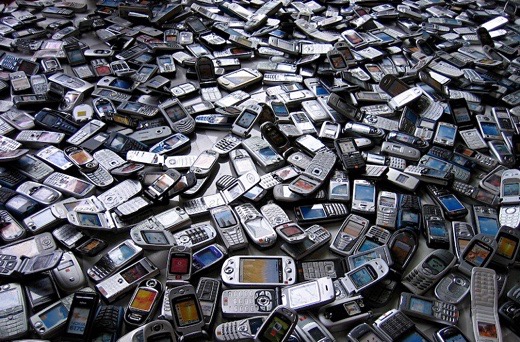
Image above: A Sea of Phones photograph. Photo by Sascha Pohflepp. From original article.

A friend of mine from India tells a story about driving an old Volkswagen beetle from California to Virginia during his first year in the United States. In a freak ice storm in Texas he skidded off the road, leaving his car with a cracked windshield and badly dented doors and fenders.

When he reached Virginia he took the car to a body shop for a repair estimate. The proprietor took one look at it and said, “it’s totaled.” My Indian friend was bewildered: “How can it be totaled? I just drove it from Texas!”

My friend’s confusion was understandable. While “totaled” sounds like a mechanical term, it’s actually an economic one: if the cost of repairs is more than the car will be worth afterwards, the only economically ‘rational’ choice is to drive it to the junkyard and buy another one.

In the ‘throwaway societies’ of the industrialized world, this is an increasingly common scenario: the cost of repairing faulty stereos, appliances, power tools, and high-tech devices often exceeds the price of buying new.

Among the long-term results are growing piles of e-waste, overflowing landfills, and the squandering of resources and energy. It’s one reason that the average American generates over 70% more solid waste today than in 1960.[1]

And e-waste – the most toxic component of household detritus – is growing almost 7 times faster than other forms of waste. Despite recycling efforts, an estimated 140 million cell phones – containing $60 million worth of precious metals and a host of toxic materials – are dumped in US landfills annually.[2]

Along with these environmental costs, there are also economic impacts. Not so long ago, most American towns had shoe repair businesses, jewelers who fixed watches and clocks, tailors who mended and altered clothes, and ‘fixit’ businesses that refurbished toasters, TVs, radios, and dozens of other household appliances.

Today, most of these businesses are gone. “It’s a dying trade,” said the owner of a New Hampshire appliance repair shop. “Lower-end appliances which you can buy for $200 to $300 are basically throwaway appliances.”[3]

The story is similar for other repair trades: in the 1940s, for example, the US was home to about 60,000 shoe repair businesses, a number that has dwindled to less than one-tenth as many today.[4]

One reason for this trend is globalization. Corporations have relocated their manufacturing operations to low-wage countries, making goods artificially cheap when sold in higher-wage countries. When those goods need to be repaired, they can’t be sent back to China or Bangladesh – they have to be fixed where wages are higher, and repairs are therefore more expensive.

My friend was confused about the status of his car because the opposite situation holds in India: labor is cheap and imported goods expensive, and no one would dream of junking a car that could be fixed.

It’s tempting to write off the decline of repair in the West as collateral damage – just another unintended cost of globalization – but the evidence suggests that it’s actually an intended consequence. To see why, it’s helpful to look at the particular needs of capital in the global growth economy – needs that led to the creation of the consumer culture just over a century ago.

When the first Model T rolled off Henry Ford’s assembly line in 1910, industrialists understood that the technique could be applied not just to cars, but to almost any manufactured good, making mass production possible on a previously unimaginable scale. The profit potential was almost limitless, but there was a catch: there was no point producing millions of items – no matter how cheaply – if there weren’t enough buyers for them.

And in the early part of the 20th century, the majority of the population – working class, rural, and diverse – had little disposable income, a wide range of tastes, and values that stressed frugality and self-reliance.

The market for manufactured goods was largely limited to the middle and upper classes, groups too small to absorb the output of full throttle mass production.

Advertising was the first means by which industry sought to scale up consumption to match the tremendous leaps in production. Although simple advertisements had been around for generations, they were hardly more sophisticated than classified ads today.

Borrowing from the insights of Freud, the new advertising focused less on the product itself than on the vanity and insecurities of potential customers. As historian Stuart Ewen points out, advertising helped to replace long-standing American values stressing thrift with new norms based on conspicuous consumption.

Advertising, now national in scope, also helped to erase regional and ethnic differences among America’s diverse local populations, thereby imposing mass tastes suited to mass production.

Through increasingly sophisticated and effective marketing techniques, Ewen says, “excessiveness replaced thrift as a social value”, and entire populations were invested with “a psychic desire to consume.” [5]

In other words, the modern consumer culture was born – not as a response to innate human greed or customer demand, but to the needs of industrial capital.

During the Great Depression, consumption failed to keep pace with production. In a vicious circle, overproduction led to idled factories, workers lost their jobs, and demand for factory output fell further. In this crisis of capitalism, not even clever advertising could stimulate consumption sufficiently to break the cycle.

In 1932, a novel solution was advanced by a real estate broker name Bernard London. His pamphlet, “Ending the Depression through Planned Obsolescence” applauded the consumerist attitudes that advertising created during the 1920s, a time when “the American people did not wait until the last possible bit of use had been extracted from every commodity.

They replaced old articles with new for reasons of fashion and up-to-dateness. They gave up old homes and old automobiles long before they were worn out.” [6]

In order to circumvent the values of thrift and frugality that had resurfaced during the Depression, London argued that the government should “chart the obsolescence of capital and consumption goods at the time of their production… After the allotted time had expired, these things would be legally ‘dead’ and would be controlled by the duly appointed governmental agency and destroyed.”[7]

The need to replace these ‘dead’ products would ensure that demand would forever remain high, and that the public – no matter how thrifty or satisfied with their material lot – would continue to consume.

London’s ideas did not catch on immediately, and the Depression eventually ended when the idle factories were converted to munitions and armaments production for World War II.

But the concept of planned obsolescence did not go away. After the War its biggest champion was industrial designer Brooks Stevens, who saw it not as a government program but as an integral feature of design and marketing.

“Unlike the European approach of the past where they tried to make the very best product and make it last forever,” he said, “the approach in America is one of making the American consumer unhappy with the product he has enjoyed the use of…, and [making him want to] obtain the newest product with the newest possible look.”[8]

Brooks’ strategy was embraced throughout the corporate world, and is still in force today. Coupled with advertising aimed at making consumers feel inadequate and insecure if they don’t have the latest products or currently fashionable clothes, the riddle of matching consumption to ever-increasing production was solved.

The constant replacement of otherwise serviceable goods for no other reason than “up-to-dateness” is most clear at the apex of the garment industry, tellingly known as the “fashion” industry. Thanks to a constant barrage of media and advertising messages, even young children fear being ostracized if they wear clothes that aren’t “cool” enough. Women in particular have been made to feel that they will be undervalued if their clothes aren’t sufficiently trendy. It’s not just advertising that transmits these messages.

One of the storylines in an episode of the 90s sit-com “Seinfeld”, for example, involves a woman who commits the faux pas of wearing the same dress on several occasions, making her the object of much canned laughter.[9]

Obsolescence has been a particularly powerful force in the high-tech world, where the limited lifespan of digital devices is more often the result of “innovation” than malfunction.

With computing power doubling every 18 months for several decades (a phenomenon so reliable it is known as Moore’s Law) digital products quickly become obsolete: as one tech writer put it, “in two years your new smartphone could be little more than a paperweight”.[10]

With marketers bombarding the public with ads claiming that this generation of smartphone is the ultimate in speed and functionality, the typical cell phone user purchases a new phone every 21 months.[11]

Needless to say, this is great for the bottom line of high-tech businesses, but terrible for the environment.

Innovation may be the primary means by which high-tech goods are made obsolete, but manufacturers are not above using other methods. Apple, for example, intentionally makes its products difficult to repair except by Apple itself, in part by refusing to provide repair information about its products. Since the cost of in-house repair often approaches the cost of a new product, Apple is assured of a healthy stream of revenue no matter what the customer decides to do.

Apple has gone even further. In a class-action lawsuit against the company, it was revealed that the company’s iPhone 6 devices were programmed to cease functioning – known as being “bricked” – when users have them repaired at unauthorized (and less expensive) repair shops. “They never disclosed that your phone could be bricked after basic repairs,” said a lawyer for the complainants.

“Apple was going to … force all its consumers to buy new products simply because they went to a repair shop.”[12]

In response to this corporate skulduggery, a number of states have tried to pass “fair repair” laws that would help independent repair shops get the parts and diagnostic tools they need, as well as schematics of how the devices are put together.

One such law has already been passed in Massachusetts to facilitate independent car repair, and farmers in Nebraska are working to pass a similar law for farm equipment.

But except for the Massachusetts law, heavy lobbying from manufacturers – from Apple and IBM to farm equipment giant John Deere – has so far stymied the passage of right-to-repair laws.[13]

From the grassroots, another response has been the rise of non-profit “repair cafés”. The first was organized in Amsterdam in 2009, and today there are more than 1,300 worldwide, each with tools and materials to help people repair clothes, furniture, electrical appliances, bicycles, crockery, toys, and more – along with skilled volunteers who can provide help if needed.[14]

These local initiatives not only strengthen the values of thrift and self-reliance intentionally eroded by consumerism, they help connect people to their community, scale back the use of scarce resources and energy, and reduce the amount of toxic materials dumped in landfills.

At a more systemic level, there’s an urgent need to rein in corporate power by re-regulating trade and finance. Deregulatory ‘free trade’ treaties have given corporations the ability to locate their operations anywhere in the world, contributing to the skewed pricing that makes it cheaper to buy new products than to repair older ones.

These treaties also make it easier for corporations to penetrate not just the economies of the global South, but the psyches of their populations – helping to turn billions of more self-reliant people into insecure consumers greedy for the standardized, mass-produced goods of corporate industry.

The spread of the consumer culture may help global capital meet its need for endless growth, but it will surely destroy the biosphere: our planet cannot possibly sustain 7 billion people consuming at the insane rate we do in the ‘developed’ world – and yet that goal is implicit in the logic of the global economy.

We also need to oppose – with words and deeds – the forces of consumerism in our own communities. The global consumer culture is not only the engine of climate change, species die-off, ocean dead zones, and many other assaults on the biosphere, it ultimately fails to meet real human needs.

The price of the consumer culture is not measured in the cheap commodities that fill our homes and then, all too soon, the nearest landfill.  Its real cost is measured in eating disorders, an epidemic of depression, heightened social conflict, and rising rates of addiction – not just to opioids, but to ‘shopping’, video games, and the internet.

It’s time to envision – and take steps to create – an economy that doesn’t destroy people and the planet just to satisfy the growth imperatives of global capital.

REFEENCES:

[1] EPA Report on the Environment, Municipal Solid Waste, https://cfpub.epa.gov/roe/indicator_pdf.cfm?i=53; Center for Sustainable Systems, “Municipal Solid Waste Factsheet,” http://css.snre.umich.edu/factsheets/municipal-solid-waste-factsheet

[2] National Public Radio, “The Continent that Contributes the Most to E-Waste is…”, January 26, 2017. http://www.npr.org/sections/goatsandsoda/2017/01/26/511612133/the-continent-that-contributes-the-most-to-e-waste-is

[3] “Irreparable Damage”, Washington Times, Jan 9, 2007. http://www.washingtontimes.com/news/2007/jan/9/20070109-121637-4917r/

[4] Morris, Natalie, “Fewer shoe repair shops mean business for those remaining”, Wall Street Journal, March 5, 2012. http://www.sj-r.com/x1644228326/; “Shoe Repair in the US: Market Research Report”, IBIS World, Apr 2017, https://www.ibisworld.com/industry-trends/market-research-reports/other-services-except-public-administration/repair-maintenance/shoe-repair.html

[5] Ewen, Stuart, Captains of Consciousness: Advertising and the Social Roots of the Consumer Culture (New York: McGraw-Hill, 1976).

[6] London, Bernard, 1932, “Ending the Depression Through Planned Obsolescence”. https://upload.wikimedia.org/wikipedia/commons/2/27/London_(1932)_Ending_the_depression_through_planned_obsolescence.pdf

[7] Ibid.

[8]  Pyramids of Waste: The Light Bulb Conspiracy, 2010, a documentary film by Cosima Dannoritzer. Viewed at FilmsforAction.org. http://www.filmsforaction.org/watch/pyramids-of-waste-2010/

[9] Seinfeld, “The Seven”, episode 13, season seven. Aired February 1, 1996.

[10] Walton, Andy, “Life Expectancy of a Smartphone”, Houston Chronicle, http://smallbusiness.chron.com/life-expectancy-smartphone-62979.html

[11] ibid.

[12] Beres, Damon, and Andy Campbell, “Apple is Fighting a Secret War to Keep You from Repairing Your Phone”, Huffington Post, June 9, 2016. http://www.huffingtonpost.com/entry/apple-right-to-repair_us_5755a6b4e4b0ed593f14fdea

[13] Solon, Olivia, “A Right to Repair: Why Nebraska Farmers are Taking on John Deere and Apple”, The Guardian, March 6, 2017, https://www.theguardian.com/environment/2017/mar/06/nebraska-farmers-right-to-repair-john-deere-apple. Beres, Damon, “Big Tech Squashes New York’s ‘Right to Repair’ Bill”, Huffington Post, June 17, 2016. http://www.huffingtonpost.com/entry/apple-right-to-repair_us_5755a6b4e4b0ed593f14fdea

[14] https://repaircafe.org/en/about/

See also:
Ea O Ka Aina: EU Stand Against Crapification 7/6/17
.

The missing ocean plastic

SUBHEAD: Newly-evolved microbes may be breaking down ocean plastics more than we know.

By Michael LePage on 25 May 2017 for new Scientist -
(https://www.newscientist.com/article/2132650-newly-evolved-microbes-may-be-breaking-down-ocean-plastics/)


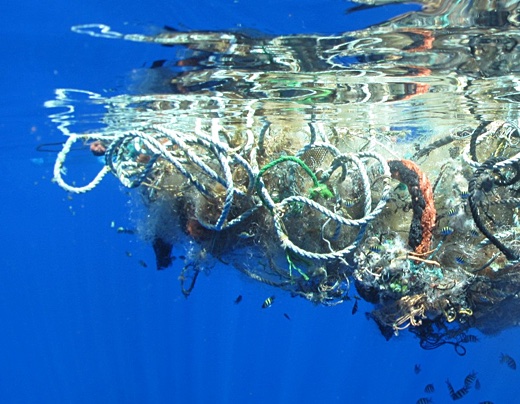
Image above: Plastic simply continues to evolve into new ecosystems. From (http://www.techtimes.com/articles/9538/20140702/plastic-debris-covers-88-percent-of-worlds-oceans-much-lower-than-expected-say-scientists.htm).

Plastic. There should be hundreds of thousands of tonnes of the stuff floating around in our oceans. But we are finding less than expected – perhaps because living organisms are evolving the ability to break it down.

Plastic production is rising exponentially, so ever more of it should be ending up in the oceans, says Ricard Sole, who studies complex systems at the Universitat Pompeu Fabra in Barcelona.

.
But surveys of areas where floating plastic accumulates, such as the North Atlantic gyre, are not finding nearly as much plastic as expected.

Mystery of the missing plastics

In fact, there’s only a tenth to a hundredth as much plastic as expected – and the amount of floating plastic does not appear to be increasing. “The trend should be there,” Sole says.

This lack of trend cannot be explained by physical processes, according to his team’s mathematical models. Instead, they propose that there has been a population boom in microbes that have evolved the ability to biodegrade plastic.

Other researchers agree that surveys are finding far less plastic in the oceans than expected. However, they say there are several other possible explanations for this “missing plastic”.

Surprisingly, even if ocean plastic is being degraded much faster than thought, it is not clear that this is a good thing. “It is difficult to say,” says Matthew Cole of Exeter University in the UK.

For instance, biodegradation could be speeding up the breakdown of large pieces of plastic into lots of very tiny pieces, which might have a greater overall impact.

Plastic also contains various additives that could get released and enter the food chain if the plastic part biodegrades, says environmental chemist Alexandra Ter Halle of the Laboratoire des IMRCP in France.

“To really tackle the plastic problem, we need to stop it getting into the oceans in the first place,” Cole says.

The ‘platisphere’

In theory it is possible that some microbes have evolved the ability to break down plastics. Studies by Linda Amaral-Zettler of the Netherlands Institute for Sea Research show that the microbes colonizing floating plastic are quite distinct from those in the surrounding water, and suggest some are feeding on pollutants.

In effect, the plastic is creating a whole new ecosystem that Amaral-Zettler and colleagues call “the plastisphere”.

But when Ter Halle looked at the DNA of the organisms on floating plastic in the North Atlantic, she didn’t find any microbes known to be capable of breaking down plastic. That could be because they have not yet been discovered of course – there could be millions of unknown microbes still.

Amaral-Zettler and Ter Halle think it is more likely that floating plastic is simply sinking to the seafloor as colonising organisms weigh it down, or breaking into such microscopic pieces that it is not being caught in the nets of research vessels. It could also be being swallowed by living organisms, or carried by currents to unexpected parts of the ocean.

The sinking explanation might also be compatible with his findings, says Sole. His study does not prove that microbes are metabolising plastic, but the lack of an upward trend can only be explained by a biological response that can increase in proportion to the amount of plastic.

If a physical process was responsible, there would still be an upward trend, he says.

It is possible that some plastic is being biodegraded, Amaral-Zettler says, but it could be over too long time-scale – a hundred years, say – to explain the missing plastic. And even if it is happening much faster, there would still be a problem.

Plastics are polluting every part of the ocean, from the beaches of remote islands to the deepest parts of the sea. Large pieces of plastic can accumulate in the stomach of animals such as turtles, which then starve to death.

While there may be less than expected, large amounts of floating plastic are found in the subtropical gyres where surface waters circle.

While terms such as the “Great Pacific Garbage Patch” conjure up visions of litter-covered seas, much of the floating plastic in the ocean consists of tiny pieces just a few millimetres wide or smaller, which are not obvious to the naked eye at all. Its impact on marine life is not clear, either.

Various schemes have been proposed to remove this plastic from the oceans, but trying to clean up the oceans is impractical, says Amaral-Zettler. “We need to look at prevention and reduction at the start.”

Journal reference: Biorxiv, DOI: 10.1101/135582

.

Nuke waste with nowhere to go

SOURCE: Katherine Muzik PHD (kmuzik@gmail.com)
SUBHEAD: Nevada says "Not in My Back Yard" on Trump revival of Yucca Mountain nuclear waste dump.

By Julia Travers on 23 April 2017 for Truth Out -
(http://www.truth-out.org/news/item/40278-nevada-says-not-in-my-back-yard-on-trump-revival-of-yucca-mountain-nuclear-waste-dump)


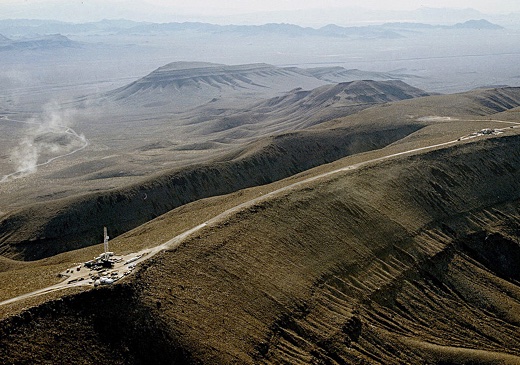
Image above: Aerial view of rdge line of the geological formation in Yucca Mountain proposed as site for America's nuclear waste storage. There is no current operational site in the country since the WIPP facility experienced a meltdown in 2014 that produced a plume of plutonium waste over New Mexico, Texas and Oklahoma. From  (http://www.hcn.org/articles/is-yucca-mountain-back-on-the-table).

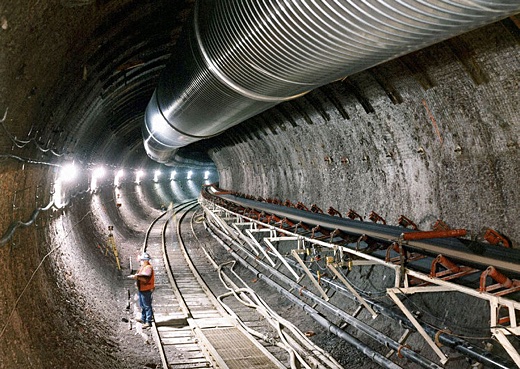
The underground Exploratory Studies Facility at Yucca Mountain in Nevada built by the Department of Energy to determine whether the location was suitable as a deep geological nuclear waste repository. Courtesy of the Department of Energy.

President Trump's preliminary 2018 budget proposal was released in March and along with many cuts to environmental programs, it includes $120 million to restart licensing operations for the Yucca Mountain Nuclear Waste Repository (Yucca Mountain).

This currently unused underground facility in Nevada has been in contention since the 80s and was strongly opposed during the Obama Administration by both the President and then Senate Minority Leader Harry Reid (D-NV). While Reid pronounced Yucca Mountain dead in 2016, the new administration has big plans for the abandoned project.

Yucca Mountain consists of a five-mile-long tunnel that was drilled 1,000 feet deep in 1994, into a volcanic structure located 100 miles from Las Vegas.

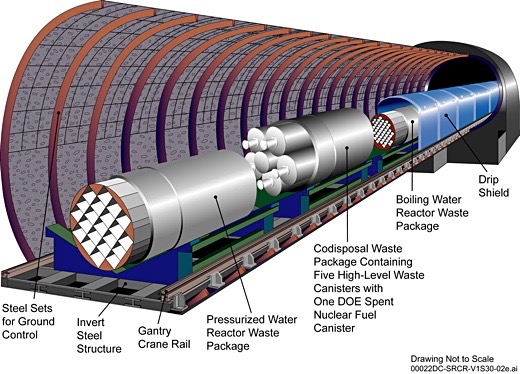
Theoretically, nuclear waste would be stored inside rooms along the tunnel -- the idea being to isolate it from the surrounding environment for hundreds of thousands of years with the use of titanium shielding.

Nevada officials have put up strong resistance to the nuclear storage facility, dating back to its inception in 1987. The state has filed over 200 contentions against the application, encompassing a wide range of issues from legal concerns to volcanic hazard estimates, corrosion and toxic contamination risks.

In 1982, President Reagan signed the Nuclear Waste Policy Act, which called for the establishment of nuclear waste disposal dumps.

The Department of Energy (DOE) was tasked with carrying out site assessments but, according to The Atlantic, "politicians didn't want to pay for the expensive and lengthy technical assessments of all the potential sites," and amended the Act to designate Nevada's Yucca Mountain as the one permanent storage location in 1987.

The initial goal was to keep the waste contained at Yucca Mountain for at least 10,000 years.

"Yucca Mountain was never a scientific selection, it was a political one," nuclear industry expert and former nuclear engineer, executive and whistleblower Arnold "Arnie" Gundersen told EnviroNews.

"When the Yucca Mountain bill was passed, it was called the 'Screw Nevada Bill.'

To revive Yucca is to ignore science. We have a nuclear waste problem that needs to be -- in fact must be solved, and if done wrong can contaminate the environment for 250,000 years. Let's have a scientific process that leads us to the best alternative, not a political mandate," Gundersen continued.

In 1997, the US Government began heating and burying metal containers in the rocks at Yucca Mountain in an effort to simulate and study radioactive waste. Gundersen stated Yucca Mountain has been proven to have an underground water and waste seepage issue.

Examples of studies of the rates of seepage at Yucca Mountain and how they are affected by temperature, time, geology and precipitation can be found on the US Department of the Interior and Lawrence Berkeley National Laboratory websites.

The State of Nevada's Nuclear Waste Project Office states because Yucca Mountain is "geologically and hydrologically active and complex," it is unsafe for the disposal of radioactive substances, which "could leak from the dump and create serious long-term health risks to the citizens of Nevada."

In 2004, the Federal Court of Appeals in Washington, D.C. ruled the DOE would have to prove it could keep the waste contained for hundreds of thousands of years, not tens of thousands, as originally proposed.

In 2008, the DOE submitted a license application to the US Nuclear Regulatory Commission (NRC) to store high-level waste at Yucca Mountain. But in 2010, the DOE shut down the Office of Civilian Radioactive Waste Management, which had run Yucca Mountain, effectively shelving the project.

In 2014, the NRC ruled Yucca Mountain could safely assure the isolation of nuclear materials over the long-term and was safe to use. Trump now proposes to supply an initial $120 million to restart the licensing process for Yucca Mountain.

The LA Times reports the full establishment of the Yucca Mountain facility has an estimated total cost of $100 billion, rivaling the price tag of the International Space Station.

Much of this lofty budget is attributed to the potential construction of hundreds of miles of railroad tracks to carry the waste from all over the country, protective titanium shields and specialized underground robots that can handle the waste.

"Republican, Democrat, independent -- there is enormous opposition to Yucca Mountain," Robert Halstead, Executive Director of Nevada's Agency for Nuclear Projects, told The Atlantic. The state is currently preparing a new slew of contentions to the project.

"The first thing we're going to do is go back to court and sue them over the radiation protection standard," he added. The article explains that critics of this facility worry the groundwater could corrode storage containers and cause a radioactive leak.


Image above: Diagram of Yucca Mountain tunnel with possible radioactive waste in tunnel on site. From (http://ethangreenapes.weebly.com/yucca-mountain.html).

In late March, DOE Secretary Rick Perry visited Yucca Mountain and met with Nevada's Republican Governor, Brian Sandoval. According to CNBC, Sandoval said, "The storage of high-level waste at Yucca Mountain is not something I am willing to consider."

In a DOE statement, Perry acknowledged Sandoval's opposition and also said, "today's meeting with Gov. Sandoval was the first step in a process that will involve talking with many federal, state, local and commercial stakeholders."

Nevada officials who oppose Yucca Mountain cite concerns over radioactive spills or leaks and the toll that could take on Las Vegas' tourism industry (not to mention public and environmental health). E&E News points out the possible impact on the tourism industry brings up a potential concern and conflict of interest for Trump, who co-owns Trump International Hotel Las Vegas with billionaire businessman Phil Ruffin.

"Clearly if there was a nuclear accident, Trump's hotel would be impacted, as would others along the Strip," said former Sen. Richard Bryan (D-NV), who is now Chairman of the state's Commission on Nuclear Projects.

In contrast, local officials in Nye County, where the facility would be located, are more supportive of Yucca Mountain as a jobs-creator. Dan Schinhofen, Chairman of the county's Board of Commissioners, wrote to Republican Rep. John Shimkus of Illinois, a supporter of Yucca Mountain, and characterized the threats to Trump's hotel as "misinformation."

Schinhofen also says Nye County hopes to be considered for an interim storage facility site as well, saying they already have a 1,280-acre location in mind. Developing an interim-storage facility while Yucca Mountain is prepared is another ongoing debated issue.

The DOE explains there are 61 commercially operating nuclear power plants with 99 nuclear reactors in the US, with four more reactors currently being constructed. Current nuclear utilities have 79,000 metric tons of spent fuel in reserve and produce 2,000 more annually, the LA Times reports.

The LA Times also explained the nation's nuclear utilities have long been paying fees for waste storage services that the DOE has not provided. That fund now totals about $36 billion.

Nuclear utilities have won $6.1 billion in settlements to date regarding this failure on behalf of the DOE.

Shimkus states, "Without Yucca Mountain, DOE will not be able to meet its disposal commitments to Colorado, Idaho, New York, South Carolina, Tennessee and Washington." Yucca Mountain's current legal waste limit is 70,000 tons.

At present, nuclear waste is most commonly stored in tanks, casks, drums and water-cooled pools. Many facilities and containers in use are not designed for long-term storage. For example, the Hanford site in Washington is well-known for its toxic leaking tanks, the cleanup of which is expected to take another 50 years and cost $110 billion. In 2014, a drum of radioactive waste exploded at the Waste Isolation Pilot Plant (WIPP) in New Mexico, which serves as a dump for waste from nuclear weapons production.

The LA Times shared in 2016, "Thousands of tons of radioactive waste that were headed for [WIPP] are backed up in Idaho, Washington, New Mexico and elsewhere," including at the Hanford site.

Cooling pools are not an ideal solution either. In 2011 an earthquake in Japan knocked out power to the cooling pumps at the Fukushima Daiichi power station, which resulted in meltdowns in three nuclear reactors. The environmental effects are far reaching and still evolving today.

Dealing with nuclear waste is a mounting concern and while there have been some isolated useful applications and solutions found, many of them are not viable over the long term or intended for extensive deployment. For example, in 2016, British scientists turned nuclear waste into long-lasting nuclear diamond batteries for potential use in space travel, but this option is costly and not scalable.

Gundersen explained that vitrification, another possibility that has been explored, is "a process that adds chemicals to the waste, which is then heated into a glass like substance." But, he says it shows "no evidence that 100 years from now the material will not break down and leak into groundwater anyway!"

In 2001, the National Academy of Sciences National Research Council wrote in Disposition of High-Level Waste and Spent Nuclear Fuel, "After four decades of study, geological disposal remains the only scientifically and technically credible long-term solution available."

"Deep geologic disposal is the only alternative, in an area proven to be free of water," concludes Gundersen. "Yucca has water seeping in, and has been proven to let waste seep out in a short period of time."


Image above: The underground Exploratory Studies Facility at Yucca Mountain in Nevada built by the Department of Energy to determine whether the location was suitable as a deep geological nuclear waste repository. Courtesy of the Department of Energy. From (https://commons.wikimedia.org/wiki/File:Yucca_Mountain_tunnel.jpg).

• Julia Travers is a journalist and author. She holds a BA in Literary and Cultural Studies from The College of William and Mary and a BFA in Art Education from Virginia Commonwealth University.

See also:
Ea O Ka Aina: Nuclear Power Zombies 5/12/16
Ea O Ka Aina: Nuclear Wasteland 8/6/15
Ea O Ka Aina: Molten Salt Nuclear Reactors 9/25/14
Ea O Ka Aina: Worse than you think 5/21/14
Ea O Ka Aina: The false science of science 9/2/14
Ea O Ka Aina: Ginger Beer Recipe 3/24/14
Ea O Ka Aina: WIPP radiation release timeline 3/3/14
.

Nuclear Power Zombies

SUBHEAD: Three Mile Island, Chernobyl, San Onofre, Fukushima, WIPP and Hanford should have taught us nuclear power is not an option.

By Juan Wilson on 12 May 2016 for Island Breath -
(http://islandbreath.blogspot.com/2016/05/nuclear-power-zombies.html)


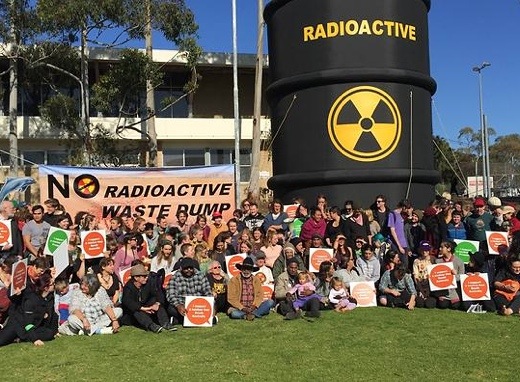
Image above: South Australian demonstrators make their opinion known concerning making them the nuclear waste dump for the world. From (http://www.sbs.com.au/news/article/2016/02/15/sa-nuclear-waste-dump-proposal-contested-green-groups).

Publicity web searchbots scour the internet for places they think likely to take their promotional material.  Occasionally the stumble upon IslandBreath.org and into unintended consequences. Because we have had nuclear power as the (critical) subject of several articles we occasionally get automated email puff pieces from the propaganda agents of the nuclear industry.

A couple of days ago I got such a submission from David Hesse.  His email address is press@world-nuclear.org. The subject of his email was, "Royal Commission’s conclusions create middle-ground in the nuclear waste discourse".

It turns out that the "middle-ground" is sacrificing the continent of Australia to be the world's nuclear waste storage facility. It is conveniently isolated and located in the southern hemisphere far from most of the world's heaviest consumer population.

Now that the business of Australia supplying coal and other raw material to China for heavily polluting climate changing industry has gone belly up we might as well as use Australia for a higher purpose - being a radioactive toilet for the ever humming industrial north. Of course, any fearful Australians that wished to escape the harm they might face could be relocated to Africa or South America.

Here's is David Hesse's email message.
World Nuclear Association Press Release. Issue Date: 09 May 2016

The report of the South Australia Nuclear Fuel Cycle Royal Commission, made public today, has fundamentally changed the nature of the global nuclear waste discourse.

Agneta Rising, Director General of the World Nuclear Association remarked, “If constructed, a multi-national waste facility based in South Australia would grant a welcome option for countries operating nuclear facilities today. Far from it being the case that there is ‘no solution’ to nuclear waste, we are seeing lots of progress – with some countries developing national repositories and now the potential addition of this viable alternative” 

The Commission has concluded “that the disposal of used fuel and intermediate level waste (ILW) could be undertaken safely in a permanent geological disposal facility in South Australia. This would have the potential to deliver significant inter-generational economic benefits to the community.” It has recommended that the South Australian Government pursues this opportunity.

A large multi-national waste storage facility would be a world first and should offer advantages in terms of siting and economics when compared to smaller national approaches. There are significant benefits on offer to South Australia for hosting such a facility, which must now work on building robust public and political support if the plan is to proceed.

Regarding the future deployment of nuclear power plants in the state, the Commission has, in short, recommended that the Australian government discard its long-standing anti-nuclear policies. While the Commission noted that nuclear power plants are not viable in South Australia under current market rules, it recommended “the South Australian Government pursue removal at the federal level of existing prohibitions on nuclear power generation…” and further, “that the South Australian Government promote and collaborate on the development of a comprehensive national energy policy that enables all technologies, including nuclear, to contribute to a reliable, low-carbon electricity network at the lowest possible system cost.”

The report marks the end of a comprehensive review of the available opportunities in the fuel cycle. The process lasted for over a year and the Commission consulted extensively before proceeding onto site visits and interviewing experts on topics such as radioactive wastes, reactor technology, etc. There has been a sustained commitment to transparency throughout the process, with responses and interview recordings made publicly available via the Commission’s website.

Rising commented, “Other governments, both inside and outside of Australia, which are considering introducing nuclear energy could really benefit from the wealth of high quality information that has been collected through the rigorous South Australian Royal Commission process.”
Thank you David for demonstrating that there is a way for all to keep our Nissan Leafs fully charged and the Amazon drones in the air and delivering plastic electronic consumer items to our doorsteps. 

See also:
Ea O Ka Aina: Fukushima radiation damages Japan 4/14/16
Ea O Ka Aina: Indian Point Nuclear Accident 3/5/16
Ea O Ka Aina: Big Fat Radioactive Lie 12/6/15
Ea O Ka Aina: San Onofre left radioactive debris 9/30/15
Ea O Ka Aina: Nuclear is not alternative energy 8/7/15
Ea O Ka Aina: Fukushima - the end of atomic power 3/13/15
Ea O Ka Aina: Molten Salt Nuclear Reactors 9/25/14
Ea O Ka Aina: The false science of science 9/2/14
Ea O Ka Aina: Nuclear Wasteland 8/6/14
Ea O Ka Aina: WIPP Worse than you think 5/21/14
Ea O Ka Aina: Fukushima - What me worry? 11/29/13
Ea O Ka Aina: Nuclear Power on the Run 8/18/13
Ea O Ka Aina: Five reactors shutdown by Sandy 10/30/12
Ea O Ka Aina: Ten Chernobyls enter Pacific 5/27/11
.

Hanamaulu Landfill Siting

SUBHEAD: Meeting on on Maalo Road landfill siting this Tuesday 6:00pm at King K Elementary.

By Nina Monasevitch on 4 February 2013 in Island Breath.
(http://islandbreath.blogspot.com/2013/02/hanamaulu-landfill-siting.html)


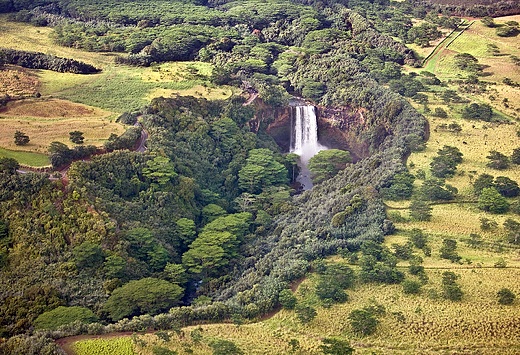
Image above: Aerial view of Wailua Falls at the end of Maalo Road. From (http://www.flickr.com/photos/ironrodart/3617887042/).

WHAT:
 Public county meeting on Hanamaulu landfill siting on Maalo Road in Hanamaulu

WHEN:
 Tuesday, February 5th at 6:00pm

WHERE:
King Kaumuali'i Elementary School
Hanamaulu, Kauai (off Kuhio Highway)

The county has chosen Ma'alo for the new landfill and Resource Recovery Park (RRP) http://www.kauai.gov/newlandfillsite/

We all need to show up at meeting this Tuesday, February 5th, 6:00pm at King Kaumuali'i Elementary School and say NO to this site!

Is the Ma’alo site for the next landfill a bad choice?

The Hawaiian word for water is wai. The Hawaiian word for wealth is waiwai. Unless we are mistaken, this roughly translates to mean that fresh water is the most precious resource. It is written that the people of old had Kapu, sacred with the implication of forbidden, on certain activities upstream. In this way, clean wai was available for farming, making medicines and drinking.

How could a rational person, with a Hawaiian heart and a scientific mind think of locating a landfill upstream in the vicinity of surface drinking water? Where is the wisdom in that?

What are the implications that the state is holding the land that was ceded by Queen Kamalu?

What will be the cost to future county engineers to bring fresh water to the people of Hanama’ulu, Kapaia, Lihu’e and lower Wailua?

How many years and how many big rains until the surface water is polluted? How many generations until the ground water is poisoned?

What will be the agricultural costs? It is said that the area proposed is arguably the best farmland in the ahupua’a, land division. How much food, for how many generations could be grown on that 160 acres? How many jobs and for how many generations could work that land? If there is a landfill, how soon will the land and the water be poisoned?

Strangely, in studying the location site map that the county prepared in the power point presentation, available online, the reservoirs are not shown.

Does this implicate the county engineers in condoning a site they know will pollute the surface water supply in the short term, and the ground water in the long term?

Does this put the county and the future taxpayer at risk of a major class action lawsuit for polluting the fresh water of future generations? Will the environmental assessment (EA) answer any of these questions? Will any journalists?

Primary concerns:
  • Contamination of fresh water supply.
  • Streamflow needs to be increased already for watershed restoration.
  • Ruin of the Hanamaulu Watershed. Total watershed Rating was 4 in 2008 Not good but potentially salvageable.
  • What will it be with land fill and horizontal well?
  • Loss of viable, rich agricultural land.
Secondary Concerns:
  • Traffic flow, sole artery Maalo Road.
  • Environmental Justice issue, mitigation due to minority and income make up of Hanamaulu area.
  • Kapaia Valley residents are not presently included in the mitigation conversation even though Hanamaulu River runs through front yard.
There are 8 other proposed sites. The County needs to pursue the others.

[IB Editor's note: Maalo Road is the only way to get to one of the premier visitor destinations on Lauai -Wailua Falls. These dramatic 80-foot waterfalls can be seen from the end Maalo Road and were used in the opening of the television series Fantasy Island. The cliff over the pool once served as a diving platform for the ali`i. After the landfill is sited on Maalo Road all tourists and Kauaians will have to vie with refuge trucks, broken open garbage bags and blowing paper debris to get to the falls.]
.

Poisoning the well

SUBHEAD: How the Feds let industry pollute the nation’s underground water supply pumping waste underground.

By Abraham Lustgarten on 11 December 2012 for Pro Publica -
(http://www.propublica.org/article/poisoning-the-well-how-the-feds-let-industry-pollute-the-nations-undergroun/single)


Image above: A view of the dry bed of the E.V. Spence Reservoir in Robert Lee, Texas, in October 2011. Records show that environmental officials have granted more than 50 aquifer exemptions for waste disposal and uranium mining in the drought-stricken stat. From original article. 

Federal officials have given energy and mining companies permission to pollute aquifers in more than 1,500 places across the country, releasing toxic material into underground reservoirs that help supply more than half of the nation's drinking water.

In many cases, the Environmental Protection Agency has granted these so-called aquifer exemptions in Western states now stricken by drought and increasingly desperate for water.


EPA records show that portions of at least 100 drinking water aquifers have been written off because exemptions have allowed them to be used as dumping grounds.

"You are sacrificing these aquifers," said Mark Williams, a hydrologist at the University of Colorado and a member of a National Science Foundation team studying the effects of energy development on the environment. "By definition, you are putting pollution into them. ... If you are looking 50 to 100 years down the road, this is not a good way to go."

As part of an investigation into the threat to water supplies from underground injection of waste, ProPublica set out to identify which aquifers have been polluted.

We found the EPA has not even kept track of exactly how many exemptions it has issued, where they are, or whom they might affect.

What records the agency was able to supply under the Freedom of Information Act show that exemptions are often issued in apparent conflict with the EPA's mandate to protect waters that may be used for drinking.

Though hundreds of exemptions are for lower-quality water of questionable use, many allow grantees to contaminate water so pure it would barely need filtration, or that is treatable using modern technology.

The EPA is only supposed to issue exemptions if aquifers are too remote, too dirty, or too deep to supply affordable drinking water. Applicants must persuade the government that the water is not being used as drinking water and that it never will be.

Sometimes, however, the agency has issued permits for portions of reservoirs that are in use, assuming contaminants will stay within the finite area exempted.

In Wyoming, people are drawing on the same water source for drinking, irrigation and livestock that, about a mile away, is being fouled with federal permission. In Texas, EPA officials are evaluating an exemption for a uranium mine — already approved by the state — even though numerous homes draw water from just outside the underground boundaries outlined in the mining company's application.

The EPA declined repeated requests for interviews for this story, but sent a written response saying exemptions have been issued responsibly, under a process that ensures contaminants remain confined.

"Aquifer Exemptions identify those waters that do not currently serve as a source of drinking water and will not serve as a source of drinking water in the future and, thus, do not need to be protected," an EPA spokesperson wrote in an email statement. "The process of exempting aquifers includes steps that minimize the possibility that future drinking water supplies are endangered."

Yet EPA officials say the agency has quietly assembled an unofficial internal task force to re-evaluate its aquifer exemption policies. The agency's spokesperson declined to give details on the group's work, but insiders say it is attempting to inventory exemptions and to determine whether aquifers should go unprotected in the future, with the value of water rising along with demand for exemptions closer to areas where people live.

Advances in geological sciences have deepened regulators' concerns about exemptions, challenging the notion that waste injected underground will stay inside the tightly drawn boundaries of the exempted areas.

"What they don't often consider is whether that waste will flow outside that zone of influence over time, and there is no doubt that it will," said Mike Wireman, a senior hydrologist with the EPA who has worked with the World Bank on global water supply issues. "Over decades, that water could discharge into a stream. It could seep into a well. If you are a rancher out there and you want to put a well in, it's difficult to find out if there is an exempted aquifer underneath your property."

Aquifer exemptions are a little-known aspect of the government's Underground Injection Control program, which is designed to protect water supplies from the underground disposal of waste.

The Safe Drinking Water Act explicitly prohibits injection into a source of drinking water, and requires precautions to ensure that oil and gas and disposal wells that run through them are carefully engineered not to leak.

Areas covered by exemptions are stripped of some of these protections, however. Waste can be discarded into them freely, and wells that run through them need not meet all standards used to prevent pollution. In many cases, no water monitoring or long-term study is required.

The recent surge in domestic drilling and rush for uranium has brought a spike in exemption applications, as well as political pressure not to block or delay them, EPA officials told ProPublica.

"The energy policy in the U.S is keeping this from happening because right now nobody — nobody — wants to interfere with the development of oil and gas or uranium," said a senior EPA employee who declined to be identified because of the sensitivity of the subject. "The political pressure is huge not to slow that down."

Many of the exemption permits, records show, have been issued in regions where water is needed most and where intense political debates are underway to decide how to fairly allocate limited water resources.

In drought-stricken Texas, communities are looking to treat brackish aquifers beneath the surface because they have run out of better options and several cities, including San Antonio and El Paso, are considering whether to build new desalinization plants for as much as $100 million apiece.

And yet environmental officials have granted more than 50 exemptions for waste disposal and uranium mining in Texas, records show. The most recent was issued in September.

The Texas Railroad Commission, the state agency that regulates oil and gas drilling, said it issued additional exemptions, covering large swaths of aquifers underlying the state, when it brought its rules into compliance with the federal Safe Drinking Water Act in 1982. This was in large part because officials viewed them as oil reservoirs and thought they were already contaminated. But it is unclear where, and how extensive, those exemptions are.

EPA "Region VI received a road map — yes, the kind they used to give free at gas stations — with the aquifers delineated, with no detail on depth," said Mario Salazar, a former EPA project engineer who worked with the underground injection program for 25 years and oversaw the approval of Texas' program, in an email.

In California, where nearly half of the nation's fruits and vegetables are grown with water from as far away as the Colorado River, the perennially cash-strapped state's governor is proposing to spend $14 billion to divert more of the Sacramento River from the north to the south. Near Bakersfield, a private project is underway to build a water bank, essentially an artificial aquifer.

Still, more than 100 exemptions for natural aquifers have been granted in California, some to dispose of drilling and fracking waste in the state's driest parts. Though most date back to the 1980s, the most recent exemption was approved in 2009 in Kern County, an agricultural heartland that is the epicenter of some of the state's most volatile rivalries over water.

The balance is even more delicate in Colorado. Growth in the Denver metro area has been stubbornly restrained not by available land, but by the limits of aquifers that have been drawn down by as much as 300 vertical feet. Much of Eastern Colorado's water has long been piped underneath the Continental Divide and, until recently, the region was mulling a $3 billion plan to build a pipeline to bring water hundreds of miles from western Wyoming.

Along with Wyoming, Montana and Utah, however, Colorado has sacrificed more of its aquifer resources than any other part of the country.

More than 1,100 aquifer exemptions have been approved by the EPA's Rocky Mountain regional office, according to a list the agency provided to ProPublica. Many of them are relatively shallow and some are in the same geologic formations containing aquifers relied on by Denver metro residents, though the boundaries are several hundred miles away. More than a dozen exemptions are in waters that might not even need to be treated in order to drink.

"It's short-sighted," said Tom Curtis, the deputy executive director of the American Water Works Association, an international non-governmental drinking water organization. "It's something that future generations may question."

To the resource industries, aquifer exemptions are essential. Oil and gas drilling waste has to go somewhere and in certain parts of the country, there are few alternatives to injecting it into porous rock that also contains water, drilling companies say. In many places, the same layers of rock that contain oil or gas also contain water, and that water is likely to already contain pollutants such as benzene from the natural hydrocarbons within it.

Similarly, the uranium mining industry works by prompting chemical reactions that separate out minerals within the aquifers themselves; the mining can't happen without the pollution.

When regulations governing waste injection were written in the 1980s to protect underground water reserves, industry sought the exemptions as a compromise. The intent was to acknowledge that many deep waters might not be worth protecting even though they technically met the definition of drinking water.

"The concept of aquifer exemptions was something that we 'invented' to address comments when the regulations were first proposed," Salazar, the former EPA official, said. "There was never the intention to exempt aquifers just because they could contain, or would obviate, the development of a resource. Water was the resource that would be protected above all."

Since then, however, approving exemptions has become the norm. In an email, the EPA said that some exemption applications had been denied, but provided no details about how many or which ones. State regulators in Texas and Wyoming could not recall a single application that had been turned down and industry representatives said they had come to expect swift approval.

"Historically they have been fairly routinely granting aquifer exemptions," said Richard Clement, the chief executive of Powertech Uranium, which is currently seeking permits for new mining in South Dakota. "There has never been a case that I'm aware of that it has not been done."

Aquifer Exemptions Granted
The aquifer exemptions approved by the EPA each year are according to a partial list of approvals provided to ProPublica by the agency in response to a FOIA request. 

In 1981, shortly after the first exemption rules were set, the EPA lowered the bar for exemptions as part of settling a lawsuit filed by the American Petroleum Institute. Since then, the agency has issued permits for water not "reasonably expected" to be used for drinking. The original language allowed exemptions only for water that could never be used.

Oil companies have been the biggest users of aquifer exemptions by far. Most are held by smaller, independent companies, but Chevron, America's second-largest oil company, holds at least 28 aquifer exemptions. Exxon holds at least 14. In Wyoming, the Canadian oil giant EnCana, currently embroiled in an investigation of water contamination related to fracking in the town of Pavillion, has been allowed to inject into aquifers at 38 sites.

Once an exemption is issued, it's all but permanent; none have ever been reversed. Permits dictate how much material companies can inject and where, but impose little or no obligations to protect the surrounding water if it has been exempted. The EPA and state environmental agencies require applicants to assess the quality of reservoirs and to do some basic modeling to show where contaminants should end up. But in most cases there is no obligation, for example, to track what has been put into the earth or — except in the case of the uranium mines — to monitor where it does end up.

The biggest problem now, experts say, is that the EPA's criteria for evaluating applications are outdated. The rules — last revised nearly three decades ago — haven't adapted to improving water treatment technology and don't reflect the changing value and scarcity of fresh water.

Aquifers once considered unusable can now be processed for drinking water at a reasonable price.

The law defines an underground source of drinking water as any water that has less than 10,000 parts per million of what are called Total Dissolved Solids, a standard measure of water quality, but historically, water with more than 3,000 TDS has been dismissed as too poor for drinking. It also has been taken for granted that, in most places, the deeper the aquifer — say, below about 2,000 feet — the higher the TDS and the less salvageable the water.

Yet today, Texas towns are treating water that has as high as 4,000 TDS and a Wyoming town is pumping from 8,500 feet deep, thousands of feet below aquifers that the EPA has determined were too far underground to ever produce useable water.

"You can just about treat anything nowadays," said Jorge Arroyo, an engineer and director of innovative water technologies at the Texas Water Development Board, which advises the state on groundwater management. Arroyo said he was unaware that so many Texas aquifers had been exempted, and that it would be feasible to treat many of them. Regarding the exemptions, he said, "With the advent of technology to treat some of this water, I think this is a prudent time to reconsider whether we allow them."

Now, as commercial crops wilt in the dry heat and winds rip the dust loose from American prairies, questions are mounting about whether the EPA should continue to grant exemptions going forward.

"Unless someone can build a clear case that this water cannot be used — we need to keep our groundwater clean," said Al Armendariz, a former regional administrator for the EPA's South Central region who now works with the Sierra Club. "We shouldn't be exempting aquifers unless we have no other choice. We should only exempt the aquifer if we are sure we are never going to use the water again."

Still, skeptics say fewer exemptions are unlikely, despite rising concern about them within the EPA, as the demand for space underground continues to grow. Long-term plans to slow climate change and clean up coal by sequestering carbon dioxide underground, for example, could further endanger aquifers, causing chemical reactions that lead to water contamination.

"Everyone wants clean water and everyone wants clean energy," said Richard Healy, a geologist with the U.S. Geological Survey whose work is focused on the nexus of energy production and water. "Energy development can occur very quickly because there is a lot of money involved. Environmental studies take longer."
.

Savory Soylent Brown

SUBHEAD: Artificial meat made from poop - As if you didn't know this was a possibility.

 By Sara Novak on 19 June 2011 for Tree Hugger.com -  
(http://www.treehugger.com/files/2011/06/artificial-meat-made-from-poop.php)


Image above: Burger Deluxe with lettuse and tomato with special sauce. From original article.
 
I'm sure your gag reflexes are in full effect right now and they should be. This is a weird one. A Japanese researcher has come up with an artificial meat that's made from human feces. According to Inhabitat, Japanese scientist Mitsuyuki Ikeda has come up with a burger made from soya, steak sauce essence, and protein extracted from human feces.


Researcher Ikeda is using sewage mud or human feces as one of the main ingredients in his artificial meat. According to Inhabitat,
"The lipids are then combined with a reaction enhancer, then whipped into 'meat' in an exploder. Ikeda then makes the poop more savory, by adding soya and steak sauce."

 
Video above: Solution to the Global Food Crisis - Let them eat Turd Burgers!? From (http://www.youtube.com/watch?v=u1N6QfuIh0g).

Different This Time

SUBHEAD: Diminishing return on waste is our economic crisis. We cannot profit by our counter-productive activities any more. By Steve Ludlum on 22 May 2011 in Economic Undertow (http://www.economic-undertow.com/2011/05/22/different-this-time-2/) Image above: Meredeth Whitney, sometimes called the Dollar Dominatrix or a Superstar Analyst. Maybe she is not liked on Wall Street because she is an attractive woman and married to a professional wrestler... or maybe it is because she speaks truth to power. From (http://moneywatch.bnet.com/investing/blog/investment-insights/muni-bonds-another-strike-against-meredith-whitney/636/).

I don’t know if Meredith Whitney ‘gets it’ or not when she claims the muni lending structure is kaput but she is on the right side of history:

Whitney: Next Financial Crisis - Local Government William Alden - The Huffington Post

The next major financial crisis could come from a crisis in local government budgets, according to a new report from analyst Meredith Whitney.

State budgets were over-extended in the years leading up to the recent financial crisis, Whitney says, as relayed by this Fortune piece. The situation is so bad that states are spending 27 percent more than they’re earning in taxes.

The state fiscal situation may be dismal, but Whitney’s thesis says that a future crisis won’t be cause by states directly, since they have a safety net from the federal government. Instead, the local municipalities — cities and towns — which, as Felix Salmon points out, are financially dependent on the states, would default on their debt.

“The state situation reminded me so much of the banks pre-crisis,” Whitney told CNBC’s Maria Bartiromo Tuesday. In 2007, Whitney predicted doom for Citigroup and was immediately vindicated when the bank’s stock price fell and the then-CEO Chuck Prince resigned.

“The similarities between the states and the banks are extreme, to the extent that states have been spending dramatically, growing leverage dramatically. Muni debt has doubled since 2000, but spending has also grown way faster than revenue,” Whitney told CNBC.

States, most of which are constitutionally required to have balanced budgets, have paid for this spending by using money that would otherwise have gone to pension funds, Whitney, who is CEO of Meredith Whitney Advisory Group, said. “You borrow from future dollars to benefit the present, basically generational robbery,” she told CNBC.

The worst states, according to the 600-page report, are California, New Jersey, Illinois and Ohio. The best, with the most conservative fiscal policies, are Texas, Virginia and Washington.

Here’s a current version of Whitney-Vision:

Whitney warns on US state pension schemes Nicole Bullock - Financial Times

Meredith Whitney, the outspoken Wall Street analyst, who predicted a wave of defaults by troubled US municipalities, has warned that the rising cost of states’ retirement schemes could redirect funds away from public services and ultimately hurt the US economy.

Ms Whitney, who shot to fame for spotting trouble at large Wall Street banks ahead of the financial crisis, forecast “state arbitrage” whereby the weakest states, namely California, Illinois, Ohio and New Jersey, face the risk of large emigration of their highest tax base – companies and high net worth individuals – to stronger states that have better managed their finances over the years.

“When states start to cut essential state services [corporations and individuals in high tax brackets] say, ‘I can take or leave it,’ and you are potentially left with a constituency that contributes less to the tax base and takes more from social services,” Ms Whitney told the Financial Times.

It isn’t clear in her writing whether Meredith understands the nature of all debt as a call option on suburbia, on the growth of energy consumption (waste). I have never seen nor heard the words ‘energy consumption’ pass the bee-stung lips of Lovely (but Serious as a Heart Attack) Meredith. Nevertheless, the end game of municipal credit is grounded in the futility of further waste as a means to service rapidly increasing debts.

The stock ‘n’ bond hamsters are outraged by Whitney’s truth to power. She’s costing finance racketeers some serious coin! They line up to pound nails into Whitney’s skull:

Meredith Whitney Speaks, Muni Market Yawns Mark Gongloff -Wall Street Journal

Professional scary person Meredith Whitney took to the op-ed pages of The Wall Street Journal this morning to sprinkle some more of her fear dust on the muni-bond market:

Municipal bond holders will experience their own form of contract renegotiation in the form of debt restructurings at the local level. These are just the facts.

She makes some good points, frankly, and offers some alarming numbers. State and local finances are plainly a mess, and off-balance sheet liabilities in the form of unfunded pension and other benefit obligations are a potential headache. That point is controversial, but it’s always important to listen to Cassandras like Ms. Whitney, who made her bones as a prognosticator before the financial crisis.

But, interestingly, muni-bond investors are not exactly heading for higher ground today on her words. Muni-bond ETFs such as the iShares S&P National AMT-Free Muni Bond fund, are basically unchanged on the day — at six-month highs.

You would think the Journal could come up with a more unflattering image? Below is more Meredith bashing from Bloomberg. If you take the time to look online you can find soothing bromides along side Whitney-bashing all over the place:

Meredith Whitney Trips Over Muni Default Tale Joe Mysak - Bloomberg News

It’s no wonder Meredith Whitney wants to distance herself from her prediction of the municipal market’s meltdown.

“I never said that there would be hundreds of billions of defaults. It was never a precise estimate over a specific period of time.” So said Whitney on Bloomberg Radio on Wednesday morning.

This is what she said on an episode of CBS’s “60 Minutes” that aired on Dec. 19, 2010:

“You could see 50 sizeable defaults. Fifty to 100 sizeable defaults. More. This will amount to hundreds of billions of dollars’ worth of defaults.”

As for timing, “It’ll be something to worry about within the next 12 months.”

What this sounds like is Meredith Whitney saying there will be hundreds of billions of dollars’ worth of municipal bond defaults within the next 12 months. That sounds like a precise estimate over a specific period of time. And that’s how it has been reported and dissected in the press since then, with not a word of protest from Whitney.

Until this week. Whitney told Bloomberg Radio host Tom Keene that she thought “60 Minutes” did a “really good job” on the story. “But the risk is that they take bits and pieces of an hour-and-a-half interview and certain portions are more magnified than others.”

Whitney also later told Keene: “In the cycle of this municipal downturn, I stand by it. But we never had a specific estimate for that. That’s not the nature of our research.”

Our waste-based economy is a scaled-up version of a family that lives in a large house. They have been heating the house by burning the furniture and have started on burning the house. ‘Industry’ notices a problem exists and suggests more efficient furnaces so that the house can be burnt more completely. Salesmen insist that burning the rest of the house is the only way to ‘prosperity’. Whitney notices the furniture is gone but hasn’t made the ‘furnace’ connection, yet.

Keep in mind that debts are being incurred as a money-flow substitute for ‘utility’ received from furniture burning. Real returns from this nonsense does not exist so something has to be created to stand in returns’ place. What economists consider to be ‘margin’ is really the difference between rates of burn. The ‘economy’ only grows when furniture — or the house — is burned faster than during previous times.

The world’s economies burn furniture faster in 2011 than they did in 1911, this represents GDP growth and ‘progress’. Furniture isn’t burned faster now than in 2005 or in 2006 which puts the world at the edge of the pit. Meredith Whitney may not be able to articulate the entire process in detail but she is able to grasp the outline of the process’s form.

“By 2012, surplus oil production capacity could entirely disappear, and as early as 2015, the shortfall in output could reach nearly 10 MBD.” (JOE 2010)

Modernity’s madness reaches escape velocity: things ARE different this time. Our house is our resource patrimony, a form of irreplaceable capital. To properly invest our capital the end must be to gain a return on its existence in a useful and enduring form not its destruction. It might have been excusable to immediately burn for heat the fuel we extracted in more benighted times, before the turn of the Twentieth Century. There is no reason why the oil extracted in 1950 is not in our world as capital now, either as a store of value like gold or performing some service, perhaps as a 100% recyclable lubricant or chemical feedstock or part of some process we cannot now imagine.

A businessman whose company made enduring use of the same oil for many decades or centuries — as a conscientious farmer might husband his soil and water — and improved its qualities in the process would be a wise businessman indeed!

The same businessman would also be exceedingly prosperous. His capital account would increase while those of his wasteful competitors would vanish taking their businesses with them … the same way capital accounts and along with capital itself is vanishing around the world right this minute!

Humans constantly seek more to degrade, burn, waste or corrupt. We refuse to think of resources as capital. Beginning with this central and essential lie, all of economics is corrupted! Whether it is coal or water, farmland or natural gas, ‘culture’ or knowledge our attitude bends toward the ‘consume’ part without understanding. The refusal to understand is the inevitable outcome of the lies’ corruption which spirals out from the center.

We haughtily pretend to dominate nature not accepting as first principle that nature is indomitable. We act as if our frauds or labels mean something to anyone or thing but ourselves.

The act of consumption revalues what is consumed.

Consumption requires the cheapest possible inputs so as to allow profits. Increased scarcity of inputs makes capital too expensive to waste. In this way waste- based economies are self- limiting. Recognizing how fuel resources or money reprice themselves by way of scarcity is more than a matter of making adjustments for scale.

Availability reprices the entire consumption dynamic into something that excludes consumption. Availability of a resource sets both the amount and the kind of the return on the resource’s use. ‘Kind’ identifies the character of an asset to be traded, which changes as the asset becomes scarce. Scarcity morphs a cheap throwaway such as a bubble-gum card into a rare collectible to be put into a museum. Scarce oil ceases to be an loss- leader for the auto- and real estate industries and instead becomes an asset to be hoarded.

Meanwhile, the appearance of asset speculation in a ‘use market’ is a scarcity indicator. Exhaustion of resource capital amplifies speculation returns. These returns become greater than those from any of the other ‘uses’ which are driven from the market.

At that point Hotelling’s Rule takes hold. Scarcity of return ‘re-proxies’ money used to measure the return. What is taking place right now under the noses of economists is the titanic struggle between concepts: money as proxy for a good versus money as a proxy for the process that destroys the good. The struggle manifests itself as currency volatility and incipient inflation/deflation. When the perception shifts from input destruction to input hoarding the consumption process will be annihilated because inputs will be unaffordable.

The ‘proxy dynamic’ is the scaffold upon which the idea of hard currency is deployed. Anyone who does not believe that hard- currencies are central to the economic ‘discussion’ taking place right now is not paying attention. The only issue is whether the currency basis should/will be gold — which is useless — or oil, which is not. When the waste- based economy by way of its ‘marketplace’ elevates oil, that resource will morph from ‘something to be wasted’ to become a store of value. The industrial economy that prospers by burning its capital in a furnace will have nothing left to burn.

Few will be able to afford to buy oil other than wealthy speculators seeking to sell it to others for a gambler’s profit. Like gold, oil would become ‘useless’ unless some non- destructive uses can be found for it. This in turn would support higher values still. John D. Rockefeller in the 19th century did not buy oil for himself. He marketed oil as a way to leverage investments in oil consuming industries. As a result, we have ‘infrastructure’ — Whitney’s muni world — built for the ‘masses’ to waste fuel on an unimaginably colossal scale.

When only the Rockefellers of the world can afford oil, none will remain to pay for these ‘infrastructure investments’ … or to service associated debts.

It is this ‘perception of oil as an investment asset’ dynamic rather than net- exports or simple oilfield exhaustion and depletion that hangs over the fuel- waste economy. Oil that is too valuable to waste strands the past 80 years of ‘investment’ by every nation on Earth. The pricing/value shifting process is visibly taking place right now. The stranding part is what Meredith Whitney observes: the fact that she is remarking about it speaks for itself!

The next rung on the ladder of understanding is whether the ‘cease to exist’ part takes place before the ‘hard currency’ part? The answer will be at what price level does the demand- side bid shift perception? At what price does oil become ‘good as gold’ and treated accordingly? Is the price $147? How about $130?

Diminishing return on waste is our economic crisis: we cannot profit by our counter-productive activities any more. At all levels, whether at the grocery store or the central bank, we are pricing ourselves out of business because we have wasted too much of our irreplaceable capital.

In this sense of the ‘pricing out of business’ part, Whitney is absolutely correct and her detractors are misleading. Our states and cities as they are currently constituted cannot afford themselves. The putative ‘customers’ of these entities cannot earn enough from wasting activities to pay for the accumulated debts incurred as substitutes for the past’s non- earnings.

The idea of states or locale entities ‘earning’ or having a return over any period other than the short-term when all that is produced is waste- enablers is a fantasy. Hello! Germany!

Remaining oil resources are difficult to exploit. Their ‘asset’ value becomes greater than their ‘consumption’ value.

We destroy our capital in the name of ‘progress’ and money capital is revalued as an integral part of the process. No wonder people are confused about inflation and deflation because the measurement is the two interconnected relative rates of capital destruction. It becomes impossible to determine what anything is worth.

We assume that the future will provide us with increasing benefits while our consumption devours what tools we need face this future.

Municipal Finance 101

In a fuel constrained environment, as prices rise choices must be made. Something must be cut in place of the fuel; the ‘somethings’ are revenues which decrease relative to expenditures. These in turn represent additional fuel waste by government which creates a vicious cycle. To make up the ongoing and expanding gap funds must be borrowed. Municipalities wind up chasing their tails, caught within incipient debt compounding spirals driven by embedded fuel costs. The only escape is to eliminate fuel waste which is impossible because the municipality is completely invested in it.

If fuel waste is eliminated, revenue vanishes as this is a ‘fee’ enacted upon the rate of wastage. If waste continues the costs increase to stifle returns. More revenue disappears at the same time fuel-waste ‘investments’ are stranded. There is no escape from the waste- based system without an overhaul or a breakdown.

Whitney suggests that state and local governments will reschedule debt payments. This is more can- kicking but what other choice to these entities have? Here is a sketch of state/local income and expenditures since 1990 to 2009 from the Census Bureau: (Please click on the chart for a large picture)

Notice the 1990s period had revenue surpluses; a period of cheap oil and economic ‘growth’. This table — which skips years — indicates a widening gap between revenues (which includes funds transfers from the Federal government) and expenditures. Indeed, state and local tax revenues are increasing but other funds are diminished. Purchase of fuel requires other funding needs be neglected, with differences made up by borrowing.

Whitney is forgiven for not going far enough. The world’s militaries will do so in La Whitney’s place. Here is the Defense Department’s think tank Joint Operating Environment 2010:

A severe energy crunch is inevitable without a massive expansion of production and refining capacity. While it is difficult to predict precisely what economic, political, and strategic effects such a shortfall might produce, it surely would reduce the prospects for growth in both the developing and developed worlds. Such an economic slowdown would exacerbate other unresolved tensions, push fragile and failing states further down the path toward collapse, and perhaps have serious economic impact on both China and India. At best, it would lead to periods of harsh economic adjustment. To what extent conservation measures, investments in alternative energy production, and efforts to expand petroleum production from tar sands and shale would mitigate such a period of adjustment is difficult to predict.

This sort of thing is the ‘container’ within which municipal and state financing exists. Finance insists that ‘growth’ is a given, which is not true:

Energy Summary (JOE 2010)

To generate the energy required worldwide by the 2030s would require us to find an additional 1.4 MBD every year until then.

During the next twenty-five years, coal, oil, and natural gas will remain indispensable to meet energy requirements. The discovery rate for new petroleum and gas fields over the past two decades (with the possible exception of Brazil) provides little reason for optimism that future efforts will find major new fields.

At present, investment in oil production is only beginning to pick up, with the result that production could reach a prolonged plateau. By 2030, the world will require production of 118 MBD, but energy producers may only be producing 100 MBD unless there are major changes in current investment and drilling capacity.

By 2012, surplus oil production capacity could entirely disappear, and as early as 2015, the shortfall in output could reach nearly 10 MBD.

The Progress Pimps insist with increasing desperation that stocks are going to go up, bonds are going to go up, both residential and commercial real estate are going to go up, that commodities are going to go up — with perhaps the dollar as the single financial asset that declines in value, also bullish.

How is an energy shortage — that could begin as soon as next year — be bullish for anything?

Energy prices are supported by economic activity. If activity declines due to a lack of return, what will drive prices?

If shortages result in fuel being so expensive that economic activity is thwarted, what funds can be had to afford anything else? A structural overhaul toward real sustainability falls out of reach. What we have invested so far in wasting activities leaves less capital remaining to fund replacement infrastructures.

Price constrained economies cannot spark-off enough cash flow to service debts. The issue becomes triage: which debts to service or pay off and which to repudiate.

Whitney accepts the obvious, that the revenue/expenditure gap is unlikely to be filled without the hard school of default imposing a new order. The dead must give way to the demands of the living … It is different this time.

Video above: Hudson ad Wolff On Debt and Recession. From (http://www.youtube.com/watch?v=GkALt1GnJa4).

See also: Ea O Ka Aina: Possible Municipal Bond Failure 5/4/11 Ea O Ka Aina: Muni Defaults in 2011 12/21/11 .