Showing posts with label Growth. Show all posts

Past the Limits to Growth

SUBHEAD: A half century since "The Limits of  Growth" was published we long for regeneration.    


By Jeffery D. Sachs on 26 May 2022 in the Seneca Effect  -
(https://thesenecaeffect.blogspot.com/2022/07/from-limits-to-growth-to-regeneration.html)


Image above: Aerial view of a banana boat in Brazil. From original article in Italian. (https://www.ilsole24ore.com/art/finalmente-abbiamo-capito-che-crescita-e-sviluppo-non-sono-stessa-cosa-AEJH2obB?refresh_ce=1) .

Fifty years ago, Italian business leaders in the Club of Rome gave a jolt to the world in their path-breaking report Limits to Growth.  That thought leadership continues today as Italian business leaders launch Regeneration 2030, a powerful call for more holistic, ethical, and sustainable business practices to help the world achieve the Sustainable Development Goals (SDGs) and the Paris Climate Agreement.  

The 50-year journey from Limits of Growth to Regeneration 2030 shows how far we have come in understanding the critical challenges facing humanity, but also how far we still have to go to meet those challenges.
 
The half-century since Limits to Growth also defines my own intellectual journey, since I began university studies at Harvard University exactly 50 years ago as well.  One of the first books that I was assigned in my introductory economics course was Limits to Growth.  The book made a deep and lasting impression on me.  Here for the first time was a mathematical simulation of the world economy and nature viewed holistically, and using new systems dynamics modeling then underway at the Massachusetts Institute of Technology (MIT). 
 
Limits to Growth warned that compound economic growth was on a path to overshoot the Earth’s finite resources, leading to a potential catastrophe in the 21st century.  My professor huffily dismissed the book and its dire warning.  The book, the professor told us, had three marks against it.  First, it was written by engineers rather than economists.  Second, it did understand the wonders of a self-correcting market system.  Third, it was written at MIT, not at Harvard!  Even at the time, I was not so sure about this easy dismissal of the book’s crucial warning.   
 
Fifty years later, and after countless international meetings, conferences, treaties, thousands of weighty research studies, and most importantly, after another half-century of our actual experience on the planet, we can say the following.  First, the growing world economy is indeed overshooting the Earth’s finite resources.  Scientists now speak of the global economy exceeding the Earth’s “planetary boundaries.”  Second, the violation of these planetary boundaries threatens the Earth’s physical systems and therefore humanity itself. 

Specifically, humanity is warming the climate; destroying the habitat of millions of other species; and polluting the air, freshwater systems, soils, and oceans. Third, the market economy by itself will not stop this destruction. 

Many of the most dangerous actions – such as emitting climate-changing greenhouse gases, destroying native forests, and adding chemical nutrients to the rivers and estuaries – do not come with market signals attached.  Earth is currently treated as a free dumping ground for many horrendously destructive practices. 

Twenty years after Limits to Growth, in 1992, the world’s governments assembled at the Rio de Janeiro Earth Summit to adopt several environmental treaties, including the UN Framework Convention on Climate Change (UNFCCC) and the Convention on Biological Diversity.  

Twenty years later, in 2012, the same governments re-assembled in Rio to discuss the fact that the environmental treaties were not working properly.  Earth, they acknowledged, was in growing danger.  At that 2012 summit they committed to establish Sustainable Development Goals (SDGs) to guide humanity to safety.  In 2015, all 193 UN member states adopted the SDGs and a few weeks later signed the Paris Climate Agreement to implement the 1992 climate treaty.
 
In short, we have gone a half-century from the first warnings to today.  We have adopted many treaties and many global goals, but in practice, have still not changed course.  The Earth continues to warm, indeed at an accelerating rate.  The Earth’s average temperature is now 1.2°C warmer than in the pre-industrial period (dated as 1880-1920), and is higher than at any time during the past 10,000 years of civilization.  

Warming has accelerated to more than 0.3°C per decade, meaning that in the next decade we will very possibly overshoot the 1.5°C warming limit that the world agreed to in Paris.    
 
A key insight for our future is that we now understand the difference between mere “economic growth” and real economic progress.  Economic growth focuses on raising traditional measures of national income, and is merely doing more of what we are already doing: more pollution, more greenhouse gas emissions, more destruction of the forests.  

True economic progress aims to raise the wellbeing of humanity, by ending poverty, achieving a fairer and more just economy, ensuring the quality education for all children, preventing new disease outbreaks, and increasing living standards through sustainable technologies and business practices.  True economic progress aims to transform our societies and technologies to raise human wellbeing.  

Regeneration 2030 is a powerful business initiative led by Italian business leaders committed to real transformation.  Regeneration aims to learn from nature itself, by creating a more circular economy that eliminates wastes and pollution by recycling, reusing, and regenerating natural resources.  Of course, an economy can’t be entirely circular – it needs energy from the outside (otherwise violating the laws of thermodynamics). 

But rather than the energy coming from digging up and burning fossil fuels, the energy of the future should come from the sun (including solar power, wind, hydroelectric, and sustainable bioenergy) and from other safe technologies.  Even safe man-made fusion energy may be within technical and economical reach in a few decades.   
 
On my part, I am trying as well to help regenerate economics, to become a new and more holistic academic discipline of sustainable development.  Just as business needs to be more holistic and aligned with the SDGs, economics as an intellectual discipline needs to recognize that the market economy must be embedded within an ethical framework, and that politics must aim for the common good.  Scientific disciplines must work together, joining forces across the natural sciences, policy sciences, human sciences, and the arts.  

Pope Francis has spurred the call for such a new and holistic economics by encouraging young people to adopt a new “Economy of Francesco,” inspired by the love of nature and humanity of St. Francis of Assisi. 
 
Sustainable Development, Regenerative Economy, and the Economy of Francesco are, at the core, a new way of harnessing our know-how, 21st century technologies, and ethics, to promote human wellbeing.  The first principle is the common good – and that means that we must start with peace and cooperation.  Ending the war in Ukraine at the negotiating table without further delay, and finding global common purpose between the West and East, is a good place for us to begin anew.

.

End of Growth Nears

SUBHEAD: Pandemic response will require a Post-Growth economic thinking and action.

By Richard Heinberg on 10 April 2020 for Common Dreams -
(https://www.commondreams.org/views/2020/04/09/pandemic-response-requires-post-growth-economic-thinking)


Image above: Aerial view of polluted overcrowded Seoul, South Korea. Seoul is a major world city engaged in supporting a growth oriented economy. From (https://www.greenpeace.org/international/story/26506/the-end-of-infinite-growth/).

Amid a horrific human tragedy of sickness and death, much of it taking place in hospitals staffed by brave but overworked and under-equipped doctors and nurses, we are all learning once again what it feels like when economic growth comes to a shuddering stop and the economy goes into reverse—shrinking and consuming itself.

Millions have been thrown out of work, untold numbers of businesses shuttered. The St. Louis Federal Reserve estimates that Q2 unemployment could clock in as high as 32.1 percent (for comparison, unemployment at the depths of the Great Depression was 25 percent, and during the Great Recession of 2008-2010 it peaked at 10 percent)

Though radical measures must now be adopted to slow the spread of the coronavirus, those measures are having toxic side effects on the economy.

Yet, economic growth was bound to end at some point, with or without the virus. A few moments of critical thought confirm that the exponential expansion of the economy—whose physical processes inevitably entail extracting natural resources and dumping polluting wastes—is destined to reach limits, given the obvious and verifiable fact that we live on a finite planet.

However, we also happen to live in a human social world in which a decades-long spurt of economic and population growth, based on the snowballing exploitation of a finite supply of fossil fuels, has become normalized, so that world leaders have come to agree that growth can and must continue forever.

In response to this situation, clear-eyed systems and environmental scientists have, during the past few decades, proposed policies either to transition the global economy away from its near-suicidal requirement for infinite growth, or to cushion the impact when growth limits are finally reached.

At first, this post-growth train of thought was so marginalized by mainstream economists that few educated people were even aware of its existence. In other words, it lay entirely outside the Overton window of acceptable public discourse.

Then, in 2008, the wheels of the financial bus that we were all riding fell off, and there was an opening for discussion about different ways of organizing the economy. During the early recovery period after the global financial crisis, I presented a natural-limits-based view of economics in my book The End of Growth, in which I summarized heterodox policy proposals for getting society on a sustainable track without destroying livelihoods.

However, central banks and national governments managed temporarily to bail out the wizards and quants who had precipitated the crisis, restarted the growth machine, and thereby narrowed the Overton window once again.

Still, during the decade that followed, a seed of post-growth economic thinking was planted and began to sprout. In Europe, ecological economists and environmental activists organized “degrowth” conferences

The tiny nation of Bhutan, which had been experimenting since the 1970s with Gross National Happiness (GNH) as an alternative to Gross Domestic Product (GDP), tallied up its findings and argued at the United Nations that other countries should likewise aim for widespread social satisfaction rather than growth in monetary exchange.

Groups promoting public bankingmushroomed across the U.S., and articles about Modern Monetary Theory(MMT) and Universal Basic Income (UBI) appeared in major news outlets; the latter was even promoted by an early contender for the Democratic Party presidential nomination.

Still, the economic priesthood held tight to its dogma. Although it was patently illogical, the demand for endless growth continued to be defended using tortured reasoning and cherry-picked statistics. We can grow in green ways, the orthodox economists insisted—ways that don’t impact the environment. Well, it’s true that we can use resources more efficiently, we can recycle more, and we can find ways to reduce the toxicity of the wastes we produce.

But the fact remains: over time, a growing economy will eventually and inevitably take up more ecological space than one that does not grow.

Even the richest man in the world, who made his hundreds of billions of dollars from consumers, came to the conclusion that there are limits to energy and gains in efficiency, and that we face a future on this planet of limits. (He, less surprisingly, came to a different solution than I and other “limits to growthers” would offer, his being that we should harvest the moon and colonize space.)

Now, the coronavirus pandemic has seismically shifted the discussion once again. The Overton window is broken and the wall that held it has caved in. Suddenly the first priority of world leaders is no longer economic growth; instead, it is public safety. Lives must be saved and health care systems salvaged regardless of the short-term hit to profits, employment, and investment returns.

This sea change in priorities requires entirely different thinking and policies—ones much more closely aligned with heterodox post-growth thinking than with pro-growth economic orthodoxy.

Here is a quick survey of the post-growth economic policies recently introduced by sustainability theorists, and a brief discussion of how and whether each is relevant to our new pandemic-obsessed moment.

Universal Basic Income (UBI)

UBI is a government plan for providing all citizens with a given sum of money, regardless of their income or employment status. The purpose is to prevent or reduce poverty and inequality. However, UBI would also be useful in a post-growth scenario. Suppose, for example, that a nation decided to lower its greenhouse gas emissions by restructuring its economy so as to substantially reduce energy usage and material throughput.

Eventually, many people could transition from jobs in airlines and other energy-intensive industries to become food producers and small-scale manufacturers within more localized economies (see below). But, over the short run, substantial numbers would be thrown out of work; how to avoid widespread economic hardship and social instability in the interim? Answer: UBI.

The U.S. federal government’s just-passed stimulus plan includes the equivalent of a nascent UBI: It mandates one-time cash payments of $1,200 for each adult and $500 per child. It also sets aside $367 billion to help small businesses and $500 billion for loans to larger industries. (The Fed is meanwhile buying corporate bonds and securities from hedge funds, to the tune of trillions, putting the Treasury on the hook for them.)

There is ongoing discussion among policy wonks about longer-term cash paymentsto individuals; if this indeed happens, the U.S. will be officially experimenting with UBI.

But where’s the money to come from? For the time being, it’s being conjured through a cozy arrangement between Congress and the Federal Reserve: Congress issues debt, which the Fed buys—without requirement for interest payments. This brings us to:

Modern Monetary Theory (MMT)


MMT says that monetarily sovereign countries like the U.S., U.K., Japan, and Canada are not limited by tax revenues or borrowing when it comes to federal government spending. They can create as much digital or paper money as they need, and are (or should be) the legal monopoly issuers of their currency. Therefore, they should be able to create and spend as much energy as needed to create full employment.

I must confess some skepticism with regard to MMT. It’s obvious how it would be useful in a crisis; but, over the longer term, if the money supply is growing faster than energy and materials, the result must be inflation.

 In fairness, Modern Monetary Theorists have given considerable thought to the problem of inflation, and have come up with ways of limiting it—such as by levying deficit-reducing taxes, during times of full employment, to reduce aggregate demand.

Yet, in my experience, most Modern Monetary Theorists follow conventional economists in mistakenly assuming that energy and natural resources are effectively infinite, rather than finite and depleting. By focusing just on employment, they miss the essential basis of all economic productivity.

In any case, a crisis is what we have: Governments and central banks are being forced to resort to a form of MMT because of a sudden, dramatic spike in unemployment. And, over the short term, money printing is an essential economic tonic.

However, over the longer term, the best outcome would be achieved if the current crisis forces economists to think anew about the nature of money itself—what it is, how it is created, and what are is social effects. Most economists still think of money as simply a medium of exchange, but it is better understood as storable, quantifiable, and transferrable social power.

Renegade economist Steve Keen points out that conventional economic theory does a surprisingly poor job of explaining money and debt. Alternative currency theorists like Thomas Greco do a much better job of it.

Ecological and biophysical economists—the vanguard of post-growth economists—go even further. They start with realistic assessments of finite energy sources and natural resources, then explore how economic systems could fairly harvest and distribute resources without depleting nature’s stores over time.

For starters, they propose taxing all financial transactionsand requiring banks to hold 100 percent reserves. They also tend to hold to the principle, first propounded by American economist Henry George (1839-1897), that each person should own what he or she creates, but that everything found in nature, most importantly land, should belong equally to all humanity.

Public Banks

Today most money is created by private banks through the process of issuing loans. Digital money is called into existence when a loan is granted; when the loan is repaid, that money vanishes. The problem is, interest must be paid on the loan, and the money needed to pay that interest isn’t created when the loan is issued. The borrower must earn or borrow money for interest payments from elsewhere.

As long as the overall economy is growing, that’s usually possible. But if the economy isn’t growing, defaults ensue. Lending slows to a dribble, with more money disappearing than is being created. That’s called a deflationary depression, and it’s something to be avoided if possible—though it’s an inevitable feature of debt-based economies in a finite world.

As a solution, why not create government-run public banks that loan money at no interest, at least in the cases of businesses that are operating for the public good? For example, if a state decided that it was in the public interest to promote renewable energy, its state bank could make zero-interest loans to solar installers.

Public banks have a long history, and operate in many nations. In the U.S., the prime example is the Bank of North Dakota, which partners with private banks to loan money to farmers, schools, and small businesses.

The idea of public banks is closely tied to MMT; think of public banks as MMT at the retail level. So far, the pandemic has not provoked wide interest in public banking; but, as the incipient recession deepens and lengthens, expect this to be a subject of increasing discussion.

Gross National Happiness (GNH)

In 1972, Bhutan’s 16-year-old King Jigme Singye Wangchuck used the phrase “Gross National Happiness” to describe the economy that would serve his country’s Buddhist-influenced culture. The label stuck, and soon the Centre for Bhutan Studies set out to develop a survey instrument to measure the Bhutanese people’s general sense of well-being. That survey instrument measures nine domains:
  • Time use
  • Living standards
  • Good governance
  • Psychological well-being
  • Community vitality
  • Culture
  • Health
  • Education
  • Ecology
Bhutan’s efforts to boost GNH have led to the banning of plastic bags and re-introduction of meditation into schools, as well as a “go-slow” approach toward the standard economic development pathway paved by costly infrastructure projects paid for with huge loans from international banks.

There’s nothing in the recent stimulus package that resembles GNH, but policy makers increasingly could be forced into considering something like it, out of necessity. As people are stuck at home for long periods, some are descending into loneliness and depression brought on by isolation; others are filling their time with art, music, home schooling, and gardening.

Leaders will eventually realize they must do something to discourage the former and encourage the latter. They may eventually conclude that gauging their success using GDP is pointless, and that directly measuring safety, health, and life satisfaction makes a lot more sense.

The Sharing Economy

The last time the U.S. suffered through an economic depression, in the 1930s, government economists and leaders of industry responded by creating a new economic paradigm—consumerism. Henceforth American citizens would be termed consumers, whose duty is to buy and discard products at an ever-accelerating rate so as to steadily increase overall employment levels, the size of the economy, returns on investments, and government tax revenues.

Two key strategies of consumerism were planned obsolescence, in which products were designed to have limited useful lifetimes, or to soon become aesthetically undesirable in comparison with new versions of the same product; and redundant consumption, in which individuals were encouraged through advertising to prefer owning their own products (such as cars and lawn mowers) rather than sharing them with family members, neighbors, or friends.

Unfortunately, while consumerism succeeded in overcoming the problem of overproduction (which was one of the causes of the Great Depression), it resulted in the steady ramping up of resource consumption.

At the same time, it had a negative impact on many people’s psychological health, as they spent more time viewing advertising messages and shopping, and less time engaging with family, friends, and nature.

The idea of the sharing economy took hold around the time of the Great Recession of 2008; it proposed a peer-to-peer (P2P) way of organizing the economy in which the sharing of goods and services is facilitated by community-based online platforms. Many pioneers of the sharing economy were motivated by the ecological ideal of reducing overall consumption levels.

Unfortunately, however, the sharing economy quickly became equated with the gig economy, and with ride-sharing apps like Uber and Lyft—which promised to eliminate the perceived need for everyone to own a car, and thereby reduce carbon emissions from transportation. Unfortunately, it turned out that Uber and Lyft generate more carbon emissions than the trips they displace, and aren’t always model employers.

Nevertheless, the original ideals of the sharing economy persist among advocates of the maker movement, collaborative consumption, the solidarity economy, open source software, transition towns, open government, and social enterprise—as well as bridging organizations like

Shareable, whose founder, Neal Gorenflo, has some ideas on why sharing is even more important during the pandemic, and how we could seize the current moment this as an opportunity to come together in cooperation and mutual aid even though we remain separated physically.

Green New Deal (GND)

GND proposals circulating in the U.S. prior to the pandemic aimed to provide 100 percent renewable energy in 10 to 20 years while supporting job retraining and aiding communities impacted by climate change.

Some proposals also included a carbon tax (often with a fee-and-dividend structure that would rebate funds to low-income people so they could afford more costly energy services), incentives for green investment, public banks, measures to re-regulate the financial system, and the first steps toward a global Marshall Plan.

While GND advocates seldom publicly acknowledge that economic growth is both ephemeral and antithetical to a livable environment, their proposals are nevertheless largely consistent with policy advice post-growth thinkers.

The coronavirus pandemic cuts both ways with regard to climate change. Emissions are down, because businesses are closed and people are staying home. But the transition to renewable energy has slowed to a crawl. If we’re to move to a post-carbon economy, we’ll need massive investment in post-carbon transportation, building heating, manufacturing, and agriculture.

President Trump has signaled he wants Congress to appropriate a couple of trillion dollars for infrastructure spending, but what he has in mind are subsidies for existing fossil fuel-dependent industries. MMT notwithstanding, the nation’s money pot is not bottomless. If we are to have a Green New Deal, it must come soon.

Resilience

We have made the world more economically efficient by lengthening supply chains to take advantage of the cheapest labor and raw materials anywhere they exist, and by minimizing inventories with just-in-time supply strategies; but the result has been a withering of resilience—the ability to recover and adapt to a crisis or disruption.

Post-growth thinkers tend to agree that the structural unsustainability of modern industrial economies has created a series of crises that are lined up to bite—from climate change to the threat of global pandemics. Therefore, preparing for the post-growth era requires building resilience—particularly at the community level.

Suddenly, in this moment of broken supply chains, and shortages of toilet paper, masks, and ventilators, the argument for resilience is easier to make: there are perfectly obvious reasons to shorten supply chains, and establish strategic stockpiles that are distributed locally. Trump’s ham-fisted attempt to renegotiate globalization via tariffs hardly counts as a step in that direction.

Unfortunately, because world leaders previously didn’t listen to resilience advocates sooner, we will all be paying a price for some time to come.

Localism

The lengthening of supply chains is the essence of globalization; if this has made us more vulnerable to crisis, then it stands to reason that we should re-localize some of our economic activity.

Post-growth thinkers have been advocating localism for decades. Naturally there are objections and questions: What about xenophobia? What about sharing knowledge and best practices across cultures?

What about global cooperation to meet global challenges like climate change? In answer, localists say we needn’t view the recovery of local knowledge, local culture, and local economic vitality as all-or-nothing. Think of it as the rebalancing of a system that has become lopsided and dangerously unstable.

Meanwhile, in nations like the United States, where national leadership during the pandemic is absent or inept, citizens are being forced into thinking and acting more locally. Localism can have either a welcoming or an exclusionary face; it’s up to us to choose. Fortunately, many people so far seem to be choosing to be neighborly.

The end of growth is painful. We had a foretaste of it in 2008, but the current crisis promises to be much worse. Our leaders are flying blind, just as they were during the Global Financial Crisis over a decade ago. We were unprepared for it, just as we were for the pandemic and the economic carnage that is accompanying it.

However, there are people who have been anticipating a moment like this for decades. If we are willing now to listen and learn from post-growth thinkers, the crisis and its aftermath can be a process of adaptation that leaves us more locally resilient, happier, and more connected.

That’s not to downplay the immensity of the task. Redesigning national economies in the midst of crisis is a challenge perhaps comparable to redesigning an airplane in mid-air, while attempting to make a safe landing.

Navigating the end of growth will require courage, new thinking, flexibility, and a willingness to make mistakes.

It’s understandable why, during “normal” times, people want to stick with what’s familiar. But we’re no longer in normal times. We are in a moment that requires us to undertake bold changes that have been put off for far too long.

.

Is the "World" getting better?

SUBHEAD: It looks like progress to those well-off and fortunate enough to die before the collapse.

By Kurt Cobb on 4 November 2018 for Resources Insights -
(http://resourceinsights.blogspot.com/2018/11/is-world-actually-getting-better.html)


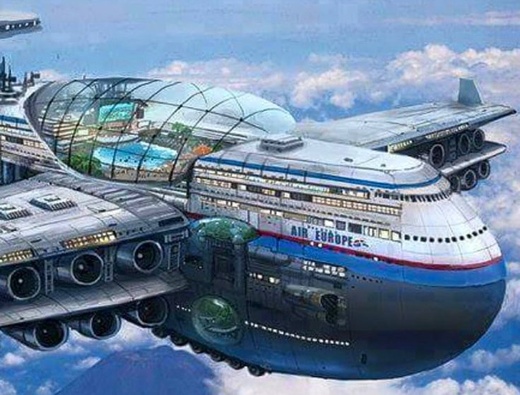
Image above: A fantasy "skyliner" with energy to burn for the sake of tourism. From (https://ok.ru/profile/565637386702/statuses/all).

A frequent critique of the daily news flow is that it is filled with negative events. This is partly a product of the human nervous system. We react very quickly to perceived threats and more slowly to hope of gain or pleasure. Editors and reporters know what will grab people's attention which is why the old adage—if it bleeds, it leads—still applies.

There are, of course, heartwarming stories about miraculous recoveries from illness and injury, rescued animals, and saintly persons doing amazing charitable acts. And, then there is a sub-genre of the feel-good story which I'll call the you've-been-living-in-opposite-land-things-are-actually-getting-better story.

Now as an antidote to the relentless negativity of the news, this kind of story gets attention. And, sometimes we need to be reminded, for instance, that life expectancy continues to rise, child mortality continues to decline, and smoking remains in decline. Humans are capable of making progress by certain measures.

"By certain measures" is the key phrase because what we typically measure when we say that things are getting better are measures of human well-being. Those who tell us not to fret about the doomsday predictions of environmentalists very craftily conflate two categories: the state of the natural world and the state of human well-being by telling us that the "world" is actually getting better.

Well, "world" in its primary definition means the planet. Other definitions are narrower and some include only humankind. If you are not paying attention, you will miss this sleight-of-hand used by apologists for the destruction of the natural world who tell us that the "world" is getting better—while carefully omitting any mention of the natural world or cherry-picking a few narrow and misleading trends concerning the environment.

If by "better" these apologists mean that generally accepted measures of human well-being continue to rise in across the entire global population, then we might grudgingly agree. (There are, however, plenty of trends that are negative in human affairs, but that discussion is for another time.)

What the apologists don't tell you is that human well-being is being purchased by the widespread, uncontrolled destruction of the very systems in the biosphere that have sustained humans in such great numbers to this point: the climate, the soil, the fisheries, the fresh water supplies, the air we breathe (through toxic pollution), the biodiversity of the plants and animals—and disruption of key systems such as the carbon cycle and the nitrogen cycle.

A Google search reveals this unconscionable omission in practically every top search item purporting to give us the good news.

And, this gets us back to the problem I have often noted regarding how we perceive risks.

We have been indoctrinated into the ideology of cost/benefit analysis which blinds us to the fact that no benefit can be justified if the risk or cost involved is the destruction of the very system which gives us the benefit—in this case, a biosphere with a habitable climate and resources from Earth systems sufficiently abundant and free of toxicity in order to sustain human life.

These necessities are no longer assured far into the future.

Yet perversely, we seek to exploit resources and undermine climate stability faster because this leads to better measures of human well-being—that is, until the day the Earth systems we rely on become so depleted and altered that the general level of human well-being goes in reverse, possibly rather quickly.

A system that is designed for collapse lies outside the category of "progress" by my definition. I am reminded of Sisyphus condemned for eternity to roll a rock up a hill only to have it roll right back down and repeat the process. Of course, it seems like it has been a very long roll uphill for industrial civilization.

But actually 200 years is a minuscule period in the life of humankind. It represents 6/100ths of one percent of the time homo sapiens have been around (about 315,000 years). The most likely path on our current trajectory is a tumultuous and destructive return to agrarian society.

All of this commotion we call industrial civilization understandably looks like progress to those living through it and fortunate enough to die before the decline begins. It's a kind of progress, I suppose, but the kind that rushes toward collapse.

And, that's not the kind the boosters of the the-world-is-getting-better meme want you to know about.

.

SCOTUS halts youth climate case

SUBHEAD: With Kavanaugh in place on Supreme Court likely to close lawsuit against fed not controlling greenhouse gases.

By Jessica Corbetton 20 October 2018 for Common Dreams -
(https://www.commondreams.org/news/2018/10/20/disgraceful-and-enraging-supreme-court-halts-youth-climate-case-after-last-ditch)


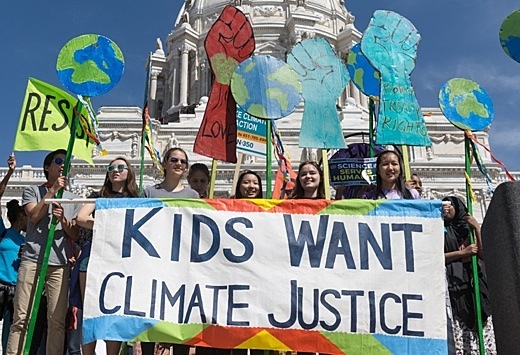
Image above: Demonstration in April 2017 in St. Paul MN by children wanting Federal Government take responsibility for not controlling greenhouse gases and imperiling life their lives. From original article.

In a move author and activist Naomi Klein denounced as "disgraceful and enraging," the U.S. Supreme Court has halted a lawsuit brought by 21 American children and young adults that aims to hold the federal government accountable for its ongoing failure to adequately curb greenhouse gas emissions to battle the global climate crisis.

The decision came in response to a last-ditch effort by the Trump administration to kill the "potentially landmark" case ahead of the trial slated to begin in the U.S. District Court for the District of Oregon on Oct. 29.

The case has been tied up in the legal system for three years. Just this week, District Court Judge Ann Aiken reaffirmed that the youth plaintiffs can credibly claim that the government has violated their due process rights.

The Supreme Court, however, stayed discovery and the trial in an order (pdf) issued Friday, demanding a response from the plaintiffs' legal counsel by Wednesday afternoon.

Michael Gerrard, director of Sabin Center for Climate Change Law at Columbia, called the move "highly unusual" and "reminiscent of their stay of the Clean Power Plan."

Farron Cousins, a radio host and executive editor of The Trial Lawyer magazine, tied the development to the upcoming midterms, tweeting:
There was one glimmer of hope this week when this case was allowed to proceed to trial, and in an instant, this guy took it away. Future generations are getting screwed, and I hope they remember who did this. Vote like your life depends on it! https://www.climateliabilitynews.org/2018/10/19/supreme-court-kids-climate-case-roberts/ 
While the high court's one-page order provoked public outrage, Julia Olson of Our Children's Trust, co-counsel for the youth plaintiffs, remained optimistic and said the team plans to file their reply on Monday.

"We are confident once Chief [John] Justice Roberts and the full court receive the youth plaintiffs' response to defendants' mischaracterization of their case, the trial will proceed," she said.
"As the Supreme Court has recognized in innumerable cases, review of constitutional questions is better done on a full record where the evidence is presented and weighed by the trier of fact. This case is about already recognized fundamental rights and children's rights of equal protection under the law."
As E&E News noted, "Roberts' action came hours after Jeffrey Wood, a top political appointee at the Department of Justice, said there is no such right. Speaking at a law conference in San Diego, Wood said the right to a safe climate that the plaintiffs demand 'simply does not exist,' adding that the government is still preparing for trial."

Several observers pointed out that the Supreme Court had previously allowed the case to proceed, back before the contentious new Justice Brett Kavanaugh replaced now-retired Anthony Kennedy. Environmental attorney Jeffrey Gracer remarked: "A newly configured Supreme Court seems poised to close the courthouse doors. But the tide of #ClimateAction cannot be stopped."

Jeffrey Gracer tweeted;
Justice Kennedy previously denied a stay in this climate change case brought by children who simply want their day in court. A newly configured Supreme Court seems poised to close the courthouse doors. But the tide of cannot be stopped.
See also:
Ea O Ka Aina: Case against Trump proceeding 10/18/18
.

Case against Trump proceeding

SUBHEAD: Blockbuster ruling on Children's Climate Change suit will proceed to trial October 29th.

By Julia Conley on 16 October 2018 for Common Dreams  -
(https://www.commondreams.org/news/2018/10/16/blockbuster-ruling-judge-says-youths-climate-case-against-trump-administration-can)


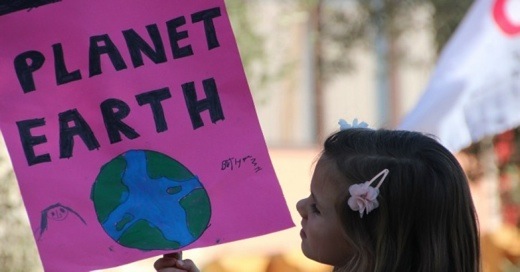
Image above: A young gird holds a poster of Planet Earth supporting children's lawsuit.  From original article.

Twenty-one children and young adults were looking forward on Tuesday to bringing their climate lawsuit against the federal government to trial in the coming weeks, following a U.S. District Court ruling arguing that the plaintiffs have made a convincing case that the Trump and Obama administrations have failed to curb carbon emissions even as they knew of the pollution's myriad harmful effects.

Judge Ann Aiken handed down the ruling late Monday in a court in Eugene, Oregon, affirming that the plaintiffs can credibly claim that their due process rights have been violated by the government and fossil fuel companies—an argument the young people are more than ready to make in court starting October 29, when the case is set to go to trial.

Following the decision, 21-year-old Tia Hatton said in a statement, "My fellow plaintiffs and I have our eyes set on one thing: our trial date...We—my lawyers, our experts, and my co-plaintiffs and I—are ready to make our case against the U.S. federal government and their deliberate energy policy that cause catastrophic climate change."

The lawsuit, Juliana vs. The United States, was first filed in 2015 under the Obama administration, with the 21 plaintiffs, then ranging in age from eight to 19, arguing with the help of Our Children's Trust that the government's actions that have worsened carbon emissions have "violated the youngest generation’s constitutional rights to life, liberty, and property, as well as failed to protect essential public trust resources."

The children pointed to increasingly frequent and destructive extreme weather events, rising sea levels, and droughts in their hometowns across the U.S. as evidence of their claim, and since then have called expert witnesses including climate scientist James Hansen and economist Joseph Stiglitz to bolster their case.

The young people "proffered uncontradicted evidence showing that the government has historically known about the dangers of greenhouse gases but has continued to take steps promoting a fossil fuel based energy system, thus increasing greenhouse gas emissions," said Aiken in her ruling.

Aiken dismissed President Donald Trump as a defendant in the lawsuit, but she did so "without prejudice"—meaning the youths can bring a case against him later on. Other Trump administration officials who head government agencies can still be named in the current case.

"The District Court continues to provide well-reasoned decisions that narrow and appropriately frame the heart of this case for trial," said Julia Olson, executive director of Our Children's Trust. "We are ready to bring all of the facts forward and prove these youths' case once and for all."

The federal government has for three years attempted to have the case dismissed by arguing that extreme weather events and pollution levels happen around the world, not only in the U.S., and that, as one Justice Department lawyer put it in 2016, "There simply is no constitutional right to a pollution-free environment." Aiken vehemently rejected the argument:
Where a complaint alleges knowing governmental action is affirmatively and substantially damaging the climate system in a way that will cause human deaths, shorten human lifespans, result in widespread damage to property, threaten human food sources, and dramatically alter the planet's ecosystem, it states a claim for a due process violation. To hold otherwise would be to say that the Constitution affords no protection against a government's knowing decision to poison the air its citizens breathe or the water its citizens drink.
"Judge Aiken's blockbuster decision lays out in extremely precise detail the factual and legal issues in our case which remain to be resolved at trial," Alex Loznak, a 21-year-old plaintiff, said.

"Having contributed extensive personal testimony and research to help develop our case's factual record over the past several years, I am confident that our arguments on the remaining disputed issues will ultimately prevail in court. We still need a full and fair trial to prove our case. October 29, here we come!"

Distributed nuclear mini-reactors

SUBHEAD: Energy Department teams up with Bill Gates to move mini-nuclear plants into your neighborhood.

By John Siciliano on 23 August 2018 for Washington Examiner -
(https://www.washingtonexaminer.com/policy/energy/energy-department-teams-up-with-bill-gates-to-move-mini-nuclear-plants-to-market)


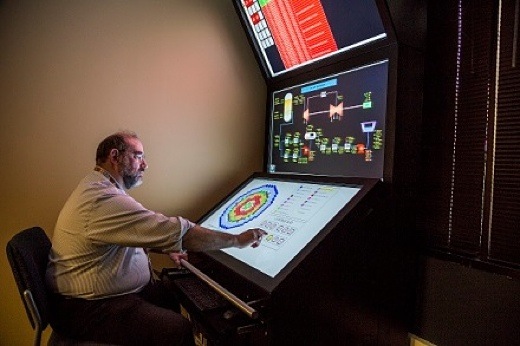
Image above: Bullshit Alert! Is this what TerraPower showed the Energy Department to get their 2016 $40 million go ahead money. On the TerraPower website this image is labeled "first phase of system-level simulator". To me it looks like somebody closed the windowblinds,  added a soft-warm spotlight on the wall, and found an unemployed busdriver to sit in as a "nuclear engineer" working a touch screen that was ganged with two LCD flat displays for promo purposes.  From (http://terrapower.com/technologies/progress).

The Energy Department is participating in major push with electric utility Southern and a company founded by Microsoft founder Bill Gates to develop small nuclear power reactors that are less expensive and more efficient than their much larger cousins.

“Molten salt reactors are getting a reboot,” the Energy Department tweeted late Wednesday, offering a schematic of a battery-like power plant module that “could power America’s energy.”

On Thursday, the nuclear industry showed its support for the effort. The new nuclear reactors “could be the energy systems of the future” as companies like TerraPower, backed by Gates, are working to build design and build them, the Nuclear Energy Institute tweeted.

The Department of Energy linked to a detailed description of how its Oak Ridge National Laboratory and other federal labs are teaming up with Southern Company, a big coal utility with several nuclear plants, and Gates’ TerraPower to test and develop a type of reactor that uses liquefied sodium “as both coolant and fuel.”


Image above: Old wrinkled billionaire monopolist, Bill Gates, trying to use a nuclear magic wand to save capitalism from energy and resource depletion. From original article.

These liquid-metal reactors are sometimes referred to as nuclear batteries because they are small, self-contained units, which theoretically can be deployed anywhere, although the version being tested at Oak Ridge appears to be one requiring a permanent structure and housing.

TerraPower was awarded a $40 million award by the Energy Department in 2016 to pursue the project.

Almost 60 years after the first designs for this type of reactor were unveiled, several companies are now starting to develop them as “energy systems of the future,” the agency explained.

The Department of Energy has so far invested over $28 million in cost-shared funds for the project to identify and test materials used in the reactor.

Southern Company and TerraPower are currently in the early design phase of testing, supported by Oak Ridge, Idaho National Laboratory, Vanderbilt University and the Electric Power Research Institute, a utility industry-funded research group, to assess the viability of liquid-sodium reactor’s for commercial use.

The companies expect to begin testing at a $20 million test facility in 2019, which will help validate the reactor’s safety systems for license certification by the Nuclear Regulatory Commission.

After testing, Southern Company and TerraPower plan to develop and license a test reactor before developing a 1,100-megawatt prototype by 2030.

See also more news of the collapse of the nuclear energy industry:
Ea O Ka Aina: Tepco Fukushima ice Wall Failing 3/8/18
Ea O Ka Aina: Fukushima Coverup 11/14/17
Ea O Ka Aina: Fukushima Hot particle update 7/27/17
Ea O Ka Aina: E-Fukushima bosses on trial 6/25/17
Ea O Ka Aina: Tepco plan to dump tainted water 7/14/17
Ea O Ka Aina: Stop Fukushima as Olympic venue 5/10/17
Ea O Ka Aina: Continuing Fukushima danger 4/14/17
Ea O Ka Aina: Stop Fukushima as Olympic venue 4/8/17 
Ea O Ka Aina: Fukushima worse than ever 2/5/17
Ea O Ka Aina: Fukushima radiation on West Coast 1/13/17
Ea O Ka Aina: Fukushima cleanup cost to double 12/9/16
Ea O Ka Aina: Tokyo damaged by nuclear pellet rain 9/24/16
Ea O Ka Aina: Nuclear Power and Climate Failure 8/24/16
Ea O Ka Aina: High radioactivity in Tokyo 8/22/16
Ea O Ka Aina: Nuclear Blinders 8/18/16
Ea O Ka Aina: Fukushima and Chernobyl 5/29/16
Ea O Ka Aina: Fukushima radiation damages Japan 4/14/16
Ea O Ka Aina: Fukushima's Nuclear Nightmare 3/13/16
Ea O Ka Aina: Fifth Fukushima Anniversary 3/11/16
Green Road Jounral: Balls filled with Uranium, Plutonium 2/19/16
Ea O Ka Aina: Fukushima impacts are ongoing 11/8/15
Ea O Ka Aina: Petroleum and Nuclear Coverups 10/21/15
Ea O Ka Aina: Fukushima Radiation Contamination 10/13/15
Ea O Ka Aina: Radioactive floods damage Japan 9/22/15
Ea O Ka Aina: Fir trees damaged by Fukushima 8/30/15
Ea O Ka Aina: Japan restarts a nuclear plant 8/11/15
Ea O Ka Aina: Fukushima disaster will continue 7/21/15
Ea O Ka Aina: Too many fish in the sea? 6/22/15
Ea O Ka Aina: Fukushima prefecture uninhabitable 6/6/15
Ea O Ka Aina: In case you've forgotten Fukushima 5/27/15
Ea O Ka Aina: Radiation damages top predator bird 4/24/15
Ea O Ka Aina: Fukshima die-offs occurring 4/17/15
Ea O Ka Aina: Fukushima Impact Update 4/13/15
Ea O Ka Aina: Fukushima - the end of atomic power 3/13/15
Ea O Ka Aina: Where is the Fukushima Data? 2/21/15
Ea O Ka Aina: Fuku-Undo 2/4/15
Ea O Ka Aina: Fukushima MOX fuel crossed Pacific 2/4/15
Ea O Ka Aina: Fukushima worst human disaster 1/26/15
Ea O Ka Aina: Japan to kill Pacific Ocean 1/23/15
Ea O Ka Aina: Japan's Environmental Catastrophe 8/25/14
ENE News: Nuclear fuel found 15 miles from Tokyo 8/10/14
Ea O Ka Aina: Earthday TPP Fukushima RIMPAC 4/22/14
Ea O Ka Aina: Fukushima Daiichi hot particles 5/30/14
Ea O Ka Aina: Japanese radiation denial 5/12/14
Ea O Ka Aina: Entomb Fukushima Daiichi now 4/6/14
Ea O Ka Aina: Fukushima Disaster 3 Years Old 4/3/14
Ea O Ka Aina: Tsunami, Fukushima and Kauai 3/9/14
Ea O Ka Aina: Japanese contamination 2/16/14
Ea O Ka Aina: Bill for Fukushima monitoring 2/9/14
Ea O Ka Aina: Tepco under reporting of radiation 2/9/14
Ea O Ka Aina: Fukushima Fallout in Alaska 1/25/14
Ea O Ka Aina: Fukushima engineer against nukes 1/17/14
Ea O Ka Aina: California to monitor ocean radiation 1/14/14
Ea O Ka Aina: Demystifying Fukushima Reactor #3 1/1/14
Ea O Ka Aina: US & Japan know criticality brewing 12/29/13
Ea O Ka Aina: Fukushima Forever 12/17/13
Ea O Ka Aina: Brief radiation spike on Kauai 12/27/13
Ea O Ka Aina: USS Ronald Reagan & Fukushima 12/15/13
Ea O Ka Aina: Fukushima Pacific Impact 12/11/13
Ea O Ka Aina: Berkeley and Fukushima health risks 12/10/13
Ea O Ka Aina: Madness engulfs Japan 12/4/13
Ea O Ka Aina: Edo Japan and Fukushima Recovery 11/30/13
Ea O Ka Aina: Reaction to Fukushima is Fascism 11/30/13
Ea O Ka Aina: Radioisotopes in the Northern Pacific 11/22/13
Ea O Ka Aina: Fukushima cleanup in critical phase 11/18/13
Ea O Ka Aina: Fukushima fuel removal to start 11/14/13
Ea O Ka Aina: Fukushima, What me worry? 11/13/13
Ea O Ka Aina: Remove other Fukushina fuel 10/29/13
Ea O Ka Aina: End to Japanese Nuclear Power? 10/3/13
Ea O Ka Aina: Fukushima & Poisoned Fish 10/3/13
Ea O Ka Aina: Fuel Danger at Fukushima 9/27/13
Ea O Ka Aina: Reactor #4 Spent Fuel Pool 9/16/13
Ea O Ka Aina: Fukushima is Not Going Away 9/9/13
Ea O Ka Aina: X-Men like Ice Wall for Fukushima 9/3/13
Ea O Ka Aina: Fukushima House of Horrors 8/21/13
Ea O Ka Aina: Fukushima Apocalypse 8/21/13
Ea O Ka Aina: Fukushima Radioactive Dust 8/20/13
Ea O Ka Aina: Cocooning Fukushima Daiichi 8/16/13
Ea O Ka Aina: Fukushima radiation coverup 8/12/13
Ea O Ka Aina: Leakage at Fukushima an emergency 8/5/13
Ea O Ka Aina: Fukushima burns on and on 7/26/13
Ea O Ka Aina: What the Fukashima? 7/24/13
Ea O Ka Aina: Fukushima Spiking 7/15/13
Ea O Ka Aina: G20 Agenda Item #1 - Fix Fukushima 7/7/13
Ea O Ka Aina: Fukushima and hypothyroid in Hawaii 4/9/13
Ea O Ka Aina: Japan to release radioactive water 2/8/13
Ea O Ka Aina: Fukushima as Roshoman 1/14/13
Ea O Ka Aina: Fukushia Radiation Report 10/24/12
Ea O Ka Aina: Fukushima Fallout 9/14/12
Ea O Ka Aina: Fukushima Unit 4 Danger 7/22/12
Ea O Ka Aina: Fukushima denial & extinction ethics 5/14/12
Ea O Ka Aina: Fukushima worse than Chernobyl 4/24/12
Ea O Ka Aina: Fukushima dangers continue 4/22/12
Ea O Ka Aina: Fukushima children condemned 3/8/12
Ea O Ka Aina: Fukushima fights chain reaction 2/7/12
Ea O Ka Aina: Tepco faking Fukushima fix 12/24/11
Ea O Ka Aina: The Non Battle for Fukushima 11/10/11
Ea O Ka Aina: Fukushima Debris nears Midway 10/14/11
Ea O Ka Aina: Fukushima Radiation Danger 7/10/11
Ea O Ka Aina: Fukushima Abandoned 9/28/11
Ea O Ka Aina: Deadly Radiation at Fukushima 8/3/11
Ea O Ka Aina: Fukushima poisons Japanese food 7/25/11
Ea O Ka Aina: Black Rain in Japan 7/22/11
Ea O Ka Aina: UK PR downplays Fukushima 7/1/11
Ea O Ka Aina: Fukushima #2 & #3 meltdown 5/17/11
Ea O Ka Aina: Fukushima sustained chain reaction 5/3/11
Ea O Ka Aina: Ocean Radioactivity in Fukushima 4/16/11
Ea O Ka Aina: Japan raises nuclear disaster level 4/12/11
Ea O Ka Aina: Fukushima No Go Zone Expanding 4/11/11
Ea O Ka Aina: Fukushima to be Decommissioned 4/8/11
Ea O Ka Aina: Fukushima Poisons Fish 4/6/11
Ea O Ka Aina: Learning from Fukushima 4/4/11
Ea O Ka Aina: Fukushima Leak goes Unplugged 4/3/11
Ea O Ka Aina: Stick a fork in it - It's done! 4/2/11
Ea O Ka Aina: Fukushima reactors reach criticality 3/31/11
Ea O Ka Aina: Fukushima Non-Containment 3/30/11
Ea O Ka Aina: Fukushima Meltdown 3/29/11
Ea O Ka Aina: Fukushima Water Blessing & Curse 3/28/11 
 
.

Where's the "eco" in ecomodernism?

SUBHEAD: A techno-green future of limitless abundance sounds great, but it's totally unsustainable.

By Aaron Vansintjan on 6 April 2018 for Red Pepper -
(https://www.redpepper.org.uk/wheres-the-eco-in-ecomodernism/)


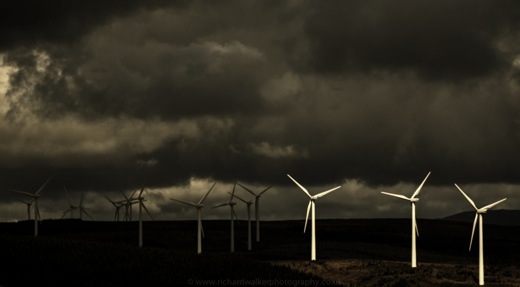
Image above: Windmills under an overcast sky. Photo by Richard Walker. From original article.

If you hadn’t heard, despair is old hat. Rather than retreat into the woods, now is the time to think big, to propose visionary policies and platforms.

So enter grand proposals like basic income, universal healthcare, and the end of work. Slap big polluters with carbon tax, eradicate tax havens for the rich, and switch to a 100% renewable energy system.

But will these proposals be enough? Humanity is careening toward certain mayhem. In a panic, many progressive commentators and climate scientists, from James Hansen and George Monbiot to, more recently, Eric Holthaus, have argued that these big policy platforms will need to add nuclear power to the list.

In a recent issue on climate change in the Jacobin, several authors also suggested we need to consider carbon capture technologies, geo-engineering (the large-scale modification of earth systems to stem the impacts of climate change), and even GMOs make an appearance.

What’s more, one of the contributors, Christian Parenti, actually proposes that we should increase our total energy use, not reduce it.

Any critique of this kind of utopian vision is often dismissed as green conservatism. In her article, “We gave Greenpeace a chance”, Angela Nagle argues: faced with President Trump promising abundance and riches, greens can only offer “a reigning in of the excesses of modernity”.

Despite all its failures, modernity freed us from the shackles of nature. Modernity promised a world without limits—and the environmentalist obsession with limits, she says, amounts to “green austerity.”

This argument is associated with an emerging body of thought called ecomodernism. Ecomodernism is the idea that we can harness technology to decouple society from the natural world.

For these techno-optimists, to reject the promise of GMOs, nuclear, and geo-engineering is to be hopelessly romantic, anti-modern, and even misanthropic. An ecological future, for them, is about cranking up the gears of modernity and rejecting a politics of limits.

Maxed-out modernism

Like it or not, this attitude actually fits quite well with the socialist tradition. For Karl Marx and Friedrich Engels, modernity brought wonders and horrors. They argued the desire to go back to a feudal world of craftspeople and cottage industries was reactionary: their revolution would try to move beyond the present, not before it.

Fully Automated Luxury Communism (FALC), is the embodiment of this kind of maxed-out modernism, rebranded for the 21st century. But, given that we are fast approaching the planetary boundaries of the capitalist system, is it really that reasonable to suggest that now is the time to power up the automated factories?

In his article “Fully automated green communism”, Aaron Bastani, one of the main proponents of FALC, tries to respond directly to this kind of criticism. For him, eco-modernist socialism can be sustainable, too.

“[T]he idea that the answer to climate change is consuming less energy – that a shift to renewables will necessarily mean a downsizing in life – feels wrong. In fact, the trends with renewables would point to the opposite: the sun furnishes our planet with enough energy to meet humanity’s annual demand in just 90 minutes.

Rather than consuming less energy, developments in wind and solar (and within just a few decades) should mean distributed energy of such abundance that we won’t know what to do with it.”

For eco-modernists like Bastani, the problem is not technology itself: the problem is who owns it. When asked if his techno-optimism doesn’t understate the reality of climate change, Bastani responds that any tool can be turned into a weapon. Technology is only violent in the hands of a for-profit system.

Technology without context

The thing is, there’s very little “eco” in eco-modernism. Ecology is about the big picture: understanding the relationships between people, animals, plants, materials, and energy—how they co-evolve and are interdependent.

So, for an ecologist, any technology cannot be understood as separate from the context that created it. In contrast, eco-modernists see technology as simply a tool, which anyone could pick up and use. Their modernism becomes “eco” when we take the machines of modernity and use them to decouple society from nature.

This is certainly the case for nuclear power. Anti-nuclear activists point to the harmful effects of nuclear radiation and accidents, but, as ecomodernists point out, coal has killed more people historically and will kill many more if we don’t do anything soon.

The only thing that can save us, they say, would be to replace the fossil fuel-based energy system with one dependent on nuclear power—which in turn would require large state subsidies and centralized planning. We have the technology for a low-impact energy system, we just need the political will.

Sounds simple, but let’s look at the big picture. Nuclear power requires a regime of experts to manage, maintain, and decommission; a centralized power grid; large states to fund and secure them; and, then, a stable political environment to keep the waste safe for at least the next 10,000 years.

The technology is only 80 years old, modern states have existed for about 200, humans have only been farming for 5,000, and most nuclear waste storage plans operate at a 100-year time-span. To put it mildly, an energy grid dependent on nuclear means having lot of trust in today’s political institutions.

The problem with nuclear clearly isn’t technical, it’s political. The prospect of scaling up nuclear to the level needed to replace fossil fuels begs two questions.

First, are our political institutions robust enough?

Second, do we want the world that nuclear creates?

A world full of nuclear power plants is a world of highly centralised power, an energy system removed from people by an army of specialised engineers and, to protect it, a maximum-security state. To think that any technology can be grabbed out of the current system and scaled up without consequences is a profoundly un-ecological idea.

Similarly the idea of going 100% renewable and increasing total energy use, as advocated by ecomodern socialists like Aaron Bastani and Christian Parenti also has its faults. As Stan Cox points out,
“There’s nothing wrong with the ‘100-percent renewable’ part… it’s with the ‘100 percent of demand’ assumption that [scientists] go dangerously off the rails. At least in affluent countries, the challenge is not only to shift the source of our energy but to transform society so that it operates on far less end-use energy while assuring sufficiency for all. That would bring a 100-percent-renewable energy system within closer reach and avoid the outrageous technological feats and gambles required by high-energy dogma. It would also have the advantage of being possible.

The idea that there will be so much solar energy that “we won’t know what to do with it” also merits a second glance. True, solar energy is practically infinite. But unlike the alternatives, it’s dissipated and difficult to collect, transport, concentrate, and store.

It’s like trying to catch the rain when you’ve spent the last two hundred years drawing water from enormous underground reservoirs. It would mean more than democratising ownership of technology, but a total reboot.

And even if we were able to press that restart button, this luxurious future would require infrastructure, land, resources, and energy to build. These are unfortunately not super-abundant, but, by definition, limited. Simply grabbing technology from the machine of profit won’t solve this problem.

Energy or barbarism

It’s here that we’re forced to really think through the ecological position. Capitalism, as Andreas Malm argues, was built on coal and oil, and is inextricable from it.

The extraction and burning of coal made the creation of the working class possible, and it generated new forms of hierarchy and inequality. In other words, any technology developed in the current system isn’t neutral—by its very design, it shapes relationships between people and nature.

Being an ecologist today certainly doesn’t mean refusing to improve humanity’s lot, but it also means having a real conversation about the limits we face.

And if an alternative system is to be at all ecological, it would mean democratically weighing the costs and benefits of different technologies: which ones we want, and which ones we don’t. That’s not anti-modern, that’s a basic requirement for a better world.

So how do we get out of this mess? Now, more than ever, we need visionary proposals and new imaginaries. But, with the ecomodernists, this gesture to “think big” gets taken to the extreme: any “buts” and you’re branded as, basically, eco-Thatcher.

Today, breathless modernism—the refusal to collectively discuss limits—is no longer tenable. The dismissal of any political discussion of limits has real costs; Ironically, modernity without limits will send us back to the dark ages.

For Andreas Malm, there is only one option. If we want to avoid a new dark age, we can’t just collectivize the grid. We have to dismantle it and build a new, very different one. And if those driving the train of modernity can’t see the catastrophe up ahead, we’ll need to pull the emergency brake.

Politics is the collective deliberation of the future we want. It follows that we would also need to debate the things we really don’t want, the things whose price we refuse to pay.

Without this kind of discussion, we’ll never have a truly sustainable society. Talking about limits isn’t constraining, it’s liberating—perhaps paradoxically, it’s the basic requirement for building a ecological future of real abundance.

[IB Publisher's note: Nuclear power is no solution to the devastation we face with climate change and ecosystem collapse. The "ecological activists", like Stuart Brand (Whole Earth Catalog), James Lovelock (Gaia Principle), James Hanson (NASA scientist) and George Monbiot (Environmental author) among others, argue that nuclear power is the is the only energy source that can keep civilization going. That's only partially true. The only thing that can keep nuclear power going is fossil fuel driven technology like trains, cement trucks, semi-tractor-trailers, bulldozers, derricks, and all the other coal, oil and gas powered portable technology needed to build, maintain and dispose of nuclear power plants. Keep in mind the Chernobyl and Fukushima nuclear meltdowns have not been "fixed" because they are out of the headlines. In human terms all the inevitable future nuclear accidents are "forever".  There is no way to clean them up. You can only try to tightly contain or widely distribute the damage. Alternative energy (wind, solar, dams, ocean wave) will never run the industrial system we have now. At best they may sustain a much smaller human population at a level of worldwide consumption last seen in the early 18th. We could still maintain the fine arts, libraries and universities in an agrarian setting, but forget about all those air-conditioned glass-sealed seaside skyscrapers.]

.

Magical Thinking of Ecomodernism

SUBHEAD: Do high-consuming nations, like the USA need to keep growing their GDP forever?

By Jason Hickel on 4 April 2018 for JasonHickel.org -
(https://www.jasonhickel.org/blog/2018/4/4/the-magical-thinking-of-ecomodernism)


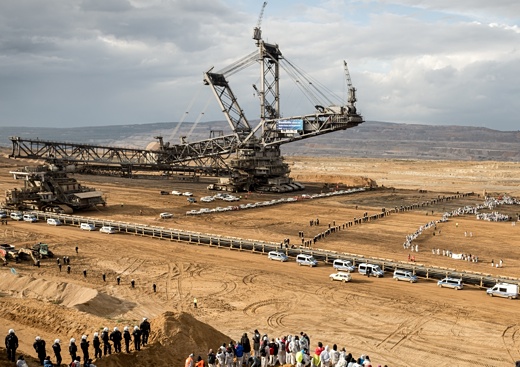
Image above: On November 5, 2017, at the beginning of COP 23, the activist organization Attac and the alliance Ende Gelände demonstrated against lignite-fired power generation in the Rhenish lignite mining district not far from Bonn. From (http://www.resilience.org/stories/2018-04-05/the-magical-thinking-of-ecomodernism/).

I recently wrote an article for Fast Company explaining why “green growth” is not a thing. I looked at three high-profile studies showing that even aggressive taxes and rapid improvements in technological efficiency will not be enough to cut global resource use as long as we keep growing the world economy.

 Right now we are consuming about 85 billion tons of material stuff per year, exceeding the sustainable threshold by 70%. According to the UN, our resource use will rise to at least 132 billion tons per year by 2050, and possibly as high as 180 billion tons.

It is on this basis that scientists have concluded that absolute decoupling of GDP from aggregate resource use is not possible. But the ecomodernists at the Breakthrough Institute aren’t convinced.

Linus Blomqvist wrote a blog post responding to my article, arguing that focusing on aggregate material flows is “misleading”, and that in reality absolute decoupling “is still a very real possibility.”

The stakes are high. After all, decoupling is the central objective of ecomodernism. No decoupling, no ecomodernism.

Blomqvist seems to agree that absolute decoupling of GDP from aggregate material use is not possible; or at least he doesn’t dispute the point.

But we needn’t worry about this fact, he says; it doesn’t matter if we keep using more and more resources each year, because aggregate material use is not a meaningful proxy for environmental impact.

 Industrial and construction materials, for instance, “account for a pretty small portion of environmental impacts like greenhouse gas emissions or land use,” and while biomass use keeps growing, land use has peaked (at least for now).

But this is cherrypicking indicators. Industrial and construction materials may contribute relatively little to greenhouse gas emissions and land use, but anyone who has ever seen (or lived next to) an open pit mine will know that they are ecological disaster zones in all sorts of other ways.

 Plus, Blomqvist’s claim about emissions and land just isn’t true (and he provides no evidence for it): cement production alone contributes 10% of anthropogenic CO2, and the transport, production and use of industrial materials is clearly linked to fossil fuel consumption.

As for biomass: let’s not pretend that land use is all that matters here. Our current method for extracting higher yields from land involves aggressive use of chemical fertilizers and pesticides, which have already pushed us well over the planetary boundaries for biogeochemical flows.

 And those same chemicals are causing insect populations – including pollinators – to collapse, and bird populations along with them.

 Indeed, the inputs involved in industrial agriculture are a major driver of biodiversity loss, regardless of whether or not more land is being used. They are also a major driver of soil depletion, which in turn drives greenhouse gas emissions from farmland.

This is the thing about ecology, you see: everything is connected. The biomass bone is connected to the biogeochemical bone is connected to the insect bone.

And that’s why aggregate material flows are in fact an important indicator of what’s happening to our planet. Sure, some material use has more dramatic impact than others.

 But no material use is impact-free. You can’t keep increasing aggregate material extraction and consumption indefinitely without increasing environmental impact right along with it. To believe that doubling or tripling our existing aggregate resource draw isn’t going to cause problems is magical thinking.

Blomqvist’s next move is similar to the first. He says that while absolute decoupling of aggregate resource use may not be possible (and sadly even relative decoupling of emissions has come to a halt), there are some happy isolated cases where it does seem to be happening.

Water extraction has peaked in the US, for example. And several pollutants (like sulfur dioxide and nitrous oxide) have peaked or declined globally. Blomqvist says this counts as “significant progress”.

If this is the best the ecomodernists have to offer, I despair. First of all, you can’t look at nations (and particularly rich nations like the US) in isolation, because they have outsourced much of their environmental impact abroad.

If you count all the water extraction involved in producing and shipping the imports that the US consumes, American water use is going up, not down. As for sulfur dioxide and nitrous oxide – yes, there have been gains, and we should celebrate them. But pollutants like these constitute one of the few examples where the much-misunderstood Environmental Kuznets Curve actually works.

Ecologists have pointed out for years that the EKC doesn’t hold for most other impacts. So as a defense for endless growth, I’m afraid Blomqvist’s example just won’t do.

I agree with Blomqvist that we should strive to accelerate resource efficiency. Of course we should! We need all the efficiency gains we can get. But unfortunately it’s not going to be enough, in and of itself – and we need to face up to this fact.

Tellingly, Blomqvist doesn’t engage with my claim about the rebound effect, nor about the physical limits to efficiency gains (the paper I cite by Ward et al concludes that “permanent decoupling is impossible for essential, non-substitutable resources because the efficiency gains are ultimately governed by physical limits”). We can’t just ignore these realities.

If absolute decoupling isn’t a thing, then ultimately we’re going to have to scale down global economic activity. Blomqvist doesn’t actually explain why he dislikes this conclusion so much. All he says is that degrowth “seems far-fetched”.

 I have no idea what he means by this. But could it really be more far-fetched than achieving what is physically impossible? Perhaps Blomqvist – or anyone at the Breakthrough Institute – could explain why they think that rich, high-consuming nations (like the US, for instance) need to keep growing their GDP (forever?), when we know that additional growth is not generating any better social outcomes.

Given how powerful the scale effect of growth is when it comes to driving ecological breakdown, it just doesn’t make sense to take it off the table.

.

NTHE is a four letter word

SUBHEAD: Near Term Human Extinction may be coming after a few of us get through the eco-bottleneck.

By Albert Bates on 25 March 2018 for The Great Change -
(http://peaksurfer.blogspot.com/2018/03/nthe-is-four-letter-word.html)


Image above: Illustration of a cityscape post near term human extinction. From (http://thefallingdarkness.com/near-term-human-extinction-a-conversation-with-guy-mcpherson/).

"Collective neurosis can be attributed to a concatenation of causes — diet, electrosmog, epigenetic triggering by microplastics in our toothpaste — take your choice."

We are not talking about climate deniers now, who have their own brand of insanity, but we keep hearing the same mantra chanted by otherwise respectable scientists and policymakers that, “climate change may be catastrophic but it won’t be the end of us.”

We hear that so often we almost never challenge it, not wishing to divert an otherwise productive conversation into what we know to be a blind alley. Nonetheless, we think the statement is at best deluded and at worst just a milder form of denialism. It is not science. It is faith. It is also human neurophysiology.
Brain imaging research has shown that a major neural region associated with cognitive flexibility is the prefrontal cortex — specifically two areas known as the dorsolateral prefrontal cortex (dlPFC) and the ventromedial prefrontal cortex (vmPFC). Additionally, the vmPFC was of interest to the researchers because past studies have revealed its connection to fundamentalist-type beliefs. For example, one study showed individuals with vmPFC lesions rated radical political statements as more moderate than people with normal brains, while another showed a direct connection between vmPFC damage and religious fundamentalism. For these reasons, in the present study, researchers looked at patients with lesions in both the vmPFC and the dlPFC, and searched for correlations between damage in these areas and responses to religious fundamentalism questionnaires.
Bobby Azarian, Raw Story, March 14, 2018

In the quote above, Azarian is referring to a study published a year ago in Neuropsychologia that connected cognitive flexibility with the ventromedial prefrontal cortex and proved that damage to that part of the brain hinders adaptive or flexible behavior, locking out world views that run contrary to some preconception. The study correlated brain-damaged veterans with religious fundamentalism.

The preconception most often grasped by NTHE (Near Term Human Extinction ) deniers is the notion that “humans survived far worse cataclysms to arrive at their present condition” —  the Toba event 70,000 years ago, for instance, when the human population was reduced to perhaps 10,000–30,000 individuals — “and we invariably rebound.”

The example most often cited is the 2005 Rutgers mDNA study showing all pre-1492 native populations of the Americas  —  well over 1 billion by some estimates  —  having descended from 70 or fewer individuals who crossed the land bridge between Asia and North America.

This is a variant of the techno-cornucopianism of Bill Gates or Elon Musk, but in their cases — building new desert cities in Arizona or seed colonies on Mars — that being externalized, absent a cold fusion Spindletop, is biophysical economics.

We have previously reviewed the hypothesis of Danny Brower and Ajit Varki that an evolutionary leap allowed homo to access higher consciousness by hard-wiring a neural pathway for denying reality.

Arguably that same pathway induces otherwise rational-seeming people to allow for the possibility of catastrophic climate change (already well underway) while denying the possibility of it leading to near-term human extinction (NTHE).

In our view, this colors the debate over what we should be doing by reducing the urgency.

Ironically there may have been human genotypes that suppressed their denial gene better than ours does. One of the effects of genetic bottlenecks is that selected genes (such as those offering a more balanced use of denial) fail to be passed along to succeeding populations.

Our personal view is that while we think NTHE can yet be avoided, the time for action grows short and as we as we walk out onto the razon’s edge and grow more desperate we will likely make many foolish mistakes, any one of which could trigger NTHE.

Appointing John Bolton the National Security Advisor, for instance. In 2016 USAnians fed up with the tweedledee-tweedledum two-party system opted to just hurl a hand grenade into the White House and stand back.

If one grenade was not enough, we still have President Bannon to look forward to in 2020 or 2024 if Cambridge Analytica can keep up with the AI revolution with respect to Big Data.

Collective neurosis can be attributed to a concatenation of causes — diet, electrosmog, epigenetic triggering by microplastics in our toothpaste — take your choice. Visionary forebears who saw these bottlenecks coming — Garrett Hardin, R. Buckminster Fuller, M. King Hubbert — all argued that the best antidote was better public education.

But at least in the US, public education was hijacked in the ‘90s by the vmPFC-lesioned hoards of Zombie Fundamentalists before being handed over to Betsy DeVoss for the final coup d’gras.

Whatever long wave or ergot diet issued humanity into the Dark Ages seems to be replaying now, and it could hardly arrive at a worse time from the standpoint of the organized climate solutioneering required to avert Anthropogenic NTHE.

We need to be in top form to survive this next bottleneck. We’d do better without the denial. Too bad climate scientists can’t afford to hire Cambridge Analytica themselves.

.