Showing posts with label Main Street. Show all posts

Worst retail year in US history

SUBHEAD: Not even during the worst parts of the last recession did things ever get as bad for U.S. retail industry.

By Michael Snyder on 14 June 2017 for the Economic Collapse Blog
(http://theeconomiccollapseblog.com/archives/2017-is-going-to-be-the-worst-retail-apocalypse-in-u-s-history-more-than-300-retailers-have-already-filed-for-bankruptcy)
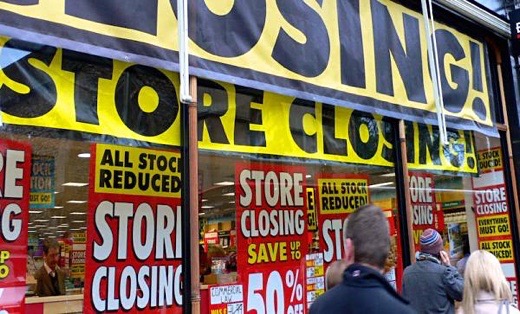

Image above: Main Street America continues to suffer from retail failures. From (http://www.zerohedge.com/news/2017-06-14/2017-will-be-worst-retail-apocalypse-us-history-over-300-retailers-have-already-file).

Not even during the worst parts of the last recession did things ever get this bad for the U.S. retail industry.  As you will see in this article, more than 300 retailers have already filed for bankruptcy in 2017, and it is being projected that a staggering 8,640 stores will close in America by the end of this calendar year.

That would shatter the old record by more than 20 percent.  Sadly, our ongoing retail apocalypse appears to only be in the early chapters.  One report recently estimated that up to 25 percent of all shopping malls in the country could shut down by 2022 due to the current woes of the retail industry.

And if the new financial crisis that is already hitting Europe starts spreading over here, the numbers that I just shared with you could ultimately turn out to be a whole lot worse.

I knew that a lot of retailers were filing for bankruptcy, but I had no idea that the grand total for this year was already in the hundreds.  According to CNN, the number of retail bankruptcies is now up 31 percent compared to the same time period last year…
Bankruptcies continue to pile up in the retail industry. More than 300 retailers have filed for bankruptcy so far this year, according to data from BankruptcyData.com. That’s up 31% from the same time last year.

Most of those filings were for small companies — the proverbial Mom & Pop store with a single location. But there are also plenty of household names on the list.
Yes, the growth of online retailers such as Amazon is fueling some of this, but the Internet has been around for several decades now.

So why are retail store closings and retail bankruptcies surging so dramatically all of a sudden?
Just a few days ago, another major victim of the retail apocalypse made headlines all over the nation when it filed for bankruptcy.  At one time Gymboree was absolutely thriving, but now it is in a desperate fight to survive
Children’s clothing chain Gymboree has filed for bankruptcy protection, aiming to slash its debts and close hundreds of stores amid crushing pressure on retailers.
Gymboree said it plans to remain in business but will close 375 to 450 of its 1,281 stores in filing for a Chapter 11 bankruptcy reorganization. Gymboree employs more than 11,000 people, including 10,500 hourly workers.
And in recent weeks other major retailers that were once very prosperous have also been forced to close stores and lay off staff
This hemorrhaging of retail jobs comes on the heels of last week’s mass layoffs at Hudson Bay Company, where employees from Saks Fifth Avenue and Lord & Taylor were among the 2,000 people laid off.

The news of HBC layoffs came on the same day that Ascena, the parent company of brands like Ann Taylor, Lane Bryant, and Dress Barn, told investors it will be closing up to 650 stores (although it did not specify which brands will be affected just yet). Only two weeks ago, affordable luxury brand Michael Kors announced it too would close 125 stores to combat brand overexposure and plummeting sales.
In a lot of ways this reminds me of 2007.  The stock market was still performing very well, but the real economy was starting to come apart at the seams.

And without a doubt, the real economy is really hurting right now.  According to Business Insider, Moody’s is warning that 22 more major retailers may be forced to declare bankruptcy in the very near future…
Twenty-two retailers in Moody’s portfolio are in serious financial trouble that could lead to bankruptcy, according to a Moody’s note published on Wednesday. That’s 16% of the 148 companies in the financial firm’s retail group — eclipsing the level of seriously distressed retail companies that Moody’s reported during the Great Recession.
You can find the full list right here.  If this many major retailers are “distressed” now, what are things going to look like once the financial markets start crashing?

As thousands of stores close down all across the United States, this is going to put an incredible amount of stress on shopping mall owners.  In order to meet their financial obligations, those mall owners need tenants, but now the number of potential tenants is shrinking rapidly.

I have talked about dead malls before, but apparently what we have seen so far is nothing compared to what is coming.  The following comes from CNN
Store closings and even dead malls are nothing new, but things might be about to get a whole lot worse.

Between 20% and 25% of American malls will close within five years, according to a new report out this week from Credit Suisse. That kind of plunge would be unprecedented in the nation’s history.
I can’t even imagine what this country is going to look like if a quarter of our shopping malls shut down within the next five years.  Already, there are some parts of the U.S. that look like a third world nation.

And what is this going to do to employment?  Today, the retail industry employs millions upon millions of Americans, and those jobs could start disappearing very rapidly
The retail sales associate is one of the most popular jobs in the country, with roughly 4.5 million Americans filling the occupation. In May, the US Bureau of Labor Statistics released data that found that 7.5 million retail jobs might be replaced by technology. The World Economic Forum predicts 30 to 50 percent of retail jobs will be gone once struggling companies like Gymboree fully hop on the digital train. MarketWatch found that over the last year, the department store space bled 29,900 jobs, while general merchandising stores cut 15,700 positions. At this rate, one Florida columnist put it soberingly, “Half of all US retail jobs could vanish. Just as ATMs replaced many bank tellers, automated check-out stations are supplanting retail clerks.”
At this moment, the number of working age Americans that do not have a job is hovering near a record high.  So being able to at least get a job in the retail industry has been a real lifeline for many Americans, and now that lifeline may be in grave danger.

For those running our big corporations, losing these kinds of jobs is not a big deal.  In fact, many corporate executives would be quite happy to replace all of their U.S. employees with technology or with foreign workers.

But if the middle class is going to survive, we need an economy that produces good paying jobs.  Unfortunately, even poor paying retail jobs are starting to disappear now, and the future of the middle class is looking bleaker than it ever has before.

.

The National Blues

SUBHEAD: People in the new town square i.e. the Walmart, are prematurely old, fattened and sickened.

By James Kunstler on 28 April 2017 for Kunstler.com -
(http://kunstler.com/clusterfuck-nation/the-national-blues/)


Image above: Walmart electric shopping carts lined up with the old, fat and sick. From (http://acidcow.com/pics/74507-walmart-shoppers-are-a-special-breed-of-people-27-pics.html).

While the news waves groan with stories about “America’s Opioid Epidemic” you may discern that there is little effort to actually understand what’s behind it, namely, the fact that life in the United States has become unspeakably depressing, empty, and purposeless for a large class of citizens.

I mean unspeakably literally. If you want evidence of our inability to construct a coherent story about what’s happening in this country, there it is.

I live in a corner of Flyover Red America where you can easily read these conditions on the landscape — the vacant Main Streets, especially after dark, the houses uncared for and decrepitating year by year, the derelict farms with barns falling down, harvesters rusting in the rain, and pastures overgrown with sumacs, the parasitical national chain stores like tumors at the edge of every town.

You can read it in the bodies of the people in the new town square, i.e. the Walmart: people prematurely old, fattened and sickened by bad food made to look and taste irresistible to con those sunk in despair, a deadly consolation for lives otherwise filled by empty hours, trash television, addictive computer games, and their own family melodramas concocted to give some narrative meaning to lives otherwise bereft of event or effort.

These are people who have suffered their economic and social roles in life to be stolen from them.

They do not work at things that matter. They have no prospects for a better life — and, anyway, the sheer notion of that has been reduced to absurd fantasies of Kardashian luxury, i.e. maximum comfort with no purpose other than to enable self-dramatization.

And nothing dramatizes a desperate life like a drug habit. It concentrates the mind, as Samuel Johnson once remarked, like waiting to be hanged.

On display in the news reports about the mystery of the opioid epidemic is America’s neurotic reliance on supposedly scientific “studies.”

Never before in history has a society studied so much and learned so little — which is what happens when you resort to scientizing things that are essentially matters of conduct. It rests on the fallacy that if you compile enough statistics about something, you can control it.

Opioid addiction is just another racket, a personal one, in a culture of racketeering that is edging toward truly epochal failure, for the simple reason that rackets are dishonest, and pervasive dishonesty is at odds with reality, and reality always has the final say.

The eerie thing about reading the landscape of despair is that you can see the ghosts of purpose and meaning in it.

Before 1970, there were at least five factories in my little town, all designed originally to run on the water power (or hydro-electric) of the Battenkill River, a tributary of the nearby Hudson.

The ruins of these enterprises are still there, the red brick walls with the roofs caved in, the twisted chain-link fence that no longer has anything to protect, the broken masonry mill-races.

The ghosts of commerce are also plainly visible in the bones of Main Street. These were businesses owned by people who lived in town, who employed other people who lived in town, who often bought and sold things grown or made in and around town.

Every level of this activity occupied people and gave purpose and meaning to their lives, even if the work associated with it was sometimes hard. Altogether, it formed a rich network of interdependence, of networked human lives and family histories.

What galls me is how casually the country accepts the forces that it has enabled to wreck these relationships. None of the news reports or “studies” done about opioid addiction will challenge or even mention the deadly logic of Walmart and operations like it that systematically destroyed local retail economies (and the lives entailed in them.)

The news media would have you believe that we still value “bargain shopping” above all other social dynamics. In the end, we don’t know what we’re talking about.

I’ve maintained for many years that it will probably require the collapse of the current arrangements for the nation to reacquire a reality-based sense of purpose and meaning. I’m kind of glad to see national chain retail failing, one less major bad thing in American life.

Trump was just a crude symptom of the sore-beset public’s longing for a new disposition of things. He’ll be swept away in the collapse of the rackets, including the real estate racket that he built his career on.

Once the collapse gets underway in earnest, starting with the most toxic racket of all, contemporary finance, there will be a lot to do.

The day may dawn in America when people are too busy to resort to opioids, and actually derive some satisfaction from the busy-ness that occupies them.

.

New Gravel Roads

SUBHEAD: In a generation Kauaians may be driving around the island on gravel roads.

By AP Staff on 16 August 2016 in the Star Advertiser -
(http://www.staradvertiser.com/breaking-news/one-citys-answer-to-pothole-complaints-new-dirt-roads/)


Image above: Lowell Frederes stands along 113th Street in Omaha, Nebraska on August 10th. The city had ground-up the asphalt surface of the street saying it was beyond repair and replaced it with a gravel road. From original article.

[IB Publisher's Note: Asphalt roads are basically fossil fuel laid deep on gravel. Concrete roads are even more energy intensive to lay down. Although there has been major projects to improve roadways on Kauai in the last decade, remember roads are temporary. It will be unlikely we will be able to afford maintenance on the roadways we use today. We have grown accustomed to dense traffic with a mix heavy trucks and tractor trailers. Kauai will have to accommodate the future -  like it or not. How we live our "suburban" lives, commuting, relying on Big-Box stores and front door deliveries from FedeEx will simply go away. Our disintegrating roads will likely support 4x4 trucks, all-terrain vehicles, off road bikes, horse drawn wagons for some time. But the  low-riding  sedans, coupes, crossovers, and hatchbacks that fill our high tech roads today will be a thing of the past.]

For miles and miles Omaha stretches on, one tidy, suburban-style neighborhood after another filled with modern low-slung houses set on spacious lawns with towering oaks and elms.

It’s a model of comfortable mid-American living, with one unusual exception: thanks to a quirk in how Omaha developed, about 300 miles of streets in these nice neighborhoods are pitted with potholes almost big enough to swallow an SUV.

The bad roads have been both an anomaly and a source of complaints for years.

But recently, they’ve become the center of a mini-crisis after local officials began dispatching crews to tear up the asphalt in the neighborhoods and turn the streets back into dirt roads, much like what existed in the city’s frontier days.

The sudden appearance of miles of dirt road in the midst of urban Omaha has prompted angry protests by residents and showcased a conflict over the public services homeowners should expect when a modern city outgrows some of its old real estate agreements.

“No letter, no notice. We just came home on a Tuesday, and our street was ground up,” said Joe Skradski, a dentist who lives on 113th Street, where a dozen $400,000-and-up houses now line a dirt path. “Since then, it’s been nothing short of a nightmare.”

Nearly every U.S. city faces a backlog of needed roadwork as streets built decades ago wear out, but the situation is especially vexing in Omaha, a sprawling city of 435,000 people with 4,800 miles of road and not enough tax revenue to maintain them.

Decades ago, a number of developers sought permission to lay down asphalt roads rather than longer-lasting concrete in several sections in the middle of town, and to skip installing curbs and gutters preferred by the city.

The city agreed, with the understanding that homeowners be responsible for occasional repaving. Some substandard roads also were in areas once outside the city but that were later annexed.

For years, the arrangement held up. But as the roads began to age and crumble, and as new residents replaced the original homeowners, resentment intensified about a city government that maintained some neighborhoods while ignoring others.

Said neighbor Bill Manhart, “It’s like living in the country, but in the middle of the city…There’s so much dust and mud on the street, what’s the point?”

A series of meeting between city officials and residents of the affected neighborhoods, which include about 10,000 houses, hasn’t resolved the problem.

“This is insanity,” declared City Council member Chris Jerram at one heated council session earlier this year.

Austin Rowser, Omaha streets superintendent, said the city’s position is “a matter of fairness. Some property owners paid for better streets and a minority didn’t.” He added that the city simply can’t afford the roughly $300 million bill to fix all the substandard streets.

That doesn’t fly with residents who say that dirt roads or crumbling pavement are unworthy of a well-off community with a growing population, a tiny unemployment rate and four Fortune 500 companies.

“Well, gee whiz, if I’m going to be on a gravel street, I don’t think they should increase my taxes,” said resident Terry Hexum, referring to a recent tax assessment hike that would generate revenue for the entire city. He helped organize a protest meeting attended by 200 people about the street dispute.

Officials have suggested that neighbors create a district to finance repaving, or the more expensive option of rebuilding the streets to city standards, which the city would then maintain.

But when no agreement was reached, city officials dispatched its bulldozers, saying dirt roads were better than deteriorating asphalt. It was not the solution residents were hoping for.

Signs went up denouncing Mayor Jean Stothert and other city officials, and one businessman filed a lawsuit that sought to force the city to repave the road in front of his $1.8 million home.

“So, they say it’s not their road,” said Manhart. “My question is: When did it become theirs to take, and when did it become ours to fix?”

Last month, Stothert announced the city would stop the dirt road conversions, would try to set aside more money for repairs and offered to pay half the cost of repaving three stretches of roads that had prompted some of the heated complaints. It was enough to get businessman Bruce Simon to drop his lawsuit, but no one has come up with a funding plan that would fix all the rough road.

According to urban planners, the dispute is a case study in how short-term deals that cities make about seemingly minor issues can backfire when the cities and circumstances change.

Dan Piatkowski, an assistant professor of regional planning at the University of Nebraska, said the dispute is also forcing residents to think about what they get from government. This is especially useful, he said, in a conservative state like Nebraska that is skeptical of government spending.

Many conservatives believe “smaller government is better, but we still want our roads to function,” he said.

.

The Fate of a City

SUBHEAD: The Frank Gehry condos and the Robert Stern hedge fund aeries recently built are already obsolete.

By James Kunstler on 13 January 2014 for Kunstler.com -
(http://kunstler.com/clusterfuck-nation/the-fate-of-a-city/)


Image above: Frank Gehry highrise luxury apartments at 8 Spruce Street in downtown Manhattan. From (http://luxuryrentalsmanhattan.com/blog-tags/micro-neighborhoods).

I was born and raised in New York City, on the east side of Manhattan (with a brief intermezzo in the long Island Suburbs (1954 – 1957) though I have lived upstate, two hundred miles north of the city, for decades since. I go back from time to time to see publishers and get some cosmopolitan thrills. One spring morning a couple of years back, toward the end of Mayor Bloomberg’s reign, I was walking across Central Park from my hotel on West 75th Street to the Metropolitan Museum of Art when I had an epiphany.

Which was that Central Park, and indeed much of the city, had never been in such good condition in my lifetime. The heart of New York had gone through a phenomenal restoration.

When I was a child in the 1960s, districts like Tribeca, Soho, and the Bowery were the realms of winos and cockroaches. The brutes who worked in the meatpacking district had never seen a supermodel. Brooklyn was as remote and benighted as Nicolae Ceausescu’s Romania.

The Central Park Zoo was like a set from Riot in Cellblock D, and the park itself was desecrated with the aging detritus of Robert Moses’s awful experiments in chain-link fencing as a decorative motif. Then, of course, came the grafitti-plagued 1970s summed up by the infamous newspaper headline [President] Ford to City: Drop Dead.

Now, the park was sparkling. The sheep’s meadow was lovingly re-sodded, many of Frederick Law Olmsted’s original structures, the dairy, the bow bridge, the Bethesda Fountain, were restored. Million dollar condos were selling on the Bowery.

Where trucks once unloaded flyblown cattle carcasses was now the hangout of movie and fashion celebrities. Brooklyn was a New Jerusalem of the lively arts. And my parents could never have afforded the 2BR/2bath apartment (with working fireplace) that I grew up in on East 68th Street.

The catch to all this was that the glorious rebirth of New York City was entirely due to the financialization of the economy. Untold billions had streamed into this special little corner of the USA since the 1980s, into the bank accounts of countless vampire squidlets engaged in the asset-stripping of the rest of the nation.

So, in case you were wondering, all the wealth of places like Detroit, Akron, Peoria, Waukegan, Chattanooga, Omaha, Hartford, and scores of other towns that had been gutted and retrofitted for suburban chain-store imperialism, or served up to the racketeers of “Eds and Meds,” or just left for dead — all that action had been converted, abracadabra, into the renovation of a few square miles near the Atlantic Ocean.

Nobody in the lamebrain New York based media really understands this dynamic, nor do they have a clue what will happen next, which is that the wealth-extraction process is now complete and that New York City has moved over the top of the arc of rebirth and is now headed down a steep, nauseating slope of breakdown and deterioration, starting with the reign of soon-to-be hapless Bill de Blasio.

Mayor Bloomberg was celebrated for, among other things, stimulating a new generation of skyscraper building. There is theory which states that an empire puts up its greatest monumental buildings just before it collapses. I think it is truthful. This is what you are now going to see in New York, especially as regards the empire of Wall Street finance, which is all set to blow up.

The many new skyscrapers recently constructed for the fabled “one percent”— the Frank Gehry condos and the Robert A.M. Stern hedge fund aeries — are already obsolete. The buyers don’t know it. In the new era of capital scarcity that we are entering, these giant buildings cannot be maintained (and, believe me, such structures require incessant, meticulous, and expensive upkeep).

Splitting up the ownership of mega-structures into condominiums under a homeowners’ association (HOA) is an experiment that has never been tried before and now we are going to watch it fail spectacularly. All those towering monuments to the beneficent genius of Michael Bloomberg will very quickly transform from assets to liabilities.

This is only one feature of a breakdown in mega-cities that will astonish those who think the trend of hypergrowth is bound to just continue indefinitely. It will probably be unfair to blame poor Mr. de Blasio (though he surely can make the process worse), even as it would be erroneous to credit Michael Bloomberg for what financialization of the economy accomplished in one small part of America.

.

Scale Implosion

SUBHEAD: The additional tragedy of the big box saga is that it scuttled social roles and social relations in every American community

By James Kunstler on 18 February 2013 for Kunstler.com -
(http://kunstler.com/blog/2013/02/scale-implosion.html)


Image above: Suburban Blackhole mashup by Juan Wilson. From (http://www.urbanthinking.org/?cat=3&paged=2).

Back in the day when big box retail started to explode upon the American landscape like a raging economic scrofula, I attended many a town planning board meeting where the pro and con factions faced off over the permitting hurdle.

The meetings were often raucous and wrathful and almost all the time the pro forces won -- for the excellent reason that they were funded and organized by the chain stores themselves (in an early demonstration of the new axioms that money-is-speech and corporations are people, too!).

The chain stores won not only because they flung money around -- sometimes directly into the wallets of public officials -- but because a sizeable chunk of every local population longed for the dazzling new mode of commerce. "We Want Bargain Shopping" was their rallying cry. The unintended consequence of their victories through the 1970s and beyond was the total destruction of local economic networks, that is, Main Streets and downtowns, in effect destroying many of their own livelihoods. Wasn't that a bargain, though?

Despite the obvious damage now visible in the entropic desolation of every American home town, WalMart managed to install itself in the pantheon of American Dream icons, along with apple pie, motherhood, and Coca Cola. In most of the country there is no other place to buy goods (and no other place to get a paycheck, scant and demeaning as it may be).

America made itself hostage to bargain shopping and then committed suicide. Here we find another axiom of human affairs at work: people get what they deserve, not what they expect. Life is tragic.

The older generations responsible for all that may be done for, but the momentum has now turned in the opposite direction. Though the public hasn't groked it yet, WalMart and its kindred malignant organisms have entered their own yeast-overgrowth death spiral.

In a now permanently contracting economy the big box model fails spectacularly. Every element of economic reality is now poised to squash them. Diesel fuel prices are heading well north of $4 again. If they push toward $5 this year you can say goodbye to the "warehouse on wheels" distribution method. (The truckers, who are mostly independent contractors, can say hello to the re-po men come to take possession of their mortgaged rigs.)

Global currency wars (competitive devaluations) are about to destroy trade relationships. Say goodbye to the 12,000 mile supply chain from Guangzhou to Hackensack. Say goodbye to the growth financing model in which it becomes necessary to open dozens of new stores every year to keep the credit revolving.

Then there is the matter of the American customers themselves. The WalMart shoppers are exactly the demographic that is getting squashed in the contraction of this phony-baloney corporate buccaneer parasite revolving credit crony capital economy.

Unlike the Federal Reserve, WalMart shoppers can't print their own money, and they can't bundle their MasterCard and Visa debts into CDOs to be fobbed off on Scandinavian pension funds for quick profits. They have only one real choice: buy less stuff, especially the stuff of leisure, comfort, and convenience.

The potential for all sorts of economic hardship is obvious in this burgeoning dynamic. But the coming implosion of big box retail implies tremendous opportunities for young people to make a livelihood in the imperative rebuilding of local economies.

At this stage it is probably discouraging for them, because all their life programming has conditioned them to be hostages of giant corporations and so to feel helpless. In a town like the old factory village I live in (population 2500) few of the few remaining young adults might venture to open a retail operation in one of the dozen-odd vacant storefronts on Main Street.

The presence of K-Mart, Tractor Supply, and Radio Shack a quarter mile west in the strip mall would seem to mock their dim inklings that something is in the wind. But K-Mart will close over 200 boxes this year, and Radio Shack is committed to shutter around 500 stores. They could be gone in this town well before Santa Claus starts checking his lists. If they go down, opportunities will blossom. There will be no new chain store brands to replace the dying ones. That phase of our history is over

What we're on the brink of is scale implosion. Everything gigantic in American life is about to get smaller or die. Everything that we do to support economic activities at gigantic scale is going to hamper our journey into the new reality.

The campaign to sustain the unsustainable, which is the official policy of US leadership, will only produce deeper whirls of entropy. I hope young people recognize this and can marshal their enthusiasm to get to work. It's already happening in the local farming scene; now it needs to happen in a commercial economy that will support local agriculture.

The additional tragedy of the big box saga is that it scuttled social roles and social relations in every American community.

On top of the insult of destroying the geographic places we call home, the chain stores also destroyed people's place in the order of daily life, including the duties, responsibilities, obligations, and ceremonies that prompt citizens to care for each other. We can get that all back, but it won't be a bargain.

.

Exiles on Main Street

SUBHEAD: Internet replaces Main Street - banks, pharmacies, post offices as well as camera, book and record stores.  

By Alan Greenblatt on 6 January 2012 for NPR - 
  (http://www.npr.org/2012/01/06/144789779/internet-exiles-stores-on-main-street)

 
Image above: John Timmons, owner of Ear X-tacy in Louisville closed his record shop after 26 years. From original article.
 
Open any children's book with a scene set downtown and you'll see a picture of basically the same row of shops. There's a bookstore, a pharmacy, a florist, a post office and a bank, and maybe a bakery where the kids can hope for a free cookie.

Nearly all those businesses are under threat from the Internet.

There's nothing new about this. Bookstores have been going under for a couple of decades now. But reports that former corporate giant Eastman Kodak will seek bankruptcy protection serve as a reminder that a multitude of products and just about every kind of transaction is now available digitally.

Kodak's fall was accompanied by news that 60-year-old camera stores and record stores open longer than 30 years were going out of business as well, all citing pressure from the Internet.

There's no doubt that the mix of shops and services that make up the spines of commercial strips and strip malls all across America will continue to change. The question now is what type of Main Street business will come under threat next.

"There are fewer and fewer services that a bank branch does, right up to getting the loans, that can't be done completely online," says Robert Thompson, a professor of popular culture at Syracuse University. "I'm surprised there haven't been more bank branch closures."

First Bookstores, Now Books
Over the years, I've picked up lots of bargains at stores going out of business because of Internet-based competition, such as Borders and Tower Records.

In the case of stores that sell CDs — and, increasingly, books — it's not just the business model of a physical store that's becoming obsolete, but the actual products themselves.

"People are not only buying books and CDs online, but what they're buying online is a digital file," Thompson says.

That's why I was shocked, when I moved to the St. Louis area a couple of years ago, to find myself living in a suburb that still had not one but two record stores.

One of them, Webster Records, specializes in music that appeals to an older crowd, such as classical and Dixieland jazz. The store keeps short hours and there's rarely much foot traffic. It does much of its business selling to collectors by mail order.

But the store couldn't compete on price or wealth of offerings with the likes of Amazon. Webster Records announced Thursday it would shut its doors at the end of this month, after 58 years in business.

I Can Get It For You Wholesale
For Webster Records store manager Jim Lovins, this is not a new experience. For years, he sold stereo and home theater equipment at a store called Hi-Fi Fo-Fum.

That shop, which had been around for decades, closed its doors last year. It was impossible to compete with Internet retailers, Lovins says, because they don't have to shoulder costs such as commissions or heating and air-conditioning display areas.

People might not be able to check out the sound they'll get from speakers they're buying online. On the other hand, they're able to read dozens or hundreds of consumer reviews of each product and, if they don't have to pay for shipping or restocking fees, take little risk auditioning equipment at home.

Losing Expertise
Not just sales of goods but also plenty of services are migrating online. Some people still don't trust online banking and are nervous about the idea of depositing checks by taking pictures of them with their phones.

But their numbers are diminishing. And no business, it seems, has succeeded for long in pressing the case that the expertise or customer care it provides outweighs the convenience and cost savings of an equivalent Internet service.

Because of the paramount importance of health, pharmacies are hoping customers will continue to rely on the kind of face-to-face help a well-trained human being can offer about matters such as interactions between drugs.

"There's a variety of counseling components that a retail pharmacist provides," says Chrissy Kopple, spokeswoman for the National Association of Chain Drug Stores. "There really isn't a replacement for that interaction on the Internet."

That may be true. But it's the same kind of argument that independent booksellers used to make about how well they knew books and their own customers' tastes.

All of the major retail pharmacists recognize the lure of the Internet themselves. Each now offers its own Web-based prescription-filling service, potentially undercutting its primary business — just as Kodak did by inventing, but failing to prosper from, digital photography.

Not Getting Rid Of Stuff
With the passage of a Maine law in 2009, every state now allows pharmacists to give flu shots. As yet, there's no app for that.

So it's possible that companies that provide services will withstand the Internet onslaught longer than stores that sell goods.

With more and more light media — books and music, photographs and movies and correspondence — going all-digital, however, there will inevitably be fewer storefronts devoted to such interests.
But if downtowns are emptying themselves of certain types of goods, does that mean we'll end up with less stuff at home?

Probably not. Digital is not next to cleanliness. I know plenty of people who sleep next to two phones, a tablet computer and a remote — or three — for the TV.

My friend Breeze Carlile is a professional organizer in Oakland, Calif., helping people get their houses in order, in part, by thinning their possessions. They may have e-readers but they continue to hold onto books, she says — and, often, the boxes they came in.

According to the Self Storage Association, nearly 10 percent of all U.S. households currently rent a storage unit — an increase of nearly two-thirds over the past 15 years.

"My clients have phones and digital cameras to take pictures, and they still print out the photos and never get them into albums," Breeze says. "Nope, people do not have less stuff."


.