Showing posts with label KIUC. Show all posts

The Off-Grid Poster Child

SUBHEAD: After the disaster of hurricane Maria, Puerto Rico is ripe to be the place to find stand-alone off-grid living.

By Juan Wilson on 20 September 2018 for Island Breath -
(http://islandbreath.blogspot.com/2018/09/off-grid-poster-child.html)
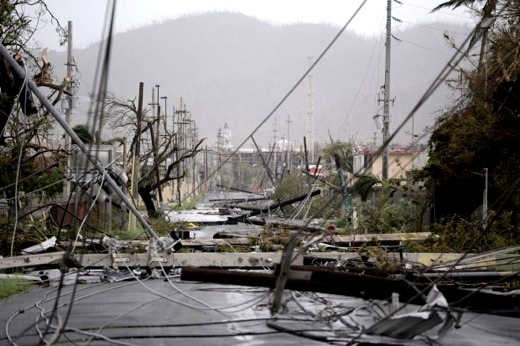

Image above: Electricity poles and lines lie toppled on the road after Hurricane Maria hit the eastern region of Puerto Rico. Photo: Carlos Giusti. From (https://www.wsj.com/articles/the-truth-about-hurricane-maria-1537129890).

Well before hurricane Maria devastated the island of Puerto Rico on 20 September 2017 the infrastructure of the power grid had deteriorated to the point of fragility not seen elsewhere in America.

That grid was the responsibility of The Puerto Rico Electric Power Authority (PREPA). PREPA is a government-owned corporation of Puerto Rico responsible for electricity generation, power distribution, and power transmission on the island. Hurricane Maria demonstrated that PREPA was a failure and that it would not have the vision or resources needed to serve Puerto Rico.

Without the resources to repair what had been a frail and failing system, Maria provided a death blow to PREPA. The Puerto Rican people tuned to gas operated electrical generators that had been purchased by people who could afford them for the frequent PREPA blackouts. After Maria things got nasty. Neighborhoods strung extension cords between homes in suburban neighborhoods. They got by with less.

There were some isolated small scaled solar photo-voltaic electric systems in place - and they became important. The Wall Street Journal reported (https://www.wired.com/story/puerto-rico-hurricane-maria-recovery/):
In the town rural town of Adjuntas, nestled in the mountains about an hour and a half southwest of San Juan, an NGO dedicated in part to solar power, called Casa Pueblo, became a pillar of the local recovery. 
When the town’s 18,000 residents were cut off from the rest of the island after Maria, the NGO’s solar-­powered radio helped authorities find out which roads were clear and which families were in danger, and attend to emergencies when the central government and federal authorities were not yet responding. 
Casa Pueblo subsequently gave out some 14,000 solar-powered lamps and also offered a solar-charged satellite phone at its offices for locals to use. At any given time, five to 10 people waited to make a call.

Arturo Massol, the associate director of Casa Pueblo and an ardent evangelist for decentralized, renewable energy, described what was happening on the island as “an energy insurrection.” Ordinary Puerto Ricans, he said, had woken up to the fact that when it came to electricity, they would have to look for alternatives.
This is part of a real solution. But that is not the direction that Puerto Rico is going. Instead the US government is planning on financing the privatization of PREPA through the creation of the “Puerto Rico Energy Transformation Administration (PRETA) that would provide guarantees (with US tax payer's money) for private energy corporations to rebuild the Puerto Rican grid. According to Debt Wire (https://www.debtwire.com/info/prepa-federalization-draft-bill-floating-congress)
Still in rough draft form, a bill tentatively titled the “Puerto Rico Energy Stabilization and Hurricane Resiliency Act of 2018” delineates specific steps to have the federal government—via the DOE—take over PREPA, impose a temporary administrator to supersede Puerto Rico’s Energy Commission ratemaking power, establish a corporation to issue restructuring bonds, and create special investment assurance accounts as part of the utility’s ongoing privatization process.
Here on Kauai the failure of privately owned Kauai Electric took a different but similar turn.

Those with long memories know what happened when the privately owned Kauai Electric called it quits. We paid off the "stake holders" a couple hundred million dollars of borrowed money to create a the debt ridden Kauai Island Utility Cooperative (KIUC). We now pay about the highest rates in the country.

Like Puerto Rico, Kauai is a stand alone grid on an isolated island. What energy it produces is all the energy it will have available. To its credit, KIUC has aggressively been adding solar voltaic power generation capacity. But it has not encouraged Solar PV stand alone systems.

Instead it encourages "co-generation"... the placement of PV systems on individual homes to supplement KIUC power generation. Co-gen certainly can reduce KIUC's high price for grid power, but it is, by my observation,  no real incentive to reduce power consumption.

Co-gen also means some resilience capability if the grid goes down because of a natural disaster, electro-magnetic pulse (EMP) or other disaster.

But KIUC suffers from the same vulnerability that Puerto Rico faced when Maria struck. All the power distribution is provided by poles and large hurricane can knock those poles down like a house of cards. That happened on Kauai with hurricane Iniki in 1992. But instead of burying the power distribution lines (as is done in most modern community planning) Kauai Electric simply re-erected the old creosote soaked wooden power poles.

Stand alone solar power systems have several advantages if they are not backed up by a electric grid or fossil fuel powered generator.
  • They absolutely limit the consumption of power to the amount of energy collected from the sun.
  • They require customer awareness of usage and some maintenance encouraging greater self reliance.
  • They reduce overall power consumption by high energy appliances like microwave ovens or air compressors.
  • They are resilient in that only the minority of systems that are hit directly by a disaster are damaged.
  • They wean us from living outside the limitations of energy not supplied by nature where you live.  
What we found was that having multiple independent stand alone PV systems is a real advantage. We stumbled into that situation by slowing adding systems over time. We started with a single panel and added increasingly bigger systems over almost a decade as we gained experience and knowledge.

All our systems use an array of one of two battery types. One type are high capacity 12volt 110amp-hour lead acid deep cycle batteries available on Kauai. The other type are 6v 405 amp-hour AGM (absorbant glass mat) batteries.

There are two AGM systems.

One is attached to our circuit breaker panel-box. This is where KIUC used to hook up. We had KIUC come and take off the meter and wiring to our house. This systems powers all the switches and outlets built into the house.

The second AGM system is attached to a power inverter providing energy for our new refrigerator and freezer. See (http://islandbreath.blogspot.com/2018/09/freezers-up-and-running.html).

The five other systems are smaller for specific tasks using smaller power inverters.
  • One provides counter lighting and strip outlets for our kitchen as well as our guest bathroom.
  • A second one provides lighting and a power strip to our master bedroom and its bathroom.
  • A third one provides lighting and a power strip  (for tool battery charging) in shop/utility room.
  • A fourth provides power for and office computer, wifi system and small appliance batteries.
  • A fifth provides power to a stand-alone shack that serves as a guest house. 
This overlapping redundancy has proved to be valuable. Any one system can go down and we can work around the problem by switching plugs in outlets and/or swapping around compatible batteries.

Redundancy is good. We had a neighbor who went with KIUC co-gen. After about a year the single co-gen system inverter failed and her solar panels were providing nothing to reduce her energy bill. The installer claimed it was out of warranty and not their problem. It took over year to get the system up and working agian.

Looking to the future my advice, as usual, is learn to and act to:
  • Grow your own food
  • Collect your own water
  • Produce your own energy
  • Make and repair what you can.
The alternative is sitting around a fire with pointy sticks.

Update on Wailua Diversion

SUBHEAD: Meeting Thursday 12/14 from 11:00am-1:00pm at the Kapaa Neighborhood Center.

By Bridget Hammerquist on 12 December 2017 in Island Breath -
(http://islandbreath.blogspot.com/2017/12/update-on-wailua-diversions.html)


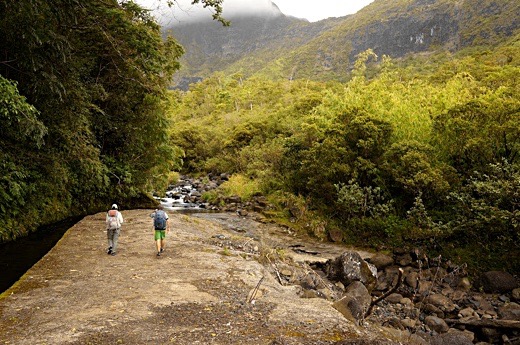
Image above: Two hikers at the Blue Hole walk across the concrete diversion (at left) of the North Fork of the Wailua Rivere diversion lets only overflow water into the natural channel of the river (at right). From (https://yosemitenews.info/forum/read.php?1,64439,64449).

[IB Publisher's note: The day with article was first published KIUC announced they were changing policy on the North Fork diversion of the Wailua River. See content of email we received.]


KIUC Board's Action on to Wailua River Diversions
Līhu'e, Kaua'i, HI - 12/12/17 - The Kauaʻi Island Utility Cooperative Board today authorized KIUC President and Chief Executive Officer David Bissell to make changes to the ditch system to return water to the North Fork of the Wailuā River at the Blue Hole and Waikoko diversions.
This action will ensure that water is flowing immediately downstream of the diversions.
The board also authorized the commencement of engineering design for permanent diversion modifications to ensure continuous stream flow for aquatic habitat. Construction will take place upon approval from the appropriate regulatory agencies.
Additionally, approval was granted to install additional gauging stations to increase data collection and understanding of the hydrology of the system.
"The hydros have been producing energy on Kauaʻi for more than 100 years and represent an important piece of KIUC's renewable portfolio and will help us reach the State's mandate of 100 percent renewables by 2045," said KIUC Board Chair Allan Smith.
On December 8, the State Board of Land and Natural Resources met and approved the holdover of a revocable permit for water use at the Blue Hole Diversion, which contribute 1.5 megawatts of energy to the island's renewable portfolio.


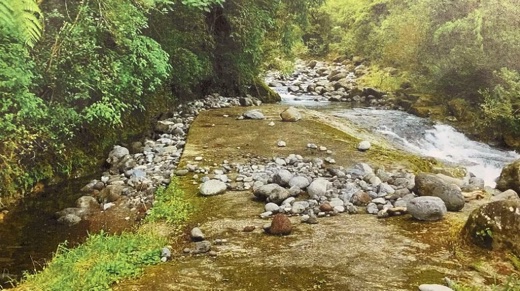
Image above: Boulders are scattered across the diversion at the head of the North Fork of the Wailua River due to heavy winter rains. Note the diversion channel is all but blocked (at left) and the natural flow of the water is in the original river bed (at right). From (https://www.bizjournals.com/pacific/news/2017/12/11/kiuc-receives-approval-for-holdover-of-hydro.html).


IB Publisher's note: On Friday 7 December 2017 the Hawaii State Board of Land & Natural Resources (BLNR) met on Kauai to consider the  renewal of a revocable water-diversion permit for Kauai Island Utility Cooperative’s (KIUC) hydroelectric plants that utilize water from Mt. Waialeale.

The water diversions have been criticized as illegal.  The Kiai Wai O Waialeale coalition, along with community groups Friends of Mahaulepu, HAPA and the Sierra Club, said KIUC and Grove Farm are illegally using 30 million gallons or more of water per day for the hydroelectric plants, and on days when there’s no rain, the streams are dry.

The BLNR approved the KIUC request.

Their will be a debriefing of the BLNR meeting Thursday 12/14 from 11:00am-1:00pm at the Kapaa Neighborhood Center.

WHAT:
Debriefing on BLNR decision in favor of KIUC and Gloves Farms to continue diverting Wailua River forks.

WHEN:
Thursday December 14th from 11:00am to 1:00pm

WHERE:
Kapaa Neighborhood Center
4491 Kou Street Kapaa, HI 96746

Summary of BLNR Meeting
Friday was an exciting day and I have to say that we did shine a bright light on a big issue that has received little public coverage. For those who may not have seen the news coverage of the Board meeting, here are a couple links to TV and newspaper coverage.

http://www.thegardenisland.com/2017/12/09/hawaii-news/kiuc-wins-water-fight/

http://www.hawaiinewsnow.com/story/37029649/land-board-approves-permit-to-continue-diverting-waialeale-waters-for-hydropower

For those who want to listen to the meeting Friday, here is a link to download the audio recording of Friday's BLNR meeting:

https://files.acrobat.com/a/preview/15e8a4fc-0d4b-4223-8c90-a96c83b92c04

My big take away/summary is:
  1. The Board was arbitrary when it denied the request for a contested case hearing.
  2. The denial gives us the right to go directly to the State Environmental Court.
Based on the facts and illuminating power points presented, Kiai Wai O Waialeale may be well positioned now to file a State Court lawsuit against KIUC on the merits of BLNR's renewal of the Waikoko and Blue Hole/North Fork Wailua diversion permits while simultaneously suing Grove Farm for its 4 100% base flow stream diversions (Iliiliula, Iole, Waiaka and Waiahi) in violation of the following water use law.

The testimony offered by KIUC established that Grove Farm is also taking 100% of the base flow from four streams fed by Mt Waialeale which waters are mixed into the waters from Waikoko and Blue Hole, diversions on State land.

Grove Farm has no permits to divert those streams and should have permits because the water is no longer used to grow sugar and pursuant to Hawaii State Supreme Court decisions, when the purpose for the diversion ends, the diversions have to be taken down and stream flow restored as mandated by Hawaii's Constitution.

Most importantly, DLNR staff and KIUC admitted the water use at issue is consumptive, because the waters diverted are never returned to their stream of origin. If you read the statute below, it doesn't appear that BLNR has any authority to approve, permit or lease State waters when the use is consumptive.

§171-58 Minerals and water rights.
(a) Except as provided in this section the right to any mineral or surface or ground water shall not be included in any lease, agreement, or sale, this right being reserved to the State; provided that the board may make provisions in the lease, agreement, or sale, for the payment of just compensation to the surface owner for improvements taken as a condition precedent to the exercise by the State of any reserved rights to enter, sever, and remove minerals or to capture, divert, or impound water.(c)(3)

After a certain land or water use has been authorized by the board subsequent to public hearings and conservation district use application and environmental impact statement approvals, water used in nonpolluting ways, for non-consumptive purposes because it is returned to the same stream or other body of water from which it was drawn, and essentially not affecting the volume and quality of water or biota in the stream or other body of water, may also be leased by the board with the prior approval of the governor and the prior authorization of the legislature by concurrent resolution.

When you read the statute, Grove Farm's diversions are illegal. Grove Farm is directing water through KIUC's hydro plants and in return, KIUC releases that water back to Grove Farm and also adds the water from its State land diversions.

Not only did we have 3 solid votes against RP renewal, with each no vote the voting board member spoke directly to KIUC's CEO, David Bissel, and told KIUC to:
  1. Complete their environmental studies (171.58 call for an EIS... did not understand why attorney's like Chris Yuen were speaking in terms of an EA when the statutory requirement is clear that any authorized use of State water can be permitted only "subsequent to" the acceptance of an EIS),
  2. Restore uninterpreted stream flow as soon as possible and
  3.  Meet with DHHL staff asap to achieve water distribution for its beneficiaries. One of the yes votes, from Chris Yuen, also made it sound like he wouldn't support them if they were not substantially along in the process by this time next year.

The other aspect that I didn't understand was why Suzanne Case did not recuse herself once it was clear that water from four Grove Farm stream diversions (IliIliula, Iole, Waiaka and Waiahi) mixes with the KIUC diversions and all runs through KIUC's power plant before being delivered to Grove Farm's infrastructure: the upper Lihue ditch (which is piped), the lower Lihue ditch and the Wailua South Fork that is 100% diverted by Grove Farm into the Hanamauulu ditch. 

Those four diversions were not part of the RP but the water from them is being used by the permittee and in return the permittee supports distribution back to Grove Farm. If you read 171.58, I can't find anything that exempts Grove Farm from a permit for their use of waters of the State. It is not right that Grove Farm directs this water to their surface water treatment plant before selling it to the County.

They claim they're charging for the delivery of water which is certainly splitting hairs because their charge is a fixed annual fee for 3 mgd.BLNR's arbitrary and capricious denial of the request for a contested case hearing, is a huge gift because we may now advance an Environmental State Court claim, having had our administrative remedy curtailed and having been deprived of due process. So rather than having the cost of an administrative hearing, I think we get to go right to State Court.

Note: Bridget Hammerquist is President of Friends of Maha’ulepu
P.O. Box: 1654
Koloa, HI 96756
friendsofmahaulepu.org
(808)742-1037

See also:
Ea O Ka Aina: Waialeale Water Lease 7/18/17
Ea O Ka Aina: Kauai's Hydro Battle 7/31/11
Ea O Ka Aina: Notice of Objection 6/3/11
Ea O Ka Aina: Special KIUC/FERC Meeting 5/28/11
Island Breath: Kauai Water Diversion - as a way of life 4/9/04

.

Waialeale Water Lease

SOURCE: Ken Taylor (littlewheel808@gmail.com)
SUBHEAD: A cultural study in preparation for renewal of a sixty-five year lease on Wailua River water.

From Ken Taylor on 18 July 2017 in Island Breath -
(http://islandbreath.blogspot.com/2017/07/waialeale-water.html)


Image above: "The Blue Hole" is valley shaped by countless waterfalls from "The Weeping Wall" below Waialeale that feed into the largest river in Hawai - the Wailua. From (http://www.onlyinyourstate.com/hawaii/hi-weeping-wall/).

The Kauai Island Utility Cooperative (KIUC) has contracted Cultural Surveys Hawaii to complete a cultural study on the proposed 65 year water lease of North Fork Wailua River, Waikoko, Iliiliula, Waiaka and Waiahi Streams, Puna District, Kauai.

KIUC is currently diverting 100% of the base flow of these mountain streams orgiginating from the Alakai and Mount Waialeale, for hydropower. These 2 KIUC hydropower plants produce only 1% of Kauai's power needs, which now is 90% supplied by solar panels during the day.

The Waiahi Hydropower plants, over a hundred years old, were needed to supply power to Lihue Mill. We now have other power options, that do not depend on diverting 100% of stream water from our forests.

Nicole Ishihara, from Cultural Surveys Hawaii, is coming to Kauai this Thursday and Friday, July 20th & 21st, to talk to Kauai about the impacts of this proposed 65 year lease by KIUC.

She will be available to talk to folks at Hā Coffee Shop in Lihue from 10 am to about 12. We will then meet up at Wailua State Park parking lot, by the Birth Stones, to carpool up to the area of the KIUC diversion (Blue Hole). Vehicles with 4WD are welcome.

Nicole Ishihara will also be available to meet with the community Thursday early evening, and Friday morning until about noon.

This is a chance for Kauai to let their voices be heard about the impacts of the diversion of a culturally important stream, proposed for the next 65 years. A lifetime without Mauka-Makai water connection from Mount Waialeale. It's just not right.

Attached is CSH letter requesting comments, and sample questions. Please let Nicole know the importance of Waialeale water by letter, phone call, chant, dance, art - however you need to express what water from Waialeale means to you, your family and your community, for the next 65 years.

CONTACT
Nicole Ishihara
Cultural Surveys Hawaii
(808) 965-6478
nishihara@culturalsurveys.com

See also concerning Waialeale water rights:
Ea O Ka Aina: The Mo'o and the Well 1/29/14
Ea O Ka Aina: Horizontal Well Presentation 9/19/13
Ea O Ka Aina: Kahili Vampire Project Meeting 9/13/13
Ea O Ka Aina: No to the Horizontal Well 4/11/13
Ea O Ka Aina: Scoping Meeting on Horizontal Well 4/6/13
Ea O Ka Aina: This is for your own good 10/13/12

.

KIUC aims at 100% renewables

SUBHEAD: The islands of Ta‘ū and Kauai are part of a bold solar plus battery experiment.

By Henry Curtis on 10 June 2017 for Ililani Media -
(http://www.ililani.media/2017/06/kiuc-moving-rapidly-towards-100.html)


Image above: A solar array partnership between KIUC, Solr City and Tesla. From (https://www.theverge.com/2017/3/8/14854858/tesla-solar-hawaii-kauai-kiuc-powerpack-battery-generator).

Ta‘ū is the easternmost volcanic island of the Samoan Islands and has a population of 600. The island switched from one hundred percent reliance on diesel generators to one hundred percent reliance on solar panels and batteries.

The system consists of 5,328 solar panels with 1.4 megawatts of solar generation capacity, and 60 Tesla Powerpacks. The battery storage system can be recharged in seven hours, and can power the island for three days.

Kauai Island Utility Cooperative (KIUC) generated more than 90 percent of its electricity from fossil fuels in 2011. Kauai’s two main fossil fuel power plants are the 96.5 MW Port Allen Generation Station and the 27.5 MW Kapaia Power Station.

Kauai currently has sufficient solar to provide almost all of its electricity demand during peak solar periods. Additional solar requires energy storage in order to be able to use the solar in the evening and at night.

Tesla built a 13-megawatt solar energy system consisting of 54,978 photovoltaic panels, combined with a 52 megawatt-hours (MWh) energy storage system consisting of 272 Powerpacks.

The system is located on 50 acres owned by Grove Farm, near Lihue. Tesla will sell electricity to KIUC at 13.9 cents per kilowatt-hour (KWh) for 20 years. The system went on-line in March, 2017.

KIUC adopted a Strategic Plan Update 2016-2030 on January 31, 2017.

“Renewables have increased from six percent of sales in 2007 to 37 percent in 2016. KIUC is rapidly closing in on reaching the 70 percent renewable level by 2030.”

There are 3,500 rooftop solar systems with a capacity of 21 megawatts.

“KIUC has either built or collaborated with third parties on three industrial scale solar projects, including Anahola (12 megawatts), Koloa (12 megawatts), and Port Allen (6 megawatts).

Three smaller privately owned solar arrays in Waimea, Omao and Kapaa contribute 1.6 megawatts total.

Currently under construction is a 13-megawatt solar array with battery storage capability adjacent to the Kapaia Power Station. This project – a partnership with Solar City and Tesla - is the first of its size in the nation.”

“KIUC’s renewable portfolio also includes hydroelectric systems at Wainiha, Waiahi, Kalāheo, Olokele and Waimea/Kekaha, generating a combined total of 10 megawatts to the grid.

A 6-megawatt system is under construction on Gay and Robinson land, and under consideration is an additional project that would combine solar and hydro in a pumped storage system, which could produce 25 megawatts at full capacity.”

“In 2016, Green Energy began operating its 7-megawatt biomass plant just outside Lihue. The plant provides 12 percent of Kauai’s power, and is one of the first plants of its kind in this country: burning wood chips from invasive species and from locally grown trees.”

“In 2016, on some individual days, KIUC derives 97 percent of its energy from renewable sources, including 77 percent from solar. On the average clear day, with solar at or close to full potential, all but one of KIUC’s diesel generators can shut down.”

KIUC plans to develop the 8.3-MW Puu Opae pumped-storage hydro project. A five-mile underground pipeline will connect two ponds on Kauai’s west side. The project recently advanced, with the settlement of a water dispute.

Earthjustice, on behalf of Poai Wai Ola: the West Kaua'i Watershed Alliance, filed a petition with the Commission on Water Resource Management (Water Commission; CWRM) in 2013, seeking to revise the minimum flow in the Waimea River and its tributaries. The complaint also stated that some of the diverted water was being wasted.

The parties involved in the proceedings were the Hawaii Agribusiness Development Corporation, Kekaha Agriculture Association, Kauai Island Utility Cooperative, the Department of Hawaiian Homelands and Po’ai Wai Ola.

The Water Commission approved a mediated agreement on April 18.

Waimea River water flow will increase from 16 million gallons per day to around 25 million gallons per day. The Department of Hawaiian Homelands will receive 6.903 million gallons a day from the Kokee Streams for homesteading purposes.

“All streams will be allowed to run from the mountain to the sea and no diversion will ever be a total diversion again.”

“The ditch systems owned by the State of Hawaii's Agribusiness Development Corporation (ADC), and currently operated by the Kekaha Agricultural Association (KAA), will continue to be maintained to allow for both present and future uses.”

“Kauai Island Utility Cooperative (KIUC) will be allowed to complete due diligence on a set of energy projects supported by the Kokee Ditch System, and, if the energy projects are built, will receive from the Kokee ditch system a rolling average of 11 mgd to support both (1) the Puu Opae project and (2) DHHL's water needs under any water reservation the Commission may grant to DHHL.”

See also:
Ea O Ka Aina: Solar power one island at a time 11/24/16
Ea O Ka Aina: Renewables - the new Fracking? 2/10/16
Ea O Ka Aina: Failing to live off the grid 1/3/16
Ea O Ka Aina: How sustainable is Solar PV? 4/26/15
Ea O Ka Aina: Our Renewable Future 1/21/15
Ea O Ka Aina: Kicking tie KIUC habit 5/1/14
Ea O Ka Aina: Caron Crash - Solar Dawn 3/19/14
Ea O Ka Aina: Go Nuclear or Go Native 10/20/14
Ea O Ka Aina: CIUK > KIUC 5/8/12
Ea O Ka Aina: The Alternative Energy Matrix 2/8/12
Ea O Ka Aina: Chinese say PV to beat coal 8/17/11
Ea O Ka Aina: Off-Grid Night Lighting 8/14/09
Island Breath: Dealing With Chaos 10/7/08
.

KIUC & the Culture of Fear

SUBHEAD: A correspondence on Smart Meters between a KIUC member and its Executive Administrator.

By Ray Songtree on 31 October 2016 for Lipstick & War Crimes -
(https://lipstick-and-war-crimes.org/kiuc-kauai-island-utility-cooperatives-culture-fear/)


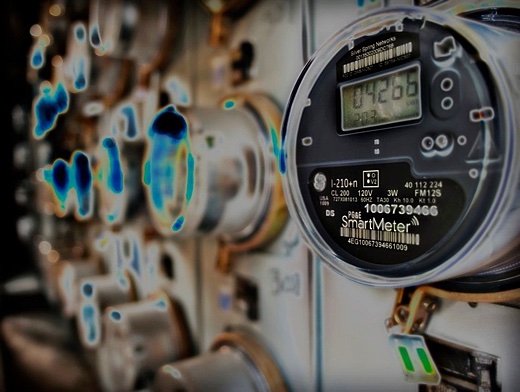
Image above: A typical smart meter installation at multi unit housing intensifies radiation in small area.  From (https://burbankaction.wordpress.com/petition/).

FROM KIUC EXECUTIVE ADMINISISTRATOR
On 10/31/2016 “Kathleen Chin” (kchin@kiuc.coop) wrote the email:
Aloha Ray,

While we are pleased to receive feedback from our members, I ask the email content you send to KIUCBOD@hawaii.rr.com and BoardChair@hawaii.rr.com be specific to our primary business as an electric utility. Please remove our email address from your bulk email blast list otherwise we will have to block your communications.

Respectfully, Pua

Kathleen “Pua” Chin | Executive Administrator | Kauai Island Utility Cooperative | 4463 Pahe`e Street, Suite 1, Lihue, HI 96766-2000

Confidentiality Notice: This e-mail message, including any attachments, is for the sole use of the intended recipient(s) and may contain confidential and privileged information. Any unauthorized review, copy, use, disclosure, or distribution is prohibited. If you are not the intended recipient, please contact the sender by reply e-mail and destroy all copies of the original message.
REPLY FROM RAY SONGTREE
On 10/31/2016 “Ray Songtree (rayupdates@hushmail.com) replied with the email:
Hi Pua,

Respectfully, who has requested this? I do not have KIUC on a blast list and find that categorization insulting. I send technology and corruption issues that board members might find interesting.

Some board members may not, and that would be expected in a diverse and free thinking group. The board is made of different individuals. Some of them may find this information vital as they will not get this info in mainstream news, which includes the Garden Island Star Advertiser. I am an author and researcher. If KIUC was curious about corruption, they would hire me as a consultant.

I often send these emails to Mayor and Council as they have gone along with KIUC lack of research and they need to be informed. The wikileaks story is critical to those who want honest government and honest utilities. This is why I included that, because many Kauai residents are hoping the county, state, federal and UN corruption will be busted. They know this will only happen through whistle blowers.

Perhaps there are people at KIUC who would not like to see this, and resent whistle blowers who throw a wrench in their opaque planning which decides for everyone else, with no ability to challenge their decisions, what the community’s future might look like.

In point, the special ballots are formatted by KIUC which is the entity being challenged. Conflict of interest? There is no check and balance at KIUC. One contestant directs wording of Ballot which predictably leads the thinking of the voters in favor of the one contestant.

Thus there are no real challenges possible to the ensconced thinking and structure of KIUC. Thus KIUC is a co-op only in name, for tax and legal reasons only, where the serfs have no voice.
I am familiar with who initiated smart grid, how it was promulgated, what it really is, and what is not, all which has been foisted on Kauai residents. Smart grid is not for anything green, it was to create the internet of all things, where everything is tracked through smart meters. Smart meters, like cell phones, were never safe and will never be safe.

TEDx Talk: By Jeromy Johnson - Wireless Wake-Up Call at Zellerbach Hall on the UC Berkeley campus. He gave a wonderful TED talk about how WiFi and EMF are affecting our health at (www.emfanalysis.com/tedx-wireless-wake-up-call/). [See video below]


Specifically, I send emails about EMF, Smart Meter, and technocracy issues. I am the person, as you might remember, who led the failed attempt to educate the board about FCC corruption and Smart Meters. The issue will never go away until KIUC is willing to do the research and break with Federal government. FCC is directly linked to KIUC.

If someone asked you to send me this letter, please forward this to them so we can discuss what kinds of FCC / government corruption, and undiscussed technology are NOT of interest to a quasi public utility.

Also please let me know who speaks to censor the communication with 9 other people?

I’m sorry your job description includes attempts to censor whistle blowing and I wonder how it is, that you sent this email without reservations?

Perhaps you would feel comfortable to discuss your honest and personal feelings about KIUC on radio, as I’m sure your job would not be jeopardized.

We could do a skype talk and I could post it to youtube for you. You have nothing to fear from KIUC.

Ray Songtree
378-4152

Image above: Jeromy Johnson TEDx talk of radiation from smart meters and cellphones. From (https://youtu.be/F0NEaPTu9oI).
.

Failing to live Off-Grid

SUBHEAD: Darth Vader invites Luke to "Come to the Dark Side". It's hard serving the power.

By Juan Wilson on 3 January 2016 Island Breath -
(http://website.kiuc.coop/sites/kiuc/files/PDF/currents/2015-12-Currents.pdf)


Image above: When Luke finds that his father is Darth Vader he is asked to join the Dark Side". From (http://thestarwarstrilogy.com/starwars/page/Original-Trilogy-Darth-Vader).

Luke Evslin has been writing a blog Ka Wae since January of 2011.  Because of his interesting perspective on issues we have had a link to that site on the Island Breath front page. Other bloggers weve linked to over the years have been James Kunstler, John Michael Greer, Charles Hugh Smith, and Dmitry Orlov.

Luke has written three excellent articles on events in Syria. Start with Thoughts on Syria.

His latest article is dated 22 December 2015 titled Thank You. It's kind of a "Goodbye piece". That article describes some of Luke's recent writing successes with Civil Beat and stepping away from the blog.

One of those writing "successes" he mentions is a cover article for the KIUC magazine Currents titled "Why I Live Off-Grid" (Also see it below). I was really surprised KIUC would publish such an article - until I read it.

In his "Thank You" article Luke states he was asked to write the piece by KIUC. The last line of the story is"
"I’m desperate to get on the grid, and will never forget the value of that electricity."
After reading "Why I Live Off-Grid" I decided to take the link to Luke's blog off Island Breath.

It's a Big Adjustment
Moving off the KIUC grid is a big adjustment. And as Luke found out it requires a lot more photo-voltaic resources and storage capacity than one might initially think.

It has taken my wife, Linda, and  I ten years to settle into a system that can get us through the day/night and, just as dramatically the summer/winter cycles. 

I won't go through the whole history here, but we started with a 60 watt panel and a small deep-cycle battery and found it inadequate for much more than lighting a fluorescent bulb. Forget about running a computer or under-counter refrigerator.

After ten years we have evolved a group of individual systems for doing all our electrical tasks. There are seven systems in all.
  1. One, with 150watts of PV panel and 4 large deep-cycle lead-acid marine batteries and  provides lighting and a radio for a guest room. 
  2. A  similar system provides master bedroom and bathroom lighting.
  3. Another similar system provides garage/utility room lighting.
  4. A 300 watt PV system with 3 sealed AGM deep-cycle sealed batteries provides kitchen counter and 2nd bathroom lighting.
  5. Another 300 watt PV panel feeds 6 large deep-cycle lead-acid marine batteries to support our wireless system (and during daylight) my desktop computer.
  6. A 1,500 watt PV array with eighth 400 amphour 6 volt batteries for the refrigerator and freezer.
  7. Another 1,500 watt PV array with eighth 400 amphour 6 volt batteries is attached to our electric panel box with a what looks like the same OutBack inverter controller system pictured in Luke's KIUC article. All it does is run the outlets and switched lighting built into the house.
Once I had all these systems running, I called KIUC to come and take their meter and the line that came down my long driveway. The gal on the phone asked me if I was taking down my house, and I told her "No, I was taking down KIUC. 


It's like Sailing a Boat
Even with all these systems charged and running, we live on a tight electrical budget. We don't use our microwave for anything but as a breadbox and storing bags of chips.

We only vacuum, or use heavy power consuming tools (like my table saw) when the sun is shining. We schedule the washing machine and dryer for midday use when the main system battery voltage reads at least 26.5 volts.

We schedule using our entertainment systems and computer systems. At night we can afford to watch two Netfix or Amazon shows or spend that time on the computer surfing the web and listening to music. 

We cannot do all these things together or at any time we want. And we are getting used to it. It's kind of like sailing a boat. A magical thing that requires vigilance at all times.

One thing I can say is that Linda and I have become very aware of the cycle of the day and the year. The winter solstice has never had quite the same meaning to me as it does now.

Besides building multiple systems for providing power we are trying to do the same thing for water, cooking and food sources.

It's Full Time Job
One I wouldn't trade. Even though I usually get up at 3:00am to check the main house system and refrigeration system. The refrigeration is the 800 pound gorilla. In the middle of the night I check to make sure if I need to that I can transfer the refrigerator over to the house system if need be. In the winter that happens once or twice a week. It's either do that; turn off the fridge or freezer, or damage $2,500 worth of battery array. Last winter I had to let some frozen food go.

I know that in time my PV panels will fail. Some may succumb to flying debris in a storm. I'm sure the main inverter will fry some day and the 110v outlets in the house go cold. That day I probably won't be willing or able to replace it to restore "normal".

I suspect that these systems, as they fail, will be just a transfer from a life in the industrial world to something like the life Hawaiians lived here four-hundred years ago. We have to make some adjustments to get there and I'm hoping for a smooth ride down.

Any, Luke, if you see this, know I admire your effort. It's a bigger effort and more exspensive than you may want to invest but it tells you the real nature of what we as Americans consume beyond our daily share of sunlight and rain.


Why I Live Off-Grid

By Luke Evslin on 22 December 2015 for KIUC Currents -
(http://website.kiuc.coop/sites/kiuc/files/PDF/currents/2015-12-Currents.pdf)


Image above: From ().

If you are young, idealistic and stuck in a hospital bed recovering from a near-death experience, stay away from the writings of Henry David Thoreau. He said:
“I went to the woods because I wished to live deliberately, to front only the essential facts of life, and see if I could not learn what it had to teach, and not, when I came to die, discover that I had not lived.”
After a lifetime of consumerism, the writings of a 19th-century philosopher convinced me to go off grid. The distant misty peaks of Makaleha would be my Walden.

I lay in bed, immobilized by a severe back injury, yet dreaming of the day I could stand and cut the cord on civilization. I wanted to suck out all the marrow of life while saving money and reducing my carbon footprint. What better way than going off grid?

Utility-scale energy is complicated: spinning reserves, frequency, naphtha, diesel, ratepaying, amperage, voltage and anthropogenic climate change. I have a hard time wrapping my head around it all.

But I can understand off grid. Just six solar panels and four batteries. I could count the components on my two hands, and it was within my price range. And then no more utility bills. It was perfect.

And I was delusional.

As soon as I left the hospital bed, I built a water catchment tank, installed six 250-watt photovoltaic panels and enclosed my wife, Sokchea, and I in a bubble of self-righteousness.

It has now been four years. Our water still comes from clouds and our electricity from the sun.

But that bubble of idealism burst long, long ago.

Eating dirt in second grade

A few days of overcast weather turns the romance of finite electricity into the reality of spoiled food, cold showers and kerosene lanterns. It is not like saying, “No thanks, I have my own bags” at the grocery store or remembering to take your Hydroflask when you leave the house.

Living off grid has affected every aspect of our lives.

The last time I had a friend over for dinner he said, “Brah, I can’t believe you live like this.”

I’m not sure if he was referring to the single LED bulb that we use at night, our mossy-tasting water or the ammonia emanating from the compost heap, but we took the hint that our rejection of infinite electricity and municipal water had brought us down a few notches on the social ladder.

I think about that one time in second grade when I told everyone I was going to eat dirt at recess. There was a thrill of exhilaration as a crowd formed around me.

“Wow, they’re all watching me,” I thought with excitement as I raised the first handful of dirt to my lips. “This is the greatest moment of my life ...”

Yet, as the moist soil passed through my mouth, so did that fleeting moment of glory. All of my classmates ran laughing, leaving me stuck to contemplate my own idiocy with a mouthful of dirt.

While my off-grid self-righteousness to shield me from the genuine concern of my friends regarding my sanity, even that has faded in the stark realization of the futility of our endeavor.

Truly going off grid is just as impossible for our modern palate to digest as dirt in the schoolyard.  

Boiling water a challenge

Speaking of dirt, right now I am drinking an organic Rainforest blend coffee that was compiled from so many Third World sources that no country of origin is listed on the label.

If I were better at selling this lifestyle, I would say that my foreign dictatorship-sourced coffee was brewed from the falling drops of condensation on the slopes of a majestic Hawaiian rainforest.

But I know better.

Most of the time my rainwater is only brewing mosquito larva and the bacteria that specialize in decomposing the anole lizards that find their unfortunate end in my tank. Yet even the disconcerting amount of microscopic life in my untreated water is overshadowed by the sheer volume of PVC and polyethylene that make up my harvesting system—those industrial plastics shown to cause neurological disorders.

Despite all of that, boiling the water is actually the hardest part of my morning coffee routine.

The last time I used an electric kettle I drained my batteries so quickly I had to spend half a day without electricity.

Now I use propane sourced from hydraulic fracturing on the East Coast, which has been linked to massive methane releases, seismic activity, dislodging of radioactive material and, most commonly, groundwater contamination by the chemicals used in the process.

Yes, this is what I call off grid.

Did I already mention my own extreme idiocy? In this case, hypocrisy is the better word.

Right now, as the sun approaches its zenith, our solar panels (made in Singapore) are bringing in about one-kilowatt of electricity. However, because our batteries (made in China) are currently full and my iMac (made in China), desk fan (made in China) and refrigerator (yes, made in the USA!) are only using about 200 combined watts, that means our charge controller is shunting somewhere around 800 continuous watts of electricity.

Only 20 percent of the electricity being generated by my system is being used, and instead of diverting the unused electrons back onto the grid like they would be in a grid-tied system, I am wasting most of my power production.

Gas generator is backup

Even worse, while we minimize our power use as much as possible on winter days, I often have to run our gasoline generator in the evening just to have enough power to run our small refrigerator through the night.While part of our motivation to go off grid was to minimize our contribution to climate change by reducing our greenhouse gas emissions, I am actually doing the opposite.

If my power consumption was the same, yet I was grid tied, I would have a significantly smaller carbon footprint.

Using the grid as a backup is more efficient than a portable generator. Instead of only using a small portion of my mid-day electricity, all of the electrons produced in our system would be sold back to the grid to be used by my neighbors.

By increasing the voltage of our islandwide grid, our small photovoltaic contribution ultimately would reduce the demand for KIUC’s naphtha- and diesel-burning generators.

Do I regret going off grid? No. Just like picking the dirt out of my teeth taught me the value of humility, going off grid has taught me the value of electricity.

No laundry after 4 p.m.

During the day when the sun is shining, I have a bumper crop of available electrons. Yet at night, when we are running exclusively off of our battery bank, every watt that flows into our home is extremely valuable.

We never have more than two lights on at a time. We cannot wash our clothes after 4 p.m. We cannot watch TV at night.

It only takes a few refrigerator loads of spoiled food before electricity becomes the most important resource in your household.

It just takes one $2,000 set of spoiled and sulfuric acid batteries before you learn not to let them discharge all the way.

While I no longer am self-righteous about our off-grid lifestyle, and I harbor no false illusions about my impact being less than others, the lesson of finite electricity has been one of the most valuable of my life.

As we transition to an island of 100 percent renewable energy, much of it based off photovoltaic technology, nighttime electricity will become progressively more valuable.

I’m desperate to get on the grid, and will never forget the value of that electricity.

.

KIUC on PV - Tesla on PowerWall

SUBHEAD: Today I got two messages. One from the backward looking KIUC - the other from forward looking Tesla Corp.

By Juan Wilson on 1 May 2015 for Island Breath -
(http://islandbreath.blogspot.com/2015/05/kiuc-on-pv-tesla-on-powerwall.html)


Image above: Three units of the Tesla PowerWall hanging on a wall. From (http://www.renovablesverdes.com/).

I got a few emails about solar energy overnight. One was from Kauai Island Utility Cooperative (KIUC) warning about the downside of rooftop solar power panels, and the other from my brother-in-law (and others) about the Tesla PowerWall.

The email from the (KIUC). It was specifically sent from  info@kiuc.coop. That means it is a corporate press release of a propaganda effort to keep the herd in line.

The thrust of the KIUC message was that solar was no big deal and that if you do anything it should be to put a solar hot water heater on your roof, not photo-voltaic panels to produce energy. In fact if you insist on putting panels on your house you'd be better off putting a small array up since you'll be relying on KIUC to get you through the night anyway.

KIUC tells its members that putting up a big array so that KIUC would pay them more than they would owe KIUC for power would be a terrible idea; warning: "Some mainland utilities are starting to charge solar customers a fee to help recover their share of fixed costs."

That's kind of like the banks that are charging negative interest rates to customers that give them cash to hold in an account.

Nowhere in the KIUC discussion of solar electric power generation do they even consider you might use batteries to store your own power - and they certainly couldn't imaging that if you produced your own power and stored it that you would even consider cutting the cord to the grid.

Well, given this kind of perspective from our "member owned cooperative" that's exactly what I would recommend. Get off the grid!

That does not mean run into the arms of the solar system leasers. I agree with KIUC on caution there.

Below is the email content from KIUC executives (working for the Touchtone Energy Group):


KIUC Straight Talk on Rooftop Solar


As a co-op, we support measures our members can take to save money and become more energy efficient.

We also want our members to make informed decisions about their energy use. With rooftop solar photovoltaic systems being sold so aggressively on Kauai, we're already seeing situations where people aren't getting the savings they were promised. So now they're paying a KIUC bill and making monthly payments on a solar lease.

There are also people who use very little electricity who are being talked into long-term leases for big rooftop systems. In some cases, their lease payments can be more than their old electric bill.

Rooftop solar isn't right for everyone, so it's important that you get all the facts before buying a system or committing to a lease.

If you do decide to get a rooftop system, we recommend getting one that's right-sized for the amount of electricity your household uses, not oversized. The bigger the system, the higher the cost. And there's no guarantee KIUC will always buy your excess power.

Here are the co-op's answers to some common questions about rooftop solar:

Should I get a rooftop solar system?

It mostly depends on how your household uses electricity. To maximize your savings, your household must be able to shift a significant amount of its electricity use to the hours when the sun is shining - doing laundry or cooking during the day, for example.

If no one is home during the day and your energy use during those hours is minimal, your savings will also be small.

What size should my system be?

Every household uses electricity differently, but the average household using 500 to 700 kilowatt hours per month can usually achieve savings with a 10-panel system producing 2.5 kilowatts. For people using less than 500 kWh per month, the savings probably aren't big enough to justify the cost of rooftop solar.

You should first consider a solar water heater, which is a lot less expensive to install and can reduce your bill by 30 percent or more - and KIUC offers a $1,000 rebate. You can call us at 246-4300 and we'll tell you what your average use is.

How many panels do I need to make my bill go away?

Even customers who offset all of their household use are still responsible for a minimum monthly charge. An oversized system designed mainly to sell excess electricity to KIUC can cost $40,000 or more before tax incentives - the bigger the system, the longer it takes to recover your investment, if ever.

Those zero-down leases sound like a great way to get solar on my roof.

With zero money down, you're rolling the cost into the monthly payment you'll be making to the solar company, which charges you for the electricity your system produces.

Before signing a long-term lease, ask yourself some questions: Do I plan to live here for 20 years or am I going to move? Am I comfortable with the risk that if the price of electricity falls, I'm still locked into a higher lease payment? Can I shift my use of electricity to the daytime? What kind of warranty does the contractor provide, and who will be around to repair my system if it breaks 10 years from now?

How much will KIUC pay me for the excess electricity I generate?

For most members with rooftop solar, the amount KIUC pays for the electricity they export to the grid changes every month, depending on the price of oil. It's been as high as 26 cents and as low as 10 cents. This rate, known as Schedule Q, reflects the amount KIUC would have had to pay to generate the power if we didn't buy it from you.

Because KIUC generates most of its electricity by burning oil, this so-called "avoided cost" calculation is tied to the oil price. As more renewables come on line and KIUC burns less oil, the amount paid under Schedule Q is expected to drop.

Will KIUC always buy the extra energy my system produces?

On a sunny afternoon when all of the photovoltaic systems on the island are at their maximum output, there can be more power being generated than there is demand - there's nowhere for this excess power to go.

So there may be times when our system won't accept all of the solar power available. That's known as curtailment. The more oversized rooftop systems on the grid, the more likely curtailment becomes. KIUC hopes to avoid curtailment by encouraging customers to install "right-sized" systems.

At times when peak solar production outpaces demand, it's possible KIUC may temporarily disconnect some oversized systems so they can't export to the grid.

Will the charges on my electric bill stay the same if I have solar?

People with solar photovoltaic systems are still on the grid. They count on it to provide 80 percent of their power, since those systems don't work at night and when it's cloudy.

Yet they pay a smaller share of the utility's fixed costs - people, poles, lines, power plants, batteries - than people without solar. Regulators have acknowledged that existing rate mechanisms don't reflect the new reality of renewable resource integration.

Some Mainland utilities are starting to charge solar customers a fee to help recover their share of fixed costs and Hawaii utilities, including KIUC, are studying similar fees. Any rate changes would be subject to the approval of the Hawaii Public Utilities Commission.


The other messages about solar were about the announcement by Elon Monk of the Tesla Corporation on the availability of a home energy storage system called the PowerWall. If you don't think that made the good old boys on the KIUC board soil their shorts read on about the PowerWall.

Here's one article on the PowerWall:


The Tesla PowerWall
Al Jazeera (http://www.aljazeera.com/news/2015/05/electric-car-pioneer-tesla-unveils-home-battery-150501180146733.html)

A device, which could fit on wall of garage or inside a house, could make solar-powered homes independent of energy grid.

Tesla, the electric car pioneer, has unveiled a "home battery" which the US company's founder Elon Musk said would help change the "entire energy infrastructure of the world".

The Tesla Powerwall can store power from solar panels, from the electricity grid at night when it is typically cheaper, and provide a secure back-up in the case of a power outage.

In theory, the device, which typically would fit on the wall of a garage or inside a house, could make solar-powered homes completely independent of the traditional energy grid.

"The goal is complete transformation of the entire energy infrastructure of the world, to completely sustainable zero carbon," Musk told reporters shortly before unveiling the Powerwall at an event outside Los Angeles.

Examples of the device were lined up along one side of a hall. "It looks like a beautiful sculpture on the wall," said Musk.

All the power for the evening demonstration, attended by several hundred media as well as technology world participants, came from his new batteries, hooked up to solar panels on the roof, he said.

'Poorest communities'
Initially the device, which will cost $3,500, will go on sale in the US later this year. But the aim is to roll it out internationally some time next year.

Germany is seen as a key market for the product, because it has among the highest take-up of solar energy in the world, Musk said.

The Powerwall comes in 10 kWh weekly cycle and 7 kWh daily cycle models, both of which are guaranteed for 10 years and are sufficient to power most homes during peak evening hours.

"This is going to be really great for the poorest communities in the world," he said. "This allows you to be completely off grid."

Musk stressed, however, that moving advanced economies like the US away from unsustainable fossil fuels was a key goal.
"I think we should collectively do something about this ... we have this handy fusion reactor in the sky, called the sun," he said.


And here's another article on the PowerWall:


Tesla Unveils Battery
French Press Agency (http://www.afp.com/en/news/tesla-unveils-battery-transform-energy-infrastructure)

Electric car pioneer Telsa Motors unveiled a "home battery" Thursday which its founder Elon Musk said would help change the "entire energy infrastructure of the world."

The Tesla Powerwall can store power from solar panels, from the electricity grid at night when it is typically cheaper, and provide a secure backup in the case of a power outage.

In theory the device, which typically would fit on the wall of a garage or inside a house, could make solar-powered homes completely independent of the traditional energy grid.

"The goal is complete transformation of the entire energy infrastructure of the world, to completely sustainable zero carbon," Musk told reporters shortly before unveiling the Powerwall in a warehouse outside Los Angeles.

Initially the device, which will cost $3,500, will go on sale in the United States later this year. But the aim is to roll it out internationally some time next year.

Germany is seen as a key market for the product -- which is about 6 inches thick, 4 feet tall and 3 feet across -- because it has among the highest take-up of solar energy in the world, Musk said.

But it could also be a huge boon for under-developed regions, where power is often unreliable at best, despite abundant solar energy -- and he compared the potential to that of the way cellphone technology has expanded.

"It's analogous to the way mobile leap-frogged landlines," Musk said.

"This is going to be really great for the poorest communities in the world," he said. "This allows you to be completely off grid." 

You get the picture. Tesla is inviting people to store the energy they need to run their homes for the cost of an automobile, and KIUC hoping you haven't heard the Tesla announcement and hoping you'll go back to sleep and stop worrying about the "Grid" or the future.

I have no idea if Tesla can manufacture and sell such a system to a wide audience. It is expensive and money to invest in the future is as rare as hen's teeth for most of us. For those with money to buy a new car this could be an alternative.

But, there are many voices that say we don't have the resources, affordable energy or focus to manufacture a way to continue our consumer based society and that a completely different paradigm is needed at this late stage of our throat hold on Mother Nature.

In any event, at least Tesla is looking forward and not backward. Big centralized top-down systems, like power grids are on the way out.
.

KIUC - the Night Stalker

SUBHEAD: KIUC's Schedule Q program is being adopted by the state and hampers renewable energy and stunts growth of home PV systems.

[IB Publisher's note: This article was updated on 3/16/2015.]

By Sonja on 11 March 2015 for ViableEnergy.org -
(http://viable-energy.org/2015/03/schedule-q-kiuc-hampers-renewables-and-stunts-pv-growth/)


Image above: The Night Stalker, a nocturnal hunter evolved from vampire bats. Blind, it seeks independent electromagnetic fields to find its prey, which it then stuns it with powerful screams for more money. Image by Dixon (1981) in "After Man: a Zoology of the Future" by Steven M. Carr. From (http://www.mun.ca/biology/scarr/Night_Stalker.htm).

I am a resident of Kauai as well as a recent adopter of solar photovoltaics. Like all new PV installations here, we are Schedule Q customers of the local utility, the Kauai Island Utility Cooperative (KIUC).
The recent rate change makes renewable energy a really bad deal for KIUC customers who have small-scale rooftop photovoltaics (PV), and moving to Schedule Q statewide will hamper the growth of renewable energies and cause more fossil fuels to be burned, contributing to global warming and climate change.
Screen Shot 2015-03-13 at 1.15.41 PM
This image shows our energy consumed, and the energy generated. The turquoise bars at the bottom is what we generate, and the darker color is what we consume – usually at night, or when the weather is bad. In February we fed 602 kWh into the grid. This is roughly 3x the amount we consumed from the grid (211kWh), and we had a small bill, not a credit at the end. This is because Schedule Q allows KIUC to pay us 1/3 of what they charge per kWh.

KIUC’s Jim Kelly’s slightly inflamatory comment on the issue “rooftop PV […] was never conceived […] as a big moneymaker for households.”


In most areas, when a PV system is grid tied the utility company offer a service called net metering. Please consider reading Wikipedia’s article on net metering. My attempt of a 2 line explanation: If you produce a kWh and feed it into the grid you can take it out of the grid at a later time. It’s a bit more complicated by how long the 2 parties “bank” the energy, peak and off-peak energy prices etc.

Some areas like Kauai have different systems though, ours is called Schedule Q.

All of Hawaii is adopting it now, and other states are looking into the concept. See Hawaii Electric's Schedule Q document. Source (http://www.hawaiielectriclight.com/vcmcontent/FileScan/PDF/EnergyServices/Tarrifs/HELCO/HELCORatesSchQ.pdf).

Schedule Q means KIUC is paying a certain amount per kWh to the home and PV owner (at the time we got the system 22c), and then charging them a higher amount at night time (at the time we paid 46c per kWh). No net-metering, no time-of-use metering, no cheaper off-peak or night time energy.

KIUC’s schedule Q rate dropped from 22c/kWh in October 2014 to 11c/kWh in March 2015 (14c on our January 2015 KIUC bill) – coming in March we pay 30c for what we use during the night, and get 11c for the same amount of energy we produce during peak hours.

Our 6.8 kW system put twice as much into the grid than it took out to break even at a schedule Q rate of 22c (October 2014), but now it would need to feed 3x as much into the grid as we take out to break even.

KIUC told us to call the PUC who told us to read through several 100 pages of Schedule Q dockets and then – if we still think there has been a mistake – file an informal complaint.

The rate being so low now is going to create financial distress to PV owners, as all their sizing and planning was wrong and as they are rolling out Schedule Q on Oahu now in the whole state and I believe the public needs to be made aware. Email me if you are interested in helping make this more public.
Here is the US department of Energy’s DSIRE database’s outdated page on net-metering on Hawaii.
These are KIUC’s costs for generating electricity from oil.


Chart above: KIUC rate data sheets 2014.  From: (http://kauai.coopwebbuilder.com/sites/kauai.coopwebbuilder.com/files/2015-01-perkwh.pdf).

According to KIUC’s Fuel Mix information in 2011 they had a solar penetration of 0.7 (meaning less than 1% of their total energy came form photovoltaics) and “In January 2011, the PUC issued an order approving changes to Kauai’s program, which was full, and the aggregate capacity limits for HECO companies were lifted and are now based on per-circuit caps rather than a percentage of peak demand.”

KIUC proceeded to build large solar farms, and a 6-megawatt solar array went online in December 2012 at Port Allen, a 12-megawatt solar project near the old Koloa Mill and a 12-megawatt facility in Anahola will go online soon. So for us on Kauai Schedule Q just means the small scale rooftop PV owner gets burned. Renewable-energy penetration here will get to almost European proportions, but allowing Schedule Q to move to other places, where the utility has no such plans will additionally cause more conventional energy production – fossil fuels being burned.

Here is the US department of Energy’s DSIRE database’s page on net-metering on Hawaii.

.

Power to the People... Not

SUBHEAD: Power utilities are increasingly becoming more aggressive about limiting customers rights. 

By Deborah Lawrence on 23 September 2014 for Energy Policy Forum -
(http://energypolicyforum.org/2014/09/19/power-to-the-people-not-if-utilities-have-a-say/)


Image above: Outback controller and inverter system in  carport attached to PV panels (on roof) with battery storage (below) nestled between washer/dryer (left) and freezer unit (right). Photo by IB publisher, Juan Wilson. After installing this system we had KIUC close our account and remove its meter and cable from our property.

Solar capacity is growing. Rapidly.

EIA (the Energy Information Administration), recently released figures on the growth of solar vs. natural gas power plant capacity additions for the first half of 2014. While natural gas appeared the winner at first glance, outperforming solar installations, it turns out that it was actually the silver medalist. EIA only compared large scale solar capacity additions.

What they did not compare was the small scale, roof top solar installations commonly referred to as distributed generation. And this made all the difference.

Small scale roof top solar together with larger scale projects actually added 2478 megawatts of total capacity in the first half of 2014 whereas EIA’s data showed only ~1000 megawatts of solar capacity added. This is a significant difference.

Total gas fired capacity was ~159 megawatts below the total solar figure making solar the clear winner.

It is also interesting to note that institutional investors are beginning to divest shares of public utilities. Utilities are stuck in a business model paradigm of the 20th century and appear to no longer be responding adequately to the needs of the grid.

Brown outs are occurring with more frequency and instead of embracing solar’s ability to mitigate such stresses and modernizing their business plans, utilities are increasingly becoming more aggressive about limiting customers rights.

It is akin to a form of business jingoism. Such attempts to curtail loss of control have now pitted utilities against their own customers.

In short, not a good place to be.

.

Zero Power

SUBHEAD: There was an island wide electric blackout on Kauai after KIUC’s second largest generator broke down.

By Chris D'Angelo on 9 May 2014 for the Garden Island -
(http://thegardenisland.com/news/local/zero-power/article_77c6eb1a-d6f0-11e3-9291-0019bb2963f4.html)


Image above: A KPD officer conducts traffic in Waipouli at the Kauai Village Plaza after the traffic lights failed on the Kuhio Highway. From the original article. Photo by Lisa Ann Capozzi.

[IB Publisher's note: Yesterday morning a little after 10:00am I got a call from a friend who asked me if my electricity was on. It was but it was not supplied by the Kauai Island Utility Cooperative (KIUC). Just a little over a week earlier we had KIUC come a take the meter away and remove their cable from our house. We had gone solar PV. My friend was calling my land line with his cell phone because his land line (in the same town of Hanapepe) was not working. His KIUC power was down and he couldn't get any radio stations. On solar power my land line was working and when I turned on my radio out came KKCR. There was no indication at my house that the grid was down. In fact in the area within sight and hearing there was no change in the rhythm of life. Sweet!]


Shortly before 10 a.m. Thursday, power across the Garden Isle suddenly died.

It was the first islandwide power outage since March 2012 and affected all of Kauai Island Utility Cooperative’s 30,000 customers.

“It’s a pretty unusual event,” said KIUC spokesman Jim Kelly.

Lisa Hicks was teaching her kindergarteners at Kilauea School when the power shut off.

“The kids were bummed when the pencil sharpener stopped working,” she said.

“When the power goes out, we always worry there was an accident. But the iPad still worked and that’s all the kids cared about.”

The two-hour outage occurred when the island’s second largest generator shut down.

“That put the load on all the existing generators,” Kelly said. “All the circuit breakers tripped and everything went out.”

The John Brown Gas Turbine generator at the Port Allen Generating Station, which generates 22 megawatts of electricity, went offline at 9:53 a.m. KIUC later confirmed that the cause was a failed fuel valve.

Along Kuhio Highway in Lihue, business owners could be seen walking out of their storefronts to investigate, while motorists cautiously proceeded past dark street lights. Several local businesses required patrons to pay with cash until credit card machines were brought back online.

Shawn Potter was working at the Healthy Nut Market and Café at Kilauea Crossing.

“It really makes us take stock on how dependent we are on technology,” he said.

Potter’s co-worker Jordan Brown used the lights-out time to straighten up the shop and socialize with co-workers.

“It was short,” Brown said. “There wasn’t much we could do.”

By 11:30 a.m., 85 percent of the island was back up. Power was fully restored at 11:51 a.m., according to KIUC.

County spokeswoman Sarah Blane said Kauai Police Department officers responded to some of the island’s busier intersections to assist with traffic control.

“Luckily, there were no major traffic crashes or incidents,” she said.

The Kauai Fire Department responded to a report of a man who was trapped in an elevator when the power cut out at Marriott’s Kauai Lagoons – Kalanipuu. However, maintenance crews were able to open the elevator and the man escaped without injury, according to Blane.

A KFD training exercise at Ahukini State Recreational Pier continued as scheduled.

County spokeswoman Mary Daubert said the Department of Water’s SCADA system, which monitors water levels at water tanks around the island, went down briefly.

“The system is almost entirely back up, and we anticipate it to be fully operational sometime tomorrow,” she wrote Thursday afternoon. “This does not affect water service.”

Additionally, the Agency on Elderly Affairs was having its annual Outstanding Older Americans Recognition Ceremony at the Kauai Beach Resort. The power went out about 15 minutes after the event started, resulting in almost the entire ceremony being held without lights, PA system and air conditioning.

“Fortunately, there’s a wall of plate glass where the event was held so there was enough light for the event to continue,” Daubert wrote. “The power came back on at about 11:15 a.m. just in time for lunch.”

Despite not having power, all Kauai schools remained open Thursday. By 11:05 a.m., Kalaheo, Koloa and King Kaumualii were the only schools left without power, according to emails sent out by Complex Area Superintendent Bill Arakaki.

Caroline Sluyter, a spokeswoman for the Department of Transportation, said flights at the Lihue Airport were not impacted as the airport had backup generator power.

Local hospitals reported only brief interruptions.

“We were slightly impacted only to the degree that it did trigger our backup generation,” said Scott McFarland, CEO of the Kauai Hawaii Health System, which includes Samuel Mahelona Memorial Hospital and Kauai Veterans Memorial Hospital.

The hospitals’ surgery teams and intensive care unit were not effected.

“We were able to be up in three seconds,” McFarland said. “The good news is hospitals practice for situations like this.”

Jonell Kaohelaulii, marketing director at Kukui Grove Center in Lihue, said the mall was without power for about an hour.

“Business as usual once power resumed,” she wrote in an email.

Maito Cuenta was loading up 10 pallets of beer for his usual delivery route when the power went out. He kept working using a flashlight.

“I was in the refrigerated area of the warehouse,” he said. “After a half an hour it got hot, but not drastically.”

Not wanting to hold up the mail, U.S. Postal worker Nick Nicholson continued his daily sorting.

“The emergency lights came on and there are a few windows in the area. So as long as I could see the labels, I kept working,” he said.

Aquila Ecolono and her 4-month-old child were at home in Kilauea when the movie they were watching went blank.

“I sat and waited and then checked with the neighbors,” she said. “I was starting to worry about what was in the freezer.”

Tom Pickett, owner of Kilauea Bakery said the store’s generator kept business running.

“The show must go on,” he said. “The generator kept the ovens running, the register functioning and most importantly the stereo.”

The last areas restored with power Thursday were parts of Lawai, Koloa, Kalaheo, Kaumakani, Koloa and Kapaia. Repairs on the generator are being made and the cause of the fuel valve failure is being assessed, according to KIUC.

The Port Allen facility generates 60 percent of Kauai’s power, while 40 percent comes from the plant in Kapaia.

.

Vote for Adam, Jimmy & Jonathan

SUBHEAD: Please vote for Adam Asquith, Jimmy Trujillo, and Jonathon Jay for the Board of the KIUC.

By Michael Shooltz on 18 February 2014 for Kauai Rising -
(http://islandbreath.blogspot.com/2014/02/vote-for-adam-jimmy-jonathan.html)


Image above: Illustration from Monopoly game of Fat Cat being arrested. From (http://thelibertycaucus.com/vero-beachs-electric-utility-just-happy-get/#.UwQmt1689IY).

We are currently in the midst of an election for three of the nine KIUC Board Members. Like so many of the issues we face in our world today this feels like a critical time.  Many of us have experience from the current board and staff of KIUC as an attitude of disdain toward we the members of the KIUC Cooperative. It comes across in many ways, even beyond the fact that we pay the highest electric rates in the country.

When I organized the members of my neighborhood to opt out of Smart Meters, Jim Kelly, KIUC's Public Relations man, came to my home to speak with me and some of my neighbors. We had not only opted out of Smart Meters but also insisted that we all have analog meters on our homes. When Mr. Kelly came to speak with us he said that our opt out request would be granted but he asked that we accept another model of digital meter that he said would be a better choice in terms of maintenance.  He had brought one of the meters with him to show us.

I asked Mr. Kelly if that meter put out radiation. He said, "No, this meter doesn't put out any radiation."  I then showed him a copy that I had of a part of the operating manual for that meter, and I read to him from it the part that described the amount of radiation that was put out by the meter that he was recommending. His response was, "Well that's not what they told me in the shop!".

The reason that I had that information on hand was that a friend had had the same conversation with Mr. Kelly three weeks earlier and was told the same thing. So, Mr. Kelly knew that he was lying to us. We were provided with analog meters.

At the orientation meeting held for the candidates who are now running for this election they were briefed by Mr. Walter Barnes who has given the orientation to candidates since the beginning of KIUC.  At this orientation the candidates were informed about the Non-Disclosure Agreement that would be required to sign promising, under severe legal and financial penalties if violated, to not disclose anything that happens behind closed doors at KIUC.

When asked when KIUC chooses to request input from the membership about matters to be decided upon affecting the Coop members, Mr. Barnes replied, "Never!".

When asked why membership input is never requested Mr. Barnes replied, "Because they don't have a f---ing clue!"

This is a pretty stunning attitude and clearly the residue of the crumbling plantation style paradigm which served the few at the serious expense of the many.

Furthermore, when discussing the role of Board Members it was made clear by Mr. Barnes that their outside research was not welcome and that their role was to support management decisions.  Furthermore when decisions were made and presented to the public, those decisions would ALWAYS be presented to the public as unanimous decisions but the Board irregardless of any differences of opinion.

So, we have a culture at KIUC where those who we supposedly elect to represent us must agree to not share with us the workings of our Co-op under severe penalties if they do. Clearly, especially in these challenging times, a change is not only needed, but required.

With that in mind I offer my heartfelt endorsement to the slate of three candidates who have chosen to run on a platform of change, a respect for, and open  collaboration with, the membership, and who are willing to explore the health and privacy issues created by Smart Meters.
The ballots have already gone out and must be in by March 8th.

This will be a close election. Your vote really matters.

Please vote for Adam Asquith, Jimmy Trujillo, and Jonathon Jay for the Board of the Kauai Island Utility Cooperative.


Letter to the TGI Editor (unpublished)


In his February 17th letter to the editor I couldn't help but notice Mr. David Proudfoot's reference to the responsibilities of the KIUC Board of Directors and his defense our coops blatant promotions of it new fees for the installation and monthly charges for those who opt out of Smart Meters.
Mr Proudfoot proclaims that, "Once elected, however, those representatives have a fiduciary duty to govern in the electorate's best interests, and a corresponding duty to explain to the electorate the reasons for their challenged decisions." It would be refreshing if that standard actually became a reality.

However, it was quite interesting that no one at KIUC ever clearly explained how it is possible for the cost of meter reading to go up. Originally KIUC was reading 30,000 meters with the cost included in members monthly bills.
After installing approximately 27,000 Smart Meters, KIUC now only reads 3,000 meters. If, as Mr. Proudfoot states, it is truly "the elected representative's fiduciary duty to govern the electorates best interests", could one of those Board Members please explain how it can possibly cost $340,000 MORE to read 27,000 LESS meters.

Rather than actually explaining where these fantom fees came from, KIUC instead used all of their promotional efforts to divide the members and distract the conversation towards who should pay these fantom fees.
In fact, KIUC distorted the language on the recent ballot so that the new installation fees, a significant portion of the new fees, which are directed at the 27,000 customers that have not yet opted out of Smart Meters, weren't even mentioned on the ballot question.
Of course these installation fees were also never mentioned in KIUC's promotions urging the members to vote "YES".

Mr. Proudfoot did a nice job of explaining the KIUC Board Members responsibilities.
However, when KIUC members already pay the highest utility bills in the country, another fantom $340,000 might not actually be considered something in "the electorate's best interests."
Michael Shooltz


.