Showing posts with label Flooding. Show all posts

Kauai Northshore update

SUBHEAD: There is pressure on all local news sources to say nothing negative about impact on tourism.

By Neal Chantara on 1 May 2018 in Island Breath-
(http://islandbreath.blogspot.com/2018/05/kauai-norhshore-update.html)
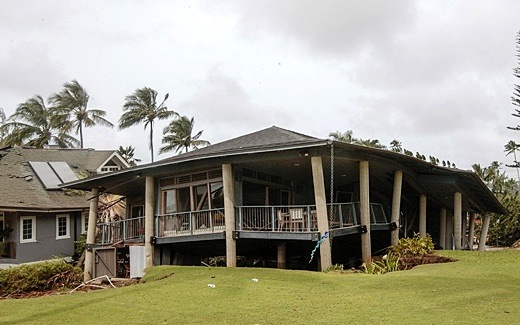

Image above: An upscale north shore raised residential structure "totaled" after being knocked off its foundation from flood waters eroding the earth around the column footings. Note half the yard looks like a putting green and half is a washed out gully. Photo by Jamm Aquino. From (http://www.staradvertiser.com/2018/04/16/photo-galleries/photos-aftermath-kauai-flooding/).

We are high and dry, but many did get wet. Mold and the high levels of contaminate in the flood waters (the water is actually "black water" from sewage, gas and oil from vehicles, etc) are making homes unlivable.

 Some people aren't aware of the danger and are simply throwing out furniture and planning to move back in.

I've been a designer and builder of healthy homes. I know better and have been researching what to do for wood that has been contaminated by these types of flood waters.

But what is so heartening is, the outpouring of support on this island. Differences have been put aside. So many volunteers. The federal and state agencies won't deal in any food other than non-perishables.

The locals with boats coordinated with locals with farms or money to buy apples, etc and a supply line of fresh food is going out to the island past Hanalei.

I spoke at length with a friend living way out there yesterday. People are picking up their trash at the road edge. Each house was delivered 5 gallons of gas. There's a free thrift store for clothes.

I was told the Hanalei Court House has more boots available than a big box store. The Hanalei Colony Resort, beyond the landslides, has been offering free breakfasts and dinners.

My friend said people are saying they are eating better now than before the flood.

Now one lane is open to emergency vehicles only. She said people out there can sign up the night before and a shuttle that leaves at 6am goes out. It will return at 6pm.

We continue to do our 2 mile walks at a couple beaches around here. They still stink. The beaches of the north shore are too contaminated to be in. However a friend said he heard the mayor on the local radio say he had a letter from the Dept of Health giving the OK to swim again!

The tourist bureau is under so much pressure. Business has really fallen off. Our daughter is a fashion designer supplying clothing to Chanterelle Couture, with four island stores and a couple on Oahu

One of Chanterelle's store owners told her that the entire week was 60% less business than normal.
Her two stores are on the other side of the island from the storm damage.

 A friend of ours, who is managing forty-two vacation rentals, had a call from a mainland person who had a booking in a place unaffected by the flood for next October - they wanted to cancel.

There is pressure on every news source in all of Hawaii not to say anything negative as so many mainland people do not differentiate between islands or part of islands and Hawaii.

They seem to think of Hawaii as one small state rather than small islands widely separated.

Many organizations have organized to help. I went by one Hanalei church with a sign out front "Free Water, Clothing, Food". There is a group of volunteers fixing homes for free.

So that's a quick update of the island news, but the real place to focus is on the Aloha.

See also:
Ea O Ka Aina: Storm damage on Kauai 4/24/18

.
Storm damage on Kauai

SUBHEAD: Rain storms have done more damage this spring to our north shore than in more than a generation.

By Juan Wilson on 24 April 2018 for Island Breath -
(http://islandbreath.blogspot.com/2018/04/rain-damage-on-kauai.html)

http://www.islandbreath.org/2018Year/04/180424kauailarge.jpg
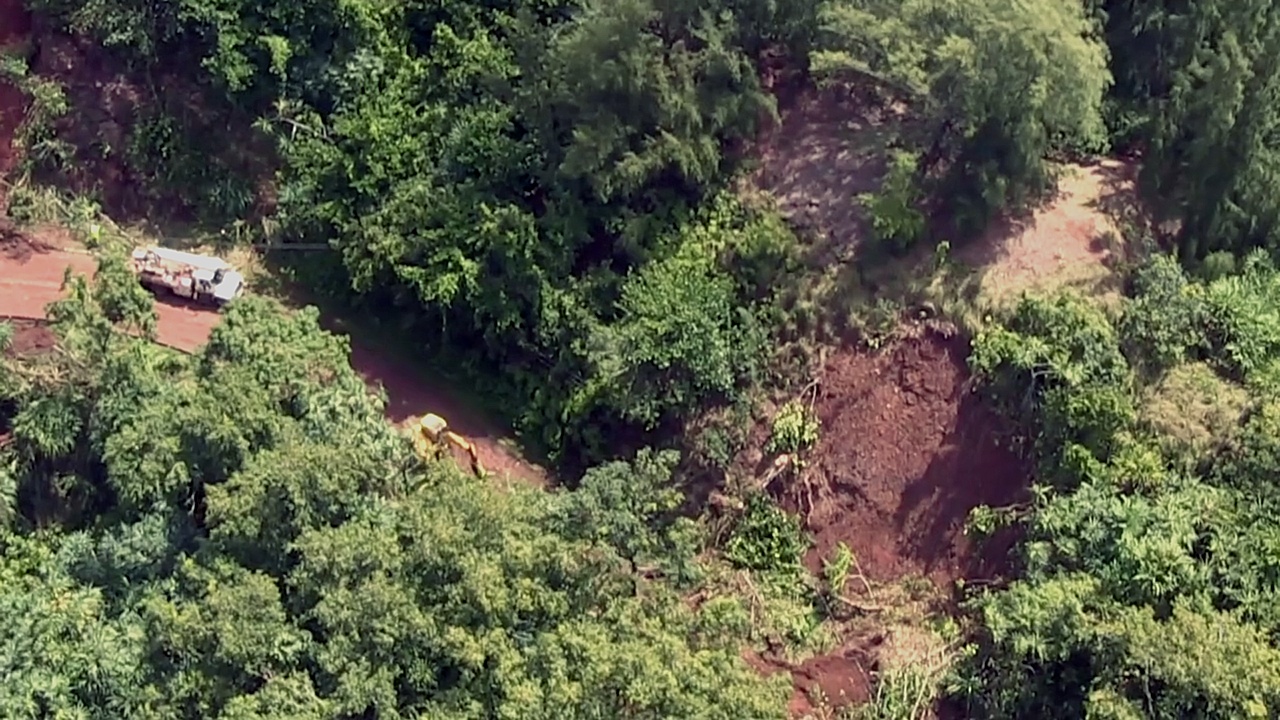
Image above: Only public road along the north shore of Kauai in Waikoko is obliterated by landslide west of Hanalei Bay.  Click to enlarge. Still image from video below.

Living in Kauai on the south side of Kauai we have missed he destruction of storms that destroyed much of the communities and infrastructure on our north shore. The impact has been tremendous for residence there; homes destroyed and roads wiped away.

As much suffering as this has caused and the long term difficulties that will linger, there is a thin silver lining in the darkened clouds.
 
The army of tourists in rented cars making the obligatory daily pilgrimage to Kee Beach crowding the roads, overflowing the parking lots and trampling the land has been temporarily halted.

When the roads are repaired and northshore tourism resumes we hope it is under new circumstances that would restrict tourist cars from anywhere west of Hanalei Bay. There was a feeble attempt to due this in the recent pass, but the will to disappoint tourists simply collapsed.

Here on the south shore we have noticed traffic through Hanapepe has increased significantly since last spring. Some of this is due to more rush hour traffic, presumably from the GMO companies and the PMRF (Pacific Missile Range Facility). We have a regular weekday 3pm eastbound rush hour never seen before.

Moreover, our local county beach, Salt Pond Beach Park, has been overrun by tourists since for over six months. This is certainly been in part because of the destruction of subtropical vacation destinations in the Caribbean.

In the last hurricane season there were 5 category-five storms that destroyed beaches, resorts, roads and much of amenities that attracted visitors. Puerto Rico is still suffering from island-wide blacked-outs. And here comes another hurricane season.

There seems to have been a bit of a campaign to make Salt Pond a heavier used visitor destination as well. Salt Pond is now rated online as a top beach for tourists. This take may take some pressure of totally overrun Poipu Beach Park and other crowded locations, but it is has unanticipated effects.

Salt Pond has historically been a "local" beach used as an outdoor living/rec room for many local families from the westside. Birthdays, weddings, graduation parties, spear-fishing surf-casting, BBQs and minding the kids and just kicking back with a beer after work has been the usage.

There is also and tradition of people temporarily living in tents (mixed with tourist camping) that helps transition (some people I've known) through a job loss, breakup or other temporary difficulty.

Anyway, I continue to hope jet plane enabled mass tourism to Hawaii ceases for two primary reasons. Is is destroying Kauai and it is destroying the atmosphere.

I have not flown to the mainland in several years and have no plans to start again.


Video above: Hawaii Department of Land & Natural Resources damage assessment of storm damage on several videos of the North Shore of Kauai. For more videos visit Vimeo site (https://vimeo.com/265509802).

.

A Hot Mess

SUBHEAD: It will be some time before we know the extent of the mess where Houston used to be.

By James Kunstler on 1 September 2017 for Kunstler.com -
(http://kunstler.com/clusterfuck-nation/a-hot-mess/)


Image above: People in Houston street walking and boating through floodwaters. Photo by David Philips. From (http://abcnews.go.com/US/epic-catastrophic-flooding-devastates-houston-rainfall-forecast/story?id=49462873).

[IB Publisher's note: I wan't to thank all the people that commented, emailed and in other ways expressed their appreciation of this website. It was inspiring. Yes we're back to posting articles to IslandBreath. However, it won't be at the pace we were keeping prior to a week ago of about two a day. That required most of the morning while lots of chores were waiting.  We will be trickling in items probably at less than half the former rate. We'll see how things go.]

It wasn’t until more than a week after Hurricane Katrina slammed into New Orleans in 2005 that the full extent of the damage was recognized and so it will go with the hot mess where Houston used to be.

Mostly, it is inconceivable that the business activity which made Houston the nation’s fourth largest city and, according to Chris Martenson, equal to the 10th largest economy in the world, will ever return to what it was before August 26, 2017.

The major activity there has been the refining and distribution of oil products, and no activity is more central to the functioning of the US economy.

So the public and our currently clueless leaders across the political spectrum, plus a legacy news media lost in the carnival of race and gender freak shows, is about to discover the dynamic relationship between energy and an industrial economy.

The pivot in this relationship is banking, which enables the conversion of oil’s raw power into everything else that goes on in a so-called advanced economy. The popular assumption is that federal disaster relief can compensate for all losses.

That assumption may go out the window with the Houston flood of 2017. And no amount of federal aid can compensate for the hours, days, and weeks that will tick by as businesses struggle to return to something like their former level of normal operation.

Many businesses will never recover, especially the smaller ones that support the big one — the little tool and die shops, the construction outfits, the trucking and shipping concerns, the riggers and pipefitters, the cement companies, and so on.

All of that activity existed in highly rationalized chains of on-time production and service and nothing will be on-time in Houston for a long time to come.

The arguments over insurance coverage have not even begun, and then there is the question of how businesses in this perpetual flood zone will renew their insurance.

Or how might they relocate to higher ground? And how do they pay for that? And where is higher ground in this vast, swampy lowland?

The public has been conditioned by frequent natural disasters to think that nobody has to eat the losses, so that in effect loss doesn’t exist, just as the nation’s central bank has engineered the belief that risk no longer exists in the management of capital.

We sure had a nice demonstration of the latter, with the Dow inching over the 22,000 hashmark in overnight futures trading today.

The exertions of the Federal Reserve in propping up the stock markets will have to go pedal-to-metal now to make up for the hole in economic activity that Houston represents.


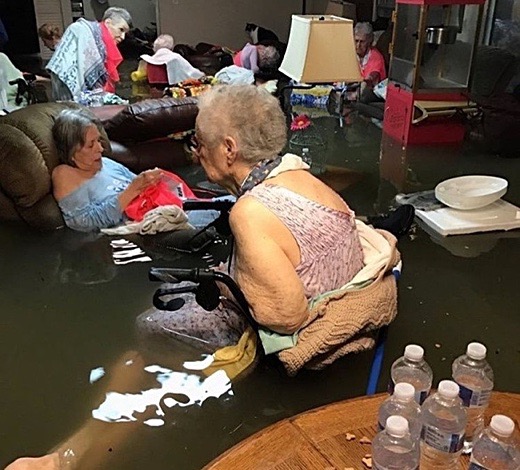
Image above: La Vita Bella Nursing Home nearly underwater in Dickinson, Texas. From ABC13-TV News. From (http://houston.culturemap.com/news/city-life/08-27-17-photos-hurricane-harvey-hits-houston-hard/#slide=2).

Meanwhile congress is left to dither over two conjoined financial emergencies at once: authorizing emergency aid to Houston, and resolving the debt ceiling problem.

The fault lines are already visible in the ill-feeling left over from Texas’s congressional delegation voting against aid for Hurricane Sandy’s rip through New York and New Jersey.

Texas Senator Ted Cruz, for one, has reinvented his political philosophy overnight to accommodate federal aid for natural disasters, something he was not keen on before September 26.

I’d assume that these politicians have some normal human sympathies — yes, really — but that these emotions won’t stand in the way of their agenda for mutual self-destruction.

Even if they manage to cobble together some kind of emergency aid package for Houston, the process will coincide with the Treasury running out of supposedly “actual” money — that is, money which can be accounted for by some method besides check-kiting.

Another assumption du jour is probably the idea that accounting no longer matters, that bankruptcy no longer means anything. Pretty soon, those logical fallacies will manifest in an accelerated falling value of the US dollar.

Somewhere in this reverberating hot mess stands a character named President Trump.

He acted out the customary disaster visitation ceremony last week, but I predict that the as-yet-revealed after-effects of Hurricane Harvey will put him in deeper and stinkier hot water than George W. Bush splashed through with Katrina.

Meanwhile, what’s that monster called Irma doing out there in the Atlantic?

.

Waikiki Beach & Ala Wai waters rise

SUBHEAD: King tides have beachgoers dodging waves while the canal nears the top of its retaining wall.

By Emily Cardenall on 25 May 2017 for Civil Beat -
(http://www.civilbeat.org/2017/05/king-tides-are-providing-a-glimpse-of-hawaiis-future/)

Image above: Tourists dodge ocean waves breaking at seaside of Outrigger Hotel in Waikiki. Note tarp and sandbags at left to retain site landscaping. From (http://www.civilbeat.org/2017/05/waikiki-beaches-contract-while-ala-wai-canal-rises/).

Waikiki could get the highest tides in more than on hundred years this weekend,

The combination of high lunar tides, a south swell and ongoing sea level rise is giving Hawaii a preview of what’s to come with climate change.

With record high tides expected through the weekend, Hawaii is getting a preview of what could become the new normal with sea level rise.

The ever-increasing effect of global warming is combining with some of the year’s highest lunar tides and a south swell to produce what are predicted to be the highest ocean levels in 112 years of record-keeping. Volunteers for the University of Hawaii’s Sea Grant College Program are taking to the coasts to document the effects.

A group called Citizen Scientists is working with Sea Grant’s Hawaii and Pacific Islands King Tides Project to take photos of coastlines all over the state to record the effects of rising sea levels.

Matthew Gonser, an extension agent with Sea Grant College who works with the volunteers, said this documentation will help make predictions for what the baseline sea level could look like in the future, among other research endeavors.

He was working with the volunteers in front of the Outrigger Canoe Club in Waikiki on Thursday afternoon.

Predictions from the National Oceanic and Atmospheric Administration have tides rising around 2.4 feet higher than average through the weekend. The average itself has been increasing slowly due to sea level rise tied to climate change, and Gonser said the result over the next couple of days could actually exceed the predictions.


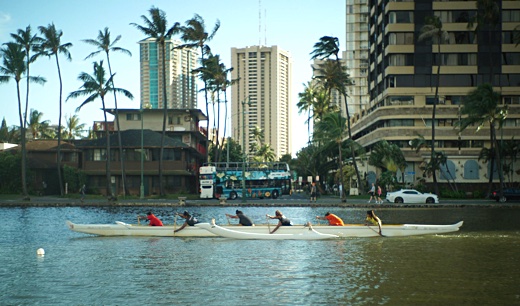
Image above: Paddlers practice on Ala Wai Canal in Waikiki when canal water was within a foot of topping its t=retaining wall. From (http://www.civilbeat.org/2017/05/waikiki-beaches-contract-while-ala-wai-canal-rises/).

May’s king tides mark the third documentation session for the volunteer group. While their photos are important to visualize and track data, the community conversations that follow will be perhaps the most significant result, Gonser said.

“We hope to engage in this conversation — that is actually really difficult to have — about how rising sea levels impact our locale,” he said. “You can’t ignore it.”

Factors are converging to create the epic tides, said Philip Thompson, associate director of the University of Hawaii’s School of Ocean and Earth Science and Technology. They include a recent increase in slow-moving, rotating and churning bodies of water, called ocean eddies, and the lasting effects of the 2015-2016 El Nino.

Meanwhile, climate change is producing rising sea levels with no end in sight.


This poses an issue for the coastal areas in Hawaii, in particular, because washed-out beaches hurt tourism and the environment.

“Maintaining our beaches and nourishing them will be an ongoing struggle,” Thompson said.

The Citizen Scientists also plan to document the next expected king tides June 23-24 and July 21 and 22.


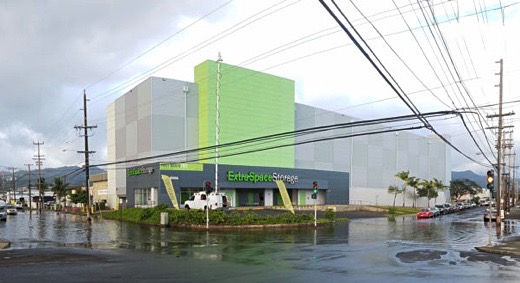
Image above: Flooding on Ahua Street near Keehi Lagoon Beach Park in Honolulu during a king tide Wednesday. From original article.

.

Radioactive floods damage Japan

SUBHEAD: Spreading contamination into populated areas through this flooding is a significant health risk to the Japanese people.

By Arnie Gundersen on 18 September 2015 for Fairwinds Associates -
(http://www.fairewinds.org/nuclear-energy-education//radioactive-floods-recontaminate-japan)


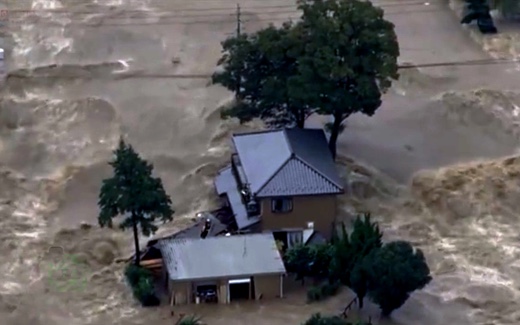
Image above: Still frame from video below of flood waters destroying a rural home. .

Hi I’m Arnie Gundersen from Fairewinds,

Mainstream media in the US and in Japan is simply not doing its job.

Last week a serious typhoon hit eastern Japan creating flooding that has not occurred for at least 50 years. Before the typhoon hit, Tokyo Electric assured the Japanese that the Fukushima Daiichi power plant was safe. As the typhoon lashed in Japan, Tokyo Electric admitted that the drainage pumps at Fukushima Daiichi failed and radioactive water once again entered the Pacific Ocean.

Also, Tokyo Electric admitted that only several dozen bags of previously collected radioactive material have also washed away. As far as mainstream media is concerned, the extent of the radioactive contamination as a result of this typhoon was limited to these relatively small releases directly on the Fukushima site.

Nothing could be further from the truth. Fukushima Prefecture is very mountainous and became highly contaminated after the triple meltdowns. Those of us who have studied the disaster at Fukushima Daiichi have noted for years that an extraordinary amount of radioactive cesium, strontium, and other radioactive isotopes from three nuclear meltdowns has spread hundreds of miles from the site of the disaster.

The rain that lashed the east coast of Japan flooded that radioactive material to new locations downhill. It is obvious to scientists, but not the mainstream media in Japan, that areas that have been previously decontaminated by the Japanese are now contaminated again by the flooding.

These newly contaminated areas include villages that had been evacuated when the disaster struck four and a half years ago that the Japanese government has allowed its population to return to.

Fairewinds has said it before and we’ll say it again. Follow the money! Tokyo Electric and the Japanese government do not want to reevaluate the spread of radiation as a result of this latest typhoon. It will cost too much. The expense to really clean up after this disaster is unimaginable.

Spreading contamination into populated areas through this flooding is a significant health risk to the Japanese people that the Japanese government refuses to accept.

 For the next three hundred years events like this typhoon will reoccur until all the radioactivity released during the Fukushima Daiichi disaster is finally washed entirely into the Pacific Ocean, not just from the Fukushima Daiichi site but from all the tributaries and rivers in the mountains that enter the Pacific ocean.

It’s time for the Japanese and American mainstream media to hold Tokyo Electric and the Japanese government accountable to reevaluate the spread of radioactive contamination as a result of last weeks typhoon, and the dose effect to their population from the flooding.


Video above: Arnie Gunderen of Fairwinds Associates presentation on Japan typhoon flooding contaminating large areas with radioactivitiy. From original article.


.

Beyond Resilience

SUBHEAD: As Climate Change creates "new normals" mitigation and adjustments will have to be made.

By Courtney White on 23 July 2015 for the Carbon Pilgrim -
(https://carbonpilgrim.wordpress.com/2015/07/14/beyond-resilience/)


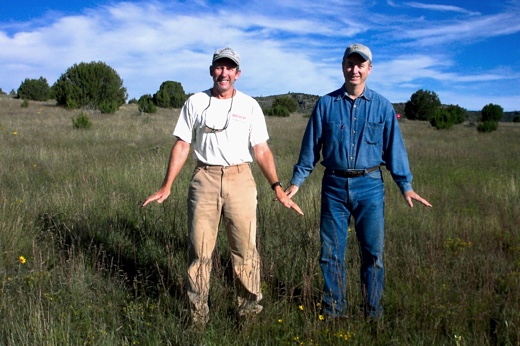
Image above: Photo of the abundant and diverse grasses that returned to the CaƱon Bonita ranch. Mike Reardon on the left. From original article.

Restoring land to health means trying to return it to something like normal ecological conditions. But what if the definition of normal changes in the meantime?

An ecosystem’s capacity to absorb a shock, such as a drought, flood, or forest fire, and then bounce back as quickly as possible is called resilience. Since it’s a critical part of ecosystem health, ecologists have made a big effort to understand what constitutes “normal” conditions in order to help a system be as resilient as possible, especially if the shock has been caused by humans, such as overgrazing by cattle.

But what if a system’s definition of normal changes? What if a region’s annual precipitation dropped by half—and stayed there? Or when the rains did fall, they came as unusually large flood events or at the wrong time of year? What does resilience mean in this context?

It’s not an abstract question. Under climate change, scientists tell us, we’ll be experiencing all manner of new normals. For restoration purposes, this means we need to search the management toolbox for practices that go beyond short-term resilience and allow an ecosystem to endure long-term deviations from normal conditions.

What would those practices be? Mike Reardon has an idea.

Since the late 1990s, Reardon has used a wide variety of land restoration tools on his family’s 6500-acre CaƱon Bonita Ranch, located in northeastern New Mexico. These tools include tree removal, brush clearing, prescribed fire, planned grazing, erosion control, riparian restoration, water harvesting, dam building, and ranch road repair—all in service of restoring ecological health to the land after decades of mismanagement by previous landowners.

Reardon’s overall goal is to support a multitude of diverse wildlife on the property and his work has been highly effective in this regard. Today, however, he faces a new challenge: How do you maintain forward progress when prolonged drought limits the use of certain tools?

In 1997, an expert with the USDA’s Natural Resources Conservation Service told Reardon that there were “too many trees” on his ranch. This was news to Reardon, who lives in Albuquerque and readily admits to being a novice about land health when he began managing the ranch. Too many piƱon and juniper trees, the expert said, meant a reduced amount of open, grassy habitat for wildlife. In the past, nature corrected this situation with periodic, lightning-sparked wildfires that would thin out the trees, allowing the land to bounce back with perennial grasses.

However, a century of fire suppression by landowners and cooperating agencies across the region, coupled with poor livestock management, eventually eliminated the land’s grass cover, resulting in widespread tree encroachment.

To reverse this situation, Reardon focused first on reducing the density of piƱon and juniper trees on the ranch. His original tools were handheld loppers and a chainsaw. Then came a spin trimmer, a front-end loader, and a Bobcat skid-steer. Next, Reardon hired a professional woodcutting crew from Mexico. To date, nearly three thousand acres have been cleared on the ranch, though some stands of trees were left for wildlife.

Next, during the years when grass (and rain) was abundant, Reardon alternated the use of two other tools to further reinvigorate the grasslands: prescribed fire and planned grazing. With the assistance of neighbors and fire experts, Reardon has completed two controlled burns, ten years apart, which effectively suppressed tree seedlings.

Reardon also employed the tool of high-density, short-duration grazing by cattle during the vegetative dormant season (December through March). This “living fire” recycles old grass into cattle manure, which helps to build grass cover.

All three tools worked. Grass came back with a flourish, teaching Reardon an important lesson.
“I learned that bare ground was enemy number one,” Reardon said, “so I do everything I can to get grass to grow. And not just any grass, I want perennials and I want as much diversity as possible.”

The next job for the resilience toolbox was water. In order to create more surface water for wildlife to drink, as well as grow a year-round supply of nutritious food, twelve earthen dams and four metal tanks (with windmills) were repaired, modified, or constructed across the ranch. He also implemented a five-phase wetland and riparian restoration project that employed many of the innovative practices pioneered by specialists Bill Zeedyk and Craig Sponholtz.

They designed and implemented treatments for a two-mile stretch of CaƱon Bonito Creek, which ran through the center of the ranch. Their goals were to decrease stream bank erosion and downcutting and to raise the water table. They also wanted to reconnect the creek to its floodplain in order to re-wet adjoining wet meadows and increase the amount of live water.

They also hoped to increase forage species, including wetland vegetation, and increase cover for wildlife. There was even a plan to harvest water from ranch roads using a variety of techniques, including redesigned road crossings and water-harvesting rock structures in canyon side channels.

Reardon also implemented a detailed monitoring program on the ranch in order to see how changes were progressing. This included vegetation and bare-ground monitoring, moisture data collection, wildlife population surveys, and photographic documentation, including sixty photo points along CaƱon Bonito creek alone.

The message of the monitoring data was clear: conditions were improving. Under Reardon’s management, the ranch progressed from a monoculture of blue grama grass to hosting a diversity of more than 55 different grass species. Dry springs began to flow again and wildlife populations shot up by a factor of ten.

Despite a drying trend that began in 2002, deer, elk, and wild turkey populations continued to rise and things seemed to be returning to normal. It looked like Reardon had succeeded in rebuilding resilience on the ranch.

Except the definition of normal was changing. The drought, for example, went on and on—and still goes on.

Today, year-round water in the CaƱon Bonito creek is rare, though there is still a steady trickle in the spring area. A relict population of ponderosa pines is dying, along with piƱon and juniper trees. Small populations of perennial grasses, previously restored, are now dying as well. And wildlife populations are in decline—wild turkey populations have dropped by 75 percent. As for the land management toolbox—persistent drought means that prescribed fire is off the table and grazing by cattle is limited to selected areas of the ranch.

Reardon has learned the hard way that getting “beyond resilience” is easier said than done.
On the good news front, there is still plenty of ground cover holding the soil in place, capturing “airmail topsoil,” as Reardon puts it, during local dust storms, as well as any raindrop that falls from the sky.

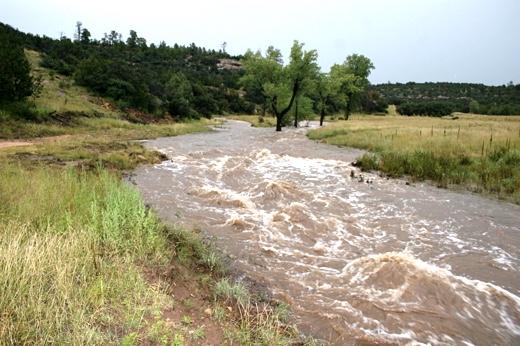
The wetland and riparian restoration work have kept the ground moist where otherwise it might have gone dry. It also helps to dissipate the destructive forces of unusually big flood events, such as one the ranch endured on September 2013, when nearly five inches fell in a matter of hours. Thanks to all the vegetation that had grown along the stream banks, the effects of that flood were not nearly as devastating as they would have been otherwise.


Image above: Here’s a photo of the new normal of big flood events on the ranch. From original article.

For Reardon, the whole experience points to important lessons learned for the new normals of hotter, drier conditions and chaotic moisture events.

“Use your time effectively,” he said, “focus on sweet spots, have a plan, pull together a diverse group of supporters and professionals, be willing to listen and learn, trust the data, be willing to admit mistakes, be proactive, become land literate, and get ready for the next storm—dust, rain, snow, whatever Mother Nature brings. It will rain again!”

Sage words as we move deeper into the twenty-first century!

• Courtney White is a former archaeologist and Sierra Club activist, Courtney dropped out of the 'conflict industry' in 1997 to co-found The Quivira Coalition, a nonprofit dedicated to building bridges between ranchers, conservationists, public land managers, scientists and others around the idea of land health. This is a chapter from his forthcoming book 2% Solutions for the Planet to be published by Chelsea Green in October. See: http://www.chelseagreen.com/two-percent-solutions-for-the-planet]


.

El Nino & La NIna in Hawaii

SUBHEAD: Expect Climate Change to whipsaw between hot, dry En Nino and cold, wet La Nina.

By Jan TenBruggencate on 28 January 2015 for Raising Islands -
(http://raisingislands.blogspot.com/2015/01/expect-climate-change-to-whipsaw-hawaii.html)


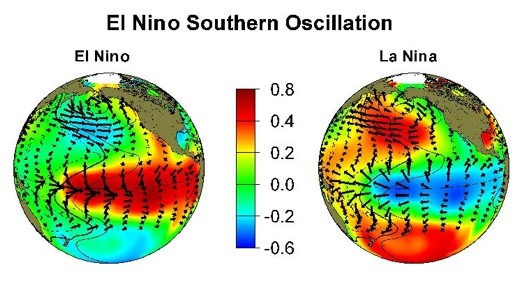
Image above: Detail of illustration on El Nino and El Nina oscillation. From U.C. Davis. (https://watershed.ucdavis.edu/skeena_river/documents/initial_reports/SKhanna.pdf).

El Nino and La Nina events could be more frequent and much stronger with climate change.

That’s according to a new analysis published this week by an international team that includes Hawai`i researcher Axel Timmermann, of the International Pacific Research Center at the University of Hawai`i.

It’s important to Hawai`i residents because those climate variances have significant impacts on rainfall patterns, storm, water temperature and other things. One issue: more drought during El Nino events and more heavy rain events during La Nina—essentially, Hawai`i during the coming decades can expect to be whipsawed between more extreme weather events.

"Our previous research showed a doubling in frequency of extreme El NiƱo events, and this new study shows a similar fate for the cold phase of the cycle. It shows again how we are just beginning to understand the consequences of global warming,” said Mat Collins, a University of Exeterprofessor and co-author of the new paper.

Increased frequency of extreme La NiƱa events under greenhouse warming was published in the journal Nature Climate Change. Its authors, besides Collins and Timmermann, are  Wenju Cai,    Guojian Wang, Agus Santoso, Michael J. McPhaden, Lixin Wu, Fei-Fei Jin, Axel Timmermann, Gabriel Vecchi, Matthieu Lengaigne, Matthew H. England, Dietmar Dommenget, Ken Takahashi & Eric Guilyardi

Timmermann echoed Collins’ comments.
“Our recent study in Nature Climate Change demonstrates that extreme La Nina events are likely to become more frequent over the next 100 years. Many of these events will follow stronger El Nino events."
 "This means for Hawaii that the transitions between El Nino and La Nina are likely to result in larger year-to-year rainfall extremes - extra drought during El Nino and extreme winter rain for La Nina,” Timmermann said.

He said the study is based on an analysis of 21 existing climate models.

The paper’s summary says:

“Here we present climate modelling evidence… for a near doubling in the frequency of future extreme La NiƱa events, from one in every 23 years to one in every 13 years.

“This occurs because projected faster mean warming of the Maritime continent than the central Pacific, enhanced upper ocean vertical temperature gradients, and increased frequency of extreme El NiƱo events are conducive to development of the extreme La NiƱa events.

“Approximately 75% of the increase occurs in years following extreme El NiƱo events, thus projecting more frequent swings between opposite extremes from one year to the next.”

.

It has begun

SUBHEAD: Wise up and stock up as food shortages and price hikes are coming before year’s end.

By Lizzie Bennett on 14 February 2014 for SHTF Plan -
(http://www.shtfplan.com/headline-news/it-has-begun-wise-up-and-stock-up-as-food-shortages-and-price-hikes-are-coming-before-the-years-end_02142014)


Image above: Mashup of grassland turning to desert. From original article.

One of the key trends we’ve seen over the last ten years is an unabated rise in prices for essential goods that include food, energy and other commodities. This year, as was the case in the 1930′s, we’ve seen quite a significant change in the weather.

We can go back and forth about the causes, but for all intents and purposes this would be an exercise in futility. What’s important to us personally are the consequences.

The key takeaway is that everything, especially your food, is about to skyrocket in price. If you have the means to do so, consider stockpiling additional goods, especially those essential dry goods like rice, beans, wheat, and corn.

One of the best investments you can make is to buy at today’s lower prices and consume at tomorrow’s higher prices. It’s a strategy that would have yielded you 50% – 100% gains over the last four years, and it’s one that will continue to be a sound investment.

Moreover, unlike paper investments, when you own commodities stored in your home there is no counter-party risk. Get prepared for long-term emergencies and save money while you’re at it!

Famine is coming to a city near you
Stop for a moment and think about what’s happening weatherwise around the world.

California is in the middle of a drought so severe that domestic supplies may be cut in a matter of weeks. California produces a massive amount of the food consumed in the United States.

Extreme cold in the United States has killed livestock in the hundreds of thousands.

Florida farmers are looking at massive losses from cold weather not just ruining citrus crops, but squash, cucumbers and herbs.

Wheat growth in Texas is stunted by continuing cold weather.

The fishing industry in Indonesia has taken a hit because of bad weather.

Peru, Venezuela, and Bolivia have experienced rainfall heavy enough to flood fields and rot crops where they stand.

Volcanic eruptions in Ecuador are also creating problems due to cattle ingesting ash with their feed leading to a slow and painful death.

Parts of Australia have been in drought for years affecting cattle and agricultural production.

Rice production in China has been affected by record low temperatures.

Large parts of the UK are underwater, and much of that water is sea water which is poisoning the soil. So wet is the UK that groundwater is so high it is actually coming out of the ground and adding to the water from rivers and the sea.

With the official assessment being that groundwater flooding will continue until MAY, and that’s if it doesn’t rain again between now and then. The River Thames is 65 feet higher than normal in some areas, flooding town after town as it heads to the sea.

Even the boreholes that keep an eye on groundwater levels can’t cope, this one blew its cap off yesterday.

Crops are going to be severely affected with some farmers saying they will not be able to plant at all this year due to salt pollution from sea water inundation.

It’s time to ramp up your food prepping
Weather around the world is causing problems with food production and there is no reason to think these problems are just going to go away.

Although I personally don’t buy into the global warming hype there is no doubt that last years weather was bad enough around the globe to affect food security. The issues I’ve listed above are a few amongst many and we are only six weeks into the new year,

As I typed that last paragraph news alerts have gone out warning of 100mph winds, another few inches of rain and a further 23 flood warning issued to join the 300 plus already in force in the UK.

One geographical region having weather bad enough to damage food production usually results in higher prices because you have to import it from other countries. What happens though when those other countries don’t have food to sell you because they have barely enough to feed their own people?

It’s time we all woke up to what is happening. It’s highly likely that certain foodstuffs will be in short supply by the end of this year. What is available is going to be a good deal more expensive than it is now. Many will not be able to afford the prices asked for basic commodities.

Vitamin deficiencies, malnutrition and disease outbreaks always occur when any form of an economic shift takes place. There is no reason to think that our situation a few months down the line will be any different. Food shortages and high prices are often a tipping point for wider unrest.

It has begun. Urge those who you know are unprepared to wise up and stock up, time may be shorter than they think.

• Lizzie Bennett lives in the UK and has extensive medical and trauma training. She is the author of Underground Medic. In addition to her experience as a catastrophic emergency medical practitioner, Lizzie is a researcher, analyst and lecturer in fields that include anaesthetic pharmacology, operating department practice, anaesthetics, and human anatomy. She is the author of the Armageddon Files, a series on emergency medicine in off-grid scenarios.

.

Climate Crisis Weather

SUBHEAD: Climate change from global warming will bring drought in temperate areas and flooding in the tropics.

By Staff on 5 May 2013 for CounterCurrents -
(http://www.countercurrents.org/cc050513A.htm)


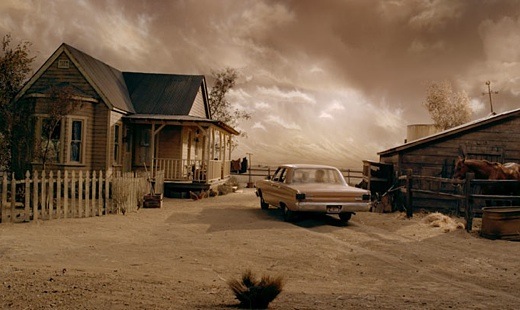
Image above: Studio set from movie "Smell of Success", 2009. From (http://miltonadamou.com/2009/10/11/smell-of-success/).

Climate crisis may increase the risk of extreme rainfall in the tropics and drought in temperate zones. Citing a new study led by NASA Neela Banerjee reported [1] from Washington:

"These results in many ways are the worst of all possible worlds," said Peter Gleick, a climatologist and water expert who is president of the Pacific Institute, an Oakland research organization. "Wet areas will get wetter and dry areas will get drier."

The regions that could get the heaviest rainfall are along the equator, mainly over the Pacific Ocean and the Asian tropics. Increased aridity and drought could have a greater effect on human life, however, because those conditions are more likely to occur where most of the world's population lives.

In the Northern Hemisphere, drought-prone areas include the southwestern US, Mexico, North Africa, the Middle East, Pakistan and northwestern China. In the Southern Hemisphere, drought could become more likely in South Africa, northwestern Australia, coastal Central America and northeastern Brazil.

"Large changes in moderate rainfall, as well as prolonged no-rain events, can have the most impact on society because they occur in regions where most people live," said William Lau, the study's lead author and a scientist at NASA's Goddard Space Flight Center in Greenbelt, Md. "The regions of heavier rainfall, except for the Asian monsoon, may have the smallest societal impact because they usually occur over the ocean," he added.

The study is based on the results of 14 models that show agreement on the possible rainfall trends, Gleick said.

Climate change does not cause forest fires but does contribute to their likelihood, Gleick said, adding: "It's not about causality but influence."

For every 1 degree Fahrenheit increase in global average temperature because of GHG emissions, heavy rainfall will increase globally by 3.9%, the study predicted.

Climate change could lead to heavier rainfall because warmer air holds more moisture.

On the flip side, for every degree Fahrenheit of warming, the length of time a region goes without rain could increase globally by 2.6%.

Scientists have said that the world needs to keep global average temperatures from exceeding 2 degrees Celsius, or about 3.6 degrees Fahrenheit, above pre-industrial global temperatures to avert catastrophic changes to nearly all aspects of life. In the last 150 years or so, the Earth's average temperature has already risen about 1 degree Celsius, or 1.3 degrees Fahrenheit.

To prevent the 2 degree Celsius rise and its effects, including extremes in rainfall, the world has to keep emissions of heat-trapping carbon dioxide below a ratio of 400 parts per million.

According to the Scripps Institution of Oceanography at UC San Diego, there have been isolated measurements of 400 parts per million in the Arctic, and scientists expect readings in Hawaii to exceed 400 parts per million this month.

Another report [2] added:

The study, to be published in the journal Geophysical Research Letters, demonstrates for the first time how rising carbon dioxide concentrations could affect the entire range of rainfall types on Earth.

“In response to carbon dioxide-induced warming, the global water cycle undergoes a gigantic competition for moisture resulting in a global pattern of increased heavy rain, decreased moderate rain, and prolonged droughts in certain regions,” said William Lau.

Light rain will also increase by one percent, across the globe. Because moderate rainfall is projected to decrease by 1.4 percent, total global rainfall is not expected to change much.

Scientists define heavy rainfall as months that receive an average of more than about 0.35 of an inch per day, and light rainfall as months that receive an average of less than 0.01 of an inch per day. The definition of moderate rainfall is months that receive an average of between about 0.04 to 0.09 of an inch per day.

According to the study, some regions outside the tropics may have no rainfall at all.

The researchers calculated statistics on the rainfall responses for a 27-year control period, starting at the beginning of the simulation. They also calculated statistics for 27-year periods around the time of doubling and tripling concentrations.

Predictions for how much rainfall will occur at any one location as the climate warms are not very reliable, the team found.

“But if we look at the entire spectrum of rainfall types we see all the models agree in a very fundamental way — projecting more heavy rain, less moderate rain events, and prolonged droughts,” Lau said.

Source:
[1] Los Angeles Times, May 4, 2013,
Climate change may bring drought to temperate areas, study says,
http://www.latimes.com/news/nationworld/nation/la-na-nasa-climate-20130504,0,2772152.story

[2] Red Orbit, May 4, 2013, “Rain And Drought Will Increase Due To Warming: NASA”,
http://www.redorbit.com/news/science/1112838172/nasa-projects-global-warming-will-drive-global-rainfall-changes-050413/
.

Worse is More Likely

SUBHEAD: That's the amount and severity of Climate Change we can expect as temperatures rise.

By Jan TenBruggencate on 10 November 2012 for Raising Islands -
(http://raisingislands.blogspot.com/2012/11/climate-change-worse-is-more-likely.html)


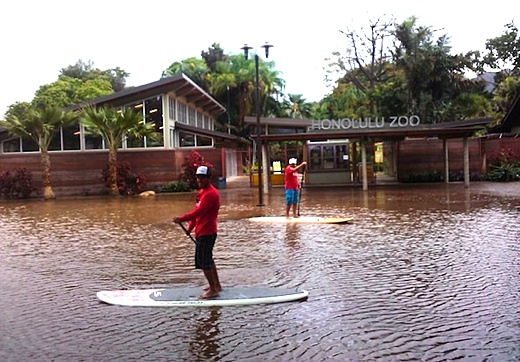
Image above: Two guys paddle board through the Honolulu Zoo after rainstorm. From (http://www.hawaii-aloha.com/blog/2012/03/09/thats-whats-sup-hawaii-boards-through-storm/).

Climate is changing faster than we’ve been told, and it’s going to get worse than the consensus estimates.

That’s a conclusion of a new report from the National Center for Atmospheric Research (NCAR).

Much of the science industry has been understating its science, perhaps because the most dire scenarios seem so outrageous, perhaps because they’re reeling from the denier attacks.

The Intergovernmental Panel on Climate Change’s 2007 report says its projections “do not include uncertainties in climate-carbon cycle feedbacks nor the full effects of changes in ice sheet flow, therefore the upper values of the ranges are not to be considered upper bounds for sea level rise.”

Translation: We left out the really scary stuff.

For Hawai`i, where climate change predicts significantly reduced rainfall and coastal flooding from higher sea levels, it’s also important stuff.

Even so, IPCC in 2007 projected contracting snow cover, disappearance of Arctic summer sea ice, increase of extreme hot weather, increased hurricane intensity, less rainfall in subtropical land areas and more. Sound familiar? Let’s see. Glaciers are melting, you can now run ships over the north sides of both the Americas and Asia, Hurricanes Katrina and Sandy, the expanding Sahara and Gobi deserts.

NCAR, in an article in this week’s issue of Science, is suggesting that the more severe estimates of global warming are more likely to be the accurate estimates.

“Our findings indicate that warming is likely to be on the high side of current projections,” say NCAR scientists John Fasullo and Kevin Trenberth.

The two researchers come to their conclusion based on global humidity patterns. Many earlier studies have tried to link climate change to cloud patterns, but clouds are notoriously ephemeral and difficult to model. On the other hand, humidity is well researched and provides a useful tool for analysis of climate patterns, they said.

They looked at relative humidity figures for cloud-free subtropical areas, which they said are “easier to observe than the cloud properties themselves.”

Why the subtropics? “The dry subtropics are a critical element in our future climate. If we can better represent these regions in models, we can improve our predictions and provide society with a better sense of the impacts to expect in a warming world,” said Fasullo.

“Because we have more reliable observations for humidity than for clouds, we can use the humidity patterns that change seasonally to evaluate climate models,” says Trenberth. “When examining the impact of future increases in heat-trapping gases, we find that the simulations with the best fidelity come from models that produce more warming.”

NCAR’s press release on the study says it “could provide a breakthrough in the longstanding quest to narrow the range of global warming expected in coming decades and beyond.”
.

Climate change-What climate change

SUBHEAD: The unprecedented Frankenstorm Sandy leaves death, dampness and darkness in its wake.

By Editorial Staff on 29 October 2012 for Charleston Gazette -
(http://wvgazette.com/Opinion/Editorials/201210290222)


Image above: Homes that are devastated by fire and the effects of Hurricane Sandy are seen at the Breezy Point section of the Queens borough of New York October 30, 2012. From article below on storm update.

A Charleston church group recently heard a slide lecture on billion-dollar weather damage and mass human suffering caused by global warming, worsened by air pollution. The grim show came from the Climate Reality Project headed by former Vice President Al Gore, who won the Nobel Peace Prize for his warnings.

The lecture is apt today as Hurricane Sandy, the "Frankenstorm," ravages the populous East Coast. Hurricanes, caused by ocean heat, have become stronger, deadlier, more costly. Sandy spans nearly 2,000 miles across its cloud swirl, almost the distance from Charleston to California.
More Frankenstorms and other weather horrors can be expected, the Gore group says. It warns:
  • Tornados have become worse menaces, obliterating some cities such as Joplin, Missouri.
  • Floods and mudslides from monster rains ravage Third World cities. Mississippi Valley floods also have become more destructive.
  • Droughts are turning some agriculture regions into worthless desert, bankrupting farmers and elevating food prices.
  • Wildfires have consumed vast sections of western forest and suburban neighborhoods.
  • Tropical diseases and parasites keep moving northward.
  • Record-breaking heat waves kill thousands of people around the world.

Image above: This CCTV photo released by the Port Authority of New York & New Jersey shows flood waters from Hurricane Sandy rushing in to the Hoboken PATH station through an elevator shaft on October 29, 2012. From article below on storm update. 

Much of this mayhem stems from the fact that warmer air holds more moisture, causing more violent storms. Oddly, cloudburst rains in one sector can mean drought in another. Only a slight temperature increase can produce "weather on steroids," one expert dubbed it.  Ph.D. meteorologist Jeff Masters said:
"Look at heat waves, drought and flooding events. They all tend to get increased when you have this extra energy in the atmosphere. I call it being on steroids for the atmosphere."
Gore himself says "dirty weather" stems from "dirty air." He adds: "Ferocious storms and deadly heat waves are occurring with alarming frequency all over the world. We are living with the reality of the climate crisis every day."

His associate, Maggie Fox, adds:
"Fossil fuel companies and their allies will go to great lengths to deny the fact that climate change is happening now. But we have one powerful response: Reality."
Insurers suffer growing losses. A giant reinsurance firm, Munich Re, warned: "Nowhere in the world is the rising number of natural catastrophes more evident than in North America." Travelers issued a brochure saying U.S. thunderstorms caused $25 billion damage last year.

West Virginia politicians and coal moguls won't acknowledge that air pollution from fossil fuels creates a "greenhouse" layer in the sky that traps heat on Earth's surface and causes "weather on steroids." But snowballing evidence indicates that this global heat-up is inflicting terrible losses on humanity. The current Frankenstorm is one further warning to consider.

Plenty of other climate-deniers exist. In his acceptance speech at the GOP convention, Mitt Romney drew laughs when he sneered: "President Obama promised to begin to slow the rise of the oceans and heal the planet." We wonder if those delegates still are snickering today.


Sample of Live Frankenstorm Updates

By Staff on 30 October 30 2012 for  Russian Times-
(http://rt.com/usa/news/frankenstorm-sandy-live-updates-451/)

Oct. 30, 15:01 EDT: US President Barack Obama will travel to storm-stricken New Jersey on Wednesday to view damage, thank first responders.

Oct. 30, 14:32 EDT: Schools in the US capital will re-open on Wednesday, according to the Washington Post.

Oct. 30, 14:06 EDT: US death toll jumps to 38. More than 8.2 million people across the eastern US are without power.
­
Oct. 30, 13:21 EDT: Alert remains in place at the Oyster Creek nuclear plant in New Jersey.

Oct. 30, 12:55 EDT: New York Stock Exchange will reopen Wednesday after being shut down for 2 days.

Oct. 30, 12:24 EDT: The Associated Press reports that death toll from hurricane Sandy has climbed to 33; many of the victims killed by falling trees.

Oct. 30, 11:37 EDT: New York mayor's office confirms all bridges over the East River have been opened. That includes Brooklyn, Williamsburg, Manhattan, and Ed Koch Queensboro (59th Street) bridges.

Oct. 30, 11:14 EDT: New York City Mayor Michael Bloomberg says at least 10 people died in NYC as result of storm.

Oct. 30, 11:07 EDT: 750,000 New Yorkers remain without power, Mayor Bloomberg tells reporters. All public transport remains closed until further notice.

Oct. 30, 11:04 EDT: New York City Mayor Bloomberg says Metro Trasport Authority CEO told him Sandy is the worst natural disaster in the subway's 108-year history.

Oct. 30, 10:55 EDT: All three airports serving the New York City area – JFK, LaGuardia and Newark – remain closed. Airports in Boston, Philadelphia, Baltimore and Washington DC are open.

Oct. 30, 10:39 EDT: New Jersey Governor Christie says 2.4 million households have been affected by Sandy – twice the number from Hurricane Irene in 2011; over 5,000 people have been placed in shelters.

Oct. 30, 10:36 EDT: New Jersey Governor Christie: "The devastation is unprecedented – like nothing we've ever seen reported before."

Oct. 30, 10:23 EDT: NJ Governor Christie said the state of NJ is working with the Salvation Army and Red Cross to bring in mobile kitchens. He also said the state is utilizing FEMA food and water resources.
­
Oct. 30, 10:21 EDT: In a press conference, NJ Governor Chris Christie said there is major damage on each and every one of New Jersey's rail lines.

Oct. 30, 09:54 EDT: MTA chairman says New Yorkers should expect mass transit to return “in pieces and parts” in the days to come.

Oct. 30, 09:51 EDT: Sewage is flowing into the main stem of the Little Patuxent River in Savage, Maryland at a rate of 2 million gallons per hour. Officials say a power outage at a water treatment plant is to blame.

Oct. 30, 09:37 EDT: NYC metro, rail, and bus service to resume on limited schedule (Sunday service) at 2pm EDT.

Oct. 30, 09:22 EDT: Officials say the fire in the Breezy Point section of the Rockaway peninsula in Queens involves 80 to 100 homes. A fire department spokesman says nearly 200 firefighters are currently at the scene.

Oct. 30, 09:15 EDT: MTA chairman says all seven subway tunnels that connect Manhattan to Brooklyn & Queens are flooded.

Oct. 30, 08:51 EDT: At least 5,751 flights have been canceled in North America for Tuesday, around 15,500 flights have been affected by the storm.
­

Oct. 30, 08:23 EDT: Since midnight, 911 has received 8,362 calls. 4,807 calls are waiting to be answered.

Oct. 30, 08:03 EDT: The Red Cross reported that nearly 11,000 people spent Monday night in its shelters across 16 states.
­

Oct. 30, 07:55 EDT: Power company Con Edison is reporting 684,000 customers without power in the New York City area.

Oct. 30, 06:40 EDT: Damage costs estimates to exceed $20 billion in US alone.

Oct. 30, 06:04 EDT: Post-Sandy forecast predicts five days of rain, according to National Weather Service.

Oct. 30, 05:59 EDT: Total of 83 people killed by hurricane Sandy: 15 in US, 1 in Canada, and 67 in the Caribbean.

Oct. 30, 05:53 EDT: Authorities in Bergen County, New Jersey, are evacuating residences after the storm broke a levee and flooded several communities with up to 5 feet (1.5m) of water.

Oct. 30, 05:44 EDT: President Obama declared hurricane Sandy “major disaster” in New York.

Oct. 30, 05:20 EDT: Sandy death toll rises to 16 people in US.

Oct. 30, 04:11 EDT: At least 50 homes were completely destroyed in Breezy Point fire, NY.

Oct. 30, 03:59 EDT: Fire engulfs 15 houses in Breezy Point, Queens, NY, as 170 firefighters are on scene battling the blaze.

Oct. 30, 03:53 EDT: At least 13 people have been killed across the US and Canada in storm-related incidents as Sandy continues to devastate the East Coast.

Oct. 30, 03:52 EDT: 6.5 million of people remain without power across the US as the result of hurricane Sandy.

Oct. 30, 03:40 EDT: New York's Metropolitan Transportation Authority stated this is worst disaster in the history of the NYC subway system.

Oct. 30, 02:29 EDT: It could take up to four days to get the water out of the flooded NY subway tunnels, according to Metro Transit Authority spokesman Kevin Ortiz.
­

Oct. 30, 02:26 EDT: Woman has died after being rescued in the Atlantic along with 14 other crewmembers having abandoned HMS Bounty ship in rough Sandy weather, US Coast guard reported.

Oct. 30, 02:26 EDT: Seven New York subway tunnels have been flooded as a result of Sandy.

Oct. 30, 02:22 EDT: 6.5 million people are now without power across the US because of Sandy.

Oct. 30, 02:10 EDT: Sandy is estimated to cost insurers somewhere between $5-10 billion, Wall Street Journal reports.

Oct. 30, 01:51 EDT: Post-tropical storm Sandy is now located just south of Lancaster, Pennsylvania.

Oct. 30, 01:31 EDT: Reports of major fire in the Rockaway Park area of Queens, New York.

Oct. 30, 00:35 EDT: Sandy death toll reaches 13 nationwide.

Oct. 30, 00:19 EDT: 5.8 million people left without power nationwide from Sandy as of midnight.

Oct. 30, 00:05 EDT: Dozens of ambulances are evacuating NYU hospital patients to Sloan Kettering and Mt. Sinai hospitals due to a generator failure.

Oct. 30, ­00:01 EDT: Power has been lost at the New York University Hospital in Lower Manhattan. Mayor Bloomberg says the city will now start evacuating people from the facility.
­

Oct. 29, 23:53 EDT : Up to 14 inches of snow reported in Tucker County, West Virginia – Weather Channel.

­
Oct. 29, 23:41 EDT: More than 1.5 million people in New York State are without power, New York Governor Andrew Cuomo tweeted.

­
Oct. 29, 23:11 EDT: As the storm pounds the East Coast, the US Nuclear Regulatory Commission has declared an "Alert" at a power plant in Oyster Creek, New Jersey. “The plant, currently in a regularly scheduled outage, declared the Alert at approximately 8:45 p.m. EDT due to water exceeding certain high water level criteria in the plant’s water intake structure,” the agency said in a statement.

Oct. 29, 23:00 EDT: 911 is receiving 10,000 calls per half hour, NYC Mayor’s Office reports.
­

Oct. 29, 22:55 EDT: The main building of Brooklyn's Coney Island Hospital is on fire, local news blog Sheepshead Bites reports. Emergency services cannot reach the site, as the streets surrounding the hospital are flooded.

Oct. 29, 22:26 EDT: At least 10 people have been killed by the disaster, according to AP. Casualties were reported in New Jersey, New York, Maryland, Pennsylvania and Connecticut.
One woman has been killed by a falling sign in Toronto as high winds reached Canada.

Oct. 29, 22:20 EDT: Reports of flooding from Sandy in PATH train stations in Hoboken and Jersey City along the Hudson River.

Oct. 29, 22:19 EDT: The National Weather Service confirms that high tide has passed in New York City, and water should begin receding from Lower Manhattan.
­

Oct. 29, 22:05 EDT: A New York Stock Exchange official has told ABC News that prior reports of flooding on the exchange's floor off Wall Street in Lower Manhattan are "egregiously false."
­

Oct. 29, 22:00 EDT: The death toll in New York City due to Sandy has now reached five.
­

Oct. 29, 21:40 EDT: At least one man has been killed after a tree fell on his house in the Queens section of New York City.

Oct. 29, 20:47 EDT: An explosion took place at a Con Edison power station in Manhattan, New York.
­
Oct. 29, 20:45 EDT: Social networks users on Manhattan's Lower East Side are reporting a "huge explosion" that preceded power going out.

Oct. 29, 20:35 EDT: Power has gone out in much of Lower Manhattan, though it has not been confirmed whether it was an outage or an intentional shutdown by Consolidated Edison.

Oct. 29, 20:30 EDT: ­The Statue of Liberty's torch has gone out. It was followed by flickering lights across Lower Manhattan, and what appeared to be two explosions in the sky over New Jersey, close to New York City.

Oct. 29, 20:14 EDT: ­The center of superstorm Sandy has reached the US state of New Jersey, the National Hurricane Center says.

Oct. 29, 20:00 EDT: ­
In Manhattan's East Village district, streets two blocks in from the East River are under roughly two feet of water, according to pictures circulating on Twitter.

Oct. 29, 19:54 EDT: ­NYC's Robert F. Kennedy Bridge has been shut down due to winds exceeding 100 mph, the Metropolitan Transportation Authority reports.

Oct. 29, 19:51 EDT: NYC's utilities provider, Consolidated Edison, cuts power to part of lower Manhattan to avoid storm damage.

Oct. 29, 19:42 EDT: ­The storm caused a faƧade of an entire building to collapse in Manhattan’s Chelsea district.

.

Long Term Food Crisis

SUBHEAD: Review of Jeremy Grantham on us entering a long-term and politically dangerous food crisis.

 By Joe Romm on 16 August 2012 for Think Progress - 
  (http://thinkprogress.org/climate/2012/08/16/681571/jeremy-grantham-on-welcome-to-dystopia-we-are-entering-a-long-term-and-politically-dangerous-food-crisis/)

 
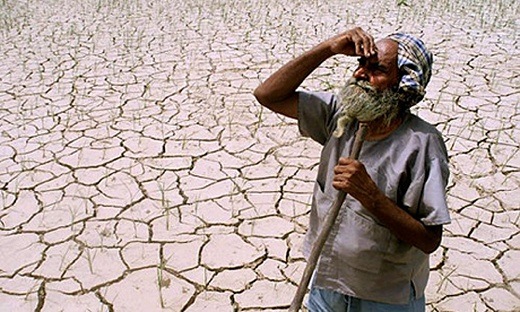
Image above: Traditional Indian farmer facing drought conditions. From (http://english.globalgujaratnews.com/article/saurashtra,-kutch-worst-hit-by-rain-deficit/).  

Summary of the Summary
We are five years into a severe global food crisis that is very unlikely to go away. It will threaten poor countries with increased malnutrition and starvation and even collapse. Resource squabbles and waves of food-induced migration will threaten global stability and global growth. This threat is badly underestimated by almost everybody and all institutions with the possible exception of some military establishments.

The yield per acre for wheat in England, France, and Germany and the yield for rice in Japan. These top-producing countries for the two most important cereals for direct human consumption have failed in the last 10 or more years to increase productivity.
Uber-hedge fund manager Jeremy Grantham has released another important discussion. Grantham, a self-described “die hard contrarian,” is one of the few leading financial figures who gets both global warming and growing food insecurity, two cornerstones of Climate Progress analysis.
I’m going to excerpt his analysis, which comprises the entire quarterly newsletter from the former Chairman and now Chief Investment Strategist of GMO Capital, which has more than $100 billion in assets under management. Grantham’s work makes very clear that the global economy is a Ponzi scheme.

In Grantham’s blunt 2Q 2010 letter (see “Grantham: Everything You Need to Know About Global Warming in 5 Minutes“), he wrote;

“Global warming will be the most important investment issue for the foreseeable future.”
Then in his January 2011 newsletter he wrote about “Things that Really Matter in 2011 and Beyond”: “Global warming causing destabilized weather patterns, adding to agricultural price pressures.” Later that year, he wrote another blunt analysis “Time to Wake Up: Days of Abundant Resources and Falling Prices Are Over Forever.”

In his new discussion, he warns we are in a “chronic global food crisis that is unlikely to fade for many decades, at least until the global population has considerably declined from its likely peak of over nine billion in 2050.” Why? “There are too many factors that will make growth in food output increasingly difficult where it used to be easy”:
  • Grain productivity has fallen decade by decade since 1970 from 3.5% to 1.5%. Quite probably, the most efficient grain producers are approaching a “glass ceiling” where further increases in productivity per acre approach zero at the grain species’ limit (just as race horses do not run materially faster now than in the 1920s). Remarkably, investment in agricultural research has steadily fallen globally, as a percent of GDP.
  • Water problems will increase to a point where gains from increased irrigation will be offset by the loss of underground water and the salination of the soil.
  • Persistent bad farming practices perpetuate land degradation, which will continue to undermine our longterm sustainable productive capacity.
  • Incremental returns from increasing fertilizer use will steadily decline on the margin for fertilizer use has increased five-fold in the last 50 years and the easy pickings are behind us.
  • There will be increased weather instability, notably floods and droughts, but also steadily increasing heat. The last three years of global weather were so bad that to draw three such years randomly would have been a remote possibility. The climate is changing.
  • The costs of fertilizer and fuel will rise rapidly
He points out something I have reported on many times here, “Talk privately to scientists involved in climate research and you find that they believe that almost everything is worse than they feared and accelerating dangerously.” The good news/bad news is:
On paper, though, the energy problem can be relatively easily addressed through very large investments in renewables and smart grids. Those countries that do this will, in several decades, eventually emerge with large advantages in lower marginal costs and in energy security. Most countries including the U.S. will not muster the political will to overcome inertia, wishful thinking, and the enormous political power of the energy interests to embark on these expensive programs. They risk being left behind in competiveness.
The devastating food crises to come will, however, largely affect the United States indirectly, through much higher prices and the terrible global instability they causes. He notes that:
For Fortress North America (ex-Mexico), or what we might call Canamerica, these problems are relatively remote. When corn crops fail we worry about farmers’ income, not about starvation. In the long run, the truth is that Canamerica seen as a unit is in an almost unimaginably superior position to the average of the rest of our planet. Per capita, the U.S. alone has five times the surface water and seven times the arable land of China! And Canada has even more.
But the staggering immorality of our food, energy, and climate policies will become increasingly indefensible. As but one example:
Despite corn being almost ludicrously inefficient as an ethanol input compared to sugar cane and scores of other plants, 40% of our corn crop – the most important one for global exports – is diverted away from food uses. If one single tankful of pure ethanol were put into an SUV (yes, I know it’s a mix in the U.S., but humor me) it displaces enough food calories to feed one Indian farmer for one year!
To persist in such folly if malnutrition increases, as I think it will, would be, to be polite, ungenerous: it pushes the price of corn away from affordability in poorer countries and, through substitution, it raises all grain prices. (The global corn and wheat prices have jumped over 40% in just two months.)
Our ethanol policy is becoming the moral equivalent of shooting some poor Indian farmers. Death just comes more slowly and painfully.
Once again, why single out Indian farmers? Because it was reported last month in Bloomberg that the caloric intake of the average Indian farmer had dropped from a high of 2,266 a day in 1973 to 2,020 last year according to their National Sample Survey Office. And for city dwellers the average had dropped from approximately 2,100 to 1,900.
The whole discussion — “Welcome to Dystopia! Entering a long-term and politically dangerous food crisis” – is a must read. Below is just the discussion on climate change.

The negative effect of climate change on grain production
I used to think that “climate change” was a weak, evasive version of “global warming” but not anymore, for weather extremes – drought, floods, and bursts of extreme heat – have turned out to be more devastating for food production than the steady rise in average global temperatures. Droughts and floods were off-the-scale awful three growing seasons ago, and I forecasted some improvement. But with impossibly low odds – based on the previous weather distribution pattern – severe weather events kept going for two more growing seasons. Just as with resource prices, detailed last year, when the odds get into the scores of thousands to one, it is usually because the old model is broken.
So in the resource case, the old model of declining resource prices was broken and a new, very different era had begun. Similarly, the odds of three such disastrous years together are just too high to be easily believed and the much safer assumption is that the old weather model is broken and a new era of rising temperature and more severe droughts and floods is upon us.
All-time heat records in cities across the world are falling like flies and the months of March through May this year were the hottest in U.S. history. As with the equally unpleasant fact of rising resource prices, this new, less desirable climate has to be accepted and adjusted to. Once again, the faster we do it, the better off we will be. Several industries like insurance are already deep into the study of the new consequences.
Farming must also adjust, and not just to the rising prices. With skill, research, and, above all, trial and error, farmers will adjust the type of crop and the type of corn seed they use to the changing weather. And I have no doubt that they will mitigate some of the worst effects of increased droughts and floods. But the worst shock lies out quite far in the future: grains have developed over many thousands of years in an unusually moderate and stable climate (moderate, that is, over a scale of hundreds of thousands of years); and selective breeding of the last few hundred years also was done in that moderate environment. Grains simply do not like very high temperatures.
By the end of the century, the expected rise in temperature globally is projected by the IPCC to reduce the productivity of grain in traditional areas by 20% to 40% – numbers so high that the heart sinks given the other problems. Yes, northern climates will benefit (so Canada once again looks like a good ally) but more world-class grain land will be lost than is gained. And do not for a second think that the scientists can be dismissed as exaggerators in the pay of evil foundations as right-wing think tanks would have you believe. The record so far has been one of timid underestimation.
Much the majority of scientists hate being in the limelight and live in dread of the accusation of the taint of exaggeration, so severe a crime in the academic world that it is second only to faking data. What the timid scientists forget (this is all driven by career risk just as with institutional investing) is that in this unique case it is underestimating that is dangerous! To put the science clearly in the public domain – a task so far totally failed at – is left to a brave handful of scientists willing to be outspoken.
Talk privately to scientists involved in climate research and you find that they believe that almost everything is worse than they feared and accelerating dangerously. A clear example is in the melting of the Northern ice, now down in late summer by 30% from its recent 30-year average to 2005. It is at a level today (and last month was the least ice cover of any June ever) that was forecast 15 years ago for 2050! Dozens of ships last year made commercial voyages across the Northern waters where none had ever gone before 2008.
A dangerously reinforcing cycle is at work: the dark ocean absorbs heat where ice reflects it, so the water warms and more ice melts. Other potentially more dangerous loops might also start: the Tundra contains vast methane reserves and methane acts like supercharged CO2. It warms the air and more Tundra melts and so on.
For agriculture, which is very sensitive indeed to temperature shifts, it has become a very dangerous world. There is now no safety margin to absorb unexpected hits as we are seeing in the global crisis playing out in the Midwest today.


.

North Shore flooding at Lumahai

SOURCE: Michael Sheehan (hanaleirivermichael@gmail.com) SUBHEAD: Advise from one north shore resident; "If you have property in Haena, sell it quick, or buy a boat to get there."  

By Terry Lilley on 12 March 2012 via email-  
(http://islandbreath.blogspot.com/2012/03/north-shore-flooding-at-lumahai.html)

 
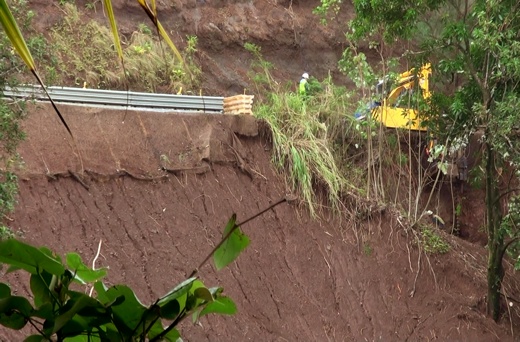
Image above: Kuhio Highway, undercut by heavy rains, may fail at Lumahai, and that's the only way Haena. From original email.

I just went down to the big landslide under the Kuhio Hwy in Lumahai and had to climb a steep cliff and a tree but finally got high enough to look at the landslide under the road. Workers were doing some type of emergency drilling, hopefully to stabilize the road but as you can see if a little more of the cliff falls away the road will be gone!

 I won't be taking video from this spot again (without a helicopter) as it took me 90 minutes to climb up this old goat or Memehune trail, barefoot through the hau bush then climb a tree and knock off a few branches so I could see the cliff! Will let the DLNR take the next pics!


Image above: Endangered moorhens crossing Kuhio Highway because of flooding. From original email.

Also is a included is a photo of two endangered Moorhens running across Kuhio Highway today before they get squished by cars! This is the problem when it floods in town instead of the wetland as the birds get washed into Hanalei and get run over by cars!

 In California the US Fish & Wildlife Service would come out and lead cars through the area to avoid killing the endangered birds but in Hanalei is it just OK to run them over even though there is only a few hundred of these birds left on the entire planet! Every flood this happens and I call the USFWS but they never even return my calls! In 2009 I took video of 24 of them squished on the road!

.

Don't trust Army Corps of Engineers

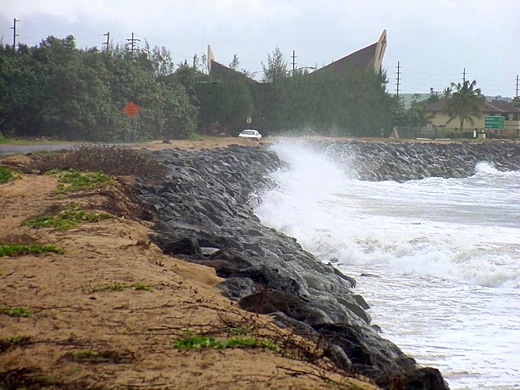
SUBHEAD: This kind of waste erodes trust in our government and makes our already difficult fiscal situation that much worse. By Juan Wilson on 6 October 2011 for Island Breath - (http://islandbreath.blogspot.com/2011/10/dont-trust-army-corps-of-engineers.html) Image above: Surf crashes on revetment wall along Kuamualii Highway near west of Catholic church in Kekaha. From (http://www.poh.usace.army.mil/CW/CWPhotos-HIKa.htm). If you remember back to the analysis of damage caused by hurricane Katrina when it hit New Orleans you probably recall that major factors for the failure of the levees and the subsequent flooding that killed almost 2000 people and did over $80 billion in property damage was laid at the feet of the Army Corp of Engineers. First - they cut the wetlands to the south of the city into ribbons by slicing channels for large vessels that wanted shortcuts to the gulf waters. These water highways eroded the grassland and marshes that buffered the mainland from storm surges. These wetlands have been a living filter protecting both the gulf and the city. They were critically damaged by the projects of the Army Corps. Second - the Corps badly designed and under maintained the levees that were needed to protect parts of the city most likely to be flooded when a storm surge from the gulf, or high water from the Mississippi came. Those lowest lying areas where the dykes were, of course, were where the poorest people (read black) lived. Here on Kauai they have been busy and have plans. I am most familiar with their efforts to "improve" the Hanapepe River Levee system. I live inside the protection of that levee on the west side of the river. My conclusion after watching the efforts since 2006 to improve the system is that the Army Corps of Engineers is a mechanistic and unimaginative design and build contracting outfit with the power of god and little care about the environment of the people that live in the path of their work. They don't get the living system here, and don't care about it. They have insisted that all living grass, plants and trees be stripped from the levee (since 2006). The Kauai County Public Works were the Corps army in the field enlisted to do the work. They employed chainsaws and backhoes and pesticides. They would spray Round-Up at 7am within 25ft of residents asleep in their beds. At least two women were badly affected by the poison gases. One suffered an asthmatic attack and could not breathe afterwards. She was in her 70's. The other was pregnant in her 20's and became ill. She miscarried within 48 hours. At a recent meeting in Hanapepe the Army Corps informed the community of the timeline for their project. I won't go into the details but they are horrible. I asked the Corps representative from Honolulu what research they had done on the best species of grasses and plants that could be placed on the sides of the levee once rebuilt. He didn't have a clue nor did he know of anyone who did. I'd rather live with no flood insurance and no levee and take a chance with the ebb and flow of nature like people did here before 1965. Has anyone noticed that since the Army Corps has been involved with "saving" Kekaha's small boat harbor and beaches that the erosion there seems to have accelerated?
Staggering Army Corps Fraud By John Rudolf on 5 October 2011 for Huffington Post - (http://www.huffingtonpost.com/2011/10/05/army-corps-engineers-fraud-eyaktek_n_996442.html) Image above: The Army Corps idea of a shoreline along the Industrial Canal in New Orleans, after hurricane Katrina. From (http://www.tulane.edu/~sanelson/Katrina/katrina_images.htm).

Two senior employees at the U.S. Army Corps of Engineers bilked the government out of $20 million through a "brazen" bribery and kickback scheme, federal prosecutors charged Tuesday afternoon.

Prosecutors identified the mastermind of the scheme as Kerry F. Khan, 53, of Alexandria, Va., a program manager at the Army Corps' Washington, D.C., headquarters. According to the 42-page indictment, Khan controlled a dizzying array of shell companies, which were used to mask millions of dollars being skimmed off inflated federal contracts paid to a Dulles, Va., technology firm.

Khan, who is charged with bribery, money laundering and wire fraud, pocketed roughly $18 million from the scheme over four years, prosecutors said. He allegedly spent the money on Rolex watches, BMW sports cars, designer clothes, first-class travel and properties around the globe.

The fraud was "staggering in scope," said Ronald Machen Jr., the U.S. attorney for the District of Columbia, at a news conference announcing the arrests.

"This indictment alleges one of the most brazen corruption schemes in the history of federal contracting," Machen said.

Harold F. Babb, the contracts director at Virginia tech firm EyakTek, was also charged with multiple felonies, along with Michael A. Alexander, a program director at the Army Corps, and Lee A. Khan, Kerry Khan's son, who controlled a consulting company allegedly involved in the scheme. The four men were arraigned in federal district court in Washington, D.C., where their lawyers entered pleas of not guilty to all charges.

A hearing is scheduled for Thursday to determine whether the men will be detained until trial, according to the Associated Press. Prosecutors called the men a flight risk.

As outlined in the indictment, the fraud scheme was simple enough, if breathtaking in scope. It began with a $1 billion Army Corps contract awarded to EyakTek, which subcontracted work out to another, unnamed Virginia tech firm. In a conspiracy with employees at the two companies, Kerry Khan and Alexander, who oversaw the contract, added millions of dollars in phony expenses to invoices sent to the government. Those funds were then allegedly skimmed from checks paid out by the agency and funneled back to the conspirators through a series of shell companies.

When arrested, the conspirators were planning a similar scheme, prosecutors said. According to recorded conversations and intercepted emails, the men were attempting to steer a $780 million technology contract to the unnamed Virginia technology firm, which could also be skimmed for profit. The only major hurdle would be clearing a government selection committee.

"Our biggest thing is being able to stack the board," Babb said during a March 2011 meeting with an unindicted co-conspirator, according to the indictment. "That's what I'm trying to do. I'm trying to stack it in our favor."

On Wednesday, several leading Democrats in Congress called on the Pentagon to improve the oversight of its more than $600 billion annual budget.

In a letter sent to Ashton Carter, Deputy Secretary of Defense, Sen. Jeanne Shaheen (D-N.H.) called the latest scam part of an ongoing pattern of fraud and waste that has drained billions of dollars from federal coffers. In particular, she pointed to a September report from the Commission on Wartime Contracting that found up to $60 billion lost to contract waste and abuse in Iraq and Afghanistan.

"We cannot allow this kind of fraud to run unchecked," Shaheen said. "This kind of waste erodes trust in our government and makes our already difficult fiscal situation that much worse."

.

Katrina in New England

SUBHEAD: The convergence of climate change, energy scarcity, and failure of capital are more than the sum of their parts.

 By James Kunstler on 29 August 2011 for Kunstler.com -
  (http://kunstler.com/blog/2011/08/katrina-in-vermont.html)

 
Image above: Bennington Police Chief Paul Doucette looks at a collapsed bridge on Route 9 in Woodford, Vt. on Aug. 28, 2011. From (http://www.bloomberg.com/news/2011-08-29/vermont-s-covered-bridges-lost-as-irene-brings-worst-flooding-in-75-years.html).

The same creeping nausea that followed the CNN 'all clear' sign in New Orleans six years ago happened again yesterday. Anderson Cooper seemed a little peeved that the lights didn't go out in Manhattan, but then the remnants of Hurricane Irene stomped up the Hudson Valley and stalled a while and commenced to rip apart the Catskills, the eastern Adirondacks, the Mohawk and upper Hudson valleys, and then almost all of Vermont, not to mention New Hampshire and western Massachusetts, and I can't even tell you much about whatever's going on in Pennsylvania, Virginia, Delaware, and Maryland this morning. Connecticut, Long Island, and Rhode Island are in there somewhere, and surely there's more than a few things out of place in North Carolina.

This is nowhere near Katrina's death toll of over 1800 souls, but the damage to scores of towns, businesses, houses, and basic civic armature is going to be very impressive as the news filters in later this week and the disaster is still very much ongoing Monday, even with the sun shining bright. Towns all over Vermont and New Hampshire are still drowning. The Hudson River is still on the rise. The Mohawk River is at a 500-year flood stage and is about to wipe the old city center of Schenectady, New York, off the map. Bridges, dams, and roads are gone over a region at least as big as the Gulf Coast splatter-trail of Katrina.
That story is still developing. A lot of people will not be able to get around for a long, long time, especially in Vermont and New Hampshire, where the rugged terrain only allows for a few major roads that go anywhere. Even the bridges that were not entirely washed away may have to be inspected before people are allowed to drive over them, and some of these bridges may be structurally shot even if they look superficially okay. There are a lot of them. If you live in a flat state, you may have no idea.
The next story is going to be the realization that there's no money to put it all back together the way it was. The states don't have the money. The federal government is obviously broke, and an awful lot of the individual households and businesses will turn out to not have any insurance coverage for this kind of disaster where it was water, not wind, that destroyed the property. I don't know what the score is insurance-wise along the mid-Atlantic beachfront towns - but remember, insurance companies were among the biggest dupes of the Big Bank mortgage-backed securities racket, and when the new claims are toted up they may find themselves in a bail-out line.
This is a warning to America that the converging catastrophes of climate change, energy scarcities, and failures of capital formation add up to more than the sum of their parts in their power to drive a complex society into a ditch - no matter what a moron like Rick Perry might say. But, of course, political ramifications will follow. There will be a lot of pissed-off people in the Northeast USA. Maybe they'll even start giving the grievance-bloated folk of Dixieland some competition in the politics of the bitter harvest.

 Oddly, the Siamese twin states of Vermont and New Hampshire are political polar opposites. Vermont, the land of Ben and Jerry's ice cream, and other squooshy culture tropes from the attic of Hippiedom, is about as Left-progressive as it gets. New Hampshire's license plate says, "Live Free or Die," and that same draconian mood defines the state's politics: hard Right. It's like a few counties of Georgia shook loose and drifted north somehow. My guess is that the political rage will be about equal on both fronts, as folks are left stranded, or homeless, or without a going business they thought they had only a day or so ago. And my further guess is that their mood will afford some insight into the extreme impotence, incompetence, and mendacity of both major political parties. As I've said before in this space, think of these times as not unlike the convulsive 1850s, preceding the worst crisis of our history.
Apart from the fact that the hurricane season is just gearing up, and that a procession of tropical storm blobs has commenced to pour out of West Africa, there is that other alternate universe of storms, brushfires, and fiascos called the fnancial system, which everybody sort of forgot about over the weekend. Well, it's ba-a-a-ck this morning, too, and the financial weather was deteriorating sharply last time I looked. You can stick a fork in the Euro Zone. Bank of America is panhandling for spare change like a dying wino as it whirls around the drain. Nobody knows what the shadow bets on all this action is, but you can bet on one thing for sure: the counterparties can't pay.
Oh, by the way, anybody remember that we had an earthquake here in the Northeast a few days before Irene rumbled in? Probably not, unless part of your building fell off. God's wrath, some might say, as we beat our path to a world made by hand.
[Editor's note: The Vermont Yankee Nuclear Plant is an aging facility scheduled to close in 2012, but was not damaged or knocked off line during hurricane Irene. see (http://www.democracynow.org/2011/8/29/we_are_still_under_siege_vermont)]

See also:
 Ea O Ka Aina: Warning on Virginia Nuclear Plant 8/26/11 .