Showing posts with label Moku. Show all posts

Kauai Puna Moku Update

SUBHEAD: Modification to Niumalu and Huleia ahupuaa boundary to provide better access to shoreline.

By Juan Wilson on 19 May 2018 for Island Breath -
(http://islandbreath.blogspot.com/2018/05/kauai-puna-moku-update.html)

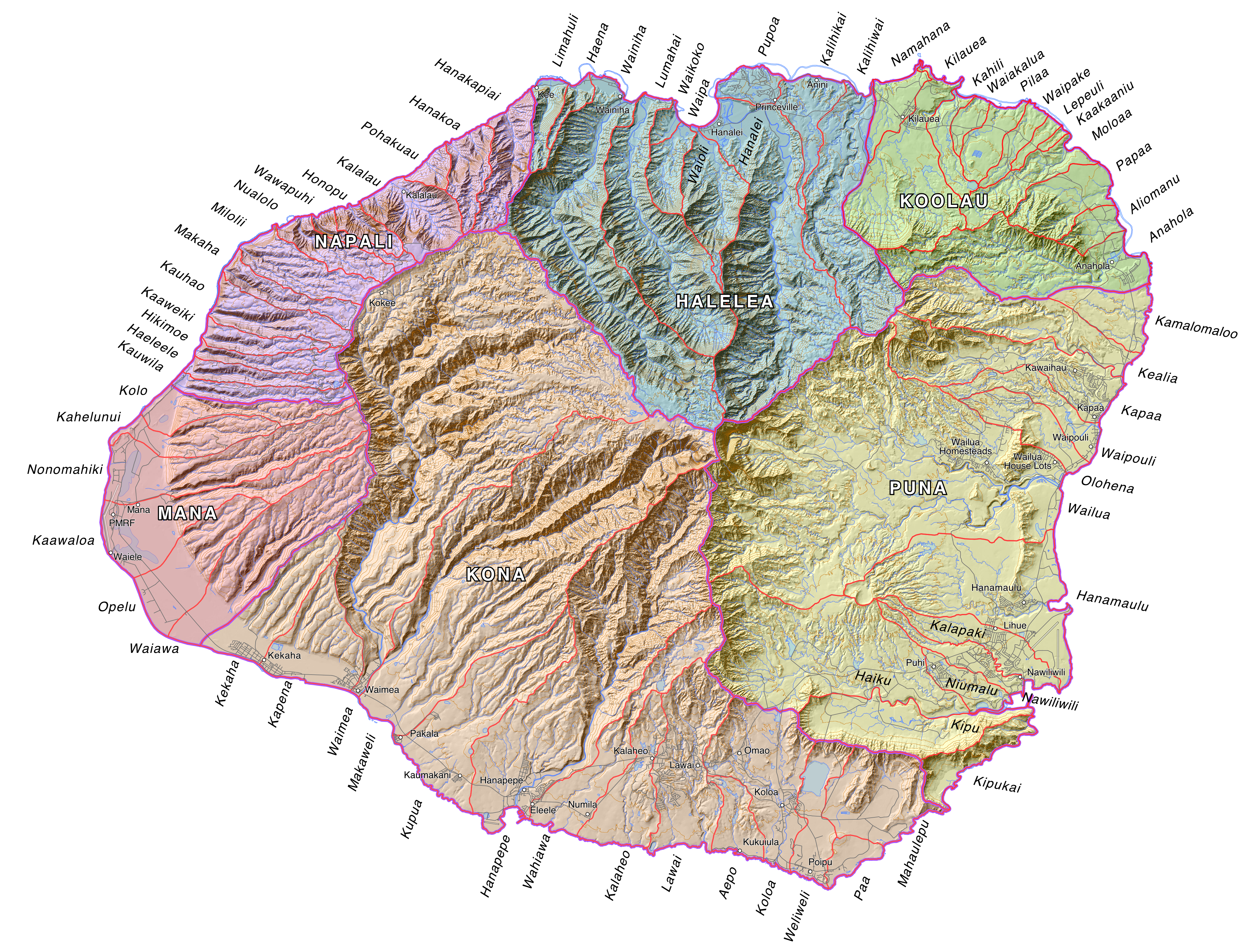
http://www.islandbreath.org/hawaiinei/M7Kauai/M7KauaiRasterFile.png
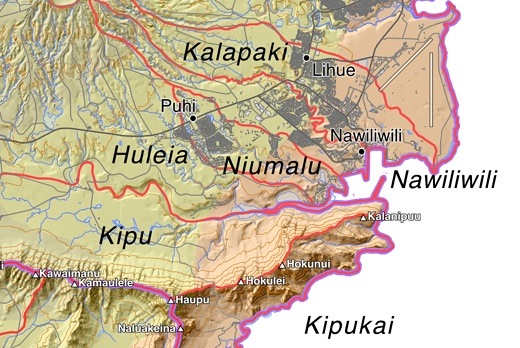
Image above: Detail of change to Kauai moku of Puna Huleia ahupuaa boundary with Niumalu. Click for full map. From (http://www.islandbreath.org/hawaiinei/M7Kauai/M7KauaiRasterFile.png).

After a consultation with Jonathan Jay we have made a modification to the boundary between  Niumalu and Huleia ahupuaa in the moku of Puna on the island of Kauai.  We think a clearer and improved boundary line has been delineated.

In previous versions of the Puna plan the Huleia ahupuaa failed to reach the true coastline of Kauai, and thus was landlocked with only Huleia Stream passing out to the ocean between Niumalu and Kipu.

We have also recently added an additional layer of information to Kauai that includes many of the locations and names of significant mountain peaks. This is important to understanding moku and ahupuaa boundaries, especially from a ground's eye perspective.

We have not yet scheduled work on the mountain peaks of other islands. It would likely require weeks of work.

Hawaiinei Land Areas
Available updated downloads for Kauai:
GoogleEarth file .KMZ (15 MB) uploaded 5/19/18
24"x36"Plotfile .PDF (44 MB) uploaded 5/19/18
Hi RezRaster File .PNG (15 MB) uploaded 5/19/18
ArcView GIS files SHP .ZIP (319 KB) uploaded 5/19/18
AutoCAD files DXF .ZIP (2.7 MB)  uploaded  5/19/18  


 .

Kauai Nui Kuapapa

SUBHEAD: Kuapapa means united under one chief. Bullshit. Niihau isn't a moku of Kauai. Mana is a moku of Kauai.

By Juan Wilson on 14  May 2017 for Island Breath -
(http://islandbreath.blogspot.com/2017/05/kauai-nui-kuapapa.html)

http://www.islandbreath.org/2017Year/05/170514mokubig.jpg
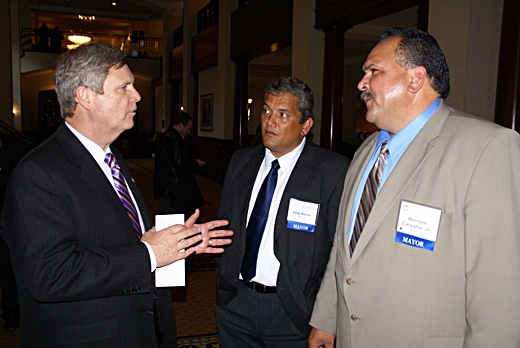
Image above: A heavily sweating Kauai Mayor Carvalho and Big Island Mayor Kenoi are being "man-splained" how GMO and pesticide policy will go down in Hawaii by Secretary of Agriculture Thomas Vilsack in a meeting in 2011. Vilsack was a former governor of Iowa and an early supporter of corn ethanol production. He had also been a lobbyist and Vice President of Monsanto corporation. Glyphoste is in his blood. From (https://damontucker.wordpress.com/tag/mayor-bernard-carvalho/).

Recently I received a mailing purportedly from Bernard Carvalho to "talk about Nui Kuapapa" - "to talk about our island". The mailing invited me to identify which moku I live in from a provided map of Kauai and Niihau. The map was first seen in the drafts of the proposed Kauai General Plan Update 2020.

http://www.islandbreath.org/2017Year/05/170514mokubig.jpg
Image above: Map of Kauai and Niihau from the draft of the General Plan Update showing Niihau as a moku of Kauai and Kona moku flooding into half of the Napali moku from Haeleele to Nualolo. See also (http://kauainuikuapapa.com/moku/kona/).


Note, this map does conform to historic moku borders in some ways. Certainly Halelea, Koolau, and Puna are reasonable representations according to many, but not all cultural interpretations. As  in many modern maps no Mana Moku is shown. Mana is subsumed by Kona.

But in addition the Napali Moku has been shriveled by half as Kona has engulfed much of the western Napali ahupuaa from Haeleele to Nualolo, including Milolii. Since when has Milolii not been considered on the Napali Coast?

To see how shallow this cultural vision of Kauai is check out the source  (http://kauainuikuapapa.com/#home). The creators of this site are linked to the General Plan effort and reveal  something interesting when you get down to the contacts page:
Nā Hōkū Welo, LLC
P.O. Box 511
Līhue, HI 96766
Phone (808) 779-9454
Fax (855) 251-5425
partner@nahokuwelo.com

Nalani K. Brun
Economic Development Specialist IV-Tourism
Office of Economic Development
County of Kauai
4444 Rice St. Suite 200
Līhue, HI 96766
Phone (808) 241-4952
Fax (808) 241-6399
nbrun@kauai.gov
In my opinion, the map, as a part of the presentation of the entire General Plan Update Plan process, shares a false Hawaiian cultural patina. The map shows Kauai County - that is the islands of Kauai and Niihau. It show five moku on Kauai and show Niihau as a moku of Kauai. Moreover, the moku are not in conformance with the earliest Hawaiian maps prior to the introduction of private property.

The General Plan Update process pretends to be a gathering of our community voices to determine our future. It uses Hawaiian words to pretend it shares Hawaiian cultural perspective. It is presented in an informal style with lots of images of local people and places, but as merely props and scenery to disguise its true purpose - ECONOMIC DEVELOPMENT... particularly for tourism and real estate development.

Because this is a Kauai County government project it is seen from a county political perspective, Niihau has been reduced to an appendage of Kauai. 

From the get-go the County Planning Department has had the goal that the General Plan Update 2020 will implement a doubling of the population of Kauai in the next generation. It calls for a tripling of the population in the Hanapepe-Elelele area and a significant increase in military operations (and personnel) on the Westside.

Niihau is not a moku of Kauai!
Hawaiian language definitions, like English, are multidimensional. In general "moku" means a cut piece of something, and a "puni" means surrounded as by water.
Moku (Parker Hawaiian Dictionary)
 A district; a division of an island, as Kona on Hawaii, and Hana on Maui.
Mokupuni (Parker Hawaiian Dictionary)
The full form for island; that is, a division of land surrounded by water.
It is true that Kauai and Niihau were at one time part of a single larger island rivaling the Big Island and included the tiny island of Kaula further to the southwest of Niihau.  Niihau maybe politically part of Kauai County but it is a separate inhabited island and a mokupuni unto itself.

Maui has had a similar fate. At one time Maui was an island that included Molokai, Lanai and Kahoolawe. As it was eroded and broken into separate islands over geological time each part became a mokupuni unto itself.

But this is clear. All Hawaiian inhabited Hawaiian islands have an identified windward and leeward side (or Kona and Koolau moku).

Mana is a moku of Kauai!
Before I detail why, I must tell you I've been mapping the moku of Kauai for over a decade. In 2009 I was approached by Jean Ileialoha Beniamina to map the moku and ahupuaa of all the Hawaiian islands. She was then Chair of the Aha Kiole Committee (later to become the Aha Moku Council).

The committee and council sought kapuna and others with knowledge of historic Hawaiian land management and the names and places of moku and ahupuaa to report on each island.

I was commissioned by the Western Pacific Regional Fisheries Management Council (WesPac) through funds from the US National Ocean & Atmospheric Administration (NOAA) to do that mapping according to the reports of the Aha Moku Council.

In 2010 the maps I produced were accepted as complete. Some adjustments were made and corrections submitted by Ahu Moku participants and others who saw the maps once published and made available to the public. The results of that effort can be found at (http://www.islandbreath.org/mokupuni/mokupuni.html).

The Kauai map specifically can be found at (http://www.islandbreath.org/mokupuni/M7Kauai/M7KauaiRasterFile.png). The kauai and the other island maps can be found at the Aha Moku Council website here (http://www.ahamoku.org/index.php/maps/).

In studying the issues I came across two vital sources. One was Mrs. Ursula S. Emerson, the wife of minister Rev. John S. Emerson of Kauai. In conjunction with local Hawaiians she mapped Kauai, Niihau and Oahu.

Mokupuni O Kauai

Image above: The 1833 map of Kauai by Ursula Emerson, wife of Reverend John Emerson of Koloa. In my opinion this is the finest map of Kauai until four decades later. It had the best proportions features and selection of detail until after the overthrow of Hawaiian sovereignty. This copy came from the Kauai Historical Society. For some unaccountable reason the title block of the maps was mutilated. Click to enlarge and see full image.

This map of Kauai is dated 1833. Besides sailor's navigational maps, this is the first coherent map of Kauai. It identifies streams and renders interior valleys and ridges. The map also show the Great Ala Loa Trail and the ahupuaa and moku of the island.  I consider it the most accurate map of Kauai until after the Great Mahhele. It shows clearly six moku on Kauai, the westernmost one being Mana Moku. Her Kauai map was used a a basis for the US Navy and British Navy maps of the late 1830’s.

Mokupuni O Kauai
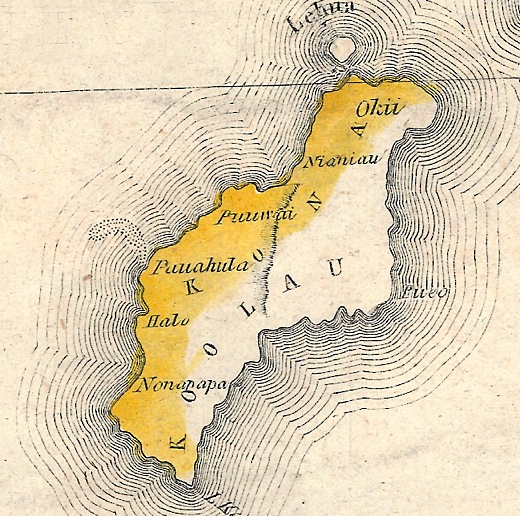
Image above:  Detail of the 1833 map of Niihau by Ursela Emerson. Click for complete map.

The Emerson map of Niihau distinctly identifies two moku - Kona and Koolau. It, like her map of Kauai, shows a detailed knowledge of shoreline, features and place names. Her maps were done in Hawaiian language and my understanding is that local Hawaiians were the source of her detailed knowledge of the islands.


Image above: Detail of Kauai island from 1838 map of Hawaiian Islands by S. P. Kalama.

Also, Simon Peter Kalama of Maui’s Lahaina Luna School was the first Hawaiian to map the Hawaiian Islands in 1837 and more accurately in 1838). He clearly shows Mana as a moku of Kauai and Niihau with a Kona and Koolau moku. See (http://islandbreath.blogspot.com/2010/06/na-mokupuni-o-hawaii-nei.html).


Image above: Detail of Niihau Island from 1838 map of Hawaiian Islands by S. P. Kalama 1838.  

It is not until well after the establishment of private property and the Hawaiian Government Survey map of 1878 did you see Mana as just an area of the westside of Kauai identified as the Moku of Waimea. That continued through the the Territory of Hawaii Map of 1901. Only later was area changed to be part Kona Moku.

I wrote to the partner at Nahokuwelo.com of this matter over a week ago saying I was prepared to work with him on the issues concerning Moku and Ahupuaa on Kauai and Niihau, needless to say, I got no reply.

If the cultural and historic confusion represented by the General Plan Update maps of moku on Kauai and Niihau are representative of the quality of the General Plan then woe be it unto Kauai and Niihau.

.

From Mokupuni to Ahupuaa

SUBHEAD: The Wailua-Kapaa Neighborhood Assoc meeting with guest speaker Juan Wilson, present "From Mokupuni to Ahupuaa".

By Rayne Raygush on 6 January for W-K Neighborhood Assoc.
(http://islandbreath.blogspot.com/2015/01/from-mokupuni-to-ahupuaa.html)


http://www.islandbreath.org/2015Year/01/150120punanorthbig.jpg
Image above: The Wailua-Kapaa Neighborhood Association is in the north part of the Puna Moku of Kauai between the North Fork of the Wailua River and south of Kealia Stream. Cartography by Juan Wilson. Derived from (http://www.islandbreath.org/mokupuni/mokupuni.html). Click to embiggen.

WHAT:
Wailua-Kapaa Neighborhood Association meeting will feature guest speaker Juan Wilson, presenting “From Mokupuni to Ahupuaa”
 

WHEN:
Saturday, January 24th, 2015 at 2:00pm until 4:00pm

WHERE:

Kapaa Public Library Meeting Room

INFO:

The presentation is free and open to the public.

CONTACT:

Sid Jackson, W-K Neighborhood Association Secretary
Phone: (808) 821-2837
Email: sjackson23@hawaii.rr.com

 
The Wailua-Kapaa Neighborhood Association will feature guest speaker Juan Wilson, presenting “From Mokupuni to Ahupuaa” on Saturday, January 24, 2014, 2:00 p.m. at the Kapaa Library Meeting Room. The presentation is free and open to the public.

The traditional land divisions of pre-contact Hawaiians were based on the sustainability and self- reliance within community watershed areas (ahupua`a) as well as within bioregions (moku) and lastly individual sovereign islands (mokupuni). These natural land divisions were the result of the flow of water over the land.

In 2010, Wilson, an architect and planner, conducted a detailed survey using historical documents, early Hawaiian Maps, USGS survey maps, the support of the Statewide Aha Keole Advisory Committee, The Western Pacific Regional Fishery Council, the Kauai Historic Society, and individual accounts from residents such Ileialoha Beniamina.

Applied to these sources, Wilson, with assistance from designer Jonathan Jay, used the geography of the islands based on 3D GoogleEarth elevations and USGS map data, as well as the State of Hawai`i GIS data on watersheds, streams and topographical contours. This information was used to tie the traditional information to modern geographic modeling which describes the flow of water over the land.

Historically, boundaries were also determined by the political influence and power. However, to the degree possible, land divisions based on conquest and private ownership were ignored, and this mapping project kept to the relation of Hawaiians to the `aina itself.

“We hope this information will foster more cultural awareness, and a greater understanding and use of native Hawaiian resource knowledge”, says Rayne Regush - Wailua-Kapaa Neighborhood Association.

The meeting will also include updates on other local issues. For more information, contact Association Secretary Sid Jackson at 821-2837 or visit www.wkna.org.

“Opportunities that reinforce our connection to the land and natural resources also help to preserve Hawaiian cultural heritage and traditional values.”


Serving Residents of the Kawaihau District
“We treasure our rural community”
340 Aina Uka Street, Kapaa, Hawaii 96746

.

Two bills to rule Niihau

SUBHEAD: No official comments are being accepted on these bills which should be a heads up. 

By Lyn McNutt on 8 Ferbuary 2014 in Island Breath -
(http://islandbreath.blogspot.com/2014/02/two-bills-to-rule-niihau.html)


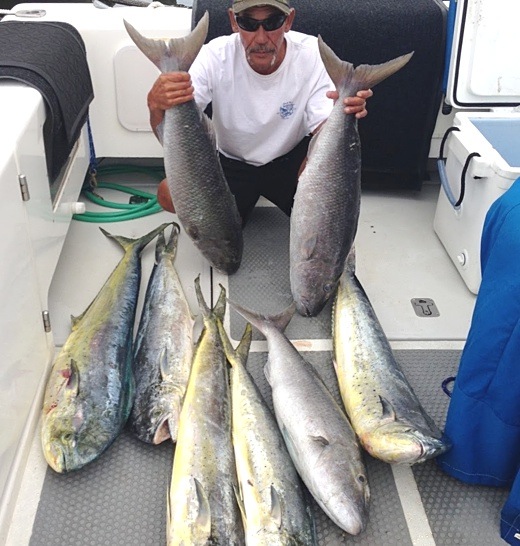
Image above: Photo of charter fishing trip results to Niihau posted by Harry Rivera on 4/14/13. From (http://blog.fishinginkauai.com/2013/04/niihau-trip.html).

No official comments are being accepted on these bills which should be a heads up.

DANGER - DANGE - DANGER

HB 2357 combined with SB180 PD1 gives control of public waters around Niihau away to the Robinson Family (SB180), specifically, by law and then sets up the Aha Moku Advisory Council to do the dirty work (HB 2357).

These are very, very bad, and if passed in their present form will be open for legal action.

HB 2357
1. The suggested text leaves the door open for real abuse.  If you only have to "consult" with people, you are under no obligation to listen to them.  This is also one of NOAA's favorite terms---"in consultation with" means nothing unless it says, "in consultation and agreement with".  There needs to be an agreement clause or they have no need to care if you agree or not after they consulted with you.  This bill only says consultation.  Not good enough.


2. The Aha Moku Council has yet to fulfill the requirements of its own strategic plan as agreed with the Governor when the Bill was signed.  They are not authorized to take on additional roles until they fulfill their primary role given to them by the state and agreed in the strategic plan. The Governor stated this clearly before and after the Bill was signed and this was then presented to moku on each island!!

The Aha Moku councils on the islands are being neglected in favor of creating a centralized management structure in DLNR to bring the management of all konokiki and moku rights into DLNR to be decided and managed by one person who only has to consult with us, and not listen.   The Aha Moku Council on Oahu has sent a letter complaining about this.

3. The Aha Moku Council Advisor does NOT have the right to decide konohiki rights nor set policy based on her/his interpretation of those rights.  These decisions belong to the people and not a government employee.  The Government failed to pass the Aha Kiole Bill, which would have been the appropriate place for this discussion.

This bill scheduled to be heard by Agriculture Committee (AGR) on Monday, February 10th at 10:00am in House Conference Room 312.

AGENDA:
HB2357

WHEN:
Monday, February 10th, 2014 at 10:00am

WHERE:
Conference Room 312
State Capitol
415 South Beretania Street
Honolulu, Hawaii

SB 180 SD1

This is a bill written and modified to benefit one person, a private land owner, and sets a very, very bad, constitutionally questionable precent. The committee on ocean management (WTL)  recommended that the measure be PASSED, WITH AMENDMENTS and be recommitted.

HB 2357 along with SB 180 SD 1 gives away everything and I honestly have no idea what people are thinking in the Senate here.  This blatantly contradicts the constitution, and is tied directly to HB 2357 by giving konohiki rights SPECIFICALLY for Niihau (as if there were any doubt who is supposed to benefit from this) and then changing the Aha Moku Council Advisor's role to work directly with the newly crowned konohiki for Niihau to get what the Robinson's want.

This is all very clever, but some of the people involved in creating this legislation need to take a good long look into their souls and wake up.  What is worse is to be using others and the law to take things away while pretending to "protect" people and resources.  I would not want this on my own conscience.

STATE REP EMAIL:
State Senators
sens@capitol.hawaii.gov

State Represenetaivers
reps@capitol.hawaii.gov 
 
KAUAI REPS EMAIL:
Representative Dee Morikawa
House District 16
Hawaii State Capitol
Room 310
phone: 808-586-6280
fax: 808-586-6281
repmorikawa@capitol.hawaii.gov

Representative James Tokioka
House District 15
Hawaii State Capitol
Room 322
phone: 808-586-6270
fax: 808-586-6271
reptokioka@capitol.hawaii.gov

Representative Derek Kawakami
House District 14
Hawaii State Capitol
Room 314
phone: 808-586-8435
fax: 808-586-8437
repkawakami@capitol.hawaii.gov

Senator Ron Kouchi
Senate District 8
Hawaii State Capitol
Room 206
phone: 808-586-6030
fax: 808-586-6031
senkouchi@Capitol.hawaii.gov

TO TESTIFY:
http://www.capitol.hawaii.gov/measure_indiv.aspx?billtype=HB&billnumber=2357&year=2014

Submit your testimony:
If you don't have an account with (http://www.capitol.hawaii.gov), you can set one up easily and it is free. Click on "Register" button in the upper right-hand corner of page.

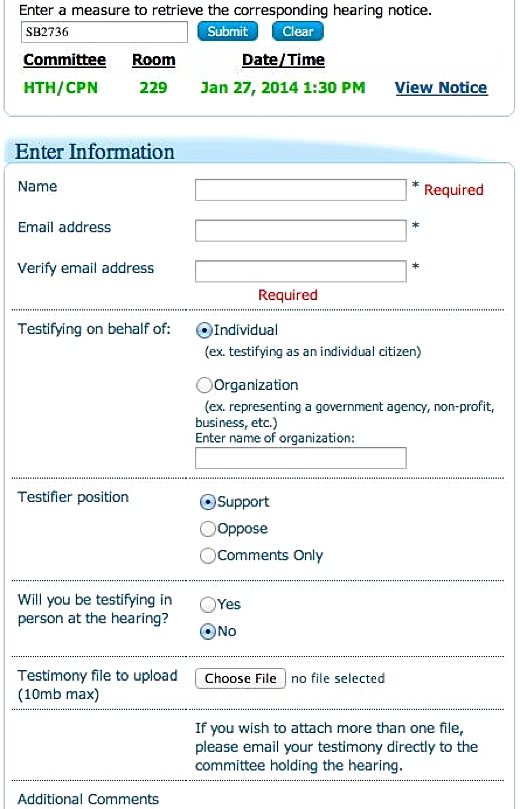
Return to HB2357 page and click on the blue "Submit Testimony" at top of page and it will take you to a page that looks like this form (for another bill):


You can fill out the information depicted in the above graphic.  Minimum, you only need to highlight the "OPPOSE" dot for SB2357, along with your acct. name and email.  If you want under "Additional Comments," you can write a few sentences or paragraphs

See also:
Ea O Ka Aina: Niihau and the US Military 2/7/14


.

The Mana Mirage

SOURCE: Hope Kallai (lokahipath2@live.com)
SUBHEAD: Mana means supernatural and dry in Hawaiian and these visitors to Kauai in 1847 found magic there.

By Chester S. Lyman 17 April 1847 in Island Breath -
(http://islandbreath.blogspot.com/2013/08/the-mana-mirage.html)


Image above: Bonafide water in Queens Pond north of the Barking Sands in Kolo ahupuaa along the shoreline. Photo by Juan Wilson (truck tracks edited out).

Below is excerpt from "Around the Horn to the Sandwich Islands and California" 1845-1850 by Chester S. Lyman. Edited by Frederick John Teggart. Starting at Page 184 to 191.

Saturday 17th April [calculated as1847] The horses having been got up, Messrs Alexander and Douglass and Miss Dibble started at 11am for a ride to Mana, 12 miles distant along the coast westerly, to witness the Mana Mirage and the Musical Sand [Barking Sands].

Our route lay over a level plain, scarcely at all elevated above the ocean, and from 1 to 2 miles wide between the sea and the inland bluff by which it is bounded. All along the shore and throughout the plain a coarse sandstone appears, composed chiefly of comminuted shells.

This plain in dry weather is the scene of a remarkable exhibition of the mirage, like that seen by the French soldiers in Egypt. The traveler sees spread out on the plain what seems to be an extensive pond of water, so perfectly resembling the real element as often effectually to deceive the spectator. On approaching it however the illusion vanishes and nothing remains but the dry sandy plain.

On passing this pseudo lake and looking back the apparent water is again visible. Mr Rowell mentions having often witnessed this and all the natives with whom we conversed gave the same account of the matter.

After riding two or three miles over the plain, we came indeed to what seemed to be a sheet of water spreading out for miles over the low level plain. This of course must be the wonderful mirage. To be sure it looked like real water and, on approaching it, we could discern little rippling waves raised by the wind, which so thoroughly completed the illusion that we could scarcely doubt that the exhibition before us was bonafide water.

Nor were we more undeceived when we saw a veritable canoe lying on one of the seeming banks partly on land and partly on the mirage.

Our wits were completely nonplussed when on beginning to cross the Mirage instead of the vision vanishing the horses feet made a splashing and splattering and some large drops of the mirage in a substantial form were actually thrown upon our clothes.

The seemingly clear lake also became to the eye muddled and dark where the hooves passed along, and we had not ridden many rods into the phenomenon before we found that unless we lifted up our feet and gathered them up under us on the saddle they would become wet and soggy in the mirage just as readily as in a real pond of water.

Moreover tall bulrushes grew up from the bottom, and by the time we had reached the opposite bank of 20 or 30 rods of troublesome and muddy wading we were so impressed by the wonderful perfectness of the illusion that we came unanimously to the conclusion that if the phenomenon we had witnessed and felt was not actual water we could not tell what it was.

It is proper to say however that the natives had forewarned us that in place of the mirage we should now find real water, the recent rains having covered the whole plain with a shallow lake of water 5 or 6 miles long and in places half a mile or more wide.

There is no doubt of the reality of the Mirage in dry weather, but on the present occasion it was flooded, and actual water had usurped its place.


Image above: Looking towards Polihale along Barking Sands shoreline. From (http://elitedaily.com/featured/10-unusual-beaches-world/).

Eleven or twelve miles from Waimea we reached the sand hills at the western extremely of the plain, which stretches off towards the North several miles further and terminates at the precipitous coast which extends along the Western side of the Island to the Caves at Haena, being an almost perpendicular rocky bluff in places attaining an elevation of 3000 or 4000 feet.

At the termination of the plain over which we had ridden is a ridge of sand hill extending from the bluff on the right a mile or more along the shore towards the left. Some parts of this ridge reach to the height of 100 feet or more above the plain, especially the southern extremity, where we first came up to it. The sand here is famous for its peculiar musical, or granting quality. The natives have observed it from time immemorial. The name of the sand bank is Nohili.

It is a beautiful clean bank of white or reddish sand, formed mostly of polished particles of seashells, and perfectly dry from direct exposure to the rays of the sun. This bank is over 100 feet perpendicular elevation above the plain, and the slope of It (30º or 35º) is as great as the particles of the sand will allow. It is steadily advancing along the plain, and the strong breezes from the North are constantly wafting along fresh supplies of sand, which coming over the summit lie on this southern slope at as steep an angle as possible. The natives say that this bank was formerly a great way off, but that now it is coming very nigh.

But the great curiosity here is the barking or grunting property of the sand. On stirring it, or rather on pressing it together with both hands, 'it gives out an audible and peculiar squeak, grunt or hark, more resembling the barking of the little toy dog which children play with than anything else. We it at various places on the sand bank, even on its s t and every where with the same result, except where it was damp.

The particles of the sand viewed with a glass are more or less rounded and highly polished, being comminuted fragments of shells. It seems to be nearly free from finer particles of dust and the sound must in some way be owing to this circumstance together with the smoothness and dryness of the particles. The natives say that they know of no other sand that has the barking quality, but that this when carried elsewhere and dried in the sun still retains it.


Image above: Ocean view of Barking Sands dunes at Nohili Point with cliffs over Mana plain in distance. Area is restricted by US Navy Pacific Missile Range Facility or PMRF. Photo by Juan Wilson.

See also:
Ea O Ka Aina: The Golden Plain 8/27/13


.

Aha Moku Gathering

SUBHEAD: This was a gathering of the Hawaiian nation, in the best sense. Let us hope more youngsters will participate in the future.


By Juan Wilson on 22 November 2010 for Island Breath - 
(http://islandbreath.blogspot.com/2010/11/aha-moku-gathering.html)
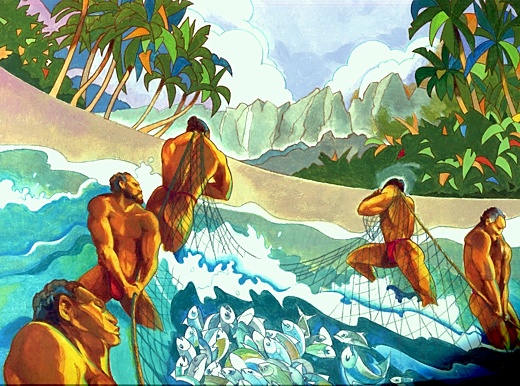
 
Image above: Detail of conference poster celebrating the gathering of the net created by Oliver Kinney.  
 
On Friday and Saturday I attended a conference at the Hawaii Convention Center in Honolulu on Oahu. It's title was Ho'olei 'la Pae'aina Puwalu. The subtitle was “Throw the Net to Bring Everyone Together in Hawaii”. About two hundred people attended representing Hawaii, Maui, Molokai, Lanai, Kahoolawe, Oahu, Kauai and Niihau.

Those attending were drawn from a process that began with the formation of the Aha Kiole Advisory Committee by act HB212 in 2007. The purpose of HB212 was to develop a method of bringing Hawaiian indigenous practices into the management of the resources in Hawaii - largely because of the recognition of the long and sustained practices that provided plenty for the people of the islands for centuries.

The state of Hawaii promised funding for the advisory committee to create an Aha Moku Council that would govern the procedures of incorporating traditional Hawaiian practices into state resource regulations. That funding never came. None the less, the committee was able to do its work and complete the required tasks culminating in a Final Report in 2009.

The Aha Kiole Advisory Committee was initially organized with efforts of the Western Pacific Regional Fisheries Management Council (WesPac). WesPac is an independent non-profit entity that is supported and overseen by the US Congress, similar to the US Postal Service, the Federal Reserve, Fanny Mae and Fanny Mac. It is not a Federal government agency, yet it has responsibility for managing fishing regulations for the US territory islands in the western Pacific, including Samoa, Guam, the North West Islands and Hawaii.

The staff and consultants of WesPac were available, as well as some funding to facilitate the self organization of Aha Moku system that would ultimately manage resources by the ancient Hawaiian land divisions of island moku (bioregions) and their ahupuaa (watersheds). The final report of the Aha Kiole Advisory Committee made a listing of the moku and ahupuaa of each island. In 2010 things were moving ahead.

A bit of a flashback here
In 2008 Jonathan Jay and I were completing a map of moku and ahupuaa of Kauai. We had been working on such a map for almost two years. We had been working with Malama Kauai and attending their Eco Roundtable meetings.

We were proposing that we have island district meetings based on traditional Hawaiian land divisions. As part of that interest we attended a meeting of the Kona Moku of Kauai held in Poipu by the Aha Kiole Advisory Committee. There we presented our first revision of the Kauai map. At the meeting we met Jean Ilei Beniamina of Niihau. We committed then to producing a map of Niihau too.

After reviewing the maps of Kauai and Niihau, Jean Ilei Beniamina suggested to WesPac that they not use an agency like NOAA to map the Hawaiian land divisions (as planned) but contract with me to complete the rest of the islands. I was engaged as an independent contractor in May of 2010 to deliver maps of all the Hawaiian islands, in phases, and be finished the time of the Ho'olei 'la Pae'aina Puwalu in late November. Those maps are now available on islandbreath.org in GoogleEarth format.

There are also GIS .shape files and PDF plot files that have been produced. Through the summer and into the fall there was an Aha Moku puwalu (conference) on each island. Among other things. The job was to set an agenda for future actions and prepare for the statewide Puwalu, that would bring together representatives from all islands.
Exit the flashback. 

 Last weekend, I was asked to attend the Ho'olei 'la Pae'aina Puwalu, held on Oahu, in the role of a consultant and be prepared to demonstrate the work to date on mapping moku and ahupuaa. I was glad to participate. I packed a laptop loaded with 3D GoogleEarth files of the islands. When I arrived at the Honolulu Convention Center I had to sign in. I was given an ID tag on a purple lanyard rather than a staff ID and lanyard. The color coding of the lanyards were assigned to the colors of each island’s symbolic flower. In other words, The ID lanyard indicated I was a Kauai participant rather than staff. This resulted in me acting in both rolls for the two days. In the general session the kiole (the speaker) representing each island made a presentation.

It must be noted that Keith Robinson was there wearing construction boots and a hardhat as if he just got off a bulldozer. When Niihau was asked to present Robinson pretended to be shy, as if he did not want to speak. When the mic was finally put in his hand he couldn’t stop. He began with a 1000 years history of his family, back to the Vikings. As a staff member I had responsibilities in helping WesPac facilitate the event (relative to providing maps offered to the groups present) and had access to staff areas “back-stage”.

As a Kauai participant I sat in at Kauai’s breakout session on discussion of offering a bill to the Hawaii legislature to consider concerning the acceptance of a continuation of the Aha Moku system and implementing its protocols.

  
Image above: Puwalu participants gathered for group photo of 200 people. Photo by Juan Wilson

After the island representatives returned to the general puwalu from their breakout sessions the last item on the two day agenda was before us. To craft the wording of a bill for the legislature to consider. The kiole for each island gathered with the indigenous coordinator of WesPac to make out the wording of the bill. This was at about 5:00pm. In about 20 minutes they had a first revision of the bill. It went like this.
URGING THE COUNTY, STATE AND FEDERAL ENTITIES WITH RESPONSIBILITY AND AUTHORITY FOR MANAGING NATURAL RESOURCES TO SUPPORT THE DEVELOPMENT OF THE AHA MOKU SYSTEM AS PART OF THE MANAGEMENT REGIME OF NATURAL RESOURCES IN HAWAI'I
WHEREAS, the statewide Ho'olei 'la Pae'aina Puwalu was held at the Hawaii Convention Center in Honolulu on November 19 and 20, 2010, involving more than 200 native Hawaiian traditional practitioners, fishermen, farmers, environmentalists, municipal representatives, State representatives and the general public, and WHEREAS, it was agreed that the 'Aha Moku structure is an effective, community-based way to manage natural resources in Hawai'i. and
WHEREAS the island caucuses at the Puwalu agreed that the Hawaii State Legislature should extend, amend and implement Act 212:
• That the 'Aha Moku system be continued;
• That the recommendations from each island in the 2009 'Aha Kiole report to the Legislature be implemented;
• That new 'Aha Kiole representatives be selected/elected by 'Aha Moku councils that have been established on each of the mokupuni;
• That where Aha Moku councils have not yet been established, efforts be made to establish them as soon as possible;
• That Niihau a Kahelelani continue to be managed based on and exclusively under its konohiki system:
• That these Aha councils be formally recognized;
• That the 'Aha Kiole role be amended so as to include it being the conduit between the Aha Moku system and the State of Hawaii Legislature; and
• That the new 'Aha Kiole report back to the Legislature on the status of the 'Aha Moku system throughout the pae'aina at the end 2011, and
WHEREAS the Puwalu participants also supported customary traditional practices that have sustained the Native Hawaiian population and culture, such as the cultural, non-commercial take of honu and fish from waters throughout the Hawaii Archipelago;
NOW, THEREFORE, BE IT RESOLVED that the participants of the Hawai'i Statewide Puwalu, in conference at the Hawai'i Convention Center on November 19 and 20, 2010, urges the county, state and federal entities with responsibility and authority for managing natural resources to support the development of the 'Aha Moku system of natural resource management and the allowance of customary traditional practices; and
BE IT FURTHER RESOLVED that copies of this Resolution be transmitted to all County Mayors, Governor of Hawaii, President of the Senate, Speaker of the House, Senate Committee on Judiciary and Hawaiian Affairs Chair, House Committee on Hawaiian Affairs Chair, Office of Hawaiian Affairs Board of Trustees Chair, Secretary of Commerce and the Chair of the Western Pacific Regional Fishery Management Council.
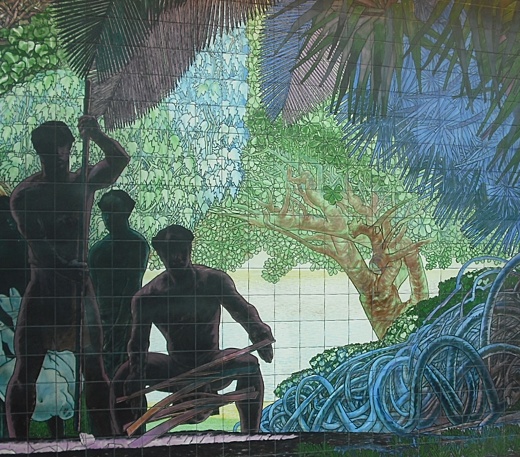
 
Image above: Detail of ceramic tile mural outside of Convention Hall ballroom. Photo by Juan Wilson.

The Kiole huddled together a made some adjustments to the final wording of the document. Keith Robinson, as kiole for Niihau, made a grab for being representative konohiki of the islands of Lehua, Kaula, and Nihoa... and got it.

It should be remembered that the 200 people present had been sitting in the ballroom for two days. It was the end of the conference and people were eager to get on their way home. They were in a mood to agree with what had been worked on paper. But... There were some questions about details. A few people began to take exception to specific language. Some points were important. The first edit to the first revision was to remove the words;

“WITH RESPONSIBILITY AND AUTHORITY FOR MANAGING NATURAL RESOURCES” This was done to remove the assumption of their authority over Hawaiian resource management, and to just have those government entities accept Hawaiian cultural tradition as the governing authority of Hawaiian resources. This went over smoothly with the group. Then point was made that legally the first paragraph and what followed the “NOW

THEREFORE, BE IT RESOLVED”
paragraph at the bottom of the resolution had to match exactly. That was resolved quickly as well.
 Then something bad happened. A few people in the audience had the sense that this large body of people would go along with any change to the resolution that was only the change in a word or two and could be done quickly. They pounced.

Someone from an outer island interjected that there was a difference between “conservationists” and “Environmentalists” and that conservationists should be added to the list of participants since all Hawaiian cultural practitioners were conservationists. “Conservationists” were added to the first paragraph. Then came the suggestion that “Ranchers” should be added to “Fishermen” and “Farmers” and that “Conservationists” and “Environmentalists” should be removed from the list of participants. When the crowd passed that suggestion, by sitting on their hands, I left of the conference hall.

 In my mind “ranching” is generally a destructive practice (look at Niihau and Kahoolawe) that was not part of traditional Hawaiian cultural practice and that even if it was should be eliminated. Removing “environmentalists” from the participants of the conference removed me. So... I took a cab to the airport. In the Hawaiian Airlines waiting area I met up with two other Kauai reps. We were there early enough get on a flight before our scheduled time.

Coincidentally, we got the last three seats on the plane and even more surprising, they were together. They were both fishermen and had been active contributors in the Kauai breakout session. One was Japanese, the other haole. Both had been on Kauai for over 30 years. They had walked out of the conference hall as well. They had left when suggestion was made (and incorporated) that required kiole to be limited to those with Hawaiian blood. That tore it for them. They had been disenfranchised. I think this conference ended tragically for many committed to living pono in Hawaii. However, overall I was impressed with the what was achieved by the gathering at the convention center.

 I met wonderful people from other islands who are working hard to preserve and protect where we live. I have a special fondness from those I got to know from Molokai, Lanai and the Big Island. This was a gathering of the Hawaiian nation, in the best sense. Let us hope more will participate in this process... especially the young.

 See also:
Ea O Ka Aina: Traditional Hawaiian Land Divisions 1/30/12 .
Oahu Ahupuaa

SUBHEAD: Traditional Hawaiian land divisions of Oahu. About 2 minutes to load.

[IB Publisher's note: Google has announced that The Google Earth API for embedding 3D maps on webpages been deprecated as of December 12th, 2014] 

HAWAIIMAUIMOLOKAILANAIKAHOOLAWEOAHUKAUAINIIHAU  

For background see:
Ea O Ka Aina: Mokupuni O Hawaii 9/25/10
Ea O Ka Aina: Na Mokupuni O Maui Nei 7/31/10
Ea O Ka Aina: Mokupuni O Oahu 11/16/10
Ea O Ka Aina: Na Mokupuni O Kauai Nei 7/31/10 

For downloads of latest Ahupuaa-Moku Maps see: 
http://www.islandbreath.org/mokupuni/mokupuni.html
.

Ka Mokupuni O Oahu

SUBHEAD: The island of Oahu has been examined for its historical ahupuaa land divisions.

By Juan Wilson on 16 November 2010 for Island Breath -
(http://islandbreath.blogspot.com/2010/11/ka-mokupuni-o-oahu.html)   


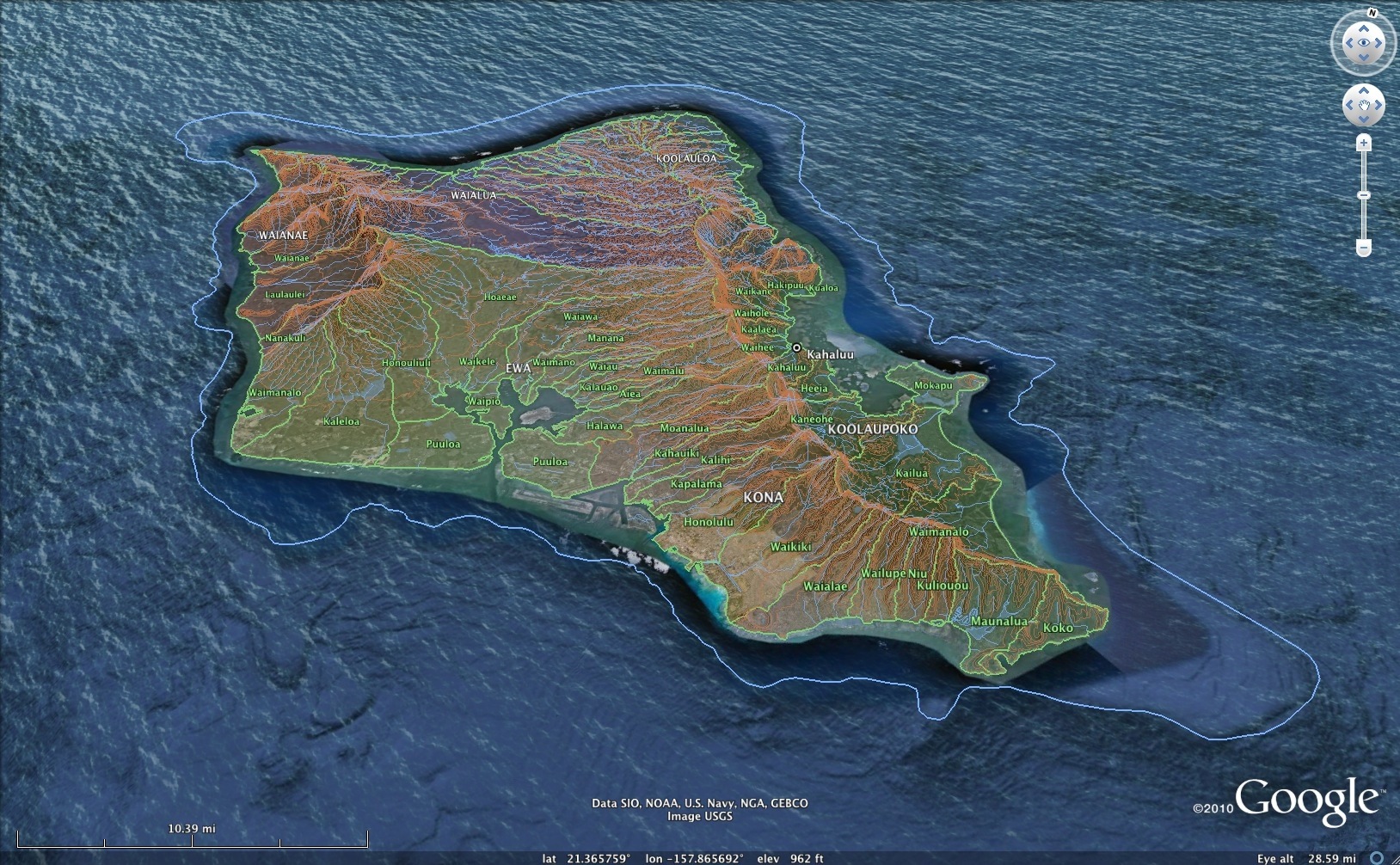
Image above: GoogleEarth view of Oahu's ahupuaa from the southeast. Click to enlarge. Created by Juan Wilson.

Author's Note on 2/1/12: To obtain the most recent ahupuaa and moku maps of Hawiian islands in PDFs of 24x36 plots, PNG files for publication, KMZ files for GoogleEarth or SHP files for GIS systems visit (http://www.islandbreath.org/mokupuni/mokupuni.html)

Links to the the island's Hawaiian land divisions for Google Earth is now available. Download the zip file below and expand it to a KML file. Open the resulting KML file with Google Earth to see the Ahupuaa and Moku of the island. The data includes elevation contour lines and all streams and rivers. The file is large for Google Earth and can take some several minutes to be up and running. Place this file in "MY PLACES" and save to disk:

If you do not have GoogleEarth you may also view this ineractive map with your web browser. Note you may be asked to download a GoogleEarth browser plug-in for your browser. The link to the embedded browser is below and has access to all other islands:
Ea O Ka Aina: Ka Mokupuni o Oahu 11/16/10

TOPOLOGICAL RULES
In creating the maps of ahupuaa in Hawaii we followed a specific set of guidelines. 1) Following the ridge lines of watershed lines conforming to 3D Google Earth modeling; USGS 7.5º contour maps, and to a lesser degree - state GIS 100' contour lines, watershed lines and shadow maps. 2) In some cases stream are boundaries between ahupuaa, as in the case of bifurcated valleys that join in a river near the ocean (as in the case on Kauai of Makaweli and Waimea joining a stone's throw from the shore).

Again Google 3D modeling was used to determine location as well as state GIS stream database. 3) In two rare incidences hyperbolic paraboloid surface joined four ahupuaa. That meant a positive and negative curve met (like a potatochip). See the fourway intersection between West and South Maui near Puunene. The intersection is the high point between Wailuku and Kihea. But that point is the lowpoint between the Haleakela and the peak above Waikapu. An even stranger situation occurs on the Big Island between Mauna Loa and Mauna Kea.

A similar potato chip surface occurs. However there is a wrinkle in it. from the saddle leading down to Hilo there is a ridge (positive curve) that flattens to neutral and goes negative (a valley). This is the reverse of two bifurcated valleys mentioned above. It the case where a stream running down a hill splits in two (as around somethin hard in its path).

 There are no landlocked ahupuaa on our map projects of the islands. There are recessed ahupuaa as in the case of Haiku ahupuaa on Kauai and reaching the ocean only in the upper part of Nawiliwili harbor or Aiea ahpupuaa on Oahu that reaches the ocean only at the eastern lobe of Pearl Harbor. We generally have considered small landlocked ahupuaa shown on state maps to be ili or contractual/political divisions that are not geographically determinable.

 NAME AND LOCATION RULES
We followed the following order of concerns in location and names of ahupuaa.
  1. If the moku or ahupuaa appeared on the 1838 map created by Simon Peter Kalama it was on our map. We followed Kalama's spelling and practice of not using diacritical marks.
  2. We used USGS 7.5 maps as a reference for place names and general location of ahupuaa. In some cases we found place names (no ahupuaa) conformed to Kalama ahupuaa names (such as on Oahu in moku Koolaupoko near Kaneohe Bay where the Marine Base is and Kalama notes the ahupuaa as Makapu (not to be confused with Makapuu point to the east.
  3.  We used that Aha Kiole Advisory Committee Final Report as a reference for additional ahapuaa and moku. In cases where several listed ahupuaa had names the were enumerated as 1, 2, 3, 4, 5 or Ekahi, Eloha, Ekolu, Eha, Elima (as in the case on Hawaii of Kalaoa in Kona) we combined the ahupuaa into one. We also did not use generic names like Pahoehoe.
  4.  We used Hawaii Government Survey maps (the earliest available we had access to) to help confirm USGS and Ahakiole names and locations.  
WHERE WE GO FROM HERE
I am sure heat will be generated by those who review these maps and can't find their ahupuaa. I have been eager to hear such reports and find a way to determine how they can be incorporated into a better understanding of the Hawaiian environment and hoe the Hawaiians thrived for so long in it.

See also:

For background see:  

Hawaii Ahupuaa

SUBHEAD: Traditional Hawaiian land divisions of the Big Island. About 3.5 minutes load.

 [IB Publisher's note: Google has announced that The Google Earth API for embedding 3D maps on webpages been deprecated as of December 12th, 2014] 

HAWAIIMAUIMOLOKAILANAIKAHOOLAWEOAHUKAUAINIIHAU  

For background see also
Ea O Ka Aina: Na Mokupuni O Maui Nei 7/31/10

For downloads of latest Ahupuaa-Moku Maps see:
http://www.islandbreath.org/mokupuni/mokupuni.html
.

Mokupuni O Hawaii

SUBHEAD: The island of Hawaii has been examined for its historical ahupuaa land divisions.  
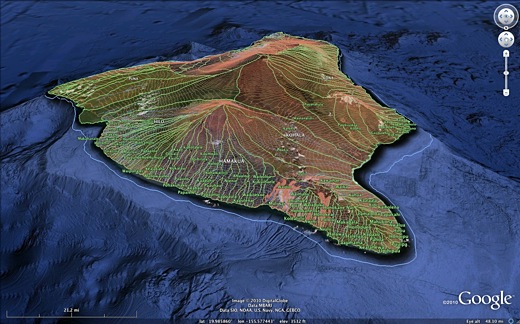
Image above: GoogleEarth screenshot of Hawaii ahupuaa divisions. Created by Juan Wilson.  

By Juan Wilson on 25 September 2010 for Island Breath -  
(http://islandbreath.blogspot.com/2010/09/mokupuni-o-hawaii.html)  

Author's Note on 2/1/12: To obtain the most recent ahupuaa and moku maps of Hawiian islands in PDFs of 24x36 plots, PNG files for publication, KMZ files for GoogleEarth or SHP files for GIS systems visit (http://www.islandbreath.org/mokupuni/mokupuni.html)

Links to the the island's Hawaiian land divisions for Google Earth is now available. Download the zip file below and expand it to a KML file. Open the resulting KML file with Google Earth to see the Ahupuaa and Moku of the island. The data includes elevation contour lines and all streams and rivers. The file is large for Google Earth and can take some several minutes to be up and running. Place this file in "MY PLACES" and save to disk:

Mokupuni O Hawaii
(http://www.islandbreath.org/2010Year/09/100925Hawaii/100925Hawaii.zip) 
 If you do not have GoogleEarth you may also view this ineractive map with your web browser. Note you may be asked to download a GoogleEarth browser plug-in for your browser. The link to the embedded browser is below and has access to all other islands:
 Ea O Ka Aina: Ka Mokupuni o Hawaii 9/25/10  


For the last few years I, with the help of others, including Jonathan Jay and the late Jean Ileialoha Beniamina, have been trying to identify the names and locations of the historic land divisions in Kauai Nei used by Hawaiians to sustainably manage land for centuries. Since this spring that work has been expanded to include all the eight main islands in the Hawaiian chain. The Western Pacific Regional Fisheries Management Council has contracted with IslandBreath.org to map the moku (bioregional) and ahupuaa (watershed) divisions throughout the state.

 On June 1st, 2010, we completed a submission that included the latest version of our maps of Kauai and Niihau. Since then we have been working on Maui Nei (Maui, Molokai, Lanai, Kahoolawe). On August 1st we will deliver that submission with a newly revised version Kauai and Niihau. We are scheduled to submit the Big Island of Hawaii on October 1st 2010, and Oahu on December 1st 2010. We will share the results on this website. An interactive GoogleEarth website embed of each island will be provided as well as a reproducible image.

Research indicates that historically there have been changes in the mapping of ahupuaa. It depended not only on the cultural, historic and geographic knowledge of the cartographer, but the motivation behind doing the map. It is likely that the need to manage resources increased as they were utilized by an expanding population.

Certainly, over the centuries how they were managed changed. In time kapu (taboo laws) were enacted and taxes based on ahupuaa resources were collected. After European contact, in the mid 19th century, the concept private property was accepted and it soon secured a foothold for widespread plantation agriculture.

Water was diverted out of the valleys and the ahupua land use concept fell into disuse. In some places, like Maui's Hamakuapoko Moku (From the airport near Kahaluhi harbor to Haiku) the land was so aggressively managed by western plantation owners that ditches dams and reservoirs completely erased original streambeds. Hawaiian place names disappeared and subsequent maps of Maui had no Ahupuaa names.

Instead we have Sprecklesville and Baldwin Avenue. I have attempted to create a set of maps that have moku and ahupuaa covering all of each island. I have tried to use the earliest printed source material available as a foundation. I have tried to eliminate the distortions caused by conquest and war. The boundaries for the land divisions is strictly based on topological features of the land: shorelines, streambeds, and mountain ridges.

Like the informer Deep Throat advised Woodward and Bernstein to the bottom of Richard Nixon's machinations; "Follow the money!" In the case of Ahupuaa that advice would be "Follow the water!" Note: Depending on the island, it may take several seconds to a minute for the data to load. The following is the content of the "splash" page for the Kauai Nei GoogleEarth Maps.
Ka Mokupuni O Hawaii Big Island
AHA KIOLE ADVISORY COMMITTEE of the Western Pacific Regional Fishery Management Council All rights reserved. © 2010 by the Aha Kiole Advisory Committee & www.IslandBreath.org
• Revision 1.0.0 on 1 October 2010 These Kauai land identifications were delineated and converted to GIS and GoogleEarth KMZ format by: Juan Wilson - Architect/Planner with the assistance of Jonathan Jay
Criteria: Simon Peter Kalama Maps (1837, 1838) of moku and ahupuaa were used as a foundation for these map boundaries. All moku and ahupuaa shown on Kalama maps are included in this project. The source for the 1837 Kalama map was the U.S. Librabry of Congress. The 1838 Kalama map was made available from the British Royal Geographic Society. Note, area names are written without traditional Hawaiian diacritical marks, as was the practice of Kalama. The divisions are based also on traditional descriptions of location, with boundaries modified to follow watershed ridges and streams/rivers from available topography.
Procedure: After identifying Kalama ahapuaa and moko locarions and names the Aha Kiole Advisary Committee Final Report was compared with State of Hawaii DBEDT GIS files (Streams, water bodies and elevation contours) and added to GoogleEarth aerial photography and 3D elevation data to determine final ahupuaa and moku names locations and boundaries. Sources: A two letter code for the sources of each ahupuaa can be seen when clicking within its boundary. They are: (sk) Simon Peter Kalama "Na Mokupuni O Hawaii Nei" maps printed in 1837 and 1838, (ak) Aha Kiole Advisory Committee Final Report 12/18/08, (gs) United States Geological Survey Maps 7.5º topographic maps), (ab) W. D. Alexander island surveys for the Hawaiian Government.
See also:
Ea O Ka Aina: Na Mokupuni O Maui Nei 8/1/10
For background see: 
sland Breath: Kauai Moku District Meeting 3/11/08  
 .

Mokupuni O Maui Nei

SUBHEAD: The Maui Nei island group has been examined for its historical ahupuaa land divisions.

By Juan Wilson on 9 September 2010 for Island Breath -
(http://islandbreath.blogspot.com/2010/07/na-mokupuni-o-maui-nei.html)  


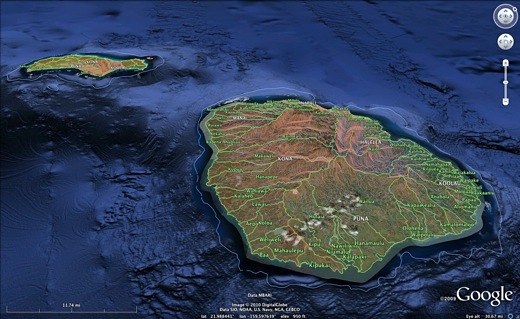
Image above: GoogleEarth screenshot of Maui Nei ahupuaa divisions. Created by Juan Wilson.
 
IB Publisher's Note on 8/22/14: To obtain the most recent ahupuaa and moku maps of Hawiian islands in PDFs of 24x36 plots, PNG files for publication, KMZ files for GoogleEarth or SHP files for GIS systems visit (http://www.islandbreath.org/mokupuni/mokupuni.html)

 Links to the the island's Hawaiian land divisions for Google Earth is now available. Download the zip file below and expand it to a KML file. Open the resulting KML file with Google Earth to see the Ahupuaa and Moku of the island. The data includes elevation contour lines and all streams and rivers. The file is large for Google Earth and can take some several minutes to be up and running. Place this file in "MY PLACES" and save to disk:

IB Publisher's Note on 8/22/14: The folowing files are not the latest versions of these islands. See link above for most recent versions:

Mokupuni O Maui
(http://www.islandbreath.org/2010Year/09/100915MauiNei/100915Maui.zip)

 Mokupuni O Molokai
 (http://www.islandbreath.org/2010Year/09/100915MauiNei/100915Molokai.zip)  

Mokupuni O Lanai
(http://www.islandbreath.org/2010Year/09/100915MauiNei/100915Lanai.zip)  

Mokupuni O Kahoolawe  
(http://www.islandbreath.org/2010Year/09/100915MauiNei/100915Kahoolawe.zip)

For PDFs of 24x36 plots, PNG files for publication, KMZ files for Googleeath or SHP files for GIS systems visit (https://public.me.com/juanwilson) If you do not have GoogleEarth you may also view this ineractive map with your web browser. Note you may be asked to download a GoogleEarth browser plug-in for your browser.

Links to the web embedded ahupuaa maps of Maui, Molokai, Lanai and Kahoolawe. Note you may be asked to download a GoogleEarth browser plug-in and that it takes as long as 45 seconds to load the data:

Ea O Ka Aina: Na Mokupuni o Maui 8/1/10
Ea O Ka Aina: Na Mokupuni o Molokai 8/1/10
Ea O Ka Aina: Na Mokupuni o Lanai 8/1/10
Ea O Ka Aina: Na Mokupuni o Kahoolawe 8/1/10

 For the last few years I, with the help of others, including Jonathan Jay and the late Jean Ileialoha Beniamina, have been trying to identify the names and locations of the historic land divisions in Kauai Nei used by Hawaiians to sustainably manage land for centuries. Since this spring that work has been expanded to include all the eight main islands in the Hawaiian chain. The Western Pacific Regional Fisheries Management Council has contracted with IslandBreath.org to map the moku (bioregional) and ahupuaa (watershed) divisions throughout the state.

 On August 1st, 2010, we completed a submission that included the latest version of our maps of Maui, Molokai, Lanai and kahoolawe. Since then we have been working on Maui Nei (Maui, Molokai, Lanai, Kahoolawe).as well as delivering a resubmission with a newly revised version Kauai and Niihau. We are scheduled to submit the Big Island of Hawaii on October 1st 2010, and Oahu on December 1st 2010. We will share the results on this website.

An interactive GoogleEarth website embed of each island will be provided as well as a reproducible image. Research indicates that historically there have been changes in the mapping of ahupuaa. It depended not only on the cultural, historic and geographic knowledge of the cartographer, but the motivation behind doing the map. It is likely that the need to manage resources increased as they were utilized by an expanding population. Certainly, over the centuries how they were managed changed. In time kapu (taboo laws) were enactedf and taxes based on ahupuaa resources were collected.

After European contact, in the mid 19th century, the concept private property was accepted and it soon secured a foothold for widespread plantation agriculture. Water was diverted out of the valleys and the ahupua land use concept fell into disuse. In some places, like the Maui's Hamakuapoko Moku (From the airport near Kahaluhi harbor to Haiku) the land was so aggressively managed western plantation owners that ditches dams and reservoirs completely erased original streambeds. Hawaiian place names disappeared and subsequent maps of Maui had no Ahupuaa names. Instead we have Sprecklesville and Baldwin Avenue. We have attempted to create a set of maps that have moku and ahupuaa covering all of each island. We have tried to use the earliest printed source material available as a foundation. I have tried to eliminate the distortions caused by conquest and war.

The boundaries for the land divisions is strictly based on topological features of the land: shorelines, streambeds, and mountain ridges. Like the informer Deep Throat advised Woodward and Bernstein to the bottom of Richard Nixon's machinations; "Follow the money!" In the case of Ahupuaa that adive would be "Follow the water!" Note: Depending on the island, it may take several seconds to a minute for the data to load. See also: Ea O Ka Aina: Na Mokupuni O Kauai Nei 8/1/10 The following is the content of the "splash" page for the Kauai Nei GoogleEarth Maps.
Na Mokupuni O Kauai Nei Kauai, Niihau
AHA KIOLE ADVISORY COMMITTEE of the Western Pacific Regional Fishery Management Council All rights reserved. © 2010 by the Aha Kiole Advisory Committee & www.IslandBreath.org Revision 1.0.0 on 1 August 2010 These Kauai land identifications were delineated and converted to GIS and GoogleEarth KMZ format by: Juan Wilson - Architect/Planner with the assistance of Jean Ilei Beniamina andv Jonathan Jay
Criteria: Samuel P. Kalama Maps (1837, 1838) of moku and ahupuaa were used as a foundation for these map boundaries. All moku and ahupuaa shown on Kalama maps are included in this project. The source for the 1837 Kalama map was the U.S. Librabry of Congress. The 1838 Kalama map was made available from the British Royal Geographic Society. Note, area names are written without traditional Hawaiian diacritical marks, as was the practice of Kalama. The divisions are based also on traditional descriptions of location, with boundaries modified to follow watershed ridges and streams/rivers from available topography.
Procedure:
After identifying Kalama ahapuaa and moko locarions and names the Aha Kiole Advisary Committee Final Report was compared with State of Hawaii DBEDT GIS files (Streams, water bodies and elevation contours) and added to GoogleEarth aerial photography and 3D elevation data to determine final ahupuaa and moku names locations and boundaries.

Sources:

A two letter code for the sources of each ahupuaa can be seen when clicking within its boundary. They are: (sk) Samuel P. Kalama "Na Mokupuni O Hawaii Nei" maps printed in 1837 and 1838, (ak) Aha Kiole Advisary Committee Final Report 12/18/08, (gs) United States Geological Survey Maps 7.5º topographic maps), (jb) Jean Ileialoha Beniamina Niihau place name research project, (kh) Kauai Historic Society & Kauai Museum maps, (ki) Kauaian Institute Hawaiian ahupuaa mapping project.
See also:

For background see:
Ea O Ka Aina: Memories of Ileialoha Beniamina 7/17/10 
Ea O Ka Aina: Mokupuni O Hawaii Nei 6/2/10
Ea O Ka Aina: Kauai & Niihau Mokupuni 4/16/10  
Ea O Ka Aina: Niihau & Kauai Mokupuni 3/3/10 
Ea O Ka Aina: Kauai Aina Mapping 12/21/09  
Ea O ka Aina: Kauai on GoogleEarth 12/6/09
Island Breath: Moku-Ahupuaa Divisions of Kauai 12/2/08 
Island Breath: Kauai Moku District Meeting 3/11/08 
Island Breath: Kauai Sustainability Land Use Plan 11/11/07

  .

Mokupuni O Kauai Nei

SUBHEAD: The Kauai Nei island group has been examined for its historical ahupuaa land divisions.

 
Image above: GoogleEarth screenshot of Maui Nei ahupuaa divisions. Created by Juan Wilson.  

By Juan Wilson on 13 September 2010 for Island Breath -
(http://islandbreath.blogspot.com/2010/07/na-mokupuni-o-kauai-nei.html)  

Author's Note on 2/1/12: To obtain the most recent ahupuaa and moku maps of Hawiian islands in PDFs of 24x36 plots, PNG files for publication, KMZ files for GoogleEarth or SHP files for GIS systems visit (http://www.islandbreath.org/mokupuni/mokupuni.html)

Links to the the island's Hawaiian land divisions for Google Earth is now available. Download the zip file below and expand it to a KML file. Open the resulting KML file with Google Earth to see the Ahupuaa and Moku of the island. The data includes elevation contour lines and all streams and rivers. The file is large for Google Earth and can take some several minutes to be up and running. Place this file in "MY PLACES" and save to disk:

Mokupuni O Kauai  
(http://www.islandbreath.org/2010Year/09/100915KauaiNei/100915Kauai.zip)

 Mokupuni O Niihau  
(http://www.islandbreath.org/2010Year/09/100915KauaiNei/100915Niihau.zip)

The following article is a previous revision on ongoing work on traditional Hawaiian land divisions.
Links to the web embedded ahupuaa maps of Kauai and Niihau. Note you may be asked to download a GoogleEarth browser plug-in and that it takes as long as 45 seconds to load the data:
Ea O Ka Aina: Na Mokupuni o Kauai 8/1/10
Ea O Ka Aina: Na Mokupuni o Niihau 8/1/10

For the last few years I, with the help of others, including Jonathan Jay and the late Jean Ileialoha Beniamina, have been trying to identify the names and locations of the historic land divisions in Kauai Nei used by Hawaiians to sustainably manage land for centuries. Since this spring that work has been expanded to include all the eight main islands in the Hawaiian chain. The Western Pacific Regional Fisheries Management Council has contracted with IslandBreath.org to map the moku (bioregional) and ahupuaa (watershed) divisions throughout the state.

 On June 1st, 2010, we completed a submission that included the latest version of our maps of Kauai and Niihau. Since then we have been working on Maui Nei (Maui, Molokai, Lanai, Kahoolawe). On August 1st we will deliver that submission with a newly revised version Kauai and Niihau.

We are scheduled to submit the Big Island of Hawaii on October 1st 2010, and Oahu on December 1st 2010. We will share the results on this website. An interactive GoogleEarth website embed of each island will be provided as well as a reproducible image. Research indicates that historically there have been changes in the mapping of ahupuaa. It depended not only on the cultural, historic and geographic knowledge of the cartographer, but the motivation behind doing the map. It is likely that the need to manage resources increased as they were utilized by an expanding population.

Certainly, over the centuries how they were managed changed. In time kapu (taboo laws) were enactedf and taxes based on ahupuaa resources were collected. After European contact, in the mid 19th century, the concept private property was accepted and it soon secured a foothold for widespread plantation agriculture.

Water was diverted out of the valleys and the ahupua land use concept fell into disuse. In some places, like theMaui's Hamakuapoko Moku (From the airport near Kahaluhi harbor to Haiku) the land was so aggressively managed western plantation owners that ditches dams and reservoirs completely erased original streambeds. Hawaiian place names disappeared and subsequent maps of Maui had no Ahupuaa names.

Instead we have Sprecklesville and Baldwin Avenue. I have attempted to create a set of maps that have moku and ahupuaa covering all of each island. I have tried to use the earliest printed source material available as a foundation. I have tried to eliminate the distortions caused by conquest and war. The boundaries for the land divisions is strictly based on topological features of the land: shorelines, streambeds, and mountain ridges.

Like the informer Deep Throat advised Woodward and Bernstein to the bottom of Richard Nixon's machinations; "Follow the money!" In the case of Ahupuaa that adive would be "Follow the water!" Note: Depending on the island, it may take several seconds to a minute for the data to load. The following is the content of the "splash" page for the Kauai Nei GoogleEarth Maps.

AHA KIOLE ADVISORY COMMITTEE of the Western Pacific Regional Fishery Management Council All rights reserved. © 2010 by the Aha Kiole Advisory Committee & www.IslandBreath.org 
• Revision 1.0.0 on 1 August 2010 These Kauai land identifications were delineated and converted to GIS and GoogleEarth KMZ format by: Juan Wilson - Architect/Planner with the assistance of Jonathan Jay 
Criteria: Simon Peter Kalama Maps (1837, 1838) of moku and ahupuaa were used as a foundation for these map boundaries. All moku and ahupuaa shown on Kalama maps are included in this project. The source for the 1837 Kalama map was the U.S. Librabry of Congress. The 1838 Kalama map was made available from the British Royal Geographic Society. Note, area names are written without traditional Hawaiian diacritical marks, as was the practice of Kalama. The divisions are based also on traditional descriptions of location, with boundaries modified to follow watershed ridges and streams/rivers from available topography. 
Procedure: After identifying Kalama ahapuaa and moko locarions and names the Aha Kiole Advisary Committee Final Report was compared with State of Hawaii DBEDT GIS files (Streams, water bodies and elevation contours) and added to GoogleEarth aerial photography and 3D elevation data to determine final ahupuaa and moku names locations and boundaries. 
Sources: A two letter code for the sources of each ahupuaa can be seen when clicking within its boundary. They are: (sk) Simon Peter Kalama "Na Mokupuni O Hawaii Nei" maps printed in 1837 and 1838, (ak) Aha Kiole Advisary Committee Final Report 12/18/08, (gs) United States Geological Survey Maps 7.5º topographic maps), (ab) W. D. Alexander island surveys for the Hawaiian Government, (ib) Island Breath research by Juan Wilson and Jonathn Jay.


See also:
Ea O Ka Aina: Mokupuni O Hawaii
9/25/10
Ea O Ka Aina: Na Mokupuni O Maui Nei 7/31/10
Ea O Ka Aina: Mokupuni O Oahu 11/16/10 
For background see:
 .