Showing posts with label Hydro Electric. Show all posts

Update on Wailua Diversion

SUBHEAD: Meeting Thursday 12/14 from 11:00am-1:00pm at the Kapaa Neighborhood Center.

By Bridget Hammerquist on 12 December 2017 in Island Breath -
(http://islandbreath.blogspot.com/2017/12/update-on-wailua-diversions.html)
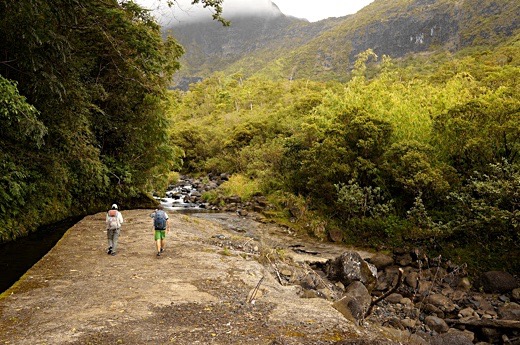

Image above: Two hikers at the Blue Hole walk across the concrete diversion (at left) of the North Fork of the Wailua Rivere diversion lets only overflow water into the natural channel of the river (at right). From (https://yosemitenews.info/forum/read.php?1,64439,64449).

[IB Publisher's note: The day with article was first published KIUC announced they were changing policy on the North Fork diversion of the Wailua River. See content of email we received.]

KIUC Board's Action on to Wailua River Diversions
Līhu'e, Kaua'i, HI - 12/12/17 - The Kauaʻi Island Utility Cooperative Board today authorized KIUC President and Chief Executive Officer David Bissell to make changes to the ditch system to return water to the North Fork of the Wailuā River at the Blue Hole and Waikoko diversions.
This action will ensure that water is flowing immediately downstream of the diversions.
The board also authorized the commencement of engineering design for permanent diversion modifications to ensure continuous stream flow for aquatic habitat. Construction will take place upon approval from the appropriate regulatory agencies.
Additionally, approval was granted to install additional gauging stations to increase data collection and understanding of the hydrology of the system.
"The hydros have been producing energy on Kauaʻi for more than 100 years and represent an important piece of KIUC's renewable portfolio and will help us reach the State's mandate of 100 percent renewables by 2045," said KIUC Board Chair Allan Smith.
On December 8, the State Board of Land and Natural Resources met and approved the holdover of a revocable permit for water use at the Blue Hole Diversion, which contribute 1.5 megawatts of energy to the island's renewable portfolio.


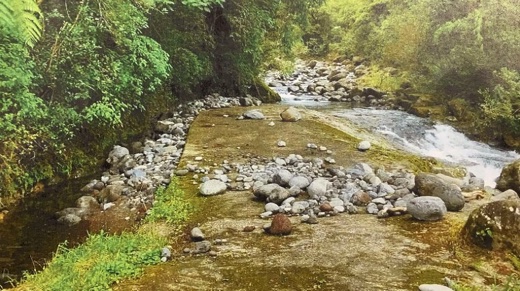
Image above: Boulders are scattered across the diversion at the head of the North Fork of the Wailua River due to heavy winter rains. Note the diversion channel is all but blocked (at left) and the natural flow of the water is in the original river bed (at right). From (https://www.bizjournals.com/pacific/news/2017/12/11/kiuc-receives-approval-for-holdover-of-hydro.html).


IB Publisher's note: On Friday 7 December 2017 the Hawaii State Board of Land & Natural Resources (BLNR) met on Kauai to consider the  renewal of a revocable water-diversion permit for Kauai Island Utility Cooperative’s (KIUC) hydroelectric plants that utilize water from Mt. Waialeale.

The water diversions have been criticized as illegal.  The Kiai Wai O Waialeale coalition, along with community groups Friends of Mahaulepu, HAPA and the Sierra Club, said KIUC and Grove Farm are illegally using 30 million gallons or more of water per day for the hydroelectric plants, and on days when there’s no rain, the streams are dry.

The BLNR approved the KIUC request.

Their will be a debriefing of the BLNR meeting Thursday 12/14 from 11:00am-1:00pm at the Kapaa Neighborhood Center.

WHAT:
Debriefing on BLNR decision in favor of KIUC and Gloves Farms to continue diverting Wailua River forks.

WHEN:
Thursday December 14th from 11:00am to 1:00pm

WHERE:
Kapaa Neighborhood Center
4491 Kou Street Kapaa, HI 96746

Summary of BLNR Meeting
Friday was an exciting day and I have to say that we did shine a bright light on a big issue that has received little public coverage. For those who may not have seen the news coverage of the Board meeting, here are a couple links to TV and newspaper coverage.

http://www.thegardenisland.com/2017/12/09/hawaii-news/kiuc-wins-water-fight/

http://www.hawaiinewsnow.com/story/37029649/land-board-approves-permit-to-continue-diverting-waialeale-waters-for-hydropower

For those who want to listen to the meeting Friday, here is a link to download the audio recording of Friday's BLNR meeting:

https://files.acrobat.com/a/preview/15e8a4fc-0d4b-4223-8c90-a96c83b92c04

My big take away/summary is:
  1. The Board was arbitrary when it denied the request for a contested case hearing.
  2. The denial gives us the right to go directly to the State Environmental Court.
Based on the facts and illuminating power points presented, Kiai Wai O Waialeale may be well positioned now to file a State Court lawsuit against KIUC on the merits of BLNR's renewal of the Waikoko and Blue Hole/North Fork Wailua diversion permits while simultaneously suing Grove Farm for its 4 100% base flow stream diversions (Iliiliula, Iole, Waiaka and Waiahi) in violation of the following water use law.

The testimony offered by KIUC established that Grove Farm is also taking 100% of the base flow from four streams fed by Mt Waialeale which waters are mixed into the waters from Waikoko and Blue Hole, diversions on State land.

Grove Farm has no permits to divert those streams and should have permits because the water is no longer used to grow sugar and pursuant to Hawaii State Supreme Court decisions, when the purpose for the diversion ends, the diversions have to be taken down and stream flow restored as mandated by Hawaii's Constitution.

Most importantly, DLNR staff and KIUC admitted the water use at issue is consumptive, because the waters diverted are never returned to their stream of origin. If you read the statute below, it doesn't appear that BLNR has any authority to approve, permit or lease State waters when the use is consumptive.

§171-58 Minerals and water rights.
(a) Except as provided in this section the right to any mineral or surface or ground water shall not be included in any lease, agreement, or sale, this right being reserved to the State; provided that the board may make provisions in the lease, agreement, or sale, for the payment of just compensation to the surface owner for improvements taken as a condition precedent to the exercise by the State of any reserved rights to enter, sever, and remove minerals or to capture, divert, or impound water.(c)(3)

After a certain land or water use has been authorized by the board subsequent to public hearings and conservation district use application and environmental impact statement approvals, water used in nonpolluting ways, for non-consumptive purposes because it is returned to the same stream or other body of water from which it was drawn, and essentially not affecting the volume and quality of water or biota in the stream or other body of water, may also be leased by the board with the prior approval of the governor and the prior authorization of the legislature by concurrent resolution.

When you read the statute, Grove Farm's diversions are illegal. Grove Farm is directing water through KIUC's hydro plants and in return, KIUC releases that water back to Grove Farm and also adds the water from its State land diversions.

Not only did we have 3 solid votes against RP renewal, with each no vote the voting board member spoke directly to KIUC's CEO, David Bissel, and told KIUC to:
  1. Complete their environmental studies (171.58 call for an EIS... did not understand why attorney's like Chris Yuen were speaking in terms of an EA when the statutory requirement is clear that any authorized use of State water can be permitted only "subsequent to" the acceptance of an EIS),
  2. Restore uninterpreted stream flow as soon as possible and
  3.  Meet with DHHL staff asap to achieve water distribution for its beneficiaries. One of the yes votes, from Chris Yuen, also made it sound like he wouldn't support them if they were not substantially along in the process by this time next year.

The other aspect that I didn't understand was why Suzanne Case did not recuse herself once it was clear that water from four Grove Farm stream diversions (IliIliula, Iole, Waiaka and Waiahi) mixes with the KIUC diversions and all runs through KIUC's power plant before being delivered to Grove Farm's infrastructure: the upper Lihue ditch (which is piped), the lower Lihue ditch and the Wailua South Fork that is 100% diverted by Grove Farm into the Hanamauulu ditch. 

Those four diversions were not part of the RP but the water from them is being used by the permittee and in return the permittee supports distribution back to Grove Farm. If you read 171.58, I can't find anything that exempts Grove Farm from a permit for their use of waters of the State. It is not right that Grove Farm directs this water to their surface water treatment plant before selling it to the County.

They claim they're charging for the delivery of water which is certainly splitting hairs because their charge is a fixed annual fee for 3 mgd.BLNR's arbitrary and capricious denial of the request for a contested case hearing, is a huge gift because we may now advance an Environmental State Court claim, having had our administrative remedy curtailed and having been deprived of due process. So rather than having the cost of an administrative hearing, I think we get to go right to State Court.

Note: Bridget Hammerquist is President of Friends of Maha’ulepu
P.O. Box: 1654
Koloa, HI 96756
friendsofmahaulepu.org
(808)742-1037

See also:
Ea O Ka Aina: Waialeale Water Lease 7/18/17
Ea O Ka Aina: Kauai's Hydro Battle 7/31/11
Ea O Ka Aina: Notice of Objection 6/3/11
Ea O Ka Aina: Special KIUC/FERC Meeting 5/28/11
Island Breath: Kauai Water Diversion - as a way of life 4/9/04

.
No more half-measures!

SUBHEAD: McKibbon says only solution is 100% renewables 'As fast as humanly possible'.

By Jake Johnson on 22 August 2017 for Common Dreams -
(https://www.commondreams.org/news/2017/08/22/only-solution-says-mckibben-100-renewables-fast-humanly-possible#)


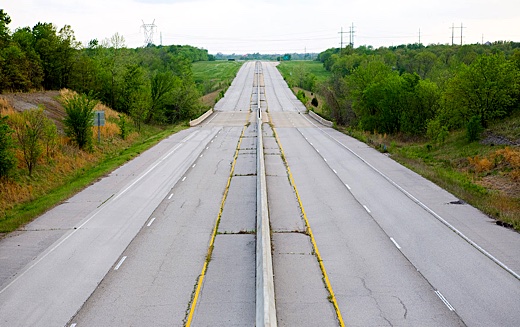
Image above: Abandoned section of "Will Rogers Turnpike" now known as Interstate 44. In a future in which we save the Earth we'll be seeing much more of this. From (http://www.flickriver.com/photos/tags/willrogersturnpike/).

"Given the state of the planet," writes 350.org founder Bill McKibben in his new feature piece for In These Times, it would have been ideal for the world to have fully transitioned its energy systems away from fossil fuels to 100 percent renewable sources "25 years ago." But we can still push for the "second best" option, McKibben concludes. To do so, we must move toward wind, solar, and water "as fast as humanly possible."

The transition to 100 percent renewable energy is a goal that has gained significant appeal over the past decade—and particularly over the past several months, as President Donald Trump has moved rapidly at the behest of Big Oil to dismantle even the limited environmental protections put in place by the Obama administration. Trump also withdrew the U.S. from the Paris climate accord, a move McKibben denounced as "stupid and reckless."

"Environmental groups from the Climate Mobilization to Greenpeace to Food and Water Watch are backing the 100 percent target," McKibben writes, as are many lawmakers, U.S. states, and countries throughout the world.

Given the climate stance of both the dominant party in Congress and the current occupant of the Oval Office, McKibben notes that we shouldn't be looking toward either for leadership.

Rather, we should look to states like California and countries like China, both of which have made significant commitments to aggressively alter their energy systems in recent months.

The newest addition to the push for renewables is Maryland, which is set to announce on Thursday an "urgent" and "historic" bill that, if passed, would transition the state's energy system to 100 percent renewables by 2035.

McKibben also points to individual senators like Bernie Sanders (I-Vt.), Ed Markey (D-Mass.), and Jeff Merkley (D-Ore.), who in April introduced legislation that would transition the U.S. to 100 percent clean and renewable energy by 2050. The bill will not pass the current Congress, "but as a standard to shape the Democratic Party agenda in 2018 and 2020, it's critically important," McKibben argues.

"What Medicare for All is to the healthcare debate, or Fight for $15 is to the battle against inequality, 100 percent renewable is to the struggle for the planet's future," McKibben writes. "It's how progressives will think about energy going forward."

Previously a fringe idea, the call for 100 percent renewables is "gaining traction outside the obvious green enclaves," McKibben adds. This is in large part because technology is such that a move toward 100 percent renewable energy "would make economic sense...even if fossil fuels weren't wrecking the Earth."

"That's why the appeal of 100% Renewable goes beyond the left," McKibben writes. "If you pay a power bill, it's the common-sense path forward."

Writing for Vox last week, David Roberts noted that "wind and solar power are saving Americans an astounding amount of money" already.

"Wind and solar produce, to use the economic term of art, 'positive externalities'—benefits to society that are not captured in their market price," Roberts writes. "Specifically, wind and solar power reduce pollution, which reduces sickness, missed work days, and early deaths."

For these reasons, and for the familiar environmental ones, 100 percent renewables is no longer merely an "aspirational goal," McKibben argues. It is "the obvious solution."

"No more half-measures... Many scientists tell us that within a decade, at current rates, we'll likely have put enough carbon in the atmosphere to warm the Earth past the Paris climate targets," McKibben concludes. 
"Renewables—even the most rapid transition—won't stop climate change, but getting off fossil fuel now might (there are no longer any guarantees) keep us from the level of damage that would shake civilization."

.

Waialeale Water Lease

SOURCE: Ken Taylor (littlewheel808@gmail.com)
SUBHEAD: A cultural study in preparation for renewal of a sixty-five year lease on Wailua River water.

From Ken Taylor on 18 July 2017 in Island Breath -
(http://islandbreath.blogspot.com/2017/07/waialeale-water.html)


Image above: "The Blue Hole" is valley shaped by countless waterfalls from "The Weeping Wall" below Waialeale that feed into the largest river in Hawai - the Wailua. From (http://www.onlyinyourstate.com/hawaii/hi-weeping-wall/).

The Kauai Island Utility Cooperative (KIUC) has contracted Cultural Surveys Hawaii to complete a cultural study on the proposed 65 year water lease of North Fork Wailua River, Waikoko, Iliiliula, Waiaka and Waiahi Streams, Puna District, Kauai.

KIUC is currently diverting 100% of the base flow of these mountain streams orgiginating from the Alakai and Mount Waialeale, for hydropower. These 2 KIUC hydropower plants produce only 1% of Kauai's power needs, which now is 90% supplied by solar panels during the day.

The Waiahi Hydropower plants, over a hundred years old, were needed to supply power to Lihue Mill. We now have other power options, that do not depend on diverting 100% of stream water from our forests.

Nicole Ishihara, from Cultural Surveys Hawaii, is coming to Kauai this Thursday and Friday, July 20th & 21st, to talk to Kauai about the impacts of this proposed 65 year lease by KIUC.

She will be available to talk to folks at Hā Coffee Shop in Lihue from 10 am to about 12. We will then meet up at Wailua State Park parking lot, by the Birth Stones, to carpool up to the area of the KIUC diversion (Blue Hole). Vehicles with 4WD are welcome.

Nicole Ishihara will also be available to meet with the community Thursday early evening, and Friday morning until about noon.

This is a chance for Kauai to let their voices be heard about the impacts of the diversion of a culturally important stream, proposed for the next 65 years. A lifetime without Mauka-Makai water connection from Mount Waialeale. It's just not right.

Attached is CSH letter requesting comments, and sample questions. Please let Nicole know the importance of Waialeale water by letter, phone call, chant, dance, art - however you need to express what water from Waialeale means to you, your family and your community, for the next 65 years.

CONTACT
Nicole Ishihara
Cultural Surveys Hawaii
(808) 965-6478
nishihara@culturalsurveys.com

See also concerning Waialeale water rights:
Ea O Ka Aina: The Mo'o and the Well 1/29/14
Ea O Ka Aina: Horizontal Well Presentation 9/19/13
Ea O Ka Aina: Kahili Vampire Project Meeting 9/13/13
Ea O Ka Aina: No to the Horizontal Well 4/11/13
Ea O Ka Aina: Scoping Meeting on Horizontal Well 4/6/13
Ea O Ka Aina: This is for your own good 10/13/12

.

Renewable Energy Controversy

SUBHEAD: The debate is can wind, solar, and hydro fully power the U.S.? Both sides are wrong.

By Richard Heinberg on 11 July 2017 for Post Carbon Institute-
(http://www.postcarbon.org/controversy-explodes-over-renewable-energy/)


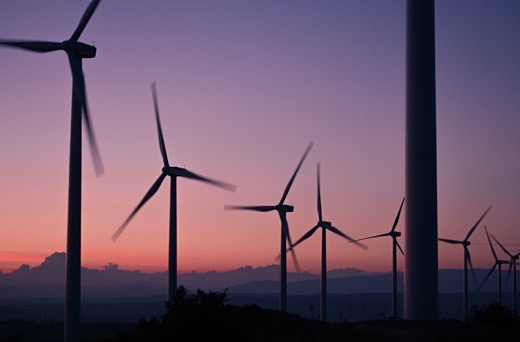
Image above: Wind generator array producing power at dusk. From original article.

[IB Publisher's note: The energy opportunities we have now will not last much longer. We need to be making good choices for our future. However, it's our opinion that Americans will use whatever is at hand for energy wherever they may be. We will use oil/gas until its gone. In some places still forested we will burn wood. In appropriate locations we will use water power. People will dig coal from the remains of dormant mines. Nuclear plants will degrade and leak but continue to operate. It will be quite a bit of last gasp pollution. The more renewable alternative energy we can get in place before we are no longer able to do so, the better off we'll be.]

The stakes in this controversy are high enough that the New York Times and other mainstream media have reported on it. One pro-renewables scientist friend of mine despairs not just because of bad press about solar and wind power, but also because the reputation of science itself is taking a beating.

If these renowned energy experts can’t agree on whether solar and wind power are capable of powering the future, then what are the implications for the credibility of climate science?

Jacobson and colleagues have published what can only be called a take-no-prisoners rebuttal to Clack et al. In it, they declare that, “The premise and all error claims by Clack et al. . . . about Jacobson et al. . . . are demonstrably false.” In a separate article, Jacobson has dismissed Clack and his co-authors as “nuclear and fossil fuel supporters,” though it’s clear that neither side in this debate is anti-renewables.

However, Clack et al. have issued their own line-by-line response to Jacobson’s line-by-line rebuttal, and it’s fairly devastating.

This is probably a good place to point out that David Fridley, staff scientist in the energy analysis program at Lawrence Berkeley National Laboratories, and I recently published a book, Our Renewable Future, exploring a hypothetical transition to a 100 percent wind-and-solar energy economy.

While we don’t say so in the book, we were compelled to write it partly because of our misgivings about Mark Jacobson’s widely publicized plans. We did not attack those plans directly, as Clack et al. have done, but sought instead to provide a more nuanced and realistic view of what a transition to all-renewable energy would involve.

Our exploration of the subject revealed that source intermittency is indeed a serious problem, and solving it becomes more expensive and technically challenging as solar-wind generation approaches 100 percent of all electricity produced.

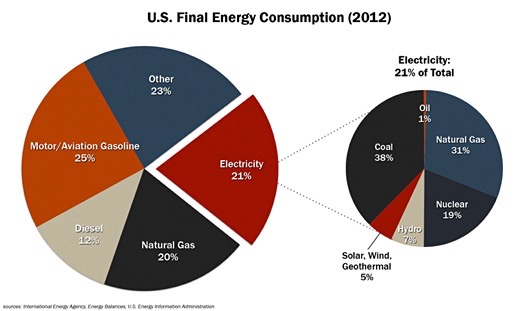
A further challenge is that solar and wind yield electricity, but 80 percent of final energy is currently used in other forms—mostly as liquid and gaseous fuels.

Therefore the energy transition will entail enormous changes in the ways we use energy, and some of those changes will be technically difficult and expensive.


Image above: Chart of energy consumption sources in 2012. Only a tiny percentage of one sector, electricity generation,  shows as much as 5% contribution of solar, wind and geothermal combined. Sources - International Energy Agency, US Energy Information Administration. From original article.

Our core realization was that scale is the biggest transition hurdle. This has implications that both Jacobson et al., and Clack et al. largely ignore. Jacobson’s plan, for example, envisions building 100,000 times more hydrogen production capacity than exists today.

And the plan’s assumed hydro expansion would require 100 times the flow of the Mississippi River. If, instead, the United States were to aim for an energy system, say, a tenth the size of its current one, then the transition would be far easier to fund and design.

When we start our transition planning by assuming that future Americans will use as much energy as we do now (or even more of it in the case of economic growth), then we have set up conditions that are nearly impossible to design for. And crucially, that conclusion still holds if we add nuclear power (which is expensive and risky) or fossil fuels (which are rapidly depleting) to the mix.

The only realistic energy future that David Fridley and I were able to envision is one in which people in currently industrialized countries use far less energy per capita, use it much more efficiently, and use it when it’s available rather than demanding 24/7/365 energy services.

That would mean not doing a lot of things we are currently doing (e.g., traveling in commercial aircraft), doing them on a much smaller scale (e.g., getting used to living in smaller spaces and buying fewer consumer products—and ones built to be endlessly repaired), or doing them very differently (e.g., constructing buildings and roads with local natural materials).

If powerdown—that is, focusing at least as much on the demand side of the energy equation as on the supply side—were combined with a deliberate and humanely guided policy of population decline, there would be abundant beneficial side effects. The climate change crisis would be far easier to tackle, as would ongoing loss of biodiversity and the depletion of resources such as fresh water, topsoil, and minerals.

Jacobson has not embraced a powerdown pathway, possibly because he assumes it would not appeal to film stars and politicians. Clack et al. do not discuss it either, mostly because their task at hand is simply to demolish Jacobson.

But powerdown, the pathway about which it is seemingly not permissible for serious people to speak, is what we should all be talking about. That’s because it is the most realistic way to get to a sustainable, happy future.

.

Nuke power limps to extinction

SUBHEAD: Nuclear power generation corporations are headed for the junk pile.

By Paul Brown on 16 April 2017 for Truth Dig -
(http://www.truthdig.com/report/item/the_nuclear_industry_is_heading_financial_black_hole_20170416)


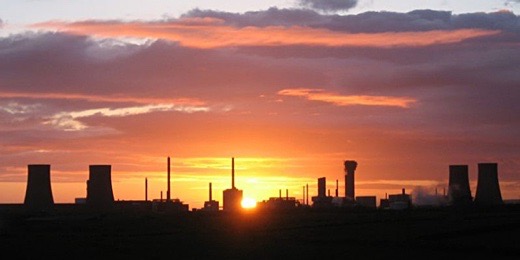
Image above: Sunset over the Sellafield power plant in Cumbria, England, near the area where Westinghouse was about to start building three large nuclear reactors - before they went bankrupt. Photo by Dom Crayford. From original article.

Any lingering hope that a worldwide nuclear power renaissance would contribute to combating climate change appears to have been dashed by US company Westinghouse, the largest provider of nuclear technology in the world, filing for bankruptcy, and the severe financial difficulties of its Japanese parent company, Toshiba.

After months of waiting, Toshiba still could not get its auditors to agree to its accounts [last] week. But it went ahead anyway and reported losses of nearly $5 billion for the eight months from April to December, in order to avoid being de-listed from the Japanese stock exchange.

The company admitted it too could face bankruptcy, and is attempting to raise capital by selling viable parts of its business.

In a statement, it said: “There are material events and conditions that raise substantial doubt about the company‘s ability to continue as a going concern.”

Nuclear Reactors

The knock-on effects of the financial disasters the two companies face will be felt across the nuclear world, but nowhere more than in the UK, which was hoping Westinghouse was about to start building three of its largest nuclear reactors, the AP 1000, at Moorside in Cumbria, northwest England.

The UK’s Conservative government will be particularly embarrassed because, in late February, it won a critical parliamentary by-election in the seat that would be home to the Moorside plant, on the guarantee that the three reactors would be built—a pledge that now seems impossible to keep.

Martin Forwood, campaign co-ordinator for Cumbrians Opposed to a Radioactive Environment, says: “I think the day of the large-scale nuclear power station is over. There is no one left to invest anymore because renewables are just cheaper, and these prices are still going down while nuclear is always up.”
Toshiba and Westinghouse are in deep trouble because the reactors they are currently building—the same design as the ones planned for Cumbria—are years late and billions of dollars over budget. Even if the companies can be re-financed, it seems extremely unlikely they would risk taking on new reactor projects.

Both the UK and Toshiba have looked to the South Korean nuclear giant KEPCO to take over the Moorside project, but the company is unlikely to want to build the Westinghouse design and would want to put forward its own reactor, the APR 1400.

This would delay the project for years, since the whole safety case for a new type of reactor would have to be examined from scratch.

But the company is already under pressure from within South Korea, where Members of Parliament have urged KEPCO not to take on a risky project in the UK. Twenty-eight members of the Republic of Korea’s “Caucus on Post-Nuclear Energy” have called on KEPCO not to invest in Moorside.

The other nuclear giant present in Britain, the French-owned Électricité de France (EDF), is in serious difficulties of its own. It is already deep in debt and its flagship project to build a prototype 1,600 megawatt reactor at Flamanville in northern France is six years behind schedule and three times over budget at €10.5 billion.

Originally due to open in 2012, its start date is now officially the end of 2018, but even that is in doubt because an investigation into poor quality steel in the reactor’s pressure vessel is yet to be completed.

Despite this, the company and the UK government are committed to building two more of these giant reactors in Somerset in southwest England, and have started pouring concrete for the bases to put them on. These reactors are due to be completed in 2025, but nobody outside the company and the UK government believes this is likely.

So, with troubles of its own, EDF is in no position to help Toshiba out of its financial difficulties. In the nuclear world, this leaves only the Chinese and the Russians who might be capable of taking on such a project.

The Russians will be ruled out on political grounds, and the Chinese are already helping out EDF with a large financial stake in the Somerset project. They also want to build a nuclear station of their own design at Bradwell in Essex, southeast England – another project that looks likely to take more than a decade to complete.

Vast Capital Costs

The problem for all these projects, apart from the vast capital cost and the timescales involved, is that the energy industry is changing dramatically. Solar and wind power are now a cheaper form of producing electricity across the world, and are less capital-intensive and quicker to build.

Despite the fact that there are more than 430 nuclear reactors in operation worldwide and the industry still has great economic and political clout, it is beginning to look like a dinosaur – too big and cumbersome to adapt to new conditions.

Nuclear power now produces about 10% of the world’s electricity, while 40% is from coal and 23% from renewables. The rest is mainly from natural gas.

Dr Jim Green, national nuclear campaigner with Friends of the Earth Australia, says: “Nuclear lobbyists are abandoning the tiresome rhetoric about a nuclear power renaissance. They are now acknowledging that the industry is in crisis.

“The crisis-ridden US, French and Japanese nuclear industries account for half of worldwide nuclear power generation.

“Renewable energy generation doubled over the past decade, and strong growth, driven by sharp cost decreases, will continue for the foreseeable future.”

See also:

.

Undamming Rivers

SUBHEAD: Many hydro dams produce modest amounts of power yet do enormous damage to rivers and fish.

By J Waldman & K. Limburg on 6 August 2015 for Environment 360 -
(https://e360.yale.edu/feature/undamming_rivers_a_chance_for_new_clean_energy_source/2901/)


Image above: Maryland recently re-licensed the aging Conowingo Dam that blocks the Susquehanna River, the largest tributary into the Chesapeake Bay. From (http://www.bayjournal.com/article/relicensing_of_conowingo_dam_an_opportunity_for_many_bay_issues).

Hydroelectric power is often touted as clean energy, but this claim is true only in the narrow sense of not causing air pollution. In many places, such as the U.S. East Coast, hydroelectric dams have damaged the ecological integrity of nearly every major river and have decimated runs of migratory fish.

This need not continue. Our rivers can be liberated from their concrete shackles, while also continuing to produce electricity at the site of former hydropower dams. How might that occur?

A confluence of factors — the aging of many dams, the advent of industrial-scale alternative energy
sources, and increasing recognition of the failure of traditional engineering approaches to sustain migratory fish populations — raises fresh possibilities for large rivers to continue to help provide power and, simultaneously, to have their biological legacies restored.

The answer may lie in “sharing” our dammed rivers, and the concept is straightforward. Remove aging hydroelectric dams, many of which produce relatively small amounts of electricity and are soon up for relicensing. When waters recede, rivers will occupy only part of the newly exposed reservoir bottoms.

Let’s use these as a home for utility-scale solar and wind power installations, and let’s employ the existing power line infrastructure to the dams to connect the new solar and wind power facilities to the grid. This vision both keeps the electricity flowing from these former hydropower sites, while helping to resurrect once-abundant fish runs, as has recently happened in Maine.

More than a half-century of modern attempts to allow fish to traverse what often are sequences of dams that block access to their historical spawning reaches in eastern U.S. rivers presents a dismal record. Highly unnatural conveyances such as fish ladders are often only marginally helpful to fish on their upstream spawning runs, which is one reason why some migratory fish runs have fallen as much as five orders of magnitude.

Take Atlantic salmon, a revered game and food fish that once may have numbered a half-million in U.S. rivers. In 2014, fewer than 400 attempted to reach their New England spawning grounds. Such relict populations are often protected from harvest, yet are still not meaningfully restored.

No other action can bring ecological integrity back to rivers as effectively as dam removals. Yet such efforts may come at the cost of a loss of hydropower. And so what many hoped would be a precedent-setting breaching of the Edwards Dam on Maine’s Kennebec River in 1999 — which had yielded only 3.5 megawatts of power — has not been followed by the dismantling of other, higher-wattage dams on the East Coast.

Yet, the efficacy of dam removal to restore migratory fish was shown in the Kennebec after the Edwards Dam fell; for the first time in more than a century-and-a-half, alewives, a species of herring, were able to access an upriver tributary, the Sebasticook.

Within just a few years the Sebasticook’s run of alewives swelled from non-existent to almost three million, supporting scores of bald eagles and an “alewife festival” that celebrates the Sebasticook’s extraordinary renewal.

In “sharing” a river more equitably between energy production and its ecological imperatives, the critical step would be the breaching of existing dams. Though that may seem improvident — if not downright radical — it is important to remember that many of these concrete walls are middle-aged or older and will be reaching their life expectancies in the coming decades. Deteriorating dams are a serious public safety concern — one likely to increase as climate change generates more frequent and intense storms.

We believe the compelling ecological and impending structural reasons for dam removals should be considered in light of the rapidly evolving national energy landscape, and that, together, they signal exciting possibilities for a dramatically improved stewardship of major rivers.

Fortunately, traditional hydropower facilities already offer the real estate that lies under reservoirs and existing electrical transmission lines that could be used by renewable energy sources.

In breaching a dam and draining a reservoir, substantial areas of land could become available for new uses.

Take the Conowingo Dam in Maryland, for example. The Conowingo is the largest of four hydroelectric dams on the lower 55 miles of the Susquehanna River and sits only nine miles above the head of Chesapeake Bay.

Its 572-megawatt capacity is fed by a 9,000-acre reservoir that also serves as an emergency water supply for Baltimore, and provides water for cooling intakes at the nearby Peach Bottom nuclear plant. The pool is also used by recreational boaters and fishers.

If the Conowingo Dam were removed, this would free up more than enough area to replace the lost hydroelectric generation with power from solar parks along the former reservoir bottom, and allow for other land uses, such as creation of fringing wetlands and forests.

For comparative scale, California’s new, 392-megawatt Ivanpah Solar Electric Generating System has three units occupying 3,500 acres.

More sun shines on the Mojave than in the mid-Atlantic region, but according to the National Renewable Energy Laboratory calculator, acre for acre, the Conowingo region should support 76 percent of the power-generating capacity of the desert. Thus, about three-quarters of the river bottom would need to be in solar to match the output of Ivanpah.

One other issue facing the Conowingo Dam removal would be the sediments behind the dam that would need to be stabilized. The reservoir itself is close to capacity, and current plans are to dredge the pool, at an estimated cost of $48 million to $267 million annually.

Those who are concerned for the ecological health of the Chesapeake Bay fear that if the dam is removed, millions of tons of sediment, enriched with nutrients and, potentially, toxic substances, could pour into the bay. But sediment stabilization is routinely done in dam removals and could be safely accomplished with careful design and engineering.

Finally, what of the pushback by those who cherish the status quo? Few local residents were alive when the Conowingo Reservoir began filling in 1928, so the big pool is their cultural heritage. Surely, any such drastic change would be hotly debated in many forums. But only a small number of houses exist on the 29 miles of shoreline that would be affected if the reservoir were removed.

The same issues were faced in the debates about removing mainstem dams in the Penobscot River in Maine, and eventually a consensus emerged there. Preservation of power generation (diverted to smaller tributaries) was important to closing the deal, and will likely be important in other cases.

And although manmade reservoirs have their aficionados, rivers often have more of them — the scores who appreciate the fishing, paddling, and nature watching they provide. One study showed large economic benefits from the Edwards Dam removal.

And what about the nuclear plant, and Baltimore’s emergency water supply? The Peach Bottom plant could install water-miserly, closed-cycle cooling towers, and Baltimore could still withdraw water from the

There are other potential tools available to help share rivers. Any remaining backwater ponds could be outfitted with floating solar panel arrays, as used successfully in Japan. Also, because reservoirs are nestled in valleys, in some instances the surrounding ridges might host wind turbines.

Though combined alternative energy sources such as these might alone make up or exceed the original hydropower lost, “run of the river” hydropower — in which only a portion of the current is routed through turbines — could also contribute. But, critically, while generating some hydropower, the river’s mainstem would remain free-flowing, opening the way for resurgent fish migrations.

On the Penobscot River, the precedent of restoring a major river while maintaining equivalency of energy production was recently accomplished. This was done by increasing hydroelectric generation capacity on a set of tributaries while reopening the mainstem channel through dam removals and more effective fishways — thus returning nearly 1,000 miles of river habitat to eleven species of sea-run fish, including Atlantic salmon, sturgeon, and river herring.

Other, once biologically productive New England rivers now clogged with multiple dams — such as the Kennebec, Merrimack, Connecticut, and Housatonic — could be prime candidates for some of these new ways of thinking about the future of rivers.

Other innovative approaches could also be explored. The previously submerged but newly available riverfront property might be sold or transferred for conservation easements or for parks or even environmentally sensitive residential development. The revenue from these sales could be used for solar or wind projects in other promising but underutilized locations, such as landfills and urban brown fields.

A discussion of new strategies is timely because we are about to double-down on the flawed status quo. The Federal Energy Regulatory Commission will be evaluating many East Coast hydro dams for relicensing within the next few years — licensing that would lock in the failed fish passage paradigm for as much as an additional half-century.

As two conservation biologists who study rivers, we believe it’s time to explore a dramatically different vision. It may be that hydro companies should not continue to act as the gatekeepers for what could otherwise be healthy rivers brimming with life.

Certainly, society requires electrical power, and rivers already are part of our grid. The way forward just may be to share a river more equitably between renewable energy production and its natural ecology.

[IB Publisher's note: Below is the comment I added to the original article.


COMMENT:

I am an architect and planner. I am also opponent of nuclear power and think the Fukushima Daiichi nuclear reactor disaster is a threat to the health of the planet and life in the Pacific Ocean.

I fully agree with the authors that large dams do great damage to our precious rivers.

The authors of this article address the loss of  572-megawatt of power from the dam but not the
emergency cooling capacity the dam's reservoir  provides for the Peach Bottom Nuclear Power Plant upstream.

It would seem closing the Peach Bottom plant would be a good idea too. It employs two GE boiling water reactors (the kind at Fukushima) that were installed in 1974 and are licensed past 2030.  They generate  generate twice the dam's power.

The sooner we can decommission our fragile nuclear power the better. I would say it is a higher priority than decommissioning and removing dams at this point in time.

Juan Wilson: Architect/Planner
Kauai, Hawaii


.

Kokee & Kekaha Ditch Systems

SUBHEAD: The diversion of water from its normal course from the Alakai Swamp through the Waimea River.

By Juan Wilson on 29 April 2015 for Island Breath -
(http://islandbreath.blogspot.com/2015/04/kokee-kekaha-ditch-systems.html)


Image above: View from Waimea Canyon Lookout. In the distance and to the upper left is the Alakai Swamp. In the forefront is Wahane Valley in the Puu Ka Pele Forest reserve. Much of the stream water in the lower valleys is diverted from flowing through the Waimea Canyon. The water is used to power the Mauka Hydroelectric Station before traveling on through the Kekaha Ditch System. Photo by Juan Wilson.

Yesterday, the 28th of April 2015, the Commission on Water Resource Management (CWRM) of the Hawaii Department of Land and Natural Resources (DLNR) met on Kauai for the first time. It was a long day for its members who were committed to several events from morning and into the night. These included planned  site visits to several locations on the Kokee and Kekaha Ditch Irrigation Systems.

I attended three events between 9:30am until 4:30pm. There was a gathering of interested parties and an orientation at the Waimea Neighborhood Center. Then there were site visits to seven points long the ditch systems to get an understanding of the systems.

The CWRM conducted a site visits to several locations on the Kokee and Kekaha Ditch Irrigation Systems in connection with the complaint against waste in the Waimea River and its tributaries filed by then Earthjustice law offices on behalf of Poai Wai Ola organization and the est Kauai Watershed Alliance.

The purpose of the site visits were to give interested parties a better understanding of the system. The Kokee and Kekaha Ditches are interlinked at a number of points that create a more complicated network than I knew.

http://www.islandbreath.org/2015Year/04/150429ditchmap.jpghttp://www.islandbreath.org/2015Year/04/150429ditchmapbig.jpg
Image above: Detail of handout map of Kekaha and Kokee Ditch System. Click to see it all larger.

 
SITE VISITS

SITE # 1

Waimea Neighborhood Center 9:45 am
A short briefing by Kekaha Agriculture Association (KAA) on the Kokee and Kekaha Ditch Systems.

SITE # 2
Waimea Canyon Lookout 10:30 am
Heading north on Kokee Road (Hwy 550), Turn right ~0.3 miles after mile marker 10
Waimea Watershed with view of Waipoo Falls (Kokee Stream). Flow in Kokee Stream is augmented by water returned from Kokee Ditch downstream of Kawaikoi, Waiakoali, and Kauaikinana Stream Diversions.

SITE # 3
Puu Lua Reservoir 11:00 am
Heading north on Kokee Road (Hwy 550), turn left at mile marker 12
Water from Kokee Ditch flows into Puu Lua Reservoir, which is located downstream of the sluice gate to Kauhao Gulch. The reservoir is maintained below 60 feet due to dam safety regulations and is used by the Division of Aquatic Resources (DAR) for sport fishing (trout are raised and released). Outflow from the reservoir continues towards the Puu Moe Divide.

SITE # 4
Puu Moe Ditch Divide 12:30 pm
Heading south on Kokee Road (Hwy 550), ~0.4 miles after mile marker 10
Kokee Ditch downstream of Puu Lua Reservoir. Water is divided between the Department of Hawaiian Home Lands (DHHL) lessees and the Kokee Ditch towards Kitano Reservoir.

SITE # 5
Black Pipe Siphon Viewpoint 1:15 pm
Heading south on Waimea Canyon Drive (Hwy 550), (See map) ~0.6 miles after mile marker 4
The Kekaha Ditch siphon conveys water from the eastern side of the valley to the western side. The siphon is located below the Mauka Hydropower Plant. Water continues in the Kekaha Ditch to the diversion point for the Menehune Ditch and on to the Mana Plain.

SITE # 6
End of Kokee Ditch 1:45 pm
Heading south on Waimea Canyon Drive (Hwy 550), ~0.1 miles after mile marker 3
Water exiting Kokee Ditch flows downslope into Kekaha Ditch.

SITE # 7
Kekaha Ditch Crossing at Hwy 550 2:15 pm
Heading south on Waimea Canyon Drive (Hwy 550), ~0.7 miles after mile marker 2
Kekaha Ditch downstream of Menehune Ditch withdrawal and before inflow from Kokee Ditch.

SITE # 8
Waimea Neighborhood Center 3:00 pm
Commission on Water Resource Management of the DLNR hears testimony from public on subjects from the Kokee and Kekaha Ditch Systems to need for water and homesteading on DHHL managed land to reach Kauai food self reliance.


One thing was clear from the presentation of Kekaha Agriculture Association representatives and the hydrologist hired by the Commission on Water Resource Management to survey the existing system - They saw the system with a mechanistic view. They read ditch flow in Millions of Gallons per Day (MGD) and siphon pipes as 48" diameter. They did not see the valleys, streams, and the plants, birds, fish and insects in them as a continuous living entity. Continuity in the living biosphere is a necessary condition for health and stability.

Many local westside people spoke eloquently on these issues. There were many influential people from Kauai and from the state as well as "stakeholders". The people were clear. Let them live on the land. Let the water be used by local people to farm, and feed people.  

My impression was that the members of the public that spoke were surprised by the warmth and sympathetic responses by the members that were present from the Commission on Water Resource Management: Chair Suzanne Case, Denise Antolini, Kamana Beamer, Jonathan Starr, and Michael Buck.

The questions the Earthjustice case has raised are related to the diversion of water from its normal course from the Alakai Swamp that on its own followed the natural terrain and into the Waimea River. These diversions were created in the early 20th century by plantation companies to grow sugar on the Mana Plain and the hilltops above it. These diversions have took tens of millions of gallons per day for almost a hundred years.

In my opinion, by taking the water out of a stream (along with fish, insects, plants) putting them through a ditch and a steel tubed syphon and running them through a hydroelectric generator creates a discontinuity in the fabic of life. There are many spots in many streams where the water does not run when it is "needed" by the KAA and its "customers". Those spots are where the biosphere breaks down.

Where Do We Go
By the early 21st century the sugarcane operations that demanded that water no longer existed. But the diversions continued. The biggest users are associated with Kekaha Agriculture Association (KAA) the Hawaii Agribusiness Development Corporation (ADC). Those users include the GMO chemical corporations BASF and Syngenta as well as Sunrise Capital that operates the Kauai Shrimp Farm. These corporations want a continued flow of the diverted water in the existing systems.

Other major players are looking for access to diverted water as well. KIUC wants access to Puu Opae Reservoir (now inactive). The plan would be to use the diverted water to drive a hydroelectric generator at night to provide electricity.

It is ironic that the users of water on the Mana plain feel they need the ditch systems. Before the Mana Plain was filled in by the sugarcane interests it was an extensive wetlands with swamps and ponds fed from the valleys above that extended to the top of the islands. Ditches were cut into the wetlands to carry the water away. To this day pumps are used to carry water to the ocean so as to control the level of water on the GMO fields. That pumping is done now "for free" by the US military to keep the Pacific Missile Range Facility dry and secure.

I believe in engineering the flow of water to slow its course through the island. It's a primary principle of permaculture. Never more than a small percentage of a stream should be taken from its natural course. The engineering of the sugarcane companies was to take all the water they could use (and more) and only let the overflow of their dams reach the the stream again.

I'd rather see the Mana Plain wetlands restored to their state before the 20th century. I'd rather see the current ditch system greatly reduced in scope and not allowed to create complete discontinuity in stream flows.

Global warming will bring water problems to Kauai. Even a few degrees of temperature rise will raise the altitude of rain forming clouds. Scientists at the University of Hawaii havce calculated that only a few hundred feet increase in cloud elevation will have a significant impact on Waialeale's ability to catch the rain. As it is, rain gauge measures their have been diminishing for decades. Global Waring are also making the Trade Winds less reliable and increasingly making El Nino and La Nina events more chaotic.

Bottom line: We have to prioritize how we use water on Kauai. Growing local food and providing for our people comes first. Fuck the corporations. And that is how the law is written that the Commission on Water Resource Management must follow.
Priority 1) Appurtenant rights of land that were cultivated in kalo(taro).
Priority 2) Hawaiian rights of traditional and customary practices.
Priority 3) Riparian rights protect people who live along the banks of rivers or streams. Priority 4) Correlative rights of those who own land overlying a ground water source.

See inset below for details.


HAWAIIAN WATER RIGHTS
From (www.law.hawaii.edu)
Today, Hawaii’s Constitution and Water Code recognize specific rights to ground and surface water, including appurtenant, riparian, Native Hawaiian, and correlative rights. To better understand how the Constitution and Code were designed to operate,it is important to have a basic understanding of these rights.

1. Appurtenant Rights
Appurtenant rights appertain or attach to parcels of land that were cultivated, usually in the traditional staple kalo, at the time of the Mähele of 1848. Hawaii law recognizes that such land retained rights to the amount of water necessary to continue to cultivate crops. Although some kuleana land has appurtenant rights, land need not have been awarded as a kuleana to retain such rights. See, e.g., Haw. Rev. Stat. § 174C-101(d) (recognizing the “appurtenant water rights of kuleana and taro lands”). Because appurtenant rights attach to the land and not to any individual, they can be exercised by property owners irrespective of race or ethnic background.

Appurtenant rights have the highest level of protection under Hawaii law and, as mentioned earlier, are a public trust purpose. For example, Hawaii’s Constitution recognizes that the Water Commission “shall set overall water conservation, quality and use policies”; but clarifies that any such priorities shall “assur[e] appurtenant rights[.]” Haw. Const. art. XI, § 7. The Water Code also recognizes the primacy of appurtenant rights: “Appurtenant rights are preserved. Nothing in this part shall be construed to deny the exercise of an appurtenant right by the holder thereof at any time.

A permit for water use based on an existing appurtenant right shall be issued upon application.” Haw. Rev. Stat. § 174C-63. Despite these strong protections, the Water Commission has never inventoried or forecasted the amount of water necessary to supply existing or future appurtenant rights. See Haw. Rev. Stat. §§ 174C-31(c), (d). Although the Water Commission’s jurisdiction to make determinations of appurtenant rights was made explicit in 2002, at the time of this primer’s publication, the Commission has yet to issue a formal declaration of any appurtenant rights, even though individuals have applied for such determinations.

Given the lack of action on the Water Commission’s part, appurtenant right holders have had difficulty protecting their interests. This has been complicated by the Hawai‘i Supreme Court’s ruling that appurtenant rights may be severed if attempts are made to transfer or reserve these rights. See Reppun v. Board of Water Supply, 65 Haw. 531, 552, 656 P.2d 57, 71 (1982). Such reservations or transfers were and remain commonplace in deeds conveying property; thus, some appurtenant rights have been extinguished.

2. Native Hawaiian Rights
Given Hawaii’s unique history and background principles of property law, our laws recognize and protect traditional and customary Native Hawaiian rights and practices. “The State reaffirms and shall protect all rights, customarily and traditionally exercised for subsistence, cultural and religious purposes and possessed by ahupua‘a tenants who are descendants of native Hawaiians who inhabited the Hawaiian Islands prior to 1778, subject to the right of the State to regulate such rights.” Haw. Const. art. XII, § 7.

In addition to that constitutional mandate, the Water Code includes specific provisions respecting and upholding the rights of Känaka Maoli, which recognize that the “traditional and customary rights of ahupua‘a tenants who are descendants of native Hawaiians who inhabited the Hawaiian Islands prior to 1778 shall not be abridged or denied by this chapter.” Haw. Rev. Stat. § 174C-101(c). The Code makes clear that such rights include, but are not limited to, the cultivation of kalo on one’s own kuleana, as well as the right to gather various resources for subsistence, cultural, and religious purposes, including: hïhïwai (or wï); ‘opae; ‘oopu; limu; thatch; ti leaf; aho cord; and medicinal plants. Haw. Rev. Stat. § 174C-101(c). Similar to the treatment of appurtenant rights, the Code specifically provides that the “traditional and customary rights assured in this section, shall not be diminished or extinguished by a failure to apply for or to receive a permit under this chapter.” Haw. Rev. Stat. § 174C-101(d).

The Code also recognizes and upholds rights conferred by “the Hawaiian Homes Commission Act, 1920, as amended, and by chapters 167 and 168, relating to the Molokai Irrigation System.” Haw. Rev. Stat. § 174C-101(a). Moreover, the Code directs the Commission to “incorporate and protect adequate reserves of water for current and foreseeable development and use of Hawaiian home lands as set forth in section 221 of the Hawaiian Homes Commission Act.” Haw. Rev. Stat. § 174C-101(a).

Comparable to the treatment of appurtenant rights, both traditional and customary Native Hawaiian rights and reservations for the Department of Hawaiian Home Lands are public trust purposes. Despite that status, the Water Commission has yet to forecast the amount of water needed to supply existing and future traditional and customary rights as well as the existing and future needs of the Department of Hawaiian Home Lands, frustrating the ability of those with such rights to effectively exercise them.

See Haw. Rev. Stat. §§ 174C-31(c), (d); -101(a). As a result, the strong protections intended for these rights remain largely on paper and unenforced on the ground in the community.

3. Riparian Rights
In Latin, ripa means river bank. Riparian rights protect the interests of people who live along the banks of rivers or streams to the reasonable use of water from that stream or river on the riparian land. Those rights are subject to other rights of equal or greater value, such as appurtenant, traditional and customary Native Hawaiian, other riparian rights, or reservations for the Department of Hawaiian Home Lands.

Hawaii’s Constitution protects existing riparian uses. Haw. Const. art. XI, § 7. Due to the Water Code’s establishment of Water Management Areas as described in Part II(F), below, Hawaii has a bifurcated system of rights. In non-designated areas, the common law controls and anyone with riparian land retains riparian rights. Once an area has been “designated,” however, only existing riparian uses, as opposed to unexercised riparian rights, continue to retain preferential status. See Haw. Const. art. XI, § 7.

Although riparian landowners who are not currently using water from the adjacent stream may apply for a permit, they will not receive any special preference if they seek to use that water on riparian land. Existing riparian uses, on the other hand, retain such a preference.

In Reppun v. Board of Water Supply, the Hawaii Supreme Court ruled that riparian rights cannot be severed from riparian land. 65 Haw. 531, 550, 656 P.2d 57, 70 (1982). Efforts to sever or transfer such rights, which usually occur as part of a deed of sale, are ineffective. Reppun, 65 Haw. at 550, 656 P.2d at 70. This means that even if you have riparian land and the deed conveying the property reserves or transfers ripari rights or water rights in general, your land will still retain those rights unless the geographic region is designated a Water Management Area.

4. Correlative Rights

Similar to the riparian right to surface water, correlative rights protect the interests of individuals who own land overlying a ground water source or aquifer. This land has rights that correlate to the water below it. Like riparian rights, Hawaii’s Constitution protects existing correlative uses, as opposed to inchoate correlative rights. This means that correlative rights are protected in non-designated areas, but only existing correlative uses receive priority in designated Ground Water Management Areas.

Moreover, correlative rights are subject to the reasonable-use doctrine, which means that in times of a water shortage each use with correlative rights has a share to a reasonable amount of water as long as the correlative use does not injure the rights or interests of other correlative right holders. Hawaii courts first recognized correlative rights in City Mill Co. v. Honolulu Sewer & Water Comm’n, 30 Haw. 912 (1929). The Hawaii Supreme Court later clarified the current correlative rights rule in the context of the State Water Code in Waiahole I, 94 Hawaii 97, 9 P.3d 409.

5. Other Water Rights

During the Hawaiian Kingdom and Territorial period, various court decisions created a range of rights, such as konohiki (or surplus) and prescriptive water rights. Those rights no longer exist under the current regulatory regime, and the range of rights now available are outlined and defined in the Water Code.

See also:
Ea O Ka Aina: The Mana Mirage 8/3013
Mana means supernatural and dry in Hawaiian and these visitors to Kauai in 1847 found magic there.

Ea O Ka Aina: The Golden Plain 8/27/13
Your guide uses his paddle to pole you into the marshy water of the Mana Plain as the canoe rocks.

Ea O Ka Aina: Eroding Kauai 3/16/13
These two areas were the largest Hawaiian wetland systems - Mana Plain and Pearl Harbor
.

Price of damming Tibet’s rivers

SOURCE: Katherine Muzik PHD (kmuzik@gmail.com)
SUBHEAD: This will end badly for the nations downstream from Tibet, who compete for scarce water.

By Michael Buckley on 30 March 2015 for the New York Times -
(http://www.nytimes.com/2015/03/31/opinion/the-price-of-damming-tibets-rivers.html)


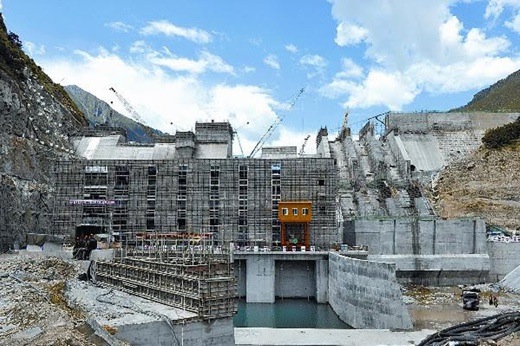
Image above: China has started building its largest hydropower station over the Yarlung river in Tibet to tap the rich water resources in the southwest of the plateau. From (http://www.tibetsun.com/news/2014/10/07/china-begins-building-largest-hydropower-station-in-tibet).

China has more than 26,000 large dams, more than the rest of the world combined. They feed its insatiable demand for energy and supply water for mining, manufacturing and agriculture.

In 2011, when China was already generating more than a fifth of the total hydropower in the world, the leadership announced that it would aim to double the country’s hydropower capacity within a decade, so as to reduce its heavy dependency on coal-fired power plants. Since the waterways of mainland China are already packed with dams, this new hydropower output could come from only one place: the rivers of Tibet.

Rivers gushing through deep canyons at the edges of the Tibetan plateau hold the highest hydropower potential in the world. The headwaters of seven major rivers are in Tibet: They flow into the world’s largest deltas and spread in an arc across Asia.

Two of the continent’s wildest rivers have their sources in Tibet: the Salween and the Brahmaputra. Though they are under threat from retreating glaciers, a more immediate concern is Chinese engineering plans. A cascade of five large dams is planned for both the Salween, which now flows freely, and the Brahmaputra, where one dam is already operational.

The damming does not benefit those who live in Tibet. The energy generated is transferred to power-hungry industrial cities farther east. Tibetans are forcibly deprived of their land; protests against hydropower projects are prohibited or violently dispersed.

Even more alarming are projects to divert the waters of Tibet’s rivers for use in mines, factories and other industries. At the eastern edge of Tibet, a planned mega-diversion from south to north would move water from the Yangtze to the Yellow, China’s two greatest rivers. Other plans call for diversion of water from the Brahmaputra, Salween and Mekong — all rivers that cross national boundaries.

Including China itself, up to two billion people downstream from Tibet depend on these rivers. Damming and diverting them will have a severe impact on their lives and environment, especially when you consider that rice and wheat require water-intensive cultivation.

Rivers support entire ecosystems. They carry tons of nutrient-rich silt downstream, a cocktail of elements needed for growing plants: nitrogen, phosphorus, potassium, magnesium and calcium. Silt is essential for agriculture and for bolstering the deltas against rising sea levels. Dams block silt, and they block fish migration.

The Yangtze is China’s biggest freshwater fishery, but since the Three Gorges Dam that spans it was completed in 2012, the downstream population of carp has fallen by 90 percent, according to Guo Qiaoyu of the Nature Conservancy in Beijing.

Vietnam, Cambodia and Bangladesh heavily depend on rivers sourced in Tibet. More than 60 percent of Cambodia’s annual fish catch derives from Tonle Sap, a lake that is replenished by the annual flooding of the Mekong. Over the last decade, as new Chinese dams have come online on the Mekong, the fish catch has plummeted. The waters rise and fall at the whim of Chinese engineers.

Then there are the direct human costs of damming and diverting: Whole communities must be relocated from areas flooded by a reservoir. They are often shifted to degraded land, where they live in poverty or have to relocate once again. By some estimates, hydropower projects have forced some 22 million Chinese to migrate since the 1950s.

In Tibet, since the 1990s, at least a million nomads and farmers — a sixth of the population — have been relocated from grasslands to make way for mining ventures and hydropower projects. These “ecological refugees” are shunted into ghettos. Moreover, China claims complete sovereignty over Tibet’s rivers, oblivious to protest from Tibetans and from the people downstream.

The United Nations has done too little, too late. In 2014, the Watercourses Convention came into effect, spelling out guidelines for transboundary water sharing, but it is nonbinding. More to the point, China is not a signatory — and neither are most nations of South Asia.

This will end badly for the nations downstream from Tibet, which are competing for scarce water. Damming and water diversion could also end badly for China, by destroying the sources of the Yangtze and Yellow Rivers.

The solution to these complex problems is simple: Since these enormous projects are state-run and state-financed, China’s leaders can cancel them at will. Though campaigns by Chinese environmentalists have stopped some dam projects, the pro-dam lobby, backed by Chinese consortiums, is powerful. There are alternatives to disrupting the rivers: China has made great investments in solar and wind power, but has not significantly deployed them in Tibet.

China’s leaders need to consider the costs of forging ahead with these projects. The health of these rivers is of vital concern to all of Asia.

.

Kahili Vampire Project Meeting

SUBHEAD: Meeting on possible action of horizontal drilling into Waialeale aquifer by Kahili Well Energy Saving Project.

By Hope Kallie on 13 September 2013 in Island Breath -
(http://islandbreath.blogspot.com/2013/09/kahili-vampire-project-meeting.html)


Image above: Kahili Vampire Project mashup by Juan Wilson. Click to enlarge.

The Kauai Department of Water is holding another public meeting about the Horizontal Well proposed for Kahili Mountain.  Now it's called the Kahili Well Energy Saving Project.  Feel Better?

There will be a Special Board Meeting of the Department of Water for the County of Kauai on Tuesday, September 17th at 2:00pm on the Second Floor, Microbiology Lab Building of the Kauai Department of Water at 4398 Loke Street, Lihue, Kauai, Hawaii, 96716.

WHAT:
Special Board Meeting of the Department of Water on Kahili Horizontal Well

WHEN:
Tuesday, September 17th, 2013 at 2:00pm

WHERE:
Second Floor, Microbiology Lab Building of DOW
4398 Loke Street
Lihue, Kauai, Hawaii, 96716

The Agenda is:
CALL TO ORDER
ROLL CALL
ACCEPTANCE OF AGENDA
NEW BUSINESS
DICUSSION - Possible action on Kahili Well Energy Saving Project EIS
JAMB IT DOWN YOUR THROAT
ADJOURNMENT

[IB Publisher's note: there is also a regular meeting of the Board of the DOW on Thursday, September 19th, 2013 at 10:00am. Agenda includes results of 9/17/13 meeting.] 

The Agenda is:
CALL TO ORDER
ROLL CALL
ACCEPTANCE OF AGENDA
MEETING MINUTES:
CORRESPONDENCE/ANNOUNCEMENTS
BOARD COMMITTEE REPORTS
OLD BUSINESS
Special Board Meeting regarding Kahili Well held on September 17, 2013


See also:
Ea O Ka Aina: No Runs, No Hits, No Errors 6/3/13
Ea O Ka Aina: Wrong Mountain and Ahupuaa 5/31/13
Ea O Ka Aina: No to the Horizontal Well  4/11/13
Ea O Ka Aina: Scoping Meeting on Horizontal Well 4/6/13
Ea O Ka Aina: Kahili horizontal well drilling  2/2/13
Ea O Ka Aina: This is for your own good 10/13/12

.

FFP Makaweli Hydro Project Ends

SOURCE: Brad Parsons (mauibrad@hotmail.com)
SUBHEAD: Free Flow Power has surrendered its permit to develop Makaweli River basin hydroelectric project.

By Daniel Lissner on 28 May 2013 for Free Flow Power -
(http://elibrary.ferc.gov/idmws/file_list.asp?accession_num=20130528-5160)


Image above: Photo of Makaweli Rover Valley by S Shoys. From (http://www.flickr.com/photos/sshoys/5527887821/lightbox/).

May 28, 2013

Kimberly Bose
Secretary Federal Energy Regulatory Commission
888 First Street, N. E. Washington, DC 20426

Re:  Request to Surrender Preliminary Permit for Project No. 13879 – Makaweli River Hydroelectric Project

Dear Secretary Bose:

On May 20, 2011, the Commission issued to Kahawai Power 2, LLC at Preliminary Permit with respect to the Makaweli River Hydroelectric Project, No. 13879-000 (the “Project”).

Free Flow Power Corporation (“FFP”), on behalf of Kahawai Power 2, LLC, hereby petitions the Commission, pursuant to 18 C.F.R. § 4.84, to approve the voluntary surrender of the Preliminary Permit for the Project.

In the course of investigating the feasibility of the Project and consultation with landowners and stakeholders pursuant to the Preliminary Permit, FFP, in cooperation with Kauai Island Utility Cooperative (“KIUC”), evaluated the compatibility of the Project with development activities that are currently underway by Gay & Robinson, Inc., an intervenor in this Project and the owners of lands on which the majority of the Project is proposed to be located.

FFP and KIUC understand that Gay & Robinson, Inc. is currently in the process of developing the Olokele Hydro Project on the Olokele Ditch, which is fed by the Olokele River and, like the Project, is also located in the Makaweli River Basin.

While the two projects are not in direct competition for the same water resources, FFP and KIUC are ceasing plans to pursue the Project in consideration of Gay & Robinson’s development efforts.

Accordingly, FFP respectfully requests that the Commission accept its surrender of the Preliminary Permit and order its termination prior to its scheduled expiration date of April 30, 2014.
If you have any questions regarding this filing, please do not hesitate to contact me at 978-252-7111.
Sincerely,

Daniel N. Lissner
General Counsel
Free Flow Power Corporation

See also:
Ea O Ka Aina: Nay No! to KIUC-FFP Deal 6/13/11

.

Renewable Energy Future

SUBHEAD: The mainstream vision and a dose of reality concerning what is actually achievable given our situation today.

By Nicole Foss on 28 October 2012 for the Automatic Earth-
(http://theautomaticearth.com/Energy/renewable-energy-the-vision-and-a-dose-of-reality.html)


Image above: A solar farm rolls like ribbons of glass across the countryside. From original article.

 [IB Editor's note: This is a long and thorough article on our renewable energy. It goes into depth too long for this post.  A detailed discussion of European efforts to introduce large scale renewable energy in Britain and Germany as well as the plan for a European SuperGrid has been cut out.We also has skipped the section on  the Global Clean Tech Bubble. Together this is about half the content of this article. Refer to original article in the AutomaticEarth for all of this material.]

In recent years, there has been more and more talk of a transition to renewable energy on the grounds of climate change, and an increasing range of public policies designed to move in this direction. Not only do advocates envisage, and suggest to custodians of the public purse, a future of 100% renewable energy, but they suggest that this can be achieved very rapidly, in perhaps a decade or two, if sufficient political will can be summoned. See for instance this 2009 Plan to Power 100 Percent of the Planet with Renewables:

A year ago former vice president Al Gore threw down a gauntlet: to repower America with 100 percent carbon-free electricity within 10 years. As the two of us started to evaluate the feasibility of such a change, we took on an even larger challenge: to determine how 100 percent of the world’s energy, for all purposes, could be supplied by wind, water and solar resources, by as early as 2030.

See also, as an example, the Zero Carbon Australia Stationary Energy Plan proposed by Beyond Zero Emissions:

The world stands on the precipice of significant change. Climate scientists predict severe impacts from even the lowest estimates of global warming. Atmospheric CO2 already exceeds safe levels. A rational response to the problem demands a rapid shift to a zero-fossil-fuel, zero-emissions future. The Zero Carbon Australia 2020 Stationary Energy Plan (the ZCA 2020 Plan) outlines a technically feasible and economically attractive way for Australia to transition to a 100% renewable energy within ten years. Social and political leadership are now required in order for the transition to begin.

The Vision and a Dose of Reality
These plans amount to a complete fantasy. For a start, the timescale for such a monumental shift is utterly unrealistic:

Perhaps the most misunderstood aspect of energy transitions is their speed. Substituting one form of energy for another takes a long time….The comparison to a giant oil tanker, uncomfortable as it is, fits perfectly: Turning it around takes lots of time.

And turning around the world’s fossil-fuel-based energy system is a truly gargantuan task. That system now has an annual throughput of more than 7 billion metric tons of hard coal and lignite, about 4 billion metric tons of crude oil, and more than 3 trillion cubic meters of natural gas. And its infrastructure—coal mines, oil and gas fields, refineries, pipelines, trains, trucks, tankers, filling stations, power plants, transformers, transmission and distribution lines, and hundreds of millions of gasoline, kerosene, diesel, and fuel oil engines—constitutes the costliest and most extensive set of installations, networks, and machines that the world has ever built, one that has taken generations and tens of trillions of dollars to put in place.

It is impossible to displace this supersystem in a decade or two—or five, for that matter. Replacing it with an equally extensive and reliable alternative based on renewable energy flows is a task that will require decades of expensive commitment. It is the work of generations of engineers.

Even if we were not facing a long period of financial crisis and economic contraction, it would not be possible to engineer such a rapid change. In a contractionary context, it is simply inconceivable. The necessary funds will not be available, and in the coming period of deleveraging, deflation and economic depression, much-reduced demand will not justify investment. Demand is not what we want, but what we can pay for, and under such circumstances, that amount will be much less than we can currently afford. With very little money in circulation, it will be difficult enough for us to maintain the infrastructure we already have, and keep future supply from collapsing for lack of investment.

Timescale and lack of funds are by no means the only possible critique of current renewable energy plans, however. It is not just a matter of taking longer, or waiting for more auspicious financial circumstances. It will never be possible to deliver what we consider business as usual, or anything remotely resembling it, on renewable energy alone. We can, of course, live in a world of renewable energy only, as we have done through out most of history, but it is not going to resemble the True Believers' techno-utopia. Living on an energy income, as opposed to an energy inheritance, will mean living within our energy means, and this is something we have not done since the industrial revolution.

Technologically harnessable renewable energy is largely a myth. While the sun will continue to shine and the wind will continue to blow, the components of the infrastructure necessary for converting these forms of energy into usable electricity, and distributing that electricity to where it is needed, are not renewable. Affordable fossil fuels are required to extract the raw materials, produce the components, and to build and maintain the infrastructure. In other words, renewables do not replace fossil fuels, nor remove the need for them. They may not even reduce that need by much, and they create additional dependencies on rare materials.

Renewable energy sounds so much more natural and believable than a perpetual-motion machine, but there's one big problem: Unless you're planning to live without electricity and motorized transportation, you need more than just wind, water, sunlight, and plants for energy. You need raw materials, real estate, and other things that will run out one day. You need stuff that has to be mined, drilled, transported, and bulldozed -- not simply harvested or farmed. You need non-renewable resources:

• Solar power. While sunlight is renewable -- for at least another four billion years -- photovoltaic panels are not. Nor is desert groundwater, used in steam turbines at some solar-thermal installations. Even after being redesigned to use air-cooled condensers that will reduce its water consumption by 90 percent, California's Blythe Solar Power Project, which will be the world's largest when it opens in 2013, will require an estimated 600 acre-feet of groundwater annually for washing mirrors, replenishing feedwater, and cooling auxiliary equipment.

• Geothermal power. These projects also depend on groundwater -- replenished by rain, yes, but not as quickly as it boils off in turbines. At the world's largest geothermal power plant, the Geysers in California, for example, production peaked in the late 1980s and then the project literally began running out of steam.

• Wind power. According to the American Wind Energy Association, the 5,700 turbines installed in the United States in 2009 required approximately 36,000 miles of steel rebar and 1.7 million cubic yards of concrete (enough to pave a four-foot-wide, 7,630-mile-long sidewalk). The gearbox of a two-megawatt wind turbine contains about 800 pounds of neodymium and 130 pounds of dysprosium -- rare earth metals that are rare because they're found in scattered deposits, rather than in concentrated ores, and are difficult to extract.

• Biomass. In developed countries, biomass is envisioned as a win-win way to produce energy while thinning wildfire-prone forests or anchoring soil with perennial switchgrass plantings. But expanding energy crops will mean less land for food production, recreation, and wildlife habitat. In many parts of the world where biomass is already used extensively to heat homes and cook meals, this renewable energy is responsible for severe deforestation and air pollution.

• Hydropower. Using currents, waves, and tidal energy to produce electricity is still experimental, but hydroelectric power from dams is a proved technology. It already supplies about 16 percent of the world's electricity, far more than all other renewable sources combined….The amount of concrete and steel in a wind-tower foundation is nothing compared with Grand Coulee or Three Gorges, and dams have an unfortunate habit of hoarding sediment and making fish, well, non-renewable.

All of these technologies also require electricity transmission from rural areas to population centers…. And while proponents would have you believe that a renewable energy project churns out free electricity forever, the life expectancy of a solar panel or wind turbine is actually shorter than that of a conventional power plant. Even dams are typically designed to last only about 50 years. So what, exactly, makes renewable energy different from coal, oil, natural gas, and nuclear power?

Renewable technologies are often less damaging to the climate and create fewer toxic wastes than conventional energy sources. But meeting the world's total energy demands in 2030 with renewable energy alone would take an estimated 3.8 million wind turbines (each with twice the capacity of today's largest machines), 720,000 wave devices, 5,350 geothermal plants, 900 hydroelectric plants, 490,000 tidal turbines, 1.7 billion rooftop photovoltaic systems, 40,000 solar photovoltaic plants, and 49,000 concentrated solar power systems. That's a heckuva lot of neodymium.

In addition, renewables generally have a much lower energy returned on energy invested (EROEI), or energy profit ratio, than we have become accustomed to in the hydrocarbon era. Since the achievable, and maintainable, level of socioeconomic complexity is very closely tied to available energy supply, moving from high EROEI energy source to much lower ones will have significant implications for the level of complexity we can sustain. Exploiting low EROEI energy sources (whether renewables or the unconventional fossil fuels left to us on the downslope of Hubbert's curve) is often a highly complex, energy-intensive activity.

As we have pointed out before at TAE, it is highly doubtful whether low EROEI energy sources can sustain the level of socioeconomic complexity required to produce them. What allows us to maintain that complexity is high EROEI conventional fossil fuels - our energy inheritance.

Power systems are one of the most complex manifestations of our complex society, and therefore likely to be among the most vulnerable aspects in a future which will be contractionary, initially in economic terms, and later in terms of energy supply. As we leave behind the era of cheap and readily available fossil fuels with a high energy profit ratio, and far more of the energy we produce must be reinvested in energy production, the surplus remaining to serve all society's other purposes will be greatly reduced. Preserving power systems in their current form for very much longer will be a very difficult task.

It is ironic then, that much of the vision for exploiting renewable energy relies on expanding power systems. In fact it involves greatly increasing their interconnectedness and complexity in the process, for instance through the use of 'smart grid' technologies, in order to compensate for the problems of intermittency and non-dispatchability. These difficulties are frequently dismissed as inconsequential in the envisioned future context of super grids and smart grids...

 [IB Editor's note: Beginning here this article has been greatly abbreviated. Refer to original article in the AutomaticEarth for all of this material.Scroll down to the image of a green light bulb to continue reading.]

... A Decentralized Renewable Reality?
Renewable energy is never going to be a strategy for continuing on our present expansionist path. It is not a good fit for the central station model of modern power systems, and threatens to destabilize them, limiting rather than extending our ability to sustain business as usual. The current plans attempt to develop it in the most technologically complex, capital and infrastructure dependent manner, mostly dependent on government largesse that is about to disappear. It is being deployed in a way that minimizes a low energy profit ratio, when that ratio is already likely too low to sustain a society complex enough to produce energy in this fashion.

Renewable electricity is not truly renewable, thanks to non-renewable integral components. It can be deployed for a period of time in such a way as to cushion the inevitable transition to a lower energy society. To do this, it makes sense to capitalize on renewable energy's inherent advantages while minimizing its disadvantages.

Minimizing the infrastructure requirement, by producing power adjacent to demand, and therefore moving power as little distance as possible, will make the most of the energy profit ratio. The simplest strategy is generally the most robust, but all the big plans for renewables have gone in the opposite direction. In moving towards hugely complex mechanisms for wheeling gargantuan quantities of power over long distances, we create a system that is highly brittle and prone to cascading system failure.

In a period of sharp economic contraction, we will not be able to afford expensive complexity. Having set up a very vulnerable system, we are going to have to accept that the the lights are not necessarily going to come on every time we flick a switch. Our demand will be much lower for a while, as economic depression deepens, and that may buy the system some time by lowering some of the stresses upon it. The lack of investment will take its toll over time however.

While a grid can function at some level even under very challenging conditions - witness India - it is living on borrowed time. We would do well to learn from the actions, and daily frustrations, of those who live under grid-challenged conditions, and do what we can to build resilience at a community level. Governments and large institutions will not be able to do this at a large scale, so we must act locally.

As with many aspects of society navigating a crunch period, decentralization can be the most appropriate response. The difficulty is that there will be little time or money to build micro-grids based on local generation. It may work in a few places blessed with resources such as a local hydro station, but likely not elsewhere in the time available. The next best solution will be minimizing demand in advance, and obtaining back up generators and local storage capacity, as they use in India and many other places with unstable grids. These are relatively affordable and currently readily available solutions, but do require some thought, such as fuel storage or determining which are essential loads that should be connected to batteries and inverters with a limited capacity. Later on, such solutions are much less likely to be available, so acting quickly is important.

Minimizing demand in a planned manner greatly reduces dependency, so that limited supply can serve the most essential purposes. It is much better than reducing demand haphazardly through deprivation in the depths of a crisis. Providing a storage component can cover grid downtime, so that one no longer has to worry so much when the power will be available, so long as it is there for some time each day. Given that even degraded systems starved of investment for years can deliver something, storage can provide a degree of peace of mind. It is typically safer than storing generator fuel.

Some will be able to install renewable generation, but it will not make sense to do this with debt on the promise of a feed-in tariff contract that stands to be repudiated. Those who can afford it will be those who can do it with no debt and no income stream, in other words those who do it for the energy security rather than for the money, and do not over-stretch themselves in the process. Sadly this will be very few people. Pooling resources in order to act at a community scale can increase the possibilities, although it may be difficult to convince enough people to participate.

It is difficult to say what power grids might look like following an economic depression, or what it will be possible to restore in the years to come. The answers are likely to vary widely with location and local circumstances. Depression years are very hard on vital economic sectors such as energy supply. Falling demand undercuts price support, and prices fall more quickly than the cost of production, so that margins are brutally squeezed. Even as prices fall, purchasing power falls faster, so that affordability gets worse. Consumers are squeezed, leading to further demand destruction in a positive feedback loop.

Under these circumstances, the energy sector is likely to be starved of investment for many years. When the economy tries to recover, it is likely to find itself hitting a hard ceiling at a much lower level of energy supply. With less energy available, society will not be able to climb the heights of complexity again, and therefore many former energy sources dependent on complex means of production will not longer be available to simpler future societies. Widespread electrification may well be a casualty of the complexity crash.

We are likely to realize at that point just how unusual the era of high energy profit ratio fossil fuels really was, and what incredible benefits we had in our hands. Sadly we squandered much of this inheritance before realizing its unique and irreplaceable value. The future will look very different.

.