Showing posts with label RIMPAC. Show all posts

Fuck RIMPAC 2018!

SUBHEAD: These exercises are a colossal waste of resources and energy that only demonstrate America's suicidal death spiral. 

By Juan Wilson on 29 June 2018 for Island Breath -
(http://islandbreath.blogspot.com/2018/06/fuck-rimpac-2018.html)


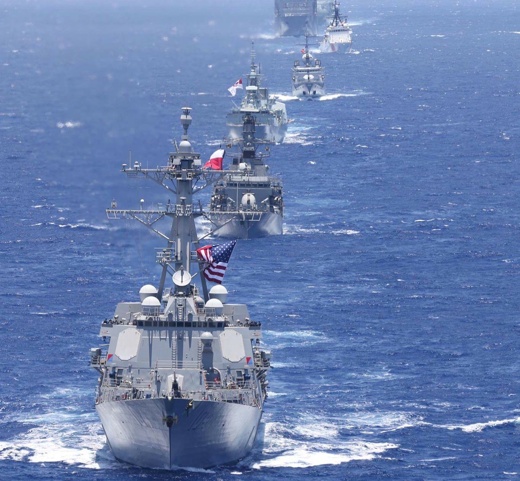
Image above: Naval participants on RIMPAC 2018 on parade for a photo op. From (https://news.usni.org/2018/06/26/rim-of-the-pacific-2018-participation).

For those that don't know RIMPAC is the U.S. Navy term for the "Rim of the Pacific. Evert two years the Navy puts together a nautical dog and pony show that they call RIMPAC "xxxx", where the "xxxx" is the even numbered year in which it takes place.

"Friendly" navy allies from nations proximate to the Pacific Ocean are invited to join the festivities on land, sea and in the air experimenting with new weapons systems, setting off explosives and coordinating he destruction of the planet Earth.

The US Navy likes to show its magnanimity by inviting "potential enemy" nations like China and Russia to join in as observers presumably to scare the crap out of them with the broad show of force. This also gives the nation the option of punishing an "enemy" observer nations with a dis-invitation if they do something we don't like.

This year China was dis-invited (https://www.militarytimes.com/news/your-military/2018/05/23/china-was-just-uninvited-from-rimpac-heres-why/) because it had the gall to continue to build up its presence in the South China Sea. Heaven forfend!

Well here we are again. This year is "RIMPAC 2018"... and it is going on now. Why "Fuck RIMPAC 2018!"? Because it is a costly public relations stunt that pollutes the ocean and kills uncounted numbers of sea creatures. Something we don't need any more of.

Through World War II to date the United States has dominated the Pacific Ocean through diabolic destruction with nuclear weapons and unfettered domination of island peoples. It is a disgusting display.

These RIMPAC war game are headquartered in Hawaii, with Pearl Harbor (on Oahu) and the Pacific Missile Range Facility (on Kauai) playing a major role.

If you don't think these "games" come at a cost to us living on Kauai you are dead wrong. Just go back to our post whale on pod stranding of a whale in Hanalei Bay in 2004 due to RIMPAC activities at the bottom of the list or articles below for a taste of the US Navy's games.

See also:
Ea O Ka Aina: Civil Beat views US military in Pacific 8/20/17
Ea O Ka Aina: "No!" to American Militarism 4/11/17
Ea O Ka Aina: DLNR responsibility on RIMPAC 7/6/16
Ea O Ka Aina: Participation in RIMPAC 2016 6/1/16
Ea O Ka Aina: Judgement against RIMPAC 2016 5/29/16
Ea O Ka Aina: Prepare for RIMPAC War in Hawaii 5/22/16
Ea O Ka Aina: Navy to "take" millions of mammals 5/1
Ea O Ka Aina: Judgement against RIMPAC 2016 4/3/16 
Ea O Ka Aina: Navy's "illegal" War Game 11/17/15
Ea O Ka Aina: US court RIMPAC Impact decision 4/3/15
Ea O Ka Aina: RIMPAC 2014 Impact Postmortem 10/22/14
Ea O Ka Aina: RIMPAC 2014 - another whale death 7/26/14
Ea O Ka Aina: RIMPAC 2014 in Full March 7/16/14
Ea O Ka Aina: 21st Century Energy Wars 7/10/14
Ea O Ka Aina: RIMPAC War on the Ocean 7/3/14
Ea O Ka Aina: Voila - World War Three 7/1/14
Ea O Ka Aina: The Pacific Pivot 6/28/14
Ea O Ka Aina: RIMPAC IMPACT 6/8/14
Ea O Ka Aina: RIMPAC Then and Now 5/16/14
Ea O Ka Aina: Earthday TPP Fukushima RIMPAC 4/22/14
Ea O Ka Aina: The Asian Pivot - An ugly dance 12/5/13
Ea O Ka Aina: Help save Mariana Islands 11/13/13
Ea O Ka Aina: End RimPac destruction of Pacific 11/1/13 
Ea O Ka Aina: Moana Nui Confereence 11/1/13
Ea O Ka Aina: Navy to conquer Marianas again  9/3/13
Ea O Ka Aina: Pagan Island beauty threatened 10/26/13
Ea O Ka Aina: Navy license to kill 10/27/12 
Ea O Ka Aina: Sleepwalking through destruction 7/16/12
Ea O Ka Aina: Okinawa breathes easier 4/27/12
Ea O Ka Aina: Navy Next-War-Itis 4/13/12
Ea O Ka Aina: America bullies Koreans 4/13/12
Ea O Ka Aina: Despoiling Jeju island coast begins 3/7/12
Ea O Ka Aina: Jeju Islanders protests Navy Base 2/29/12
Ea O Ka Aina: Hawaii - Start of American Empire 2/26/12
Ea O Ka Aina: Korean Island of Peace 2/26/12   
Ea O Ka Aina: Military schmoozes Guam & Hawaii 3/17/11
Ea O Ka Aina: In Search of Real Security - One 8/31/10
Ea O Ka Aina: Peace for the Blue Continent 8/10/10
Ea O Ka Aina: Shift in Pacific Power Balance 8/5/10
Ea O Ka Aina: RIMPAC to expand activities 8/3/10
Ea O Ka Aina: RIMPAC War Games here in July 6/20/10
Ea O Ka Aina: Pacific Resistance to U.S. Military 5/24/10
Ea O Ka Aina: Guam Land Grab 11/30/09
Ea O Ka Aina: Guam as a modern Bikini Atoll 12/25/09
Ea O Ka Aina: GUAM - Another Strategic Island 11/8/09
Ea O Ka Aina: Diego Garcia - Another stolen island 11/6/09
Ea O Ka Aina: DARPA & Super-Cavitation on Kauai 3/24/09
Island Breath: RIMPAC 2008 - Navy fired up in Hawaii 7/2/08
Island Breath: RIMPAC 2008 uses destructive sonar 4/22/08
Island Breath: Navy Plans for the Pacific 9/3/07
Island Breath: Judge restricts sonar off California 08/07/07
Island Breath: RIMPAC 2006 sonar compromise 7/9/06
Island Breath: RIMPAC 2006 - Impact on Ocean 5/23/06
Island Breath: RIMPAC 2004 - Whale strandings on Kauai 9/2/04
.

Stop Navy killing marine mammals

SOURCE: Koohan Paik (koohanpaik@gmail.com)
SUBHEAD:  Tell the Navy to examine alternatives that would limit activities harmful to marine mammals.

By Dave Henkin on 6 December 2017 for Earth Justice -
(https://secure.earthjustice.org/site/SPageNavigator/P2A_NavySonar.html)


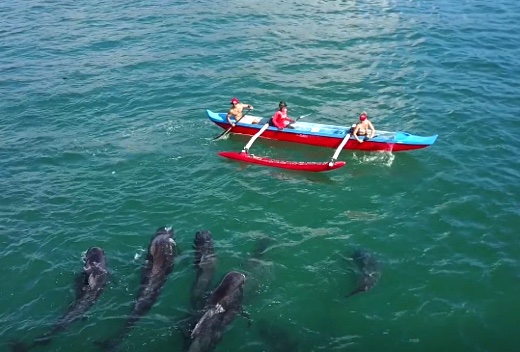
Image above: Outrigger canoe tries to keep this pod of pilot whales from beaching at Kalapaki on Kauai - five of them died. From (http://www.hawaiinewsnow.com/story/36592433/officials-investigating-several-whales-stranded-at-kauais-kalapaki-beach).

The key to reducing harm to marine mammals is to restrict harmful Navy activities in sensitive marine habitat.

Unfortunately, the Navy proposes stripping protections from critical areas.

Thousands of whales, dolphins and other marine mammals could suffer permanent injury—and even death—from warfare training exercises if the Navy walks back their agreement to a reasonable testing and training plan.

Over the next five years, the Navy wants to fire tens of thousands of rockets, missiles and projectiles and blast sonar for tens of thousands of hours in waters off Hawai‘i and Southern California that are home to dozens of vulnerable marine mammal species.

To marine mammals, the deafening sounds from Navy activities can be fatal. In the dark depths of the ocean, these mammals rely almost entirely on sound to “see” their world. It’s how they feed, mate, communicate and navigate. If a whale or dolphin can’t hear, it can’t survive.

Before the Navy can adopt its testing and training plan, it needs to consider public input under the National Environmental Policy Act, or NEPA. You have only until December 12 to tell the Navy to commit to a reasonable plan that achieves military preparedness while maximizing marine mammal safety.


Image above: Two dying pilot whales on the sand at Kalapaki Beach. From (http://www.hawaiinewsnow.com/story/36592433/officials-investigating-several-whales-stranded-at-kauais-kalapaki-beach).

After a landmark settlement with Earthjustice in 2015, the Navy voluntarily agreed to safeguards for whales, dolphins and other marine mammals, protecting vast swaths of vital ocean habitat. But these common sense measures are conspicuously missing from Navy’s draft plan for the next five years of training and testing around the Hawaiian Islands and off Southern California.

The settlement proved that the Navy can both protect our nation and minimize harm to whales and dolphins by limiting the use of sonar and explosives in vital habitats.

The waters off the coast of Southern California are a globally important feeding area for endangered whales, and, for numerous small, resident whale and dolphin populations off Hawai‘i, the islands are literally their only home.

For years, scientists have documented that mid-frequency sonar wreaks havoc on the ocean environment, causing serious impacts to marine mammals, such as permanent hearing loss, lung injuries, strandings, habitat abandonment and even death.

The Navy already acknowledged that it doesn’t need to train in every square inch of the ocean and that it can take reasonable steps to reduce the deadly toll of its activities. Tell it to examine and pursue alternatives that protect both the nation and irreplaceable marine life.

See also: 
Ea O Ka Aina: Air Force plans to bomb whales 2/6/17
Ea O Ka Aina: Hawaiian spinner dolphin restriction 1/9/17
Ea O Ka Aina: Navy to dump 20K tons of poison 11/16/16
Ea O Ka Aina: PMRF injuring marine mammals10/9/16
Ea O Ka Aina: Judgement against RIMPAC 2016 5/29/16
Ea O Ka Aina: US court RIMPAC Impact decision 4/3/15
Ea O Ka Aina: PMRF RIMPAC Claptrap 11/22/14
Ea O Ka Aina: RIMPAC 2014 - another whale death 7/26/14
Ea O Ka Aina: Navy Injury & Death Toll 3/19/14
Ea O Ka Aina: Navy License to Kill 10/9/12
Ea O Ka Aina: Navy admits threat to sea mammals 5/10/12
Ea O Ka Aina: Talk on Ocean Noise 12/28/11
Ea O Ka Aina: Navy to kill Pacific whales 1/17/09

Civil Beat views US military in Pacific

SUBHEAD: Will a military buildup in far-flung Pacific island territories destroy their unique environment?

By Juan Wilson on 20 August 2017 for Island Breath -
(http://islandbreath.blogspot.com/2017/08/civil-beat-views-us-military-in-pacific.html)


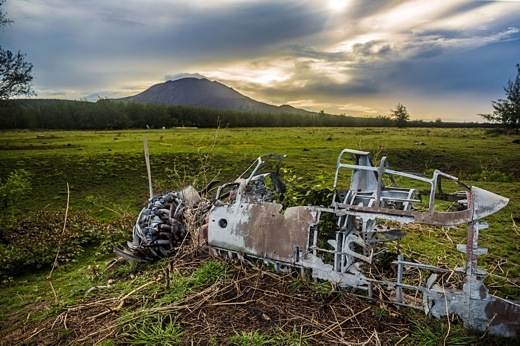
Image above: Phboto of WWII military plane wreck on Pagan Island. the island is now to be used by American forces for target practice. (http://www.civilbeat.org/2016/12/can-these-islands-survive-americas-military-pivot-to-asia/).

Civil Beat is a Hawaiian news agency that has done an excellent job in investigating a wide range of interests throughout the Hawaiian Islands. It stands head and shoulders above the pathetic efforts of the Garden Island News (owned by the Honolulu Star-Advertiser which is owned by a Canadian corporation Black Press).

Civil Beat is a 501(c)3 tax-exempt news organization dedicated to cultivating an informed body of citizens, all striving to make Hawaii a better place. It uses local reporters and covers local, national and international issues. It is one of the few online news sites IslandBreath supports with donations.

Civil Beat has made an important contribution to a better understanding of American military domination in the Pacific. That imperial effort goes back to the Spanish American War and the takeover of Hawaii and continues to this day. 

Civil Beat has put together several articles in one place called Outpost Pacific (http://www.civilbeat.org/projects/pacific-outpost/) covering issues on the Mariana Islands with specific pieces on Pagan Island, Tinian Island, Guam and Farallon de Medinilla.

Already plans for  RIMPAC 2018 are racing ahead. Those are the Rim of the Pacific war games conducted by the US Navy every even numbered year in and around Hawaii that includes more than a dozen navies.

Kauai's Pacific Missile Range Facility (PMRF) and Makaha Ridge Tracking Facility play a large part in those war games and any real war in the Pacific. That makes Kauai, and those other strategic islands occupied by the US military ground zero for any major conflict involving China, North Korea or Russia.

See:
Civil Beat Chapter 1: Can These Islands Survive America’s Military Pivot To Asia?
Civil Beat Chapter 2: The Fight To Save Pagan Island From US Bombs
Civil Beat Chapter 3: Tinian - "We believed in America"
Civil Beat Chapter 4: Guam - Many In This Military Outpost Welcome More Troops
Civil Beat Chapter 5: Missing Data Plagues Military Training Plans In The Marianas

See also:

Ea O Ka Aina: South Korea's stubborn Peace Effort 8/4/17
Ea O Ka Aina: "No!" to America Militrarism in Hawaii 4/11/17
Ea O Ka Aina: Air Force plans to bomb whales 2/6/17
Ea O Ka Aina: MV-22 Osprey landing at Salt Pond 2/5/17
Ea O Ka Aina: Kauai and Niihau endangered 9/24/16 
Ea O Ka Aina: DLNR responsibility on RIMPAC 7/6/16
Ea O Ka Aina: Oceans4Peace Pacific Pivot Panel 6/18/16
Ea O Ka Aina: Ocean 4 Peace Events 6/11/16
Ea O Ka Aina: Prepare for RIMPAC 2016 War in Hawaii 5/22/16
Ea O Ka Aina: Navy to "take" millions of mammals 5/17/16
Ea O Ka Aina: US court RIMPAC Impact decision 4/3/15
Ea O Ka Aina: RIMPAC 2014 Impact Postmortem 10/22/1
Ea O Ka Aina: Marines backing off 8/24/12
Ea O Ka Aina: Unproved Osprey on Kauai 8/21/12
Ea O Ka Aina: RIMPAC 2014 in Full March 7/16/14
Ea O Ka Aina: 21st Century Energy Wars 7/10/14
Ea O Ka Aina: RIMPAC War on the Ocean 7/3/14
Ea O Ka Aina: Voila - World War Three 7/1/14
Ea O Ka Aina: The Pacific Pivot 6/28/14
Ea O Ka Aina: RIMPAC IMPACT 6/8/14
Ea O Ka Aina: RIMPAC Then and Now 5/16/14
Ea O Ka Aina: Earthday TPP Fukushima RIMPAC 4/22/14
Ea O Ka Aina: The Asian Pivot - An ugly dance 12/5/13
Ea O Ka Aina: Help save Mariana Islands 11/13/13
Ea O Ka Aina: End RimPac destruction of Pacific 11/1/13 
Ea O Ka Aina: Moana Nui Confereence 11/1/13
Ea O Ka Aina: Navy to conquer Marianas again  9/3/13
Ea O Ka Aina: Pagan Island beauty threatened 10/26/13
Ea O Ka Aina: Navy license to kill 10/27/12 
Ea O Ka Aina: Sleepwalking through destruction 7/16/12
Ea O Ka Aina: Okinawa breathes easier 4/27/12
Ea O Ka Aina: Navy Next-War-Itis 4/13/12
Ea O Ka Aina: America bullies Koreans 4/13/12
Ea O Ka Aina: Despoiling Jeju island coast begins 3/7/12
Ea O Ka Aina: Jeju Islanders protests Navy Base 2/29/12
Ea O Ka Aina: Hawaii - Start of American Empire 2/26/12
Ea O Ka Aina: Korean Island of Peace 2/26/12   
Ea O Ka Aina: Military schmoozes Guam & Hawaii 3/17/11
Ea O Ka Aina: In Search of Real Security - One 8/31/10
Ea O Ka Aina: Peace for the Blue Continent 8/10/10
Ea O Ka Aina: Shift in Pacific Power Balance 8/5/10
Ea O Ka Aina: RimPac to expand activities 6/29/10
Ea O Ka Aina: RIMPAC War Games here in July 6/20/10
Ea O Ka Aina: Pacific Resistance to U.S. Military 5/24/10
Ea O Ka Aina: De-colonizing the Pacific 5/21/10
Ea O Ka Aina: RIMPAC to Return in 2010 5/2/10
Ea O Ka Aina: Living at the Tip of the Spear 4/5/10
Ea O Ka Aina: Living at the Tip of the Spear 4/15/10
Ea O Ka Aina: Guam Land Grab 11/30/09
Ea O Ka Aina: Guam as a modern Bikini Atoll 12/25/09
Ea O Ka Aina: GUAM - Another Strategic Island 11/8/09
Ea O Ka Aina: Diego Garcia - Another stolen island 11/6/09
Ea O Ka Aina: DARPA & Super-Cavitation on Kauai 3/24/09
Island Breath: RIMPAC 2008 - Navy fired up in Hawaii 7/2/08
Island Breath: RIMPAC 2008 uses destructive sonar 4/22/08
Island Breath: Navy Plans for the Pacific 9/3/07
Island Breath: Judge restricts sonar off California 08/07/07
Island Breath: RIMPAC 2006 sonar compromise 7/9/06
Island Breath: RIMPAC 2006 - Impact on Ocean 5/23/06
Island Breath: RIMPAC 2004 - Whale strandings on Kauai 9/2/04
Island Breath: PMRF Land Grab 3/15/04 


.

US taking on Pacific Wars

 SOURCE: Jon Letman (jonletman@gmail.com)
SUBHEAD: US military must be ready for multi-domain battle with in Pacific tomorrow.

By Sidney Greenberg Jr on 31 January 2017 for Breaking Defense -
(http://breakingdefense.com/2017/01/army-must-ready-for-multi-domain-battle-in-pacific-tomorrow/)


Image above: Land-based missiles could form a risky virtual wall against Chinese aggression in Pacific. Graphic by CSBA. From (http://breakingdefense.com/2016/11/a-bridgehead-too-far-csbas-aggressive-risky-strategy-for-marines/).

[IB Publisher's note: We here in Hawaii are the rehearsal stage for this new and more aggressive "posture" towards the western Pacific.]

With one eye on China and another on North Korea, US Army Pacific is injecting cyber warfare and new joint tactics into every wargame it can.

At least 30 forthcoming exercises — culminating in the massive RIMPAC 2018 — will train troops on aspects of Multi-Domain Battle, the land Army’s effort to extend its reach into the other “domains” of air, sea, space, and cyberspace.

Meanwhile, USARPAC simulations of the concept test near-future weapons such as ship-killer missiles and cruise missile-killing cannon.

“The big advantage we have in the Pacific is we’ve got a boss that is pushing us,” said Gen. Robert Brown, the USARPAC commander, during a visit to Washington last week. That’s Pacific Command chief Adm. Harry Harris, a fan of Multi-Domain Battle. Harris has got PACOM’s components — Army, Air Force, Navy, and Marine — working together as Brown has never seen before, the general said.

There’s a real sense of urgency on Multi-Domain Battle in the Pacific, too Brown told the Center for a New American Security. “This isn’t something 10 years from now,” he said. “If Kim Jong-un goes south tomorrow, I will need some of this tomorrow.”

A land war in North Korea is Gen. Brown’s top concern. That’s where the US Army has stood ready to “fight tonight” since 1953.

But Pyongyang’s investments in nuclear weapons, long-range missiles, drones, cyber attack, and special forces might make a second Korean War murderously more complex than the first. That type of threat drives much of Multi-Domain Battle’s emphasis on air, missile, and cyber defense.

Further south rises the new threat of a naval war with China. Today that’s primarily the Navy’s problem, with the Marines and Air Force in important supporting roles, while the Army plays an essential but unglamorous part in running supply lines and communications for all four services.

But with Adm. Harris’s enthusiastic urging, Multi-Domain Battle envisions ground-based batteries of anti-aircraft, anti-missile, and anti-ship weapons, supported by long-range sensors and jammers, that can strike targets well out to sea. Islands defended by such Army batteries (or Marine Corps outposts) could serve as unsinkable anvils, with the Navy and the Air Force as the highly mobile hammers.


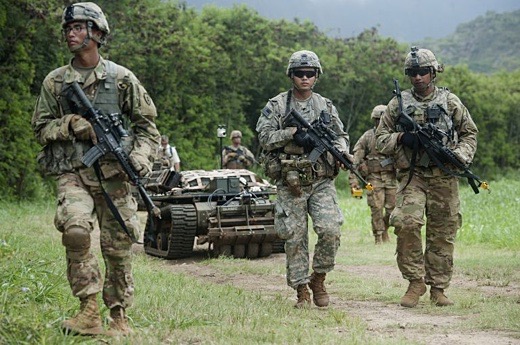
Image above: Punisher unmanned ground vehicle follows soldiers during the PACMAN-I experiment in Hawaii. From original article.

The goal is “a Multi-Domain Battle task force that can provide ballistic missile defense, short-range air defense, cyber, (and) can be mobile and protect itself,” Brown said.

“It is nice to have longer range and be able to affect other domains. It’s, in many cases, a game changer,” Brown told me after his public talk. “In our early tabletops and experimentation and … it has made a difference.” The long-term goal, he said, is to incorporate these new technologies into real-world exercises.

There are lots of things the Army needs to buy. “Number one is Electronic Warfare (EW),” Brown said, detecting, jamming, and deceiving enemy sensors and communications while protecting one’s own. The general envisions “thousands” of cheap decoys generating signals to hide the true locations of Army radars, for example.

Another priority is Short-Range Air Defense (SHORAD), made newly relevant in the age of drones. Both SHORAD and EW suffered massive cutbacks after 1991 and will take years to recover.

But there is plenty the Army can do right now to train itself for Multi-Domain Battle, said Brown. “I never had to worry about cyber (as a young officer),” Brown said. “A company commander from just a few years ago never had to worry that much about cyber, never had to worry that much about space (or) the sea.”

Now USARPAC is adding those other domains to what had been land-only exercises. Army officers must manage liaisons from the other services, coordinate operations across domains, and deal with cyber threats. Making the most of these new tools requires new training and a new mindset, Brown said: “Some of the older leaders in the military would say we need to go back to the basics, but the basics have changed.”


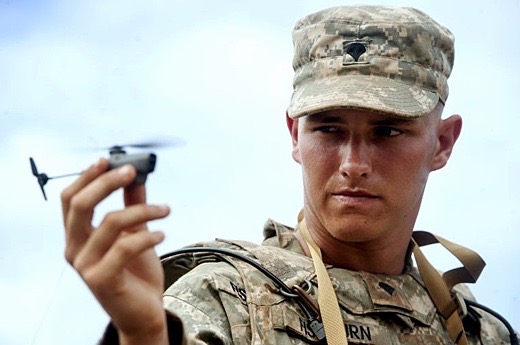
Image above: A soldier holds a PD-100 mini-drone during the PACMAN-I experiment in Hawaii. From original article.

Leadership for the Digital Age
How many domains — land, sea, air, space, cyberspace, electromagnetic, human — can a commander manage at once? “There’s a fine line where you don’t want to overload them too much,” Brown acknowledged, “but I think the younger guys can handle it easily. The folks that are overloaded are the old thinkers, the old guys, those of us forty and above, and we tend to slow them down like crazy.”

That said, the young digital natives have weaknesses of their own. “I’ve had aides, that, when they couldn’t use their app on the phone, they couldn’t navigate their way out of a paper bag,” Brown said.

So Army training exercises increasingly kick away the digital crutch. Just as one of Brown’s units, the Alaska-based 1st Stryker Brigade Combat Team, was about to launch its main offensive at the National Training Center, “the world-class cyber OPFOR (Opposing Force) took out all their coms,” he said. “They had to go back to manual means….It was painful.”

Even when they do have access to all their digital tools, the younger generation have a lower tolerance for frustration and failure, Brown said, and they need older mentors to help them gain perspective. “This generation is more afraid of failure than I’ve ever seen, (because) when they fail, it goes everywhere,” he said. “It’s on Facebook, it’s on Twitter.”

That same glut of digital data makes a difference on the battlefield. “When I was young , the fog of war was not enough information,” Brown recalled. “What’s the fog of war now? Too much information.”

13 years ago, then-Colonel Brown took command of one of the Army’s newly created Stryker brigades, the first units designed from the ground up to exploit wireless networks and computerized command and control.

At first, Brown’s staff would get carried away by their marvelous new technology and drown him in “stacks” of data — when he might have 15 minutes to make a decision. Brown and his officers had to retrain themselves to themselves to winnow through information, not just harvest it.

The Stryker experience gave also gave Brown a new appreciation for initiative. After he ditched his initial “very prescriptive” orders and let his company commanders experiment with the new unit, “we learned a ton from that,” he told me. “I can remember experts sitting there saying, ‘No! You can’t do that!

You can’t use that engineer Stryker that way!’… and then they’d go, ‘Oh, I guess you can.'”
Such bottom-up improvisation became a necessity amidst the guerrilla warfare of Afghanistan an Iraq — a cultural revolution in the chronically bureaucratic Army — and is now a central tenet of Multi-Domain Battle. Army Chief of Staff Mark Milley has even said soldiers must develop “the willingness to disobey specific orders.”

“To be effective in multiple domains, it’s tough…PhD-level work,” said Brown. “You have to have people who you can empower to be effective. You cannot use command and control.” In fact, the Army has formally abandoned the traditional term “command and control,” which emphasized superiors enforcing subordinates’ compliance to orders.

The new doctrine of “mission command” instead emphasizes superiors inculcating a shared vision of the mission and unleashing subordinates’ creativity to accomplish it. “We changed our leadership philosophy,” said Brown, “and that is a key part of multi-domain battle.”

Embracing initiative this way is a competitive advantage for Americans, Brown said.  On a recent trip to China to visit the People’s Liberation Army, he was very impressed in many ways: “Very tough soldiers, amazing equipment,” and in some areas, such as electronic warfare and long-range weapons, “they have surpassed us.”

But the crucial difference is that “they cannot empower their non-commissioned officers or soldiers the way we do,” Brown said. “I maintain that an E-5 Sergeant, the lowest-level sergeant in our Army, does what a colonel does in their army, and better.”

See also:
Ea O Ka Aina: MV-22 Osprey landing at Salt Pond 2/5/17
Ea O Ka Aina: Kauai and Niihau endangered 9/24/16 
Ea O Ka Aina: DLNR responsibility on RIMPAC 7/6/16
Ea O Ka Aina: Oceans4Peace Pacific Pivot Panel 6/18/16
Ea O Ka Aina: Ocean 4 Peace Events 6/11/16
Ea O Ka Aina: Prepare for RIMPAC 2016 War in Hawaii 5/22/16
Ea O Ka Aina: Navy to "take" millions of mammals 5/17/16
Ea O Ka Aina: US court RIMPAC Impact decision 4/3/15
Ea O Ka Aina: RIMPAC 2014 Impact Postmortem 10/22/1
Ea O Ka Aina: Marines backing off 8/24/12
Ea O Ka Aina: Unproved Osprey on Kauai 8/21/12
Ea O Ka Aina: RIMPAC 2014 in Full March 7/16/14
Ea O Ka Aina: 21st Century Energy Wars 7/10/14
Ea O Ka Aina: RIMPAC War on the Ocean 7/3/14
Ea O Ka Aina: Voila - World War Three 7/1/14
Ea O Ka Aina: The Pacific Pivot 6/28/14
Ea O Ka Aina: RIMPAC IMPACT 6/8/14
Ea O Ka Aina: RIMPAC Then and Now 5/16/14
Ea O Ka Aina: Earthday TPP Fukushima RIMPAC 4/22/14
Ea O Ka Aina: The Asian Pivot - An ugly dance 12/5/13
Ea O Ka Aina: Help save Mariana Islands 11/13/13
Ea O Ka Aina: End RimPac destruction of Pacific 11/1/13 
Ea O Ka Aina: Moana Nui Confereence 11/1/13
Ea O Ka Aina: Navy to conquer Marianas again  9/3/13
Ea O Ka Aina: Pagan Island beauty threatened 10/26/13
Ea O Ka Aina: Navy license to kill 10/27/12 
Ea O Ka Aina: Sleepwalking through destruction 7/16/12
Ea O Ka Aina: Okinawa breathes easier 4/27/12
Ea O Ka Aina: Navy Next-War-Itis 4/13/12
Ea O Ka Aina: America bullies Koreans 4/13/12
Ea O Ka Aina: Despoiling Jeju island coast begins 3/7/12
Ea O Ka Aina: Jeju Islanders protests Navy Base 2/29/12
Ea O Ka Aina: Hawaii - Start of American Empire 2/26/12
Ea O Ka Aina: Korean Island of Peace 2/26/12   
Ea O Ka Aina: Military schmoozes Guam & Hawaii 3/17/11
Ea O Ka Aina: In Search of Real Security - One 8/31/10
Ea O Ka Aina: Peace for the Blue Continent 8/10/10
Ea O Ka Aina: Shift in Pacific Power Balance 8/5/10
Ea O Ka Aina: RimPac to expand activities 6/29/10
Ea O Ka Aina: RIMPAC War Games here in July 6/20/10
Ea O Ka Aina: Pacific Resistance to U.S. Military 5/24/10
Ea O Ka Aina: De-colonizing the Pacific 5/21/10
Ea O Ka Aina: RIMPAC to Return in 2010 5/2/10
Ea O Ka Aina: Living at the Tip of the Spear 4/5/10
Ea O Ka Aina: Living at the Tip of the Spear 4/15/10
Ea O Ka Aina: Guam Land Grab 11/30/09
Ea O Ka Aina: Guam as a modern Bikini Atoll 12/25/09
Ea O Ka Aina: GUAM - Another Strategic Island 11/8/09
Ea O Ka Aina: Diego Garcia - Another stolen island 11/6/09
Ea O Ka Aina: DARPA & Super-Cavitation on Kauai 3/24/09
Island Breath: RIMPAC 2008 - Navy fired up in Hawaii 7/2/08
Island Breath: RIMPAC 2008 uses destructive sonar 4/22/08
Island Breath: Navy Plans for the Pacific 9/3/07
Island Breath: Judge restricts sonar off California 08/07/07
Island Breath: RIMPAC 2006 sonar compromise 7/9/06
Island Breath: RIMPAC 2006 - Impact on Ocean 5/23/06
Island Breath: RIMPAC 2004 - Whale strandings on Kauai 9/2/04
Island Breath: PMRF Land Grab 3/15/04 

.

Navy to dump 20K tons of poison

SUBHEAD: US military plans to dump 20,000 tons of heavy metals and explosives into the Oceans.

By Dahr Jamail on 15 November 2016 for Truth Out -
(http://www.truth-out.org/news/item/38374-us-military-plans-to-dump-20-000-tons-of-heavy-metals-and-explosives-into-the-oceans)
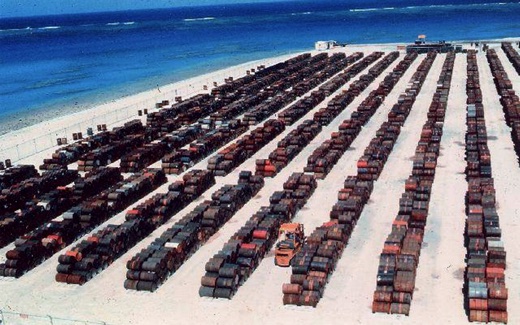

Image above:The former Navy weapons testing site now stores nuclear waste and, shown in this photo,  leaking barrels of Agent Orange that have been there since 1973. Note that the barrels are only a few feet above sea level. But at least there was some management of the material (until the Navy abandoned the site in 2006. The US Navy view of toxic waste is "Out of site - Not our problem!"  Johnston Island is less than 800 miles from Hawaii. From (http://www.environmentandsociety.org/exhibitions/risk-and-militarization/aftermaths).

The US Navy has been conducting war-game exercises in US waters for decades, and in the process, it has left behind tons of bombs, heavy metals, missiles, sonar buoys, high explosives and depleted uranium munitions that are extremely harmful to both humans and marine life.

Truthout recently reported that the Navy has admitted to releasing chemicals into the oceans that are known to injure infants' brains, as well as having left large amounts of depleted uranium in US coastal waters. Now, the Navy's own documents reveal that it also plans to use 20,000 tons of heavy metals, plastics and other highly toxic compounds over the next two decades in the oceans where it conducts its war games.

According to the Navy's 2015 Northwest Training and Testing environmental impact statement (EIS), in the thousands of warfare "testing and training events" it conducts each year, 200,000 "stressors" from the use of missiles, torpedoes, guns and other explosive firings in US waters happen biennially.

These "stressors," along with drones, vessels, aircraft, shells, batteries, electronic components and anti-corrosion compounds that coat external metal surfaces are the vehicles by which the Navy will be introducing heavy metals and highly toxic compounds into the environment.

Just some of the dangerous compounds the Navy will be injecting into the environment during their exercises are: ammonium perchlorate, picric acid, nitrobenzene, lithium from sonobuoy batteries, lead, manganese, phosphorus, sulfur, copper, nickel, tungsten, chromium, molybdenum, vanadium, trinitrotoluene (TNT), RDX [Royal Demolition eXplosive] and HMX  [High Melting eXplosive], among many others.

"None of these belong in the ocean's food web, upon which we all depend," Karen Sullivan, a retired endangered species biologist who cofounded West Coast Action Alliance, which acts as a watchdog of Naval activities in the Pacific Northwest, told Truthout. "Nor will the Navy be willing to clean it up, or even contribute to medical tests for people whose health may suffer."

A worrying example of that fact: In August of this year, a lawmaker in Pennsylvania urged 70,000 residents across three counties whose drinking water was contaminated by the Navy to sue them, just to get funding to pay for blood tests to see how sick they had become.

Other examples of US citizens being treated as collateral damage abound.

Just this October, the BBC reported on an Air Force Base leaking toxic chemicals into the sewer system, and the port of San Diego filed a federal lawsuit against the Navy for injecting an underground plume of toxic chemicals that threatens to contaminate the entire bay.

But stories like these are only the tip of an impending iceberg.

Experts Truthout spoke with warn that if the Navy gets its way, the next 20 years will see them causing far more environmental degradation and destruction up and down US coastal areas by way of widespread chemical and toxic contamination.

Insidious Contamination
The Navy is, like all the other branches of the US military, ridiculously well-funded. Recent history shows that US military spending dwarfs the rest of the planet's military spending.

"For the last half-century, US military spending has purchased the annihilation of millions throughout Southeast Asia, the Arab world, and Central Asia," Mozhgan Savabieasfahani, an environmental toxicologist and winner of the 2015 Rachel Carson prize for her work on depleted uranium (DU) and heavy metal contamination, told Truthout. "Accompanying that human annihilation has been environmental devastation and birth defects, from Vietnam to Iraq."

Her strong words are backed by clear, cold facts that come from even mainstream media sources in the US, like Newsweek magazine, which in a 2014 article titled "The US Department of Defense Is One of the World's Biggest Polluters" stated:
The US Department of Defence [sic] is one of the world's worst polluters. Its footprint dwarfs that of any corporation: 4,127 installations spread across 19 million acres of American soil. Maureen Sullivan, who heads the Pentagon's environmental programs, says her office contends with 39,000 contaminated sites.
Even as far back as 1990, the US Department of Defense had already admitted to creating more than 14,000 suspected contamination sites across the planet.
The US Safe Drinking Water Act defines "contaminant" as: " ... any physical, chemical, biological or radiological substance or matter in water. Drinking water may reasonably be expected to contain at least small amounts of some contaminants. Some contaminants may be harmful if consumed at certain levels in drinking water. The presence of contaminants does not necessarily indicate that the water poses a health risk."
Thus, contamination being a matter of scale, the government creates a "not-to-exceed" level based on what it knows about each contaminant, in order to minimize human exposure to each item on its massive list of contaminants.
However, the contamination guidelines don't account for the kind of pollution perpetrated by the US Navy.
"What do you do when it's massive quantities of contaminants in the ocean, and not your drinking water?" asked Sullivan, who worked at the US Fish and Wildlife Service for more than 15 years and is an expert in the bureaucratic procedures the Navy is supposed to be following.
She pointed out how "contamination," or water pollution, is defined as "environmental degradation that occurs when pollutants are directly or indirectly discharged into water bodies without adequate treatment to remove harmful compounds."
On that point she said, "None of the dangerous compounds being dumped into our waters by the Navy have ever been treated or removed, which leads to hearing this false choice: The cost of cleanup or removal would be exorbitant. Therefore, we should continue dumping as always, in perpetuity."
Navy spokesperson Sheila Murray told Truthout that depleted uranium on the seafloor was no more harmful than any other metal, a statement that flies in the face of numerous scientific studies that have proven otherwise. Sullivan believes that, by making that statement, the Navy "has disavowed responsibility for all of this toxic ocean pollution."

Savabieasfahani said that while the Navy may be content to add depleted uranium to the environment that already has high levels of man-made pollutants, we should not share its complacency.
"A cluster of worsening environmental phenomena go hand-in-hand with that accumulation of pollutants," she told Truthout. "Global warming, mass extinctions, ecosystem collapse, food-web modification, physical and biological changes in organisms, endocrine disruption, and a pandemic of neurodevelopmental disorders in children accompany those rising background pollution levels. Peer-reviewed research is already showing steep declines in the biodiversity of ecosystems."

How Much Contamination?
According to Sullivan, who studied the EIS, the Navy plans to introduce 20,000 tons of contaminants into the environment, which is the equivalent of dumping a load of toxins the size of a Yorktown-class aircraft carrier scattered throughout the seas and sounds of coastal Washington, Oregon and Northern California.

As staggering as that amount is, it does not even include contaminants that have been released over the last six decades of Naval exercises in oceans around the globe (the plans mentioned in these documents are limited to Pacific Northwest waters).

The aforementioned list of toxic compounds the Navy has, is and is planning to release into the environment via its exercises are documented in EPA Superfund site lists as known hazards and all of them are highly toxic at both acute and chronic levels.

For example, perchlorates are highly soluble in water and according to the EPA, "generally have high mobility in soils." They have been found in breast milk, target the thyroid gland and affect children and fetuses more than they affect adults.

Lithium causes behavioral changes that, in large animals and humans, can be fatal. Ingestion of merely one to two grams of picric acid would cause severe poisoning. TNT remains active underwater, can bioaccumulate in fish, including salmon, and can cause developmental and physiological problems, according to scientific studies. HMX and RDX explosives are both well documented to be extremely toxic and dangerous.

Sullivan says all of this raises questions about why there are no regulations preventing the creation of Superfund sites (polluted locations that require intensive clean-up) in the ocean. "We depend on salmon, yet the Navy is creating massive ecosystem-wide pollution right under our noses," Sullivan said. "How can they not see that it will be generations from now who reap the bitter harvest?"
Savabieasfahani agreed and took it a step further, issuing a dire warning.

"Toxic metals, such as lead and uranium, are biomagnified," she explained."'Biomagnification' means that toxins get more concentrated in an organism which ingests plants or animals containing that toxin. For example, contaminated fish can pass on large doses of toxin to their human consumers."

The 20,000 tons of contaminants the Navy plans to release into the ocean in the coming years do not include the additional 4.7 to 14 tons of "metals with potential toxicity" that will be "released" annually in the inland waters of both Puget Sound and Hood Canal, according to Naval documents.

Given that those numbers are for one year only, in 20 years, between 94 and 280 tons of heavy metals will be released inland (in addition to what will be released in the open ocean).

It is also worth noting that two actual Superfund sites along Washington's inland shorelines are both on Naval property.

"In addition to the toxic contaminants deliberately dumped, what happens to their land-based toxic brews when torrential rains like we had in October overwhelm storm water runoff systems?" Sullivan asked, then provided the answer. "They end up in Puget Sound and Hood Canal."

Devils in the Details
Naval documentation also reveals that over the next 20 years, the weights of the various contaminants include 6,739 tons of unrecoverable sonobuoys (including their animal-entangling parachutes and batteries which leach lithium for 55 years), and 396 tons of small-caliber rounds, the latter comprising only 2 percent of the total weight of "expended materials."

The Navy's flares, which weigh between 12 and 30 pounds apiece, are used 824 times annually, adding up to 16,480 flares weighing between 200,000 and 500,000 pounds over 20 years.

The Navy admits that the flares leave toxic residues whenever they are used, saying, "Solid flare and pyrotechnic residues may contain, depending on their purpose and color, an average weight of up to 0.85 pounds of aluminum, magnesium, zinc, strontium, barium, cadmium, nickel, and perchlorates."
Meaning, at a minimum, seven tons of toxic pyrotechnic residues are to be introduced into Pacific Northwest waters in the next 20 years.

Looking at explosives for training alone, the Navy plans to use 29,024 pounds annually, amounting to 290 tons over the next two decades.

Another issue is unexploded ordnance, or, as it's commonly known, "duds."
At current Navy rates for duds only, we would see an additional nine tons of dangerous residual explosive material fired into Pacific Northwest waters every 20 years, sitting on the ocean floor, leaching dangerous toxics.

Moreover, not all contaminants immediately sink and bind to or get encapsulated by sediments. Some materials can be transported by ocean currents.

Because the Navy's EIS uses ocean dispersal and chemical degradation as its rationale for claiming no adverse impacts on species or habitats -- anywhere, ever -- it should be noted that the expended material from local warfare exercises may not tell the whole story. In other words, perhaps all of the contaminants in question should be added together to get an idea of the full impact.

For example, every other year, according to the Navy, they are authorized to dump up to 352,000 pounds of expended military materials, by way of them being shot, dropped and exploded, into the Gulf of Alaska. This includes up to 10,500 pounds of hazardous materials, such as cyanide, chromium, lead, tungsten, nickel, cadmium, barium chromate, chlorides, phosphorus, titanium compounds, lead oxide, potassium perchlorate, lead chromate, ammonium perchlorate, fulminate of mercury and lead azide.

The Navy is dumping much of it into Essential Fish Habitat in the Gulf of Alaska at peak times of fishery and marine mammal presence, impacting and harming a multitude of species. They are also carrying out a similar dumping process in Pacific Northwest waters.

Naval Obfuscation
In the Navy's 2015 Northwest Training and Testing EIS, it quotes several studies, saying, "contamination of the marine environment by munitions constituents is not well documented." This is often the Navy's claim, used to show its actions are not deleterious to the environment, when "not well documented" actually means that it has not looked for or measured its impacts on the environment. Regardless, the need for more data does not mean it is scientifically sound to assume there has been no damage.

In the section of the 2015 EIS on Cumulative Impacts, the Navy says, "Long-term exposure to pollutants poses potential risks to the health of marine mammals, although for the most part, the impacts are just starting to be understood." The impacts include " ... organ anomalies and impaired reproduction and immune function." There are multiple other examples of such doublespeak within the Navy's own documents.

Another example is in the EIS section on Sediments and Water Quality, where the Navy claims that "slow but significant removal" of two types of explosive material (RDX and HMX) happens through a chemical reaction whose speed is dictated by the pH [acidity] of seawater. Adequate proof is not provided by the Navy, yet risks to human health from these toxins has been extremely well documented.

It could be argued that the Navy's gross negligence of its environmental impacts amounts to a federal agency passing off wishful thinking as science. The toxic legacy of this negligence will be passed down to generations far beyond our own.


• Dahr Jamail, a Truthout staff reporter, is the author of The Will to Resist: Soldiers Who Refuse to Fight in Iraq and Afghanistan (Haymarket Books, 2009), and Beyond the Green Zone: Dispatches From an Unembedded Journalist in Occupied Iraq (Haymarket Books, 2007). Jamail reported from Iraq for more than a year, as well as from Lebanon, Syria, Jordan and Turkey over the last 10 years, and has won the Martha Gellhorn Award for Investigative Journalism, among other awards.

[IB Publisher's note: As an example of US Navy failed cleanup efforts check out this from Wilikpedia (https://en.wikipedia.org/wiki/Johnston_Atoll)
" Over the years, leaks of Agent Orange as well as chemical weapon leaks in the weapon storage area occurred where caustic chemicals such as sodium hydroxide were used to mitigate toxic agents during cleanup. Larger spills of nerve and mustard agent within the MCD at JACADS also took place. Small releases of chemical weapon components from JACADS were cited by the EPA. Multiple studies of the Johnston Atoll environment and ecology have been conducted and the Atoll is likely the most studied island in the Pacific.[11]

Dr. Lisa Lobel's work at the Atoll on the impact of PCB contamination in reef damselfish (Abudefduf sordidus) demonstrated that embryonic abnormalities could be utilized as a metric for comparing contaminated and uncontaminated areas.[52] Some PCB contamination in the lagoon was traced to Coast Guard disposal practices of PCB laden electrical transformers.

In 1962 Plutonium pollution following three failed nuclear missile launches was heaviest near the destroyed launch emplacement, in the lagoon offshore of the launch pad and near Sand Island. The contaminated launch site was stripped, the debris gathered and buried in the island's 1962 expansion.

A comprehensive radiological survey was completed in 1980 to record transuranic contamination remaining from the 1962 THOR missile aborts. The Air Force also initiated research on methods to remove dioxin contamination from soil resulting from leakage of the stored Herbicide Orange.[11] Since then, U.S. defense authorities have surveyed the island in a series of studies.

Contaminated structures were dismantled and isolated within the former THOR Launch Emplacement No. 1 (LE-1) as a start for the cleanup program. About 45,000 tons of soil contaminated with radioactive isotopes was collected and placed into a fenced area covering 24 acres (10 ha) on the north of the island. The area was known as the Radiological Control Area, but dubbed "The Pluto' Yard" because its heavy contamination with highly radioactive Plutonium.[15][53]

The Pluto yard is on the site of the LE1 emplactment where the 1962 missile explosion occurred and also where a highly contaminated loading ramp was buried that was made for loading plutonium contaminated debris onto small boats that was dumped at sea. Remediation included a plutonium "mining" operation called the Johnston Atoll Plutonium Contaminated Soil Cleanup Project.

The collected radioactive soil and other debris was buried in a landfill created within the former LE-1 area from June 2002 through November 11, 2002. Remediation at the Radiation Control Area included the construction of a 61 centimeters thick cap of coral sealing the landfill. Permanent markers were placed at each corner of the landfill to identify the landfill area.[11]

The atoll was placed up for auction via the U.S. General Services Administration (GSA) in 2005 before it was withdrawn. The stripped Johnston Island was briefly offered for sale with several deed restrictions in 2005 as a "residence or vacation getaway," with potential usage for "eco-tourism" by the GSA's Office of Real Property Utilization and Disposal."
And this about Vieques Island in Puerto Rico where the Navy was present for decades and ceased operations on the island in 2003. Check out (http://www.nytimes.com/2009/08/07/science/earth/07vieques.html):
"The Navy has begun removing hazardous unexploded munitions from its old training ground by detonating them in the open air. It also proposes to burn through nearly 100 acres of dense tropical vegetation to locate and explode highly sensitive cluster bombs.

But what could have been a healing process has been marred by lingering mistrust. As the Navy moves to erase a bitter vestige of its long presence here, residents assert that it is simply exposing them again to risk.

“The great majority of emergency room visits here last year were for respiratory problems,” said Evelyn Delerme Camacho, the mayor of Vieques. “Can they guarantee that contaminants or smoke won’t reach the population? Would we have to wait and see if there’s a problem?”

The cleanup comes as the local Vieques government and most of the island’s 9,300 residents pursue claims against the United States government for contamination and for illnesses that they assert are linked to pollutants released during decades of live-fire and bombing exercises beginning in World War II.
Given the history of grievances, many locals are aghast that the Navy’s methods involve burnings and detonations whose booms can be heard in some residential areas, setting people on edge. They have spoken out at public hearings and in legislative resolutions.

But Christopher T. Penny, head of the Navy’s Vieques restoration program, said the unexploded bombs are too powerful to be set off in detonation chambers. And he said that experiments to cut through the dense vegetation with a remote-control device had not had much success."
See also:
Ea O Ka Aina:Navy says Depleted Uranium okays 10/31/16
Ea O Ka Aina: Navy Polluting East Pacific Territories 10/17/16 
Ea O Ka Aina: PMRF injuring marine mammals 10/9/16
Ea O Ka Aina: Osprey endanger Kauai 9/23/16

Ea O Ka Aina: Federal Court slams Navy Sonar 7/16/16
Ea O Ka Aina: DLNR responsibility for RIMPAC 7/5/16
Ea O Ka Aina: Oceans4Peace Pacific Pivot Panel 6/18/16
Ea O Ka Aina: Ocean 4 Peace Events 6/11/16
Ea O Ka Aina: Kauai and Niihau endangered 9/23/16
Ea O Ka Aina: Prepare for RIMPAC War in Hawaii 5/22/16
Ea O Ka Aina: Navy to "take" millions of mammals 5/17/16
Ea O Ka Aina: US court RIMPAC Impact decision 4/3/15
Ea O Ka Aina: RIMPAC 2014 Impact Postmortem 10/22/1
Ea O Ka Aina: RIMPAC 2014 in Full March 7/16/14
Ea O Ka Aina: 21st Century Energy Wars 7/10/14
Ea O Ka Aina: RIMPAC War on the Ocean 7/3/14
Ea O Ka Aina: Voila - World War Three 7/1/14
Ea O Ka Aina: The Pacific Pivot 6/28/14
Ea O Ka Aina: RIMPAC IMPACT 6/8/14
Ea O Ka Aina: RIMPAC Then and Now 5/16/14
Ea O Ka Aina: Earthday TPP Fukushima RIMPAC 4/22/14
Ea O Ka Aina: The Asian Pivot - An ugly dance 12/5/13
Ea O Ka Aina: Help save Mariana Islands 11/13/13
Ea O Ka Aina: End RimPac destruction of Pacific 11/1/13 
Ea O Ka Aina: Moana Nui Confereence 11/1/13
Ea O Ka Aina: Navy to conquer Marianas again  9/3/13
Ea O Ka Aina: Pagan Island beauty threatened 10/26/13
Ea O Ka Aina: Navy license to kill 10/27/12
Ea O Ka Aina: Unproved Osprey on Kauai 8/21/12
Ea O Ka Aina: Sleepwalking through destruction 7/16/12
Ea O Ka Aina: Okinawa breathes easier 4/27/12
Ea O Ka Aina: Navy Next-War-Itis 4/13/12
Ea O Ka Aina: America bullies Koreans 4/13/12
Ea O Ka Aina: Despoiling Jeju island coast begins 3/7/12
Ea O Ka Aina: Jeju Islanders protests Navy Base 2/29/12
Ea O Ka Aina: Hawaii - Start of American Empire 2/26/12
Ea O Ka Aina: Korean Island of Peace 2/26/12   
Ea O Ka Aina: Military schmoozes Guam & Hawaii 3/17/11
Ea O Ka Aina: In Search of Real Security - One 8/31/10
Ea O Ka Aina: Peace for the Blue Continent 8/10/10
Ea O Ka Aina: Shift in Pacific Power Balance 8/5/10
Ea O Ka Aina: RimPac to expand activities 6/29/10
Ea O Ka Aina: RIMPAC War Games here in July 6/20/10
Ea O Ka Aina: Pacific Resistance to U.S. Military 5/24/10

Ea O Ka Aina: Guam Land Grab 11/30/09
Ea O Ka Aina: Guam as a modern Bikini Atoll 12/25/09
Ea O Ka Aina: GUAM - Another Strategic Island 11/8/09
Ea O Ka Aina: Diego Garcia - Another stolen island 11/6/09
Ea O Ka Aina: DARPA & Super-Cavitation on Kauai 3/24/09
Island Breath: RIMPAC 2008 - Navy fired up in Hawaii 7/2/08
Island Breath: RIMPAC 2008 uses destructive sonar 4/22/08
Island Breath: Navy Plans for the Pacific 9/3/07
Island Breath: Judge restricts sonar off California 08/07/07
Island Breath: RIMPAC 2006 sonar compromise 7/9/06
Island Breath: RIMPAC 2006 - Impact on Ocean 5/23/06
Island Breath: RIMPAC 2004 - Whale strandings on Kauai 9/2/04
Island Breath: PMRF Land Grab 3/15/04
.
Navy says Depleted Uranium okay

SUBHEAD: It says its spent depleted uranium ordinance is not a problem laying in coastal waters.

By Dahr Jamail on 31 October 2016 for Truth Out -
(http://www.truth-out.org/news/item/38185-the-navy-s-use-of-depleted-uranium-in-our-coastal-waters-threatens-humans-wildlife)


Image above: Naval gunners inspect ammunition containing depleted uranium in a photo taken on November 1, 1987. Photo by US Navy. From original article.

Earlier this month, Truthout reported that the US Navy is knowingly introducing toxic metals and chemicals into the environment during its war game exercises.

Sheila Murray with the Navy Region Northwest's public affairs office, when asked what the Navy was doing to mitigate environmental contamination from the large numbers of Depleted Uranium (DU) rounds it left on the seabed off the Pacific Northwest Coast claimed current research "does not suggest short- or long-term effects" from the release of DU to the environment that could result in its uptake by marine organisms."

She also said that DU rounds "are extremely stable in sea water and pose no greater threat than any other metal."

In response to this, Mozhgan Savabieasfahani, an environmental toxicologist and winner of the 2015 Rachel Carson Prize environmental award for her work on DU and heavy metal contamination, told Truthout, "The US Navy representative's views exhibit an alarming level of amnesia."

She said this because Murray's statement has been one that has been recycled by the Navy for years. Reuters reported in January 2003 that the Navy confirmed its use of DU shells in arms tests off the Washington State coast, at which time the Navy claimed, "The DU rounds dissolve so slowly that they would not contribute to naturally occurring (radiation) levels ... and do not pose a significant risk."

Meanwhile, ample scientific reports -- including Savabieasfahani's own research -- demonstrate the deleterious health impacts caused by DU.

"When those bullets and bombs explode, dangerous nanoparticles of metals, including uranium nanoparticles, are released into the environment," she explained to Truthout. "Laboratory research has already established that exposure to environmentally relevant concentrations of uranium has negative impacts on fish embryogenesis, and on the reproductive success of fish."

Naval documents show that as much as 34 tons of DU could be present on the seabed just 12 miles from the outer coast of Washington State.

Even more distressing, the Navy's own documents reveal that the extent of its use of DU off the coast of the US is far more pervasive than it admits to the public.

And results of a Freedom of Information Act filing provided to Truthout show that the Navy, which claims in its environmental impact statements it has not used DU since 2008, has actually shipped it from a Puget Sound munitions area as recently as 2011.

A Bogus Study
The Navy's public affairs officer, Murray, also told Truthout that a "recent study" of an area off the south coast of England that was used for test firing DU rounds "did not show presence of DU in sample of intertidal and ocean bottom sediments, seaweed, mussels, and locally caught lobster and scallops. (Toque, 2006)."

However, the study Murray cites -- and which the Navy consistently cites when arguing that DU is not harmful -- is heavily disputed.

Carol Van Strum, an Oregon-based environmental advocate who has researched DU for years, told Truthout that Murray's statement is "an out-and-out lie."

Van Strum, who has read the Toque study closely and knows it well, pointed out that, for starters, the study's author works for a British military contractor. She went on to point out two very serious flaws in the study.

"While the study relied on 'locally caught' lobster and scallops as samples for testing for depleted uranium, the samples were never 'caught' but rather bought in a local market, and thus could have come from anywhere," Van Strum explained. "Second, and most worrisome ... the actual study reports depleted uranium contamination in nearly all of the samples."

The Navy's Environmental Impact Statement (EIS) on the matter claims "the survey results show no evidence of DU being present in any marine environmental sample collected in the year 2004."

But Van Strum called their claim "incontrovertibly false" because the study itself stated it had found DU contamination in the soil in many areas where the military was operating cannons, in the soil where ordnance had been fired, and in the soil, sea water and marine life where the ordnance they had fired had landed.

"The study's methodology would not pass muster for even a high school science project," Van Strum said.

Karen Sullivan, a retired endangered species biologist who co-founded the website West Coast Action Alliance that acts as a watchdog of Naval activities in the Pacific Northwest, questioned why the Navy would open itself up to accusations of bias by relying on only a single study done by someone who works for a group affiliated with the British military.

"Why would the Navy rely on such a flawed and obviously biased study to 'prove' that DU in seawater poses no threat greater than any other metal?" Sullivan, who worked at the US Fish and Wildlife Service for more than 15 years and who is an expert in the bureaucratic procedures the Navy is supposed to be following, asked in an interview with Truthout. "Probably because the enormous body of properly conducted and unbiased science completely refutes it."

Van Strum went on to point out additional significant problems with the study, including the almost laughable procurement and use of the samples.

"For starters, the entire sampling of marine organisms consisted of a bucket of mussels, 0.9 kg of shelled scallops, and three lobsters," Van Strum explained.

"In a section straight out of Monty Python, named 'Seafood purchase methodology,' the author reports with a straight face that the three lobsters and the scallops were bought in a shop in Kirkcudbright, 'and boiled within a day of purchase'."

Yet even in what was obviously a bogus sample, both uranium and DU were found.

"Not even truly creative data contortions support the [Navy's] 'no evidence of DU' conclusion," Van Strum said.

"For example, all uranium found in the shelled, cooked mussels was attributed by legerdemain [sleight of hand] to bits of uranium-contaminated sediment or shell that 'may have accidentally contaminated' the meat.

And even after the high level of uranium in one of three lobsters was reduced 81 percent -- applying a completely unreferenced and phenomenally high dry/wet weight ratio -- the level was still twice the mean for all of the UK, at which point the author simply concludes that 'such a low concentration is not deemed significant'."

Additionally, a 2007 Naval Budget Proposal, shows a gun being upgraded to fire 25mm DU rounds (see page 32).  According to the proposal, there were over 100 guns of this type for that year. These facts beg the question: How could the Navy possibly be "phasing out" DU, as it claims to be doing?

Human Health Impacts of DU "Quite Relevant" to Naval Exercises
"Navy exercises in the waters of the Pacific Northwest will release contaminants into the marine environment, with an undeniable potential to harm human health," Savabieasfahani said, noting that this would apply even to low-level amounts of DU being introduced into the oceans. "It is long established that explosives can contaminate soil, sediment and water and thereby impact environmental and human health."

She explained that the human and environmental impacts of the Navy's use of DU in past exercises is "quite relevant," and cited a report that showed how DU exposure has been linked to lower cognitive ability in adults.

"This leads us to expect much worse impacts on growing children, newborns and infants -- to say nothing of unborn babies," Savabieasfahani added.

"Furthermore, epidemiological evidence is also consistent with an increased risk of birth defects in the children of people exposed to DU."

She also heavily emphasized the fact that the internalization of uranium in any form will result in both chemical and radiation exposure.

"Once inside a living body, DU and uranium's effects are virtually the same," Savabieasfahani explained. "This is a point worth repeating."

Moreover, Savabieasfahani emphasized that it's dangerous to guesstimate "safe" levels of DU, whether or not it reaches levels determined to be "toxic."

"Our knowledge of the human health impacts of DU is consistent with laboratory studies of other mammals," she said. "DU exposure affects neurogenesis during prenatal and postnatal brain development by disrupting patterns of cell proliferation and cell death. Even sub-toxic levels of DU have been shown to alter brain function."

She also took issue with Murray's argument, which Savabieasfahani described as, essentially, "the solution to pollution is dilution." This is the nuclear industry's default argument about radiation and other forms of pollution, and has been for decades, despite the fact that this logic was "decisively rejected" more than 40 years ago.

Savabieasfahani pointed out that even Richard Nixon's EPA administrator, William Ruckelshaus, rejected the dilution argument in a 1972 Congressional testimony regarding the Clean Water Act.

Savabieasfahani noted that any upcoming Naval exercises that introduce heavy metals and other pollutants, regardless of whether they use DU, will increase the environmental "background burden" of DU and other pollutants.

"Increasing that burden is simply irresponsible," Savabieasfahani said. "Seabed pollutants have already found their way into our bodies. Those pollutants will continue to impact the most vulnerable populations -- infants, newborns and growing children -- most profoundly, and their imprint will be found in the baby teeth of our children."

Other Instances of DU
Problems with DU in the Pacific Northwest are not limited to the Navy.

At Washington's Joint Base Lewis-McChord, as well as the Yakima Training Center, there has not been any cleanup of contaminated areas or disposal of dangerous rounds, despite confirmed reports of contamination in nearby areas. I

t is also worth noting that, while no direct link has been proven, the lung cancer rate for Pierce County, Washington, where Lewis-McChord Base is located, is among the highest in the entire state.

Truthout asked Sullivan to comment on this. She pointed out that rather than cleaning up these areas, the US Army requested a "master permit" from the Nuclear Regulatory Commission (NRC) "to leave in place -- laying on the surface -- all the DU munitions and bombs it has ever fired, since 1960, at nearly 20 bases throughout the United States."

That permit was granted in March. It includes Joint Base Lewis-McChord, where, according to Sullivan, 750 pounds of pure DU are lying on open grounds, in fragments and inhalable dust. This is significant: DU dust tends to blow around and leach into groundwater, contaminating both soil and drinking water.

According to the permit, 12,566 pounds of DU fragments and dust remain, lying out in the open, across military bases throughout the US.

Furthermore, a March 2016 "Safety Report" by the NRC shows that the commission never required the Army to collect and dispose of DU debris. It also noted that the Army asked to not be required to disclose the qualifications of each base's Garrison Radiation Safety Officer (RSO) any time there was a change in personnel, "for privacy and administrative burden reasons."

The NRC agreed to forego that requirement. This means that the NRC will not know the qualifications of each base's RSO unless it specifically asks for it, so it is possible that an RSO may not even be qualified as a radiation safety expert.

All of these factors add up to an extremely disconcerting situation, given that a recent independent study states clearly, "The annual dose limit for the population can be exceeded within a few years from DU deposition for soil inhalation."

Sullivan is concerned that, while the Army takes at least some precautions towards preventing troop exposure, "actual public health is given short shrift."

"For what it's worth, the phrase 'public health' is mentioned only once in the entire Safety Report, in reference to a regulation," Sullivan said. "The phrase 'public dose' is mentioned 10 times."

Lastly, to screen for groundwater contamination, the Army has proposed to sample some wells near its bases. However, the NRC noted, "The Army states that the DU concentration in groundwater coming from soil depends on several factors, which they have not measured for any RCA (Radiation Controlled Area)."

Sullivan expressed grave concern over the fact that the Army has not measured for radiation in these areas.

"Then how would they know?" she asked. "Perhaps it's a way to justify the perennial statement the public has come to expect from so-called 'public processes' that always end in false platitudes like the one the Army delivered: They concluded that groundwater or any other contamination is 'not significant'."

While it remains unclear if DU is still being used by the Navy or Army, what is clear is that they are not sufficiently cleaning up the DU they have already introduced into the environment, nor are they taking steps to mitigate its potential harm to their own soldiers, the general population, and the environment.

• Dahr Jamail, a Truthout staff reporter, is the author of The Will to Resist: Soldiers Who Refuse to Fight in Iraq and Afghanistan (Haymarket Books, 2009), and Beyond the Green Zone: Dispatches From an Unembedded Journalist in Occupied Iraq (Haymarket Books, 2007). Jamail reported from Iraq for more than a year, as well as from Lebanon, Syria, Jordan and Turkey over the last 10 years, and has won the Martha Gellhorn Award for Investigative Journalism, among other awards.
His third book, The Mass Destruction of Iraq: Why It Is Happening, and Who Is Responsible, co-written with William Rivers Pitt, is available now on Amazon.


.