Showing posts with label Transparency. Show all posts

A Commons Based Economy

SUBHEAD: Presentation by Michel Bauwens of what a Commons based economy will look like.

By By David Bollier on 27 June 2015 for Bollier.org -
(http://www.bollier.org/blog/michel-bauwens-heres-what-commons-based-economy-looks)


Image above: Michel Bauwens photographed for article about the Catalan Integral Cooperative. From (http://commonstransition.org/catalan-integral-cooperative/).

So what might a commons-based economy actually look like in its broadest dimensions, and how might we achieve it?  My colleague Michel Bauwens of the P2P Foundation offers a remarkably thoughtful and detailed explanation in a just-released YouTube talk, produced by FutureSharp. It’s not really a video – just Michel’s voiceover and a simple schematic chart – but the 20-minute talk does a great job of sketching the big-picture strategies that must be pursued if we are going to invent a new type of post-capitalist economy.

Michel focuses on the importance of three specific realms that are crucial to this new vision – ecological sustainability, open knowledge and social solidarity. Each is critical as a field of action for overturning the existing logic of market capitalism.

Fortunately, there are many promising developments in each of these realms. Many parts of the environmental movement seek to go beyond the standard “market-oriented solutions.” There is a growing body of open source-inspired projects for software code, information, design and physical production, which is now spawning new types of global sharing of information with distributed local production.

And there are many advocates and initiatives for social justice and fairness in the economy, such as cooperatives and the solidarity economy movement.

The problem, says Bauwens, is that these movements do not generally connect with each other or coordinate internationally. He therefore sees the need for “meta-economic networks” to bridge these fields of action.

So, for example, we need “open cooperativism” enterprises to bridge open knowledge systems and cooperatives, so that open network (or licensed) systems are not simply dominated by large corporations in the way that Google, Uber and Airbnb have done.

We also need to develop an “open source circular economy” to bridge the worlds of eco-sustainability and open knowledge.  We will never address major environmental problems if the technological and product solutions are based on proprietary knowledge; open circulation of knowledge can change that.

Bauwens also sketches a compelling scenario by which commons-based projects can begin to develop a new politics through such vehicles as a new “ethical entrepreneurial coalition,” a “Chamber of Commons,” and “Commons Assemblies.”

He calls for new types of cooperative finance that can support sustainable production (based on the idea of sufficiency shared by all) as well as the mutualizing of knowledge (vs. its privatization via patents and copyright) and social solidarity (to ensure just and fair distribution of any surplus value created).

While the overall vision may strike skeptics as utopian, the truth is that many of the ideas in Bauwen’s scenario are already underway, if not well-developed.  What’s mostly missing is a wider orientation and commitment to a coherent, shared vision such as this one.

There is also a need for new bridges of social practice and coordination among the three key fields of action.


Video above: Michel Bauwens presentation. From (https://www.youtube.com/watch?v=sO-QJLDpHQ0).

You can also check out several short short videos introducing the basic concepts of peer production here.

Anyone who is especially interested in this topic should know that the P2P Foundation plans to host a three-day summer school on “The Art of Commoning,” from August 25-27, in Cloughjordan ecovillage in Tipperary, Ireland.  Details here and here.

.

Americans too stupid for labels?

SUBHEAD: Congressional panel says American public is too stupid to utilize GMO labeling information.

By Michael, McAuliff on 10 July 2014 for Huffington Post -
(http://www.huffingtonpost.com/2014/07/10/gmo-labels-congress_n_5576255.html)


Image above: Still image of apple with organically grown price code label video below. 

It's pretty rare that members of Congress and all the witnesses they've called will declare out loud that Americans are just too ignorant to be given a piece of information, but that was a key conclusion of a session of the House Agriculture Committee this week.

The issue was genetically modified organisms, or GMOs as they're often known in the food industry. And members of the subcommittee on Horticulture, Research, Biotechnology, and Foreign Agriculture, as well as their four experts, agreed that the genetic engineering of food crops has been a thorough success responsible for feeding the hungry, improving nutrition and reducing the use of pesticides.

People who oppose GMOs or want them labeled so that consumers can know what they're eating are alarmists who thrive on fear and ignorance, the panel agreed. Labeling GMO foods would only stoke those fears, and harm a beneficial thing, so it should not be allowed, the lawmakers and witnesses agreed.

"I really worry that labeling does more harm than good, that it leads too many people away from it and it diminishes the market for GMOs that are the solution to a lot of the problems we face," said David Just, a professor at Cornell University and co-director of the Cornell Center for Behavioral Economics in Child Nutrition Programs.

Rep. Ted Yoho (R-Fla.) agreed with Just and asked him, "What is the biggest drawback? Is it the ignorance of what the product is, just from a lack of education?"

"It is ignorance of the product, and it's a general skepticism of anything they eat that is too processed or treated in some way that they don't quite understand," Just said.

"Even using long scientific-sounding words make it sound like it's been grown in a test tube, and people get scared of it," Just added.

Rep. Kurt Schrader (D-Ore.) agreed with another witness, Calestous Juma, an international development professor at Harvard's Kennedy School, that political leaders had been cowed by misinformed populaces into bending on GMOs, especially in the European Union, where Juma said hundreds of millions of euros have been spent on studies that have found GMOs safe.

"It's obvious that while the science in the EU in incontrovertible about the health and safety benefits of genetically modified hybrid crops, that because of politics, people are afraid to lead, and inform consumers," Schrader said.

Juma cited an extensive report by the European Commission. (There is at least one controversial group that disagrees with him.)

Certainly, there is misinformation about GMOs, as highlighted in a New York Times feature on a Hawaiian ban of most GMOs. But entirely missing from the hearing was any suggestion that there are real concerns about the impact of genetically engineered food, such as the growth of pesticide-resistant "super weeds," over-reliance on single-crop factory farming, decreased biodiversity, and a lack of a consistent approval process. (Read more pros and cons here.)
 
The issue may soon gain fresh relevance on Capitol Hill, where a measure backed by Reps. Mike Pompeo (R-Kan.) and G.K. Butterfield (D-N.C.) to stop states from requiring GMO labeling could get marked up as early as September. The bill also would allow genetically engineered food to be labeled "100 percent natural."

The idea of the bill brought Ben and Jerry's co-founder Jerry Greenfield to Capitol Hill Thursday to push back, along with Rep. Peter DeFazio (D-Ore.), who backs labeling.

Greenfield told HuffPost that labeling is a simple, inexpensive matter of letting people know what's in their food, and letting them decide what they want to support and eat.

"This idea that consumers will be scared away -- the label will be a very simple thing, a few words on a container saying something like 'may be produced with genetic engineering.' It's not scary," Greenfield said.

Watch the video above to see experts and members of Congress conclude Americans should be denied GMO labels because they are too ignorant, as well as Greenfield's reaction.


Video above: How to identify conventional, organic and GMO produce. From (http://youtu.be/0eL_W48yGP0).

.

Hawaii GMO label bill progress

SUBHEAD: Action alert so that you can keep B2521 moving on through our legislature.

By Michael Shooltz on 13 February 2014 in Island Breath -
(http://islandbreath.blogspot.com/2014/02/hawaii-gmo-label-bill-progress.html)

http://www.islandbreath.org/2014Year/02/140214cheetosbig.jpg
Image above: Cheetos Flamin' Hot cheese flavored GMO corn snack from the Soylent Yellow Corporation. Mashup by Juan Wilson. Click to embiggen.

And the dance continues. Our best chance at a labeling bill passed another hurdle today as SB 2521 was passed out of the Health Committee by a vote of two to one with two excused absences. This bill's journey is illustrated below in the excerpt from the Legislative website. 

SB2521 SD1 (click to testify)   

Measure Title:RELATING TO LABELING.
Report Title: Labeling of Genetically Engineered Foods; Private Civil Enforcement
Description: Requires labeling of foods, including raw agricultural commodities, processed food, and seed or seed stock, that have been genetically engineered or deems them misbranded. Provides a penalty for violations and authorizes private civil enforcement of the Act. (SD1)
Companion:
Package:None
Current Referral: HTH/JDL, CPN/WAM
Introducer(s):CHUN OAKLAND

Sort by DateStatus Text
1/17/2014SIntroduced.
1/21/2014SPassed First Reading.
1/21/2014SReferred to HTH/JDL, CPN.
1/27/2014SRe-Referred to HTH/JDL, CPN/WAM.
2/7/2014SThe committee(s) on HTH/JDL has scheduled a public hearing on 02-10-14 1:45PM in conference room 229.
2/10/2014SThe committee(s) on JDL recommend(s) that the measure be PASSED, WITH AMENDMENTS. The votes in JDL were as follows: 4 Aye(s): Senator(s) Hee, Gabbard, Galuteria, Ihara; Aye(s) with reservations: none ; 1 No(es): Senator(s) Slom; and 2 Excused: Senator(s) Shimabukuro, Solomon.
2/11/2014SThe committee(s) on HTH deferred the measure until 02-12-14 1:30PM in conference room 229.
2/12/2014SThe committee(s) on HTH deferred the measure until 02-13-14 1:00PM in conference room 229.
2/12/2014SThe committee on HTH has rescheduled its decision making to 02-13-14 1:00PM in conference room 224.
2/13/2014SThe committee(s) on HTH recommend(s) that the measure be PASSED, WITH AMENDMENTS. The votes in HTH were as follows: 2 Aye(s): Senator(s) Green, Chun Oakland; Aye(s) with reservations: none ; 1 No(es): Senator(s) Slom; and 2 Excused: Senator(s) Baker, Nishihara.
2/14/2014SReported from CPN/WAM (Stand. Com. Rep. No. 2430) with recommendation of passage on Second Reading, as amended (SD 1) and referral to CPN/WAM.


ACTION REQUEST    
Next step is that Labeling Bill SB 2521 now moves on to CPN and WAM committees for further hearings. Nomi Carmano, of Babes against Biotech, is doing a super job of being present daily at the State Legislature and following the many bills currently being heard. In her words:
The measure moves on to CPN/WAM, Consumer Protection and Ways and Means. This would take a miracle to get Senator Rosalyn Baker ($20k+ GMO money) and Senator David Ige to hear and pass GMO labeling out of committee so let's start politely but firmly pushing both of them to hear SB2521 for GMO labeling. 
Ige is running for Governor, do you want a Governor who doesn't support GMO labeling?! Maui, do you want a Senator and Consumer Protection Chair that doesn't support GMO labeling?!

Call and email Ige and Baker and ask them to hear SB2521 ASAP ............... The majority of residents want labeling, Hawaii Democrats support labeling and as elected Democrats they should too. Be nice, let's ask for a miracle and call and email them!
You can contact them at the following phone numbers and email addresses. This Bill has been moving well through committees and this may be the most important time for you to let your voices be heard. Both a phone call and an email would be great!! And it would be helpful if you addressed your emails to Sens. Baker and Ige, and also copied all of the Reps and Sens on your email just to let them know you are paying attention to all that is happening in our Legislature.

An example of testimony on the GMO Label Bill SB2521 from Brad Parsons:


Aloha Senator Baker:

Please support SB2521 for GMO labeling and pass it out of the Health Committee. Regardless of whether or not you yourself support or decline GMOs, the public deserves to know what they are eating. GMO labeling is justified at the state level for the following reasons:

✦ Consumers have a judicially recognized right to know.

✦ The patentability of GE Foods demonstrates they are materially different.

✦ The lack of any independent testing or review by FDA supports requiring state labeling.

✦ The demonstrated adverse environmental impacts of GE pesticides supports requiring labeling.

✦ Public lack of trust for federal action on GMO labeling due to lack of independent or regulatory agency testing of GMO foods, the blatant financial relationships between the chemical industry producing GMOs and the campaign funds of elected officials at the Federal level and key decision makers with financial ties to the chemical/GMO industry in Federal agencies such as the FDA, USDA and EPA.

✦ For example, the FDA Deputy Commissioner for Food and Veterinary Medicine, is a former Vice President of Policy and lobbyist for Monsanto Company. Public lack of confidence in Federal regulation or labeling is demonstrated in one of many cases here.

✦ Years of inaction at the Federal level supports providing transparency and action at State level.

✦ The majority of GMO foods either contain pesticides engineered into the plant itself or pesticides absorbed by the plant through ground water in pesticide resistant crops which are heavily sprayed.

✦ One engineered trait, Bt toxin which the GMO industry claims breaks down in the body and the Federal government approved, has been found in the blood of 93% of pregnant women and 80% of their babies’ umbilical blood.

✦ Labeling of GMO foods would provide medical traceability regarding consumption.

✦ 62 countries require GMO labeling and though our President campaigned on the premise of labeling GMOs in 2008 and once in office appointed Monsanto executive Michael Taylor to head the FDA food division. Seven years later GMOs are still not labeled which justifies state action.

✦ Sensitive, vulnerable, vegan and vegetarian populations need to know if GMOs are in food products to avoid potential allergenic properties and the potential use of animal DNA in produce through genetic engineering.

✦ As GMO Ground Zero worldwide with the most open air GMO tests and constant exposure to GMO related pesticide spraying in Hawaii, we deserve more than anywhere to decide whether or not we want to support this industry with our purchases.

Mahalo and Aloha,
Name
Address


To get your emails to all of our Reps and Sens use the following email addresses:

Reps@capitol.hawaii.gov  
Sens@capitol.hawaii.gov  

Senator Rosalyn Baker, Senator Maui
808-586-6070
Senbaker@capitol.hawaii.gov
Senator David Ige, Senator Maui
808-586-6230
SenIge@capitol.hawaii.gov

On other matters, sending more congratulations to you all as well!!  Updates on your other efforts include SB 2058 and HB 2506. We had requested that you submit your opposition to both of these bills which were designed to strip the counties of their rights to pass laws supporting the health and well being of the county. So far it appears that your opposition to both of these bills have been very effective.

Neither of the bills have been scheduled for any committee hearings which is a good sign that there may no longer be the political will to try to pass them this session. Although we will continue to watch them. Stopping them, as well as the defeat of SB 110 are wonderful examples of the power of you shining the Light on the dark!!

The other "bad labeling" bill we requested you oppose, SB 111, did pass out of committee. It was passed on with amendments to three committees so it still has a long way to go and requires watching. As an interesting aside I received a call from Senator Kouchi yesterday who shared with me why he supported the passing out of committee of SB 111.

While we had different opinions on SB 111, he was a key vote in the defeat of SB 110 which was much appreciated. He said he was calling because he had recognized that Kauai Rising was generating the large volume of correspondence  he has been receiving. So, please know that your combined voices are being heard, recognized and are making a difference. Thank you!!!

As always, Mahalo to each one of you who has recognized that we are involved in a marathon and not a sprint. Your willingness to stay involved and stay engaged in each step of the process is so critically important.

The Chemical Companies and their lobbyists are at work 24/7 and never take a day off. They are in attendance at each one of these legislative hearings making their presence and their viewpoints known and heard.

Your combined presence is brighter and stronger. When Truth is spoken is has a power and resonance of it's own. Together your voices will ultimately lead to victory for the health and well being of life on our islands.

Shine on Kauai!!

See also:
Island Breath: Down with King Corn 2/28/08

.

Hawaii GMO Labeling Bill

SUBHEAD: Get on board with support of Hawaii State Legislature GMO labeling bill today. Time critical.

By Brad Parsons on 25 January 2014 in Island Breath -
(http://islandbreath.blogspot.com/2014/01/hawaii-gmo-labeling-bill.html)


Image above: A pro-GMO post depicting GMO labeling. From (http://akshatrathi.com/2012/05/29/beating-nature-at-its-own-game/).

Friday, January 24th, just after we sent out our most recent update, the Hawaii Senate Health Committee scheduled the first of the GMO Labeling bills for a hearing on January 27th:

Step #1
Review the GMO labeling bill:
Please go to:  http://www.capitol.hawaii.gov/measure_indiv.aspx?billtype=SB&billnumber=2736  It will look like this:

SB2736
Measure Title:RELATING TO FOOD LABELING.
Report Title: Genetically Engineered Material; Labeling Requirements
Description: Establishes, beginning January 1, 2015, labeling requirements for any food or raw agricultural commodity sold in the State that contains a genetically engineered material, or was produced with a genetically engineered material; establishes exceptions; establishes violations; requires director of health to adopt rules.
Companion:
Package:None
Current Referral: HTH/CPN, WAM
Introducer(s):ENGLISH, CHUN OAKLAND, GABBARD, GREEN, RUDERMAN, SHIMABUKURO, Ihara, Keith-Agaran, L. Thielen

Sort by DateStatus Text
1/17/2014SIntroduced.
1/21/2014SPassed First Reading.
1/21/2014SReferred to HTH, CPN.
1/23/2014SRe-Referred to HTH/CPN, WAM.
1/24/2014SThe committee(s) on HTH has scheduled a public hearing on 01-27-14 1:30PM in conference room 229.

S = Senate | H = House | D = Data Systems | $ = Appropriation measure | ConAm = Constitutional Amendment

Step #2
Submit your testimony:
If you don't have an account with (http://www.capitol.hawaii.gov), you can set one up easily and it is free. Click on "Register" button in the upper right-hand corner of page.

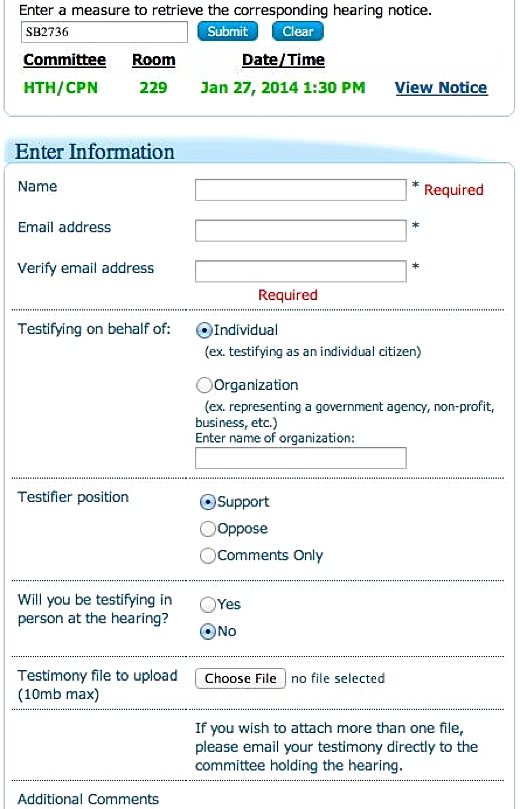
Return to SB2736 page and cClick on the blue "Submit Testimony" at top of page and it will take you to a page that looks like this:


you can fill out the information depicted in the above graphic.  Minimum, you only need to highlight the "Support" dot for SB2736, along with your acct. name and email.  If you want under "Additional Comments," you can write a few sentences or paragraphs in support of a GMO Labeling bill.  You can also attach any supporting documentation you want (like a particularly good article on GMO's or labeling) with the "Testimony file to upload" option, but you don't have to.

The most testimony the Hawaii Legislature ever got on this issue was last year with HB174 in four different hearing dates; on one of those dates they received about 1000 pieces of testimony or indications of sentiment.  We've got over 3000 people here.  Let's see if we can top 1000 people showing "Support" for SB2736.  Everybody on this list can participate.  Need Action on this As Soon As Possible in the next 24 hours.  Let's see what we can do to start with on this first one.

Step #3
Get involved with the online petition for Hawaii GMO labeling legislation.

Click here for MoveOn.com petition drive: (http://petitions.moveon.org/sign/gmo-labeling-in-hawaii). This petition for labeling GMOs in Hawaii is going to Hawaii Governor Abercrombie.


.

California to monitor ocean radiation

SUBHEAD: Shouldn't Hawaii be monitoring Pacific Ocean and atmosphere to set baseline for Fukushima radiation?

By Staff on 13 January 2014 for ENENews -
(http://enenews.com/california-professor-imperative-we-monitor-for-any-radioactive-contaminants-that-will-be-arriving-this-year-in-ocean-from-fukushima-l-a-times-claims-levels-are-declining-fails-to-inform)


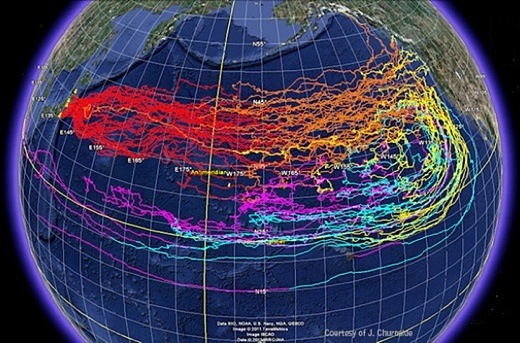
Image above: GoogleEarth used to demonstrate simulation of Cs137 distribution by Pacific Ocean currents. From (http://fukushima-diary.com/2012/05/does-radiation-travel-across-the-sea/).

Berkeley Lab News Center, Jan. 13, 2014: Researchers from California State University, Long Beach (CSULB) and the Lawrence Berkeley National Laboratory have launched “Kelp Watch 2014,” a scientific campaign designed to determine the extent of radioactive contamination of the state’s kelp forest from Japan’s damaged Fukushima nuclear power plant [...]

Nineteen academic and government institutions and three other organizations/businesses [are involved]. These participants will sample kelp from the entire California coastline [...] sampling will begin in mid-February and will end in late winter. [...] Sampling will take place several times in 2014, and processed kelp samples will be sent to the Lawrence Berkeley National Lab [...]

Manhattan Beach, CA Patch, Jan. 13, 2014: Cal State Long Beach researchers will monitor the state’s kelp forest for radioactive contamination from the meltdown of the Fukushima nuclear power plant in Japan, it was announced Monday. Traces of radioactive iodine from the March 11, 2011, earthquake, tsunami and meltdown were detected about a month later in kelp along the Orange County shoreline.

Steven L. Manley, CSULB biology professor an expert in marine algae and kelp (Emphasis Added): “The California kelp forest is a highly productive and complex ecosystem and a valuable state resource.
It is imperative that we monitor this coastal forest for any radioactive contaminants that will be arriving this year in the ocean currents from Fukushima disaster.

 I receive calls and emails weekly from concerned visitors and Californians about the effect of the Fukushima disaster on our California marine life. I tell them that the anticipated concentrations that will arrive are most likely very low but we have no data regarding its impact on our coastal ecosystem. Kelp Watch 2014 will provide an initial monitoring system at least in the short-term. [...] this entire initiative is unfunded by any state or federal agency.”

Kai Vetter, professor of nuclear engineering at UC Berkeley (Emphasis Added): “UC Berkeley and Berkeley Lab’s analysis within the new Kelp Watch initiative is part of a larger, ongoing, effort to measure Fukushima related radionuclides in a large variety of objects. [...]

Making our results available is a critical aspect of our work as it allows us to address concerns about Fukushima radiation levels and to explain the meaning and potential impact of these levels particularly in the context of the natural radiation background we are exposed to in our daily lives [Physicians: "Comparisons between nuclear fallout and background radiation are misleading"].”

.

GMO Pre-Legislative Update

SUBHEAD: This Hawaiian legislative session will be a busy one for GMO related bills.

By Brad Parsons on 10 January 2014 in Island Breath -
(http://islandbreath.blogspot.com/2014/01/gmo-pre-legislative-update.html)

http://www.islandbreath.org/2014Year/01/140112kuibig.jpg
Image above: Detail of poster for demostration at State Capital Rotunda on january 15th,  2014 from 9am-3:30pm. Click to embiggen.

This is a GMO Pre-Legislative Update.  Wow, a lot is happening.  Let's first start with the Hawaii Legislative Session.

The Petition has already been shared with selected members of the Legislature in support of this issue and will be shared with the Governor and rest of the Legislature in the coming week.  As of now, we have about 2,720 signers from Hawaii and 3650 signers in total.  We hope throughout the coming Legislative Session you make your voices heard.

Most of the GMO Labeling and Pesticide bills from the 2013 Hawaii Legislative Session have been carried over to the 2014 Legislative Session.  In total it is about 16 bills.  In numeric order they are (you can click on the bill number to see more information about each):

HB174 RELATING TO FOOD LABELING.   
HB348 RELATING TO HEALTH.   
HB627 RELATING TO FOOD.   
HB631 RELATING TO FOOD.   
HB733 RELATING TO LABELING OF GE WHOLE FOOD.   
HB735 RELATING TO TARO SECURITY.   
HB1386 RELATING TO PESTICIDES.    

SB468 RELATING TO FOOD LABELING.   
SB590 RELATING TO AGRICULTURE.   
SB615 RELATING TO LABELING.   
SB648 RELATING TO HEALTH.   
SB649 RELATING TO HEALTH.   
SB934 RELATING TO HEALTH.   
SB1290 RELATING TO LABELING OF GE WHOLE FOOD.   
SB1329 RELATING TO LABELING.   
SB2037 RELATING TO AGRICULTURE.    

The above SB2037 is actually a newly introduced bill for the 2014 Session.  No other newly introduced 2014 bills on these issues are yet available online.  There is word in the past day that, "Sen. Malama Solomon and/or Senate Ag Committee Chair Nishihara are introducing a 'pre-emption' bill to try to take away any/all authority the counties may have to regulate the bio-tech industry/GMOs.

She said she gave it to the Atty General to review the language," but it has not been introduced and is not yet available to the public to see.  Reps and Senators can be emailed about this at:  reps@capitol.hawaii.gov, sens@capitol.hawaii.gov

There is also an important report on pesticides in Hawaii mandated by HB673 from the 2013 Legislative Session prepared by the Hawaii Legislative Reference Bureau and it is: "State Reporting Requirements For General Use Pesticides"   http://lrbhawaii.info/reports/legrpts/lrb/2013/act105_slh13.pdf


Image above: Poster supporting Maui GMO-pesticide regulation.

Maui follows Kauai's lead:  Bill introduced to require disclosure of pesticides & GMOs, as well as buffer zones between GMO crops and schools, medical facilities, daycare facilities and similar operations. Its goal is "to inform the public and protect against direct, indirect and cumulative negative health impacts."

Maui needs your help: Please email Councilmember Riki Hokama
Tell him, as a visitor to Maui - you don't want to be poisoned on your vacation. Ask him to pass the GMO/Pesticide Bill!

Phone calls are even better: to Councilmember Riki Hokama: ask him to bring up Councilmember Elle Cochran's GMO/Pesticide bill.

Councilmember Riki Hokama
riki.hokama@mauicounty.us
phone: (808) 270-7768
fax: (808) 270-7848

SEE: 
https://www.facebook.com/events/1488522851373229/


READ: 
http://www.mauiweekly.com/page/content.detail/id/532072/Councilmember-Cochran-Introduces-Pesticide-and-GMO-Legislation.html

Protect Hawaii:  Help Fund GMO Ground Zero Community Organization for Policy Work in 2014 Legislative Session

My name is Nomi Carmona, co-founder and President of Hawaii environmental and political non-profit Babes Against Biotech and I am an unpaid community organizer in Hawaii focused on GMO regulation and pesticide policy. My mission is to stop global chemical and biotech corporations from poisoning the land and people of Hawaii, and I need your support for the 2014 Hawaii state lawmaking session.

Hawaii is GMO Ground Zero worldwide. We are the home to over 5,000 open-air Genetically Modified Organism (GMO) experiments, exposing residents to massive restricted pesticide use, environmental contamination and genetic experimentation.

We desperately need policy change to protect ourselves from GMO agrochemical intensive agriculture and Genetically Engineered (GE) seed production by the largest chemical companies in the world, occurring year round.

The GE seeds developed in Hawaii are exported, genetically contaminating food crops worldwide, being engineered for experimental herbicide resistance and producing pesticides. Our air, land, water and health is being heavily genetically and chemically contaminated and we are considered the endangered species capital of the world.

The legislative session will release hundreds of bills and each bill has 2-8+ hearings and full votes before the House and Senate.

Last year I was in the Capitol almost every weekday testifying and reporting, working overnight, marched through rainstorms across the state of Hawaii and have camped numerous times overnight in lines to testify for hearings when necessary. Everywhere there is a GMO lobbyist or interest at stake, I want to be there, defending and progressing community demands for safe, non-toxic environments.

We have no connection with Nomi Carmona, but we believe she will be needed and indispensable at ground zero in the Legislature this Session. http://www.indiegogo.com/projects/protect-hawaii-fund-gmo-ground-zero-community-organization-for-policy-change

Nomi has a great breakdown of GMO financial contributions to the Hawaii Legislators under the 'Gallery' tab at the above link:  2013 Hawaii State Senate & House GMO Campaign Fund Analysis

News Items
  1. Maine recently became the second state to enact a GE labeling law. Read more: http://www.centerforfoodsafety.org/press-releases/2827/food-movements-political-power-growing
  2. Very Informative Jan. 9th LiveStream by Doug of Presentation Recorded at  http://new.livestream.com/accounts/3132312/events/2680918Roundup (aka the New DDT) and GMO Foods
    A Threat to Our Daily Diet

    Speakers:
    Dr. Stephanie Seneff, Senior research scientist, MIT Computer Science and Artificial Intelligence Laboratory
    Dr. Hector Valenzuela, Extension crop specialist, UH CTAHR
  3.  "GMO's: Engineering an Environmental Disaster" SoundCloud.com
    Earthjustice attorney Paul Achitoff discusses how genetically engineered crops harm the environment by increasing pesticide use. 
    https://soundcloud.com/earthjustice-down2earth/gmos-environmental-disaster

     
  4. "GMO Labeling and the 'Natural' Food Fight: Treacherous Terrain in 2014"   http://www.organicconsumers.org/articles/article_28998.cfm
  5. "Battle over GMO Labeling Rumbling in U.S."
    http://news.yahoo.com/battle-over-gmo-labeling-rumbling-us-020212420.html

     
  6. "Industry Proposal Would Bar GE Food Labels"
    http://www.ewg.org/release/industry-proposal-would-bar-ge-food-labels

     
  7. "Food Industry to fire preemptive GMO Strike" 
    http://www.politico.com/story/2014/01/gmo-labeling-bill-101853.html

     
  8. "Neonicotinoid Pesticides not just a Threat to Bees; Humans also at Risk"   http://www.naturalnews.com/043399_neonicotinoid_pesticides_bees_developmental_neurotoxicity.html
  9. Pictoral:  "King Dayne Aipoalani's Story May Convince You That Hawaii Belongs To The Hawaiians"
    http://www.businessinsider.com/hawaiian-sovereignty-movement-atooi-kingdom-2014-1  

That's it for now.  Strap yourselves in, it's gonna be a 'rough and tumble' Legislative Session.

.

GMO labeling support slipping

SUBHEAD: Monsanto and Dupont are backing Washington State anti-labeling campaign with $18.1 million. 

By Alison Vekshin on 24 October 2013 for Bloomberg News -
(http://www.bloomberg.com/news/2013-10-25/monsanto-bets-5-million-in-fight-over-gene-altered-food.html)


Image above: GMO corn seed kernel. From original article.

Monsanto (Dekalb)  and DuPont (Pioneer) among the biggest makers of bioengineered crop seeds, are persuading Washington state voters to change their minds about a proposal to require labels on genetically modified food.

The companies are backing an anti-labeling campaign with $18.1 million -- twice that of advocates for a ballot measure next month. The labeling proposal had a 45 percentage-point lead among registered voters five weeks ago that has narrowed to 4 points since opponents began advertising, the independent Elway Poll showed Oct. 21.

“This is a David and Goliath fight,” said Trudy Bialic, a spokeswoman for PCC Natural Markets based in Seattle. Store shelves are lined with tags -- “Non-GMO Project verified product” -- on products from canola oil to granola bars, to reassure those who fear or distrust genetically modified organisms. “There’s no way we can compete with the resources of Monsanto, Dow and DuPont.”

Washington joined 26 states with proposals this year to mandate such labeling or to prohibit genetically engineered food, according to the Center for Food Safety, a nonprofit environmental advocacy group. If voters approve Initiative 522, Washington would be the first to require labels. While Connecticut and Maine have passed labeling laws, they won’t take effect until more states do likewise.

PCC, whose nine stores make it the largest consumer-owned natural food retail co-operative in the U.S., donated $423,174 to support the proposal. “Vote Yes on 522!” is at the top of its website and signs urging support are posted in store windows.

Seed King
Monsanto, the world’s biggest seed producer, contributed $5.1 million to oppose the measure as of Oct. 2, according to MapLight, a nonpartisan research organization based in Berkeley, California. That compares with $1.53 billion that the St. Louis-based company spent on research and development in the year that ended in August, when sales reached $14.9 billion.

DuPont’s Pioneer, the seed unit of the Wilmington, Delaware-based company, is the second-biggest corporate contributor, at $3.6 million, according to MapLight. Dow Chemical Co. based in Midland, Michigan, gave $621,000.

Monsanto and DuPont, the second-biggest seed company, sell corn and soybeans that have been genetically engineered to withstand weedkillers such as Roundup. They also make corn modified to produce an insecticidal protein that allows farmers to fight pests without applying more chemicals.

The two companies were the top donors in a $46 million drive last year to defeat an effort to require labeling in California. Supporters were outspent 5-to-1.

Magic Soaps
Advocates of the Washington initiative have collected $9.1 million, mainly from health and natural food companies, according to MapLight. The biggest contributor is closely held Dr. Bronner’s Magic Soaps, the maker of organic cleansing products and lotions in Escondido, California, at $2.6 million.

The Organic Consumers Association, a Finland, Minnesota-based advocacy group, is second at $800,091. Mercola.com LLC, a vendor of vitamins and nutrition products based in Hoffman Estates, Illinois, gave $500,000.

The Washington measure would require labels for most raw agricultural commodities, processed foods, seeds and seed stocks produced using genetic engineering. The World Health Organization definition is any organism whose genetic material has been changed in a way that doesn’t occur naturally, including through introduction of a gene from another organism.

“Both sides are advertising heavily in what may be the most expensive initiative campaign in state history,” according to the October report by Seattle-based Elway Research Inc.

Support Slides
In September, support for the referendum was ahead of opposition, 66 percent to 21 percent. After advertising on the issue began, support fell to 46 percent, with opposition rising to 42 percent, according to the Elway Poll.

The survey of 413 registered voters was taken Oct. 15-17 and has a margin of error of 5 percentage points.

The battle over genetically modified food comes as organic sales are expanding at more than three times the pace of total U.S. packaged foods, rising 10 percent to $29 billion in 2012, according to a Bloomberg Industries analysis. Agriculture companies argue that Washington’s initiative would be costly and misleading to consumers, and isn’t needed.

“Complicated and unnecessary labeling regulations would unfairly hurt Washington farmers, food producers and grocers, cost taxpayers millions, increase food prices and give misleading information to consumers about the safety of the products they know and trust,” Wendy Reinhardt Kapsak, a Monsanto spokeswoman, said in a statement.

Jane Slusark, a Pioneer spokeswoman, and Garry Hamlin, a spokesman for Dow AgroSciences, referred questions to the No on 522 Coalition.

Incomplete, Inconsistent
“It provides us incomplete, inconsistent and inaccurate information,” Dana Bieber, a coalition spokeswoman, said in a telephone interview. “If it’s about the right to know, the proponents went ahead and exempted 70 percent of food that’s even sold in the state.”

The measure would boost food costs as much as $520 per year for a family of four from 2015 to 2019, according to a report last month by the Washington Research Council, a Seattle-based, business-supported organization. Farmers and food manufacturers would incur $264 million in costs to begin complying with the measure, the report said. The proposal exempts food served in restaurants.

The Grocery Manufacturers Association, a Washington, D.C.- based group that represents companies such as ConAgra Foods Inc. and Kraft Foods Group Inc., has raised the most to defeat the Washington effort, at $7.7 million, according to MapLight.

Washington State Attorney General Bob Ferguson sued the association last week, saying it illegally collected and spent the funds while shielding the identities of its contributors.

Faces Sanctions
The association set up a Washington state political committee and reported the source of its funds on Oct. 18, Janelle Guthrie, Ferguson’s spokeswoman, said by e-mail. The industry group still faces a penalty, she said.

“While the GMA made the requested disclosures, there must be sanctions for violating the law and the case will move forward as filed,” Ferguson said.

The U.S. Food and Drug Administration supports voluntary labeling by food manufacturers indicating whether their products have been developed through genetic engineering, according to the agency’s website.

Scientific bodies from the American Association for the Advancement of Science to the World Health Organization have concluded that genetically modified foods on the market are no riskier than conventional foods.

Still, there are doubters.

“I like to know what I’m eating,” Theresa Witherspoon, a 49-year-old Seattle housewife said in an interview outside the PCC store. “I’m not particularly interested in consuming things that have an unknown effect on your body.”

Witherspoon, who said her sister died of stomach cancer, said she plans to vote for the initiative.

“I’m not putting anything in my body that’s going to potentially adversely affect me,” Witherspoon said.

.

Manning and WikiLeaks not deadly

SUBHEAD: Bradley Manning sentencing testimony indicates WikiLeaks not responsible for any deaths.

By Matt Sledge on 3 August 2013 for Huffington Post -
(http://www.huffingtonpost.com/2013/08/03/bradley-manning-sentence_n_3696501.html)


Image above: Supporters of Julian Assange, Bradley Manning, Wikileaks and ex-NSA whistleblower Edward Snowden gather with banners and flags outside the Ecuadorean embassy where Julian Assange is scheduled to make a balcony speech. From (http://www.demotix.com/news/2188354/julian-assange-supports-whistleblower-ed-snowden-speech-transcript#media-2188384).

 For three years Bradley Manning and Julian Assange were accused of murder. Members of Congress and the administration said their WikiLeaks document dump endangered U.S. interests -- and lives.

"Mr. Assange can say whatever he likes about the greater good he thinks he and his source are doing, but the truth is they might already have on their hands the blood of some young soldier or that of an Afghan family," Adm. Mike Mullen, then the chairman of the Joint Chiefs of Staff, said in July 2010.

Before a press corps hollowed out to a skeleton crew after Manning's verdict, that insinuation is falling apart. Top government officials testifying in open court for Manning's sentencing in recent days have cited no credible evidence his leaks led directly to any deaths. They have instead spoken to diplomatic sources placed at risk and strayed foreign relations. In the words of one official, some allies got "chesty."

The State Department's current, official take on the cables' release may come Monday, as Undersecretary of State Patrick Kennedy testifies in court for a full day on damage caused by the cables. Or Kennedy may once again be forced into closed session to talk about any specifics in yet another example of the secrecy that has shrouded the trial, even in its sentencing phase.

During the first phase of the trial, the judge overseeing Manning's case prevented the defendant from presenting any evidence against claims that his releases caused any harm. So those revelations, endlessly fought over in the press since WikiLeaks' releases, have all taken place during the sentencing phase of Manning's court martial. They may shave years off his maximum 132.5-year punishment.

For Assange supporters, meanwhile, the trial testimony comes as long-awaited vindication for the much-vilified WikiLeaks founder.

"I did not expect anyone was killed otherwise I am sure it would have come out already. What we saw early on regarding Manning, Julian Assange and Wikileaks were efforts to poison the atmosphere against them by claiming they had blood on their hands," said Michael Ratner, Assange's U.S. lawyer. "Our government lies."

The disclosures have come out as glimpses of sunlight in the secrecy shadowing the trial. Though Manning's leaks are freely available online, the government still treats most of them as classified.

It's an absurd situation that has led to Manning's prosecutors referring to clearly legitimate State Department cables as "purported" State Department cables. Perhaps more consequentially, it means a significant portion of the testimony about the harm caused by the cables' release is taking place in closed, classified session.

Nevertheless, the most explosive claim about Manning's leaks -- that battlefield reports from Iraq and Afghanistan got U.S. sources killed -- seems to have been settled. The prosecution's first witness was Brig. Gen. Robert Carr, who led the Department of Defense's review of the WikiLeaks releases.

Carr's order to lead the Information Review Task Force came straight from then-Secretary of Defense Robert Gates. Carr and a team of 300 worked for over a year.

"We had to understand this data ... give them some reassurance that they didn't have to sit on the top in the middle of a hill in Afghanistan and go through 77,000 documents to find their vulnerabilities," Carr said. "That was our job."

Not a single death could be linked to names in the WikiLeaks files, Carr testified.

After more than a year of searching, the task force found a single instance where the Taliban claimed to have killed an Afghan source because of WikiLeaks. But then they discovered the cables did not actually contain the source's name.

"The name was not there," Carr said.

The Taliban's claim was so dodgy that the judge overseeing the case, Col. Denise Lind, said she would disregard it.

But Carr did state that, "There are some people out there that quit talking to us as a result of their releases." He also provocatively suggested that the release of Guantanamo detainee assessment briefs in April 2011 slowed down transfers from the prison to foreign countries.

"There might have been a delta between what the foreign government was saying and what they had told their people," said Carr, "and that could, in fact, cause conflict between two nations and stop our efforts to move forward on the Guantanamo."

Two lawyers who represent clients at Guantanamo, however, reject Carr's claims out of hand. They note that the assessment briefs' release came right in the middle of the longest period without a transfer in the history of the prison.

"I would think it would be difficult for this administration to claim with a straight face that they were making any efforts to close the prison in 2011 or '12," said Shane Kadidal, a lawyer at the Center for Constitutional Rights. "It's faintly ludicrous to blame their failures on WikiLeaks."

Clive Stafford Smith, director of the UK legal charity Reprieve, said, "It is idiotic."

Carr was followed on the witness stand Wednesday by John Kirchhofer, who as deputy director of the Defense Department's WikiLeaks task force was responsible for its day-to-day operations.

Kirchhofer singled out one episode in open court: a briefing he gave to NATO allies in Belgium the week the Iraq War Logs were released in October 2010.

There were some "pretty aggressive people getting chesty," Kirchhofer said. "In a closed forum I can tell you what countries if that matters."

More tangibly, Michael Kozak, who led the State Department's WikiLeaks Persons at Risk working group, testified about the efforts the department had to take to protect U.S. sources named in the diplomatic cables. If the group thought someone might be in danger of "violence or incarceration or something similarly grave," he said, it sprung into action -- notifying them that their name was in the cables, and asking if they needed American assistance.

The most important type of assistance offered, Kozak said, was a ticket out of harm's way or help with immigration status in a new country. Kozak spoke bluntly. But he was not asked, nor did he offer, any testimony about sources who were named in the cables and later killed.

Kozak said the greatest damage of the leaks, from his perspective, was their "chilling effect" on human rights activists no longer willing to talk to the U.S.

When Kozak was asked how many people the working group had identified as being in danger, he was quickly cut off by a defense objection. He added that he would rather provide an answer in closed, classified session -- which the court then entered.

The exchange was one more example of how the court's strict adherence to government secrecy has obscured the presentation of evidence of actual harm caused by the leaks. But Steve Aftergood, an expert on government secrecy at the Federation of American Scientists, said closing court may sometimes be necessary.

"It’s possible that publicly highlighting a specific incident of damage -- perhaps some kind of diplomatic dispute arising from the cables -- would reopen the dispute and aggravate it further," Aftergood said.

"But if something like that is true, it would be true only with regard to specific incidents," he added. "It should still be possible for the prosecution to publicly characterize the damage it says was done, and to describe the nature and the magnitude of the harm."

Outside of the courtroom, there are clues about damage from the cables' release.

P.J. Crowley, the former State Department spokesman who helped respond to the WikiLeaks dump that became known as "Cablegate," told HuffPost before the trial started that fears the disclosures would throw sand in the gears of U.S. diplomacy had not been realized. This was in part, Crowley said, because of extensive outreach and mitigation efforts of the sort Kozak described in court Friday.

But on the individual level, Crowley said, "The reality is that people have been put in danger -- people have been incarcerated. There are people who have been cited in these cables who have been killed."

"Now, I'm very cautious," he added. "Was somebody killed because they were listed in a WikiLeaks cable? I can't say that."

If the sentencing testimony from State Undersecretary Kennedy remains hidden Monday in a secure courtroom at Fort Meade, the closest we may come to the facts is an anonymous congressional aide's January 2011 analysis to Reuters. The aide's summation of internal government reviews of the WikiLeaks releases at both the State and Defense departments came just months after Kennedy first briefed Congress on harm from WikiLeaks.

It's an appraisal that has been widely known for years, yet it has not stopped critics from repeating the charge that Assange and Manning have blood on their hands.

As the anonymous aide related to Reuters in 2011: "We were told (the impact of WikiLeaks revelations) was embarrassing but not damaging."

Japan conceals radiation danger

SUBHEAD: Japan officially orders censorship of truth about Fukushima Nuclear radiation disaster.  

By Alexander Higgens on 27 July 2011 for COTO Report -  
(http://coto2.wordpress.com/2011/07/27/japan-officially-orders-censorship-of-truth-about-fukushima-nuclear-radiation-disaster/)

 
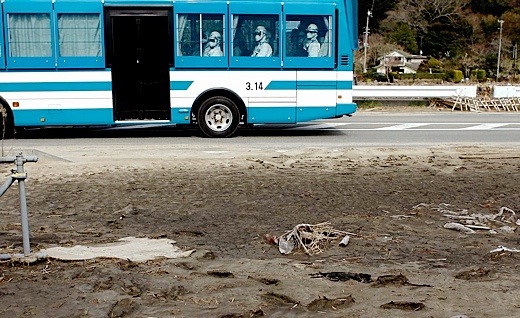
Image above: Government workers within Fukushima Radiation Exclusion Zone. From (http://cryptome.org/eyeball/daiichi-npp12/daiichi-photos12.htm).
 

The government of Japan has issued an official order to telecommunications companies and web masters to censor reports which contradict the state media reports that the Fukushima nuclear radiation disaster is over.

The supposedly free democratic nation of Japan, which supposedly values and promotes freedom of speech, has officially issued orders to telecommunication companies and webmasters to remove content from websites that counter the official government position that the disaster is over and there is no more threat from the radiation.

“The government charges that the damage caused by earthquakes and by the nuclear accident are being magnified by irresponsible rumors, and the government must take action for the sake of the public good. The project team has begun to send “letters of request” to such organizations as telephone companies, internet providers, cable television stations, and others, demanding that they “take adequate measures based on the guidelines in response to illegal information. ”The measures include erasing any information from internet sites that the authorities deem harmful to public order and morality.” Source: Asia Pacific Journal

Note: I saw the executive order issued by Japan a week or two ago but could not find it in an English version anywhere but didn’t report on it because the Japanese to English translated versions of the order did not provide clear enough meaning. What I gathered from the order was that Japan ordered telecommunication companies to provide notices to websites and webmasters to remove messages from internet bulletin boards and websites that conflicted with the Government reported version of events.

If the websites and webmasters did not comply the telecommunication companies are to shut down offending websites as this is considered a national security issue which is affecting public safety and contributing to public unrest. It was also ordered that email communications be monitored to prevent the spread of false rumors. If you can find the original executive order, please send me a tip with the link.

As previously reported GMAIL reported that their email system has in fact been affected by government sponsored hacking. As far as the so-called rumors that the censorship intends to suppress many of the rumors simply are not rumors but the truth. For example, Japan says it is trying to suppress rumors of radioactive cars while countries are in fact reporting receiving radioactive cars imported from Japan. Japan is trying to suppress false rumors of radioactive fish but in fact radioactive fish are being caught and Japan and the US are saying the fish are safe to eat while being 2400% above Federal radiation limits for food. The list goes on and on.

Since this report comes out of Tokyo, given the context and nature of this report and the fact it will likely soon be erased by the Japan censorship order, here is the original full article.

Fukushima Residents Seek Answers 

SUBHEAD: Amid mixed signals from media, TEPCO and government a report from the Radiation Exclusion Zone

By Makiko Segawa on 27 July 2011 in Fukushima

Mistrust of the media has surged among the people of Fukushima Prefecture. In part this is due to reports filed by mainstream journalists who are unwilling to visit the area near the crippled Fukushima Daiichi nuclear power plant. But above all it is the result of contradictory reportsreleased by the media, TEPCO and the government.

On the one hand, many local officials and residents in Fukushima insist that the situation is safe and that the media, in fanning unwarranted fears, are damaging the economy of the region.By contrast, many freelance journalists in Tokyo report that the central government is downplaying the fact that radiation leakage has been massive and that the threat to public health has been woefully underestimated.

While the government long hewed to its original definition of a 20 kilometer exclusion zone, following the April 12 announcement that the Fukushima radiation severity level has been raised from a level 5 event (as with Three Mile Island) to a level 7 event (as with Chernobyl), the government also extended the radiation exclusion zone from 20 kilometers to at least five communities in the 30-50 kilometer range.

.
.

NRC knows but hides info

SUBHEAD: Nuclear Regulatory Commission keeps information from public on Vermont Yankee Plant controversy.  

By Dave Gram on 10 July 2011 for Huffington Post - 
 (http://www.huffingtonpost.com/2011/07/10/vermont-yankee-plant-nuclear-regulatory-commission_n_894209.html)

 
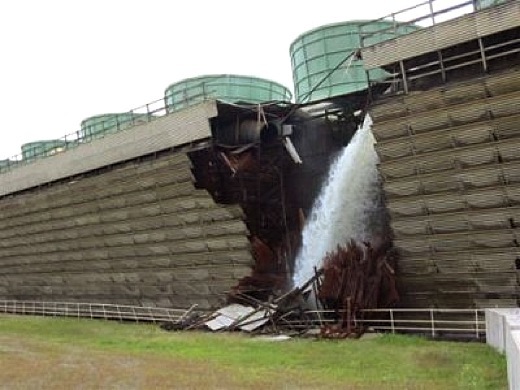
Image above: Cooling tower collapse at Vermont Yankee nuclear plant in 2007. The plant should have been shutdown already. From (http://www.heatingoil.com/blog/in-vermont-nuclear-shutdown-would-mean-turn-to-fossil-fuels1210/).

When a nuclear watchdog group asked the Nuclear Regulatory Commission for a study on leaks of radioactive water at the Vermont Yankee plant, it was told the NRC had seen the report but had never officially taken custody of it – so it wasn't public.

Critics say it's a style of communication between regulator and regulated that cuts out the public and even state regulators trying to track leaks of tritium, a radioactive form of water linked with cancer when ingested in high amounts.

An NRC spokeswoman confirmed the agency routinely sees industry reports that it does not share on its public web site.

"We don't take possession of them so you can't get them from us," said Diane Screnci, spokeswoman in the NRC's Northeast regional office.

The fight comes as the NRC comes under heightened scrutiny for what its critics say is too much coziness with the industry it oversees, and is part of what Michel Keegan of the Coalition for a Nuclear-Free Great Lakes called a pattern of making public access to information more difficult.

An already difficult-to-navigate NRC online documents service recently was redesigned and became more so, Keegan said. The NRC uses company claims of proprietary information, security concerns and exceptions to limit access, he added. The agency also notes that the industry is sharing information with it voluntarily.

"The NRC hides behind this," Keegan added.

At Vermont Yankee, the battle is even more pitched than in most places. The governor and Legislature are pushing to shut the plant down when its initial 40-year license expires next March. They cite the recent tritium leaks and misstatements by company executives – Vermont's attorney general announced Thursday the company won't be prosecuted for perjury – as reasons Vermont should get done with nuclear power.

Plant owner Entergy Corp. says the Vernon reactor is safe and reliable. It is suing in federal court, saying the state's efforts to shut down Vermont Yankee are pre-empted by federal law.

Raymond Shadis of the nuclear watchdog group New England Coalition said the NRC, which renewed Vermont Yankee's federal license in March, is making regulatory decisions based on information the public doesn't get to see. "It's our position that this should be open to the light of public scrutiny," he said.

The issue came to light June 22, when officials from the NRC's regional headquarters in Pennsylvania traveled to Brattleboro for a public meeting designed as a review of the agency's annual report card for the Vernon reactor.

According to a filing by Shadis' group with the state Public Service Board, NRC health physicist James Noggle told the audience that significant progress had been made "toward identifying and isolating the source of the leak; also voluminous groundwater sampling tables, and evidence that groundwater contamination is physically isolated from the plant site's underlying aquifer."

Noggle cited a hydrogeology report from New Orleans-based Entergy Corp, which owns Vermont Yankee, that an NRC librarian later told him was posted to an industry computer server accessible by the NRC but not the general public.

"The NRC was provided a Hydrogeologic study report on Vermont Yankee online via the industry's Certrec computer system, which Entergy uses to provide inspection access to licensee documents, without the NRC actually taking custody of the document," NRC technical librarian Mary Mendiola wrote in an e-mail. "Therefore, the NRC never received the document that Raymond Shadis is requesting. He should contact Entergy directly for this document ..."

Information contained in that document was not being shared with the state board, despite an order from it in February that Vermont Yankee and Entergy update the board every two weeks on its investigation into tritium leaks at the plant, Shadis said.

Jared Margolis, a lawyer for Shadis' group, wrote to the board on July 1 saying the information it was getting from Entergy was "not complete or accurate," that it "does not accurately reflect the status of the investigation as reported to NRC," and that "it appears that Entergy has withheld information from the Board and the Parties regarding its investigations into these leaks."

Shadis said it was ironic that Entergy was declining to share information that appeared to put Vermont Yankee and its tritium cleanup efforts in a favorable light. He said the reluctance to make the information public resulted from "force of habit."

Vermont Yankee spokesman Larry Smith said the company did not want to comment. "Since this was a filing made with the Board, we will respond before the Board as the Board directs," he said.

Concerns about Entergy sharing different information with the NRC than with the state come at a time when its relations with the state of Vermont have been much rockier than with the federal agency. The NRC approved a 20-year license extension for the plant earlier this year, while the state has been moving to shut its lone reactor down when its initial 40-year license expires next March.

Entergy is suing in federal court to block the state's efforts.

The NRC also has been coming under scrutiny from critics who say it hasn't been a tough enough regulator. In an investigative series last month, The Associated Press reported that the NRC has been working closely with the nuclear power industry to keep the nation's aging reactors operating within safety standards by repeatedly weakening those standards, or simply failing to enforce them.

In an e-mail sent Friday, Screnci maintained the public should have confidence in the NRC as a regulator and in the way it handles information provided to it by the industry.

"The public should not be concerned that the NRC is reviewing licensee documents that are not available to the public while conducting inspections," she wrote. "As a matter of fact, independently verifying licensee information is an important part of our inspection process. When we document our activities in inspection reports, we list the documents reviewed, provide information on what the document contained and explain how we reached any conclusions. We always attempt to conduct our activities in an open and transparent way."

Close Vermont Yankee  

By Jarred Cobb & John Deans on 25 February 2011 for GreenPeace - (http://usactions.greenpeace.org/blog/greenpeaceusa_blog?cat=38890)

  Greenpeace: Vermont Yankee: A bad deal for VT

Well, somehow this cloudy day seems a little brighter as we look back on yesterday's victory up here in Vermont. Yesterday a whopping 26 members of the 30-member state Senate voted against continuing the license at Vermont Yankee Nuclear Plant for another 20 years after its scheduled closing in 2012. This is a huge victory for Vermonters and our clean energy future.

It was an epic day in many respects, and a testament to the strength of democracy here in Vermont. Hundreds jammed the statehouse, having traveled in terrible blizzard conditions to witness the Senate’s historic vote and make sure senators were hearing from their constituents. As the debate was underway, Senate pages scurried around delivering scores of messages from citizens to senators as they deliberated on the floor. In a memorable moment just before the vote, Senator Choate said, “Just in the past three hours I've been delivered 50 to 60 pink slips.”

 Our volunteers in the state house were working non-stop to make sure voters were contacting their Senators. Every walk of life was represented there, farmers, schoolteachers, students young and old, business people, and activists who have been fighting the plant since before its construction. It was an inspiring moment for democracy as we saw the true power of grassroots action.

When people stand up, raise their voices and organize we can win big victories for the planet and our neighbors. As we traveled around the state holding volunteer meetings, generating calls, letters, and emails, talking to business people, and learning from long-time community members the response was overwhelming.

When I was in Ludlow with a volunteer knocking on doors, one man asked why we were collecting letters. We explained that a group of citizens was meeting with a Senator the next day. “When, where?” he asked, and then showed up at 8:30AM on a Saturday to make sure his Senator would vote the right way. So did 24 other people; and the Senator had no choice. She voted no.

These stories are not unique, the vote yesterday was by a citizen legislature that listens to its people, and Greenpeace has worked hard to make sure those voices are heard. Our volunteers were tireless and committed, our goals were high, but we have just won a huge victory for the planet. Vermonters are tired of sitting in the shadow of this leaky old reactor and getting lied to and swindled by Entergy Louisiana.

The fight isn’t over. Entergy is a powerful corporation and has said they’re not done, and we aren’t either. Now we want to see the House show the same courage as the Senate and vote this session to retire Vermont Yankee. The vote yesterday was the first time a state legislative body has voted to retire a nuclear plant; we want the House to be the second.

This vote also sends a strong message to the nation and the world that the nuclear renaissance is dead on arrival. President Obama: Vermont knows that nuclear energy can’t be a part of our energy future. We need investments in renewable sources of energy to power our future and put people back to work. The US can follow Vermont’s leadership to the energy revolution America needs. No Nukes (new or old)!

.

Community Meeting on KIUC

SUBHEAD: It became clear that KIUC board members do not and never had any intention of seeking mutual agreement with the Kauai Community. By Elaine Dunbar on 24 June 2011 in Island Breath - (http://islandbreath.blogspot.com/2011/06/community-meeting-on-kiuc.html) Image above: Ols West salesman sells Snake Oil to the general public. From (http://planetpov.com/2011/04/22/the-republican-snake-oil-salesmen). Last night Adam Asquith and others offered some sincere alternatives in the spirit of coming together and mediating; for instance, take FERC out of the deal, extend the voting deadline, recall the ballot. It became clear that KIUC board members do not and never had any intention of seeking mutual agreement by their firm reluctance to even consider anything except stay the course. The cheerful and agreeable willingness to continue community engagement has a leash on it; they will attend meetings until the cows come home, but their position is set in stone. A PR charade. Bisselʻs original statement that if the community does not want this, we wonʻt go forward was just hot air. Ben Sullivan, last night, added unnecessarily, to the contentiousness by his comment of the meeting being ʻpolarizedʻ; this was countered eloquently by a local lady who said she came to the meeting to try to understand what was going on and didnʻt appreciate being accused of being ʻpolarizedʻ......as she had not even gained knowledge at that point to have an opinion. She came there to learn. I came to the point of directing questions only to Carol Bain for direct, unmuddied answers. Ben Sullivan does not seem to grasp the details nor the whole picture or maybe he is just intent to stay KIUCʻs course; I canʻt and wonʻt tolerate spin, especially ill informed spin. Carol provided a direct answer, without delay, on the procedure to protect and process the ballots. She stated the ballots are received and handled by a 3rd party to their POBox and not opened until the day the votes will be counted and that the counting will be overseen by people chosen to monitor. Ben had informed me that it would take several days to provide this information. Thanks to Carol, I was satisfied with her efficient response. Stewart Burley who described himself as a risk management person, when asked why he didnʻt foresee risk potential before the MOA was signed without communicating with the public first, was rather vague in his answer and quickly digressed to submarines. There were some things they refused to respond to such as the amount of Membersʻ money spent so far, in ad campaigns to influence the Members to vote ʻYesʻ. Or the fact that canceling the contract with FFP would amount to millions as opposed to the $350,000 figure being tossed around. KIUC has created the polarization because, simply, they did not respect the local community enough to engage with them BEFORE the action was taken. Myself, I can only assume this occurred because they either have some other agenda or they think we donʻt know any better and are incapable of making informed decisions. I would hope that now they know we are. To date, there still has been no commitment from the KIUC board to honor a legally mandated responsibility to address Native Hawaiian concerns. This is something that should have been done at the onset, before the secret Memorandum of Agreement. They skate the issue every time someone brings it up and say they will get to it. I would think this is part of the due diligence that needed to be done before the MOA. And, as well, the Lawful Hawaiian Government filed a Notice of Objection, Cease and Desist with FERC, KIUC and FFP. Many would like to hear that addressed by KIUC in their ability to move forward and how they intend to respond. In Joan Conrowʻs excellent piece in the Honolulu Weekly Kauaiʻs Hydro Battle , one part by Isaac Moriwake, Earthjustice attorney, jumped out as particularly alarming: "Hawaii has very strong and nationally recognized protections regarding stream flows and Native Hawaiian rights. That stands to be completely wiped out by what KIUC is doing, and it seems theyʻre doing it for that purpose," And with that said, KIUCʻs MOA has become a more dangerous matter now. See also: Ea O Ka Ania: KIUC's Smoke Filled Room 6/18/11 Ea O Ka Aina: Kauai's Hydro Battle 6/24/11 .

Kauai's Hydro Battle

SOURCE: Ken Taylor (taylork021@hawaii.rr.com)
 SUBHEAD: This is a decision that will be made in this community, by this community.  

By Joan Conrow on 22 June 2011 for Honolulu Weekly - 
  (http://honoluluweekly.com/cover/2011/06/kauais-hydro-battle)

 
Image above: TVA Fort Peck Dam on cover of the first pictorial Life Magazine on 11/23/1936 From (http://www.milkintheclock.com/2008/11/first-issue-of-life-is-published/).

 Hawaii has very strong and nationally recognized protections regarding stream flows and Native Hawaiian rights. That stands to be completely wiped out by what KIUC is doing, and it seems they’re doing it for that purpose. Isaac Moriwake COVER Farmer Jerry Ornellas bristled when he read in the local newspaper that Kauai Island Utility Cooperative (KIUC) was looking to develop a hydroelectric project on the Wailua reservoir. It was the first he’d heard of it, and that rankled, considering he was president of a water users cooperative whose system includes the reservoir.

“They know who we are,” Ornellas said. “You’d think they would have given us the courtesy of a call. But they never said a word.” The Robinson family was equally vexed to discover they had not been consulted on plans to study hydro on land in western Kauai they have owned for more than a century. Conservationists, meanwhile, were outraged to learn that a twice-bitterly-beaten-down plan to dam the Wailua River apparently had been resurrected.

Thus began KIUC’s clumsy foray into hydroelectric development under a federal process that allows investors to stake a claim, gold rush-style, on rivers and irrigation ditches. The utility actually followed the lead of Free Flow Power (FFP), a Massachusetts-based consortium of consultants and investors that filed the permit applications that created a community uproar.

The utility became embroiled when it bought Free Flow’s permits and hired the firm to guide it through a hydro development process administered by the Federal Energy Regulatory Commission (FERC) in Washington, DC. It’s a process that has been attempted in Hawaii, but never completed, and Sen. Daniel Akaka has unsuccessfully sought legislation to prevent its use in the Islands. The core concern is whether the FERC process will respect the state’s progressive water code, particularly its instream flow standards, which determine the quantity, flow and depth of water required to protect the various uses of a specific stream.

Others wonder if federal bureaucrats–given their unfamiliarity with Hawaii’s unique cultural, environmental and historical characteristics–can be reasonably expected to set the right standards. Whether or not Hawaii residents can effectively participate in a proceeding based in Washington, DC has yet to be determined. For all those reasons, KIUC’s decision to take the FERC route has raised suspicion and resistance. But the secrecy surrounding the initial applications, and uncertainty about exactly what might be developed, has also fed the opposition.

KIUC claims it is too early to discuss project plans, and regardless of what Free Flow wrote on the applications, it is not going to build any dams. “These permits just give us the right to do feasibility studies,” says David Bissell, chief executive officer of KIUC, a member-owned utility cooperative. “We are just at the very preliminary stages of trying to see what’s possible.”  

Hindu Monks Oppose

Not everyone is convinced. “All we have to go on is what’s in their applications,” said Rev. Easan Katir, a monk at Kauai’s Hindu monastery. The monks, who normally eschew political activism, are vigorously opposing the utility’s proposed hydro projects on the Wailua River, which runs through the monastery’s grounds and feeds the East Kauai Water Users Cooperative they helped to form. FERC opponents are leery of both Free Flow and the process that brought it into a relationship with KIUC. “Free Flow Power has never done hydro development,” said Adam Asquith, a taro farmer and Universiy of Hawaii Sea Grant extenson agent on Kauai.

 Keeping the Flow

Bissell maintains that the non-profit utility cooperative will benefit from having FFP manage the process, which he says offers insurance that KIUC will not be edged out by a private developer who would charge more for any electricity generated. He also says that without FERC, hydro has no future at KIUC. “I would not recommend we go forward investing possibly millions of dollars without the FERC process because a for-profit developer could jump in front of us,” Bissell said. To stake its own claim, KIUC purchased the shell companies that FFP formed to file six applications on waterways from Hanalei to Kekaha.

FERC has already approved three, giving KIUC preliminary permits that carry the exclusive right to study hydroelectric development for three years. Bissell said no specific price was placed on the applications, which were purchased as part of a larger consulting contract. The utility has refused to disclose the full value of the contract, which includes an incentive for delivering completed projects, but KIUC attorney David Proudfoot said FFP will be paid “several million dollars if none go past the first stage.”

In response, Asquith led a petition drive that is forcing KIUC to put its FFP contract to a vote of its members, with ballots being mailed out this week. Although FERC opponents have little money for advertising, the monastery funded a full-page informational ad in the Kauai newspaper, and citizens have used social media and the Island’s community radio station and public access television station to take their message to co-op members.

 Navigating the Waters

Meanwhile, the East Kauai Water Users Cooperative, County of Kauai, Department of Hawaiian Home Lands (DHHL) and State Agricultural Development Corporation filed formal petitions to intervene in the FERC permits, and the state attorney general’s office apparently plans to take similar action.

 “Why go to Washington, DC, to decide how Hawaii streams are managed?” said William Tam, deputy director of the Hawaii Commission on Water Resources and Management. “It is hard to understand some facts when you’re 5,000 miles away. Written statements do not always tell the whole story.” Tam has taken no stand on the current KIUC permits. The matter may come before the Water Commission, and he has not thoroughly reviewed the applications. But he is familiar with FERC from his earlier tenure in the State attorney general’s office.

Between 1989 and 1991, the State opposed FERC jurisdiction over three proposed hydroelectric projects for the upper and lower Wailua River and the Hanalei River. The State objected on the grounds that the projects were not located on “navigable waters,” as provided under the Federal Power Act, and that FERC would assert its authority over in-stream flow standards.

The State Water Code vests that authority to the State Water Commission, which is charged with managing Hawaii’s stream water–a public trust resource–for cultural, ecological and economic purposes. While a California court recognized FERC’s authority to set instream flow standards and another court upheld the State of Washington’s right to set Clean Water Act standards, those questions remain untested in Hawaii, because no FERC hydro project has ever been built in the Islands. However, the issue of FERC jurisdiction has been addressed, at least in part.

On June 2, 1989, FERC ruled that it had no jurisdiction over a proposed “lower Wailua” project–a diversion dam about 1,000 feet upstream from Wailua Falls with a powerhouse about .9 miles upstream of the Fern Grotto–because “the Wailua River has not been shown to be a navigable water at the site of Island Power Co.’s proposed project.” On July 18, 1991, FERC issued an order stating that federal licensing was not required for Island Power’s proposed “upper Wailua” project–again because the site was not on “navigable waters.”  

License to Flow

In 1990, however, FERC ruled that it had the authority to issue “voluntary licenses” for a proposed project on the Hanalei River because it constitutes “Commerce Clause waters.” These are defined as “any waterway within the United States…where…water will ultimately end up in public waters such as a river or stream, tributary to a river or stream, lake, reservoir, bay, gulf, sea or ocean either within or adjacent to the United States,” which is true of virtually all streams in Hawaii. Developers ultimately dropped all three projects, leaving unanswered the question of whether federal or state interests prevail. In light of these decade-old orders, Tam said, it is not correct for KIUC to claim that the FERC process is required for the Wailua River. Nor is it accurate to claim that FERC is the only way to secure priority for a project. “The applicant will have to obtain an option or a lease from the landowner at some point,” he said. “Do it up front. No one else will be able to use the property.” Asquith said the KIUC Board could “level the playing field” simply by passing a resolution refusing to buy electricity from any project developed under a FERC permit. KIUC officials say it is too early in the process to sign a lease or obtain an option, because they are uncertain which locations may bear fruit.

Besides, they say, FERC offers the benefit of a clear roadmap for developing hydro, which is lacking at the state level. “It’s a well-defined, transparent process that requires intensive involvement by all stakeholders,” Bissell said. “It gives stakeholders a seat at the table on these important resources people feel very passionate about. It’s really not a way to circumvent the state process.”

KIUC board members also have vowed to secure all the state permits needed for a hydro project. While the FERC process is relatively common in the western United States, Tam does not believe it is appropriate for Hawaii. First, the methodology for determining stream flows on the Mainland is “very different” than what is used in Hawaii, he said. There is also the distance factor. “There just is not a similar ability to participate.

You have to go to Washington to participate in hearings about what is happening in Hawaii streams. We think those kinds of decisions should be made here.” Isaac Moriwake, an Earthjustice attorney who has litigated water use issues on Maui, agrees. “Hawaii has very strong and nationally recognized protections regarding stream flows and Native Hawaiian rights. That stands to be completely wiped out by what KIUC is doing, and it seems they’re doing it for that purpose,” he said.  

A Matter of Trust

The (DHHL) raised similar concerns in its intervention request. “Hawaii law grants DHHL priority over other users of the State of Hawaii’s water resources, including water in the East Kauai Irrigation System, which encompasses the Wailua Reservoir. In addition, a preliminary permit would afford [KIUC] certain priorities that may interfere with DHHL’s current and future development of the area’s hydrologic resources.” Asquith was also disturbed by that prospect. “Water in Hawaii is a highly provincial resource, hydrologically, socially, culturally–even the rain has a different name in each valley,” he said. “It is impossible to convey the depth of the value of water to someone who hasn’t taken time to understand it. The FERC bomb was just this horrific breach of protocol that was shocking to me.”

 The insensitivity displayed by KIUC and FFP, both of which failed to consult key players before filing permit applications, and the prospect of working through a federal process that he termed “more procedural than substantive” motivated Asquith to mount the petition drive. In addition to forcing a vote on the FFP contract–ballots must be cast by July 8–the petition drive also required KIUC to host a general membership meeting, which was held June 4.

More than 100 people attended. Most expressed concerns, grievances and reservations in testimony that spanned the better part of a day. “I support hydro, but in good conscience, how can I vote yes when I don’t know what it’s going to entail, is all I’m saying,” testified Mark Sueyasu, who identified himself as a west Kauai hunter. Puanani Rogers said the utility should have met with Native Hawaiians before moving forward, prompting Bissell to reply that such consultation “is very high on our priorities.”

 “You’ve run off down this road in secret…without having the community on board, and I think that’s the core of your problem,” said Les Brosnan, who noted that in its earlier forays into alternative energy, KIUC “chose weak partners that are still flailing around and have failed to deliver.” Some, however, urged KIUC to move ahead. Among them was Councilwoman JoAnn Yukimura, who said she believes that ending the Free Flow contract “will stop our in-house efforts to develop hydro.”

 That spurred others to address Bissell’s desire to “get the discussion out of the FERC process and into hydro,” which apparently prompted the utility to distribute hand-held paper fans that read “hydros” on one side and “yes!” on the other. “KIUC has successfully blurred the reason for this meeting,” said Elaine Dunbar, who helped collect petition signatures. “It’s not about hydro. It’s about secrecy and an improper process.” Criticism about the process spilled over into KIUC’s approach to the upcoming vote, including its preparation of a “voter guide” that focused on hydro, with no reference to the petitioners’ concerns about FERC. Petitioners said it seemed unreasonable that KIUC had written the pro and con arguments. KIUC attorney Proudfoot disagreed.

“The Board voted for [the Free Flow contract]. They are entitled to support it. They are not required to help others who don’t support it with the member’s money. That’s why it’s clearly labeled ‘KIUC voters guide.’” Despite edging petitioners out of that particular process, and acknowledging past failures with consultations, KIUC officials said they are fully committed to carefully considering public concerns as they explore hydroelectric development. “This is a decision that will be made in this community, by this community,” said KIUC director, Jan TenBruggencate. Bissell offered his own exhortations at the meeting.
“I encourage everyone to have trust in KIUC, have trust in your elected board, have trust in me and, most importantly, have trust in yourself. The only way these projects will go forward is through overwhelming community support.”
Therein seems to lay the crux of the conflict. “If KIUC cannot conduct a single meeting in a manner which addresses the acknowledged intent of the petition and the clear interest of the people attending, how can they possibly conduct complicated community interactions on hydro?” Asquith questioned, in a widely circulated email. “If they cannot refrain from shameful ballot propaganda that completely distorts the intent of the petition and vote, how can they possibly deliver a balanced presentation on hydro?” Or as Kapaa resident Glenn Mickens noted during a break in the meeting:
“There’s only one reason we’re here. It’s a matter of trust. From the get-go, there’s this underlying mistrust for KIUC.
And overcoming that mistrust ultimately may prove more difficult for the utility than successfully developing hydroelectric under any process.  

Plenty water but no kokua

With one of the world’s wettest places at its summit, Waialeale receives 424 inches of rain each year. Many of Kauai’s numerous streams derive from the lush hilltop, feeding sugar and pineapple plantations and generating the hydroelectric power that ran the plantations’ mills and camps. McBryde Sugar Co. built a plant on the north shore’s Wainiha River in 1905 that continues to generate about 3.6 megawatts of power for Kauai Island Utility Cooperative, while also serving the needs of Kauai Coffee. Seven smaller systems–five of them privately owned–produce another 5 megawatts for the utility. Together, they account for about 15 percent of the island’s total power generation. While several hydro projects were proposed for the Wailua and Hanalei rivers in recent decades, they were all stalled by environmental concerns, community opposition and funding problems.

.