Showing posts with label Anarchy. Show all posts

Automation - whatta bitch!

SUBHEAD: Artificial intelligence, automation and robotics are combining to make people superfluous.

By Juan Wilson in 4 January 2017 for Island Breath -
(http://islandbreath.blogspot.com/2017/01/automation-whatta-bitch.html)
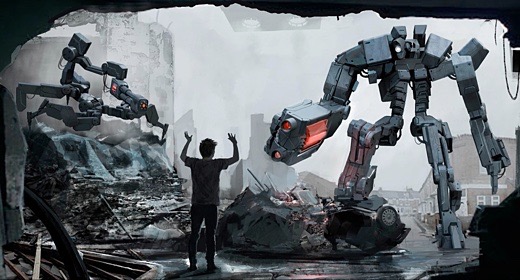

Image above: Concept graphic for movie "Robot Overlords".. From (http://cinefex.com/blog/robot-overlords/).

The previous four posts on this website deal with automated technology replacing human beings in areas where thought, skill and experience have been required for a task to be completed.
In the few decades robotics and software have automated patterned repetitive tasks in manufacturing - most notably in automobile production. Through the 1950's and 60s Detroit autoworkers were the envy of the world. Members of the United Auto Workers could command good wages - enough for a single worker to own a home, support a family and send the kids off to college.

Today those jobs have been automated and largely sent out of the country to where people are cheaper to operate.  Detroit is a shell of itself, reinventing itself as a post industrial city with much of its population lost and its suburbs blending into urban gardens and wilderness.

Many of the nine-to-five jobs humans have had have disappeared. But as the articles above demonstrate there is another wave of human replacement coming on right now.

THE WRITING IS ON THE WALL
Uber, Google, Apple, Tesla, Amazon and others want into an autonomous vehicle future. They are planning for automobile, drones and other technologies to replace a wide spectrum of human work not requiring an advanced education: that includes not only transportation and manufacturing, but food service and retailing.

The fast food industry is racing to replace human workers with fully automated service. Basically vending machines for burgers and fries. What's a teenager to do for work? Design a commercially successful iPod app?

The retailers like Walmart and Home Depot now encourage shoppers to check themselves out at automated teller stations. (Incidentally, I refuse to use them and seek out a human teller at these sites and tell them I'm glad to see them behind the counter).

Is this a danger or threat to humans? I would say it well may be. For decades science fiction writers and futurists have perceived a future where our technology becomes self aware and realizes the weakness and self destructive nature of humans (particularly in great numbers). Remember HAL in the movie "2001: A Space Odessy" or SKYNET in "The Terminator"?

As automation and artificial intelligence develop higher capacities that our technology may realize, as many humans have - that our behavior in the ecosystem is suicidal. At that point we humans may be seen as an unsupportable cost in the overall system.

Humans require way too many resources, too much energy, too much food and too much entertainment in order to be satisfied. If the technology can get along without, truckers, clerks, and factory workers why should it put up with the unemployed, retired, handicapped and children? In other words - Who Needs Us? Certainly not the elite 1% who now have their clutches on the vast majority of wealth.


Image above: Robot staff of eighteen cooks, serves and entertains at a restaurant in Harbin, China. From (http://www.eater.com/2012/6/28/6570185/all-robot-staff-serves-cooks-at-chinas-robot-restaurant).

OFF THE GRID AWAY FROM THE SYSTEM
I am not suggesting that we all go 'Unabomber" route. If you don't remember the Unibomber was Ted Kaczynski, he was mathematical prodigy that abandoned a promising academic career  at UC Berkely in 1969.

Kaczynski moved to an isolated cabin in Montana. Between 1978 and 1995 he killed three people, and injured 23 others, in a nationwide bombing campaign targeting people involved with modern technology.

Kaczynski was driven mad by his realizations about where industrialism was taking humanity. As twisted as his actions were I see the wisdom of his wide-ranging social critique "The Unibomber Manifesto(https://partners.nytimes.com/library/national/unabom-manifesto-1.html). He opposed industrialization and modern technology, and advocated advancing a nature-centered form of anarchism.

We have been advocating for a decade that we lower consumption, get off the grid and becoming self reliant. It may not be too late - but at this point I'd advise hurrying.

See also:
Ea O Ka Aina: Capitalism is a form of Cancer 10/7/16
Ea O Ka Aina: Lost in the Blogosphere? 8/21/16
Ea O Ka Aina: Oases on a future Eaarth 6/28/15
Ea O Ka Aina: Building the Garden of Eden 5/25/15
Ea O Ka Aina: The Hail Mary Pass 8/17/14
Ea O Ka Aina: Worse than you think 5/21/14
Ea O Ka Aina: The New Game 11/10/13
Ea O Ka Aina: The Wolf & the Cherry Tree 2/16/13
Ea O Ka Aina: Food, Water, Energy & Shelter 1/31/13
Ea O Ka Aina: Embrace the Change 7/24/12
Ea O Ka Aina: Doom & Gloom 7/17/12
Ea O Ka Aina: Power from the People 4/3/12
Ea O Ka Aina: The Titanic or Noah's Ark 3/4/12
Ea O Ka Aina: The Hero's Way 1/13/12
Ea O Ka Aina: Trick or Treat! 10/31/11
Ea O Ka Aina: 911 Aftermath - Our Self Defeat 9/10/11
Ea O Ka Aina: In a van - Down by the river 8/23/11
Ea O Ka Aina: The American Unraveling 7/29/11
Ea O Ka Aina: All Aboard! 12/9/09

.

Brexit - the system cannot hold

SUBHEAD: If the Brexit vote shows us one thing, it's that were at the finish of a dead end street.

By Raul Ilargi Meijer on 24 June 2016 for the Automatic Earth -
(http://www.theautomaticearth.com/2016/06/brexit-the-system-cannot-hold/)


Image above: David Cameron demanding Brits vote against exiting the European Union. From (http://www.express.co.uk/news/uk/618841/David-Cameron-European-Union-Leaders-Mark-Rutte-Nigel-Farage-Theresa-May-Brexit-referendum).

Well, they did it. A majority of Britons made clear they’re so fed up with David Cameron and everything he says or does, including promoting the EU, that they voted against that EU. They detest Cameron much more than they like Nigel Farage or Boris Johnson. It seems that everyone has underestimated that.

Cameron just announced he’s stepping down. And that points to a very large hole in the ground somewhere in London town. Because going through a list of potential leaders, you get the strong impression there are none left. Not to run the country, and not to negotiate anything with Brussels. Which has a deep leadership -credibility- hole of itself, even though the incumbents are completely blind to that.

But first Britain. The Leave victory was as much a vote against Chancellor George Osborne as it was against Cameron. So Osborne is out as potential leader of the Conservatives. Boris Johnson? Not nearly enough people like him, and he fumbled his side of the Leave campaign so badly his credibility, though perhaps not being fully shot, is far too much of an uncertainty for the Tories to enter the upcoming inevitable general elections with.

Who else is there? Michael Gove? Absolute suicide. Likeability factor of zero Kelvin. That bus these guys drove around which proclaimed they could get £350 million extra a year for the NHS health care system in case of a Brexit will come back to haunt all of them. Just about the first thing Farage said earlier when the win became clear, was that the £350 million was a mistake.

I guess you could mention Theresa May, who apparently wants the post, but she’s an integral part of the Cameron clique and can’t be presented as the fresh start the party so badly needs.

Talking about Farage, who’s not Tory, but Ukip, he’s done what he set out to do, and that means the end of the line for him. He could, and will, call for a national unity government, but there is no such unity. He got voted out of a job today -he is/was a member of the European Parliament- and Ukip has only one seat in the British parliament, so he’s a bit tragic today. There is no place nor need for a UK Independence Party when the UK is already independent.

Then there’s Labour, who failed to reach their own constituency, which subsequently voted with Farage et al, and who stood right alongside Cameron for Remain, with ‘leader’ Jeremy Corbyn reduced to the role of a curiously mumbling movie extra. So Corbyn is out.

Shadow finance minister John McDonnell has aspirations, but he’s a firm Remain guy as well, and that happens to have been voted down. Labour has failed in a terrible fashion, and they better acknowledge it or else. But they already had a very hard time just coming up with Corbyn last time around, and the next twist won’t be any easier.

Cameron, Osborne, Corbyn, they have all failed to connect with their people. This is not some recent development. Nor is it a British phenomenon, support for traditional parties is crumbling away everywhere in the western world.

The main reason for this is a fast fading economy, which all politicians just try to hide from their people, but which those same people get hit by every single day.

A second reason is that politicians of traditional parties are not perceived as standing up for either their people nor their societies, but as a class in themselves.

In Britain, there now seems to be a unique opportunity to organize a movement like (Unidos) Podemos in Spain, the European Union’s next big headache coming up in a few days. Podemos is proof that this can be done fast, and there’s a big gaping hole to fill.

Much of what’s next in politics may be pre-empted in the markets. Though it’s hard to say where it all leads, this morning there’s obviously a lot of panic, short covering etc going on, fact is that as I write this, Germany’s DAX index loses 6% (-16.3% YoY), France’s CAC is down 7.7% (-18.5%) and Spain’s IBEX no less than 10.3% (-30%). Ironically, the losses in Britain’s FTSE are ‘only’ 4.5% (-11%).

These are numbers that can move entire societies, countries and political systems. But we’ll see. Currency moves are already abating, and on the 22nd floor of a well-protected building in Basel, all of the relevant central bankers in the world are conspiring to buy whatever they can get their hands on. Losses will be big but can perhaps be contained up to a point, and tomorrow is Saturday.

By the way, from a purely legal point of view, Cameron et al could try and push aside the referendum, which is not legally binding. I got only one thing on that: please let them try.

As an aside, wouldn’t it be a great irony if the England soccer (football) team now go on to win the Euro Cup? Or even Wales, which voted massively against the EU?

Finally, this was of course not a vote about the -perhaps not so- United Kingdom, it was a vote about the EU. But the only thing we can expect from Brussels and all the 27 remaining capitals is damage control and more high handedness. It’s all the Junckers and Tusks and Schäubles and Dijsselbloems are capable of anymore.

But it’s they, as much as David Cameron, who were voted down today. And they too should draw their conclusions, or this becomes not even so much about credibility as it becomes about sheer relevance.

Even well before there will be negotiations with whoever represents Britain by the time it happens, the Brussels court circle will be confronted with a whole slew of calls for referendums in other member states. The cat is out of Pandora’s bag, and the genie out of her bottle.

Many of the calls will come from the far-right, but it’s Brussels itself that created the space for these people to operate in. I’ve said it before, the EU does not prevent the next battle in Europe, it will create it. EC head Donald Tusk’s statement earlier today was about strengthening the union with the remaining 27 nations. As if Britain were the only place where people want out…

Holland, France, Denmark, Italy, Spain, Hungary, they will all have calls for referendums. Greece already had one a year ago. The center cannot hold. Nor can the system. If referendums were held in all remaining 27 EU member states, the union would be a lot smaller the next morning. The Unholy Union depends on people not getting a say.

The overwhelming underlying principle that we see at work here is that centralization is dead, because the economy has perished. Or at least the growth of the economy has, which is the same in a system that relies on perpetual growth to ‘function’.

But that is something we can be sure no politician or bureaucrat or economist is willing to acknowledge. They’re all going to continue to claim that their specific theories and plans are capable of regenerating the growth the system depends on. Only to see them fail.

It’s high time for something completely different, because we’re on a dead end street. If the Brexit vote shows us one thing, it’s that. But that is not what people -wish to- see.

Unfortunately, the kinds of wholesale changes needed now hardly ever take place in a peaceful manner. I guess that’s my main preoccupation right now.
Things fall apart; the centre cannot hold;
Mere anarchy is loosed upon the world,
The blood-dimmed tide is loosed, and everywhere
The ceremony of innocence is drowned;
Yeats

.

Rebel Architecture

SUBHEAD: A documentary series profiling architects who are using design as a form of activism and resistance.

By Andrew Butler on 7 Mar 2015 for Films For Action -
(http://www.filmsforaction.org/watch/rebel-architecture-2014/)


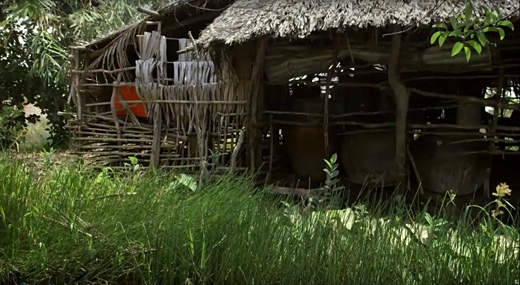
Image above:  A country home in Vietnam built of indigenous materials from river edge tropical forest demonstrates the integration of green nature that is missing in the cities. A still image from Part 6 below.

A six-part documentary series from Al Jazeera profiling architects who are using design as a form of activism and resistance to tackle the world's urban, environmental and social crises. The series follows architects from Vietnam, Nigeria, Spain, Pakistan, Israel/Occupied West Bank and Brazil who believe architecture can do more than iconic towers and luxury flats - turning away from elite "starchitecture" to design for the majority.

Part 1 - Guerrilla architect


Video above: Santiago Cirugeda is a subversive architect from Seville who has dedicated his career to reclaiming urban spaces for the public. From (https://youtu.be/674N2SnaAfs).

Part 2 -  A traditional future


Video above: Pakistani architect Yasmeen Lari uses local building techniques to rebuild villages in the flood-stricken Sindh region.. From (https://youtu.be/5yvAFis1FB0).


Part 3 The architecture of violence


Video above: Eyal Weizman explains architecture's key role in the Israeli occupation of Palestine and the evolution of urban warfare. From (https://youtu.be/ybwJaCeeA9o).

Part 4 - Greening the city

Video above: Vo Trong Nghia attempts to return greenery to Vietnam's choking cities and design affordable homes for poor communities.

From (https://youtu.be/bgQoVbEX8-A).

Part 5 - Working on water


Architect Kunle Adeyemi sets out to solve the issues of flooding and overcrowding in Nigeria's waterside slums. From (https://youtu.be/ciG2OJvlWb0).

Part 6 - The pedreiro and the master planner


Video above: Informal builder Ricardo de Oliviera struggles with the government's plan for the future of Rio's Rocinha favela. From (https://youtu.be/kv0_ELupyxs).

See more episodes of Rebel Architecture 2104
(http://www.aljazeera.com/programmes/rebelarchitecture/episodes.html)

.

An Unplanned Break

SUBHEAD: This story is no longer just about the bees, but also butterflies, and even people.

By Andy Russell on 26 August 2014 for Autonomy Acres -
(http://autonomyacres.wordpress.com/2014/08/26/an-unplanned-break-writers-block-and-the-art-of-extinction/)


Image above: GMOs threaten bees and butterflies (Essentially food and life as you know it). From (http://www.fabulousfoodlife.com/gmos-threaten-bees-butterflies-essentially-food-life-as-you-know-it/).

While the title of this essay may be tinted with a bit of doom and gloom, it is not as ominous as it sounds, and it is a fairly accurate description of the events and stories that follow.  For anyone who has followed this blog over the last five years may have noticed, I have gone through periods of consistent, productive writing, balanced out with dry periods of nothing but writers’ block growing up through the cracks of my mindscape.

While these droughts have been few for the most part, this last one has been pretty epic in scale!  The last time I sat down to write was back in February of this year when I continued with an ongoing series of essays about DIY homebrewing.

Since this last winter (the one filled with all of the Polar Vortexes) many things have happened here at the Dead End Alley Farm, and much of it would have made great copy for essays and DIY how – to’s here on the blog. I am not going to touch on everything, but I guess it is time for us to catch up on current events and happenings around the homestead and the world at large.

As I sit here in the afternoon shade with a cold beer in the outside office (a picnic table and some benches, and a hacked together arbor covered in wild grapes and honeysuckle) I am listening to one of the hens cluck away in pride or fear or some other emotion that only a chicken can know.  I can see bumble bees feeding on white clover and catnip, an overcast sky, and my old dog Harvey lying in the grass watching the world go by.

There are parts of our yard that are overgrown with weeds that should have been ripped from the ground long ago, and some of our apple trees (especially the big old one in back) are beginning to shed apples like drops of rain.  There is garlic hanging from the roof joists of my back deck and the tomato plants are overloaded with luscious fruit this year.

I have three hives of bees this season.  My pride and joy are the Carniolans that overwintered and have proven to be exceptional bees.  They are 3 deep with 2 honey supers (which translates to a very healthy colony that is making a lot of honey), a naturally mated queen (who may be the same one from last year, not real sure if they have swarmed or not this season) leads this tribe, and they are poised to enter this upcoming winter appearing very strong and healthy with adequate food supplies.

This spring I also purchased 2 packages of hybrid Buckfast bees that came up from Georgia.  Sadly one perished within the first week (dead queen), but the other one has shown to be a vigorous (if not a bit pissy) hive of bees.

At last check they were finishing up drawing out comb and making honey in 3 deep boxes which should be enough stores for winter. And throughout the early part of the year these Buckfast bees provided frames of brood and eggs to help strengthen my Carniolans, and have also helped out to create a third colony.

At the end of June I came across a local company, 4 Seasons Apiaries, that specializes in locally bred queens and nucs.  This is a huge deal for us in Minnesota, not only for the fact that it is hard to find northern bred queens anywhere, but because it was only 20 minutes from my house as the car drives.  I ended up purchasing a really dark queen for $28 and put together a split that was made up of two frames each of the Buckfasts and the Carniolans.

The jury is still out on how this hive is doing though.  The queen is laying eggs, there is brood (both capped and otherwise), and they are actually making quite a bit of honey, but their overall numbers seem low to me.  They will most likely be subsidized with honey from the Carniolans this winter in hopes that they will have enough food to survive the cold, dark days of the upper midwest winter.

While I cross my fingers in hopes that all 3 of my colonies will pull through and survive this upcoming winter, observation and common sense tell me that the likelihood of all 3 surviving is slim at best.  Current numbers from this last winters survival rate was anywhere from about 30-50%.  These are horseshit numbers when compared to 20-30 years ago when a beekeeper could expect close to 90% survival rate in their apiaries.

So the same story continues for the bees.  While the numbers of reported cases of colony collapse disorder have evened out (and possibly plateaued), bee losses continue throughout many parts of the world, but seem especially high here in America.

Why this is such a surprise to people baffles me.  Our modern – mono crop – anthropocentric ways of inhabiting this planet are not compatible with a diverse, living, natural world.  This story is no longer just about the bees, but also of the monarch butterfly, the oceans, the remaining old growth forests of the world, and even people.

Habitat destruction, climate change, slavery, edible-food-like-products engineered to grow with poison, industrial pollution, and profit – from – disease are all symptoms of the overarching cancer that is this modern day capitalist society. It has grown up around us over the last 300 years, the whole time was spent in a petrochemical party binge, and now that we are drying out we are starting to feel the hangover!

It is as simple as this – when the bees lose, we lose, and that is the road we are going down.  The world that we live in, regardless of your flavor of religion, or politics, or indifference is still ruled by cold hard facts established through observation and the scientific method.  The world is changing, mainly its’ climate, but also the make-up of its varied populations.

Every day the Earth loses another creature, another plant.  The last of manifest destiny is completing itself as the few remaining “wild” people are driven from their forest homes, and the blood of ethnic genocide still waters the tree of “Liberty” for those of us in the privileged world .

This spring my family experienced climate change first hand.  For some naive reason I thought we were insulated from climate change here in Minnesota, but was I wrong!

Starting towards the end of May and going through towards the end of June, we received upwards of 15 inches of rain for the month, with a lot of this rain coming in bursts of multiple inches in short periods of time.  At some point a sewer line about a block and a half away from my home could no longer keep up with the amount of stormwater entering the system and literally collapsed in on itself.

This blockage led to my whole neighborhoods’ sanitary sewers backing up and we had upwards of 14 inches of sewage water in our basements!

Lets just say it was a real shitty and smelly problem to clean up.  To add to the mess, the city that I live in is not claiming any real responsibility for the sewer collapsing.  They are saying that the amount of rain that we received is to blame (because no one could have predicted that we would ever get that much rain in such a small space of time), and it is not their problem that the sewer wasn’t designed to handle that much water.

This situation is a good illustration of the intersecting problems of failing infrastructure and its ability to deal with the symptoms of climate change.

Not only is it bad enough that our infrastructure is falling apart and failing throughout the country, climate change will only hasten the collapse of these systems that we take for granted.

As there is less and less money to spend on domestic infrastructure projects and basic preventative maintenance, and the ever increasing threats of unstable weather conditions loom closer on all of our horizons, our roads and sewers and all the other systems that make modern lifestyles possible will be challenged and frequently overcome by a force far greater than themselves.

What is the quick take away from this conversation?  That as we face the future of a world that struggles to adapt to a changing climate with far fewer cheap resources on hand to work with, we can no longer rely on the long term support of our governments to solve these problems or to even help clean up the messes that ensue.

Just think back to hurricanes Katrina or Sandy (or any number of other climate disasters that happen regularly around the world) and you have all the evidence that you need to show government ineptitude when a climate-crisis strikes.

Most of the collapse will be slow and unnoticeable except for those places directly affected by whatever natural disaster decides to strike next.  But with each changing season, and every new climate change induced disaster, bit by bit the comfort and convenience that we are used to will begin to erode away.

As long as we keep spending our resources, whether that be gold or oil, in a way that denies climate change and resource depletion, we will find ourselves in a world that is an empty shell of the one we now know.

If I were a religious man I may start praying extra hard right now, but thankfully I let science rather than superstition guide my life.  Critical observation and the ability to make rational decisions based on the facts is important.

Not just for a nation or a civilization, but also on the personal and family level.  I think if there is anything I have learned, is that when we can look at problems on multiple levels, do the research that is needed to educate ourselves on these problems, and then make decisions based on these observations to correct the problem, we can do a lot just in our own lives to change the course of events, and add a bit of resiliency and human spirit back into our everyday lives.

As briefly mentioned here in other posts, a year and a half ago I quit a long time job of mine in favor of one that affords me far more free time.

The trade off has been huge, and sometimes quite challenging.  This has been my second summer off, and my first full season as a partially self employed, full time stay at home dad.  It has probably been the most eye opening, and sometimes hardest role I have ever had to play.

Being use to the role as the main breadwinner in my family for so long and then giving up that economic control is not easy, but a lesson that I urge you to all try at some point in your life.  After these last few months of being at home with the kids, I have a far greater appreciation and respect for the work that my wife (as well as all you other moms out there!) has done over the last 8 years.

Child rearing is the hardest thing I have ever participated in, but I am glad that I have had the chance to dive in full time.

For me the hardest part has been balancing time between time actively spent with the kids, chores, and coordinating our CSA.  The CSA we run is small.  2 full shares, and 2, ½ shares, but it gave me a nice chunk of cash in the spring and early summer for things like groceries (I can’t grow cheese cake!) and gas money.

That cash is gone now, so my new endeavor is working on a business plan that expands out from the CSA in other directions to increase my summer cash flow for a few more months.

Eventually I hope to start making a bit of money by raising bees to sell, starting a small plant nursery, and I am also exploring some options for teaching classes.  Using outlets like the public library system, community education, and space at my local co-op,

I am hoping to put together a selection of classes that will include introductions to beekeeping and Permaculture, and also a tree grafting workshop each spring.  I am in the early phases of research and planning, but I hope to teach my first official tree grafting class this upcoming spring (contact me if you are interested in hosting a class).

I guess when I really sit down and think about it, my ultimate long term goal is to not have to ever work a full time job again, unless it is for myself.  I am not scared of hard work, but it comes back to the fact that I am no longer alright selling my time to some asshole when I am fully capable of doing something(s) I am passionate about and generate an income for myself at the same time.

Is this selfish?  Maybe, but I am okay with that as well.  I have begun to realize more than ever most people are just clueless drones.  Who after years of taking orders, and numbing themselves with TV, processed food, and fanatical beliefs in fairy tales can no longer truly take care of themselves or make desicions that impact their destiny.

As it stands, with humans being prisoners to their own creations and all,  I do not have a lot of hope for humanity right now.

If you follow David Holmgren’s work Future Scenarios, we are most likely entering into the Brown Tech future.  A world where we will continue draining the Earth of its fossil fuels, destroying the last of the wild lands, converting more and more  of that land to desertscapes of monocrops, and the further erosion of our shared cultural heritage, modern Homo Sapiens have perfected the art of extinction.

It is a bleak future.  One that leaves less and less room for those of us who seek freedom and justice.  It is a world that has been reduced to cultural poverty by traditions and tragedies alike.

It is a world where all life on Earth has been reduced to interchangeable and disposable parts in the pursuit of Progress.  It is a world filled with death and injustice, but it is also falling apart.

Whether humans can survive this collapse of our own making is yet to be determined.  It will be hard, but even the strongest rock is defeated by water and wind in the end.  It is in these cracks and fissures that we can seek our refuge.  The spots forgotten about and overlooked.  The areas where literal and figurative weeds grow.  The edges.  The TAZs where humanity still flourish.

Go on hikes.  Hunt mushrooms.  Raise bees.  Raise Kids.  Bake bread.  Love.  Hate.  Grow some carrots.  Chop some wood.  Pull some weeds.  Laugh.  Hug a puppy.  Cry.  Resist!  Grow.  Take a nap.  Rise up!  Read a book.  Lend a hand.   Take notes.  Have fun.  Fish.  Visit a friend.  Hug your mom.  Plant trees.  Be human….

.

Anarchy and Minecraft

SUBHEAD: When it's running for free the participants "play nice" and build a world to their own liking.

By Juan Wilson on 31 March 2014 for Island Breath -
(http://islandbreath.blogspot.com/2014/03/anarchy-and-minecraft.html)

http://www.islandbreath.org/2014Year/03/140331minecraftbig.jpg
Image above: Aerial view of a landscape built with computer game Minecraft. From (http://wallpaperswide.com/minecraft_landscape-wallpapers.html). Click to embiggen.

The recent announcement by the Kauai Department of Water to abandon the project to drill a horizontal well sent me to thinking about how we rule ourselves and how we as a community make decisions.

In my mind this seriously flawed proposal was essentially to tap into Mount Waialeale to drain the Alakai fresh water aquifer for the sake of money and development.

The various dog and pony shows put on by the DOW to sell the project  - and appear to go through the motions of consulting the community were disasters. All the green smoke rosey blather from the DOW's management and their consultants hit a brick wall.

Blow by Blow 
People who attended these scripted events were not going to be polite and follow the presenter's rules. They spoke up and pushed back. They implored and bullied. They would have no part in the fiasco.
  • This was similar to what Kauai Mayor Bernard Carvalho recently faced when he vetoed the GMO regulation Bill 2491. It passed with the concerted and in-your-face effort of a populist uprising. Carvalho, under pressure from the chemical companies in control of our ag land, put Kauai's health and well being  behind corporate interest and vetoed the bill. To his dismay his veto was overturned.  
  • This was like what our Governor Neil Abercrombie faced in April 2012 with his attempt to create the Public Land Development Corporation (PLDC) that would be the means of privitizing Hawaii's public land and getting around environmental restrictions and local community interests in the pursuit of real estate speculation. Massive stone faced opposition.
  • This is also what ex Governor Linda Lingle experienced as the point woman for the Superferry. This was in reality a military experiment in crowd sourcing the R&D of navel craft, in the guise of public transportation. It and Lingle lost its traction in September 2007 when she faced the people of Kauai at the Peace & Freedom Convention Center in Lihue and could not intimidate us.
  • It is what the Navy Commander of the PMRF faced at Kalaheo School in Novermber of 2003 when presenting a plan to greatly expand the area of PMRF control of the Mana Plain that included a lease arrangement that would be free and forever. Two hundred Kauai residents showed up on short unpublicized notice. All testified strongly against the proposed arrangement.
Pitchforks and Torches
These kinds of responses to government have been seen by some as "mob rule".  But I would say they are really the heart of what democracy can achieve. Sure, democracy can quickly dissolve into mob rule. A summary lynching can be a thoroughly democratic process. The whims and blood fever of a hungry crowd that senses injustice produce ugly results.

All political forces have their dark sides. Enlightened personal leadership without selfish interest is key in all governing situations.

The United States has never been - and was never intended - to be a democracy. It was designed to be a republic. A people ruled by selected representatives. It was meant to be a federation of semi-sovereign states that were too unwieldy to be make decisions the votes of all its constituent citizens.

On a day to day basis, even running a large town by up-or-down votes by majority rule is to too cumbersome for practical operations. Not only is democracy impractical but the results can be quite undesirable. Think of a public lynching.

But when corporate interests take control of representative government and public and corporate employment passes through a revolving door - then somebody has to break the cycle. Put their body in front of the door. So what works.

For democracy to work the cost must be to the participant.

Less is More
Recently the Kauai County Charter Review Commission rejected three proposals that would have given voters the chance to split the island into districts for electing council members rather than having them elected at-large.

My opinion is that this was a halfway measure that really did not address the issue of properly representing the interests of Kauai. The district scale (moku) were too big and unequal in scale and resources.

Closer to the heart would be town (ahupuaa) representatives. It always seemed odd to me that Kauai's executive leader was a "mayor". In my past mayorships were the role of town or city leaders, not rural county counterparts.

I recommend that Kauai would be better off with a mayor in each of its towns. Let's start with trwenty-two mayors for Wainiha, Hanalei, (I don't count Princeville as a public town but a private resort), Anini, Kilauea, Moloaa, Anahola, Kealea, Kawaihau, Kapaa, Wailua, Waipouli, Hanamaulu, Lihue, Puhi, Omau, Lawai, Koloa, Poipu, Kalaheo, Hanapepe, Waimea, Kekaha.

Moreover, I suggest that each town should also have its own elementary school, park, library, fire department, peace officer and public works operation.

The less you have to deal with the county, state or federal government the better off you are. An even though all government has become a form of mafia operation, it seems to me that the smaller that operation is the less harm it will do in the long run.

Anarchy and Minecraft! 
We will need a lot of faith and a lot of good will to get through the approaching maelstrom of change needed to sort out the future. The powers that be have short term vested interests in the continuity of current arrangements. You don't. I recommend finding a situation where one won't need cable TV, a car or a job.

Accepting this take on authority is to a degree accepting anarchy: A situation where you are best suited to be your own regulator. For anarchy to work it requires an informed, moral and responsible citizenry... But that's the case with democracy and even representative government as well. With anarchy you cut out the middleman.

Have you seen the computer game Minecraft? It's kind of a electronic Lego system on steroids with 3D block elements representing everything from lava to grassy lawn. You can create and you can destroy - as needed to achieve your goals.

When it's running on a free server you'll find the overwhelming number the participants "play nice" and build a place in the world to their own liking. It's a kind of anarchy rarely achieved in reality. But one that should be attempted.  

Once again I urge you to produce your own food; clean up your own shit; collect your own water; provide your own power; repair your own tools; play your own music; write your own editorials and love your own people.


.

Asymmetric Warfare Group

SUBHEAD: U.S. Army builds ‘Fake City’ in Virginia to train soldiers for domestic warfare in America.

By Paul Joseph Watson on 14 February 2014 for SHTF Plan -
(http://www.shtfplan.com/headline-news/u-s-army-builds-fake-city-in-virginia-to-practice-military-occupation_02142014)


Image above: Still from video below of typical American small town Christian church built domestic warfare training center in Virginia. 

The U.S. Army has built a 300 acre ‘fake city’ complete with a sports stadium, bank, school, and an underground subway in order to train for unspecified future combat scenarios.

The recently opened site is located in Virginia and was built at a cost of $96 million dollars, taking just two years to complete.

While the city was ostensibly built to prepare U.S. troops for the occupation of cities abroad, some will undoubtedly fear that the real intention could be closer to home. Although the site includes a mosque, the town looks American in every other way, with signs in English.

The fact that, as the Telegraph reports, “The subway carriages even carry the same logo as the carriages in Washington DC,” could suggest that the site was built to double both as a foreign city and a mock domestic town.

According to Colonel John P. Petkosek, “This is the place where we can be creative, where we can come up with solutions for problems that we don’t even know we have yet….This is where we’ll look at solutions for the future–material solutions and non-material solutions…anything from how you’re going to operate in a subterranean environment to how you dismount a Humvee to avoid an IED strike.”

The increasing demonization of domestic political groups as extremists has prompted numerous scenarios where commentators have suggested that U.S. Army and National Guard personnel could be needed to quell civil unrest.

In 2012, an academic study about the future use of the military as a peacekeeping force within the United States written by a retired Army Colonel depicted a shocking scenario in which the U.S. Army is used to restore order to a town that has been seized by Tea Party “insurrectionists”.

The study dovetailed with a leaked U.S. Army manual which revealed plans for the military to carry out “Civil Disturbance Operations” during which troops would be used domestically to quell riots, confiscate firearms and even kill Americans on U.S. soil during mass civil unrest.

The manual also describes how prisoners will be processed through temporary internment camps under the guidance of U.S. Army FM 3-19.40 Internment/Resettlement Operations, which outlines how internees would be “re-educated” into developing an “appreciation of U.S. policies” while detained in prison camps inside the United States.

Fort Hood soldiers are also being taught by their superiors that Christians, Tea Party supporters and anti-abortion activists represent a radical terror threat, mirroring rhetoric backed by the Department of Homeland Security which frames “liberty lovers” as domestic extremists.

Last year, former Navy SEAL Ben Smith warned that the Obama administration is asking top brass in the military if they would be comfortable with disarming U.S. citizens, a litmus test that includes gauging whether they would be prepared to order NCOs to fire on Americans.

During a recent Ohio National Guard exercise, second amendment proponents were portrayed as domestic terrorists as part of a mock disaster drill.


Image above: US Army video press release 1/24/14 on Asymmetric Warfare Training Center opening at Fort Hill, Virginia. From (http://youtu.be/LkPkvVMpoak).


Image above: Compilation of TV news articles on U.S> military preparedness for fighting Americans at home. From (http://youtu.be/Jv124RD-G3k).

See also:
Ea O Ka Aina: Training for supression of Americans 4/10/12

.

The Anarchist's Shoes

SUBHEAD: Years of reading ads convinced me that a highly "technical" shoes enhanced feet. As if!

By Amanda Kovattana on 12 February 2014 for Amanda Kovattana Blog -
(http://amandakovattana.blogspot.com/2014/02/the-anarchists-shoes.html)


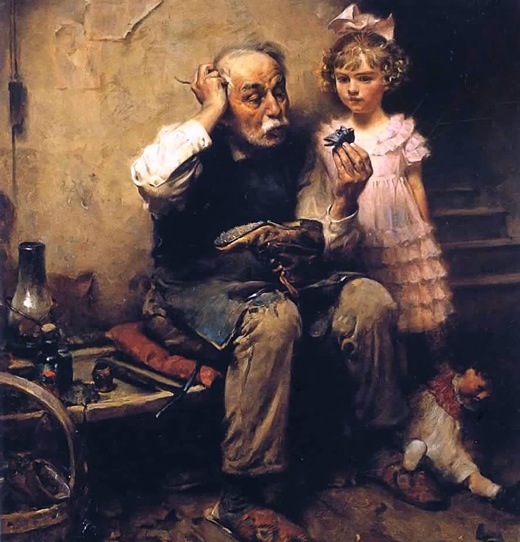
Image above: Detail of painting "Cobbler Studying a Doll's Shoe" by Norman Rockwell, 1921. From (http://ayay.co.uk/background/paintings/norman_rockwell/cobbler-studying-dolls-shoe/).

At Thanksgiving dinner the Anarchist was admiring the black ankle boot moccasins I was wearing with my sarong pants and I announced that I was going to make my own shoes.

"I'd be very interested in how that goes", said the Anarchist who was a self designated non-conformist who had, during a discussion at one of our parties, announced that she was an anarchist. A term that fits well for this story.

Her desire to join me in my shoe odyssey further intrigued me and she told me of her feet woes. How the combination of bunions and toes now curling up over her feet made it increasingly difficult to find footwear to fit. She didn't have good feet to begin with, she explained, but years of forcing them into heels and of being on her feet all day while working at a Hallmark store did them in.

Only then did I realize that she always wore Ugg boots even in summer and now she could only wear the right boot of two pairs of Uggs. I showed her the work of a shoemaker who had blogged about making a pair of shoes for a woman with severely swollen feet.

See (http://simpleshoemaking.wordpress.com/2013/08/26/how-to-make-simple-stitch-down-shoes-for-people-with-swollen-feet/).

This gave us the confidence that we too could solve our shoe problems in the same manner.

I had my own reasons for wanting to make my own shoes. My daily dog walking was wearing out my shoes faster than at any time in my life. The soles of walking shoes did not seem to wear as well as they once did. I was shoe goo-ing them repeatedly (glue used to fix holes in tennis shoes). Then I read an article brought to my attention by a newsfeed I subscribe to called the Village Green Network which usually concerned itself with food and recipes for making something simple like laundry soap.

The article was by a woman who had decided to make her own shoes because most shoes caused her pain on the long hikes she liked to take. She referenced another article that described how shoes compromise the natural gait of the foot. I was shocked and then not at all surprised. So often did a single assumption lead to misinformation never investigated.

Shoes were still built on the same too narrow lasts as they had been for centuries under the belief that feet had to be supported. They were also too heavy, inflexible, reduced surface area of the foot and since they were drawn with a curve rather than on a straight axis forced the foot to an incorrect orientation.

The referenced article (http://www.unshod.org/pfbc/pfrossi2.htm) described how the footbed of shoes have an indentation under the ball of the foot designed into the shoe to make the foot look smaller. Sure enough I checked all my shoes and every one of them had that indentation built into the footbed. This slight dip compromised the natural arch of the foot especially when other areas of the footbed were compressed with wear.

This combination put three important bones out of alignment. The reason arch support was needed turned out to be to raise these bones back into place. The turned up toes of shoes, the lack of flexibility in the sole, the stiffness of the uppers all interfered with the natural ability of the foot to grasp surface area, expand and move the body.

The article also pointed out that you can tell by the wear pattern of your shoes that the natural gait was being compromised. I looked on the bottom of my shoes and sure enough all of them were worn down on the outside edge of the heels and on a spot in the middle of the ball of the foot as described. I thought it was because of my bowed legs causing my shoes not to land properly.

I read the article several times before I could believe that shoes were not helping at all (apart from protecting the foot from pointed rocks) and were more likely reducing the foots flexibility and strength. Feet would be better off in a pair of moccasins the article concluded.

Earlier in the year I had been similarly astounded by an article claiming that the brassiere seriously compromised the ability of the breasts to get rid of toxins and did not in fact keep a woman's breasts from sagging over time, but had compromised the muscle structure of the breasts to take care of this themselves. Given my personal minimalist topography I could happily give up the brassiere, but I could not do without shoes.

Thus I embarked on my shoemaking education and found a book at the library with full color pictures that convinced me of what wonderfully colorful and interesting footwear I could make for myself. This led me to find the author online where I found the aforementioned blog about making shoes for swollen feet. She had also posted an article from the New York Times (http://nymag.com/health/features/46213/) a bit more readable and less technical that said the same thing—shoes were bad for you.

I consulted my chiropractor and he told me about the body's remarkable ability to adapt. How bones that had been badly set would over time correct themselves. So feet would also adapt to shoes. And he himself would not be giving up the support of his hiking boots no matter what the claims of the new minimalist trends in sport shoes.

One could simply train oneself to walk properly he claimed. I in turn told him how I had learned from a masseuse that the Asian squat was not a body position that one could learn in adulthood. That this act of folding the body up and squatting on the heels actually changed the angle of the hip sockets so only those who had practiced this sitting position from childhood could accomplish it so easily in adulthood.

So wouldn't a person who had spent most of their time walking barefoot be similarly suited to unconstructed shoes? He agreed that I had made a convincing hypotheses for my new shoe wearing preferences. And given his theory of adaptation it is likely that others who adopted a barefoot lifestyle could over time strengthen their feet too. My karate class was, after all, filled with newcomers learning to exert their body for peak fighting performance while barefoot.

Shoemaking
I had been a seamstress all my life and I once made jester slippers from wool felting, but I hadn't a clue how to choose leather or what a millimeter in thickness felt like. In order to become acquainted with the medium I ordered a three pound box of leather scraps from e-bay for $30. And what an assortment of cowhide did I receive.

I picked over the fake crocodile in unnatural colors, the fake pink ostrich that came in lime green, red and turquoise, some shiny red metallic gold and copper pieces, floral embossed ones and weird ones that looked like flocked wall paper. I was both repulsed and intrigued and spent an afternoon art date putting together combinations of blue crocodile and lime green ostrich. Most of the scraps came in pieces too small to use so I would have to make a crazy quilt shoe.

I felt more compelled to meet the needs of my Anarchist friend for her need was greater and I still had shoes a plenty. Plus the caveat of making shoes for a "customer" excited me with visions of a new shoe making add-on to my services. Who could resist custom made shoes? Another of my clients also had problems with bunions gradually eliminating all but men's running shoes for her. She said she could have had an operation to correct her feet, but there was no way she would have been able to be off her feet for six weeks.

My Anarchist friend had said the same thing. It occurred to me that the abuse of women's feet in heels and the failure to correct them surgically was probably quite common among women, especially those that took care of others as women so often did.

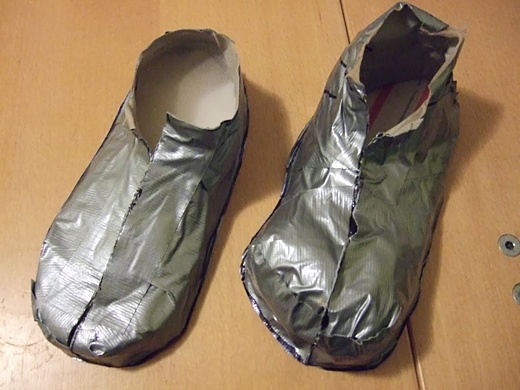
I watched a video on my shoemakers blog on how to make a last upon which to build a shoe and went to visit the Anarchist with duct tape and homemade play dough in hand. The play dough was for filling the spaces over the toes to make a shoe like shape.

I had her slip on a pair of knee high nylons I had brought with me and she stood on the cardboard soles I had made with a little wall of duct tape around the perimeter. I went to town ripping off pieces of duct tape and wrapping them across her feet attaching them to the side wall.


Image above: Two attempts using duct-tape to create shoe shape to derive leather patterns. From original article.

After I was done I carefully cut the duct tape boots off down the top of the foot. The results looked like a pair of boots left behind by the Tin Man after a thorough beating.

Instead of flattening out my duct tape pieces to make patterns for a last as instructed, I decided to skip that step and just drape the leather over the duct tape forms themselves. I cut up an old black t-shirt to make a prototype. The Anarchist loved the pixie shape I had devised to accommodate the unusual shape of her feet.

My challenge was to make the shoe for the more normal foot look the same as this high profile one. It would not be possible to make them identical, but I could mimic the same shape and hold the foot with a hidden piece inside the shoe.

I had brought my bag of leather scraps so she could choose what kind of leather she wanted her shoes made from. She admired how soft and flexible some of the pieces. As they were to be her first pair, were and chose black which would go with most of her outfits and hats for she was a snappy dresser.

She then showed me the pair of shoes she had had custom made by a professional shoemaker. They hurt her feet she said and cost $500. They were so stiff and ugly they made me angry. There was no flex to the sole at all. Whoever constructed these shoes had decided that her feet were too crippled to be of any use and had made what was essentially the foot part of a wooden leg.

I ordered more leather from e-bay—remnants from upholstered leather sofa making. And I made adjustments to my t-shirt mock up until we were satisfied with the fit. Then I took apart my model and used the pieces as a pattern to cut the shoe parts out of the black leather.


Image above: Two attempts using duct-tape to create shoe shape to derive leather patterns. From original article.

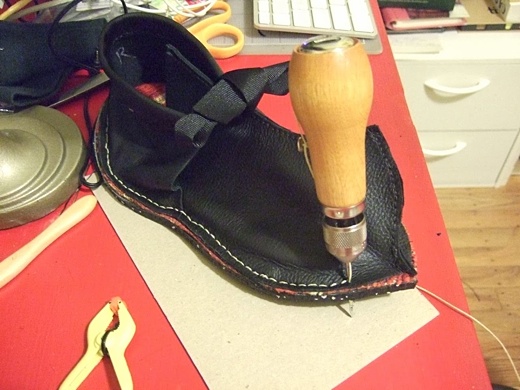
Next I had to learn how to sew leather together with the prescribed synthetic sinew. I bought myself the proper needles, a stitching awl, sinew and some non toxic cement. I could use my sewing machine to make holes in the leather that could then be enlarged by the stitching awl; the hand sewing went much easier once I made the holes large enough.

Hunting down material for the soles would be a challenge since this was a material only available to professional shoe makers in bulk rolls. My shoemaker blogger suggested going to Home Depot to look for rubber floor tiles used in workout rooms and garages; they were made from recycled automobile tires. The pack of 6 tiles I found would be enough for 12 pairs of shoes, but they were the right thickness. I was very pleased that they were a recycled product.

The insoles were also challenging because my customer's feet were of such a shape that no conventional insole from the drug store would work.

So in the end I used some square sheets of rubber I had on hand that came as knee pads inside gardening pants. I covered these thick pieces with scrap upholstery material I had gotten from FabMo a non profit that collected samples discarded by interior design stores. For shoe laces I decided to use gross grain ribbon from the fabric store was in order. These ribbon ties along with the pointed pixie toes made the shoes look magical.


Image above: Two attempts using duct-tape to create shoe shape to derive leather patterns. From original article.

I had the Anarchist try them on. The problematic right foot was a bit loose in the toe. She got her canes out and took a test drive walking fast into her room and back. The pointed soles on one foot would catch a little as she picked up her feet so I took them home and cut and sewed the toes into a rounded shape.

Now they fit better and were easier to walk in. She also commented that they were very comfortable and the soles offered plenty of arch support. That's funny I thought, I didn't build any arch support into the footbed. But the thickness of the insoles afforded enough cushion to feel like it and protected her protruding bones from the hard floor. She was pleased with the that they looked dressy too.

Stepping off the Grid
Such off the grid journeys, I realized, usually started with a revealing piece of information. Shampoo I found out made your hair grease up which led to hair washing every other day when I really didn't need to wash my hair more than once a week if I used baking soda and an apple cider rinse as was done a century ago. Not to mention that some of the ingredients in shampoo were toxic.

When I started reading up on what caused my blood sugar to spike I learned that our food supply was compromised by the misinformation of the medical institution creating a world wide aversion to saturated fat. The processed food industry then capitalized on cheap ingredients some of which the body was unable to digest. But as long as a package said low-fat or vegetarian any frankenfood would sell as a health food.

My interest in electric cars taught me that automobiles could be built much simpler and lighter if it weren't for the demands of long distance travel and the crash test at freeway speeds. Crash test regulations kept other alternatives off the market even if you never intended to drive on the freeway, but at a much slower speed appropriate to neighborhoods.

Housing was also controlled by regulations not necessarily for safety but to keep keeping them large. Too large to afford. I had believed that these first world regulations created a superior society, but I now see that it is more about upholding a standard of living.

One that would continue to feed the profit margins of industrialized products made with machinery so large it required huge amounts of capital so only mega corporations could compete. Not to mention creating a society where shoes, cars and houses had become status items under designer label brands.

These designs were so conventionally limited that there were only minute differences between brands and models creating a sea of choices that really offered no choice at all. Anyone wanting a different concept altogether was out of luck. Likewise anyone with abnormally wide feet or feet already ruined by fashion trends had no shoes at all.

I too had been taken. Years of reading advertisements specifying the technical improvements of shoes in the sports industry had convinced me that a highly "technical" shoe corrected or at least enhanced the performance of feet.

Now I saw that industrially made shoes were coddling feet with padding while undermining their natural ability to function. (Plus the overseas sweatshops with their underpaid labor and toxic work environments to produce these shoes always irked me.)

Others had also realized how the emperor had no clothes given all of the above revelations being passed around and I was aware that a movement was afoot. More and more people were interested in old ways of doing things—cooking from scratch, finding ways to live in tiny homes, getting kids to school in Dutch cargo bicycles, investigating ayervedic medicine, massage, yoga and other ancient techniques of living healthily.

But despite all this re-skilling as it has come to be known, not too many people had taken up shoemaking. In fact leather work as a hobby seemed to have fallen out of favor along with macrame plant hangers. I had found only the one out of print book in my library system.

Even on the internet very little information was being offered. Those who had had taken up shoemaking were mostly moms and grandmothers looking for healthy shoes for children that would allow the foot to develop naturally. Shoes for adults were likely more subject to fashion demands and fitting into conventional work settings.

It was also a skill that pushed beyond most people's ability requiring sharp tools, a bit of strength to push needles through leather and thick rubber and an imaginative design sense plus an ability to visualize three dimensionally. Just the sort of skill set I had been cultivating since childhood.

And the potential for recycling and making unique fashion items would entertain me for some time. What better way to upset the paradigm than to make one's own shoes? A village cobbler could help turn a community away from exclusive designer brands to unique one-of-kind efforts in a locally made product.

It is the Year of the Horse an kick ass time to manifest new ideas. And the horse is the only animal on the horoscope to wear shoes!

May ye all be well shod.

.

Charting Collapsniks


SUBHEAD: Some have become “terra-ists” bringing down the system by acts of economic disobedience.

By Albert Bates on 14 January 2014 for The Great Change -
(http://peaksurfer.blogspot.co.uk/2014/01/charting-collapseniks.html)


Image above: Illustration used for article "Collapse? Fast or Slow?". From (http://22billionenergyslaves.blogspot.com/2012/08/collapse-sudden-or-slow.html).

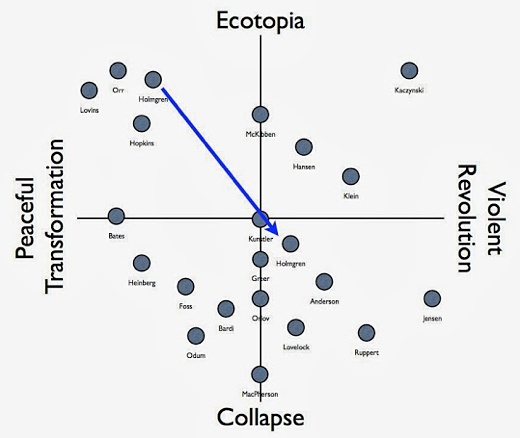
Rather than spurning financial system terrorists, Holmgren urges activists to become “terra-ists”; to directly bring down the system by thousands of acts of economic disobedience.
"A ferment in the environmental movement, brewing for many years, has now bubbled up into the blogosphere. We are dipping our ladle in here to take a little taste of it, even though we are quite certain it is not done fermenting.

Bill McKibben has been stirring the wort of whether social activism can save us for many years. In Eaarth: Making Life on a Tough New Planet, as in The End of Nature a quarter century earlier, he poignantly waffled, in elegant prose, between hope and despair. Since launching 350.org — “the first political action with a number for a name” — he has urged those of us with any remaining shred of hope for our children’s future, given what we now know about climate change, to step up and lay our lives on the line. Get arrested. Risk lengthy jail terms and even death to stop this atrocity. Do not go gentle into that good night.

Words to this effect we have heard much longer and louder from Derrick Jensen, another eloquent writer, the difference being that McKibben advocates for non-violence in the mold of Gandhi and King, while Jensen has no qualms about advocating violence. Naomi Klein, another stirring writer with an arrest record, calls for acts of resistance large and small.

McKibben is tepid about taking on capitalism’s growth imperative, as though it were not a major contributing factor, while neither Holmgren, Klein nor Jensen have any such reservations.

Thus we are tasting many different flavors of leadership, or literary guidance, in the shaping of the nascent climate resistance movement.

Scientists themselves have been growing politically more active and radicalized, as Klein described in her October New Statesman essay. If you go back enough years you’ll find scientists like Dennis Meadows, Howard Odum and James Lovelock, all of whom correctly foresaw the impending collision between consumer civilizations and natural systems. Lovelock made a series of climate-and-society predictions that went unheeded for 20 years but hold up well in retrospect.

Joining the chorus of climate Cassandras with more structured harmonies are the peak-oilers and financial collapsarians. These thoughtful writers straddle a continuum that is both time-sensitive (near-term, middle term, long-term) and outcome ambivalent — they are undecided as to whether the future they foresee will be a good thing, a bad thing, or even survivable.

Guy MacPherson has staked out the lonely position for near-term human extinction, which might be a good thing or a bad thing, depending on how you look at it. Richard Heinberg, Nicole Foss and Steve Keen all see financial constraints as the leading edge of whatever storm is forming, and are not making predictions about how or when, but are planting gardens and putting up canned goods nonetheless.

Michael Ruppert, James Howard Kunstler and Dmitry Orlov are also decoupling from whatever economic grids they may be attached to, but do not foresee a particularly happy outcome in all this. Social unraveling is not a pretty picture, as Orlov describes in his Five Stages of Collapse.

Still clinging to the possibility of some salvageable human prospect are cultural and technical optimists like Amory Lovins, David Orr and Rob Hopkins. We personally would also favor this idea of an ecotopian future, and have been working to bring it about it for half a century now, but our own position is that collapse is likely unstoppable now, given, as Nicole Foss puts it “the excess claims on underlying real wealth.”

What suddenly bubbled up from the blog vat at the start of 2014 was a white paper authored by David Holmgren, one of the founders of permaculture, reversing a position he had long espoused.

Instead of associating himself with peaceful change by calling for restraint on overconsumption and gradual adoption of the degrowth economic paradigm, extending it ever outward until it became the mainstream culture, Holmgren abruptly called for “Crash on Demand or a strategic decoupling by masses of youth (and elders) from the economic system that is the crashing the planet’s ecological stasis, by simply walking away.

“Rather than spurning financial system terrorists [a.k.a. banksters or the 1/10th-percent],” Holmgren urged activists to become “terra-ists”; to directly bring down the system by thousands of acts of economic disobedience. “The urgency for more radical action to build parallel systems and disconnect from the increasingly centralized destructive mainstream is a logical and ethical necessity whether or not it contributes to a financial collapse,” he wrote provocatively.

This immediately inspired a flurry of thoughtful responses, as might be expected. One of the most impassioned came from one whose positions Holmgren had just abandoned. Writing for Transition Culture January 13, Rob Hopkins responded, “to state that we need to deliberately, and explicitly, crash the global economy feels to me naive and dangerous, especially as nothing in between growth and collapse is explored at all.”

Hopkins main truck with Holmgren is his readiness to toss away all notions of mainstreaming permaculture and transition towns. “I may be naive,” he writes, “but I still think it is possible to mobilise that in a way that, as the Bristol Pound illustrates, gets the support and buy-in of the 'City/State' level, and begins to really put pressure and influence on 'National' thinking. I may be naive, but it's preferable to economic collapse in my book, and I think we can still do it.”

Concerned that a hard line position would expose social change agents to the full weight of state security as well as to the blame cascading from an angry populace, and that sewing the seeds of civil discord is always dangerous, Nicole Foss wrote on The Automatic Earth January 9 that financial collapse is already well underway and there is no need to expedite the process.

“While I understand why Holmgren would open a discussion on this front, given what is at stake, it is indeed dangerous to ‘grasp the third rail’ in this way. This approach has some aspects in common with Deep Green Resistance, which also advocates bringing down the existing system, although in their case in a more overtly destructive manner.”

“Decentralization initiatives already face opposition, but this could become significantly worse if perceived to be even more of a direct threat to the establishment,” Foss concluded.

Having these positions staked out was useful for the discussion of strategy that change agents need to be more engaged with. Klein and McKibben seem to think that if we just have enough “Battles for Seattle,” the economic system of global civilization will be radically restructured. Our own experience in joining dozens of massive marches and actions of civil disobedience but nonetheless failing to end the Vietnam War has perhaps jaundiced our views in this regard. Moreover, Holmgren and Foss make clear that that’s not going to happen.

Even the recently unveiled strategy of fossil fuel divestment, as promising as it is, and as grounded in investment reality of the stranded, overvalued assets unable to ever be burnt, stands little chance of being able to arrest climate tipping points that may have been triggered decades ago.

Foss is not especially concerned for the climate, apparently clinging to the position Holmgren had some years ago, that collapse of energy and economics will augur in a low-carbon future, although she does acknowledge the lurking unknowns from reversed global dimming.

“We need to get down to the business of doing the things on the ground that matter, and to look after our own local reality. We can expect considerable opposition from those who have long benefited from the status quo, but if enough people are involved, change can become unstoppable.

It won’t solve our problems in the sense of allowing us to continue any kind of business as usual scenario, and it won’t prevent us from having to address the consequences of overshoot, but a goal to move us through the coming bottleneck with a minimum amount of suffering is worth striving for.”

Our own view is that the likelihood that a runaway greenhouse effect is now underway is greater than it has ever been, and to call what is coming a bottleneck is a poor choice of words except perhaps in the sense of the genetic bottleneck experienced 70-80 thousand years ago in connection with a supervolcano that reduced our hereditary lines to fewer than 5000 individuals worldwide.

While we understand the concern she raises about unduly politicizing the issue, we’d say that cat has left its bag and keeping silent for fear of numbing the population makes no more sense for climate change than it does for Ponzi economics.

Indeed, the parallels between the overdraft on Earth’s atmosphere and the excess claims on fictional central bank assets are striking — neither is going to go away simply by ignoring them. In both cases, the cake already baked.

This prompts us to make a new grid to categorize the range of opinions amongst peakists, collapseniks, politicos and anarchists. It goes something like this, at first drawing, and we welcome corrections, especially from those named.

Holmgren’s change of position can be charted this way:

 
Image above: Chart demonstrating Holmgren's vector of change. From original article. This is revision #6 since the original post.

If we plot the respective positions of other change strategists, they look something like this:

 
Image above: Chart illustrating several "collapsniks" positions. From original article. This is revision #6 since the original post.

Our own position in this matrix outlined in two books since 2006,
is off to the left and centered on the line, meaning that while we are adamant in our advocacy for peaceful transformation, we are doubtful as to whether ecotopia is possible without collapse. Those seem to us to be a coupled pair. Likewise, McKibben is in favor of a new green economy but stuck vacillating between more peaceful and less peaceful means of getting there, while MacPherson is deeply wedded to inevitable collapse without caring any more about social responses.

Not surprising, given what they know, scientists like Lovelock, Ken Anderson, and Howard Odum all fall below the line dividing Ecotopia from Collapse. Odum, we suspect, would have been in favor of peaceful transformation, while the others would like us to push harder and force the issue.

Naturally those most concerned with Holmgren’s shift would be those closest to his former position, including Rob Hopkins. Those closest to him now — Kunstler, Anderson, Hansen and Klein — would be the most likely to approve.

What is missing from Holmgren’s paper are the advances in terrestrial carbon sequestration — as opposed to Ponzi geoengineering — in no small measure reaching fruition by dint of permaculture design.

While permaculturists like Rob Hopkins, Declan Kennedy and Max Lindegger pursued innovations in social structures — transition towns, complimentary currencies and ecovillages — other permaculturists — Darren Doherty, Richard Perkins, Joel Salatin and Ethan Roland, to name just some — have pushed the envelope to see how much carbon can actually be returned to the soil. This revolution is the subject of Courtney White’s new book, Grass, Soil, Hope: A Journey Through Carbon Country, scheduled for release in June.

Would we have ever learned that a mere 2% increase in the carbon content of the planet’s soils could offset 100% of all greenhouse gas emissions going into the atmosphere if we had not been so frightened of climate change by Al Gore and other scaremongers? Speaking as one who wandered deep into Amazonian history to discover this new paradigm, we reply: probably not.

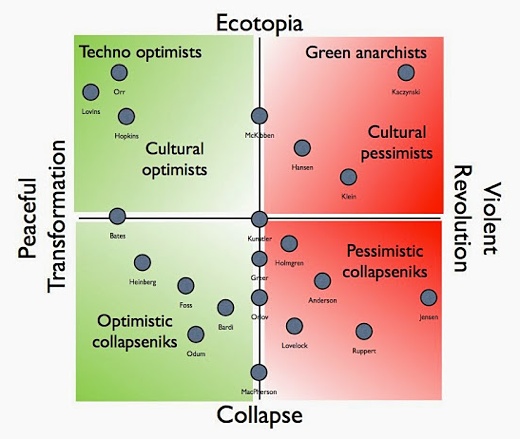
We’ve added some color coding and sector analysis with this third iteration:

 
Image above: Chart with color coding for pacifism vs violence. From original article. This is revision #6 since the original post.

Now lets step back and add a whole ‘nother layer to this. There is a really good cultural transformation going on, with ecovillagers, ecological restorationists, soil remineralizers and post-empire econometricists.

Simultaneously, there is a really negative übertrend of banksters and purchased or annointed politicians enriching themselves off oil, nuke and the wealth of nature, then turning all that surplus into the worst kinds of pollution – the kinds that take millennia to degrade and even then impair gene pools for untold generations.

These two conflicting transformations coexist against the backdrop of almost immeasurably immense climatic and biosystemic change that will severely affect, if not drive, our world in the future. We all exist in the context of ecosystems and yet these familiar norms are being utterly destroyed while we write this.

The tiny little good ecovillagers, permaculturists and transition towners do pales in comparison to the scale of damage of unrestrained growthaholism that seems almost a genetic imperative of our species — and we are the keystone species in ecosystem Earth.

Holmgren has this right, and it is undeniably frightening. We’re sure there may be more thoughtful readers who can add to this analysis and produce more insights than we have, but as we say, we’re just grateful to be having this kind of discussion.

• After co-teaching a permaculture course in Belize with Nicole Foss next month, we will be vetting this analysis with Dmitry Orlov, Dennis Meadows, John Michael Greer, Gail Tverberg, KMO and others at the Age of Limits conference in Pennsylvania in May. .

Guerrilla Forest Gardens

SUBHEAD: Good luck to all of you who are out there reclaiming the land with fruit trees and berry shrubs.

By Andy Russell on 30 March 2013 for Autonomy Acres -
(http://www.resilience.org/stories/2013-04-01/guerrilla-forest-gardens)


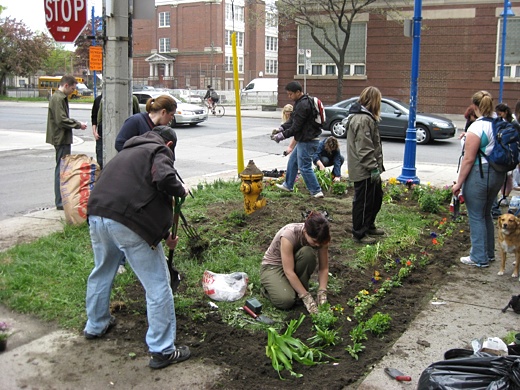
Image above: A bit of forgotten urban grass being transformed into a garden by guerrillas. From (http://blog.gardenmediagroup.com/2013/03/how-to-guerrilla-gardening.html).

In the last few years a popular meme growing throughout the ether of the inter-webs is the idea of guerrilla gardening. The idea of guerrilla gardening is really quite simple, but with some rather radical implications. Guerrilla gardening is the cultivation and care of plants (usually edibles) on land that you do not own. It is done on land that may be overlooked and forgotten about by private companies or municipalities. It may be D.O.T. land such as boulevards or parcels cut off by highways, and surrounded by entrance and exit ramps. It may be tucked away off of the beaten path in a county park, or behind the public library.

All of these pieces of land represent and exemplify humans innate ability to conquer, divide, categorize, map, and privatize the Earth. The more radical implications of guerrilla gardening is that it calls into question the land use of today’s modern world. With the rise of modern industrial society, and the accumulation of mass amounts of riches by the ruling class, land that historically had been held and treated as a commons, has effectively been divorced from the people who benefited and cared for the land the most.

When common, everyday people lose access to land, they become enslaved and dependent upon the industrial machine that is destroying human culture and the land base that supports all of us. Not that long ago (at least in the historical long view) when the planet had a smaller population and people had a greater hand in the production of their food – the commons – whether that be forest, pasture, prairie, or wetlands, contributed greatly to the food in their diets and personal autonomy in their lives.

Nowadays with a much larger population and less food producing (wild)land to forage from and grow on, guerrilla gardening, or what I will refer to as Guerrilla Forest Gardening for the rest of the article, provides us with a very unique opportunity. Incorporating a few of the principles of Permaculture, a Guerrilla Forest Garden is not just a way to grow food, it is also a healing process and an act of nonviolent civil disobedience.

Where guerrilla gardening is based on the use of annual vegetables and fruits and is a relatively short lived seasonal endeavor Guerrilla Forest Gardens seek to add a sense of permanence to these overlooked pieces of land. The simple act of planting food bearing trees and shrubs on land you don’t “own” becomes something revolutionary and a force for positive change.

How much land in your town, county, state, and country has been fenced off and plastered with “No Trespassing” signs? How much of that land, assuming that it is not harboring a toxic waste dump, storing munitions for imperialistic resource wars, or some other use that is mistaken for human “Progress”, could be planted with woody, food producing perennials?

How much of that land could be sequestering carbon that is being belched out of smokestacks and tailpipes? How much of that land are we going to need to help feed us once Peak Oil and energy descent make industrial agriculture a thing of the past? The easy answer – almost all of it!

All of this land – the isolated parcels, abandoned lots, overgrown parkland and weedy hillsides forgotten to plat maps and urban decay, now present us with a chance to start healing the landscape. Most of this land is no longer a part of intact, healthy, and native ecosystems. They are typically marginal pieces of land that annual crops would do poorly on, and with little to no way of irrigating, makes them a challenge to design and plant. The beauty of a Guerrilla Forest Garden is in the use of a wide array of different perennials, that in time will need less and less human intervention to thrive.

Perennial food crops have many distinct advantages over annual row crops, and this can be seen with a quick explanation of how conventional agriculture works. Our current model of industrial agriculture is based on plants that are essentially domesticated weeds that thrive on disturbed soils. This means each spring we cultivate the Earth with shovels, tillers, and giant tractors to give our domesticated weeds the foot up and environment they need to grow and thrive.

 But by annually tilling the soil and using large amounts of synthetic fertilizers and pesticides, we deplete any fertility that may be present and damage the huge and immensely complex web of life that inhabits and has a beneficial symbiosis with the soil.

This cycle of annual cultivation and constant depletion of our soils’ fertility and organic matter has led to desertification throughout the worlds original agricultural and pastoral lands (and continues to spread today everywhere there is industrial agriculture and poor land management). By moving towards a perennial dominated landscape we can virtually eliminate (in the right circumstances) the need to disturb the soil on an annual basis to grow our food.

We can start to rebuild our soils, and also to repair the watersheds that have been destroyed through industrial agriculture and loss of wild spaces. The unfortunate part of this is that it cannot be done overnight. It can take many years before we can begin to see the results, but we have to start sometime, so let’s make it happen now!

The initial establishment of a Guerrilla Forest Garden requires the most work. Before even thinking about digging the holes to plant the trees in, we first need to come up with the varieties of fruits and nuts we want to put in the ground. What I plant here in Minnesota is going to be different than what can be planted in a much warmer (cooler, wetter, drier, etc…) climate, so the logical first step is to decide what perennial food plants grow in your region and then find a source for these plants.

I love seed and nursery catalogs, but they are expensive when you start to order a large number of trees, shrubs, and seeds with which to work. What I do (most of the time) is use them as a way of creating a wishlist of plants that I want to acquire. I get names, pictures, and descriptions of varieties that look like good candidates for a specific project or garden and add them to my list of plants to research.

When I decide upon a certain apple, plum, gooseberry or whatever it may be that I am looking for, I rely on swapping with friends, arranging trades through The North American Scion Exchange (or similar networks), and foraging them from already established orchards, food forests, and gardens. I only try to purchase plants or seeds that have proven difficult to either find or propagate on my own, but I do still buy my fair share of vegetable seed (and root stock for tree grafting) from catalogs on an annual basis for our CSA, but I am trying to wean myself from this and I am moving in the right direction.

So what do you do with all these genetics (seeds, cuttings, and scion wood) that you have received in trades, saved from last year’s gardens, and have foraged from different spots? Seeds are easy, plant them! Well most of the time. Some seeds/nuts need to be treated with a bit more care. Cold stratification is a process that mimics nature’s seasonal cycle of cool and moist conditions. Many tree nuts and other perennials will not germinate without being subject to cold stratification, so learn how to do this or find a source of seed that has already gone through this process.

Many plants can be propagated through rooting cuttings. Some need to be green wood cuttings, some need to be hard wood for the rooting process to happen, so once again, do your homework. Many people use a rooting hormone to get things started, but this is pretty nasty stuff, so be careful. I have had luck using raw honey in place of rooting hormone and have had reasonable success. I am not sure what the science is on this, but it is well worth experimenting with (report back with results please!!).

Plants that lend themselves to this method of propagation are blueberries, currants, elderberries, gooseberries, figs, tree collards and many more. I have found YouTube to be very helpful in this department, so if someone has done it, there is most likely a video out there to show you how!

Root cuttings, or divisions are also another way of propagating perennials. Plants like asparagus, comfrey, hops, raspberries, and rhubarb all can be multiplied by root division. It is usually best to get them early in the spring before things are starting to really take off. Keep them watered and you should have very few problems. Come year two or three of these plants that have been propagated by root division is when you can expect your first yield.

And last is grafting. Anyone who has followed this blog for awhile knows how much I like grafting. Tree grafting is a craft that spans thousands of years and is the reason we have named cultivars of apples, cherries, pears, and plums that sometimes can be hundreds of years old. Grafting allows us to customize trees for the characteristics we are looking for.

Do you need an apple tree that can be kept small, and produces a good cider apple? How about a plum that can be planted in a clay heavy soil? The right choice of root stock (and there are many to choose from), and a cultivar that is suited to your climate can make all the difference in your grafting success.

The more modern twist on grafting is Guerrilla Grafting. Just like its counterpart we started the article out with, Guerrilla Grafting takes advantage of resources that are already available and could be a major component to establishing a Guerrilla Forest Garden. So many parking lots, corporate campuses, and other semi-public areas are landscaped with decorative crab apples and flowering pears and cherries. Why not graft on sticks of edible cultivars and get some real food out of the deal!

You might be amazed at how prevalent some of these trees are. They are all over the Twin Cities metro area where I reside and most likely in your hometown as well (wherever in the world you are reading from). Because many of these trees are already mature, if your grafting is successful, you can expect to get fruit in two to three years. Add a few under story plants and ground covers and you are well on your way to establishing a Guerrilla Forest Garden!

The very nature of a Guerrilla Forest Garden is illegal. You ARE trespassing – and whether that be on land or on an idea, what you are doing is a threat to those in power. There is a reason we have been separated from the land, and it is that when we lose the ability to provide for ourselves, we lose our autonomy and freedom as humans and as a community.

Guerrilla Forest Gardens are just one tactic and solution we have to start reclaiming what has always been ours. When we have access to land that we can care for and steward, we reconnect with a bit of our humanity that has been subjugated and domesticated in these ‘a waning days of the Wal-Mart world!

Good luck to all of you who are out there reclaiming the land with fruit trees and berry shrubs.  Keep your pruning shears and grafting knives sharp, your shovels close, and your spirit of Revolution lit!

 Take a chance, plant some trees, and cover your tracks!  Do it for yourself, but also for the future, and defend the Earth!  Go Guerrillas!!!

.