Showing posts with label DIY. Show all posts

Building your own internet

SUBHEAD: A digital justice project is putting people online and providing technology training in Detroit.

By J. Gabriel Ware on 26 march 2018 for Yes Magazine -
(http://www.yesmagazine.org/people-power/when-they-couldnt-afford-internet-service-they-built-their-own-20180326)


Image above: Dwight Roston is drilling on the roof of a home in Detroit’s Islandview neighborhood on the city’s east side. From original article.

Dwight Roston is part of a team that is setting up a wireless internet connection. The home is just one of 150 designated households in the city to receive free internet service by the end of the year.

In 2016, a coalition of media, tech, and community organizations launched the Equitable Internet Initiative, a project that will result in the construction of wireless broadband internet networks across three underserved Detroit neighborhoods.

Leading the initiative is the Detroit Community Technology Project (DCTP), a digital justice project sponsored by Allied Media Projects. Each network will provide wireless internet service to 50 households per neighborhood, according to Diana Nucera, executive director of DCTP.

“During the economic and housing crisis, communities had to fend for themselves,” Nucera says.

“Media and technology play such a vital role in economic opportunities, but the tech industry doesn’t really think about community organizing.”

That’s why, she explains, “we developed this approach called community technology.”

Detroit has one of the most extreme digital divides in the country, with more than 60% of low-income residents without broadband in their homes. According to a recent report from the Brookings Institution, residents in low-income or rural neighborhoods are the least likely to have broadband subscriptions.

Even discounted municipal or corporate broadband subscriptions, if available, are not necessarily alternatives for many families. After all, affordability is relative.

Last year, the United Nations declared internet access a human right. But like running water, which was also declared a human right by the U.N., it is considered a paid service in the United States. In 2016, a U.S. federal court ruled that the high-speed internet service can be defined as a utility, such as gas and electricity.

And as is the case with access to most utilities, there is a large gap between those who can afford internet service and those who cannot.

This digital divide, which includes lack of access to computers, is a barrier to success in day-to-day life tasks, so much of which is done online—from paying bills and other financial management to obtaining voting information, from completing homework to communicating with a child’s school.

The coalition raised just under $1 million from local and national foundations to finance the Equitable Internet Initiative. Funds were used to hire employees, buy equipment, and internet bandwidth.

They purchased three discounted wholesale gigabit connections from Rocket Fiber, a Detroit-based high-speed internet service provider. Their contract with Rocket Fiber allows the coalition to share its connection with the community—a provision not allowed by other companies.

Each neighborhood is represented by a partnering organization, whose locale is used as the central connection hub for service. In Islandview, it’s the Church of Messiah, a non-traditional Episcopal church. An antenna sits atop the roof and receives a point-to-point wireless connection from Rocket Fiber, which is then shared to the 50 designated households.

The community members are responsible for installation. DCTP trains a representative of the partnering organization, who then trains five to seven neighbors to install the equipment. These digital stewards, who Nucera says had no previous technical experience, are responsible for “building the networks.”

They mount CPE (customer premise equipment) dishes on top of the homes, which receive a signal from the hubs. Finally, they run cables from the dishes to the routers inside the homes.

Roston, a digital steward, says the work was foreign to him.

“Being a digital steward was completely out of the range of what I usually do,” he says. “I was so used to using the internet— all the software and everything—but I didn’t know how internet networks work.”

So far, he’s helped with getting 19 of the 50 designated households in the Islandview neighborhood online.

Wallace Gilbert Jr. is responsible for recruiting Roston. Gilbert is the assistant pastor of the Church of Messiah, and he’s also a digital steward trainer. He has worked in tech for 30 years and for the past several years has been teaching neighborhood youth to build and repair personal computers to take home. Digital literacy is among the needs of the community that the church provides.

One day Gilbert noticed quite a number of the children were using the church computers to complete homework assignments. “I asked one of the fellas why was he using the computer [at the church] when I know I helped him build a high-end computer,” he explains. “He told me that he didn’t have the internet at home.”

It was then, Gilbert says, he realized that the computers were useless if the youth couldn’t access the internet.

The Federal Communication Commission’s Broadband Task Force reported that approximately 70%  of teachers assign homework requiring access to broadband. According to the same report, 70% is also the rate of school-aged children in Detroit who don’t have internet access at home.

A mission of both The Church of Messiah and the Detroit Community Technology Project is to increase young people’s access to and facility with technology. This is why Gilbert and the church joined the Equitable Internet Initiative.

Nucera says the three-neighborhood project is about 50% complete. The coalition’s contract with Rocket Fiber expires next year, but another internet service provider has agreed to extend service for an additional three years. The next and final phase of the project involves developing a business model so that the residents will continue to have internet after the second contract ends.

This element of self-determination is also motivating, Roston says.

“You don’t ever want to give somebody something that they did not have and couldn’t do without and then take it away from them,” he says.

The bottom-up approach of having residents directly involved in building the internet, Nucera says, is a model that also strengthens community relationships, increases civic engagement, and redistributes political and economic power to otherwise marginalized neighborhoods

“If the community has ownership of the infrastructure, then they’re more likely to participate in its maintenance, evolution, and innovation,” she explains. “That’s what we believe leads to sustainability.”

The project is a model for any neighborhood, though, even at a small scale.

“I don’t want people to think that this can only be done with a million dollars,” Nucera says. “There’s different scales to this model. Two neighbors can come together and share internet, and they continue adding people to the network until it grows as to how big as they want it.”

See also:
Ea O Ka Aina: Indigenous groups start telecom 11/3/16
Ea O Ka Aina: Build a local low-tech internet 9/12/16
Ea O Ka Aina: Internet Economics 5/21/09


.

Grid Beam is Minecraft for real life

SUBHEAD: Grid Beam is a kind of LEGO, or Erector Set, for grownups who want to build real things.

By Kirsten Dirksen on 17 September 2017 for -
(https://www.youtube.com/channel/UCDsElQQt_gCZ9LgnW-7v-cQ)


Image above: A computer workstation built by the Jergensons using the wooden Grid Beam system. Still frame from video below.

[IB Publishers note: The Unistrut metal framing system similar in application to the metal Grid Beam system. Unistrut was invented around 1920 by Charles Attwoodand is still widely used in the building industry for everything from hanging pipes above ceilings to framing out engineering projects. There are a myriad of components built for the 1 5/8" Unistrut beams. The big difference is unlike Grid Beam you cannot make the Unistrut beams is a home shop.]

Grid Beam is a kind of LEGO, or Erector Set, for grownups who want to build real things.

Its creators, brothers Phil and Richard Jergenson, have used it to create tiny houses, furniture, electric vehicles, bicycles and even a solar train car that made a 44-mile run on working rail.

The Jergensons grew up playing with modular toys- LEGOs, Meccano, Erector Sets, Lincoln Logs- and wanted to apply this technology to help people construct their own environments, whether car, bike or bed.

Phil’s daughter, Rona, grew up with a set of Grid Beam (then called Box Beam) and constantly re-modeled her room.

“My bed, I changed it out every week, my dad would come in and one time I would have a bunk bed with a slide, the next day I”d say I don’t really want another bed let me put a desk underneath it.”

The Grid Beam brothers operate an off-grid, solar-powered shop in Willits, CA (Mendocino County) where they manufacture and sell the hardware: 2x2 wood (or aluminium) beams with holes drilled through every 1 ½ inches, as well as, standard furniture bolts and accessories like wheels, bicycle pedals or feet for tiny houses.


Video above: A 28 minute video explaining Grid Beam system and examples of things the Jergenson brothers have constructed with it. From (https://youtu.be/PIMESt9iLYg).

And given the consistent pattern of the Grid Beams, designs are easily replicated.

“If you just count the holes you can duplicate these frames just by looking at a couple of photos,” explains Phil.

“You can do anything for a fraction of the price. I see people being able to build their own tiny house and tiny electric car for easily 2 or 3 thousand dollars because that’s the cost of the components,” argues Phil.

“And when you build it yourself, if something should go wrong, you are the specialist and you are the one who can fix it.”

Visit:
http://www.gridbeam.com/

Read:
“How to Build with Grid Beams” https://www.amazon.com/How-Build-Grid...

.

From Cacao to Chocolate

SUBHEAD: Instructions on harvesting, drying, husking, roasting, grinding and adding ingredients for chocolate.

By Linda Pascatore on 6 June 2017 for Island Breath -
(http://islandbreath.blogspot.com/2017/06/from-cacao-to-chocolate.html


Image above: Picked cacao fruit split and kernels removed for fermenting. Photo by Juan Wilson.

[IB Publisher's note: We are ever grateful for Jo Amsterdam, from Kalaheo, for giving us our first batch of cacao starts long enough ago that we can make chocolate today.]

We now have mature cacao trees, here in Hanapepe Valley on Kauai.  We have been making our own chocolate!  It is a multi-step process, which I will explain below step by step.  For the complete recipe in one place, look towards the end of the article where it is summarized.


Image above: Cacao treeling in ground after a few months. Photo by Juan Wilson.

About seven years ago, a friend gave us some tiny sprouted cacao beans.  It took almost a year before they were big enough to plant out in the ground.


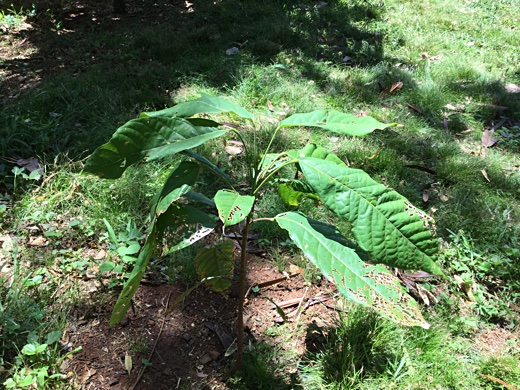
Image above: Young cacao tree a year later. Photo by Juan Wilson.

The plants grew slowly, but with regular watering, they finally reached ground water. 


Image above: Six years later a ten foot tall cacao tree with its second year of fruit. Photo by Juan Wilson.

Then they took off and grew much quicker.  About seven years from the sprouts, we got our first cacao bean pods. 


Image above: Mature cacao fruit ready to pick determined by scratching a small spot with a finger nail. If the flesh under the skin is green wait and test later. If yellow-orange the fruit is ready. Photo by Juan Wilson.

There are a variety of different types and colors of cacao.  All of ours start red and turn slightly orange when ripe.  You can tell ours are ripe when you stick a fingernail through the skin, and the inside is a mustard yellow.


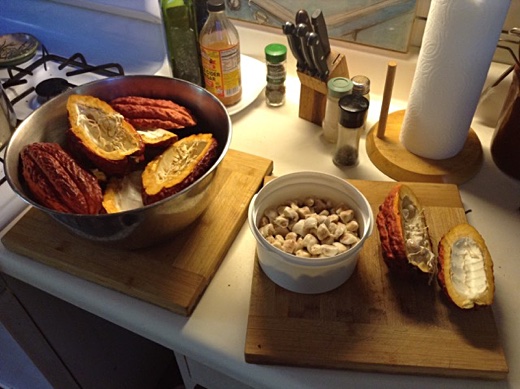
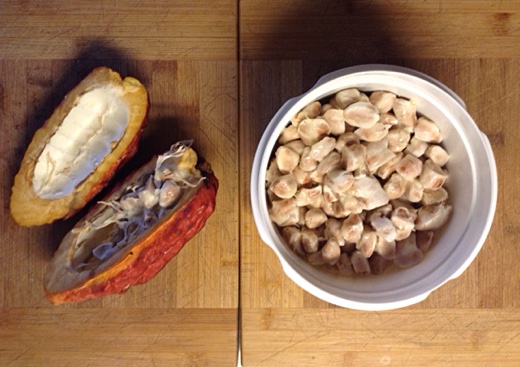
Image above: Split cacao husk cacao husk (left) and split and kernels removed for fermenting (right). Photo by Juan Wilson.

Then we cut through the skin to split the bean and expose the seeds.  We then pull out the seeds.


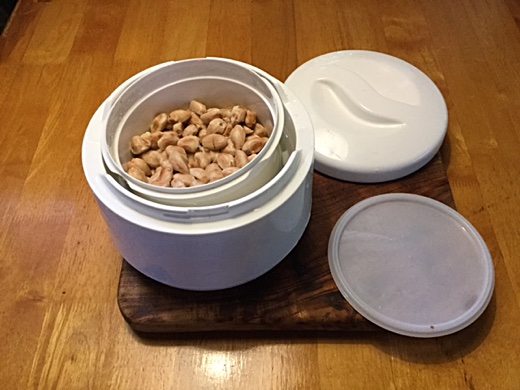
Image above: Fermenting cacao beans require changing hot water in yogurt maker for a week. Photo by Juan Wilson.

We have a non-electric yogurt maker, which operates by adding boiling water to the outer bowl. We use this yogurt maker to ferment the seeds for three or four days. You could also use 2 nesting covered bowls with hot water in the larger, or an electric yogurt maker, or put it in a warm place (don't know if pilot lights exist anymore, but I remember using the one on my old stove for a variety of purposes).


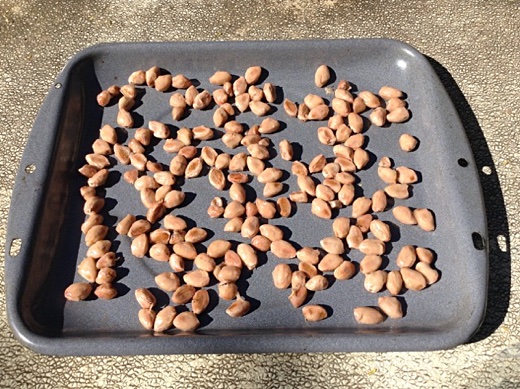
Image above: Fermented cacao beans drying in sun for a week. Photo by Juan Wilson.

After fermenting for 3 or 4 days, spread the beans on a pan and place out to dry in the sun. After 5 or 6 days in the sun (or at least a dry, airy place) the beans will be dried out. 


Image above: Sun dried cacao ready to be roasted in oven. Photo by Juan Wilson.

Then it is time to roast them.  Bake the beans in the oven, for 5 minutes at 350 degrees, then for 10 minutes at 250 degrees.  Don't leave them in the oven while it comes down to 250--take them out after 5 minutes at 350, then wait for your oven to come down to 250, the bake 10 minutes more.  You can go a longer time at one lower temperature, but we found that starting at the higher temp separated the beans more from the skin and made them easier to peel.


Image above: Peeling roasted cacao of their thin shell with knife and finger nails is a lot of manual work . Photo by Juan Wilson.

After the beans cool, peel off the thin outer skin or husk.  We use a paring knife to break the skin, then peel off to leave the beans shown below.  Some beans will break up, that is no problem as we are going to grind them anyway.  These roasted beans are called nibs.  Some folks like to eat either the raw beans, or the roasted beans, with no other ingredients.  They are flavorful, but rather bitter.


Image above: One half pound of roasted and peeled cacao nibs ready for grinding. Photo by Juan Wilson.

There are different ways to grind the cacao.  You can use a coffee grinder, a food processor, or a mortar and pestle.  We do a little of all three, although that is probably not necessary.  Unless you have commercial equipment, your chocolate will be more grainy and have more texture than chocolate you buy, but we consider the texture part of the charm of making authentic chocolate ourselves.


Image above: Ground cacao nibs after being chopped in coffee bean grinder. Photo by Juan Wilson.
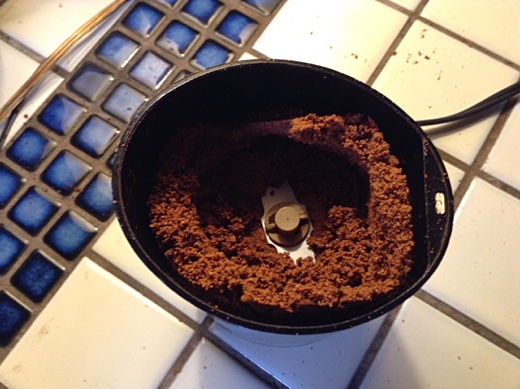
We use a small coffee grinder first, to grind the beans until they look like a moist, grainy powder (if your grinder can get them smaller, that is better).


Image above: Coconut oil and baking sugar to be mixed with ground cacao nibs. Photo by Juan Wilson.

We add confectionery sugar, which we also grind first in the coffee grinder.  We have also used can sugar, but it is more difficult to get it to a fine texture.


Image above: Ingredients of nibs, oil and sugar blending in food processor.  Photo by Juan Wilson.

Then we put the ground cacao and sugar in the food processor and mix some more.  The last ingredient is coconut oil, which we also add to the food processor and mix.  Some recipes call for cocoa butter, but we did not like the texture or taste--it seemed to result in lighter chocolate instead of the dark 80% cacao we like.


Image above: Smoothing blended ingredients with a mortar and pestle. Photo by Juan Wilson.

Our last step is to warm our pestle in a 200 degree oven, then add the cacao mixture (beans, sugar and coconut oil) to grind it some more. 


Image above: Resulting chocolate mix placed into ice-cube tray to be refrigerated.  Photo by Juan Wilson.

We press the chocolate into an ice cube tray, which makes a good sized piece of chocolate.  When inverted, it is flat on the bottom and rounded on the top.


Image above: Half a batch of finished chocolate pieces after removal from ice-tray. Photo by Juan Wilson.

We keep a few pieces out for consumption in the next day or two, and refrigerate the rest.  In a sealed container or plastic bag the chocolate keeps for months in the fridge.

Recipe for making chocolate from cacao beans:

Ingredients:
(this recipe is for 8 cacao pods but you can just keep the proportions and size it up or down)
Makes about 12 ounces of chocolate

8 cacao pods (approximately 8 ounces of roasted beans)
2 ounces of confectionery sugar (for 80% cacao -- can be adjusted to sweeter blend)
2 tablespoons of unrefined coconut oil

Procedure:
Cut open cacao pods and pull out cacao beans.

Place in a yogurt maker and ferment cacao beans for 3 or 4 days.  We use a non-electric yogurt maker and boiling water changed three times per day.  You could use two covered bowls that nest, with boiling water in the larger bowl.

Place fermented cacao beans on a baking plan, and put in the sun for 5 or 6 days.

Bake dried cacao beans for 5 minutes at 350 degrees.  Remove beans and reset oven to 250 degrees, when oven reaches temp, bake for 10 minutes at 250 degrees.

Cool roasted cacao beans and peel.  Use a paring knife to break skin, then peel off thin outer skin or husk.  It is okay if the beans break up, just separate from husk.

Grind cacao beans in a coffee grinder until as smooth as it will get (like moist coarse powder). You may do all the grinding in either a coffee grinder, a food processor, or a mortar and pestle--we use all three).

Separately, grind confectionery sugar until smooth and fine.

Put cacao beans and sugar in food processor, mix some more.

Add coconut oil to beans and sugar, mix some more.

Remove mixture from food processor and put in mortar (warmed in 200 degree oven to mix better)

Mix as long as you like, to make it smoother.

Push cacao mixture into ice cube tray, refrigerate until cool.  You can take out some to serve soon at room temperature, but keep rest refrigerated.   It will keep for months in a sealed container or plastic bag.

Enjoy your chocolate!

We plan to experiment soon making chocolate using just our own honey, and no sugar--we will report the results in an update.

For more info on cacao, go to: https://en.wikipedia.org/wiki/Cocoa_bean


.

Long Term Egg Storage

SUBHEAD: There are a number of techniques for keeping eggs edible for months without refrigeration.

By Brian Kaller on 25 October 2016 for Restoring Mayberry -
(http://restoringmayberry.blogspot.com/2016/10/storing-eggs-for-winter.html)


Image above: A variety of jarred pickled eggs. They can be kept for long periods. From (https://www.reference.com/food/basic-recipe-pickled-eggs-bb99f4e9c9bcce2a).

No matter what else you have in your kitchen, you probably have eggs. Whether you boil or fry them for breakfast, brush them over meat, whisk them into egg-drop soup, bake them into pastries, eggs provide one of the simplest and yet most versatile of foods, prized the world over as a rich source of easy protein.

If you raise your own chickens, moreover, you have a ready source of eggs, as well as fertilizer and comedy relief. Hens convert your leftovers into your next breakfast, keep your garden free of pests and mow your lawn for free.

Other animals can do some of these things, but not many of us have the time, space or will to manage a suburban herd of sheep or swine, or to slaughter them in the garage. Hens, however, require little space or maintenance, and turn any home into a homestead.

They lay eggs seasonally, however, speeding up in summer and slowing in winter. You could give them more indoor light or Vitamin D supplements, but they cost money and interfere with the chickens’ natural cycle – and saving money and being all-natural are two of the most popular reasons for keeping backyard chickens in the first place.

Another way would be to collect the extra eggs in summer and preserve them through the winter. Eggs can be preserved in several ways; one, well-known to pub patrons here, is to pickle them.

A typical recipe involves hard-boiling eggs and removing the shells, and then creating a pickling solution of cider vinegar, small amounts of salt, sugar, herbs and spices. Bring the mixture to the boil, then simmer for five minutes and pour over the eggs – they should keep for at least a few months.

You can also soak the eggs in a solution of sodium silicate, known as isinglass or water-glass. One popular recipe from a century ago recommended dissolving sodium silicate in boiling water, to about the consistency of a syrup (or about 1 part silicate to 3 parts water).

The eggs -- as fresh as possible, and thoroughly clean -- should be immersed in the solution in such manner that every part of each egg is covered with the liquid, then removed and let dry. If the solution is kept near the boiling temperature, the preservative effect was said to be much more certain and to last longer.

Perhaps the best and longest-lasting way, however, is to preserve eggs in limewater. No recipe could be simpler; take fresh raw eggs in the shell, set them gently in a jar, and pour in a simple lukewarm mix of tap water and lime powder. I’ve done this with our eggs, and they lasted for up to a year and remained edible.

“Lime” here means neither the citrus fruit nor the tree, but refers to calcium hydroxide, a white powder derived from limestone. For at least 7,000 years humans burned limestone in kilns to create the dangerous and caustic “quicklime” (Calcium oxide), and hydrated that to create lime powder (calcium hydroxide).

Sumerians and Romans used it as a cement, while farmers mixed it with water to create whitewash, tanners used it to remove hair from hides, gardeners to repel slugs and snails, printers to bleach paper.

Perhaps most importantly, farmers here in Ireland spread lime over their boggy fields to “sweeten” the acid soil and increase crop production as much as four-fold. For hundreds of years until the mid-20th century, lime supported a vast and vital network of village industry in this part of the world-- County Cork alone was said to contain an amazing 23,000 kilns, or one every 80 acres.

In his 1915 monograph “Lime-water for the preservation of eggs,” Frank Shutt describes a series of egg preservation experiments at an experimental farm in Ottawa, which found lime-water to be “superior to all other methods” – how, he didn’t say.

When I first tried to preserve eggs in lime-water, I simply mixed equal parts lime and water – which did no harm, but most of the lime simply settled to the bottom.

It turned out a fraction as much lime would have sufficed – Shutt says that water saturates with lime at 700 parts water to one part lime, but adds that “owing to impurities in commercial lime, it is well to use more than is called for.” In any case, if you use more lime than is necessary to saturate in water, the rest simply condenses out.

Since exposure to air causes more lime to condense over time, some articles recommend keeping the container sealed, either in a Kilner jar or by pouring a layer of oil over the top. I kept mine in an ordinary mayonnaise jar, and they kept fine for a year.

Eggs kept this way do come out with their whites darkened slightly, and with a faint “musty” smell like old clothes. It does not, however, have the unpleasant smell of a rotten egg – believe me, you won’t mistake one for the other.

The difference can perhaps be compared to that of rehydrated milk vs. fresh milk – not inedible, just slightly different than expected. As Shutt puts it, nothing “can entirely arrest that ‘stale’ flavour common in all but strictly fresh laid eggs.”

I’m not aware of an upper limit on how long eggs could be kept this way – I kept mine a year, with no ill effects beyond the stale smell – but I would not recommend going longer than several months to be on the safe side. Several months, however, still allows the homesteader to continue harvesting eggs through the winter.

Shutt recommends keeping the water at a cool temperature – 40-45 degrees Fahrenheit, or five degrees Centigrade, to help the preservation.

That’s the temperature of a refrigerator, but a cellar or underground storage container would probably be fine. I kept mine at room temperature during an Irish year, where the temperature ranges from freezing (32F, 0C) in winter to lukewarm (75F, 25C) in summer, with no ill effects.

Some old texts say to boil the lime-water, dissolving as much of the lime as you can and letting it cool before immersing the eggs; that might be slightly preferable simply to maximise the amount of lime dissolved or to sterilise the water, but I tried it both ways and noticed no difference in quality.

Some old recipes recommend adding salt to the eggs, but I tried it with and without salt and found that it didn’t make a difference, and neither did Shutt a century ago. Still other 19th-century recipes mixed the lime with salt-peter and even borax, but I would not try those until I had confirmed their safety.

Experiments like this might seem pointless when we have refrigerators, freezers and a convenience store down the road.

Many of us, though, like being able to do things ourselves, with simple ingredients, for a lot less money than processed food at the store would cost. Money and electricity, moreover, are less certain than they used to be; I know many friends who have lost jobs, or whose power now goes out regularly.

Here in Europe we know people whose governments have collapsed or gone bankrupt, or been torn by civil war. These scenarios are not as apocalyptic as most people imagine -- crises are rare, and even in a crisis life goes on – but they happen occasionally, in an emergency our local village would benefit from someone who knows how to do things the old-fashioned way.

See also a website page with several recipes for pickling eggs
(https://www.pinterest.com/Dragonfly9586/pickled-egg-recipes/)

.

Farmers’ markets play a vital role

SUBHEAD: Both the DIY economy and farmers markets to continue flourishing as will need for sustainability.

By Daniel Matthews on 29 September 2016 for Sustainable Food Trust -
(http://sustainablefoodtrust.org/articles/farmers-markets-america/)


Image above: Fresh organic vegetables offered at local farmers' market. From original article.

Drive across America today, and there’s one thing you’re guaranteed to see more of: farmers’ markets. The USDA reports the number of registered farmers’ markets increased by 2.3% from 2015 to 2016—and that’s just the ones listed in the National Farmers Market Directory.

This increase wasn’t necessarily expected. In 2015, Treehugger author Margaret Badore speculated as to whether US farmers’ markets had hit their peak. From 2013 to 2014, the growth rate was only 1.5 percent. But after that, the number of markets continued to grow, instead of stagnating. What is driving this growth? The answer can be found in the broader state of economic affairs in the US.

Sustainability and the DIY Community
There’s increasing demand for organic foods and ethical business practices, reflecting a growing engagement with sustainability. According to Sustainable Table, more consumers are considering the “environmental, health and social consequences of industrial food production”; as a result, organic acreage is increasing at an annual rate of 15%.

In terms of demand, the USDA’s Organic Market Overview shows the market for organic food is continuing to show double-digit growth. In 2015, sales reached $37 billion, up 12 percent from 2014. And farms that conduct direct-to-consumer (DTC) sales at farmers markets, Community Supported Agricultural programs, and other outlets are more likely to stay in business than those that don’t.

Small local farms maintain their profitability, in part, through DTC sales of organic foods in a growing market. These farms spend less on land and equipment than large farms, and are able to get a good Return On Investment (ROI) through organic food sales. Simply put, organics fetch a high price because of high demand.

Most vendors at the market are part of a Do-It-Yourself (DIY) community that adds jobs to the economy. In 2015, Bloomberg reported a surprising statistic: the DIY economy had added 370,000 jobs, marking an increase of 1 million more self-employed workers in the first four months of the year. According to the Pew Research Center, three out of ten US jobs are held by the self-employed and their employees. In the agriculture sector, around 81 percent of the workforce consists of self-employed farmers and the workers they employ. The USDA’s report on the Farm Labor Survey reveals that, on average, the number of people employed by farms increased between 2007 and 2012. This was in contrast to “nonfarm employment”, which, according to the USDA, went down in this period because of the 2007-2009 recession.

Farmers exemplify a traditional form of self-employment as business owners, but another part of the picture is the self-employed worker in the ‘gig economy’. More and more Americans—particularly Millennials—are choosing to do contract work, taking on ‘gigs’ for a temporary period of time. This new gig economy has a technological twist, with workers using apps and websites that connect them to on-demand work. Think Uber, the ride-sharing service that uses a mobile app to connect drivers and riders.

The best estimate of the gig economy’s growth, reported by the Bureau of Labor Statistics, is that “nonemployers” under the “Other” category created one million jobs between 2003 and 2013. That’s more than any other sector. The self-employed in this case are short-term contract workers. They’re freelancers, independent consultants, people who work odd jobs. The Census Bureau defines the gig worker as a “self-employed individual operating a very small, unincorporated business with no paid employees.”

Just as farmers’ markets and CSAs don’t rely on distribution through centralised supermarkets, gig workers, by definition, don’t rely on a single location and employer for their source of income. The increase in self-employment and contract work are both moves away from centralisation, and growth in self-employment and ‘gig’ work is one of the primary economic catalysts feeding the increase in farmers markets.

Behind all this is the great enabler of our interconnected moment—new technologies.

Technology at the Farmers’ Market
When you go to a farmers’ market, one thing you may notice is that nearly every merchant accepts credit cards. That’s a far cry from an old-school market where people barter, trade or pay in cash.

This is, of course, smart business in the modern world. According to Square’s guide on how to accept credit card payments, people spend 12 to 18% more when they use a credit card instead of cash. At the farmers market I frequent in my hometown, all the merchants have a mobile payment device attached to their phones.

It’s no surprise that the growth of both the DIY community and farmers’ markets, parallels the growth of mobile payment and the smartphone market. With big players like Apple and Paypal in the mix, the mobile payment industry is expected to hit $189 billion by 2019, a growth of 154% from 2014. Many purchases from small merchants wouldn’t be possible without the huge mobile payment industry. There may be an irony, or worse, a paradox here in the dependency on technologies developed by huge corporate entities like Apple.

Smartphones have had an inarguable environmental impact that a sustainable farmer may not want to be associated with. But they have become an integral part of our business practices, especially so in micro and small businesses in developing countries. They increase the economic viability of small sole traders and the self-employed, enabling the vendor to cast a wider net for commerce
.
The benefits of mobile payments in farmers’ markets are enough to overlook any irony in their use.

The Benefits of Farmers’ Markets
Farmers’ markets provide an important array of benefits to local communities, as the Farmers Market Coalition’s infographic details.

Farmers’ markets return money to local economies, while a high percentage of profits from corporate ‘chain’ stores go elsewhere. Walmart, for one, has been implicated by Oxfam in the tax haven scandal that came to light following the Panama Papers leak. That means Walmart is not paying taxes on the profits it makes from grocery purchases. Some vendors make all their income from farmers’ markets. 

As the Coalition points out, “Locally owned retailers, such as farmers’ markets, return more than three times as much of their sales to the local economy. They hire nearly five times more people than non-local vendors. Workers hired by local farmers that use sustainable farming practices (such as crop rotation and cover crops) receive an education in good agro-ecological farming practice. Down the line, that means more farm start-ups and more entrepreneurial investment.

Impoverished families can use food stamps at the market, meaning the $18.8 million of SNAP cash from 2014 went right back into local taxpayer pockets. Fresh sustainable produce means better health and lower obesity rates for poorer families. Helping people to feed themselves better will place less of a burden on the health care system, lowering medical bills for poor families that can barely afford health insurance.

Additionally, there’s no doubt as to the sustainability benefits of farmers’ markets. According to the Farmers Market Coalition, which cites unpublished raw data from a survey of direct market farmers, the local and regional produce you’ll find at farmers’ markets travels about twenty-seven times less distance than “conventionally-sourced” produce. Further, 81% of these farmers use farming practices that reduce waste and promote soil health, such as on-site composting. And three out of four farmers follow practices “consistent with organic standards”.

These sustainability practices in turn benefit the consumer. According to Scientific American, soil depletion and “intensive agricultural methods” lessen the nutrient content in produce. According to authors Roddy Scheer and Doug Moss, “Those who want to get the most nutritious fruits and vegetables should buy regularly from local organic farmers.”

Bringing it home
As calls for sustainability keep escalating, expect both the DIY economy and farmers markets to continue flourishing. Can we expect complete decentralisation and the demise of supermarkets? It’s a long shot. But we can expect farmers markets and small farms to keep bringing organic foods closer to our homes, giving us more opportunities to support them.

.

Build a local low-tech internet

SUBHEAD: Research groups have developed and implemented much cheaper alternative network technologies.

By Kris De Decker on 26 October 2015 for Low Tech Magazine -
(http://www.lowtechmagazine.com/2015/10/how-to-build-a-low-tech-internet.html)
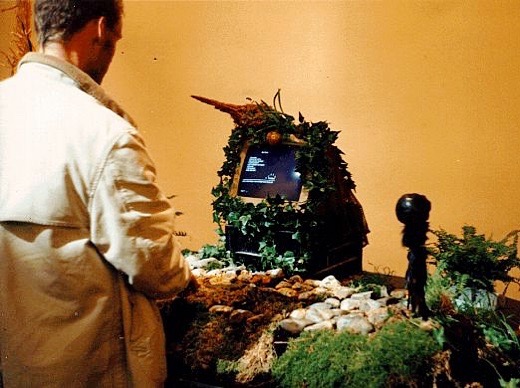

Image above: An artistic interpretation of Stone Age computing. From (https://oertijd.home.xs4all.nl/st-age/photo.htm).

Wireless internet access is on the rise in both modern consumer societies and in the developing world.

In rich countries, however, the focus is on always-on connectivity and ever higher access speeds. In poor countries, on the other hand, connectivity is achieved through much more low-tech, often asynchronous networks.

While the high-tech approach pushes the costs and energy use of the internet higher and higher, the low-tech alternatives result in much cheaper and very energy efficient networks that combine well with renewable power production and are resistant to disruptions.

If we want the internet to keep working in circumstances where access to energy is more limited, we can learn important lessons from alternative network technologies. Best of all, there's no need to wait for governments or companies to facilitate: we can build our own resilient communication infrastructure if we cooperate with one another. This is demonstrated by several community networks in Europe, of which the largest has more than 35,000 users already.

More than half of the global population does not have access to the "worldwide" web. Up to now, the internet is mainly an urban phenomenon, especially in "developing" countries.

Telecommunication companies are usually reluctant to extend their network outside cities due to a combination of high infrastructure costs, low population density, limited ability to pay for services, and an unreliable or non-existent electricity infrastructure. Even in remote regions of "developed" countries, internet connectivity isn't always available.

Internet companies such as Facebook and Google regularly make headlines with plans for connecting these remote regions to the internet. Facebook tries to achieve this with drones, while Google counts on high-altitude balloons. There are major technological challenges, but the main objection to these plans is their commercial character.

Obviously, Google and Facebook want to connect more people to the internet because that would increase their revenues. Facebook especially receives lots of criticism because their network promotes their own site in particular, and blocks most other internet applications. [1]

Meanwhile, several research groups and network enthusiasts have developed and implemented much cheaper alternative network technologies to solve these issues. Although these low-tech networks have proven their worth, they have received much less attention.

Contrary to the projects of internet companies, they are set up by small organisations or by the users themselves. This guarantees an open network that benefits the users instead of a handful of corporations. At the same time, these low-tech networks are very energy efficient.

WiFi-based Long Distance Networks
Most low-tech networks are based on WiFi, the same technology that allows mobile access to the internet in most western households. As we have seen in the previous article, sharing these devices could provide free mobile access across densely populated cities. But the technology can be equally useful in sparsely populated areas.

Although the WiFi-standard was developed for short-distance data communication (with a typical range of about 30 metres), its reach can be extended through modifications of the Media Access Control (MAC) layer in the networking protocol, and through the use of range extender amplifiers and directional antennas. [2]
Although the WiFi-standard was developed for short-distance data communication, its reach can be extended to cover distances of more than 100 kilometres.
The longest unamplified WiFi link is a 384 km wireless point-to-point connection between Pico El Águila and Platillón in Venezuela, established a few years ago. [3,4]

However, WiFi-based long distance networks usually consist of a combination of shorter point-to-point links, each between a few kilometres and one hundred kilometers long at most. These are combined to create larger, multihop networks. Point-to-points links, which form the backbone of a long range WiFi network, are combined with omnidirectional antennas that distribute the signal to individual households (or public institutions) of a community.
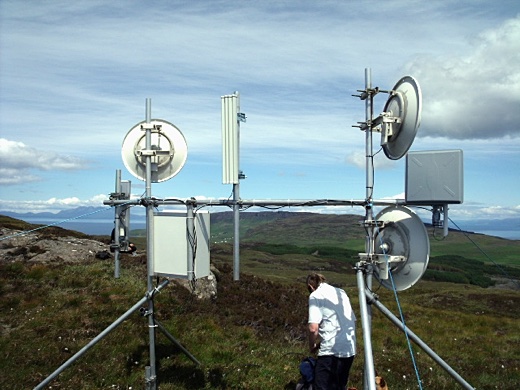


Image above: A relay with three point-to-point links and three sectoral antennae. By Tegola. From original article.

Long-distance WiFi links require line of sight to make a connection -- in this sense, the technology resembles the 18th century optical telegraph. [5] If there's no line of sight between two points, a third relay is required that can see both points, and the signal is sent to the intermediate relay first. Depending on the terrain and particular obstacles, more hubs may be necessary. [6]

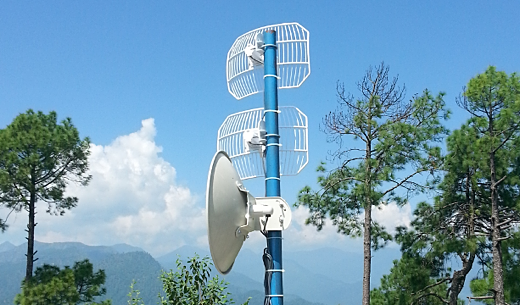
Point-to-point links typically consist of two directional antennas, one focused on the next node and the other on the previous node in the network. Nodes can have multiple antennas with one antenna per fixed point-to-point link to each neighbour. [7] This allows mesh routing protocols that can dynamically select which links to choose for routing among the available ones. [8]
Long-distance WiFi links require line of sight to make a connection -- in this sense, the technology resembles the 18th century optical telegraph.
Distribution nodes usually consist of a sectoral antenna (a small version of the things you see on mobile phone masts) or a conventional WiFi-router, together with a number of receivers in the community. [6] For short distance WiFi-communication, there is no requirement for line of sight between the transmitter and the receiver. [9]

To provide users with access to the worldwide internet, a long range WiFi network should be connected to the main backbone of the internet using at least one "backhaul" or "gateway node". This can be a dial-up or broadband connection (DSL, fibre or satellite). If such a link is not established, users would still be able to communicate with each other and view websites set up on local servers, but they would not be able to access the internet. [10]

Advantages of Long Range WiFi
Long range WiFi offers high bandwidth (up to 54 Mbps) combined with very low capital costs. Because the WiFi standard enjoys widespread acceptance and has huge production volumes, off-the-shelf antennas and wireless cards can be bought for very little money. [11]

Alternatively, components can be put together from discarded materials such as old routers, satellite dish antennas and laptops. Protocols like WiLDNet run on a 266 Mhz processor with only 128 MB memory, so an old computer will do the trick. [7]

The WiFi-nodes are lightweight and don't need expensive towers -- further decreasing capital costs, and minimizing the impact of the structures to be built. [7] More recently, single units that combine antenna, wireless card and processor have become available. These are very convenient for installation. To build a relay, one simply connects such units together with ethernet cables that carry both signal and power. [6]

The units can be mounted in towers or slim masts, given that they offer little windload. [3] Examples of suppliers of long range WiFi components are Ubiquity, Alvarion and MikroTik, and simpleWiFi.
Long Range WiFi makes use of unlicensed spectrum and offers high bandwidth, low capital costs, easy installation, and low power requirements.
Long range WiFi also has low operational costs due to low power requirements. A typical mast installation consisting of two long distance links and one or two wireless cards for local distribution consumes around 30 watts. [6,12]

In several low-tech networks, nodes are entirely powered by solar panels and batteries. Another important advantage of long range WiFi is that it makes use of unlicensed spectrum (2.4 and 5 GHz), and thus avoids negotiations with telecom operators and government. This adds to the cost advantage and allows basically anyone to start a WiFi-based long distance network. [9]

Long Range WiFi Networks in Poor Countries
The first long range WiFi networks were set up ten to fifteen years ago. In poor countries, two main types have been built. The first is aimed at providing internet access to people in remote villages.

An example is the Akshaya network in India, which covers the entire Kerala State and is one of the largest wireless networks in the world. The infrastructure is built around approximately 2,500 "computer access centers", which are open to the local population -- direct ownership of computers is minimal in the region. [13]

Another example, also in India, are the AirJaldi networks which provide internet access to approximately 20,000 users in six states, all in remote regions and on difficult terrain. Most nodes in this network are solar-powered and the distance between them can range up to 50 km or more. [14]

In some African countries, local WiFi-networks distribute internet access from a satellite gateway. [15,16]


Image above: A node in the AirJaldi network, a company connecting rural India. From original article.

second type of long distance WiFi network in poor countries is aimed at providing telemedicine to remote communities. In remote regions, health care is often provided through health posts scarcely equipped and attended by health technicians who are barely trained. [17]

Long-range WiFi networks can connect urban hospitals with these outlying health posts, allowing doctors to remotely support health technicians using high-resolution file transfers and real-time communication tools based on voice and video.

An example is the link between Cabo Pantoja and Iquitos in the Loreto province in Peru, which was established in 2007. The 450 km network consists of 17 towers which are 16 to 50 km apart. The line connects 15 medical outposts in remote villages with the main hospital in Iquitos and is aimed at remote diagnosis of patients. [17,18]

All equipment is powered by solar panels. [18,19] Other succesful examples of long range WiFi telemedicine networks have been built in India, Malawi and Ghana. [20,21]

WiFi-Based Community Networks in Europe
The low-tech networks in poor countries are set up by NGO's, governments, universities or businesses. In contrast, most of the WiFi-based long distance networks in remote regions of rich countries are so-called "community networks": the users themselves build, own, power and maintain the infrastructure.

Similar to the shared wireless approach in cities, reciprocal resource sharing forms the basis of these networks: participants can set up their own node and connect to the network (for free), as long as their node also allows traffic of other members. Each node acts as a WiFi routing device that provides IP forwarding services and a data link to all users and nodes connected to it. [8,22]
In a community network, the users themselves build, own, power and maintain the infrastructure.
Consequently, with each new user, the network becomes larger. There is no a-priori overall planning. A community network grows bottom-up, driven by the needs of its users, as nodes and links are added or upgraded following demand patterns. The only consideration is to connect a node from a new participant to an existing one.

As a node is powered on, it discovers it neighbours, attributes itself a unique IP address, and then establishes the most appropriate routes to the rest of the network, taking into account the quality of the links. Community networks are open to participation to everyone, sometimes according to an open peering agreement. [8,9,19,22]


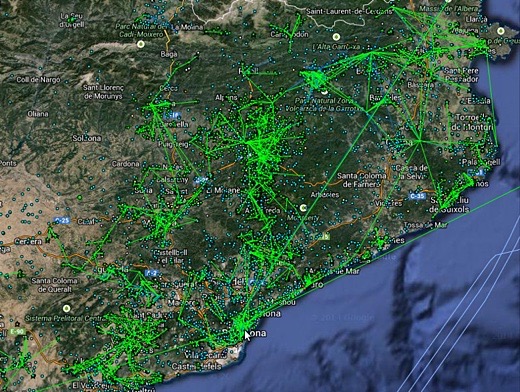
Image above: Wireless links in Barcelona Spanish by GuifiNet. From original article.

Despite the lack of reliable statistics, community networks seem to be rather succesful, and there are several large ones in Europe, such as Guifi.net (Spain), Athens Wireless Metropolitan Network (Greece), FunkFeuer (Austria), and Freifunk (Germany). [8,22,23,24]

The Spanish network  is the largest WiFi-based long distance network in the world with more than 50,000 kilometres of links, although a small part is based on optic fibre links. Most of it is located in the Catalan Pyrenees, one of the least populated areas in Spain. The network was initiated in 2004 and now has close to 30,000 nodes, up from 17,000 in 2012. [8,22]

Guifi.net provides internet access to individuals, companies, administrations and universities. In principle, the network is installed, powered and maintained by its users, although volunteer teams and even commercial installers are present to help. Some nodes and backbone upgrades have been succesfully crowdfunded by indirect beneficiaries of the network. [8,22]

Performance of Low-tech Networks
So how about the performance of low-tech networks? What can you do with them? The available bandwidth per user can vary enormously, depending on the bandwidth of the gateway node(s) and the number of users, among other factors. The long-distance WiFi networks aimed at telemedicine in poor countries have few users and a good backhaul, resulting in high bandwidth (+ 40 Mbps).

This gives them a similar performance to fibre connections in the developed world. A study of (a small part of) the Guifi.net community network, which has dozens of gateway nodes and thousands of users, showed an average throughput of 2 Mbps, which is comparable to a relatively slow DSL connection. Actual throughput per user varies from 700 kbps to 8 Mbps. [25]
The available bandwidth per user can vary enormously, depending on the bandwidth of the gateway node(s) and the number of users, among other factors
However, the low-tech networks that distribute internet access to a large user base in developing countries can have much more limited bandwidth per user. For example, a university campus in Kerala (India) uses a 750 kbps internet connection that is shared across 3,000 faculty members and students operating from 400 machines, where during peak hours nearly every machine is being used.

Therefore, the worst-case average bandwidth available per machine is approximately 1.9 kbps, which is slow even in comparison to a dial-up connection (56 kbps). And this can be considered a really good connectivity compared to typical rural settings in poor countries. [26] To make matters worse, such networks often have to deal with an intermittent power supply.

Under these circumstances, even the most common internet applications have poor performance, or don't work at all. The communication model of the internet is based on a set of network assumptions, called the TCP/IP protocol suite. These include the existence of a bi-directional end-to-end path between the source (for example a website's server) and the destination (the user's computer), short round-trip delays, and low error rates.

Many low-tech networks in poor countries do not comform to these assumptions. They are characterized by intermittent connectivity or "network partitioning" -- the absence of an end-to-end path between source and destination -- long and variable delays, and high error rates. [21,27,28]

Delay-Tolerant Networks
Nevertheless, even in such conditions, the internet could work perfectly fine. The technical issues can be solved by moving away from the always-on model of traditional networks, and instead design networks based upon asynchronous communication and intermittent connectivity.

These so-called "delay-tolerant networks" (DTNs) have their own specialized protocols overlayed on top of the lower protocols and do not utilize TCP. They overcome the problems of intermittent connectivity and long delays by using store-and-forward message switching.

Information is forwarded from a storage place on one node to a storage place on another node, along a path that eventually reaches its destination. In contrast to traditional internet routers, which only store incoming packets for a few milliseconds on memory chips, the nodes of a delay-tolerant network have persistent storage (such as hard disks) that can hold information indefinitely. [27,28]
Delay-tolerant networks combine well with renewable energy: solar panels or wind turbines could power network nodes only when the sun shines or the wind blows, eliminating the need for energy storage.
Delay-tolerant networks don't require an end-to-end path between source and destination. Data is simply transferred from node to node. If the next node is unavailable because of long delays or a power outage, the data is stored on the hard disk until the node becomes available again. While it might take a long time for data to travel from source to destination, a delay-tolerant network ensures that it will eventually arrive.

Delay-tolerant networks further decrease capital costs and energy use, leading to the most efficient use of scarce resources. They keep working with an intermittent energy supply and they combine well with renewable energy sources: solar panels or wind turbines could power network nodes only when the sun shines or the wind blows, eliminating the need for energy storage.

Data Mules
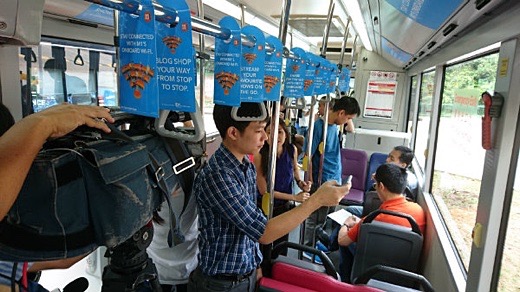
Delay-tolerant networking can take surprising forms, especially when they take advantage of some non-traditional means of communication, such as "data mules". [11,29] In such networks, conventional transportation technologies -- buses, cars, motorcycles, trains, boats, airplanes -- are used to ferry messages from one location to another in a store-and-forward manner.

Examples are DakNet and KioskNet, which use buses as data mules. [30-34] In many developing regions, rural bus routes regularly visit villages and towns that have no network connectivity. By equipping each vehicle with a computer, a storage device and a mobile WiFi-node on the one hand, and by installing a stationary WiFi-node in each village on the other hand, the local transport infrastructure can substitute for a wireless internet link. [11]


Image above: Singapore provides seamless service on board island bus service. From (https://www.thinksmallcell.com/System/m1-singapore-provides-seamless-service-on-board-island-bus-service.html).

Outgoing data (such as sent emails or requests for webpages) is stored on local computers in the village until the bus comes withing range. At this point, the fixed WiFi-node of the local computer automatically transmits the data to the mobile WiFi-node of the bus. Later, when the bus arrives at a hub that is connected to the internet, the outgoing data is transmitted from the mobile WiFi-node to the gateway node, and then to the internet.

Data sent to the village takes the opposite route. The bus -- or data -- driver doesn't require any special skills and is completely oblivious to the data transfers taking place. He or she does not need to do anything other than come in range of the nodes. [30,31]
In a data mules network, the local transport infrastructure substitutes for a wireless internet link.
The use of data mules offers some extra advantages over more "sophisticated" delay-tolerant networks. A "drive-by" WiFi network allows for small, low-cost and low-power radio devices to be used, which don't require line of sight and consequently no towers -- further lowering capital costs and energy use compared to other low-tech networks. [30,31,32]

The use of short-distance WiFi-links also results in a higher bandwidth compared to long-distance WiFi-links, which makes data mules better suited to transfer larger files. On average, 20 MB of data can be moved in each direction when a bus passes a fixed WiFi-node. [30,32] On the other hand, latency (the time interval between sending and receiving data) is usually higher than on long-range WiFi-links. A single bus passing by a village once a day gives a latency of 24 hours.

Delay-Tolerant Software
Obviously, a delay-tolerant network (DTN) -- whatever its form -- also requires new software: applications that function without a connected end-to-end networking path. [11]

Such custom applications are also useful for synchronous, low bandwidth networks. Email is relatively easy to adapt to intermittent connectivity, because it's an asynchronous communication method by itself.

A DTN-enabled email client stores outgoing messages until a connection is available. Although emails may take longer to reach their destination, the user experience doesn't really change.


Image above: Vision of a computer technology merged with organic nature.  From (https://oertijd.home.xs4all.nl/st-age/photo.htm).

Browsing and searching the web requires more adaptations. For example, most search engines optimize for speed, assuming that a user can quickly look through the returned links and immediately run a second modified search if the first result is inadequate. However, in intermittent networks, multiple rounds of interactive search would be impractical. [26,35]

Asynchronous search engines optimize for bandwith rather than response time. [26,30,31,35,36]

For example, RuralCafe desynchronizes the search process by performing many search tasks in an offline manner, refining the search request based on a database of similar searches. The actual retrieval of information using the network is only done when absolutely necessary.
Many internet applications could be adapted to intermittent networks, such as webbrowsing, email, electronic form filling, interaction with e-commerce sites, blogsoftware, large file downloads, or social media.
Some DTN-enabled browsers download not only the explicitly requested webpages but also the pages that are linked to by the requested pages. [30] Others are optimized to return low-bandwidth results, which are achieved by filtering, analysis, and compression on the server site.

A similar effect can be achieved through the use of a service like Loband, which strips webpages of images, video, advertisements, social media buttons, and so on, merely presenting the textual content. [26]

Browsing and searching on intermittent networks can also be improved by local caching (storing already downloaded pages) and prefetching (downloading pages that might be retrieved in the future).

Many other internet applications could also be adapted to intermittent networks, such as electronic form filling, interaction with e-commerce sites, blogsoftware, large file downloads, social media, and so on. [11,30] All these applications would remain possible, though at lower speeds.

Sneakernets
Obviously, real-time applications such as internet telephony, media streaming, chatting or videoconferencing are impossible to adapt to intermittent networks, which provide only asynchronous communication. These applications are also difficult to run on synchronous networks that have limited bandwidth.

Because these are the applications that are in large part responsible for the growing energy use of the internet, one could argue that their incompatibility with low-tech networks is actually a good thing (see the previous article).

Furthermore, many of these applications could be organized in different ways. While real-time voice or video conversations won't work, it's perfectly possible to send and receive voice or video messages. And while streaming media can't happen, downloading music albums and video remains possible.

Moreover, these files could be "transmitted" by the most low-tech internet technology available: a sneakernet. In a sneakernet, digital data is "wirelessly" transmitted using a storage medium such as a hard disk, a USB-key, a flash card, or a CD or DVD. Before the arrival of the internet, all computer files were exchanged via a sneakernet, using tape or floppy disks as a storage medium.

Just like a data mules network, a sneakernet involves a vehicle, a messenger on foot, or an animal (such as a carrier pigeon).

However, in a sneakernet there is no automatic data transfer between the mobile node (for instance, a vehicle) and the stationary nodes (sender and recipient). Instead, the data first have to be transferred from the sender's computer to a portable storage medium.

Then, upon arrival, the data have to be transferred from the portable storage medium to the receiver's computer. [30] A sneakernet thus requires manual intervention and this makes it less convenient for many internet applications.

There are exceptions, though. For example, a movie doesn't have to be transferred to the hard disk of your computer in order to watch it. You play it straight from a portable hard disk or slide a disc into the DVD-player.

Moreover, a sneakernet also offers an important advantage: of all low-tech networks, it has the most bandwidth available. This makes it perfectly suited for the distribution of large files such as movies or computer games. In fact, when very large files are involved, a sneakernet even beats the fastest fibre internet connection. At lower internet speeds, sneakernets can be advantageous for much smaller files.

Technological progress will not lower the advantage of a sneakernet. Digital storage media evolve at least as fast as internet connections and they both improve communication in an equal way.

Resilient Networks
While most low-tech networks are aimed at regions where the alternative is often no internet connection at all, their usefulness for well-connected areas cannot be overlooked. The internet as we know it in the industrialized world is a product of an abundant energy supply, a robust electricity infrastructure, and sustained economic growth. This "high-tech" internet might offer some fancy advantages over the low-tech networks, but it cannot survive if these conditions change. This makes it extremely vulnerable.
The internet as we know it in the industrialized world is a product of an abundant energy supply, a robust electricity infrastructure, and sustained economic growth. It cannot survive if these conditions change.
Depending on their level of resilience, low-tech networks can remain in operation when the supply of fossil fuels is interrupted, when the electricity infrastructure deteriorates, when the economy grinds to a halt, or if other calamities should hit. Such a low-tech internet would allow us to surf the web, send and receive e-mails, shop online, share content, and so on.

Meanwhile, data mules and sneakernets could serve to handle the distribution of large files such as videos. Stuffing a cargo vessel or a train full of digital storage media would beat any digital network in terms of speed, cost and energy efficiency. And if such a transport infrastructure would no longer be available, we could still rely on messengers on foot, cargo bikes and sailing vessels.

Such a hybrid system of online and offline applications would remain a very powerful communication network -- unlike anything we had even in the late twentieth century. Even if we envision a doom scenario in which the wider internet infrastructure would disintegrate, isolated low-tech networks would still be very useful local and regional communication technologies.

Furthermore, they could obtain content from other remote networks through the exchange of portable storage media. The internet, it appears, can be as low-tech or high-tech as we can afford it to be.

Sources & Notes:
DIY: Wireless networking in the developing world (Third Edition) is a free book about designing, implementing and maintaining low-cost wireless networks. Available in English, French, and Spanish.

[1] Connecting the unwired world with balloons, satellites, lasers & drones, Slashdot, 2015

[2] A QoS-aware dynamic bandwidth allocation scheme for multi-hop WiFi-based long distance networks, Iftekhar Hussain et al., 2015

[3] Long-distance, Low-Cost Wireless Data Transmission (PDF), Ermanno Pietrosemoli, 2011

[4] This link could only be established thanks to the height of the endpoints (4,200 and 1,500 km) and the flatness of the middle ground. The curvature of the Earth makes longer point-to-point WiFi-links difficult to achieve because line of sight between two points is required.

[5] Radio waves occupy a volume around the optical line, which must be unemcumbered from obstacles. This volume is known as the Fresnel ellipsoid and its size grows with the distance between the two end points and with the wavelength of the signal, which is in turn inversely proportional to the frequency. Thus, it is required to leave extra "elbow room" for the Fresnel zone. [9]

[6] A Brief History of the Tegola Project, Tegola Project, retrieved October 2015

[7] WiLDNet: Design and Implementation of High Performance WiFi based Long Distance Networks (PDF), Rabin Patra et al., 2007

[8] Topology Patterns of a Community Network: Guifi.net (PDF), Davide Vega et al., 2012

[9] Global Access to the Internet for All, internet draft, Internet Engineering Task Force (IETF), 2015

[10] This is what happened to Afghanistan's JLINK network when funding for the network's satellite link ran dry in 2012.

[11] The case for technology in developing regions (PDF), Eric Brewer et al., 2005

[12] Beyond Pilots: Keeping Rural Wireless Networks Alive (PDF), Sonesh Surana et al., 2008

[13] http://www.akshaya.kerala.gov.in/

[14] http://main.airjaldi.com/

[15] VillageCell: Cost Effective Cellular Connectivity in Rural Areas (PDF), Abhinav Anand et al., 2012

[16] Deployment and Extensio of a Converged WiMAX/WiFi Network for Dwesa Community Area South Africa (PDF), N. Ndlovu et al., 2009

[17] "A telemedicine network optimized for long distances in the Amazonian jungle of Peru" (PDF), Carlos Rey-Moreno, ExtremeCom '11, September 2011

[18] "Telemedicine networks of EHAS Foundation in Latin America", Ignacio Prieto-Egido et al., in "Frontiers in Public Health", October 15, 2014.

[19] "The design of a wireless solar-powered router for rural environments isolated from health facilities" (PDF), Francisco Javier Simo Reigadas et al., in "IEEE Wireless Communications", June 2008.

[20] On a long wireless link for rural telemedicine in Malawi (PDF), M. Zennaro et al., 2008
[21] A Survey of Delay- and Disruption-Tolerant Networking Applications, Artemios G. Voyiatzis, 2012

[22] Supporting Cloud Deployment in the Guifi Community Network (PDF), Roger Baig et al., 2013

[23] A Case for Research with and on Community Networks (PDF), Bart Braem et.al, 2013

[24] There are smaller networks in Scotland (Tegola), Slovenia (wlan slovenija), Belgium (Wireless Antwerpen), and the Netherlands (Wireless Leiden), among others. Australia has Melbourne Wireless. In Latin America, numerous examples exists, such as Bogota Mesh (Colombia) and Monte Video Libre (Uruguay). Some of these networks are interconnected. This is the case for the Belgian and Dutch community networks, and for the Slovenian and Austrian networks. [8,22,23]

[25] Proxy performance analysis in a community wireless network, Pablo Pitarch Miguel, 2013

[26] RuralCafe: Web Search in the Rural Developing World (PDF), Jay Chen et al., 2009

[27] A Delay-Tolerant Network Architecture for Challenged Networks (PDF), Kevin Fall, 2003

[28] Delay- and Disruption-Tolerant Networks (DTNs) -- A Tutorial (version 2.0) (PDF), Forrest Warthman, 2012

[29] Healthcare Supported by Data Mule Networks in Remote Communities of the Amazon Region, Mauro Margalho Coutinho et al., 2014

[30] First Mile Solutions' Daknet Takes Rural Communities Online (PDF), Carol Chyau and Jean-Francois Raymond, 2005

[31] DakNet: A Road to Universal Broadband Connectivity (PDF), Amir Alexander Hasson et al., 2003

[32] DakNet: Architecture and Connectivity in Developing Nations (PDF), Madhuri Bhole, 2015

[33] Delay Tolerant Networks and Their Applications, Longxiang Gao et al., 2015

[34] Low-cost communication for rural internet kiosks using mechanical backhaul, A. Seth et al., 2006

[35] Searching the World Wide Web in Low-Connectivity Communities (PDF), William Thies et al., 2002

[36] Slow Search: Information Retrieval without Time Constraints (PDF), Jaime Teevan, 2013

[37] Potential for Collaborative Caching and Prefetching in Largely-Disconnected Villages (PDF), Sibren Isaacman et al., 2008


.

The Desert Fridge Project

SUBHEAD: How to build a pot-in-pot "Desert Fridge to cool food by 18ºF for extending storage.

By Bibi Farber on 5 March 2009 in Next World TV -
(http://www.nextworldtv.com/videos/innovations/desert-fridge.html)


Image above: Still frame pouring sand into pot-in-pot "Desert Fridge Project. From video below.

The Pot in Pot method of keeping food cool in hot climates is even becoming popular among people in the West who wish to reduce their dependency on a big energy sucking refrigerator.

The method is very simple: There are two clay pots, one inside the other. In between fill with is sand. Saturate sand with water and Put food to be cooled in inner pot. Cover pots. As the water evaporates it removes heat from the inner system, thereby leaving it cool.

As needed add more water a few times a day to keep the sand wet.

One major benefit is that the pot-in-pot enables Gambian farmers to retain food for future sale, instead of dumping all the produce that doesn't sell during a given day.

If the farmers have a storage system, it changes everything. No electricity needed!


Video above: How to build a pot-in-pot "Desert Fridge. From (https://youtu.be/92fpnUfRt1A).

.

No Dig Vegetable Garden

SUBHEAD: There are several styles of no-dig gardening, including straw bale gardening.

By Linda Ly on 5 March 2014 for Garden Betty -
(http://www.gardenbetty.com/2014/03/the-no-dig-vegetable-garden/)


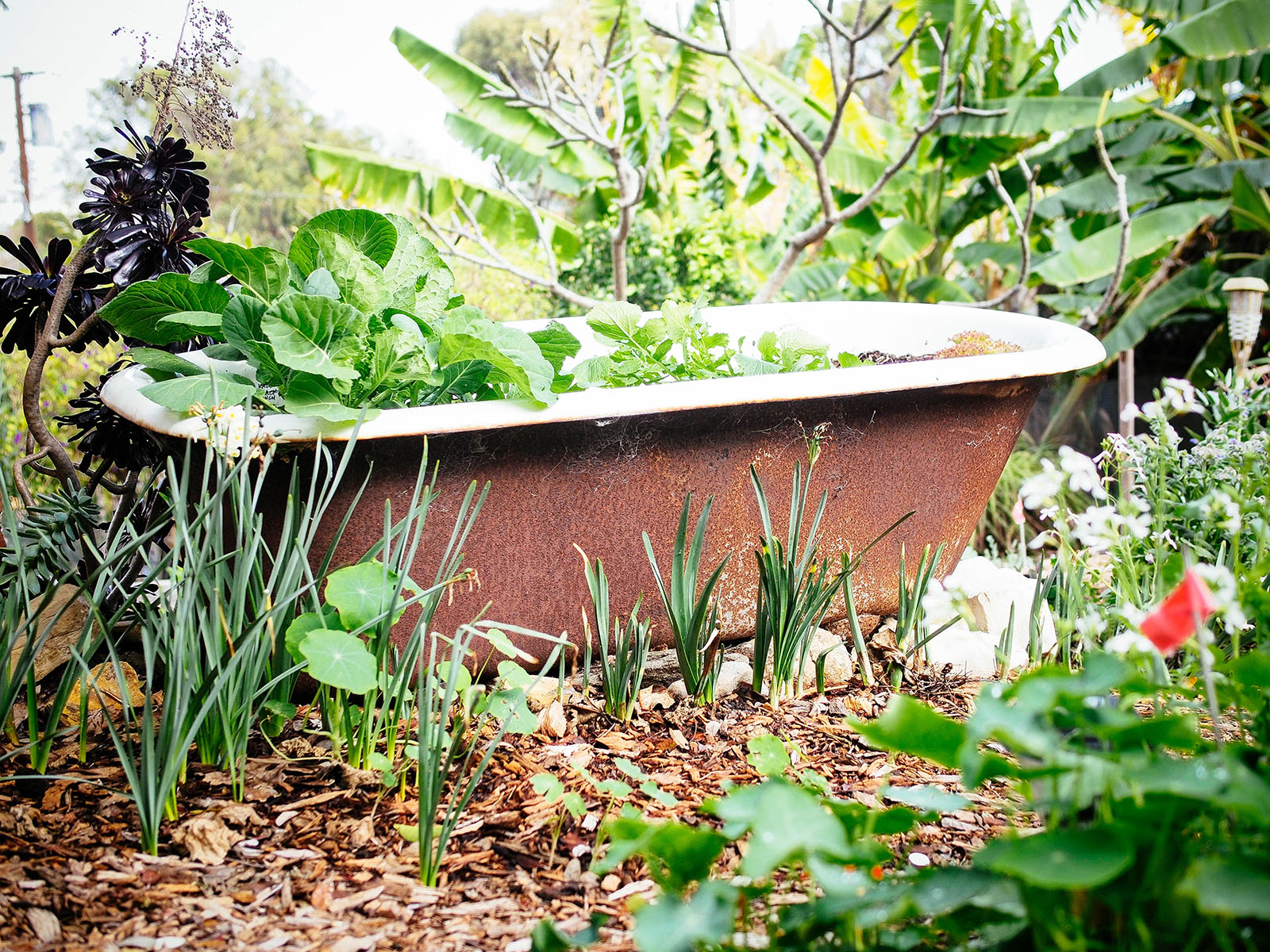
Image above: Claw foot porcelain tub planter. From original article).

[IB Publisher note: This article wasn't posted for the cute claw footed tub, but for the thin, efficient, economic soil recipe that is described using mostly straw, alfalfa and newspaper.]

I started a new garden bed last fall, and I didn’t dig a thing. It actually would’ve been pretty challenging to dig anything, as I started the new bed in an old bathtub. In my backyard! Four months later, the first plants seeded are finally thriving, thanks to the longer days.

I inherited this vintage, enameled-steel clawfoot tub from the previous owners after I moved into my house a few years ago. They had it propped up under the feijoa tree on a stack of stones, and for many summers it was our repurposed party cooler, filled to the brim with ice and stuffed with cases of beer. But having the tub sit empty the rest of the year seemed silly, especially since we weren’t using it as an actual tub to wash anything in the garden.


Image above: Rusty clawfoot porcelain iron tub.

I envisioned turning it into a planter (especially a future planter for potatoes and sweet potatoes, where the tubers could be contained), but the massive size made filling it with good-quality soil a little cost-prohibitive, considering we needed to top off all our existing beds as well. I started looking into no-dig methods for building raised beds, which pile on layers of organic materials that decompose over a season to create humus-rich earth.

There are several styles of no-dig gardening, including straw bale gardening, lasagna gardening, and sheet mulching, but I was most intrigued with Esther Deans’ method, which appeared suspiciously simple. The Australian gardener and author promoted a style of no-dig gardening (you can still find her book online) that popularized no-dig gardens throughout the 70s and 80s, and inspired the ideas of permaculture designer Bill Mollison.
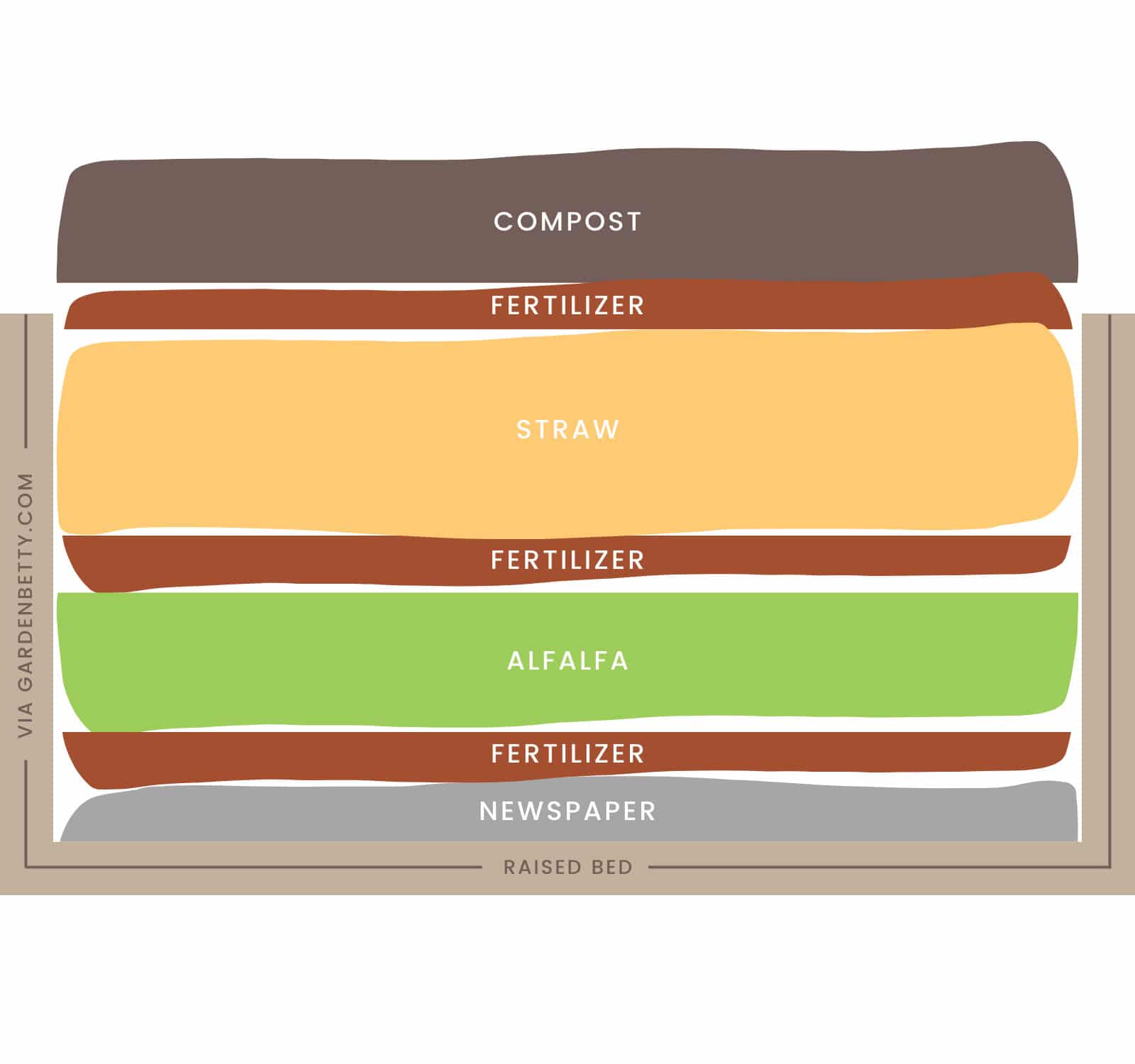

Deans’ method comprised a specific formula that started with newspaper and added fertilizer, alfalfa, straw, and finally compost. The layers could be built over a soft surface like grass or dirt — or even a hard surface like concrete, though the raised bed would have to be deep enough for deep-rooted vegetables to thrive.


Image above: No-Dig Gardening Chart.

I decided to try this method for filling my clawfoot tub, since straw and alfalfa are cheap and easy to come by at my local feed store, and I could use them to mulch and amend several other beds in the garden.

I started with about 10 sheets of newspaper layered in the bottom of the tub. In my case, they were less for weed suppression, and more for adding brown matter and providing food for the worms that will make their home in the tub.

Next came a generous dusting of fertilizer — I chose bone meal and blood meal, but animal manure or any high-nitrogen fertilizer would work. Rather than following the suggested application on the packages, I tossed in a few handfuls of each, then watered them in well. (A few handfuls is much more than you would typically use if you were fertilizing a bed, but in this case, the extra bone meal and blood meal is added to accelerate the breakdown of the layers.)

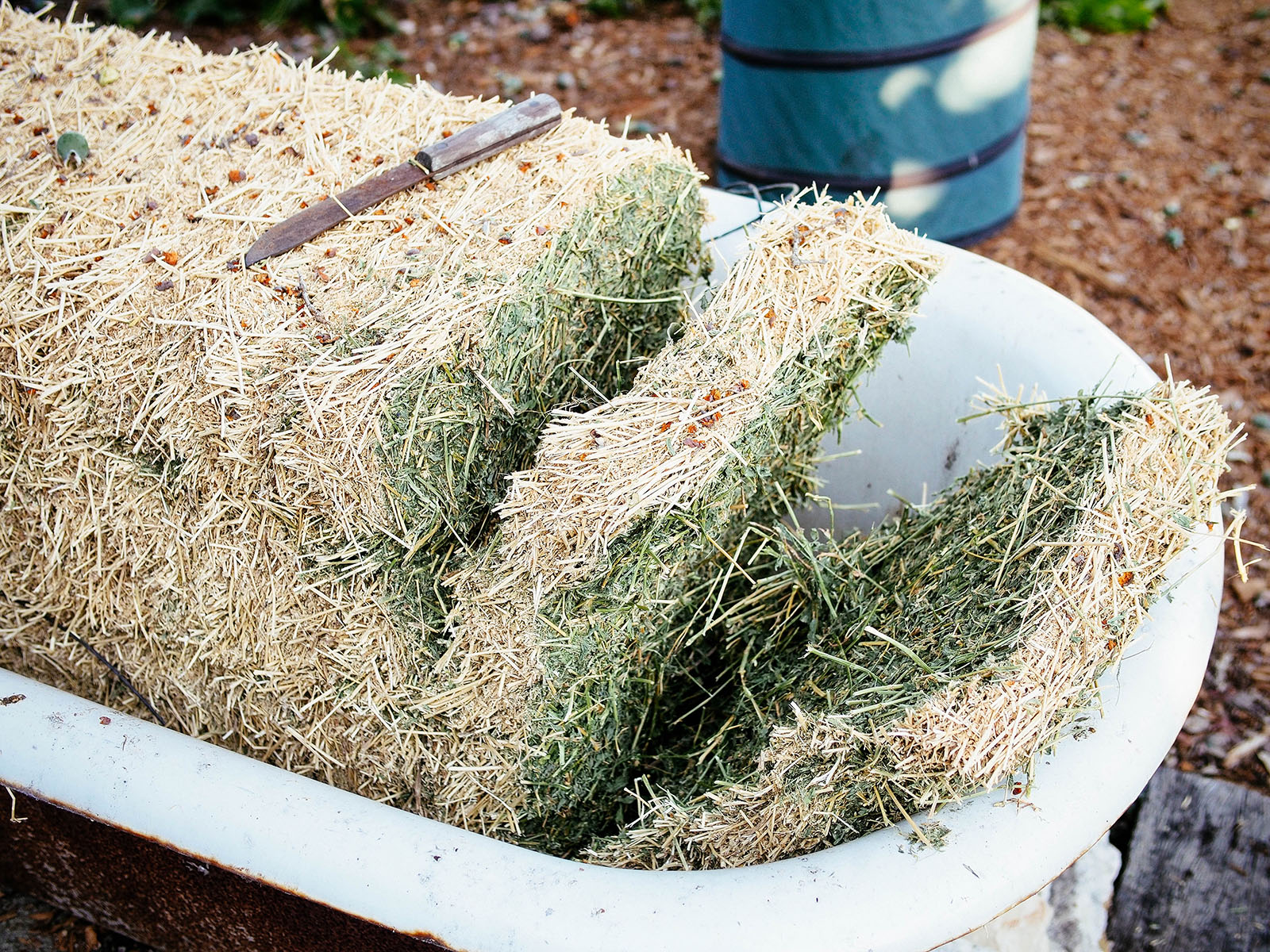
Then came the alfalfa. Alfalfa (also called lucerne hay) is the same stuff used as horse feed. It comes in bales that pull apart in 3-inch pads and makes an excellent base for a no-dig garden.


Image above: "Bale of alfalfa (lucerne hay)


Image above: Close uo of alfalfa.


With its super nutritious and high nitrogen content, it rots quickly, providing rich organic matter for plants and helping other materials decompose. I covered the bottom of my tub with two layers of alfalfa pads (about 6 inches), a few more handfuls of bone meal and blood meal, then soaked them thoroughly with a hose.

On top of the alfalfa, I added a thick layer of straw (about 12 inches, or double my alfalfa layer).

Straw is basically hay without the grains; it’s the hollow stems and dried leaves left behind after all the grains and seeds have been harvested. It’s not as nitrogen-rich, but breaks down quickly into compost and contains fewer seeds, meaning less weeds growing in your no-dig bed.

Really pack in and pack down the straw in your raised bed (even building the layer up to the lip), as it will greatly compress after a couple of months.


Image above: Bale of Straw.


Following the straw was another generous dusting of bone meal and blood meal, and another soak with the hose.

Finally, the topmost layer was a healthy addition of compost (about 3 to 6 inches). Whatever you use, it should be well rotted and teeming with microbes. This is the layer you’ll be seeding and planting in, so don’t skimp on the compost. Wet it down, and you’re ready to plant!

In a standard-depth raised bed, the ratio of layers would more likely look like this from the bottom up:
  • 10 sheets of newspaper
  • 3 inches of alfalfa (one pad)
  • 6 inches of straw
  • 3 to 6 inches of compost (or well amended soil)
Scatter bone meal and blood meal over each layer and saturate with water before adding the next layer. It might seem like you’re piling on a mountain of materials, but the alfalfa and straw will compress under repeated watering and reduce to about half their height by the end of the season.

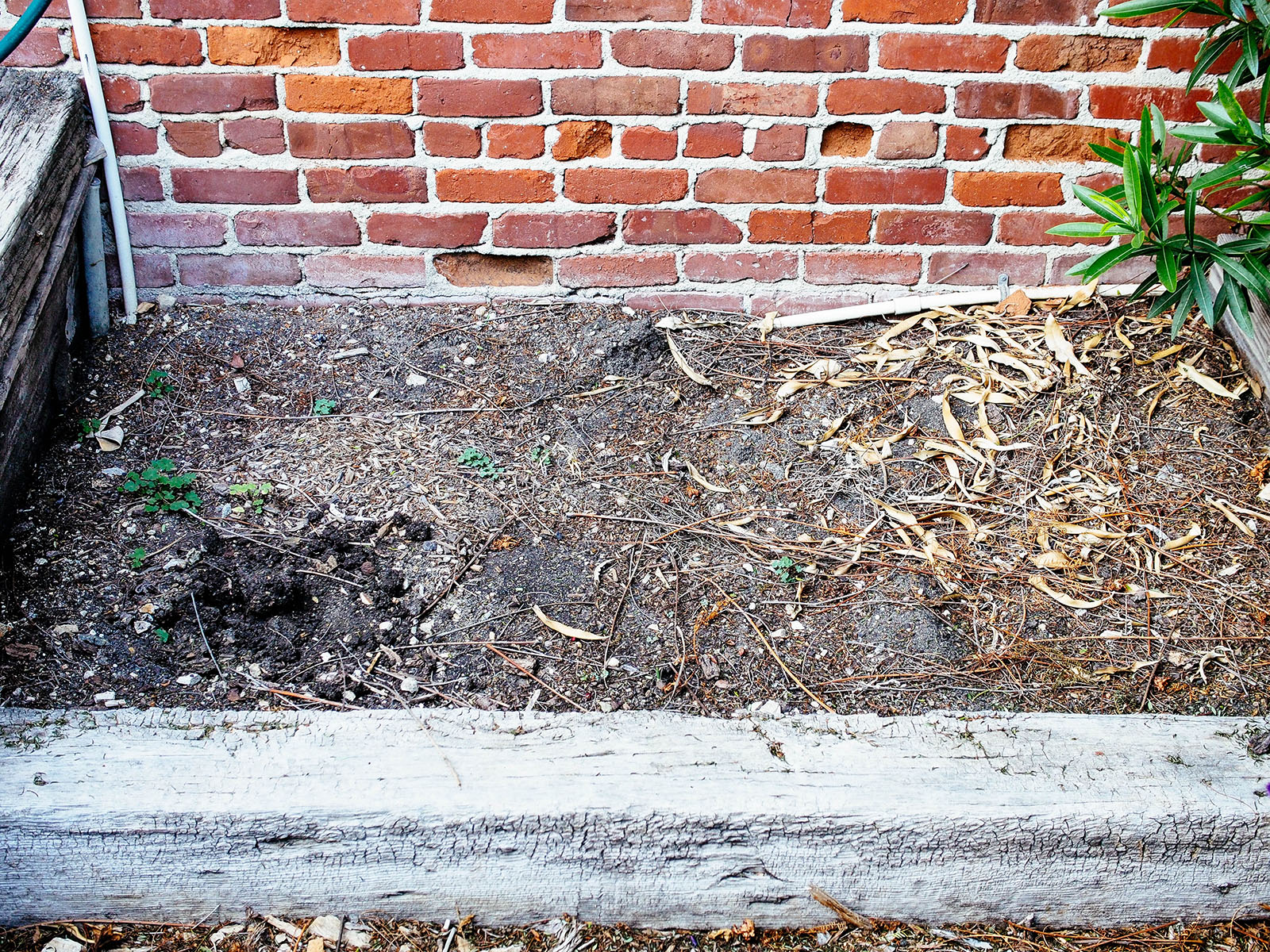
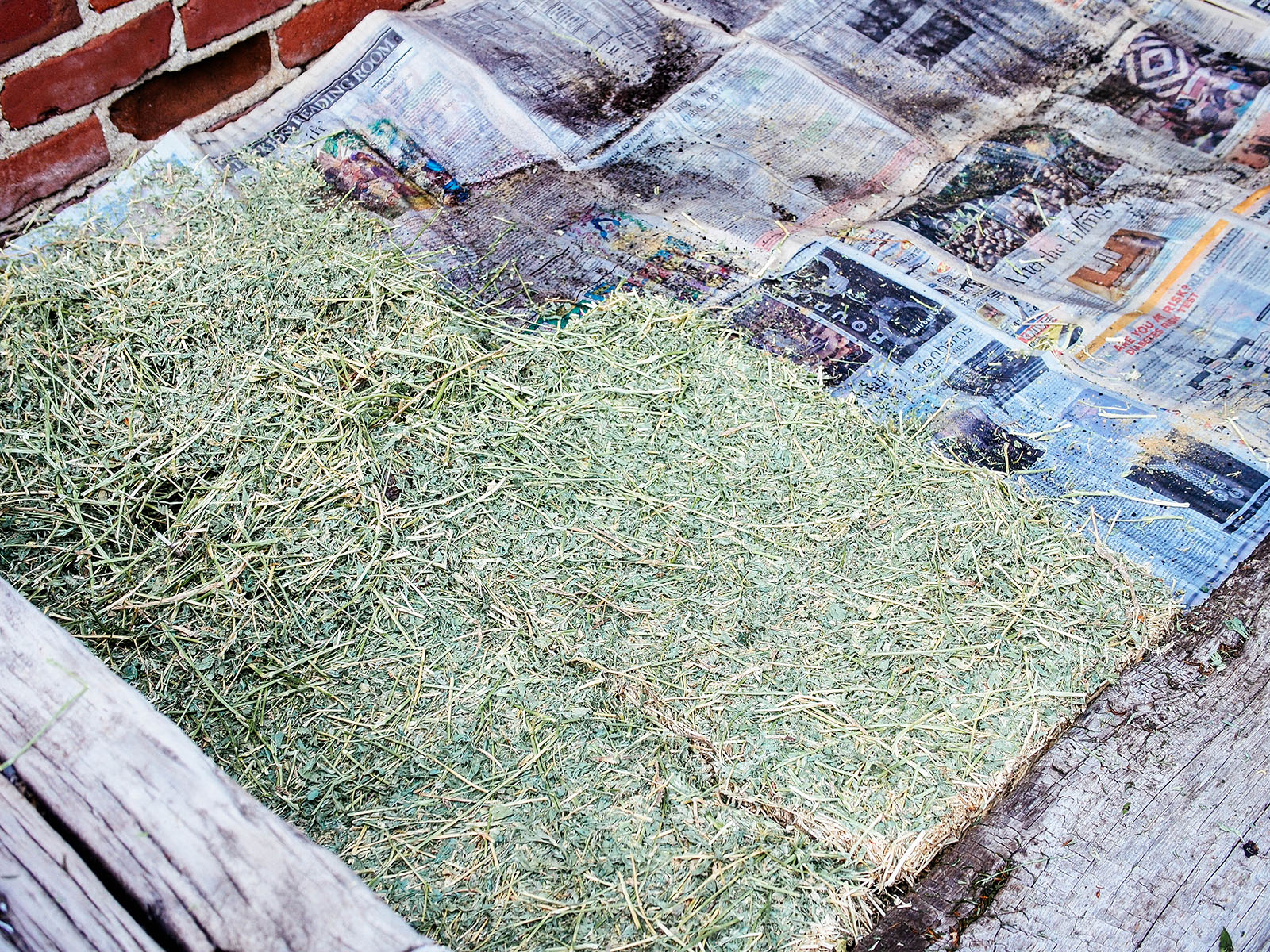
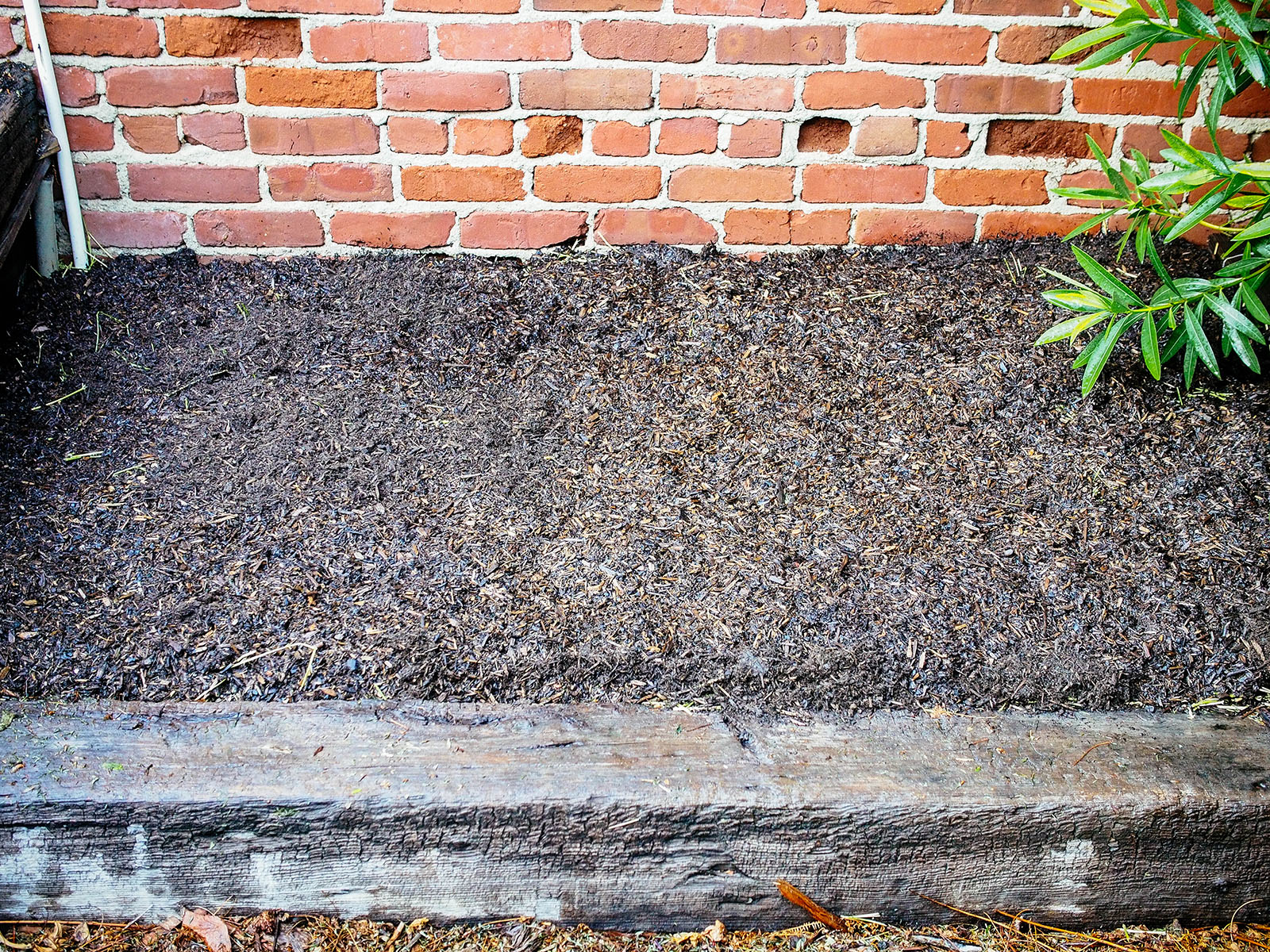
The no-dig method also works for reviving an old raised bed; just omit the straw layer and add the rest on top of the existing soil. I had a bed sit empty and dry for a couple of months, and its soil had turned into heavy, compacted earth. I stacked on the newspaper, bone and blood meal, alfalfa, more bone and blood meal, then topped off with homemade compost, and sprayed each layer with water.


Image above: Neglected garden bed.


Image above: Alfalfa pads spread across raised bed.


Image above: Newly revived garden bed.


I didn’t plant in the bed, but watered it with the rest of the garden through winter and now have lush, aerated soil to plant in spring.

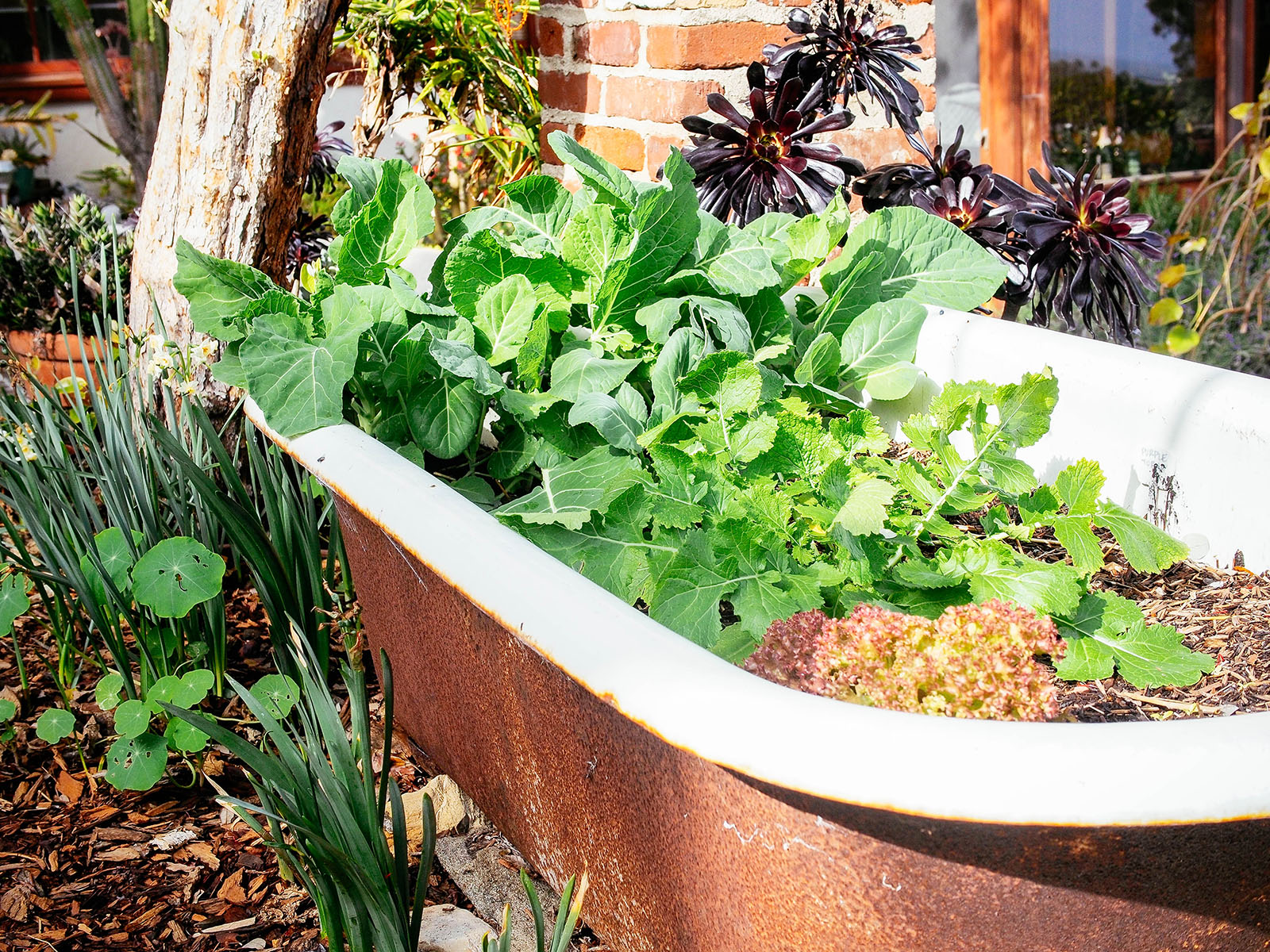
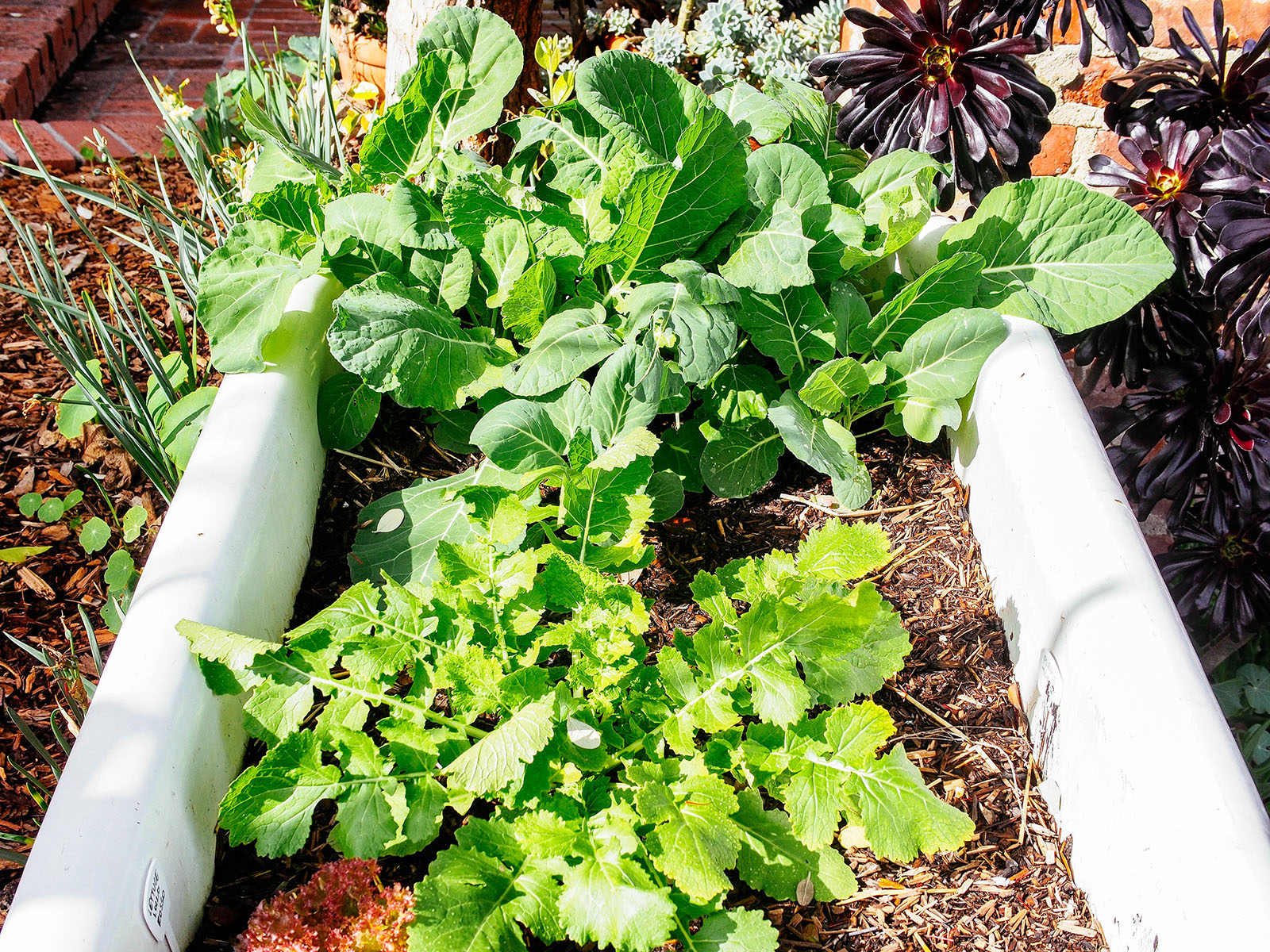
Going back to the bathtub, this is what it looks like today, planted with kale, turnip, and lettuce.


Image above: Leafy greens in clawfoot tub.


Image above: Portuguese kale.


Image above: Red lettuce.

I started everything from seed and they sprouted within a week. I watered like normal and did not fertilize the bed. (Though going into spring, I’ll be amending with fish emulsion or compost tea to replenish the nitrogen in the soil.)

I’ve read from a few sources that newly built no-dig beds work best with shallow-rooted plants until the layers break down into humus. But from the looks of it, my turnips (shown here in the foreground) are faring well so far.


Image above: Kale, turnips, and lettuce growing in bathtub planter.

I probably wouldn’t plant, say, carrots or daikon in a first-season bed as they’re very deep-rooted. I’d avoid planting peas and beans as they can be sensitive to the salinity in high-nitrogen fertilizers.
Excess nitrogen can also cause fruiting plants to produce lots of foliage but fewer flowers. By the second season, however, all that alfalfa and straw will have turned into rich black soil that’s ideal for all of those varieties.

Like any raised bed, you should top off and amend your no-dig bed every season with soil and compost. But once it’s established, maintaining it requires no real effort and reviving it (if you’ve neglected to plant or amend) requires no back-breaking digging. Simply build upon the layers again and let nature do the work.


Vintage bathtub planter.


.