Showing posts with label Craft. Show all posts

Just wait a little while

SUBHEAD: You’ll have to earn everything worth having, including self-respect and your next meal.

By James Kunstler on 7 August 2017 for Kunstler.com -
(http://kunstler.com/clusterfuck-nation/just-wait-little/)
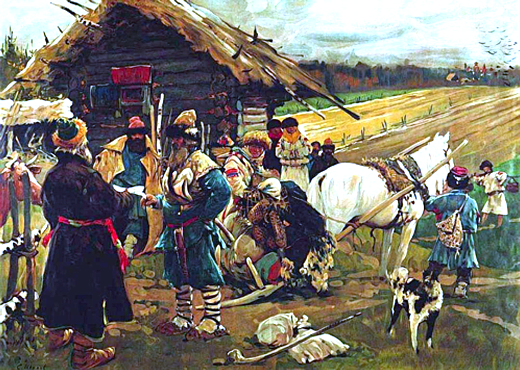

Image above: Aarly 20th century Russian painting of "A Peasant Leaving His Landlord on Yuri's Day" by Sergei V. Ivanov. From (https://www.kp.ru/radio/26511/3430500/).

The trouble, of course, is that even after the Deep State (a.k.a. “The Swamp”) succeeds in quicksanding President Trump, America will be left with itself — adrift among the cypress stumps, drained of purpose, spirit, hope, credibility, and, worst of all, a collective grasp on reality, lost in the fog of collapse.

Here’s what you need to know about what’s going on and where we’re headed.

The United States is comprehensively bankrupt. The government is broke and the citizenry is trapped under inescapable debt burdens. We are never again going to generate the kinds and volumes of “growth” associated with techno-industrial expansion.

That growth came out of energy flows, mainly fossil fuels, that paid for themselves and furnished a surplus for doing other useful things. It’s over.

Shale oil, for instance, doesn’t pay for itself and the companies engaged in it will eventually run out of accounting hocus-pocus for pretending that it does, and they will go out of business.

The self-evident absence of growth means the end of borrowing money at all levels. When you can’t pay back old loans, it’s unlikely that you will be able to arrange new loans.

The nation could pretend to be able to borrow more, since it can supposedly “create” money (loan it into existence, print it, add keystrokes to computer records), but eventually those tricks fail, too.

Either the “non-performing” loans (loans not being paid off) cause money to disappear, or the authorities “create” so much new money from thin air (money not associated with real things of value like land, food, manufactured goods) that the “money” loses its mojo as a medium of exchange (for real things), as a store of value (over time), and as a reliable index of pricing — which is to say all the functions of money.

In other words, there are two ways of going broke in this situation: money can become scarce as it disappears so that few people have any; or everybody can have plenty of money that has no value and no credibility.

I mention these monetary matters because the system of finance is the unifying link between all the systems we depend on for modern life, and none of them can run without it.

So that’s where the real trouble is apt to start. That’s why I write about markets and banks on this blog.

The authorities in this nation, including government, business, and academia, routinely lie about our national financial operations for a couple of reasons.

One is that they know the situation is hopeless but the consequences are so awful to contemplate that resorting to accounting fraud and pretense is preferable to facing reality.

Secondarily, they do it to protect their jobs and reputations — which they will lose anyway as collapse proceeds and their record of feckless dishonesty reveals itself naturally.

The underlying issue is the scale of human activity in our time. It has exceeded its limits and we have to tune back a lot of what we do. Anything organized at the giant scale is headed for failure, so it comes down to a choice between outright collapse or severe re-scaling, which you might think of as managed contraction.

That goes for government programs, military adventures, corporate enterprise, education, transportation, health care, agriculture, urban design, basically everything. There is an unfortunate human inclination to not reform, revise, or re-scale familiar activities.

We’ll use every kind of duct tape and baling wire we can find to keep the current systems operating, and we have, but we’re close to the point where that sort of cob-job maintenance won’t work anymore, especially where money is concerned.

Why this is so has been attributed to intrinsic human brain programming that supposedly evolved optimally for short-term planning. But obviously many people and institutions dedicate themselves to long-term thinking.

So there must be a big emotional over-ride represented by the fear of letting go of what used to work that tends to disable long-term thinking. It’s hard to accept that our set-up is about to stop working — especially something as marvelous as techno-industrial society.

But that’s exactly what’s happening. If you want a chance at keeping on keeping on, you’ll have to get with reality’s program. Start by choosing a place to live that has some prospect of remaining civilized. This probably doesn’t include our big cities.

But there are plenty of small cities and small towns out in America that are scaled for the resource realities of the future, waiting to be reinhabited and reactivated.

A lot of these lie along the country’s inland waterways — the Ohio, Mississippi, Missouri river system, the Great Lakes, the Hudson and St. Lawrence corridors — and they also exist in regions of the country were food can be grown.

You’ll have to shift your energies into a trade or vocation that makes you useful to other people. This probably precludes jobs like developing phone apps, day-trading, and teaching gender studies.

Think: carpentry, blacksmithing, basic medicine, mule-breeding, simplified small retail, and especially farming, along with the value-added activities entailed in farm production.

The entire digital economy is going to fade away like a drug-induced hallucination, so beware the current narcissistic blandishments of computer technology.

Keep in mind that being in this world actually entitles you to nothing. One way or another, you’ll have to earn everything worth having, including self-respect and your next meal.

Now, just wait a little while.

.

The Archaic Arts & Skills

SUBHEAD: Our job is to help archaic arts endure through the cacophony and clutter of the modern world.

By Brian Miller on 26 October 2014 for Winged Elm Farm -
(http://www.wingedelmfarm.com/blog/category/homesteading-2/)


Image above: Comtemporary oil painting of hunting with bow and arrow from a birch bark canoe. "Solitary Hunter" by Z. S. Liang. From (http://www.liangstudio.com/Solitary%20Hunter.html).

Beyond the brilliant red on the maple outside my study, the shots of hunters at both daybreak and sundown indicate fall has well and truly arrived.

Saturday morning was spent in the usual pursuit of running both errands and clearing the slate of farm chores and tasks. Success was not fully achieved in either category. Afternoon found me bushhogging a large pasture of 12 acres. A soothing act as the cut grass reveals the sensual curve of the landscape, it is also a meditative activity, one that allows time for the mind to float along unexpected paths.

As I finished in the early evening, the crack of firearms in the distance pulled me back from any reverie. The cattle looked up, muttered something to the equivalent of “humans,” and went back to

I entered the house for our evening coffee to find that Cindy had baked a platter of freshly made shortbread cookies. For some reason this had me thinking about the pursuit of what in our global consumer culture have been dismissed as the archaic arts. These are arts not clearly connected with the culture of global commerce—which is not to say that they are not connected with commerce, of course.

I have spent my adult life in the mines of the book industry, an art-form-turned-business-model locked in classic overshoot, where the issuance of new works has not yet registered the collapse of readership, where the vein we have followed of new readers has petered and faltered and is near to playing out, where a kid of a nearby farm, 18 years of age, told me recently, without embarrassment, that he had never read a book by choice.

During a short visit with a sister in Arkansas this week, I found her pursuing a similar arc, teaching classical European ballet. She has run a vibrant and popular dance academy for many years, yet she faces the difficulty of capturing an audience for an art form that doesn’t come with tweets and likes.

She has the dedicated dancers of the discipline. But in our 24/7 world of digital and visual distractions, where is the audience that can discern an aplomb from an arabesque?

Global culture is a consumer culture. Its goal is growth on a finite planet: a car for everyone in China and India, farmed shrimp from Indonesia on every Iowa farmer’s plate. It is fundamentally a disposable culture: disposable products, people and planet. It has little use for the arts of an enduring culture.

The dance that requires long study, the book written a hundred years ago, the technique of preserving soil fertility organically—all are archaic: they don’t require a container ship to deliver them to our door.

There are still niches for the archaic arts. And it is our job to help preserve them, to help them endure through the cacophony and clutter of the modern world.

While the era of mass literacy and the literature it spawned may be coming to an end, it doesn’t mean that literacy and the written word are also going to be lost. Audiences for disciplined and focused dance may be in retreat, but the participants are still queuing up to learn.

We on a small farm are learning the archaic arts—harvesting manure to build soil fertility, constructing secure fences that do indeed make good neighbors, planting vegetables that, when they mature, will feed us for a month, creating a plate of shortbread cookies that nourishes the soul—and all connect us with long past practitioners of these arts in ways that Facebook and Walmart never can and never will.

These are the arts that make us more fully a community, a culture, a people.

.

The End of Employment

SUBHEAD: In nonindustrial societies  individuals consume or barter the product of their own labor.

By John Michael Greer on 16 April 2014 for the Archdruid Report-
(http://thearchdruidreport.blogspot.com/2014/04/the-end-of-employment.html)


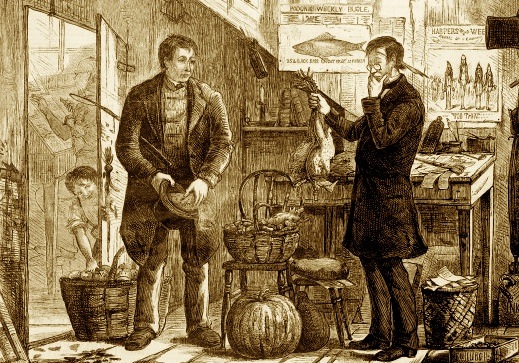
Image above: Etchinjg of man bartering with shop keeper. From (http://www.gizmag.com/bitcoin-currency-money-economy-mature/30863/).

Nothing is easier, as the Long Descent begins to pick up speed around us, than giving in to despair—and nothing is more pointless. Those of us who are alive today are faced with the hugely demanding task of coping with the consequences of industrial civilization’s decline and fall, and saving as many as possible of the best achievements of the last few centuries so that they can cushion the descent and enrich the human societies of the far future.  That won’t be easy; so?  

 The same challenge has been faced many times before, and quite often it’s been faced with relative success.

The circumstances of the present case are in some ways more difficult than past equivalents, to be sure, but the tools and the knowledge base available to cope with them are almost incomparably greater. All in all, factoring in the greater challenges and the greater resources, it’s probably fair to suggest that the challenge of our time is about on a par with other eras of decline and fall. 

The only question that still remains to be settled is how many of the people who are awake to the imminence of crisis will rise to the challenge, and how many will fail to do so.

The suicide of peak oil writer Mike Ruppert two days ago puts a bit of additional emphasis on that last point. I never met Ruppert, though we corresponded back in the days when his “From The Wilderness” website was one of the few places on the internet that paid any attention at all to peak oil, and I don’t claim to know what personal demons drove him to put a bullet through his brain.

Over the last eight years, though, as the project of this blog has brought me into contact with more and more people who are grappling with the predicament of our time, I’ve met a great many people whose plans for dealing with a postpeak world amount to much the same thing.  Some of them are quite forthright about it, which at least has the virtue of honesty.  

 Rather more of them conceal the starkness of that choice behind a variety of convenient evasions, the insistence that we’re all going to die soon anyway being far and away the most popular of these just now.

I admit to a certain macabre curiosity about how that will play out in the years ahead.

I’ve suspected for a while now, for example, that the baby boomers will manage one final mediagenic fad on the way out, and the generation that marked its childhood with coonskin caps and hula hoops and its puberty with love beads and Beatlemania will finish with a fad for suicide parties, in which attendees reminisce to the sound of the tunes they loved in high school, then wash down pills with vodka and help each other tie plastic bags over their heads.

Still, I wonder how many people will have second thoughts once every other option has gone whistling down the wind, and fling themselves into an assortment of futile attempts to have their cake when they’ve already eaten it right down to the bare plate. We may see some truly bizarre religious movements, and some truly destructive political ones, before those who go around today insisting that they don’t want to live in a deindustrial world finally get their wish.

There are, of course, plenty of other options. The best choice for most of us, as I’ve noted here in previous posts, follows a strategy I’ve described wryly as “collapse first and avoid the rush:”  getting ahead of the curve of decline, in other words, and downshifting to a much less extravagant lifestyle while there’s still time to pick up the skills and tools needed to do it competently.

Despite the strident insistence from defenders of the status quo that anything less than business as usual amounts to heading straight back to the caves, it’s entirely possible to have a decent and tolerably comfortable life on a tiny fraction of the energy and resource base that middle class Americans think they can’t possibly do without.

Mind you, you have to know how to do it, and that’s not the sort of knowledge you can pick up from a manual, which is why it’s crucial to start now and get through the learning curve while you still have the income and the resources to cushion the impact of the inevitable mistakes.

This is more or less what I’ve been saying for eight years now. The difficulty at this stage in the process, though, is that a growing number of Americans are running out of time. I don’t think it’s escaped the notice of many people in this country that despite all the cheerleading from government officials, despite all the reassurances from dignified and clueless economists, despite all those reams of doctored statistics gobbled down whole by the watchdogs-turned-lapdogs of the media and spewed forth undigested onto the evening news, the US economy is not getting better.  

Outside a few privileged sectors, times are hard and getting harder; more and more Americans are slipping into the bleak category of the long-term unemployed, and a great many of those who can still find employment work at part-time positions for sweatshop wages with no benefits at all.

Despite all the same cheerleading, reassurances, and doctored statistics, furthermore, the US economy is not going to get better: not for more than brief intervals by any measure, and not at all if “better”  means returning to some equivalent of America’s late 20th century boomtime.

Those days are over, and they will not return. That harsh reality is having an immediate impact on some of my readers already, and that impact will only spread as time goes on. For those who have already been caught by the economic downdrafts, it’s arguably too late to collapse first and avoid the rush; willy-nilly, they’re already collapsing as fast as they can, and the rush is picking up speed around them as we speak.

For those who aren’t yet in that situation, the need to make changes while there’s still time to do so is paramount, and a significant number of my readers seem to be aware of this.

One measure of that is the number of requests for personal advice I field, which has gone up steeply in recent months. Those requests cover a pretty fair selection of the whole gamut of human situations in a failing civilization, but one question has been coming up more and more often of late: the question of what jobs might be likely to provide steady employment as the industrial economy comes apart.

That’s a point I’ve been mulling over of late, since its implications intersect the whole tangled web in which our economy and society is snared just now. In particular, it assumes that the current way of bringing work together with workers, and turning the potentials of human mind and muscle toward the production of goods and services, is likely to remain in place for the time being, and it’s becoming increasingly clear to me that this won’t be the case.

It’s important to be clear on exactly what’s being discussed here.

Human beings have always had to produce goods and services to stay alive and keep their families and communities going; that’s not going to change. In nonindustrial societies, though, most work is performed by individuals who consume the product of their own labor, and most of the rest is sold or bartered directly by the people who produce it to the people who consume it. What sets the industrial world apart is that a third party, the employer, inserts himself into this process, hiring people to produce goods and services and then selling those goods and services to buyers. 

That’s employment, in the modern sense of the word; most people think of getting hired by an employer, for a fixed salary or wage, to produce goods and services that the employer then sells to someone else, as the normal and natural state of affairs—but it’s a state of affairs that is already beginning to break down around us, because the surpluses that make that kind of employment economically viable are going away.

Let’s begin with the big picture. In any human society, whether it’s a tribe of hunter-gatherers, an industrial nation-state, or anything else, people apply energy to raw materials to produce goods and services; this is what we mean by the word “economy.” The goods and services that any economy can produce are strictly limited by the energy sources and raw materials that it can access.

A principle that ecologists call Liebig’s law of the minimum is relevant here: the amount of anything  that a given species or ecosystem can produce in a given place and time is limited by whichever resource is in shortest supply.

Most people get that when thinking about the nonhuman world; it makes sense that plants can’t use extra sunlight to make up for a shortage of water, and that you can’t treat soil deficient in phosphates by adding extra nitrates. It’s when you apply this same logic to human societies that the mental gears jam up, because we’ve been told so often that one resource can always be substituted for another that most people believe it without a second thought.

What’s going on here, though, is considerably more subtle than current jargon reflects.

Examine most of the cases of resource substitution that find their way into economics textbooks, and you’ll find that what’s happened is that a process of resource extraction that uses less energy on a scarcer material has been replaced by another process that takes more energy but uses more abundant materials.

The shift from high-quality iron ores to low-grade taconite that reshaped the iron industry in the 20th century, for example, was possible because ever-increasing amounts of highly concentrated energy could be put into the smelting process without making the resulting iron too expensive for the market.

The point made by this and comparable examples is applicable across the board to what I’ve termed technic societies, that subset of human societies—ours is the first, though probably not the last—in which a large fraction of total energy per capita comes from nonbiological sources and is put to work by way of  machines rather than human or animal muscles.  Far more often than not, in such societies, concentrated energy is the limiting resource.

Given an abundant enough supply of concentrated energy at a low enough price, it would be possible to supply a technic society with raw materials by extracting dissolved minerals from seawater or chewing up ordinary rock to get a part per million or so of this or that useful element. Lacking that—and there are good reasons to think that human societies will always be lacking that—access to concentrated energy is where Liebig’s law bites down hard.

Another way to make this same point is to think of how much of any given product a single worker can make in a day using a set of good hand tools, and comparing that to the quantity of the same thing that the same worker could make using the successive generations of factory equipment, from the steam-driven and belt-fed power tools of the late 19th century straight through to the computerized milling machines and assembly-line robots of today.

The difference can be expressed most clearly as a matter of the amount of energy being applied directly and indirectly to the manufacturing process—not merely the energy driving the tools through the manufacturing process, but the energy that goes into  manufacturing and maintaining the tools, supporting the infrastructure needed for manufacture and maintenance, and so on through the whole system involved in the manufacturing process.

Maverick economist E.F. Schumacher, whose work has been discussed in this blog many times already, pointed out that the cost per worker of equipping a workplace is one of the many crucial factors that  mainstream economic thought invariably neglects.

That cost is usually expressed in financial terms, but underlying the abstract tokens we call money is a real cost in energy, expressed in terms of the goods and services that have to be consumed in the process of equipping and maintaining the workplace. If you have energy to spare, that’s not a problem; if you don’t, on the other hand, you’re actually better off using a less complex technology—what Schumacher called “intermediate technology” and the movement in which I studied green wizardry thirty years ago called “appropriate technology.”

The cost per worker of equipping a workplace, in turn, also has a political dimension—a point that Schumacher did not neglect, though nearly all other economists pretend that it doesn’t exist.

The more costly it is to equip a workplace, the more certain it is that workers won’t be able to set themselves up in business, and the more control the very rich will then have over economic production and the supply of jobs.

As Joseph Tainter pointed out in The Collapse of Complex Societies, social complexity correlates precisely with social hierarchy; one of the functions of complexity, in the workplace as elsewhere, is thus to maintain existing social pecking orders.

Schumacher’s arguments, though, focused on the Third World nations of his own time, which had very little manufacturing capacity at all—most of them, remember, had been colonies of European empires, assigned the role of producing raw materials and buying finished products from the imperial center as part of the wealth pump that drove them into grinding poverty while keeping their imperial overlords rich.

He focused on advising client nations on how to build their own economies and extract themselves from the political grip of their former overlords, who were usually all too eager to import high-tech factories which their upper classes inevitably controlled. The situation is considerably more challenging when  your economy is geared to immense surpluses of concentrated energy, and the supply of energy begins to run short—and of course that’s the situation we’re in today.

Even if it were just a matter of replacing factory equipment, that would be a huge challenge, because all those expensive machines—not to mention the infrastructure that manufactures them, maintains them, supplies them, and integrates their products into the wider economy—count as sunk costs, subject to what social psychologists call the “Concorde fallacy,” the conviction that it’s less wasteful to keep on throwing money into a failing project than to cut your losses and do something else.

The real problem is that it’s not just factory equipment; the entire economy has been structured from the ground up to use colossal amounts of highly concentrated energy, and everything that’s been invested in that economy since the beginning of the modern era thus counts as a sunk cost to one degree or another.

What makes this even more challenging is that very few people in the modern industrial world actually produce goods and services for consumers, much less for themselves, by applying energy to raw materials. The vast majority of today’s employees, and in particular all those who have the wealth and influence that come with high social status, don’t do this. 

Executives, brokers, bankers, consultants, analysts, salespeople - well, I could go on for pages: the whole range of what used to be called white-collar jobs exists to support the production of goods and services by the working joes and janes managing all the energy-intensive machinery down there on the shop floor. So does the entire vast maze of the financial industry, and so do the legions of government bureaucrats—local, state, and federal—who manage, regulate, or oversee one or another aspect of economic activity.

All these people are understandably just as interested in keeping their jobs as the working joes and janes down there on the shop floor, and yet the energy surpluses that made it economically viable to perch such an immensely complex infrastructure on top of the production of goods and services for consumers are going away.

The result is a frantic struggle on everyone’s part to make sure that the other guy loses his job first. It’s a struggle that all of them will ultimately lose—as the energy surplus needed to support it dwindles away, so will the entire system that’s perched on that high but precarious support—and so, as long as that system remains in place, getting hired by an employer, paid a regular wage or salary, and given work and a workplace to produce goods and services that the employer then sells to someone else, is going to become increasingly rare and increasingly unrewarding. 

That transformation is already well under way. Nobody I know personally who works for an employer in the sense I’ve just outlined is prospering in today’s American economy.  Most of the people I know who are employees in the usual sense of the word are having their benefits slashed, their working conditions worsened, their hours cut, and their pay reduced by one maneuver or another, and the threat of being laid off is constantly hovering over their heads. 

The few exceptions are treading water and hoping to escape the same fate. None of this is accidental, and none of it is merely the result of greed on the part of the very rich, though admittedly the culture of executive kleptocracy at the upper end of the American social pyramid is making things a good deal worse than they might otherwise be.

The people I know who are prospering right now are those who produce goods and services for their own use, and provide goods and services directly to other people, without having an employer to provide them with work, a workplace, and a regular wage or salary. Some of these people have to stay under the radar screen of the current legal and regulatory system, since the people who work in that system are trying to preserve their own jobs by making life difficult for those who try to do without their services.

Others can do things more openly. All of them have sidestepped as many as possible of the infrastructure services that are supposed to be part of an employee’s working life—for example, they aren’t getting trained at universities, since the US academic industry these days is just another predatory business sector trying to keep itself afloat by running others into the ground, and they aren’t going to banks for working capital for much the same reason.

They’re using their own labor, their own wits, and their own personal connections with potential customers, to find a niche in which they can earn the money (or barter for the goods) they need or want.

I’d like to suggest that this is the wave of the future—not least because this is how economic life normally operates in nonindustrial societies, where the vast majority of people in the workforce are directly engaged in the production of goods and services for themselves and their own customers. 

The surplus that supports all those people in management, finance, and so on is a luxury that nonindustrial societies don’t have. In the most pragmatic of economic senses, collapsing now and avoiding the rush involves getting out of a dying model of economics before it drags you down, and finding your footing in the emerging informal economy while there’s still time to get past the worst of the learning curve.

Playing by the rules of a dying economy, that is, is not a strategy with a high success rate or a long shelf life. Those of my readers who are still employed in the usual sense of the term may choose to hold onto that increasingly rare status, but it’s not wise for them to assume that such arrangements will last indefinitely; using the available money and other resources to get training, tools, and skills for some other way of getting by would probably be a wise strategy.

Those of my readers who have already fallen through the widening cracks of the employment economy will have a harder row to hoe in many cases; for them, the crucial requirement is getting access to food, shelter, and other necessities while figuring out what to do next and getting through any learning curve that might be required.

All these are challenges; still, like the broader challenge of coping with the decline and fall of a civilization, they are challenges that countless other people have met in other places and times.

Those who are willing to set aside currently popular fantasies of entitlement and the fashionable pleasures of despair will likely be in a position to do the same thing this time around, too.
.

The Anarchist's Shoes

SUBHEAD: Years of reading ads convinced me that a highly "technical" shoes enhanced feet. As if!

By Amanda Kovattana on 12 February 2014 for Amanda Kovattana Blog -
(http://amandakovattana.blogspot.com/2014/02/the-anarchists-shoes.html)


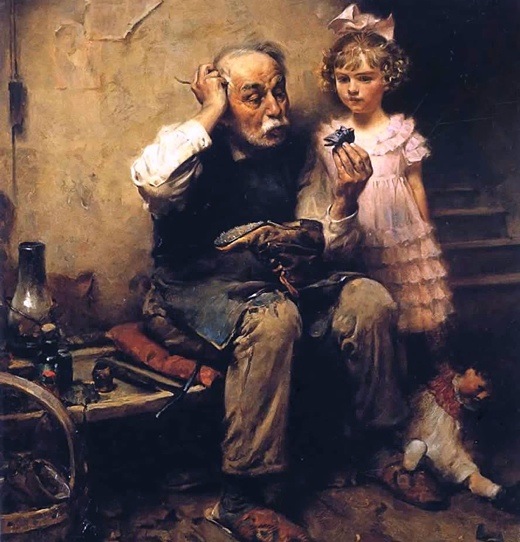
Image above: Detail of painting "Cobbler Studying a Doll's Shoe" by Norman Rockwell, 1921. From (http://ayay.co.uk/background/paintings/norman_rockwell/cobbler-studying-dolls-shoe/).

At Thanksgiving dinner the Anarchist was admiring the black ankle boot moccasins I was wearing with my sarong pants and I announced that I was going to make my own shoes.

"I'd be very interested in how that goes", said the Anarchist who was a self designated non-conformist who had, during a discussion at one of our parties, announced that she was an anarchist. A term that fits well for this story.

Her desire to join me in my shoe odyssey further intrigued me and she told me of her feet woes. How the combination of bunions and toes now curling up over her feet made it increasingly difficult to find footwear to fit. She didn't have good feet to begin with, she explained, but years of forcing them into heels and of being on her feet all day while working at a Hallmark store did them in.

Only then did I realize that she always wore Ugg boots even in summer and now she could only wear the right boot of two pairs of Uggs. I showed her the work of a shoemaker who had blogged about making a pair of shoes for a woman with severely swollen feet.

See (http://simpleshoemaking.wordpress.com/2013/08/26/how-to-make-simple-stitch-down-shoes-for-people-with-swollen-feet/).

This gave us the confidence that we too could solve our shoe problems in the same manner.

I had my own reasons for wanting to make my own shoes. My daily dog walking was wearing out my shoes faster than at any time in my life. The soles of walking shoes did not seem to wear as well as they once did. I was shoe goo-ing them repeatedly (glue used to fix holes in tennis shoes). Then I read an article brought to my attention by a newsfeed I subscribe to called the Village Green Network which usually concerned itself with food and recipes for making something simple like laundry soap.

The article was by a woman who had decided to make her own shoes because most shoes caused her pain on the long hikes she liked to take. She referenced another article that described how shoes compromise the natural gait of the foot. I was shocked and then not at all surprised. So often did a single assumption lead to misinformation never investigated.

Shoes were still built on the same too narrow lasts as they had been for centuries under the belief that feet had to be supported. They were also too heavy, inflexible, reduced surface area of the foot and since they were drawn with a curve rather than on a straight axis forced the foot to an incorrect orientation.

The referenced article (http://www.unshod.org/pfbc/pfrossi2.htm) described how the footbed of shoes have an indentation under the ball of the foot designed into the shoe to make the foot look smaller. Sure enough I checked all my shoes and every one of them had that indentation built into the footbed. This slight dip compromised the natural arch of the foot especially when other areas of the footbed were compressed with wear.

This combination put three important bones out of alignment. The reason arch support was needed turned out to be to raise these bones back into place. The turned up toes of shoes, the lack of flexibility in the sole, the stiffness of the uppers all interfered with the natural ability of the foot to grasp surface area, expand and move the body.

The article also pointed out that you can tell by the wear pattern of your shoes that the natural gait was being compromised. I looked on the bottom of my shoes and sure enough all of them were worn down on the outside edge of the heels and on a spot in the middle of the ball of the foot as described. I thought it was because of my bowed legs causing my shoes not to land properly.

I read the article several times before I could believe that shoes were not helping at all (apart from protecting the foot from pointed rocks) and were more likely reducing the foots flexibility and strength. Feet would be better off in a pair of moccasins the article concluded.

Earlier in the year I had been similarly astounded by an article claiming that the brassiere seriously compromised the ability of the breasts to get rid of toxins and did not in fact keep a woman's breasts from sagging over time, but had compromised the muscle structure of the breasts to take care of this themselves. Given my personal minimalist topography I could happily give up the brassiere, but I could not do without shoes.

Thus I embarked on my shoemaking education and found a book at the library with full color pictures that convinced me of what wonderfully colorful and interesting footwear I could make for myself. This led me to find the author online where I found the aforementioned blog about making shoes for swollen feet. She had also posted an article from the New York Times (http://nymag.com/health/features/46213/) a bit more readable and less technical that said the same thing—shoes were bad for you.

I consulted my chiropractor and he told me about the body's remarkable ability to adapt. How bones that had been badly set would over time correct themselves. So feet would also adapt to shoes. And he himself would not be giving up the support of his hiking boots no matter what the claims of the new minimalist trends in sport shoes.

One could simply train oneself to walk properly he claimed. I in turn told him how I had learned from a masseuse that the Asian squat was not a body position that one could learn in adulthood. That this act of folding the body up and squatting on the heels actually changed the angle of the hip sockets so only those who had practiced this sitting position from childhood could accomplish it so easily in adulthood.

So wouldn't a person who had spent most of their time walking barefoot be similarly suited to unconstructed shoes? He agreed that I had made a convincing hypotheses for my new shoe wearing preferences. And given his theory of adaptation it is likely that others who adopted a barefoot lifestyle could over time strengthen their feet too. My karate class was, after all, filled with newcomers learning to exert their body for peak fighting performance while barefoot.

Shoemaking
I had been a seamstress all my life and I once made jester slippers from wool felting, but I hadn't a clue how to choose leather or what a millimeter in thickness felt like. In order to become acquainted with the medium I ordered a three pound box of leather scraps from e-bay for $30. And what an assortment of cowhide did I receive.

I picked over the fake crocodile in unnatural colors, the fake pink ostrich that came in lime green, red and turquoise, some shiny red metallic gold and copper pieces, floral embossed ones and weird ones that looked like flocked wall paper. I was both repulsed and intrigued and spent an afternoon art date putting together combinations of blue crocodile and lime green ostrich. Most of the scraps came in pieces too small to use so I would have to make a crazy quilt shoe.

I felt more compelled to meet the needs of my Anarchist friend for her need was greater and I still had shoes a plenty. Plus the caveat of making shoes for a "customer" excited me with visions of a new shoe making add-on to my services. Who could resist custom made shoes? Another of my clients also had problems with bunions gradually eliminating all but men's running shoes for her. She said she could have had an operation to correct her feet, but there was no way she would have been able to be off her feet for six weeks.

My Anarchist friend had said the same thing. It occurred to me that the abuse of women's feet in heels and the failure to correct them surgically was probably quite common among women, especially those that took care of others as women so often did.

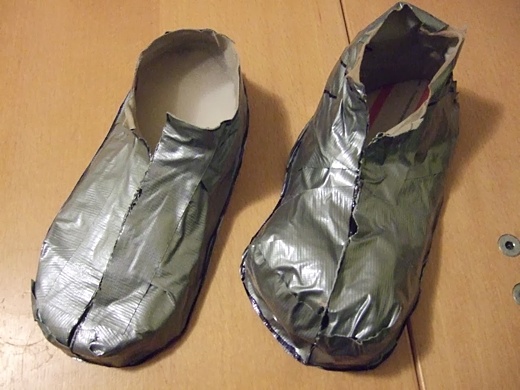
I watched a video on my shoemakers blog on how to make a last upon which to build a shoe and went to visit the Anarchist with duct tape and homemade play dough in hand. The play dough was for filling the spaces over the toes to make a shoe like shape.

I had her slip on a pair of knee high nylons I had brought with me and she stood on the cardboard soles I had made with a little wall of duct tape around the perimeter. I went to town ripping off pieces of duct tape and wrapping them across her feet attaching them to the side wall.


Image above: Two attempts using duct-tape to create shoe shape to derive leather patterns. From original article.

After I was done I carefully cut the duct tape boots off down the top of the foot. The results looked like a pair of boots left behind by the Tin Man after a thorough beating.

Instead of flattening out my duct tape pieces to make patterns for a last as instructed, I decided to skip that step and just drape the leather over the duct tape forms themselves. I cut up an old black t-shirt to make a prototype. The Anarchist loved the pixie shape I had devised to accommodate the unusual shape of her feet.

My challenge was to make the shoe for the more normal foot look the same as this high profile one. It would not be possible to make them identical, but I could mimic the same shape and hold the foot with a hidden piece inside the shoe.

I had brought my bag of leather scraps so she could choose what kind of leather she wanted her shoes made from. She admired how soft and flexible some of the pieces. As they were to be her first pair, were and chose black which would go with most of her outfits and hats for she was a snappy dresser.

She then showed me the pair of shoes she had had custom made by a professional shoemaker. They hurt her feet she said and cost $500. They were so stiff and ugly they made me angry. There was no flex to the sole at all. Whoever constructed these shoes had decided that her feet were too crippled to be of any use and had made what was essentially the foot part of a wooden leg.

I ordered more leather from e-bay—remnants from upholstered leather sofa making. And I made adjustments to my t-shirt mock up until we were satisfied with the fit. Then I took apart my model and used the pieces as a pattern to cut the shoe parts out of the black leather.


Image above: Two attempts using duct-tape to create shoe shape to derive leather patterns. From original article.

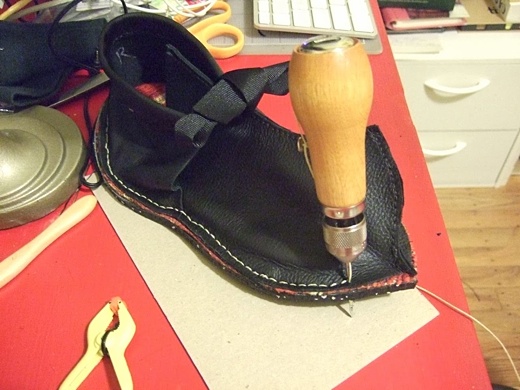
Next I had to learn how to sew leather together with the prescribed synthetic sinew. I bought myself the proper needles, a stitching awl, sinew and some non toxic cement. I could use my sewing machine to make holes in the leather that could then be enlarged by the stitching awl; the hand sewing went much easier once I made the holes large enough.

Hunting down material for the soles would be a challenge since this was a material only available to professional shoe makers in bulk rolls. My shoemaker blogger suggested going to Home Depot to look for rubber floor tiles used in workout rooms and garages; they were made from recycled automobile tires. The pack of 6 tiles I found would be enough for 12 pairs of shoes, but they were the right thickness. I was very pleased that they were a recycled product.

The insoles were also challenging because my customer's feet were of such a shape that no conventional insole from the drug store would work.

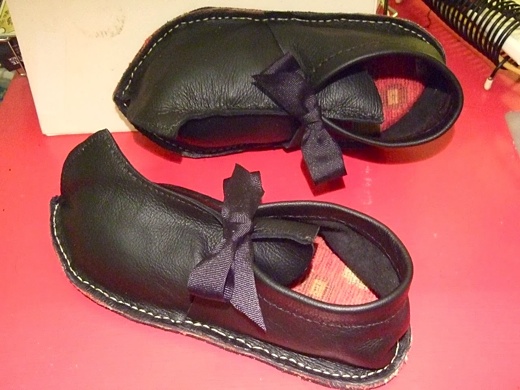
So in the end I used some square sheets of rubber I had on hand that came as knee pads inside gardening pants. I covered these thick pieces with scrap upholstery material I had gotten from FabMo a non profit that collected samples discarded by interior design stores. For shoe laces I decided to use gross grain ribbon from the fabric store was in order. These ribbon ties along with the pointed pixie toes made the shoes look magical.


Image above: Two attempts using duct-tape to create shoe shape to derive leather patterns. From original article.

I had the Anarchist try them on. The problematic right foot was a bit loose in the toe. She got her canes out and took a test drive walking fast into her room and back. The pointed soles on one foot would catch a little as she picked up her feet so I took them home and cut and sewed the toes into a rounded shape.

Now they fit better and were easier to walk in. She also commented that they were very comfortable and the soles offered plenty of arch support. That's funny I thought, I didn't build any arch support into the footbed. But the thickness of the insoles afforded enough cushion to feel like it and protected her protruding bones from the hard floor. She was pleased with the that they looked dressy too.

Stepping off the Grid
Such off the grid journeys, I realized, usually started with a revealing piece of information. Shampoo I found out made your hair grease up which led to hair washing every other day when I really didn't need to wash my hair more than once a week if I used baking soda and an apple cider rinse as was done a century ago. Not to mention that some of the ingredients in shampoo were toxic.

When I started reading up on what caused my blood sugar to spike I learned that our food supply was compromised by the misinformation of the medical institution creating a world wide aversion to saturated fat. The processed food industry then capitalized on cheap ingredients some of which the body was unable to digest. But as long as a package said low-fat or vegetarian any frankenfood would sell as a health food.

My interest in electric cars taught me that automobiles could be built much simpler and lighter if it weren't for the demands of long distance travel and the crash test at freeway speeds. Crash test regulations kept other alternatives off the market even if you never intended to drive on the freeway, but at a much slower speed appropriate to neighborhoods.

Housing was also controlled by regulations not necessarily for safety but to keep keeping them large. Too large to afford. I had believed that these first world regulations created a superior society, but I now see that it is more about upholding a standard of living.

One that would continue to feed the profit margins of industrialized products made with machinery so large it required huge amounts of capital so only mega corporations could compete. Not to mention creating a society where shoes, cars and houses had become status items under designer label brands.

These designs were so conventionally limited that there were only minute differences between brands and models creating a sea of choices that really offered no choice at all. Anyone wanting a different concept altogether was out of luck. Likewise anyone with abnormally wide feet or feet already ruined by fashion trends had no shoes at all.

I too had been taken. Years of reading advertisements specifying the technical improvements of shoes in the sports industry had convinced me that a highly "technical" shoe corrected or at least enhanced the performance of feet.

Now I saw that industrially made shoes were coddling feet with padding while undermining their natural ability to function. (Plus the overseas sweatshops with their underpaid labor and toxic work environments to produce these shoes always irked me.)

Others had also realized how the emperor had no clothes given all of the above revelations being passed around and I was aware that a movement was afoot. More and more people were interested in old ways of doing things—cooking from scratch, finding ways to live in tiny homes, getting kids to school in Dutch cargo bicycles, investigating ayervedic medicine, massage, yoga and other ancient techniques of living healthily.

But despite all this re-skilling as it has come to be known, not too many people had taken up shoemaking. In fact leather work as a hobby seemed to have fallen out of favor along with macrame plant hangers. I had found only the one out of print book in my library system.

Even on the internet very little information was being offered. Those who had had taken up shoemaking were mostly moms and grandmothers looking for healthy shoes for children that would allow the foot to develop naturally. Shoes for adults were likely more subject to fashion demands and fitting into conventional work settings.

It was also a skill that pushed beyond most people's ability requiring sharp tools, a bit of strength to push needles through leather and thick rubber and an imaginative design sense plus an ability to visualize three dimensionally. Just the sort of skill set I had been cultivating since childhood.

And the potential for recycling and making unique fashion items would entertain me for some time. What better way to upset the paradigm than to make one's own shoes? A village cobbler could help turn a community away from exclusive designer brands to unique one-of-kind efforts in a locally made product.

It is the Year of the Horse an kick ass time to manifest new ideas. And the horse is the only animal on the horoscope to wear shoes!

May ye all be well shod.

.

Off-grid handcrafted life

SUBHEAD: Schulz models much of what he builds on the Japanese aesthetic - make everything in life not just functional, but beautiful.

By Kirsteen Dirksen on 25 November 2013 for Fair Companies -
(http://faircompanies.com/videos/view/off-grid-handcrafted-life-on-oregon-farm-workshop/)


Image above: Front entrance of 200sf structure built from local materials. Still from video below.

Brian is an "obsessive craftsman" who believes he can build most anything in his life. On his Oregon farm he has built, or renovated, five tiny structures. After being told by the county that he couldn't erect a yurt, he built a code-approved main house "to give us a place to legally stay".

Once the main house was built, he created several smaller structures (less than 200 square feet) on the property from 90% local materials.

The farm is completely off the grid and Schulz points out that this doesn't mean they rely on propane or lots of photovoltaics. Nearly all their tools for living have been adapted to fit the off-grid lifestyle.
For his prototype solar-powered bathhouse Schulz used recycled solar hot water panels, salvaged hot water tanks (from the dump), a solar thermal window and a recycled soaking tub.

Indoors, Schulz has adapted a chest freezer to create a low-consuming refrigerator (using a tenth of the electricity of a regular fridge) and a 1940s wood-fired cookstove to cook, heat and as a heat-exchanger, harvesting waste heat and thermo-syphoning water to heat up the home's hot water.

They do have a limited number of photovoltaic panels which produce about 1000 watts of electricity when the sun is shining (for the entire farm), as well as a micro hydro generator in the creek and solar thermal panels.


Image above: Hand-crafted kayak frame on rafter ties below ceiling of structure above. Still from video below. 

Schulz models much of what he builds on the Japanese aesthetic and tries to make everything in his life not just functional, but beautiful (e.g. his bathhouse was designed not just as a shower, but as a way to de-stress).

Schulz is an avid kayaker and for his day job, he builds skin-on-frame kayaks (as well as teach others to build their own).


Video above: Tour of off-grid Oregon organic farm, kayak workshop and home. From (http://youtu.be/7DSQ0W2lwtw).

Cape Falcon Kayak: http://capefalconkayak.com/

More info on original story: http://faircompanies.com/videos/view/...


.

Refuge

SUBHEAD: We need to put human fulfillment and some connection to nature back at the center of our work.

By Andy Brewin 23 February 2013 for Dark Mountain -
(http://dark-mountain.net/blog/refuge/)


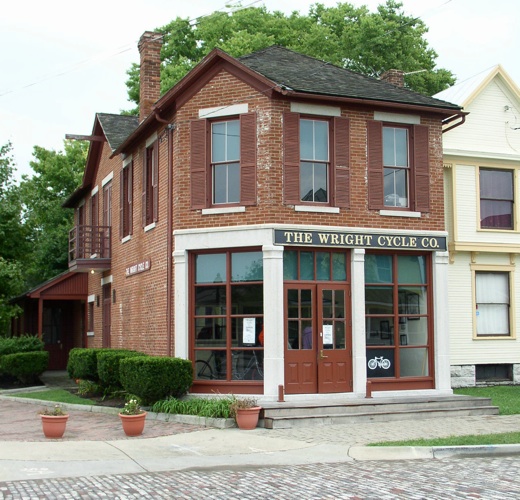
Image above: The Wright brothers' bicycle shop in Dayton Ohio. From (http://www.gyan.com/WrightBrothersShop.html).

If the fossil fuel era has been about anything it has been about acting; doing. Whenever we have a problem, we do something. But when are we ever encouraged to reflect? When do we apply a filter to our thoughts that allows us to sort the good ideas from the bad? Rarely. Instead, we’ve papered over these cracks in our thinking with billions of years of concentrated solar energy. Fossil fuels have allowed us to be lazy, turbo-charging all our activity whether or not it is good or useful. But when activity is the sole measure of success, reflection isn’t valued. In political or activist circles, not ‘doing’ is likely to bring an accusation of failing to deal with a problem.

Yet I’d argue that our societal and environmental predicament is the result of too much doing: of billions of people acting unwisely and far too often. It is this fixation with activity for its own sake which has led to the squandering of our energy reserves and to the wrecking of a good proportion of the planet. Why this fixation with activity? In anticipation of something better, of course. If Western culture stands for anything it is doing to achieve; to get somewhere else; to move forward, to progress.

The cult of progress is, of course, based on an increasingly debatable assumption that the future is going to be ‘better’ than the present, and very much better than the past. The future discounts the present and the past; an idea that lies at the heart of economic theory and accounting practice. It’s as if any present or past good will never be as good as what will follow in an imagined future. In spite of plenty of evidence to the contrary, this is the assumption that our society is expected to place at the heart of its collective life’s work.

Progress thus becomes the clarion call of those who would benefit from our ever-increasing activity and, with it, our ever-increasing dislocation from the rest of nature and the things that actually make us human.

In the unfolding era of scarcity, and with the real prospect of both economic and environmental collapse, I’d suggest that we will need to be much more careful in our thinking, and much less prone to simply acting. We need to be careful about how we respond to the challenges the future throws at us. It’s too simplistic, for example, to believe that a mass movement for this or a mass movement for that will be the catalyst for changes we might wish to see.

Mass movements are simply another form of doing. They utilise the same reductionist thinking that has arguably created many of the problems we have to grapple with today. Mass movements, if they are to last, also require leadership. Call me a cynic, but arguably leadership, at least on this scale, always fails. We need human-scale responses.

In pondering all of this, and what an alternative might look like, I find myself increasingly drawn to the word refuge and the idea it embodies. The concept of the refuge – a place to reflect, collect our own thoughts, sift and hang on to the good whilst shedding the bad – could be a powerful antidote to the increasingly illusory idea of progress. According to the Oxford English Dictionary, the word derives from the Latin word refugium; re meaning ‘back’ and fugere meaning’flee’. In other words: walking away.

That’s walking away rather than giving up. The concept of refuge encourages walking away from a broken system and back to the things we enjoy and feel comfortable with. Things that do us good and things that make us human. Above all, fleeing from the things that make us unhappy and insecure. In a world that dances ever closer to the edge of the abyss, be it through financial meltdown, climate catastrophe or the implications of increasing resource scarcity, refuge potentially provides us with a unifying idea with which to abandon this thoughtless engagement in mindless activity, in the pursuit of limitless growth, dressed up as human progress.

Living without reflecting is like driving without looking. Refuge, on the other hand, encourages a collective dropping of the shoulders; breathing more slowly, counting our blessings, sifting carefully the good from the bad, doing things more thoughtfully, waking up and smelling the roses, or the coffee, depending on your preference.

In musing upon the word refuge, and thinking about how, practically speaking, such a concept might manifest itself in reality, I’m reminded of the role of monasteries in the ‘Dark Ages’ that followed the disintegration of the Roman Empire in Europe. After centuries of war, the increasing cost of maintaining the empire, infighting and civil unrest, as well as increasing corruption at the top of society, the Roman Empire slipped away into history. This is a history that resonates loudly with what we are increasingly experiencing today. Ask any Greek, ask any Spaniard, ask the countless hundreds of thousands of Americans living in trailers. Ask anyone in a queue at a food bank.

Barbarian armies swept in to territories previously held by the Romans, razing cities to the ground and squabbling over land and resources. Whilst cities lay in ruins, monasteries, often because they were remote, developed. Monks relentlessly copied Greek and Roman manuscripts, as well as holy books, thus keeping the nucleus of a future civilisation alive; sifting the good from the wreckage.

When a monastery was founded, many people gravitated towards it to enjoy both its spiritual and material benefits. In many cases the monasteries created the nucleus of new towns and cities. Monasteries became stopping-off points for travellers, fortresses during conflict, centres for distributing food in times of famine, hospitals during epidemics and neutral grounds for opposing parties to discuss grievances and make agreements. All of this was in addition to their primary role as bastions of knowledge and skills, and custodians of faith.

As well as preserving knowledge, the monasteries also became the catalysts for new ways of living. They were the inventors of rudimentary machinery, they developed alcoholic drinks and a wonderful diversity of cuisines, they researched basic science, they encouraged new patterns and methods of agriculture and land development, and they established networks of connections with one another. All of this laid the groundwork for a new European culture which emerged from the rubble of the collapse of Rome.

Today, the idea of the refuge encourages us to look back before we look forward. We have countless centuries of collected knowledge. It’s a library. It’s worthy of investigation. It has value. Like the monks that pored over manuscripts for days, weeks and years on end, the time we put into (re) learning from the past will sow the seeds of how we might live in the future. We need to be creating communities that look to the past and then to themselves for solutions.

The whole point of beginning to develop human-scale ideas is that no one person has all the answers. I certainly don’t. All I have is a belief that if we turn away and turn inwards we’ll start to address what we actually need. Of course I have some views about what might constitute ‘refuge’. Some are ideas already in use to some extent.

Allotments, community-supported agriculture, urban agriculture, small local breweries, artisan bakers, farmhouse cheese making, artisan butchers, small scale bicycle makers, localised energy production, craft woodworkers, cob builders, timber framed house builders, small scale clothing makers, local currencies, and very many more. Each one addressing real human needs.

Each one a result of reflecting upon the weaknesses of the prevailing system, the strength of more traditional methods and the necessity to put human fulfillment and, in many cases, some connection to nature back at the center of how we spend our time living and working.

It would be easy to dismiss, for example, the growth in interest in allotment gardening here in Britain, or the re-igniting of interest in craft manufactured bicycles, as quaint anomalies. They aren’t. They point to a growing disquiet with what industrial society has endowed us with. The idea of working in, or on, such a refuge gives us the opportunity to develop a unifying narrative in response to this growing disquiet.

So where might we start? If you like, we start with our own personal monastery; the ‘space’ to reflect upon what we actually think refuge might look like. It could be a metaphorical space. It could be a physical space.

We might pose questions such as: What do we actually need? What fulfils us? What skills do we have to offer? What do we think is worthy of investigation? How do we go about reimagining some aspect of the best of the past? Do we do it on our own or with others?

We need to be honest with ourselves; this is partly about seeking out truths and dispelling the fictions we have had sold to us. We, all of us, have an inkling of what is wrong. We need to go about this with confidence. Arguably no one else is going to do it for us; no political leader, no mass movement.

Before you ask, I do have my own ‘refuge’. I’m using my near decade and a half of environmental doom-gathering to formulate an idea. I’m spending a lot of time reflecting on the writing of thinkers like John Ruskin. I’m pondering what human fulfilment actually means. I’m wondering if our environmental predicament isn’t simply a result of a bigger human predicament. I find myself asking what place there is for truth or even beauty in what we do today? I’m trying to connect this idea of refuge to the way I spend most of my time.

My work life is spent with bicycles. I’m grateful to be able to work with something that generally brings pleasure and is a blessing rather than a curse when we consider the many other ways in which we transport ourselves. I’m not blind to the shortcomings and impacts of an industry which is in general large and globalised.

But I carry with me handed-down stories of the way in which my trade operated in the past and what place the bicycle occupied in society. There’s a historical perspective which is worthy of investigation. I’m reflecting upon what role the bicycle might actually play in our unfolding future.

It’s currently a work in progress, but the idea of refuge – of walking away to some extent – encourages a very different approach to how we go about interpreting the future.

.

Salvaging Quality

SUBHEAD: A handsaw manufactured two generations ago has better steel than the one in Home Depot today.

 By John Michael Greer on 13 July 2011 for ArchDruid Report - (http://thearchdruidreport.blogspot.com/2011/07/salvaging-quality.html)

 
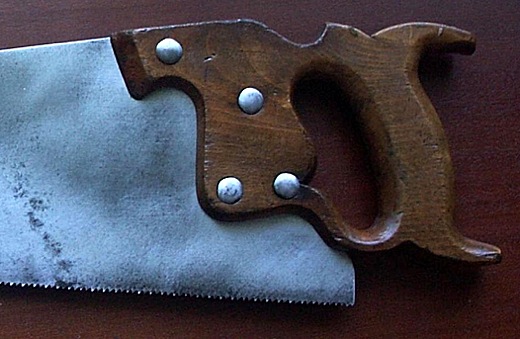
Image above: An old handsaw kept in good shape. From (http://www.woodworkforums.com/f152/identify-old-hand-saw-117740/).

It’s been a busy week for those of us who keep watch over the industrial world’s deepening tailspin, as politicians in the United States and Europe play a game of chicken using sovereign debt in the role traditionally filled by fast cars.

The issue in the United States is simple enough: the most that either side is able to offer, given its political commitments, is less than the least either side can afford to accept, and the occasional turns toward demagoguery on both sides haven’t exactly helped. It’s still possible that some last minute compromise may be hammered out, but the odds against that are starting to lengthen, and if that doesn’t happen, the financial end of the federal government will start seizing up in about three weeks.

It should be an interesting spectacle. Europe is a more complex situation. Greece, the current poster child for sovereign debt dysfunction, did what poor countries so often do, borrowed in foreign markets far beyond its ability to repay, and now can’t meet its bills. Unfortunately the normal way to resolve such problems – defaulting on the debt – would bankrupt quite a few large banks in other EU nations, and these latter have put pressure on their national governments to stave off a Greek default.

The problem here is that Greece is going to have to default sooner or later; the question is purely a matter of when The Greek government is in hock far beyond its ability to repay, and the austerity measures pushed on it by the cluelessly doctrinaire economists at the IMF have worsened the matter considerably by putting the Greek economy into a tailspin.

So it’s simply a matter of waiting for the inevitable to happen, and the credit markets to go into spasm accordingly. Mind you, the horrified utterances currently being splashed around the global media, claiming that default is unthinkable and unprecedented, are nonsense of the most blatant sort. Nations default on their debts all the time.

Russia did it in 1998, Argentina did it in 2002, and both nations survived; most European nations, for that matter, have defaulted on their debts more than once over the course of their history, and bankrupted plenty of banks in the process – that’s where we get the word bankrupt, you know. Defaults have always been one of the inescapable risks of lending to governments. EU governments could get realistic about this, let Greece do what countries with too much debt normally do, and spend their time more usefully writing letters of condolence to the bank executives who will be out of a job shortly thereafter.

 Come to think of it, it’s just possible that this is what EU governments are actually doing. The current flurry of handwaving and emergency meetings may be no more than a source of plausible deniability – we’re sorry, we did all we could, it was the fault of (fill in the blank to conform to local prejudices) that Greece crashed and took half Europe’s banks with it, blah blah blah.

For that matter, it’s not completely beyond the bounds of possibility that politicians on this side of the Atlantic are playing a similar game. The US is up to its eyeballs in unpayable debts, loaded down with entitlements and international commitments that it can’t afford but that no elected official dares to touch, and lurching toward a default as inevitable as Greece’s but on an almost unimaginably vaster scale. Nearly the only way to get out of the resulting trap with some chance of national survival would be to trigger a run on Treasury bills, now, that will force a default on the national debt in the near future, when both sides can conveniently blame it on the intransigence of the other party and the perfidiousness of foreign lenders.

It does seem unlikely that this level of public-spiritedness is at work in Congress and the White House, but I’d like to believe that it’s possible. These latest consternations, in turn, provide all the more relevance to the theme I’ve been discussing in the last couple of posts here, the possibility of shifting over here and now to the salvage economy that’s already beginning to emerge outside the narrowing circle of scarcity industrialism. This week I’d like to bring up another dimension of that shift, and talk about one of the unspoken and unspeakable realities of life in a declining industrial society: the pervasive phenomenon of stealth inflation.

By this I don’t mean inflation in the sense in which economists use the word, the decrease in the value of money driven by the expansion of the money supply relative to the supply of goods and services. That kind of inflation deserves much better press than it gets; though it’s denounced by all right-thinking people these days, it’s one of the safety valves by which a capitalist economy’s tendency to produce excess paper wealth gets brought back into step with the actual wealth in circulation, the nonfiscal goods and nonfinancial services that meet actual human needs. It thus serves exactly the same role, in a much more subtle and flexible way, as the negative-interest currencies being proposed by would-be financial reformers these days.

Stealth inflation is a good deal less laudable. It’s the process by which the price of goods and services remains the same, while the value of what’s provided for that price diminishes.

It’s sometimes done by decreasing quantities – most Americans over forty, for example, will remember the days when cans of soup and candy bars were a good deal larger than they are now – but far more often done by cutting quality. Sometimes this is a minor, even a subtle, factor; in other cases, it’s neither, and can quite easily become lethal in its effects. A good example of the first kind came my way a while back when a friend, knowing I like to cook with cast iron pans, found an elderly example in a secondhand store for some absurdly small price and gave it to me.

Because my wife has celiac disease – a severe enough case that relatively small traces of gluten can have unwelcome effects – I had to strip off the natural coating that cast iron cookwear gets when it’s well treated, and reseason the pan again, just as though it had been bought new. Even with this rough treatment, though, the old pan proved to be a much better piece of cookwear than any of the more recently manufactured cast iron pans I’d been using for a decade or so previously. Its inner surface has a much smoother finish, its metal conducts heat more evenly; this evening’s fried zucchini (fresh from the garden) was cooked in it, because no other pan I have does as good a job.

 This isn’t simply a matter of chance or a personal quirk. Ask any cast iron aficionado and dollars will get you doughnuts – perhaps these days I should say “credit swaps will get you crullers” or something like that – you’ll hear a similar story; the cast iron cookware you can buy in your local hardware store simply isn’t as good as the same products made a quarter century ago, and the difference is no small thing. I’ve heard the same thing in the very different context of craftspeople who work with old tools; the quality of the metal, they say, as well as the workmanship tends to be dramatically better in tools that are at least a quarter century old. In some cases the differences are enough to kill.

One of the nasty little secrets behind the rising toll from food poisoning in the United States and elsewhere is that a great deal of it could easily have been prevented by common sense sanitary procedures that used to be standard, but have been cut for the sake of lower per unit costs and higher quarterly profits. What makes this all the more embarrassing is that this is America’s second encounter with what happens to the safety and quality of processed food in a capitalist system under economic stress; Upton Sinclair’s The Jungle probably ought to be required reading for the pundits, and there are many of them just now, who fatuously insist that government regulation is always and everywhere a bad idea.

 The same purblind mania for gutting sensible regulation that freed the banking industry from the Glass-Steagall Act and its equivalents in other industrial nations, and at a stroke brought back the devastating bubble-and-bust economics that dominated the industrial world before the Glass-Steagall Act was originally passed, has had equivalent effects in many other sectors of economic life.

An acceleration in stealth inflation through declining quality is among the results. Still, there’s a deeper force pressing in the same direction, and it comes from the relentless mathematics of fossil fuel depletion and its impact on an economy founded on the expectation of constant growth. There has been a great deal of talk recently on the leftward side of the economic spectrum about the need to “decouple” economic growth from increases in the supply of energy. Still, as Zen masters are wont to say, talk does not cook the rice; insisting that economic growth can continue while energy supplies are stuck in a bumpy plateau does not make it so.

 The production of real, nonfiscal goods and services requires inputs of energy, as well as raw materials (which must be extracted by using energy) and labor (which in America, at least, usually uses a fair amount of energy, too). The only goods and services that can grow unchecked as energy supplies flatline are financial goods and services – that is, “goods” that consist of the essentially arbitrary tokens our society uses to allocate real wealth, on the one hand, and “services” that consist of shuffling and exchanging these tokens in more or less intricate ways, on the other.

As the cheap abundant energy that provided the basis for three centuries of industrial civilization stops being cheap and abundant, then, one of the consequences is a widening disconnection between the production of nonfiscal goods and services and the production of money in all its various forms.

Left to itself, the natural result would be a rising spiral of inflation in which the value of money declined steadily, to stay more or less in step with the amount of real goods and services available to buy. This natural result, though, is utterly unacceptable to the political classes – the people who take an active role in the political process – anywhere in the industrial world.

This has imposed any number of distortions on the global economy, but one of them is a constant push to keep the nominal rate of inflation as low as possible, thus sparing politicians the hard task of explaining to their constituents a reality that neither the politicians nor the constituents have yet begun to understand.

That push drives the widespread juggling of economic statistics across the industrial world, but I’ve come to believe that it also provides an important motive force behind stealth inflation. Large corporations have plenty of interfaces with governments, and governments have plenty of levers by which to influence corporate behavior for political ends; if the politicians in Washington DC, let’s say, decided that it would be really helpful if businesses increased their profit margins relative to their costs by some means other than raising prices, it doesn’t seem at all unlikely that this preference would be heard in corporate boardrooms, and play at least some role in shaping their decisions.

What this means for the individual green wizard, in turn, is that there’s every reason to think that a good many of the goods and services sold to consumers are going to continue to decrease in quality in the years ahead. That in turn implies at least two things. The first is that the strategy of salvaging energy discussed in last week’s post has an additional advantage, because what’s being salvaged in a good many cases is not simply an equivalent of what’s on the market today, but a better product, one that tolerably often will work better and last longer than a new product of the same type.

As we approach an age in which many goods may stop being available at all for extended periods, this is not an opportunity to ignore. The second implication is that those who learn the skills needed to take older products that are no longer working, or no longer working well, and recondition them so that they can return to usefulness, may find themselves with a job skill of no small importance in the emerging salvage economy. It’s not too hard, for example, to find old handsaws for sale very cheaply at flea markets and estate sales. Fairly often, after being handed down through a couple of generations, these have rusted blades, teeth that are dull and bent out of their proper set, cracked and damaged handles, and the like.

The steel of the blade, however, is very often of much higher quality than the equivalent new product in a hardware store today, and it doesn’t actually take that much in the way of skills and tools to remove the rust, polish the blade, reset and file the teeth, make a new handle out of hardwood and attach it to the old blade, and so on. The result is a saw that can be handed down for several more generations, and do a great deal of useful work in the meantime; it’s also a product that can be sold or bartered to craftspeople at a premium price. In at least a few cases, it’s also possible to go one step further and figure out how to manufacture products on a small scale to old specifications.

 I don’t have anything like the metallurgical knowledge to figure our what makes the difference between my old cast iron pan and my newer pans, but the information’s surely out there, and could be tracked down by someone with the necessary background. Whether or not there would be enough of a market to make this a paying proposition anytime soon is another matter; there are odd little niche markets that might at least pay the bills.

Myself, having more facility with words than with metals, I’m contemplating tracking down a basic letterpress and exploring the honorable profession of Benjamin Franklin. The printing press with movable type was invented in the Middle Ages, after all, and very likely can remain a viable technology no matter how far down the slope of decline we end up sliding. Under current conditions, it can help pay its own bills via handprinted wedding invitations and the like; as conditions change and the complex supply chains that keep computer printers and copiers functioning become more problematic, a printing press powered by human muscle and capable of running on supplies no more complex than paper and homebrewed ink may turn into a serious asset.

 Your mileage will unquestionably vary, and a second income refurbishing old items or using some outdated but sustainable technology will be the right choice for some people and the wrong choice for others.

I mention it here partly because a good many readers of these posts have asked about potential businesses and income sources in a deindustrializing world, and partly because a fair number of people out there in the peak oil blogosphere don’t yet seem to have thought through the fact that they’ll need to earn a living in one way or another during the long slow unraveling of the industrial economy.

That unraveling may have its sudden jolts, to be sure. If the politicians in Washington DC and an assortment of European capitals fumble the current situation spectacularly enough, this autumn could see an economic crisis on the grand scale, with markets seizing up, banks shutting down, and governments facing abrupt replacement by legal means or otherwise.

 Still, we’ll come out the other side of it, no doubt poorer but still faced with the ordinary challenges of the human condition; if learning how to recondition old tools allows someone to barter for necessities during the years ahead, that’s a positive step, and such positive steps on the individual scale are the raw materials from which the deindustrial future will gradually emerge.

See also:
Ea O Ka Aina: Salvaging Energy 7/6/11
Island Breath: Salvage Societies 10/28/07 .