Showing posts with label Britain. Show all posts

Energy collapse is upon us

SUBHEAD: This is your chance to engage with and become an agent of a new paradigm for humanity.

By Nafeez Ahmed on 28 December 2018 for Medium
(https://medium.com/insurge-intelligence/brexit-stage-one-in-europes-slow-burn-energy-collapse-1f520d7e2d89)


Image above: Van on fire in Paris after violent Yellow Vest protests. From original article.

Everyone’s talking about Brexit. Some about the French riots. But no one’s talking about why they are happening, and what they really mean. They might think they are, but they are usually missing the point.

On 6th May 2010, the Conservative Party took the reins of power for the first time since 1992, propped up with some help from the Liberal Democrats.

Hours before the election result, I warned in a blog post that whichever government was elected, it would be the first step in a dramatic shift toward the far-right that would likely sweep across the Western world within 10 years.

I wrote, describing the failure of all three political parties to understand why the heyday of economic growth was unlikely to return.
“The new government, beholden to conventional wisdom, will be unable or unwilling to get to grips with the root structural causes of the current convergence of crises facing this country, and the world...” 
“This suggests that in 5–10 years, the entire mainstream party-political system in this country, and many Western countries, will be completely discredited as crises continue to escalate while mainstream policy solutions serve largely to contribute to them, not ameliorate them.  
The collapse of the mainstream party-political system across the liberal democratic heartlands could pave the way for the increasing legitimization of far-right politics by the end of this decade…”
My prediction was astonishingly prescient. The global shift to the far-right began within exactly five years of my forecast, and has continued to accelerate before the decade is even out.

In 2014, far-right parties won 172 seats in the European Union elections — just under a quarter of all seats in the European Parliament.

In 2015, David Cameron was re-elected as Prime Minister with a parliamentary majority, a victory attributed in part to his promise to hold a referendum on Britain’s membership of the European Union.

Unbeknownst to many, the Tories had quietly established wide-ranging links with many of the same far-right parties that were now capturing seats in the EU.

The following year in June, the ‘Brexit’ referendum shocked the world with its result: a majority vote to leave the EU.

Six months later, billionaire real estate guru Donald Trump shocked the world again when he became president of the world’s most powerful country. Like the Conservatives in the UK, the Republicans too had forged trans-Atlantic connections with European parties and movements of the extreme-right.

Since then, far-right parties have made continued electoral gains across Europe in Italy, Sweden, Germany, France, Poland and Hungary.

We are on the cusp of a tidal wave, that looks poised to accelerate into a tsunami. Exactly as I had anticipated, far-right politics is no longer the province of the fringe, but is becoming increasingly normalised.

This not an accident. It is the result of a system that is failing — and the efforts of a network of far-right groups to exploit the fractures emerging from this system-failure to tear everything down, and erect a new order of their own fashioning.

My prediction of the resurgence of the far-right was based on analysing the probable consequences of a long-term ‘system-failure’ in which we are unable to return to the levels of economic growth we had become accustomed to in the heyday of the 1980s and 90s.

That system-failure, I explained, is rooted in the economics of the energy production that enables economic growth:
“…. a full and lasting recovery… is likely to be impossible in the constraints of the current system, because we’re running short on the physical basis of the last few decades of exponential (and fluctuating) ‘growth’ — and that is cheap, easily available hydrocarbon energies, primarily oil, gas and coal.

The turning point has arrived, and without that global cheap energy source in abundant supply, we cannot continue growing, no matter what we do. Something has to give. Our economies need to be fundamentally, structurally, transformed. 


We need to transition to a new, clean, renewable energy system on which to base our economies. 

We need to transform the way money is created, so that it’s not linked to the systematic generation of debt. We need to transform our banking system on the same grounds. 

Whitehall, and the three political parties, recognize only facets of the picture, but they don’t see it as a whole.”

Turning Point

The energy turning point is unequivocal. In the years preceding the historic Brexit referendum, and the marked resurgence of nationalist, populist and far-right movements across Europe, the entire continent has faced a quietly brewing energy crisis.

Europe is now a ‘post-peak oil’ continent. Currently, every single major oil producer in Western Europe is in decline. According to data from BP’s 2018 Statistical Review of Energy, Western European oil production peaked between 1996 and 2002. Since then, production had declined while net imports have gradually increased.

In a two-part study published in 2016 and 2017 in the Springer journal, BioPhysical Economics and Resource Quality, Michael Dittmar, Senior Scientist at the ETH Zurich Institute for Particle Physics and CERN, developed a new empirical model of oil production and consumption.

The study provides perhaps one of the most empirically-robust models of oil production and consumption to date, but its forecast was sobering.

Noting that oil exports from Russia and former Soviet Union countries are set to decline, Dittmar found that Western Europe will find it difficult to replace these lost exports. As a result,
“total consumption in Western Europe is predicted to be about 20 percent lower in 2020 than it was in 2015.”
The only region of the world where production will be stable for the next 15 to 20 years is the OPEC Middle East.

Everywhere else, concludes Dittmar, production will decline by around 3 to 5 percent a year after 2020. And in some regions, this decline has already started.

Not everyone agrees that a steep decline in Russia’s oil production is imminent. Last year, the Oxford Institute for Energy Studies argued that Russian production could probably continue to grow out to at least 2020. How long it would last thereafter was unclear.

On the other hand, the Russian government’s own energy experts are worried. In September 2018, Russia’s energy minister Alexander Novak warned that Russia’s oil production might peak within three years due to mounting production costs and taxes.

In the ensuing two decades, Russia could lose almost half its current capacity. This sobering assessment is still broadly consistent with the Oxford study.

The following month, Dr Kent Moor of the Energy Capital Research Group, who has advised 27 governments around the world including the US and Russia, argued that Russia is scraping the bottom of the barrel in its prize Western Siberia basin.

Moor cited internal Russian Ministry of Energy reports from 2016 warning of a “Western Siberia rapid decline curve amounting to a loss of some 8.5 percent in volume by 2022. Some of this is already underway.”

Although Russia is actively pursuing alternative strategies, wrote Moor, these are all “inordinately expensive”, and might produce only temporary results.

It’s not that the oil is running out. The oil is there in abundance — more than enough to fry the planet several times over.

The challenge is that we are relying less on cheap crude oil and more on expensive, dirtier and unconventional fossil fuels. Energetically, this stuff is more challenging to get out and less potent after extraction than crude.

The bottom line is that as Europe’s domestic oil supplies slowly dwindle, there is no meaningful strategy to wean ourselves off abject dependence on Russia; the post-carbon transition is consistently too little, too late; and the impact on Europe’s economies — if business-as-usual continues — will continue to unravel the politics of the union.

While very few are talking about Europe’s slow-burn energy crisis, the reality is that as Europe’s own fossil fuel resources are inexorably declining, and as producers continue to face oil price volatility amidst persistently higher costs of production, Europe’s economy will suffer.

In September, I reported exclusively on the findings of an expert report commissioned by the scientific group working on the forthcoming UN’s Sustainability Report.

The report underscored that cheap energy flows are the lifeblood of economic growth: and that as we shift into an era of declining resource quality, we are likely to continue seeing slow, weak if not declining economic growth.

This is happening at a global scale. EROI is already beginning to approach levels seen in the nineteenth century — demonstrating how constrained global economic growth might be due to declining net energy returns to society.

End of energy growth

Britain, which is due to leave the European Union on 29th March 2019, is a poster boy for this brewing energy-economic crisis.

In January 2017, the Centre for Climate Change Economics and Policy run by the University of Leeds and London School of Economics, produced a startling analysis of Britain’s declining net energy problem.

The study attempted to develop a methodology to examine national-level figures for Energy Return on Investment (EROI) — the amount of energy one uses to extract a particular quantity of energy.

The goal of the study was to pinpoint the EROI value as much as possible using Britain as a prime case-study. The concept of EROI fleshes out the recognition that a significant surplus of energy is required to fuel economic activity, separate to energy that is consumed precisely to extract energy in the first place.

The less energy we use to get new energy out, the more energy we have left to invest in the wider goods and services of economic activity. But if we keep using more energy just to get energy out, the amount of net energy we have left to fuel our economies decreases.

According to the study authors, Lina Brand-Correa, Paul Brockway, Claire Carter, Tim Foxon, Anne Owen and Peter Taylor:
“The higher the EROI of an energy supply technology, the more ‘valuable’ it is in terms of producing (economically) useful energy output. In other words, a higher EROI allows for more net energy to be available to the economy, which is valuable in the sense that all economic activity relies on energy use to a greater or lesser extent.”
The verdict on the UK predicament is stark. They find that “the UK as a whole has had a declining EROI in the first decade of the 21st century, going from 9.6 in 2000 to 6.2 in 2012.

These initial results show that more and more energy is having to be used in the extraction of energy itself rather than by the UK’s economy or society.”

Citing the work of French economists Florian Fizaine and Vincent Court, which estimates a minimal societal EROI of 11 for continuous economic growth, the paper concludes:
“… the UK is below that benchmark.”

In other words, early last year, a major scientific study found that for the last two decades and beyond, Britain’s economic growth is fundamentally constrained by domestic net energy decline. But this groundbreaking news did not make the ‘news’.

Break-up

At the close of 2010, in my book A User’s Guide to the Crisis of Civilization, I predicted that large trans-national state structures like the European Union are likely to face challenges to their territorial integrity as a side-effect of these processes.

The failure to address the systemic causes behind the 2008 financial crash, the incapacity to recognise it as a symptom of a system in decline, would lead to an increasingly authoritarian politics.

The integrity of large trans-national structures depends on the abundance of cheap energy flows to sustain them. If those flows come at greater cost and lower quality, then those structures will become increasingly strained and potentially even begin to break down.

Costs to keep the system going increase while returns are squeezed, meaning that the surplus to invest in core social goods to maintain such structures declines.

That is why despite the so-called ‘recovery’ — tepid as it is and based on accelerating debt levels (in biophysical terms borrowing from the Earth today with promise of paying it back tomorrow with what has already been over consumed today) — in real terms, peoples’ purchasing power continues to decline.

The failure to understand and engage with the root, systemic causes of the crisis also means that policymakers put themselves in a position where they can only address surface-symptoms.

All too often, that means short-term, reactionary responses.

And so in France, instead of addressing the question of how to galvanise a third industrial revolution to speed a post-carbon transition and infrastructure revival, Macron’s response to the climate crisis was to protect fossil fuel and nuclear producers while hiking up fuel taxes.

He didn’t want to tackle the horrendous supply chains of big French corporations. He didn’t want to penalise the powerful oil, gas and nuclear lobbies that he hopes might help him get re-elected, and did next to nothing to speed a viable post-carbon transition that might transform economic prosperity on more sustainable foundations.

And so by placing the burden almost exclusively on French workers and consumers, Macron triggered the spiral of rage and riots.

Protestors have set fire to banks, smashed and looted shops, and even targeted the Arc de Triomphe. They demand an end to corporate freeloading, along with nationalist demands such as ‘Frexit’ - France’s departure from the EU, and preventing migration.

It is telling that while some demands are compelling, there is no semblance of understanding the real planetary crisis beyond banal tropes about Big Banks. The French state has responded with its own violence, firing water cannons and tear gas on protestors, arresting over a thousand people, and threatening to bring in the French Army.

This is a microcosm of what can happen when states and peoples both fail to understand the deeper dynamics of a failing system: everyone responds to what is in front of them. Protestors blame Macron. The French state cracks down on violence. Politics becomes militarised, while scepticism of the liberal incumbency across the political spectrum finds vindication.

France’s riots therefore did not come out of the blue. They are part and parcel of a wider process of slow-burn EROI decline in which the returns to society from economic activity are being increasingly constrained by the higher energetic costs of that activity and productivity declines of the ageing centralised industrial-era infrastructure and technology.

It was only a matter of time before the average person began to feel the impact of that squeeze in their day to day lives. Macron’s tax hikes were not the cause, but the trigger. They lit the match, but the tinder box was already fuming.

Brexit

But we’ve been here before, in Syria and beyond.

Brexit was triggered in the context of global system dynamics which remain poorly understood. Over the decade preceding the 2008 financial crisis, Britain’s economic growth was being undermined not merely by a debt-bubble in the housing markets, but by an ailing fossil fuel dependent energy system.

That ailing system was indelibly linked to the European migrant crisis, which saw over a million refugees from the Middle East and North Africa seeking sanctuary across Europe, including the UK and France, that fuelled the surge in nationalist populism sweeping across the continent.

The migrant crisis, too, did not come out of the blue, but followed hot on the heels of the turbulence of the Arab Spring. The destabilisation of Syria, Egypt, Yemen and beyond was a long time coming — but it was triggered by a perfect storm of crises.

Domestic oil production declines which pulled the rug out from beneath oil-export dependent state revenues conspired with global oil price spikes thanks to the plateauing in world production of cheap conventional oil. A string of climate crises across the world’s major food basket regions led to crop failures and droughts which boosted food price spikes.

Global systemic crisis interacted with the breakdown in local national systems. As I’d reported in 2013, a natural drought cycle in Syria was massively worsened due to climate change, devastating agriculture and driving hundreds of thousands of Sunni farmers into Alawite-dominated coastal cities.

As Syrian oil revenues plummeted, its domestic conventional oil production having peaked in the mid-1990s, the government’s slashing of critical fuel and food subsidies just as prices were spiking globally was the last straw. People could not even afford bread, so they hit the streets.

Bashar al-Assad responded with escalating brutality, including shooting civilians in the streets. When protestors picked up arms in response, the cycle of violence kicked in.

Outside powers intervened to coopt their favoured sides, Russia and Iran backing Assad, the West backing various rebel groups — neither particularly interested in supporting Syrian civil society. The conflict escalated, devastating the country, and fuelling an unprecedented refugee crisis.

When NATO intervened in Libya, when the US and UK backed Saudi Arabia’s indiscriminate aerial bombardment of Yemen, it only destabilised the region further. The arc of collapse across the Middle East and North Africa resulted from a fatal combination: an earth system crisis, compounded by short-sighted and self-serving responses from human systems.

When families and children began turning up in their droves on European shores, the earth system crisis ‘out there’ came home.

The West could not shield itself from the long-range consequences of the unsustainability of the very postwar system it had nurtured since the Second World War: structural dependence on fossil fuels, a patchwork of alliances with regional despotic regimes, laying the groundwork for converging climate change, crude oil depletion and the resulting domino effect of food and economic crises.

The earth system crisis that erupted in Syria triggered a wave of human system destabilisation of which Brexit was merely the first eruption.

And so the Syria crisis is indeed a taste of things to come. Europe is already a post-peak oil continent, whose domestic fossil resources are in decline.

Most credible studies of Europe’s shale gas potential show that it is extremely weak and not similar to the American situation. If we are hell-bent on maintaining dependence on fossil fuels, we will be forced to import.

But as I showed in my scientific monograph for Springer Energy Briefs, Failing States, Collapsing Systems: BioPhysical Triggers of Political Violence (2017), if demand growth increases at current rates, it is unlikely that Central Asian and Russian suppliers will be capable of meeting that demand at costs we can cope with in coming decades.

Meanwhile, certain climate impacts are already locked in. Between 2030 and 2045, large parts of the Middle East and North Africa (MENA) are likely to become increasingly uninhabitable due to climate change. This is the same period in which oil production across the MENA region has been forecast to begin plateauing and declining.

As the energy costs of fossil fuel production and imports increases, and as the EU is likely hit again by the challenge of large-scale migration from the Middle East due to climate devastation, the challenges to the EU’s territorial integrity will not go away.

Brexit is merely a ripple on the surface of deeper currents. It is a symptom of the great civilisational phase-shift to life after fossil fuels.

In this sense, the Brexit fiasco is an example of how distant we are as a species from the conversations we need to be having.

Talking about being in or out of Europe and in what way is not unimportant, but it’s also a massive distraction from the deeper systemic crisis that is unfolding beneath the very issues driving our immediate concerns about Brexit.

Earth system disruption does not inevitably result in destabilisation of human systems. But if human systems refuse to engage and adapt to those disruptions, then they will be destabilised.

As long as Britain, Europe and their citizens continue to obsess myopically on the symptoms rather than the causes, we will be incapable of responding meaningfully to those causes.

Instead, we will fight with each other manically about the symptoms, while the ground beneath our feet continues to unravel.

The crisis of Brexit and the eruption of the riots in France are symptoms of a great unfolding civilizational transition, in which an old reductionist paradigm of materialist self-maximation is dying.

Citizens and policymakers, activists and business leaders, need to wake up to what is actually happening to have the conversations that can kick-start meaningful approaches to systemic transformation.

This is not a far-flung crisis that is going to happen years in the future. This is now. This is happening and it is affecting you, your children, and those you love the most. And it will affect their children, and their children.

This is your legacy. This is your choice. This is your chance to engage with and become an agent of a new paradigm, one that speaks for all humans, all species, and the Earth itself.

Maybe we don’t know exactly what the emerging paradigms will look like. But we know that it’s time to ask ourselves:Where do we stand? With the old, or with the new?

.
Uncomfortable Truth about Hawaii

SUBHEAD: The illegal takeover of the Hawaii was an act of war and never resolved with peace.

By Keanu Sai on 16 August 2018 for University of Hawaii -
(https://islandbreath.blogspot.com/2018/10/uncomfortable-truth-about-hawaii.html)


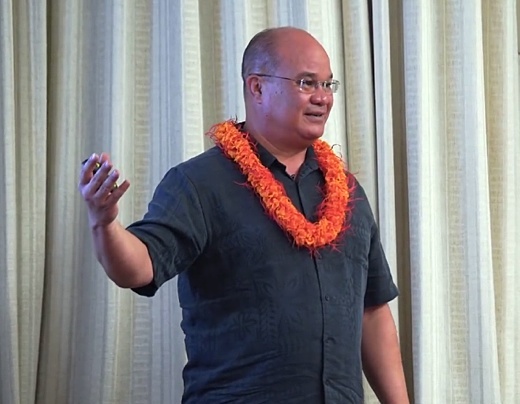
Image above: Still frame from video of  Na Moolelo Lecture Series lecture at University of Hawaii-Windward Community College. See below.

[IB Publisher's note: A mahalo to Craig Davies, of Kauai, for the link to this lecture on Hawaiian history and loss of independence.]

Dr. Keanu Sai is a political scientist specializing in international relations and public law, as well as a faculty member at the University of Hawaii-Windward Community College and an adjunct faculty member at the University of Hawaii College of Education.

He addressed the concept of “act of war,” as well as its implications and consequences in the context of international law. The discussion, “An Uncomfortable Truth: Hawaii has been in a State of War with the United States since 1893,” took place on June 13.

Na Moolelo Lecture Series: The Na Moolelo Lecture Series is an opportunity for the public to learn from Hawaiian cultural experts, historians and other museum professionals who prompt discussion of Hawaiian history and culture as well as museum practices.

The free series supports Iolani Palace’s mission to preserve and share Hawaii’s unique cultural and historical qualities with the community.


Video above: Still frame from video of lecture "An Uncomfortable Truth: Hawaii in a State of War" by Dr. Keanu Sai.

.

Germany can no longer rely on USA


SUBHEAD: Germany's Merkel says Trump and Brexit have left Europe with an unsteady alliance.

By Tyler Durden on 28 May 2017 for Zero Hedge -
(http://www.zerohedge.com/news/2017-05-28/watershed-moment-merkel-says-germany-can-no-longer-rely-america)


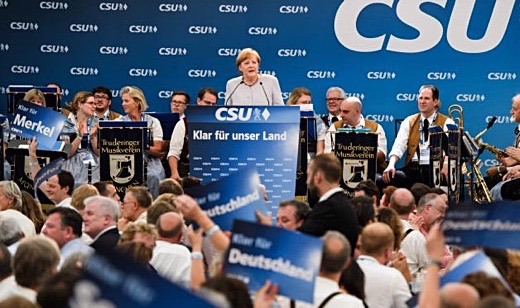
Image above: German Chancellor Merkel speaking at Christian Social Union meeting in Bavaria. From (https://www.welt.de/politik/deutschland/article165008816/Merkel-sieht-in-den-USA-keinen-verlaesslichen-Partner-mehr.html).

After the recent G7 meeting in Itlay and faced with a western alliance divided by Brexit and Donald Trump's presidency, Germany's Merkel said "die zeiten, in denen wir uns auf andere völlig verlassen konnten, sind ein Stück vorbei", or loosely translated "the times in which we could completely depend on others are on the way out" and added that "I've experienced that in the last few days."

Merkel then said that while Germany and Europe would strive to remain on good terms with America and Britain, "we have to fight for our own destiny" and she also said that special emphasis was needed on warm relations between Berlin and newly-elected French President Emmanuel Macron.

Her comments came after Trump said during the G-7 meeting he needed more time to decide if the US would continue backing the Paris climate deal, which has frustrated European diplomats. A subseqent report by Axios, Trump privately told multiple people, including EPA Administrator Scott Pruitt, that "he plans to leave the Paris agreement on climate change" which will likely further infurate his European allies.

During his trip, Trump also echoed his past criticism of NATO allies for failing to meet the defensive alliance's military spending commitment of two percent of GDP.
Observers noted that he neglected to publicly endorse the pact's Article Five, which guarantees that member countries will aid the others they are attacked. The omission was especially striking as he unveiled a memorial to the September 11, 2001 terrorist attacks against the US, the only time the mutual defense clause has been triggered.
On Friday, Trump also described German trade practices as "bad, very bad," in Brussels talks last week, complaining that Europe's largest economy sells too many cars to the US.

Reactions to Merkel's striking comment came pouring in from the likes of Edward Snowden who called her speech an "era-defining moment".

Dark Arts - The Atlantic Bridge

SUBHEAD: How a dark money network, Atlantic Bridge, is taking power on both sides of the Atlantic..

By George Monbiot on 3 February 2017 Monbiot.com -
(http://www.monbiot.com/2017/02/04/dark-arts/)


Image above: Inverse color image of logo for the Atlantic Bridge organization.

It took corporate America a while to warm to Donald Trump. Some of his positions, especially on trade, horrified business leaders. Many of them favored Ted Cruz or Scott Walker. But once he had secured the nomination, the big money began to recognize an unprecedented opportunity.

Trump was prepared not only to promote the cause of corporations in government, but to turn government into a kind of corporation, staffed and run by executives and lobbyists. His incoherence was not a liability but an opening: his agenda could be shaped.

And the dark money network that some American corporations had already developed was perfectly positioned to shape it.

Dark money is the term used in the US for the undisclosed funding of organizations involved in political advocacy. Few people would see a tobacco company as a credible source on public health, or a coal company as a neutral commentator on climate change. To advance their political interests, such companies must pay others to speak on their behalf.

Soon after the Second World War, some of America’s richest people began setting up a network of thinktanks to promote their interests. These purport to offer dispassionate opinions on public affairs. But they are more like corporate lobbyists, working on behalf of those who founded and fund them. These are the organizations now running much of the Trump administration.

We have no hope of understanding what is coming until we understand how the dark money network operates. The remarkable story of a British member of parliament provides a unique insight into this network, on both sides of the Atlantic. His name is Liam Fox. Six years ago, his political career seemed to be over.

The scandal he had caused by mixing his private and official interests, that was highly embarrassing to David Cameron’s government, had forced him to resign as Secretary of State for Defence. But today he is back on the front bench, with a crucial and sensitive portfolio: Secretary of State for International Trade.

In 1997, the year the Conservatives lost office to Tony Blair, Liam Fox, who sits on the hard right of the parliamentary Conservative party, founded an organization called The Atlantic Bridge. Its matron was Margaret Thatcher.

On its advisory council sat the future cabinet ministers Michael Gove, George Osborne, William Hague and Chris Grayling.

Fox, who became a leading campaigner for Brexit, described the mission of The Atlantic Bridge as “to bring people together who have common interests”. It would defend these interests from “European integrationists who would like to pull Britain away from its relationship with the United States”.

The Atlantic Bridge was later registered as a charity. It was part of the UK’s own dark money network: only after it collapsed did we discover the full story of who had funded it.

Its main sponsor was the immensely rich Michael Hintze, who worked at Goldman Sachs before setting up his own hedge fund, CQS. Hintze is one of the Conservative party’s biggest donors. In 2012, he was revealed as a funder of the Global Warming Policy Foundation, that casts doubt on the science of climate change. As well as making cash grants and loans to The Atlantic Bridge, he lent Liam Fox his private jet to fly to and from Washington.

Another funder was the drug company Pfizer. It paid for a researcher at The Atlantic Bridge called Gabby Bertin. She went on to become David Cameron’s press secretary, and now sits in the House of Lords: Cameron gave her a life peerage in his resignation honors list.

In 2007, a group called the American Legislative Exchange Council (ALEC) set up a sister organisation, The Atlantic Bridge Project, to run the US arm of Fox’s initiative. ALEC is perhaps the most controversial of the corporate-funded thinktanks in the US.

It specialises in bringing together corporate lobbyists with state and federal legislators to develop “model bills”. The legislators and their families enjoy lavish hospitality from the group, then take the model bills home with them, to promote as if they were their own initiatives.

ALEC has claimed that over 1000 of its bills are introduced by legislators every year, and one in five of them becomes law. It has been heavily funded by tobacco companies, the oil company Exxon, drug companies and Charles and David Koch: the billionaires who founded the first Tea Party organisations. Pfizer, that funded Gabby Bertin’s post at The Atlantic Bridge, sits on ALEC’s corporate board.

Some of the most contentious legislation in recent years, such as state bills lowering the minimum wage, bills granting corporations immunity from prosecution and the “ag-gag” laws, forbidding people to investigate factory farming practices, were developed by ALEC.

To run the US arm of Atlantic Bridge, ALEC brought in its director of international relations, Catherine Bray. She is a British woman who had previously worked for the Conservative member of the European Parliament Richard Ashworth and the UKIP member Roger Helmer.

She has subsequently worked for the man who brought us Brexit, Daniel Hannan. In 2015, she married Wells Griffith, who became the battleground states director for Trump’s presidential campaign.

Among the members of The Atlantic Bridge’s US advisory council were the ultra-conservative senators James Inhofe, Jon Kyl and Jim DeMint.

James Inhofe is reported to have received over $2 million in campaign finance from coal and oil companies.

Both Koch Industries and ExxonMobil have been major donors. Coincidentally, he has described man-made global warming as “the greatest hoax ever perpetrated on the American people”.

Jon Kyle, now retired, is currently acting as the “sherpa” guiding Jeff Sessions’s nomination as Trump’s attorney general through the Senate.
 
Jim DeMint resigned his seat in the Senate to become president of the Heritage Foundation, which is probably, after ALEC, the second most controversial thinktank in America. It was founded with a large grant from Joseph Coors, heir to the Coors brewing empire, then built up with money from the banking and oil billionaire Richard Mellon Scaife. Like ALEC, it has been richly funded by the Koch Brothers.

Heritage, under DeMint’s presidency, drove the attempt to ensure that Congress refused to pass the federal budget, temporarily shutting down the government. Fox’s former special adviser at the Ministry of Defence, an American called Luke Coffey, now works for the foundation.

The Heritage Foundation is now at the heart of Trump’s administration. Its board members, fellows and staff comprise a large part of his transition team.

Among them are Rebekah Mercer, who sits on Trump’s executive committee, Steven Groves and Jim Carafano (State Department), Curtis Dubay (Treasury) and Ed Meese, Paul Winfree, Russ Vought and John Gray (Management and Budget).

CNN reports that “no other Washington institution has that kind of footprint in the transition”.

Trump’s extraordinary plan to cut federal spending by $10.5 trillion was drafted by the Heritage Foundation, which called it a “Blueprint for a New Administration”. Russ Vought and John Gray, who moved onto Trump’s team from Heritage, are now turning this blueprint into his first budget.

It will, if passed, inflict devastating cuts on healthcare, social security, legal aid, financial regulation and environmental protections, eliminate programs to prevent violence against women, to defend civil rights and fund the arts, and will privatize the Corporation for Public Broadcasting.

Trump, as you follow this story, begins to look less like a president and more like an intermediary: implementing an agenda that has been handed down to him.

In July last year, soon after he became trade secretary, Liam Fox flew to Washington. One of his first stops was a place he has visited often over the past 15 years: the office of the Heritage Foundation, where he spoke among others to Jim DeMint.

A freedom of information request reveals that one of the topics raised at the meeting was the European ban on American chicken washed in chlorine: a ban that producers hope the UK will lift under a new trade agreement.

Afterwards, Fox wrote to DeMint, looking forward to “working with you as the new UK government develops its trade policy priorities, including in high value areas that we discussed such as defence.”

How did Fox get to be in this position, after the scandal that brought him down six years ago? The scandal itself provides a possible clue: it involved a crossing of the boundaries between public and private interests.

The man who ran the UK branch of The Atlantic Bridge was his friend Adam Werrity, who operated out of Michael Hintze’s office building. Werrity’s work became entangled with Liam Fox’s official business as defense secretary.

Werritty, who carried a business card naming him as Fox’s adviser but was never employed by the Ministry of Defense, joined the secretary of state on numerous ministerial visits overseas, and made frequent visits to Fox’s office.

By the time details of this relationship began to leak, the Charity Commission had investigated The Atlantic Bridge and determined that its work didn’t look very charitable. It had to pay back the tax from which it had been exempted (Hintze picked up the bill).

In response, the trustees shut the organization down. As the story about Adam Werrity’s unauthorized involvement in the business of government began to grow, Fox made a number of misleading statements. He was left with no choice but to resign.

So when Theresa May brought him back into government, and gave him a portfolio that should, in principle, involve setting clear boundaries between public and private interests, it was as strong a signal as we might receive about the intentions of her government.

The trade treaties that Fox is charged with developing set the limits of sovereignty. US food and environmental standards tend to be lower than ours, and they will become lower still if Trump gets his way.

ny trade treaty we strike will create a common set of standards for products and services. Trump’s administration will demand that ours are adjusted downwards, so that US corporations can penetrate our markets without having to modify their practices.

All the cards, following the Brexit vote, are in US hands: if the UK resists, there will be no treaty. What May needed – even before Trump became president – was a person prepared to strike such a deal.

As the Financial Times reports, “the election of Donald Trump has transformed the fortunes of Liam Fox”. He is now “an indispensable member of Theresa May’s front bench team”. The shadow diplomatic mission he developed through The Atlantic Bridge plugs him straight into the Trump administration.

Long before Trump won, campaign funding in the US had systematically corrupted the political system. A new analysis by US political scientists finds an almost perfect linear relationship, across 32 years, between the money gathered by the two parties for congressional elections and their share of the vote. But there has also been a shift over these years: corporate donors have come to dominate this funding.

By tying our fortunes to those of the United States, the government binds us into this system. This is part of what Brexit is about: European laws protecting the public interest were portrayed by Conservative Eurosceptics as intolerable intrusions on corporate freedom.

Taking back control from Europe means closer integration with the US. The transatlantic special relationship is a special relationship between political and corporate power.

In April 1938, President Franklin Roosevelt sent the US Congress the following warning.

“The liberty of a democracy is not safe if the people tolerate the growth of private power to a point where it becomes stronger than their democratic state itself. That, in its essence, is fascism.” 

It is a warning we would do well to remember.

.

Change can be a bitch!

SUBHEAD: 2017 will be the year where most people's favorite worldview flies off the rails.

By Raul Ilargi Meijer on 13 January 2107 for The Automatic Earth -
(https://www.theautomaticearth.com/2017/01/2017-change-can-be-a-bitch/)


Image above: From Revelers bundle up while gathered at Times Square during a New Year's Eve celebration Saturday, Dec. 31, 2016, in New York. Photo by Julio Cortez. (https://www.abqjournal.com/918871/ringing-in-change.html).

2016 brought a lot of changes, or rather, brought them to light. In reality, the world has been changing for many years, but many prominent actors benefitted from the changes remaining hidden. Simply because their wealth and power and worldviews are better served that way.

It’s entirely unclear whether we will ever get a chance to see to what extent the efforts to hide developments have been successful, or even been perpetrated at all, because we don’t know to what extent truth and reality will be accessible in the future.

What we can say at this point in time is that the changes 2016 delivered were urgently needed. There are many people out there who just want to turn back the clock, and change everything back to how it was, but they can’t, and that’s a good thing, because the way things were was hurting too many people.

2016 will go down in history as the year when a big divide between groups of people in the western world became visible, a divide that had until then been papered over by real or imaginary wealth, as well as by ignorance and denial.

When politics and media conspire to paint for the public a picture of their choosing, they can be very successful, especially if that picture is what people very much wish to see, true or not.

But as we’ve seen recently, our traditional media have become completely useless when it comes to reporting news; the vast majority have switched to reporting their own opinions and pretending that is news.

On the one hand, there is a segment of society that either has noticed no changes, or is so desperate to hold on to what they have left, that they resist seeing them. On the other hand, there are those who feel left behind by that first group, and by the idea that the world that is still functioning and even doing well.

The first group has been captivated by, and believed in, the incessantly promoted message of recovery from an economic, financial and gradually also political crisis. The second see in their lives and that of their friends and neighbors that this recovery is an illusion.

It’s like the old saying goes: you can’t fool all of the people all of the time. And that’s why you have Brexit and Trump and why you’re going to have much more of that, certainly across Europe. Things are not going well, and there is no recovery, for a large enough percentage of people that their votes and voices now swing the debates and elections.

It’s not even complicated. This week there was a report from Elevate’s Center for the New Middle Class that concluded that half of Americans, 160 million people, can’t afford to have a broken arm treated (at $1,400).

And sure, you can say that perhaps that number is a bit too high, but there have been many such reports, that for instance say the majority of Americans have less than $1000 in savings, and can’t even afford a car repair.

In Britain numbers are not much different. Over the past decade, the country has been very busy creating an entire new underclass. If your economy is not doing well, and your answer to that is budget cuts and austerity, it’s inevitable that this happens, that you create some kind of two-tier or three-tier society. And then come election time, you run the risk of losing.

Both Britain and the US boast low unemployment numbers, but as soon as you lift the veil, what you see is low participation rates, low wages and huge numbers of part-time jobs stripped of all the benefits a job used to guarantee. It allows those who still sit pretty to continue doing that, but it’ll come right back to haunt you if you don’t turn it around, and fast enough.

For many people, Obama, Merkel, Cameron and the EU cabal have been disasters. For too many, as we now know. That doesn’t mean that Trump will fix the economic problems, but that’s not the issue.

People have voted for anything but more of the same. Which in Britain they’re not even getting either, so expect more mayhem there.

In most places, some variety of right wing alternative is the only option available that is far enough removed from ‘more of the same’. Moreover, many if not most incumbent parties are in a deep identity crisis. Trump did away with the Republicans AND the Democrats, and they had better understand why that is, or they’ll be wholly irrelevant soon.

In Britain, the most important votes in many decades was lost by the Tories, who subsequently performed a musical chairs act and stayed in power. You lost! Losers are not supposed to stay in power! But the other guys are all too busy infighting to notice.

That identity crisis, by the way, is not a new thing. If you look across the western political spectrum, there are all these left wing and right wing parties happily working together, either in coalition governments or through other ‘productive’ forms of cooperation.

So who are people going to vote for when they’re unhappy with what they’ve got? Where is that ‘change’ that they want? Not on the traditional left or right.

So you get Podemos and M5S and Trump and UKIP and Le Pen. It’s not their fault, or the voters’ fault, it’s the political establishment that has tricked itself into believing in the same illusion it’s been promoting to voters.

And yes, they have now proven that it’s possible to stave off, for a number of years, a deeper crisis, depression, by borrowing and printing ‘money’. Especially if you can at the same time hit the poorest in your society with impunity.

But in the end no amount of fake or false news on the economic front will allow you to continue the facade for too long, because people know when they can’t afford things anymore. The evidence here is somewhat more direct than with regards to political fake news, though they may well both follow the same pattern of ‘discovery’.

Our societies are still run as if there is no real crisis, as if it’s all just a temporary glitch, as if the incumbent models function just fine, and as if recovery is just around the corner. And we can make it look as if that is true, but only for an ever smaller amount of time, and for an ever smaller amount of people.

The basic issue here is not a political one. It’s economic. Our economic systems have failed, and they can’t be repaired. We should always have realized that no growth is forever, but at least we now know. Or could know, it’ll take a while to sink in.

Next up is a redo and revamp of those economic systems, but that is not going to be easy, and may not get done at all. The resistance may be too strong, warfare -economic or physical- may seem like a way out, there are many unknowns.

We could, ironically, get quite far in that redo if we simply cut all the waste for our economic processes, but then again, that would have us find out that much of the system runs entirely on wasting stuff, and wasting less kills the system.

However that may be, and however it may turn out, this is where we find ourselves. Protesting Trump and Brexit is inevitable, but it doesn’t address any core issues. From a purely economic point of view, Obama failed spectacularly, as did David Cameron, as does Angela Merkel. And as do, we will find out in 2017, many other incumbent ‘leaders’.

Their successors, whatever political colors they may come from, will all come to power promising, and subsequently attempting, to restart growth. Which is no longer feasible across an entire country, or even if it were, it would mean squeezing other countries. With corresponding risks.

Trump and Brexit are necessary, perhaps even long overdue, in order to break the illusion that things could go on as they were. But they are not solutions. America needs a big wake-up. Trump looks likely to deliver one. That is needed for the rest of the country to wake from its slumber.

Ask yourself: are you going to get weaker from dealing with a Trump presidency? Maybe not the best question, or at least not before having asked: do you know how weak you are right now?

For Britain to leave the EU is a great first step. As I’ve said many times, centralization is not an option without growth. And Brussels has shown us quite a few of the worst consequences of centralization. Nobody should want to be a part of that.

Summarized: for most people, 2017 will be the year of the inability to understand where their favorite worldview flew off the rails. Change can be a bitch. But change is needed to keep life alive.

.

Talk of more growth & globalization

SUBHEAD: And to think the economic meltdown hasn’t truly started yet, has been kept hidden behind a wall of debt.

By Raul Ilargi Meijer on 7 December 2016 for the Automatic Earth
(https://www.theautomaticearth.com/2016/12/more-talk-about-more-growth-and-more-globalization/)


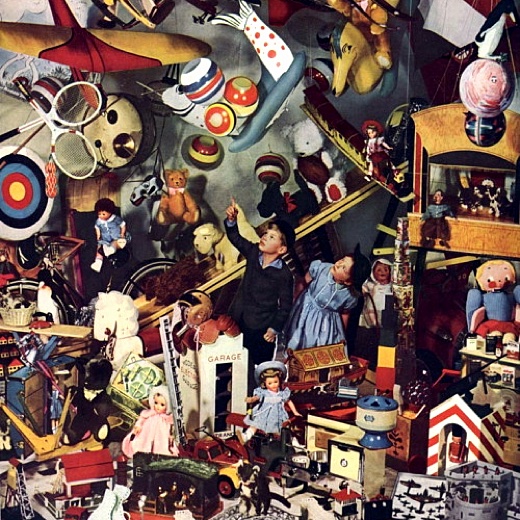
Image above:Children point towards Christmas toys at The Fair Department Store, Chicago 1940. Photo by Arthur Gerlach. From original article.

The world is facing the “first lost decade since the 1860s”, said Bank of England governor Mark Carney this week. Arguably good for soundbite of the day, but the buck stops there. The only way that buck could have kept rolling would have been for Carney to take a critical look at himself and his employer(s), but there was none of that.

The Canadian import governor has no doubts about anything he’s done, or if he does he shows none. Instead he puts the blame for all that’s gone awry, on some -minor- elements of what he think globalization means, not with the phenomenon itself, or his enduring support for, and belief in, it. The problem with that is it’s indeed belief only; he can’t prove an inch of what he says.

Globalization is an act of faith inside a politico-economic belief system, and all it needs according to Carney and many others in his ‘church’ is a little tweaking. That globalization itself could be the driving force behind Brexit, Trump and the defeat of Italian PM Renzi does not enter into the faith’s ‘thought’ system.

Neither does the possibility that globalization is what it is, in and of itself, a process that in the end cannot be tweaked. That globalization is simply yet another form of centralization that follows the same rules and laws all other forms do, where power and wealth always, of necessity, wind up in the hands of a few, through pretty basic centrifugal forces.

Mark Carney launched a defense of globalization and set out a manifesto for central bankers and governments to boost growth and make the world economy more equal.

The Bank of England Governor said they must acknowledge that gains from trade and technology haven’t been felt by all, improve the balance of monetary and fiscal policy, and move to a more inclusive model where “everyone has a stake in globalization.”

Carney’s speech in Liverpool, England, comes amid rising disquiet about the state of the world economy and political status quo that helped propel Donald Trump to victory in the U.S. presidential election and boost support for the U.K.’s exit from the European Union.


Trump isn’t right to favor more protectionist policies in response to globalization , Carney said in a television interview broadcast after his speech. The answer is to “redistribute some of the benefits of trade” and ensure that workers are able to acquire new skills. “Weak income growth has focused growing attention on its distribution,” Carney said in the speech.

“Inequalities which might have been tolerated during generalized prosperity are felt more acutely when economies stagnate.” Describing the world as facing the “first lost decade since the 1860s,” the BOE governor said public support for open markets is under threat and rejecting them would be a “tragedy, but is a possibility.”
Carney also defended the central bank’s current policy stance. The BOE has faced criticism from politicians after officials took measures including cutting interest rates and expanding asset purchases in August to support the economy after Britain’s June vote to leave the EU. “Low rates are not the caprice of central bankers, but rather the consequence of powerful global forces, including debt, demographics and distribution,” he said, adding that they helped to prevent a deeper economic downturn.
People like Carney will insist that globalization spurs growth, right up to the moment where they’re either voted out or fired. And they’ll probably keep on insisting until their dying days.

But why are we in that “first lost decade since the 1860s” then? Is that really only because ‘we’ failed to “redistribute some of the benefits of trade”, something that can allegedly be easily rectified by enabling workers to ‘acquire new skills’?

Where is the proof for that? And why have economies stagnated in the middle of the entire process of globalization? Is that solely because ‘some of’ the benefits were not distributed well enough? If that is so, and wealth distribution is the only problem with globalization, at what point do we redistribute ourselves into the realm of communism? Where’s the dividing line? It all feels mighty vague and unsatisfactory, and not a little goal-seeked.

Like a large part of the Brexit voters in Britain, millions of Italians have been on the losing side of globalism’s ‘benefits distribution’. And this weekend they found an outlet for their frustration about it.

Like Brexiteers voted against Cameron and Osborne much more than they voted for anything in specific, and Trump won because Americans are fed up with the Obama/Clinton/GOP model, Italians voted against PM Renzi and his idea to take power away from parliament and give it to him.

Judging from poll numbers, they also seem to have gained confidence in Beppe Grillo’s, and the Five Star Movement’s, ability to do something real in politics. It has taken a while, and that makes sense because the movement doesn’t fit the model of politics as they’ve known it all their lives.

Also, there are many Italians who have largely agreed with much of what Grillo has been saying all along, but were deterred by the way he delivered it. Ask an Italian and they’re likely to say “too angry, too rude” when it comes to Grillo. And it’s true, his style doesn’t seem to fit in with the rest. But then that’s also exactly his forte. Because there comes a point when everything that does fit in, becomes suspect.

The old guard, from Renzi to Berlusconi to the socialists, will double their efforts to keep Grillo out of the center of power now. President Mattarella is in on it: he asked Renzi to stay on as PM until after the budget has been pushed through, and is then likely to install another technocrat government, tasked with changing laws with the express intent of making it harder for Grillo to get into power.

And Renzi, of course, is on the same wavelength as Carney, and the entire EU -and global- cabal: globalize, reform, re-distribute ‘some benefits’, execute more austerity, rinse and repeat.

What’s particular about Italy in this sense is what it has been able to preserve, unlike most other nations. That is, Italy has a lot of small enterprises, often family owned, with highly skilled workers. That doesn’t fit today’s globalization model, since it’s deemed not competitive enough when you’re forced to fight for market share.

But if globalization, and the entire growth model, is over anyway, as I’ve often asserted, it’s a whole different story. If that is true, the country had better save what’s left of its business model, because it’s ideal for a post-centralized world. ‘Workers’ wouldn’t have to ‘acquire new skills, and leave old and proven skills to be forgotten and gather dust.

The world is changing rapidly and that will become even a lot more evident in 2017. The incumbent economic and political systems, as well as their proponents and cheerleaders, are on the way out. They have all failed miserably. What comes next will be profoundly chaotic for quite a while, and that will be perilous. There is not one single (belief) system to replace them, there will be many and they will often clash.

In some places, the political right will prevail, in others the left. In most, from the look of things, neither will, if only because at the end of the day both left and right are still part of incumbent systems. Europe has a number of elections coming up and in at least some of these, parties from outside the incumbent systems will come out on top.

Whether they can then go on to form governments is perhaps another story; the system will not give up easily. But it is done. Carney’s recipe of ‘some’ redistribution of wealth and acquiring new skills is widely shared in power circles, and that will be the system’s undoing. All it has to offer is more talk about more growth and more globalization, and while people protest only the latter, neither is on offer.

One of the tools the media use to discredit anything that comes from outside the system is to label it all ‘populist’. It’s a miracle it hasn’t become a honor label yet. In Europe, all new rightwing parties (a label in itself) get called populist, Le Pen, Wilders, Frauke Petry in Germany, the Lega Nord in Italy.

But so does someone like Beppe Grillo, who politically has nothing in common with these people.
Moreover, many of their ideas are not to the right of existing parties at all.

Despite some of his views, new French Republican candidate François Fillon is not called a populist, ostensibly because he’s from a large incumbent party, but so are Trump and Sanders in the US, and they do get called populist.

Empty labels, fake news and oceans of debt keep the systems -somewhat- going for now. But the genie’s long left the bottle. The ‘incumbents’ have failed their people for far too long, most of all economically. And they keep on claiming that everything will be alright, everyone will be better off if only we execute more globalization, and give them all a few pennies more.

It really is too silly to be true that that is what existing systems and their servants are still trying to make everyone believe. While it is so obvious that so many have long stopped believing. You would think they’d change their messages to reflect that change in society. But they don’t know how. And it’s that very inability that feeds those pesky ‘populists’.

The same François Fillon could be a contender in France against anti-EU Le Pen because he’s expressed doubts on Brussels. Dutch PM Rutte has cautiously critiqued the union too. But those shifts in words if not real opinions come far too late. Britain has said No and there’s zero chance that more nations will not do the same. Just give them the option, give them a vote.

The only way to keep Europe from descending into chaos is to abandon the EU, lock the doors and throw away the keys. The same is true on a global scale, with all the globalist trade agreements that most people have long lost faith in. We will either see a peaceful transition to a system not based on centralization, or we will not see peace, period.

And to think economic meltdown hasn’t even truly started yet, has been kept hidden behind a wall of debt, and so many people are already so fed up with the whole shebang.

.

Podesta Wikileaks from inside USA

SUBHEAD: Former British ambassador claims source of Wikileaks Podesta emails from Washington source.

By Tyler Durden on 2 November 2016 for Zero Hedge -
(http://www.zerohedge.com/news/2016-11-02/former-british-ambassador-claims-source-podesta-leaks-comes-within-washington)


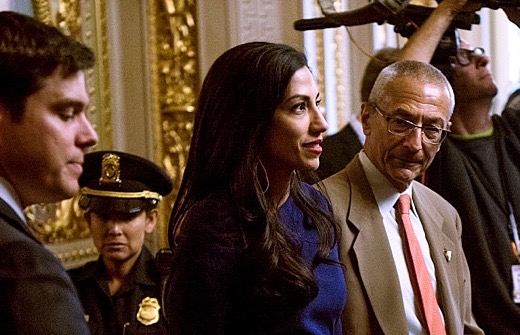
Image above: Huma Abedin and John Podesta, aides to Presidential candidate Hillary Clinton are seen in the Capitol's Senate Reception Room upon arriving for Clinton's meeting with Senate Democrats, July 14, 2016. Photo by Tom Williams. From (http://www.gettyimages.com/detail/news-photo/huma-abedin-and-john-podesta-aides-to-presidential-news-photo/576502484#huma-abedin-and-john-podesta-aides-to-presidential-candidate-hillary-picture-id576502484).

With the media gripped by accusatory speculation regarding the identity of the source behind the Wikileaks leak of hacked Podesta and DNC emails, much of it focused on Russia, a new theory has emerged from Craig Murray, the former British ambassador to Uzbekistan, who tells Sputnik (a Russian media outlet) that the source of the leaks are not Russian hackers but a Washington insider.

"The source of these emails and leaks has nothing to do with Russia at all. I discovered what the source was when I attended the Sam Adam's whistleblower award in Washington. 

The source of these emails comes from within official circles in Washington DC. You should look to Washington not to Moscow."

Asked about whether or not WikiLeaks have ever published information at the behest of Moscow, Murray said that "WikiLeaks has never published any material received from the Russian government or from any proxy of the Russian government. It's simply a completely untrue claim designed to divert attention from the content of the material."

While blasted by Washington, first by Republicans several years ago, and most recently by Democrats, the WikiLeaks revelations have often been hailed as a champion of accountability.

"I think whistleblowers have become extremely important in the West because the propaganda model — as Chomsky puts it — has been reinforced to the extent that people don't get any true information out of the media at all. It's worth saying that Julian Assange and WikiLeaks are publishers; they publish what whistleblowers leak to them," Mr. Murrary told Sputnik.

Yet, whistleblowers in the US continue to be subject to lengthy prison sentences. A key example is Chelsea Manning, who was sentenced on August 21, 2013 to a thirty five year sentence for providing WikiLeaks with sensitive military and diplomatic documents highlighting, among other things, US military conduct in Iraq.

Murray also mentions the case of John Kiriakou, a former investigator of international terrorism with the CIA who turned whistleblower.

"The people who did the torture have suffered no comeback at all," adds Mr. Murray.

Taking a step back and discussing the risk of geopolitical escalation between Russia and the US, Murray told Sputnik that "there is no chance whatsoever that Russia is going to ever attack the United States, that simply isn't going to happen."

"Just as Russia is not going to attack the United Kingdom. There never has been a chance that Russia would ever attack either of these two countries. But of course the narrative is all to do with power and funneling huge amounts of American taxpayer money into the defense industry and the security industry and these people are both from the class that benefits."

It's an extremely dangerous game, says Mr. Murray, and it feeds into a foreign policy that is completely mad.

"In Syria — and I should say I'm no fan of the Assad regime at all — but the idea that backing assorted groups of jihadists to tear the country apart is a better solution is crazy and it's especially crazy when we've already messed up Iraq, Afghanistan and now we're doing exactly the same thing again and you can see it doesn't work, it only works in terms of promoting continued instability and continued spending for the military and the security services."

Finally, Murray also believes that the public can't get clear analysis of these issues from mainstream media, because they are part of the same money/power nexus.

.

America on a War Path

SUBHEAD: Around the world the USA military is challenging Russia, Iran and China as the pot boils.

By Juan Wilson on 13 October 2016 for Island Breath  -
(http://www.shtfplan.com/headline-news/nuclear-war-is-on-the-horizon-this-is-not-just-talk-action-has-been-taken_10102016)


Image above: American and Russian flags in flames. From www.shtfplan.com.

The United States seems to be unable to handle its any of its substantial problems or even identify them. Looking at the presidential race it would seem the most important issue is who-grabbed-who-where.  It comes down to deciding who is dirtier between Trumps or Clinton.

No debate about finding peaceful solutions in the Middle East, Eastern Europe or South China Sea. No back-and-forth on ways to avoid the climate catastrophe we face. No proposals for getting off dirty fossil fuel dependence. No plans for mitigating the damage from the nearing economic bubble collapse.

Both Trump and Clinton have their bogeymen. For Trump its China, for Clinton its Russia. Both these candidates seemed poised to take a punch at their nemesis.

Both Clinton and Trump agree on vilifying Iran. They see Iran's proxy Hezbollah as the source of many evils in the Middle East beginning in the 1980s with the Lebanese Civil War to today with "tentacles" in Yemen and Syria. But it gets complicated. 

It seems Iran is the nexus between Russia and China. Both Russia and China are Iran's neighbors. Russia and Iran share borders on the Caspian Sea and China and Iran share borders with Pakistan and Afghanistan.

Iran is also a longtime ally of Syria and its current ruling Assad family. And, since the United States dumped Saddam Hussein and the Sunni leaders in Iraq, Iran has had an opening to the Shia leadership in Iraq. And the only thing that separates Syria from Iran is Iraq.

So China and Russia and Iran all have more close vital interests in the area than the United States. 

American resentment for Iran links us to continuing confrontation with both Chinese and Russian activities in the region.

We've been at war there for a very long time. It should be noted how very far away from the United States this part of the world is and how it has proved to create for us quagmires in Iraq, Afghanistan and now Syria.  

Our potential "enemies" have been building up their capabilities as we have spilled blood and treasure in the sand. The sounds of our saber rattling will not strike them as so terrifying the next time it comes down to a fight.


US joins Saudis in Yemen conflict

SUBHEAD: US actively joins Yemen conflict with cruise missile strikes on anti-Saudi targets.

By Tyler Durden on 13 October 2016 for Zero Hedge -
(http://www.zerohedge.com/news/2016-10-13/us-joins-yemen-conflict-cruise-missile-strikes-anti-saudi-targets)


Image above: USS Mason (DDG-87) fires an SM-2  missile during a March 2016 exercise. Photo by US Navy. From (https://news.usni.org/2016/10/11/uss-mason-fired-3-missiles-to-defend-from-yemen-cruise-missiles-attack).

We can now put away any speculation whether the US will limit its support and arming of Saudi Arabia in its ongoing campaign over Yemen over "war crime" concerns.

Overnight, the U.S. military not only did not rebuke the Saudis for a military campaign that has claimed nearly 10,000 innocent civilian lives, but became the latest entrant in the Yemen offensive, when it launched cruise missile strikes on Thursday to knock out three coastal radar sites in areas of Yemen controlled by Iran-aligned Houthi forces, in what was supposedly a retaliation after failed missile attacks this week on a U.S. Navy destroyer, U.S. officials said.

Cited by Reuters, U.S. officials speaking on condition of anonymity, said U.S. Navy destroyer USS Nitze launched the Tomahawk cruise missiles around 4 a.m. (0100 GMT). The strikes, authorized by President Barack Obama, represent Washington's first direct military action against suspected Houthi-controlled targets in Yemen's conflict.

As we reported previously, U.S. officials said there growing indications - if no official proof - that Houthi fighters, or forces aligned with them, were responsible for Sunday's attempted strikes, in which two coastal cruise missiles designed to target ships failed to reach the destroyer.

And like on all previous occasions when the US got involved in a nation's sovereign affairs, the Pentagon stressed the limited nature of the strikes, aimed at radar that enabled the launch of at least three missiles against the U.S. Navy ship USS Mason on Sunday and Wednesday.

What it did, however, was make Saudi incursions into Yemen even easier, providing the Saudi airforce a corridor deep into the country which making sure Yemen was unable to retaliate against its invaders.

Of course, the official line is different. "These limited self-defense strikes were conducted to protect our personnel, our ships and our freedom of navigation," Pentagon spokesman Peter Cook adding that "these radars were active during previous attacks and attempted attacks on ships in the Red Sea," including the USS Mason, one of the officials said, adding the targeted radar sites were in remote areas where the risk of civilian casualties was low.

In retrospect one now wonders if the "cruise missiles" that fell close to the US ships were merely the latest false flag providing the US cover to launch another foreign intervention.To be sure, the Houthis, who are battling the internationally-recognized government of Yemen President Abd Rabbu Mansour al-Hadi, denied any involvement in Sunday's attempt to strike the USS Mason.

On Thursday, the Houthis reiterated a denial that they carried out the strikes and said they did not come from areas under their control, a news agency controlled by the group reported a military source as saying.  The allegations were false pretexts to "escalate aggression and cover up crimes committed against the Yemeni people", the source said.

it wouldn't be the first time that the US has done just that to launch an offensive war (without Congressional approval). Sure enough, the US from immediately launching a strategic attack.
According to Reuters, the US military official identified the areas in Yemen where the US strikes took place as near Ras Isa, north of Mukha and near Khoka.

There may have been another reason for the strikes: shipping sources told Reuters sites were hit in the Dhubab district of Taiz province. As the map shows, the area impacted by US air strikes overlooks the Bab al-Mandab Straight known for fishing and smuggling; also known for being one of the world's busiest transit spots.

The missile incidents, along with an Oct. 1 strike on a vessel from the United Arab Emirates, add to questions about safety of passage for military ships around the Bab al-Mandab Strait, one of the world's busiest shipping routes.

This latest US attack appears to be just the beginning: Pentagon spokesman Peter Cook warned against any future attacks, adding that "The United States will respond to any further threat to our ships and commercial traffic, as appropriate."

Others chimed in:
The United Arab Emirates (UAE), a leading member of a Saudi-led Arab coalition fighting to end Houthi control, denounced the attacks on the Mason as an attempt to target the freedom of navigation and to inflame the regional situation. 

Although Thursday's strikes against the radar aim to undercut the ability to track and target U.S. ships, the Houthis are still believed to possess missiles that could pose a threat.

Reuters has reported that the coastal defense cruise missiles used against the USS Mason had considerable range, fuelling concern about the kind of weaponry the Houthis appear willing to employ and some of which, U.S. officials believe, is supplied by Iran.  One of the missiles fired on Sunday traveled more than two dozen nautical miles before splashing into the Red Sea off Yemen's southern coast, one U.S. official said.
And suggesting that Yemen is about to become the next major geopolitical hotzone, earlier today Iran's semi-official Tasnim news agency reported that Iran sent two warships to the Gulf of Aden on Thursday, establishing a military presence in waters off Yemen where the U.S. military launched cruise missile strikes on areas controlled by Iran-backed Houthi forces.

"Iran's Alvand and Bushehr warships have been dispatched to the Gulf of Aden to protect trade vessels," Tasnim reported.
As a result, we expect many more "false flag" events in the coming days.


British has Green Light in Syria
SUBHEAD: Royal Air Force pilots can shoot down Russian jets over Syria if they feel threatened.

By Tyler Durden on 13 October 2016 for Zero Hedge -

(http://www.zerohedge.com/news/2016-10-13/royal-air-force-pilots-ordered-shoot-down-hostile-russian-jets-over-syria)


Image above: A British Tornado is one of a family of twin-engine, variable-sweep wing multi-role combat aircraft manufactured by Panavia  for Britain, Italy and Germany. From (https://en.wikipedia.org/wiki/Panavia_Tornado).


As the US officially enters the Yemen military campaign, the UK appears ready and willing to precipitate a catalytic event from which there is no going back.

With relations between Russia and the West at post-Cold War lows and deteriorating fast, Royal Air Force (RAF) pilots have been given the go-ahead to shoot down Russian military jets when flying missions over Syria and Iraq, if they are endangered by them.

The development comes with warnings that the UK and Russia are now "one step closer" to being at war, according to the Sunday Times.

While the RAF's Tornado pilots have been instructed to avoid contact with Russian aircraft while engaged in missions for Operation Shader, the codename for the RAF's anti-Isis work in Iraq and Syria, their aircraft have been armed with air-to-air missiles and the pilots have been given the green light to defend themselves if they are threatened by Russian pilots.

"The first thing a British pilot will do is to try to avoid a situation where an air-to-air attack is likely to occur — you avoid an area if there is Russian activity," an unidentified source from the UK's Permanent Joint Headquarters (PJHQ) told the Sunday Times.

"But if a pilot is fired on or believes he is about to be fired on, he can defend himself.

We now have a situation where a single pilot, irrespective of nationality, can have a strategic impact on future events."

Where things get tricky is the qualifier "if he believes he is about to be fired on" - since this makes open engagement a function of threat evaluation in real time during stressed conditions, the likelihood of an escalation that could result in two warplanes shooting at each other, just jumped significantly. 

The RAF Tornados aircraft will be armed with heat-seeking Advanced Short Range Air-to-Air Missiles (Asraams, also called AIM-132 missiles), the IBT adds. These weapons, which cost £200,000 each, have a longer range than other air-to-air missiles, allowing RAF pilots to shoot down enemy aircraft without being targeted themselves.

Providing cover to the largely underreported, if substantial escalation, according to the Sunday Times report an appraisal carried out by UK defence officials said: "It took six days for Russia to strike any Isis targets at all. Their air strikes have included moderate opposition groups who have been fighting to defend their areas from Isis.

Among the targets hit were three field hospitals." In the past 24 hours Russia's Defence Ministry said that it has continued its air strikes on IS positions in Hama, Idlib, Latakia and Raqqa. It reported that the attacks resulted in the "complete destruction" of "53 fortified areas and strong points with armament and military hardware", seven ammunition depots, four field camps of "terrorists", one command centre, and artillery and mortar batteries.

Russia has countered that US airstrikes have failed to make much of an impact on ISIS targets, and as reported last month, a "mistaken" strike by the US coalition forces killed over 60 Syrian soldiers in a move Russia accused of being a provocation to war.

The Sunday Times' report quoted a defence source as saying: "Up till now RAF Tornados have been equipped with 500lb satellite-guided bombs — there has been no or little air-to-air threat. But in the last week the situation has changed. We need to respond accordingly."

But another source of the original story summarized the severity of the situation best when he said that "we need to protect our pilots but at the same time we're taking a step closer to war.

It will only take one plane to be shot down in an air-to-air battle and the whole landscape will change."

See also:
Ea O Ka Aina: Russia warns of shooting down US jets 10/6/16
.

Understanding Brexit

SUBHEAD: The powerless of Great Britain press their thumbs in the eyes of the power elites.

By harles Hugh Smith on 26 June 2016 for of The Minds -
(http://charleshughsmith.blogspot.co.uk/2016/06/understanding-brexit-powerless-press.html)


Image above: American and British elites, like Tweedledee and Tweedleddum, speak with one voice through two mouths - one the Republican/Conservative and the other Democrat/Labor. Image is still from Walt Disney "Alice in Wonderland". From original article.

The sense of having a real say, and possessing actual agency, is very empowering, and very rare, for members of the lower-middle class and the working class today.

The premier strategy for retaining power is to give the powerless a carefully managed illusion of decision-making and autonomy. Having a say over one's life and choices is called agency, and it is the illusion of agency that makes democracy such a powerful tool of control.

The second most effective means of maintaining power is to limit the choices offered the powerless. Offering the powerless false choices, i.e. the choice between two functionally equivalent options, provides the comforting illusion of agency while insuring that the status quo Power Elite remains in charge, regardless of the choice made by the powerless.

For example, give the powerless a choice between Tweedle-Dum (Republicans/Tories) and Tweedle-Dee (Democrats/Labour). Whomever they elect, the self-serving Power Elite of entrenched interests and wealth remains firmly in charge, for the Power Elite speaks with one voice through two mouths, one Establishment Democrat/Labour, the other Establishment Republican/Tory.

If the powerless get restless, make them fearful. This is easily managed via external threats and dramatic predictions of economic doom should the Power Elite be threatened.

If fear has lost its edge due to over-use, then whip up social controversies that divide and conquer the powerless. Divisive, hot-button social controversies are easily staged and media-managed; these serve to distract and fragment the powerless in endless culture wars.

The powerless get very few opportunities to express their dissatisfaction with their gradual impoverishment and powerlessness, and few opportunities to register their disapproval of the Power Elite. They know complaints go nowhere, petitions are ignored, and demonstrations accomplish nothing.

So when a rare chance to stick a thumb in the eye of the Power Elite comes along, they take it. The Brexit vote was just such an opportunity.

Though the benefits that flowed from membership in the European Union may well have been substantial, many people did not have any direct experience of those benefits, which largely flowed to a handful of privileged classes: young, well-educated workers in finance, people who bought housing in London before the huge run-up in valuations, and workers providing services to the wealthy foreigners and highly paid financial professionals.

Many households have seen their quality of life and living standards stagnate or decay during the U.K.'s membership in the E.U. The benefits touted by the Power Elite are either illusory or too modest to matter to these households, and their rage has only grown as the Power Elite tried to browbeat them into approving a membership that yielded no benefits to their households.

The Power Elite simply repeated what has worked well for 60+ years: tout the systemic benefits of E.U. membership, confident in the belief that some of these benefits have trickled down to the lower economic classes, and stoke fears of economic decline if the Powers That Be don't get their way.

Unfortunately for the Power Elite, the benefits of E.U. membership, financialization and globalization have been concentrated at the top of the pyramid: the already wealthy got wealthier, and the young, well-educated, mobile, entrepreneurial class had enhanced opportunities to generate private wealth or at least secure an excellent salary.

A third privileged (i.e. protected) class includes all those benefiting from direct E.U. subsidies.

Those outside these classes saw little if any benefit.

The slow decay of living standards and social mobility was crystallized into anger by the Brexit vote, which was intended to be yet another rigged, illusory choice. The masses were supposed to be persuaded by either the list of goodies that flowed from membership or from fear-mongering about the catastrophic consequences of Brexit.

But neither worked as planned: the benefits were too diffuse or too concentrated in the hands of a few to be persuasive in terms of self-interest, and the fear-mongering only increased awareness of how much the Power Elite wanted a Remain outcome.

Will Brexit hurt the classes that did not directly benefit from E.U. membership?Perhaps.

Perhaps it was not in their self-interest to vote for Brexit. But the immeasurable pleasure in depriving the Power Elite of their "democracy" legitimacy was worth any potential sacrifice.

The sense of having a real say, and possessing actual agency, is very empowering, and very rare, for members of the lower-middle class and the working class today. the wealthy and powerful are accustomed to vetoing anything that impairs their wealth or power, and they're accustomed to either winning over or distracting the powerless.

Thus it was a shock when the powerless took the rare opportunity to stick a thumb in the eye of the Power Elite by depriving them of something they wanted.

is this childish, or self-defeating? Perhaps. But when the system erodes a citizenry's sense of agency, they have little to lose by relishing the chance to use the same power the wealthy constantly wield without any qualm or hesitancy: the power to say "no."


.