Showing posts with label Unrest. Show all posts

Brexit - the system cannot hold

SUBHEAD: If the Brexit vote shows us one thing, it's that were at the finish of a dead end street.

By Raul Ilargi Meijer on 24 June 2016 for the Automatic Earth -
(http://www.theautomaticearth.com/2016/06/brexit-the-system-cannot-hold/)


Image above: David Cameron demanding Brits vote against exiting the European Union. From (http://www.express.co.uk/news/uk/618841/David-Cameron-European-Union-Leaders-Mark-Rutte-Nigel-Farage-Theresa-May-Brexit-referendum).

Well, they did it. A majority of Britons made clear they’re so fed up with David Cameron and everything he says or does, including promoting the EU, that they voted against that EU. They detest Cameron much more than they like Nigel Farage or Boris Johnson. It seems that everyone has underestimated that.

Cameron just announced he’s stepping down. And that points to a very large hole in the ground somewhere in London town. Because going through a list of potential leaders, you get the strong impression there are none left. Not to run the country, and not to negotiate anything with Brussels. Which has a deep leadership -credibility- hole of itself, even though the incumbents are completely blind to that.

But first Britain. The Leave victory was as much a vote against Chancellor George Osborne as it was against Cameron. So Osborne is out as potential leader of the Conservatives. Boris Johnson? Not nearly enough people like him, and he fumbled his side of the Leave campaign so badly his credibility, though perhaps not being fully shot, is far too much of an uncertainty for the Tories to enter the upcoming inevitable general elections with.

Who else is there? Michael Gove? Absolute suicide. Likeability factor of zero Kelvin. That bus these guys drove around which proclaimed they could get £350 million extra a year for the NHS health care system in case of a Brexit will come back to haunt all of them. Just about the first thing Farage said earlier when the win became clear, was that the £350 million was a mistake.

I guess you could mention Theresa May, who apparently wants the post, but she’s an integral part of the Cameron clique and can’t be presented as the fresh start the party so badly needs.

Talking about Farage, who’s not Tory, but Ukip, he’s done what he set out to do, and that means the end of the line for him. He could, and will, call for a national unity government, but there is no such unity. He got voted out of a job today -he is/was a member of the European Parliament- and Ukip has only one seat in the British parliament, so he’s a bit tragic today. There is no place nor need for a UK Independence Party when the UK is already independent.

Then there’s Labour, who failed to reach their own constituency, which subsequently voted with Farage et al, and who stood right alongside Cameron for Remain, with ‘leader’ Jeremy Corbyn reduced to the role of a curiously mumbling movie extra. So Corbyn is out.

Shadow finance minister John McDonnell has aspirations, but he’s a firm Remain guy as well, and that happens to have been voted down. Labour has failed in a terrible fashion, and they better acknowledge it or else. But they already had a very hard time just coming up with Corbyn last time around, and the next twist won’t be any easier.

Cameron, Osborne, Corbyn, they have all failed to connect with their people. This is not some recent development. Nor is it a British phenomenon, support for traditional parties is crumbling away everywhere in the western world.

The main reason for this is a fast fading economy, which all politicians just try to hide from their people, but which those same people get hit by every single day.

A second reason is that politicians of traditional parties are not perceived as standing up for either their people nor their societies, but as a class in themselves.

In Britain, there now seems to be a unique opportunity to organize a movement like (Unidos) Podemos in Spain, the European Union’s next big headache coming up in a few days. Podemos is proof that this can be done fast, and there’s a big gaping hole to fill.

Much of what’s next in politics may be pre-empted in the markets. Though it’s hard to say where it all leads, this morning there’s obviously a lot of panic, short covering etc going on, fact is that as I write this, Germany’s DAX index loses 6% (-16.3% YoY), France’s CAC is down 7.7% (-18.5%) and Spain’s IBEX no less than 10.3% (-30%). Ironically, the losses in Britain’s FTSE are ‘only’ 4.5% (-11%).

These are numbers that can move entire societies, countries and political systems. But we’ll see. Currency moves are already abating, and on the 22nd floor of a well-protected building in Basel, all of the relevant central bankers in the world are conspiring to buy whatever they can get their hands on. Losses will be big but can perhaps be contained up to a point, and tomorrow is Saturday.

By the way, from a purely legal point of view, Cameron et al could try and push aside the referendum, which is not legally binding. I got only one thing on that: please let them try.

As an aside, wouldn’t it be a great irony if the England soccer (football) team now go on to win the Euro Cup? Or even Wales, which voted massively against the EU?

Finally, this was of course not a vote about the -perhaps not so- United Kingdom, it was a vote about the EU. But the only thing we can expect from Brussels and all the 27 remaining capitals is damage control and more high handedness. It’s all the Junckers and Tusks and Schäubles and Dijsselbloems are capable of anymore.

But it’s they, as much as David Cameron, who were voted down today. And they too should draw their conclusions, or this becomes not even so much about credibility as it becomes about sheer relevance.

Even well before there will be negotiations with whoever represents Britain by the time it happens, the Brussels court circle will be confronted with a whole slew of calls for referendums in other member states. The cat is out of Pandora’s bag, and the genie out of her bottle.

Many of the calls will come from the far-right, but it’s Brussels itself that created the space for these people to operate in. I’ve said it before, the EU does not prevent the next battle in Europe, it will create it. EC head Donald Tusk’s statement earlier today was about strengthening the union with the remaining 27 nations. As if Britain were the only place where people want out…

Holland, France, Denmark, Italy, Spain, Hungary, they will all have calls for referendums. Greece already had one a year ago. The center cannot hold. Nor can the system. If referendums were held in all remaining 27 EU member states, the union would be a lot smaller the next morning. The Unholy Union depends on people not getting a say.

The overwhelming underlying principle that we see at work here is that centralization is dead, because the economy has perished. Or at least the growth of the economy has, which is the same in a system that relies on perpetual growth to ‘function’.

But that is something we can be sure no politician or bureaucrat or economist is willing to acknowledge. They’re all going to continue to claim that their specific theories and plans are capable of regenerating the growth the system depends on. Only to see them fail.

It’s high time for something completely different, because we’re on a dead end street. If the Brexit vote shows us one thing, it’s that. But that is not what people -wish to- see.

Unfortunately, the kinds of wholesale changes needed now hardly ever take place in a peaceful manner. I guess that’s my main preoccupation right now.
Things fall apart; the centre cannot hold;
Mere anarchy is loosed upon the world,
The blood-dimmed tide is loosed, and everywhere
The ceremony of innocence is drowned;
Yeats

.
The Fate of the Turtle

SUBHEAD: Instead of Big Brother, government in our time turns out to be Autistic Brother. It makes weird noises and flaps its appendages.

By James Kunstler on 10 November 2014 for Kunstler.com -
(http://kunstler.com/clusterfuck-nation/the-fate-of-the-turtle/)


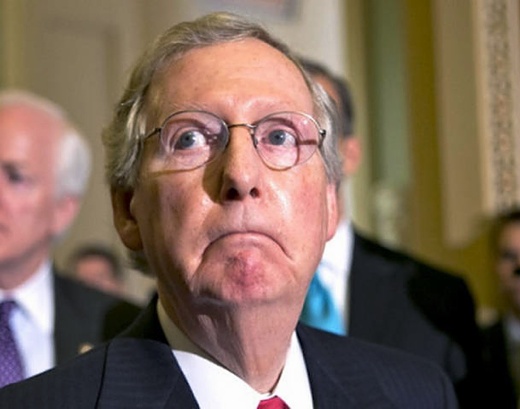
Image above: The Kentucky Crying Turtle - Kentucky Senator Mitch McConnell. From (https://www.flickr.com/photos/donkeyhotey/5272920666/).

Anybody truly interested in government, and therefore politics, should be cognizant above all that ours have already entered systemic failure. The management of societal affairs is on an arc to become more inept and ineffectual, no matter how either of the current major parties pretends to control things.

Instead of Big Brother, government in our time turns out to be Autistic Brother. It makes weird noises and flaps its appendages, but can barely tie its own shoelaces.

The one thing it does exceedingly well is drain the remaining capital from endeavors that might contribute to the greater good. This includes intellectual capital, by the way, which, under better circumstances, might gird the political will to reform the sub-systems that civilized life depends on.

These include: food production (industrial agri-business), commerce (the WalMart model), transportation (Happy Motoring), school (a matrix of rackets), medicine (ditto with the patient as hostage), and banking (a matrix of fraud and swindling).

All of these systems have something in common: they’ve exceeded their fragility threshold and crossed into the frontier of criticality. They have nowhere to go except failure. It would be nice if we could construct leaner and more local systems to replace these monsters, but there is too much vested interest in them.

For instance, the voters slapped down virtually every major ballot proposition to invest in light rail and public transit around the country. The likely explanation is that they’ve bought the story that shale oil will allow them to drive to WalMart forever.

That story is false, by the way. The politicos put it over because they believe the Wall Street fraudsters who are pimping a junk finance racket in shale oil for short-term, high-yield returns. The politicos want desperately to believe the story because the background reality is too difficult to contemplate: an American living arrangement with no future.

The public, of course, is eager to believe the same story for the same reasons, but at some point they’ll flip and blame the story-tellers, and their wrath could truly wreck what remains of this polity. When it is really too late to fix any of these things, they’ll beg someone to tell them what to do, and the job-description for that position is dictator.

It’s certainly remarkable that the years since the troubles of 2008 have been so seemingly placid and uneventful, at least here in the USA — not so much if you live in the Middle East or Ukraine, or in the decaying economies of southern Euroland, or the septic failed states of Africa.

The many formerly-middle-class Americans living in economic ruin apparently blame themselves when, for instance, they’re billed tens of thousands of dollars for some routine surgery performed “out of network” by a bureaucratic happenstance. They must be punch-drunk with cable news, or over-medicated.

Don’t expect this national mood of paralysis and surrender to last indefinitely.

What troubles me at the moment is that when that mood snaps, it will be for a bad reason in the wrong way. Ferguson, Mo., is still sitting there like an unattended back-pack on the courthouse steps. Before Christmas, some kind of grand jury decision is going to come down. All the reality-based chatter points to the probable exoneration of Darren Wilson, the policeman who shot teenager Michael Brown.

I expect the trouble arising out of that to be a lot worse than most people currently suppose, and then we’ll literally be off to the races. If that happens, it will be a huge and tragic diversion from the things that really matter to keep the project of civilized life going. In a way, it will be the true beginning of the end. The end of what? Of pretending that the people in authority know what they are doing.

If you think that President Obama is lonely and bereft now, just wait. Some excuse will be found to try an impeach him and then the nation will spend another two years conducting a three-ring circus while the shale oil “miracle” crashes and burns and the banking system melts away to nothing.

It’s been fun watching Mitch McConnell get ready to preside over all of this. History could not have found a less sympathetic patsy.

.

Pentagon readying for breakdown

SUBHEAD: Social science is being militarized to target peaceful activists and protest movements.

By Nafeez Ahmed on 12 June 2014 for the Guardian -
(http://www.theguardian.com/environment/earth-insight/2014/jun/12/pentagon-mass-civil-breakdown)


Image above: Freedom of Speech Zone during George Bush run Republican National Convention in 2004. From (http://www.fark.com/comments/7844971/One-hundred-protestors-arrested-by-state-security-after-singing-clapping-demonstration-against-regime-in-far-flung-despotic-country-of-North-Carolina).

A US Department of Defense (DoD) research programme is funding universities to model the dynamics, risks and tipping points for large-scale civil unrest across the world, under the supervision of various US military agencies. The multi-million dollar programme is designed to develop immediate and long-term "warfighter-relevant insights" for senior officials and decision makers in "the defense policy community," and to inform policy implemented by "combatant commands."

Launched in 2008 – the year of the global banking crisis – the DoD 'Minerva Research Initiative' partners with universities "to improve DoD's basic understanding of the social, cultural, behavioral, and political forces that shape regions of the world of strategic importance to the US."

Among the projects awarded for the period 2014-2017 is a Cornell University-led study managed by the US Air Force Office of Scientific Research which aims to develop an empirical model "of the dynamics of social movement mobilisation and contagions." The project will determine "the critical mass (tipping point)" of social contagians by studying their "digital traces" in the cases of "the 2011 Egyptian revolution, the 2011 Russian Duma elections, the 2012 Nigerian fuel subsidy crisis and the 2013 Gazi park protests in Turkey." (IB emphasis)

Twitter posts and conversations will be examined "to identify individuals mobilised in a social contagion and when they become mobilised."

Another project awarded this year to the University of Washington "seeks to uncover the conditions under which political movements aimed at large-scale political and economic change originate," along with their "characteristics and consequences." (IB emphasis)

The project, managed by the US Army Research Office, focuses on "large-scale movements involving more than 1,000 participants in enduring activity," and will cover 58 countries in total.

Last year, the DoD's Minerva Initiative funded a project to determine 'Who Does Not Become a Terrorist, and Why?' which, however, conflates peaceful activists with "supporters of political violence" who are different from terrorists only in that they do not embark on "armed militancy" themselves. The project explicitly sets out to study non-violent activists: (IB emphasis)
"In every context we find many individuals who share the demographic, family, cultural, and/or socioeconomic background of those who decided to engage in terrorism, and yet refrained themselves from taking up armed militancy, even though they were sympathetic to the end goals of armed groups. The field of terrorism studies has not, until recently, attempted to look at this control group. This project is not about terrorists, but about supporters of political violence."
The project's 14 case studies each "involve extensive interviews with ten or more activists and militants in parties and NGOs who, though sympathetic to radical causes, have chosen a path of non-violence."

I contacted the project's principal investigator, Prof Maria Rasmussen of the US Naval Postgraduate School, asking why non-violent activists working for NGOs should be equated to supporters of political violence – and which "parties and NGOs" were being investigated – but received no response.

Similarly, Minerva programme staff refused to answer a series of similar questions I put to them, including asking how "radical causes" promoted by peaceful NGOs constituted a potential national security threat of interest to the DoD.

Among my questions, I asked:
"Does the US Department of Defense see protest movements and social activism in different parts of the world as a threat to US national security? If so, why? Does the US Department of Defense consider political movements aiming for large scale political and economic change as a national security matter? If so, why? Activism, protest, 'political movements' and of course NGOs are a vital element of a healthy civil society and democracy - why is it that the DoD is funding research to investigate such issues?"
Minerva's programme director Dr Erin Fitzgerald said "I appreciate your concerns and am glad that you reached out to give us the opportunity to clarify" before promising a more detailed response. Instead, I received the following bland statement from the DoD's press office:
"The Department of Defense takes seriously its role in the security of the United States, its citizens, and US allies and partners. While every security challenge does not cause conflict, and every conflict does not involve the US military, Minerva helps fund basic social science research that helps increase the Department of Defense's understanding of what causes instability and insecurity around the world. By better understanding these conflicts and their causes beforehand, the Department of Defense can better prepare for the dynamic future security environment."
In 2013, Minerva funded a University of Maryland project in collaboration with the US Department of Energy's Pacific Northwest National Laboratory to gauge the risk of civil unrest due to climate change. The three-year $1.9 million project is developing models to anticipate what could happen to societies under a range of potential climate change scenarios. (IB emphasis)

From the outset, the Minerva programme was slated to provide over $75 million over five years for social and behavioral science research. This year alone it has been allocated a total budget of $17.8 million by US Congress.

An internal Minerva staff email communication referenced in a 2012 Masters dissertation reveals that the programme is geared toward producing quick results that are directly applicable to field operations. The dissertation was part of a Minerva-funded project on "counter-radical Muslim discourse" at Arizona State University.

The internal email from Prof Steve Corman, a principal investigator for the project, describes a meeting hosted by the DoD's Human Social Cultural and Behavioural Modeling (HSCB) programme in which senior Pentagon officials said their priority was "to develop capabilities that are deliverable quickly" in the form of "models and tools that can be integrated with operations."

Although Office of Naval Research supervisor Dr Harold Hawkins had assured the university researchers at the outset that the project was merely "a basic research effort, so we shouldn't be concerned about doing applied stuff", the meeting in fact showed that DoD is looking to "feed results" into "applications," Corman said in the email. He advised his researchers to "think about shaping results, reports, etc., so they [DoD] can clearly see their application for tools that can be taken to the field." (IB emphasis)

Many independent scholars are critical of what they see as the US government's efforts to militarise social science in the service of war. In May 2008, the American Anthropological Association (AAA) wrote to the US government noting that the Pentagon lacks "the kind of infrastructure for evaluating anthropological [and other social science] research" in a way that involves "rigorous, balanced and objective peer review", calling for such research to be managed instead by civilian agencies like the National Science Foundation (NSF).

The following month, the DoD signed a memorandum of understanding (MoU) with the NSF to cooperate on the management of Minerva. In response, the AAA cautioned that although research proposals would now be evaluated by NSF's merit-review panels. "Pentagon officials will have decision-making power in deciding who sits on the panels":
"… there remain concerns within the discipline that research will only be funded when it supports the Pentagon's agenda. (IB emphasis) Other critics of the programme, including the Network of Concerned Anthropologists, have raised concerns that the programme would discourage research in other important areas and undermine the role of the university as a place for independent discussion and critique of the military."
According to Prof David Price, a cultural anthropologist at St Martin's University in Washington DC and author of Weaponizing Anthropology: Social Science in Service of the Militarized State, "when you looked at the individual bits of many of these projects they sort of looked like normal social science, textual analysis, historical research, and so on, but when you added these bits up they all shared themes of legibility with all the distortions of over-simplification. Minerva is farming out the piece-work of empire in ways that can allow individuals to disassociate their individual contributions from the larger project."

Prof Price has previously exposed how the Pentagon's Human Terrain Systems (HTS) programme - designed to embed social scientists in military field operations - routinely conducted training scenarios set in regions "within the United States."

Citing a summary critique of the programme sent to HTS directors by a former employee, Price reported that the HTS training scenarios "adapted COIN [counterinsurgency] for Afghanistan/Iraq" to domestic situations "in the USA where the local population was seen from the military perspective as threatening the established balance of power and influence, and challenging law and order."

One war-game, said Price, involved environmental activists protesting pollution from a coal-fired plant near Missouri, some of whom were members of the well-known environmental NGO Sierra Club. Participants were tasked to "identify those who were 'problem-solvers' and those who were 'problem-causers,' (IB emphasis) and the rest of the population whom would be the target of the information operations to move their Center of Gravity toward that set of viewpoints and values which was the 'desired end-state' of the military's strategy."

Such war-games are consistent with a raft of Pentagon planning documents which suggest that National Security Agency (NSA) mass surveillance is partially motivated to prepare for the destabilising impact of coming environmental, energy and economic shocks.

James Petras, Bartle Professor of Sociology at Binghamton University in New York, concurs with Price's concerns. Minerva-funded social scientists tied to Pentagon counterinsurgency operations are involved in the "study of emotions in stoking or quelling ideologically driven movements," he said, including how "to counteract grassroots movements."  (IB emphasis)

Minerva is a prime example of the deeply narrow-minded and self-defeating nature of military ideology. Worse still, the unwillingness of DoD officials to answer the most basic questions is symptomatic of a simple fact – in their unswerving mission to defend an increasingly unpopular global system serving the interests of a tiny minority, security agencies have no qualms about painting the rest of us as potential terrorists.

• Dr. Nafeez Ahmed is an international security journalist and academic. He is the author of A User's Guide to the Crisis of Civilization: And How to Save It, and the forthcoming science fiction thriller, ZERO POINT.

.

China's Bubble of Millionaires

SUBHEAD: The recent bubble of millionaires in China may have such inequality as to bring down the system.

By William Pesek on 12 June 2014 for Bloomberg View -
(http://www.bloombergview.com/articles/2014-06-12/china-s-latest-bubble-millionaires)


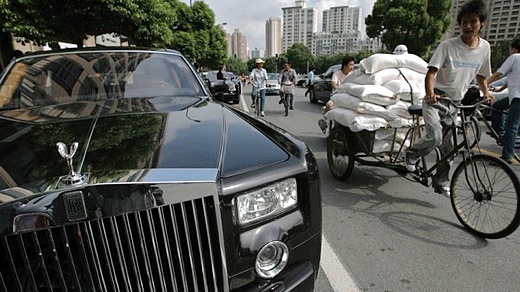
Image above: A man on a cargo bike passes a Rolls Royce in China. From (http://www.bbc.com/news/world-asia-china-20024880).

Funny how everyone thought China would get old before it got rich. The opposite seems to be true.

A new Boston Consulting Group study shows America's lock on the most-millionaires title may be in jeopardy after a surge in Chinese wealth.

The Middle Kingdom surpassed Japan and Europe in the most recent survey, boasting 2.4 million millionaires. That's still far off the U.S.'s 7.1 million, of course. But the absence of transparency in China and the vast networks that exist to spirit wealth into bank accounts overseas makes it a sure bet BCG's figure is wildly conservative.

This should be good news for a Communist Party trying to transform "poor" China into a prosperous nation, right? In fact, this millionaire bubble is dangerous for two reasons. One, it's raising the odds of social instability. Two, as the ranks of those profiting from the status quo grow, there's even less impetus to restructure the economy.

The first risk is straightforward enough. Even if a few million are rolling in yuan (several million, more likely), most of China's 1.3 billion people aren't. Indeed, the gap between rich and poor is among the highest anywhere. Take China's Gini coefficient, an inequality measure in which 0 represents perfect equality, while 1 means wealth is in hands of one person. The United Nations warns that a score of more than 0.4 can cause socially instability. China's was 0.55 in 2010, up from 0.3 in 1980.

Creating an oligarchy wasn't Deng Xiaoping's plan when he initiated China's economic opening in 1979. Yet the combination of huge gains in gross domestic product and an opaque political system has fueled a robber-baron culture. This reality is coming to light at an awkward moment. Try as they might, Xi Jinping's army of Internet censors can't quell the anger lighting up chat rooms, microblog platforms and text-message systems.

In March, censors struggled to tamp down outrage over reports that ex-security chief Zhou Yongkang might have amassed an estimated $14.5 billion in ill-gotten gains. Nor could Beijing control the Bo Xilai narrative a year earlier. Authorities wanted the masses to be enraged by the Chongqing Communist Party chief's disloyalty to the memory of Mao Zedong.

But all Chinese could talk about was how a modestly paid civil servant was living the high life and sending his son to Harvard. Or how Bo's extended family, according to the New York Times, quietly amassed a $160 million fortune.

Such tales are toxic for a ruling party that's become communist in name only. Bloomberg's website has been offline in China since 2012 after an expose on the estimated $376 million amassed by Xi's own family. Average Chinese are becoming savvier about the insider trading, land grabs and old-fashioned rent seeking that enriches government officials and their cronies. They're starting to realize that the "Chinese Dream" President Xi waxes on about may hold true for the 1 percent only.
That's making Xi's reform drive even more difficult.

The BCG figures are a stark reminder of the roadblocks to expanding China's services sector and reducing the role of exports and excessive investment. Think about the nature of China's recent wealth gains. From the U.S. to Southeast Asia, wealth creation has been driven by stock-market rallies. In China, the windfall has been fueled by shadow-banking vehicles like trusts, the value of which surged 81.5 percent in 2013.

How does Xi rein in this financing monster when it's enriching the very people whose cooperation he needs to retool the economy? It's hard enough to tell Chinese to accept slowing growth. How does he tell fellow officials and well-connected power brokers that they must take a bath on their trust investments in order to limit broader risks to the financial system?

More likely, this huge vulnerability will go unchecked. Xi wants to pull off a Deng 2.0, setting China on a new, more sustainable growth path. But it's the millionaires who may ultimately decide if China stops borrowing and building its way to insolvency. And their ranks are swelling as we speak.

.

Global Riot Epidemic

SUBHEAD: The unrest throughout the world is related to demise of cheap oil and rise in food prices.

By Nafeez Mosaddeq Ahmed on 3 March 2014 for the Guardian -
(http://www.theguardian.com/environment/earth-insight/2014/feb/28/global-riots-protests-end-cheap-fossil-fuels-ukraine-venezuela)


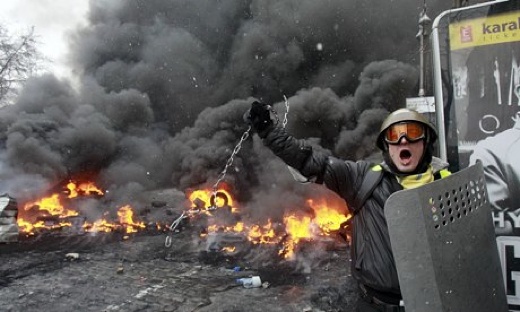
Image above: A protester in Kiev, Ukraine, swings a chainj from behind a shield while fire engulfs street. From original article.

If anyone had hoped that the Arab Spring and Occupy protests a few years back were one-off episodes that would soon give way to more stability, they have another thing coming. The hope was that ongoing economic recovery would return to pre-crash levels of growth, alleviating the grievances fueling the fires of civil unrest, stoked by years of recession.

But this hasn't happened. And it won't.

Instead the post-2008 crash era, including 2013 and early 2014, has seen a persistence and proliferation of civil unrest on a scale that has never been seen before in human history. This month alone has seen riots kick-off in Venezuela, Bosnia, Ukraine, Iceland, and Thailand.

This is not a coincidence. The riots are of course rooted in common, regressive economic forces playing out across every continent of the planet - but those forces themselves are symptomatic of a deeper, protracted process of global system failure as we transition from the old industrial era of dirty fossil fuels, towards something else.

Even before the Arab Spring erupted in Tunisia in December 2010, analysts at the New England Complex Systems Institute warned of the danger of civil unrest due to escalating food prices. If the Food & Agricultural Organisation (FAO) food price index rises above 210, they warned, it could trigger riots across large areas of the world.

Hunger games
The pattern is clear. Food price spikes in 2008 coincided with the eruption of social unrest in Tunisia, Egypt, Yemen, Somalia, Cameroon, Mozambique, Sudan, Haiti, and India, among others.

In 2011, the price spikes preceded social unrest across the Middle East and North Africa - Egypt, Syria, Iraq, Oman, Saudi Arabia, Bahrain, Libya, Uganda, Mauritania, Algeria, and so on.

Last year saw food prices reach their third highest year on record, corresponding to the latest outbreaks of street violence and protests in Argentina, Brazil, Bangladesh, China, Kyrgyzstan, Turkey and elsewhere.

Since about a decade ago, the FAO food price index has more than doubled from 91.1 in 2000 to an average of 209.8 in 2013. As Prof Yaneer Bar-Yam, founding president of the Complex Systems Institute, told Vice magazine last week:

"Our analysis says that 210 on the FAO index is the boiling point and we have been hovering there for the past 18 months... In some of the cases the link is more explicit, in others, given that we are at the boiling point, anything will trigger unrest."

But Bar-Yam's analysis of the causes of the global food crisis don't go deep enough - he focuses on the impact of farmland being used for biofuels, and excessive financial speculation on food commodities. But these factors barely scratch the surface.

It's a gas
The recent cases illustrate not just an explicit link between civil unrest and an increasingly volatile global food system, but also the root of this problem in the increasing unsustainability of our chronic civilisational addiction to fossil fuels.

In Ukraine, previous food price shocks have impacted negatively on the country's grain exports, contributing to intensifying urban poverty in particular. Accelerating levels of domestic inflation are underestimated in official statistics - Ukrainians spend on average as much as 75% on household bills, and more than half their incomes on necessities such as food and non-alcoholic drinks, and as75% on household bills.

Similarly, for most of last year, Venezuela suffered from ongoing food shortages driven by policy mismanagement along with 17 year record-high inflation due mostly to rising food prices.

While dependence on increasingly expensive food imports plays a role here, at the heart of both countries is a deepening energy crisis. Ukraine is a net energy importer, having peaked in oil and gas production way back in 1976. Despite excitement about domestic shale potential, Ukraine's oil production has declined by over 60% over the last twenty years driven by both geological challenges and dearth of investment.

Currently, about 80% of Ukraine's oil, and 80% of its gas, is imported from Russia. But over half of Ukraine's energy consumption is sustained by gas. Russian natural gas prices have nearly quadrupled since 2004. The rocketing energy prices underpin the inflation that is driving excruciating poverty rates for average Ukranians, exacerbating social, ethnic, political and class divisions.

The Ukrainian government's recent decision to dramatically slash Russian gas imports will likely worsen this as alternative cheaper energy sources are in short supply. Hopes that domestic energy sources might save the day are slim - apart from the fact that shale cannot solve the prospect of expensive liquid fuels, nuclear will not help either.

A leaked European Bank for Reconstruction and Development (EBRD) report reveals that proposals to loan 300 million Euros to renovate Ukraine's ageing infrastructure of 15 state-owned nuclear reactors will gradually double already debilitating electricity prices by 2020.

"Socialism" or Soc-oil-ism?
In Venezuela, the story is familiar. Previously, the Oil and Gas Journal reported the country's oil reserves were 99.4 billion barrels. As of 2011, this was revised upwards to a mammoth 211 billion barrels of proven oil reserves, and more recently by the US Geological Survey to a whopping 513 billion barrels. The massive boost came from the discovery of reserves of extra heavy oil in the Orinoco belt.

The huge associated costs of production and refining this heavy oil compared to cheaper conventional oil, however, mean the new finds have contributed little to Venezuela's escalating energy and economic challenges. Venezuela's oil production peaked around 1999, and has declined by a quarter since then. Its gas production peaked around 2001, and has declined by about a third.

Simultaneously, as domestic oil consumption has steadily increased - in fact almost doubling since 1990 - this has eaten further into declining production, resulting in net oil exports plummeting by nearly half since 1996. As oil represents 95% of export earnings and about half of budget revenues, this decline has massively reduced the scope to sustain government social programmes, including critical subsidies.

Looming pandemic?
These local conditions are being exacerbated by global structural realities. Record high global food prices impinge on these local conditions and push them over the edge. But the food price hikes, in turn, are symptomatic of a range of overlapping problems. Global agriculture's excessive dependence on fossil fuel inputs means food prices are invariably linked to oil price spikes. Naturally, biofuels and food commodity speculation pushes prices up even further - elite financiers alone benefit from this while working people from middle to lower classes bear the brunt.

Of course, the elephant in the room is climate change. According to Japanese media, a leaked draft of the UN Intergovernmental Panel on Climate Change's (IPCC) second major report warned that while demand for food will rise by 14%, global crop production will drop by 2% per decade due to current levels of global warming, and wreak $1.45 trillion of economic damage by the end of the century. The scenario is based on a projected rise of 2.5 degrees Celsius.

This is likely to be a very conservative estimate. Considering that the current trajectory of industrial agriculture is already seeing yield plateaus in major food basket regions, the interaction of environmental, energy, and economic crises suggests that business-as-usual won't work.

The epidemic of global riots is symptomatic of global system failure - a civilisational form that has outlasted its usefulness. We need a new paradigm.

Unfortunately, simply taking to the streets isn't the answer. What is needed is a meaningful vision for civilisational transition - backed up with people power and ethical consistence.

It's time that governments, corporations and the public alike woke up to the fact that we are fast entering a new post-carbon era, and that the quicker we adapt to it, the far better our chances of successfully redefining a new form of civilisation - a new form of prosperity - that is capable of living in harmony with the Earth system.

But if we continue to make like ostriches, we'll only have ourselves to blame when the epidemic becomes a pandemic at our doorsteps.

.

Europe Disintegrating

SUBHEAD: You're dreaming if you think that the European crisis is resolved... or even salvageable.

By Raul Ilagi Meijer on 24 September 2012 for Automatic Earth - (http://theautomaticearth.com/Finance/youre-dreaming-if-you-think-the-euro-crisis-is-resolved.html)


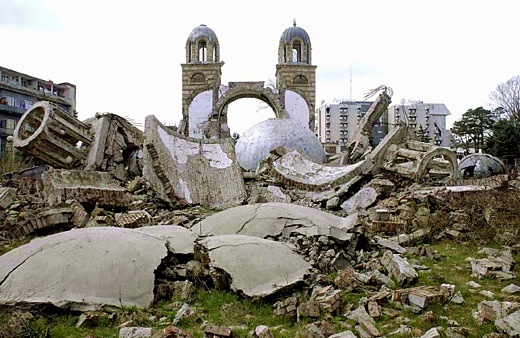
Image above: Ruins of the Serbian Orthodox Cathedral of the Holy Trinity in Djakovica destroyed by ethnic Albanians in July 19999. From (http://www.kosovo.net/systematic_destruction.html).

The German edition of Der Spiegel opens the new week on Monday morning with a series of articles on the European situation, which make clear, as if that were still necessary, that Europe is still an absolute mess. You know, just in case you thought it was not. That Mario Draghi's latest unlimited whatever it is had somehow chased away the demons.

First, Der Spiegel writes that the Greek deficit is twice as high as previously thought,, at €20 billion, according to a preliminary version of the long awaited troika report. The gap has to be closed for the next tranche of bailout money to be paid.

Second, eurozone countries plan to let the ESM balloon to over €2 trillion ($2.6 trillion) . Remember that the German Constitutional Court limited Berlin's part to about €119 billion recently. Creative accounting to infinity and beyond. The efforts to keep the union together will blow it apart.
Third, former German FInance Minister Steinbrueck works on a banking plan that would split up investment and retail activities for Germany's banks (including Deutsche), think Glass Steagall.

He wants to ban commodities speculation. And he wants a bank-ESM, a fund paid for by banks that can be used to bail them out, rather than taxpayer money.

There's lot more going on, and going wrong, in Europe, no matter what Draghi does, and no matter what plans José Manuel Barroso unveils. When I saw that the latter was seriously talking about establishing a European army, I couldn't help thinking: will it bring all those translators to the battlefield too?

Europe is not a country, it is not a culture, and it is not a language. It is a loose union that consists of many of each. Europe can hold together in times of plenty, and it will fall apart in meagre times. The only thing Europeans have power over - to a degree - is how the process of unravelling will unfold; they can't stop the process. The present attempts to hold the union together at all costs will be extremely costly, they have zero chance of succeeding, and they will lead to violence. The alternative, an attempt to live together as good and peaceful neighbors outside of a currency union, is not even considered. And I'm pretty sure it won't be until it's too late.

Hedge fund king Ray Dalio last week expressed the same fears I have been hammering on for months now, see for instance Project Europe is Over, Dear Angela, It's Time To Do The Right Thing and A Big Bad Brick Wall. I will always be reluctant to evoke Hitler's name, because it will inevitably be interpreted by many people as over the top fear-mongering, and because of the WWII survivor stories I grew up with, but the principle remains the same. A few weeks ago, I finally did resort to using the name, for the simple reason that in my view the threat in Europe is growing by the day:

Europe is creating conditions - of misery, poverty and hopelessness - in a number of its member states [..], that are not unlike those that provided the space needed by the likes of Hitler and Mussolini to rise to power in the 1920s and '30s. And that is a grave danger.

Now, Dalio says this:

RAY DALIO: I don't know whether we're beyond the point of being able to successfully manage this. And I worry then about—social disruption. I worry about—another leg down in the economies—causing—social disruptions. Because deleveraging—can be very painful, it depends how they're managed.

But when people—get at each other's throat, the rich and the poor and the left and the right and so on, and you have a basic breakdown,that becomes very threatening. And for example, Hitler came to power in 1933, which was the depth of the Great Depression because of the social tension between the factions. So I think it very much is dependent on how the people work this through together and worry about the social elements.

I can only hope that more people wake up to this, and that the people who lead the continent into these dangers will be relieved from their positions before they can do more harm. Hey, I can hope...

Still: "How the people work this through together"? They obviously don't. It's one-way traffic all the way. Conditions and demands are imposed upon people who have no say in how their politicians, elected or not, react to them. It's the bullies vs the bullied, working all the way down the chain of command.. The troika bullies Spanish PM Rajoy, and he turns around and tries to bully Artur Mas, the President of Catalunya.

And as long as the IMF is allowed a seat at the various tables from which it can demand and impose, that is not going to change. The Fund's "reform" demands, based on Milton Friedman's Chicago School shock capitalism, tried, tested, and fine-tuned in South America, Asia and Eastern Europe, are still the sole religious mantra. These days, that is true for the EU as much as for the IMF, as I documented in Hungary Says The IMF And EU Want To Make It A Colony Of Slaves.

Is this because nothing has been learned from past failure doctrine disasters? No, on the contrary, it's because the approach has been so spectacularly successful for the IMF's main donors and puppetmasters. What have been calamities for the people of the countries concerned have also been both the sparkplugs and the fuel for the engine of increasing political power the puppeteers have obtained through the IMF. And this time around they're set on doing themselves one better. This time they are aiming to buy up the Acropolis and the Coliseum.

And it's really simple from thereon in. It makes no difference whether you call it shock doctrine or 21st century imperialism or hostile takeovers, you can't take away from the people of Greece, Italy and Spain all the monuments of their past, as well as all powers they have over their own economies, production facilities and agriculture, and expect them to take that lying down. Not going to happen.

That's what makes the situation in Europe so dangerously volatile today. And it will all spread further too. We will end up with large parts of Europe being de facto owned by international conglomerates, who will use this ownership to drive up prices for essential services, food, electricity, water, housing etc. While at the same time IMF-style "reforms" will drive wages down.

The politico-banking class are all sitting there smugly and comfy in their bought-on-someone-else's-credit plush offices, picking through the still rich and splendid spoils of once proud nations and fiercely independent peoples. And even if they do win some of the preliminary battles at the negotiating table, the real ones can be won only through the use of violence.

There isn't much time left until that becomes a realistic threat, which means that now is the time for the people of Europe to decide whether they want to go down that road or not. And if they don't, they need to draw conclusions and accept the potential consequences of that decision: Get up, Stand up. And no, I don't have a lot of faith that they will. But I do hope that more people will now start to clue in on what that means: yes, violence.

Czech President Václav Klaus gives his view in the Telegraph this weekend. Klaus is not my favorite person, he's certainly no Václav Havel, but he provides a few good insights here.

The new push for a European Union federation, complete with its own head of state and army, is the "final phase" of the destruction of democracy and the nation state, the president of the Czech Republic has warned.

In an interview with The Sunday Telegraph, Václav Klaus warns that "two-faced" politicians, including the Conservatives, have opened the door to an EU superstate by giving up on democracy, in a flight from accountability and responsibility to their voters. "We need to think about how to restore our statehood and our sovereignty. That is impossible in a federation. The EU should move in an opposite direction," he said.

Last week, Germany, France and nine other of Europe's largest countries called for an end to national vetoes over defence policy as Guido Westerwelle, the German foreign minister, urged the creation of a directly elected EU president "who personally appoints the members of his European government".

Mr Westerwelle, in a reference to British opposition, called for nation states to be stripped of vetoes on defence to "prevent one single member state from being able to obstruct initiatives" which "could eventually involve a European army".

The new offensive followed the unprecedented declaration by the Commission's president, José Manuel Barroso, during his "state of union" address to the European Parliament on 12 September, that he would make proposals for a fully-fledged EU "federation" in 2014. "Let's not be afraid of the word," he said.

[..] Mr Klaus described Mr Barroso's call for a federation, quickly followed by the German-led intervention, as an important turning point.
"This is the first time he has acknowledged the real ambitions of today's protagonists of a further deepening of European integration. Until today, people, like Mr Barroso, held these ambitions in secret from the European public," he said. "I'm afraid that Barroso has the feeling that the time is right to announce such an absolutely wrong development. "They think they are finalising the concept of Europe, but in my understanding they are destroying it." [..]

"When it comes to the political elites at the top of the countries, it is true, I am isolated," he said. "Especially after our Communist experience, we know, very strongly and possibly more than people in Western Europe, that the process of democracy is more important than the outcome". [..]

In his book, Europe: The Shattering of Illusions, to be published by Bloomsbury on Thursday, Mr Klaus makes the case that the EU has evolved into its current form because political leaders have found it convenient to turn away from their nation states, where voters have historically been able to hold them to account.
 
"Political elites have always known that the shift in decision-making from the national to the supranational level weakens the traditional democratic mechanisms (that are inseparable from the existence of the nation state), and this increases their power in a radical way. That is why they wanted this shift so badly in the past, and that is why they want it today," he writes.

"The authors of the concept of European integration managed to short circuit the minds of the people, making a link between Hitler's aggressive nationalism (nationalism of a totally negative type) and the traditional nation state, calling into question the existence of nation states in general. Of the many fatal mistakes and lies that have always underpinned the evolution of the EU, this is one of the worst."

Mr. Klaus has kept his country out of the eurozone, a wise decision, since the Czech Republic was in no better position than Greece was when it joined the euro, and might well have ended up where Greece presently is.

The peaceful split between the Czech and Slovak parts of Czechoslovakia in 1994 will probably be talked about a lot in the coming years, if only because it went directly against he trend of unification. Had similar wisdom been used in Yugoslavia, we might have been spared a lot of violence. When there no longer is an economic reason for regions to stay together that have their own culture, history and language, then these regions will split up. That is not a disaster. Big is not better.

There were a million and a half people in the streets of Barcelona to celebrate Diada, the national holiday of Catalunya (I like their spelling so much better...) the other day. For the Catalans, independence is a done deal, it's just matter of time. They're on their way there, and they intend to continue on that way. Spain's refusal to let Catalunya control its own taxes, as well as a verdict by the Madrid Constitutional Court against a plan accepted by its own parliament to give regions more self-control sealed the deal.

The government in Madrid, however, calls the plan "illegal, unthinkable, lethal". The Spanish army is threatening to "crush the vultures". That sounds a lot more like Yugoslavia than like Czechoslovakia.

But it is the inevitable future of Europe. If and when Catalunya secedes, the Spanish Basque region will soon follow. The French Pays Basque will insist on joining it. Scotland? Wales, anyone? There will be many regions in many countries that will resist central governments increasingly feeding, like Rome did when its wealth was running out, on their peripheries.

People with distinct cultures, histories and languages will feel that they are better off governing themselves. And in many cases they will be right. They will realize that times will be economically much harder no matter what they do, so they might as well do it alone.

What Europe should be doing is recognizing these situations early, and facilitating cries for independence where these cries are loud and clear. It does no such thing. Europe's leaders want to intensify the union, not allow it to break up.

But Catalan polls show a majority of the people are for independence. And there is a UN charter that guarantees a people the right of self-determination. Still, the Spanish army vows to crush the vultures. Europe had better come to its senses fast.

The fate of the continent and its people is presently in the hands of a group of bankers, technocrats and delusional politicians. That fate needs to be clawed out of those white-knuckled fingers, and fast, or we will see a lot of blood in the streets.

UPDATE September 25: One day after I wrote the above, Ambrose Evans-Pritchard comes with Be Very Careful, Beloved Spain , in which he outlines the same danger I did, with the Spanish army threatening the Catalans. He ends with:

"People sometimes ask when I became a pessimist. The answer is the summer of 1991 when I accompanied Serb troops into the Baroque city of Vukovar – shattered by howitzer shelling within a comfortable drive from Vienna, and strewn with the bodies of dead children – and watched 300 wounded prisoners taken from hospital. I assumed they were at last safe. We learned later that they were machine-gunned shortly afterwards at a collective farm nearby.
The unthinkable was happening before my eyes, though it was small in scale compared to the slaughter of 8,000 Bosnian Muslim men and boys at Srebrenica, which I later covered at a trial in The Hague.

When things go wrong, they really go wrong. Cuidado, Querida España."

I think we all need to be very careful, not just the Spanish and the Catalans.

And Nigel Farage:
“What is really happening here is the eurozone crisis is so serious, and so dire, public opinion across Europe is turning so quickly in every country against the project, that what they are trying to do is seal and complete the project before everybody really wakes up to what’s being done in their name.”

“That’s what they are about. We are now entering the end game in what has been a 50 year political project. This is all going to come to a very dramatic head over the course of the next two years....

The end game for them is to effectively abolish the nation states of Europe, to completely abolish any concept of national democracy, and to vest all power, all the attributes we associate with normal countries, that is all to be vested in this new European political class.
.

DHS to the rescue

SUBHEAD: The Department of Homeland Security is planning on facing the American people with new heavily armored vehicles.

By Mac Slavo on 12 September 2012 for SHTFplan.com -
(http://www.shtfplan.com/headline-news/what-are-the-milipolice-planning-on-doing-with-these-heavily-armored-vehicles_09122012)


Image above: Armored MaxxPro acquired by the department of Homeland Security. From original article.

With a massive biometric FBI surveillance system going live across the United States in recent weeks, tens of thousands of drones to be flying over American skies within just a few years, over 1 billion rounds of ammunition being acquired by non-military government agencies, and host of laws and executive orders outlining military and police emergency response plans to lock down the United States, it isn’t much of a stretch to suggest that our government is preparing for something that aims to fundamentally transform America as we know it today.

New evidence for a coming lock-down of America is presented to the public by citizen journalists and alternative media on an almost weekly basis, which suggests that whatever is being planned is on a much more accelerated schedule now than ever before.


Image above: Note stenciled "Police/Rescue" to make it seem they'll be looking out for your interest. From original article.

The latest, from alternative news hub Rense.com, indicates that Department of Homeland Security is expecting significant push-back in the very near future, which explains why they would need some 2,500 heavily armored vehicles with DHS Police/Rescue logos:
What could they need equipment like this for here in the US?  They are hitting the road with it.  Caravans of National Guard equipment but with new never before seen equipment in the convoys. Take a close look at what is painted on the side of the Black Humvees. The Humvees are fully armored the same standard used by our military.

The use of the word ‘Rescue’ is an obvious psy op…makes it sound nice and benign, kind of like a life-saving paramedic ambulance and not a domination and death machine.  The Posse Comitatus Act is gone.

They are gearing up for serious business and are training the National Guard, FEMA and Police with them.  The latest batch of 2,500 GLS vehicles don’t come more heavily-armored.  The GLS is the larger vehicle on the trailer below. It is a deadly serious piece of equipment and they have never been used inside the US until now.  All information in this email has been released publicly.

Image above: MaxxPro MRAP armored vehicle on flatbed truck. From original article.

The United States government is and has been planning for unlikely events like war and societal collapse for many years. This year President Obama has implemented, by Executive Order, doomsday response plans that would essentially give the government an unprecedented ability to nationalize large industries, personal farm and ranch land, and even your skills and labor in the event of a declared emergency. A control grid is being put into place to handle what they know is coming.
The only question is: What, exactly, is it that is coming to America?


DHS MaxxPro Specifications
By Truther on 7 September 2012 for Pakalert Press
(http://www.pakalertpress.com/2012/09/07/dhs-ramps-up-to-subdue-and-kill-americans/)

The International MaxxPro is Navistar Defense’s Mine Resistant Ambush Protected (MRAP) vehicle and incorporates the latest design in armoring technology. Extensively tested by the military and used in theater today, the MaxxPro features a V-shaped hull and other design features that greatly improve survivability. With so much protection, it’s the vehicle that every crew wants when they’re out in the field. MaxxPro MRAP specifications:
Length: 254″ (21.2 feet)
Width: 102″ (8.5 feet)
Height: 120″ (10 feet)
Wheel base: 153″ (12.8 feet)
Curb weight: 37,850 lbs. (18.9 tons)
Engine: MaxxForce 9.3 Diesel 
The MaxxPro MRAP is built to withstand ballistic arms fire, mine blasts, IEDs, and other emerging threats. Its V-shaped hull helps deflect blasts out and away from the crew and its armoring can be customized to meet any mission requirement.

The installation contract retrofits 2,717 vintage MaxxPro vehicles (work performed in West Point, Mississippi) with a new rolling chassis. This chassis enhancement included the addition of the DXM™ independent suspension, a MaxxForce® 9.3 engine, and a 570 amp alternator and driveline. The work was completed at the end of May 2012.

.

The Rising

SUBHEAD: It's the fruit of utterly failed moral leadership in a rudderless society adrift on a sea of delusion.  

By James Kunstler on 16 July 2012 for Kunstler.com -  
 (http://kunstler.com/blog/2012/07/the-rising.html)

 
Image above: The "Star Jammer". A flying wooden ship suspended on balloons. From (http://community.wizards.com/prom/blog/2012/05/15/star-jammer:_flying_sailing_ship).

The word lamppost is popping up lately with alarming frequency in connection with the word banker in all kinds of respectable places, and I don't think this refers to, say, men in Armani suits searching for their car keys where the light is shining on the sidewalk after quaffing a few rare cuvee jeroboams of Louis Roederer Cristal. Rather, it seems to suggest a certain unease with the levers of jurisprudence in this republic of grifters, stooges, and bought-off lackeys.

Also of late come rumblings from the most august newspaper in the land that certain questions concerning LIBOR-fixing among American bank officials might soon be entertained in a federal courtroom. But isn't it a fact that the US Department of Justice has its hands full - not to mention its dockets - with cases of alleged performance-doping by star athletes? Just think: all that effort (and expense!) at repeated prosecutions and Roger Clemens remains at large! His fastball might yet shred the constitution and dishonor all the combined sacrifices of our men in uniform in countless heroic wars.

Meanwhile, has The New York Times sent a reporter to chat up the elusive John Corzine? It must be an easier job than, say, trekking to a cave in Tora Bora to interview the late Mr. Osama bin Laden - which a few plucky reporters actually accomplished back when - yet Mr. Corzine is now better hidden than the Orang-pendek of Sumatra. And higher-functioning, too, considering his current role as Uncle Scrooge McDuck to the Obama reelection campaign. In what 5th sub-basement of a Robert A. M. Stern-designed luxury high-rise does Mr. Corzine sit with his moneybags of purloined MF Global customer funds writing checks to the Democratic National Committee?

All this is to say that when a few lame rumors of prosecutorial zeal appear in old gray mouthpiece for the status quo, you can bet that the true tipping point of public impatience has probably been breeched and the fall of the elites is closer than you think. In the sizzling sauna that the US has become under the regime of climate change denial, the black swans of political turmoil are moistly hatching. Who knows what form the mischief might take and how the trouble starts. Perhaps a hostage crisis at the Maidstone Club where families of a dozen hedge fund chiefs are held in the pool house by an out-of-work pipefitter from Wantagh high on bath salts. Or a swindled soybean farmer in a Semtex-rigged vest pays a call on the PFG-Best futures trading headquarters in Cedar Falls, Iowa, just as the lawyers and their financier clients sit down in the conference room to an ordered-in lunch of sloppy joes, fries, and slurpees. Or maybe a part-time evangelist off his Zoloft in some broiling strip-mall in a bankrupt California shit-hole sees the numbers 666 resolve among the remnants of his half-eaten enchilada on a Mitt Romney for President commemorative plate and packs up an arsenal of legally-acquired small arms for his journey to the Republican Convention in Tampa....

This is, after all, the country where the Kardashians reign. Anything might happen.

This is also the fruit of utterly failed moral leadership in a rudderless society adrift on a sea of delusion and untruth in an age of accounts unsettled. The battle over which empty suit gets elected president is a preface to the discovery that the national government only pretends to be in charge of anything. As the reality of total, comprehensive bankruptcy simmers up, perhaps a critical number of citizens stop forking over their quarterly taxes - since it would be the same thing as pounding sand down a rat-hole. Then, things really go south governance-wise. The next revolution in North America could make 1793 Paris look like an Ace of Cakes episode. Lamppost lynchings will seem too merciful. Rather, look for a new realty TV launch: Kardashian Kangaroo Kourt, in which every week a score of obscenely wealthy celebrities plucked from the realms of banking, showbiz and politics are dragged over three miles of barrel cactus in the Cabeza Prieta National Wildlife Refuge behind a Dodge Mopar-loaded Ram Runner (mostly American-made).

In the meantime, let's just all kick back these hot summer nights on the front porch with a few vodka and Red Bulls and enjoy Jack Abramoff's new radio show on Clear Channel in which the re-branded "lobbying reformer" offers advice on improving the transaction of public business in our nation's capital. This is Mr. Abramoff's first job since completing his prison work-release gig in a kosher Baltimore pizza store. God bless you, Jack..

Welcome to the Wormhole

SUBHEAD: The "global slowdown" is a compressive collapse of a system plagued by deception and massive cross-defaults. By James Kunstler on 4 June 2012 for Kunstler.com - (http://kunstler.com/blog/2012/06/welcome-to-the-wormhole.html) Image above: "Wormhole" animation by Eric Lindahl. From (http://www.mnartists.org/work.do?rid=164912). Now we get to the really fun part of the global unwind where even money flowing into supposedly safe havens turns, presto change-o, into an evaporation of wealth, and all of the lawyer-lobbyists who ever double-parked on K Street in the sorry history of this frantic era will not avail to contain the demons of their own design.
The world is waiting to re-learn an old lesson: that untruth and reality exist in an adversarial relationship. Sad to say, there isn't enough legal infrastructure in the world, nor enough time, to pass judgment on all the lies and misrepresentations that burden the current edition of what passes for civilization. This goes especially for money matters, where currencies, certificates, and contracts actually have to represent what they purport to stand for. When those relationships fail, as they have been doing for some years now, everything falls apart.
This is what comes of evading the enforcement of norms and standards and of running exchanges without clearing operations. The response to this mischief in deeds such as the Dodd-Frank so-called financial reform act only heaps more hyper-complex untruth on the smoldering compost of prior intentional falsities. It all seems so hopelessly abstract that even thoughtful citizens can't muster the means to object until that magic moment when, say, the supermarket shelves go empty or nobody will accept the green paper cluttering up your billfold.
For all the epic volume of blather on the Internet and elsewhere, few have even remarked on extraordinary passivity of the vulgar masses in the face of having their future looted out from under them. The ethos of the penitentiary must have saturated the zeitgeist wherein you are expected to just bend over and take it good and hard where the sun don't shine and then you are rewarded with a baloney sandwich. At least that's been the theme since 2008.
The way things are lining up, though, it might be a whole different story when the two political parties convene this summer for their nominating rigmarole. I remain convinced that these fatuous rites will meet with disruption. Of course, both parties deserve an equal dose of citizen-generated shock and awe. Both parties need to be rebuked, humiliated, and probably dismantled so that this country can get on with the business of trying to become civilized. Charlotte, NC, (the Democrats) and Tampa, FLA, (Republicans) are the venues for these dumbshows. I hope to be there running a pitchfork concession.
Meanwhile, as what many observers call a "global slowdown" reveals itself to be a compressive collapse of faith in a system plagued by deception and pranged by massive cross-defaults, political uproar will rage through Europe and set the stage for emulation in the USA. Angela Merkel made a funny over the weekend: something about constructing a European fiscal union. That has about the same chance of happening as Mrs. Merkel becoming a pole dancer when her party gets tossed out of leadership not many months down the line. All the nations where people wear clothing are in desperate trouble. Their debt problems are insoluble and they're out of accounting tricks. Events are running way ahead of institutions and personalities.
Speaking of which, what dogs me more and more every day is how come Jon Corzine is still at large six months after mugging MF Global's customers, and what is the status of JP Morgan's "London Whale" fiasco now that the news media have conveniently stopped following the story. Have the losses blown past $5 billion? Or is that just one little tuft of yarn which, when yanked, will unravel the entire skein of world banking? Well, it's party season in the Hamptons now and the gentlemen responsible for these misdeeds are busy nibbling the sea urchin roe and cucumber tidbits, I suppose, and it would be unkind to ask them to testify before a congressional subcommittee or, jeepers, a grand jury.
Ever wonder what it might be like to live in a world without consequences? Well, you've had a good look at it for more than a couple of years. How did it work out? What did you get away with? And how do you plan to hang onto it?
.

The Twilight of Protest

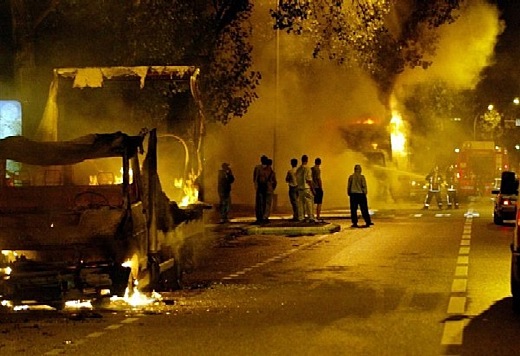
SUBHEAD: The change on the individual, family, and community level that will have the most to offer the world. By John Michael Greer on 15 May 2012 for the Archdruid Report - (http://thearchdruidreport.blogspot.com/2012/05/twilight-of-protest.html) Image above: Local youths watch firemen extinguish burning vehicles during clashes in the Paris suburb of Aulnay sur Bois, November 3, 2005. From (http://blogs.reuters.com/faithworld/2010/12/02/scathing-u-s-view-of-french-unrest-and-muslim-integration-in-wikileaks/).
Over the last four months or so, as this blog has sketched out the trajectory of empires in general, and then traced the intricate history of America’s empire in particular, I’ve been avoiding a specific issue. That avoidance hasn’t come from any lack of awareness on my part, and if it had been, comments and emails from readers asking when I was going to get around to discussing the issue would have taken care of that in short order. No, it’s simply a natural reluctance to bring up a subject that has to be discussed sooner or later, but is guaranteed to generate far more heat than light.
The subject? The role of protest movements in the decline and fall of the American empire.
That’s an issue sufficiently burdened with tangled emotions and unstated agendas that even finding a good starting place for the discussion is a challenge. Fortunately I have some assistance, courtesy of Owen Lloyd, who is involved with an organization called Deep Green Resistance and recently wrote a review of my book The Blood of the Earth. It’s by no means a bad review. Quite the contrary, Lloyd made a serious effort to grapple with the issues that book tried to raise, and by and large succeeded; where he failed, the misunderstandings were all but inevitable, given the differences between his views and mine. Thus it’s all the more striking that his review points up so precisely the reasons why protest movements have by and large been spinning their wheels in empty air for thirty years, and will almost certainly continue to do so while America’s empire crashes and burns around them.
The point that matters here is the review’s denunciation of one of the central points of the book, which is that those who want to change the world need to start by changing their own lives. According to Lloyd, we don’t have time for that, since the biosphere is in dire peril; what’s needed instead are the standard tools of contemporary activism—"direct action, community building, and outreach," in his convenient summary. His reasoning is logical enough, as far as it goes; if your house is on fire, after all, it’s a little late to install sprinklers and smoke alarms. If the situation is as urgent as Lloyd claims, all other considerations have to take a back seat to an all-out effort to deal with the immediate crisis with the most effective means available.
It’s a common enough claim in the contemporary activist community; Derrick Jensen had an article in Orion Magazine a few years back making essentially the same argument. Still, there’s a problem with that argument, because the responses Lloyd, Jensen, and other activists are promoting here have been standard across the spectrum of activist groups for more than three decades now, and that’s more than enough time to see how well they work. The answer? Well, let’s be charitable and say "not very well."
For years now, leading environmentalists have been bemoaning how much ground is being lost year after year, and how little the environmental movement has been able to do even to slow that down. They are quite correct in that assessment, of course. It’s standard these days to insist that this simply shows the power differential between the corporate interests that profit from environmental destruction and the citizen groups that are trying to fight them. That argument seems convincing, too, so long as you do what most people these days are taught to do, and ignore the lessons of history.
Glance back to a slightly earlier period and at least one of those lessons stands out in bold relief. In the 1970s, environmental activists facing equally powerful and well-funded corporate interests built a mass movement and forced through landmark legislation. In the United States, the Clean Air Act, the Endangered Species Act, and a bevy of less famous but equally important environmental bills crashed through a wall of corporate opposition and became the law of the land. That sort of success is something that today’s environmental activists can only daydream about, and it was accomplished using the same tools that activists use today—with one important addition: the environmental activists of that time recognized that the most effective way to advocate any given change was to make that change in their own lives first. That awareness was not limited to the environmental movement; it was pioneered by the feminists of the 1960s and 1970s, in fact, who turned it into a core principle of their movement—"the personal is political"—and leveraged it efficiently to bring about dramatic if still incomplete gains in women’s rights. They recognized, as did many other activists in those years, that if your lifestyle supports a system, and depends on that system, any efforts you may think you’re making to force significant change on that system will be wasted breath.
It will be wasted breath because most people, reasonably enough, want to see that there’s a life worth living on the other side of the changes your activist movement wants to make, and the best way to give them a glimpse of that life is to enact it yourself. It will also be wasted breath because most people have a tolerably good nose for hypocrisy, and are highly familiar with the kind of demagogy that calls on everybody else to make sacrifices and get by with less so the demagogue doesn’t have to do so. Talk to Americans who didn’t support either the climate change movement or its corporate opposition, and you’ll find that for a good many of them, it was when word of Al Gore’s air-conditioned mansion and frequent-flyer miles got around that they decided that global warming was yet another manufactured threat, meant to stampede people into acquiescing with somebody’s political agenda.
Finally, it will be wasted breath because if the system you think you want to change is also the system that supplies you with a comfortable middle class lifestyle, with all the comforts and conveniences that such a lifestyle supplies, the changes you will push the system to make will pretty reliably be limited to those that will not affect your continued access to the lifestyle, comforts and conveniences in question. The Breton peak oil blogger Damien Perrotin has commented amusingly on the influence of what, in France, are called bobos—that is, bourgeois bohemians (the acronym works equally well in both languages), members of the liberal upper middle classes. Bobos are terribly eager to see themselves as the saviors of the world—that’s the bohemian side—and will do absolutely anything to fulfill this role, so long as it doesn’t require them to give up any of the benefits of their privileged status—that’s the bourgeois side.
I hope the term catches on in this country, because we have a lot of bobos over here, too. Last week’s discussion of captive constituencies has a special relevance in any discussion of the species Bobo americanus, because being active in the captive constituency of some otherwise mainstream political faction is a very popular way to play the role of saving the world without risking disruption to the system that gives bobos their privileged status. There are also substantial personal rewards available for those who take leadership positions in captive constituencies, and help keep them captive. It’s a role bobos are well qualified to fill, especially those who come from the upper end of the class hierarchy and so have the connections and skills for the job. That’s where you get the executives of mainstream environmental groups who draw six-figure salaries, maintain cordial relationships with corporate sponsors, and show an obvious willingness to settle for whatever scraps may fall from the tables of wealth and power onto their corner of America’s unwashed kitchen floor.
Still, the bobo-ization of American radicalism is not limited to such obvious cases. When you hear activists loudly insisting that it’s possible to save the world without being an ascetic—and I’m sorry to say that, yes, that well-worn trope turned up in the Owen Lloyd book review cited above—you’re hearing the echoes of bobo influence, in the form of the popular but profoundly wrong notion that it must somehow be possible to maintain today’s unsustainable lifestyles on a sustainable basis. That’s not going to happen, for reasons that reach right down into the laws of thermodynamics; no amount of handwaving is going to make it happen; and the sooner we get used to living with a lot less, the less damage we will do to ourselves, each other, and the Earth as the industrial economy sputters to a halt.
Now of course that suggestion is anathema to the existing order of things, in America and elsewhere. It’s usually anathema in a declining imperial society. James Francis’ useful study Subversive Virtue: Asceticism and Authority in the Second-Century Pagan World chronicles how the imperial Roman government came to treat the asceticism of Stoic and Neoplatonic philosophers as an unendurable threat to its authority. They were quite correct to do so; a system that maintains itself in power by bribing the lower classes with panem et circenses and the middle and upper classes with the more lavish entertainments chronicled in Petronius’ Satyricon has no convenient lever with which to control those who have no interest in these things.
Thus it’s probably safe to assume that there will be no effective opposition to the status quo in this country until some movement arises that in practice—not just in theory—embraces an essentially ascetic approach. My guess, for what it’s worth, is that the first movement to do so will be a revived Marxism. I’m no fan of Karl Marx, and even less a fan of the various ideologues who filled out the framework of his system, but Marxism has features that will give it powerful appeal in the decades ahead. It gives the poor someone to blame for their misfortunes, and does so in a far more detailed manner than (say) the vague rhetoric of the Occupy movement; it is among the few ideologies that manage to fuse a rigorous intellectual tradition with a utopian future vision of religious intensity; and it has a strong ascetic element—the figure of the Marxist revolutionary, lean, passionate, doctrinaire, and contemptuous of material goods except insofar as they might help further the cause, was a common social type in Europe for close to a century.
Marxism also has an advantage just now that no amount of money could buy it: the extraordinary campaign of unintended propaganda that the Republican party is currently carrying out on its behalf. Right now, even the most moderate and revenue-neutral attempts to use the powers of government for the benefit of American citizens are being lambasted by the GOP as communism. It’s an embarrassing admission of intellectual poverty—one gathers that the American right spent so long belaboring the Red Peril that it really has no idea what to say now that communism isn’t around any more—but it also guarantees a familiar kind of backlash. Fundamentalist churches that spend too much time denouncing Satanism, complete with lurid descriptions of Satanic living replete with wild parties and orgiastic sex, get that kind of backlash; that’s why they so often find that they’ve merely succeeded in making devil worship popular among local teens.
In the same way, if the Republicans succeed in rebranding, say, public assistance and food safety laws as Marxist, the most likely result of that campaign will be to convince a great many Americans of otherwise moderate political views that Marx might have had something going for him after all. As suggested above, I don’t consider this a good thing; in theory, Marxist revolution leads to the glorious worker’s paradise of the future via the inevitable workings of the historical dialectic, but in practice the dictatorship of the proletariat reliably turns into just another dictatorship, with the usual quota of gulags and unmarked mass graves. Still, in a country where most people are frighteningly ignorant of history, and are being driven to the wall by a corrupt and spectacularly mismanaged imperial economy in headlong decline, it’s unpleasantly unlikely that this point will be remembered.
Still, other forces are pushing American society toward a crisis that its existing political and economic arrangements are unlikely to survive, and the rehabilitation of Marxism is unlikely to proceed fast enough to reach any sort of critical mass before that crisis hits in earnest. It’s probably a safe bet that the more mainstream groups will increasingly side with the established order of things—I’ve long suspected that before all this is over with, the Sierra Club will come out in favor of strip mining the national park system so long as it’s done in, ahem, an environmentally sensitive way. Outside the bobosphere, things are much less clear, for the twilight years of a disintegrating political system tolerably often create a fiercely Darwinian environment for ideologies and political movements, in which the only thing that matters is which set of beliefs and personalities can build the strongest coalition at the right time, absorb or marginalize the largest fraction of opposing groups, and make the most successful bid for power. As that bubbling cauldron of competing belief systems boils over in violence and systemic disruption, it’s anyone’s guess who or what will come out on top.
Whoever ends up more or less in charge of what’s left of the United States of America when the flames die down and the rubble stops bouncing, though, will have to face a predicament far more difficult than the ones encountered by the winners in 1932, or 1860, or for that matter 1776. All three of these past crises happened when the United States was still a rising power, with vast and largely untapped natural resources, and social and economic systems not yet burdened with the aftermath of a failed empire; the winning side could safely assume that once the immediate crisis was resolved, the nation would return to relative prosperity, pay off its debts, and proceed from there.
That won’t be happening this time around. When the crisis is over, whatever form it takes, the United States—or whatever assortment of successor nations end up dividing its territory between them—will be a shattered, bankrupt, resource-poor Third World failed state (or collection of failed states) that will likely have to struggle hard even to regain basic levels of political and economic stability. That struggle will be pursued in a world in which energy and other resources are getting scarcer each year, energy- and resource-intensive technologies are being abandoned by all but a very few rich and powerful nations, and unpredictable swings in temperature, rainfall, and other climatic and ecological factors make life a good deal more difficult for everyone. In that not-so-far-future America, the comforts and conveniences most of us now take for granted will be available only to the rich and powerful, if they can be had by anyone at all.
That’s the world our choices over the last three decades or so have been preparing for us, and for our grandchildren’s grandchildren. In such a world, the people who will have the most to offer their communities, their societies, and the biosphere that supports all our lives will be those who have the courage, now, to walk away from the consumer economy and its smorgasbord of dubious pleasures, and learn, now, how to get by with less, use their own capacities of body and mind, and work with the patterns and processes of nature. For the time being—specifically, until we get close enough to the crisis period that even the most nonviolent challenge to the existing order calls down massive violence in response—protest can still accomplish goals worth pursuing, especially if activists wake up once again to the power of personal example; over the longer run, though, it’s the change on the individual, family, and community level that so many of today’s activists reject as pointless that have the most to offer the world.
.