Showing posts with label Diplomacy. Show all posts

Japan struggles with Okinawa base

SUBHEAD: Katherine Muzak PHD (kmuzik@gmail.com)
SUBHEAD: Government and prefecture hold talks over relocation of U.S. Marine base in Okinawa.

By Staff on 5 April 2015 for Japan Times -
(http://www.japantimes.co.jp/news/2015/04/05/national/politics-diplomacy/suga-onaga-hold-talks-over-relocation-of-futenma-base-in-okinawa/#.VSLZ0Wb3DZN)
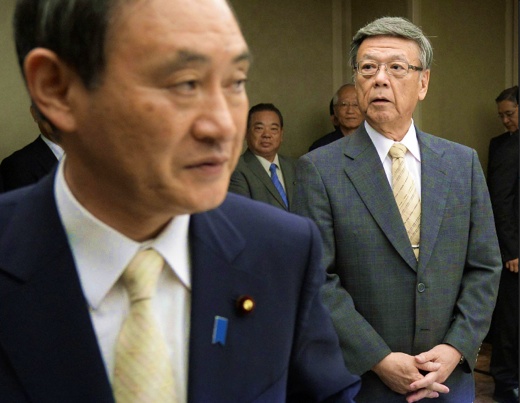

Image above: Chief Japan Cabinet Secretary Yoshihide Suga (left) and Okinawa Governor Takeshi Onaga (right) meet in a hotel in Nah, Okinawa, on Sunday. From original article.

[Source's note: It is very exciting, to see the Okinawan Governor, Onaga, supported by his long-oppressed people, at last confronting the Japanese government.  He, we, are supporting protection of the last coral reef ecosystem in Japan.]

Chief Cabinet Secretary Yoshihide Suga and Okinawa Gov. Takeshi Onaga failed to bridge their differences over the relocation plan for a contentious U.S. air base Sunday in Naha as the standoff between the central and Okinawa governments continued to roil the prefecture.

The talks are the first between Suga, Prime Minister Shinzo Abe’s right-hand man, and Onaga since he became governor in December with a pledge to block the plan to build a replacement facility for the base in a coastal area of Nago. The base is currently in the city of Ginowan.

At the meeting, which was partly open to reporters, Suga repeated the central government’s position that the relocation plan is the “only solution” when considering several factors, including Japan’s defense alliance with the United States and the need to alleviate the risk of accidents posed by the existing base.

But Onaga stuck to his guns, saying he was “convinced that the new base in Henoko can never be built.”

“You say we should shoulder (the burden of the base ) because (Futenma) is the most dangerous (one) in the world and its risks need to be removed, all the while causing the people of this prefecture great pain. Just saying that itself shows the decadence of politics in Japan.”

Suga, who doubles as minister in charge of base burden issues in Okinawa, which hosts the bulk of U.S. forces in Japan, said he hopes to regain the trust of the Okinawa residents by working with the prefectural government, while reducing their hosting duties one step at a time.

In the meantime, Onaga again requested a meeting with Abe, who has snubbed the governor during his many visits to Tokyo since taking the post.

After the roughly one-hour meeting at a hotel in the prefectural capital, Suga tried to cast it in a positive light, telling reporters the occasion marked the “first step” in advancing consultations between the central and prefectural governments.

He also indicated his willingness to consider arranging a meeting between Abe and Onaga, saying he would proceed with the idea while listening to Okinawa’s views.

See also:
Ea O Ka Aina: Fear and Hope in Oura Bay 1/27/15
The Oura Coral Reef Ecosystem is the last intact one in Japan! US military actions threaten it.

Ea O Ka Aina: RIMPAC War on the Ocean 7/3/14
Impacts on Pacific Ocean by military activity focusing on Jeju Island, Okinawa and Hawaii.

Ea O Ka Aina: Okinawa resists US Military 2/11/14
US ambassador visits Okinawa amid long-running row over US military bases there.

Ea O Ka Aina: US Okinawa base setback 1/20/14
Japanese voters re-elect mayor opposed to base complaining of pollution, crime and accidents.

Ea O Ka Aina: Okinawa breathes easier 4/27/12
Japan pays to relocate 9,000 US marines off Okinawa to Guam, Australia and Hawaii.

Ea O Ka Aina: Pacific Resistance to U.S. Military 5/24/10
From Japan to Guam to Hawaii, activists resist expansion of US military presence in the Pacific.

Ea O Ka Aina: It's Universal 1/1/2009
How the US Marines live in Okinawa illustrate how crazy we are.
.
Iranian and American Diplomacy

SUBHEAD: Foreign Minister, Dr. Javad Zarif's response to the letter of 47 US Senators to Iranian leaders.

By Staff on 9 March 2015 for Iranian Foreign Ministry -
(http://en.mfa.ir/index.aspx?siteid=3&fkeyid=&siteid=3&fkeyid=&siteid=3&pageid=1997&newsview=330948)


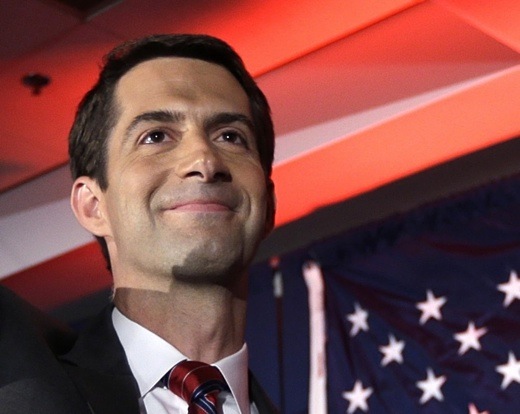
Image above: Idiot letter author Senator Tom Cotton (R-Ark). Forty-seven Republican senators signed it warning that any agreement the Obama administration strikes with Iran to limit Tehran's nuclear program may be short-lived unless Congress approves the deal. From (http://www.washingtonpost.com/blogs/worldviews/wp/2015/03/09/the-misguided-condescending-letter-from-republican-senators-to-iran/).

Asked about the open letter of 47 US Senators to Iranian leaders, the Iranian Foreign Minister, Dr. Javad Zarif, responded that "in our view, this letter has no legal value and is mostly a propaganda ploy. It is very interesting that while negotiations are still in progress and while no agreement has been reached, some political pressure groups are so afraid even of the prospect of an agreement that they resort to unconventional methods, unprecedented in diplomatic history. This indicates that like Netanyahu, who considers peace as an existential threat, some are opposed to any agreement, regardless of its content."

Zarif expressed astonishment that some members of US Congress find it appropriate to write to leaders of another country against their own President and administration. He pointed out that from reading the open letter, it seems that the authors not only do not understand international law, but are not fully cognizant of the nuances of their own Constitution when it comes to presidential powers in the conduct of foreign policy.

Foreign Minister Zarif added that "I should bring one important point to the attention of the authors and that is, the world is not the United States, and the conduct of inter-state relations is governed by international law, and not by US domestic law. The authors may not fully understand that in international law, governments represent the entirety of their respective states, are responsible for the conduct of foreign affairs, are required to fulfil the obligations they undertake with other states and may not invoke their internal law as justification for failure to perform their international obligations."

The Iranian Foreign Minister added that "Change of administration does not in any way relieve the next administration from international obligations undertaken by its predecessor in a possible agreement about Iran`s peaceful nuclear program." He continued "I wish to enlighten the authors that if the next administration revokes any agreement with the stroke of a pen, as they boast, it will have simply committed a blatant violation of international law."

He emphasized that if the current negotiation with P5+1 result in a Joint Comprehensive Plan of Action, it will not be a bilateral agreement between Iran and the US, but rather one that will be concluded with the participation of five other countries, including all permanent members of the Security Council, and will also be endorsed by a Security Council resolution.

Zarif expressed the hope that his comments "may enrich the knowledge of the authors to recognize that according to international law, Congress may not modify the terms of the agreement at any time as they claim, and if Congress adopts any measure to impede its implementation, it will have committed a material breach of US obligations."

The Foreign Minister also informed the authors that majority of US international agreements in recent decades are in fact what the signatories describe as "mere executive agreements" and not treaties ratified by the Senate.

He reminded them that "their letter in fact undermines the credibility of thousands of such mere executive agreements that have been or will be entered into by the US with various other governments.

Zarif concluded by stating that "the Islamic Republic of Iran has entered these negotiations in good faith and with the political will to reach an agreement, and it is imperative for our counterparts to prove similar good faith and political will in order to make an agreement possible."

.

Out on the Helpless Weekend

SUBHEAD:  I hope you have a good weekend, and especially if you’re in Ukraine. Take care and take shelter.

By Raul Ilargi Meijer on 14 March 2014 for the Automatic Earth -
(http://www.theautomaticearth.com/debt-rattle-mar-14-2014-out-on-the-helpless-weekend)


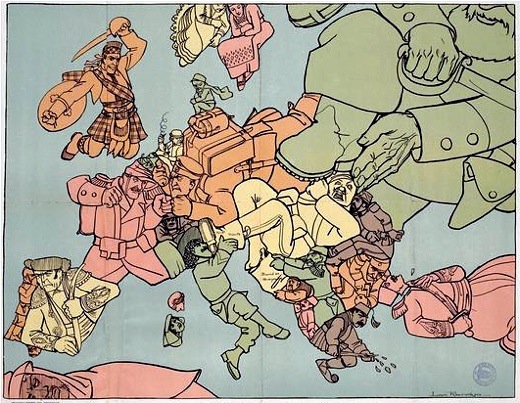
Image above: Satirical map of Europe in 1914. One hundred years ago Europe was about to enter World War I. It was all about the same part of the world kicking up sparks today. From (http://historiana.eu/collection/satirical-maps).

So what are we going to do over the weekend? For many of us it’ll be a lot of nerves and anguish over the rattling of sabres and armored personnel carriers by the Black Sea, and there’s not much we can do about it. Maybe a good time to take store of friends and loved ones, and spare a thought and prayer for all the Crimeans and Ukrainians who want nothing but what we want as well, peace and sunshine and a quiet weekend with their families.

It’s anywhere between hard and impossible to figure out what’s going on out there, but our western media sure are not telling us the truth and nothing but the truth. It’s a major propaganda bubble on all sides, and that leaves nothing but losers in its wake. It could still change the map of the world with no turning back, however, and have a lot of blood be shed in fields and city streets as it does.

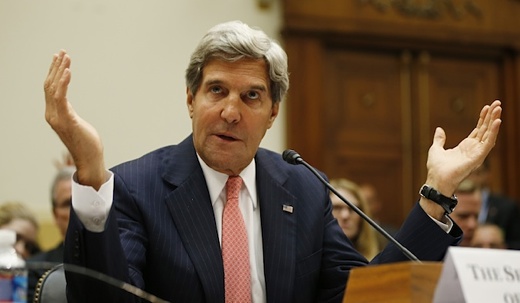
For me personally, it’s an aberration that John Kerry gets to speak for not just the US, but the entire western world, because Kerry is one of Capitol Hill’s army of borderline psycho coneheads who represent interests, not people. The man’s a stooge. Which makes it all the more interesting to see Ron Paul state that Putin has the law on his side.

And it makes one wonder why that difference in view in Washington is not debated on the Hill before Kerry moves on to his next meeting to tell the Russians to put up or shut up. If for no other reason than a message like that sounds silly coming from him, and not a single Russian is fooled.

But in the meantime this hairdo in search of working neurons could cause a lot of pain for mothers and children who happen to live in the line of fire. And we can say one more time that we expected better from Obama, but that got to sound repetitive and silly a while ago, not to mention devoid of credibility.

If things go wrong, there’s no telling what the world’s economies will look like by Monday. There’s so much zombie capital keeping the system afloat today that a mass fear driven kneejerk into what is perceived as safety could wipe out more of it than entire nations are worth. Such a move back into reality would be good on some fronts, but who wants to see lives lost over it?

What has been lost a little in translation and hubris is that China has put its voice behind Russia, but there’s no way Kerry and Merkel haven’t picked up on that loud and clear. If they want to play cops and robbers and sanctions and boycotts, they may find they’re shooting their own feet in the crazy house or mirrors they’ve created.

And even if the Kiev unrest is toned down at the last minute, there may be so much economic uncertainty shaken loose over the past while that matters start to plummet out of hand anyway.

Most pundits keep on claiming that the Chinese government has it all under control, and it’s only trying to reform the system, and isn’t that a great thing, but I’m thinking first of all Beijing has never tried anything like it, and second given the size of shadow banking one really needs to wonder how much control they actually have.

From where I’m sitting what happens in China today could just as easily be part of an ordinary power struggle, and moreover one that unfolds while the country has some very serious problems that are unrelated to whatever reform is or is not intended to take place.

That 18.1% plunge in Chinese exports is still front and center in my mind when I read the news. That’s a very big number. And when their president and PM try to make it look as if they sort of meant for events to happen as they do, and say all they really care about is creating jobs, I simply don’t see how they’re going to do that with that sort of drop in exports, the one segment in their economy that keeps the whole thing going to begin with.

We’re 2 weeks and change away from Japan’s dreaded sales tax rise, and there is just no way those two weeks will not be filled with people taken cover and seeking shelter, be they investors or ordinary citizens. There’s too much risk for everyone but a few daring risk takers. And if the deflationary last twenty years have shown us anything, it’s that the average Japanese is not a great risk taker.

So the velocity of money can only go down, and no matter what I read about inflation in Japan, that is a surefire way to get quagmired even deeper in deflation, and Abe’s stimulus to compensate for the sales tax hike won’t change that (it’ll only make that tax hike look stupid, because net revenue will be ridiculously low).

How will longer will Shinzo Abe call the shots? Hard to gauge, if only because Japan doesn’t seem to have any other way to go anymore. Unless perhaps it goes for self-sufficiency in a big way, but that’s so not 21st century and globalization and having your politics dictated by the financial system that it’s going to take a big old battle to get there. In Japan like in so many other places. I hope you have a good weekend, and especially if you’re in Ukraine. Take care and take shelter.

.

Let's you and him fight

SUBHEAD: Resource and capital scarcities drive down standards of living and lower the trust horizon in a time of failed states.

By James Kunstler on 3 March 2014 for Kunstler.com -
(http://kunstler.com/clusterfuck-nation/lets-you-and-him-fight/)


Image above: John Kerry's Lie: 'The President Is Not Asking You to Go to War'. From (http://www.theatlantic.com/politics/archive/2013/09/john-kerrys-lie-the-president-is-not-asking-you-to-go-to-war/279362/).

So, now we are threatening to start World War Three because Russia is trying to control the chaos in a failed state on its border — a state that our own government spooks provoked into failure? 

The last time I checked, there was a list of countries that the USA had sent troops, armed ships, and aircraft into recently, and for reasons similar to Russia’s in Crimea: the former Yugoslavia, Somalia, Afghanistan, Iraq, Libya, none of them even anywhere close to American soil. I don’t remember Russia threatening confrontations with the USA over these adventures.

The phones at the White House and the congressional offices ought to be ringing off the hook with angry US citizens objecting to the posturing of our elected officials. There ought to be crowds with bobbing placards in Farragut Square reminding the occupant of 1400 Pennsylvania Avenue how ridiculous this makes us look.

The saber-rattlers at The New York Times were sounding like the promoters of a World Wrestling Federation stunt Monday morning when they said in a Page One story:

“The Russian occupation of Crimea has challenged Mr. Obama as has no other international crisis, and at its heart, the advice seemed to pose the same question: Is Mr. Obama tough enough to take on the former K.G.B. colonel in the Kremlin?”

Are they out of their chicken-hawk minds over there? It sounds like a ploy out of the old Eric Berne playbook: Let’s You and Him Fight. What the USA and its European factotums ought to do is mind their own business and stop issuing idle threats. 

They set the scene for the Ukrainian melt-down by trying to tilt the government their way, financing a pro-Euroland revolt, only to see their sponsored proxy dissidents give way to a claque of armed neo-Nazis, whose first official act was to outlaw the use of the Russian language in a country with millions of long-established Russian-speakers. 

This is apart, of course, from the fact Ukraine had been until very recently a province of Russia’s former Soviet empire.

Secretary of State John Kerry — a haircut in search of a brain — is winging to Kiev tomorrow to pretend that the USA has a direct interest in what happens there. Since US behavior is so patently hypocritical, it raises the pretty basic question: what are our motives? 

I don’t think they amount to anything more than international grandstanding — based on the delusion that we have the power and the right to control everything on the planet, which is based, in turn, on our current mood of extreme insecurity as our own ongoing spate of bad choices sets the table for a banquet of consequences.

America can’t even manage its own affairs. We ignore our own gathering energy crisis, telling ourselves the fairy tale that shale oil will allow us to keep driving to WalMart forever. 

We paper over all of our financial degeneracy and wink at financial criminals. Our infrastructure is falling apart. We’re constructing an edifice of surveillance and social control that would make the late Dr. Joseph Goebbels turn green in his grave with envy while we squander our dwindling political capital on stupid gender confusion battles.

The Russians, on the other hand, have every right to protect their interests along their own border, to protect the persons and property of Russian-speaking Ukrainians who, not long ago, were citizens of a greater Russia, to discourage neo-Nazi activity in their back-yard, and most of all to try to stabilize a region that has little history and experience with independence. 

They also have to contend with the bankruptcy of Ukraine, which may be the principal cause of its current crack-up. Ukraine is deep in hock to Russia, but also to a network of Western banks, and it remains to be seen whether the failure of these linked obligations will lead to contagion throughout the global financial system. It only takes one additional falling snowflake to push a snow-field into criticality.

Welcome to the era of failed states. We’ve already seen plenty of action around the world and we’re going to see more as resource and capital scarcities drive down standards of living and lower the trust horizon. 

The world is not going in the direction that Tom Friedman and the globalists thought. Anything organized at the giant scale is now in trouble, nation-states in particular.  The USA is not immune to this trend, whatever we imagine about ourselves for now.

.

Cynical about Bahrain

SUBHEAD: Bahrain got the authoritarian lid back on, at a significant cost in national trauma, sectarian rancor and regional tension. By Fredrik Richter & Adrian Croft on 9 May 2011 for Reuters - (http://www.huffingtonpost.com/2011/05/09/bahrain-protests-news_n_859393.html) Image above: Bahrain unrest causes cancellation of Grand Prix race in the country. Ouch! From (http://www.caradvice.com.au/106037/australian-formula-one-grand-prix-to-open-2011-season-bahrain-race-cancelled/). The fate of Bahrain's protest movement is a stark reminder of how Western and regional power politics can trump reformist yearnings, even in an Arab world convulsed by popular uprisings against entrenched autocrats.

Bahrain is not Libya or Syria, but Western tolerance of the Sunni monarchy's crackdown suggests that interests such as the U.S. naval base in Manama, ties to oil giant Saudi Arabia and the need to contain neighboring Iran outweigh any sympathy with pro-democracy demonstrators mostly from the Shi'ite majority.

"The response from the West has been very timid and it shows the double standards in its foreign policy compared to Libya," said Nabeel Rajab of the Bahrain Center for Human Rights.

"Saudi influence is so huge on Bahrain now and the West has not stood up to it, which has disappointed many. They're losing the hearts and minds of the democrats in Bahrain."

Iran has hardly been consistent either, fiercely criticizing Bahrain's treatment of its Shi'ites, and praising Arab revolts elsewhere as "Islamic awakenings" -- except the uprising in its lone Arab ally Syria, which it blames on a U.S.-Israeli plot.

Bahrain's king said on Sunday a state of emergency, imposed in March after Saudi-led troops arrived to help crush protests, would be lifted on June 1, two weeks before it expires.

That would be two days before a deadline set by Formula One organizers for Bahrain to decide whether to reschedule a Grand Prix it was to have hosted on March 13. The motor race was postponed because of the unrest then shaking the Gulf island.

Bahrain is eager to prove that stability has returned after the upheaval in which at least 29 people, all but six of them Shi'ites, have been killed since protests erupted in February.

VERBAL SLAPS

Apart from verbal slaps on the wrist, the United States and its allies have stood by as Bahrain, egged on by Saudi Arabia, has pursued a punitive campaign that appears to target Shi'ites in general, not just the advocates of more political freedoms, a constitutional monarchy and an end to sectarian discrimination.

Some protesters had gone further, demanding the overthrow of the al-Khalifa family that has ruled Bahrain for 200 years.

Bahrain, which accuses Shi'ite Iran of instigating the unrest, has detained hundreds of protesters and put dozens on trial in special courts. Others have lost their government jobs.

The dragnet has swept up politicians, journalists and even medical staff. Four detainees have died in police custody. The government denies reports by rights groups of torture and abuse.

Last month the main Shi'ite Wefaq opposition party reported the demolition, often by night, of at least 25 Shi'ite mosques -- described by the authorities as illegal structures.

Pro-government media have depicted the protesters as violent traitors, driven by sectarian designs to disenfranchise Sunnis and encouraged by Iran to further its regional influence.

"Bahrain has killed twice as many of its citizens as Syria has if one adjusts for population size. Yet its ambassador was welcome at the Royal Wedding in Britain, and Bahrain was given a pass for repressing its revolution," said Joshua Landis, a Middle East expert at Oklahoma University.

"Either it is because Shi'ites are not considered as highly as Sunnis due to Western enmity with Iran and fear of the 'Shi'ite Crescent', as it is often called, or it is because the U.S. has a strong relationship with Saudi Arabia and needs oil and military bases in the Persian Gulf," Landis said.

Western officials deny that military action against Muammar Gaddafi's Libya versus rebukes for Bahrain reflect hypocrisy.

LIBYA QUITE DIFFERENT

"There is a complete difference between the two circumstances," British Foreign Office Minister Alistair Burt told Reuters last week, citing Libyan and Arab League calls for Western action to halt Gaddafi's intent to kill his own people.

"We'll continue to make representations to Bahrain, but in Bahrain there was a political process of dialogue between respective factions which we would encourage to be continued."

Saudi intervention, however, stymied any immediate prospects of political dialogue in Bahrain, as hardliners in the ruling al-Khalifa family silenced reformists led by the Crown Prince.

Washington has offered only muted criticism of its Bahraini ally in public, although even some Shi'ite politicians acknowledge it has raised its voice in private.

"There was sustained pressure from Western governments, especially the U.S.. But it was low-profile, given the friendly relationships with Bahrain," said Wefaq's Jasim Husain.

The United States, trying to balance its interests and its ideals as revolts threaten its Arab friends and foes alike, has struck a middle course on Syria, an old antagonist.

It has tightened sanctions to punish President Bashar al-Assad's use of force against demonstrators, but has stopped short of calling for the overthrow of a regime it sees as a vital, if unsavory, component in regional stability.

"Bahrain escaped the kind of criticism Syria got out of deference to Saudi Arabia, which has absolutely no interest in reforms in Bahrain, let alone regime change," Murhaf Jouejati, a Middle East scholar at George Washington University, said.

"Moreover, Bahrain, an ally of both Saudi Arabia and the U.S., is home to the U.S. Fifth fleet, and Washington has every interest in the continued dominance of the pro-American and anti-Iranian Bahraini monarchy."

For now, Bahrain may have jammed the authoritarian lid back on, at a significant cost in national trauma, sectarian rancor and regional tension. It is hard to imagine the story is over.

.

Uh Oh! Is Egyptian Flu Catching?

SOURCE: Elaine Dunbar (inunyabus@gmail.com) SUBHEAD: All US Ambassadors recalled back to Washington for an unprecedented event - a "QDDR". Compiled from circulated email 10 February 2011 -

   
Image above: U.S. Ambassadors to European countries gathered in Brussels in 2010. From (http://thehague.usembassy.gov/news/events/events-2010/october-1---ambassador-hartog-levin-in-brussels.html).

We received the following thoughts on the widely-circulated story alleging ALL US Ambassadors were recalled to DC for a conference from a retired career member of the US Dept of State...
Jeff - Whoever sent this to you is right on one point at least: It has never happened before. When State has a Chiefs of Mission conference, it normally tends to do it on a regional basis. What I am reading in the story below is a conference of the chief officers of every diplomatic and consular post.
They are not all Ambassadors, however. Ambassadors have Embassies; Consuls General have Consulates General; and Consuls have Consulates. The goal of such a meeting, if it actually occurs, would be to brief all chief officers of our overseas posts simultaneously about some truly critical issue; so critical that something may be expected to happen in the area of any of those posts that affects the safety and security of the post and the people in it, along with the vital interests of the United States.
The global overseas senior management cut would be ambassadors and consuls general. That is a plausible cut, even recognizing that in some countries we have more than one consul general ( 5 in Canada, 2 in Brazil as examples). It could be that the rebellion in Cairo is seen to be peculiarly contageous, and might unsettle any diplomatic post. In such an eventuality, the goal would be to put everyone on the alert at the same level of sensitivity and give each the same precisely stated policy guidance.
How to act in the event of another Tahrir Square gathering in some other country could be the subject. That can all be done, of course, with a properly stated and prioritized telegram. Getting all those troops together is both expensive and disruptive. Interesting. (Name withheld)
Here now, is the original story circulated this week: Monday, February 7, 2011... "All Ambassadors Called Back to Washington" Sunday, February 06, 2011 2:21 "U.S. Ambassadors of the world called back to Washington" In an unprecedented move, apparently one that has never happened before, nearly all U.S. Ambassadors to all nations have been called back to Washington for a summit conference this week. Some sources were reporting on story on 31 January 2011. "Clinton calls for historic meeting with ambassadors" (http://www.politico.com/news/stories/0111/48471.html)
"Ambassadors from almost all 260 U.S. embassies, consulates and other posts in more than 180 countries are expected to convene at the State Department for what's being billed as the first meeting of its kind."
"Secretary of State Hillary Rodham Clinton is convening an unprecedented mass meeting of U.S. ambassadors" (http://www.huffingtonpost.com/2011/01/31/clinton-ambassador-meeting_n_816146.html) The first logical thought that comes to mind looking back at all previous world crisis, what might now be so important, evidently more-so than anything ever in the past, to call all ambassadors back to Washington? The sky's the limit with ideas and conspiracy.
  • To get all their stories 'straight' ahead of time for something.
  • To prearrange settling the debt score between nations prior to a new world currency roll-out.
  • A dollar currency devaluation.
  • China is calling in our debt
  • New severely damaging Wikileaks about to be released.
  • Afraid of electronic communication leaks of something very important to discuss ?
While the main stream and most Americans are involved with the SuperBowl at the moment, hardly any reporting on the event can be found. Fine time to do something 'under the radar'. Could this actually be simply a 'first time' of such a gathering to discuss 'normal' business? At first instinct, suspicion is aroused. The 'official' explanation from the U.S. State Dept. is something named the first Quadrennial Diplomacy and Development Review or QDDR (http://www.state.gov/s/dmr/qddr/). Stay tuned. .

Why Prosecute WikiLeaks?

SUBHEAD: No media outlet has been successfully charged for what WikiLeaks does, and it's site is under attack. UPDATE: WikiLeaks has struggled back online and can now be accessed at its direct IP address (http://213.251.145.96/). We discovered this address at NetworkWorld.com (http://www.networkworld.com/news/2010/120310-wikleaks-struggles-back-online-at.html?hpg1=bn) The leaked cables database is also keyword searchable at http://cablesearch.org.
[Publisher's note: For more on WikiLeak's recent disruption of service see (http://www.huffingtonpost.com/2010/12/02/wikileaks-down-website-go_n_791436.html). A legal analysis and recent interview with Julian Assange follow.] Images above: www.WikiLeaks.org returns error message ar 8:35pm PST on 12/2/10. Video above: Al Jazeera "Inside" news feature on Julian Assange. From (http://www.youtube.com/watch?v=66CHVHH-fk8)
By Trevor Timm on 12 November 2010 for New York Law School -
(http://www.lasisblog.com/2010/11/12/wikileaks-has-committed-no-crime) Since August, when Wikileaks first published 91,000 classified documents relating to the Afghanistan War, and in October, when they published approximately 400,000 more relating to the War in Iraq, many conservative commentators have been clamoring for the Justice Department to prosecute Wikileaks for publishing classified information. But in the United States, generally publishing classified information is not a crime. The sort of information that a news organization can be prosecuted for publishing is limited to: nuclear secrets (Atomic Energy Act), the identities of covert agents (Intelligence Identities Protection Act), and certain forms of communications intelligence (Section 798 of the Espionage Act). Perhaps lamenting that the U.S. does not have an Official Secrets Act like the United Kingdom, right wing columnists have consistently misinterpreted these Acts, or have cited other provisions of our espionage laws which almost surely do not apply to Wikileaks, The most commonly cited statute by those who advocate prosecuting Wikileaks is Section 793(e) of the Espionage Act. In August, former Bush speechwriter Marc Theissen linked to this section in an article for the Washington Post when he wrote that Wikileaks is “a criminal enterprise” whose founder, Julian Assange, should be arrested by U.S. forces on foreign soil, international law be damned. But this provision does not apply to those who publish information. Section 793(e)reads “Whoever having unauthorized possession of, access to, or control over any document…relating to the national defense…willfully communicates… the same and fails to deliver it to the officer or employee of the United States entitled to receive it…[s]hall be fined under this title or imprisoned not more than ten years, or both.” As made clear in the Pentagon Papers case, the word “communicates” was never meant “to encompass publication” or to affect the press. Congress included the word “publish” in three other sections of the Act but intentionally left it out of 793. As the legislative history of this provision states, “Nothing in this Act shall…in any way to limit or infringe upon freedom of the press or of speech as guaranteed by the Constitution of the United States.” Justice Douglas referenced the legislative history in his concurring opinion, when he wrote of Section 793, “it is apparent that Congress was capable of, and did, distinguish between publishing and communication in the various sections of the Espionage Act.” Washington Times columnist Tony Blankley wants Wikileaks charged under a similar provision in the Espionage Act, Section 794(b), which does include the word “publish.” Yet this statute applies only to information that is published with intent to deliver it to the enemy, a fact any prosecutor would have to prove beyond a reasonable doubt. While Wikileaks admits it intended to affect U.S. public opinion of the war (as Daniel Ellsberg did with the Pentagon Papers), this is far different than intending the information for the enemy. The documents were first disseminated to only domestic and allied country newspapers to effect public opinion of the war, and Wikileaks redacted names and other information in the Iraq War logs. And while Wikileaks was criticized for not redacting names in the Afghanistan files, it had asked the government for help redacting names from the documents through an intermediary—the New York Times—and the government declined to help. Further, Section794 sets out specific information that is prohibited such as troop and ship “movement[s]” and military “plans,” emphasizing future missions, while the Iraq and Afghanistan leaks consisted of after-action reports about what had already taken place. In other words: history. Regardless of the specificity of Section 794, there is no proof the documents have led to any harm of U.S. soldiers. Although Chairman of the Joint Chiefs of Staff Admiral Mike Mullen said Wikileaks will have “blood on its hands,” the Pentagon later admitted, “We have yet to see any harm come to anyone in Afghanistan that we can directly tie to exposure in the Wikileaks documents.” Admittedly, that U.S. forces haven’t be harmed by the publication of these documents yet is not guarantee against a harm yet to come. Still, it is worth noting that despite the hysteria of the conservatives, and their predictions of disaster resulting from Wikileaks’ leaks, we know of no ramifications from the publication whatsoever. Other commentators have cited Section 798 of the Espionage Act, a provision that has previously alarmed journalists because it has no intent requirement like Sections 793 and 794. In other words, someone can be prosecuted under this act, no matter the motivations behind publication or the audience it was intended for. But these commentators do not seem to have analyzed the law beyond that point. If they did, they would realize, as Salon.com columnist Glenn Greenwald points out, Section 798 covers “only very narrow categories of information (i.e., cryptography, signals communication intelligence, or interception of foreign governments’ communications) which plainly do not encompass the leak of the Afghan [or now Iraq] war documents.” No media outlet has ever been charged under Sections 793, 794 or 798. The Bush Administration—not exactly a friend to the press—considered prosecuting the New York Times under Section 798 for its story on the NSA’s most likely illegal warrantless wiretapping program, which fits more squarely under the definition of communication intelligence. Yet even then, the Justice Department declined to do so. Perhaps realizing these realities, during the most current leak of Iraq War documents, many commentators seem to have dropped the pretense that Wikileaks could be charged under a specific statute at all. Jonah Goldberg openly wondered in the Chicago Tribune and several other newspapers last week, “Why wasn’t Julian Assange garroted in his hotel room years ago? It’s a serious question.” Mr. Goldberg most likely knows the answer is because assassination is illegal (Er, at least it used to be). The New York Sun, after asking “What would our greatest leaders expect President Obama to do in respect of Julian Assange?” suggested FDR or Lincoln would have tried Assange for treason. The Sun probably knows Assange is a foreign citizen, making a treason charge impossible. And former Bush State Department official Christian Whiton said the Wikileaks organization should be deemed “enemy combatants, paving the way for non-judicial actions against them.” Judging by Whiton’s refusal to elaborate on his comments, he probably knows that will never happen either. All of this evidence suggests that the Justice Department’s statement saying they are “exploring possible criminal charges” against Wikileaks is just posturing. As Timothy Matusheski, a lawyer working with Wikileaks and Mr. Assange, said, “They accuse him of breaking the law. But they haven’t said what law.” Perhaps because they can’t find one.

An Interview Julian Assange
Admire him or revile him, WikiLeaks’ Julian Assange may be the prophet of a coming age of involuntary transparency, the leader of an organization devoted to divulging the world’s secrets using technology unimagined a generation ago. Over the last year his information insurgency has dumped 76,000 secret Afghan war documents and another trove of 392,000 files from the Iraq war into the public domain–the largest classified military security breaches in history. Sunday, WikiLeaks made the first of 250,000 classified U.S. State Department cables public, offering an unprecedented view of how America’s top diplomats view enemies and friends alike. But, as Assange explained to me earlier this month, the Pentagon and State Department leaks are just the start. In a rare, two-hour interview conducted in London on November 11, Assange said that he’s still sitting on a trove of secret documents, about half of which relate to the private sector. And WikiLeaks’ next target will be a major American bank. “It will give a true and representative insight into how banks behave at the executive level in a way that will stimulate investigations and reforms, I presume,” he said, adding: “For this, there’s only one similar example. It’s like the Enron emails.” Here is an edited transcript of that discussion: Forbes: To start, is it true you’re sitting on trove of unpublished documents? Julian Assange: Sure. That’s usually the case. As we’ve gotten more successful, there’s a gap between the speed of our publishing pipeline and the speed of our receiving submissions pipeline. Our pipeline of leaks has been increasing exponentially as our profile rises, and our ability to publish is increasing linearly. You mean as your personal profile rises? Yeah, the rising profile of the organization and my rising profile also. And there’s a network effect for anything to do with trust. Once something starts going around and being considered trustworthy in a particular arena, and you meet someone and they say “I heard this is trustworthy,” then all of a sudden it reconfirms your suspicion that the thing is trustworthy. So that’s why brand is so important, just as it is with anything you have to trust. And this gap between your publishing resources and your submissions is why the site’s submission function has been down since October? We have too much. Before you turned off submissions, how many leaks were you getting a day? As I said, it was increasing exponentially. When we get lots of press, we can get a spike of hundreds or thousands. The quality is sometimes not as high. If the front page of the Pirate Bay links to us, as they have done on occasion, we can get a lot of submissions, but the quality is not as high. How much of this trove of documents that you’re sitting on is related to the private sector? About fifty percent. You’ve been focused on the U.S. military mostly in the last year. Does that mean you have private sector-focused leaks in the works? Yes. If you think about it, we have a publishing pipeline that’s increasing linearly, and an exponential number of leaks, so we’re in a position where we have to prioritize our resources so that the biggest impact stuff gets released first. So do you have very high impact corporate stuff to release then? Yes, but maybe not as high impact…I mean, it could take down a bank or two. That sounds like high impact. But not as big an impact as the history of a whole war. But it depends on how you measure these things. When will WikiLeaks return to its older model of more frequent leaks of smaller amounts of material? If you look at the average number of documents we’re releasing, we’re vastly exceeding what we did last year. These are huge datasets. So it’s actually very efficient for us to do that. If you look at the number of packages, the number of packages has decreased. But if you look at the average number of documents, that’s tremendously increased. So will you return to the model of higher number of targets and sources? Yes. Though I do actually think…[pauses] These big package releases. There should be a cute name for them. Megaleaks? Megaleaks. That’s good. These megaleaks…They’re an important phenomenon, and they’re only going to increase. When there’s a tremendous dataset, covering a whole period of history or affecting a whole group of people, that’s worth specializing on and doing a unique production for each one, which is what we’ve done. We’re totally source dependent. We get what we get. As our profile rises in a certain area, we get more in a particular area. People say, why don’t you release more leaks from the Taliban. So I say hey, help us, tell more Taliban dissidents about us. These megaleaks, as you call them, we haven’t seen any of those from the private sector. No, not at the same scale as for the military. Will we? Yes. We have one related to a bank coming up, that’s a megaleak. It’s not as big a scale as the Iraq material, but it’s either tens or hundreds of thousands of documents depending on how you define it. Is it a U.S. bank? Yes, it’s a U.S. bank. One that still exists? Yes, a big U.S. bank. The biggest U.S. bank? No comment. When will it happen? Early next year. I won’t say more. What do you want to be the result of this release? [Pauses] I’m not sure. It will give a true and representative insight into how banks behave at the executive level in a way that will stimulate investigations and reforms, I presume. Usually when you get leaks at this level, it’s about one particular case or one particular violation. For this, there’s only one similar example. It’s like the Enron emails. Why were these so valuable? When Enron collapsed, through court processes, thousands and thousands of emails came out that were internal, and it provided a window into how the whole company was managed. It was all the little decisions that supported the flagrant violations. This will be like that. Yes, there will be some flagrant violations, unethical practices that will be revealed, but it will also be all the supporting decision-making structures and the internal executive ethos that cames out, and that’s tremendously valuable. Like the Iraq War Logs, yes there were mass casualty incidents that were very newsworthy, but the great value is seeing the full spectrum of the war. You could call it the ecosystem of corruption. But it’s also all the regular decision making that turns a blind eye to and supports unethical practices: the oversight that’s not done, the priorities of executives, how they think they’re fulfilling their own self-interest. The way they talk about it. How many dollars were at stake in this? We’re still investigating. All I can say is it’s clear there were unethical practices, but it’s too early to suggest there’s criminality. We have to be careful about applying criminal labels to people until we’re very sure. Can you tell me anything about what kind of unethical behavior we’re talking about? No. You once said to one of my colleagues that WikiLeaks has material on BP. What have you got? We’ve got lots now, but we haven’t determined how much is original. There’s been a lot of press on the BP issue, and lawyers, and people are pulling out a lot of stuff. So I suspect the material we have on BP may not be that original. We’ll have to see whether our stuff is especially unique. The Russian press has reported that you plan to target Russian companies and politicians. I’ve heard from other WikiLeaks sources that this was blown out of proportion. It was blown out of proportion when the FSB reportedly said not to worry, that they could take us down. But yes, we have material on many business and governments, including in Russia. It’s not right to say there’s going to be a particular focus on Russia. Let’s just walk through other industries. What about pharmaceutical companies? Yes. To be clear, we have so much unprocessed stuff, I’m not even sure about all of it. These are just things I’ve briefly looked at or that one of our people have told me about. How much stuff do you have? How many gigs or terabytes? I’m not sure. I haven’t had time to calculate. Continuing then: The tech industry? We have some material on spying by a major government on the tech industry. Industrial espionage. U.S.? China? The U.S. is one of the victims. What about the energy industry? Yes. Aside from BP? Yes. On environmental issues? A whole range of issues. Can you give me some examples? One example: It began with something we released last year, quite an interesting case that wasn’t really picked up by anyone. There’s a Texas Canadian oil company whose name escapes me. And they had these wells in Albania that had been blowing. Quite serious. We got this report from a consultant engineer into what was happening, saying vans were turning up in the middle of the night doing something to them. They were being sabotaged. The Albanian government was involved with another company; There were two rival producers and one was government-owned and the other was privately owned. So when we got this report; It didn’t have a header. It didn’t say the name of the firm, or even who the wells belonged to. So it wasn’t picked up because it was missing key data. At the time, yeah. So I said, what the hell do we do with this thing? It’s impossible to verify if we don’t even know who it came from. It could have been one company trying to frame the other one. So we did something very unusual, and published it and said “We’ve got this thing, looks like it could have been written by a rival company aiming to defame the other, but we can’t verify it. We want more information.” Whether it’s a fake document or real one, something was going on. Either one company is trying to frame the other, which is interesting, or it’s true, which is also very interesting. That’s where the matter sat until we got a letter of inquiry from an engineering consulting company asking how to get rid of it. We demanded that they first prove that they were the owner. It sounds like when Apple confirmed that the lost iPhone 4 was real, by demanding that Gizmodo return it. Yes, like Apple and the iPhone. They sent us a screen capture with the missing header and other information. What were they thinking? I don’t know. So the full publication is coming up? Yes. Do you have more on finance? We have a lot of finance related things. Of the commercial sectors we’ve covered, finance is the most significant. Before the banks went bust in Dubai, we put out a number of leaks showing they were unhealthy. They threatened to send us to prison in Dubai, which is a little serious, if we went there. Just to review, what would you say are the biggest five private sector leaks in WikiLeaks’ history? It depends on the importance of the material vs. the impact. Kaupthing was one of the most important, because of the chain of effects it set off, the scrutiny in Iceland and the rest of Scandinvia. The Bank Julius Baer case was also important. The Kaupthing leak was a very good leak. The loanbook described in very frank terms the credit worthiness of all these big companies and billionaires and borrowers, not just internal to the bank, but a broad spectrum all over the world, an assessment of a whole bunch of businesses around the world. It was quite an interesting leak. It didn’t just expose Kaupthing, it exposed many companies. The bank Julius Baer exposed high net worth individuals hiding assets in the Cayman Islands, and we went on to do a series that exposed bank Julius Baer’s own internal tax structure. It’s interesting that Swiss banks also hide their assets from the Swiss by using offshore bank structuring. We had some quite good stuff in there. It set off a chain of regulatory investigations, possibly resulting in some changes. It triggered a lot of interesting scrutiny. Regulation: Is that what you’re after? I’m not a big fan of regulation: anyone who likes freedom of the press can’t be. But there are some abuses that should be regulated, and this is one. With regard to these corporate leaks, I should say: There’s an overlap between corporate and government leaks. When we released the Kroll report on three to four billion smuggled out by the former Kenyan president Daniel arap Moi and his cronies, where did the money go? There’s no megacorruption–as they call it in Africa, it’s a bit sensational but you’re talking about billions–without support from Western banks and companies. That money went into London properties, Swiss banks, property in New York, companies that had been set up to move this money. We had another interesting one from the pharmaceutical industry: It was quite self-referential. The lobbyists had been getting leaks from the WHO. They were getting their own internal intelligence report affecting investment regulation. We were leaked a copy. It was a meta-leak. That was quite influential, though it was a relatively small leak–it was published in Nature and other pharma journals. What do you think WikiLeaks mean for business? How do businesses need to adjust to a world where WikiLeaks exists? WikiLeaks means it’s easier to run a good business and harder to run a bad business, and all CEOs should be encouraged by this. I think about the case in China where milk powder companies started cutting the protein in milk powder with plastics. That happened at a number of separate manufacturers. Let’s say you want to run a good company. It’s nice to have an ethical workplace. Your employees are much less likely to screw you over if they’re not screwing other people over. Then one company starts cutting their milk powder with melamine, and becomes more profitable. You can follow suit, or slowly go bankrupt and the one that’s cutting its milk powder will take you over. That’s the worst of all possible outcomes. The other possibility is that the first one to cut its milk powder is exposed. Then you don’t have to cut your milk powder. There’s a threat of regulation that produces self-regulation. It just means that it’s easier for honest CEOs to run an honest business, if the dishonest businesses are more effected negatively by leaks than honest businesses. That’s the whole idea. In the struggle between open and honest companies and dishonest and closed companies, we’re creating a tremendous reputational tax on the unethical companies. No one wants to have their own things leaked. It pains us when we have internal leaks. But across any given industry, it is both good for the whole industry to have those leaks and it’s especially good for the good players. But aside from the market as a whole, how should companies change their behavior understanding that leaks will increase? Do things to encourage leaks from dishonest competitors. Be as open and honest as possible. Treat your employees well. I think it’s extremely positive. You end up with a situation where honest companies producing quality products are more competitive than dishonest companies producing bad products. And companies that treat their employees well do better than those that treat them badly. Would you call yourself a free market proponent? Absolutely. I have mixed attitudes towards capitalism, but I love markets. Having lived and worked in many countries, I can see the tremendous vibrancy in, say, the Malaysian telecom sector compared to U.S. sector. In the U.S. everything is vertically integrated and sewn up, so you don’t have a free market. In Malaysia, you have a broad spectrum of players, and you can see the benefits for all as a result. How do your leaks fit into that? To put it simply, in order for there to be a market, there has to be information. A perfect market requires perfect information. There’s the famous lemon example in the used car market. It’s hard for buyers to tell lemons from good cars, and sellers can’t get a good price, even when they have a good car. By making it easier to see where the problems are inside of companies, we identify the lemons. That means there’s a better market for good companies. For a market to be free, people have to know who they’re dealing with. You’ve developed a reputation as anti-establishment and anti-institution. Not at all. Creating a well-run establishment is a difficult thing to do, and I’ve been in countries where institutions are in a state of collapse, so I understand the difficulty of running a company. Institutions don’t come from nowhere. It’s not correct to put me in any one philosophical or economic camp, because I’ve learned from many. But one is American libertarianism, market libertarianism. So as far as markets are concerned I’m a libertarian, but I have enough expertise in politics and history to understand that a free market ends up as monopoly unless you force them to be free. WikiLeaks is designed to make capitalism more free and ethical. But in the meantime, there could be a lot of pain from these scandals, obviously. Pain for the guilty. Do you derive pleasure from these scandals that you expose and the companies you shame? It’s tremendously satisfying work to see reforms being engaged in and stimulating those reforms. To see opportunists and abusers brought to account. You were a traditional computer hacker. How did you find this new model of getting information out of companies? It’s a bit annoying, actually. Because I cowrote a book about [being a hacker], there are documentaries about that, people talk about that a lot. They can cut and paste. But that was 20 years ago. It’s very annoying to see modern day articles calling me a computer hacker. I’m not ashamed of it, I’m quite proud of it. But I understand the reason they suggest I’m a computer hacker now. There’s a very specific reason. I started one of the first ISPs in Australia, known as Suburbia, in 1993. Since that time, I’ve been a publisher, and at various moments a journalist. There’s a deliberate attempt to redefine what we’re doing not as publishing, which is protected in many countries, or the journalist activities, which is protected in other ways, as something which doesn’t have a protection, like computer hacking, and to therefore split us off from the rest of the press and from these legal protections. It’s done quite deliberately by some of our opponents. It’s also done because of fear, from publishers like The New York Times that they’ll be regulated and investigated if they include our activities in publishing and journalism. I’m not arguing you’re a hacker now. But if we say that both what you were doing then and now are both about gaining access to information, when did you change your strategy from going in and getting it to simply asking for it? That hacker mindset was very valuable to me. But the insiders know where the bodies are. It’s much more efficient to have insiders. They know the problems, they understand how to expose them. How did you start to approach your leak strategy? When we started Suburbia in 1993, I knew that bringing information to the people was very important. We facilitated many groups: We were the electronic printer if you like for many companies and individuals who were using us to publish information. They were bringing us information, and some of them were activist groups, lawyers. And some bringing forth information about companies, like Telstra, the Australian telecommunications giant. We published information on them. That’s something I was doing in the 1990s. We were the free speech ISP in Australia. An Australian Anti-church of Scientology website was hounded out of Victoria University by legal threats from California, and hounded out of a lot of places. Eventually they came to us. People were fleeing from ISPs that would fold under legal threats, even from a cult in the U.S. That’s something I saw early on, without realizing it: potentiating people to reveal their information, creating a conduit. Without having any other robust publisher in the market, people came to us. I wanted to ask you about [Peiter Zatko, a legendary hacker and security researcher who also goes by] “Mudge.” Yeah, I know Mudge. He’s a very sharp guy. Mudge is now leading a project at the Pentagon’s Defense Advanced Research Projects Agency to find a technology that can stop leaks, which seems pretty relative to your organization. Can you tell me about your past relationship with Mudge? Well, I…no comment. Were you part of the same scene of hackers? When you were a computer hacker, you must have known him well. We were in the same milieu. I spoke with everyone in that milieu. What do you think of his current work to prevent digital leaks inside of organizations, a project called Cyber Insider Threat or Cinder? I know nothing about it. But what do you of the potential of any technology designed to prevent leaks? Marginal. What do you mean? New formats and new ways of communicating are constantly cropping up. Stopping leaks is a new form of censorship. And in the same manner that very significant resources spent on China’s firewall, the result is that anyone who’s motivated can work around it. Not just the small fraction of users, but anyone who really wants to can work around it. Censorship circumvention tools [like the program Tor] also focus on leaks. They facilitate leaking. Airgapped networks are different. Where there’s literally no connection between the network and the internet. You may need a human being to carry something. But they don’t have to intentionally carry it. It could be a virus on a USB stick, as the Stuxnet worm showed, though it went in the other direction. You could pass the information out via someone who doesn’t know they’re a mule. Back to Mudge and Cinder: Do you think, knowing his intelligence personally, that he can solve the problem of leaks? No, but that doesn’t mean that the difficulty can’t be increased. But I think it’s a very difficult case, and the reason I suggest it’s an impossible case to solve completely is that most people do not leak. And the various threats and penalties already mean they have to be highly motivated to deal with those threats and penalties. These are highly motivated people. Censoring might work for the average person, but not for highly motivated people. And our people are highly motivated. Mudge is a clever guy, and he’s also highly ethical. I suspect he would have concerns about creating a system to conceal genuine abuses. But his goal of preventing leaks doesn’t differentiate among different types of content. It would stop whistleblowers just as much as it stops exfiltration of data by foreign hackers. I’m sure he’ll tell you China spies on the U.S., Russia, France. There are genuine concerns about those powers exfiltrating data. And it’s possibly ethical to combat that process. But spying is also stabilizing to relationships. Your fears about where a country is or is not are always worse than the reality. If you only have a black box, you can put all your fears into it, particularly opportunists in government or private industry who want to address a problem that may not exist. If you know what a government is doing, that can reduce tensions. There have been reports that Daniel Domscheit-Berg, a German who used to work with WikiLeaks, has left to create his own WikiLeaks-type organization. The Wall Street Journal described him as a “competitor” to WikiLeaks. Do you see him as competition? The supply of leaks is very large. It’s helpful for us to have more people in this industry. It’s protective to us. What do you think of the idea of WikiLeaks copycats and spinoffs? There have been a few over time, and they’ve been very dangerous. It’s not something that’s easy to do right. That’s the problem. Recently we saw a Chinese WikiLeaks. We encouraged them to come to us to work with us. It would be nice to have more Chinese speakers working with us in a dedicated way. But what they’d set up had no meaningful security. They have no reputation you can trust. It’s very easy and very dangerous to do it wrong. Do you think that the Icelandic Modern Media Initiative [a series of bills to make Iceland the most free-speech and whistleblower-protective country in the world] would make it easier to do this right if it passes? Not at the highest level. We deal with organizations that do not obey the rule of law. So laws don’t matter. Intelligence agencies keep things secret because they often violate the rule of law or of good behavior. What about corporate leaks? For corporate leaks, yes, free speech laws could make things easier. Not for military contractors, because they’re in bed with intelligence agencies. If a spy agency’s involved, IMMI won’t help you. Except it may increase the diplomatic cost a little, if they’re caught. That’s why our primary defense isn’t law, but technology. Are there any other leaking organizations that you do endorse? No, there are none. Do you hope that IMMI will foster a new generation of WikiLeaks-type organizations? More than WikiLeaks: general publishing. We’re the canary in the coalmine. We’re at the vanguard. But the attacks against publishers in general are severe. If you had a wishlist of what industries or governments, what are you looking for from leakers? All governments, all industries. We accept all material of diplomatic, historical or ethical significance that hasn’t been released before and is under active suppression. There’s a question about which industries have the greatest potential for reform. Those may be the ones we haven’t heard about yet. So what’s the big thing around the corner? The real answer is I don’t know. No one in the public knows. But someone on the inside does know. But there are also industries that just have more secrecy, so you must know there are things you want that you haven’t gotten. That’s right. Within the intelligence industry is one example. They have a higher level of secrecy. And that’s also true of the banking industry. Other industries that are extremely well paid, say Goldman Sachs, might have higher incentives not to lose their jobs. So it’s only the obvious things that we want: Things concerning intelligence and war, and mass financial fraud. Because they affect so many people so severely. And they’re harder leaks to get. Intelligence particularly, because the penalties are so severe. Although very few people have been caught, it’s worth noting. The penalties may be severe, but nearly everyone gets away with it. To keep people in control, you only need to make them scared. The CIA is not scared as an institution of people leaking. It’s scared that people will know that people are leaking and getting away with it. If that happens, the management loses control. And WikiLeaks has the opposite strategy? That’s right. It’s summed up by the phrase “courage is contagious.” If you demonstrate that individuals can leak something and go on to live a good life, it’s tremendously incentivizing to people.
Additional related current reporting on these matters:
"Julian Assange answers your questions" The Guardian, 3 December 2010.
"Assange's Lawyer speaks out on details of rape charges" James D. Catlin, 2 December 2010.
"Assange Case: Evidence Destroyed Over and Over Again" Göran Rudling, 30 September 2010.
.

The Mother of all WikiLeaks

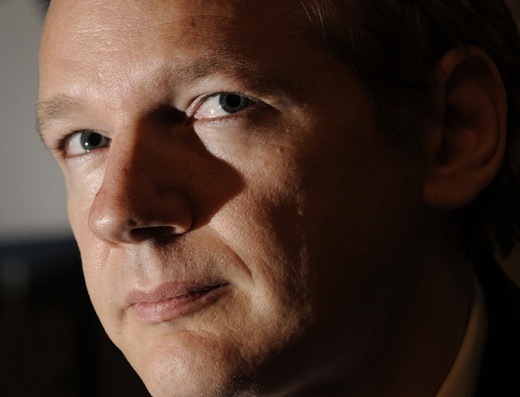
SUBHEAD: Official Washington worries the WikiLeak will reveal extremely embarrassing details of US diplomacy and reshape world events. Image above: Close-up photo of Julien Assange, founder of WikiLeaks.org. By John Nichols on 26 November 2010 for The Nation - (http://www.thenation.com/blog/156684/official-washington-worries-wikileak-will-reveal-inconsistent-approach-terror)
Usually, when a WikiLeaks document dump is in the offering, U.S. officials play like it could not possibly matter. "More of the same," "nothing new," "just a repeat of what everyone was already aware of": these have been the standard lines. But not this time. Washington is abuzz with Holiday weekend talk about how officials at the White House, the Department of Defense and the State Department are "holding their breath" in troubled anticipation of an imminent release of thousands of classified documents by the controversial website. WikiLeaks is tweeting that officials in Washington are "hyperventilating again over fears of being held to account.". That's not hype. They really are worried this time. Why so? Because this release of documents could pull back the curtain on how the U.S. practices international diplomacy. To understand why this matters, consider two related realities: 1. Many, if not all, of the U.S. officials who deal on the international stage tend to like secrecy, as it allows them to play by different rules when dealing with countries that are deemed "allies" or "rogues." In other words, despite the blunt official talk about how the "war of terror" is a universal endeavor, the U.S. sometimes casts a blind eye toward -- or even works with -- groups that are identified as practicing terrorism. 2. These powerful players often feel threatened by transparency, as it reveals when they are allow allied states to act like rogue states. This gets especially messy when "friendly" governments are allowed to get away with actions that the U.S. otherwise identifies as being so serious that might justify economic sanctions or even a military response. Understand these facts and you will understand why official Washington is worried by this particular WikiLeak. Reportedly, the next leak -- which could come this weekend -- will include "hundreds of thousands of classified State cables that detail private diplomatic discussions with other governments, potentially compromising discussions with dissidents, and even, reportedly, corruption allegations against foreign governments." Among other things, international press accounts suggest, the new WikiLeak will include a military report revealing that the U.S. officials were aware that the Turkish government allowed its citizens to aid al-Qaeda in Iraq. An additional document will, according to London's Al-Hayat newspaper, reveal that the U.S. aided Kurdish separatist rebels whose group, the PKK, is listed by the State Department as a foreign terrorist organization. Turkey is a complex country located at a critical crossroads for the United States. It is no secret that U.S. officials have always applied different sets of rules when dealing with it. The problem is that the public revelation of the differences between U.S. treatment of Turkey and, say, Iran, could be more than embarrassing. It could call into question whether U.S. officials are consistent in their condemnation of terrorism and of countries that condone terrorism. Of course, that's not what State Department officials are saying publicly. They're talking about protecting diplomatic secrecy. "When this confidence is betrayed and ends up on the front pages of newspapers or lead stories on television and radio it has an impact," says spokesperson P.J. Crowley. "We decry what has happened. These revelations are harmful to the United States and our interests. They are going to create tension in our relationships between our diplomats and our friends around the world. We wish that this would not happen. But we are, obviously, prepared for the possibility that it will." What should U.S. citizens make of such revelations? Don't expect an outcry. Americans will not be shocked to learn that their government is inconsistent in its relations with other countries. We don't yet know what exactly this WikiLeak will reveal. But these sorts of revelations, which so unsettle official Washington, could well improve the domestic debate. No one wants to see the world become a more dangerous place; nor is there anyone who wants to play fast and loose with the safety of U.S. troops, diplomats or innocents abroad. With those provisions, however, a case can certainly be made that transparency brings nuance to the discussion of how the U.S. engages with other countries, and to debates about the standards that are applied with regard to supposedly "terrorist" activity and supposedly "terrorist" groups. A broader consciousness of these realities could make it tougher for the White House, the Pentagon and the State Department to suggest that the United States faces only black-and-white choices, that this country's only options are absolutes, and that America cannot possibly negotiate with countries or groups that engage in actions that the U.S. offically condemns. In other words, this WikiLeak might just make it harder for officials in Washington to "sell" hardline responses, covert actions and military interventions. Washington insiders might be bothered by that prospect. But the citizens of the United States can handle diplomatic reality -- and transparency.

Feign Before The Storm
By Nadim Kobeissi on 26 November 2010 - (http://log.nadim.cc/?p=17)
As dawn breaks over the greatest declassification in history, the world awakens to a radiant truth: WikiLeaks is winning. The looming WikiLeaks release, which promises to declassify almost three million documents, has already sent the world’s most prominent governments into a political frenzy. The United States is orchestrating a dozen-stringed political mission, sending diplomats ranging from aides to Norway, to ambassadors to Canada, to Hillary Clinton herself to Australia in order to mitigate a possible relational disaster. The US seems very well aware that the world will not like it quite as much after WikiLeaks exposes its unvarnished truth – according to the Israeli Haaretz, the Americans are “viewing the leak very seriously”, believing it might contain diplomatic cables – internal US communications that detail the real, US opinions on international political matters.

Admittedly, it is interesting to see how all U.S. efforts to mitigate the imminent WikiLeaks crisis have been directed at foreign governments, and not at their own people.

The UK government hasn’t bothered to conceal its panic as well as the United States, recently issuing a class 1 and class 5 that reprehensibly asks the British press to censor “military operations, plans, capabilities” and “security and intelligence special services” that may be contained in the next WikiLeak. The UK government’s blind, censoring fear may be understandable, what with the whistle-blower organization promising to redefine the entire world’s history very, very soon. What is incomprehensible, however, is how the UK is seemingly expecting to circumvent the Internet’s free flow of information with a simple censorship order. Russia is concerned. Italy’s Berlusconi is scared. The United States has already “slammed” the leak with woefully unconvincing arguments, having one ambassador call it an “absolutely awful impediment to [his] business”, which raises the question as to what kind of business it is that transparency is likely to hurt. According to WikiLeaks, this political fiasco began when the New York Times briefed the White House on the contents of the embargoed leak this Monday. WikiLeaks has since predicted to its Twitter followers to watch as “every tinpot dictator in the world briefed prior to release”, and was right: in less than two days, Norway, Iraq, Turkey, Israel, Canada, Russia, Denmark, Iceland, Australia and the UK have been briefed by US diplomats over the contents of a leak that may render the world’s superpower internationally red-faced. In what may be a matter of days, or even hours, many are expecting nothing short of a political revolution. Reuters is quoting sources that claim the leak contains corruption allegations that may very well cause an international uproar, calling the leak more revealing than both the Afghanistan and Iraq war logs combined. The more politicians cower, the more the public sits on the edge of its seat, awaiting the next leak from an organization that so far has delivered more unvarnished truth in the last year than all of the world’s governments and press combined.

WikiLeaks is winning at the UN, convincing it and the European Union to launch a full Afghanistan torture investigation, and is losing only with parties that have some, or many, embarrassing truths to cover. But with the people, WikiLeaks is winning all the same – for while lies may blind from the truth, they cannot and do not hold as the truth shines.

.

US - Iran Relations

SUBHEAD: An interview with Iranian author and political observer Hooman Majd, by Kauai journalist Jon Letman. Image above: Photo portrait of Hooman Majd for Interview magazine. From (http://www.interviewmagazine.com/culture/hooman-majd-/). By Jon Letman on 1 October 2010 in TruthOut.org - (http://www.truth-out.org/us-iran-relations-age-ayatollah63766) Equally at home in Tehran or New York, Hooman Majd benefits from a background as intricately woven as any Persian carpet. The son of a diplomat under the shah of Iran, Majd attended schools in California, India, Iran, North Africa and England. After the tumultuous 1979 Islamic Revolution, return to Iran for Majd and others like him suddenly became highly unlikely if not impossible. But with reforms and an easing of restrictions on dual-passport holders under former President Mohammad Khatami, Majd returned to Iran for the first time in three decades in 2003. Since then, he has written about Iran full-time for, among others, The New York Times, The New Yorker, Foreign Policy, Politico and Salon. His first book, "The Ayatollah Begs to Differ: The Paradox of Modern Iran," was widely lauded for its keen insight into Iranian society and the Islamic Republic. Majd has also interpreted for both Khatami and - at the UN (2006-2008) - for President Mahmoud Ahmadinejad. Majd has repeatedly traveled inside Iran since the disputed 2009 Iranian elections, and documents the current state of affairs in his newly published book, "The Ayatollahs' Democracy: An Iranian Challenge." Jon Letman interviewed Majd for Truthout. He started by asking Majd about the American female hiker who was recently released from Evin Prison in Tehran. Jon Letman: Were you surprised by the announcement that Sarah Shourd would be released? Hooman Majd. (Photo: Ken Browar) Hooman Majd: No, not at all. I anticipated there would be some move before President Ahmadinejad [came] to New York ... I think that, in light of what is going on between Iran and the United States and the West in general - the sanctions, the military threat from Israel and so on - I am sure they would rather not have [the hikers] be the big issue. I think it was a perfect time for them, also with the end of Ramadan the Supreme Leader [Ayatollah Ali Khamenei] pardons all these prisoners every year anyway ... It's a tradition in Islamic society to issue pardons at the end of Ramadan, so this just worked for them very well. I would have been surprised if nothing had happened. JL: So possibly the other two hikers might follow? HM: I don't know. The thing about Iran is there are many political factions and it's not quite the dictatorial, authoritarian state with one person always making every single decision ... Even if President Ahmadinejad would prefer to have all hikers released, there are people who are going to be opposed to that - even conservatives who normally would be on his side on some things - so he doesn't really have the power to do it. This may have been a compromise for him like, "don't push too hard, but we'll let one of them go." If the Supreme Leader ordered them all to be released, they would be released, but the Supreme Leader doesn't play the game the way we might imagine a supreme dictator would. He prefers to listen to different people, different factions, and come to some sort of consensus. In a case like this, I doubt very much that he would even get involved and he would leave it up to the judiciary to give advice ... You never know, but I would imagine that between now and the end of the year, they will try to find an excuse to let the other two hikers go. JL: You have indicated concern about how statements by Ahmadinejad were translated. The frequently-cited comment about "no homosexuality in Iran," the idea of "wiping Israel off the map" and the infamous Holocaust denial have become hallmarks of Ahmadinejad among Americans. Would you say this question of translation is a widespread problem between the US and Iran? HM: Absolutely. Often words are misinterpreted if not mistranslated, and that is a recurring problem in U.S.-Iran relations. On the Holocaust, Ahmadinejad has questioned, if not denied its existence, which is indeed reprehensible, but some take that to mean he is keen on perpetrating another Holocaust, something both he, and more importantly the Supreme Leader, have denied. Americans also tend not to distinguish between political rhetoric and real intentions, which can lead to great misunderstanding. JL: Are there any North American politicians who, you believe, have a good understanding of Iran? HM: I'm not sure there are many, if any at all, who truly understand Iran and Iranians. It's often not their fault, of course, and one of the problems is that Iranian exiles, many of whom are staunch opponents of the Islamic regime, can influence the thinking of Western politicians with their thinking, which is often geared to an agenda not necessarily reflective of reality. Think Ahmad Chalabi and the Iraq question before the invasion in 2003. I'd say that there are, however, some politicians who are more open-minded, and people like John Kerry and Dennis Kucinich come to mind, both of whom I've met and seem far more understanding of the intricacies and complexities involved in Iranian politics. JL: In large measure, American politicians, the media and public sat back in silence, or vocally supported the invasions of both Afghanistan and Iraq. Nearly a decade later, many of those one-time supporters now regret their earlier stance or at least express doubts. With sustained calls for increasing pressure and sanctions on Iran, and the frequently repeated mantra "all options are on the table," do you think the American public or Congress would support military force against Iran? HM: It seems that way, based on polls and sentiment around the country. The problem is that Iran has been identified as a dangerous enemy, and the longer the media forwards that proposition - and the media is guilty, just as it was in the Iraq war - then the easier it becomes for Americans to accept that we might just have to resort to military force to remove any Iranian threat. The Israelis, of course, would like to see the U.S. take a stronger stand against Iran, even if it means war, and their thinking has an effect on Congress, certainly, if not on [the] Obama White House. Even liberals, or liberal hawks, have bought into the idea that war might be necessary, and that is discouraging, to say the least. JL: You've said you think it is probably inevitable that relations between the US and Iran will improve and that the current situation will not continue indefinitely. HM: I can't see how it can. I think both countries realize that it is in their interest ultimately to have some form of relationship. I think it is going to take America realizing that, in the region, we are accustomed to having relations with weaker countries and we are very much the superior party that can dictate terms. Iran has resisted that for 30 years. I think Obama is the first president who's acknowledged at least that it's a problem and that we are going to have to probably deal with Iran on the basis of being equal. Even though we all well understand that we're not equal in terms of economy, military might and the like, but Iran is never going to come to the table if it feels like it's coming as a second class citizen. I still think there is an American attitude that is very hard to break which is "We're great. Who wouldn't want to be like us? Who wouldn't want to have the benefits of our largesse, handing out aid and having American companies based in their countries?" and "our culture is great," and all that. It's hard for us to imagine ourselves as not being the greatest country on earth. If you are an [American] politician it's very hard to imagine "now we are going to treat these guys as our equals? That's ridiculous. What have they ever done to deserve that?" We can barely do that with Europeans, let alone what was once a backwards, third world country. I also think the current situation is untenable because nothing that we want to accomplish on a foreign policy front is going to be accomplished without some form of reconciliation with Iran. We're not going to achieve our goals in Iraq, in Afghanistan and in the Palestinian territories without some form of understanding with Iran. That doesn't necessarily mean Iran is going to be [our] best friend like Saudi Arabia with the president of Iran at a state dinner at the White House, but there will eventually have to be some form of reconciliation or understanding between the two countries - which I think means that ultimately that will lead to relations and an American embassy reopening and an Iranian embassy in Washington. I think it just has to. JL: What kind of potential exists between the US and Iran if relations improve? HM: Iran is a huge country and much, much more sophisticated than most people imagine ... It certainly has the potential to be at least the way Turkey is to most Americans. Turkey is viewed as a very modern country and a great place to go and visit and yet Islamic as well. Iran is in some ways like that ... with the difference that Iran is probably more influential than Turkey in affairs that are of interest to us. JL: If the US or Israel were to launch either a limited or full-scale attack on Iran, what might we expect in response? HM: It's very difficult to say, and it depends very much on what kind of attack there is on Iran - whether it is simply a bombing run on the nuclear facilities or whether it is designed to inflict serious damage to Iran's military capability as well, in order to mitigate a response, such as taking out Revolutionary Guard bases. I think there's no question that Iran will most probably respond first in the immediate region, in the Persian Gulf, and try to attack U.S. interests there. It doesn't take much to inflict serious damage to shipping, to the economies of small countries such Bahrain and the Emirates, both allies of the U.S., and to generally ensure that the price of oil skyrockets. If Israel is the attacking party rather than the U.S., I think one would see a response by Hezbollah from across the Lebanese border, and maybe from Hamas in Gaza. If it's the U.S. only, I imagine Iran won't want to start a fight with Israel. JL: Do you see a shift in Americans' perception or interest in Iran? HM: It comes and goes. Every time Ahmadinejad says something really obnoxious unfortunately it hurts the cause of getting Americans to understand Iran better and makes us assume the worst ... But I think Americans generally would like to understand. There's a reason why there is so much interest in books and articles on Iran and why the mass media pay so much attention to Iran. I think the more we talk about things like war with Iran, I think Americans want to know. I think a lot of people regret not knowing enough about Iraq when we kind of blindly said as a nation, "well ok, if we need to go to war, we need to go to war," without really thinking what war and the aftermath would mean with this society. There wasn't a lot of information on Iraq except we knew we had a dictator we had been demonizing for years - and rightly so: he was an evil person - but Americans didn't show, on the whole, a lot of interest in knowing what we were getting ourselves into. I think that experience, particularly combined with the experience of Afghanistan, which I think a lot of people think is a lost cause ... I think there's [a feeling] like "wait a second - with all this talk of going to war, with all this talk of threats and sanctions and belligerent rhetoric that comes out of both sides, let's understand what is going on here." I think that's good. .