Showing posts with label Policy. Show all posts

America with Trump's policy

SUBHEAD: Climate models are more likely to underestimate than to overestimate the amount of change.

By Joe Rom on 8 August 2017 for Think Progress -
(https://thinkprogress.org/governmental-climate-report-forecasts-catastrophe-under-trump-policies-77197b4a8301/)


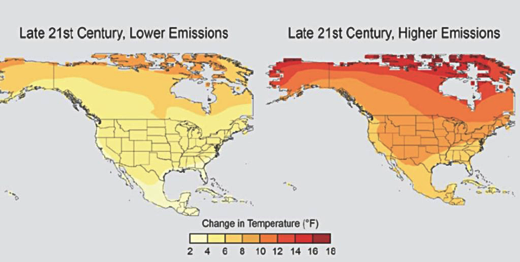
Image above: Map of North America and dramatic temperature changes that could occur with business as usual under Trump plans. From original article.

Leaked draft reveals a devastated America, up to 8 feet of sea level rise, 18°F Arctic warming--unless we embrace Paris climate deal.

The United States faces a choice between manageable warming and unmanageable catastrophe, according to a leaked draft report by scientists from 13 federal agencies.

The report’s “higher emissions” scenario projects a devastating 8°F to 10°F warming over the interior of this country–and, unimaginably, upwards of 18°F over in the Arctic!–by 2071 to 2100. In that case, global sea levels could rise as much as 8 feet, inundating every major coastal city in this country and around the world.

The report was first published by the New York Times, which noted that it “directly contradicts claims by President Trump and members of his cabinet who say that the human contribution to climate change is uncertain, and that the ability to predict the effects is limited.”

The draft, a special science section of the Congressionally-mandated quadrennial National Climate Assessment (NCA), has been given to Trump’s political appointees for review. It was reportedly leaked to the media out of concern that the report may be censored or watered down by the administration the way other climate documents have been.

The NCA is the definitive statement of current and future impacts of carbon pollution on the United States. The last one was from 2014, and it made crystal clear we were running out of time to avoid catastrophe.

“This latest report indicates that a path of inaction will truly lead to disastrous climate change impacts,” leading climatologist Michael Mann told ThinkProgress in an email. “Sadly, the Trump presidency has steered the U.S. toward this path.”

To get to the more manageable “lower emissions” scenario, the nation and the world must far exceed the emissions reduction goals agreed to in Paris in December 2015. Leaving the Paris accord and failing to meet our commitment–as Trump intends–puts the world on track for a “higher emissions” scenario that leads to unimaginable impacts.

“Emerging science regarding Antarctic ice sheet stability suggests that, for high emission scenarios, a GMSL [global mean sea level] rise exceeding 8 feet (2.4 m) by 2100 is physically possible, although the probability of such an extreme outcome cannot currently be assessed,” the report says.

We hold our future in our hands, as the report makes clear: “Choices made today will determine the magnitude of climate change risks beyond the next few decades.”

The bad news is that “the observed increase in global carbon emissions over the past 15-20 years has been consistent with higher scenarios.” The (somewhat) good news is that “in 2014 and 2015, emission growth rates slowed as economic growth has become less carbon-intensive.

But even if this new trend continues, “it is not yet at a rate that would meet the long-term temperature goal of the Paris Agreement of holding the increase in the global average temperature to well below 3.6°F (2°C) above preindustrial levels.”

Deep in the report, the scientists spell out the choices we face concerning the Paris climate pledges, the Intended Nationally Determined Contributions (INDCs).

The chart below, from the report, looks at probabilistic temperature outcomes for “emission scenarios following no policy, current policy, meeting the INDCs with no increased future ambition and meeting the INDCs with continually increasing ambition.”

xxx

As the chart makes clear, if we want a high probability of staying below the 2°C (3.6°F) threshold, beyond which scientists project impacts rapidly shift from dangerous to catastrophic, we will have to adopt policies that are considerably more ambitious than Paris–and we need to do that as soon as possible.

With the policies President Trump has embraced–where we don’t even meet the initial Paris targets and we return to promoting fossil fuels–then we face the very realistic prospect that total warming will be 4°C (7°F) or higher. And that, as the scientific literature makes clear, would be the end of modern civilization as we know it.

Furthermore, the report says that “climate models are more likely to underestimate than to overestimate the amount of long-term future change,” so there is a greater chance things will be worse than the report lays out than they will be better.

.

European nuke policy collapses

SUBHEAD: Plans for a worldwide fleet of huge new nuclear reactors have collapsed, with the cancellation of a major project.

By Paul Brown on 28 May 2015 for Climate Network News -
(http://www.climatenewsnetwork.net/new-energy-policy-needed-as-nuclear-giants-take-a-hit/)


Image above: GreenPeace members preparing for demonstration against European Pressurized Reaactor in Flamanville. From original article.

[IB Piublisher's note: After realizing that there is no way we can contain or clean up the Fukushima Daiichi triple meltdown that is killing the Pacific Ocean it should be a no-brainer that expanding reliance on nuclear energy is worse than a deadend - it's suicide. Yet we carry on.]

Plans for a worldwide fleet of huge new nuclear reactors have collapsed, with the cancellation of a major project and no new orders being placed.

The European nuclear industry, led by France, seems to be in terminal decline as a result of the cancellation of a new Finnish reactor, technical faults in stations already under construction, and severe financial problems.

The French government owns 85% of both of the country’s two premier nuclear companies – Areva, which designs the reactors, and Électricité de France (EDF), which builds and manages them. Now it is amalgamating the two giants in a bid to rescue the industry.

Even if the vast financial losses involved in building new nuclear stations can be stemmed, there is still a big question mark over whether either company can win any new orders.

Their flagship project, the European Pressurised Reactor (EPR), billed as the most powerful reactor in the world, has two prototypes under construction − one in Finland and the second in France. Both of the 1,650 megawatt reactors are years late and billions of  Euros over budget, with no sign of either being completed.

Enthusiastic cheerleader

The Finnish government, once the most enthusiastic nuclear cheerleader in Europe, has lost patience with Areva, and the Finnish electricity company TVO has scrapped plans to build a second EPR in Finland.

This is because the first one, under construction at Olkiluoto since 2005, and which was supposed to be finished by 2009, is not expected to be producing electricity until 2018 – and even that may yet prove optimistic. It was intended  to be the first of a “worldwide fleet”.

The second EPR under construction, at Flamanville in France, is also seriously delayed, and possibly in even deeper trouble because of concerns about the quality of steel in the pressure vessel.

The components, forged in France by Areva, were already in place in the half-built reactor before questions over the carbon content of the vessel and its safety were raised and work was halted.
The knock-on effect of the inquiry into this safety glitch is that the Flamanville reactor will be delayed again. In a worst-case scenario, it would have to be part-dismantled or scrapped altogether.
The French government is keen to rescue
the industry, but had already decided against
ordering any more reactors after the fiasco
in building Flamanville
This has also raised queries over the French company’s biggest potential export market, China. Two EPRs are being built in China, but checks are being made there too because these reactors may also have excess carbon in the steel. The suspect parts were made in France in the same forge as the Flamanville pressure vessel.

These delays and cancellations have placed a severe strain on Areva’s finances. In 2014, on revenues of €8.3 billion ($9.2 billion), it lost €4.8 billion. Hence, the French government’s move to amalgamate the two companies to try to make one viable unit. In fact, EDF will take over Areva, which has not sold a new reactor since 2007.

Serious blow

This is a serious blow to the pride of a country that is seen as the world leader in nuclear energy, with 75% of its electricity coming from 58 reactors.

The French government is keen to rescue the industry, but had already decided against ordering any more reactors after the fiasco in building Flamanville, which was years late and over budget even before the latest hiccup.

All this leaves the UK as the last country in the world anxious to buy a French reactor. With a new Conservative government in power for less than a month, its energy policy is already in disarray.

Plans to build four 1,650 megawatt EPRs in Britain to produce 14% of the country’s electricity − announced before this month’s general election − look ever more unlikely.

Even with the first two at Hinkley Point in the west of England − where site preparations have been made, and a final agreement was expected with EDF this summer − nothing is likely to happen for months. The most likely course must now be cancellation.

Plans have been put on hold while EDF and Areva sort out the problems at Flamanville, and then try to find a way of financing the project. Four hundred workers on the Hinkley Point project have already been laid off.

Unfair state aid

The new British government is already facing legal challenges from Austria and Luxembourg and from various renewable energy groups for unfair state aid for this nuclear project.

Even if ministers see these threats off, it seems unlikely that anyone will commit to building new EPRs in the UK until at least one of the four reactors under construction in China, Finland and France is actually shown to work.

There is no guarantee that will happen in the next three years, so the chances of Britain getting any new nuclear power stations before 2030 are close to zero.

Currently, the UK is closing coal-fired stations to comply with European Union directives to combat climate change, but it has not developed renewables as fast as Germany and other European neighbours − claiming that new nuclear build would fill the gap.

It now looks as though the government will urgently need to rethink its energy policy.
.

Brazil Reduces Deforestation

SUBHEAD: The rate of deforestation has been reduced by over two-thirds from a decade ago.

By Doug Boucher 6 July 2014 for Solutions -
(http://www.thesolutionsjournal.com/node/237165)
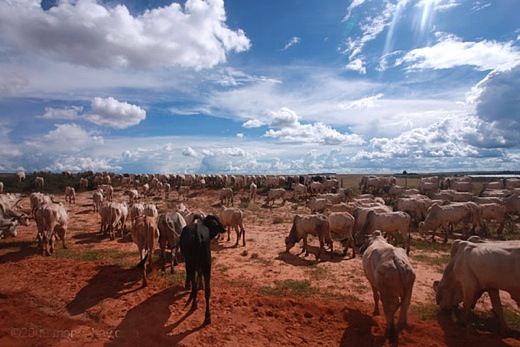

Image above:A cattle herd wandering in the heart of Mato Grosso, Brazil. The 2009 beef moratorium created a supply chain through which ranchers were pressured to end deforestation. From (http://news.mongabay.com/2009/0909-amazon-cattle-ranching.html).

During the second half of the twentieth century, the deforestation of the tropics became a global concern. Young people everywhere learned at an early age that “saving the rainforest” was one of the most urgent needs of the planet. Yet, for decades, these worries had no real effect on the reality of tropical deforestation.

The lack of progress until the start of the twenty-first century is evident in this graph. Figure 1 shows global greenhouse gas emissions from land use change—which for the past half-century (since 1961)

have come almost totally from tropical deforestation. Although there was a fair amount of year-to-year variation up to the year 2000, the trend is absolutely flat, with no overall decrease in deforestation despite global concern and efforts.

Then, in the early part of the twenty-first century, there was a dramatic change. The curve drops sharply, with emissions from land use change falling by over a third in barely a decade. After decades of fruitless efforts, there were clear signs of a major success within a few years.

It turns out that most of the decrease in deforestation has been in the Amazon, and mostly in one country—Brazil. Amazonia is the largest tropical forest in the world with about five million square kilometers.1,2 Furthermore, about 80 percent of the basin’s forest remains basically intact.

 Brazil contains about 60 percent of the entire Amazon forest, 1 and at the peak of its deforestation in 2004, it was not only the largest tropical forest country, but also the leader in deforestation worldwide.

In this article, I describe the events and causes that underlie the rapid reduction in deforestation in Brazil. In a few short years, a large—indeed, historic—change has occurred. If Brazil’s success can be duplicated elsewhere, most of us living today could witness the end of thousands of years of deforestation in our lifetimes.

The annual data compiled from satellite imagery by Brazil’s National Institute of Space Research (INPE), clearly shows the downward trend of deforestation in the Brazilian Amazon over the past nine years (2004 to 2013). There was substantial variation from year to year through the 1990s and early 2000s, partly related to changes in the economic factors driving deforestation (e.g., recessions, prices for commodities such as beef and soybeans, and the exchange rate of the Brazilian real relative to the dollar and the euro).4

Variation in weather from year to year also had an impact, since most deforestation occurs during the southern hemisphere dry season (roughly June to October), when forests can be most easily cut down and burned. But until 2004, there was no up or down trend visible at all beyond the annual fluctuations.

Since then, however, there has been enormous progress. The rate of deforestation has been reduced by over two-thirds from its average level in the decade from 1996 to 2005 (the period that Brazil uses as its baseline), and by nearly three-fourths from its high point in 2004. How has this been accomplished?

A New Political Dynamic

This progress reflects the growth of the environmental and social movements in Brazil in the last two decades, including the rise to power of the new Workers’ Party (PT) and their leader, Luis Inácio Lula da Silva (known to Brazilians simply as “Lula”), who was elected President in 2002 on his fourth try. Lula’s government and its progress in reducing deforestation came out of a long history of engagement with social movements.

Based in the trade union and landless peasants’ movements, but also having ties to forest peoples’ organizations such as those of indigenous peoples and the rubber tappers union, the PT provided a model for a broad-based coalition that focused on social, economic, and environmental transformation—rather than just on taking power. The PT had significant experience in pressuring both businesses and governments, including Lula’s own government, after he was elected.

At least as important as Lula was Marina Silva, his first Minister of the Environment. Her activism aimed at curtailing the rate of forest clearing went back to her early experience in the Amazon state of Acre, working with Chico Mendes to organize the rubber tappers union and the state branch of the PT. As Minister, she was responsible for implementing the government’s actions to reduce deforestation, which often brought her into conflict with other Ministries’ plans for development and economic growth.

Initially, the policies of Lula’s government were aimed at achieving broad-based social and economic development, particularly for urban workers and the peasants and landless laborers in the rural sector. In the six years after Lula’s 2002 election—through social programs such as Fome Zero (Zero Hunger) and Bolsa Familia (Family Allowances)—Brazil reduced its poverty rate from over 34 percent to less than 23 percent, while 29 million citizens rose into the middle class.5 Hunger and malnutrition rates dropped substantially, and important advances were made in reducing economic inequality.6,7

During the early years of Lula’s administration, actions aimed at reducing deforestation emphasized the creation of protected areas and recognition of indigenous lands, as well as enforcement actions against illegal logging.8
 
But equally important was the change in the political dynamic. For decades, the issue of deforestation had been seen in Brazil in terms of national sovereignty—as something raised by foreign NGOs pressuring to save Amazon forests even at the cost of Brazilians’ right to economic development. It was often pointed out that those concerned with “saving the rainforest” came from countries that had themselves become rich by exploiting their own natural resources, including destroying most of their forests.

Yet, now they were lecturing tropical countries to avoid following this same course for the sake of the planet. Foreigners’ claims to speak for the natural world were counter-posed to Brazil’s right to decide how to use its own land.

This changed under the Lula government. Deforestation was recast as the wasteful exploitation of resources that rightfully belonged to all Brazilians—particularly to forest peoples such as indigenous groups and the rubber tappers —by powerful forces such as expanding soybean farmers and cattle ranchers. Initially separate, organizations representing forest peoples and urban environmentalists began working together, and joined in 2008 to found the Zero Deforestation campaign.

This movement—composed of a broad coalition of non-governmental organizations including environmental, indigenous, rubber-tapper, labor, human rights, and other groups—exerted strong pressure on the federal government. Although allied with international NGOs such as Greenpeace, Friends of the Earth, and World Wildlife Fund, they were fundamentally Brazilian in origin and in their sources of political power.

NGOs were to become the key actors in the widely publicized 2006 and 2009 exposés of the role that the soybean and beef industries had played in deforesting the Amazon, and in negotiating deforestation moratoria with those industries. The Zero Deforestation campaign proposed what became the Amazon Fund and its management by the Brazilian national development bank BNDES (Banco Nacional do Desenvolvimento), and members of the campaign now participate in the Fund’s steering committee as important stakeholders.

Marina Silva, as Minister of the Environment, led the effort to reduce deforestation from within the government, but was also willing to leave that government and join the social movement when it was necessary for the struggle against deforestation.

After several years in office, she resigned from Lula’s cabinet in protest against the inadequate pace of action on deforestation, and became the Green Party’s candidate for President in the race to succeed Lula in 2010. Quite unexpectedly, she won nearly 20 percent of the vote in the first round,9 showing the strength of the popular commitment to ending deforestation and exerting pressure on the PT’s candidate, (Dilma Rousseff, Lula’s former Energy Minister and then Chief of Staff) to commit to continuing the progress that had been achieved. Indeed, Lula himself agreed before leaving office to move the deadline for Brazil’s target to reduce deforestation rates by 80 percent up to 2016 from 2020.

The Zero Deforestation Campaign, going further, pushed for an end to deforestation by 2015. Rousseff’s partial veto in 2012 of the amendments to the Forest Code that would have given amnesty for past illegal deforestation reflected the new political dynamic that emerged at least in part through Silva’s electoral success.

Many Actors, Many Solutions

The reduction in deforestation would not have happened without the new political dynamic, but it still required the work of many actors, including governments (both at the federal and state levels, and those of other countries such as Norway, Germany, and the U.K.), businesses, and NGOs.

Legal steps—including the enforcement of existing forest laws and prosecutions of actors in the soybean and beef supply chains who distributed products produced through deforestation—also played an important role. These prosecutions worked together with voluntary business commitments such as the soybean and beef moratoria, which were enforced using sophisticated satellite imagery.

Law Enforcement and the Soy and Beef Moratoria
The initial government actions, setting up reserves and increasing enforcement of environmental laws, were part of the historic Plan for the Prevention and Combating of Deforestation in the Amazon (PPCDAM), instituted by the Lula government in 2004.

Although not originally motivated by climate change, over time the PPCDAM grew and was transformed, and its efforts are now a key element of the National Climate Change Plan. Since emissions from deforestation represented the majority of Brazil’s global warming pollution in the 1990s, making actions against deforestation part of the Climate Plan was a logical step, but it also made it possible to connect the country’s actions with an emerging global concern.

These high-level actions were complemented by on-the-ground steps to strengthen enforcement of existing laws, for example against illegal logging. The data made available by the national space agency INPE on a monthly basis have made it possible to crack down quickly in areas of new deforestation identified through satellite monitoring programs.1

Steps taken include the closing of illegal sawmills and jailing of the perpetrators, including government officials who had been taking bribes to ignore illegal deforestation. Although such enforcement campaigns are often episodic and occur in response to media coverage—which in turn is often generated by new monthly data on deforestation or burning—they have had a cumulative effect of making deforestation a risky activity rather than accepted business as usual.

The 2006 release of Greenpeace’s report, Eating Up the Amazon, proved to be a key step in scaling up pressure.10 The report linked the soybean industry to deforestation, global warming, water pollution, and even the use of slave labor to clear land. It focused particularly on two multi-national companies: the giant grain trader and exporter Cargill and the world’s largest fast food chain, McDonald’s.

Action came within weeks. The two associations that together included nearly all soybean processors and exporters in Brazil—the Brazilian Association of Vegetable Oil Industries (ABIOVE) and the National Association of Cereal Exporters (ANEC)—announced a moratorium on deforestation. Their members would not buy any soybeans produced on Amazon farmland deforested after June 24, 2006. This soy moratorium was followed by a similar one involving beef in 2009, likewise provoked by two hard-hitting NGO reports, Amigos da Terra Amazônia Brasileira’s Time to Pay the Bill and Greenpeace’s Slaughtering the Amazon.11,12

The actions of the independent federal public prosecutors, particular in the key states of Pará and Mato Grosso, have been an important link between these voluntary business actions and government enforcement.13

 The moratorium commitments by exporters, soybean processors, slaughterhouses, and supermarkets that they would buy only non-deforestation soy and beef have been buttressed by strong threats from public prosecutors in those two states.

First in Pará and then in Mato Grosso, slaughterhouses have signed agreements under which ranchers were required to provide the GPS coordinates of their property boundaries to the slaughterhouses in order to sell their beef to them. This in turn makes it possible to use remote sensing data not only to detect deforestation, but to know on which ranch it is taking place and to take action against it.

The prosecutors’ warnings to supermarkets that they too would be held responsible for the sale of beef produced in violation of environmental laws, combined with the new ability to enforce them using GPS data, has effectively made the supply chain a part of the system through which ranchers are pressured, both economically and legally, to end deforestation.

The soy moratorium has been in place for six years, and there is now data to show just how successful it has been. Comparing satellite images showing deforestation with views of the same areas in subsequent years, Rudorff, et al., found that by the 2009/2010 crop year, only 0.25 percent of land with soybean crops had been planted in deforested areas since the moratorium began.14

These fields represented only 0.04 percent of the total soybean area in Brazil. The recent detailed examination by Macedo et al., of soybean production and deforestation in Mato Grosso, where the industry’s expansion has been concentrated, reinforces these conclusions and provides evidence that the link between soy and deforestation—strong until recently—has now been broken.1,15,16

Despite the rise of soy prices to record high levels since 2007, tropical forest clearing for soybeans has declined to very low levels in Mato Grosso. Furthermore, in the adjacent cerrado region, deforestation has also been substantially reduced.15

We do not yet have analogous data for the beef moratorium, which is more recent and involves a more complicated supply chain. However, there are initial signs of changes in the actions of ranchers in response to the moratorium, and within the next few years we should have clearer satellite evidence of how successful the beef moratorium has been.13

The soy and beef moratorium efforts show that the movement was based on a sophisticated understanding of the political economy and power dynamics of Amazonia, pressuring not only governments but also the industries that were the major drivers of deforestation. They used the threat of an international consumer boycott as a source of pressure on these industries, but the strategy emphasized pressure on businesses along the entirety of the deforestation-related supply chain, not just relying on individual consumers’ shopping decisions.

All the businesses involved—not just the farmers and ranchers producing soy and cattle, but also the banks financing them, the slaughterhouses buying their cattle, the exporters shipping their products overseas, and the intermediaries and supermarket chains distributing them domestically—were targets of the campaigning. The point of the campaigning was not to persuade individual consumers to change their behavior, but to force action by businesses that were critical links in the supply chain.


Image above: Areal photo of isolated deforested area in Amazon forest. From original article.


Indigenous Lands and Protected Areas

Much of the success in reducing deforestation came from establishing —and effectively protecting —an extensive network of indigenous lands and protected areas across the Amazon.

Starting in 2002, more and more areas were brought under various state and federal classifications, so that now just over half of the forest in the Brazilian Amazon is protected in some form. Nearly half of this area is reserved for indigenous peoples, about a fifth is under strict protection, and about a fourth is designated for sustainable development.

Some of the protected areas follow the model of state and federal preserves in developed countries. However, the protection of indigenous peoples’ territories is distinctive and plays a critical role in conservation of the Amazon rainforest.

The collective tenure of these lands by indigenous peoples—legally confirmed and enforced by the Brazilian government—gives them the right to use the land for sustainable forest management and the exploitation of timber and non-timber forest resources. In practice, they have generally chosen to keep almost all of their lands in forest, and studies of Brazil’s reserves have found that they have reduced the rate of emissions from deforestation by about ten-fold compared to neighboring areas.8

Beyond the reserves’ effectiveness as environmental measures, they represent the tangible recognition of indigenous peoples’ rights that had been denied for many years.

Rapid Economic Growth
The traditional framing of environmental issues in Brazil, as in developed countries, has seen a conflict between economic development and environmental protection.

But Brazil’s reduction of deforestation by two-thirds occurred at the same time that it saw strong economic growth and significant advancement in social justice. The country’s GDP increased at a rapid rate during the 2000s, ranging from over 3 percent to over 7 percent annually for nearly a decade.19,20

 The two industries previously most responsible for Amazon deforestation—beef and soy—both showed continued healthy growth at the national level, with production, exports, and the size of the cattle herd continuing to increase steadily even as deforestation dropped.17
 
While the first few years of decline were partly connected to the economic slowdown and lower commodity prices,1,16,18 more recent data show that the continuing reduction in deforestation rates has not been due to economic recession. Deforestation rates have continued to fall both before and after the recession of 2008-2009, and through the recent years of record agricultural prices.


State Actions

 Under Brazil’s federal system, the states have been responsible for a substantial part of the country’s success in reducing deforestation. In Brazil, states share responsibility for land use policies with the national government in Brasilia, and governors in states such as Pará have both taken action themselves and pushed the federal government for stronger anti-deforestation policies.15

Another example is the state of Amazonas, which is Brazil’s largest: as big as Alaska, and over twice the size of Texas.

Although its own reduction of the deforestation rate by 70 percent from 2002 to 2008 was from an initially low level, and thus not a major contribution to emissions reductions, its ability to maintain a rapid rate of economic growth while achieving this reduction —an increase of 65 percent in GDP in half a decade—showed how tropical forest regions can move to growth driven by urban sectors rather than by deforestation, and develop rapidly in the process. Amazonas has reduced deforestation to a very low level, with 98 percent of its forest still standing.

The Support of Norway

Brazil showed the seriousness of its commitment to combating deforestation by putting it into national legislation at the end of December 2009. The Climate Change Law inscribes the commitment to reduce overall emissions by between 36.1 percent and 38.9 percent, relative to business as usual, by the year 2020.21

This is equivalent to a 20 percent reduction from Brazil’s 2005 level.

An important indication of international support for this effort came at the 2007 United Nations Framework Convention on Climate Change (UNFCCC) meeting in Bali, Indonesia, where Norway’s Prime Minister Jens Stoltenberg announced Norway’s commitment to protecting tropical forests and offered $2.5 billion dollars during the next five years to finance such programs around the world.

One of the most notable aspects of the pledge was the promise of up to $1 billion for Brazil’s Amazon Fund, to be used for what is called “results-based financing” or “pay for performance.” This means that the money will flow not on the basis of efforts, promises or attempts to reduce deforestation, but only as the goal of reducing deforestation is met.

The “REDD+” (Reducing Emissions from Deforestation and Forest Degradation) system that Norway negotiated with Brazil is simple and straightforward. The rate of compensation for reductions (the “carbon price”) is $5.00/ton of CO2. Each hectare of tropical forest is assumed to emit 100 tons of carbon when cleared, which is equivalent to 367 tons of CO2. The reduction in area deforested is calculated in comparison to the average from 1996 through 2005, which was 19,500 km2 per year in all of the Brazilian Amazon.

To date, over $670 million in compensation has been paid to Brazil under this agreement. As REDD+ is often identified— erroneously—with offset-based carbon-market financing, it is important to point out that the Norway-Brazil program—by far the world’s largest (it covers over one-fourth of the world’s tropical forests by itself) and the most successful —is strictly a non-market, non-offset program.

Norway does not get the right to emit a single ton more of CO2 bin exchange for its funding of Brazil’s reductions in emissions. Although Germany, the U.K., and other donor nations, as well as international programs such as UN-REDD have also contributed support, no other country has committed to funding for REDD+ at a level close to that coming from Norway.

The Norwegian contribution to REDD+ efforts worldwide in the initial period ($2.5 billion over five years) amounted to about $100 annually for each of its citizens. In comparison, the United States’ REDD+ pledge in Copenhagen ($1 billion over three years) added up to only about $1 annually for every American.
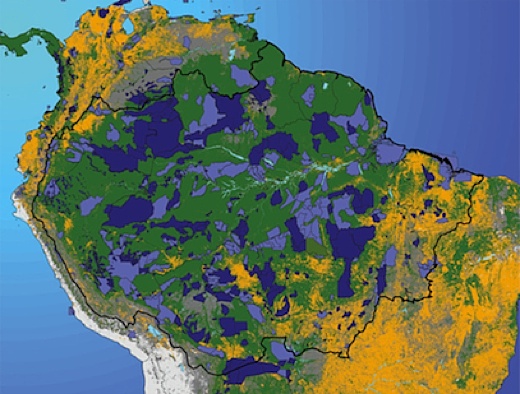


Image above: This map of the Amazon Basin (within black line) shows Indigenous Reserves (dark blue) and other protected areas (light blue). Deforested areas are shown in yellow. From original article. Source Woods Hole Research Center.

What Has Been Accomplished

Undoubtedly there will be both ups and downs in this story in the years to come. Indeed, the Amazon deforestation rate rose in both 2008 and in 2013, by substantial percentages if calculated only with respect to the previous year. But a glance at Figure 2 shows that despite these reversals, the overall trend is clearly downward since the mid-2000s. Compared to the average over the 1996-2005 baseline, Brazil’s Amazon deforestation had been reduced by 70 percent in 2013. This represents by far the largest success in solving the problem of tropical deforestation, and indeed has been an important contribution to the effort to slow climate change.22

It is particularly impressive in that it has occurred during a period in which the other Amazon countries have not shown any consistent decreases in deforestation.23

The credit for this progress should be shared by many actors. The Brazilian federal government under Lula and Dilma Rousseff has taken strong actions, as have the independent federal public prosecutors and state governments. Marina Silva, both as Minister and as a Presidential candidate, has been a transformative leader on the issue for many years.24

The voluntary moratorium adopted by the soy industry—and the NGO pressure that led to it—played important roles in reducing the pressure for deforestation by a commodity that was one of its major drivers. And the compensation provided by Norway, beyond its economic value, showed that the global community would support Brazil with concrete resources, not just rhetorically.
 
Ultimately, however, it is the change in the politics of the issue that has made progress possible, and for this, Brazilian civil society deserves most of the credit. The indigenous peoples, rubber tappers, labor organizers, environmentalists and other members of the broad social movement to end deforestation, made it possible and ultimately necessary for politicians and businesses to act. They have done a great service not only to their own country, but also to the climate and biodiversity of our entire planet.

Acknowledgements

This work was originally presented at the Yale School of Forestry and Environmental Studies in 2011, and much of its content was subsequently published in a different form in the journal Tropical Conservation Science in 2013.25 It includes analyses supported by funding from the Climate and Land Use Alliance and by subcontracts from the European Federation for Transport and Environment and the Environmental Investigation Agency.

I thank these organizations and my UCS colleagues, particularly Jordan Faires, Sarah Roquemore, Estrellita Fitzhugh, and the other members of the Tropical Forest and Climate Initiative, for their support and help. The detailed comments of the three reviewers were very helpful in the revision process, and I very much appreciate them.


References

1. Nepstad, D et al. The end of deforestation in the Brazilian Amazon. Science 326, 1350- 1351 (2009).
2. Pan, Y et al. A large and persistent carbon sink in the world’s forests. Science 333, 988-993 (2011).
3. FAO-ITTO. The State of Forests in the Amazon Basin, Congo Basin and Southeast Asia. Food and Agriculture Organization [online] (Rome, Italy, 2011) (www.fao.org/docrep/014/i2247e/i2247e00.pdf).
4. Boucher, D, Elias, P, Lininger, K, May-Tobin, C, Roquemore, S & Saxon, E. The Root of the Problem: What’s Driving Tropical Deforestation Today? Union of Concerned Scientists [online] (Cambridge, MA, 2011) (www.ucsusa.org/whatsdrivingdeforestation).
5. Throssell, L. Lula’s legacy for Brazil’s next president. BBC News – Latin America & Caribbean [online] (September 30, 2010) (www.bbc.co.uk/news/world-latin-america-11414276?print=true).
6. Rocha, C. Developments in national policies for food and nutrition security in Brazil. Development Policy Review 27, 51–66 (2009).
7. Chappell, MJ and LaValle, LA. Food security and biodiversity: Can we have both? An agroecological analysis. Agriculture and Human Values 28, 3-26 (2010).
8. Ricketts, TH et al. Indigenous lands, protected areas, and slowing climate change. PLoS Biology 8, e1000331 (2013).
9. Phillips, T. Brazil election sees breakthrough for greens and environmental agenda. The Guardian [online] (October 4, 2010) (www.guardian.co.uk/world/2010/oct/04/brazil-election-breakthrough-greens).
10. Greenpeace International. Eating Up the Amazon. Greenpeace International [online] (April 2006)(www.greenpeace.org/forests).
11. Amigos da Terra – Amazônia Brasileira. A Hora da Conta - Time to Pay the Bill. Friends of the Earth-Brazilian Amazon [online] (São Paulo, Brazil, April 2009) (www.amazonia.org.br/guia/detalhes.cfm?id=313449&tipo=6&cat_id=85&subcat_...).
12. Greenpeace International. Slaughtering the Amazon. Greenpeace International [online] (June 2009) (www.greenpeace.org/international/en/publications/reports/slaughtering-th...).
13. Walker, N, Bramble, B & Patel, S. From major driver of deforestation and greenhouse gas emissions to forest guardians? New developments in Brazil’s Amazon cattle industry. National Wildlife Federation [online] (Washington, D.C., 2010) (www.nwf.org/Global-Warming/Policy-Solutions/~/media/4878226C49BF48EB9EB5...).
14. Rudorff, BFT et al. The soy moratorium in the Amazon biome monitored by remote sensing images. Remote Sensing 3, 185-202 (2011).
15. Macedo, MN et al. Decoupling of deforestation and soy production in the southern Amazon during the late 2000s. Proceedings of the National Academy of Sciences 109, 1341-1346 (2012).
16. Nepstad, DC, Stickler, CM & Almeida, OT. Globalization of the Amazon soy and beef industries: Opportunities for conservation. Conservation Biology 20, 1595–1603 (2006).
17. USDA Foreign Agricultural Service. Production, supply and distribution online. United States Department of Agriculture [online] (Washington, D.C., 2011) (www.fas.usda.gov/psdonline/psdDownload.aspx; dataset psd_oilseeds_csv.zip).
18. Soares-Filho, B et al. Role of Brazilian Amazon protected areas in climate change mitigation. Proceedings of the National Academy of Sciences 107, 10821-10826 (2010).
19. World Bank. Data – GDP growth (annual %) [online] (2011). data.worldbank.org/indicator/NY.GDP.MKTP.KD.ZG.
20. Organisation for Economic Cooperation and Development. Country Statistical Profile: Brazil. Organisation for Economic Cooperation and Development [online] (2010) (www.oecd-ilibrary.org/economics/country-statistical-profile-brazil_csp-b...).
21. Law No. 12.187 of 29, Diario Oficial da União No. 248-A, Secciao 1, 109–110 (Government Of Brazil, Brasilia, December 2009).
22. Observatorio do Clima. Sistema de Estimativa de Emissões de Gases de Efeito Estufa (SEEG) – Mudança de Uso da Terra. Observatorio do Clima [online] (2013) (seeg.observatoriodoclima.eco.br/ index.php/emissions/index/sector/Mudan%25C3%25A7a%2Bde%2BUso%2Bda%2BTerra).
23. Boucher, D. Three datasets agree: Amazon deforestation has been reduced. The Equation blog (Union of Concerned Scientists) [online] (2013) (blog.ucsusa.org/three-datasets-agree-amazon-deforestation-has-been-reduced).
24. Heid, D, Roger, C & Nag, E.-M.. Climate Governance in the Developing World (Polity Press, Cambridge, UK and Cambridge, MA, 2013).
25. Boucher, D, Roquemore S. & Fitzhugh, E. Brazil’s success in reducing deforestation. Tropical Conservation Science 6, 426-445 (2013).


.
Let the People Decide

SOURCE: Brad Parsons (kauaibrad@hotmail.com)
SUBHEAD: Should Agro-Chemical Operations be Proven Safe Prior to being used on Kauai?

By Staff on 18 April 2014 for Kauai Rising-
(http://islandbreath.blogspot.com/2014/04/let-people-decide.html)


Image above: Residents of Kauai display sign chastising Dow, DuPont and Syngenta for trying to overturn pesticide regulations designed to protect the island. From (http://gmosecrets.com/category/pesticides-poisoning-kauai-keiki-families/).

The NEXT STEP
Kauai Charter Amendment to Add Article 33

Let the People Decide:
Should Agro-Chemical Operations be Proven Safe Prior to being used on Kauai?

The Ohana:
Please add your voice to that of this growing coalition of people and organizations as we come together to place this Amendment on the ballot on November 4, 2014.
  • Friends of Navdanya (Vandana Shiva's U.S. Organization)
  • Kauai Alliance for Peace and Social Justice
  • Kauai Fresh Farms
  • Kauai Rising
  • Ohana O'Kauai
  • People for the Preservation of Kauai
  • Regenerations international Botanical Garden
  • Safe Meter Kauai
  • Shaka movement
  • Surfrider Foundation
  • Wai Koa Plantation
ACTION STEPS:
Sign the Petition to Place the Charter Amendment on the Ballot at the following locations:
  • Harvest Market in Hanalei
  • Magic Dragon Today and Art Supply Princeville
  • Kauai Mini Golf and Botanical Gardens Kilauea
  • Small Town Coffee in Kapaa
See updated petition gathering sites at: https://www.facebook.com/events/435175346627970/?ref=22
or contact one of the petition team captains below.
Join one of the Petition gathering Teams around the island by contacting a team captain:
  • Lora Lynne 826-6513 (Northside)
  • Elaine 651-7531 (Kapaa-Moloa'a)
  • Rich 822-0930 (Wailua - Lihue)
  • Siri 634-5514 (Eastside)
  • Janee 652-2526 (Southside)
  • Klayton 652-2425 (Westside)
  • Sandy 320-3878 (Eastside)
To stay updated on events and information add your email address to our contact list by sending an email to:
THE PROCESS:
To place a Charter Amendment on the ballot requires the gathering of 3,000 signatures of Kauai registered voters by the middle of May of 2014 (five thousand signatures or more would create a wonderful momentum as we move toward the November 4th, 2014 election date.)

Placing the Amendment on the ballot allows the people to directly vote in November on whether or not they want to see the Amendment passed. Once passed the Amendment cannot be repealed by the County Council, nor can it be vetoed by the Mayor. It lets the people decide.

To pass the Amendment in the November election requires that a simple majority of the voters who turn out, vote to pass the Amendment.

THE CONTENT:
The Charter Amendment is designed to insure the health and well being of Kauai and its people by requiring that the AgroChemical Businesses on Kauai prove that their operations here are safe prior to implementing them.

View the entire Charter Amendment at www.kauairising.org

MAHALO
As we watch the events of the world we recognize that we are at a tipping point for so many choices facing our world at this time. None is more important in affecting the health and well being of our world and our people than this issue of GMOs, especially here on Kauai, Ground Zero for their GMO research and testing activities.

At this time, more than ever, your voice makes a difference and amplifies the effectiveness of our community's ability to achieve its vision of a healthy, abundant island home for everyone. Mahalo for all that you do bring this vision into manifestation. Your voice really matters!

.

Ukraine Hubris Circus

SUBHEAD: You don’t win a war with a Haircut In Search Of A Brain, not even a PR war. Those days are gone.

By Raul Illargi Meijer on 5 March 2014 for the Automatic Earth -
(http://www.theautomaticearth.com/debt-rattle-mar-4-2014-the-hubris-circus/)


Image above: Assistant Secretary of State Victoria Nulandm (L) Secretary of State John Kerry (the “Haircut In Search Of A Brain”). From (http://www.theguardian.com/world/video/2013/jul/30/israeli-palestinian-peace-deal-nine-months-video).

Arguably, the US lost its first PR war over Vietnam. When its young and hopeful started dying on live TV, it was over. Never again, swore spin doctors on all sides of Capitol Hill. Over the past 40-odd years, PR and spin techniques have been substantially refined, and the media – both written and TV -, hard as it may have seemed at the time, have moved much closer to the government’s PR interests. So much so that one can figuratively speaking expect to be burned at the stake for suggesting Edward Snowden is anything like today’s Woodward and Bernstein.

As I was watching John Kerry land in Kiev today, and walk with his insane security detail to places where protesters were shot, only very recently, the lost PR war of 4 decades ago came to mind. God knows they’re still trying with all their might, just watch CNN, and read the Washington Post, but it looks very much like a lost cause.

The Washington Post runs a long piece entitled Behind the West’s Miscalculations in Ukraine; the basic tenet is that the US left it to Europe to deal with Ukraine and Yanukovych, and the EU screwed up, so now John Kerry has to step in and they will never leave this kind of important project up the Europeans again.

And granted, the EU probably didn’t do a great job either, but A) who would believe Washington would leave a project of the geopolitical magnitude of Ukraine up to others, and B) the article doesn’t name Assistant Secretary of State Victoria Nuland even once. While it’s very clear from recordings that she was pivotal in bringing “Yats” to power – she about hand-picked him – and keeping “Klitsch” out.

If you’re the Washington Post, and you run a long story on the “West’s Miscalculations in Ukraine”, but you neglect to mention the number one – public – US operative, then what does that say about Woodward and Bernstein’s legacy? For Peep’s sake, Nuland is walking in Kiev with Kerry on live TV as we speak, but you just ignore her in your article?

The “Haircut In Search Of A Brain” Kerry (as Jim Kunstler adequately christened the Secretary of State) came traveling with the promise of a $1 billion loan to the self-appointed new Kiev government. He better make sure the documents are iron clad, in case “Yats” is outta there in a few weeks time and the next government refuses to pay up.

That $1 billion number was what Yanukovych turned his back on in negotiations with Europe last fall, presumably when the absolutely full of themselves EU crew started attaching ever more IMF and World Bank conditions to it, and Putin had offered him $15 billion.

Apparently, that took everyone by surprise, including the US as represented by Nuland and ambassador Pyatt. And now Kerry comes a-carrying the same $1 billion again, undoubtedly with more strings attached than a spinning wheel. The entire western circus is just drowning in its own hubris.

NATO holds a special meeting today. So do the EU foreign ministers. And they’re all of them on the phone with the White House all the time. They’re extremely busy looking at bans and sanctions. And what do we have so far? The US has halted military cooperation with Russia.

Yeah, that’ll hurt … A secret document in Britain that the Guardian got hold of calls for any sanctions to leave rich Russians’ investments in London real estate alone. That’s got to have made Putin chuckle.

Economic sanctions? I bet you you can’t find anyone who can assure you those would hurt Russia more than it does the west. So count them out. Like what, we’re not going to buy your oil and gas anymore, Vlad?

I see estimates of high (60 days) EU gas reserves after a very mild winter across the continent, but so what? Are Germany et al going to risk first banning Russian gas, and then start buying again, in the hope that Putin will have learned his lesson?

For all they know, he’ll just double the price. Apart from all that, don’t forget that contracts have been signed, and you can’t just break those. Moscow sells $180 billion worth of mostly oil and gas to Europe, and Europe sells Moscow $120 billion in machines and various other items.

And whatever you may think of Putin, he’s consistent in his message: Russia reserves the right to protect the Russians and ethnic Russians who live in Ukraine.

And despite all sorts of denials in western media that these people are under threat, why should they, or we for that matter, feel sure about that? We’ve seen the anti-Russian sentiments. And If you don’t know what that looks like, try 12 Videos Showing Why Ukraine Fears And Stands Up To Radical Nationalists.

Putin also said today that Yanukovych in his view has no political future, something he indicated last week when he refused to meet with the ousted president. However, Putin maintains that Yanukovych is the only legitimate president of Ukraine, even if he fled to save his life. Which was in serious danger, little reason to doubt that.

Russia simply doesn’t recognize the “Yats”-led self named new government in Kiev. And that probably means “Yats” won’t be in power long. Kerry and his EU counterparts better prepare for that, and support a next PM, certainly before the May elections, if those take place.

No matter what you think, if you pay attention, it seems undeniable that Putin is winning the PR war on this one. No matter that Angela Merkel and Madeleine Munster Albright (who dug her up?) say he’s delusional and lives in another world, or Obama states he’s on the wrong side of history.

Riddle me this: if you want to have a constructive discussion with someone, to what extent does it help to say such things? And what is the person you’re saying it about supposed to make of it? Anyone notice that Putin doesn’t stoop to such levels? It seems that only the losers do.

The best assessment I saw today came from Russian/American journalist Vladimir Pozner on CNN, who said that whatever Putin does, he is always demonized by western media.

Pozner also remarked that there’s no such thing as one Ukraine, there are many different peoples gathered together under one flag. They of course have the same right to self-determination that all peoples are guaranteed under UN law.

And if the millions of Russians living in Ukraine feel threatened, and ask Putin for protection, should he deny that request? What would the US do if it had that kind of number of Americans under threat, and requesting aid, somewhere in the world, let alone on its own borders, like Mexico or Canada? I think we know the answer to that one.

Washington and Brussels would love to get a hold of the pipelines under Ukraine soil. And that they haven’t yet is certainly not for lack of trying. But they’re choking on their own hubris circus, and besides they should understand that Russia will never allow them control over those pipelines, because they keep the Russian economy alive.

It looks like a very real possibility that Ukraine will not survive in its present shape and form for much longer. And even though it would first of all be silly to blame that on Russia, even if Ukraine would split according to the wishes of its separate population segments, the pro west western part of the country should never get it into its head to as much as touch the pipelines.

Because that would carry with it a serious risk of warfare. It’s time for the western world to wake up from its hubris induced dreams of what once was. You don’t win a war with a Haircut In Search Of A Brain, not even a PR war. Those days are gone.

.

Marijuana law turns to reason

SUBHEAD: Police groups furiously protest Eric Holder's marijuana policy announcement not to pursue state sanctioned recreational use of marijuana.

By Staff on 5 August 2013 in The Last Marijuana Trial - 
(http://the-last-marijuana-trial.com/judge-cannabis-ministers-religion-protected-under-rfra/)

Image above: Roger Christie in happier days before being incarcerated without trial for three years at the request of ObamaJustice Department. From (http://www.420magazine.com/forums/international-cannabis-news/196576-religion-marijuana-infused-faith-pushes-commonly-held-limits.html)

On Wednesday, July 31, 2013, U.S. District Court Judge Leslie E. Kobayashi ruled that imprisoned Cannabis Minister, Rev. Roger Christie, can present a religious defense at trial.

The court ruled as a matter of law that Christie’s religion is legitimate, his belief is sincere, and that the government’s action was a substantial burden on the legitimate exercise of his religion.

The ruling establishes that the prosecution must now prove at a hearing that Christie’s arrest and incarceration was the least restrictive means of upholding the law — and that the federal government had a compelling interest in prosecuting him.

The Court has yet to rule on Christie’s recent RFRA (Religious Freedom Restoration Act) motion. If she grants the motion, the case against Christie will be dismissed. If she does not grant the motion, Christie will still be able to present a religious defense at trial as to the element of the intent to distribute.

Christie has been held in detention without bail at the Honolulu Federal Detention Center since his arrest by federal authorities on July 8, 2010. He is charged with distributing marijuana to his parishioners.

Comment by Vicki:
 The case of Roger Christie will go down in history as one of the most egregious abrogations of a citizen’s Constitutional rights – ever. Murderers, rapists, psychopaths, even cannibals roam free on bail while the Reverend of a Church sits in a dungeon for the crime of seeking God with the help of the herb that He placed here to take care of most of our needs.

Cannabis nourishes our bodies and our souls, clothes us, inspires ideas and provides the paper to write them on, inspires music and the joy to dance to it, can be used as fuel, and is the most potent medicine available that can cure cancer and a myriad other ills, with no toxic side effects. No one has ever died from taking it.

Yet, these agents of our Federal Government whom we pay with our hard-earned tax dollars to keep us safe, have seen fit to deny him his Constitutional rights – the very rights that define us as a nation. The rights that once set this nation apart from those such as North Korea or China.

I ask you, who presents the greatest threat to our safety? Roger, or these misguided agents?


Justice Dept won't challenge States

By Phil Mattingly on 30 August 2013 for Bloomberg News
(http://www.bloomberg.com/news/2013-08-29/u-s-won-t-sue-to-block-state-marijuana-legalization.html)

The U.S. won’t challenge laws in Colorado and Washington that legalized the recreational use of marijuana and will focus federal prosecutions on ties to criminal organizations, distribution to minors and transportation across state lines, the Justice Department said.

Attorney General Eric Holder told the governors of the two states that U.S. attorneys will focus on certain priority areas and work with them to set rules for the marijuana industry.

The decision marks the first time the U.S. government has condoned recreational marijuana use and opens the door for other states to consider it. Voters in Washington and Colorado became the first to legalize it in November. Nineteen states allow medical marijuana use, according to the National Conference of State Legislatures.

In a memo to federal prosecutors around the country, Deputy Attorney General James Cole said that, beyond the priority areas, “the federal government has traditionally relied on states and local law enforcement agencies to address marijuana activity” under their own laws.

The new guidelines are “a major and historic step toward ending marijuana prohibition,” said Dan Riffle, federal policy director for the Marijuana Policy Project.

“The next step is for Congress to act,” said Riffle, whose Washington-based group is the largest advocating legalization. “We need to fix our nation’s broken marijuana laws and not just continue to work around them.”

Growing, selling or possessing marijuana remains illegal under federal law.

Criminal Activity

The federal priorities include monitoring marijuana activities for ties to criminal organizations, distribution to minors and transportation across state lines. Prosecutors have also been instructed to focus on preventing state-authorized endeavors from being used as a cover for trafficking other illegal drugs, violence in pot cultivation and driving under the influence of marijuana.

The government will also pursue cases where marijuana is grown on public lands or when it is carried on federal property, according to the Justice Department’s memo.

Officials in Washington and Colorado, as well as businesses associated with marijuana, have been pressing the Justice Department to make a decision on what the federal government would do where recreational use has been legalized.

“This very carefully considered approach by the federal government will allow our state to move forward and show the country a way a well-regulated system can be effectuated in a state while still respecting the federal Controlled Substances Act,” Washington Governor Jay Inslee, a 62-year-old Democrat, said today at a news briefing in Olympia.

Trusting States

“What I’m hearing from the federal government is that they believe there’s a reason to trust the states of Colorado and Washington,” Inslee told reporters. “So we’re not going to allow distribution of this product in a way that has massive leakage outside the state of Washington. We’re not going to allow distribution of this product to minors.”

Colorado Democratic Governor John Hickenlooper, 61, said the state shares the Justice Department’s enforcement priorities. The state is “determined to keep marijuana businesses from being fronts for criminal enterprises or other illegal activity,” he said in a statement.

‘A Mistake’

New Jersey Governor Chris Christie, 50, a Republican who is seeking re-election in November and may run for president in 2016, called Holder’s decision not to challenge recreational marijuana laws “a mistake.”

It amounts to a “de facto” legalization, said Christie, a former U.S. attorney. New Jersey won’t move toward legalizing the recreational use of marijuana, the governor told reporters in Point Pleasant today.

Washington and Colorado have been designing regulations for the cultivation and sale of recreational marijuana while the Obama administration formulated its position on the state laws.

The Justice Department said it reserves the right to preempt the states should they run afoul of the new guidelines.


 Cops want continuing drug money 

By Ryan Grim on 30 August 2013 for Huffington Post -
(http://www.huffingtonpost.com/2013/08/30/police-eric-holder-marijuana-_n_3846518.html)


Image above: DEA agents remove "evidence" in pot dispensary raid in san Diaego 4/23/13. Look like regular cops to me - except for the face hoods. From (http://www.utsandiego.com/news/2013/Apr/23/marijuana-dispensary-cole-ntf-raid/)


A broad coalition of law enforcement officers who have spent the past three decades waging an increasingly militarized drug war that has failed to reduce drug use doesn't want to give up the fight.

Organizations that include sheriffs, narcotics officers and big-city police chiefs slammed Attorney General Eric Holder in a joint letter Friday, expressing "extreme disappointment" at his announcement that the Department of Justice would allow Colorado and Washington to implement state laws that legalized recreational marijuana for adults.

If there had been doubt about how meaningful Holder's move was, the fury reflected in the police response eliminates it. The role of law enforcement is traditionally understood to be limited to enforcing laws, but police organizations have become increasingly powerful political actors, and lashed out at Holder for not consulting sufficiently before adopting the new policy.

"It is unacceptable that the Department of Justice did not consult our organizations -- whose members will be directly impacted -- for meaningful input ahead of this important decision," the letter reads. "Our organizations were given notice just thirty minutes before the official announcement was made public and were not given the adequate forum ahead of time to express our concerns with the Department’s conclusion on this matter.

Simply 'checking the box' by alerting law enforcement officials right before a decision is announced is not enough and certainly does not show an understanding of the value the Federal, state, local and tribal law enforcement partnerships bring to the Department of Justice and the public safety discussion."

The missive was signed by the Major County Sheriffs’ Association, the National Sheriffs’ Association, the Association of State Criminal Investigative Agencies, the International Association of Chiefs of Police, the National Narcotic Officers Associations’ Coalition, the Major Cities Chiefs Police Association and the Police Executive Research Forum.

Law enforcement, the police groups said, "becomes infinitely harder for our front-line men and women given the Department’s position."

The Justice Department declined to respond.

Local law enforcement agencies rely heavily on the drug war for funding. Police departments are often able to keep a large portion of the assets they seize during drug raids, even if charges are never brought. And federal grants for drug war operations make up a sizable portion of local law enforcement funding.

The letter warns that marijuana can cause suicidal thoughts, impairs driving and is a "gateway drug." The missive does not, however, address the failure of law enforcement generally to reduce drug use, even while tripling the number of people behind bars. Instead, the police warn that liberalizing pot laws will lead to an increase in crime.

"The decision will undoubtedly have grave unintended consequences, including a reversal of the declining crime rates that we as law enforcement practitioners have spent more than a decade maintaining," the officers write.

Worse, they warn, more states are likely to follow Washington and Colorado.

"The failure of the Department of Justice to challenge state policies that clearly contradict Federal law is both unacceptable and unprecedented. The failure of the Federal government to act in this matter is an open invitation to other states to legalize marijuana in defiance of federal law," they write.E


.

Obama considers Climate Change

SUBHEAD: Obama administration will use Nixon-Era law to fight climate change, but may cave on XL Pipline.

By Michael Scherer on 16 March 2013 for Time Swampland -
(http://swampland.time.com/2013/03/16/white-house-keystone-xl-pipeline-not-a-climate-change-cure/)


Image above: Obama descending from Air Force One onto tarmac under hazy polluted sky. From (http://theenterprisereport.typepad.com/news/2009/05/openness-obama-style-screen-the-bad-the-pr.html).

Barack Obama has seen protesters from his motorcade for years: McCain and Romney campaign supporters, health care reform opponents and all manner of Tea Party acolytes. But when he left Argonne National Laboratory in a cold rain outside Chicago on Friday, there was another breed altogether: environmentalists bearing bright hand-painted signs with messages like, “No XL Pipeline.”

In a matter of months, the Obama Administration will have to decide whether to permit the Keystone XL pipeline, a 2,000 mile conduit for Canadian oil seeking ports on the Gulf of Mexico. Environmentalists have made stopping the pipeline their number one priority, saying it will encourage the development of a particularly dirty type of oil at a time when America should be leading the world in reducing greenhouse gases.

White House aides are clearly uncomfortable with the current campaign from their left, a fact that quickly became clear on the flight to Chicago. “Thousands of miles of pipeline have been built since President Obama took office, and that hasn’t had a measurable impact on climate change,” said Deputy Press Secretary Josh Earnest, on board Air Force One. “The truth is what we need to do is take an all of the above approach.”

When I asked if he was saying that further green energy investment was more important to fighting climate change than stopping the new pipeline, he did not hesitate. “There is no question about that,” he said.

White House officials say no final decision has been made about the fate of the pipeline, but for environmentalists reading the tea leaves, such rhetoric is not a positive sign. Repeatedly in recent weeks, Obama’s aides have tried to distance the President from the process. “When there is a decision that is ready to be announced by the State Department, they will go ahead and make that announcement,” said Earnest. Notably, when Obama rejected a previous plan for the pipeline during the election year, he said his concern was focused only on the rushed permit process. “This announcement is not a judgement on the merits of the pipeline,” the President said in a statement at the time.

For senior administration officials, the protests over the pipeline have distracted from the more important fights, and recent accomplishments, in the fight to reduce carbon pollution, which the president has again elevated to a priority since winning the election. At the Argonne National Laboratory, Obama praised recent government funded research to develop electric cars, and announced plans for a new $2 billion, 10-year National Energy Trust, which would provide new research funding for electric and low-emissions vehicles.

He also boasted of a recent Environmental Protection Agency study that showed significant increases in fuel economy of U.S. cars, in part because of new standards instituted during Obama’s first term. After the speech, Obama aides sent reporters an email titled “How We Shift America Off Oil” that did not mention the pipeline, but rather pointed to the importance of new funding for energy research that would reduce American dependence on fossil fuels.

On Capitol Hill, Republicans have also made the Keystone XL pipeline a cause celeb. As the President flex to Chicago, Michigan Republican Congressman Ted Upton introduced a bill Friday that would give Congress the power to approve the pipeline directly, though its passage is far from certain in the Senate. Congressional Republicans raised the topic of the pipeline on Wednesday in a meeting with Obama. Reports from the room, which have been confirmed by the White House, described Obama as neither embracing nor rejecting the project.

Obama to use Nixon Era Law

By
Mark Drajem on 15 March 2013 for Bloomberg News -
(http://www.bloomberg.com/news/2013-03-15/obama-will-use-nixon-era-law-to-fight-climate-change.html)


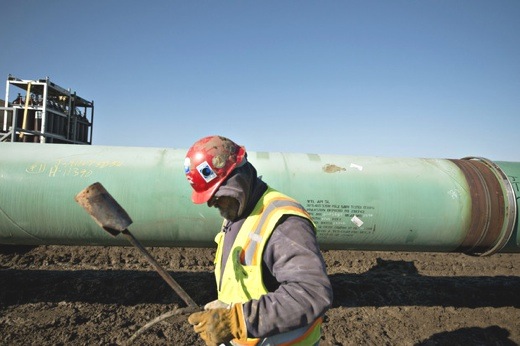
Image above: Pipeline Keystone XL construction worker. From original article.

Similar analyses could be made for the oil sands that would be transported in TransCanada Corp.’s Keystone XL pipeline, and leases to drill for oil, gas and coal on federal lands, such as those for Arch Coal Inc. and Peabody Energy Corp.

President Barack Obama is preparing to tell all federal agencies for the first time that they should consider the impact on global warming before approving major projects, from pipelines to highways.

The result could be significant delays for natural gas- export facilities, ports for coal sales to Asia, and even new forest roads, industry lobbyists warn.

“It’s got us very freaked out,” said Ross Eisenberg, vice president of the National Association of Manufacturers, a Washington-based group that represents 11,000 companies such as Exxon Mobil Corp. (XOM) and Southern Co. (SO) The standards, which constitute guidance for agencies and not new regulations, are set to be issued in the coming weeks, according to lawyers briefed by administration officials.

In taking the step, Obama would be fulfilling a vow to act alone in the face of a Republican-run House of Representatives unwilling to pass measures limiting greenhouse gases. He’d expand the scope of a Nixon-era law that was first intended to force agencies to assess the effect of projects on air, water and soil pollution.

“If Congress won’t act soon to protect future generations, I will,” Obama said last month during his State of the Union address. He pledged executive actions “to reduce pollution, prepare our communities for the consequences of climate change, and speed the transition to more sustainable sources of energy.”

Illinois Speech
The president is scheduled to deliver a speech on energy today at the Argonne National Laboratory in Lemont, Illinois. He is pressing Congress to create a $2 billion clean-energy research fund with fees paid by oil and gas producers.

While some U.S. agencies already take climate change into account when assessing projects, the new guidelines would apply across-the-board to all federal reviews. Industry lobbyists say they worry that projects could be tied up in lawsuits or administrative delays.

For example, Ambre Energy Ltd. is seeking a permit from the Army Corps of Engineers to build a coal-export facility at the Port of Morrow in Oregon. Under existing rules, officials weighing approval would consider whether ships in the port would foul the water or generate air pollution locally. The Environmental Protection Agency and activist groups say that review should be broadened to account for the greenhouse gases emitted when exported coal is burned in power plants in Asia.

Keystone Pipeline
Similar analyses could be made for the oil sands that would be transported in TransCanada Corp. (TRP)’s Keystone XL pipeline, and leases to drill for oil, gas and coal on federal lands, such as those for Arch Coal Inc. (ACI) and Peabody Energy Corp. (BTU)

If the new White House guidance is structured correctly, it will require just those kinds of lifecycle reviews, said Bill Snape, senior counsel at the Center for Biological Diversity in Washington. The environmental group has sued to press for this approach, and Snape says lawsuits along this line are certain if the administration approves the Keystone pipeline, which would transport oil from Canada’s tar sands to the U.S. Gulf Coast.

“The real danger is the delays,” said Eisenberg of the manufacturers’ group. “I don’t think the answer is ever going to be ‘no,’ but it can confound things.”

Lawyers and lobbyists are now waiting for the White House’s Council on Environmental Quality to issue the long bottled-up standards for how agencies should address climate change under the National Environmental Policy Act, signed into law by President Richard Nixon in 1970.
Environmental Impact

NEPA requires federal agencies to consider and publish the environmental impact of their actions before making decisions. Those reviews don’t mandate a specific course of action. They do provide a chance for citizens and environmentalists to weigh in before regulators decide on an action -- and to challenge those reviews in court if it’s cleared.

“Each agency currently differs in how their NEPA reviews consider the climate change impacts of projects, as well as how climate change impacts such as extreme weather will affect projects,” Taryn Tuss, a Council on Environmental Quality spokeswoman, said in an e-mail. “CEQ is working to incorporate the public input we received on the draft guidance, and will release updated guidance when it is completed.”

Major Shakeup
The new standards will be “a major shakeup in how agencies conduct NEPA” reviews, said Brendan Cummings, senior counsel for the Center for Biological Diversity in San Francisco.

The White House is looking at requiring consideration of both the increase in greenhouse gases and a project’s vulnerability to flooding, drought or other extreme weather that might result from global warming, according to an initial proposal it issued in 2010. Those full reports would be required for projects with 25,000 metric tons of carbon dioxide equivalent emissions or more per year, the equivalent of burning about 100 rail cars of coal.

The initial draft exempted federal land and resource decisions from the guidance, although CEQ said it was assessing how to handle those cases. Federal lands could be included in the final standards.

The White House guidance itself won’t force any projects to be stopped outright. Instead, it’s likely to prompt lawsuits against federal projects on these grounds, and increase the probability that courts will step in and order extensive reviews as part of the “adequate analysis” required in the law, said George Mannina, an attorney at Nossaman LLP in Washington.

Next Administration
“The question is: Where does this analysis take us?” he said. “Adequate analysis may be much broader than the agency and applicant might consider.”

While the Obama administration’s guidance could be easily rescinded by the next administration, the court rulings that stem from these cases will live on as precedents, Mannina said.

Lobbying groups such as the U.S. Chamber of Commerce, American Petroleum Institute and the National Mining Association weighed in with the White House against including climate in NEPA, a law initially aimed at chemical leaks or air pollution.

“Not only will this result in additional delay of the NEPA process, but will result in speculative and inaccurate modeling that will have direct impacts on approval of specific projects,” the National Mining Association in Washington wrote in comments to the White House in 2010.

Leases Challenged
The group represents Arch Coal (ACI) and Peabody, both based in St. Louis. Leases that the Department of Interior issued for those companies to mine for coal in Wyoming are facing lawsuits from environmental groups, arguing that the agency didn’t adequately tally up the effect on global warming from burning that coal.

Given Obama’s pledge to address global warming, “this is a massive contradiction,” said Jeremy Nichols, director of climate at WildEarth Guardians in Denver, which filed lawsuits against the leases.

Arch Coal referred questions to the mining group.

Beth Sutton, a Peabody spokeswoman, said in an e-mail, “We believe the current regulatory approach to surface mine permits is appropriate and protects the environment.”

Since CEQ first announced its proposal, more than three dozen federal approvals were challenged on climate grounds, including a highway project in North Carolina, a methane-venting plan for a coal mine in Colorado, and a research facility in California, according to a chart compiled by the Center for Climate Change Law at Columbia University.

Next Target
The next target is TransCanada (TRP)’s application to build the 1,661-mile (2,673-kilometer) Keystone pipeline. The Sierra Club and 350.org drew 35,000 people to Washington last month to urge Obama to reject the pipeline. Meanwhile, the NEPA review by the State Department included an initial analysis of carbon released when the tar sands are refined into gasoline and used in vehicles.

It stopped short, however, of saying the project would result in an increase in greenhouse gas emissions. With or without the pipeline, the oil sands will be mined and used as fuel, the report said. That finding is likely to be disputed in court if the Obama administration clears the project.

“Keystone is ground zero,” said Snape, of the Center for Biological Diversity. “Clearly this will come into play, and it will be litigated.”

Any actions by the administration now on global warming would pick up on a mixed record over the past four years.

Cap-and-Trade
While Obama failed to get Congress to pass cap-and-trade legislation, the EPA reversed course from the previous administration and ruled that carbon-dioxide emissions endanger public health, opening the way for the agency to regulate it.

Using that finding, the agency raised mileage standards for automobiles and proposed rules for new power plants that would essentially outlaw the construction of new coal-fired power plants that don’t have expensive carbon-capture technology.

Environmentalists such as the Natural Resources Defense Council say the most important action next will be the EPA’s rules for existing power plants, the single biggest source of carbon-dioxide emissions. The NEPA standards are separate from those rules, and will affect how the federal government itself is furthering global warming.

“Agencies do a pretty poor job of looking at climate change impacts,” Rebecca Judd, a legislative counsel at the environmental legal group Earthjustice in Washington. “A thorough guidance would help alleviate that.”
.

Uh Oh! Is Egyptian Flu Catching?

SOURCE: Elaine Dunbar (inunyabus@gmail.com) SUBHEAD: All US Ambassadors recalled back to Washington for an unprecedented event - a "QDDR". Compiled from circulated email 10 February 2011 -

   
Image above: U.S. Ambassadors to European countries gathered in Brussels in 2010. From (http://thehague.usembassy.gov/news/events/events-2010/october-1---ambassador-hartog-levin-in-brussels.html).

We received the following thoughts on the widely-circulated story alleging ALL US Ambassadors were recalled to DC for a conference from a retired career member of the US Dept of State...
Jeff - Whoever sent this to you is right on one point at least: It has never happened before. When State has a Chiefs of Mission conference, it normally tends to do it on a regional basis. What I am reading in the story below is a conference of the chief officers of every diplomatic and consular post.
They are not all Ambassadors, however. Ambassadors have Embassies; Consuls General have Consulates General; and Consuls have Consulates. The goal of such a meeting, if it actually occurs, would be to brief all chief officers of our overseas posts simultaneously about some truly critical issue; so critical that something may be expected to happen in the area of any of those posts that affects the safety and security of the post and the people in it, along with the vital interests of the United States.
The global overseas senior management cut would be ambassadors and consuls general. That is a plausible cut, even recognizing that in some countries we have more than one consul general ( 5 in Canada, 2 in Brazil as examples). It could be that the rebellion in Cairo is seen to be peculiarly contageous, and might unsettle any diplomatic post. In such an eventuality, the goal would be to put everyone on the alert at the same level of sensitivity and give each the same precisely stated policy guidance.
How to act in the event of another Tahrir Square gathering in some other country could be the subject. That can all be done, of course, with a properly stated and prioritized telegram. Getting all those troops together is both expensive and disruptive. Interesting. (Name withheld)
Here now, is the original story circulated this week: Monday, February 7, 2011... "All Ambassadors Called Back to Washington" Sunday, February 06, 2011 2:21 "U.S. Ambassadors of the world called back to Washington" In an unprecedented move, apparently one that has never happened before, nearly all U.S. Ambassadors to all nations have been called back to Washington for a summit conference this week. Some sources were reporting on story on 31 January 2011. "Clinton calls for historic meeting with ambassadors" (http://www.politico.com/news/stories/0111/48471.html)
"Ambassadors from almost all 260 U.S. embassies, consulates and other posts in more than 180 countries are expected to convene at the State Department for what's being billed as the first meeting of its kind."
"Secretary of State Hillary Rodham Clinton is convening an unprecedented mass meeting of U.S. ambassadors" (http://www.huffingtonpost.com/2011/01/31/clinton-ambassador-meeting_n_816146.html) The first logical thought that comes to mind looking back at all previous world crisis, what might now be so important, evidently more-so than anything ever in the past, to call all ambassadors back to Washington? The sky's the limit with ideas and conspiracy.
  • To get all their stories 'straight' ahead of time for something.
  • To prearrange settling the debt score between nations prior to a new world currency roll-out.
  • A dollar currency devaluation.
  • China is calling in our debt
  • New severely damaging Wikileaks about to be released.
  • Afraid of electronic communication leaks of something very important to discuss ?
While the main stream and most Americans are involved with the SuperBowl at the moment, hardly any reporting on the event can be found. Fine time to do something 'under the radar'. Could this actually be simply a 'first time' of such a gathering to discuss 'normal' business? At first instinct, suspicion is aroused. The 'official' explanation from the U.S. State Dept. is something named the first Quadrennial Diplomacy and Development Review or QDDR (http://www.state.gov/s/dmr/qddr/). Stay tuned. .