Showing posts with label Middle Class. Show all posts

Winners will lose - Losers will win

SUBHEAD: The consolation, perhaps, is that there will be plenty for all those who survive the collapse.

By James Kunstler on 20 August 2018 for Kunstler.com -
(http://kunstler.com/clusterfuck-nation/the-winners-will-lose-and-the-losers-will-win/)
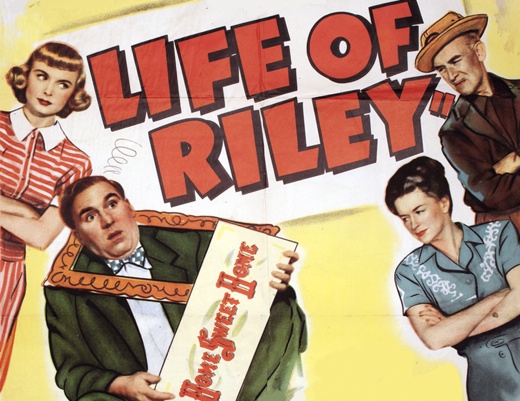

Image above: Detail of poster for the 1949 movie "The Life of Riley" based on the popular radio show and later hit 1950's TV show. From (https://www.imdb.com/title/tt0041590/).

Who doesn’t want to think that they are a good human being? That they are a person of good intentions, clear conscience, fair-minded, generous, loving, and merciful? On the other hand, who wants to be a loser?

The current political predicament in the USA has America’s winners turned losers and the consequent pain of that flip-flop has propelled the new designated losers into a fury of moral indignation.

The deplorable Trump insurgents were supposed to be put in their place on November 8, 2016 — stuffed back into their reeking WalMarts — but instead, their champion with his gold-plated hair-do presides over the nation in the house where Lincoln, The Roosevelts, and Hillary lived. “Winning…!” as the new president likes to tweet.

What a revoltin’ development, as Chester A. Riley used to say on “The Life of Riley” TV show back in 1955, when America was great (at least that’s the theory). Riley was an original deplorable before the concept even emerged from the murk of early pop culture.

He worked in an aircraft factory somewhere in southern California, which only a few decades prior was the mecca of an earlier generations of losers: the Oakies and other Dust Bowl refugees who went west to pick fruit or get into the movies.

Chester A. Riley supported a family on that job as a wing-riveter. All the male characters in the series had been through the Second World War, but were so far removed from the horror that the audience never heard about it.

That was the point: to forget all that gore and get down with the new crazes for backyard barbeque, seeing the USA in your Chevrolet, enjoying that healthful pack of Lucky Strikes in the valley of the Jolly Green Giant… double your pleasure, double your fun… and away go troubles down the drain….

As Tom Wolfe pointed out eons ago, the most overlooked feature of post-war American life was the way that the old US peasantry found themselves living higher on the hog than Louis the XVI and his court at Versailles.

Hot and cold running water, all the deliciously engineered Betty Crocker cake you could eat, painless dentistry, and Yankees away games on Channel 11, with Pabst Blue Ribbon by the case! By 1960 or so, along came color TV and air-conditioning, and in places like Atlanta, St. Louis, and Little Rock, you barely had to go outside anymore, thank God! No more heat stroke, hookworm, or chiggers.

It was a helluva lot better than earlier peasant classes had it, for sure, but let’s face it: it was kind of a low-grade nirvana. And a couple of generations beyond “The Life of Riley” the whole thing has fallen apart.

There are few hands-on jobs that allow a man to support a family. And what would we even mean by that? Stick the women back in kitchen and the laundry room?

What a waste of human capital (even for socialists who oppose capital). The odd thing is that there is increasingly little for this class of people to do besides stand near the door of the WalMart, and if the vaunted tech entrepreneurs of this land have their way with robotics, you can be sure there would be less than nothing for them to do… except crawl off and die quietly, without leaving an odoriferous mess.

What political commentator has failed to notice that the supposed savior of this peasant class is himself a sort of shabby version of Louis XVI, with his gilded toilet seats, brand-name pomp, and complex hair?

A happy peasantry needs a good king, and that is the role Mr. Trump seems to have cast himself in. I assume that he wants very earnestly to be considered a good person, though all his efforts to demonstrate that have been startlingly clumsy and mostly ineffective.

The one thing he has truly accomplished is driving his opponents in the overclass out of their gourds with loathing and resentment. (The term, overclass was minted, I believe by the excellent essayist Michael Lind.)

It’s a wonderfully inclusive term in that it describes basically everyone who is not in the underclass — that now-dreadful realm of tattooed diabetics moiling in the war memorial auditoriums and minor league ball parks for their hero and leader to descend like Deus ex Machina in the presidential helicopter to remind them how much they’re winning.

Meanwhile, the class of former winners-turned-losers — the Silicon Valley executives, the Hollywood movers and shakers, the Brooklyn Hipsters, the Ivy League faculties, the Deep State guideline writers, the K-Street consultants, the yoga ladies of Fairfield County, Connecticut, the acolytes of Oprah Winfrey and Elizabeth Warren — resort to righteous litigation in their crusade to restore the proper order of rule in this land. When they come to power, the shining city will be at hand….

I kind of doubt it. The truth is, all current winners and losers are living in the shadow of a financial system that doesn’t really work anymore, because it doesn’t represent the reality of wealth that is no longer there.

The consolation, perhaps, is that there will be plenty for all those who survive the collapse of that system to do when the time comes.

But it will be in a disposition of things and of power that we can’t possibly recognize from where we stand these days.

.

Robots to replace truck drivers

SUBHEAD: One of the few decent paying jobs for those without college degrees is threatened.

By Natalie Kitroeff on 25 September 2106 for L.A. Times -
(http://www.latimes.com/projects/la-fi-automated-trucks-labor-20160924/)


Image above: Two Otto self driving semi-tractors sit in garage. They have been test driving with autonomous technology up and down Interstate 280 and the 101 Freeway. Photo by Tony Avelar. From original article.

Trucking paid for Scott Spindola to take a road trip down the coast of Spain, climb halfway up Machu Picchu, and sample a Costa Rican beach for two weeks. The 44-year-old from Covina now makes up to $70,000 per year, with overtime, hauling goods from the port of Long Beach. He has full medical coverage and plans to drive until he retires.

But in a decade, his big rig may not have any need for him.

Carmaking giants and ride-sharing upstarts racing to put autonomous vehicles on the road are dead set on replacing drivers, and that includes truckers. Trucks without human hands at the wheel could be on American roads within a decade, say analysts and industry executives.

At risk is one of the most common jobs in many states, and one of the last remaining careers that offer middle-class pay to those without a college degree. There are 1.7 million truckers in America, and another 1.7 million drivers of taxis, buses and delivery vehicles. That compares with 4.1 million construction workers.

While factory jobs have gushed out of the country over the last decade, trucking has grown and pay has risen. Truckers make $42,500 per year on average, putting them firmly in the middle class.

On Sept. 20, the Obama administration put its weight behind automated driving, for the first time releasing federal guidelines for the systems. About a dozen states already created laws that allow for the testing of self-driving vehicles.

But the federal government, through the National Highway Traffic Safety Administration, will ultimately have to set rules to safely accommodate 80,000-pound autonomous trucks on U.S. highways.

In doing so, the feds have placed a bet that driverless cars and trucks will save lives. But autonomous big rigs, taxis and Ubers also promise to lower the cost of travel and transporting goods.

It would also be the first time that machines take direct aim at an entire class of blue-collar work in America. Other workers who do things you may think cannot be done by robots — like gardeners, home builders and trash collectors — may be next.

“We are going to see a wave and an acceleration in automation, and it will affect job markets,” said Jerry Kaplan, a Stanford lecturer and the author of “Humans Need Not Apply” and “Artificial Intelligence: What Everyone Needs to Know,” two books that chronicle the effect of robotics on labor.

“Long-haul truck driving is a great example, where there isn’t much judgment involved and it’s a fairly controlled environment,” Kaplan said.

Robots’ march into vehicles, factories, stores, and offices could also profoundly deepen inequality. Research has shown that artificial intelligence helps erase jobs that require basic skills and creates more roles for highly educated people.

“Automation tends to replace low-wage jobs with high-wage jobs,” said James Bessen, a lecturer at the Boston University School of Law who researches the effect of innovation on labor.

“The people whose skills become obsolete are low-wage workers, and to the extent that it’s difficult for them to acquire new skills, it affects inequality.”

Trucking will likely be the first type of driving to be fully automated – meaning there’s no one at the wheel. One reason is that long-haul big rigs spend most of their time on highways, which are the easiest roads to navigate without human intervention.

But there’s also a sweeter financial incentive for automating trucks. Trucking is a $700-billion industry, in which a third of costs go to compensating drivers.

“If you can get rid of the drivers, those people are out of jobs, but the cost of moving all those goods goes down significantly,” Kaplan said.

The companies pioneering these new technologies have tried to sell cost savings as something that will be good for trucking employers and workers.

Otto, a self-driving truck company started by former Google engineers and executives, pitches its system as a source of new income for drivers who will be able to spend more time in vehicles that can drive solo as they rest.

Uber bought the San Francisco-based company in August.

.

American Dream's last gasp

SUBHEAD: Many think of the federal government as anything more than a vast mechanism operated by rich crooks.

By John Michael Greer on 2 Novemner 2016 for the Archdruid Report -
(thearchdruidreport.blogspot.com/2016/11/the-last-gasp-of-american-dream.html)


Image above: The RNC third night is abizarre evening filled with fourth-rate public figures who speak on the theme is “Make America First Again”. From (https://newrepublic.com/minutes/135353/crowd-rnc-greedy-red-meat).

Just at the moment, many of my readers—and of course a great many others as well—are paying close attention to which of the two most detested people in American public life will put a hand on a Bible in January, and preside thereafter over the next four years of this nation’s accelerating decline and fall.

That focus is understandable, and not just because both parties have trotted out the shopworn claim that this election, like every other one in living memory, is the most important in our lifetimes. For a change, there are actual issues involved.

Barring any of the incidents that could throw the election into the House of Representatives, we’ll know by this time next week whether the bipartisan consensus that’s been welded firmly in place in American politics since the election of George W. Bush will stay intact for the next four years.

That consensus, for those of my readers who haven’t been paying attention, supports massive giveaways to big corporations and the already affluent, punitive austerity for the poor, malign neglect for the nation’s infrastructure, the destruction of the American working class through federal subsidies for automation and offshoring and tacit acceptance of mass illegal immigration as a means of driving down wages, and a monomaniacally confrontational foreign policy obsessed with the domination of the Middle East by raw military force.

Those are the policies that George W. Bush and Barack Obama pursued through four presidential terms, and they’re the policies that Hillary Clinton has supported throughout her political career.

Donald Trump, by contrast, has been arguing against several core elements of that consensus since the beginning of his run for office. Specifically, he’s calling for a reversal of federal policies that support offshoring of jobs, the enforcement of US immigration law, and a less rigidly confrontational stance toward Russia over the war in Syria.

It’s been popular all through the current campaign for Clinton’s supporters to insist that nobody actually cares about these issues, and that Trump’s supporters must by definition be motivated by hateful values instead, but that rhetorical gimmick has been a standard thoughstopper on the left for many years now, and it simply won’t wash.

The reason why Trump was able to sweep aside the other GOP candidates, and has a shot at winning next week’s election despite the unanimous opposition of this nation’s political class, is that he’s the first presidential candidate in a generation to admit that the issues just mentioned actually matter.

That was a ticket to the nomination, in turn, because outside the bicoastal echo chamber of the affluent, the US economy has been in freefall for years. I suspect that a great many financially comfortable people in today’s America have no idea just how bad things have gotten here in the flyover states.

The recovery of the last eight years has only benefited the upper 20% or so by income of the population; the rest have been left to get by on declining real wages, while simultaneously having to face skyrocketing rents driven by federal policies that prop up the real estate market, and stunning increases in medical costs driven by Obama’s embarrassingly misnamed “Affordable Care Act.”

It’s no accident that death rates from suicide, drug overdose, and alcohol poisoning are soaring just now among working class white people.

These are my neighbors, the people I talk with in laundromats and lodge meetings, and they’re being driven to the wall.

Most of the time, affluent liberals who are quick to emote about the sufferings of poor children in conveniently distant corners of the Third World like to brush aside the issues I’ve just raised as irrelevancies.

I’ve long since lost track of the number of times I’ve heard people insist that the American working class hasn’t been destroyed, that its destruction doesn’t matter, or that it was the fault of the working classes themselves. I’ve occasionally heard people attempt to claim all three of these things at once.

On those occasions when the mainstream left deigns to recognize the situation I’ve sketched out, it’s usually in the terms Hillary Clinton used in her infamous “basket of deplorables” speech, in which she admitted that there were people who hadn’t benefited from the recovery and “we need to do something for them.” That the people in question might deserve to have a voice in what’s done for them, or to them, is not part of the vocabulary of the affluent American left.

That’s why, if you pay a visit to the town where I live, you’ll find Trump signs all over the place—and you’ll find the highest concentration of them in the poor neighborhood just south of my home, a bleak rundown zone where there’s a church every few blocks and an abandoned house every few doors, and where the people tipping back beers on a porch of a summer evening rarely all have the same skin color.

They know exactly what they need, and what tens of thousands of other economically devastated American communities need: enough full-time jobs at decent wages to give them the chance to lift their families out of poverty.

They understand that need, and discuss it in detail among themselves, with a clarity you’ll rarely find in the media. (It’s a source of wry amusement to me that the best coverage of the situation on the ground here in the flyover states appeared, not in any of America’s newspapers of record, nor in any of its allegedly serious magazines, but in a raucous NSFW online humor magazine.)

What’s more, the working class people who point to a lack of jobs as the cause of middle America’s economic collapse are dead right.

The reason why those tens of thousands of American communities are economically devastated is that too few people have enough income to support the small businesses and local economies that used to thrive there.

The money that used to keep main streets bustling across the United States, the wages that used to be handed out on Friday afternoons to millions of Americans who’d spent the previous week putting in an honest day’s work for an honest day’s pay, have been siphoned off to inflate the profits of a handful of huge corporations to absurd levels and cater to the kleptocratic feeding frenzy that’s made multimillion-dollar bonuses a matter of course at the top of the corporate food chain.

It really is as simple as that.

The Trump voters in the neighborhood south of my home may not have a handle on all the details, but they know that their survival depends on getting some of that money flowing back into paychecks to be spent in their community.

It’s an open question whether they’re going to get that if Donald Trump wins the election, and a great many of his supporters know this perfectly well. It’s as certain as anything can be, though, that they’re not going to get it from Hillary Clinton.

The economic policy she’s touted in her speeches, to the extent that this isn’t just the sort of campaign rhetoric that will pass its pull date the moment the last vote is counted, focuses on improving opportunities for the middle class—the people, in other words, who have already reaped the lion’s share of those economic benefits that didn’t go straight into the pockets of the rich.

To the working classes, she offers nothing but a repetition of the same empty slogans and disposable promises.

What’s more, they know this, and another round of empty slogans and disposable promises isn’t going to change that.

Nor, it probably needs to be said, is it going to be changed by another round of media handwaving designed to make Donald Trump look bad in the eyes of affluent liberals.

I’ve noted with some amusement the various news stories on the highbrow end of the media noting, in tones variously baffled and horrified, that when you show Trump supporters videos designed to make them less enthusiastic about their candidate, they double down.

Any number of canned theories have been floated to explain why that happens, but none that I’ve heard have dealt with the obvious explanations.

To begin with, it’s not as though that habit is only found on Trump’s side of the fence.

In recent weeks, as one Wikileaks email dump after another has forced an assortment of stories about Clinton’s arrogant and corrupt behavior into the news, her followers have doubled down just as enthusiastically as Trump’s; those of my readers who are familiar with the psychology of previous investment will likely notice that emotional investment is just as subject to this law as the financial kind.

For that matter, supporters of both candidates are quite sensibly aware that this election is meant to choose a public official rather than a plaster saint, and recognize that a genuine scoundrel who will take the right stands on the issues that matter to them is a better choice than a squeaky-clean innocent who won’t, even if such an animal could actually be found in the grubby ecosystem of contemporary American politics.

That said, there’s another factor that probably plays an even larger role, which is that when working class Americans get told by slickly groomed talking heads in suits that something they believe is wrong, their default assumption is that the talking heads are lying.

Working class Americans, after all, have very good reason for making this their default assumption. Over and over again, that’s the way things have turned out.

The talking heads insisted that handing over tax dollars to various corporate welfare queens would bring jobs back to American communities; the corporations in question pocketed the tax dollars and walked away.

The talking heads insisted that if working class people went to college at their own expense and got retrained in new skills, that would bring jobs back to American communities; the academic industry profited mightily but the jobs never showed up, leaving tens of millions of people buried so deeply under student loan debt that most of them will never recover financially.

The talking heads insisted that this or that or the other political candidate would bring jobs back to American communities by pursuing exactly the same policies that got rid of the jobs in the first place—essentially the same claim that the Clinton campaign is making now—and we know how that turned out.

For that matter, trust in talking heads generally is at an all-time low out here in flyover country.

Consider the way that herbal medicine—“God’s medicine” is the usual phrase these days—has become the go-to option for a huge and growing number of devout rural Christians.

There are plenty of reasons why that should be happening, but surely one of the most crucial is the cascading loss of faith in the slickly groomed talking heads that sell modern medicine to consumers.

Herbs may not be as effective as modern pharmaceuticals in treating major illnesses, to be sure, but they generally don’t have the ghastly side effects that so many pharmaceuticals will give you.

Furthermore, and just as crucially, nobody ever bankrupted their family and ended up on the street because of the high price of herbs.

It used to be, not all that long ago, that the sort of people we’re discussing trusted implicitly in American society and its institutions.

They were just as prone as any urban sophisticate to distrust this or that politician or businessperson or cultural figure, to be sure; back in the days when local caucuses and county conventions of the two main political parties still counted for something, you could be sure of hearing raucous debates about a galaxy of personalities and issues.

Next to nobody, though, doubted that the basic structures of American society were not merely sound, but superior to all others.

You won’t find that certainty in flyover country these days.

Where you hear such claims made at all, they’re phrased in the kind of angry and defensive terms that lets everyone know that the speaker is trying to convince himself of something he doesn’t entirely believe any more, or in the kind of elegaic tones that hearken back to an earlier time when things still seemed to work—when the phrase “the American Dream” still stood for a reality that many people had experienced and many more could expect to achieve for themselves and their children.

Very few people out here think of the federal government as anything more than a vast mechanism operated by rich crooks for their own benefit, at the expense of everyone else.

What’s more, the same cynical attitude is spreading to embrace the other institutions of American society, and—lethally—the ideals from which those institutions get whatever legitimacy they still hold in the eyes of the people.

Those of my readers who were around in the late 1980s and early 1990s have seen this movie before, though it came with Cyrillic subtitles that time around.

By 1985 or so, it had become painfully obvious to most citizens of the Soviet Union that the grand promises of Marxism would not be kept and the glorious future for which their grandparents and great-grandparents had fought and labored was never going to arrive.

Glowing articles in Pravda and Izvestia insisted that everything was just fine in the Worker’s Paradise; annual five-year plans presupposed that economic conditions would get steadily better while, for most people, economic conditions got steadily worse.

Vast May Day parades showed off the Soviet Union’s military might, Soyuz spacecraft circled the globe to show off its technological prowess, and tame intellectuals comfortably situated in the more affluent districts of Moscow and Leningrad, looking forward to their next vacation at their favorite Black Sea resort, chattered in print about the good life under socialism, while millions of ordinary Soviet citizens trudged through a bleak round of long lines, product shortages, and system-wide dysfunction.

Then crisis hit, and the great-great-grandchildren of the people who surged to the barricades during the Russian Revolution shrugged, and let the Soviet Union unravel in a matter of days.

I suspect we’re much closer to a similar cascade of events here in the United States than most people realize. My fellow peak oil blogger Dmitry Orlov pointed out a decade or so back, in a series of much-reprinted blog posts and his book Reinventing Collapse, that the differences between the Soviet Union and the United States were far less important than their similarities, and that a Soviet-style collapse was a real possibility here—a possibility for which most Americans are far less well prepared than their Russian equivalents in the early 1990s.

His arguments have become even more compelling as the years have passed, and the United States has become mired ever more deeply in a mire of institutional dysfunction and politico-economic kleptocracy all but indistinguishable from the one that eventually swallowed its erstwhile rival.

Point by point, the parallels stand out.
  • We’ve got the news articles insisting, in tones by turns glowing and shrill, that things have never been better in the United States and anyone who says otherwise is just plain wrong.
     
  • We’ve got the economic pronouncements predicated on continuing growth at a time when the only things growing in the US economy are its total debt load and the number of people who are permanently unemployed.
  • We’ve got the overblown displays of military might and technological prowess, reminiscent of nothing so much as the macho posturing of balding middle-aged former athletes who are trying to pretend that they haven’t lost it.
  • We’ve got the tame intellectuals comfortably situated in the more affluent suburban districts around Boston, New York, Washington, and San Francisco, looking forward to their next vacation in whatever the currently fashionable spot might happen to be, babbling on the internet about the good life under predatory cybercapitalism.
Meanwhile millions of Americans trudge through a bleak round of layoffs, wage cuts, part-time jobs at minimal pay, and system-wide dysfunction.

The crisis hasn’t hit yet, but those members of the political class who think that the people who used to be rock-solid American patriots will turn out en masse to keep today’s apparatchiks secure in their comfortable lifestyles have, as the saying goes, another think coming.

 Nor is it irrelevant that most of the enlisted personnel in the armed forces, who are the US government’s ultimate bulwark against popular unrest, come from the very classes that have lost faith most drastically in the American system.

The one significant difference between the Soviet case and the American one at this stage of the game is that Soviet citizens had no choice but to accept the leaders the Communist Party of the USSR foisted off on them, from Brezhnev to Andropov to Chernenko to Gorbachev, until the system collapsed of its own weight.

American citizens, on the other hand, do at least potentially have a choice.

Elections in the United States have been riddled with fraud for most of two centuries, but since both parties are generally up to their eyeballs in voter fraud to a roughly equal degree, fraud mostly swings close elections.

 It’s still possible for a sufficiently popular candidate to overwhelm the graveyard vote, the crooked voting machines, and the other crass realities of American elections by sheer force of numbers.

That way, an outsider unburdened with the echo-chamber thinking of a dysfunctional elite might just be able to elbow his way into the White House. Will that happen this time? No one knows.

If George W. Bush was our Leonid Brezhnev, as I’d suggest, and Barack Obama is our Yuri Andropov, Hillary Clinton is running for the position of Konstantin Chernenko; her running mate Tim Kaine, in turn, is waiting in the wings as a suitably idealistic and clueless Mikhail Gorbachev, under whom the whole shebang can promptly go to bits.

While I don’t seriously expect the trajectory of the United States to parallel that of the Soviet Union anything like as precisely as this satiric metaphor would suggest, the basic pattern of cascading dysfunction ending in political collapse is quite a common thing in history, and a galaxy of parallels suggests that the same thing could very easily happen here within the next decade or so.

The serene conviction among the political class and their affluent hangers-on that nothing of the sort could possibly take place is just another factor making it more likely.

It’s by no means certain that a Trump presidency will stop that from happening, and jolt the United States far enough out of its current death spiral to make it possible to salvage something from the American experiment.

Even among Trump’s most diehard supporters, it’s common to find people who cheerfully admit that Trump might not change things enough to matter; it’s just that when times are desperate enough—and out here in the flyover states, they are—a leap in the dark is preferable to the guaranteed continuation of the unendurable.

Thus the grassroots movement that propelled Trump to the Republican nomination in the teeth of the GOP establishment, and has brought him to within a couple of aces of the White House in the teeth of the entire US political class, might best be understood as the last gasp of the American dream.

Whether he wins or loses next week, this country is moving into the darkness of an uncharted night—and it’s not out of place to wonder, much as Hamlet did, what dreams may come in that darkness.

.

Spinning Wheels

SUBHEAD: Is any effort to reform the food system is doomed to operate within the confines of the larger system?

[IB Publisher's note: We don't think so - however, unfortunately,  the fledgling small farm movement will not be large enough to serve the middle class when the bottom falls out of the big-ag food delivery system.]

By Brian Miller on 2 November 2015 for Winged Elm Farm -
(http://www.wingedelmfarm.com/blog/2015/11/02/spinning-wheels/)


Image above: A produce booth at the Palm Beach Gardens Farmer's Market. Can this system serve the middle class? From (http://farmersmarketsflorida.com/).

Periodically I feel the urge to write about farm economics, but I never quite figure out where to begin or what it encompasses. If I were to focus strictly on the profit/loss of our 70-acre farm, the picture might be too grim. To focus only on the rewards, the picture would be too rosy.

An endless amount is written these days about the small farm revolution, the explosion of farmer’s markets, and the localization of the American palate — a market destined for a middle class that each year dwindles in size, dwindles in spending power. Which leaves me wondering, who is buying all of these $7 a dozen, specially curated eggs?

Part of the problem with the small farm renaissance, as I see it, is that its success is partly measured by a share in a marketplace created to favor consolidation and lead to practices that are the antithesis of sustainable or at least careful stewardship.

More important, its success seems based specifically on a species of wealth derived from consumerism.

I really shouldn’t compare the prototypical small farm customer to a crack addict. But I will say that so much of our consumer society is built on providing a momentary high.

Which means that any effort to reform the food system is doomed to operate within the confines of the larger system that gave it birth, one based on providing that “high” to increase consumption.

Likewise, the larger economy thrives on providing a purchasable identity.

Create a consumerist buzz centered on small, idyllic plots of land, sustainability, and local food and you risk ginning up interest in hobby farms by bored, wealthy city dwellers, generating a publishing bonanza of how-to books, and building a market for those $7 a dozen, specially curated eggs.

A harsh assessment?

Perhaps, because there are a lot of great small farms and farmers, and plenty of sincere customers supporting their efforts. And there have been some great innovations to provide opportunities to support small farms, like CSAs and farmer’s markets.

And then there are the growing number of rural Americans who already lead a peak-empire life —working ad hoc jobs, bartering, growing their own gardens, raising or hunting their own meat and butchering it, living largely outside of the middle-class matrix of consumerism.

The old Wobblies had a motto: “We’re building the new society in the shell of the old.” Maybe that is the best we can shoot for at this stage in the global economy.

But I can’t shake the feeling that the middle-class small farm economy all seems too little, too late. It is too easily converted into another twee Martha Stewart aspiration for a middle class with dwindling hopes and clout.

The rubber-meets-the-road moment for all of us will be when this consumer-driven small farm moment meets the real small farm movement — a movement of descent, where we get to see who truly has the will and resources to embrace a smaller economic lifestyle, a lifestyle where a more authentic life of hard work powered by necessity shapes what we find valuable, one where identities are not for purchase.

.

Bang Your'e Dead

SUBHEAD: What used to be working class is now an idle class only dreaming of what it means to be a man.

By James Kunstler on 12 October 2015 for Kunstler.com -
(http://kunstler.com/clusterfuck-nation/bang-youre-dead/)


Image above: This is a surveillance camera still of is of twelve year old Tamir Rice as a police car approaches the playground pavilion he stands in Rice, who had been reported brandishing a realistic toy gun on the sidewalk. Police were called. As the cruiser nears the site Rice is seen approaching them. This frame is from three seconds before the cruiser come to a stop and five seconds before Rice is shot to death. From (http://www.wkyc.com/story/news/local/cleveland/2014/11/26/tamir-rice-shooting-video-released/19530745/).

Apropos of the recent Roseburg, Oregon, school massacre that left nine dead, President Obama said, “we’re going to have to come together and stop these things from happening.” 

That’s an understandable sentiment, and the president has to say something, after all. But within the context of how life is lived in this country these days, we’re not going to stop these things from happening.
 
And what is that context? A nation physically arranged on-the-ground to produce maximum loneliness, arranged economically to produce maximum anxiety, and disposed socially to produce maximum alienation. 

Really, everything in the once vaunted American way of life slouches in the direction of depression, rage, violence, and death.

This begs the question about guns. I believe it should be harder to buy guns. I believe certain weapons-of-war, such as assault rifles, should not be sold in the civilian market. 

But I also believe that the evolution of our Deep State — the collusion of a corrupt corporate oligarchy with an overbearing police and surveillance apparatus — is such a threat to liberty and decency that the public needs to be armed in defense of it. The Deep State needs to worry about the citizens it is fucking with.

The laws on gun sales range from ridiculously lax in many states to onerous in a few. Yet the most stringent, Connecticut, (rated “A” by the Brady Campaign org), was the site of the most horrific massacre of recent times so far, the 2012 Sandy Hook School shooting. 

The handgun law in New York City is the most extreme in the nation — limiting possession only to police and a few other very special categories of citizens. 

But it took the “stop-and-frisk” policy to really shake the weapons out of the gang-banging demographic. 

And now that Mayor Bill deBlasio has deemed that “racist,” gang-banging murders are going up again.

Which leads to a consideration that there is already such a fantastic arsenal of weapons loose in this country that attempts to regulate them would be an exercise in futility — it would only stimulate brisker underground trafficking in the existing supply.

What concerns me more than the gun issue per se is the extraordinary violence-saturated, pornified culture of young men driven crazy by failure, loneliness, grievance, and anger. 

 More and more, there are no parameters for the normal expression of masculine behavior in America — for instance, taking pride in doing something well, or becoming a good candidate for marriage. 

The lower classes have almost no vocational domain for the normal enactments of manhood, and one of the few left is the army, where they are overtly trained to be killers.

Much of what used to be the working class is now an idle class that can only dream of what it means to be a man and they are bombarded with the most sordid pre-packaged media dreams in the form of video games based on homicide, the narcissistic power fantasies of movies, TV, and professional sports, and the frustrating tauntings of free porn. The last thing they’re able to do is form families. 

All of this operates in conditions where there are no normal models of male authority, especially fathers and bosses, to regulate the impulse control of young men — and teach them to regulate it themselves.

The physical setting of American life composed of a failing suburban sprawl pattern for daily life — the perfect set-up for making community impossible — obliterates the secondary layer of socialization beyond the family. 

This is life in the strip-mall wilderness of our country, which has gotten to be most of where people live. Imagine a society without families and real communities and wave your flag over that.

President Obama and whatever else passes for authority in America these days won’t even talk about that. They don’t have a vocabulary for it. They don’t understand how it works and what it’s doing to the nation. 

Many of the parts and modules of it make up what’s left of our foundering economy: junk food, pointless and endless motoring, television. We’re not going to do anything about it. 

The killing and the mayhem will continue through the process of economic collapse that we have entered. And when we reach the destination of all that, probably something medieval or feudal in make-up, it will be possible once again for boys to develop into men instead of monsters.

.

Whisper of the Shutoff Valve

SUBHEAD: Outside that narrowing circle of elites the number of economic nonpersons will grow steadily - one shutoff notice at a time.

By John Michael Greer on 6 May 2015 for Archdruid Report - 
(http://thearchdruidreport.blogspot.com/2015/05/the-whisper-of-shutoff-valve.html)


Image above: Detroit home site without water to fight fires. From article claiming it is a human right to be able to access clean water wherever it is available (http://www.forwardprogressives.com/detroit-water-shut-violation-human-rights/).

Last week’s post on the impending decline and fall of the internet fielded a great many responses. That was no surprise, to be sure; nor was I startled in the least to find that many of them rejected the thesis of the post with some heat. Contemporary pop culture’s strident insistence that technological progress is a clock that never runs backwards made such counterclaims inevitable.

Still, it’s always educational to watch the arguments fielded to prop up the increasingly shaky edifice of the modern mythology of progress, and the last week was no exception. A response I found particularly interesting from that standpoint appeared on one of the many online venues where Archdruid Report posts appear.

One of the commenters insisted that my post should be rejected out of hand as mere doom and gloom; after all, he pointed out, it was ridiculous for me to suggest that fifty years from now, a majority of the population of the United States might be without reliable electricity or running water.

I’ve made the same prediction here and elsewhere a good many times. Each time, most of my readers or listeners seem to have taken it as a piece of sheer rhetorical hyperbole. The electrical grid and the assorted systems that send potable water flowing out of faucets are so basic to the rituals of everyday life in today’s America that their continued presence is taken for granted

At most, it’s conceivable that individuals might choose not to connect to them; there’s a certain amount of talk about off-grid living here and there in the alternative media, for example. That people who want these things might not have access to them, though, is pretty much unthinkable.

Meanwhile, in Detroit and Baltimore, tens of thousands of residents are in the process of losing their access to water and electricity.

The situation in both cities is much the same, and there’s every reason to think that identical headlines will shortly appear in reference to other cities around the nation. Not that many decades ago, Detroit and Baltimore were important industrial centers with thriving economies. Along with more than a hundred other cities in America’s Rust Belt, they were thrown under the bus with the first wave of industrial offshoring in the 1970s.

The situation for both cities has only gotten worse since that time, as the United States completed its long transition from a manufacturing economy producing goods and services to a bubble economy that mostly produces unpayable IOUs.

These days, the middle-class families whose tax payments propped up the expansive urban systems of an earlier day have long since moved out of town. Most of the remaining residents are poor, and the ongoing redistribution of wealth in America toward the very rich and away from everyone else has driven down the income of the urban poor to the point that many of them can no longer afford to pay their water and power bills.

City utilities in Detroit and Baltimore have been sufficiently sensitive to political pressures that large-scale utility shutoffs have been delayed, but shifts in the political climate in both cities are bringing the delays to an end; water bills have increased steadily, more and more people have been unable to pay them, and the result is as predictable as it is brutal.

The debate over the Detroit and Baltimore shutoffs has followed the usual pattern, as one side wallows in bash-the-poor rhetoric while the other side insists plaintively that access to utilities is a human right. Neither side seems to be interested in talking about the broader context in which these disputes take shape. There are two aspects to that broader context, and it’s a tossup which is the more threatening.

The first aspect is the failure of the US economy to recover in any meaningful sense from the financial crisis of 2008. Now of course politicians from Obama on down have gone overtime grandstanding about the alleged recovery we’re in. I invite any of my readers who bought into that rhetoric to try the following simple experiment.

Go to your favorite internet search engine and look up how much the fracking industry has added to the US gross domestic product each year from 2009 to 2014. Now subtract that figure from the US gross domestic product for each of those years, and see how much growth there’s actually been in the rest of the economy since the real estate bubble imploded.

What you’ll find, if you take the time to do that, is that the rest of the US economy has been flat on its back gasping for air for the last five years.

What makes this even more problematic, as I’ve noted in several previous posts here, is that the great fracking boom about which we’ve heard so much for the last five years was never actually the game-changing energy revolution its promoters claimed; it was simply another installment in the series of speculative bubbles that has largely replaced constructive economic activity in this country over the last two decades or so.

What’s more, it’s not the only bubble currently being blown, and it may not even be the largest.

We’ve also got a second tech-stock bubble, with money-losing internet corporations racking up absurd valuations in the stock market while they burn through millions of dollars of venture capital.

We’ve got a student loan bubble, in which billions of dollars of loans that will never be paid back have been bundled, packaged, and sold to investors just like all those no-doc mortgages were a decade ago; car loans are getting the same treatment; the real estate market is fizzing again in many urban areas as investors pile into another round of lavishly marketed property investments. Well, I could go on for some time.

It’s entirely possible that if all the bubble activity were to be subtracted from the last five years or so of GDP, the result would show an economy in freefall.

Certainly that’s the impression that emerges if you take the time to check out those economic statistics that aren’t being systematically jiggered by the US government for PR purposes.

The number of long-term unemployed in America is at an all-time high; roads, bridges, and other basic infrastructure is falling to pieces; measurements of US public health—generally considered a good proxy for the real economic condition of the population—are well below those of other industrial countries, heading toward Third World levels

Abandoned shopping malls litter the landscape while major retailers announce more than 6000 store closures. These are not things you see in an era of economic expansion, or even one of relative stability; they’re markers of decline.

The utility shutoffs in Detroit and Baltimore are further symptoms of the same broad process of economic unraveling. It’s true, as pundits in the media have been insisting since the story broke, that utilities get shut off for nonpayment of bills all the time. It’s equally true that shutting off the water supply of 20,000 or 30,000 people all at once is pretty much unprecedented.

Both cities, please note, have had very large populations of poor people for many decades now.

Those who like to blame a “culture of poverty” for the tangled relationship between US governments and the American poor, and of course that trope has been rehashed by some of the pundits just mentioned, haven’t yet gotten around to explaining how the culture of poverty all at once inspired tens of thousands of people who had been paying their utility bills to stop doing so.

There are plenty of good reasons, after all, why poor people who used to pay their bills can’t do so any more. Standard business models in the United States used to take it for granted that the best way to run the staffing dimensions of any company, large or small, was to have as many full-time positions as possible and to use raises and other practical incentives to encourage employees who were good at their jobs to stay with the company.

That approach has been increasingly unfashionable in today’s America, partly due to perverse regulatory incentives that penalize employers for offering full-time positions, partly to the emergence of attitudes in corner offices that treat employees as just another commodity. (I doubt it’s any kind of accident that most corporations nowadays refer to their employment offices as “human resource departments.” What do you do with a resource? You exploit it.)

These days, most of the jobs available to the poor are part-time, pay very little, and include nasty little clawbacks in the form of requirements that employees pay out of pocket for uniforms, equipment, and other things that employers used to provide as a matter of course.

Meanwhile housing prices and rents are rising well above their post-2008 dip, and a great many other necessities are becoming more costly—inflation may be under control, or so the official statistics say, but anyone who’s been shopping at the same grocery store for the last eight years knows perfectly well that prices kept on rising anyway.

So you’ve got falling incomes running up against rising costs for food, rent, and utilities, among other things. In the resulting collision, something’s got to give, and for tens of thousands of poor Detroiters and Baltimoreans, what gave first was the ability to keep current on their water bills. Expect to see the same story playing out across the country as more people on the bottom of the income pyramid find themselves in the same situation.

What you won’t hear in the media, though it’s visible enough if you know where to look and are willing to do so, is that people above the bottom of the income pyramid are also losing ground, being forced down toward economic nonpersonhood. From the middle classes down, everyone’s losing ground.

That process doesn’t continue any further than the middle class, to be sure. It’s been pointed out repeatedly that over the last four decades or so, the distribution of wealth in America has skewed further and further out of balance, with the top 20% of incomes taking a larger and larger share at the expense of everybody else.

That’s an important factor in bringing about the collision just described. Some thinkers on the radical fringes of American society, which is the only place in the US you can talk about such things these days, have argued that the raw greed of the well-to-do is the sole reason why so many people lower down the ladder are being pushed further down still.

Scapegoating rhetoric of that sort is always comforting, because it holds out the promise—theoretically, if not practically—that something can be done about the situation. If only the thieving rich could be lined up against a convenient brick wall and removed from the equation in the time-honored fashion, the logic goes, people in Detroit and Baltimore could afford to pay their water bills!

I suspect we’ll hear such claims increasingly often as the years pass and more and more Americans find their access to familiar comforts and necessities slipping away. Simple answers are always popular in such times, not least when the people being scapegoated go as far out of their way to make themselves good targets for such exercises as the American rich have done in recent decades.

John Kenneth Galbraith’s equation of the current US political and economic elite with the French aristocracy on the eve of revolution rings even more true than it did when he wrote it back in 1992, in the pages of The Culture of Contentment.

The unthinking extravagances, the casual dismissal of the last shreds of noblesse oblige, the obsessive pursuit of personal advantages and private feuds without the least thought of the potential consequences, the bland inability to recognize that the power, privilege, wealth, and sheer survival of the aristocracy depended on the system the aristocrats themselves were destabilizing by their actions—it’s all there, complete with sprawling overpriced mansions that could just about double for Versailles.

The urban mobs that played so large a role back in 1789 are warming up for their performances as I write these words; the only thing left to complete the picture is a few tumbrils and a guillotine, and those will doubtless arrive on cue.

The senility of the current US elite, as noted in a previous post here, is a massive political fact in today’s America. Still, it’s not the only factor in play here. Previous generations of wealthy Americans recognized without too much difficulty that their power, prosperity, and survival depended on the willingness of the rest of the population to put up with their antics.

Several times already in America’s history, elite groups have allied with populist forces to push through reforms that sharply weakened the power of the wealthy elite, because they recognized that the alternative was a social explosion even more destructive to the system on which elite power depends.

I suppose it’s possible that the people currently occupying the upper ranks of the political and economic pyramid in today’s America are just that much more stupid than their equivalents in the Jacksonian, Progressive, and New Deal eras. Still, there’s at least one other explanation to hand, and it’s the second of the two threatening contextual issues mentioned earlier.

Until the nineteenth century, fresh running water piped into homes for everyday use was purely an affectation of the very rich in a few very wealthy and technologically adept societies. Sewer pipes to take dirty water and human wastes out of the house belonged in the same category.

This wasn’t because nobody knew how plumbing works—the Romans had competent plumbers, for example, and water faucets and flush toilets were to be found in Roman mansions of the imperial age. The reason those same things weren’t found in every Roman house was economic, not technical.

Behind that economic issue lay an ecological reality. White’s Law, one of the foundational principles of human ecology, states that economic development is a function of energy per capita.

For a society before the industrial age, the Roman Empire had an impressive amount of energy per capita to expend; control over the agricultural economy of the Mediterranean basin, modest inputs from sunlight, water and wind, and a thriving slave industry fed by the expansion of Roman military power all fed into the capacity of Roman society to develop itself economically and technically.

That’s why rich Romans had running water and iced drinks in summer, while their equivalents in ancient Greece a few centuries earlier had to make do without either one.

Fossil fuels gave industrial civilization a supply of energy many orders of magnitude greater than any previous human civilization has had—a supply vast enough that the difference remains huge even after the vast expansion of population that followed the industrial revolution. There was, however, a catch—or, more precisely, two catches.

To begin with, fossil fuels are finite, nonrenewable resources; no matter how much handwaving is employed in the attempt to obscure this point—and whatever else might be in short supply these days, that sort of handwaving is not—every barrel of oil, ton of coal, or cubic foot of natural gas that’s burnt takes the world one step closer to the point at which there will be no economically extractable reserves of oil, coal, or natural gas at all.

That’s catch #1. Catch #2 is subtler, and considerably more dangerous. Oil, coal, and natural gas don’t leap out of the ground on command. They have to be extracted and processed, and this takes energy.

Companies in the fossil fuel industries have always targeted the deposits that cost less to extract and process, for obvious economic reasons. What this means, though, is that over time, a larger and larger fraction of the energy yield of oil, coal, and natural gas has to be put right back into extracting and processing oil, coal, and natural gas—and this leaves less and less for all other uses.

That’s the vise that’s tightening around the American economy these days. The great fracking boom, to the extent that it wasn’t simply one more speculative gimmick aimed at the pocketbooks of chumps, was an attempt to make up for the ongoing decline of America’s conventional oilfields by going after oil that was far more expensive to extract.

The fact that none of the companies at the heart of the fracking boom ever turned a profit, even when oil brought more than $100 a barrel, gives some sense of just how costly shale oil is to get out of the ground. The financial cost of extraction, though, is a proxy for the energy cost of extraction—the amount of energy, and of the products of energy, that had to be thrown into the task of getting a little extra oil out of marginal source rock.

Energy needed to extract energy, again, can’t be used for any other purpose. It doesn’t contribute to the energy surplus that makes economic development possible. As the energy industry itself takes a bigger bite out of each year’s energy production, every other economic activity loses part of the fuel that makes it run.

That, in turn, is the core reason why the American economy is on the ropes, America’s infrastructure is falling to bits—and Americans in Detroit and Baltimore are facing a transition to Third World conditions, without electricity or running water.

I suspect, for what it’s worth, that the shutoff notices being mailed to tens of thousands of poor families in those two cities are a good working model for the way that industrial civilization itself will wind down. It won’t be sudden; for decades to come, there will still be people who have access to what Americans today consider the ordinary necessities and comforts of everyday life; there will just be fewer of them each year.

Outside that narrowing circle, the number of economic nonpersons will grow steadily, one shutoff notice at a time.

As I’ve pointed out in previous posts, the line of fracture between the senile elite and what Arnold Toynbee called the internal proletariat—the people who live within a failing civilization’s borders but receive essentially none of its benefits—eventually opens into a chasm that swallows what’s left of the civilization.

Sometimes the tectonic processes that pull the chasm open are hard to miss, but there are times when they’re a good deal more difficult to sense in action, and this is one of these latter times. Listen to the whisper of the shutoff valve, and you’ll hear tens of thousands of Americans being cut off from basic services the rest of us, for the time being, still take for granted.

.

Our Middleman-Skimming Economy

SUBHEAD: Collapse for the middlemen-skimmers is akin to the collapse of debt-based serfdom. It's called freedom.

By Charles Hugh Smith on 11 February 2014 for Of Two Minds -
(http://www.oftwominds.com/blogfeb14/middlemen2-14.html)


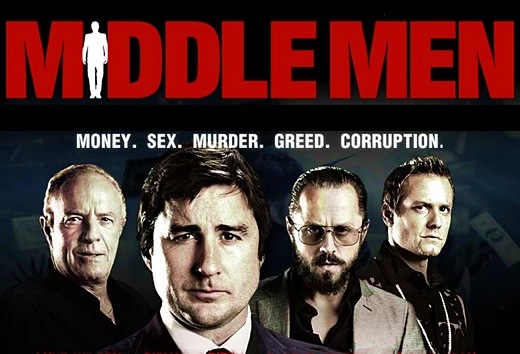
Image above: Detail of movie poster fr film "Middlemen" From (http://sorabhsamsukha.blogspot.com/2011/11/movie-review-middle-men.html).

The Internet is enabling sellers and buyers to bypass the predatory State and the parasitic middlemen the State enforces.

Why do we read commentaries and analyses? To understand why the Status Quo is dying and to have a hand in shaping the new way of living that will replace it. Longtime correspondent Zeus Y. recently encapsulated the core dynamic of our era:
"Here's the deal between the two worlds right now: the Status Quo is dying but trying to take everything with it and the other is trying to hold the old world up enough to avoid complete collapse, buy time, and construct the airplane of the new world, all while flying."
Humans avoid changing current arrangements until there is no choice left but to change them--usually when the arrangement collapses in a heap. Greece is an interesting example of just this dynamic: the political parties left, right and center are desperate to keep the corrupt Status Quo intact, while those whose slice of the swag has vanished have already moved on to new arrangements that no longer depend on Central State swag or the many layers of middlemen that skimmed off most of the wealth for various monopolies, cartels and Elites:
After Crisis, Greeks Work to Promote ‘Social’ Economy
Here's the Status Quo arrangement: the Elites trying to take everything they can before their vast skimming arrangement finally collapses:
Corruption in the EU and Greece (Acting Man)
Greek official bribed 'more times than he can remember'
At the time, Mr. Kantas, a wiry former military officer, did not actually have the authority to decide much of anything on his own. But corruption was so rampant inside the Greek equivalent of the Pentagon that even a man of his relatively modest rank, he testified recently, was able to amass nearly $19 million in just five years on the job.
Corruption across EU 'breathtaking' (BBC)
It's instructive to study the key strategy in Greece's social/community economy: get rid of the middleman.

There's a couple of things we need to understand about middlemen before we can grasp the revolutionary nature of a social/community economy.

A middleman adds value to both supplier and buyer by making transactions faster, easier and cheaper. A bank, for example, clears payments made with checks, and takes depositors' savings and loans the money out at interest to borrowers. Both of these transactions are fraught with various risks and complications, and the bank charges a fee for taking on the management of the transactions.

A wholesaler adds value by providing a market for both sellers and buyers that enables a transfer of risks and transaction costs to the wholesaler in exchange for lower prices to the seller and higher prices to the buyer.

The keys to this middleman economy are transparency, voluntary choices and the competition that arises in transparent voluntary markets. Middleman economies function for both sellers and buyers only as long as all transactions are voluntary and the costs and risks of using middlemen are transparent to all participants.

The problem, as Marx foresaw, is that profits are always at risk in such a competitive marketplace. Middlemen who raise their prices enough to skim big profits are soon abandoned by sellers and buyers who can get lower transaction costs elsewhere.

The ideal system for middlemen is the exact opposite of an open competitive market: low-risk fat profits flow to monopolies or cartels that obscure costs, and turn sellers and buyers into involuntary participants who have no other choice but to give money to the middlemen.

This is the middleman-skimming economy, in which middlemen are free to skim enormous profits from participants who've been left no other choice. The classic skimming middleman is of course the State (government), which holds a monopoly on violence and other forms of coercion (for example, threats from the F.B.I.: Green is the new red: Will Potter on the problem of treating environmentalists like terrorists).

Everyone who thinks the State is a warm and fuzzy uncle here to help the disadvantaged should study these paragraphs closely:

At the Tribune, I was covering breaking news, shootings, murders and local government, and it was all horribly depressing. It was not the type of thing I went into journalism to do. I had a background in college in environmental activism, and protesting the World Trade Organization and the economic sanctions on Iraq, and I wanted to be involved in something positive like that again. 
So I went out leafletting with a group of people. We just passed out pieces of paper in a residential neighborhood about animal testing. I thought that was the most I could do as a working journalist — something so benign. And of course, since I have the worst luck ever, we were all arrested and charged. It was the only time I’ve been arrested. Those charges were later thrown out, of course. It was a frivolous arrest. And it’s still lawful to pass out handbills.
A couple weeks later, I was visited by two FBI agents at my home, who told me that unless I helped them by becoming an informant and investigating protest groups, they would put me on a domestic terrorist list. They also made some threats about making sure I wouldn’t receive a Fulbright I had applied for, and making sure my girlfriend at the time wouldn’t receive her PhD funding.

I really want to think that I wouldn’t be affected by something like that, especially given my activist background, but it just scared the daylights out of me. It really did. That fear eventually turned into an obsession with finding out how this happened, how nonviolent protestors are being labeled as terrorists.

They knew everywhere I worked, they knew my editors at the Tribune, they knew different journalism awards I received — and their message was, “Help us or we’re going to put you on a different path.” And they kept saying, “Don’t throw all this away.” And so at one point, I just said, “What are you going to make go away?

This is a class C misdemeanor for leafletting, there’s no way it’s going to hold up in court, and you’re talking about ruining my life.” I of course never became an informant, and never thought about doing anything like that, but — it changed the focus of my work, without a doubt.

There's your warm and fuzzy State in action. I can attest from personal experience that these are exactly the same tactics used to suppress, undermine and criminalize the anti-war movement in the late 1960s and 70s.
Pimping the Empire, Conservative-Style
Pimping the Empire, Progressive-Style
Substitute middleman-skimming operation for empire and you get the basic idea.

The State is thus the ultimate skimming middleman: Every transactional fee is set by a monopoly seeking maximum profit and/or leverage from every transaction.

In our middleman-skimming economy, the State partners with various private cartels to fix prices, guaranteeing immense profits for the corporate cartels and the State functionaries who enforce the involuntary trade.

Would you like to see the "competitive" healthcare available in your area? It turns out all the insurance plans are ultimately operated by two companies in the cartel--ditto for the hospitals, Big Pharma medications, and so on.

How about our "competitive" national defense weapons industry? Oops, there's only a handful of suppliers--or in many cases, one supplier. Here's your $1,000 hammer--sorry about the high cost, but our overhead costs include very large bribes paid to politicos under the polite guise of "campaign donations." We're sure you understand (snicker).

Higher education is another middleman-skimming operation. Want a degree that may (or may not) still have a few shreds of "value" in the real economy? Pony up $100,000, buster, or better yet, make that $200,000. Here's the friendly Federal government which will issue you the loans to pay us.

Oh, and these loans can't be discharged in bankruptcy--they're due and payable for the rest of your days (with rare exceptions that require a full-time legal team and many years of effort).

In a no-middleman system such as the one I propose in The Nearly Free University and The Emerging Economy: The Revolution in Higher Education, students (buyers) pay the lecturers, working professionals/mentors, adaptive learning providers, etc. directly, cutting out the middleman universities entirely because the system is based on the professional model of accredit the student, not the institution.

The same elimination of middleman-skimming is possible in a cash-barter only healthcare system: The "Impossible" Healthcare Solution: Go Back to Cash (July 29, 2009).

The Internet is enabling sellers and buyers to bypass the predatory State and the parasitic middlemen the State enforces. Banks--no longer needed. Sickcare cartels--no longer needed. Higher education cartel--no longer needed.

If you still think all these cartels are essential, please re-read the article on how people find new ways of living and interacting once the corrupt skimming operations of the State and cartels collapse.

After Crisis, Greeks Work to Promote ‘Social’ Economy.

Collapse of this system is akin to the collapse of debt-based serfdom. It's called freedom, and it's only a disaster for the middlemen-skimmers. For the rest of us, it's a new arrangement with many advantages over the long term.


.

Holmgren holds his ground

SUBHEAD: Many activists see Permaculture as just a sideshow, or maybe as something good, but not really important.

By DavidM58 on 5 February 2014 for Integral Permaculture -
(http://integralpermaculture.wordpress.com/2014/02/03/david-holmgren-i-havent-really-changed-the-message/)


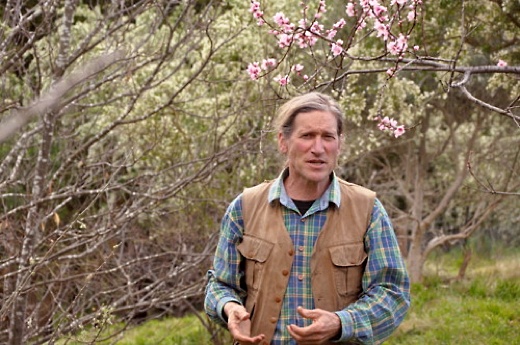
Image above: Photo of David Holmgren in the woods in spring. From (http://www.transitionnetwork.org/blogs/rob-hopkins/2014-01/holmgren-s-crash-demand-be-careful-what-you-wish).

I’m suggesting in my essay, the underling thing is an appeal to those people to come and join us in the positive side where we’re going to create the world we do want, whether or not it leads to a larger scale positive change, or whether or not it contributes to a crash.
- David Holmgren
It’s a great interview of David Holmgren by Steffan Geyer on his show “21st Century Permaculture!” broadcast by Shoreditch Community Radio. The “classic retro funk” mixed in is an added bonus. The interview is now being streamed at Mixcloud here (http://www.mixcloud.com/21stCenturyPermaculture/2nd-feb-2014/).


The interview focuses on the hubub that has surrounded Holmgen’s Crash on Demand essay, and I’m very pleased (and relieved) to report that my interpretation (What Is David Holmgren Really Telling Us?) was apparently spot on.

Here are a couple of excerpts I’ve transcribed from the interview:
David Holmgren:
I’m fairly pleased with the response [to the essay] – the fact that it’s created quite a lot of discussion, and triggered a lot of more nuanced thinking about ranges around ‘Future Scenarios.’ Albert Bates’ slightly  lighthearted work on this, where he shifted me from an optimistic ecotopian view to a pessimistic collapsnik. …well, I didn’t agree with that at all, in that I’ve always had a mixture of the two, and I don’t think I’ve particularly changed my position.

But in speaking of permaculture as a positive response of creating the world we do want, whether or not it leads to, if you like, ecological salvation for humanity, just that positive, can do, ‘we’re going to do this anyway’ – it sort of put me in a box, I suppose, naturally enough with Rob Hopkins, but also surprisingly techno-optimists like Amory Lovins, and even people imagining techno utopias.

Whereas, I’ve always had this permaculture view which has been framed against a fairly dark view of the state of the world and likely possibilities, but a positive view about what  personal, household, and community action can be in the context of that world.

Steffen Geyer:

Some people have actually commented that you’re advocating something very similar to what you advocated in Permaculture One, and that you’ve been doing that the whole time in your work, and there’s actually not much of a departure. It’s just a little bit more explicitly said.

David Holmgren:

Yeah, that’s pretty much it! I’ve always been skeptical about the ability to say “What we’re doing in Permaculture might be useful at some local scale, but it only becomes useful when it leads to some large scale societal change.”
Another step in that assumption is that large scale societal change will inevitably come by the powers that be, pulling the levers at the top of the system in the right way to give us the policies to restructure the economy and restructure things you can’t do at the household level. I’ve always seen that as a very limited, what I call “old fashioned” view of political change.
Because Permaculture’s never been cast as you say as a revolution, it’s really been cast as gardening; that a lot of the actions have then been acceptable to a lot of people, because you don’t have to buy in to an idealogical view of the world to see the benefit in some Permaculture strategies and techniques, and the common sense behind a lot of the principles.
The fact that those things are actually subversive to the sort of economy and power structures we have, is not necessarily self evident or important to most people. It does this work for them, it’s useful, it seems fairly benign, and it has multiple benefits. That is a real and true basis for Permaculture, but Mollison and I were never under any illusion that the widespread adoption of this would sort of overturn the power structures in society in the process of getting us in line with the limits that nature ultimately imposes on human systems.

Those limits will and are being imposed, and we can sort of go with the flow of that or we can resist it.  So I haven’t really changed the message, but in a public sense, and of course the blogosphere, the internet, allows one to be very public, and I did choose words fairly carefully with the Crash on Demand essay, and I can see how some people thought  I was advocating that the primary motivation for the sort of Permaculture strategies was actually to destroy the current economy.
That’s not the purpose at all, but it’s a bizarre situation that we’ve got to, where the possibility of the success of that strategy would hasten what is an inevitable process, because generally the view is that these personal things that we do don’t really have any impact.
I suppose I have, increasingly in recent years, started to articulate Permaculture as a political strategy back to people who are of that ilk – activists who are desperately trying to change the structures of society around both equity issues and environmental limits. A lot of them see Permaculture as just a sideshow, or maybe as something good, but not really important.
As their world is progressively unraveling… what I mean by ‘their world’ is the faith that it is possible to martial rational evidence, influence enough policy and powerful people that the inevitability and the logic of the changes that we’re proposing will prevail through some sort of orderly process. That is unraveling.
Large numbers of people in that field, I believe, will give up – are giving up – especially on the climate front. These are people who’ve had enormous energy and commitment, they’re not your average Joe-blow citizen, they’re people who are empowered, who’ve put massive personal energy into these things.
As that community and psychology falls apart, …I’m suggesting in my essay, the underling thing is an appeal to those people to come and join us in the positive side where we’re going to create the world we do want, whether or not it leads to a larger scale positive change, or whether or not it contributes to a crash.

But interestingly, when people have this belief that it’s possible to bring about this larger change, and that faith is lost, there’s a few places people go. One is toward a sort of catatonic disconnection and dysfunction, or just total burnout.  
Another place where a minority will tend to go is back to the old hard revolutionary movement -that we’ve got to have in the end violence to bring the system to an end.  I think people have, at a lot of levels, misunderstood my essay, because part of what I’m doing is appealing to those people to come and join us on this side of the fence. And one of the arguments is yes, one of the effects of a change in behavior by a small proportion of the world’s global middle class could actually bring the system down.
And that idea is attractive to people who have lost all hope for that sort of change. It’s not actually a motivation for me, and I don’t think it’s a motivation for most people involved in Permaculture. But for those sorts of people, it’s actually a safer place than ending up on the track of the Unibomber.
Because we don’t need many prominent ex-environmentalists and social justice advocates to end up in that active violence against the system to have really severe demonization and lockdown of the positive movements we’re talking about. And I think that’s an aspect that hasn’t so much come out in the discussion around the essay. Though I think there’s been some very good and useful discussion, and good points made by almost everyone who’s commentated on it.
A couple of things.  First, I really appreciate that Holmgren acknowledges that a lot of good points were made by almost everyone who’s commented on his essay.  I think it’s important to see all the posts as a friendly discussion sharing important perspectives, all of which are worthwhile to hear and to discuss – rather than framing this as an acrimonious debate.

Second, I appreciate the important point about the potential negative impacts of more violent responses.

In future posts I hope to explore both of these last two topics, and I hope to employ some examples of using PatternDynamics in the process.

See also:
Ea O Ka Aina: Crash and Demand Pathways 2/3/14
Ea O Ka Aina: Response to Holmgren's scenarios 1/10/14
Ea O Ka Aina: Stabbing the Beast 1/1/14
Ea O Ka Aina: Crash on Demand 12/30/13


.

The Pleasures of Extinction

SUBHEAD: Fantasies of imminent human extinction are comforting iin the face of this ugly predicament.

By John Michael Greer on 15 May 2013 for the Archdruid Report -
(http://thearchdruidreport.blogspot.com/2013/05/the-pleasures-of-extinction.html)


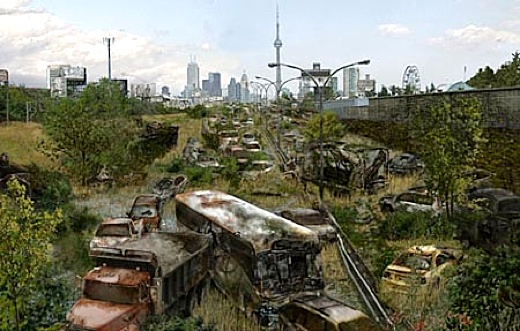
Image above: Toronto with CN Tower after everybody is gone. From (http://redstarcafe.wordpress.com/2008/09/27/life-after-humans/).

One of the wry pleasures that’s repeatedly come my way since the beginning of this blog seven years ago is that of watching a good many of my predictions come true in short order. Now it’s true that I’ve also made a certain number of failed predictions over that time. Back in 2007 and 2008, for instance, I insisted that the US government wouldn’t be dumb enough to try to cover its ballooning budget deficits by spinning the printing presses; some idiocies, I thought, were too extreme even for the inmates of the current American political class.

As th Fed proceeds merrily through yet another round of quantitative easing, that assumption has proved to be rather too naive.

Even so, my batting average so far has been pretty respectable. In the early days of this blog, for example, Daniel Yergin was insisting at the top of his lungs that the price of oil would settle down shortly to a long-term plateau of $38 a barrel, while fans of a dozen different alternative technologies were claiming just as stridently that if the price of oil ever got to the unthinkable level of $60 a barrel, the technology they favored would be profitable enough to sweep all before it.

There were very few of us back then who predicted that oil would go quite a bit past $60 a barrel and stay there, and even fewer who pointed out that abundant cheap fossil fuel energy made alternatives look much more viable than they were. These days, with oil wobbling around $100 a barrel and most of the alternatives still wholly dependent on government subsidies, that turned out to be tolerably prescient.

Over the last few weeks, another of my predictions has turned out spot on the money. A little less than six months ago, as New Age bookstores around the world were quietly emptying entire bookshelves dedicated to December 21, 2012 and putting 50%-off stickers on the contents, I noted in a blog post here that it wouldn’t be long before people who were looking for an excuse to put off doing anything about the crisis of industrial society would have a replacement for 2012.

Well, it’s here. The latest apocalyptic fad is near-term human extinction, or NTE for short: the claim that humanity, along with most other life on Earth, will inevitably be extinct by 2030 at the latest.

It’s probably necessary to say up front that humanity will certainly go extinct eventually—no species lasts forever—and there’s always the chance that it could happen in short order; a stray asteroid with enough mass, or a few rearranged codons in some virus nobody’s heard about yet, could do the job quite readily.

Still, there’s a great difference between claiming that human extinction is possible and insisting that it’s certainly going to happen in the next seventeen years, especially when the arguments used to defend that claim amount to nothing more than an insistence that worst-case scenarios are the only possible outcome.

There’s a tolerably long history to such claims. When I was growing up in the 1970s, there were people on the far end of the environmental movement who insisted that humanity would certainly be extinct before the year 2000, and the same prediction has been repeated with different dates and justifications ever since.

Those of my readers who remember the Solar Temple mass suicides of 1994 and 1995 may recall that the collective suicide note left behind by the members of that ill-fated order made exactly that claim: Earth would be uninhabitable by the year 2000, Solar Temple founder Luc Jouret insisted, and so the initiates of the Solar Temple were getting out while the getting was good.

In the early days of the peak oil movement, similarly, the same insistence on imminent extinction popped up tolerably often. I was convinced at the time, and remain convinced today, that this was largely a product of an odd and very American habit I’ve termed "apocalypse machismo."

One consequence of America’s pervasive anti-intellectualism, with its frankly weird equation of manhood with chest-thumping brainlessness, is that many male American intellectuals end up burdened by doubts about their own masculinity, and some of them respond by trying to talk as tough as possible; intellectual women in this male-dominated culture find they often have to copy that same habit, sometimes to even greater extremes, in order to get taken seriously at all.

This has been a major factor all through America’s recent history; the neoconservative movement, packed as it was with academic intellectuals whose obsession with proving their own virility on a global stage drove them into one foreign policy fiasco after another, makes as good a poster child as any.

In the same way, we had a lot of apocalypse machismo in the early peak oil movement. In the first few years of this blog, for that matter, I could count on fielding (and deleting) a comment every month or two from somebody who wanted to talk about the new scenario for imminent human extinction he’d just worked up.

The Deepwater Horizon blowout and the Fukushima Daiichi nuclear meltdown fielded a bumper crop of the same thing; those of my readers who doubt this are invited to go digging back through the archives of any unmoderated peak oil forum, where they’ll find, in the days and weeks immediately following each of these disasters, colorful if implausible scenarios predicting the imminent demise of all life on earth presented as sober fact.

No doubt there’s at least some of that at work in the sudden surge of interest in near-term human extinction, but I question whether it’s the main driving force this time around. There are at least two other factors that are likely to be involved, and one of them unfolds directly from the points made in the last few posts in the current sequence.

The shape of time sketched out by Augustine of Hippo in the pages of The City of God, and adopted thereafter by most of the western world until the rise of the later mythology of perpetual progress, allows a range of variations.

Even within the mainstream of western Christianity, the options extend over a much broader landscape than most of my readers may realize, and the versions of the Augustinian mythos found outside the Christian mainstream are even more diverse. In his useful 1998 book Millennium Rage, sociologist Philip Lamy argued that most beliefs about the future in today’s America are "fractured apocalypses," in which the events foretold in the Book of Revelation are pulled out of context and rearranged in response to contemporary social trends.

His insight can be applied a good deal more generally: the whole Augustinian story has been subjected to similar treatment. Eden, the Fall, the vale of tears, the righteous remnant, the redeeming revelation, the rising struggle between good and evil, the final catastrophe and the return to paradise thereafter—you’ll find these, or most of these, in a great many current belief systems, but the order and relative importance of each element may vary, and it’s far from uncommon for one or two of the classic themes of the story to be stretched nearly out of recognition, or deleted entirely.

One detail that often comes in for serious reworking in modern social movements is the final step, the one in which the elect are welcomed back into paradise while everyone else is herded into the lake of fire to be punished for all eternity. The habit of morphological thinking discussed earlier in this sequence of posts is of crucial importance here: take a close look at the development over time of social movements that embrace the Augustinian narrative, and the historical shifts in that last part of the story have a fascinating message to communicate.

The wave of Christian fundamentalism that’s currently breaking and flowing back out to sea makes a good case in point. Back in the days of the Jesus People and the Good News Bible, when that wave first began building, its rhetoric was triumphant: the whole nation was turning to Christ, the rest of the world would surely follow, and the imminent Second Coming would see everyone but a few stubborn sinners rushing forward joyfully to embrace God’s infinite love.

Fast forward a couple of decades, and the proportion between the saved and the damned shifted significantly closer to the sort of thing you’d hear in an old-fashioned hellfire-and-brimstone sermon, but the saved were still utterly convinced of their own salvation: those were the days when "In Case Of Rapture, This Car Will Be Unoccupied" bumper stickers sprouted on the rear ends of cars all over America.

You won’t see too many of those bumper stickers these days. Just as the optimistic faith that a new generation could win the world for Christ gave way gradually to the far more pessimistic vision of a world mired in wickedness from which the elect would shortly be teleported to safety—beamed up by St. Scotty, as the joke had it, to the bridge of the USS Enterchrist—so the serene confidence on the part of believers that they would be numbered among the elect has been replaced, in these latter days of the movement, by an increasingly pervasive sense of sin and unworthiness.

Too many dates for the Rapture have come and gone, too many once-respected preachers have been caught with their pants around their ankles in one sense or another, and the well-founded suspicion that the Republican party is using the evangelical churches every bit as cynically and shamelessly as the Democratic party is using the environmental movement has got to weigh on a lot of once-hopeful minds.

Christian theology places hard limits on just how far the exclusion from future blessedness can extend, as there has to be "a great multitude, which no man could number" (Revelations 7:9) of the saved gathered around the throne of God when the boom comes down. Outside Christianity, the same process routinely goes much further.

A good example is the New Age movement, which emerged out of a variety of older fringe spiritualities right around the same time that the current round of Christian fundamentalism got going in America. The early days of the New Age movement were pervaded by the same optimistic sense that a new and more enlightened epoch was about to dawn, and everyone—even, or especially, those who made fun of the movement’s pretensions—would soon fall in line.

As the movement matured and the New Age stubbornly refused to arrive, in turn, the same mood shift that affected fundamentalism had a comparable impact; New Age teachers began to talk more about the ascension of enlightened individuals into higher planes of being, the activities of evil powers who were maintaining the illusion of a world of limits, and the imminence of a world-cleansing cataclysm that would finally get around to ushering in the New Age.

By the time the hoopla began building over 2012, finally, the prophecies trotted out in advance of that much-ballyhooed nonevent ranged all over the map; there were still optimists of the old school, who insisted that a great shift in consciousness would make everyone get around to agreeing with them; there were many more who expected mass death to leave the world purified for the usual minority of the elect; and there were no small number who were retailing scenarios in which the entire human race would be exterminated.

This is a familiar rhythm in the history of American popular spirituality. At regular intervals, some movement that’s existed out on the fringes for decades suddenly gets a mass following, turns into a pop culture phenomenon, and has thirty to forty years of popularity before it returns to the fringes. Some traditions repeat the process; Christian fundamentalism has had two periods of pop stardom—once between the Roaring Nineties and the Great Depression, and then again from the late 1970s to the present—and a strong case could be made that the New Age movement is a rehash of the vogue for occultism that was so huge a part of American pop culture between 1890 and 1929.

Other movements fill the void when the ones just named head for the fringes; from the 1930s to the 1970s, liberal Christian churches were a dominant force in American religion, and there’s some reason to think that the pendulum is headed the same way again as fundamentalism sunsets out a second time.

If human beings were rational actors, as economists like to imagine, they wouldn’t respond to the disconfirmation of their beliefs by postulating world-wrecking catastrophes. Here as elsewhere, though, the fond fantasies of economists stand up poorly as models for predicting events in the real world. If you haven’t had the experience of devoting decades of your life to a failed belief system, dear reader, try to put yourself into such a person’s shoes.

It would take a degree of equanimity rare even among saints to look back on such an experience without harvesting a bumper crop of resentment, grief and guilt—and if fantasies of apocalyptic destruction play any role at all in your belief system, one way to deal with those difficult emotions in their first and rawest forms is to pour them into a belief in some cataclysm big enough to punish the world and everyone in it for their failure to live up to your hopes.

The environmental movement is not a religion, but its course in America in recent decades followed the pattern I’ve just outlined. Like fundamentalism and the New Age movement, it came in from the fringe in the 1970s with the same sense of imminent triumph that guided the other movements I’ve named. Its transformation from a charismatic movement of outsiders to a set of bureaucratic institutions closely intertwined with the existing order of society followed the same trajectory as fundamentalist churches, and its sense of triumphant expectancy faded out at roughly the same pace, replaced by the same struggle against evil that brought fundamentalist Christians into their devil’s pact with the GOP and inspired New Age believers to embrace conspiracy theories and the paranoid fantasies of David Icke.

At this point, roughly in parallel with fundamentalism and the New Age, the environmental movement is having to come face to face with the total failure of its hopes. Back in the heady days of its early successes, the vision that guided it saw environmental protection as the next step forward in the same trajectory of social progress that included the civil rights movement and second wave feminism; it was in this spirit, for example, that environmental lawyers proposed that trees be given legal standing.

The hope all along was that industrial civilization could achieve a permanent peace with the world of nature and continue up the infinite road of progress without leaving a scorched and looted planet in its wake.

That hope is dead. If there was ever a chance to achieve it, it went whistling down the wind decades ago, and at this point the jaws of resource depletion and environmental degradation are tightening around the collective throat of the world’s industrial societies, in exactly the fashion predicted in detail forty years ago in the pages of The Limits to Growth.

Even if the green technologies promoted by an increasingly frantic minority of environmentalists could support something like today’s rates of energy use, which they can’t, we can no longer afford the sort of massive buildout of those technologies that would be necessary to supplant even a significant part of our current fossil fuel consumption.

If what’s left of the environmental movement managed to overcome its own internal dysfunctions and the formidable opposition of its foes, and became a mass movement again, the most it could accomplish at this point would be the protection of some of the most vulnerable ecosystems as industrial society stumbles down the first bitter steps of the long descent into the deindustrial future.

That’s still a goal worth achieving, but it’s not the goal to which the environmental mainstream committed itself when it embraced a role among the socially acceptable institutions of American public life, with the perks and salaries that this status involves.

This explains, I suggest, the way that certain mainstream environmentalists have turned to proselytizing for nuclear power and other frankly ecocidal technologies, under the curious delusion that "possibly a little better than the worst" somehow amounts to "good." The desperation in such rhetoric is palpable, and signals the end of the road—an end that, in this case as in the others I’ve cited, involves a good many fantasies of total destruction.

Still, there’s another factor here, and it unfolds from one of the least creditable aspects of the way that the environmental movement has evolved over time. It has become increasingly clear that the perks, the salaries, and the comfortable middle class lifestyles embraced so enthusiastically by so many people in the movement are themselves part of the problem.

I was intrigued to read earlier this month a thoughtful essay by leading British climate scientist Kevin Anderson arguing, in terms that will sound very familiar to regular readers of The Archdruid Report, that the failure of climate change activism to make any headway in changing people’s behavior may have more than a little to do with the fact that the people who are urging such changes aren’t making them themselves.

I have no reason to think that Anderson reads my blog or, for that matter, knows me from Hu Gadarn’s off ox, but then you don’t need to wear an archdruid’s funny hat to notice that people these days are acutely sensitive to signs of hypocrisy, or to grasp that even the most vital changes aren’t going to happen if even the people who are most aware of their importance aren’t willing to start making them in their own lives. For reasons a post last year discussed at some length, those who have built their lives on the fantasy that it’s possible to have their planet and eat it too are not going to find such reflections welcome, or even bearable.

Fantasies of imminent human extinction are one comforting if futile response to this ugly predicament. If you want a justification for living as though there’s no tomorrow, insisting that in fact, there’s no tomorrow is certainly one option. If I’m right, the pleasures of believing in near-term human extinction are likely to appeal to a very large and well-heeled audience in the years immediately ahead, and those of my readers interested in cashing in on the next 2012-style bonanza should probably take note.

See also:
Ea O Ka Aina: Preparing for Near Term Extinction 5/7/13
Ea O Ka Aina: Pondering Near Term Extinction 4/28/13

.