Showing posts with label Shopping. Show all posts

Farewell to Bargain Shopping

SUBHEAD: Perhaps Generations X, Y & Z will recognize an opportunity to go into business.

By James Kunstler on 7 January 2019 for Kunstler.com -
(http://kunstler.com/clusterfuck-nation/a-farewell-to-bargain-shopping/)


Image above: Photo image of K-Mart closing announcement by James Kunstler from original article.

[IB Publisher's note. Mr. Kunstler nailed it today! His humor is that of the grave, but it still amuses as it stings. Our little island of Kauai The Macy's is barely hanging on at the Kukui Grove Mall but our only mall has lost its Sears and K-Mart as well as Border's Books, Sports Authority, and a host of other national chains.The Walmart has hung on in Lihue but is quickly morphing intoi a competitor to Costco with an ever larger percentage of grocery floor space - Besides economy of size Costco seems to be aiming for the connoisseurs, restaurateurs and foodies - while Walmart is trolling for everyone else, including elderly, handicapped, and bottom feeders.We do much of our shopping through Azazon and are just waiting for CEO Jeff Bezos to buy the US Postal Service to stay in business.  Fortunately we still have a Home Depot to keep our homes intact, but that will likely disappear when new home building grinds to a halt. All those stores are a 30 minute (if your lucky) drive from here in Hanapepe. Thank god we still hava a Napa Auto Supply and Ace Hardware with walking distance. Hunker down folks. We have visited Jim Kunster's town outside of Albany, NY. and found it much like our former home in Panama, NY where you coulkd noit buy a can of soup or quart of milk without half an hour in a car.]

France has its Yellow Vests. Here in USA, we have a few poor shlubs hoisting the “Going Out of Business” signs on the highway in front of the K-Mart.

The store in my little flyover town in upstate New York announced that it would shutter in March, and the sign-hoisting shlubs appeared out on Route 29 the first Saturday in January, an apt kick-off to a nervous new year.

K-Mart’s parent company, Sears, is moving into liquidation, meaning anything that’s not nailed down must be converted into cash to pay off its creditors.

The store’s closing is viewed as both an injury and an insult to the town.

There just isn’t anywhere else to buy a long list of ordinary goods, from dish-towels to tennis balls without a 17-mile journey west, which means an hour behind the wheel coming-and-going, plus whatever time you spend picking stuff up inside.

And, of course, many people in town feel that this is just another way of Wall Street saying “…you deplorable, pathetic, tapped-out, drug-addled, tattoo-bedizened yokels are not worthy of a K-Mart….”

The K-Mart occupied the better part of a small strip mall at the edge of town, which also boasts a Dollar Store, which appears to sell stuff that fell off a truck.

There’s another, newer strip mall beyond it with a supermarket, a drug store, and a Tractor Supply outlet that probably stole a lot of K-Mart’s business after opening a few years ago.

There’s much speculation about what’ll go into Kmart’s soon-to-be vacant space, about 80,000 square feet of crappy tilt-up construction not far from the end of its design life, with a flat roof that has groaned under heavy snow loads for four decades. Nobody I talked to has a clue.

Probably not Neiman Marcus, for starters. I’m thinking: maybe an evangelical roller rink. It’s too big for a wig shop, or a motorcycle thug-wear boutique, the usual bottom-feeders in the declension of commercial collapse.

More likely, nothing will replace it. The national chain retail model has fallen apart, along with new car sales. Something is up in this foundering land, despite all the heraldic trumpet blasts on cable news about the “booming economy.”

What’s up is the international implosion of the bad debt, and the fading illusion that it doesn’t matter. It has any number of ways to express itself, from store closings, to dissolving pensions, to stock market instability, to divorce, homelessness, and war.

It’s what you get from a hyper-financialized economy that doesn’t really produce wealth but only steals it from somewhere else. It’s not the fault of “capitalism,” which, in theory just stands for the management of a society’s savings. America doesn’t save, it borrows.

Zero interest rates made savings a mug’s game, and zero interest rates were necessary to extend the borrowing far beyond the credible boundaries of repayment. Debt isn’t capital, it just pretends to be for a period of time. Wall Street made its trillions off the time-value of that pretense and now time is up.

Even in the hardship economy we’re sailing into, people will need to buy and sell things and it is very hard to see how that fundamental process of exchange might be reorganized going forward.

Back in the 1990s I attended many a town meeting (in many towns) where chain stores applied for permits to set-up operations. It was often contentious. There was always a contingent of locals — organized by the chains themselves — waving placards that said “We Want Bargain Shopping.”

And there were the short-sighted town officials drooling over the real estate tax “ratables” that chain stores represented. Their adversaries feared that their locally-owned Main Street businesses would be killed, and that was exactly what happened, in very short order.

You could see it coming from a thousand miles away. Now the Big Boxes are going down. Boo Hoo….

What will emerge out of the current disorder? Perhaps Generations X-Y-and-Z will recognize an opportunity to go into business — as an alternative to purchasing a degree in gender studies for $200,000 (at 6 percent interest).

There will be lots of opportunities, even in a world with generally less shopping.

 But it may require a deeper collapse to sweep away the impediments, both practical and mental, before that awareness turns to action.


.
2017 Retail Closings

SUBHEAD: Brick and mortar chain stores are dropping like flies and the carnage will continue.

By Mike Timmermann on 24 April 2017 for Clark.com -
(http://clark.com/shopping-retail/major-retailers-closing-2017/)


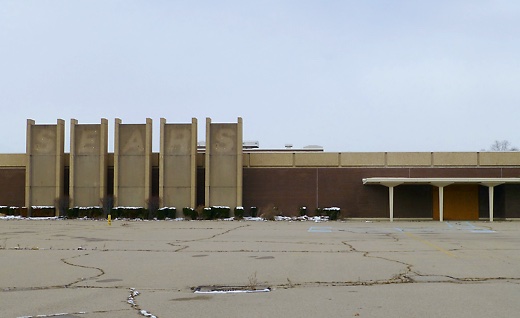
Image above: Closed Sears department store at Salem Mall in Trotwood, Ohio. From (https://www.flickr.com/photos/army_arch/15275399304).

“The reality is that America has been over-stored. We have far too many retail locations, shopping centers and branches of different chains,” Clark Howard said. “But stores that are meeting your needs with low prices will continue to thrive.”

In the meantime, here’s our list of major retailers that are closing stores in 2017:

The latest news

Sears & Kmart – 150 stores and counting…

These 10 retailers are closing more than 1,000 stores in 2017

Sears Holdings isn’t finished shutting down under-performing Sears and Kmart locations quite yet.
In a news release dated April 21, the company said it has made significant progress in its restructuring program, with $700 million in annualized cost savings so far.

The initiative began earlier this year with closures of 150 non-profitable stores, which included 108 Kmart and 42 Sears locations.

Now, the retailer says 92 under-performing Kmart pharmacies and 50 Sears Auto Centers are shutting down. No list of the affected locations was immediately available.

Meanwhile, Business Insider has compiled a list of additional Sears and Kmart stores that are quietly being shut down, according to local media reports.
Here’s the list so far:

Kmart

  • Livonia, Michigan
  • Kahului, Hawaii
  • Beavercreek, Ohio
  • Meadville, Pennsylvania
  • Mill Hall, Pennsylvania
  • East Stroudsburg, Pennsylvania
  • Spanaway, Washington

Sears

  • Miami, Florida
  • Alamogordo, New Mexico
  • Charleston, South Carolina
Read more: Retail crisis: Sears and Kmart to close even more stores

bebe – 180 stores


Women’s clothing retailer Bebe Stores is shutting down all of its roughly 180 locations nationwide.
In a filing with the Securities and Exchange Commission dated April 21, the company said it expects to close all stores by the end of May after liquidation sales are held.

The retailer’s future remains unclear, though some speculate it will continue as an online-only merchant.

Rue21 – 400 stores

Teen clothing retailer rue21 is closing about 400 stores, according to its website.

A message on rue21.com read, “It’s true – we are closing some stores. It was a difficult but necessary decision. But the good news is we still have hundreds of locations across the country, and our website rue21.com, open for business!”

Rue21 has posted a list of the locations that are closing on its website. Click here to see if yours is affected.

Department stores

JCPenney – 138 stores

These 10 retailers are closing more than 1,000 stores in 2017

JCPenney is delaying plans to close 138 stores because sales are up since the retailer announced that it was shutting them down.

USA Today reports that liquidation sales at those locations have been postponed until May 22 and store closures have been pushed back six weeks to July 31.
Here’s a list of the 138 stores that will be closing.

Macy’s – 68 stores

These 10 retailers are closing more than 1,000 stores in 2017

Macy’s plans to close about 15% of its locations amid a challenging retail environment.

The retailer revealed in August 2016 that it would close 100 of its 730 stores to concentrate on better-performing locations to “elevate their status as preferred shopping destinations.”

In a January 4 news release, Macy’s announced 68 of the closures. Of the 68, three have already closed, 63 were scheduled to shut down in early 2017, and two will be closed in mid-2017.
The company plans to close approximately 30 additional stores over the next few years.

Mall stores

Abercrombie & Fitch – 60 stores

You can add Abercrombie & Fitch to the growing list of retailers that will be closing stores this year.
According to a news release, the company plans to shut down about 60 U.S. locations during fiscal 2017 as leases expire. Fortune reports that A&F will have 670 remaining stores, down from 839 just five years ago.

Guess – 60 stores

Guess is planning to pull the plug on 60 of its stores this year. CEO Victor Herrero told analysts of the decision during a Q4 earnings call on March 15.  It’s expected that most of the closures will be among the flagship Guess brand stores and Marciano locations.

Guess brands operate 945 retail stores in the Americas, Europe and Asia. Some 400 of those stores are in the United States.

Crocs – 160 stores

Crocs announced in a March 1 press release that the brand will be trimming some 160 stores from its 558-store portfolio by the end of 2018.

The Limited – 250 stores

After more than 50 years in business, The Limited closed all of its nearly 250 stores across the country on January 8. The retailer indicated that its website would live on, but no merchandise is for sale.

Read more: Confirmed: The Limited is closing mall stores across the country

Wet Seal – 171 stores

Bankrupt clothing store Wet Seal has shut down all of its 171 stores, according to the Wall Street Journal. A message on the retailer’s website read, ‘Thanks babe, it’s been real.’

American Apparel – 110 stores

Made in the USA clothing manufacturer American Apparel is expected to close all of its remaining 110 stores very soon.

According to a news release from January 10, Canada-based Gildan Activewear’s $88 million bid at a bankruptcy auction won the rights to American Apparel’s brand and some assets. However, retail store assets were not part of the purchase, according to Gildan.

Read more: American Apparel is expected to close all 110 stores soon

BCBG – 120 stores

High-end women’s clothing chain BCBG is closing about 120 stores, mostly in the U.S., according to the Minneapolis Star Tribune.

The Star Tribune reported in early February that liquidation sales have started and are expected to run eight to 10 weeks before the stores close for good.

The company’s mini-shops within Macy’s will remain open.

Other retailers

Payless ShoeSource – 400 stores

Payless ShoeSource has filed for Chapter 11 bankruptcy protection and will immediately close nearly 400 underperforming locations in the U.S. and Puerto Rico, the company announced April 4.

“This is a difficult, but necessary, decision driven by the continued challenges of the retail environment, which will only intensify. We will build a stronger Payless for our customers, vendors and suppliers, associates, business partners and other stakeholders through this process,” W. Paul Jones, Payless chief executive officer, said in a statement.

Payless has approximately 4,400 stores in more than 30 countries. Here’s a list of the stores that are closing.

hhgregg  – 220 stores

After more than six decades, electronics retailer hhgregg is going out of business.
Liquidation sales have begun at the retailer’s 132 stores, which will close by the end of May. In March, the company announced the closure of 88 locations.
The news comes after hhgregg failed to find a buyer by its April 7 deadline.

GameStop – 150+ stores

After reporting a drop in fourth quarter sales, GameStop announced March 24 that it plans to close between 2% to 3% of its global store footprint, which means at least 150 stores.
GameStop has struggled due to weak sales of certain video games and “aggressive console promotions” from its competitors.

RadioShack – 552 stores

RadioShack has announced the closure of 552 stores after the ailing electronics retailer filed for Chapter 11 bankruptcy protection for a second time in March.

The closing locations represent 36% of RadioShack’s stores, Business Insider reported. Here’s the list.

Staples – 70 stores

Staples said in March that it will close 70 locations throughout North America by the end of 2017.
During a recent earnings call, Staples said same store sales in North America were down 7% during the fourth quarter of 2016. The drop in sales was blamed on lower foot traffic.
Read more: Staples to shutter 70 stores in 2017

CVS  – 70 stores

Back in December 2016, we first told you that CVS had plans to close 70 locations across the country in early 2017.
In late February, we began to get the first reports from local media about exactly which locations already have been or will soon be shuttered, including more than 10 stores in Illinois.
Read more: New list: These CVS locations will be closing soon

Gander Mountain – 32 stores

Gander Mountain, the outdoor goods retailer, has announced it will close 32 of its 162 locations. The company filed for Chapter 11 bankruptcy protection in March.
More than 1,200 employees will be impacted by the closures. Here’s the list.

Family Christian – 240 stores

Family Christian, the biggest seller of Christian books and merchandise in the nation, announced February 23 that 240 stores in 36 states would be permanently closed.
Read more: Family Christian closing all 240+ locations

The takeaway: Use those gift cards ASAP!

“If you have any gift cards in your home that are for major retailers, I want you to go and shop. I want you to use them up,’ Clark said. “And when you don’t know what to give somebody, give them a nice card and give them cash. You don’t have to worry about the store closing when you give them cash.”

See also:
Ea O Ka Aina: Retail Zombieshaunt the malls 2/15/17
.

Robot runs over young boy

SUBHEAD: A 300 pound 5'-5" tall security robot runs over child in California shopping mall.

By Steven Hoffer on 13 July 2016 for Huffington Post -
(http://www.huffingtonpost.com/entry/security-robot-toddler_us_57863670e4b03fc3ee4e8f3a?section=)


Image above: Security robot stands 5'-5" and weighs 300lbs. if it does not like the way you look it will alert local human authorities. Don't tell me the manufacturer is not working on a weaponized version. From original article.

A young boy was knocked down and run over by a 5-foot-tall, 300-pound security robot at a California mall on Thursday.

Sixteen-month-old Harwin Cheng suffered a swollen foot and several scrapes in the scary encounter at the Stanford Shopping Center in Palo Alto.

“The robot hit my son’s head and he fell down — facing down on the floor — and the robot did not stop and it kept moving forward,” Harwin’s mom, Tiffany Teng, told ABC 7.

Teng said that the robot would have run over her son’s other foot had her husband not pulled the boy away.

The security robots are made by a company called Knightscope, located in Mountain View. The K5 version uses lasers, thermal imaging sensors, 360 video, air quality sensors, a microphone and various other technologies to deter and detect criminal activities. In the event of suspicious activity, the robot alerts local human authorities.

Stacy Dean Stephens, Knightscope vice president of marketing and sales, told NBC Bay Area that the company does not think the robots are dangerous.

“This is a horrific accident, but we believe the technology and the machines are incredibly safe and we will continue to do our best to make sure that they are,” Stephens said.

The Stanford Shopping Center has used the technology for about a year. Representatives also told the NBC station that the shopping center is investigating the incident and will dock all of its security robots until further notice.

See also:
Ea O Ka Aina: Dallas use of killer "robot" alarming 7/8/16
Ea O Ka Aina: Weaponized drones in America 8/29/15
Ea O Ka Aina: Residents ban traffic cameras 12/29/14
Ea O Ka Aina: Remotely Piloted Corporate War 2/23/12
Ea O Ka Aina: Google's self driving car crashes 8/5/11
Ea O Ka Aina: Globalized Free Fire Zone 6/24/10

.

Retail Apocalypse

SUBHEAD: So far 2016 is offering empty shelves and retail store closings all across America.

By Michael Snyder on 31 January 2016 for End of American Dream -
(http://endoftheamericandream.com/archives/retail-apocalypse-2016-brings-empty-shelves-and-store-closings-all-across-america)


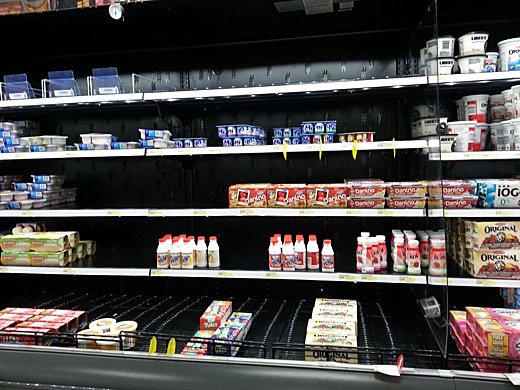
Image above: Low level of inventory in supermarket cooler section. From (http://retailexcellence.com/uhhhh-are-they-going-out-of-business/).

Major retailers in the United States are shutting down hundreds of stores, and shoppers are reporting alarmingly bare shelves in many retail locations that are still open all over the country.  It appears that the retail apocalypse that made so many headlines in 2015 has gone to an entirely new level as we enter 2016.

As economic activity slows down and Internet retailers capture more of the market, brick and mortar retailers are cutting their losses.  This is especially true in areas that are on the lower portion of the income scale.

In impoverished urban centers all over the nation, it is not uncommon to find entire malls that have now been completely abandoned.  It has been estimated that there is about a billion square feet of retail space sitting empty in this country, and this crisis is only going to get worse as the retail apocalypse accelerates.

We always get a wave of store closings after the holiday shopping season, but this year has been particularly active.  The following are just a few of the big retailers that have already made major announcements…
But these store closings are only part of the story.

All over the country, shoppers are noticing bare shelves and alarmingly low inventory levels.  This is happening even at the largest and most prominent retailers.

I want to share with you an excerpt from a recent article by Jeremiah Johnson.  The anecdotes that he shares definitely set off alarm bells with me.  Read them for yourself and see what you think…

I came across two excellent comments upon Steve Quayle’s website that bear reading, as these are two people with experience in retail marketing, inventory, ordering, and purchases.  Take a look at these:

#1 (From DJ, January 24, 2016)

“Steve-
[Regarding the] alerts about the current state of the RR industry. This is in line with what I’ve been noticing as I visited our local/regional grocery store, Walmart, and Target this week in WI. I worked in big box retail for 20 years specializing in Inventory Management. These stores are all using computerized inventory management systems that monitor and automatically replenish inventory when levels/shelf stock get low. This prevents “out of stocks” and lost sales. These companies rely on the ability to replenish inventory quickly from regional warehouses.
As I shopped this week and looked at inventory levels I was shocked. There were numerous (above and beyond acceptable levels) out of stocks across category lines at all three retailers. And even where inventory was on the shelf, the overall levels were noticeably reduced.
Based on my experience, working for two of these three organizations in store management, they have drastically/intentionally reduced their inventory levels. This is either due to financial stresses/poor sales effecting their ability to acquire new inventory, or it could be the result of what was mentioned earlier regarding the transporting of goods to these regional warehouses. Either way this doesn’t bode well for the what’s to come.  Stock up now while you can!”
#2 (From a Commenter following up #1 who didn’t provide a name, January 26, 2016)
“I’d like to tailgate on the SQ Alert “based on my experience…” regarding stock levels in big box stores. This weekend we were in two such stores, each in fairly isolated communities which are easily the communities’ best source for acquiring grocery items in quantity.
I myself worked in retail (meat) for thirty years so I know exactly what a well-stocked store looks like, understand the key categories and category drivers, and how shelves are stocked and displays are built to drive sales and profits. I also understand supply chain and distribution methodologies quite well.
Each of the stores we were in were woefully under-stocked. This time of year-the few weeks following the holidays-is usually big business in groceries and low stock levels suggest either poor ordering at the store level, poor purchasing at the distribution level or a purposeful desire to be under-stocked.
Anyone familiar with the retail grocery industry is also familiar with how highly touted “the big box store’s” infrastructure is. They know exactly when demand is high and for what items and in what quantities. It is very unlikely that both stores somehow got “surprised” by unusually high demand. It is reasonable then to imagine that low stock levels in rural areas with few options is a purposed endeavor to assure that both the budget conscious and the folks in more remote areas are not fully able to load up their pantries.
Simply put I believe the major retailer in question is doing their part to limit the ability of rural America to be sufficiently prepared. Nevertheless, we are wise to do our best to keep ahead of the curve. God bless your efforts, Steve.”
Yes, this is just anecdotal evidence, but it lines up perfectly with hard numbers that I have been discussing on The Economic Collapse Blog.

Exports are plummeting all over the globe, and the Baltic Dry Index just plunged to another new all-time record low.  The amount of stuff being shipped around by air, truck and rail inside this country has been dropping significantly, and this tells us that real economic activity is really slowing down.

If you currently work in the retail industry, your job is not secure, and you may want to start evaluating your options.

We have entered the initial phases of a major economic downturn, and it is going to be especially cruel to those on the low end of the income spectrum.  Do what you can to get prepared now, because the economy is not going to be getting better any time soon.

.

The Last Black Friday

SUBHEAD: Like the medieval days in Europe, commoners and peasants will live huddled in the shadows of their cathedrals and pray for charity... a break on pampers or spam.

By Juan Wilson on 24 November 2012 for Island Breath -
(http://islandbreath.blogspot.com/2012/11/the-last-black-friday.html)


Image above: A vintage 1950's Fritz Wegner Christmas advent calender. From (http://www.etsy.com/listing/33407920/vintage-1950s-fritz-wegner-advent?image_id=98773810).

It's only getting worse. This year I noticed that here on Kauai the Christmas items were being set up in retail stores before Halloween. If your under fifty you might remember when the Christmas binge anticipation began just preceding Thanksgiving.

I'm old enough to remember when you couldn't find any commercial reference to Christmas until after Thanksgiving - with the exception of the Santa balloon in the Macy's Thanksgiving Day Parade.

A few days after Thanksgiving my mother would have tossed the last of the turkey soup leftovers and she would hang up the special month of December advent calender that had the peek-a-boo doors with the count-down to Christmas day. That's when we officially began the Christmas season in our home. I usually did not begin shopping until the last few days before Christmas.

This year, however, with an earlier than usual Thanksgiving and the Big Box stores opening their doors with special sales before you have half digested even a morsel of turkey, the madness of Christmas shopping will extend over a month.

Some call it Camping

Now we have this phenomena of Black Friday. A shopping sale extravaganza that provides a few coveted items at ridiculously discounted prices to first comers. This pits shopper against shopper for 60" plasma TVs or pink Barbie Doll electrically driven "ridem" Hummers.

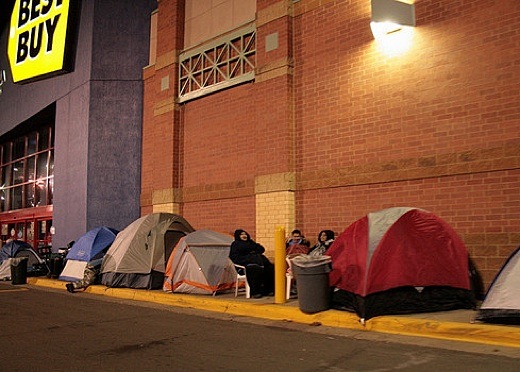
For a shopper to win his desired item requires camping out at the offering big box store in winter conditions to be first through the automatic doors at midnight. Experienced shoppers prepare for their ordeal bringing portable lamps, food, camping chairs and even tents.

Black Friday 2012 is not just a big day for sales and deals for some adventurous people who consider this a week-long event. The Fort Myers Best Buy has a tent city in front of the store with people literally living there on Monday, November 19, 2012 for a store opening on the Friday after Thanksgiving.


Image above: Campers outside the Best Buy in Fort Meyers, Florida, waiting four days for special sale items. From (http://www.examiner.com/article/black-friday-shoppers-are-already-camped-out-tents-at-best-buy).


The Starting Gun

As you probably know, these promotions have resulted in many deaths due to pushing, pepper-spraying, trampling, beatings, stabbings, and shootings. Yes, people bring pepper spray, knives and guns to do their Christmas shopping in celebration of the birth of baby Jesus.
 
A sense of the ambiance of a Walmarts can be seen in the video below that has the following commentary.

Just to clarify, this happened at 10:00pm on Thanksgiving Day! Walmart started their "Black Friday" deals Thursday night to draw the crowds sooner.

These people really wanted their phones. There are several little fights, one guy busts out of the middle and starts flipping out on everyone in his path. There is a bald guy that even passes out from all the commotion at 1:05. The guy was ok in the end. I was asked to stop filming, so I did. Just think, This happened on Thanksgiving day!

Video above: Walmart Black Friday 2012. From (http://youtu.be/K3RDTxVCKC4).

Just another Hooverville

This may be the last Black Friday of its kind. If European sovereign debt continues to fester, or the American economy goes "over the cliff" with tax hikes and spending cutbacks, we will likely be in a deeper recession (let's just call it the Greatest Depression) this time next year. If so, the people camping out at the big box stores won't be doing it as a lark.

Another way to look at the Black Friday spectacle is to see it as a perpetual state of being. People who cannot afford homes and depend of discount sales on clothing and special junk food offerings to survive. Where possible they live at the big box store that will permit their residency.

Like the medieval days in Europe, commoners and peasants will live huddled in the shadows of their cathedrals and pray for charity... a break on pampers or spam.

Check out:
http://www.allstays.com/c/wal-mart-locations.htm for locations of Walmart's that allow RV camping in their parking lots.


.