Showing posts with label Nationalism. Show all posts

Energy collapse is upon us

SUBHEAD: This is your chance to engage with and become an agent of a new paradigm for humanity.

By Nafeez Ahmed on 28 December 2018 for Medium
(https://medium.com/insurge-intelligence/brexit-stage-one-in-europes-slow-burn-energy-collapse-1f520d7e2d89)


Image above: Van on fire in Paris after violent Yellow Vest protests. From original article.

Everyone’s talking about Brexit. Some about the French riots. But no one’s talking about why they are happening, and what they really mean. They might think they are, but they are usually missing the point.

On 6th May 2010, the Conservative Party took the reins of power for the first time since 1992, propped up with some help from the Liberal Democrats.

Hours before the election result, I warned in a blog post that whichever government was elected, it would be the first step in a dramatic shift toward the far-right that would likely sweep across the Western world within 10 years.

I wrote, describing the failure of all three political parties to understand why the heyday of economic growth was unlikely to return.
“The new government, beholden to conventional wisdom, will be unable or unwilling to get to grips with the root structural causes of the current convergence of crises facing this country, and the world...” 
“This suggests that in 5–10 years, the entire mainstream party-political system in this country, and many Western countries, will be completely discredited as crises continue to escalate while mainstream policy solutions serve largely to contribute to them, not ameliorate them.  
The collapse of the mainstream party-political system across the liberal democratic heartlands could pave the way for the increasing legitimization of far-right politics by the end of this decade…”
My prediction was astonishingly prescient. The global shift to the far-right began within exactly five years of my forecast, and has continued to accelerate before the decade is even out.

In 2014, far-right parties won 172 seats in the European Union elections — just under a quarter of all seats in the European Parliament.

In 2015, David Cameron was re-elected as Prime Minister with a parliamentary majority, a victory attributed in part to his promise to hold a referendum on Britain’s membership of the European Union.

Unbeknownst to many, the Tories had quietly established wide-ranging links with many of the same far-right parties that were now capturing seats in the EU.

The following year in June, the ‘Brexit’ referendum shocked the world with its result: a majority vote to leave the EU.

Six months later, billionaire real estate guru Donald Trump shocked the world again when he became president of the world’s most powerful country. Like the Conservatives in the UK, the Republicans too had forged trans-Atlantic connections with European parties and movements of the extreme-right.

Since then, far-right parties have made continued electoral gains across Europe in Italy, Sweden, Germany, France, Poland and Hungary.

We are on the cusp of a tidal wave, that looks poised to accelerate into a tsunami. Exactly as I had anticipated, far-right politics is no longer the province of the fringe, but is becoming increasingly normalised.

This not an accident. It is the result of a system that is failing — and the efforts of a network of far-right groups to exploit the fractures emerging from this system-failure to tear everything down, and erect a new order of their own fashioning.

My prediction of the resurgence of the far-right was based on analysing the probable consequences of a long-term ‘system-failure’ in which we are unable to return to the levels of economic growth we had become accustomed to in the heyday of the 1980s and 90s.

That system-failure, I explained, is rooted in the economics of the energy production that enables economic growth:
“…. a full and lasting recovery… is likely to be impossible in the constraints of the current system, because we’re running short on the physical basis of the last few decades of exponential (and fluctuating) ‘growth’ — and that is cheap, easily available hydrocarbon energies, primarily oil, gas and coal.

The turning point has arrived, and without that global cheap energy source in abundant supply, we cannot continue growing, no matter what we do. Something has to give. Our economies need to be fundamentally, structurally, transformed. 


We need to transition to a new, clean, renewable energy system on which to base our economies. 

We need to transform the way money is created, so that it’s not linked to the systematic generation of debt. We need to transform our banking system on the same grounds. 

Whitehall, and the three political parties, recognize only facets of the picture, but they don’t see it as a whole.”

Turning Point

The energy turning point is unequivocal. In the years preceding the historic Brexit referendum, and the marked resurgence of nationalist, populist and far-right movements across Europe, the entire continent has faced a quietly brewing energy crisis.

Europe is now a ‘post-peak oil’ continent. Currently, every single major oil producer in Western Europe is in decline. According to data from BP’s 2018 Statistical Review of Energy, Western European oil production peaked between 1996 and 2002. Since then, production had declined while net imports have gradually increased.

In a two-part study published in 2016 and 2017 in the Springer journal, BioPhysical Economics and Resource Quality, Michael Dittmar, Senior Scientist at the ETH Zurich Institute for Particle Physics and CERN, developed a new empirical model of oil production and consumption.

The study provides perhaps one of the most empirically-robust models of oil production and consumption to date, but its forecast was sobering.

Noting that oil exports from Russia and former Soviet Union countries are set to decline, Dittmar found that Western Europe will find it difficult to replace these lost exports. As a result,
“total consumption in Western Europe is predicted to be about 20 percent lower in 2020 than it was in 2015.”
The only region of the world where production will be stable for the next 15 to 20 years is the OPEC Middle East.

Everywhere else, concludes Dittmar, production will decline by around 3 to 5 percent a year after 2020. And in some regions, this decline has already started.

Not everyone agrees that a steep decline in Russia’s oil production is imminent. Last year, the Oxford Institute for Energy Studies argued that Russian production could probably continue to grow out to at least 2020. How long it would last thereafter was unclear.

On the other hand, the Russian government’s own energy experts are worried. In September 2018, Russia’s energy minister Alexander Novak warned that Russia’s oil production might peak within three years due to mounting production costs and taxes.

In the ensuing two decades, Russia could lose almost half its current capacity. This sobering assessment is still broadly consistent with the Oxford study.

The following month, Dr Kent Moor of the Energy Capital Research Group, who has advised 27 governments around the world including the US and Russia, argued that Russia is scraping the bottom of the barrel in its prize Western Siberia basin.

Moor cited internal Russian Ministry of Energy reports from 2016 warning of a “Western Siberia rapid decline curve amounting to a loss of some 8.5 percent in volume by 2022. Some of this is already underway.”

Although Russia is actively pursuing alternative strategies, wrote Moor, these are all “inordinately expensive”, and might produce only temporary results.

It’s not that the oil is running out. The oil is there in abundance — more than enough to fry the planet several times over.

The challenge is that we are relying less on cheap crude oil and more on expensive, dirtier and unconventional fossil fuels. Energetically, this stuff is more challenging to get out and less potent after extraction than crude.

The bottom line is that as Europe’s domestic oil supplies slowly dwindle, there is no meaningful strategy to wean ourselves off abject dependence on Russia; the post-carbon transition is consistently too little, too late; and the impact on Europe’s economies — if business-as-usual continues — will continue to unravel the politics of the union.

While very few are talking about Europe’s slow-burn energy crisis, the reality is that as Europe’s own fossil fuel resources are inexorably declining, and as producers continue to face oil price volatility amidst persistently higher costs of production, Europe’s economy will suffer.

In September, I reported exclusively on the findings of an expert report commissioned by the scientific group working on the forthcoming UN’s Sustainability Report.

The report underscored that cheap energy flows are the lifeblood of economic growth: and that as we shift into an era of declining resource quality, we are likely to continue seeing slow, weak if not declining economic growth.

This is happening at a global scale. EROI is already beginning to approach levels seen in the nineteenth century — demonstrating how constrained global economic growth might be due to declining net energy returns to society.

End of energy growth

Britain, which is due to leave the European Union on 29th March 2019, is a poster boy for this brewing energy-economic crisis.

In January 2017, the Centre for Climate Change Economics and Policy run by the University of Leeds and London School of Economics, produced a startling analysis of Britain’s declining net energy problem.

The study attempted to develop a methodology to examine national-level figures for Energy Return on Investment (EROI) — the amount of energy one uses to extract a particular quantity of energy.

The goal of the study was to pinpoint the EROI value as much as possible using Britain as a prime case-study. The concept of EROI fleshes out the recognition that a significant surplus of energy is required to fuel economic activity, separate to energy that is consumed precisely to extract energy in the first place.

The less energy we use to get new energy out, the more energy we have left to invest in the wider goods and services of economic activity. But if we keep using more energy just to get energy out, the amount of net energy we have left to fuel our economies decreases.

According to the study authors, Lina Brand-Correa, Paul Brockway, Claire Carter, Tim Foxon, Anne Owen and Peter Taylor:
“The higher the EROI of an energy supply technology, the more ‘valuable’ it is in terms of producing (economically) useful energy output. In other words, a higher EROI allows for more net energy to be available to the economy, which is valuable in the sense that all economic activity relies on energy use to a greater or lesser extent.”
The verdict on the UK predicament is stark. They find that “the UK as a whole has had a declining EROI in the first decade of the 21st century, going from 9.6 in 2000 to 6.2 in 2012.

These initial results show that more and more energy is having to be used in the extraction of energy itself rather than by the UK’s economy or society.”

Citing the work of French economists Florian Fizaine and Vincent Court, which estimates a minimal societal EROI of 11 for continuous economic growth, the paper concludes:
“… the UK is below that benchmark.”

In other words, early last year, a major scientific study found that for the last two decades and beyond, Britain’s economic growth is fundamentally constrained by domestic net energy decline. But this groundbreaking news did not make the ‘news’.

Break-up

At the close of 2010, in my book A User’s Guide to the Crisis of Civilization, I predicted that large trans-national state structures like the European Union are likely to face challenges to their territorial integrity as a side-effect of these processes.

The failure to address the systemic causes behind the 2008 financial crash, the incapacity to recognise it as a symptom of a system in decline, would lead to an increasingly authoritarian politics.

The integrity of large trans-national structures depends on the abundance of cheap energy flows to sustain them. If those flows come at greater cost and lower quality, then those structures will become increasingly strained and potentially even begin to break down.

Costs to keep the system going increase while returns are squeezed, meaning that the surplus to invest in core social goods to maintain such structures declines.

That is why despite the so-called ‘recovery’ — tepid as it is and based on accelerating debt levels (in biophysical terms borrowing from the Earth today with promise of paying it back tomorrow with what has already been over consumed today) — in real terms, peoples’ purchasing power continues to decline.

The failure to understand and engage with the root, systemic causes of the crisis also means that policymakers put themselves in a position where they can only address surface-symptoms.

All too often, that means short-term, reactionary responses.

And so in France, instead of addressing the question of how to galvanise a third industrial revolution to speed a post-carbon transition and infrastructure revival, Macron’s response to the climate crisis was to protect fossil fuel and nuclear producers while hiking up fuel taxes.

He didn’t want to tackle the horrendous supply chains of big French corporations. He didn’t want to penalise the powerful oil, gas and nuclear lobbies that he hopes might help him get re-elected, and did next to nothing to speed a viable post-carbon transition that might transform economic prosperity on more sustainable foundations.

And so by placing the burden almost exclusively on French workers and consumers, Macron triggered the spiral of rage and riots.

Protestors have set fire to banks, smashed and looted shops, and even targeted the Arc de Triomphe. They demand an end to corporate freeloading, along with nationalist demands such as ‘Frexit’ - France’s departure from the EU, and preventing migration.

It is telling that while some demands are compelling, there is no semblance of understanding the real planetary crisis beyond banal tropes about Big Banks. The French state has responded with its own violence, firing water cannons and tear gas on protestors, arresting over a thousand people, and threatening to bring in the French Army.

This is a microcosm of what can happen when states and peoples both fail to understand the deeper dynamics of a failing system: everyone responds to what is in front of them. Protestors blame Macron. The French state cracks down on violence. Politics becomes militarised, while scepticism of the liberal incumbency across the political spectrum finds vindication.

France’s riots therefore did not come out of the blue. They are part and parcel of a wider process of slow-burn EROI decline in which the returns to society from economic activity are being increasingly constrained by the higher energetic costs of that activity and productivity declines of the ageing centralised industrial-era infrastructure and technology.

It was only a matter of time before the average person began to feel the impact of that squeeze in their day to day lives. Macron’s tax hikes were not the cause, but the trigger. They lit the match, but the tinder box was already fuming.

Brexit

But we’ve been here before, in Syria and beyond.

Brexit was triggered in the context of global system dynamics which remain poorly understood. Over the decade preceding the 2008 financial crisis, Britain’s economic growth was being undermined not merely by a debt-bubble in the housing markets, but by an ailing fossil fuel dependent energy system.

That ailing system was indelibly linked to the European migrant crisis, which saw over a million refugees from the Middle East and North Africa seeking sanctuary across Europe, including the UK and France, that fuelled the surge in nationalist populism sweeping across the continent.

The migrant crisis, too, did not come out of the blue, but followed hot on the heels of the turbulence of the Arab Spring. The destabilisation of Syria, Egypt, Yemen and beyond was a long time coming — but it was triggered by a perfect storm of crises.

Domestic oil production declines which pulled the rug out from beneath oil-export dependent state revenues conspired with global oil price spikes thanks to the plateauing in world production of cheap conventional oil. A string of climate crises across the world’s major food basket regions led to crop failures and droughts which boosted food price spikes.

Global systemic crisis interacted with the breakdown in local national systems. As I’d reported in 2013, a natural drought cycle in Syria was massively worsened due to climate change, devastating agriculture and driving hundreds of thousands of Sunni farmers into Alawite-dominated coastal cities.

As Syrian oil revenues plummeted, its domestic conventional oil production having peaked in the mid-1990s, the government’s slashing of critical fuel and food subsidies just as prices were spiking globally was the last straw. People could not even afford bread, so they hit the streets.

Bashar al-Assad responded with escalating brutality, including shooting civilians in the streets. When protestors picked up arms in response, the cycle of violence kicked in.

Outside powers intervened to coopt their favoured sides, Russia and Iran backing Assad, the West backing various rebel groups — neither particularly interested in supporting Syrian civil society. The conflict escalated, devastating the country, and fuelling an unprecedented refugee crisis.

When NATO intervened in Libya, when the US and UK backed Saudi Arabia’s indiscriminate aerial bombardment of Yemen, it only destabilised the region further. The arc of collapse across the Middle East and North Africa resulted from a fatal combination: an earth system crisis, compounded by short-sighted and self-serving responses from human systems.

When families and children began turning up in their droves on European shores, the earth system crisis ‘out there’ came home.

The West could not shield itself from the long-range consequences of the unsustainability of the very postwar system it had nurtured since the Second World War: structural dependence on fossil fuels, a patchwork of alliances with regional despotic regimes, laying the groundwork for converging climate change, crude oil depletion and the resulting domino effect of food and economic crises.

The earth system crisis that erupted in Syria triggered a wave of human system destabilisation of which Brexit was merely the first eruption.

And so the Syria crisis is indeed a taste of things to come. Europe is already a post-peak oil continent, whose domestic fossil resources are in decline.

Most credible studies of Europe’s shale gas potential show that it is extremely weak and not similar to the American situation. If we are hell-bent on maintaining dependence on fossil fuels, we will be forced to import.

But as I showed in my scientific monograph for Springer Energy Briefs, Failing States, Collapsing Systems: BioPhysical Triggers of Political Violence (2017), if demand growth increases at current rates, it is unlikely that Central Asian and Russian suppliers will be capable of meeting that demand at costs we can cope with in coming decades.

Meanwhile, certain climate impacts are already locked in. Between 2030 and 2045, large parts of the Middle East and North Africa (MENA) are likely to become increasingly uninhabitable due to climate change. This is the same period in which oil production across the MENA region has been forecast to begin plateauing and declining.

As the energy costs of fossil fuel production and imports increases, and as the EU is likely hit again by the challenge of large-scale migration from the Middle East due to climate devastation, the challenges to the EU’s territorial integrity will not go away.

Brexit is merely a ripple on the surface of deeper currents. It is a symptom of the great civilisational phase-shift to life after fossil fuels.

In this sense, the Brexit fiasco is an example of how distant we are as a species from the conversations we need to be having.

Talking about being in or out of Europe and in what way is not unimportant, but it’s also a massive distraction from the deeper systemic crisis that is unfolding beneath the very issues driving our immediate concerns about Brexit.

Earth system disruption does not inevitably result in destabilisation of human systems. But if human systems refuse to engage and adapt to those disruptions, then they will be destabilised.

As long as Britain, Europe and their citizens continue to obsess myopically on the symptoms rather than the causes, we will be incapable of responding meaningfully to those causes.

Instead, we will fight with each other manically about the symptoms, while the ground beneath our feet continues to unravel.

The crisis of Brexit and the eruption of the riots in France are symptoms of a great unfolding civilizational transition, in which an old reductionist paradigm of materialist self-maximation is dying.

Citizens and policymakers, activists and business leaders, need to wake up to what is actually happening to have the conversations that can kick-start meaningful approaches to systemic transformation.

This is not a far-flung crisis that is going to happen years in the future. This is now. This is happening and it is affecting you, your children, and those you love the most. And it will affect their children, and their children.

This is your legacy. This is your choice. This is your chance to engage with and become an agent of a new paradigm, one that speaks for all humans, all species, and the Earth itself.

Maybe we don’t know exactly what the emerging paradigms will look like. But we know that it’s time to ask ourselves:Where do we stand? With the old, or with the new?

.

The Lie of the Land

SUBHEAD: Will Trump’s presidency spell disaster for the climate, or can the green movement seize back the debate?

By Paul Kingsnorth on 18 March 2017 for The Guardian -
(https://www.theguardian.com/books/2017/mar/18/the-new-lie-of-the-land-what-future-for-environmentalism-in-the-age-of-trump)


Image above: Detail of photo of man in suit ignoring woman with sign reading "Need ticket home 2 Maine! Stranded in NYC w/abusive husband! Please help me get out of here!" From (http://www.pbs.org/newshour/making-sense/why-education-wont-solve-americas-inequality-crisis/).

Last June, I voted to leave the European Union. I wasn’t an anti-EU fanatic but I was, despite my advancing years, still something of a green idealist.

 I had always believed that small was beautiful, that people should govern themselves and that power should be reclaimed and localized whenever possible. I didn’t think that throwing the people of Greece, Spain and Ireland to the wolves in order to keep bankers happy looked like the kind of right-on progressive justice that some of the EU’s supporters were claiming it represented.

So I voted to leave. I didn’t say anything about this before the vote and, despite being a writer, I didn’t write about it either. There was too much mudslinging on both sides already, and I didn’t want to throw any more or have any thrown at me. In any case, I didn’t have much to say.

The mudslinging, it turned out, was just a prelude to what would come next. The EU referendum, like the election of Donald Trump in the US five months later, and the Scottish independence question, newly reopened this week, tore the plaster off a pre-existing national wound that now began to bleed freely.

All sorts of things bubbled up that had been suppressed for years, and everyone was suddenly taking sides. Some people, when I told them that I’d voted to leave, looked at me as if I’d just owned up to a criminal record.

Why would I do that? Was I a racist? A fascist? Did I hate foreigners? Did I hate Europe?

I must hate something.

Did I know how irresponsible I had just been? Had I changed my mind yet? I needed to go away and check my privilege.

The eruption of anger that followed the vote, on all sides, was surprising enough. But what was also surprising to me was the uniformity of opinion among people I had thought I shared a worldview with.

Most people in the leftish, green-tinged world in which I had spent probably too much time over the years seemed to be lining up behind the EU.

The public intellectuals, the Green party, the big NGOs: all these people, from a tradition founded on localization, degrowth, bioregionalism and a fierce critique of industrial capitalism, were on board with a multinational trading bloc backed by the world’s banks, corporations and neoliberal politicians. Something smelt fishy.

I was born in the early 1970s. At around the same time, two forces – two movements, if you like – were also born that would shape the lives of my generation. One was neoliberalism. The other was environmentalism.

Neoliberalism was an economic project. It sought to replace stuttering statist economic models with a new laissez-faire order by removing “barriers to trade” wherever they might be found.

These barriers might be protectionist tariffs or taxes; they might also be national laws, local customs or environmental regulations.

The creation of the World Trade Organization in 1995 was the culmination of a decades-long project, pushed by the economic and military might of the United States and its allies, to globalize the neoliberal model and cement it in international law.

By the early 21st century it seemed that this globalization process was both unstoppable and almost complete. Political parties from all traditions had surrendered to it, and the pundits and the economists were happily on board.

In the process, the economic project had developed into a cultural one, promulgated by its beneficiary class, the urban, tech-savvy, cosmopolitan bourgeoisie.

Often referred to as “globalism”, this worldview envisaged a borderless, one-world culture, in which trade tariffs and national boundaries were seen as equally damaging to the new hypercapitalist conception of freedom.

Traditions, distinctive cultures, national identities, religious strictures, social mores – all would dissolve away in the healing light of free trade and a western liberal conception of social progress.

Only bigots and luddites could possibly oppose such a utopian dream.
Being something of a luddite myself, I wrote a book, One No, Many Yeses, opposing it 15 years ago.

The book tracked the great wave of anti-globalization movements that washed over the world at the end of the 20th century, from the summit blockades at Seattle, Prague and Genoa to the uprising of the Zapatistas in Mexico and the anti-privatisation riots in South Africa.

What I found as I investigated these movements was that the most lasting of them were fuelled not by a general rage against “the system”, but by a sense of place and belonging.

Somewhere that people loved or felt attached to was being threatened by outside forces, whether they be trade treaties, buccaneering corporations or oppressive governments, and people were fighting to defend what they knew and what they were.

This sense of the uniqueness of places, and of the cultures that sprang from them, had been what pushed me towards green activism in the first place.

From a young age I had an inchoate sense that much of the world’s color, beauty and distinctiveness was being bulldozed away in the name of money and progress.

Some old magic, some connection, was being snuffed out in the process. It must be 20 years since I read the autobiography of the late travel writer Norman Lewis, The World, The World, but the last sentence stays with me.

Wandering the hills of India, Lewis is ask by a puzzled local why he spends his life traveling instead of staying at home. What is he looking for? “I am looking for the people who have always been there,” replies Lewis, “and belong to the places where they live. The others I do not wish to see.”

As a writer, whether of fiction or non-fiction, I have been looking for the same thing. That first book of mine, it turned out, was a journey in search of people who belong. It was a defence of a threatened fragility. A few years later, I wrote another, this time about globalisation’s impact on England, my home country.

I’ve since written novels and essays and poems and they always seem, however hard I try to write about something else, to circle back around to that primal question: what does it mean to belong to a place, to a people, to nature, in a time in which belonging is everywhere under attack?

 Does it mean anything? Why should it matter?

All I know is that it matters to me. That was why I joined what I wanted to believe was a movement that could derail globalization. For a while, it looked like it might.

Then came 9/11, and a different kind of anti-globalization movement – violent Islamism – began stalking the west. Governments cracked down on dissent and populations grew fearful. Everything suddenly seemed darker.

Still it seemed that nothing could stop the neoliberal train. It kept rolling, faster and faster, until in 2008 it hit a wall at full speed.

Remarkably, it survived the crash. When the banks were bailed out and the corporations given another series of blank checks, I gave up on the idea that much would ever change.

The power of money seemed as stark as the stench of corruption. Perhaps neoliberalism was unstoppable after all. Perhaps, as Margaret Thatcher had once famously claimed, there was, indeed, no alternative.

On 24 June last year I woke up, made a cup of tea and turned on my computer, wondering by what margin the nation had voted to remain in the EU. On the BBC website, the headline seemed to take up the whole screen: BRITAIN VOTES TO LEAVE THE EUROPEAN UNION.

Five months later, my morning seemed to repeat itself. I woke up, made another cup of tea, wondered how many votes Clinton had won by, and then gaped at the margin of Trump’s victory. It was clear the poles were shifting. Something big was going on.

On both occasions I can remember precisely how I felt. It was a feeling that had nothing to do with what might happen next, and it wasn’t really related to my opinions about any of the issues involved.

The feeling was exhilaration. I suddenly realized that for the last decade I had believed, even though I had pretended not to believe, in the end of history. Now, the end of history was ending. Change was possible after all.

I also began to realize something else: the anti-globalization movement had not died. Its impulse had driven Brexit as it had driven Donald Trump’s victory. It had driven Jeremy Corbyn’s rise, and those of Syriza in Greece and Bernie Sanders in the US.

In their different ways and for different reasons, coalitions of people were again pushing back against the dehumanizing world that the global economy was creating. Globalization had been impoverishing the south for decades. Now it was impoverishing the west, too, and the discontent had reached boiling point.

But change is a trickster and it makes no promises.

Back in the day, those of us who fancied ourselves as radicals thought we were the shock troops in the battle against globalization. As a young greenie, I would consume the words of Edward Abbey and Murray Bookchin, Vandana Shiva and EF Schumacher, James Lovelock and Dave Foreman.

These were the people who were constructing the sane future, and I wanted to join them.

Campaigning environmentalists, the “social justice” movement, the lefties and the greens: we would be the heroes of the coming hour.

Our rational solutions to climate change, our well-argued deconstructions of neoliberalism, our piles of evidence about the negative impact of trade treaties, our righteous demands for justice – these would shake the world. When they learned the truth about the continuing corporate stitch-up, the people would rise up in opposition.

They did rise up in the end, but it wasn’t us they were listening to. The message had found a different messenger. Trump said in his last TV spot before election victory:
“There is, a global power structure that is responsible for the economic decisions that have robbed our working class, stripped our country of its wealth and put that money into the pockets of a handful of large corporations and political entities”.
They were words that could have been heard at any social forum, anti-globalization gathering or left-green beanfeast from the last 20 years, as could the rousing final sentence:
“The only thing that can stop this corrupt machine is you.”
In a penetrating essay in The American Interest last July, social psychologist Jonathan Haidt sought to place all this in context. He suggested that the old left-right political divide, which had been looking iffy for years, was being supplanted by a new binary: globalism versus nationalism.

Nationalism, in the broadest sense of the term, was the default worldview of most people at most times, especially in more traditional places. It was a community-focused attitude, in which a nation, tribe or ethnic group was seen as a thing of value to be loved and protected.

Globalism, the ideology of the rising urban bourgeoisie, was more individualistic. It valued diversity and change, prioritized rights over obligations and saw the world as a whole, rather than particular parts of it, as the moral community to which we all belong.

The current explosion of nationalism in the west, Haidt said, was due to globalism having overplayed its hand. Different attitudes to the issue of mass immigration – the spark that lit the fire on both sides of the Atlantic – demonstrated how this had happened.

While globalists saw migration as a right, nationalists saw it as a privilege.

To a globalist, border walls and immigration laws are tantamount to racism or human rights abuse.

To a nationalist, they are evidence of a community asserting its values and choosing to whom to grant citizenship.

Psychologically, Haidt suggested, what happened in 2016 was that many nationalist-inclined voters in the west felt that their community was now under existential threat – not only from large-scale migration, but from Islamist terrorist attacks and the globalist elite’s dismissive attitude to their concerns about both.

In response, they began to look around for strong leaders to protect them. The rest is history, still in the making.

This is the power of the new populists. The likes of Stephen Bannon and Marine Le Pen understand the destructive energy of global capitalism as well as the left does, but they also understand what the left refuses to see: that the heart of the west’s current wound is cultural rather than economic.

What is driving the modern turmoil are threats to identity, culture and meaning. Waves of migration, multicultural policies, eroding borders, shifting national and ethnic identities, globalist attacks on western culture: all that is solid is melting into air.

Who can promise the return of that solidity?

Not the left, which long ago hitched its wagon to the globalist horse, enthusing about breaking down everything from gender identities to national borders and painting any dissent as prejudice or hatred.

Instead, a new nationalism has risen to the occasion. As ever, those who can harness people’s deep, old attachment to tribe, place and identity – to a belonging and a meaning beyond money or argument – will win the day. This might be as iron a law as any human history can provide.

It didn’t take Trump’s cabinet of millionaires long, having got themselves comfortable in the White House, to start dismantling the nation’s environmental protections.

Two months in, the administration has given the green light to two controversial oil pipelines and removed environmental oversight on others, cancelled Obama’s climate action plan, removed regulations protecting clean water and appointed a former head of ExxonMobil as secretary of state.

Anti-green campaigner Myron Ebell, who believes that environmentalism is “the greatest threat to freedom and prosperity in the modern world” was asked to head Trump’s transition team for the Environmental Protection Agency, which he wants to abolish, and which has just seen its budget slashed by 25%.

Trump himself is notorious for his cavalier attitude to anything furry or leafy that gets in the way of his gaudy developments. The natural world has always been an inconvenient barrier to economic growth, which is why we are faced with a global ecological crisis.

But Trump’s anti-environmentalism, while it serves the interests of corporations, speaks the language of the people. In his telling, protecting the natural world from destruction is another example of the globalist elite sticking it to ordinary folk.

The notion that environmentalists are a privileged elite telling the hard-pressed that they can’t have decent lives has been a staple of corporate propaganda for decades.

Look at these horrible elitists, runs the line, trying to abolish your hard-earned holiday flights and double the price of your car journey. Who are they to tell you that you can’t give your children plastic toys at Christmas, or eat air-freighted avocados? Have you seen the size of Al Gore’s house?

Hypocrites!

Like all effective propaganda lines, this one works because there is some truth in it.

The environmental movement that emerged in the west more than 40 years ago, with the founding of organizations such as Greenpeace and Friends of the Earth and the birth of green parties across Europe, had its roots in the conservation world.

While its outlook was planetary – no true ecological movement can be anything else – its actions were often local or national. “Think globally, act locally”, perhaps the movement’s most effective early slogan, looks in retrospect like a beautiful combination of the best of the globalist and the nationalist impulses.

These days, though, as the Brexit vote demonstrated, green politics is a marker of the globalist class.

With their grand ecological Marshall Plans and their talk of sustainability and carbon, environmentalists today often seem distant from everyday concerns.

Green spokespeople and activists rarely come from the classes of people who have been hit hardest by globalization. The greens have shifted firmly into the camp of the globalist left. Now, as the blowback gathers steam, they find themselves on the wrong side of the divide.

All this can look like bad news from a certain perspective, but maybe it isn’t.

While environmentalism has changed the world in the last four decades, in recent years it has been spinning its wheels.

Increasingly unrealistic demands for global action on climate change, pie-in-the-sky manifestos calling for global rollouts of this or that eco-megaplan, the promotion of enormous windfarms or solar arrays that do more damage to wild nature than they prevent, all backed with a “40 months to save the world” narrative that’s been going on for 40 years: something had to give.

Some of the new populists may hope they can sound the death knell of the green movement, but perhaps they can instead teach it a necessary lesson.

What Haidt calls nationalism is really a new name for a much older impulse: the need to belong.

Specifically, the need to belong to a place in which you can feel at home. The fact that this impulse can be exploited by demagogues doesn’t mean that the impulse itself is wrong. Stalin built gulags on the back of a notional quest for equality, but that doesn’t mean we should give up on trying to make things fair.

The anti-globalist attack on the greens is a wake-up call. It points to the fact that green ideas have too often become a virtue signal for the carbon-heavy bourgeoisie, drinking their Fairtrade organic coffee as they wait for their transatlantic flight.

Green globalism has become part of the growth machine; a comfortable notion for those who don’t really want much to change.

What would happen if environmentalism remade itself – or was remade by the times?

What might a benevolent green nationalism sound like?

You want to protect and nurture your homeland – well, then, you’ll want to nurture its forests and its streams too. You want to protect its badgers and its mountain lions. What could be more patriotic?

This is not the kind of nationalism of which Trump would approve, but that’s the point. Why should those who want to protect a besieged natural world allow billionaire property developers to represent them as the elitists? Why not fight back – on what they think is their territory?

It has been done before. The nation that gave us Trump also gave us Teddy Roosevelt, another Republican populist president, but one who believed that America’s identity was tied up with protecting, not despoiling, its wild places.

Roosevelt created one of the greatest systems of protected areas and national parks in the world, using his presidency to save 230m acres of land. He wrote:
 “We have fallen heirs to the most glorious heritage a people ever received,”“and each one must do his part if we wish to show that the nation is worthy of its good fortune.”
Protecting nature, Roosevelt believed, was a patriotic act.

If I had to offer up just one thing I have learned from my years of environmental campaigning, it would be this: any attempt to protect nature from the worst human depredation has to speak to people where they are.

It has to make us all feel that the natural world, the non-human realm, is not an obstacle in the way of our progress but a part of our community that we should nurture; a part of our birthright. In other words, we need to tie our ecological identity in with our cultural identity.

In the age of drones and robots, this notion might sound airy or even ridiculous, but it has been the default way of seeing for most indigenous cultures throughout history.

In the resistance to the Dakota Access pipeline, recently given the go-ahead by Trump, where the Standing Rock Sioux and thousands of supporters continue to resist the construction of an oil pipeline across Native American land, we perhaps see some indication of what this fusing of human and non-human belonging could look like today; a defense of both territory and culture, in the name of nature, rooted in love.

Globalism is the rootless ideology of the fossil fuel age, and it will fade with it. But the angry nationalisms that currently challenge it offer us no better answers about how to live well with a natural world that we have made into an enemy.

Our oldest identity is one that stills holds us in its grip, whether we know it or not.

Like the fox in the garden or the bird in the tree, we are all animals in a place. If we have a future, cultural or ecological – and they are the same thing, in the end – it will begin with a quality of attention and a defense of loved things. All else is for the birds, and the foxes too.

Paul Kingsnorth’s new book, Confessions of a Recovering Environmentalist, is published by Faber.

.

Deep State War

SUBHEAD: Vault 7. Here is one example of how quickly the CIA's over-reach has been absorbed by the body politic.

By Charles Hugh Smith on 10 March 2017 for Of Two Minds -
(http://www.oftwominds.com/blogmar17/deep-state-war3-17.html)


Image above: "CIA" derived from "CNN" logo. From (https://counterpsyops.com/2012/08/31/operation-mockingbird-2012-nyt-writer-leaked-story-critical-of-obama-to-cia/).

The battle raging in the Deep State isn't just a bureaucratic battle--it's a war for the soul, identity and direction of the nation.

When do the unlimited powers of the Intelligence/Security agencies threaten America's domestic and global national interests ?

The CIA and its political enablers claim the agency's essentially unlimited powers, partially revealed by Wikileak's Vault 7 , pose no threat to America's interests, since they are intended to "defend" American interests.

This is the rationale presented by neocon CIA allies in both political parties: the CIA can't possibly threaten America's interests because the CIA defines America's interests.

This is the wormhole down which civil liberties and democracy have drained. It is an extraordinarily defining moment in American history when the director of the FBI publicly declares that there is no such thing as "absolute privacy" in the U.S.

In effect, privacy is now contingent on the level of interest the Security State has in private conversations or data. If we read the U.S. Constitution, we do not find such contingencies: civil liberties are absolute.

Post-1790 presidents have temporarily mooted civil liberties in time of war, and the CIA-led camp of the Deep State has justified its unlimited powers by effectively declared "a state of war is now permanent and enduring."

So what's left to defend if America has become the enemy of civil liberties and democracy , that is become a totalitarian state ruled by Security Services and their political henchmen and apologists?

I have long suggested that the tectonic plates of the Deep State are shifting as the ruling consensus has eroded.

Some elements of the Deep State--what I call the progressive wing, which is (ironically to some) anchored in the military services-- now view the neocon-CIA (Security State)-Wall Street elements as profoundly dangerous to America's long-term interests, both domestically and globally.

Is the Deep State Fracturing into Disunity? (March 14, 2014)

I have suggested that this "rogue Deep State" quietly aided Donald Trump (by subtly undermining Hillary Clinton's campaign) as the last best chance to save the nation from the neocon's over-reach that the Establishment's Wall Street-funded leadership (Bush, Clinton, Obama, et al.) has overseen - including granting the CIA and its allies virtually unlimited powers unhindered by any effective oversight.

Does a Rogue Deep State Have Trump's Back? (January 18, 2017)

This profound split in the Deep State has now broken into open warfare. The first salvo was the absurd propaganda campaign led by Establishment mouthpieces The New York Times and The Washington Post claiming Russian agents had "hacked" the U.S. election to favor Trump.

This fact-free propaganda campaign failed - having no evidence didn't work quite as well as the NYT and Wapo expected - and so the propaganda machine launched the second salvo , accusing Trump of being a Russian patsy.

The evidence for this claim was equally laughable, and that campaign has only made the Establishment, its propaganda mouthpieces and the neocon Deep State look desperate and foolish on the global and domestic stages.

The desperate neocon Deep State and its Democratic Party allies went to absurd lengths to undermine Trump via the "Boris and Natasha" strategy of accusing Trump of collaborating with the Evil Russkies, even going so far as to briefly exhume former President G.W. Bush from deep-freeze to make a fool of himself, saying the Trump-Evil Russkies connection should be "investigated."

Now the rogue elements have launched a counterstrike--Vault 7. Here is one example of how quickly the CIA's over-reach has been absorbed by the body politic.

I highly recommend reading Wikileak's summary of Vault 7: Vault 7: CIA Hacking Tools Revealed.

We now know that the CIA maintained a special program (UMBRAGE) to mimic Russia-based hackers and create false trails back to fictitious "Russian hackers." A number of highly experienced analysts who reviewed the supposed "Russian hacks" had suggested the "evidence" smelled of false trails-- not just bread crumbs, but bread crumbs heavy-handedly stenciled "this is Russian malware."

The body count from Vault 7 has not yet been tallied, but it wouldn't surprise me if former President Obama and his team eventually end up as political casualties. Non-partisan observers are noting all this over-reach occurred on Obama's watch, and it hasn't gone unnoticed that one of Obama's last executive orders stripped away the last shreds of oversight of what could be "shared" (or invented) between the Security Agencies.

Indeed, the entire leadership of the Democratic Party seems to have placed all their chips on the increasingly unviable claim that the CIA is the squeaky clean defender of America.

Vault 7 is not just political theater--it highlights the core questions facing the nation: what is left to defend if civil liberties and democratically elected oversight have been reduced to Potemkin-village travesties?

If there are no limits on CIA powers and surveillance, then what is left of civil liberties and democracy? Answer: nothing.

The battle raging in the Deep State isn't just a bureaucratic battle--it's a war for the soul, identity and direction of the nation. Citizens who define America's interests as civil liberties and democracy should be deeply troubled by the Establishment's surrender of these in favor of a National Security State with essentially no limits.

Americans tasked with defending America's "interests" globally should be asking if a CIA/NSA et al. with unlimited power is detrimental to America's soft and hard power globally, and toxic to its influence.

The answer is obvious: a CIA with unlimited power and the backing of a corrupt Establishment and media is more than detrimental to America's soft and hard power globally--it is disastrous and potentially fatal to America's interests, standing and influence.

Those of us on the sidelines can only hope that the progressive wing of the Deep State, the rogue elements who see the terrible danger of an unlimited National Security State, will succeed in undermining the powerful political support for this toxic totalitarian regime.


.

Nationalism, Hitler, Nixon & Trump

SUBHEAD: Trump's words spread a sense of economic anxiety and national humiliation.

By Nadia Prupis on 22 July 2016 for Common Dreams -
(http://www.commondreams.org/news/2016/07/22/nixon-hitler-and-nationalism-donald-trumps-speech-triggers-alarm-bells)


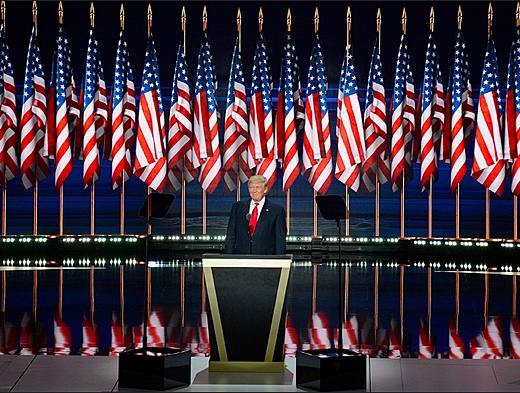
Image above: Donald Trump accepts the Republican nomination for president on July 21, 2016. From original article by (https://www.flickr.com/photos/disneyabc/27854803653/).

Trump's speech triggers alarm bells as he  "signals his determination to exploit fears of violence as part of crusade to seize the White House."

It's official. Donald Trump is the Republican nominee for president.

Reactions abounded late Thursday after the (racist, xenophobic, Islamophobic, and misogynistic) real estate mogul accepted the party's nomination in a rambling, hour-and-fifteen-minute long speech.

Some noted the parallels to Richard Nixon's infamous 1968 "law and order" speech; others pointed out the fascist undertones of Trump's declaration that "I alone can fix this." Few were thrilled that former KKK grand wizard David Duke praised the speech on Twitter.

As The Nation's John Nichols said Thursday night, the speech ultimately signaled Trump's "determination to exploit fears of violence as part of crusade to seize the White House from the Democrats."
Nichols wrote:
Richard Nixon accepted the Republican nomination for president on a Thursday night in the long hot summer of 1968 with a speech that signaled his determination to exploit fears of violence as part of crusade to seize the White House from the Democrats.

[....] The permissive '60s would end, Nixon argued, with the transition of power from a Democratic administration to a Republican who was prepared to crack down on violence.

"Tonight, it is time for some honest talk about the problem of order in the United States," declared Nixon in 1968.

"It is finally time for a straightforward assessment of the state of our nation," declared Trump in 2016.


"The most basic duty of government is to defend the lives of its own citizens. Any government that fails to do so is a government unworthy to lead," Trump told Republican delegates in 2016.


"When the nation with the greatest tradition of the rule of law is plagued by unprecedented lawlessness…then it's time for new leadership for the United States of America," Nixon told Republican delegates in 1968.
Trevor Timm made similar comparisons. In a column for the Guardian on Friday, he wrote:
The parallels with a man who presided over another era in which there were widespread allegations of police brutality and killings of unarmed African Americans seem compelling.


But if you take a detailed look back at Nixon's 1968 campaign for president, the analogy runs much deeper than his not-so-coded language attacking racial minorities. As each day passes, Trump's success looks more and more similar to Nixon's rise to power.
But the alarm bells did not stop with Nixon comparisons. On Twitter, prominent activist and Black Lives Matter co-founder Alicia Garza said, "I don't know what I'm watching right now but I imagine this is the kind of speech Hitler would make."

"When Trump says law and order what he means is shut down #BlackLivesMatter," she tweeted. "He meant law and order for whites, martial law for everyone else."
At The Root, Danielle C. Belton summed up:
Trump said, "[O]ur plan will put America first. Americanism, not globalism, will be our credo."


Mmm, nationalism. That's never caused any problems. I hate to bring up the "F" word, but what a fascist thing to say, future "Dear Leader."
Black Lives Matter co-founder Patrisse Cullors said in a statement issued Thursday, "The terrorist on our televisions tonight was Donald Trump. He pledged to fight for Americans, while threatening the vast majority of this country with imprisonment, deportation and a culture of abject fear. His doublespeak belies his true nature: a charlatan who will embolden racists and destroy communities of color. He is a disgrace.

White people of conscience must forcefully reject this hatred immediately."

Yet while the speech seemed "self-evidently absurd to liberal listeners," writes Richard Eskow of Campaign for America's Future, "it's likely to resonate very well among the white, largely male demographic his campaign has targeted."

Eskow noted the rhetorical trajectory of the speech, which "suddenly pivoted from real-world complaints" like poverty, unemployment, and crumbling infrastructure to "something much more abstract—and nationalistic," something that would appeal to his "decimated" base that is "desperate and frightened and looking for answers." Eskow wrote:
Trump spoke to their economic injuries in classic authoritarian style:
"Not only have our citizens endured domestic disaster, but they have lived through one international humiliation after another. One after another! We all remember the images of our sailors being forced to their knees by their Iranian captors at gunpoint."


For Trump, the sexualized image of humiliation—"to their knees"—is surely no accident. (Remember this?) Weimar Republic comparisons may come too cheaply, but this marriage of economic anxiety and national humiliation is strikingly reminiscent of someone else's rhetoric—and I think you know who I mean.
That's what makes Trump's core message—putting "America First"—so dangerous, Eskow says.
"At the mention of this phrase," Eskow writes, "born of anti-Semitism and unwillingness to fight Hitler's Germany, the crowd erupted in wild cheers: USA! USA!"

.

Homeless

SUBHEAD: The USA is going nowhere because it doesn’t like the new place where history wants to take it.

By James Kunstler on 26 May 2014 for Kunstler.com -
(http://kunstler.com/clusterfuck-nation/homeless-2/)


Image above: We left Carthage on a nice run of route 66 rolling though the Missouri countryside.  The endpoint this time is was Carterville and very little of the area is active. Most buildings are boarded up or derelict. From (http://66in25.blogspot.com/2012_05_01_archive.html).

H History is moving the furniture around in the house of mankind just about everywhere but the USA. Things have changed, except here, where people come and go through the rooms of state, and everything looks shabbier by the day, and lethargy eats away at the upholstery like an acid fog, and the walls reverberate with meaningless oratory. The USA is going nowhere because it doesn’t like the new place where history wants to take it.

That is, first of all, a place of far less influence on everybody else, in a new era of desperate struggle to remain modern. That fading modern world is the house that America built, the great post World War Two McMansion stuffed with dubious luxuries in a Las Vegas of the collective mind. History’s bank has foreclosed on it and all the nations and people of the world have been told to make new arrangements for daily life. 

The USA wants everybody to stay put and act as if nothing has changed.

Therefore, change will be forced on the USA. It will take the form of things breaking and not getting fixed. Unfortunately, America furnished its part of the house with stapled-together crap designed to look better than it really was. 

We like to keep the blinds drawn now so as not to see it all coming apart. Barack Obama comes and goes like a pliable butler, doing little more than carrying trays of policy that will be consumed like stale tea cakes — while the wallpaper curls, and the boilers fail down in the basement, and veneers delaminate, and little animals scuttle ominously around in the attic.

Everybody I know is distressed by this toxic languor, this sense of being stuck waiting in a place they want desperately to move on from — like the prison of elder-care where so many find themselves hostage to the futility of staving off a certain ending, while all the family resources drain into various bureaucratic black holes. Do we care that the generations to come will have nothing left, nothing at all?

This Memorial Day the usual pieties are noticeably muted. Few politicians dare to utter sanctimonies about our brave soldiers maimed on far-flung battlefields, when so many of them are stuck waiting alone in dark rooms with only their wounds and phantom limbs for company. If regular civilian medicine is a cruel, hopeless, quasi-criminal racket, imagine what medicine for army veterans must be like — all that plus an overlay of profound government ineptitude and institutionalized ass-covering.

Even the idle chatter about American Dreaming has faded out lately, because too much has happened to families and individuals to demonstrate that people need more than dreams and wishes to make things happen. It’s kind of a relief to not have to listen to those inane exhortations anymore, especially the idiotic shrieking that “We’re number one!”

Others have got our number now. They are going their own way whether we like it or not. The Russians and the Chinese. The voters in Europe. The moiling masses of Arabia and its outlands. The generals in Thailand. Too bad the people of Main Street USA don’t want to do anything but sit on their hands waiting for the rafters to tumble down. My guess is that nothing will bestir us until we wake up one morning surrounded by rubble and dust. By then, America will be a salvage operation.

There’s a long and comprehensive To-Do list that has been waiting for us since at least 2008, when the nation received one forceful blow upside its thick head. We refuse to pay attention. First item on the list: restructure the banks. 

Other items: reinstate the Glass-Steagall Act; disassemble the ridiculous “security” edifice under the NSA; upgrade the US electric grid; close down most of our military bases overseas (and some of our bases in the USA); draw up a constitutional amendment re-defining the alleged “personhood” of corporations; fix the passenger railroad system to prepare for the end of Happy Motoring; rebuild Main Street commerce to prepare for the death of WalMart and things like it; outlaw GMO foods and promote local food production; shut down casino gambling.

That’s just my list. What’s yours? And when will you step out of this rotting house into the sunshine?

.

Real US Map of Regions

SUBHEAD: The US won’t survive if we end the separation of church and state or ban the expression of offensive ideas.

[IB Editor:  This is the last in a five-part series excerpted from his new book, “American Nations: A History of the Eleven Rival Regional Cultures of North America,” published Sept. 29 by Viking. Read Part 1, Part 2, Part 3 and Part 4.)]

 By Colin Woodward on 5 October 2011 for Bloomberg News -  
(http://www.bloomberg.com/news/2011-10-05/the-real-u-s-map-a-country-of-regions-part-5-colin-woodard.html)

 
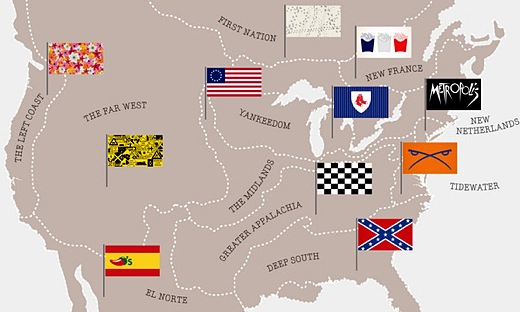
Image above: Illustration of North American nations by Original Champions of Design From original article.

 In “American Nations,” I’ve sought to show how our Balkanized past has informed our divided present, in the hopes of fostering a better understanding of the American identity and predicament. But inevitably people ask what this means for the future.

The short answer is, of course, that nobody knows. But given the challenges facing the U.S., Mexico and, to a lesser extent, Canada, it seems unwise to simply assume that North America’s political boundaries will remain as they are today.

The U.S. is wracked by internal discord between two blocs formed by seven of its 11 regional nations -- the conservative bloc that includes the Deep South, Tidewater and much of greater Appalachia, pitted against the more liberal alliance of Yankeedom, New Netherland, the Midlands and the Left Coast. Increasingly, through American history, the conflict between these two blocs has been driving the nation apart.

The country has been exhibiting the classic symptoms of an empire in decline. Kevin Phillips -- the political strategist who, back in 1969, used regional ethnography to accurately predict the ensuing 40 years of American political development - - has pointed out parallels with late imperial Holland and Britain. Like its superpower predecessors, the U.S. has built up a staggering trade deficit and sovereign debt while overreaching militarily. As financial services have come to account for a larger and larger share of national output, religious extremists have come to play a bigger and bigger role in political life.

Indebted and Divided
Once a great exporter of innovations, products and financial capital, the U.S. is now deeply indebted to China, on which America relies for much of what it consumes and, increasingly, for the scientists and engineers who are needed by research and development firms and institutions.

The U.S. citizenry is divided along regional lines. The country’s military has been mired in expensive and frustrating counterinsurgency wars in Mesopotamia and Central Asia, while barbarians have stormed the gates of Washington and Wall Street, killing thousands in the surprise attacks of September 2001.

Add in the damage to public confidence in the electoral system caused by the 2000 election, the near-total meltdown of the financial sector in 2008, and extreme political dysfunction in the capital, and it’s clear the U.S. hasn’t started the 21st century auspiciously.

To the south, the Mexican federation is in even worse shape. For years, leading foreign-policy experts have been describing it as a failed state. It’s not hard to imagine Mexico shattering in a time of crisis -- a climate-change-related disaster, a global financial collapse, a major act of terrorism -- freeing the Mexican half of El Norte to look northward.

In Canada, national fractures have been obvious for some time, with New France pushing for outright independence through 1995. In that year, 60 percent of Quebec’s Francophones voted in support of independence. The measure was narrowly defeated (because English-speakers, immigrants and the First Nation section of Quebec rejected it). The lower house of the federal parliament recognizes Quebec as a “distinct society,” and New France-style multiculturalism has become the civic religion of Canadians everywhere.

Today, Canada is perhaps the most stable of the three North American federations. Unlike the U.S., it has, in effect, rejected any illusion of having a single dominant culture, and adjusted accordingly. Whether that will be enough to preserve the federation in the long term remains to be seen.

Unlikely Compromise
In the U.S., one approach to maintaining the status quo might be for its 11 nations to follow Canada’s example and compromise their respective cultural agendas for the sake of unity. Unfortunately, neither the Dixie bloc nor the Northern alliance is likely to make major concessions. Most Yankees, New Netherlanders and Left Coasters simply won’t accept an evangelical Christian theocracy with weak or nonexistent social, labor or environmental protections, public school systems, and checks on corporate power in politics.

For their part, most Deep Southerners will resist paying higher taxes to underwrite a public health-insurance system; a universal network of generously funded, unionized and avowedly secular public schools; tuition-free public universities; government-subsidized transportation, high-speed rail and renewable energy projects; or strict regulations on financial services, food safety, environmental pollution and campaign finance.

Instead, the “red” and “blue” nations will continue to wrestle with one another for control over federal policy, each doing what it can to woo “purple” nations to their cause, just as they have since they gathered at the First Continental Congress.

Another outside possibility is that, faced with a major crisis, the federation’s leaders will betray their oath to uphold the U.S. Constitution, the primary adhesive holding the Union together. In the midst of, say, a deadly pandemic or the simultaneous destruction of several cities by terrorists, a fearful public might condone the suspension of civil rights, or the dissolution of Congress. Some regional nations would be happy with the new order and others, deeply opposed. With the Constitution abandoned, the federation could well disintegrate, forming one or more confederations of like-minded regions.

Chances are, any such new sovereign entities would be based on state boundaries, because, in such a scenario, governors and legislators would be the most politically legitimate actors. New York, New Jersey and states in New England, the Great Lakes region and the Pacific Northwest might form one or more confederations. States controlled by the Deep South -- South Carolina, Georgia, Alabama, Mississippi and Louisiana -- might form another. The mountain and plains states of the Far West would constitute an obvious third.

The situation might be more complicated within the often- divided Greater Appalachia or the nationally mixed states of Texas, California, Pennsylvania, Ohio and Arizona. It isn’t impossible to imagine some of the resulting coalitions extending into Canada or, in the case of El Norte, into Mexico

Or perhaps the federation would simply reach accommodation over time as its component nations came to realize that the only issue on which they could find common ground was the need to free themselves from one another’s veto power. Perhaps they’d join together enough to pass laws and constitutional amendments granting more powers to the states and liquidating many of the functions of the central government. The U.S. might continue to exist, but its powers would be limited to national defense, foreign policy and the negotiation of interstate trade agreements. It would, in other words, resemble the European Union or the original confederation of 1781.

If that were to happen, the states could be counted on to behave in accordance with their respective national heritages. The 11-nation format would be useful as a predictor of behavior. Yankee New Englanders might cooperate closely with one another, much as the Scandinavian countries do within Europe. Texans might finally assert their constitutional right (under the terms of their annexation to the U.S.) to split into as many as five individual states. Illinoisans might agree to divide downstate from Chicagoland. California might split into southern, northern and interior states.

The external borders of this retooled U.S. might remain in place, or perhaps some Canadian or Mexican provinces might apply for membership in the looser federation. Far stranger things have happened in history.

Preserving the U.S.
One thing is certain: If Americans want the U.S. to continue to exist in something like its current form, they will need to respect the fundamental tenets of our unlikely union. It can’t survive if we end the separation of church and state or ban the expression (or criticism) of offensive ideas. We won’t hold together if presidents appoint political ideologues to the Supreme Court, or if party loyalists try to win elections by trying to stop people from voting. The union can’t function if national coalitions continue to use House and Senate rules to prevent decision-making on important issues.

Other sovereign democratic states have central governments more dysfunctional than our own, but most can fall back on unifying elements we lack: common ethnicity, a shared religion or near-universal consensus on many fundamental political issues. Our constitutional order -- an arrangement negotiated among the regional cultures -- assumes and requires compromise in order to function at all.

And the U.S. needs its central government to function cleanly, openly and efficiently because it’s one of the few important things that bind us together.

• Colin Woodard, a correspondent for the Christian Science Monitor and the Chronicle of Higher Education, is the author of “The Lobster Coast,” “The Republic of Pirates” and “Ocean’s End.” 


.

The Divided Nations of America

SUBHEAD: An examination of real national divisions of North America based on geography and culture.

 By Colin Woodward on 28 September 2011 for Bloomberg News - (http://www.bloomberg.com/news/2011-09-29/real-u-s-map-a-country-of-regions-part-1-commentary-by-colin-woodard.html)  
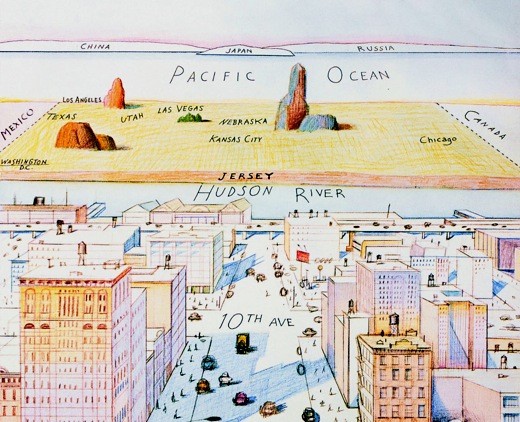
Image above: Detail from "The World as Seen From 9th Avenue" by Saul Steinberg, in the New Yorker, 1976. From (http://bigthink.com/ideas/21121).

[IB Editor's note: This is Part 1 of a five part piece being published by Bloomberg News that are excerpts from the book “American Nations: A History of the Eleven Rival Regional Cultures of North America”, published Sept. 29 by Viking. Part 5 will be published tomorrow in Bloomberg News and we will repost as well.] 
 
In 2008, with the U.S. divided between red states and blue states, then-candidate Barack Obama called for unity over division, a common shout-out among politicians and others determined to preserve America’s under- siege, allegedly shared values. Yet such calls ignore the fact that there are no shared “American values.”

We’ve always been divided. And not truly along state lines.
America’s most essential and abiding divisions stem from the fact that the U.S. is a federation composed of the whole or parts of 11 disparate regional cultures -- each exhibiting conflicting agendas and the characteristics of nationhood -- and which respect neither state nor international boundaries, bleeding over the borders of Canada and Mexico as readily as they divide California, Texas, Illinois or Pennsylvania.

The differences between them shaped the scope and nature of the American Revolution, the Articles of Confederation, the Constitution and, most tragically, the Civil War. Since 1960, the fault lines between these nations have been growing wider, fueling culture wars, constitutional struggles and those ever- present pleas for unity.
These “nations” have been with us all along.

Cultural Clusters
The settlers of each of the original colonial clusters came from various regions of the British islands, or from France, the Netherlands or Spain, and had distinct religious, political and ethnographic characteristics. These cultures developed in remarkable isolation from one another, cultivating distinct and often contradictory values, practices, dialects and ideals. Some championed individualism, others utopian reform.

Some were guided by divine purpose, others by conscience and inquiry. Some embraced an Anglo-Saxon Protestant identity, others ethnic and religious pluralism. Some valued equality and democratic participation, others deferred to aristocratic order. All continue to champion some version of their original ideals in the present day, frustrating attempts to build a national consensus.

Forget the state boundaries. Arbitrarily chosen, they often slash through cohesive cultures, creating massive cultural fissures in states like Maryland, Oregon and New York. Equally burdensome are the regional designations with which we try to analyze national politics -- the Northeast, West, Midwest and South. They’re illusions masking the real forces driving the affairs of our sprawling continent: the 11 regional cultures of North America.

These 11 nations -- Yankeedom, Tidewater, New Netherland, New France, Deep South, Greater Appalachia, the Midlands, First Nation, the Far West, the Left Coast, El Norte -- have been hiding in plain sight throughout our history.

You see them outlined on linguists’ dialect maps, cultural anthropologists’ maps of material culture regions, cultural geographers’ maps of religious regions, campaign strategists’ maps of political geography and historians’ maps of the patterns of settlement across the continent. I’m not the first person to have recognized the importance of these regional cultures.

In 1969, Kevin Phillips, then a Republican campaign strategist, identified the distinct boundaries and values of several of these nations and used them to accurately prophesize the Reagan Revolution in his “Emerging Republican Majority,” a political cult classic.

Divisions Within States
The force of their identities is felt particularly in questions of culture and national politics: California is split into three nations, and the divide is visible on a map of which counties voted for or against same-sex marriage in 2008. The Yankee-settled portion of Ohio is evident on the county maps of the 2004 and 2008 elections, a strip of blue across a largely red state.

According to the Census Bureau, Greater Appalachia’s citizens inhabit virtually the only counties in the country where a majority answered merely “American” when asked to name their ancestry. In 2008, Gallup asked more than 350,000 Americans if religion was an important part of their daily lives. The top 10 states to answer affirmatively were all controlled by Deep Southerners or those in Greater Appalachia. Eight of the bottom 10 were states dominated by Yankees.

Our continent’s famed mobility -- and the transportation and communications technology that foster it -- has been reinforcing, not dissolving, the differences between the nations. As journalist Bill Bishop and sociologist Robert Cushing demonstrated in “The Big Sort,” since 1976, Americans have been relocating to communities where people share their values and worldviews.

As a result, the proportion of voters living in counties that give landslide support (defined as more than a 20 percent margin of victory) to one party or another increased from 26.8 percent in 1976 to 48.3 percent in 2004. The flows of people are significant, with a net 13 million people moving from Democratic to Republican landslide counties between 1990 and 2006 alone. These moves have reinforced regional cultures.

What this all amounts to is this: As Americans sort themselves into like-minded communities, they’re also sorting themselves, more than ever, into like-minded nations, cultural fiefdoms where the forces of contention between nations are more easily rallied, rendering the compromise and consensus necessary to move the wheels of the federal government increasingly difficult to achieve.
So what are these nations, and what parts of the continent does each control?

Yankeedom
Yankeedom was founded on Massachusetts Bay by radical Calvinists as a religious utopia in the New England wilderness. From the outset, there was emphasis on education, local political control and the pursuit of the greater good, even if it required individual self-denial. Yankees have the greatest faith in government’s ability to improve lives. For more than four centuries, Yankees have sought to build a more perfect society here on earth through social engineering, extensive citizen involvement in the political process and the aggressive assimilation of foreigners.

Settled by stable, educated families, Yankeedom has always had a middle-class ethos and considerable respect for intellectual achievement. Its religious zeal has waned over time, but not its underlying “secular Puritanism” or drive to improve the world.

From its New England core, Yankee culture spread with its settlers across upper New York state, the northern strips of Pennsylvania, Ohio, Indiana, Illinois and Iowa; parts of the eastern Dakotas; and on up to Michigan, Wisconsin, Minnesota and the Canadian Maritimes. It has been locked in perpetual combat with the Deep South for control of the federal government since the moment such a thing existed.

New Netherland
The 17th-century Dutch colony of New Netherland had a lasting impact by laying down the cultural DNA for New Amsterdam (now Greater New York City) that was, from the start, a global commercial trading society. Multiethnic, multireligious, speculative, materialistic, mercantile and free-trading, the future metropolis was a raucous, not entirely democratic city- state where no one ethnic or religious group has ever been truly in charge. It nurtured two innovations considered subversive: a profound tolerance of diversity and an unflinching commitment to freedom. Forced upon other nations at the Constitutional Convention, these ideals have been passed on to us as the Bill of Rights.

New Netherland has retained its fundamental values and societal model, having long reigned as the leading world center of Western commerce, finance and publishing. But its territory has shrunk over the centuries. Today, the five boroughs of New York City, the lower Hudson Valley, northern New Jersey, western Long Island and southwestern Connecticut comprise New Netherland. The most densely inhabited part of North America, its population -- 19 million at this writing -- is greater than that of many European nations, and its influence over this continent’s media, publishing, fashion, intellectual and economic life is hard to overstate.

The Midlands
Arguably the most “American” of the nations, the Midlands was founded by English Quakers on the shores of Delaware Bay. Pluralistic and organized around the middle class, the Midlands spawned the culture of Middle America and the Heartland, where ethnic and ideological purity have never been a priority, government has been seen as an unwelcome intrusion, and political opinion has been moderate, even apathetic.

Long an ethnic mosaic, with people of German descent -- not Anglo-Saxons -- making up the largest group since the 1600s, the Midlands includes those who, like Yankees, believe society should be organized to benefit ordinary people, but they are skeptical of top-down government intervention, as many of their ancestors fled from European tyrannies. The Midlands is home to a dialect long considered “standard American,” a bellwether for national political attitudes and the key swing vote in every national debate from the abolition of slavery to the 2008 presidential contest.

From its cultural hearth in southeastern Pennsylvania, southern New Jersey, and northern Delaware and Maryland, Midland culture spread through much of the heartland: central Ohio, Indiana and Illinois; northern Missouri; most of Iowa; and the less-arid eastern halves of South Dakota, Nebraska and Kansas. It shares the key border cities of Chicago (with Yankeedom) and St. Louis (with Greater Appalachia, a nation to be discussed in a later installment). It also has an important extension in southern Ontario, where many Midlanders emigrated after the American Revolution, forming the central core of English- speaking Canada. Although less concerned with its national identity, the Midlands is, nonetheless, an enormously influential moderating force in continental politics, as it agrees with only part of its neighbors’ strident agendas.

Tomorrow: Tidewater, Greater Appalachia and the Deep South.

• Colin Woodard, a correspondent for the Christian Science Monitor and the Chronicle of Higher Education, is the author of “The Lobster Coast,” “The Republic of Pirates” and “Ocean’s End.”

See also:
American Nations Part 2
American Nations Part 3
American Nations Part 4
American Nations Part 5 or
Ea O Ka Aina: Real US Map of Regions 10/05/11 .