Showing posts with label World. Show all posts

Natural Time 2.0

SUBHEAD: An update on a universal time system for the planet Earth based on "natural time" from Mauna Kea mountain.

By Jonathan Jay on 4 November 2017 for BeNow.world -
(http://benow.world/?p=388)
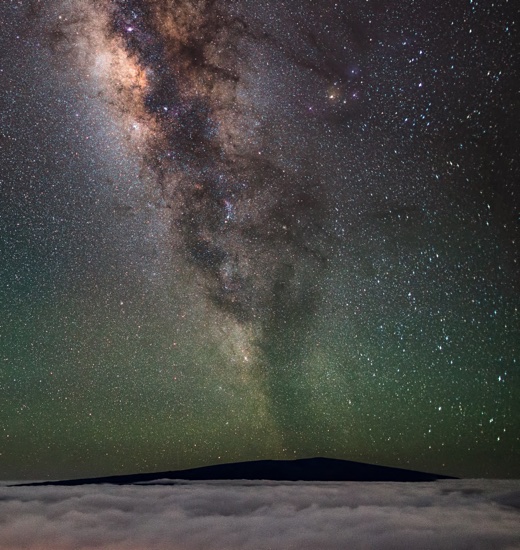

Image above: Starlight over Mauna Kea mountain from Haleakala mountain on Maui.   Photo by Shane Michael Black. From (https://danspace77.com/2014/12/03/mauna-kea-starlight/).

[IB Publisher's note: There is a full explanation of this time system at BeNow.world.]

As we move further into the third millennium, perhaps now would be a great time to turn away from machine and atomic time, and return to the actual rhythms of the real world.  Not the model.  Not the fabricated.  Not the fictitious nor mean.  But the real.  So, what is real?

Hours, minutes, seconds and weeks – they are all made up. There is nothing intrinsically 7, 24, or 60 about time.

Time simply flows.

Time zones, daylight savings too – all social constructs, designed by people for their particular self-interests, mostly as a means of social control, and in the world we live in today; technological, industrial, and increasingly sophisticated, yet still machines.

All the data in the world will never teach you how to kiss, or love, or gaze in wonder at the heavens above.  This is vastly more profound.

The sun, the moon, and  stars these however, are real.  They gyre and swoon, eccentric and elliptical, and ever in flux, often at time-scales that exceed our capacity to easily recognize.  The universe is not a clockwork; it is made of energy.

It is not fixed; it vibrates.

We are not separate from it, we are of it.  In the natural world, time is elastic; it is liquid.  it pulses and flows.   It is fluid, not mechanical.  Continuous, not zoned. Flexible; neither standardized nor mean.

And yet legacy time systems rebel against these realities at every turn.  Why?

The Industrial world view, and the time model it perpetuates is separated from reality.  Separation seems to be a central principle; It literally exists apart. Rather than observe and conform to what actually is, the industrial time model asserts conceptual supremacy over the natural world it perports to describe.

Reality is too variable, too inconsistent — too alive — to be controlled, and so the actual univere is jettisoned for a more compliant and regulatable model.

And yet it remains as true today as it was in 1841 when Ralph Waldo Emerson observed “a foolish consistency is the hobgoblin of little minds.”

Some people say, time does not exist.  It is an illusion, created by the mind, founded on separation.  Which is exactly the what industrial time system is.  Alienated. And, alienating.

But Mauna Kea stands calm and connected.  It is a place from which the the earth almost touches heaven.  Where even the industrial astronomical community will admit as having some of the most ‘stellar’ seeing from anywhere on the surface of this world.  So much sky!

So still, and dark, dry and dust free the little atmosphere that slides above the summit.

Overhead at night  the stars shine and wheel across the sky, but hardly sparkle — the laminar flow of air over the summit so smooth flows.  The moon and the sun swoon and dance the tides.  And beneath them all, the Mauna slowly revolves, breathing in and out once a day, the end and the beginning of each revolution.

Not the suburb of some 19th century  European empire, but the tallest pinnacle on the planet surrounded by the broadest ocean in the solar system.

For more information about this natural time system, go to:  http://benow.world/?p=388

.

Hokule'a returns to Hawaii

SUBHEAD: Hawaiian sailing canoe completes three-year voyage around the world to inspire people to take care of the Earth.

By Carla Herreria on 18 June 2017 for Huffington Post -
(http://www.huffingtonpost.com/entry/hokulea-completes-voyage-around-the-world_us_5945910ae4b0f15cd5bbc9ce)


Image above: The Hokoule'a returning to Honolulu harbor after three year journey. From original article.

[IB Publisher's note: Visit the Huffington Posts article to see many more images of the return of the Hokule'a.]

Three years after setting sail from Hawaii using only the stars, the wind and ancient Polynesian navigation techniques to voyage around the world, the Hokulea, a traditional double-hulled Hawaiian sailing canoe, has arrived back home on the island of Oahu.

Thousands of people welcomed the Hokulea as it docked in Magic Island in Honolulu early Saturday morning. Hawaiians greeted the canoe and its crew with traditional chants.

The homecoming, which marks the end of a difficult and meaningful voyage, was an emotional one for many. As the canoe approached land, a rainbow could be seen just off the horizon.


Image above: The Hokoule'a return is welcomed by the public and Hawaiian indigenous practitioners. From original article.

In 2014, navigators with the Polynesian Voyaging Society set sail on the Hokulea with one message: To inspire communities around the world to take care of “island Earth.” In its voyage, the Hokulea and her crew traveled more than 40,000 nautical miles, visiting 150 ports in 23 countries, including stops in South Africa, Brazil, Tahiti and New York City.

The Hokulea’s unique mission is a point of pride for the Aloha State.


Image above: The Hokoule'a finally at dock on Magic Island with the Ala Wai Boat Harbor in the background. From original article.

Hawaii is one of the few states that has pushed back against the Trump administration’s policies on climate change.

This month, Governor David Ige, a Democrat, signed a bill that binds the state of Hawaii to the goals made in the Paris climate accord, despite President Donald Trump’s decision to pull the country from the agreement. In 2015, Hawaii became the first state to enact a law requiring that 100 percent of its electricity come from renewable sources by 2045.

“Watching you on your epic voyage, you taught us that there is more than connects the world than divides us,” Ige said to the Hokulea crew during Saturday’s ceremony, according to the Honolulu Star-Advertiser.


Video above: The Honolulu Star Advertiser video of return of Kokule'a to Hawaii. From (https://youtu.be/Hvh5bX4iFHU).

See also:
Ea O Ka Aina: New Sail Power in Mediterranean 6/15/17
Ea O Ka Aina: A houseboat that sails 67/9/16
Ea O Ka Aina: Larry Ellison - Oracle 6/21/12
Ea O Ka Aina: Our Brave Experiment 6/13/12
Ea O Ka Aina: Hokulea sister ship Hikianalia 10/10/12
Ea O Ka Aina: Moving local goods by boat 3/7/12 
Ea O Ka Aina: Polyneisans again tour the Pacific 8/15/11
Ea O Ka Aina: Clear Sky over Polynesian canoes 7/12/11
Ea O Ka Aina: The Sail Transport Network 6/4/11
Island Breath: The future of ocean sailing 8/15/08
Island Breath: Sail Technology Reemerges 12/25/07
Island Breath: Rethinking the sail 12/25/07
Island Breath: THe Polynesian Package 8/24/07
Island Breath: The Future of Ocean Sailing 8/15/06
.

World Is preparing for War

SUBHEAD: Mikhail Gorbachev says wars must be outlawed, because it cannot resolve any of the global problems we are facing.

By Andrea Germanos on 27 January 2017 for COmmon Dreams -
(http://www.commondreams.org/news/2017/01/27/mikhail-gorbachev-appears-world-preparing-war)


Image above: And it won't be merely a trade war if current trends go off the rails. From (http://www.cnbc.com/2017/01/25/trade-war-between-china-and-the-us-is-a-lose-lose--state-media.html).

Former Soviet leader Mikhail Gorbachev has warned that it appears "as if the world is preparing for war."

'Wars must be outlawed, because none of the global problems we are facing can be resolved by war,' writes former Soviet leader.

Writing in an op-ed published Thursday at TIME magazine, Gorbachev, who won the Nobel Peace Prize in 1990 for his role in ending the Cold War, writes that the most pressing problem facing the world is "the militarization of politics and the new arms race."

State budgets, he continues, claim austerity to sacrifice social spending, but easily back funding for weapons of war. At the same time, he writes of the buildup on Russia's borders: "NATO and Russian forces and weapons" are now in close proximity "as if to shoot point-blank." He continues:
Politicians and military leaders sound increasingly belligerent and defense doctrines more dangerous. Commentators and TV personalities are joining the bellicose chorus. It all looks as if the world is preparing for war.
While he and President Ronald Reagan agreed in 1985 "that a nuclear war cannot be won and must never be fought," now, "the nuclear threat once again seems real," with "advocates for arms build-up and the military-industrial complex [...] rubbing their hands." And that, he declares, is absolutely the wrong direction to solve the world's ills. Instead, war of any kind must be abolished, he writes:
In modern world, wars must be outlawed, because none of the global problems we are facing can be resolved by war—not poverty, nor the environment, migration, population growth, or shortages of resources.
He called on the United Nations Security Council to adopt a resolution—which should be put forth by U.S. President Donald Trump and Russian President Vladimir Putin—that restates that "a nuclear war cannot be won and must never be fought. "

In 2014 Gorbachev warned that the world was "on the brink of a new Cold War"—a situation fueled in part by the U.S. being "tortured by triumphalism."

More recently, in 2016, he said, "The window to a nuclear weapon-free world…is being shut and sealed right before our eyes."

"As long as nuclear weapons exist, there is a danger that someday they will be used as a result either of accident or technical failure or of evil intent of man, an insane person or terrorist," Gorbachev said.

Trump, however, out of step with most of the world, used Twitter to call for an expanded U.S. nuclear arsenal—a fact that contributed to the Bulletin of the Atomic Scientists this week moving its symbolic Doomsday Clock closer to midnight.

.

Coral bleaching worldwide

SUBHEAD: Here is evidence that something very bad is happening in Earth's oceans.

By Nick Visser on 8 OCtober 2015 for Huffington Post -
(http://www.huffingtonpost.com/entry/coral-bleaching-climate-change_561568d9e4b021e856d33d0f)


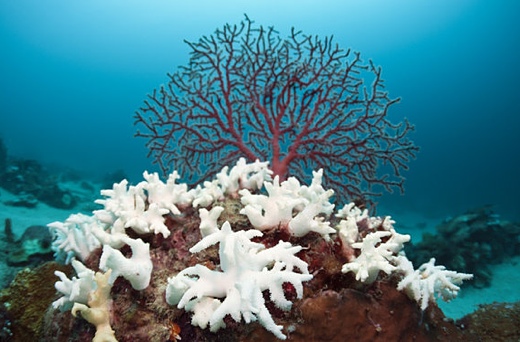
Image above: Bleached corals in West Papua, Indonesia. The world's corals are experiencing a mass bleaching as a result of warmer ocean temperatures and other factors. From original article.

The planet's coral reefs are experiencing a mass global bleaching, the National Oceanic and Atmospheric Administration announced on Thursday. The bleaching, only the third event of its type in recorded history, is another troubling sign of the damaging effects of climate change on the planet's health.

Bleaching happens when usually vibrantly colored corals lose their hues and turn bright white due to warmer oceans or other environmental factors. The colorful algae that live in and feed coral polyps leave in stressful times, turning the otherwise breathtaking formations into ghostly shells.

Warmer ocean temperatures are wreaking havoc on the undersea biome, causing widespread damage to delicate coral ecosystems that may well get worse due to the potential effects of a strong El Niño tropical weather system.

Reefs cover about 0.1 percent of the ocean floor, but are home to some 25 percent of marine life and have long been one of the main victims of a hotter world. However, Mark Eakin, the coordinator for NOAA's Coral Reef Watch program, said corals are often out of the public eye simply because they're underwater.

"What do you think people would do if, in a matter of months, 60 percent of the redwood forest would die?" he asked. "It's a bit of a problem of being out of sight, out of mind."

Eakin was referring to a smaller-scale bleaching that took place in the Caribbean in 2005 that wiped out 60 percent of corals in that region, but went relatively unnoticed. Now, however, bleaching is taking place on a much larger scale. Mass bleaching has happened just twice before, Eakin said, once in 1998 and again in 2010.

The current global bleaching began in the northern Pacific in the summer of 2014 and has since expanded throughout the Pacific and Indian Oceans. Corals in the U.S. have been among the hardest-hit, and scientists are particularly concerned with formations around Hawaii and the Caribbean.

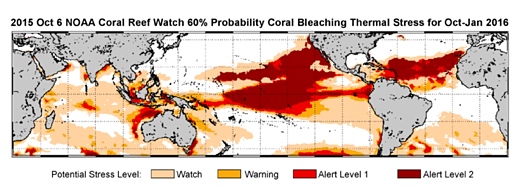
The chart below shows the probable threat of bleaching around the globe for the next several months, with the dark red areas showing the places that face the greatest risk.


NOAA's standard 4-month bleaching outlook showing threat of bleaching continuing in the Caribbean, Hawaii and Kiribati, and perhaps expanding into the Republic of the Marshall Islands, from October 2015 to January 2016. From original article. From original article.

When algae leave coral during a bleaching, the reef is left sick, hungry and vulnerable. This doesn't necessarily kill the coral, and some certainly recover. But severe or long-term bleaching -- like the current phenomenon -- is often fatal, according to NOAA. As reefs die, a slew of biodiversity is thrown out of whack. Fish lose their homes, crustaceans leave and many other species die as well.

"After corals die, reefs quickly degrade and the structures corals build erode," a press release from NOAA reads. "This provides less shoreline protection from storms and fewer habitats for fish and other marine life, including ecologically and economically important species."

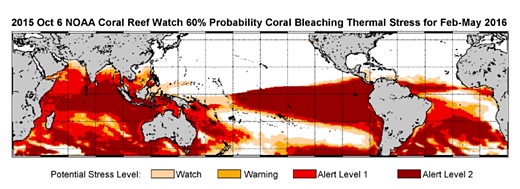
However, Eakin was quick to note that while the current bleaching event is severe enough, the ongoing El Niño could amp it up to "frightening" levels in the near future, as illustrated below.


Image above: An extended bleaching outlook showing the threat of bleaching expected in Kiribati, the Galapagos, the South Pacific -- especially east of the dateline and perhaps affecting Polynesia -- and most coral reef regions in the Indian Ocean, from February to May 2016.

The news is the latest in a series of troubling climate-related milestones. Last month, NOAA announced that this year's summer had been the hottest in recorded history. In August, scientists said the world's glaciers had melted to the lowest levels since record-keeping began more than 120 years ago. And in March, researchers said Arctic sea ice had seen the smallest annual growth ever.

NOAA's announcement about the bleaching comes a little less than two months ahead of the highly anticipated Paris climate summit in December. Hundreds of world leaders will attempt to devise a global plan for combating climate change, as time is running out to keep the planet below an agreed-upon warming threshold of 2 degrees Celsius.

Oceans will be a key issue during the summit, and Eakin says there's an "absolutely urgent need" for action. By the end of the current bleaching event, he says, some 4,600 square miles of reefs could be dead.

"One of the most heart-wrenching dives I've made in my life was in 2010 during the second global bleaching event," Eakin said of a dive he took in Thailand. "It was just fields of bleached coral. The fish were swimming around in midwater looking stunned."


.

Aina - That Which Feeds Us

SUBHEAD: This film sees path for addressing the crises facing the island of Kauai - and island Earth.

[IB Publisher's note: You cann ow see the complete movie here (http://islandbreath.blogspot.com/2015/07/see-aina-movie.html)]

By Jason Donovan on 13 July 2015 for Preserve Paradise -
(http://islandbreath.blogspot.com/2015/07/aina-that-which-feeds-us.html)


Image above: Poster for movie Aina:That Which Feeds Us. From (http://space4peace.blogspot.com/2015/06/they-are-not-farming-they-are-doing.html).

AINA (pronounced "eye-nah") means, “that which feeds us” in the Hawaiian language. The film highlights a simple yet effective path for addressing some of the most pressing environmental and health crises facing the island of Kauai - and of island Earth. That may sound like an outstanding claim, but as AINA vividly illustrates, such is the power of agriculture and consumer choices for people and the planet.

WHAT:
World Premiere of film AINA:That Which Feeds UsFollowed by a short panel with Directors, Film Producers, and Featured Individuals in the Film. Live Musical performances by The Waipa Serenaders and Special Musical Guests TBA

WHERE:
Performing Arts Center
Kauai Community College
Kaumualii Highway
Lihue, HI 96766

WHEN:
Doors open Saturday at 6:00pm July 25th

Movie starts at 7:00pm

COST: 
$10 per person - children free
Get tickets here (there is an online ticket handling fee):  https://www.eventbrite.com/e/world-premiere-of-the-film-aina-at-the-kauai-performing-arts-center-tickets-17490771368


A new film by Josh Thome and Sherpas Cinema. Join us for the World Premeier of the Film, AINA: That Which Feeds Us, on Kauai at the KCC Performing Arts Center on July 25th at 7:00 PM.

“The film is ultimately about our relationship with the Earth that feeds us,” says filmmaker Josh Thome. “The traditional Hawaiian relationship is in stark contrast to that of industrial agriculture and has much to teach the world today.”

Indeed, for a culture that was able to thrive for over a thousand years on small islands in the middle of the Pacific Ocean, Hawaiians mastered the science and art of managing resources for abundance.
"To 'malama aina' is to take care of the Earth that feeds us. The minute we lose site of that, we have signed our own 'palapala make', our death warrant.” -- Sabra Kauka, from AINA
While the story of AINA is told on Kauai, it links the agricultural issues facing the island as a microcosm for the crossroads that agriculture is at globally.
"When we look at agriculture globally, it is the largest interface between humans and the environment. Agriculture is either going to make us or break us.” -- Don Heacock, Biologist, from AINA
The impacts of industrial agriculture have become inescapable but ʻĀINA shows a way forward that can lead to a healthier and more sustainable food system.
"Do we just go for the short sighted gains and profits without even considering how it is going to affect five generations, seven generations down the road? These are the kinds of things that our ancestors thought about.” -- Kawika Winter PhD, Ethnobotanist, from AINA

This Special World Premiere Event is not to be missed, Rerserve your seats today!

Seating is limited so it is recommend you get your tickets now as more than half of all available tickets have already sold out. This is a non-profit event, with all proceeds going to just cover the event expenses.


Video above: Trailer for Aina: That Which feeds Us. From (https://youtu.be/DVY9menoeMU).


.

BIS negative outlook

SUBHEAD: Bank for International Settlements says “The world is unable to fight next global crash”.

By Mike Slavo on 29 June 2015 for SHTF Plan  -
(http://www.shtfplan.com/headline-news/central-bank-of-central-banks-says-the-world-is-unable-to-fight-next-global-crash_06292015)


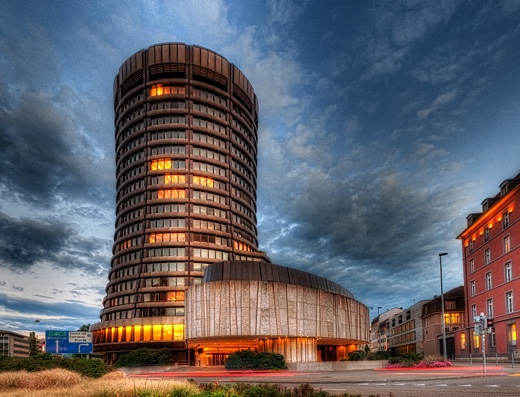
Image above: Headquarters of the Bank for International Settlements in Basel, Switzerland .From (https://www.flickr.com/photos/simply-mo/4889743841).

According to the Bank for International Settlements (BIS), the shadowy “central bank of central banks,” the world as it stands is incapable of combating another global financial crash – a crash that there is every reason to think is coming.

That’s because the economy remains in the hands of the Federal Reserve and other central banks. The financial wizards in THIS VIDEO went so far to say that “we are all slaves to the central banks.” It wasn’t exactly hyperbole.

According to the BIS, central banks have already “used up their ammunition” by driving interests to below zero, freezing investment for the important stuff like production and infrastructure, and instead fueling huge bubbles for wonder kids on Wall Street to play in.

Now, everything is basically teetering on the edge until the music stops. According to the BIS, it will soon be time to pay the piper – as “persistent ultra-low rates” are poised to unleash destruction upon the economy like King Kong set loose on Manhattan:
The BIS report described the threat of a new bust in advanced economies as a “main risk”, with many reaching the top of the economic cycle.

The economies worst hit by the last crisis are now suffering the costs of persistent ultra-low rates, the organisation said, which could “inflict serious damage on the financial system”, sapping banks and weakening their balance sheets and their ability to lend.
And worse, the advanced countries will be unable to fight back against the serious consequences, according to their 2015 annual report :
• The world will be unable to fight the next global financial crash as central banks have used up their ammunition trying to tackle the last crises.
Central banks have backed themselves into a corner after repeatedly cutting interest rates to shore up their economies.

Central banks may have contributed [to the coming crisis] by fuelling costly financial booms and busts and delaying adjustment.”
In past years, the BIS has painted a clear picture of the bleak financial landscape brought on by central bank policy since the 2008 crisis.

It warned in 2013 that:
Fresh action from central banks to kick-start growth may do more harm than good, by distorting financial markets and jeopardising stability.

“Unfortunately, central banks cannot do more without compounding the risks they have already created.” (source)
In 2014, it found that central banks have failed to achieve a recovery, and are incapable of doing so:
Robust, self-sustaining growth still eludes the global economy… Central banks cannot solve the structural problems that are preventing a return to strong and sustainable growth.
“Most of all, central banks cannot enact the structural economic and financial reforms needed to return economies to the real growth paths authorities and their publics both want and expect.”
What central bank accommodation has done during the recovery is to borrow timeBut the time needs to be used wisely, as the balance between benefits and costs is deteriorating.” (source)
Given the unique insider position of the Bank of International Settlements in the global financial power structure, these are foreboding words to be met with mature concern. This is a tacit admission that the powers that be know the next big crisis is around the corner, and they are ready to watch us drown in it – this time, without reaching down to offer us up.


BIS Warning

SUBHEAD: Monetary policymakers have run out of room to fight the next crisis with interest rates unable to go lower.

By Peter Spence on 29 June 2015 for the Telegraph  (http://www.telegraph.co.uk/finance/economics/11704051/The-world-is-defenseless-against-the-next-financial-crisis-warns-BIS.html)

The world will be unable to fight the next global financial crash as central banks have used up their ammunition trying to tackle the last crises, the Bank of International Settlements has warned.

The so-called central bank of central banks launched a scatching critique of global monetary policy in its annual report. The BIS claimed that central banks have backed themselves into a corner after repeatedly cutting interest rates to shore up their economies.


These low interest rates have in turn fuelled economic booms, encouraging excessive risk taking. Booms have then turned to busts, which policymakers have responded to with even lower rates.

Claudio Borio, head of the organisation’s monetary and economic department, said: “Persistent exceptionally low rates reflect the central banks’ and market participants’ response to the unusually weak post-crisis recovery as they fumble in the dark in search of new certainties.”

“Rather than just reflecting the current weakness, they may in part have contributed to it by fuelling costly financial booms and busts and delaying adjustment. The result is too much debt, too little growth and too low interest rates.

"In short, low rates beget lower rates."

The BIS warned that interest rates have now been so low for so long that central banks are unequipped to fight the next crises.

“In some jurisdictions, monetary policy is already testing its outer limits, to the point of stretching the boundaries of the unthinkable,” the BIS said.

Policymakers in the eurozone, Denmark, Sweden and Switzerland have taken their interest rates below zero in an attempt to support their economies, contributing to a decline in bond yields.

Extraordinarily low interest rates are not a “new equilibrium” said Jaime Caruana, general manager of the BIS, rejecting the theory of so-called “secular stagnation” which some economists blame for the continued decline in global lending rates.

“True, there may be secular forces that put downward pressure on equilibrium interest rates … [but] we argue that the current configuration of very low rates is neither inevitable, nor does it represent a new equilibrium,” he said.

Mr Caruana said that interest rate hikes “should be welcomed”, as global economies have started to grow at close to their historical averages, and a slump in oil prices has provided the global economy with a boost.
• Fed primed to raise rates as the US engine roars back into life
• Pay growth surge could force Bank of England to raise interest rates
Why European banks are a buy despite potential Grexit 
The BIS report described the threat of a new bust in advanced economies as a “main risk”, with many reaching the top of the economic cycle.

The economies worst hit by the last crisis are now suffering the costs of persistent ultra-low rates, the organisation said, which could “inflict serious damage on the financial system”, sapping banks and weakening their balance sheets and their ability to lend.

And the continued misallocation of resources during busts prompted by central banks’s rock-bottom interest rates has also hammered productivity growth, the BIS said, as a prolonged reliance on debt had been used in its place.

This problem is compounded as the world’s populations continue to age, the organisation warned, making debt burdens harder to bear. Yet politicians have relied too much on temporary growth boosts by using debt, rather than making painful choices, said the BIS.

Mr Caruana said that during booms, workers and capital are shifted to slow-growing sectors, with a “long-lasting negative” impact on productivity growth. “Misallocated labour needs to move from these sectors to other parts of the economy,” he said.

The BIS said that the current turmoil in Greece typified the kind of “toxic mix” of private and public debt being used as a solution to economic problems, rather than making the proper commitment “to badly needed” structural reforms.

Mr Caruana said that policymakers must now focus on the supply side of the economy, introducing the right reforms, rather than continue to lean on debt which will inevitably undermine growth.

.

How goes the War?

SUBHEAD: Oh, you didn’t notice that World War Three is underway, actually has been for more than year?

By James Kunstler on 23 February 2015 at Kunstler.com -
(http://kunstler.com/clusterfuck-nation/how-goes-the-war/)


Image above: Detail of cartoon from 5/9/14 showing weapons used in World Wars. From (http://www.autoclub-ix35.ru/viewtopic.php?f=9&p=177973#p177995).

Oh, you didn’t notice that World War Three is underway, actually has been for more than year? Well, that’s because most of it has been taking place in the banking sector, which for most people is just an alternative universe of math. The catch, which many people either miss or don’t care about, is that the math doesn’t add up.

For instance, the runaway choo-choo train of linked European sovereign bond obligations with its overloaded caboose of interest rate swaps and other janky derivatives of mass destruction. That train left the station in Athens a few weeks ago bound for Frankfurt. 

Ever since, the German government and its cohorts in the EU, the ECB, and the IMF have been issuing reassurances that the choo-choo train will not blow up when it reaches its destination.

Few people grok that Greece is an entity with an economy not much bigger than North Carolina’s, yet it is burdened with roughly $350 billion of old debt that will never be paid back. 

The only thing at issue is how it will not be paid back, that is, what mode of pretense will be employed to disguise the inability to pay back this debt. The mode du jour has been the crude one of lending Greece more money to pay back the interest on the old debt. A seven-year-old ought to be able to understand where that leads.

It’s kind of up to the Greeks this week to possibly opt out of that farcical deal. They have at least two other present options: return to being a sunwashed semi-medieval backwater of olive farmers, shepherds, and inn-keepers, or perhaps lease out some cozy corner of their vast Mediterranean coastline to the Russian navy for enough annual walking-around money to keep the lights on for the aforementioned farmers, shepherds, and inn-keepers. 

Of course, that would drive the US and its NATO quislings batshit crazy.

We’ve already got our knickers in a twist over Ukraine, a so-called nation whose highest and best purpose over the millennia has been as a sort of lethal doormat in front of Russia, leaving adventurers like Napoleon and Hitler bleeding in the snow as they crawled back to their nations of origin. 

In short, Ukraine has worked so well for Russia that we must be insane to imagine that it would give up that traditional relationship. 

Yet the US and NATO persist in their foolishness and attempt to back up their Kievan intrigues with financial “sanctions” against Russia.

Russia is doing what it has always done in the face of adversity, which is to suck it up. And, anyway, these western financial monkeyshines don’t hold a candle to ordeals like the siege of Stalingrad. What’s more, the Russians, despite their peculiar alphabet and thuggish demeanor, are at least as clever with computers as our code jockeys. 

We (in the USA) think just because we’ve made it possible for everyman to drool over Kim Kardashian’s booty on an iPhone screen that we have some kind of immunity against cyber counter-attack from way out east.

It seems to me that Russia (with China and others) is very busy constructing an alternate financial network that will allow for international money transfers and other necessities for conducting normal trade operations, outside of systems like the SWIFT code, which the US has been using as a knout against our imagined enemies. The upshot will leave America high and dry in a lot of what remains of international trade, especially in oil.

Meanwhile we continue to tell ourselves the false and idiotic story of “energy independence,” based on the shale oil Ponzi scheme that blew up last fall — the consequences of which won’t really be felt for about another eight months, when all those wells drilled and fracked in 2013-14, start to fall off their production cliff, and the replacement wells will not have been drilled. 

We’re still importing almost 8 million barrels of oil a day, contrary to all the fairy tales we tell ourselves. What happens when the sellers decide they won’t take US dollars for it? Hmmmm….

See also:
Ea  O Ka Aina: Welcome to World War III By James Kunstler 2/16/15
.

Global Economy Near Collapse

SUBHEAD: Pope - "An economy built on money-worship and war and scarred by yawning inequality and youth unemployment cannot survive."

By Alexander C. Kaufman on 13 June 2014 for Huffington Post -
(http://www.huffingtonpost.com/2014/06/13/pope-francis-economy_n_5491831.html)


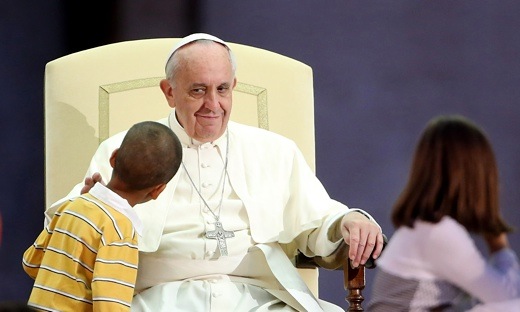
Image above: Boy allows boy who ran on state to join him, From (newsfeed.time.com/2013/10/30/boy-just-wants-to-chill-with-pope-francis-on-stage/).

The global economic system is near collapse, according to Pope Francis.

An economy built on money-worship and war and scarred by yawning inequality and youth unemployment cannot survive, the 77-year-old Roman Catholic leader suggested in a newly published interview.

“We are excluding an entire generation to sustain a system that is not good,” he told La Vanguardia’s Vatican reporter, Henrique Cymerman. (Read an English translation here.) “Our global economic system can’t take any more.”

The pontiff said he was especially concerned about youth unemployment, which hit 13.1 percent last year, according to a report by the International Labor Organization.

"The rate of unemployment is very worrisome to me, which in some countries is over 50 percent," he said. "Someone told me that 75 million young Europeans under 25 years of age are unemployed. That is an atrocity."

That 75 million is actually the total for the whole world, according to the ILO, but that is still too much youth unemployment.

Pope Francis denounced the influence of war and the military on the global economy in particular:
“We discard a whole generation to maintain an economic system that no longer endures, a system that to survive has to make war, as the big empires have always done,” he said.
"But since we cannot wage the Third World War, we make regional wars," he added. "And what does that mean? That we make and sell arms. And with that the balance sheets of the idolatrous economies -- the big world economies that sacrifice man at the feet of the idol of money -- are obviously cleaned up."

Pope Francis is gaining a reputation for pointed comments on the global economy. In April, amid feverish media coverage of French economist Thomas Piketty's bombshell book on income inequality, he made clear his stance on the widening wealth gap with a tweet saying:
"Inequality is the root of social evil."

.

Japanese contamination

SUBHEAD: New insight on the spread of contamination from Fukushima Daiichi nuclear disaster.

Compiled by Staff on 16 February 2014 for ENE News -
(http://enenews.com/govt-report-plutonium-releases-from-fukushima-a-top-concern-uncertainty-over-how-far-molten-fuel-has-eaten-through-what-remained-of-primary-containment)

http://www.islandbreath.org/2014Year/02/140216worldbig.jpg
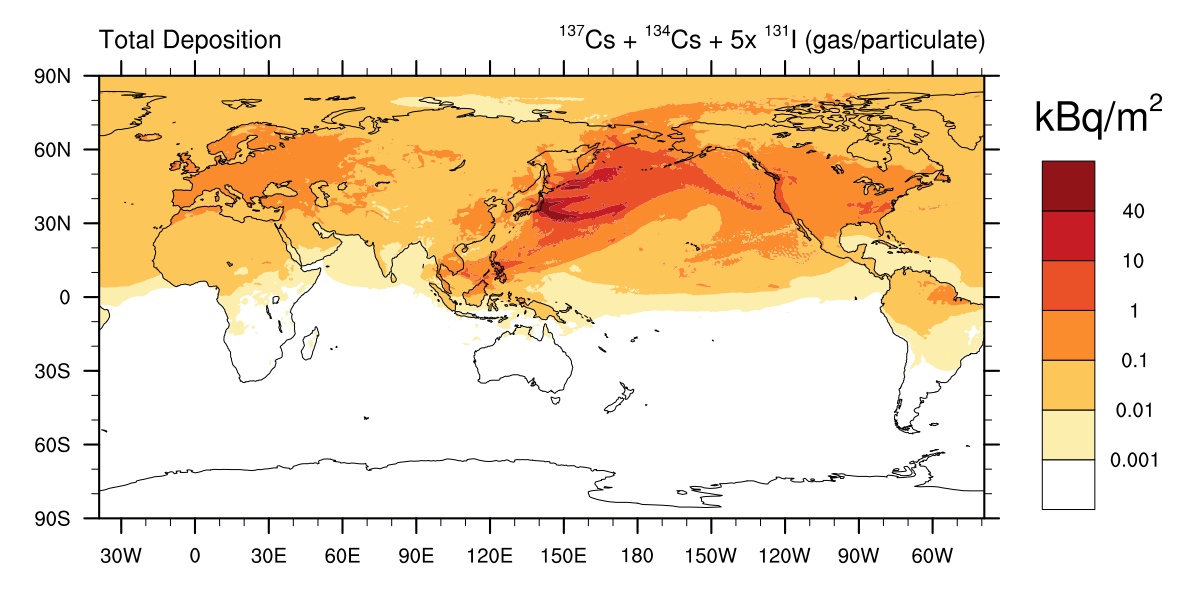
Image above: Worldwide atmospheric distribution of radioactive Cesium and Iodine from Fukushima Daiichi. From European Commission report below. Click to embiggen.

Excerpts from the European Environment Agency Report
(764 Page PDF: With "Late lessons from Chernobyl, early warnings from Fukushim". Starting on page 450)

Containment Vessels
  • Within a few hours the reactor cores of the three operating units were subject to varying degrees of meltdown [...] the reactor pressure vessels themselves had failed and, in various degrees, the primary containment of the pressure suppression system had failed
  • Deteriorating situation – with [...] sharp perturbations in containment pressure and radiation levels, particularly within what remained of the primary containment
  • There still remained uncertainty about a series of ongoing problems, including the state and level of the nuclear fuel, particularly after confirmation that molten fuel may have eaten through three-quarters of the concrete under Unit #1 and damaged the bases of two of the other reactors
Plutonium and Other Actinides
  • Of primary concern were fission products, readily absorbed by the human body, and the actinides [e.g. plutonium], which act as heavy metal poisons
  • Significantly, there is confirmed isotopic evidence for the release of plutonium into the atmosphere and deposition on the ground in northwest and south of the Fukushima nuclear site
Health Effects
  • In order to cope with this level of contamination, and in contradiction to international radiation protection standards, Japanese regulators have raised dose constraints to 20 mSv/year – thereby subjecting schoolchildren to exposures normally only tolerated by adult nuclear workers
  • It is clear that there will need to be a significant assessment of a wide range of environmental risk factors


Image above: East Asian atmospheric distribution of radioactive Cesium and Iodine from Fukushima Daiichi. From European Commission report below.

European Commission, Science for Environment Policy News Alert (pdf) (emphasis added): [...]

This EU-funded study modelled the global spread of radionuclides of caesium and iodine from Fukushima [...] between March and May 2011 [...]

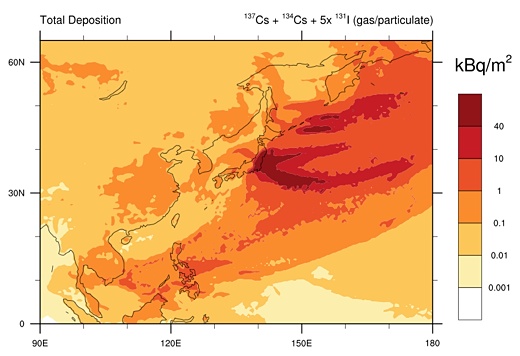
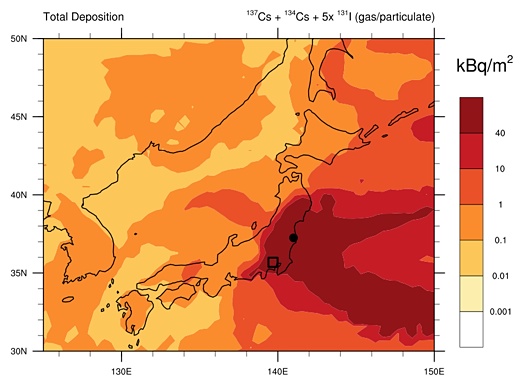
It focused on radionuclides that were emitted as gases [...] The International Atomic Energy Agency defines ’contamination’ as the presence of a radioactive substance in quantities more than 40 kilobecquerels per m². [...] land area affected by radioactivity from both types of radionuclides above this threshold is approximately 34,000 km² of Japan, inhabited by around 9.4 million people. However, the estimate used for the iodine radionuclide emissions from the incident is considered to be an underestimate.

A separate calculation which assumed source emissions that were five times greater, suggested that a relatively large and densely populated part of Japan – 56,000 km² [21,622 square miles] – would be classified as contaminated. [...] It should be emphasised that this refers to two radionuclides only, whereas additional ones are unaccounted for due to a lack of measurements. [...]


Image above: Japanese atmospheric distribution of radioactive Cesium and Iodine from Fukushima Daiichi. From European Commission. Note Black circle is Fukushima Daiichi NPP. Black square is greater Tokyo.

Modelling the global atmospheric transport and deposition of radionuclides from the Fukushima Dai-ichi nuclear accident (pdf), 2013 (emphasis added): Chino et al. (2011) estimate a total [131I] release of 150 PBq [...] results are considered by [the] authors to be lower estimates and to have an error of at least a factor of five. Winiarek et al. (2012) estimate the lower bound of the total activity of 131I released into the atmosphere [...] between 190 and 700 PBq [...]

We estimate that the land area affected by the deposition of radioactivity in excess of 40 kBqm² is approximately 34,000 km². [...] this part of Japan is inhabited by 9.4 million people. The surface area that received a total deposition greater than 10 kBqm² encompasses parts of the Tokyo metropolitan area, and approximately covers 60,000 km2, being inhabited by 46 million people. We emphasize that this is based on the emission of 150 PBq 131I estimated by Chino et al. (2011), which might actually be a factor of five too low.

Discussion Paper (pdf): To test the potential of a larger source than 150 PBq 131I, we performed a sensitivity test by applying 5 times higher emissions, based on the emissions estimate uncertainty by Chino et al. (2011). [...] an area of 56,000 km², inhabited by 43 million people, would be contaminated by more than 40 kBqm², including the Tokyo metropolitan area. Although this large 131I source is speculative, it seems more realistic than the low estimate of 150 PBq [...]


.

Shake me, wake me!

SUBHEAD: The event horizon of bad faith is the point where the credulous folk of this age ride a juggernaut.

By James Kunstler on 3 February 2014 for Kunstler.com -
(http://kunstler.com/clusterfuck-nation/shake-me-wake-me/)


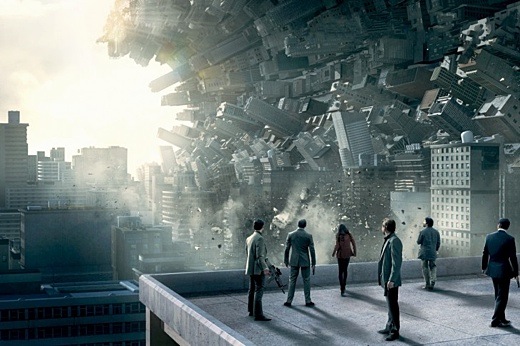
Image above: Scene in movie Inception of the dreamworld collapsing. From (http://topwalls.net/movies-films-beginning-inception-city-sun-building/).

 The rot moves from the margins to the center, but the disease moves from the center to the margins. That is what has happened in the realm of money in recent weeks due to the sustained mispricing of the cost of credit by central banks, led by the US Federal Reserve. 

Along the way, that outfit has managed to misprice just about everything else  — stocks, houses, exotic securities, food commodities, precious metals, fine art. 

Oil is mispriced as well, on the low side, since oil production only gets more expensive and complex these days while it depends more on mispriced borrowed money. That situation will be corrected by scarcity, as oil companies discover that real capital is unavailable. 

And then the oil will become scarce. The “capital” circulating around the globe now is a squishy, gelatinous substance called “liquidity.” All it does is gum up markets. But eventually things do get unstuck.

Meanwhile, the rot of epic mispricing expresses itself in collapsing currencies and the economies they are supposed to represent: India, Turkey, Argentina, Hungary so far. Italy, Spain, and Greece would be in that club if they had currencies of their own. 

For now, they just do without driving their cars and burn furniture to stay warm this winter. Automobile use in Italy is back to 1970s levels of annual miles-driven. That’s quite a drop.

Before too long, the people will be out in the streets engaging with the riot police, as in Ukraine. This is long overdue, of course, and probably cannot be explained rationally since extreme changes in public sentiment are subject to murmurations, the same unseen forces that direct flocks of birds and schools of fish that all at once suddenly turn in a new direction without any detectable communication.

Who can otherwise explain the amazing placidity of the sore beset American public, beyond the standard trope about bread, circuses, and superbowls? Last night they were insulted with TV commercials hawking Maserati cars. Behold, you miserable nation of overfed SNAP card swipers, the fruits of wealth and celebrity! 

Savor your unworthiness while you await the imminent spectacles of the Sochi Olympics and Oscar Night! Things at the margins may yet interrupt the trance at the center. My guess is that true wickedness brews unseen in the hidden, unregulated markets of currency and interest rate swaps.

The big banks are so deep in this derivative ca-ca that eyeballs are turning brown in the upper level executive suites. Notable bankers are even jumping out of windows, hanging themselves in back rooms, and blowing their brains out in roadside ditches. 

Is it not strange that there are no reports on the contents of their suicide notes, if they troubled to leave one? (And is it not unlikely that they would all exit the scene without a word of explanation?) 

One of these, William Broeksmit, a risk manager for Deutsche Bank, was reportedly engaged in “unwinding positions” for that that outfit, which holds over $70 trillion in swap paper. For scale, compare that number with Germany’s gross domestic product of about $3.4 trillion and you could get a glimmer of the mischief in motion out there. Did poor Mr. Broeksmit despair of his task? 

Physicist Stephen Hawking declared last week that black holes are not exactly what people thought they were. Stuff does leak back out of them. 

This will soon be proven in the unwinding derivatives trades when most of the putative wealth associated with swaps and such disappears across the event horizon of bad faith, and little dribbles of their prior existence leak back out in bankruptcy proceedings and political upheaval.

The event horizon of bad faith is the exact point where the credulous folk of this modern age, from high to low, discover that their central banks only pretend to be regulating agencies, that they ride a juggernaut of which nobody is really in control. 

The illusion of control has been the governing myth since the Lehman moment in 2008. We needed desperately to believe that the authorities had our backs. They don’t even have their own fronts.

Is the money world at that threshold right now? One thing seems clear: nobody is able to turn back the plummeting currencies. They go where they will and their failures must be infectious as the greater engine of world trade seizes up. 

Who will write the letters of credit that make international commerce possible? Who will trust whom? When do people seriously start to starve and reach for the pitchforks? When does the action move from Kiev to London, New York, Frankfurt, and Paris?


.

COP19 conclusion

SUBHEAD: Although a CO2 "contribution" limit was accepted, the COP19 ends with UN admission of failure on 2ºC limit.

By Bryan Dyne on 25 November 2013 for Worls Socialist Website -
(http://www.wsws.org/en/articles/2013/11/25/clim-n25.html)


Image above: Non-governmental organizations walked out of the COP19 climate talks here last Thursday. From (http://www.iwnsvg.com/2013/11/22/green-groups-walk-out-of-global-climate-summit-in-protest-video/).

During the final press conference of the 19th Conference of Parties (COP19), the latest international climate change summit, which ended on November 23 in Warsaw, a top UN official admitted that current efforts were not adequate to halt the pace of global warming.

United Nations Framework Convention on Climate Change (UNFCCC) Executive Secretary Christiana Figueres said that the summit “does not put us on track for a two-degree world.”

“Two-degree world” has become the catch-phrase for containing and reducing greenhouse gas emissions globally so that average world temperatures in 2100 do not increase by more than 2° C above what they were at the beginning of the 20th century. This has been taken as the benchmark by the UNFCCC to stop catastrophic results caused by climate change from occurring. These primarily include mass droughts, more powerful hurricanes, large floods and rising ocean levels.

Figueres then posed as mutually exclusive the “two realities” of “the urgency of the science and the boundaries that science imposes on us with respect to greenhouse gas emissions with an international policy evolution process that is necessarily a gradual and progressive process.”

She was referring to the divisions between the major powers that exist over any agreement to reduce greenhouse gas emissions in a timely manner. While every country, including the US and major imperialist powers, states that global warming should be brought under control, all are determined to do it on their own terms. Major corporate interests must be appeased, including the national fossil fuel industries of both developed and developing nations.

There is an overwhelming body of scientific evidence of the ever-growing threat to the world's population caused by continued emissions of carbon dioxide and other greenhouse gases. During COP19, a group of scientists from the Climate Action Tracker released a report saying that if current trends continue, the likely warming will not be 2° C, but 3.7° C and possible as high as 4.6° C. That world governments cannot agree on how to resolve the climate change crisis underscores the basic inability of capitalism—based on private property and rival nation-states—to defend the natural environment necessary for life.

COP19 is the most recent in a series of international summits—Copenhagen, Cancún, Durban, and Doha, to name a few—that were called in the attempt to create a post-Kyoto Protocol climate treaty. At each instance, there has not been an agreed-upon structure for all participating countries to reduce greenhouse gas emissions. The most that these conferences have achieved is a commitment to a new treaty by 2015 that will go into force in 2020.

As with previous summits, the divisions have occurred largely across the lines of the industrialized versus the developing countries. During the first international climate talks in 1992 and then again in the 1997 Kyoto Protocol, it was established that “developed” nations would have obligations to cut greenhouse gas emissions while “developing” nations would not. Since the Copenhagen summit in December 2009, the US and the European Union have staunchly refused to accept this framework, insisting that emerging economies, particularly India, China and others such as Brazil, should also be beholden to reducing greenhouse gas emissions.

These tensions flared when China and India sharply rejected the phrasing of “commitments” by all parties towards greenhouse gas emissions in the penultimate draft. “Only developed countries should have commitments,” stated Chinese lead negotiator Su Wei. It was only when “commitments” was changed to “contributions” that both countries backed down.

Tensions became so overt that Poland was forced to remove Marcin Korolec, the host of the conference, from his position as environment minister. It did not help matters when Japan—the country of origin of the Kyoto Protocol—revealed that it would not be meeting its 2020 emission reduction deadline.

The second sticking point was over financial allocations to developing countries over losses and damages caused by global warming. They demanded that a new institution be formed called a “loss-and-damage mechanism” to deal with the financial impacts of weather events exacerbated by climate change. Furthermore, the developing nations wanted this body to be independent of a previously existing UN body that deals with similar issues, which was agreed upon.

While these are being hailed as victories, both proposals are largely face-saving measures. They do nothing to concretely reduce greenhouse gas emissions.

This theme was taken up by a variety of environmentalist groups including Greenpeace International, the World Wildlife Fund, Oxfam International, ActionAid International, Friends of the Earth Europe and the International Trade Union Confederation. In a coordinated action, the groups walked out of the conference, accusing the participating governments of giving in to the interests of the “dirty energy lobby” and not working towards solving the “climate crisis.” They vowed to “return with the voice of the people” to put “pressure” on world governments.

The idea of putting “pressure” on governments has been taken up by environmentalist activists in the past. Their perspective is that with enough letters written and enough protests held, world leaders will finally take initiative and solve global warming.

To call this politically bankrupt and impotent is an understatement. As shown through this conference and countless others, there is a fundamental inability, in the face of inter-imperialist rivalries and the predatory exploitation of the poorer countries by the richer ones, to come to any agreement on reorganizing the world economy to head off an environmental disaster.

There are powerful financial interests at stake. According to one report issued for the Warsaw conference, just 90 corporations worldwide are responsible for two-thirds of the greenhouse gas buildup over the past 200 years that is driving global warming. These corporations—mainly giant oil and gas monopolies and coal mining companies—cling to their profit interests in the face of threats to the survival of the human race.

If the available technology that exists today is to be utilized to carry out the urgent restructuring of energy generation, transportation, industry and agriculture to halt carbon emissions, while simultaneously raising worldwide living standards, it must be done under a rationally planned world socialist society.
.

Earth Overshoot Day

SUBHEAD: Today, August 20th, humans on Earth have already spent all of 2013's available resources.

By Staff on 20 August 2013 for Global Footprint Network -
(http://www.footprintnetwork.org/en/index.php/GFN/page/earth_overshoot_day/)


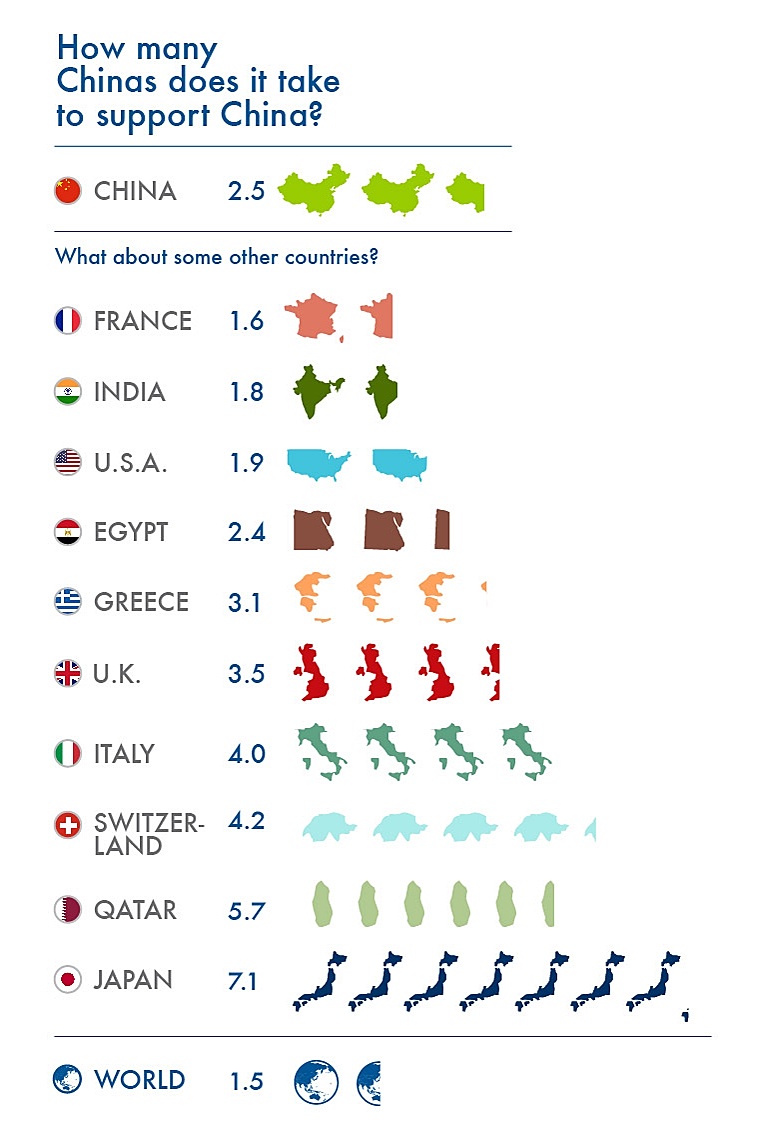
Image above: "How Many China's Does it Take to Support China?" graphic. From original article. Click to enlarge.

August 20 is Earth Overshoot Day 2013, marking the date when humanity exhausted nature’s budget for the year. We are now operating in overdraft. For the rest of the year, we will maintain our ecological deficit by drawing down local resource stocks and accumulating carbon dioxide in the atmosphere.

Just as a bank statement tracks income against expenditures, Global Footprint Network measures humanity’s demand for and supply of natural resources and ecological services. And the data is sobering. Global Footprint Network estimates that in approximately eight months, we demand more renewable resources and C02 sequestration than what the planet can provide for an entire year.

In 1993, Earth Overshoot Day—the approximate date our resource consumption for a given year exceeds the planet’s ability to replenish—fell on October 21. In 2003, Overshoot Day was on September 22. Given current trends in consumption, one thing is clear: Earth Overshoot Day arrives a few days earlier each year.

Earth Overshoot Day, a concept originally developed by Global Footprint Network partner and U.K. think tank new economics foundation, is the annual marker of when we begin living beyond our means in a given year. While only a rough estimate of time and resource trends, Earth Overshoot Day is as close as science can be to measuring the gap between our demand for ecological resources and services, and how much the planet can provide.

The Cost of Ecological Overspending
Throughout most of history, humanity has used nature’s resources to build cities and roads, to provide food and create products, and to absorb our carbon dioxide at a rate that was well within Earth’s budget. But in the mid-1970s, we crossed a critical threshold: Human consumption began outstripping what the planet could reproduce.

According to Global Footprint Network’s calculations, our demand for renewable ecological resources and the services they provide is now equivalent to that of more than 1.5 Earths. The data shows us on track to require the resources of two planets well before mid-century.

The fact that we are using, or “spending,” our natural capital faster than it can replenish is similar to having expenditures that continuously exceed income. In planetary terms, the costs of our ecological overspending are becoming more evident by the day. Climate change—a result of greenhouse gases being emitted faster than they can be absorbed by forests and oceans—is the most obvious and arguably pressing result. But there are others—shrinking forests, species loss, fisheries collapse, higher commodity prices and civil unrest, to name a few. The environmental and economic crises we are experiencing are symptoms of looming catastrophe. Humanity is simply using more than what the planet can provide.

Methodology and Projections
In 2011, Earth Overshoot Day came a few weeks later than it did in 2010. Does this mean we reduced global overshoot? The answer, unfortunately, is no.

Earth Overshoot Day is an estimate, not an exact date. It’s not possible to determine with 100 percent accuracy the day we bust our ecological budget. Adjustments of the date that we go into overshoot are due to revised calculations, not ecological advances on the part of humanity. Based on current assumptions, Global Footprint Network data now suggests that since 2001, Earth Overshoot Day has been moving three days earlier each year.

As Global Footprint Network methodology changes, projections will continue to shift. But every scientific model used to account for human demand and nature’s supply shows a consistent trend: We are well over budget, and that debt is compounding. It is an ecological debt, and the interest we are paying on that mounting debt—food shortages, soil erosion, and the build-up of CO₂ in our atmosphere—comes with devastating human and monetary costs.
.

Mid Year Digest

SUBHEAD: Young people, harken: prepare for careers in agriculture and activities that support it.

By James Kunstler on 24 June 2013 for Kunstler.com -
(http://kunstler.com/clusterfuck-nation/mid-year-digest/)


Image above: Detail of map of the Imperial Federation of the British Empire illustrated by Walter Crane in 1886. From (http://ancientworldmaps.blogspot.com/2011/02/world-map-19th-century.html).

Wondering why the money world got its knickers in a twist last week? The answer is simple: the global economy is breaking apart and its constituent major players are doing face-plants on the downhill slope of a no-longer-cheap-oil way of life.  Let’s look at them case by case.

The USA slogs deeper into paralysis and decay in a collective mental fog of disbelief that its own exceptionalism can’t overcome the laws of thermodynamics. This general malaise precipitates into a range of specific quandaries. The so-called economy depends on financialization, since it is no longer based on manufacturing things of value. 

The financialization depends on housing, that is, a particular kind of housing: suburban sprawl housing (and its commercial accessories, the strip malls, the box stores, the burger shacks, etc.). Gasoline is now too expensive to run the suburban living arrangement. It will remain marginally unaffordable. Even if the price of oil goes down, it will be because citizens of the USA will not have enough money to buy it. Lesson: the suburban project is over, along with the economy it drove in on.

But so is the mega-city project, the giant metroplex of skyscrapers. So, don’t suppose that we can transform the production house-building industry into an apartment-building industry. The end of cheap oil also means we can’t run cities at the 20th century scale. That includes the scale of the buildings as well as the aggregate scale of the whole urban organism. Nobody gets this. For one thing, there will be far fewer jobs in anything connected to financialization because that “industry” is imploding. 

The recent action around the Federal Reserve illustrates this. When chairman Bernanke’s lips quivered last week, the financial markets had a grand mal seizure. He floated the notion that his organization might “taper” their purchases of US government issued debt and mortgage-backed securities — the latter being mostly bundled debt originated by government-sponsored entities and agencies. That’s the “money” that supports the suburban sprawl industry.

If the Fed were to reduce its purchases of this debt paper, nobody else would buy it. The reason the Fed buys the quantity it does in the first place ($85 billion-a-month) is that nobody else would touch it at the offered zero interest rates. The US Treasury and the mortgage bundlers could only sell the stuff if they paid higher interest rates. 

But the US government would choke to death on higher interest rates because its aggregate debt is so huge and the scheduled interest payments so gigantic that a one percent increase would destroy even the fantasy of economic equilibrium.

Apart from that unhappy equation, entropy never sleeps. Everything in America except the Apple stores and a handful of big banks is falling apart — especially the human habitat and households. Suburbia will only lose value and utility. Big cities will have to get smaller (ouch!). Tar sands, shale oil and shale gas will not ride to the rescue (they cost too much to get out of the ground). 

The entire declension of government from federal to state to local will be too broke to fix the roads and make “transfer payments” to idle, indigent citizens. This populace will lose faith in their institutions… and disorder will eventually resolve in a new and very different disposition of things on-the-ground. If we’re lucky, this will not include cruel despotic leadership and war.

If the “taper” talk is empty rhetoric, and the Fed continues sopping up issued debt, it will eventually destroy the credibility of its issued money. That is just another way of going broke, though it might beat a shorter path to the general loss of legitimacy of governments and other institutions.

Young people, harken: prepare for careers in agriculture and activities that support it. Consider moving to small towns in parts of the country where farming is possible and get ready to rebuild a very different economy.  Also, consider repudiating your college debt en masse, since the fantasy of repayment is but another mental shackle holding you back from your future.

As for the other parts of the global economy, a digest:

Europe doesn’t have enough oil and gas to run itself. Its suppliers (Russia, various Islamic states) are all basically hostile to it. As the late, great Tony Soprano might say, “end of story.” Europe has been playing financial pocket pool with itself for five years with credibility ebbing. Soon Europe will descend into painful economic re-set. Its era as the go-to theme park of advanced civilization is ending. Go there while it’s still possible and take some snapshots of what comfort and artistry used to look like.

China is imploding under the weight of its half-assed crony command economy and banking system. Nice try. Cookie fortune says, “Industrial era entered too late in game.” All else there is desperation: e.g. the idea of moving hundreds of millions of peasants into new cities. As Tony would say, “Fuggeddabowdit.” They’re better off growing bok choy en situ. Anyway, no one should assume that China can remain politically stable. Let’s hope that its economic and political crack-up doesn’t transmute into war.

Russia’s oil production is in permanent decline. It has a lot, but it gets most of its income from selling it to other people. Hence, Vlad Putin’s notion of finding something else to base Russia’s economy on. Like…what? I don’t think they’re going to replace China in making salad shooters.

Farming would be the way to go, and Vlad’s government is hoping that global warming improves Russia’s prospects for doing more of that. In any case, Russia might benefit in the long term by not selling off all of its oil and gas — though Western Europe would surely suffer from that decision. On the plus side, Russia’s government is not crippled by idiot squabbles over abortion, gay marriage, and the Bible in schools.

Japan. Sorry to repeat myself. Going medieval. They have no oil and gas. (Cue Tony Soprano again.) In the event, Japan’s financial hara-kiri will drag down the rest of the world’s banking system — or at least hasten the damage already self-inflicted elsewhere around the globe. I’m also informed that much of the essential computer chip fabrication in the world still happens in Japan, and that will go away, too, as the Japanese engine seizes, smokes, and expels its final belch of CO2.
     
What else is there? 

South America? Think: spreading jungle (or desert, take your pick). 

Canada? There’s an idea. Maybe Labrador becomes the new Hamptons? Second biggest national land mass… 30 million people (2 percent of China’s population). 

Only one drawback: the view to the south.

.

Dancing Shoes

SUBHEAD: When the central banks finish destroying he meaning of money altogether you'll be paying $25,000 for a Little Debbie snack cake.  

By James Kunstler on 20 May 2012 forKunstler.com - 
  (http://kunstler.com/blog/2012/05/dancing-shoes.html)


Image above: Opening dance scene in a bank from "Pennies From Heaven" set during 1930's Depression. From (http://www.nicksflickpicks.com/2005/11/picked-flick-73-pennies-from-heaven.html).


So many shoes are dropping out there that reality is starting to look and sound like the tap-line in a Busby Berkeley production number. The meme-scape, too, is humming with viral transmissions of dire doings. Is JP Morgan unwinding like a 1911 knitted woolen Yale varsity sweater? Did it booby-trap the credit default swap universe in the process, and is that getting ready to blow? The whole world is hanging by its fingernails, refusing to be dragged into the future.

That future is all about contraction. We could navigate our way into it but we don't want to. We want to stay right where we are with all our stuff and no need to make new arrangements and we are trying every last trick to do that. Can you not sense a terrible tidal surge of implacable forces under the headlines' placid surface? I do offer Mark Zuckerberg best wishes on his nuptials, but I think he set himself up for one of fate's great pranks as FB stock goes to 99 cents while he's still on his honeymoon (playing Frogger in a super deluxe hotel suite).

Does anybody really believe that the European money problem has any other ending except massive repudiation of obligations and epic political realignment? Or that the USA isn't caught in the undertow. The only real question now is how the civilized world might remain civilized while it rebuilds its money system. Money, after all, is a representative of reality and the representations by nations and person and institutions have been so false for so long that, for practical purposes, there is no consensual reality anymore.

By the way, it was a nice gag at the time, but Karl Rove was wrong. We are not creating our own reality.

Reality's theme going forward is changing from liquidity to liquidation. The European LTRO (quantitative easing) was a nice fairy tail, and the mild buzz lasted a few months, but its flimsy spell is broken. An awful lot of parties may be liquidating gold and silver, too, this week but under the circumstances I've got to think there will be plenty of counterparties looking to buy, since uncertainty is crushing all other media of exchange.

The process begins to look like a mass metamorphic conversion of winners to losers and vice-versa. In a giant unwinding of paper assets the result may be that precious metals go sideways while all other assets tank - and then once everything's in the tank, PMs tank, too, because nobody is left standing with that kind of cash.

Of course, in the event just a little bitty bit of gold will still buy a lot of stuff. The other possibility is that the rumored global coordinated central bank QE (quantitative easing) doomsday machine goes off destroying the meaning of cash money altogether. Surely that sort or stunt will not cast the same spell as the LTRO, a more measured act of desperation, but will call into question the very meaning of dollars, euros, yen, and pounds sterling. That's when you'll be paying $25,000 for a Little Debbie snack cake.

Let me be first of the non-right-wing in the blogster corps to venture the somewhat un-PC idea that Barack Obama turned out to be the first black schmuck elected President of the US. He didn't do the one thing that would have mattered most: put an end to government sponsored control fraud. Control fraud at that level is so pernicious because it destroys the legitimacy of institutions. It can only make a nation cynical, by which I don't mean given to malicious humor, which is different, but just always thinking the worst of your fellow man and the very idea that the human race ever produced anything fine and durable.

And on top of that malfeasance, to try to suspend due process of law in Section 1021 of the NDAA bill (military budget) - smacked down by federal judge Katherine Forrest last week - was an amazing transgression that the mainstream press greeted four months ago with barely a shrug. Can't we just start a movement to go down to Charlotte, NC, this summer and levitate the convention center into outer space? It nearly worked with the Pentagon forty odd years ago.

What do you suppose Obama and the other feckless schmucks of the G-8 were telling each other this weekend at Camp David between weenie roasts and ping-pong round robins? It must have been the emptiest dumb show of mere protocol; an exchange of tie-tacks in the national colors, the playing of many anthems and flying of flags, issuance of bland assurances and platitudes. Nobody believes any of them anymore, even poor Mr. Hollandaise, who has been on the job a few days. Angela Merkel must be good and goddam sick of even showing up at the office.

Well, perhaps its best that the world will go where it has to go without leadership. After all, human history is emergent and improvisation suits us. Forceful leaders often only leave a big mess behind. But imagine a world where nobody gets paid. That might be our world by the end of the week.
.

Fundraising Extremis

SUBHEAD: What do we have to do around here to get the uber-rich to save the world? By Dmitry Orlov on 24 April 2012 for Club Orlov - (http://cluborlov.blogspot.com/2012/04/fundraising-in-extremis.html) Image above: Koch Brother look-alikes Ralph Bellamy (L) and Don Ameche (R) pick up homeless man to see if they can "save" him in movie Trading Places, 1983. From (http://cockeyedcaravan.blogspot.com/2010/12/underrated-movie-100-trading-places.html). There are some important projects that need to be up and running starting like yesterday, because they are key to human survival. Unfortunately, they cannot be funded in the usual ways because of the warped nature of market economics and global finance, which dictates that the only goal of investing money is to make more money. The project of averting disastrous outcomes is not a money-maker, per se, and does not get funded. But shipping in millions of plastic orange Halloween pumpkins from China every year is a sure bet, and so the free market prioritizes orange plastic pumpkins above doing what is essential to keep us all alive. The invisible hand of the free market, it turns out, is attached to an invisible idiot.
A good example of this sort of project is shutting down nuclear power stations before the electric grid goes down and they all melt down à la Fukushima Daiichi, poisoning land and sea around them for thousands of years. The electric grid is indeed going down: the rate of power supply disruptions has been increasing exponentially in the US. Just recently a large and important piece of central Boston went dark because of a transformer explosion. The response was to roll in diesel generators to provide emergency power.
The transformers within the grid tend to be old, sometimes decades old, are at this point only built overseas, and, since they are expensive, there aren't too many spares sitting around. As this infrastructure ages (as it does, and will continue to do, since there is no money to update it) such incidents increase in frequency, putting greater and greater pressure on already scarce and expensive diesel supplies. Already in many places emergency diesel generators are run not just in emergencies, but to fill in gaps in the power supplied through the grid during peak load hours. Diesel is already used for sea and land freight, as well as for most other heavy machinery, and there is not much of it to spare anywhere in the world, so the idea of replacing the electric grid with local diesel generators runs into a very serious problem almost immediately. In fact, looking at the many reports of diesel shortages around the world, it already has.
An extended blackout is fatal to a nuclear power plant. Without a grid to power, the reactors have to be shut down, but they still need to be cooled in order to avoid a meltdown. The power to run the cooling pumps comes from the power plant itself, or the electric grid, or, if both are down, from, you guessed it, diesel generators. There is usually only a few days' worth of diesel on hand; beyond that, cooling water boils out, the zirconium cladding of the nuclear fuel assemblies catches on fire, and the whole thing melts down and becomes too radioactive to even go near, never mind clean up.
Worse yet, most of the 100 or so nuclear power plants in the US are full of spent fuel rods. The spent fuel is no longer potent enough to generate power, but a lot of it is still quite hot, and so the rods are kept in pools of water, which has to be circulated and cooled to keep it from boiling away. The spent fuel contains decay products that span the entire periodic table of elements, many of which are both radioactive and toxic. If the water boils away, the fuel rods spontaneously combust, blanketing the surrounding countryside with a plume of radioactive and toxic products of nuclear decay. The solution is to fish the rods out of the pools, put them into dry casks, and place the casks deep underground in geologically stable formations away from seismic zones. This is a slow and expensive process, for which there is currently no money.
Another, associated and equally important project, is in helping populations, especially those in developed countries, transition to a life without much electricity. In most places, some combination of technologies based on renewable sources of energy needs to be put into place to provide electricity for illumination and communications (the only uses for which electricity is critical). In addition, passive and concentrating solar installations can provide thermal energy for domestic and even some industrial uses. This, again, is a large-scale, expensive project, requiring a high level of funding over an extended period of time. It is also not expected to be any sort of money-maker: nobody will want to pay to have their multi-kilowatt domestic electric system replaced with a few LED lights and chargers for portable electronics, and go back to washing dishes and clothes by hand in solar-heated water. They'd rather just stay comfortable, and then, when that is no longer possible, just sit silently in the dark wearing dirty clothes.
And so, where would all of this money come from? Certainly not from governments: they are too busy bailing out the banks and finance companies that provide the politicians with their political campaign funds. That only leaves private individuals, so let's examine them as a potential source of this critical funding.
Taking the United States as an example, and going up the economic food chain starting from the bottom, we have the downtrodden: the various victims of slavery, genocide, economic exploitation and racial and ethnic discrimination that made this country great. Let's just call them “the poor people.” They serve a key function in society: that of making the slightly less downtrodden worker drones feel superior, thinking “at least we are better off than they are” and continuing to labor for a pittance. Funding large projects is not one of the functions of either of these population groups, although they may be tapped to provide labor, and they do buy an awful lot of lottery tickets. Most of them are either destitute, or poor, or surviving paycheck to paycheck, mired in debt.
Next we have the much smaller group of people who do have a non-negligible net worth. Since the term “middle class” has become all but meaningless, let's just call them “the rich people.” This group is shrinking every day, as more and more people come to measure their wealth not by how much then own but by how much they owe. If you think that savings and debt are diametrically opposed, you may be right, in a strict sense, but only if you ignore the essential purpose of money for the rich people, which is to make them feel rich. To feel rich, they need two things. The first includes all sorts of accoutrements of being rich: flashy cars and clothes, latest gadgets, women with large silicone breast implants, ski vacations and so on, and it doesn't matter too much whether these are procured by spending money or by running up debts; they feel rich either way, or at least richer than someone else they can look down upon, which is all that really matters. The second includes the abstract and addictive thrills of handling large sums of money, be they theirs or borrowed; the purpose of money is to make more money, and the purpose of debt is to make more debt. Parting with their savings to avert disaster and accept a more humble way of living will not make them feel rich in either of these ways.
Image above: Don Ameche (L) and Ralph Bellamy (R) try and explain commodity futures to Eddie Murphy in movie Trading Places. 1983. From (http://cockeyedcaravan.blogspot.com/2010/12/underrated-movie-100-trading-places.html). Lastly, we have the über-rich: those who have simply too much money. People like George Soros or Bill Gates make a big deal of their philanthropy, promoting democracy or fighting malaria; couldn't they help? Theoretically they could (they certainly have the money) but we have to understand what they are. They are vampires. They suck not our blood, literally, but our time and our toil. We get a “living” and an increasingly empty promise of retirement (once we are too old to be useful to them) on an increasingly devastated planet; they get everything else. The way they confiscate our wealth varies—Soros stole people's savings by speculating in currency markets; Gates charged a “Microsoft tax” by foisting on the world a buggy, bloated and insecure operating system with the complicity of the US government; the Waltons who own Walmart did it by shipping US jobs to China while driving small businesses in the US out of business. But the way they extend their largess does not vary: its purpose is to make them look like they are good men. To gain some perspective on what that means, here is a poem by Bertolt Brecht, translated by Slavoj Žižek:
The Interrogation of the Good
Step forward: we hear
That you are a good man.
You cannot be bought, but the lightning
Which strikes the house, also
Cannot be bought.
You hold to what you said.
But what did you say?
You are honest, you say your opinion.
Which opinion?
You are brave.
Against whom?
You are wise.
For whom?
You do not consider your personal advantages.
Whose advantages do you consider then?
You are a good friend.
Are you also a good friend of the good people?
Hear us then: we know
You are our enemy.
This is why we shall
Now put you in front of a wall.
But in consideration of your merits and good qualities
We shall put you in front of a good wall and shoot you
With a good bullet from a good gun and bury you
With a good shovel in the good earth.
The über-rich thus have two functions in society. The main function is to suck wealth out of the Earth and out of humanity as efficiently as possible. The ancillary function is to spit some of it back out in a way that makes them look like the Earth's and humanity's benefactors. But there is a problem with this balance of payments: in order for the Earth and humanity to derive a net benefit from their activities, they would have to spit out as much, if not more, as they suck in. In the process, they would cease to be über-rich; in effect, they would cease to exist.
And here we come to the crux of the argument. The only possible sources of funding for our project of making the planet survivable for future generations are the über-rich, but in the process they have to cease to exist. Brecht's approach is both simple and dramatic, but a more humane option can be imagined. There is a certain point in time when people are particularly malleable when it comes to the question of disposing of their money: on their deathbed. Lying in extremis, one inevitably ponders the fact that “you can't take it with you,” thoughts of a potentially unpleasant world beyond death begin to bedevil the mind... With the right sort of persuasion, dramatic results are often achieved by priests, heads of nonprofits and other mendicants. It is at this point that a pitch for saving what's left of the planet may succeed.
Imagine our über-patriarch lying in extremis. Arrayed before him are his various (ex-) wives (in a Western harem the wives are spaced out in time as well as in space, to abide by the local bigamy laws) and their various children, all waiting for their bit of the legacy. There is the leathery old harpy who came first, the now wilted trophy wife who tried to hold it together with facelifts and implants and Botox, but now looks like a partially deflated balloon animal, and the pretty but sociopathic young nymphomaniac that's been keeping him (and his bodyguards) company of late. They are all hideous in their hypocritical concern for his well-being/wish for his speedy death. The children are hideous in their own way: all practiced at the healthy sibling rivalry in who can do the absolute least to appease the daddy-monster and avoid being disowned. Maybe somebody becomes suspicious that the old ogre will leave all the loot to his favorite, and the favorite is found in the wine cellar, choked to death with a silk scarf. There is a reason why posh English-language writers write so many murder mysteries, and it's the same reason that landscape painters paint so many trees: it's what grows there.
But then a group of dignified and austere gentlemen arrives and asks for an audience. They are all bona fide members of a secret society with which our ailing patriarch is well acquainted, and they lay out a plan: his legacy is to be added to their war chest, which will be used to wage total war to win a survivable future. He will die so that the Earth may live. The lawyer is summoned, the Last Will and Testament is hastily amended and signed, and the patriarch expires in bliss.
And if that doesn't work, then there's what Brecht suggests.
.