Showing posts with label France. Show all posts

Energy collapse is upon us

SUBHEAD: This is your chance to engage with and become an agent of a new paradigm for humanity.

By Nafeez Ahmed on 28 December 2018 for Medium
(https://medium.com/insurge-intelligence/brexit-stage-one-in-europes-slow-burn-energy-collapse-1f520d7e2d89)


Image above: Van on fire in Paris after violent Yellow Vest protests. From original article.

Everyone’s talking about Brexit. Some about the French riots. But no one’s talking about why they are happening, and what they really mean. They might think they are, but they are usually missing the point.

On 6th May 2010, the Conservative Party took the reins of power for the first time since 1992, propped up with some help from the Liberal Democrats.

Hours before the election result, I warned in a blog post that whichever government was elected, it would be the first step in a dramatic shift toward the far-right that would likely sweep across the Western world within 10 years.

I wrote, describing the failure of all three political parties to understand why the heyday of economic growth was unlikely to return.
“The new government, beholden to conventional wisdom, will be unable or unwilling to get to grips with the root structural causes of the current convergence of crises facing this country, and the world...” 
“This suggests that in 5–10 years, the entire mainstream party-political system in this country, and many Western countries, will be completely discredited as crises continue to escalate while mainstream policy solutions serve largely to contribute to them, not ameliorate them.  
The collapse of the mainstream party-political system across the liberal democratic heartlands could pave the way for the increasing legitimization of far-right politics by the end of this decade…”
My prediction was astonishingly prescient. The global shift to the far-right began within exactly five years of my forecast, and has continued to accelerate before the decade is even out.

In 2014, far-right parties won 172 seats in the European Union elections — just under a quarter of all seats in the European Parliament.

In 2015, David Cameron was re-elected as Prime Minister with a parliamentary majority, a victory attributed in part to his promise to hold a referendum on Britain’s membership of the European Union.

Unbeknownst to many, the Tories had quietly established wide-ranging links with many of the same far-right parties that were now capturing seats in the EU.

The following year in June, the ‘Brexit’ referendum shocked the world with its result: a majority vote to leave the EU.

Six months later, billionaire real estate guru Donald Trump shocked the world again when he became president of the world’s most powerful country. Like the Conservatives in the UK, the Republicans too had forged trans-Atlantic connections with European parties and movements of the extreme-right.

Since then, far-right parties have made continued electoral gains across Europe in Italy, Sweden, Germany, France, Poland and Hungary.

We are on the cusp of a tidal wave, that looks poised to accelerate into a tsunami. Exactly as I had anticipated, far-right politics is no longer the province of the fringe, but is becoming increasingly normalised.

This not an accident. It is the result of a system that is failing — and the efforts of a network of far-right groups to exploit the fractures emerging from this system-failure to tear everything down, and erect a new order of their own fashioning.

My prediction of the resurgence of the far-right was based on analysing the probable consequences of a long-term ‘system-failure’ in which we are unable to return to the levels of economic growth we had become accustomed to in the heyday of the 1980s and 90s.

That system-failure, I explained, is rooted in the economics of the energy production that enables economic growth:
“…. a full and lasting recovery… is likely to be impossible in the constraints of the current system, because we’re running short on the physical basis of the last few decades of exponential (and fluctuating) ‘growth’ — and that is cheap, easily available hydrocarbon energies, primarily oil, gas and coal.

The turning point has arrived, and without that global cheap energy source in abundant supply, we cannot continue growing, no matter what we do. Something has to give. Our economies need to be fundamentally, structurally, transformed. 


We need to transition to a new, clean, renewable energy system on which to base our economies. 

We need to transform the way money is created, so that it’s not linked to the systematic generation of debt. We need to transform our banking system on the same grounds. 

Whitehall, and the three political parties, recognize only facets of the picture, but they don’t see it as a whole.”

Turning Point

The energy turning point is unequivocal. In the years preceding the historic Brexit referendum, and the marked resurgence of nationalist, populist and far-right movements across Europe, the entire continent has faced a quietly brewing energy crisis.

Europe is now a ‘post-peak oil’ continent. Currently, every single major oil producer in Western Europe is in decline. According to data from BP’s 2018 Statistical Review of Energy, Western European oil production peaked between 1996 and 2002. Since then, production had declined while net imports have gradually increased.

In a two-part study published in 2016 and 2017 in the Springer journal, BioPhysical Economics and Resource Quality, Michael Dittmar, Senior Scientist at the ETH Zurich Institute for Particle Physics and CERN, developed a new empirical model of oil production and consumption.

The study provides perhaps one of the most empirically-robust models of oil production and consumption to date, but its forecast was sobering.

Noting that oil exports from Russia and former Soviet Union countries are set to decline, Dittmar found that Western Europe will find it difficult to replace these lost exports. As a result,
“total consumption in Western Europe is predicted to be about 20 percent lower in 2020 than it was in 2015.”
The only region of the world where production will be stable for the next 15 to 20 years is the OPEC Middle East.

Everywhere else, concludes Dittmar, production will decline by around 3 to 5 percent a year after 2020. And in some regions, this decline has already started.

Not everyone agrees that a steep decline in Russia’s oil production is imminent. Last year, the Oxford Institute for Energy Studies argued that Russian production could probably continue to grow out to at least 2020. How long it would last thereafter was unclear.

On the other hand, the Russian government’s own energy experts are worried. In September 2018, Russia’s energy minister Alexander Novak warned that Russia’s oil production might peak within three years due to mounting production costs and taxes.

In the ensuing two decades, Russia could lose almost half its current capacity. This sobering assessment is still broadly consistent with the Oxford study.

The following month, Dr Kent Moor of the Energy Capital Research Group, who has advised 27 governments around the world including the US and Russia, argued that Russia is scraping the bottom of the barrel in its prize Western Siberia basin.

Moor cited internal Russian Ministry of Energy reports from 2016 warning of a “Western Siberia rapid decline curve amounting to a loss of some 8.5 percent in volume by 2022. Some of this is already underway.”

Although Russia is actively pursuing alternative strategies, wrote Moor, these are all “inordinately expensive”, and might produce only temporary results.

It’s not that the oil is running out. The oil is there in abundance — more than enough to fry the planet several times over.

The challenge is that we are relying less on cheap crude oil and more on expensive, dirtier and unconventional fossil fuels. Energetically, this stuff is more challenging to get out and less potent after extraction than crude.

The bottom line is that as Europe’s domestic oil supplies slowly dwindle, there is no meaningful strategy to wean ourselves off abject dependence on Russia; the post-carbon transition is consistently too little, too late; and the impact on Europe’s economies — if business-as-usual continues — will continue to unravel the politics of the union.

While very few are talking about Europe’s slow-burn energy crisis, the reality is that as Europe’s own fossil fuel resources are inexorably declining, and as producers continue to face oil price volatility amidst persistently higher costs of production, Europe’s economy will suffer.

In September, I reported exclusively on the findings of an expert report commissioned by the scientific group working on the forthcoming UN’s Sustainability Report.

The report underscored that cheap energy flows are the lifeblood of economic growth: and that as we shift into an era of declining resource quality, we are likely to continue seeing slow, weak if not declining economic growth.

This is happening at a global scale. EROI is already beginning to approach levels seen in the nineteenth century — demonstrating how constrained global economic growth might be due to declining net energy returns to society.

End of energy growth

Britain, which is due to leave the European Union on 29th March 2019, is a poster boy for this brewing energy-economic crisis.

In January 2017, the Centre for Climate Change Economics and Policy run by the University of Leeds and London School of Economics, produced a startling analysis of Britain’s declining net energy problem.

The study attempted to develop a methodology to examine national-level figures for Energy Return on Investment (EROI) — the amount of energy one uses to extract a particular quantity of energy.

The goal of the study was to pinpoint the EROI value as much as possible using Britain as a prime case-study. The concept of EROI fleshes out the recognition that a significant surplus of energy is required to fuel economic activity, separate to energy that is consumed precisely to extract energy in the first place.

The less energy we use to get new energy out, the more energy we have left to invest in the wider goods and services of economic activity. But if we keep using more energy just to get energy out, the amount of net energy we have left to fuel our economies decreases.

According to the study authors, Lina Brand-Correa, Paul Brockway, Claire Carter, Tim Foxon, Anne Owen and Peter Taylor:
“The higher the EROI of an energy supply technology, the more ‘valuable’ it is in terms of producing (economically) useful energy output. In other words, a higher EROI allows for more net energy to be available to the economy, which is valuable in the sense that all economic activity relies on energy use to a greater or lesser extent.”
The verdict on the UK predicament is stark. They find that “the UK as a whole has had a declining EROI in the first decade of the 21st century, going from 9.6 in 2000 to 6.2 in 2012.

These initial results show that more and more energy is having to be used in the extraction of energy itself rather than by the UK’s economy or society.”

Citing the work of French economists Florian Fizaine and Vincent Court, which estimates a minimal societal EROI of 11 for continuous economic growth, the paper concludes:
“… the UK is below that benchmark.”

In other words, early last year, a major scientific study found that for the last two decades and beyond, Britain’s economic growth is fundamentally constrained by domestic net energy decline. But this groundbreaking news did not make the ‘news’.

Break-up

At the close of 2010, in my book A User’s Guide to the Crisis of Civilization, I predicted that large trans-national state structures like the European Union are likely to face challenges to their territorial integrity as a side-effect of these processes.

The failure to address the systemic causes behind the 2008 financial crash, the incapacity to recognise it as a symptom of a system in decline, would lead to an increasingly authoritarian politics.

The integrity of large trans-national structures depends on the abundance of cheap energy flows to sustain them. If those flows come at greater cost and lower quality, then those structures will become increasingly strained and potentially even begin to break down.

Costs to keep the system going increase while returns are squeezed, meaning that the surplus to invest in core social goods to maintain such structures declines.

That is why despite the so-called ‘recovery’ — tepid as it is and based on accelerating debt levels (in biophysical terms borrowing from the Earth today with promise of paying it back tomorrow with what has already been over consumed today) — in real terms, peoples’ purchasing power continues to decline.

The failure to understand and engage with the root, systemic causes of the crisis also means that policymakers put themselves in a position where they can only address surface-symptoms.

All too often, that means short-term, reactionary responses.

And so in France, instead of addressing the question of how to galvanise a third industrial revolution to speed a post-carbon transition and infrastructure revival, Macron’s response to the climate crisis was to protect fossil fuel and nuclear producers while hiking up fuel taxes.

He didn’t want to tackle the horrendous supply chains of big French corporations. He didn’t want to penalise the powerful oil, gas and nuclear lobbies that he hopes might help him get re-elected, and did next to nothing to speed a viable post-carbon transition that might transform economic prosperity on more sustainable foundations.

And so by placing the burden almost exclusively on French workers and consumers, Macron triggered the spiral of rage and riots.

Protestors have set fire to banks, smashed and looted shops, and even targeted the Arc de Triomphe. They demand an end to corporate freeloading, along with nationalist demands such as ‘Frexit’ - France’s departure from the EU, and preventing migration.

It is telling that while some demands are compelling, there is no semblance of understanding the real planetary crisis beyond banal tropes about Big Banks. The French state has responded with its own violence, firing water cannons and tear gas on protestors, arresting over a thousand people, and threatening to bring in the French Army.

This is a microcosm of what can happen when states and peoples both fail to understand the deeper dynamics of a failing system: everyone responds to what is in front of them. Protestors blame Macron. The French state cracks down on violence. Politics becomes militarised, while scepticism of the liberal incumbency across the political spectrum finds vindication.

France’s riots therefore did not come out of the blue. They are part and parcel of a wider process of slow-burn EROI decline in which the returns to society from economic activity are being increasingly constrained by the higher energetic costs of that activity and productivity declines of the ageing centralised industrial-era infrastructure and technology.

It was only a matter of time before the average person began to feel the impact of that squeeze in their day to day lives. Macron’s tax hikes were not the cause, but the trigger. They lit the match, but the tinder box was already fuming.

Brexit

But we’ve been here before, in Syria and beyond.

Brexit was triggered in the context of global system dynamics which remain poorly understood. Over the decade preceding the 2008 financial crisis, Britain’s economic growth was being undermined not merely by a debt-bubble in the housing markets, but by an ailing fossil fuel dependent energy system.

That ailing system was indelibly linked to the European migrant crisis, which saw over a million refugees from the Middle East and North Africa seeking sanctuary across Europe, including the UK and France, that fuelled the surge in nationalist populism sweeping across the continent.

The migrant crisis, too, did not come out of the blue, but followed hot on the heels of the turbulence of the Arab Spring. The destabilisation of Syria, Egypt, Yemen and beyond was a long time coming — but it was triggered by a perfect storm of crises.

Domestic oil production declines which pulled the rug out from beneath oil-export dependent state revenues conspired with global oil price spikes thanks to the plateauing in world production of cheap conventional oil. A string of climate crises across the world’s major food basket regions led to crop failures and droughts which boosted food price spikes.

Global systemic crisis interacted with the breakdown in local national systems. As I’d reported in 2013, a natural drought cycle in Syria was massively worsened due to climate change, devastating agriculture and driving hundreds of thousands of Sunni farmers into Alawite-dominated coastal cities.

As Syrian oil revenues plummeted, its domestic conventional oil production having peaked in the mid-1990s, the government’s slashing of critical fuel and food subsidies just as prices were spiking globally was the last straw. People could not even afford bread, so they hit the streets.

Bashar al-Assad responded with escalating brutality, including shooting civilians in the streets. When protestors picked up arms in response, the cycle of violence kicked in.

Outside powers intervened to coopt their favoured sides, Russia and Iran backing Assad, the West backing various rebel groups — neither particularly interested in supporting Syrian civil society. The conflict escalated, devastating the country, and fuelling an unprecedented refugee crisis.

When NATO intervened in Libya, when the US and UK backed Saudi Arabia’s indiscriminate aerial bombardment of Yemen, it only destabilised the region further. The arc of collapse across the Middle East and North Africa resulted from a fatal combination: an earth system crisis, compounded by short-sighted and self-serving responses from human systems.

When families and children began turning up in their droves on European shores, the earth system crisis ‘out there’ came home.

The West could not shield itself from the long-range consequences of the unsustainability of the very postwar system it had nurtured since the Second World War: structural dependence on fossil fuels, a patchwork of alliances with regional despotic regimes, laying the groundwork for converging climate change, crude oil depletion and the resulting domino effect of food and economic crises.

The earth system crisis that erupted in Syria triggered a wave of human system destabilisation of which Brexit was merely the first eruption.

And so the Syria crisis is indeed a taste of things to come. Europe is already a post-peak oil continent, whose domestic fossil resources are in decline.

Most credible studies of Europe’s shale gas potential show that it is extremely weak and not similar to the American situation. If we are hell-bent on maintaining dependence on fossil fuels, we will be forced to import.

But as I showed in my scientific monograph for Springer Energy Briefs, Failing States, Collapsing Systems: BioPhysical Triggers of Political Violence (2017), if demand growth increases at current rates, it is unlikely that Central Asian and Russian suppliers will be capable of meeting that demand at costs we can cope with in coming decades.

Meanwhile, certain climate impacts are already locked in. Between 2030 and 2045, large parts of the Middle East and North Africa (MENA) are likely to become increasingly uninhabitable due to climate change. This is the same period in which oil production across the MENA region has been forecast to begin plateauing and declining.

As the energy costs of fossil fuel production and imports increases, and as the EU is likely hit again by the challenge of large-scale migration from the Middle East due to climate devastation, the challenges to the EU’s territorial integrity will not go away.

Brexit is merely a ripple on the surface of deeper currents. It is a symptom of the great civilisational phase-shift to life after fossil fuels.

In this sense, the Brexit fiasco is an example of how distant we are as a species from the conversations we need to be having.

Talking about being in or out of Europe and in what way is not unimportant, but it’s also a massive distraction from the deeper systemic crisis that is unfolding beneath the very issues driving our immediate concerns about Brexit.

Earth system disruption does not inevitably result in destabilisation of human systems. But if human systems refuse to engage and adapt to those disruptions, then they will be destabilised.

As long as Britain, Europe and their citizens continue to obsess myopically on the symptoms rather than the causes, we will be incapable of responding meaningfully to those causes.

Instead, we will fight with each other manically about the symptoms, while the ground beneath our feet continues to unravel.

The crisis of Brexit and the eruption of the riots in France are symptoms of a great unfolding civilizational transition, in which an old reductionist paradigm of materialist self-maximation is dying.

Citizens and policymakers, activists and business leaders, need to wake up to what is actually happening to have the conversations that can kick-start meaningful approaches to systemic transformation.

This is not a far-flung crisis that is going to happen years in the future. This is now. This is happening and it is affecting you, your children, and those you love the most. And it will affect their children, and their children.

This is your legacy. This is your choice. This is your chance to engage with and become an agent of a new paradigm, one that speaks for all humans, all species, and the Earth itself.

Maybe we don’t know exactly what the emerging paradigms will look like. But we know that it’s time to ask ourselves:Where do we stand? With the old, or with the new?

.
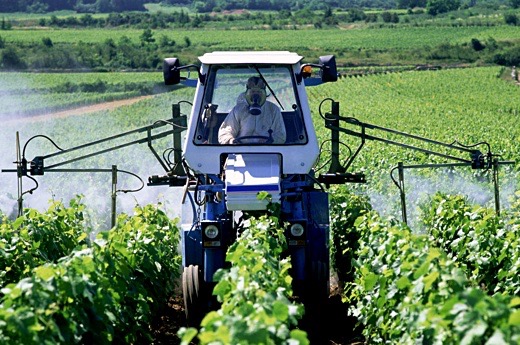
France votes against glyphosate

SUBHEAD: The French government has voted against the renewal of an EU Commission license for glyphosate use.

By Staff on 1 September 2017 for Farming UK -
(https://www.farminguk.com/News/France-votes-against-the-use-of-pesticide-glyphosate_47307.html)


Image above: Grape vine spraying near Mersault village, Burgundy, France. From (https://www.pourquoidocteur.fr/Articles/Question-d-actu/2888-Pesticides-les-effets-reels-sur-la-sante).

The French government has voted against the renewal of an EU Commission license for the pesticide glyphosate.The decision by the French government comes as evidence emerges of the risk of birth defects caused by exposure to pesticides.

Monsanto is the major supplier of products containing glyphosate, with ‘Roundup’ being the best-known product.

The product is widely used by farmers, gardeners and local authorities to control weeds. In 2015 the World Health Organisation’s (WHO) classified glyphosate as a probable carcinogen.

But in March, the EU's chemicals agency said glyphosate should not be classed as a carcinogen. And a survey has shown that a ban on glyphosate in the UK could force one in five wheat farms into 'serious financial difficulty'.

More than half of British farmers say they are concerned that a ban could cost them more than £10,000 every year.Speaking at Cereals 2017, NFU Vice President Guy Smith said:
“This year looks like being a watershed year for classical chemistry for arable farms with these three decisions on the horizon from Europe.

“A poor decision on endocrine disruptor definition could see an end to the availability of around 26 active ingredients; the European Commission is proposing a ban on the use of neonicotinoids on all outdoor crops; and a decision on the reauthorisation of glyphosate is due by the end of the year.

“The NFU will continue to make the case for evidence-based decisions to be made in all three of these areas, and we will continue to work with our members to help them make the case to politicians and other decision makers about the importance of these products and to demonstrate the damage that bad decisions will have on farming and our food supply.”
.

Ready, Set, Splat!

SUBHEAD: If the credit-worthiness of France takes a wrong turn, it will upset the global currency system.

By James Kunstler on 24 April 2017 for Kunstler.com-
(http://kunstler.com/clusterfuck-nation/ready-set-splat/)


Image above: Marine Le Pen and Emmanuel Macron were big winners in first round of French election for presidency. From (https://en.news-front.info/2017/02/05/french-elections-le-pen-and-macron-rally-supporters/).

As I write, the French stock market (the CAC 40), is doing a grand jeté (up 4.5 percent!) in celebration of Emmanuel Macron’s assumed slaying of the dragon Le Pen. But that was just the first round under the interesting French election system.

Consider that two other candidates who were eliminated, Monsieurs Fillon and Mélenchon, got nearly 40 percent of the vote. Are we so sure about where their voters go in the second and final round two weeks from now?

I suspect that most Americans — even the ones who follow Rachel Maddow — are about as interested in French politics as differential calculus.

Macron, 36, is a blank slate.

He was finance minister under current president François Hollande, of the Socialist Party, but declared during the election campaign that he’s not a socialist, he only wanted to be of service to his country, and this time he ran under his own party, En Marche!

He appears to represent the continuation of business-as-usual with the European Union, which seems to put him on the wrong side of history at this crucial moment — if you suppose, as I do, that the EU is so riddled with hopeless financial contradictions and centrifugal political tensions that it is unlikely to persist.

Yet, understandably, people are reluctant to change the system they’re living under. Le Pen wants to blow the EU up, especially the bureaucracy lodged in Brussels that has become a self-serving and self perpetuating monster.

Blowing up the EU would necessarily, it seems, mean the end of the European Central Bank, and with it the scams and Ponzi schemes that have provided an appearance of normality, despite an official 10.5 percent unemployment rate in France and a constant chain of public massacres by resident Jihadistas of one sort or another, some of them perpetrated by radical refugees allowed in under EU policy.

Macron might serve the interests of the American Deep State, which is determined to drive a wedge between Europe and the Chinese-Russian-Iranian “silk road” economic bloc that would consolidate trade in the Eastern Hemisphere.

The US wants “the West” to remain what it had been for seventy years: the dominant posse. Even if the underlying conditions remained the same, this might not be possible.

But those underlying conditions are changing, and in ways that much of the political maneuvering across the West cannot alter, or even comprehend, for instance, the inability of these mature industrial economies to grow anymore. That is largely a function of the end of affordable energy.

Unfortunately, the absence of growth portends not stagnation but collapse as society fails to generate enough new wealth to pay its debts.

Now, we’ve seen a pretty impressive demonstration of advanced nations playing financial games to cover up this corrosive condition. But the dishonesty at work is pretty obvious, and the problem with dishonesty in financial affairs is that it represents unreality.

The accrued momentum in colossal sums of money flowing this way and that way has allowed unreality to reign in international finance for a while. But that is now flying apart. The ultimate reality, politicians and economists will soon discover, is that you can’t create your own reality.

So whatever you think now about the French election, or the fate of the EU, is liable to change as the great debt crack-up our time finally gets underway and suddenly every nation has to scramble desperately to keep its shit together.

That magic moment may be at hand this week as the US congress returns from Easter recess to face its budget and debt ceiling dilemmas.

If the credit-worthiness of this country takes a wrong turn, it will upset the global currency system.

In fact, it will rip a hole in financial time-and-space into which the presumed value of all sorts of things represented on paper and computer drives will disappear, never to be seen again.

.

Europe revolts against TTIP

SUBHEAD: United States faces major trade negotiation setback as Europeans revolt against TTIP.

By Andrei Akulov on 4 September 2016 for Strategic Culture -
(http://www.strategic-culture.org/news/2016/09/04/us-faces-major-setback-as-europeans-revolt-against-ttip.html)


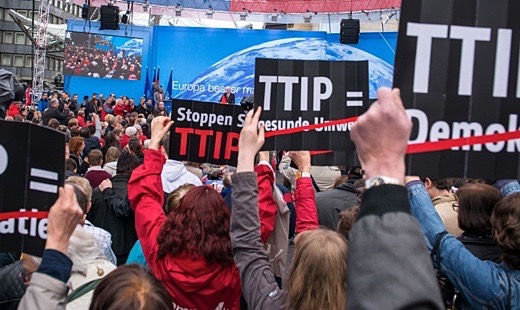
Image above: Europeans demonstrate against American corporatism of TTIP. From original article.

France wants to halt thorny EU-US trade talks on the Transatlantic Trade and Investment Partnership (TTIP) as President Francois Hollande underlined there would be no deal until after President Barack Obama leaves office in January. Matthias Fekl, the French minister for foreign trade, has said his country will call for an end to the deal.

France has been sceptical about the TTIP from the start and has threatened to block the deal, arguing the US has offered little in return for concessions made by Europe. All 28 EU member states and the European parliament will have to ratify the TTIP before it comes into force.

The statements came just a couple of days after German economy minister Sigmar Gabriel had said talks for TTIP had de facto failed. Gabriel, who leads Germany’s centre-left Social Democratic party and is vice-chancellor in the coalition government, said Europe mustn’t submit to the American proposals.

Mr. Gabriel’s statement is in contrast with the position of Chancellor Angela Merkel who supports the deal. Meanwhile, the US-German conflicts are growing. US courts and authorities took a hard line against the Volkswagen Group, Germany’s largest car manufacturer, in relation to its exhaust scandal. In a deal that does not include all damage claims, VW is required to pay up to 13.6 billion euros.

There is a growing chorus in Germany saying that the country should orientate more to Asia. This perspective shared by the organizers of the anti-TTIP lobby, including the German Trade Union Federation (DGB), the Left Party and the Greens.

The fact that former British Prime Minister David Cameron – an outspoken proponent of TTIP – is no longer involved in negotiations is another major setback for the deal, which at this point is believed by many to be dead in the water.

TTIP negotiations have been ongoing since 2013 in an effort to establish a massive free trade zone that would eliminate many tariffs. After 14 rounds of talks that have lasted three years not a single common item out of the 27 chapters being discussed has been agreed on.

The United States has refused to agree on an equal playing field between European and American companies in the sphere of public procurement sticking to the principle of «buy American».

The opponents of the deal believe that in its current guise the TTIP is too friendly to US businesses. One of the main concerns with TTIP is that it could allow multinational corporations to effectively «sue» governments for taking actions that might damage their businesses.

Critics claim American companies might be able to avoid having to meet various EU health, safety and environment regulations by challenging them in a quasi-court set up to resolve disputes between investors and states.

In Europe thousands of people supported by society groups, trade unions and activists take to the streets expressing protest against the deal.

Three million people have signed a petition calling for it to be scrapped. For instance, various trade unions and other groups have called for protests against the TTIP across Germany to take place on September 17. A trade agreement with Canada has also come under attack.

US presidential candidate Donald Trump has promoted protectionist trade policies, while rival Hillary Clinton has also cast doubt on the TTIP deal. Congressional opposition has become steep. The lawmakers on both sides of the aisle have railed against free trade agreements as unfair to US companies and workers.

These developments take place against the background of another major free trade agreement - the Trans Pacific Partnership (TPP) - hitting snags on the way to being pushed through Congress. The chances are really slim

The likely failure will be a great setback undermining the US credibility in the Asia Pacific region and the world. According to Singapore’s Prime Minister Lee Hsien Loong, for America’s friends and partners, ratifying the trade pact was a litmus test for US credibility and seriousness of purpose.

Both deals have been problematic, primarily because they contain clauses that would allow corporations to sue sovereign nations and are seen as a US attempt to assert political, diplomatic and corporate influence.

As illustrated above, even Americans reject them, blaming the North American Free Trade Agreement for the exodus of American manufacturing to cheaper destinations. But the failure to push through both agreements will put into doubt the US status of global superpower.

Inside the US wealth inequality is growing.

Student loans are up. So too are food stamps and health insurance costs. In the meantime, labor force participation, home ownership and median family incomes have plummeted. The US government's $19 trillion debt is a huge problem.

Long wars in Afghanistan and Iraq have exacted an enormous price - immense financial expense, estimated to be as high as $6 trillion (£3.9tn). The detention centre at Guantanamo Bay, as well as the NSA and Wikileaks spying scandals, have undermined the belief in American values and American diplomacy.

The defense expenditure is huge, but its effectiveness is questioned. «We’re in a dramatic crisis now. There is no question that we’re capable against the threats on the counter-terrorism side, but we’ve reached a point where we’re in fact—not heading towards—but we’re already hollow against a high-end threat, said House Armed Services Committee majority staff director Bob Simmons speaking before an audience at the American Enterprise Institute (AEI) on June 21.

We lack the capacity and capability that we need to effectively deter on the high-end.

Among the foreign policy disasters in the Middle East, the rise of the Muslim extremists in several nations has created a crisis for all of the West, including the United States but most immediately and especially for refugee-swamped Europe.

The West is reaping the results of America’s foreign policy failures as it struggles to cope with hundreds of thousands of refugees pouring out of Syria and the Middle East.

>There is scant evidence that this century the US has achieved any progress pursuing its foreign policy goals. And while the US has stagnated, some countries, like Russia, China and many others, have prospered. This combination of decline at home and rise abroad has reduced America’s international power markedly.

At the turn of the century few argued when the 20th century was dubbed the «American Century». Over the past 16 years, America's fortunes have changed with dizzying speed. The safer bet is that the 21st century will not be America’s. The TTIP’s rejection by European leaders and grass roots’ protests against the agreement testify to the fact.
.

French burkini ban

SUBHEAD: Armed French police force woman to remove clothing on public beach. Have they lost their minds?

By Ben Quinn on 23 August 2016 for the Guardian -
(https://www.theguardian.com/world/2016/aug/24/french-police-make-woman-remove-burkini-on-nice-beach)


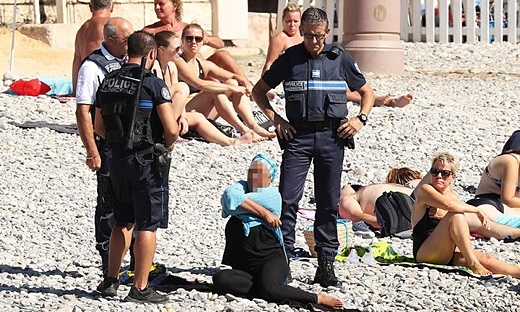
Image above: A ticket given to the woman by police, which said she was not ‘wearing an outfit respecting good morals and secularism’. Police forced her to remove some clothing. From original article.

Authorities in 15 towns have banned burkinis, citing public concern following recent terrorist attacks in France.

Photographs have emerged of armed French police confronting a woman on a beach and making her remove some of her clothing as part of a controversial ban on the burkini.

Authorities in several French towns have implemented bans on the burkini, which covers the body and head, citing concerns about religious clothing in the wake of recent terrorist killings in the country.

The images of police confronting the woman in Nice on Tuesday show at least four police officers standing over a woman who was resting on the shore at the town’s Promenade des Anglais, the scene of last month’s Bastille Day lorry attack.

After they arrive, she appears to remove a blue long-sleeved tunic, although one of the officers appears to take notes or issue an on-the-spot fine.

The photographs emerged as a mother of two also told on Tuesday how she had been fined on the beach in nearby Cannes wearing leggings, a tunic and a headscarf.

Her ticket, seen by French news agency AFP, read that she was not wearing “an outfit respecting good morals and secularism”.

“I was sitting on a beach with my family,” said the 34-year-old who gave only her first name, Siam. “I was wearing a classic headscarf. I had no intention of swimming.”

A witness to the scene, Mathilde Cousin, confirmed the incident. “The saddest thing was that people were shouting ‘go home’, some were applauding the police,” she said. “Her daughter was crying.”

Last week, Nice became the latest French resort to ban the burkini. Using language similar to the bans imposed earlier at other locations, the city barred clothing that “overtly manifests adherence to a religion at a time when France and places of worship are the target of terrorist attacks”.

The Nice ban refers specifically to the truck attack in the city on 14 July that claimed 86 lives, as well as the murder 12 days later of a Catholic priest near the northern city of Rouen.

The ban by several towns will come before France’s highest administrative court on Thursday following an appeal by the Human Rights League, a French NGO. It is challenging the decision by a lower court in Nice, which upheld a ban on the outfit by the town of Villeneuve-Loubet.

Villeneuve-Loubet, just west of Nice, was among the first of 15 towns to ban the burkini, triggering a fierce debate in France and elsewhere about the wearing of the full-body swimsuit, women’s rights and secularism.

A Corsican mayor has also banned burkinis, amid tensions on the island and violent clashes between villagers and three Muslim families. Skirmishes at a beach in the commune of Sisco earlier this month left four people injured and resulted in riot police being brought in to stop a crowd of 200 Corsicans marching into a housing estate with a high population of people of North African origin, shouting “this is our home”.

A police investigation is under way to determine the cause of the violent brawl, although there has been no confirmation from authorities as to whether anyone on the beach was wearing a burkini at the time.

Nevertheless the local Socialist mayor, Ange-Pierre Vivoni, banned the garments, describing the measure as necessary to “protect the population”.

The Nice tribunal ruled on Monday that the ban in Villeneuve-Loubet was “necessary, appropriate and proportionate” to prevent public disorder after a succession of jihadi attacks in France.

The burkini was “liable to offend the religious convictions or (religious) non-convictions of other users of the beach,” and “be felt as a defiance or a provocation exacerbating tensions felt by” the community, it added.

The ruling by the state council, France’s highest administrative court, will provide a legal precedent for towns to follow around the country.


French divided over burkini ban
SUBHEAD: France's burkini ban row divides government as court mulls legality.


By Angelique Christafis on 25 August 2016 for the Guardian -
(https://www.theguardian.com/world/2016/aug/25/frances-burkini-ban-row-divides-government-court-mulls-legality)

France’s prime minister, Manuel Valls, has clashed with his education minister amid growing divisions in the government over the controversial burkini bans on some beaches.

The education minister, Najat Vallaud-Belkacem, one of the Socialist government’s leading feminist voices, was highly critical of the growing number of burkini bans, which have provoked debate after women were stopped by police for wearing headscarves and long-sleeved clothing on the beach.

France’s highest court – the state council – began hearing arguments on Thursday from the Human Rights League and an anti-Islamophobia group, which are seeking to reverse a decision by the southern town of Villeneuve-Loubet, near Nice, to ban the full-body swimsuits.

Vallaud-Belkacem, who was born into a Muslim family in rural Morocco before moving to France aged four, told Europe 1 radio the proliferation of burkini bans was not welcome.

She said: “I think it’s a problem because it raises the question of our individual freedoms: how far will we go to check that an outfit is conforming to ‘good manners’?”

She warned that the bans had “let loose” verbal racism. The Socialist party had previously expressed outrage after a 34-year-old French woman was stopped by police on a beach in Cannes for sitting with her children wearing a headscarf and long trousers and was shouted at by a crowd to “go home”.

“My dream of society is a society where women are free and proud of their bodies,” said Vallaud-Belkacem. She warned that with tensions high after a series of terrorist attacks claimed by the Islamic State, “we shouldn’t add oil to the fire” by banning burkinis.

But moments after Vallaud-Belkacem spoke, her comments were flatly contradicted by Valls, who reiterated his support for mayors who have banned the garments. Asked if the decrees amounted to racism, Valls said: “No, that’s a bad interpretation.” He said the full-body swimwear represented “the enslavement of women”.

Valls has said he supports the mayors who have issued local short-term decrees against burkinis, while refusing their demands for nationwide legislation against them.
The state council’s ruling, due shortly, is likely to set a precedent for other towns that have banned the burkini.

The administrative court in Nice ruled on Monday that the Villeneuve-Loubet ban was necessary to prevent public disorder after the Bastille Day attack in Nice and the murder of a priest in Normandy.

 The London mayor, Sadiq Khan, condemned the ban on a visit to Paris on Thursday, his first overseas trip since taking office in May. “I’m quite firm on this. I don’t think anyone should tell women what they can and can’t wear. Full stop. It’s as simple as that.”

Khan’s counterpart in Paris, Anne Hidalgo, hosting London’s first Muslim mayor, called for an end to burkini “hysteria”, saying authorities should instead focus on improving social cohesion.

The former French president Nicolas Sarkozy weighed into the controversy on Wednesday when he called the full-body burkini swimsuit a “provocation” that supported radicalised Islam. He told a TV interviewer: “We don’t imprison women behind fabric.”

This was followed by a rebuke from the woman who created the burkini, the Australian designer Aheda Zanetti, who said Sarkozy had misunderstood what the swimwear represented.

“He needs to go to the beach and maybe ask, what is a burkini swimsuit?” Zanetti said. “Burkini is just a word that describes a full-cover swimsuit, and it doesn’t symbolise anything to do with Muslims. It’s about encouraging our kids and children to learn how to swim.”

The political row over burkinis has intensified after a woman in a headscarf was photographed on a beach in Nice removing a long-sleeved top while surrounded by armed police.

The city banned the burkini on its beaches last week, following about 15 seaside areas in south-east France where mayors had done the same.

The series of pictures, taken by a local French news photographer, showed a woman dressed in leggings, a long-sleeved tunic and headscarf being approached by four officers.

As the police stand around her, she removes her long-sleeved top, revealing a short-sleeved top underneath. It is unclear whether or not the woman was ordered to do so. In another image, a police officer appears to write out a fine.

The Nice mayor’s office denied that the woman had been forced to remove clothing, telling Agence France-Presse that she was showing police the swimsuit she was wearing under her tunic.

Nice’s deputy mayor, Christian Estrosi, from Sarkozy’s Les Républicains party, said a municipal police team had “acted perfectly to make sure that [the] decree was respected”. He threatened legal action against anyone disseminating pictures of municipal police. Twenty-four women have been stopped by police in the city since the burkini ban came into force.


The woman in Cannes, a former flight attendant from Toulouse who gave her name only as Siam, said she was wearing clothes and a headscarf when she was approached by police who wrote on her ticket that her clothes did not conform with “good manners” or French secularism.

“I wasn’t in a burkini, I wasn’t in a burqa, I wasn’t naked, so I considered my clothing was appropriate,” she said.

The various mayoral decrees do not explicitly use the word burkini; instead they ban “beachwear which ostentatiously displays religious affiliation”, citing reasons such as the need to protect public order, hygiene or French laws on secularism.

The state council’s ruling, due at 3pm (1pm GMT) on Friday, is likely to set a precedent for other towns that have introduced bans.
.

Participation in RIMPAC 2016

SUBHEAD: The countries participating in largest naval war exercise reach record number and include NATO.

By Juan Wilson  1 June 2016 for Island Breath  -
(http://www.stripes.com/news/pacific/27-nations-set-to-join-rimpac-exercise-in-hawaii-california-1.412494)

http://www.islandbreath.org/2016Year/06/160601pacrimbig.jpg
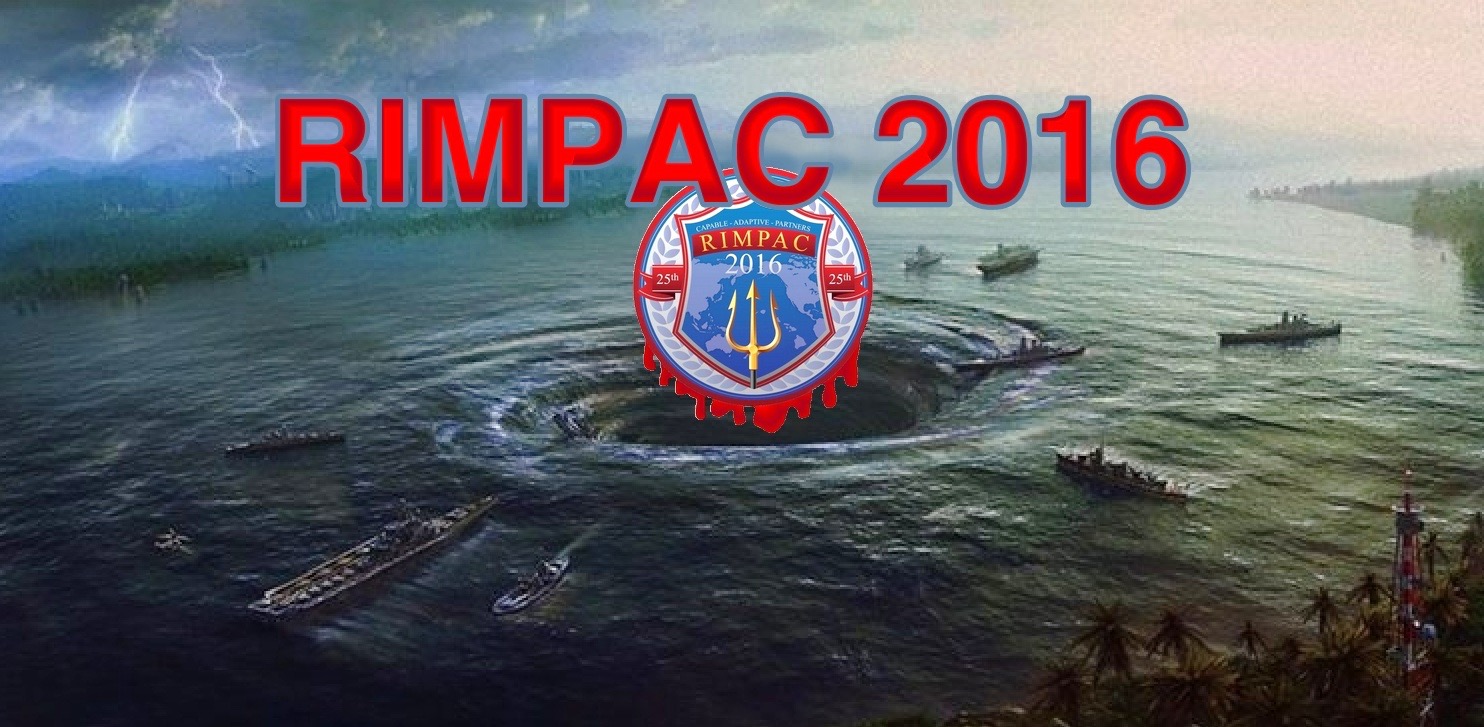
Image above: Teaser poster for "Pacific Rim II" film being produced now and ready for 2018. Mashup by Juan Wilson. Click to embiggen.

Note below the two recent articles  (5/31 and 6/1) in Stars and Stripes and Naval Today respectively that are puff pieces more than actual news stories. They both concern RIMPAC 2016 - the international naval war exercises that will begin toward the end of this month.

Both of these articles seem to have been "crafted" from the same US Navy public relations announcement. They cover the same points with about the same amount of detail in the same order.

The gist of the pieces are:
One: To congratulate the US Navy for convincing four new non-Pacific nations (Brazil, Denmark, Germany and Italy) for joining the Rim of the Pacific nations involved with Pacific Naval warfare. Three out of four of them are allies in the North Atlantic Treaty Organization.

Two: To dampen criticism, from the likes of Sen John McCain, that the Chinese Navy should be disenvited from participating as observers in RIMPAC 2016 as they were in 2014. Obviously, the US wants China to see what they would face in and conflict in the South China Sea if they continue to build up they Naval presence in the Western Pacific.

Three: The public relations effort  invokes “The Great Green Fleet” using conservation efforts and alternative fuels; and focusing on rescue and disaster relief operations is a screen for deadlier activities that even in "practice" mode are lethal to the life in the ocean..
As to my opinion of these gists:
One:  The US Navy Pacific fleet in including three NATO navies from the Atlantic Ocean under its wing in the Pacific. Always remember that attacking any NATO nation is an attack on all. In my opinion the US Navy wants to make sure that if there is trouble in the Western Pacific that it will be the US Navy and not NATO doing the coordination.
Two: The US Navy wants the Chinese Navy to observe how mighty and dominant it is in command and control on the Pacific Ocean. They also want the Chinese available for public relations purposes. Also The relationship of a panoramic flotilla of 45 RIMPAC ships from 27nations in proportion to a couple of ships from the Chinese Navy in passive obervation makes a great photo opportunity.
Three: No amount of "Green Fleet" bullshit can obscure the deadly impact of high energy sonar, radar, amphibious operations and live ammo exercises on the Pacific Ocean and its denizens - live reefs, fish, birds, ocean mammals and to the the ecosystems that support them.
It should be noted that buried in the second story below is the detail that Japan Maritime Self Defense Force Rear Adm. Koji Manabe was named the vice commander of the RIMPAC 2016 Combined Task Force. This is interesting because his role was only enabled by an adjustment to Japanese law that disallows any military activity other than that needed for self defense - the old rules would not have allowed a leading role in such an activity as RIMPAC.

As the United States pushes militarily forward in Eastern Europe and the Middle East, it expands its already dominant role throughout the Pacific region. To me it looks like we are pushing for World War Three.  And that's a bad idea. As I have said before - the central role of our navy should not be to threaten live throughout the world, but to protect the oceans and those who live in it.


Twenty 27 countries in RIMPAC 2016

By Wyatt Olsen  31 May 2016 for Stars & Stripes  -
(http://www.stripes.com/news/pacific/27-nations-set-to-join-rimpac-exercise-in-hawaii-california-1.412494)


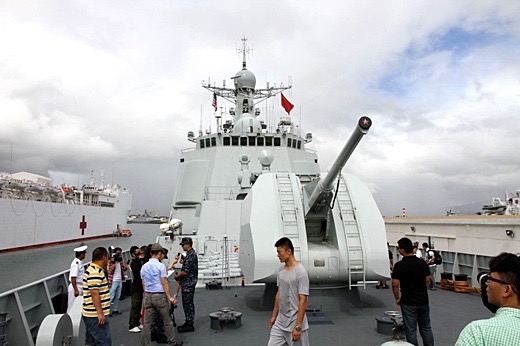
Image above: Reporters and other visitors gather to inspect the bow of the Haikou, China's flagship destroyer, during the 2014 Rim of the Pacific exercise in Hawaii. From original article.

Four nations will join this summer’s Rim of the Pacific drills in Hawaii, increasing the number of countries participating in the world’s largest international maritime exercise to 27.

Brazil, Denmark, Germany and Italy will take part for the first time in the biennial RIMPAC, which is slated to begin June 30 and end Aug. 4, the Navy said Tuesday. China, which joined the exercise in 2014, will also participate.

This year’s U.S. Pacific Fleet-hosted drills – which will focus on disaster relief, maritime security, sea control and complex warfighting – will include 45 ships, five submarines, more than 200 aircraft and 25,000 personnel.

Participating nations include Australia, Brunei, Canada, Chile, Colombia, France, India, Indonesia, Japan, Malaysia, Mexico, the Netherlands, New Zealand, Norway, Peru, South Korea, the Philippines, Singapore, Thailand, Tonga and the United Kingdom.

Drills will include amphibious operations, gunnery, counter-piracy, mine clearance, explosive ordnance disposal and diving and salvage operations. Defensive training against missiles, submarines and aircraft will also take place.

While most of the exercise is held in Hawaii, amphibious operations will take place in Southern California, featuring a harpoon missile shoot from a Navy littoral combat ship. A submarine rescue is new for this year, the Navy said.

Playing a major role in this year’s RIMPAC is the Navy’s “Great Green Fleet,” a yearlong initiative that uses energy conservation measures and alternative fuels to demonstrate how cutting energy costs can contribute to overall military readiness.

Almost all the vessels participating will use an approved alternate-fuel blend, the Navy said.

Some in Congress have called for China to be disinvited to RIMPAC, citing the country’s expansionist actions in the South China Sea, where it has enlarged small atolls through sand dredging.

The country has built facilities and runways on some, construction the U.S. characterizes as militarization.

Last month, U.S. Rep. Mark Takai, of Hawaii, a member of the House Armed Services Committee, asked Secretary of Defense Ash Carter to reconsider China’s invitation in light of its naval actions over the past two years.

“I guess my question is why then should we reward China for this aggressive behavior by including them in an event meant for allies and partners?” Takai said to Carter during a March hearing. He described China’s behavior as “the polar opposite of U.S. objectives in the region.”

In late April, China told the U.S. it would deny a Hong Kong port visit by the USS John C. Stennis aircraft carrier strike group planned for May 3-8. The denial likely came in response to the strike group’s recent presence near the disputed Spratly Islands close to the Philippines.

U.S. Pacific Fleet commander Adm. Scott Swift has said on numerous occasions he believes the path forward with China is to deepen relationships with military-to-military contact.

In 2014, China sent four ships to RIMPAC, including the destroyer Haikou and hospital ship Peace Ark. It also sent a spy ship, which remained in international waters off Hawaii.


Record participation in RIMPAC 2016

By Staff 1 June 2016 for Naval Today -
(https://navaltoday.com/2016/06/01/record-number-of-countries-to-take-part-in-rimpac-2016/)

With four new participants, the number of countries taking part in RIMPAC, the world’s largest international maritime exercise, rose to 27.

45 ships, five submarines, more than 200 aircraft and 25,000 personnel will participate in the biennial Rim of the Pacific (RIMPAC) exercise scheduled June 30 to August 4, in and around the Hawaiian Islands and Southern California.

This is the first time that Brazil, Denmark, Germany, and Italy are participating in RIMPAC 2016. Additional firsts will involve flexing the command and control structure for various at sea events and incorporating a submarine rescue exercise.

Other participants will be forces from:

Australia, Brazil, Brunei, Canada, Chile, Colombia, Denmark, France, Germany, India, Indonesia, Italy, Japan, Malaysia, Mexico, Netherlands, New Zealand, Norway, People’s Republic of China, Peru, the Republic of Korea, the Republic of the Philippines, Singapore, Thailand, Tonga, the United Kingdom and the United States.

This year will see amphibious operations in the Southern California operating area, feature a harpoon missile shoot from a U.S. Navy littoral combat ship and highlight fleet innovation during the Trident Warrior experimentation series.

RIMPAC 2016 is the 25th exercise in the series that began in 1971. Hosted by U.S. Pacific Fleet.
It will be led by U.S. Vice Adm. Nora Tyson, commander of the U.S. 3rd Fleet (C3F), who will serve as the Combined Task Force (CTF) Commander.

Royal Canadian Navy Rear Adm. Scott Bishop will serve as deputy commander of the CTF, and Japan Maritime Self Defense Force Rear Adm. Koji Manabe as the vice commander.

See also:
Ea O Ka Aina: Judgement Against RIMPAC 2016 5/29/16
Ea O Ka Aina: Prepare for RIMPAC War in Hawaii 5/22/16
Ea O Ka Aina: Navy to "take" millions of mammals 5/17/16
Ea O Ka Aina: US court RIMPAC Impact decision 4/3/15
Ea O Ka Aina: RIMPAC 2014 Impact Postmortem 10/22/1
Ea O Ka Aina: RIMPAC 2014 in Full March 7/16/14
Ea O Ka Aina: 21st Century Energy Wars 7/10/14
Ea O Ka Aina: RIMPAC War on the Ocean 7/3/14
Ea O Ka Aina: Voila - World War Three 7/1/14
Ea O Ka Aina: The Pacific Pivot 6/28/14
Ea O Ka Aina: RIMPAC IMPACT 6/8/14
Ea O Ka Aina: RIMPAC Then and Now 5/16/14
Ea O Ka Aina: Earthday TPP Fukushima RIMPAC 4/22/14
Ea O Ka Aina: The Asian Pivot - An ugly dance 12/5/13
Ea O Ka Aina: Help save Mariana Islands 11/13/13
Ea O Ka Aina: End RimPac destruction of Pacific 11/1/13 
Ea O Ka Aina: Moana Nui Confereence 11/1/13
Ea O Ka Aina: Navy to conquer Marianas again  9/3/13
Ea O Ka Aina: Pagan Island beauty threatened 10/26/13
Ea O Ka Aina: Navy license to kill 10/27/12 
Ea O Ka Aina: Sleepwalking through destruction 7/16/12
Ea O Ka Aina: Okinawa breathes easier 4/27/12
Ea O Ka Aina: Navy Next-War-Itis 4/13/12
Ea O Ka Aina: America bullies Koreans 4/13/12
Ea O Ka Aina: Despoiling Jeju island coast begins 3/7/12
Ea O Ka Aina: Jeju Islanders protests Navy Base 2/29/12
Ea O Ka Aina: Hawaii - Start of American Empire 2/26/12
Ea O Ka Aina: Korean Island of Peace 2/26/12   
Ea O Ka Aina: Military schmoozes Guam & Hawaii 3/17/11
Ea O Ka Aina: In Search of Real Security - One 8/31/10
Ea O Ka Aina: Peace for the Blue Continent 8/10/10
Ea O Ka Aina: Shift in Pacific Power Balance 8/5/10
Ea O Ka Aina: RimPac to expand activities 6/29/10
Ea O Ka Aina: RIMPAC War Games here in July 6/20/10
Ea O Ka Aina: Pacific Resistance to U.S. Military 5/24/10
Ea O Ka Aina: Guam Land Grab 11/30/09
Ea O Ka Aina: Guam as a modern Bikini Atoll 12/25/09
Ea O Ka Aina: GUAM - Another Strategic Island 11/8/09
Ea O Ka Aina: Diego Garcia - Another stolen island 11/6/09
Ea O Ka Aina: DARPA & Super-Cavitation on Kauai 3/24/09
Island Breath: RIMPAC 2008 - Navy fired up in Hawaii 7/2/08
Island Breath: RIMPAC 2008 uses destructive sonar 4/22/08
Island Breath: Navy Plans for the Pacific 9/3/07
Island Breath: Judge restricts sonar off California 08/07/07
Island Breath: RIMPAC 2006 sonar compromise 7/9/06
Island Breath: RIMPAC 2006 - Impact on Ocean 5/23/06
Island Breath: RIMPAC 2004 - Whale strandings on Kauai 9/2/04
Island Breath: PMRF Land Grab 3/15/04

.

COP21 Expectations

SUBHEAD: Ambition and Smoke, Love and Courage - What to expect from the climate treaty negotiations in Paris.

By John Foran on 30 November 2015 for Resilience  -
(http://www.resilience.org/stories/2015-11-30/ambition-and-smoke-love-and-courage-what-to-expect-from-the-climate-treaty-negotiations-in-paris)


Image above: A clever logo design used by protesters of COP21combines elements of COP21 symbol of the Eiffel Tower, the international peace Sign and the symbol for anarchy. From original article.
“The most important question raised by the climate summit may be: Does the power to change the world belong to the people in the conference rooms of Le Bourget or to the people in the streets of Paris?”
- Rebecca Solnit, “Power in Paris“
The Paris COP 21 UN climate summit is upon us, now, starting on Monday, November 30.  I have spent the last year, ever since the dust of Lima was wiped from my shoes, trying my best to get a grasp on what was going to happen and communicating what I found out to all interested parties.  This has led to two long pieces, “Just Say ‘No’ to the Paris COP:  A Possible Way to Win Something for Climate Justice” and “A History of the Climate Negotiations in Six Videos.”

In the last two months, the world’s attention has really started to focus on climate, the COP, and the possibilities and probabilities of “success” and (gasp!) “failure.”  The murder of 129 people in the streets of Paris on Friday, November 13, has only trained hearts and minds more on this ground zero in the interlaced struggles for peace on Earth with justice.

Within twenty-four hours, the French government and the UNFCCC had reassured us that the COP would proceed exactly as planned, with added layers of security.

The incredible and creative plans of civil society for making sure that the world’s demand for climate justice will be heard in Paris hung in the balance until the government of François Hollande made it known that the twin bookends of our strategy – the massive march on Sunday, November 29 and the nonviolent civil disobedience and other acts of protest scheduled for the outcome of the COP on Friday and Saturday, December 11 and 12 – would be prohibited from occurring.

A COP without the full-throated participation of global civil society, however, has a less than zero chance of succeeding, whatever that nebulous term connotes.  Just as the COP must go on, so, too, will we, the countless members of the global climate justice movement, whether marching under that banner in Paris or simply showing up in our hearts and heads.

But the carefully prepared script that global elites have been busy writing for Paris may not end up to end the way they think, and here’s why.

Ambition and Smoke:  The Negotiations Will Take Unexpected Turns
In “Just Say ‘No’ to the Paris COP,” I developed an argument that the best possible outcome would be a conference that ended in disarray, without an agreement that would lock in catastrophic climate change or be hailed by most of the world as the first step on the road to a future without climate chaos and social turmoil (as if).  I have seen nothing on the part of the negotiating process in the intervening weeks that makes me think differently.

What is it that the governments of the world are being asked to do in Paris?  Their remit is to agree on a global treaty that would address several key elements:
  1. an ambitious upper limit on the amount of warming that humanity should countenance as acceptable and somehow safe for future generations, 
  2. a legally binding set of measures that all countries would agree on to achieve that goal, and
  3. mobilization of the technical and financial resources to ensure that all countries would have the means to make the transition to a low or zero carbon way of life, and to do so in a way that enables the rapid emergence of the global South from poverty and inequality in the name of social justice.
Operationally, this means choosing between 1.5 and 2 degrees Celsius as the temperature target, creating a mechanism to close the widening emissions gap to put us on that path, and securing at least $100 billion annually for a Green Climate Fund, and something similar for the Loss and Damage mechanism that will provide immediate emergency aid countries hit by extreme weather events.

At the moment, all the national pledges for climate action – the Individually Determined National Contributions (INDCs) – are in.  Unfortunately, the best estimates for the warming that they will give us vary between an optimistic 2.7 degrees and around 3.3 degrees or a little more.

The calculations are rendered more difficult because the UNFCCC failed to agree on any uniform ways of making these pledges in the four years that they gave themselves at COP 17 in Durban, South Africa, in 2011 to make this happen.

In Climate Action Tracker’s estimation, after careful review of pledges “covering about 71% of global emissions, 17 have not been rated as ‘sufficient’…. Two are sufficient but cover only 0.4% of global emissions.”  They conclude that the current level of ambition would give us a 66 percent chance of staying under 3 degrees Celsius!
There is a major risk that if current INDCs are locked in for 2030 and not reviewed and strengthened every five years, starting in 2020, that achievement of the 1.5°C goal called for by all the most vulnerable countries may be locked out, and achievement of the 2°C goal fundamentally threatened.
Based on the climate action promised under the INDCs it is now clear that governments at the Paris climate conference need to consider a formal acknowledgement that there is an insufficient level of mitigation ambition for 2025 and 2030 to limit warming below 2°C.
In November a group of NGOs including 350.org, Friends of the Earth International, the PanAfrican Climate Justice Alliance, and others issued “Fair Shares:  A Civil Society Equity Review of INDCs,” which finds that
The INDC commitments will likely lead the world to a devastating 3°C or more warming above pre-industrial levels. The current INDCs amount to barely half of the emissions cuts required by 2030.  Moreover, the INDCs submitted by all major developed countries fall well short of their fair shares. From the list of countries highlighted in the report, Russia’s INDC represents zero contribution towards committing its fair share. Japan’s represents about a tenth, the United States’ about a fifth, and the European Union’s just over a fifth of its fair share….  On the other hand, the majority of developing countries’ mitigation pledges exceed or broadly meet their fair share, including Kenya, the Marshall Islands, China, Indonesia, and India. Brazil’s INDC represents slightly more than two thirds of its fair share.
So, on the main question, what is on the table will warm the planet at least three times more above pre-industrial levels than what we currently have done, about 0.85 degrees Celsius.  No one wants to see worse effects from climate change than we are experiencing now, but that is inevitable since there is already enough carbon dioxide and other greenhouse gases in the air to take us to 1.4 degrees, even if we stopped burning fossil fuels tomorrow.

To make matters worse, these “pledges” will not be legally binding commitments.  They will not even go into effect until 2020.  They will not be reviewed so they can be “ratcheted up” for five more years till 2025.  And they will take us well beyond the supposedly “safe” threshold of 2 degrees in the next quarter century.

This is what Christiana Figueres, the Executive Secretary of the UNFCCC, President Obama, and other world “leaders” will hail as a success, if all goes well for them in Paris.

But to get agreement even on these dispiriting and ecocidal targets, they will need nearly every government of the world to agree that this is fair and reasonable.  To do so, they are going to have to come up with about $90 billion more for the Green Climate Fund than has been pledged so far.  And they will have to do something for Loss and Damage as well.

And herein lies a little room for hope.  Many countries – more than 100 – have said that they cannot live (in some cases literally) with 2 degrees of warming, and are demanding that the treaty inscribe 1.5 degrees as the target.

Many are insisting that $100 billion for the GCF is a non-negotiable promise (it was made at COP 15 back in 2009 in Copenhagen).  And others, such as the Philippines, need substantial funding for Loss and Damage as well.

So how exactly will the global North get an agreement under these circumstances?

The negotiating text has not shrunk below 50 pages in the multiple “intersessional” meetings that took place in 2015.

 Most of the text is in brackets, meaning that there are competing proposals for all of the clauses that involve these and other crucial issues.  There are seemingly unbridgeable differences of opinion among the nations at the table.

And the working time and process at a COP are simply not constructed to produce efficiency or progress in the negotiations.

Thus even if the will existed, and it doesn’t, it strikes me as absurd to think that these two weeks in Paris will get to the finish line.  They have kicked the can down the road for four years, avoiding all the intractable differences, barely making progress on the shape of the treaty itself, let alone the content.

On the other hand, Sunita Narain, who along with Chandra Bushan of the Delhi-based Centre for Science and Environment is the author of a devastating critique of US proposals on climate change – “Captain America:  U.S. Climate Goals – A Reckoning“ – has made perhaps the best case for how world leaders (and there are no world leaders in climate change, except perhaps for Pope Francis, who doesn’t have a country to bring to the table) are going to pull an agreement out of the hat.
So, what is likely to happen? Let me use my 20-COP past to map out the likely scenario and explain what it means for us in the emerging South that is already affected by unseasonal weather but needs its right to development.
First, there will be a Paris deal. This is a given. But to make it happen the French will make some clever moves, given that the current draft has been negotiated for over four years, is more than 50 pages long and full of disagreements. They have already changed the order of things by inviting heads of state on the first day and not the last. Everyone from Obama, German Chancellor Angela Merkel to Indian Prime Minister Narendra Modi is coming. The French will produce (and I hope with more finesse than the Danish government) a zero draft with the bare bones of the agreement at the start of the two-week meeting. The heads of state will have little room but to endorse this broad agreement. Then for the next two weeks negotiators will idle away time till the gavel comes down on the midnight of the last day.
Second, this zero draft for the Paris treaty will be minimalist and, therefore, seemingly non-controversial. It will endorse the submission of the Intended Nationally Determined Contributions (INDCs), which are voluntary commitments made by countries to cut carbon emissions. It will admit that the sum of these commitments does not add up to keeping the world below 2°C rise, which is seen to be the least risky option. But it will say that the agreement provides a stable and predictable foundation to ratchet up the commitments in the future.
Third, it will not make the commitment or the expected result legally binding. Instead it will make the procedure of submitting reports binding. It will also sidestep the tricky issue of review of INDCs, which countries like India have strangely objected to. It will simply say that in five years there will be a stock take of the aggregate of all INDCs. So no individual country’s progress will be reviewed, only the sum of their actions and how close it is to keeping the temperature rise below 2°C. On the really tricky issue of additional finance it will not mention specifics, just make a broad promise. And to keep the Americans happy it will try and do the finance bit on another piece of paper. In this way, the Paris Climate Change Treaty will be ready for signature even before the leaders leave. It will be weak but aspirational. The spin will be that it lays the ground for future action.
She goes on to pass judgment on what this would mean:
What it means is a little more than this. The world would have agreed to a framework, pushed by the US, which is voluntary, bottom up – countries decide what they will do rather than get targets based on their contribution to the problem – and most importantly universal. It breaks once and for all the distinction between developing and developed countries. As agreed in the Framework Convention on Climate Change, developed countries had to take the first and drastic action because of their historical responsibility.
It also means the US will appropriate an even greater share of the carbon budget, simply because its intended action is unambitious. The world is left with a limited space to emit greenhouse gases, if it wants to stay within a not-too-dangerous threshold. The still developing world – India and all of Africa – needs to increase emissions for its development. But by 2030, the timeframe of the intended Paris treaty, almost all the carbon budget would be gone. Our future right to development will be surrendered. We will be told to find a different way to grow economically. Ours has to be a low-carbon growth and if it is expensive, it is our problem. There will be no money or technology to aid us to get there.
This would be clever indeed.  It is precisely the dangerous scenario we have to block, to figure out how to throw a wrench with “climate justice” etched into it into its gears.

Where is the ambition in these rooms?
So who might make it awkward for the architects of this disastrous treaty in Paris?  In addition to the dozens of countries who are on record for a 1.5° temperature ceiling and the nearly unanimous desire for a legally binding treaty worthy of the name, there is the Climate Vulnerable Forum, a diverse set of countries who have formed a loose negotiating bloc for the summit.  Their Founding Communique gives some hope, insisting that “the minimum deliverable for the UN Climate Change Conference at Paris (UNFCCC COP21) is an agreement entirely consistent with the non-negotiable survival of our kind.”

AOSIS, the 44-member strong Alliance of Small Island States, has also endorsed keeping warming under the safer, if more difficult limit of 1.5 degrees Celsius, and has called on the nations of the world to be fully de-carbonized by 2050.

The 48-member Least Developed Countries bloc issued a statement in February calling for “emissions peaking for developed countries in 2015, with an aim of net zero emissions by 2050 in the context of equitable access to sustainable development.”

On the truly poignant side, Peru, Mexico, and Colombia have pledged money to the Green Climate Fund, shaming the wealthy nations of the world, who have so far put up only about $10 billion of the promised $100 billion annually by 2020 (the claim that there is actually now $62 billion promised to the Fund is full of double counting and includes forms of “aid” that come with plenty of strings attached).  Perhaps the wealthy should just ask the global South to fund the rest!

Hope and Possibility:  
Climate Justice at Cop 21 and Beyond, or, Why We Are Going and What We Hope to Do There for Climate Justice

I have just argued that the best possible outcome of the COP 21 negotiations would be not to agree on a treaty, but instead for the talks to descend into chaos in the halls in a scenario where nations inside the negotiations blocked any outcome because what is on the table is completely unacceptable.

 As this is the position of the vast majority of the global climate justice movement – that the COP process is hopelessly compromised and inadequate – we might ask:  What can or should the movement do in Paris to enable such an outcome, however slight the chance of it may seem?

In “Just Say ‘No’ to the Paris COP,” I outlined the variety of actions that the movement has planned for Paris.  I’d like to return to them here, updated under new circumstances, and with the COP itself (no pun intended) fast on our heels.

Global Climate Marches will take place (almost) everywhere
The November 29 marches in Paris and around the world are intended by their big NGO organizers such as Avaaz and 350.org to take the rhetoric of global leaders and turn it into a weapon with which to shame or encourage them into doing the right thing.

Their potential to appeal to newly active people in a variety of ways, taking into account that different people respond to different messages, aim to help forge a truly broad and deep climate justice movement, which will require moving more and more people into and through climate action to climate justice.

Now, of course, the situation on the ground in Paris is vastly altered after the November 13 massacre of 129 people by the terrorists of ISIS/Daesh.

So the organizers are calling for a huge turnout around the world to replace the momentum stolen by the French authorities from a march that would have numbered in the several hundred thousands – indeed, with the solidarity of the climate justice movement for real peace throughout the world based on social justice, it would not be too far-fetched to imagine that closer to a million people would have been in the streets of Paris, with Parisians responding to this solidarity.

After the Charlie Hebdo murders in January, some 1.6 million people marched in Paris and three million across France a week later;  think what could have been this time.
Meanwhile the People’s Pilgrimage, inspired by Pope Francis’s bracing climate encyclical Laudato Si, is set to arrive in Paris just before the COP opens on November 30. Yeb Saño, one of its co-organizers, points out that “Paris is not our destination.

Our real destination will be the hearts and minds of people, so our journey continues even after Paris.”  He told a group I was with this summer that “Paris is merely a six-year delay of what was promised in Copenhagen.

Paris will give us a ten to fifteen page ‘Motherhood’ statement with lots of ‘creative ambiguity.’  Unless we change the system, the same system that got us into the crisis, the negotiations process cannot, for the life of me, I cannot see it get us out of it.”

The question remains:  what will happen in Paris on November 29?  I will be there with a dozen other members of the Climate Justice Project with the aim of participating fully in the actions and doing our best to report on them.  I know that I will show up at the duly appointed place and time, and we will have to see who else does.

The Climate Games
Creative ideas abound in this movement, and there will be many thousands of imaginative, passionate people on hand to enact them.  In the aftermath of the French crackdown on public demonstrations, the role that will be played throughout COP 21 by participants in the Climate Games looms even larger than before.

Organized by the Laboratory of Insurrectional Imagination (le Labofii) as an open call to anyone who feels moved to do express their views about the COP and the larger forces behind it, conceived as the Mesh – “austerity-dictating politicians, fossil fuel corporations, industry lobbyists, peddlers of false solutions and greenwashers,” it anticipates a joyful chaos that will bring together “artists, activists, designers, scientists, hackers, architects, gamers, performers and other citizens together to conceptualise, and build and rehearse ef­fective new tools and tactics of resistance to be used during the COP21.”

Teams of activists will form to engage in “a mass participation transmedia action framework that merges the street, disobedient bodies and cyberspace, and turns the city into a total resistance performance event open to all.”

The Climate Games organizers’ eloquent response to November 13 merits quoting in full:
First of all, we want to clearly state our solidarity with all victims of all forms of terror. Machine guns and explosives hurt the same whether in Paris or Beirut, Ankara or Yola, Damascus or Kobane, Baghdad or elsewhere. The hurt feels the same whether it comes from the gun of a jihadist or a police officer, the missiles of a fighter plane or a drone.
These attacks must not change the conversation but deepen it. We want to clearly state that our dedication for social and climate justice remains as strong as ever. We are convinced that the geopolitical and economic dynamics that underpin climate chaos are the same as those that feed terrorism. From the oil wars in Iraq to the droughts in Syria caused by ecological collapse, all feed the same inequalities that lead to cycles of violent conflict.
We are writing this from a city under a state of emergency. The government has announced that the COP21 negotiations will go on, but all public outdoor demonstrations across France, including the Global Climate March and the day of mass actions on December 12th, have been banned. We refuse this shadow of the future, we will not bend to the politics of fear that stifle liberties in the name of security. The biggest threat to security, to life in all its forms, is the system that drives the climate disaster. History is never made by those who ask permission.
We believe that COP21 can not take place without the participation or mobilizations of civil society while governments and multinationals continue with business as usual. Only the Climate Justice movements with their disobedient bodies will be able to do the necessary work of keeping 80% of the fossil fuels in the ground.
We are still and more than ever dedicated to forms of actions that aim to address the root causes of climate chaos in determined non-violent ways. Our playing field has been totally transformed in Paris, but everywhere else in the world we encourage people to continue with their plans and adventures. We call all teams in Paris to take into account the exceptional circumstances and to not put anyone in fear or danger.
The decentralised creative nature of the Climate Games could become the alternative nonviolent response to this state of emergency. Like the mushrooms that emerge at dawn, the ants that scuttle across borders at night we will rise out of fear and shock, we will adapt and resist. We are not fighting for nature, we are nature defending itself.
For details, and to enter, stay tuned here.

A People’s Climate Strike Builds Out from Paris
Another intriguing and promising new strategy for the movement that will have its premiere in Paris is that of a global or people’s climate strike.  As Ben Manski and Jill Stein explain:  “What makes a strike different from mere protest? A strike is an economic stoppage. A strike does not plead. It does not demand. It simply does.”
 A People’s Climate Strike is being planned – to bring the engines of economic and ecological destruction to a grinding halt, demonstrate our growing power, and promote community-controlled, just, and green alternatives. The People’s Climate Strike will move us from the symbolism of marches towards the assertion of power in the streets. We will begin to develop a tool that has been essential for democratic social change throughout history.
In Paris, there is a call for students (including children) to skip classes or turn their schools into sites of climate action on November 30, the day the COP opens.  There are actions planned for seventy countries on that day.  In the eyes of the organizers, “The adult generations have promised to stop the climate crisis, but they have skipped their homework year after year. Climate strike is a wake-up call to our own generation. And it is the start of a network that will solve the greatest challenge in human history. Together. We need your hands and hearts and smarts!”  The measure of its success will be the number of people who raise their hands:
“The open hand is the symbol of Climate Strike. If you agree to the three demands of Climate Strike: 
  1. fossils should stay in the ground, 
  2. transition to 100% clean energy,
  3. help people impacted by climate change then show the world your hand.”

Creating a People’s Alternative to the COP 
At every COP, movements seek to create strong counter-spaces and projects, whose impact on countless activists over the years would be hard to overestimate.

In Paris, the network of French and global organizers who have come together as Coalition Climat21 has shown an astonishing capacity to make it possible to share insights, teach skills, strengthen bonds, plan actions, and envision futures across a variety of venues.

One of these will be a two-day Citizen Climate Summit or “Village of Alternatives” on December 5 and 6, in Montreuil, a working-class neighborhood of Paris where my group will be staying.  In the words of the organizers of the Coalition Climat21, this will be a place “to put forward solutions tackling climate change.

Let’s show decision-makers that these solutions already exist and are building a better world: with more justice, more solidarity, more happiness! … Putting in common our experience, analyses, struggles, and hopes will enable us to anchor our movement for the long-term.”

This will be followed between December 7 and 11 at the Climate Action Zone (ZAC) at the CENTQUATRE-PARIS in the northern part of Paris, where “All people are welcome – from the activists who will come from every corner of the world to local French high school students.  Here one can get basic information on the climate crisis and the UN negotiations, as well as meet with others to share information, create, and organize.”

During the “crunch time” of the second week of the COP when the negotiations will likely be floundering, participants in the Climate Action Zone will generate plans for their movements’ actions and messages at the end of the COP on Friday, December 11, and Saturday, December 12, seizing our chance to “have the final word” on COP21.  As Amy Goodman of Democracy Now! puts it:  “If the leaders fail, many will be there to storm the Bastille.”

The Streets Await Us
Things are most definitely heating up (so to speak) for Paris.  While the French state cries for a war on terrorism and denies our civil liberties, this is being met with a cry for a just peace with climate justice.
COP 21 is a litmus test of where power lies.  The balance of forces has greatly changed, and the climate justice movement is much savvier than at Copenhagen in 2009.  In the heart-wrenching words of the Network of Spiritual Progressives:
What if the wake-up call of these kinds of acts are to help us see that the only real response (once we recognize the existential crisis of being alive, being vulnerable, not knowing if we will live or die today and try to find some acceptance and peace with that while we go about living our lives and perhaps in remembering our vulnerability we choose to live our lives more fully, love more unconditionally, and be more generous and kind) is to build a movement and take back our country and our world. Perhaps this moment is a call to action – not to create a false sense of safety or security or to turn more inward – for ordinary people to rise-up and lead because our leaders are failing us.
In this crucial moment of history, I don’t think I could rise out of bed in the morning if it wasn’t for the global climate justice movement – its creativity, growing numbers, passion, imagination, grit, and joyfulness.

In hopes to see you or your spirit on the streets of Paris!

.