Showing posts with label Brexit. Show all posts

Energy collapse is upon us

SUBHEAD: This is your chance to engage with and become an agent of a new paradigm for humanity.

By Nafeez Ahmed on 28 December 2018 for Medium
(https://medium.com/insurge-intelligence/brexit-stage-one-in-europes-slow-burn-energy-collapse-1f520d7e2d89)


Image above: Van on fire in Paris after violent Yellow Vest protests. From original article.

Everyone’s talking about Brexit. Some about the French riots. But no one’s talking about why they are happening, and what they really mean. They might think they are, but they are usually missing the point.

On 6th May 2010, the Conservative Party took the reins of power for the first time since 1992, propped up with some help from the Liberal Democrats.

Hours before the election result, I warned in a blog post that whichever government was elected, it would be the first step in a dramatic shift toward the far-right that would likely sweep across the Western world within 10 years.

I wrote, describing the failure of all three political parties to understand why the heyday of economic growth was unlikely to return.
“The new government, beholden to conventional wisdom, will be unable or unwilling to get to grips with the root structural causes of the current convergence of crises facing this country, and the world...” 
“This suggests that in 5–10 years, the entire mainstream party-political system in this country, and many Western countries, will be completely discredited as crises continue to escalate while mainstream policy solutions serve largely to contribute to them, not ameliorate them.  
The collapse of the mainstream party-political system across the liberal democratic heartlands could pave the way for the increasing legitimization of far-right politics by the end of this decade…”
My prediction was astonishingly prescient. The global shift to the far-right began within exactly five years of my forecast, and has continued to accelerate before the decade is even out.

In 2014, far-right parties won 172 seats in the European Union elections — just under a quarter of all seats in the European Parliament.

In 2015, David Cameron was re-elected as Prime Minister with a parliamentary majority, a victory attributed in part to his promise to hold a referendum on Britain’s membership of the European Union.

Unbeknownst to many, the Tories had quietly established wide-ranging links with many of the same far-right parties that were now capturing seats in the EU.

The following year in June, the ‘Brexit’ referendum shocked the world with its result: a majority vote to leave the EU.

Six months later, billionaire real estate guru Donald Trump shocked the world again when he became president of the world’s most powerful country. Like the Conservatives in the UK, the Republicans too had forged trans-Atlantic connections with European parties and movements of the extreme-right.

Since then, far-right parties have made continued electoral gains across Europe in Italy, Sweden, Germany, France, Poland and Hungary.

We are on the cusp of a tidal wave, that looks poised to accelerate into a tsunami. Exactly as I had anticipated, far-right politics is no longer the province of the fringe, but is becoming increasingly normalised.

This not an accident. It is the result of a system that is failing — and the efforts of a network of far-right groups to exploit the fractures emerging from this system-failure to tear everything down, and erect a new order of their own fashioning.

My prediction of the resurgence of the far-right was based on analysing the probable consequences of a long-term ‘system-failure’ in which we are unable to return to the levels of economic growth we had become accustomed to in the heyday of the 1980s and 90s.

That system-failure, I explained, is rooted in the economics of the energy production that enables economic growth:
“…. a full and lasting recovery… is likely to be impossible in the constraints of the current system, because we’re running short on the physical basis of the last few decades of exponential (and fluctuating) ‘growth’ — and that is cheap, easily available hydrocarbon energies, primarily oil, gas and coal.

The turning point has arrived, and without that global cheap energy source in abundant supply, we cannot continue growing, no matter what we do. Something has to give. Our economies need to be fundamentally, structurally, transformed. 


We need to transition to a new, clean, renewable energy system on which to base our economies. 

We need to transform the way money is created, so that it’s not linked to the systematic generation of debt. We need to transform our banking system on the same grounds. 

Whitehall, and the three political parties, recognize only facets of the picture, but they don’t see it as a whole.”

Turning Point

The energy turning point is unequivocal. In the years preceding the historic Brexit referendum, and the marked resurgence of nationalist, populist and far-right movements across Europe, the entire continent has faced a quietly brewing energy crisis.

Europe is now a ‘post-peak oil’ continent. Currently, every single major oil producer in Western Europe is in decline. According to data from BP’s 2018 Statistical Review of Energy, Western European oil production peaked between 1996 and 2002. Since then, production had declined while net imports have gradually increased.

In a two-part study published in 2016 and 2017 in the Springer journal, BioPhysical Economics and Resource Quality, Michael Dittmar, Senior Scientist at the ETH Zurich Institute for Particle Physics and CERN, developed a new empirical model of oil production and consumption.

The study provides perhaps one of the most empirically-robust models of oil production and consumption to date, but its forecast was sobering.

Noting that oil exports from Russia and former Soviet Union countries are set to decline, Dittmar found that Western Europe will find it difficult to replace these lost exports. As a result,
“total consumption in Western Europe is predicted to be about 20 percent lower in 2020 than it was in 2015.”
The only region of the world where production will be stable for the next 15 to 20 years is the OPEC Middle East.

Everywhere else, concludes Dittmar, production will decline by around 3 to 5 percent a year after 2020. And in some regions, this decline has already started.

Not everyone agrees that a steep decline in Russia’s oil production is imminent. Last year, the Oxford Institute for Energy Studies argued that Russian production could probably continue to grow out to at least 2020. How long it would last thereafter was unclear.

On the other hand, the Russian government’s own energy experts are worried. In September 2018, Russia’s energy minister Alexander Novak warned that Russia’s oil production might peak within three years due to mounting production costs and taxes.

In the ensuing two decades, Russia could lose almost half its current capacity. This sobering assessment is still broadly consistent with the Oxford study.

The following month, Dr Kent Moor of the Energy Capital Research Group, who has advised 27 governments around the world including the US and Russia, argued that Russia is scraping the bottom of the barrel in its prize Western Siberia basin.

Moor cited internal Russian Ministry of Energy reports from 2016 warning of a “Western Siberia rapid decline curve amounting to a loss of some 8.5 percent in volume by 2022. Some of this is already underway.”

Although Russia is actively pursuing alternative strategies, wrote Moor, these are all “inordinately expensive”, and might produce only temporary results.

It’s not that the oil is running out. The oil is there in abundance — more than enough to fry the planet several times over.

The challenge is that we are relying less on cheap crude oil and more on expensive, dirtier and unconventional fossil fuels. Energetically, this stuff is more challenging to get out and less potent after extraction than crude.

The bottom line is that as Europe’s domestic oil supplies slowly dwindle, there is no meaningful strategy to wean ourselves off abject dependence on Russia; the post-carbon transition is consistently too little, too late; and the impact on Europe’s economies — if business-as-usual continues — will continue to unravel the politics of the union.

While very few are talking about Europe’s slow-burn energy crisis, the reality is that as Europe’s own fossil fuel resources are inexorably declining, and as producers continue to face oil price volatility amidst persistently higher costs of production, Europe’s economy will suffer.

In September, I reported exclusively on the findings of an expert report commissioned by the scientific group working on the forthcoming UN’s Sustainability Report.

The report underscored that cheap energy flows are the lifeblood of economic growth: and that as we shift into an era of declining resource quality, we are likely to continue seeing slow, weak if not declining economic growth.

This is happening at a global scale. EROI is already beginning to approach levels seen in the nineteenth century — demonstrating how constrained global economic growth might be due to declining net energy returns to society.

End of energy growth

Britain, which is due to leave the European Union on 29th March 2019, is a poster boy for this brewing energy-economic crisis.

In January 2017, the Centre for Climate Change Economics and Policy run by the University of Leeds and London School of Economics, produced a startling analysis of Britain’s declining net energy problem.

The study attempted to develop a methodology to examine national-level figures for Energy Return on Investment (EROI) — the amount of energy one uses to extract a particular quantity of energy.

The goal of the study was to pinpoint the EROI value as much as possible using Britain as a prime case-study. The concept of EROI fleshes out the recognition that a significant surplus of energy is required to fuel economic activity, separate to energy that is consumed precisely to extract energy in the first place.

The less energy we use to get new energy out, the more energy we have left to invest in the wider goods and services of economic activity. But if we keep using more energy just to get energy out, the amount of net energy we have left to fuel our economies decreases.

According to the study authors, Lina Brand-Correa, Paul Brockway, Claire Carter, Tim Foxon, Anne Owen and Peter Taylor:
“The higher the EROI of an energy supply technology, the more ‘valuable’ it is in terms of producing (economically) useful energy output. In other words, a higher EROI allows for more net energy to be available to the economy, which is valuable in the sense that all economic activity relies on energy use to a greater or lesser extent.”
The verdict on the UK predicament is stark. They find that “the UK as a whole has had a declining EROI in the first decade of the 21st century, going from 9.6 in 2000 to 6.2 in 2012.

These initial results show that more and more energy is having to be used in the extraction of energy itself rather than by the UK’s economy or society.”

Citing the work of French economists Florian Fizaine and Vincent Court, which estimates a minimal societal EROI of 11 for continuous economic growth, the paper concludes:
“… the UK is below that benchmark.”

In other words, early last year, a major scientific study found that for the last two decades and beyond, Britain’s economic growth is fundamentally constrained by domestic net energy decline. But this groundbreaking news did not make the ‘news’.

Break-up

At the close of 2010, in my book A User’s Guide to the Crisis of Civilization, I predicted that large trans-national state structures like the European Union are likely to face challenges to their territorial integrity as a side-effect of these processes.

The failure to address the systemic causes behind the 2008 financial crash, the incapacity to recognise it as a symptom of a system in decline, would lead to an increasingly authoritarian politics.

The integrity of large trans-national structures depends on the abundance of cheap energy flows to sustain them. If those flows come at greater cost and lower quality, then those structures will become increasingly strained and potentially even begin to break down.

Costs to keep the system going increase while returns are squeezed, meaning that the surplus to invest in core social goods to maintain such structures declines.

That is why despite the so-called ‘recovery’ — tepid as it is and based on accelerating debt levels (in biophysical terms borrowing from the Earth today with promise of paying it back tomorrow with what has already been over consumed today) — in real terms, peoples’ purchasing power continues to decline.

The failure to understand and engage with the root, systemic causes of the crisis also means that policymakers put themselves in a position where they can only address surface-symptoms.

All too often, that means short-term, reactionary responses.

And so in France, instead of addressing the question of how to galvanise a third industrial revolution to speed a post-carbon transition and infrastructure revival, Macron’s response to the climate crisis was to protect fossil fuel and nuclear producers while hiking up fuel taxes.

He didn’t want to tackle the horrendous supply chains of big French corporations. He didn’t want to penalise the powerful oil, gas and nuclear lobbies that he hopes might help him get re-elected, and did next to nothing to speed a viable post-carbon transition that might transform economic prosperity on more sustainable foundations.

And so by placing the burden almost exclusively on French workers and consumers, Macron triggered the spiral of rage and riots.

Protestors have set fire to banks, smashed and looted shops, and even targeted the Arc de Triomphe. They demand an end to corporate freeloading, along with nationalist demands such as ‘Frexit’ - France’s departure from the EU, and preventing migration.

It is telling that while some demands are compelling, there is no semblance of understanding the real planetary crisis beyond banal tropes about Big Banks. The French state has responded with its own violence, firing water cannons and tear gas on protestors, arresting over a thousand people, and threatening to bring in the French Army.

This is a microcosm of what can happen when states and peoples both fail to understand the deeper dynamics of a failing system: everyone responds to what is in front of them. Protestors blame Macron. The French state cracks down on violence. Politics becomes militarised, while scepticism of the liberal incumbency across the political spectrum finds vindication.

France’s riots therefore did not come out of the blue. They are part and parcel of a wider process of slow-burn EROI decline in which the returns to society from economic activity are being increasingly constrained by the higher energetic costs of that activity and productivity declines of the ageing centralised industrial-era infrastructure and technology.

It was only a matter of time before the average person began to feel the impact of that squeeze in their day to day lives. Macron’s tax hikes were not the cause, but the trigger. They lit the match, but the tinder box was already fuming.

Brexit

But we’ve been here before, in Syria and beyond.

Brexit was triggered in the context of global system dynamics which remain poorly understood. Over the decade preceding the 2008 financial crisis, Britain’s economic growth was being undermined not merely by a debt-bubble in the housing markets, but by an ailing fossil fuel dependent energy system.

That ailing system was indelibly linked to the European migrant crisis, which saw over a million refugees from the Middle East and North Africa seeking sanctuary across Europe, including the UK and France, that fuelled the surge in nationalist populism sweeping across the continent.

The migrant crisis, too, did not come out of the blue, but followed hot on the heels of the turbulence of the Arab Spring. The destabilisation of Syria, Egypt, Yemen and beyond was a long time coming — but it was triggered by a perfect storm of crises.

Domestic oil production declines which pulled the rug out from beneath oil-export dependent state revenues conspired with global oil price spikes thanks to the plateauing in world production of cheap conventional oil. A string of climate crises across the world’s major food basket regions led to crop failures and droughts which boosted food price spikes.

Global systemic crisis interacted with the breakdown in local national systems. As I’d reported in 2013, a natural drought cycle in Syria was massively worsened due to climate change, devastating agriculture and driving hundreds of thousands of Sunni farmers into Alawite-dominated coastal cities.

As Syrian oil revenues plummeted, its domestic conventional oil production having peaked in the mid-1990s, the government’s slashing of critical fuel and food subsidies just as prices were spiking globally was the last straw. People could not even afford bread, so they hit the streets.

Bashar al-Assad responded with escalating brutality, including shooting civilians in the streets. When protestors picked up arms in response, the cycle of violence kicked in.

Outside powers intervened to coopt their favoured sides, Russia and Iran backing Assad, the West backing various rebel groups — neither particularly interested in supporting Syrian civil society. The conflict escalated, devastating the country, and fuelling an unprecedented refugee crisis.

When NATO intervened in Libya, when the US and UK backed Saudi Arabia’s indiscriminate aerial bombardment of Yemen, it only destabilised the region further. The arc of collapse across the Middle East and North Africa resulted from a fatal combination: an earth system crisis, compounded by short-sighted and self-serving responses from human systems.

When families and children began turning up in their droves on European shores, the earth system crisis ‘out there’ came home.

The West could not shield itself from the long-range consequences of the unsustainability of the very postwar system it had nurtured since the Second World War: structural dependence on fossil fuels, a patchwork of alliances with regional despotic regimes, laying the groundwork for converging climate change, crude oil depletion and the resulting domino effect of food and economic crises.

The earth system crisis that erupted in Syria triggered a wave of human system destabilisation of which Brexit was merely the first eruption.

And so the Syria crisis is indeed a taste of things to come. Europe is already a post-peak oil continent, whose domestic fossil resources are in decline.

Most credible studies of Europe’s shale gas potential show that it is extremely weak and not similar to the American situation. If we are hell-bent on maintaining dependence on fossil fuels, we will be forced to import.

But as I showed in my scientific monograph for Springer Energy Briefs, Failing States, Collapsing Systems: BioPhysical Triggers of Political Violence (2017), if demand growth increases at current rates, it is unlikely that Central Asian and Russian suppliers will be capable of meeting that demand at costs we can cope with in coming decades.

Meanwhile, certain climate impacts are already locked in. Between 2030 and 2045, large parts of the Middle East and North Africa (MENA) are likely to become increasingly uninhabitable due to climate change. This is the same period in which oil production across the MENA region has been forecast to begin plateauing and declining.

As the energy costs of fossil fuel production and imports increases, and as the EU is likely hit again by the challenge of large-scale migration from the Middle East due to climate devastation, the challenges to the EU’s territorial integrity will not go away.

Brexit is merely a ripple on the surface of deeper currents. It is a symptom of the great civilisational phase-shift to life after fossil fuels.

In this sense, the Brexit fiasco is an example of how distant we are as a species from the conversations we need to be having.

Talking about being in or out of Europe and in what way is not unimportant, but it’s also a massive distraction from the deeper systemic crisis that is unfolding beneath the very issues driving our immediate concerns about Brexit.

Earth system disruption does not inevitably result in destabilisation of human systems. But if human systems refuse to engage and adapt to those disruptions, then they will be destabilised.

As long as Britain, Europe and their citizens continue to obsess myopically on the symptoms rather than the causes, we will be incapable of responding meaningfully to those causes.

Instead, we will fight with each other manically about the symptoms, while the ground beneath our feet continues to unravel.

The crisis of Brexit and the eruption of the riots in France are symptoms of a great unfolding civilizational transition, in which an old reductionist paradigm of materialist self-maximation is dying.

Citizens and policymakers, activists and business leaders, need to wake up to what is actually happening to have the conversations that can kick-start meaningful approaches to systemic transformation.

This is not a far-flung crisis that is going to happen years in the future. This is now. This is happening and it is affecting you, your children, and those you love the most. And it will affect their children, and their children.

This is your legacy. This is your choice. This is your chance to engage with and become an agent of a new paradigm, one that speaks for all humans, all species, and the Earth itself.

Maybe we don’t know exactly what the emerging paradigms will look like. But we know that it’s time to ask ourselves:Where do we stand? With the old, or with the new?

.

Connecting the dots - Trump to Brexit

SUBHEAD: How our democracy was hijacked in America and Britain by friends of Donald Trump.

By  Carole Cadwalladr on 7 May 2017 for the Guardian -
(https://www.theguardian.com/technology/2017/may/07/the-great-british-brexit-robbery-hijacked-democracy)

http://www.islandbreath.org/2017Year/06/170603linksbig.jpg
Image above: Diagram of links between Trump, Steve Bannon, Cambridge Analytica and Aggregate IQ, Nigel Farage and Brexit. Click to embiggen. From original article.

A shadowy global operation involving big data, billionaire friends of Trump and the disparate forces of the Brexit campaign influenced the result of the EU referendum. As Britain heads to the polls again, is its electoral process still fit for purpose?

In June 2013, a young American postgraduate called Sophie was passing through London when she was called up by the boss of a firm where she’d previously interned. The company, SCL Elections, went on to be bought by Robert Mercer, a secretive hedge fund billionaire, renamed Cambridge Analytica, and achieved a certain notoriety as the data analytics firm that played a role in both Trump and Brexit campaigns. But all of this was still to come.

London in 2013 was still basking in the afterglow of the Olympics. Britain had not yet Brexited. The world had not yet turned.

“That was before we became this dark, dystopian data company that gave the world Trump,” a former Cambridge Analytica employee who I’ll call Paul tells me. “It was back when we were still just a psychological warfare firm.”

Was that really what you called it, I ask him. Psychological warfare? “Totally. That’s what it is. Psyops. Psychological operations – the same methods the military use to effect mass sentiment change. It’s what they mean by winning ‘hearts and minds’. We were just doing it to win elections in the kind of developing countries that don’t  have many rules.”

Why would anyone want to intern with a psychological warfare firm, I ask him. And he looks at me like I am mad. “It was like working for MI6. Only it’s MI6 for hire.

It was very posh, very English, run by an old Etonian and you got to do some really cool things. Fly all over the world. You were working with the president of Kenya or Ghana or wherever. It’s not like election campaigns in the west. You got to do all sorts of crazy shit.”

On that day in January 2013, Sophie met up with SCL’s chief executive, Alexander Nix, and gave him the germ of an idea.

“She said, ‘You really need to get into data.’ She really drummed it home to Alexander. And she mentioned to him a firm that belonged to someone she knew about through her father.”
Who’s her father?

“Eric Schmidt.”

Eric Schmidt – the chairman of Google?”
I had been speaking to former employees of Cambridge Analytica for months and heard dozens of hair-raising stories, but it was still a gobsmacking moment. To anyone concerned about surveillance, Palantir is practically now a trigger word.

The data-mining firm has contracts with governments all over the world – including GCHQ and the NSA. It’s owned by Peter Thiel, the billionaire co-founder of PayPal and major investor in Facebook, who became Silicon Valley’s first vocal supporter of Trump.

In some ways, Eric Schmidt’s daughter showing up and referring to Palantir is just another weird detail in the weirdest story I have ever researched.

A weird but telling detail. Because it goes to the heart of why the story of Cambridge Analytica is one of the most profoundly unsettling of our time. Sophie Schmidt now works for another Silicon Valley megafirm: Uber. And what’s clear is that the power and dominance of the Silicon Valley – Google and Facebook and a small handful of others – are at the centre of the global tectonic shift we are currently witnessing.

It also reveals a critical and gaping hole in the political debate in Britain. Because what is happening in America and what is happening in Britain are entwined. Brexit and Trump are entwined. The Trump administration’s links to Russia and Britain are entwined.

And Cambridge Analytica is one point of focus through which we can see all these relationships in play; it also reveals the elephant in the room as we hurtle into a general election: Britain tying its future to an America that is being remade - in a radical and alarming way - by Trump.

There are three strands to this story. How the foundations of an authoritarian surveillance state are being laid in the US. How British democracy was subverted through a covert, far-reaching plan of coordination enabled by a US billionaire.

And how we are in the midst of a massive land grab for power by billionaires via our data. Data which is being silently amassed, harvested and stored. Whoever owns this data owns the future.

My entry point into this story began, as so many things do, with a late-night Google. Last December, I took an unsettling tumble into a wormhole of Google autocomplete suggestions that ended with “did the holocaust happen”. And an entire page of results that claimed it didn’t.

Google’s algorithm had been gamed by extremist sites and it was Jonathan Albright, a professor of communications at Elon University, North Carolina, who helped me get to grips with what I was seeing. He was the first person to map and uncover an entire “alt-right” news and information ecosystem and he was the one who first introduced me to Cambridge Analytica.

He called the company a central point in the right’s “propaganda machine”, a line I quoted in reference to its work for the Trump election campaign and the referendum Leave campaign.

That led to the second article featuring Cambridge Analytica – as a central node in the alternative news and information network that I believed Robert Mercer and Steve Bannon, the key Trump aide who is now his chief strategist, were creating.

I found evidence suggesting they were on a strategic mission to smash the mainstream media and replace it with one comprising alternative facts, fake history and rightwing propaganda.


Image above: Robert Mercer in 2012 playing the World Poker Tour. From (http://www.cnbc.com/2014/11/07/robert-mercer-the-most-important-political-money-man-youve-never-heard-of.html).

Mercer is a brilliant computer scientist, a pioneer in early artificial intelligence, and the co-owner of one of the most successful hedge funds on the planet (with a gravity-defying 71.8% annual return). And, he is also, I discovered, good friends with Nigel Farage.

Andy Wigmore, Leave.EU’s communications director, told me that it was Mercer who had directed his company, Cambridge Analytica, to “help” the Leave campaign.

The second article triggered two investigations, which are both continuing: one by the Information Commissioner’s Office into the possible illegal use of data. And a second by the Electoral Commission which is “focused on whether one or more donations – including services – accepted by Leave.EU was ‘impermissable’”.

What I then discovered is that Mercer’s role in the referendum went far beyond this. Far beyond the jurisdiction of any UK law. The key to understanding how a motivated and determined billionaire could bypass ourelectoral laws rests on AggregateIQ, an obscure web analytics company based in an office above a shop in Victoria, British Columbia.

It was with AggregateIQ that Vote Leave (the official Leave campaign) chose to spend £3.9m, more than half its official £7m campaign budget. As did three other affiliated Leave campaigns: BeLeave, Veterans for Britain and the Democratic Unionist party, spending a further £757,750.

“Coordination” between campaigns is prohibited under UK electoral law, unless campaign expenditure is declared, jointly. It wasn’t. Vote Leave says the Electoral Commission “looked into this” and gave it “a clean bill of health”.

How did an obscure Canadian company come to play such a pivotal role in Brexit? It’s a question that Martin Moore, director of the centre for the study of communication, media and power at King’s College London has been asking too. “I went through all the Leave campaign invoices when the Electoral Commission uploaded them to its site in February.

And I kept on discovering all these huge amounts going to a company that not only had I never heard of, but that there was practically nothing at all about on the internet. More money was spent with AggregateIQ than with any other company in any other campaign in the entire referendum. All I found, at that time, was a one-page website and that was it. It was an absolute mystery.”

Moore contributed to an LSE report published in April that concluded UK’s electoral laws were “weak and helpless” in the face of new forms of digital campaigning.

Offshore companies, money poured into databases, unfettered third parties… the caps on spending had come off. The laws that had always underpinned Britain’s electoral laws were no longer fit for purpose. Laws, the report said, that needed “urgently reviewing by parliament”.

AggregateIQ holds the key to unravelling another complicated network of influence that Mercer has created. A source emailed me to say he had found that AggregateIQ’s address and telephone number corresponded to a company listed on Cambridge Analytica’s website as its overseas office: “SCL Canada”. A day later, that online reference vanished.

There had to be a connection between the two companies. Between the various Leave campaigns. Between the referendum and Mercer. It was too big a coincidence.

But everyone – AggregateIQ, Cambridge Analytica, Leave.EU, Vote Leave – denied it. AggregateIQ had just been a short-term “contractor” to Cambridge Analytica. There was nothing to disprove this. We published the known facts. On 29 March, article 50 was triggered.

Then I meet Paul, the first of two sources formerly employed by Cambridge Analytica. He is in his late 20s and bears mental scars from his time there. “It’s almost like post-traumatic shock. It was so… messed up. It happened so fast. I just woke up one morning and found we’d turned into the Republican fascist party. I still can’t get my head around it.”

He laughed when I told him the frustrating mystery that was AggregateIQ. “Find Chris Wylie,” he said.

Who’s Chris Wylie?

“He’s the one who brought data and micro-targeting [individualized political messages] to Cambridge Analytica. And he’s from west Canada. It’s only because of him that AggregateIQ exist. They’re his friends. He’s the one who brought them in.”

There wasn’t just a relationship between Cambridge Analytica and AggregateIQ, Paul told me. They were intimately entwined, key nodes in Robert Mercer’s distributed empire. “The Canadians were our back office.

They built our software for us. They held our database. If AggregateIQ is involved then Cambridge Analytica is involved. And if Cambridge Analytica is involved, then Robert Mercer and Steve Bannon are involved. You need to find Chris Wylie.”

I did find Chris Wylie. He refused to comment.

Key to understanding how data would transform the company is knowing where it came from. And it’s a letter from “Director of Defence Operations, SCL Group”, that helped me realise this. It’s from “Commander Steve Tatham, PhD, MPhil, Royal Navy (rtd)” complaining about my use in my Mercer article of the word “disinformation”.

I wrote back to him pointing out references in papers he’d written to “deception” and “propaganda”, which I said I understood to be “roughly synonymous with ‘disinformation’.” It’s only later that it strikes me how strange it is that I’m corresponding with a retired navy commander about military strategies that may have been used in British and US elections.

What’s been lost in the US coverage of this “data analytics” firm is the understanding of where the firm came from: deep within the military-industrial complex. A weird British corner of it populated, as the military establishment in Britain is, by old-school Tories.

Geoffrey Pattie, a former parliamentary under-secretary of state for defence procurement and director of Marconi Defence Systems, used to be on the board, and Lord Marland, David Cameron’s pro-Brexit former trade envoy, a shareholder.

Steve Tatham was the head of psychological operations for British forces in Afghanistan. The Observer has seen letters endorsing him from the UK Ministry of Defence, the Foreign Office and NATO.

SCL/Cambridge Analytica was not some startup created by a couple of guys with a Mac PowerBook. It’s effectively part of the British defence establishment. And, now, too, the American defence establishment. An ex-commanding officer of the US Marine Corps operations centre, Chris Naler, has recently joined Iota Global, a partner of the SCL group.

This is not just a story about social psychology and data analytics. It has to be understood in terms of a military contractor using military strategies on a civilian population. Us.

David Miller, a professor of sociology at Bath University and an authority in psyops and propaganda, says it is “an extraordinary scandal that this should be anywhere near a democracy. It should be clear to voters where information is coming from, and if it’s not transparent or open where it’s coming from, it raises the question of whether we are actually living in a democracy or not.”

Paul and David, another ex-Cambridge Analytica employee, were working at the firm when it introduced mass data-harvesting to its psychological warfare techniques. “It brought psychology, propaganda and technology together in this powerful new way,” David tells me.

And it was Facebook that made it possible. It was from Facebook that Cambridge Analytica obtained its vast dataset in the first place.

Earlier, psychologists at Cambridge University harvested Facebook data (legally) for research purposes and published pioneering peer-reviewed work about determining personality traits, political partisanship, sexuality and much more from people’s Facebook “likes”.

And SCL/Cambridge Analytica contracted a scientist at the university, Dr Aleksandr Kogan, to harvest new Facebook data. And he did so by paying people to take a personality quiz which also allowed not just their own Facebook profiles to be harvested, but also those of their friends – a process then allowed by the social network.

Facebook was the source of the psychological insights that enabled Cambridge Analytica to target individuals. It was also the mechanism that enabled them to be delivered on a large scale.

The company also (perfectly legally) bought consumer datasets – on everything from magazine subscriptions to airline travel – and uniquely it appended these with the psych data to voter files.

It matched all this information to people’s addresses, their phone numbers and often their email addresses. “The goal is to capture every single aspect of every voter’s information environment,” said David. “And the personality data enabled Cambridge Analytica to craft individual messages.”

Finding “persuadable” voters is key for any campaign and with its treasure trove of data, Cambridge Analytica could target people high in neuroticism, for example, with images of immigrants “swamping” the country. The key is finding emotional triggers for each individual voter.

Cambridge Analytica worked on campaigns in several key states for a Republican political action committee. Its key objective, according to a memo the Observer has seen, was “voter disengagement” and “to persuade Democrat voters to stay at home”: a profoundly disquieting tactic. It has previously been claimed that suppression tactics were used in the campaign, but this document provides the first actual evidence.

But does it actually work? One of the criticisms that has been levelled at my and others’ articles is that Cambridge Analytica’s “special sauce” has been oversold. Is what it is doing any different from any other political consultancy?

“It’s not a political consultancy,” says David. “You have to understand this is not a normal company in any way. I don’t think Mercer even cares if it ever makes any money. It’s the product of a billionaire spending huge amounts of money to build his own experimental science lab, to test what works, to find tiny slivers of influence that can tip an election.

Robert Mercer did not invest in this firm until it ran a bunch of pilots – controlled trials. This is one of the smartest computer scientists in the world. He is not going to splash $15m on bullshit.”

Tamsin Shaw, an associate professor of philosophy at New York University, helps me understand the context. She has researched the US military’s funding and use of psychological research for use in torture. “The capacity for this science to be used to manipulate emotions is very well established.

This is military-funded technology that has been harnessed by a global plutocracy and is being used to sway elections in ways that people can’t even see, don’t even realise is happening to them,” she says. “It’s about exploiting existing phenomenon like nationalism and then using it to manipulate people at the margins.

To have so much data in the hands of a bunch of international plutocrats to do with it what they will is absolutely chilling.

“We are in an information war and billionaires are buying up these companies, which are then employed to go to work in the heart of government. That’s a very worrying situation.”

A project that Cambridge Analytica carried out in Trinidad in 2013 brings all the elements in this story together. Just as Robert Mercer began his negotiations with SCL boss Alexander Nix about an acquisition, SCL was retained by several government ministers in Trinidad and Tobago.

The brief involved developing a micro-targeting programme for the governing party of the time.

And AggregateIQ – the same company involved in delivering Brexit for Vote Leave – was brought in to build the targeting platform.

David said: “The standard SCL/CA method is that you get a government contract from the ruling party. And this pays for the political work. So, it’s often some bullshit health project that’s just a cover for getting the minister re-elected. But in this case, our government contacts were with Trinidad’s national security council.”

The security work was to be the prize for the political work. Documents seen by the Observer show that this was a proposal to capture citizens’ browsing history en masse, recording phone conversations and applying natural language processing to the recorded voice data to construct a national police database, complete with scores for each citizen on their propensity to commit crime.

“The plan put to the minister was Minority Report. It was pre-crime. And the fact that Cambridge Analytica is now working inside the Pentagon is, I think, absolutely terrifying,” said David.


Image above: Steve Bannon in the East Room of the White House on February 15, 2017. Photo by Pete Marovich. From ((http://www.vanityfair.com/news/2017/04/steve-bannon-isnt-through-with-trump-yet).

These documents throw light on a significant and under-reported aspect of the Trump administration. The company that helped Trump achieve power in the first place has now been awarded contracts in the Pentagon and the US state department. Its former vice-president Steve Bannon now sits in the White House. It is also reported to be in discussions for “military and homeland security work”.

In the US, the government is bound by strict laws about what data it can collect on individuals. But, for private companies anything goes. Is it unreasonable to see in this the possible beginnings of an authoritarian surveillance state?

A state that is bringing corporate interests into the heart of the administration. Documents detail Cambridge Analytica is involved with many other right-leaning billionaires, including Rupert Murdoch. One memo references Cambridge Analytica trying to place an article with a journalist in Murdoch’s Wall Street Journal: “RM re-channeled and connected with Jamie McCauley from Robert Thomson News Corp office,” it says.

It makes me think again about the story involving Sophie Schmidt, Cambridge Analytica and Palantir. Is it a telling detail, or is it a clue to something else going on? Cambridge Analytica and Palantir both declined to comment for this article on whether they had any relationship.

But witnesses and emails confirm that meetings between Cambridge Analytica and Palantir took place in 2013. The possibility of a working relationship was at least discussed.

Further documents seen by the Observer confirm that at least one senior Palantir employee consulted with Cambridge Analytica in relation to the Trinidad project and later political work in the US. But at the time, I’m told, Palantir decided it was too much of a reputational risk for a more formal arrangement.

There was no upside to it. Palantir is a company that is trusted to handle vast datasets on UK and US citizens for GCHQ and the NSA, as well as many other countries.

Now though, they are both owned by ideologically aligned billionaires: Robert Mercer and Peter Thiel. The Trump campaign has said that Thiel helped it with data. A campaign that was led by Steve Bannon, who was then at Cambridge Analytica.

A leading QC who spends a lot of time in the investigatory powers tribunal said that the problem with this technology was that it all depended on whose hands it was in.

“On the one hand, it’s being done by companies and governments who say ‘you can trust us, we are good and democratic and bake cakes at the weekend’. But then the same expertise can also be sold on to whichever repressive regime.”

In Britain, we still trust our government. We respect our authorities to uphold our laws. We trust the rule of law. We believe we live in a free and fair democracy. Which is what, I believe, makes the last part of this story so profoundly unsettling.

The details of the Trinidad project finally unlocked the mystery that was AggregateIQ. Trinidad was SCL’s first project using big data for micro-targeting before the firm was acquired by Mercer. It was the model that Mercer was buying into.

And it brought together all the players: the Cambridge psychologist Aleksandr Kogan, AggregateIQ, Chris Wylie, and two other individuals who would play a role in this story: Mark Gettleson, a focus group expert who had previously worked for the Lib Dems. And Thomas Borwick, the son of Victoria Borwick, the Conservative MP for Kensington.

When my article linking Mercer and Leave.EU was published in February, no one was more upset about it than former Tory adviser Dominic Cummings, the campaign strategist for Vote Leave. He launched an irate Twitter tirade. The piece was “full of errors & itself spreads disinformation” “CA had ~0% role in Brexit referendum”.

A week later the Observer revealed AggregateIQ’s possible link to Cambridge Analytica. Cummings’s Twitter feed went quiet. He didn’t return my messages or my emails.

Questions had already been swirling about whether there had been any coordination between the Leave campaigns. In the week before the referendum, Vote Leave donated money to two other Leave groups – £625,000 to BeLeave, run by fashion student Darren Grimes, and £100,000 to Veterans for Britain, who both then spent this money with AggregateIQ.

The Electoral Commission has written to AggregateIQ. A source close to the investigation said that AggregateIQ responded by saying it had signed a non-disclosure agreement. And since it was outside British jurisdiction, that was the end of it. Vote Leave refers to this as the Electoral Commission giving it “a clean bill of health”.

On his blog, Dominic Cummings has written thousands of words about the referendum campaign. What is missing is any details about his data scientists. He “hired physicists” is all he’ll say. In the books on Brexit, other members of the team talk about “Dom’s astrophysicists”, who he kept “a tightly guarded secret”. They built models, using data “scraped” off Facebook.

Finally, after weeks of messages, he sent me an email. We were agreed on one thing, it turned out. He wrote: “The law/regulatory agencies are such a joke the reality is that anybody who wanted to cheat the law could do it easily without people realising.”

But, he says, “by encouraging people to focus on non-stories like Mercer’s nonexistent role in the referendum you are obscuring these important issues”.

And to finally answer the question about how Vote Leave found this obscure Canadian company on the other side of the planet, he wrote: “Someone found AIQ [AggregateIQ] on the internet and interviewed them on the phone then told me – let’s go with these guys. They were clearly more competent than any others we’d spoken to in London.”

The most unfortunate aspect of this – for Dominic Cummings – is that this isn’t credible. It’s the work of moments to put a date filter on Google search and discover that in late 2015 or early 2016, there are no Google hits for “Aggregate IQ”. There is no press coverage. No random mentions. It doesn’t even throw up its website. I have caught Dominic Cummings in what appears to be an alternative fact.

But what is an actual fact is that Gettleson and Borwick, both previously consultants for SCL and Cambridge Analytica, were both core members of the Vote Leave team.

They’re both in the official Vote Leave documents lodged with the Electoral Commission, though they coyly describe their previous work for SCL/Cambridge Analytica as “micro-targeting in Antigua and Trinidad” and “direct communications for several PACs, Senate and Governor campaigns”.

And Borwick wasn’t just any member of the team. He was Vote Leave’s chief technology officer.

This story may involve a complex web of connections, but it all comes back to Cambridge Analytica. It all comes back to Mercer.

Because the connections must have been evident. “AggregateIQ may not have belonged to the Mercers but they exist within his world,” David told me. “Almost all of their contracts came from Cambridge Analytica or Mercer. They wouldn’t exist without them.

During the whole time the referendum was going on, they were working every day on the [Ted] Cruz campaign with Mercer and Cambridge Analytica. AggregateIQ built and ran Cambridge Analytica’s database platforms.”

Cummings won’t say who did his modelling. But invoices lodged with the Electoral Commission show payments to a company called Advanced Skills Institute. It takes me weeks to spot the significance of this because the company is usually referred to as ASI Data Science, a company that has a revolving cast of data scientists who have gone on to work with Cambridge Analytica and vice versa.

There are videos of ASI data scientists presenting Cambridge Analytica personality models and pages for events the two companies have jointly hosted. ASI told the Observer it had no formal relationship with Cambridge Analytica.

Here’s the crucial fact: during the US primary elections, Aggregate IQ signed away its intellectual property (IP). It didn’t own its IP: Robert Mercer did. For AggregateIQ to work with another campaign in Britain, the firm would have to have had the express permission of Mercer.

Asked if it would make any comment on financial or business links between “Cambridge Analytica, Robert Mercer, Steve Bannon, AggregateIQ, Leave.EU and Vote Leave”, a spokesperson for Cambridge Analytica said: “Cambridge Analytica did no paid or unpaid work for Leave.EU.”

This story isn’t about cunning Dominic Cummings finding a few loopholes in the Electoral Commission’s rules. Finding a way to spend an extra million quid here. Or (as the Observer has also discovered) underdeclaring the costs of his physicists on the spending returns by £43,000.

This story is not even about what appears to be covert coordination between Vote Leave and Leave.EU in their use of AggregateIQ and Cambridge Analytica. It’s about how a motivated US billionaire – Mercer and his chief ideologue, Bannon – helped to bring about the biggest constitutional change to Britain in a century.


Image above: Donald Trump, in the White House Rose Garden announcing US exit from Paris Climate agreement on 2 June 2017. From (http://www.cnbc.com/2017/05/31/trump-paris-accord-exit-is-good-for-the-environment-commentary.html).

Because to understand where and how Brexit is connected to Trump, it’s right here. These relationships, which thread through the middle of Cambridge Analytica, are the result of a transatlantic partnership that stretches back years.

Nigel Farage and Bannon have been close associates since at least 2012. Bannon opened the London arm of his news website Breitbart in 2014 to support Ukip – the latest front “in our current cultural and political war”, he told the New York Times.

Britain had always been key to Bannon’s plans, another ex-Cambridge Analytica employee told me on condition of anonymity. It was a crucial part of his strategy for changing the entire world order.

“He believes that to change politics, you have to first change the culture. And Britain was key to that.

He thought that where Britain led, America would follow. The idea of Brexit was hugely symbolically important to him.”

On 29 March, the day article 50 was triggered, I called one of the smaller campaigns, Veterans for Britain. Cummings’s strategy was to target people in the last days of the campaign and Vote Leave gave the smaller group £100,000 in the last week. A small number of people they identified as “persuadable” were bombarded with more than a billion ads, the vast majority in the last few days.
I asked David Banks, Veterans for Britain’s head of communications, why they spent the money with AggregateIQ.

“I didn’t find AggegrateIQ. They found us. They rang us up and pitched us. There’s no conspiracy here. They were this Canadian company which was opening an office in London to work in British politics and they were doing stuff that none of the UK companies could offer.

Their targeting was based on a set of technologies that hadn’t reached the UK yet. A lot of it was proprietary, they’d found a way of targeting people based on behavioural insights. They approached us.”

It seems clear to me that David Banks didn’t know there might have been anything untoward about this. He’s a patriotic man who believes in British sovereignty and British values and British laws. I don’t think he knew about any overlap with these other campaigns. I can only think that he was played.

And that we, the British people, were played. In his blog, Dominic Cummings writes that Brexit came down to “about 600,000 people – just over 1% of registered voters”. It’s not a stretch to believe that a member of the global 1% found a way to influence this crucial 1% of British voters.

The referendum was an open goal too tempting a target for US billionaires not to take a clear shot at.

Or I should say US billionaires and other interested parties, because in acknowledging the transatlantic links that bind Britain and America, Brexit and Trump, so tightly, we also must acknowledge that Russia is wrapped somewhere in this tight embrace too.

For the last month, I’ve been writing about the links between the British right, the Trump administration and the European right. And these links lead to Russia from multiple directions. Between Nigel Farage and Donald Trump and Cambridge Analytica.

A map shown to the Observer showing the many places in the world where SCL and Cambridge Analytica have worked includes Russia, Lithuania, Latvia, Ukraine, Iran and Moldova. Multiple Cambridge Analytica sources have revealed other links to Russia, including trips to the country, meetings with executives from Russian state-owned companies, and references by SCL employees to working for Russian entities.

Article 50 has been triggered. AggregateIQ is outside British jurisdiction. The Electoral Commission is powerless. And another election, with these same rules, is just a month away. It is not that the authorities don’t know there is cause for concern.

The Observer has learned that the Crown Prosecution Service did appoint a special prosecutor to assess whether there was a case for a criminal investigation into whether campaign finance laws were broken.

The CPS referred it back to the electoral commission. Someone close to the intelligence select committee tells me that “work is being done” on potential Russian interference in the referendum.

Gavin Millar, a QC and expert in electoral law, described the situation as “highly disturbing”. He believes the only way to find the truth would be to hold a public inquiry. But a government would need to call it. A government that has just triggered an election specifically to shore up its power base. An election designed to set us into permanent alignment with Trump’s America.

Martin Moore of King’s College, London, pointed out that elections were a newly fashionable tool for would-be authoritarian states. “Look at ErdoÄŸan in Turkey. What Theresa May is doing is quite anti-democratic in a way. It’s about enhancing her power very deliberately. It’s not about a battle of policy between two parties.”

This is Britain in 2017. A Britain that increasingly looks like a “managed” democracy. Paid for by a US billionaire. Using military-style technology. Delivered by Facebook. And enabled by us. If we let this referendum result stand, we are giving it our implicit consent.

This isn’t about Remain or Leave. It goes far beyond party politics. It’s about the first step into a brave, new, increasingly undemocratic world.

Key names

SCL Group
British company with 25 years experience in military “psychological operations” and “election management”.

Cambridge Analytica
Data analytics company formed in 2014. Robert Mercer owns 90%. SCL owns 10%. Carried out major digital targeting campaigns for Donald Trump campaign, Ted Cruz’s nomination campaign and multiple other US Republican campaigns – mostly funded by Mercer. Gave Nigel Farage’s Leave.EU “help” during referendum.

Robert Mercer

 US billionaire hedge fund owner who was Trump’s biggest donor. Owns Cambridge Analytica and the IP [intellectual property] ofAggregateIQ. Friend of Farage. Close associate of Steve Bannon.

Steve Bannon
Trump’s chief strategist. Vice-president of Cambridge Analytica during referendum period. Friend of Farage.

Alexander Nix
 Director of Cambridge Analytica and SCL Group.

Christopher Wylie
Canadian who first brought data expertise and microtargeting to Cambridge Analytica; recruited AggregateIQ.

AggregateIQ
Data analytics company based in Victoria, British Columbia, Canada. Worked for Mercer-funded Pacs that supported the Trump campaign. Robert Mercer owns AggregateIQ’s IP. Paid £3.9m by Vote Leave to “micro-target” voters on social media during referendum campaign. Outside British jurisdiction.

Veterans for Britain
Given £100,000 by Vote Leave. Spent it with AggregateIQ.
 

BeLeave
Youth Leave campaign set up by 23-year-old student. Given £625,000 by Vote Leave & £50,000 by another donor. Spent it with AggregateIQ.

DUP
Democratic Unionist Party of Northern Ireland. Spent £32,750 with AggregrateIQ.

Thomas Borwick
Vote Leave’s chief technology officer. Previously worked with SCL/Cambridge Analytica and AggregateIQ.

ASI Data Science
 Data science specialists. Links with Cambridge Analytica, including staff moving between the two and holding joint events. Paid £114,000 by Vote Leave. Vote Leave declared £71,000 to Electoral Commission.

Donald Trump
US president. Campaign funded by Mercer and run by Bannon. Data services supplied by Cambridge Analytica and AggregrateIQ.

Nigel Farage
Former Ukip leader. Leader of Leave.EU. Friend of Trump, Mercer and Bannon.

Arron Banks
Bristol businessman. Co-founder of Leave.EU. Owns data company and insurance firm. Single biggest donor to Leave – £7.5m.

Some names, ages and other identifying details of sources in this article have been changed
This article was amended on 20 May 2017 to remove a reference to eBay.

.

G7 nations shun Trump

SUBHEAD: G7 leaders plow ahead after Trump throws 'Tantrum' over Paris Climate Accord.

By Lauren McCauley on 27 May 2017 for Common Ground -
(https://www.commondreams.org/news/2017/05/27/other-g7-leaders-plow-ahead-after-trump-throws-tantrum-over-climate-accord)


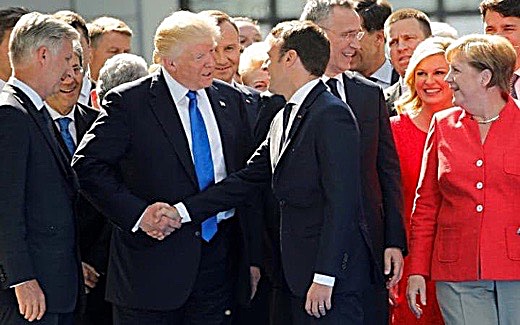
Image above: After pushing his way to the front of the G7 leaders Trump has a "tug of War" handshake with newly elected French President Emmanuel Macron who was trying to avoid the orange clown. From (http://www.unionleader.com/article/20170526/NEWS06/170529490).

In addition to stymying action on fossil fuels, Trump also 'forced the Italian prime minister Paulo Gentiloni to shred plans for an ambitious statement stressing the plight of migrants.

Further isolating the United States as other world powers prepare to take on the crisis of climate change, President Donald Trump refused to commit to the landmark Paris Climate Agreement as the remaining G7 leaders reaffirmed their determination to implement the accord.

In what has been described as an "unusually frank statement," the G7 Taormina Leaders' Communiqué (pdf) released Saturday after the two-day meeting in Sicily, says that the U.S. is "in the process of reviewing its policies on climate change and on the Paris Agreement and thus is not in a position to join the consensus on these topics."

"Understanding this process," the document continues, "the heads of state and of government of Canada, France, Germany, Italy, Japan, and the United Kingdom and the presidents of the European Council and of the European Commission reaffirm their strong commitment to swiftly implement the Paris Agreement."

Meanwhile, Trump took to Twitter to announce that he would "make a final decision on the Paris Accord next week," but it was clear the U.S. president had been a substantial roadblock over the course of the summit.

"The entire discussion about climate was very difficult, if not to say very dissatisfying," German Chancellor Angela Merkel told reporters on Saturday. "There are no indications whether the United States will stay in the Paris Agreement or not."

On those deliberations, The Guardian reported:
During the two-day conclave in Taormina, other leaders repeatedly urged Trump to recognize that as world's second biggest carbon emitter, the U.S. had to show leadership on climate issues.

Leaders warned the U.S. president that he risks a stampede, as others in the 195-nation agreement use American withdrawal from the treaty to reduce their own commitments.

Trump retained the option of pulling out of the treaty altogether or, more likely, scaling back on the specific commitments made by the Obama administration. Obama pledged to cut domestic greenhouse gas emissions 26-28 % below 2005 levels by 2025.
While not surprised, environmental groups expressed dismay over Trump's recalcitrance.
The truncated six-page document (compared with last year's 32-page tome), which outlines the industrialized nations' top priorities, "offered only minimal language on climate change and energy," the Union of Concerned Scientists noted.

Alden Meyer, a leading expert on the United Nation's international climate negotiations process and director of strategy and policy with the organization, said that Trump's "continued waffling on whether to stay in or withdraw from the Paris Agreement made it impossible to reach consensus at the Taormina summit on the need for ambitious climate action."

But, Meyer continues, "he stands in stark isolation, as the leaders from Europe, Canada, and Japan have made it crystal clear they intend to fully implement their national commitments under the Paris Agreement and pursue efforts to decarbonize the global economy."

More concisely, Alex Doukas, senior campaigner at Oil Change International, said: "even though Donald Trump threw a tantrum, the grown-ups in the room ignored him."

However, Doukas did note that the group stopped short of reaffirming their commitment to phase out fossil fuel subsidies by 2025.

"G7 leaders caved in the face fossil fuel cronyism, and were silent on their prior commitment to end fossil fuel subsidies by 2025—despite this language being agreed at the meeting of G7 energy ministers in April," Doukas said.

"Subsidizing fossil fuel companies in the face of rapid climate change is like spraying jet fuel on a burning home. To put out the fire, we must first stop making the problem worse," Doukas continued.

"Ignoring the problem just because fossil fuel industry mascots like Trump demand it is like agreeing to take the warning labels off of cigarettes because they offend Joe Camel. Our leaders must act now to stop burning our tax dollars and stop trashing the climate."

In addition to stymying action on fossil fuels, Trump also reportedly "forced the Italian prime minister Paulo Gentiloni—the summit host—to shred plans for an ambitious statement stressing the plight of migrants was a global rather than regional responsibility," the Guardian reported.

One unnamed European diplomat told the Independent that "[t]here was very strong opposition by the Americans and British who wanted to refocus on security and water down the expansive language on freedom of movement."

Opening up borders was one of the primary demands of the protesters who rallied on the streets of the Italian resort community on Saturday. Thousands of peaceful activists marched and carried signs, that included phrases like "Freedom, not Frontex," referring to the European Union's draconian border control agency.

Instead, the groups settled on language committing to fighting "protectionism" through trade and terrorism, as well as vowing to impose additional sanctions against Russia if warranted.


.

Ready, Set, Splat!

SUBHEAD: If the credit-worthiness of France takes a wrong turn, it will upset the global currency system.

By James Kunstler on 24 April 2017 for Kunstler.com-
(http://kunstler.com/clusterfuck-nation/ready-set-splat/)


Image above: Marine Le Pen and Emmanuel Macron were big winners in first round of French election for presidency. From (https://en.news-front.info/2017/02/05/french-elections-le-pen-and-macron-rally-supporters/).

As I write, the French stock market (the CAC 40), is doing a grand jeté (up 4.5 percent!) in celebration of Emmanuel Macron’s assumed slaying of the dragon Le Pen. But that was just the first round under the interesting French election system.

Consider that two other candidates who were eliminated, Monsieurs Fillon and Mélenchon, got nearly 40 percent of the vote. Are we so sure about where their voters go in the second and final round two weeks from now?

I suspect that most Americans — even the ones who follow Rachel Maddow — are about as interested in French politics as differential calculus.

Macron, 36, is a blank slate.

He was finance minister under current president François Hollande, of the Socialist Party, but declared during the election campaign that he’s not a socialist, he only wanted to be of service to his country, and this time he ran under his own party, En Marche!

He appears to represent the continuation of business-as-usual with the European Union, which seems to put him on the wrong side of history at this crucial moment — if you suppose, as I do, that the EU is so riddled with hopeless financial contradictions and centrifugal political tensions that it is unlikely to persist.

Yet, understandably, people are reluctant to change the system they’re living under. Le Pen wants to blow the EU up, especially the bureaucracy lodged in Brussels that has become a self-serving and self perpetuating monster.

Blowing up the EU would necessarily, it seems, mean the end of the European Central Bank, and with it the scams and Ponzi schemes that have provided an appearance of normality, despite an official 10.5 percent unemployment rate in France and a constant chain of public massacres by resident Jihadistas of one sort or another, some of them perpetrated by radical refugees allowed in under EU policy.

Macron might serve the interests of the American Deep State, which is determined to drive a wedge between Europe and the Chinese-Russian-Iranian “silk road” economic bloc that would consolidate trade in the Eastern Hemisphere.

The US wants “the West” to remain what it had been for seventy years: the dominant posse. Even if the underlying conditions remained the same, this might not be possible.

But those underlying conditions are changing, and in ways that much of the political maneuvering across the West cannot alter, or even comprehend, for instance, the inability of these mature industrial economies to grow anymore. That is largely a function of the end of affordable energy.

Unfortunately, the absence of growth portends not stagnation but collapse as society fails to generate enough new wealth to pay its debts.

Now, we’ve seen a pretty impressive demonstration of advanced nations playing financial games to cover up this corrosive condition. But the dishonesty at work is pretty obvious, and the problem with dishonesty in financial affairs is that it represents unreality.

The accrued momentum in colossal sums of money flowing this way and that way has allowed unreality to reign in international finance for a while. But that is now flying apart. The ultimate reality, politicians and economists will soon discover, is that you can’t create your own reality.

So whatever you think now about the French election, or the fate of the EU, is liable to change as the great debt crack-up our time finally gets underway and suddenly every nation has to scramble desperately to keep its shit together.

That magic moment may be at hand this week as the US congress returns from Easter recess to face its budget and debt ceiling dilemmas.

If the credit-worthiness of this country takes a wrong turn, it will upset the global currency system.

In fact, it will rip a hole in financial time-and-space into which the presumed value of all sorts of things represented on paper and computer drives will disappear, never to be seen again.

.

The Lie of the Land

SUBHEAD: Will Trump’s presidency spell disaster for the climate, or can the green movement seize back the debate?

By Paul Kingsnorth on 18 March 2017 for The Guardian -
(https://www.theguardian.com/books/2017/mar/18/the-new-lie-of-the-land-what-future-for-environmentalism-in-the-age-of-trump)


Image above: Detail of photo of man in suit ignoring woman with sign reading "Need ticket home 2 Maine! Stranded in NYC w/abusive husband! Please help me get out of here!" From (http://www.pbs.org/newshour/making-sense/why-education-wont-solve-americas-inequality-crisis/).

Last June, I voted to leave the European Union. I wasn’t an anti-EU fanatic but I was, despite my advancing years, still something of a green idealist.

 I had always believed that small was beautiful, that people should govern themselves and that power should be reclaimed and localized whenever possible. I didn’t think that throwing the people of Greece, Spain and Ireland to the wolves in order to keep bankers happy looked like the kind of right-on progressive justice that some of the EU’s supporters were claiming it represented.

So I voted to leave. I didn’t say anything about this before the vote and, despite being a writer, I didn’t write about it either. There was too much mudslinging on both sides already, and I didn’t want to throw any more or have any thrown at me. In any case, I didn’t have much to say.

The mudslinging, it turned out, was just a prelude to what would come next. The EU referendum, like the election of Donald Trump in the US five months later, and the Scottish independence question, newly reopened this week, tore the plaster off a pre-existing national wound that now began to bleed freely.

All sorts of things bubbled up that had been suppressed for years, and everyone was suddenly taking sides. Some people, when I told them that I’d voted to leave, looked at me as if I’d just owned up to a criminal record.

Why would I do that? Was I a racist? A fascist? Did I hate foreigners? Did I hate Europe?

I must hate something.

Did I know how irresponsible I had just been? Had I changed my mind yet? I needed to go away and check my privilege.

The eruption of anger that followed the vote, on all sides, was surprising enough. But what was also surprising to me was the uniformity of opinion among people I had thought I shared a worldview with.

Most people in the leftish, green-tinged world in which I had spent probably too much time over the years seemed to be lining up behind the EU.

The public intellectuals, the Green party, the big NGOs: all these people, from a tradition founded on localization, degrowth, bioregionalism and a fierce critique of industrial capitalism, were on board with a multinational trading bloc backed by the world’s banks, corporations and neoliberal politicians. Something smelt fishy.

I was born in the early 1970s. At around the same time, two forces – two movements, if you like – were also born that would shape the lives of my generation. One was neoliberalism. The other was environmentalism.

Neoliberalism was an economic project. It sought to replace stuttering statist economic models with a new laissez-faire order by removing “barriers to trade” wherever they might be found.

These barriers might be protectionist tariffs or taxes; they might also be national laws, local customs or environmental regulations.

The creation of the World Trade Organization in 1995 was the culmination of a decades-long project, pushed by the economic and military might of the United States and its allies, to globalize the neoliberal model and cement it in international law.

By the early 21st century it seemed that this globalization process was both unstoppable and almost complete. Political parties from all traditions had surrendered to it, and the pundits and the economists were happily on board.

In the process, the economic project had developed into a cultural one, promulgated by its beneficiary class, the urban, tech-savvy, cosmopolitan bourgeoisie.

Often referred to as “globalism”, this worldview envisaged a borderless, one-world culture, in which trade tariffs and national boundaries were seen as equally damaging to the new hypercapitalist conception of freedom.

Traditions, distinctive cultures, national identities, religious strictures, social mores – all would dissolve away in the healing light of free trade and a western liberal conception of social progress.

Only bigots and luddites could possibly oppose such a utopian dream.
Being something of a luddite myself, I wrote a book, One No, Many Yeses, opposing it 15 years ago.

The book tracked the great wave of anti-globalization movements that washed over the world at the end of the 20th century, from the summit blockades at Seattle, Prague and Genoa to the uprising of the Zapatistas in Mexico and the anti-privatisation riots in South Africa.

What I found as I investigated these movements was that the most lasting of them were fuelled not by a general rage against “the system”, but by a sense of place and belonging.

Somewhere that people loved or felt attached to was being threatened by outside forces, whether they be trade treaties, buccaneering corporations or oppressive governments, and people were fighting to defend what they knew and what they were.

This sense of the uniqueness of places, and of the cultures that sprang from them, had been what pushed me towards green activism in the first place.

From a young age I had an inchoate sense that much of the world’s color, beauty and distinctiveness was being bulldozed away in the name of money and progress.

Some old magic, some connection, was being snuffed out in the process. It must be 20 years since I read the autobiography of the late travel writer Norman Lewis, The World, The World, but the last sentence stays with me.

Wandering the hills of India, Lewis is ask by a puzzled local why he spends his life traveling instead of staying at home. What is he looking for? “I am looking for the people who have always been there,” replies Lewis, “and belong to the places where they live. The others I do not wish to see.”

As a writer, whether of fiction or non-fiction, I have been looking for the same thing. That first book of mine, it turned out, was a journey in search of people who belong. It was a defence of a threatened fragility. A few years later, I wrote another, this time about globalisation’s impact on England, my home country.

I’ve since written novels and essays and poems and they always seem, however hard I try to write about something else, to circle back around to that primal question: what does it mean to belong to a place, to a people, to nature, in a time in which belonging is everywhere under attack?

 Does it mean anything? Why should it matter?

All I know is that it matters to me. That was why I joined what I wanted to believe was a movement that could derail globalization. For a while, it looked like it might.

Then came 9/11, and a different kind of anti-globalization movement – violent Islamism – began stalking the west. Governments cracked down on dissent and populations grew fearful. Everything suddenly seemed darker.

Still it seemed that nothing could stop the neoliberal train. It kept rolling, faster and faster, until in 2008 it hit a wall at full speed.

Remarkably, it survived the crash. When the banks were bailed out and the corporations given another series of blank checks, I gave up on the idea that much would ever change.

The power of money seemed as stark as the stench of corruption. Perhaps neoliberalism was unstoppable after all. Perhaps, as Margaret Thatcher had once famously claimed, there was, indeed, no alternative.

On 24 June last year I woke up, made a cup of tea and turned on my computer, wondering by what margin the nation had voted to remain in the EU. On the BBC website, the headline seemed to take up the whole screen: BRITAIN VOTES TO LEAVE THE EUROPEAN UNION.

Five months later, my morning seemed to repeat itself. I woke up, made another cup of tea, wondered how many votes Clinton had won by, and then gaped at the margin of Trump’s victory. It was clear the poles were shifting. Something big was going on.

On both occasions I can remember precisely how I felt. It was a feeling that had nothing to do with what might happen next, and it wasn’t really related to my opinions about any of the issues involved.

The feeling was exhilaration. I suddenly realized that for the last decade I had believed, even though I had pretended not to believe, in the end of history. Now, the end of history was ending. Change was possible after all.

I also began to realize something else: the anti-globalization movement had not died. Its impulse had driven Brexit as it had driven Donald Trump’s victory. It had driven Jeremy Corbyn’s rise, and those of Syriza in Greece and Bernie Sanders in the US.

In their different ways and for different reasons, coalitions of people were again pushing back against the dehumanizing world that the global economy was creating. Globalization had been impoverishing the south for decades. Now it was impoverishing the west, too, and the discontent had reached boiling point.

But change is a trickster and it makes no promises.

Back in the day, those of us who fancied ourselves as radicals thought we were the shock troops in the battle against globalization. As a young greenie, I would consume the words of Edward Abbey and Murray Bookchin, Vandana Shiva and EF Schumacher, James Lovelock and Dave Foreman.

These were the people who were constructing the sane future, and I wanted to join them.

Campaigning environmentalists, the “social justice” movement, the lefties and the greens: we would be the heroes of the coming hour.

Our rational solutions to climate change, our well-argued deconstructions of neoliberalism, our piles of evidence about the negative impact of trade treaties, our righteous demands for justice – these would shake the world. When they learned the truth about the continuing corporate stitch-up, the people would rise up in opposition.

They did rise up in the end, but it wasn’t us they were listening to. The message had found a different messenger. Trump said in his last TV spot before election victory:
“There is, a global power structure that is responsible for the economic decisions that have robbed our working class, stripped our country of its wealth and put that money into the pockets of a handful of large corporations and political entities”.
They were words that could have been heard at any social forum, anti-globalization gathering or left-green beanfeast from the last 20 years, as could the rousing final sentence:
“The only thing that can stop this corrupt machine is you.”
In a penetrating essay in The American Interest last July, social psychologist Jonathan Haidt sought to place all this in context. He suggested that the old left-right political divide, which had been looking iffy for years, was being supplanted by a new binary: globalism versus nationalism.

Nationalism, in the broadest sense of the term, was the default worldview of most people at most times, especially in more traditional places. It was a community-focused attitude, in which a nation, tribe or ethnic group was seen as a thing of value to be loved and protected.

Globalism, the ideology of the rising urban bourgeoisie, was more individualistic. It valued diversity and change, prioritized rights over obligations and saw the world as a whole, rather than particular parts of it, as the moral community to which we all belong.

The current explosion of nationalism in the west, Haidt said, was due to globalism having overplayed its hand. Different attitudes to the issue of mass immigration – the spark that lit the fire on both sides of the Atlantic – demonstrated how this had happened.

While globalists saw migration as a right, nationalists saw it as a privilege.

To a globalist, border walls and immigration laws are tantamount to racism or human rights abuse.

To a nationalist, they are evidence of a community asserting its values and choosing to whom to grant citizenship.

Psychologically, Haidt suggested, what happened in 2016 was that many nationalist-inclined voters in the west felt that their community was now under existential threat – not only from large-scale migration, but from Islamist terrorist attacks and the globalist elite’s dismissive attitude to their concerns about both.

In response, they began to look around for strong leaders to protect them. The rest is history, still in the making.

This is the power of the new populists. The likes of Stephen Bannon and Marine Le Pen understand the destructive energy of global capitalism as well as the left does, but they also understand what the left refuses to see: that the heart of the west’s current wound is cultural rather than economic.

What is driving the modern turmoil are threats to identity, culture and meaning. Waves of migration, multicultural policies, eroding borders, shifting national and ethnic identities, globalist attacks on western culture: all that is solid is melting into air.

Who can promise the return of that solidity?

Not the left, which long ago hitched its wagon to the globalist horse, enthusing about breaking down everything from gender identities to national borders and painting any dissent as prejudice or hatred.

Instead, a new nationalism has risen to the occasion. As ever, those who can harness people’s deep, old attachment to tribe, place and identity – to a belonging and a meaning beyond money or argument – will win the day. This might be as iron a law as any human history can provide.

It didn’t take Trump’s cabinet of millionaires long, having got themselves comfortable in the White House, to start dismantling the nation’s environmental protections.

Two months in, the administration has given the green light to two controversial oil pipelines and removed environmental oversight on others, cancelled Obama’s climate action plan, removed regulations protecting clean water and appointed a former head of ExxonMobil as secretary of state.

Anti-green campaigner Myron Ebell, who believes that environmentalism is “the greatest threat to freedom and prosperity in the modern world” was asked to head Trump’s transition team for the Environmental Protection Agency, which he wants to abolish, and which has just seen its budget slashed by 25%.

Trump himself is notorious for his cavalier attitude to anything furry or leafy that gets in the way of his gaudy developments. The natural world has always been an inconvenient barrier to economic growth, which is why we are faced with a global ecological crisis.

But Trump’s anti-environmentalism, while it serves the interests of corporations, speaks the language of the people. In his telling, protecting the natural world from destruction is another example of the globalist elite sticking it to ordinary folk.

The notion that environmentalists are a privileged elite telling the hard-pressed that they can’t have decent lives has been a staple of corporate propaganda for decades.

Look at these horrible elitists, runs the line, trying to abolish your hard-earned holiday flights and double the price of your car journey. Who are they to tell you that you can’t give your children plastic toys at Christmas, or eat air-freighted avocados? Have you seen the size of Al Gore’s house?

Hypocrites!

Like all effective propaganda lines, this one works because there is some truth in it.

The environmental movement that emerged in the west more than 40 years ago, with the founding of organizations such as Greenpeace and Friends of the Earth and the birth of green parties across Europe, had its roots in the conservation world.

While its outlook was planetary – no true ecological movement can be anything else – its actions were often local or national. “Think globally, act locally”, perhaps the movement’s most effective early slogan, looks in retrospect like a beautiful combination of the best of the globalist and the nationalist impulses.

These days, though, as the Brexit vote demonstrated, green politics is a marker of the globalist class.

With their grand ecological Marshall Plans and their talk of sustainability and carbon, environmentalists today often seem distant from everyday concerns.

Green spokespeople and activists rarely come from the classes of people who have been hit hardest by globalization. The greens have shifted firmly into the camp of the globalist left. Now, as the blowback gathers steam, they find themselves on the wrong side of the divide.

All this can look like bad news from a certain perspective, but maybe it isn’t.

While environmentalism has changed the world in the last four decades, in recent years it has been spinning its wheels.

Increasingly unrealistic demands for global action on climate change, pie-in-the-sky manifestos calling for global rollouts of this or that eco-megaplan, the promotion of enormous windfarms or solar arrays that do more damage to wild nature than they prevent, all backed with a “40 months to save the world” narrative that’s been going on for 40 years: something had to give.

Some of the new populists may hope they can sound the death knell of the green movement, but perhaps they can instead teach it a necessary lesson.

What Haidt calls nationalism is really a new name for a much older impulse: the need to belong.

Specifically, the need to belong to a place in which you can feel at home. The fact that this impulse can be exploited by demagogues doesn’t mean that the impulse itself is wrong. Stalin built gulags on the back of a notional quest for equality, but that doesn’t mean we should give up on trying to make things fair.

The anti-globalist attack on the greens is a wake-up call. It points to the fact that green ideas have too often become a virtue signal for the carbon-heavy bourgeoisie, drinking their Fairtrade organic coffee as they wait for their transatlantic flight.

Green globalism has become part of the growth machine; a comfortable notion for those who don’t really want much to change.

What would happen if environmentalism remade itself – or was remade by the times?

What might a benevolent green nationalism sound like?

You want to protect and nurture your homeland – well, then, you’ll want to nurture its forests and its streams too. You want to protect its badgers and its mountain lions. What could be more patriotic?

This is not the kind of nationalism of which Trump would approve, but that’s the point. Why should those who want to protect a besieged natural world allow billionaire property developers to represent them as the elitists? Why not fight back – on what they think is their territory?

It has been done before. The nation that gave us Trump also gave us Teddy Roosevelt, another Republican populist president, but one who believed that America’s identity was tied up with protecting, not despoiling, its wild places.

Roosevelt created one of the greatest systems of protected areas and national parks in the world, using his presidency to save 230m acres of land. He wrote:
 “We have fallen heirs to the most glorious heritage a people ever received,”“and each one must do his part if we wish to show that the nation is worthy of its good fortune.”
Protecting nature, Roosevelt believed, was a patriotic act.

If I had to offer up just one thing I have learned from my years of environmental campaigning, it would be this: any attempt to protect nature from the worst human depredation has to speak to people where they are.

It has to make us all feel that the natural world, the non-human realm, is not an obstacle in the way of our progress but a part of our community that we should nurture; a part of our birthright. In other words, we need to tie our ecological identity in with our cultural identity.

In the age of drones and robots, this notion might sound airy or even ridiculous, but it has been the default way of seeing for most indigenous cultures throughout history.

In the resistance to the Dakota Access pipeline, recently given the go-ahead by Trump, where the Standing Rock Sioux and thousands of supporters continue to resist the construction of an oil pipeline across Native American land, we perhaps see some indication of what this fusing of human and non-human belonging could look like today; a defense of both territory and culture, in the name of nature, rooted in love.

Globalism is the rootless ideology of the fossil fuel age, and it will fade with it. But the angry nationalisms that currently challenge it offer us no better answers about how to live well with a natural world that we have made into an enemy.

Our oldest identity is one that stills holds us in its grip, whether we know it or not.

Like the fox in the garden or the bird in the tree, we are all animals in a place. If we have a future, cultural or ecological – and they are the same thing, in the end – it will begin with a quality of attention and a defense of loved things. All else is for the birds, and the foxes too.

• Paul Kingsnorth’s new book, Confessions of a Recovering Environmentalist, is published by Faber.

.