Showing posts with label Conservatism. Show all posts

Destruction of our postal service

SUBHEAD: The Trump Administration, Republicans and corporations are already taking it apart.

By Jim Hightower on 2 January 2019 for nTruthDig  -
(https://www.truthdig.com/articles/the-wholesale-destruction-of-our-postal-service-is-already-underway/)


Image above: USPS mail truck on delivery. From original article.


Last spring, President Trump created an inter-agency federal task force to propose structural reforms in the U.S. Postal Service.

In only two months, the task force (comprised entirely of top Trump officials) zapped out a down-and-dirty report with this key recommendation: 
“Prepare [USPS] for future conversion from a government agency into a privately-held corporation.”
Privatization! Are they not aware that our public postal agency is enormously popular and important to… well, to the public?

A February Pew Research poll finds that an astonishing 88 percent of Americans give the Postal Service a thumbs up.
Even the president’s executive order setting up the task force conceded that the post office “is regularly cited as the Federal agency with the highest public approval rating.”

The 640,000 middle-class postal workers and letter carriers merit such kudos because they literally deliver for us.
Working from 31,585 local offices, they trundle 150 billion pieces of mail a year, 4 million miles a day, to 157 million addresses across the land — from inner-city neighborhoods to back roads — delivering all with remarkable speed.

USPS does this without taking a dime in taxpayer funds, financing its operations entirely from its sales and services to customers. This is a genuine public good linking all of America’s people together.

For decades, though, anti-government propagandists have pushed the narrative that government is inherently incompetent, wasteful, and a social evil that must to be eliminated.
But the problem for these ideologues is that USPS is not only a government agency that works, but millions of folks see it working for them daily.

Therefore, to maintain the negative political narrative about public entities, the far-right corporatists are desperate to kill our public post offices.

.

Armageddon Rides in the Balance

SUBHEAD: Never before have irrationality and immorality had such a firm hold on the US government.

By Paul Craig Roberts on 10 September 2018 for PaulCraigRoberts.org -
(https://www.paulcraigroberts.org/2018/09/10/armageddon-rides-in-the-balance/)


Image above: Many in this world inhabit Armageddon already. Damaged buildings are seen at the Yarmouk Palestinian camp in Damascus, Syria. April 28, 2018. Photo by Omar Sanadiki. From (https://www.thenational.ae/world/mena/syria-regime-and-rebels-agree-evacuation-deal-in-southern-damascus-1.725770).

IB Publisher's note: Yes Paul Craig Roberts is a nutcake. He is a Ronald Reagan Republican economist who sees clearly, but through a deeply colored filter. None the less, he does have an inkling of the dichotomy between the "Left" and the "Right". The "Left" with elements of the "Deep State" (intelligence complex, CIA, NSA, State Department, etc) and the "Right" with elements of the "Military-Industrial Complex" (Pentagon, Defense contractors, Mercenary operations, ICE, etc.). Both aspects of our government are hurtling towards a more repressive and garrulous America. As these aggressive and regressive forces gain influence, woe is us. America will conduct more war and experience more repression.] 

For some time I have pointed out the paradox of the American liberal/progressive/left being allied with the CIA, FBI, military/security complex and deep state. Now leftist Ann Garrison has noticed the paradox of this alliance. She concludes that the Left has lost its mind. https://www.globalresearch.ca/we-love-the-cia-or-how-the-left-lost-its-mind/5653450

Indeed, it has.

Out of its hatred of Trump the Left has united with the forces of evil and war that are leading to conflict with Russia. The Left’s hatred of Trump shows that the American Left has totally seperated from the interests of the working class, which elected Trump.

The American Left has abandoned the working class for the group victimizations and hatreds of Identity Politics. As Hillary put it, the working class comprises the “Trump deplorables.” The Democratic Party, like the Republicans, represents the ruling oligarchy.

I have explained that the leftwing lost its bearings when the Soviet Union collapsed and socialism gave way to neoliberal privatizations.

The moral fury of the leftwing movement had to go somewhere, and it found its home in Identity Politics in which the white heterosexual male takes the place of the capitalist, and his victim groups—blacks, women, homosexuals, illegal immigrants—take the place of the working class.

The consequences of the leftwing’s alliance with warmongers and liars is the leftwing’s loss of veracity. The Left has endorsed a CIA orchestration—“Russiagate”—for which there is no known evidence, but which the Left supports as proven truth.

The purpose of “Russiagate” is to prevent President Trump from normalizing relations with Russia. In these times when so many Americans are hard pressed, normal relations could adversely impact the budget and power of the military/security complex by reducing the “Russian threat.”

If there is no real Russian threat, only an orchestrated perceived one, the question arises: why does the military/security complex have a taxpayer-supported annual budget of $1,000 billion dollars?

The presstitutes have kept the truth from emerging that the “Russiagate” investigation has found no sign of a Trump/Putin plot to steal the 2016 presidential election from Hillary.

Indeed, it has been proven beyond all questioning that the Hillary emails were not hacked but were downloaded on a thumb drive. This proof collapses the entire premise of “Russiagate.”
Nevertheless, the hoax continues.

Muller’s indictments are for unrelated matters, such as income tax evasion in the distant past of Republican fund raisers and consultants. These charges have nothing whatsoever to do with Mueller’s mandate.

Indeed, as Andrew C. McCarthy, a former US attorney who led the 1995 terrorism prosecution against Sheik Omar Abdel Rahman for the 1993 World Trade Center bombing, has made clear, Deputy Attorney General Rod Rosenstein’s appointment of Mueller to head the “Russiagate” investigation is not in compliance with the regulations that govern the appointment of a special prosecutor.

The appointment of a special prosecutor requires evidence of a specific federal crime that is to be investigated. You only have a special prosecutor when there is factual basis for believing that a federal crime has been committed.

What is the federal crime? What is the factual basis? Mueller’s appointment does not say. Therefore, Mueller’s appointment is invalid. Rosenstein has violated the process.

In my opinion, this is grounds for Rosenstein to be removed from office. https://www.nationalreview.com/2018/09/trump-russia-probe-robert-mueller-investigation/

At one time, Congress—both parties—would have been all over the invalid Mueller appointment.

However, after 16 years of Cheney/Bush and Obama regime lawlessness, even Republicans accept that the Constitution’s restraints on executive branch power, along with the laws and regulations Congress has established specifying the exercise of these powers, have been rendered meaningless by the “war on terror,” a hoax designed to further Israel’s interests in the Middle East and the neoonservative doctrine of US hegemony, while making billions of dollars for the military/security complex.

Charlie Savage’s book, Takeover, and David Ray Griffin’s book, Bush and Cheney: How They Ruined America and the World, accurately document how 9/11 was used to destroy the Constitution’s balance of power within the government and to create unaccountable executive branch powers that over-ride the Constitution’s protection of civil liberty.

This demand for an unaccountable executive branch, pushed by VP—actually President in fact—Dick Cheney and his minions, such as Addington and John Yoo, was the agenda of the Republican Federalist Society.

An early book laying out the legally invalid and legally incompetent argument that the president had powers unchecked by Congress or the judiciary was Terry Eastland’s book, Energy in the Executive.

This collection of nonsense became Cheney’s bible as he proceeded in secret to remove constraints on executive branch power. The elevation of the executive branch above the law of the land is documented in Charlie Savage’s book. Read it and weep for your country destroyed by Dick Cheney.

On top of Cheney’s coup against accountable government, we have in America today another coup, organized by former CIA director John Brennan, former FBI director Comey, deputy attorney general Rod Rosenstein, the Democratic National Committee, the departed Republican senator John McCain, a coup fully supported by the entirety of the US presstitute media.

This coup is against the democratically elected President of the United States for the sole reason that he threatens the power and profit of the entrenched military/security complex, about which President Eisenhower warned us 57 years ago, by wanting to normalize relations with Russia, the world’s premier nuclear power.

The question is unavoidable: Why do the American people put up with this? Are they so insouciant that they have no realization that, if a president can be driven from office because he wants peace with Russia, the removed president’s successor will have to stand against Russia or also be driven from office. Trust and negotiation between the nuclear powers becomes impossible.

Why do Americans support conflict with a nuclear power that can completely destroy America?

During the entirety of the Cold War, in which I was a participant, the emphasis was on reducing tensions and creating trust. Today Washington’s interest is piling provocation after provocation on a country that can wipe us off the face of the earth.

The liberal/progressive/left, the Democratic National Committee, the CIA and the rest of the covert state, and the media whores all share this same commitment to the reckless and irresponsible provocation of a powerful nuclear power. As the US military itself acknowledges, Russia’s weapons are far beyond America’s defenses.

So what is going on? Is it the liberal/progressive/left’s desire that evil America be destroyed? Is this desired destruction of evil America the reason the Left has allied itself so tightly with the warmongers in Washington?

Is this the reason that the Left and the Democrats and a handful of Republicans want to impeach President Trump for attempting to make peace with Russia?

How can these crazed immoral people present themselves as some sort of moral arbiter when they are locked on a trajectory that will destroy Earth?

This destruction might be closer than anyone thinks. Here is the situation in Syria:

Russia and Syria, in cooperation with Iran and Turkey, have begun the assult on Iblid province, the last stronghold of Washington’s proxy army consisting of Al Qaeda, Al Nursra, and ISIS mercenaries hired by Washington.

According to reports, which might or might not be true considering the lack of veracity that is the defining characteristic of the Western media, the US and UK have troops among the mercenary forces, hoping apparently that this presence will deter the attack. As the attack has already begun, this is a false hope.

The Russians discovered Washington’s plot to explode a chemical weapon in Iblid province and exposed Washington’s plot to the UN. Washington had it set up that once its proxies created the appearance of a chemical weapon explosion, Washington would send Tomahawk missiles upon the Syrian forces, thus protecting its proxy army that it sent to overthrow Assad for Israel.

The Russian exposure of Washington’s conspiracy has denied Washington UN support. Moreover, Russia has sent a naval force armed with the new Russian hypersonic missiles to Syria and has announced that its aircraft in the area are also armed with these missiles.

As the US Navy and Air Force have no defense whatsoever against these missiles, if the US attacks the Syrian/Russian forces, it will be Putin’s decision whether any US ship or military aircraft in the area exists as anything but a smoldering ruin.

In other words, the entire power in the area lies in Russian hands. If Washington had any sense—and it doesn’t, Washington has hubris and arrogance in the place of sense—Washington would be nowhere close to Syria.

The question is this: Will the hotheads in Washington conclude that the Russian announcements and marshalling of forces is “just another Putin bluff.”

So far Putin has been loaded up with never-ending insults and provocation— blame for the crash of the Malaysian airliner, blame for poisoning a variety of people in England, blame for invading Ukraine, blame for interfering in US elections, blame for supporting the “dictator” Assad, a person democratically elected by a large vote who obviously has the support of the Syrian people as he liberates Syria from the forces Washington sent to put the country into the same chaos that exists in Iraq and Libya.

Have we reached the situation about which I have been worried, worries shared with my readers, in which Washington makes the miscalculation, based on the incorrect understanding of Russia’s resolve, to launch an attack on the Syrian/Russian forces that have begun the final liberation of Syria from Washington’s paid mercenaries?

Yesterday the Veteran Intelligence Professionals for Sanity sent a letter to President Trump advising him of the war danger that the Trump administration has created by its continued illegal interference in Syria’s internal affairs. https://www.globalresearch.ca/moscow-has-upped-the-ante-in-syria/5653571

The Russian government cannot accept Washington’s military intervention in behalf of Al Qaeda, Al Nursa, and ISIS without completely losing all credibility, not only in the world, but inside Russia itself.

A realistic alternative to military action would be for Washington to stand aside as Syria reconstitutes itself and use a propaganda war to blame Syria and Russia for civilian deaths and for destroying “democratic rebels” who rose against a “dictator.”

The fear could be expanded to the Baltics and Ukraine by reviving the propaganda that Putin intends to reconstruct the Soviet Empire.

Washington has long used an expertly manufactured fear of Russia to control Europe. Fear can keep Europe in line, whereas military action against Russia could scare Europe into taking refuge in a revival of its sovereignty.

Yesterday the Wall Street Journal reported: “President Bashar al-Assad of Syria has approved the use of chlorine gas in an offensive against the country’s last major rebel stronghold, U.S. officials said, raising the prospects for another retaliatory U.S. military strike as thousands try to escape what could be a decisive battle in the seven-year-old war.”

According to the Wall Street Journal, the US strikes could target Russian and Iranian forces as well as Syrian forces.

It is difficult to believe that Washington thinks attacks on Russian forces would go unanswered. Such a reckless and irresponsible act could initiate Armageddon.

The claim that Assad has approved the use of chlorine gas in the liberation of Iblid is propagandistic nonsense put out by Washington as an excuse for Washington’s effort to protect its proxy army in Syria with military strikes.

All Syrian chemical weapons were removed by Russia and turned over to the US during the Obama regime. Moreover, Russia would not permit Assad to use chemical weapons if he had them.

Life on earth is faced with a situation in which Washington is so determined to overthrow Assad and to leave Syria in the same chaos as Libya and Iraq that Washington is willing to risk war with Russia.

Never before have irrationality and immorality had such a firm hold on a government. The world should be scared to death of the recklessness and irresponsibility of the US government.

.

Neoliberalism: the Break-up Tour

SUBHEAD: Why, given the trail of destruction it has left, are we still dancing to the Neoliberal tune?

By Sara Woods & Andrew Simms on 16 August 2017 for Red Pepper -
(http://www.redpepper.org.uk/neoliberalism-the-break-up-tour/)


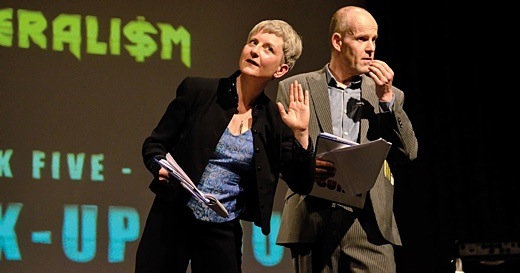
Image above: Sara Woods and Andrew Simms perform  Neoliberalism – The Break-up Tour. They aim ‘to do the almost impossible: turn economics into entertainment’. From original article.

It’s Sunday morning and you have two choices:
  1. Jump in the car and go buy a patio heater, getting stuck in traffic on the way; or 
  2. Go for a walk with a friend in the dappled sunlight lie on your back and stare at the clouds. 
Economics tells us you’re happier doing a). How did we get here? And is the mainstream economic consensus of the past four decades now really falling apart?

We created Neoliberalism – The Break-Up Tour, a fast-paced mix of stand-up and game show, to explore these questions and see if we could do the almost impossible and turn economics into entertainment.

But while many aspects of neoliberalism’s current doctrine tend to comedy and even farce, few of the many millions on its receiving end have been enjoying the show. It is not entertaining how modern economics has got away with so much despite the lack of evidence in its favour – and so much demonstrable carnage in its wake.

Ideological resurrection

Neoliberalism as we know it began just 70 years ago, in Mont Pèlerin, a small village in Switzerland. In photographs the village has the same tranquil postcard perfection that was used to deeply unnerving effect in the French television drama

The Returned, in which people inexplicably come back from the grave to the bewilderment of friends and family.

In April 1947, Mont-Pèlerin was home to an ideological resurrection and, as with The Returned, what came back was critically different to the previous incarnation.

The architects of neoliberalism favoured a faith in free markets to best meet peoples’ needs, drawing on the tradition of Adam Smith, but taken to a new, extreme level. They coupled this to an equally extreme libertarian individualism.

After some initial debate and a little falling out, they forged an assault on the public realm and the role of the state and a submission of the individual and society to market forces that Smith would have rejected.

Adam Smith was the grandfather of market economics, but a more complex thinker than modern-day neoliberals like to remember. They hail the ‘invisible hand’ – the idea that self-interest and unfettered markets work best – and recall his famous discourse on the manufacture of the pin, revealing how the specialisation and division of labour led to huge increases in productivity.

Less well remembered are his observations on the human consequences. The monotony would lead, he wrote, to the worker no longer being able to ‘exert his understanding, or to exercise his invention’ and becoming ‘as stupid and ignorant as it is possible for a human creature to become’.

Worse, considering how many would become servants to mass production, their ‘torpor of mind’ would take away their capacity for ‘rational conversation… generous, noble or tender sentiment and consequently of forming any just judgement’.

Smith also mocked the very consumerism that his market system would breed to feed itself, and was especially sceptical of corporate power, believing that whenever the two got together it would lead to a ‘conspiracy against the public, or in some contrivance to raise prices’.

Most surprising of all for latterday neoliberals are his conveniently forgotten views on the vital roles of the state.

It should, he argued, protect society from violence, protect every member from ‘the injustice or oppression of every other member’, and then, crucially, ‘erect and maintain those public institutions and those public works’ that, although of great value to society, are by nature not profitable and therefore should not be expected to be delivered by private enterprise.

Smith’s forgotten early caveats to his market system are now coming home to roost everywhere, from the business models of Uber and Sports Direct, to failed railway franchises, the painful reprivatisation of banks and the creeping privatisation of the NHS. It amounts to an intellectual collapse of the neoliberal model.

Original line-up

Neoliberalism’s original line-up gathered at the Hotel du Lac in Mont Pèlerin to discuss how to halt the spread of ideas that emphasised common purpose and governments acting directly in the public interest.

It featured Milton Friedman and Friedrich von Hayek, scions of the Chicago School of Economics, Ludvig von Mises of the Austrian school, and philosopher Karl Popper. They set out to perfect a market system that would underpin their particular vision of a free society.

Against a backdrop of highly interventionist economic planning during war time, and the rise of Stalin’s centralized, totalitarian state in the Soviet Union, they married an old, neoclassical belief in deregulated markets with newer liberal concerns about individual freedom.

They sought to rescue the reputation of market systems from their ignominious failure in the financial crash of 1929, and champion pure individualism against all forms of collective organization. The ideological temperature was set by the Austrian American, von Mises, who accused neoliberal scions Hayek and Friedman of being ‘a bunch of socialists’.

The Mont-Pèlerin Society they formed remains active today, still promoting the same message. Here’s a flavour of their motivation and atmosphere of mind, taken from their original statement of principles:

‘The central values of civilisation are in danger. Over large stretches of the earth’s surface the essential conditions of human dignity and freedom have already disappeared…

The group holds that these developments… have been fostered by a decline of belief in private property and the competitive market; for without the diffused power and initiative associated with these institutions it is difficult to imagine a society in which freedom may be effectively preserved.’

Many other influential neoliberal think tanks grew from this core group and their beliefs. But there were cracks even at the beginning. At least one who was closely involved at the outset sensed a fundamental flaw in their position.

The philosopher Karl Popper, author of The Open Society and Its Enemies, did not stay involved. He had a more nuanced view on markets and freedom, pointing out that ‘proponents of complete freedom are in actuality, whatever their intentions, enemies of freedom’.

Popper saw the logical consequence of ignoring how power, unregulated markets and unrestrained individual behaviour would interact, reasoning that this notion of freedom would, paradoxically, be, ‘not only self-destructive but bound to produce its opposite, for if all restraints were removed there would be nothing whatever to stop the strong enslaving the weak’. By Popper’s definition, neoliberalism wasn’t liberal at all.

Neoliberalism on tour

Nevertheless, from being viewed as extremists and outsiders, just over two decades of constant agitation and the proliferation of like-minded groups saw their rise to power begin with the breakdown of the post-war economic architecture, built to ensure maximum international stability. Neoliberalism has been on tour ever since, inviting itself to play all over the world. Like many of music’s big names, from the moment it was created, it started to exhibit the instability and volatility that would ultimately bring it down.

1971 saw the end of the Bretton Woods arrangement, a system that maintained ballast in the flow of money around the world and speculative trading on currencies. The end of these checks and balances waved the flag to allow money to move around the world much more easily and with greater volatility.

A secondary banking crisis hit the UK as early as 1973-75, before a whole sequence of crises hit Mexico and Latin America from 1982. This period, with the private banks and international financial institutions in the driving seat, also created conditions leading to the African debt crisis – where everyone saddled with debt due to predatory lending was told to produce the same thing for export, suppressing prices globally, leaving them running faster to stand still, while being denuded of their natural wealth, and having their health and education systems trashed in the process.

The 1980s brought the US savings and loans crisis, and ‘Black Monday’ in 1987 saw markets falling like dominoes from New York to London and Hong Kong. Then a whole carnival of market failure paraded through Finland to Mexico, Asia, Russia and Argentina before 1999, when things really started to fall apart. That year saw the end of the Glass-Steagall bank regulations, brought in to prevent a repeat of the 1929 Wall Street crash. Their removal allowed bankers to gamble with other people’s money (yours and mine) at virtually no risk to themselves, but with the chance to get vastly rich.

Then came the dot.com crash in 2000-02 and the US energy crisis. These were speculative boom-and-bust crises, exactly what you’d expect when checks and balances are removed. They were quickly followed by financial implosions in Iceland, Ireland and then the great crash of 2007-08, triggered by the US sub-prime mortgage scandal. From there, attended by the neo-medieval blood-letting medicine of austerity, problems continued in the UK, Greece and across Europe, all to the tune of ‘The Cure is Worse Than the Disease’.

It’s important to remember how recently neoliberalism retained its absolute grip on the imagination of the left. In his 2006 Mansion House speech, the year before the big crash began, the chancellor, Gordon Brown, said that many who advised him ‘favoured a regulatory crackdown’. He added, ‘I believe that we were right not to go down that road… and we were right to build upon our light touch system.’ His right-hand man, Ed Balls, said: ‘Nothing should be done to put at risk a light-touch regulatory regime.’ He didn’t say that nothing should be done to put at risk society, the welfare of the wider economy and the ecosystems on which we depend.

Still dancing

So why, given the trail of destruction that neoliberalism has already left, are we still dancing to its tune? Haven’t we learnt what J K Galbraith saw in the 1929 great crash: ‘The sense of responsibility in the financial community for the community as a whole is not small… It is nearly nil.’

If entirely self-interested private finance remains the beating heart of your economy, a bit of extra regulation won’t solve the problem. Because, as Galbraith also saw, regulators have a short, depressingly predictable lifecycle and tend to be ‘vigorous in youth, rapidly turning complacent in middle age, before either becoming senile or an arm of the industry they are meant to regulate’.

Shareholder capitalism keeps the self-interest of finance in the economic driving seat. Without making finance actively subservient to broader social, economic and environmental purpose – by law and through different governance models such as mutual, cooperatives and social enterprises – we just get more of the same. And the very failures of the financialised economy are used to further entrench it. The answer to everything becomes more privatisation, liberalisation and deregulation.

As long as that happens, its price is set by quality of life – and life itself. Cost-cutting and a weak regulatory system have led to the Grenfell Tower disaster. Ninety people per month die after being declared fit for work by the DWP and losing their benefits. Inequality has been rising for three decades, and we are on course to return to Victorian levels. Work is increasingly insecure and low paid. Five million workers give the equivalent of a day’s worth of free overtime to their employers every week.

A model based on competitive, selfish individualism is blind to the fundamental mechanisms of collaboration, mutual aid, cooperation, sympathy, empathy and sharing that have been at the core of our development and success as a species. High-paid City bankers are estimated to destroy £7 in social value for every pound they generate. Advertisers are worse and tax accountants much, much worse. But look at childcare workers, hospital cleaners and waste recyclers, where the opposite is true. Although on desperately low pay, they create seven to 12 times more social value than the amount they are paid.

A more positive take

We have been so indoctrinated by neoliberalism that even though research shows that the great majority of us hold values that emphasize caring, generosity, tolerance and cooperation, when we’re asked what we think are others’ values, we suspect most to be the selfish, competitive, individualistic poster children of neoliberalism.

So what opportunities might open up if we give that more realistic and positive take on human reality a chance, and allow policies to be put into place for fair shares, cooperation and respect for planetary boundaries?

Perhaps that would be a nice, simple policy test: does this proposal lead to a more equal sharing of economic benefits, a smaller ecological footprint and improved human well-being? If it can likely tick those boxes, give it a try.

How do we do it? In many ways, the new world is already here, in the shell of the old. In Germany, banks are dominated by mutuals and cooperatives, with a clear mandate to help people and the economy rather than just themselves. In Holland, the four-day week offers a lower impact, better work/life balance.

Despite all the obstacles, community-owned renewable energy, working for people and planet, is growing dramatically – by 17 per cent last year in Scotland, for example.

Neoliberalism is in its intellectual death throes, unable to answer the systemic threats it has created. A better world is possible if we take away the excessive privilege of finance and make it subservient to real life.

Money and the markets are not innate, they’re not like gravity, they’re human made contracts between ourselves about how we organize society.

It’s time for neoliberalism’s zombie economics, peddling suicide finance, to stop touring and let those playing planet and human-friendly economic tunes take the stage.

.

Manchester, or Innocence Long Lost

SUBHEAD: An 8-year old child in Manchester, just like one in Mosul or Aleppo, is innocent.

By Raul Ilargi Meijer on 27 May 2017 for the Automatic Earth -
(https://www.theautomaticearth.com/2017/05/manchester-or-innocence-long-lost/)


Image above: Mass media propaganda demonizes children in Iran to exhort more violence against our "enemeies". It's all lies. Stop the violence against the Middle East and Islam. It's our kuleana. From (https://themediaexpress.com/2017/03/11/military-training-camps-for-iranian-children-to-prepare-for-jihad/).

[IB Publisher's note: This is a long and detailed piece... certainely longer than most we post on IslandBreath. Raul Ilargi Meijer hits the nail on the head by implicating Western culture with complicity in the atrocity of the endless War on Terrorism.]

There are times when you have to talk about things when it appears most inopportune to do so, because they’re the only times people might listen. Times when people will argue that ‘this is not the right moment’, while in reality it’s the only moment.

A solid 99% of people will have been filled, and rightly so of course, with a mixture of disgust, disbelief and infinite sadness when hearing of yet another attack on civilians in Europe, this one in Manchester. An equally solid 99% will have failed to recognize that while the event was unique for the city of Manchester, it was by no means unique for the world, not even at the time it happened.

Though the footage of parents desperately trying to find their children, and the news that one of the dead was just 8 years old, touches everyone in more or less the same place in our hearts, by far most of us miss out on the next logical step.

In a wider perspective, it is easy to see that parents crying for missing children, and children killed in infancy, is what connects Manchester, and the UK, and Europe, to parents in Syria, Libya, Iraq.

What’s different between these places is not the suffering or the outrage, the mourning or the despair, what’s different is only the location on the map. That and the frequency with which terror is unleashed upon a given population. But just because it happens all the time in other places doesn’t make it more normal or acceptable.

It’s the exact same thing, the exact same experience, and still a vast majority of people don’t, choose not to, feel it as such.

Which is curious when you think about it. In the aftermath of a terror attack, the mother of a missing, maimed or murdered child undergoes the same heartbreak no matter where they are in the world (“I hope the Russians love their children too”). But the empathy, the compassion, is hardly acknowledged in Britain at all, let alone shared.

Not that it couldn’t be. Imagine that our papers and TV channels would tell us, preferably repeatedly, in their reports in the wake of an attack like the one in Manchester how eerily similar the emotions must be to those felt in Aleppo, Homs and many other cities.

That would change our perception enormously. But the media choose not to make the connection, and the people apparently are not capable of doing it themselves.

None of that changes the fact, however, that British lives are not more valuable than Syrian and Libyan ones. Not even when we’ve gotten used to ‘news’ about bombings and drone attacks executed for years now by US-led coalitions, or the images of children drowning when they flee the area because of these attacks.

The overall theme here is that 99.9% of people everywhere in the world are innocent, especially when they are children, but their governments and their societies are not. That doesn’t justify the Manchester attack in any shape or form, it simply lays equal blame and condemnation for western terror attacks in the Middle East and North Africa, perpetrated by the people we elect into power.

 This is something people in the west pay no attention to. It’s easier that way, and besides our media with great enthusiasm pave the way for our collective ignorance, by calling some other group of people ‘terrorists’, which while they’re at it is supposed to justify killing some other mother’s child.

There’s another thing that is also different: they didn’t start. We did. The British and French terrorized the region for many decades, since the 19th century, even way before the Americans joined in.

The presence of oil, and its rising role in our economies, caused them to double down on that terror.
Yes, it’s awkward to talk about this on the eve of a deadly attack, and it’s easy to find arguments and rhetoric that appear to deflect responsibility. But at the same time this truly is the only moment we can hope that anyone will listen. And lest we forget, the UK carries an outsized share of the responsibility in this tragedy, both historically and in the present.

You can say things about the city coming together, or the country coming together, or “not allowing terrorists to affect our way of life”, but perhaps it should instead really be all the mothers who have children missing or dying, wherever they live, coming together. They all see their ways of life affected, and many on a daily basis.

Those mothers in Syria and Libya, who have been through the same hellhole as those in Manchester, are a lot closer to you than the politicians who send out jet fighters to bomb cities in the desert, or sell arms to individuals and organizations to control these cities for their own narrow personal gain, such as the governments of Saudi Arabia and Turkey.

The traumatized mothers in the desert are not your enemies; your enemies are much closer to home. Still, most of you will tend to react to fear and panic by looking for protection in exactly those circles that are least likely to provide it.

The UK government under Theresa May, like those of Tony Blair, Gordon Brown and David Cameron before, is as cynically eager as their predecessors to send bombers into the desert, and sell arms to those living there.

We can illustrate all this with a few bits of news. First, the US-led coalotion, of which the UK is a substantial part, killed more civilians in Syria than at any time since they started bombing the country almost 3 years ago.

They keep saying they don’t target civilians, but to put it mildly they don’t appear to go out of their way not to hit them. For instance, a single attack on Mosul, Iraq in March killed over 105 civilians. ‘Collateral damage’ in these cases, and there are hundreds by now, is a very disrespectful term. Moreover, the files released by Chelsea Manning show US soldiers killing people ‘with impunity’.

US-led air strikes on Syria killed a total of 225 civilians over the past month, a monitor said on Tuesday, the highest 30-day toll since the campaign began in 2014. The Syrian Observatory for Human Rights said the civilian dead between April 23 and May 23 included 44 children and 36 women. The US-led air campaign against the Islamic State jihadist group in Syria began on September 23, 2014. “The past month of operations is the highest civilian toll since the coalition began bombing Syria,” Observatory head Rami Abdel Rahman told AFP. “There has been a very big escalation.” The previous deadliest 30-day period was between February 23 and March 23 this year, when 220 civilians were killed, Abdel Rahman said.
And it’s not as if the British didn’t or couldn’t know what was going on. That was clear as early as 2003, when Tony Blair couldn’t wait to join the Bush coalition to invade Iraq on the false premise of weapons of mass destruction. Before Libya was invaded, which led to Hillary’s disgusting ‘we came we saw he died’, Gaddafi, the one who did die, warned Blair about what would happen. It indeed did, which makes Blair a guilty man.

Muammar Gaddafi warned Tony Blair in two fraught phone conversations in 2011 that his removal from the Libyan leadership would open a space for al-Qaida to seize control of the country and even launch an invasion of Europe. The transcripts of the conversations have been published with Blair’s agreement by the UK foreign affairs select committee, which is conducting an inquiry into the western air campaign that led to the ousting and killing of Gaddafi in October 2011. In the two calls the former British prime minister pleaded with Gaddafi to stand aside or end the violence. The transcripts reveal the gulf in understanding between Gaddafi and the west over what was occurring in his country and the nature of the threat he was facing.

In the first call, at 11.15am on 25 February 2011, Gaddafi gave a warning in part borne out by future events: “They [jihadis] want to control the Mediterranean and then they will attack Europe.” In the second call, at 3.25pm the same day, the Libyan leader said: “We are not fighting them, they are attacking us. I want to tell you the truth. It is not a difficult situation at all. The story is simply this: an organisation has laid down sleeping cells in north Africa. Called the al-Qaida organisation in north Africa … The sleeping cells in Libya are similar to dormant cells in America before 9/11.”

Gaddafi added: “I will have to arm the people and get ready for a fight. Libyan people will die, damage will be on the Med, Europe and the whole world. These armed groups are using the situation [in Libya] as a justification – and we shall fight them.” Three weeks after the calls, a Nato-led coalition that included Britain began bombing raids that led to the overthrow of Gaddafi. He was finally deposed in August and murdered by opponents of his regime in October.
What they are guilty of is no more and no less than Manchester. No hyperbole, but a warning from Blair’s own intelligence services back in 2003. The real weapons of mass destruction were not in Iraq, but in the White House and Downing Street no. 10. The CIA issued warnings similar to this.

Before the 2003 invasion of Iraq led by the U.S. and U.K., he was forcefully and repeatedly warned by Britain’s intelligence services that it would lead to exactly this type of terrorist attack — and he concealed these warnings from the British people, instead claiming the war would reduce the risk of terrorism. We know this because of the Chilcot Report, the seven-year-long British investigation of the Iraq War released in 2016. The report declassifies numerous internal government documents that illustrate the yawning chasm between what Blair was being told in private and his claims in public as he pushed for war.

On February 10, 2003, one month before the war began, the U.K.’s Joint Intelligence Committee — the key advisory body for the British Prime Minister on intelligence matters — issued a white paper titled “International Terrorism: War With Iraq.” It began:

“The threat from Al Qaida will increase at the onset of any military action against Iraq. They will target Coalition forces and other Western interests in the Middle East. Attacks against Western interests elsewhere are also likely, especially in the US and UK, for maximum impact. The worldwide threat from other Islamist terrorist groups and individuals will increase significantly.”

And it concluded much the same way: “Al Qaida and associated groups will continue to represent by far the greatest terrorist threat to Western interests, and that threat will be heightened by military action against Iraq. The broader threat from Islamist terrorists will also increase in the event of war, reflecting intensified anti-US/anti-Western sentiment in the Muslim world, including among Muslim communities in the West.”
Not long behind Blair came David Cameron, a man after Tony’s heart:

European ministers have embarrassed David Cameron by voting to impose an arms embargo on Saudi Arabia on the same day the British prime minister praised the UK for selling “brilliant” arms to the country. Speaking at a BAE Systems factory in Preston, the prime minister said the UK had pushed the sale of Eurofighter Typhoons to countries in the Middle East, including Oman and Saudi Arabia. [..] Cameron’s speech in Preston came at the same time the European Parliament voted to impose an EU-wide ban on arms exports to Saudi Arabia, citing criticism from the UN of its bombing in Yemen.

Asked at the talks how he was helping to export the planes, Cameron said: “With the Typhoon there is an alliance of countries: the Italians, Germans and ourselves. We spend a lot of time trying to work out who is best placed to win these export orders. We’ve got hopefully good news coming from Kuwait. The Italians have been doing a lot of work there. The British have been working very hard in Oman.” The vote will not force EU members to comply with the ban, but will force the government to examine its relationship with Saudi Arabia.

In the last year the British government has sold £3 billion (US$4.18 billion) worth of arms and military kit to the Gulf state, as well as providing training to Saudi forces. A report released by Amnesty International on Friday called the ongoing trade with Saudi Arabia “truly sickening,” and urged governments to attend meetings in Geneva on Monday to discuss the implementation of the Arms Trade Treaty (ATT). The report names the UK, France, Germany, Italy, Montenegro, the Netherlands, Spain, Sweden, Switzerland, Turkey and the US as having issued licenses for arms to Saudi Arabia worth more than £18 billion in 2015.

The arms sold include drones, bombs, torpedoes, rockets and missiles, which have been used by Saudi Arabia and its allies for gross violations of human rights and possible war crimes during aerial and ground attacks in Yemen, the campaign group said. Control Arms Director Anna Macdonald said: “Governments such as the UK and France were leaders in seeking to secure an ATT – and now they are undermining the commitments they made to reduce human suffering by supplying Saudi Arabia with some of the deadliest weapons in the world. It’s truly sickening.”
British MPs from Cameron’s own party didn’t like it either, but what meaning does that have if it takes 5 years to issue a report, and moreover he can simply refuse to give evidence?

David Cameron’s intervention in Libya was carried out with no proper intelligence analysis, drifted into an unannounced goal of regime change and shirked its moral responsibility to help reconstruct the country following the fall of Muammar Gaddafi, according to a scathing report by the foreign affairs select committee. The failures led to the country becoming a failed a state on the verge of all-out civil war, the report adds. The report, the product of a parliamentary equivalent of the Chilcot inquiry into the Iraq war, closely echoes the criticisms widely made of Tony Blair’s intervention in Iraq, and may yet come to be as damaging to Cameron’s foreign policy legacy.

It concurs with Barack Obama’s assessment that the intervention was “a shitshow”, and repeats the US president’s claim that France and Britain lost interest in Libya after Gaddafi was overthrown. Cameron has refused to give evidence to the select committee. In one of his few reflections on his major military intervention, he blamed the Libyan people for failing to take their chance of democracy.

The committee, which has a majority of Conservative members, did not have Chilcot-style access to internal papers, but took voluminous evidence from senior ministers at the time, and other key players such as Blair, the chief of the defence staff, Lord Richards, and leading diplomats. The result of the French, British and US intervention, the report finds, “was political and economic collapse, inter-militia and inter-tribal warfare, humanitarian and migrant crises, widespread human rights violations, the spread of Gaddafi regime weapons across the region and the growth of Isil [Islamic State] in north Africa”.
It seems obvious that if there were an impartial international body with the power to prosecute, Bush, Cheney, Blair, Cameron, Hillary etc. etc. (don’t forget France) would be charged with war crimes. And Obama too: his ‘shitshow’ comment must be seen in light of the ‘we came we saw he died’ comment by Hillary Clinton, his Secretary of State. Think he didn’t know what was happening?

Another person who should be charged is Theresa May, Cameron’s Home Secretary from May 2010 till July 2016, and of course Britain’s present PM, who sells as much weaponry to Saudi Arabia as she possibly can while the Saudi’s are shoving the few Yemeni’s they leave alive back beyond the Stone Age. And then May has the gall to talk about humanitarian aid.

Theresa May has defended her trip to Saudi Arabia, saying its ties with the UK are important for security and prosperity. The prime minister is facing questions about the UK’s support for the Saudi-led coalition which is fighting rebels in neighbouring Yemen. Labour Party leader Jeremy Corbyn said UK-made weapons were contributing to a “humanitarian catastrophe”. [..] Mrs May said humanitarian aid was one of the issues she would be discussing on her trip. “We are concerned about the humanitarian situation – that’s why the UK last year was the fourth largest donor to the Yemen in terms of humanitarian aid – £103m. We will be continuing with that,” she told the BBC.

[..] Mr Corbyn called for the immediate suspension of UK arms exports to Saudi Arabia. He criticised the “dictatorial Saudi monarchy’s shocking human rights record” and said the PM should focus on human rights and international law at the centre of her talks. “The Saudi-led coalition bombing in Yemen, backed by the British government, has left thousands dead, 21 million people in need of humanitarian assistance and three million refugees uprooted from their homes,” he said. “Yemen urgently needs a ceasefire, a political settlement, and food aid, not more bombing.
“British-made weapons are being used in a war which has caused a humanitarian catastrophe.”
The one person who would probably not be in front of such a court is Jeremy Corbyn, opponent of May’s in the June 8 elections. Though there is the issue that he never protested in much stronger terms as an MP. Still, if you have to pick one of the two, what is not obvious?

Theresa May has staunchly defended selling arms to Saudi Arabia despite the country facing accusations of war crimes, insisting close ties “keep people on the streets of Britain safe”. Jeremy Corbyn called on the Prime Minister to halt those sales because of the “humanitarian devastation” caused by a Saudi-led coalition waging war against rebels in Yemen. The Labour leader spoke out after the Parliamentary committee charged with scrutinising arms exports said it was likely that British weapons had been used to violate international law.

The Saudis stand accused of bombing multiple international hospitals run by the charity Médecins Sans Frontières, as well as schools, wedding parties and food factories. In the Commons, Mr Corbyn linked weapons sales to the ongoing refugee crisis, which he said should be Britain’s “number one concern and our number one humanitarian response”.

He added: “That is why I remain concerned that at the heart of this Government’s security strategy is apparently increased arms exports to the very part of the world that most immediately threatens our security.

The British Government continue to sell arms to Saudi Arabia that are being used to commit crimes against humanity in Yemen , as has been clearly detailed by the UN and other independent agencies.”

But, in response, Ms May pointed out she had called on Saudi Arabia to investigate the allegations about Yemen when she met with the kingdom’s deputy crown prince at the recent G20 summit in China. The Prime Minister dismissed Mr Corbyn’s suggestion that “what happened in Saudi Arabia was a threat to the safety of people here in the UK”. Instead, she said: “Actually, what matters is the strength of our relationship with Saudi Arabia. When it comes to counter-terrorism and dealing with terrorism, it is that relationship that has helped to keep people on the streets of Britain safe.”
May’s, and Britain’s, utterly mad stance in this is perhaps best exemplified, in one sentence, by her comments during the speedy trip she made to Turkey, again to sell more arms to an at best highly questionable regime. Why do it, why drag your entire nation through the moral gutter for $100 million or a few billion? The military industrial complex.

Theresa May issued a stern warning to Turkish president Recep Tayyip Erdogan about respecting human rights yesterday as she prepared to sign a £100m fighter jet deal that Downing Street hopes will lead to Britain becoming Turkey’s main defence partner.
And once again, no, none of this justifies the Manchester bombing. Neither a government nor an extremist movement has any right to kill innocent people. But let’s make sure we know that neither does.
There’s another aspect to the story. MI6 had close links to the Libyan community in Manchester.

The British government operated an “open door” policy that allowed Libyan exiles and British-Libyan citizens to join the 2011 uprising that toppled Muammar Gaddafi even though some had been subject to counter-terrorism control orders, Middle East Eye can reveal. Several former rebel fighters now back in the UK told MEE that they had been able to travel to Libya with “no questions asked” as authorities continued to investigate the background of a British-Libyan suicide bomber who killed 22 people in Monday’s attack in Manchester.


Salman Abedi, 22, the British-born son of exiled dissidents who returned to Libya as the revolution against Gaddafi gathered momentum, is also understood to have spent time in the North African country in 2011 and to have returned there on several subsequent occasions. Sources spoken to by MEE suggest that the government facilitated the travel of Libyan exiles and British-Libyan residents and citizens keen to fight against Gaddafi including some who it deemed to pose a potential security threat.

One British citizen with a Libyan background who was placed on a control order – effectively house arrest – because of fears that he would join militant groups in Iraq said he was “shocked” that he was able to travel to Libya in 2011 shortly after his control order was lifted. “I was allowed to go, no questions asked,” said the source. He said he had met several other British-Libyans in London who also had control orders lifted in 2011 as the war against Gaddafi intensified, with the UK, France and the US carrying out air strikes and deploying special forces soldiers in support of the rebels.

“They didn’t have passports, they were looking for fakes or a way to smuggle themselves across,” said the source. But within days of their control orders being lifted, British authorities returned their passports, he said. Many Libyan exiles in the UK with links to the LIFG [Libyan Islamic Fighting Group ] were placed on control orders and subjected to surveillance and monitoring following the rapprochement between the British and Libyan governments sealed by the so-called “Deal in the Desert” between then-British Prime Minister Tony Blair and Gaddafi in 2004.

According to documents retrieved from the ransacked offices of the Libyan intelligence agency following Gaddafi’s fall from power in 2011, British security services cracked down on Libyan dissidents in the UK as part of the deal, as well as assisting in the rendition of two senior LIFG leaders, Abdel Hakim Belhaj and Sami al-Saadi, to Tripoli where they allege they were tortured.
Torture one day, passports the other. Lovely. And it still gets better: MI6 didn’t just have close contacts with Libyans in Manchester, it knew the alleged perpetrator’s family, and used his father multiple times as on operative:

According to Scotland Yard, the attack on the crowd leaving the Ariana Grande concert at Manchester Arena, 22 May, has been perpetrated by Salman Abedi. A bankcard has been conveniently found in the pocket of the mutilated corpse of the ‘terrorist’. This attack is generally interpreted as proof that the United Kingdom is not implicated in international terrorism and that, on the contrary, it is a victim of it.


[..] In 1992, Ramadan Abedi [Salman’s father] was sent back to Libya by Britain’s MI6 and was involved in a British-devised plot to assassinate Muammar Gaddafi. The operation having been readily exposed, he was exfiltrated by MI6 and transferred back to the UK where he obtained political asylum.

He moved in 1999 to Whalley Range (south of Manchester) where there was already resident a small Libyan Islamist community. In 1994, Ramadan Abedi returned again to Libya under MI6’s direction. In late 1995 he is involved in the creation of the Libyan Islamic Fighting Group (LIFG), a local branch of Al-Qaeda, in conjunction with Abdelhakim Belhadj.

The LIFG was then employed by MI6 again to assassinate Gaddafi, for a payoff of £100,000. This operation, which also failed, provoked heated exchanges within British Intelligence, leading to the resignation of one David Shayler. Other former members of the LIFG have also lived at Whalley Range, including Abedi’s friend Abd al-Baset-Azzouz. In 2009, this last joined Al-Qaeda in Pakistan and became a close associate of its chief, Ayman al-Zawahiri. In 2011, al-Baset-Azzouz is active on the ground with the NATO operation against Libya.

On 11 September 2012, he directs the operation against the US Ambassador in Libya, Christopher Stevens, assassinated at Benghazi. He is arrested in Turkey and extradited to the US in December 2014, his trial still pending. Nobody pays attention to the fact that Ramadan Abedi has linked LIFG members to the formation of Al-Qaeda in Iraq and, in 2011, he takes part in MI6’s ‘Arab Spring’ operations, and in LIFG’s role on the ground in support of NATO. In any event, Abedi returned to Libya after the fall of Gaddafi and moves his family there, leaving his older children in the family home at Whalley Range.

According to the former Spanish Prime Minister José Maria Aznar, Abdelhakim Belhadj was involved in the assassinations in Madrid of 11 March 2004. Later, he is secretly arrested in Malaysia by the CIA and transferred to Libya where he is tortured not by Libyan or American functionaries but by MI6 agents. He is finally freed after the accord between Saif al-Islam Gaddafi [Gaddafi’s son] and the jihadists.
Luckily, perhaps the Brits are not that stupid:
Slightly over a half of people in the UK agree that the nation’s involvement in wars abroad has increased the terror threat to the country, a poll out Friday has showed. The survey found that 53% of 7,134 UK adults sampled by YouGov said they believed wars the UK supported or fought were in part responsible for terror attacks at home. [..]

Labour leader Jeremy Corbyn, who made a speech earlier in the day to mark his return to general election campaigning, said UK’s war on terror had not worked. He cited intelligence experts who said foreign wars, including in Libya, threatened the country’s security.
If that is true, Theresa May obviously should have no chance of winning. May can and will try to use the horror of Manchester, and the subsequent pause in the campaign, to strengthen her position in the upcoming election, by playing on people’s fear and making them believe she’s in control.

Even if the very attack itself makes clear that she’s not. The Tories have already attacked Corbyn for saying their policies have failed; it was the wrong time to say that, according to them.

But it’s not. It’s the very best time. This is when people pay attention. And having this discussion doesn’t disrespect the victims of Manchester. If anything, it shows more respect than not having the discussion. Because you want to make sure this doesn’t happen again, neither here nor there. And to achieve that, you have to look at why these things happen.

An 8-year old child in Manchester, just like one in Mosul or Aleppo, is innocent. Yourself, perhaps not so much. The politicians you vote into power, and the media you read and watch to inform you, not a chance. Guilty as hell.

.

Dark Arts - The Atlantic Bridge

SUBHEAD: How a dark money network, Atlantic Bridge, is taking power on both sides of the Atlantic..

By George Monbiot on 3 February 2017 Monbiot.com -
(http://www.monbiot.com/2017/02/04/dark-arts/)


Image above: Inverse color image of logo for the Atlantic Bridge organization.

It took corporate America a while to warm to Donald Trump. Some of his positions, especially on trade, horrified business leaders. Many of them favored Ted Cruz or Scott Walker. But once he had secured the nomination, the big money began to recognize an unprecedented opportunity.

Trump was prepared not only to promote the cause of corporations in government, but to turn government into a kind of corporation, staffed and run by executives and lobbyists. His incoherence was not a liability but an opening: his agenda could be shaped.

And the dark money network that some American corporations had already developed was perfectly positioned to shape it.

Dark money is the term used in the US for the undisclosed funding of organizations involved in political advocacy. Few people would see a tobacco company as a credible source on public health, or a coal company as a neutral commentator on climate change. To advance their political interests, such companies must pay others to speak on their behalf.

Soon after the Second World War, some of America’s richest people began setting up a network of thinktanks to promote their interests. These purport to offer dispassionate opinions on public affairs. But they are more like corporate lobbyists, working on behalf of those who founded and fund them. These are the organizations now running much of the Trump administration.

We have no hope of understanding what is coming until we understand how the dark money network operates. The remarkable story of a British member of parliament provides a unique insight into this network, on both sides of the Atlantic. His name is Liam Fox. Six years ago, his political career seemed to be over.

The scandal he had caused by mixing his private and official interests, that was highly embarrassing to David Cameron’s government, had forced him to resign as Secretary of State for Defence. But today he is back on the front bench, with a crucial and sensitive portfolio: Secretary of State for International Trade.

In 1997, the year the Conservatives lost office to Tony Blair, Liam Fox, who sits on the hard right of the parliamentary Conservative party, founded an organization called The Atlantic Bridge. Its matron was Margaret Thatcher.

On its advisory council sat the future cabinet ministers Michael Gove, George Osborne, William Hague and Chris Grayling.

Fox, who became a leading campaigner for Brexit, described the mission of The Atlantic Bridge as “to bring people together who have common interests”. It would defend these interests from “European integrationists who would like to pull Britain away from its relationship with the United States”.

The Atlantic Bridge was later registered as a charity. It was part of the UK’s own dark money network: only after it collapsed did we discover the full story of who had funded it.

Its main sponsor was the immensely rich Michael Hintze, who worked at Goldman Sachs before setting up his own hedge fund, CQS. Hintze is one of the Conservative party’s biggest donors. In 2012, he was revealed as a funder of the Global Warming Policy Foundation, that casts doubt on the science of climate change. As well as making cash grants and loans to The Atlantic Bridge, he lent Liam Fox his private jet to fly to and from Washington.

Another funder was the drug company Pfizer. It paid for a researcher at The Atlantic Bridge called Gabby Bertin. She went on to become David Cameron’s press secretary, and now sits in the House of Lords: Cameron gave her a life peerage in his resignation honors list.

In 2007, a group called the American Legislative Exchange Council (ALEC) set up a sister organisation, The Atlantic Bridge Project, to run the US arm of Fox’s initiative. ALEC is perhaps the most controversial of the corporate-funded thinktanks in the US.

It specialises in bringing together corporate lobbyists with state and federal legislators to develop “model bills”. The legislators and their families enjoy lavish hospitality from the group, then take the model bills home with them, to promote as if they were their own initiatives.

ALEC has claimed that over 1000 of its bills are introduced by legislators every year, and one in five of them becomes law. It has been heavily funded by tobacco companies, the oil company Exxon, drug companies and Charles and David Koch: the billionaires who founded the first Tea Party organisations. Pfizer, that funded Gabby Bertin’s post at The Atlantic Bridge, sits on ALEC’s corporate board.

Some of the most contentious legislation in recent years, such as state bills lowering the minimum wage, bills granting corporations immunity from prosecution and the “ag-gag” laws, forbidding people to investigate factory farming practices, were developed by ALEC.

To run the US arm of Atlantic Bridge, ALEC brought in its director of international relations, Catherine Bray. She is a British woman who had previously worked for the Conservative member of the European Parliament Richard Ashworth and the UKIP member Roger Helmer.

She has subsequently worked for the man who brought us Brexit, Daniel Hannan. In 2015, she married Wells Griffith, who became the battleground states director for Trump’s presidential campaign.

Among the members of The Atlantic Bridge’s US advisory council were the ultra-conservative senators James Inhofe, Jon Kyl and Jim DeMint.

James Inhofe is reported to have received over $2 million in campaign finance from coal and oil companies.

Both Koch Industries and ExxonMobil have been major donors. Coincidentally, he has described man-made global warming as “the greatest hoax ever perpetrated on the American people”.

Jon Kyle, now retired, is currently acting as the “sherpa” guiding Jeff Sessions’s nomination as Trump’s attorney general through the Senate.
 
Jim DeMint resigned his seat in the Senate to become president of the Heritage Foundation, which is probably, after ALEC, the second most controversial thinktank in America. It was founded with a large grant from Joseph Coors, heir to the Coors brewing empire, then built up with money from the banking and oil billionaire Richard Mellon Scaife. Like ALEC, it has been richly funded by the Koch Brothers.

Heritage, under DeMint’s presidency, drove the attempt to ensure that Congress refused to pass the federal budget, temporarily shutting down the government. Fox’s former special adviser at the Ministry of Defence, an American called Luke Coffey, now works for the foundation.

The Heritage Foundation is now at the heart of Trump’s administration. Its board members, fellows and staff comprise a large part of his transition team.

Among them are Rebekah Mercer, who sits on Trump’s executive committee, Steven Groves and Jim Carafano (State Department), Curtis Dubay (Treasury) and Ed Meese, Paul Winfree, Russ Vought and John Gray (Management and Budget).

CNN reports that “no other Washington institution has that kind of footprint in the transition”.

Trump’s extraordinary plan to cut federal spending by $10.5 trillion was drafted by the Heritage Foundation, which called it a “Blueprint for a New Administration”. Russ Vought and John Gray, who moved onto Trump’s team from Heritage, are now turning this blueprint into his first budget.

It will, if passed, inflict devastating cuts on healthcare, social security, legal aid, financial regulation and environmental protections, eliminate programs to prevent violence against women, to defend civil rights and fund the arts, and will privatize the Corporation for Public Broadcasting.

Trump, as you follow this story, begins to look less like a president and more like an intermediary: implementing an agenda that has been handed down to him.

In July last year, soon after he became trade secretary, Liam Fox flew to Washington. One of his first stops was a place he has visited often over the past 15 years: the office of the Heritage Foundation, where he spoke among others to Jim DeMint.

A freedom of information request reveals that one of the topics raised at the meeting was the European ban on American chicken washed in chlorine: a ban that producers hope the UK will lift under a new trade agreement.

Afterwards, Fox wrote to DeMint, looking forward to “working with you as the new UK government develops its trade policy priorities, including in high value areas that we discussed such as defence.”

How did Fox get to be in this position, after the scandal that brought him down six years ago? The scandal itself provides a possible clue: it involved a crossing of the boundaries between public and private interests.

The man who ran the UK branch of The Atlantic Bridge was his friend Adam Werrity, who operated out of Michael Hintze’s office building. Werrity’s work became entangled with Liam Fox’s official business as defense secretary.

Werritty, who carried a business card naming him as Fox’s adviser but was never employed by the Ministry of Defense, joined the secretary of state on numerous ministerial visits overseas, and made frequent visits to Fox’s office.

By the time details of this relationship began to leak, the Charity Commission had investigated The Atlantic Bridge and determined that its work didn’t look very charitable. It had to pay back the tax from which it had been exempted (Hintze picked up the bill).

In response, the trustees shut the organization down. As the story about Adam Werrity’s unauthorized involvement in the business of government began to grow, Fox made a number of misleading statements. He was left with no choice but to resign.

So when Theresa May brought him back into government, and gave him a portfolio that should, in principle, involve setting clear boundaries between public and private interests, it was as strong a signal as we might receive about the intentions of her government.

The trade treaties that Fox is charged with developing set the limits of sovereignty. US food and environmental standards tend to be lower than ours, and they will become lower still if Trump gets his way.

ny trade treaty we strike will create a common set of standards for products and services. Trump’s administration will demand that ours are adjusted downwards, so that US corporations can penetrate our markets without having to modify their practices.

All the cards, following the Brexit vote, are in US hands: if the UK resists, there will be no treaty. What May needed – even before Trump became president – was a person prepared to strike such a deal.

As the Financial Times reports, “the election of Donald Trump has transformed the fortunes of Liam Fox”. He is now “an indispensable member of Theresa May’s front bench team”. The shadow diplomatic mission he developed through The Atlantic Bridge plugs him straight into the Trump administration.

Long before Trump won, campaign funding in the US had systematically corrupted the political system. A new analysis by US political scientists finds an almost perfect linear relationship, across 32 years, between the money gathered by the two parties for congressional elections and their share of the vote. But there has also been a shift over these years: corporate donors have come to dominate this funding.

By tying our fortunes to those of the United States, the government binds us into this system. This is part of what Brexit is about: European laws protecting the public interest were portrayed by Conservative Eurosceptics as intolerable intrusions on corporate freedom.

Taking back control from Europe means closer integration with the US. The transatlantic special relationship is a special relationship between political and corporate power.

In April 1938, President Franklin Roosevelt sent the US Congress the following warning.

“The liberty of a democracy is not safe if the people tolerate the growth of private power to a point where it becomes stronger than their democratic state itself. That, in its essence, is fascism.” 

It is a warning we would do well to remember.

.

Coming of the Post-Liberal Era

SUBHEAD: Clinton may still win the election, but the broader currents in American political life have changed.

By John Michael Greer on 28 September 2016 for the Archdruid Report -
(http://thearchdruidreport.blogspot.com/2016/09/the-coming-of-postliberal-era.html)

http://www.islandbreath.org/2016Year/09/160928drunkardsbig.jpg
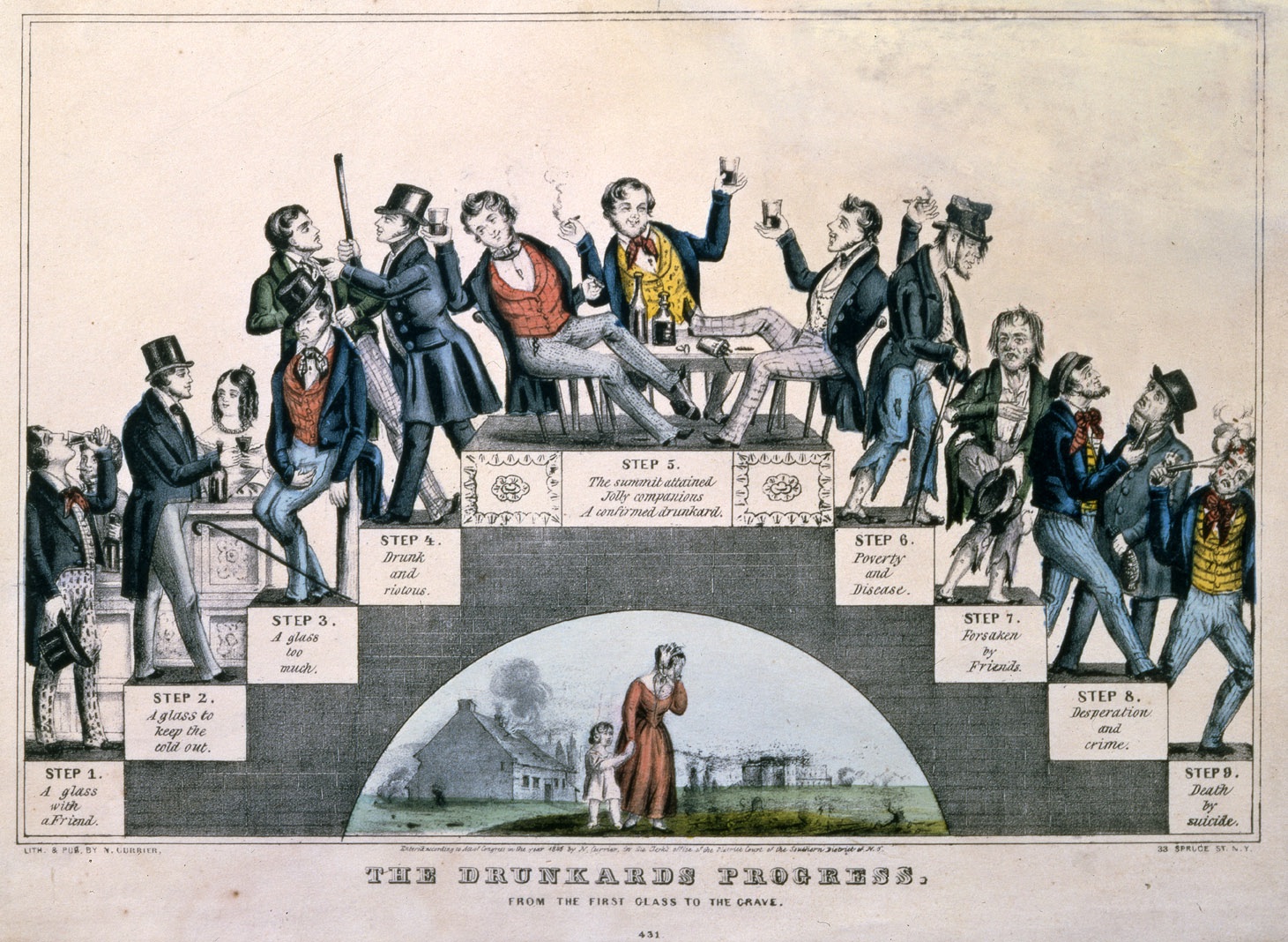
Image above: A poster supporting American temperance from alcohol, a Liberal goal in the 19th century. It's labeled "The Drunkard's Progress - From the First Glass to the Grave". Click to enlarge. From (http://www.americanyawp.com/text/10-religion-and-reform/).

One of the big challenges faced by any student of current events is that of seeing past the turmoil of the present moment to catch the deep trends shaping events on a broader scale.

It’s a little like standing on a beach, without benefit of tide tables, and trying to guess whether the tide’s coming in or going out.

Waves surge, break, and flow back out to sea; the wind blows this way and that; it takes time, and close attention to subtle details, before you can be sure whether the sea is gradually climbing the beach or just as gradually retreating from it.

Over the last year or so, though, it’s become increasingly clear to me that one of the great tides of American politics has turned and is flowing out to sea.

For almost precisely two hundred years, this country’s political discourse has been shaped—more powerfully, perhaps, than by any other single force—by the loose bundle of ideas, interests, and values we can call American liberalism. That’s the tide that’s turning.

The most important trends shaping the political landscape of our time, to my mind, are the descent of the liberal movement into its final decadence, and the first stirrings of the postliberal politics that is already emerging in its wake.

To make sense of what American liberalism has been, what it has become, and what will happen in its aftermath, history is an essential resource.

Ask a believer in a political ideology to define it, and you’ll get one set of canned talking points; ask an opponent of that ideology to do the same thing, and you’ll get another—and both of them will be shaped more by the demands of moment-by-moment politics than by any broader logic.

Trace that ideology from its birth through its adolescence, maturity, and decline into senescence, and you get a much better view of what it actually means.

Let’s go back, then, to the wellsprings of the American liberal movement. Historians have argued for a good long time about the deeper roots of that movement, but its first visible upsurge can be traced to a few urban centers in the coastal Northeast in the years just after the War of 1812.

Boston—nineteenth century America’s San Francisco—was the epicenter of the newborn movement, a bubbling cauldron of new social ideas to which aspiring intellectuals flocked from across the new Republic.

Any of my readers who think that the naive and effervescent idealism of the 1960s was anything new need to read Nathaniel Hawthorne’s The Blithedale Romance; it's set in the Massachusetts counterculture of the early nineteenth century, and most of the action takes place on a commune. That’s the context in which American liberalism was born.

From the very beginning, it was a movement of the educated elite.

Though it spoke movingly about uplifting the downtrodden, the downtrodden themselves were permitted very little active part in it. It was also as closely intertwined with Protestant Christianity as the movement of the 1960s was with Asian religions.

Ministers from the Congregationalist and Unitarian churches played a central role in the movement throughout its early years, and the major organizations of the movement—the Anti-Slavery Societies, the Temperance League, and the Non-Resistant League, the first influential American pacifist group—were closely allied with churches, and staffed and supported by clergymen.

Both the elitism and the Protestant Christian orientation, as we’ll see, had a powerful influence on the way American liberalism evolved over the two centuries that followed.

Three major social issues formed the framework around which the new movement coalesced.

The first was the abolition of slavery; the second was the prohibition of alcohol; the third was the improvement of the legal status of women. (The movement traversed a long and convoluted road before this latter goal took its ultimate form of legal and social equality between the genders.)

There were plenty of other issues that attracted their own share of attention from the movement—dietary reform, dress reform, pacifism, and the like—but all of them shared a common theme: the redefinition of politics as an expression of values.

Let’s take a moment to unpack that last phrase. Politics at that time, and at most other periods throughout human history, was understood as a straightforward matter of interests—in the bluntest of terms, who got what benefits and who paid what costs.

Then and for most of a century thereafter, for example, one of the things that happened in the wake of every Presidential election is that the winner’s party got to hand out federal jobs en masse to its supporters. It was called the “spoils system,” as in “to the victor belongs the spoils;” people flocked to campaign for this or that presidential candidate as much in the hope of getting a comfortable federal job as for anyother reason.

Nobody saw anything wrong with that system, because politics was about interests.

In the same way, there’s no evidence that anybody in the Constitutional Convention agonized about the ethical dimensions of the notorious provision that defined each slave as being 3/5ths of a person.

I doubt the ethical side of the matter ever crossed any of their minds, because politics was not about ethics or any other expression of values—it was about interests—and the issue was simply one of finding a compromise that allowed each state to feel that its interests would be adequately represented in Congress.

Values, in the thought of the time, belonged to church and to the private conscience of the individual; politics was about interests pure and simple.

(We probably need to stop here for a moment to deal with the standard response: “Yes, but they should have known better!” This is a classic example of chronocentrism.

Just as ethnocentrism privileges the beliefs, values, and interests of a particular ethnic group, chronocentrism does the same thing to the beliefs, values, and interests of a particular time.

Chronocentrism is enormously common today, on all sides of the political and cultural landscape; you can see it when scientists insist that people in the Middle Ages should have known better than to believe in astrology, for example, or when Christians insist that the old Pagans should have known better than to believe in polytheist religions. In every case, it’s simply one more attempt to evade the difficult task of understanding the past.)

Newborn American liberalism, though, rejected the division between politics and values. Their opposition to slavery, for example, had nothing to do with the divergent economic interests of the industrializing northern states and the plantation economy of the South, and everything to do with a devoutly held conviction that chattel slavery was morally wrong.

Their opposition to alcohol, to the laws that denied civil rights to women, to war, and to everything else on the lengthy shopping list of the movement had to do with moral values, not with interests. That’s where you see the impact of the movement’s Protestant heritage: it took values out of the church and tried to apply them to the world as a whole.

At the time, that was exotic enough that the moral crusades just mentioned got about as much political traction at the time as the colorful fantasies of the 1960s did in their own day.

Both movements were saved from complete failure by the impact of war. The movement of the 1960s drew most of its influence on popular culture from its opposition to the Vietnam War, which is why it collapsed nearly without a trace when the war ended and the draft was repealed. The earlier movement had to wait a while for its war, and in the meantime it very nearly destroyed itself by leaping on board the same kind of apocalyptic fantasy that kicked the New Age movement into its current death spiral four years ago.

In the late 1830s, frustrated by the failure of the perfect society to show up as quickly as they desired, a great many adherents of the new liberal movement embraced the prophecy of William Miller, a New England farmer who believed that he had worked out from the Bible the correct date of the Second Coming of Christ. When October 22, 1844 passed without incident, the same way December 21, 2012 did, the resulting “Great Disappointment” was a body blow to the movement.

By then, though, one of the moral crusades being pushed by American liberals had attracted the potent support of raw economic interest. The division between northern and southern states over the question of slavery was not primarily seen at the time as a matter of ethics; it was a matter of competing interests, like every other political question, though of course northern politicians and media were quick to capitalize on the moral rhetoric of the Abolitionists.

At issue was the shape of the nation’s economic future.

Was it going to be an agrarian society producing mostly raw materials for export, and fully integrated into a global economy centered on Britain—the southern model? Or was it going to go its own way, raise trade barriers against the global economy, and develop its own industrial and agricultural economy for domestic consumption—the northern model?

Such questions had immediate practical implications, because government policies that favored one model guaranteed the ruin of the other. Slavery was the linchpin of the Southern model, because the big southern plantations required a vast supply of labor at next to no cost to turn a profit, and so it became a core issue targeted by northern politicians and propagandists alike.

Read detailed accounts of the struggles in Congress between northern and southern politicians, though, and you’ll find that what was under debate had as much to do with trade policy and federal expenditures.

Was there to be free trade, which benefited the South, or trade barriers, which benefited the North? Was the federal budget to pay for canals and roads, which benefited northern interests by getting raw materials to factories and manufactured products to markets, but were irrelevant to southern interests, which simply needed riverboats to ship cotton and tobacco to the nearest seaport?

Even the bitter struggles over which newly admitted states were to have slave-based economies, and which were not, had an overwhelming economic context in the politics of the time.

The North wanted to see the western territories turned into a patchwork of family farms, producing agricultural products for the burgeoning cities of the eastern seaboard and the Great Lakes and buying manufactured goods from northern factories; the South wanted to see those same territories made available for plantations that would raise products for export to England and the world.

Yet the ethical dimension became central to northern propaganda, as already noted, and that helped spread the liberal conviction that values as well as interests had a place in the political dialogue.

By 1860, that conviction had become widespread enough that it shaped thinking south of the Mason-Dixon line. As originally written, for example, the first line of the Confederate song “The Bonny Blue Flag” ran “fighting for the property we won by honest toil”—and no one anywhere had any illusions about the identity, or skin color, of the property in question.

Before long, though, it was rewritten as “fighting for our liberty, with treasure, blood and toil.” The moment that change occurred, the South had already lost; it’s entirely possible to argue for slavery on grounds of economic interest, but once the focus of the conversation changes to values such as liberty, slavery becomes indefensible.

So the Civil War raged, the Confederacy rose and fell, the Northern economic model guided American economic policy for most of a century thereafter, and the liberal movement found its feet again.

With slavery abolished, the other two primary goals took center stage, and the struggle to outlaw alcohol and get voting rights for women proceeded very nearly in lockstep.

The 18th Amendment, prohibiting the manufacture and sale of alcohol in the US, and the 19th Amendment, granting women the right to vote, were passed in 1919 and 1920 respectively, and even though Prohibition turned out to be a total flop, the same rhetoric was redirected toward drugs (most were legal in the US until the 1930s) and continues to shape public policy today.

Then came the Great Depression, and with the election of Franklin Roosevelt in 1932—and above all with his landslide reelection victory in 1936, when the GOP carried only two states—the liberal movement became the dominant force in American political life.

Triumph after triumph followed. The legalization of unions, the establishment of a tax-funded social safety net, the forced desegregation of the South: these and a galaxy of other reforms on the liberal shopping list duly followed.

The remarkable thing is that all these achievements took place while the liberal movement was fighting opponents from both sides.

To the right, of course, old-fashioned conservatives still dug in their heels and fought for the interests that mattered to them, but from the 1930s on, liberals also faced constant challenge from further left.

American liberalism, as already mentioned, was a movement of the educated elite; it focused on helping the downtrodden rather than including them; and that approach increasingly ran into trouble as the downtrodden turned out to have ideas of their own that didn’t necessarily square with what liberals wanted to do for them.

Starting in the 1970s, in turn, American liberalism also ended up facing a third source of challenges—a new form of conservatism that borrowed the value-centered language of liberalism but used a different set of values to rally support to its cause: the values of conservative Protestant Christianity.

In some ways, the rise of the so-called “new conservatism” with its talk about “family values” represented the final, ironic triumph of the long struggle to put values at the center of political discourse.

By the 1980s, every political faction in American public life, no matter how crass and venial its behavior or its goals, took care to festoon itself with some suitable collection of abstract values. That’s still the case today; nobody talks about interests, even when interests are the obvious issue.

Thus you get the standard liberal response to criticism, which is to insist that the only reason anyone might possibly object to a liberal policy is because they have hateful values.

Let’s take current US immigration policy as an example. This limits the number of legal immigrants while tacitly allowing unlimited illegal immigration. There are solid pragmatic reasons for questioning the appropriateness of that policy.

The US today has the highest number of permanently unemployed people in its history, incomes and standards of living for the lower 80% of the population have been moving raggedly downward since the 1970s, and federal tax policies effectively subsidize the offshoring of jobs.

That being the case, allowing in millions of illegal immigrants who have, for all practical purposes, no legal rights, and can be employed at sweatshop wages in substandard conditions, can only drive wages down further than they’ve already gone, furthering the impoverishment and immiseration of wage-earning Americans.

These are valid issues, dealing with (among other things) serious humanitarian concerns for the welfare of wage-earning Americans, and they have nothing to do with racial issues—they would be just as compelling if the immigrants were coming from Canada.

Yet you can’t say any of this in the hearing of a modern American liberal. If you try, you can count on being shouted down and accused of being a racist.

Why? I’d like to suggest that it’s because the affluent classes from which the leadership of the liberal movement is drawn, and which set the tone for the movement as a whole, benefit directly from the collapse in wages that has partly been caused by mass illegal immigration, since that decrease in wages has yielded lower prices for the goods and services they buy and higher profits for the companies for which many of them work, and whose stocks many of them own.

That is to say, a movement that began its history with the insistence that values had a place in politics alongside interests has ended up using talk about values to silence discussion of the ways in which its members are pursuing their own interests.

That’s not a strategy with a long shelf life, because it doesn’t take long for the other side to identify, and then exploit, the gap between rhetoric and reality.

Ironies of this sort are anything but unusual in political history. It’s astonishingly common for a movement that starts off trying to overturn the status quo in the name of some idealistic abstraction or other to check its ideals at the door once it becomes the status quo.

If anything, American liberalism held onto its ideals longer than most and accomplished a great deal more than many, and I think that most of us—even those who, like me, are moderate Burkean conservatives—are grateful to the liberal movement of the past for ending such obvious abuses as chattel slavery and the denial of civil rights to women, and for championing the idea that values as well as interests deserve a voice in the public sphere.

It deserves the modern equivalent of a raised hat and a moment of silence, if no more, as it finally sinks into the decadence that is the ultimate fate of every successful political movement.

The current US presidential election shows, perhaps better than anything else, just how far that decadence has gone. Hillary Clinton’s campaign is floundering in the face of Trump’s challenge because so few Americans still believe that the liberal shibboleths in her campaign rhetoric mean anything at all.

Even among her supporters, enthusiasm is hard to find, and her campaign rallies have had embarrassingly sparse attendance.

Increasingly frantic claims that only racists, fascists, and other deplorables support Trump convince no one but true believers, and make the concealment of interests behind shopworn values increasingly transparent.

Clinton may still win the election by one means or another, but the broader currents in American political life have clearly changed course.

It’s possible to be more precise. Bernie Sanders and Donald Trump, in stark contrast to Clinton, have evoked extraordinarily passionate reactions from the voters, precisely because they’ve offered an alternative to a status quo pervaded by the rhetoric of a moribund liberalism.

In the same way, in Britain—where the liberal movement followed a somewhat different trajectory but has ended up in the same place—the success of the Brexit campaign and the wild enthusiasm with which Labour Party voters have backed the supposedly unelectable Jeremy Corbyn show that the same process is well under way there.

Having turned into the captive ideology of an affluent elite, liberalism has lost the loyalty of the downtrodden that once, with admittedly mixed motives, it set out to help. That’s a loss it’s unlikely to survive.

Over the decades ahead, in other words, we can expect the emergence of a postliberal politics in the United States, England, and quite possibly some other countries as well.

The shape of the political landscape in the short term is fairly easy to guess.

Watch the way the professional politicians in the Republican Party have flocked to Hillary Clinton’s banner, and you can see the genesis of a party of the affluent demanding the prolongation of free trade, American intervention in the Middle East, and the rest of the waning bipartisan consensus that supports its interests.

Listen to the roars of enthusiasm for Bernie Sanders and Donald Trump—or better still, talk to the not inconsiderable number of Sanders supporters who will be voting for Trump this November—and you can sense the emergence of a populist party seeking the abandonment of that consensus in defense of its very different interests.

What names those parties will have is by no means certain yet, and a vast number of other details still have to be worked out. One way or another, though, it’s going to be a wild ride.

.