Hokule'a returns to Hawaii

SUBHEAD: Hawaiian sailing canoe completes three-year voyage around the world to inspire people to take care of the Earth.

By Carla Herreria on 18 June 2017 for Huffington Post -
(http://www.huffingtonpost.com/entry/hokulea-completes-voyage-around-the-world_us_5945910ae4b0f15cd5bbc9ce)


Image above: The Hokoule'a returning to Honolulu harbor after three year journey. From original article.

[IB Publisher's note: Visit the Huffington Posts article to see many more images of the return of the Hokule'a.]

Three years after setting sail from Hawaii using only the stars, the wind and ancient Polynesian navigation techniques to voyage around the world, the Hokulea, a traditional double-hulled Hawaiian sailing canoe, has arrived back home on the island of Oahu.

Thousands of people welcomed the Hokulea as it docked in Magic Island in Honolulu early Saturday morning. Hawaiians greeted the canoe and its crew with traditional chants.

The homecoming, which marks the end of a difficult and meaningful voyage, was an emotional one for many. As the canoe approached land, a rainbow could be seen just off the horizon.


Image above: The Hokoule'a return is welcomed by the public and Hawaiian indigenous practitioners. From original article.

In 2014, navigators with the Polynesian Voyaging Society set sail on the Hokulea with one message: To inspire communities around the world to take care of “island Earth.” In its voyage, the Hokulea and her crew traveled more than 40,000 nautical miles, visiting 150 ports in 23 countries, including stops in South Africa, Brazil, Tahiti and New York City.

The Hokulea’s unique mission is a point of pride for the Aloha State.


Image above: The Hokoule'a finally at dock on Magic Island with the Ala Wai Boat Harbor in the background. From original article.

Hawaii is one of the few states that has pushed back against the Trump administration’s policies on climate change.

This month, Governor David Ige, a Democrat, signed a bill that binds the state of Hawaii to the goals made in the Paris climate accord, despite President Donald Trump’s decision to pull the country from the agreement. In 2015, Hawaii became the first state to enact a law requiring that 100 percent of its electricity come from renewable sources by 2045.

“Watching you on your epic voyage, you taught us that there is more than connects the world than divides us,” Ige said to the Hokulea crew during Saturday’s ceremony, according to the Honolulu Star-Advertiser.


Video above: The Honolulu Star Advertiser video of return of Kokule'a to Hawaii. From (https://youtu.be/Hvh5bX4iFHU).

See also:
Ea O Ka Aina: New Sail Power in Mediterranean 6/15/17
Ea O Ka Aina: A houseboat that sails 67/9/16
Ea O Ka Aina: Larry Ellison - Oracle 6/21/12
Ea O Ka Aina: Our Brave Experiment 6/13/12
Ea O Ka Aina: Hokulea sister ship Hikianalia 10/10/12
Ea O Ka Aina: Moving local goods by boat 3/7/12 
Ea O Ka Aina: Polyneisans again tour the Pacific 8/15/11
Ea O Ka Aina: Clear Sky over Polynesian canoes 7/12/11
Ea O Ka Aina: The Sail Transport Network 6/4/11
Island Breath: The future of ocean sailing 8/15/08
Island Breath: Sail Technology Reemerges 12/25/07
Island Breath: Rethinking the sail 12/25/07
Island Breath: THe Polynesian Package 8/24/07
Island Breath: The Future of Ocean Sailing 8/15/06
.

Review of "The One Device"

SUBHEAD: A new book on the birth and manufacture of Apple's now ten year old iPhone. 

By Les Grossman on 19 June 2017 for the New York Times -
(https://www.nytimes.com/2017/06/19/books/review/one-device-secret-history-iphone-brian-merchant.html)


Image above: Apple CEO Steve Jobs introducing the first iPhone at the Macworld Conference in January 2007. From original article.

[IB Publisher's note:  In regards to President Trump's "Muslim Ban" on Syrians entering America - it should be remembered that Steve Jobs was the son of Syrian immigrants.]

Before anybody outside Apple was aware of it, the project that would become the iPhone was referred to internally by the code name Purple. No one seems to remember exactly why; it may have been named after a toy purple kangaroo that belonged to one of the engineers.

Purple was so secret that even inside Apple hardly anybody knew about it. It was developed in a lab sealed tight behind badge readers and a metal door. Employees had to sign Non-Disclosure Agreements for their Non-Disclosure Agreements.

The lab became known as the Purple Dorm because people worked there round the clock, through weekends, holidays, vacations, honeymoons.

They ate there. They slept there. It smelled bad.

In fact, although it would eventually emerge as the gleaming quintessence of the collaboration between the Apple co-founder Steve Jobs and Apple’s design magus, Jony Ive, Purple could seem like a nightmare of overwork, insoluble technical tarballs and political infighting.
“You created a pressure cooker of a bunch of really smart people with an impossible deadline, an impossible mission, and then you hear that the future of the entire company is resting on it,”


Andy Grignon, one of the iPhone’s key engineers, has said. “It was just like this soup of misery.” The Purple Dorm will no doubt one day be the setting of a taut claustrophobic drama by some future Aaron Sorkin.

If it does, that drama may well be based on “The One Device: The Secret History of the iPhone,” a new book by Brian Merchant, an editor at Motherboard, the science and technology division of Vice.

Merchant does the important work of excavating and compiling large numbers of details and anecdotes about the development of the iPhone, many of them previously unrecorded. It’s important because along with being splash-, water- and dust-resistant, the iPhone is resistant to history.

The iPhone dwells among us, but it looks — it’s designed to look — as if it just moments ago entered our world from some higher, more ideal plane of existence. Just as its flat black face makes no compromise with the contours of the human skull, its gleaming, lickable surface offers no clues about where and when it was made, or by whom, or how.

You can’t even open it without a special proprietary screwdriver called a Pentalobe. This is an effect not just of the iPhone’s physical design but of the strange culture of reverence and secrecy that Apple has created around its products. The iPhone knows everything about us, but we know very little about it.

An example: multitouch, the technology that allows the iPhone’s touch-screen to track several fingertips at once — it’s why you can pinch to zoom. Where does it come from? Jobs always maintained that multitouch was invented at Apple. It wasn’t.

As Merchant demonstrates, it was actually invented several different times, including in the 1960s at England’s Royal Radar Establishment and in the 1970s at CERN. The specific multitouch technology that went into the iPhone was pioneered around the turn of the millennium by a man you’ve almost certainly never heard of named Wayne Westerman.

A brilliant engineering Ph.D. at the University of Delaware, Westerman worked on multitouch in part because he suffered from severe repetitive strain injury, which made conventional keyboard interfaces agony. Apple acquired Westerman’s company, FingerWorks, in 2005 — whereupon it and Westerman disappeared behind Apple’s Titanium Curtain.

The rest is, and isn’t, history. (Apple wouldn’t let Merchant interview Westerman, or any current Apple employee, for “The One Device.” Merchant did, with characteristic thoroughness, track down Westerman’s sister.)

The iPhone is designed for maximum efficiency and compactness. “The One Device” isn’t. The three chapters on the development of the iPhone are the heart of the book, but there’s some filler too.

It’s curiously unilluminating to read a metallurgical analysis of a pulverized iPhone, or to watch Merchant trudge around the globe on a kind of iCalvary in search of the raw materials Apple uses — through a Stygian Bolivian tin mine and a lithium mine in the Chilean desert and an e-waste dump in Nairobi where many iPhones end up.
This kind of hacker tourism can be done well — the gold standard is Neal Stephenson’s epic 1996 Wired article “Mother Earth Mother Board".

His one conspicuous success in this line is his visit to a Foxconn factory outside Shenzhen, China, where iPhones are manufactured.

Foxconn has a reputation for bad labor conditions, and visiting Westerners are generally closely chaperoned, but during a trip to the bathroom Merchant manages to ditch his minders and take a stroll through the vast, dystopian facility. “It is factories all the way down,” he writes, “a million consumer electronics being threaded together in identically drab monoliths.

You feel tiny among them, like a brief spit of organic matter between aircraft-carrier-size engines of industry.” It’s a palpable glimpse of the way the iPhone has, like a shiny glossy virus, physically reshaped the world to produce copies of itself.

Merchant also tells the origin stories of the technologies that converged into the iPhone: Gorilla Glass, motion sensors, lithium-ion batteries, ARM chips, wireless technology and so on.

He shows how many people’s work went into the creation of the iPhone, as a counterweight to “the myth of the lone inventor — the notion that after countless hours of toiling, one man can conjure up an invention that changes the course of history.”

The lone inventor starts showing his straw stuffing after a couple of paragraphs, but Merchant spends entire chapters chatting with people like Mitsuaki Oshima, the father of image stabilization.

Oshima undoubtedly has hidden depths, but as an interviewer Merchant is powerless to reveal them. (“Even with a shake of the camera, the image did not blur at all. It was too good to be true!” etc.)

Even worse is Merchant’s ghastly time-traveling habit. In order to talk about magnetometers we first have to sit still for a history lesson (“compasses can be traced back at least as far as the Han dynasty, around 206 B.C.”).

To get to assembly-line production, a concept with which most readers are already pretty familiar, we have to slog back to the Pleistocene Era (“Homo erectus, which emerged 1.7 million years ago, were the first species to widely adopt tools.…”).

And so on. The origin of this kind of writing can be traced back at least as far as the Undergraduate Era, to those leaden essays that begin, “Since the dawn of time, mankind has wondered.…”

But when he gets back to the actual iPhone’s creation, Merchant tells a far richer story than I — having covered Apple for years as a journalist — have seen before. If you’ve ever worked on a hopeless project that felt like it was going nowhere, you will draw spiritual strength from Merchant’s account of life in the Purple trenches.

It includes fascinating dead ends and might-have- beens (a prototype based on the original iPod’s click wheel, backlit in blue and orange); personal sacrifices (“The iPhone is the reason I’m divorced”).

There were obscure technical hurdles (the phone’s infrared proximity sensor, which turns the screen off when it’s near your head, wouldn’t recognize dark hair)

And there was the backstage tension at the launch (I was actually there, watching Jobs rehearse the famous iPhone keynote, but apparently missed everything); even a symbolic onstage assassination (when Jobs publicly demonstrated swiping to delete a contact, he used Apple vice president Tony Fadell’s name, foreshadowing Fadell’s imminent departure).

The iPhone masquerades as a thing not made by human hands. Merchant’s book makes visible that human labor, and in the process dispels some of the fog and reality distortion that surround the iPhone. “The One Device” isn’t definitive, but it’s a start.

What we need is the critical equivalent of a Pentalobe, a book that will crack open the meaning of the iPhone, to properly interrogate this digital symbiont, or parasite, that has introduced new kinds of both connection and disconnection into our lives.

If the iPhone was a revolution, who or what exactly was overthrown? One of the stories Merchant tells comes from Grignon, who was the first person to receive a call on the iPhone.

“Instead of being this awesome Alexander Graham Bell moment, it was just like, ‘Yeah,… go to voice mail,’” Grignon says. “I think it’s very apropos, given where we are now.”

THE ONE DEVICE
The Secret History of the iPhone
By Brian Merchant
Illustrated. 407 pp.
Little, Brown & Company. $28.

.

US shoots down Syrian drone

SUBHEAD: US jet shoots down Syrian Army drone in "Dangerous Escalation" in region.

By Tyler Durden on 20 June 2017 for Zero Hedge -
(http://www.zerohedge.com/news/2017-06-20/us-jet-shoots-down-syrian-army-drone-dangerous-escalation)


Image above: An Iranian made Shahed drone in hanger. The craft used by Syrian military for air surveillance and attacks. This is the type of aircrarft shot down by American F-15 yesterday.  From (https://dragonsdrones.com/2017/04/11/description-hesa-shahed-129/).

An American Air Forde F-15E fighter jet shot down a Syrian regime Iranian made Shahed-129 drone on Monday near At Tanf, Syria. This is the third downing of a pro-regime aircraft this month, CNN reported.

The downing of the drone comes a day after a US jet shot down a regime aircraft that was engaging a fleeing ISIS convoy, according to the Syrian government.

An armed Shaheed-129 UAV “displayed hostile intent and advanced on Coalition forces” at 12:30 am local time on Tuesday, the coalition said in a statement. The drone was observed in the same area where another UAV was shot down on June 8th.

"The drone was downed just outside the 55 kilometer de-confliction zone, according to the officials.

It was an Iranian-made Shahed 129 and was thought to be armed and in firing range of US troops.

One official said that the drone was shot down because it was 'assessed to be a threat.'

That drone was shot down after it dropped one of several weapons it was carrying near a position where coalition personnel are training and advising partner ground forces in the fight against ISIS."

According to Fox News, this is the second time the US has shot down an Iranian drone in less than a month. It also marks the fifth time since late May the U.S. military has bombed pro-Syrian forces in southern Syria.

Connecticut Sen. Chris Murphy described the attack as “a dangerous escalation" of tensions between the US and the main backers of the Syrian regime, Russia and Iran.

Murphy told CNN that if the US doesn't stop the attacks, the situation could escalate into an armed conflict between the two sides, who both claim to be fighting ISIS.
“I think we’re getting closer and closer to open conflict between Iran and Russia and the American public need to know that we are moving very fast towards what could be another war in the Middle East – something Donald Trump promised he wouldn’t do when he ran for office.”
The US's actions could also prompt its coalition partners to withdraw from Syria, wary of being drawn deeper into an armed conflict with Iran and Russia. On Tuesday, Australia said it would temporarily suspend fights in the conflict zone as a "precautionary measure" after Russia said it would withdraw from an air-safety agreement in retaliation for Sunday's downing of the Syrian aircraft.

On the same day that the drone was shot down by US forces, an armed Russian fighter jet buzzed a U.S. Air Force reconnaissance aircraft in the Baltic Sea, two U.S. officials told Fox News.
In the latest in a long series of close encounters, Fox News reports the Russian Su-27 jet had missiles under its wings and approached the U.S. Air Force RC-135 recon jet "rapidly," coming within five feet of the American aircraft, the officials said.

Once alongside, the Russian jet was “provocative” in its flight maneuvers and flying “erratically,” according to another official.


.

Australia suspends Syria overflights

SUBHEAD: Australia became the first coalition member to suspend flights in Syria, claiming it's too dangerous for its planes.

By Tyler Durden on 20 June 2017 for Zero Hedge -
(http://www.zerohedge.com/news/2017-06-20/australia-halts-flights-syria-citing-potential-threats-russia)


Image above: Royal Australian Air Force flying American made F18 Hornets began making their first strike on Islamic State forces in Syria in September 2015. From (http://www.sbs.com.au/news/article/2015/09/09/first-raaf-strikes-syria-within-week).

Russia’s Monday decision to suspend a memorandum of cooperation with the US-led coalition in retaliation after a US jet shot down a Syrian Army plane has rattled some US allies, who fear escalating tensions between Russia and the coalition. In what it called a "precautionary measure," Australia became the first coalition member to suspend flights in Syria, claiming it's too dangerous for its planes to fly without the agreement, according to BBC.
“As a precautionary measure, Australian Defense Force (ADF) strike operations into Syria have temporarily ceased,” Australia’s Department of Defense said in a statement, adding its operations in Iraq would continue as part of the coalition.”


“ADF personnel are closely monitoring the air situation in Syria and a decision on the resumption of ADF air operations in Syria will be made in due course.”


“Australian Defense Force protection is regularly reviewed in response to a range of potential threats,” the Department of Defense said.
Australia has deployed about 780 military personnel as part of the US-led coalition fighting the Islamic State in Iraq and Syria

The BBC notes that Australia has a small but highly capable contingent of six F/A-18 strike aircraft; a tanker; and an E-7A Wedgetail early warning aircraft, all based at Al Minhad in the United Arab Emirates.

Most of the Australian strikes have been in Iraq, though its aircraft do also operate over Syria. Australian commanders will reassess the situation in due course. The more fundamental question is what the Russian threat actually amounts to. Is it just rhetoric or does Moscow want to deny certain areas of Syrian airspace to US-led coalition aircraft?

Australian aircraft will continue to fly missions in Iraq.As reported yesterday, Russia suspended cooperation under the “Memorandum on the Prevention of Incidents and Ensuring Air Safety in Syria” on Monday after the US shot down a Syrian Army fighter jet. 

The Russian Defense ministry called the attack “an act of aggression,” on the part of the US-led coalition. The US military neglected to use a communication line with Russia concerning this attack, despite the fact that Russian warplanes were also on a mission in Syrian airspace at the time, the Russian Defense Ministry alleged, conflicting with the Pentagon's explanation of events.

The bilateral memorandum of understanding was signed between the United States and Russia signed in October 2015 to ensure the safety of flights during combat missions over Syria.

In retaliation for the US attack, the ministry warned that Russian missile defense would intercept any aircraft in the area of operations of the Russian Aerospace Forces in Syria.

The Russian Defense Ministry announced, quoted by Sputnik;
"In areas where Russian aviation is conducting combat missions in the Syrian skies, any flying objects, including jets and unmanned aerial vehicles of the international coalition discovered west of the Euphrates River will be followed by Russian air and ground defenses as air targets."
Contrary to the earlier statement by the US, according to which it "contacted its Russian counterparts by telephone via an established "de-confliction line" to de-escalate the situation and stop the firing", Russia claims the US-led coalition command didn't use the deconfliction channel with Russia to avoid an incident during an operation in Raqqa:
"Russian Aerospace Forces' jets were conducting operations in Syrian airspace that time. However, the command of the coalition forces didn't use the existing channel between the air command of the Qatari airbase al Udeid and the [Russian] Hmeymim airbase to avoid incidents over Syria."
We now wait to see which other US allies – Germany, Denmark, the Netherlands, France, Jordan and the UK also are contributing men and arms to the task of "liberating" Syria  – will announce that they're temporarily pulling out of the conflict until tensions once again de-escalate.


.

Trump lets Mattis set troop levels

SUBHEAD: Delegating too much authority to the military does not shield Trump from responsibility for setbacks.

By Phil Stewart & Idrees Ali on 14 June 2017 for Reuters  -
(https://www.reuters.com/article/us-usa-afghanistan-troops-idUSKBN19431H)


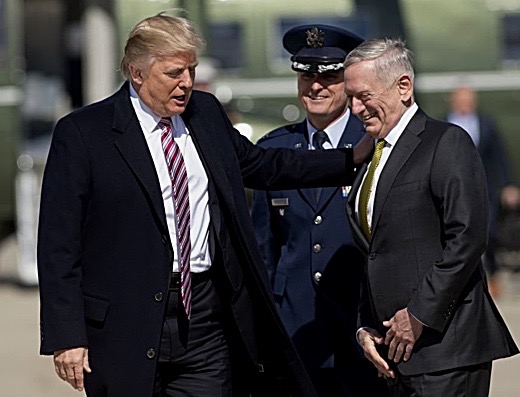
Image above: Trump on tarmac, in front of President's Marine helicopter, with hand on shoulder of Defense Secretary Jim Mattis. From (http://ijr.com/2017/06/899016-trump-grants-mattis-authority-set-troop-levels-afghanistan-report/).

U.S. President Donald Trump has given Defense Secretary Jim Mattis the authority to set troop levels in Afghanistan, a U.S. official told Reuters on Tuesday, opening the door for future troop increases requested by the U.S. commander.

The official, who spoke on condition of anonymity, said no immediate decision had been made about the troop levels, which are now set at about 8,400. The Pentagon declined to comment.

The decision is similar to one announced in April that applied to U.S. troop levels in Iraq and Syria, and came as Mattis warned Congress the U.S.-backed Afghan forces were not beating the Taliban despite more than 15 years of war.

"We are not winning in Afghanistan right now," Mattis said in testimony to the Senate Armed Services Committee earlier on Tuesday. "And we will correct this as soon as possible."

Mattis said the Taliban were "surging" at the moment, something he said he intended to address.
A former U.S. official said such a decision might allow the White House to argue that it was not micromanaging as much as the administration of former President Barack Obama was sometimes accused of doing.

Critics say delegating too much authority to the military does not shield Trump from political responsibility during battlefield setbacks and could reduce the chances for diplomats to warn of potential blowback from military decisions.

It has been four months since Army General John Nicholson, who leads U.S. and international forces in Afghanistan, said he needed "a few thousand" additional forces, some potentially drawn from U.S. allies.

Current and former U.S. officials say discussions revolve around adding 3,000 to 5,000 troops. Those forces are expected to be largely comprised of trainers to support Afghan forces, as well as air crews.
Deliberations include giving more authority to forces on the ground and taking more aggressive action against Taliban fighters.

Some U.S. officials have questioned the benefit of sending more troops to Afghanistan because any politically palatable number would not be enough to turn the tide, much less create stability and security. To date, more than 2,300 Americans have been killed and more than 17,000 wounded since the war began in 2001.

Any increase of several thousand troops would leave American forces in Afghanistan well below their 2011 peak of more than 100,000 troops.

A truck bomb explosion in Kabul last month killed more than 150 people, making it the deadliest attack in the Afghan capital since the Taliban were ousted in 2001 by a NATO-led coalition after ruling the country for five years.

On Saturday, three U.S. soldiers were killed when an Afghan soldier opened fire on them in eastern Afghanistan.

The broader regional U.S. strategy for Afghanistan remains unclear. Mattis promised on Tuesday to brief lawmakers on a new war strategy by mid-July that is widely expected to call for thousands more U.S. troops.

Senator John McCain, the chairman of the Armed Forces Committee, pressed Mattis on the deteriorating situation during the Tuesday hearing, saying the United States had an urgent need for "a change in strategy, and an increase in resources if we are to turn the situation around."
"We recognize the need for urgency," Mattis said.


The Afghan government was assessed by the U.S. military to control or influence just 59.7 percent of Afghanistan's 407 districts as of Feb. 20, a nearly 11 percentage-point decrease from the same time in 2016, according to data released by the U.S. Special Inspector General for Afghanistan Reconstruction.


.

US shoots down Syrian jet

SUBHEAD: Russia halts cooperation with US in Syria, will "Intercept Any Aircraft" in Russian areas of operation.

By Tyler Durden on 19 June 2017 for Zero Hedge -
(http://www.zerohedge.com/news/2017-06-19/russia-halts-cooperation-us-syria-will-intercept-any-aircraft-russian-areas-operatio)


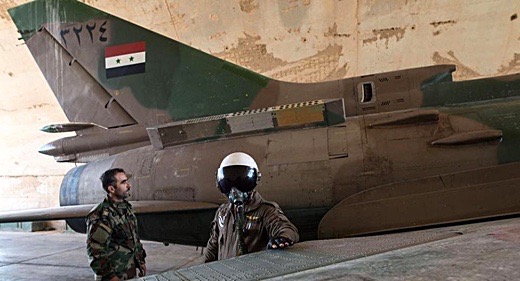
Image above: The kind of plane US shot down was a Russian built SU-22 aircraft. They are worn out and their pilots are old, but they’re all still flying. This is a close-up of the fin and rear fuselage of the SyAAF’s Su-22M-4K serial number 3224, as seen during a pre-fight inspection. From (http://warisboring.com/the-su-22-is-syrias-war-weary-warhorse/).

Shortly after Russia's deputy foreign minister slammed the US downing of a Syrian Su-22 jet as an "act of aggression" and "support for terrorists", Russia announced that starting June 19th it was halting all interactions with the US under the framework on the "memorandum of incident prevention in Syrian skies", the Russian Defense Ministry said on Monday, thereby assuring the probability of even more deadly escalations between Russia and the US-led coalition.

In retaliation, the ministry warned that Russian missile defense will intercept any aircraft in the area of operations of the Russian Aerospace Forces in Syria,

"In areas where Russian aviation is conducting combat missions in the Syrian skies, any flying ojects, including jets and unmanned aerial vehicles of the international coalition discovered west of the Euphrates River will be followed by Russian air and ground defenses as air targets," the Russian Defense Ministry announced, quoted by Sputnik.

Contrary to the earlier statement by the US according to which, it "contacted its Russian counterparts by telephone via an established "de-confliction line" to de-escalate the situation and stop the firing", Russia claims the US-led coalition command didn't use the deconfliction channel with Russia to avoid an incident during an operation in Raqqa:
"Russian Aerospace Forces' jets were conducting operations in Syrian airspace that time. However, the command of the coalition forces didn't use the existing channel between the air command of the Qatari airbase al Udeid and the [Russian] Hmeymim airbase to avoid incidents over Syria."
The Russian ministry also demands a thorough investigation by the US command with the provision of its results and measures taken.
"We consider such actions of the US command as an intentional violation of its obligations in the framework of the memo on avoiding incidents and the safety of aviation flights during operations in Syria signed on October 20, 2015."
A bilateral memorandum of understanding was signed between the United States and Russia signed in October 2015 to ensure the safety of flights during combat missions over Syria.

On June 18, the Syrian army said that the US-led coalition had brought down its aircraft in southern Raqqa countryside when it was fulfilling its mission against Daesh.

Later, the coalition confirmed the attack saying that it shot down the Syrian government forces' Su-22 aircraft as it had allegedly been bombing in an area where US-backed rebel forces, the Syrian Democratic Forces (SDF), were stationed, south of Tabqa in the Raqqa province. The US-led coalition called its attack on the Syrian army's jet "collective self-defense," adding that it contacted the Russian military to de-escalate the situation after the incident.

.

Absent Without Leave

SUBHEAD: The public may not give a shit about the Middle East or federal dairy supports, but they’ll notice when their money is worthless.

By James Kunslter on 19 June 2017 for Kunstler.com -
(http://kunstler.com/clusterfuck-nation/7816/)


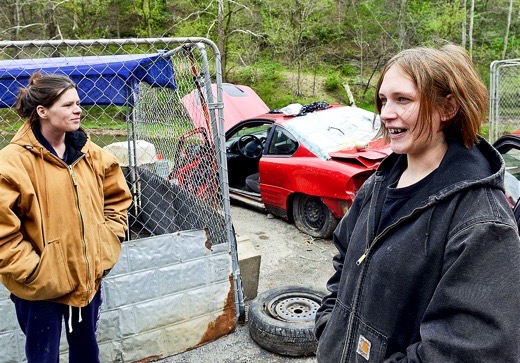
Image above: Rochelle Pipier (L) and Tonya Tedrow (R) in Littleton, West Virginia, where poverty and opioids are destroying people and community. From (http://www.post-gazette.com/local/region/2015/05/31/Littleton-W-Va-is-a-town-decimated-by-poverty-drugs/stories/201504280190).

It ain’t bragging if it’s true. I’ve said repeatedly on this blog for years that the federal government would only become more impotent, more incompetent, and more ineffectual as The Long Emergency rolled out. And here we are now, at just such pass in history.

The process has been well underway since the beginning of the century. Even the attempts to expand its scope and reach — such as the post 9-11 addition of God-knows-how-many new intelligence services — has only produced an epic clusterfuck of cross-purposed mission creep that threatens the federal government’s existential legitimacy.

After nearly a year of investigating, the FBI, the CIA, the NSA, the DIA, DHS, et. al. haven’t been able to leak any substantial fact about “Russian collusion” with the Trump election campaign — and, considering the torrent of leaks about all manner of other collateral matters during this same period, it seems impossible to conclude that there is anything actually there besides utterly manufactured hysteria.

Now, one might imagine that this intelligence community could have manufactured some gift-wrapped facts rather than just waves of hysteria, but that’s where the incompetence and impotence comes in.

They never came up with anything besides Flynn and Sessions having conversations with the Russian ambassador — as if the ambassadors are not here to have conversations with our government officials.

You’d think that with all the computer graphics available these days they could concoct a cineplex-quality feature film-length recording of Donald Trump making a “great deal” to swap Kansas for Lithuania, or Jared Kushner giving piggyback rides to Vladimir Putin in the Kremlin.

But all we’ve really ever gotten was a packet of emails from the Democratic National Committee and John Podesta of the Clinton campaign gloating about how nicely they fucked over Bernie Sanders — and that doesn’t exactly reflect so well on what has evolved to be the so-called “Resistance.”

The net effect of all this sound and fury is a government so paralyzed that it can’t even pass bad legislation or execute its existing (excessive) duties. That might theoretically be a good thing, except what we’re seeing are individual departments just veering off on their own, especially the military, which now operates without any civilian control.

Apparently General Mattis, the Secretary of Defense, pretty much decided on his own to dispatch another 8,000 US troops to Afghanistan to move things along there in the war’s 16th year. Or did he get President Trump to look up from his Twitter window for three seconds to explain the situation and get a nod of approval?

Perhaps you also didn’t notice the news item over the weekend that a US-led fighter plane coalition shot down a Syrian air force plane in Syrian airspace. In an earlier era that could easily be construed as an act of war.

Who gave the order for that, you have to wonder. And what will the consequences be? Reasonable people might also ask: haven’t we already made enough deadly mischief in that part of the world?

With the US military gone rogue in foreign lands, and the intelligence community off-the-reservation at home, and the Trump White House all gummed up in the tarbaby of RussiaGate, and the House and Senate lost in the shuffle, you also have to wonder what anybody is going to do about the imminent technical bankruptcy of the USA as the Treasury Department spends down its dwindling fund of remaining cash money to pay ongoing expenses — everything from agriculture subsidies to Medicare.

That well is going dry in the middle of the summer, and without any resolution to the debt ceiling debate, the country will not be able to borrow more to pretend that it’s solvent.

I don’t see any indication that the House and Senate will be able to bluster their way through this. Instead, the situation will compel extraordinary new acts of financial fraud via the central banks and its cadre of Too-Big-To-Fail associates. In the event, the likely outcome will be a spectacular fall in the value of the US dollar, and perhaps consecutively, the collapse of the equity and real estate markets.

The public may not give a shit about Syria, Afghanistan, or federal dairy supports, but they’ll sure perk up and notice that their money is going worthless. I doubt they’ll be clamoring for Hillary Clinton to be installed as the first US Caesar to fix it all.

.

Crisis point for American elites

SUBHEAD: The exploitive elites cannot turn back the tides of history, but they can immiserate millions.

By Charles Hugh Smith on 19 June 2017 for Of Two Minds -
(http://www.oftwominds.com/blogjune17/crisis-elites6-17.html)


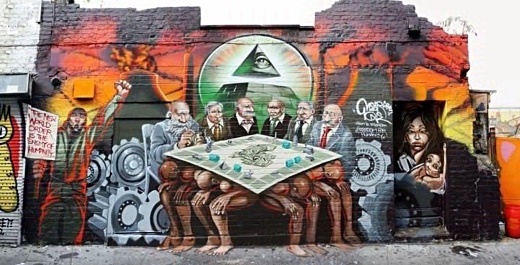
Image above: In 2012 Los Angeles-based artist MEARONE was making a building mural in the UK and faced a lot of scrutiny about the piece. "I came to paint a mural that depicted the elite banker cartel". From (http://crpbayarea.org/2012/10/05/the-corporate-medias-response-to-mear-ones-latest-piece-on-the-banking-elite/).

The "fixes" to the stagnation of postwar Capitalism in the 1970s were financialization, globalism, and the sustained expansion of debt--all have run out of steam.

Many of us have written about cycles in the past decade: Kondratieff economic cycles, business/credit cycles, the Strauss–Howe generational theory (an existential national crisis arises every four generations, as described in their book The Fourth Turning), and long-wave cycles of growth and decline, as described in seminal books such as The Great Wave: Price Revolutions and the Rhythm of History and War and Peace and War: The Rise and Fall of Empires.

There is another Rhythm of American History that few recognize: the economic, social and political crises sparked by exploitive Elites. There are two dynamics that drive these crises:
  1. The exploitation of commoners by financial/political Elites reaches extremes that create systemic instability as commoners no longer have the means to improve their conditions.

  2. The economic mode of production that generated Elite wealth no longer functions, but the Elites cling to the failing system and enforce it with increasingly violent suppression of dissent.
Here are the previous Crises of Exploitive Elites:
A) American Southern Slavery: 1850 to 1865
Though the toxins generated by slavery are still with us, the existential political, social and economic crisis arose in the years between 1850 and the end of the Civil War in 1865.

In broad brush, the rise of the American West triggered a political crisis in the U.S. as the southern states realized the non-slave West's rising political power would doom the fragile balance between the non-slave Northern industrial-economy states and the cotton/agricultural slave-economy South.

It was a trend the South couldn't possibly win, but the South's exploitive Elites refused to concede any of their power--and that refusal to adapt to changing conditions guaranteed the Civil War.

The first Industrial Revolution radically transformed the source of wealth creation. The plantation agrarian mode of production of the South was eclipsed by the vast wealth-generating might of the rapidly industrializing North.

The Southern political and economic Elites could not win economically or politically, so they attempted a military solution--a war they might have won had it not been for the Westerners Lincoln, Grant and Sherman. (Lincoln was born and raised in the frontiers of Kentucky, Indiana and Illinois; both Grant and Sherman were born in Ohio and served in Army postings along the West Coast.)

The moral tide was rising against slavery. The Christian world had long been divided on the issue of slavery, but the tide turned against slavery in the early-to-mid-1800s, both in Great Britain an the U.S. Moral turnings are powerful instigators of political crises, and once again the Southern Elites attempted to stem this tide with military force.

B) The Crisis of Gilded-Age Exploitation: 1892 to 1914
The dates of this crisis are inexact and open to interpretation, but in broad brush, the Second Industrial Revolution (mass production, integrated industrial corporations, the rising dominance of Finance and Industrial Capital, emergence of monopolies and cartels, etc.) forced millions of commoners into the penury of wage-labor while concentrating the gains of capital and speculation into the hands of the few.

Adjusted for inflation, the wealth of the financier-industrialists in this era exceeds the wealth of today's billionaires, and is on par with the extremes of wealth concentration that characterize the last stages of the Roman Empire.

Commoners attempting to unionize were brutally suppressed by hired private enforcers and the police/military forces of the American government. Radical unions such as the I.W.W. (Industrial Workers of the World, a.k.a. Wobblies) were destroyed by coordinated, concerted government suppression, much of it by means that are visibly illegal by today's standards.

The conflict between exploited industrial labor and politically dominant Capital was eventually resolved by progressive anti-trust laws (aided by President Theodore Roosevelt) and the beginnings of social rights and welfare programs--universal education, limits on hours worked per week, etc.

C) Great Depression & Debt Capitalism: 1929 to 1941
Capital was increasingly concentrated in the hands of the Elites in the Roaring 20s, but the commoners had new access to the financial magic of credit: banks sprouted by the thousands, anxious to loan money to fund the purchase of more farmland, new autos, and all the other output of a consumerist economy.

But alas, credit is not collateral, nor is it wealth. When the debt bubble burst, so did the stock market, which was based on highly leveraged margin debt.

The Elite financiers resisted writing down the debt that had made them so rich, and as a result the Depression dragged on, immiserating millions who then turned to fascism or radical socialism as the political fixes to the systemic exploitation and dominance of Elites.

4) Civil Rights and Global Empire: 1954 to 1973.
The legacy of slavery's oppression had lingered on for almost 100 years, and the rising prosperity of the 1950s and 60s generated a social, moral, political and economic movement to throw off the most oppressive aspects of an exploitive social/political order.

At the same time, the costs of maintaining a Global Empire were raised to a boiling point by the war in Vietnam, which destabilized the moral, political, social and economic orders.

In response the Elites instigated waves of violent, suppressive state tactics designed to disrupt and destroy the organized dissent of social movements. These tactics included the FBI's COINTELPRO programs as well as other blatantly illegal, heavy-handed government enforcement of the dominance of exploitive Elites.
    I've written extensively about state over-reach and illegal suppression of dissent: remember, the state exists to enforce the dominance of Elites: everything else is propaganda, misdirection and obfuscation.

    Welcome to the United States of Orwell, Part 3: We had to Destroy Democracy in Order to Save It (March 28, 2012)
    State Over-Reach: Stripmining the Citizenry for Fun and Profit (November 13, 2009)
    When It Becomes Serious, First They Lie--When That Fails, They Arrest You (March 16, 2015)
    For more on COINTELPRO, please read War at Home: Covert action against U.S. activists and what we can do about it.

    Simply put: when lies no longer work, the government devotes its resources not to eliminating wars of choice, cronyism and corruption but to suppressing dissent and resistance to those extractive, exploitive policies.

    Which brings us to the present-day Crisis of Exploitive Elites. The "fixes" to the stagnation of postwar Elite/state-dominated Capitalism in the 1970s were financialization, globalism, and the sustained expansion of debt in all sectors--state, corporate and household.

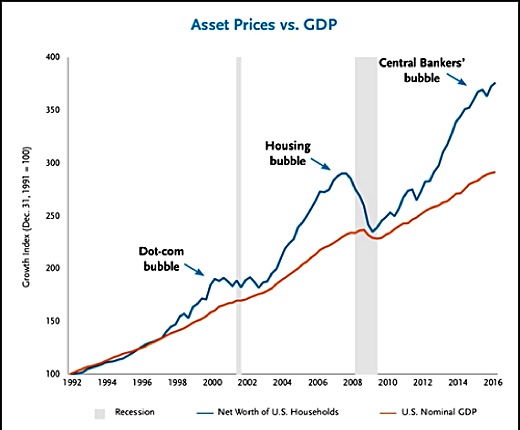
    Now all three engines of "growth" have run out of steam. All three greatly exacerbated wealth and income inequality, as these two charts reveal:


    Image above: Chart comparing American disparity of family income in 2002 and 20012. From original article.


    Image above: Chart American asset prices versus Gross Domestic Production. Note Cnetral Bank bubble value veering uo and away from GDP. From original article.

    Once again, the political and economic Elites are resisting the tides that are undermining their Empires of Debt and Exploitation. The Elite-controlled Corporate Media has been ordered to War Status, an DefCon-5 emergency requiring an endless spew of all-out propaganda designed to distract, disrupt and destroy organized dissent and any resistance to the dominance of Exploitive political and financial Elites.

    The Exploitive Elites cannot turn back the clock, so they cling to their failed "fixes" and demand our compliance.

    The Exploitive Elites cannot turn back the tides of history, but they can immiserate millions. That seems to be "solution" enough for them, but you cannot destroy rising moral revulsion to soaring inequality and the abject failure of debt-based global capitalism with mere media propaganda.

    See also
    The Automatic Earth: Coming Apart at the Brink
    Bloomberg: The U.S. Is Where the Rich Are the Richest
    Peak Prosperity: The Pin To Pop This Mother Of All Bubbles?

    .

    Sculptures from the Anthropocene

    SUBHEAD: Once lost, do the wonders of our world just get forgotten and cease to mean anything to us?

    By Glenn Morris on 12 June 2017 for The Dark Mountain -
    (http://dark-mountain.net/blog/sculptures-from-the-anthropocene/)


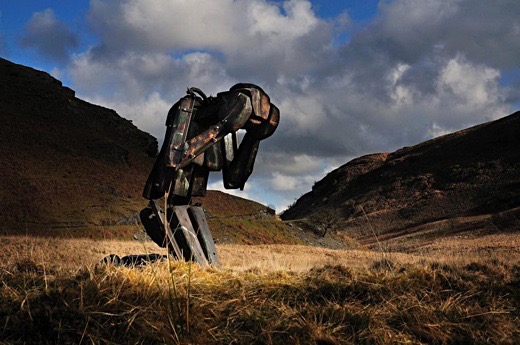
    Image above: Sculpture #1 From Anthropocene series by Glenn Morris. From original article.

    Our tenuous hold on life – framed, as it were, within our doctrine of ‘living in the moment’ – seems all the more fragile when one considers the sheer inability displayed by the human species to understand and act on the threats now posed to society.

    The damage wreaked on our environment by the emissions of toxic chemicals, habitat destruction and the paradigm of ‘growth whatever the cost’ continues, and yet for world governments it’s still business as usual.

    From an early age (birth to be precise), our education is designed to rule out informed interrogation into the order of things; subject matter is fed to us purely to equip us for the world of work. The idea that people could live and thrive in an alternative construct of society does not even get discussed, unless it is past cultures which are conveniently described as ‘primitive’.

    The receptive brain of a child soaks up all it is told; by the time the few with enough imagination to challenge the perceived wisdom voice their thoughts it is too late, they realise they can have any colour – as long as it is black.

    As a child, my mother took me to London’s Natural History Museum and, like most children, I was spellbound by the huge dinosaur skeletons – their vastness, their teeth and claws, the sheer scale left me wide-eyed with wonder; and yet, despite the obvious power of these creatures, we were told at school that they were weak and died out very quickly, whereas humans were highly successful, they invented tools, grew food, and, above all, were ‘civilised’.

    I believed this. In reality, modern human time can be measured in a few tens of thousands of years (with only the last 200 years witnessing the destruction of the environment on a major scale, to the point where the future of humanity is brought into question), whereas the dinosaurs, that weak, ill-equipped species, actually existed for around 160 million years! To my way of thinking, that’s pretty successful.

    Seeing these vast vestiges of past life standing still on display in a museum setting, and seeing how we, as humans, view ourselves in terms of time and our place in the world, led me to the area of creative activity that I am currently working on. Humankind now faces the end of an existence in which the planet’s resources can be plundered, destroyed and polluted with complete abandon.

    It would be easy, as is often done, to blame individuals; in fact, the simple truth is that the current way society is organised is based on growth and profit – the environment, the life with which we share the planet, and indeed people themselves, come second to these objectives.

    Most people find it impossible to imagine a society that is fundamentally different from that in which we now live – we are told that people are ‘naturally’ selfish, it’s just progress or ‘we’ve got to move on’.

    Why must we believe this? It is interesting to consider than when the Palaeolithic hunter-gatherer societies made the transformation into the Neolithic, agrarian societies, this did not happen over thousands of years – it was a matter of a few generations.

    To change society into a form in which we grasp the concept of what it is to be human and how we live alongside each other in a mutually happy and beneficial way can happen; it just needs people to understand that this society is flawed and cannot be allowed to continue. I say again – it is not the people but the model we choose to live under.

    As I write this, a brief radio news item tells us that scientists have reported that two-thirds of coral on Australia’s Great Barrier Reef have now been destroyed – bleached and dead as the water temperatures rise. This was quickly followed by some sports news, then probably forgotten by most listeners.

    Once lost, do the wonders of our world just get forgotten and cease to mean anything to us? I have never seen a coral reef, but I certainly want it to continue to exist, as I do wildflower meadows, elephants, honey bees, butterflies and indeed, numerous life forms that are now threatened with extinction.


    Image above: Sculpture #2 From Anthropocene series by Glenn Morris. From original article.

    Imagine for a moment the Palaeolithic hunter; he is hungry, his sense are heightened and acute to a level we simply cannot imagine, he looks out onto a landscape untouched by human activity: rivers full of fish, unimaginable numbers of birds and animals, the air clear and scented with the nearby plants – that is his normality.

    Would he be troubled by the past or future? What we see today is our reality; if we have never heard a corncrake or seen flocks of lapwings, can we be expected to regret their disappearance?

    Do young people, shackled as they are to a life of screens, social media and the importance of self, trouble themselves over coral reefs or the decline of butterflies? Do they need to?

    What they experience is their normality. But I am worried, very worried that our senses have been cauterised and the sheer beauty of life is ebbing away and; in the end, it will not be there even if we want it.

    I am fortunate in that my working life has allowed me to spend considerable periods of time over many years living in remote areas, predominantly the Arctic.

    Through living with the Inuit, still – to some extent, a hunter-gatherer culture– one gets a profound sense of the importance of our connection with the land and animals that provide the means of survival; furthermore (and this seems to happen only after a relatively long period of time), living in a place where human figures are mere specks within a vast untouched landscape, a true wilderness, gives one a clear and deep sense of just how insignificant we are.

    To journey through a wilderness with an open mind and for a long enough period of time can allow a person to begin to experience a different level of consciousness which, in ‘normal’ life, would not be attainable.

    Some years ago I was nearing the end of a 400-mile journey across Greenland’s vast ice cap. I had pulled a loaded sledge containing my food, tent and fuel, but little else for comfort or entertainment. I had one companion.

    After 40 days of grinding labor across endless ice fields, mountains and crevasses, I saw the fjords and mountains of the west coast; by this time we had virtually no food and I knew the feeling of hunger.

    The reason I mention this is because as we left the ice and entered the Arctic rocks and tundra, at the point where the ice sheet meets ‘land’, I had an overwhelming feeling of connection and ‘oneness’ with the hostile terrain I found myself in – it seemed somehow linked to my inner self; I felt hardwired into the landscape, liberated, and was seeing my surroundings through the eyes of a wild animal. It was a truly wonderful feeling which, sadly, dissipated soon after we finally reached a small town on the west coast.

    I felt later that this power of connection to nature, the environment and landscape would have been normal for early hunter-gatherer cultures, so much so that they would not have reflected on it any more than we might on other human responses such as sadness, love or pain.

    The current human condition, particularly in the western world, gives little opportunity and virtually denies people the ability to engage with nature and the environment.

    The fact that beauty, wonder, happiness and the profound feeling of what it is to be human can be obtained without cost, and simply by engaging with our world, does not sit well with market forces or with companies trying to sell happiness through acquisition.

    Our society has now reached the point where scientists are describing the beginning of a new epoch – Anthropocene. The actual geological strata is being affected by the production of plastics, concrete and radionuclides.

    This, alongside continued and increasing production of carbon means that the human species is successfully and relentlessly destroying the agar jelly of its own petri dish. Society has now reached a state where the majority of people have, not out of choice, ceased to have links with or engage with nature and the environment in a meaningful way.

    Why are we not seeing mass worldwide protests against a society that is leading us by the hand, willingly it would seem, to an existence that, at best, will be irretrievably damaged or worse, terrifying and dangerous?


    Image above: Sculpture #3 From Anthropocene series by Glenn Morris. From original article.

    As a sculptor, these questions and concerns constantly flow through my thought processes and subconsciously, or even consciously, guide the chisels, drills and clay of what I do.

    My chosen materials– stone, metals and earth– and the means of construction– fire and the impact of hammer against stone – also seem to bring something of the land into the work.

    I have been privileged and lucky enough to feel and have intimate contact with the beauty of our world, but sometimes feel that I am shouting at people who are moving towards danger through sound-proofed glass.

    I make sculpture because I feel happy working in three dimensions but, moreover, it is the way I feel best able to explore my inner concerns and the way humans have become so entirely self-absorbed and inured to uncomfortable and incontrovertible evidence of damage to the very things that sustain us.

    My most recent works set out to confront and explore the way in which we view our past as a species, and our relationship with time itself. I am interested in how we erroneously see ourselves as indestructible.

    The three figures constructed under the generic title of ‘Anthropocene’ form part of a wider group, designed not as sculptures to be seen close up, but within a landscape, or even ‘unseen’. They were assembled and placed in remote, often mountainous or moorland settings, and left in situ.

    I did not mind whether they were seen or not; if they were seen, then ideally it would be from a distance. Although the figures are three times life size, and at close quarters have a monumental sense about them, they rapidly become insignificant, even invisible, once any distance is put between them and the viewer.

    I tried to imbue both a sense of power and sadness or melancholy into the figures. I wanted all to have qualities of dark industry as well as extreme vulnerability.

    In his recent book The Great Derangement, Amitav Ghosh examines the inability, of literature and politics to embrace and grasp the enormity of the catastrophe that awaits us, and questions how future generations will look back on our response (denial?) to this.

    I feel that artists should be dealing with the unspeakable, using this conduit to communicate in a visceral way that sometimes only art can.

    Climate change – like warfare, pollution, starvation and the alteration of the planet’s surface – is a symptom of how our society is organized; until humans realize that a system based on growth and profit will ultimately self destruct, then we can expect ‘business as usual’ as we herald the dawn of the new epoch.

    All photographs are from Glenn Morris’s ‘Anthropocene’ series. The sculptures are made from recycled timbers and forged iron.

    • Glenn Morris‘s work is inspired and informed by the beauty and harshness of the environment in the far north, and by our relationship and response to the loss of things that possess beauty in any form. He works predominantly in stone and mixed media, using traditional carving techniques. The forms and works tend to follow two or three lines of exploration: the sensual and feminine, the masculine, industrial form and more objective comments on things environmental. He has a first class degree in sculpture and has had work exhibited in public areas and also at the Royal Academy. glennmorris.co.uk
    .

    Coming Apart at the Brink

    SUBHEAD: We have reached a point where there is no possibility of revival within the current system.

    By Alastair Crooke on 18 June 2017 for the Automatic Earth -
    (https://www.theautomaticearth.com/2017/06/coming-apart-the-imperial-city-at-the-brink/)


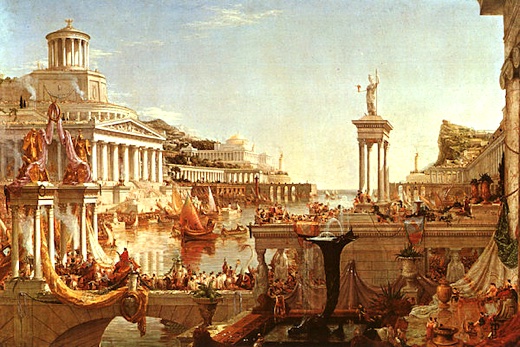
    Image above: Oil painting by Thomas Cole "The Consummation of Empire" 1836. From original article.

    [Automatic Earth's publisher Raul Ilagi Meier's introduction: The Conflicts Forum, directed by former British diplomat and MI6 ‘ranking figure’ Alastair Crooke, sent me another unpublished article by Alastair and asked if the Automatic Earth would publish it. But of course. Previous articles by Alastair published here are: ‘End of Growth’ Sparks Wide Discontent in October 2016, Obstacles to Trump’s ‘Growth’ Plans in November 2016 and What is this ‘Crisis’ of Modernity? in January 2017.]

    David Stockman routinely refers to President Trump as the ‘Great Disrupter’. But this is not a bad quality, he insists. Rather, it is a necessary one: Stockman argues (my paraphrasing) that Trump represents the outside force, the externality, that tips a ‘world system’ over the brink: It has to tip over the brink, because systems become too ossified, too far out on their ‘branch’ to be able to reform themselves.

    It does not really matter so much, whether the agency of this tipping process (President Trump in this instance), fully comprehends his pivotal role, or plays it out in an intelligent and subtle way, or in a heavy-handed, and unsubtle manner. Either serve the purpose. And that purpose is to disrupt.

    Why should disruption be somehow a ‘quality’? It is because, during a period when ‘a system’ is coming apart, (history tells us), one can reach a point at which there is no possibility of revival within the old, but still prevailing, system.

    An externality of some sort – maybe war, or some other calamity or a Trump – is necessary to tip the congealed system ‘over’: thus, the external intrusion can be the catalyst for (often traumatic) transformational change.

    Stockman puts it starkly:
    “The single most important thing to know about the present risk environment [he is pointing here to both the political risk as well as financial risk environment], is that it is extreme, and unprecedented. In essence, the ruling elites and their mainstream media megaphones have arrogantly decided that the 2016 [US Presidential] election was a correctible error”.
    But complacency simply is endemic: “The utter fragility of the latest and greatest Fed bubble could not be better proxied than in this astounding fact. To wit, during the last 5,000 trading days (20 years), the VIX (a measure of market volatility) has closed below 10 on just 11 occasions. And 7 of those have been during the last month! … That’s complacency begging to be monkey-hammered”, Stockman says.

    Former Presidential candidate, Pat Buchanan concurs: “President Trump may be chief of state, head of government and commander in chief, but his administration is shot through with disloyalists plotting to bring him down.

    We are approaching something of a civil war where the capital city seeks the overthrow of the sovereign, and [to achieve] its own restoration. Thus far, it is a nonviolent struggle, though street clashes between pro- and anti-Trump forces are increasingly marked by fistfights and brawls. Police are having difficulty keeping people apart. A few have been arrested carrying concealed weapons.

    That the objective of this city is to bring Trump down, via a deep state-media coup, is no secret. Few deny it.”

    The extraordinary successful ‘manufacture’ and ‘parachuting-in’ of Macron into the French Presidential election by the French élite, precisely has given to the globalised Deep State (including their US counterparts), renewed confidence that Europe and America’s slide towards ‘populism’, is indeed a ‘correctable error’. European elites now can barely contain their revived schadenfreude at the Brexiters’ and at the Populists’ presumed discomfort (see here).


    Image above: Oil painting by Thomas Cole "The Destruction of Empire" 1836. From original article.

    But despite the palpable danger to the integrity of the political system itself, Stockman notes, “it is no inconsiderable understatement to suggest that the S&P 500 at 2440 is about as fragile as the ‘market’ has ever been.

    Any untoward pinprick could send it into a tailspin … Doug Kass said it best in his recent commentary:
    “Over history, as we have learned, a Minksy Moment develops when investor sentiment becomes complacent after long periods of prosperity and the data is ignored, and doesn’t seem to matter anymore, as I wrote in “It’s a ‘Bohemian Rhapsody’ Market: Nothing Really Matters … to investors.” 
    In short, the market has become ‘zombie’ (in the sense of residing within a psychological defence mechanism – as, when to contemplate the alternative – simply is too threatening to the psyche) [emphasis added].

    Daniel Henninger, in a Wall Street Journal op-ed, writes:
    “Donald Trump’s election has caused psychological unhingement in much of the population. But the Trump phenomenon only accelerated forces that were plummeting in this direction before the 2016 election…

    “Impossible to miss, though, is how jacked up emotional intensity has become in American politics. The campaign rallies of both Mr. Trump and Bernie Sanders often sat on the edge of violence. Reporters describe political town hall meetings as full of “angry” voters. Shouting down the opposition in these forums or on campus has been virtually internalized as standard behavior. Refusal to reason is the new normal. And then, the unreason is euphemized as free speech.

    Explaining away these impulses as a routine turn of the populist political cycle is insufficient. Something more permanent is happening.”
    It is not, of course just the markets which are threatened by unperceived risk. Trump shall not be forgiven for challenging the sacrosant meme of a world divided between (good) ‘liberal’ democracies (led by the US and its European allies) and (bad) illiberal autocracies (led today, by President Putin’s Russia): by snubbing NATO and withdrawing from the Paris Climate Agreement, Professor Michael Klare writes;
    “We’ve been told, President Trump is dismantling the liberal world order created by Franklin D Roosevelt at the end of World War II”.
    An offence, it seems, against something somehow sacral: recently, US comedienne Kathy Griffin posted a video of herself holding the bloody, severed head of Donald Trump. “But that wasn’t the end of it” Henninger notes.
     “We may assume that as Ms. Griffin was creating her video, the artists at New York’s Public Theater, were rehearsing their production of Julius Caesar, the one in which Central Park audiences watch ‘Caesar’ as a blond-haired Donald Trump, who is pulled down from a podium by men in suits, and assassinated with plunging knives … Whatever once fastened the doors of people’s minds to something secure and stable has become unhinged.”
    Mike Vlahos (Professor at the US Naval War college and John Hopkins) tells us that, as a military historian and global strategist, he became curious to know just why it is that ‘world systems’ do ‘come apart’. His first, intuitive sense was that their collapse generally was brought about by some massive external force such as war, pestilence or famine, and by the concomitant mass migrations of peoples.

    But when he and his students completed their research, he concluded that though these factors had often played an important part, they were not the prime cause of the system coming apart. Rather, he identified a number of key triggers:
    • The elites became stratified, and politics frozen
    • The peoples’ allegiance became taken for granted, at the same time that the elites chose to ignore threats to the peoples’ way of life
    • Social mobility declined, and change is fiercely resisted
    • Rather, élites work to maximize their wealth and status.
    • Elite authority becomes excessively militarized – and justified as ‘saving civilization’.
    He concludes from this study;
    “The situation that we inhabit today […] here in the imperial city in Washington DC, is that it is absolutely hollowed out … it is incapable of offering anything to its own people, the American people … I think we have reached a point where there is no possibility of revival within the current system that exists. The current system is set upon … is determined to eat itself out in a kind of civil war that is coming, and at the end of that, it will be done, will be finished”.

    “The Methoni, one of the great nations of the late Bronze Age, had this same problem with the élites and the 1% that we have today, and they were overthrown. That’s 3300 years ago, and it keeps happening again and again.

    And the very structure of the decadent relationships in late periods where élites refuse to accommodate, refuse to adapt, refuse to be sensitive to needs of the larger whole of society, means this has to happen. There has to be an overthrow … for things eventually to get better, to be renewed. In other words, you can’t renew from within”.


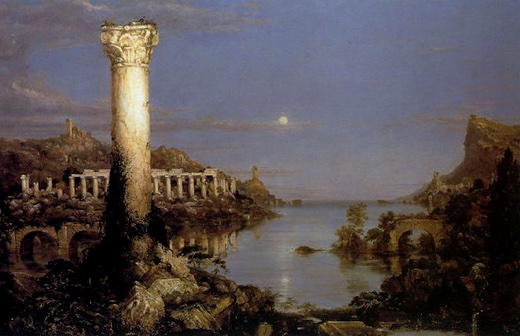
    Image above: Oil painting by Thomas Cole "The Desolation of Empire" 1836. From original article.

    Is this the situation today? The pre-conditions that Professor Vlahos relates, in terms of élite hubris, self-regard, and disdain for the real concerns of people are there (the polarization of US society at the US election provides the empirical evidence for this). And Stockman, in calling Trump the ‘Great Disrupter’ plainly implies that he might be precisely the ‘externality’ (coming from outside the élite) – that might tip things ‘over’. This surely is what Stockman means when he warns about ‘the present risk environment’ being extreme.

    Of course, the usual retort is that Trump offers no coherent alternative conceptual vision for the future, but only seized successfully upon a number of key insights: the power of cultural nationalism, the pain felt by the casualties of globalism, the impact of a hollowed-out US economy, and the need to put America first.

    This is true. These insights do not constitute a vision for the future, but why should one expect that, from the ‘Disrupter’? His ‘agency’ is that of catalyst, not that of final ‘constructor’. That comes later.

    So, from whence does ultimate societal renewal come? The classic answer is that after ‘disruption’ nothing much is left standing amidst the (metaphoric) ruins of whatever stood as the reigning ‘modernity’.

    Historically, renewal was effected through a communal ‘reaching back’- beyond the roots of whatever represented the contemporary crisis – to delve back, deep into the archetypal cultural history of a people. The rummaging in collective memory, allows a narrative to shape, about why the present ‘hurt’ befell its people, and to bring forward, transformed into contemporary meaning, some ‘solution’: a new meta-historical understanding.

    Plainly, this (a type of spiritual renewal) is not President Trump’s ‘bag’. (Steve Bannon’s the more so, perhaps?)

    What does all this mean in practical terms? First, it suggests that most of us still prefer not to address the stark reality that “the objective of this city (DC), is to bring Trump down, via a deep state-media coup” and the bitter political trench warfare, which this portends. We prefer to rest in complacency, (as zombies for now), until a crisis squarely hits us – in a personal way.

    Secondly, thoughts of an easy return to the status quo ante (such as via Vice-President Pence standing-in), is problematic (Macron’s election in France notwithstanding). Since the élites (all of them), have, in their ‘war’ against ‘populists’ and deplorables, totally lost legitimacy and authority for a substantive part of their populations. And they will not – cannot – adapt. For, that is their nature.

    This is the moment, Professor Vlahos notes, when a system – i.e. US operational governance – begins to ‘come apart’. Individuals, cabals within government, whole departments of state, look to their own self-awarded ‘authority’, rather than to that of the government as mandated by the electorate.

    Thus we have this past week, the Senate voting 97-2 to impose further sanctions on Russia. Another wrench jammed into Trump’s foreign policy wheels – and explicitly conceived to paralyse and impede the President.

    Thirdly, the intent is – like some Amazonian reptile venom – to ‘bite’ him with so much innuendo and assorted investigations and further allegations, that Trump, like the reptile’s victim, remains awake – but incapable of moving a muscle: A true zombie, in fact, as the reptile feeds on its living corpse.

    Fourth, this zombified US President, will shortly face the requirement to negotiate with Congress an exit from a bubbling financial sphere soaring upwards, whilst a moribund real economy trails downwards – under pressure from the fast-approaching debt-ceiling deadline.

    The Senate’s slap at the President’s face with the Russia sanctions vote suggests it is more likely that he will be tossed another spanner: this time aimed at the wheels of the ‘Trump reflation’ program.

    What other insights might history offer? Two, perhaps: Professor Vlahos, during his discussion with John Batchelor, the latter points out that, even at the very moment that the hub of the Roman Empire already had fallen apart, the collapsing Empire was celebrated the most, when it was imitated at the furthest edges of Empire: by the peoples of Gaul and Germany, for example.

    Are we not seeing the same today, in Europe, as Merkel and Macron vow to keep the liberal, globalist values of the American Empire alive — at the edges of the American Empire — in Europe?

    And lastly, the constituency that historically led renewal? Professor Vlahos: “The Roman legions, the Czarist armies, the German Imperial armies and the Ottoman armies”.

    The Pentagon élites should note well.


    http://www.islandbreath.org/2017Year/06/170618empire4big.jpg
    Image above: Oil painting by Thomas Cole 1836 series on "The Course of Empire - The Pastoral State". From (http://www.artfixdaily.com/artwire/release/1791-nature-and-the-american-vision-the-hudson-river-school) Click to enlarge..

    [IB Publsiher's note: Above is another of American painter Thomas Cole's series. This one illustrates the arcadian or pastoral state. It's not clear if it follows or  precedes Empire. We, at Island Breath, are hoping and planning for the latter.]

    .

    A Climate Changing Proposal

    SUBHEAD: We must devote ourselves to cooling the climate if we are to have any future at all.

    By Peter Bane & Susan Butler on 15 June 2017 for Resilence -
    (http://www.resilience.org/stories/2017-06-15/a-climate-cooling-proposal/)


    Image above: An aerial view of agroforestry management practices in Niger in 2004. From (http://www.smithsonianmag.com/science-nature/great-green-wall-stop-desertification-not-so-much-180960171/).

    Climate cooling activities increase water storage to support green plant growth, and draw carbon from the atmosphere through photosynthesis to form deep, rich soils under forests, marshes, and grasslands.

    The result is known as Drawdown, carbon banking, or when coupled with agriculture, carbon farming. While healthy biosystems worldwide do this already, human carbon emissions from fossil fuel, destructive agriculture, and deforestation combine to overwhelm the balancing effects of natural systems.

    Beginning 7,000 years ago with early agriculture, quickening with the Industrial Revolution, and threatening to spin out of control in the 21st century, human activities past and present are heating the planet. We must now consciously enter the climate equation by assisting nature’s cooling processes through land repair.

    For the first time in the UN process, Drawdown was recognized as a viable and necessary response to the climate crisis under the Paris agreement of 2015 (COP-21). Pushed aggressively by European and Commonwealth nations, “net zero emissions” became the goal.

    This approach has gained political traction because, despite a quarter century of international agreements and efforts, emissions reductions through effiency, conservation, fuel shifting, technological innovation, and system redesign have proved exceedingly slow to move the global economy onto a lean carbon basis.

    Optimists point to recent rapid growth in renewable energy, but time is not on our side. Beyond lowering the increment of industrial emissions, we must rapidly subtract CO2 and advance ecosystem cooling in order to mitigate the catastrophic and mounting effects of climate change.

    The threat from climate disruption is more immediate and dire than is widely understood. Extreme weather events—fire, flood, drought, and storm—are proliferating and growing more intense with each year; this endangers life and property on a vast scale, triggering war, conflict, and migration.

    Over the past 10,000 years, agriculture and human settlement have damaged and degraded two-thirds of Earth’s land cover, and devastated ocean life. Biosystems are under extreme pressure as humans consume 50% more than natural regeneration provides each year, further suppressing photosynthetic capacity.

    Overshoot has accelerated since 1987, bringing more and more living systems to the brink of collapse. Because of inertia in the climate system, the most dramatic changes from recent human carbon excesses have not yet manifested, but the trends are ominous.

    Positive feedback loops from methane releases under permafrost, burning of tropical and temperate forests, ice-free Arctic seas, and deglaciation threaten to speed up warming exponentially well before mid-century. Scientists across the planet are afraid. Runaway heating presents a terrifying but ever closer prospect.

    All life we know would die if Earth were to become another Venus. The build-out of renewable energy systems will take more than a generation and would not by itself be enough to reverse carbon loading of the atmosphere, while we may have no more than a decade before passing critical planetary thresholds.

    More must be done. Geoengineering of the atmosphere and oceans is unproven and its undertaking would be reckless. But extending the longevity of green cover on land is within our grasp and will bring enormous benefits.

    The evidence for effectiveness of photosynthesis is encoded in the data from Charles Keeling’s Mauna Loa laboratory.

    Every May, as the two-thirds of Earth’s land mass in the Northern Hemisphere regreens, carbon levels in the atmosphere drop. Our job is to increase this drawdown. One method is proven across centuries: reforestation.

    At times of plague and genocide during the past two millenia, the upward march of carbon in the atmosphere has stalled and reversed. Forests have done the work, as they supplanted farm fields abandoned by collapsing societies.

    We do not wish for mass human death; fortunately recent innovations in agriculture point to the possibility of rebuilding our soils and forests while eating from them too.

    A 2014 white paper by the Rodale Institute calculated that adopting best current organic farming practices worldwide, even without further reforestation, could sequester more carbon than the global economy and nature emit each year.

    The required wholesale redesign of landscapes across the earth can provide healthy livelihoods for millions, redefine the meaning of work, and solve pressing social problems.


    Image above: Before and after photos of ecological and agricultural restoration of the Loess Plateau in China begun in 2005. From (https://revitalizationnews.com/article/ecological-agricultural-restoration-of-chinas-loess-plateau/).

    We must make building deep, rich soils and tending magnificent forests the over-arching purpose of human life, woven deeply into all cultures. Soils, forests, grasslands and silvocroplands can store 20 billion tons of carbon annually, enough to bring the atmospheric load down to climate-safe levels in the range of 280-310 ppm CO2 by the end of the century.

    With demonstrated carbon capture rates between 4 and 300 tons per hectare per year, the planet’s 13 billion hectares of accessible land can support enough photosynthesis to reverse our current destructive course—but only if we make it our top priority now and for generations to come.

    Building deep rich soils requires extensive land repair coupled with intelligent ecosystem management, especially slowing, spreading, and sinking runoff water, and covering land with green plants. For most immediate effect, surfaces must be kept cool to take heat load off the atmosphere.

    Soils must remain vegetated or mulched at all times and pavements in urban areas should be shaded wherever possible. Forests too must be protected and expanded, especially connecting coastlines with continental interiors to enhance water cycles. With adequate water, crops and biomass can be grown, nurturing humans and other animals with nutrient-dense foods, while providing materials for the circular economy.

    As agriculture is transformed away from tillage and chemicals and toward a perennial framework, the fungal associates of plants will orchestrate both health and carbon capture, regenerating soil organic matter levels to their prehistoric maxima and beyond.

    In a virtuous spiral, organically growing soils, animals, and plants would support ample and healthy human populations as they do the work of tending highly productive landscapes. We see a fine-grained pattern of forests, fields, orchards, pastures, and wetlands across all the inhabited continents, dotted with villages and towns, connected by the World Wide Web.

    Our cities too will regain their once green raiment, becoming mosaics of market gardens, greenhouses, edible parks, and offices, factories, shops, and warehouses under living roofs. There will be water everywhere: springs, streams, rivers, and lakes will reappear where no one expected to see them again.

    Building up deep rich soils and healthy ecosystems begs a global effort in promotion and finance, but will be achieved by millions of small-scale projects carried out at neighborhood and watershed levels, where design standards can be determined democratically and best practices tested empirically.

    This is work for hundreds of millions of people presently unemployed, underemployed, or pursuing dangerous and destructive jobs. Ongoing, globally coordinated research and development efforts should focus on documenting and sharing effective strategies arising from grassroots innovation.

    Land repair leads directly to higher yields in agriculture and forestry, as well as cleaner water, reduced damage from flooding and drought, and so can become self-supporting in food, water, and economic yields.

    Estimates from Slovakia suggest that savings from mitigation of flood damage alone provided a one-year payback on investments of 4 euros (USD$5) per cubic meter of water storage created. Most materials will be available locally (wood, stone, brush, plants, clay), and the energy, tools, and machinery required will be modest.

    As hundreds of millions devote their lives to this cause, the resulting rich landscapes, clean waters, healthy populations, and stable climate will be deeply respected as a global commons, deserving of permanent protection.

    Climate change is an emergency demanding that we reorganize our societies on a wartime footing to fight for our lives. By terra-forming the planet, by pulling carbon gas out of the air and storing it safely and securely as humus in soil and wood in trees, we can rebalance the earth’s carbon chemistry.

    While this calls for lifetimes of labor and virtual mountains of treasure, we have hundreds of millions needing employment while trillions of dollars slosh around the global economy hiding from taxation, feeding speculative bubbles, extracting wealth from the natural world, and creating pernicious social and political problems.

    Migrant problem? Not anymore; rather, an opportunity. Instead of vast refugee camps spreading across deserts in Africa and the Middle East, let us create networks of villages for a new Civilian Conservation Corps, housing millions of well-paid and well-trained workers building infrastructures designed to catch water and repair landscapes.

    Starting where investments in natural capital can bring the most immediate return of employment and agricultural productivity, this urgent, moon-shot-scale effort must be kickstarted now because time is of the essence. It can evolve into self-organized human cultures across the planet.

    We know how to do this. President Franklin Roosevelt put millions to work through the Civilian Conservation Corps (CCC) and Works Progress Administration (WPA) across the US during the New Deal era of the 1930s.

    Many of the earthen structures: swales, terraces, infiltration pits and ponds, as well as the bridges, culverts, forest trails, and more that these agencies built are still in place, working quietly to regulate stream flow and improve ecosystems.

    More recently, the Slovak Republic undertook a pilot program of waterworks with EU support to similar purposes in 2010-11. The result was a dizzying array of creative, low-cost solutions to flooding and erosion in agricultural, forested, and urban landscapes. These are national-scale examples from recent history to the present.

    Smaller efforts are ongoing in a multitude of regions, unremarked but no less effective. Bill Mollison and others have described many of the same techniques and methods used in these programs, and have gone beyond the Euro-American context to address dryland and tropical regions.

    Permaculture designers have gathered traditional knowledge and combined it with the scientific method to demonstrate what works to repair damaged lands, restore water supplies, improve agriculture, and sequester carbon.

    The demonstrated systems are effective, cheap, can be made in large measure with local materials, and do not require machinery—although it can be helpful on larger projects.

    Wood, stone, and bamboo structures, gabions and check dams, earthen dams, dikes, polders, balks, terraces, and contour ditches can be created quickly and without specialized tools or materials. They can endure for generations and so represent excellent investments.

    Water slows down and infiltrates into soils, making more groundwater available to sustain more plant growth for a longer time each season promoting better transpiration, cooling, cloud formation, and rainfall. This supports healthy springs, streams, lakes and estuaries.

    xxx

    Microengineering works are not the only approach, though they restore damaged lands directly, and once installed can work passively for decades, supporting food systems where no agriculture is presently sustainable.

    Where farming is active, cover crops, zerotillage implements, elimination of fallow, intensive rotational grazing, polycultures, and a suite of agroforestry techniques are available to improve yields, eliminate erosion, support ecosystem services such as pollination and microclimate, and build soil carbon.

    Through the international Permaculture movement and its proven curriculum, extensive grassroots networks are now familiar with land repair tools and could rapidly extend these practices by training teams of local workers.

    The urgent need for a massive effort to ensure human survival means it’s now time to take back finance. Faced with a falling house of cards, global elites have been innovating like mad, using quantitative easing and negative interest rates to prop up failing industrial growth economies, perhaps to no avail.

    But now we know more about using finance as a tool. We know money is not scarce. It’s not a commodity, but a social construct.

    Whatever we can do, we can finance. Whatever is truly productive magnetizes and proliferates money. It would be an epic understatement to say that Drawdown activities are truly productive.

    We must use Keynesian public financing to put the global underemployed and the badly employed—which is most people—to meaningful and collaborative work at sufficient wages making their immediate vicinities ecologically productive, building rich soils, sequestering carbon, and cooling the climate. Finance for this purpose, issued debt-free by national central banks, can be administered by local governments.

    Much as the 1911 Weeks Act in the US acquired failed farms for the public trust, and planted forests on them, derelict and degraded lands can be purchased from private ownership through public finance to create new common pool resources, vested in local land trusts, community councils, or state stewardship, as appropriate.

    Conservation agreements with private landowners accompanied by 4C land repair can upgrade private property while pulling it out of the polluting industrial economy and into organic production.

    Good design of our watersheds, forests, rangelands, and estuaries holds the promise of a regenerative economy for the future. These will be the long-term rewards of seizing the moment of our destiny:

    We must devote ourselves to cooling the climate if we are to have any future at all. On our way there we can solve a plethora of persistent problems that have plagued the growth economy from its inception, ushering in a new era of human prosperity and planetary health.
    .