
SUBHEAD: We have reached a point where there is no possibility of revival within the current system.
By Alastair Crooke on 18 June 2017 for the Automatic Earth -
(https://www.theautomaticearth.com/2017/06/coming-apart-the-imperial-city-at-the-brink/)
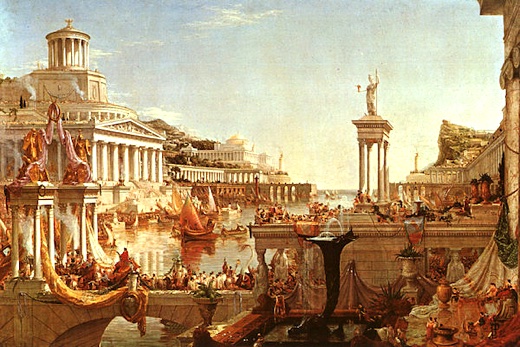
Image above: Oil painting by Thomas Cole "The Consummation of Empire" 1836. From original article.
[Automatic Earth's publisher Raul Ilagi Meier's introduction: The Conflicts Forum, directed by former British diplomat and MI6 ‘ranking figure’ Alastair Crooke, sent me another unpublished article by Alastair and asked if the Automatic Earth would publish it. But of course. Previous articles by Alastair published here are: ‘End of Growth’ Sparks Wide Discontent in October 2016, Obstacles to Trump’s ‘Growth’ Plans in November 2016 and What is this ‘Crisis’ of Modernity? in January 2017.]
David Stockman routinely refers to President Trump as the ‘Great Disrupter’. But this is not a bad quality, he insists. Rather, it is a necessary one: Stockman argues (my paraphrasing) that Trump represents the outside force, the externality, that tips a ‘world system’ over the brink: It has to tip over the brink, because systems become too ossified, too far out on their ‘branch’ to be able to reform themselves.
It does not really matter so much, whether the agency of this tipping process (President Trump in this instance), fully comprehends his pivotal role, or plays it out in an intelligent and subtle way, or in a heavy-handed, and unsubtle manner. Either serve the purpose. And that purpose is to disrupt.
Why should disruption be somehow a ‘quality’? It is because, during a period when ‘a system’ is coming apart, (history tells us), one can reach a point at which there is no possibility of revival within the old, but still prevailing, system.
An externality of some sort – maybe war, or some other calamity or a Trump – is necessary to tip the congealed system ‘over’: thus, the external intrusion can be the catalyst for (often traumatic) transformational change.
Stockman puts it starkly:
Former Presidential candidate, Pat Buchanan concurs: “President Trump may be chief of state, head of government and commander in chief, but his administration is shot through with disloyalists plotting to bring him down.
We are approaching something of a civil war where the capital city seeks the overthrow of the sovereign, and [to achieve] its own restoration. Thus far, it is a nonviolent struggle, though street clashes between pro- and anti-Trump forces are increasingly marked by fistfights and brawls. Police are having difficulty keeping people apart. A few have been arrested carrying concealed weapons.
That the objective of this city is to bring Trump down, via a deep state-media coup, is no secret. Few deny it.”
The extraordinary successful ‘manufacture’ and ‘parachuting-in’ of Macron into the French Presidential election by the French élite, precisely has given to the globalised Deep State (including their US counterparts), renewed confidence that Europe and America’s slide towards ‘populism’, is indeed a ‘correctable error’. European elites now can barely contain their revived schadenfreude at the Brexiters’ and at the Populists’ presumed discomfort (see here).

Image above: Oil painting by Thomas Cole "The Destruction of Empire" 1836. From original article.
But despite the palpable danger to the integrity of the political system itself, Stockman notes, “it is no inconsiderable understatement to suggest that the S&P 500 at 2440 is about as fragile as the ‘market’ has ever been.
Any untoward pinprick could send it into a tailspin … Doug Kass said it best in his recent commentary:
Daniel Henninger, in a Wall Street Journal op-ed, writes:
But when he and his students completed their research, he concluded that though these factors had often played an important part, they were not the prime cause of the system coming apart. Rather, he identified a number of key triggers:
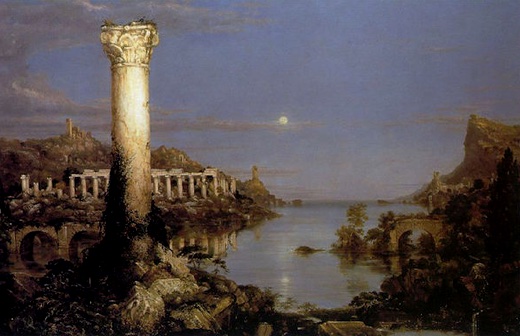
Image above: Oil painting by Thomas Cole "The Desolation of Empire" 1836. From original article.
Is this the situation today? The pre-conditions that Professor Vlahos relates, in terms of élite hubris, self-regard, and disdain for the real concerns of people are there (the polarization of US society at the US election provides the empirical evidence for this). And Stockman, in calling Trump the ‘Great Disrupter’ plainly implies that he might be precisely the ‘externality’ (coming from outside the élite) – that might tip things ‘over’. This surely is what Stockman means when he warns about ‘the present risk environment’ being extreme.
Of course, the usual retort is that Trump offers no coherent alternative conceptual vision for the future, but only seized successfully upon a number of key insights: the power of cultural nationalism, the pain felt by the casualties of globalism, the impact of a hollowed-out US economy, and the need to put America first.
This is true. These insights do not constitute a vision for the future, but why should one expect that, from the ‘Disrupter’? His ‘agency’ is that of catalyst, not that of final ‘constructor’. That comes later.
So, from whence does ultimate societal renewal come? The classic answer is that after ‘disruption’ nothing much is left standing amidst the (metaphoric) ruins of whatever stood as the reigning ‘modernity’.
Historically, renewal was effected through a communal ‘reaching back’- beyond the roots of whatever represented the contemporary crisis – to delve back, deep into the archetypal cultural history of a people. The rummaging in collective memory, allows a narrative to shape, about why the present ‘hurt’ befell its people, and to bring forward, transformed into contemporary meaning, some ‘solution’: a new meta-historical understanding.
Plainly, this (a type of spiritual renewal) is not President Trump’s ‘bag’. (Steve Bannon’s the more so, perhaps?)
What does all this mean in practical terms? First, it suggests that most of us still prefer not to address the stark reality that “the objective of this city (DC), is to bring Trump down, via a deep state-media coup” and the bitter political trench warfare, which this portends. We prefer to rest in complacency, (as zombies for now), until a crisis squarely hits us – in a personal way.
Secondly, thoughts of an easy return to the status quo ante (such as via Vice-President Pence standing-in), is problematic (Macron’s election in France notwithstanding). Since the élites (all of them), have, in their ‘war’ against ‘populists’ and deplorables, totally lost legitimacy and authority for a substantive part of their populations. And they will not – cannot – adapt. For, that is their nature.
This is the moment, Professor Vlahos notes, when a system – i.e. US operational governance – begins to ‘come apart’. Individuals, cabals within government, whole departments of state, look to their own self-awarded ‘authority’, rather than to that of the government as mandated by the electorate.
Thus we have this past week, the Senate voting 97-2 to impose further sanctions on Russia. Another wrench jammed into Trump’s foreign policy wheels – and explicitly conceived to paralyse and impede the President.
Thirdly, the intent is – like some Amazonian reptile venom – to ‘bite’ him with so much innuendo and assorted investigations and further allegations, that Trump, like the reptile’s victim, remains awake – but incapable of moving a muscle: A true zombie, in fact, as the reptile feeds on its living corpse.
Fourth, this zombified US President, will shortly face the requirement to negotiate with Congress an exit from a bubbling financial sphere soaring upwards, whilst a moribund real economy trails downwards – under pressure from the fast-approaching debt-ceiling deadline.
The Senate’s slap at the President’s face with the Russia sanctions vote suggests it is more likely that he will be tossed another spanner: this time aimed at the wheels of the ‘Trump reflation’ program.
What other insights might history offer? Two, perhaps: Professor Vlahos, during his discussion with John Batchelor, the latter points out that, even at the very moment that the hub of the Roman Empire already had fallen apart, the collapsing Empire was celebrated the most, when it was imitated at the furthest edges of Empire: by the peoples of Gaul and Germany, for example.
Are we not seeing the same today, in Europe, as Merkel and Macron vow to keep the liberal, globalist values of the American Empire alive — at the edges of the American Empire — in Europe?
And lastly, the constituency that historically led renewal? Professor Vlahos: “The Roman legions, the Czarist armies, the German Imperial armies and the Ottoman armies”.
The Pentagon élites should note well.

Image above: Oil painting by Thomas Cole 1836 series on "The Course of Empire - The Pastoral State". From (http://www.artfixdaily.com/artwire/release/1791-nature-and-the-american-vision-the-hudson-river-school) Click to enlarge..
[IB Publsiher's note: Above is another of American painter Thomas Cole's series. This one illustrates the arcadian or pastoral state. It's not clear if it follows or precedes Empire. We, at Island Breath, are hoping and planning for the latter.]
.
By Alastair Crooke on 18 June 2017 for the Automatic Earth -
(https://www.theautomaticearth.com/2017/06/coming-apart-the-imperial-city-at-the-brink/)
Image above: Oil painting by Thomas Cole "The Consummation of Empire" 1836. From original article.
[Automatic Earth's publisher Raul Ilagi Meier's introduction: The Conflicts Forum, directed by former British diplomat and MI6 ‘ranking figure’ Alastair Crooke, sent me another unpublished article by Alastair and asked if the Automatic Earth would publish it. But of course. Previous articles by Alastair published here are: ‘End of Growth’ Sparks Wide Discontent in October 2016, Obstacles to Trump’s ‘Growth’ Plans in November 2016 and What is this ‘Crisis’ of Modernity? in January 2017.]
David Stockman routinely refers to President Trump as the ‘Great Disrupter’. But this is not a bad quality, he insists. Rather, it is a necessary one: Stockman argues (my paraphrasing) that Trump represents the outside force, the externality, that tips a ‘world system’ over the brink: It has to tip over the brink, because systems become too ossified, too far out on their ‘branch’ to be able to reform themselves.
It does not really matter so much, whether the agency of this tipping process (President Trump in this instance), fully comprehends his pivotal role, or plays it out in an intelligent and subtle way, or in a heavy-handed, and unsubtle manner. Either serve the purpose. And that purpose is to disrupt.
Why should disruption be somehow a ‘quality’? It is because, during a period when ‘a system’ is coming apart, (history tells us), one can reach a point at which there is no possibility of revival within the old, but still prevailing, system.
An externality of some sort – maybe war, or some other calamity or a Trump – is necessary to tip the congealed system ‘over’: thus, the external intrusion can be the catalyst for (often traumatic) transformational change.
Stockman puts it starkly:
“The single most important thing to know about the present risk environment [he is pointing here to both the political risk as well as financial risk environment], is that it is extreme, and unprecedented. In essence, the ruling elites and their mainstream media megaphones have arrogantly decided that the 2016 [US Presidential] election was a correctible error”.But complacency simply is endemic: “The utter fragility of the latest and greatest Fed bubble could not be better proxied than in this astounding fact. To wit, during the last 5,000 trading days (20 years), the VIX (a measure of market volatility) has closed below 10 on just 11 occasions. And 7 of those have been during the last month! … That’s complacency begging to be monkey-hammered”, Stockman says.
Former Presidential candidate, Pat Buchanan concurs: “President Trump may be chief of state, head of government and commander in chief, but his administration is shot through with disloyalists plotting to bring him down.
We are approaching something of a civil war where the capital city seeks the overthrow of the sovereign, and [to achieve] its own restoration. Thus far, it is a nonviolent struggle, though street clashes between pro- and anti-Trump forces are increasingly marked by fistfights and brawls. Police are having difficulty keeping people apart. A few have been arrested carrying concealed weapons.
That the objective of this city is to bring Trump down, via a deep state-media coup, is no secret. Few deny it.”
The extraordinary successful ‘manufacture’ and ‘parachuting-in’ of Macron into the French Presidential election by the French élite, precisely has given to the globalised Deep State (including their US counterparts), renewed confidence that Europe and America’s slide towards ‘populism’, is indeed a ‘correctable error’. European elites now can barely contain their revived schadenfreude at the Brexiters’ and at the Populists’ presumed discomfort (see here).
Image above: Oil painting by Thomas Cole "The Destruction of Empire" 1836. From original article.
But despite the palpable danger to the integrity of the political system itself, Stockman notes, “it is no inconsiderable understatement to suggest that the S&P 500 at 2440 is about as fragile as the ‘market’ has ever been.
Any untoward pinprick could send it into a tailspin … Doug Kass said it best in his recent commentary:
“Over history, as we have learned, a Minksy Moment develops when investor sentiment becomes complacent after long periods of prosperity and the data is ignored, and doesn’t seem to matter anymore, as I wrote in “It’s a ‘Bohemian Rhapsody’ Market: Nothing Really Matters … to investors.”In short, the market has become ‘zombie’ (in the sense of residing within a psychological defence mechanism – as, when to contemplate the alternative – simply is too threatening to the psyche) [emphasis added].
Daniel Henninger, in a Wall Street Journal op-ed, writes:
“Donald Trump’s election has caused psychological unhingement in much of the population. But the Trump phenomenon only accelerated forces that were plummeting in this direction before the 2016 election…It is not, of course just the markets which are threatened by unperceived risk. Trump shall not be forgiven for challenging the sacrosant meme of a world divided between (good) ‘liberal’ democracies (led by the US and its European allies) and (bad) illiberal autocracies (led today, by President Putin’s Russia): by snubbing NATO and withdrawing from the Paris Climate Agreement, Professor Michael Klare writes;
“Impossible to miss, though, is how jacked up emotional intensity has become in American politics. The campaign rallies of both Mr. Trump and Bernie Sanders often sat on the edge of violence. Reporters describe political town hall meetings as full of “angry” voters. Shouting down the opposition in these forums or on campus has been virtually internalized as standard behavior. Refusal to reason is the new normal. And then, the unreason is euphemized as free speech.
Explaining away these impulses as a routine turn of the populist political cycle is insufficient. Something more permanent is happening.”
“We’ve been told, President Trump is dismantling the liberal world order created by Franklin D Roosevelt at the end of World War II”.An offence, it seems, against something somehow sacral: recently, US comedienne Kathy Griffin posted a video of herself holding the bloody, severed head of Donald Trump. “But that wasn’t the end of it” Henninger notes.
“We may assume that as Ms. Griffin was creating her video, the artists at New York’s Public Theater, were rehearsing their production of Julius Caesar, the one in which Central Park audiences watch ‘Caesar’ as a blond-haired Donald Trump, who is pulled down from a podium by men in suits, and assassinated with plunging knives … Whatever once fastened the doors of people’s minds to something secure and stable has become unhinged.”Mike Vlahos (Professor at the US Naval War college and John Hopkins) tells us that, as a military historian and global strategist, he became curious to know just why it is that ‘world systems’ do ‘come apart’. His first, intuitive sense was that their collapse generally was brought about by some massive external force such as war, pestilence or famine, and by the concomitant mass migrations of peoples.
But when he and his students completed their research, he concluded that though these factors had often played an important part, they were not the prime cause of the system coming apart. Rather, he identified a number of key triggers:
- The elites became stratified, and politics frozen
- The peoples’ allegiance became taken for granted, at the same time that the elites chose to ignore threats to the peoples’ way of life
- Social mobility declined, and change is fiercely resisted
- Rather, élites work to maximize their wealth and status.
- Elite authority becomes excessively militarized – and justified as ‘saving civilization’.
“The situation that we inhabit today […] here in the imperial city in Washington DC, is that it is absolutely hollowed out … it is incapable of offering anything to its own people, the American people … I think we have reached a point where there is no possibility of revival within the current system that exists. The current system is set upon … is determined to eat itself out in a kind of civil war that is coming, and at the end of that, it will be done, will be finished”.
“The Methoni, one of the great nations of the late Bronze Age, had this same problem with the élites and the 1% that we have today, and they were overthrown. That’s 3300 years ago, and it keeps happening again and again.
And the very structure of the decadent relationships in late periods where élites refuse to accommodate, refuse to adapt, refuse to be sensitive to needs of the larger whole of society, means this has to happen. There has to be an overthrow … for things eventually to get better, to be renewed. In other words, you can’t renew from within”.
Image above: Oil painting by Thomas Cole "The Desolation of Empire" 1836. From original article.
Is this the situation today? The pre-conditions that Professor Vlahos relates, in terms of élite hubris, self-regard, and disdain for the real concerns of people are there (the polarization of US society at the US election provides the empirical evidence for this). And Stockman, in calling Trump the ‘Great Disrupter’ plainly implies that he might be precisely the ‘externality’ (coming from outside the élite) – that might tip things ‘over’. This surely is what Stockman means when he warns about ‘the present risk environment’ being extreme.
Of course, the usual retort is that Trump offers no coherent alternative conceptual vision for the future, but only seized successfully upon a number of key insights: the power of cultural nationalism, the pain felt by the casualties of globalism, the impact of a hollowed-out US economy, and the need to put America first.
This is true. These insights do not constitute a vision for the future, but why should one expect that, from the ‘Disrupter’? His ‘agency’ is that of catalyst, not that of final ‘constructor’. That comes later.
So, from whence does ultimate societal renewal come? The classic answer is that after ‘disruption’ nothing much is left standing amidst the (metaphoric) ruins of whatever stood as the reigning ‘modernity’.
Historically, renewal was effected through a communal ‘reaching back’- beyond the roots of whatever represented the contemporary crisis – to delve back, deep into the archetypal cultural history of a people. The rummaging in collective memory, allows a narrative to shape, about why the present ‘hurt’ befell its people, and to bring forward, transformed into contemporary meaning, some ‘solution’: a new meta-historical understanding.
Plainly, this (a type of spiritual renewal) is not President Trump’s ‘bag’. (Steve Bannon’s the more so, perhaps?)
What does all this mean in practical terms? First, it suggests that most of us still prefer not to address the stark reality that “the objective of this city (DC), is to bring Trump down, via a deep state-media coup” and the bitter political trench warfare, which this portends. We prefer to rest in complacency, (as zombies for now), until a crisis squarely hits us – in a personal way.
Secondly, thoughts of an easy return to the status quo ante (such as via Vice-President Pence standing-in), is problematic (Macron’s election in France notwithstanding). Since the élites (all of them), have, in their ‘war’ against ‘populists’ and deplorables, totally lost legitimacy and authority for a substantive part of their populations. And they will not – cannot – adapt. For, that is their nature.
This is the moment, Professor Vlahos notes, when a system – i.e. US operational governance – begins to ‘come apart’. Individuals, cabals within government, whole departments of state, look to their own self-awarded ‘authority’, rather than to that of the government as mandated by the electorate.
Thus we have this past week, the Senate voting 97-2 to impose further sanctions on Russia. Another wrench jammed into Trump’s foreign policy wheels – and explicitly conceived to paralyse and impede the President.
Thirdly, the intent is – like some Amazonian reptile venom – to ‘bite’ him with so much innuendo and assorted investigations and further allegations, that Trump, like the reptile’s victim, remains awake – but incapable of moving a muscle: A true zombie, in fact, as the reptile feeds on its living corpse.
Fourth, this zombified US President, will shortly face the requirement to negotiate with Congress an exit from a bubbling financial sphere soaring upwards, whilst a moribund real economy trails downwards – under pressure from the fast-approaching debt-ceiling deadline.
The Senate’s slap at the President’s face with the Russia sanctions vote suggests it is more likely that he will be tossed another spanner: this time aimed at the wheels of the ‘Trump reflation’ program.
What other insights might history offer? Two, perhaps: Professor Vlahos, during his discussion with John Batchelor, the latter points out that, even at the very moment that the hub of the Roman Empire already had fallen apart, the collapsing Empire was celebrated the most, when it was imitated at the furthest edges of Empire: by the peoples of Gaul and Germany, for example.
Are we not seeing the same today, in Europe, as Merkel and Macron vow to keep the liberal, globalist values of the American Empire alive — at the edges of the American Empire — in Europe?
And lastly, the constituency that historically led renewal? Professor Vlahos: “The Roman legions, the Czarist armies, the German Imperial armies and the Ottoman armies”.
The Pentagon élites should note well.

Image above: Oil painting by Thomas Cole 1836 series on "The Course of Empire - The Pastoral State". From (http://www.artfixdaily.com/artwire/release/1791-nature-and-the-american-vision-the-hudson-river-school) Click to enlarge..
[IB Publsiher's note: Above is another of American painter Thomas Cole's series. This one illustrates the arcadian or pastoral state. It's not clear if it follows or precedes Empire. We, at Island Breath, are hoping and planning for the latter.]
.
