
SUBHEAD: Shrubs grow much faster than trees and are powerful carbon sequestration engines in their own right.
By Adrian Fisher on 27 December 2018 for Ecological Gardening
(https://www.ecologicalgardening.net/2018/12/native-shrubs-and-why-theyre-essential.html)
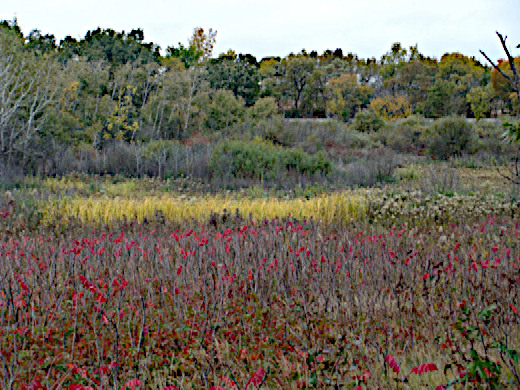
Image above: Sand prairie merging into shrubland in southeast Wisconsin. From The Prairie Botanist
It is precisely their adaptive characteristics that give shrubs their potential to be powerful players in soil carbon sequestration and ecosystem regeneration in certain parts of the world, such as the Midwest.
Although alarming, the reports are not surprising to anyone who’s been keeping track. The IPCC report says human global society has 12 years to reduce carbon emissions to 45% below 2010 levels if there is to be any hope of holding overall average global temperature rise to 1.5 degrees C (2.7 degrees F).
The US report, searchable by region, adds fairly detailed, equally dire scenarios for this country. No place on earth will be immune to the destructive consequences of our failure to act.
Since the world has already warmed approximately 1 degree C, even if we are able to keeping warming to 1.5 degrees—an almost insanely optimistic proposal, given the array of forces, from active malice to blind inertia, all backed by money, power and influence poised against success—there will still be massive, destabilized weather patterns and disruptive, destructive weather events similar to and worse than what we are already experiencing.
The resultant ecological destruction and human misery will only increase with each half a degree beyond 1 degree until large parts of the earth are literally uninhabitable by humans. We are, right now, on track to warm roughly 3.3 degrees by century’s end.
Despite the official reports’ newly grim tone, there are no new solutions. As we’ve known for decades, staving off disaster requires both cutting greenhouse gas emissions and helping earth’s biological systems regenerate, pull massive amounts of carbon from the air, and store it in biomass and soils.
For an overview of how all of this can be achieved, the book and companion website “Drawdown” remains an excellent compendium of strategies and tactics.
The IPCC report offers four scenarios by which rapid decarbonization and carbon sequestration could be achieved. Three of them rely heavily on so far non-existent or extremely small-scale technological carbon capture and sequestration methods.
Possibly the worst of these from an ecological point of view is BECCS (bioenergy with carbon capture and storage), a technique involving growing and burning massive amounts of trees, shrubs and grasses while “magically” capturing and sequestering the resultant carbon emissions.
Relying on salvation by means of a fix we don’t actually have the ability, money or time to accomplish is a distracting, destructive form of magical thinking. Practiced at scale, BECCS would require appropriating farmland, destroying forests and wrecking ecosystems.
An analogous illustration of its potential for upending ecosystems and ways of life would be the destruction palm oil plantations have wrought in Borneo, devastation turbo-charged in part by an American law meant to get us off dependence on fossil fuels and well documented in the New York Times Magazine.)
Natural carbon solutions offer the most realistic way forward
The IPCC scenario that best comports with current reality and a genuinely sustainable, resilient future describes what carbon farmers, holistic managers, scientists, environmentalists and many others have been touting and practicing for 50 years.
That is, while we ramp up renewables, increase energy efficiency, and decarbonize our life styles, we should also do everything possible to enable worldwide carbon sequestration through biological processes.
We should restore and vastly augment our forests, grasslands and wetlands and overhaul agricultural practices along agroecological lines. Here in the US, the recently published paper “Natural Carbon Solutions for the United States” quantifies how much carbon can be sequestered through improved landscape and coastal wetlands management practices.
The authors calculate potential sequestration to be about 21% of total US emissions, or enough to equal taking all cars and trucks in the US off the road.
Unlike purely mechanical carbon sequestration methods, or schemes such as BECCS, natural carbon solutions would simultaneously help get global temperature rise under control while improving and enriching ecosystems’ functioning—thus helping ease the crisis of ecological destruction now sweeping the planet.
While nearly everyone has a pretty good idea of how to cut emissions, fewer are aware of how they themselves could implement natural carbon solutions beyond planting a tree or two. But simply plopping some trees in a lawn or along a parkway is not enough.
As I’ve written previously, serious natural carbon sequestration, at whatever scale, requires regenerative landscape management practices such as putting in a biodiverse palette of native trees, flowers and grasses and stopping the use of pesticides and synthetic fertilizer.
Shrubs can be crucial to this kind of planting, especially in terms of the other ecological benefits they offer. Wherever there is a lawn, a tree and possibly a small garden, or even a tiny strip along the foundations of a building, there should be a native shrub or two, or possibly more.
Large properties and farms have nearly unlimited possibilities in the form of hedgerows, shelterbelts or even reconstituted shrub prairies.
Shrubs are a necessary part of landscaping for carbon sequestration
From a landscaping perspective, shrubs are sort of like the middle children in a very large family: necessarily adaptable, but little thought of or noticed.
This is true even scientifically. “Natural Carbon Solutions” explicitly omits shrublands from the calculations, and a 2016 review of scientific literature in “Why Be a Shrub” states that the least studied landscape types are shrublands, while the least studied plants are shrubs.
Yet shrubs flourish virtually everywhere and shrublands are increasing across the globe, possibly due in part to climate change.
In the American West the new severity of wildfires makes it difficult for forests to regenerate. The replacement is shrubland, or, to use an old term, “barrens.” Is the lack of notice and study because shrubs are so common and ubiquitous, but lack the majesty of trees and the show-offy beauty of flowering annuals and perennials?
This lack of notice carries through in our designed landscapes. The default for parks and private property alike is often faux open woodland or savanna, with widely spaced trees and plenty of grass—and few shrubs.
Farms are faux prairies where shrubs that formerly would have flourished wild and later in hedgerows and fencerows and along waterways have been largely extirpated.
What shrubs there are might be a few non-native ornamentals ranged in a row along a building foundation, kept as a low hedge along a sidewalk, or grouped in a small island of mulch.
Humans love these savanna-ish landscapes that now cover millions of acres. For us, they are comfortable and attractive. They look very green on Google Earth and from the air to migrating birds.
But for birds and other animals, they function as “death traps,” as a US Fish and Wildlife employee once told me. Birds looking for habitat in such a place find it inhospitable. There is neither ground-level shelter, nor, for some kinds of shrub-dependent birds, good nesting habitat.
Nor is there much in the way of flowers for pollinators or host plants for insect herbivores or caterpillars, which means few of the native insects and berries that birds forage for in massive quantities for their own needs and to feed their young.
Finally, what should be a complex underground web of fungal species and soil dwelling microbes is, instead, simplified and depauperate.
Because they are missing shrubby layers, what seem to humans like well structured environments are, in fact, missing the complex structure that creates the capacity for higher order ecological relationships—that is, the relationships among three or more species (including plants, animals, fungi and bacteria) that tie an ecosystem together and enable carbon sequestration.
The adaptive characteristics of shrubs
Shrubs are the woody plants with multiple stems that branch close to the ground and may be erect but might sprawl. Usually they are less than 15 feet in height; anything taller than that is usually, but not always considered a tree. In general, deciduous shrubs are spring (sometimes fall) flowering and yield small fruits such as berries, drupes or nuts.
Crucially for wild landscapes of all types, their adaptability means they can re-sprout easily after fires or other disturbances, grow to mature size much faster than trees, and have self-spreading habits such as suckering or rooting where branches touch the ground.
It’s often hard to kill a shrub without digging out the roots. Their many leaves and stems make them efficient photosynthesis factories, pulling carbon out of the air, and their roots hook up with the underground biome as contributing partners.
They share nutrients and information with other plants, engage in the carbon-sugars-for-nutrients trade with fungi, shelter microbes in return for nitrogen and other nutrients, and thus contribute to a healthy, biodiverse, carbon-sequestering soil system. Some kinds of shrubs even act as nurse species, so that young trees grow better in their company.
The Midwest was once a very shrubby place
It’s hard to visualize what the landscape in the Midwest looked like prior to the European invasion down through the first half of the 19th century.
There were, of course, towns and trade routes, especially along the rivers, but it was a land with few fences or readily marked boundaries in the sense that we know them.
A broad area of the country around the western Great Lakes and running south to Texas functioned as the transition zone between the Eastern forest and the Western prairies. It was a landscape of great diversity, an intricate mosaic of landscape types, all of them highly dependent on fire to maintain their distinctive characteristics.
Overall, the land ranged along a continuum from mostly treeless open prairie to shrub prairie to savanna to woodland to, rarely, closed-canopy forest. The native peoples used fire as a management tool and maintaining and shaping the diversity.
Yet this management was holistic, non-linear, intuitive, spiritual, and tended to enhance biodiversity, unlike most of the control-prioritizing methods we employ today.
Surveyors’ notes from the early 19th century often include mentions of shrubs such as American hazelnut. A typical comment might read, “scattering timber, principally burr and white oak, hazel and hickory undergrowth.”
That is, they were traveling through shrub prairies and savannas where shrubs intermingled with trees and prairie plants.
Other noted shrub species included New Jersey tea, four species of dogwood, wild crabapple, wild plum, sumac species, roses, prairie willow and prickly ash.
Species prevalence depended on soil type and moisture availability, but all—more than thirty species— were adapted to fire, with the shrubby adaptive ability to easily spread vegetatively and to rapidly regenerate post-fire.
In areas of very frequent fires where shrub barrens developed, even some species of oak took on a shrubby form. The vanishingly few modern examples of shrub prairie also demonstrate their value as wildlife habitat.
These remaining landscapes tend to be on moist, sandy soil and include not only some of the species listed above, but also chokeberries, huckleberries, blueberries, grasses such as big bluestem, and flowers such as prairie violet. They are home to shrub-dependent birds, pollinators and wildlife such as herptiles, amphibians and mammals, including some rare or endangered species.
Disappearing native shrubs
Our cultural landscape amnesia is so great that, during the time much of this landscape was being physically erased by farms and towns, memories of it were concurrently erased, or if spoken of, were disputed or even disbelieved.
Unless we learn otherwise, we tend to think that the current landscape is how it should be. I’ve talked with farming people who have lost their history, can’t call native shrubs and prairie plants by their names and think of them as weeds to be mown down. Conventional farming policy and practice exacerbates this tendency.
Only very old people, mostly long dead now, have told me of hedgerows full of shrubs in bloom, and remembered homemade wild plum preserves, gooseberry pies and elderberry wine.
Today, as a result, wild native shrubs are in decline in the Midwest. To the knowledgeable eye it is odd, even jarring to see farmhouses landscaped with nursery standardized non-native barberries and privets in one of the great shrub producing regions of the world.
It is sad to realize that shrubs with scant to no ecological value are favored over the Midwest species that could be such a boon to wildlife, soil health and to the farmers themselves.
And our cities, suburbs and towns are no better for many native shrubs, which don't easily conform to the constraints imposed by extremely manicured landscapes. Luckily, this has been slowly changing as cultivars have been selected and developed.
Viburnums and hydrangeas have long been of value and these days, many residential street have their serviceberries, chokeberries, dogwoods and oak leaf hydrangeas.
Even in natural areas, often created in less desirable, less farmable land than the great open prairies, fire suppression ensured that what were shrub prairies and savannas rapidly became woodlands and sometimes forests.
Only in the late 20th century were these last two landscapes rediscovered as entities in and of themselves.
A former savanna can often be recognized by the presence of old bur oaks with the characteristically wide-spreading shape they develop when open-grown, surrounded by younger, straighter, narrower trees. In modern restoration, savannas have often been prioritized.
Conversely, shrub species such as gray dogwood, though native, have frequently been put on lists of less desirable plants in need of control. Only in this century have wild native shrubs’ value been reconsidered as necessary understory species and as major landscape components in and of themselves.
Wild native shrubs for carbon sequestration
In the Midwest (and possibly other regions in the world), reforestation and afforestation as a major carbon sequestering and ecological resilience strategy does not mean recreating the deep forests of the Eastern and Southeastern US.
What is required is figuring out how lessons from the old patchwork-mosaic, fire-dependent landscape can be relearned and applied in new ways.
Existing natural landscapes should be examined for their carbon-sequestering, water management and ecological resilience functions and the data used as inspiration for how best to conduct the necessary rewilding, recomplexifying efforts in the landscapes where humans live, work and farm.
We need to expand the army of ecologists, restorationists, landscape managers, farmers, and public and private landowners already at work and create new, potent alliances of land managers.
I believe it will be found that recreating a diversity of landscapes along the prairie to forest continuum, including shrub prairies and wetlands, in accordance with given soil types and water availability, will best make use of conditions here--even as the climate changes.
The possibilities are manifold.
All of this should be possible and will be necessary as the indisputable benefits of nurturing species complexity in the service of biological diversity and soil carbon sequestration become more widely acknowledged during our climate emergency.
Shrubs grow much faster than trees and are powerful carbon sequestration engines in their own right.
They could play a huge part of the Midwest’s potential carbon sequestration and resilience strategy. It’s time for these middle children of the plant world to come into their own.
.
By Adrian Fisher on 27 December 2018 for Ecological Gardening
(https://www.ecologicalgardening.net/2018/12/native-shrubs-and-why-theyre-essential.html)
Image above: Sand prairie merging into shrubland in southeast Wisconsin. From The Prairie Botanist
“Shrubbiness is such a remarkable adaptive design that one may wonder why more plants have not adopted it.” (H. C. Stutz, 1989)In light of the newest IPCC and US climate change reports, coupled with reports of the ongoing declines of wild species—birds, insects—you name them, just so long as they aren’t human, I have turned to thinking about shrubs.
It is precisely their adaptive characteristics that give shrubs their potential to be powerful players in soil carbon sequestration and ecosystem regeneration in certain parts of the world, such as the Midwest.
Although alarming, the reports are not surprising to anyone who’s been keeping track. The IPCC report says human global society has 12 years to reduce carbon emissions to 45% below 2010 levels if there is to be any hope of holding overall average global temperature rise to 1.5 degrees C (2.7 degrees F).
The US report, searchable by region, adds fairly detailed, equally dire scenarios for this country. No place on earth will be immune to the destructive consequences of our failure to act.
Since the world has already warmed approximately 1 degree C, even if we are able to keeping warming to 1.5 degrees—an almost insanely optimistic proposal, given the array of forces, from active malice to blind inertia, all backed by money, power and influence poised against success—there will still be massive, destabilized weather patterns and disruptive, destructive weather events similar to and worse than what we are already experiencing.
The resultant ecological destruction and human misery will only increase with each half a degree beyond 1 degree until large parts of the earth are literally uninhabitable by humans. We are, right now, on track to warm roughly 3.3 degrees by century’s end.
Despite the official reports’ newly grim tone, there are no new solutions. As we’ve known for decades, staving off disaster requires both cutting greenhouse gas emissions and helping earth’s biological systems regenerate, pull massive amounts of carbon from the air, and store it in biomass and soils.
For an overview of how all of this can be achieved, the book and companion website “Drawdown” remains an excellent compendium of strategies and tactics.
The IPCC report offers four scenarios by which rapid decarbonization and carbon sequestration could be achieved. Three of them rely heavily on so far non-existent or extremely small-scale technological carbon capture and sequestration methods.
Possibly the worst of these from an ecological point of view is BECCS (bioenergy with carbon capture and storage), a technique involving growing and burning massive amounts of trees, shrubs and grasses while “magically” capturing and sequestering the resultant carbon emissions.
Relying on salvation by means of a fix we don’t actually have the ability, money or time to accomplish is a distracting, destructive form of magical thinking. Practiced at scale, BECCS would require appropriating farmland, destroying forests and wrecking ecosystems.
An analogous illustration of its potential for upending ecosystems and ways of life would be the destruction palm oil plantations have wrought in Borneo, devastation turbo-charged in part by an American law meant to get us off dependence on fossil fuels and well documented in the New York Times Magazine.)
Natural carbon solutions offer the most realistic way forward
The IPCC scenario that best comports with current reality and a genuinely sustainable, resilient future describes what carbon farmers, holistic managers, scientists, environmentalists and many others have been touting and practicing for 50 years.
That is, while we ramp up renewables, increase energy efficiency, and decarbonize our life styles, we should also do everything possible to enable worldwide carbon sequestration through biological processes.
We should restore and vastly augment our forests, grasslands and wetlands and overhaul agricultural practices along agroecological lines. Here in the US, the recently published paper “Natural Carbon Solutions for the United States” quantifies how much carbon can be sequestered through improved landscape and coastal wetlands management practices.
The authors calculate potential sequestration to be about 21% of total US emissions, or enough to equal taking all cars and trucks in the US off the road.
Unlike purely mechanical carbon sequestration methods, or schemes such as BECCS, natural carbon solutions would simultaneously help get global temperature rise under control while improving and enriching ecosystems’ functioning—thus helping ease the crisis of ecological destruction now sweeping the planet.
While nearly everyone has a pretty good idea of how to cut emissions, fewer are aware of how they themselves could implement natural carbon solutions beyond planting a tree or two. But simply plopping some trees in a lawn or along a parkway is not enough.
As I’ve written previously, serious natural carbon sequestration, at whatever scale, requires regenerative landscape management practices such as putting in a biodiverse palette of native trees, flowers and grasses and stopping the use of pesticides and synthetic fertilizer.
Shrubs can be crucial to this kind of planting, especially in terms of the other ecological benefits they offer. Wherever there is a lawn, a tree and possibly a small garden, or even a tiny strip along the foundations of a building, there should be a native shrub or two, or possibly more.
Large properties and farms have nearly unlimited possibilities in the form of hedgerows, shelterbelts or even reconstituted shrub prairies.
Shrubs are a necessary part of landscaping for carbon sequestration
From a landscaping perspective, shrubs are sort of like the middle children in a very large family: necessarily adaptable, but little thought of or noticed.
This is true even scientifically. “Natural Carbon Solutions” explicitly omits shrublands from the calculations, and a 2016 review of scientific literature in “Why Be a Shrub” states that the least studied landscape types are shrublands, while the least studied plants are shrubs.
Yet shrubs flourish virtually everywhere and shrublands are increasing across the globe, possibly due in part to climate change.
In the American West the new severity of wildfires makes it difficult for forests to regenerate. The replacement is shrubland, or, to use an old term, “barrens.” Is the lack of notice and study because shrubs are so common and ubiquitous, but lack the majesty of trees and the show-offy beauty of flowering annuals and perennials?
This lack of notice carries through in our designed landscapes. The default for parks and private property alike is often faux open woodland or savanna, with widely spaced trees and plenty of grass—and few shrubs.
Farms are faux prairies where shrubs that formerly would have flourished wild and later in hedgerows and fencerows and along waterways have been largely extirpated.
What shrubs there are might be a few non-native ornamentals ranged in a row along a building foundation, kept as a low hedge along a sidewalk, or grouped in a small island of mulch.
Humans love these savanna-ish landscapes that now cover millions of acres. For us, they are comfortable and attractive. They look very green on Google Earth and from the air to migrating birds.
But for birds and other animals, they function as “death traps,” as a US Fish and Wildlife employee once told me. Birds looking for habitat in such a place find it inhospitable. There is neither ground-level shelter, nor, for some kinds of shrub-dependent birds, good nesting habitat.
Nor is there much in the way of flowers for pollinators or host plants for insect herbivores or caterpillars, which means few of the native insects and berries that birds forage for in massive quantities for their own needs and to feed their young.
Finally, what should be a complex underground web of fungal species and soil dwelling microbes is, instead, simplified and depauperate.
Because they are missing shrubby layers, what seem to humans like well structured environments are, in fact, missing the complex structure that creates the capacity for higher order ecological relationships—that is, the relationships among three or more species (including plants, animals, fungi and bacteria) that tie an ecosystem together and enable carbon sequestration.
The adaptive characteristics of shrubs
Shrubs are the woody plants with multiple stems that branch close to the ground and may be erect but might sprawl. Usually they are less than 15 feet in height; anything taller than that is usually, but not always considered a tree. In general, deciduous shrubs are spring (sometimes fall) flowering and yield small fruits such as berries, drupes or nuts.
Crucially for wild landscapes of all types, their adaptability means they can re-sprout easily after fires or other disturbances, grow to mature size much faster than trees, and have self-spreading habits such as suckering or rooting where branches touch the ground.
It’s often hard to kill a shrub without digging out the roots. Their many leaves and stems make them efficient photosynthesis factories, pulling carbon out of the air, and their roots hook up with the underground biome as contributing partners.
They share nutrients and information with other plants, engage in the carbon-sugars-for-nutrients trade with fungi, shelter microbes in return for nitrogen and other nutrients, and thus contribute to a healthy, biodiverse, carbon-sequestering soil system. Some kinds of shrubs even act as nurse species, so that young trees grow better in their company.
The Midwest was once a very shrubby place
It’s hard to visualize what the landscape in the Midwest looked like prior to the European invasion down through the first half of the 19th century.
There were, of course, towns and trade routes, especially along the rivers, but it was a land with few fences or readily marked boundaries in the sense that we know them.
A broad area of the country around the western Great Lakes and running south to Texas functioned as the transition zone between the Eastern forest and the Western prairies. It was a landscape of great diversity, an intricate mosaic of landscape types, all of them highly dependent on fire to maintain their distinctive characteristics.
Overall, the land ranged along a continuum from mostly treeless open prairie to shrub prairie to savanna to woodland to, rarely, closed-canopy forest. The native peoples used fire as a management tool and maintaining and shaping the diversity.
Yet this management was holistic, non-linear, intuitive, spiritual, and tended to enhance biodiversity, unlike most of the control-prioritizing methods we employ today.
Surveyors’ notes from the early 19th century often include mentions of shrubs such as American hazelnut. A typical comment might read, “scattering timber, principally burr and white oak, hazel and hickory undergrowth.”
That is, they were traveling through shrub prairies and savannas where shrubs intermingled with trees and prairie plants.
Other noted shrub species included New Jersey tea, four species of dogwood, wild crabapple, wild plum, sumac species, roses, prairie willow and prickly ash.
Species prevalence depended on soil type and moisture availability, but all—more than thirty species— were adapted to fire, with the shrubby adaptive ability to easily spread vegetatively and to rapidly regenerate post-fire.
In areas of very frequent fires where shrub barrens developed, even some species of oak took on a shrubby form. The vanishingly few modern examples of shrub prairie also demonstrate their value as wildlife habitat.
These remaining landscapes tend to be on moist, sandy soil and include not only some of the species listed above, but also chokeberries, huckleberries, blueberries, grasses such as big bluestem, and flowers such as prairie violet. They are home to shrub-dependent birds, pollinators and wildlife such as herptiles, amphibians and mammals, including some rare or endangered species.
Disappearing native shrubs
Our cultural landscape amnesia is so great that, during the time much of this landscape was being physically erased by farms and towns, memories of it were concurrently erased, or if spoken of, were disputed or even disbelieved.
Unless we learn otherwise, we tend to think that the current landscape is how it should be. I’ve talked with farming people who have lost their history, can’t call native shrubs and prairie plants by their names and think of them as weeds to be mown down. Conventional farming policy and practice exacerbates this tendency.
Only very old people, mostly long dead now, have told me of hedgerows full of shrubs in bloom, and remembered homemade wild plum preserves, gooseberry pies and elderberry wine.
Today, as a result, wild native shrubs are in decline in the Midwest. To the knowledgeable eye it is odd, even jarring to see farmhouses landscaped with nursery standardized non-native barberries and privets in one of the great shrub producing regions of the world.
It is sad to realize that shrubs with scant to no ecological value are favored over the Midwest species that could be such a boon to wildlife, soil health and to the farmers themselves.
And our cities, suburbs and towns are no better for many native shrubs, which don't easily conform to the constraints imposed by extremely manicured landscapes. Luckily, this has been slowly changing as cultivars have been selected and developed.
Viburnums and hydrangeas have long been of value and these days, many residential street have their serviceberries, chokeberries, dogwoods and oak leaf hydrangeas.
Even in natural areas, often created in less desirable, less farmable land than the great open prairies, fire suppression ensured that what were shrub prairies and savannas rapidly became woodlands and sometimes forests.
Only in the late 20th century were these last two landscapes rediscovered as entities in and of themselves.
A former savanna can often be recognized by the presence of old bur oaks with the characteristically wide-spreading shape they develop when open-grown, surrounded by younger, straighter, narrower trees. In modern restoration, savannas have often been prioritized.
Conversely, shrub species such as gray dogwood, though native, have frequently been put on lists of less desirable plants in need of control. Only in this century have wild native shrubs’ value been reconsidered as necessary understory species and as major landscape components in and of themselves.
Wild native shrubs for carbon sequestration
In the Midwest (and possibly other regions in the world), reforestation and afforestation as a major carbon sequestering and ecological resilience strategy does not mean recreating the deep forests of the Eastern and Southeastern US.
What is required is figuring out how lessons from the old patchwork-mosaic, fire-dependent landscape can be relearned and applied in new ways.
Existing natural landscapes should be examined for their carbon-sequestering, water management and ecological resilience functions and the data used as inspiration for how best to conduct the necessary rewilding, recomplexifying efforts in the landscapes where humans live, work and farm.
We need to expand the army of ecologists, restorationists, landscape managers, farmers, and public and private landowners already at work and create new, potent alliances of land managers.
I believe it will be found that recreating a diversity of landscapes along the prairie to forest continuum, including shrub prairies and wetlands, in accordance with given soil types and water availability, will best make use of conditions here--even as the climate changes.
The possibilities are manifold.
- Where can gray dogwood and other spreading, suckering shrubs be encouraged in their proclivities?
- Where can huge wetland restorations be undertaken, where swamp roses and black chokeberries, buttonbush and swamp dogwood are allowed to run riot?
- Where will wild plums be allowed to form their dense, thorny thickets, or hazelnuts and bladdernuts be encouraged to grow among the oaks, their rightful companions?
- Who can persuade farmers that allowing these species back on their less productive land will improve the resilience of their farms—and the health of themselves and their children?
- How can park district and municipal officials and other urban/suburban land owners and managers learn to see native shrubs as worthwhile companions to trees?
All of this should be possible and will be necessary as the indisputable benefits of nurturing species complexity in the service of biological diversity and soil carbon sequestration become more widely acknowledged during our climate emergency.
Shrubs grow much faster than trees and are powerful carbon sequestration engines in their own right.
They could play a huge part of the Midwest’s potential carbon sequestration and resilience strategy. It’s time for these middle children of the plant world to come into their own.
.

