Showing posts with label Saudi Arabia. Show all posts

The Real 9/11 Conspiracy

SUBHEAD: The US pretending it was not Saudi Arabia that flew two commercial jets into the World Trade Center towers.

By Sonali Kolatkar on 23 May 2016 for TruthDig -
(https://www.alternet.org/real-911-conspiracy)
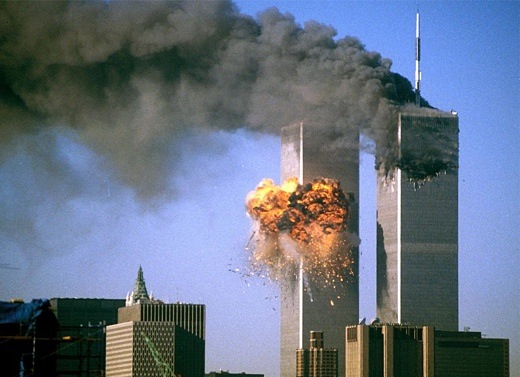

Image above: North tower burning (right) as South tower is struck by commercial jet. From (https://www.alternet.org/real-911-conspiracy).

I remember watching the towers fall.

My sister called early in the morning to tell me to turn on the television. My husband and I, who had been working closely with Afghan women organizing against the Taliban, stared at the screen, aghast as the buildings crumbled.

Like everyone else the world over, we realized it was a moment that was going to change history. We also realized that ordinary people, including our friends in Afghanistan, were going to pay the price for something they likely had nothing to do with.

And sure enough, on Oct. 7, 2001, despite the fact that 15 of the 19 hijackers were Saudi nationals, the U.S. went to war with Afghanistan. That war, the longest in U.S. history, remains a bloody weight on our collective conscience.

But as soon as the towers fell and Congress rushed to hand over blanket authority to President Bush to wantonly bomb, whispers of “an inside job” began circulating on the internet.

Those whispers snowballed as the war expanded from Afghanistan to Iraq. Many anti-war activists, eager to undermine the flawed rationale for the Iraq War, insisted ever more shrilly that Bush and company were likely behind the attacks or knew ahead of time that the attacks were coming and failed to act purposefully.

Complex and convoluted arguments about the temperatures at which the towers’ beams melted were vociferously trotted out on public radio and in Internet chat rooms. Jesse Ventura jumped into the fray. Films like “Loose Change” and “Zeitgeist” offered seductive theories for Americans to latch onto as they became angry about our rush to war.

As a journalist, I often came under fire from the so-called “9/11 truthers” for being a “gatekeeper” and refusing to take the conspiracy theories seriously. I was much more interested in the devastation being wrought by the U.S. in the name of the 9/11 attacks.

And one irrefutable fact kept arising over and over in my mind: 15 of the 19 hijackers were Saudi nationals. It was a simple fact that everyone agreed on. It had nothing to do with secrets, lies or thermodynamics. It was out in the open.

Here is a plausible conspiracy: The Saudi government, known for aiding and abetting fundamentalist terrorist groups in order to legitimize its own extremist ideology, may well have been involved with some of the 9/11 terrorists, whether or not they knew the hijackers’ intentions.

Once those links were revealed, the U.S. government, which has a history of cozy relations with the Saudis for various reasons (oil, regional influence, weapons sales, etc.), may have wanted to overlook those embarrassing connections and instead divert the American public to countries it had an interest in, namely Iraq (with Afghanistan as a stepping stone).

But in 2004, the 9/11 Commission, a 10-person government panel created to investigate the attacks, absolved the Saudi Arabian government of any involvement. (It also faulted intelligence agencies for lack of coordination.) This was thought to be the end of the story. We were supposed to accept as mere coincidence the fact that the majority of the hijackers were Saudi citizens.
 
Now it turns out that the far more plausible 9/11 conspiracy could be true. After years of rumors that a classified section of a 2002 congressional report held the key to a Saudi role, The Guardian newspaper recently interviewed a member of the 9/11 Commission who confirmed these suspicions.

John Lehman, a Republican and former U.S. Navy secretary under President Reagan, asserted, “There was an awful lot of participation by Saudi individuals in supporting the hijackers, and some of those people worked in the Saudi government.” According to The Guardian, Lehman was aware of “five Saudi government officials who were strongly suspected of involvement in the terrorists’ support network.”

Lehman, along with several members of Congress, wants the Obama administration to declassify the so-called “28 pages” that were kept secret. While Obama decides whether or not to release the documents, the GOP-dominated Senate has just passed a bill that would allow families of 9/11 victims to sue the Saudi government. The Saudis are predictably outraged, and Obama will likely veto the bill to assuage the U.S. ally.

Why is any of this important, particularly given the GOP’s penchant for finding any excuse, however insignificant, to oppose Obama?

It is important because the entire premise of current U.S. foreign policy in the Middle East is based on an assumption that no government actors were involved in the 9/11 attacks.

 Rather, we were told, it was a series of shadowy and reprehensible groups, including “al-Qaida, the Taliban and their associated forces,” in Obama’s own words, that have been targeted for blame and elimination. Just who those “associated forces” are is unknown. In reality, the “enemy” is about as classified as Saudi Arabia’s role in 9/11.

The wars in Afghanistan and Iraq that began well over a decade ago unleashed chaos and violence. They generated the gulag in Guantanamo, Cuba. They were expanded via drone strikes in Pakistan, Libya, Yemen and Somalia.

They have killed untold numbers of innocents and inspired hatred toward the U.S. The U.S. has undermined the Arab Spring movements for democracy in countries like Egypt and even bolstered Saudi Arabia’s brutal quashing of democracy in Bahrain.

It has partnered with the Saudis on a bloody war in Yemen and continued its long-standing tradition of selling the wealthy Gulf monarchy more weapons than it knows what to do with.

The real 9/11 conspiracy is that, despite recent claims that “U.S.-Saudi relations are strained,” close ties between the two countries are worth far more than uncovering what really happened on Sept. 11, 2001.

The real conspiracy has been out in the open all along. We are told that we need to trust that our government is handling the terrorists who hate us and tried to kill us, even if many contend that the wars have made us less safe. But it turns out our government is simply and amiably working along with the nation most implicated in the 9/11 attacks.

None of this is to imply that the U.S. should have bombed Saudi Arabia instead of Afghanistan in 2001. Our post-9/11 military incursions all point to the singular fact that the “War on Terror” has been a “War of Terror.”

On the lengthy list of reasons our modern era of warfare is immoral, misguided, murderous, violent and in every sense wrong, the revelations of Saudi links to the 9/11 attacks ought to be the final straw.

See also:
Ea O Ka Aina: 9/11 The Day America Ended 9/11/16
Ea O Ka Aina: What We've Lost Since 911 6/16/14
Ea O Ka Aina: New Meaning for Day After 911 9/12/13
Ea O Ka Aina: 911 Aftermath - Our Self Defeat
9/10/11
Ea O Ka Aina: The Price of 911 9/7/11
Ea O Ka Aina: Giuliani 911 NY PD FD Fraud
8/31/11
Ea O Ka Aina: Israel as a Failed State
1/4/09
Island Breath: 7th Anniversary of September 11th
9/8/08
Island Breath: The War on Terror Begins 9/11/2001 9/9/06
Island Breath: Bush-Taliban Deal Disaster
4/9/04

.
Saudis and Trump gambling Bigly

SUBHEAD: If the region still has a window for peaceful adaptation, it is small and quickly narrowing.

By Richard Heinberg on 17 November 2017 for the Post Carbon Institute -
(http://www.postcarbon.org/saudis-and-trump-gambling-bigly/)


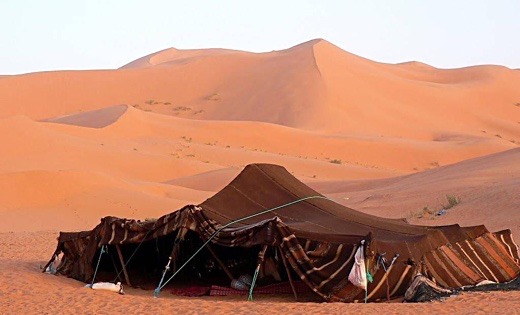
Image above: Forget about Neom an the 2030 Vision. This is a Bedouin tent in the desert of Saudi Arabia. In their migratory rounds, the Bedouins needed shelter that was both portable and reliable in a variety of conditions - cool in the day, warm at night and dry Under the rain. Without oil this is the way to live in Saudi Arabia. From (https://74fdc.wordpress.com/2012/03/30/the-bedouin-tent-cool-in-the-day-warm-at-night-and-dry-under-the-rain/).

""My grandfather rode a camel, my father rode a camel, I drive a Mercedes, my son drives a Land Rover ” –  Rashid bin Saeed Al Maktoum, first Prime Minister of United Arab Emirates


Try this simple mental exercise. Imagine a hypothetical Middle Eastern monarchy in which:
  • Virtually all wealth comes from the extraction and sale of depleting, non-renewable, climate changing petroleum;
  • Domestic oil consumption is rising rapidly, which means that, as long as this trend continues and overall oil production doesn’t rise to compensate, the country’s net oil exports are destined to decline year by year;
  • The state has a history of supporting a radical version of Sunni Islam, but the people who live near its oilfields are mostly Shiite Muslims;
  • Power and income have been shared by direct descendants of the royal founder of the state for the past 80 years, but the thousands of princes on the take don’t always get along well;
  • Many of the princes have expatriated the wealth of the country overseas;
  • Population is growing at well over two percent annually (doubling in size every 30 years), and, as a result, 70 percent of the country is under age 30 with increasing numbers in need of a job;
  • Roughly 30 percent of the population consists of immigrants—many of whom are treated terribly—who have been brought into the country to perform labor that nationals don’t want to do;
  • A sizeable portion of the nation’s enormous wealth has been spent on elaborate weapons systems and on fighting foreign wars;
  • A powerful Shia Muslim nation located just a couple of hundred miles away has gained geopolitical advantage in recent years; and,
  • For the past three years oil prices have been too low to enable the kingdom to meet its obligations, so it has rapidly been spending down its cash reserves.
Now, ask yourself: What could possibly go wrong here?

We are, of course, discussing Saudi Arabia, which has been much in the news lately. This essay will review recent events centered therein and probe their significance.

As we will see, the main actors in the drama are an ambitious young Saudi prince, the Trump administration (and its own ambitious young prince), Iran, and Israel (which has a hand in just about everything of significance that happens in the Middle East)—with Lebanon, Qatar, and Yemen as possible staging grounds for the unfolding of further action.

As we will also see, regional stability is likely now in peril to a greater degree than at any time since the U.S. invasion of Iraq.

MbS Rules
Most of the current hubbub in Saudi Arabia revolves around 32-year-old Crown Prince Mohammad bin Salman (sometimes referred to as MbS), who was elevated to his current status as heir apparent to the throne in June 2017. MbS appears to be a forward-thinking young Saudi who wants to reduce his country’s official support for the extreme branch of Sunni Islam known as Wahhabism.

He has lobbied for regulations restricting the powers of the religious police and advocated for the removal of the ban on women drivers. MbS’s moderate stance is widely popular among Saudi youth.

Bin Salman has also put forward a plan called “Saudi Vision 2030,” which aims to reform the Saudi economy, privatize Saudi Aramco (the government-owned oil company), reduce corruption, develop renewable energy and other non-petroleum revenue streams, and pursue sustainable development.

The plan includes setting up a $2 trillion megafund for a transition to the post-oil era. This policy is, again, widely approved by younger Saudis.

Though MbS appears to be the new de facto ruler of Saudi Arabia, his official title since 2015 has been Minister of Defense. In that capacity he has overseen Saudi’s deepening involvement in the war in neighboring Yemen, where rebel Houthis (who follow Shia Islam) gained control of the government in 2014-2015.

The Saudi intervention has killed thousands of civilians, prompting accusations of war crimes. Earlier this November, the Saudis blockaded Yemeni ports, severely exacerbating Yemen’s massive humanitarian crisis, with up to seven million facing the imminent prospect of famine amid the worst outbreak of cholera in history.

On November 13, Houthi rebels threatened to attack oil tankers and warships sailing under the Saudi coalition flag unless Riyadh lifted its blockade; the same day, the Saudi government pledged to open Yemeni ports. So far, the war has cost the Saudis tens of billions of dollars, yet has failed to dislodge the Houthis and their allies from the Yemeni capital.

In Syria, Saudi Arabia has been a main supplier of arms to various Sunni rebel groups (almost certainly including ISIS) since the start of that nation’s civil war. The secular Syrian President Bashar al-Assad has, for his part, received backing from Iran and Russia.

After 2015, when MbS rose to leadership of the Saudi Defense Ministry, Saudi support for the anti-Assad forces increased significantly. However, the rebels have not fared well: the Assad regime’s position today is far more secure than was the case even a year ago thanks to Russian intervention and the help of Iran/Hezbollah.

A third “accomplishment” of MbS as Minister of Defense has been to blockade the tiny neighboring nation of Qatar, for no apparent reason other than the fact that Qatar and Iran are on friendly terms. The two countries share access to the South Pars/North Dome natural gas field in the Persian Gulf, and as a result Qatar is the world’s top exporter of liquefied natural gas (LNG). Iran and Turkey both back Qatar in the dispute.

In May of this year, Donald Trump made his first foreign trip as president—to Saudi Arabia, where he was flattered with the pomp and circumstance that world leaders have learned are keys to his fragile ego. On that visit he met with MbS, Egypt’s military dictator, and officials of the United Arab Emirates. It was right after the visit that Saudi Arabia launched its campaign against Qatar—which Trump quickly endorsed.

To summarize perhaps too simplistically, MbS is an ambitious and visionary young man. But two big projects under his supervision as Minister of Defense have failed miserably, and a third seems to be going nowhere.

Gambling Spree Timeline
Now let’s recall the events of the past month that have garnered Mohammed bin Salman and the Saudis so many headlines:

October 27. President Trump’s son-in-law and Senior Advisor, 36-year-old Jared Kushner, arrives in Riyadh for an unannounced visit. He leaves within 48 hours after extensive meetings with MbS.

November 4. Lebanese Prime Minister Saad Hariri is summoned to Saudi Arabia. This in itself is not unusual: Hariri holds Saudi as well as Lebanese citizenship (as did his assassinated father Rafiq). But then Hariri is forced to read a resignation letter, written by the Saudis, on Saudi TV. The letter blames Iran for making Lebanon’s power-sharing arrangement untenable. It is still unclear whether Hariri is actually free to return to Lebanon.

November 4. Saudi Arabia claims it has intercepted a missile launched from Yemen and aimed at Riyadh’s airport. The Houthis have fired missiles into Saudi territory previously, but this one has a longer range. Saudi officials immediately blame Iran and Lebanon’s Hezbollah (who support the Houthis), and the missile firing is proclaimed an act of war.

The weekend of November 4-5. Mohammed bin Salman initiates a purge. Two prominent princes who try to flee the country are killed; a dozen others are detained. Government ministers are also rounded up. Altogether, by November 10, over 200 (some sources put the number at 500) have been detained, some tortured, with up to $800 billion in assets frozen.

The ostensible purpose of the purge is to reduce corruption (the entire Saudi system is in fact built on corruption; it is difficult to imagine it functioning any other way). The purge is by all accounts the biggest power grab since the creation of the Saudi state.

MbS has shattered the great compromises on which the kingdom was founded—between the royal family and the clergy, and among the families of the descendants of Ibn Saud. For now he has the country’s youth and the military behind him. But he has also made some powerful people extremely unhappy.

November 9. Saudi citizens are advised to leave Lebanon.

This remarkable string of incidents, all taking place within a mere two weeks, has left commentators speculating as to what might come next. Could this be the prelude to a Saudi bombing of Lebanon? That would likely accomplish little, as the Saudi air force has little to show for its efforts in Yemen, and Hezbollah already is used to being routinely bombed by competent Israeli pilots.

Might MbS undertake an invasion of Qatar? One could argue that it is only with the spoils of such an invasion that Saudi Arabia could afford to continue its lavish spending much longer. But sending troops toward Doha, home to the largest U.S. military base in the region, would constitute a blind roll of the dice.

The Trump administration might side with the Saudis, but explaining its reasons for doing so would require some fancy verbal footwork, given the obvious violations of international law. Iran, if not Turkey, would undoubtedly feel compelled to respond in some way.

Lurking rather quietly in the background of all this is Israel—which reportedly has been holding informal meetings with the Saudi leadership for at least five years aimed at strategically uniting the two nations against their mutual foe, Iran.

The budding alliance carries many risks for both countries, which each enjoy a special relationship with the U.S. Iran, on the other hand, has increased its cooperative relations with Russia in recent years.

Saudi/Trump Prospects
We have no way of knowing what Jared Kushner and Mohammed bin Salman said to one another in their meetings October 27-28. Perhaps the essence of Kushner’s message was, 
“Go for it. Throw all your chips in. We’ll back you up. Somehow.”
MbS’s subsequent actions certainly suggest that this might have been the gist; moreover, such reckless encouragement would have been entirely in character: Kushner is himself a gambler (though not a very lucky one, on the evidence of his purchase of 666 Fifth Avenue in New York City), and his father-in-law is speculator-in-chief.

Donald Trump’s own luck is fairly spotty. He managed to win the U.S. presidency against stiff odds, but in doing so he (like MbS) made some powerful people very angry.

Whether or not there is something to the Trump-Russia election-rigging story, Special Counsel Robert Mueller appears to be closing in on the president and his inner circle with charges potentially including money laundering, perjury, obstruction of justice, and conspiracy against the United States.

Trump can’t fire Mueller without inciting a rebellion in Congress that might lead to Mueller’s appointment as Independent Counsel (a position in which he would be far less vulnerable to presidential interference).

Desperation stalks the halls of the White House. What could change the game? A war might do the trick—maybe a huge conflagration in the Middle East or Korea. Earlier this year I described the current administration as “a presidency in search of an emergency”—anything to justify going full authoritarian.

Mohammed bin Salman’s chances of igniting a regional conflict are substantially higher than his chances of achieving an economic-social soft landing for his nation. But he’s far from being the only double-down-delusional national leader in today’s world. Perhaps he, Trump, and Kushner together fantasize about the unimaginable wealth they can realize for themselves by doing just one more deal, rolling the dice one last time.

There is a possible alternative interpretation of the events of October 27 (the two are not mutually exclusive): maybe Jared Kushner’s visit to Riyadh was to lobby for the listing of Saudi Aramco on the New York Stock Exchange—essentially the substance of a subsequent presidential tweet.

This explanation might exude a less conspiratorial fragrance, but its implications are no less noxious.

If the Saudi IPO—which will be the biggest in history—were channeled through the NYSE, the U.S. kleptocracy (perhaps including Kushner and Trump) would make a killing, and this could be a quid pro quo for backing MbS’s personal ambitions and risky moves in the region. In any case, MbS’s flurry of domestic arrests—of businessmen as well as rival princes—could easily spook already nervous potential Aramco investors.

There’s no guarantee the Aramco IPO will even happen. It would, after all, require an audit of Saudi oil reserves. For years analysts have argued that OPEC stated reserves, which are not audited by any disinterested second party such as the International Energy Agency, have been generously inflated for political reasons. If this is indeed the case, it’s not just the Saudis and Aramco investors who should be worried, but the whole oil-dependent world.

The bullet points at the start of this article, though framed somewhat facetiously, outline the deadly serious bind that Saudi Arabia faces: it is not just a political, geopolitical, or economic trap, but also a biophysical one.

Indeed, Saudi Arabia epitomizes the growth snare in which the entire world struggles: a few decades’ worth of cheap fossil fuels have driven population, consumption, and expectations far beyond what can be sustained or fulfilled for much longer.

“Vision 2030” is certainly an attractive idea on its face. Saudi Arabia should naturally be thinking about a post-petroleum transition.

But the project as outlined entails hiring outside engineers to design and build a “sustainable” industrial society nearly from scratch, and it assumes no reduction in standards of living.

Such a project raises a thorny question: if your own people aren’t skilled and knowledgeable enough to build a sustainable society, how can you trust them to operate and manage it sustainably?

The centerpiece of “Vision 2030” is the proposal for a purpose-built city, Neom, that would be powered by solar panels and busied by cutting-edge industries like artificial intelligence, biotechnology, IoT, and robotics; its water would be supplied by desalination plants and its food grown hydroponically.

Neom, if ever actually built, would most likely either be an enormous waste of billions of dollars and untold amounts of natural resources that can never be used for better purposes (as in hundreds of Chinese “ghost cities”), or would lead to an even uglier and more extreme version of haves vs. have-nots than already exists in Saudi Arabia. Add continued rapid population growth and the whole exercise becomes transparently futile.

A cheaper and more sensible plan (though likely not as popular) would be to end population growth, slash overall consumption, reduce economic inequality, make peace in the region, and aim for home-grown development of intermediate technology.

Not as glamorous, not as attractive to an ambitious risk taker. But practical nonetheless.

However, even this plan comes with substantial risks, as climate change could foreclose on any progress by 2100 with deadly high temperatures that make much of the Middle East uninhabitable by humans.

If the region still has a window for peaceful adaptation, it is small and quickly narrowing.


.

US shoots down Syrian jet

SUBHEAD: Russia halts cooperation with US in Syria, will "Intercept Any Aircraft" in Russian areas of operation.

By Tyler Durden on 19 June 2017 for Zero Hedge -
(http://www.zerohedge.com/news/2017-06-19/russia-halts-cooperation-us-syria-will-intercept-any-aircraft-russian-areas-operatio)


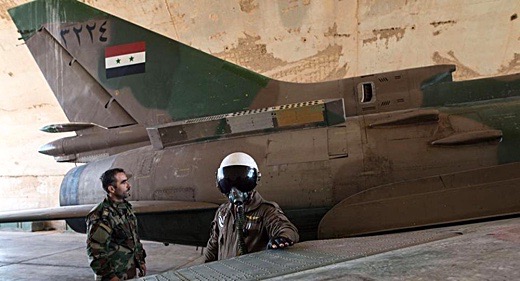
Image above: The kind of plane US shot down was a Russian built SU-22 aircraft. They are worn out and their pilots are old, but they’re all still flying. This is a close-up of the fin and rear fuselage of the SyAAF’s Su-22M-4K serial number 3224, as seen during a pre-fight inspection. From (http://warisboring.com/the-su-22-is-syrias-war-weary-warhorse/).

Shortly after Russia's deputy foreign minister slammed the US downing of a Syrian Su-22 jet as an "act of aggression" and "support for terrorists", Russia announced that starting June 19th it was halting all interactions with the US under the framework on the "memorandum of incident prevention in Syrian skies", the Russian Defense Ministry said on Monday, thereby assuring the probability of even more deadly escalations between Russia and the US-led coalition.

In retaliation, the ministry warned that Russian missile defense will intercept any aircraft in the area of operations of the Russian Aerospace Forces in Syria,

"In areas where Russian aviation is conducting combat missions in the Syrian skies, any flying ojects, including jets and unmanned aerial vehicles of the international coalition discovered west of the Euphrates River will be followed by Russian air and ground defenses as air targets," the Russian Defense Ministry announced, quoted by Sputnik.

Contrary to the earlier statement by the US according to which, it "contacted its Russian counterparts by telephone via an established "de-confliction line" to de-escalate the situation and stop the firing", Russia claims the US-led coalition command didn't use the deconfliction channel with Russia to avoid an incident during an operation in Raqqa:
"Russian Aerospace Forces' jets were conducting operations in Syrian airspace that time. However, the command of the coalition forces didn't use the existing channel between the air command of the Qatari airbase al Udeid and the [Russian] Hmeymim airbase to avoid incidents over Syria."
The Russian ministry also demands a thorough investigation by the US command with the provision of its results and measures taken.
"We consider such actions of the US command as an intentional violation of its obligations in the framework of the memo on avoiding incidents and the safety of aviation flights during operations in Syria signed on October 20, 2015."
A bilateral memorandum of understanding was signed between the United States and Russia signed in October 2015 to ensure the safety of flights during combat missions over Syria.

On June 18, the Syrian army said that the US-led coalition had brought down its aircraft in southern Raqqa countryside when it was fulfilling its mission against Daesh.

Later, the coalition confirmed the attack saying that it shot down the Syrian government forces' Su-22 aircraft as it had allegedly been bombing in an area where US-backed rebel forces, the Syrian Democratic Forces (SDF), were stationed, south of Tabqa in the Raqqa province. The US-led coalition called its attack on the Syrian army's jet "collective self-defense," adding that it contacted the Russian military to de-escalate the situation after the incident.

.

Saudi Terror Funding

SUBHEAD: 'Sensitive' United Kingdom terror funding inquiry report may never be published.

By Jessica Elgot on 31 May 2017 for the Guardian -
(https://www.theguardian.com/uk-news/2017/may/31/sensitive-uk-terror-funding-inquiry-findings-may-never-be-published-saudi-arabia)


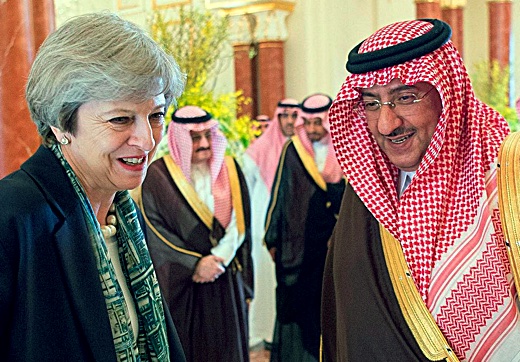
Image above: Theresa May with crown prince Muhammad bin Nayef during her visit to Saudi Arabia in April. From original article.

An investigation into the foreign funding and support of jihadi groups that was authorized by David Cameron may never be published, the Home Office has admitted. That investigation into foreign funding and support of jihadi groups operating in UK is understood to focus on Saudi Arabia.

The inquiry into revenue streams for extremist groups operating in the UK was commissioned by the former prime minister and is thought to focus on Saudi Arabia, which has repeatedly been highlighted by European leaders as a funding source for Islamist jihadis.

The investigation was launched as part of a deal with the Liberal Democrats in exchange for the party supporting the extension of British airstrikes against Islamic State into Syria in December 2015.

Tom Brake, the Lib Dem foreign affairs spokesman, has written to the prime minister asking her to confirm that the investigation will not be shelved.

The Observer reported in January last year that the Home Office’s extremism analysis unit had been directed by Downing Street to investigate overseas funding of extremist groups in the UK, with findings to be shown to Theresa May, then home secretary, and Cameron.

However, 18 months later, the Home Office confirmed the report had not yet been completed and said it would not necessarily be published, calling the contents “very sensitive”.

A decision would be taken “after the election by the next government” about the future of the investigation, a Home Office spokesman said.

In his letter to May, Brake wrote: “As home secretary at the time, your department was one of those leading on the report. Eighteen months later, and following two horrific terrorist attacks by British-born citizens, that report still remains incomplete and unpublished.

“It is no secret that Saudi Arabia in particular provides funding to hundreds of mosques in the UK, espousing a very hardline Wahhabist interpretation of Islam. It is often in these institutions that British extremism takes root.

The contents of the report may prove politically as well as legally sensitive. Saudi Arabia, which has been a funding source for fundamentalist Islamist preachers and mosques, was visited by May earlier this year.

Last December, a leaked report from Germany’s federal intelligence service accused several Gulf groups of funding religious schools and radical Salafist preachers in mosques, calling it “a long-term strategy of influence”.

The Lib Dem leader, Tim Farron, said he felt the government had not held up its side of the bargain made ahead of the vote on airstrikes. The report must be published when it was completed, he insisted, despite the Home Office caution that information in the document would be sensitive.

“That short-sighted approach needs to change. It is critical that these extreme, hardline views are confronted head on, and that those who fund them are called out publicly,” he said.

“If the Conservatives are serious about stopping terrorism on our shores, they must stop stalling and reopen investigation into foreign funding of violent extremism in the UK.”

.

We cannot admit it's the Saudis

SUBHEAD: Trump ludicrously accuses Iran of being the source of most terrorism in the Middle East.

By Patrick Cockburn on 28 March 2017 for Strategic Culture -
(https://www.strategic-culture.org/news/2017/05/28/we-know-what-inspired-manchester-attack-we-just-wont-admit-it.html)


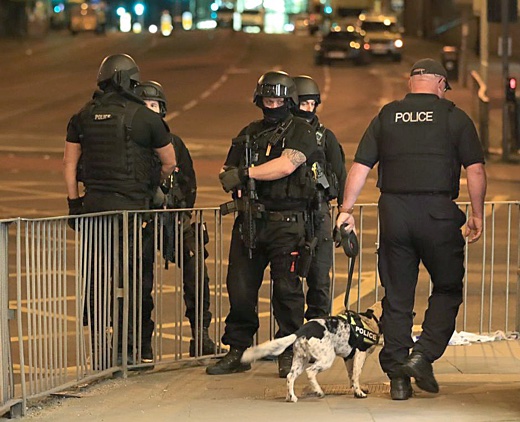
Image above: Armed police in aftermath of terrorist attack at the Manchester Arena after Ariana Grande concert. From (http://metro.co.uk/2017/05/23/fundraiser-started-for-homeless-man-who-held-dying-woman-in-manchester-attack-6655996/).

[IB Publisher's note: We also cannot believe that we created Al  Qaeda (and ISIS) by funding Osama Bin Ladin and the Mujahideen to thwart the Soviet Union in Afghanistan in the 1980's.]

In the wake of the massacre in Manchester, people rightly warn against blaming the entire Muslim community in Britain and the world. Certainly one of the aims of those who carry out such atrocities is to provoke the communal punishment of all Muslims, thereby alienating a portion of them who will then become open to recruitment by Isis and al-Qaeda clones.

This approach of not blaming Muslims in general but targeting “radicalisation” or simply “evil” may appear sensible and moderate, but in practice it makes the motivation of the killers in Manchester or the Bataclan theatre in Paris in 2015 appear vaguer and less identifiable than it really is.

Such generalities have the unfortunate effect of preventing people pointing an accusing finger at the variant of Islam which certainly is responsible for preparing the soil for the beliefs and actions likely to have inspired the suicide bomber Salman Abedi.

The ultimate inspiration for such people is Wahhabism, the puritanical, fanatical and regressive type of Islam dominant in Saudi Arabia, whose ideology is close to that of al-Qaeda and Isis. This is an exclusive creed, intolerant of all who disagree with it such as secular liberals, members of other Muslim communities such as the Shia or women resisting their chattel-like status.

What has been termed Salafi jihadism, the core beliefs of Isis and al-Qaeda, developed out of Wahhabism, and has carried out its prejudices to what it sees as a logical and violent conclusion.

Shia and Yazidis were not just heretics in the eyes of this movement, which was a sort of Islamic Khmer Rouge, but sub-humans who should be massacred or enslaved. Any woman who transgressed against repressive social mores should be savagely punished.

 Faith should be demonstrated by a public death of the believer, slaughtering the unbelievers, be they the 86 Shia children being evacuated by bus from their homes in Syria on 15 April or the butchery of young fans at a pop concert in Manchester on Monday night.

The real causes of “radicalisation” have long been known, but the government, the BBC and others seldom if ever refer to it because they do not want to offend the Saudis or be accused of anti-Islamic bias. It is much easier to say, piously but quite inaccurately, that Isis and al-Qaeda and their murderous foot soldiers “have nothing to do with Islam”. This has been the track record of US and UK governments since 9/11.

They will look in any direction except Saudi Arabia when seeking the causes of terrorism. President Trump has been justly denounced and derided in the US for last Sunday accusing Iran and, in effect, the Shia community of responsibility for the wave of terrorism that has engulfed the region when it ultimately emanates from one small but immensely influential Sunni sect.

One of the great cultural changes in the world over the last 50 years is the way in which Wahhabism, once an isolated splinter group, has become an increasingly dominant influence over mainstream Sunni Islam, thanks to Saudi financial support.

A further sign of the Salafi-jihadi impact is the choice of targets: the attacks on the Bataclan theatre in Paris in 2015, a gay night club in Florida in 2016 and the Manchester Arena this week have one thing in common. They were all frequented by young people enjoying entertainment and a lifestyle which made them an Isis or al-Qaeda target.

But these are also events where the mixing of men and women or the very presence of gay people is denounced by puritan Wahhabis and Salafi jihadis alike. They both live in a cultural environment in which the demonisation of such people and activities is the norm, though their response may differ.

The culpability of Western governments for terrorist attacks on their own citizens is glaring but is seldom even referred to. Leaders want to have a political and commercial alliance with Saudi Arabia and the Gulf oil states. They have never held them to account for supporting a repressive and sectarian ideology which is likely to have inspired Salman Abedi.

Details of his motivation may be lacking, but the target of his attack and the method of his death is classic al-Qaeda and Isis in its mode of operating.

The reason these two demonic organisations were able to survive and expand despite the billions – perhaps trillions – of dollars spent on “the war on terror” after 9/11 is that those responsible for stopping them deliberately missed the target and have gone on doing so.

After 9/11, President Bush portrayed Iraq not Saudi Arabia as the enemy; in a re-run of history President Trump is ludicrously accusing Iran of being the source of most terrorism in the Middle East.

This is the real 9/11 conspiracy, beloved of crackpots worldwide, but there is nothing secret about the deliberate blindness of British and American governments to the source of the beliefs that has inspired the massacres of which Manchester is only the latest – and certainly not the last – horrible example.

.

Unencumbered by the facts…

SUBHEAD: No links were found between Saddam Hussein and Al Qaeda or stockpiles of chemical weapons. 

By Madeleine Burnside on 27 May 2017 for Sanity Papers -
(http://sanitypapers.com/this-weeks-story/unencumbered-by-the-facts/)


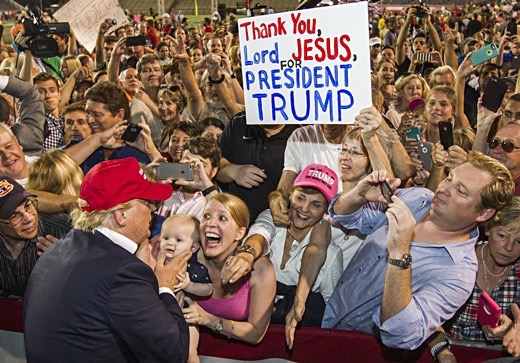
Image above: Trump meets enthusiastic Born Again Christians at political rally in September 2015. From (http://www.npr.org/sections/itsallpolitics/2015/09/13/439833719/true-believer-why-donald-trump-is-the-choice-of-the-religious-right).

Friends often exclaim to me about Donald Trump voters (some of whom are near and dear to them), “Why don’t they see what Trump’s doing? Why don’t they change their minds?” And of course, some people have—probably those who harbored doubts even while voting for him. Yet a solid majority of his base show unwavering loyalty.

Why is that, really?

A friend of mine, who is a member of that devoted base, thought that Trump would do well with the Saudis because he’s done business with them and knows how to make deals with them. My first reaction was scoffery—how could this president do well at anything?

But, out of respect for my friend, I paused to consider his point. I had to say, maybe. Am I so certain about all of my own facts that I can scoff with impunity? It was an interesting seed of doubt that I decided to follow down a few logical rabbit holes.

Back when dinosaurs roamed the earth and I was a graduate student in California, my doctoral advisor was Norman O. Brown, a fascinating, surprising, and sometimes difficult man.

He started out as a classicist, spent World War II as a code-breaker for the OSS (now the CIA), and eventually worked his way out of classics into the study of Freudian psychology, only to become an icon of 1960s thought.

His most revolutionary book, Love’s Body, mingled snippets of his vast learning into a comprehensive meditation on the big questions of life.

Anyway, he would often come to seminars with two books that he was reading under his arm. He instilled in us that we should never draw our opinions from one source, no matter how apparently primary—we needed to look for the other side of the argument.

Sometimes, when this proved elusive, two books on different subjects—here he would smush together the volumes that he had brought with him—might have a “wedding” (his term) that would bring us to an insightful conclusion.

In many ways, we Liberals like to think of this sort of reasoning as part and parcel of our position. We stay open to new ideas. We dip into Fox News or Drudge Report in order to hear from the other side. We work to tolerate people’s differences. We delight in critical thinking.

Or do we?

When my friend suggested that good things might happen from Trump’s visit with the Saudis I, unencumbered by the facts, was ready to make a vigorous counter-argument.

The government of modern-day Saudi Arabia is a subject on which I know very little and, for me, the event was illuminated only by my disdain for all things Trump.

All things, and that’s a lot. Am I actually not receptive to thinking there might be something of value in the man’s effort without fully exploring the issue? Where did my liberal values slip?

I am reading a fascinating book by Jane Mayer, The Dark Side: The Inside Story of How the War on Terror Turned Into a War on American Ideals. It focuses on George Bush’s presidency after 9/11, and his decision to opt out of the Geneva Conventions armed-conflict protocols regarding imprisonment and torture. It’s not for the squeamish.

Mayer’s book also dwells a great deal on how the Bush administration willfully disregarded reports that torture doesn’t work as reliably as empathy-based interrogation techniques—a fact that has been documented since something like the 12th century.

Bush officials also ignored reports that did not presumptively suit or advance their agenda, for example, the fact that no links were ever found between Al Qaeda and Saddam Hussein’s regime, or that Iraqi stockpiles of weapons of mass destruction were effectively non-existent by the end of the 1990s. Why did these people not pay attention or take these findings into account? Why the heck not?

Hmmm…

Another friend, who often has insightful things to say about this blog, sent me to a podcast that had set her thinking—specifically, three episodes from You Are Not So Smart titled “The Backfire Effect.”

They dissect and analyze the phenomenon of fitting the facts to suit one’s preconceived notions or clinging to notions once we’ve established them for ourselves. Why do we do it? Does it serve us in any way? To go deeper: Does it have some sort of evolutionary value?

So there they are: Ostensibly nothing to do with Trump, but I’m reading The Dark Side, listening to “The Backfire Effect,” and thus attending the wedding of two different analyses in a way that would make my wonderful mentor proud.

Here’s the link to the “Backfire Effect - Part One”(https://soundcloud.com/youarenotsosmart/093-the-backfire-effect-part-one) - don’t miss it.

We all need to understand the consequences of our own assumptions if we are ever going to turn this country around in a constructive and lasting way.


.

Oil trader: "There is no growth"

SUBHEAD: World's largest oil trader has a stunning warning for OPEC pricing strategies. 

By Tyler Durden on 10 May 2017 for Zero Hedge -
(http://www.zerohedge.com/news/2017-05-10/there%E2%80%99s-no-growth-worlds-largest-oil-trader-has-stunning-warning-opec)


Image above: Oil price cartoon "Diminishing Returns" by David Simonds for the Observer. From (http://www.execreview.com/2017/04/as-wind-wave-and-shale-power-converge-could-this-be-the-end-for-opec/).

When it comes to the oil market, the narrative over the past year, ever since OPEC's first aborted meeting last April, has been just one: limit crude supply in hopes of rebelancing the oil market, reducing excess inventories, in the process sending the price of oil higher.

However, echoing what we have warned for many months, overnight the world’s biggest independent oil trader said OPEC's efforts could be in vain because the oil producing cartel is seeking to control the wrong thing:

"It's not a matter of supply, but global demand which is simply not there."
According to Vitol Group, the world's biggest independent oil trader demand isn’t expanding as much as expected, and U.S. shale output is growing faster than forecast, Bloomberg reports.

As a logical outcome, that’s increasing the burden on the world’s biggest producers, who need to stick to their pledges to cut supply just to keep prices from falling, said Kho Hui Meng, the head of the company’s Asian arm.

Meanwhile, shale continues to capture OPEC, and mostly Saudi, market share as do countries such as Iran and Libya which are not bound by the Vienna agreement production quotas.

But the biggest variable is demand, of which there is simply not enough: “What we need is real demand growth, faster demand growth,” Kho, the president of Vitol Asia Pte., said in an interview in Kuala Lumpur. “Growth is there, but not fast enough.”

The problem in a nutshell: originally, oil consumption, or demand, was forecast to expand this year by about 1.3 million barrels a day, growth has been limited to about 800,000 barrels a day so far in 2017, Vitol's Kho said, adding that meanwhile U.S. output had grown 400,000-500,000 barrels a day more than expected.

“If demand goes back to where it should, where it’s forecast, then it’ll help, but my gut feel tells me it is still a bit long,” he said. Vitol's dour demand outlook has been shared by the International Energy Agency itself, which trimmed its forecasts for global oil demand growth this year by about 100,000 barrels a day to 1.3 million a day as a result of weaker consumption in OECD member countries and an abrupt slowdown in economic activity in India and Russia, according to a report released last month.

As a result, the Paris-based IEA cut its estimate for India’s 2017 oil-demand growth by 11% . It's not just India: there’s also concern that consumption may slow in China, the world’s second-biggest oil user. As we reported in March, China's independent refiners or "teapots", which account for a third of the nation’s capacity, have received lower crude import quotas compared with a year earlier, prompting speculation their purchases could slow.

“The oil market is looking for growth but there’s no growth,” Vitol’s Kho said, adding that the refiners may only get approval for the same volume of imports as last year. And while U.S. gasoline consumption is expected to hit its seasonal summer peak soon, demand growth “is not there yet,” he said.

Yet, in what may be the third law of oil price (dis)information, for every bearish oil trader, there is an equally bullish oil producerm, in this case Saudi Arabia. And indeed, the world’s biggest crude exporter is quite optimistic on oil's prospects.

According to Bloomberg, Saudi Arabia expects 2017 global consumption to grow at a rate close to that of 2016, Energy Minister Khalid Al-Falih said on Monday.

“We look for China’s oil demand growth to match last year’s, on the back of a robust transport sector, while India’s anticipated annual economic growth of more than seven percent will continue to drive healthy growth,” he said in Kuala Lumpur.

While some fear a slowdown in Chinese oil demand, Sanford C. Bernstein & Co. doesn’t see any cause for concern. Growth in the nation’s car fleet will support gasoline demand, with increasing truck sales and air travel also helping fuel consumption, it said in a report dated May 9.

Saudi Arabia and Russia, the world’s largest crude producers, signaled this week they could extend production cuts into 2018, doubling down on an effort to eliminate a surplus.

It was the first time they said they would consider prolonging their output reductions for longer than the six-month extension that’s widely expected to be agreed at an OPEC meeting on May 25.

And then there is shale.

“We’ve always talked about the call on OPEC, how much OPEC oil is needed to satisfy world demand,” said Nawaf Al-Sabah, chief executive officer of Kufpec, a unit of state-run Kuwait Petroleum Corporation:
“Now, in this new paradigm, it’s really becoming the call on shale. And the market is setting itself at the marginal cost of a shale barrel.”
As Bloomberg points out, U.S. output has jumped for 11 weeks through the end of April to 9.29 million barrels a day, the most since August 2015, Energy Information Administration data show.

Furthermore, according to an EIA forecast released on Monday, US crude output for 2017 is expected to rise again, from 9.22MMbpd to 9.31MMBpd, and jump in 2018 from 9.9MMbpd to an all time high 9.96MMpbd.

That may prove optimistic.

According to a separate Bloomberg report, U.S. shale explorers are boosting drilling budgets 10 times faster than the rest of the world to harvest fields that register fat profits even with the recent drop in oil prices.

Flush with cash from a short-lived OPEC-led crude rally, North American drillers plan to lift their 2017 outlays by 32 percent to $84 billion, compared with just 3 percent for international projects, according to analysts at Barclays Plc.

Much of the increase in spending is flowing into the Permian Basin, a sprawling, mile-thick accumulation of crude beneath Texas and New Mexico, where producers have been reaping double-digit returns even with oil commanding less than half what it did in 2014.

Needless to say, that’s very bad news for OPEC and non-OPEC in the ongoing, and failing, global campaign to crimp supplies and elevate prices. Wood Mackenzie Ltd. estimates that new spending will add 800,000 barrels of North American crude this year, equivalent to 44 percent of the reductions announced by the Saudi- and Russia-led group.

Drilling budgets around the world collapsed in 2016 as the worst crude market collapse in a generation erased cash flows, forcing explorers to cancel expansion projects, cut jobs and sell oil and natural gas fields to raise cash.

The pain also swept across the Organization of Petroleum Exporting Countries, which in November relented by agreeing with several non-OPEC nations to curb output by 1.8 million barrels a day. So far, independent American explorers such as EOG Resources Inc. and Pioneer Natural Resources Co. are holding fast to their ambitious growth plans.

Some recently finished wells in the Permian region yielded 70 percent returns at first-quarter prices, EOG Chief Executive Officer Bill Thomas told investors and analysts during a conference call on Tuesday.

But the worst news for OPEC is that a new flood of oil may be imminent: "U.S. oil production is already swelling, even though output from the new wells being drilled won’t materialize above ground for months." In other words, "in a few months" expects a whole new wave of shale oil to hit markets.

It is unclear how long the shale strategy can continue: drillers can afford to be sanguine despite oil’s recent tumble because they’ve cushioned themselves with hedges, Martin said. Hedges are financial instruments that lock in prices for future output and shield producers from volatile market movements.

“There is some price malaise creeping in,” Martin said. “But the aristocracy of the U.S. independents have insulated themselves” through hedging.

At the end of the day, however, the biggest culprit for OPEC's failed strategy may be none other than the Fed and its peer central banks, who have made access to cheap money virtually problematic, money which shale companies that were near bankruptcy a year ago, are now using to pump record amounts in hopes of stealing Saudi market share.

“The specter of American supply is real,” Roy Martin, a Wood Mackenzie research analyst in Houston, said in a telephone interview. “The level of capital budget increases really surprised us.”

If Riyadh really want the price of oil to go up, perhaps it should send a letter to Janet Yellen to make it more difficult for shale companies to get the funding they need to produce any amount of oil with virtually no capital limitations.

Finally, we go back to Vitol’s Kho, who tried to end on an optimistic note.

He failed:
“I am still watching the U.S. summer gasoline demand,” he said. “OPEC has said it will try and extend its output cuts beyond June. So if that happens, and the discipline is good, and if the U.S. lack of growth in demand changes into summer, then we may see oil go back to the low $50s, but the prevailing mood today is not.”
.

The Inevitability of Impeachment

SUBHEAD: Trump’s impeachment will happen. The only question is how grave a catastrophe America faces first.

By Robert Kuttner on 29 January 2017 for Huffington Post -
(http://www.huffingtonpost.com/entry/the-inevitability-of-impeachment_us_588e8d52e4b0b065cbbcd09f)


Image above: A caricature of Donald Trump. From (http://opinion.premiumtimesng.com/2016/11/08/175721/).

Trump has been trying to govern by impulse, on whim, for personal retribution, for profit, by decree ― as if he had been elected dictator. It doesn’t work, and the wheels are coming off the bus. After a week!

Impeachment is gaining ground because it is the only way to get him out, and because Republicans are already deserting this president in droves, and because the man is psychiatrically incapable of checking whether something is legal before he does it.

Impeachment is gaining ground because it’s so horribly clear that Trump is unfit for office. The grownups around Trump, even the most slavishly loyal ones, spend half their time trying to rein him in, but it can’t be done.

They spend the other half fielding frantic calls from Republican chieftains, business elites and foreign leaders. Trump did what? Poor Reince Priebus has finally attained the pinnacle of power, and it can’t be fun.

It is one thing to live in your own reality when you are a candidate and it’s just words. You can fool enough of the people enough of the time maybe even to get elected. But when you try to govern that way, there is a reality to reality—and reality pushes back.

One by one, Trump has decreed impulsive orders, un-vetted by legal, policy, or political staff, much less by serious planning. Almost immediately he is forced to walk them back by a combination of political and legal pressure—and by reality.

Unlike in the various dictatorships Trump admires, the complex skein of constitutional legal and political checks on tyranny in the United States are holding—just barely at times, but they are holding. And the more reckless Trump’s behavior, the stronger become the checks.

Only with his lunatic effort to selectively ban refugees (but not from terrorist-sending countries like Saudi Arabia and Egypt where Trump has business interests) has Trump discovered that the American system has courts. It has courts. Imagine that.

The more unhinged he becomes, the less will conservative judges be the toadies to ordinary Republican policies that they too often have been. Anybody want to wager that the Supreme Court will be Trump’s whore?

In the past week, Republicans from Mitch McConnell on down have tripped over each other rejecting his view of Putin. They have ridiculed his screwball claim of massive voter fraud.

They are running for cover on how to kill ObamaCare without killing patients or Republican re-election hopes. This is actually complicated, and nuance is not Trump’s strong suit. Rep Tom McClintock of California spoke for many when he warned:
“We’d better be sure that we’re prepared to live with the market we’ve created” with repeal, said Rep. Tom McClintock. (R-Calif.)

“That’s going to be called Trumpcare. Republicans will own that lock, stock and barrel, and we’ll be judged in the election less than two years away.”
Sen. Lindsey Graham, mocking Trump’s own nutty tweeting habits, sent out a tweet calling a trade war with Mexico “mucho sad.”

Trump’s own senior staff has had to pull him back from his ludicrous crusade against Mexico and Mexicans, where Trump forces the Mexican president to cancel an official visit one day, and spends an hour on the phone kissing up the next day.

Trump proposed to reinstate torture, but key Republican leaders killed that idea. Sen. John Thune (S.D.), the Senate’s third ranking Republican said Wednesday that the ban on torture was settled law and the Republicans in Congress would oppose any reinstatement. Trump’s own defense secretary holds the same view. After blustering out his new torture policy, Trump meekly agreed to defer to his defense advisers.

All this in just a week! Now capped by federal judges starting to rein him in.

Two weeks ago, in this space, just based on what we witnessed during the transition, I wrote a piece calling for a citizens impeachment panel, as a shadow House Judiciary Committee, to assemble a dossier for a Trump impeachment, and a citizens’ campaign to create a public impeachment movement.

In the two weeks since then, Free Speech for People has launched a citizens’ campaign to impeach Trump. About 400,000 people have already signed the impeachment petition.

The bipartisan group Citizens for Responsibility and Ethics in Washington, (CREW) has been conducting a detailed investigation. Senior legal scholars associated with CREW have filed a detailed legal brief in their lawsuit, documenting the several ways Trump is in violation of the Emoluments Clause, which prohibits a president from profiting from the actions of foreign governments.

There are already plenty of other grounds for impeachment, including Trump’s putting his own business interests ahead of the country’s and his weird and opportunistic alliance with Vladimir Putin bordering on treason.

A lesser-known law that goes beyond the Emoluments Clause is the STOCK Act of 2012, which explicitly prohibits the president and other officials from profiting from non-public knowledge.

Impeachment, of course, is a political as well as a legal process. The Founders designed it that way deliberately. But after just a week in office, not only has Trump been deserting the Constitution; his partisan allies are deserting him.

Despite his creepy weirdness, Republicans at first thought they could use Trump for Republican ends. But from his embrace of Putin to his sponsorship of a general trade war, this is no Republican. One can only imagine the alarm and horror being expressed by Republicans privately.

In 1984, the psychiatrist Otto Kernberg described a sickness known as Malignant Narcissism. Unlike ordinary narcissism, malignant narcissism was a severe pathology.

It was characterized by an absence of conscience, a pathological grandiosity and quest for power, and a sadistic joy in cruelty.

Given the sheer danger to the Republic as well as to the Republicans, Trump’s impeachment will happen. The only question is how grave a catastrophe America faces first.

• Robert Kuttner is co-editor of The American Prospect and professor at Brandeis University’s Heller School. His latest book is Debtors’ Prison: The Politics of Austerity Versus Possibility.

.

Trending

SUBHEAD: Whatever we manage to rebuild will get done locally. In victory, Dillary Clump may utterly cease to matter.

By James Kunstler on 29 August 2016 for Kunstler.com -
(http://kunstler.com/clusterfuck-nation/trending/)


Image above: A mashup of Dillary Clump. An image trending on the internet. You'll find it if you look.

Would fate permit it, the election of Hillary Clinton will be the supreme and perhaps terminal act in an Anything-Goes-And-Nothing-Matters society.

Yet, even with the fabulous luck of running against a consummate political oaf, she struggles to get the upper hand, and she may land in the White House with the lowest voter turnout in modern history.

And then her reward in office may be to dodge indictment for four years while the nation crumbles around her. This is the way the world ends: not with a bang or a whimper but with a cackle.

Imagine the scene following Hillary’s election. In order to salvage the last shred of its credibility, the Federal Reserve raises its overnight funds rate another quarter percent and crashes the last Potemkin semblance of a “recovering” economy, that is, the levitated stock markets.

Tens of millions of retired individuals previously driven into them by zero interest rate policy are wiped out.

Even more gravely, pension funds and insurance companies are destroyed, but not before their troubles trigger derivative contracts with big banks which then explode and expose the inability of counterparties to make good on their ends of the bet.

In a blind panic, the Federal Reserve reverses its policy in December, drops the Fed Funds interest rate back to 25 basis points and announces the grandest new round of “quantitative easing” (money printing) ever, while congress is coerced into voting for the greatest bailout of institutions the world has ever seen, along with a “one time” helicopter drop of a cool trillion dollars in the form of combined tax cuts and “shovel-ready infrastructure projects.”

The media rejoices. The US Dollar tanks. Absolutely nobody wants US treasury bonds, bills, and notes. The pathetic remnant of the American middle class stares into the abyss. (If it looks hard enough, it sees the US government down there.)

We’re now living in the setup for this, treating the election shenanigans so far as just another sordid television entertainment. It’s more than that. It’s an engraved invitation to the worst crisis since the Civil War.

The crisis may even feature events like a civil war with identity groups skirmishing around our already-ruined “flyover” cities just like the factions in Aleppo and Fallujah. Thank the “Progressive” Left for that.

Believe me, history will blame them for chucking the idea of a unifying common culture onto the garbage barge.

And yes, for all our tribulations here in America, the rest of the world will be struggling with its own epic disorders.

It remains to be seen whether they will lead to war as, say, the Chinese ruling party attempts to evade the crash of its own rickety banking system, and the inflamed millions of ruined “investors,” by starting a brawl with Japan over a few meaningless islands in the Pacific.

Could happen. And, oh, is North Korea for real with its right out front nuclear bomb-and-missile program? What does the rest of the world plan to do about that?

You don’t even want to look at the Middle East. The grisly conflicts there of recent decades are just a prelude to what happens when the House of Saud loses its grip on the government. That will happen, and then the big question is whether Aramco can continue to function, or whether the critical parts of it end up damaged beyond repair as competing tribes fight over it.

In any case, the world will begin to notice the salient fact of life in that part of the world: namely, that the Arabian desert, and much of the great band of arid territory on either side of it, cannot support the populations that mushroomed in the nutrient bath of the 20th century oil economy. And they won’t all be able to self-export to Europe either.

Speaking of that interesting region, around the same time Hillary sets up for intensive care in the third floor of the White House, the old order will be swept away across Europe. Farewell Merkel and Monsieur Hollandaise.

Farewell to the squishy Left all over the place. Enter the hard-asses. You’d think if anything might unite that continent it might be the wish to defend secular freedom under the rule of law, but even that remains to be seen.

Yes, the world following 3Q 2016 is looking like one hot mess. If you remember anything, let it be this: the primary mission of your cohort of the human race is managing contraction. The world is getting wider and poorer again and the outcome everywhere will be determined by the success of people to manage their lives locally.

The big things of this world — governments, corporations, institutions — are losing their traction and whatever we manage to rebuild will get done locally. In victory, Hillary may utterly cease to matter.

.

Skidding towards Syrian War

SUBHEAD: Nobody is challenging Hillary Clinton enough on what her plan for a no-fly zone and military escalation in Syria will mean. And the slope is very, very slippery.

By John Queelly on  on 17 June 2016 for Common Ground -
(\http://www.commondreams.org/news/2016/06/17/leaked-cable-greasing-skids-clintons-next-regime-change-disaster)


Image above: Smoke and flames rose after what fighters of the Syrian Democratic Forces said were American-led airstrikes on the mills of Manbij where Islamic State militants are positioned, in Aleppo, Syria, on Thursday. From (http://www.nytimes.com/2016/06/17/world/middleeast/syria-assad-obama-airstrikes-diplomats-memo.html).

An internal cable signed by more than 51 State Department officials objecting to the Obama administration's policy on Syria is particularly worrisome, according to experts, given Hillary Clinton's hawkish foreign policy positions and her stated plan to escalate President Barack Obama's war in Syria if elected.

The cable itself was leaked to major news outlets, including the New York Times and the Wall Street Journal, both of which carried frontpage stories on its implications Friday morning.

The memo, sent through an official "dissent channel" within the State Department, includes repeated calls for "targeted military strikes" against the Syrian government of President Bashar al-Assad and expressions of frustration that Obama has resisted deeper military engagement amid peace talk efforts that have produced little progress over recent months.

It puts forth "moral rationale" for such calls, saying "[t]he status quo in Syria will continue to present increasingly dire, if not disastrous, humanitarian, diplomatic and terrorism-related challenges."
The WSJ reports that such official dissent is not unusual, but that "the number of diplomats actively opposing a major White House" policy position was.

"It's embarrassing for the administration to have so many rank-and-file members break on Syria," a former State Department official who worked on Middle East policy told the WSJ.

According to the Times, "The names on the memo are almost all midlevel officials — many of them career diplomats — who have been involved in the administration’s Syria policy over the last five years, at home or abroad. They range from a Syria desk officer in the Bureau of Near Eastern Affairs to a former deputy to the American ambassador in Damascus."

Strikingly, those knowledgeable about the cable suggested it may not be directed at President Obama as much as it is directed at a future President Hillary Clinton, the presumptive Democratic nominee and current general election frontrunner.

As the WSJ reported, "The internal cable may be an attempt to shape the foreign policy outlook of the next administration, the official familiar with the document said. President Barack Obama has balked at taking military action against Mr. Assad, while Democratic presidential hopeful Hillary Clinton has promised a more hawkish stance toward the Syrian leader."

As numerous respondents on social media noted in their reactions to the story, the implications of the memo are more pronounced—and potentially more dangerous—when considered in the context of a hypothetical Hillary Clinton administration:
Dan Kennedy (@dankennedy_nu)
Unfortunately, Clinton wouldn't have to be persuaded to bomb Syria. She's already there. nytimes.com

Jonathan Cohn (@JonathanCohn)
Biding their time until Clinton takes over?
wsj,com
Ben Norton (@BenjaminNorton)Dozens of US State Dept officials are again calling for regime change, which will officially turn Syria into Iraq #2 
nyti.ms/YvNU03 
According to Phyllis Bennis, who directs the New Internationalism Project at the Institute for Policy Studies and spoke with Common Dreams by phone Friday morning, the diplomatic officials should be commended for highlighting the abject failures of the U.S. policies in Syria. However, she warned there is much to be alarmed about, given the prescriptions attached to their dissent and the political context under which they were made public.

"I have no doubt that people working on the Syria desk in the State Department over these years must be incredibly frustrated, there's no doubt about that," Bennis said. She applauded the moral considerations offered by the officials, but said just because they recognize that the "U.S. policy has failed and is failing" it doesn't follow "that the only alternative is military escalation."

"Though the cable also calls for an increased diplomatic effort," Bennis said, "they do so in the context of saying that greater military attacks will somehow bring Assad to the table. And there simply is no evidence of that—quite the contrary. The notion that the military engagement itself is what is preventing potential success for a greater diplomatic engagement is simply not taken seriously."

Citing the Pentagon's opposition to ramped up strikes in Syria, Bennis said the contents of the memo are not without irony. "You have the military brass recognizing largely that military escalation is not going to work [in Syria] and the so-called 'diplomats' are the ones calling for the military."
As one commenter on Twitter similarly noted, "We've come 180° from Vietnam War, when Pentagon always wanted to bomb & State was where diplomatic doves roosted."

In their cable, the officials insist they are not "advocating for a slippery slope that ends in a military confrontation with Russia," but rather pushing for, according to the Times, a credible threat of military action to keep Assad in line.

However, according to Bennis, that logic is extremely problematic given that it totally "denies the reality that a confrontation with Bashar al-Assad right now is a confrontation with Russia."
That may not have been the case six or eight months ago, Bennis explained, but given the level of Russian's current involvement, it is certainly the case now.

"Direct bombing of Assad's own targets is that slippery slope," she said. "And it's very, very slippery."

Given the current volatile relationship between the Washington, D.C. and Moscow—noting heightened tensions amid NATO war games in Poland this week and increased saber-rattling in eastern Europe and the Baltic States—Bennis argues that further antagonizing Russia will do nothing to bring peace to the Syrian people.

"Under conditions when relations with Russia are all warm and fuzzy you might be able to get away with this without it necessarily leading to major Cold War escalation or worse," she said. "But these are not warm and fuzzy times with Russia. There are enormous tensions, including military tensions right on Russia's border."

The kind of bombings these officials are calling for is very dangerous, said Bennis, "because what they're proposing is the kind of escalation that is certain to lead to more political confrontation with Russia and threatens the possibility that that confrontation could become more than just political."

Like other observers, Bennis also expressed specific concerns about the cable's implications in the context of U.S. presidential race in which neither media outlets nor voters have exerted much pressure on candidates to answer difficult questions about U.S. foreign policy, especially regarding Syria and the greater Middle East.

"These wars," she said, "which the U.S. is waging around the world, have simply not be a feature of the election campaign from any of that candidates. And it's time that stopped."

"We know that current policy is failing. What would they do differently?" Bennis asked. "Hillary Clinton says she would do what President Obama is doing, but that she'd do more of it and harsher—more bombs, more regime change, and a quicker move to a no-fly zone."

That, too, would further antagonize Russia, she said. "Nobody is challenging Hillary Clinton on what her discussion of a no-fly means vis-a-vis Russia. Does she think that [former] Secretary of Defense Gates was wrong when he said creating a no-fly zone starts with going to war? Or does she think going to war against Russia is just fine?"


.

Debacle at Doha

SUBHEAD: The Saudi led debacle in Doha will be seen as marking the beginning of the end of the old oil order.

By Michael Klare on 28 April 2016 for Tom Dispatch -
(http://www.tomdispatch.com/post/176134/tomgram%3A_michael_klare%2C_the_coming_world_of_%22peak_oil_demand%2C%22_not_%22peak_oil%22/)


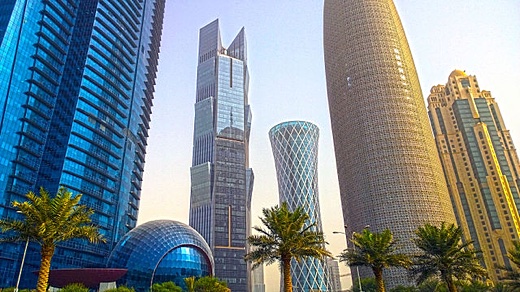
Image above: Skyscrapers in the city of Doha, Qatar. From (http://www.resilience.org/stories/2016-04-29/the-debacle-at-doha).

Sunday, April 17th was the designated moment. The world’s leading oil producers were expected to bring fresh discipline to the chaotic petroleum market and spark a return to high prices.

Meeting in Doha, the glittering capital of petroleum-rich Qatar, the oil ministers of the Organization of the Petroleum Exporting Countries (OPEC), along with such key non-OPEC producers as Russia and Mexico, were scheduled to ratify a draft agreement obliging them to freeze their oil output at current levels.

In anticipation of such a deal, oil prices had begun to creep inexorably upward, from $30 per barrel in mid-January to $43 on the eve of the gathering. But far from restoring the old oil order, the meeting ended in discord, driving prices down again and revealing deep cracks in the ranks of global energy producers.

It is hard to overstate the significance of the Doha debacle. At the very least, it will perpetuate the low oil prices that have plagued the industry for the past two years, forcing smaller firms into bankruptcy and erasing hundreds of billions of dollars of investments in new production capacity. It may also have obliterated any future prospects for cooperation between OPEC and non-OPEC producers in regulating the market.

Most of all, however, it demonstrated that the petroleum-fueled world we’ve known these last decades -- with oil demand always thrusting ahead of supply, ensuring steady profits for all major producers -- is no more. Replacing it is an anemic, possibly even declining, demand for oil that is likely to force suppliers to fight one another for ever-diminishing market shares.

The Road to Doha
Before the Doha gathering, the leaders of the major producing countries expressed confidence that a production freeze would finally halt the devastating slump in oil prices that began in mid-2014. Most of them are heavily dependent on petroleum exports to finance their governments and keep restiveness among their populaces at bay.

Both Russia and Venezuela, for instance, rely on energy exports for approximately 50% of government income, while for Nigeria it’s more like 75%.  So the plunge in prices had already cut deep into government spending around the world, causing civil unrest and even in some cases political turmoil.

No one expected the April 17th meeting to result in an immediate, dramatic price upturn, but everyone hoped that it would lay the foundation for a steady rise in the coming months. The leaders of these countries were well aware of one thing: to achieve such progress, unity was crucial.

Otherwise they were not likely to overcome the various factors that had caused the price collapse in the first place.  Some of these were structural and embedded deep in the way the industry had been organized; some were the product of their own feckless responses to the crisis.

On the structural side, global demand for energy had, in recent years, ceased to rise quickly enough to soak up all the crude oil pouring onto the market, thanks in part to new supplies from Iraq and especially from the expanding shale fields of the United States.

This oversupply triggered the initial 2014 price drop when Brent crude -- the international benchmark blend -- went from a high of $115 on June 19th to $77 on November 26th, the day before a fateful OPEC meeting in Vienna. The next day, OPEC members, led by Saudi Arabia, failed to agree on either production cuts or a freeze, and the price of oil went into freefall.

The failure of that November meeting has been widely attributed to the Saudis’ desire to kill off new output elsewhere -- especially shale production in the United States -- and to restore their historic dominance of the global oil market. Many analysts were also convinced that Riyadh was seeking to punish regional rivals Iran and Russia for their support of the Assad regime in Syria (which the Saudis seek to topple).

The rejection, in other words, was meant to fulfill two tasks at the same time: blunt or wipe out the challenge posed by North American shale producers and undermine two economically shaky energy powers that opposed Saudi goals in the Middle East by depriving them of much needed oil revenues.

Because Saudi Arabia could produce oil so much more cheaply than other countries -- for as little as $3 per barrel -- and because it could draw upon hundreds of billions of dollars in sovereign wealth funds to meet any budget shortfalls of its own, its leaders believed it more capable of weathering any price downturn than its rivals.

Today, however, that rosy prediction is looking grimmer as the Saudi royals begin to feel the pinch of low oil prices, and find themselves cutting back on the benefits they had been passing on to an ever-growing, potentially restive population while still financing a costly, inconclusive, and increasingly disastrous war in Yemen.

Many energy analysts became convinced that Doha would prove the decisive moment when Riyadh would finally be amenable to a production freeze.  Just days before the conference, participants expressed growing confidence that such a plan would indeed be adopted.

After all, preliminary negotiations between Russia, Venezuela, Qatar, and Saudi Arabia had produced a draft document that most participants assumed was essentially ready for signature. The only sticking point: the nature of Iran’s participation.

The Iranians were, in fact, agreeable to such a freeze, but only after they were allowed to raise their relatively modest daily output to levels achieved in 2012 before the West imposed sanctions in an effort to force Tehran to agree to dismantle its nuclear enrichment program.  Now that those sanctions were, in fact, being lifted as a result of the recently concluded nuclear deal, Tehran was determined to restore the status quo ante.

On this, the Saudis balked, having no wish to see their arch-rival obtain added oil revenues.  Still, most observers assumed that, in the end, Riyadh would agree to a formula allowing Iran some increase before a freeze.

“There are positive indications an agreement will be reached during this meeting... an initial agreement on freezing production,” said Nawal Al-Fuzaia, Kuwait’s OPEC representative, echoing the views of other Doha participants.

But then something happened. According to people familiar with the sequence of events, Saudi Arabia’s Deputy Crown Prince and key oil strategist, Mohammed bin Salman, called the Saudi delegation in Doha at 3:00 a.m. on April 17th and instructed them to spurn a deal that provided leeway of any sort for Iran.

When the Iranians -- who chose not to attend the meeting -- signaled that they had no intention of freezing their output to satisfy their rivals, the Saudis rejected the draft agreement it had helped negotiate and the assembly ended in disarray.

Geopolitics to the Fore
Most analysts have since suggested that the Saudi royals simply considered punishing Iran more important than raising oil prices.  No matter the cost to them, in other words, they could not bring themselves to help Iran pursue its geopolitical objectives, including giving yet more support to Shiite forces in Iraq, Syria, Yemen, and Lebanon.

Already feeling pressured by Tehran and ever less confident of Washington’s support, they were ready to use any means available to weaken the Iranians, whatever the danger to themselves.

“The failure to reach an agreement in Doha is a reminder that Saudi Arabia is in no mood to do Iran any favors right now and that their ongoing geopolitical conflict cannot be discounted as an element of the current Saudi oil policy,” said Jason Bordoff of the Center on Global Energy Policy at Columbia University.

Many analysts also pointed to the rising influence of Deputy Crown Prince Mohammed bin Salman, entrusted with near-total control of the economy and the military by his aging father, King Salman. As Minister of Defense, the prince has spearheaded the Saudi drive to counter the Iranians in a regional struggle for dominance.

Most significantly, he is the main force behind Saudi Arabia’s ongoing intervention in Yemen, aimed at defeating the Houthi rebels, a largely Shia group with loose ties to Iran, and restoring deposed former president Abd Rabbuh Mansur Hadi.

After a year of relentless U.S.-backed airstrikes (including the use of cluster bombs), the Saudi intervention has, in fact, failed to achieve its intended objectives, though it has produced thousands of civilian casualties, provoking fierce condemnation from U.N. officials, and created space for the rise of al-Qaeda in the Arabian Peninsula. Nevertheless, the prince seems determined to keep the conflict going and to counter Iranian influence across the region.

For Prince Mohammed, the oil market has evidently become just another arena for this ongoing struggle. “Under his guidance,” the Financial Times noted in April, “Saudi Arabia’s oil policy appears to be less driven by the price of crude than global politics, particularly Riyadh’s bitter rivalry with post-sanctions Tehran.”

This seems to have been the backstory for Riyadh’s last-minute decision to scuttle the talks in Doha. On April 16th, for instance, Prince Mohammed couldn’t have been blunter to Bloomberg, even if he didn’t mention the Iranians by name: “If all major producers don’t freeze production, we will not freeze production.”

With the proposed agreement in tatters, Saudi Arabia is now expected to boost its own output, ensuring that prices will remain bargain-basement low and so deprive Iran of any windfall from its expected increase in exports.

The kingdom, Prince Mohammed told Bloomberg, was prepared to immediately raise production from its current 10.2 million barrels per day to 11.5 million barrels and could add another million barrels “if we wanted to” in the next six to nine months.

With Iranian and Iraqi oil heading for market in larger quantities, that’s the definition of oversupply.  It would certainly ensure Saudi Arabia’s continued dominance of the market, but it might also wound the kingdom in a major way, if not fatally.

A New Global Reality
No doubt geopolitics played a significant role in the Saudi decision, but that’s hardly the whole story.

Overshadowing discussions about a possible production freeze was a new fact of life for the oil industry: the past would be no predictor of the future when it came to global oil demand.  Whatever the Saudis think of the Iranians or vice versa, their industry is being fundamentally transformed, altering relationships among the major producers and eroding their inclination to cooperate.


Until very recently, it was assumed that the demand for oil would continue to expand indefinitely, creating space for multiple producers to enter the market, and for ones already in it to increase their output.

Even when supply outran demand and drove prices down, as has periodically occurred, producers could always take solace in the knowledge that, as in the past, demand would eventually rebound, jacking prices up again. Under such circumstances and at such a moment, it was just good sense for individual producers to cooperate in lowering output, knowing that everyone would benefit sooner or later from the inevitable price increase.

But what happens if confidence in the eventual resurgence of demand begins to wither? Then the incentives to cooperate begin to evaporate, too, and it’s every producer for itself in a mad scramble to protect market share.

This new reality -- a world in which “peak oil demand,” rather than “peak oil,” will shape the consciousness of major players -- is what the Doha catastrophe foreshadowed.

At the beginning of this century, many energy analysts were convinced that we were at the edge of the arrival of “peak oil”; a peak, that is, in the output of petroleum in which planetary reserves would be exhausted long before the demand for oil disappeared, triggering a global economic crisis. As a result of advances in drilling technology, however, the supply of oil has continued to grow, while demand has unexpectedly begun to stall.

This can be traced both to slowing economic growth globally and to an accelerating “green revolution” in which the planet will be transitioning to non-carbon fuel sources. With most nations now committed to measures aimed at reducing emissions of greenhouse gases under the just-signed Paris climate accord, the demand for oil is likely to experience significant declines in the years ahead. In other words, global oil demand will peak long before supplies begin to run low, creating a monumental challenge for the oil-producing countries.

 This is no theoretical construct.  It’s reality itself.  Net consumption of oil in the advanced industrialized nations has already dropped from 50 million barrels per day in 2005 to 45 million barrels in 2014. Further declines are in store as strict fuel efficiency standards for the production of new vehicles and other climate-related measures take effect, the price of solar and wind power continues to fall, and other alternative energy sources come on line.

While the demand for oil does continue to rise in the developing world, even there it’s not climbing at rates previously taken for granted. With such countries also beginning to impose tougher constraints on carbon emissions, global consumption is expected to reach a peak and begin an inexorable decline. According to experts Thijs Van de Graaf and Aviel Verbruggen, overall world peak demand could be reached as early as 2020.

In such a world, high-cost oil producers will be driven out of the market and the advantage -- such as it is -- will lie with the lowest-cost ones. Countries that depend on petroleum exports for a large share of their revenues will come under increasing pressure to move away from excessive reliance on oil.

This may have been another consideration in the Saudi decision at Doha. In the months leading up to the April meeting, senior Saudi officials dropped hints that they were beginning to plan for a post-petroleum era and that Deputy Crown Prince bin Salman would play a key role in overseeing the transition.

On April 1st, the prince himself indicated that steps were underway to begin this process. As part of the effort, he announced, he was planning an initial public offering of shares in state-owned Saudi Aramco, the world’s number one oil producer, and would transfer the proceeds, an estimated $2 trillion, to its Public Investment Fund (PIF).

“IPOing Aramco and transferring its shares to PIF will technically make investments the source of Saudi government revenue, not oil,” the prince pointed out. “What is left now is to diversify investments. So within 20 years, we will be an economy or state that doesn’t depend mainly on oil.”

For a country that more than any other has rested its claim to wealth and power on the production and sale of petroleum, this is a revolutionary statement. If Saudi Arabia says it is ready to begin a move away from reliance on petroleum, we are indeed entering a new world in which, among other things, the titans of oil production will no longer hold sway over our lives as they have in the past.

This, in fact, appears to be the outlook adopted by Prince Mohammed in the wake of the Doha debacle.  In announcing the kingdom’s new economic blueprint on April 25th, he vowed to liberate the country from its “addiction” to oil.”  This will not, of course, be easy to achieve, given the kingdom’s heavy reliance on oil revenues and lack of plausible alternatives.

The 30-year-old prince could also face opposition from within the royal family to his audacious moves (as well as his blundering ones in Yemen and possibly elsewhere).  Whatever the fate of the Saudi royals, however, if predictions of a future peak in world oil demand prove accurate, the debacle in Doha will be seen as marking the beginning of the end of the old oil order.

• Michael T. Klare, a TomDispatch regular, is a professor of peace and world security studies at Hampshire College and the author, most recently, of The Race for What’s Left. A documentary movie version of his book Blood and Oil is available from the Media Education Foundation. Follow him on Twitter at @mklare1.

.