Showing posts with label Reforestation. Show all posts

Save Earth planting Weed

SUBHEAD: The cheapest fastest way to avoid climate collapse and extinction is to plant cannabis.

By Ellen Brown on 24 July 2019 for TruthDig -
(https://www.truthdig.com/articles/the-cheapest-way-to-save-the-planet-grows-like-a-weed/)
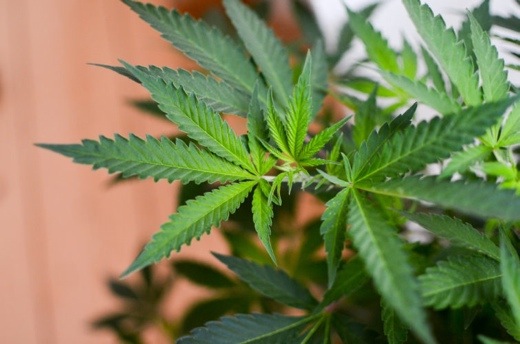

Image above: Closeup of marijuana leaf. From original article.

Planting billions of trees across the world is by far the cheapest and most efficient way to tackle the climate crisis. So states a Guardian article, citing a new analysis published in the journal Science. The author explains:
As trees grow, they absorb and store the carbon dioxide emissions that are driving global heating. New research estimates that a worldwide planting programme could remove two-thirds of all the emissions that have been pumped into the atmosphere by human activities, a figure the scientists describe as “mind-blowing”.
For skeptics who reject the global warming thesis, reforestation also addresses the critical problems of mass species extinction and environmental pollution, which are well-documented.

A 2012 study from the University of Michigan found that loss of biodiversity impacts ecosystems as much as does climate change and pollution. Forests shelter plant and animal life in their diverse forms, and trees remove air pollution by the interception of particulate matter on plant surfaces and the absorption of gaseous pollutants through the leaves.

The July analytical review in Science calculated how many additional trees could be planted globally without encroaching on crop land or urban areas. It found that there are 1.7 billion hectares (4.2 billion acres) of treeless land on which 1.2 trillion native tree saplings would naturally grow.

Using the most efficient methods, 1 trillion trees could be restored for as little as $300 billion—less than 2% of the lower range of estimates for the Green New Deal introduced by progressive Democrats in February.

The Guardian quoted Professor Tom Crowther at the Swiss university ETH Zürich, who said, “What blows my mind is the scale. I thought restoration would be in the top 10, but it is overwhelmingly more powerful than all of the other climate change solutions proposed.” He said it was also by far the cheapest solution that has ever been proposed.

The chief drawback of reforestation as a solution to the climate crisis, as The Guardian piece points out, is that trees grow slowly. The projected restoration could take 50 to 100 years to reach its full carbon sequestering potential.

A Faster, More Efficient Solution

Fortunately, as of December 2018, there is now a cheaper, faster and more efficient alternative—one that was suppressed for nearly a century but was legalized on a national scale when President Trump signed the Agriculture Improvement Act of 2018.

This is the widespread cultivation of industrial hemp, the nonintoxicating form of cannabis grown for fiber, cloth, oil, food and other purposes. Hemp grows to 13 feet in 100 days, making it one of the fastest carbon dioxide-to-biomass conversion tools available.

Industrial hemp has been proved to absorb more CO2 per hectare than any forest or commercial crop, making it the ideal carbon sink. It can be grown on a wide scale on nutrient-poor soils with very small amounts of water and no fertilizers.

Hemp products can promote biodiversity and reverse environmental pollution by replacing petrochemical-based plastics, which are now being dumped into the ocean at the rate of one garbage truck per minute. One million seabirds die each year from ingesting plastic, and up to 90% have plastic in their guts.

Microplastic (resulting from the breakdown of larger pieces by sunlight and waves) and microbeads (used in body washes and facial cleansers) have been called the ocean’s smog. They absorb toxins in the water, enter the food chain and ultimately wind up in humans. To avoid all that, we can use plastic made from hemp, which is biodegradable and nontoxic.

Other environmental toxins come from the textile industry, which is second only to agriculture in the amount of pollution it creates and the voluminous amounts of water it uses. Hemp can be grown with minimal water, and hemp fabrics can be made without the use of toxic chemicals.

Environmental pollution from the burning of fossil fuels can also be reversed with hemp, which is more efficient and environmentally friendly than wheat and corn as a clean-burning biofuel.

Hemp cultivation also encourages biodiversity in the soil, by regenerating farmland that has long been depleted from the use of toxic chemicals. It is a “weed” and grows like one, ubiquitously, beating out other plants without pesticides or herbicides; and its long taproot holds the soil, channeling moisture deeper into it.

Unlike most forestry projects, hemp can be grown on existing agricultural land and included as part of a farm’s crop rotation, with positive effects on the yields and the profits from subsequent crops.

A Self-Funding Solution

Hemp cultivation is profitable in many other ways—so profitable that it is effectively a self-funding solution to the environmental crisis. According to a Forbes piece titled “Industrial Hemp Is the Answer to Petrochemical Dependency,” crop yields from hemp can range from $20,000 to $50,000 per acre.

Its widespread cultivation can happen without government subsidies. Investment in research, development and incentives would speed the process, but market forces will propel these transformations even if Congress fails to act.

All farmers need for incentive is a market for the products, which hemp legalization has provided. Due to the crop’s century-long suppression, the infrastructure to capitalize on its diverse uses still needs to be developed, but the infrastructure should come with the newly opened markets.

Hemp can break our dependency on petrochemicals, not only for fuel but for plastics, textiles, construction materials and much more. It has actually been grown for industrial and medicinal purposes for millennia, and today it is legally grown for industrial use in hundreds of countries outside the U.S.

Just after the nationwide ban established by the Marihuana Tax Act in 1937, an article in Popular Mechanics claimed it was a billion-dollar crop (the equivalent of about $16 billion today), useful in 25,000 products ranging from dynamite to cellophane.

New uses continue to be found, including eliminating smog from fuels, creating a cleaner energy source that can replace nuclear power, removing radioactive water from the soil and providing a very nutritious food source for humans and animals. Cannabidiol (CBD), a nonpsychoactive derivative of hemp, has recently been shown to help curb opioid addiction, now a national epidemic.

Hemp can also help save our shrinking forests by eliminating the need to clear-cut them for paper pulp. One acre planted in hemp produces as much pulp as 4.1 acres of trees, according to the USDA; and unlike trees, hemp can be harvested two or three times a year. Hemp paper is also finer, stronger and lasts longer than wood-based paper.

Benjamin Franklin’s paper mill used hemp. Until 1883, it was one of the largest agricultural crops (some say the largest), and 80–90% of all paper in the world was made from it. It was also the material from which most fabric, soap, fuel and fiber were made; and it was an essential resource for any country with a shipping industry, since sails were made from it.

In early America, growing hemp was considered so important that it was illegal for farmers not to grow it. Hemp was legal tender from 1631 until the early 1800s, and taxes could even be paid with it.

Banned by the Competition?

The competitive threat to other industries of this supremely useful plant may have been a chief driver of its apparently groundless criminalization in the 1930s. Hemp is not marijuana and is so low in psychoactive components that it cannot produce a marijuana “high.” It was banned for nearly a century simply because it was in the same plant species as marijuana.

Cannabis came under attack in the 1930s in all its forms. Why? Hemp competed not only with the lumber industry but with the oil, cotton, petrochemical and pharmaceutical industries. Many have speculated that it was suppressed by these powerful competitors.

William Randolf Hearst, the newspaper mogul, owned vast tracts of forest land, which he intended to use for making wood-pulp paper. Cheap hemp-based paper would make his forest investments a major money loser. Hearst was a master of “yellow journalism,” and a favorite target of his editorials was “reefer madness.”

He was allied with the DuPont Corporation, which provided the chemicals to bleach and process the wood pulp used in the paper-making process. DuPont was also ready to introduce petroleum-based fibers such as nylon, and hemp fabrics competed with that new market.

In fact, hemp products threatened the entire petroleum industry. Henry Ford first designed his cars to run on alcohol from biofuels, but the criminalization of both alcohol and hemp forced him to switch to the dirtier, less efficient fossil fuels that dominate the industry today.

A biofuel-based infrastructure would create a completely decentralized power grid, eliminating the giant monopolistic power companies. Communities could provide their own energy using easily renewable plants.

None of this is news. Hemp historians have been writing about the crop’s myriad uses and its senseless prohibition for decades. (See “The Emperor Wears No Clothes” by Jack Herer, 1992 and “Hemp for Victory: A Global Warming Solution” by Richard Davis, 2009.)

What is news is that hemp cultivation is finally legal across the country. The time is short to save the planet and its vanishing diversity of species. Rather than engaging in endless debates over carbon taxes and Silicon Valley style technological fixes, we need to be regenerating our soils, our forests and our oceans with nature’s own plant solutions.

.
More native shrubs are essential

SUBHEAD: Shrubs grow much faster than trees and are powerful carbon sequestration engines in their own right.

By Adrian Fisher on 27 December 2018 for Ecological Gardening
(https://www.ecologicalgardening.net/2018/12/native-shrubs-and-why-theyre-essential.html)


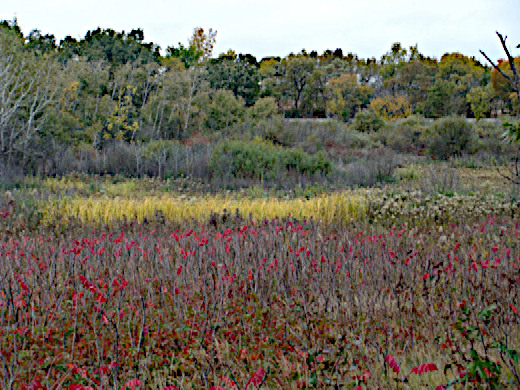
Image above: Sand prairie merging into shrubland in southeast Wisconsin. From The Prairie Botanist
“Shrubbiness is such a remarkable adaptive design that one may wonder why more plants have not adopted it.” (H. C. Stutz, 1989)
In light of the newest IPCC and US climate change reports, coupled with reports of the ongoing declines of wild species—birds, insects—you name them, just so long as they aren’t human, I have turned to thinking about shrubs.

It is precisely their adaptive characteristics that give shrubs their potential to be powerful players in soil carbon sequestration and ecosystem regeneration in certain parts of the world, such as the Midwest.

Although alarming, the reports are not surprising to anyone who’s been keeping track. The IPCC report says human global society has 12 years to reduce carbon emissions to 45% below 2010 levels if there is to be any hope of holding overall average global temperature rise to 1.5 degrees C (2.7 degrees F).

The US report, searchable by region, adds fairly detailed, equally dire scenarios for this country. No place on earth will be immune to the destructive consequences of our failure to act.

Since the world has already warmed approximately 1 degree C, even if we are able to keeping warming to 1.5 degrees—an almost insanely optimistic proposal, given the array of forces, from active malice to blind inertia, all backed by money, power and influence poised against success—there will still be massive, destabilized weather patterns and disruptive, destructive weather events similar to and worse than what we are already experiencing.

The resultant ecological destruction and human misery will only increase with each half a degree beyond 1 degree until large parts of the earth are literally uninhabitable by humans. We are, right now, on track to warm roughly 3.3 degrees by century’s end.

Despite the official reports’ newly grim tone, there are no new solutions. As we’ve known for decades, staving off disaster requires both cutting greenhouse gas emissions and helping earth’s biological systems regenerate, pull massive amounts of carbon from the air, and store it in biomass and soils.

For an overview of how all of this can be achieved, the book and companion website “Drawdown” remains an excellent compendium of strategies and tactics.

The IPCC report offers four scenarios by which rapid decarbonization and carbon sequestration could be achieved. Three of them rely heavily on so far non-existent or extremely small-scale technological carbon capture and sequestration methods.

Possibly the worst of these from an ecological point of view is BECCS (bioenergy with carbon capture and storage), a technique involving growing and burning massive amounts of trees, shrubs and grasses while “magically” capturing and sequestering the resultant carbon emissions.

Relying on salvation by means of a fix we don’t actually have the ability, money or time to accomplish is a distracting, destructive form of magical thinking. Practiced at scale, BECCS would require appropriating farmland, destroying forests and wrecking ecosystems.

An analogous illustration of its potential for upending ecosystems and ways of life would be the destruction palm oil plantations have wrought in Borneo, devastation turbo-charged in part by an American law meant to get us off dependence on fossil fuels and well documented in the New York Times Magazine.)

Natural carbon solutions offer the most realistic way forward
The IPCC scenario that best comports with current reality and a genuinely sustainable, resilient future describes what carbon farmers, holistic managers, scientists, environmentalists and many others have been touting and practicing for 50 years.

That is, while we ramp up renewables, increase energy efficiency, and decarbonize our life styles, we should also do everything possible to enable worldwide carbon sequestration through biological processes.

We should restore and vastly augment our forests, grasslands and wetlands and overhaul agricultural practices along agroecological lines. Here in the US, the recently published paper “Natural Carbon Solutions for the United States” quantifies how much carbon can be sequestered through improved landscape and coastal wetlands management practices.

The authors calculate potential sequestration to be about 21% of total US emissions, or enough to equal taking all cars and trucks in the US off the road.

Unlike purely mechanical carbon sequestration methods, or schemes such as BECCS, natural carbon solutions would simultaneously help get global temperature rise under control while improving and enriching ecosystems’ functioning—thus helping ease the crisis of ecological destruction now sweeping the planet.

While nearly everyone has a pretty good idea of how to cut emissions, fewer are aware of how they themselves could implement natural carbon solutions beyond planting a tree or two. But simply plopping some trees in a lawn or along a parkway is not enough.

As I’ve written previously, serious natural carbon sequestration, at whatever scale, requires regenerative landscape management practices such as putting in a biodiverse palette of native trees, flowers and grasses and stopping the use of pesticides and synthetic fertilizer.

Shrubs can be crucial to this kind of planting, especially in terms of the other ecological benefits they offer. Wherever there is a lawn, a tree and possibly a small garden, or even a tiny strip along the foundations of a building, there should be a native shrub or two, or possibly more.

Large properties and farms have nearly unlimited possibilities in the form of hedgerows, shelterbelts or even reconstituted shrub prairies.

Shrubs are a necessary part of landscaping for carbon sequestration
From a landscaping perspective, shrubs are sort of like the middle children in a very large family: necessarily adaptable, but little thought of or noticed.

This is true even scientifically. “Natural Carbon Solutions” explicitly omits shrublands from the calculations, and a 2016 review of scientific literature in “Why Be a Shrub” states that the least studied landscape types are shrublands, while the least studied plants are shrubs.

Yet shrubs flourish virtually everywhere and shrublands are increasing across the globe, possibly due in part to climate change.

In the American West the new severity of wildfires makes it difficult for forests to regenerate. The replacement is shrubland, or, to use an old term, “barrens.” Is the lack of notice and study because shrubs are so common and ubiquitous, but lack the majesty of trees and the show-offy beauty of flowering annuals and perennials?

This lack of notice carries through in our designed landscapes. The default for parks and private property alike is often faux open woodland or savanna, with widely spaced trees and plenty of grass—and few shrubs.

Farms are faux prairies where shrubs that formerly would have flourished wild and later in hedgerows and fencerows and along waterways have been largely extirpated.

What shrubs there are might be a few non-native ornamentals ranged in a row along a building foundation, kept as a low hedge along a sidewalk, or grouped in a small island of mulch.

Humans love these savanna-ish landscapes that now cover millions of acres. For us, they are comfortable and attractive. They look very green on Google Earth and from the air to migrating birds.

But for birds and other animals, they function as “death traps,” as a US Fish and Wildlife employee once told me. Birds looking for habitat in such a place find it inhospitable. There is neither ground-level shelter, nor, for some kinds of shrub-dependent birds, good nesting habitat.

Nor is there much in the way of flowers for pollinators or host plants for insect herbivores or caterpillars, which means few of the native insects and berries that birds forage for in massive quantities for their own needs and to feed their young.

Finally, what should be a complex underground web of fungal species and soil dwelling microbes is, instead, simplified and depauperate.

Because they are missing shrubby layers, what seem to humans like well structured environments are, in fact, missing the complex structure that creates the capacity for higher order ecological relationships—that is, the relationships among three or more species (including plants, animals, fungi and bacteria) that tie an ecosystem together and enable carbon sequestration.

The adaptive characteristics of shrubs
Shrubs are the woody plants with multiple stems that branch close to the ground and may be erect but might sprawl. Usually they are less than 15 feet in height; anything taller than that is usually, but not always considered a tree. In general, deciduous shrubs are spring (sometimes fall) flowering and yield small fruits such as berries, drupes or nuts.

Crucially for wild landscapes of all types, their adaptability means they can re-sprout easily after fires or other disturbances, grow to mature size much faster than trees, and have self-spreading habits such as suckering or rooting where branches touch the ground.

It’s often hard to kill a shrub without digging out the roots. Their many leaves and stems make them efficient photosynthesis factories, pulling carbon out of the air, and their roots hook up with the underground biome as contributing partners.

They share nutrients and information with other plants, engage in the carbon-sugars-for-nutrients trade with fungi, shelter microbes in return for nitrogen and other nutrients, and thus contribute to a healthy, biodiverse, carbon-sequestering soil system. Some kinds of shrubs even act as nurse species, so that young trees grow better in their company.

The Midwest was once a very shrubby place
It’s hard to visualize what the landscape in the Midwest looked like prior to the European invasion down through the first half of the 19th century.

There were, of course, towns and trade routes, especially along the rivers, but it was a land with few fences or readily marked boundaries in the sense that we know them.

A broad area of the country around the western Great Lakes and running south to Texas functioned as the transition zone between the Eastern forest and the Western prairies. It was a landscape of great diversity, an intricate mosaic of landscape types, all of them highly dependent on fire to maintain their distinctive characteristics.

Overall, the land ranged along a continuum from mostly treeless open prairie to shrub prairie to savanna to woodland to, rarely, closed-canopy forest. The native peoples used fire as a management tool and maintaining and shaping the diversity.

Yet this management was holistic, non-linear, intuitive, spiritual, and tended to enhance biodiversity, unlike most of the control-prioritizing methods we employ today.

Surveyors’ notes from the early 19th century often include mentions of shrubs such as American hazelnut. A typical comment might read, “scattering timber, principally burr and white oak, hazel and hickory undergrowth.”

That is, they were traveling through shrub prairies and savannas where shrubs intermingled with trees and prairie plants.

Other noted shrub species included New Jersey tea, four species of dogwood, wild crabapple, wild plum, sumac species, roses, prairie willow and prickly ash.

Species prevalence depended on soil type and moisture availability, but all—more than thirty species— were adapted to fire, with the shrubby adaptive ability to easily spread vegetatively and to rapidly regenerate post-fire.

In areas of very frequent fires where shrub barrens developed, even some species of oak took on a shrubby form. The vanishingly few modern examples of shrub prairie also demonstrate their value as wildlife habitat.

These remaining landscapes tend to be on moist, sandy soil and include not only some of the species listed above, but also chokeberries, huckleberries, blueberries, grasses such as big bluestem, and flowers such as prairie violet. They are home to shrub-dependent birds, pollinators and wildlife such as herptiles, amphibians and mammals, including some rare or endangered species.

Disappearing native shrubs
Our cultural landscape amnesia is so great that, during the time much of this landscape was being physically erased by farms and towns, memories of it were concurrently erased, or if spoken of, were disputed or even disbelieved.

Unless we learn otherwise, we tend to think that the current landscape is how it should be. I’ve talked with farming people who have lost their history, can’t call native shrubs and prairie plants by their names and think of them as weeds to be mown down. Conventional farming policy and practice exacerbates this tendency.

 Only very old people, mostly long dead now, have told me of hedgerows full of shrubs in bloom, and remembered homemade wild plum preserves, gooseberry pies and elderberry wine.

Today, as a result, wild native shrubs are in decline in the Midwest. To the knowledgeable eye it is odd, even jarring to see farmhouses landscaped with nursery standardized non-native barberries and privets in one of the great shrub producing regions of the world.

It is sad to realize that shrubs with scant to no ecological value are favored over the Midwest species that could be such a boon to wildlife, soil health and to the farmers themselves.

And our cities, suburbs and towns are no better for many native shrubs, which don't easily conform to the constraints imposed by extremely manicured landscapes. Luckily, this has been slowly changing as cultivars have been selected and developed.

Viburnums and hydrangeas have long been of value and these days, many residential street have their serviceberries, chokeberries, dogwoods and oak leaf hydrangeas.

Even in natural areas, often created in less desirable, less farmable land than the great open prairies, fire suppression ensured that what were shrub prairies and savannas rapidly became woodlands and sometimes forests.

Only in the late 20th century were these last two landscapes rediscovered as entities in and of themselves.

A former savanna can often be recognized by the presence of old bur oaks with the characteristically wide-spreading shape they develop when open-grown, surrounded by younger, straighter, narrower trees. In modern restoration, savannas have often been prioritized.

Conversely, shrub species such as gray dogwood, though native, have frequently been put on lists of less desirable plants in need of control. Only in this century have wild native shrubs’ value been reconsidered as necessary understory species and as major landscape components in and of themselves.

Wild native shrubs for carbon sequestration
In the Midwest (and possibly other regions in the world), reforestation and afforestation as a major carbon sequestering and ecological resilience strategy does not mean recreating the deep forests of the Eastern and Southeastern US.

What is required is figuring out how lessons from the old patchwork-mosaic, fire-dependent landscape can be relearned and applied in new ways.

Existing natural landscapes should be examined for their carbon-sequestering, water management and ecological resilience functions and the data used as inspiration for how best to conduct the necessary rewilding, recomplexifying efforts in the landscapes where humans live, work and farm.

We need to expand the army of ecologists, restorationists, landscape managers, farmers, and public and private landowners already at work and create new, potent alliances of land managers.

I believe it will be found that recreating a diversity of landscapes along the prairie to forest continuum, including shrub prairies and wetlands, in accordance with given soil types and water availability, will best make use of conditions here--even as the climate changes.

The possibilities are manifold.
  • Where can gray dogwood and other spreading, suckering shrubs be encouraged in their proclivities?
  • Where can huge wetland restorations be undertaken, where swamp roses and black chokeberries, buttonbush and swamp dogwood are allowed to run riot?
  • Where will wild plums be allowed to form their dense, thorny thickets, or hazelnuts and bladdernuts be encouraged to grow among the oaks, their rightful companions?
  • Who can persuade farmers that allowing these species back on their less productive land will improve the resilience of their farms—and the health of themselves and their children?
  • How can park district and municipal officials and other urban/suburban land owners and managers learn to see native shrubs as worthwhile companions to trees?
And, though some of the needed work is ongoing even now, much more needs to be done, faster.

All of this should be possible and will be necessary as the indisputable benefits of nurturing species complexity in the service of biological diversity and soil carbon sequestration become more widely acknowledged during our climate emergency.

Shrubs grow much faster than trees and are powerful carbon sequestration engines in their own right.

They could play a huge part of the Midwest’s potential carbon sequestration and resilience strategy. It’s time for these middle children of the plant world to come into their own.

.

Why Permaculture Puts Food First

SUBHEAD: It teaches you to think ecosystemically: no waste; cyclical; nourishing body and soul; steady state.

By Albert Bates on 5 November 2018 for the Great Change -
(http://peaksurfer.blogspot.com/2018/10/why-permaculture-puts-food-first.html)


Image above: There are seven popular food crops in this photograph of The Farm. From original article.

When I teach permaculture, and now having done more than 50 full design courses, I try to de-emphasize gardening.

I do that because I know that most other Permaculture teachers do precisely the opposite; they begin with drawing a chicken and then make mandala gardens and herb spirals. I don’t usually do that because to me Permaculture is much more. It is a regenerative design science.

It teaches you to think ecosystemically: no waste; cyclical; nourishing body and soul; steady state. It applies to every aspect of your life, and of civilization; from how we brush our teeth to how we build our cities and exchange value for value.

But Permaculture is also about looking ahead, over the fence, up to the sky, into the forest, and observing the grander patterns.

Anyone who takes that kind of moment these days will be bound to notice phenological signs and portents, the uptick in unusual weather events, a spreading refugee crisis, and some really nasty resource wars appealing to our ethnic tribalism.
“The switch from growth to decline in oil production will thus almost certainly create economic and political tension.”
 — Colin Campbell and Jean Laherrére, Scientific American (1998)

These times have been long predicted, from Malthus’ and Arhennius’ calculations of population and carbon dioxide, to Limits to Growth, The Population Bomb, and now decades of reports from the UN Intergovernmental Panel on Climate Change. All of those, and more, are known knowns.

Kerry Emanuel told us about the hurricanes and superstorms in 1987. I predicted the spread of mosquitoes, ticks, and viruses in 1989.

In that same decade James Lovelock, Tim Lenton, Johan Shellnhuber and others were warning that after diverging 2º Celsius from the pre-industrial maxima the carrying capacity of global agriculture would no longer support more than two billion people, and possibly fewer than one billion.

Healthy humans cannot be decoupled from net photosynthetic productivity and that cannot be decoupled from favorable growing conditions; ie: the Holocene epoch of mild and predictable sunlight and rainfall over vast areas of favorable soil.

Last year, a distinguished group of scientists issued this warning:
… [B]iomass plantations with subsequent carbon immobilization are likely unable to “repair” insufficient emission reduction policies without compromising food production and biosphere functioning due to its space‐consuming properties. 
... the requirements for a strong mitigation scenario staying below the 2°C target would require a combination of high irrigation water input and development of highly effective carbon process chains. Although we find that this strategy of sequestering carbon is not a viable alternative to aggressive emission reductions, it could still support mitigation efforts if sustainably managed.
***
This leaves us with a rather clear, but hardly comforting overall conclusion: Holding the 2°C line seems only feasible if two sets of climate action work hand in hand. On the one hand, greenhouse gas emissions need to be reduced as early and as effectively as possible. 
In fact, an even more aggressive strategy than reflected by the [IPCC] RCP2.6 scenario should be pursued, aiming at the “induced implosion” of most fossil fuel‐driven business cases in the next couple of decades. 
On the other hand, CDR [carbon dioxide removal] can significantly contribute as a “supporting actor” of the mitigation protagonist, if it gets started and deployed immediately. This means that the biological extraction of atmospheric CO2 as well as the suppression of CO2 release from biological systems must draw upon all possible measures — whether they are optimal or not, whether they are high‐ or low‐tech. 
We therefore suggest fully exploring the pertinent options available now, which include reforestation of degraded land and the protection of degraded forests to allow them to recover naturally and increase their carbon storage, e.g., within the Bonn Challenge initiative or the New York Declaration on Forests. 
Further options range from up‐scaled agroforestry approaches to the application of biochar and various no‐tillage practices for food production on appropriate soils. 
Also, it becomes overwhelmingly evident that humanity cannot anymore afford to waste up to 50% of its agricultural harvest along various consumption chains or to go on operating ineffective irrigation systems.
All of those techniques —reforestation of degraded land, up‐scaled agroforestry, biochar, organic no-till, eliminating waste, and low-tech, broad dissemination — are the meat and potatoes of Permaculture.

In 2008, James Lovelock wrote:
Whatever we do is likely to lead to death on a scale that makes all previous wars, famines and disasters small. 
To continue business as usual will probably kill most of us during the century. Is there any reason to believe that fully implementing Bali, with sustainable development and the full use of renewable energy, would kill less? \
We have to consider seriously that, as with nineteenth century medicine, the best option is often kind words and pain killers but otherwise do nothing and let Nature take its course.

***

Had we heeded Malthus’s warning and kept the human population to less than one billion, we would not now be facing a torrid future. 
Whether or not we go for Bali or use geoengineering, the planet is likely, massively and cruelly, to cull us, in the same merciless way that we have eliminated so many species by changing their environment into one where survival is difficult.
Permaculture is not willing to go gentle into that good night. And this is why food is so core to its pedagogy.

As a movement it is training as many people as possible, from white-gloved suburbanites to war-ravaged refugees, how to garden.

It is showing, through gardening, not-merely self-sufficiency and survival in daunting times, but regeneration of soils, recapture of carbon, and ingenious means for restoring the natural balance that ultimately will be the way we end the crises we are now committed to experiencing.

And with any luck, we’ll also get to eat.


.

A search for words in Indian country

SUBHEAD: In a tribal-managed forest I could not use the English language to describe what I was seeing.

By Stephanie Woodard on 3 September 2018 for Yes Magazine -
(https://www.yesmagazine.org/peace-justice/finding-the-words-for-indian-country-20180903)

http://www.islandbreath.org/2018Year/09/180911forestbig.jpg
Image above: Photo of a sustainably managed Native American forest. From original article. Click to enlarge.

My focus on Native subject matter started in the late 1990s, when I was deputy editor of Garden Design magazine. As part of an effort to offer readers more environmental coverage, I assigned a writer to report the story of a guitar owned by music star Rosanne Cash.

The Gibson guitar company had made the instrument from sustainably logged wood provided by the Menominee Tribe’s timber-products firm.

Before asking the writer to trace the guitar back to its origins in the Wisconsin forest, I did the due diligence any editor engages in when assigning a story. I visited Cash at her New York City house and talked to representatives of Gibson and the tribal enterprise.

I interviewed forest-products engineers who had visited the forest as part of a Rainforest Alliance program that certified timber as sustainably logged for buyers that wanted such products.

I learned unexpected things, which would set a pattern for my reporting in years to come. In Indian Country, you can expect to be frequently surprised by facts or ideas that lie around the next corner. Officials of Menominee Tribal Enterprises told me that the tribe had logged its 235,000-acre forest intensively for 150 years, extracting 2.5 billion board feet of lumber according to principles laid down by 19th-century chiefs.

The tribe had, in essence, removed the forest three times over during that period. Yet the tract looked untouched, said the engineers who had toured it. They raved about its biodiversity and beauty.

I saw striking satellite photographs, in which the tribe’s forest was a darker green than the surrounding areas. The Menominees had managed this by making harvesting decisions with all the forest’s inhabitants in mind.

If felling a tree in a certain direction would destroy a butterfly habitat or food for ruffled grouse, the forester looked for another option. Essentially, the forest was treated like a garden. As a result, it was in radiant health.

According to one engineer, the timber cut from it was so good, new grades had been created just for the Menominees. To top it all off, the forest-products company supported job creation that easily outstripped that of most small businesses its size.

The tribe had improved its forest by using it aggressively: to me, sitting in an office building in New York City, this sounded like alchemy.

At the time, not interacting with nature was more typically understood as the way to protect it—a concept that has fallen by the wayside to a large degree because of the influence of indigenous people and their ideas. I thought, if Native timber-products companies were so interesting, their gardens must be amazing.

I called Native Seeds/SEARCH, a Tucson seed bank for heirloom indigenous crops, and talked to Angelo Joaquin, a Tohono O’odham tribal member who was then its director. He suggested I talk to Clayton Brascoupé, a Mohawk/Algonquin farmer who lives at Tesuque Pueblo and runs the Traditional Native American Farmers Association, in Santa Fe.

Brascoupé showed me around the remains of ancient Puebloan plots north of the city, then put me in touch with farmers at Cochiti Pueblo, which is south of Santa Fe. I ended up in a field there, face-to-face with corn, beans, squash, and an indigenous culture’s time-honored yet contemporary way of doing and being.

A culture’s concepts are most accurately conveyed in its own language.

My first inchoate thought was that I had no idea how to use the English language to describe what I was seeing. A culture’s concepts are most accurately conveyed in its own language, so even the basics confused me.

To begin with, was I looking at a garden, which implies guardianship by a caretaker who cultivates each plant as an individual, as the Menominees did the trees in their forest? Or was this large prolific plot better called a farm, which connotes large-scale (and nowadays often industrial) production of food?

If there were no exact equivalents, which words came closest? I started to worry about the ancestry of the English synonyms from among which I would choose as I wrote about this place. Anglo-Saxon contributions to our vocabulary have a sense of simplicity and candor that made sense for these unpretentious plots.

The Latin contribution came into English as the language of scholars; using this part of our vocabulary might convey the contemplative aspects of Native life, including the thinking and activities surrounding the growing of food crops.

I was dumbstruck—no other way to describe it. I posed the language question to two older Pueblo gentlemen who were showing me around Cochiti: Gabe Trujillo and Joseph Benado. “Those aren’t the distinctions we make,” Benado said. He went on to describe a vocabulary that tracked the English words in some ways but diverged in others.

Shifting from English to Keres, the language of the southern Pueblos, Benado explained, as the governor of the Pueblos translated, that plant-rearing is akin to child-rearing for his people. The two activities share terms and concepts. Both involve spiritual and practical considerations.

Benado expanded on the linguistic characteristics of Keres by describing the life cycle of corn: “You plant the corn, and the seed has one name. When it sprouts, it has another. As it grows, it has another name. As the ear comes to life, it is called another thing.

When it is ripe, it is called another, and when it’s harvested, another. As it dries, it has another name. When the stalk has dried in the field, it has another; and what’s left goes back into the earth.” Returning to English, Benado added, “I enjoy what I do so much.

When I look at my family’s table, filled with what I have grown, I feel such joy at having provided for them. Farming makes you a better person, because you are always looking forward to next year.”

When Benado made that first language shift, from English to Keres, the timbre of his voice changed. When he spoke in English, it was low-pitched, or what we might call bass. In Keres, he was a baritone, with the words accompanied by a resonant breathiness and overtones, or higher related notes, that proceeded in harmony with the basic pitch.

Had I not been there in person, I would have thought two different people had spoken in turn. Embedded in each language was an identity so powerful that it transformed the speaker physiologically and further emphasized the cultural divide.

Over the years, I have become used to writing across the divide and describing, however imperfectly, what I saw in one Native community after another. Though I started out writing about agriculture and culture, I quickly realized that you cannot talk about crops without talking about the land, and you cannot talk about the land without talking about why the original people of this country have so little of what they once held.

And you cannot consider that without looking at the human-rights crisis this has wrought in communities whose interaction with the natural world is the basis of every aspect of life, from the most mundane to the most rarified.

Early on, I began receiving weekly and sometimes daily calls—and later emails and texts as well—from all over Indian Country alerting me to events and people I might want to look into and write about. A lot of the leads ended up as articles; some became yearlong, or even multiyear, series. Eventually, they led to this book.

Along the way, I have never lost the feeling that with each reporting assignment I am a visitor to a world whose outlines I can only begin to sense.

• Excerpt from American Apartheid: The Native Struggle for Self-Determination and Inclusion by Stephanie Woodard, with photographs by Joseph Zummo, published with permission of IG Publishing.

.

Averting Apocalypse

SUBHEAD: Advertising controlling the masses can be repurposed in order to liberate humanity. Really!

By Daniel Pinchbeck on 27 July 2017 for Medium -
(https://medium.com/@danielpinchbeck_91351/averting-apocalypse-e43416746fb)


Image above: A polar bear amid melting ice with no place to go. From original article.

[IB Publisher's note: This is a subtly deceptive piece. At one point  Although Pinchbeck makes some important observations on possible future human behavior regarding food and energy production, as well as resetting priorities regarding corporate and financial operations, he still falls into the techno-optimist trap of thinking we are going to avoid ecological collapse through retooling Google, Facebook and Bitcoin.  Pinchbeck writes "...we need new, powerful, abstract goals to orient us and provide ideals for people to rally around. Patriotism, satyagraha, the ideal of a “Master Race” provided such goals for mass movements in the past..."Don't wait for Elon Musk and Jeff Bezos to save you. Get a head start of avoiding apocalypse by turning away from corporations and government for your survival. My thinking is that the future will look more like 1850 than Pinchbeck's 2050.]  

A few weeks ago, New York Magazine published a devastatingly apocalyptic overview of climate predictions. We are on target for a 4 to 8 degrees Celsius warmer climate by 2100, at current rates of CO2 emissions.

We know from past epochs that it could even be worse: In the past, temperatures have shot up as much as ten degrees in a single decade, as feedback loops get engaged. The author David Wallace-Wells is correct when he writes, “No plausible program of emissions reductions alone can prevent climate disaster.”

However, that doesn’t mean that nothing can be done to save our species - and the planet - from approaching cataclysm. In fact, if humanity was to awaken to our current plight and work together, we could transform the Earth in a positive direction that would allow us to thrive here for the long term.

Unfortunately, at the moment most people’s innate response to the looming ecological mega-crisis is to suppress it, avoid it, or freeze like the fabled deer caught in the headlights. It seems too overwhelming to contemplate.

Obviously, we need to find a different way to respond. The problem is that the effort to develop a systemic response and coherent strategy for making this change falls outside of existing categories - public or private sector, left or right, etc.

So what can we do?

First we have to understand what’s possible. I spent the last decade researching and considering what we must do to avert ecological collapse. The results are presented in my new book, How Soon Is Now? (published by Watkins, with introductions from Russell Brand - who calls it “a blueprint for the future” - and Sting).

Let’s imagine ourselves - for a moment - as extraterrestrial observers watching humanity’s current gyrations from the surface of another world. We need to start from such a high level of abstraction before we drill down into the possible solutions in various areas.

From such a distant vantage point, humanity would resemble one gigantic organism that is continuously transforming the surface of the Earth. From the alien perspective, we might seem to be something like rust, or a virus on the face of the Earth.

However, the aliens would realize that this fast-developing species has the capacity for self-reflection and long-term thought.

If or when we become aware of ourselves as a planetary entity - a super-organism in a continuous symbiotic relationship with the ecology of the Earth - we will rethink how we organize ourselves and how we apply our technologies.

We will use our creative powers to replenish and restore the world’s ecosystems while we take care, responsibly, of our human family as one unified whole. Instead of a virus, we might intentionally mutate ourselves to become the Earth’s immune system.

In my book, I defined the three main areas we need to address as our technical infrastructure (energy, agriculture, and industry); the social systems (government and economics); and consciousness (the set of beliefs, values, and ideologies which are imprinted by mass media and education).

We can look at these three areas as gears that turn each other. For instance, when the technology of the Internet developed, it changed collective consciousness and had many influences on our political and economic systems.

Together, the technical infrastructure, social system, and collective consciousness make up our current paradigm - the system we are in now, which is in the process, unfortunately, of annihilating the ecosystems we depend upon for life.

In terms of the technical infrastructure, we know that we need to make a rapid transition to renewable energy - in a decade or two, rather than a half century or more.

We also need to make a transition from industrial and monocultural agriculture back to regenerative farming practices that sequester CO2 in the soil. We need to transition from exploitative industrial processes to what the designer William McDonogue calls “cradle to cradle” manufacturing.

In the short term, we also need to demand a sharp global reduction in CO2 emissions that will, indeed, impact the lifestyles of vast masses of people, above all the wealthy.

The lifestyles of the wealthy are a much bigger problem than overpopulation. It is estimated that 50% of the world’s resources are consumed by the wealthiest 1% of the population.

I know the idea of voluntarily reducing our excesses seems difficult to imagine from where we are now. But I will propose, later on, how this can be accomplished. Similar things have happened before.

The gist of it is that we need to unleash a global marketing campaign that makes use of mass media, social media, and social networks and utilizes the levers of our individual and collective psychology, as effectively as advertising does.

When we look at the technical challenges facing us, we can see they are difficult - but not impossible.
Solar has already reached “grid parity” with fossil fuels. We have developed new methods for storing renewable energy sources (such as the Tesla Power Wall) as well as developing the “Internet of Energy” which will allow individuals and communities to feed energy back to the grid.

One issue is the enormous “sunk costs” of the existing fossil fuel infrastructure - but forfeiting that is better than forfeiting a future for our species.

Such a rapid energy transition is not something that can occur purely through market mechanisms. It would require a melding of public and private interest. Hard as this is to imagine, it has occurred in the past: After the 1941 Pearl Harbor attack, for example, the US shifted all factories to wartime production within a few months.

Production of consumer goods like private cars were stopped. The wealthy were taxed at more than 90% and this capital was used for wartime goals. If this has happened before, such a concerted effort can happen again.

People have to recognize the ecological crisis poses the same level of existential threat as the Nazis did in World War Two. It requires the same level of collective, committed response.

Farming practices must change as drastically as energy production. According to the United Nations, we only have 60 years of harvests left with current industrial farming practices, in any case.

This is because we are depleting the world’s topsoil. Luckily, there are other - in many cases older - forms of farming that replenish and restore topsoil. These include organic farming, no-till farming, and permaculture. These practices also sequester carbon back in the soil - potentially huge amounts of CO2.

We also need a large-scale global reduction on meat eating, as animal agriculture is extremely destructive to the environment. 30% of the Earth’s surface is animal grazing land.

With a reduction or moratorium on meat, we can reforest this surface area, creating carbon sinks.

Reforestation can be accomplished quickly using the latest technologies such as drones to plant trees and Artificial Intelligence to help replicate diverse self-supportive ecosystems.

While it is true that regenerative farming practices require more skilled labor, more people working on farms, as well as smaller farms, this is also not technically impossible or unfeasible.

In fact, we are seeing increasing automation in many fields that will eliminate millions of industrial jobs over the next decades. An interesting question is - what are people supposed to do once all of the old industrial jobs have disappeared?

Retraining people to be custodians and stewards of their local lands, teaching them to grow food, combining the best knowledge from the present and past, could be socially beneficial on many levels.

To accomplish this will also require a shift in the third area I mentioned upfront - our consciousness and ideology, which is imprinted through the media. Essentially, over the last few hundred years, we developed an ideology of one-directional progress and modernization that benefitted corporations and large-scale commercial enterprises.

According to this ideology, the rural areas were boring and stagnant. Mass populations would relocate to cities and people would find it more exciting to work in sweatshops or small factories, as Uber drivers or in marketing firms.

In essence, to make the transition that is now necessary, we need to change our vision of progress once again. People living in healthy multi-generational communities out in nature, working less, growing food, taking care of their local ecosystems - combining the best of modern technology with some aspects of ancient and indigenous cultures - could become a new paradigm for a humane and resilient post post-modernity.

We could actually resettle the rural areas as part of a movement toward decentralized and resilient communities. Resilience will be a necessary virtue in the near-future, as we confront intensifying battering from “super-storms” and other impacts of the ecological crisis. Decentralized communities that can grow their own food and make their own energy are maximally resilient.

Our industrial paradigm must also change drastically from the models of “planned obsolescence” and “conspicuous consumption” that fueled the last centuries of industrialization. It is increasingly obvious that we are living on a planet of finite and limited resources, yet we have constructed a commercialized industrial system that requires constant over-production of disposable goods that poison the environment.

Plastics, for instance, now infiltrate every ecosystem on the planet and concentrate in the fatty tissues of animals, causing hormonal disruptions and cancers. We have been hypnotized and entranced by our own technical powers yet unable to master them and use them wisely. This must now change.

The alternative is that we redesign our systems of industrial manufacturing, over the next decades, so they are close to zero-waste, or even feed back benevolently into the Earth’s ecosystems. While this seems impossible from where we are now, we do have a great model for this - nature itself. Nature is ceaselessly productive and her productions do not harm the biosphere but only add to its fertility and abundance.

In Cradle to Cradle, designer William McDonogue proposes that all of our packaging could be designed so it is compostable and contains seeds. When you eat an ice cream, you bury the wrapper and a little garden grows from it. McDonogue believes we can redesign all of our industrial systems along the same principles.

While this seems difficult to imagine now, we must remember that many things which seemed impossible have, in fact, come to pass. Flying around the planet in a metal tube was impossible - until the Wright Brothers came along.

Forms of plastic are already being developed out of biodegradable and nondestructive materials such as cassava and hemp. “Biomimicry” may also provide many answers. The point is that we need our academies and laboratories to innovate in this direction, and unleash our creative genius on this area, comprehensively.

Tools and gadgets that require rare metals and other minerals - like laptops and Smart Phones - should be designed so that their components can be replaced and recycled. The bylaws of companies must change so they are responsible for their products over the entire course of their lifecycle.

I know it seems difficult, if not impossible, to address these areas in the systemic way I have proposed here. This is because our social systems and ruling ideologies are organized against it. We live in an odd circumstance where we have been indoctrinated and programmed to believe that unreason - irrationality - must triumph.

But social systems as well as ideologies do, in fact, change. Human nature, in itself, is changeable, as Oscar Wilde realized: “The only thing that one really knows about human nature is that it changes. Change is the one quality we can predicate of it.”

If we are going to make a rapid transition to renewable energy over the next decade or two, while we engineer a transition to regenerative agriculture and at the same time redesign our industrial manufacturing processes to minimize waste and mesh with the Earth’s ecology, this will require a deep transformation in our social systems as well as our ruling values and ideologies. It will, also - we must accept - profoundly impact our daily lives and habits.

We will have to change our consumption patterns, reduce our excesses, as well as some of our short-term expectations for the future - both for ourselves and our children.

However, when we fully realize the alternative is a universal collapse and apocalypse that will ruin our children’s future and leave the Earth close to uninhabitable, we can make this choice happily - choosing it as a mission and a destiny.

When we start to respond as a society to the ecological crisis, we may find we enjoy life more. Building new community networks and moving toward resilience will increase our sense of personal satisfaction while ending our feeling of alienation from one another and the Earth as a whole.

One main factor accelerating our rush toward global cataclysm is the underlying design of our economic system.

We can look at corporations as artificial life forms that humans have designed to survive and compete in an artificial game that we also created which we call the stock market.

We gave these artificial life-forms only one prime directive: In order to survive and “win the game,” they must maximize financial profit and shareholder value. This is, therefore, exactly what corporations do - like robots.

If a corporation can only survive and win its game by maximizing financial value, then it naturally must work to overcome anything that stands in the way of that goal. For instance, a corporation must seek to evade environmental restrictions that reduce its profit margins. If the health and diversity of local ecosystems or communities stand in its way, it must break them.

Such an artificial life-form - designed with one purpose only - must also naturally self-select for the most sociopathic character types as it needs CEOs and leaders who have no ethical compunction or concern for externalities.

In this sense, we can’t even blame a company like British Petroleum for despoiling the Gulf of Mexico, to take just one example. Evading restrictions, corrupting governments - that is what corporations have been designed to do.

Similarly, our money system is a design artifact that enforces certain kinds of behavior patterns. A debt-based currency issued by private banks and backed by government loans, money is designed to maximize competition and create artificial scarcity, as well as winners and losers.

The Belgian economist Bernard Lietaer - one of the architects of the Euro - argues that our money system is purely a “Yang” currency supporting masculine ideals of aggression, competition, hoarding, and domination,

In his book The Future of Money, Lietaer looks at the history of monetary systems and finds examples of more balanced societies that also used “Yin” currencies which foster collaboration, community, connection, and sharing.

Lietaer proposes that we could create a global trading currency he names the Terra that would have a “demarrage” charge or negative interest rate. In other words, when you receive a Terra, it has a time stamp on it. It quickly goes down in value as you hold onto it.

Your best option is, thus, to get the currency back into circulation rather than hoarding it. This is one innovative idea that could lead to a less destructive money system. There are many others.

The blockchain - the underlying technology upon which crypto-currencies like Bitcoin, Ether, and Tezos have been built - could provide the new infrastructure for a rapid redesign and reinvention of our financial system.

However, a new financial system can’t simply imitate the same destructive processes and hierarchies of our present system, if we want to interrupt our march toward ecological suicide.

If we want an ecologically sane society, we will need to radically reduce the current extremes of wealth inequality, which create irresponsible attitudes and practices for rich and poor alike.

Blockchain - a transparent accounting ledger that is distributed and decentralized - could also provide the basis for a global direct democracy that scales from the local to the bioregional to the global level.

We could potentially create a truly democratic system where everybody, ultimately, has the equal right to contribute - to debate and decide on our collective future. This may seem scary at first, but alternatives may be even less feasible.

We are seeing new prototypes for collaborative governance developing online in platforms like DemocracyOS and Loomio.

Just as our economic system is a design template from over a century ago, our current political system was largely constructed in the late 18th and early 19th Centuries, when information only moved as fast as horse-and-buggies or schooner ships.

The rate of change was much slower than it is today. In fact, when we look back through history we discover there is an intrinsic relationship between the predominant form of media and the ruling political-economic system.

For instance, we could never have had empires like Rome or Babylon without a written code of laws - without the media technology of writing.

We could never have had the modern nation-state with its liberal democracies and parliaments without the printing press, which made it possible for many people to follow the news of the day and have enough knowledge to vote in elections.

With the Internet, we have a new, profound system of globally interactive communication and it points toward a profound transition in our social, political, and economic infrastructure.

The regressive movements happening now express a tension between the older modes of authoritarian control and the new possibilities and potentials inherent in our new media and communications infrastructure, which points toward the potential for a much deeper level of democratic decision-making, as well as a sharing of wealth and power.

I realize these considerations may seem very abstract to some readers - it may seem a stretch to connect them with our urgent and immediate need to deal with an ecological emergency that threatens our tenure on this planet in the near-term.

However, I believe that all aspects of this crisis are linked together and it is crucial to understand it, as a system. Without the right viewpoint on it, we can’t make the right moves, whether in the short or long term. All of this is explored in my book in greater detail.

So then - let’s return to the somewhat mind-boggling question of how we can approach the multi-dimensional ecological crisis we have brought upon ourselves in the short term and avert what seems to be probable if not inevitable catastrophe? I propose the following as methodology and next steps.

In the next years, we must create a broad-based movement of civil society, globally, that is solution-focused and positive - that recognizes not only the threat of climate change and environmental crisis but also the opportunity this crisis provides us to reinvent our society so it is truly equitable, empathic, and corresponds to our deepest and best impulses individually and collectively.

The problem with organizations like Greenpeace or Bill McKibben’s 350.org, I believe, is the lack of a brilliantly inspiring and redemptive vision for the future. We need a movement that offers a thrilling vision of our future together, particularly for Millennials and even younger people.

In some ways, in fact, our future looks very bright. If we can handle the ecological threat — a big “if” — the prospect of automation combined with a Universal Basic Income could alleviate humanity, as a whole, from degrading work and senseless drudgery. We could liberate the knowledge commons so that people everywhere have unlimited opportunity to learn new skills. The prospect of settling other planets is, also, an exciting one.

I also believe the new paradigm may include an intentionally guided evolution of consciousness as well as an exploration of altered or non-ordinary states of consciousness. While this seems marginal now, it may be important or even crucial for our future.

This is something I have explored in depth in past works - it is too much to unpack here. Personally I am persuaded by the overlay of quantum physics, the Holographic Universe theory of David Bohm, and the mystical traditions of Eastern cultures like Tibet and India.

The melding of ancient mysticism and modern techno-science may turn out to be an extremely important aspect of the transformation taking place.

As science and mysticism converge (even Elon Musk now believes we are living in a kind of simulation similar to what Gnostics spoke about a few thousand years ago), we find that our self-identity, our sense of purpose or meaning, and the way we envision humanity’s place in the universe are all changing.

In any case, the idea that we could orient ourselves positively toward a creative and participatory future could be deeply inspiring - and profoundly different from the ideology of corporate globalization culminating in a technological Singularity where silicon fuses with flesh. There may be many potential future orientations that are valid and valuable.

Some people may fuse with machines while others choose to return to a more agrarian way of life.

I know these ideas seem abstract - but we need new, powerful, abstract goals to orient us and provide ideals for people to rally around.

Patriotism, satyagraha, the ideal of a “Master Race” provided such goals for mass movements in the past. We need new collective myths to support our transition to an emancipated, ecologically regenerative society.

In terms of building a global movement, the marketing pitch would be something like the following:
“Dear Human Family,
We have reached an amazing and critical juncture. On the one hand, we see extraordinary progress happening in many areas. On the other, our rapid evolution over the last centuries has unleashed an ecological crisis that could bring our species to an end or lead to a crash back to a much smaller population. This time happens to be critical.
A beautiful outcome is possible, still, but to get there, we will have to cooperate as never before. We will, also, have to commit to building a future that elevates and enhances our human community as a whole as we care for our threatened ecosystems and seek to repair and reverse the damage we have done.
We can co-create a global society defined by universal abundance within the next 20 to 50 years - probably closer to 20. This would be a world where nobody went hungry and everybody had access to knowledge and ongoing education and job retraining via the Internet, supported by a basic income. But to get to that place we must first undergo a period of transition that will be difficult and challenging - but also, potentially beautiful, if we rise to this occasion. We must understand that individually and collectively, we are on a hero’s journey, a trial by fire.
We know from past epochs that humanity has the capacity to rally when challenged. The United States and Britain rallied to win the Second World War, even though this required tremendous sacrifices for many people. We require the same kind of commitment now. If humanity has accomplished this before, we can again, together.”
The fact that we are more connected than ever before - almost as if the global brain has spontaneously emerged just when we need it most - might mean that new ideas and a new awareness could spread rapidly at the propitious moment.

Imagine, for instance, if Google and Facebook were to put what I just wrote above on their home page. 2 billion people now use Facebook every day. Zuckerberg has recently announced his interest in Universal Basic Income, and proposes that fighting global warming could be a rallying cry for the Millennials.

Google and Facebook - or other social networks that develop through peer-to-peer computing or the blockchain - could be used to warn everybody on Earth that we are confronting the immediate prospect of ecological decimation.

These platforms could be used to give people the necessary information they need to make many changes in their daily lives. Through social tools, groups could be formed that would support millions of people in shifting to vegetarianism, sharing cars and tools and other resources, engaging in voluntary campaigns of bioremediation, ending the unnecessary use of plastics, and so on.

We now have the mapping and geolocating capacities to enhance our efficiencies and support conservation in many areas.

A massive short-term jobs program - something like the WPA in the 1930s - could be unleashed to transition our energy infrastructure to renewables and shift our farming practices to regenerative ones. Many forms of tech innovation are developing rapidly that could be implemented universally.

For instance, vertical farms and massive solar collectors can be built. Urban rooftops can be painted white or gardens put on them to reduce the albedo effect. Biochar is an industrial process that creates energy from biomass while sequestering CO2, ending with a carbon-rich tilth that can enhance topsoil. Industrial Biochar could be scaled up globally.

I tend to believe that to make this deadline, we need a new media network that is global and funded to the same level as FOX or CNN. This network would be laser focused on ecological solutions and pragmatic alternatives.

No problem would be presented just to create fear and anxiety in the viewer’s mind. Every program that presented a problem in the world would also propose actionable steps to solve it. The content would be linked to participatory networks where people could engage immediately in bringing about solutions.

One simple way for a network such as this one to be launched would be for a group of progressive billionaires, realizing the necessity, to come together to contribute the seed capital.

Because many people are currently hypnotized or brainwashed by FOX in particular, this new network would have to make use of similar tropes, repetitive memes, and production values. It could also integrate user-generated content, engaging its audience in a new way.

What I have offered here is a brief overview, indicating both the direction of the change we need to make, and the actionable steps that are required in many areas. I know that most people in the mainstream will immediately reject this plan as impossible. The fact is that nothing is impossible for us, once we set our minds to it.

We certainly don’t know the limits of what we can do - at least until we try with all of our will and courage, and we haven’t done that yet. I also think, considering the scale of the problems, the solutions are likely to be rapidly scalable, growing exponentially once we have found the answers.

For instance, when a community develops that is largely self-sufficient and makes a positive local impact, the templates for how that community governs itself, as well as its daily practices, can be shared and copied widely.

The techniques of television, advertising, and branding that have been used so successfully to dominate and control the mass mind can be repurposed in order to liberate humanity from its delusions. The most important thing to realize is that, despite what doomsayers tell us, our fate still rests in our hands.


.

A Personal Forest

SUBHEAD: How many trees do I need to plant in the coming year to offset the climate impact of my lifestyle?

By Alan Bates on 9 August 2017 for The Great Change -
(http://peaksurfer.blogspot.com/2017/08/a-personal-forest.html)


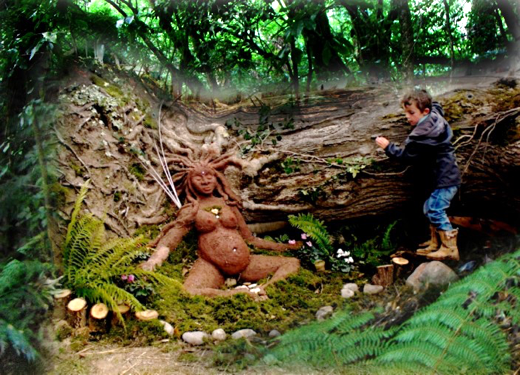
Image above: A child finding magic in the forest. From original article.

"Every year on New Years Day I write down my annual electric meter reading, chart the milage of whatever vehicles I used, including buses, trains and airplanes, and also quantify my use of propane gas, firewood, etc. From that I determine how many trees I need to plant in the coming year to offset the climate impact of my lifestyle."

When I was a young boy my parents moved from the Chicago suburbs to a hardwood forested area of Connecticut, which is where I grew up. My back yard was those woods, and I used to have play forts, many different camping or hiding areas, and a succession of tree houses.

I liked to overnight on a mattress of pine needles in a small grove of pines, and sometimes even did that in a foot of fresh, powdered snow.

My parents also let me climb trees and play on an old rug covering scrap timber I had placed across the lower boughs of a large post oak. Later I built a round pole tipi in that tree and spent many summer nights living there, learning to climb up and down with ropes.


I guess you could say trees are as family to me. They remain a part of my life wherever I go. When I was 17 I learned to work horses on the long line, and later, when I arrived at the Farm in Tennessee, fresh out of grad school, I put those skills to use snaking logs from the forest with a team of Belgian mares.

I built a tent home for my bride on a platform of hand hewn oak logs acquired that way.

People would sometimes come to the Ecovillage Training Center at The Farm and marvel at the small-diameter round poles used for rafters on the very large living roof spanning our Green Dragon tavern, but I knew when I built that roof that round poles were much stronger than milled lumber. They were like the tree limbs that had supported my tree houses.

Deep Well Injection
In my thirties I was a pubic interest attorney fighting against a chemical company in a town 15 miles from The Farm. The company was manufacturing organophosphate pesticides and herbicides and injecting its waste products, including its bad batches, into a deep well.

The State Water Quality labs had tested the green luminescent effluent and said it was the most toxic they’d ever encountered. A single drop dripped into their fish tank killed all the fish within 24 hours.

That deep well went nearly a mile down and pressure fractured bedded limestone — it “fracked” it — to make the rock more receptive to millions of gallons of this witches’ brew.

The fracturing also opened pathways into the Knox Aquifer, one of the largest underground rivers in North America, and presumedly went on to contaminate other large, potentially important, fresh water reserves for the Southeastern United States over a very large area.

Each test well the company drilled showed that the contamination had already traveled farther away from the site than the company was willing to track.

The State did not have the resources to drill million-dollar test wells, so the full extent of the damage may never be known. As well water in the area gradually turned fluorescent green, the company bought out the landowners and sealed their wells.

When our local environmental group sued the company, the company told the judge that there was no reason to protect the aquifer because the Southeast region had plenty of fresh water on or close to the surface.

In written briefs, I made two arguments against that: population and climate change. Freshwater resources were valuable, and would only become more so.

This was the early 1980s, and there I was, going into a Tennessee court and trying to make a case for global warming. It forced me to read nearly every study I could get my hands on and to contact experts and beg them to come and testify.

I tried to simplify an extremely complex subject so that the average judge or juror could understand it, despite confusing and confounding webs of arcane psuedoscience spun by company lawyers, and exceptions in the federal Resource Conservation and Recovery Act that you could pump a lake through.

As it turned out, the case never went to trial. The Tennessee Department of Health and Environment contacted me and persuaded me I should help them draft regulations banning deepwell injection and hydro-fracking, which I agreed to do.

That was a much less costly route for the local environmental group, letting the State bear the expense of experts to fight off the well-funded and unscrupulous industrial lobby.

We had won, although it took a few years before the victory was sealed and the chemical companies packed up and left town. Their toxic waste is still down there, for now.

In any nonviolent campaign there are four basic steps: collection of the facts to determine whether injustices exist; negotiation; self purification; and direct action. — M.L. King, Letter from a Birmingham Jail (1963).

In that time I had spent reading and speaking with experts I had scared myself. Global warming was a much bigger deal than I originally thought. We were up only a half-degree over the prior century at that point, but already there were signs the poles were melting, sea levels were rising, and more frequent droughts were coming to mid-continents.

In 1988, the Mississippi River had gotten so low that barge traffic had to be suspended. My young congressman, Al Gore Jr., opened hearings on Capitol Hill.

Scientists began going public to sound the alarm. Big Oil and Coal began funding campaigns to undermine the smear those scientists and to poison the public debate with bogus studies and conspiracy theories. The Bush Administration’s official policy was climate science censorship. All these signs were ominous.

Carbon Sinks

Fossil fuels have had such a profound change on civilization that it is difficult to imagine giving them up voluntarily. They issued in the industrial revolution and globalized the world with railroads and steamships.

They ended a particularly odious practice that had been the traditional method of Empire-building for the previous 5000 years, supplanting the long tradition of human slaves with “energy slaves” and “energy-saving” home appliances.

The American Civil War was a last gasp of plantation economics, and it ended with a crushing victory for steely industrialists and their fossil energy, who went on to extend their new empire with the Spanish American War and all the resource wars thereafter.

Does the end of coal and oil mean a return to human slavery or can we learn to craft an egalitarian society within a solar budget? Time will tell.

On the other side of the ledger, there are a few promising signs that something can be done to reverse the effects of three centuries of oil and coal addiction. The forests of North America remain a net carbon sink, but when land goes from forest to farm, it generates a huge spike in atmospheric carbon.

In Mexico, which is losing more than 5000 km2 of forest every year, logging, fires and soil degradation account for 42% of the country’s estimated annual emissions of carbon.

In addition to the carbon lost from trees, soils lose 25–31% of their initial carbon (to a depth of 1 m) when plowed, irrigated and cultivated.

In the US, croplands increased from about 2500 km2 in 1700 to 2,360,000 km2 in 1990 (although nearly all of that occurred before 1920). Pastures expanded from 1000 km2 to 2,300,000 km2 over the same period.

The fabled era of the cowboy was between 1850 and 1950, and the pattern was repeated in Canada and Mexico. But then something different happened.

Partly because of the Dust Bowl and the organized responses of the Roosevelt Administration, partly because of the Great Depression, and partly because of an emerging conservation ethic, after 1920 many farmlands were abandoned in the northeast, southeast and north central regions and 100,000 km2 were reforested by nature.

Between 1938 and 2002 the US gained 123 million acres of forest from farm abandonment while losing 150 million acres to logging, primarily in the Southeast and Pacific Northwest.

This trend, net marginal loss, continues today in the US and Canada, in contrast to Mexico which is rapidly destroying its forests, and not re-growing them anywhere.

The net sink effect of a recovering forest is variable but the average for Eastern deciduous successional forest it is 200 grams C per m2 per year, or two metric tons per hectare.

This is calculated by considering annual growth and mortality above and below ground, the chemical changes in dead wood, and net changes in soil carbon. (Pacla S., et al., Eddy-covariance measurements now confirm estimates of carbon sinks from forest inventories, in King & Dilling, 2007).

Sometime around 1985 I began planting trees to offset my personal carbon footprint. Today that forest is about 30 acres (12 ha) and annually plants itself. I wrote a book, Climate in Crisis, pulling together my legal research and laying the climate science out in lay terms that non-scientists, such as myself, could grasp.

In 1995, I retired from law to become a permaculture teacher and ecovillage designer. I continued to attend scientific meetings and international negotiations on climate, and I contributed a blog, many magazine articles and books to the discussion.

I kept myself current with the latest findings, always exploring pathways that might provide solutions, not just for my personal footprint, but also to the coming climate catastrophe for us all.

Atmospheric Scrub Brushes
We could spend print here discussing geoengineering, replacements for fossil energy, biochar, and shifting to some form of ecological agriculture, but the truth of the matter is, nothing can heal our global chemical imbalance faster than trees.

As I wrote in Climate in Crisis, and later in other books, forests are scrub brushes. They absorb CO2 from the air, transform it to O2 with the magic of photosynthesis, and sequester the C in lignin and cellulose.

They also transfer it deep into the ground through their roots and the soil food web.
We, the humans, might be able, under optimal conditions, to get up to sequestering as much as 1 gigaton of carbon (petagram C or PgC) annually by switching to “carbon farming:” holistic management; compost teas; keyline; and organic no-till. Biochar’s full potential is estimated at 4 to 10 PgC per year, if the world were to widely employ biomass-to-energy pyrolysis reactors.


Image above: Carbon cycle in undisturbed (or fully reforested) tropical forest. From original article.


Image above: Carbon cycle after ten years in a deforested tropical forest. From original article.

Forests, with all-out reforestation and afforestation, have a potential yield of 80 PgC/yr.

The climate cycle, with 393 ppm C in the air [this was written in January 2013. The number now is 407], is currently adding 2 parts per million to the atmosphere annually. That represents an additional retention of 3.2 PgC over what Earth is able to flush back to the land or the oceans. The oceans are acidifying — at a disastrous pace — because of the excess C being flushed, so what needs to happen is that more C needs to be taken from both the oceans and the atmosphere and entombed in the land, which is, in point of fact, where the excess came from in the first place.

Going Beyond Zero
To get back to 350 ppm — Bill McKibben’s goal — we need to lower atmospheric carbon by 42 ppm, or 67.4 PgC. If we wanted to accomplish that goal as quickly as say, 2050 (37 years from now), we would need to average a net C removal rate of 1.82 PgC/yr. So we need to go from plus 3.2 to minus 1.8, on average, over about 40 years. Of course, many, myself included, don’t believe 350 is good enough to pull our fat from the fire. I would prefer we aim for 320 ppm by 2050 if we want to escape the worst Mother Nature is now preparing to dish up.


Image above: Carbon cycle in conventional logging in a forest. From original article.


Image above: Carbon cycle with reduced impact logging in a forest. From original article.

A 320 goal in 37 years means we need to lower atmospheric carbon by 72 ppm, or 115 PgC; an average a net C removal rate of 3.1 PgC/yr.

In other words, we need to flip from adding 3.2 PgC greenhouse gas pollution every year to removing about that amount. We have to go net negative, for at least the next 40 years.

Organic gardening and soil remineralization, as Vandana Shiva, Elaine Ingham, Dan Kittredge and others are so enthusiastic for, will not get us there, although it is a good start and an important wedge, with many other benefits.

Biochar could get us there, but the industry is immature, poorly understood by environmentalists, and dependent on financing that may or may not be available in an era of de-growth and economic collapse.

To scale up to 3 or 4 PgC/yr is likely to take longer than 40 years.

Tree planting is our best bet. Franklin Roosevelt’s Civilian Conservation Corps planted massive shelterbelts to end the Dust Bowl, and the jobs provided helped lift the USA out of the Great Depression.

The same could be done in Spain and Greece, not to mention Africa. And, lest we forget, two of the world’s greatest reforestitians, Christopher Columbus and Genghis Khan, demonstrated our species’ ability to rapidly change climate.

They showed that we could even jump start a minor Ice Age if we wanted. Talk about air conditioning! Fageddaboutit.

Right now, the planet is still rapidly losing forest. In 1988, borrowing from federal agency reports being suppressed from publication by the first Bush administration, I drew graphics to show what would happen to the Eastern forest in a 5 degree warmer world, and the kind of species migrations that might be expected.


Image above: Migration towards the arctic of some North American forest trees with 5 degrees centigrade increase in temperature due to global warming.

A more important point, which I raised in Climate in Crisis, was that individual forest patch compositions are less important than the synergies that are lost when those compositions are broken up.

It matters what happens between patches, and it is not just about plants, either. We need to consider the pollinators and seed storing animals. They can’t just have food in one season, they need it in all seasons, or they will leave.

Some plants and animals are fast migrators (armadillos and spruce) and some are much slower (leafcutter ants and ginkgo).

When you force a rapid system change, the network of connections is broken, and it may take some time to find new equilibrium. In the meantime, biodiversity crashes and ecological services are impaired. The web unravels.

GHG Footprints
In the early Nineties I used to quip that before I wrote my book on climate my greenhouse pollution footprint had been in steady decline for 10 years. After I wrote my book it went through the roof. Invitations to speak continue to increase, even now, 23 years later.

Every year on New Years Day I write down my annual electric meter reading, chart the milage of whatever vehicles I used, including buses, trains and airplanes, and also quantify my use of propane gas, firewood, etc.

Using a conversion formula from the book, I convert my personal energy slaves into tree-years. From that I determine how many trees I need to plant in the coming year to offset the climate impact of my lifestyle.

Planting trees as a personal offset requires a bit of advance planning, because the calculation depends on how long a tree will grow, how big it will become, and what it will likely give back to the atmosphere at the end of its life.

Also, one has to anticipate the changing dynamics ushered in by rapid climate change. This led me to arrange for a long-term contract of some land and to acquire new knowledge on how best to plant and manage a climate-resilient forest.

I now have the benefit of visits to the Pioneer and Alford forests in the Ozarks, which I describe in The Biochar Solution (2010), as well as to wilderness old growth in Scotland, British Columbia, Northern Queensland in Australia, Muir Wood in California, the Darien Peninsula of Colombia, the Mesoamerican highlands and the Amazonian Basin, to name a few.

I have studied permaculture, with special reference to the work of Christopher Nesbitt, David Jacke and Eric Toensmeier in designing a methodology for building food-resource forests.

But, back in 1985, I had none of that, and so I began on a part of my parents’ farm that was in the process of transitioning from vegetable field production to low brush.

See also:
Ea O Ka Aina: Degrading in the Amazon Hurts Us 8/7/17


AUTHOR'S Apologies to regular followers of our blog who may read the above when it was first published in 2013. We are re-running this two-part series this week and next while absorbed teaching a Permaculture course in Ireland.
In the second installment of this series, I will describe the planting of my personal forest and how I calculate its carbon sequestration impact.

.