Time for Direct Action on CO2

SUBHEAD: We demand the possibility of a decent future. We will not stand by as that possibility vanishes daily.

By Emily Johnson on 11 April 2016 for TruthOut -
(http://www.truth-out.org/opinion/item/37874-the-time-for-direct-action-is-now)
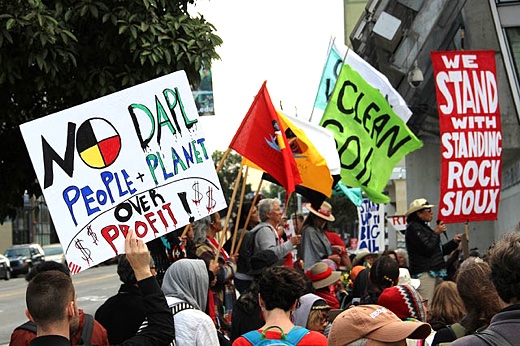

Image above: A protest march in solidarity with the Standing Rock Sioux against the Dakota Access pipeline in San Francisco, California, August 24, 2016. Photo by Peg Hunter. From original article.
"In your heart, you know we're right." -- Imogene Williams, 84, to BNSF Railway officers about to arrest her for blockading the oil train tracks.
What if you brought a patient dying of fever to the hospital, and the doctors looked earnest and suggested removing a sweater? We're in an emergency, and no one in power is treating it as such.

Our warming world is by far the most dire emergency humanity has ever faced, and thanks to the inaction induced by decades of corporate lies, our political and social systems are radically failing us.

There is currently no policy under consideration anywhere that will keep us below a global temperature rise of 1.5 degrees Celsius (we're almost there), which might avoid the worst impacts and tipping points of climate change.

Likewise, there's no policy that currently has a prayer of passage and implementation that will keep us below 2 degrees Celsius, which might mean a chance for those of us in the Global North, though it would make refugees, at best, of hundreds of millions of people across the Middle East, Africa and Asia -- not to mention those in low-lying island nations.

Elected leaders tell us -- when they talk about this at all -- that we need to aim for what's "politically possible" -- a concept with which physics is unacquainted.

But happily, the goals that seem "politically possible" dissolve fast in a time of profound change, and other goals reveal themselves as clearly within reach. The only question that has meaning now is: What has a chance of waking politicians of their torpor and spurring them -- spurring all of us -- to act with the clarity and determination the situation requires?

"In your heart, you know we're right," my friend Imogene Williams said, as a police officer was about to arrest her for blockading the tracks used for transporting explosive Bakken crude oil. Williams is 84 years old, and is as pink-cheeked and twinkly-eyed a great-grandmother as Norman Rockwell could hope for.

I suspect her soft words were rather more unsettling than they would have been coming from someone else. They stayed with me, because I kept wondering if she was right. Some police officers are informed enough to fear for their kids' futures on a warming planet, no doubt, and some aren't, just like any other demographic.

What I wondered was not about that one man, but about the way he seemed at that moment to represent both the broader, law-abiding public and the enforcers of the current, deeply problematic construct of human law.

In its fundamental denial of the laws of nature, for example, human law still allows companies to emit gases that we now know for a fact will kill countless millions, and yet imprisons a young man for winning an oil and gas lease auction in an act of protest.

What do we owe those who are already dying? Or even our loved ones? As a friend of mine asked once: "The people who don't know what we know, 10 or 20 years from now, what will they think that we should have done to warn them?"

Notwithstanding the old cartoon about the stages of global warming denial (It's not real ... it's not human-caused ... it's not a problem ... why didn't you tell us?), they clearly can't say we didn't tell them; many brave and tired people have been doing little else for decades. But telling, for a variety of reasons, has not been enough.

If I do nothing but tell people, now -- if I continue organizing, voting, writing, speaking -- and the world continues on the 4-degree trajectory represented by current pledges, I will see hideous things before I die -- things that have already begun: countries imploding, hundreds of millions starving and displaced, entire ecosystems collapsing. We all will. It will come closer and closer, and then it will come for us.

When we are old, what will we wish we had done? What can we do to wake the human spirit enough that we might save ourselves?

I've seen the climate movement build from handfuls of people here and there, to hundreds and thousands -- and even hundreds of thousands, in rare moments. I believe that we're poised for a growth far more explosive: The wave of energy that has recently come into the group that I'm part of, 350 Seattle, has been extraordinary. We're having to run with all our might simply to make sure we don't fail new people by not having meaningful ways for them to engage.

I believe we're coming to what This Is an Uprising calls "the moment of the whirlwind" -- the moment when years of effort suddenly cohere, and people pour into the streets.

If groups of students can bring down Slobodan Milošević, Zine El Abidine Ben Ali and Hosni Mubarak, then you, I and our friends can bring down Exxon, and spill its pockets to the people trying to rebuild the world the company is in the process of destroying. I promise. We don't even have to worry about death squads.

There will be a moment -- perhaps not within months, but not as long as decades either -- when the police, like Milošević's soldiers, will refuse to follow orders. They're human beings, and if they're not worried yet, they will be; an understanding of the current crisis will change their ideas of what's right as it has changed mine.

There will be a moment when judges understand that if there has ever been a time to interpret our laws so as not to exclude the realities of the planet we inhabit, this is it. Otherwise, our legal system is worth no more than King Canute's (ironic) attempt to hold back the tide.

There have already been moments when prosecutors understood this. There has already been talk among politicians in my city of explicitly decriminalizing nonviolent civil disobedience on climate. Friends of mine have been thanked by police officers for blockades they'd taken part in. Other friends have been mildly sentenced by judges who said, "We need more people like you."

When I began writing this, I was in an RV with several others, on the way to North Dakota to support the Sacred Stone Spirit Camp, where the Standing Rock Sioux and representatives from hundreds of tribal nations have been blockading the construction of an oil pipeline near to their water supplies.

Not long before, there were protests in Louisiana over the Bureau of Ocean Energy Management's sale of Gulf of Mexico oil and gas leases, just weeks after unprecedented flooding left the state with three times as much rain as Hurricane Katrina.

There must be somewhere that new fossil fuel infrastructure isn't being fought hard, but I don't know where it is. I'm from the Northwest, where we've successfully staved off or defeated every new infrastructure project in the last few years. Which is good, because we have to.

But it's not nearly enough -- not yet. On the road to Standing Rock, I read about the (warming-induced) spread of Zika and the damage it's doing to babies' brains. We passed through two areas of intense wildfires. Whole neighborhoods of Miami now regularly flood at high tide. How biblical does it have to get before politicians act?

Hillary Clinton, who at least has an idea how serious the problem is, hired a pro-fracking transition manager, Ken Salazar, even though we may have already used up all of our carbon budget.

Fracking releases vast amounts of methane, which is a far more powerful greenhouse gas than carbon dioxide in the near term -- and the near term is exactly what we have to worry about most, given the terrifying speed of Greenland's and other ice sheets' melt.

If we turn up the thermostat now, we might -- no, will -- be paying for it for millennia. If there's even a we. It's not clear how there could be, with ecosystems collapsing across the planet.

So again: When we are old, what will we wish we had done? What will you wish you had done? How do we wake each other out of this?

As the brave people at Standing Rock and along the Gulf Coast are showing us all, it's time -- it's past time -- to make our stand and defend the world with all we have. Creatively, peacefully and with the utmost resolve, we have to put ourselves on the line to change things.

There has never been a movement for social change that succeeded by people simply being good people and attending to their daily lives. There have been few that have not succeeded -- however unlikely they were -- when people were willing to move beyond themselves, and peacefully step up en masse to demand something different.

Because we are deeply social creatures, nonviolent resistance may be the most powerful force on the planet. As Williams understands, many -- perhaps most -- people know in their hearts that we're right. All we have to do is let them see that together, we really do have this power.

People often feel uncomfortable with civil disobedience; it reveals tensions in the current system (in this case, the fact that our laws are deeply inadequate next to the laws of physics), and that system feels inevitable to them.

But unexpected and deep social change happens regularly, in truth -- from bringing down a dictator, to changing racist laws, to letting people marry (whether they're of different races, or of the same sex). Seldom do these things happen without civil disobedience.

Here's our choice: The world represented by Donald Trump, in which we fiddle while escalating climate change creates escalating horror, refugees, anxiety and walls -- or a world in which we stand together and demand the change we need by every peaceful and inspiring method available to us, until it happens.

There will still be climate change, but we'll do our best to minimize it, and to become united as a people in our response -- determined, compassionate and creative. Not building walls, but building communities that will fight together to keep the planet as vibrant and alive as physics and our previous bad behavior permit.

The people in power don't actually know that this world is possible; almost to a person, they need to "evolve" (again). And we can help them.

We can't leave the hard work to other people. We have to stand up for the world we love.

Look outside your window, and understand that if we don't succeed, everything you see will be profoundly changed in coming decades: Your trees will die from insects, drought or flood; your neighborhoods may become fortresses or go underwater; the people walking down your street may die -- or have babies who die -- of diseases once unheard-of in your climate. That is what we have to lose.

What can we gain? Everything, but most of all faith. Faith in a planet well enough to continue supporting us; ecosystems slowly coming back into balance; and social systems that acknowledge the natural world, and know that we must be in harmony with it.

We gain a decent (perhaps even beautiful) future, which is a possibility that will otherwise -- within years -- be in our rearview mirrors.

When we are old, what will we wish we had done? Everything, perhaps, but for a start, we could do much worse than simply standing together in the resolved and clear spirit of Standing Rock: We demand the possibility of a decent future.

We will not stand by as that possibility vanishes daily.

Not just in Standing Rock and Louisiana, but also in Washington State, Massachusetts, Vermont and many other places -- that is exactly what communities are doing. Direct action by itself, of course, won't be enough to set us on the right path. But when you're in a hole, the first thing you do is stop digging. So we have to stop digging.

•  Emily Johnston is a Seattle poet, essayist and activist, published also in Slate, Crosscut, The Oregonian and elsewhere. Her first book of poetry, Her Animals, is forthcoming in early spring 2015 from Hummingbird Press. Follow her on Twitter: @enjohnston.


.

How about a "Grown" economy?

SUBHEAD: People complain about the overuse of "Degrowth" and are looking for something more positive.

By Juan Wilson on 11 October 2016 for Island Breath-
(http://islandbreath.blogspot.com/2016/10/how-about-grown-economy.html)


Image above: Illustration inspired by the "The Fifth Sacred Thing" by DreamNectar. From (http://dreamnectar.deviantart.com/art/The-Fifth-Sacred-Thing-331086738).

We at IslandBreath have been using the term "Degrowth" for years to describe what our planning goals ought to be going forward. It is a word that if implemented as a policy could help us match the resource capability of the Earth to a sustainable number of people on the planet.

Some still think "Degrowth" it is a useful term and others think it is tired and overused and needs new management. See the arguments by Kate Raworth and Giorgio Kallis "Has 'Degrowth' or 'De-Growth' outgrown its own name?".

Kate Rarworth makes a case against Degrowth arguing that it does not describe a solution. She thinks it has overall a negative connotation and counters,
"We have an economy that needs to grow, whether or not it makes us thrive.
We need an economy that makes us thrive, whether or not it grows."
and adds:
I’m guessing that some of my degrowth friends will respond to this blog with irritation, frustration or a sigh. Here we go again – we’ve got to explain the basics once more.
If so, take note. Because when you find yourself continually having to explain the basics and clear up repeated misunderstandings, it means there is something wrong with the way the ideas are being presented.
Believe me, the answer is in the name. It’s time for a new frame.
Giorgio Kallis makes the point that "Degrowth" is accurate and concise:
‘Degrowth’ is as clear as it gets. Definitely no less clear than ‘equality’; or ‘economic growth’ for that matter... Beyond a critique of the absurdity of perpetual growth, degrowth signifies a decrease of global carbon and material footprint, starting from the wealthy...The ‘green growth camp’ also wants such a decrease, but it argues that GDP growth is necessary for – or compatible with – it. Degrowth does not and expects GDP will decrease.
Others are even looking for new alternatives.

Miklos Antal recently wrote "D.E.growth: A Small Change in the Slogan with Large Benefits". His case is to revamp the word for new psychological effects. His suggestion is: "D.E.growth"
Building on the popularity of the growth frame, the term "D.E.growth" can be intriguing. This is crucial to raise attention, and from this aspect, it might be better for a radical movement than slogans like “sustainable prosperity” or “good life”. Invoking growth in an innovative and somewhat puzzling way can help to focus attention on the issue of economic growth and to trigger discussions about its future, which is an important goal of the alternative economics movement.
Unlike in the case of "Degrowth", however, first subconscious reactions to the slogan might be positive. As the two capital letters in the beginning are separated, the first clearly understandable part is “growth”, and growth is up, and up is good. All subsequent information processing will then be influenced by the first positive subconscious evaluation.
Well, "D.E.growth" makes a contemporary styled stab at a "refresh" of the word, but it seems overwrought and overthought to me.


Growth is foremost an organic process. The life of individual plants and animals begins with a single cell. It divides to multiply, specialize and grow into an individual living entity. It is easier for us to see the mature "grown" animal form. It happens sometime after adolescence and reproductive age.

Animals, like cats grow to a size appropriate for the environmental "niche" that they are embedded in. A domesticated cat, at 12 pounds, lives in a place where appropriate prey are fairly limited in size (rodents and birds), whereas a black panther, at 120 pounds, will target antelope, deer, warthogs and wild boar.

For a plant "grown" can be more difficult idea to understand. But individual plants, like whole forests have a climax of growth. For and individual tree it might take centuries to be "grown".For example a "grown" sequoia tree might reach a height of 400 feet in as many years... but no higher than it can draw water from the soil to nurture its leaves.

Plants are self regulated in size but by different dynamics than animals.

So are economies. Ours is at the end stage of "Growth". "Degrowth" will come on its own as certain aspects of our economy fade away or crash and burn. What is important to realize is that ours is no longer a "Growth" economy but a "Grown" economy. That is a fundamental requirement of sustainability and even survivability.


It's time we humans matured enough to realize that civilization is done and grown, so if our chores are done, its time to smell the roses.
.

Jill Stein shreds Shriver

SUBHEAD: Asking the wrong questions for the same-old answers will get the same disastrous consequences.

By Staff on 10 October 2016 for Jill Stein for President -
(http://www.jill2016.com/debates)


Image above: Still from video interview below. Maria Shriver can't put down the cellphone that's telling her what ridiculous questions to ask to Stein. Most backfire on her.  From (http://www.jill2016.com/debates).

Last week Jill stopped in for an interview with Maria Shriver, corporate media icon and heir to one of the great establishment political families.

To be blunt, Maria tried to ridicule, mock and undermine Jill. And just as at Standing Rock -- Jill stood strong, powerful and unwavering.

What you'll see is a candidate who will not bow down and will not give in. What you'll also see is a so-called “journalist” attempting to trivialize real issues to defend Hillary Clinton. Maria Shriver used  every “gotcha” tactic in the book, and Jill was nothing short of phenomenal!

It was particularly galling to hear Maria Shriver try to shame Jill (and her supporters) for not supporting Hillary Clinton, and strongly implied that YOUR vote automatically belong to Hillary. Be sure to listen to Jill's fearless answer.


Video above: Maria Shriver interviews Jill Stein. From (https://youtu.be/eNAUW2KzjKk).

Jill's days are filled with back-to-back interviews and last night, at the second Presidential Debate, Democracy Now! Was prepared to allow Jill's answers to be heard after Hillary and Donald's non-answers to each question.

But for the first time in their history, technical difficulties prevented them from being able to do a live show from a different location.

But Jill’s team turned on a dime, and created a Facebook stream to allow Jill to respond in real time. Over 2 million people were reached this way!

Please check out that recording on the website, and you will see that Jill always comes back to the issues that are literally killing us: climate disaster (Matthew being just the latest superstorm), wealth inequality, access to medical care, student debt, institutional racism, police brutality, and so much more.

The Green Party has the answers that Americans are desperate to hear. We will continue to take to the “people's media”, social media like Facebook and Twitter, to make our case and spread the Green movement.

The establishment media is trying to silence us. But the great wind of change is blowing …

This movement will not be stopped - it will be heard, and it will grow. The work we do this year will directly translate into more Green candidates in the next election cycle, and a 2020 presidential campaign that will be immediately well-funded, organized, and effective.

But we can't keep up this work, especially our 50-state Get Out The Vote campaign, without your financial help. Please, will you chip in $29 for Stein today, or any amount you can give up to $2700 per person.

Hillary and Donald don't have bold, breakthrough answers. You know that. The Maria Shrivers of the world don't have brilliant, incisive questions. You also know that.

If you ask the wrong questions and put forth the same-old, same-old answers, all you get is the same disastrous consequences.


.

Wounded Elephant

SUBHEAD: Are we a nation or just the world’s biggest comedy club? Where's the Deep State when you really need it?

By James Kunstler on 10 October 2016 for Kunstler.com -
(http://kunstler.com/clusterfuck-nation/wounded-elephant/)


Image above: "Fourteen What the Fuck?!" moments from 2nd debate in Rolling Stone.  From (http://www.rollingstone.com/politics/features/14-wtf-moments-from-the-second-presidential-debate-w444070).

Last night’s debate raises some interesting questions, such as: would the Romans have elected Caligula if given the chance to vote? Can the Republican party recover from Donald Trump?

If the party poobahs “pull the plug” on Trump, as some are threatening to do (that is, cut off funds to his campaign), will they go down the drain with him anyway?

Is the USA a nation or just the world’s biggest comedy club? Where is the Deep State when you really need it?

That odor wafting across the land is the smell of Republicans with their hair on fire. Yet the gloat of astonishment on Hillary’s face as she witnesses the Queeg-like crack-up of her rival will eventually fade as she discerns the wreckage awaiting her in the oval office. Weep for your country!

The only good to come out of this sordid election is the certainty that a lot of political debris will be swept away in the Fourth Turning underway. Out of the miasma of idiocy and posture that is this election campaign, the hard-edged realities of our time will emerge and the TV audience will come to the stark recognition that it is not just another mere entertainment.

The other major nations of the world are not so much ganging up on America, as Hillary would have it, but reasonably attempting to ring-fence the mad bull that the USA has become — as the two candidates vie to start World War Three with China and Russia respectively.

The last resort of the scoundrels in today’s version of the “yellow press” is to blame Russia for attempting to meddle in our election. War, children, it’s just a shot away.

It is getting to be too late to sort out all the confusion sown by this horrific campaign. From here on its really more a matter of the dust settling. In background of it all looms the train-wreck of global finance, which will be the true determinant of what the American people will have to do in the years ahead.

During the weeks of the election distraction, the European banks struggle to conceal their insolvency while the politicians of Euro-land desperately try to paper over the cracks in these fracturing institutions. Few can tell what is actually happening in China’s banking system, but it’s sending out ominous tremors that are hard to ignore.

But be sure it is all daisy-chained right into Wall Street and the US banks. The potential for wrecking markets and currencies around the world is extreme at this moment. It may only be a matter of whether it happens before or after the election.

Then we’ll see what happens when financial institutions can’t trust each other. Trade stops. Economies crumble. Pretenses evaporate. If it gets bad enough, the shelves of the supermarkets go bare in three days and you’re living in a permanent hurricane disaster without the wind and rain.

Believe me, that will be bad enough. Hillary, if elected, will not get to play FDR-2. Rather, she’ll be stuck in the role of Hoover, the Return, presiding over a freight elevator of an economy with a broken cable. Expect problems with the US dollar. Expect “emergency” actions. Expect the unintended consequences of those actions.

If there is one outstanding upshot of these “debates” it must be their staggering failure to reassure the American public that they can expect effective leadership through the hardships ahead. There must be many others out there like myself wondering who will emerge from the rubble?

I suspect it will be someone we haven’t heard of before, just as Bonaparte was unheard of in France in 1792. This is not entirely a nation of clowns, though it feels like that lately.


Video above: Satire of Clinton-Trump Second Debate overwhelms and presages the reality. From (https://youtu.be/-nQGBZQrtT0).


Video above: Actual excerpt from  Clinton-Trump Second Debate plumbs depths of groping and mail laundering. And this was a better moment of the broadcast. From (https://youtu.be/NKCmr6IZd1U).


.

Is Capitalism killing you?

SUBHEAD: Income sharers combine their wealth to be able to cooperatively make economic decisions.

By Matt Stannard on 6 October 2016 for Occupy.com -
(http://www.occupy.com/article/capitalism-killing-you-income-sharing-could-save-our-lives)


Image above: A meeting with Ocuppy.com and Commonomics USA making a presentation. From original article.

Being poor is hoping the toothache goes away,” Hugo Award-winning author John Scalzi wrote in a personal blog post over a decade ago.
“Being poor is a heater in only one room of the house... Being poor is needing that 35-cent raise... Being poor is six dollars short on the utility bill and no way to close the gap... Being poor is knowing you work as hard as anyone, anywhere.”
Economic insecurity is the American nightmare. It kills us earlier, messes up our mental health, saps the life out of us. Since Scalzi’s 2005 post, we’ve learned that more than 60 percent of us can’t afford a $500 emergency – which roughly translates to hoping the toothache goes away. That’s a pretty raw deal in exchange for an economic system that’s also killing the planet.

And only rarely can we count on others to help us out. They’re either broke themselves, or profiting from our financial instability.

“Being poor,” Scalzi wrote, “is relying on people who don’t give a damn about you.”

But there are groups of Americans who are turning that indifference on its head. Within the larger intentional communities movement are a growing number of egalitarian, income-sharing communities, whose members combine their wealth and income to create spaces where people make economic decisions cooperatively, rely on one another and a democratic policymaking process for security, and cease to consider finances—or their financial challenges—the responsibility of lone individuals.

The financial families they create range from a half-dozen to nearly a hundred people, in locations from urban Baltimore, Portland and Washington D.C. to rural Missouri and Virginia.

In mainstream society, poverty is a tremendous waste of human resources, including time and health.

 “The human potential that is lost is massive,” says Sky Blue, Executive Director of the Fellowship for Intentional Community and a second-generation member of Twin Oaks, the nation’s largest income-sharing community.

If you’re opposed to capitalism and this waste of potential, Sky tells me, “there’s an imperative to share income.” Its proponents say it works, and they have evidence: People in such communities can live comfortably on as little as $5,000 per-person per-year; if people get too old or too sick to work, they receive support from others in the community and the care-time devoted to them is not a zero-sum game like it is with families in the mainstream economy.

The idea of people (apart from our immediate family) co-owning virtually everything with us is far, far away even from liberal visions of economic egalitarianism. Americans don’t generally share, at least not at a level you can base an entire economy on. At best, in favorable political seasons, we re-distribute.

But that’s not enough for income-sharing adherents. They’re even more radical than Marxists. “We’re going beyond ‘owning the means of production,’” Valerie Renwick-Porter, a writer and yoga teacher at Twin Oaks, tells me. “What we’re doing is about owning every aspect of our lives.”

Although income-sharing communities differ in many of their day-to-day logistics, they generally share a number of traits. Income earned, and value produced, by members generally goes directly into the community budget. The community can then scale the cost of all its basic obligations and members’ individual needs; things are always less expensive when you can organize people into larger cooperative systems.

 Community resources such as land, buildings, vehicles, are collectively owned. Individuals have their individual things (the community doesn’t own your underpants), but there are often rules and norms to discourage the classism of conspicuous consumption.

And typically, there are cooperative work enterprises in the communities, complementing the shared wealth and providing on-site work opportunities for members.

Variations exist. Some communities only partially share income. Some share expenses but not income. The common denominator is that in these communities, nobody considers their wealth and property wholly their own.

Potential members must apply and get accepted into the communities; the provisional period is careful and deliberative.

Members can be expelled; the due process for that to occur is extensive. The communities can often work with members who have personal debt or financial obligations, but there are limits, and everything is done with careful conversation. “We don’t give everybody a blank check,” Valerie says. Nor, she says, does income sharing “divide it down to the penny.”
 
Since members must inevitably interact with the outside world, income-sharing makes such interaction easier, creating, Sky says, “a bubble with a semi-permeable membrane” where people receive significant financial security, help others achieve that security, all the while aware that they are not alone.

Income-replacing work, like food production, maintenance, and caring for others, is given the economic weight it deserves, rather than being marginalized by a system that discounts much of that productive labor.

It’s not a perfect system. Income-sharing can reveal a microcosm of the good and bad behaviors in society. Property transfer policies and other procedures for negotiating between personal and community property can be challenging.

Above all, Sky says, Americans view private property as sacred and talking about personal finances is verboten. “It’s very hard to let go of that way of living even with the best of ideals or intentions,” Valerie adds. “It doesn’t make sense because all of your assumptions come from a different paradigm.”

But the success and growing interest in income-sharing communities suggests that at least some Americans can make the leap of faith. The case for material sharing doesn’t require us to tattoo hammers and sickles on our shoulders, distribute copies of the Little Red Book, or storm any Winter Palaces. The case is very simple: We save resources, and make better use of them, when we share.

Members of income-sharing communities can work fewer hours than those in the mainstream economy, and achieve a higher level of material security in those hours. Participation in democratic decision making also helps people become ethical and other-oriented. The added exigencies of economic and ecological crises call for widespread modeling of community income-sharing. Starting to share now could help us dismantle oppressive systems large and small.

Perhaps most importantly, these communities already exist, meaning people can join them or build communities modeled after existing ones rather than waiting for some vanguard revolutionary party to overthrow capitalism first.

“You can just make a choice to reorganize your life around compassion and solidarity and cooperation,” G. Paul Blundell, a seed-exchange specialist and member of Compersia in Washington D.C. says in a short video [http://www.theatlantic.com/video/index/501005/income-sharing-commune/] about that community.

“You don't have to wait for the rest of the world to come along to do that.”

.

PMRF injuring marine mammals

SUBHEAD: NOAA okays air force tests injuring marine mammals on ocean from PMRF test range.

By Juan Wilson on 9 October 2016 for Island Breath -
(http://islandbreath.blogspot.com/2016/10/pmrf-to-injure-marine-mammals.html)


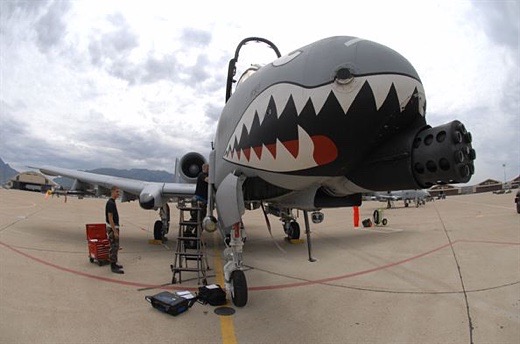
Image above: Airmen from the 53d's 86th Fighter Weapons Squadron ready A-10 Thunderbolts from Moody Air Force Base, to participate in the Air Force's air-to-ground Weapons System Evaluation Program known as Combat Hammer in 2008. From (http://www.acc.af.mil/News/ArticleDisplay/tabid/5725/Article/201987/53d-wing-conducts-largest-air-to-ground-wsep-in-history.aspx).

I would like to thank Rayne Raygush for alerting us to relevant entries from the Federal Register published since the last issue of The Environmental Notice that relate to military weapons testing near Kauai.

For full notice information, click on (https://www.gpo.gov/fdsys/pkg/FR-2016-10-03/pdf/2016-23725.pdf).

The article below is derived from this that notice, including details of the notification by NOAA of ongoing damage to marine mammals. This is occurring now during the month of October and November and is being conducted by the US Air Force for testing of weapons systems in the waters around Kauai.

ISSUER:
National Marine Fisheries Service (NMFS), National Oceanic and Atmospheric Administration (NOAA) of Commerce Department.

WHO:
U.S. Air Force 86 Fighter Weapons Squadron (86 FWS)

WHAT:
Notice of issuance of an incidental harassment authorization for Air Force.

WHERE:
Barking Sands Underwater Range Extension (BSURE) area of the Pacific Missile Range Facility (PMRF) at Kauai, Hawaii.

WHEN:
This authorization is effective from October 1, 2016, through November 30, 2016.

INFORMATION:
Laura McCue, Office of Protected Resources, NMFS, (301) 427-8401.

BACKGROUND:
Law direct the Secretary of Commerce to allow, upon request, the incidental, but not intentional, taking (killing) of small numbers of marine mammals of a species or population stock, by U.S. citizens who engage in a specified activity (other than commercial fishing) within a specified geographical region if certain findings are made and either regulations are issued or, if the taking is limited to harassment, a notice of a proposed authorization is provided to the public for review.

An authorization for incidental takings (killings) for marine mammals shall be granted if NMFS finds that the taking will have a negligible impact on the species or stock(s), will not have an unmitigable adverse impact on the availability of the species or stock(s) for subsistence uses (where relevant), and if the permissible methods of taking and requirements pertaining to the mitigation, monitoring, and reporting of such taking are set forth.

NMFS has defined “negligible impact” in 50 CFR 216.103 as “an impact resulting from the specified activity that cannot be reasonably expected to, and is not reasonably likely to, adversely affect the species or stock through effects on annual rates of recruitment or survival.”

The US Air Force 86 Fighter Weapons Squadron plans to conduct an air-to-surface mission in the BSURE area of the PMRF. The Long Range Strike Weapons System Evaluation Program (LRS WSEP) test objective is to conduct operational evaluations of long range strike weapons and other munitions as part of operations to properly train units to execute real-world operational expectations in a time of war.

Due to threats to national security, increased missions involving air-to-surface activities have been directed by the Department of Defense (DoD).

86 FWS proposes actions that include LRS WSEP test missions of the Joint Air-To-Surface Stand-off Missile (JASSM) and the Small Diameter Bomb-I/II (SDB-I/II) including detonations at the water surface. These activities qualify as military readiness activities under the MMPA.

IMPACTS:
The following aspects of the planned LRS WSEP training activities have the potential to take marine mammals: Munition strikes and detonation effects (overpressure and acoustic components). Take, by Level B harassment of individuals of dwarf sperm whale, pygmy sperm whale, Fraser's dolphin, and minke whale could potentially result from the specified activity.

Additionally, 86 FWS has requested authorization for Level A Harassment of one individual dwarf sperm whale. 86 FWS's LRS WSEP training activities may potentially impact marine mammals at or near the water surface. In the absence of mitigation, marine mammals could potentially be injured or killed by exploding and non-exploding projectiles, falling debris, or ingestion of military expended materials.

HARM LEVELS:
Level B Behavioral Response could result from exposure to explosive detonations that cause disruption of natural behavioral patterns, including migration, surfacing, nursing, breeding, feeding, or sheltering.

TTS is Temporary Threshold Shift that can affect how an animal behaves in response to the environment, including reactions to predators, and prey.

PTS is Permanent Threshold Shift that results from exposure to explosive detonations that is irreversible and is considered this to be an permanent injury.

http://www.islandbreath.org/2016Year/10/161009table5big.jpg
Image above: Table 5 from Federal Reserve notice indicating distance between marine mammal and weapons explosion and the resulting level of damage to the victim.  From (https://www.gpo.gov/fdsys/pkg/FR-2016-10-03/pdf/2016-23725.pdf). Click to enlarge.

Note Table 5 above indicates in the case of pygmy and dwarf whales that permanent damage could be done to an individual whale over 4 miles from an explosion and temporary damage could be inflicted almost 13 miles from an explosion. These species could even experience behavior disruption over 35 miles from an explosion.
TABLE 7: NUMBER OF MARINE MAMMALS POTENTIALLY AFFECTED

Species
Mortality Level A: PTS
Permanent
Level B: TTS
Temporary
Level B:
Behavioral
Dwarf Sperm Whale 0 1964
Pygmy Sperm Whale 0 0326
Frasier's Dolphin 0 010
Mincke Whale 0 012
Humpback Whale 0 039
TOTAL 0 117101

BOTTOM LINE
Needless to say, the US military continues its war against the Pacific Ocean and its inhabitants. The damage weapons testing will do is only estimated.

These damage estimates to not include damage to non-mammals, (fish, squid, etc.) that are the prey of many whales, dolphins and seals. Those numbers are uncountable and probably have an impact on marine mammal health and levels of stress.

These estimates also do not include how unpleasant the environment becomes to these mammals as a result of ocean explosions, particularly to damaging chaotic sound nearby to animals capable if hearing across the ocean; like having a airport runway for a frontyard.

That the Navy and Air Force of the United States is making the Hawaiian Islands a place that does not welcome marine mammals, including whales, dolphins and seals is a crime against life itself.

See also:
Ea O Ka Aina: Federal Court slams Navy Sonar 7/16/16
Ea O Ka Aina: DLNR responsibility for RIMPAC 7/5/16
Ea O Ka Aina: Oceans4Peace Pacific Pivot Panel 6/18/16
Ea O Ka Aina: Ocean 4 Peace Events 6/11/16
Ea O Ka Aina: Kauai and Niihau endangered 9/23/16
Ea O Ka Aina: Prepare for RIMPAC War in Hawaii 5/22/16
Ea O Ka Aina: Navy to "take" millions of mammals 5/17/16
Ea O Ka Aina: US court RIMPAC Impact decision 4/3/15
Ea O Ka Aina: RIMPAC 2014 Impact Postmortem 10/22/14
Ea O Ka Aina: RIMPAC 2014 in Full March 7/16/14
Ea O Ka Aina: 21st Century Energy Wars 7/10/14
Ea O Ka Aina: RIMPAC War on the Ocean 7/3/14
Ea O Ka Aina: Voila - World War Three 7/1/14
Ea O Ka Aina: The Pacific Pivot 6/28/14
Ea O Ka Aina: RIMPAC IMPACT 6/8/14
Ea O Ka Aina: RIMPAC Then and Now 5/16/14
Ea O Ka Aina: Earthday TPP Fukushima RIMPAC 4/22/14
Ea O Ka Aina: The Asian Pivot - An ugly dance 12/5/13
Ea O Ka Aina: Help save Mariana Islands 11/13/13
Ea O Ka Aina: End RimPac destruction of Pacific 11/1/13 
Ea O Ka Aina: Moana Nui Confereence 11/1/13
Ea O Ka Aina: Navy to conquer Marianas again  9/3/13
Ea O Ka Aina: Pagan Island beauty threatened 10/26/13
Ea O Ka Aina: Navy license to kill 10/27/12
Ea O Ka Aina: Unproved Osprey on Kauai 8/21/12
Ea O Ka Aina: Sleepwalking through destruction 7/16/12
Ea O Ka Aina: Okinawa breathes easier 4/27/12
Ea O Ka Aina: Navy Next-War-Itis 4/13/12
Ea O Ka Aina: America bullies Koreans 4/13/12
Ea O Ka Aina: Despoiling Jeju island coast begins 3/7/12
Ea O Ka Aina: Jeju Islanders protests Navy Base 2/29/12
Ea O Ka Aina: Hawaii - Start of American Empire 2/26/12
Ea O Ka Aina: Korean Island of Peace 2/26/12   
Ea O Ka Aina: Military schmoozes Guam & Hawaii 3/17/11
Ea O Ka Aina: In Search of Real Security - One 8/31/10
Ea O Ka Aina: Peace for the Blue Continent 8/10/10
Ea O Ka Aina: Shift in Pacific Power Balance 8/5/10
Ea O Ka Aina: RimPac to expand activities 6/29/10
Ea O Ka Aina: RIMPAC War Games here in July 6/20/10
Ea O Ka Aina: Pacific Resistance to U.S. Military 5/24/10
Ea O Ka Aina: Guam Land Grab 11/30/09
Ea O Ka Aina: Guam as a modern Bikini Atoll 12/25/09
Ea O Ka Aina: GUAM - Another Strategic Island 11/8/09
Ea O Ka Aina: Diego Garcia - Another stolen island 11/6/09
Ea O Ka Aina: DARPA & Super-Cavitation on Kauai 3/24/09
Island Breath: RIMPAC 2008 - Navy fired up in Hawaii 7/2/08
Island Breath: RIMPAC 2008 uses destructive sonar 4/22/08
Island Breath: Navy Plans for the Pacific 9/3/07
Island Breath: Judge restricts sonar off California 08/07/07
Island Breath: RIMPAC 2006 sonar compromise 7/9/06
Island Breath: RIMPAC 2006 - Impact on Ocean 5/23/06
Island Breath: RIMPAC 2004 - Whale strandings on Kauai 9/2/04
Island Breath: PMRF Land Grab 3/15/04

.

Russia warns shooting down US jets

SUBHEAD: White House spokesman confirms plan for U.S. air strikes on Syria has been rejected.

By Jmie McIntyre on 6 October 2016 for Washington Examiner -
(http://www.washingtonexaminer.com/russia-warns-of-possible-shoot-down-of-us-planes-over-syria/article/2603838#!)


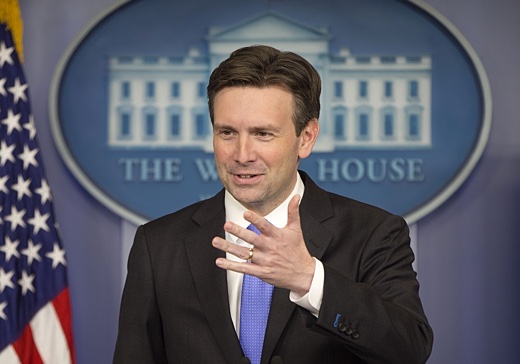
Image above: White House spokesman Josh Earnest confirmed this plan change to reporters on Thursday 6th October 2016. From (http://theduran.com/us-backs-down-over-syria-following-russian-threat-shoot-down-american-aircraft/).

Just days after Russia moved an additional advanced anti-aircraft battery to Syria, Moscow hinted toward a possible shoot-down of U.S. or coalition planes that threaten or attack Syrian government troops, which are backed by Moscow.

The U.S. and Russia have a memorandum of understanding designed to avert any confrontation between their warplanes in the skies over Syria, but Moscow says that doesn't apply to its ground-based missile crews.

"Any missile or airstrikes on the territory controlled by the Syrian government will create a clear threat to Russian servicemen," Russian Defense Ministry spokesman Gen. Igor Konashenkov said Thursday, according to Kremlin-backed Russia Today."

"Russian air defense system crews are unlikely to have time to determine in a 'straight line' the exact flight paths of missiles and then who the warheads belong to."

At the Pentagon, a reporter asked spokesman Peter Cook whether the statement represented a threat to U.S. aircraft.

"Well, again, I'll leave it to the Russians to describe what the purpose of that system, those systems are for. And I will highlight once again that their stated intent in going into Syria was to target groups like al Nusra and ISIL, and those groups do not operate aircraft," he said.

"And so we would continue to have concerns about what purpose they're serving in those locations.

And more importantly, we'll continue to conduct our operations as we have for months now over Syria, and we'll continue to do so taking every possible step we need to to ensure the safety of our air crews, coalition air crews in Syria."

He also said that despite differences with the Russians over Syria, the MOU with Moscow has been successful in reducing the risk to U.S. pilots.

"It has been an effective means of communication to avoid misunderstanding and miscalculation," Cook said. "We will continue to employ that line of communication in an appropriate fashion, and would encourage the Russians to do the same."

Konashenkov seemed also to be boasting that U.S. stealth technology would offer little protection against Russia's advanced S-300 and S-400 missile systems, both of which it has deployed in Syria.


Video above: White House spokesman Josh Earnest speaking to reporters on Thursday 6th October 2016. From (https://youtu.be/LIR4UP4rYkY).


.

Why Standing Rock is test for Obama

SUBHEAD: Climate math shows we need a managed decline of fossil fuels in the U.S. That means no DAPL.

By mark Trahant on 6 October 2016 for Yes Magazine -
(http://www.yesmagazine.org/planet/why-standing-rock-is-a-test-for-obama-and-all-climate-choices-ahead-20161006)


Image above: Energy policy adviser Brian Deese, who helped broker the Paris agreement, is congratulated by President Obama 10/5/16. White House photo by Pete Souza. From original article.

With the Paris Agreements taking effect in less than a month, climate math shows we need a managed decline of fossil fuels in the U.S. And that makes Standing Rock a test for Obama and all climate choices in the future.

Ten months ago, the United States told the world it was ready to do something about climate change. Enough talk. Time to act. And because of the nature of the crisis, the world’s governments are moving quickly (well, at least as measured by governments).

On Wednesday, President Barack Obama announced the global agreement from the Paris talks will begin implementation on November 4 after being ratified by European nations.

“Today, the world meets the moment. And if we follow through on the commitments that this agreement embodies, history may well judge it as a turning point for our planet,” the president said.

The Paris agreement formally begins four days before the U.S. presidential election, in which Republican Donald Trump opposes that agreement as well as its science while Democrat Hillary Clinton strongly supports it.

“Now, the Paris Agreement alone will not solve the climate crisis. Even if we meet every target embodied in the agreement, we’ll only get to part of where we need to go,” the President said. But make no mistake, this agreement will help delay or avoid some of the worst consequences of climate change.

It will help other nations ratchet down their dangerous carbon emissions over time and set bolder targets as technology advances, all under a strong system of transparency that allows each nation to evaluate the progress of all other nations.

And by sending a signal that this is going to be our future—a clean energy future—it opens up the floodgates for businesses and scientists and engineers to unleash high-tech, low-carbon investment and innovation at a scale that we’ve never seen before. So this gives us the best possible shot to save the one planet we’ve got.”

The test of those words is found at Standing Rock.

If the president, the government, the world really believe that the agreement will only get us part of where we need to go to avoid the worst consequences of climate change, then stopping the Dakota Access pipeline is essential.

A recent report by Oil Change International and a consortium of environmental organizations calls for a “managed decline of fossil fuel production.” The logic is simple math. The study measures potential carbon emissions from “where the wells are already drilled, the pits dug, and the pipelines, processing facilities, railways, and export terminals constructed.”

Add those numbers up, and “the potential carbon emissions from the oil, gas, and coal in the world’s currently operating fields and mines would take us beyond 2 degrees Celsius of warming.”

In other words: “Keep It in the Ground” is not just a slogan but the answer to the math question, “How does the world meet its target of limiting global warming to 2 degrees?” Remember— and this is important—2 degrees Celsius is supposed to be the upper limit. The Paris agreement calls for nations to work toward a limit of 1.5 degrees Celsius warming, a much more difficult goal.

“Scientists say that to have even a two-thirds chance of staying below a global increase of 2 degrees Celsius, we can release 800 gigatons more CO2 into the atmosphere,” writes Bill McKibben in The New Republic.

“But the Rystad data shows coal mines and oil and gas wells currently in operation worldwide contain 942 gigatons worth of CO2. So the math problem is simple, and it goes like this: 942 > 800.” That’s just to hit the 2 degree target. To reach the more difficult stretch goal?

McKibben says, “To have even a 50–50 chance of meeting that goal, we can only release about 353 gigatons more CO2. So let’s do the math again: 942 > 353.”

As challenging as that number is, it does not mean giving up fossil fuels immediately. (One of the first dismissals of what was occurring at Standing Rock was by industry supporters who said, “Oh, but they drive cars and trucks there …”)

The Oil Change International report states: “This does not mean stopping using all fossil fuels overnight. Governments and companies should conduct a managed decline of the fossil fuel industry and ensure a just transition for the workers and communities that depend on it.”

That’s really the key in North Dakota—and beyond. The transition begins by saying that Dakota Access pipeline represents our past and a mistake. And as part of a managed decline, major fossil fuel infrastructure projects like this pipeline—are no more.

But what about the jobs the pipeline construction would bring? What will this do to North Dakota? Actually, it could be a great thing.

Data from Stanford researchers shows that the transition to clean energy could happen faster than projected—and benefit any state almost immediately. The Solutions Project says that, in North Dakota, a transformation toward clean energy “pays for itself in as little as two years from air pollution and climate cost savings alone.”

Two years? Imagine all the intellectual activity, the construction, the jobs, the fresh investment that would come together to make that so. It would be mind-blowing. The Stanford data says such a transition would create 8,574 permanent operations jobs and 21,744 construction jobs.


On Wednesday, the White House listed out its accomplishments on climate change, a couple of pages: investments in clean energy, new pollution rules, car standards, and generally creative thinking. But there was no plan for a managed decline. There was no math behind the numbers.

This global challenge, the data of climate change, adds up to one thing: Standing Rock is a test.
The United States cannot meet its obligations to the world if it continues business as usual. It’s just not possible; the math of carbon emissions cannot be wished away.

The people who are camped at Standing Rock are giving President Obama the opportunity to show how a managed decline is possible. And, if done right, inspiring. As the president said, “This gives us the best possible shot to save the one planet we’ve got.”

• Mark Trahant originally wrote this article for Trahant Reports. It has been edited for YES! Magazine.
 
See also:

Ea O Ka Aina: Why we are Singing for Water 10/8/16
Ea O Ka Aina: Labor's Dakota Access Pipeline Crisis 10/3/16
Ea O Ka Aina: Standing Firm for Standing Rock 10/3/16
Ea O Ka Aina: Contact bankers behind DAPL 9/29/16
Ea O Ka Aina: NoDAPL demo at Enbridge Inc 9/29/16
Ea O Ka Aina: Militarized Police raid NoDAPL 9/28/16
Ea O Ka Aina: Stop funding of Dakota Access Pipeline 9/27/16
Ea O Ka Aina: UN experts to US, "Stop DAPL Now!" 9/27/16
Ea O Ka Aina: No DAPL solidarity grows 9/21/16
Ea O Ka Aina: This is how we should be living 9/16/16
Ea O Ka Aina: 'Natural Capital' replacing 'Nature' 9/14/16
Ea O Ka Aina: The Big Difference at Standing Rock 9/13/16
Ea O Ka Aina: Jill Stein joins Standing Rock Sioux 9/10/16
Ea O Ka Aina: Pipeline temporarily halted 9/6/16
Ea O Ka Aina: Native Americans attacked with dogs 9/5/16
Ea O Ka Aina: Mni Wiconi! Water is Life! 9/3/16
Ea O Ka Aina: Sioux can stop the Pipeline 8/28/16
Ea O Ka Aina: Officials cut water to Sioux 8/23/16   


.

Why We are Singing for Water

SUBHEAD: We at Standing Rock are singing in front of men with guns and surveillance helicopters.

By Linda Hogan on 4 October 2016 for YEs Magazine -
(http://www.yesmagazine.org/people-power/to-the-standing-rock-sioux-who-are-singing-for-water-20161004)


Image above: Women water protectors coming back from prayer at the Cannonball River. Photo by Rob Wilson. From original article.

We were water beings from the beginning. The river was our Grandmother and supplied everything we needed to survive. 

We are singing for water and for the protectors of Earth’s waters. We sing for water. Long-legged birds stand at the edges of lakes and rivers to watch for fish, their nests hidden in the rushes. A doe crosses land and stands guard as her little one drinks.

With the rain, snow, and groundwater in a place where living Earth supported large herds of bison for thousands of years.

As for us, we were water beings from the beginning. We rained from the broken waters of our mothers to enter this world. We drank from our mothers to thrive. Water is our life-blood, and like all creations on this blue planet, we were born to its currents and passages. So we sing for those who pray to protect the wide, long Missouri River on its elemental journey.

Near the Cannonball River, a place of chokecherries, Indiangrass, and other plants, thousands of people are camped. They know that by legal treaty rights the Missouri River and the land of this region belong to the Standing Rock Sioux. Water flows beneath the skin of this Earth body, and vast clear aquifers lie deeper in the near ground, with rivers and tributaries above.

The “Plains” may be the wrong word to use for places existing in the midst of all the ground water and watersheds that support life here: animals, birds, food and medicine plants, expanses of wildflowers in the spring and then the harsh, cold seasons of winter. The tall grasses live because of waters from snow and rain.

My own nation, the Chicaza, lived with the Mississippi River throughout much of our long history.

 We called that wide rush of water The Long Person. She was our Grandmother and supplied everything we needed to survive. With great sorrow, we were removed from our homeland in 1837.

We left in order to avoid future genocide. The U.S. government planned to place all of the tribes into Indian Territory and build a wall around it, opening the rest of the country to settlers. Large numbers of Native peoples were chased toward what is now Oklahoma, but many of the Plains nations managed to remain, avoid capture, and try to return to their beloved homelands.

While many Northern Plains nations escaped life in Oklahoma, continuing actions by the federal government resulted in a shrinking land base for the Dakota and Lakota, including the Dawes Act of 1889, which opened most land for settlers throughout the country.

The Fort Laramie Treaty is the only treaty that remains unbroken by the United States.

Now it is a corporation breaking the heart of the people, ignoring the treaty rights and the water guaranteed to the Sioux by that 1868 treaty. The state government of North Dakota also has not upheld the treaty and backs the corporation, Energy Transfer Partners/Sunoco.

Most Native peoples and others are hoping the Standing Rock Sioux Nation will hold steady to all their treaty rights to the Missouri River, that the land and water will remain healthy and intact, and that the Dakota Access pipeline will never pass beneath the river nor cross the land in any way.
Thousands of water protectors have arrived to show their solidarity. The chiefs and leaders of over 300 tribal nations have appeared to speak of their own concern for the water and land. Others have sent water, money, and supplies.

Along these waterways, many negotiations decreased the land base, but the river system has grown even more important as trail and trade, especially for survival and subsistence for people who refused to give up their land for any hundred million dollars offered by the United States.


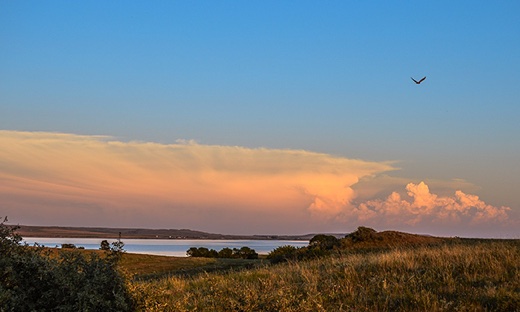
Image above: Storm clouds over Lake Oahe near Sacred Stone Camp. Photo by Rob Wilson. From original artilce.

Other states are also affected by work on the Bakken crude pipeline. Citizens in Iowa have had their homes condemned by the Texas company that began fracking the Bakken fields. Fracking makes the land more vulnerable and more likely to shift and move, affecting tectonic plates.

Water is removed and injected back into Earth with secret chemicals, their exact toxic ingredients protected by patents. This makes for a vulnerable Earth. The lawsuits in Iowa have at least slowed operations.

Bakken crude comes from one of the most dangerous work sites now in operation. Working men have been charred to death by explosions and fires, electrocuted. Native women near these “man camps” have been subject to abuse, rape, and sometimes have disappeared, often into the sex trafficking business, sometimes murdered.

Standing Rock, this part of the Plains, is the world of well-known leader and holy man Sitting Bull. It is land crossed during the time of the Fort Laramie Treaty, signed in what is now Wyoming. In my mind’s eye as I’ve studied the history, I see the many leaders of nations crossing this land to participate in negotiations with the American government.

Wearing beautifully made regalia, most traveled on horseback or with wagons, the chiefs and the women ambassadors of nations who thought the Fort Laramie Treaty would be a resolution to their problems. Even those who had earlier disputes came together with one another in kinship, camping together, sharing meals, and creating new relationships.

Now the chiefs of many tribal nations and other representatives have arrived again, this time to join in common protection for the water of this Earth and in solidarity with the Standing Rock and Lakota. This is still the land of the Standing Rock Sioux and other Lakota Nations, still held together by the words and memory of Sitting Bull, who loved and protected his people.

No company or state has the right to take a thin, dirty business through it, a pipeline certain to break, destroying the water and contaminating the future.

But the Dakota Access corporation sent its private, aggressive militia to declare its own war on the people. With that amount of harassment, the water protectors could certainly be in danger.

We already saw on the news that, after being told where the burial sites and sacred lands were, the bulldozers went to those areas and tore through the earth, the opposite of what was expected. What drives such hostility is hard to imagine.

The planes and helicopters have been flying over the vulnerable past and future of the land. What look like SWAT teams and men with assault rifles are set loose to aim the weapons of their anger or use attack dogs on the people who are only protecting the water, or were chopping wood or cooking for the others when the armed men arrived.

It stays with me. What drives this hatred is impossible for me to understand.

I think of the pilots and these men and I wonder, do they go home at times to happiness, to their own families?
Do they carefully tend gardens or gently touch their loved ones? Do they protect their children from bullies?

Do those with such fury on their faces think that the others are human beings like themselves?

Do they realize that flying over the lands of the First People causes fear?
Forever I will think of one picture, quickly removed from a website, showing a man point an assault rifle too near a crying girl, maybe 8 years old, her hair neatly French braided, her clothing impeccable.

I am a Chickasaw woman no longer on the waters of the Mississippi, but my daughters and grandchildren are Oglala Lakota. We know how many tribes in the South became extinct centuries even before the fur trappers and gold seekers journeyed to these Northern Plains.

We’ve all survived massacres and hunger from the loss of our food sources, from freezing winters, even before the time of Custer’s wars in this region.

Photographs from space reveal that Earth is a water planet. No living thing survives without water. It is for that reason space explorers search for planets that may contain this element; it is a sign of life.
Most First People have chants or songs about the sacred nature of water.

Water is even used for baptism in Christian religions. I hear that even the waters have their distinct songs as they journey toward the oceans.

We live on a single globe of water, all of it one entity. It is alive, this elemental force, this yearning sacred creation, longing to reach an ocean. This is our body, and perhaps we are a part of its soul. It is always moving away, traveling and then returning, in its glorious circle. And we know that when we sing for water, we sing for ourselves.

At this time, we need to pray and sing for water in other locations as well. To name only a few, the San Juan River and its Animas tributary is still too polluted for use by the Navajo after the great wall of pollution from the Gold King Mine spill. 

The Menomenee are fighting a mining site at their water’s source. California tribes have had water taken by bottling companies and their sacred springs have dried. The Amazon and other rivers in South America are under duress from mining, oil, deforestation, and mega-dam builders.

See also:
Ea O Ka Aina: Labor's Dakota Access Pipeline Crisis 10/3/16
Ea O Ka Aina: Standing Firm for Standing Rock 10/3/16
Ea O Ka Aina: Contact bankers behind DAPL 9/29/16
Ea O Ka Aina: NoDAPL demo at Enbridge Inc 9/29/16
Ea O Ka Aina: Militarized Police raid NoDAPL 9/28/16
Ea O Ka Aina: Stop funding of Dakota Access Pipeline 9/27/16
Ea O Ka Aina: UN experts to US, "Stop DAPL Now!" 9/27/16
Ea O Ka Aina: No DAPL solidarity grows 9/21/16
Ea O Ka Aina: This is how we should be living 9/16/16
Ea O Ka Aina: 'Natural Capital' replacing 'Nature' 9/14/16
Ea O Ka Aina: The Big Difference at Standing Rock 9/13/16
Ea O Ka Aina: Jill Stein joins Standing Rock Sioux 9/10/16
Ea O Ka Aina: Pipeline temporarily halted 9/6/16
Ea O Ka Aina: Native Americans attacked with dogs 9/5/16
Ea O Ka Aina: Mni Wiconi! Water is Life! 9/3/16
Ea O Ka Aina: Sioux can stop the Pipeline 8/28/16
Ea O Ka Aina: Officials cut water to Sioux 8/23/16  
.

End Amazon Crude!

SUBHEAD: The Amazon is Earth's most important carbon sink, most biodiverse rainforest, inhabited by indigenous people.

By Mike Goworecki on 30 September 2016 for Monga Bay -
(https://news.mongabay.com/2016/09/u-s-imports-of-amazon-crude-oil-driving-expansion-of-oil-operations/)


Image above: A pool of oil on May 1, 2009, in Lago Agrio, an Ecuadorean town in the Amazon where Texaco left contamination. Photo by Moises Saman. From (http://www.truth-out.org/news/item/37891-u-s-imports-of-amazon-crude-oil-driving-expansion-of-oil-operations).
  • Oakland, California-based non-profit Amazon Watch released the report this week to highlight the impacts of oil operations on Amazonian biodiversity and indigenous peoples, as well as on refinery communities in the U.S. and the global climate.
  • U.S. crude imports are in overall decline, the report notes. But imports from the Amazon are on the rise, so much so that the U.S. is now importing more crude oil from the Amazon than from any single foreign country.
  • “Existing and proposed oil and gas blocks in the Amazon cover 283,172 square miles, an area larger than the state of Texas,” per the report.
Crude oil imported to the U.S. from the Amazon, most of which gets refined in California, is driving expansion of oil operations into the rainforest, according to a new report.

Oakland, California-based non-profit Amazon Watch released the report this week to highlight the impacts of oil operations on Amazonian biodiversity and indigenous peoples, as well as on refinery communities in the U.S. and the global climate.

U.S. crude imports are in overall decline, the report notes. But imports from the Amazon are on the rise, so much so that the U.S. is now importing more crude oil from the Amazon than from any single foreign country.

California’s refineries process an average of 170,978 barrels (almost 7.2 million gallons) of those imports every day — representing 74 percent of all Amazon crude imports to the U.S. and roughly 60 percent of total exports from Colombia, Ecuador, and Peru.

“All commercial and public fleets in California — and many across the U.S. — that buy bulk diesel are using fuel that is at least partially derived from Amazon crude,” Adam Zuckerman, Amazon Watch’s End Amazon Crude Campaign Manager, said in a statement. “Therefore, virtually every company, city, and university in California and around the country contributes to the destruction of the Amazon rainforest.”

The opening of new oil drilling concessions represents one of the most severe threats to the western Amazon, the group says. “Existing and proposed oil and gas blocks in the Amazon cover 283,172 square miles, an area larger than the state of Texas,” per the report.

“Oil is presently being extracted from only 7% of these blocks, yet national governments aim to exploit an additional 40%, including those slated for pristine, mega-diverse forests such as Ecuador’s Yasuní National Park, a UNESCO Biosphere Reserve.”

In the report, Amazon Watch details the “triple carbon impact” of Amazonian oil extraction: carbon emissions are released when the rainforest is cut down to establish drill sites and the necessary roads and other infrastructure, which also means further destruction of the world’s largest carbon sink, and then even more emissions are created when the oil is ultimately burned for energy.

The Amazon plays a crucial role in regulating the global climate and hydrological patterns. The report notes that, therefore, deforestation in the Amazon can be said to contribute to the years-long drought in California, which is having a drastic impact on the state’s agricultural industry and causing massive wildfires.

http://www.islandbreath.org/2016Year/10/161008amazonbig.jpg
Image above: Infographic "End Amazon Crude!" by Amazon Watch. Click to enlarge. From original article.

Of course, the Amazon is also home to the world’s highest levels of biodiversity, with more than 430 mammal species, 1,300 bird species, 56,000 plant and tree species, 5,600 fish species, 1,000 amphibian species, and 2.5 million insect species.

Just one hectare of Yasuní National Park in the Ecuadorian Amazon contains 655 endemic tree species, more than all of the tree species in the United States and Canada combined. “Oil-driven deforestation gravely threatens this complex web of biodiversity, with recent studies linking major, exponential extinctions to forest loss,” the report states.

Esperanza Martínez, president of the Ecuadorian NGO Acción Ecologica, said in a statement that the crude oil that is imported into the U.S. from Ecuador “now carries with it a wave of disasters even greater than previous oil drilling history in the country, since drilling has begun in the Yasuní National Park. Yasuní is home to indigenous communities in voluntary isolation and forests full of immense biodiversity.”

Amazon Watch has also documented the impacts of oil operations on some of the hundreds of indigenous peoples whose traditional territories are in the Amazon. For instance, Peru’s Health Ministry reports that 98 percent of children in the indigenous communities of one oil-producing region of the Peruvian Amazon have high levels of toxic metals in their blood.

 In response, the country’s Environmental Ministry declared four river basins impacted by oil operations “environmental emergencies.”

“If you needed another reason why the time is now to stand up to the oil companies, this remarkable report provides it,” Bill McKibben, noted environmentalist, author, and founder of 350.org, said in a statement. “Ripping apart the Amazon rainforest and indigenous lives rubs salt in the deep climate wound our fossil fuel habit has created.”

McKibben authored an article back in 2012 for Rolling Stone entitled “Global Warming’s Terrifying New Math” in which he wrote that “We have five times as much oil and coal and gas on the books as climate scientists think is safe to burn” and argued that as much as 80 percent of the world’s fossil fuel reserves would need to be kept in the ground if we are to avert the worst impacts of runaway climate change.

Just last year, a study published in the journal Nature supported McKibben’s calculations. The authors of the study wrote: “Our results suggest that, globally, a third of oil reserves, half of gas reserves and over 80 per cent of current coal reserves should remain unused from 2010 to 2050 in order to meet the target of 2°C.”

Bill McKibben wasn’t the only notable climate activist to highlight the importance of Amazon Watch’s findings.

“Scientific research continues to tell us that we must keep dirty fuels in the ground and continue the transition to 100% clean energy if we want to preserve our communities, protect the health of our families, and tackle the climate crisis,” Sierra Club executive director Michael Brune said in a statement. “Putting an end to the destructive use of Amazon crude is a crucial first step in meeting that challenge.”

Amazonian peoples, many of whom consider oil to be the blood of Mother Earth, have long called on governments and corporations to keep it in the ground,” the Amazon Watch report states. “Now scientists are catching up with their calls, stating that we need to keep 80% of fossil fuels in the ground in order to have a good chance of averting catastrophic climate change.

As our planet’s most important carbon sink, the home to over 400 distinct indigenous peoples, and the world’s most biodiverse rainforest, it is urgent that we keep the oil in the ground in the Amazon.”

CITATION
  • McGlade, C., & Ekins, P. (2015). The geographical distribution of fossil fuels unused when limiting global warming to 2 [deg] C. Nature, 517(7533), 187-190. doi:10.1038/nature14016

Amazon Watch commissioned Pulitzer Prize-winning animator Mark Fiore to create a short animation to accompany the report, which you can watch here:


Video above: Mark Fiore animation "End Amazon Crude!".From (https://youtu.be/v8PKR8vR77Q).

.

Capitalism is a form of Cancer

SUBHEAD: A few thoughts on why treating Global Warming has proved so difficult to get a handle on.

By Juan Wilson on 7 October 2016 for Island Breath -
(http://islandbreath.blogspot.com/2016/10/capitalism-is-form-of-cancer.html)


Image above: Political cartoon by Justin Bilicki. From (https://www.pinterest.com/pin/134756213820806743/).

Sometimes as I'm going to bed I have half-formed thoughts that I play with for a while and promise myself I will remember in the morning for further possible development. The night before last I was thinking about how trapped we seem amidst perpetual growth on a finite planet and dealing with global warming, human population, resource depletion and uncontrolled industrialism, etc.

I know part of the problem is that our lifestyles and the shear numbers of human beings require too much of the Earth. But besides that we have a non-human component that has been raised to the rank of "person" but is not - namely corporations - and they are the embodiment of Capitalism and now have some human rights.

The question formulated in my mind was why this linked set of suicidal tendencies had become held together in such a self reinforcing and destructive partnership. Then something came to mind. A pair of connected relationships.

Cancer is to we Humans as Capitalism is to the Earth.

That is, each relationship is one of a self-regulating living entity with a lethal disease. An illness with the characteristic of requiring unlimited unending growth to survive. And that means using any and all of its hosts resources to continue - eventually killing the host... and itself.

Capitalism will be stopped. The question is; will we be the agents and save the Earth as we know it, or will Earth become uninhabitable for us?

The indicators are not good.

The capitalist corporations know they are destroying the Earth. For example, take Philip Morris Tobacco, they knew many decades ago that their cigarettes gave people lung cancer and killed them - but they continue to sell to their addicted customers. And just as Exxon knew decades ago that their fossil fuel products would destroy the Earth's atmosphere through CO2 emmisions -  they continued expanding their drilling operations to fracking, shale oil and offshore drilling.

Both corporations followed the capitalist's mantra of maximizing profits for the good of the shareholders - above all other responsibilities. That's the core religion of all corporations. They don't call it "a religion"... they call it "fiduciary responsibility". 

THEM OR US?
So it's gotten down a question of "Them or us?" It's late to begin saving Mother Nature.There is little time to shut down the ever expanding dirty resource extraction and pollution model the corporations are bound to. Their world view is black and white - Grow or Die! The main stream media is not going to help either.

Companies like the National Broadcasting Company (NBC) was once owned by Radio Corporation of America (RCA). The General Electric Company (GE), who builds nuclear power plants and and weapons systems owns NBC (and CNBC and MSNBC) now.

During the first "Presidential Debate" hosted by NBC's Lester Holt there was nothing significant asked of the candidates about fossil fuel CO2, shale oil pollution, global warming, sea rise for climate instability.

These crises are too damaging to the corporations to get headlines. that's because the only solution to  Capitalism is the halt of industrialization and the end to wholesale extraction of the Earth's resources.

KILL THE CANCER!
Unfortunately for Capitalism, Nature is not a subset Capitalist civilization. It is but a lethal, subset of Nature that needs to be surgically removed.

Let is stop the Dakota Access Pipe Line as a tiny first step and move on from there to shut down corporations "as people" and capitalism as the economic model. It's not re-starting "Growth" we should play for, it's "De-growth" - contraction - that's the ticket. If we can't stop "Growth" I suggest you pray for "Collapse"!

.