Showing posts with label Steady-State. Show all posts

Scientists outline paths to survival

SUBHEAD: World greenhouse gas emissions must peak by 2020 — just 15 months from now.

By Eric Holthaus on 4 October 2018 for Grist -
(https://grist.org/article/with-the-world-on-the-line-scientists-outline-the-paths-to-survival/)


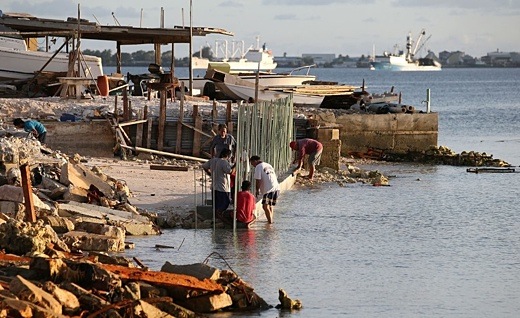
Image above: Efforts to rebuild concrete bulkhead on an eroding shore in the Marshall Islands. From original article.

This week, scientists and representatives from every country on Earth are gathering in South Korea to put the finishing touches on a report that, if followed, would change the course of history.

The report is a roadmap for possible ways to keep climate change to 1.5 degrees C above pre-industrial levels

Anything beyond that amount of warming, and the planet starts to really go haywire. So the Intergovernmental Panel on Climate Change — a U.N.-sponsored, Nobel Peace Prize-winning assemblage of scientists — wants to show how we can avoid that.

To be clear, hitting that goal would require a radical rethink in almost every aspect of society. But the report finds that not meeting the goal would upend life as we know it, too.

“This will be one of the most important meetings in the IPCC’s history,” said Hoesung Lee, the group’s chair, in his opening address on Monday.

The report will be released on October 8. From leaked drafts, we know the basics of scientists’ findings: World greenhouse gas emissions must peak by 2020 — just 15 months from now.

The scientists also show the difference in impacts between 1.5 and 2 degrees would not be minor — it could be make-or-break for the West Antarctic Ice Sheet, for example, which would flood every coastal city on Earth should it collapse.

“The decisions we make now about whether we let 1.5 or 2 degrees or more happen will change the world enormously,” said Heleen de Coninck, a Dutch climate scientist and one of the report’s lead authors, in an interview with the BBC. “The lives of people will never be the same again either way, but we can influence which future we end up with.”

The report has been in the works since the 2015 Paris climate agreement. Three years ago, during the climate talks, leaders of a few dozen small island nations and other highly vulnerable nations, like Ethiopia, Bangladesh, and Vietnam, demanded the bolder 1.5 degrees C temperature target be included in the first-ever global climate pact.

The group represents 1 billion people, and for some of the involved countries, like the Marshall Islands, their entire existence is at stake.

At the time, the lead negotiator from that tiny Pacific island nation used the word “genocide” to describe the inevitable process of forced abandonment of his country due to sea-level rise, should global temperature breach the 1.5 degree target.

Even taking into account the policies and pledges enacted globally since the Paris Agreement, the world is on course to warm between 2.6 to 3.2 degrees C by the end of the century, according to independent analysis by Climate Action Tracker.

According to a U.N. preview of the report, meeting the 1.5 goal would “require very fast changes in electricity production, transport, construction, agriculture and industry” worldwide, in a globally coordinated effort to bring about a zero-carbon economy as quickly as possible.

It would also very likely require eventually removing huge amounts of carbon dioxide from the atmosphere using technology that is not currently available at the scale that would be necessary. And there’s no time to waste: “The longer CO2 is emitted at today’s rate, the faster this decarbonization will need to be.”

The world has already warmed by about 1.1 degrees C, and the implications of that are increasingly obvious. In just the three years since the Paris Agreement was signed, we’ve seen thousand-year rainstorms by the dozens, the most destructive hurricane season in U.S. history, disastrous fires on almost every continent, and an unprecedented coral bleaching episode that affected 70 percent of the world’s reefs.

In this age of rapid warming, the IPCC report is inherently political — there are obvious winners and losers if the world fails to meet the 1.5-degree goal.

If the world’s governments are to take the implications of IPCC’s findings seriously, it would be nothing less than revolutionary — a radical restructuring of human society on our planet.

Right now, scientists are trying to find the precise words to describe an impending catastrophe and the utterly heroic efforts it would take to avert it.

“We’re talking about the kind of crisis that forces us to rethink everything we’ve known so far on how to build a secure future,” Greenpeace’s Kaisa Kosonen told AFP in response to a draft of the report. “We have to try to make the impossible possible.”

.

Kauai County "Keep Kauai Rural!"

SUBHEAD: The County of Kauai and its consultants have forsaken "Rural" Kauai in lieu of "Suburban" development

By Juan Wilson on 17 November 2016 for Island Breath - 
(http://islandbreath.blogspot.com/2016/11/kauai-county-keep-kauai-rural.html)

http://www.islandbreath.org/2016Year/11/161117limaolabig.jpg
Image above: Looks like mainland suburbs to me! Aerial rendering of Lima Ola development with Eleele Iluna housing Phase I & II to the left, Eleele to the upper left and A&B land to the right. Click to enlarge. From (http://limaolakauai.net/).

"If you build it they will come." Field of Dreams movie, 1989


COMMENT DEADLINE UPDATE

Comments on the update of the Kauai General Plan will be taken up to 16 December 2016. This is an extension of the previous date of 12/2/16.

HOW TO COMMENT
Comments to the draft can be emailed to plankauai@kauai.gov

or snail-mailed to:
Kauai County Planning Department,
Attention: Long Range Division
4444 Rice Street, Suite A473, Līhue, HI 96766.

See more at (http://plankauai.com/)


MY THOUGHTS IN A NUTSHELL
This issue of growth is our "Standing Rock". I recommend that the County instruct the Planning Department to abandon the current process of updating the Kauai General Plan 2000. It primarily dictates assigning Agriculture land as Urban in order to provide land for suburban development. The Kauai General Plan 2020-2035 should look to have that Agricultural land designated Rural land to meet the needs of self reliance in the future. It would also follow the will of the people: "KEEP KAUAI RURAL!"

Moreover, schemes like that of the Kauai Division of Housing to build Lima Ola as an automobile- centric bedroom community with no stores, shops or places of employment will only force people into their cars to buy a quart of milk or to make the money to pay for it.  There will be a great increase in traffic, both to the Big Save plaza to shop, and to Lihue for jobs.  As "Urban" land  it will also not allow people to live a rural, self reliant lifestyle.

BACK IN THE DAY
When I first came to Kauai in 1971 the population of the island was less than half of what it is today. I even don't remember where there were traffic light stops, but then all the cane fields were operating and there were plenty of orange cane haul truck crossing lights.

Back in the early 1970's there was little highway traffic. Tourists often did not need a rental car and spent time at destination resorts which provided entertainment and coordinated site seeing bus tours. Most people did not have to do a daily commute across the island for work. Many sugar cane and pineapple workers lived in housing adjacent to or embedded in the fields. 

And those cane truck roads were a highway for locals to many places you cannot get to today, like beaches and waterfalls, and hiking trails. Most Kauai people over sixty could reach a number of beaches, waterfalls, slippery slides, campsites and trails that are now off limits due to private residential development.

Now local people are pretty much confined to be in there home, at school, at work or in a county beach park. The tourists are pretty much regulated to commercial zip-lines, river tubing and ATV adventures.

It was the rural nature and charm of Kauai that made living here worthwhile and special. The natural beauty of the island makai (ocean side) and mauka (mountain side) allowed playing, fishing, farming, hunting. People didn't live on Kauai for its nightlife and unless you were to include camping.

The only major shopping plaza stood where the Kauai County offices are today. It had a supermarket and Liberty House department store and not much more. There was no Kukui Grove mall. The Coconut Marketplace was still in the planning stage.

As was demonstrated in the 1960s in places like Nassau County in New York and Orange County in California, there was big money to be made paving over potato farms and orange groves for ticky-tacky suburbia. Agriculture was subsumed into Car Culture. 

As the pressure to suburbanize Kauai was getting underway the county put together a plan with the purpose of steering "development" in a direction that the people on the island wanted.

The County of Kauai General Plan released in 2000 was done in 1998-99 was produced to guide the future of Kauai into the 21st century. It was developed with a good deal of local community interaction. The most important message the people of Kauai had for the County Government was "KEEP KAUAI RURAL". The Kauai General Plan was progressive and ambitious.

RURAL LIVING ON KAUAI
I live in Hanapepe and am most familiar with the south and west side of Kauai. West of Hanapepe most privately owned land is Robinson Family Property and east of Hanapepe is mostly Alexander & Baldwin properties. In the past both were mostly sugarcane plantations sprinkled with small residential communities known as camps.

Only a small relic of those communities persist in places like Kamakani and Pakala. They have been fairly self sustaining with vegetable gardens, chicken coops, dog kennels, and pigs styes, with access to fishing, hunting and horse riding. That is rural living.

There are also areas of rural living in valleys like Hanapepe, Makaweli and Waimea as well. But overall communities like Eleele, Hanapepe Heights, Waimea Town and Kekaha are suburban - not rural. In fact many rural activities mentioned above are now prohibited.

FAILURE OF COMMERCIAL AGRICULTURE
Unfortunately, within the time frame of that plan the sugar and pineapple plantations were faltering across the state. The big agland owners on Kauai like Grove Farms and Alexander & Baldwin realized that the land they controlled was no longer as profitable.

Over a decade ago I was privileged to see several of Alexander & Baldwin's annual corporate reports that were provided to corporate shareholders. It was clear reading them what the long range plan was. A&B holds over 3,000 acres along the south shore of Kauai stretching from Poipu to Hanapepe that is designated for Agriculture use. A&B has working to redesignate that property as Urban and that is the only way to convert that land into Suburbia.  

Selling out the land as either the most expensive real estates acreage, or densest housing development possible, was the most profitable liquidation plan for them. After taking the cue from Dole on Oahu they began suburbanization with zest. They began the high-end development of Kukuiula between Poipu and Laui Valley. One thing got in the way - the Great Recession of 2007-2008 when the housing bubble burst.
 
But how to recover and accomplish the goal now with the current restrictions land usage in Hawaii? Convert Agriculture land into Urban land and fill it with small parcels on cul-de-sacs.

PERMITTED LAND USE ON KAUAI
As of now the Hawaii State Land Use Commission (LUC) designates only four approved State Land Uses (SLU) on Kauai (followed by percent of island land areas) - Conservation (48.8% or 194,720 acres), Agricultural (47.4% 190,391 acres), Urban (3.5% 14,865 acres) and Rural (.3% 1,374acres).
CONSERVATION SLU DISTRICT
Conservation lands are comprised primarily of lands in existing forest and water reserve zones and include areas necessary for protecting watersheds and water sources, scenic and historic areas, parks, wilderness, open space, recreational areas, habitats of endemic plants, fish and wildlife, and all submerged lands seaward of the shoreline. The conservation District also includes lands subject to flooding and soil erosion.
Conservation Districts are administrated by the State Board of Land and Natural Resources and uses are governed by rules promulgated by the State Department of Land and Natural Resources.

AGRICULTURAL SLU DISTRICT
The Agricultural District includes lands for the cultivation of crops, aquaculture, raising livestock, wind energy facility, timber cultivation, agriculture-support activities (i.e., mills, employee quarters, etc.) and land with significant potential for agriculture uses. Golf courses and golf-related activities approved by a county before July 1, 2005, may be allowed in this district, otherwise such new facilities would be prohibited.

Uses permitted in the highest productivity agricultural categories are governed by statute. Uses in the lower-productivity categories – C, D, E or U – are established by the Commission and include those allowed on A&B lands as well as those stated under Section 205-4.5, Hawaii Revised Statutes.

URBAN SLU DISTRICT
The Urban District generally includes lands characterized by “city-like” concentrations of people, structures and services. This District also includes vacant areas for future development.
Jurisdiction of this district lies primarily with the respective counties. Generally, lot sizes and uses permitted in the district area are established by the respective county through ordinances or rules.
RURAL SLU DISTRICT
Rural Districts are composed primarily of small farms intermixed with low-density residential lots with a minimum size of one-half acre. Jurisdiction over Rural Districts is shared by the Commission and county governments.

Permitted uses include those relating or compatible to agricultural use and low-density residential lots. Variances can by obtained through the special use permitting process.
Conservation SLU is sacrosanct and won't be easily converted to suburban development. Suburban development can go on Urban SLU but there is not much left undeveloped. Because only a small percentage of land on Kauai is designated  Rural SLU,  not much development could go there.

Moreover, the Rural SLU designation requires at least half acre parcels and allows activities unacceptable to suburbanites like chicken coops, hunting dog kennels, goat or sheep pens, or manure piles. 

But Agricultural SLU covers almost half the island of Kauai. And its the large land owners like Grove Farms and A&B that own much of that land. 

As an architect-planner my experience with the Kauai Planning Department is that they are working to transform Kauai into what is in effect an outlying suburb of Oahu -  Think another Mililani (pop. 48,000) and Kaneohe (pop. 34,000) here on Kauai. What could possibly be less sustainable on the most isolated landmass in the world?

http://www.islandbreath.org/2016Year/09/160904hanapepebig.jpg
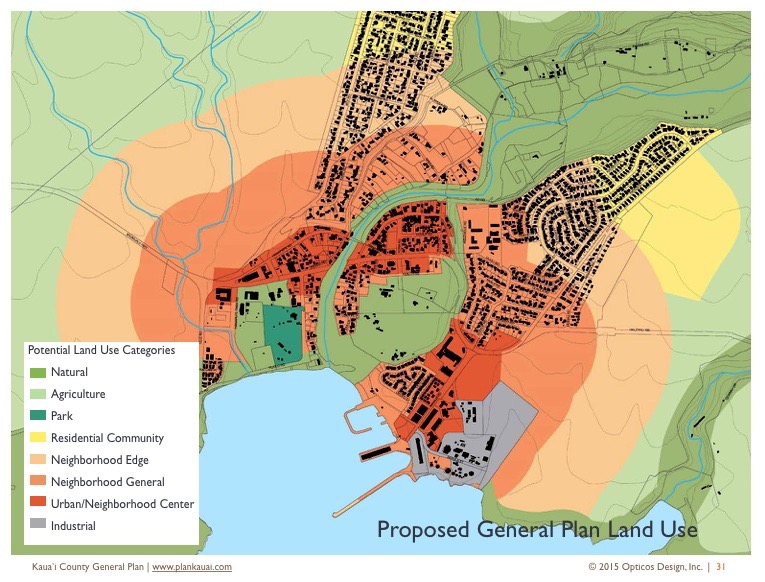
Image above: Page 37 from Kauai Plan Closing Workshop on Hanapepe-Eleele showing the expansion of the Urban Neighborhood center, Neighborhood General, Neighborhood Edge and Residential Community "doubling" in area. Note the proposed Lina Ola project is the yellow area in the upper right down through the light orange down to Route 540 about 2/3 down this image. From (http://plankauai.com/wp-content/uploads/2015_1104_HanapepeEleeleClosing-1.pdf).

THE UPDATED GENERAL PLAN 2020-2035
As you probably know if you live on Kauai, the big land owners and County government are hell bent to resume the hyper development that was on track a decade ago and went bust in the financial crackup in 2007-08.

The Kauai County Planning Department is working with Opticos Design Inc, a mainland California design firm, to conduct community meetings and produce a newly updated Kauai General Plan for 2020-2035 to guide us into the future.

From what I can see there is nothing more to this plan to date than spreading more suburbia across the island.

The Introduction to the proposed General Plan update begins with the subtitle:

"Kauai is at a Crossroads"
... The island is at a crossroads on an array of issues, and many attribute this overwhelming sense of vulnerability and insecurity to a common source: growth.

Let's agree about that but the next subhead reads:

"Growth is Happening Whether We Like It or Not"
... The desire for and need to manage growth is the primary driver behind long range planning.
I take exception to every word of that. We live on a finite isolated island on a finite and isolated planet. We can stop growth with a steady state population on a local and planetary level or go extinct soon.

What the plan proposes in new development is not Rural and not Urban but actually suburban and it will go on land that is currently capable of supporting food, fiber and timber production. Converting it to suburbia will only increase our dependency of failing mainland agriculture.

HABITAT, LIMA OLA & SPRAWL
Last night I attended a meeting of the Hanapepe-Eleele Community Association. Jerry Mackler, Kauai Planner presented the Kauai County Housing Division plan for Lima Ola. The Housing Division has bought 75 acres of land adjacent to the the recent Habitat for Humanity self-built housing project on the south side of Kaumaalii Highway in Eleele from A&B.  They plan to spend over $50 million to develop it.

That land that is now growing coffee. The Housing Division intends to build single and multifamily residential buildings there once they get approval to change the SLU from Agricultural to Urban.

When I mentioned that the planned housing was not within a walkable distance for most residents of Lima Ola to the nearest commercial area at Eleele Shopping Plaza and that people were likely to drive there and back to home for a pint of milk or a candy bar, Mr. Mackler agreed.

When I mentioned that Lima Ola could have included a few small corner retail stores or shops to substantially cut back on need to drive to nearby Eleele, Mr. Mackler  said that was not possible because Alexander & Baldwin would not permit that as a condition of the sale of the Lima Ola land.

When I asked Mr. Mackler if that because Alexander & Baldwin has plans to build commercial mall on adjacent Agriculture fields converted to Urban use he agreed that was the reason. 

Mr. Mackler spoke highly of Habitat for Humanity and their self-built affordable home sites in Eleele and  Eleele Ilima, a new affordable housing project  now currently under construction by Habitat but being expedited by contractors, adjacent just to the northeast of the Lima Ola site. He mentioned that the Lima Ola planning coordinated with the Habitat site for continuity of easements and other features.


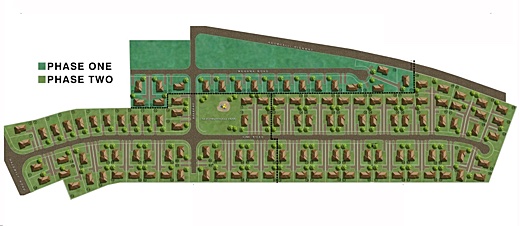
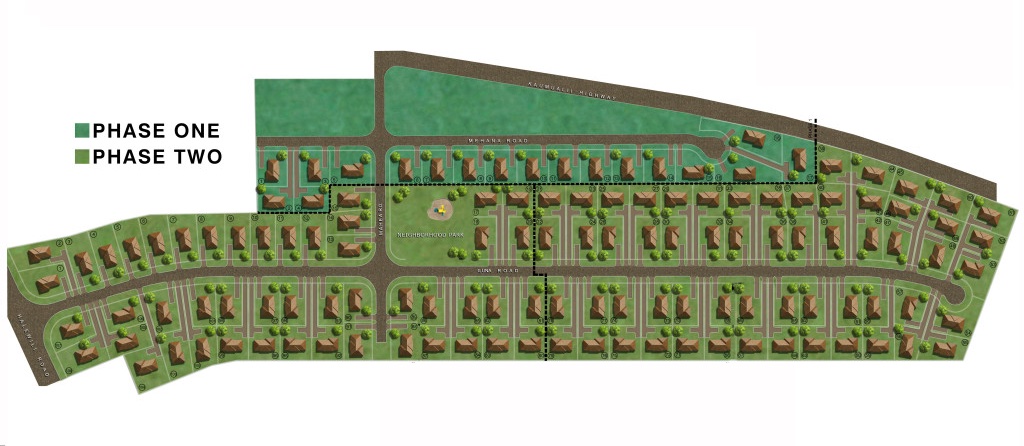
Image above: On top are the 18 units of sweat equity Habitat for Humanity housing in Phase One of Eleele Iluna. Below are the additional single family homes built by contractors in Phase Two. Click to enlarge. From (http://kauaihabitat.org/about-us/our-builds/eleele-iluna/).

You can see the pattern. Start small and get bigger.
  • Begin on the west end of the A&B agricultural land near the industrial section of Port Allen. Habitat for Humanities has future owners put in sweat equity to build 18 homes has a first phase Eleele Iluna, a new affordable housing near Eleele existing low cost housing south of the Kaumalii Highway.
  • Next have contractors frame out and roof Phase II of the Eleele Iluna project next door with 48 units and a end goal of of 107 single family homes.
  • Next have Lima Ola through the County of Kauai, raise $50 million dollars to build 550 units of multi-family and single-family dwellings next to Eleele Iluna Phase II.
  • Next have A&B roll out a few thousands of acres of sprawl with a mall. 
THE LONG EMERGENCY
Oh yeah. That! James Kunstler wrote the book in 2005. In it he perceived collapse in a way few had. That collapse began in 2007-08 under the leadership of George W. Bush. It played out a the pop of a huge housing bubble.

Since then it has taken many trillions of dollars to paper over that hole. Many of the people whose thoughts I respect most are feeling the next shoe drop. Nothing really got fixed. The USA printed money and charged nothing to banks to dip their beaks. The USA gave people no interest on their savings. The USA pretended their was no unemployment.

Now that Donald Trump is taking over his experience with bankruptcy should prove useful as we enter the next peak on this roller coaster.

Living in communities that provide their own useful work, food, energy, recreation and entertainment will be a requirement after the barges and jets stop delivery for Amazon and Ebay. Lima Ola and the A & B sprawl would be better off rural - just like the people of Kauai envisioned.  "KEEP KAUAI RURAL!"  

See also:
Kauai County General Plan 2000-2020 x
Ea O Ka Aina: Kauai General Plan Update 9/3/16
Ea O Ka Aina: Kauai Plan Disappoints 12/9/15
Ea O Ka Aina: Tax Donkey Purgatory - Lima Ola 7/18/14
Ea O Ka Aina: Lihue Loss of Vision 9/5/14
Ea O Ka Aina: Kilauea Development on Agland 4/9/11
Ea O Ka Aina: If a tyrant developed Kauai 3/24/11
Ea O Ka Aina: Potash King's Palace 6/24/10
Ea O Ka Aina: Kauai Farm Worker Housing 7/14/09
Ea O Ka Aina: Let Moloaa farmers farm 4/2/09
Ea O Ka Aina: Kauai General Plan 4/2/09
Ea O Ka Aina: Peak Oil Planning 1/29/09
Island Breath: Kauai Sustainable Land Use Plan 11/1/07
Island Breath: LEGS Sustainability Conference 10/13/07

How about a "Grown" economy?

SUBHEAD: People complain about the overuse of "Degrowth" and are looking for something more positive.

By Juan Wilson on 11 October 2016 for Island Breath-
(http://islandbreath.blogspot.com/2016/10/how-about-grown-economy.html)


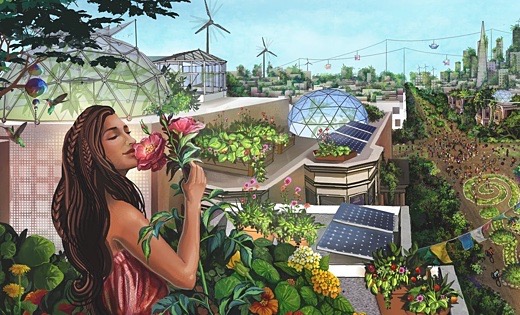
Image above: Illustration inspired by the "The Fifth Sacred Thing" by DreamNectar. From (http://dreamnectar.deviantart.com/art/The-Fifth-Sacred-Thing-331086738).

We at IslandBreath have been using the term "Degrowth" for years to describe what our planning goals ought to be going forward. It is a word that if implemented as a policy could help us match the resource capability of the Earth to a sustainable number of people on the planet.

Some still think "Degrowth" it is a useful term and others think it is tired and overused and needs new management. See the arguments by Kate Raworth and Giorgio Kallis "Has 'Degrowth' or 'De-Growth' outgrown its own name?".

Kate Rarworth makes a case against Degrowth arguing that it does not describe a solution. She thinks it has overall a negative connotation and counters,
"We have an economy that needs to grow, whether or not it makes us thrive.
We need an economy that makes us thrive, whether or not it grows."
and adds:
I’m guessing that some of my degrowth friends will respond to this blog with irritation, frustration or a sigh. Here we go again – we’ve got to explain the basics once more.
If so, take note. Because when you find yourself continually having to explain the basics and clear up repeated misunderstandings, it means there is something wrong with the way the ideas are being presented.
Believe me, the answer is in the name. It’s time for a new frame.
Giorgio Kallis makes the point that "Degrowth" is accurate and concise:
‘Degrowth’ is as clear as it gets. Definitely no less clear than ‘equality’; or ‘economic growth’ for that matter... Beyond a critique of the absurdity of perpetual growth, degrowth signifies a decrease of global carbon and material footprint, starting from the wealthy...The ‘green growth camp’ also wants such a decrease, but it argues that GDP growth is necessary for – or compatible with – it. Degrowth does not and expects GDP will decrease.
Others are even looking for new alternatives.

Miklos Antal recently wrote "D.E.growth: A Small Change in the Slogan with Large Benefits". His case is to revamp the word for new psychological effects. His suggestion is: "D.E.growth"
Building on the popularity of the growth frame, the term "D.E.growth" can be intriguing. This is crucial to raise attention, and from this aspect, it might be better for a radical movement than slogans like “sustainable prosperity” or “good life”. Invoking growth in an innovative and somewhat puzzling way can help to focus attention on the issue of economic growth and to trigger discussions about its future, which is an important goal of the alternative economics movement.
Unlike in the case of "Degrowth", however, first subconscious reactions to the slogan might be positive. As the two capital letters in the beginning are separated, the first clearly understandable part is “growth”, and growth is up, and up is good. All subsequent information processing will then be influenced by the first positive subconscious evaluation.
Well, "D.E.growth" makes a contemporary styled stab at a "refresh" of the word, but it seems overwrought and overthought to me.


Growth is foremost an organic process. The life of individual plants and animals begins with a single cell. It divides to multiply, specialize and grow into an individual living entity. It is easier for us to see the mature "grown" animal form. It happens sometime after adolescence and reproductive age.

Animals, like cats grow to a size appropriate for the environmental "niche" that they are embedded in. A domesticated cat, at 12 pounds, lives in a place where appropriate prey are fairly limited in size (rodents and birds), whereas a black panther, at 120 pounds, will target antelope, deer, warthogs and wild boar.

For a plant "grown" can be more difficult idea to understand. But individual plants, like whole forests have a climax of growth. For and individual tree it might take centuries to be "grown".For example a "grown" sequoia tree might reach a height of 400 feet in as many years... but no higher than it can draw water from the soil to nurture its leaves.

Plants are self regulated in size but by different dynamics than animals.

So are economies. Ours is at the end stage of "Growth". "Degrowth" will come on its own as certain aspects of our economy fade away or crash and burn. What is important to realize is that ours is no longer a "Growth" economy but a "Grown" economy. That is a fundamental requirement of sustainability and even survivability.


It's time we humans matured enough to realize that civilization is done and grown, so if our chores are done, its time to smell the roses.
.

Vermont adopts Steady State idea

SUBHEAD: Vermonters have proven the phrase “steady state economy” is not the bogeyman it was thought to be.

By Brian Czech on 15 May 2016 for SteadyState.org  -
(http://steadystate.org/no-mere-resolution/)


Image above: Frame of GIF file below illustrating a map of America with each county sized on the basis of Gross Domestic Production.

Here’s a day to remember: May 6, 2016.

That’s the day when, late in the afternoon, the Legislature of the State of Vermont passed H.C.R. 412, “House Concurrent Resolution Honoring the Center for the Advancement of the Steady State Economy for Its Important Work.” In a nation where acts of steady statesmanship – political support for a steady state economy – have only just begun, the Vermont Legislature has offered a perfect and prescient precedent.

Some may scoff at the idea that any resolution could be momentous. It’s true that, typically, a resolution isn’t as distinguished as a statute, an executive order, or a Supreme Court decision. H.C.R. 412 was one of 47 resolutions passed on that adjourning day of the 2015/2016 Vermont Legislature. True, too, that the legislature didn’t resolve to reform any economic policy with H.C.R. 412.

Now that we’ve looked the donut squarely in the hole, let’s consider what the Vermont Legislature did accomplish:
  1. The steady state economy – the only sustainable alternative to unsustainable growth or recession – was brought out of its academic niche into mainstream political dialog. We’re not talking about the ramblings of a quirky county commissioner or misfiring mayor. A state legislature represents the second-highest lawmaking level in the land. In Vermont, a famously beautiful and progressive land that has also offered us a viable presidential candidate, there was virtually unanimous support in the legislature for recognizing limits to economic growth, the problems caused by growth, and the solutions inherent to a steady state economy.

  2. Vermonters have proven the phrase “steady state economy” is not the bogeyman it was thought to be by the architects and activists of the “new economy” movement. If a state legislature can stomach, reprint, and even honor the phrase, it’s time to stop the hand-wringing in futile attempts to come up with a warmer and fuzzier phrase that would connote an economy of stabilized size. “Steady state economy” is perfectly clear with no connotations necessary. Let’s just tell it like it is, and thank you Vermont.

  3. H.C.R. 412 is loaded with implications for future adjustments to tax codes, budgets, program goals and incentives of all kinds. Meanwhile, it provides leadership that is immediately relevant to consumers. Consumers are citizens who constitute the demand side of the economy. Any citizen mulling the construction of a new home, the purchase of a new vehicle, or the development of a new wardrobe has a decision to make. To illustrate by extreme: Hummer or hybrid? Conscientious, widespread tempering of demand toward sustainable levels starts with leadership, such as provided in H.C.R. 412.
Suddenly, doesn’t the donut look bigger than the hole?

H.C.R. 412 was introduced by Representative Curt McCormack of Burlington. The Burlington connection makes a lot of sense, given the long-running leadership in steady state economics coming out of the University of Vermont and its Gund Institute for Ecological Economics. In fact, McCormack is on the UVM Board of Trustees.

It’s refreshing that, in the political days of short-term memory and “small hands” rhetoric, some politicians are doing their homework on the big picture and the long term. The perpetual push for increasing GDP is a growing threat to the environment, the economy, national security, and international stability, but the threat is clear only for those who stop to think about it.

Led by McCormack, May 6 was the day a state legislature stopped to think about it. It’s a day worth remembering.


Image above: From (http://metrocosm.com/map-us-economy/).

.

Retrotopia - A distant scent of blood

SUBHEAD: Gemotek insisted their corn couldn't be the source of the illnesses, and the government backed them.

By John Michael Greer on 18 May 2016 for the Archdruid Report -
(http://thearchdruidreport.blogspot.com/2016/05/retrotopia-distant-scent-of-blood.html)
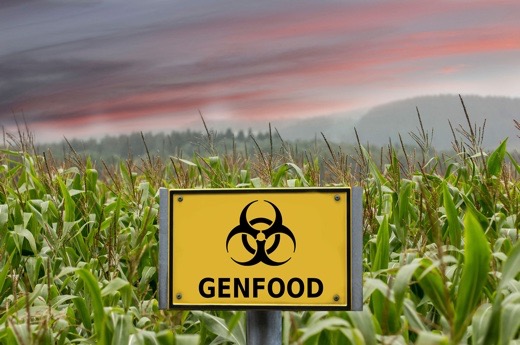

Image above: Genetically modified corn field. From (http://www.genetwork.info/biggest-gmo-myths-busted/).

[Author's note: This is the sixteenth installment of an exploration of some of the possible futures discussed on this blog, using the toolkit of narrative fiction. Our narrator, having recovered from a bout of the flu, goes for a walk, meets someone he’s encountered before, and begins to understand why the Lakeland Republic took the path it did.]

The next morning I felt pretty good, all things considered, and got up not too much later than usual. It was bright and clear, as nice an autumn day as you could ask for. I knew I had two days to make up and a lot of discussions and negotiations with the Lakeland Republic government still waited, but I’d been stuck in my room for two days and wanted to stretch my legs a bit before I headed back into another conference room at the Capitol.

I compromised by calling Melanie Berger and arranging to meet with her and some other people from Meeker’s staff after lunch. That done, once I’d finished my morning routine, I headed down the stairs and out onto the street.

I didn’t have any particular destination in mind, just fresh air and a bit of exercise, and two or three random turns brought me within sight of the Capitol.

That sent half a dozen trains of thought scurrying off in a bunch of directions, and one of them reminded me that I hadn’t seen a scrap of news for better than two days. Another couple of blocks and I got to Kaufer’s News, where the same scruffy-looking woman was sitting on the same wooden stool, surrounded by the same snowstorm of newspapers and magazines.

I bought that day’s Toledo Blade, and since it was still way too early to put anything into my stomach, I crossed the street, found a park bench in front of the Capitol that had sunlight all over it, sat down and started reading.

There was plenty of news. The president of Texas had just denounced the Confederacy for drilling for natural gas too close to the Texas border, and the Confederate government had issued the kind of curt response that might mean nothing and might mean trouble.

The latest word from the Antarctic melting season was worse than before; Wilkes Land had chucked up a huge jokulhlaup—yeah, I had to look the word up the first time I saw it, too; it means a flood of meltwater from underneath a glacier—that tore loose maybe two thousand square miles of ice and had half the southern Indian Ocean full of bergs.

There was another report out on the lithium crisis, from another bunch of experts who pointed out yet again that the world was going to run out of lithium for batteries in another half dozen years and all the alternatives were much more expensive; I knew better than to think that the report would get any more action than the last half dozen had.

Back home, meanwhile, the leaders of the Dem-Reps had a laundry list of demands for the new administration, most of which involved Montrose ditching her platform and adopting theirs instead. There’d been no response from the Montrose transition team, which was probably just as well. I knew what Ellen would say to that and it wasn’t fit to print.

Still, the thing I read first was an article on the satellite situation. There was a squib on the front page about that, and a big article with illustrations on pages four and five. It was as bad as I’d feared. The weather satellite that got hit on Friday had thrown big chunks of itself all over, and two more satellites had already been hit.

The chain reaction was under way, and in a year or so putting a satellite into the midrange orbits would be a waste of money—a few days, a week at most, and some chunk of scrap metal will come whipping out of nowhere at twenty thousand miles an hour and turn your umpty-billion-yuan investment into a cloud of debris ready to share the love with anything else in orbit.

That reality was already hitting stock markets around the world—telecoms were plunging, and so was every other economic sector that depended too much on satellites.

Most of the Chinese manufacturing sector was freaking out, too, because a lot of their exports go by way of the Indian Ocean, and satellite data’s the only thing that keeps container ships out of the way of icebergs. Economists were trying to rough out the probable hit to global GDP, and though estimates were all over the map, none of them was pretty. The short version was that everybody was running around screaming.

Everybody outside the Lakeland Republic, that is. The satellite crisis was an academic concern there.

I mean that literally; the paper quoted a professor of astronomy from Toledo University, a Dr. Marjorie Vanich, about the work she and her grad students were doing on the mathematics of orbital collisions, and that was the only consequence the whole mess was having inside the Lakeland borders. I shook my head.

Progress was going to win out eventually, I told myself, but the Republic’s retro policies certainly seemed to deflect a good many hassles in the short term.

I finished the first section, set down the paper.

Sitting there in the sunlight of a clear autumn day, with a horsedrawn cab going clip-clop on the street in front of me, schoolchildren piling out of a streetcar and heading toward the Capitol for a field trip, pedestrians ducking into Kaufer’s News or the little hole-in-the-wall café half a block from it, and the green-and-blue Lakeland Republic flag flapping leisurely above the whole scene, all the crises and commotions in the newspaper I’d just read might as well have been on the far side of the Moon.

For the first time I found myself wishing that the Lakeland Republic could find some way to survive over the long term after all. The thought that there could be someplace on the planet where all those crises just didn’t matter much was really rather comforting.

I got up, stuck the paper into one of the big patch pockets of my trench coat, and started walking, going nowhere in particular. A clock on the corner of a nearby building told me I still had better than an hour to kill before lunch. I looked around, and decided to walk all the way around the Capitol, checking out the big green park that surrounded it and the businesses and government offices nearby.

I thought of the Legislative Building back home in Philadelphia, with its walls of glass and metal and its perpetually leaky roof; I thought of the Presidential Mansion twelve blocks away, another ultramodern eyesore, where one set of movers hauling Bill Barfield’s stuff out would be crossing paths just then with another set of movers hauling Ellen Montrose’s stuff in.

I thought of the huge bleak office blocks sprawling west and south from there, where people I knew were busy trying to figure out how to cope with a rising tide of challenges that didn’t look as though it was ever going to ebb.

I got to one end of the park, turned the corner. A little in from the far corner was what looked like a monument of some sort, a big slab of dark red stone up on end, with something written on it. Shrubs formed a rough ring around it, and a couple of trees looked on from nearby. I wondered what it was commemorating, started walking that way.

When I got closer, I noticed that there was a ring of park benches inside the circle of shrubs, and one person sitting on one of the benches; it wasn’t until I was weaving through the gap between two shrubs that I realized it was the same Senator Mary Chenkin

I’d met at the Atheist Assembly the previous Sunday. By the time I’d noticed that, she’d spotted me and got to her feet, and so I went over and did and said the polite thing, and we got to talking.

The writing on the monument didn’t enlighten me much. It had a date on it—29 APRIL 2024—and nothing else. I’d just about decided to ask Chenkin about it when she said, “I bet they didn’t brief you about this little memento of ours—and they probably should have, if you’re going to make any kind of sense of what we’ve done here in the Lakeland Republic. Do you have a few minutes?”

“Most of an hour,” I said. “If you’ve got the time—”

“I should be at a committee meeting later on, but there should be plenty of time.” She waved me to the bench and then perched on the front of it, facing me.

“You probably know about DM-386 corn, Mr. Carr,” she said. “The stuff that had genes from poisonous starfish spliced into it.”

“Yeah.” Ugly memories stirred. “I would have had a kid brother if it wasn’t for that.”

“You and a lot of others.” She shook her head. “Gemotek, the corporation that made it, used to have its regional headquarters right here.”

She gestured across the park toward the Capitol. “A big silver glass and steel skyscraper complex, with a plaza facing this way. It got torn down right after the war, the steel went to make rails for the Toledo streetcar system, and the site—well, you’ll understand a little further on why we chose to put our Capitol there.

“But it was 2020, as I recall, when Gemotek scientists held a press conference right here to announce that DM-386 was going to save the world from hunger.” Another shake of her head dismissed the words. “Did they plant much of it up where your family lived?”

“Not to speak of. We were in what used to be upstate New York, and corn wasn’t a big crop.”

“Well, there you are. Here, we’re the buckle on the corn belt: the old states of Ohio, Indiana, Illinois, and across into Iowa and Nebraska. Gemotek marketed DM-386 heavily via exclusive contracts with local seed stores, and it was literally everywhere. They insisted it was safe, the government insisted it was safe, the experts said the same thing—but nobody bothered to test it on pregnant women.”

“I remember,” I said.

“And down here, it wasn’t just in the food supply. The pollen had the toxin in it, and that was in the air every spring. After the first year’s crop, what’s more, it got into the water table in a lot of places. So there were some counties where the live birth rate dropped by half over a two year period.”

She leaned toward me. “And here’s the thing. Gemotek kept insisting that it couldn’t possibly be their corn, and the government backed them.

They brought in one highly paid expert after another to tell us that some new virus or other was causing the epidemic of stillbirths. It all sounded plausible, until you found out that the only countries in the world that had this supposed virus were countries that allowed DM-386 corn to cross their borders.

The media wouldn’t mention that, and if you said something about it on the old internet, or any other public venue, Gemotek would slap you with a libel suit. They’d win, too—they had all the expert opinion on their side that money could buy. All the farmers and the other people of the corn belt had on their side was unbiased epidemiology and too many dead infants.

“So by the fall and winter of 2023, the entire Midwest was a powderkeg. A lot of farmers stopped planting DM-386, even though Gemotek had a clause in the sales agreement that let them sue you for breach of contract if you did that.

Seed stores that stocked it got burnt to the ground, and Gemotek sales staff who went out into farm country didn’t always come back.

There were federal troops here by then—not just Homeland Security, also regular Army with tanks and helicopters they’d brought up from the South after the trouble in Knoxville and Chattanooga the year before—and you had armed bands of young people and military vets springing up all over the countryside. It was pretty bad.

“By April, it was pretty clear that next to nobody in the region was planting Gemotek seeds—not just DM-386, anything from that company. Farmers were letting their farms go fallow if they couldn’t get seed they thought was safe.

That’s when Michael Yates, who was the CEO of Gemotek, said he was going to come to Toledo and talk some sense into the idiots who thought there was something wrong with his product. By all accounts, yes, that’s what he said.”

All of a sudden I remembered how the story ended, but didn’t say anything.

“So he came here—right where we’re sitting now. The company made a big fuss in the media, put up a platform out in front of the building, put half a dozen security guards around it, and thought that would do the job.

Yates was a celebrity CEO—” Unexpectedly, she laughed. “That phrase sounds so strange nowadays. Still, there were a lot of them before the Second Civil War: flashy, outspoken, hungry for publicity. He was like that. He flew in, and came out here, and started mouthing the same canned talking points Gemotek flacks had been rehashing since the first wave of stillbirths hit the media.

“I think he even believed them.” She shrugged. “He wasn’t an epidemiologist or even a geneticist, just a glorified salesman who thought his big paycheck made him smarter than anyone else, and he lived the sort of bicoastal lifestyle the rich favored in those days. If he’d ever set foot in the ‘flyover states’ before then, I never heard of it.

 But of course the crowd wasn’t having any of it. Something like nine thousand people showed up. They were shouting at him, and he was trying to make himself heard, and somebody lunged for the platform and a security guard panicked and opened fire, and the crowd mobbed the platform. It was all over in maybe five minutes.

As I recall, two of the guards survived. The other four were trampled and beaten to death, and nineteen people were shot—and Michael Yates was quite literally torn to shreds. There was hardly enough left of him to bury.

“So that’s what happened on April 29th, 2024. The crowd scattered as soon as it was all over, before Homeland Security troops could get here from their barracks; the feds declared a state of emergency and shut Toledo down, and then two days later the riots started down in Birmingham and the National Guard units sent to stop them joined the rioters.

Your historians probably say that that’s where and when the Second Civil War started, and they’re right—but this is where the seed that grew into the Lakeland Republic got planted.”

“Hell of a seed,” I said, for want of anything better.

“I won’t argue. But this—” Her gesture indicated the monument, and the shadow of a vanished building. “—this is a big part of why the whole Midwest went up like a rocket once the Birmingham riots turned serious, and why nothing the federal government did to get people to lay down their arms did a bit of good.

Every family I knew back in those days had either lost a child or knew someone who had—but it wasn’t just that. There had been plenty of other cases where the old government put the financial interests of big corporations ahead of the welfare of its people—hundreds of them, really—but this thing was that one straw too many.

“And then, when the fighting was over, the constitutional convention was meeting, and people from the World Bank and the IMF flew in to offer us big loans for reconstruction, care to guess what one of their very first conditions was?”

I didn’t have to answer; she saw on my face that I knew the story.

“Exactly, Mr. Carr. The provisional government had already passed a law banning genetically modified organisms until adequate safety tests could be done, and the World Bank demanded that we repeal it. To them it was just a trade barrier. Of course all of us in the provisional government knew perfectly well that if we agreed to that, we’d be facing Michael Yates’ fate in short order, so we called for a referendum.”

She shook her head, laughed reminiscently. “The World Bank people went ballistic. I had one of their economists with his face six inches from mine, shouting threats for fifteen minutes in half-coherent English without a break.

But we held the referendum, the no vote came in at 89%, we told the IMF and the World Bank to pack their bags and go home, and the rest of our history unfolded as you’ve seen—and a lot of it was because of a pavement streaked with blood, right here.”

Something in her voice just then made me consider her face closely, and read something in her expression that I don’t think she’d intended me to see. “You were there, weren’t you?” I asked.

She glanced up at me, looked away, and after a long moment nodded.

A long moment passed. The clop-clop of a horsedrawn taxi came close, passed on into the distance. “Here’s the thing,” she said finally. “All of us who were alive then—well, those who didn’t help tear Michael Yates to pieces helped tear the United States of America to pieces.

It was the same in both cases: people who had been hurt and deceived and cheated until they couldn’t bear it any longer, who finally lashed out in blind rage and then looked down and saw the blood on their hands.

After something like that, you have to come to terms with the fact that what’s done can never be undone, and try to figure out what you can do that will make it turn out to be worthwhile after all.”

She took a watch out of her purse, then, glanced at it, and said, “Oh dear. They’ve been waiting for me in the committee room for five minutes now. Thank you for listening, Mr. Carr—will I see you at the Assembly next Sunday?”

“That’s the plan,” I told her. She got up, we made the usual polite noises, and she hurried away toward the Capitol. Maybe she was late for her meeting, and maybe she’d said more than she’d intended to say and wanted to end the conversation. I didn’t greatly care, as I wanted a little solitude myself just then.

I’d known about DM-386 corn, of course, and my family wasn’t the only one I knew that lost a kid to the fatal lung defects the starfish stuff caused if the mother got exposed to it in the wrong trimester.

For that matter, plenty of other miracle products have turned out to have side effects nasty enough to rack up a fair-sized body count. No, it was thinking of the pleasant old lady I’d just been sitting with as a young woman with blood dripping from her hands.

Every nation starts that way. The Atlantic Republic certainly did—I knew people back home who’d been guerrillas in the Adirondacks and the Alleghenies, and they’d talk sometimes about things they’d seen and done that made my blood run cold.

The old United States got its start the same way, two and a half centuries further back. I knew that, but I hadn’t been thinking about it when I’d sat on the park bench musing about how calm the Lakeland Republic seemed in the middle of all the consternation outside its borders. It hadn’t occurred to me what had gone into making that calm happen.

The breeze whispering past the stone monument seemed just then to have a distant scent of blood on it. I turned and walked away.

Below are the first seven of fifteen previous Retrotopia articles reproduced on Island Breath:
Ea O Ka Aina: Retrotopia - Dawn train from Pittsburgh 8/27/15
Ea O Ka Aina: Retrotopia - View from a Moving Window 9/2/15
Ea O Ka Aina: Retrotopia - A Cab Ride in Toledo 9/10/15
Ea O Ka Aina: Retrotopia - Public Utilities, Private Goods 9/24/15
Ea O Ka Aina: Retrotopia - A Change of Habit 10/1/15
Ea O Ka Aina: Retrotopia - Scent of Ink on Paper 10/15/15
Ea O Ka Aina: Retrotopia - A Question of Subsidies 10/22/15

The other pieces can be found at the Archdruid Report website.


.
The Economy Should Stop Growing

SUBHEAD: Why the Economy Should Stop Growing—And Just Grow Up.

By David Korten on 4 May 2016 for Yes Magazine -
(http://www.yesmagazine.org/planet/why-the-economy-should-stop-growing-and-just-grow-up-20160504)


Image above: "Urban Density" by Jorg Dickman. From (http://en.yellowkorner.com/photos/1282/urban-density.aspx).

“How do we grow the economy?” is an obsolete question. Local initiatives across the world are looking for maturity instead as they rebuild caring, place-based communities and economies. 

Listen to the political candidates as they put forward their economic solutions. You will hear a well-established and rarely challenged narrative. “We must grow the economy to produce jobs so people will have the money to grow their consumption, which will grow more jobs…” Grow. Grow. Grow.

But children and adolescents grow. Adults mature. It is time to reframe the debate to recognize that we have pushed growth in material consumption beyond Earth’s environmental limits. We must now shift our economic priority from growth to maturity—meeting the needs of all within the limits of what Earth can provide.
Global GDP is currently growing 3 to 4 percent annually. Contrary to the promises of politicians and economists, this growth is not eliminating poverty and creating a better life for all. It is instead creating increasingly grotesque and unsustainable imbalances in our relationship to Earth and to each other.

Specifics differ by country, but the U.S. experience characterizes the broader trend. Corporate profits as a percentage of GDP are at a record high. The U.S. middle class is shrinking as most people work longer hours and struggle harder to put food on the table and maintain a roof over their heads. Families are collapsing, and suicide rates are increasing.

The assets of the world’s 62 richest individuals equal those of the poorest half of humanity—3.6 billion people. In the United States, the 2015 bonus pool for 172,400 Wall Street employees was $25 billion—just short of the $28 billion required to give 4.2 million minimum wage restaurant and health care workers a raise to $15 an hour.

Humans now consume at a rate 1.6 times what Earth can provide. Weather becomes more severe and erratic, and critical environmental systems are in decline.

These distortions are a predictable consequence of an economic system designed to extract Earth’s natural wealth for the purpose of maximizing financial returns to those who already have more than they need.

On the plus side, as this system has created the imperative for deep change, it has also positioned us to take the step toward a life-centered planetary civilization. It has:
  • Globalized awareness of humans’ interdependence with one another and Earth,
  • Produced a system of global communications that allows us to think and act as a global species,
  • Highlighted racism, sexism, and other forms of xenophobia as threats to the well-being of all, and
  • Turned millennials into a revolutionary political force by denying them the economic opportunities their parents took for granted.
We cannot, however, look to the economic institutions that created the imbalances to now create an economy that meets the essential needs of all in balanced relationship to a living Earth. Global financial markets value life only for its market price. And the legal structures of global corporations centralize power and delink it from the realities of people’s daily lives.

Restoring balance is necessarily the work of living communities, of people who care about one another, the health of their environment, and the future of their children.

The step to maturity depends on rebuilding caring, place-based communities and economies and restoring to them the power that global corporations and financial markets have usurped. Local initiatives toward this end are already underway throughout the world.

“How do we grow the economy?” is an obsolete question. The questions relevant to this moment in history are “How do we navigate the step to a mature economy that meets the needs of all within the limits of a finite living Earth?”

How do we rebuild the strength and power of living communities? How do we create a culture of mutual caring and responsibility? How do we assure that the legal rights of people and communities take priority over those of government-created artificial persons called corporations?

Living organisms have learned to self-organize as bioregional communities that create and maintain the conditions essential to a living Earth community. We humans must take the step to maturity as we learn to live as responsible members of that community.


.

Steady State - Is it a miracle?

SUBHEAD: Would a living in a steady-state economy constitute a real miracle?

By Herman Daly on 6 August 2015 for the Daly News -
(http://steadystate.org/would-the-steady-state-economy-be-a-miracle/)


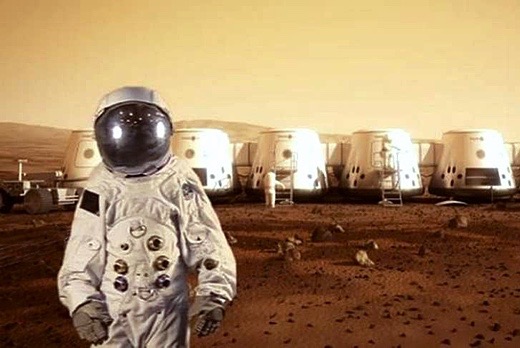
Image above: An illustration for the Mars One program. In 2013 the Mars One organization named 1058 potential colonists for its program. In 2014 they expected the final colonists selection will be through a Reality Show. Wouldn't you rather use the money this program would goble up to make life livable on Earth. From (http://wordlesstech.com/mars-one-astronaut-selection-will-be-a-reality-show).

Many people think that advocating a steady-state economy is like wishing for a miracle. I understand their reasoning and take their point—in the present era of growthism it does seem rather like advocating a miracle. But that raises the question: exactly what is a miracle? And how many other miracles are we wishing for these days?

Of course science, by definition of its method, rules out the existence of miracles, if by miracle we mean either something not explainable physically in terms of efficient causation, or else overwhelmingly improbable. Consequently, if a miracle did exist science could not see it. Looking for a miracle with science is like looking for darkness in the narrow beam of a flashlight.

Consciousness, reason, and good and evil are undeniably real, yet we have no convincing explanation for them in terms of efficient causation or biophysical evolution. And the origin of first life (as opposed to its subsequent evolution into different forms) also qualifies as a miracle by the above definition.

Sir Francis Crick, co-discoverer of DNA, thinks the origin of life on earth is so physically improbable (miraculous) that it must have arrived here from space—”directed panspermia” is the elegant name for this miraculous sidereal ejaculation. Science considers the whole amazing experience of life on earth as just a cosmic accident.

Given that life on earth is, according to science, eventually going to end, why make extraordinary efforts to prolong it, especially if, as the modern intelligentsia assures us, the universe and all life are just temporary accidents? We, as non-miraculous random events, can have no objective idea of what a good life is. Therefore we cannot know how much per capita consumption is sufficient for a good life.

Instead of a steady-state economy the default economic rule of scientific materialism seems to be, “more and more (especially for me) while things last.” Yes, I know that most scientific materialists are good people, but I am suggesting that their goodness must have origins other than their professed materialism.

For some of us materialism is just a methodology, not an ultimate worldview in which divine purpose might replace cosmic random. For Christians, for example, hope in the promise of New Creation (Rom. 8; 1 Cor.15) substitutes for despair over the ultimate impossibility of preserving this Creation forever, as well as over our repeated failures to protect it while it lasts. Like this Creation, New Creation would be a miracle—a generalized resurrection of this mortal Creation.1 

 It is a grace-based hope that flies in the face of the hard facts of evil, entropy, and finitude. It is a religious belief that death, decay, and oblivion are not the last words, and therefore it is classed as superstition in the modern secular academy, along with other religions.

Belief that the end of the world will occur soon, with lots of life-support capacity left unused (wasted), is a tenet both of some scientific catastrophists, as well as some religious fundamentalists, who consequently consider themselves exempt from the responsibility of Creation stewardship. Why sacrifice for a non-existent beneficiary, they logically ask?

However, Pope Francis, for one, in his Laudato Si strongly affirms the value of this Creation, however transitory, and in this regard he speaks for most Christians and many other religious people, as well as for some thoughtful atheists.

Most scientists (and some theologians) will not be happy with talk about miracles, or with hope in New Creation. They fear that such hope will undercut efforts to prolong the present Creation, which they believe is all there is or ever will be.

Yet when faced with the ultimate heat death of the universe, plus the increasing likelihood of self-destruction well before then, and with the meaninglessness implicit (and increasingly explicit) in their materialist cosmology, they sometimes flinch.

They look for optimism (if not hope) somewhere within their materialism. They invent the hypothesis of infinitely many (unobservable) universes in which life may outlive our universe.

They were led to this extraordinary idea in order to escape the implications of the anthropic principle—which argues that for life to have come about by chance in our single universe would require far too many just-so coincidences among the magnitudes of basic physical constants.

To preserve the idea of chance as reasonable cause, and thereby escape any notion of Creator or Telos, they argue that although these coincidences are indeed miraculously improbable in a single universe, they would surely happen if there were infinitely many universes. And of course our universe is obviously the one in which the improbable events all happened.

If you don’t believe that Shakespeare wrote Hamlet, you can claim that infinitely many monkeys pecking away at infinitely many typewriters had to hit upon it someday. That such a deification of random would take the meaning and pleasure out of reading Hamlet—or studying anything in “creation” at all—is a carefully repressed thought.

The idea of infinitely many universes, or monkeys for that matter, is speculative—at least as speculative as the idea of New Creation. The only evidence that could be offered to support hope for the future miracle of New Creation would be the occurrence of a similar miracle in the past, namely the present Creation.

Science understandably tries to account for this Creation, as far as reasonable, in its own materialistic terms, and of course from the beginning rejects “miracle” or God as an explanatory category. I am not objecting to that self-imposed, defining limitation of science.

I am just saying that New Creation is not a scientific concept rooted in efficient and material causation. It is a religious hope rooted in the idea of final causation and ultimate purpose. As such it is neither contradictory to nor dependent upon science.

Whether ad hoc postulation of infinitely many unobservable universes violates the self-imposed limitation of science, and belongs more to the category of miracle, I will leave to the reader’s judgment. But the working hypothesis of scientific materialism, however fruitful it has been, should not be sanctified as the Ultimate Metaphysics of Chance.

Nor does adding Darwinian natural selection to Mendelian random mutation alter the picture, since the selecting criteria of environmental conditions (other organisms and geophysical surroundings) are also considered to be a product of chance.

Mutations provide random change in the genetic menu from which natural selection picks according to the survival value determined by a randomly changing environment.

Such a Metaphysics of Chance precludes explanation of some basic facts, pushing them into the category of miracle:
  • First, that there is something rather than nothing;
  • Second, the just-right physical “coincidences” recognized in the anthropic principle;
  • Third, the “spontaneous generation” of first life from inanimate matter (which has apparently never happened again);
  • Fourth, the creation of an incredible amount of specified information in the genome of all the irreducibly complex living creatures that evolved from the relatively simple information in the first living thing (in spite of the fact that random change destroys rather than creates information);

    Fifth, the emergence of self-consciousness and rational thought itself (if my thoughts are ultimately the product of random, why believe any of them, including this one?);|
  • Sixth, the amazing correspondence between abstract mathematical thought and empirical natural order; and
  • Seventh, the innate human perception of right and wrong, of good and bad, which would be meaningless in a purely material world.
 Explaining these facts “by chance” strains credulity at least as much as “by miracle.”

Metaphysical humility remains a virtue for both science and religion. The longevity of a steady-state economy is a metaphysically humble goal appropriate for limited creatures in the face of ignorance and mystery.

Christianity and science both recognize the fundamental finitude and frailties of this Creation. Christianity offers ultimate hope in New Creation; science necessarily remains mute about that.  

Scientism, however, seeing no limits to this Creation, offers, instead of hope, the campaigning optimism of, for example, the Coming Singularity of the digital “new creation” with immortal silicon-based consciousness, or IBM’s new creation of “building a smarter planet,” or NASA’s new creation of colonizing Mars.

A moment’s reflection, however, shows that a spaceship, and a space colony, as well as a population of infinitely long-lived silicon “people,” must all operate as the strictest of steady-state economies.

If we cannot manage a steady-state economy on the large and forgiving earth out of which we evolved and to which we are evolutionarily well adapted, then how likely are we to manage it on a barren rock under alien conditions, including extreme cold and intense radiation?

Yet large amounts of taxpayer’s money is wasted in pursuit of the unnecessary miracle of colonizing Mars, while nothing is invested in the necessary and smaller miracle of attaining a steady-state economy on our finite earth. The pseudo-religion of scientism leads those who reject a steady-state economy on earth as a “miracle” to imagine even bigger miracles to escape it.

Notes:
1. For more on the theology of New Creation, see, Jürgen Moltmann, Ethics of Hope. Minneapolis, MN: Fortress Press. 2012; John Polkinghorne, The God of Hope and the End of the World. New Haven, CT: Yale University Press. 2003; and N. T. Wright, Surprised by Hope. New York: Harper Collins. 2008.


.