Showing posts with label Marine Mammals. Show all posts

Stop Navy killing marine mammals

SOURCE: Koohan Paik (koohanpaik@gmail.com)
SUBHEAD:  Tell the Navy to examine alternatives that would limit activities harmful to marine mammals.

By Dave Henkin on 6 December 2017 for Earth Justice -
(https://secure.earthjustice.org/site/SPageNavigator/P2A_NavySonar.html)
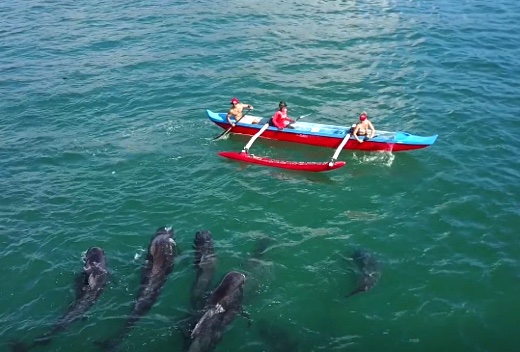

Image above: Outrigger canoe tries to keep this pod of pilot whales from beaching at Kalapaki on Kauai - five of them died. From (http://www.hawaiinewsnow.com/story/36592433/officials-investigating-several-whales-stranded-at-kauais-kalapaki-beach).

The key to reducing harm to marine mammals is to restrict harmful Navy activities in sensitive marine habitat.

Unfortunately, the Navy proposes stripping protections from critical areas.

Thousands of whales, dolphins and other marine mammals could suffer permanent injury—and even death—from warfare training exercises if the Navy walks back their agreement to a reasonable testing and training plan.

Over the next five years, the Navy wants to fire tens of thousands of rockets, missiles and projectiles and blast sonar for tens of thousands of hours in waters off Hawai‘i and Southern California that are home to dozens of vulnerable marine mammal species.

To marine mammals, the deafening sounds from Navy activities can be fatal. In the dark depths of the ocean, these mammals rely almost entirely on sound to “see” their world. It’s how they feed, mate, communicate and navigate. If a whale or dolphin can’t hear, it can’t survive.

Before the Navy can adopt its testing and training plan, it needs to consider public input under the National Environmental Policy Act, or NEPA. You have only until December 12 to tell the Navy to commit to a reasonable plan that achieves military preparedness while maximizing marine mammal safety.


Image above: Two dying pilot whales on the sand at Kalapaki Beach. From (http://www.hawaiinewsnow.com/story/36592433/officials-investigating-several-whales-stranded-at-kauais-kalapaki-beach).

After a landmark settlement with Earthjustice in 2015, the Navy voluntarily agreed to safeguards for whales, dolphins and other marine mammals, protecting vast swaths of vital ocean habitat. But these common sense measures are conspicuously missing from Navy’s draft plan for the next five years of training and testing around the Hawaiian Islands and off Southern California.

The settlement proved that the Navy can both protect our nation and minimize harm to whales and dolphins by limiting the use of sonar and explosives in vital habitats.

The waters off the coast of Southern California are a globally important feeding area for endangered whales, and, for numerous small, resident whale and dolphin populations off Hawai‘i, the islands are literally their only home.

For years, scientists have documented that mid-frequency sonar wreaks havoc on the ocean environment, causing serious impacts to marine mammals, such as permanent hearing loss, lung injuries, strandings, habitat abandonment and even death.

The Navy already acknowledged that it doesn’t need to train in every square inch of the ocean and that it can take reasonable steps to reduce the deadly toll of its activities. Tell it to examine and pursue alternatives that protect both the nation and irreplaceable marine life.

See also: 
Ea O Ka Aina: Air Force plans to bomb whales 2/6/17
Ea O Ka Aina: Hawaiian spinner dolphin restriction 1/9/17
Ea O Ka Aina: Navy to dump 20K tons of poison 11/16/16
Ea O Ka Aina: PMRF injuring marine mammals10/9/16
Ea O Ka Aina: Judgement against RIMPAC 2016 5/29/16
Ea O Ka Aina: US court RIMPAC Impact decision 4/3/15
Ea O Ka Aina: PMRF RIMPAC Claptrap 11/22/14
Ea O Ka Aina: RIMPAC 2014 - another whale death 7/26/14
Ea O Ka Aina: Navy Injury & Death Toll 3/19/14
Ea O Ka Aina: Navy License to Kill 10/9/12
Ea O Ka Aina: Navy admits threat to sea mammals 5/10/12
Ea O Ka Aina: Talk on Ocean Noise 12/28/11
Ea O Ka Aina: Navy to kill Pacific whales 1/17/09
Hawaiian spinner dolphin restriction

SUBHEAD: NOAA considering a 150 foot buffer zone restricting swimming near dolphins.

By Aja Hannah on 4 January 2017 for Earth Island Journal -
(http://www.earthisland.org/journal/index.php/elist/eListRead/noaa_ban_swimming_spinner_dolphins_hawaii/)


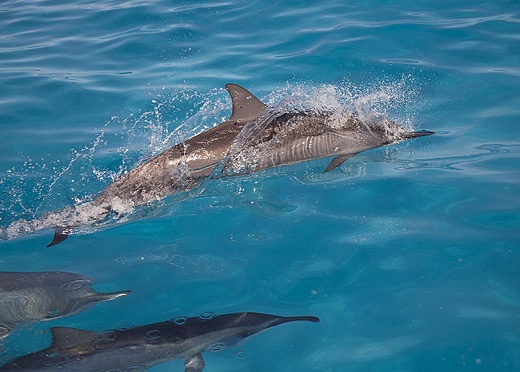
Image above: Spinner dolphins in Hawaii's Papahanaumokuakea Marine National Monument. From original article.

The proposed banned zone is intended to protect marine mammals from over-eager tourists.

[IB Publisher's note: Even 150' may be too close for approaching swimmers. Here on Kauai it is certainly it is too close for tourist filled zodiacs and catamarans that spot a pod of spinners during daylight hours and rouse them for sleep to dance for the tourists. They sail from Hanapepe along the south shore and to the westside and along the Napali Coast.]

Imagine you're sleeping and a friend comes over unannounced. You might hang out for a few hours or you might walk them out. Either way, they eventually leave and you return to bed. You're just getting into that good sleep when another person knocks on the door. Then another and another. All night this continues. Then it happens again the next night. And the night after that.

This is the current problem plaguing the Hawaiian spinner dolphin, one of the smallest dolphin species, well-known for their airborne twisting jumps.

The mainly nocturnal mammals spend their daylight hours resting near the shores of the Hawaiian Islands in shallow waters, but a growing number of tourists, tour companies, and increasing human interaction are impacting the health of the dolphin pods as well as individual dolphins.

In August, National Oceanic and Atmospheric Administration (NOAA) Fisheries proposed a rule that would ban everyone from swimming with Hawaiian spinner dolphins. Under the rule, no one would be allowed get within 50 yards of spinner dolphins by any means. This includes by boat, kayak, paddleboard, swimming, and other type of transportation.

The proposed ban has proven controversial, even among those who agree that spinner dolphins need protections. Hawaii’s economy, of course, is sustained by tourism, and local operators are concerned the ban may negatively impact their business.

At four to seven feet long, Hawaiian spinner dolphins (Stenella longirostris) spend the night hours off Hawaiian shores in search of fish, shrimp, and squid. In the darkness, these mammals track their prey to depths of nearly 1,000 feet, communicate through echolocation, and work cooperatively to herd prey for the catch.

As sunrise arrives, the dolphins return to the shallow coasts to socialize, sleep, and nurse their young until late in the afternoon. Dolphins remain in motion when they sleep: For four to five hours every afternoon, the dolphins will swim slowly back and forth, coming up for air when necessary, while half of their brain sleeps, a unique adaptation for dolphins and whales that are required to control their own breathing at all times.

When a vessel or person approaches a pod, dolphins are interrupted from their sleep — they wake up completely to assess the threat. When this happens repeatedly — as it often does — the dolphins become exhausted, and have less energy for other activities, including responding to threats, hunting, or caring for their young.

According to studies cited in the NOAA Fisheries’ proposal, short term changes in spinner dolphin behavior due to human interference have already been documented in Hawai’i, including a decreased number of individuals sighted in typical resting places. While this is not definitive of a decreased population, it at least means the dolphins have moved from traditional resting grounds.

“Several studies have suggested that spinner dolphins exhibit behaviors outside of their normal resting behaviors in response to human interactions in Hawaii. Disturbed individuals incur an energetic cost,” said Ann Garrett, the assistant regional administrator of NOAA Fisheries. Interactions that cause such behavioral changes qualify as “harassment” of marine mammals under the MMPA.

Spinner dolphin pods can be found off the coasts of Kauai/Niihau, Hawaii (The Big Island), and Oahu and do not interbreed throughout Hawaii’s archipelago. Disturbance of one individual can also disturb the whole pod into relocating and interrupts nursing mothers.

“Long-term studies on dolphins in different parts of the world have documented negative impacts from intense viewing pressure, including population decline, habitat abandonment, and decreased reproductive success,” Garrett added. “The enhanced protections were proposed in response to both identifiable short-term changes in behavior and as a preventative measure,”she said, referring to the proposed 50-yard buffer zone.

Although not listed under the Endangered Species Act, the dolphins are already protected under the MMPA, which makes it illegal to harass, feed, hunt, capture, collect or kill any marine mammal or collect or possess any part of a marine mammal. Harassment includes any pursuit, torment, or annoyance that could injure or disturb marine mammals, including activities that disturb behavioral patterns.

The MMPA is currently implemented in Hawai’i by NOAA Fisheries Office of Law Enforcement, the US Coast Guard, and Hawaii’s Division of Conservation and Resources Enforcement. Maximum penalties for violation of the law include a civil fine of $27,500 or — for criminal penalties — one year in prison and/or a $100,000 fine. Enforcement of the law, however, has been spotty, and most people visiting Hawai’i are unaware of the restrictions.

NOAA Fisheries and partners have also established a certification program, Dolphin SMART, which businesses can join to show their support for the species. Dolphin SMART promotes dolphin conservation by minimizing harassment, and includes a 50-yard distance requirement. Operators wishing to become certified must attend training and participate in responsible advertising, among other criteria.

The proposed 50-yard NOAA rule would enhance and clarify these existing protections for spinner dolphins. Exceptions to the rule would include: people who inadvertently come within 50 yards of a dolphin, as long as they make efforts to move away; vessels that are approached by dolphins, as long as the vessel remains on its course; vessels that cannot safely keep a 50-yard distance when going to or from a port or harbor; and emergency situations when imminent or serious threat must be avoided.

Other alternative rules under consideration include a 100-yard restriction and closure of important daytime habitats to swimmers at certain times of day, including four bays on the Big Island and one on Maui. These measures are unlikely to be adopted at this time, but could be adopted in the future if the 50-yard limit does not provide enough protection.

Hearings for the proposal have drawn more than 300 people from four islands and NOAA Fisheries is still compiling the written comments it received.

Dolphin Discoveries has been in business for 25 years on the Big Island, running swim tours and writing local guidelines on sustainable dolphin swims.

Co-owner of Dolphin Discoveries Kevin Merrill said, “Usually when we get in the water, we just float and the dolphins swim by. We know the dolphins are nocturnal and need to rest. Responsible operators cease at about 11:00 a.m.”

Merrill explained that legal issues and missteps created an excess of boating permits and an oversaturated tour market in Kona, a touristy area on west side of the Big Island. “Because of the way [the local government] issued permits, you have people trying to scratch out a living doing whatever they can. You’ve got all these knuckleheads that don’t understand what they’re doing with the dolphins, but they invested in a boat and have a permit.”

While conducting his tours, Merrill has encountered people driving through the pods at high speeds so that the dolphins will swim and jump at the bow. He’s seen overhand swimming and splashing tourists, which is seen as aggressive behavior by the dolphins.

Tour boats sometimes drive into the middle of pods and have clients drop into the water almost on top of the dolphins. And, of course, some operators continue to conduct swims past the ideal 11:00 a.m. limit, preventing dolphins from sleeping. Voluntary guidelines have been established locally, but there is no law to enforce the guidelines or to penalize the offenders.

Merrill believes the dolphins need protection, but there are better alternatives that would protect both dolphins and local businesses. Instead of banning the entire practice of swimming with dolphins in Hawaii, Merrill would rather see complete closures of critical habitats and time limits on swimming with dolphins made mandatory and enforced by NOAA.

These restrictions would also be easier to patrol than a 50-yard limit, he said, especially considering that the dolphins, tides, and people are constantly in motion. The new rule could put local, responsible operations out of business. “We think there should be local solutions to local problems,” he said.

Merrill also pointed out that captive facilities would be exempt from this the 50-yard ban. As a result, the only way for people to have a close encounter with a dolphin would be in a small tank. There’s the possibility that this would increase demand for captive dolphins.

However, Garrett said the 50-yard rule would level the playing field among businesses.

The pressure for close interactions with spinner dolphins would wane since no operators could legally provide them, she said, and tour operators would develop other alternatives, including wildlife tours that help customers spot the dolphins and other animals from a distance.

Mark Palmer, associate director of the International Marine Mammal Project, a project of Earth Island Institute, is a proponent of the ban. “While there is room for experimentation, in the end the needs of the dolphins are most important.

We may well need to go for swimming closures in areas necessary for dolphin respite,” he said. “I also think the issue is bigger than just the official whale watching tour companies — individual tourists are a problem.”

Because of that, he thinks that close supervision and enforcement by NOAA Fisheries will be required if the rule is passed, and that tourists will still need to be educated on why the dolphins should not be approached.

NOAA expects to make a decision on the proposed rule in late 2017.

.

PMRF injuring marine mammals

SUBHEAD: NOAA okays air force tests injuring marine mammals on ocean from PMRF test range.

By Juan Wilson on 9 October 2016 for Island Breath -
(http://islandbreath.blogspot.com/2016/10/pmrf-to-injure-marine-mammals.html)


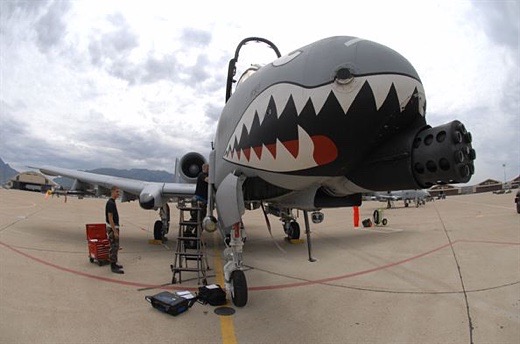
Image above: Airmen from the 53d's 86th Fighter Weapons Squadron ready A-10 Thunderbolts from Moody Air Force Base, to participate in the Air Force's air-to-ground Weapons System Evaluation Program known as Combat Hammer in 2008. From (http://www.acc.af.mil/News/ArticleDisplay/tabid/5725/Article/201987/53d-wing-conducts-largest-air-to-ground-wsep-in-history.aspx).

I would like to thank Rayne Raygush for alerting us to relevant entries from the Federal Register published since the last issue of The Environmental Notice that relate to military weapons testing near Kauai.

For full notice information, click on (https://www.gpo.gov/fdsys/pkg/FR-2016-10-03/pdf/2016-23725.pdf).

The article below is derived from this that notice, including details of the notification by NOAA of ongoing damage to marine mammals. This is occurring now during the month of October and November and is being conducted by the US Air Force for testing of weapons systems in the waters around Kauai.

ISSUER:
National Marine Fisheries Service (NMFS), National Oceanic and Atmospheric Administration (NOAA) of Commerce Department.

WHO:
U.S. Air Force 86 Fighter Weapons Squadron (86 FWS)

WHAT:
Notice of issuance of an incidental harassment authorization for Air Force.

WHERE:
Barking Sands Underwater Range Extension (BSURE) area of the Pacific Missile Range Facility (PMRF) at Kauai, Hawaii.

WHEN:
This authorization is effective from October 1, 2016, through November 30, 2016.

INFORMATION:
Laura McCue, Office of Protected Resources, NMFS, (301) 427-8401.

BACKGROUND:
Law direct the Secretary of Commerce to allow, upon request, the incidental, but not intentional, taking (killing) of small numbers of marine mammals of a species or population stock, by U.S. citizens who engage in a specified activity (other than commercial fishing) within a specified geographical region if certain findings are made and either regulations are issued or, if the taking is limited to harassment, a notice of a proposed authorization is provided to the public for review.

An authorization for incidental takings (killings) for marine mammals shall be granted if NMFS finds that the taking will have a negligible impact on the species or stock(s), will not have an unmitigable adverse impact on the availability of the species or stock(s) for subsistence uses (where relevant), and if the permissible methods of taking and requirements pertaining to the mitigation, monitoring, and reporting of such taking are set forth.

NMFS has defined “negligible impact” in 50 CFR 216.103 as “an impact resulting from the specified activity that cannot be reasonably expected to, and is not reasonably likely to, adversely affect the species or stock through effects on annual rates of recruitment or survival.”

The US Air Force 86 Fighter Weapons Squadron plans to conduct an air-to-surface mission in the BSURE area of the PMRF. The Long Range Strike Weapons System Evaluation Program (LRS WSEP) test objective is to conduct operational evaluations of long range strike weapons and other munitions as part of operations to properly train units to execute real-world operational expectations in a time of war.

Due to threats to national security, increased missions involving air-to-surface activities have been directed by the Department of Defense (DoD).

86 FWS proposes actions that include LRS WSEP test missions of the Joint Air-To-Surface Stand-off Missile (JASSM) and the Small Diameter Bomb-I/II (SDB-I/II) including detonations at the water surface. These activities qualify as military readiness activities under the MMPA.

IMPACTS:
The following aspects of the planned LRS WSEP training activities have the potential to take marine mammals: Munition strikes and detonation effects (overpressure and acoustic components). Take, by Level B harassment of individuals of dwarf sperm whale, pygmy sperm whale, Fraser's dolphin, and minke whale could potentially result from the specified activity.

Additionally, 86 FWS has requested authorization for Level A Harassment of one individual dwarf sperm whale. 86 FWS's LRS WSEP training activities may potentially impact marine mammals at or near the water surface. In the absence of mitigation, marine mammals could potentially be injured or killed by exploding and non-exploding projectiles, falling debris, or ingestion of military expended materials.

HARM LEVELS:
Level B Behavioral Response could result from exposure to explosive detonations that cause disruption of natural behavioral patterns, including migration, surfacing, nursing, breeding, feeding, or sheltering.

TTS is Temporary Threshold Shift that can affect how an animal behaves in response to the environment, including reactions to predators, and prey.

PTS is Permanent Threshold Shift that results from exposure to explosive detonations that is irreversible and is considered this to be an permanent injury.

http://www.islandbreath.org/2016Year/10/161009table5big.jpg
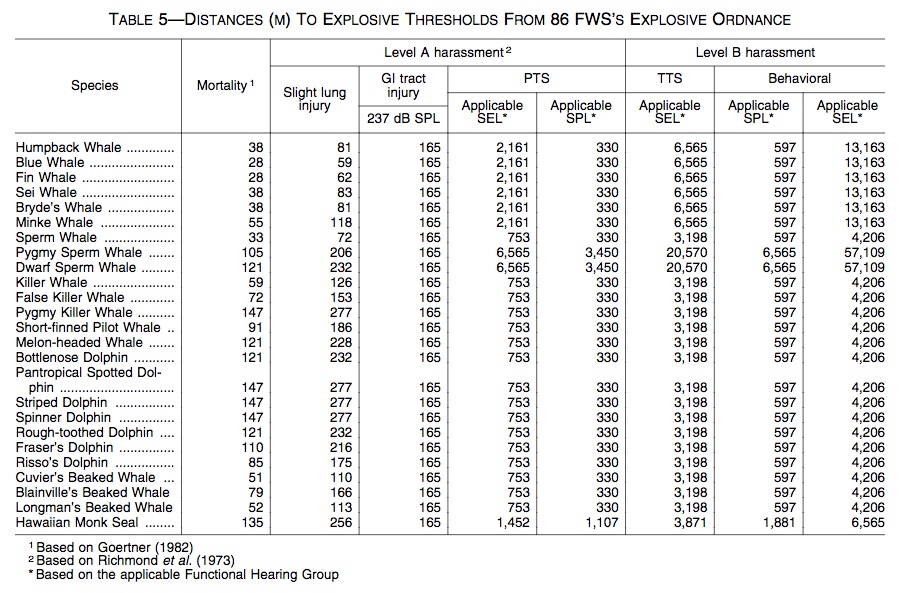
Image above: Table 5 from Federal Reserve notice indicating distance between marine mammal and weapons explosion and the resulting level of damage to the victim.  From (https://www.gpo.gov/fdsys/pkg/FR-2016-10-03/pdf/2016-23725.pdf). Click to enlarge.

Note Table 5 above indicates in the case of pygmy and dwarf whales that permanent damage could be done to an individual whale over 4 miles from an explosion and temporary damage could be inflicted almost 13 miles from an explosion. These species could even experience behavior disruption over 35 miles from an explosion.
TABLE 7: NUMBER OF MARINE MAMMALS POTENTIALLY AFFECTED

Species
Mortality Level A: PTS
Permanent
Level B: TTS
Temporary
Level B:
Behavioral
Dwarf Sperm Whale 0 1964
Pygmy Sperm Whale 0 0326
Frasier's Dolphin 0 010
Mincke Whale 0 012
Humpback Whale 0 039
TOTAL 0 117101

BOTTOM LINE
Needless to say, the US military continues its war against the Pacific Ocean and its inhabitants. The damage weapons testing will do is only estimated.

These damage estimates to not include damage to non-mammals, (fish, squid, etc.) that are the prey of many whales, dolphins and seals. Those numbers are uncountable and probably have an impact on marine mammal health and levels of stress.

These estimates also do not include how unpleasant the environment becomes to these mammals as a result of ocean explosions, particularly to damaging chaotic sound nearby to animals capable if hearing across the ocean; like having a airport runway for a frontyard.

That the Navy and Air Force of the United States is making the Hawaiian Islands a place that does not welcome marine mammals, including whales, dolphins and seals is a crime against life itself.

See also:
Ea O Ka Aina: Federal Court slams Navy Sonar 7/16/16
Ea O Ka Aina: DLNR responsibility for RIMPAC 7/5/16
Ea O Ka Aina: Oceans4Peace Pacific Pivot Panel 6/18/16
Ea O Ka Aina: Ocean 4 Peace Events 6/11/16
Ea O Ka Aina: Kauai and Niihau endangered 9/23/16
Ea O Ka Aina: Prepare for RIMPAC War in Hawaii 5/22/16
Ea O Ka Aina: Navy to "take" millions of mammals 5/17/16
Ea O Ka Aina: US court RIMPAC Impact decision 4/3/15
Ea O Ka Aina: RIMPAC 2014 Impact Postmortem 10/22/14
Ea O Ka Aina: RIMPAC 2014 in Full March 7/16/14
Ea O Ka Aina: 21st Century Energy Wars 7/10/14
Ea O Ka Aina: RIMPAC War on the Ocean 7/3/14
Ea O Ka Aina: Voila - World War Three 7/1/14
Ea O Ka Aina: The Pacific Pivot 6/28/14
Ea O Ka Aina: RIMPAC IMPACT 6/8/14
Ea O Ka Aina: RIMPAC Then and Now 5/16/14
Ea O Ka Aina: Earthday TPP Fukushima RIMPAC 4/22/14
Ea O Ka Aina: The Asian Pivot - An ugly dance 12/5/13
Ea O Ka Aina: Help save Mariana Islands 11/13/13
Ea O Ka Aina: End RimPac destruction of Pacific 11/1/13 
Ea O Ka Aina: Moana Nui Confereence 11/1/13
Ea O Ka Aina: Navy to conquer Marianas again  9/3/13
Ea O Ka Aina: Pagan Island beauty threatened 10/26/13
Ea O Ka Aina: Navy license to kill 10/27/12
Ea O Ka Aina: Unproved Osprey on Kauai 8/21/12
Ea O Ka Aina: Sleepwalking through destruction 7/16/12
Ea O Ka Aina: Okinawa breathes easier 4/27/12
Ea O Ka Aina: Navy Next-War-Itis 4/13/12
Ea O Ka Aina: America bullies Koreans 4/13/12
Ea O Ka Aina: Despoiling Jeju island coast begins 3/7/12
Ea O Ka Aina: Jeju Islanders protests Navy Base 2/29/12
Ea O Ka Aina: Hawaii - Start of American Empire 2/26/12
Ea O Ka Aina: Korean Island of Peace 2/26/12   
Ea O Ka Aina: Military schmoozes Guam & Hawaii 3/17/11
Ea O Ka Aina: In Search of Real Security - One 8/31/10
Ea O Ka Aina: Peace for the Blue Continent 8/10/10
Ea O Ka Aina: Shift in Pacific Power Balance 8/5/10
Ea O Ka Aina: RimPac to expand activities 6/29/10
Ea O Ka Aina: RIMPAC War Games here in July 6/20/10
Ea O Ka Aina: Pacific Resistance to U.S. Military 5/24/10
Ea O Ka Aina: Guam Land Grab 11/30/09
Ea O Ka Aina: Guam as a modern Bikini Atoll 12/25/09
Ea O Ka Aina: GUAM - Another Strategic Island 11/8/09
Ea O Ka Aina: Diego Garcia - Another stolen island 11/6/09
Ea O Ka Aina: DARPA & Super-Cavitation on Kauai 3/24/09
Island Breath: RIMPAC 2008 - Navy fired up in Hawaii 7/2/08
Island Breath: RIMPAC 2008 uses destructive sonar 4/22/08
Island Breath: Navy Plans for the Pacific 9/3/07
Island Breath: Judge restricts sonar off California 08/07/07
Island Breath: RIMPAC 2006 sonar compromise 7/9/06
Island Breath: RIMPAC 2006 - Impact on Ocean 5/23/06
Island Breath: RIMPAC 2004 - Whale strandings on Kauai 9/2/04
Island Breath: PMRF Land Grab 3/15/04

.

US court RIMPAC Impact decision

SUBHEAD: Federal judge rules Navy training in Pacific violates laws meant to protect marine life.

By Tom Hasslinger on 3 April 2015 for the Garden Island -
(http://thegardenisland.com/news/local/govt-and-politics/ocean-impact/article_18c6f238-d9d1-11e4-bf36-1bec41fb1edd.html)


Image above: During RIMPAC 2014 a Super Stallion flies ahead of the USS Peleliu near Hawaiian coast as smoke drifts across the sea near unidentified Hawaiian shore. The Peleiu is a large amphibious warship the resembles a small aircraft carrier that supports vertical and tilt wing aircraft. The 35 year old Peleliu was decommissioned last week. From (http://www.scoopnest.com/s/rimpac%202014/).

The Navy has underestimated the threat maritime exercises and the use sonar poses on marine life around Hawaii and California, a federal judge ruled Tuesday.

U.S. District Judge Susan Oki Mollway in Hawaii concluded that the National Marine Fisheries Service violated environmental laws when it decided that the Navy’s training would have a “negligible impact” on whales, turtles, dolphins and other mammals.

The 66-page ruling said the Navy didn’t explore all possible safeguards to better protect mammals in the ocean, especially given the vast mileage of water that the military used to train.

“The court is saying that the Navy’s categorical and sweeping statements, which allow for no compromise at all as to space, time, species, or condition, do not constitute the ‘hard look’ required by NEPA,” Mollway wrote regarding the Navy’s stance that restrictions would hinder military practices. “The Navy never explains why, if it can accommodate restrictions for humpback whales, it cannot accommodate restrictions for any other species.”

The ruling was praised by environmentalists.

“We’re not trying to stop all training and testing,” said David Henkin, the Earthjustice attorney representing several groups that filed the lawsuit. “But at the same time, it’s important to take the necessary steps to protect all marine life.”

Earthjustice is representing Conservation Council for Hawaii, the Animal Welfare Institute, Center for Biological Diversity and Ocean Mammal Institute challenging NMFS’s approval of a 5-year plan by the U.S. Navy for testing and training activities off Hawaii and Southern California. The groups have maintained that mammals are being unnecessarily harmed, in part, because the Navy doesn’t avoid “biologically sensitive areas.”

The National Environmental Policy Act requires federal agencies to consider a range of alternatives, including ones that could be pursued with less environmental harm, when embarking on operations.

Henkin said the Navy has access to 3.5 million square miles of the waters sweeping from California to Hawaii. Some select areas are particularly sensitive for sea life, such as whales. For example, around 50,000 square miles off Hawaiian waters could be classified as sensitive grounds for marine life, and that size can be avoided while leaving plenty of sea for military operations.

“The court’s ruling recognizes that, to defend our country, the Navy doesn’t need to train in every square inch of a swath of ocean larger than all 50 United States combined,” Henkin said.

“If we can limit or prevent training in these small areas we can limit or prevent these deaths that occur,” he added. “It’s completely avoidable ... It’s not what you do, it’s how you do it.”

The Navy said it would evaluate the ruling before determining its next move and couldn’t comment on specifics.

“If the Navy cannot realistically train at sea, sailor’s lives and our national security will be at risk,” U.S. Pacific Fleet spokesman Lt. Cmdr. Nick Sherrouse wrote in response to the ruling. “It is essential sailors have realistic training that fully prepares them to fight tonight, if necessary, and have equipment that has been thoroughly tested before they go into harm’s way,”

What happens next is still to be determined. Exercises could be moved or stricter permitting regulations could be agreed to.

In the meantime, Henkin said he will seek a court order to ensure adequate protections are put in place while it settles out.

“We would invite the government to come to an agreement without a need for more (litigation),” he said. “One way or the other, we are going to do whatever we can to make sure there is adequate protection.”

Held every two years and hosted by the U.S. Pacific Fleet, Rim of the Pacific, or RIMPAC, is the world’s largest international maritime war exercise. In total, 22 nations, 49 surface ships, six submarines, more than 200 aircraft and 25,000 personnel participated in last year’s event from June 26 to Aug. 1. It included live fire target practice, explosives, sonar and the sinking of the decommissioned USS Tuscaloosa 57 nautical miles northwest of Kauai.

The Navy says training will kill 155 whales over five years, but environmentalists say the numbers would be much higher. Some Kauai residents expressed concern when the training was here.

One of those citizens is Hanalei resident and marine biologist Terry Lilley. He copied U.S. Congresswoman Tulsi Gabbard on dozens of emails and photos over the last year documenting what he says shows the serious damage being caused to Kauai’s nearshore marine environment, including green sea turtles, sharks, reefs and coral, by the Navy’s activities.

Gabbard, in turn, wrote a letter in October to Adm. Harry Harris Jr. of the United States Pacific Fleet inquiring about monitoring the effects of military operations on marine life.

“I am very pleased to see that the federal court looked at all of the data about the destruction of our reefs caused by the U.S. Navy war games and made the decision they did,” he wrote in an email to The Garden Island. “We now need to get the destructive activities stopped so we can start working on a massive study and coral reef restoration project.”

Sherrouse said the Navy has been training in the Hawaii and Southern California ranges for more than 60 years.


Image above: Multinational Marine forces exit a CH-53 Sikorsky during the air assault portion of RIMPAC 2014 at Pacific Missile Range Facility on Kauai's westside. From original TGI article.

“This training and testing remains critical to the defense of the nation,” he said. “We are committed to meeting our national security mission and protecting marine life by using protective measures, working with regulatory agencies, and better understanding marine mammals through research.”

But the judge’s ruling stated the Navy doesn’t need all of the waters to still conduct its missions successfully.

She also noted the “stunning number of marine mammals” the Navy’s activities threaten with harm. The judge also found the Fisheries Service violated its legal duties to ensure Navy training would not push endangered whales and turtles to extinction.

“No restriction of any kind is even hypothesized,” Mollway wrote of the Navy’s stance. “Again, the breathtaking assertions allow for no limitation at all, but this makes no sense given the size of the ocean area involved.”

See also:
Ea O Ka Aina: RIMPAC 2014 - another whale dead 7/27/14
Ea O Ka Aina: RIMPAC 2014 in Full March 7/16/14
Ea O Ka Aina: 21st Century Energy Wars 7/10/14
Ea O Ka Aina: RIMPAC War on the Ocean 7/3/14
Ea O Ka Aina: Voila - World War Three 7/1/14
Ea O Ka Aina: The Pacific Pivot 6/28/14
Ea O Ka Aina: RIMPAC IMPACT 6/8/14
Ea O Ka Aina: RIMPAC Then and Now 5/16/14
Ea O Ka Aina: Earthday TPP Fukushima RIMPAC 4/22/14
Ea O Ka Aina: The Asian Pivot - An ugly dance 12/5/13
Ea O Ka Aina: Help save Mariana Islands 11/13/13
Ea O Ka Aina: End RimPac destruction of Pacific 11/1/13 
Ea O Ka Aina: Moana Nui Confereence 11/1/13
Ea O Ka Aina: Navy to conquer Marianas again  9/3/13
Ea O Ka Aina: Pagan Island beauty threatened 10/26/13
Ea O Ka Aina: Sleepwalking through destruction 7/16/12
Ea O Ka Aina: Okinawa breathes easier 4/27/12
Ea O Ka Aina: Navy Next-War-Itis 4/13/12
Ea O Ka Aina: America bullies Koreans 4/13/12
Ea O Ka Aina: Despoiling Jeju island coast begins 3/7/12
Ea O Ka Aina: Jeju Islanders protests Navy Base 2/29/12
Ea O Ka Aina: Hawaii - Start of American Empire 2/26/12
Ea O Ka Aina: Korean Island of Peace 2/26/12   
Ea O Ka Aina: Military schmoozes Guam & Hawaii 3/17/11
Ea O Ka Aina: In Search of Real Security - One 8/31/10
Ea O Ka Aina: Peace for the Blue Continent 8/10/10
Ea O Ka Aina: Shift in Pacific Power Balance 8/5/10
Ea O Ka Aina: RimPac to expand activities 6/29/10
Ea O Ka Aina: RIMPAC War Games here in July 6/20/10
Ea O Ka Aina: Pacific Resistance to U.S. Military 5/24/10
Ea O Ka Aina: Guam Land Grab 11/30/09
Ea O Ka Aina: Guam as a modern Bikini Atoll 12/25/09
Ea O Ka Aina: GUAM - Another Strategic Island 11/8/09
Ea O Ka Aina: Diego Garcia - Another stolen island 11/6/09
Ea O Ka Aina: DARPA & Super-Cavitation on Kauai 3/24/09
Island Breath: RIMPAC 2008 - Navy fired up in Hawaii 7/2/08
Island Breath: RIMPAC 2008 uses destructive sonar 4/22/08
Island Breath: Navy Plans for the Pacific 9/3/07
Island Breath: Judge restricts sonar off California 08/07/07
Island Breath: RIMPAC 2006 sonar compromise 7/9/06
Island Breath: RIMPAC 2006 - Impact on Ocean 5/23/06
Island Breath: RIMPAC 2004 - Whale strandings on Kauai 9/2/04
Island Breath: PMRF Land Grab 3/15/04

.

PMRF RIMPAC Claptrap

SOURCE: Gorden Labetz (glabedzmd@aol.com)
SUBHEAD: PMRF propaganda says navy exercises not harmful to marine life, but facts disagree.

By Chris D'Angelo on 21 November 2014 for the Garden Island -
(http://thegardenisland.com/news/local/no-scientific-evidence/article_0006f856-713f-11e4-9ff7-6bf7648d8280.html)


Image above: A pod of dolphins swims in front of the USNS Alan Shepard. From article below.

[IB Publisher note: Below this TGI piece is by KPBS from August 2013 that indicates the Navy has negotiated a five year agreement that would allow "takes" or killings of hundreds of sea mammals and injuring of thousands of others in exercises like RIMPAC]

The U.S. Pacific Fleet in Pearl Harbor says community concerns that the Rim of the Pacific maritime exercise and Kauai’s Pacific Missile Range Facility are negatively impacting marine life are unfounded.

In early October, after hearing from several constituents, Hawaii Congresswoman Tulsi Gabbard requested information about the Navy’s efforts to monitor the effects of RIMPAC and PMRF on the ocean and marine ecosystems.

“In response to concerns of your constituents, there has been no scientific evidence that RIMPAC 2014 or exercises at the Pacific Missile Range Facility (PMRF) have caused damage to marine life,” USPF Commander Adm. Harry B. Harris Jr. wrote in a response to Gabbard.

In his three-page letter, Harris discussed the aggressive steps taken by the Navy to avoid harming marine mammals, sea turtles and corals, through the use of protective measures during training, especially with sonar and explosives.

Harris also pointed out that the Navy funded over $300 million in independent research over the past 10 years, making it a world leader in marine mammal research and monitoring.

“The Navy works with regulatory agencies, using the best available science, to obtain necessary authorizations and continues to further our understanding of marine mammals through research and monitoring,” he wrote.

Others, however, say the military exercises are harming marine life.

Katherine Muzik, a local marine biologist, said it is proven — as written about in Joshua Horwitz’s book “War of the Whales” — that sonar is lethal to whales. It is only logical, she said, that it would also have deleterious, if not lethal, effects on invertebrates, including shrimp and coral, which rely on vibrations for detecting prey, escaping predators and reproducing.

“I would bet on my life that sonar is hurting other creatures,” she said. “We don’t have the proof, but the absence of proof doesn’t mean it’s an absence of fact.”

Muzik said that with so many factors already damaging the marine environment — warming ocean temperatures, acidification and pollution — for the U.S. military to insist on purposefully, knowingly and deliberately maiming and killing marine life in the name of practice is unacceptable and tragic.

In August 2013, a pair of environmental impact statements detailed that U.S. Navy training and testing activities could inadvertently kill hundreds of whales and dolphins — an injure thousands more — between 2014 and 2018. The studies included waters off the East Coast, the Gulf of Mexico, Southern California and Hawaii.

Most of the deaths — as many as 155 off Hawaii and Southern California — would come from detonating underwater explosives, while some could be caused by sonar testing or animals being struck by ships. In addition to deaths, the EIS report said the activities off Hawaii and Southern California could cause 2,039 serious injuries, 1.86 million temporary injuries and 7.7 million instances of behavioral change.

“I think it’s bogus when they say they have a lookout,” Muzik said. “I think the truth is there are animals there, they know there are animals there, and they are allowed to take them.”

Held every two years and hosted by the Pacific Fleet, RIMPAC is the world’s largest international maritime war exercise. In total, 22 nations, 49 surface ships, six submarines, more than 200 aircraft and 25,000 personnel participated in this year’s event, which lasted from June 26 to Aug. 1 and included live fire target practice and the sinking of the decommissioned USS Tuscaloosa 57 nautical miles northwest of Kauai.

The drills take place in the Hawaii Operating Area and several off-shore ranges, including PMRF.

Harris told Gabbard there are steps the Navy must take to minimize harm to the environment — per environmental laws such as the Marine Mammal Protection Act and the Endangered Species Act — during its trainings, including RIMPAC.

Before each RIMPAC, Harris wrote, the Navy briefs participating U.S. and foreign units about protective measures, as well as reminds service members to avoid interaction with sea turtles, Hawaiian monk seals, dolphins, coral reefs and Essential Fish Habitats. Additionally, Navy officials complete Marine Species Awareness Training and units are required to report sonar use and submit daily marine mammal sighting reports.

Prior to and during training with sonar, the Navy uses trained, qualified lookouts to search the area for marine mammals, according to Harris. If one is sighted within 1,000 yards, sonar transmissions are reduced. Within 200 yards, sonar is shut down completely.

“Safety zones are also established to protect marine life from the effects of explosive and non-explosive munitions,” he wrote.

In an emailed statement Wednesday, Gabbard said she has been “deeply concerned about the scope of devastation” of Kauai’s coral reefs, which continue to suffer from an outbreak of black band coral disease. Over the past year, she said she has reached out to experts in marine biology, local and federal officials, and the U.S. military to ask about potential causes and how the disease can be stopped.

“The broader scientific community does not point to the U.S. Navy as the cause of this coral disease,” Gabbard wrote to The Garden Island. “Rather, experts agree it likely is a combination of runoff, growing population and development, and overfishing, among other cited causes.”

Gordon LaBedz of the Surfrider Foundation Kauai Chapter, which sued the Navy over the 2006 RIMPAC exercises, described Harris’ response letter as “100 percent predictable,” and said he puts the Navy right up there will the commercial fishing industry in terms of the world’s most environmentally destructive entities.

“In my 30 years of suing the Navy, I’ve never experienced them as good stewards of the environment,” he said.

As for Harris’ comments about there being no evidence, LaBedz said it bothers him. When a whale dies, it sinks. It doesn’t float on the surface where it can be found, he said.

In his letter, Harris also addressed a situation in July in which a 16-foot sub adult pilot whale washed ashore and died in Hanalei Bay. In response, the Navy conducted an aerial survey in accordance with the Pacific Fleet’s Stranding Response Plan.

While LaBedz said he is convinced that whale died as a result of sonar, Harris said, “To date, there is no evidence of a connection to Navy.”

When asked how someone would obtain the scientific evidence referenced by Harris, and what that evidence might be, or look like, Pacific Fleet spokesman Mark Matsunaga wrote, “The Navy uses the best available science in its environmental analysis and lists these references at the end of each resource section of our EISs,” and referred TGI to a series of websites, including www.hstteis.com.


Navy Plans to Kill Marine Mammals
SUBHEAD: Navy five year plan expects to kill hundreds of dolphins and whales and injuring thousands.

By David Wagner on 30 August 2013 for KPBS -
(http://www.kpbs.org/news/2013/aug/30/navy-says-its-probably-about-bomb-hundreds-dolph/)

In two reports published August 30th, 2013, the U.S. Navy acknowledges that bomb testing and sonar use over the next five years will likely kill hundreds of marine mammals and seriously injure thousands more.

In two reports published Friday, the U.S. Navy acknowledged that bomb testing and sonar use over the next five years will likely kill hundreds of marine mammals and seriously injure thousands more.
To get permits for these training exercises, the military is required to report on the environmental impact of its proposed operations.

By the Navy's own count, training procedures from 2014 through 2019 could result in the deaths of over 340 dolphins and whales.

Most of those deaths would be caused by bombs the Navy plans to detonate off the East Coast, in the Gulf of Mexico, and between Southern California and Hawaii. But some deaths—as well as "behavioral changes" for millions more susceptible marine mammals—could stem from the Navy's active sonar use, which environmentalists have been criticizing for years.

"Mid-frequency sonar is an intense noise source that propagates through the ocean at the frequency that certain whales and dolphins are most sensitive to," says Giulia Good Stefani, an attorney with the Southern California office of the Natural Resources Defense Council.

Researchers are still trying to fully understand the effects of sonar on marine mammals, but they've found connections between sonar and recent mass whale strandings. Sonar has been known to damage hearing in marine mammals, which can prove fatal for creatures that rely on echolocation to move through the ocean and find food.

But the Navy contends that bomb training and sonar operation are crucial to national security and cannot be simulated. In a video statement, Rear Admiral Kevin Slates describes these as "perishable skills that require training at sea under realistic conditions."

"We don't argue that the Navy doesn't need to train," counters Stefani. "We simply have asked the Navy to try to reduce the impact it's having on marine mammal populations.


See also:
Ea O Ka Aina: RIMPAC Impact Postmortem 10/22/14
Our congresswoman Tulsi Gabbarb seeking information from Navy on their methods of protecting ...
Ea O Ka Aina: RIMPAC 2014 - another whale death 7/26/14
It's not like this has not happened here before. The Navy washes off the blood and wears white.
Ea O Ka Aina: RIMPAC 2014 in Full March 7/17/14
Even if RIMPAC didn't harm wildlife or the environment these war games are pointless.
Ea O Ka Aina: RIMPAC War on the Ocean 7/3/14
The unseen wars on the Pacific Ocean lead by the United States Navy is cranking up this summer.
Ea O Ka Aina: The Pacific Pivot  6/26/14

RIMPAC is only a small piece of a huge, systemized federal project of destruction in the Pacific.
Ea O Ka Aina: RIMPAC IMPACT 6/8/14
If you think that RIMPAC 2014 will be anything but harmful to Hawaii you are delusional.
Ea O Ka Aina: Operation Dominic & Hawaii  6/3/14
US nuclear tests on Johnson Island tell us that this year's RIMPAC will be more of the same destruction to the Pacific Ocean.
Ea O Ka Aina: RIMPAC Now and Then 5/16/14
The history of RIMPAC exercises tells us that this year will be more of the same. Destruction to life in the Pacific Ocean.
Ea O Ka Aina: Earthday TPP Fukushima RIMPAC 4/22/14

Excuse us while we turn the Pacific Ocean into a radioactive ashtray.
Ea  O Ka Aina: An Ugly Dance  - The Asian Pivot 12/5/13
It's a feeble attempt by USA to outplay Asia in the game of who can destroy the planet the fastest.
Ea O Ka Aina: End RIMPAC destruction of Pacific 11/1/13
Pacific Rim countries led by the US Navy take part in exercises in death and destruction in our ocean.
Ea O Ka Aina: Sleepwalking through destruction 7/16/12
Ea O Ka Aina: Military schmoozes Guam & Hawaii 3/17/11
Ea O Ka Aina: Pacific Resistance to U.S. Military 5/24/10
Ea O Ka Aina: Shift in Pacific Power Balance 8/5/10
Ea O Ka Aina: RIMPAC to Return in 2010 5/2/10 
Ea O Ka Aina: Living at the Tip of the Spear 4/5/10
Ea O Ka Aina: Guam Land Grab 11/30/09
Ea O Ka Aina: Guam as a modern Bikini Atoll 12/25/09
Ea O Ka Aina: GUAM - Another Strategic Island 11/8/09
Ea O Ka Aina: Diego Garcia - Another stolen island 11/6/09
Ea O Ka Aina: DARPA & Super-Cavitation on Kauai 3/24/09
Island Breath: RIMPAC 2008 - Navy fired up in Hawaii 7/2/08
Island Breath: RIMPAC 2008 uses destructive sonar 4/22/08
Island Breath: Navy Plans for the Pacific 9/3/07
Island Breath: Judge restricts sonar off California 08/07/07
Island Breath: RIMPAC 2006 sonar use feared 5/23/06
Island Breath: RIMPAC 2006 sonar compromise 7/9/06
Island Breath: RIMPAC 2004 Strands whales in Hanlei 09/02/04 
Island Breath: PMRF Land Grab 6/5/04 

.