Showing posts with label Liberalism. Show all posts

Armageddon Rides in the Balance

SUBHEAD: Never before have irrationality and immorality had such a firm hold on the US government.

By Paul Craig Roberts on 10 September 2018 for PaulCraigRoberts.org -
(https://www.paulcraigroberts.org/2018/09/10/armageddon-rides-in-the-balance/)


Image above: Many in this world inhabit Armageddon already. Damaged buildings are seen at the Yarmouk Palestinian camp in Damascus, Syria. April 28, 2018. Photo by Omar Sanadiki. From (https://www.thenational.ae/world/mena/syria-regime-and-rebels-agree-evacuation-deal-in-southern-damascus-1.725770).

IB Publisher's note: Yes Paul Craig Roberts is a nutcake. He is a Ronald Reagan Republican economist who sees clearly, but through a deeply colored filter. None the less, he does have an inkling of the dichotomy between the "Left" and the "Right". The "Left" with elements of the "Deep State" (intelligence complex, CIA, NSA, State Department, etc) and the "Right" with elements of the "Military-Industrial Complex" (Pentagon, Defense contractors, Mercenary operations, ICE, etc.). Both aspects of our government are hurtling towards a more repressive and garrulous America. As these aggressive and regressive forces gain influence, woe is us. America will conduct more war and experience more repression.] 

For some time I have pointed out the paradox of the American liberal/progressive/left being allied with the CIA, FBI, military/security complex and deep state. Now leftist Ann Garrison has noticed the paradox of this alliance. She concludes that the Left has lost its mind. https://www.globalresearch.ca/we-love-the-cia-or-how-the-left-lost-its-mind/5653450

Indeed, it has.

Out of its hatred of Trump the Left has united with the forces of evil and war that are leading to conflict with Russia. The Left’s hatred of Trump shows that the American Left has totally seperated from the interests of the working class, which elected Trump.

The American Left has abandoned the working class for the group victimizations and hatreds of Identity Politics. As Hillary put it, the working class comprises the “Trump deplorables.” The Democratic Party, like the Republicans, represents the ruling oligarchy.

I have explained that the leftwing lost its bearings when the Soviet Union collapsed and socialism gave way to neoliberal privatizations.

The moral fury of the leftwing movement had to go somewhere, and it found its home in Identity Politics in which the white heterosexual male takes the place of the capitalist, and his victim groups—blacks, women, homosexuals, illegal immigrants—take the place of the working class.

The consequences of the leftwing’s alliance with warmongers and liars is the leftwing’s loss of veracity. The Left has endorsed a CIA orchestration—“Russiagate”—for which there is no known evidence, but which the Left supports as proven truth.

The purpose of “Russiagate” is to prevent President Trump from normalizing relations with Russia. In these times when so many Americans are hard pressed, normal relations could adversely impact the budget and power of the military/security complex by reducing the “Russian threat.”

If there is no real Russian threat, only an orchestrated perceived one, the question arises: why does the military/security complex have a taxpayer-supported annual budget of $1,000 billion dollars?

The presstitutes have kept the truth from emerging that the “Russiagate” investigation has found no sign of a Trump/Putin plot to steal the 2016 presidential election from Hillary.

Indeed, it has been proven beyond all questioning that the Hillary emails were not hacked but were downloaded on a thumb drive. This proof collapses the entire premise of “Russiagate.”
Nevertheless, the hoax continues.

Muller’s indictments are for unrelated matters, such as income tax evasion in the distant past of Republican fund raisers and consultants. These charges have nothing whatsoever to do with Mueller’s mandate.

Indeed, as Andrew C. McCarthy, a former US attorney who led the 1995 terrorism prosecution against Sheik Omar Abdel Rahman for the 1993 World Trade Center bombing, has made clear, Deputy Attorney General Rod Rosenstein’s appointment of Mueller to head the “Russiagate” investigation is not in compliance with the regulations that govern the appointment of a special prosecutor.

The appointment of a special prosecutor requires evidence of a specific federal crime that is to be investigated. You only have a special prosecutor when there is factual basis for believing that a federal crime has been committed.

What is the federal crime? What is the factual basis? Mueller’s appointment does not say. Therefore, Mueller’s appointment is invalid. Rosenstein has violated the process.

In my opinion, this is grounds for Rosenstein to be removed from office. https://www.nationalreview.com/2018/09/trump-russia-probe-robert-mueller-investigation/

At one time, Congress—both parties—would have been all over the invalid Mueller appointment.

However, after 16 years of Cheney/Bush and Obama regime lawlessness, even Republicans accept that the Constitution’s restraints on executive branch power, along with the laws and regulations Congress has established specifying the exercise of these powers, have been rendered meaningless by the “war on terror,” a hoax designed to further Israel’s interests in the Middle East and the neoonservative doctrine of US hegemony, while making billions of dollars for the military/security complex.

Charlie Savage’s book, Takeover, and David Ray Griffin’s book, Bush and Cheney: How They Ruined America and the World, accurately document how 9/11 was used to destroy the Constitution’s balance of power within the government and to create unaccountable executive branch powers that over-ride the Constitution’s protection of civil liberty.

This demand for an unaccountable executive branch, pushed by VP—actually President in fact—Dick Cheney and his minions, such as Addington and John Yoo, was the agenda of the Republican Federalist Society.

An early book laying out the legally invalid and legally incompetent argument that the president had powers unchecked by Congress or the judiciary was Terry Eastland’s book, Energy in the Executive.

This collection of nonsense became Cheney’s bible as he proceeded in secret to remove constraints on executive branch power. The elevation of the executive branch above the law of the land is documented in Charlie Savage’s book. Read it and weep for your country destroyed by Dick Cheney.

On top of Cheney’s coup against accountable government, we have in America today another coup, organized by former CIA director John Brennan, former FBI director Comey, deputy attorney general Rod Rosenstein, the Democratic National Committee, the departed Republican senator John McCain, a coup fully supported by the entirety of the US presstitute media.

This coup is against the democratically elected President of the United States for the sole reason that he threatens the power and profit of the entrenched military/security complex, about which President Eisenhower warned us 57 years ago, by wanting to normalize relations with Russia, the world’s premier nuclear power.

The question is unavoidable: Why do the American people put up with this? Are they so insouciant that they have no realization that, if a president can be driven from office because he wants peace with Russia, the removed president’s successor will have to stand against Russia or also be driven from office. Trust and negotiation between the nuclear powers becomes impossible.

Why do Americans support conflict with a nuclear power that can completely destroy America?

During the entirety of the Cold War, in which I was a participant, the emphasis was on reducing tensions and creating trust. Today Washington’s interest is piling provocation after provocation on a country that can wipe us off the face of the earth.

The liberal/progressive/left, the Democratic National Committee, the CIA and the rest of the covert state, and the media whores all share this same commitment to the reckless and irresponsible provocation of a powerful nuclear power. As the US military itself acknowledges, Russia’s weapons are far beyond America’s defenses.

So what is going on? Is it the liberal/progressive/left’s desire that evil America be destroyed? Is this desired destruction of evil America the reason the Left has allied itself so tightly with the warmongers in Washington?

Is this the reason that the Left and the Democrats and a handful of Republicans want to impeach President Trump for attempting to make peace with Russia?

How can these crazed immoral people present themselves as some sort of moral arbiter when they are locked on a trajectory that will destroy Earth?

This destruction might be closer than anyone thinks. Here is the situation in Syria:

Russia and Syria, in cooperation with Iran and Turkey, have begun the assult on Iblid province, the last stronghold of Washington’s proxy army consisting of Al Qaeda, Al Nursra, and ISIS mercenaries hired by Washington.

According to reports, which might or might not be true considering the lack of veracity that is the defining characteristic of the Western media, the US and UK have troops among the mercenary forces, hoping apparently that this presence will deter the attack. As the attack has already begun, this is a false hope.

The Russians discovered Washington’s plot to explode a chemical weapon in Iblid province and exposed Washington’s plot to the UN. Washington had it set up that once its proxies created the appearance of a chemical weapon explosion, Washington would send Tomahawk missiles upon the Syrian forces, thus protecting its proxy army that it sent to overthrow Assad for Israel.

The Russian exposure of Washington’s conspiracy has denied Washington UN support. Moreover, Russia has sent a naval force armed with the new Russian hypersonic missiles to Syria and has announced that its aircraft in the area are also armed with these missiles.

As the US Navy and Air Force have no defense whatsoever against these missiles, if the US attacks the Syrian/Russian forces, it will be Putin’s decision whether any US ship or military aircraft in the area exists as anything but a smoldering ruin.

In other words, the entire power in the area lies in Russian hands. If Washington had any sense—and it doesn’t, Washington has hubris and arrogance in the place of sense—Washington would be nowhere close to Syria.

The question is this: Will the hotheads in Washington conclude that the Russian announcements and marshalling of forces is “just another Putin bluff.”

So far Putin has been loaded up with never-ending insults and provocation— blame for the crash of the Malaysian airliner, blame for poisoning a variety of people in England, blame for invading Ukraine, blame for interfering in US elections, blame for supporting the “dictator” Assad, a person democratically elected by a large vote who obviously has the support of the Syrian people as he liberates Syria from the forces Washington sent to put the country into the same chaos that exists in Iraq and Libya.

Have we reached the situation about which I have been worried, worries shared with my readers, in which Washington makes the miscalculation, based on the incorrect understanding of Russia’s resolve, to launch an attack on the Syrian/Russian forces that have begun the final liberation of Syria from Washington’s paid mercenaries?

Yesterday the Veteran Intelligence Professionals for Sanity sent a letter to President Trump advising him of the war danger that the Trump administration has created by its continued illegal interference in Syria’s internal affairs. https://www.globalresearch.ca/moscow-has-upped-the-ante-in-syria/5653571

The Russian government cannot accept Washington’s military intervention in behalf of Al Qaeda, Al Nursa, and ISIS without completely losing all credibility, not only in the world, but inside Russia itself.

A realistic alternative to military action would be for Washington to stand aside as Syria reconstitutes itself and use a propaganda war to blame Syria and Russia for civilian deaths and for destroying “democratic rebels” who rose against a “dictator.”

The fear could be expanded to the Baltics and Ukraine by reviving the propaganda that Putin intends to reconstruct the Soviet Empire.

Washington has long used an expertly manufactured fear of Russia to control Europe. Fear can keep Europe in line, whereas military action against Russia could scare Europe into taking refuge in a revival of its sovereignty.

Yesterday the Wall Street Journal reported: “President Bashar al-Assad of Syria has approved the use of chlorine gas in an offensive against the country’s last major rebel stronghold, U.S. officials said, raising the prospects for another retaliatory U.S. military strike as thousands try to escape what could be a decisive battle in the seven-year-old war.”

According to the Wall Street Journal, the US strikes could target Russian and Iranian forces as well as Syrian forces.

It is difficult to believe that Washington thinks attacks on Russian forces would go unanswered. Such a reckless and irresponsible act could initiate Armageddon.

The claim that Assad has approved the use of chlorine gas in the liberation of Iblid is propagandistic nonsense put out by Washington as an excuse for Washington’s effort to protect its proxy army in Syria with military strikes.

All Syrian chemical weapons were removed by Russia and turned over to the US during the Obama regime. Moreover, Russia would not permit Assad to use chemical weapons if he had them.

Life on earth is faced with a situation in which Washington is so determined to overthrow Assad and to leave Syria in the same chaos as Libya and Iraq that Washington is willing to risk war with Russia.

Never before have irrationality and immorality had such a firm hold on a government. The world should be scared to death of the recklessness and irresponsibility of the US government.

.
Warren on the Warpath

SUBHEAD: Centrist Democrats riled as Warren says days of 'Lukewarm' policies are over.

By Jake Johnson on 18 August 2017 for Common Dreams -
(https://www.commondreams.org/news/2017/08/18/centrist-democrats-riled-warren-says-days-lukewarm-policies-are-over#)


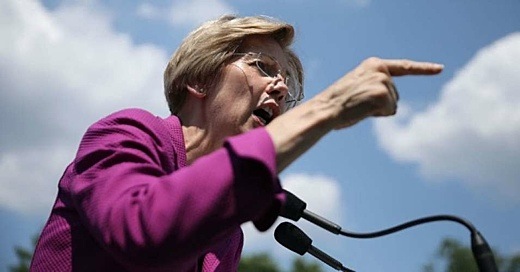
Image above: From ().

She says;  "The Democratic Party isn't going back to the days of welfare reform and the crime bill."

In a wide-ranging and fiery keynote speech last weekend at the 12th annual Netroots Nation conference in Atlanta, Georgia, Sen. Elizabeth Warren (D-Mass.) relentlessly derided moderate Democratic pundits calling for the party to move "back to the center" and declared that Democrats must unequivocally "fight for progressive solutions to our nation's challenges."

As The Hill's Amie Parnes reported on Friday, Warren's assertion during the weekend gathering that progressives are "the heart and soul of today's Democratic Party"—and not merely a "wing"—raised the ire of so-called "moderate" Democrats, who have insisted that progressive policies won't sell in swing states.

But recent survey results have consistently shown that policies like single-payer healthcare, progressive taxation, a higher minimum wage, and tuition-free public college are extremely popular among the broader electorate. Sen. Bernie Sanders (I-Vt.)—the most prominent advocate of an ambitious, far-reaching progressive agenda—has consistently polled as the most popular politician in the country.

For Warren, these are all indicators that those pining for a rightward shift "back to the center" are deeply mistaken.

Specifically, Warren took aim at a recent New York Times op-ed by Democratic commentators Mark Penn and Andrew Stein, who argued that Democrats must moderate their positions in order to take back Congress and, ultimately, the presidency.

Warren ridiculed this argument as a call for a return to Bill Clinton-era policies that "lock[ed] up non-violent drug offenders and ripp[ed] more holes in our economic safety net."

"The Democratic Party isn't going back to the days of welfare reform and the crime bill," Warren said. "We're not going back to the days of being lukewarm on choice.

We're not going back to the days when universal healthcare was something Democrats talked about on the campaign trail but were too chicken to fight for after they got elected."

"And," Warren concluded, "we're not going back to the days when a Democrat who wanted to run for a seat in Washington first had to grovel on Wall Street."

For months media outlets have speculated that Warren is gearing up for a 2020 presidential run, but she has denied the rumors.

Warren's remarks came as a large coalition of progressive groups is mobilizing during the congressional recess to pressure Democrats to formally endorse the "People's Platform," a slate of ambitious legislation that includes Rep. John Conyers' (D-Mich.) Medicare for All bill.


Video above: Watch Warren's full speech at Netroots Nation. From (https://youtu.be/Rc2D9pn8mjc).

.

Coming of the Post-Liberal Era

SUBHEAD: Clinton may still win the election, but the broader currents in American political life have changed.

By John Michael Greer on 28 September 2016 for the Archdruid Report -
(http://thearchdruidreport.blogspot.com/2016/09/the-coming-of-postliberal-era.html)

http://www.islandbreath.org/2016Year/09/160928drunkardsbig.jpg
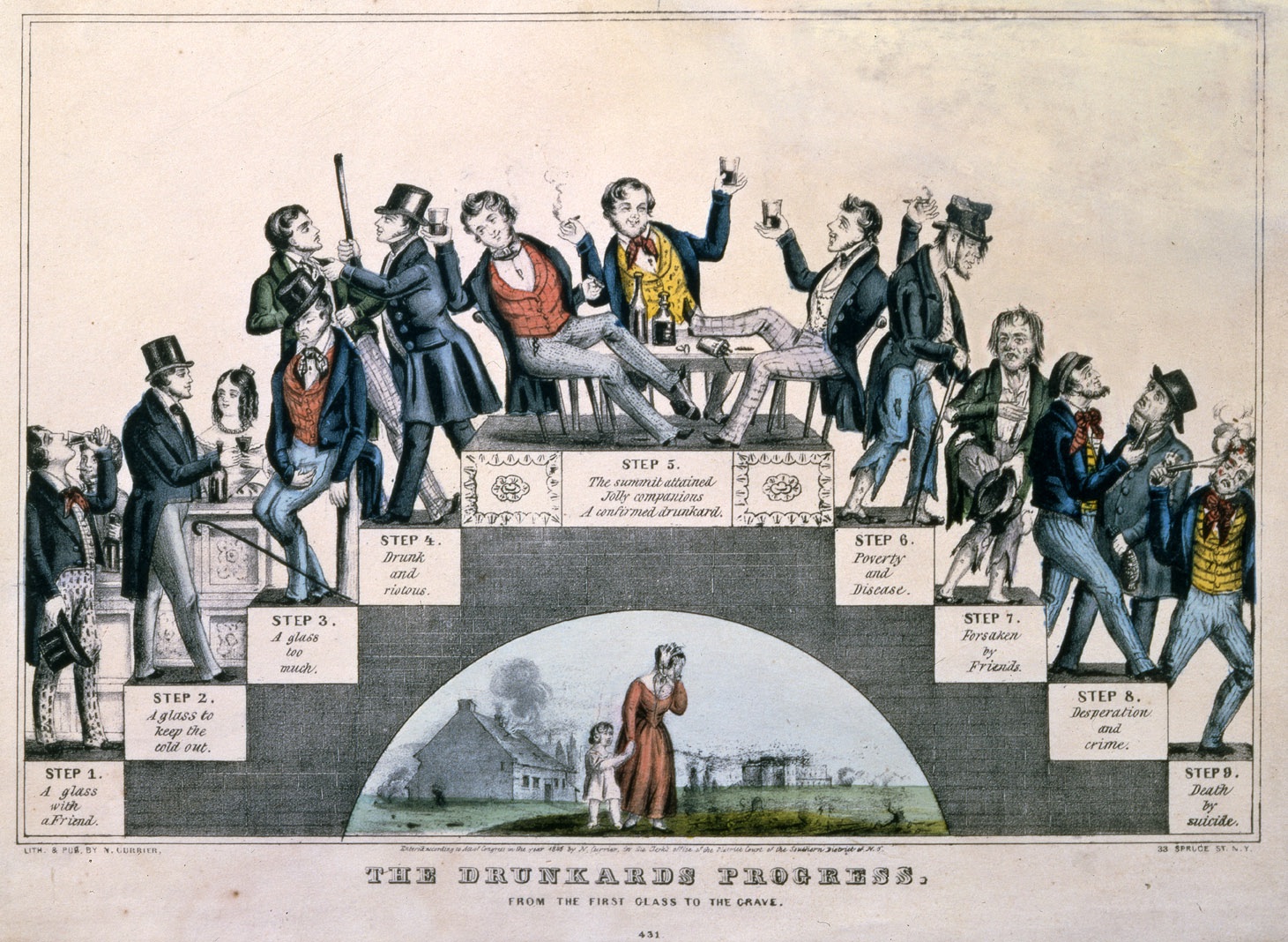
Image above: A poster supporting American temperance from alcohol, a Liberal goal in the 19th century. It's labeled "The Drunkard's Progress - From the First Glass to the Grave". Click to enlarge. From (http://www.americanyawp.com/text/10-religion-and-reform/).

One of the big challenges faced by any student of current events is that of seeing past the turmoil of the present moment to catch the deep trends shaping events on a broader scale.

It’s a little like standing on a beach, without benefit of tide tables, and trying to guess whether the tide’s coming in or going out.

Waves surge, break, and flow back out to sea; the wind blows this way and that; it takes time, and close attention to subtle details, before you can be sure whether the sea is gradually climbing the beach or just as gradually retreating from it.

Over the last year or so, though, it’s become increasingly clear to me that one of the great tides of American politics has turned and is flowing out to sea.

For almost precisely two hundred years, this country’s political discourse has been shaped—more powerfully, perhaps, than by any other single force—by the loose bundle of ideas, interests, and values we can call American liberalism. That’s the tide that’s turning.

The most important trends shaping the political landscape of our time, to my mind, are the descent of the liberal movement into its final decadence, and the first stirrings of the postliberal politics that is already emerging in its wake.

To make sense of what American liberalism has been, what it has become, and what will happen in its aftermath, history is an essential resource.

Ask a believer in a political ideology to define it, and you’ll get one set of canned talking points; ask an opponent of that ideology to do the same thing, and you’ll get another—and both of them will be shaped more by the demands of moment-by-moment politics than by any broader logic.

Trace that ideology from its birth through its adolescence, maturity, and decline into senescence, and you get a much better view of what it actually means.

Let’s go back, then, to the wellsprings of the American liberal movement. Historians have argued for a good long time about the deeper roots of that movement, but its first visible upsurge can be traced to a few urban centers in the coastal Northeast in the years just after the War of 1812.

Boston—nineteenth century America’s San Francisco—was the epicenter of the newborn movement, a bubbling cauldron of new social ideas to which aspiring intellectuals flocked from across the new Republic.

Any of my readers who think that the naive and effervescent idealism of the 1960s was anything new need to read Nathaniel Hawthorne’s The Blithedale Romance; it's set in the Massachusetts counterculture of the early nineteenth century, and most of the action takes place on a commune. That’s the context in which American liberalism was born.

From the very beginning, it was a movement of the educated elite.

Though it spoke movingly about uplifting the downtrodden, the downtrodden themselves were permitted very little active part in it. It was also as closely intertwined with Protestant Christianity as the movement of the 1960s was with Asian religions.

Ministers from the Congregationalist and Unitarian churches played a central role in the movement throughout its early years, and the major organizations of the movement—the Anti-Slavery Societies, the Temperance League, and the Non-Resistant League, the first influential American pacifist group—were closely allied with churches, and staffed and supported by clergymen.

Both the elitism and the Protestant Christian orientation, as we’ll see, had a powerful influence on the way American liberalism evolved over the two centuries that followed.

Three major social issues formed the framework around which the new movement coalesced.

The first was the abolition of slavery; the second was the prohibition of alcohol; the third was the improvement of the legal status of women. (The movement traversed a long and convoluted road before this latter goal took its ultimate form of legal and social equality between the genders.)

There were plenty of other issues that attracted their own share of attention from the movement—dietary reform, dress reform, pacifism, and the like—but all of them shared a common theme: the redefinition of politics as an expression of values.

Let’s take a moment to unpack that last phrase. Politics at that time, and at most other periods throughout human history, was understood as a straightforward matter of interests—in the bluntest of terms, who got what benefits and who paid what costs.

Then and for most of a century thereafter, for example, one of the things that happened in the wake of every Presidential election is that the winner’s party got to hand out federal jobs en masse to its supporters. It was called the “spoils system,” as in “to the victor belongs the spoils;” people flocked to campaign for this or that presidential candidate as much in the hope of getting a comfortable federal job as for anyother reason.

Nobody saw anything wrong with that system, because politics was about interests.

In the same way, there’s no evidence that anybody in the Constitutional Convention agonized about the ethical dimensions of the notorious provision that defined each slave as being 3/5ths of a person.

I doubt the ethical side of the matter ever crossed any of their minds, because politics was not about ethics or any other expression of values—it was about interests—and the issue was simply one of finding a compromise that allowed each state to feel that its interests would be adequately represented in Congress.

Values, in the thought of the time, belonged to church and to the private conscience of the individual; politics was about interests pure and simple.

(We probably need to stop here for a moment to deal with the standard response: “Yes, but they should have known better!” This is a classic example of chronocentrism.

Just as ethnocentrism privileges the beliefs, values, and interests of a particular ethnic group, chronocentrism does the same thing to the beliefs, values, and interests of a particular time.

Chronocentrism is enormously common today, on all sides of the political and cultural landscape; you can see it when scientists insist that people in the Middle Ages should have known better than to believe in astrology, for example, or when Christians insist that the old Pagans should have known better than to believe in polytheist religions. In every case, it’s simply one more attempt to evade the difficult task of understanding the past.)

Newborn American liberalism, though, rejected the division between politics and values. Their opposition to slavery, for example, had nothing to do with the divergent economic interests of the industrializing northern states and the plantation economy of the South, and everything to do with a devoutly held conviction that chattel slavery was morally wrong.

Their opposition to alcohol, to the laws that denied civil rights to women, to war, and to everything else on the lengthy shopping list of the movement had to do with moral values, not with interests. That’s where you see the impact of the movement’s Protestant heritage: it took values out of the church and tried to apply them to the world as a whole.

At the time, that was exotic enough that the moral crusades just mentioned got about as much political traction at the time as the colorful fantasies of the 1960s did in their own day.

Both movements were saved from complete failure by the impact of war. The movement of the 1960s drew most of its influence on popular culture from its opposition to the Vietnam War, which is why it collapsed nearly without a trace when the war ended and the draft was repealed. The earlier movement had to wait a while for its war, and in the meantime it very nearly destroyed itself by leaping on board the same kind of apocalyptic fantasy that kicked the New Age movement into its current death spiral four years ago.

In the late 1830s, frustrated by the failure of the perfect society to show up as quickly as they desired, a great many adherents of the new liberal movement embraced the prophecy of William Miller, a New England farmer who believed that he had worked out from the Bible the correct date of the Second Coming of Christ. When October 22, 1844 passed without incident, the same way December 21, 2012 did, the resulting “Great Disappointment” was a body blow to the movement.

By then, though, one of the moral crusades being pushed by American liberals had attracted the potent support of raw economic interest. The division between northern and southern states over the question of slavery was not primarily seen at the time as a matter of ethics; it was a matter of competing interests, like every other political question, though of course northern politicians and media were quick to capitalize on the moral rhetoric of the Abolitionists.

At issue was the shape of the nation’s economic future.

Was it going to be an agrarian society producing mostly raw materials for export, and fully integrated into a global economy centered on Britain—the southern model? Or was it going to go its own way, raise trade barriers against the global economy, and develop its own industrial and agricultural economy for domestic consumption—the northern model?

Such questions had immediate practical implications, because government policies that favored one model guaranteed the ruin of the other. Slavery was the linchpin of the Southern model, because the big southern plantations required a vast supply of labor at next to no cost to turn a profit, and so it became a core issue targeted by northern politicians and propagandists alike.

Read detailed accounts of the struggles in Congress between northern and southern politicians, though, and you’ll find that what was under debate had as much to do with trade policy and federal expenditures.

Was there to be free trade, which benefited the South, or trade barriers, which benefited the North? Was the federal budget to pay for canals and roads, which benefited northern interests by getting raw materials to factories and manufactured products to markets, but were irrelevant to southern interests, which simply needed riverboats to ship cotton and tobacco to the nearest seaport?

Even the bitter struggles over which newly admitted states were to have slave-based economies, and which were not, had an overwhelming economic context in the politics of the time.

The North wanted to see the western territories turned into a patchwork of family farms, producing agricultural products for the burgeoning cities of the eastern seaboard and the Great Lakes and buying manufactured goods from northern factories; the South wanted to see those same territories made available for plantations that would raise products for export to England and the world.

Yet the ethical dimension became central to northern propaganda, as already noted, and that helped spread the liberal conviction that values as well as interests had a place in the political dialogue.

By 1860, that conviction had become widespread enough that it shaped thinking south of the Mason-Dixon line. As originally written, for example, the first line of the Confederate song “The Bonny Blue Flag” ran “fighting for the property we won by honest toil”—and no one anywhere had any illusions about the identity, or skin color, of the property in question.

Before long, though, it was rewritten as “fighting for our liberty, with treasure, blood and toil.” The moment that change occurred, the South had already lost; it’s entirely possible to argue for slavery on grounds of economic interest, but once the focus of the conversation changes to values such as liberty, slavery becomes indefensible.

So the Civil War raged, the Confederacy rose and fell, the Northern economic model guided American economic policy for most of a century thereafter, and the liberal movement found its feet again.

With slavery abolished, the other two primary goals took center stage, and the struggle to outlaw alcohol and get voting rights for women proceeded very nearly in lockstep.

The 18th Amendment, prohibiting the manufacture and sale of alcohol in the US, and the 19th Amendment, granting women the right to vote, were passed in 1919 and 1920 respectively, and even though Prohibition turned out to be a total flop, the same rhetoric was redirected toward drugs (most were legal in the US until the 1930s) and continues to shape public policy today.

Then came the Great Depression, and with the election of Franklin Roosevelt in 1932—and above all with his landslide reelection victory in 1936, when the GOP carried only two states—the liberal movement became the dominant force in American political life.

Triumph after triumph followed. The legalization of unions, the establishment of a tax-funded social safety net, the forced desegregation of the South: these and a galaxy of other reforms on the liberal shopping list duly followed.

The remarkable thing is that all these achievements took place while the liberal movement was fighting opponents from both sides.

To the right, of course, old-fashioned conservatives still dug in their heels and fought for the interests that mattered to them, but from the 1930s on, liberals also faced constant challenge from further left.

American liberalism, as already mentioned, was a movement of the educated elite; it focused on helping the downtrodden rather than including them; and that approach increasingly ran into trouble as the downtrodden turned out to have ideas of their own that didn’t necessarily square with what liberals wanted to do for them.

Starting in the 1970s, in turn, American liberalism also ended up facing a third source of challenges—a new form of conservatism that borrowed the value-centered language of liberalism but used a different set of values to rally support to its cause: the values of conservative Protestant Christianity.

In some ways, the rise of the so-called “new conservatism” with its talk about “family values” represented the final, ironic triumph of the long struggle to put values at the center of political discourse.

By the 1980s, every political faction in American public life, no matter how crass and venial its behavior or its goals, took care to festoon itself with some suitable collection of abstract values. That’s still the case today; nobody talks about interests, even when interests are the obvious issue.

Thus you get the standard liberal response to criticism, which is to insist that the only reason anyone might possibly object to a liberal policy is because they have hateful values.

Let’s take current US immigration policy as an example. This limits the number of legal immigrants while tacitly allowing unlimited illegal immigration. There are solid pragmatic reasons for questioning the appropriateness of that policy.

The US today has the highest number of permanently unemployed people in its history, incomes and standards of living for the lower 80% of the population have been moving raggedly downward since the 1970s, and federal tax policies effectively subsidize the offshoring of jobs.

That being the case, allowing in millions of illegal immigrants who have, for all practical purposes, no legal rights, and can be employed at sweatshop wages in substandard conditions, can only drive wages down further than they’ve already gone, furthering the impoverishment and immiseration of wage-earning Americans.

These are valid issues, dealing with (among other things) serious humanitarian concerns for the welfare of wage-earning Americans, and they have nothing to do with racial issues—they would be just as compelling if the immigrants were coming from Canada.

Yet you can’t say any of this in the hearing of a modern American liberal. If you try, you can count on being shouted down and accused of being a racist.

Why? I’d like to suggest that it’s because the affluent classes from which the leadership of the liberal movement is drawn, and which set the tone for the movement as a whole, benefit directly from the collapse in wages that has partly been caused by mass illegal immigration, since that decrease in wages has yielded lower prices for the goods and services they buy and higher profits for the companies for which many of them work, and whose stocks many of them own.

That is to say, a movement that began its history with the insistence that values had a place in politics alongside interests has ended up using talk about values to silence discussion of the ways in which its members are pursuing their own interests.

That’s not a strategy with a long shelf life, because it doesn’t take long for the other side to identify, and then exploit, the gap between rhetoric and reality.

Ironies of this sort are anything but unusual in political history. It’s astonishingly common for a movement that starts off trying to overturn the status quo in the name of some idealistic abstraction or other to check its ideals at the door once it becomes the status quo.

If anything, American liberalism held onto its ideals longer than most and accomplished a great deal more than many, and I think that most of us—even those who, like me, are moderate Burkean conservatives—are grateful to the liberal movement of the past for ending such obvious abuses as chattel slavery and the denial of civil rights to women, and for championing the idea that values as well as interests deserve a voice in the public sphere.

It deserves the modern equivalent of a raised hat and a moment of silence, if no more, as it finally sinks into the decadence that is the ultimate fate of every successful political movement.

The current US presidential election shows, perhaps better than anything else, just how far that decadence has gone. Hillary Clinton’s campaign is floundering in the face of Trump’s challenge because so few Americans still believe that the liberal shibboleths in her campaign rhetoric mean anything at all.

Even among her supporters, enthusiasm is hard to find, and her campaign rallies have had embarrassingly sparse attendance.

Increasingly frantic claims that only racists, fascists, and other deplorables support Trump convince no one but true believers, and make the concealment of interests behind shopworn values increasingly transparent.

Clinton may still win the election by one means or another, but the broader currents in American political life have clearly changed course.

It’s possible to be more precise. Bernie Sanders and Donald Trump, in stark contrast to Clinton, have evoked extraordinarily passionate reactions from the voters, precisely because they’ve offered an alternative to a status quo pervaded by the rhetoric of a moribund liberalism.

In the same way, in Britain—where the liberal movement followed a somewhat different trajectory but has ended up in the same place—the success of the Brexit campaign and the wild enthusiasm with which Labour Party voters have backed the supposedly unelectable Jeremy Corbyn show that the same process is well under way there.

Having turned into the captive ideology of an affluent elite, liberalism has lost the loyalty of the downtrodden that once, with admittedly mixed motives, it set out to help. That’s a loss it’s unlikely to survive.

Over the decades ahead, in other words, we can expect the emergence of a postliberal politics in the United States, England, and quite possibly some other countries as well.

The shape of the political landscape in the short term is fairly easy to guess.

Watch the way the professional politicians in the Republican Party have flocked to Hillary Clinton’s banner, and you can see the genesis of a party of the affluent demanding the prolongation of free trade, American intervention in the Middle East, and the rest of the waning bipartisan consensus that supports its interests.

Listen to the roars of enthusiasm for Bernie Sanders and Donald Trump—or better still, talk to the not inconsiderable number of Sanders supporters who will be voting for Trump this November—and you can sense the emergence of a populist party seeking the abandonment of that consensus in defense of its very different interests.

What names those parties will have is by no means certain yet, and a vast number of other details still have to be worked out. One way or another, though, it’s going to be a wild ride.

.

Labour Party supports Corbyn

SUBHEAD: Despite sabotage and dirty tricks, he wins party leadership race in unprecedented landslide.

By Cory Doctorow on 24 September 2016 for Boing Boing -
(http://boingboing.net/2016/09/24/despite-sabotage-and-dirty-tri.html)


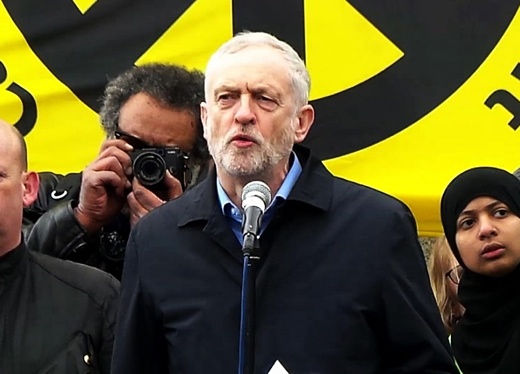
Image above: Jeremy Corbyn accepting party vote victory. From original article.

It's been just over a year since Jeremy Corbyn won the UK Labour Party leadership race with the biggest margin in history -- an avowed socialist who would reverse the party's years of special gifts to the UK's legendarily corrupt finance sector, fight mass surveillance, pull out of secretive trade deals -- a frugal man who walked his talk.

Almost immediately, his own party began sabotaging him, from the top on down, culminating in the mass-disenfranchisement of Corbyn supporters through an after-hours, non-agenda vote, which the party grandees doubled down on by spending the money those disenfranchised members had paid to appeal their decision to higher and higher courts.

In parallel, the UK press unilaterally declared Labour's most-popular-ever leader to be "unelectable" and did everything they could to sideline, belittle and dismiss him and his supporters, even as the UK Tories were leading the country to disaster through their Brexit vote.

So it is nothing short of a miracle that Corbyn has won the leadership race, and that, moreover, he has increased his lead, beyond last year's landslide, with a higher voter turnout than ever.

Corbyn's pledged to unite Labour (something that will require cooperation from the bankster-friendly, warmongering, surveillance-addicted party establishment) and promised not to retaliate against the party execs and elected leaders who tried to sabotage his leadership.
Mr Corbyn was first elected Labour leader in September 2015, when he beat three other candidates and got 59.5% of the vote.

Turnout was higher this time around, with 77.6% of the 654,006 eligible party members, trade union members and registered supporters - 506,438 in total - confirmed as taking part.

Mr Corbyn won comfortably in each of the three categories - winning the support of 59% of party members, 70% of registered supporters and 60% of affiliated supporters.

Party members - Jeremy Corbyn (168,216); Owen Smith (116,960)
Registered supporters - Corbyn (84,918); Smith (36,599)
Affiliated supporters - Corbyn (60,075); Smith (39,670)

Despite winning the leadership in a vote of the wider membership and registered supporters last year Mr Corbyn, who spent three decades as part of a marginalised leftwing group of Labour MPs in Parliament, has never had the support of more than about 20% of Labour's MPs.

.

Sanders to fight DNC over TPP

SUBHEAD: The trade agreement is opposed by virtually the entire grassroots base of the Democratic Party.

By Deidre Fulton on 3 July 2016 for Common Dreams  -
(http://www.commondreams.org/news/2016/07/03/sanders-organizing-grassroots-push-against-tpp-dnc-platform-meeting)


Image above: Bernie Sanders makes a point at the podium. From original article.

Environmentalists oppose it. So do labor unions, medical professionals, and major religious groups, as well as every leading presidential candidate.

So why hasn't the Democratic Party gone on record opposing the Trans Pacific Partnership (TPP)?
That's what Bernie Sanders wants to know.

Noting that the deal "is opposed by virtually the entire grassroots base of the Democratic Party," Sanders said Sunday he will reintroduce an amendment rejecting the TPP at next weekend's full Democratic Platform Committee meeting in Orlando, Florida.

In an op-ed published in the Philadelphia Inquirer, Sanders praised the platform drafting committee for including "some very positive provisions" in the final draft released Friday.

"At a time when huge Wall Street financial institutions are bigger now than they were before the taxpayers of this country bailed them out, the platform calls for enacting a 21st-century Glass-Steagall Act and for breaking up too-big-to-fail banks," Sanders wrote.

"The platform calls for a historic expansion of Social Security, closes loopholes that allow corporations to avoid paying taxes, creates millions of jobs rebuilding our crumbling infrastructure, makes it easier for workers to join unions, takes on the greed of the pharmaceutical companies, ends disastrous deportation raids, bans private prisons and detention centers, abolishes the death penalty, moves to automatic voter registration and the public financing of elections, eliminates super PACs, and urges passage of a constitutional amendment to overturn Citizens United, among many other initiatives," he continued—all provisions where Sanders' influence was in evidence.

However, Sanders wrote, "there were a number of vitally important proposals brought forth by the delegates from our campaign that were not adopted." These included a national ban on fracking, a carbon tax, and clear language on corporate-friendly "free trade" agreements like the TPP.

To that end, Sanders said he will offer an amendment in Florida "to make it clear that the Democratic Party is strongly opposed to the Trans-Pacific Partnership" and to ensure the deal doesn't come up for a vote during the lame-duck session of Congress.

"My hope is that a grassroots movement of working people, environmentalists, and human-rights advocates will work with us to demand that the Democratic Party include these initiatives in the platform to be adopted by the full committee in Orlando," he wrote.

As Sanders and others observed last week, by tacitly backing the TPP, the drafting committee was not only working against the party, but undermining Clinton's own stated position.
Indeed, Sanders wrote in the Inquirer op-ed:
Frankly, I do not understand why the amendment our delegates offered on this issue in St. Louis was defeated with all of Hillary Clinton's committee members voting against it. I don't understand that because Clinton, during the campaign, made it very clear that she did not want to see the TPP appear on the floor during the lame-duck session.

If both Clinton and I agree that the TPP should not get to the floor of Congress this year, it's hard to understand why an amendment saying so would not be overwhelmingly passed.
The full 187-member Platform Committee meets in Orlando ahead of the Democratic National Convention, which will ratify the platform, at the end of the month.

.

The Potemkin Party

SUBHEAD: That Democrats tolerate entities like WalMart is an argument for the bankruptcy of the party.

By James Kunstler on 27 July 2015 for Kunstler.com -
(http://kunstler.com/clusterfuck-nation/potemkin-party/)


Image above: A bomb scare at the Walmart in Lihue, Kauai, Hawaii in May of 2014. From (http://www.kitv.com/news/Lihue-Walmart-evacuated-after-bomb-threat/25800944).

How many of you brooding on the dreadful prospect of Hillary have chanced to survey what remains of Democratic Party (cough cough) leadership in the background of Her Royal Inevitableness? Nothing is the answer. Zip. Nobody. A vacuum. 

There is no Democratic Party anymore. There are no figures of gravitas anywhere to be found, no ideas really suited to the American prospect, nothing with the will to oppose the lumbering parasitic corporatocracy that is doing little more than cluttering up this moment in history while it sucks the last dregs of value from our society.
 
I say this as a lifelong registered Democrat but a completely disaffected one — who regards the Republican opposition as the mere errand boy of the above-named lumbering parasitic corporatocracy. Readers are surely chafing to insert that the Democrats have been no less errand boys (and girls) for the same disgusting zeitgeist, and they are surely correct in the case of Hillary, and indeed of the current President.

Readers are surely also chafing to insert that there is Bernie Sanders, climbing in the opinion polls, disdaining Wall Street money, denouncing the current disposition of things with the old union hall surliness we’ve grown to know and love. 

 I’m grateful that Bernie is in the race, that he’s framing an argument against Ms. It’s My Turn. I just don’t happen to think that Bernie gets what the country — indeed what all of techno-industrial society — is really up against, namely a long emergency of economic contraction and collapse.

These circumstances require a very different agenda than just an I Dreamed I Saw Joe Hill redistributionist scheme. Lively as Bernie is, I don’t think he offers much beyond that, as if cadging a little more tax money out of WalMart, General Mills, and Exxon-Mobil will fix what is ailing this sad-ass polity. The heart of the matter is that our way of life has shot its wad and now we have to live very differently. Almost nobody wants to even try to think about this.

I hugely resent the fact that the Democratic Party puts its time and energy into the stupid sexual politics of the day when it should be working on issues such as re-localizing commercial economies (rebuilding Main Streets), reforming agriculture to avoid the total collapse of corporate-industrial farming, and fixing the passenger rail system so people will have some way to get around the country when happy Motoring dies (along with commercial aviation).

The “to do” list for rearranging the basic systems of daily life in America is long and loaded with opportunity. Every system that is retooled contains jobs and social roles for people who have been shut out of the economy for two generations. If we do everything we can to promote smaller-scaled local farming, there will be plenty of work for lesser-skilled people to do and get paid for. 

Saying goodbye to the tyranny of Big Box commerce would open up vast vocational opportunities in reconstructed local and regional networks of commerce, especially for young people interested in running their own business. 

We need to prepare for localized clinic-style medicine (in opposition to the continuing amalgamation and gigantization of hospitals, with its handmaidens of Big Pharma and the insurance rackets). The train system has got to be reborn as a true public utility.

 Just about every other civilized country is already demonstrating how that is done — it’s not that difficult and it would employ a lot of people at every level. That is what the agenda of a truly progressive political party should be at this moment in history.

That Democrats even tolerate the existence of evil entities like WalMart is an argument for the ideological bankruptcy of the party. Democratic Presidents from Carter to Clinton to Obama could have used the Department of Justice and the existing anti-trust statutes to at least discourage the pernicious monopolization of commerce that Big Boxes represented. 

By the same token, President Obama could have used existing federal law to break up the banking oligarchy starting in 2009, not to mention backing legislation to more crisply define alleged corporate “personhood” in the wake of the ruinous “Citizens United” Supreme Court decision of 2010. They don’t even talk about it because Wall Street owns them.

So, you fellow disaffected Democrats — those of you who can’t go over to the other side, but feel you have no place in your country’s politics — look around and tell me who you see casting a shadow on the Democratic landscape. Nobody. Just tired, corrupt, devious old Hillary and her nemesis Bernie the Union Hall Champion out of a Pete Seeger marching song.

I’ve been saying for a while that this period of history resembles the 1850s in America in two big ways: 1) our society faces a crisis, and 2) the existing political parties are not up to the task of comprehending what society faces. In the 1850s it was the Whigs that dried up and blew away (virtually overnight), while the old Democratic party just entered a 75-year wilderness of irrelevancy. God help us if Trump-o-mania turns out to be the only alternative.

Oh, by the way, notice that the lead editorial in Monday’s New York Times is a plea for transgender bathrooms in schools. What could be more important? For Transgender Americans, Legal Battles Over Restrooms

IB Publisher's Note:
Grigory Potemkin was a Russian military leader, statesman, nobleman and favourite of Catherine the Great. The phrase "Potemkin village" was originally used to describe a fake portable village, built only to impress. According to the story, Grigory Potemkin erected the fake portable settlement along the banks of the Dnieper River in order to fool Empress Catherine II during her journey to Crimea in 1787. The phrase is now used, typically in politics and economics, to describe any construction (literal or figurative) built solely to deceive others into thinking that some situation is better than it really is. Some modern historians claim the original story is exaggerated.


.

2014 Election Hangover

SUBHEAD: Not all is lost. We can be thankful for Maui's passing its GMO Moratorium Initiative.

By Juan Wilson on 5 November 2014 for Island Breath -
(http://islandbreath.blogspot.com/2014/11/election-hangover.html)


Image above: A grocery store employee wipes down a soup bar with a display informing customers of organic, GMO-free oils, in Boulder, Colorado Thursday, Oct. 23, 2014. From
(http://www.npr.org/blogs/thetwo-way/2014/11/05/361586991/gmo-labeling-colorado-voters-reject-food-measure-maui-voters-approve).

After the millions of dollars spent by Monsanto and DOW to snuff the GMO Moratorium Initiative on the Maui County ballot we can be cheered. But this national election has bitter taste and acrid stink to it.

As examples, the voters in Colorado and Oregon did not support their GMO labeling legislation. See  (http://grist.org/politics/food-votes-gmo-labels-rejected-in-colorado-probably-oregon-berkeley-taxes-soda/). Republican peak energy and climate change deniers now control the US House and Senate. See (http://www.nytimes.com/2014/11/05/us/politics/midterm-elections.html).

In general America has finally made some real progress on legislation on gay rights and the  decriminalization of marijuana. But we really are in denial about the near future regarding to our  economy, energy, food security and environment.

The 2014 election could be compared with the 1980 election when Ronald Reagan led a wide reactionary victory. At the end of the Jimmy Carter presidency America was in deep denial about the energy crisis that had emerged in the 1970s and the stagflation that had become a symptom of an America passed its peak.

Reagan's slogan "It's morning in America" was a rejection of the initial steps to conserve energy and live within the means of the environment that was identifed with hippie and alternative social movements. Reagan's neoconservative agenda and has had lasting negative ramifications to this day. It's advocates like Rumsfeld, Bush, and Cheney have left still festering wounds.

The 2014 election's shift to the "right" is again a reactionary rejection symptomatic of self denial and self delusion. Our closest allies, the European Union and Japan are in the same boat. The ponzi schemes of paying off debt with more debt is over. Now the transfer of wealth from the bottom of the social pyramid is well under way.   

Kauai County Voting
To see a full accounting of the fourth count of votes on Kauai click on this link (www.islandbreath.org/2014Year/11/141105cok.pdf).

Kauai Mayor
Here on Kauai the mayoral election was not surprisingly won by the incumbent Bernard Carvalho with 14,688 votes. His challenger was Dustin Barca, a retired professional surfer and martial arts practitioner. He did better than many thought. He got more than half of Carvalho's numbers with 8,195 votes. Barca's most important qualification for the office was his rejection of GMOs on Kauai and in your diet.

Kauai Council
The top vote-getters were three who will strongly support GMO corporate interests. The top two who were incumbents, Mel Rapozo and Ross Kagawa, who already have a bill in motion to overturn the Bill 2491 that set down regulations on GMO company pesticide experimentation. Kaneshiro will follow that effort.

If you look at this list of seven council winners from highest to lowest vote-getters it looks a gradient from most conservative to most liberal. In the middle is Kipukai Kualii. He has stumbled politically in the past. As the swing vote on the council he has a great responsibility to tip the balance of power to the greater long term interest of Kauai.

Names of winning candidates Votes Percent
RAPOZO, Mel 13,147 7.8%
KAGAWA, Ross K. 12,387 7.4%
KANESHIRO, Arryl 11,971 7.1%
KUALII, KipuKai 9,985 5.9%
YUKIMURA, JoAnn 8,941 5.3%
CHOCK, Mason 8,730 5.2%
HOOSER, Gary 8,257 4.9%

I'm sorry incumbent Jay Furfaro lost his Chairmanship of the Council to Mel Rapozo. I did not always agree with Jay, but I he did a heroic job leading the council through the controversial 2492 testimony and voting. He calmed what may have turned into violence when it mattered.

I'm also sorry that incumbent Tim Bynum lost to someone like Ross Kagawa. Tim became a better councilman over time . He strongly supported 2491 and other environmental issues. Ross Kagawa often seems confused and uninformed.

It is too bad that Felicia Cowden did not get enough votes to displace establishment shill Arryl Kaneshiro. She would have been a breath of fresh air on the council. But Furfaro, Bynum and Cowden lost... and Kauai will be a different and nastier place because of it.

Names of losing candidates     Votes Percent
FURFARO, Jay   8,165 4.9%
BRUN, Arthur 8,120 4.8%
PERRY, Darryl 8,076 4.8%
COWDEN, Felicia      7,917 4.7%
BYNUM, Tim 7,602 4.5%
DeCOSTA, Billy 7,243 4.3%
LARANIO, Tiana  5,665 3.4%

.

Neo-Nazi Ukrainia

SUBHEAD: The Ukrainian government falls to Right Sector by intrigue, violence and stupidity.

By Paul Craig Roberts on 26 February 2014 for PaulCraigRoberts.org -
(www.paulcraigroberts.org/2014/02/26/ukrainian-neo-nazis-declare-power-comes-barrels-guns/)


Image above: Here we see a right-wing battalion of Patriots of Ukraine paramilitaries tooled up in the midst of the protests in Kiev. Note the Neo-Nazi symbol on armbands. From (http://imgur.com/a/1ghhi/).

Reality on the ground in Ukraine contradicts the incompetent and immoral Obama regime’s portrait of Ukrainian democracy on the march.

To the extent that government exists in post-coup Ukraine, it is laws dictated by gun and threat wielding thugs of the neo-Nazi, Russophobic, ultra-nationalist, right-wing parties. Watch the video of the armed thug, Aleksandr Muzychko, who boosts of killing Russian soldiers in Chechnya, dictating to the Rovno regional parliament a grant of apartments to families of protesters. http://rt.com/news/radical-opposition-intimidating-techniques-882/

Read about the neo-nazis intimidating the Central Election Commission in order to secure rule and personnel changes in order to favor the ultra-right in the forthcoming elections. Thug Aleksandr Shevchenko informed the CEC that armed activists will remain in CEC offices in order to make certain that the election is not rigged against the neo-nazis. What he means, of course, is the armed thugs will make sure the neo-nazis win. If the neo-nazis don’t win, the chances are high that they will take power regardless.

Members of President Yanukovich’s ruling party, the Party of Regions, have been shot, had arrest warrants issued for them, have experienced home invasions and physical threats, and are resigning in droves in hopes of saving the lives of themselves and their families. The prosecutor’s office in the Volyn region (western Ukraine) has been ordered by ultra-nationalists to resign en masse .

Jewish synagogs and Eastern Orthodox Christian churches are being attacked.

To toot my own horn, I might have been the first and only to predict that Washington’s organization of pro-EU Ukrainian politicians into a coup against the elected government of Ukraine would destroy democracy and establish the precedent that force prevails over elections, thereby empowering the organized and armed extreme right-wing.

This is precisely what has happened. Note that there was no one in the Obama regime who had enough sense to see the obvious result of their smug, self-satisfied interference in the internal affairs of Ukraine.

If a democratically elected president and ruling party are so easily driven from power by armed neo-nazis, what chance do Washington’s paid stooges among the so-called “moderates” have of forming a government? These are the corrupt people who wanted President Yanukovich out of office so that they could take the money instead. The corruption charge against Yanukovich was cover for the disloyal, undemocratic “moderate” schemers to seize power and be paid millions of dollars by Washington for taking Ukraine into the EU and NATO.

The Washington-paid schemers are now reaping their just reward as they sit in craven silence while neo-nazi Muzychko wielding an Ak-47 challenges government officials to their face: “I dare you take my gun!”

Only Obama, Susan Rice, Victoria Nuland, Washington’s European puppets, and the Western prostitute media can describe the brutal reality of post-coup Ukraine as “the forward march of democracy.”

The West now faces a real mess, and so does Russia. The presstitutes will keep the American public from ever knowing what has happened, and the Obama regime will never admit it. It is not always clear that even the Russians want to admit it. The intelligent, reasonable, and humane Russian Foreign Minister, a person 100 cuts above the despicable John Kerry, keeps speaking as if this is all a mistake and appealing to the Western governments to stand behind the agreement that they pressured President Yanukovich to sign.

Yanukovich is history, as are Washington’s “moderates.” The moderates are not only corrupt; they are stupid. The fools even disbanded the Riot Police, leaving themselves at the mercy of the armed right-wing nazi thugs.

Ukraine is out of control. This is what happens when an arrogant, but stupid, Assistant Secretary of State (Victoria Nuland) plots with an equally arrogant and stupid US ambassador (Pyatt) to put their candidates in power once their coup against the elected president succeeds. The ignorant and deluded who deny any such plotting occurred can listen to the conversation between Nuland and Pyatt here:
http://www.youtube.com/watch?v=MSxaa-67yGM&feature=player_embedded

The situation will almost certainly lead to war. Only Putin’s diplomatic skills could prevent it. However, Putin has been demonized by Washington and the whores who comprise the US print and TV media. European and British politicians would have their Washington paychecks cut off if they aligned with Putin.

War is unavoidable, because the Western public is out to lunch. The more facts and information I provide, the more emails I receive defending the “sincere [and well paid] protesters’ honest protests against corruption,” as if corruption were the issue. I hear from Ukrainians and from those of Ukrainian ethnicity in Canada and the US that it is natural for Ukrainians to hate Russians because Ukrainians suffered under communism, as if suffering under communism, which disappeared in 1991, is unique to Ukrainians and has anything to do with the US coup that has fallen into neo-nazi hands,

No doubt. Many suffered under communism, including Russians. But was the suffering greater than the suffering of Japanese civilians twice nuked by the “Indispensable people,” or the suffering by German civilians whose cities were firebombed, like Tokyo, by the “exceptional people”?

Today Japan and Germany are Washington’s puppet states. In contrast, Ukraine was an independent country with a working relationship with Russia. It was this relationship that Washington wished to destroy.

Now that a reckless and incompetent Washington has opened Pandora’s Box, more evil has been released upon the world. The suffering will not be confined to Ukraine.

There are a number of reasons why the situation is likely to develop in a very bad way. One is that most people are unable to deal with reality even when reality directly confronts them. When I provide the facts as they are known, here are some of the responses I receive: “You are a Putin agent;” “you hate Ukrainians;” “you are defending corruption;” “you must not know how Ukrainians suffered at the hands of Stalin.”

Of course, having done Russian studies in graduate school, having been a member of the US-USSR student exchange program in 1961, having traveled in Russia, Georgia, Ukraine, and Uzbekistan, having published in scholarly journals of Slavic and Russian studies, having twice addressed the Soviet Academy of Sciences, having been invited to explain to the CIA why the Soviet economic collapse occurred despite the CIA’s predictions to the contrary, I wouldn’t know anything about how people suffered under communism. The willingness of readers to display to me their utter ignorance and stupidity is astonishing. There is a large number of people who think reality consists of their delusions.

Reality is simply too much for mentally and emotionally weak people who are capable of holding on to their delusions in the face of all evidence to the contrary. The masses of deluded people and the total inability of Washington, wallowing it its hubris, to admit a mistake, mean that Washington’s destabilization of Ukraine is a problem for us all.

RT reports that “Russian President Vladimir Putin has ordered an urgent military drill to test combat readiness of the armed forces across western and central Russia.” According to Russia’s Defense Minister, the surprise drill tested ground troops, Air Force, airborne troops and aerospace defense. http://rt.com/news/putin-drill-combat-army-864/

The Defense Minister said: “The drills are not connected with events in Ukraine at all.”

Yes, of course. The Defense Minister says this, because Putin still hopes that the EU will come to its senses. In my opinion, and I hope I am wrong, the European “leaders” are too corrupted by Washington’s money to have any sense. They are bought-and-paid-for. Nothing is important to them but money.

Ask yourself, why does Russia need at this time an urgent readiness test unrelated to Ukraine? Anyone familiar with geography knows that western and central Russia sit atop Ukraine.

Let us all cross our fingers that another war is not the consequence of the insouciant American public, the craven cowardice of the presstitute media, Washington’s corrupt European puppets, and the utter mendacity of the criminals who rule in Washington.


Democracy murdered by protest
SUBHEAD: The Ukrainian government falls to Right Sector by intrigue, violence and stupidity.

By Paul Craig Roberts on 23 February 2014 for World News -
(http://worldnewstrust.com/democracy-murdered-by-protest-ukraine-falls-to-intrigue-and-violence-paul-craig-roberts)


Certainly not the bought-and-paid-for-moderates that Washington and the EU hoped to install as the new government of Ukraine.

The agreement that the Washington- and EU-supported opposition concluded with President Yanukovich to end the crisis did not last an hour. Even the former boxing champion, Vitaly Klitschko, who was riding high as an opposition leader until a few hours ago has been booed by the rioters and shoved aside.

The newly appointed president by what is perhaps an irrelevant parliament, Oleksandr Turchynov, has no support base among those who overthrew the government. As the BBC reports, “like all of the mainstream opposition politicians, Mr. Turchynov is not entirely trusted or respected by the protesters in Kiev’s Independence Square.”

In western Ukraine the only organized and armed force is the ultra-nationalist Right Sector. From the way this group’s leaders speak, they assume that they are in charge. One of the group’s leaders, Aleksandr Muzychko, has pledged to fight against “Jews and Russians until I die.”

Asserting the Right Sector’s authority over the situation, Muzychko declared that now that the democratically elected government has been overthrown, “there will be order and discipline” or “Right Sector squads will shoot the bastards on the spot.”

The bastards are any protesters who dare to protest the Right Sector’s control.

Muzychko declared, “The next president of Ukraine will be from Right Sector.”

Another Right Sector leader, Dmitry Yarosh, declared: “The Right Sector will not lay down its arms.” He declared the deal made between the opposition and the President to be “unacceptable” and demanded the liquidation of President Yanukovich’s political party.

The Right Sector’s roots go back to the Ukrainians who fought for Adolf Hitler against the Soviet Union during World War II. It was the Right Sector that introduced armed fighters and turned the tide of the protests in Kiev from peaceful protests in favor of joining the EU to violent attacks on police with the view of overthrowing the democratically elected government, which the Right Sector succeeded in doing.

The Right Sector did not overthrow the Ukraine government in order to deliver it into the hands of the Washington and EU paid “opposition.”

There is a tendency to discount the Right Sector as a small fringe group, but the Right Sector not only took control of the protests away from the Western supported moderates, as moderate leaders themselves admitted, but also the Right Sector has enough public support to destroy the national monument to the Red Army soldiers who died liberating Ukraine from Nazi Germany.

Unlike the U.S.-orchestrated toppling of the stature of Saddam Hussein, which was a PR event for the presstitutes in which Iraqis themselves were not involved, Ukrainian rightists’ destruction of the monument commemorating the Red Army’s liberation of the Ukraine had public support.

If the Right Sector hates Russians for defeating the Nazis, the Right Sector also hates the United States, France, and England for the same reason. The Right Sector is an unlikely political party to take Ukraine into the EU.

The Russian parts of Ukraine clearly understand that the Right Sector’s destruction of the monument commemorating the stand of the Red Army against the German troops is a threat against the Russian population of Ukraine. Provincial governments in eastern and southern Ukraine that formerly were part of Russia are organizing militias against the ultra-nationalist threat unleashed by Washington’s stupidity and incompetence and by the naive and gullible Kiev protesters.

Having interfered in Ukraine’s internal affairs and lost control, Washington is now issuing ultimatums to Russia not to interfere in Ukraine. Does the idiot Susan Rice, Obama’s neoconservative National Security Adviser, think Putin is going to pay any attention to her ultimatums or to any instruction from a government so militarily incompetent that it was unable to successfully occupy Baghdad after 8 years or to defeat a few thousand lightly armed Taliban after 12 years?

In only took a few hours for Russian troops to destroy the American- and Israeli-trained and armed Georgian army that Washington sent to invade South Ossetia.

Where does Obama find morons like Susan Rice and Victoria Nuland? These two belong in a kindergarten for mentally handicapped children, not in the government of a superpower where their ignorance and arrogance can start World War III.

Ukraine is far more important to Russia than it is to the United States or EU. If the situation in Ukraine spirals out of control and right-wing extremists seize control, Russian intervention is certain. The arrogant and stupid Obama regime has carelessly and recklessly created a direct strategic threat to the existence of Russia.

According to the Moscow Times, this is what a senior Russian official has to say: “If Ukraine breaks apart, it will trigger a war.” Ukraine “will lose Crimera first,” because Russia “will go in just as we did in Georgia.” Another Russian official said: “ We will not allow Europe and the United States to take Ukraine from us. The states of the former Soviet Union, we are one family. They think Russia is still as weak as in the early 1990s but we are not.”

The Ukrainian right-wing is in a stronger position than Washington’s paid Ukrainian puppets, essentially weak and irrelevant persons who sold out their country for Washington’s money. The Right Sector is organized. It is armed. It is indigenous. It is not dependent on money funneled in from Washington and EU financed NGOs. It has an ideology, and it is focused. The Right Sector doesn’t have to pay its protesters to take to the streets like Washington had to do.

Most importantly, well-meaning but stupid protesters -- especially the Kiev students -- and an Ukrainian parliament playing to the protesters destroyed Ukrainian democracy. The opposition-controlled parliament removed an elected president from office without an election, an obvious illegal and undemocratic action.

The opposition-controlled parliament issued illegal arrest warrants for members of the president’s government. The opposition-controlled parliament illegally released criminals from prison.

As the opposition has created a regime of illegality in place of law and constitutional procedures, the field is wide open for the Right Sector. Expect everything the opposition did to Yanukovich to be done to them by the Right Sector. By their own illegal and unconstitutional actions, the opposition has set the precedent for their own demise.

Just as the February 1917 revolution against the Russian Tsar set the stage for the October 1917 Bolshevik Revolution, surprising the stupid “reformers,” the overthrow of the Ukrainian political order has set the stage for the Right Sector. We can only hope that the Right Sector blows its chance.

The American media is a useless news source. It serves as a Ministry for Government Lies. The corrupt propagandists are portraying the undemocratic removal of Yanukovich as a victory for freedom and democracy. When it begins to leak out that everything has gone wrong, the presstitutes will blame it all on Russia and Putin. The Western media is a plague upon humanity.

Americans have no idea that the neoconservative regime of the White House Fool is leading them into a Great Power Confrontation that could end in destruction of life on earth.

Ironic, isn’t it. America’s “first black president,” the person liberals thought would restore justice, morality, and reason to Western civilization, is instead now positioned as the person who will have to accept humiliating defeat or risk the destruction of life on earth.

Sources:
http://rt.com/news/ukraine-right-sector-militants-210/
http://rt.com/news/war-monument-toppled-ukraine-351/
http://rt.com/news/ukraine-acting-president-yanukovich-339/
http://rt.com/news/ukraine-opposition-yanukovich-coup-273/
http://www.themoscowtimes.com/news/article/russia-pledges-to-fight-for-crimea-if-ukraine-splits/495034.html
http://www.bbc.co.uk/news/world-europe-26312008
http://www.channel4.com/news/kiev-svoboda-far-right-protests-right-sector-riot-police

• Paul Craig Roberts was Assistant Secretary of the Treasury for Economic Policy and associate editor of the Wall Street Journal. He was columnist for Business Week, Scripps Howard News Service, and Creators Syndicate. He has had many university appointments. His internet columns have attracted a worldwide following. His latest book, The Failure of Laissez Faire Capitalism and Economic Dissolution of the West is now available.

.

How I became an ex-liberal

SUBHEAD: The solution to our ecological and economic problems lie beyond the scope of our current political beliefs.

By Erik Lindberg on 6 December 2013 for Transition Milwaukee -
(http://transitionmilwaukee.org/profiles/blogs/how-i-became-an-ex-liberal)


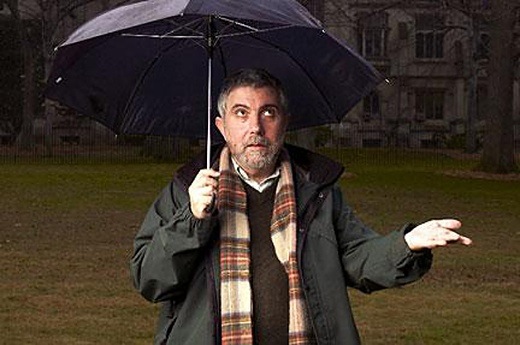
Image above: Paul Krugman checking for rain. From (http://www.peremeny.ru/books/osminog/5151).

In 2010 Scott Walker was elected Governor of my home state of Wisconsin.  Although he ran on the typical Republican program of cutting spending and providing “tax relief” to the wealthy in order to boost the economy, most of us were surprised when Walker unveiled his more draconian plan of ending the rights of government employees to engage in collective bargaining.

Walker argued that he was only trying to provide more flexibility to local municipalities struggling to balance their budgets, but it didn’t take long for critics to become aware of his larger agenda of pitting a wealthy ownership class and a low income white voters against government employees.

Crushing workers’ unions, it soon became apparent, was also one of Walker’s goals, a goal shared by billionaire funders like the ultra-conservative Koch brothers.  Labor Unions were one of the last liberal strongholds able to compete with funding bonanza that was now flowing into conservative “Super Pacs,” and conservatives believed they could achieve a permanent electoral advantage by destroying unions once and for all.

Because Walker openly used phrases like “divide and conquer” and “crush” when referring to his political opponents, it was obvious he was prepared for a fight.  But he was likely taken off-guard by the sudden groundswell of liberal and Democratic energy.

Attempting to postpone a crucial vote on Walker’s bill, the State Senate’s Democratic minority fled to Illinois  where they holed-up in a motel waiting for public opinion to realize what was at stake; meanwhile tens of thousands of protestors descended on Madison, occupying the Capital Building with round-the clock drumming, chanting, and singing, while growing crowds swelled on the adjacent streets as the throngs of protestor reached a count of close to one hundred thousand, despite the windy and cold February and March days.

On a cold, rainy, and particularly windy Sunday in early March, my wife and I bussed in from Milwaukee and joined the protests with some of our friends.  My wife was and is an employee at UW-Milwaukee, and the new legislation was likely to affect our healthcare benefits just as she began a difficulty pregnancy carrying our twin boys.  But beyond that, her job security in the university system that Walker was all too willing to put on the chopping block was suddenly in question.

In Madison it was impossible not to be swept up by the energy, especially for long-time liberals like us who had grown increasingly alarmed at the growing inequality in our nation.  Finally, a broad segment of the population was mad and scared, but was at the same time harnessing this emotion in positive ways, getting involved in our democracy, letting their voices be heard.

Makeshift ponchos and tarps whipped loudly in the wind and thousands of homemade signs were buffeted to and fro.  And yet the cold and the wet was barely noticed amidst the camaraderie and thrill of a mass protest.

Workers from all walks of life and  affiliations had joined the crowds.  Policemen and Firefighters marched arm in arm with school teachers, students, office staff, and Janitors alike.  Several members of the Green Bay Packers publically sided with the workers and the unions.  Children and grandchildren stood together watching the traditionally conservative farmers drive their tractors into Madison to lend their visible support.

For decades, committed liberals had been appalled the wishy-washy stance of their leaders, and had bemoaned the complacency of the Democrat rank and file. Since the Reagan Presidency, Democrats had ceased standing for anything. Instead of fighting for a truly liberal agenda of economic fairness, opportunity, and inclusion, the party had rolled over and compromised with a conservative agenda bent on lowering taxes and cutting public investment while the nation suffered decaying infrastructure, a growing and permanently impoverished underclass, and a division of wealth not seen since just before The Great Depression.
The American dream was slipping away, and the Democratic establishment seemed to be siding more and more frequently with the wealthy elites.

For many liberals, however, this seemed like our moment—finally. The just cause, the surging enthusiasm, the loud uproar, and of course an especially greasy villain were all here. The plutocratic agenda of conservatives was finally visible to all, and people were responding. 
The government bailout of large banks after the 2008 financial crash had created a new sense of populism; this populism was given intellectual support in weekly columns and blogs by liberal economists such as Paul Krugman and Robert Reich, who argued that Republican-led income inequality was a major cause of the crash. Barack Obama’s thrilling election was still fresh in our minds, and his stated commitment to increased government investment and a more steeply progressive tax rate resonated loudly.
The “Occupy Wall Street” movement was just being born, adding to our political lexicon the new category of “the 1%.” Uprisings in Tunisia and Egypt proved to some that an egalitarian revolution of the people was underway and that the Plutocrats and Oligarchs of the world would be under siege.

Amidst this intoxicating mix of anger, energy, and optimism, Michael Moore arrived in Madison to invigorate the crown with a speech that would crystalize many of the beliefs and expectations behind which liberals were rallying with newfound enthusiasm. “America,” he began his March 5th speech to thousands of ecstatic protestors, “is not broke.” Rather, he argued, its tremendous bounty has been the target of a great political and ideological theft carried out by forty years of right wing misrule:

"Contrary to what those in power would like you to believe so that you’ll give up your pensions, cut your wages, and settle for the life your great-grandparents had, America is not broke. Not by a long shot. The country is awash in wealth and cash. It’s just not in your hands. It has been transferred, in the greatest heist in history, from workers and consumers to the banks and the portfolios of the uber-rich."

One need only be marginally familiar with the lives of luxury led by the financial elites in this nation to appreciate the element of truth in Moore’s pronouncements. And then there are the harsh facts, increasingly making themselves known despite the mainstream media’s initial reluctance to make too much of them.
As Moore reminded his Madison audience, “Today just 400 Americans have the same wealth as half of all Americans combined. Let me say this again. 400 obscenely rich people, most of whom benefitted in some way from the multi-trillion dollar taxpayer ‘bailout’ of 2008, now have as much loot, stock and property as the assets of 155 million Americans combined.”
Until this balance of wealth is restored, Moore argued, the nation and its democracy will suffer. This is not liberty and justice for all.

In many ways, the goal of the union protesters as well as Moore’s seemingly radical plea for equality simply expresses what was, until the late 1970s, taken as common sense by both Democrats and Republicans alike: that too much concentration of wealth in the hands of the few would cause the overall economy to suffer. This was the lesson taught by The Great Depression.
Thus even as income distribution and the functioning of the economy may not be as simple as Moore’s metaphor of the “heist” implies, nor do serious liberal economists believe that our financial woes can be addressed simply by re-redistributing the wealth in one fell swoop, liberals believe that the sort of inequality caused by Reagan-era tax policy or Walker-style union busting is not only unfair; it is also an ineffective way of running a free-market economy like ours.
Liberals will therefore conclude that with a balanced tax code and concerted government investment in things like infrastructure, research and development, and green energy for the future, we have every reason to expect a thriving middle class with generous pensions, good health-care, and a constantly growing and widely distributed increase in standards of living.
There is no reason, after all, why we should settle for the lives lived by our great-grandparents, or even our parents for that matter. That each generation of American will live better than the previous one is seen as the most basic test of our Republic, our democracy, and our very freedom.

Or as Moore put it, summarizing in plain terms this traditional liberal economic consensus:
"I have nothing more than a high school degree. But back when I was in school, every student had to take one semester of economics in order to graduate. 
And here’s what I learned: Money doesn’t grow on trees. It grows when we make things. It grows when we have good jobs with good wages that we use to buy the things we need and thus create more jobs. It grows when we provide an outstanding educational system that then grows a new generation of inventors, entrepreneurs, artists, scientists and thinkers who come up with the next great idea for the planet. And that new idea creates new jobs and that creates revenue for the state. 
But if those who have the most money don’t pay their fair share of taxes, the state can’t function. The schools can’t produce the best and the brightest who will go on to create those jobs. If the wealthy get to keep most of their money, we have seen what they will do with it: recklessly gamble it on crazy Wall Street schemes and crash our economy. The crash they created cost us millions of jobs. That too caused a reduction in tax revenue. Everyone ended up suffering because of what the rich did."
Moore’s language and concepts can be traced to a liberal playbook which may have gone underground for a few decades, but that can be dated back at least to F.D.R’s New Deal.
As Roosevelt put it, “We have always known that heedless self-interest was bad morals; we know now that it is bad economics.” In the face of The Great Depression, or so the story goes, Roosevelt built the strongest industrial powerhouse the world has ever seen by combining this sort of economic and political fair-play into a robustly competitive mix of free-markets and government investment. 
“Among men of good will,” Roosevelt proclaimed in his second inaugural address, “science and democracy together offer an ever-richer life and ever-larger satisfaction to the individual. With this change in our moral climate and our rediscovered ability to improve our economic order, we have set our feet upon the road of enduring progress.”
The Madison protests and the Occupy Wall Street movement, we might say, are asking only that we stay true to this road of enduring progress. In the face of the “Great Recession” of recent years, then, liberals hoped we would return to this tried and true common sense again, believing that only ignorant and greedy conservatives stand in the way.

I have been a liberal since I first began thinking about political issues as a teenager. Moreover, I was the sort of liberal who remained disappointed by Clinton’s “third way” and was angered by Obama’s increasing coziness with global financial interests. I was the kind of liberal who was fervently committed to equality, favored helping the downtrodden, and believes that we are all in this together. Ronald Reagan was my nightmare.
Like Howard Dean, I stood for what he referred to as “the Democratic wing of the Democratic Party.” But as I listened to the words of Moore, to the liberal protestors and commentators, as I read the angry facebook posts and emails of my liberal friends, my skepticism and eventually rejection of this position gradually emerged.
A traditional liberal standpoint failed to understand the present and was unable to envision a realistic plan for the future.
Why this rejection of what might be seen as a new New Deal? Especially given my direct interest in a well-funded university with generous benefits, why did I soon become a critic of these protests and the underlying economic and political expectations?
What could possibly be wrong with an economic recovery fueled by the sort of equality and solidarity I had long argued for? How, indeed, could any sane liberal reject “enduring progress” or “an ever-richer life and ever-larger satisfaction to the individual”? What else could I possibly expect? The “heedless self-interest” that we associate with conservatives is the only common criticism of this position, and I certainly had not adopted that.

The answer, which is the main subject of the book, lies beyond our current political categories. It cannot be found in Republican or conservative view, the only mainstream alternative to the liberal one described by Moore.
The conservative idea that we might achieve widespread prosperity and progress by privileging the wealthy “job creators,” as they came to be euphemistically called during the Walker campaign and later during the Romney one, would be stupid were it not so self-serving and politically effective for wealthy political and economic elites--at least in the short term.
Rather, the problem with this liberal position has to do with its underlying assumptions, beliefs, and expectations, many of which are shared equally with even the most conservative Republican Tea Party supporters or Wall Street CEOs. It is a problem that is not discussed within our current political debate, in which it would remain unmentionable even were it not virtually inconceivable in the first place.

The problem, in its most simple terms, is that the sort of increased prosperity and economic growth that has been promised to Americans, almost as a birthright, is not environmentally sustainable—not even close. The prosperity and rising standard of living that Moore, as only one example, promises, depends on increasing amounts of finite fossil and other finite resources, and creates more carbon emissions than our atmosphere can absorb.
To put it bluntly, if the American or world economy continues to grow as Moore, Obama, or Paul Krugman all believe it can and should, we will soon find that we don’t have enough fuel and other natural resources to maintain this increase in economic activity and, in the meantime, will have created an uninhabitable planet while trying.
While the conservative program of trying to achieve economic growth and increased prosperity by way of tax cuts and deregulation is wrong on so many levels, the liberal approach is no more ecologically sustainable nor, it turns out, practically possible.

I had arrived at this conclusion through a journey that had begun in 2007. That year I had purchased a shop and warehouse for my remodeling company in Milwaukee, Wisconsin. At the time I had a vague but growing awareness that something would have to be done about global warming, and was determined to do something “green” with the building’s large flat roof. “Going green,” I also concluded, would be a great marketing ploy and would likely increase my own prosperity. I naively hatched a plan of charging batteries with solar power, so that I might run all our jobs and vehicles off solar power and the biodiesel we also would start manufacturing.
Because of my optimistic, can-do spirit, I never bothered doing the math to see how this might work. But the cost of solar panels eliminated that possibility. Instead, I decided to grow vegetables on what I would come to call the rooftop farm.  Will Allen and his organization “Growing Power” was starting to make its mark and I had been impressed by Allen’s high-concentration growing techniques.
Although I was quite dedicated to my farming project, and considered myself an environmentalist, it was carried out rather impulsively, based on very little understanding of the environmental and economic issues at stake; but my rooftop farming adventures nevertheless launched me into the world of urban agriculture, which in turn led me into a more “hard-core” sustainability movement represented by The Transition Movement.

The Transition Movement is unique among environmental or sustainability organizations because it does not believe that the cure for our addiction to fossil fuels is to replace them with another source of power; rather, it maintains, we need to change the way we live in far more fundamental ways. This is a simple proposition, but it never really occurred to me. Like most Americans, I was far more likely to imagine using rooftop solar panels to run a power-hungry woodshop and vast fleets of biodiesel trucks; neither of these, we will see, are practically possible at any sort of industrial scale.
Among the many things I learned as I was exposed to voices rarely admitted into the mainstream, is how ignorant and uninformed Americans are about energy and the environment. What passes for common sense or a legitimate vision for the future, even at the highest academic or government levels, is in fact based on a series of unfounded myths and a lot of wishful thinking.
 I realized that even as I had been committed enough to the environmental cause to haul 20 yards of Growing Power compost up to my roof, I knew almost nothing about the environmental concerns that motivated me. I realized that even as I listened to NPR all day and read a broad spectrum of print journalism, I had accepted as fact a series of fanciful stories about energy and the economy. How could I have been so uniformed? 
And if I was that uniformed, what about all the journalists and politicians whose views of the world I had come to accept? In the words of James Kuntsler, we were sleepwalking into the future, and someone had better start screaming loud enough to wake everybody up. Using my rooftop garden as a launching pad, I soon started giving interviews, began writing a blog on energy and the economy, and gave public talks about “basic energy literacy” whenever I was given the chance.

Above I referred to the Transition Movement as “hard core,” and I used the quotations marks purposely. This and other related movements or schools of thought are carefully kept outside our political and cultural mainstream; its members are often looked upon as extremists with conclusions not fit for polite or moderate company.
But the true extremists are those who believe there is a technological solution to every problem, and the truly astonishing belief is the one that holds we can have infinite growth on a finite planet. Thus while the Transition Movement can tend to be highly idealistic in its hope and vision for a better future, it relies on hard-nosed and data-driven in the analysis.
The conclusion drawn by the careful work of “post-carbon” geologists, physicists, historians, and economists is that the only way we can live within our planetary resources is by consuming much, much less. There is no magical solution that will, in the words of John Michael Greer, “let us have our planet and eat it too.”
As it turns out, we may in fact have to live more like our great-grandparents, at least in terms of the amount of energy and natural materials we consume, and the amount of waste we produce. Despite all the promises made in “green growth” propaganda, the only way we might actually use and waste less is by living much more simply.

Part of my task in the pages that follow will be to present the sort of basic, but generally unknown, information about energy and the environment that is missing from our various public forums in the United States and the rest of the industrialized world.
But this is only a small part of my task. As I became more interested and informed about these issues, and then began speaking about them, I also realized how difficult it is to get people to actually hear these truths, even as they are drawn from largely uncontested facts about energy use, economic growth, global emission levels, available reserves of fossil fuels, and the limits of renewable energy.
Most people I talked to would agree that someone should do something, but would carry on with their high-energy and high-consumption lifestyles without a moment’s hesitation nor with any recognition that this way of life cannot continue. It didn’t take too long for me to realize that the more interesting question and bigger problem does not lie in the information itself, which is pretty straightforward.
Rather, it was how we as a civilization had become so adept at ignoring and evading this information, even as this denial was allowing us to hurtle towards a disaster beyond a magnitude that few can imagine.

There are many ways in which Americans try to avoid and elude the very basic fact that we live on a finite planet whose ecological limits have been surpassed, and whose natural systems which support all life are crashing around us.
For the most part, we tend to be concerned about other things and are diverted by a world of often trivial novelties and short-term concerns. But we are also fed a steady diet of stories about our collective ability to overcome any barrier--as long as we maintain our freedoms, our ingenious and entrepreneurial spirit, and our faith and confidence in ourselves.
 We believe that we are riding a great wave of permanent progress, and should expect a rising standard of living, demand a world of increased comfort and security, count on more and more automation and computerization and thus less physical or menial labor.
 In visions of the future, as they are usually presented, we are promised a low-energy knowledge economy in which everyone appears to be a creative force of unique individuality, tapping away happily on a laptop from some beach, bamboo jungle hut, or scenic country vista.
Because these stories of continued material improvement are lent some legitimate credibility from our previous century or two of enormous success, we are able to ignore the underlying truth of Moore’s elementary lesson in economics, a truth that is as well-documented as it is unspoken: that “good jobs with good wages” use a lot of energy and produce enormous quantities of waste; that the hard work and good ideas that produce more jobs will also demand more energy and produce more waste; that the next “great idea” for the planet almost always involves the use of more energy and resources.
Because we as a civilization are mainly uninformed about the way the economy, energy, and the environment interact, we are all too ready to believe that the next great idea for the planet will be a way to create more jobs, more good ideas, and more stuff without actually using more energy, more natural resources, and without creating more waste.
Certainly Bill Gates or Mark Zucherberg will figure out how we can have our planet and eat it too. 
We believe that unprecedented efficiencies and limitless renewable energy are just around the corner. This, we will see, is a baseless myth. But because our expectations for a certain kind of future are so thoroughly cemented into our minds, most of us are all too willing to accept it as an impeachable truth.

The issue of our collective state of denial had been bothering me for a year or two by the time Michael Moore showed up in Madison. But as I began to listen more carefully to what liberals believed and expected, and the way liberal leaders reinforced these expectations without a moment of thought given to the ecological cost of these expectations, I began to see how unsustainable even the most progressive liberal plans and hopes were.
But beyond this, the liberal position didn’t seem correctable from the inside. Pointing out a few basic facts about energy consumption couldn’t change anything—because it would have to change just about everything, including the most fundamental beliefs and assumptions of liberals, if it were actually heard.
Better to ignore the issue and get on with the far more satisfying work of blaming conservatives. Liberals didn’t give a moment’s notice to the true ecological costs of their promises, in other words, because if they did, they would need to recast the entire liberal program.

This isn’t to say that conservatives, today, have any insights to offer about how we might achieve a sustainable future. Most environmentalists are liberals, and most “hard core” environmentalists are, or were at some point, liberals as well.
 But the sort of changes we need to make in order to have a peaceful, just, equitable, and inhabitable planet move us well beyond what liberal politics is able to confront. Part of this difficulty, I will argue, has to do with concepts and beliefs rooted deeply within the liberal political and economic agenda that reach back to its early formative experiences. Liberalism was born in an era of unprecedented expansion and its basic hopes and plans for the future are rooted a sort of perpetual growth that cannot continue.
Among its basic tenants is the belief that living with less would be a defeat of its central principles and promises. It banks on permanent technological innovation and a never ending series of “good ideas for the planet.” It assumes that with the proper set of policies, codes, and regulations, a solid educational system, and an adequate social safety net, there are no limits to what we can accomplish, that all Americans deserve to live like the wealthy, and that the whole world deserves to live like Americans.
Whether in the form of Roosevelt’s New Deal, Clinton’s Third Way, or Moore’s populist worker-centered politics, liberalism (a concept I will discuss in greater depth below) is incapable of conceiving of or planning for a way of life that is remotely sustainable or that will allow our children and grandchildren to inherit an inhabitable planet.
The solution to our long term ecological and economic problems is not to become more liberal; it is to adopt beliefs and expectations that lie beyond the scope of our current political beliefs and expectations, liberal or conservative.

.