Showing posts with label Happiness. Show all posts

Human Well-being vs GDP Growth

SUBHEAD: We must make what really produces human well-being and reduces our impact on Earth.

By Kurt Cobb on 5 December 2017 for Resource Insights -
(http://resourceinsights.blogspot.com/2017/12/human-well-being-economic-growth-and-so.html)
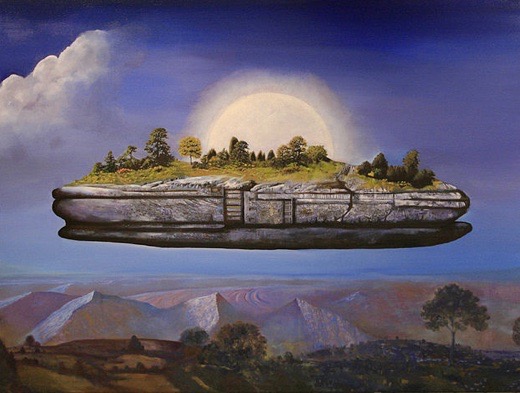

Image above "Utopien 04" (2007). Painting by Makis E. Warlamis. From (http://www.resilience.org/stories/2017-12-03/human-well-economic-growth-called-decoupling/).

Some people claim that humans—called breatharians—can live on air alone. Others claim we can have economic growth without increasing our resource use, so-called decoupling. Neither claim withstands scrutiny though here I am only going to deal with the second one.

Hidden beneath the claim of decoupling is the assertion that human well-being and economic growth are synonymous.

But, human well-being is far from a one-dimensional economic variable linked unalterably to more income and consumption. So, saying that economic growth must at some point come to an end to maintain the habitability of the planet is not the same as saying that human well-being must also stop improving.

On the contrary, a stable society in harmony with the workings of the natural world in a way that maintains the habitability of the biosphere for humans would seem to be an essential characteristic of a society which offers a high degree of well-being to humans. Destroying that habitability through endless economic growth then is contrary to human well-being in the long run.

All of this should seem obvious. But so often the advocates of growth or “sustainable” growth tell us that ending growth would destroy the chance for countless people to attain well-being in our modern industrial world.

While that has some truth within the narrow context that measures well-being as a function of economic output, it misses the point above. An uninhabitable world is really, really bad for human well-being.

The answer these advocates say is economic growth decoupled from increased resource use. But as two recent papers suggest, this is an oxymoron.

As “Is Decoupling GDP Growth from Environmental Impact Possible?” explains,while society has been getting gradually more efficient at producing goods and services, we are not anywhere near economic growth without increased resource use. The apparent decoupling in Germany and some other countries is probably due to the following factors:
1) substitution of one resource for another; 2) the financialization of one or more components of GDP that involves increasing monetary flows without a concomitant rise in material and/or energy throughput, and 3) the exporting of environmental impact to another nation or region of the world (i.e. the separation of production and consumption).
Moreover, there are limits to how efficient we can be. Each increment of efficiency becomes more and more expensive, rising steeply and prohibitively as we approach zero increase in resource use for any increment of growth—or as we move toward zero resource use from current levels while achieving the same level of economic output, a no-growth scenario. In short, we are never going to become breatharians.

A second paper suggests that matters are even worse because we are using the wrong measure. Instead of using output per unit of Gross Domestic Product (GDP), we should be looking at resource use per capita. By that measure resource use has become far less efficient, expanding by 60 percent per person between 1900 and 2009. Of course, the goods and services provided have also expanded greatly.

But here again we would be making a direct and proportional link between human well-being and consumption when well-being is much more complex.

The authors contrast this finding with one that claims that resource consumption dropped by 63 percent in that period—a claim that is true within the narrow context of output per unit of GDP, a measure of relative impact (relative to money) rather than absolute impact on the planet.

We humans would like to believe that we can achieve a society with all the material benefits we enjoy today widely distributed across the globe—but without the material. We can’t do that without destroying the habitability of the planet.

What we can do is focus on what really produces human well-being (and not just GDP growth) and make that the locus of our efforts while finding ways to reduce our impact on the planet on an absolute rather than a relative basis.

.
Lesson from Costa Rica

SUBHEAD: Want to avert the apocalypse? This is the country in the Western Hemisphere to look for solutions.

By Jason Hickel on 7 October 2017 for the Guardian -
(https://www.theguardian.com/working-in-development/2017/oct/07/how-to-avert-the-apocalypse-take-lessons-from-costa-rica?CMP=Share_iOSApp_Other)


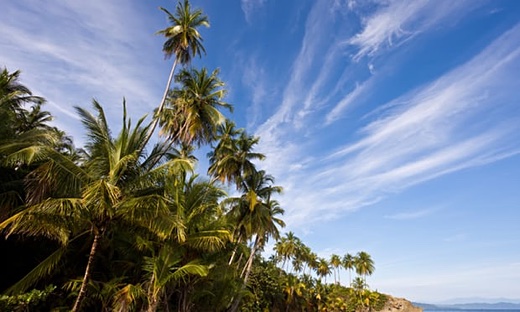
Image above: Shoreline of Costa Rica. Photo by Alamay. From original article.

Earlier this summer, a paper published in the journal Nature captured headlines with a rather bleak forecast. Our chances of keeping global warming below the 2C danger threshold are very, very small: only about 5%.

The reason, according to the paper’s authors, is that the cuts we’re making to greenhouse gas emissions are being cancelled out by economic growth.

In the coming decades, we’ll be able to reduce the carbon intensity of the global economy by about 1.9% per year, if we make heavy investments in clean energy and efficient technology. That’s a lot. But as long as the economy keeps growing by more than that, total emissions are still going to rise.

Right now we’re ratcheting up global GDP by 3% per year, which means we’re headed for trouble.

If we want to have any hope of averting catastrophe, we’re going to have to do something about our addiction to growth. This is tricky, because GDP growth is the main policy objective of virtually every government on the planet.

It lies at the heart of everything we’ve been told to believe about how the economy should work: that GDP growth is good, that it’s essential to progress, and that if we want to improve human wellbeing and eradicate poverty around the world, we need more of it. It’s a powerful narrative. But is it true?

Maybe not. Take Costa Rica. A beautiful Central American country known for its lush rainforests and stunning beaches, Costa Rica proves that achieving high levels of human wellbeing has very little to do with GDP and almost everything to do with something very different.

Every few years the New Economics Foundation publishes the Happy Planet Index – a measure of progress that looks at life expectancy, wellbeing and equality rather than the narrow metric of GDP, and plots these measures against ecological impact.

Costa Rica tops the list of countries every time. With a life expectancy of 79.1 years and levels of wellbeing in the top 7% of the world, Costa Rica matches many Scandinavian nations in these areas and neatly outperforms the United States. And it manages all of this with a GDP per capita of only $10,000 (£7,640), less than one fifth that of the US.

In this sense, Costa Rica is the most efficient economy on earth: it produces high standards of living with low GDP and minimal pressure on the environment.

How do they do it? Professors Martínez-Franzoni and Sánchez-Ancochea argue that it’s all down to Costa Rica’s commitment to universalism: the principle that everyone – regardless of income – should have equal access to generous, high-quality social services as a basic right.

A series of progressive governments started rolling out healthcare, education and social security in the 1940s and expanded these to the whole population from the 50s onward, after abolishing the military and freeing up more resources for social spending.

Costa Rica wasn’t alone in this effort, of course. Progressive governments elsewhere in Latin America made similar moves, but in nearly every case the US violently intervened to stop them for fear that “communist” ideas might scupper American interests in the region.

Costa Rica escaped this fate by outwardly claiming to be anti-communist and – horribly – allowing US-backed forces to use the country as a base in the contra war against Nicaragua.

The upshot is that Costa Rica is one of only a few countries in the global south that enjoys robust universalism. It’s not perfect, however.

Relatively high levels of income inequality make the economy less efficient than it otherwise might be. But the country’s achievements are still impressive. On the back of universal social policy, Costa Rica surpassed the US in life expectancy in the late 80s, when its GDP per capita was a mere tenth of America’s.

Today, Costa Rica is a thorn in the side of orthodox economics. The conventional wisdom holds that high GDP is essential for longevity: “wealthier is healthier”, as former World Bank chief economist Larry Summers put it in a famous paper.

But Costa Rica shows that we can achieve human progress without much GDP at all, and therefore without triggering ecological collapse. In fact, the part of Costa Rica where people live the longest, happiest lives – the Nicoya Peninsula – is also the poorest, in terms of GDP per capita.

Researchers have concluded that Nicoyans do so well not in spite of their “poverty”, but because of it – because their communities, environment and relationships haven’t been ploughed over by industrial expansion.

All of this turns the usual growth narrative on its head. Henry Wallich, a former member of the US Federal Reserve Board, once pointed out that “growth is a substitute for redistribution”. And it’s true: most politicians would rather try to rev up the GDP and hope it trickles down than raise taxes on the rich and redistribute income into social goods.

But a new generation of thinkers is ready to flip Wallich’s quip around: if growth is a substitute for redistribution, then redistribution can be a substitute for growth.


Costa Rica provides a hopeful model for any country that wants to chart its way out of poverty. But it also holds an important lesson for rich countries. Scientists tell us that if we want to avert dangerous climate change, high-consuming nations – like Britain and the US – are going to have to scale down their bloated economies to get back in sync with the planet’s ecology, and fast.

A widely-cited paper by scientists at the University of Manchester estimates it’s going to require downscaling of 4-6% per year.

This is what ecologists call “de-growth”. This calls for redistributing existing resources and investing in social goods in order to render growth unnecessary.

Decommoditizing and universalizing healthcare, education and even housing would be a step in the right direction. Another would be a universal basic income – perhaps funded by taxes on carbon, land, resource extraction and financial transactions.

The opposite of growth isn’t austerity, or depression, or voluntary poverty. It is sharing what we already have, so we won’t need to plunder the earth for more.

Costa Rica proves that rich countries could theoretically ease their consumption by half or more while maintaining or even increasing their human development indicators. Of course, getting there would require that we devise a new economic system that doesn’t require endless growth just to stay afloat. That’s a challenge, to be sure, but it’s possible.

After all, once we have excellent healthcare, education, and affordable housing, what will endlessly more income growth gain us?

Maybe bigger TVs, flashier cars, and expensive holidays. But not more happiness, or stronger communities, or more time with our families and friends. Not more peace or more stability, fresher air or cleaner rivers.

Past a certain point, GDP gains us nothing when it comes to what really matters. In an age of climate change, where the pursuit of ever more GDP is actively dangerous, we need a different approach.

.

The wisdom around us

SUBHEAD: Societies that were healthy, educated, happy that had little waste, government or need for energy.

By Brian Kaller on 27 July 2017 for Restoring Mayberry -
(http://restoringmayberry.blogspot.co.uk/2017/07/the-wisdom-around-us.html)


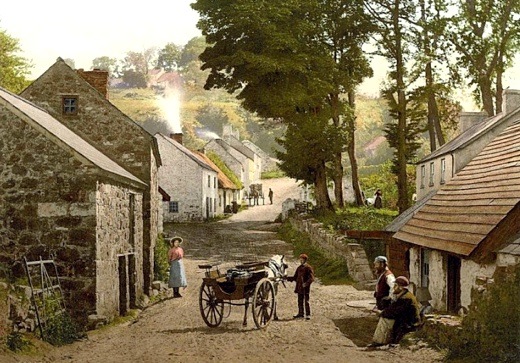
Image above: Retouched photo of the village of Glenoe in County Antrim, Ireland in the 19th century. From (http://www.newsletter.co.uk/lifestyle/nostalgia/picture-special-nineteenth-century-ireland-has-been-revealed-in-a-series-of-photochrom-postcards-1-7914650).

If we want to learn from people in more traditional eras, we can do several things; we can read books and journals from that era, from before fossil fuels or electricity, before cars or internet, before everything became cheap and fast and thrown away.

Some books from that era remain widely read; Mark Twain and Laura Ingalls Wilder from the USA, Jane Austen or Charles Dickens from England, and I would encourage readers to can go back farther in history to medieval writers or Ancient Greeks and Romans.

We can also read historians who specialise in everyday life, or people today who still practice traditional crafts and write about it – I recommend John Seymour and Scott Savage, among others.

Many people today are forced by poverty to live simpler lives, as in the Third World, but their circumstances are often less healthy, literate or safe than those of 20th century Ireland.

We in the West have too few first-person narratives from people who grew up in such poverty, and their cultures, climates and languages often pose a barrier to understanding.

We can talk to people closer to home who grew up with very little – say, people who grew up in trailer parks or slums – but again, they experienced a different kind of poverty.

Most families I know in my native USA grew up with a lot of television, little freedom and the constant threat of violence; in many ways, they experienced the opposite of my Irish neighbours.

We can talk to people Western countries today who grew up living more simply than most Americans today – say, Amish, Mennonites or plain Quakers.

Such groups, however, typically withdrew from the world because they have a rigid and insular culture, making them reluctant to share with outsiders and making their habits less relatable.

I wasn’t just interested in sitting and watching television shows about people living simpler and more traditional lives; I wanted to learn how to do so myself.

We can talk to elderly Americans who remember the mid-20th century, and I have talked to quite a few over the years and learned a great deal. Their world, however, is not too unfamiliar; if you talk to a 70-year-old American, you are still talking to someone who grew up watching television and sitting in traffic.

That’s what makes my Irish neighbours so valuable; they are among the last Westerners on Earth, speaking English and now living in a familiar modern world -- to grow up in the pre-modern world, before electricity and modern media, before cars and modern devices.

As late as the 1960s in Ireland, by contrast, fewer than one per cent of Irish owned a car, relying instead on feet and horses. As late as the 1970s many areas lacked electricity, meaning not just electric lights but radio and television.

Their lack of modern influences kept the culture parochial and traditional even into modern times; birth control was legalised only in 1978, and divorce only in 1995.

My elderly neighbours grew up with different priorities from people today; they had skills, not career tracks, and lived not as individuals but as members of something greater.

Their homes were filled with family members who pitched in with the work of getting food and water and warmth, and the ones who worked outside the home brought in the little money they needed for a few luxuries.

At gatherings they sang songs and told stories that were hundreds of years old, passed down like prayers from father to son, mother to daughter. They grew up knowing the histories of their cousins and neighbours, who were often the same people.

When I ask them to remember a certain decade in their lives, they remember their childhood adventures and adult duties, the aging and passing of family, the passing down of traditions.

Of course, the Ireland my neighbours talk about has mostly disappeared, replaced by a modern country not very different from the USA or Britain; drive along the major roads near our house and you sit in traffic jams, pass billboards and fast-food stops, see advertisements for Hollywood blockbusters, and hear wacky morning-zoo DJs on the radio.

Cities are filled with young people constantly staring at little glowing rectangles, addicted to video-games or social media, increasingly dependent on touching a screen to get the basic needs of life.

Raising a teenager here means talking about “sexting,” drugs, date rapes – the same uncomfortable parent-child discussions as you need to have anywhere these days.

It’s difficult enough for older Americans who grew up with television and movies, albeit an older and gentler variety. Older Irish I talk to feel like they are living in a foreign country.

When I moved to rural Ireland 15 years ago, I admit, there was a lot to get used to. Ireland lies at the same latitude as southern Alaska, so the winter nights can be eighteen hours long, and the days quite dim.

During the summer we have the opposite problem, and I have to cover the windows with tinfoil to get any sleep. It rains one day out of three – that’s the price you pay for the lush countryside – and even in summer it never gets very warm.

Nonetheless, my family and I made a go of living here, building a house and garden and turning the land into a homestead.

We grew some of our own food, kept chickens and bees, and learned as we went. I’d always loved traditional crafts, so I learned whatever I could about skills being kept alive by a few devoted aficionados.

I tried my hand at blacksmithing, basketry, hedge-laying, natural building, bush-craft, leather-working, book-binding, brewing, pickling, cheese-making and wine-making, sometimes just dabbling, sometimes making it into a hobby.

I had to work in Dublin to pay the bills, which meant three hours a day on the bus and back each day. That meant devoting the few remaining waking hours each day to doing chores on the land, feeding possibly checking the bees, doing some traditional crafts, giving my daughter home-schooling lessons and having a writing career on the side.

Thankfully, I discovered that was much more feasible than you might imagine; a garden, animals and crafts can take up perhaps an hour or two a day, and you can learn a great deal while working around a regular life. It’s not being entirely self-sufficient or off the grid, in the manner of doomsday preppers or reality-television eccentrics, but I don’t need that kind of life, and you probably don’t either.

Many people I know just want to be more self-reliant, or have fun learning skills, or to pollute less, or spend less money, or work with the land instead of against it – all things that go along with the old-fashioned skills I was learning.

Most of all, I talked with elderly people, and realised what a different world they had grown up in, and what an underappreciated resource they were.

I struck up conversations with neighbours passing on the road, or having tea at their house, or sitting next to them on the long bus ride to Dublin, or visiting the local old folks’ home. Occasionally I asked them if I could sit down for formal interviews, and sat down with a camera and audio recorder.

I found that Irish radio had done occasional documentaries on traditional life, that school-children had collected the memories of their grandparents, that documentarians had filmed Irish villagers decades ago, and that historical societies and local experts had scrapbooks filled with the minutiae of day-to-day life.

I listened to hundreds of hours of recordings and read thousands of pages of transcripts, collecting the details of their everyday lives.

Again, I’m not trying to romanticise their difficult lives, or claim that they didn’t have their own problems, or that the world hasn’t improved in certain ways – of course it has. I’m not saying that we could or should do exactly what they did, or that all traditional societies were as beneficial as the examples I use.

Of course Ireland in the fifties was quite different from America in the 1950s, and from many other traditional times and places, and of course I’ll be cherry-picking good qualities from many times and places and ignoring the downsides of each era. There’s no perfect past that I’m demanding we emulate.

I am saying that certain peoples in history created societies that were healthy, educated, clean, happy – by their own testimony – and ran on little energy, generated little waste and needed little government. I want to look at how they did these things, and what we can learn from them.

.

Young men and imaginary worlds

SUBHEAD: For many men the gaming universe is more enjoyable than the real world.

By Mike Shedlock on 17 July 2017 for Mish Talk -
(https://mishtalk.com/2017/07/17/another-reason-men-dont-work-imaginary-world-more-enjoyable-than-the-real-world/)


Image above: Detail if illustration of the hero characters from the top 70 video games of all time. From (http://www.slayerment.com/top-video-game-songs-all-time).

President Trump, like President Obama before him, point out the low unemployment rate as a measure of success.

What they don’t point out are masses of people on welfare via fraudulent disabilities, people in school wasting money in dead-end retraining exercises, people who have simply given up looking for a job, and people in forced retirement needing Social Security payments to survive.

A team of researchers from Princeton, the University of Chicago, and the University of Rochester discusses another class of individuals who are not working but are not counted as unemployed: People, primarily young men who are addicted to games. For such individuals, games provide a fantasy world that is far more enjoyable than the real world.


Please consider their report on Leisure Luxuries and the Labor Supply of Young Men.
Between 2000 and 2015, market hours worked fell by 203 hours per year (12 percent) for younger men ages 21-30, compared to a decline of 163 hours per year (8 percent) for men ages 31-55.

These declines started prior to the Great Recession, accelerated sharply during the recession, and have rebounded only modestly since. We use a variety of data sources to document that the hours decline was particularly pronounced for younger men.

Not only have hours fallen, but there is a large and growing segment of this population that appears detached from the labor market: 15 percent of younger men, excluding full-time students, worked zero weeks over the prior year as of 2016. The comparable number in 2000 was only 8 percent.

A natural question is how these younger men support themselves given their decline in earnings. We document that 67 percent of non-employed younger men lived with a parent or close relative in 2015, compared to 46 percent in 2000.

One avenue to gauge how younger men perceive their fortunes is to use survey data on happiness. In this spirit, we complement the patterns in hours, wages, and consumption with data on life satisfaction from the General Social Survey.

We find that younger men reported increased happiness during the 2000s, despite stagnant wages, declining employment rates and increased propensity to live with parents/relatives. This contrasts sharply with older men, whose satisfaction clearly fell, tracking their decline in employment.

See also:

 http://www.theonion.com/video/warcraft-sequel-lets-gamers-play-a-character-playi-14240


Island Breath: Man's Nintendo Memories 6/14/08
Island Breath: California imitates GTA 10/25/07
Island Breath: Virtual World & Apocalypse 12/19/05
.

Permaculture in Hawaii

SUBHEAD: Permaculture works to keep the birds, insects, soil and surrounding nature content and ourselves fed.

By Juan Wilson on 26 April 2017 for Island Breath -
(http://islandbreath.blogspot.com/2017/04/permaculture-in-hawaii.html)


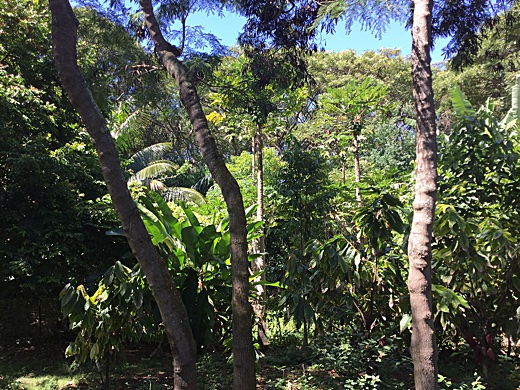
Image above: We at IslandBreath have attempted to do permaculture. Photo from our backyard efforts at creating a "food forest" that we have named "Akea Aina".  In this image are cacao, starfruit, avocado, papaya, cassava, coconut, breadfruit, banana, and mango. Photo by Juan Wilson.

Akea Aina consists of about 1.5 acres of land - a third of it is our property, a third rented from the Robinson family and another third is on Hawaiian public land.

The photo above show haole koa ("false" koa) trees in foreground. They are early adopters in yards on Hanapepe Valley but few people have let haole koa grow so large as they are usually considered weed trees.

Haole koa are hard and heavy wood good for fires and they are good nitrogen fixers. They provide light shade that sun-delicate plants can grow under. Beneath them are a row of cacao trees with fruit.

To the left and right of this photo are breadfruit trees and cassava. Beyond what you can see are beehives.

In the background, from the left is a starfruit tree, coconut, mango, papaya, avocado and more. That's only a small sample of what can be grown on a small farm.

Below is a brief video survey of permaculture efforts in Hawaii on various islands. By "permaculture" we mean intentional living arrangements on land that produces food and fertile land as a foundation of healthy local flora and fauna. This way of life means living "in nature".

That implies sustainable self sufficiency in food, soil, water and energy.      

Mokupuni o Hawaii
Introduction to the permaculture training programs offered at the  La'akea community on the Big Island, with teacher Tracy Matfin. Get a look at La'akea uses permaculture principles.


Video above: Permaculture Education Programs - La'akea, Hawaii in 2011. From (https://youtu.be/-XgpTaAfb7Q).

Mokupuni o Maui
Fruition Permaculture Design as he gives us a tour of Laulima Farm in lush Kipahulu, Maui, Hawaii. Jesse Krebs discusses the key permaculture design features of this beautiful tropical farm.


Video above: Fruit-based Veganic Permaculture on Maui in 2013. From (https://youtu.be/zG2JuTvq5e8).

Mokupuni o Molokai
SustAINAble Molokai and Geoff Lawton of the Permaculture Research Institute of America and of PRI Australia. We now have strategies to heal the land by slowing the course of water.


Video above: Heal the land, Harvest water, Grow food security on Molokai in 2013. From (https://youtu.be/P2Lp8YmJaag).

Mokupuni o Oahu
Growing your own food and being self sufficient is one of the best ways to give power back to the people and live in harmony with nature.


Video above: Permaculture with Paul Izak in Hawaii on Oahu in 2012. From (https://youtu.be/_WHG3NJEq90).

Mokupuni o Kauai
Paul Massey, the Director Regeneration Botanical Gardens gives a concise definition of what Kauai Food Forest is all about.


Video above: Permaculture in Kauai Part 2 in 2013. From (https://youtu.be/5pJrw9QuCB0).

There is no doubt in our minds that these methods of "farming" are the way to go here in Hawaii. It works to keep the birds, insects, soil and surrounding nature content and ourselves fed.

.

Millennials become "De" Generation

SUBHEAD: De-Growth and De-Industrialization and embracing a non consumer life for one's happiness.

By Charles Hugh Smith on 13 April 2017 for Of Two Minds -
(http://www.oftwominds.com/blogapr17/millennials-halfx4-17.html)


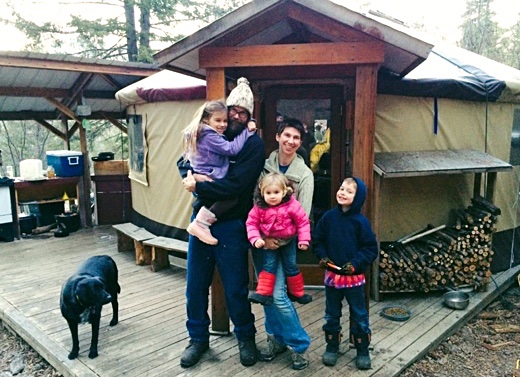
Image above: Ester Emery and Nich Fouch with family living off-grid where its cold in winter. From (http://estheremery.com/meet-esther/).

[IB Publisher's note: See part one of this line of thought here Ea O Ka Aina: Millennials abandoning Suburbia]

Where's the growth going to come from as the dominant generation makes less, borrows less, spends less, saves more and turns away from long commutes, malls and suburban living and abandons the worship of private vehicles?

If anything defined the postwar economy between 1946 and 1999, it was the exodus of the middle class from cities to suburbs and the glorification of what Jim Kunstler calls Happy Motoring: freeways, cars and trucks, ten lanes of private vehicles, the vast majority of which are transporting one person.

The build-out of suburbia drove growth for decades: millions of new suburban homes, miles of new freeways, sprawling shopping malls, and tens of millions of new autos, trucks, and SUVs, transforming one-car households into three vehicle households. Then there was all the furnishings for those expansive new homes, and the credit necessary to fund the homes, vehicles, furnishings, etc.

Now the Millennial generation is turning its back on both of these bedrock engines of growth. As various metrics reveal, the Millennials are fine with taking Uber to work, buying their shoes from Zappos (return them if they don't fit, no problem), and making whatever tradeoffs are necessary to live in urban cores.

Simply put, the natural progression of this generation is away from suburban malls, suburban home ownership and the car-centric commuter lifestyle that goes with suburban homeownership.

Saddled with insanely high student debt loads imposed by the rapaciously predatory higher education cartel, Millennials avoid additional debt like the plague. Millennials have relatively high savings rates. As for a lifetime of penury to service debt--hey, they already have that, thanks to their "I borrowed $100,000 and all I got was this worthless college degree" student loans.

Consider the secondary effects of these trend changes. If Millennials are earning less and already carrying heavy debt loads, who is going to buy the Baby Boom's millions of pricey suburban McMansions. The answer might be "no one."

If vehicle sales decline, all the secondary auto-related sales decline, too. Auto insurance, for example.

Furnishing a small expensive urban flat requires a lot less furnishings than a 3,000 square foot suburban house. What happens to sales of big dining sets and backyard furniture?

As retail malls die, property taxes, sales taxes and payroll taxes decline, too. Many cheerlead the notion of repurposed commercial space, but uses such as community college classes pay a lot less per square foot than retail did, and generate little in the way of sales and payroll taxes.

Financial losses will also mount. Valuations and property taxes will decline, and commercial real estate loans based on nose-bleed valuations and high retail lease rates will go south, triggering significant financial-sector losses.

Retail is already shrinking fast. Look at the store closings--the 2017 number already exceeds the post-financial crisis surge in 2008:

Where's the growth going to come from as the dominant generation makes less, borrows less, spends less, saves more and turns away from long commutes, malls and suburban living and abandons the worship of private vehicles? Toss in the convergence of technology (i.e. a mobile phone does everything) and the answer is growth is being replaced by DeGrowth.


Video above: A TEDx Talk "De" trends by "De-Generation" engaging De-Growth. From (https://youtu.be/y395J6W6i1E).

The "De" Generation (DeGrowth) (8:26)


.

Mid 20th Century Misery

SUBHEAD: An update by Stevan Dohanos of Norman Rockwell's nostalgic illustrations for the 1950's.

By Cory Doctorow on 11 September 2015 for Boing Boing -
(http://boingboing.net/2015/09/11/mid-century-misery-the-discon.html)


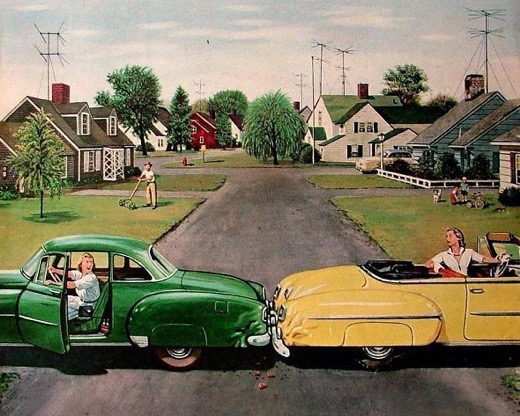
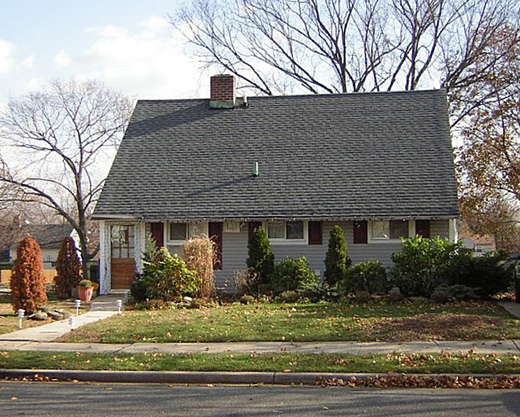
Image above: Detail of Stevan Dohanos painting "Backup Collision" taking place in what seems to be Levittown, Long Island. From original article. See also (https://americangallery.wordpress.com/category/dohanos-stevan/).

Dohanos was a prolific American painter and illustrator with over 125 Saturday Evening Post covers to his credit.

The mid-century commercial painters had all sorts of weird quirks. Consider Art Frahm, who specialized in women carrying celery whose underwear elastics had failed catastrophically, resulting in knickers around their ankles.


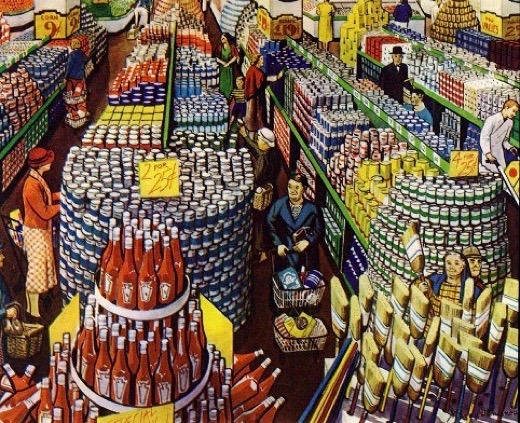
Image above: Detail of Stevan Dohanos painting "Food Fair, Philadelphia" show the "abundance" of packaged food in post WW2 America. From original article.

But Donahos's speciality was, in its own way, weirder. In an era known for its grinning families and cheerful scenes, Donahos often painted discontents.

Sometimes it was just in the slumped set of a boy's shoulders as his father sat him down for a heart-to-heart in the chicken coop; more often, it was in the indefinable angst on the faces of his subjects.

Looking at Donahos's work, I could easily believe that it was simulacra: a contemporary painter creating a fake body of work for an imaginary mid-century commercial artist who snuck desperate signs of anomie into his work, crying for help from behind his easel.

But no, Donahos was the real thing, painting -- and selling -- works that showed the hidden anxiety of the Father Knows Best set.

Stevan Dohanos (1907 – 1994)


Detail of Stevan Dohanos painting "After Dinner Dishes" illustrates a woman's frustration at the end of a long day anywhere in America. From original article.


.

Kids need more outdoors

SUBHEAD: The disadvantages of indoor swapping screen time for going outside and getting dirty.

By Shannon Hayes on 13 July 2015 for Yes Magazine -
(http://www.yesmagazine.org/issues/make-it-right/swapping-screen-time-for-getting-dirty-why-kids-need-to-spend-more-time-outside)


Image above: IB Publisher's daughter Laura, at nine, handing her dad his walking stick on hike along ice cold Coonecticut stream. Photo by Juan Wilson.

It is my 11-year-old daughter Saoirse’s first visit to Washington, D.C. She doesn’t know where she wants to go. Museum of Natural History? Air and Space? Then she sees the greenhouse. “Here,” she says with certainty. She drags me by the arm through the glass doors and into the tropical paradise.

Her body transforms. Her smile grows wider, her eyes brighter. She woke up at three in the morning to catch the flight with me. Tomorrow she will accompany me as I speak at a symposium about our family and farming life, so we make the most of this day. Thankfully, her exhausted body seems to draw nourishment from the foliage around us. All signs of fatigue melt away.

I gaze around me, recognizing the philodendron, the ficus trees, the bougainvillea, the anthurium like old friends. “A greenhouse like this got me through college,” I remark. Saoirse doesn’t hear me. She is smelling blossoms.

My family was never certain that I would be able to complete school. I had a scholarship to attend a private liberal arts college in a nearby city. Once enrolled, I wilted, begging my parents to let me come back to the farm each weekend, pleading with them for their blessing to withdraw.

When I subsequently enrolled in SUNY Binghamton, they feared I would meet the same troubles of debilitating homesickness. But I found the campus greenhouse. I spent every waking moment between classes there, potting, pruning, watering. And I got through. I still went home twice each month. I told my friends I was needed on the farm. The truth was that I needed the farm. I hid that truth with shame.

We called it homesickness, and I saw it as my great weakness. But in How to Raise a Wild Child, Dr. Scott D. Sampson gives it another name: topophilia, a love of place. And he asserts it is the key to restoring sustainability on our planet.

As chief curator at the Denver Museum of Nature and Science and host of the PBS KIDS television series Dinosaur Train, Sampson argues that the current disconnect between kids and the natural world is a threat to their physical, mental, and emotional health. One study he cites found that the average American child spends less than seven minutes a day outdoors, but racks up more than seven hours per day staring at screens.

Sampson revisits his own childhood experiences that led him to dedicate his life to the natural world, taking us back to an early memory when he ventured down a damp forest path with his mother while living in the Pacific Northwest. He recalls the scent of the soil, the patter of drips from the moisture-laden trees, and how the forest gave way to an opening where a frog pond was alive with tadpoles. The walk ended in a full- immersion experience as he waded in above his boots, up to his waist, simply overpowered by his sense of wonder.

Throughout his childhood, this forest became a playground and fantasy world, a stomping ground for him and his dog, a refuge where he and his best friend could work through their teenage angst, a challenge course as they burned off their testosterone-laden energy.

Sampson’s career took him, like many Americans, through multiple long-distance moves, but he continued to experience nature in its most raw and rare forms. He writes, “I can’t help but take that Pacific Northwest forest with me wherever I go. It is an indelible part of who I am, more like a lens on the world than a collection of memories.”

Drawing on this experience, Sampson offers the topophilia hypothesis: that bonding between people and place offers adaptive advantages to human beings. He believes topophilia can become the foundation for the young generation to regain their connection to nature.

Sampson describes how every generation of hunter-gatherers over the past tens of thousands of years was born with the physical and cognitive capacity to live virtually anyplace, yet they were required to learn to live in an intimate relationship with a particular place. “Hunter-gatherer survival from the Pleistocene ice age to the present day may have depended on nurturing a built-in bias to bond with a local place,” he argue

This bonding would have enabled place-specific knowledge to pass between generations. Sampson proposes that topophilia evolved to help humans adapt to a diverse range of settings, each requiring a unique array of life skills to survive.


Sampson says that children can recognize more than 10,000 corporate logos, but fewer than 10 plants native to their region. He argues this disconnect threatens our planet and the very future of humanity. “If sustainability depends on transforming the human relationship with nature,” he writes, “the present-day gap between kids and nature emerges as one of the greatest and most overlooked crises of our time.”

If correct, this hypothesis has two implications. First, Sampson believes, bonding between humans and nature is most effective when initiated in early childhood. And second, periodic exposure to nature in a diverse range of settings will likely be less effective in fostering bonds with nature than abundant time spent outdoors in a single, local place.

These two premises form the foundation of Sampson’s antidote to our culture’s disconnect from the natural world, and the bulk of his book is dedicated to teaching parents and educators age-appropriate techniques for fostering a deeper bond with nature, whether in cities, suburbs, or the wild.


Image above: IB Publisher's son John Wilson, at five, hiking along a stream in winter near home in Fairfield CT in 1985. Photo by Juan Wilson.

Throughout all the stages of childhood, one steadfast technique that Sampson encourages families to return to is the sit-spot—a place close to home in nature that allows children and their mentors to become quiet and more intimate with their surroundings.

As much as Sampson suggests that the goal is to change the next generation, it becomes clear from the text that the key is not to change the behavior of our children. They innately know what to do. It is the grown-ups who must change, learning to become mentors and to develop new habits of observation so they may help youth move through the phases of childhood bonded to the natural world.

Sampson devotes extensive space to this topic, reminding us that becoming experts will not bring our children closer to nature. Instead, the secret to fostering that bond lies in rediscovering our sense of wonder, humility, and playfulness.

My own childhood mentor was an old farmer with a penchant for getting us lost for hours on end as we explored lightning strikes in tree trunks, dug in the ground for hidden springs, or foraged for blackberries. His knack for finding trouble—whether by swinging by his knees from an apple tree, or slipping out the door on cold, rainy nights to track down cattle that had gotten spooked up into the ridges—forced me to push my own boundaries as I went through adolescence.

By the time I was ready for college, my roots to the land had grown so deep, the thought of leaving it broke my heart. I was a part of my ecosystem.

I let Saoirse take the lead as we scamper through the greenhouse, following her eyes and her nose as we track down blossoms and take in the scent of each exotic flower. She is not unlike me. She gets to an unfamiliar place, and the first time she is able to relax is when she finds nature.

It wasn’t easy for me, trying to find my way in a world while so deeply rooted to one place. I couldn’t chase career opportunities. I couldn’t chase love. And as I leave the greenhouse with my daughter almost 20 years later, I wonder if the hours of free play she has had in the same fields, woods, pastures, and streams that defined my own wild childhood are a ball and chain, tying her soul to the agrarian fate that tied me.

I can leave my unique ecosystem for short periods of time. But I am simply unable to fathom a life permanently disconnected from it. Will she face the same future? Am I working to restore a new generation’s love of nature, or am I limiting my daughter’s future?

We make our way back to the hotel room. As we climb up Independence Avenue, she stops in her tracks. There, growing beside the sidewalk, is a small patch of weeds. They are flowering. “Oh, Mom! LOOK!” Her enthusiasm for her discovery exceeds her joy at the splendor of the orchid room in the botanical gardens. It surpasses the thrill of the 3-D IMAX film we watched at the Air and Space Museum.

“It looks like bluets,” she observes as she bends down over the sidewalk, oblivious to the foot traffic around her, “but it could be gill-over-the-ground. The leaves are similar, but the colors of the flowers are different. Do you see that?” She points.

“At home they are darker blue, almost purple. These have white and blue petals.” We stand there, in the nation’s capital, mesmerized by the weeds that some groundskeeper will soon be obliged to remove in a Capitol Hill grooming session.

Her wonder doesn’t stop there. Our path back to the budget hotel is far grittier than the splendors of the National Mall. We must make our way under bridges and highways, past a few derelict city plots.

On the journey, she marvels at the resilience of the ivy that hugs a tree in an abandoned lot; she stops to watch a flock of gulls as they fight over discarded pizza, laughing at their antics, imagining with me their dialogue. Inspired by Sampson’s writing, I stifle my own cynicism and allow myself to share her excitement. Maybe the farm is not her ball and chain after all.

Maybe, as Sampson suggests, it is her lens on the world. She teaches me there is nature to love. To honor. To protect. Everywhere.

 • Shannon Hayes wrote this article for Make It Right, the Summer 2015 issue of YES! Magazine. Shannon writes, home-schools, and farms with her family from Sap Bush Hollow Farm in upstate New York. Her newest book is Homespun Mom Comes Unraveled. She blogs at TheRadicalHomemaker.net.


.

To save Future live in Present

SUBHEAD: “The kingdom of heaven is at hand” because, if not at hand, it is nowhere.

By Wendell Barry on 23 March 2015 for Yes Magazine -
(http://www.yesmagazine.org/issues/together-with-earth/wendell-berry-climate-change-future-present)


Image above: Turning around from the 13th and Webster intersection where the Ameritrade Park sign is, you will see the third largest mural in the nation. The gigantic painting of Omaha's past, present, and future covers the east side of the Energy Systems Building. From (http://www.beepbeep.org/4delos/archives/2010/06/meg-saligmans-fertile-ground.html).

This excerpt consists of two numbered parts. The first was written in 2013 and the second in 2014.

I. [2013]

So far as I am concerned, the future has no narrative. The future does not exist until it has become the past. To a very limited extent, prediction has worked. The sun, so far, has set and risen as we have expected it to do. And the world, I suppose, will predictably end, but all of its predicted deadlines, so far, have been wrong.

The End of Something—history, the novel, Christianity, the human race, the world—has long been an irresistible subject. Many of the things predicted to end have so far continued, evidently to the embarrassment of none of the predictors.

The future has been equally, and relatedly, an irresistible subject. How can so many people of certified intelligence have written so many pages on a subject about which nobody knows anything? Perhaps we need a book— in case we don’t already have one—on the end of the future.

None of us knows the future. Fairly predictably, we are going to be surprised by it. That is why “Take...no thought for the morrow...” is such excellent advice. Taking thought for the morrow is, fairly predictably, a waste of time.

I have noticed, for example, that most of the bad possibilities I have worried about have never happened.

And so I have taken care to worry about all the bad possibilities. I could think of, in order to keep them from happening. Some of my scientific friends will call this a superstition, but if I did not forestall so many calamities, who did?

However, after so much good work, even I must concede that by taking thought for the morrow we have invested, and wasted, a lot of effort in preparing for morrows that never came. Also by taking thought for the morrow we repeatedly burden today with undoing the damage and waste of false expectations—and so delaying our confrontation with the actuality that today has brought.

The question, of course, will come: If we take no thought for the morrow, how will we be prepared for the morrow?
I am not an accredited interpreter of Scripture, but taking thought for the morrow is a waste of time, I believe, because all we can do to prepare rightly for tomorrow is to do the right thing today.

The passage continues: “for the morrow shall take thought for the things of itself. Sufficient unto the day is the evil thereof.” The evil of the day, as we know, enters into it from the past. And so the first right thing we must do today is to take thought of our history. We must act daily as critics of history so as to prevent, so far as we can, the evils of yesterday from infecting today.

Another right thing we must do today is to appreciate the day itself and all that is good in it. This also is sound biblical advice, but good sense and good manners tell us the same. To fail to enjoy the good things that are enjoyable is impoverishing and ungrateful.

The one other right thing we must do today is to provide against want. Here the difference between “prediction” and “provision” is crucial.

To predict is to foretell, as if we know what is going to happen. Prediction often applies to unprecedented events: human-caused climate change, the end of the world, etc. Prediction is “futurology.”

To provide, literally, is to see ahead. But in common usage it is to look ahead. Our ordinary, daily understanding seems to have accepted long ago that our capacity to see ahead is feeble. The sense of “provision” and “providing” comes from the past, and is informed by precedent.

Provision informs us that on a critical day—St. Patrick’s Day, or in a certain phase of the moon, or when the time has come and the ground is ready—the right thing to do is plant potatoes. We don’t do this because we have predicted a bountiful harvest; history warns us against that.

We plant potatoes because history informs us that hunger is possible, and we must do what we can to provide against it. We know from the past only that, if we plant potatoes today, the harvest might be bountiful, but we can’t be sure, and so provision requires us to think today also of a diversity of food crops.

What we must not do in our efforts of provision is to waste or permanently destroy anything of value. History informs us that the things we waste or destroy today may be needed on the morrow. This obviously prohibits the “creative destruction” of the industrialists and industrial economists, who think that evil is permissible today for the sake of greater good tomorrow. There is no rational argument for compromise with soil erosion or toxic pollution.

For me—and most people are like me in this respect—“climate change” is an issue of faith; I must either trust or distrust the scientific experts who predict the future of the climate. I know from my experience, from the memories of my elders, from certain features of my home landscape, from reading history, that over the last 150 years or so the weather has changed and is changing. I know without doubt that to change is the nature of weather.

Just so, I know from as many reasons that the alleged causes of climate change—waste and pollution—are wrong. The right thing to do today, as always, is to stop, or start stopping, our habit of wasting and poisoning the good and beautiful things of the world, which once were called “divine gifts” and now are called “natural resources.”

I always suppose that experts may be wrong. But even if they are wrong about the alleged human causes of climate change, we have nothing to lose, and much to gain, by trusting them.

Even so, we are not dummies, and we can see that for all of us to stop, or start stopping, our waste and destruction today would be difficult. And so we chase our thoughts off into the morrow where we can resign ourselves to “the end of life as we know it” and come to rest, or start devising heroic methods and technologies for coping with a changed climate. The technologies will help, if not us, then the corporations that will sell them to us at a profit.

I have let the preceding paragraph rest for two days to see if I think it is fair. I think it is fair. As evidence, I will mention only that, while the theme of climate change grows ever more famous and fearful, land abuse is growing worse, noticed by almost nobody.

A steady stream of poisons is flowing from our croplands into the air and water. The land itself continues to flow or blow away, and in some places erosion is getting worse. High grain prices are now pushing soybeans and corn onto more and more sloping land, and “no-till” technology does not prevent erosion on continuously cropped grainfields.

Climate change, supposedly, is recent. It is apocalyptic, “big news,” and the certified smart people all are talking about it, thinking about it, getting ready to deal with it in the future.

Land abuse, by contrast, is ancient as well as contemporary. There is nothing futurological about it. It has been happening a long time, it is still happening, and it is getting worse. Most people have not heard of it. Most people would not know it if they saw it.

The laws for conservation of land in use were set forth by Sir Albert Howard in the middle of the last century. They were nature’s laws, he said, and he was right. Those laws are the basis of the 50-Year Farm Bill, which outlines a program of work that can be started now, which would help with climate change, but which needs to be done anyhow.

Millions of environmentalists and wilderness preservers are dependably worried about climate change. But they are not conversant with nature’s laws, they know and care nothing about land use, and they have never heard of Albert Howard or the 50-Year Farm Bill.

II. [2014]

If we understand that Nature can be an economic asset, a help and ally, to those who obey her laws, then we can see that she can help us now. There is work to do now that will make us her friends, and we will worry less about the future. We can begin backing out of the future into the present, where we are alive, where we belong. To the extent that we have moved out of the future, we also have moved out of “the environment” into the actual places where we actually are living.

If, on the contrary, we have our minds set in the future, where we are sure that climate change is going to play hell with the environment, we have entered into a convergence of abstractions that makes it difficult to think or do anything in particular. If we think the future damage of climate change to the environment is a big problem only solvable by a big solution, then thinking or doing something in particular becomes more difficult, perhaps impossible.

It is true that changes in governmental policy, if the changes were made according to the right principles, would have to be rated as big solutions. Such big solutions surely would help, and a number of times I have tramped the streets to promote them, but just as surely they would fail if not accompanied by small solutions.

And here we come to the reassuring difference between changes in policy and changes in principle. The needed policy changes, though addressed to present evils, wait upon the future, and so are presently nonexistent. But changes in principle can be made now, by so few as just one of us.

Changes in principle, carried into practice, are necessarily small changes made at home by one of us or a few of us. Innumerable small solutions emerge as the changed principles are adapted to unique lives in unique small places. Such small solutions do not wait upon the future. Insofar as they are possible now, exist now, are actual and exemplary now, they give hope. Hope, I concede, is for the future.

Our nature seems to require us to hope that our life and the world’s life will continue into the future. Even so, the future offers no validation of this hope. That validation is to be found only in the knowledge, the history, the good work, and the good examples that are now at hand.

There is in fact much at hand and in reach that is good, useful, encouraging, and full of promise, although we seem less and less inclined to attend to or value what is at hand. We are always ready to set aside our present life, even our present happiness, to peruse the menu of future exterminations. If the future is threatened by the present, which it undoubtedly is, then the present is more threatened, and often is annihilated, by the future.

“Oh, oh, oh,” cry the funerary experts, looking ahead through their black veils. “Life as we know it soon will end. If the governments don’t stop us, we’re going to destroy the world. The time is coming when we will have to do something to save the world. The time is coming when it will be too late to save the world. Oh, oh, oh.” If that is the way our minds are afflicted, we and our world are dead already.

The present is going by and we are not in it. Maybe when the present is past, we will enjoy sitting in dark rooms and looking at pictures of it, even as the present keeps arriving in our absence.

Or maybe we could give up saving the world and start to live savingly in it. If using less energy would be a good idea for the future, that is because it is a good idea. The government could enforce such a saving by rationing fuels, citing the many good reasons, as it did during World War II.

If the government should do something so sensible, I would respect it much more than I do. But to wish for good sense from the government only displaces good sense into the future, where it is of no use to anybody and is soon overcome by prophesies of doom.

On the contrary, so few as just one of us can save energy right now by self-control, careful thought, and remembering the lost virtue of frugality. Spending less, burning less, traveling less may be a relief. A cooler, slower life may make us happier, more present to ourselves, and to others who need us to be present.

Because of such rewards, a large problem may be effectively addressed by the many small solutions that, after all, are necessary, no matter what the government might do. The government might even do the right thing at last by imitating the people.

In this essay and elsewhere, I have advocated for the 50-Year Farm Bill, another big solution I am doing my best to promote, but not because it will be good in or for the future. I am for it because it is good now, according to present understanding of present needs. I know that it is good now because its principles are now satisfactorily practiced by many (though not nearly enough) farmers.

Only the present good is good. It is the presence of good—good work, good thoughts, good acts, good places—by which we know that the present does not have to be a nightmare of the future. “The kingdom of heaven is at hand” because, if not at hand, it is nowhere.


.

Movement for Happiness

SUBHEAD: Vermont joins Bhutan in seeking sustainable happiness over gross national productivity.

By John de Graaf on 15 May 2014 for ThruthOut -
(http://truth-out.org/opinion/item/23710-building-a-movement-for-happiness)


Image above: Waites River, Vermont. A small village in early autumn along Route 25 is hard to find unless you know exactly where to turn off. From (http://www.picturesocial.com/photo/waits-river-vermont).

Vermont and Bhutan have embraced happiness rather than GDP as a measure of social success. The world's happiest countries share surprising characteristics - a small gap between rich and poor; work-life balance; urban design favoring community over cars; high degrees of interpersonal trust; a strong social safety net, and the highest tax rates in the world.

You probably missed it, but April 13, 2014, marked the third annual Pursuit of Happiness Day. April 13 just happens to be the birthday of Thomas Jefferson, who wrote those famous words "life, liberty and the pursuit of happiness" into our Declaration of Independence.

Jefferson and other American revolutionary leaders including Washington, Adams and Franklin all believed that the main purpose of government was increasing the happiness of its citizens. They said so on many occasions. But the idea of government promoting happiness or its corollary, "wellbeing," is more often derided in contemporary politics - "social engineering," some call it.

One significant exception is the state of Vermont. In addition to electing the most progressive and independent of US senators, Bernie Sanders, Vermont has become a laboratory for promoting new ways of understanding and promoting happiness and wellbeing.

Its governor, Peter Shumlin, has proclaimed Pursuit of Happiness Day in Vermont for the past three years. Its legislature, with support from Democrats, Republicans and Progressive Party members, has established a state GPI or Genuine Progress Indicator, that uses some two dozen measures of health, wealth, education, leisure and sustainability to measure progress (Maryland has the same index and other states may follow soon).

So it's probably not surprising that Vermont has been the site of three of four national Happiness conferences in the US (Seattle hosted the other) and will be sponsoring the 5th Gross National Happiness Conference  - Happiness and Wellbeing: Building a National Movement - in Burlington at the end of this month (May 29th - June 1st) .

Organizers hope the conference will help create a strategy for building public policies and personal change based on the goal of Sustainable and Equitable Wellbeing and Happiness.

Bhutan's Challenge
The conference was inspired by a United Nations meeting, Wellbeing and Happiness: Defining a New Economic Paradigm, held in April 2012. At that meeting, then-Prime Minister of Bhutan, Jigmi Thinley, declared that;
The time has come for global action to build a new world economic system that is no longer based on the illusion that limitless growth is possible on our precious and finite planet or that endless material gain promotes wellbeing. Instead, it will be a system that promotes harmony and respect for nature and each other; that respects our ancient wisdom traditions and protects our most vulnerable people as our own family, and that gives us time to live and enjoy our lives and to appreciate rather than destroy our world. It will be an economic system, in short, that is fully sustainable and that is rooted in true abiding wellbeing and happiness.

The tiny Himalayan nation of Bhutan, population 750,000 (about the same as Vermont), has been trying to measure and promote happiness as the goal of its government since its then-16-year old King, Jigme Singye Wangchuck, proclaimed that "Gross National Happiness is more important than Gross National Product" four decades ago.

Its challenge to Gross National Product (now Gross Domestic Product), the standard by which other nations measure success, followed an earlier observation by US Senator Bobby Kennedy that GNP "measures, in short, everything except that which makes life worthwhile."

As is now well-understood, GNP (or GDP) is a poor indicator of wellbeing - it measures the churn of money in a society. It creates an upside-down world in which many bad things - oil spills, traffic accidents, cancer, etc. - are measured positively because money must be spent to alleviate them, while many things essential to wellbeing - housework, volunteering, natural beauty, good health, etc. - are not counted at all (prompting Kennedy's comments). The Genuine Progress Indicators used in Vermont and Maryland are attempts to correct these clear design flaws in GDP.

Bhutan has brought leading experts in many disciplines from around the world to guide its progress toward its goal of Gross National Happiness. The country currently conducts bi-annual surveys to measure the wellbeing and happiness of its people, measuring progress in nine areas or "domains" of life considered especially important for happiness, including: physical health; mental health; education; quality of governance; social support and community vitality; environmental quality; time balance; access to arts, culture and recreation, and material wellbeing.

In this model, material wellbeing - the primary goal of GDP - matters, but as only one of several important factors.

Bhutan has also created a "happiness policy tool" that allow lawmakers to understand the longer-term implications of proposed legislation on each domain of happiness. Its 24-member Gross National Happiness Commission evaluates major policy proposals using this tool and advises Bhutan's parliament regarding their likely impact.

For example, using the tool, Bhutan turned down an offer to join the World Trade Organization. The proposal scored only 42 of 92 possible points in the GNH Commission analysis; 69 points are required for a positive recommendation.

The New Science of Happiness
In the days of Jefferson, it wasn't really possible to measure and assess national happiness and its causes. But in the past couple of decades, a new science of happiness, driven by advances in positive psychology and extensive studies of the brain, has allowed researchers to more thoroughly understand happiness and its roots in both public policy and human behavior. Gallup polls 1,000 Americans daily regarding their life satisfaction using a popular tool called the Cantril ladder: Perhaps not surprisingly, Americans are 20 percent happier on weekends than on workdays.

Gallup also uses the ladder and other measures to assess the happiness of 150 countries in the world each year. Consistently, northern European nations rank on top, with Denmark in the number one spot (at 7.7 out of 10) year after year. The United States, which ranked 11th in 2007, has dropped to 17th place (7.0 out of 10) since the great economic meltdown. Several factors in particular characterize the world's happiest countries - a relatively small gap between rich and poor; excellent work-life balance; urban design favoring community over cars; high degrees of interpersonal trust; a strong social safety net, and, contrary to popularly-held US ideas, the highest tax rates in the world.

Putting Happiness First
Organizers of the Vermont conference hope to launch a movement that puts happiness and wellbeing at the forefront of policy ideas and educational goals. The event features more than 50 prominent speakers, including Vermont state Senator Anthony Pollina, author of the Vermont GPI legislation, Linda Wheatley and Tom Barefoot, lead organizers of GNHUSA, the Vermont organization that has been the primary conference organizer, Laura Musikanski of the Happiness Alliance based in Seattle, John Havens of Hacking H(app)iness and a writer for the British newspaper The Guardian. (Full disclosure: This author is also a speaker.)

"Bhutan may have first suggested that happiness and wellbeing be the primary focus of policymaking," says Linda Wheatley, conference organizer and co-founder of Vermont-based GNHUSA, "but now, as we face indicators of economic, social and environmental distress, the whole world is seeing the value of that shift in orientation. It's time for an informed and inspired grassroots movement. We're thrilled to be part of that effort and invite everyone else to join us."

Participants will gather to share the tools, skills and resources for building happiness initiatives in other towns and cities across the country. The formal conference, on Thursday and Friday, will explore four content areas: Policy and Community Engagement; the Power of Data; Developing Happiness Skills, and Movement Building. Each segment will include a keynote and plenary presentations by well-known academics and activists in a variety of related fields, followed by workshops for further skill development. The very practical efforts currently underway in Vermont will be an important focus of the conversation.

The formal conference, on Thursday, May 29 and Friday, May 30, will be followed on the weekend by a series of add-on trainings including a focus on spiritual traditions and on conducting happiness surveys and using happiness policy tools in local communities.

Until now, what has been happening in Bhutan, and more recently, in the state of Vermont, has been under the radar of most Americans. Conference organizers hope this gathering will help change that.

"We'll be looking at best practices to improve wellbeing and happiness from throughout the world," says Tom Barefoot of GNHUSA. "At a time when so much of our news is a litany of inequality and environmental destruction, making happiness our goal instead of more money, stuff and consumerism is common sense. The scientific evidence shows that social connection, participation, good health and access to nature matter far more for wellbeing than an ever-growing GDP. It's time for that evidence to get out there more widely."


.

Talking Happy

SUBHEAD: It’s plain that environmental, psychological, and social well-being must be the new goal. By Richard Heinberg on 5 April 2012 for Post Carbon Institute - (http://www.postcarbon.org/blog-post/783915-talking-happiness) Image above: A cloud on the horizon. Bhutanese teenagers play video games in internet cafe after school in Thimphu. From (http://www.sandokaiproductions.com/background-information-about-b/).

I’m writing this on a plane, on my way home from four conferences on the “new economy.” Clearly there is rapidly growing interest in this subject, due in no small degree to the ongoing disintegration, and worsening dysfunction, of our present economic system. All four conferences (one in Berkeley; one in Tarrytown, New York; one at Harvard, organized by students; and one at the United Nations) were interesting and important, but the UN conference on “High Level Meeting on Wellbeing and Happiness: Defining a New Economic Paradigm,” organized by the nation of Bhutan, was especially noteworthy.

That conference encompassed four days, of which the first, third, and fourth were working sessions tasked with producing an agenda and preliminary report. The second day was a more public event (still by invitation) in which I participated. Six hundred dignitaries, scholars, and NGO representatives crowded into a windowless UN meeting hall for six hours of speeches, comments, and questions—all focused on the government of Bhutan’s initiative to replace or augment GDP as a measure of national and global economic progress.
Bhutan has already done impressive work along these lines, beginning in the early 1970s, developing a “Gross National Happiness” indicator and continuing to refine methods of measuring personal, social, and environmental well-being. This tiny Himalayan, mostly Buddhist, kingdom of 800,000 still has a low per capita GDP, but its citizens are among the happiest in the world. The current King and Prime Minister are evidently unwilling to rest on these accomplishments; they have set their sights on global happiness.
The conference featured opening statements from UN Secretary General Ban Ki Moon, the President of the UN General Assembly, the President of Costa Rica, and official representatives of France, Australia, the UK, Israel, Morocco, and Thailand. Renowned economists Jeffrey Sachs and Joseph Stiglitz spoke of the limitations and perversity of GDP and of recent efforts to develop alternatives. All the speakers seemed delighted to endorse the notion that happiness is a desirable societal goal.
Fittingly, the boldest and most eloquent statement of the day came from Lyonchhen Jigmi Thinley, the Prime Minister of Bhutan, who observed that GDP growth is killing the planet, destroying our future, and making humanity less equitable and, on the whole, more miserable. This framing of the situation placed him on one side of a subtle (and in fact never clearly articulated) divide that persisted throughout the conference—a schism between those who see GDP growth as fine and necessary, especially for poor nations, though needing supplementation with growth in other dimensions; and those who see further GDP expansion as unattainable or undesirable.
The inadequacy of the former, ostensibly more moderate, position was revealed in a presentation late in the morning by Mathis Wackernagel of the Global Footprint Network, who pointed out that humanity is already using resources at one-and-a-half times the rate Earth can regenerate them annually (the temporary imbalance being enabled by a one-time-only drawdown of fossil fuels). This being the case, then presumably our global consumption of resources—and hence the global economy itself—must actually shrink substantially if we are to avert the catastrophic consequences of ecological overshoot.
The strategy of reining in population as a way to reduce total consumption without as much per capita sacrifice was not mentioned by anyone during the day.
Neither did anyone in the room explicitly call for de-growth. There were plenty of expressions of disgust at overconsumption in rich nations such as the US, and at the predatory behavior of the financial elite (the now-infamous “one percent”). But most speakers hewed to a politically safe notion that less-industrialized nations need more GDP growth in order to eradicate poverty.
Vandana Shiva of India garnered hoots and vigorous hand-claps for her insistence that farmers and the food system be put front and center in economic reform, pointing out that agriculture is responsible for 75 percent of the ongoing loss of biodiversity on the planet, and that the majority of people in many poor countries are farmers who are being forced by global agribusiness either to go into debt to adopt expensive soil-killing technologies, or to give up and move to the city (or, in the worst instance, commit suicide, as a quarter-million Indian farmers have done).
Prince Charles of Great Britain put in an appearance by video recording, eloquently ticking off the ecological and social crises brought on by industrial growth and calling for development along other lines.
Spiritual leaders of several faiths chimed in to point out that happiness, as a state of mind, can be actively cultivated regardless of one’s material circumstances.
Many mentions were made of the Rio Plus 20 meetings set to take place later this year, where nations will propose and agree upon strategies to expand the “green economy.” While all speakers seemed eager to include happiness and well-being economic indicators in those discussions, the prospects are not good. It’s late in the game: the Rio agenda is already largely set.
Further, that agenda may actually be regressive in its implications for people and planet. I had recently come from a meeting of indigenous leaders and ecological economists, most of whom are actively preparing for the Rio gatherings. The word from the indigenous leaders is that the “green economy” (as designed and marketed by the world’s wealthy nations and big corporations) will actually consist mostly of a monetization or commodification of nature’s services, such as carbon sequestration by forests. Indigenous communities may in some instances benefit from payments for forest protection, but in the end the result will likely be competition and division among native communities, along with an explosion of trading in carbon derivatives—which will merely further enrich the “one percent.”
There are likely to be impediments to the realization of a global happiness and well-being agenda. As one of the speakers pointed out, unless all nations make substantial new investments in surveys and the management of statistics, the adoption of Gross National Happiness targets and metrics will be practically meaningless. I might further mention (though no one did so publicly at the conference) that governments will find it nearly impossible to reduce their manic pursuit of GDP until they find another way of financing their operations (since declining GDP means a declining tax base).
A Chinese delegate offered a highly nuanced and somewhat admonitory official comment, while a handful of EU official representatives made somewhat more encouraging noises. But notably absent was any official representative of, or statement from, the United States. One can only imagine the puzzlement among State Department functionaries at the notion of Gross National Happiness, or the hoots of derisive laughter in Congress should the issue ever arrive there for consideration.
The next steps following from the conference include a report to the Secretary General, which will be forwarded to all UN member nations; the establishment of an ongoing commission to further study the development of a new economic paradigm; and the building of a global new-economy movement that includes youth organizations and a wide range of NGOs.
I had the sense of being at a milestone event, at which a couple of heads of state and several high-level national government representatives were saying almost exactly what ecological economists like Herman Daly have been telling us for years. Here is a nation—a tiny one, but a nation nonetheless—making its voice heard in the international community, calling for an end to the monomaniacal pursuit of GDP growth above all else. Despite the difficulties ahead, this is a cause worth celebrating and supporting. Once it becomes clear that further GDP growth will be ever more difficult to achieve, national leaders will desperately need ways to make life tolerable for their increasingly restive constituents. It’s plain that environmental, psychological, and social well-being must be the new goal, and we can thank the government of Bhutan for realizing this and blazing a trail that others may follow.

Not Yet Happy SUBHEAD: Bhutan fails on its 'Gross National Happiness' index goals. By Vishal Arora on 6 April 2012 for Huffington Post - Image above: A cloud on the horizon. Bhutanese teenagers play video games in internet cafe after school in Thimphu. From (http://www.daylife.com/photo/03Qp9IMc6Gei0?__site=daylife). In a country that prides itself on measuring quality of life in terms of "Gross National Happiness," this small Buddhist kingdom in the Himalayas seems to have a problem: at least half its citizens aren't happy, according to its own measurements.

While more than 90 percent of the 7,142 respondents said they were "happy" in a recent government survey, only 49 percent of people fit the official definition of total happiness by meeting at least six of the survey's nine criteria.

Bhutan's fourth king, Jigme Singye Wangchuck, coined the phrase GNH in 1972 on the belief that people's happiness did not depend on the nation's economic wealth alone.

GNH indicators -- as opposed to more traditional measures like a nation's gross domestic product based on economic activity -- recognize nine components of happiness: psychological well-being, ecology, health, education, culture, living standards, time use, community vitality and good governance.

Many of the GNH indicators find their roots in Buddhism. Psychological well-being, for example, includes measures of meditation, prayer, nonviolence, and reincarnation.

The country's GNH secretary, Karma Tshiteem, said Buddhism is key to people's happiness. About three-quarters of Bhutan's roughly 700,000 people are Buddhists.

In the recent survey by the Center for Bhutan Studies, 51 percent of Bhutanese were found to be "not yet happy."

"Most youth of my age are confused, they are living each day as it comes, having no idea about GNH, no idea about religion and customs that have been passed on," said 24-year-old Princess Yiwang Pindarica, a cousin of Bhutan's King Jigme Khesar Namgyel Wangchuck. "I think they say they are happy because they do not dig deep when they say 'yes.'"

Tshiteem, who oversees the government's GNH Commission, said the GNH index ensures that people's well-being reflects "the strong spiritual character of our Bhutanese culture."

"It is well proven that happiness is largely a state of the mind," he said. Thanks to the GNH philosophy, he added, Bhutan had conserved its environment, cultures and traditions despite more than half a century of modernization.

Namgay Zam, an anchor from state-owned broadcaster Bhutan Broadcasting Service, said the government's emphasis on happiness may get the landlocked nation only so far.

"Bhutanese generally are very content people, resigned to their fates due to their belief in karma," she said. "They simply don't ask for more."

.

What Is Adapting in Place?

SUBHEAD: Creating a vision of a life worth having that takes limits into account is a project that is quite literally life or death.  

By Sharon Astyk 5 April 2011 in Casaubon's Book
(http://scienceblogs.com/casaubonsbook/2011/04/what_is_adapting_in_place.php)

 
Image above: A home in Levittown, Long Island, NY built circa 1950, leading the suburban explosion. From (http://www.flickr.com/photos/roarlaura/69728784).

So what is Adapting In Place anyway? I'm writing a book about it (coming out next fall), I talk about it a lot, but what exactly am I getting at? It is partly about preparedness, both individual and community, partly about changing expectations, partly about achieving a kind of balance. It seems pedestrian in a way - lots of questions about how to do the laundry and keep food cool and work with your neighbors - ordinary things. Trivial seeming things. Or perhaps not. In a way this may be the biggest question of all - how do we go on where we are with what we have in this new world?

Moreover, how do we create a model of a life worth aspiring to that isn't destructive, that honestly takes a look at where we're going? This is not trivial, and it isn't purely personal - in fact, you could argue that this is the world's single most central question, because for the last 70 years, the US and other Global North nations have exported a vision of a life that has penetrated across the globe.

With policy and with military might and with money and with Hollywood and with everything we have, we have modeled consumption, we have modeled cheap energy, and we have set up almost 7 billion people to want something that 7 billion people cannot have.

We can't have it because the earth can't sustain it - it lacks the resources. It lacks the capacity to absorb the pollution and outputs. And the longer we keep up the lie that some people don't mind that you have 5, 10, 20, 1000 times more than they do, the harder the adaptive process will be, and the more fighting and the more dying it will cause.

Most of us will die or kill for a dream we hold strongly enough. Re-creating the dream, creating a vision of a life worth having that takes limits into account is a project that is quite literally life or death. It starts with staying. The world cannot handle more people who pick up and leave for new territory after they've raped the place they live in.

And while we know that there will be many relocations and radical changes, most people are going to make the best of the infrastructure we've created over the last years, simply because we have no choice. I personally think that there is insufficient time to remake our world dramatically. Now there are people who would argue with me about this - and they may even have a case.

But I think there are compelling reasons to believe that we may not have enough time to take a world created for cheap energy and transform it into one that can handle expensive energy and replace much of that with renewable power. The idea that we will be able to make a massive societal retrofit occur rapidly depends in large part on, I think, the idea that the current economic crisis is just an unpleasant coincidence that happens to be occurring just as peak oil and climate change are really hitting us.

This, I think is a radical error in reasoning - in fact, as nearly every serious analyst who really grasps peak oil gets, the economic limitations are part and parcel of our present crisis. That is, our ability to do new things is going to be more and more constrained over time. Which means that most of us aren't going to be living in new urbanist walkable communities or in perfect ecovillages driving electric cars - we're going to be living where we are.

Some projects will be done - but the idea that we're going to do a full-scale overhaul of our society seems deeply wrong - we did a radical build out to get ourselves here, and we used up the easy, cheap segment of our resources. Which means that most of us are going to be limited to what we can accomplish ourselves, using our personal resources, what resources are available through family, friends, community and governments of various levels.

Much of our way of life may have been, as Kunstler refers to suburbia, "the greatest-misallocation of resources in history", but is how we allocated the resources - we've done this build out, and we're going to be living with the results. While the current situation has created mobility for some people - those who have already lost jobs and homes, those who know they are in a situation that can't possibly improve - on the other hand, for many people, the current situation works to keep them in place.

Nothing is selling in their area - so they can't sell their house and move to another. Or they are afraid to change jobs, because the loss of seniority would lead to making them easy targets for layoffs in this economy. It may not be possible any longer to get back what they owe on their house - but it may still make sense to keep paying the mortgage, because they expect extended family to move in, or because they can grow food on the land.

They may be tied down by elderly or disabled family members who can't be easily moved, by a shared custody agreement, or by need to access to certain kinds of medical care. Family - biological or chosen - may tie them to an area, as may familiarity with the climate and region. We may decide that strong community ties make an imperfect area (and all areas are imperfect) enough to keep us there.

Or we may lack the resources to move. Staying in place isn't always the best of a bad lot of options - sometimes it is simply the best option. There's been a tendency to rhetorically abandon areas we don't know what to do with - inner cities, exurbs, suburbia - all of these are dismissed sometimes, as though this will magically vacate them.

The fact is that 300 million people in the US or 60 million in Britain cannot simply all go out to the countryside to their own bunkers, unless we wish to create a new suburbia, with barbed-wire, each ticky-tacky bunker lined up in the countryside next to its neighbors . Nor can we move everyone into cities - there aren't jobs enough, nor room enough to grow food. Food alone will mean that the countryside and suburbs (near the city markets, often built on good farmland) will have to be populated - and the cities were usually cities for reasons long before oil - those reasons won't go away.

More and more, I am advising people to stay put, or at most move to a place fairly near and like the one they live in now. I don't think there's enough time to adapt to new climates and environmental conditions, to retrofit new homes and build communities - now that doesn't mean some people won't have to move. But if you can stay put, I think there are some real advantages for most people - it takes time to build community, to build soil, to learn the bus lines, to get into the carpools, to find the cheap produce, to learn about pests and diseases and how to keep cool or warm.

We need a model of a new life now - not ten years from now when we've found the perfect place. The nuts and bolts of adapting in place are ordinary, so ordinary they seem small.

Should I insulate? How do I collect rainwater? How little electricity can I do with? What do I do if the power goes out entirely? What is the right thing to eat for dinner? How shall I preserve it for later? What do we teach the kids? What do we tell Grandma about what we're doing?

 I don't live in the perfect place, and these ordinary trivial seeming things are the bread and butter of my life too. They become almost invisible, and we learn to miss their enormous impact - the aggregate of 300 million Americans or 1 billion developed world dwellers eating and pooping and keeping warm and cool and getting around.

 I don't live the perfect life in the perfect place, but I remake it in the image of my dream a little more each year. I once read that people who build their dream houses spend 2 years building them - and then live in them for an average of 7 years. Because dreams change.

Because sometimes what we dream about is the thing we can't have, not the thing we do. And yet most of us in the developed world have more possessions, more comforts than the kings of old, than the richest people of our great-great grandparent's time.

We have more ease than the slave owners of the past, with fossil-fueled slaves to do our bidding. If we can't come to embrace what we do have, and a fair share, who can? If we can't do with less, will you ask someone who lives a harder life with less to do it? If we who made the dream and sold it to the rest of the world can't change our dream when it doesn't fit us anymore, what hope is there?

 .