Showing posts with label Leadership. Show all posts

G7 nations shun Trump

SUBHEAD: G7 leaders plow ahead after Trump throws 'Tantrum' over Paris Climate Accord.

By Lauren McCauley on 27 May 2017 for Common Ground -
(https://www.commondreams.org/news/2017/05/27/other-g7-leaders-plow-ahead-after-trump-throws-tantrum-over-climate-accord)
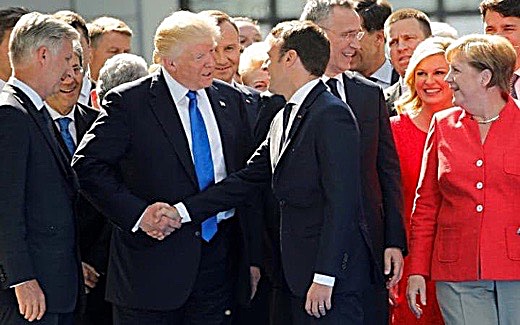

Image above: After pushing his way to the front of the G7 leaders Trump has a "tug of War" handshake with newly elected French President Emmanuel Macron who was trying to avoid the orange clown. From (http://www.unionleader.com/article/20170526/NEWS06/170529490).

In addition to stymying action on fossil fuels, Trump also 'forced the Italian prime minister Paulo Gentiloni to shred plans for an ambitious statement stressing the plight of migrants.

Further isolating the United States as other world powers prepare to take on the crisis of climate change, President Donald Trump refused to commit to the landmark Paris Climate Agreement as the remaining G7 leaders reaffirmed their determination to implement the accord.

In what has been described as an "unusually frank statement," the G7 Taormina Leaders' Communiqué (pdf) released Saturday after the two-day meeting in Sicily, says that the U.S. is "in the process of reviewing its policies on climate change and on the Paris Agreement and thus is not in a position to join the consensus on these topics."

"Understanding this process," the document continues, "the heads of state and of government of Canada, France, Germany, Italy, Japan, and the United Kingdom and the presidents of the European Council and of the European Commission reaffirm their strong commitment to swiftly implement the Paris Agreement."

Meanwhile, Trump took to Twitter to announce that he would "make a final decision on the Paris Accord next week," but it was clear the U.S. president had been a substantial roadblock over the course of the summit.

"The entire discussion about climate was very difficult, if not to say very dissatisfying," German Chancellor Angela Merkel told reporters on Saturday. "There are no indications whether the United States will stay in the Paris Agreement or not."

On those deliberations, The Guardian reported:
During the two-day conclave in Taormina, other leaders repeatedly urged Trump to recognize that as world's second biggest carbon emitter, the U.S. had to show leadership on climate issues.

Leaders warned the U.S. president that he risks a stampede, as others in the 195-nation agreement use American withdrawal from the treaty to reduce their own commitments.

Trump retained the option of pulling out of the treaty altogether or, more likely, scaling back on the specific commitments made by the Obama administration. Obama pledged to cut domestic greenhouse gas emissions 26-28 % below 2005 levels by 2025.
While not surprised, environmental groups expressed dismay over Trump's recalcitrance.
The truncated six-page document (compared with last year's 32-page tome), which outlines the industrialized nations' top priorities, "offered only minimal language on climate change and energy," the Union of Concerned Scientists noted.

Alden Meyer, a leading expert on the United Nation's international climate negotiations process and director of strategy and policy with the organization, said that Trump's "continued waffling on whether to stay in or withdraw from the Paris Agreement made it impossible to reach consensus at the Taormina summit on the need for ambitious climate action."

But, Meyer continues, "he stands in stark isolation, as the leaders from Europe, Canada, and Japan have made it crystal clear they intend to fully implement their national commitments under the Paris Agreement and pursue efforts to decarbonize the global economy."

More concisely, Alex Doukas, senior campaigner at Oil Change International, said: "even though Donald Trump threw a tantrum, the grown-ups in the room ignored him."

However, Doukas did note that the group stopped short of reaffirming their commitment to phase out fossil fuel subsidies by 2025.

"G7 leaders caved in the face fossil fuel cronyism, and were silent on their prior commitment to end fossil fuel subsidies by 2025—despite this language being agreed at the meeting of G7 energy ministers in April," Doukas said.

"Subsidizing fossil fuel companies in the face of rapid climate change is like spraying jet fuel on a burning home. To put out the fire, we must first stop making the problem worse," Doukas continued.

"Ignoring the problem just because fossil fuel industry mascots like Trump demand it is like agreeing to take the warning labels off of cigarettes because they offend Joe Camel. Our leaders must act now to stop burning our tax dollars and stop trashing the climate."

In addition to stymying action on fossil fuels, Trump also reportedly "forced the Italian prime minister Paulo Gentiloni—the summit host—to shred plans for an ambitious statement stressing the plight of migrants was a global rather than regional responsibility," the Guardian reported.

One unnamed European diplomat told the Independent that "[t]here was very strong opposition by the Americans and British who wanted to refocus on security and water down the expansive language on freedom of movement."

Opening up borders was one of the primary demands of the protesters who rallied on the streets of the Italian resort community on Saturday. Thousands of peaceful activists marched and carried signs, that included phrases like "Freedom, not Frontex," referring to the European Union's draconian border control agency.

Instead, the groups settled on language committing to fighting "protectionism" through trade and terrorism, as well as vowing to impose additional sanctions against Russia if warranted.


.

Donald Trump's mental health

SUBHEAD: Psychiatrists are expressing their concern about President Donald Trump's mental state.

By Cesar Chelela & Ornando Garci on 11 March 2017 for Common Dreams -
(http://www.commondreams.org/views/2017/03/11/barry-goldwater-donald-trump)


Image above: Illustration of Donald Trump and names of mental health issues. From origanal article.

Increasingly, members of the psychiatric profession are expressing their concern about President Donald Trump mental health status.

In a recent letter to the New York Times, two prestigious psychiatrists, Judith L. Herman and Robert Jay Lifton seriously question his grasp of reality and say, “Soon after the election, one of us raised concerns about Donald Trump’s fitness for office, based on the alarming symptoms of mental instability he had shown during his campaign.

Since then, this concern has grown. Even within the space of a few weeks, the demands of the presidency have magnified his erratic patterns of behavior.”

They are clear that they are not making a diagnosis but just expressing their concern, saying, “We are in no way offering a psychiatric diagnosis, which would be unwise to attempt from a distance. Nevertheless, as psychiatrists we feel obliged to express our alarm. We fear that when faced with a crisis, President Trump will lack the judgment to respond rationally.”

As a base for these carefully stated considerations is the Goldwater Rule. In 1964, the magazine Fact published the article “The Unconscious of a Conservative: A Special Issue on the Mind of Barry Goldwater.”

The article included the results of a poll among psychiatrists questioning them if then Senator Barry Goldwater was fit to be president. Of the 2,147 who responded, 657 said that he was fit and 1,189 said that he was not.

In addition to the responses to the question about Goldwater, the article included a series of quotations from the respondents, various facts and observations about Goldwater. Goldwater sued the editor-published of the magazine, Ralph Ginzburg, who had edited some of the quotations from articles and even from some of the psychiatrists interviewed.

Goldwater sued him and won $75,000 in damages, since the judge found that Ginzburg had acted with malicious intent.

Before the publication of the article, the medical director of the American Psychiatric Association had warned Ginzburg that the responses were not valid without a “thorough clinical examination” of Goldwater, according to Jonathan D. Moreno, an American philosopher and historian.

In 1973, the American Psychiatric Association (APA) made that policy official and established what became known as the “Goldwater Rule.”

The Rule, which appeared in the first edition of the APA’s code of ethics and is still in effect now, says:
“On occasion psychiatrists are asked for an opinion about an individual who is in the light of public attention or who has disclosed information about himself/herself through public media. In such circumstances, a psychiatrist may share with the public his or her expertise about psychiatric issues in general.

However, it is unethical for a psychiatrist to offer a professional opinion unless he or she has conducted an examination and has been granted proper authorization for such a statement.”
Although there are some positive aspects to the Goldwater Rule, it presents some conflicting issues.

The rule still prevents the unethical misuse of the psychiatric profession: i.e. it may be tempting to come to a diagnostic conclusion on a public figure when politically convenient, even in the face of a paucity of data.

The rule should allow, however, for psychiatrists and other health-related professionals to voice their concerns regarding the mental stability of high office holders.

In our culture we need a psychological clearance for people working in intelligence, in the FBI, in the police.

Should not we demand a clean bill of mental health for the person who is going to literally control our lives?

For as long a such needed regulation does not exist, should responsible professionals remain silent, obediently abiding by a rule that in this case protects what many consider a manifestly dangerous character at the helm of the world?

One should also consider the ethical obligations to protect public health imposed by the psychiatric profession.

In a letter to the New York Times, 37 psychiatrists, psychologists and social workers alerted on the dangers imposed by President Donald Trump’s mental health status. According to these professionals, the silence imposed by the Goldwater Rule “…has resulted in a failure to lend our expertise to worried journalists and members of Congress at this critical time.”

And they conclude, “We believe that the grave emotional instability indicated by Mr. Trump’s speech and action makes him incapable of serving safely as President.”

Professional impressions could be mild or strong but they are not the same as diagnosis; they can still warn and educate the public preventing potential harm. Such rule should be applied wisely and judiciously but not at the expense of similarly important ethical obligations imposed by the psychiatric profession.

Therefore, while it should be respected, the Goldwater Rule should not gag the psychiatric profession from protecting the public at large.

.

The Uber-lie

SUBHEAD: In periods of decline, strongmen arise promising to restore past glories and to defeat enemies.

By Richard Heinberg on 6 February 2017 for Post Carbon Institute -
(http://www.postcarbon.org/the-uber-lie/)


Image above: "Trumps Fountain of Lies" the conspiracy of Steve Bannon and Kellyanne Conway. From (https://www.inverse.com/article/27303-steve-bannon-looks-like-michael-shannon-meme).

Our new American president is famous for spinning whoppers. Falsehoods, fabrications, distortions, deceptions—they’re all in a day’s work.

The result is an increasingly adversarial relationship between the administration and the press, which may in fact be the point of the exercise: as conservative commenter Scott McKay suggests in The American Spectator,
 “The hacks covering Trump are as lazy as they are partisan, so feeding them . . . manufactured controversies over [the size of] inaugural crowds is a guaranteed way of keeping them occupied while things of real substance are done.”
But are some matters of real substance (such as last week’s ban on entry by residents of seven Muslim-dominated nations) themselves being used to hide even deeper and more significant shifts in power and governance?

Steve “I want to bring everything crashing down” Bannon, who has proclaimed himself an enemy of Washington’s political class, is a member of a small cabal (also including Trump, Stephen Miller, Reince Priebus, and Jared Kushner) that appears to be consolidating nearly complete federal governmental power, drafting executive orders, and formulating political strategy—all without paper trail or oversight of any kind.

The more outrage and confusion they create, the more effective is their smokescreen for the dismantling of governmental norms and institutions.

There’s no point downplaying the seriousness of what is up. Some commentators are describing it as a coup d’etat in progress; there is definitely the potential for blood in the streets at some point.

Nevertheless, even as political events spiral toward (perhaps intended) chaos, I wish once again, as I’ve done countless times before, to point to a lie even bigger than the ones being served up by the new administration—one that predates the new presidency, but whose deconstruction is essential for understanding the dawning Trumpocene era.

I’m referring to a lie that is leading us toward not just political violence but, potentially, much worse.

It is an untruth that’s both durable and bipartisan; one that the business community, nearly all professional economists, and politicians around the globe reiterate ceaselessly.  

It is the lie that human society can continue growing its population and consumption levels indefinitely on our finite planet, and never suffer consequences.

Yes, this lie has been debunked periodically, starting decades ago. A discussion about planetary limits erupted into prominence in the 1970s and faded, yet has never really gone away.

But now those limits are becoming less and less theoretical, more and more real. I would argue that the emergence of the Trump administration is a symptom of that shift from forecast to actuality.

Consider population. There were one billion of us on Planet Earth in 1800. Now there are 7.5 billion, all needing jobs, housing, food, and clothing. From time immemorial there were natural population checks—disease and famine. Bad things.

But during the last century or so we defeated those population checks. Famines became rare and lots of diseases can now be cured.

Modern agriculture grows food in astounding quantities. That’s all good (for people anyway—for ecosystems, not so much). But the result is that human population has grown with unprecedented speed.

Some say this is not a problem, because the rate of population growth is slowing: that rate was two percent per year in the 1960s; now it’s one percent.

Yet because one percent of 7.5 billion is more than two percent of 3 billion (which was the world population in 1960), the actual number of people we’re now adding annually is the highest ever: over eighty million—the equivalent of Tokyo, New York, Mexico City, and London added together.

Much of that population growth is occurring in countries that are already having a hard time taking care of their people. The result? Failed states, political unrest, and rivers of refugees.

Per capita consumption of just about everything also grew during past decades, and political and economic systems came to depend upon economic growth to provide returns on investments, expanding tax revenues, and positive poll numbers for politicians.

Nearly all of that consumption growth depended on fossil fuels to provide energy for raw materials extraction, manufacturing, and transport.

But fossil fuels are finite and by now we’ve used the best of them. We are not making the transition to alternative energy sources fast enough to avert crisis (if it is even possible for alternative energy sources to maintain current levels of production and transport).

At the same time, we have depleted other essential resources, including topsoil, forests, minerals, and fish. As we extract and use resources, we create pollution—including greenhouse gasses, which cause climate change.

Depletion and pollution eventually act as a brake on further economic growth even in the wealthiest nations. Then, as the engine of the economy slows, workers find their incomes leveling off and declining—a phenomenon also related to the globalization of production, which elites have pursued in order to maximize profits.

Declining wages have resulted in the upwelling of anti-immigrant and anti-globalization sentiments among a large swath of the American populace, and those sentiments have in turn served up Donald Trump.

Here we are. It’s perfectly understandable that people are angry and want change. Why not vote for a vain huckster who promises to “Make America Great Again”?

However, unless we deal with deeper biophysical problems (population, consumption, depletion, and pollution), as well as the policies that elites have used to forestall the effects of economic contraction for themselves (globalization, financialization, automation, a massive increase in debt, and a resulting spike in economic inequality), America certainly won’t be “great again”; instead, we’ll just proceed through the five stages of collapse helpfully identified by Dmitry Orlov.

Rather than coming to grips with our society’s fundamental biophysical contradictions, we have clung to the convenient lies that markets will always provide, and that there are plenty of resources for as many humans as we can ever possibly want to crowd onto this little planet.

And if people are struggling, that must be the fault of [insert preferred boogeyman or group here]. No doubt many people will continue adhering to these lies even as the evidence around us increasingly shows that modern industrial society has already entered a trajectory of decline.

While Trump is a symptom of both the end of economic growth and of the denial of that new reality, events didn’t have to flow in his direction. Liberals could have taken up the issues of declining wages and globalization (as Bernie Sanders did) and even immigration reform.

For example, Colin Hines, former head of Greenpeace’s International Economics Unit and author of Localization: A Global Manifesto, has just released a new book, Progressive Protectionism, in which he argues that
“We must make the progressive case for controlling our borders, and restricting not just migration but the free movement of goods, services and capital where it threatens environment, wellbeing and social cohesion.”
But instead of well-thought out policies tackling the extremely complex issues of global trade, immigration, and living wages, we have hastily written executive orders that upend the lives of innocents.

Two teams (liberal and conservative) are lined up on the national playing field, with positions on all significant issues divvied up between them.

As the heat of tempers rises, our options are narrowed to choosing which team to cheer for; there is no time to question our own team’s issues. That’s just one of the downsides of increasing political polarization—which Trump is exacerbating dramatically.

Just as Team Trump covers its actions with a smokescreen of controversial falsehoods, our society hides its biggest lie of all—the lie of guaranteed, unending economic growth—behind a camouflage of political controversies.

Even in relatively calm times, the über-lie was watertight: almost no one questioned it. Like all lies, it served to divert attention from an unwanted truth—the truth of our collective vulnerability to depletion, pollution, and the law of diminishing returns. Now that truth is more hidden than ever.

Our new government shows nothing but contempt for environmentalists and it plans to exit Paris climate agreement. Denial reigns! Chaos threatens!

So why bother bringing up the obscured reality of limits to growth now, when immediate crises demand instant action? It’s objectively too late to restrain population and consumption growth so as to avert what ecologists of the 1970s called a “hard landing.”

Now we’ve fully embarked on the age of consequences, and there are fires to put out.

Yes, the times have moved on, but the truth is still the truth, and I would argue that it’s only by understanding the biophysical wellsprings of change that can we successfully adapt, and recognize whatever opportunities come our way as the pace of contraction accelerates to the point that decline can no longer successfully be hidden by the elite’s strategies.

Perhaps Donald Trump succeeded because his promises spoke to what civilizations in decline tend to want to hear. It could be argued that the pluralistic, secular, cosmopolitan, tolerant, constitutional democratic nation state is a political arrangement appropriate for a growing economy buoyed by pervasive optimism.

(On a scale much smaller than contemporary America, ancient Greece and Rome during their early expansionary periods provided examples of this kind of political-social arrangement). As societies contract, people turn fearful, angry, and pessimistic—and fear, anger, and pessimism fairly dripped from Trump’s inaugural address.

In periods of decline, strongmen tend to arise promising to restore past glories and to defeat domestic and foreign enemies. Repressive kleptocracies are the rule rather than the exception.

If that’s what we see developing around us and we want something different, we will have to propose economic, political, and social forms that are appropriate to the biophysical realities increasingly confronting us—and that embody or promote cultural values that we wish to promote or preserve.

Look for good historic examples. Imagine new strategies. What program will speak to people’s actual needs and concerns at this moment in history?

Promising a return to an economy and way of life that characterized a past moment is pointless, and it may propel demagogues to power. But there is always a range of possible responses to the reality of the present.  

What’s needed is a new hard-nosed sort of optimism (based on an honest acknowledgment of previously denied truths) as an alternative to the lies of divisive bullies who take advantage of the elites’ failures in order to promote their own patently greedy interests.

What that actually means in concrete terms I hope to propose in more detail in future essays.


.

Ms Gabbard goes to Syria

SUBHEAD: After "secret trip", Gabbard derided as ‘Stooge,’ and praised as ‘Courageous’.

By Kristin Downey on 27 January 2017 for Civel Beat -
(http://www.civilbeat.org/2017/01/after-secret-trip-gabbard-derided-as-stooge-praised-as-courageous/)


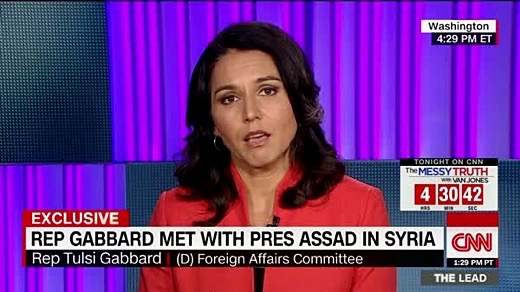
Image above: Tulsi Gabbard explaining her journey this week to meet President Assad in Syria. From still frame from CNN video stream.

No stranger to the national stage, the Hawaii congresswoman is getting international attention after meeting with Syrian President Assad.

Hawaii Congresswoman Tulsi Gabbard’s secret fact-finding trip to Syria and Lebanon — and especially her meeting with a brutal dictator, Syrian President Bashar Assad — continues to garner attention here and abroad.

Gabbard, who serves on the House Foreign Affairs and Armed Services committees, has declined to share many details about the week-long visit to the war-torn nations, which has only added to the mystery and heightened the suspicions of people questioning her motives.

On Friday, her office said again that Gabbard would not discuss the trip.

In statements, Gabbard has characterized the trip as a peace-making effort aimed at trying to better understand the on-the-ground realities in the region, where horrific violence has caused millions of refugees to flee to Europe and the United States.

She said she was surprised by an invitation to meet with Assad, and acted on the opportunity, sharing no further details.

Anger And Praise Critics say that a meeting with a member of Congress enhanced Assad’s credibility and that it was naïve, or even treacherous, for her to go there.

Gabbard’s trip “raised alarms,” wrote The Guardian, a British news site. “Tulsi Gabbard’s Fascist Escorts to Syria,” was the headline on a piece by The Daily Beast. The Daily Kos called her a “stooge” for the Syrian president, who has killed thousands of dissidents, allegedly including by poison gas.

The secret trip angered some of her congressional colleagues, according to The Hill, a political news site.

Gabbard, a combat veteran who served in Iraq, has also been praised in some circles for making the trip. A group of Syrians posting on a website called Progressive Democrats of America called the visit “courageous.” A story about the trip on AntiWar.Blog attracted applause from people who oppose U.S. military intervention and high levels of military spending.

Gabbard, a Hindu of Samoan descent, has also been lauded by white supremacists David Duke, the former leader of the Ku Klux Klan, and Richard B. Spencer. In a tweet, Spencer said Gabbard is “brave and the kind of person we need in the diplomatic corps.”

Syria, once a bastion of multiculturalism and religious tolerance, the home of picturesque and historic antiquities, has become a bloodbath since a civil war erupted in 2011 amid the uprisings known as the Arab Spring.

Assad’s regime is backed by Russia. His opponents, who are backed by Saudi Arabia and other Persian Gulf countries, include many Islamic militant groups. Some of the rebels who are viewed as more moderate have received American support.

Syrian government forces are also battling the Islamic State on Syrian soil.

Former President Barack Obama was a vocal opponent of Assad, and contemplated sending U.S. troops to Syria to help topple his regime. President Donald Trump has endorsed a more hands-off approach to military intervention in the Middle East.

His position on Syria is a work in progress, but there have been some suggestions in leaked documents that he plans to step up U.S. involvement there.

Gabbard has long opposed U.S. military intervention in Syria, saying that overthrowing Assad would allow Islamic militants to gain control of the country.

Center Of Attention — Again
This isn’t the first time the representative of Hawaii’s 2nd Congressional District has been a lightning rod.

She has been at odds with the Democratic Party establishment since she endorsed Sen. Bernie Sanders for president instead of former Secretary of State Hillary Clinton. Gabbard resigned her position as vice-chair of the Democratic National Party to underscore her disapproval of what she said the party had done to undermine Sanders’ candidacy.

Gabbard went to Syria during the transition week, as Obama was departing office and Trump was being inaugurated. She said she could not reveal details of her travel plans for security reasons.

She did not inform Democratic Party officials she was going, and did not tell the Republican leaders of the Foreign Service or Armed Service committees. She said she did tell the Defense Department she was planning to make the trip, and got approval from the House Ethics Committee.

She said she did not inform Trump.

“The Trump administration was not aware or involved in the trip in any way, and the congresswoman has not been in touch with them since returning regarding this trip or anything else,” her office said in a statement.

Gabbard’s relationship with Trump has also raised eyebrows in Democratic circles. Shortly after he won the election, Gabbard visited him at his New York home in Trump Tower. She said she went to talk about her concerns about military intervention in Syria; some observers speculated she might be looking for a job in his administration.

Assad’s military alliance with Russia added to the controversy over Gabbard’s trip. Russia is widely believed to have intervened in the U.S. presidential election by hacking the email of the Democratic National Committee, exposing messages that put Clinton and her supporters in a bad light and undermined her candidacy.

Gabbard has said that the trip was sponsored by an organization called the Arab American Community Center for Economic and Social Services, part of an organization known as ACCESS, which says on its website that it is a philanthropic group that assists Arab-Americans.

She said was accompanied by former Congressman Dennis Kucinich, a progressive pacifist who ran for president in 2008.

Gabbard’s husband, Abraham Williams, also traved with her. He posted video of the trip on Gabbard’s facebook page, which has drawn 102,000 views, 2,640 shares and dozens of comments.

Most of them are complimentary, with some urging her to run for president in 2020.

.

Women Who Farm

SUBHEAD: The actions of women rooted in agriculture, leadership and cultural change.

By Katie Massy on 1 March 2016 for Overgow the System -
(http://www.overgrowthesystem.com/women-who-farm/#wome-who-farm)


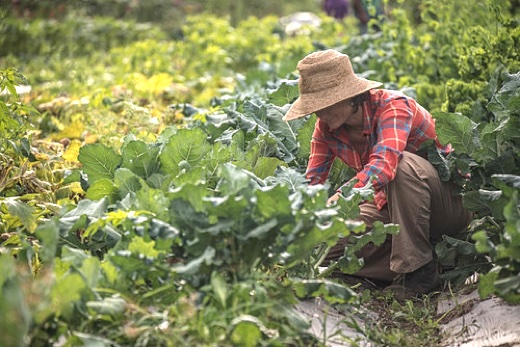
Image above: A woman farming. From  original article.

From backyards, abandoned urban spaces, rural properties, and farmland, women around the world, are leading a change that nourishes the soil, encourages biodiversity, safe-guards the seeds, and teaches the children.

This movement continues to gain power through the women who are changing the future of food. Their hardwork, re-skilling and activism is what the world has been waiting for.
Women Who Farm seeks to share these stories.

This project establishes itself as an online media project, and as a book that follows the stories of 15 women across Canada and the United States. The book is still in its infancy stage, while the online project is now underway.

Women Who Farm seeks to celebrate women, through it’s multiple platforms in order to create a new narrative of perserverance, skill and leadership. These stories can inspire both women and men, towards a more ecological and diverse food system which in turn will bring about a more socially just and biodiverse world.

As Vandana Shiva, an agricultural activist says, “We are either going to have a future where women lead the way to make peace with the earth, or we are not going to have a human future at all.”

Are you a woman dedicated to small-scale agriculture, homesteading, gardening, market farming, or raising animals in an ethical way?  Be apart of Women Who Farm! We seek to celebrate women who are leading the local food movement.

To be featured on the Women Who Farm Facebook page send in a photo of yourself on your farm, or in your garden, etc. and we will send you a question. Once we receive your reply, we will feature you on our social media channels. We will post your photo with your engaging quote and give credit to you and your farm.

Do you want to write for Women Who Farm?  We are seeking to publish articles through our online platform connected with Over Grow The System. We will also share your article on the Women Who Farm social media sites.

One last easy way to be apart of Women Who Farm: Tag yourself #womenwhofarm and connect up with us!

Please send all photo’s, submissions and any questions you may have to submissions@womenwhofarm.com

[Her]Story is an online feature of Women Who Farm that empowers and celebrates women around the world. We share the stories of women to inspire a new narrative of empowerment through gardening, homesteading, farming, beekeeping, and seed saving.

This online platform is for you. By sharing your story, you inspire others to create positive change on both the land and in communities throughout the world. By sharing the good work that you and countless women are indebted to, you inspire ripples of positive global change.

Tips & suggestions for your entry:
  • Please give full, in depth replies. Write like you would in an essay.
  • Find someone who can go over and edit your entry before you enter in below.
  • Feel free to advertise the work you are doing, such as your blog or book etc., but don’t let it over shadow the writing. You can advertise at the end of the article the work in which you want to promote.
  • We want to share your story with both the challenges and victories. We are inspired by the real stories of what it means to farm and grow food. It’s not all sunshine and kale, and we are totally inspired by that. Check out some of our Her[Story] features below.
  • After we receive your submission, we will contact you and ask for photographs.  
  • Please send in ten to fifteen high quality images. Images really help with the telling of your story.
  • You don’t have any high quality images? Reach out to your community to see if there is anyone who will take pictures of you and your work.  Some smart phones take good enough quality images that look beautiful. We request that all images are 2000pix wide
  • Please reply to the questions you feel most called to. You do not need to reply to all of them.

My name is Katie Massy. I have been farming since the age of 25. I found my life’s career when I planted the first seeds of early Spring. My first year farming was filled with struggle, but that year of not having a boss, being free on the land, eating amazing food, made me fall in love with being a farmer.

Heart and Soil Organics, run by my partner and I, began when I met a man travelling down from the Haida Gwaii, who urged me to start growing food. With limited access to locally grown food, and most food being shipped in, he was concerned about the Haida Gwaii and noted that Vancouver Island was in a similar situation. It was that day that my partner and I decided to start farming.
We now grow on an acre of land, maybe a little bit more.

Our intention is not to plow more soil, but to grow with better soil, quality seed, and rain harvested water. We spend a lot of time soil building. Each year we harvest enough rain water to irrigate our entire farm for the year.

With the support of our customers it is possible for us to grow food that nourishes both the land and its people. When people take home food we have grown, I feel such happiness in my heart. They have tasted what a real tomato tastes like.

I believe farming is such a perfect vocation for women. It takes real nuturing and attention to grow good food. We don’t need to know how to fix huge tractors, or combines. All we need are some hand tools, determination and a strong back.

I hope that you share your story with me. Together we can change the cultural ideal of what it means to be a woman and celebrate being a farmer. It is a great thing to be a woman who farms.


Video above: "Women Who Farm". Featuring Katie Massy. From original article. (https://vimeo.com/155460216).

.

The Solution Space - Part 4

SUBHEAD: The shift to lower consumption will be imposed on us. The element of choice will be only in how we choose to face it.

[IB Publisher's note: This is one of a five part series on the boundaries of the Solution Space in which our future lives can take place.] 

By Nicole Foss on 18 August 2015 for the Automatic Earth -
(http://www.theautomaticearth.com/2015/08/the-boundaries-and-future-of-solution-space-part-4/)


Image above: In Sanzhi, Taiwan this utopian resort village was abandoned in 1980 before it was ever occupied. From (http://pixieandrotter.com/2012/09/17/ten-abandoned-citiesvillages/).

PART 4
Elected Leaders & Policy Ineffectiveness
The majority of proposals made by those who acknowledge limits fail on at least one of the previous criteria, and often several, if not all of them. Solution space is smaller than we typically think.

The most common approach is to insist on government policies intended to implement meaningful change by fiat. Even in the best of times, government policy is a blunt instrument which all too often achieves the opposite of its stated intention, and in contractionary times the likelihood of this increases enormously.

Governments are reactive – and slowly – not proactive. Policies typically reflect the realities of the past, not the future, and are therefore particularly maladaptive at times of large scale trend change, particularly when that change unfolds rapidly. Those focusing on government policy are mostly not thinking in terms of crisis, however, but of seamless proactive adjustment – the kind of which humanity is congenitally incapable.

There is a common perception that government policy and its effect on society depends critically on who holds the seat of power and what policies they impose. The assumption is that elected leaders do, in fact, wield the power to determine and implement their chosen policies, but this has become less and less the case over time.

Elected leaders are the public face of a system which they do not control, and increasingly act merely as salesmen for policies determined behind the scenes, mostly at the behest of special interest groups with privileged political access.

It actually matters little who is the figure-head at any given time, as their actions are constrained by the system in which they are embedded. Even if leaders fully understood the situation we face, which is highly unlikely given the nature of the leadership selection process, they would be unable to change the direction of a system so much larger than themselves.

Where public pressure on elected governments develops around a specific issue, for whatever reason, the political response is generally to act in such a way as to appear to do something meaningful, while actually making no substantive change at all.

Often the appearance of action is nothing more than vacuous political spin, assuaging public opinion while doing nothing to threaten the extractive interests driving the system in the same direction as always. We cannot expect truly adaptive initiatives to emerge from a system hostage to powerful vested interests and therefore locked into a given direction.

Public understanding of the issues agitated for or against tends, unfortunately, to be limited and one-dimensional, meaning that it is essentially impossible to create public pressure for truly informed policy changes, and it is relatively simple to claim that the appearance of action constitutes actual action. A short public attention span makes this even simpler.

People are also extremely unlikely to vote for policies which, if they were to make a meaningful difference, would amount to depriving those same people of the outsized consumption habits to which they have become accustomed. The insurmountable obstacles to achieving change through government policy become obvious.

Planned degrowth assumes the possibility of a smooth progression towards a lower consumption future, but this is not how contractions unfold following the bursting of a bubble. What we can expect is a series of abrupt dislocations that are going to wreak havoc with our collective ability to plan anything at all for many years, by which time we will already be living in a lower consumption future arrived at chaotically.

Effective planning for an epochal shift requires the capacity for top-down policy implementation at large scale, combined with social cohesion, the ability to maintain complexity, and the energy to maintain control over a myriad distinct aspects simultaneously. It is simply not going to happen in the manner that proponents envisage.

Steady State & Population Control
Similarly, a steady state economy is not a realistic construct in light of many non-negotiable realities.

Human history, and in fact the non-human evolution which preceded it, is a dynamic history of boom and bust, of niches opening up, being exploited, being over-exploited and collapsing. It is a history of opportunism and the consequences following from it.

In the human experience, boom and bust in the form of the rise and fall of empire is an emergent property of civilizational scale. A steady state at this scale is prima facie impossible.

An approximation of steady state can exist under certain circumstances, where a population well below ecological carrying capacity, and surrounded by abundance, is left in isolation for a very long period of time.

The Australian aboriginal existence prior to the European invasion is probably the best example, having persisted for tens of thousands of years. The circumstances which permitted it were, however, diametrically opposite to those we currently face.

Proponents of the steady state economy do not seem to appreciate the extent to which we have long since transgressed the point of no return from the perspective of being able to maintain what we have built. Even if we were merely approaching limits, instead of having moved substantially into overshoot, we would not be able to hold society in stasis just below those limitations.

Populations grow and expansion proceeds with it. Intentionally preventing population growth globally is unrealistic. Even China, as a single country, has struggled with population control policies, and has had to take drastic and dictatorial measures in order to slow population growth. This clearly relies on strong top-down control, which is only barely possible at a national level and will never be possible at a global level.

In China we are also going to see that the outcome of population control has challenging consequences, and that a policy supposedly designed to foster stability can have the opposite effect.

The desire for a male child has dangerously distorted the gender ratio in ways which will leave the country with a large excess of young men with no prospects for either work or marriage. That is a guarantee of trouble, either at home or abroad, or possibly both. There will also be far too few employed young people to look after a burgeoning elderly population, meaning a rapid die-off of the elderly cohort at some point.

Even then China is unlikely to have managed to get itself back below the carrying capacity it has done so much to destroy during its frantic dash for growth. The tremendous modernity drive China has engaged in essentially undone any benefit curbing population growth might have had, by increasing energy and resource consumption per capita by an enormous margin.

It is population times consumption which determines impact, and in China the ecological impact has in many ways been catastrophic. That has to some extent been compensated for by obtaining access to a great deal of land in other countries, but economic colonialism has done nothing for global stability.

While it is possible to conceive, as some steady-state and degrowth proponents do, of a world in which civilization and large-scale urbanism have been dismantled in favour of autonomous, yet networked, village-scale settlements, that does not make it even remotely realistic.

Humanity may, in the distant future, after the overshoot condition has been resolved by nature, as it will eventually be, find itself living in villages once again, but they would not be networked in the modern, technological sense, and the population they housed would be much smaller than at present.

If it is below carrying capacity, then it will grow again, restarting the cycle of expansion and contraction rather than settling for a steady-state. Reaching for the stars again would not be possible however, as the necessary energy and resources have already been consumed or dissipated.

Blind Alleys and Techno-Fantasies
People are often inclined to think that a different trajectory is a matter of choice – for instance that we must collectively choose to live differently in order to prevent an ecological catastrophe. In fact it is not a matter of choice at all.

There is no basis for top-down control capable of delivering meaningful change, nor would humanity ever collectively choose to scale back its consumption pattern, although individuals can and do. Given opportunities as a species, we take them, as evolution has shaped us to do.

Groups which made a habit of forgoing opportunities in the past would quickly have been out-competed by those who did not. We are the descendants of a long long line of opportunists, selected over millennia for our flexibility in turning an incredibly wide range of circumstances to our advantage.

But, in this instance we will have no choice – the shift to lower consumption will be imposed on us by circumstance. The element of choice will be only in how we choose to face that which we cannot change.

Another class of ideas for ways forward is grounded in techno-optimism, suggesting that because human beings are clever and creative, and have tended to push back apparent limits before, that we will be able to do so indefinitely. The notion is that changing our trajectory is unnecessary because limits can always be circumvented. Needless to say, such a view is not grounded in physical reality.

These ‘solutions’ are entrepreneurial rather than policy-driven, although they may expect to be facilitated through policy.

Ideas in this category would include such things as smart renewables-based power grids, high-performance electric cars, high-tech energy storage systems, thorium reactors, fusion reactors, biofuels, genetically modified (pseudo)foodstuffs, geoengineering, enhanced automation, high-tech carbon sequestration, global carbon trading platforms, electronic crypto-currencies, clean-tech, vertical farming skyscrapers and many other notions.

Notice that all of these presume the ready availability of cheap energy and resources, along with large quantities of capital, and all assume that technological complexity can be maintained or even increased. Options such as these also have a substantial dependence on the continuation of globalized trade in both goods and services in order to satisfy their complex supply chains.

However, globalization depends on the ability to operate at large scale in extremely complex ways, it depends on cheap energy, it depends on maintaining trust in trading partners, and it depends on the ability to travel without facing unacceptable levels of physical risk from piracy or conflict.

Trade does very poorly in times of financial and economic contraction. In the Great Depression of the 1930s, trade fell by 66% in two years. Trust collapses, and with it the contractual ability to agree on risk-sharing arrangements. Letters of credit become impossible to obtain in a credit crunch, and without them goods do not move.

Many goods will in any case have no market, as there will be little purchasing power for anything but essentials, and possibly not even sufficient for those. As we move from the peak of globalized trade, there will be an enormous excess of transport capacity, which will drive prices down relentlessly to the point where transporting goods becomes uneconomic. Much transport capacity will be scrapped.

Without credit to oil the wheels of trade, our highly leveraged economic system will grind to a halt.

It is natural that we regard our current situation as being normal, and take for granted that the march of technological progress – the only reality most of us have known – will continue. Few question very deeply the foundations of our societies, and even those who do recognize that change must occur rarely realize the extent to which that change will inevitably strike at the fundamental basis of modern existence.

Globalization has peaked and will shortly be moving into reverse. The world will be a very different place as a result.

See also:
Ea O Ka Aina: The Solution Space - Part 1 8/15/15
The cost of capital will be high and solutions which need it will lie outside solution space.
Ea O Ka Aina: The Solution Space - Part 2  8/16/15
If solutions depend on a cooperation at large scale, they will not be part of solution space.
Ea O Ka Aina: The Solution Space - Part 3 8/17/15
Proposed solutions which depend on energy-intensivity will lie outside of solution space. 
Ea O Ka Aina: The Solution Space - Part 4 8/18/15
Lower consumption will be imposed on us. Our choice will be how we choose to face it.
Ea O Ka Aina: The Solution Space - Part 5 8/19/15
The ways forward will be inexpensive, small-scale, simple, low-energy, community-based.

.

Paradigm Blindness

SUBHEAD:  Leadership in every realm does not grasp that the terms for carrying on the human project have changed.

By James Kunstler on 7 October 2013 for Kunstler.com -
(http://kunstler.com/clusterfuck-nation/paradigm-blindness/)


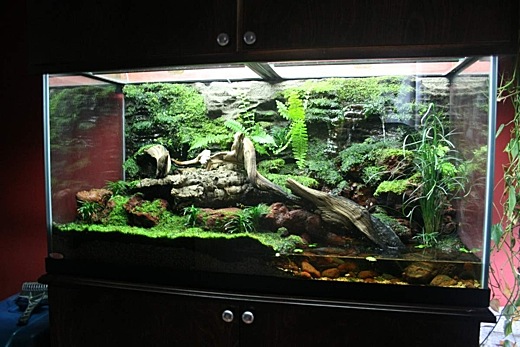
Image above: Washington DC. A steamy tropical reptile terrarium. From (http://www.trees-plants.com/terrarium-moss/).

Something is sucking the air out of the humid terrarium that is US politics, making the lizards, tarantulas, and scorpions within hyperventilate. That something is the vacuum of disappearing wealth.

All the accounting fraud, statistical mis-reporting, price manipulations, naked-short beat-downs, high-speed arbitrage hijinks, and carry trade rackets can’t conceal the reality that the nation is going broke – at least 99 percent of the nation.

The remaining 1 percenters are swimming in a pool of notional wealth that is primed to go down the drain and leave them at the bottom, desiccated little husks of animal matter that the crows will feed on.

The reason nobody seems to know what to do is because they know anything they do will make them look bad, so the only thing to do is nothing, with a sound track of lizard squawks and much darting of forked tongues.

Nature is now in charge, not personalities, and nature is now leading a purblind humanity to the place it has to go, which is smaller, simpler, and local. The flailings and squawking of politicians can only avail to make the journey more painful and disorderly, but the march is on.

Leadership in every realm — politics, business, the ivory tower, media — does not grasp that the terms for carrying on the human project have changed. The agenda now is to go medieval, and not in the Pulp Fiction sense, but in our arrangements for daily life. We are being asked by nature to say goodbye gracefully to the hubris known as the current edition of modernity.

If we don’t do this gracefully, nature will kick our ass out of it and drag the stragglers along kicking and screaming into the next disposition of things. That is pretty much the true subtext of the struggle in government this season, but it is not being translated at the conscious level into a coherent narrative that the public can understand. The failure of narratives produces a failure of leadership. Failures of leadership lead to failures of action.

I can especially understand this after being in a particular part of the USA for three days last week: Orange County, California, specifically the fiasco known as Irvine.

This so-called “city” was once a ranch comprising hundreds of thousands of acres consolidated out of old Spanish land grants by one James Irvine, an Irish immigrant who made a fortune selling groceries and dry goods during the California Gold Rush and parlayed it into real estate — including eventually the nearly 200-square-mile tract of creosote bush and sagebrush forty-odd miles south of nascent Los Angeles.

The so-called city named after Mr. Irvine — and still largely controlled by a private real estate development company he founded — prides itself on being rationally planned. By this they mean that all the angles have been figured out for producing massive volumes of exquisitely-tuned suburban sprawl at a nice profit.

One thing this demonstrates is that rational planning is not the same thing as intelligence because the end result on-the-ground is a nightmare of the most extreme car dependency in the nation, arguably even worse than Los Angeles. That it is also a nightmare of crushing uniformity, disconnection, boredom, and ennui probably matters less because the essence of the place’s character is that it has no future.

There is absolutely no way that the American people can continue their Happy Motoring frolic for another generation, yet the Irvine Company is still busy slapping together new monocultures of housing pods, strip malls, and all the other usual furnishings with the kind of stupid confidence of people intoxicated on Rotary Club bullshit — which is to say zeal minus consciousness.

It is the same frame-of-mind that produces the famous Orange County right wing politics.

Orange County, and places like it, represent a tremendous tragic problem for this country. They were the products of emergent economic forces that humans only pretended to control with their vaunted rational planning. They almost certainly cannot be fixed. They’re too big and the money won’t be there; it’s the essence of our predicament that capital formation is crippled and that situation will only get worse.

These places will enter a state of widespread crisis within the next ten years, and possibly much sooner. The people who live there will see their property lose all its value, and then they will have to make choices about where to move to. In the process, they will dig in their heels, cause an immense amount of political mischief, and eventually lose anyway.

The emergent path of going medieval means living in smaller, tighter towns and doing some kind of business, or working some kind of trade, that is based in the economy of the town and its region. Under these conditions, things like the federal government are destined to wither. The dumbshow underway in Washington these days is just a symptom of all that.

.

At the End of the Night a Good Day

SUBHEAD:  Bill 2491 amended so that pesticide disclosure requirement bolstered, buffer zones remain.

By Gary Hooser on 28 Seltember 2013 for GaryHooserBlog -
(http://garyhooser.wordpress.com/2013/09/28/at-the-end-of-the-night-it-was-a-very-good-day/)


Image above: Proponents and opponents of Kauai County Council Bill 2491 wait to enter the council chambers, Friday ahead of a meeting to discuss the bill at the historic County Building. From (http://thegardenisland.com/news/local/govt-and-politics/amended/article_6421cc64-288c-11e3-8593-0019bb2963f4.html).

Last night (Friday, Sept 27th), after an exhausting 12 hour meeting, the Kauai County Council Committee on Economic Development, Agriculture and Sustainability voted 4 to 1 to amend and to pass out of committee Bill 2491. The full Council will now consider and vote on the amended Bill. That Council meeting has yet to be scheduled but could occur within the next 7 to 10 days.

Was this a victory? The answer is a resounding YES.

Is this enough? The answer is a resounding NO.

While I continue to review the details of the entire very comprehensive and complex amendment that was passed last night – it appears that 50% of the Bill survived the amendment process.

The key and heart and soul of the entire effort, “the right to know” disclosure provision was made even stronger than originally introduced.

The disclosure provision is arguably the most important element of the Bill and is what the agrochemical companies are most concerned about – and this provision emerged from the process robust and strong. The buffer zones are intact but need to be strengthened. The EIS provision was converted into an alternative study but I believe will serve the purpose needed to determine health and environmental impacts of this industry. The moratorium did not make the cut but interestingly the companies seem to be willing to sign an agreement limiting expansion.

Thank you to all who have worked so hard on this effort. Yesterday’s outcome was a significant win but much work is needed to strengthen the Bill that now moves to the full Council.

You can be sure that the industry pushback will be strong and swift. It is likely we will hear from their lawyers again as they renew their effort to bully the County into submission. It is also likely that there will be more press releases, more pronouncements’ from State government officials, more full page ads in the newspaper and more letters from the Chamber of Commerce.

Please let Council Members JoAnn Yukimura and Nadine Nakamura how much their work is appreciated in helping to pass Bill 2491. Without their willingness to do the heavy lifting and writing of the amendments, this very important measure could have remained in limbo for a long, long time. Tell them mahalo…and yes please tell them we need a stronger version that includes better buffer zones and a moratorium commitment that includes the entire island of Kauai. Even though he is not on the Committee and was not able to vote last night, Bill 2491’s co-introducer Council Member Tim Bynum provided invaluable support during last nights deliberations and deserves a huge mahalo as well.

To be clear: Bill 2491 can be further amended during the full Council meeting that will be scheduled in the near future. It can be made stronger or it can be made weaker during this meeting and this effort is not over until the full Council votes and the Mayor signs Bill 2491 into law.

Imua! gh

Amendments:

1) The core of the issue – “The Right To Know” was preserved and strengthened. Should Bill 2491 pass out of the full Council in its present amended form companies will have to disclose to the world the chemicals they are using on our island. They will have to tell us what pesticides they are using, how much they are using and where and when they used it. And they will have to tell us what GMO crops they are growing as well.

2) Buffer Zones – While I believe this section needs significant strengthening, the amended Bill includes buffer protection zones around schools, hospitals, homes and many other areas. To be clear this section IMHO needs to be expanded and I am hopeful this can be done in the upcoming Council meeting.

3) Health/Environmental Impact Study – The amended Bill requires the County to conduct a study following a comprehensive process designed to ensure the end product is comprehensive and includes the detailed medical and environmental data gathering and analysis required for solid future decision making. While not following the 343 EIS process which I preferred and was outlined in the Bill, this is an alternative path to the same objective.

4) Prohibition of open air testing of experimental pesticides and experimental GMO’s – These provisions were deleted and are not included in the “moving forward Bill 2491”.

5) Permitting – This provision was deleted. I attempted unsuccessfully to retain this provision by amending the words “shall” to “may” and thus retaining the option of the County to implement permitting. However, those introducing the amendments decided this provision could be passed into law at a future date, after the study was completed and if the study showed a specific need for permitting.

6) Moratorium – This provision was deleted and was perhaps my biggest disappointment. However apparently the 4 agrochemical companies are prepared to sign a written agreement that they will not expand their operations north of the Wailua River for a period of time that I believe was two years or until the County Health and Environmental study was completed. While at first it may seem like a welcome offer to those who live on the north and east shore, this proposal is offensive and unacceptable – and must include the entire island.
.

Turning the Herd

SUBHEAD: Some animals who are running oblique to the cliff’s edge are trying to persuade other members of the herd to follow them.

By Alan Bates on 16 July 2013 for The Great Change -
(http://peaksurfer.blogspot.co.uk/2013/07/turning-herd.html)


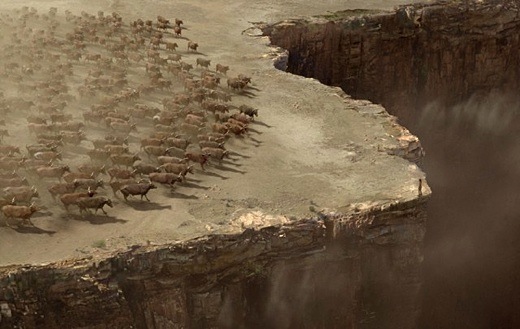
Image above: Cattle stampede over a cliff in film "Australia". From (http://www.framestore.com/work/australia).
"Salvaging hope has to do with finding some wayward lead animals who are running oblique to the cliff’s edge and trying to persuade other members of the herd to follow them, in hopes that collectively it may actually slow momentum or even reverse direction of the herd, or at worst, save a few animals from being swept over."
We are sitting in a bay window of a stone cabin staring at the sunny, windswept west coast of Ireland, Rossbeigh Beach on the Iveragh Peninsula, overlooking Dingle Bay near Killorglin. We began this trip with an utterly absorbing International Communal Societies meeting in Scotland, moved on to a climate farming design charrette at a Permaculture center in Norway, then a repeat performance on a biodynamic farm in Sweden, and now the annual Feasta (Foundation for the Economics of Sustainability) retreat week in the west of County Kerry where we are brewing cool coffee with our Biolite stove and charging this iPad.

We travelled by train from Dublin with Nicole Foss (Stoneleigh of The Automatic Earth) after spending the night at the home of David Korowicz, to a quaint summer retreat cottage on the beach purchased by London barrister John Joplin in 1960 as a stone ruin and still being very gradually restored. It will house the dozen or so international participants of our conversation the coming week.

Arriving in late afternoon, we sat here in this window and curled up with a book we picked off the shelf, Sharing for Survival: Restoring the Climate, the Commons and Society, a Feasta anthology edited by Brian Davey and published in 2012. Now completely entranced by Davey’s opening chapter, in this post we will try to describe what we liked about it.

The chapter is called What can be done if mainstream politics loses interest in climate change, which seems at first glance a dumb question, being a fait d’accompli, but it turns out to be a compendium of the world’s best thinking on how to turn sour lemons into mojitos.

The first thing Davey observes is that great changes seldom come from confrontation. Rather, they are approached obliquely, indirectly, because from the standpoint of the historical participant, what needs to happen is unclear. Actually, as to our present dilemma, Davey’s essay points clearly to what needs to happen and catalogs the challenges.

Policymakers and business leaders are a tight-knit class locked into a commitment to growth. Growth underpins our global economic system, if for no other reason than money is merely the issuance of debt obligations and when you add the requirement of (unlent) interest, as Margrit Kennedy observed 30 years ago, it sets up a Ponzi scheme that is utterly dependent on growth, and endlessly seeking new patsies. This system requires both the unscrupulous lender and the gullible victim, and the globalized education system is geared to produce both in large numbers.

Money, drug and energy addicts share a brain chemistry that gets reinforced by both Western diet and social networks of fellow addicts. Policy is largely formulated by officials dialoging with the predator class and their skilled lobbyists and public relations hires, creating a mainstream narrative drummed by media that drowns out all alternative narratives, even the ones being trumpeted by Mother Nature in the form of superstorms, net fossil energy decline and global weirding.

No-one likes to maintain stressful confrontational relationships over long times, so regulatory capture is followed by the capture of non-profit opposition groups, popular media, and large open public fora, such as we described in past narratives of Rio+20 and UN climate conferences. Davey says, given this context, the situation appears pretty hopeless. We are a herd species and our herd is galloping towards a cliff.

Salvaging hope has to do with finding some wayward lead animals who are running oblique to the cliff’s edge and trying to persuade other members of the herd to follow them, in hopes that collectively it may actually slow momentum or even reverse direction of the herd, or at worst, save a few animals from being swept over.

We might think of these as “seed” experiments — complimentary currencies, ecovillages, “cool” stoves, and non-violent methods of conflict transformation — as the fringe of society but they are actually the leading edge of our inevitable future, if we are to have one.

In Denmark we can point to Ross Jackson’s “breakaway” strategy — a reform of global governance led by democratically or economically advanced countries like Iceland and Bhutan. In Germany there is the “solidarity economy” that hopes to congeal cooperative networks of CSA’s, community energy companies, community gardens and similar grass roots enterprises into a political force. From Ireland and the UK we have the Transition movement that combines town-scale remodeling projects with personal reskilling to cope with energy descent and climate change.

From Italy we have Slow Food evolving through slow money and slow living to slow everything, very useful to the herd-and-cliff metaphor. From France we get Decroissance, which personally we prefer over its English version (Degrowth), because the French sounds more like a flaky pastry than losing your job. Something similar is emerging in Bolivia and Ecuador with Buen Vivir.

From these seeds, with some sunlight, water and the luck of a green thumb, who knows? What we may see will not be a centralized, pre-conceived new system replacing the old like Bolshevism or the Campuchean Revolution, but a bottom-up, decentralized Sacred Unrest, to borrow Paul Hawken’s words.

As Davey says, though, “What is still not clear is how far governments are capable of contributing to the new future.” It is argued by Naomi Klein, among others, that nations are now functioning as brands, running sophisticated PR campaigns designed by financial sector for the purpose of gaining expanded markets, access to raw materials, and new populations of debt slaves. Alternative futures will have to compete with this for minds and hearts.

It is helpful that governments and their economic schemes are increasingly seen as corrupt and bankrupt. It is less helpful that they are erecting a neo-liberal security state to impose power and undercut their opposition by violent means. Nonetheless, truth will out. As Napolean said, “Never harass your enemy when he is in the process of destroying himself.” The herd is not slowing yet, but the outlyers are gaining adherents.

.

The Case for Hope

SUBHEAD: Of course there is no way forward now. You walk the path into being, you make the way, and if you do it well, others can follow the route.

By Rebecca Solnit on 19 May 2013 for Tom Dispatch  -
(http://www.tomdispatch.com/post/175701/tomgram%3A_rebecca_solnit%2C_what_comes_after_hope)


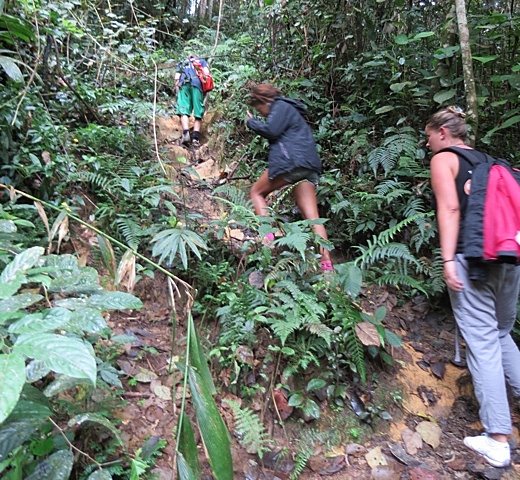
Image above: Trekking through Malaysia in March 2012. From (http://samandkaty.wordpress.com/2012/03/15/food-glorious-food/).

Ten years ago, my part of the world was full of valiant opposition to the new wars being launched far away and at home -- and of despair. And like despairing people everywhere, whether in a personal depression or a political tailspin, these activists believed the future would look more or less like the present. If there was nothing else they were confident about, at least they were confident about that. Ten years ago, as a contrarian and a person who prefers not to see others suffer, I tried to undermine despair with the case for hope.

A decade later, the present is still contaminated by the crimes of that era, but so much has changed. Not necessarily for the better -- a decade ago, most spoke of climate change as a distant problem, and then it caught up with us in 10,000 ways. But not entirely for the worse either -- the vigorous climate movement we needed arose in that decade and is growing now. If there is one thing we can draw from where we are now and where we were then, it’s that the unimaginable is ordinary, and the way forward is almost never a straight path you can glance down, but a labyrinth of surprises, gifts, and afflictions you prepare for by accepting your blind spots as well as your intuitions.

The despairing of May 2003 were convinced of one true thing, that we had not stopped the invasion of Iraq, but they extrapolated from that a series of false assumptions about our failures and our powerlessness across time and space. They assumed -- like the neoconservatives themselves -- that those neocons would be atop the world for a long time to come. Instead, the neocon and neoliberal ideologies have been widely reviled and renounced around the world; the Republicans’ demographic hemorrhage has weakened them in this country; the failures of their wars are evident to everyone; and though they still grasp fearsome power, everything has indeed changed. Everything changes: there lies most of our hope and some of our fear.

I’ve seen extraordinary change in my lifetime, some of it in the last decade. I was born in a country that had been galvanized and unsettled by the civil rights movement, but still lacked a meaningful environmental movement, women’s movement, or queer rights movement (beyond a couple of small organizations founded in California in the 1950s).

Half a century ago, to be gay or lesbian was to live in hiding or be treated as mentally ill or criminal. That 12 states and several countries would legalize same-sex marriage was beyond imaginable then. It wasn’t even on the table in 2003. San Francisco’s spring run of same-sex weddings in 2004 flung open the doors through which so many have passed since.

If you take the long view, you’ll see how startlingly, how unexpectedly but regularly things change. Not by magic, but by the incremental effect of countless acts of courage, love, and commitment, the small drops that wear away stones and carve new landscapes, and sometimes by torrents of popular will that change the world suddenly. To say that is not to say that it will all come out fine in the end regardless. I’m just telling you that everything is in motion, and sometimes we are ourselves that movement.

Unstoppabilities
Hope and history are sisters: one looks forward and one looks back, and they make the world spacious enough to move through freely. Obliviousness to the past and to the mutability of all things imprisons you in a shrunken present. Hopelessness often comes out of that amnesia, out of forgetting that everything is in motion, everything changes. We have a great deal of history of defeat, suffering, cruelty, and loss, and everyone should know it. But that’s not all we have.

There’s the people’s history, the counterhistory that you didn’t necessarily get in school and don’t usually get on the news: the history of the battles we’ve won, of the rights we’ve gained, of the differences between then and now that those who live in forgetfulness lack. This is often the history of how individuals came together to produce that behemoth civil society, which stands astride nations and topples regimes -- and mostly does it without weapons or armies. It’s a history that undermines most of what you’ve been told about authority and violence and your own powerlessness.

Civil society is our power, our joy, and our possibility, and it has written a lot of the history in the last few years, as well as the last half century. If you doubt our power, see how it terrifies those at the top, and remember that they fight it best by convincing us it doesn’t exist. It does exist, though, like lava beneath the earth, and when it erupts, the surface of the earth is remade.

Things change. And people sometimes have the power to make that happen, if and when they come together and act (and occasionally act alone, as did writers Rachel Carson and Harriet Beecher Stowe -- or Mohammed Bouazizi, the young man whose suicide triggered the Arab Spring).

If you fix your eye on where we started out, you’ll see that we’ve come a long way by those means. If you look forward, you’ll see that we have a long way to go -- and that sometimes we go backward when we forget that we fought for the eight-hour workday or workplace safety or women’s rights or voting rights or affordable education, forget that we won them, that they’re precious, and that we can lose them again. There’s much to be proud of, there’s much to mourn, there’s much yet to do, and the job of doing it is ours, a heavy gift to carry. And it’s made to be carried, by people who are unstoppable, who are movements, who are change itself.

Too Soon to Tell
Ten years ago I began writing about hope and speaking about it. My online essay “Acts of Hope,” posted on May 19, 2003, was my first encounter with Tomdispatch.com, which would change my work and my life. It gave me room for another kind of voice and another kind of writing. It showed me how the Internet could give wings to words. What I wrote then and subsequently for the site spread around the world in remarkable ways, putting me in touch with people and movements, and deeper into conversations about the possible and the impossible (and into a cherished friendship with the site’s founder and editor, Tom Engelhardt).

For a few years, I spoke about hope around this country and in Europe. I repeatedly ran into comfortably situated people who were hostile to the idea of hope: they thought that hope somehow betrayed the desperate and downtrodden, as if the desperate wanted the solidarity of misery from the privileged, rather than action. Hopelessness for people in extreme situations means resignation to one’s own deprivation or destruction. Hope can be a survival strategy. For comfortably situated people, hopelessness means cynicism and letting oneself off the hook. If everything is doomed, then nothing is required (and vice versa).

Despair is often premature: it’s a form of impatience as well as certainty. My favorite comment about political change comes from Zhou En-Lai, the premier of the People’s Republic of China under Chairman Mao. Asked in the early 1970s about his opinion of the French Revolution, he reportedly answered, “Too soon to tell.”

Some say that he was talking about the revolutions of 1968, not 1789, but even then it provides a generous and expansive perspective. To hold onto uncertainty and possibility and a sense that even four years later, no less nearly two centuries after the fact, the verdict still isn’t in is more than most people I know are prepared to offer. A lot of them will hardly give an event a month to complete its effects, and many movements and endeavors are ruled failures well before they’re over.

Not long ago, I ran into a guy who’d been involved in the Occupy Wall Street movement, that great upwelling in southern Manhattan in the fall of 2011 that catalyzed a global conversation and a series of actions and occupations nationwide and globally. He offered a tailspin of a description of how Occupy was over and had failed.

But I wonder: How could he possibly know? It really is too soon to tell. First of all, maybe the kid who will lead the movement that will save the world was catalyzed by what she lived through or stumbled upon in Occupy Fresno or Occupy Memphis, and we won’t reap what she sows until 2023 or 2043. Maybe the seeds of something more were sown, as they were in Czechoslovakia during the Prague Spring of 1968 and Charter 77, for the great and unforeseen harvest that was the Velvet Revolution of 1989, the nonviolent overthrow of the Soviet totalitarian state in that country.

Second, Occupy began to say what needed to be said about greed and capitalism, exposing a brutality that had long been hushed up, revealing both the victims of debt and the rigged economy that created it. This country changed because those things were said out loud. I can’t say exactly how, but I know it mattered. So much that matters is immeasurable, unquantifiable, and beyond price. Laws around banking, foreclosure, and student loans are changing -- not enough, not everywhere, but some people will benefit, and they matter. Occupy didn’t cause those changes directly, but it did much to make the voice of the people audible and the sheer wrongness of our debt system visible -- and gave momentum to the ongoing endeavors to overturn Citizens United and abolish corporate personhood.

Third, I only know a little of what the thousands of local gatherings and networks we mean by “Occupy” are now doing, but I know that Occupy Sandy is still doing vital work in the destruction zone of that hurricane and was about the best grassroots disaster relief endeavor this nation has ever seen. I know that Strike Debt, a direct offshoot of Occupy Wall Street, has relieved millions of dollars in medical debt, not with the sense that we can fix all debt this way, but that we can demonstrate the malleability, the artifice, and the immorality of the student, medical, and housing debt that is destroying so many lives.

I know that the Occupy Homes foreclosure defenders have been doing amazing things, often one home at a time, from Atlanta to Minneapolis. (Last Friday, Occupy Our Homes organized a “showdown at the Department of Justice” in Washington, D.C.; that Saturday, Strike Debt Bay Area held their second Debtors' Assembly: undead from coast to coast.)

Fourth, I know people personally whose lives were changed, and who are doing work they never imagined they would be involved in, and I’m friends with remarkable people who, but for Occupy, I would not know existed. People connected across class, racial, and cultural lines in the flowering of that movement. Like Freedom Summer, whose consequences were to be felt so far beyond Mississippi in 1964, this will have reach beyond the moment in which I write and you read.

Finally, there was great joy at the time , the joy of liberation and of solidarity, and joy is worth something in itself. In a sense, it’s worth everything, even if it’s always fleeting, though not always as scarce as we imagine.

Climates of Hope and Fear
I had lunch with Middle East and nonviolence scholar Stephen Zunes the other day and asked him what he would say about the Arab Spring now. He had, he told me, been in Egypt several months ago watching television with an activist. Formerly, the news was always about what the leaders did, decided, ordained, inflicted.

But the news they were watching was surprisingly focused on civil society, on what ordinary people initiated or resisted, on how they responded, what they thought. He spoke of how so many in the Middle East had lost their fatalism and sense of powerlessness and awoken to their own collective power.

This civil society remains awake in Egypt and the other countries. What will it achieve? Maybe it’s too soon to tell. Syria is a turbulent version of hell now, but it could be leaving the dynasty of the Assads in the past; its future remains to be written. Perhaps its people will indeed write the next chapter in its story, and not only with explosives.

You can tell the arc of the past few years as, first, the Arab Spring, then extraordinary civil society actions in Chile, Quebec, Spain, and elsewhere, followed by Occupy. But don't stop there.

After Occupy came Idle No More, the Canada-based explosion of indigenous power and resistance (to a Canadian government that has gone over to the far right and to environmental destruction on a grand scale). It was founded by four women in November of 2012 and it’s spread across North America, sparking new environmental actions and new coalitions around environmental and climate issues, with flash-mob-style powwows in shopping malls and other places, with a thousand-mile walk (and snowshoe) by seven Cree youth this winter. (There were 400 people with them by the time they arrived at Canada’s Parliament in Ottawa.)

Idle No More activists have vowed to block the construction of any pipeline that tries to transport the particularly dirty crude oil from the Alberta tar sands, whether it heads north, east, or west from northern Alberta. Each of those directions takes it over native land. This is part of the reason why tar sands supporters are pushing so hard to build the Keystone XL pipeline from Alberta to the U.S. Gulf Coast.

Thankfully, the push back is also strong. Our fate may depend on it. As climate scientist James Hansen wrote a year ago, “Canada’s tar sands, deposits of sand saturated with bitumen, contain twice the amount of carbon dioxide emitted by global oil use in our entire history. If we were to fully exploit this new oil source, and continue to burn our conventional oil, gas, and coal supplies, concentrations of carbon dioxide in the atmosphere eventually would reach levels higher than in the Pliocene era, more than 2.5 million years ago, when sea level was at least 50 feet higher than it is now.”

The news just came in that we reached 400 parts per million of carbon dioxide in our atmosphere, the highest level in more than five million years. This is terrible news on a scale that eclipses everything else, because it encompasses everything else. We are wrecking our world, for everyone for all time, or at least the next several thousand years. But “we” is a tricky word here. Some of the people I most love and admire are doing extraordinary things to save the world, for you, for us, for generations unborn, for species yet to be named, for the oceans and sub-Saharan Africans and Arctic dwellers and everyone in-between, for the whole unbearably beautiful symphony of life on Earth that is imperiled.

Part of what sustains me in the face of this potential cataclysm is remembering that, in 2003, there hardly was a climate movement. It was small, polite, mostly believed the troubles were decades away, and was populated with people who thought that lifestyle changes could save the planet -- rather than that you have to get out there and fight the power. And they were the good ones. Too many of us didn’t think about it at all.

Only a few years later, things have changed. There’s a vibrant climate movement in North America. If you haven’t quite taken that in, it might be because it’s working on so many disparate fronts that are often treated separately: mountaintop coal removal, coal-fired power plants (closing 145 existing ones to date and preventing more than 150 planned ones from opening), fracking, oil exploration in the Arctic, the Tar Sands pipeline, and 350.org’s juggernaut of a campus campaign to promote disinvestment from oil, gas, and coal companies. Only started in November 2012, there are already divestment movements underway on more than 380 college and university campuses, and now cities are getting on board. It has significant victories; it will have more.

Some countries -- notably Germany, with Denmark not far behind -- have done remarkable things when it comes to promoting non-fossil-fuel renewable energy. Copenhagen, for example, in the cold gray north, is on track to become a carbon-neutral city by 2025 (and in the meantime reduced its carbon emissions 25% between 2005 and 2011). The United States has a host of promising smaller projects. To offer just two examples, Los Angeles has committed to being coal-free by 2025, while San Francisco will offer its citizens electricity from 100% renewable and carbon-neutral sources and its supervisors just voted to divest the city’s fossil-fuel stocks.

There are so many pieces of the potential solution to this puzzle, and some of them are for you to put together. Whether they will multiply or ever add up to enough we don’t yet know. We need more: more people, more transformations, more ways to conquer and dismantle the oil companies, more of a vision of what is at stake, more of the great force that is civil society. Will we get it? I don’t know. Neither do you. Anything could happen.

But here’s what I’m saying: you should wake up amazed every day of your life, because if I had told you in 1988 that, within three years, the Soviet satellite states would liberate themselves nonviolently and the Soviet Union would cease to exist, you would have thought I was crazy. If I had told you in 1990 that South America was on its way to liberating itself and becoming a continent of progressive and democratic experiments, you would have considered me delusional.

If, in November 2010, I had told you that, within months, the autocrat Hosni Mubarak, who had dominated Egypt since 1981, would be overthrown by 18 days of popular uprisings, or that the dictators of Tunisia and Libya would be ousted, all in the same year, you would have institutionalized me. If I told you on September 16, 2011, that a bunch of kids sitting in a park in lower Manhattan would rock the country, you’d say I was beyond delusional. You would have, if you believed as the despairing do, that the future is invariably going to look like the present, only more so. It won’t.

I still value hope, but I see it as only part of what’s required, a starting point. Think of it as the match but not the tinder or the blaze. To matter, to change the world, you also need devotion and will and you need to act. Hope is only where it begins, though I’ve also seen people toil on without regard to hope, to what they believe is possible. They live on principle and they gamble, and sometimes they even win, or sometimes the goal they were aiming for is reached long after their deaths. Still, it’s action that gets you there. When what was once hoped for is realized, it falls into the background, becomes the new normal; and we hope for or carp about something else.

The future is bigger than our imaginations. It’s unimaginable, and then it comes anyway. To meet it we need to keep going, to walk past what we can imagine. We need to be unstoppable. And here’s what it takes: you don’t stop walking to congratulate yourself; you don’t stop walking to wallow in despair; you don’t stop because your own life got too comfortable or too rough; you don’t stop because you won; you don’t stop because you lost. There’s more to win, more to lose, others who need you.

You don’t stop walking because there is no way forward. Of course there is no way. You walk the path into being, you make the way, and if you do it well, others can follow the route. You look backward to grasp the long history you’re moving forward from, the paths others have made, the road you came in on. You look forward to possibility. That’s what we mean by hope, and you look past it into the impossible and that doesn’t stop you either. But mostly you just walk, right foot, left foot, right foot, left foot. That’s what makes you unstoppable.

• Rebecca Solnit’s first essay for Tomdispatch.com turned into the book Hope in the Dark: Untold Histories, Wild Possibilities, since translated into eight languages. Portions of this essay began life as the keynote speech at the National Lawyers' Guild gala in honor of attorney and human rights activist Walter Riley, whose own life is a beautiful example of unstoppability. Solnit’s latest book, The Faraway Nearby, will be published in June. 

.