Showing posts with label Eastern Europe. Show all posts

Human lineage from Greece?

SUBHEAD: Fossils cast doubt on early human lineage originating in Africa.

By Will Dunham on 23 May 2017 for Ekathimerini.com -
(http://www.ekathimerini.com/218639/article/ekathimerini/news/fossils-cast-doubt-on-human-lineage-originating-in-africa)


Image above: Graecopithecus freybergi lived 7.2 million years ago in the dust-laden savannah of the Athens Basin. This view from Graecopithecus freybergi’ place of discovery, Pyrgos Vassilissis, to the southeast over the plain of Athens and under a reddish cloud of Sahara dust; in the background: Mount Hymettos and Mount Lykabettos. Illustration by Velizar Simeonovski. From (http://www.sci-news.com/othersciences/anthropology/graecopithecus-freybergi-hominin-04888.html).

Fossils from Greece and Bulgaria of an ape-like creature that lived 7.2 million years ago may fundamentally alter the understanding of human origins, casting doubt on the view that the evolutionary lineage that led to people arose in Africa.

Scientists said on Monday the creature, known as Graecopithecus freybergi and known only from a lower jawbone and an isolated tooth, may be the oldest-known member of the human lineage that began after an evolutionary split from the line that led to chimpanzees, our closest cousins.

The jawbone, which included teeth, was unearthed in 1944 in Athens. The premolar was found in south-central Bulgaria in 2009. The researchers examined them using sophisticated new techniques including CT scans and established their age by dating the sedimentary rock in which they were found.

They found dental root development that possessed telltale human characteristics not seen in chimps and their ancestors, placing Graecopithecus within the human lineage, known as hominins. Until now, the oldest-known hominin was Sahelanthropus, which lived 6-7 million years ago in Chad.

The scientific consensus long has been that hominins originated in Africa. Considering the Graecopithecus fossils hail from the Balkans, the eastern Mediterranean may have given rise to the human lineage, the researchers said.

The findings in no way call into question that our species, Homo sapiens, first appeared in Africa about 200,000 years ago and later migrated to other parts of the world, the researchers said.

"Our species evolved in Africa. Our lineage may not have," said paleoanthropologist Madelaine Böhme of Germany's University of Tübingen, adding that the findings "may change radically our understanding of early human/hominin origin."

Homo sapiens is only the latest in a long evolutionary hominin line that began with overwhelmingly ape-like species, followed by a succession of species acquiring more and more human traits over time.

University of Toronto paleoanthropologist David Begun said the possibility that the evolutionary split occurred outside Africa is not incongruent with later hominin species arising there.

"We know that many of the mammals of Africa did in fact originate in Eurasia and dispersed into Africa at around the time Graecopithecus lived," Begun said. "So why not Graecopithecus as well?"

Graecopithecus is a mysterious species because its fossils are so sparse. It was roughly the size of a female chimp and dwelled in a relatively dry mixed woodland-grassland environment, similar to today's African savanna, alongside antelopes, giraffes, rhinos, elephants, hyenas and warthogs.

The findings were published in the journal PLOS ONE.

See also:
Ea O Ka Aina: Evolution becomes Conscious 1/5/13
Ea O Ka Aina: One time Through the Bottleneck 7/21/11
Ea O Ka Aina: Hobbits and Menehunes 5/9/09

.

European danger of nuclear war

SUBHEAD: German "think tank" thinks conflict is growing between USA and Russia over Eastern Europe.

By Peter Schwartz on 15 OCtober 2016 for World Socialists -
(http://www.wsws.org/en/articles/2016/10/15/nucl-o15.html)


Image above: Inspection of a U.S. nuclear weapon storage system at Volkel Air Base use by Royal Netherlands Air Force F-16 jets. From (https://en.wikipedia.org/wiki/Nuclear_sharing).

In September, the German pro-government think tank “Stiftung Wissenschaft und Politik” (SWP) published a study on the implications of US policy towards Russia and European security. [1] The 28-page document is aimed at a professional audience and is written in political and military jargon that couches the annihilation of millions of human lives in matter-of-fact terms, as if dealing with the solution to a technical problem.

But this prosaic language conceals a nightmare scenario. American policy towards Russia, as described by the SWP study, focuses primarily on preparation for a nuclear war, which would involve large parts of Europe. If the results of the study are to be taken seriously, then the risk for the present generation of dying in a violent atomic storm is alarmingly high.

The study’s author, Dr. Peter Rudolf, an SWP employee, not only provides his own assessment, but references every paragraph with other sources. The text contains 118 footnotes, each of which refers to multiple articles in foreign policy and military journals and statements by leading politicians. The study summarizes the debate that is currently taking place in leading circles of the military and political establishment.

At its very beginning, the study stresses that the nuclear war danger is not an abstract, hypothetical risk. As “the first and most important structural feature” of US-Russian relations, the study names the “mutual nuclear annihilation capability.”

Even 25 years after the end of the Cold War, the United States and Russia, who together possess “approximately 90 percent of all nuclear weapons in the world,” maintain their strategic nuclear weapons “in constant combat readiness.” “They want to guarantee,” the study says, “if necessary under extreme time pressure, that they are able to make the decision to use nuclear arsenals... This is to prevent one’s own nuclear weapons being eliminated by a first strike.”

The study points to the very short time frame for decisions as “anything but conducive” to “crisis stabilization.” The flight times of ballistic missiles between the two countries run to “11 minutes for sea-based and 30 minutes for land-based missiles.”

The risk that a political crisis could “accidentally” result in a nuclear exchange due to these short reaction times is thus extremely high. This risk is further elevated by the ruthlessness with which the US and its NATO allies are escalating the conflict with Russia in Eastern Europe and Syria, and by the advanced planning for a nuclear war.

According to the SWP study, “a reinvigorated Russia, at least from the perspective of military planners in the Pentagon,” is regarded “as a potential enemy in a time of newly unfolding great power conflicts, as an enemy who—like China—needs to be deterred by the capacity for conflict dominance.” For this deterrent, according to the study, there are three strategic approaches in the US.

The first school of thought, which the study refers to as “confrontational, ’Neo-Containment,’” focuses on unconditional confrontation. It regards “consideration of alleged or actual Russian security interests” to be inappropriate. “Rather, external pressure should be increased and Russia forced into an arms race, in the opinion of this school.”

The second school advocates a “realpolitik approach to the management of US-Russian relations.” It proposes to recognize Russia’s claim to spheres of influence on its periphery, “in the interests of a regulated power rivalry,” while “at the same time signaling clearly that any aggression against a NATO member would be answered militarily.”

And finally, there is the school of thought that takes a “cooperative and inclusive approach.” It postulates self-critically “that the US bears a share [of the blame] in the deterioration of bilateral relations, especially through the expansion of NATO in a period of Russian weakness, and by promoting missile defence,” and advocates “a differentiated approach, combining a readiness to cooperate and risk mitigation.”

The study counts the Obama administration as part of this third, “cooperative-integrative,” school. This is remarkable, when one considers that Barack Obama is the first American president during whose entire eight years in office the country has continuously waged war.

Obama’s political record includes: supporting the right-wing coup in Kiev directed against Russia; the massive deployment of NATO troops to Russia’s western border; the unconditional guarantee of military assistance to the aggressive Baltic states, and the escalation of the Syrian war, which could provoke a direct confrontation between the Russian and American military.

One can easily imagine, therefore, what would happen if one of the two other, more confrontational schools of thought prevailed, within which the leading contender for the American presidency, Hillary Clinton, holds considerable sway. On this question, Clinton attacks her semi-fascist challenger Donald Trump from the right by accusing him of weakness towards Russia.

How far the plans and preparations for a nuclear war against Russia (and China) are already advanced in the strategic think tanks and leading military circles is made clear in the SWP study’s chapter, “New confrontation and its consequences.” The risks of a nuclear escalation of the conflict with Russia are now higher than during the Cold War, and continue to increase.

The “informal rules and regimes” that could moderate the ever-present risk of a military escalation of the East-West conflict at that time have been lost, according to the study. “What has disappeared is also the political sensitivity in dealing with military risks, and precisely the risk of a potential nuclear escalation, should deterrence fail.”

The study comprehensively shows how “the strengthening of conventional deterrence” by NATO - i.e., the stationing of troops on the Russian border, the plans for bringing in reinforcements, etc.—sets in motion an arms dynamic that inevitably leads to nuclear escalation. “The new policy of deterrence in Europe will hardly, as is sometimes assumed or hoped, be restricted to the conventional level,” it states. “The credibility of extended deterrence always rested on the nuclear escalation option.”

It is in this context that the final document of the Warsaw NATO summit in July 2016 should be understood. “It says, NATO remains a ‘nuclear alliance,’ and in the case of a threat to the fundamental security of a member state, has the capability and determination to impose unacceptable costs on an opponent.”

“For the first time since the end of the East-West conflict,” the study continues, “there are again in NATO considerations to conduct exercises with a view to scenarios where there could be a nuclear escalation. The danger of nuclear war in Europe as a result of an escalating crisis threatens to return.”

Among the texts to which the study refers on this issue is the essay, “Why a nuclear war would most likely begin in the Baltic states,” [2] which appeared in the conservative US foreign policy journal the National Interest on July 20, 2016.

The article accuses the US government of not taking the possibility of a nuclear war between America and Russia seriously enough following the end of the Cold War, and of having neglected atomic weapons capabilities. In reality, it says, such a possibility not only exists, but is becoming more likely. Then the article lists eight reasons why the greatest danger for such a war exists with regard to the three Baltic states.

It refers to the statement of President Obama during a visit to Estonia two years ago that the defence of the capitals of the three countries was “just as important as the defence of Berlin and Paris and London.”

This is “an extraordinary assertion,” when one considers that “the population of metropolitan London (about 8 million) is greater than that of all three Baltic states combined (about 6 million), and that the eastern coast of the Baltic Sea is so close to the Russian heartland.”

It then argues that, due to the superiority of conventional Russian forces in the region, compliance with the guarantee of security for the Baltic states would almost automatically lead to a nuclear escalation.

“The bottom line is that all the ingredients are present in the eastern Baltic area for an East-West conflict escalating to nuclear weapons use,” the article concludes. This is a “prescription for catastrophe.”

The study of the SWP, which generally promotes a pro-US line, does not delve into the causes and the background of the US drive towards war. Only at one point does it hint that it has to do with the quest for world domination. The US sees itself “in a time of renewed great power conflict,” it says. “Russia and China are the potential enemies that must be deterred by superior military power—and through the ability for conflict dominance.”

The changes in the international security situation have “activated the old, never vanished but seldom openly articulated core power interests of the USA, which, in the 1940s, under the influence of geo-political thinking... developed and were since followed: namely, to prevent one or more hostile great powers controlling the resources of Eurasia and acquiring a power potential that could endanger American supremacy.”

The SWP study does not deal with European reactions, although the openness with which it addresses the danger of a nuclear war expresses a certain concern regarding the consequences of America’s Russia policy. One might have expected the European governments to show more restraint in face of this imminent danger threatening to incinerate large parts of Europe. However, the opposite is the case.

While Germany and France refused to actively support the Iraq war in 2003, and Germany stood aside in the 2011 Libyan war, Paris and Berlin, like London, are now participating in both the escalation of the conflict with Russia in Syria and the NATO deployment to the Russian border.

French Foreign Minister Jean-Marc Ayrault has publicly accused Russian President Vladimir Putin of war crimes. President François Hollande has cancelled a meeting with Putin in Paris. British Foreign Minister Boris Johnson is calling for demonstrations outside the Russian embassy. Berlin has increased its troop contingent in the Middle East. And the German media are full of inflammatory articles against Russia.

That does not mean that political agreement exists between Europe and the United States—in fact, political and economic tensions are growing. But Europe’s ruling classes are reacting to the same objective developments that prevail in the US. In response to the global financial and economic crisis, unresolved since 2008, growing social tensions at home and the risk of violent class struggles, they react by turning to militarism, war and authoritarian forms of rule.

The danger of nuclear annihilation will not deter them from this course, just as the foreseeable catastrophe did not stop them in 1914 and in 1939 from plunging humanity into the inferno of the First and the Second World Wars. Only an independent, international movement of the working class against war and its cause, capitalism, can prevent a nuclear catastrophe.

Notes:
[1] Peter Rudolf, “Amerikanische Russland-Politik und europäische Sicherheitsordnung” (“American policy on Russia and European security order”), SWP Research Paper September 2016
[2] Loren B. Thompson, “Why the Baltic States Are Where Nuclear War Is Most Likely to Begin”, The National Interest, 20.7.2016

.

Putin bashing existential madness

SUBHEAD: The neocons and neoliberals might succeed in provoking a violent uprising in Moscow.

By Robert Parry on 12 September 2106 for Consortium News -
(https://consortiumnews.com/2016/09/12/the-existential-madness-of-putin-bashing/)


Image above: Russian President Vladimir Putin addresses the United Nation in 2015. From (http://orientalreview.org/2015/09/30/putin-at-the-un-do-you-at-least-realize-now-what-youve-done/).

Arguably, the nuttiest neoconservative idea – among a long list of nutty ideas – has been to destabilize nuclear-armed Russia by weakening its economy, isolating it from Europe, pushing NATO up to its borders, demonizing its leadership, and sponsoring anti-government political activists inside Russia to promote “regime change.”

This breathtakingly dangerous strategy has been formulated and implemented with little serious debate inside the United States as the major mainstream news media and the neocons’ liberal-interventionist sidekicks have fallen in line much as they did during the run-up to the disastrous invasion of Iraq in 2003.

Except with Russia, the risks are even greater – conceivably, a nuclear war that could exterminate life on the planet. Yet, despite those stakes, there has been a cavalier – even goofy – attitude in the U.S. political/media mainstream about undertaking this new “regime change” project aimed at Moscow.

There is also little appreciation of how lucky the world was when the Soviet Union fell apart in 1991 without some Russian extremists seizing control of the nuclear codes and taking humanity to the brink of extinction. Back then, there was a mix of luck and restrained leadership, especially on the Soviet side.

Plus, there were at least verbal assurances from George H.W. Bush’s administration that the Soviet retreat from East Germany and Eastern Europe would not be exploited by NATO and that a new era of cooperation with the West could follow the break-up of the Soviet Union.

Instead, the United States dispatched financial “experts” – many from Harvard Business School – who arrived in Moscow with neoliberal plans for “shock therapy” to “privatize” Russia’s resources, which turned a handful of corrupt insiders into powerful billionaires, known as “oligarchs,” and the “Harvard Boys” into well-rewarded consultants.

But the result for the average Russian was horrific as the population experienced a drop in life expectancy unprecedented in a country not at war. While a Russian could expect to live to be almost 70 in the mid-1980s, that expectation had dropped to less than 65 by the mid-1990s.

The “Harvard Boys” were living the high-life with beautiful women, caviar and champagne in the lavish enclaves of Moscow – as the U.S.-favored President Boris Yeltsin drank himself into stupors – but there were reports of starvation in villages in the Russian heartland and organized crime murdered people on the street with near impunity.

Meanwhile, Presidents Bill Clinton and George W. Bush cast aside any restraint regarding Russia’s national pride and historic fears by expanding NATO across Eastern Europe, including the incorporation of former Soviet republics.

In the 1990s, the “triumphalist” neocons formulated a doctrine for permanent U.S. global dominance with their thinking reaching its most belligerent form during George W. Bush’s presidency, which asserted the virtually unlimited right for the United States to intervene militarily anywhere in the world regardless of international law and treaties.

How Despair Led to Putin
Without recognizing the desperation and despair of the Russian people during the Yeltsin era — and the soaring American arrogance in the 1990s — it is hard to comprehend the political rise and enduring popularity of Vladimir Putin, who became president after Yeltsin abruptly resigned on New Year’s Eve 1999. (In declining health, Yeltsin died on April 23, 2007).

Putin, a former KGB officer with a strong devotion to his native land, began to put Russia’s house back in order. Though he collaborated with some oligarchs, he reined in others by putting them in jail for corruption or forcing them into exile.

Putin cracked down on crime and terrorism, often employing harsh means to restore order, including smashing Islamist rebels seeking to take Chechnya out of the Russian Federation.

Gradually, Russia regained its economic footing and the condition of the average Russian improved. By 2012, Russian life expectancy had rebounded to more than 70 years. Putin also won praise from many Russians for reestablishing the country’s national pride and reasserting its position on the world stage.

Though a resurgent Russia created friction with the neocon designs for permanent U.S. world domination, Putin represented a side of Russian politics that favored cooperation with the West. He particularly hoped that he could work closely with President Barack Obama, who likewise indicated his desire to team up with Russia to make progress on thorny international issues.

In 2012, Obama was overheard on an open mike telling Putin’s close political ally, then-President Dmitri Medvedev, that “after my election, I have more flexibility,” suggesting greater cooperation with Russia. (Because of the Russian constitution barring someone from serving more than two consecutive terms as president, Medvedev, who had been prime minister, essentially swapped jobs with Putin for four years.)

Obama’s promise was not entirely an empty one. His relationship with the Russian leadership warmed as the two powers confronted common concerns over security issues, such as convincing Syria to surrender its chemical-weapons arsenal in 2013 and persuading Iran to accept tight limitations on its nuclear program in 2014.

In an extraordinary op-ed in The New York Times on Sept. 11, 2013, Putin described his relationship with Obama as one of “growing trust” while disagreeing with the notion of “American “exceptionalism.”

In the key last section that he supposedly wrote himself, Putin said:
“My working and personal relationship with President Obama is marked by growing trust. I appreciate this. I carefully studied his address to the nation on Tuesday. And I would rather disagree with a case he made on American exceptionalism, stating that the United States’ policy is ‘what makes America different. It’s what makes us exceptional.’

“It is extremely dangerous to encourage people to see themselves as exceptional, whatever the motivation. There are big countries and small countries, rich and poor, those with long democratic traditions and those still finding their way to democracy. Their policies differ, too. We are all different, but when we ask for the Lord’s blessings, we must not forget that God created us equal.”
Offending the Neocons
Though Putin may have thought he was simply contributing to a worthy international debate in the spirit of the U.S. Declaration of Independence’s assertion that “all men are created equal,” his objection to “American exceptionalism” represented fighting words to America’s neocons.

Instead of engaging in mushy multilateral diplomacy, muscular neocons saw America as above the law and lusted for bombing campaigns against Syria and Iran – with the goal of notching two more “regime change” solutions on their belts.

Thus, the neocons and their liberal-interventionist fellow-travelers came to see Putin as a major and unwelcome obstacle to their dreams of permanent U.S. dominance over the planet, which they would promote through what amounted to permanent warfare. (The main distinction between neocons and liberal interventionists is that the former cites “democracy promotion” as its rationale and the latter justifies war under the mantle of “humanitarianism.”)

Barely two weeks after Putin’s op-ed in the Times, a prominent neocon, Carl Gershman, the longtime president of the U.S.-government-funded National Endowment for Democracy, issued what amounted to a rejoinder in The Washington Post on Sept. 26, 2013.

Gershman’s op-ed made clear that U.S. policy should take aim at Ukraine, a historically and strategically sensitive country on Russia’s doorstep where the Russian nation made a stand against the Tatars in the 1600s and where the Nazis launched Operation Barbarossa, the devastating 1941 invasion which killed some 4 million Soviet soldiers and led to some 26 million Soviet dead total.

In the Post, Gershman wrote that “Ukraine is the biggest prize,” but made clear that Putin was the ultimate target: “Ukraine’s choice to join Europe will accelerate the demise of the ideology of Russian imperialism that Putin represents. Russians, too, face a choice, and Putin may find himself on the losing end not just in the near abroad but within Russia itself.”

To advance this cause, NED alone was funding scores of projects that funneled hundreds of thousands of dollars to Ukrainian political activists and media outlets, creating what amounted to a shadow political structure that could help stir up unrest when the Ukrainian government didn’t act as desired, i.e., when elected President Viktor Yanukovych balked at a European economic plan that included cuts in pensions and heat subsidies as demanded by the International Monetary Fund.

When Yanukovych sought more time to negotiate a less onerous deal, U.S.-backed protests swept into Kiev’s Maidan square. Though representing genuine sentiment among many western Ukrainians for increased ties to Europe, neo-Nazi and ultra-nationalist street fighters gained control of the uprising and began firebombing police.

Despite the mounting violence, the protests were cheered on by neocon Sen. John McCain, U.S. Ambassador Geoffrey Pyatt and Assistant Secretary of State for Europe Victoria Nuland, the wife of neocon stalwart Robert Kagan, a co-founder of the Project for the New American Century, which was a major promoter of the U.S. invasion of Iraq.
In a speech to Ukrainian business leaders on Dec. 13, 2013, Nuland reminded them that the United States had invested $5 billion in their “European aspirations.”

By early February 2014, in an intercepted phone call, she was discussing with Pyatt who should lead a new government – “Yats is the guy,” she declared referring to Arseniy Yatsenyuk. Nuland and Pyatt continued the conversation with exchanges about how to “glue this thing” or “midwife this thing,” respectively.

A Western-backed Putsch
The violence worsened on Feb. 20, 2014, when mysterious snipers opened fire on police and demonstrators sparking clashes that killed scores, including police officers and protesters. Though later evidence suggested that the shootings were a provocation by the neo-Nazis, the immediate reaction in the mainstream Western media was to blame Yanukovych.

Though Yanukovych agreed to a compromise on Feb. 21 that would reduce his powers and speed up new elections so he could be voted out of office, he was still painted as a tyrannical villain. As neo-Nazi and other rightists chased him and his government from power on Feb. 22, the West hailed the unconstitutional putsch as “legitimate” and a victory for “democracy.”

The coup, however, prompted resistance from ethnic Russian areas of Ukraine, particularly in the east and south. With the aid of Russian troops who were stationed at the Russian naval base in Sevastopol, the Crimeans held a referendum and voted by 96 percent to leave Ukraine and rejoin the Russian Federation, a move accepted by Putin and the Kremlin.

However, the West’s mainstream media called the referendum a “sham” and Crimea’s secession from Ukraine became Putin’s “invasion” – although the Russian troops were already in Crimea as part of the basing agreement and the referendum, though hastily organized, clearly represented the overwhelming will of the Crimean people, a judgment corroborated by a variety of subsequent polls.

Ethnic Russians in eastern Ukraine also rose up against the new regime in Kiev, prompting more accusations in the West about “Russian aggression.”

Anyone who raised the possibility that these areas, Yanukovych’s political strongholds, might simply be rejecting what they saw as an illegal political coup in Kiev was dismissed as a “Putin apologist” or a “Moscow stooge.”

While Official Washington and its mainstream media rallied the world in outrage against Putin and Russia, the new authorities in Kiev slipped Nuland’s choice, Yatsenyuk, into the post of prime minister where he pushed through the onerous IMF “reforms,” making the already hard lives of Ukrainians even harder. (The unpopular Yatsenyuk eventually resigned his position.)

Despite the obvious risks of supporting a putsch on Russia’s border, the neocons achieved their political goal of driving a huge wedge between Putin and Obama, whose quiet cooperation had been so troublesome for the neocon plan for violent “regime change” in Syria and Iran.

The successful neocon play in Ukraine also preempted possible U.S.-Russian cooperation in trying to impose an Israeli-Palestinian peace agreement that would have established a Palestinian state and would have stymied Israel’s plans for gobbling up Palestinian territory by expanding Jewish settlements and creating an apartheid-style future for the indigenous Arabs, confining them to a few cantons surrounded by de facto Israeli territory.

Obama’s timid failure to explain and defend his productive collaboration with Putin enabled the neocons to achieve another goal of making Putin an untouchable, a demonized foreign leader routinely mocked and smeared by the mainstream Western news media.

Along with Putin’s demonization, the neocons have sparked a new Cold War that will not only extend today’s “permanent warfare” indefinitely but dramatically increase its budgetary costs with massive new investments in strategic weapons.

Upping the Nuclear Ante
By targeting Putin and Russia, the neocons have upped the ante when it comes to their “regime change” agenda. No longer satisfied with inflicting “regime change” in countries deemed hostile to Israel – Iraq, Syria, Libya, Iran, etc. – the neocons have raised their sights on Russia.

In that devil-may-care approach, the neocons are joined by prominent “liberal interventionists,” such as billionaire currency speculator George Soros, who pulls the strings of many “liberal” organizations that he bankrolls.

In February 2015, Soros laid out his “Russia-regime-change” vision in the liberal New York Review of Books with an alarmist call for Europe “to wake up and recognize that it is under attack from Russia” – despite the fact that it has been NATO encroaching on Russia’s borders, not the other way around.

But Soros’s hysteria amounted to a clarion call to his many dependents among supposedly independent “non-governmental organizations” to take up the goal of destabilizing Russia and driving Putin from office. As a currency speculator, Soros recognizes the value of inflicting economic pain as well as military punishment on a target country.

“The financial crisis in Russia and the body bags [of supposedly Russian soldiers] from Ukraine have made President Putin politically vulnerable,” Soros wrote, urging Europe to keep up the economic pressure on Russia while working to transform Ukraine into an economic/political success story, saying:
“…if Europe rose to the challenge and helped Ukraine not only to defend itself but to become a land of promise, Putin could not blame Russia’s troubles on the Western powers. He would be clearly responsible and he would either have to change course or try to stay in power by brutal repression, cowing people into submission. If he fell from power, an economic and political reformer would be likely to succeed him.”
But Soros recognized the other possibility: that a Western-driven destabilization of Russia and a failed state in Ukraine could either bolster Putin or lead to his replacement by an extreme Russian nationalist, someone far-harder-line than Putin.

With Ukraine’s continued failure, Soros wrote, “President Putin could convincingly argue that Russia’s problems are due to the hostility of the Western powers. Even if he fell from power, an even more hardline leader like Igor Sechin or a nationalist demagogue would succeed him.”

Yet, Soros fails to appreciate how dangerous his schemes could be to make Russia’s economy scream so loudly that Putin would be swept aside by some political upheaval. As Soros suggests, the Russian people could turn to an extreme nationalist, not to some pliable Western-approved politician.

Protecting Mother Russia
Especially after suffering the depravations of the Yeltsin years, the Russian people might favor an extremist who would take a tough stance against the West and might see brandishing the nuclear arsenal as the only way to protect Mother Russia.

Still, Official Washington can’t get enough of demonizing Putin. A year ago, Obama’s White House – presumably to show how much the President disdains Putin, too – made fun of how Putin sits with his legs apart.

White House spokesman Josh Earnest cited a photo of the Russian president sitting next to Israeli Prime Minister Benjamin Netanyahu. “President Putin was striking a now-familiar pose of less-than-perfect posture and unbuttoned jacket and, you know, knees spread far apart to convey a particular image,” Earnest said, while ignoring the fact that Netanyahu was sitting with his legs wide apart, too.

Amid this anything-goes Putin-bashing, The New York Times, The Washington Post and now Hillary Clinton’s campaign have escalated their anti-Putin rhetoric, especially since Republican presidential nominee Donald Trump has offered some praise of Putin as a “strong” leader.

Despite the barrage of cheap insults emanating from U.S. political and media circles, Putin has remained remarkably cool-headed, refusing the react in kind. Oddly, as much as the American political/media establishment treats Putin as a madman, Official Washington actually counts on his even-temper to avoid a genuine existential crisis for the world.

If Putin were what the U.S. mainstream media and politicians describe – a dangerous lunatic – the endless baiting of Putin would be even more irresponsible. Yet, even with many people privately realizing that Putin is a much more calculating leader than their negative propaganda makes him out to be, there still could be a limit to Putin’s patience.

Or the neocons and liberal hawks might succeed in provoking a violent uprising in Moscow that ousts Putin. However, if that were to happen, the odds – as even Soros acknowledges – might favor a Russian nationalist coming out on top and thus in control of the nuclear codes.

In many ways, it’s not Putin who should worry Americans but the guy that might follow Putin.


.

Russian comfort rises with Brexit

SUBHEAD: Reflection of the overall weariness in Europe with continued NATO expansion eastward.

By MK Bhadrakumar on 27 June 2016 for Asia Times   -
(http://atimes.com/2016/06/brexit-russias-comfort-level-rises-us-loses-eurasian-plot/)


Image above: Russian and British Prime Ministers Putin and Cameron speak confidentially. From (http://www.thewhatandthewhy.com/brexit-and-russia/).

If there is a tide in the affairs of men, as Brutus said in William Shakespeare’s play Julius Caesar, it must be the same in the affairs of nations, too.

At Tashkent, Russian President Vladimir Putin hinted he is insightful enough to recognize new opportunities in Britain.

Less than a week ago, the North Atlantic Treaty Organization was creeping toward the borders of Russia and relentlessly provoking it, but the tide abruptly turned on Friday. Eurasian politics will never be the same again after Brexit.

Only last Wednesday, while addressing the Russian Duma in Moscow, President Vladimir Putin took Russia’s political elites into confidence that the nation was facing once again a menace on its borders similar to the Nazi invasion exactly 75 years ago.

However, two days later in Tashkent, Putin spoke calmly and in a detached tone, when asked for his reaction to Brexit. But he hinted he is insightful enough to recognize the opportunity brought up by fate. Putin said:
  • Brexit will have “consequences” for both Britain and Europe as a whole and will inevitably have “global effects… both positive and negative”
  • “Time will tell whether there will be more pluses or minuses”
  • Brexit will impact market and currencies, but a “global upheaval” is unlikely
  • Apropos sanctions against Russia, if EU countries are ready for “constructive dialogue,” Moscow will be “not only ready – we seek it and we will respond positively to positive initiatives”
  • Having said that, Russia has limits since the onus on the implementation of the Minsk accord on Ukraine lies with Kiev and “without them, we can do nothing.”
Putin had most recently visited Greece, an EU country closest to Russia. Significantly, in the words of the Greek Prime Minister Alexis Tsipras, Brexit “confirms a deep political crisis, an identity crisis and a crisis in the European strategy.”

This would also be echoing the broad swathe of Russian opinion.

The Russian commentators on the whole feel elated that the Brexit vote will inexorably lead to a weakening of the EU sanctions. Indeed, they expect a significant improvement in Russia’s relations with Britain.

London is a favorite playpen of Russian oligarchs and Moscow elites. Boris Johnson, the UK’s most likely post-Brexit prime minister, has been a vocal supporter of warm relations with Russia, and the Moscow elites regard him to be an unusual politician who has no cold war mentality and even more interestingly, has no foreign policy mentality, either.

Clearly, the surmise among the Russian analysts is that Washington will be hard-pressed to impose its trans-Atlantic leadership in the same manner it used to, and the EU itself will be probably unable to reach a consensus on extending the sanctions against Russia beyond the end of the year. These are Russia’s best bets.

However, Putin’s cautious words suggest that Moscow will keep its fingers crossed as to how Washington could afford to permit Brexit to be taken to its logical conclusion and simply allow the British people to leave the EU. Quite obviously, Putin neatly sidestepped any talk of European disintegration.

On the other hand, Moscow cannot be unaware that Euroskepticism is a pervasive phenomenon in Europe. If Brexit has a ‘domino effect’ and sets in motion referenda in other European countries as well, the unthinkable may happen.

Even otherwise, the Euroskeptic groups in Europe have already strengthened their standing. Either way, while George Soros wrote in the weekend that the disintegration of the EU has become “practically irreversible,” he may have a point.

Clearly, there are question marks over Britain’s own survival. Russia stands to benefit here, too, because Britain has been traditionally not only the charioteer of US interests in Europe but also been an ‘arbiter’ of sorts within the EU, a role where it is irreplaceable.

In the face of mounting pressure from the West, Moscow lately began focusing on expanding its influence and consolidating its leadership in Eurasia. At the St. Petersburg International Economic Forum a week ago, Putin unveiled a Greater Eurasia project. All indications are that this also was a key agenda item for discussions with the Chinese leadership during his visit to Beijing in the weekend.

Putin visualizes a grand partnership within the ambit of the Greater Eurasia plan, involving Russia-led Eurasian Economic Union (EEU), China and, possibly, India and Iran – effectively expanding the ‘post-Soviet space’ toward East, West and South Asian directions.

Putin’s Greater Eurasia vision has three templates – security, common market and internal governance. The Russian intention seems to be to bring the cascading Chinese influence in the Eurasian space to be brought under negotiation within a multilateral format, especially China’s One Belt One Road initiative.

But China is unlikely to agree. China has had a field day as tensions began rising between Russia and the West under the shadow of the NATO build-up. But with Brexit, the power dynamic in Eurasia may be about to change dramatically in Russia’s favor.

Arguably, Brexit eases the pressure on Russia from the West and provides it with the respite to pay greater attention to the reality that in the recent years, China has been steadily expanding its influence in Eurasia – not only in Central Asia but also in the Balkans and Central Europe.

What matters most for Moscow will be whether Brexit will arrest the recent trend, encouraged in no small measure by Washington, toward militarization of Europe. The upcoming NATO summit in Warsaw (July 8-9) will now be taking place under the shadow of Brexit.

It may be a harbinger of things to come that Bulgaria and Romania last week voiced opposition to the idea of a NATO fleet in the Black Sea. The Bulgarian prime minister Boiko Borisov said on Thursday with a touch of sarcasm that the Black Sea should be a place where yachts and large boats filled with tourists sail rather than being a military arena.

Practical cooperation within the alliance may continue in the near term. But it remains to be seen how far Washington will succeed in keeping the European mind trained on the highly contrived thesis of Russia being a revisionist state that has put military mobilization at the center of its strategic thinking.
Brexit poses questions for NATO although the British people have not voted to leave the alliance.

In an insightful commentary, the well-known ‘Russia hand’ at the National Interest magazine Nikolas Gvosdev noted that Brexit “validates two developing trend lines in Europe”. Gvosdev explained:
The first is the hesitation within Western European countries to want to be drawn into conflicts and problems happening on the eastern periphery of the continent or within the post-Soviet space. The second will be to reawaken the lingering regional split within the alliance — with some members arguing that if NATO had paid much more attention to dealing with the cross-Mediterranean threats to European security, rather than on being drawn into playing geopolitical games in Eurasia, the migration crisis might have been avoided or blunted — and thus one of the key drivers of Brexit might have been neutralized.
    The bottom line is that the EU and NATO are complementary. And Brexit upholds that national interests prevail over European collective interests. Without doubt, Brexit is also, partly at least, a reflection of the overall weariness in Europe with the continued NATO expansion eastward.

    • Ambassador MK Bhadrakumar served as a career diplomat in the Indian Foreign Service for over 29 years, with postings including India’s ambassador to Uzbekistan (1995-1998) and to Turkey (1998-2001). He writes the “Indian Punchline” blog and has written regularly for Asia Times since 2001.

    .

    America's Lust for War

    SUBHEAD: Why WWIII? Because we can't face we're not NUMBER 1and it's all we know how to do.

    By Juan Wilson on 21 June 2016 for Island Breath -
    (http://islandbreath.blogspot.com/2016/06/americas-lust-for-war.html)


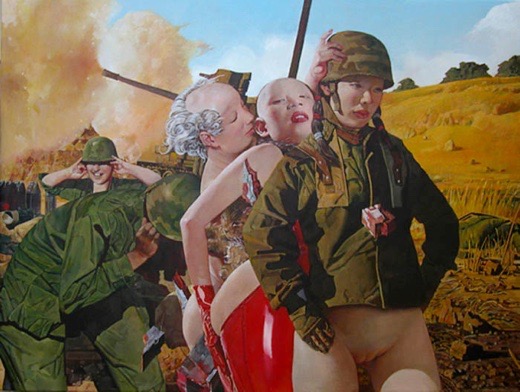
    Image above: Wei Dong, Lust & War, 2008, Oil and Acrylic on Canvas, 36x48 inches. From (http://depthofreality.livejournal.com/70102.html).

    I must apologize to regular readers for my concentration on the US military over the last week and a half. The posts centering on our militarism began with "They Died of Progress" by John Michael Greer. It detailed the brittle and fragile state of America's "high-tech" military versus the more pragmatic approach of the Russian and Chinese efforts.

    A week later I presented an overview of American military history of destructive activities in the Pacific that resulted in an extended nuclear war between 1946 and 1962 through today's belligerent RIMPAC 2016 naval exercises.

    It seems to me that we are on the cusp of a reaching a place we can't back out of. We are aggressively pushing our "enemies" against the wall in several regions of the world. They include the
    • Middle East: There we've been continuous war since the 1990's (the 1980's if you count our support of the mujahideen and Osama Bin Laden in Afghanistan against the USSR). Now we dialing it up in Syria and Iraq and the mess the Saudis are entangled in while we kowtow to Israel's neo-fascist - not to mention threats to Iran and others.
    • Eastern Europe: There we are using NATO to antagonize Russia with extending our reach into former USSR satellite states with American weapons systems aimed East. We have overthrown the leaders in the Ukraine and are moving naval elements into the eastern Mediterranean and even the Black sea.
    • Eastern Asia: We are heating up the disputes over rights in the South China Sea between China and our "allies" Vietnam, the Philippines, Indonesia and other players. With our numerous bases in Japan we continue to push against North Korea, Russia and China. 
    If either Killory Hilton or Donald Drumpf get into the White House it think our State Department will be getting a green light and we will soon find ourselves fighting World War III throughout the world.

    Why? Because of our fading glory? Because it's been profitable to be losing every war we've entered since World War II. Because we can't face a world where we are not NUMBER 1? Because it's all we know how to do now?

    We must turn from war. Don't support the US military and the corporations that support it and impoverished us.

    RIMPAC 2016 sucks!

    Tick Tick Tick

    SUBHEAD: Is it that the US has a more genuine interest in the Ukraine and Syria than their neighbor Russia?

    By James Kunstler on 28 September 2015 for Kunstler.com -
    (http://kunstler.com/clusterfuck-nation/tick-tick-tick/)


    Image above: Russia's President Vladimir Putin (r) gives an interview to American journalist Charlie Rose for CBS'60 Minutes. From (http://www.telegraph.co.uk/news/worldnews/vladimir-putin/11895845/Russian-troops-will-not-fight-in-Syria-for-now-says-Putin.html).

    Did Charlie Rose look like a fucking idiot last Sunday night on 60-Minutes, or what, asking Vladimir Putin how he could know for sure that the US was behind the 2014 Ukraine coup against President Viktor Yanukovych? 

    Maybe the idiots are the 60-Minutes producers and fluffers who are supposed to prep Charlie’s questions. Putin seemed startled and amused by this one on Ukraine: how could he know for sure?

    Well, gosh, because Ukraine was virtually a province of Russia in one form or another for hundreds of years, and Russia has a potent intelligence service (formerly called the KGB) that had assets and connections threaded through Ukrainian society like the rhizomorphs of the fungus Armillaria solidipes through a conifer forest. Gosh, Charlie, it’s like asking Obama whether the NSA might know what’s going on in Texas.

    And so there is Vladimir Putin, a former KGB officer, having to spell it out for the American clodhopper super-journalist. “We have thousands of contacts with them. 

    We know who and where, and when they met with someone, and who worked with those who ousted Yanukovych, how they were supported, how much they were paid, how they were trained, where, in which country, and who those instructors were. We know everything.”

    The only thing Vlad left out of course was the now-world-famous panicked yelp by Assistant Secretary of State Victoria Nuland crying, “Fuck the EU,” when events in Kiev started getting out of hand for US stage-managers. But he probably heard about that, too.

    Charlie then voice-overed the following statement: “For the record, the US has denied any involvement in the removal of the Ukrainian leader.” Right. And your call is important us. And your check is in the mail. And they hate us for our freedom.

    This bit on Ukraine was only a little more appalling than Charlie’s earlier segment on Syria. Was Putin trying to rescue the Assad government? Charlie asked, in the context of President Obama’s statement years ago that “Assad has to go.”

    Putin answered as if he were explaining something that should have been self-evident to a not-very-bright high school freshman: “To remove the legitimate government would create a situation which you can witness in other countries of the region, for instance Libya, where all the state institutions have disintegrated. 

    We see a similar situation in Iraq. There’s no other solution to the Syrian crisis than strengthening the government structure.”

    I guess Charlie and the 60-Minutes production crew hadn’t noticed what had gone on around the Middle East the past fifteen years with America’s program of toppling dictators into the maw of anarchy. Not such great outcomes.

    Charlie persisted though, following his script: Was Putin trying to rescue Assad? Vlad had to lay it out for him as if he were introducing Charlie to the game of Animal Lotto: “What do you think about those who support the terrorist organizations only to oust Assad without thinking about what happens to the country after all the state institutions have been demolished…? Look at those who are in control of 60 percent of the territory of Syria."

    Meaning ISIS. Al Nusra (formerly al Qaeda in Syria), i.e., groups internationally recognized as terrorist organizations.

    Charlie Rose, 60-Minutes — and perhaps by extension US government agencies with an interest in propagandizing — seem to want to put over the story that Russia has involved itself in Syria only to aggrandize its role on in world affairs.

    Forgive me for being so blunt, but what sort of stupid fucking idea is this? And are there any non-lobotomized adults left in the USA who can’t see straight through it? 

    The truth is that American policy in Syria (plus Iraq, Libya, Ukraine, Somalia, Afghanistan) is an impressive record of failure in terms of the one basic aim that most rational people might agree upon: stabilizing the region in a way that does not leave Islamic jihadi maniacs in charge.

    Okay, so now the Russians will do what they can to try to stabilize Syria. They’ve had their failures, too (famously, Afghanistan). But Russian territory adjoins the Islamic lands and they clearly have stake in containing the virus of Islamic extremism near their borders. Is that not obvious?

    Charlie made one other extremely dumb statement — he seems to prefer making assertions to asking straight-up questions — to the effect that Russia was misbehaving by deploying troops on its border with Ukraine.

    Putin again seemed astonished by this credulous idiocy. The US had troops and nuclear weapons all over Europe, he answered. Did Charlie think that meant the US was attempting to occupy the nations of Europe now? Was it “a crime” for Russia to defend its own border with a neighboring state (formerly a province) that, he implied, the US had deliberately destabilized?

    The Putin segment was followed by a sickening session with Donald Trump, a man who now — after a month or so of public exposure — proves incapable of uttering a coherent idea. I wonder what Vladimir Putin makes of this incomparable buffoon. Perhaps that America has gotten what it deserves.

    .

    America's Achilles' Heel

    SUBHEAD: Putin - "I get the feeling that no matter what the Americans touch, they end up with Libya or Iraq."

    By Dmitry Orlov on 12 May 2015 for Club Orlov -
    (http://cluborlov.blogspot.com/2015/05/americas-achilles-heel.html)


    Image above: Statue of wounded Achilles on the Grand Staircase in Achillion Palace in Corfu, Greece. From (http://www.hellenicvisions.com/Speeches/speech_AchillesHeelandWhyIsItImportant.html).

    [IB Publisher's note: This long article has been only partially reproduced here. For the beginning of the full article click here.]

    Instead of collapsing quietly, the US has decided to pick a fight with Russia. It appears to have already lost the fight, but a question remains: How many more countries will the US manage to destroy before the reality of its inevitable defeat and disintegration finally catches up with it?

    As Putin said last summer when speaking at the Seliger youth forum, “I get the feeling that no matter what the Americans touch, they end up with Libya or Iraq.” Indeed, the Americans have been on a tear, destroying one country after another. Iraq has been dismembered, Libya is a no-go zone, Syria is a humanitarian disaster, Egypt is a military dictatorship executing a program of mass imprisonment.

    The latest fiasco is Yemen, where the pro-American government was recently overthrown, and the American nationals who found themselves trapped there had to wait for the Russians and the Chinese to extract them and send them home. But it was the previous American foreign policy fiasco, in the Ukraine, which prompted the Russians, along with the Chinese, to signal that the US has taken a step too far, and that all further steps will result in automatic escalation.

    The Russian plan, along with China, India, and much of the rest of the world, is to prepare for war with the US, but to do everything possible to avoid it. Time is on their side, because with each passing day they become stronger while America grows weaker.

    But while this process runs its course, America might “touch” a few more countries, turning them into a Libya or an Iraq. Is Greece next on the list? What about throwing under the bus the Baltic states (Estonia, Latvia, Lithuania), which are now NATO members (i.e., sacrificial lambs)?

    Estonia is a short drive from Russia's second-largest city, St. Petersburg, it has a large Russian population, it has a majority-Russian capital city, and it has a rabidly anti-Russian government. Of those four facts, just one is incongruous. Is it being set up to self-destruct? Some Central Asian republics, in Russia's ticklish underbelly, might be ripe for being “touched” too.

    There is no question that the Americans will continue to try to create mischief around the world, “touching” vulnerable, exploitable countries, for as long as they can. But there is another question that deserves to be asked: Do the Americans “touch” themselves? Because if they do, then the next candidate for extreme makeover into a bombed-out wasteland might be the United States itself. Let's consider this option.

    As the events in Ferguson, and more recently in Baltimore, have indicated, the tensions between African-Americans and the police have escalated to a point where explosions become likely. The American “war on drugs” has been essentially a war on young black (and Latino) men; about a third of young blacks are behind bars.

    They also run a high risk of being shot by the police. To be fair, the police also run a high risk of getting shot by young black males, causing them to be jumpy and to overreact.

    Given the gradually collapsing economy—close to 100 million working-age Americans are unemployed (“outside the labor force,” if you wish to split hairs)—it would seem that for an ever-increasing chunk of the population cooperating with the authorities is no longer a useful strategy: you get locked up or killed anyway, but you get none of the temporary benefits that come from ignoring the law.

    There is an interesting asymmetry in the American media's ability to block out information about civil unrest and insurgency: if it is happening overseas, then news of it can be carefully calibrated or suppressed outright. (Did American television tell you about the recent resumption of shelling of civilian districts by the Ukrainian military? Of course not!)

    This is possible because Americans are notoriously narcissistic and largely indifferent to the rest of the world, of which most of them know little, and what they think they know is often wrong.

    But if the unrest is within the US itself, then the various media outlets find themselves competing against each other in who can sensationalize it better, in order to get more viewership, and more advertising revenue. The mainstream media in the US is tightly controlled by a handful of large conglomerates, making it one big monopoly on information, but at the level of selling advertising market principles still prevail.

    Thus there is the potential for a positive feedback loop: more civil unrest generates more sensationalized news coverage, which in turn amplifies the civil unrest, which further sensationalizes the news coverage. And there is a second positive feedback loop as well: the more civil unrest there is, the more the police overreact in trying to control the situation, thereby generating more rage, amplifying the civil unrest.

    These two positive feedback loops can continue to run out of control for a while, but the end result, in all such recent incidents, is the same: the introduction of National Guard troops and the imposition of curfew and martial law.

    The swift introduction of the military might seem a bit odd, considering that most police departments, even small-town ones, have been heavily militarized in recent years, and even the security people at some school districts now have military vehicles and machine guns. But the progression is a natural one.

    On the one hand, when people who habitually resort to brute force find that it isn't working, they naturally assume that this is because they aren't using enough of it.

    On the other hand, if the criminal justice system is already a travesty and a shambles, then why not just cut through the red tape and impose martial law?

    There is an awful lot of weapons of all sorts in the US already, and more will come in all the time as the US is forced to close overseas military bases due to lack of funds. And they will probably get used, for the same reason and in the same fashion that red bricks came to be used in Boston.

    You see, plenty of red bricks kept coming into Boston aboard British ships, where they were used as ballast for the return trip. This created the impetus to do something with them. But putting up brick buildings is a difficult, demanding process, especially if laborers are always drunk.

    And so the solution was to use the bricks to pave sidewalks—something one can do on one's hands and knees. Similarly with the military hardware sloshing back into the US from abroad. It will be used, because it's there; and it will be used in the stupidest way possible: shooting at one's own people.

    But bad things happen to militaries when they are ordered to shoot at their own people. It is one thing to shoot at “towel-heads” in a far-away land; it is quite another to be ordered shoot at somebody who could be your own brother down the street from where you grew up. Such orders result in fragging (shooting your own officers), in refusal to follow orders, and in attempts to stand up for the other side.

    And that's where things get interesting. Because, you see, if you shoot at, imprison, and otherwise abuse a defenseless civilian population long enough, what you get in response is an armed insurgency. The place insurgencies are easiest to organize is in prison.

    For instance, ISIS, or the Islamic Caliphate, was masterminded by people who had previously worked for Saddam Hussein, while they were imprisoned by the Americans. They took this opportunity to work out an efficient organizational structure and, upon release, found each other and got down to work.

    Having a third of young American blacks locked up gives them all the opportunity they need to organize an effective insurgency.

    To be effective, an insurgency needs lots of weapons. Here, again, there is a procedure for acquiring military technology that has become almost routine. What weapons are being used by ISIS? Why, of course, American ones, which the Americans provided to the regime in Baghdad, and which ISIS took as trophies when the Iraqi army refused to fight and ran away.

    And what weapons are being used by the Houthi rebels in Yemen? Why, of course, the American ones, which the Americans provided to the now overthrown pro-American regime there. And what are some of the weapons being used by the Syrian regime of Bashar Assad?

    Why, of course, American ones, sold to them by the Ukrainian government, which got them from the Americans. There is a pattern here: it seems that whenever Americans arm, train and equip an army, that army stands a really big chance of simply melting away, with the weapons falling into the hands of those who want to use them against American interests. It is hard to see why this same pattern wouldn't hold once the US places much of itself under military occupation.

    And that's where things get really interesting: a well-armed, well-organized insurgency composed of thoroughly radicalized, outraged people who have absolutely nothing to lose and are fighting for their home turf and their families squaring off against a demoralized, defeated US military that has just failed spectacularly in every country it “touched.”

    They say that “You can't fight city hall.” But what if you have a tank battalion that can control four intersections all around city hall, turrets pointed in all directions, firing at anything that moves?

    And what if you have enough infantry to go around and ring the doorbells of all the key city hall bureaucrats? Wouldn't that change one's odds of victory in fighting city hall?

    The US might get to “touch” a few more countries before this scenario unfolds, but it seems likely that (excepting the possibility of all-out war) eventually America will “touch” itself, and then all those countries whose troops marched through Red Square last Saturday won't have America to kick around any more.

    .

    NATO & centralization beyond control

    SUBHEAD: This bears repeating - NATO exists to manage the risks created by its own existence.

    By -Raul Meijer Ilargi on 27 February 2015 for the Automatic Earth - 
    (http://www.theautomaticearth.com/2015/02/when-centralization-scales-beyond-our-control/)


    Image above: In late February 2015 NATO and Russian military forces were doing maneuvers in Estonia's border, 60 miles from St. Petersburg. From (http://www.telegraph.co.uk/news/worldnews/europe/estonia/11435698/Nato-and-Russia-hold-rival-military-exercises-on-Estonian-border.html).

    In an article about NATO exercises in Estonia, just 300 yards from the Russian border, Daniel McAdams at the Ron Paul Institute makes a point that I want to use to make a much broader point. Not to provide answers, though, just to provide questions. McAdams quotes the Guardian review of a book by George Sakwa:

    Russian military plane over international waters 25 miles from the UK coast is “real and present danger” to NATO. Yet… Yet yesterday US combat vehicles conducted a military parade and show of military force in Estonia just 300 yards – yards! – from the Russian border. That is just over 60 miles from downtown St. Petersburg. This is not a provocation, we are to believe. This is not a “real and present danger” to Russia. NATO is exempt from the rules it imposes on its enemies. In the Guardian’s review of a new book by Politics professor George Sakwa, the current fallout from a near quarter century of post-Cold War NATO policies is perfectly captured:

    The hawks in the Clinton administration ignored all this, Bush abandoned the anti-ballistic missile treaty and put rockets close to Russia’s borders, and now a decade later, after Russia’s angry reaction to provocations in Georgia in 2008 and Ukraine today, we have what Sakwa rightly calls a “fateful geographical paradox: that NATO exists to manage the risks created by its existence”.
    That line bears repeating: “NATO exists to manage the risks created by its existence.”
    Yes, that line bears repeating, but it bears much more than that: the line doesn’t go nearly far enough. Because NATO doesn’t only exist, it develops and changes. In fact, to justify its prolonged existence, NATO has turned from a force for peace into a warmonger. That way, the organization argues, consciously or not, it provides itself with a reason to exist. It now doesn’t just exist to manage the risks, it exists to create them. In doing so, NATO itself has become the biggest risk.

    Regular readers will be well aware that I, like Ron Paul, have said many times that NATO should be dismantled (and not just NATO). Not only because it’s long outlived its original purpose, based in the Cold War, but because it increasingly attracts as leaders people who use ever more aggressive language for ever more elusive reasons.

    The latest in the series are new General Secretary Stoltenberg and General ‘Warhead’ Breedlove, both of whom seem hell bent on outdoing even Ukraine’s leadership pair of Poroshenko and Yatsenyuk when it comes to making unsubstantiated claims about Russia, and about the situation in Ukraine – and Eastern Europe – in a broader sense.

    My thesis is that all supranational organizations will eventually attract a certain kind of people as their leaders, and that these are inevitably the last kind of people we should want in these positions. But in the absence of effective democratic oversight, they end up there anyway.

    Therefore, the only way to counter this mechanism is to dismantle and abandon the organizations, while we still can. Which is not a given, since they function like power pyramids, in which ever more active power flows to an ever smaller top, until they become ‘untouchable’ by the nations that founded them in the first place.

    These organizations don’t just fail to meet their originally stated purpose, they become entities dangerous to those they were meant to serve. That’s true for NATO, for the IMF, the World Bank, and the EU. They all end up serving only their most powerful members, at the cost of the smaller and less powerful. Since there is no mechanism to prevent this from happening while they exist, we must dismantle them.

    There’s a strong correlation with an example from the economic world, in which corporations were originally incorporated for a specific project (e.g. building a bridge), a specific budget and a specific duration. And look at corporations now: there is no time limit to their existence, they are free to buy political control over our societies across generations, and they have even been granted person’s rights, though persons die and corporations no longer do.

    What is true for corporations is just as true for supranational organizations: it’s all about scale. They are all – well, mostly – founded by well-meaning people, but these people ignore – willingly or not – to set time, financial and legal limits to them. And that’s a surefire recipe for disaster. The IMF upon its inception had lofty ideals behind it.

    But look at the damage it’s done across the globe. The World Bank was intended to help fight poverty in poor nations, but, like the IMF, has become an instrument for the rich to control these nations and prey on them.

    And NATO has been busy ever since the Berlin wall came down, to resurrect the Cold War, without which it knows it must fear for its continued existence. It’s a twin sister of the American military complex, which creates threats out of nowhere and fights wars that all end in disaster, creating chaos along the way that forms the reason, and the cradle, for the next theater of war.

    I’ve said before that I’m somewhat hesitant to include the US in the list of supranational organizations that should be dismantled, but if the country, the union, can’t find a way to reform and refind itself, I don’t see much reason for it to live on. The concentrated power bastion in Washington simply does too much harm to too many people, both at home and abroad. Nobody should have that sort of power.

    If you have an entity that comprises 300 million people, it’s inevitable that ‘rulers’ over that entity need to be curtailed and limited in their powers from the get-go, or things will go awfully wrong. In the US, arguably, that has long since started to happen. The solution – in theory – is real simple: decentralize power. The solution in practice is much less obvious, since the people in power won’t volunteer to give up what they’ve got. A critical mass has been reached from which it will be very hard to retreat.
    ‘Once it reaches a certain threshold, the process of institutionalization becomes counterproductive’
    Those are the words from a man I’ve been thinking about for quite a while, when pondering these issues, 20th century philosopher/priest Ivan Illich, whose criticism of ‘institutionalization’, mostly published in the 1970′s from Latin America, was largely inspired by, and directed at, the Catholic Church, not coincidentally the world’s – by far – earliest truly multinational corporation.

    Illich basically asserted that institutions tend to monopolize parts of societies that they should leave alone, because they belong to the people, and are essential to their well-being. From Wikipedia’s entry on Illich:
    [e]lite professional groups . . . have come to exert a ‘radical monopoly’ on such basic human activities as health, agriculture, home-building, and learning, leading to a ‘war on subsistence’ that robs peasant societies of their vital skills and know-how. The result of much economic development is very often not human flourishing but ‘modernized poverty,’ dependency, and an out-of-control system in which the humans become worn-down mechanical parts.”
    [2] Illich proposed that we should “invert the present deep structure of tools” in order to “give people tools that guarantee their right to work with independent efficiency.”[14]
    Schools should not be able to declare themselves the only valuable source of education, nor hospitals that of health care. To Illich, the fact that he did see them do this anyway, meant people were being robbed of their freedom to learn, and to heal.

    In the same vein, NATO should not have a monopoly on defending us from ‘evil’ enemies, because it will create that evil just to justify its own apparatus, in the process robbing people of the ability to judge what is evil and what is not.
    ‘[I]nstitutions create the needs and control their satisfaction, and, by so doing, turn the human being and her or his creativity into objects’
    And that of course moves us real close to what I said about supranational organizations and multinationals, and to what Sakwa said: “NATO exists to manage the risks created by its existence.”. It shirks close to the Completion Backward Principle, in which first a need and a market is created and only then the product that fills that need.

    My perhaps favorite Illich quote, which with a little imagination is one on one applicable to the entire institutionalization issue, is this:
    Many students, especially those who are poor, intuitively know what the schools do for them. They school them to confuse process and substance. Once these become blurred, a new logic is assumed: the more treatment there is, the better are the results; or, escalation leads to success. The pupil is thereby “schooled” to confuse teaching with learning, grade advancement with education, a diploma with competence, and fluency with the ability to say something new. His imagination is “schooled” to accept service in place of value.
    Medical treatment is mistaken for health care, social work for the improvement of community life, police protection for safety, military poise for national security, the rat race for productive work. Health, learning, dignity, independence, and creative endeavour are defined as little more than the performance of the institutions which claim to serve these ends, and their improvement is made to depend on allocating more resources to the management of hospitals, schools, and other agencies in question.
    I never liked the education system I grew up in, any more than I like supranational institutions (it just took me a while to figure out the connection). High school was fine, because it was a breeze. But university was like running into a wall, multiple times. I just never had the idea that these people had anything I wanted. Just perhaps a degree that would have given me a ‘better’ job.

    But to go through 4-5-6 years of something I absolutely didn’t want, or saw the use of, seemed to be far too high a price to pay. This was way after Illich wrote what he did, though I didn’t read it until even much later again, but when I did, I still had a feeling of redemption, of: I’m not the only one who saw what I did.

    And of course people will say that I’m an idiot to throw away a university degree when so many others would kill to have one. That all, however, proves Illich’s point, and it leads back to the same issue: universities have a monopoly on learning, which means people learn less and less, they only ‘learn’ to be cogs in a machine. And if you don’t get the degree, than no well-paying job for you. And that’s exactly what Illich says. It makes for societies of unhappy people, who can’t even provide for themselves, as all their ancestors could, because all they’ve learned is to be that cog.

    I wanted to bring Ivan Illich into the discussion about NATO we’ve been having for a long time, with Ron Paul and myself saying it should be banned and its pieces ritually incinerated, because Illich makes the idea far more accessible that this is all part of a much larger pattern. That is to say, we tend towards centralization at all levels, mostly at first – seemingly – innocently, but soon with control moving beyond our perception.

    Who controls NATO, or the IMF? I’m sure you understand it’s not you. Still, when an organization exhibits aggressive behavior in your name, or lends out your money in your name, you should at all times feel that you are in control, through those you elect to represent you. Well, do you? Or are you merely thinking: that’s too far away from me?

    Organizations, like so many things in life, don’t scale up well, if at all. Beyond a certain critical mass, they become counterproductive, as Illich states. They become predators on their own creators. That goes as much for NATO, IMF and EU as it does for schools and hospitals.
    Modern societies appear to create more and more institutions – and great swathes of the way we live our lives become institutionalized. ‘This process undermines people – it diminishes their confidence in themselves, and in their capacity to solve problems… It kills convivial relationships. Finally it colonizes life like a parasite or a cancer that kills creativity’ (Finger and Asún 2001: 10).
    Experts and an expert culture always call for more experts. Experts also have a tendency to cartelize themselves by creating ‘institutional barricades’ – for example proclaiming themselves gatekeepers, as well as self-selecting themselves. Finally, experts control knowledge production, as they decide what valid and legitimate knowledge is, and how its acquisition is sanctioned.
    Schooling – the production of knowledge, the marketing of knowledge, which is what the school amounts to, draws society into the trap of thinking that knowledge is hygienic, pure, respectable, deodorized, produced by human heads and amassed in stock…..
    [B]y making school compulsory, [people] are schooled to believe that the self-taught individual is to be discriminated against; that learning and the growth of cognitive capacity, require a process of consumption of services presented in an industrial, a planned, a professional form;… that learning is a thing rather than an activity. A thing that can be amassed and measured, the possession of which is a measure of the productivity of the individual within the society. That is, of his social value.
    It’s a trap we’ve set for ourselves, and over which we’ve now long lost control. Technology seems to make the world ‘smaller’, and to increase our control, but in effect it ends up doing the opposite. It makes us dumber, since we are now only cogs in a machine that others control, and over which we have no oversight. If the machine gets orders to go to war, the cogs will have to obey.

    That’s our world today, and that’s what the NATO issue teaches us. NATO is our Frankenstein. And if we don’t stop it now, it will end up coming after us.

    .

    How goes the War?

    SUBHEAD: Oh, you didn’t notice that World War Three is underway, actually has been for more than year?

    By James Kunstler on 23 February 2015 at Kunstler.com -
    (http://kunstler.com/clusterfuck-nation/how-goes-the-war/)


    Image above: Detail of cartoon from 5/9/14 showing weapons used in World Wars. From (http://www.autoclub-ix35.ru/viewtopic.php?f=9&p=177973#p177995).

    Oh, you didn’t notice that World War Three is underway, actually has been for more than year? Well, that’s because most of it has been taking place in the banking sector, which for most people is just an alternative universe of math. The catch, which many people either miss or don’t care about, is that the math doesn’t add up.

    For instance, the runaway choo-choo train of linked European sovereign bond obligations with its overloaded caboose of interest rate swaps and other janky derivatives of mass destruction. That train left the station in Athens a few weeks ago bound for Frankfurt. 

    Ever since, the German government and its cohorts in the EU, the ECB, and the IMF have been issuing reassurances that the choo-choo train will not blow up when it reaches its destination.

    Few people grok that Greece is an entity with an economy not much bigger than North Carolina’s, yet it is burdened with roughly $350 billion of old debt that will never be paid back. 

    The only thing at issue is how it will not be paid back, that is, what mode of pretense will be employed to disguise the inability to pay back this debt. The mode du jour has been the crude one of lending Greece more money to pay back the interest on the old debt. A seven-year-old ought to be able to understand where that leads.

    It’s kind of up to the Greeks this week to possibly opt out of that farcical deal. They have at least two other present options: return to being a sunwashed semi-medieval backwater of olive farmers, shepherds, and inn-keepers, or perhaps lease out some cozy corner of their vast Mediterranean coastline to the Russian navy for enough annual walking-around money to keep the lights on for the aforementioned farmers, shepherds, and inn-keepers. 

    Of course, that would drive the US and its NATO quislings batshit crazy.

    We’ve already got our knickers in a twist over Ukraine, a so-called nation whose highest and best purpose over the millennia has been as a sort of lethal doormat in front of Russia, leaving adventurers like Napoleon and Hitler bleeding in the snow as they crawled back to their nations of origin. 

    In short, Ukraine has worked so well for Russia that we must be insane to imagine that it would give up that traditional relationship. 

    Yet the US and NATO persist in their foolishness and attempt to back up their Kievan intrigues with financial “sanctions” against Russia.

    Russia is doing what it has always done in the face of adversity, which is to suck it up. And, anyway, these western financial monkeyshines don’t hold a candle to ordeals like the siege of Stalingrad. What’s more, the Russians, despite their peculiar alphabet and thuggish demeanor, are at least as clever with computers as our code jockeys. 

    We (in the USA) think just because we’ve made it possible for everyman to drool over Kim Kardashian’s booty on an iPhone screen that we have some kind of immunity against cyber counter-attack from way out east.

    It seems to me that Russia (with China and others) is very busy constructing an alternate financial network that will allow for international money transfers and other necessities for conducting normal trade operations, outside of systems like the SWIFT code, which the US has been using as a knout against our imagined enemies. The upshot will leave America high and dry in a lot of what remains of international trade, especially in oil.

    Meanwhile we continue to tell ourselves the false and idiotic story of “energy independence,” based on the shale oil Ponzi scheme that blew up last fall — the consequences of which won’t really be felt for about another eight months, when all those wells drilled and fracked in 2013-14, start to fall off their production cliff, and the replacement wells will not have been drilled. 

    We’re still importing almost 8 million barrels of oil a day, contrary to all the fairy tales we tell ourselves. What happens when the sellers decide they won’t take US dollars for it? Hmmmm….

    See also:
    Ea  O Ka Aina: Welcome to World War III By James Kunstler 2/16/15
    .

    US fakes Russian Ukraine invasion

    SUBHEAD: In his thirst for war, Senator Jim Inhofe releases fake photos of Russian troops in the Ukraine.

    [IB Publisher's note: We have no doubts that Russia is exerting its muscle to keep Ukraine within its sphere of influence. It has been within that sphere for centuries. But if you are going to start WWIII over the issue you might as well use real evidence rather than False Flag propaganda. Jimmy Inhofe is a fool and an idiot. He does not believe in evolution, global warming, women's reproductive rights or finite planetary resources.]

    By Michael Krieger on 13 February 2015 for Liberty Blitzkrieg -
    (http://libertyblitzkrieg.com/2015/02/13/in-his-thirst-for-war-senator-jim-inhofe-releases-fake-photos-of-russian-troops-in-the-ukraine/)


    Image above: Evidence provided by US installed Ukrainian government officials to Senator Jim Inhofe as proof of Russian force invasion. This image was actually copied and cropped from photo Russian troops active in 2008 in Georgia.See below. From (http://www.zerohedge.com/sites/default/files/images/user3303/imageroot/2015/02/20150213_ukr1_2.jpg).

    Members of the Senate Armed Services Committee first viewed the graphic pictures in December. Sen. Jim Inhofe (R., Okla.) then obtained the photos and worked to independently verify and confirm the authenticity of the photos, before providing them exclusively to the Free Beacon.

    Inhofe said he hopes the images act as a wake up call to the Obama administration and American people, who largely have been spared from seeing the graphic violence inflicted upon Ukraine by the Russian-backed separatists…

    Following publication of this story, serious questions have been raised about the authenticity of some of the photographs provided by Sen. Jim Inhofe (R., Okla.). Several images of the Russian convoys appear to have been taken in 2008, during Russia’s conflict with Georgia. Given the similarities between the earlier images and those provided by the senator’s office, the Washington Free Beacon is investigating further and will update as necessary.

    Sen. Inhofe said in a statement: “The Ukrainian parliament members who gave us these photos in print form as if it came directly from a camera really did themselves a disservice. We felt confident to release these photos because the images match the reporting of what is going on in the region. I was furious to learn one of the photos provided now appears to be falsified from an AP photo taken in 2008.

    – From the Washington Free Beacon’s article: Updated: Provenance of Photos Showing Atrocities Questioned
    This is absolutely incredible. Incredible.

    First of all, I don’t claim to have any idea about what is happening in Ukraine. Many people out there feel obligated to pick a side, but I can promise you that 99% of them don’t actually have a clue. I don’t think there are many “goods guys” on either side of this fight, and my assumption is that both sides are lying as much as possible. It’s a very sad situation, but very few people really knows what’s going on. That’s why I don’t comment on it much.

    I wish I could say the same thing for United States Senators, you know, the people who actually play an important role in deciding when the country goes to war (that is, when Obama decides to consult them).

    In his best attempt to impersonate war crazed Senator John McCain, Sen. Jim Inhofe of Oklahoma released photographic proof of Russian solders in Ukraine in order to push forward his bill to provide U.S. arms to Ukraine. Or so he thought…
    The Washington Free Beacon reported:
    Inhofe’s bill to arm the Ukrainians is sponsored by at least 16 other leading Republicans, including Sens. Ted Cruz (Texas), John Cornyn (Texas), Marco Rubio (Fla.), and Tom Cotton (Ark.).

    The bill would authorize the United States to send lethal weaponry and require Obama to provide Congress with a “comprehensive strategy” to support Ukraine going forward.
    The new evidence could help bolster the case on Capitol Hill for a new piece of legislation that would enable the United States to provide lethal military aid to the Ukrainians, who have been asking America for such support for months.

    The pictures were taken between Aug. 24 and Sept. 5 in the midst of a Russian-backed incursion into Eastern Ukraine. The fighting has only grown more bloody in the ensuing months, as hundreds more Russians enter the country, according to congressional sources briefed on the conflict.

    Members of the Senate Armed Services Committee first viewed the graphic pictures in December. Sen. Jim Inhofe (R., Okla.) then obtained the photos and worked to independently verify and confirm the authenticity of the photos, before providing them exclusively to the Free Beacon.

    Inhofe said he hopes the images act as a wake up call to the Obama administration and American people, who largely have been spared from seeing the graphic violence inflicted upon Ukraine by the Russian-backed separatists.


    Image above: Original photo of Russian armor division on Georgia in 2008. From (http://www.zerohedge.com/sites/default/files/images/user3303/imageroot/2015/02/20150213_ukr1_2.jpg).

    There’s just one slight problem here. Some of the photos are totally fake, and are actually from Russia’s 2008 conflict with Georgia. More from the Washington Free Beacon:
    UPDATE 3:11 P.M.: Following publication of this story, serious questions have been raised about the authenticity of some of the photographs provided by Sen. Jim Inhofe (R., Okla.). Several images of the Russian convoys appear to have been taken in 2008, during Russia’s conflict with Georgia. Given the similarities between the earlier images and those provided by the senator’s office, the Washington Free Beacon is investigating further and will update as necessary.


    Sen. Inhofe said in a statement: “The Ukrainian parliament members who gave us these photos in print form as if it came directly from a camera really did themselves a disservice. We felt confident to release these photos because the images match the reporting of what is going on in the region. I was furious to learn one of the photos provided now appears to be falsified from an AP photo taken in 2008. This doesn’t change the fact that there is plenty of evidence Russia has made advances into the country with T-72 tanks and that pro-Russian separatists have been killing Ukrainians in cold blood.”
    This is simply unbelievable, and further proof that U.S. “leadership” has absolutely no idea what they are doing. Very dangerous. The Daily Caller put it quite well:
    Sen. Jim Inhofe (R-Okla.) released photographs Thursday of what he says is confirmed Russian military action against Ukraine. He gave them “exclusively” to the Washington Free Beacon.

    Except there’s just one problem — some of the photographs given to WFB from the 80-year-old senator date back to 2008 from the AP and aren’t exclusive at all.

    The WFB points out that the photographic evidence could be pivotal in convincing Congress to back legislation that would give military assistance to the Ukranians. They say Inofe worked “independently” from Congress to verify the authenticity of the photographs.

    Independently, meaning his office forget to do basic online image searches.
    Inhofe, of course, bashes President Obama, saying he’s “slow to recognize” what is happening around the world.
    But maybe it’s a certain Oklahoma senator who needs to take a class at the local Apple store.
    You can’t make this stuff up. Further proof to not believe anything the government says, and to not start anymore wars.

    For related articles, see:
    Made in the USA – How the Ukrainian Government is Giving Away Citizenships so Foreigners Can Run the Country

    Tensions Between the U.S. and Russia Are Worse Than You Realize – Remarks by Foreign Minister Sergey Lavrov

    .