Showing posts with label Hegemony. Show all posts

War from Declining Hegemon

SUBHEAD: The Washington-Moscow confrontation in Alepo, Syria  portends to a huge conflagration.

By Chandra Muzaffar on 31 October 2016 for Counter Current - 
(http://www.countercurrents.org/2016/10/31/the-danger-of-war-from-a-declining-hegemon/)


Image above: "Before and After". The Olympia Restaurant, which calls Aleppo home, has published old photos of Aleppo alongside newer photos captured in the same locations after the war began. For more see (http://petapixel.com/2016/08/02/26-photos-show-war-changed-syria/).

Is a war in the making — a Third World War?

If there is much talk about such a possibility, it is mainly because of the tensions between the United States and Russia.

Tensions between the two most powerful nuclear states in the world have never been this high since the end of the Cold War in 1989 and the demise of the Soviet Union in 1991.
There are at least two flash points, one more dangerous than the other.

In Eastern Ukraine, Russian backed rebels will not surrender to the US supported regime in Kiev because they see US control over Ukraine as part of a much larger agenda to expand NATO power to the very borders of Russia. This has been happening for some years now.

But it is the Washington-Moscow confrontation in Alepo, Syria which portends to a huge conflagration. The US is protective of major militant groups such as Al-Nusra which has besieged Eastern Allepo  and is seeking to overthrow the Bashar al-Assad government.

Washington has also set its sight on ‘regime change’ in Damascus ever since the latter’s determined resistance to Israeli occupation of the strategic Golan Heights in Syria from 1967 onwards.

The drive for regime change intensified with the US-Israeli quest for a “new Middle East” following the Anglo-American invasion and occupation of Iraq in 2003. It became more pronounced in 2009 when Bashar al-Assad rejected a proposal to allow a gas pipe-line from Qatar to Europe to pass through his country, a pipe-line which would have reduced Europe’s dependence upon Russia for gas. Russia of course has been a long-standing ally of Syria.

Together with Iran and the Lebanese Hezbollah, it is helping the Syrian government to break the siege of Eastern Allepo and to defeat militants in other parts of Syria.

It is obvious that in both instances, in Ukraine and Syria, the US has not been able to achieve what it wants.

The US has also been stymied in Southeast Asia where its attempt to re-assert its power through its 2010 ‘Pivot to Asia’ policy has suffered a serious setback as a result of the decision of the new president  of the Philippines, Rodrigo Duterte, to pursue an independent foreign policy that no longer adheres blindly to US interests.

At the same time, China continues to expand and enhance its economic strength in Asia and the world through its One Belt One Road (OBOR) projects and the Asia Infrastructure Investment Bank (AIIB) and via its leadership of BRICS.

China’s regional and global economic role is leading to its pronounced presence in security and military matters. As a result of all this, the US’s imperial power has clearly diminished. It is a hegemon in decline.

It is because it is not prepared to accept its decline that some US generals are threatening to demonstrate US’s military might.If a hegemon is a danger to humankind when it is at its pinnacle, it becomes an even greater threat to peace when its power is diminishing. Like a wounded tiger, it becomes even more furious and ferocious.

A new US president may be inclined to give vent to this frustration through an arrogant display of military power.

How can we check such wanton arrogance?  There will be elements in the elite stratum of US society itself who would be opposed to the US going to war.

We saw a bit of this in 2013 when those who were itching to launch military strikes against Syria based upon dubious “evidence” of the government’s use of chemical weapons were thwarted by others with a saner view of the consequences of war. It is also important to observe that none of the US’s major allies in Europe wants a war.

Burdened by severe challenges related to the economy and migration, the governments know that their citizens will reject any move towards war either on the borders of Russia or in Syria and West Asia.

This also suggests that a self-absorbed European citizenry may not have the enthusiasm to mobilise against an imminent war. Let us not forget that it was in European cities from London to Berlin that the biggest demonstrations against the war in Iraq took place in 2003. Anti-war protests will have to be initiated elsewhere this time.

Governments in Moscow and Beijing, in Tehran and Jakarta, in Pretoria and La Paz, should come out openly against war. They should encourage other governments in the Global South and the Global North to denounce any move towards a war that will engulf the whole of humanity.

Citizens all over the world should condemn war through a variety of strategies ranging from signature campaigns and letters to the media to public rallies and street demonstrations.

In this campaign against an imminent war, the media, both conventional and alternative, will have a huge role to play. It is unfortunate that well-known media outlets in the West have supported war in the past. It is time that they atone for their sins!

• Dr. Chandra Muzaffar is the President of the International Movement for a Just World (JUST), Malaysia.

.

U.S. empire is essentially over

SUBHEAD: But the American foreign policy elite eagerly await an expansion of overseas wars under Hillary Clinton.

By Michael Krieger on 20 October 2016 for Liberty Blitzkrieg -
(http://libertyblitzkrieg.com/2016/10/20/u-s-foreign-policy-elite-eagerly-await-an-expansion-of-overseas-wars-under-hillary-clinton/)


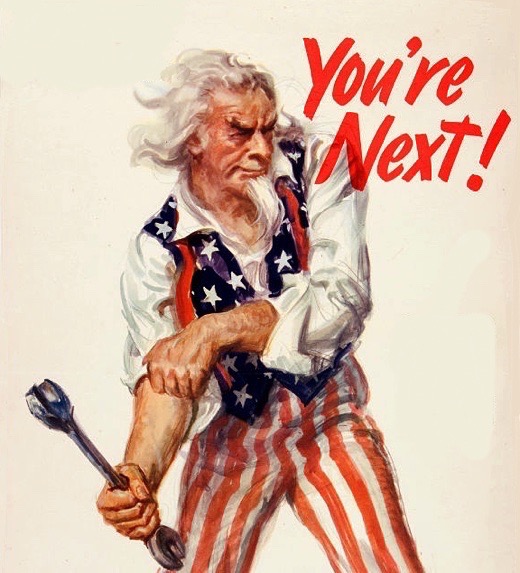
Image above: Uncle Sam rolling up his sleeves to take on Japan after beating Germany. From (https://www.hakes.com/Auction/ItemDetail/63091/JAPYOURE-NEXT-WWII-UNCLE-SAM-POSTER-BY-FLAGG).

[IB Publisher's note: Both the Left and Right wing of American journalism see the election of Hillary Clinton as an opportunity for War Hawks in America to gain traction on more intense military confrontation on several fronts, particularly Syria and Ukraine. This is about the last moment to dial back on the escalation towards WWIII.] 

Your average American Hillary Clinton supporter will smugly head to the polls on November 8th, entirely self-assured of his or her vital role in the defeat of fascism in these United States.

It won’t take long for such childish delusions to be vanquished by the horror of subsequent reckless and unnecessary imperial conflagrations that will be inevitably unleashed by their savior throughout the world.

The extreme dangers faced by the planet as a result of neocon warmonger Hillary Clinton becoming President have been apparent for a very long time. Oliver Stone and many others have vocally warned about it, and I’ve covered the topic on many occasions; including in the following posts:

Oliver Stone Opines on the Dangerous Extremism of Neocon Clinton
More Troubling Evidence That Hillary Clinton Will Start WW3 – Part 1
More Troubling Evidence That Hillary Clinton Will Start WW3 – Part 2
Lifelong Democrat and Former RFK Speechwriter Supports Trump


Now, courtesy of a newly published article at The Washington Post, we are once again forced to confront this very uncomfortable reality. Here are a few of the more disturbing excerpts from today’s piece:

There is one corner of Washington where Donald Trump’s scorched-earth presidential campaign is treated as a mere distraction and where bipartisanship reigns. In the rarefied world of the Washington foreign policy establishment, President Obama’s departure from the White House — and the possible return of a more conventional and hawkish Hillary Clinton — is being met with quiet relief.

The Republicans and Democrats who make up the foreign policy elite are laying the groundwork for a more assertive American foreign policy via a flurry of reports shaped by officials who are likely to play senior roles in a potential Clinton White House.

It is not unusual for Washington’s establishment to launch major studies in the final months of an administration to correct the perceived mistakes of a president or influence his successor. But the bipartisan nature of the recent recommendations, coming at a time when the country has never been more polarized, reflect a remarkable consensus among the foreign policy elite.

This consensus is driven by broad-based backlash against a president who has repeatedly stressed the dangers of overreach and the limits of American power, especially in the Middle East. “There’s a widespread perception that not being active enough or recognizing the limits of American power has costs,” said Philip Gordon, a senior foreign policy adviser to Obama until 2015. “So the normal swing is to be more interventionist.”

Taken together, the studies and reports call for more-aggressive American action to constrain Iran, rein in the chaos in the Middle East and check Russia in Europe.
The studies, which reflect Clinton’s stated views and the direction she is likely to take if she is elected, break most forcefully with Obama on Syria. Virtually all these efforts, including a report that will be released Wednesday by the liberal Center for American Progress, call for stepped up military action to deter President Bashar al-Assad’s regime and Russian forces in Syria.
This is what passes off as “liberal” these days.
The proposed military measures include calls for safe zones to protect moderate rebels from Syrian and Russian forces. Most of the studies propose limited American airstrikes with cruise missiles to punish Assad if he continues to attack civilians with barrel bombs, as is currently happening in besieged Aleppo. So far, Obama has staunchly resisted any military action against the Assad regime.

Even pinprick cruise missile strikes designed to hobble the Syrian air force or punish Assad would risk a direct confrontation with Russian forces, which are scattered throughout the key Syrian military bases that would be targeted.

“You can’t pretend you can go to war against Assad and not go to war against the Russians,” said a senior administration official who is involved in Middle East policy and was granted anonymity to discuss internal White House deliberations.

"Inside the White House, senior administration officials regularly dismissed calls for military force from the foreign policy establishment as the product of “too much college, not enough knowledge,” writes Derek Chollet, a former top Obama administration official, in his new book “The Long Game.”

Other White House officials derisively referred to Washington’s foreign policy experts as “the Blob.”
As much as I’ve criticized Obama for his many costly foreign adventures, he is an absolute peacenik compared to Clinton. Let’s never forget that the biggest foreign policy disaster of his Presidency, the destruction of Libya, was the brainchild of his then Secretary of State, Hillary Rodham Clinton.
“Everyone has kind of given up on the Middle East. We have been at it for 15 years, and a lot of Americans think it is hopeless,” Hadley said. “We think it is not.”
What would we do without people like Hadley around to screw things up?
“The dynamic is totally different from what I saw a decade ago” when Democratic and Republican elites were feuding over the invasion of Iraq, said Brian Katulis, a senior Middle East analyst at the Center for American Progress. Today, the focus among the foreign policy elite is on rebuilding a more muscular and more “centrist internationalism,” he said.
This is an absolute disaster waiting to happen. As I tweeted earlier today:
"We stand at a very dangerous moment. The U.S. empire is essentially over, but the emperors haven’t got the memo."

.

A Thousand Balls of Flame

SUBHEAD: A whiff of World War III as anti-Russian rhetoric emanates from the Clinton campaign.

By Dmitry Orlov on 23 August 2016 for Club Orlov -
(http://cluborlov.blogspot.com/2016/08/a-thousand-balls-of-flame.html)


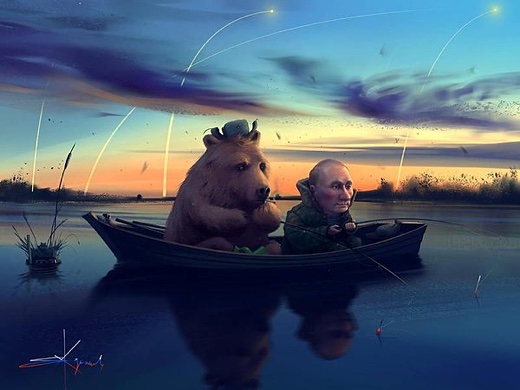
Image above: Illustration of Putin and Russian bear fishing as missiles are launched behind them. From original article.

A whiff of World War III hangs in the air. In the US, Cold War 2.0 is on, and the anti-Russian rhetoric emanating from the Clinton campaign, echoed by the mass media, hearkens back to McCarthyism and the red scare.

In response, many people are starting to think that Armageddon might be nigh—an all-out nuclear exchange, followed by nuclear winter and human extinction. It seems that many people in the US like to think that way. Goodness gracious!

But, you know, this is hardly unreasonable of them.

The US is spiraling down into financial, economic and political collapse, losing its standing in the world and turning into a continent-sized ghetto full of drug abuse, violence and decaying infrastructure, its population vice-ridden, poisoned with genetically modified food, morbidly obese, exploited by predatory police departments and city halls, plus a wide assortment of rackets, from medicine to education to real estate… That we know.

We also know how painful it is to realize that the US is damaged beyond repair, or to acquiesce to the fact that most of the damage is self-inflicted: the endless, useless wars, the limitless corruption of money politics, the toxic culture and gender wars, and the imperial hubris and willful ignorance that underlies it all… This level of disconnect between the expected and the observed certainly hurts, but the pain can be avoided, for a time, through mass delusion.

This sort of downward spiral does not automatically spell “Apocalypse,” but the specifics of the state cult of the US—an old-time religiosity overlaid with the secular religion of progress—are such that there can be no other options: either we are on our way up to build colonies on Mars, or we perish in a ball of flame.

Since the humiliation of having to ask the Russians for permission to fly the Soyuz to the International Space Station makes the prospect of American space colonies seem dubious, it’s Plan B: balls of flame here we come!

And so, most of the recent American warmongering toward Russia can be explained by the desire to find anyone but oneself to blame for one’s unfolding demise. This is a well-understood psychological move—projecting the shadow—where one takes everything one hates but can’t admit to about oneself and projects it onto another.

On a subconscious level (and, in the case of some very stupid people, even a conscious one) the Americans would like to nuke Russia until it glows, but can’t do so because Russia would nuke them right back.

But the Americans can project that same desire onto Russia, and since they have to believe that they are good while Russia is evil, this makes the Armageddon scenario appear much more likely.

But this way of thinking involves a break with reality. There is exactly one nation in the world that nukes other countries, and that would be the United States.

It gratuitously nuked Japan, which was ready to surrender anyway, just because it could.

It prepared to nuke Russia at the start of the Cold War, but was prevented from doing so by a lack of a sufficiently large number of nuclear bombs at the time.

And it attempted to render Russia defenseless against nuclear attack, abandoning the Anti-Ballistic Missile Treaty in 2002, but has been prevented from doing so by Russia’s new weapons.

These include, among others, long-range supersonic cruise missiles (Kalibr), and suborbital intercontinental missiles carrying multiple nuclear payloads capable of evasive maneuvers as they approach their targets (Sarmat).

All of these new weapons are impossible to intercept using any conceivable defensive technology. At the same time, Russia has also developed its own defensive capabilities, and its latest S-500 system will effectively seal off Russia’s airspace, being able to intercept targets both close to the ground and in low Earth orbit.

In the meantime, the US has squandered a fantastic sum of money fattening up its notoriously corrupt defense establishment with various versions of “Star Wars,” but none of that money has been particularly well spent.

The two installations in Europe of Aegis Ashore (completed in Romania, planned in Poland) won’t help against Kalibr missiles launched from submarines or small ships in the Pacific or the Atlantic, close to US shores, or against intercontinental missiles that can fly around them.

The THAAD installation currently going into South Korea (which the locals are currently protesting by shaving their heads) won’t change the picture either.

There is exactly one nuclear aggressor nation on the planet, and it isn’t Russia. But this shouldn’t matter. In spite of American efforts to undermine it, the logic of Mutual Assured Destruction (MAD) remains in effect.

The probability of a nuclear exchange is determined not by anyone’s policy but by the likelihood of it happening by accident.

Since there is no winning strategy in a nuclear war, nobody has any reason to try to start one. Under no circumstances is the US ever going to be able to dictate its terms to Russia by threatening it with nuclear annihilation.

If a nuclear war is not in the cards, how about a conventional one? The US has been sabre-rattling by stationing troops and holding drills in the Baltics, right on Russia's western border, installing ABM systems in Romania, Poland and South Korea, supporting anti-Russian Ukrainian Nazis, etc. All of this seems quite provocative; can it result in a war? And what would that war look like?

Here, we have to look at how Russia has responded to previous provocations. These are all the facts that we know, and can use to predict what will happen, as opposed to purely fictional, conjectural statements unrelated to known facts.

When the US or its proxies attack an enclave of Russian citizens outside of Russia's borders, here are the types of responses that we have been able to observe so far:

  1. The example of Georgia. During the Summer Olympics in Beijing (a traditional time of peace), the Georgian military, armed and trained by the US and Israel, invaded South Ossetia. This region was part of Georgia in name only, being mostly inhabited by Russian speakers and passport-holders. Georgian troops started shelling its capital, Tskhinval, killing some Russian peacekeeping troops stationed in the region and causing civilian casualties.

    In response, Russian troops rolled into Georgia, within hours completely eliminating Georgia’s war-making capability. They announced that South Ossetia was de facto no longer part of Georgia, throwing in Abkhazia (another disputed Russian enclave) for good measure, and withdrew. Georgia’s warmongering president Saakashvili was pronounced a “political corpse” and left to molder in place.

    Eventually he was forced to flee Georgia, where he has been declared a fugitive from justice. The US State Department recently gave him a new job, as Governor of Odessa in the Ukraine. Recently, Russian-Georgian relations have been on the mend.
  2. The example of Crimea. During the Winter Olympics in Sochi, in Russia (a traditional time of peace) there occurred an illegal, violent overthrow of the elected, constitutional government of the Ukraine, followed by the installation of a US-picked puppet administration. In response, the overwhelmingly Russian population of the autonomous region of Crimea held a referendum.

    Some 95% of them voted to secede from the Ukraine and to once again become part of Russia, which they had been for centuries and until very recently. The Russians then used their troops already stationed in the region under an international agreement to make sure that the results of the referendum were duly enacted. Not a single shot was fired during this perfectly peaceful exercise in direct democracy.
  3. The example of Crimea again. During the Summer Olympics in Rio (a traditional time of peace) a number of Ukrainian operatives stormed the Crimean border and were swiftly apprehended by Russia's Federal Security Service, together with a cache of weapons and explosives. A number of them were killed in the process, along with two Russians.

    The survivors immediately confessed to planning to organize terrorist attacks at the ferry terminal that links Crimea with the Russian mainland and a railway station. The ringleader of the group confessed to being promised the princely sum of $140 for carrying out these attacks.

    All of them are very much looking forward to a warm, dry bunk and three square meals of day, care of the Russian government, which must seem like a slice of heaven compared to the violence, chaos, destitution and desolation that characterizes life in present-day Ukraine.

    In response, the government in Kiev protested against “Russian provocation,” and put its troops on alert to prepare against “Russian invasion.” Perhaps the next shipment of US aid to the Ukraine should include a supply of chlorpromazine or some other high-potency antipsychotic medication.

    Note the constant refrain of “during the Olympics.” This is not a coincidence but is indicative of a certain American modus operandi. Yes, waging war during a traditional time of peace is both cynical and stupid. But the American motto seems to be “If we try something repeatedly and it still doesn't work, then we just aren’t trying hard enough.”

    In the minds of those who plan these events, the reason they never work right can’t possibly have anything to do with it being stupid. This is known as “Level III Stupid”: stupidity so profound that it is unable to comprehend its own stupidity.
  4. The example of Donbass. After the events described in point 2 above, this populous, industrialized region, which was part of Russia until well into the 20th century and is linguistically and culturally Russian, went into political turmoil, because most of the locals wanted nothing to do with the government that had been installed in Kiev, which they saw as illegitimate.

    The Kiev government proceeded to make things worse, first by enacting laws infringing on the rights of Russian-speakers, then by actually attacking the region with the army, which they continue to do to this day, with three unsuccessful invasions and continuous shelling of both residential and industrial areas, in the course of which over ten thousand civilians have been murdered and many more wounded. 
In response, Russia assisted with establishing a local resistance movement supported by a capable military contingent formed of local volunteers.

This was done by Russian volunteers, acting in an unofficial capacity, and by Russian private citizens donating money to the cause. In spite of Western hysteria over “Russian invasion” and “Russian aggression,” no evidence of it exists.

Instead, the Russian government has done just three things: it refused to interfere with the work of its citizens coming to the aid of Donbass; it pursued a diplomatic strategy for resolving the conflict; and it has provided numerous convoys of humanitarian aid to the residents of Donbass.

Russia’s diplomatic initiative resulted in two international agreements—Minsk I and Minsk II—which compelled both Kiev and Donbass to pursue a strategy of political resolution of the conflict through cessation of hostilities and the granting to Donbass of full autonomy.

Kiev has steadfastly refused to fulfill its obligations under these agreements. The conflict is now frozen, but continuing to bleed because of Ukrainian shelling, waiting for the Ukrainian puppet government to collapse.

To complete the picture, let us include Russia’s recent military action in Syria, where it came to the defense of the embattled Syrian government and quickly demolished a large part of ISIS/ISIL/Daesh/Islamic Caliphate, along with various other terrorist organizations active in the region. The rationale for this action is that Russia saw a foreign-funded terrorist nest in Syria as a direct threat to Russia’s security.

Two other notable facts here are that Russia acted in accordance with international law, having been invited by Syria’s legitimate, internationally recognized government and that the military action was scaled back as soon as it seemed possible for all of the legitimate (non-terrorist) parties to the conflict to return to the negotiating table.

These three elements—using military force as a reactive security measure, scrupulous adherence to international law, and seeing military action as being in the service of diplomacy—are very important to understanding Russia’s methods and ambitions.

Turning now to US military/diplomatic adventures, we see a situation that is quite different. US military spending is responsible for over half of all federal discretionary spending, dwarfing most other vitally important sectors, such as infrastructure, public medicine and public education. It serves several objectives.

Most importantly, it is a public jobs program: a way of employing people who are not employable in any actually productive capacity due to lack of intelligence, education and training.

Second, it is a way for politicians and defense contractors to synergistically enrich themselves and each other at the public’s expense.

Third, it is an advertising program for weapons sales, the US being the top purveyor of lethal technology in the world.

Last of all, it is a way of projecting force around the world, bombing into submission any country that dares oppose Washington’s global hegemonic ambitions, often in total disregard of international law. Nowhere on this list is the actual goal of defending the US.

None of these justifications works vis-à-vis Russia. In dollar terms, the US outspends Russia on defense hands down. However, viewed in terms of purchasing parity, Russia manages to buy as much as ten times more defensive capability per unit national wealth than the US, largely negating this advantage.

Also, what the US gets for its money is inferior: the Russian military gets the weapons it wants; the US military gets what the corrupt political establishment and their accomplices in the military-industrial complex want in order to enrich themselves.

In terms of being an advertising campaign for weapons sales, watching Russian weaponry in action in Syria, effectively wiping out terrorists in short order through a relentless bombing campaign using scant resources, then seeing US weaponry used by the Saudis in Yemen, with much support and advice from the US, being continuously defeated by lightly armed insurgents, is unlikely to generate too many additional sales leads.

Lastly, the project of maintaining US global hegemony seems to be on the rocks as well. Russia and China are now in a de facto military union.

Russia’s superior weaponry, coupled with China’s almost infinitely huge infantry, make it an undefeatable combination. Russia now has a permanent air base in Syria, has made a deal with Iran to use Iranian military bases, and is in the process of prying Turkey away from NATO.

As the US military, with its numerous useless bases around the world and piles of useless gadgets, turns into an international embarrassment, it remains, for the time being, a public jobs program for employing incompetents, and a rich source of graft.

In all, it is important to understand how actually circumscribed American military capabilities are. The US is very good at attacking vastly inferior adversaries. The action against Nazi Germany only succeeded because it was by then effectively defeated by the Red Army—all except for the final mop-up, which is when the US came out of its timid isolation and joined the fray.

Even North Korea and Vietnam proved too tough for it, and even there its poor performance would have been much poorer were it not for the draft, which had the effect of adding non-incompetents to the ranks, but produced the unpleasant side-effect of enlisted men shooting their incompetent officers—a much underreported chapter of American military history.

And now, with the addition of LGBTQ people to the ranks, the US military is on its way to becoming an international laughing stock. Previously, terms like “faggot” and “pussy” were in widespread use in the US military’s basic training. Drill sergeants used such terminology to exhort the “numb-nuts” placed in their charge to start acting like men.

I wonder what words drill sergeants use now that they’ve been tasked with training those they previously referred to as “faggots” and “pussies”? The comedic potential of this nuance isn’t lost on Russia’s military men.

This comedy can continue as long as the US military continues to shy away from attacking any serious adversary, because if it did, comedy would turn to tragedy rather quickly.
  • If, for instance, US forces tried to attack Russian territory by lobbing missiles across the border, they would be neutralized in instantaneous retaliation by Russia’s vastly superior artillery.
  • If Americans or their proxies provoked Russians living outside of Russia (and there are millions of them) to the point of open rebellion, Russian volunteers, acting in an unofficial capacity and using private funds, would quickly train, outfit and arm them, creating a popular insurgency that would continue for years, if necessary, until Americans and their proxies capitulate.
  • If the Americans do the ultimately foolish thing and invade Russian territory, they would be kettled and annihilated, as repeatedly happened to the Ukrainian forces in Donbass.
  • Any attempt to attack Russia using the US aircraft carrier fleet would result in its instantaneous sinking using any of several weapons: ballistic anti-ship missiles, supercavitating torpedos or supersonic cruise missiles.
  • Strategic bombers, cruise missiles and ballistic missiles would be eliminated by Russia’s advanced new air defense systems.
So much for attack; but what about defense? Well it turns out that there is an entire separate dimension to engaging Russia militarily. You see, Russia lost a huge number of civilian lives while fighting off Nazi Germany. Many people, including old people, women and children, died of starvation and disease, or from German shelling, or from the abuse they suffered at the hands of German soldiers.

On the other hand, Soviet military casualties were on par with those of the Germans. This incredible calamity befell Russia because it had been invaded, and it has conditioned Russian military thinking ever since.

The next large-scale war, if there ever is one, will be fought on enemy territory. Thus, if the US attacks Russia, Russia will counterattack the US mainland. Keeping in mind that the US hasn’t fought a war on its own territory in over 150 years, this would come as quite a shock.

Of course, this would be done in ways that are consistent with Russian military thinking. Most importantly, the attack must be such that the possibility of triggering a nuclear exchange remains minimized.

Second, the use of force would be kept to the minimum required to secure a cessation of hostilities and a return to the negotiating table on terms favorable to Russia.

Third, every effort would be made to make good use of internal popular revolts to create long-lasting insurgencies, letting volunteers provide the necessary arms and training.

Lastly, winning the peace is just as important as winning the war, and every effort would be made to inform the American public that what they are experiencing is just retribution for certain illegal acts.

From a diplomatic perspective, it would be much more tidy to treat the problem of war criminals running the US as an internal, American political problem, to be solved by Americans themselves, with an absolute minimum of outside help.

This would best be accomplished through a bit of friendly, neighborly intelligence-sharing, letting all interested parties within the US know who exactly should be held responsible for these war crimes, what they and their family members look like, and where they live.

The question then is, What is the absolute minimum of military action—what I am calling “a thousand balls of fire,” named after George Bush Senior’s “a thousand points of light”—to restore peace on terms favorable to Russia? It seems to me that 1000 “balls of fire” is just about the right number. These would be smallish explosions—enough to demolish a building or an industrial installation, with almost no casualties.

This last point is extremely important, because the goal is to destroy the system without actually directly hurting any of the people. It wouldn’t be anyone else’s fault if people in the US suffer because they refuse to do as their own FEMA asks them to do: stockpile a month’s worth of food and water and put together an emergency evacuation plan.

In addition, given the direction in which the US is heading, getting a second passport, expatriating your savings, and getting some firearms training just in case you end up sticking around are all good ideas.

The reason it is very important for this military action to not kill anyone is this: there are some three million Russians currently residing in the US, and killing any of them is definitely not on strategy. There is an even larger number of people from populous countries friendly to Russia, such as China and India, who should also remain unharmed. Thus, a strategy that would result in massive loss of life would simply not be acceptable.

A much better scenario would involve producing a crisis that would quickly convince the Russians living in the US (along with all the other foreign nationals and first-generation immigrants, and quite a few of the second-generation immigrants too) that the US is no longer a good place to live.

Then all of these people could be repatriated—a process that would no doubt take a few years. Currently, Russia is the number three destination worldwide for people looking for a better place to live, after the US and Germany. Germany is now on the verge of open revolt against Angela Merkel’s insane pro-immigration policies.

The US is not far behind, and won’t remain an attractive destination for much longer. And that leaves Russia as the number one go-to place on the whole planet. That’s a lot of pressure, even for a country that is 11 time zones wide and has plenty of everything except tropical fruit and people.

We must also keep in mind that Israel—which is, let’s face it, a US protectorate temporarily parked on Palestinian land—wouldn’t last long without massive US support. Fully a third of Israeli population happens to be Russian. The moment Project Israel starts looking defunct, most of these Russian Jews, clever people that they are, will no doubt decide to stage an exodus and go right back to Russia, as is their right.

This will create quite a headache for Russia’s Federal Migration Service, because it will have to sift through them all, letting in all the normal Russian Jews while keeping out the Zionist zealots, the war criminals and the ultra-religious nutcases. This will also take considerable time.

But actions that risk major loss of life also turn out to be entirely unnecessary, because an effective alternative strategy is available: destroy key pieces of government and corporate infrastructure, then fold your arms and wait for the other side to crawl back to the negotiating table waving a white rag. You see, there are just a few magic ingredients that allow the US to continue to exist as a stable, developed country capable of projecting military force overseas.

They are: the electric grid; the financial system; the interstate highway system; rail and ocean freight; the airlines; and oil and gas pipelines. Disable all of the above, and it’s pretty much game over. How many “balls of flame” would that take? Probably well under a thousand.

Disabling the electric grid is almost ridiculously easy, because the system is very highly integrated and interdependent, consisting of just three sub-grids, called “interconnects”: western, eastern and Texas.

The most vulnerable parts of the system are the Large Power Transformers (LPTs) which step up voltages to millions of volts for transmission, and step them down again for distribution. These units are big as houses, custom-built, cost millions of dollars and a few years to replace, and are mostly manufactured outside the US.

Also, along with the rest of the infrastructure in the US, most of them are quite old and prone to failure. There are several thousand of these key pieces of equipment, but because the electric grid in the US is working at close to capacity, with several critical choke points, it would be completely disabled if even a handful of the particularly strategic LPTs were destroyed.

In the US, any extended power outage in any of the larger urban centers automatically triggers large-scale looting and mayhem.

Some estimate that just a two week long outage would push the situation to a point of no return, where the damage would become too extensive to ever be repaired.

Disabling the financial system is likewise relatively trivial. There are just a few choke points, including the Federal Reserve, a few major banks, debit and credit card company data centers, etc. They can be disabled using a variety of methods, such as a cruise missile strike, a cyberattack, electric supply disruption or even civil unrest.

It bears noting that the financial system in the US is rigged to blow even without foreign intervention. The combination of runaway debt, a gigantic bond bubble, the Federal Reserve trapped into ever-lower interest rates, underfunded pensions and other obligations, hugely overpriced real estate and a ridiculously frothy stock market will eventually detonate it from the inside.

A few more surgical strikes can take out the oil and gas pipelines, import terminals, highway bridges and tunnels, railroads and airlines.

A few months without access to money and financial services, electricity, gasoline, diesel, natural gas, air transport or imported spare parts needed to repair the damage should be enough to force the US to capitulate. If it makes any efforts to restore any of these services, an additional strike or two would quickly negate them.

The number of “balls of flame” can be optimized by taking advantage of destructive synergies: a GPS jammer deployed near the site of an attack can prevent responders from navigating to it; taking out a supply depot together with the facility it serves, coupled with transportation system disruptions, can delay repairs by many months; a simple bomb threat can immobilize a transportation hub, making it a sitting duck instead of a large number of moving targets; etc.

You may think that executing such a fine-tuned attack would require a great deal of intelligence, which would be difficult to gather, but this is not the case. First, a great deal of tactically useful information is constantly being leaked by insiders, who often consider themselves “patriots.” Second, what hasn’t been leaked can be hacked, because of the pitiable state of cybersecurity in the US.

Remember, Russia is where anti-virus software is made—and a few of the viruses too. The National Security Agency was recently hacked, and its crown jewels stolen; if it can be hacked, what about all those whose security it supposedly protects?

You might also think that the US, if attacked in this manner, could effectively retaliate in kind, but this scenario is rather difficult to imagine.

Many Russians don’t find English too difficult, are generally familiar with the US through exposure to US media, and the specialists among them, especially those who have studied or taught at universities in the US, can navigate their field of expertise in the US almost as easily as in Russia.

Most Americans, on the other hand, can barely find Russia on a map, can’t get past the Cyrillic alphabet and find Russian utterly incomprehensible.

Also consider that Russia’s defense establishment is mainly focused on... defense. Offending people in foreign lands is not generally seen as strategically important. “A hundred friends is better than a hundred rubles” is a popular saying.

And so Russia manages to be friends with India and Pakistan at the same time, and with China and Vietnam. In the Middle East, it maintains cordial relations with Turkey, Syria, Israel, Saudi Arabia, Yemen, Egypt and Iran, also all at the same time.

Russian diplomats are required to keep channels of communication open with friends and adversaries alike, at all times. Yes, being inexplicably adversarial toward Russia can be excruciatingly painful, but you can make it stop any time! All it takes is a phone call.

Add to this the fact that the vicissitudes of Russian history have conditioned Russia’s population to expect the worst, and simply deal with it. “They can’t kill us all!” is another favorite saying.

If Americans manage to make them suffer, the Russian people would no doubt find great solace in the fact they are making the Americans suffer even worse, and many among them would think that this achievement, in itself, is already a victory.

Nor will they remain without help; it is no accident that Russia’s Minister of Defense, Sergei Shoigu, previously ran the Emergencies Ministry, and his performance at his job there won him much adulation and praise. In short, if attacked, the Russians will simply take their lumps—as they always have—and then go on to conquer and win, as they always have.

It doesn’t help matters that most of what little Americans have been told about Russia by their political leaders and mass media is almost entirely wrong.

They keep hearing about Putin and the “Russian bear,” and so they are probably imagining Russia to be a vast wasteland where Vladimir Putin keeps company with a chess-playing, internet server-hacking, nuclear physicist, rocket scientist, Ebola vaccine-inventing, polyglot, polymath bear.

Bears are wonderful, Russians love bears, but let’s not overstate things. Yes, Russian bears can ride bicycles and are sometimes even good with children, but they are still just wild animals and/or pets (many Russians can’t draw that distinction). And so when the Americans growl about the “Russian bear,” the Russians wonder, Which one?

In short, Russia is to most Americans a mystery wrapped in an enigma, and there simply isn’t a large enough pool of intelligent Americans with good knowledge of Russia to draw upon, whereas to many Russians the US is an open book.

As far as the actual American “intelligence” and “security” services, they are all bloated bureaucratic boondoggles mired in political opportunism and groupthink that excel at just two things: unquestioningly following idiotic procedures, and creatively fitting the facts to the politics du jour.

“Proving” that Iraq has “weapons of mass destruction”—no problem! Telling Islamist terrorists apart from elderly midwestern grandmothers at an airport security checkpoint—no can do!

Russia will not resort to military measures against the US unless sorely provoked. Time and patience are on Russia’s side. With each passing year, the US grows weaker and loses friends and allies, while Russia grows stronger and gains friends and allies.

The US, with its political dysfunction, runaway debt, decaying infrastructure and spreading civil unrest, is a dead nation walking. It will take time for each of the United States to neatly demolish themselves into their own footprints, like those three New York skyscrapers did on 9/11 (WTC #1, #2 and #7) but Russia is very patient. Russia is ready to respond to any provocation, but the last thing the Russians want is another war.

And that, if you like good news, is the best news you are going to hear. But if you still think that there is going to be a war with Russia, don’t think “Armageddon”; think “a thousand balls of flame,” and then—crickets!
.

The Broken Chessboard

SUBHEAD: Zbigniew Brzezinski, architect of US hegemony, gives up on American Empire.

By Mike Whitney on 25 August 2016 for Counter Punch -
(http://www.counterpunch.org/2016/08/25/the-broken-chessboard-brzezinski-gives-up-on-empire/)


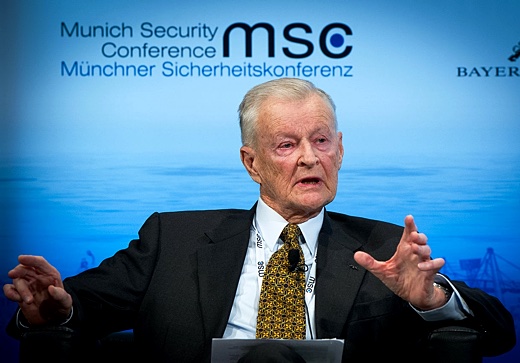
Image above: Zbigniew Brzezinski (Former United States National Security Advisor; Counselor and Trustee, Center for Strategic and International Studies) at the 50th Munich Security Conference 2014. From original article.

The main architect of Washington’s plan to rule the world has abandoned the scheme and called for the forging of ties with Russia and China. While Zbigniew Brzezinski’s article in The American Interest titled “Towards a Global Realignment” has largely been ignored by the media, it shows that powerful members of the policymaking establishment no longer believe that Washington will prevail in its quest to extent US hegemony across the Middle East and Asia.

Brzezinski, who was the main proponent of this idea and who drew up the blueprint for imperial expansion in his 1997 book The Grand Chessboard: American Primacy and Its Geostrategic Imperatives, has done an about-face and called for a dramatic revising of the strategy. Here’s an excerpt from the article in the AI:
“As its era of global dominance ends, the United States needs to take the lead in realigning the global power architecture.

Five basic verities regarding the emerging redistribution of global political power and the violent political awakening in the Middle East are signaling the coming of a new global realignment.

The first of these verities is that the United States is still the world’s politically, economically, and militarily most powerful entity but, given complex geopolitical shifts in regional balances, it is no longer the globally imperial power.” (Toward a Global Realignment, Zbigniew Brzezinski, The American Interest)
Repeat: The US is “no longer the globally imperial power.” Compare this assessment to a statement Brzezinski made years earlier in Chessboard when he claimed the US was ” the world’s paramount power.”
“…The last decade of the twentieth century has witnessed a tectonic shift in world affairs. For the first time ever, a non-Eurasian power has emerged not only as a key arbiter of Eurasian power relations but also as the world’s paramount power. The defeat and collapse of the Soviet Union was the final step in the rapid ascendance of a Western Hemisphere power, the United States, as the sole and, indeed, the first truly global power.” (“The Grand Chessboard: American Primacy And Its Geostrategic Imperatives,” Zbigniew Brzezinski, Basic Books, 1997, p. xiii)
Here’s more from the article in the AI:
“The fact is that there has never been a truly “dominant” global power until the emergence of America on the world scene….. The decisive new global reality was the appearance on the world scene of America as simultaneously the richest and militarily the most powerful player. During the latter part of the 20th century no other power even came close. That era is now ending.” (AI)
But why is “that era is now ending”? What’s changed since 1997 when Brzezinski referred to the US as the “world’s paramount power”?

Brzezinski points to the rise of Russia and China, the weakness of Europe and the “violent political awakening among post-colonial Muslims” as the proximate causes of this sudden reversal. His comments on Islam are particularly instructive in that he provides a rational explanation for terrorism rather than the typical government boilerplate about “hating our freedoms.”

To his credit, Brzezinski sees the outbreak of terror as the “welling up of historical grievances” (from “deeply felt sense of injustice”) not as the mindless violence of fanatical psychopaths.

Naturally, in a short 1,500-word article, Brzezniski can’t cover all the challenges (or threats) the US might face in the future. But it’s clear that what he’s most worried about is the strengthening of economic, political and military ties between Russia, China, Iran, Turkey and the other Central Asian states. This is his main area of concern, in fact, he even anticipated this problem in 1997 when he wrote Chessboard. Here’s what he said:
“Henceforth, the United States may have to determine how to cope with regional coalitions that seek to push America out of Eurasia, thereby threatening America’s status as a global power.” (p.55)

“…To put it in a terminology that harkens back to the more brutal age of ancient empires, the three grand imperatives of imperial geostrategy are to prevent collusion and maintain security dependence among the vassals, to keep tributaries pliant and protected, and to keep the barbarians from coming together.” (p.40)
“…prevent collusion…among the vassals.” That says it all, doesn’t it?

The Obama administration’s reckless foreign policy, particularly the toppling of governments in Libya and Ukraine, has greatly accelerated the rate at which these anti-American coalitions have formed. In other words, Washington’s enemies have emerged in response to Washington’s behavior. Obama can only blame himself.

Russian Federation President Vladimir Putin has responded to the growing threat of regional instability and the placing of NATO forces on Russia’s borders by strengthening alliances with countries on Russia’s perimeter and across the Middle East.

At the same time, Putin and his colleagues in the BRICS (Brazil, Russia, India, China and South Africa) countries have established an alternate banking system (BRICS Bank and AIIB) that will eventually challenge the dollar-dominated system that is the source of US global power.

This is why Brzezinski has done a quick 180 and abandoned the plan for US hegemony; it is because he is concerned about the dangers of a non-dollar-based system arising among the developing and unaligned countries that would replace the western Central Bank oligopoly. If that happens, then the US will lose its stranglehold on the global economy and the extortionist system whereby fishwrap greenbacks are exchanged for valuable goods and services will come to an end.

Unfortunately, Brzezinski’s more cautious approach is not likely to be followed by presidential-favorite Hillary Clinton who is a firm believer in imperial expansion through force of arms. It was Clinton who first introduced “pivot” to the strategic lexicon in a speech she gave in 2010 titled “America’s Pacific Century”. Here’s an excerpt from the speech that appeared in Foreign Policy magazine:
“As the war in Iraq winds down and America begins to withdraw its forces from Afghanistan, the United States stands at a pivot point. Over the last 10 years, we have allocated immense resources to those two theaters. In the next 10 years, we need to be smart and systematic about where we invest time and energy, so that we put ourselves in the best position to sustain our leadership, secure our interests, and advance our values.

One of the most important tasks of American statecraft over the next decade will therefore be to lock in a substantially increased investment — diplomatic, economic, strategic, and otherwise — in the Asia-Pacific region…
Harnessing Asia’s growth and dynamism is central to American economic and strategic interests and a key priority for President Obama. Open markets in Asia provide the United States with unprecedented opportunities for investment, trade, and access to cutting-edge technology…..American firms (need) to tap into the vast and growing consumer base of Asia…
The region already generates more than half of global output and nearly half of global trade. As we strive to meet President Obama’s goal of doubling exports by 2015, we are looking for opportunities to do even more business in Asia…and our investment opportunities in Asia’s dynamic markets.”
(“America’s Pacific Century”, Secretary of State Hillary Clinton”, Foreign Policy Magazine, 2011)
Compare Clinton’s speech to comments Brzezinski made in Chessboard 14 years earlier:
“For America, the chief geopolitical prize is Eurasia… (p.30)….. Eurasia is the globe’s largest continent and is geopolitically axial. A power that dominates Eurasia would control two of the world’s three most advanced and economically productive regions. ….About 75 per cent of the world’s people live in Eurasia, and most of the world’s physical wealth is there as well, both in its enterprises and underneath its soil. Eurasia accounts for 60 per cent of the world’s GNP and about three-fourths of the world’s known energy resources.” (p.31)
The strategic objectives are identical, the only difference is that Brzezinski has made a course correction based on changing circumstances and the growing resistance to US bullying, domination and sanctions. We have not yet reached the tipping point for US primacy, but that day is fast approaching and Brzezinski knows it.

In contrast, Clinton is still fully-committed to expanding US hegemony across Asia. She doesn’t understand the risks this poses for the country or the world. She’s going to persist with the interventions until the US war-making juggernaut is stopped dead-in-its-tracks which, judging by her hyperbolic rhetoric, will probably happen some time in her first term.

Brzezinski presents a rational but self-serving plan to climb-down, minimize future conflicts, avoid a nuclear conflagration and preserve the global order. (aka–The “dollar system”) But will bloodthirsty Hillary follow his advice?
Not a chance.

.

GMO Corn Wars

SUBHEAD: The farm-by-farm fight between China and the United States to dominate the global food supply.

By Ted Genoways on 16 August 2015 for the New Republic -
(http://www.newrepublic.com/article/122441/corn-wars)

http://www.islandbreath.org/2015Year/08/150828cornwarsbig.jpg
Image above: Illustration of "Corn Wars" by Brian Stauffer. From original article.

On September 30, 2012, agents from the FBI contacted U.S. Customs and Border Protection at O’Hare International Airport in Chicago with an urgent request. They wanted bags from two passengers on an outbound flight to Beijing pulled for immediate inspection.

The passengers didn’t track as dangerous criminals: Li Shaoming, president of Beijing Kings Nower Seed Science & Technology, a large Chinese agricultural company that develops corn, rice, cotton, and canola seeds, and Ye Jian, the company’s crop research manager.

In Li’s luggage, agents found two large Pop Weaver microwave popcorn boxes. Buried under the bags of unpopped snack kernels were roughly 300 tiny manila envelopes, all cryptically numbered—2155, 2403, 20362. Inside each envelope was a single corn seed.

In Ye’s luggage, agents found more corn seeds hidden amid his clothes, each one individually wrapped in napkins from a Subway restaurant. Customs officers were dispatched to the gate area for the Beijing flight, where they found the two men and conducted body searches. Still more corn seeds, also folded into napkins, were discovered in Ye’s pockets.

Meanwhile, at a different gate, Wang Hongwei, another Chinese national believed to be in the employ of Kings Nower (agents never learned if he worked for the company or was related to someone who did), boarded a separate flight for Burlington, Vermont, where he had a car waiting for him to drive to Canada.

FBI agents were there to follow him—though Wang, after leaving the airport parking garage, made a series of abrupt turns and managed to give his surveillance team the slip. It didn’t matter.

Border patrol officers were waiting when Wang pulled up to the Highgate Springs port of entry along the U.S.-Canadian border. He was selected out for a search, which turned up 44 bags of corn seeds under his seat and in his suitcases, as well as a notebook filled with GPS coordinates and a digital camera containing hundreds of pictures of cornfields.

 Questioned by agents, Wang would say only that he had purchased the seeds from a man named Mo Hailong, the director of international business at the Beijing Dabeinong Technology Group (DBN Group), the parent company of Kings Nower Seed.

Not wanting to alert Mo, agents allowed all three men to leave the country, but their corn seeds were confiscated. Special Agent Mark E. Betten, a 16-year veteran of the FBI specializing in the investigation of intellectual property theft, had the seeds sent to an independent bio-diagnostic testing laboratory, which confirmed that they were proprietary, genetically modified hybrids.

Eventually, their genetic sequencing was matched to seeds under development by Monsanto, DuPont Pioneer, and LG Seeds, which, including LG’s parent company, Groupe Limagrain, comprise three of the four largest seed companies in the world. The GPS coordinates were found to correspond with farms in Iowa and Illinois, where those companies were testing the performance of new hybrids.

In December 2013, after collecting this evidence, U.S. marshals arrived at Mo’s home in Boca Raton, Florida. He was taken into custody and extradited to Iowa, where he has been under house arrest in Des Moines ever since.

The FBI also brought charges against five alleged co-conspirators, all Chinese, who remain at large, including the three men stopped by customs agents, and eventually against Mo’s sister, Mo Yun, as well. Mo and his sister are scheduled to stand trial before a federal court in Iowa in September on charges of conspiracy to steal trade secrets. If convicted, they face up to ten years in prison and a $5 million fine.

This may seem like a lot of post-September 11 cloak-and-dagger for a few corn seeds, but the U.S. government believes that something much larger is going on. This theft, they argue, stems from an undeniable and dangerous fact: Despite its remarkable landmass, China simply can’t grow enough food to feed itself, particularly now that the country’s burgeoning middle class has acquired an appetite for meat. (Most corn in China is used as feed for livestock.)

Water shortages and lack of arable terrain have forced their government to buy between two and five million metric tons of American corn annually, approximately 94 percent of all corn imported into China each year.

If China hopes to feed (and pacify) its growing population while also loosening the very real stranglehold that America has on its national food supply, its farmers have to start producing a lot more corn—not just enough to meet their domestic demand in good years but enough to maintain a stockpile to offset their global market impact during bad ones.

For decades, China has increased corn yields by putting more acres into production, but they’re running out of arable land, and the USDA now estimates that Chinese corn consumption will rise by 41 percent by 2023, far outpacing production increases.

The only tenable way for China to meet its own demand, then, is by planting high-performance hybrids, which can single-handedly double or potentially even triple per-acre corn production.

Chinese scientists haven’t developed a significant corn hybrid in years. But Monsanto and DuPont Pioneer, the two American seed giants, have produced so many successful hybrids that they now control 45 percent of all the seed sold in the world.

The Department of Justice maintains that China is quietly permitting and even encouraging companies to steal American agricultural secrets right out of the ground. Acquiring the technology behind these next-generation hybrids could save companies like DBN Group—and the country—as much as a decade, and many millions of dollars, in research.

nd, plant geneticists familiar with the case told me, the very fact that Kings Nower Seed has brought to market—and intended to bring more—products with stolen genetics hints that the Chinese government is complicit. The theft is not hard to detect or prove; the only way that DBN Group could hope to get away with this scheme is if China were pushing such spying as a matter of policy.

In fact, a 2011 report prepared by the Office of the National Counterintelligence Executive, which advises the president on intelligence matters related to national security, listed “agricultural technology” among the targets “likely to be of greatest interest” to spies from Russia and China.

“Surging prices for food,” the report stated, “may increase the value of and interest in collecting U.S. technologies related to crop production, such as genetic engineering, improved seeds, and fertilizer.”

Since that report, the Department of Justice has cracked down, successfully prosecuting Chinese national Kexue Huang for stealing secrets related to organic fertilizer production and an unidentified “new food product” while he was employed at both Dow AgroSciences and Cargill, as well as Weiqiang Zhang, for theft of genetically engineered rice seeds from Colorado-based Ventria Bioscience.

What makes the case against Mo Hailong stand out is that the FBI openly acknowledges that each step of its operation, each escalation of surveillance, was approved by a federal judge under the Foreign Intelligence Surveillance Act (FISA), which requires that the investigating agency provide evidence that wiretapping is “necessary, or relevant, to the ability of the United States to protect against foreign threats to national security, such as attack, sabotage, terrorism, or clandestine intelligence activities.”

The federal government, thereby, has implicitly acknowledged that it considers agricultural products both an asset and a weapon in a long-range geopolitical chess match with China, a resource of near-military value and importance, one that must be protected by all available means.

By that logic, those Chinese nationals stealing corn are spies, no different—and, indeed, perhaps more important—than those who swipe plans for a new weapons system.

This may, at first glance, appear melodramatic—like Homeland in the heartland—but it is striking that the Department of Justice did not invoke FISA measures (at least not openly) in carrying out similar investigations into Dongfan Chung, a former Boeing engineer who stole trade secrets related to the Delta IV rocket and the Air Force’s C-17 aircraft, or Qing Li, who conspired to procure 30 military accelerometers, which, according to the government, “have applications in smart bombs, missiles, and calibrating g-forces of nuclear explosions.”

When asked about the extraordinary use of FISA in this case, Nick Klinefeldt, U.S. attorney for the Southern District of Iowa, who is prosecuting Mo, chose his words carefully. “The agriculture industry is important,” he said. “It’s important not just to the state of Iowa but to the United States.”

In announcing the charges against Mo last July, Thomas R. Metz, special agent in charge of the Omaha Division of the FBI, went still further, saying that “identifying and deterring those focused on stealing trade secrets, propriety [sic] and confidential information, or national security information is the number two priority for the FBI, second only to terrorism.”

Think about that: The U.S. Department of Justice and the FBI now contend, in effect, that the theft of genetically modified corn technology is as credible a threat to national security as the spread to nation-states of the technology necessary to deliver and detonate nuclear warheads.

Disturbingly, they may be right. As the global population continues to climb and climate change makes arable soil and water for irrigation ever more scarce, the world’s next superpower will be determined not just by which country has the most military might but also, and more importantly, by its mastery of the technology required to produce large quantities of food.

The bureau’s investigation of Mo Hailong began only after Mo made a stunning blunder. It was early May 2011, and Mo and Wang Lei, vice chairman of Kings Nower Seed at the time, were driving country roads in Tama County, Iowa, allegedly searching for a DuPont Pioneer test field.

But apparently uncertain if he was in the right place or unsure of what kind of seed DuPont Pioneer was testing, Mo had Wang pull to the edge of a field, so they could question a farmer in the midst of spring planting. Mo and Wang told the farmer they had been attending an international agricultural conference at Iowa State and wanted to see someone planting a real cornfield. The farmer was dubious.

Ames was nearly an hour away with nothing but expanses of cornfields in between, all at the peak of planting season. How had these two men chanced upon his field on the very day that he happened to be planting an experimental and top-secret seed under development by DuPont Pioneer?

The next day, a DuPont Pioneer field manager spotted the same car. He watched Mo scramble up the ditch bank, and then kneel down in the dirt and begin digging corn seeds out of the ground.

When confronted by the field manager, Mo grew flustered and red-faced. He now claimed to be a researcher from the University of Iowa—not Iowa State—on his way to a conference.

But before the field manager could question him further, Mo fled. He jumped into the waiting car, and Wang took off, swerving through the grassy ditch before fishtailing onto the gravel road and speeding away.

A few weeks later, agents from the Iowa office of the FBI sat down with DuPont Pioneer representatives for a standing meeting (which itself says something about the importance our law enforcement officials place on our corn) at their corporate headquarters in Johnston, Iowa, a northern suburb of Des Moines.

A DuPont Pioneer executive mentioned the incident and explained that the company enters into exclusive contracts with farmers to grow proprietary and often genetically engineered seeds. The exact genetic sequence of successful seeds is a tightly held secret, worth many millions of dollars.

The DuPont Pioneer field manager had written down the license plate number and handed it over to company security.

Multinational food conglomerates like DuPont Pioneer and Monsanto have sizable security forces and highly efficient investigatory networks. They traced the plates back to a rental car company at the Kansas City airport. Representatives there said the car had been rented by Mo Hailong.

According to court documents, an unnamed vice president and general manager from DuPont Pioneer’s Chinese subsidiary told the FBI he already had reason to believe that Kings Nower Seed was somehow stealing the company’s experimental seeds in order to raise clones for sale to Chinese farmers.

DuPont Pioneer had recently discovered that one of DBN Group’s best-selling corn seed products in China shared genetic sequencing with a male parent line that the company had genetically engineered.

The executive had confronted a DBN Group executive, sarcastically congratulating him on the success of their product. The Chinese executive had allegedly cracked a knowing smile and nodded, which the DuPont executive had taken as a tacit admission. The FBI agreed to investigate.

Four months later, while the FBI was still looking into the Tama incident, a call came into the sheriff’s office in Polk County, Iowa, with a report of three Asian males walking around a cornfield in Bondurant, just outside of Des Moines.

Despite the strangeness of such a call, the responding deputy hurried to the field, approached the men, and took down their names: Mo Hailong Robert (Mo occasionally used the alias Robert Mo), Wang Lei, and Li Shaoming, the CEO of Kings Nower Seed.

The men acknowledged that they were Chinese seed growers but claimed they were there to offer advice to the owner of the farm. When the FBI learned of the report—and recognized Mo’s name—they dispatched an agent from the Omaha field office to interview the farmer. He had never heard of the three men, much less sought their advice. He told the agent he didn’t even know what kind of corn he was growing, other than to say he was under contract to Monsanto.

Soon after, a Monsanto field representative confirmed that this, too, was a test site for a new parent seed the company had under development.

With an emerging picture of what Mo was up to, the FBI began tracking his movements—and soon discovered that he and Wang were intending to travel together to Des Moines for events held in connection with the World Food Prize.

The morning after their arrival, on February 15, 2012, the security team at DuPont Pioneer called the FBI to report “they were confident” (in the words of the subsequent report) that Mo, using an alias and fake corporate affiliation, had joined a delegation visiting their headquarters.

The FBI collected the surveillance video of the tour inside DuPont Pioneer’s research lab and also identified Mo on corresponding security footage from the delegation’s tour of a Monsanto research facility in Ankeny later in the day. That night, agents tracked Mo to a state dinner hosted by Iowa Governor Terry Branstad in honor of Xi Jinping, then the vice president of China and now the president.

The next day, Mo and Wang went together to a sports bar near the hotel where they were staying in the Des Moines suburbs. They met up with Xaoming Bao, a Chinese seed executive and former DuPont Pioneer employee whose wife was employed by the company as a corn-genetics researcher.

FBI investigators could now demonstrate that Mo had, on two separate occasions, sought to obtain experimental seeds by collecting them from secret test sites, and furthermore, it appeared he had gained the information about how to find those locations by working with corporate insiders.

The FBI also discovered that while he was in Iowa, Mo had shipped hundreds of pounds of packages from a West Des Moines UPS location to his home in Boca Raton. The contents listed on the tracking sheet: “corn samples.”


Image above: Drought-resistant corn hybrids on display at a DuPont Pioneer sales center near Cairo, Nebraska. From original article.

The theft of high-performing corn seeds from a competitor’s fields is as old as the cultivation of corn. “They say that a good plant breeder always had lots of pockets,” said Donald J. Lee, a professor and plant geneticist in the department of agronomy and horticulture at the University of Nebraska–Lincoln. “And when he would go visit his neighbor’s plant breeding fields, they always came back full.”

Until recently, farmers were their own seed providers. Lee told me his grandfather, a farmer in Iowa a century ago, would select ears from each harvest to provide the seed for planting the next year. He recorded the quality of his yield, slowly identifying a set of seed characteristics that seemed to produce the best crop. In those days, it was not unusual for family and friends to share seed stock.

 “Maybe a neighbor would say, ‘Hey, I really did good with this seed that I got from a cousin in eastern Iowa. You should try a little of this,’” Lee said. “But they were all open-pollinated populations, so those seeds were not genetically identical. In fact, probably every seed was genetically distinct.”

So much genetic variability meant that farmers like Lee’s grandfather would cross two varieties and get large, robust ears one year, only to find that the same two varieties produced scraggly cobs with missing kernels and dead tips the next. “So if you take a look at the historic yields of corn in Iowa and Nebraska during the teens, the twenties, the thirties—it’s flat,” he said.

That all changed with the arrival of Henry A. Wallace, the founder of Pioneer Hi-Bred Seeds, who Lee described as “the Bill Gates of the seed industry.”

Wallace, the son of the longtime president of the Cornbelt Meat Producers, first encountered the problem of genetic variation while studying corn breeding at Iowa State Agricultural College.

Rediscovering Gregor Mendel’s groundbreaking research on pea pods, Wallace had the key insight that the only solution to producing hearty corn hybrids was to first create genetically pure inbred varieties that could be used as “parents” year after year.

Wallace initially worried that such an approach “was probably impractical because of the difficulty of doing the hand-pollinating work,” but he was won over by a paper published in 1918 by Donald Jones, a chemist at the Connecticut Agricultural Station’s experimental farm. Jones had successfully inbred two separate varieties of corn and then crossed them to produce a durable, high-performing hybrid.

Wallace recognized that this was the key to creating seed corn with consistently higher yields, but the old problem remained: Producing these hybrids would be far too complex for the average farmer to undertake alone.

Wallace began to envision an organized way of breeding and distributing high-performing corn seed to farmers across the Midwest. A man of unusual commitment to the common good, he wrote a friend that he did not consider himself a corn breeder but rather “a searcher for methods of bringing the ‘inner light’ to outward manifestation.”

So Wallace at first conceived of a nonprofit organization, potentially run with government cooperation and even public funding. In 1921, his father, Henry C. Wallace, was appointed secretary of agriculture and might have helped spearhead such an effort.

But after his father died unexpectedly at age 58 and Calvin Coolidge settled into the laissez-faire years of his presidency, Wallace saw little chance of an ambitious national program gaining traction. He decided instead, in May 1926, to start the Hi-Bred Corn Company—the world’s first hybrid seed producer.

To interest farmers, Roswell Garst, Wallace’s lead salesman, who later became a major seed producer in his own right, went from one farm to the next, across 16 counties in western Iowa, giving away enough eight-pound sample bags of Hi-Bred seeds for farmers to plant half their fields.

Whatever additional yield the hybrid corn produced, Pioneer would split fifty-fifty with the farmer. After several years, farmers realized that they would see greater profits by simply buying the bags of seeds, instead of sharing the surplus yield with the company.

Those shared harvests produced something even more valuable than profit for the young company: information about how the seeds performed under different growing conditions. Wallace directed a sizable chunk of his revenue back into research, hiring a team of new corn breeders to devise still more hybrids.

In the early 1930s, Perry Collins, one of Wallace’s researchers, developed Hybrid 307—the first corn specifically developed and marketed for drought-resistance, hitting seed dealerships just as the country spiraled into the Dust Bowl.

And when Wallace was, like his father, appointed secretary of agriculture, by Franklin Roosevelt in 1933, he finally had the resources to nationally evangelize for hybrid seed, which he believed had the potential to rescue the nation from the Great Depression.

The transformation that followed was staggering. When Wallace joined Roosevelt’s cabinet, less than 1 percent of America’s corn came from hybrid seeds. A decade later, more than three-quarters of all corn was grown from hybrids—nearly doubling the national per-acre yield over the next 20 years.

To keep this record output from depressing corn prices, Wallace created the “ever-normal granary,” under which the federal government would establish a federal grain reserve.

In years of high production, the Department of Agriculture would buy corn and store it to keep prices up. In years of crop loss, the government would release the reserve to keep prices down. Wallace’s plan was hugely popular, stabilizing American food prices—and winning him a spot as FDR’s running mate in 1940.

But Wallace’s remarkable Hi-Bred Corn had one significant drawback: It consumed far more nitrogen compounds from the soil than ordinary corn—more, in fact, than almost any other crop. During the war years, the government solved the problem by simply putting more acres into production, but after World War II, the Department of Agriculture found a different solution.

Giant chemical manufacturers, like DuPont and Monsanto, had secured wartime defense contracts to produce ammonia nitrate and anhydrous ammonia to make bombs and other munitions. They had developed an herbicide known as 2,4-D as a potential destroyer of German crops and manufactured the insecticide DDT to prevent the spread of typhus-carrying lice among GIs.

As soon as the war was over, DuPont turned to marketing those same chemicals for lawn and garden use as fertilizer, weed killer, and DuPont 5% DDT Insect Spray. Company advertisements from the period touted their products as “Better Things for Better Living … Through Chemistry.”

But gardens were just the tip of the iceberg. DuPont, along with other giant chemical manufacturers like Dow and Monsanto, teamed up with the grain cartels, including Cargill and Archer Daniels Midland, to lobby for congressional support for producing these compounds as large-scale agri-chemicals.

In 1953, the industry found its greatest ally, when Ezra Taft Benson took over as President Dwight D. Eisenhower’s Secretary of Agriculture. (Wallace, by then, had retired from public life. He was briefly the editor of the New Republic before making a failed bid for the presidency in 1948.)

Benson, a high-ranking member of the Mormon Church and a fanatical Red Scare Republican, immediately informed Eisenhower that he was philosophically opposed to the government price supports developed by Wallace, because, to his mind, they were tantamount to socialism. He publicly referred to small farmers as “irresponsible feeders at the public trough.”

Foreshadowing today’s aggressive, pro-corporate agricultural policies, Benson argued that the only way to outcompete the collective farms of the Soviet Union and Red China was to use our superior corn and chemical technology to the fullest.

The United States could, if it chose, overproduce corn to drive down international prices, and it could use the surplus as a tool of diplomatic leverage in the form of foreign aid. Instead of guns, the United States began to give our allies grain—transforming, for the first time, a food product into a weapon in the national arsenal. The only problem was that by effectively militarizing American agriculture, Benson made agri-tech a target for foreign spying.

In April 2012, Mo flew from his home in Florida to O’Hare International Airport and rented a car. An FBI surveillance team followed him as he drove along back roads through rural Illinois and northern Indiana. After about a week of this, Mo stopped one day at a farm near Monee, Illinois, advertising DuPont Pioneer seeds for sale.

The farmer there later told the FBI that Mo had asked about what types of corn and soybeans he could buy, explaining that he had purchased 40 acres nearby and was planning to plant the property. The surveillance team followed Mo to a farm about 15 minutes west of Monee, where, a review of property records soon revealed, Kings Nower Seed had purchased a parcel for $600,000 only the month before.

As agents watched Mo crisscross the Midwest, stopping at seed stores to inquire about different products, they began to suspect that he planned to plant the Illinois acreage by hand. Donald J. Lee, the University of Nebraska professor, compares stealing parent seeds to obtaining programming code without knowing what application it is intended for or what operating system it’s meant to run on.

Likewise, knowing the genetic structure of a corn seed is just one part of the problem. “You don’t know the importance of those genes, unless you have yield data,” said Lee. “When did the plant mature? What’s its development profile? How did it respond to such-and-such disease?” This is what Mo appeared to be doing: setting up his own covert test farm, one that he could oversee personally.
--advertisement--

FBI surveillance teams followed Mo to Crossroads Ag, a DuPont Pioneer seed dealer in Dallas Center, Iowa, and observed him loading bags of seeds into his trunk. When investigators questioned the owner, he said Mo paid in cash—more than $1,500—for six bags of Pioneer Hi-Bred corn seeds.

He said Mo had been purchasing seed there for two years, always asking for DuPont Pioneer’s “latest products,” but this year he had arrived with a detailed list.

The owner had told Mo that he wasn’t supposed to sell him some of the specific products he was asking for, unless he had a contract agreement with DuPont Pioneer, which the owner knew he didn’t.

The next day, FBI surveillance watched Mo repeat the process, buying six bags of DeKalb brand seed corn, a Monsanto product, at MFA Agri Services in Pattonsburg, Missouri.

Finally, the team followed Mo back to Adel, Iowa, where Mo unloaded some of the seed bags at a storage facility before driving on to the farm in Illinois where the remaining bags were unloaded and, the FBI believes, seeds may have been planted.

About one out of every 200 seeds in a bag of hybrid corn seed is a parent, which can be identified by planting the bag and then collecting kernels from whichever plants look different from the rest.

Investigators believe Mo may have been collecting some parent seeds this way.

Later, when Mo and two DBN Group employees attempted to FedEx the remaining corn seeds to an associate in Hong Kong, the FBI intercepted the packages and conducted a search of the five boxes. Each contained eight or nine gallon-sized baggies filled with seed corn, along with a handwritten numerical code identifying each hybrid.

The FBI has not revealed exactly when they applied to a FISA court for more broad-ranging investigatory powers, but the FBI’s court filings show that their information on Mo and his associates became much more detailed after meetings with DuPont Pioneer executives over the summer.

Top executives told agents that “the loss of an inbred line of seed would result in losing approximately five to eight years of research and a minimum of $30 to $40 million dollars, potentially much more.”

After that, the FBI tapped the men’s mobile phones and tracked Mo’s bank records. They collected their email from Yahoo, Google, and Hotmail, corporate documents from DropBox, and thousands of files from Mo’s Apple iCloud account. The FBI used Mo’s mobile phone to track his movements, bugged his rental cars to eavesdrop on his conversations, and installed a video camera outside the storage unit in Adel.

To exercise such investigatory power, the FBI had to argue that Mo was an “agent of a foreign power”—or, in other words, to persuade a judge that Mo might be acting on behalf not just of DBN Group but at the direction of the People’s Republic of China.

With that, the FBI had the authority to treat Mo as if he were the leader of a state-sponsored Chinese spy ring. (Klinefeldt, the U.S. attorney prosecuting the case, was evasive about whether that suspicion proved substantive. “When you start an investigation,” he said, “you don’t know exactly where it will lead.”)

FBI investigators soon got the explicit evidence they needed to make arrests. Over a listening device installed in an Enterprise rental car, the surveillance team recorded a bizarre and inept conversation between two of Mo’s associates from DBN Group, Lin Yong and Ye Jian.

In the translated transcript, submitted as part of the government’s case, the two men are consumed by worry that they are being followed and about the charges they could face if caught. So, as they drive around rural Illinois looking for DuPont Pioneer and Monsanto test fields from which to steal, they begin making a list of the crimes they have committed.

After some back and forth, they come up with trespassing for every time they have slipped onto private property, larceny for the seeds and ears they have been stealing from the fields, and multiple violations of intellectual property protections.

“These are actually very serious offenses,” Lin says.

“They could treat us as spies!” Ye interjects.

Lin, exasperated, responds: “That is what we’ve been doing!”

Soon after, with the harvest season nearly complete, Mo seems to have decided it was time to send to China what corn he and his associates had collected. The group drove back to the secret Illinois farm and began discussing how they would divvy up the seeds.

Some would go into checked bags bound for Beijing, others would be carried to a car and driven across the border from Vermont into Canada, and some would go with Mo back to Florida, where he would ship them to China. With tickets booked for departure the following morning, the five men readied their caches of seeds—Li deciding to stash his under packets of Pop Weaver microwave popcorn.

The whole group then piled into a white minivan and drove into Monee to eat at the local Subway. On their way out, one of the men, perhaps Ye, must have stuffed his pockets full of napkins.

When Soviet premier Nikita Khrushchev visited the United States at President Eisenhower’s invitation in 1959, he specifically requested to see only one man: Roswell Garst, the former Pioneer seed salesman for Henry A. Wallace, who was then head of Garst and Thomas Hi-Bred Corn Company. Khrushchev had met Garst once before, when he visited the Soviet Union, and had become obsessed by the potential of hybrid corn. Khrushchev and his wife spent a day at Garst’s farm near Coon Rapids, Iowa.

In his memoirs, Khrushchev later wrote, “Garst gave me an entire lecture on agriculture,” in which he earnestly explained that American farmers had stopped worrying about crop rotation. “Science today considers that approach outdated. And I think so, too,” Garst told the Soviet leader. In past years, planting the same crop repeatedly would have attracted pests and depleted the soil of nitrogen.

“Now there is no such problem. We have herbicides and other such chemical substances that make it possible to combat pests,” Garst said. And there was no longer any need to plant clover or alfalfa to accumulate nitrogen. “It is more profitable for me to buy nitrogen, potassium, phosphorus, in mix form, and add this fertilizer.”

On that same official visit, Ezra Taft Benson led Khrushchev on a tour of the U.S. Agricultural Research Center in Beltsville, Maryland. Benson, in his official remarks, said that there was a “constant give-and-take of information between government scientists and those in private industry,” adding that “we are all working together within the framework of our capitalistic free-enterprise society to benefit our farmers, all our citizens, and people throughout the world.”

He listed hybrid corn first among the achievements of such cooperative efforts and introduced white-coated lab researchers who extolled the virtues of 2,4-D and chemical fertilizers. Khrushchev was unimpressed by a visit he made to a farm owned by President Eisenhower, dismissing it as “not on a scale such as we have at our collective farms and state farms.”

Benson later remembered that Khrushchev bragged, “We won’t have to fight you. We’ll so weaken your economy until you fall like overripe fruit into our hands.” Benson vowed that American farms would outproduce the Soviets through superior chemistry.

By the end of the Eisenhower era, however, environmentalists began to raise concerns about the hundreds of commercial herbicides and pesticides being applied to American crops in quantities totaling hundreds of millions of pounds.

Benson admonished doubters that “abandoning the use of chemicals on farms and in the food industry would result in an immediate decline in the quantity and overall quality of our food supply and cause a rapid rise in food prices paid by the consumer.”

Even when Rachel Carson documented connections between DDT and 2,4-D and elevated incidence rates of rare forms of cancer in Silent Spring, Benson remained unmoved. He is said to have written to Eisenhower wondering “why a spinster with no children was so concerned with genetics,” and then, as if to answer his own question, offered that Carson was “probably a Communist.” (The Eisenhower Presidential Library, for what it’s worth, contains no record of this letter.)

Benson’s war on the “socialist” price supports and farm aid programs instituted by Henry A. Wallace stalled out during the liberal-minded 1960s. But at the advent of the new decade, President Richard Nixon appointed Earl Butz, Benson’s former assistant, to become the new secretary of agriculture.

Butz had grown up on a farm in Indiana and spent 30 years teaching agricultural economics at Purdue before becoming dean of the university’s College of Agriculture. Many small farmers hated him, because he had been such a vocal advocate for turning family farming into big business during the Eisenhower administration. His refrain for those families, famously, was: “Get big or get out.”

Almost as soon as Butz won approval from Congress, he canceled payments for fallow land and urged farmers to “plant fencerow to fencerow,” promising to use the emerging global economy to buttress against low prices. If our supply threatened futures, we would simply go to the world market and use our size and economic might to meet the demand and forge foreign dependence on American food in the bargain. We would defeat the Communists by making them dependent on us to feed themselves.

In January 1972, Butz sold what amounted to our entire grain reserve to the Soviets. The following month, Nixon went to China and brokered a deal with Chairman Mao Zedong, allowing the importation of American corn and securing contracts for American companies to build 13 of the world’s largest ammonia-processing plants for producing fertilizer on Chinese soil.

America’s Communist foes regarded these moves as an agreement not to wage war through food. But Butz discussed these moves in terms of “agri-power,” and stated it plainly: “Food is a weapon.” To open a new front in the conflict, he supported maintaining American food superiority through yet another innovation: bioengineering feed, such as corn and soybeans.

Through the miracle of science, the United States would not only produce more crops than our rivals; we would produce better crops. By 1972, scientists had already developed the ability to cut and splice protein strands in the DNA sequences of bacteria. If they could do the same with plant cells, then they could chemically insert resistance to weeds and insects.

Less than five years later, a team from the University of Washington discovered that a bacterium that causes tumorlike growths on plants did so by inserting its own DNA into the cell nuclei of its host plant. What they had discovered was essentially a natural form of gene splicing. By the 1980s, researchers had devised techniques for removing the bacteria genes and inserting desirable DNA sequences.

The U.S. government recognized this as technology the Soviets and Chinese could not match. Monsanto was also quick to see the market opportunity. The company had grown with the production of 2,4-D and its descendant 2,4,5-T, which were then combined to produce Agent Orange to defoliate forest cover during the Vietnam War.

In 1970, in an effort to come up with an even stronger plant killer, Monsanto chemist John E. Franz hit upon an herbicide called glyphosate, which was marketed under the trade name Roundup and had seen unmatched growth in broadleaf weed control in the agricultural industry.

The only problem with Roundup: It was such an effective herbicide that farmers had to apply it carefully, spraying only early sprouting weeds, to avoid exterminating their crops.

Monsanto’s engineers set about searching for a gene that would allow crops to survive exposure to Roundup. They found it in the wastewater-treatment plant of one of their own glyphosate production plants in Louisiana, where workers had noticed a range of bacteria thriving despite exposure to Roundup—and one, under lab testing, displayed total immunity to glyphosate pesticides.

By 1996, Monsanto had commercially introduced soybeans that had been genetically modified to resist glyphosate—what the company termed “Roundup Ready.”

Next, researchers set to trying to find a genetic-engineering solution to the European corn borer, an insect that inflicted more than $1 billion in losses of corn production in the U.S. and Canada each year. Since the 1960s, endotoxins produced by Bacillus thuringiensis (Bt), a common bacteria found in the soil, had been sold as a commercial microbial insecticide to kill moth larvae.

If the specific DNA that produced Bt toxins could be isolated and spliced into corn genetic sequences, scientists believed they could create an ear of corn that would be lethal to the European corn borer. Soon, that hurdle had been cleared, and Monsanto began looking for a seed partner to market its pest-resistant corn. If it could marry its genetic modifications with Pioneer’s hybrid seeds, Monsanto believed it would have a corn seed with unmatched yield potential.

In the early 1990s, perhaps too eager to demonstrate the effectiveness of its new GMO crops, Monsanto allowed Pioneer to use its biotech to produce Roundup Ready soybeans and Bt corn—asking only for small usage fees and no royalties.

For less than $40 million, Pioneer suddenly had the technology and the sales muscle to move toward genetically modified feed crops, a growth market worth many billions of dollars. Rather than partner with Monsanto, Pioneer became its greatest competitor, entering into a joint venture with DuPont, called Optimum Quality Grains.

In response, Monsanto launched a series of bitter and protracted lawsuits, and eventually, in 1999, Pioneer sold its entire remaining stock to DuPont (thus changing the name to DuPont Pioneer). In 2002, all eleven lawsuits were settled at once—as DuPont Pioneer realized that it had more to gain by paying for Monsanto’s genetics and focusing on capturing the Chinese market.

In the years since, DuPont Pioneer has increased its share of the corn-seed market in China from less than a tenth of a percent to 12 percent. (Monsanto has a 1 percent market share.) DuPont Pioneer has told Chinese officials that they should Americanize their agriculture: consolidate land, plant GMO seed, apply industrial fertilizers, subsidize the sale of planting and harvest equipment.

This way, the company argues, China could dramatically increase its per-acre yield. William S. Niebur, who leads DuPont Pioneer’s operations in China, told the Des Moines Register last year that officials have listened to these recommendations with an “open ear.”

n March 2015, Mo Hailong’s attorneys filed a motion to suppress all evidence gathered from the secret recordings made of Mo and his associates, arguing that the authorization to gather those materials should never have been granted.

In order to legally justify the use of FISA, surveillance must target an “agent of a foreign power,” and the purpose of the surveillance must be to gather “foreign intelligence information.”

Mo’s attorneys argue there is no evidence that Mo is an agent of the Chinese government or that his company is backed by China, so for “the first time in the statute’s history (as far as our research reveals), the [U.S.] government used FISA to investigate a trade secret dispute between two privately owned companies.”

When it comes to the Chinese form of capitalism, the line is undeniably murky. The government has taken a strong hand in recent years in encouraging the growth of China’s agricultural sector.

In 2013, for example, China’s Shuanghui International entered an overvalue bid to buy Smithfield Foods, the world’s largest producer of pork. Under questioning by Congress, Smithfield insisted the purchase came without the urging or backing of the Chinese government.

But after the purchase received congressional approval, Nathan Halverson at the Center for Investigative Reporting discovered that the Bank of China, the state bank of the Chinese government, had approved the $4 billion loan for Shuanghui to purchase Smithfield in a single day—and in China, Shuanghui has touted the support the government is giving them.

In the wake of that purchase, the Chinese government has been actively consolidating the country’s seed companies, which currently number more than 5,000.

This consolidation would centralize research, improving China’s ability to develop its own hybrids to compete with giants like DuPont and Monsanto, and it would also allow China to mimic the field-to-slaughter vertical integration that has given meat producers like Smithfield and Cargill such an advantage in the United States. DBN Group is a notable example of a seed company that is booming thanks to consolidation and government assistance.

Founded in 1994 by seed-tech whiz kid Shao Genhuo, DBN Group has recently acquired more than 30 feed operations from the Chinese government, and the company runs China Farmer University jointly with the Chinese Academy of Agricultural Sciences.

By targeting Mo and his sister Mo Yun as the leaders of the spy ring, the FBI may hope to incriminate Shao (who is married to Mo Yun)—and, ultimately, implicate Chinese agriculture ministers.

But the U.S. government’s argument that the technology behind Roundup Ready soybeans and Bt corn constitutes not just trade secrets but national security secrets is a problematic one.

Companies like DuPont Pioneer and Monsanto like to maintain that they are striving only to feed a burgeoning global population.

Last year, Niebur, of DuPont Pioneer China, asked, “Without China’s food security, how can we ever imagine an effective, realistic, sustainable global food-security system?” But DuPont Pioneer’s goal, of course, is not global food security or feeding the Chinese people, but rather increasing market share and profit by keeping China as a customer.

And the Department of Justice has taken up the argument that such a goal is not only of importance to our economy but a matter of national security, an unsettling conflation of the interests of large corporations with that of the country itself.

Today, it’s estimated that 92 percent of American corn and 94 percent of American soybeans are GMOs, almost all of it produced by Monsanto or DuPont Pioneer, and again, nearly half of the seed sold globally.

Activists in both China and the United States have raised concerns about just two corporations having so much influence over the world food supply, with so little transparency. (Despite repeated requests, DuPont Pioneer declined to participate in this story.)

But these fears, while well founded, miss the larger point of what such companies represent: the intent of the U.S. government to use food as an ever-more powerful point of leverage to wield over large, increasingly hungry nations like China. The prosecution of Mo Hailong and his circle stands as a warning to the Chinese government, issued through its proxy companies.

The ears in the field, the seeds in the ground, even the pollen on the wind, are American-owned and American-protected.

They are available to the world as food only if you agree to our conditions and are willing to pay our price.

.