Showing posts with label Asia. Show all posts

The Broken Chessboard

SUBHEAD: Zbigniew Brzezinski, architect of US hegemony, gives up on American Empire.

By Mike Whitney on 25 August 2016 for Counter Punch -
(http://www.counterpunch.org/2016/08/25/the-broken-chessboard-brzezinski-gives-up-on-empire/)
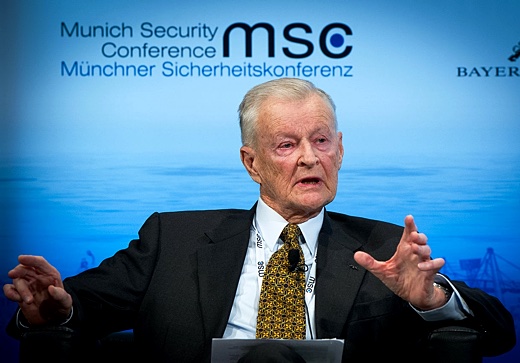

Image above: Zbigniew Brzezinski (Former United States National Security Advisor; Counselor and Trustee, Center for Strategic and International Studies) at the 50th Munich Security Conference 2014. From original article.

The main architect of Washington’s plan to rule the world has abandoned the scheme and called for the forging of ties with Russia and China. While Zbigniew Brzezinski’s article in The American Interest titled “Towards a Global Realignment” has largely been ignored by the media, it shows that powerful members of the policymaking establishment no longer believe that Washington will prevail in its quest to extent US hegemony across the Middle East and Asia.

Brzezinski, who was the main proponent of this idea and who drew up the blueprint for imperial expansion in his 1997 book The Grand Chessboard: American Primacy and Its Geostrategic Imperatives, has done an about-face and called for a dramatic revising of the strategy. Here’s an excerpt from the article in the AI:
“As its era of global dominance ends, the United States needs to take the lead in realigning the global power architecture.

Five basic verities regarding the emerging redistribution of global political power and the violent political awakening in the Middle East are signaling the coming of a new global realignment.

The first of these verities is that the United States is still the world’s politically, economically, and militarily most powerful entity but, given complex geopolitical shifts in regional balances, it is no longer the globally imperial power.” (Toward a Global Realignment, Zbigniew Brzezinski, The American Interest)
Repeat: The US is “no longer the globally imperial power.” Compare this assessment to a statement Brzezinski made years earlier in Chessboard when he claimed the US was ” the world’s paramount power.”
“…The last decade of the twentieth century has witnessed a tectonic shift in world affairs. For the first time ever, a non-Eurasian power has emerged not only as a key arbiter of Eurasian power relations but also as the world’s paramount power. The defeat and collapse of the Soviet Union was the final step in the rapid ascendance of a Western Hemisphere power, the United States, as the sole and, indeed, the first truly global power.” (“The Grand Chessboard: American Primacy And Its Geostrategic Imperatives,” Zbigniew Brzezinski, Basic Books, 1997, p. xiii)
Here’s more from the article in the AI:
“The fact is that there has never been a truly “dominant” global power until the emergence of America on the world scene….. The decisive new global reality was the appearance on the world scene of America as simultaneously the richest and militarily the most powerful player. During the latter part of the 20th century no other power even came close. That era is now ending.” (AI)
But why is “that era is now ending”? What’s changed since 1997 when Brzezinski referred to the US as the “world’s paramount power”?

Brzezinski points to the rise of Russia and China, the weakness of Europe and the “violent political awakening among post-colonial Muslims” as the proximate causes of this sudden reversal. His comments on Islam are particularly instructive in that he provides a rational explanation for terrorism rather than the typical government boilerplate about “hating our freedoms.”

To his credit, Brzezinski sees the outbreak of terror as the “welling up of historical grievances” (from “deeply felt sense of injustice”) not as the mindless violence of fanatical psychopaths.

Naturally, in a short 1,500-word article, Brzezniski can’t cover all the challenges (or threats) the US might face in the future. But it’s clear that what he’s most worried about is the strengthening of economic, political and military ties between Russia, China, Iran, Turkey and the other Central Asian states. This is his main area of concern, in fact, he even anticipated this problem in 1997 when he wrote Chessboard. Here’s what he said:
“Henceforth, the United States may have to determine how to cope with regional coalitions that seek to push America out of Eurasia, thereby threatening America’s status as a global power.” (p.55)

“…To put it in a terminology that harkens back to the more brutal age of ancient empires, the three grand imperatives of imperial geostrategy are to prevent collusion and maintain security dependence among the vassals, to keep tributaries pliant and protected, and to keep the barbarians from coming together.” (p.40)
“…prevent collusion…among the vassals.” That says it all, doesn’t it?

The Obama administration’s reckless foreign policy, particularly the toppling of governments in Libya and Ukraine, has greatly accelerated the rate at which these anti-American coalitions have formed. In other words, Washington’s enemies have emerged in response to Washington’s behavior. Obama can only blame himself.

Russian Federation President Vladimir Putin has responded to the growing threat of regional instability and the placing of NATO forces on Russia’s borders by strengthening alliances with countries on Russia’s perimeter and across the Middle East.

At the same time, Putin and his colleagues in the BRICS (Brazil, Russia, India, China and South Africa) countries have established an alternate banking system (BRICS Bank and AIIB) that will eventually challenge the dollar-dominated system that is the source of US global power.

This is why Brzezinski has done a quick 180 and abandoned the plan for US hegemony; it is because he is concerned about the dangers of a non-dollar-based system arising among the developing and unaligned countries that would replace the western Central Bank oligopoly. If that happens, then the US will lose its stranglehold on the global economy and the extortionist system whereby fishwrap greenbacks are exchanged for valuable goods and services will come to an end.

Unfortunately, Brzezinski’s more cautious approach is not likely to be followed by presidential-favorite Hillary Clinton who is a firm believer in imperial expansion through force of arms. It was Clinton who first introduced “pivot” to the strategic lexicon in a speech she gave in 2010 titled “America’s Pacific Century”. Here’s an excerpt from the speech that appeared in Foreign Policy magazine:
“As the war in Iraq winds down and America begins to withdraw its forces from Afghanistan, the United States stands at a pivot point. Over the last 10 years, we have allocated immense resources to those two theaters. In the next 10 years, we need to be smart and systematic about where we invest time and energy, so that we put ourselves in the best position to sustain our leadership, secure our interests, and advance our values.

One of the most important tasks of American statecraft over the next decade will therefore be to lock in a substantially increased investment — diplomatic, economic, strategic, and otherwise — in the Asia-Pacific region…
Harnessing Asia’s growth and dynamism is central to American economic and strategic interests and a key priority for President Obama. Open markets in Asia provide the United States with unprecedented opportunities for investment, trade, and access to cutting-edge technology…..American firms (need) to tap into the vast and growing consumer base of Asia…
The region already generates more than half of global output and nearly half of global trade. As we strive to meet President Obama’s goal of doubling exports by 2015, we are looking for opportunities to do even more business in Asia…and our investment opportunities in Asia’s dynamic markets.”
(“America’s Pacific Century”, Secretary of State Hillary Clinton”, Foreign Policy Magazine, 2011)
Compare Clinton’s speech to comments Brzezinski made in Chessboard 14 years earlier:
“For America, the chief geopolitical prize is Eurasia… (p.30)….. Eurasia is the globe’s largest continent and is geopolitically axial. A power that dominates Eurasia would control two of the world’s three most advanced and economically productive regions. ….About 75 per cent of the world’s people live in Eurasia, and most of the world’s physical wealth is there as well, both in its enterprises and underneath its soil. Eurasia accounts for 60 per cent of the world’s GNP and about three-fourths of the world’s known energy resources.” (p.31)
The strategic objectives are identical, the only difference is that Brzezinski has made a course correction based on changing circumstances and the growing resistance to US bullying, domination and sanctions. We have not yet reached the tipping point for US primacy, but that day is fast approaching and Brzezinski knows it.

In contrast, Clinton is still fully-committed to expanding US hegemony across Asia. She doesn’t understand the risks this poses for the country or the world. She’s going to persist with the interventions until the US war-making juggernaut is stopped dead-in-its-tracks which, judging by her hyperbolic rhetoric, will probably happen some time in her first term.

Brzezinski presents a rational but self-serving plan to climb-down, minimize future conflicts, avoid a nuclear conflagration and preserve the global order. (aka–The “dollar system”) But will bloodthirsty Hillary follow his advice?
Not a chance.

.
Debate includes all major parties

SUBHEAD: It's unlikely that the Libertarian or Green candidates will get another chance to share a stage.  

By Eric Ortiz on 12 August 2016 for Truth Dig - 
(http://www.truthdig.com/eartotheground/item/live_blog_bill_clinton_jill_stein_and_gary_johnson_speak_in_las_vegas_20160)


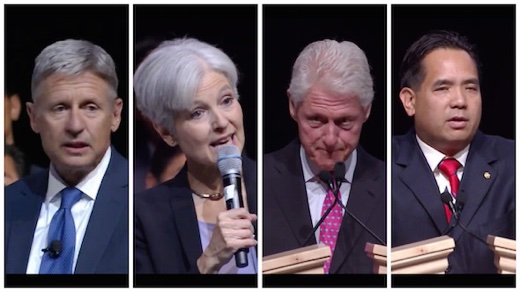
Image above: Presidential candidates Gary Johnson (L), Jill Stein (G), former President Bill Clinton representing Hillary Clinton (D) and Utah Attorney General Sean Reyes representing Donald Trump (R).  From original article.

Thanks to the Asian American Journalists Association (AAJA) and Asian and Pacific Islander American Vote (APIAVote) for putting together the 2016 Presidential Election Forum.

The quad-partisan forum marked the first time in this election cycle that the top four presidential campaigns participated in an event together. The Republican, Democratic, Libertarian, and Green Party presidential campaigns were all represented. Let’s hope it won’t be the last time.

So what did we learn? We have four horses in the race. But only two have a realistic shot to win: Hillary Clinton and Donald Trump. Still, having Green and Libertarian Party candidates on the same stage as representatives of the Democratic and Republican campaigns is a positive development. And something that should be celebrated. The next step is getting all four campaigns on the same debate stage in prime time.

Baby steps to democracy. We have to start somewhere to fix a corrupt system.

2:18 p.m. PDT: Libertarian presidential nominee Gary Johnson will be the first to speak, followed by the Green Party’s Jill Stein. “There is an opportunity to not only hear from these political leaders, but also be represented on television,” Chen tells the crowd. She also stresses that it’s important not to group all Asian Americans and Pacific Islanders together, noting that they “don’t all vote alike.”

2:21 p.m. PDT: “How crazy” is this election, Johnson asks. “I might be president of the United States.”

2:29 p.m. PDT: “Will this be a wasted vote?” asks interviewer Richard Lui.

“A wasted vote is a vote for someone you don’t believe in,” Johnson says. “If you want to waste your vote on Clinton or Trump, have at it.” Johnson then refers to the “magic 15 percent” he needs to get into the debates. “There’s no way I am going to win the presidency if I’m not in the debates. ... I do think that there’s a real possibility that I’ll be in the debates.”

Asked about what he would say to Clinton in a debate, Johnson remarks, “Hillary has been the architect of our foreign policy. ... She and Obama support the opposition in Syria and Libya.”
Lui asks how Johnson will bring an end to terrorism. “When we kill innocent people abroad, this is what adds to the recruitment when it comes to [Islamic State].”

2:38 p.m. PDT: They briefly discuss Donald Trump, who is notably absent from the forum:
The talk focuses on the economy. “Crony capitalism is alive and well,” Johnson says, arguing that “free trade is the opposite of capitalism.” The conversation turns to the Trans-Pacific Partnership. Johnson says:
I do support TPP. Is it a perfect document? No, nothing really is ... my advisers have told me that this does make things better.
Lui notes that Johnson has been labeled “Governor No” for his use of the veto to kill legislation. “What will you say no to” as president, Lui asks.

“No new taxes,” Johnson says.

The conversation turns to gun legislation, specifically a ban on assault weapons. Johnson doesn’t fully answer the question but does note there is a misunderstanding about what “automatic weapons” are. Lui asks Johnson how many guns he owns. “I have a pistol, a .38 pistol, and I have a 12-gauge shotgun.”

2:42 p.m. PDT: After a question from the audience, Lui brings up the subject of marijuana regulation. “58 percent of Americans supports legalizing marijuana,” Johnson explains, telling the audience that “every single one of you” knows somebody who uses marijuana. “What’s the difference between that and having a few drinks in the evening?” Johnson asks, receiving cheers from the audience. “I don’t want to take away from a person’s right to use these products.”

Lui asks when Johnson last used marijuana. “Last time I took marijuana was about three months ago,” Johnson says. “It was pleasant.”

2:50 p.m. PDT: Johnson explains his solution to education funding: giving control back to the states. “By eliminating the Federal Department of Education” there will be more money for the states, Johnson argues.

“If you had the states engaged in this competition, I believe there would be fabulous success,” Johnson continues. “That’s how we get better, by competing with one another.”

Finally, the conversation turns to the AAPI community and its vote. Lui asks Johnson what “AAPI” stands for—and he doesn’t know (Hillary Clinton probably does, though.)

“I don’t think any of us are different, I think we all have common goals here.” Johnson argues that entrepreneurship should be encouraged more in the United States.

Lui asks about undocumented workers, many of whom are of Asian-American descent. “The system is broken, we should make it as easy as possible for somebody who wants to come into this country and work to get a work visa,” Johnson declares. “I don’t want to break up families, I don’t want to be deporting.”

 2:52 p.m. PDT: The interview wraps up as Lui asks Johnson what family means to him and what his father taught him. Next up: Green Party presidential nominee Jill Stein.

3:01 p.m. PDT: I will be taking over the live blog for Emma Niles. If you want to watch a broadcast of the town hall forum in Las Vegas, click here. 
 
3:04 p.m. PDT: Dr. Jill Stein takes the stage. Stein is the Green Party presidential nominee. She is representing mothers, doctors and citizens of the planet. “Will we have a planet going forward?” she asks. Fair question.

3:08 p.m. PDT: How does Stein define her party in one sentence? The Green Party is the only party that can stand up for people and peace over profits. Stein is calling for a Green New Deal that fixes the crisis of the economy and the crisis of the environment. Recently, Truthdig political correspondent Bill Boyarksy talked with Stein, and she laid out the Green New Deal in more detail.

3:12 p.m. PDT: How would we pay for the green energy transition? Stein says it will pay for itself. Lui is skeptical. Stein makes the case: (1) Cut the wars for oil. (2) We get healthier when we zero out the polluting fossil fuels.

3:14 p.m. PDT: Stein has come up in the polls from being a nonfactor, almost invisible, to now polling at 5, 6 and 7 percent. “Democracy needs a moral compass,” Stein says. The Republican Party is eating itself. The Democratic Party is fractured. Stein is talking about how the Democratic primary was rigged in favor of Hillary Clinton. And the feed goes down. Coincidence?

3:18 p.m. PDT: The way Stein talks is refreshing. We need a politics of integrity. She says 42 million young people have student debt and she wants to wipe out all of that debt, the same way Wall Street got bailed out. How will she pay for it? Quantitative easing. The Fed buys up the student debt and cancels it digitally. Lui calls it the “magic eraser” and says many people don’t like that. Stein is unmoved and wants to create the economy of the future.

3:22 p.m. PDT: A common knock on Stein is that she has never served in a major political public office. Lui points this out. She says this is true. She doesn’t have the experience of making secret deals behind closed doors. She believes her lack of public political services is an advantage. She is running for president as “an honest broker.”

3:25 p.m. PDT: What is Stein’s favorite green energy source? Solar power. Go solar. Lui is a fan of wind power. Having a wind turbine in the backyard is a little more difficult than installing solar panels on the roof.

3:27 p.m. PDT: Stein wins points with the Asian community. Stein knows what AAPI stands for: Asian American Pacific Islanders.


3:30 p.m. PDT: Talk turns to feminism. Women deserve equal rights. Stein is all for gender equality and wage parity. We need a national federal minimum wage of $15. How important is it for men to be feminists? In Stein’s view, feminists are humanists.

3:32 p.m. PDT: Is it time for an Asian-American Supreme Court justice? Stein says yes. Lui tells her to stop pandering. “Test me,” Stein says.


3:34 p.m. PDT: No hardball questions here. “What does family mean to you?” Richard Lui asks Jill Stein. It is the same questions he asked Gary Johnson to close his interview. There is no wrong answer, and she gets the answer right.  

Family means love, connection. We are connected by community, cultures, nations. We are all on one small boat: planet earth. We are all part of the same human family, striving for human rights and justice.

Stein says her parents taught her to have a backbone and to stand up for what is right. She talks about growing up in an immigrant Jewish family after the Holocaust. That is when she was introduced to doing the right thing and standing up for the right thing, even if the position may be unpopular.

3:37 p.m. PDT: That’s all for Jill Stein. If you want to learn more about her, she stopped by the Truthdig headquarters in Los Angeles on June 7, the same day as the California primary. Here’s a behind-the-scenes look at her visit.

3:45 p.m. PDT: What happens in Las Vegas today, we want the whole world to know. Hillary Clinton couldn’t make it to the town hall event, so she sent her husband to represent her. He is not complaining. Sin City is his kind of town.

3:52 p.m. PDT: William Jefferson Clinton has arrived. The woman who introduces him tells everyone to welcome Bill Clinton by giving him a hug. She must not have gotten the memo from the Hillary camp: No touching allowed. It’s like the sign at the zoo says: Do not feed the animals.

Up next is Bill Clinton, the 42nd president of the United States.

3:55 p.m. PDT: Clinton gets the podium all to himself.

3:56 p.m. PDT: Clinton gets the crowd fired up by talking about building potential for the future that allows people to give themselves better lives and give their children better tomorrows. He’s done this before. We need to create more and better jobs and accelerate the formation of small businesses.

He talks about the economic plan Hillary Clinton laid out in Detroit on Friday. He brings up the aftermath of the crash. That’s rich, considering he helped accelerate the income inequality gap with the repeal of the Glass-Steagall Act. Truthdig Editor in Chief Robert Scheer examined how the groundwork was laid for the collapse of the U.S. economy in his book “The Great American Stickup.”
Since the collapse happened on the watch of President George W. Bush at the end of two full terms in office, many in the Democratic Party were only too eager to blame his administration. Yet while Bush did nothing to remedy the problem, and his response was to simply reward the culprits, the roots of this disaster go back much further, to the free-market propaganda of the Reagan years and, most damagingly, to the bipartisan deregulation of the banking industry undertaken with the full support of “liberal” President Clinton. Yes, Clinton. And if this debacle needs a name, it should most properly be called “the Clinton bubble,” as difficult as it may be to accept for those of us who voted for him.
3:57 p.m. PDT: A mayor, governor and United States senator—Bill Clinton is talking about Tim Kaine, Hillary Clinton’s running mate.


4:01 p.m. PDT: Clinton is sticking to the script and hitting all of the talking points: student debt, education, small business loans. He doesn’t want to upset Hillary. You won’t like her when she’s angry. He knows.

4:10 p.m. PDT: According to Bill Clinton, the unemployment rate with people with college degrees is 2.4 percent. He then acknowledges that there are 1 million jobs for plumbers, welders, construction workers—working-class jobs. Many people don’t have the training to work these jobs. Hillary wants to change this.

 4:12 p.m. PDT: Hillary Clinton promises to provide a new path to citizenship for immigrants in the first 100 days of her presidency, Bill Clinton reminds us. She is determined to bring stability and sanity to this issue. Sounds great. What’s not to trust?

4:18 p.m. PDT: Bill Clinton gets serious. Walls or bridges? That will be the metaphor for this election. Are we stronger together or stronger apart? Our diversity is a blessing. We can live together. Hillary can grow our economy and lift the world to a better place. As a politician, Bill Clinton is a pro and talks a great game.

The key question as always is this: Can you trust the rhetoric? Will the actions mirror the words? Will the Clinton do what they say? Or will they say one thing and do another behind closed doors? Let’s just say we’re not going to bet the farm on taking the Clintons at their word. They need to earn the trust of the people and regain the trust of the people. If that is possible.

4:26 p.m. PDT: Vote Hillary Clinton for 30 years of prosperity. Bill Clinton’s talk in a nutshell.


4:27 p.m. PDT: Time for audience questions. The first one is no softball. Will the Trans-Pacific Partnership promote your values? To create better allies and strengthen American values globally?

Would you support the TPP? “That’s a very adroit way you asked the question. Congratulations,” says Bill Clinton. It’s a difficult issue, Clinton explains. Hillary does not support the latest version of TPP, he says. These things have political consequences that go beyond the economic consequences.

The United States has proven extremely vulnerable to profitable job loss, that is jobs that are doing well in our country. We have too many companies in American that are dominated by shareholders that want quick returns. All these trade deals that don’t deal with currency valuation changes are not solving the problem. I signed over 300 trade deals. I was in favor of more trade. I understand why there is more resistance to multinational trade agreements instead of country by country deals. 

Corporations have sold out the American people. The reason that Hillary has opposed this. We don’t have enough stakeholder-driven corporations. We have too many shareholder-driven corporations. The real nub of this problem is the intersection of a trade agreement with countries that want to keep their good jobs in their country and they still want to make American goods. We are dominated by a stockholder mentality. We are not protected by currency manipulation. In other words, a very political answer. Sounds smart, but really, a lot of words that don’t say much.

Translation: Of course, Hillary skirted the rules. She’s a Clinton. I taught her the art of obfuscating the truth. But if we admitted to all the wrongdoing we have done over the years, there’s no chance we would get back to the White House. We don’t want that. The establishment doesn’t want that. So we will keep bobbing and weaving, ducking and jiving, slipping and sliding until we can return home to 1600 Pennsylvania Ave.

4:35 p.m. PDT: The music begins to play. Time for Bill Clinton to go. They have other speakers. He wants to answer one more question. He’s still got juice. They turn the music off.
4:37 p.m. PDT: The last question is about the emails. Hillary Clinton’s emails. “It’s the biggest bunch of bull I’ve ever heard,” Bill Clinton says. The emails weren’t relevant, he continues. He names a bunch of people who are supporting her, including people from the National Security Agency, the CIA and on and on. Would everybody who worked with her be for her if she wasn’t trustworthy? But what if the people who support her aren’t trustworthy.

Who is policing the police? She’s the only one who was transparent, her husband continues. There is a long-running dispute from the State Department and the intelligence community. There are people in the intelligence community who believe she is the only person left you can trust with classified material. Julian Assange and Edward Snowden may disagree

4:43 p.m. PDT: Bill Clinton exits stage left. He warmed up the mic for Mike Honda, a congressman representing the 17th District of California, otherwise known as Silicon Valley. He turns the town hall into a sporting event and leads the crowd in a cheer. When I say APIA vote, you say, “Power up.” APIA vote. Power up. “Democracy is not a spectator sport. This is participatory.”

4:51 p.m. PDT: Utah Attorney General Sean Reyes is here to speak on behalf of his candidate, Donald Trump. Reyes has a sense of humor. He takes a selfie.


4:54 p.m. PDT: Time for an etymology lesson. What’s in a word? Politics. Reyes explains. Poli means “many.” Tics are “blood-sucking insects.” Politics is all about blood-sucking insects. Reyes seems like a nice, normal person. Maybe Donald Trump isn’t the crazy demagogue everyone says he is?

4:57 p.m. PDT: Who thinks karaoke should be an Olympic sport? Sean Reyes will be here all week. Please tip your waitresses.

4:58 p.m. PDT: For being a Trump surrogate, Reyes hasn’t said much about Trump. That changes. “Donald Trump sends his thanks and appreciation,” Reyes says. Short and sweet. Less is more. I think it says a lot about Donald Trump and Mike Pence that they would let an average person like me speak to a special group like you.

5:07 p.m. PDT: Reyes reiterates the data about unemployment and the economy that Donald Trump used during his speech at the Republican convention. Nearly 14 million have left the workforce since Obama took the oath of office in 2009. Household incomes are down $4,000 since 2000. Reyes says the 5 percent unemployment number bandied about is a big hoax. Trump will make the American economy grow. Trust them.

5:12 p.m. PDT: One of the keys to public speaking is delivery. Reyes is saying the same things Trump says, but with less fire, brimstone and spittle.

5:19 p.m. PDT: Reyes wants to clarify some things Trump said about the Philippines, and Reyes says he has the full authority to do so. Trump welcomes law-abiding Filipinos. Trump was talking about terrorist elements that exist in the Philippines. Trump promotes legal immigration. Don’t ever forget, Trump is a humanitarian. He is the biggest and best humanitarian in the history of humanitarians.

5:27 p.m. PDT: What would a pro-Trump speech be without a little Hillary Clinton-bashing?

5:28 p.m. PDT: Reyes doesn’t agree with everything Donald Trump says, but Reyes wants a new future, not the status quo. He wants a visionary leader. Trump is that leader, says Reyes. But he will not be taking questions because he has a plane to catch. Couldn’t they hold the plane? He ends with a rap. Don’t mess with Reyes. That was worth the price of admission.

5:29 p.m. PDT: Reyes told his personal story as an Asian-American and Pacific Islander. He spoke from the heart. But did he convince anyone to support Trump?

5:33 p.m. PDT: The live stream wraps with analysis from Jason Chung from the Republican National Committee and Politico’s Seung Min Kim. Chung thinks Trump will be the next president. Do we want four more years of the last eight years? Or do we want a change? Chung thinks people want a change. Polls are painting a different picture. We’ll see what reality shows.

.

From Pol Pot to ISIS

SOURCE: Ken Taylor (taylork021@hawaii.rr.com)  
SUBHEAD: American and British hands in genocidal intervention in Asia and the Middle East continues.

By John Pilger on 21 November 2015 for JohnPilger.com -
(http://johnpilger.com/articles/from-pol-pot-to-isis-the-blood-never-dried)


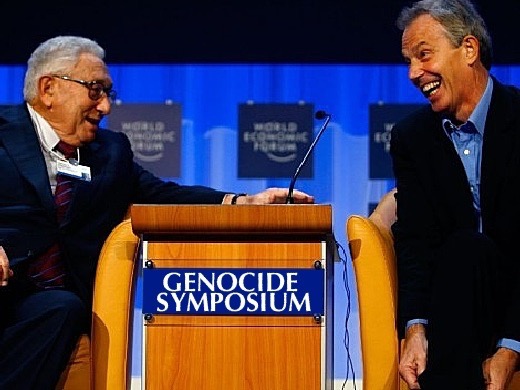
Image above: Henry Kissenger and Tony Blair smile and chat on World Economic Forum stage. From original article. Blue sign modification mashup by Juan Wilson.

In transmitting President Richard Nixon's orders for a "massive" bombing of Cambodia in 1969, Henry Kissinger said, "Anything that flies on everything that moves". As Barack Obama wages his seventh war against the Muslim world since he was awarded the Nobel Peace Prize, and Francois Hollande promises a "merciless" attack on the rubble of Syria, the orchestrated hysteria and lies make one almost nostalgic for Kissinger's murderous honesty.

As a witness to the human consequences of aerial savagery - including the beheading of victims, their parts festooning trees and fields - I am not surprised by the disregard of memory and history, yet again.

A telling example is the rise to power of Pol Pot and his Khmer Rouge, who had much in common with today's Islamic State in Iraq and Syria (ISIS). They, too, were ruthless medievalists who began as a small sect. They, too, were the product of an American-made apocalypse, this time in Asia.

According to Pol Pot, his movement had consisted of "fewer than 5,000 poorly armed guerrillas uncertain about their strategy, tactics, loyalty and leaders". Once Nixon's and Kissinger's B-52 bombers had gone to work as part of "Operation Menu", the west's ultimate demon could not believe his luck.

The Americans dropped the equivalent of five Hiroshimas on rural Cambodia during 1969-73. They leveled village after village, returning to bomb the rubble and corpses.

The craters left giant necklaces of carnage, still visible from the air. The terror was unimaginable. A former Khmer Rouge official described how the survivors "froze up and they would wander around mute for three or four days. Terrified and half-crazy, the people were ready to believe what they were told... That was what made it so easy for the Khmer Rouge to win the people over."

A Finnish Government Commission of Inquiry estimated that 600,000 Cambodians died in the ensuing civil war and described the bombing as the "first stage in a decade of genocide". What Nixon and Kissinger began, Pol Pot, their beneficiary, completed. Under their bombs, the Khmer Rouge grew to a formidable army of 200,000.

ISIS has a similar past and present. By most scholarly measure, Bush and Blair's invasion of Iraq in 2003 led to the deaths of at least 700,000 people - in a country that had no history of jihadism.

The Kurds had done territorial and political deals; Sunni and Shia had class and sectarian differences, but they were at peace; intermarriage was common. Three years before the invasion, I drove the length of Iraq without fear. On the way I met people proud, above all, to be Iraqis, the heirs of a civilization that seemed, for them, a presence.

Bush and Blair blew all this to bits. Iraq is now a nest of jihadism. Al-Qaeda - like Pol Pot's "jihadists" - seized the opportunity provided by the onslaught of 'Shock and Awe' and the civil war that followed. "Rebel" Syria offered even greater rewards, with CIA and Gulf state ratlines of weapons, logistics and money running through Turkey. The arrival of foreign recruits was inevitable.

A former British ambassador, Oliver Miles, wrote:

 "The [Cameron] government seems to be following the example of Tony Blair, who ignored consistent advice from the Foreign Office, MI5 and MI6 that our Middle East policy - and in particular our Middle East wars - had been a principal driver in the recruitment of Muslims in Britain for terrorism here."

ISIS is the progeny of those in Washington, London and Paris who, in conspiring to destroy Iraq, Syria and Libya, committed an epic crime against humanity. Like Pol Pot and the Khmer Rouge, ISIS are the mutations of a western state terror dispensed by a venal imperial elite undeterred by the consequences of actions taken at great remove in distance and culture.

Their culpability is unmentionable in "our" societies, making accomplices of those who suppress this critical truth.

It is 23 years since a holocaust enveloped Iraq, immediately after the first Gulf War, when the US and Britain hijacked the United Nations Security Council and imposed punitive "sanctions" on the Iraqi population - ironically, reinforcing the domestic authority of Saddam Hussein. It was like a medieval siege.

Almost everything that sustained a modern state was, in the jargon, "blocked" - from chlorine for making the water supply safe to school pencils, parts for X-ray machines, common painkillers and drugs to combat previously unknown cancers carried in the dust from the southern battlefields contaminated with Depleted Uranium.

Just before Christmas 1999, the Department of Trade and Industry in London restricted the export of vaccines meant to protect Iraqi children against diphtheria and yellow fever. Kim Howells, parliamentary Under-Secretary of State in the Blair government, explained why.

"The children's vaccines", he said, "were capable of being used in weapons of mass destruction". The British Government could get away with such an outrage because media reporting of Iraq - much of it manipulated by the Foreign Office - blamed Saddam Hussein for everything.

Under a bogus "humanitarian" Oil for Food Programme, $100 was allotted for each Iraqi to live on for a year. This figure had to pay for the entire society's infrastructure and essential services, such as power and water. "Imagine," the UN Assistant Secretary General, Hans Von Sponeck, told me, "setting that pittance against the lack of clean water, and the fact that the majority of sick people cannot afford treatment, and the sheer trauma of getting from day to day, and you have a glimpse of the nightmare. And make no mistake, this is deliberate.

I have not in the past wanted to use the word genocide, but now it is unavoidable."

Disgusted, Von Sponeck resigned as UN Humanitarian Co-ordinator in Iraq. His predecessor, Denis Halliday, an equally distinguished senior UN official, had also resigned. "I was instructed," Halliday said, "to implement a policy that satisfies the definition of genocide: a deliberate policy that has effectively killed well over a million individuals, children and adults."

A study by the United Nations Children's Fund, Unicef, found that between 1991 and 1998, the height of the blockade, there were 500,000 "excess" deaths of Iraqi infants under the age of five. An American TV reporter put this to Madeleine Albright, US Ambassador to the United Nations, asking her, "Is the price worth it?" Albright replied, "We think the price is worth it."

In 2007, the senior British official responsible for the sanctions, Carne Ross, known as "Mr. Iraq", told a parliamentary selection committee, "[The US and UK governments] effectively denied the entire population a means to live."

When I interviewed Carne Ross three years later, he was consumed by regret and contrition. "I feel ashamed," he said. He is today a rare truth-teller of how governments deceive and how a compliant media plays a critical role in disseminating and maintaining the deception. "We would feed [journalists] factoids of sanitised intelligence," he said, "or we'd freeze them out."

Last year, a not untypical headline in the Guardian read: "Faced with the horror of Isis we must act." 

The "we must act" is a ghost risen, a warning of the suppression of informed memory, facts, lessons learned and regrets or shame. The author of the article was Peter Hain, the former Foreign Office minister responsible for Iraq under Blair.


In 1998, when Denis Halliday revealed the extent of the suffering in Iraq for which the Blair Government shared primary responsibility, Hain abused him on the BBC's Newsnight as an "apologist for Saddam". In 2003, Hain backed Blair's invasion of stricken Iraq on the basis of transparent lies. At a subsequent Labour Party conference, he dismissed the invasion as a "fringe issue".

Here was Hain demanding "air strikes, drones, military equipment and other support" for those "facing genocide" in Iraq and Syria. This will further "the imperative of a political solution". The day Hain's article appeared, Denis Halliday and Hans Von Sponeck happened to be in London and came to visit me.

They were not shocked by the lethal hypocrisy of a politician, but lamented the enduring, almost inexplicable absence of intelligent diplomacy in negotiating a semblance of truce. Across the world, from Northern Ireland to Nepal, those regarding each other as terrorists and heretics have faced each other across a table. Why not now in Iraq and Syria?

Instead, there is a vapid, almost sociopathic verboseness from Cameron, Hollande, Obama and their "coalition of the willing" as they prescribe more violence delivered from 30,000 feet on places where the blood of previous adventures never dried. They seem to relish their own violence and stupidityso much they want it to overthrow their one potentially valuable ally, the government in Syria.

This is nothing new, as the following leaked UK-US intelligence file illustrates:

"In order to facilitate the action of liberative [sic] forces... a special effort should be made to eliminate certain key individuals [and] to proceed with internal disturbances in Syria. CIA is prepared, and SIS (MI6) will attempt to mount minor sabotage and coup de main [sic] incidents within Syria, working through contacts with individuals... a necessary degree of fear... frontier and [staged] border clashes [will] provide a pretext for intervention... the CIA and SIS should use... capabilities in both psychological and action fields to augment tension."

That was written in 1957, although it could have been written yesterday. In the imperial world, nothing essentially changes.

In 2013, the former French Foreign Minister Roland Dumas revealed that "two years before the Arab spring", he was told in London that a war on Syria was planned. "I am going to tell you something," he said in an interview with the French TV channel LPC, "I was in England two years before the violence in Syria on other business. I met top British officials, who confessed to me that they were preparing something in Syria...

Britain was organizing an invasion of rebels into Syria. They even asked me, although I was no longer Minister for Foreign Affairs, if I would like to participate... This operation goes way back. It was prepared, preconceived and planned."

The only effective opponents of ISIS are accredited demons of the west - Syria, Iran, Hezbollah and now Russia. The obstacle is Turkey, an "ally" and a member of Nato, which has conspired with the CIA, MI6 and the Gulf medievalists to channel support to the Syrian "rebels", including those now calling themselves ISIS.

Supporting Turkey in its long-held ambition for regional dominance by overthrowing the Assad government beckons a major conventional war and the horrific dismemberment of the most ethnically diverse state in the Middle East.

A truce - however difficult to negotiate and achieve - is the only way out of this maze; otherwise, the atrocities in Paris and Beirut will be repeated. Together with a truce, the leading perpetrators and overseers of violence in the Middle East - the Americans and Europeans - must themselves "de-radicalise" and demonstrate a good faith to alienated Muslim communities everywhere, including those at home.

There should be an immediate cessation of all shipments of war materials to Israel and recognition of the State of Palestine.

The issue of Palestine is the region's most festering open wound, and the oft-stated justification for the rise of Islamic extremism. Osama bin Laden made that clear. Palestine also offers hope. Give justice to the Palestinians and you begin to change the world around them.

More than 40 years ago, the Nixon-Kissinger bombing of Cambodia unleashed a torrent of suffering from which that country has never recovered. The same is true of the Blair-Bush crime in Iraq, and the Nato and "coalition" crimes in Libya and Syria. With impeccable timing, Henry Kissinger's latest self-serving tome has been released with its satirical title, "World Order".

In one fawning review, Kissinger is described as a "key shaper of a world order that remained stable for a quarter of a century".

Tell that to the people of Cambodia, Vietnam, Laos, Chile, East Timor and all the other victims of his "statecraft". Only when "we" recognize the war criminals in our midst and stop denying ourselves the truth will the blood begin to dry.

• John Pilger is an Australian journalist and documentary maker, based in London. He has twice won Britain's Journalist of the Year Award, and his documentaries have received academy awards in Britain and the US. Follow John Pilger on twitter@johnpilger

.

Are resource wars our future?

SUBHEAD: The COP21 summit should be viewed as a kind of preemptive peace conference, before the wars truly begin.

By Michael Klare on 3 November 2015 for Tom Dispatch-
(http://www.tomdispatch.com/post/176063/tomgram%3A_michael_klare%2C_are_resource_wars_our_future/)


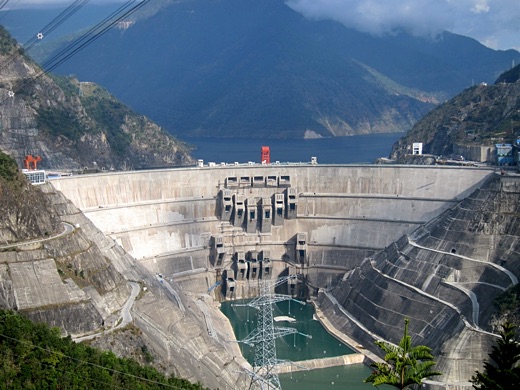
Image above: China diverted much of the Brahmputra River with the Xiawan Dam on the eastern plateau of Tibet before its water reach thirsty India and Bangladesh.  Is this an act of war? From (http://bfmedic.com/lancang-dam-real-life/xiaowan-dam/).

At the end of November, delegations from nearly 200 countries will convene in Paris for what is billed as the most important climate meeting ever held.  Officially known as the 21st Conference of the Parties (COP-21) of the United Nations Framework Convention on Climate Change (the 1992 treaty that designated that phenomenon a threat to planetary health and human survival), the Paris summit will be focused on the adoption of measures that would limit global warming to less than catastrophic levels.

If it fails, world temperatures in the coming decades are likely to exceed 2 degrees Celsius (3.5 degrees Fahrenheit), the maximum amount most scientists believe the Earth can endure without experiencing irreversible climate shocks, including soaring temperatures and a substantial rise in global sea levels.

A failure to cap carbon emissions guarantees another result as well, though one far less discussed.  It will, in the long run, bring on not just climate shocks, but also worldwide instability, insurrection, and warfare.  In this sense, COP-21 should be considered not just a climate summit but a peace conference -- perhaps the most significant peace convocation in history.

To grasp why, consider the latest scientific findings on the likely impacts of global warming, especially the 2014 report of the Intergovernmental Panel on Climate Change (IPCC).  When first published, that report attracted worldwide media coverage for predicting that unchecked climate change will result in severe droughts, intense storms, oppressive heat waves, recurring crop failures, and coastal flooding, all leading to widespread death and deprivation.

Recent events, including a punishing drought in California and crippling heat waves in Europe and Asia, have focused more attention on just such impacts.

The IPCC report, however, suggested that global warming would have devastating impacts of a social and political nature as well, including economic decline, state collapse, civil strife, mass migrations, and sooner or later resource wars.

These predictions have received far less attention, and yet the possibility of such a future should be obvious enough since human institutions, like natural systems, are vulnerable to climate change.  Economies are going to suffer when key commodities -- crops, timber, fish, livestock -- grow scarcer, are destroyed, or fail.  Societies will begin to buckle under the strain of economic decline and massive refugee flows.

Armed conflict may not be the most immediate consequence of these developments, the IPCC notes, but combine the effects of climate change with already existing poverty, hunger, resource scarcity, incompetent and corrupt governance, and ethnic, religious, or national resentments, and you’re likely to end up with bitter conflicts over access to food, water, land, and other necessities of life.

The Coming of Climate Civil Wars
Such wars would not arise in a vacuum.  Already existing stresses and grievances would be heightened, enflamed undoubtedly by provocative acts and the exhortations of demagogic leaders.

Think of the current outbreak of violence in Israel and the Palestinian territories, touched off by clashes over access to the Temple Mount in Jerusalem (also known as the Noble Sanctuary) and the inflammatory rhetoric of assorted leaders. Combine economic and resource deprivation with such situations and you have a perfect recipe for war.

The necessities of life are already unevenly distributed across the planet. Often the divide between those with access to adequate supplies of vital resources and those lacking them coincides with long-term schisms along racial, ethnic, religious, or linguistic lines.

The Israelis and Palestinians, for example, harbor deep-seated ethnic and religious hostilities but also experience vastly different possibilities when it comes to access to land and water.  Add the stresses of climate change to such situations and you can naturally expect passions to boil over.

Climate change will degrade or destroy many natural systems, often already under stress, on which humans rely for their survival.  Some areas that now support agriculture or animal husbandry may become uninhabitable or capable only of providing for greatly diminished populations.

Under the pressure of rising temperatures and increasingly fierce droughts, the southern fringe of the Sahara desert, for example, is now being transformed from grasslands capable of sustaining nomadic herders into an empty wasteland, forcing local nomads off their ancestral lands.

Many existing farmlands in Africa, Asia, and the Middle East will suffer a similar fate.  Rivers that once supplied water year-round will run only sporadically or dry up altogether, again leaving populations with unpalatable choices.

As the IPCC report points out, enormous pressure will be put upon often weak state institutions to adjust to climate change and aid those in desperate need of emergency food, shelter, and other necessities. “Increased human insecurity,” the report says, “may coincide with a decline in the capacity of states to conduct effective adaptation efforts, thus creating the circumstances in which there is greater potential for violent conflict.”

A good example of this peril is provided by the outbreak of civil war in Syria and the subsequent collapse of that country in a welter of fighting and a wave of refugees of a sort that hasn’t been seen since World War II.  Between 2006 and 2010, Syria experienced a devastating drought in which climate change is believed to have been a factor, turning nearly 60% of the country into desert.  Crops failed and most of the country’s livestock perished, forcing millions of farmers into penury.

Desperate and unable to live on their land any longer, they moved into Syria’s major cities in search of work, often facing extreme hardship as well as hostility from well-connected urban elites.
Had Syrian autocrat Bashar al-Assad responded with an emergency program of jobs and housing for those displaced, perhaps conflict could have been averted.  Instead, he cut food and fuel subsidies, adding to the misery of the migrants and fanning the flames of revolt.

In the view of several prominent scholars, “the rapidly growing urban peripheries of Syria, marked by illegal settlements, overcrowding, poor infrastructure, unemployment, and crime, were neglected by the Assad government and became the heart of the developing unrest.”

A similar picture has unfolded in the Sahel region of Africa, the southern fringe of the Sahara, where severe drought has combined with habitat decline and government neglect to provoke armed violence.

The area has faced many such periods in the past, but now, thanks to climate change, there is less time between the droughts.  “Instead of 10 years apart, they became five years apart, and now only a couple years apart,” observes Robert Piper, the United Nations regional humanitarian coordinator for the Sahel.  “And that, in turn, is putting enormous stresses on what is already an incredibly fragile environment and a highly vulnerable population.”

In Mali, one of several nations straddling this region, the nomadic Tuaregs have been particularly hard hit, as the grasslands they rely on to feed their cattle are turning into desert.  A Berber-speaking Muslim population, the Tuaregs have long faced hostility from the central government in Bamako, once controlled by the French and now by black Africans of Christian or animist faith.

With their traditional livelihoods in peril and little assistance forthcoming from the capital, the Tuaregs revolted in January 2012, capturing half of Mali before being driven back into the Sahara by French and other foreign forces (with U.S. logistical and intelligence support).

Consider the events in Syria and Mali previews of what is likely to come later in this century on a far larger scale.  As climate change intensifies, bringing not just desertification but rising sea levels in low-lying coastal areas and increasingly devastating heat waves in regions that are already hot, ever more parts of the planet will be rendered less habitable, pushing millions of people into desperate flight.

While the strongest and wealthiest governments, especially in more temperate regions, will be better able to cope with these stresses, expect to see the number of failed states grow dramatically, leading to violence and open warfare over what food, arable land, and shelter remains.

In other words, imagine significant parts of the planet in the kind of state that Libya, Syria, and Yemen are in today.  Some people will stay and fight to survive; others will migrate, almost assuredly encountering a far more violent version of the hostility we already see toward immigrants and refugees in the lands they head for.  The result, inevitably, will be a global epidemic of resource civil wars and resource violence of every sort.

Water Wars
Most of these conflicts will be of an internal, civil character: clan against clan, tribe against tribe, sect against sect.  On a climate-changed planet, however, don’t rule out struggles among nations for diminished vital resources -- especially access to water.  It’s already clear that climate change will reduce the supply of water in many tropical and subtropical regions, jeopardizing the continued pursuit of agriculture, the health and functioning of major cities, and possibly the very sinews of society.

The risk of “water wars” will arise when two or more countries depend on the same key water source -- the Nile, the Jordan, the Euphrates, the Indus, the Mekong, or other trans-boundary river systems -- and one or more of them seek to appropriate a disproportionate share of the ever-shrinking supply of its water.  Attempts by countries to build dams and divert the water flow of such riverine systems have already provoked skirmishes and threats of war, as when Turkey and Syria erected dams on the Euphrates, constraining the downstream flow.

One system that has attracted particular concern in this regard is the Brahmaputra River, which originates in China (where it is known as the Yarlung Tsangpo) and passes through India and Bangladesh before emptying into the Indian Ocean.

 China has already erected one dam on the river and has plans for more, producing considerable unease in India, where the Brahmaputra’s water is vital for agriculture.  But what has provoked the most alarm is a Chinese plan to channel water from that river to water-scarce areas in the northern part of that country.

The Chinese insist that no such action is imminent, but intensified warming and increased drought could, in the future, prompt such a move, jeopardizing India’s water supply and possibly provoking a conflict.  “China’s construction of dams and the proposed diversion of the Brahmaputra’s waters is not only expected to have repercussions for water flow, agriculture, ecology, and lives and livelihoods downstream,” Sudha Ramachandran writes in The Diplomat, “it could also become another contentious issue undermining Sino-Indian relations.”

Of course, even in a future of far greater water stresses, such situations are not guaranteed to provoke armed combat.  Perhaps the states involved will figure out how to share whatever limited resources remain and seek alternative means of survival.  Nonetheless, the temptation to employ force is bound to grow as supplies dwindle and millions of people face thirst and starvation.  In such circumstances, the survival of the state itself will be at risk, inviting desperate measures.

Lowering the Temperature
There is much that undoubtedly could be done to reduce the risk of water wars, including the adoption of cooperative water-management schemes and the introduction of the wholesale use of drip irrigation and related processes that use water far more efficiently. However, the best way to avoid future climate-related strife is, of course, to reduce the pace of global warming.  Every fraction of a degree less warming achieved in Paris and thereafter will mean that much less blood spilled in future climate-driven resource wars.

This is why the Paris climate summit should be viewed as a kind of preemptive peace conference, one that is taking place before the wars truly begin.  If delegates to COP-21 succeed in sending us down a path that limits global warming to 2 degrees Celsius, the risk of future violence will be diminished accordingly.  Needless to say, even 2 degrees of warming guarantees substantial damage to vital natural systems, potentially severe resource scarcities, and attendant civil strife.

As a result, a lower ceiling for temperature rise would be preferable and should be the goal of future conferences.  Still, given the carbon emissions pouring into the atmosphere, even a 2-degree cap would be a significant accomplishment.

To achieve such an outcome, delegates will undoubtedly have to begin dealing with conflicts of the present moment as well, including those in Syria, Iraq, Yemen, and Ukraine, in order to collaborate in devising common, mutually binding climate measures.  In this sense, too, the Paris summit will be a peace conference.

For the first time, the nations of the world will have to step beyond national thinking and embrace a higher goal: the safety of the ecosphere and all its human inhabitants, no matter their national, ethnic, religious, racial, or linguistic identities.  Nothing like this has ever been attempted, which means that it will be an exercise in peacemaking of the most essential sort -- and, for once, before the wars truly begin.

• Michael T. Klare, a TomDispatch regular, is a professor of peace and world security studies at Hampshire College and the author, most recently, of The Race for What’s Left. A documentary movie version of his book Blood and Oil is available from the Media Education Foundation. Follow him on Twitter at @mklare1.


.

Container Freight Rates Crash 60%

SUBHEAD: Container shipping rates between Asia and Europe fall 60% in three weeks signalling global trade in free fall.

By Tyler Durden on 23 August 2015 for Zero Hedge -
(http://www.zerohedge.com/news/2015-08-23/global-trade-freefall-container-freight-rates-asia-europe-crash-60-three-weeks)


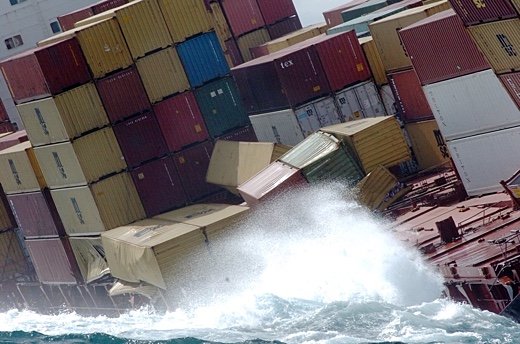
Image above: The Rena, a container ship, founders off New Zealand in October 2011. From (http://www.emergency.co.nz/archive/rena.html).

Three weeks ago, when we last looked at the collapse in trade along what may be the most trafficked route involving China, i.e., from Asia to Northern Europe, we noted that while that particular shipping freight rate Europe had crashed some 23% on just one week, there was some good news: at least the Baltic Dry index was still inexplicably rising, and at last check it was hovering just above 1,100.

That is no longer the case, and just as with everything else in recent months, the Baltic Dry dead cat bounce is now over, with the BDIY topping out just above 1200 on August 4, and now back in triple digit territory, rapidly sliding back to the reality of recent record lows which a few months ago we suggested hinted that much more is wrong with global trade, and the global economy, than artificially manipulated stock markets would admit.

More importantly, a major source of confusion appears to have been resolved. Recall that as we noted on August 3, "many were wondering how it was possible that with accelerating deterioration across all Chinese asset classes, not to mention the bursting of various asset bubbles, could global shippers demand increasingly higher freight rates, an indication of either a tight transportation market or a jump in commodity demand, neither of which seemed credible. We may have the answer."
We did. To wit:
"Should the dead cat bounce in shipping rates indeed be over, and if the accelerate slide continues at the current pace, not only will shippers mothball key transit lanes, but the biggest concern for global economy, the unprecedented slowdown in world trade volumes, which we flagged a week ago, will be not only confirmed but is likely to unleash yet another global recession."
As expected, on Friday, we got confirmation that the BDIY has indeed become a lagging indicator to actual demand, when Reuters reported in its latest weekly update using data from the Shanghai Containerized Freight Index, that key shipping freight rates for transporting containers from ports in Asia to Northern Europe fell by 26.7 percent to $469 per 20-foot container (TEU) in the week ended on Friday. 

The collapse in rates is nothing short of a bloodbath: "it was the third consecutive week of falling freight rates on the world’s busiest route and rates are now nearly 60 percent lower than three weeks ago.

Freight rates on the world’s busiest shipping route have tanked this year due to overcapacity in available vessels and sluggish demand in goods to be transported. Rates generally deemed profitable for shipping companies on the route are at about $800-$1,000 per TEU.

Other Europe-focused freight rates did even worse, with container freight rates from Asia to ports in the Mediterranean plunging 32.1%, while those to the US West and East coast slid by 7.9% and 9.9%, respectively.
This should not come as a surprise: it was back in March when we first reported that "Global Trade Volume Tumbles Most Since 2011; Biggest Value Plunge Since Lehman."

It took the no longer discounting "market" about 6 months to figure this out. As for the culprit, no question who is at fault.

What happens next?

Well, some, such as the world’s largest container shipping company, Maersk Line, will desperately try to no longer lose money on every transit, with a plan to raise spot freight rates by $1,000 from ports in Asia to ports in northern Europe, with effect from Sep 1. Other major container shipping companies have similar plans.

The virtually guaranteed outcome of this "strategy", as there is simply not enough demand as the world careens off the global recession cliff to offset a surge in freight costs, will be an even greater collapse in trade volumes. 

The alternative, is just as bad: as we sarcastically hinted first in March:
... none of the above should alarm anyone: remember - central banks can just print trade with just the flick of a CTRL-P switch.
And then again three weeks ago when we said no need to worry because it is just a matter of time before "central planners learn how to print trade."

For now, however, printing money no longer equates to boosting global trade. In fact, easy monetary policy now appears to be backfiring, as even the "market" has figured out.

So, sarcasm aside, what really happens next, to both shipping, trade, the global economy and markets? Sadly, unless central planning finally works after 7 years of failing ever upward... this.

xxx

The Dow Jones Industrial Average fell over 1,000 points as trading opened Monday, following steep dives in markets around the world.

The benchmark index fell 1,089 before it quickly righted itself to a loss of 603 points, or 3.7 percent, to 15,858. The drop followed declines Thursday and Friday caused by uncertainty over China's markets after a devaluation of the Chinese currency.

NYSE Group Inc., operator of the New York Stock Exchange, invoked "Rule 48" on Monday, a rarely used action which relaxes some trading rules on especially volatile pre-start trading to ensure a smooth opening to the trading day. A number of stocks triggered rules, which act as circuit breakers, when a price drop of 10 percent in a five-minute period is noted.

Between last week and Monday, the Dow Jones Industrial Average suffered its worst decline in four years; the average was down 370 points, to 16,088 at 10:15 a.m.


.

Women Crossed the Line

SUBHEAD: For world peace these women crossed the DMZ Line from North Korea to South Korea.

By Jon Letman on 24 May 24 for Boing Boing  -
(http://www.islandbreath.org/2015Year/05/150524dmz.jpg)


Image above: A press conference for "Women Call for a Korean Peace Treaty". From original article.

In an historic move, a group of global feminist activists march into the demilitarized zone between North and South Korea to create a space for a new type of conversation about truly ending the Korean war.

At the time of this blog post in Seoul and Pyongyang it’s already Sunday, May 24th, International Women’s Day for Peace and Disarmament, when a group of more than 30 women are scheduled to cross the Demilitarized Zone (DMZ) at Kaesong from North Korea into South Korea. Their goal: to draw attention to Korea’s “forgotten” and unfinished war, and move toward a real peace that can reunite families and, perhaps, a divided nation.

The march includes both North and South Korean women marching on their respective sides, and was preceded by a peace symposium in Pyongyang (watch North Korean TV coverage here). It will be followed by a similar symposium in Seoul after they cross the DMZ (Saturday evening in the U.S.).

The Korean War (officially 1950-53) stands out for its bloody toll. Some 4 million people, mostly civilians, perished. Although a “temporary” cease-fire was signed, the last 62 years have been marked by a protracted cold war defined by ongoing threats by both sides of the DMZ, decades of profligate military spending, and what is effectively a permanent state of near-war and the fear of attack.

The idea to walk from North Korea into South Korea began with a dream that lead organizer Christine Ahn had several years ago. The concept grew after Ahn connected with feminist icon Gloria Steinem who took a public stand in 2011 against the militarization of South Korea’s Jeju island.


Activist and feminist Gloria Steinem (C) speaks at a news conference before the WomenCrossDMZ group leaves for North Korea's capital Pyongyang, at a hotel in Beijing, China, May 19, 2015.  REUTERS/Kim Kyung-Hoon
Image above: Activist and feminist Gloria Steinem (C) speaks at a news conference before the WomenCrossDMZ group leaves for North Korea's capital Pyongyang, at a hotel in Beijing, China, May 19, 2015. REUTERS/Kim Kyung-Hoon. In original article.

The movement evolved into WomenCrossDMZ as Nobel Peace Prize laureates Mairead Maguire of Northern Ireland and Leymah Gbowee of Liberia joined Ahn, Steinem and what has grown to more than 30 women from South Korea, Japan, the US, Britain, Australia--at least 15 countries, in all.

A Different Future
Gwyn Kirk, a founding member of Women for Genuine Security, and one of the DMZ marchers, says WomenCrossDMZ is intended to create a space for a new type of conversation about ending the Korean war once and for all. After more than 60 years of tit-for-tat provocations, costly and dangerous brinksmanship and outright nuclear threats, Kirk says it’s time to create a different future.

That this movement is organized entirely by women is natural, says Kirk, pointing to UN Security Resolution 1325 which reaffirms “the important role of women in the prevention and resolution of conflicts, peace negotiations, peace-building, peacekeeping, humanitarian response and in post-conflict reconstruction…”

As these women mount a brave effort to do what men have failed to achieve (bring peace to the Korean peninsula), they are also receiving criticism for their efforts. One Korea policy commentator went so far as to call the group “naïve, duplicitous, disingenuous, fatuous, and [stupid].”

CNN’s Brian Todd asked if Kim Jong-un was “in league with a women’s group to bring peace between North and South Korea” and played up suggestions Christine Ahn might be “sympathetic” to North Korea. The Monthly Review responded by breaking down why The Situation Room with Wolf Blitzer did a “hatchet job” on WomenCross DMZ rather than a serious examination of what they set out to achieve.


NGO activist Choi Ai-young (R) and other members of the WomenCrossDMZ group pose with Korea's traditional patchwork before the group leaves for North Korea's capital Pyongyang, at a hotel in Beijing, China, May 19, 2015. REUTERS/Kim Kyung-Hoon
Image above: NGO activist Choi Ai-young (R) and other members of the WomenCrossDMZ group pose with Korea's traditional patchwork before the group leaves for North Korea's capital Pyongyang, at a hotel in Beijing, China, May 19, 2015. In original article.
 
Making history
Independent investigative journalist Tim Shorrock had a different take. In an email from Seoul, he called the DMZ march “an important milestone because it runs against the grain of the militarist approach to Korea taken by the Obama administration and the hostility of the South Korean government.”

Shorrock, who has covered Korea and Japan for more than three decades, said the women’s march and symposia held in Pyongyang and later Seoul, sends a message to the North that peace and reconciliation are possible. He hopes the march will also spur the U.S. to “take measures to defuse the tense situation in Korea and adopt a more flexible approach to settling its differences with North Korea.”

Responding to charges that she and her colleagues are “sympathetic” to North Korea, Christine Ahn says it’s ironic that people who claim to be staunch supporters of human rights are the ones most vehemently opposed to efforts to pursue a real peace agreement.

“You’re not going to see any improvement in North Korean human rights if you continue to isolate them or not engage or have dialogue,” Ahn said by Skype. The universal theme that has united years of international NGO reports, she says, is that there needs to be a peace settlement to improve human rights in North Korea.

Crazy repression, crazy militarization
WomenCrossDMZ, Ahn says, seeks to “get to the root cause of the issue of divided families” and what she calls “crazy militarization” and “crazy repression” of democracy in both North and South Korea.

Ahn says former U.S. Ambassador to South Korea James Laney cut to the core of the Korean issue when he said, “...One item should be at the top of the agenda...that is the establishment of a peace treaty to replace the truce that has been in place since 1953...”

To fully appreciate why North Korea has evolved into a “paranoid, hyper-militaristic society,” Ahn says it’s important to carefully examine history before the 1950-53 Korean war and remember the tremendous losses suffered by the North. “We might have forgotten that history,” she says, “but [North Korea] hasn’t.”

Ahn describes WomenCrossDMZ as “peace women” who want to find a peaceful resolution to the Korean stalemate. To do that, she says, requires listening, understanding, dialogue and a degree of empathy which is absent today. Dehumanizing the other side won’t bring peace, Ahn says. “It’s a tough place to be, but I really believe there is no other alternative.”

Being armed to the teeth (hasn’t worked) 
Gwyn Kirk says that reducing military tensions is more likely to lead to better human rights conditions. “That’s what we’re advocating...more dialogue and more openness.” As long as there’s no dialogue or engagement, nothing will change.”

Kirk points to diplomatic progress between the United States and both Cuba and Iran, saying that “sanctions, being armed to the teeth [and] militarism hasn’t worked.” 
She adds, “So if that’s controversial, I guess [it’s] controversial but it just seems to me that this old cold war stuff is really history...We need to move forward and think differently.

Follow the organization on Twitter or Facebook. Link to announcement from “Women Cross DMZ” (PDF)
Photo, top: Members of the WomenCrossDMZ group attend a news conference before they leave for North Korea's capital Pyongyang, at a hotel in Beijing, China, May 19, 2015. REUTERS/KIM KYUNG-HOON

• Jon Letman is an independent freelance journalist and photographer on the Hawaiian island of Kauai. His articles on conservation, the environment, politics and the Asia-Pacific region have been published in Al Jazeera English, Truthout, Inter Press Service, Christian Science Monitor, CNN Traveller, as well as publications in Finland, Iceland, Russia, Japan, Canada, the UK and across the US.  

.

TPA approved for TPP

SUBHEAD: Trade Promotion Authority (TPA) vote approved by Senate after some hope was raised Tuesday.

By Michael McCauliff on 14 May 2015 for Huffington Post -
(http://www.huffingtonpost.com/2015/05/12/senate-democrats-trade-promotion-authority_n_7267600.html)


Image above: Title of "TPP & TPA"A stock photo of a handshake is much like our economy will be after TPP passes - empty and fake. From (http://www.i2coalition.com/trans-pacific-partnership-and-trade-promotion-authority-reading-list/).

The Senate passed a pair of trade protection measures Thursday, and voted shortly afterward to start debate on the fast-track bill that President Barack Obama needs to secure his massive and controversial free-trade initiatives with Asia and Europe.

One measure, which reauthorizes trade preferences for some African countries, faced little opposition, and passed by a vote of 96 to 1. But the second, a customs and trade enforcement package, was approved more narrowly, with 78 voting in favor and 20 opposed.

The package was opposed by the Obama administration and many Republicans because it contains a measure that would crack down on currency manipulation -- particularly by China, the prime offender, but also by several other members of Obama's proposed sweeping Trans-Pacific Partnership trade agreement with 11 Pacific Rim nations.

With the currency crackdown passed, lawmakers were willing to let debate start on granting Obama what is known as trade promotion authority, voting 65 to 33 to proceed. TPA would allow the president to "fast-track" passage of the TPP deal and the Transatlantic Trade and Investment Partnership, a similarly massive agreement with Europe.

Opponents of the currency provision say it could spark a new trade war with China, and the administration argues that a number of the Asian trade partners would likely pull out of the broader TPP deal if currency manipulation is addressed.

But in the view of most Democrats, and some Republicans, there should be no new free trade deals if the United States is not going to address the advantages other countries and their businesses get from keeping their currencies artificially low.

"Now is the time to think deeply and comprehensively about this country's trade policy," said Sen. Chuck Schumer (D-N.Y.), who has taken the lead in fighting for the currency provision. "We have lost millions of jobs because of currency manipulation, which makes the imports of China about 33 percent cheaper."

While the White House opposes the measure -- and its future passage in the House of Representatives is far from certain -- Senate Democrats insisted that it be considered before they would debate giving Obama his fast track.

Democrats -- including staunch free-traders like Oregon Sen. Ron Wyden -- united to stall the fast-track bill earlier in the week by extracting a vote on the customs package. The package includes numerous other trade enforcement reforms, including bans on goods made with forced or child labor.

"I can't think of the last time the Senate spoke with such an emphatic voice on a trade issue," said Sen. Sherrod Brown (D-Ohio), the prime architect of the Democrats' mini-revolt. "The simple message [is] we cannot have trade promotion without trade enforcement ... We shouldn't be passing new agreements while doing nothing to enforce existing laws and support American companies dealing with unfair competition."

Wyden, who made the entire push for the trade bills possible by cutting deals with Senate Finance Committee Chairman Orrin Hatch (R-Utah) and House Ways and Means Committee Chairman Paul Ryan (R-Wis.), insisted that the customs bill would ensure that the new trade deals are better than the failed pacts of the past.

"The NAFTA playbook, the playbook for trade in the 1990s, is gone, and it is a new day in trade policy," Wyden said before the votes. "The trade promotion act is not the trade policy of the 1990s, is not the North American Free Trade Agreement, and what we're going to do today is essentially starting with the question of how vigorous trade enforcement ought to be at the forefront of America's trade policy in 2015 and beyond."

With passage of the two measures on Thursday, the Senate was set to start debating the TPA bill that had been stalled earlier in the week. It was unclear how long that debate and amendment process would last, but fast-track backers were hoping to get it passed by June.

TPA faces an uncertain future in the House, where nearly all Democrats are opposed, as well as a strong contingent of Republicans.


No fast track for TPP
SUBHEAD: Senate Democrats, lead by Elizabeth Warren, knock down Obama's trade bill.

By Jennifer Bendery on 12 May 2015 for Huffington Post -
(http://www.huffingtonpost.com/2015/05/12/senate-democrats-trade-promotion-authority_n_7267600.html)


Image above: Senator Elizabeth Warren says President Obama has deceived the American people on the purpose of the Trans-Pacific Partnership. From (https://www.popularresistance.org/desperate-obama-administration-deceives-on-fast-track-tpp/).

Senate Democrats dealt a stinging blow to President Barack Obama Tuesday by blocking legislation that would grant him authority to fast-track international trade deals.

Democrats, including several who favor Obama's trade agenda, banded together to prevent the Senate from considering legislation that grants the president so-called Trade Promotion Authority, which would bar Congress from amending or filibustering trade agreements negotiated by the administration.

Fifty-two senators voted to start debate on the bill, short of the 60 needed to overcome a Democratic filibuster. Forty-five senators voted against the plan.

The fast-track bill is seen as essential to passing the Trans-Pacific Partnership, a secretive trade deal the Obama administration is negotiating with 11 other Asian-Pacific countries. Obama's rejection at the hands of his own party follows his bitter public feud with Sen. Elizabeth Warren (D-Mass.) over his trade agenda. Republican leaders in the House and Senate support both TPA and TPP.

In the final hours before the vote, even Democrats who support the president’s trade agenda concluded that they could cut a better deal with Republicans by preventing Senate Majority Leader Mitch McConnell (R-Ky.) from opening debate on the TPA bill. "We're telling everyone, 'Don't be a cheap date,'" said one Democratic aide who spoke anonymously to discuss strategy.

Tuesday's filibuster isn't the first setback for fast track. The TPA bill had been stalled in the Senate Finance Committee for months before Obama and Senate Finance Committee Chairman Orrin Hatch (R-Utah) cut a deal with Sen. Ron Wyden (D-Ore.) that offered a handful of concessions in exchange for Democratic votes.

All of those concessions, however, were not attached to the TPA bill itself, but packaged into three other pieces of legislation that cleared the committee during the same hearing in late April.

On Tuesday, McConnell showed some willingness to vote on two of the bills together -- TPA and a bill on Trade Adjustment Assistance, a program that provides job training and financial aid to workers who lose their jobs from international trade.

"We can't debate any of the provisions senators want to consider if they vote to filibuster even getting on this bill," McConnell said.

McConnell also said he would allow votes on the other bills with Democratic support, but moving them as separate bills would give Obama and Republican leaders opportunities to torpedo those provisions without taking down the TPA bill.

Most of the Democratic concessions from the Wyden-Hatch talks are included in a trade enforcement bill. Some of the most important include a ban on imports made with forced labor, which is opposed by some Republicans, and a provision to fight currency manipulation by foreign governments, which is opposed by Obama.

"Our special concern this afternoon is about a lack of commitment on trade enforcement," Wyden said Tuesday. He accused Republicans of "legislative malpractice" for separating the bills with strong Democratic support from the TPA legislation.

"All they have to do is put the enforcement part into this," Sen Dianne Feinstein (D-Calif.) told HuffPost. "And there's a good reason that you want this enforced. You don't want child labor. You don't want people working 24 hours a day. I mean, this has to be part of the agreement. So to leave it out is a concern to us."

Speaking from the Senate floor, however, a visibly irritated Hatch said that separating the bills had been necessary. The currency manipulation provision authored by Sens. Chuck Schumer (D-N.Y.) and Sherrod Brown (D-Ohio) would ultimately undermine TPA, according to Hatch, and needed to be included in a separate bill, which could be dismembered, ignored or vetoed without touching TPA.

"Everybody knew that putting the Schumer amendment on the one bill would not be acceptable in the House and would not be acceptable to the president," Hatch said.

Earlier Tuesday, the White House downplayed the significance of the vote, but wouldn't say whether it supports Democrats' push to bundle the four bills.

"It is not unprecedented, to say the least, for the United States Senate to encounter procedural snafus," White House press secretary Josh Earnest said in his daily briefing. “We're pleased to see Democrats and Republicans both indicating a willingness to work through these procedural challenges."

Fast track authority is not necessarily dead. McConnell has the authority to bring the legislation back after cutting deals with Democrats, but it now faces an uphill battle in the Senate and an even tougher fight in the House, where a substantial bloc of Republicans and the overwhelming majority of Democrats don't back the measure.

McConnell wants the trade deal to pass, but will be able to relish a round of headlines focused on Democratic in-fighting in the short-term. "Maybe he wanted to kill it," Sen. Pat Leahy (D-Vt.) said of fast track.

The Democratic blockade of the measure intensifies a long-simmering conflict with the president, who has made securing trade deals a key element of his legacy and his final two years in office.
The president and backers of the effort say it will open more markets for U.S. goods, level the playing field for American manufacturers, and serve as a check on China's global advance.

And they argue the Obama administration has figured out how to solve the problems of the much-maligned North American Free Trade Agreement.

"Most people don't realize that we actually fixed a lot of what was wrong with NAFTA in the course of this," said Sen. Tom Carper (Del.), one of the few Democrats to stick with Obama on the vote. "We need to be negotiating in the present, in the present tense, and not the past."

But many Democrats and some Republicans fear the TPP in particular will facilitate currency manipulation by foreign competitors, erode labor and environmental standards at home and abroad, and shrink domestic jobs for the middle-class. The Obama administration treats the TPP negotiating texts as classified information, making it a crime for his trade critics to detail their concerns in public.

While Carper and Obama emphasize that TPP will include enforceable labor and environmental protections, both labor unions and environmental groups remain steadfastly opposed to the deal, citing lax enforcement of such trade safeguards under Obama's tenure.

Obama's feud with Warren has centered around the TPP's enforcement mechanism, known as Investor-State Dispute Settlement. The process allows foreign corporations to sue a country over laws or regulations that they believe unfairly threaten their investments. The cases are heard before an international tribunal with the power to levy financial penalties against nations.

While Obama has insisted that the process will not jeopardize U.S. standards, Warren and others worry it will curb future rulemaking, and indeed concerns that new rules would violate past trade agreements have become part of congressional debate in recent years.

The Obama administration has been in open war with Warren over this issue, with the president calling some of her concerns "pure speculation," "bunk" and "dishonest." Warren told The Washington Post on Monday she has yet to see a draft "that would do what the president says he has already accomplished."

Currency manipulation has been another major sticking point. In the past, a number of countries, including Japan, Malaysia and Singapore, which are all part of TPP, have kept the value of their currencies artificially low, which costs American jobs by making foreign goods cheaper. Two efforts to combat currency manipulation garnered bipartisan support in the Finance Committee.

The one authored by Brown and Schumer was approved as part of the trade enforcement bill, while another, authored by Sens. Rob Portman (R-Ohio) and Debbie Stabenow (D-Mich.), was defeated.

Schumer predicted trouble for the administration if it didn't promise to protect the bill his amendment was attached to.

"Unless the administration says they won't veto it, they're going to lose a lot of votes on TPA, on the regular trade bill," Schumer told HuffPost earlier this month.

Unlike other Democratic demands, several Republicans support efforts to combat currency manipulation, as do many corporations, particularly in the steel and auto industries. Obama has warned that a poorly written currency provision could hamper the Federal Reserve's ability to conduct monetary policy, but many economists believe it would be simple to craft effective language that would give the Fed plenty of leeway.

The Schumer-Brown bill would require the U.S. Department of Commerce to consider the effects of currency manipulation on trade complaints brought by U.S. companies. Those calculations would be included in international trade cases.

"If you represent a state like mine and you see what's happened in the last 25 years, you have to be very skeptical of arguments that seem to say, 'Just go away, your concerns are unwarranted, we're gonna fix all the problems of the past,'” said Sen. Bob Casey (D-Pa.). "It's just a basic disagreement."


.