Showing posts with label Progressive. Show all posts

Warren on the Warpath

SUBHEAD: Centrist Democrats riled as Warren says days of 'Lukewarm' policies are over.

By Jake Johnson on 18 August 2017 for Common Dreams -
(https://www.commondreams.org/news/2017/08/18/centrist-democrats-riled-warren-says-days-lukewarm-policies-are-over#)


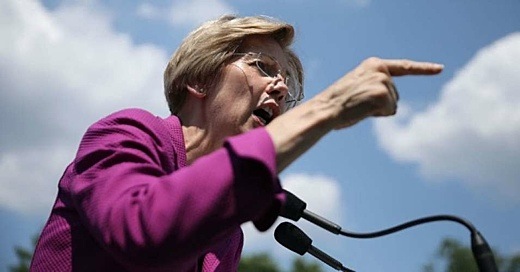
Image above: From ().

She says;  "The Democratic Party isn't going back to the days of welfare reform and the crime bill."

In a wide-ranging and fiery keynote speech last weekend at the 12th annual Netroots Nation conference in Atlanta, Georgia, Sen. Elizabeth Warren (D-Mass.) relentlessly derided moderate Democratic pundits calling for the party to move "back to the center" and declared that Democrats must unequivocally "fight for progressive solutions to our nation's challenges."

As The Hill's Amie Parnes reported on Friday, Warren's assertion during the weekend gathering that progressives are "the heart and soul of today's Democratic Party"—and not merely a "wing"—raised the ire of so-called "moderate" Democrats, who have insisted that progressive policies won't sell in swing states.

But recent survey results have consistently shown that policies like single-payer healthcare, progressive taxation, a higher minimum wage, and tuition-free public college are extremely popular among the broader electorate. Sen. Bernie Sanders (I-Vt.)—the most prominent advocate of an ambitious, far-reaching progressive agenda—has consistently polled as the most popular politician in the country.

For Warren, these are all indicators that those pining for a rightward shift "back to the center" are deeply mistaken.

Specifically, Warren took aim at a recent New York Times op-ed by Democratic commentators Mark Penn and Andrew Stein, who argued that Democrats must moderate their positions in order to take back Congress and, ultimately, the presidency.

Warren ridiculed this argument as a call for a return to Bill Clinton-era policies that "lock[ed] up non-violent drug offenders and ripp[ed] more holes in our economic safety net."

"The Democratic Party isn't going back to the days of welfare reform and the crime bill," Warren said. "We're not going back to the days of being lukewarm on choice.

We're not going back to the days when universal healthcare was something Democrats talked about on the campaign trail but were too chicken to fight for after they got elected."

"And," Warren concluded, "we're not going back to the days when a Democrat who wanted to run for a seat in Washington first had to grovel on Wall Street."

For months media outlets have speculated that Warren is gearing up for a 2020 presidential run, but she has denied the rumors.

Warren's remarks came as a large coalition of progressive groups is mobilizing during the congressional recess to pressure Democrats to formally endorse the "People's Platform," a slate of ambitious legislation that includes Rep. John Conyers' (D-Mich.) Medicare for All bill.


Video above: Watch Warren's full speech at Netroots Nation. From (https://youtu.be/Rc2D9pn8mjc).

.

Hawaii Universal Healthcare plan?

SOURCE: Koohan Paik (koohanpaik@gmail.com)
SUBHEAD: Hawaii bill considers possibility of universal healthcare coverage to residents.

By Jill N. Tokuda on 25 March 2017 in Island Breath -
(http://islandbreath.blogspot.com/2017/03/hawaii-single-payer-plan.html)


Image above: Senator Lorraine Inouye in the Hawaii State Building in Honolulu. From (https://www.flickr.com/photos/134175784@N05/26056617971/).

[IB Publisher's note: This is time sensitive. Deadline tomorrow for comments.]

After witnessing the Republicans' tour-de-force fumbled attempt to rob Americans of healthcare, it occurred to me that *now* is the perfect "opening" to push for a healthcare system that truly serves us.

Unless you own an insurance company, that would be "universal healthcare," or "single-payer healthcare" -- basic medical coverage for all, for little or no money, with the opportunity to purchase additional coverage from a private insurance company.

Besides costing tax payers less money, universal healthcare is a great way to shift wealth back to the people from the 1%, and also from defense spending back to social services.

So I did a bit of research to find out how we can get back to the universal health care that Hawaii happened to have enjoyed a quarter-century ago. And guess what I found out?

There are folks in State government thinking along these same lines. Turns out, funding to investigate the viability of a universal healthcare system is being proposed this week!

Yep, there is a line-item in a budget bill to provide funding to the Hawaii Health Authority (they do healthcare planning for the state) to research how Hawaii can get universal healthcare -- health care for all! The item proposes to give a salary to two researchers, who would be helped by nine volunteers to draw up a plan. This is the first step in the right direction.

Of course, the health insurance companies are powerful and oppose such a plan that cuts their profit out of the equation of our healthcare. But if this bill gets enough testimonies sent in BY MONDAY NIGHT, and our senators vote to fund this research, we will be on our way to a system that would resemble Medicare for all ages. Wouldn't that be great?

The budget bill is HB100 in the Senate Ways and Means Committee. Here is the web site to submit testimony: (http://www.capitol.hawaii.gov)

(It's cumbersome at first, but you get the hang of it - just don't forget your password!)

Once you indicate HB100, there is a place for you to make a comment that you would like to see the Hawaii Health Authority funded so that those nine volunteers plus a couple of paid staff can design a Universal Health Care system for Hawaii.

AND... call the Hawaii State senator who represents you -- and tell them the same thing.

AND... if you are so inclined, call the other senators in the Ways and Means Committee. Here is the list of their names and numbers.

Ways and Means Committee
Chair: Jill N. Tokuda: 808-587-7220
Vice Chair: Donovan M. Dela Cruz: 808-586-6090
Lorraine Inouye: 808-586-7335
J. Kalani English: 808-587-7225
Brickwood Galuteria: 808-586-6740
Breene Harimoto: 808-586-6230
Kai Kahele: 808-586-6760
Gil Riviere: 808-586-7330
Maile Shimabukuro: 808-586-7793
Brian Taniguchi: 808-586-6460
Glenn Wakai: 808-586-8585

Hawaii State Senators
 On Kauai it is Ron Kouchi: 808-586-6030
For other districts find your Senator's phone number here:
(http://www.capitol.hawaii.gov/members/legislators.aspx?chamber=S)
 
Please let's fund the Hawaii Health Authority's research on Universal Health Care. But testimony must be in by Monday evening. Here is an opportunity to make a difference!

.

From now on all progress is local

SUBHEAD: In the Trump Era work on climate change, alternative energy and conservation will be local.

By Ben Adler on 18 January 2017 for Grist Magazine -
(http://grist.org/climate-energy/in-the-trump-era-all-climate-progress-will-be-local/)


Image above: Poster advocating restoration project of native species in Los Angeles River.  From (https://californiawaterblog.com/2014/12/09/new-environmentalism-needed-for-california-water-2/).

California Gov. Jerry Brown is arguably the most pro-climate governor in the country. So when he spoke to a group of scientists about Donald Trump’s election last month, you might have expected him to fret about all the damage a climate-denying White House can manage in the next four years.

Instead, Brown came out swinging. If the Trump administration ends NASA’s climate research, Brown promised that California would step up, reminding the crowd that he was once called Governor Moonbeam for his fascination with outer space.

“If Trump turns off the satellites, California will launch its own damn satellite,” he said. “We’ve got the scientists, we’ve got the lawyers, and we’re ready to fight.”

This can-do climate attitude has swept the country in recent years. And now that a climate science–denier is moving into the White House, activists, mayors, and state legislators from across the country are pulling up their organic cotton socks and setting more aggressive goals. They’re pushing for more wind and solar power, trying to block coal exports, and planning to put more electrical vehicles on the road.

“States have always led the way in regards to creating significant U.S action on climate change,” says Heather Leibowitz, director of Environment New York. “The Trump victory will make state climate change efforts even more important.”

Going back to Cali
In the wake of Trump’s victory in November, the highest-ranking leaders of both houses of California’s legislature and mayors of the state’s major cities, such as Los Angeles’s Eric Garcetti, reaffirmed their commitment to making progress on climate change.

“I’m encouraged that California leaders have all made clear statements that California will continue to set the bar high and lead the way,” says Michelle Kinman, clean energy advocate at Environment California.

In September, Gov. Brown signed a law requiring the state to cut its greenhouse gas emissions to 40 percent below 1990 levels by 2030. That’s no small feat for a state with a growing economy and a swelling population. So California is looking for new ways to meet that ambitious emissions target, aiming to put 1 million electric vehicles on the road by 2023 and to get half of the state’s power from renewable sources by 2030.

The Brown administration also increased the size of rebates for buying electric cars and announced plans to add 7,500 electric vehicle charging stations in the coming years.

California already has three state-supported pilot programs for getting more electric cars on the road. In the San Joaquin Valley and the Los Angeles metro area, partly to help clean the smog-choked air, buyers can get up to $9,200 in incentives to retire their conventional car and buy a low-emissions one.

Another pilot program in the San Francisco Bay Area provides low-interest loans to people with little or no credit history to purchase an electric car. A third program sets up a low-income electric car sharing service expected to launch in L.A. and Sacramento later this year.

The biggest ambition for California climate hawks, however, is a statewide ban on fracking. Momentum is building: Six California counties have already prohibited the practice. The latest victory came in November when voters approved a ballot initiative in oil-rich Monterey County, even though Chevron and other oil companies spent millions of dollars to stop it.

Best coast
The Pacific Northwest sits between the oil and gas-rich Bakken Shale, Wyoming’s coal-heavy Powder River Basin, and oil hungry markets in Asia. Communities throughout the Pacific Northwest have been organizing to stop fossil fuels from coming through their towns on trains, ships, and in pipelines. Last year, for instance, the Vancouver, Washington, city council passed a ban on future oil terminals, although the measure still requires the Governor’s approval. Elsewhere in the state, the towns of Hoquiam and Aberdeen changed their zoning codes to prevent oil companies from using their ports to ship their product to Asia. Locals worry that an oil spill could devastate the local fishing industry.

And just last week, the Quinault, a coastal Native American tribe, won a key legal challenge to a proposed oil train terminal, which likely spells the death of the project.

“Tribes and environmental activists have run the tables on the fossil fuel companies over the last few years in the Pacific Northwest,” says Eric de Place, policy director at the Sightline Institute, an environmental think tank in Seattle.

Now that Big Oil will have a friend in the White House happy to grant them federal construction permits, these communities will have to rely on their own local powers to block fossil fuel expansion, rather than pressuring the federal government. Case in point: Portland, Oregon.

Last month, its city council passed zoning changes banning construction of fossil fuel terminals. Activists hope that other cities will follow Portland’s lead, erecting a “green wall” blocking coal, oil, and liquefied natural gas exports to Asia.

“What we’ve done in Portland is replicable now in other cities,” Portland Mayor Charlie Hales told InsideClimate news. “Everybody has a zoning code.” Whatcom County in northwest Washington looks like the first to follow. In the next few weeks, its county council is likely to amend its zoning rules to stymie fossil fuel exports.

Meanwhile, back East
East Coast states have been taking climate change seriously for decades. It was Massachusetts that started the lawsuit which resulted in the Supreme Court’s ruling in 2007 that required the EPA to regulate carbon pollution under the Clean Air Act. The Bay State also has a commitment to get 80 percent of its energy from renewables by 2050, and it’s part of a consortium of Northeastern states that has been working to cut power plant emissions through a regional cap-and-trade system since 2008.

Even though Massachusetts has a Republican Governor, Charlie Baker, it has veto-proof Democratic majorities in the state legislature who are pushing climate action forward. Massachusetts State Senate President Stan Rosenberg recently said he hopes to pass a raft of legislation increasing climate ambition in 2017.

Next door, New York State has set targets to curb carbon emissions and increased renewable energy deployment by 2030. To get there, the state’s utility commission has adopted innovative strategies to reduce energy demand and clean up its energy portfolio, including building a new transmission line for hydropower from Quebec.

Last week, Gov. Andrew Cuomo called on the Long Island Port Authority to approve a 90 megawatt offshore wind farm, which would be the country’s biggest.

Clean energy commonsense, nationwide
The Sierra Club’s Ready for 100 program is an effort to get cities to shoot for 100-percent renewable energy by 2035. The group targets local governments in the 20 states that let cities strike their own deals with energy providers.

“We think this will be a vehicle that will accelerate the transition to clean energy, despite what might happen at the federal level,” says Kassie Rohrbach, Ready for 100’s associate director.

San Diego, the country’s eighth-largest city, and 20 others have committed to relying only on renewables. That includes the seven cities that have already hit that goal. In November, Georgetown, Texas, became the latest to run purely on wind and solar.

Cities are also trying to coax people out of their cars. In November, voters in red and blue states passed initiatives to pay for expanded transit. Seattle and Los Angeles County raised sales taxes to support light rail, while Kansas City, Missouri, and Indianapolis approved tax hikes for new bus service.

Taking it to the streets
And then there are the fights happening outside the walls of any council chamber, courthouse, or statehouse. The Sierra Club’s Beyond Coal campaign has been taking its case directly to the public energy utilities that decide whether to close coal-fired power plants. Last year, the organization helped shutter 24 coal plants, extending a string of successes for Beyond Coal since it launched in 2010.

Closing these plants has curbed carbon emissions and led to cleaner air and water. In November, a research team at Stony Brook University in New York examined Western Atlantic bluefin tuna and found that a poisonous byproduct of burning coal, methylmercury, had dropped 20 percent over the last decade.

To be sure, Trump has promised to trash all of the Obama administration’s rules cracking down on coal pollution, including the Clean Power Plan that prompted Georgetown, Texas, to go green in the first place. But coal appears to be doomed, anyway. In the energy market, it’s getting trounced by cheaper wind, solar, and natural gas. Trump might slow the death of coal, but he can’t stop it.

Mary Anne Hitt, Beyond Coal’s director, said she expects to see dozens of coal plants shut down in Trump’s first year in the White House.

“We expect similar progress in 2017,” she says, “and record amounts of renewable energy coming online to replace it.”

All this progress at the local level may seem paradoxical when we’ve just elected a climate science denier as president. But even most Trump voters don’t agree with his climate policies. That’s why activists are urging local politicians to adopt an ambitious climate agenda.

“It’s important to remember the public overwhelmingly supports a cleaner, healthier future,” says Leibowitz of Environment New York.


.

Jill Stein shines on Fox News

SUBHEAD: Jill Stein says Hillary's plan for Syria could start a war between US and Russia.

By Tim Hains on 15 September 2016 for Real Clear Politics -
(http://www.realclearpolitics.com/video/2016/09/15/jill_stein_hillary_clinton_wants_to_start_an_air_war_with_russia_over_syria.html)


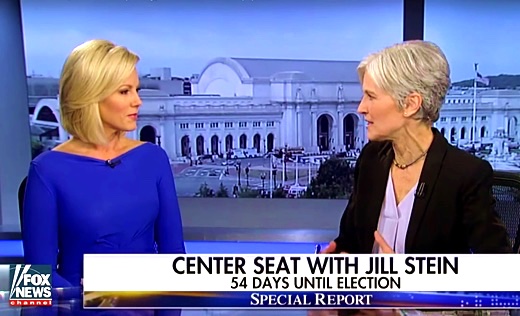
Image above: Jill Stein (r) answers question on Fox New show on 9/14/16. Still from video below.

Dr. Jill Stein, the Green Party candidate, joined Fox News Channel's 'Special Report' on Thursday, where she answered a question from Charles Krauthammer about whether or not she is worried about helping Donald Trump get elected.

"I will feel terrible if Donald Trump gets elected and I will feel terrible if Hillary Clinton gets elected," Stein said.

"Equally so?" Krauthammer asked.

"Yes," she said. "Hillary Clinton wants to start an air war over Syria with Russia, who have 2,000 nuclear weapons on hair-trigger alert. Given Hillary Clinton's record not only in Iraq, but in Libya, I think this is as dangerous as it gets."

"Donald Trump wants to bar Muslims from entering into this country, but Hillary Clinton has been very busy bombing Muslims in other countries," she said.


Video above: Jill Stein on Fox News' "Center Seat" questioned by Charles Krauthammer. Covers Supreme Court, Dakota Access Pipeline, and domestic policy. From (https://youtu.be/v4DEg5Rr_uI).

.

Our Kauai primary voting picks

SUBHEAD: Island Breath's endorsements for Kauai Primary Election 8/1 - 8/13.

By Linda Pascatore on 28 July 2016 for Island Breath
(http://islandbreath.blogspot.com/2016/07/our-primary-voting-recommendations.html)


Image above: Still from video of Gary Hooser speaking in front of the Kauai County Council Building in support of bill 2492 to regulate restricted pesticides on Kauai. From (https://www.youtube.com/watch?v=223Sbj8UFkA).

Island Breath picks are based on general progressive, liberal positions, with an emphasis on the environment, peace, equality, and Hawaiian Sovereignty; with special emphasis on Anti-GMO/Pesticide/Big Ag positions by the candidiates.

Primary voting Schedule
  • Early Walk In Voting for Primary: 1 August to 11 August 2016
  • Last day to request Mail in Ballot: 6 August 2016
  • Primary Elections: 13 August 2016 - Polls open 7am to 6pm
To register to vote, update existing voter registration, confirm voter address, and request to vote by mail, find your polling place, or view your ballot, go to: https://olvr.hawaii.gov/Default.aspx

**Special Island Breath Endorsement:  Gary Hooser for Kauai County Council
Our favorite politician of all time: if you vote for only one person on this ballot, vote for Gary!

Our recommended candidates are in italics with larger print. We did not include those running unopposed.

We found information on candidates records and positions on Votesmart (http://votesmart.org/), the League of Women Voters (http://www.lwv-hawaii.com/candidates-2016.htm), and also in articles profiling individual candidates in Honolulu Star Advertiser, Civil Beat and The Garden Island.

On the front page of the primary ballot, you must first choose one political party or non-partisan, and then vote only for those candidates. 


Democratic Party
US Senator:

Christensen, Makani
Honeychurch, Tutz
Reeyes, Arturo 
* Schatz, Brian
Shiratori, Miles


US Representative, Second District (Kauai)
Chan Hodges, Shay
* Gabbard, Tulsi

(Note: Shay Chan Hodges has excellent positions on issues, and is generally more progressive than Gabbard.  However, we recommend Gabbard because of her already powerful position in the House, and because of her endorsement of Bernie Sanders and bravery in standing up to the DNC)


Hawaii State Senator: (Kauai) check your location here https://olvr.hawaii.gov/Default.aspx
* Ahuna, Kanoe
Kouchi, Dan


Hawaii State Representative: (Kauai) check your location here https://olvr.hawaii.gov/Default.aspx
District 14:
Nakamura, Nadine
* Rosenstiel, Fern Anuenue

(Note: Nadine lost our support when she left the council at the time of the crucial GMO vote to take an appointment from Carvalho)


District 15: (Kauai) check your location here https://olvr.hawaii.gov/Default.aspx
* Oi, Tommy
Tokioka, James Kunane

(Note: Tommy is not that progressive, but we judge him to be better than Tokioka)


Republican Party
(Note: we don't usually vote on the Republican ballot, but our picks here are for the most progressive of the Republicans running) 


US Senator:
* Carroll, John
Gottschalk, Karla (Bart)
Pirkowski, Eddie
Roco, John P


US Representative, 2nd District:
* Hafner, Eric
Kaaihue, Angela Aulani

(Note: Eric is an excellent candidate and we agree with almost all of his positions)


Non-Partisan

On the back page of your ballot, you will find the non-partisan votes for Office of Hawaiian Affairs (OHA), Prosecuting Attorney, and County Council:

Kauai County Council:  (vote for not more than 7 candidates)

Special Note on voting for County Council:
Island Breath is recommending voting for no more than the three candidates noted below.  If you vote for all seven, but really support just three candidates, your #4, 5, 6 and 7 votes could enable those other candidates to win over your top candidates.  Consider voting for fewer--a practice called "plunking", explained further in this link: https://garyhooser.wordpress.com/2016/07/26/do-not-vote-in-the-council-race-until-you-read-this-please/ 

Apalla, Juno-Ann A
Bernabe, Matt
Brun, Arthur
* Chock, Mason
Doctor Sparks, Norma
Fukushima, Richard S
* Hooser, Gary L
Kagawa, Ross K
Kaneshiro, Arryl
Kawakami, Derek S K
Kualli, Kipukai
Rapozo, Mel
* Yukimura, JoAnn A


Kauai County Prosecuting Attorney (both candidates advance to general election)
Lisa Arin 
* Justin Kollar


Office of Hawaiian Affairs (OHA): Hawaii Resident Trustee: (vote for one candidate)
(Note: recommendations based on their positions on true Hawaiian Sovereignty, not the Akaka bill)

Kahui, Bo V (Craig)
Lindsey, Robert K (Bob)
* Trask, Mililani B


Molokai Resident Trustee: (vote for one candidate)
Flowers, Jerry (Manuwa) 
* Hanapi, Alapai
Machado, Colette (Pipi'i)


At large trustee: (vote for one candidate)
* Akina, Keli'i
Anthony, Daniel K
Apoliona, Haunani
Crum, Couglas E
Kalima, Leona Mapuana
Makekau, Keali'i
Mossman, Paul Ledwith

.
.

Sanders to fight DNC over TPP

SUBHEAD: The trade agreement is opposed by virtually the entire grassroots base of the Democratic Party.

By Deidre Fulton on 3 July 2016 for Common Dreams  -
(http://www.commondreams.org/news/2016/07/03/sanders-organizing-grassroots-push-against-tpp-dnc-platform-meeting)


Image above: Bernie Sanders makes a point at the podium. From original article.

Environmentalists oppose it. So do labor unions, medical professionals, and major religious groups, as well as every leading presidential candidate.

So why hasn't the Democratic Party gone on record opposing the Trans Pacific Partnership (TPP)?
That's what Bernie Sanders wants to know.

Noting that the deal "is opposed by virtually the entire grassroots base of the Democratic Party," Sanders said Sunday he will reintroduce an amendment rejecting the TPP at next weekend's full Democratic Platform Committee meeting in Orlando, Florida.

In an op-ed published in the Philadelphia Inquirer, Sanders praised the platform drafting committee for including "some very positive provisions" in the final draft released Friday.

"At a time when huge Wall Street financial institutions are bigger now than they were before the taxpayers of this country bailed them out, the platform calls for enacting a 21st-century Glass-Steagall Act and for breaking up too-big-to-fail banks," Sanders wrote.

"The platform calls for a historic expansion of Social Security, closes loopholes that allow corporations to avoid paying taxes, creates millions of jobs rebuilding our crumbling infrastructure, makes it easier for workers to join unions, takes on the greed of the pharmaceutical companies, ends disastrous deportation raids, bans private prisons and detention centers, abolishes the death penalty, moves to automatic voter registration and the public financing of elections, eliminates super PACs, and urges passage of a constitutional amendment to overturn Citizens United, among many other initiatives," he continued—all provisions where Sanders' influence was in evidence.

However, Sanders wrote, "there were a number of vitally important proposals brought forth by the delegates from our campaign that were not adopted." These included a national ban on fracking, a carbon tax, and clear language on corporate-friendly "free trade" agreements like the TPP.

To that end, Sanders said he will offer an amendment in Florida "to make it clear that the Democratic Party is strongly opposed to the Trans-Pacific Partnership" and to ensure the deal doesn't come up for a vote during the lame-duck session of Congress.

"My hope is that a grassroots movement of working people, environmentalists, and human-rights advocates will work with us to demand that the Democratic Party include these initiatives in the platform to be adopted by the full committee in Orlando," he wrote.

As Sanders and others observed last week, by tacitly backing the TPP, the drafting committee was not only working against the party, but undermining Clinton's own stated position.
Indeed, Sanders wrote in the Inquirer op-ed:
Frankly, I do not understand why the amendment our delegates offered on this issue in St. Louis was defeated with all of Hillary Clinton's committee members voting against it. I don't understand that because Clinton, during the campaign, made it very clear that she did not want to see the TPP appear on the floor during the lame-duck session.

If both Clinton and I agree that the TPP should not get to the floor of Congress this year, it's hard to understand why an amendment saying so would not be overwhelmingly passed.
The full 187-member Platform Committee meets in Orlando ahead of the Democratic National Convention, which will ratify the platform, at the end of the month.

.

Bernie lead on Trump lead on Clinton

SUBHEAD: In a new national Rasmussen poll the Donald has five-point lead over Hillary.

By Andrea Germanos on 19 May 2016 for Common Dreams -
(http://www.commondreams.org/news/2016/05/19/new-national-poll-trump-increasing-lead-over-clinton)


Image above: Photo-illustration of Clinton and Trump by DonkeyHotey. From original article.

A new Rasmussen poll released Thursday shows Republican front-runner Donald Trump increasing his lead over Democratic presidential candidate Hillary Clinton.

The New York billionaire has a five-point edge over the Clinton, with 42 percent of likely voters saying they'd back him compared to 37 percent for Clinton.

The poll also shows Trump now getting 76 percent of the Republican vote; Clinton nabbed 72 percent of the Democratic vote. Thirteen percent of Democrats would prefer Trump in square-off between the two, while nine percent of Republican voters would favor Clinton in such a match-up.

A Rasmussen poll released at the beginning of the month, for comparison, showed the two candidates running neck-and-neck, with the real estate mogul with 41 percent to the former secretary of state's 39 percent, within that poll's margin of error of plus or minus 3 percentage points.

The new Rasmussen poll, the New York Daily News reports, "suggests Trump could be experiencing a popularity surge as he pivots away from many of the controversial and bigoted statements he made during the GOP primary and embraces more establishment positions as he prepares for the general election."

A separate NBC News/SurveyMonkey poll released this week showed Clinton with just a three-point lead over Trump—48 to 45 percent. That poll's margin of error is plus or minus 1.2 percentage points.

And a Fox News national survey released Wednesday also showed Trump leading Clinton 45-42 percent, though that lead is within the survey's 3 percentage point margin of error.

Clinton challenger Bernie Sanders, for his part, has continued to point to polling showing that he's the Democratic candidate able to trounce Trump—and that ability was only further bolstered by the Fox News poll which showed that in a hypothetical general election match-up between the Vermont senator and Trump, Sanders leads 46 to 42 percent.

"If you look at virtually every poll in the last six weeks we do better and often much better against Trump than Secretary Clinton," Sanders said Friday in North Dakota. "So if the goal is to defeat Donald Trump, we are the campaign to do that."


Sandersism has defeated Clintonism

SUBHEAD: Even if Hillary fixes the delegate count to win the nomination, and goes on to face Trump her faction of the Democratic party has been defeated already.

By Seth Abramson on 18 May 2016 for Huffington Post -
(http://www.huffingtonpost.com/seth-abramson/make-no-mistake-sanderism_b_10008136.html)


Image above: Photo-illustration of Sanders and Clinton and Trump by DonkeyHotey. From (http://polyconundrum.com/articles/democracy/10833-a-sterling-example-of-democracy-in-action.html).

In 2008, Hillary Clinton — on her way to losing the Democratic nomination — won nine of the final 25 nominating contests. In 2016, she may well — despite being treated as the likely winner of this year’s Democratic primary by the mainstream media — win only seven or eight of the final 25 state primaries and caucuses.

If you’re wondering how Clinton could perform worse in the second half of the election cycle in 2016 than she did in 2008 and still be in a position to win, there’s a good explanation for it that goes beyond the fact that the neck-and-neck Democratic primary race we’ve had for over two months started with a brief but solid run for Clinton.

In 2008, both Democratic candidates were sanctioned by Party elders, so super-delegates were free to pick whoever they thought was the stronger candidate without fear of reprisal.

In 2016, super-delegates are expected to go with Clinton even if the insurgent Sanders has clearly shown himself, by mid-June, to be the stronger general-election candidate in terms of both head-to-head match-ups with Trump, favorability ratings among independent voters, and performance in the second half of the nominating season.

Super-delegates will fall into line — the thinking goes — not because Clinton is a strong general-election bet, or liked by many people, or a real spokeswoman for the ideology of the Party base, or able to win independents, or nearly the same candidate in May that she was in February, or capable of winning over her current Democratic opposition the way Obama did after the primary in 2008, but because Democrats in Washington have made clear that any super-delegates who back the now-stronger horse in Philadelphia this July — Sanders — will be ostracized from the Party.

Fear, then, is what could make Clinton the Democratic nominee even if (a) super-delegates are officially charged with voting for the strongest general-election candidate, and (b) Clinton goes on a historic losing streak in the back half of the primary season election calendar.

But all that’s horse-race nonsense, and won’t matter very much to political historians looking back at this period in American history from the vantage point of, say, 2116.

They won’t care that in 2008 Hillary Clinton won Kentucky by 36 points over then-Senator Obama, but in 2016 only managed to beat a 74-year-old independent socialist with no super-PAC and exponentially less name recognition by 0.4 percent — despite her making 11 trips to the state, having a much larger advertising budget, and daily receiving on-the-stump aid from a popular former President who won Kentucky twice.

We used to say that Hillary Clinton, for all her flaws, handily wins closed Democratic primaries.

Well, we can’t say that anymore.

But it doesn’t really matter in the long run.

And it won’t matter in 2116 that Democratic Party elders and particularly former Goldwater-Girl Clinton are so enamored by the idea of a Nixonian strongman that they fundamentally misunderstand the relation of Bernie Sanders to Sandersism. They believe he can direct the movement he lent his name to in the same way Clinton believes progressive Democrats will fall into line no matter how much she disrespects them, but they’re wrong.

And Clinton is wrong to think she doesn’t owe Sanders and his political allies the same visibility and authority in her prospective Administration that she had in Barack Obama’s; she’s also wrong to think that the benefit of rules-fixing at the state Democratic convention in Nevada is worth the November votes it’s going to cost her — especially given her huge delegate lead, which allows her to be a magnanimous rule-follower.

But all that’s only relevant to the Clinton-Sanders and Clinton-Trump horse-races.

Is it a “horse-race” issue that the DNC is publicly representing itself as a “neutral” arbiter in the Democratic primary, and publicly stating that super-delegates don’t vote until July, but according to NBC is in fact “colluding” with the Clinton campaign “behind the scenes” to begin — with millions of votes yet to be cast — the transition of the DNC from an independent operation to one run by Hillary Clinton? No, for the fact that there’s “nothing neutral” about the DNC right now (as David Chalian of CNN put it last night) merely tells you something about the ethics of the Democratic Party in 2016.

After all, this is a Party that has, in 2016, given Debbie Wasserman Schultz a job.

But not only isn’t this an article about horse races, it’s also not about 2016. It’s certainly not about the fact that Hillary Clinton is doing everything she needs to be doing right now to lose the fall general campaign — even as she sets up Bernie Sanders to be the eventual fall-guy for her own failures.

No — this article is about the future.

Conservative Republicans have largely been successful in pulling their party to the right since 1996; the GOP as it is today is almost unrecognizable from the days of George H.W. Bush, who in 2016 terms would be a Democrat.

While conservatives suffered some setbacks over the last few years — owing to their leaders choosing, over and over, to ignore them or even slap them in the face publicly — the 2016 GOP primary has shown us that a party’s “base”, apropos of its name, always get the last laugh. Why? Because it’s what any political party is ultimately founded upon.

Since 1996, progressive Democrats have had their butts handed to them repeatedly by their leaders. The Democratic Party as it is today is almost unrecognizable from the days of Michael Dukakis. Bill Clinton turned out to be a “New Democrat,” in other words a triangulating neoliberal corporatist. Al Gore waited until far too late in his 2000 campaign to unveil his “progressive warrior” persona.

Howard Dean was cut off at the knees by the media in 2004, when somehow everyone who reported on “The Scream” neglected to mention that it was only the media’s turning off of all off-stage mics that made Dean’s speech seem out-of-place in-context. Barack Obama has been a terrific President whose administration has been, nevertheless, not nearly as progressive as the two campaigns he waged to get into the White House led progressives to expect.

When the Democrats did everything in their power to anoint Hillary Clinton before a single American had voted — giving her a 350-superdelegate lead, more than $100 million in super-PAC money, a laughably disingenuous “debate schedule,” and much more — it was presumed that progressives would take a right cross to the chin with the same good grace they always had.

Keeping progressives complacent has been particularly easy for the “New Democrat” philosophy Bill and Hillary Clinton used to take over the Democratic Party because it has, too, the complicity of the corporate media — in much the same way Republican conservatives succeeded because of their absolute dominance of American radio.

Despite being told not to do so by the DNC itself, the mainstream media began tallying superdelegates back in 2015, which ensured that Clinton would not face a real challenger from within the Democratic Party. Until it realized there was real money to be made in cable-sponsored “town halls”, the mainstream media remained largely silent on the laughably sparse debate schedule the DNC had created as a sort of “red carpet” for Clinton. The media gave Sanders only a fraction of the coverage enjoyed by Clinton.

It stacked its permanent on-air “panels” with Clinton supporters, while relegating Sanders surrogates to, at most, brief interviews. And it perpetuated a single master narrative to the point it became a self-fulfilling prophecy: the idea that if a 74-year-old independent socialist from an all-white state couldn’t immediately, even instantaneously, win a majority of the black and Latino vote nationwide, it meant his “appeal” was limited to well-to-do Caucasian hipsters.

That Sanders has doubled his support among blacks and Latinos over the last three months is, in this day-to-day “horse-race” perspective the media and the media alone promulgates, meaningless.

The problem is, “-isms” don’t operate at the level of a year; they unfold over decades.

Sandersism isn’t about 2016; it’s about 2024, 2044, and even — in terms of what it means for the future of this country — 2116.

The point being this: the ideological revolution within the Democratic Party has already happened, and Sandersism won. The only question now is how long Democrats and the country will have to wait to see its gains in real-time.

A Clinton presidency would forestall those gains somewhat less than a Trump presidency would, but the fact remains that either a Clinton or a Trump administration would merely delay the inevitable “New New Deal” America has richly earned and will ultimately receive.

It’s not just me saying this, nor is it merely Sanders supporters. No less a staunch Clinton ally than David Axelrod said on CNN two weeks ago that not only is the “debate over” regarding the ideological future of the Democratic Party, it was actually over a long time ago.

And Bernie Sanders won it.

It was over when a 74-year-old independent socialist with no super-PAC or name recognition went from 4 percent in the polls at the beginning of 2015 to — within 13 months — a statistical dead heat with the most powerful political machine in the history of American democracy.

Let’s be clear: the Clintons aren’t merely the most politically successful husband-and-wife team in American history; they’re not merely the scions of a family that has, for a quarter-century, been the most politically influential in the Democratic Party; they literally remade the party into their own image more than two decades ago.

The Democratic Party today is Clintonism. And when Bernie Sanders declared what was ostensibly a fringe candidacy last spring, he was in no uncertain terms — not even the Clintons doubted it — declaring war on the Democratic Party as the Clintons had made it. He was, in short, declaring a return to the politics of FDR and the Democratic Party of the New Deal.

Contemporary journalists are tasked with seeing beyond the ends of their noses, but rarely do; they’re encouraged in this dereliction of duty by politicians like the Clintons for whom a perpetual focus on the day-to-day horse-race is good for business — specifically, the business of keeping one of the two major American political parties exactly as it already is. (Which, as noted, is exactly how they made it.)

As long as reporters focus exclusively on the horse-race, it’s easy to count delegates properly — though actually, the media struggles to do even this — and see that Sanders remains unlikely to be the lead horse after the current lap is run.

It’s equally easy to see that saying Clinton has “won” obscures not just how bad a politician she is; not just how poor a campaign she has run; not just how disliked she is by the general-election electorate; not just how needlessly close a general-election race her nomination would ensure; but also, and more importantly, how irrelevant her political persona — which she has shed by degrees this election cycle anyway — will be to the future of her Party and the nation.

An obsession with the horse-race — with what happens in 2016, irrespective of what will happen in 2020, 2024, and for decades after that — is the only thing that allows Hillary Clinton to declare victory in the Democratic nominating process.

Any longer view, particularly one that considers that Clintonism and Sandersism didn’t start 2015 at the same starting line — indeed, didn’t even start in the same stadium — will acknowledge that Sanders finishing the 2016 election season with between 46 percent and 48 percent of the pledged delegates means Sandersism has defeated Clintonism.

The Democrats ignore this at their peril.

But make no mistake, they will ignore it — they already are, and with a particularly unpalatable smugness — and so they must therefore, going forward, be considered as existentially imperiled as the Republican Party is right now.

The Democratic Party’s perverse obsession with closed primaries has left them with a likely nominee distinctly unpopular with the independent voters who decide national elections. The Party’s reliance on superdelegates ensured a noncompetitive field of Democratic competitors (Chafee, Webb, and O’Malley) and stacked the deck against a legitimate “movement” insurgent from the ranks of the nation’s progressive-but-independent politicians — an insurgent with the sort of excitement behind him that could drive turnout in a GOTV-oriented “base” election.

Clinton’s continued refusal to release her Wall Street transcripts, and the Party’s broader recalcitrance in the face of working-class suffering, isn’t an instance of Clinton or the Party standing up for itself in the face of unreasonable expectations — rather, it’s a failure to honor the generation coming up, which needs to believe that its politicians mean what they say and really do care about the things they say they do.

Clinton didn’t owe Sanders supporters transcripts of all her prepared remarks on substantive economic and foreign policy, she owed that transparency to her Party and to the nation whose votes she seeks. But the Party’s esoteric fundraising schemes and infrastructure made it impossible for it to stand up to one of its best rainmakers — ironically, in part because the Party has done nothing to get money out of politics via meaningful campaign finance reform.

Finally, the Party’s reliance on a set rather than variable primary schedule means that certain states and votes are every four years privileged over others; concerns about the undue influence of Southern voters on this year’s primary had nothing to do with racial demographics and everything to do with the signal sent when a Party lets its most moderate voters (white and black alike) have the biggest say in its nominating process.

Clintonism supports all of the above structural flaws only because they, in turn, support the election of Clintons to national office.

And that, in a nutshell, is Clintonism: a feedback loop whose motive engine is money and influence and the continued political success of Clintons. In the 90s it was geared toward Bill; in the aughts and tens, Hillary; and we can expect that the same forces will soon be brought to bear for Chelsea, if she desires it. Meanwhile, life has gotten worse for those Americans who don’t attend Clinton Thanksgiving in Chappaqua or help pay for the house in which it is held.

As a broader, more abstract philosophy, however, Clintonism is by no means restricted to the Clintons. All of its most cynical, Nixonian manifestations are iterable, meaning they can be used by any two-bit local, state, or national politician willing to put politics in the way of people — and vanity in the place of principle.

In Sandersism, universal healthcare is a human right that cannot be subjected to the realpolitik of incremental legislation. In this view, Obamacare must of course be maintained until the very moment we switch to a single-payer system, but it is the obligation of every person concerned with human rights to militate for such a system to the exclusion of others.

In Sandersism, a college education is a public good all Americans are entitled to, meaning that whatever funding priorities must be rearranged to make this possible must be rearranged. “We can’t do it” is no more a reply to the Sandersist view of higher education than would be a similar statement with respect to other basic American rights.

In Sandersism, climate change supplants terrorism as the top threat to national security, without degrading any of the current anti-terrorism efforts that respect human rights and appropriately assess the scope (and primary drivers) of our terror risk. In Sandersism, a living wage for all Americans is a human right, not something for politicians to log-roll endlessly about.

A Sandersist’s first offer to her negotiating partner on the subject of a living wage is $15, and her second offer is $15, and her third offer is $15, and every offer thereafter is $15 — for saying $10 or $12 is akin to saying that minorities can sometimes be discriminated against without the immediate and utter disapproval of American law.

In Sandersism you negotiate with any and all parties of good faith up until the moment doing so requires sacrificing a principle. If, under those conditions, not enough parties of good faith remain, you spend all your time and resources writing executive orders and working for an end to gerrymandering and the defeat of all bad-faith politicians in local, state, and national primaries and generals.

In Sandersism politics is an arena where ideas, not bank accounts or special interests, are contested; every American is given every possible opportunity to vote; corporate practices that maim or kill living humans are outlawed; those few economic practices that can terminally endanger basic economic justice are adequately regulated; and we spend as much money making sure our criminal justice system and law enforcement apparatuses are actually just as we do ensuring our military is capable and appropriately fearsome.

Sandersism is a “we” and an “us” movement that transcends the artificial divisions of the party era and the atomization of persons and communities. A Sandersist spends the minimum amount of time running for office and the maximum amount of time doing the difficult work of governing — and in both roles places transparency ahead of political exigency ten times out of ten.

Sandersism is already the philosophy of a majority of Democrats under 45, which means by 2024 it will almost certainly be the philosophy of a majority of Democrats under 55.

And any movement with those demographic internals is already a current and future cultural dominant for the purposes of political planning and action.

That Sanders defeats Trump by more than Clinton in every battleground state and nationally only underscores that Clintonism no longer is a winning formula for a national election. That Sanders likely won’t get to carry the flag for Sandersism this fall — and Clinton will lose unless she carries that flag clearly and proudly — is merely another irony in what has been a veritable landslide of ironies this election season. Clinton saying “I don’t know if he is a Democrat” will certainly be at the top of that irony-pile, now that it’s clear that the Party’s platform will largely be Sandersist.

The Democrats under Hillary Clinton are now a “zombie party”; everyone but their leaders can see that they have the same thing coming to them in (say) 2024 that the Republicans had coming to them in 2016 because of the many slaps in the face they gave their own base in the aughts. Any presidency Clinton has now can be no more than the end of something very old and tired, not the beginning of anything new.

And the best part is, Clinton is telegraphing her own defeat to the media every single day — they’re just not picking up the signal.

Sanders has pulled Clinton to the left on every issue of consequence. Now Clinton opposes all or nearly all of the recent international trade deals; supports a $15 minimum wage; wants a single-payer healthcare option for all Americans over 50; is willing to ban fracking as part of the Democratic Party platform (per reports); opposes the death penalty in all but vanishingly rare circumstances; is committed to breaking up too-big-to-fail banks; and so on.

What’s even more astonishing is that not only has Clinton stolen most of Sanders’ campaign agenda, she’s also stolen many of his best lines. Reporters frequently note that Clinton’s best-received speeches easily could have been delivered (and, indeed, previously had been, to much larger crowds) by Sanders.

It doesn’t even matter that Clinton’s embrace of Sanders’ progressivism is obviously entirely fake, and will disappear into thin air should she ever get into the White House. Sandersists know this, and nothing that happens at the Democratic National Convention will convince them otherwise.

Clinton aides smugly telling reporters that Clinton will concede almost everything to Sanders with respect to the Party’s platform because “the platform doesn’t matter” and “voters don’t care about the platform” are, finally, speaking only to themselves — taking a victory lap during which their zombie appendages fall off one by one.

For the fact remains that, should Clinton win the nomination, she will have done so using Sandersism as her chief philosophical mainstay and bulwark. The fact remains that any support she now has with voters under 45 — which is to say, barely any — was gained on the explicit presumption that she could deliver on a Sandersist legislative agenda in Washington.

Should she do as she definitely plans to do — drop everything she’s adopted from Sanders should she get into the White House — she’ll face another legitimate progressive challenger in 2020, and should she defeat that challenger by again remaking herself as someone totally other than who she is, if indeed she is anyone at all, in 2024 progressives will finally seal the deal and take their party back.

In other words, every action Clintonism takes in the next eight years will be part of a retreating action in the face of Sandersism. The Democratic Party as the Clintons remade it in the 1990s is dead, and the most Clinton can do is steer her little ghost-ship a few more miles until it finally wrecks itself on an offshore sandbar.

Clinton may win the battle in 2016, but only political neophytes — and a few Washington Post columnists, I suppose — fail to see that she’s already lost the war.


.
Chicago Worker Cooperative

SUBHEAD: Three years ago these Chicago workers took over a window factory and today they are thriving.

By Sarah van Gelder on 9 October 2015 for Yes Magazine  -
(http://www.yesmagazine.org/edge-of-change/three-years-ago-these-chicago-workers-took-over-a-window-factory-today-theyre-thriving-20151009)


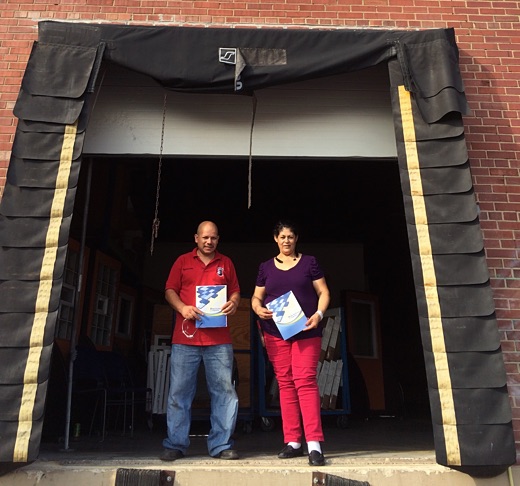
Image above: Armando Robles and Beatriz Gurrola, worker-owners of New Era Windows and Doors Cooperative. Photo by author. From original article.

When Republic Windows and Doors closed down without giving workers notice, the issue drew national attention. Since then, they’ve turned the factory into a worker-owned co-op—where they hold the power.

Back in the day, factory workers at the Chicago-based Republic Windows and Doors were simply told what to do. That wasn’t unusual. Workers might have seen ways to improve the production process, but at Republic their supervisor wasn’t interested, said former employee Armando Robles.

“Whatever the bosses want, we do it. We’d say, ‘Look, this is a better way,’ and they say, ‘No, we say you have to do it this way.’ Even when they make a mistake, they just continue,” Robles explained.

Things are very different today. Employees of what is now called New Era Windows and Doors are also the owners. And their ideas matter. Any of them can propose improvements, and if they can convince a majority of their co-workers, things can change quickly.

“If we make a mistake, we talk to each other and we find a solution,” Robles told me when I visited the factory in late September. “We try to do the best for everyone. We work harder because we’re working for ourselves. But it’s more enjoyable. We work with passion.”

It was a long journey to becoming a worker cooperative, and it was not a journey anyone had planned. In 2008, Republic’s owners closed the factory and laid off the work force without the required 60-days notice.

Workers occupied the factory and refused to leave the premises until they were paid what they were owed. The story went nationwide. Pressure from the union, area activists, and even President Obama led to a victory. The workers were paid, and instead of shutting down, the factory was sold to California-based Serious Materials.

The workers kept their jobs, though the experience radicalized them. Some visited Argentina where they learned that other workers facing the same situation had occupied their factories and eventually became worker-owners.

So Robles and his co-workers were prepared when, three years later, Serious Materials announced they would shut down and liquidate the factory. Once again, the workers occupied. With a nationwide petition drive, support from United Electrical Workers, financing from The Working World (an organization that helps establish worker cooperatives), support from the local Occupy movement, and the memory of the previous occupation still fresh in the minds of the Chicago power elite, the protest turned into a buyout.

The New Era Windows and Doors Cooperative has been in operation since 2013. It hasn’t been easy, but the worker-owners have learned together how to operate their own business. And then there were the meetings: “It was difficult to make decisions together,” Robles said. “But it’s kind of fun, because at the end of the day it’s for the benefit of everyone.”

Sales are modest, but growing. Last year the company sold about a half million dollars worth of windows. This year, they anticipate the number will be significantly higher. There are 23 worker-owners, and two staff members who Robles hopes will opt to become worker-owners.

His vision is for New Era to help spawn other cooperatives. Instead of expanding by hiring drivers, for example, he’d like to see the company help start a cooperative of drivers.

How is this company staying alive when other owners have failed? The worker-owners made tough decisions about what equipment they could get rid of to save money. And they did a lot of sales via word of mouth.

“The good thing is we don’t have the CEO making millions of dollars,” Robles said, “so we have the ability to compete with the industry.” Also, they don’t have to generate big profits to keep investors happy; they just have to make enough to pay expenses and pay back their debt.

This business model is based on “enough.” Enough pay and benefits to live with dignity. Enough of the machinery that is necessary, but not the sort that is too expensive.

Opportunities for employee-owners to draw on their full capacities, not to be relegated to repetitive work while a few make all the decisions and much of the money. Their more equitable pay structure creates opportunities for more people to have enough to live and thrive; instead of keeping some at the edge of poverty while others prosper.

This is what local power looks like: companies like New Era Windows and Doors creating the stability that comes with locally rooted employment, insulated from the speculative finance that, in the case of publicly traded companies, requires many jobs be moved to low-wage regions.

These worker-owners focus on values, including the possibility for others to also be worker-owners, and the importance of producing ecologically smart products. The company prides itself on selling energy-efficient windows and doors, and customizing them to the climate and location of the client.

If this and other locally rooted companies can survive government policies that favor big corporations over local business, they could help lay the foundation for an inclusive and sustainable rebirth of our society.


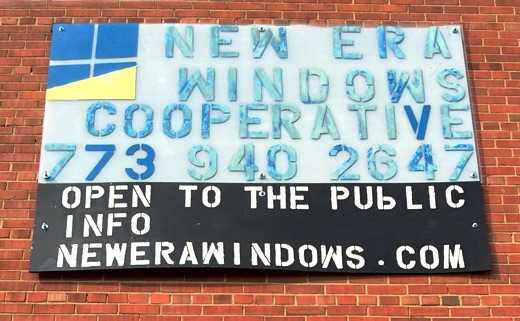
Image above: Hand-made sign over the loading cock at New Era Windows and Doors Cooperative. Photo by author. From original article.

• To visit the New Era Window website click on www.newerawindows.com.
.

Suicide of the American Left

SUBHEAD: American culture has lost the ability to imagine any future that isn’t simply an endless rehash of the present.

By John Michael Greer on 5 August 2015 for the Arch Druid Report -
(http://thearchdruidreport.blogspot.com/2015/08/the-suicide-of-american-left.html)


Image above: Caricature of Hillary Clintion with 2016 playbook in hand. By DonKeyhoty. From (https://www.flickr.com/photos/donkeyhotey/17181316959/in/photostream/).

Regular readers of this blog know that I generally avoid partisan politics in the essays posted here. There are several reasons for that unpopular habit, but the most important of them is that we don’t actually have partisan politics in today’s America, except in a purely nominal sense. It’s true that politicians by and large group themselves into one of two parties, which make a great show of their rivalry on a narrow range of issues.

Get past the handful of culture-war hot buttons that give them their favorite opportunities for grandstanding, though, and you’ll find an ironclad consensus, especially on those issues that have the most to say about the future of the United States and the world.

It’s popular on the disaffected fringes of both parties to insist that the consensus in question comes solely from the other side; dissident Democrats claim that Democratic politicians have basically adopted the GOP platform, while disgruntled Republicans claim that their politicians have capitulated to the Democratic agenda. Neither of these claims, as it happens, are true.

Back when the two parties still stood for something, for example, Democrats in Congress could be counted on to back organized labor and family farmers against their corporate adversaries and to fight attempts on the part of bankers to get back into the speculation business, while their opposite numbers in the GOP were ferocious in their opposition to military adventurism overseas and government expansion at home.

Nowadays? The Democrats long ago threw their former core constituencies under the bus and ditched the Depression-era legislation that stopped kleptocratic bankers from running the economy into the ground, while the Republicans decided that they’d never met a foreign entanglement or a government handout they didn’t like—unless, of course, the latter benefited the poor.

An ever more intrusive and metastatic bureaucratic state funneling trillions to corrupt corporate interests, an economic policy made up primarily of dishonest statistics and money-printing operations, and a monomaniacally interventionist foreign policy.

That’s the bipartisan political consensus in Washington DC these days, and it’s a consensus that not all that long ago would have been rejected with volcanic fury by both parties if anyone had been so foolish as to suggest it.

The gap between the current Washington consensus and the former ideals of the nation’s political parties, not to mention the wishes of the people on whose sovereign will the whole system is supposed to depend, has attracted an increasing amount of attention in recent years. That’s driven quite a bit of debate, and no shortage of fingerpointing, about the origins and purposes of the policies that are welded into place in US politics these days.

On the left, the most popular candidates just now for the position of villainous influence behind it all mostly come from the banking industry; on the right, the field is somewhat more diverse; and there’s no shortage of options from further afield.

Though I know it won’t satisfy those with a taste for conspiracy theory, I’d like to suggest a simpler explanation. The political consensus in Washington DC these days can best be characterized as an increasingly frantic attempt, using increasingly risky means, to maintain business as usual for the political class at a time when “business as usual” in any sense of that phrase is long past its pull date.

This, in turn, is largely the product of the increasingly bleak corner into which past policies have backed this country, but it’s also in part the result of a massively important but mostly unrecognized turn of events: by and large, neither the contemporary US political class nor anyone else with a significant presence in American public life seems to be able to imagine a future that differs in any meaningful way from what we’ve got right now.

I’d like to take a moment here to look at that last point from a different angle, with the assistance of that tawdry quadrennial three-ring circus now under way, which will sooner or later select the next inmate for the White House. For anyone who enjoys the spectacle of florid political dysfunction, the 2016 presidential race promises to be the last word in target-rich environments.

The Republican party in particular has flung itself with creditable enthusiasm into the task of taking my circus metaphor as literally as possible—what, after all, does the GOP resemble just at the moment, if not one of those little cars that roll out under the big top and fling open the doors, so that one clown after another can come tumbling out into the limelight?

They’ve already graced the electoral big top with a first-rate collection of clowns, too. There’s Donald Trump, whose campaign is shaping up to be the loudest invocation of pure uninhibited führerprinzip since, oh, 1933 or so; there’s Scott Walker, whose attitudes toward working Americans suggest that he’d be quite happy to sign legislation legalizing slavery if his rich friends asked him for it; there’s—well, here again, “target-rich environment” is the phrase that comes forcefully to mind.

The only people who have to be sweating just now, other than ordinary Americans trying to imagine any of the current round of GOP candidates as the titular leader of their country, are gag writers for satiric periodicals such as The Onion, who have to go to work each day and face the brutally unforgiving task of coming up with something more absurd than the press releases and public statements of the candidates in question.

Still, I’m going to leave those tempting possibilities alone for the moment, and focus on a much more dreary figure, since she and her campaign offer a useful glimpse at the yawning void beneath what’s left of the American political system.

Yes, that would be Hillary Clinton, the officially anointed frontrunner for the Democratic nomination. It’s pretty much a foregone conclusion that she’ll lose this campaign the way she lost the 2008 race, and for the same reason: neither she nor her handlers seem to have noticed that she’s got to offer the American people some reason to want to vote for her.

In a way, Clinton is the most honest of the current crop of presidential candidates, though this is less a matter of personal integrity than of sheer inattention. I frankly doubt that the other candidates have a single noble motive for seeking office among them, but they have at least realized that they have to go through the motions of having convictions and pursuing policies they think are right.

Clinton and her advisers apparently didn’t get that memo, and as a result, she’s not even going through the motions. Her campaign basically consists of posing for the cameras, dodging substantive questions, uttering an assortment of vague sound bites to encourage the rich friends who are backing her, and making plans for her inauguration, as though there wasn’t an election to get through first.

Still, there’s more going on here than the sheer incompetence of a campaign that hasn’t yet noticed that a sense of entitlement isn’t a qualification for office. The deeper issue that will doom the Clinton candidacy can be phrased as a simple question: does anyone actually believe for a moment that electing Hillary Clinton president will change anything that matters?

Those other candidates who are getting less tepid responses from the voters than Clinton are doing so precisely because a significant number of voters think that electing one of them will actually change something.

The voters in question are wrong, of course. Barack Obama is the wave of the future here as elsewhere; after his monumentally cynical 2008 campaign, which swept him into office on a torrent of vacuous sound bites about hope and change, he proceeded to carry out exactly the same domestic and foreign policies we’d have gotten had George W. Bush served two more terms.

Equally, whoever wins the 2016 election will keep those same policies in place, because those are the policies that have the unanimous support of the political class; it’s just that everybody but Clinton will do their level best to pretend that they’re going to do something else, as Obama did, until the day after the election.

Those policies will be kept in place, in turn, because any other choice would risk pulling the plug on a failing system. I’m not at all sure how many people outside the US have any idea just how frail and brittle the world’s so-called sole hyperpower is just at this moment.

To borrow a point made trenchantly some years back by my fellow blogger Dmitry Orlov, the US resembles nothing so much as the Soviet Union in the years just before the Berlin Wall came down: a grandiose international presence, backed by a baroque military arsenal and an increasingly shrill triumphalist ideology, perched uneasily atop a hollow shell of a society that has long since tipped over the brink into economic and cultural freefall.

Neither Hillary Clinton nor any of the other candidates in the running for the 2016 election will change anything that matters, in turn, because any change that isn’t strictly cosmetic risks bringing the entire tumbledown, jerry-rigged structure of American political and economic power crashing down around everyone’s ears.

That’s why, to switch examples, Barack Obama a few days ago brought out with maximum fanfare a new energy policy that consists of doing pretty much what his administration has been doing for the last six years already, as though doing what you’ve always done and expecting a different result wasn’t a good functional definition of insanity.

Any other approach to energy and climate change, or any of a hundred other issues, risks triggering a crisis that the United States can’t survive in its current form—and the fact that such a crisis is going to happen sooner or later anyway just adds spice to the bubbling pot.

The one thing that can reliably bring a nation through a time of troubles of the sort we’re facing is a vision of a different future, one that appeals to enough people to inspire them to unite their energies with those of the nation’s official leadership, and put up with the difficulties of the transition.

That’s what got the United States through its three previous existential crises: the Revolutionary War, the Civil War, and the Great Depression. In each case, when an insupportable status quo finally shattered, enough of the nation united around a charismatic leader, and a vision of a future that was different from the present, to pull some semblance of a national community through the chaos.

We don’t have such a vision in American politics now. To an astonishing degree, in fact, American culture has lost the ability to imagine any future that isn’t simply an endless rehash of the present—other, that is, than the perennially popular fantasy of apocalyptic annihilation, with or without the salvation of a privileged minority via Rapture,

Singularity, or what have you. That’s a remarkable change for a society that not so long ago was brimming with visionary tomorrows that differed radically from the existing order of things. It’s especially remarkable in that the leftward end of the American political spectrum, the end that’s nominally tasked with the job of coming up with new visions, has spent the last forty years at the forefront of the flight from alternative futures.

I’m thinking here, as one example out of many, of an event I attended a while back, put together by one of the longtime names of the American left, and featuring an all-star cast of equally big names in what passes for environmentalism and political radicalism these days.

With very few exceptions, every one of the speakers put their time on the podium into vivid descriptions of the villainy of the designated villains and all the villainous things they were going to do unless they were stopped. It was pretty grueling; at the end of the first full day, going up the stairs to the street level, I watched as a woman turned to a friend and said, “Well, that just about makes me want to go out and throw myself off a bridge”—and neither the friend nor anybody else argued.

Let’s take a closer look, though, at the strategy behind the event. Was there, at this event, any real discussion of how to stop the villains in question, other than a rehash of proposals that have failed over and over again for the last four decades? Not that I heard.

Did anyone offer some prospect other than maintaining the status quo endlessly against the attempts of the designated villains to make things worse? Not only was there nothing of the kind, I heard backchannel from more than one participant that the organizer had a long history of discouraging anybody at his events from offering the least shred of that sort of hope.

Dismal as it was, the event was worth attending, as it conducted an exact if unintentional autopsy of the corpse of the American left, and made the cause of death almost impossible to ignore.

At the dawn of the Reagan era, to be specific, most of the movements in this country that used to push for specific goals on the leftward end of things stopped doing so, and redefined themselves in wholly reactive and negative terms: instead of trying to enact their own policies, they refocused entirely on trying to stop the enactment of opposing policies by the other side.

By and large, they’re still at it, even though the results have amounted to four decades of nearly unbroken failure, and the few successes—such as the legalization of same-sex marriage—were won by pressure groups unconnected to, and usually unsupported by, the professional activists of the official left.

There are at least two reasons why a strategy of pure reaction, without any coherent attempt to advance an agenda of its own or even a clear idea of what that agenda might be, has been a fruitful source of humiliation and defeat for the American left.

The first is that this approach violates one of the most basic rules of strategy: you win when you seize the initiative and force the other side to respond to your actions, and you lose by passively responding to whatever the other side comes up with. In any contest, without exception, if you surrender the initiative and let the other side set the terms of the conflict, you’re begging to be beaten, and will normally get your wish in short order.

That in itself is bad enough. A movement that defines itself in purely negative terms, though, and attempts solely to prevent someone else’s agenda from being enacted rather than pursuing a concrete agenda of its own, suffers from another massive problem: the best such a movement can hope for is a continuation of the status quo, because the only choice it offers is the one between business as usual and something worse.

That’s fine if most people are satisfied with the way things are, and are willing to fling themselves into the struggle for the sake of a set of political, economic, and social arrangements that they consider worth fighting for.

I’m not sure why so many people on the leftward end of American politics haven’t noticed that this is not the case today. One hypothesis that comes to mind is that by and large, the leftward end of the American political landscape is dominated by middle class and upper middle class white people from the comparatively prosperous coastal states.

Many of them belong to the upper 20% by income of the American population, and the rest aren’t far below that threshold.

The grand bargain of the Reagan years, by which the middle classes bought a guarantee of their wealth and privilege by letting their former allies in the working classes get thrown under the bus, has profited them hugely, and holding onto what they gained by that maneuver doubtless ranks high on their unstated list of motives—much higher, certainly, than pushing for a different future that might put their privileges in jeopardy.

The other major power bloc that supports the American left these days offers an interesting lesson in the power of positive goals. That bloc is made up of certain relatively disadvantaged ethnic groups, above all the African-American community.

The Democratic party has been able to hold the loyalty of most African-Americans through decades of equivocation, meaningless gestures, and outright betrayal, precisely because it can offer them a specific vision of a better future: that is, a future in which Americans of African ancestry get treated just like white folk.

No doubt it’ll sink in one of these days that the Democratic party has zero interest in actually seeing that future arrive—if that happened, after all, it would lose one of the most reliable of its captive constituencies—but until that day arrives, the loyalty of the African-American community to a party that offers them precious little but promises is a testimony to the power of a positive vision for the future.

That’s something that the Democratic party doesn’t seem to be able to offer anyone else in America, though. Even on paper, what have the last half dozen or so Democratic candidates for president offered? Setting aside crassly manipulative sound bites of the “hope and change” variety, it’s all been attempts to keep things going the way they’ve been going, bracketed with lurid threats about the GOP’s evil plans to make things so much worse.

That’s why, for example, the Democratic party has been eager to leap on climate change as a campaign issue, even though their performance in office on that issue is indistinguishable from that of the Republicans they claim to oppose: it’s easy to frame climate change as a conflict between keeping things the way they are and making them much worse, and that’s basically the only tune the American left knows how to play these days.

The difficulty, of course, is that after forty years of repeated and humiliating failure, the Democrats and the other leftward movements in American political life are caught in a brutal vise of their own making. On the one hand, very few people actually believe any more that the left is capable of preventing things from getting worse.

There’s good reason for that lack of faith, since a great many things have been getting steadily worse for the majority of Americans since the 1970s, and the assorted technological trinkets and distractions that have become available since then don’t do much to make up for the absence of stable jobs with decent wages, functioning infrastructure, affordable health care, and all the other amenities that have gone gurgling down the nation’s drain since then.

Yet there’s another factor, of course, as hinted above. If the best you can offer the voters is a choice between what they have now and something worse, and what they have now is already pretty wretched, you’re not likely to get much traction.

That’s the deeper issue behind the unenthusiastic popular response to Hillary Clinton’s antics, and I’d like to suggest it’s also what’s behind Donald Trump’s success in the polls—no matter how awful a president he’d be, the logic seems to run, at least he’d be different.

When a nation reaches that degree of impatience with a status quo no one with access to power is willing to consider changing, an explosion is not far away.

.

Let the People Decide

SOURCE: Brad Parsons (kauaibrad@hotmail.com)
SUBHEAD: Should Agro-Chemical Operations be Proven Safe Prior to being used on Kauai?

By Staff on 18 April 2014 for Kauai Rising-
(http://islandbreath.blogspot.com/2014/04/let-people-decide.html)


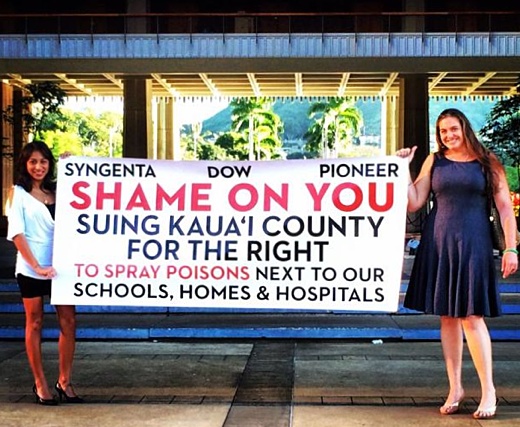
Image above: Residents of Kauai display sign chastising Dow, DuPont and Syngenta for trying to overturn pesticide regulations designed to protect the island. From (http://gmosecrets.com/category/pesticides-poisoning-kauai-keiki-families/).

The NEXT STEP
Kauai Charter Amendment to Add Article 33

Let the People Decide:
Should Agro-Chemical Operations be Proven Safe Prior to being used on Kauai?

The Ohana:
Please add your voice to that of this growing coalition of people and organizations as we come together to place this Amendment on the ballot on November 4, 2014.
  • Friends of Navdanya (Vandana Shiva's U.S. Organization)
  • Kauai Alliance for Peace and Social Justice
  • Kauai Fresh Farms
  • Kauai Rising
  • Ohana O'Kauai
  • People for the Preservation of Kauai
  • Regenerations international Botanical Garden
  • Safe Meter Kauai
  • Shaka movement
  • Surfrider Foundation
  • Wai Koa Plantation
ACTION STEPS:
Sign the Petition to Place the Charter Amendment on the Ballot at the following locations:
  • Harvest Market in Hanalei
  • Magic Dragon Today and Art Supply Princeville
  • Kauai Mini Golf and Botanical Gardens Kilauea
  • Small Town Coffee in Kapaa
See updated petition gathering sites at: https://www.facebook.com/events/435175346627970/?ref=22
or contact one of the petition team captains below.
Join one of the Petition gathering Teams around the island by contacting a team captain:
  • Lora Lynne 826-6513 (Northside)
  • Elaine 651-7531 (Kapaa-Moloa'a)
  • Rich 822-0930 (Wailua - Lihue)
  • Siri 634-5514 (Eastside)
  • Janee 652-2526 (Southside)
  • Klayton 652-2425 (Westside)
  • Sandy 320-3878 (Eastside)
To stay updated on events and information add your email address to our contact list by sending an email to:
THE PROCESS:
To place a Charter Amendment on the ballot requires the gathering of 3,000 signatures of Kauai registered voters by the middle of May of 2014 (five thousand signatures or more would create a wonderful momentum as we move toward the November 4th, 2014 election date.)

Placing the Amendment on the ballot allows the people to directly vote in November on whether or not they want to see the Amendment passed. Once passed the Amendment cannot be repealed by the County Council, nor can it be vetoed by the Mayor. It lets the people decide.

To pass the Amendment in the November election requires that a simple majority of the voters who turn out, vote to pass the Amendment.

THE CONTENT:
The Charter Amendment is designed to insure the health and well being of Kauai and its people by requiring that the AgroChemical Businesses on Kauai prove that their operations here are safe prior to implementing them.

View the entire Charter Amendment at www.kauairising.org

MAHALO
As we watch the events of the world we recognize that we are at a tipping point for so many choices facing our world at this time. None is more important in affecting the health and well being of our world and our people than this issue of GMOs, especially here on Kauai, Ground Zero for their GMO research and testing activities.

At this time, more than ever, your voice makes a difference and amplifies the effectiveness of our community's ability to achieve its vision of a healthy, abundant island home for everyone. Mahalo for all that you do bring this vision into manifestation. Your voice really matters!

.