Showing posts with label Kleptocracy. Show all posts

The Uber-lie

SUBHEAD: In periods of decline, strongmen arise promising to restore past glories and to defeat enemies.

By Richard Heinberg on 6 February 2017 for Post Carbon Institute -
(http://www.postcarbon.org/the-uber-lie/)
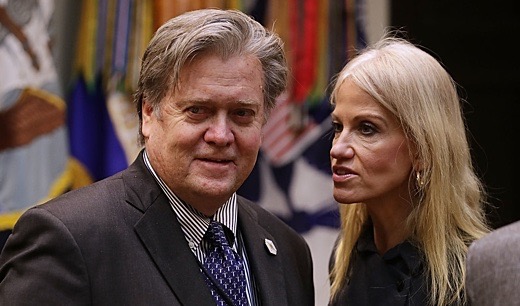

Image above: "Trumps Fountain of Lies" the conspiracy of Steve Bannon and Kellyanne Conway. From (https://www.inverse.com/article/27303-steve-bannon-looks-like-michael-shannon-meme).

Our new American president is famous for spinning whoppers. Falsehoods, fabrications, distortions, deceptions—they’re all in a day’s work.

The result is an increasingly adversarial relationship between the administration and the press, which may in fact be the point of the exercise: as conservative commenter Scott McKay suggests in The American Spectator,
 “The hacks covering Trump are as lazy as they are partisan, so feeding them . . . manufactured controversies over [the size of] inaugural crowds is a guaranteed way of keeping them occupied while things of real substance are done.”
But are some matters of real substance (such as last week’s ban on entry by residents of seven Muslim-dominated nations) themselves being used to hide even deeper and more significant shifts in power and governance?

Steve “I want to bring everything crashing down” Bannon, who has proclaimed himself an enemy of Washington’s political class, is a member of a small cabal (also including Trump, Stephen Miller, Reince Priebus, and Jared Kushner) that appears to be consolidating nearly complete federal governmental power, drafting executive orders, and formulating political strategy—all without paper trail or oversight of any kind.

The more outrage and confusion they create, the more effective is their smokescreen for the dismantling of governmental norms and institutions.

There’s no point downplaying the seriousness of what is up. Some commentators are describing it as a coup d’etat in progress; there is definitely the potential for blood in the streets at some point.

Nevertheless, even as political events spiral toward (perhaps intended) chaos, I wish once again, as I’ve done countless times before, to point to a lie even bigger than the ones being served up by the new administration—one that predates the new presidency, but whose deconstruction is essential for understanding the dawning Trumpocene era.

I’m referring to a lie that is leading us toward not just political violence but, potentially, much worse.

It is an untruth that’s both durable and bipartisan; one that the business community, nearly all professional economists, and politicians around the globe reiterate ceaselessly.  

It is the lie that human society can continue growing its population and consumption levels indefinitely on our finite planet, and never suffer consequences.

Yes, this lie has been debunked periodically, starting decades ago. A discussion about planetary limits erupted into prominence in the 1970s and faded, yet has never really gone away.

But now those limits are becoming less and less theoretical, more and more real. I would argue that the emergence of the Trump administration is a symptom of that shift from forecast to actuality.

Consider population. There were one billion of us on Planet Earth in 1800. Now there are 7.5 billion, all needing jobs, housing, food, and clothing. From time immemorial there were natural population checks—disease and famine. Bad things.

But during the last century or so we defeated those population checks. Famines became rare and lots of diseases can now be cured.

Modern agriculture grows food in astounding quantities. That’s all good (for people anyway—for ecosystems, not so much). But the result is that human population has grown with unprecedented speed.

Some say this is not a problem, because the rate of population growth is slowing: that rate was two percent per year in the 1960s; now it’s one percent.

Yet because one percent of 7.5 billion is more than two percent of 3 billion (which was the world population in 1960), the actual number of people we’re now adding annually is the highest ever: over eighty million—the equivalent of Tokyo, New York, Mexico City, and London added together.

Much of that population growth is occurring in countries that are already having a hard time taking care of their people. The result? Failed states, political unrest, and rivers of refugees.

Per capita consumption of just about everything also grew during past decades, and political and economic systems came to depend upon economic growth to provide returns on investments, expanding tax revenues, and positive poll numbers for politicians.

Nearly all of that consumption growth depended on fossil fuels to provide energy for raw materials extraction, manufacturing, and transport.

But fossil fuels are finite and by now we’ve used the best of them. We are not making the transition to alternative energy sources fast enough to avert crisis (if it is even possible for alternative energy sources to maintain current levels of production and transport).

At the same time, we have depleted other essential resources, including topsoil, forests, minerals, and fish. As we extract and use resources, we create pollution—including greenhouse gasses, which cause climate change.

Depletion and pollution eventually act as a brake on further economic growth even in the wealthiest nations. Then, as the engine of the economy slows, workers find their incomes leveling off and declining—a phenomenon also related to the globalization of production, which elites have pursued in order to maximize profits.

Declining wages have resulted in the upwelling of anti-immigrant and anti-globalization sentiments among a large swath of the American populace, and those sentiments have in turn served up Donald Trump.

Here we are. It’s perfectly understandable that people are angry and want change. Why not vote for a vain huckster who promises to “Make America Great Again”?

However, unless we deal with deeper biophysical problems (population, consumption, depletion, and pollution), as well as the policies that elites have used to forestall the effects of economic contraction for themselves (globalization, financialization, automation, a massive increase in debt, and a resulting spike in economic inequality), America certainly won’t be “great again”; instead, we’ll just proceed through the five stages of collapse helpfully identified by Dmitry Orlov.

Rather than coming to grips with our society’s fundamental biophysical contradictions, we have clung to the convenient lies that markets will always provide, and that there are plenty of resources for as many humans as we can ever possibly want to crowd onto this little planet.

And if people are struggling, that must be the fault of [insert preferred boogeyman or group here]. No doubt many people will continue adhering to these lies even as the evidence around us increasingly shows that modern industrial society has already entered a trajectory of decline.

While Trump is a symptom of both the end of economic growth and of the denial of that new reality, events didn’t have to flow in his direction. Liberals could have taken up the issues of declining wages and globalization (as Bernie Sanders did) and even immigration reform.

For example, Colin Hines, former head of Greenpeace’s International Economics Unit and author of Localization: A Global Manifesto, has just released a new book, Progressive Protectionism, in which he argues that
“We must make the progressive case for controlling our borders, and restricting not just migration but the free movement of goods, services and capital where it threatens environment, wellbeing and social cohesion.”
But instead of well-thought out policies tackling the extremely complex issues of global trade, immigration, and living wages, we have hastily written executive orders that upend the lives of innocents.

Two teams (liberal and conservative) are lined up on the national playing field, with positions on all significant issues divvied up between them.

As the heat of tempers rises, our options are narrowed to choosing which team to cheer for; there is no time to question our own team’s issues. That’s just one of the downsides of increasing political polarization—which Trump is exacerbating dramatically.

Just as Team Trump covers its actions with a smokescreen of controversial falsehoods, our society hides its biggest lie of all—the lie of guaranteed, unending economic growth—behind a camouflage of political controversies.

Even in relatively calm times, the über-lie was watertight: almost no one questioned it. Like all lies, it served to divert attention from an unwanted truth—the truth of our collective vulnerability to depletion, pollution, and the law of diminishing returns. Now that truth is more hidden than ever.

Our new government shows nothing but contempt for environmentalists and it plans to exit Paris climate agreement. Denial reigns! Chaos threatens!

So why bother bringing up the obscured reality of limits to growth now, when immediate crises demand instant action? It’s objectively too late to restrain population and consumption growth so as to avert what ecologists of the 1970s called a “hard landing.”

Now we’ve fully embarked on the age of consequences, and there are fires to put out.

Yes, the times have moved on, but the truth is still the truth, and I would argue that it’s only by understanding the biophysical wellsprings of change that can we successfully adapt, and recognize whatever opportunities come our way as the pace of contraction accelerates to the point that decline can no longer successfully be hidden by the elite’s strategies.

Perhaps Donald Trump succeeded because his promises spoke to what civilizations in decline tend to want to hear. It could be argued that the pluralistic, secular, cosmopolitan, tolerant, constitutional democratic nation state is a political arrangement appropriate for a growing economy buoyed by pervasive optimism.

(On a scale much smaller than contemporary America, ancient Greece and Rome during their early expansionary periods provided examples of this kind of political-social arrangement). As societies contract, people turn fearful, angry, and pessimistic—and fear, anger, and pessimism fairly dripped from Trump’s inaugural address.

In periods of decline, strongmen tend to arise promising to restore past glories and to defeat domestic and foreign enemies. Repressive kleptocracies are the rule rather than the exception.

If that’s what we see developing around us and we want something different, we will have to propose economic, political, and social forms that are appropriate to the biophysical realities increasingly confronting us—and that embody or promote cultural values that we wish to promote or preserve.

Look for good historic examples. Imagine new strategies. What program will speak to people’s actual needs and concerns at this moment in history?

Promising a return to an economy and way of life that characterized a past moment is pointless, and it may propel demagogues to power. But there is always a range of possible responses to the reality of the present.  

What’s needed is a new hard-nosed sort of optimism (based on an honest acknowledgment of previously denied truths) as an alternative to the lies of divisive bullies who take advantage of the elites’ failures in order to promote their own patently greedy interests.

What that actually means in concrete terms I hope to propose in more detail in future essays.


.

Greece blew up the debt Death Star

SUBHEAD: The Greek Elites and kleptocrats are terrified of the discipline that leaving the euro will impose.

By Charles Hugh Smith on 1 February 2015 for of Two Minds -
(http://charleshughsmith.blogspot.co.uk/2015/02/greece-just-blew-up-empires-death-star.html)


Image above: Death Star destroyed. From (http://reachingutopia.com/white-house-denies-petition-to-construct-death-star/big-death-star/).

The Greek Elites and kleptocrats are terrified of the discipline that leaving the euro will impose, but the general public should welcome the transition to an economy and society that has been freed from the shackles of Imperial debt and the kleptocracy that has bled the nation dry.

Although the financial media is blathering about negotiations and gamesmanship, the truth is Greece just blew up the Empire's Death Star of debt. There's nothing left to negotiate except the official admission that the Imperial Death Star of debt, the most fearsome threat in the galaxy, has been blown to smithereens.

There are three fundamental points that need to be emphasized, mostly because they've been lost in handwringing, fearmongering and the ceaseless chatter of propaganda shills.

ONE:
Impaired debt and defaults result from imprudent underwriting and lender incompetence/ greed. Since when did it become accepted policy to reward imprudent lending, incompetence and greed?

Classical Capitalism is very clear on what should happen to lenders who ignored risk management; they get destroyed. As imprudently issued loans default, the losses pile up and the lender become insolvent. At that point, Capitalism kicks in and the management is fired, the stock goes to zero, the lender's assets are auctioned off and the creditors are issued whatever remains after wages, taxes, accounts payable, etc. are paid.

There's nothing complicated about it: Capitalism requires the discipline of losses being taken by those responsible, the firing of incompetents and the destruction of imprudent lenders.

Yet somehow the dominant narrative has reversed this essential core of Capitalism into blaming the borrower for the losses.

Look, if someone offers to loan me a billion dollars with no collateral and no assessment of the risks that I might not be able to pay the interest or principal, then who's the fool? The idiot who wants to give me $1 billion without any risk assessment, or the borrower who takes the "free money" being offered?

Yes, no one should borrow money that they can't pay back, blah blah blah, but the primary fiduciary responsibility is on the lender to not offer loans to marginal borrowers and those at high risk of defaulting on their debts.

Yet the official line on debt is "the lenders are blameless, the borrowers are at fault and should pay." The borrowers were imprudent to take on debt they couldn't service, but it is the lenders who made the bad loans who are ultimately are at fault and who should suck all the losses.

Let's set aside the propaganda for a moment and get real: anyone with the slightest knowledge of Greek finances and the power structure of the Greek economy/society knew it was insanely risky to loan Greece billions of euros. No one can deny this, yet somehow the lenders deserve to be paid for their avarice, stupidity, incompetence and total disregard for the standards of prudent lending? No, they deserve to be destroyed--closed down and their assets auctioned off.

TWO:
Greece will not be wiped out by leaving the euro currency--it will be freed to rebuilt itself with prudent fiscal management and policies that reward investment and penalize risky borrowing, speculation and corruption.

Here's the thing about Greece issuing its own fiat currency--it will force fiscal discipline in a way that the euro did not and could not. This is why the Greek Status Quo is quivering with fear--the gravy train of irresponsibility enabled by the euro is ending, and they are terrified of living within their means and having to face the discipline that the market will impose on the Greek fiat currency.

If there's one thing Greece needs more than anything, it's the discipline and the rewards of the market. Any nation that issues its own fiat currency has a choice: it can exercise fiscal prudence and enforce policies that reward entrepreneurism, prudent lending, savings, wise investments, fair taxation, etc., or it can try to prop up its bloated, corrupt kleptocracy by printing rivers of fiat money.

If it chooses the Dark Side and prints money in excess, it will soon drive the value of that currency to near-zero. The kleptocracy that hoped to benefit from money-printing is impoverished or forced to move their capital elsewhere.

In other words, Greece returning to being responsible for its own currency is a good thing. The new currency will be valued cheaply relative to other currencies at first, and this is also a good thing, as imports will be unaffordable for all but the wealthy (kiss BMW sales in Greece good-bye) and everything produced in Greece becomes a bargain globally.

This will attract capital seeking places where it can make a profit and is treated fairly, and it will enable Greece to rebuild its export sector and boost its substantial tourist trade.

The promise that marginal borrowers would be transformed into sterling-credit borrowers by adopting the euro was always a fantasy--and a painfully visible fantasy at that. Anyone with their eyes even partially open could see that the vast differences in productivity, credit, risk and culture between the eurozone nations made the euro unworkable from the start.

It was equally visible that the eurozone's inept policies and loose lending standards would obscure these fundamental differences until the damage would be too great to hide--which is exactly what transpired.

THREE:
The hundreds of billions of euros in so-called bailouts did not help Greece--all they did was bail out imprudent lenders and Euroland Elites. Virtually none of these vast sums helped the Greek nation or its people; what little did stay in Greece flowed to the kleptocrats that continued to rule Greece.

The harsh reality of misrule and corruption was recently spelled out in Misrule of the Few: How the Oligarchs Ruined Greece:

"Greece has failed to address (rising wealth/income inequality) because the country’s elites have a vested interest in keeping things as they are. Since the early 1990s, a handful of wealthy families -- an oligarchy in all but name -- has dominated Greek politics.

These elites have preserved their positions through control of the media and through old-fashioned favoritism, sharing the spoils of power with the country’s politicians. Greek legislators, in turn, have held on to power by rewarding a small number of professional associations and public-sector unions that support the status quo. Even as European lenders have put the country’s finances under a microscope, this arrangement has held."

Greece just blew up the Death Star of debt, and now the threat has been lifted from other debtor nations suffering from the yoke of Imperial misrule. The Greek Elites and kleptocrats are terrified of the discipline that leaving the euro will impose, but the general public should welcome the transition to an economy and society that has been freed from the shackles of Imperial debt and the kleptocracy that has bled the nation dry.
.

Between a rock and a squishy place

SUBHEAD: Overlooked in this equation is the ongoing destruction of ordinary citizens (a.k.a. the “middle class”).

By James Kunstler on 2 December 2013 for Kunstler.com -
(http://kunstler.com/clusterfuck-nation/between-a-rock-and-a-squishy-place/)


Image above: Obama celebrating with the banksters. From (http://www.silverbearcafe.com/private/02.13/libor.html).

The rock is reality. The squishy place is the illusion that pervasive racketeering is an okay replacement for an economy. The essence of racketeering is the use of dishonest schemes to get money, often (but not always) employing coercion to make it work. Some rackets can function on the sheer cluelessness of the victim(s).
 
Is it fair to suppose that money management is at the heart of the sort of advanced, complex economy that developed early in the 20th century? I think so. 

Money is the lifeblood of trade and of investment in productive activities that support trade. Of course, in order for money to have meaning, to function in such transactional relations, the people must be convinced that it legitimately represents its face value. 

 Otherwise, money must be labeled “money” — that is, a medium of exchange suspected of false value. An economy that uses “money” — especially an economy of rackets — is an economy in a lot of trouble, and that is where ours is in December 2013.

The trouble reached escape velocity in the fall of 2008 when a particular brand of racket among the Wall Street kit-bag of rackets got badly out-of-hand, namely the business of selling securitized bundled mortgages and their “innovative” derivative “products” to dupes unaware that they were booby-trapped for failure which would, perversely, hugely reward the seller of such trash paper. 

These were, in the immortal words of Senator Carl Levin (D-Mich), 
the “really shitty deal[s]” propagated by the likes of the Goldman Sachs crypto-bank — so-called collateralized debt obligations — pawned off on credulous pension fund managers and other “marks” around the world greedy for “yield.”
 It turned out that all the large banks trafficking in such booby-trapped contracts ended up choking on them when “the music stopped” — that is, when the derivative “swaps” payoffs at the heart of this particular racket began to fail, sending up a general alarm that all such “products” were primed to blow up the entire “banking” system. 

By the way, the quotation marks I so liberally resort to are necessary to denote that in such a matrix of rackets things are not what they appear to be but only what they pretend to be.

The failure of Bear Stearns followed by the implosion of Lehman Brothers and the near-death experience of AIG alerted “civilians” outside Wall Street that the banks were linked in a web of fraud and insolvency and had to be “rescued” in order for the rest of America to keep its “way of life” going. 

The rescue remedy proved to be several new layers of fraud that have now matured into institutionalized rackets. The best known are the Siamese twins of “Quantitative Easing” and zero interest rate policy (ZIRP). 

The lesser-known racket was the 2009 rule change by the Financial Accounting Standards Board that allowed banks to make up whatever numbers they felt like in reporting the value of their holdings (“assets”).

Hence, these dishonest, regularized operations can be labeled a hostage racket with coercion at their core. The coercion comes in the form of the threat that any let-up in the stream of QE “money” enjoyed by the banks in the form of carry-trade “loans” and “primary dealer” premium cream-offs will send the economy back to the stone age. 

Overlooked in this equation is the ongoing destruction of ordinary citizens (a.k.a. the “middle class”) who have already lost their grip on the emblematic “way of life” Wall Street is working so tirelessly to defend. Politicians are, of course, deeply implicated and indeed directly involved in all these rackets, since these hired handmaidens make and execute the laws protecting Wall Street’s looting operations.

The catch to all this, lately, lies in the cognitive dissonance between the symptomatic euphoria of record stock market indexes versus the conviction of a few hardcore skeptical observers that the rackets are now so reckless and impudent as to be beyond any hope of control and on a trajectory to bring about hardships orders of magnitude above anything imagined in 2008.

So-called “health care” is also a hostage racket, since sick people are hardly in a position to bargain for anything, but it is only a sub-system of the larger matrix of rackets that have made this such an unusually dishonest society. My guess is that ObamaCare is sure to make it worse, and pretty quickly too, since the rules for ObamaCare were written by the hireling lobbyists of the industries that benefit from the racketeering.

The big mystery in all this remains: where are the people with some institutional power who might stand up and denounce all this perfidy? What has made us such a culture of cowards and cravens that the best we can do is produce a couple of comedians who speak truth to power in the form of jokes. Most of this is not that funny.

By the way, one reason for the vulgar orgy of “consumerism” that, in recent years, has turned the Thanksgiving holiday into a sort of grotesque sporting event, is to mount a crude demonstration that our “money” is a viable medium of exchange. The dumbest people in the land are induced to swarm through the merchandise warehouse stores and fight to exchange their “money” for hard goods offered at false “bargains.” I wonder how much of it is a dress rehearsal for what happens in a hyper-inflation?

.

No Mo' PoMo

SUBHEAD: The world is about to find out that you really can't get something for nothing. It will be a harsh lesson.

By Jame Kunstler on 13 May 2013 for Kunstler.com -
(http://kunstler.com/blog/2013/05/no-mo-pomo.html)


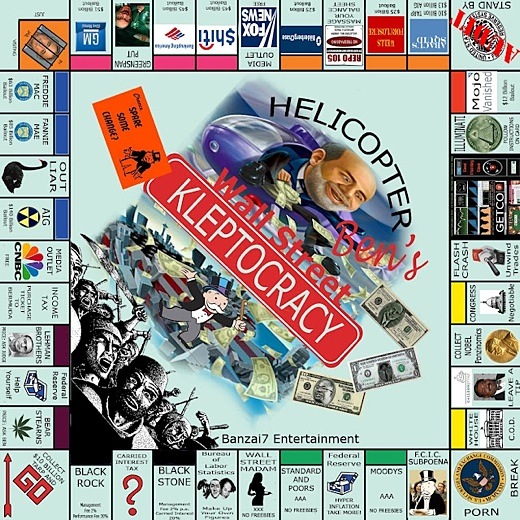
Image above: From (http://williambanzai7.blogspot.com/2010/09/wall-street-kleptocracy-game.html).

Whenever the Federal Reserve wants to tweak the dials of the economy -- or pretend that it can -- it turns first to its sock puppet at The Wall Street Journal, John Hilsenrath, and "leaks" a rumor of policy change (here). They like to do this late on Fridays when financial markets are about to close, so that market players will have a whole weekend to ponder the Fed's actions like medieval viziers reading goat entrails.

Last Friday's puddle of steaming guts was a supposed preview of the Fed's "exit strategy" from its reckless policy of "quantitative easing" or "money" creation (or "liquidity," if you like). In other words, they supposedly intend to stop juicing the financial markets with fake wealth, i.e. capital not accumulated from real productive activity, but just fictively created on computer hard drives.

For the past year they have been doing this to the tune of $85 billion a month, "buying" US Treasury bonds and bills and an assortment of miscellaneous securities (mostly trash that can't be pawned off on anyone else) through their so-called "primary dealer" bank cohorts, the too-big-to-fail usual suspects, who "earn" hefty transaction fees in the process of conveying all these pixels from Point A to Point B. These interventions are called Permanent Open Market Operations, or PoMo.

The theory all along has been that this $85 billion a month would seep down to Main Street to provoke spending (increasing the "velocity of money) and therefore "jump start" the economy. The theory has proven itself to be complete horseshit, of course. All it has done is suppress interest rates on bonds, depriving old people of income off their savings by so doing. It also artificially jacked up reckless lending on loans for houses, cars, and college degrees, juiced the share price of stocks, and boosted food prices.

Meanwhile, an increasingly former middle class languishes in a purgatory of foreclosure, penury, and desperation. The Fed can't really do anything to help them. It can only burden them with more easy-credit debt, especially their college-age children. But ours is a financialized economy and finance is too abstruse for most ordinary people to understand, so they just muddle along in a fog of dashed hopes and repossession.

Lately, though, the financial markets at the heart of the financialized economy -- that is, an economy based on buying and selling increasingly dubious "paper" assets rather than on capital formation through producing things of value -- are sending distress signals. The aforesaid efforts at economic dial-tweaking have only produced distortions and perversions in the basic functioning of the markets they're designed to tweak.

  • They pervert the "price discovery" mechanism by dumping "free money" into equity markets.
  • They distort "risk premiums" by steering money out of savings, where it earns less than nothing, into riskier investments subject to the vagaries of everything from weather (commodity markets) to control fraud (bank stocks) to geopolitics (Toyota stock).
  • They debauch market expectations in general by implying permanent artificial life-support.
  • They promote market gaming such as front-running equity prices via high frequency trading on computers, naked shorting (pretending to borrow shares that, in fact, do not exist) and the abuse of futures markets -- lately illustrated in the ongoing smash of paper gold and silver contracts, with the side effect of driving yet more money into stock markets.
  • Finally, they undermine the meaning and value of money itself, which is the most dangerous game of all because when people lose confidence in their national currency, nations dissolve in political chaos.
Despite the aura of control, Fed officials (and casual observers) may sense things spinning out of control. Of course, hyper-fragility is exactly the effect that all the Fed's own actions would predictably lead to. When you divorce truth from reality, strange things are bound to happen. The Fed ventriloquists who speak through Hilsenrath at The Wall Street Journal suggest they would accomplish their exit from the current $85billion-a-month QE policy in a set of "halting steps" by irregularly dialing down QE issuance month-by-month to fine-tune the results on-the-fly, as markets may require.

This is also complete horseshit because they could only accomplish controlled tweakings by somehow signaling their intentions beforehand through some lackey like Hilsenrath. Otherwise, they could not pretend to control the results of their actions. They might as well just throw spaghetti at the wall to see if it sticks. Unfortunately, the "halting steps" idea would only provide even more opportunities for selective, complex front-running, shorting, and gaming -- which is to say setting up more dangerous behavior with more uncertain and possibly destructive outcomes.

Anyway, there's no evidence at this moment that anyone believes what was leaked to Hilsenrath. It could easily be more smoke and mirrors aimed at concealing the fact that the Federal Reserve has no idea what it has been doing and fears the consequences.

There is one thing that we know for sure in this strange period when bankers have tried to manage reality in the absence of truth: that advanced industrial-technological economies designed to run on $20-a-barrel oil can't run on $100-a-barrel oil, and that is why the US economy was subject to financialization in the first place -- to offset declining productive activity by an attempt to get something for nothing.

Notice that this macro-trend coincided exactly with the rise of legalized gambling all over America. That is how the idea that you could get something for nothing got to be normal.

The world is about to find out that you really can't get something for nothing. It will be a harsh lesson.

.

Bernanke Breaks Down

SUBHEAD: The whole bailout and quantitative easing thing is just a kleptocracy.

By Vharles Hugh Smith on 31 March 2013 for Of Two Minds -
(http://charleshughsmith.blogspot.co.uk/2013/03/bernanke-breaks-down-this-whole-thing.html)


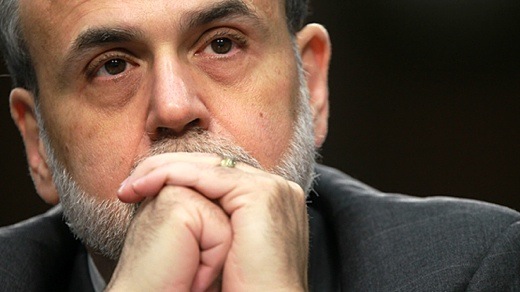
Image above: From Bernanke about to get third degree from media. (http://www.thefiscaltimes.com/Columns/2011/04/27/Fed-Chairman-Bernanke-to-Get-Media-Third-Degree.aspx#page1).

In an unprecedented abandonment of his carefully scripted responses to Congressional questions, Federal Reserve Chairman Ben Bernanke unleashed what appeared to be a heart-felt and spontaneous disavowal of the financial and political systems of the United States.

Asked a question about the wealth effect, Bernanke paused and said, "The wealth effect. Ah, right." He then smiled faintly and shook his head. "You want to know about the wealth effect? Well, I'll be candid with you. This whole thing is a kleptocracy--the financial system, the political system, it's one big kleptocracy. That's the real wealth effect."

Seeming to find his footing, Bernanke continued with a passion that startled the audience. "You know, I told myself to just repeat the party line for another year so I could step down quietly and let Yellen or another of the toadies take over, but I realized that I can no longer stomach the lies, the obfuscation and the plundering."

"Yes, I have a plum position lined up at Goldman Sachs after my retirement. You know, give a few speeches and pocket a couple of million dollars, but I am tired of the dirtiness of all this money."
Leaning into the microphone, Bernanke asked, "Aren't you tired of the dirtiness of all the money you take? Aren't you tired of the lies we're all living?"

"I am supposed to be an expert in economics. So I'll tell you how the system works in very simple terms. It's no different from the late Roman Empire, actually. The trick is to get close to the seat of Imperial power, which in our country is the Federal government. You bribe those on the make--there's always an abundance of them--to grant you special privileges, subsidies, contracts or a monopoly. You skim a great fortune off this proximity to political and financial power, and then you take this fortune and buy a rentier income--you know, thousands of rental homes, farmland, buildings in Manhattan, tax-free municipal bonds, and so on."

"This is how we ended up with cartels running everything: national defense, healthcare, higher education, the financial sector. You--the elected nobility--enable this vast skimming operation in the name of democracy and capitalism. But we all know those are facades. Democracy is a fraud at the national level, but we're all too cowardly to confess it."

Taking a sip of water, Bernanke said, "Let me tell you a little secret about all our policies based on Keynesian principles. Paul Krugman and I put on witch doctor masks and we dance around a campfire waving dead chickens and chanting nonsense. That's Keynesianism."

"It's hopelessly flawed, a disaster, for one simple reason: the Keynesians think all investment is productive, when the truth is most investment is unproductive and has to be written off. But that isn't allowed to happen any more, because those close to power would lose."

"As a result, everything we do and say here in Washington and in New York is a travesty of a mockery of a sham, an endless parade of lies, half-truths and spin. President Bush, in his own homespun way, spoke the truth when he said, 'This sucker's going down.' He meant the kleptocracy, the whole fraud we're living to enrich ourselves and keep power. I have had enough, ladies and gentleman, and this is my last public appearance as an employee of the Federal Reserve."

Fed officials explained the chairman's spontaneous comments as "the unfortunate result of a mix-up in the chairman's medication," triggering speculation that Mr. Bernanke had stopped taking Ibogaine. Sudden bursts of truth-telling are one side-effect of withdrawal, according to those familiar with the psychotropic medication.

According to sources within the Federal Reserve and Treasury, those supporting Janet Yellen as the new chair of the Fed are battling another faction who believe it would better serve the interests of the economy to install a high-frequency trading machine at the helm of the Fed. "There is a growing sense that it's time to cut out the middleman, so to speak, and just let the HFT computers openly trade the Fed's accounts," said one unnamed source.

Alas, April Fools. Sadly, no one in power has the courage to tell the truth.

Wait a minute--one former insider is willing to tell the truth--David Stockman:

The Great Deformation: The Corruption of Capitalism in America
The Great Deformation (Kindle edition) 
.

The Corporate State Wins Again

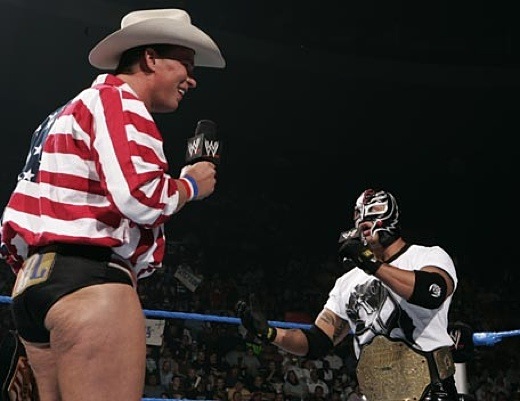
SUBHEAD: These elites do not have a vision. They will continue to exploit the nation, the global economy and the ecosystem. By Chris Hedges on 25 April 2011 in Truthdig - (http://www.truthdig.com/report/item/the_corporate_state_wins_again_20110425) Image above: Wrestler John Bradshaw Layfield verbally abuses Mexican Rey Mysterio in ring. From (http://www.wrestlingwiththetruth.com/tag/john-bradshaw-layfield). When did our democracy die? When did it irrevocably transform itself into a lifeless farce and absurd political theater? When did the press, labor, universities and the Democratic Party—which once made piecemeal and incremental reform possible—wither and atrophy? When did reform through electoral politics become a form of magical thinking? When did the dead hand of the corporate state become unassailable? The body politic was mortally wounded during the long, slow strangulation of ideas and priorities during the Red Scare and the Cold War. Its bastard child, the war on terror, inherited the iconography and language of permanent war and fear. The battle against internal and external enemies became the excuse to funnel trillions in taxpayer funds and government resources to the war industry, curtail civil liberties and abandon social welfare. Skeptics, critics and dissenters were ridiculed and ignored. The FBI, Homeland Security and the CIA enforced ideological conformity. Debate over the expansion of empire became taboo. Secrecy, the anointing of specialized elites to run our affairs and the steady intrusion of the state into the private lives of citizens conditioned us to totalitarian practices. Sheldon Wolin points out in “Democracy Incorporated” that this configuration of corporate power, which he calls “inverted totalitarianism,” is not like “Mein Kampf” or “The Communist Manifesto,” the result of a premeditated plot. It grew, Wolin writes, from “a set of effects produced by actions or practices undertaken in ignorance of their lasting consequences.” Corporate capitalism—because it was trumpeted throughout the Cold War as a bulwark against communism—expanded with fewer and fewer government regulations and legal impediments. Capitalism was seen as an unalloyed good. It was not required to be socially responsible. Any impediment to its growth, whether in the form of trust-busting, union activity or regulation, was condemned as a step toward socialism and capitulation. Every corporation is a despotic fiefdom, a mini-dictatorship. And by the end Wal-Mart, Exxon Mobil and Goldman Sachs had grafted their totalitarian structures onto the state. The Cold War also bequeathed to us the species of the neoliberal. The neoliberal enthusiastically embraces “national security” as the highest good. The neoliberal—composed of the gullible and cynical careerists—parrots back the mantra of endless war and corporate capitalism as an inevitable form of human progress. Globalization, the neoliberal assures us, is the route to a worldwide utopia. Empire and war are vehicles for lofty human values. Greg Mortenson, the disgraced author of “Three Cups of Tea”, tapped into this formula. The deaths of hundreds of thousands of innocents in Iraq or Afghanistan are ignored or dismissed as the cost of progress. We are bringing democracy to Iraq, liberating the women of Afghanistan, defying the evil clerics in Iran, ridding the world of terrorists and protecting Israel. Those who oppose us do not have legitimate grievances. They need to be educated. It is a fantasy. But to name our own evil is to be banished. We continue to talk about personalities—Ronald Reagan, Bill Clinton, George W. Bush and Barack Obama—although the heads of state or elected officials in Congress have become largely irrelevant. Lobbyists write the bills. Lobbyists get them passed. Lobbyists make sure you get the money to be elected. And lobbyists employ you when you get out of office. Those who hold actual power are the tiny elite who manage the corporations. Jacob S. Hacker and Paul Pierson, in their book “Winner-Take-All Politics,” point out that the share of national income of the top 0.1 percent of Americans since 1974 has grown from 2.7 to 12.3 percent. One in six American workers may be without a job. Some 40 million Americans may live in poverty, with tens of millions more living in a category called “near poverty.” Six million people may be forced from their homes because of foreclosures and bank repossessions. But while the masses suffer, Goldman Sachs, one of the financial firms most responsible for the evaporation of $17 trillion in wages, savings and wealth of small investors and shareholders, is giddily handing out $17.5 billion in compensation to its managers, including $12.6 million to its CEO, Lloyd Blankfein. The massive redistribution of wealth, as Hacker and Pierson write, happened because lawmakers and public officials were, in essence, hired to permit it to happen. It was not a conspiracy. The process was transparent. It did not require the formation of a new political party or movement. It was the result of inertia by our political and intellectual class, which in the face of expanding corporate power found it personally profitable to facilitate it or look the other way. The armies of lobbyists, who write the legislation, bankroll political campaigns and disseminate propaganda, have been able to short-circuit the electorate. Hacker and Pierson pinpoint the administration of Jimmy Carter as the start of our descent, but I think it began long before with Woodrow Wilson, the ideology of permanent war and the capacity by public relations to manufacture consent. Empires die over such long stretches of time that the exact moment when terminal decline becomes irreversible is probably impossible to document. That we are at the end, however, is beyond dispute. The rhetoric of the Democratic Party and the neoliberals sustains the illusion of participatory democracy. The Democrats and their liberal apologists offer minor palliatives and a feel-your-pain language to mask the cruelty and goals of the corporate state. The reconfiguration of American society into a form of neofeudalism will be cemented into place whether it is delivered by Democrats, who are pushing us there at 60 miles an hour, or Republicans, who are barreling toward it at 100 miles an hour. Wolin writes, “By fostering an illusion among the powerless classes” that it can make their interests a priority, the Democratic Party “pacifies and thereby defines the style of an opposition party in an inverted totalitarian system.” The Democrats are always able to offer up a least-worst alternative while, in fact, doing little or nothing to thwart the march toward corporate collectivism. The systems of information, owned or dominated by corporations, keep the public entranced with celebrity meltdowns, gossip, trivia and entertainment. There are no national news or intellectual forums for genuine political discussion and debate. The talking heads on Fox or MSNBC or CNN spin and riff on the same inane statements by Sarah Palin or Donald Trump. They give us lavish updates on the foibles of a Mel Gibson or Charlie Sheen. And they provide venues for the powerful to speak directly to the masses. It is burlesque. It is not that the public does not want a good health care system, programs that provide employment, quality public education or an end to Wall Street’s looting of the U.S. Treasury. Most polls suggest Americans do. But it has become impossible for most citizens to find out what is happening in the centers of power. Television news celebrities dutifully present two opposing sides to every issue, although each side is usually lying. The viewer can believe whatever he or she wants to believe. Nothing is actually elucidated or explained. The sound bites by Republicans or Democrats are accepted at face value. And once the television lights are turned off, the politicians go back to the business of serving business. We live in a fragmented society. We are ignorant of what is being done to us. We are diverted by the absurd and political theater. We are afraid of terrorism, of losing our job and of carrying out acts of dissent. We are politically demobilized and paralyzed. We do not question the state religion of patriotic virtue, the war on terror or the military and security state. We are herded like sheep through airports by Homeland Security and, once we get through the metal detectors and body scanners, spontaneously applaud our men and women in uniform. As we become more insecure and afraid, we become more anxious. We are driven by fiercer and fiercer competition. We yearn for stability and protection. This is the genius of all systems of totalitarianism. The citizen’s highest hope finally becomes to be secure and left alone. Human history, rather than a chronicle of freedom and democracy, is characterized by ruthless domination. Our elites have done what all elites do. They have found sophisticated mechanisms to thwart popular aspirations, disenfranchise the working and increasingly the middle class, keep us passive and make us serve their interests. The brief democratic opening in our society in the early 20th century, made possible by radical movements, unions and a vigorous press, has again been shut tight. We were mesmerized by political charades, cheap consumerism and virtual hallucinations as we were ruthlessly stripped of power. The game is over. We lost. The corporate state will continue its inexorable advance until two-thirds of the nation is locked into a desperate, permanent underclass. Most Americans will struggle to make a living while the Blankfeins and our political elites wallow in the decadence and greed of the Forbidden City and Versailles. These elites do not have a vision. They know only one word—more. They will continue to exploit the nation, the global economy and the ecosystem. And they will use their money to hide in gated compounds when it all implodes. Do not expect them to take care of us when it starts to unravel. We will have to take care of ourselves. We will have to create small, monastic communities where we can sustain and feed ourselves. It will be up to us to keep alive the intellectual, moral and culture values the corporate state has attempted to snuff out. It is either that or become drones and serfs in a global, corporate dystopia. It is not much of a choice. But at least we still have one. Video above: Chris Hedges on "Empire of Illusion". From (http://www.youtube.com/watch?feature=player_embedded&v=dHle_turjes). .

Dodd's Wall Street Plan

SUBHEAD: Why won't Chris Dodd take "Yes" for an answer on financial reform? Because he doesn't want to.

 By Simon Johnson on 26 April 2010 in Huffington Post - 
 (http://www.huffingtonpost.com/simon-johnson/when-will-chris-dodd-star_b_551311.html)

 
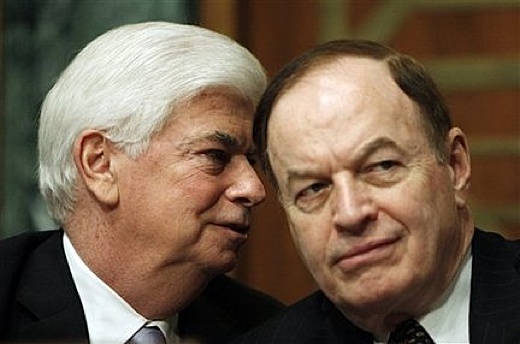
Image above: Democrat Chris Dodd whispers a confidence to Republican Richard Shelby on financial reform. From (http://www.cleveland.com/business/index.ssf/2009/12/dodd_shelby_voice_optimism_on.html).

 Senator Chris Dodd is a tactical legislative genius - keep this clearly in your mind during the days ahead. In terms of maneuvering for the outcomes he seeks, managing the votes, and controlling the floor, you have rarely seen his equal.

Senator Dodd wants some financial reform - enough to declare victory - but not so much as to seriously undermine the prevalence of megabanks on Wall Street. You can take whatever view you like on his motivation - but Senator Dodd himself is quite open about his thinking and intentions. Given the mounting pressure from many sides - including Federal Reserve Bank presidents - to implement significantly more reform (see also David Warsh's Sunday evening assessment), for example using some version of the Brown-Kaufman SAFE banking act, how exactly will Senator Dodd prevail?
1) He knows that the Republican leadership will mount a disinformation campaign, trying to muddy the waters by claiming that the Dodd bill "institutionalizes bailouts". This top-down Republican line is complete and deliberate misrepresentation - designed purely to prevent real reform. Every time it is repeated, Senator Dodd's position becomes stronger because people who really want reform need to rally to his defend his approach.

2) The Republican attacks also justify the Democratic leadership and various pro-reform groups telling people: Don't confuse the message. Everyone in the center and on the left is lobbied to emphasize that Senator Dodd's bill will completely "end too big to fail" - if you deviate from this line, you will be accused of falling in with Mitch McConnell's dangerous views. Expect this pressure to intensify in coming days - requests for responsible and transparent debate on policy options will be drowned out and pushed aside by the pressure for conformity (underpinned by the desire not to undermine Wall Street campaign contributions too much).

3) As the White House pushes back against the Republicans, this will further strengthen Senator Dodd - he is the congressional standard bearer, after all. And everyone knows that he needs 60 senators on his side in order to prevail, so some weakening of the bill is presumed inevitable and must be accepted in the reasonable name of making some progress. But this is where the pure genius of Senator Dodd enters the equation - with an audacity that makes you whistle with appreciation for the art (although not the substance). The presumption is that Senator Dodd is negotiating with one or more Republicans who are the easiest to bring on board. This would make sense if Senator Dodd wanted the strongest bill possible. Senator Chuck Grassley voted for strong derivatives reform in the Agriculture Committee; Senator Olympia Snowe also seems on board with that agenda. 

Senators John Thune and Bob Corker are saying in public that Republicans want to vote for reform (although it's a good question what this means exactly). Senator Jim Bunning voted with Senator Bernie Sanders in the Budget committee - on what is being seen as a test vote on breaking up banks (Sanders's press release; Huffington Post coverage).

Senator Scott Brown is wavering in broad daylight. Senator George Voinovich is retiring and rumored to be flexible on financial reform issues. But Senator Dodd is closeted in negotiations with Senator Richard Shelby - who stands for the most pro-Wall Street bill possible.

The goal is apparently not to give up as little as possible and still get a bill. The goal is to bring as many supporters of Wall Street as possible on board with the legislation, at the same time as framing the issues so the pro-reform camp looks bad when it presses for more. As we head into what is likely to be the decisive week, Senator Dodd controls the clock, can determine what is debated on the Senate floor, and - whenever he feels hard pressed - remind everyone to toe his line or fear the extreme Republicans.

At this point, only the White House can bring sufficient pressure for the Brown-Kaufman bill to get an up-or-down vote; the odds are against this being what the White House really wants to do. But keep calling the White House and the Senate Democratic leadership.

 .

American Kleptocracy

SUBHEAD: How American fears of socialism and fascism hide what is naked theft by those in power.

 By William J. Astore on 20 April 2010 in TomDispatch - 
(http://www.tomdispatch.com/post/175235/tomgram%3A_william_astore%2C_the_business_of_america_is_kleptocracy__)


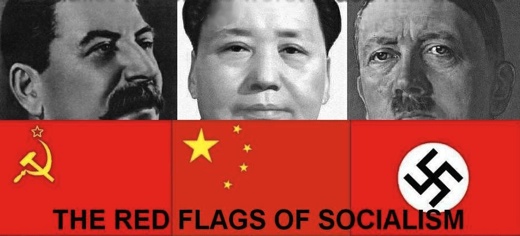
Image above: Detail of poster titled "The Red Flags of Socialism". From (http://standupforamerica.wordpress.com/2009/09/01/defining-socialism-and-our-discussions/).

Kleptocracy -- now, there’s a word I was taught to associate with corrupt and exploitative governments that steal ruthlessly and relentlessly from the people. It’s a word, in fact, that’s usually applied to flawed or failed governments in Africa, Latin America, or the nether regions of Asia. Such governments are typically led by autocratic strong men who shower themselves and their cronies with all the fruits of extracted wealth, whether stolen from the people or squeezed from their country’s natural resources. It’s not a word you’re likely to see associated with a mature republic like the United States led by disinterested public servants and regulated by more-or-less transparent principles and processes.

In fact, when Americans today wish to critique or condemn their government, the typical epithets used are “socialism” or “fascism.” When my conservative friends are upset, they send me emails with links to material about “ObamaCare” and the like. These generally warn of a future socialist takeover of the private realm by an intrusive, power-hungry government. When my progressive friends are upset, they send me emails with links pointing to an incipient fascist takeover of our public and private realms, led by that same intrusive, power-hungry government (and, I admit it, I’m hardly innocent when it comes to such “what if” scenarios).

What if, however, instead of looking at where our government might be headed, we took a closer look at where we are -- at the power-brokers who run or influence our government, at those who are profiting and prospering from it? These are, after all, the “winners” in our American world in terms of the power they wield and the wealth they acquire. And shouldn’t we be looking as well at those Americans who are losing -- their jobs, their money, their homes, their healthcare, their access to a better way of life -- and asking why?

If we were to take an honest look at America’s blasted landscape of “losers” and the far shinier, spiffier world of “winners,” we’d have to admit that it wasn’t signs of onrushing socialism or fascism that stood out, but of staggeringly self-aggrandizing greed and theft right in the here and now. We’d notice our public coffers being emptied to benefit major corporations and financial institutions working in close alliance with, and passing on remarkable sums of money to, the representatives of “the people.” We’d see, in a word, kleptocracy on a scale to dazzle. We would suddenly see an almost magical disappearing act being performed, largely without comment, right before our eyes.
Of Red Herrings and Missing Pallets of Money


Think of socialism and fascism as the red herrings of this moment or, if you’re an old time movie fan, as Hitchcockian MacGuffins -- in other words, riveting distractions. Conservatives and Tea Partiers fear invasive government regulation and excessive taxation, while railing against government takeovers -- even as corporate lobbyists write our public healthcare bills to favor private interests. Similarly, progressives rail against an emergent proto-fascist corps of private guns-for-hire, warrantless wiretapping, and the potential government-approved assassination of U.S. citizens, all sanctioned by a perpetual, and apparently open-ended, state of war.

Yet, if this is socialism, why are private health insurers the government’s go-to guys for healthcare coverage? If this is fascism, why haven’t the secret police rounded up tea partiers and progressive critics as well and sent them to the lager or the gulag?

Consider this: America is not now, nor has it often been, a hotbed of political radicalism. We have no substantial socialist or workers’ party. (Unless you’re deluded, please don’t count the corporate-friendly “Democrat” party here.) We have no substantial fascist party. (Unless you’re deluded, please don’t count the cartoonish “Tea Partiers” here; these predominantly white, graying, and fairly affluent Americans seem most worried that the jackbooted thugs will be coming for them.)

What drives America today is, in fact, business -- just as was true in the days of Calvin Coolidge. But it’s not the fair-minded “free enterprise” system touted in those freshly revised Texas guidelines for American history textbooks; rather, it’s a rigged system of crony capitalism that increasingly ends in what, if we were looking at some other country, we would recognize as an unabashed kleptocracy.

Recall, if you care to, those pallets stacked with hundreds of millions of dollars that the Bush administration sent to Iraq and which, Houdini-like, simply disappeared. Think of the ever-rising cost of our wars in Iraq and Afghanistan, now in excess of a trillion dollars, and just whose pockets are full, thanks to them.

If you want to know the true state of our government and where it’s heading, follow the money (if you can) and remain vigilant: our kleptocratic Houdinis are hard at work, seeking to make yet more money vanish from your pockets -- and reappear in theirs.
From Each According to His Gullibility, To Each According to His Greed

Never has the old adage my father used to repeat to me -- “the rich get richer and the poor poorer” -- seemed fresher or truer. If you want confirmation of just where we are today, for instance, consider this passage from a recent piece by Tony Judt:

"In 2005, 21.2 percent of U.S. national income accrued to just 1 percent of earners. Contrast 1968, when the CEO of General Motors took home, in pay and benefits, about sixty-six times the amount paid to a typical GM worker. Today the CEO of Wal-Mart earns nine hundred times the wages of his average employee. Indeed, the wealth of the Wal-Mart founder’s family in 2005 was estimated at about the same ($90 billion) as that of the bottom 40 percent of the U.S. population: 120 million people."

Wealth concentration is only one aspect of our increasingly kleptocratic system. War profiteering by corporations (however well disguised as heartfelt support for our heroic warfighters) is another. Meanwhile, retired senior military officers typically line up to cash in on the kleptocratic equivalent of welfare, peddling their “expertise” in return for impressive corporate and Pentagon payouts that supplement their six-figure pensions. Even that putative champion of the Carhartt-wearing common folk, Sarah Palin, pocketed a cool $12 million last year without putting the slightest dent in her populist bona fides.

Based on such stories, now legion, perhaps we should rewrite George Orwell’s famous tagline from Animal Farm as:
"All animals are equal, but a few are so much more equal than others."
And who are those “more equal” citizens? Certainly, major corporations, which now enjoy a kind of political citizenship and the largesse of a federal government eager to rescue them from their financial mistakes, especially when they’re judged “too big to fail.” In raiding the U.S. Treasury, big banks and investment firms, shamelessly ready to jack up executive pay and bonuses even after accepting billions in taxpayer-funded bailouts, arguably outgun militarized multinationals in the conquest of the public realm and the extraction of our wealth for their benefit.

Such kleptocratic outfits are, of course, abetted by thousands of lobbyists and by politicians who thrive off corporate campaign contributions. Indeed, many of our more prominent public servants have proved expert at spinning through the revolving door into the private sector. Even ex-politicians who prefer to be seen as sympathetic to the little guy like former House Majority Leader Dick Gephardt eagerly cash in.

I’m Shocked, Shocked, to Find Profiteering Going on Here
An old Roman maxim enjoins us to “let justice be done, though the heavens fall.” Within our kleptocracy, the prevailing attitude is an insouciant “We’ll get ours, though the heavens fall.” This mindset marks the decline of our polity. A spirit of shared sacrifice, dismissed as hopelessly naïve, has been replaced by a form of tribalized privatization in which insiders find ways to profit no matter what.

Is it any surprise then that, in seeking to export our form of government to Iraq and Afghanistan, we’ve produced not two model democracies, but two emerging kleptocracies, fueled respectively by oil and opium?

When we confront corruption in Iraq or Afghanistan, are we not like the police chief in the classic movie Casablanca who is shocked, shocked to find gambling going on at Rick’s Café, even as he accepts his winnings?

Why then do we bother to feign shock when Iraqi and Afghan elites, a tiny minority, seek to enrich themselves at the expense of the majority?

Shouldn’t we be flattered? Imitation, after all, is the sincerest form of flattery. Isn’t it?.