Showing posts with label American Dream. Show all posts

The Final Show

SUBHEAD: As the curtain draws shut on the Greatest Show on Earth so it goes with the "Greatest Country". 

By Simon Black on 22 May 2017 for Sovereign Man -
(https://www.sovereignman.com/trends/the-final-show-of-the-greatest-country-on-earth-21824/)
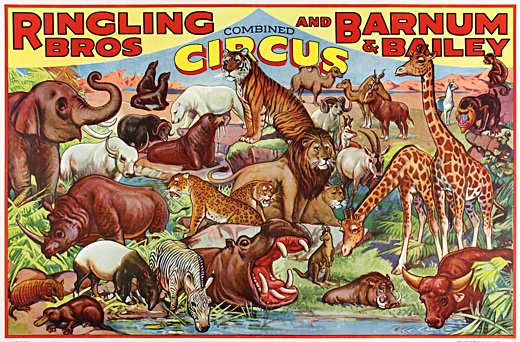
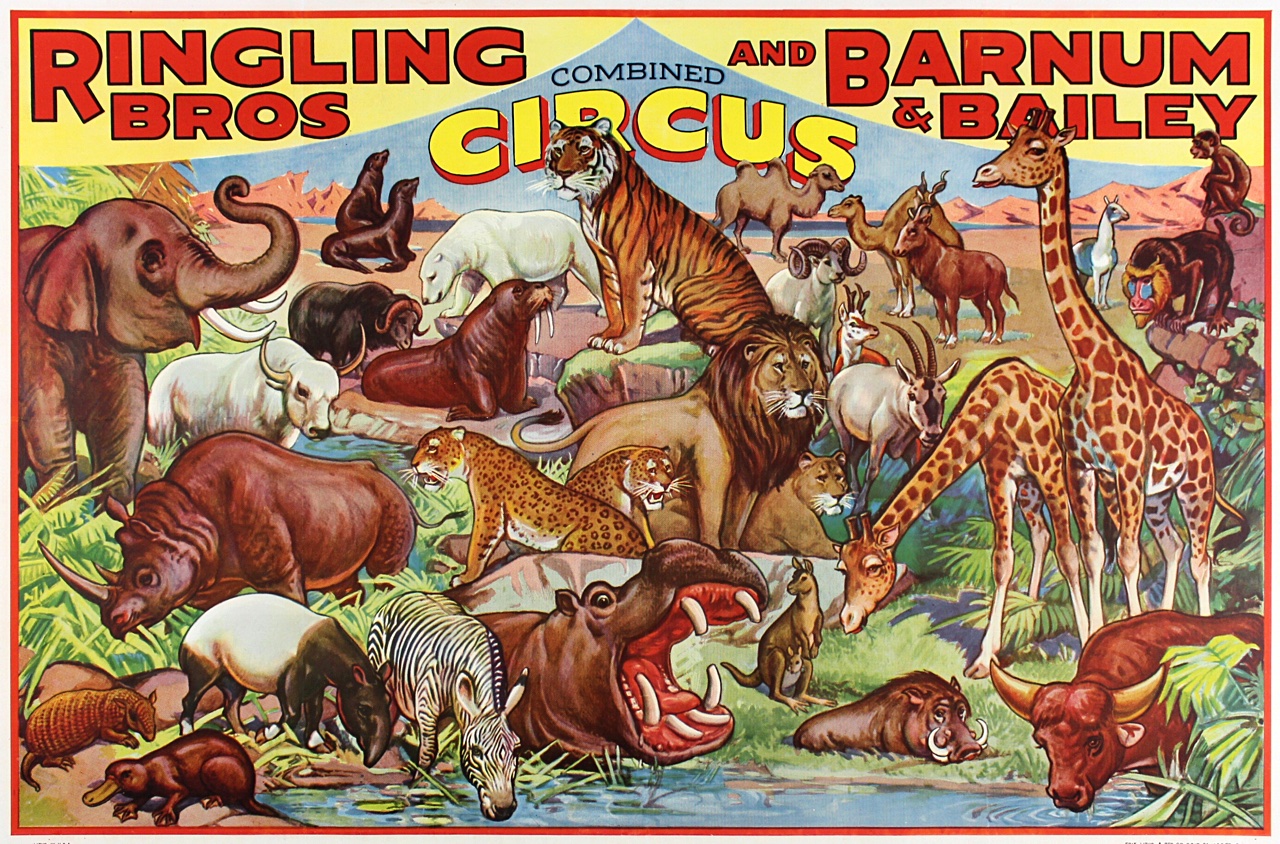
http://www.islandbreath.org/2017Year/05/170523circusbig.jpg
Image above: Poster of wild animals that were displayed by Ringling Bros Barnum & Bauley Circus. From (https://www.cinemasterpieces.com/circus.htm). Click to embiggen.

On May 31, 1866, John C. Ringling was born in Iowa to German immigrants in what felt like an extremely bleak year.

The chaos and devastation from the Civil War that had ended in 1865 were still keenly felt, and the US economy was in the midst of a deep recession

The country was still shaken from the assassination of Abraham Lincoln.

And the new President, Andrew Johnson, was embroiled in a major political crisis with Congress that would soon lead to his impeachment.

(Johnson was also a noted buffoon, once giving a speech in early 1866 to honor George Washington in which he referred to himself over 200 times and accused Congress of plotting his assassination.)

No doubt those were some of the darkest days in US history. And it would have been hard for Mr. and Mrs. Ringling to imagine a bright future for their children.

But John and four of his brothers went on to build the most successful circus empire in modern history– the Ringling Brothers and Barnum & Bailey Circus, known as the “Greatest Show on Earth.”

There were countless traveling circuses crisscrossing the United States in the 19th and early 20th centuries.

But what made the Ringling Brothers’ event so spectacular was sheer scale. They didn’t hold anything back– lions, tigers, elephants.

The Ringling brothers were also masters of efficient logistics.

Like Ray Kroc and Henry Ford, the brothers developed an assembly line approach to the construction, deconstruction, and transportation of their event so that they could swiftly move from town to town.

It was a spectacle itself simply to see their train of railway cars packed with exotic animals stretching on for more than a mile.

Their circus was considered the ultimate in entertainment back then, and John Ringling became one of the wealthiest men in America as a result of this success.

It seemed like the empire would last forever.
But it didn’t.

After peaking in the Roaring 20s, the circus took a major hit during the Great Depression that effectively bankrupted John Ringling, the sole surviving brother.

At the time of his death in 1936, in fact, Ringling only had about $5,500 in the bank (that’s after adjusting for inflation to 2017 dollars).

The circus limped along in the Depression and barely made it through World War II.

Towards the end of the War in 1944, right before they thought their luck would turn, the circus had a major accident in Hartford in which the tent caught fire, killing 167 people.

That nearly bankrupted the company a second time, and several executives went to jail for negligence.

In the decades that followed, American consumer tastes changed.

Television, movies, and music were far more interesting than circus performances, and Ringling Brothers went into terminal decline.

Fast forward to the age of Facebook and YouTube, and there simply wasn’t a whole lot left in the circus that was exotic or interesting anymore, not to mention the animal rights issues.

So yesterday, the Greatest Show on Earth held its final performance in Uniondale, New York, after 146-years in the business.

A century ago this would have seemed impossible.

The early 1900s were the absolute peak for Ringling Brothers, and no one imagined a future where consumers weren’t standing in line to buy tickets.

Candidly I find this story to be an interesting metaphor for the United States itself.

Rise from the ashes. Remarkable growth. Peak wealth and power. Bankruptcy. Gross negligence and incompetence. More bankruptcy. Terminal decline.

And just like how people viewed Ringling Brothers 100-years ago, it’s difficult for anyone to imagine a world in which the US isn’t the dominant superpower.

Instead of the Greatest Show on Earth, it’s the Greatest Country on Earth. And most of us have been programmed to believe that this primacy will last forever.

But nothing lasts. History is full of failed dominant superpowers, from the Roman Empire to the Ottoman Empire. Many no longer exist.

Their declines were almost invariably due to excessive spending, unsustainable debt, military overreach, and a society that abandoned the core values which made it wealthy and powerful to begin with.

Every successive superpower always believes that they will never suffer the same fate. And every time they’re wrong.

This time is not different.

Yes, it’s still a wonderful country with plenty of positive things going for it.

But at its core the United States still has $20 trillion in public debt (over 100% of GDP) and an additional $46.7 trillion in net, unfunded future social obligations (like Social Security and Medicare).

Plus, the government spends an appalling amount of money, far more than they collect in tax revenue.
(In 2016 their total net loss exceeded an incredible $1 TRILLION.)

Former Treasury Secretary Larry Summers summed it up when he quipped, “How long can the world’s biggest borrower remain the world’s biggest power?”

The answer is– no one knows. Maybe months. Maybe decades.

Either way, this trend is one of the biggest stories of our time. And though few people want to acknowledge it, it’s already happening.

We now regularly witness government shutdowns, debt ceiling crises, and gross government incompetence. But this is just the beginning.

The national debt is growing far faster than the economy as a whole. And, especially if interest rates continue to rise, the trend will accelerate.

It’s simple arithmetic.

So while it seems impossible now, the Greatest Country on Earth will some day have its final show as well. That doesn’t mean the US simply disappears.

But it’s foolish to assume that the insolvency of the world’s largest superpower will forever be consequence-free.

What’s your Plan B?
Do you have a Plan B?

If you live, work, bank, invest, own a business, and hold your assets all in just one country, you are putting all of your eggs in one basket.

You’re making a high-stakes bet that everything is going to be ok in that one country — forever.

All it would take is for the economy to tank, a natural disaster to hit, or the political system to go into turmoil and you could lose everything—your money, your assets, and possibly even your freedom.
.
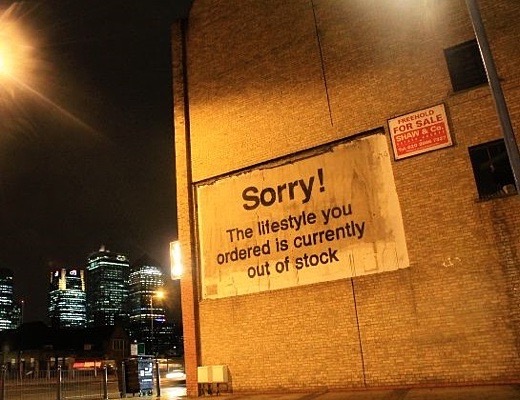
This lifestyle out is of stock

SUBHEAD: Dear Imperial America, the lifestyle you ordered is unavailable and permanently out of stock.

By Charles Hugh Smith on 15 February 2017 for Of Two Minds -
(http://www.oftwominds.com/blogfeb17/elites-empire2-17.html)


Image above: Mashup of lifestyle announcment on side of building. From original article.

Dear Imperial America: Sorry, the lifestyle you ordered is unavailable and permanently out of stock.

Our extraordinary misallocation of national treasure and political power has set a banquet of consequences that few are willing to face, much less address head-on. If we had to sum up this vast misallocation, we might start by characterizing it as the result of a multitude of elites playing Empire with money borrowed from future generations.

We can start the list of extraordinary misallocations of national treasure with the Neocon's endless wars of choice. Ten years ago, estimates of the total cost of the Iraq misadventure were $3 trillion: Cost of Iraq War: $3 Trillion; Cost of Solar Plants to Power all 105 million U.S Households: $500 Billion (April 10, 2008)

(Yes, I know solar energy is not "the solution" due to intermittency, lack of storage, fossil fuels are needed to build and maintain the solar infrastructure, etc.--but the point is: would we be better off if we'd invested 20% of the money squandered on the Iraq misadventure on alternative energy, even with all its limitations?)

But this does not exhaust the list of extraordinary misallocations of treasure. Universities have found the funds to build grand edifices on campus (never mind the trillion dollars in student loan debt that funded the delusions of grandeur) while much of the rest of our educational infrastructure crumbles as deferred maintenance takes its inevitable toll.

Public transit systems such as the San Francisco Bay Area's BART always find the funds to pay for hefty raises and gold-plated benefits for employees and managers, meanwhile the system's core has crumbled due to--you guessed it--hundreds of millions of dollars in long-deferred maintenance.

While employee wages, benefits and pensions dominate local government outlays, maintenance is funded by selling bonds, which cost twice as much over the long run due to interest and other costs.

Where cities and counties once funded school maintenance and filling potholes out of tax receipts, now many locales demand taxpayers approve tens of millions of dollars in new bonds to pay for these basic infrastructure maintenance projects.

It has reached the point that even maintaining city parks requires borrowing millions.

Political elites have found that promising the impossible--lower taxes and increased benefits/entitlements--keeps them in power, and as long as the credit spigot of new government borrowing is wide open, there are no limits on how many more trillions of dollars in future interest payments can be promised to win re-election today.

The fact that this sets a toxic banquet of consequences for future taxpayers and beneficiaries--no worries, some future politico will have to sit down at that banquet.

Political and financial elites have lined their own pockets and insured the continuity of their own power by deferring boring, unsexy, you-get-no-votes-for-this maintenance. Want to be "popular" and win re-election?

Ram through sexy new projects such as "affordable" housing (i.e. costly housing subsidized by taxpayers), extensions in mass transit lines, fancy new stadiums and student-services buildings--and pay for it all with borrowed money and by slashing boring, unsexy maintenance work.

The drama of the Oroville Dam is tied directly to the deferral of rountine maintenance: What You Need To Know About The Oroville Dam Crisis (interview with a civil engineering expert and Chris Martenson)

While we must ask cui bono (to whose benefit?) of scare-mongering estimates of deferred maintenance (one person's "required infrastructure" could be another person's pork-barrel project awarded as payback for political contributions), many of us can see a crumbling empire of deferred maintenance with our own eyes.

I can personally attest to city streets that were potholed 20 years ago that finally got repaved--but only after taxpayers agreed to pay double by borrowing millions for routine street maintenance that was previously paid out of tax revenues.

I see spalling concrete (concrete falling off due to rusting rebar) at major international airports, university buildings that are flooded due to poor drainage that should have been addressed decades ago, water mains that burst, sewer lines that are decades past their replacement date--the list is truly endless.

Dear Imperial America: the lifestyle you ordered is permanently out of stock. The banquet of consequences has already been served, and will only become more distasteful the longer we put off facing our skyrocketing debt, runaway elites and delusions of grandeur head-on.

.

2017: Where the Truth Lies

SUBHEAD: And there’s no doubt that Trump is an iceberg-sized gamble, but a change had to come.

By Raul Ilargi Meijer on 27 December 2016 in the Automatic Earth -
(https://www.theautomaticearth.com/2016/12/2017-where-the-truth-lies/)


Image above: Donald Trump's version of reality is "Trumpth". Mashup by Juan Wilson. From (http://www.documentarytube.com/articles/7-scary-realities-for-americans-with-donald-trump-as-president). Click to embiggen.

I was surprised to see how surprised I was, like I’m sure millions of people were, to see the term ‘fake news’ pop up in what are still called ‘respectable’ (which is by now really just another word for ‘old’) news outlets.

Because a huge part of what they have been feeding their readers and viewers for years is that very thing: fake news. Who needs a bunch of bored highschool kids in small town Montenegro when you have the offices of America’s ‘official’ news sources at your disposal?

That there are still people trying to make a serious point by quoting anything at all published in the Washington Post -and to an only slightly lesser extent the New York Times- is beyond me. And not a little bit beyond. Well, that people still read these sheets is just as incredible, I grant you that.

I haven’t kept count of the number of ‘articles’ the WaPo has published over the past year or so -the election campaign- that referred to unsubstantiated reports emanating from anonymous US intelligence sources about Russian involvement in everything bad under the sun, but I’m dead certain that put together they would add up to a Christmas bestseller of respectable size.

A chance missed there, gents. You could have had your own garbage lead your own bestseller lists. Snake, tail.

And it’s not as if it was a new thing for them either, what’s new is the sheer volume and the concerted campaign we’re talking about. We of course had a similar thing in 2003 with the Weapons of Mass Destruction ‘fantasy’. Now that I mention it, how is it possible that Colin Powell is still walking around free, and Cheney and W.?

When did it become de rigueur to lie to the people, let alone Congress and the UN? What have we become? When did that happen? Remember Ukraine, and the stories you were told about that, less than 3 years ago? Crimea? G-d I hope Trump will get rid of Victoria Nuland.

Trump called the UN a sad club for people to “get together, talk and have a good time”. Is he wrong? Really? If so, do tell, how wrong is he? Perhaps wrong in the same way that the IMF is wrong for letting Christine Lagarde keep her plush tax-free seat after being convicted for handing €400 million in French taxpayer money to a crony? That kind of wrong?

I’m thinking there are still awfully few people who understand what’s happening in the world. What’s changing. And I don’t hold out much hope that they will until it hits them smack upside the backs of their heads.

Why there’s Trump and Brexit, and why many more changes are in the offing. Well, it’s precisely because the UN and EU and IMF and Capitol Hill are self-serving ‘clubs’ filled with unaccountable and overpaid people who have turned the world into a godawful mess.

Not for themselves, they’re fine, thank you very much, they all have pensions from here to Rome and back again for the rest of their lives, but for everyone else. God, I hope Trump will come through on his pre-election promise to limit the terms of American Congressmen and Senators. And that this is subsequently applied to all these ‘clubs’. Because if anything, it’s them who are the bane of this world. Public service…

There may be fine individuals among them, that’s not even -the worst of- the point, it’s the dilapidated, decayed, rotten to the core institutions that they ‘serve’ which are the problem. They serve themselves and they serve the institutions, the one thing they sure don’t serve is the people.

You know who’s given (‘voted’) them those lavish pensions and benefits? They themselves did, and their predecessors.

The UN is supposed to keep the peace in the world. Well, works like a charm, doesn’t it? The IMF is tasked with keeping 200 or so nations in reasonably balanced economic conditions. Got it down.

The US Congress was set up as a pillar of democracy, but it’s occupied by guys and gals who spend so much more time raising funds for their next campaign than representing those who voted them in, that they need lobbyists to tell them which way to vote.

As for the EU, is it even possible they’re the worst of the bunch? Europe is falling apart before all of our eyes, and they’re all in full tard denial about it.

They are turning Greece into a third world country, they’re alienating Britain to the point where the English will, once they wake up to what’s going on, want to set Brussels on fire. And why? There’s no point left to any of it at all.

Italy’s a goner, once enough Italians realize what the ECB wants to do to their banks. France is such a key member nobody wants to even imagine it falling, so its broke banks are ignored. Holland will come very close to voting in Wilders, which means Nexit. Germany is destabilizing rapidly. Spain has been a hornets’ nest for years. Etc.

And again: why? Well, because the Obama/Merkel model has so dramatically failed. All these places where left and right work together to produce a shapeless blob somewhere in the center that has no identity and doesn’t speak out for anyone.

You just wouldn’t know it from reading the Washington Post. Or any comparable old and respected medium in any of these European countries. It’s not just the politics that have failed, it’s its propaganda machine too.

This is something that manifests itself differently in different places, but it shouldn’t be that hard to see the ties that bind it all together. For one thing, because, not even touched on so far, the amount of fake financial news that has been forced down our throats for decades, and increasingly so: the worse things get, the bigger the lie…

There is no economic recovery. Never was. Not in the US, not in Europe anywhere. It’s a fairy tale. There are plates shifting, sure. You can cherry pick a region stateside that does well if only you select the ‘right’ stats. Like you can say employment is on a roll, if you’re willing to discard the number of ‘newly created’ jobs that are part time.

And yes, if you just completely ignore that 94 million Americans are not counted at all in unemployment numbers, Obama has been a big success. It’s just that those 94 million have a vote, too. We will see that exact same dynamic, and we have already started, play out all across Europe.

It’ll be much messier, for instance because in Holland last time I looked 81 different political parties were vying to take part in the upcoming elections, but the end result will be the same. That is, the existing order will be voted out.

Not everywhere, and it won’t be replaced by radically different parties and people in all places, but do please understand that it doesn’t have to.

In Europe, it’s not and/and, it’s if/or. As in, if either Italy or France or Holland vote in a party that wants to leave the EU or the Euro, it’s game over. The endgame will be almighty messed up because of all the laws and regulations the EU has invented, but eventually the walls of Brussels will crumble.

Good riddance too.

I’ve said it a hundred times before, all the institutions mentioned before, EU, IMF, UN and yes, even Congress, exist by the grace of growth. People accept them only as long as they can show reasonable proof that they bring economic benefits. As soon as that’s gone (or I should say as soon as people figure it out), so are they.

People are going to vote for someone close to their own lives, their own world, to lead them in times of contraction. That is inevitable. It’s why Trump won, and it’s also why he’s set to fail. Isn’t that a lovely paradox? We’re going to split up into smaller entities, economic contraction guarantees it.

And while everyone tries to talk you into thinking that’s terrible, there’s no reason why it should be.

We can work together in many different ways.

All these supranational institutions have merely become straight jackets that serve only the people who work inside them and those outside who benefit from keeping up appearances and clinging to power.

That of course gets us back to the Washington Post and its comatose brethren. The US press has been a full accomplice with Washington in reporting fake news about the recovery, and it’s not there. Never has been.

The Dow Jones says one thing, the votes for Trump say another. In the end, democracy is that simple. Same goes for Britain, same goes for continental Europe.

And there’s no doubt that Trump is an iceberg-sized gamble, but a change had to come. A change from the monsoon of fake news we have all been fed, but also initially a change that won’t be able to help itself from being replete with more fake news, from all sides.

Put it this way: in 2016, the engine of change got cranked up. In the new year, it will accelerate. That is 2017. That is what the new year will bring.

.

A pleasant lull

SUBHEAD: We’d rather crash and burn than change anything about our behavior, or even our perception.


By James Kunstler on 5 September 2016 for Kunstler.com -
(http://kunstler.com/clusterfuck-nation/a-pleasant-lull/)


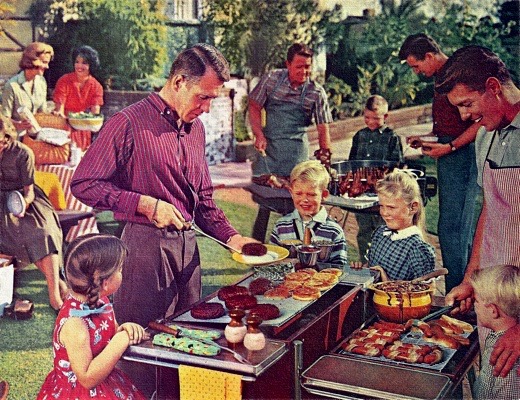
Image above: Illustration of a classic backyard American holiday barbecue. From (https://rogerwilkersonblog.wordpress.com/tag/cookout/page/2/).

A pleasant lull lies over the land where today fewer people labor honestly — and some labor gruelingly for too little — while a matrix of rackets sustains the illusion that our living arrangements have a future.

Is Quarterback Colin Kaepernick on the minds of the millions moiling around their backyard barbeques?

I applaud his refusal to stand for the national anthem, though not for the reasons he stated. Rather, because I’m sick of vulgar symbolism in a dark moment of a fraying culture that demands more than cheap talk and lame gestures.

In case you’re wondering, the reason we’re subject to all these repetitions of The Star Spangled Banner is not for love-of-country but something quite the opposite: the fear that its promises are empty.

Ever wonder why every public official in the land has to wear a flag lapel pin? Should it be necessary for the president of the US to signal his devotion to duty?

Wouldn’t we normally just assume this to be the case?

No, it signals the widespread and generalized anxiety that the national condition is dire and that we don’t have the confidence or the clarity to face the challenges of the time. President Obama might as well wear a crucifix or a bulb of garlic in his lapel.

In this presidential election year especially, Labor Day serves as a sort of collective deep breath before the plunge into a season of political anguish. The number of potential voters disgusted with the choice between two clueless monsters of egotism must be epic.

If WalMart held a sale on bullshit filters, they might stand a chance of turning a Q3 profit. Otherwise, expect economic performance to be increasingly frightening even if The New York Times and CNN continue to spin out tales of unicorns jumping rainbows.

Events, not personalities, are going to demonstrate where things are at in the late-stage techno-industrial crack-up at hand. The shamans at the Federal Reserve have exhausted their repertoire of incantations for levitating the financial markets and, more ominously, the value of the US dollar.

The prankish god they serve has arranged things so that the very faith needed to sustain their illusory influence will run down the drain as November 8 creeps closer. They must be getting awfully nervous down at the Eccles Building.

The sudden bankruptcy of South Korea’s Hanjin Shipping Company ought to send shivers down the scaly spines of globalism’s cheerleaders. Fragility is everywhere in this unraveling network of gigantic, far-flung promises and obligations.

The former middle class of America has lost its ability to absorb anymore smart phones or Kardashian brand Pure Glitz hairspray©. They’re pacing grooves in the faux hardwood floors of their McHomes through reams of unpayable bills trying to stave off the re-po squad while Grandma slips into a diabetic coma.

These are the good folks who supposedly comprise 70 percent of the so-called economy, a.k.a. “consumers.” You can stick a fork in them — and maybe we’ll hear a few reports of that on Tuesday when the holiday barbeques smolder their last.

More concerning, though, are the conditions of the banks. When their true insolvency is revealed — which may coincide with the height of the election season — look out below.

The bankruptcy of one measly shipping company will look like a zit on the ass of a diving blue whale as countless trade operations seize up for lack of confidence that they will ever be paid. Then what?

Then we are forced to pay attention to the actual dynamics now at work in the world. Or be driven crazy by our refusal to get with the program. I tend to think we’ll opt for the latter.

We’re too unused to reality. We’d rather crash and burn than change anything about our behavior, or even our perception.

Both Trump and Hillary are perfect avatars for this date with a hard landing. The disorder both of them are capable of inducing will be a spectacle for the ages.

.

The Era of Bad Feeling

SUBHEAD: It is nothing like the TV ad fantasy of a lone luxury car plying a coastal highway in low, golden light.

By James Kunstler on 15 September 2014 for Kunstler.com -
(http://kunstler.com/clusterfuck-nation/the-era-of-bad-feeling/)


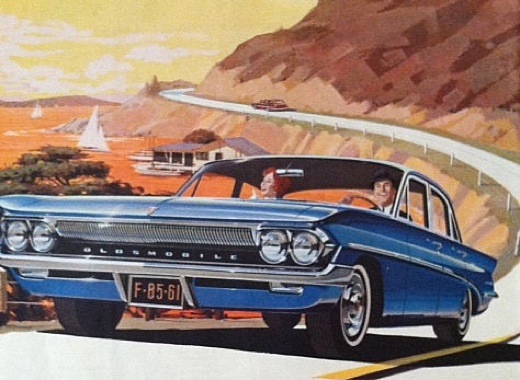
Image above: An illustrated magazine ad for a 1961 Oldsmobile F-85 cruising a coastal highway. Is that adman Don Draper and secretary Joan Halloway in the car? From (https://www.etsy.com/listing/166385345/vintage-ad-vintage-car-ad-vintage?ref=market).

There are times when events are in charge, not personalities. The unseen forces that hold the affairs of nations and economies in equilibrium dissolve, particles fly out of the many centers, and things heat up toward criticality.

Glance in the rear-view mirror and say goodbye to the Era of Wishful Thinking. This was the time when the USA was inspired by its Master Wish: to be able to keep driving to Wal-Mart forever. Looked at closely, the contemporary idea of Utopia was always a shabby package.

On one side, all the pointless driving. For most Americans it was nothing like the TV advertising fantasy of a lone luxury car plying a coastal highway in low, golden light. More like being stuck near the junction of I-55 and I-90 in Chicago at rush hour in July in an overheating Dodge Grand Caravan with three screaming ADD kids whose smart phone batteries just died — plus your fiercely over-filled bladder and no empty Snapple bottle to resort to.

On the other side, there’s the Wal-Mart part: the unbelievable cornucopia of insanely cheap plastic goodies, like, somewhere in the 1990s America became one giant loading dock for nearly free stuff. Wasn’t that fun? Now, everybody has got the full rig, from the flatscreen to the salad shooter, but we’re tired of seeing Kim Kardashian’s booty, and nobody really liked salad, even when you could shoot the stuff into a bowl.

The thrill is gone, and so is the paycheck that was your ticket to the orgy. It’s especially gloomy over in the food department, where the boxes of Lucky Charms are suddenly half the weight and twice the price. And that was going to be the family dinner! Must be Nature’s way of telling you it’s time for a new tattoo.

In this weird liminal time since the so-called Crash of 2008 leadership has depended on lies and subterfuges to prop up the illusion of resilience. One biggie is the shale oil revolution, kind of a national parlor trick to wow the multitudes for a long enough moment to convince them that their troubles with the national energy supply are over.

Even people paid to think were hosed on this one. Wait until they discover that the shale oil producers have never made a buck producing shale oil, only on the sale of leases and real estate to “greater fools” and creaming off the froth of the complex junk financing deals behind their exertions.

Expect that mirage to dissipate in the next 24 months, perhaps sooner if the price of oil keeps sinking toward the sub $90-a-barrel level, where there’s no economically rational reason to bother drilling and fracking.

The lies, frauds, and cons run between the axis of Wall Street and Washington had two fatal consequences with still-lagging effects.
  1. They destroyed the capacity for markets to establish the real price of anything — rendering markets useless.
  2. They disabled capital formation to the degree that we might not have the money to rebuild an economy to replace the “financialized” matrix of rackets that currently pretends to function. 
 A lot of observers like myself have been waiting for the moment when the fog of pretense lifts and exposes all the broken machinery within. We may be so close now that you can smell it.

Change is in the air, literally, as we wake this still-summer morning with the thermometer so low you wish the furnace was prepped and ready to run. Much is in the air, too, where the news of events near and far provoke swirls of transformation in the disposition of people, nations, and affairs. Who would have guessed a few years ago how nervous Scotland would make the whole Western world?

The sharpies at the Pentagon, and the White House, and the CIA may be waiting with indigestion and palpitations for the next ISIS decapitation video, but maybe you have to wonder instead which of five thousand shopping malls across this land will be visited by black-flagged desperados armed with automatic rifles and RPG’s.

Finally, there are the people themselves of this sclerotic polity: too dumb and distracted to help themselves, full of inchoate grievance and resentment, tending ever deeper into darkness. Welcome to the season of the witch in the Era of Bad Feeling. Somewhere “out there” there is a light of virtue waiting for us, but we are a long way from finding our way to it.

.

Refusing the Call

SUBHEAD: Updating the parable of the Hobbit and the Lord of the Rings to our predicament.

By John Michael Greer on 23 April 2014 for the Archdruid Report -
(http://thearchdruidreport.blogspot.com/2014/04/refusing-call-tale-rewritten.html)


Image above: Gandalf tries to entice Frodo Baggins to join an adventure. Still frame from the movie "The Hobbit: An Unexpected Journey".  From (http://inthenameofageek.blogspot.com/2012/12/the-hobbit-unexpected-journey-review.html).

I have been wondering for some time now how to talk about the weirdly autumnal note that sounds so often and so clearly in America these days.

Through the babble and clatter, the seven or eight television screens yelling from the walls of every restaurant you pass and all the rest of it, there comes a tone and a mood that reminds me of wind among bare branches and dry leaves crackling underfoot.

It's as though even the people who insist most loudly that it’s all onward and upward from here don’t believe it any more, and those for whom the old optimism stopped being more than a soothing shibboleth a long time ago are hunching their shoulders, shutting their eyes tight, and hoping that things can still hold together for just a little while longer.

It’s not just that American politicians and pundits are insisting at the top of their lungs that the United States can threaten Russia with natural gas surpluses that don’t exist, though that’s admittedly a very bad sign all by itself.

It’s that this orgy of self-congratulatory nonsense appears in the news right next to reports that oil and gas companies are slashing their investments in the fracking technology and shale leases that were supposed to produce those imaginary surpluses, having lost a great deal of money pursuing the shale oil mirage, while Russia and Iran pursue a trade deal that will make US sanctions against Iran all but irrelevant, and China is quietly making arrangements to conduct its trade with Europe in yuan rather than dollars.

Strong nations in control of their own destinies, it’s fair to note, don’t respond to challenges on this scale by plunging their heads quite so enthusiastically into the sands of self-deception.

To shift temporal metaphors a bit, the long day of national delusion that dawned back in 1980, when Ronald Reagan famously and fatuously proclaimed “it’s morning in America,” is drawing on rapidly toward dusk, and most Americans are hopelessly unprepared for the coming of night.

They’re unprepared in practical terms, that is, for an era in which the five per cent of us who live in the United States will no longer dispose of a quarter of the world’s energy supply and a third of its raw materials and industrial products, and in which what currently counts as a normal American lifestyle will soon be no more than a fading memory for the vast majority.

They’re just as unprepared, though, for the psychological and emotional costs of that shattering transformation—not least because the change isn’t being imposed on them at random by an indifferent universe, but comes as the inevitable consequence of their own collective choices in decades not that long past.

The hard fact that most people in this country are trying not to remember is this: in the years right after Reagan’s election, a vast number of Americans enthusiastically turned their backs on the promising steps toward sustainability that had been taken in the previous decade, abandoned the ideals they’d been praising to the skies up to that time, and cashed in their grandchildrens’ future so that they didn’t have to give up the extravagance and waste that defined their familiar and comfortable lifestyles.

As a direct result, the nonrenewable resources that might have supported the transition to a sustainable future went instead to fuel one last orgy of wretched excess. Now, though, the party is over, the bill is due, and the consequences of that disastrous decision have become a massive though almost wholly unmentionable factor in our nation’s culture and collective psychology.

A great many of the more disturbing features of contemporary American life, I’m convinced, can’t be understood unless America’s thirty-year vacation from reality is taken into account. A sixth of the US population is currently on antidepressant medications, and since maybe half of Americans can’t afford to get medication at all, the total number of Americans who are clinically depressed is likely a good deal higher than prescription figures suggest.

The sort of bizarre delusions that used to count as evidence of serious mental illness—baroque conspiracy theories thickly frosted with shrill claims of persecution, fantasies of imminent mass death as punishment for humanity’s sins, and so on—have become part of the common currency of American folk belief.

For that matter, what does our pop culture’s frankly necrophiliac obsession with vampires amount to but an attempt, thinly veiled in the most transparent of symbolism, to insist that it really is okay to victimize future generations for centuries down the line in order to prolong one’s own existence?

Mythic and legends such as this can be remarkably subtle barometers of the collective psyche. The transformation that turned the vampire from just another spooky Eastern European folktale into a massive pop culture presence in industrial North America has quite a bit to say about the unspoken ideas and emotions moving through the crawlspaces of our collective life.

In the same way, it’s anything but an accident that the myth of the heroic quest has become so pervasive a presence in the modern industrial world that Joseph Campbell could simply label it “the monomyth,” the basic form of myth as such.

In any sense other than a wholly parochial one, of course, he was quite wrong—the wild diversity of the world’s mythic stories can’t be forced into any one narrative pattern—but if we look only at popular culture in the modern industrial world, he’s almost right.

The story of the callow nobody who answers the call to adventure, goes off into the unknown, accomplishes some grand task, and returns transformed, to transform his surroundings in turn, is firmly welded into place in the imagination of our age.

You’ll find it at the center of J.R.R. Tolkien’s great works of fantasy, in the most forgettable products of the modern entertainment industry, and everything in between and all around.

Yet there’s a curious blind spot in all this: we hear plenty about those who answer the call to adventure, and nothing at all about those who refuse it. Those latter don’t offer much of a plot engine for an adventure story, granted, but such a tale could make for a gripping psychological study—and one that has some uncomfortably familiar features.

With that in mind, with an apology in the direction of Tolkien’s ghost, and with another to those of my readers who aren’t lifelong Tolkien buffs with a head full of Middle-earth trivia—yes, I used to sign school yearbooks in fluent Elvish—

I’d like to suggest a brief visit to an alternate Middle-earth: one in which Frodo Baggins, facing the final crisis of the Third Age and the need to leave behind everything he knew and loved in order to take the Ring to Mount Doom, crumpled instead, with a cry of “I can’t, Gandalf, I just can’t.” Perhaps you’ll join me in a quiet corner of The Green Dragon, the best inn in Bywater, take a mug of ale from the buxom hobbit barmaid, and talk about old Frodo, who lived until recently just up the road and across the bridge in Hobbiton.

You’ve heard about the magic ring he had, the one that he inherited from his uncle Bilbo, the one that Gandalf the wizard wanted him to go off and destroy? That was thirty years ago, and most folk in the Shire have heard rumors about it by now.

Yes, it’s quite true; Frodo was supposed to leave the Shire and go off on an adventure, as Bilbo did before him, and couldn’t bring himself to do it. He had plenty of reasons to stay home, to be sure. He was tolerably well off and quite comfortable, all his friends and connections were here, and the journey would have been difficult and dangerous.

Nor was there any certainty of success—quite the contrary, it’s entirely possible that he might have perished somewhere in the wild lands, or been caught by the Dark Lord’s servants, or what have you.

So he refused, and when Gandalf tried to talk to him about it, he threw the old wizard out of Bag End and slammed the round green door in his face. Have you ever seen someone in a fight who knows that he’s in the wrong, and knows that everyone else knows it, and that knowledge just makes him even more angry and stubborn? That was Frodo just then.

Friends of mine watched the whole thing, or as much of it as could be seen from the garden outside, and it was not a pleasant spectacle.

It’s what happened thereafter, though, that bears recalling. I’m quite sure that if Frodo had shown the least sign of leaving the Shire and going on the quest, Sauron would have sent Black Riders after him in a fine hurry, and there’s no telling what else might have come boiling up out of Mordor.

It’s by no means impossible that the Dark Lord might have panicked, and launched a hasty, ill-advised assault on Gondor right away.

For all I know, that may have been what Gandalf had in mind, tricking the Dark Lord into overreacting before he’d gathered his full strength, and before Gondor and Rohan had been thoroughly weakened from within.

Still, once Sauron’s spies brought him word that Frodo had refused to embark on the quest, the Dark Lord knew that he had a good deal less to fear, and that he could afford to take his time.

Ever since then, there have been plenty of servants of Mordor in and around the Shire, and a Black Rider or two keeping watch nearby, but nothing obvious or direct, nothing that might rouse whatever courage Frodo might have had left or convince him that he had to flee for his life.

Sauron was willing to be patient—patient and cruel. I’m quite sure he knew perfectly well what the rest of Frodo’s life would be like.

So Gandalf went away, and Frodo stayed in Bag End, and for years thereafter it seemed as though the whole business had been no more than a mistake. The news that came up the Greenway from the southern lands was no worse than before; Gondor still stood firm, and though there was said to be some kind of trouble in Rohan, well, that was only to be expected now and then.

Frodo even took to joking about how gullible he’d been to believe all those alarmist claims that Gandalf had made. Sauron was still safely cooped up in Mordor, and all seemed right with Middle-earth.

Of course part of that was simply that Frodo had gotten even wealthier and more comfortable than he’d been before. He patched up his relationship with the Sackville-Bagginses, and he invested a good deal of his money in Sandyman’s mill in Hobbiton, which paid off handsomely.

He no longer spent time with many of his younger friends by then, partly because they had their own opinions about what he should have done, and partly because he had business connections with some of the wealthiest hobbits in the Shire, and wanted to build on those.

He no longer took long walks around the Shire, as he’d done before, and he gave up visiting elves and dwarves when he stopped speaking to Gandalf.

But of course the rumors and news from the southern lands slowly but surely turned to the worse, as the Dark Lord gathered his power and tightened his grip on the western lands a little at a time. I recall when Rohan fell to Saruman’s goblin armies.

That was a shock for a great many folk, here in the Shire and elsewhere. Soon thereafter, though, Frodo was claiming that after all, Saruman wasn’t Sauron, and Rohan wasn’t that important, and for all anyone knew, the wizard and the Dark Lord might well end up at each other’s throats and spare the rest of us.

Still, it was around that time that Frodo stopped joking about Gandalf’s warnings, and got angry if anyone mentioned them in his hearing. It was around that same time, too, that he started insisting loudly and often that someone would surely stop Sauron.

One day it was the elves: after all, they had three rings of power, and could surely overwhelm the forces of Mordor if they chose to. Another day, the dwarves would do it, or Saruman, or the men of Gondor, or the Valar in the uttermost West. There were so many alternatives! His friends very quickly learned to nod and agree with him, for he would lose his temper and start shouting at them if they disagreed or even asked questions.

When Lorien was destroyed, that was another shock. It was after that, as I recall, that Frodo started hinting darkly that the elves didn’t seem to be doing anything with their three rings of power to stop Sauron, and maybe they weren’t as opposed to him as they claimed. He came up with any number of theories about this or that elvish conspiracy.

The first troubles were starting to affect the Shire by then, of course, and his investments were beginning to lose money; it was probably inevitable that he would start claiming that the conspiracy was aimed in part against hobbits, against the Shire, or against him in particular—especially the latter. They wanted his ring, of course. That played a larger and larger role in his talk as the years passed.

I don’t recall hearing of any particular change in his thinking when word came that Minas Tirith had been taken by the Dark Lord’s armies, but it wasn’t much later that a great many elves came hurrying along the East Road through the Shire, and a few months after that, word came that Rivendell had fallen.

That was not merely a shock, but a blow; Frodo had grown up hearing his uncle’s stories about Rivendell and the elves and half-elves who lived there. There was a time after that news came that some of us briefly wondered if old Frodo might actually find it in himself to do the thing he’d refused to do all those years before.

But of course he did nothing of the kind, not even when the troubles here in the Shire began to bite more and more deeply, when goblins started raiding the borders of the North Farthing and the Buckland had to be abandoned to the Old Forest. No, he started insisting to anyone who would listen that Middle-earth was doomed, that there was no hope left in elves or dying Númenor, that Sauron’s final victory would surely come before—oh, I forget what the date was; it was some year or other not too far from now.

He spent hours reading through books of lore, making long lists of reasons why the Dark Lord’s triumph was surely at hand. Why did he do that? Why, for the same reason that drove him to each of his other excuses in turn: to prove to himself that his decision to refuse the quest hadn’t been the terrible mistake he knew perfectly well it had been.

And then, of course, the Ring betrayed him, as it betrayed Gollum and Isildur before him. He came home late at night, after drinking himself half under the table at the Ivy Bush, and discovered that the Ring was nowhere to be found.

After searching Bag End in a frantic state, he ran out the door and down the road toward Bywater shouting “My precious! My precious!” He was weeping and running blindly in the night, and when he got to the bridge he stumbled; over he went into the water, and that was the end of him. They found his body in a weir downstream the next morning.

The worst of it is that right up to the end, right up to the hour the Ring left him, he still could have embarked on the quest. It would have been a different journey, and quite possibly a harder one. With Rivendell gone, he would have had to go west rather than east, across the Far Downs to Cirdan at the Grey Havens, where you’ll find most of the high-elves who still remain in Middle-earth.

From there, with such companions as might have joined him, he would have had to go north and then eastward through Arnor, past the ruins of Annuminas and Lake Evendim, to the dales of the Misty Mountains, and then across by one of the northern passes: a hard and risky journey, but by no means impossible, for with no more need to hinder travel between Rivendell and Lorien, the Dark Lord’s watch on the mountains has grown slack.

Beyond the mountains, the wood-elves still dwell in the northern reaches of Mirkwood, along with refugees from Lorien and the last of the Beornings. He could have gotten shelter and help there, and boats to travel down the River Running into the heart of Wilderland. From there his way would have led by foot to the poorly guarded northern borders of Mordor—when has Sauron ever had to face a threat from that quarter?

So you see that it could have been done. It could still be done, if someone were willing to do it. Even though so much of what could have been saved thirty years ago has been lost, even though Minas Tirith, Edoras, Lorien and Rivendell have fallen and the line of the kings of Gondor is no more, it would still be worth doing; there would still be many things that could be saved.

Nor would such a journey have to be made alone. Though Aragorn son of Arathorn was slain in the last defense of Rivendell, there are still Rangers to be found in Cirdan’s realm and the old lands of Arnor; there are elf-warriors who hope to avenge the blood shed at Rivendell, and dwarves from the Blue Mountains who have their own ancient grudges against the Dark Lord.

The last free Rohirrim retreated to Minhiriath after Éomer fell at Helm’s Deep, and still war against King Grima, while Gondor west of the river Gilrain clings to a tenuous independence and would rise up against Sauron at need. Would those and the elves of Lindon be enough? No one can say; there are no certainties in this business, except for the one Frodo chose—the certainty that doing nothing will guarantee Sauron’s victory.

And there might even still be a wizard to join such a quest. In fact, there would certainly be one—the very last of them, as far as I know. Gandalf perished when Lorien fell, I am sorry to say, and as for Saruman, the last anyone saw of him, he was screaming in terror as two Ringwraiths dragged him through the door of the Dark Tower; his double-dealing was never likely to bring him to a good end.

The chief of the Ringwraiths rules in Isengard now. Still, there was a third in these western lands: fool and bird-tamer, Saruman called him, having never quite managed to notice that knowledge of the ways of nature and the friendship of birds and beasts might have considerable value in the last need of Middle-earth. Radagast is his name; yes, that would be me.

Why am I telling you all this? Well, you are old Frodo’s youngest cousin, are you not? Very nearly the only one of his relatives with enough of the wild Tookish blood in you to matter, or so I am told. It was just a month ago that you and two of your friends were walking in the woods, and you spoke with quite a bit of anger about how the older generation of hobbits had decided to huddle in their holes until the darkness falls—those were your very words, I believe.

How did I know that? Why, a little bird told me—a wren, to be precise, a very clever and helpful little fellow, who runs errands for me from time to time when I visit this part of Middle-earth. If you meant what you said then, there is still hope.

And the Ring? No, it was not lost, or not for long. It slipped from its chain and fell from old Frodo’s pocket as he stumbled home that last night, and a field mouse spotted it. I had briefed all the animals and birds around Hobbiton, of course, and so she knew what to do; she dragged the Ring into thick grass, and when dawn came, caught the attention of a jay, who took it and hid it high up in a tree. I had to trade quite a collection of sparkling things for it!

But here it is, in this envelope, waiting for someone to take up the quest that Frodo refused.

The choice is yours, my dear hobbit. What will you do?

.

Golden Era of the 1950-60s

SUBHEAD: The 1950s and 60s were not "normal". They were a one-off period -  an extraordinary anomaly.

By Charles Hugh Smith on 28 March 2014 for Of Two Minds -
(http://www.oftwominds.com/blogmar14/50s-anomaly3-14.html)


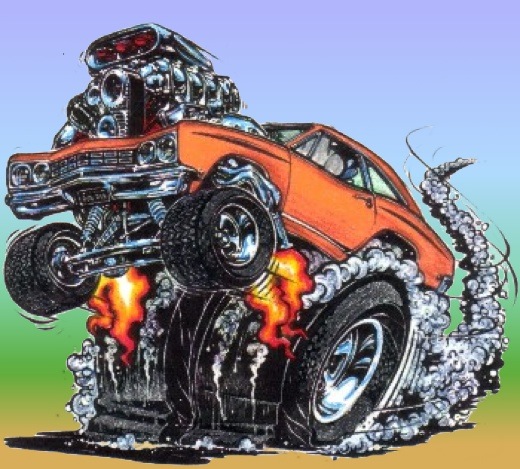
Image above: The 1968 Roadrunner was built for heavy duty street racing. A favorite of moonshiners. Illustration oby Ed Big Daddy Roth. From (http://www.vsrnonline.com/bdr_ads/WeldonArt_1.htm).

If there is one thing that unites trade unionists, Keynesian Cargo Cultists, free-market fans and believers in American exceptionalism, it's a misty-eyed nostalgia for the Golden Era of the 1950s and 60s, when one wage-earner earned enough to buy all the goodies of a middle-class lifestyle because everything was cheap. Food was cheap, land was cheap, houses were cheap, college was cheap and most importantly, oil was cheap.

The entire political spectrum looks back at this Golden Age with longing because it was an era of "the rising tide raises all ships:" essentially full employment, a strong U.S. dollar and overseas demand for U.S. goods combined to raise wages while keeping inflation low.

The nostalgic punditry quite naturally think of this full-employment golden age of their youth as the default setting, i.e. the economy of the 1950s/60s was "normal." But it wasn't normal--it was a one-off anomaly, never to be repeated. Consider the backdrop of this Golden Era:
  1. Our industrial competitors had been flattened and/or bled dry in World War II, leaving the U.S. with the largest pool of capital and intact industrial base. Very little was imported from other nations.
  2. The pent-up consumer demand after 15 years of Depression and rationing during 1942-45 drove strong demand for virtually everything, boosting employment and wages.
  3. The Federal government had put tens of millions of people to work (12 million in the military alone) during the war, and with few consumer items to spend money on, these wages piled up into a mountain of savings/capital.
  4. These conditions created a massive pool of qualified borrowers for mortgages, auto loans, etc.
  5. The Federal government guaranteed low-interest mortgages and college education for the 12 million veterans.
  6. The U.S. dollar was institutionalized as the reserve currency, backed by gold at a fixed price.

  7. Oil was cheap--incredibly cheap.
All those conditions went away as global competition heated up and the demand for dollars outstripped supply. I won't rehash Triffin's Paradox again, but please read The Big-Picture Economy, Part 1: Labor, Imports and the Dollar (September 23, 2013).

In essence, the industrial nations flattened during World War II needed dollars to fund their own rebuilding. Printing their own currencies simply weakened those currencies, so they needed hard money, i.e. dollars. The U.S. funded the initial spurt of rebuilding with Marshall Plan loans, but these were relatively modest in size.

Though all sorts of alternative global currency schemes had been discussed in academic circles (the bancor, etc.), the reality on the ground was the dollar functioned as a reserve currency that everyone knew and trusted.

But to fund our Allies' continued growth (recall the U.S. was in a political, military, cultural, economic and propaganda Cold War with the Soviet Union), the U.S. had to provide them with more dollars--a lot more dollars.

Federally issued Marshall Plan loans provided only a small percentage of the capital needed. As Triffin pointed out, the "normal" mechanism to provide capital overseas is to import goods and export dollars, which is precisely what the U.S. did.

This trend increased as industrial competitors' products improved in quality and their price remained low in an era of the strong dollar.

Long story short: you can't issue a reserve currency, export that currency in size and peg it to gold. As the U.S. shifted (by necessity, as noted above) from an exporter to an importer, a percentage of those holding dollars overseas chose to trade their dollars for gold. That cycle of exporting dollars/importing goods to provide capital to the world would lead to all the U.S. gold being transferred overseas, so the dollar was unpegged from gold in 1971.

Since then, the U.S. has attempted to square the circle: continue to issue the reserve currency, i.e. export dollars to the world by running trade deficits, but also compete in the global market for goods and services, which requires weakening the dollar to be competitive.

In a global marketplace for goods and services, all sorts of things become tradable, including labor. The misty-eyed folks who are nostalgic for the 1950s/60s want a contradictory set of goodies: they want a gold-backed currency that is still the reserve currency, and they want trade surpluses, i.e. they want to export goods and import others' currencies. They want full employment, protectionist walls that enable high wages in the U.S. and they want to be free to export U.S. goods and services abroad with no restrictions.

All those goodies are contradictory. You can't have high wages protected by steep tariffs and also have the privilege of exporting your surplus goods to other markets. That's only possible in an Imperial colonialist model where the Imperial center can coerce its colonial periphery into buying its exports in trade for the colonies' raw commodities.

And very importantly, oil is no longer cheap. The primary fuel for industrial and consumerist economies is no longer cheap. That reality sets all sorts of constraints on growth that central states and banks have tried to get around by blowing credit bubbles. That works for a while and then ends very badly.

The 1950s/60s were not "normal"--they were a one-off, extraordinary anomaly. Pining for an impossible set of contradictory conditions is not helpful. We have to deal with the "real normal," which is a global economy in which no one can square the circle for long.


.

American Delusionalism

SUBHEAD: Endless recycling of failed predictions blind us to the unwelcome future closing in.

By John Michael Greer on 19 March 2014 for the Arch Druid Report -
(http://thearchdruidreport.blogspot.com/2014/03/american-delusionalism-or-why-history.html)


Image above: Detail of painting "Life After People", by James Sparkes, 2012.  From (http://www.behance.net/gallery/Life-After-People/3842583).

One of the things that reliably irritates a certain fraction of this blog’s readers, as I’ve had occasion to comment before, is my habit of using history as a touchstone that can be used to test claims about the future. No matter what the context, no matter how wearily familiar the process under discussion might be, it’s a safe bet that the moment I start talking about historical parallels, somebody or other is going to pop up and insist that it really is different this time.

In a trivial sense, of course, that claim is correct. The tech stock bubble that popped in 2000, the real estate bubble that popped in 2008, and the fracking bubble that’s showing every sign of popping in the uncomfortably near future are all different from each other, and from every other bubble and bust in the history of speculative markets, all the way back to the Dutch tulip mania of 1637.

It’s quite true that tech stocks aren’t tulips, and bundled loans backed up by dubious no-doc mortgages aren’t the same as bundled loans backed up by dubious shale leases—well, not exactly the same—but in practice, the many differences of detail are irrelevant compared to the one crucial identity. 

Tulips, tech stocks, and bundled loans, along with South Sea Company shares in 1730, investment trusts in 1929, and all the other speculative vehicles in all the other speculative bubbles of the last five centuries, different as they are, all follow the identical trajectory:  up with the rocket, down with the stick.

That is to say, those who insist that it’s different this time are right where it doesn’t matter and wrong where it counts. I’ve come to think of the words “it’s different this time,” in fact, as the nearest thing history has to the warning siren and flashing red light that tells you that something is about to go very, very wrong. When people start saying it, especially when plenty of people with plenty of access to the media start saying it, it’s time to dive for the floor, cover your head with your arms, and wait for the blast to hit.

With that in mind, I’d like to talk a bit about the recent media flurry around the phrase “American exceptionalism,” which has become something of a shibboleth among pseudoconservative talking heads in recent months. Pseudoconservatives?

Well, yes; actual conservatives, motivated by the long and by no means undistinguished tradition of conservative thinking launched by Edmund Burke in the late 18th century, are interested in, ahem, conserving things, and conservatives who actually conserve are about as rare these days as liberals who actually liberate.

Certainly you won’t find many of either among the strident voices insisting just now that the last scraps of America’s democracy at home and reputation abroad ought to be sacrificed in the service of their squeaky-voiced machismo.

As far as I know, the phrase “American exceptionalism” was originally coined by none other than Josef Stalin—evidence, if any more were needed, that American pseudoconservatives these days, having no ideas of their own, have simply borrowed those of their erstwhile Communist bogeyman and stood them on their heads with a Miltonic “Evil, be thou my good.” 

Stalin meant by it the opinion of many Communists in his time that the United States, unlike the industrial nations of Europe, wasn’t yet ripe for the triumphant proletarian revolution predicted (inaccurately) by Marx’s secular theology.

Devout Marxist that he was, Stalin rejected this claim with some heat, denouncing it in so many words as “this heresy of American exceptionalism,” and insisting (also inaccurately) that America would get its proletarian revolution on schedule.

While Stalin may have invented the phrase, the perception that he thus labeled had considerably older roots. In a previous time, though, that perception took a rather different tone than it does today.

A great many of the early leaders and thinkers of the United States in its early years, and no small number of the foreign observers who watched the American experiment in those days, thought and hoped that the newly founded republic might be able to avoid making the familiar mistakes that had brought so much misery onto the empires of the Old World.

Later on, during and immediately after the great debates over American empire at the end of the 19th century, a great many Americans and foreign observers still thought and hoped that the republic might come to its senses in time and back away from the same mistakes that doomed those Old World empires to the misery just mentioned.

These days, by contrast, the phrase “American exceptionalism” seems to stand for the conviction that America can and should make every one of those same mistakes, right down to the fine details, and will still somehow be spared the logically inevitable consequences.

The current blind faith in American exceptionalism, in other words, is simply another way of saying “it’s different this time.”  Those who insist that God is on America’s side when America isn’t exactly returning the favor, like those who have less blatantly theological reasons for their belief that this nation’s excrement emits no noticeable odor, are for all practical purposes demanding that America must not, under any circumstances, draw any benefit from the painfully learnt lessons of history.

 I suggest that a better name for the belief in question might be "American delusionalism;" it’s hard to see how this bizarre act of faith can do anything other than help drive the American experiment toward a miserable end, but then that’s just one more irony in the fire.

The same conviction that the past has nothing to teach the present is just as common elsewhere in contemporary culture. I’m thinking here, among other things, of the ongoing drumbeat of claims that our species will inevitably be extinct by 2030. As I noted in a previous post here, this is yet another expression of the same dubious logic that generated the 2012 delusion, but much of the rhetoric that surrounds it starts from the insistence that nothing like the current round of greenhouse gas-driven climate change has ever happened before.

That insistence bespeaks an embarrassing lack of knowledge about paleoclimatology. Vast quantities of greenhouse gases being dumped into the atmosphere over a century or two? Check; the usual culprit is vulcanism, specifically the kind of flood-basalt eruption that opens a crack in the earth many miles in length and turns an area the size of a European nation into a lake of lava. The most recent of those, a smallish one, happened about 6 million years ago in the Columbia River basin of eastern Washington and Oregon states.

 Further back, in the Aptian, Toarcian, and Turonian-Cenomanian epochs of the late Mesozoic, that same process on a much larger scale boosted atmospheric CO2 levels to three times the present figure and triggered what paleoclimatologists call "super-greenhouse events." Did those cause the extinction of all life on earth? Not hardly; as far as the paleontological evidence shows, it didn’t even slow the brontosaurs down.

Oceanic acidification leading to the collapse of calcium-shelled plankton populations? Check; those three super-greenhouse events, along with a great many less drastic climate spikes, did that.

The ocean also contains very large numbers of single-celled organisms that don’t have calcium shells, such as blue-green algae, which aren’t particularly sensitive to shifts in the pH level of seawater; when such shifts happen, these other organisms expand to fill the empty niches, and everybody further up the food chain gets used to a change in diet.

When the acidification goes away, whatever species of calcium-shelled plankton have managed to survive elbow their way back into their former niches and undergo a burst of evolutionary radiation; this makes life easy for geologists today, who can figure out the age of any rock laid down in an ancient ocean by checking the remains of foraminifers and other calcium-loving plankton against a chart of what existed when.

Sudden climate change recently enough to be experienced by human beings? Check; most people have heard of the end of the last ice age, though you have to read the technical literature or one of a very few popular treatments to get some idea of just how drastically the climate changed, or how fast.

=The old saw about a slow, gradual warming over millennia got chucked into the dumpster decades ago, when ice cores from Greenland upset that particular theory. The ratio between different isotopes of oxygen in the ice laid down in different years provides a sensitive measure of the average global temperature at sea level during those same years. According to that measure, at the end of the Younger Dryas period about 11,800 years ago, global temperatures shot up by 20° F. in less than a decade.

Now of course that didn’t mean that temperatures shot up that far evenly, all over the world.  What seems to have happened is that the tropics barely warmed at all, the southern end of the planet warmed mildly, and the northern end experienced a drastic heat wave that tipped the great continental ice sheets of the era into rapid collapse and sent sea levels soaring upwards.

Those of my readers who have been paying attention to recent scientific publications about Greenland and the Arctic Ocean now have very good reason to worry, because the current round of climate change has most strongly affected the northern end of the planet, too, and scientists have begun to notice historically unprecedented changes in the Greenland ice cap. In an upcoming post I plan on discussing at some length what those particular historical parallels promise for our future, and it’s not pretty.

Oh, and the aftermath of the post-Younger Dryas temperature spike was a period several thousand years long when global temperatures were considerably higher than they are today. The Holocene Hypsithermal, as it’s called, saw global temperatures peak around 7° F. higher than they are today—about the level, that is, that’s already baked into the cake as a result of anthropogenic emissions of greenhouse gases.  It was not a particularly pleasant time.=

Most of western North America was desert, baked to a crackly crunch by drought conditions that make today’s dry years look soggy; much of what’s now, at least in theory, the eastern woodland biome was dryland prairie, while both coasts got rapidly rising seas with a side order of frequent big tsunamis—again, we’ll talk about those in the upcoming post just mentioned. Still, you’ll notice that our species survived the experience.


As those droughts and tsunamis might suggest, the lessons taught by history don’t necessarily amount to "everything will be just fine." The weird inability of the contemporary imagination to find any middle ground between business as usual and sudden total annihilation has its usual effect here, hiding the actual risks of anthropogenic climate change behind a facade of apocalyptic fantasies.

Here again, the question "what happened the last time this occurred?" is the most accessible way to avoid that trap, and the insistence that it’s different this time and the evidence of the past can’t be applied to the present and future puts that safeguard out of reach.

For a third example, consider the latest round of claims that a sudden financial collapse driven by current debt loads will crash the global economy once and for all.

That sudden collapse has been being predicted year after weary year for decades now—do any of my readers, I wonder, remember Dr. Ravi Batra’s The Great Depression of 1990?—and its repeated failure to show up and perform as predicted seems only to strengthen the conviction on the part of believers that this year, like some financial equivalent of the Great Pumpkin, the long-delayed crash will finally put in its long-delayed appearance and bring the global economy crashing down.

I’m far from sure that they’re right about the imminence of a crash; the economy of high finance these days is so heavily manipulated, and so thoroughly detached from the real economy where real goods and services have to be produced using real energy and resources, that it’s occurred to me more than once that the stock market and the other organs of the financial sphere might keep chugging away in a state of blissful disconnection to the rest of existence for a very long time to come.

Still, let’s grant for the moment that the absurd buildup of unpayable debt in the United States and other industrial nations will in fact become the driving force behind a credit collapse, in which drastic deleveraging will erase trillions of dollars in notional wealth. Would such a crash succeed, as a great many people are claiming just now, in bringing the global economy to a sudden and permanent stop?

Here again, the lessons of history provide a clear and straightforward answer to that question, and it’s not one that supports the partisans of the fast-crash theory. Massive credit collapses that erase very large sums of notional wealth and impact the global economy are hardly a new phenomenon, after all.

One example—the credit collapse of 1930-1932—is still just within living memory; the financial crises of 1873 and 1893 are well documented, and there are dozens of other examples of nations and whole continents hammered by credit collapses and other forms of drastic economic crisis. Those crises have had plenty of consequences, but one thing that has never happened as a result of any of them is the sort of self-feeding, irrevocable plunge into the abyss that current fast-crash theories require.

The reason for this is that credit is merely one way by which a society manages the distribution of goods and services. That’s all it is. Energy, raw materials, and labor are the factors that have to be present in order to produce goods and services.  Credit simply regulates who gets how much of each of these things, and there have been plenty of societies that have handled that same task without making use of a credit system at all.

A credit collapse, in turn, doesn’t make the energy, raw materials, and labor vanish into some fiscal equivalent of a black hole; they’re all still there, in whatever quantities they were before the credit collapse, and all that’s needed is some new way to allocate them to the production of goods and services.

This, in turn, governments promptly provide. In 1933, for example, faced with the most severe credit collapse in American history, Franklin Roosevelt temporarily nationalized the entire US banking system, seized nearly all the privately held gold in the country, unilaterally changed the national debt from "payable in gold" to "payable in Federal Reserve notes" (which amounted to a technical default), and launched a flurry of other emergency measures.  The credit collapse came to a screeching halt, famously, in less than a hundred days.

Other nations facing the same crisis took equally drastic measures, with similar results. While that history has apparently been forgotten across large sections of the peak oil blogosphere, it’s a safe bet that none of it has been forgotten in the corridors of power in Washington DC and elsewhere in the world.

More generally, governments have an extremely broad range of powers that can be used, and have been used, in extreme financial emergencies to stop a credit or currency collapse from terminating the real economy. Faced with a severe crisis, governments can slap on wage and price controls, freeze currency exchanges, impose rationing, raise trade barriers, default on their debts, nationalize whole industries, issue new currencies, allocate goods and services by fiat, and impose martial law to make sure the new economic rules are followed to the letter, if necessary, at gunpoint.

Again, these aren’t theoretical possibilities; every one of them has actually been used by more than one government faced by a major economic crisis in the last century and a half. Given that track record, it requires a breathtaking leap of faith to assume that if the next round of deleveraging spirals out of control, politicians around the world will simply sit on their hands, saying "Whatever shall we do?" in plaintive voices, while civilization crashes to ruin around them.

What makes that leap of faith all the more curious is in the runup to the economic crisis of 2008-9, the same claims of imminent, unstoppable financial apocalypse we’re hearing today were being made—in some cases, by the same people who are making them today.  (I treasure a comment I fielded from a popular peak oil blogger at the height of the 2009 crisis, who insisted that the fast crash was upon us and that my predictions about the future were therefore all wrong.

Their logic was flawed then, and it’s just as flawed now, because it dismisses the lessons of history as irrelevant and therefore fails to take into account how the events under discussion play out in the real world.

That’s the problem with the insistence that this time it really is different: it disables the most effective protection we’ve got against the habit of thought that cognitive psychologists call "confirmation bias," the tendency to look for evidence that supports one’s pet theory rather than seeking the evidence that might call it into question. The scientific method itself, in the final analysis, is simply a collection of useful gimmicks that help you sidestep confirmation bias.

That’s why competent scientists, when they come up with a hypothesis to explain something in nature, promptly sit down and try to think up as many ways as possible to disprove the hypothesis.  Those potentials for disproof are the raw materials from which experiments are designed, and only if the hypothesis survives all experimental attempts to disprove it does it take its first step toward scientific respectability.

It’s not exactly easy to run controlled double-blind experiments on entire societies, but historical comparison offers the same sort of counterweight to confirmation bias. Any present or future set of events, however unique it may be in terms of the fine details, has points of similarity with events in the past, and those points of similarity allow the past events to be taken as a guide to the present and future.

This works best if you’ve got a series of past events, as different from each other as any one of them is from the present or future situation you’re trying to predict; if you can find common patterns in the whole range of past parallels, it’s usually a safe bet that the same pattern will recur again.

Any time you approach a present or future event, then, you have two choices: you can look for the features that event has in common with other events, despite the differences of detail, or you can focus on the differences and ignore the common features. The first of those choices, it’s worth noting, allows you to consider both the similarities and the differences.

Once you’ve got the common pattern, it then becomes possible to modify it as needed to take into account the special characteristics of the situation you’re trying to understand or predict: to notice, for example, that the dark age that will follow our civilization will have to contend with nuclear and chemical pollution on top of the more ordinary consequences of decline and fall.

If you start from the assumption that the event you’re trying to predict is unlike anything that’s ever happened before, though, you’ve thrown out your chance of perceiving the common pattern. What happens instead, with motononous regularity, is that pop-culture narratives such as the sudden overnight collapse beloved of Hollywood screenplay writers smuggle themselves into the picture, and cement themselves in place with the help of confirmation bias.

The result is the endless recycling of repeatedly failed predictions that plays so central a role in the collective imagination of our time, and has helped so many people blind themselves to the unwelcome future closing in on us.

.

Be patient Collaspeniks

SUBHEAD: Are you crazy to continue believing in collapse? That it hasn’t happened yet doesn’t mean you’re wrong.

By James Kunstler on 10 March 2014 for Peak Prosperity -
(http://www.peakprosperity.com/blog/84902/crazy-continue-believing-collapse)


Image above: A sustainable off-grid retreat conveniently available for rent. From (http://www.homeaway.com/vacation-rental/p235456).

It’s nerve-wracking to live in the historical moment of an epic turning point, especially when the great groaning garbage barge of late industrial civilization doesn’t turn quickly where you know it must, and you are left feeling naked and ashamed with your dark worldview, your careful preparations for a difficult future, and your scornful or tittering relatives reminding you each day what a ninny you are to worry about the trendings of events.

Persevere. There are worse things in this life than not being right exactly on schedule.

Two simple words explain why more robust signs of an economic collapse have hung five since the tremors of 2008: inertia and fraud. Never in human history has there been such a matrix of complex systems so vast, dense, weighty, and powerful for running everyday life (nor a larger population engaged in it). That much stuff in motion takes a while to slow down. The embodied energy has kept enough of it running to give the appearance of continuity.

For instance, agri-biz still sends its amber waves of grain and tankers of corn-syrup to the Pepsico snack-food factories, and the WalMart trucks still faithfully convey the pallets of Cheetos, Fritos, Funyons, and Tostitos from the Pepsico loading dock to the big box aisles of glory. The freeways still hum with traffic even though oil is pricey at $100 a barrel. The lights stay on.

The gabble and blabber of Cable TV continues remorselessly in the background of life. All of that is due to inertia. It gives the superficial impression of the old normal carrying on. Things go on until they can’t, in the immortal words of Herb Stein.

The fraud is present in the abuse and misrepresentation of official statistics used as metrics in government policy, in the pervasive accounting chicanery of that same government in its fiscal dealings, as well as in our leading financial institutions and corporations, including control fraud in banking, interest rate rigging, mortgage and title fraud, front-running, naked shorting, re-hypothecation, money laundering, pumping-and-dumping, channel stuffing, the endless innovation of swindles, and, most importantly, the fundamental mispricing of the cost of money, which reverberates through everything else, most particularly real estate, stocks, and bonds.

Beyond that, in the shadows of the shadowland known as shadow banking, a liminal realm of secrets and intrigues, only a few are privileged to know what is going on, and you can be sure they only know their end of the trade — while immense sums of ever more abstract “money” slosh through the derivative sewers on their way to oblivion in the ocean of failed trust.

So, don’t feel bad if this colossal armature of folly still stands, and have faith that the blinding light of God’s judgment will eventually shine even unto the watery depths where failed trust has sunk. Sooner or later the relationship between reality and truth re-sets to the calculus of what is actually happening.

Meanwhile, the big questions worth reflecting upon are: What is the shape of the future? How might we conduct ourselves in it and on our way to it; and how will we think and feel about all that? It’s very likely that the journey to where we’re going will be rougher than the actual destination, once we get there.

There is a hearty consensus outside the mainstream financial media and the thickets of academia that the models we have been using to understand the economy look more broken each month, and this surely adds to the difficulty of constructing our own mental models for how the everyday world of the years ahead will operate.

Some of the commentators in blogville and elsewhere like to blame capitalism. Capitalism is a phantom adversary. It isn’t an economic system. It isn’t an ideology, really, or a belief system. If the word means anything, it describes the behavior of accumulated surplus wealth in concert with the known laws of physics — the movement of energy through time and space — and the choices we make organizing society in relation to that.

The energy is embodied as capital, represented in money for convenience. Interest expresses the cost of money over time and the risks associated with lending it. By the way, interest rates work the same way under all political systems, despite attempts in some societies to criminalize it.

During the high tide of the industrial expansion, when fossil fuels were cheap and we accumulated the greatest wealth surplus ever in history, humanity made some very bad choices, squandering this possibly one-time bonanza.

We fought two world wars, and lots of wasteful lesser ones. Russia and its imitators attempted to collectivize wealth under gangster government and only succeeded in impoverishing everyone but the gangsters.

America built suburbia and Las Vegas. The one thing that no “modern” culture did was plan for a future when the fossil fuel orgy and the techno-industrial fiesta might wind down, which is exactly the case now. Instead, we opted for the Julian Simon folly of crossing our fingers and hoping that some unnamed band of genius wizard innovators would mitigate the problems of resource scarcity and population overshoot just in time.

The demonizers of capitalism propose to remedy our compound predicament by just getting rid of money. But the idea of a human society without money leaves you either up a baobab tree on the paleolithic savannah, or in some sort of Ray Kurzweil techno-narcissistic masturbation fantasy multiverse with no relation to the organic doings on planet earth.

I suspect as long as there are human societies there will be things to exchange that have a quality we call “money,” and as long as that’s the case, some individuals will have more of it than others, and they will lend some of their surplus to others on terms.

What most people call capitalism was a model of economy derived from a particular transitory moment in history. It seemed to describe reality, but after a while it didn’t because reality changed and it was, finally, just a model. Nothing lasts forever. Boo-hoo, Karl Marx, J.M Keynes, and Paul Krugman.

What’s cracking up first is the complexity and abstraction of our current money operations, sometimes loosely called the financialized economy. If we blame anything for our problems with money, blame our half-baked attempts to mitigate the wind-down of the techno-industrial cavalcade of progress by issuing ersatz surplus wealth in the form of debt — that is, promises to fork over hypothetical not- yet-accumulated wealth at some future date.

There are too many promises now, and too few trustworthy promisors, and poor prospects for generating the volumes of wealth as we did in the recent past.

The hidden (or ignored) truth of this quandary expresses itself inevitably in the degenerate culture of the day, the freak show of pornified criminal avarice that the USA has become.

It only shows how demoralizing our recent history has been that the collective national attention is focused on such vulgar stupidities as twerking, or the Kanye-Kardashian porno romance, the doings of the Duck Dynasty, and the partying wolves of Wall Street.

By slow increments since about the time John F. Kennedy was shot in the head, we’ve become a land where anything goes and nothing matters. The political blame for that can be distributed equally between Boomer progressives (e.g., inventors of political correctness) and the knuckle-dragging “free-market” conservatives (e.g.,money is free speech).

The catch is, some things do matter, for instance whether the human race can continue to be civilized in some fashion when the techno-industrial orgy draws to a close.

In Part 2: How Life Will Change, we sort out the new operating principles that will matter more in the future than the trash heap of current cultural norms. The society that emerges from the post-growth economy will surely require a new moral compass, a set of values based on qualities of behavior and things worth caring about — as opposed to coolness, snobbery, menace, or power, the current lodestars of human aspiration. 

Click here to access Part 2 of this report (free executive summary; enrollment required for full access).

.

How I became an ex-liberal

SUBHEAD: The solution to our ecological and economic problems lie beyond the scope of our current political beliefs.

By Erik Lindberg on 6 December 2013 for Transition Milwaukee -
(http://transitionmilwaukee.org/profiles/blogs/how-i-became-an-ex-liberal)


Image above: Paul Krugman checking for rain. From (http://www.peremeny.ru/books/osminog/5151).

In 2010 Scott Walker was elected Governor of my home state of Wisconsin.  Although he ran on the typical Republican program of cutting spending and providing “tax relief” to the wealthy in order to boost the economy, most of us were surprised when Walker unveiled his more draconian plan of ending the rights of government employees to engage in collective bargaining.

Walker argued that he was only trying to provide more flexibility to local municipalities struggling to balance their budgets, but it didn’t take long for critics to become aware of his larger agenda of pitting a wealthy ownership class and a low income white voters against government employees.

Crushing workers’ unions, it soon became apparent, was also one of Walker’s goals, a goal shared by billionaire funders like the ultra-conservative Koch brothers.  Labor Unions were one of the last liberal strongholds able to compete with funding bonanza that was now flowing into conservative “Super Pacs,” and conservatives believed they could achieve a permanent electoral advantage by destroying unions once and for all.

Because Walker openly used phrases like “divide and conquer” and “crush” when referring to his political opponents, it was obvious he was prepared for a fight.  But he was likely taken off-guard by the sudden groundswell of liberal and Democratic energy.

Attempting to postpone a crucial vote on Walker’s bill, the State Senate’s Democratic minority fled to Illinois  where they holed-up in a motel waiting for public opinion to realize what was at stake; meanwhile tens of thousands of protestors descended on Madison, occupying the Capital Building with round-the clock drumming, chanting, and singing, while growing crowds swelled on the adjacent streets as the throngs of protestor reached a count of close to one hundred thousand, despite the windy and cold February and March days.

On a cold, rainy, and particularly windy Sunday in early March, my wife and I bussed in from Milwaukee and joined the protests with some of our friends.  My wife was and is an employee at UW-Milwaukee, and the new legislation was likely to affect our healthcare benefits just as she began a difficulty pregnancy carrying our twin boys.  But beyond that, her job security in the university system that Walker was all too willing to put on the chopping block was suddenly in question.

In Madison it was impossible not to be swept up by the energy, especially for long-time liberals like us who had grown increasingly alarmed at the growing inequality in our nation.  Finally, a broad segment of the population was mad and scared, but was at the same time harnessing this emotion in positive ways, getting involved in our democracy, letting their voices be heard.

Makeshift ponchos and tarps whipped loudly in the wind and thousands of homemade signs were buffeted to and fro.  And yet the cold and the wet was barely noticed amidst the camaraderie and thrill of a mass protest.

Workers from all walks of life and  affiliations had joined the crowds.  Policemen and Firefighters marched arm in arm with school teachers, students, office staff, and Janitors alike.  Several members of the Green Bay Packers publically sided with the workers and the unions.  Children and grandchildren stood together watching the traditionally conservative farmers drive their tractors into Madison to lend their visible support.

For decades, committed liberals had been appalled the wishy-washy stance of their leaders, and had bemoaned the complacency of the Democrat rank and file. Since the Reagan Presidency, Democrats had ceased standing for anything. Instead of fighting for a truly liberal agenda of economic fairness, opportunity, and inclusion, the party had rolled over and compromised with a conservative agenda bent on lowering taxes and cutting public investment while the nation suffered decaying infrastructure, a growing and permanently impoverished underclass, and a division of wealth not seen since just before The Great Depression.
The American dream was slipping away, and the Democratic establishment seemed to be siding more and more frequently with the wealthy elites.

For many liberals, however, this seemed like our moment—finally. The just cause, the surging enthusiasm, the loud uproar, and of course an especially greasy villain were all here. The plutocratic agenda of conservatives was finally visible to all, and people were responding. 
The government bailout of large banks after the 2008 financial crash had created a new sense of populism; this populism was given intellectual support in weekly columns and blogs by liberal economists such as Paul Krugman and Robert Reich, who argued that Republican-led income inequality was a major cause of the crash. Barack Obama’s thrilling election was still fresh in our minds, and his stated commitment to increased government investment and a more steeply progressive tax rate resonated loudly.
The “Occupy Wall Street” movement was just being born, adding to our political lexicon the new category of “the 1%.” Uprisings in Tunisia and Egypt proved to some that an egalitarian revolution of the people was underway and that the Plutocrats and Oligarchs of the world would be under siege.

Amidst this intoxicating mix of anger, energy, and optimism, Michael Moore arrived in Madison to invigorate the crown with a speech that would crystalize many of the beliefs and expectations behind which liberals were rallying with newfound enthusiasm. “America,” he began his March 5th speech to thousands of ecstatic protestors, “is not broke.” Rather, he argued, its tremendous bounty has been the target of a great political and ideological theft carried out by forty years of right wing misrule:

"Contrary to what those in power would like you to believe so that you’ll give up your pensions, cut your wages, and settle for the life your great-grandparents had, America is not broke. Not by a long shot. The country is awash in wealth and cash. It’s just not in your hands. It has been transferred, in the greatest heist in history, from workers and consumers to the banks and the portfolios of the uber-rich."

One need only be marginally familiar with the lives of luxury led by the financial elites in this nation to appreciate the element of truth in Moore’s pronouncements. And then there are the harsh facts, increasingly making themselves known despite the mainstream media’s initial reluctance to make too much of them.
As Moore reminded his Madison audience, “Today just 400 Americans have the same wealth as half of all Americans combined. Let me say this again. 400 obscenely rich people, most of whom benefitted in some way from the multi-trillion dollar taxpayer ‘bailout’ of 2008, now have as much loot, stock and property as the assets of 155 million Americans combined.”
Until this balance of wealth is restored, Moore argued, the nation and its democracy will suffer. This is not liberty and justice for all.

In many ways, the goal of the union protesters as well as Moore’s seemingly radical plea for equality simply expresses what was, until the late 1970s, taken as common sense by both Democrats and Republicans alike: that too much concentration of wealth in the hands of the few would cause the overall economy to suffer. This was the lesson taught by The Great Depression.
Thus even as income distribution and the functioning of the economy may not be as simple as Moore’s metaphor of the “heist” implies, nor do serious liberal economists believe that our financial woes can be addressed simply by re-redistributing the wealth in one fell swoop, liberals believe that the sort of inequality caused by Reagan-era tax policy or Walker-style union busting is not only unfair; it is also an ineffective way of running a free-market economy like ours.
Liberals will therefore conclude that with a balanced tax code and concerted government investment in things like infrastructure, research and development, and green energy for the future, we have every reason to expect a thriving middle class with generous pensions, good health-care, and a constantly growing and widely distributed increase in standards of living.
There is no reason, after all, why we should settle for the lives lived by our great-grandparents, or even our parents for that matter. That each generation of American will live better than the previous one is seen as the most basic test of our Republic, our democracy, and our very freedom.

Or as Moore put it, summarizing in plain terms this traditional liberal economic consensus:
"I have nothing more than a high school degree. But back when I was in school, every student had to take one semester of economics in order to graduate. 
And here’s what I learned: Money doesn’t grow on trees. It grows when we make things. It grows when we have good jobs with good wages that we use to buy the things we need and thus create more jobs. It grows when we provide an outstanding educational system that then grows a new generation of inventors, entrepreneurs, artists, scientists and thinkers who come up with the next great idea for the planet. And that new idea creates new jobs and that creates revenue for the state. 
But if those who have the most money don’t pay their fair share of taxes, the state can’t function. The schools can’t produce the best and the brightest who will go on to create those jobs. If the wealthy get to keep most of their money, we have seen what they will do with it: recklessly gamble it on crazy Wall Street schemes and crash our economy. The crash they created cost us millions of jobs. That too caused a reduction in tax revenue. Everyone ended up suffering because of what the rich did."
Moore’s language and concepts can be traced to a liberal playbook which may have gone underground for a few decades, but that can be dated back at least to F.D.R’s New Deal.
As Roosevelt put it, “We have always known that heedless self-interest was bad morals; we know now that it is bad economics.” In the face of The Great Depression, or so the story goes, Roosevelt built the strongest industrial powerhouse the world has ever seen by combining this sort of economic and political fair-play into a robustly competitive mix of free-markets and government investment. 
“Among men of good will,” Roosevelt proclaimed in his second inaugural address, “science and democracy together offer an ever-richer life and ever-larger satisfaction to the individual. With this change in our moral climate and our rediscovered ability to improve our economic order, we have set our feet upon the road of enduring progress.”
The Madison protests and the Occupy Wall Street movement, we might say, are asking only that we stay true to this road of enduring progress. In the face of the “Great Recession” of recent years, then, liberals hoped we would return to this tried and true common sense again, believing that only ignorant and greedy conservatives stand in the way.

I have been a liberal since I first began thinking about political issues as a teenager. Moreover, I was the sort of liberal who remained disappointed by Clinton’s “third way” and was angered by Obama’s increasing coziness with global financial interests. I was the kind of liberal who was fervently committed to equality, favored helping the downtrodden, and believes that we are all in this together. Ronald Reagan was my nightmare.
Like Howard Dean, I stood for what he referred to as “the Democratic wing of the Democratic Party.” But as I listened to the words of Moore, to the liberal protestors and commentators, as I read the angry facebook posts and emails of my liberal friends, my skepticism and eventually rejection of this position gradually emerged.
A traditional liberal standpoint failed to understand the present and was unable to envision a realistic plan for the future.
Why this rejection of what might be seen as a new New Deal? Especially given my direct interest in a well-funded university with generous benefits, why did I soon become a critic of these protests and the underlying economic and political expectations?
What could possibly be wrong with an economic recovery fueled by the sort of equality and solidarity I had long argued for? How, indeed, could any sane liberal reject “enduring progress” or “an ever-richer life and ever-larger satisfaction to the individual”? What else could I possibly expect? The “heedless self-interest” that we associate with conservatives is the only common criticism of this position, and I certainly had not adopted that.

The answer, which is the main subject of the book, lies beyond our current political categories. It cannot be found in Republican or conservative view, the only mainstream alternative to the liberal one described by Moore.
The conservative idea that we might achieve widespread prosperity and progress by privileging the wealthy “job creators,” as they came to be euphemistically called during the Walker campaign and later during the Romney one, would be stupid were it not so self-serving and politically effective for wealthy political and economic elites--at least in the short term.
Rather, the problem with this liberal position has to do with its underlying assumptions, beliefs, and expectations, many of which are shared equally with even the most conservative Republican Tea Party supporters or Wall Street CEOs. It is a problem that is not discussed within our current political debate, in which it would remain unmentionable even were it not virtually inconceivable in the first place.

The problem, in its most simple terms, is that the sort of increased prosperity and economic growth that has been promised to Americans, almost as a birthright, is not environmentally sustainable—not even close. The prosperity and rising standard of living that Moore, as only one example, promises, depends on increasing amounts of finite fossil and other finite resources, and creates more carbon emissions than our atmosphere can absorb.
To put it bluntly, if the American or world economy continues to grow as Moore, Obama, or Paul Krugman all believe it can and should, we will soon find that we don’t have enough fuel and other natural resources to maintain this increase in economic activity and, in the meantime, will have created an uninhabitable planet while trying.
While the conservative program of trying to achieve economic growth and increased prosperity by way of tax cuts and deregulation is wrong on so many levels, the liberal approach is no more ecologically sustainable nor, it turns out, practically possible.

I had arrived at this conclusion through a journey that had begun in 2007. That year I had purchased a shop and warehouse for my remodeling company in Milwaukee, Wisconsin. At the time I had a vague but growing awareness that something would have to be done about global warming, and was determined to do something “green” with the building’s large flat roof. “Going green,” I also concluded, would be a great marketing ploy and would likely increase my own prosperity. I naively hatched a plan of charging batteries with solar power, so that I might run all our jobs and vehicles off solar power and the biodiesel we also would start manufacturing.
Because of my optimistic, can-do spirit, I never bothered doing the math to see how this might work. But the cost of solar panels eliminated that possibility. Instead, I decided to grow vegetables on what I would come to call the rooftop farm.  Will Allen and his organization “Growing Power” was starting to make its mark and I had been impressed by Allen’s high-concentration growing techniques.
Although I was quite dedicated to my farming project, and considered myself an environmentalist, it was carried out rather impulsively, based on very little understanding of the environmental and economic issues at stake; but my rooftop farming adventures nevertheless launched me into the world of urban agriculture, which in turn led me into a more “hard-core” sustainability movement represented by The Transition Movement.

The Transition Movement is unique among environmental or sustainability organizations because it does not believe that the cure for our addiction to fossil fuels is to replace them with another source of power; rather, it maintains, we need to change the way we live in far more fundamental ways. This is a simple proposition, but it never really occurred to me. Like most Americans, I was far more likely to imagine using rooftop solar panels to run a power-hungry woodshop and vast fleets of biodiesel trucks; neither of these, we will see, are practically possible at any sort of industrial scale.
Among the many things I learned as I was exposed to voices rarely admitted into the mainstream, is how ignorant and uninformed Americans are about energy and the environment. What passes for common sense or a legitimate vision for the future, even at the highest academic or government levels, is in fact based on a series of unfounded myths and a lot of wishful thinking.
 I realized that even as I had been committed enough to the environmental cause to haul 20 yards of Growing Power compost up to my roof, I knew almost nothing about the environmental concerns that motivated me. I realized that even as I listened to NPR all day and read a broad spectrum of print journalism, I had accepted as fact a series of fanciful stories about energy and the economy. How could I have been so uniformed? 
And if I was that uniformed, what about all the journalists and politicians whose views of the world I had come to accept? In the words of James Kuntsler, we were sleepwalking into the future, and someone had better start screaming loud enough to wake everybody up. Using my rooftop garden as a launching pad, I soon started giving interviews, began writing a blog on energy and the economy, and gave public talks about “basic energy literacy” whenever I was given the chance.

Above I referred to the Transition Movement as “hard core,” and I used the quotations marks purposely. This and other related movements or schools of thought are carefully kept outside our political and cultural mainstream; its members are often looked upon as extremists with conclusions not fit for polite or moderate company.
But the true extremists are those who believe there is a technological solution to every problem, and the truly astonishing belief is the one that holds we can have infinite growth on a finite planet. Thus while the Transition Movement can tend to be highly idealistic in its hope and vision for a better future, it relies on hard-nosed and data-driven in the analysis.
The conclusion drawn by the careful work of “post-carbon” geologists, physicists, historians, and economists is that the only way we can live within our planetary resources is by consuming much, much less. There is no magical solution that will, in the words of John Michael Greer, “let us have our planet and eat it too.”
As it turns out, we may in fact have to live more like our great-grandparents, at least in terms of the amount of energy and natural materials we consume, and the amount of waste we produce. Despite all the promises made in “green growth” propaganda, the only way we might actually use and waste less is by living much more simply.

Part of my task in the pages that follow will be to present the sort of basic, but generally unknown, information about energy and the environment that is missing from our various public forums in the United States and the rest of the industrialized world.
But this is only a small part of my task. As I became more interested and informed about these issues, and then began speaking about them, I also realized how difficult it is to get people to actually hear these truths, even as they are drawn from largely uncontested facts about energy use, economic growth, global emission levels, available reserves of fossil fuels, and the limits of renewable energy.
Most people I talked to would agree that someone should do something, but would carry on with their high-energy and high-consumption lifestyles without a moment’s hesitation nor with any recognition that this way of life cannot continue. It didn’t take too long for me to realize that the more interesting question and bigger problem does not lie in the information itself, which is pretty straightforward.
Rather, it was how we as a civilization had become so adept at ignoring and evading this information, even as this denial was allowing us to hurtle towards a disaster beyond a magnitude that few can imagine.

There are many ways in which Americans try to avoid and elude the very basic fact that we live on a finite planet whose ecological limits have been surpassed, and whose natural systems which support all life are crashing around us.
For the most part, we tend to be concerned about other things and are diverted by a world of often trivial novelties and short-term concerns. But we are also fed a steady diet of stories about our collective ability to overcome any barrier--as long as we maintain our freedoms, our ingenious and entrepreneurial spirit, and our faith and confidence in ourselves.
 We believe that we are riding a great wave of permanent progress, and should expect a rising standard of living, demand a world of increased comfort and security, count on more and more automation and computerization and thus less physical or menial labor.
 In visions of the future, as they are usually presented, we are promised a low-energy knowledge economy in which everyone appears to be a creative force of unique individuality, tapping away happily on a laptop from some beach, bamboo jungle hut, or scenic country vista.
Because these stories of continued material improvement are lent some legitimate credibility from our previous century or two of enormous success, we are able to ignore the underlying truth of Moore’s elementary lesson in economics, a truth that is as well-documented as it is unspoken: that “good jobs with good wages” use a lot of energy and produce enormous quantities of waste; that the hard work and good ideas that produce more jobs will also demand more energy and produce more waste; that the next “great idea” for the planet almost always involves the use of more energy and resources.
Because we as a civilization are mainly uninformed about the way the economy, energy, and the environment interact, we are all too ready to believe that the next great idea for the planet will be a way to create more jobs, more good ideas, and more stuff without actually using more energy, more natural resources, and without creating more waste.
Certainly Bill Gates or Mark Zucherberg will figure out how we can have our planet and eat it too. 
We believe that unprecedented efficiencies and limitless renewable energy are just around the corner. This, we will see, is a baseless myth. But because our expectations for a certain kind of future are so thoroughly cemented into our minds, most of us are all too willing to accept it as an impeachable truth.

The issue of our collective state of denial had been bothering me for a year or two by the time Michael Moore showed up in Madison. But as I began to listen more carefully to what liberals believed and expected, and the way liberal leaders reinforced these expectations without a moment of thought given to the ecological cost of these expectations, I began to see how unsustainable even the most progressive liberal plans and hopes were.
But beyond this, the liberal position didn’t seem correctable from the inside. Pointing out a few basic facts about energy consumption couldn’t change anything—because it would have to change just about everything, including the most fundamental beliefs and assumptions of liberals, if it were actually heard.
Better to ignore the issue and get on with the far more satisfying work of blaming conservatives. Liberals didn’t give a moment’s notice to the true ecological costs of their promises, in other words, because if they did, they would need to recast the entire liberal program.

This isn’t to say that conservatives, today, have any insights to offer about how we might achieve a sustainable future. Most environmentalists are liberals, and most “hard core” environmentalists are, or were at some point, liberals as well.
 But the sort of changes we need to make in order to have a peaceful, just, equitable, and inhabitable planet move us well beyond what liberal politics is able to confront. Part of this difficulty, I will argue, has to do with concepts and beliefs rooted deeply within the liberal political and economic agenda that reach back to its early formative experiences. Liberalism was born in an era of unprecedented expansion and its basic hopes and plans for the future are rooted a sort of perpetual growth that cannot continue.
Among its basic tenants is the belief that living with less would be a defeat of its central principles and promises. It banks on permanent technological innovation and a never ending series of “good ideas for the planet.” It assumes that with the proper set of policies, codes, and regulations, a solid educational system, and an adequate social safety net, there are no limits to what we can accomplish, that all Americans deserve to live like the wealthy, and that the whole world deserves to live like Americans.
Whether in the form of Roosevelt’s New Deal, Clinton’s Third Way, or Moore’s populist worker-centered politics, liberalism (a concept I will discuss in greater depth below) is incapable of conceiving of or planning for a way of life that is remotely sustainable or that will allow our children and grandchildren to inherit an inhabitable planet.
The solution to our long term ecological and economic problems is not to become more liberal; it is to adopt beliefs and expectations that lie beyond the scope of our current political beliefs and expectations, liberal or conservative.

.