Showing posts with label Dictator. Show all posts

Is the President mentally fit?

SUBHEAD: Psychiatrists at Yale warn that there is something seriously wrong with Donald Trump.

By Staff on 21 April 2017 for Anti-Media -
(http://theantimedia.org/psychiatrists-yale-warned-trump/)


Image above: Mashup illustration of Donald Trump in straght-jacket in padded room. From original article.
“I’ve worked with murderers and rapists. I can recognize dangerousness from a mile away. You don’t have to be an expert on dangerousness or spend fifty years studying it like I have in order to know how dangerous this man is.”
Those words came from the mouth of James Gilligan, psychiatrist and professor at New York University. The man he is speaking of is the president of the United States.

Gilligan’s comments were one of many from a group of psychiatrists who gathered at Yale’s School of Medicine on Thursday. The message presented was that Donald Trump is mentally unfit to be in the White House.

Dr. John Gartner, practicing psychiatrist and founding member of Duty to Warn, a group of several dozen mental health professionals who feel it’s their obligation to inform the public about the president’s mental state, says the warning signs have been there from the beginning.

Dr. Gartner said.
“Worse than just being a liar or a narcissist, in addition he is paranoid, delusional and grandiose thinking, and he proved that to the country the first day he was president.”
Earlier in the year, claiming Trump is “psychologically incapable of competently discharging the duties of President,” Dr. Gartner started a petition calling for Trump to be removed from office. So far, that petition has received nearly 43,000 signatures.

Dr. Bandy Lee, who chaired the conference and is an assistant clinical professor in Yale’s department of psychology, thinks Trump’s mental state is an issue people are beginning to become concerned about:
As some prominent psychiatrists have noted, [Trump’s mental health] is the elephant in the room. I think the public is really starting to catch on and widely talk about this now.


.

The Uber-lie

SUBHEAD: In periods of decline, strongmen arise promising to restore past glories and to defeat enemies.

By Richard Heinberg on 6 February 2017 for Post Carbon Institute -
(http://www.postcarbon.org/the-uber-lie/)


Image above: "Trumps Fountain of Lies" the conspiracy of Steve Bannon and Kellyanne Conway. From (https://www.inverse.com/article/27303-steve-bannon-looks-like-michael-shannon-meme).

Our new American president is famous for spinning whoppers. Falsehoods, fabrications, distortions, deceptions—they’re all in a day’s work.

The result is an increasingly adversarial relationship between the administration and the press, which may in fact be the point of the exercise: as conservative commenter Scott McKay suggests in The American Spectator,
 “The hacks covering Trump are as lazy as they are partisan, so feeding them . . . manufactured controversies over [the size of] inaugural crowds is a guaranteed way of keeping them occupied while things of real substance are done.”
But are some matters of real substance (such as last week’s ban on entry by residents of seven Muslim-dominated nations) themselves being used to hide even deeper and more significant shifts in power and governance?

Steve “I want to bring everything crashing down” Bannon, who has proclaimed himself an enemy of Washington’s political class, is a member of a small cabal (also including Trump, Stephen Miller, Reince Priebus, and Jared Kushner) that appears to be consolidating nearly complete federal governmental power, drafting executive orders, and formulating political strategy—all without paper trail or oversight of any kind.

The more outrage and confusion they create, the more effective is their smokescreen for the dismantling of governmental norms and institutions.

There’s no point downplaying the seriousness of what is up. Some commentators are describing it as a coup d’etat in progress; there is definitely the potential for blood in the streets at some point.

Nevertheless, even as political events spiral toward (perhaps intended) chaos, I wish once again, as I’ve done countless times before, to point to a lie even bigger than the ones being served up by the new administration—one that predates the new presidency, but whose deconstruction is essential for understanding the dawning Trumpocene era.

I’m referring to a lie that is leading us toward not just political violence but, potentially, much worse.

It is an untruth that’s both durable and bipartisan; one that the business community, nearly all professional economists, and politicians around the globe reiterate ceaselessly.  

It is the lie that human society can continue growing its population and consumption levels indefinitely on our finite planet, and never suffer consequences.

Yes, this lie has been debunked periodically, starting decades ago. A discussion about planetary limits erupted into prominence in the 1970s and faded, yet has never really gone away.

But now those limits are becoming less and less theoretical, more and more real. I would argue that the emergence of the Trump administration is a symptom of that shift from forecast to actuality.

Consider population. There were one billion of us on Planet Earth in 1800. Now there are 7.5 billion, all needing jobs, housing, food, and clothing. From time immemorial there were natural population checks—disease and famine. Bad things.

But during the last century or so we defeated those population checks. Famines became rare and lots of diseases can now be cured.

Modern agriculture grows food in astounding quantities. That’s all good (for people anyway—for ecosystems, not so much). But the result is that human population has grown with unprecedented speed.

Some say this is not a problem, because the rate of population growth is slowing: that rate was two percent per year in the 1960s; now it’s one percent.

Yet because one percent of 7.5 billion is more than two percent of 3 billion (which was the world population in 1960), the actual number of people we’re now adding annually is the highest ever: over eighty million—the equivalent of Tokyo, New York, Mexico City, and London added together.

Much of that population growth is occurring in countries that are already having a hard time taking care of their people. The result? Failed states, political unrest, and rivers of refugees.

Per capita consumption of just about everything also grew during past decades, and political and economic systems came to depend upon economic growth to provide returns on investments, expanding tax revenues, and positive poll numbers for politicians.

Nearly all of that consumption growth depended on fossil fuels to provide energy for raw materials extraction, manufacturing, and transport.

But fossil fuels are finite and by now we’ve used the best of them. We are not making the transition to alternative energy sources fast enough to avert crisis (if it is even possible for alternative energy sources to maintain current levels of production and transport).

At the same time, we have depleted other essential resources, including topsoil, forests, minerals, and fish. As we extract and use resources, we create pollution—including greenhouse gasses, which cause climate change.

Depletion and pollution eventually act as a brake on further economic growth even in the wealthiest nations. Then, as the engine of the economy slows, workers find their incomes leveling off and declining—a phenomenon also related to the globalization of production, which elites have pursued in order to maximize profits.

Declining wages have resulted in the upwelling of anti-immigrant and anti-globalization sentiments among a large swath of the American populace, and those sentiments have in turn served up Donald Trump.

Here we are. It’s perfectly understandable that people are angry and want change. Why not vote for a vain huckster who promises to “Make America Great Again”?

However, unless we deal with deeper biophysical problems (population, consumption, depletion, and pollution), as well as the policies that elites have used to forestall the effects of economic contraction for themselves (globalization, financialization, automation, a massive increase in debt, and a resulting spike in economic inequality), America certainly won’t be “great again”; instead, we’ll just proceed through the five stages of collapse helpfully identified by Dmitry Orlov.

Rather than coming to grips with our society’s fundamental biophysical contradictions, we have clung to the convenient lies that markets will always provide, and that there are plenty of resources for as many humans as we can ever possibly want to crowd onto this little planet.

And if people are struggling, that must be the fault of [insert preferred boogeyman or group here]. No doubt many people will continue adhering to these lies even as the evidence around us increasingly shows that modern industrial society has already entered a trajectory of decline.

While Trump is a symptom of both the end of economic growth and of the denial of that new reality, events didn’t have to flow in his direction. Liberals could have taken up the issues of declining wages and globalization (as Bernie Sanders did) and even immigration reform.

For example, Colin Hines, former head of Greenpeace’s International Economics Unit and author of Localization: A Global Manifesto, has just released a new book, Progressive Protectionism, in which he argues that
“We must make the progressive case for controlling our borders, and restricting not just migration but the free movement of goods, services and capital where it threatens environment, wellbeing and social cohesion.”
But instead of well-thought out policies tackling the extremely complex issues of global trade, immigration, and living wages, we have hastily written executive orders that upend the lives of innocents.

Two teams (liberal and conservative) are lined up on the national playing field, with positions on all significant issues divvied up between them.

As the heat of tempers rises, our options are narrowed to choosing which team to cheer for; there is no time to question our own team’s issues. That’s just one of the downsides of increasing political polarization—which Trump is exacerbating dramatically.

Just as Team Trump covers its actions with a smokescreen of controversial falsehoods, our society hides its biggest lie of all—the lie of guaranteed, unending economic growth—behind a camouflage of political controversies.

Even in relatively calm times, the über-lie was watertight: almost no one questioned it. Like all lies, it served to divert attention from an unwanted truth—the truth of our collective vulnerability to depletion, pollution, and the law of diminishing returns. Now that truth is more hidden than ever.

Our new government shows nothing but contempt for environmentalists and it plans to exit Paris climate agreement. Denial reigns! Chaos threatens!

So why bother bringing up the obscured reality of limits to growth now, when immediate crises demand instant action? It’s objectively too late to restrain population and consumption growth so as to avert what ecologists of the 1970s called a “hard landing.”

Now we’ve fully embarked on the age of consequences, and there are fires to put out.

Yes, the times have moved on, but the truth is still the truth, and I would argue that it’s only by understanding the biophysical wellsprings of change that can we successfully adapt, and recognize whatever opportunities come our way as the pace of contraction accelerates to the point that decline can no longer successfully be hidden by the elite’s strategies.

Perhaps Donald Trump succeeded because his promises spoke to what civilizations in decline tend to want to hear. It could be argued that the pluralistic, secular, cosmopolitan, tolerant, constitutional democratic nation state is a political arrangement appropriate for a growing economy buoyed by pervasive optimism.

(On a scale much smaller than contemporary America, ancient Greece and Rome during their early expansionary periods provided examples of this kind of political-social arrangement). As societies contract, people turn fearful, angry, and pessimistic—and fear, anger, and pessimism fairly dripped from Trump’s inaugural address.

In periods of decline, strongmen tend to arise promising to restore past glories and to defeat domestic and foreign enemies. Repressive kleptocracies are the rule rather than the exception.

If that’s what we see developing around us and we want something different, we will have to propose economic, political, and social forms that are appropriate to the biophysical realities increasingly confronting us—and that embody or promote cultural values that we wish to promote or preserve.

Look for good historic examples. Imagine new strategies. What program will speak to people’s actual needs and concerns at this moment in history?

Promising a return to an economy and way of life that characterized a past moment is pointless, and it may propel demagogues to power. But there is always a range of possible responses to the reality of the present.  

What’s needed is a new hard-nosed sort of optimism (based on an honest acknowledgment of previously denied truths) as an alternative to the lies of divisive bullies who take advantage of the elites’ failures in order to promote their own patently greedy interests.

What that actually means in concrete terms I hope to propose in more detail in future essays.


.

ISIS made in USA

SUBHEAD: Secret Pentagon Report Reveals US "Created" ISIS As A "Tool" To Overthrow Syria's President Assad.

By Nafeez Ahmed on 24 May 2015 for Zero Hedge -
(http://www.zerohedge.com/news/2015-05-23/secret-pentagon-report-reveals-us-created-isis-tool-overthrow-syrias-president-assad)


Image above: The unknown man was photographed being killed by a masked executioner in a village just outside ISIS' stronghold and de facto capital Raqqa while a large crowd looked on in February 2015. From (http://www.dailymail.co.uk/news/article-2945684/Beheaded-WITCHCRAFT-Latest-ISIS-execution-Syria-echoes-Dark-Ages-man-killed-invoking-magic.html).

From the first sudden, and quite dramatic, appearance of the fanatical Islamic group known as ISIS which was largely unheard of until a year ago, on the world's stage and which promptly replaced the worn out and tired al Qaeda as the world's terrorist bogeyman, we suggested that the "straight to beheading YouTube clip" purpose behind the Saudi Arabia-funded Islamic State was a simple one:
Use the Jihadists as the vehicle of choice to achieve a political goal: depose of Syria's president Assad, who for years has stood in the way of a critical Qatari natural gas pipeline, one which could dethrone Russia as Europe's dominant - and belligerent - source of energy, reaching an interim climax with the unsuccessful Mediterranean Sea military build up of 2013, which nearly resulted in quasi-world war.

The narrative and the plotline were so transparent, even Russia saw right through them. Recall from September of last year:
If the West bombs Islamic State militants in Syria without consulting Damascus, LiveLeak reports that the anti-ISIS alliance may use the occasion to launch airstrikes against President Bashar Assad’s forces, according to Russian Foreign Minister Sergey Lavrov. Clearly comprehending that Obama's new strategy against ISIS in Syria is all about pushing the Qatar pipeline through (as was the impetus behind the 2013 intervention push), Russia is pushing back noting that the it is using ISIS as a pretext for bombing Syrian government forces and warning that "such a development would lead to a huge escalation of conflict in the Middle East and North Africa."
But it's one thing to speculate; it's something entirely different to have hard proof.

And while speculation was rife that just like the CIA-funded al Qaeda had been used as a facade by the US to achieve its own geopolitical and national interests over the past two decades, so ISIS was nothing more than al Qaeda 2.0, there was no actual evidence of just this.

That may all have changed now when a declassified secret US government document obtained by the public interest law firm, Judicial Watch, shows that Western governments deliberately allied with al-Qaeda and other Islamist extremist groups to topple Syrian dictator Bashir al-Assad.

According to investigative reporter Nafeez Ahmed in Medium, the "leaked document reveals that in coordination with the Gulf states and Turkey, the West intentionally sponsored violent Islamist groups to destabilize Assad, despite anticipating that doing so could lead to the emergence of an ‘Islamic State’ in Iraq and Syria (ISIS).
According to the newly declassified US document, the Pentagon foresaw the likely rise of the ‘Islamic State’ as a direct consequence of the strategy, but described this outcome as a strategic opportunity to “isolate the Syrian regime.” 
And not just that: as we reported last week, now that ISIS is running around the middle east, cutting people's heads of in 1080p quality and Hollywood-quality (perhaps literally) video, the US has a credible justification to sell billions worth of modern, sophisticated weapons in the region in order to "modernize" and "replenish" the weapons of such US allies as Saudi Arabia, Israel and Iraq.

But that the US military-industrial complex is a winner every time war breaks out anywhere in the world (usually with the assistance of the CIA) is clear to everyone by now. What wasn't clear is just how the US predetermined the current course of events in the middle east.

Now, thanks to the following declassified report, we have a far better understanding of not only how current events in the middle east came to be, but what America's puppermaster role leading up to it all, was.
From Nafeez Ahmed: Secret Pentagon report reveals West saw ISIS as strategic asset Anti-ISIS coalition knowingly sponsored violent extremists to ‘isolate’ Assad, rollback ‘Shia expansion', originally posted in Medium.

Hypocrisy
The revelations contradict the official line of Western government on their policies in Syria, and raise disturbing questions about secret Western support for violent extremists abroad, while using the burgeoning threat of terror to justify excessive mass surveillance and crackdowns on civil liberties at home.

Among the batch of documents obtained by Judicial Watch through a federal lawsuit, released earlier this week, is a US Defense Intelligence Agency (DIA) document then classified as “secret,” dated 12th August 2012.

The DIA provides military intelligence in support of planners, policymakers and operations for the US Department of Defense and intelligence community.
So far, media reporting has focused on the evidence that the Obama administration knew of arms supplies from a Libyan terrorist stronghold to rebels in Syria.

Some outlets have reported the US intelligence community’s internal prediction of the rise of ISIS. Yet none have accurately acknowledged the disturbing details exposing how the West knowingly fostered a sectarian, al-Qaeda-driven rebellion in Syria.

Charles Shoebridge, a former British Army and Metropolitan Police counter-terrorism intelligence officer, said:
“Given the political leanings of the organisation that obtained these documents, it’s unsurprising that the main emphasis given to them thus far has been an attempt to embarrass Hilary Clinton regarding what was known about the attack on the US consulate in Benghazi in 2012. However, the documents also contain far less publicized revelations that raise vitally important questions of the West’s governments and media in their support of Syria’s rebellion.”
The West’s Islamists
The newly declassified DIA document from 2012 confirms that the main component of the anti-Assad rebel forces by this time comprised Islamist insurgents affiliated to groups that would lead to the emergence of ISIS. Despite this, these groups were to continue receiving support from Western militaries and their regional allies.

Noting that “the Salafist [sic], the Muslim Brotherhood, and AQI [al-Qaeda in Iraq] are the major forces driving the insurgency in Syria,” the document states that “the West, Gulf countries, and Turkey support the opposition,” while Russia, China and Iran “support the [Assad] regime.”

The 7-page DIA document states that al-Qaeda in Iraq (AQI), the precursor to the ‘Islamic State in Iraq,’ (ISI) which became the ‘Islamic State in Iraq and Syria,’ “supported the Syrian opposition from the beginning, both ideologically and through the media.”

The formerly secret Pentagon report notes that the “rise of the insurgency in Syria” has increasingly taken a “sectarian direction,” attracting diverse support from Sunni “religious and tribal powers” across the region.

In a section titled ‘The Future Assumptions of the Crisis,’ the DIA report predicts that while Assad’s regime will survive, retaining control over Syrian territory, the crisis will continue to escalate “into proxy war.”

The document also recommends the creation of “safe havens under international sheltering, similar to what transpired in Libya when Benghazi was chosen as the command centre for the temporary government.”

In Libya, anti-Gaddafi rebels, most of whom were al-Qaeda affiliated militias, were protected by NATO ‘safe havens’ (aka ‘no fly zones’).

‘Supporting powers want’ ISIS entity

In a strikingly prescient prediction, the Pentagon document explicitly forecasts the probable declaration of “an Islamic State through its union with other terrorist organizations in Iraq and Syria.”

Nevertheless, “Western countries, the Gulf states and Turkey are supporting these efforts” by Syrian “opposition forces” fighting to “control the eastern areas (Hasaka and Der Zor), adjacent to Western Iraqi provinces (Mosul and Anbar)”:
“… there is the possibility of establishing a declared or undeclared Salafist Principality in eastern Syria (Hasaka and Der Zor), and this is exactly what the supporting powers to the opposition want, in order to isolate the Syrian regime, which is considered the strategic depth of the Shia expansion (Iraq and Iran).”
The secret Pentagon document thus provides extraordinary confirmation that the US-led coalition currently fighting ISIS, had three years ago welcomed the emergence of an extremist “Salafist Principality” in the region as a way to undermine Assad, and block off the strategic expansion of Iran. Crucially, Iraq is labeled as an integral part of this “Shia expansion.”

The establishment of such a “Salafist Principality” in eastern Syria, the DIA document asserts, is “exactly” what the “supporting powers to the [Syrian] opposition want.” Earlier on, the document repeatedly describes those “supporting powers” as “the West, Gulf countries, and Turkey.”

Further on, the document reveals that Pentagon analysts were acutely aware of the dire risks of this strategy, yet ploughed ahead anyway.

The establishment of such a “Salafist Principality” in eastern Syria, it says, would create “the ideal atmosphere for AQI to return to its old pockets in Mosul and Ramadi.” Last summer, ISIS conquered Mosul in Iraq, and just this month has also taken control of Ramadi.
Such a quasi-state entity will provide:
“… a renewed momentum under the presumption of unifying the jihad among Sunni Iraq and Syria, and the rest of the Sunnis in the Arab world against what it considers one enemy. ISI could also declare an Islamic State through its union with other terrorist organizations in Iraq and Syria, which will create grave danger in regards to unifying Iraq and the protection of territory.”
The 2012 DIA document is an Intelligence Information Report (IIR), not a “finally evaluated intelligence” assessment, but its contents are vetted before distribution. The report was circulated throughout the US intelligence community, including to the State Department, Central Command, the Department of Homeland Security, the CIA, FBI, among other agencies.

In response to my questions about the strategy, the British government simply denied the Pentagon report’s startling revelations of deliberate Western sponsorship of violent extremists in Syria. A British Foreign Office spokesperson said:
“AQ and ISIL are proscribed terrorist organisations. The UK opposes all forms of terrorism. AQ, ISIL, and their affiliates pose a direct threat to the UK’s national security. We are part of a military and political coalition to defeat ISIL in Iraq and Syria, and are working with international partners to counter the threat from AQ and other terrorist groups in that region. In Syria we have always supported those moderate opposition groups who oppose the tyranny of Assad and the brutality of the extremists.”
The DIA did not respond to request for comment.

Strategic asset for regime-change
Security analyst Shoebridge, however, who has tracked Western support for Islamist terrorists in Syria since the beginning of the war, pointed out that the secret Pentagon intelligence report exposes fatal contradictions at the heart of official pronunciations:
“Throughout the early years of the Syria crisis, the US and UK governments, and almost universally the West’s mainstream media, promoted Syria’s rebels as moderate, liberal, secular, democratic, and therefore deserving of the West’s support. Given that these documents wholly undermine this assessment, it’s significant that the West’s media has now, despite their immense significance, almost entirely ignored them.”
According to Brad Hoff, a former US Marine who served during the early years of the Iraq War and as a 9/11 first responder at the Marine Corps Headquarters in Battalion Quantico from 2000 to 2004, the just released Pentagon report for the first time provides stunning affirmation that:
“US intelligence predicted the rise of the Islamic State in Iraq and the Levant (ISIL or ISIS), but instead of clearly delineating the group as an enemy, the report envisions the terror group as a US strategic asset.”
Hoff, who is managing editor of Levant Report — ?an online publication run by Texas-based educators who have direct experience of the Middle East?—?points out that the DIA document “matter-of-factly” states that the rise of such an extremist Salafist political entity in the region offers a “tool for regime change in Syria.”
The DIA intelligence report shows, he said, that the rise of ISIS only became possible in the context of the Syrian insurgency?—?“there is no mention of US troop withdrawal from Iraq as a catalyst for Islamic State’s rise, which is the contention of innumerable politicians and pundits.” The report demonstrates that:
“The establishment of a ‘Salafist Principality’ in Eastern Syria is ‘exactly’ what the external powers supporting the opposition want (identified as ‘the West, Gulf Countries, and Turkey’) in order to weaken the Assad government.”
The rise of a Salafist quasi-state entity that might expand into Iraq, and fracture that country, was therefore clearly foreseen by US intelligence as likely?—?but nevertheless strategically useful?—?blowback from the West’s commitment to “isolating Syria.”


Complicity
Critics of the US-led strategy in the region have repeatedly raised questions about the role of coalition allies in intentionally providing extensive support to Islamist terrorist groups in the drive to destabilize the Assad regime in Syria.

The conventional wisdom is that the US government did not retain sufficient oversight on the funding to anti-Assad rebel groups, which was supposed to be monitored and vetted to ensure that only ‘moderate’ groups were supported.

However, the newly declassified Pentagon report proves unambiguously that years before ISIS launched its concerted offensive against Iraq, the US intelligence community was fully aware that Islamist militants constituted the core of Syria’s sectarian insurgency.

Despite that, the Pentagon continued to support the Islamist insurgency, even while anticipating the probability that doing so would establish an extremist Salafi stronghold in Syria and Iraq.

As Shoebridge told me, “The documents show that not only did the US government at the latest by August 2012 know the true extremist nature and likely outcome of Syria’s rebellion”?—?namely, the emergence of ISIS?—?“but that this was considered an advantage for US foreign policy. This also suggests a decision to spend years in an effort to deliberately mislead the West’s public, via a compliant media, into believing that Syria’s rebellion was overwhelmingly ‘moderate.’”

Annie Machon, a former MI5 intelligence officer who blew the whistle in the 1990s on MI6 funding of al-Qaeda to assassinate Libya’s former leader Colonel Gaddafi, similarly said of the revelations:
“This is no surprise to me. Within individual countries there are always multiple intelligence agencies with competing agendas.”
She explained that MI6’s Libya operation in 1996, which resulted in the deaths of innocent people, “happened at precisely the time when MI5 was setting up a new section to investigate al-Qaeda.”
This strategy was repeated on a grand scale in the 2011 NATO intervention in Libya, said Machon, where the CIA and MI6 were:
“… supporting the very same Libyan groups, resulting in a failed state, mass murder, displacement and anarchy. So the idea that elements of the American military-security complex have enabled the development of ISIS after their failed attempt to get NATO to once again ‘intervene’ is part of an established pattern. And they remain indifferent to the sheer scale of human suffering that is unleashed as a result of such game-playing.”

Divide and rule  
Several US government officials have conceded that their closest allies in the anti-ISIS coalition were funding violent extremist Islamist groups that became integral to ISIS.

US Vice President Joe Biden, for instance, admitted last year that Saudi Arabia, the UAE, Qatar and Turkey had funneled hundreds of millions of dollars to Islamist rebels in Syria that metamorphosed into ISIS.

But he did not admit what this internal Pentagon document demonstrates?—?that the entire covert strategy was sanctioned and supervised by the US, Britain, France, Israel and other Western powers.

The strategy appears to fit a policy scenario identified by a recent US Army-commissioned RAND Corp report.

The report, published four years before the DIA document, called for the US “to capitalise on the Shia-Sunni conflict by taking the side of the conservative Sunni regimes in a decisive fashion and working with them against all Shiite empowerment movements in the Muslim world.”

The US would need to contain “Iranian power and influence” in the Gulf by “shoring up the traditional Sunni regimes in Saudi Arabia, Egypt, and Pakistan.” Simultaneously, the US must maintain “a strong strategic relationship with the Iraqi Shiite government” despite its Iran alliance.

The RAND report confirmed that the “divide and rule” strategy was already being deployed “to create divisions in the jihadist camp. Today in Iraq such a strategy is being used at the tactical level.”

The report observed that the US was forming “temporary alliances” with al-Qaeda affiliated “nationalist insurgent groups” that have fought the US for four years in the form of “weapons and cash.” Although these nationalists “have cooperated with al-Qaeda against US forces,” they are now being supported to exploit “the common threat that al-Qaeda now poses to both parties.”

The 2012 DIA document, however, further shows that while sponsoring purportedly former al-Qaeda insurgents in Iraq to counter al-Qaeda, Western governments were simultaneously arming al-Qaeda insurgents in Syria.

The revelation from an internal US intelligence document that the very US-led coalition supposedly fighting ‘Islamic State’ today, knowingly created ISIS in the first place, raises troubling questions about recent government efforts to justify the expansion of state anti-terror powers.

In the wake of the rise of ISIS, intrusive new measures to combat extremism including mass surveillance, the Orwellian ‘prevent duty’ and even plans to enable government censorship of broadcasters, are being pursued on both sides of the Atlantic, much of which disproportionately targets activists, journalists and ethnic minorities, especially Muslims.

Yet the new Pentagon report reveals that, contrary to Western government claims, the primary cause of the threat comes from their own deeply misguided policies of secretly sponsoring Islamist terrorism for dubious geopolitical purposes.


• Dr Nafeez Ahmed is an investigative journalist, bestselling author and international security scholar. A former Guardian writer, he writes the ‘System Shift’ column for VICE’s Motherboard, and is also a columnist for Middle East Eye. He is the winner of a 2015 Project Censored Award, known as the ‘Alternative Pulitzer Prize’, for Outstanding Investigative Journalism for his Guardian work, and was selected in the Evening Standard’s ‘Power 1,000’ most globally influential Londoners.
Nafeez has also written for The Independent, Sydney Morning Herald, The Age, The Scotsman, Foreign Policy, The Atlantic, Quartz, Prospect, New Statesman, Le Monde diplomatique, New Internationalist, Counterpunch, Truthout, among others. He is the author of A User’s Guide to the Crisis of Civilization: And How to Save It (2010), and the scifi thriller novel ZERO POINT, among other books. His work on the root causes and covert operations linked to international terrorism officially contributed to the 9/11 Commission and the 7/7 Coroner’s Inquest.

.

Domestic Peace Force

SUBHEAD: Is that why Homeland Security purchased so many assault weapons and people killing ammo?

By Mac Slavo on 4 February 2013 for SHTF Plan -
(http://www.shtfplan.com/headline-news/are-all-those-guns-and-ammunition-for-obamas-civilian-national-security-force_02042013)


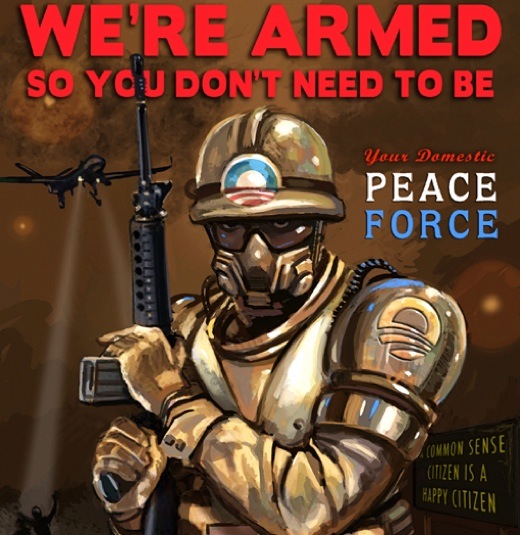
Image above: Detail of poster for Obama Domestic Peace Force. From original article and (http://daletoons.blogspot.com/).

Speculation abounds surrounding the 2 billion rounds of ammunition purchased by the Department of Homeland Security and other national alphabet agencies in recent years. Moreover, as the White House and their cohorts in Congress contemplate the disarming of American citizens, the very assault weapons purported to be so dangerous in the hands of law abiding gun owners are being purchased in mass quantities by local and federal law enforcement agencies.

So what is the purpose and motivation behind the government’s continued efforts to stockpile so much firepower? One frightening theory could explain what the President and his national security apparatus are up to.

The following excerpted From article by Joseph Farah 'Why is US stockpiling Guns & Ammo? 
Many of you will remember a story I broke a long time ago – about presidential candidate Barack Obama’s little-noticed announcement that, if elected in 2008, he wanted to create a “civilian national security force” [or domestic peace force] as big, as strong and as well-funded as the Defense Department.

Here’s what he actually said at a campaign stop in Colorado July 2, 2008:

“We cannot continue to rely only on our military in order to achieve the national security objectives we’ve set. We’ve got to have a civilian national security force that’s just as powerful, just as strong, just as well-funded.”

Could what we see happening now in the Department of Homeland Security be the beginning of Obama’s dream and our constitutional nightmare?

We never heard another mention of Obama’s “civilian national security force” again. Not in 2008, 2009, 2010, 2011 or 2012.

But that brings us up to 2013 and the highly unusual stockpiling of firearms and ammo by Homeland Security – firearms and ammo that Obama would like to deny to ordinary citizens who are not members of his domestic army.

Well, I hate to say it, but I may have predicted this, too.

In a Halloween column last fall, I stated that, if re-elected, Obama would “declare a full-scale war on his domestic opposition.”

I wasn’t joking. I was deadly serious – so serious, in fact, that I did something I pledged I would never do: Vote for Mitt Romney. It was a matter of self-defense and self-preservation. I said then that a second term of Obama might mean we would never see another free and fair election in America. (I’m not even sure we saw one in 2012.)
 
I suggested due process would go the way of the horse and buggy. I said I expected Obama would move to shut down or destroy all independent media. I even speculated that his biggest critics would eventually be rounded up in the name of national security.

Think about it.

Why does the civilian Department of Homeland Security need billions of rounds of ammunition?

This is the agency that is responsible for policing the border. But it doesn’t.

This is the agency that is responsible for catching terrorists. But it doesn’t.

So why does Homeland Security need so many weapons and enough hollow-point rounds to plug every American six times?

The official explanation? Target practice.  See this Fox News Story on ammo purchases:
As for concern about the type of bullets — hollow points, which expand upon impact — the statement said the type is “standard issue” and is used during “mandatory quarterly firearms qualifications and other training sessions.”
While the majority of Americans will take this explanation at face value, there are some key facts that suggest the Department of Homeland Security is mobilizing for a significant future action against the American people.
  • The US military has been actively war-gaming worst-case scenarios that include economic collapse and civil unrest, going so far as to simulate wide-scale food riots.

  • Just last month the military deployed gunships over Miami and executed a training exercise with local police departments. A few days later, similar exercises were held in Houston, TX. Last year these “exercises” also included ground forces, armored personnel carriers and tanks on the streets of St. Louis.

  • Despite overwhelming opposition, there is an overt and focused movement to disarm Americans of their right to bear semi-automatic personal defense rifles and any other firearms deemed dangerous to the public. Those calling for this disarmament qualify their positions by claiming these weapons are not necessary for sporting, hunting, or personal defense. As if this provision of the US Constitution doesn’t even exist, there is a total blackout on the fundamental intent of the Second Amendment, which allows for citizens to bear arms to protect themselves against tyrannical government.

  • Heavily armored vehicles have been spotted all over the country, and many local law enforcement agencies have taken possession of these vehicles, normally reserved for military engagements, and have put them to use in neighborhoods and communities around America.
  • Congress has authorized the deployment of some 30,000 surveillance drones in the skies of America, to be available for use by intelligence agencies by 2015.

  • The National Security Agency is building a massive spy center capable of recording, aggregating and analyzing every digital interaction on the planet – phones, internet, purchasing patterns, travel, and even what we say in the privacy of our own homes. A 30 year veteran of the NSA says the data mining program is so vast it will “create an Orwellian state.”

  • The US government, in the aftermath of the September 11th attacks, has created legislation that directly targets American citizens. The Patriot Act makes it possible for anyone who is identified as attempting to subvert government legitimacy as a terrorist, and also allows for the warrantless wiretapping of everyone for any reason. Under the Patriot Act and expanded government definitions, just about anyone now qualifies as a domestic terrorist.

  • The National Defense Authorization Act takes the Patriot Act even further, allowing the government to detain anyone suspected of being a terrorist indefinitely and without trial – this includes American citizens living in the United States.

  • And, as Joseph Farah points out, the President specifically claimed he would create a civilian national security police force as large as the US military. If he meant it, then we’re talking about 2 million or so civilians that will be armed, deputized and backed by the government. To do what? We’re not quite sure, but apparently we need these civilians for something important, or else the President wouldn’t have brought it up.
These are but a few examples of what our government has been up to. There are hundreds of others.

Now put all those together and the complete puzzle begins to emerge.

This surveillance infrastructure and control grid are being designed not for foreign terrorists or rogue nations that may do harm to America. They have been designed for you.

You, my fellow American, are the enemy.

See also:
Ea O Ka Aina: DHS to the Rescue 9/12/12
Ea O Ka Aina: Traing of supression of Americans 4/10/12
Ea O Ka Aina: Feds hunkering down for upheaval 3/19/12

.

True Survival Tale

SUBHEAD: Taking their possessions and some seeds, the family retreated ever deeper into the forest.

By Mac Slavo on 2 February 2013 for SHTF Plan -
(http://www.shtfplan.com/emergency-preparedness/a-true-survival-story-taking-their-possessions-and-some-seeds-they-had-retreated-ever-deeper-into-the-forest_02022013)


Image above: The Lykovs lived in this hand-built log cabin, lit by a single window “the size of a backpack pocket” and warmed by a smoky wood-fired stove. From original artile.

When Josef Stalin instituted a campaign of purging dissidents in the 1930′s, some 17 million people were left dead or missing by the time it was all said and done.
Had you been targeted for extermination during this Great Purge, your chances of survival very rapidly approached zero.

Most became victims when their government classified them as enemies of the state.

Some, however, and against all odds, found a way to survive.
The Lykovs had the clothes on their backs, some personal possessions, and some basic supplies when they fled the Purge.

They made it in one of the most inhospitable regions in the world for forty years.

Despite the challenges and regardless of the odds, humans are built to survive. See their story below.
Source: These excerpts have been made available by The Smithsonian Institution and shared for the increase and diffusion of knowledge
This forest [Russian Taiga] is the last and greatest of Earth’s wildernesses. It stretches from the furthest tip of Russia’s arctic regions as far south as Mongolia, and east from the Urals to the Pacific: five million square miles of nothingness, with a population, outside a handful of towns, that amounts to only a few thousand people…

Thus it was in the remote south of the forest in the summer of 1978. A helicopter sent to find a safe spot to land a party of geologists was skimming the treeline a hundred or so miles from the Mongolian border when it dropped into the thickly wooded valley of an unnamed tributary of the Abakan, a seething ribbon of water rushing through dangerous terrain. The valley walls were narrow, with sides that were close to vertical in places, and the skinny pine and birch trees swaying in the rotors’ downdraft were so thickly clustered that there was no chance of finding a spot to set the aircraft down. But, peering intently through his windscreen in search of a landing place, the pilot saw something that should not have been there. It was a clearing, 6,000 feet up a mountainside, wedged between the pine and larch and scored with what looked like long, dark furrows. The baffled helicopter crew made several passes before reluctantly concluding that this was evidence of human habitation—a garden that, from the size and shape of the clearing, must have been there for a long time.

It was an astounding discovery. The mountain was more than 150 miles from the nearest settlement, in a spot that had never been explored. The Soviet authorities had no records of anyone living in the district…

As the intruders scrambled up the mountain, heading for the spot pinpointed by their pilots, they began to come across signs of human activity: a rough path, a staff, a log laid across a stream, and finally a small shed filled with birch-bark containers of cut-up dried potatoes…

The sight that greeted the geologists as they entered the cabin was like something from the middle ages. Jerry-built from whatever materials came to hand, the dwelling was not much more than a burrow—”a low, soot-blackened log kennel that was as cold as a cellar,” with a floor consisting of potato peel and pine-nut shells. Looking around in the dim light, the visitors saw that it consisted of a single room. It was cramped, musty and indescribably filthy, propped up by sagging joists—and, astonishingly, home to a family of five.

Led by Pismenskaya, the scientists backed hurriedly out of the hut and retreated to a spot a few yards away, where they took out some provisions and began to eat. After about half an hour, the door of the cabin creaked open, and the old man and his two daughters emerged—no longer hysterical and, though still obviously frightened, “frankly curious.” 
Warily, the three strange figures approached and sat down with their visitors, rejecting everything that they were offered—jam, tea, bread—with a muttered, “We are not allowed that!” When Pismenskaya asked, “Have you ever eaten bread?” the old man answered: “I have. But they have not. They have never seen it.” At least he was intelligible. The daughters spoke a language distorted by a lifetime of isolation. “When the sisters talked to each other, it sounded like a slow, blurred cooing.”…

Slowly, over several visits, the full story of the family emerged. The old man’s name was Karp Lykov, and he was an Old Believer—a member of a fundamentalist Russian Orthodox sect, worshiping in a style unchanged since the 17th century. Old Believers had been persecuted since the days of Peter the Great, and Lykov talked about it as though it had happened only yesterday; for him, Peter was a personal enemy and “the anti-Christ in human form”—a point he insisted had been amply proved by Tsar’s campaign to modernize Russia by forcibly “chopping off the beards of Christians.” But these centuries-old hatreds were conflated with more recent grievances; Karp was prone to complain in the same breath about a merchant who had refused to make a gift of 26poods [940 pounds] of potatoes to the Old Believers sometime around 1900.

Things had only got worse for the Lykov family when the atheist Bolsheviks took power. Under the Soviets, isolated Old Believer communities that had fled to Siberia to escape persecution began to retreat ever further from civilization. During the purges of the 1930s, with Christianity itself under assault, a Communist patrol had shot Lykov’s brother on the outskirts of their village while Lykov knelt working beside him. He had responded by scooping up his family and bolting into forest…

That was in 1936, and there were only four Lykovs then—Karp; his wife, Akulina; a son named Savin, nine-years-old, and Natalia, a daughter who was only two. Taking their possessions and some seeds, they had retreated ever deeper into the taiga, building themselves a succession of crude dwelling places, until at last they had fetched up in this desolate spot. 
Two more children had been born in the wild—Dmitry in 1940 and Agafia in 1943—and neither of the youngest Lykov children had ever seen a human being who was not a member of their family. All that Agafia and Dmitry knew of the outside world they learned entirely from their parents’ stories. The family’s principal entertainment, the Russian journalist Vasily Peskov noted, “was for everyone to recount their dreams.”

The Lykov children knew there were places called cities where humans lived crammed together in tall buildings. They had heard there were countries other than Russia. But such concepts were no more than abstractions to them. Their only reading matter was prayer books and an ancient family Bible. Akulina had used the gospels to teach her children to read and write, using sharpened birch sticks dipped into honeysuckle juice as pen and ink.


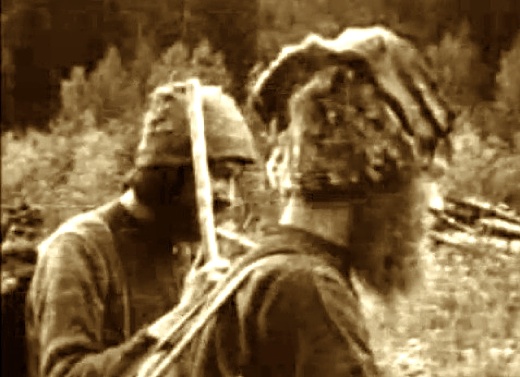
Image above: Dmitry (left) and Savin in the Siberian summer on their homestead. From original article.


Image above: Agafia Lykova (left) with her sister, Natalia. From original article.

Isolation made survival in the wilderness close to impossible. Dependent solely on their own resources, the Lykovs struggled to replace the few things they had brought into the taiga with them. They fashioned birch-bark galoshes in place of shoes. Clothes were patched and repatched until they fell apart, then replaced with hemp cloth grown from seed…

The Lykovs had carried a crude spinning wheel and, incredibly, the components of a loom into the taiga with them—moving these from place to place as they gradually went further into the wilderness must have required many long and arduous journeys—but they had no technology for replacing metal. 
 A couple of kettles served them well for many years, but when rust finally overcame them, the only replacements they could fashion came from birch bark. Since these could not be placed in a fire, it became far harder to cook. By the time the Lykovs were discovered, their staple diet was potato patties mixed with ground rye and hemp seeds.

In some respects, Peskov makes clear, the taiga did offer some abundance: “Beside the dwelling ran a clear, cold stream. Stands of larch, spruce, pine and birch yielded all that anyone could take…. Bilberries and raspberries were close to hand, firewood as well, and pine nuts fell right on the roof.”

Yet the Lykovs lived permanently on the edge of famine. It was not until the late 1950s, when Dmitry reached manhood, that they first trapped animals for their meat and skins. Lacking guns and even bows, they could hunt only by digging traps or pursuing prey across the mountains until the animals collapsed from exhaustion. 
Dmitry built up astonishing endurance, and could hunt barefoot in winter, sometimes returning to the hut after several days, having slept in the open in 40 degrees of frost, a young elk across his shoulders. More often than not, though, there was no meat, and their diet gradually became more monotonous. Wild animals destroyed their crop of carrots, and Agafia recalled the late 1950s as “the hungry years.” She said,
"We ate the rowanberry leaf, roots, grass, mushrooms, potato tops, and bark, We were hungry all the time. Every year we held a council to decide whether to eat everything up or leave some for seed."
Famine was an ever-present danger in these circumstances, and in 1961 it snowed in June. The hard frost killed everything growing in their garden, and by spring the family had been reduced to eating shoes and bark. Akulina chose to see her children fed, and that year she died of starvation. 
he rest of the family were saved by what they regarded as a miracle: a single grain of rye sprouted in their pea patch. The Lykovs put up a fence around the shoot and guarded it zealously night and day to keep off mice and squirrels. At harvest time, the solitary spike yielded 18 grains, and from this they painstakingly rebuilt their rye crop…


Image above The Lykovs’ homestead seen from a Soviet reconnaissance plane, 1980. From original article.

Perhaps the saddest aspect of the Lykovs’ strange story was the rapidity with which the family went into decline after they re-established contact with the outside world. In the fall of 1981, three of the four children followed their mother to the grave within a few days of one another. 
 According to Peskov, their deaths were not, as might have been expected, the result of exposure to diseases to which they had no immunity. Both Savin and Natalia suffered from kidney failure, most likely a result of their harsh diet. But Dmitry died of pneumonia, which might have begun as an infection he acquired from his new friends.

His death shook the geologists, who tried desperately to save him. They offered to call in a helicopter and have him evacuated to a hospital. But Dmitry, in extremis, would abandon neither his family nor the religion he had practiced all his life. “We are not allowed that,” he whispered just before he died. “A man lives for howsoever God grants.”

When all three Lykovs had been buried, the geologists attempted to talk Karp and Agafia into leaving the forest and returning to be with relatives who had survived the persecutions of the purge years, and who still lived on in the same old villages. But neither of the survivors would hear of it. They rebuilt their old cabin, but stayed close to their old home.
.

Revenge for Aaron Swartz

SUBHEAD: Anonymous strikes at at US Justice Department for hounding Aaron Schwartz to death.

By Alexander Reed on 26 January 2013 for TruthDig.com -
(http://www.truthdig.com/eartotheground/item/anonymous_retaliates_for_swartzs_suicide_20130126/)


Image above: Aaron Swartz poses in a Borderland Books in San Francisco on February 4, 2008. He died at 26 this January. From (http://articles.washingtonpost.com/2013-01-16/lifestyle/36384043_1_academics-journals-copyrights).

Members of Anonymous, a collection of digital pranksters working for democracy in the dark places of the Web, said Saturday that they had hijacked the site of the U.S. Sentencing Commission as well as a trove of sensitive documents to take revenge for the death of Internet freedom advocate Aaron Swartz.

Swartz has become a martyr for hackers and activists fighting for a free and open Internet since he killed himself just over two weeks ago in the face of a threatened prison sentence many have said would have been disproportionate to his crime. Shortly after his death, Anonymous hacked MIT for its role in enabling a U.S. prosecutor to push for a brutal punishment for Swartz.

“The website of the commission, an independent agency of the judicial branch involved in sentencing, was replaced with a message warning that when Swartz killed himself two weeks ago ‘a line was crossed,’ ” The Guardian reported.
“In a message posted on the website and in an accompanying YouTube video, the hackers said they had infiltrated several government computer systems and copied secret information they threatened to make public.”

The group likened the captured information to a nuclear weapon, saying it had “enough fissile material for multiple warheads” that it could launch against the Justice Department and its associated organizations if its demands to reverse the policies that led to Swartz’s death were not met.

“By late Saturday morning, the USSC website was offline, but cached versions could be found where the message appeared,” The Guardian wrote.

A pulse-pounding propaganda film describing the broad civil liberties context surrounding Anonymous’ hack and promising to do more appears below.


Video above: "Anonymous Operation Last Resort". From (http://youtu.be/WaPni5O2YyI).

See also: Death & Freedom of Information 1/17/13


.

Democracy's Arc

SUBHEAD: There’s no shortage of crises sufficient to tip the current system into its final stalemate.  

By John Michael Greer on 3 May 2012 for Archdruid Report - 
  (http://thearchdruidreport.blogspot.com/2012/05/democracys-arc.html)

 
Image above: Detail of packaging for the computer game "Junta". From (http://www.rollthedice.nl/2009/10/08/strijps-bultje-1-nineteen-eighty-four-1984-een-zoektocht/).
 
The troubling news about methane releases from the Arctic ocean that was the focus of last week’s post on The Archdruid Report belongs, as I mentioned then, to the wider trajectory of industrial society’s decline and fall, not to the more specific theme I’ve been developing here in recent months.

The end of America’s global empire takes place against the background of that wider trajectory, to be sure, and core elements of the predicament of industrial civilization bid fair to play a crucial role as the United States backs itself into a corner defined by its own history. Still, important as the limits to growth are just now, there’s much more at work in the endgame of American empire.
Thus this week’s post will plunge without further ado from the austere heights of atmospheric chemistry to the steaming, swampy, snake-infested realities of American politics. It’s a jarring shift in more ways than one, since everybody basically agrees on what methane is, what the atmosphere is, and so on; the terms that frame debates about the greenhouse effect and anthropogenic global warming are clearly defined and bear some relationship to observable fact. We don’t have that advantage in politics. In particular, the possibility of an intelligent conversation about American politics is hamstrung by the spectacular distortions imposed on basic terms by nearly everybody involved.
The worst example, and the one I propose to explore this week, is democracy. It’s hard to think of a word that’s bandied about more freely, but I keep on waiting for Inigo Montoya from The Princess Bride to stand up and say his classic line: “You keep on using that word. I do not think it means what you think it means.”
On both ends of American politics, for example, democracy is for all practical purposes defined as a political system in which a majority of voters will support whatever group happens to be using the word at that moment. That definition can be seen at work most clearly in the shrill insistence, common these days over much of the political spectrum, that the United States isn’t a democracy; after all, the argument runs, if the United States was a democracy, the people would vote in favor of their own best interests, which of course just happen to be identical with the platform of whoever’s talking. The fact that this claim can be heard from groups whose ideas of the people’s best interests differ in every conceivable way—for example, the Tea Party and Occupy Wall Street—simply adds to the irony.
Behind the rhetoric is a conception of democracy that has nothing in common with the real world, and everything in common with the Utopian fantasies that have come to infest contemporary political discourse. When Americans talk about democracy or, with even richer irony, “real democracy,” they usually mean a system that does not exist, has never existed, and can never exist—a system less real than Neverland, in which the free choices of millions of individual voters somehow always add up to an optimal response to the challenges of a complex age, without ever running afoul of the troubles that inevitably beset democratic systems in the real world.
Here’s an example. Nearly all those who insist that the United States is not a democracy cite, as evidence for that claim, the fact that our elections are usually corrupt and sometimes fraudulent. Now of course this is quite true; the winner in an American election is generally, though not always, the candidate that has the most money to spend; the broader influence of wealth over America’s media and political parties is pervasive; and election fraud is as much a part of American culture as baseball and apple pie. the Democrats who waxed indignant about the rigged election returns from Florida in 2000, for example, by and large seem to have gone out of their way to forget about the voting machines at the bottom of Lake Michigan that put John F. Kennedy in the White House in 1960.
Does this prove that the United States isn’t a “real democracy”? Not at all. This is how democracies actually function in the real world. Under a system of representative democracy, the people who have wealth and the people who have power are by no means always the same; some of those who have wealth want power, some of those who have power want wealth, and the law of supply and demand takes it from there. That extends all the way down to the individual voter, by the way.

 Give citizens the right to dispose of their votes freely, and a significant number of them will use that freedom to put their votes up for sale—directly, as in old-fashioned machine politics, or indirectly, by voting for candidates who provide them with goodies at the public expense. There’s no way to prevent that without depriving citizens of the right to vote as they choose, and you can’t eliminate that and still have a democracy.
 
By this point I suspect some of my readers may be wondering if I’m opposed to democracy. Quite the contrary, I’m very much in favor of it; despite its problems, it beats the stuffing out of most systems of government. It has three benefits in particular that you don’t usually get in other forms of government.
First, democracies tolerate much broader freedom of speech and conscience than countries ruled by other systems. I can critique the personalities, policies, and (as here) fundamental concepts of American government without having to worry that this will bring jackbooted thugs crashing through my door at three in the morning; in nondemocratic countries, critics of the government in power rarely have that security.

 Equally, I can practice the religion I choose, read the books I prefer, carry on conversations with people in other democratic countries around the world, and exercise a great many other freedoms that people in nondemocratic countries simply don’t have. These things matter; people have fought and died for them, and a system that makes room for them is far and away preferable to one that doesn’t.
Second, democracies don’t kill anything like as many of their own citizens as most other forms of government do. The history of the twentieth century, if nothing else, should have been enough of a reminder that authoritarian governments come with a very high domestic body count.

All governments everywhere kill plenty of people whenever they go to war, and all governments everywhere go to war when they think they can get away with it; imperial democracies also tend to build up very large prison populations—the United States has more people in prison than any other nation on Earth, just as Britain in its age of empire shipped so many convicts to Australia that they played a sizable role in the settling of that continent. Still, all other things being equal, it’s better to live in a nation where the government doesn’t dump large numbers of its own citizens into mass graves, and democracies do that far less often, and to far fewer people, than nondemocratic governments generally do.
Finally, democracies undergo systemic change with less disruption and violence than nondemocratic countries do. Whether we’re talking about removing a failed head of state, coping with an economic depression, dealing with military defeat, or winning or losing an empire, democracies routinely manage to surf the wave of change without the sort of collapse such changes very often bring to nondemocratic countries. The rotation of leadership hardwired into the constitutions of most successful democracies builds a certain amount of change into the system, if only because different politicians have different pet agendas, and pressure from outside the political class—if it’s strong, sustained, and intelligently directed—very often does have an impact: not quickly, not easily, and not without a great deal of bellowing and handwaving, but the thing does happen eventually.
All three of these benefits, and a number of others of the same kind, can be summed up in a single sentence: democracy is resilient. Authoritarian societies, by contrast, are brittle; that’s why they can’t tolerate freedom of speech and conscience, why they so often murder their citizens in large numbers, and why they tend to shatter when they are driven to change by the pressure of events. Democratic societies can also be brittle, especially if they’re newly established, or if a substantial fraction of their citizens rejects the values of democracy; still, all other things being equal, a democratic society normally weathers systemic change with less trauma than an authoritarian one.
One measure of this greater resilience, ironically enough, may be seen in the lack of success radical groups generally have when they try to delegitimize and overturn an established democratic society. Rhetoric that would bring a brutal response from authoritarian governments get little more than a yawn from democratic ones. A few years back, the phrase “repressive tolerance” was the term for this on the American far left. I doubt those who denounced it under this label would have preferred to be dragged from their beds in the middle of the night, shot through the head, and tumbled into an unmarked grave; the rest of us, certainly, have good reason to be thankful that that’s not the way America generally deals with its dissidents.
That aside, there’s equally good reason to want a system in place just now that can handle systemic change with the smallest possible amount of trauma and violence, because we’re headed for a great deal of systemic change in the years and decades ahead. Part of that is due to the wider trajectory of industrial society I referenced toward the beginning of this essay, part of it is due to the ongoing decline of America’s global empire, but a good deal of it comes from a different source.

The Greeks, who had a penchant for giving names to things, had a convenient label for that source: anacyclosis. That was the moniker coined by the Greek historian Polybius, who chronicled the conquest of Greece by the Romans in the second century BCE. He noted that the squabbling city-states of the Greek world tended to cycle through a distinctive sequence of governments—monarchy, followed by aristocracy, followed by democracy, and then back around again to monarchy. It’s a cogent model, especially if you replace “monarchy” with “dictatorship” and “aristocracy” with “junta” to bring the terminology up to current standards.
A short and modernized form of the explanation—those of my readers who are interested in the original form should consult the Histories of Polybius—is that in every dictatorship, an inner circle of officials and generals emerges. This inner circle eventually takes advantage of weakness at the top to depose the dictator or, more often, simply waits until he dies and then distributes power so that no one figure has total control; thus a junta is formed. '

In every country run by a junta, in turn, a wider circle of officials, officers, and influential people emerges; this wider circle eventually takes advantage of weakness at the top to depose the junta, and when this happens, in ancient Greece and the modern world alike, the standard gambit is to install a democratic constitution to win popular support and outflank remaining allies of the deposed junta. In every democracy, finally, competing circles of officials, officers, and influential people emerge; these expand their power until the democratic system freezes into gridlock under the pressure of factionalism or unsolved crisis; the democratic system loses its legitimacy, political collapse follows, and finally the head of the strongest faction seizes power and imposes a dictatorship, and the cycle begins all over again.

It can be educational to measure this sequence against recent history and see how well it fits. Russia, for example, has been through a classic round of anacyclosis since the 1917 revolution: dictatorship under Lenin and Stalin, a junta from Khrushchev through Gorbachev, and a democracy—a real democracy, please remember, complete with corruption, rigged elections, and the other features of real democracy—since that time. China, similarly, had a period of democracy from 1911 to 1949, a dictatorship under Mao, and a junta since then, with movements toward democracy evident over the last few decades. Still, the example I have in mind is the United States of America, which has been around the cycle three times since its founding; the one difference, and it’s crucial, is that all three stages have taken place repeatedly under the same constitution.

A case could be made that this is the great achievement of modern representative democracy—the development of a system so resilient that it can weather anacyclosis without cracking. The three rounds of anacyclosis we’ve had in the United States so far have each followed the classic pattern; they’ve begun under the dominance of a single leader whose overwhelming support from the political class and the population as a whole allowed him to shatter the factional stalemate of the previous phase and impose a radically new order on the nation. After his death, power passes to what amounts to an elected junta, and gradually defuses outwards in the usual way, until a popular movement to expand civil rights and political participation overturns the authority of the junta.

Out of the expansion of political participation, factions rise to power, and eventually bring the mechanism of government to a standstill; crisis follows, and is resolved by the election of another almost-dictator.
 
Glance back over American history and it’s hard to miss the pattern, repeating over a period that runs roughly seventy to eighty years. The dictator-figures were George Washington, Abraham Lincoln, and Franklin Roosevelt, each of whom overturned existing structures in order to consolidate their power, and did so with scant regard for existing law.

The juntas were the old Whigs, the Republicans, and the New Deal Democrats, each of them representatives of a single social class; they were overthrown in turn by Jacksonian populism, the Progressive movement, and the complex social convulsions of the Sixties, each of which diffused power across a broader section of the citizenry. The first cycle ended in stalemate over the issue of slavery; the second ended in a comparable stalemate over finding an effective response to the Great Depression; the third—well, that’s where we are right now.
There’s no shortage of crises sufficient to tip the current system into its final stalemate, and no shortage of people in the political class who show every sign of being willing to give it that final push. The great difficulty just now, it seems to me, is precisely that fashionable contempt for democracy as it actually exists that I addressed earlier in this essay.

In 1860, that habit was so far from finding a place in the political dialogue that the constitution of the Confederate States of America was in most respects a copy of the one signed at Philadelphia a long lifetime before. In 1932, though a minority of Americans supported Marxism, fascism, or one of the other popular authoritarianisms of the day, the vast majority who put Roosevelt into the White House four times in a row expected him to maintain at least a rough approximation of constitutional government.
 
That’s much less true this time around. Granted, there’s less public support for overtly authoritarian ideologies—I expect to see Marxism make a large-scale comeback on the American left in the next few years, for reasons I’ll explain in a future post—but as Oswald Spengler pointed out almost a century ago, in the endgame of democratic societies, it’s not the cult of ideology but the cult of personality that’s the real danger.

As the Russian proverb warns, it’s never a good idea to let the perfect become the enemy of the good; in our time, as a growing number of Americans insist that America isn’t a democracy because it doesn’t live up to their fantasies of political entitlement, it’s all too possible that one or more mass movements could coalesce around some charismatic figure who offers to fix everything that’s wrong with the country if only we let him get rid of all those cumbersome checks and balances that stand in his way. How many of the benefits of democracy I listed above would survive the victory of such a movement is not a question I would like to contemplate.
See also:
Ea O Ka Aina: Seascapes with Methane Plumes 4/25/12

 .

Hewlett-Packard supplies Big Brother

SOURCE: Hewlett-Packard supplying computers to Syria to eavesdrop on internet communications to control dissidents. By Vernon Silver on 18 November 2011 for Bloomberg News - (http://www.bloomberg.com/news/2011-11-18/hewlett-packard-computers-underpin-syria-electonic-surveillance-project.html) Image above: Syrian demonstrators face death in the streets. From (http://www.emirates247.com/news/world/syrian-activists-30-killed-in-24-hours-2011-07-18-1.408401). Hewlett-Packard Co. equipment worth more than $500,000 has been installed in computer rooms in Syria, underpinning a surveillance system being built to monitor e-mails and Internet use, according to documents from the deal and a person familiar with the installation. The gear made by Palo Alto, California-based Hewlett- Packard would run a Damascus monitoring center for Syrian agents to track citizens’ communications, and route data, according to blueprints and the person familiar with the system. The Italian company running the project, Area SpA, bought the equipment through resellers in Italy, according to the documents and the person familiar with the deal. More than 3,500 people have died in Syria’s crackdown on protesters since March. At the same time, technicians from Area were installing and testing the surveillance system, which also includes data-storage equipment from Sunnyvale, California-based NetApp Inc., a Nov. 4 article by Bloomberg News showed. Area, which is based outside Milan, bought the Hewlett- Packard and NetApp gear as part of a contract with Syria’s state-owned fixed-line telephone company, according to the documents and the person familiar with the transactions. The gear from Hewlett-Packard, the world’s largest computer maker, cost 427,911 euros ($578,000), according to Area financial records. Almost all the Hewlett-Packard equipment consists of racks of servers housed in fan-cooled cabinets, according to schematics and the person familiar with the job who has worked on the project for Area. Desktop computers comprise an additional portion. Compliance Highest Priority Hewlett-Packard spokeswoman Shelby Watts declined to comment specifically on Area’s surveillance system. “HP’s policy is to comply with all U.S. export control laws and regulations,” the company said in a statement. “We do not have any employees or facilities in Syria, and our sales to parties in that country have been limited to items that are consistent with U.S. law and licensing policy on telecommunications products.” “Compliance with U.S. and international trade laws are of the highest priority for HP,” the statement said. The U.S. has banned most American exports to Syria other than food or medicine since 2004, and issues licenses that permit exceptions. Hewlett-Packard spokeswoman Watts declined to address whether this particular sale had been covered by a license or comment on anything else beyond the company’s statement. Eugene Cottilli, a spokesman for the U.S. Commerce Department, said, “We are prohibited by law from discussing specific information about export licenses.” Project Backlash When reviewing license applications for sales to Syria of telecommunications equipment and associated computers, the U.S. evaluates whether the export would promote the free flow of information among the Syrian people and to the outside world, he said. U.S. Senators Mark Kirk, a Republican from Illinois, Robert Casey, a Democrat from Pennsylvania, and Christopher Coons, a Democrat from Delaware, have called for an investigation into NetApp’s role. Amid a backlash against the project, Area Chief Executive Officer Andrea Formenti said Nov. 8 that his company is weighing options that may include exiting the deal. Area has never had any relations with Syrian intelligence agencies, and its dealings comply with all export rules, the company said. Work on the Syria project has been suspended for more than two months, Formenti said, declining to say why. Technical problems “could be one of the reasons,” he said. The project hasn’t been completed and has never been operational, he said. Formenti didn’t respond to a request for comment for this story. Area records show Western suppliers’ financial stake in the Syria deal. Deep-Packet Probes The bill for Hewlett-Packard equipment compares with 2.75 million euros for the NetApp data-storage systems, according to the records and the person familiar with the installation. Germany’s Utimaco Safeware AG and Paris-based Qosmos SA also supplied technology for the project, according to the documents and the person familiar with the deal. European Union sanctions against Syria don’t bar such sales. Qosmos, a maker of deep-packet inspection probes that peer into the contents of e-mails, said it had been working on the project through Utimaco and is pulling out of the deal. Utimaco, based in Oberursel near Frankfurt, makes systems that connect tapped telecom lines to monitoring center computers. The company said in a statement on its website that it requires all its partners to adhere to German and EU export regulations and United Nations embargos. “We are thoroughly investigating the matter and have stopped any further activities with Area until we receive full clarification from them,” Utimaco said. No Intention Sophos Ltd., the Abingdon, England-based provider of security and data-protection software that controls Utimaco, said in a Nov. 11 statement, “We are working very closely with our team at Utimaco to understand this situation fully and see that a full investigation takes place.” NetApp said in a statement that it condemns any unlawful shipments to Syria and has notified the U.S. government about the Bloomberg article. “We absolutely do not support the sale of NetApp equipment to Syria,” NetApp CEO Thomas Georgens told investors on an earnings conference call Nov. 16. “I’m not here to suggest that we have found a legal way to achieve an objective to sell products to a banned country. We have no intention of doing that.” “NetApp produces storage products; we don’t produce applications that are being talked about in this particular article,” Georgens said. “NetApp has not produced this application or participated in its development at all.” Iran Sales Hewlett-Packard has previously sold computers and software for use by Syrian telecommunications companies under licenses granted by the U.S. Commerce Department. In a March 12, 2009, letter to the Securities and Exchange Commission, the company said that in the previous five years it had applied for and been granted 14 such licenses for sales that generated revenue of about $4 million. That letter came in response to an SEC inquiry about Hewlett-Packard’s sales of printers to Iran through a Dubai- based distributor, which the Boston Globe had revealed in a December 2008 report. Hewlett-Packard said that while the sales through a non-U.S. subsidiary were legal, it had decided to end distribution in Iran. See also: Ea O Ka Aina: Internet Censorship Ahead 11/16/11 .