Showing posts with label Automobile. Show all posts

West Coast State of Mind

SUBHEAD: It's just a part of the even greater tectonic phenomenon called the Ring of Fire.

By James Kunstler on 4 June 2018 for Kunstler.com -
(http://kunstler.com/clusterfuck-nation/west-coast-state-mind/)


Image above: On May 18th 1980, Mount Saint Helens exploded and devastated hundreds of square miles around it. From (https://rarehistoricalphotos.com/eruption-mount-st-helens-1980/).

Driving south on I-5 into Seattle, the Cascadia Subduction Zone came to mind, especially when the highway dipped into a gloomy tunnel beneath Seattle’s relatively new skyscraper district. This fault line runs along the Pacific coast from north of Vancouver down into California.

The western “plates” move implacably east and downward under the North American plate, building up massive tectonic forces that can produce some of the most violent megathrust earthquakes on the planet.

The zone also accounts for a chain of volcanoes that tend to produce titanic explosions rather than eruptions of lava and ash as seen in the hula movies.

The most recent expression of this tendency was Mt. St. Helens in 1980, an impressive cataclysm by the standards of our fine-tuned complex civilization, but a junior event of its type compared to, say, the blow-off of Mt. Mazama 7,500 years ago, which left Crater Lake for the tourists. A publicity-shy correspondent writes:

By all acounts Mazama was floating upon a vast lake of steamy rhyolite. It was a structurally unstable stratovolcano the size of Mount Shasta with a net volume of 80 cubic miles. A five minute Triple Junction 9.3 Richter Scale shaker uncorked the Mount Mazama champagne bottle via massive lahars which removed the overpressure. Geologists estimate that the eruption lasted for about one day.

It’s only been in the last thirty years that Seattle hoisted up its tombstone cluster of several dozen office and condo towers. That’s what cities do these days to demonstrate their self-regard, and Seattle is perhaps America’s boomingest city, what with Microsoft’s and Amazon’s headquarters there — avatars of the digital economy.

A megathrust earthquake there today would produce a scene that even the computer graphics artistes of Hollywood could not match for picturesque chaos. What were the city planners thinking when they signed off on those building plans?

I survived the journey through the Seattle tunnel, dogged by neurotic fantasies, and headed south to California’s Bay Area, another seismic doomer zone. For sure I am not the only casual observer who gets the doomish vibe out there on the Left Coast.

Even if you are oblivious to the geology of the place, there’s plenty to suggest a sense of impossibility for business-as-usual continuing much longer.

I got that end-of-an-era feeling in California traffic, specifically driving toward San Francisco on the I-80 freeway out in the suburban asteroid belt of Contra Costa County, past the sinister oil refineries of Mococo and the dormitory sprawl of Walnut Creek, Orinda, and Lafayette.

Things go on until they can’t, economist Herb Stein observed, back in the quaint old 20th century, as the USA revved up toward the final blowoff we’ve now entered.

The shale oil “miracle” (so-called) has given even thoughtful adults the false impression that the California template for modern living will continue indefinitely. I’d give it less than five years now.

The movers and shakers of that state dwell in an extra-special political bubble of their own that doesn’t accommodate much thought about the actual future in which all their recent investments in public infrastructure fail spectacularly.

There will be no Tesla utopia of self-driving electric cars to “solve” the dilemmas of internal combustion, despite the prototype demonstrations among status-seeking tech executive millionaires.

From the Berkeley highlands at night, you could see across the fabled bay to the twinkling new skyscrapers of San Francisco — like Seattle’s, another expression of the inordinate riches spawned by computers. How was that a good idea, considering what happened there as recently as 1906?

What you see out there along the Pacific rim of the USA is a giant booby-trap of certain cataclysm. It’s part of the even greater tectonic phenomenon called the Ring of Fire, which circles the whole western ocean from the Aleutian Islands to Japan through Indonesia and up again along the western edge of South America.

Things are livening up all over the darn thing right now, including the rumblings of a bunch of big volcanoes in the South Pacific and the Fuego volcano in Guatemala, uncorking lethally as I write.

And, of course, none of the foregoing includes the giant magma dome of worthless stock and bond values swelling under the towers of Wall Street back east.

[IB Publisher's note: Over time We've come to sense that James H. Kunstler has a bit of misogynous and racial bias in his understanding of people. We try to make posts to this website that do not display that side of his world. None the less, we still find his observations of American suburban auto-centric life, with its self denial and absurdities, a penetrating vision.]

.

Not So Happy Motoring

SUBHEAD: We’re so far from any real debate about the issues that the events will blindside the nation.

By James Kunstler on 30 March 2018 for Kunstler.com -
(http://kunstler.com/clusterfuck-nation/not-happy-motoring/)


Image above: Tesla said autopilot was activated during a fatal Model X crash last week in California. From (http://money.cnn.com/2018/03/31/technology/tesla-model-x-crash-autopilot/index.html).

It hasn’t been a great month for America’s electric car fantasy. Elon Musk’s Tesla company — the symbolic beating heart of the fantasy — is whirling around the drain with its share price plummeting 22 percent, its bonds downgraded by Moody’s to junk status, a failure to produce its “affordable” ($36,000 — Ha!) Model 3 at commercial scale, a massive recall of earlier S Model sedans for a steering defect, and the spectacular fiery crash in Silicon Valley last week of an X model that may have been operating in automatic mode (the authorities can’t determine that based on what’s left), and which killed the driver.

Oh, and an experimental self-driving Uber car (Volvo brand) ran over and killed a lady crossing the street with her bicycle in Tempe, Arizona, two weeks ago. Don’t blame Elon for that.

There’s a lot to like about electric cars, of course, if, say, you’re a Google executive floating through life in a techno-narcissism bubble, or a Hollywood actor with wooly grandiose notions of saving the planet while simultaneously signaling your wealth and your “green” virtue cred.

Teslas supposedly handle beautifully, ride very quietly, have great low-end power, and decent range of over 200 miles. The engine has something like twenty moving parts, is very long-lasting, and is easy to repair or change out if necessary.

Are they actually “green and clean?” Bwaahaaaaa….! Are you kidding? First, there’s the energy embedded in producing the car: mining and smelting the ores, manufacturing the plastics, running the assembly line, etc.

That embedded energy amounts to about 22% of the energy consumed by the car over a ten-year lifetime. Then there’s the cost of actually powering the car day-by-day. The electricity around the USA is produced mostly by burning coal, natural gas, or by nuclear fission, all of which produce harmful emissions or byproducts.

But the illusion that the power just comes out of a plug in the wall (for just pennies a day!) is a powerful one for the credulous public.

The cherry-on-top is the fantasy that before much longer all that electric power will come from “renewables,” solar and wind, and we can leave the whole fossil fuel mess behind us. We say that to ourselves as a sort of prayer, and it has exactly that value.

There are at least a couple of other holes in story, big-picture wise. One is that electric mass motoring — switching out the whole liquid fuel fleet for an all-electric fleet — won’t pencil out economically.

We probably started the project forty years too late to even be able to test it at scale, because economic events are now moving so quickly in the direction of global austerity that the putative middle-class customer base for electric cars will barely exist in the near future.

Americans especially nowadays are so financially stressed that they can’t qualify for car loans — and that is mainly how cars are bought in this land.

The industry has strained mightily to bend the rules so that these days it’s even possible to get a seven-year loan for a used car whose collateral value will dissipate long before the loan is paid back. Hard to see how they can take that much further.

The usual answer for that is that you won’t need to own a car because the nation will be served by self-driving electric Uber-style cars-on-demand, which will supposedly require far fewer cars in all.

That really doesn’t answer some big questions, such as: how might commuting work in our big metroplex cities? Even if you posit multiple occupancy vehicles, it still represents a whole lot of car trips.

Oh, you say, everybody will just work from home. Really? I don’t think so — though I wouldn’t rule out an end to corporate organization of work as we’ve known it, and if that happens, we will be a nation of farmers and artisans again, that is, a World Made By Hand.

Also consider, if the car companies only need to make and sell a fraction of the vehicles they sell now, the whole industry will collapse.

Another hole in the story is the universal assumption that the USA must remain a land of mandatory car dependency, hostage to the fiasco of our suburban infrastructure. I understand why we’re attached to it.

We spent most of the 20th century building all that shit, and squandered most our wealth on it. It’s comfortably familiar, even if it’s actually a miserable environment for everyday life.

But none of those monetary and psychological investments negate the fact that suburbia has outlived its limited and rather perverse usefulness.

We’re so far from having any intelligent public debate about these issues that the events now spooling out will completely blindside the nation.

.

Electric cars don't reduce CO2

SUBHEAD: An inconvenient fact is they mostly use oil, gas and coal to get recharged and also have exotic batteries to be replaced.

By Tyler Durden on 18 August 2017 for Zero Hedge -
(http://www.zerohedge.com/news/2017-08-18/inconvenient-fact-morgan-stanley-says-electric-cars-create-more-co2-they-save)


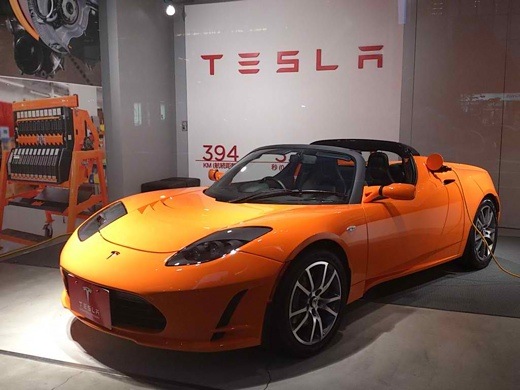
Image above: A Tesla two-seat sports roadster is displayed while it charges at an auto show. From (http://unitedcarsnow.com/2017-tesla-roadster/2017-tesla-roadster-interior/).

For all the funds out there looking to fill their portfolio with "environmentally conscious" companies working diligently to avert an inevitable global warming catastrophe that will result in the extinction of the human race, we guess in lieu of their actual fiduciary duties to simply make money for their investors, Morgan Stanley has compiled a list of how you can get the most 'environmental healing' per dollar invested.

As MarketWatch points out, it's not terribly surprising that of the 39 publicly-traded stocks analyzed, the solar and wind generation companies landed at the very top of Morgan Stanley's environmentally friendly the list.

Morgan Stanley identified 39 stocks that generate at least half their revenue “from the provision of solutions to climate change,” something it said was a central component of investing to make a difference, as opposed to just a making a buck.

“In our view, impact investing needs to begin with companies whose products and services have a notable positive environmental or social impact,” wrote Jessica Alsford, an equity strategist at the investment bank.

Not surprisingly, alternative-energy companies ranked the highest in terms of their positive impact, and the “top five climate-change impact stocks” were all manufacturers of solar and wind energy: Canadian Solar, China High Speed Transmission, GCL-Poly, Daqo New Energy, and Jinko Solar.
What is surprising, however, is that publicly traded electric car manufacturers, darlings of the environmentally-conscious Left, were actually found to generate more CO2 than they save.

As a stark reminder to our left-leaning political elites who created these companies with massive taxpayer funded subsidies, Morgan Stanley points out that while Teslas don't burn gasoline they do have to be charged using electricity generated by coal and other fossil fuels.

This is where Tesla, along with China’s Guoxuan High-Tech fall short.

“Whilst the electric vehicles and lithium batteries manufactured by these two companies do indeed help to reduce direct CO2 emissions from vehicles, electricity is needed to power them,” Morgan Stanley wrote.
“And with their primary markets still largely weighted towards fossil-fuel power (72% in the U.S. and 75% in China) the CO2 emissions from this electricity generation are still material.”
In other words, “the carbon emissions generated by the electricity required for electric vehicles are greater than those saved by cutting out direct vehicle emissions.”

Morgan Stanley calculated that an investment of $1 million in Canadian Solar results in nearly 15,300 metric tons of carbon dioxide being saved every year. For Tesla, such an investment adds nearly one-third of a metric ton of CO2.

.

Adios autos - Children have legs

SUBHEAD: Kids are not only the citizens of the future, they are also an active part of our society.

By Staff on 9 August 2017 for Goethe.de -
(http://www.goethe.de/ins/cz/prj/fup/en16408476.htm)


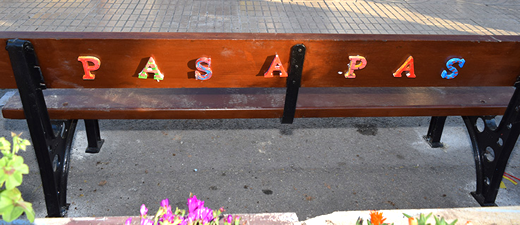
Image above: Where once cars blocked the view of the school entrance, there is now a bench. Photo by Tano Espinosa From original article.

[IB Publisher's note: As children my generation (baby boomers) had a great deal more independence than the young today. My wife used to walk to primary school during snowy upstate New York winters. I used to play outdoors until sunset on long summer evenings on Long Island while in grade school. Kids had a lot of unsupervised time in which to invent their own lives.]

The scene is almost always the same: a traffic jam at the doors of Spanish primary schools. Hardly any children are seen without their parents. An initiative in the town of Jávea seeks to counter this way of doing things. It has rediscovered the street for schoolchildren.

“Going to school together helps children feel like part of a group”, says Antonio Moya, an architect by profession. He is one of the four masterminds behind the Pas a Pas (Step by Step) project in Jávea, which aims to give children an active role in urban life.

Since April 2016, more than 100 children from four primary schools have been walking to school together in this town on Spain’s East coast. They have been joined in autumn by students from another two schools.

“We expect the initiative to reach up to 300 children during this term”, says Moya. The concept is simple: for every school there is a meeting place where children between the ages of six and twelve assemble and walk to school together.

Groups with smaller children are accompanied by an adult, and shopkeepers in the area have been informed and act as points of control, if needed.

Pedestrian-friendly cities
Pas a Pas also helps parents save time. According to a 2015 study, they spend an average of 100 hours a year driving their children to school.

This is not to mention the benefits for the environment: the creators of Pas a Pas estimate that parents currently travel 854 kilometres a year to transport their kids. Leaving the car in the garage can significantly reduce CO2 emissions, which not only benefits the educational community, but the entire city.

Jávea is not the only place working to win over parents and children to a more socially conscious way of going to school. The first such initiative in the Spanish capital of Madrid dates back to 2007, and Barcelona, the Catalan metropolis, took some initial steps in 2000.

The satellite town Rivas Vaciamadrid, east of Madrid, received an EU award for sustainable urban mobility owing to its commitment to road safety: fewer cars on the street also mean a safer path to school.

This also happens to be the core idea that, for years, has driven the campaign by the Spanish traffic authority, the DGT, to support cities, schools and families in making streets more pedestrian-friendly and to foster children’s autonomy.

Indeed, the Jávea project was launched three years ago when a child was hit by a car in front of the school. Calls for greater safety became widespread, and the city responded by freeing funds. Chema Segovia, also an architect and, along with Moya, one of the founders of Pas a Pas, recalls the beginnings in Jávea:
“When we took on the project, the first thing we did was to meet with representatives of the schools, the police and parents. But we realized that someone important was missing from our discussions.”
It was obvious who he was referring to: the children. “We couldn’t make decisions for those who hadn’t been given a voice,” says Segovia.


Image above: Nine-year-old Elena, with her fellow walkers, on a bench in front of their school. Photo (CC BY-SA): Antonio Moya . Photo by Tano Espinosa From original article.

The street as a site of social encounter
Then workshops were held in which children could bring in their own ideas about the exterior design of the school: more parking for bikes, for instance, skating tracks or benches to sit on. There was nothing outrageous about their proposals.

But they came to naught: either because of lacking public budgets, or due to the everyday chaos of parking. That is, in almost every case.

But not at the primary school of the Jávea port district. There, in front of the entrance, two benches have been installed, right where there used to be a line of cars waiting to collect children. “This is not only about making the journey to school safer,” explains Segovia.

For him, the street is not an object of protection, but rather a site of social encounter, a place for sharing:
“And this is precisely what we seek to achieve with our project.”
The architect points out that children play a key role in sustainable urban planning: “They are not only the citizens of the future: they are also an active part of our society. And, as such, they can take part in decision-making.”

Today, three years after the start of the initiative, Jávea looks different. In front of the school in the port district, you can see planters with colorful drawings.

On top of the fences around another school’s yard, children had placed vases they themselves had made. While they have been removed in the meantime, everyone cherishes the memories of that day. Even the residents.

“These individual actions can help make our project more familiar to the town’s citizens,” states Antonio Moya. And that is precisely the goal: to create a city that is worthy for all those who live in it.

Painted signs instead of traffic signs A lot has happened, too, on the walls of houses in the city center. Here and there you can see signs that point children in the direction of school.

These are not traffic signs, but rather homemade signs that have been painted and stuck or hung to the walls.

“Pas a Pas”, they say: “Step by step”, a sign of integration and identity of a group that, as often noted by the Italian pedagogue and visionary, Francesco Tonucci, modern urban life very often marginalizes.

“The great thing is that children have no prejudices,” says Moya. This is in stark contrast to the authorities that, in many other towns, came out in opposition to the ideas of Pas a Pas.

“Luckily, this is not the case in Jávea,” he adds. The city’s commitment is solid, and interest is also growing among parents:
“What works best, of course, is word of mouth.”
This has certainly been the case in Jávea. The initiative of getting to school together has been moving forward on its own for some time: the key movers of Pas a Pas generally act behind the scenes.

Also, Moya and his team will not have to visit the primary school in the port district, one of the new members of the project, on too many Fridays in the future.

The parents have worked out a plan among themselves, found adult monitors and sought to encourage other families to join Pas a Pas. “I’m sure we can find others,” says a confident mother as she says goodbye to her daughter Elena.

The nine-year-old girl is joining the group on their walk to school for the first time, and she is clearly curious about the other children. There are five of them: not a bad start. Who knows? Other schoolmates might just come along next time. Because Elena is undoubtedly enjoying the time spent outside, in the fresh air.

.

American way of life is negotiable

SUBHEAD: Communism coming to the US brought by corporations and in the name of technological progress.

By Ugo Bardi on 29 May 2017 for Cassandra's Legacy -
(http://cassandralegacy.blogspot.com/2017/05/why-american-way-of-life-is-negotiable.html)


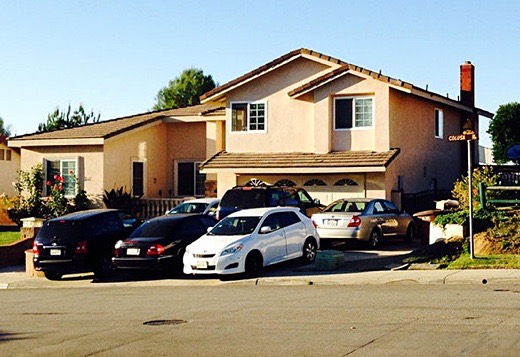
Image above: “Six cars for one driveway of this house every day. It’s not like they had a party… this is EVERY DAY! Who knows if they actually have more cars inside the garage?” – Jason in California. IB Publisher's note: Even here on the isolated tropical island of Kauai it is not unusual in crowded neighborhoods with small house lots with a two car driveway to find four cars in front of the house - One vehicle for every driving age individual living there. From (http://neighborshame.com/packed-driveway/).

In a previous post, I discussed the RethinkX report by James Arbib and Tony Seba on the future of transportation. The report discusses a technological revolution that would bring about a new concept: "Transportation as a Service" (TaaS) that will people to move mainly by using publicly available, driverless cars.

Many took the report (and my comments on it) as just another technofix aimed at keeping things as they are; business as usual. Indeed, the report, framed the "TaaS" concept in terms of economic growth. Nothing else is acceptable in the public debate, today.

So, it seems that few people realized what kind of sacred cow Arbib and Seba are planning to slaughter and serve as well cooked burgers. It is nothing less than the private car, the pivotal element of the American way of life (yes, exactly what George Bush 1st said "is not negotiable").

This idea is as far from business as usual as I can imagine, one of the most disruptive and revolutionary ideas that I came across in recent times. So, I think I can go more in depth into this subject and explain why it is so disruptive and revolutionary.

The growth in car ownership was the result of a political decision that most Western government took at some moment (Even Adolf Hitler did, at least in part). It was a decision that didn't have to be taken; for instance, the Soviet Government always discouraged private car ownership. But governments, although not benevolent organizations, are made of people and people can recognize a good business when they see it.


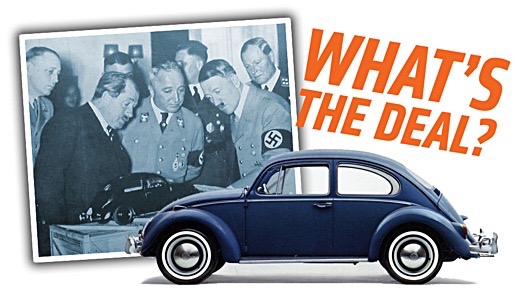
Image above: The Volkswagen Bug was introduced to America in the late 1940s but sales did not explode until the early 1960's when interest in the "big finned" gas guzzling Detroit "land yachts" waned.  In the background is a photo of Adolf Hitler inspecting a model of a 1939 VW Bug before World War II. From (http://www.calvertjournal.com/features/show/4235/soviet-mass-housing-novye-cheryomushki-belyayevo-suburbs)

More cars meant more highways, more bridges, more shopping centers, more housing developments, and more opportunities to build things. That meant a lot of money flowing. So, the explosive development of private motorization happened because it could happen.

But, in recent times, the trend is reversing. The number of cars per person and per household is going down. These data by Sivak (2015) seem to be the most recent ones available.

And it is not just the number of cars that's going down, also the number of miles driven per person or per car is falling. The trend is the same in many Western countries: we went through some kind of "peak car".

So, what's going on? One factor is that cars are becoming more expensive.

That's mainly because cars are becoming heavier and more complicated. Today, a classic Volkswagen Beetle would cost very little, possibly less than it did at the time of the great motorization growth of the 1950s. But no insurance company would want to insure it, and no government would provide a license plate for it: too noisy, unsafe, and polluting.

But the increasing cost of ownership is probably a minor factor in comparison to deeper changes that are taking place. The increasing social inequality that leads to a larger and larger fraction of people becoming poor or very poor. See below the behavior of the "Gini Coefficient", a measure of the inequality in society.

So, cars are more expensive and there are more poor people. No wonder that car ownership is going down: a gradually higher fraction of the population cannot afford cars any more.

We shouldn't be surprised: for most of humankind's history, most people would walk; only a few could afford horses or coaches. One car in every garage was a very peculiar phenomenon that couldn't possibly last for a long time and that won't probably ever be repeated in the future. But the end of the cycle may not be painless for many. If you live, or have lived, in a Western suburban area, you know what the problem is.


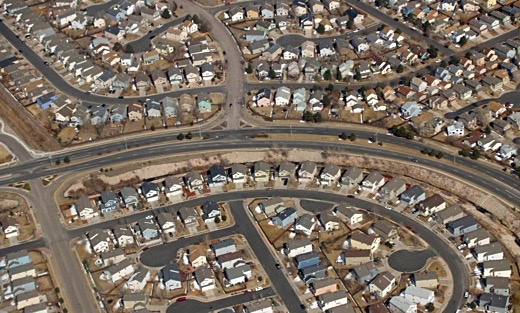
Image above: Aerial photograph of a Pheonix suburban development, that looks like a computer circuitboard, used as an example of a neighborhood that would make residents sick. From (https://motherboard.vice.com/en_us/article/how-doctors-are-finding-neighborhoods-that-make-their-patients-sick)

There you are: miles away from anything that's not other people's homes. Miles from your workplace, miles from the nearest supermarket, miles from the closest train station. No car means no job, no groceries, no place to go.

By far and large, most families living in Western suburbs still own at least one car. They have to, even though that means an increasingly heavy strain to the family's budget. But, as the current trends continue, there will come a moment in which owning a car will become a burden too heavy to carry for a non negligible fraction of the suburban population. Then what happens?

Well, there are several possible ways for people to cope: biking, carpooling, using donkeys, move to the city to live in a shack made of discarded cardboard containers or, simply, go zombie and die.

Cities are unlikely (to say the least) to establish conventional bus services for the citizens who find themselves stranded in the bloated suburbs: it would be awfully too expensive. So, as it happens in these cases, technological innovation is supposed to come to the rescue. And it does that with the concept of "TaaS" (Transportation as a Service).

It is, basically, a high-tech car rental service where you use a vehicle only when you need it, thanks to the technological marvels of Global Positioning Satellites, automated driving, and electric power.

It is not obvious that TaaS will be less expensive than car ownership in terms of dollars per mile. But, with TaaS, you don't have the fixed costs of owning a car: you can save money by reducing your travels to the bare minimum.

So, you can use TaaS to reach your workplace (if you still have a job) and to reach a supermarket to redeem your food stamps. For the rest of the time, you stay home and watch TV or use the social media. What else do you need?

Arbib and Seba have correctly described in their report how this phenomenon is not going to be gradual: it is going to be explosive. As car ownership goes down, the cost of cars will increase simply because of diminishing economies of scale. Add to it the decreasing profits of the oil industry and the whole thing is going to implode fast, generating a textbook example of the "Seneca Cliff".

By the end of the cycle, people (those who will survive the ordeal) might abandon the suburbs and move into high-rise apartment building that can be serviced by public transportation at reasonable costs. At this point, the American landscape could look much like that of the old Soviet Union.


Image above: The Moscow suburb of Novye Cheryomushki (New Cherry Town) is made up of Soviet style apartment blocks, in the style of French architect Le Corbusier. By 1991 75% of all Soviet housing was in this style of Industrialized housing. It was serviced by mass transit and walking paths, as few Soviet citizens could afford to operate a private car. From (http://www.calvertjournal.com/features/show/4235/soviet-mass-housing-novye-cheryomushki-belyayevo-suburbs)

Eventually, TaaS is just an example of the concept of the "Internet of Things" that's so fashionable nowadays. It means that you won't own things anymore: cars or whatever; you rent them. So, your refrigerator, your TV set, even your toaster, are not your property but of the corporations leasing them to you.

It looks like a good idea, because you can have the latest models and you don't have to worry about maintenance. At least as long as don't run out of credit, because, if you do, your toaster will refuse to toast your bread.

All this sounds like... well, you know what it sounds like. Would you have ever imagined that Communism would come one day to the US brought by corporations and in the name of technological progress? The "American way of life" really turns out to be negotiable.

.

Millennials abandoning suburbia

SUBHEAD: A generation is turning its back on suburban sprawl and automobiles for homesteading.

By Charles Hugh Smith on 13 April 2017 for Of Two Minds -
(http://www.oftwominds.com/blogapr17/millennials-halfx4-17.html)


Image above: Millennials are embracing gardening like no recent generation. From (http://thechronicleherald.ca/homesnews/1440355-millennials-on-the-hunt-for-outdoor-spaces).

Real solutions have two parts: changes in values and operational changes in habits and processes. Many Millennials are homesteading, buying affordable homes and building community.

While it's certainly good sport to mock "snowflakes," not all Millennials are snowflakes. Many are homesteading, buying affordable homes and building communities that get stuff done.

I discuss these trends with Drew Sample, who is living them in Ohio. ( hear a 60-second excerpt or listen to the full podcast on Drew's site.)

Although the mainstream media focuses on bubble-priced Left and Right coast homes costing hundreds of thousands of dollars, there are perfectly serviceable houses that can be had for $50,000 or less elsewhere in America. Drew just bought one, and rather than go through a bank for the mortgage, he arranged (with the help of a real estate attorney) for a family member to put up the mortgage.

This arrangement is win-win: the family member earns a much higher return on the cash than a savings account or equivalent, the loan is secured by the property, and Drew cuts out the bank/lender.

It may surprise those who only read media accounts of Millennials living in their parents' basement playing videogames, many of the Millennials in Drew's "tribe" are growing food via homesteading.

This is arguably a global trend, as the short video below from Japan reveals.

An increasing number of Japanese Millennials are abandoning the high-cost, long work hours life in big cities for a rural lifestyle that is described as "half farmer, half X," with X being whatever part-time work generates the modest incomes needed to sustain the village lifestyle.

I recently watched a Japanese TV program (Soko ga Japan is the name of the series) profiling the young residents of a Japanese farming village. Each household pays $200 or $250 per month for a spacious old house and adjoining farm plot.

This is roughly 10% of what the households were paying for cramping flats in Tokyo. One of the homes is an expansive 200-year old farm house which the young tenant has fixed up to host informal gatherings for those interested in the village community.

Drew reports his mortgage is a bit over $300/month. Including property taxes and homeowner's insurance, the basic cost of ownership is roughly half what neighboring homes are renting for.

So what is X, the other source of income? Raising animals and high-value vegetables that can be sold to restaurants is one source, but many of the young homesteaders continue to do the work they did in the city, only remotely: graphic design, illustration, IT (information technology), translation, etc.

This is an example of what I call the Mobile Creative class, the non-age specific class of people who have broken free of Corporate-State wage-slave serfdom by cobbling together multiple income streams doing work they care about, and radically slashing their cost of living to enable this freedom to do meaningful work.

America's Nine Classes: The New Class Hierarchy (April 29, 2014)

The New Class: Mobile Creatives (May 1, 2014)

The Nitty-Gritty of Financial Independence: The Self-Employed Mobile Creative (February 8, 2017)

I describe how to fashion a mobile creative work life and income in my book Get a Job, Build a Real Career and Defy a Bewildering Economy.

When people say they want solutions, they're actually seeking only a specific kind of solution, one that leaves everything they have now intact but guarantees them more of something: more security, more healthcare, more education, more money, etc., but at no cost or inconvenience to themselves.

Anything that fits these parameters isn't a solution; it's magic. Magical thinking and magical fixes are endlessly appealing precisely because they don't require us to change anything or work at anything outside our comfort zone.

In the real world, solutions change core values and processes. If they don't, they're not real solutions.

Fake fixes come in various types: cosmetic band-aids, alleviation of the symptoms while the disease continues unchecked, public-relations relabeling of the problem so it appears to go away via semantic trickery, and so on.

The credit-card fueled shopping-spree of suburban malls is dying for a variety of structural/systemic reasons. Embracing that as the only model we have is to choose extinction.

.

Musktopia here we come!

SUBHEAD:  How delusional USA is these days that Elon Musk of Tesla and Space X is taken seriously. 

By James Kunstler on 3 April 2017 for Kunstler.com -
(http://kunstler.com/clusterfuck-nation/musktopia-here-we-come/)


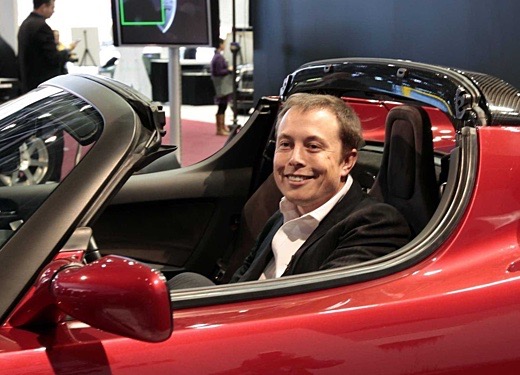
Image above: Elon Musk sits for photo-op in one of his Tesla battery operated cars in a 2013 autoshow. From (http://oppositelock.kinja.com/tesla-posts-surprise-profit-1058185106).

It ought to be sign of just how delusional the nation is these days that Elon Musk of Tesla and Space X is taken seriously.

Musk continues to dangle his fantasy of travel to Mars before a country that can barely get its shit together on Planet Earth, and the Tesla car represents one of the main reasons for it — namely, that we’ll do anything to preserve, maintain, and defend our addiction to incessant and pointless motoring (and nothing to devise a saner living arrangement).

Even people with Ivy League educations believe that the electric car is a “solution” to our basic economic quandary, which is to keep all the accessories and furnishings of suburbia running at all costs in the face of problems with fossil fuels, especially climate change.

First, understand how the Tesla car and electric motoring are bound up in our culture of virtue signaling, the main motivational feature of political correctness. Virtue signaling is a status acquisition racket.

In this case, you get social brownie points for indicating that you’re on-board with “clean energy,” you’re “green,” “an environmentalist,” “Earth –friendly.” Ordinary schmoes can drive a Prius for their brownie points. But the Tesla driver gets all that and much more: the envy of the Prius drivers!

This is all horse shit, of course, because there’s nothing green or Earth-friendly about Tesla cars, or electric cars in general. Evidently, many Americans think these cars run on batteries.

No they don’t. Not really.

The battery is just a storage unit for electricity that comes from power plants that burn something, or from hydroelectric installations like Hoover Dam, with its problems of declining reservoir levels and aging re-bar concrete construction.

A lot of what gets burned for electric power is coal. Connect the dots. Also consider the embedded energy that it takes to just manufacture the cars. That had to come from somewhere, too.

The Silicon Valley executive who drives a Tesla gets to feel good about him/her/zheself without doing anything to change him/her/zhe’s way of life. All it requires is the $101,500 entry price for the cheapest model. For many Silicon Valley execs, this might be walking-around money. For the masses of Flyover Deplorables that’s just another impossible dream in a growing list of dissolving comforts and conveniences.

In fact, the mass motoring paradigm in the USA is already failing not on the basis of what kind of fuel the car runs on but on the financing end. Americans are used to buying cars on installment loans and, as the middle class implosion continues, there are fewer and fewer Americans who qualify to borrow.

The regular car industry (gasoline branch) has been trying to work around this reality for years by enabling sketchier loans for ever-sketchier customers — like, seven years for a used car. The borrower in such a deal is sure to be “underwater” with collateral (the car) that is close to worthless well before the loan can be extinguished.

We’re beginning to see the fruits of this racket just now, as these longer-termed loans start to age out. On top of that, a lot of these janky loans were bundled into tradable securities just like the janky mortgage loans that set off the banking fiasco of 2008. Wait for that to blow.

What much of America refuses to consider in the face of all this is that there’s another way to inhabit the landscape: walkable neighborhoods, towns, and cities with some kind of public transit.

Some Millennials gravitate to places designed along these lines because they grew up in the ‘burbs and they know full well the social nullity induced there. But the rest of America is still committed to the greatest misallocation of resources in the history of the world: suburban living.

And tragically, of course, we’re kind of stuck with all that “infrastructure” for daily life. It’s already built out! Part of Donald Trump’s appeal was his promise to keep its furnishings in working order.

All of this remains to be sorted out. The political disorder currently roiling America is there because the contradictions in our national life have become so starkly obvious, and the first thing to crack is the political consensus that allows business-as-usual to keep chugging along.

The political turmoil will only accelerate the accompanying economic turmoil that drives it in a self-reinforcing feedback loop.

That dynamic has a long way to go before any of these issues resolved satisfactorily.

.

Fumbling towards Collapse

SUBHEAD: We need no more McHousing subdivisions, and other accoutrements of our fast zombifying mode of existence.

By James Kunstler on 20 February 2017 for Kunstler.com -
(http://kunstler.com/clusterfuck-nation/fumbling-towards-collapse/)


Image above: Toronto suburbs during zombie apocalypse from the remake of is 2004’s Dawn of the Dead. From (https://scarina.wordpress.com/2011/09/30/when-hell-is-full/).

In all the smoke and fog emitted by Trump and his adversaries, it must be hard to make out the actual issues dogging this society, and even when you can, to find a coherent position on them.

This was nicely illustrated in Paul Krugman’s fatuous column in Monday’s New York Times, “On Economic Arrogance” — the title describes Krugman’s own attitude to a T.

In it, Krugman attempts to account for the no-growth economy by marshaling the stock-in-trade legerdemain of academic economics: productivity, demographics, and labor metrics.

Krugman actually knows zip about what afflicts us in the present disposition of things, namely the falling energy-return-on-energy-investment in the oil industry, which is approaching the point where the immense activity of getting oil out of the ground won’t be worth the cost and trouble of doing it.

And since most of the things we do and produce in this economy are based on cheap oil — with no reality-based prospect of replacing it with so-called “renewables” or as yet undiscovered energy rescue remedies — we can’t generate enough wealth to maintain anything close to our assumed standard of living.

We can’t even generate enough wealth to pay the interest on the debt we’ve racked up in order to hide our growing energy predicament.

And that, in a nutshell, is what will blow up the financial system. And when that department of the economy goes, the rest will follow.

So, the real issue hidden in plain sight is how America — indeed all the so-called “developed” nations — are going to navigate to a stepped-down mode of living, without slip-sliding all the way into a dark age, or something worse.

By the way, the Ole Maestro, Alan Greenspan, also chimed in on the “productivity” question last week to equally specious effect in this Business Insider article.

None of these celebrated Grand Viziers knows what the fuck he’s talking about, and a nation depending on their guidance will find itself lost in a hall of mirrors with the lights off.

So, on one side you have Trump and his trumpets and trumpistas heralding the return of “greatness” (i.e. a booming industrial economy of happy men with lunchboxes) which is not going to happen; and on the other side you have a claque of clueless technocrats who actually believe they can “solve” the productivity problem with measures that really only boil down to different kinds of accounting fraud.

You also have an American public, and a mass media, who do not question the premise of a massive “infrastructure” spending project to re-boot the foundering economy. If you ask what they mean by that, you will learn that they uniformly see rebuilding our highways, bridges, tunnels, and airports.

Some rightly suspect that the money for that is not there — or can only be summoned with more accounting fraud (borrowing from our future).

But on the whole, most adults of all political stripes in this country think we can and should do this, that it would be a good thing.

And what is this infrastructure re-boot in the service of? A living arrangement with no future. A matrix of extreme car dependency that has zero chance of continuing another decade.

More WalMarts, Target stores, Taco Bells, muffler shops, McHousing subdivisions, and other accoutrement of our fast-zombifying mode of existence?

Isn’t it obvious, even if you never heard of, or don’t understand, the oil quandary, that we have shot our wad with all this? That we have to start down a different path if we intend to remain human?

It’s not hard to describe that waiting world, which I’ve done in a bunch of recent books. We’re going there whether we like it or not. But we can make the journey to it easier or harsher depending on how much we drag our heels getting on with the job.

History is pretty unforgiving. Right now, the dynamic I describe is propelling us toward a difficult reckoning, which is very likely to manifest this spring as the political ineptitude of Trump, and the antipathy of his enemies, leaves us in a constitutional maelstrom at the very moment when the financial system comes unglued.

Look for the debt ceiling debate and another Federal Reserve interest rate hike to set off the latter.

There may be yet another converging layer of tribulation when we start blaming all our problems on Russia, China, Mexico, or some other patsy nation. It’s already obvious that we can depend on the Deep State to rev that up.

.

You Are Not In Control

SUBHEAD: The Technosphere controls our tastes, making us prefer things that it prefers for its own reasons.

By Dmitry Orlov on 14 February 2017 for Club Orlov -
(http://cluborlov.blogspot.com/2017/02/you-are-not-in-control.html)


Image above: Detail of illustration of man controlled by technology by Igor Morski. From (https://www.pinterest.com/pin/543317142516835055/).

My recent book tour was very valuable, among other things, in gauging audience response to the various topics related to the technosphere and its control over us. Specifically, what seems to be generally missing is an understanding that the technosphere doesn’t just control technology; it controls our minds as well.

The technosphere doesn’t just prevent us from choosing technologies that we think may be appropriate and rejecting the ones that aren’t. It controls our tastes, making us prefer things that it prefers for its own reasons. It also controls our values, aligning them with its own. And it controls our bodies, causing us to treat ourselves as if we were mechanisms rather than symbiotic communities of living cells (human and otherwise).

None of this invalidates the approach I proposed for shrinking the technosphere which is based on a harm/benefit analysis and allows us to ratchet down our technology choices by always picking technologies with the least harm and the greatest benefit.

But this approach only works if the analysis is informed by our own tastes, not the tastes imposed on us by the technosphere, by our values, not the technosphere’s values, and by our rejection of a mechanistic conception of our selves.

These choices are implicit in the 32 criteria used in harm/benefit analysis, favoring local over global, group interests over individual interests, artisanal over industrial and so on. But I think it would be helpful to make these choices explicit, by working through an example of each of the three types of control listed above. This week I'll tackle the first of these.

A good example of how the technosphere controls our tastes is the personal automobile. Many people regard it as a symbol of freedom and see their car as an extension of their personalities.

The freedom to be car-free is not generally regarded as important, while the freedoms bestowed by car ownership are rather questionable. It is the freedom to make car payments, pay for repairs, insurance, parking, towing and gasoline. It is the freedom to pay tolls, traffic tickets, title fees and excise taxes.
  • It is the freedom to spend countless hours stuck in traffic jams and to suffer injuries in car accidents.
  • It is the freedom to bring up neurologically damaged children by subjecting them to unsafe carbon monoxide levels (you are encouraged to have a CO detector in your house, but not in your car—because it would be going off all the time).
  • It is the freedom to suffer indignities when pulled over by police, especially if you’ve been drinking. In terms of a harm/benefit analysis, private car ownership makes no sense at all.
  • It is often argued that a car is a necessity, although the facts tell a different story. Worldwide, there are 1.2 billion vehicles on the road. The population of the planet is over 7 billion. Therefore, there are at least 5.8 billion people alive in the world who don’t own a car. 
How can something be considered a necessity if 82% of us don’t seem to need it? In fact, owning a car becomes necessary only in a certain specific set of circumstances.

Here are some of the key ingredients: a landscape that is impassable except by motor vehicle, single-use zoning that segregates land by residential, commercial, agricultural and industrial uses, a lifestyle that requires a daily commute, and a deficit of public transportation.

In turn, widespread private car ownership is what enables these key ingredients: without it, situations in which private car ownership becomes a necessity simply would not arise.

Now, moving people about the landscape is not a productive activity: it is a waste of time and energy.

If you can live, send your children to school, shop and work all without leaving the confines of a small neighborhood, you are bound to be more efficient than someone who has to drive between these four locations on a daily basis. But the technosphere is rational to a fault and is all about achieving efficiencies. And so, an obvious question to ask is,

What is it about the car-dependent living arrangement, and the landscape it enables, that the technosphere finds to be efficient? The surprising answer is that the technosphere strives to optimize the burning of gasoline; everything else is just a byproduct of this optimization.


It turns out that the fact that so many people are forced to own a car has nothing to do with transportation and everything to do with petroleum chemistry.

About half of what can be usefully extracted from a barrel of crude oil is in the form of gasoline. It is possible to boost the fraction of other, more useful products, such as kerosene, diesel fuel, jet fuel and heating oil, but not by much and at a cost of reduced net energy.

But gasoline is not very useful at all. It is volatile (quite a lot of it evaporates, especially in the summer); it is chemically unstable and doesn’t keep for long; it is toxic and carcinogenic. It has a rather low flash point, limiting the compression ratio that can be achieved by gasoline-fueled engines, making them thermodynamically less efficient. It is useless for large engines, and is basically a small-engine fuel.

Gasoline-powered engines don’t last very long because gasoline-air mixture is detonated (using an electric spark) rather than burned, and the shock waves from the detonations cause components to wear out quickly. They have few industrial uses; all of the serious transportation infrastructure, including locomotives, ships, jet aircraft, tractor-trailers, construction equipment and electrical generators run on petroleum distillates such as kerosene, jet fuel, diesel oil and bunker fuel.

If it weren’t for widespread private car ownership, gasoline would have to be flared off at refineries, at a loss. In turn, the cost of petroleum distillates—which are all of the industrial fuels—would double, and this would curtail the technosphere’s global expansion by making long-distance freight much more expensive. The technosphere’s goal, then, is to make us pay for the gasoline by forcing us to drive. To this end, the landscape is structured in a way that makes driving necessary.

The fact that to get from a Motel 8 on one side of the road to the McDonalds on the other requires you to drive two miles, navigate a cloverleaf, and drive two miles back is not a bug; it's a feature.

When James Kunstler calls suburban sprawl “the greatest misallocation of resources in human history” he is only partly right. It is also the greatest optimization in exploiting every part of the crude oil barrel in the history of the technosphere.

The proliferation of small gasoline-burning engines in the form of cars enables another optimization, forcing us to pay for another generally useless fraction of the crude oil barrel: road tar. Lots of cars require lots of paved roadways and parking lots.

Thus, the technosphere wins twice, first by making us pay for the privilege of disposing of what is essentially toxic waste at our own risk and expense, then by making us pay for spreading another form of toxic waste all over the ground.

 Suburban sprawl is not a failure of urban planning; it is a success story in enslaving humans and making them toil on behalf of the technosphere while causing great damage to themselves and to the environment. Needless to say, you have absolutely no control over any of this.

You. Are. Not. In. Control.

You can vote, you can protest, you can lobby, donate to environmentalist groups, attend conferences on urban planning… and you would just be wasting your time, because you can't change petroleum chemistry.

That the need to make people buy gasoline trumps all other considerations becomes obvious if we observe how the technosphere reacts whenever gasoline demand falters.

When rampant wealth inequality started making owning a car unaffordable for more and more people, the solution was to introduce larger cars for those who could still afford one: minivans for the mommies, pickup trucks for the daddies, and for everyone the now common SUV.

And now that gasoline demand is dropping again because of falling labor participation rate and an increase in the number of people who telecommute, the solution will no doubt be driverless cars which will cruise around aimlessly burning gasoline.

Mommies may think that a minivan will keep their kiddies safer than a compact would (not true unless they have 8-9 kids).

Daddies may think that the pickup truck is a sign of manliness (true if you are some sort of gofer/roustabout; pickup trucks are driven by picker-uppers, a subspecies of gofer/roustabout).

But all they are doing is obeying “The Third Law of the Technosphere,” if you will: “For every improvement in the efficiency of gasoline-fired engines, there must be an equal and opposite improvement in inefficiency.”

So, perhaps you should just relax and go with the flow.

After all, being a slave in the service of the technosphere is not immediately life-threatening… unless you crash into a tree or get run over by a drunk. But there is another problem: this arrangement isn’t going to last. The net energy that can be extracted out of a barrel of oil is quickly shrinking.

In less then a decade the energy surplus required to maintain a car-centric lifestyle will no longer exist.

If private car ownership and daily driving are required of you in order to survive, then you won’t survive. There goes at least 18% of the world’s population, which will find itself stranded in the middle of an impassable landscape. Oops!

Given that you are not in control, and given that the car-centric lifestyle is an evolutionary dead end for your subspecies, what can you do?

The answer is obvious: you can plan your escape, then join the other 82% of the world’s population, which is able to live car-free. Some of them even manage to live entirely outside of the reach of the technosphere. Let their example be your inspiration.

.

Robots to replace truck drivers

SUBHEAD: One of the few decent paying jobs for those without college degrees is threatened.

By Natalie Kitroeff on 25 September 2106 for L.A. Times -
(http://www.latimes.com/projects/la-fi-automated-trucks-labor-20160924/)


Image above: Two Otto self driving semi-tractors sit in garage. They have been test driving with autonomous technology up and down Interstate 280 and the 101 Freeway. Photo by Tony Avelar. From original article.

Trucking paid for Scott Spindola to take a road trip down the coast of Spain, climb halfway up Machu Picchu, and sample a Costa Rican beach for two weeks. The 44-year-old from Covina now makes up to $70,000 per year, with overtime, hauling goods from the port of Long Beach. He has full medical coverage and plans to drive until he retires.

But in a decade, his big rig may not have any need for him.

Carmaking giants and ride-sharing upstarts racing to put autonomous vehicles on the road are dead set on replacing drivers, and that includes truckers. Trucks without human hands at the wheel could be on American roads within a decade, say analysts and industry executives.

At risk is one of the most common jobs in many states, and one of the last remaining careers that offer middle-class pay to those without a college degree. There are 1.7 million truckers in America, and another 1.7 million drivers of taxis, buses and delivery vehicles. That compares with 4.1 million construction workers.

While factory jobs have gushed out of the country over the last decade, trucking has grown and pay has risen. Truckers make $42,500 per year on average, putting them firmly in the middle class.

On Sept. 20, the Obama administration put its weight behind automated driving, for the first time releasing federal guidelines for the systems. About a dozen states already created laws that allow for the testing of self-driving vehicles.

But the federal government, through the National Highway Traffic Safety Administration, will ultimately have to set rules to safely accommodate 80,000-pound autonomous trucks on U.S. highways.

In doing so, the feds have placed a bet that driverless cars and trucks will save lives. But autonomous big rigs, taxis and Ubers also promise to lower the cost of travel and transporting goods.

It would also be the first time that machines take direct aim at an entire class of blue-collar work in America. Other workers who do things you may think cannot be done by robots — like gardeners, home builders and trash collectors — may be next.

“We are going to see a wave and an acceleration in automation, and it will affect job markets,” said Jerry Kaplan, a Stanford lecturer and the author of “Humans Need Not Apply” and “Artificial Intelligence: What Everyone Needs to Know,” two books that chronicle the effect of robotics on labor.

“Long-haul truck driving is a great example, where there isn’t much judgment involved and it’s a fairly controlled environment,” Kaplan said.

Robots’ march into vehicles, factories, stores, and offices could also profoundly deepen inequality. Research has shown that artificial intelligence helps erase jobs that require basic skills and creates more roles for highly educated people.

“Automation tends to replace low-wage jobs with high-wage jobs,” said James Bessen, a lecturer at the Boston University School of Law who researches the effect of innovation on labor.

“The people whose skills become obsolete are low-wage workers, and to the extent that it’s difficult for them to acquire new skills, it affects inequality.”

Trucking will likely be the first type of driving to be fully automated – meaning there’s no one at the wheel. One reason is that long-haul big rigs spend most of their time on highways, which are the easiest roads to navigate without human intervention.

But there’s also a sweeter financial incentive for automating trucks. Trucking is a $700-billion industry, in which a third of costs go to compensating drivers.

“If you can get rid of the drivers, those people are out of jobs, but the cost of moving all those goods goes down significantly,” Kaplan said.

The companies pioneering these new technologies have tried to sell cost savings as something that will be good for trucking employers and workers.

Otto, a self-driving truck company started by former Google engineers and executives, pitches its system as a source of new income for drivers who will be able to spend more time in vehicles that can drive solo as they rest.

Uber bought the San Francisco-based company in August.

.

Uber robot car misses red light

SUBHEAD: As Uber launches self driving car in San Francisco incident causes DMV to shut it down.

By Alex Davies on 14 December 2016 for Wired.com -
(https://www.wired.com/2016/12/ubers-self-driving-car-ran-red-light-san-francisco/)


Image above: Still frame from dash camera video of Uber car blowing through red light in San Francisco in December 2016. From video below.

[IB Publisher's note: I suspect the drivers will take the brunt of blame for mishaps during the phasing in of robotic cars that will eventually replace them. I doubt we'll hear much mea culpa from Uber about not getting permission to start this program without DMV permits.]

An Uber equipped to drive itself ran a red light in San Francisco’s SOMA neighborhood Wednesday morning, per a YouTube video apparently shot from a local Luxor cab and reported by The Examiner:
In the video, a Volvo XC90 SUV decked out in the sensors Uber uses to see the world plowed through the intersection roughly three seconds after the light went red, and as a pedestrian was stepping into the crosswalk.

In a statement, Uber spokesperson Chelsea Kohler said the car was being operated by its human driver at the time and had no passengers aboard, and that Uber has suspended that driver while it investigates.2

Even if it was a human at the wheel, it’s bad news on the day Uber announced it’s welcoming passengers aboard its fleet of driverless cars in the city, and that it’s doing so without filing for an autonomous testing permit with the California DMV. Declining to do that likely means Uber doesn’t have to publicly report things like crashes and “disengagements”—when the human operator takes control to make sure the car operates safely.

In a letter sent to Uber self-driving chief Anthony Levandowski on Wednesday afternoon, California DMV counsel Brian Soublet said that if Uber does not immediately confirm it will stop testing and seek a permit, the DMV will take legal action and seek an injunction. Uber did not immediately respond to a request for comment on the letter.3


Video above: The reality! What appears to be an Uber driverless car blows through red light in San Francisico. From (https://youtu.be/_CdJ4oae8f4) and original article.
Charles Rotter, operations manager at Luxor, confirmed to the Examiner that the video was from Wednesday.

“Yes, the dashcam of one of our ramp vans at 10:37 this am,” he wrote, in an email.

The cab pulls up to a red light on Third Street in South of Market, by the San Francisco Museum of Modern Art. A pack of cars flies through a yellow light, and one even drives through the first moment of a red light.

About three seconds after the light turned red, an Uber self-driving car can apparently be seen traveling through the red light at moderate speed as a pedestrian walks across the intersection on the right side of the intersection.
While the video does show an Uber vehicle driving through a red light, it is not clear whether the vehicle was self-driven at the time.

The cameras at the top of the vehicle indicate that it is capable of operating without a driver, but such vehicles can still be driven by humans — and it is entirely possible that this video shows the result of human error.

It is difficult to see inside the vehicle's window as it runs the red light, but a still shot of the image appears to show a face reflecting off the windshield:

Of course, this is not definitive proof that the vehicle was being driven by a human at the time of the incident. The face may show a person in the passenger's seat, or it may not be a face at all.  Uber confirmed in a statement to TechCrunch that the incident was due to human error:
This incident was due to human error. This is why we believe so much in making the roads safer by building self-driving Ubers. This vehicle was not part of the pilot and was not carrying customers. The driver involved has been suspended while we continue to investigate.
Later in the afternoon of 14 December 2016, the state of California's Department of Motor Services ordered Uber to halt its self-driving car rides, effective immediately, as its "autonomous vehicles" were operating without the proper permits:
The DMV requires a permit to use autonomous vehicles on public roads. Uber, which did not immediately respond to a request for comment, had previously argued that its technology was exempt.

“The rules apply to cars that can drive without someone controlling or monitoring them,” wrote Anthony Levandowski, head of Uber’s Advanced Technology Group, in a blog post published early Wednesday morning, before the DMV letter came out. “For us, it’s still early days, and our cars are not yet ready to drive without a person monitoring them.”

Video above: The smooze! A promotional spot introducing Uber's driverless program in San Francisico. From (https://youtu.be/OKJK3_XIGD4) and original article..

So far, twenty companies have reportedly obtained the permits to test autonomous cars on California roads.

.

New Gravel Roads

SUBHEAD: In a generation Kauaians may be driving around the island on gravel roads.

By AP Staff on 16 August 2016 in the Star Advertiser -
(http://www.staradvertiser.com/breaking-news/one-citys-answer-to-pothole-complaints-new-dirt-roads/)


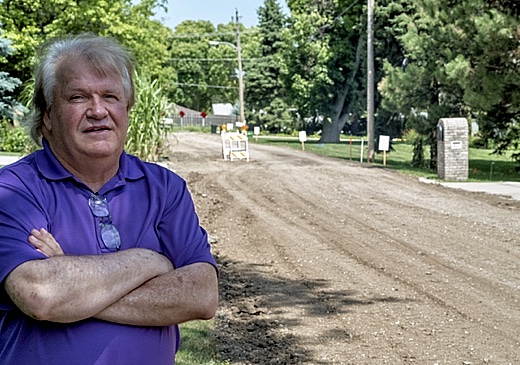
Image above: Lowell Frederes stands along 113th Street in Omaha, Nebraska on August 10th. The city had ground-up the asphalt surface of the street saying it was beyond repair and replaced it with a gravel road. From original article.

[IB Publisher's Note: Asphalt roads are basically fossil fuel laid deep on gravel. Concrete roads are even more energy intensive to lay down. Although there has been major projects to improve roadways on Kauai in the last decade, remember roads are temporary. It will be unlikely we will be able to afford maintenance on the roadways we use today. We have grown accustomed to dense traffic with a mix heavy trucks and tractor trailers. Kauai will have to accommodate the future -  like it or not. How we live our "suburban" lives, commuting, relying on Big-Box stores and front door deliveries from FedeEx will simply go away. Our disintegrating roads will likely support 4x4 trucks, all-terrain vehicles, off road bikes, horse drawn wagons for some time. But the  low-riding  sedans, coupes, crossovers, and hatchbacks that fill our high tech roads today will be a thing of the past.]

For miles and miles Omaha stretches on, one tidy, suburban-style neighborhood after another filled with modern low-slung houses set on spacious lawns with towering oaks and elms.

It’s a model of comfortable mid-American living, with one unusual exception: thanks to a quirk in how Omaha developed, about 300 miles of streets in these nice neighborhoods are pitted with potholes almost big enough to swallow an SUV.

The bad roads have been both an anomaly and a source of complaints for years.

But recently, they’ve become the center of a mini-crisis after local officials began dispatching crews to tear up the asphalt in the neighborhoods and turn the streets back into dirt roads, much like what existed in the city’s frontier days.

The sudden appearance of miles of dirt road in the midst of urban Omaha has prompted angry protests by residents and showcased a conflict over the public services homeowners should expect when a modern city outgrows some of its old real estate agreements.

“No letter, no notice. We just came home on a Tuesday, and our street was ground up,” said Joe Skradski, a dentist who lives on 113th Street, where a dozen $400,000-and-up houses now line a dirt path. “Since then, it’s been nothing short of a nightmare.”

Nearly every U.S. city faces a backlog of needed roadwork as streets built decades ago wear out, but the situation is especially vexing in Omaha, a sprawling city of 435,000 people with 4,800 miles of road and not enough tax revenue to maintain them.

Decades ago, a number of developers sought permission to lay down asphalt roads rather than longer-lasting concrete in several sections in the middle of town, and to skip installing curbs and gutters preferred by the city.

The city agreed, with the understanding that homeowners be responsible for occasional repaving. Some substandard roads also were in areas once outside the city but that were later annexed.

For years, the arrangement held up. But as the roads began to age and crumble, and as new residents replaced the original homeowners, resentment intensified about a city government that maintained some neighborhoods while ignoring others.

Said neighbor Bill Manhart, “It’s like living in the country, but in the middle of the city…There’s so much dust and mud on the street, what’s the point?”

A series of meeting between city officials and residents of the affected neighborhoods, which include about 10,000 houses, hasn’t resolved the problem.

“This is insanity,” declared City Council member Chris Jerram at one heated council session earlier this year.

Austin Rowser, Omaha streets superintendent, said the city’s position is “a matter of fairness. Some property owners paid for better streets and a minority didn’t.” He added that the city simply can’t afford the roughly $300 million bill to fix all the substandard streets.

That doesn’t fly with residents who say that dirt roads or crumbling pavement are unworthy of a well-off community with a growing population, a tiny unemployment rate and four Fortune 500 companies.

“Well, gee whiz, if I’m going to be on a gravel street, I don’t think they should increase my taxes,” said resident Terry Hexum, referring to a recent tax assessment hike that would generate revenue for the entire city. He helped organize a protest meeting attended by 200 people about the street dispute.

Officials have suggested that neighbors create a district to finance repaving, or the more expensive option of rebuilding the streets to city standards, which the city would then maintain.

But when no agreement was reached, city officials dispatched its bulldozers, saying dirt roads were better than deteriorating asphalt. It was not the solution residents were hoping for.

Signs went up denouncing Mayor Jean Stothert and other city officials, and one businessman filed a lawsuit that sought to force the city to repave the road in front of his $1.8 million home.

“So, they say it’s not their road,” said Manhart. “My question is: When did it become theirs to take, and when did it become ours to fix?”

Last month, Stothert announced the city would stop the dirt road conversions, would try to set aside more money for repairs and offered to pay half the cost of repaving three stretches of roads that had prompted some of the heated complaints. It was enough to get businessman Bruce Simon to drop his lawsuit, but no one has come up with a funding plan that would fix all the rough road.

According to urban planners, the dispute is a case study in how short-term deals that cities make about seemingly minor issues can backfire when the cities and circumstances change.

Dan Piatkowski, an assistant professor of regional planning at the University of Nebraska, said the dispute is also forcing residents to think about what they get from government. This is especially useful, he said, in a conservative state like Nebraska that is skeptical of government spending.

Many conservatives believe “smaller government is better, but we still want our roads to function,” he said.

.

Mexico City superhero

SUBHEAD: Clogged with traffic, the capital is hard for pedestrians. Enter Peatónito, wrestling for safer streets.

By Dulce Ramos on 8 November 2015 for the Guardian -
(http://www.theguardian.com/cities/2015/nov/09/unmasked-mexico-city-superhero-wrestling-pedestrian-rights)


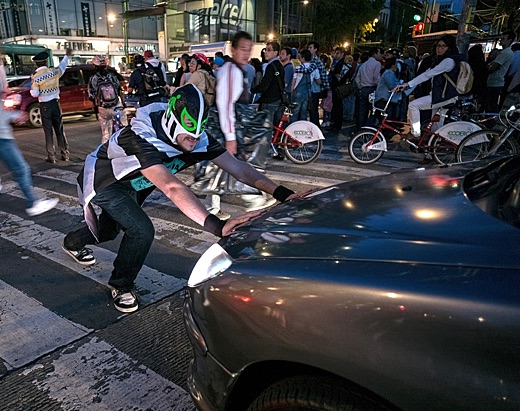
Image above: Masked campaigner Peatónito pushes back a car that has strayed on to a pedestrian crossing in Mexico City. Photograph by Sean Smith. From original article.

The traffic light turns red at the corner of Avenida Juárez and Eje Central, the busiest pedestrian crossing in Mexico City, used by around 9,000 people every hour. Tonight, a driver stops his grey Peugeot exactly on the crossing where the masses are trying to pass. His car is now a steel barrier for those trying to reach the Palacio de Bellas Artes.

A masked man dressed in black makes his way through the river of people, walking purposefully towards the Peugeot. His black and white striped cape, reminiscent of a zebra crossing, flaps behind him. He goes to the car, flings his cape over his shoulder, and pushes the Peugeot backwards to make space.

“My name is Peatónito, and I fight for the rights of pedestrians,” he says, introducing himself. The driver smiles and reverses willingly and eventually the pair shake hands. With the pedestrian crossing again flowing as it should, Peatónito heads back to the pavement where he will wait until he is needed again. The traffic light turns green.

Since 2012, Mexico City has had a “superhero” defending its pedestrians: Peatónito, or Pedestrian Man. Three years after he first appeared on the streets, armed with a highway code and a white aerosol can to spray zebra crossings and pavements where none existed, Peatónito can take pride in the victories that he and his fellow transport rights activists have achieved.

Together, they fight for a safer, more efficient way for people to get around the capital – which has 5.5m vehicles in circulation – on foot.

The triumphs are tangible. This August, Mexico City’s government presented a new set of road traffic regulations with reduced speed limits on primary routes (that is, slower routes) from 70km/h to 50km/h. The reduced speed limit isn’t a mere whim on the part of the activists; it’s possible to measure how dangerous the streets of the capital are. In Mexico City, 52 accidents in every 1,000 are fatal. In the entire country, the rate is 39 deaths for every 1,000 accidents.

Another battle that has been fought and won is the implementation of “Vision Zero”, a series of public policies aimed at eradicating road traffic deaths, which activists worldwide have been backing for years. Their aims: an ethical focus to ensure that human life is prioritised; shared responsibility between those who design the roads and those who use them, and street safety and mechanisms for change.

The Netherlands, Sweden and the UK are among the pioneering countries to adopt Vision Zero (the first two just under 20 years ago). Then came US cities like Chicago, New York, Boston, San Francisco, and eight more. In Mexico, the initiative has been taken up – at least as a point of discussion – in Torreón, an industrial city in the state of Coahuila, and in Mexico City.

If today pedestrians are at the centre of Mexico City’s new road traffic regulations – having relegated cars from the top of the agenda – it is in large part the result of years of activism influencing the city’s policies on road traffic safety.

The dangers of walking

But why does Mexico City need a superhero like Peatónito? And how did the country’s first group of pedestrian rights activists emerge in the capital? If you consider that Mexico City combines the biggest concentration of cars, inadequate road infrastructure, and a total lack of road safety culture, it is not surprising that there are more deaths on the city’s streets than on any others in Mexico.

According to the National Council for the Prevention of Accidents, in 2013, 491 pedestrians died in road traffic accidents in Mexico City. This is equivalent to 6% of all the pedestrian deaths recorded that year in the country. In contrast, when we look at the number of fatalities among drivers and vehicle passengers, the figure is cut by half.

Only 265 of those killed in road traffic accidents in 2013 were behind the wheel or in the car at the time. Being a pedestrian in the world’s fourth most populous city is to risk one’s neck on a daily occurrence.

Despite the fact that in Mexico City, just three out of every 10 journeys are made by car, for decades the government has favoured investment in public works that favour car usage. Walking around the city may well be for the adventurous types, statistically speaking, but Mexico City is full of people who make their journeys on two feet: navigating cars, running after buses that don’t stop where they should, risking their lives on the public bicycle system.

Looking after all these people are the traffic police, but there is little they can do in a city of feverish drivers who will do anything to arrive at their destination on time.

Convincing Mexico’s inhabitants to use their cars less would not only reduce the number of traffic accidents, but would improve the functionality of the city by cutting, for example, the time it takes to commute across the metropolitan zone. Daily transport services in the form of ramshackle buses, driven recklessly, head to the centre crammed with passengers from the suburbs. The underground system, the Metro, has not been properly serviced in years and is also packed to dangerous extremes each morning.
Mexico City, like other cities in the world, doesn’t boast services such as “park and ride” or “incentive parking” – those car parks that allow commuters heading for city centres to leave their vehicles and transfer to public transport connections for part of the journey.
With a general outlook like this, it is little wonder that people opt to use their cars each day to get around, despite it taking up to two or three hours for them to reach their destination.
It’s for all these reasons that Peatónito swoops down onto the streets of Mexico City, backed by a network of activists intent on putting a stop to such problems and making the city more civilised and habitable.

Peatónito unmasked

The man behind Peatónito’s mask is Jorge Cáñez, a 29-old political scientist who works in a civic technology lab for the city government. Twice a week, he dresses as a superhero and takes to the streets to expose serious and minor traffic violations.

“In Mexico City, just moving from A to B is the most hazardous, complicated and inefficient thing imaginable,” says Peatónito, in a bar in the Roma district, one of the city’s most pedestrian-friendly areas, where cyclists and motorcyclists can move around in relative safety. He recalls how his activism began when he had to endure the daily torment of travelling by bus from his house to university.

“When I was a student, I told myself: ‘I’m not going to rest until I find out the reason why public transport from my house to university is so bad, and until I find a solution’.” Thus, 10 years ago, Cáñez began investigating how Mexico City’s public transportation policies are conceived. What he didn’t know was that he wasn’t alone.

In 2010, with the arrival in of the Metrobús, Mexico City’s first bus system in the style of busway or BRT (Bus rapid transit), the agenda around transportation began to be more visible. And yet, groups of urban cyclists had already spent more than 20 years trying to highlight the importance of developing a city that is more amenable to different modes of transport. In 2010, the collective “Walk, Build a City”, the first group of pedestrian rights activists in the country, began to make themselves known.
 
That year, on 21 March, members of the collective painted a pavement on a controversial highway that was built without the normal public bidding process and which damaged green areas.It seemed no one felt it important that the pedestrians should have a designated path, despite the fact they were forced to use that space if they wanted to take the bus.

It took those citizens longer to paint the pavement than for the government to remove it. “We promise to paint a better one,” officials said. And although it took some time, in the end they did designate a narrow strip along the bridge to pedestrians. It was the first of many victories for the pro-mobility activists.

‘The road can be a ring’

Was it necessary to create a character that resembled something out of a Lucha Libre fight to raise awareness about the risks to Mexico City’s pedestrians? Jorge Peatónito isn’t sure, but he believes creativity is a powerful weapon for activists.

“Lucha Libre is deep-rooted in Mexican life, but the idea [for Peatónito] came to me the day I took a few foreign friends along to see a fight. If we’ve had Superbarrio (another Mexican self-claimed superhero who fought causes on behalf of the city’s lower classes in the 1990s), why can’t we imagine the street as a wrestling ring?” This is how his activism acquired its comedy touch.

Humour aside, Peatónito is well aware that in real life superpowers don’t exist, and was himself involved in a car crash four months ago, when a car rammed his bicycle near the Tepito neighbourhood, an area of the city that is notorious for its gangs and black market. Fortunately, he was unhurt – traffic chaos is his kryptonite, he says.

Notwithstanding the risks of the job, Cáñez finds it rewarding and has no plans to abandon his superhero persona: “I do it all for the love of art, to do something for the city. Financially speaking, Peatónito hasn’t earned me more than the fee for a few talks and a couple of trips. That’s it. The best thing is the satisfaction of communicating a message in a powerful way.”

In 2010, with the arrival in of the Metrobús, Mexico City’s first bus system in the style of busway or BRT (Bus rapid transit), the agenda around transportation began to be more visible. And yet, groups of urban cyclists had already spent more than 20 years trying to highlight the importance of developing a city that is more amenable to different modes of transport. In 2010, the collective “Walk, Build a City”, the first group of pedestrian rights activists in the country, began to make themselves known.

That year, on 21 March, members of the collective painted a pavement on a controversial highway that was built without the normal public bidding process and which damaged green areas.It seemed no one felt it important that the pedestrians should have a designated path, despite the fact they were forced to use that space if they wanted to take the bus.

It took those citizens longer to paint the pavement than for the government to remove it. “We promise to paint a better one,” officials said. And although it took some time, in the end they did designate a narrow strip along the bridge to pedestrians. It was the first of many victories for the pro-mobility activists.

‘The road can be a ring’

Was it necessary to create a character that resembled something out of a Lucha Libre fight to raise awareness about the risks to Mexico City’s pedestrians? Jorge Peatónito isn’t sure, but he believes creativity is a powerful weapon for activists.

“Lucha Libre is deep-rooted in Mexican life, but the idea [for Peatónito] came to me the day I took a few foreign friends along to see a fight. If we’ve had Superbarrio (another Mexican self-claimed superhero who fought causes on behalf of the city’s lower classes in the 1990s), why can’t we imagine the street as a wrestling ring?” This is how his activism acquired its comedy touch.

Humour aside, Peatónito is well aware that in real life superpowers don’t exist, and was himself involved in a car crash four months ago, when a car rammed his bicycle near the Tepito neighbourhood, an area of the city that is notorious for its gangs and black market. Fortunately, he was unhurt – traffic chaos is his kryptonite, he says.

Notwithstanding the risks of the job, Cáñez finds it rewarding and has no plans to abandon his superhero persona:
“I do it all for the love of art, to do something for the city. Financially speaking, Peatónito hasn’t earned me more than the fee for a few talks and a couple of trips. That’s it. The best thing is the satisfaction of communicating a message in a powerful way.”

.