The Militarized Pacific

SUBHEAD: American military excess in a region scarred by militarism and an ongoing legacy of war without end.

By Jon Letman on 14 May 2017 for Truth Out -
(http://www.truth-out.org/op-ed/item/23688-the-militarized-pacific-an-anniversary-without-end)


Image above: Marshallese children swim and play amongst a junk heap on the shore of tiny Ebeye island, one of the most densely populated places on earth. Some 11-12,000 people are packed onto the 80 acre island. Photo by Richard Ross. From original article.

March 1, the 60th anniversary of the Castle Bravo test - a nuclear detonation over a thousand times more powerful than the bomb that destroyed Hiroshima - has come and gone.

Predictably, major decadal events, like a 15-megaton explosion over a Micronesian atoll, garner fleeting attention, but it's all the days between the anniversaries that tell the real story of those who live with the impacts.

For the people of the Marshall Islands, where Enewetak, Bikini and neighboring atolls were irradiated and rendered uninhabitable by 67 nuclear tests between 1946 and 1958, the brief anniversary recognition only underscores what little attention the Marshallese and, in a broader sense, millions of peoples of the Asia-Pacific are given by the US government and public.

The Marshallese, like people across the Pacific, live with impacts of plans devised at the United States Pacific Command (USPACOM) headquarters in Hawaii. After the Pentagon, PACOM is one of the world's most far-reaching military command centers.

With a self-proclaimed "Area of Responsibility" that absorbs half the world's population and covers roughly half the planet from the Arctic to the Antarctic, across the Indian Ocean and from Central Asia to the Central Pacific, it gives new meaning to the word "vast."

Generally, the US public gives little, if any, thought to the impact their military has on entire societies, economies and the natural environments that sustain them - as they pursue "American interests" and "national security" under America's self-dubbed first Pacific president.

Many Americans are aware of the US military presence in Hawaii, Okinawa, Guam and throughout Japan and South Korea. Those old enough may recall the now-closed naval base at Subic Bay in the Philippines and might have noticed President Obama's 2011 announcement of an Asia-Pacific pivot.

Part of the pivot includes the deployment of up to 2,500 Marines, along with B52 bombers, FA18s, C17 transport aircraft and other military hardware, to Northern Australia and a naval base in Western Australia.

However, places like the US-backed naval base being built on South Korea's Jeju island and the enormous military testing and training ranges in the Northern Mariana Islands (larger than much of the western United States) receive almost no attention. Names like Pagan, Rongelap and Kwajalein are scarcely known in the country that uses these islands for its own military testing.

Something to Prove
Nowhere are the costs of a militarized Pacific better illustrated than in the Republic of the Marshall Islands (RMI). The tiny Micronesian nation, located between Hawaii and Guam, has just 53,000 people. The Marshallese are a young population - the median age is just over 19 years old - yet the country is burdened with some of the highest cancer rates in the Pacific following 12 years of US nuclear tests in what was called "the Pacific Proving Grounds."

Dr. Neal Palafox of the John Burns School of Medicine at the University of Hawaii has been working in the RMI on and off since the 1980s. Palafox says health impacts are not limited to elevated cancer rates (especially cervical, breast and liver) and birth defects, but include heart disease, diabetes, stroke, hepatitis, obesity and substance abuse that stem from the dramatic changes the country has undergone since the 1950s.

"The rapidness at which [Marshall Islanders] had to enter Westernization is a large part of the cause of the non-communicable diseases which are lifestyle and diet [related]," Palafox says, adding that increased levels and types of cancers in the Marshall Islands, based on National Cancer Institute (NCI) research and firsthand accounts by Marshallese, are the result of nuclear testing.

In a series of eight papers published in the journal Health Physics, the NCI found average thyroid radiation doses in the southern Marshall Islands ranged from 12 to 34 megarays (mGy), in the mid-latitudes from 67 to 160 mGy and in the northern inhabited atolls (closest to the nuclear tests) from 760 to 7,600 mGy. In the mainland United States, the report notes, exposure to natural radiation in the environment is 1 mGy.

The militarization that continued after World War II led to sweeping societal changes for the Marshallese as the combination of forced evacuations and relocations due to nuclear testing and the lure of jobs at the military base on Kwajalein Atoll led to rapid urbanization.

Today three-quarters of the country's people live on just two tiny islands - the capital Majuro and Ebeye Island, part of Kwajalein Atoll, home to the Ronald Reagan Ballistic Missile Defense Test Site (RTS), one of the premier missile testing facilities in the Pacific.

Founded in the 1960s, RTS supports the US Space Surveillance Network, the Missile Defense Agency and AEGIS Ballistic Missile Defense testing which contributes to the land-based missile systems the US is preparing to deploy in Poland and Romania.

"Slum of the Pacific"
Three miles north of Kwajalein's main island is Ebeye. At 80 acres, it's little more than a speck of dry land but it's home to an estimated 11,000-12,000 Marshallese, making it one of the most densely populate places on Earth. Over half the population is under 18 years old, largely supported by adults who commute daily to work at RTS as groundskeepers, kitchen workers, custodians or in clerical positions.

Noda Lojkar, who was born on Ebeye says, "The living conditions are really hard - it's bad, especially with power and water [shortages]." Lojkar is the consul general at the RMI's consulate in Honolulu, but has family on Ebeye and still regularly visits.

He says some 800 Marshallese work at RTS, each of them supporting around 14 people on Ebeye. Lojkar remembers less crowded times and a friendlier relationship with military personnel but says conditions have grown more rigid in recent years. "The base became stricter and stricter, and it changed people's mentality and how they looked at the Americans," he says.

After 9/11, Kwajalein island access for Marshallese grew tighter even when visiting in search of potable water. "On Ebeye, there's not enough water," Lojkar says, explaining that the military has multiple sources of water.

With almost no space to grow or raise food, Ebeye residents live mostly on imported rice, flour, canned meats and fish from the US or Australia. The tropical bounty found on other Pacific islands is in short supply on Ebeye, and simply traveling to another island to harvest food is impractical or impossible for those who don't have a boat, can't afford the expensive gas and don't own land on other islands.

A Life Changed
Life on Ebeye wasn't always like this. Giff Johnson, editor of RMI's sole newspaper, the Marshall Islands Journal, has been visiting Ebeye since 1976. He's spent close to a year on the island and has watched as various bodies - the US military, the RMI and US governments, and most recently Australia - have tried to improve basic water, power and hygiene infrastructure.

The urbanization of not just Ebeye but the entire country, which began in the 1950s and 60s, saw people come from as far away as the Federated States of Micronesia (FSM) and Palau to work at "Kwaj." As outsiders converged on Ebeye, families grew, and conditions became what they are today.

Johnson, who lives on Majuro, describes how Marshallese visiting Kwajalein, have to go through gratuitous security checks that include multiple identification passes, X-rays, fingerprinting and even confiscation of possessions as innocuous as candy bars.

This treatment is disturbing to Marshallese inside their own country. "We're your allies, [we] vote with the US at the UN. We support you and work on the base. We're not al Qaeda. We are your partners," Johnson says, repeating the sentiment of many Marshallese.

RTS did not respond to a request for comment.

By hosting RTS, Marshallese must also submit to restricted access to Kwajalein lagoon before, during and after range operations - that is, when missiles armed with dummy warheads are being fired from or into the lagoon.

Besides poor infrastructure, overcrowding and few job opportunities, Johnson says life is hard in the RMI's crowded urban centers, citing alcohol abuse, dropping out of school, high suicide rates and chronic health problems as contributing factors to RMI's high outward migration and disproportionately high rate of enlistment in the US military.

"Our industry here is government grants from the United States," Johnson says wryly. "That's our economy."

"Safe" Is a Relative Term
In the northern Marshall Islands, 150 miles east of Bikini, is Rongelap Atoll. Today, the main island is mostly empty, the majority of its population having been removed, relocated and then evacuated with the help of Greenpeace in 1985. The Rongelapese community is divided between remote Mejatto Island and Majuro.

Senator Kenneth Kedi represents Rongelap - his home community - in the RMI's parliament. Kedi describes how, following the nuclear tests, women on Rongelap began having "very unnatural babies - octopus-looking, grape-looking." He says a 1982 report by the US Department of Energy (DOE) confirmed that parts of Rongelap were as contaminated as Bikini.

In 1996, the US provided $45 million to the Rongelap local government for "environmental remediation and resettlement," but today less than $10 million remains and, according to Kedi, "we are not even close to ten percent of decontaminating our islands." A Nuclear Claims Tribunal awarded $1 billion for cleanup and compensation, but Kedi says, "[they] did not have the money. It did not even pay us a penny for that."

Despite this, in 2010 the US Department of Interior began pressuring Rongelapese to return to the island or face cuts in financial support. When Kedi asked a DOE official and scientist if it was safe to return to Rongelap they told him "safe is a relative term." That, Kedi says, sounds more like an environment for animals, not humans.

Kedi describes an ongoing health and environmental crisis that is the direct result of the United States but says, "a lot of our leaders in the [US] Congress have no understanding whatsoever of what took place in the Marshall Islands...they have no idea how grave the situation is..." He adds the same is true for the American public.

"There are still outstanding issues with this unique and great relationship that we have. The United States government needs to address the issue of the radiation legacy. We need to bring this to a closure."

Kedi spoke to Truthout by Skype from Majuro hours after the surprise announcement of a lawsuit that RMI filed against the nine nuclear nations at the International Court of Justice on April 24. Kedi likens the filing to David vs. Goliath but criticizes the lawsuit for its failure to address compensation.

"If [the lawsuit] were to include the issues of the Marshall Islands for compensation and health care and rehabilitation...then I would support that. Shouldn't we be focusing on our own issues that we are actually struggling with today - health care and contaminated land?" Kedi asks.

Resolving these outstanding issues, Kedi says, is not just a matter of dollars. "It's about doing the right thing...We just want peace and harmony like we used to have before the testing time."

"More Like Us Than Mice"
Today the Rongelap local government is working with Julian Aguon, a human rights lawyer in Guam. Aguon says too many people consider America's nuclear legacy in the Marshall Islands "a chapter that is closed in a book that has ended, it's relegated to the past."

"Oh, this was so tragic... and we're so sorry it happened but it's over," Aguon says, in a voice feigning concern. He says the US ignores a range of big issues and arguments and relied on a faulty study about limited radioactive contamination. "It's very clear that everywhere in the Marshalls was contaminated - not just four atolls."

The ongoing fear of radiation, Aguon says, is part of the reason why so many people have left the RMI, taking advantage of a special agreement that allows visa-free US residence for nationals of the RMI, FSM and Palau. These compacts of free association (COFA) are full of major shortcomings, not the least of which is the requirement to be taxed like a US citizen but with the burden of heavily restricted health care access. COFA has led to sizeable Marshallese communities in Hawaii and places like Salem, Oregon, and Springdale, Arkansas.

"To put it in historical context, these people aren't able to trust anything that the US says only because in 1957 they were moved back with a very clear plan that they were going to be purposefully exposed to long-term low-level radiation. Not the acute exposure right after the bomb but the inhalation and the consumption of the food," Aguon says.

Aguon describes the Marshallese as having been "corralled together and made the unwitting subjects of non-consensual medical experimentation after the Bravo nuclear test."

In a 1956 Atomic Energy Commission meeting, Merril Eisenbud, director of the AEC Health and Safety Laboratory, described the Marshallese thus: "While it is true that these people do not live, I would say, the way Westerners do, civilized people, it is nevertheless also true that these people are more like us than the mice."

"We, in these far-flung places," Aguon says, "[have] a sense that American civil society really bears a greater responsibility for trying to arrest the spread of certain juggernaut forces like militarism that is being perpetuated in their name by their government for their safety."

(Another) Asia-Pacific Pivot
The plight of the Marshall Islands is the back-story of today's increasingly militarized Asia-Pacific, but David Vine, associate professor of anthropology at American University, sees nothing particularly new about Obama's Asia-Pacific pivot.

"Very early on islands were identified as playing a very important role in expanding the reach of the United States, and US commerce in particular," Vine says, citing early US military forays into Okinawa and the tiny Bonin (Ogasawara) Islands southeast of Japan. In the 1960s US nuclear weapons were kept in Okinawan ports and have been documented as passing through Japanese islands despite Japan's stated opposition to introducing and storing nuclear weapons.

Similarly, in 1987, the nation of Palau, under pressure from the US, dropped its opposition to the entry of US nuclear armed and powered vessels into its territory.

Vine talks about the post-World War II "forward posture" of creating a wall of Pacific islands as close as possible to Asia for its own strategic interests. He describes Pacific island nations like the RMI, Palau and FSM as being technically sovereign but, like American Samoa, Guam, Saipan and the Northern Mariana Islands, effectively run as colonies.

Vine says these islands exist under conditions that overwhelmingly benefit US military interests, perhaps best illustrated by the US insisting on the "right of strategic denial." This "right," claimed under COFA, grants the US exclusive military control over half a million square miles of the Pacific and includes provisions allowing for the use of RTS on Kwajalein through 2066 with the option to extend to 2086.

Pointing to small Pacific outposts that lack "Burger King bases" (sprawling military bases loaded with recreational and other amenities), Vine says, "while sometimes military facilities might be quite limited, they often can form the nucleus for what could be a much larger base." He says austere bases with small numbers of personnel or "temporarily embedding" US forces within another nation's military base (Australia, Singapore, the Philippines), are part of the "lily pad strategy." Vine says what constitutes a US military base in name is often subject to semantic games, using words like "military place" instead of "military base."

According to the Department of Defense 2013 Base Structure Report, the US has just one military base in the Marshall Islands: RTS at Kwajalein. However, it also controls 10 other sites in the RMI which are not counted as bases because they don't meet the criteria of at least ten acres and $10 million PRV ("plant replacement value"). Regardless of the true number, in a country made up of just 70 square miles, every foot of dry land counts.

Vine has thoroughly documented the displacement of Chagos Islanders to make way for the US military base at Diego Garcia in the Indian Ocean in his book Island of Shame: The Secret History of the US Military Base on Diego Garcia. He says the patterns of displacement in the Pacific, specifically the Marshall Islands, are similar to what happened at Diego Garcia.

Anniversaries Without End
According to Vine, this is a very dangerous time in the Asia-Pacific and the US is playing a largely unproductive role that is increasing danger and heightening tension between China and other nations. "The presence and build-up of US bases," he says, "is not the way to ensure peace and security in the region."

In the coming months, the world will mark the 70th anniversary of Pacific battles in Saipan, Guam, the Mariana Islands, New Guinea, Palau, the Philippines and Burma.

More anniversaries will be recognized next year to commemorate battles in Bataan, Manila and Iwo Jima, followed by anniversaries of the firebombing of Tokyo, the battle of Okinawa and then, in August 2015, the destruction of Hiroshima and Nagasaki.

Each event represents death and destruction of the past in a region scarred by militarism and an ongoing legacy of war without end.

• Jon Letman is a freelance journalist on Kauai. He writes about politics, people and the environment in the Asia-Pacific region. Follow him on Twitter: @jonletman.
.

GMOs - China - Syngenta

SUBHEAD: China pushes public to accept GMO food products as Syngenta takeover nears.

By Shuping Niu on 21 May 2017 for Bloomberg -
(https://www.bloomberg.com/news/articles/2017-05-22/china-pushes-public-to-accept-gmo-as-syngenta-takeover-nears)


Image above: A bowl of genetically-modified "Golden Rice." Photograph by Imaginechina. From original article.

China will carry out a nationwide poll next month to test the public’s acceptance of genetically-modified food, a technology the government says would boost yields and sustainable agriculture in a country that’s seen consumption soar.

Beijing’s prestigious Tsinghua University and two other Chinese colleges will carry out the survey, said Jin Jianbin, a professor at Tsinghua’s School of Journalism and Communication. The poll, sponsored by the government, will be carried out in tandem with a campaign on social media to broadcast basic knowledge on GMO technology, which is widely misunderstood in the country, Jin said.

China is the world’s fourth-largest grower of GMO cotton and the top importer of soybeans, most of which are genetically modified and used for cooking oil and animal feed for pigs and chickens. But public concern over food safety issues and skepticism about the effects of consuming GMO foods have made the government reluctant to introduce the technology for staple crops.

A 2012 trial of so-called Golden Rice -- a yellow GMO variant of the grain that produces beta-carotene -- caused a public storm after reports that the rice was fed to children without the parents being aware that it was genetically modified.

“Many Chinese turn pale when you mention the GMO word,” said Jin in his small office. Some still believe GMO food can cause cancer and impair childbirth, due to misleading reports in newspapers and social media, he said. A recent decision by a local legislative body against growing GMO crops has added to public confusion, Jin said.

‘Half-Cooked Rice’

The national survey aims to discover what the public’s concerns are so that the government can resolve the confusion, Jin said. “If the government pushes ahead before the public is ready to accept the technology, it would be embarrassing -- like offering a pot of half-cooked rice to eat.”

Jin said he expected the poll result to show that the general public’s perception of GMO is still negative, but “as more people get to know the technology, more would be willing to accept it.”

The lack of an authoritative scientific institution to answer questions, the widespread illegal cultivation of GMO crops, and public mistrust of government authorities after a series of food scandals have all contributed to skepticism about GMO, Jin said.

Producers of GMO crops claim they offer improved yields, enhanced nutritional value and resistance to drought, frost and insects. Critics have raised concerns over safety and potential adverse ecological effects.

Last year, the U.S., the world’s largest producer of GMO crops, mandated that food makers label products with modified ingredients. EU lawmakers this month objected to imports of herbicide-resistant strains of corn and cotton.

Syngenta AG, which produces genetically modified seeds for corn, is gearing up for rapid expansion in the country after shareholders accepted a $43 billion offer for the Swiss agribusiness by China National Chemical Corp. The Chinese state-owned company is expected to complete the deal this month.

The American Chamber of Commerce in China had complained that U.S. strains of GMO suffered from slower and less predictable approval for import into China. Chinese and U.S. officials have agreed to evaluate pending U.S. biotechnology product applications by the end of the month, including corn and cotton.

China itself has spent billions on research of its own GMO technology over the past decade, but has not allowed commercial production of grains, with scientists citing public resistance as part of the reason for the delay. China has said that it will allow commercial production of modified corn and soybeans by 2020.

Government officials have said that the country would introduce the use of the technology first on feed grains after cotton. China’s corn consumption is estimated to grow nearly 20 percent in the coming decade on demand for protein-rich meat and dairy products.


Syngenta sells Hawaii Sites

SUBHEAD: IB Publisher's note - this is because of the extent of military operations throughout the state of Hawaii and on Kauai the large Syngenta presense at and around the PMRF where research and development and testing of new weapon systems takes place.

By  Jessica Else on 12 May 2017 for The Garden Island - 
(http://thegardenisland.com/business/local/syngenta-sells-hawaii-sites/article_330d8eae-ebd4-55a0-8acb-cb1246eedcbb.html)

An Iowa company is taking over the Hawaii Syngenta sites, including the location on Kauai’s Westside, but day-to-day activities will stay the same, according to company representatives.

The purchase agreement between Hartung Brothers, Inc. and Syngenta was announced Thursday. The deal should close by the end of June for an undisclosed amount.

“There are no planned reductions (in staff) resulting from this,” said Paul Minehart, Syngenta spokesman.

Syngenta’s Kauai location employs about 100 people.

Hartung Brothers, Inc., is a seed company founded in Madison,Wisc., in 1975, that has been providing seed corn production, processing and distribution services to Syngenta since the 1980s.

“We are extremely pleased to have this agreement with Hartung Brothers for our Hawaii sites,” said Ed Attema, Syngenta head of Global Seed Operations, Production & Supply in a press release. “The goal has been to have our employee talent base and facilities maintained and to contract work with the new owner, and that will be achieved.”

All employees will be offered employment by Hartung when the acquisition closes, according to the release.

Part of the agreement includes Syngenta contracting current Hawaii-based seed production activities from Hartung. According to the release, the purchase “ensures ongoing crop innovation will continue to be part of Hawaii agriculture, which plays an important role in food production for the U.S. and around the world.”

Bennette Misalucha, executive director of Hawaii Crop Improvement Association, welcomed the new agribusiness to the Hawaii agriculture community.

“Hartung Brothers, Inc.’s purchase of Syngenta’s Hawaii operations will ensure the preservation of jobs and continuation of seed production activities on Oahu and Kauai,” Misalucha said.

Activists who have been asking the state to regulate pesticide use by the agribusiness companies on the Westside are keeping an eye on the sale, hoping to see a change in practices.

“It would be refreshing if a company came in, grew something non-toxic and profitable, (so) that we could have jobs that are safe from continual pesticide exposure,” said Jeri Di Pietro, of Hawaii SEED.
Di Pietro said she hopes Hartung Brothers will use practices that remedies the soil.

“Even the worst soil can be made healthy again, we need to see what this new company has in mind,” she said.

In August, Syngenta Seeds announced a potential $43 billion sale of the company to China National Chemical Corporation (ChemChina) and the deal between the state-owned ChemChina and the Swiss-owned Syngenta is nearing completion.

In a Wednesday announcement, the two companies said the takeover has won support from about 80 percent of Syngenta’s shareholders.

The transaction required 67 percent of shareholders to accept the acquisition. According to a timeline provided by the companies, the first half of the settlement will be paid on May 18 and the second half will be paid on June 7.

ChemChina is headquartered in Beijing and owns production, research and development, and marketing systems in 150 countries and regions.

Since the August announcement of the pending sale, Hawaii locations have been exempt from the deal by the U.S. Committee on Foreign Investment.

Even so, Syngenta officials have been planning to sell its operations on Oahu and Kauai since the announcement of the possible ChemChina buyout in August.

The purpose was to pursue a different operating model by contracting Hawaii-based seed production activities with the new owner, according to a news release, while maintaining a commitment to developing agricultural innovation in Hawaii.

This isn’t the first time Syngenta has entertained the idea of selling or merging the company. In August 2015, Monsanto abandoned a $47 billion proposed takeover of the company.

Though Hartung is taking over the reins at Syngenta’s Hawaii locations, the family owned agribusiness plans to keep the focus on providing customers with quality seeds and services, as well as maintaining a strong workforce.

“Our company is very much a family business rooted in the work ethic instilled in us by our parents Lorna and Galen Hartung,” said Dan Hartung, president, Hartung Brothers, Inc. “We are excited about the opportunities this acquisition will bring our current customers.”

He continued: “It will also allow us to expand our customer base with new capabilities. We are very impressed with the current Hawaii management team and employees. Their dedication, knowledge and pride shows in all they do.”

Syngenta works about 4,000 acres on Oahu and Kauai for inbred and hybrid seed production sites and was established in Hawaii in the late 1960s.

See also:
Ea O Ka Aina: ChemChina takeover of Syngenta 5/5/17
Ea O Ka Aina: China's suicidal food strategy 9/30/16
Ea O Ka Aina: China to take over Syngenta? 2/2/16
Ea O Ka Aina: GMO Corn Wars 8/28/15
Ea O Ka Aina: Oxfam at Odds over GMO's 4/14/10
Island Breath: TGI#24 - Down with King Corn 2/28/08
Island Breath: GMO Free China 12/22/05


.

The Banality the Anthropocene

SUBHEAD: When my uncle becomes blind to the violence of his own corn, he becomes blind to Standing Rock, and more.

By Heather Anna Swanson on 22 February 2017 for Cultural Anthropology -
(https://culanth.org/fieldsights/1074-the-banality-of-the-anthropocene)


Image above: Barn along Highway 1, south of Fairfield, Iowa. Photograph  by Ken K. From original article.


I want to propose an Anthropocene territorialization and a subject-making project in which anthropologists might want to engage. The territory of which I write is a place called Iowa.

There are plenty of troubling things about the Anthropocene. But to my mind, one of its most troubling dimensions is the sheer number of people it fails to trouble.

For many living in precarious situations, the Anthropocene is already life-altering, life-threatening, and even deadly. It comes in the form of a massive flood or a rising tide that takes their homes away. Or as an oil well that poisons the river on which they depend.

But for others, especially the white and middle-class of the global North, the Anthropocene is so banal that they do not even notice it. It is the green front lawn, the strip-mall parking lot, the drainage ditch where only bullfrog tadpoles remain.

Iowa lies at the heart of this banal Anthropocene. The Anthropocene, here, is wholesome. It is the cornfield and the industrial pig farm. It is the 4-H county fair and eating hot dogs on the Fourth of July. It is precisely this banality, this routinized everydayness (see Arendt 1963), that makes the Iowa Anthropocene so terrifying.

I write of Iowa not from the outside, but from a place of connection. I, too, am Iowa. Without it, I would not be where I am. My mother and father were born and raised in Iowa, and its mid-twentieth-century agricultural modernization and postwar dreams for better futures propelled their upward mobility.

It allowed them to get off the farm and become the first people in their families to go to college. Iowa’s industrial agriculture and its surpluses thus made my own scholarly career possible.
Indeed, we are all implicated in Iowa.

We are all entangled with the everyday violences of industrial agriculture and nationalist projects in a way that substituting an organic latte for the hot dog or shopping at Whole Foods won’t solve.

We cannot make ourselves clean. The urbanized coasts are made possible by the production of the heartland. New York is standing on Iowa (cf. Moore 2010).
How is it that Americans, especially white middle-class ones, learn not to notice such entanglements, to not be affected? How do we learn not to see the damage around us?

Iowa is objectively one of the most ruined landscapes in the United States, but its ruination garners surprisingly little notice. Less than 0.1 percent of the tallgrass prairie that once covered much of the state remains. You’ve seen the Anthropocene J-curves: the rise of atmospheric CO2, human population growth, and dammed rivers, to name a few (Steffen et al. 2015). The decline in Iowa prairie makes a reverse J.

Between 1830 and 1910, Iowa lost a whopping 97 percent of its prairie acreage. But this is only the tip of the iceberg. The reorientation of Iowa’s landscape toward capitalist agricultural production has resulted in the obliteration of worlds that once occupied it. The American Indians who carefully tended the prairie through burning and bison management have been forced out of the state.

Nearly every acre has been privatized. Today Iowa ranks forty-ninth out of the fifty U.S. states in public land holdings.

Ninety-nine percent of its marshes are gone. The level of its main aquifer has dropped by as much as three hundred feet since the nineteenth century, largely due to the extraction of irrigation water. Water quality is a mess, too.

Between 2010 and 2015 more than sixty Iowa cities and towns had high nitrate levels in drinking water due to the leaching and run-off of agricultural fertilizers. And those same fertilizers wash down the Mississippi River to the Gulf of Mexico, where they have created an aquatic dead zone the size of Connecticut.

Few people, either within or beyond Iowa, notice the profundity of these changes. When my uncle, a farmer in northeast Iowa, gazes out at his cornfields, he does not see the annihilation of the prairie, the loss of the bison, or the displacement of American Indian communities.

He does not notice the contamination of groundwater, even though he had to redig his well a few years ago due to bacterial seepage from a nearby pig farm. He simply shrugs off such things and wonders what the crop prices will be next year.

Blindness proliferates: when my uncle becomes blind to the violence of his own corn, he becomes blind to others in neighboring farmhouses, in the neighboring towns, in neighboring states. He cannot see Standing Rock, and he cannot see why Black Lives Matter might matter to him.

It isn’t exactly his fault that he doesn't notice. White middle-class American subjectivities are predicated on not noticing. They are predicated on structural blindness: on a refusal to acknowledge the histories we inherit. As Deborah Bird Rose (2004) has shown in the case of Australian settler colonialism, dreaming of futures requires blindness to the past.

Michel Foucault’s work reminds us that the discourses that shape our subjectivities are not just words; they are also the bricks of the prison, the institutional form of the clinic (see Hirst 1995). But we have failed to see that they are also the monocrop cornfield. Iowa’s landscape infrastructure produces us and the Anthropocene.

The cornfield is an assemblage that brings the so-called common good of progress and nationalist growth into being. It produces grain futures markets and cheap hamburgers. How can we better see its terrors and erasures?

One of these terrors is that there are countless Iowas beyond Iowa. I currently live in Denmark, where I am a member of a research project called Aarhus University Research on the Anthropocene (AURA).

One of my colleagues, Nathalia Brichet, uses the term “mild apocalypse” to draw attention to the normalized degradation of Danish landscapes. In the midst of Denmark’s rolling fields and highly managed forests, the Anthropocene continues to be stubbornly hard to see.

Donna Haraway has called for curiosity as both scholarly method and political practice, as an antidote to these learned blindnesses. In her book When Species Meet (Haraway 2008), she becomes curious about who and what she touches when she reaches out to pet her dog.

That curiosity becomes a radical practice of tracing and inheriting histories, such as the dog-herding practices of livestock-based Australian colonization efforts and the making of purebred dogs.

But in a world of structural blindness, such kinds of curiosity do not come naturally. They must be cultivated. But how? How, in the words of Joseph Dumit (2014), do we wake up to connections?

Can we imagine corollaries to Bible study meetings or consciousness-raising groups in which people would be encouraged to trace the histories of the landscapes they inhabit, a process that might draw them into new ways of seeing themselves and their worlds? I imagine such practices as a multispecies analogue to Foucauldian genealogy (see Foucault 1970).

Might exploring the genealogies of Iowa cornfields, for example, denaturalize them and counter the power of their banality?

Might they enable Iowans and all of us to become more curious about the conditions of our own subjectivities and, in turn, how we might transform the landscapes with which they are entangled? This is the important work of making curiosity more common, of troubling the Anthropocene.

References

Arendt, Hannah. 1963. Eichmann in Jerusalem: A Report on the Banality of Evil. New York: Viking Press.

Dumit, Joseph. 2014. “Writing the Implosion: Teaching the World One Thing at a Time.” Cultural Anthropology 29, no. 2: 344–62.

Foucault, Michel. 1970. The Order of Things: An Archaeology of Knowledge. New York: Pantheon. Originally published in 1966. 

Haraway, Donna. 2008. When Species Meet. Minneapolis: University of Minnesota Press.
Hirst, Paul. 1995. “Foucault and Architecture.” In Michel Foucault: Critical Assessments, Volume 4, edited by Barry Smart, 350–71. New York: Routledge.

Moore, Jason W. 2010. “‘Amsterdam is Standing on Norway’ Part One: The Alchemy of Capital, Empire, and Nature in the Diaspora of Silver, 1545–1648.” Journal of Agrarian Change 10, no. 1: 33–68.

Rose, Deborah Bird. 2004. Reports from a Wild Country: Ethics for Decolonization. Sydney: University of New South Wales Press.

Steffen, Will, Wendy Broadgate, Lisa Deutsch, Owen Gaffney, and Cornelia Ludwig. 2015. “The Trajectory of the Anthropocene: The Great Acceleration.” Anthropocene Review 2, no. 1: 81–98.

.

Real Wealth and trusting No System

SUBHEAD: We are into the Anthropocene Age. Previous systems that provided wealth are bankrupt.

By Juan Wilson on 23 May 2107 for Island Breath -
(http://islandbreath.blogspot.com/2017/05/real-wealth-and-trusting-no-system.html)


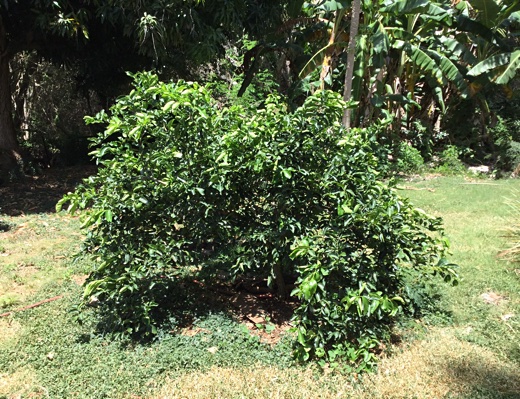
Image above: A dwarf lime tree in Hanapepe Valley produces hundreds of limes throughout the year. Photo by Juan Wilson.

If you have not noticed already I'd be surprised. What you say? You have not gotten whiff of the acrid smoke has been coming off the carcass of "Our American Way of Life".  It's happening. 

For me 'resistance" has been going on for three generations. Back to the civil rights movement and anti-Vietnam War protests during Kennedy and Johnson years; on through Nixon and Reagan's soulless "Christian" operations, into Bush & Son's CIA 911 psychosis and now through sly Obama's and clueless Trump's endless robot wars against the Middle East.

For much of that time I thought I was dealing with individual moral and social issues. That each issue could be dealt with and we could get back on the track to a fairer and friendlier future for all Americans.

It did seem like much was still right with the country - and if we could only get a handle on some of  the mean spiritedness, selfishness, etc that things would be okay... Not to happen.

It has become clearer and clearer that our institutions are creating the problems and not dealing with the results... in fact they use the problems created with one policy to feed the fire to create more bad policy.

As it stands our legislatures, judiciaries, regulatory agencies, government service departments, banking institutions, fuel energy sector, corporations, insurance operations and just about anything else you can think of is part of the problem. They are in self denial and cannot get a grip on the underlying systemic failure we face.

In fact, since Trump's rise to power it seems any marginally positive service the government might provide (like measuring and identifying environmental problems) are being reduced or systematically eliminated and uncontrolled profiteering on limited resources is being encouraged. We are poring our blood and sweat into increasingly useless and self destructive behavior. 

However, an economic phase change is about to occur.

For America to "thrive" the intercontinental container shipping, along with the interstate trucking, and long haul rail shipping systems must run smoothly and continuously.

That is how the Walmart, Costco, Amazon and Home Depot remain operational. These corporations will stop operating when it is not profitable. And those underlying transportation systems are far more delicate than most people realize - and no! roboticized semi-tractor trailers is not the solution.

This moment it is really clear that;
GROWTH IS DEAD!
THE RESOURCES ARE GONE!
THE ENVIRONMENT IS MORTALLY DAMAGED!
will mean we are really into the Anthropocene Age. Previous systems that provided wealth are bankrupt. We are on our own.

It means the future of "The American Way of Life" no longer exist. Then it will be our responsibility to make America coherent again... and feed ourselves.

Remember when America gloated as the Soviet Union came apart at the seams and went through collapse. Well, now it's our turn. We will find out, as the Russians did, how fragile wealth and security are.

So get used to it... but more importantly realize that your salaried pay, or pension deposit or Social Security check, or Electronic Benefit Transfer Card could simply evaporate. From now on you should see that it is coming and act appropriately to have an alternate future available.

Real wealth is having food, water, shelter, energy information and safety. In the future you will have to provide these things for yourself, or have something real to trade acquire them... like gold, tobacco, alcohol or bullets.

Almost all of us run from task to task oblivious of the sources wealth. We work to create credit that we can use to purchase those things that constitute real wealth.
  • We buy bottled water by the case. 
  • We buy bags of organic produce flown across the ocean. 
  • We subscribe to information systems that are equivalent to a monthly car loan.
Many are totally underwater on our home, education and car payments. Others owe it to the healthcare systems.

Our job should be creating our own real wealth at home. Think of it as a slo-mo transition away from the current system.  

Growing food; collecting water; making things; providing service. It's not complicated. Just get good at it and it will pay off.

As an example is the dwarf lime tree in our back yard.  We planted it about six years ago. It produces enough fresh juicy limes that we on average consume at one a day in beverages, on salads, cooking. We are able, as well to share several with friends and neighbors.

The small, shriveled, yellowish limes we see at our local supermarket (shipped in from God knows where) are priced with tax at over a dollar a piece.

That dwarf lime is "earning" us about $400 a year, over $30 a month, just sitting in the sun enjoying itself.

Over the last several years we have become macadamia nut independent with one mature tree (and two coming on)

And with about ten small cacao trees producing fruit, we are about to become chocolate independent. We've made a few batches and the last competed with commercial dark chocolate in taste.

As John Michael Greer wrote so prophetically in 2012:
"Collapse now and avoid the rush!"
(http://thearchdruidreport.blogspot.com/2012/06/collapse-now-and-avoid-rush.html)
.

Dow-DuPont illegal spraying on Oahu

SOURCE: Jeri DiPietro (ofstone@aol.com)
SUBHEAD: Whistleblower alleges herbicide spraying by Dow-DuPont in Waialua, Oahu, violated safety rules.

By Rick Daysog on 22 May 2017 for Hawaii News Now -
(http://www.hawaiinewsnow.com/story/35491969/whistleblower-alleges-herbicide-sprayings-potentially-exposed-waialua-community)


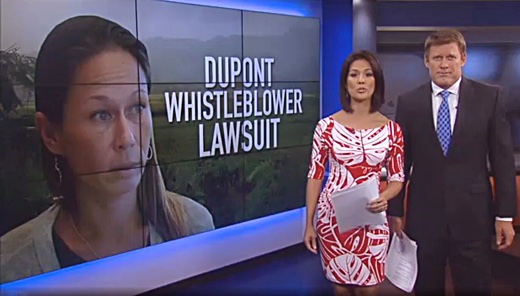
Image above: Still frame from video report on DuPont pesticide spraying on Oahu. From video at (http://www.hawaiinewsnow.com/clip/13352327/whistleblower-alleges-herbicide-sprayings-in-waialua-violated-safety-rules).

A former farm worker alleges in a lawsuit that a GMO seed company dangerously mishandled herbicides, potentially exposing the Waialua community.

Shannell Grilho said that DuPont Pioneer fired her and her husband Morgan Armitage about a year ago, after she raised questions about the company's spraying practices.

"They should not be able to do this to anyone," Grilho said. "We're still dealing with it now. We're trying. We got evicted from where we were living."

According to Grilho, the company sprayed its fields even on days when the winds exceeded safety rules. Pioneer's former Waialua farm is adjacent to Waialua High and Intermediate School and a nearby subdivision.

"You're talking about health, safety and welfare, hazardous chemicals. Not only are they worried about their co-workers who they supervise but they're worried about bringing this back to their children," said Michael Green, Grilho's attorney said.

Pioneer declined to respond to the specific allegations in the lawsuit but issued this statement: "We … (follow) rigorous safety protocols to ensure the safety of our employees and our neighbors."
Pioneer no longer uses those fields, but has operations in Kunia and on the Big Island.

According to Grilho's lawsuit, Pioneer sprayed its fields with herbicides such as Roundup and Honcho, using backpack sprayers and boom sprayers mounted on tractors. The sprayers are required to keep 500 feet away from workers.

But Grilho said sprayers sometimes came too close, forcing her to evacuate co-workers in a van to drive to a safer location.

She said that after she raised her concerns with a supervisor, she was reprimanded and was ordered to work in the fields.

She said she was given boots two sizes too big and was required to walk up to 50 acres a day, injuring her knee.

Two days before Christmas in 2015, she was fired. Her husband Morgan, a 13-year Pioneer employee, was terminated about a month later.

"This is only to make as much money DuPont can make, to get these crops done and get them sprayed. Everyday it's for the almighty dollar for them and the hell with the workers," Green said.
"This is disgusting of major corporations and it has destroyed this family financially. But they can't destroy their spirit."

See also:
Ea O Ka Aina: Stop Monsanto-Bayer Merger 1/14/17
Ea O Ka Aina: Chemical Company Troubles 5/13/16
Ea O Ka Aina: Stink Grows Over Chlorpyrifos 1/23/16
Ea O Ka Aina: DowPont Genetically Modified Offices 12/15/15
Ea O Ka Aina: Kauai's Toxic Cocktail 6/20/14
Ea O Ka Aina: Ecoterrorist Coprorations 4/25/14
Ea O Ka Aina: Dow - DuPont - Syngenta sue Kauai 1/11/14
Ea O Ka Aina: Farming vs poisoning the land 2/14/14
Ea O Ka Aina: Glorious night for Kauai 1/18/13

Hawaii environmentalists advocate for pesticide regulations
State to study impacts of agricultural pesticide use
Pesticide-free zones proposed near schools, hospitals

.

The Final Show

SUBHEAD: As the curtain draws shut on the Greatest Show on Earth so it goes with the "Greatest Country". 

By Simon Black on 22 May 2017 for Sovereign Man -
(https://www.sovereignman.com/trends/the-final-show-of-the-greatest-country-on-earth-21824/)

http://www.islandbreath.org/2017Year/05/170523circusbig.jpg
Image above: Poster of wild animals that were displayed by Ringling Bros Barnum & Bauley Circus. From (https://www.cinemasterpieces.com/circus.htm). Click to embiggen.

On May 31, 1866, John C. Ringling was born in Iowa to German immigrants in what felt like an extremely bleak year.

The chaos and devastation from the Civil War that had ended in 1865 were still keenly felt, and the US economy was in the midst of a deep recession

The country was still shaken from the assassination of Abraham Lincoln.

And the new President, Andrew Johnson, was embroiled in a major political crisis with Congress that would soon lead to his impeachment.

(Johnson was also a noted buffoon, once giving a speech in early 1866 to honor George Washington in which he referred to himself over 200 times and accused Congress of plotting his assassination.)

No doubt those were some of the darkest days in US history. And it would have been hard for Mr. and Mrs. Ringling to imagine a bright future for their children.

But John and four of his brothers went on to build the most successful circus empire in modern history– the Ringling Brothers and Barnum & Bailey Circus, known as the “Greatest Show on Earth.”

There were countless traveling circuses crisscrossing the United States in the 19th and early 20th centuries.

But what made the Ringling Brothers’ event so spectacular was sheer scale. They didn’t hold anything back– lions, tigers, elephants.

The Ringling brothers were also masters of efficient logistics.

Like Ray Kroc and Henry Ford, the brothers developed an assembly line approach to the construction, deconstruction, and transportation of their event so that they could swiftly move from town to town.

It was a spectacle itself simply to see their train of railway cars packed with exotic animals stretching on for more than a mile.

Their circus was considered the ultimate in entertainment back then, and John Ringling became one of the wealthiest men in America as a result of this success.

It seemed like the empire would last forever.
But it didn’t.

After peaking in the Roaring 20s, the circus took a major hit during the Great Depression that effectively bankrupted John Ringling, the sole surviving brother.

At the time of his death in 1936, in fact, Ringling only had about $5,500 in the bank (that’s after adjusting for inflation to 2017 dollars).

The circus limped along in the Depression and barely made it through World War II.

Towards the end of the War in 1944, right before they thought their luck would turn, the circus had a major accident in Hartford in which the tent caught fire, killing 167 people.

That nearly bankrupted the company a second time, and several executives went to jail for negligence.

In the decades that followed, American consumer tastes changed.

Television, movies, and music were far more interesting than circus performances, and Ringling Brothers went into terminal decline.

Fast forward to the age of Facebook and YouTube, and there simply wasn’t a whole lot left in the circus that was exotic or interesting anymore, not to mention the animal rights issues.

So yesterday, the Greatest Show on Earth held its final performance in Uniondale, New York, after 146-years in the business.

A century ago this would have seemed impossible.

The early 1900s were the absolute peak for Ringling Brothers, and no one imagined a future where consumers weren’t standing in line to buy tickets.

Candidly I find this story to be an interesting metaphor for the United States itself.

Rise from the ashes. Remarkable growth. Peak wealth and power. Bankruptcy. Gross negligence and incompetence. More bankruptcy. Terminal decline.

And just like how people viewed Ringling Brothers 100-years ago, it’s difficult for anyone to imagine a world in which the US isn’t the dominant superpower.

Instead of the Greatest Show on Earth, it’s the Greatest Country on Earth. And most of us have been programmed to believe that this primacy will last forever.

But nothing lasts. History is full of failed dominant superpowers, from the Roman Empire to the Ottoman Empire. Many no longer exist.

Their declines were almost invariably due to excessive spending, unsustainable debt, military overreach, and a society that abandoned the core values which made it wealthy and powerful to begin with.

Every successive superpower always believes that they will never suffer the same fate. And every time they’re wrong.

This time is not different.

Yes, it’s still a wonderful country with plenty of positive things going for it.

But at its core the United States still has $20 trillion in public debt (over 100% of GDP) and an additional $46.7 trillion in net, unfunded future social obligations (like Social Security and Medicare).

Plus, the government spends an appalling amount of money, far more than they collect in tax revenue.
(In 2016 their total net loss exceeded an incredible $1 TRILLION.)

Former Treasury Secretary Larry Summers summed it up when he quipped, “How long can the world’s biggest borrower remain the world’s biggest power?”

The answer is– no one knows. Maybe months. Maybe decades.

Either way, this trend is one of the biggest stories of our time. And though few people want to acknowledge it, it’s already happening.

We now regularly witness government shutdowns, debt ceiling crises, and gross government incompetence. But this is just the beginning.

The national debt is growing far faster than the economy as a whole. And, especially if interest rates continue to rise, the trend will accelerate.

It’s simple arithmetic.

So while it seems impossible now, the Greatest Country on Earth will some day have its final show as well. That doesn’t mean the US simply disappears.

But it’s foolish to assume that the insolvency of the world’s largest superpower will forever be consequence-free.

What’s your Plan B?
Do you have a Plan B?

If you live, work, bank, invest, own a business, and hold your assets all in just one country, you are putting all of your eggs in one basket.

You’re making a high-stakes bet that everything is going to be ok in that one country — forever.

All it would take is for the economy to tank, a natural disaster to hit, or the political system to go into turmoil and you could lose everything—your money, your assets, and possibly even your freedom.
.

Do you, Mr Jones?

SUBHEAD: A sinister host of adversaries are coming after Trump and are going to get rid of him one way or another.

By James Kunstler on 22 May 2017 for Kunstler.com -
(http://kunstler.com/clusterfuck-nation/do-you-mr-jones/)

http://www.islandbreath.org/2017Year/05/170522highway61big.jpg
Image above: Portrait of Bob Dylan on LP record album cover of "Highway 61 Revisited" on which "Ballad of a Thin Man" was released in 1965. From (https://genius.com/Bob-dylan-ballad-of-a-thin-man-lyrics). Click to enlarge.

In case you wonder how our politics fell into such a slough of despond, the answer is pretty simple. Neither main political party, or their trains of experts, specialists, and mouthpieces, can construct a coherent story about what is happening in this country — and the result is a roaring wave of recursive objurgation and wrath that loops purposelessly towards gathering darkness.

What’s happening is a slow-motion collapse of the economy. Neither Democrats or Republicans know why it is so remorselessly underway. A tiny number of well-positioned scavengers thrive on the debris cast off by the process of disintegration, but they don’t really understand the process either — the lobbyists, lawyers, bankers, contractors, feeders at the troughs of government could not be more cynical or clueless.

The nation suffers desperately from an absence of leadership and perhaps even more from the loss of faith that leadership is even possible after years without it.

Perhaps that’s why so much hostility is aimed at Mr. Putin of Russia, a person who appears to know where his country stands in history, and who enjoys ample support among his countrymen. How that must gall the empty vessels like Lindsey Graham, Rubio, Schumer, Feinstein, Ryan, et. al.

So along came the dazzling, zany Trump, who was able to communicate a vague sense-memory of what had been lost in our time of American life, whose sheer bluster resembled something like conviction as projected via the cartoonizing medium of television, and who entered a paralysis of intention the moment he stepped into the oval office, where he proved to be even less authentic than the Wizard of Oz.

Turned out he didn’t really understand the economic collapse underway either; he just remembered an America of 1962 and though somehow the national clock might be turned back.

The industrial triumph of America in the 19th and 20th century was really something to behold. But like all stories, it had a beginning, a middle, and an end, and we’re closer to the end of that story than the middle. It doesn’t mean the end of civilization but it means we have to start a new story that provides some outline of a life worth living on a planet worth caring about.

For the moment the fragmentary stories of redemption revolve around technological rescue remedies, chiefly the idea that electric cars will save the nation. This dumb narrative alone ought to inform you just how lost we are, because the story assumes that our prime objective is to remain car-dependent at all costs — when one of the main features in the story of our future is the absolute end of car dependency and all its furnishings and accessories. We can’t imagine going there. (How would you, without a car?)

The economy is collapsing because it was based on cheap oil, which is no longer cheap to pull out of the ground — despite what you might pay for it at the pump these days. The public is understandably confounded by this.

But their mystification does nothing to allay the disappearance of jobs, incomes, prospects, or purpose. They retreat from the pain of loss into a fog of manufactured melodrama featuring superheros and supervillains and supernatural doings.

Donald Trump could never be a Franklin Roosevelt or a Lincoln. These were figures who, if nothing else, could articulate the terms that reality had laid on America’s table in their particular moments of history. Mr. Trump can barely speak English and his notions about history amount to a kind of funny papers of the mind.

A sinister host of adversaries who ought to understand what is happening in this country, but don’t, or can’t, or won’t, are coming after him, and they are going to get rid of him one way or another. They have to. They must. And they will.


Ballad of a Thin Man
by Bob Dylan - 1965

You walk into the room with your pencil in your hand
You see somebody naked and you say, "Who is that man?"
You try so hard but you don't understand
Just what you will say when you get home
Because something is happening here but you don't know what it is
Do you, Mr. Jones?

You raise up your head and you ask, "Is this where it is?"
And somebody points to you and says, "It's his"
And you say, "What's mine?" and somebody else says, "Well, what is?"
And you say, "Oh my God, am I here all alone?"
But something is happening and you don't know what it is
Do you, Mr. Jones?

You hand in your ticket and you go watch the geek
Who immediately walks up to you when he hears you speak
And says, "How does it feel to be such a freak?"
And you say, "Impossible!" as he hands you a bone
And something is happening here but you don't know what it is
Do you, Mr. Jones?

You have many contacts among the lumberjacks
To get you facts when someone attacks your imagination
But nobody has any respect, anyway they already expect you to all give a check
To tax-deductible charity organizations.

Ah, you've been with the professors and they've all liked your looks
With great lawyers you have discussed lepers and crooks
You've been through all of F. Scott Fitzgerald's books
You're very well-read, it's well-known
But something is happening here and you don't know what it is
Do you, Mr. Jones?

Well, the sword swallower, he comes up to you and then he kneels
He crosses himself and then he clicks his high heels
And without further notice, he asks you how it feels
And he says, "Here is your throat back, thanks for the loan"
And you know something is happening but you don't know what it is
Do you, Mr. Jones?

Now, you see this one-eyed midget shouting the word "Now"
And you say, "For what reason?" and he says, "How"
And you say, "What does this mean?" and he screams back, "You're a cow!
Give me some milk or else go home"
And you know something's happening but you don't know what it is
Do you, Mr. Jones?

Well, you walk into the room like a camel, and then you frown
You put your eyes in your pocket and your nose on the ground
There ought to be a law against you comin' around
You should be made to wear earphones
'Cause something is happening and you don't know what it is
Do you, Mr. Jones?

.

Arctic seed vault meltdown

SUBHEAD: Arctic Doomsday Seed Vault imperilled by unanticipated global warming. Who knew?

By mary Papenfuss on 20 May 2017 for Huffington Post -
(http://www.huffingtonpost.com/entry/seed-vault-flooded_us_5920d547e4b034684b0cda63)


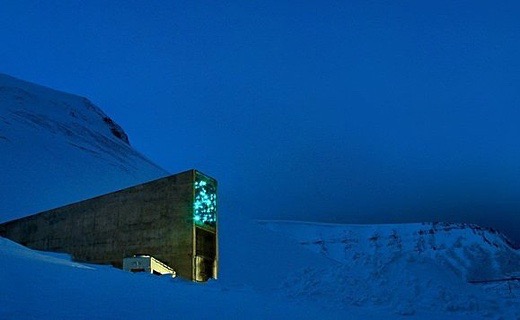
Image above: The entrance of the “last-chance” food source was flooded recently. From original article.

Flooding caused by climate change has hit the Global Seed Vault, which holds samples of the world’s seeds in the event of an apocalyptic catastrophe.

The seeds weren’t damaged, but the entryway of the vault flooded when nearby permafrost melted. Engineers are now designing plans to shore up protections at the storage facility.

The vault has been described as the “Noah’s Ark” of seeds and a last chance for the world to regenerate if the worst happens. Built into a hillside in the Norwegian archipelago of Svalbard, it was established in 2008 as a fail-safe protection for food sources and stores packets of dried and frozen seeds from around the world that can last hundreds of years.

The melting occurred during the recent extraordinarily warm Arctic winter but, since the facility was designed to require little monitoring and is unstaffed, officials just discovered it. Now the Norwegian government, which owns the vault, and Statsbygg, the agency that runs the facility, will closely monitor it for threats from climate change.

“It was not in our plans to think that the permafrost would not be there and that it would experience extreme weather like that,” Statsbygg spokeswoman Hege Njaa Aschim told The Guardian. “It was supposed to [operate] without the help of humans, but now we are watching the seed vault 24 hours a day.”

Workers used pumps to remove the standing water and will waterproof walls and build drainage ditches to deal with runoff from melting permafrost.

Officials chose the location because they believed the permafrost there was permanent. But in a worrying sign that world-threatening change may be inescapable anywhere on the planet, the permafrost melted for the first time in recorded history.

See also:
Ea O Ka Aina: Seeds Surviving Climate Change 11/10/10

.

Black carbon thaws the tundra

SUBHEAD: The fuels we burn affect extreme warming in the Arctic, and solutions begin with understanding how.

By Madeline Ostrander 17 May 2017 for Ensia.com -
(https://ensia.com/features/black-carbon/)


Image above: Carbon soot on ice increases absorption of heat from sunlight.  From original article.

On a morning in September 2015, sterile, gray Arctic light filtered through a blanket of woolly clouds as Matt Gunsch and Tate Barrett parked their rented pickup truck on a dirt road and clomped in rubber boots down a long, icy boardwalk to their air-monitoring laboratory on the tundra.

From the outside, the lab looked unglamorous — a dingy, white shack perched on a metal frame in a meadow speckled with snow and grass stubble. It felt distinctly like the middle of nowhere — though it was just a couple of miles beyond the main streets of UtqiaÄ¡vik, Alaska, the northernmost town in America. Inside the shack, a cracked window was patched with red tape.

There was a shelf stacked with steel-toed and military-style “bunny” boots designed for extreme cold, tables scattered with miscellaneous lab supplies, a toaster oven — and hundreds of thousands of dollars worth of air-monitoring equipment whose internal motors filled the room with a constant high-pitched hum.

Partially isolated from the dirt and exhaust of town, this turned out to be a good place to try to sniff out small intruders in the delicate Arctic atmosphere.

That summer and fall, Royal Dutch Shell was wrapping up the last of its offshore exploratory drilling in the Arctic (and would shortly announce its decision not to return). Environmentalists protested all summer and decried the potential for an oil spill — envisioning a catastrophe like the infamous Deepwater Horizon blowup of 2010, but on ice.

Gunsch and Barrett, then Ph.D. students in atmospheric chemistry and environmental science respectively, were tracking a less dramatic but still insidious problem. They were searching the air for signs of black carbon, a type of air pollution also known as soot.

Black carbon is a product of incomplete combustion from forest fires and the burning of both wood and fossil fuels, and its influence on the Arctic is like the proverbial death by a thousand cuts. At the top of the world, black carbon can land on snow and ice, darkening them, which makes them soak up more heat from the sun and melt faster.

It can also absorb and radiate heat from sunlight as it floats through the atmosphere.Black carbon may be worsening the extreme warming felt all over the Arctic, record temperatures that are making permafrost disintegrate and sea ice melt.

And if the Arctic gets too much warmer, it is, in the long term, like setting off a giant Rube Goldberg machine — once Arctic ice melts, seas rise; ocean waters absorb more heat; methane, another potent greenhouse gas, escapes from the permafrost.

The particles that end up in the Arctic have millions of points of origin, drifting northward from sources like wood and coal stoves used for cooking in India or diesel trucks chugging down U.S. highways. But any particles produced in the Arctic itself are far more likely to linger here and become a more damaging pollution problem.

As the melting Arctic becomes more accessible to ships and enticing for new development, some black carbon sources in the region are increasing. But there are only a handful of research stations monitoring the impact.

The Arctic is a difficult place to do research — tough to reach and subject to extreme weather that can interfere with even the best-designed equipment. UtqiaÄ¡vik is one of about a half-dozen places in the entire high-Arctic region that are capturing ongoing data on soot.

Going Beyond Assumptions

Scientists had been making a lot of assumptions about how black carbon ended up in the Arctic — based on estimates and sophisticated models of global air masses. But few people had actually ventured out to the tundra to measure it themselves with this level of precision.

And unless scientists and policy-makers knew where the problem was coming from, it would be tough to remedy it.

Inside Gunsch and Barrett’s lab in 2015, air was sucked in through a cone-shaped duct on the roof that sorted out particles — anything about a thirtieth of the width of a human hair and smaller could get through.

A set of six foil-covered tentacles dangled from the ceiling, shunting the particles between several pieces of equipment designed to sort and measure them.

The most obtrusive of these was “Maverick,” named affectionately after Tom Cruise’s character in the movie Top Gun — a machine made of a complex assemblage of tubes, wires and metal and mounted onto an airplane cart. Gunsch and his supervisor, Kerri Pratt, a chemistry professor at the University of Michigan, had built Maverick by hand and shipped it to the Arctic. Inside Maverick were a set of tiny discs that had to be lined up with meticulous precision so that a laser could zap every microscopic particle at the precise moment it floated into the center of the instrument.

As the laser exploded particles into fragments — kind of like “the Death Star [from Star Wars] blowing apart a planet,” Gunsch says — each gave off a unique signature, a fingerprint that could tell the researchers where in the world it came from.

Meanwhile, Barrett was working with Baylor University environmental science professor Rebecca Sheesley to collect the tiny specks that passed through another air sampler. Later, he and Sheesley would analyze them for the presence of radioactive carbon isotopes — in order to tell whether the soot came from ancient carbon (like fossil fuels) or newer sources (like forest fires).

Despite the Space Age novelty of it all, it was tedious work. Gunsch and Barrett trekked back and forth several times a day between an old naval research station just off UtqiaÄ¡vik’s desolate, eroded beach road and the lab.

They changed out thumb-sized filters made of aluminum foil, recorded weather data and crunched numbers. At night especially they kept an eye out for polar bears, although Gunsch had only ever seen a fox.

Buying Time

In the past decade, researchers have been racing to understand how much of a role black carbon plays in the global climate. It’s not a simple thing to answer: Black carbon is a complicated little substance, made of assorted molecules clumped together into particles of various sizes that can travel large distances and shape-shift as they interact with water, clouds, and chemicals.

Some scientists say black carbon could have an enormous impact on global warming, second only to carbon dioxide in its potency. Other experts think black carbon’s influence on the planet is smaller, but its effects on the Arctic itself could be noticeable.

One study, published in 2015 in the journal Nature Climate Change, examined what might happen if the world reduced black carbon emissions (along with a few other more minor greenhouse gases) by about 60 percent — according to one of the authors — and made the most stringent cuts in the next 15 years. Under such a scenario, the Arctic could cool by as much as a 0.2 °C (0.36 °F) by 2050.

That might sound small. But it’s a huge amount when you consider that 2 °C (3.6 °F) of atmospheric heat — a threshold long held up by several international authorities, including the United Nations Framework Convention on Climate Change — is often described as the brink of global catastrophe. And the hotter it gets up north, the warmer the rest of the planet becomes.

Though there is scientific uncertainty about its impacts, reining in black carbon could be a much more palatable political goal than tackling CO2. Globally, emissions of black carbon are already ramping down: In the U.S., for instance, they have dropped dramatically because of regulations on diesel engines.

And it could be relatively simple to cut back on the sources that are most damaging to the Arctic in particular. For instance, one of the worst culprits lies in the Russian Arctic — where natural gas plants burn off waste methane, sending black carbon into the skies.

That problem could be curbed with low-cost technologies that capture the gas instead, and several countries — including Russia and the United States—have endorsed an international agreement to end routine gas flaring by 2030.

Another problematic source could be curtailed with a mass effort to promote and distribute cleaner-burning woodstoves in northern latitudes and more efficient cookstoves in the developing world. This would also prevent hundreds of thousands of deaths from smoke inhalation.

In the global scale of things, black carbon’s impact is neither as important nor as long-lasting as that of CO2. But take a bit of soot out of the air, and the effects are almost instant.

The short lifespan of black carbon also makes it an appealing target: A particle of soot can live in the atmosphere for only about a week, whereas a molecule of CO2 can linger there anywhere from a few decades to many millennia. In the global scale of things, black carbon’s impact is neither as important nor as long-lasting as that of CO2.

But take a bit of soot out of the air, and the effects are almost instant. “We’re very clear in acknowledging that CO2 is the 800-pound gorilla in the room,” says climate science professor Mark Flanner, an author of the Nature Climate Change study. “But … maybe through selective actions [on black carbon], you can buy yourself a little bit of extra time or slow the amount of warming that will occur within the next few decades.”

When black carbon is regulated, though, it’s often an afterthought. Under the Clean Air Act, the U.S. Environmental Protection Agency regulates black carbon as a component of “particulate matter”: Little particles are also a health hazard because they can penetrate human lung tissue, enter the bloodstream, and contribute to asthma, bronchitis, and heart and respiratory diseases.

But particulates are an overarching category that includes light-colored aerosols too, and not every effort to cut back on particles will also reduce black carbon. According to James Baumgartner, air regulator with the Alaska Department of Environmental Conservation, “the state of Alaska has no applicable emission standard specific to black carbon.”

In 2012, the United Nations Economic Commission for Europe took on new standards to target black carbon as a component of particulate matter. Last fall, California pioneered a new law that requires a 50 percent cut in black carbon emissions by 2030.

Early in 2016 the Bureau of Ocean Energy Management released a proposed new rule for offshore air pollution standards for oil drilling in both Alaska and the Gulf of Mexico. The agency said it was also reviewing and researching means for controlling black carbon.

But members of the oil industry oppose new offshore air standards, the Trump administration has torn down numerous other Obama-era environmental regulations, and the fate of this rule is uncertain. At press time, the rule was still under review.

In the past few years, there have been international efforts to come up with less scattershot ways of curbing black carbon.

In April 2015, more than seven months before the Paris climate agreement, the eight nations and six indigenous organizations that sit on the Arctic Council — including the United States and Russia — quietly adopted a framework agreement to “take enhanced, ambitious, national and collective action to accelerate the decline in our overall black carbon emissions.”

It was a “groundbreaking agreement … the first time that the Arctic Council countries had taken action on climate change,” says Erika Rosenthal, a lawyer with the organization Earthjustice. At the same time, the U.S. took over the chairmanship of the Arctic Council, and then–Secretary of State John Kerry championed climate change and saving the Arctic as among his core missions.

Later that year, Obama became the first president to travel above the Arctic Circle, and under U.S. chairmanship, the Arctic Council worked on a set of science-based recommendations for cutting black carbon emissions around the world.

New sources of black carbon are creeping into the Arctic as the ice thaws. Between 2008 and 2012, marine traffic in the U.S. Arctic went up 108 percent.

Much of that progress seemed up in the air as the Arctic Council gathered last week in Fairbanks to pass the rotating chairmanship on to Finland under Prime Minister Juha Sipilä. Speaking at that meeting, U.S. Secretary of State Rex Tillerson expressed reluctance to make any commitments on climate change: “We’re not going to rush to make a decision,” he said.

It’s still not clear whether President Donald Trump will withdraw from the Paris Climate Agreement, though he announced recently that he’d withhold his decision until after the Group of Seven meeting in Italy later this month.

Despite all of that, the United States joined other Arctic nations in signing a pledge at the Arctic Council meeting that explicitly acknowledges how extreme and urgent Arctic warming is. The agreement, called the Fairbanks Declaration, adopts an “aspirational collective goal” to cut black carbon 25 to 33 percent by 2025. It’s less than what scientific models call for, but it is at least a concrete target.

“It’s not enough, but it’s a first step,” says Rosenthal.

Unanswered Questions
Meanwhile, new sources of black carbon are creeping into the Arctic as the ice thaws. Between 2008 and 2012, marine traffic in the U.S. Arctic went up 108 percent. In the summer and fall of 2016, the Crystal Serenity became the first luxury cruise liner to travel across the Arctic Ocean from Alaska to New York City.

In late April this year, President Trump signed an executive order with the aim of reviving offshore drilling in the Alaskan Arctic and elsewhere, a move that prompted a lawsuit from several environmental groups. Oil companies are drilling more than a dozen exploratory oil wells in the Barents Sea off the coast of Norway.

In the Russian Arctic, fossil-fuel companies have invested tens of billions of dollars in a massive drilling project that will ship liquefied natural gas from the Yamal Peninsula to Europe and other parts of Asia.

As such projects charge ahead, there are still many unanswered questions about how they will affect the Arctic’s air and climate. University of Michigan’s Pratt was surprised when her data revealed that the Prudhoe Bay oil field produced vast quantities of particles that were growing and could have an impact on cloud formation — a finding she and a group of collaborators reported in a paper in December 2016.

Two years ago, Baylor’s Sheesley and Barrett, who is now a postdoctoral researcher at the University of North Texas, discovered that the major culprits dirtying Alaskan skies with black carbon in the winter lay in the North American Arctic (including Prudhoe) and the Russian Arctic — another surprise.

Maverick, the particle “Death Star,” spent its second field season in 2016 at a remote U.S. Department of Energy research site, where Gunsch got a closer view of black carbon from Prudhoe.

“Maybe this oil field is having a greater impact than we thought,” says Pratt. And if that’s true, then putting more ships, rigs, roads, drills and well pads in the Arctic could have more serious consequences than climate scientists previously understood.

That means that more answers are needed urgently, and scientists are scrambling to fit the rest of the puzzle pieces together. Since 2015, three scientists — one with the U.S. National Oceanic and Atmospheric Administration, one at the University of Leeds, and one with the French Laboratoire Atmosphères, Milieux, Observations Spatiales, or LATMOS — have been bringing together groups of researchers from around the world to figure out how to shine a light on unexplained questions about black carbon.

Charles Brock, a NOAA research physicist, is trying to organize a project with scientists from multiple agencies that would use research airplanes to track black-carbon pollution as it travels from China, Japan, and Korea to the Arctic.

Much of the research on black carbon in the U.S. relies directly or indirectly on government funding whose fate could be tenuous under the Trump administration.

Meanwhile, the Arctic is rapidly unraveling. Since Pratt began her field work in Alaska five years ago, she’s has made several journeys into the waters of the Chukchi Sea and onto the sea ice with local guides in UtqiaÄ¡vik. “It’s actually pretty amazing. You can see the changes in the ice just in that time frame,” she said. “It’s quite shocking actually to see it firsthand.”


.