Showing posts with label Coral. Show all posts

The Banality the Anthropocene

SUBHEAD: When my uncle becomes blind to the violence of his own corn, he becomes blind to Standing Rock, and more.

By Heather Anna Swanson on 22 February 2017 for Cultural Anthropology -
(https://culanth.org/fieldsights/1074-the-banality-of-the-anthropocene)


Image above: Barn along Highway 1, south of Fairfield, Iowa. Photograph  by Ken K. From original article.


I want to propose an Anthropocene territorialization and a subject-making project in which anthropologists might want to engage. The territory of which I write is a place called Iowa.

There are plenty of troubling things about the Anthropocene. But to my mind, one of its most troubling dimensions is the sheer number of people it fails to trouble.

For many living in precarious situations, the Anthropocene is already life-altering, life-threatening, and even deadly. It comes in the form of a massive flood or a rising tide that takes their homes away. Or as an oil well that poisons the river on which they depend.

But for others, especially the white and middle-class of the global North, the Anthropocene is so banal that they do not even notice it. It is the green front lawn, the strip-mall parking lot, the drainage ditch where only bullfrog tadpoles remain.

Iowa lies at the heart of this banal Anthropocene. The Anthropocene, here, is wholesome. It is the cornfield and the industrial pig farm. It is the 4-H county fair and eating hot dogs on the Fourth of July. It is precisely this banality, this routinized everydayness (see Arendt 1963), that makes the Iowa Anthropocene so terrifying.

I write of Iowa not from the outside, but from a place of connection. I, too, am Iowa. Without it, I would not be where I am. My mother and father were born and raised in Iowa, and its mid-twentieth-century agricultural modernization and postwar dreams for better futures propelled their upward mobility.

It allowed them to get off the farm and become the first people in their families to go to college. Iowa’s industrial agriculture and its surpluses thus made my own scholarly career possible.
Indeed, we are all implicated in Iowa.

We are all entangled with the everyday violences of industrial agriculture and nationalist projects in a way that substituting an organic latte for the hot dog or shopping at Whole Foods won’t solve.

We cannot make ourselves clean. The urbanized coasts are made possible by the production of the heartland. New York is standing on Iowa (cf. Moore 2010).
How is it that Americans, especially white middle-class ones, learn not to notice such entanglements, to not be affected? How do we learn not to see the damage around us?

Iowa is objectively one of the most ruined landscapes in the United States, but its ruination garners surprisingly little notice. Less than 0.1 percent of the tallgrass prairie that once covered much of the state remains. You’ve seen the Anthropocene J-curves: the rise of atmospheric CO2, human population growth, and dammed rivers, to name a few (Steffen et al. 2015). The decline in Iowa prairie makes a reverse J.

Between 1830 and 1910, Iowa lost a whopping 97 percent of its prairie acreage. But this is only the tip of the iceberg. The reorientation of Iowa’s landscape toward capitalist agricultural production has resulted in the obliteration of worlds that once occupied it. The American Indians who carefully tended the prairie through burning and bison management have been forced out of the state.

Nearly every acre has been privatized. Today Iowa ranks forty-ninth out of the fifty U.S. states in public land holdings.

Ninety-nine percent of its marshes are gone. The level of its main aquifer has dropped by as much as three hundred feet since the nineteenth century, largely due to the extraction of irrigation water. Water quality is a mess, too.

Between 2010 and 2015 more than sixty Iowa cities and towns had high nitrate levels in drinking water due to the leaching and run-off of agricultural fertilizers. And those same fertilizers wash down the Mississippi River to the Gulf of Mexico, where they have created an aquatic dead zone the size of Connecticut.

Few people, either within or beyond Iowa, notice the profundity of these changes. When my uncle, a farmer in northeast Iowa, gazes out at his cornfields, he does not see the annihilation of the prairie, the loss of the bison, or the displacement of American Indian communities.

He does not notice the contamination of groundwater, even though he had to redig his well a few years ago due to bacterial seepage from a nearby pig farm. He simply shrugs off such things and wonders what the crop prices will be next year.

Blindness proliferates: when my uncle becomes blind to the violence of his own corn, he becomes blind to others in neighboring farmhouses, in the neighboring towns, in neighboring states. He cannot see Standing Rock, and he cannot see why Black Lives Matter might matter to him.

It isn’t exactly his fault that he doesn't notice. White middle-class American subjectivities are predicated on not noticing. They are predicated on structural blindness: on a refusal to acknowledge the histories we inherit. As Deborah Bird Rose (2004) has shown in the case of Australian settler colonialism, dreaming of futures requires blindness to the past.

Michel Foucault’s work reminds us that the discourses that shape our subjectivities are not just words; they are also the bricks of the prison, the institutional form of the clinic (see Hirst 1995). But we have failed to see that they are also the monocrop cornfield. Iowa’s landscape infrastructure produces us and the Anthropocene.

The cornfield is an assemblage that brings the so-called common good of progress and nationalist growth into being. It produces grain futures markets and cheap hamburgers. How can we better see its terrors and erasures?

One of these terrors is that there are countless Iowas beyond Iowa. I currently live in Denmark, where I am a member of a research project called Aarhus University Research on the Anthropocene (AURA).

One of my colleagues, Nathalia Brichet, uses the term “mild apocalypse” to draw attention to the normalized degradation of Danish landscapes. In the midst of Denmark’s rolling fields and highly managed forests, the Anthropocene continues to be stubbornly hard to see.

Donna Haraway has called for curiosity as both scholarly method and political practice, as an antidote to these learned blindnesses. In her book When Species Meet (Haraway 2008), she becomes curious about who and what she touches when she reaches out to pet her dog.

That curiosity becomes a radical practice of tracing and inheriting histories, such as the dog-herding practices of livestock-based Australian colonization efforts and the making of purebred dogs.

But in a world of structural blindness, such kinds of curiosity do not come naturally. They must be cultivated. But how? How, in the words of Joseph Dumit (2014), do we wake up to connections?

Can we imagine corollaries to Bible study meetings or consciousness-raising groups in which people would be encouraged to trace the histories of the landscapes they inhabit, a process that might draw them into new ways of seeing themselves and their worlds? I imagine such practices as a multispecies analogue to Foucauldian genealogy (see Foucault 1970).

Might exploring the genealogies of Iowa cornfields, for example, denaturalize them and counter the power of their banality?

Might they enable Iowans and all of us to become more curious about the conditions of our own subjectivities and, in turn, how we might transform the landscapes with which they are entangled? This is the important work of making curiosity more common, of troubling the Anthropocene.

References

Arendt, Hannah. 1963. Eichmann in Jerusalem: A Report on the Banality of Evil. New York: Viking Press.

Dumit, Joseph. 2014. “Writing the Implosion: Teaching the World One Thing at a Time.” Cultural Anthropology 29, no. 2: 344–62.

Foucault, Michel. 1970. The Order of Things: An Archaeology of Knowledge. New York: Pantheon. Originally published in 1966. 

Haraway, Donna. 2008. When Species Meet. Minneapolis: University of Minnesota Press.
Hirst, Paul. 1995. “Foucault and Architecture.” In Michel Foucault: Critical Assessments, Volume 4, edited by Barry Smart, 350–71. New York: Routledge.

Moore, Jason W. 2010. “‘Amsterdam is Standing on Norway’ Part One: The Alchemy of Capital, Empire, and Nature in the Diaspora of Silver, 1545–1648.” Journal of Agrarian Change 10, no. 1: 33–68.

Rose, Deborah Bird. 2004. Reports from a Wild Country: Ethics for Decolonization. Sydney: University of New South Wales Press.

Steffen, Will, Wendy Broadgate, Lisa Deutsch, Owen Gaffney, and Cornelia Ludwig. 2015. “The Trajectory of the Anthropocene: The Great Acceleration.” Anthropocene Review 2, no. 1: 81–98.

.

See "The Strangled Sea"

SUBHEAD: The courageous Okinawan struggle against U.S. military destruction of their beautiful island.

By Katherine Muzik PHD on 9 May 2017 in Island Breath -
(http://islandbreath.blogspot.com/2017/05/see-stranged-sea.html)

http://www.islandbreath.org/2017Year/05/170509poster.pdf
Image above: Poster for "The Strangled Sea" event. Click for enlarged PDF file to post around the island.

WHAT:
See film "The Strangled Sea" (in Japanese with English Subtitles)
Presented by Professor Kosuzu Abe, an activist and Social Scientist, Ryukyu University
For the Okinawans it is a matter of "Peace, Beauty and Agony".

WHEN:
Saturday, 20 May 2017 at 7:00 - 9:30pm

WHERE:
Kealia Farm Market
2345 Kealia Road, Kealia, Kauai, HI 96746
Venue phone number: +1 808-635-4100

COST:
Free (but donations appreciated).

ENDORSED: 
by the Kauai Alliance for Peace ans Social Justice

MORE INFO:
For more information call +1 (808) 346-6167

Besides the film their will be a presentation of “Threatened to Death“ honoring the wonders of Okinawa’s Oura Sea and Yambaru Forest by Katherine Muzik, Ph.D., Marine Biologist

There will also ne Q & A to discuss America's increased militarization of Okinawa, Puerto Rico, Korea and Kauai...

.

Great Barrier Reef in terminal decline

SUBHEAD: New aerial surveys show damage has spread to two-thirds of reef, up from one-third last year.

By Nadia Prupis on 10 April 2017 for Common Dreams -
(http://www.commondreams.org/news/2017/04/10/great-barrier-reef-faces-terminal-stage-climate-change-fight)


Image above: Part of this year's mass bleaching occurred even in the absence of an El Niño event. (Photo by Ryan McMinds. From original article.

The Great Barrier Reef may be at a "terminal" point after being hit with unprecedented bleaching events in consecutive years, scientists warned Monday.

According to new aerial surveys conducted by the Australian Research Council's Centre of Excellence for Coral Reef Studies, two-thirds of the reef have now been affected, up from one-third last year. This year's mass bleaching occurred even in the absence of an El Niño event.

Professor Terry Hughes, who led the surveys, told the Guardian, "The significance of bleaching this year is that it's back to back, so there's been zero time for recovery."

"It's too early yet to tell what the full death toll will be from this year's bleaching, but clearly it will extend 500km (310 miles) south of last year's bleaching," he said.

Australia now faces a rapidly approaching deadline for saving the reef by addressing climate change, Hughes added.

"It takes at least a decade for a full recovery of even the fastest growing corals, so mass bleaching events 12 months apart offers zero prospect of recovery for reefs that were damaged in 2016," said Dr. James Kerry, who also took part in the surveys.

Bleaching occurs when overly warm ocean waters cause coral to get rid of its internal algae, which turns the coral white and erodes its structures. The loss of structure makes shorelines more vulnerable to extreme weather and destroys natural habitats for marine life.

A groundbreaking study published last year found that climate change is the primary cause of coral reef degradation around the world.

Jon Brodie, a water quality expert, told the Guardian that the reef was now at a "terminal stage" and that many scientists have lost hope that it can be salvaged.

"We've given up. It's been my life managing water quality, we've failed," Brodie said. "Even though we've spent a lot of money, we've had no success."

Others remained hopeful that the reef had a future, but warned that time was of the essence.

"You've got to be optimistic, I think we have to be," said Jon Day, former director of the Great Barrier Reef Marine Park Authority. "But every moment we waste, and every dollar we waste, isn't helping the issue. We've been denying it for so long, and now we're starting to accept it. But we're spending insufficient amounts addressing the problem."

Hughes continued, "The sooner we take action on global greenhouse gas emissions and transition away from fossil fuels to renewables, the better."

See also:
Ea O Ka Aina: Ray of (false) hope for coral 4/5/17

.

Ray of (false) hope for coral

SUBHEAD: In Fiji a coral gardener is trying to save the world by saving one dying reef at a time.

By Richard Walker on 5 April 2017 for Future Perfect -
(http://www.goethe.de/ins/cz/prj/fup/en16243793.htm)


Image above: Dr Austin Bowden-Kerby searching for coral suitable for nursery. From original article.


IB Publisher's  note: Yesterday, when I was about publish this article I emailed its content to fellow Kauaian Dr Katherine Muzik PHD who is an expert in reef biology to get her take on Dr Austin Bowden-Kerby efforts. Her reply came a bit after I posted the piece. She wrote:

"Well, the short answer is what he is doing is not working. Realize that "his" reefs were wiped out by the Category 5 hurricane/cyclone last year, and coincidentally also the nearby village where he routinely sipped tea. Venturing on to Christmas Island, he reported to me that all was bleached, quite hopeless."

"The Southern Hemisphere is pretty much f***ed, by climate change. We are at over 400 parts per million of CO2 in effect forever. That's way too far over McKibben's 350ppm limit for a sustainable planet, for at least the foreseeable future. Too hot."

"I met Dr. Austen Bowden-Kerby in Honolulu last year, at a "Coral Gardening" meeting at the University of Hawaii. He is a very effervescent guy, he even included my program and Mala Moana on a multi-million dollar proposal, for me to work on Kauai and Molokai, teaming up with  the University of Hawaii guys."

"Nary a word back though. Poof! So I would say, a better title would be "False ray of false hope for coral", much like the lab research on Oahu. Until we clean up the watersheds, and embark on "degrowth", planetwide, the corals are doomed."


Coral reefs are vital for the health of the planet, but they’re dying. In Fiji a coral gardener is trying to save the world, one reef at a time.

Dr Austin Bowden-Kerby is not so young anymore. But he overflows with the energy and passion of youth. “Wow! Look at this coral!” I swim over. “It’s a staghorn. They’re very rare here” he gushes.

We’re exploring in waters off the Beach House, a small retreat on Fiji’s famous Coral Coast. Soon after, another call: “I found Nemo!” A shy clown fish darts into hiding. Later he chomps into an edible seaweed drifting past. “They say it’s a great aphrodisiac” he winks.

His enthusiasm for life on the reef is infectious, but it hides a more serious concern. That these reefs that he loves might not be around in just a few decades.

“Most of the projections say that by the year 2050 the coral reefs will be gone.” But Austin has a plan. He wants to save the world, and he’s starting with coral.

Save coral reefs - Save the planet
“The Earth has a fever, and it is called climate change.” Austin – an American-born marine biologist who now calls Fiji home – is blunt about the challenges we face. “We all know that our home is in big trouble… we are out of balance.” But why focus on coral?

Coral reefs provide food, livelihoods and coastal protection to a billion people worldwide. They occupy less than one percent of the ocean’s area, but are home to a quarter of all marine species. According to Austin, coral reefs are the most sensitive of our environmental systems. They are the front line in the battle against climate change. “If we can save this system, we can save the planet.”

To save a reef, garden it!
But how do you save a coral reef? Here’s one way: cultivate it, harvest it, regrow it. Garden it! Austin Bowden-Kerby is a coral gardener. He has been working in the ocean for more than 40 years.

The idea for coral gardening was planted – literally – on the dynamite-blasted reefs of Micronesia. “I tried breaking up corals, branches of corals, and throwing them down.

And on these broken areas I got instant reef!” It’s not quite instant – the coral branches that Austin placed on the rubble of dead reefs took at least six months to fully establish themselves.

But they grew, and Austin was encouraged. Lots of work and one PhD later, and he is confident that coral gardening is the way to save the world’s reefs.

Decades on, Austin has used coral gardening techniques to start rebuilding reefs across the world, and trained others to do the same. But he stresses that it’s not a quick fix. “I don’t pretend that I’m trying to replant the whole reef. You can’t do it.” What you can do is replant a patch to create “a pocket of health” that will grow and spread on its own.

So how does it work? First, find a good spot that has everything a garden needs – sunlight, space, protection from the elements. Create a nursery where the corals grow. In time, harvest the corals and place them back into the reef, where they take hold, reproduce and spread.

And the best thing? With a bit of training and know-how, anyone can play their part. “This is something people can do. It can be done on a small scale and repeated, repeated, repeated to have a major impact”.


Image above: Kerby planting coral in underwater nursery. From original article.

Saving the reef with ‘super corals’
But coral gardening has changed since Austin first started. In early 2016 global water temperatures rose dramatically. Reefs were damaged across the world. Once flourishing sites that Austin had worked on became completely bleached, and died. These spikes in temperature are likely to be the norm from now on.


So Austin only wants to plant corals that he knows can withstand hotter water without bleaching. He calls them ‘super corals’. The waters off the Beach House reached 34 degrees Celsius in early 2016.

That’s three or four degrees higher than bleaching temperature for most corals around the world. Which means that whatever has survived here may be some of the most heat-resistant coral on the planet.

I’m following Austin as he hunts for surviving super corals. But there isn’t much to be found. When he finds a small colony he is ecstatic. He carefully detaches the coral from its rock and transports it back to the nursery.

The whole point of this trip is to figure out which of these corals will survive in a hot-water future. “Unless we actually know that what we’re planting will survive into the future, why plant it?” Austin is looking for as many different species and genotypes of coral as he can find to put in the super coral nursery.

Some may not survive the summer, but the ones that do will be some of the toughest corals around. Perfect for regrowing a heat-resistant reef.

In a year or so, these super corals will be trimmed and the second-generation corals put back onto the reef. From there everything is in Mother Nature’s hands. The corals will grow and eventually spawn, releasing their offspring into the water to create new colonies of heat-resistant corals as far as the tide will take them.

But why not just leave these ‘super corals’ where they are? Sadly, rising water temperatures are not the only threat to corals.

With its natural predators overfished, the coral-eating Crown of Thorns Starfish runs rampant across Fiji’s reefs. They eat one fist-sized coral every day. “Every bleaching resistant colony that we bring into the nursery has a much better chance of surviving under care than it does in the wild,” says Austin.

Seeing the bigger picture
Austin wants to see coral gardeners all over Fiji. And he wants to train them in his techniques to manage and restore their home reef. What’s more, he wants them to team up with resorts. Already, several resorts have employed trained coral gardeners. Communities need the reef for their food.

Resorts need the reef for their business. It’s a win-win.

But Austin knows that coral gardening alone is not enough. If fish are to return to the reef they need protection from overfishing. So locally managed marine areas and ‘no take’ zones are vital. But if you ask local villages not to catch fish, where do they get their protein? Austin is working on that too – his ‘Happy Chickens for Healthy Reefs’ project trains people in poultry farming. So far he has hatched and distributed over 15,000 baby chicks.

Austin thinks big – it isn’t just about saving the reef. Austin’s whole purpose is to provide hope. To show people that something can be done. To inspire. “Corals excite people. They get people involved. It’s like a ray of hope in this really dark time. We need this hope.”

.

Can "Super Coral" save reefs

SOURCE: Sam Monet (monets001@hawaii.rr.com)
SUBHEAD: Researchers in Hawaii are using an "assisted evolution" to grow coral to withstand the hotter more acidic oceans.

By AP Staff on 5 November 2015 for the Guardian -
(http://www.theguardian.com/environment/2015/nov/05/scientists-attempt-to-breed-super-coral-to-save-threatened-reefs)


Image above: Juvenile coral is prepared to transplant on to reefs in hopes that the high-performing specimens will strengthen the overall health of the reef. Photograph by Caleb Jones/AP. From original story.

[Note from Source: In the 1970's, acid rain from Germany killed much of Sweden's native forests and lakes.  After the German's initiated green controls, the Swedes replaced their native forests with mono cultured trees that, unfortunately did not and cannot replicate or replace the bio diversity that existed in their native forests.  However, that is better than nothing.  President Ronnie Reagan denied the existence of Acid Rain or ozone depletion, both well documented by the Swedes.]

The super coral might help us, however, if it cannot support the entire ecosystem, the life forms that depend on the existing corals will not survive and will not support the rest of the food chain that is much more complex than a Swedish forest.  Mono cultured coral reefs will not be the same.

I have been writing about and warning the politicians and people of Hawaii about global warming since the very early 1990's.  The direct result of our global greed and ignorance, today it is upon us.

The Ala Wai yacht harbor is much hotter, more polluted, acid and silted than Kaneohe Bay.  What little corals we have, have been bleached in our harbor.  I suggest the real test of the super coral is in Ala Wai harbor.  If it can live and breed here, then it can do that anywhere in Hawaii and similar climate zones world wide.


Researchers in Hawaii are using an "assisted evolution experiment" to grow coral that can withstand the hotter and more acidic oceans caused by global warming

Scientists at a research centre on Hawaii’s Coconut Island have embarked on an experiment to grow “super coral” that they hope can withstand the hotter and more acidic oceans that are expected with global warming.

The quest to grow the hearty coral comes at a time when researchers are warning about the dire health of the world’s reefs, which create habitats for marine life, protect shorelines and drive tourist economies.

When coral is stressed by changing environmental conditions, it expels the symbiotic algae that live within it and the animal turns white or bright yellow, a process called bleaching, said Ruth Gates, director of the Hawaii Institute of Marine Biology.

If the organisms are unable to recover from these bleaching events, especially when they recur over several consecutive years, the coral will die. Gates estimated that about 60 to 80% of the coral in Kaneohe Bay has bleached this year.

“The bleaching has intensified and got much more serious,” said Gates, of the coral around the bay. Where they once looked for the bleached coral among the h

Gates and her team are taking the coral to their centre on the 29-acre isle and slowly exposing them to slightly more stressful water.

They bathe chunks of coral that they’ve already identified as having strong genes in water that mimics the warmer and more acidic oceans. They are also taking resilient strains and breeding them with one another, helping perpetuate those stronger traits.

The theory they are testing is called assisted evolution, and while it has been used for thousands of years on other plants and animals, the concept has not been applied to coral living in the wild.

“We’ve given them experiences that we think are going to raise their ability to survive stress,” Gates said. She said they hope to see these corals, which will soon be transplanted into the bay, maintain their colour, grow normally and then reproduce next summer.

In early October, the National Oceanic and Atmospheric Administration (Noaa) said that coral reefs worldwide are experiencing bleaching, calling the event extensive and severe.

“We may be looking at losing somewhere in the range of 10 to 20% of the coral reefs this year,” Noaa coral reef watch coordinator Mark Eakin said when the report was released. “Hawaii is getting hit with the worst coral bleaching they have ever seen.”

And this is the second consecutive year Hawaii has experienced widespread bleaching.

Scientists say some coral has already fallen victim to global warming. About 30% of the world’s coral population has already perished as a result of above average ocean temperatures, El Niño’s effects and acidification.


Image above: Researcher Jen Davidson places a tray of enhanced coral on to a reef during a practice run for future transplants off the island of Oahu. Photograph by Hugh Gentry/AP. From original story.

Gates and her team understand the challenges of scalability and time. Having success locally does not necessarily mean they will be able to scale their project to address a massive, global marine crisis before much of the world’s coral reefs are already gone.

Tom Oliver, a marine biologist and team leader at Noaa’s Coral Reef Ecosystem Division, said the project is scalable with the requisite amount of effort and funding. He said, “the question is not can they do it, it’s can they do it fast enough?”

Oliver said that many reef restoration projects struggle because of the cost and time involved with raising standard coral and planting it in the ocean. “Restoration needs to have brood stock that can handle the changing conditions on reefs,” he said.xxx

Gates said more research needs to be done before they can begin to address scalability.

In 2013, Gates and her Australian counterpart Dr Madeleine van Oppen, who does coral research at the Australia Institute of Marine Science, won the $10,000 (£6,500) Paul G Allen Ocean Challenge for their proposal to assist coral evolution.

Allen’s foundation then asked them for a proposal to fully fund the idea, which they eventually did with a $4m grant in June. Allen, who co-founded Microsoft with Bill Gates, has various climate-related projects in his philanthropic portfolio.

Hawaii’s Gates said that while the goal of their project is to help coral survive global warming, there is still a need to end human’s reliance on fossil fuels and to mitigate the emission of greenhouse gasses that cause global warming.

“Even if we stopped all greenhouse gas emissions today, there is still this lag in the atmosphere where climate change will continue for probably hundreds of years,” Van Oppen said. “It’s hard to imagine it’s not going to get worse.”


.

Coral bleaching worldwide

SUBHEAD: Here is evidence that something very bad is happening in Earth's oceans.

By Nick Visser on 8 OCtober 2015 for Huffington Post -
(http://www.huffingtonpost.com/entry/coral-bleaching-climate-change_561568d9e4b021e856d33d0f)


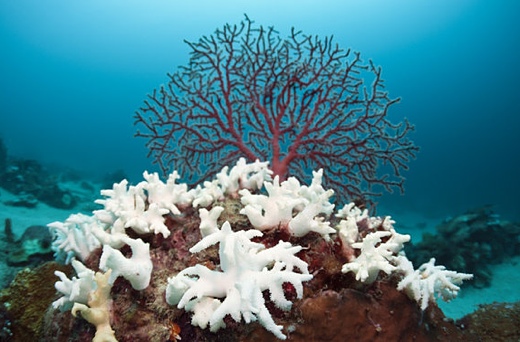
Image above: Bleached corals in West Papua, Indonesia. The world's corals are experiencing a mass bleaching as a result of warmer ocean temperatures and other factors. From original article.

The planet's coral reefs are experiencing a mass global bleaching, the National Oceanic and Atmospheric Administration announced on Thursday. The bleaching, only the third event of its type in recorded history, is another troubling sign of the damaging effects of climate change on the planet's health.

Bleaching happens when usually vibrantly colored corals lose their hues and turn bright white due to warmer oceans or other environmental factors. The colorful algae that live in and feed coral polyps leave in stressful times, turning the otherwise breathtaking formations into ghostly shells.

Warmer ocean temperatures are wreaking havoc on the undersea biome, causing widespread damage to delicate coral ecosystems that may well get worse due to the potential effects of a strong El Niño tropical weather system.

Reefs cover about 0.1 percent of the ocean floor, but are home to some 25 percent of marine life and have long been one of the main victims of a hotter world. However, Mark Eakin, the coordinator for NOAA's Coral Reef Watch program, said corals are often out of the public eye simply because they're underwater.

"What do you think people would do if, in a matter of months, 60 percent of the redwood forest would die?" he asked. "It's a bit of a problem of being out of sight, out of mind."

Eakin was referring to a smaller-scale bleaching that took place in the Caribbean in 2005 that wiped out 60 percent of corals in that region, but went relatively unnoticed. Now, however, bleaching is taking place on a much larger scale. Mass bleaching has happened just twice before, Eakin said, once in 1998 and again in 2010.

The current global bleaching began in the northern Pacific in the summer of 2014 and has since expanded throughout the Pacific and Indian Oceans. Corals in the U.S. have been among the hardest-hit, and scientists are particularly concerned with formations around Hawaii and the Caribbean.

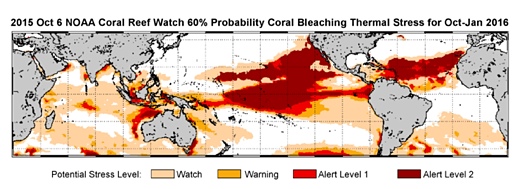
The chart below shows the probable threat of bleaching around the globe for the next several months, with the dark red areas showing the places that face the greatest risk.


NOAA's standard 4-month bleaching outlook showing threat of bleaching continuing in the Caribbean, Hawaii and Kiribati, and perhaps expanding into the Republic of the Marshall Islands, from October 2015 to January 2016. From original article. From original article.

When algae leave coral during a bleaching, the reef is left sick, hungry and vulnerable. This doesn't necessarily kill the coral, and some certainly recover. But severe or long-term bleaching -- like the current phenomenon -- is often fatal, according to NOAA. As reefs die, a slew of biodiversity is thrown out of whack. Fish lose their homes, crustaceans leave and many other species die as well.

"After corals die, reefs quickly degrade and the structures corals build erode," a press release from NOAA reads. "This provides less shoreline protection from storms and fewer habitats for fish and other marine life, including ecologically and economically important species."

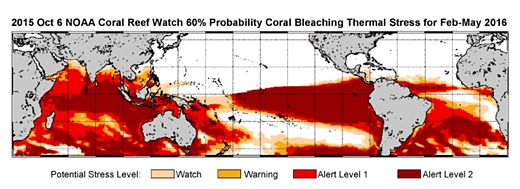
However, Eakin was quick to note that while the current bleaching event is severe enough, the ongoing El Niño could amp it up to "frightening" levels in the near future, as illustrated below.


Image above: An extended bleaching outlook showing the threat of bleaching expected in Kiribati, the Galapagos, the South Pacific -- especially east of the dateline and perhaps affecting Polynesia -- and most coral reef regions in the Indian Ocean, from February to May 2016.

The news is the latest in a series of troubling climate-related milestones. Last month, NOAA announced that this year's summer had been the hottest in recorded history. In August, scientists said the world's glaciers had melted to the lowest levels since record-keeping began more than 120 years ago. And in March, researchers said Arctic sea ice had seen the smallest annual growth ever.

NOAA's announcement about the bleaching comes a little less than two months ahead of the highly anticipated Paris climate summit in December. Hundreds of world leaders will attempt to devise a global plan for combating climate change, as time is running out to keep the planet below an agreed-upon warming threshold of 2 degrees Celsius.

Oceans will be a key issue during the summit, and Eakin says there's an "absolutely urgent need" for action. By the end of the current bleaching event, he says, some 4,600 square miles of reefs could be dead.

"One of the most heart-wrenching dives I've made in my life was in 2010 during the second global bleaching event," Eakin said of a dive he took in Thailand. "It was just fields of bleached coral. The fish were swimming around in midwater looking stunned."


.

Bar-B-Que Kauai Style

SOURCE: David Ward (ward.david7@gmail.com)
SUBHEAD: Electromagnet radiation from military, scientific and aerospace operations may be affecting the health of Kauai.

By Stewart D. Simonson on 23 September 2015 for Dark Matters a Lot -
(http://darkmattersalot.com/2015/09/23/bar-b-que-hawaiian-style/)

[IB Publisher's note: Below are parts of two articles recently posted on the site Dark Matters a Lot that indicate that a great deal of electromagnet radiation from military, scientific and aerospace operations may be affecting the health of people on Kauai and damaging the environment on the land and in the sea.]

http://www.islandbreath.org/2015Year/09/150928parkingbig.jpg
Image above: The view from the visitor's parking area of the dome provides high-power, high gain pulsed electromagnetic radiation from AN/FPS-117 control radar station. Click to enlarge. From original article.

Above is the parking area at the west (or first) Kalalau Valley Lookout in Kokee State Park. The nearby station, seen in the mist, scatters unhealthy radiation into the surrounding area.

The safe distance from the Kokee AN/FPS-117 radar is calculated to be 530 meters (or 1730 feet). Visitors in the parking lot are only 900 feet or less from this radar. This "safe" distance is based on average power, FCC does not even address peak pulsed power, which I believe is worse. See page 28 (http://fsims.faa.gov/wdocs/orders/ps_orders/a_3910.3b.pdf)

http://www.islandbreath.org/2015Year/09/150928anfps117big.jpg
Image above: Detail from page 27-28 from FAA report referenced above showing safe distance to stand near the from the Kokee AN/FPS-117 radar station to be 530 meters. 

http://www.islandbreath.org/2015Year/09/150928birdseyebig.jpg
Image above: Aerial view from GoogleEarth the Kalalau Lookout and AN/FPS-117 radar station.The station is only 800 feet from the center of the lookout parking lot. Half the safe distance recommended. From GoogleEarth by Juan Wilson. Click to enlarge.


Shock Talk
SUBHEAD: KKCR radio guests Terry Lilley & Stuart Stevonson discuss potential health and environmental effects of microwave tower radiation on Kauai.

Host Dr. Donna Caplan on 21 September 2015 for KKCR - 
(http://darkmattersalot.com/2015/09/22/shock-talk/) 

To hear this show click on original link here (http://www.kkcr.org/archive/ht092115.mp3) , or  here (www.islandbreath.org/2015Year/09/150921kkcrshow.mp3).


Image above: Aerial view from GoogleEarth the Kalalau Lookout and AN/FPS-117 radar station.The station is only 800 feet from the center of the lookout parking lot. Half the safe distance recommended.

Our data and reef surveys indicate this disease/disassociation may be due to electromagnetic damage caused by chronic low level electrical currents from nearby high power, high gain antennas and radar stations inducting and conducting into the nearby shallow, conductive seawater.
- Terry Lilley.


Image above: Dead 500 year old mound coral on north shore of Kauai is now a typical site.
.

Quest to Create ‘Super Corals’

SUBHEAD: Coral reefs are increasingly threatened by warmer more acidic seas. Is selectively breeding corals the answer?

By Nicola Jones on 4 August 2015 for Environment 360  -
(http://e360.yale.edu/mobile/feature.msp?id=2900)


Image above: Reefs thrive in the hot waters of American Samoa that would kill other corals. Photo by Floris van Breugel/Naturepl.com. From (http://www.nature.com/news/climate-change-adaptation-designer-reefs-1.15073).

In Hawaii this summer, as corals engage in their once-a-year courtship ritual of releasing sperm and eggs into the water by moonlight, Ruth Gates will oversee a unique mating: the coming together of “super-corals” in her lab.

Gates and her team at the Institute of Marine Biology in Kaneohe tagged corals in their local waters that thrived through a heinous hot spell last September.

A few of those rugged specimens will be picked for arranged marriages this month, hopefully yielding some offspring even better suited to thriving in the warmer waters of the future. It will be, she thinks, the first selective mating of corals to try to help them thrive in the face of climate change.

Gates and her colleague, Madeleine van Oppen at the Australian Institute of Marine Science, have been awarded $3.9 million from Paul G. Allen's philanthropic organization Vulcan Inc. for this and other work into the “assisted evolution” of corals — an attempt to intentionally beef up the genetic stock of reefs to survive the onslaught of climate change. “This idea of homing in on super-performers is a no-brainer,” says Gates. “We have been doing it in the food supply for millennia.”

The work can be tricky — corals don’t like to be touched when breeding. And it’s controversial — some find the idea of active intervention in coral ecosystems disconcerting, since it turns a natural environment into a planned one that might be less biodiverse and less resilient to unexpected challenges like disease.

The idea of tinkering with coral genetics is even touchier, even if current work focuses on simple selective breeding for the hardiest corals, rather than on the more controversial prospect of producing corals that have been genetically modified.

But Gates thinks it’s necessary. Studies on the Great Barrier Reef and in the Red Sea have shown that the rate at which corals calcify their hard shells has declined by 15 to 30 percent since 1990 thanks to thermal stress; an influential 2008 report on global coral status showed that about 20 percent of global coral coverage has been lost since 1950.

In August 2014, an unprecedented 20 species of coral were listed as threatened under the U.S. Endangered Species Act, bringing the total on the list to 22.

The global culprit is climate change — which brings heat waves that devastate the symbiotic algae living within coral and bleaches the animals deathly white — along with rising acidity that literally dissolves coral bodies.

Locally, reefs also face disease, fishing nets that scrape the ocean floor, water pollution, and hurricanes. “Coral reefs are astonishingly resilient and have survived devastating blows from natural disasters in the past,” writes evolutionary ecologist Les Kaufman of Boston University. But he adds that they have never faced all these challenges together.

The usual plan for coral conservation is to create a marine protected area to limit the extra harms of fishing and pollution. But many think more proactive intervention is needed.

“Corals grow so slowly they only need to reproduce once every 100 years,” says David Vaughan, executive director of the Mote Tropical Research Laboratory in the Florida Keys. “But now we’ve killed so many we don’t want to wait that long for them to do it themselves.”

There is a shortcut available. In 1995, Baruch Rinkevich of Israel’s National Institute of Oceanography in Tel Aviv proposed that researchers start “gardening” coral reefs on a grand scale, actively restoring corals in the same way that silviculture manages forests.

The idea is simple: take broken pieces of coral, grow them in a nursery under controlled conditions (as hobbyists have been doing for decades), and then replant them where needed.

But this approach faces challenges: Replanted corals are often gobbled up by hungry parrotfish or wiped out by disease. And the scale is daunting. Some reef-building corals grow just a millimeter a year, and there are more than 110,000 square-miles of coral reef on the planet.

Nursery projects have proven they can boost coral growth. Once planted in the ocean, some nursery corals are an order of magnitude more reproductive than their natural brethren, says Rinkevich. “They’ve had the best start in life,” he explains.

In Florida, Vaughan has learned how to boost some particularly sluggish coral growth rates dramatically: His team surgically slices donor coral fragments into tiny pieces to promote faster regeneration. Doubling the size of a quarter-sized fragment used to take several years; now it takes months. Around the world to date, more than 100 species of coral have been successfully raised in nurseries.

But such projects are still just a drop in the bucket. The largest efforts, from the Philippines to Florida, have replanted tens of thousands of corals and the total globally stands at about 100,000, altogether covering perhaps less than a square mile. Some are hoping to scale that up. “I have a personal challenge to not retire until I plant a million corals,” says the 61-year-old Vaughan.

Rinkevich has also applied for funding for a one-million-coral project in Tanzania. At that scale they hope their ‘drop’ will start to have an ecological impact. “If we could plant 10 million staghorn corals we could de-list them,” estimates Vaughan. “So I need nine other crazy people like me,” he laughs — and, at a cost of about $1 to $10 per coral, a lot of funding, too.

Regardless of scale, these efforts are useless if the corals die — which sometimes happens. In one project in Bolinao, the Philippines, replants were walloped by bad weather, including two super-typhoons and three regular typhoons. “We were unlucky. Many died,” says Rinkevich. To face those odds, conservationists need to be sure they’re planting not just a lot of corals, but the right corals. “We want to be sure we’re picking winners,” says Vaughan.

This July, Vaughan switched on some adjustable tanks in his Florida lab that will let his group control the temperature and pH in which their baby corals are raised. In this way they can select the hardiest for future planting in the ocean.

Likewise, van Oppen will be studying coral responses to stressful conditions in Australia’s massive National Sea Simulator, a facility with more than 900,000 gallons of seawater tanks. And Stephen Palumbi, a marine biologist at Stanford University in California, last year started to build his own ‘smart reef’ off Ofu Island in American Samoa, with the hardiest corals he could find.

Palumbi’s experimental reefs were hit by warm waters and started bleaching in January; he and his team are just now looking to see if the transplanted corals from a warm-water-adapted pool fared better than other corals in the region.

Researchers don’t need to know the specific genes involved to do selective breeding, but they do need to know that the traits are inheritable. Recent work suggests they are.


Image above: This juvenile coral was raised from sperm and eggs in the lab, and then infected with symbiotic algae that are used to coping with elevated temperatures. Photo by Emily Howells/AIMS. From (http://www.nature.com/news/climate-change-adaptation-designer-reefs-1.15073).


Mikhail Matz at the University of Texas in Austin and colleagues crossed four coral colonies from two locations in the Great Barrier Reef off Australia to make 10 different offspring families, and tested their survival in hot waters of 35.5 degrees C, or 96 degrees F. They found that having a coral parent from the warmer location boosted survival odds up to five-fold.

Matz argues that the best way to use these genes is to simply take some warm-water corals and move them, so they can spread their adaptive genes through natural breeding. This “assisted migration” might be cheaper and less risky than nursery-based projects.

“Coral selection in captivity might be severely limiting genetic variation in what comes out of it,” he says. “I don’t think we understand enough about the genetic underpinnings of coral tolerance to actually be able to guide their evolution in any meaningful way.”

Ove Hoegh-Guldberg, director of the Global Change Institute and professor of marine science at the University of Queensland in Brisbane, Australia, co-wrote a provocative policy piece in Science in 2008 supporting investigation into assisted migration for corals and other animals. But he describes himself as a pragmatist.

“I believe some of these things might be useful on a local scale, perhaps to rebuild a reef for tourists to come and see — that makes economic sense,” he says. “But it’s a long way from starry-eyed ambitions to replant the world’s reefs.”

The most important thing, he emphasizes, is to ensure the world community works together to stabilize carbon dioxide emissions and ocean temperatures: “Without that,” Hoegh-Guldberg says, “any attempt at restoration will be washed away by our rapidly changing climate.”

Meanwhile, van Oppen, Gates, and others are trying to work out how best to get coral gardens to grow. Alongside selective breeding programs, they are also going to see how corals can best acclimatize to new conditions — there are hints that simply raising corals in challenging conditions can activate their latent ability to cope with those environments in a way that can be passed on to the next generation.

They will also be working with zooxanthellae — the algae that live in symbiosis with corals and that sometimes flee when waters get too hot. They are trying to increase the rate at which the algae’s genes mutate — using chemical cocktails or radiation for example — hoping to stumble upon a new variant that helps with heat resistance.

Van Oppen says they’re even “playing around a bit” with trying to intentionally splice in specific gene variants to make genetically modified (GM) corals designed to cope with heat or acid. “But,” she quickly adds, “that’s when you start to hear a lot of resistance. That’s not part of the Paul Allen grant for that reason.”

Genetic modification for ecological preservation is very rare, but not unprecedented: Researchers have made GM American chestnut trees to resist fungal blight, although they don’t yet have permission to plant them.

Van Oppen predicts that resistance to these projects will fade as time passes and the plight of corals gets worse. “I presented these ideas to the Great Barrier Reef Marine Park Authority late last year,” says van Oppen. “They were quite excited about developing these technologies ‘just in case’.”

See also:
Nature: Climate-change adaptation - Designer Reefs 4/23/14

.

Fear and Hope in Oura Bay

SUBHEAD: The Oura Coral Reef Ecosystem is the last intact one in Japan! US military actions threaten it.

By Katherine Muzik on 15 January 2015 for Asian-Pacific Journal -
(http://japanfocus.org/events/view/241)


Image above: Oura Bay's expansive cathedrals of blue coral is at least 5,000 years old. From original article.

On a sunny September day, last year, I tumbled from a diving boat into the bright clear blue sea of Henoko’s Oura Bay, feeling both fear and hope.  Would the corals living there still be fine, as they had been during my previous visits in years past?

Or would they and other marine life here be suffering and dying from various negative impacts of human behavior (toxic  runoff, sedimentation, garbage, ocean acidification, global warming, overfishing, etc.) which are steadily and inexorably killing coral reefs all around the world?

As I breathed through my SCUBA regulator, and peered through my mask, slowly descending, my worries vanished.  I saw waving red sea fans, a resplendent school of silvery Fusiliers, the Okinawan Prefectural fish, and countless beautiful and healthy corals. I was filled with joy! I felt I had returned to the seas of my childhood!  I swam like a turtle, slowly down and around a huge colony of Porites, over 7 meters tall, a huge golden colony, with no blemish at all.

I admired its perfection with gratitude, and then kicked my feet to swim happily through Oura’s expansive cathedrals of blue coral, to see my other old coral friends, at the so-called “Coral Museum”, many at least 5,000 years old. (Blue coral, Heliopora coerulea, has been declared by CITES to be a vulnerable species, on its way to extinction. Here at Oura it is fine!)

I felt so safe.  I had healthy corals all around me, fish, crabs, sea anemones, sea cucumbers, clams, everything fine as far as I could see.  Meanwhile above in the boat, awaiting me were my Okinawan friends, Nakasone the captain and Iha, a retired high school chemistry teacher. Guiding me was another friend, the expert diver, Makishi. I was snugly embraced by a SCUBA harness borrowed from friends at local Snack Snufkin divers.

What happiness! I was honored that these friends and others had invited me to visit, to help them explain to the world, how important the corals of Oura Bay are. Can’t everyone understand how unique and diverse this Bay is?  It is miraculously healthy.

There are thousands of species living here: over 420 species of coral, 1,040 species of fish, 403 species of algae and seagrasses, of sea 1,974 mollusks (including 120 kinds of sea slugs) and 753 crustaceans. More species inhabit the associated mountains, forests, rivers, mangroves, and tidal flats! Many are new to science and still undescribed. Feeling ecstatic, I returned to the blue sky above, but, oh no, there was an American military ship hovering nearby the dive boat. I was again filled with worry and fear.

From our boat, I could see long red floats, marking the area near shore where exploratory drilling had already begun, despite the appalling absence of an official Environmental Impact Survey. The dugongs have fled, but the corals and seaweeds cannot move away.  They will surely perish if we cannot stop construction.


Besides diving at Oura, during my 10-day visit to Okinawa in September, I sang my Waterdrop song in Japanese with children gathered at Sedake beach in Oura. I rallied with elderly and youthful protestors at the gate at Henoko’s Camp Schwab, and with more protestors at Takae, still defiant, daily, against Ospreys there.

I participated in two Symposia, one at Okidai (Okinawa University) with former Okidai President Sakurai and Architect Makishi, and one in Nago with Nago Mayor Inamine, held a press conference in Naha with the Governor’s team, and finally, as I left Japan, another one in Tokyo at the Parliament, with Itokazu Keiko, Okinawa’s Diet Member.

Why did I agree to travel all the way from Kaua’i to Okinawa to dive at Oura Bay?  Coral reefs all around the world are in great peril.  They are dying in the Florida Keys, in the Arabian seas of Oman, at the Great Barrier Reef. (As a Marine Biologist, I have studied corals in Florida, Puerto Rico, Jamaica, Belize, Barbados, Mexico, Florida, Kenya, Fiji, the Philippines, New Caledonia, Australia, Tahiti, Hawaii, Japan and Okinawa, and therefore am acutely aware of their decline.)

When I lived in Okinawa, during 1981 to 1988, I dived from Amami Oshima down to Yonaguni, and I was shocked to discover that even then, most of the coral reefs of the Ryukyu Archipelago were dead or dying.

When I returned to Okinawa to live there again, thirty years later, from 2007 to 2011, I was further saddened. Even more of the island has been over-developed and paved with cement, and thus, the remaining life nearby in the sea is even more threatened by man’s activities on land. To destroy Oura’s unique and remarkable reef purposefully, to obliterate it, which will certainly happen with the current US-Japan military-industrial plan, is simply, not acceptable.

The 3.5 million truckloads of fill to be brought there will not only destroy the place from where it is removed, the fill will block and change Oura Bay’s incoming life-giving currents. A quick calculation shows, an impossible 9,589 trucks per day every day for a year, or about 959 trucks a day for ten years, destroying the reef and bringing dust and noise and more CO2 pollution.

Again, not acceptable! It breaks my heart to see videos of my old friends lying (perhaps even pushed by police) on the highway pavement outside Camp Schwab gates, and protesting from boats, risking arrest and their lives, to avert this tragedy.

I fear that Abe and Obama have forgotten compassion and history.  Their actions are not helping to end racism, militarism and extreme materialism, the giant triplet of societal and environmental destruction.

They are ignoring the facts:  the Oura Coral Reef Ecosystem is the last intact one in Japan! 80% of Okinawans are against the military airport construction at Oura! In November, Onaga, running for Governor on an anti-base platform, and anti-base Mayor Shiroma of Naha, were both elected by landslides!

Although this US military Base is purportedly part of Obama’s plan to “contain China”, also in November the President of the People’s Republic of China, Xi Jinping, warned that empires always fail, that disputes must be resolved peacefully! With eighty percent of the Japanese population voicing opposition to the bases, the LDP suffered major setbacks in the Okinawa election.

Nineteen different Japanese scientific societies have now publicly added their support to protect the life of Oura!

So yes I have fear, but I also have hope. My Uchinanchu (Okinawan word for Okinawan!) friends are indomitable.  I salute their tenacity, awareness, and political savvy.  As a democracy, Okinawans have the right to choose.  For example, they can choose to exchange a Marine Base for a Marine Sanctuary! Yes!

They can choose to perpetuate peace, not conflict, to perpetuate conservation, study and jobs in ecotourism for local students, scientists and fishermen.  Instead of Harm, let’s choose Harmony! Together we might be able to continue to keep this fabulous ecosystem safe.

Together we will help protect the rare and endangered blue coral, the dugong, the Okinawan rail, and Pryer’s Woodpecker.  We will speak for the fishes, seaweeds, seafans and clams!

I take great hope from my steadfast Uchinanchu, who now, in January 2015, continue to protest the US-Japanese military activities, as I remember the words of Rachel Carson in her book, “Sense of Wonder”:

“Those who contemplate the beauty of the earth find reserves of strength that will endure as long as life lasts.”

• Marine biologist Katherine Muzik Ph.D., is director of Kulu Wai, Kauai, Hawai’i.  She has many years experience of research in Japan and Okinawa.


Protesters oppose Okinawa base relocation

SOURCE: Koohan Paik (koohanpaik@gmail.com)
SUBHEAD: U.S. Navy container ship remained stuck on a coral reef near Okinawa for a second day.

By Francis Burnsmon 26 January 2015 for Asahi Shimbun -
(http://ajw.asahi.com/article/behind_news/politics/AJ201501260065)
 Thousands of people, including lawmakers, formed a human chain around the National Diet Building in Tokyo on Jan. 25 to protest the central government’s planned relocation of a U.S. air base in Okinawa Prefecture.

“(The government) turns a deaf ear to the will of Okinawans and forges ahead with the relocation plan,” said Natsumi Okubo, a 28-year-old company worker from Tokyo’s Koto Ward, who joined the demonstration. “As mainlanders, we want to think about what democracy is all about.”

Organizers of the protest, including pacifist groups, put the turnout at around 7,000 people.

The central government is moving ahead with the relocation of the U.S. Marine Corps Air Station Futenma currently in Ginowan to the Henoko district of the city of Nago, both in Okinawa Prefecture.

Voters in Okinawa Prefecture expressed their opposition to that move on Nov. 16 by electing Takeshi Onaga as governor over the incumbent, Hirokazu Nakaima, who had supported the relocation plan.

Onaga, who wants the U.S. air station moved outside the prefecture, says he has been repeatedly snubbed by the central government in his attempts to discuss the Futenma plan.

Among the participants in the Jan. 25 protest were the winners of Okinawa’s four single-seat constituencies in the Dec. 14 Lower House election who had all campaigned on a platform of opposing the relocation plan.

In Tokyo, they jointly condemned the Abe administration’s moves in relation to the project.


USNS ship stuck on Okinawa coral reef

SOURCE: Koohan Paik (koohanpaik@gmail.com)
SUBHEAD: U.S. Navy container ship remained stuck on a coral reef near Okinawa for a second day.

By Francis Burnsmon 1 January 2015 for UPI News -
(http://www.upi.com/Top_News/US/2015/01/23/US-Navy-vessel-stuck-on-coral-reef-off-Okinawa/9791422032625/)


Image above: File photo of Sgt. Matej Kocak at sea. From original article.

A total of 131 people, including 38 civilian crew members, 26 Marines and 67 soldiers, were still on board the USNS Sgt. Matej Kocak, officials said, with another ship on the scene if they need to be evacuated. The vessel was leaking but the amount of water coming in is "manageable," Lt. Charles Banks, a spokesman for the 7th Fleet, said.

The 821-foot vessel struck a reef or outcropping Thursday 6 miles off the coast of Okinawa. High tide that night did not free it.

Banks said experts were headed to the area to determine what must be done to get the ship off the reef. In one case in 2013 the USS Guardian had to be taken apart to remove it from a reef in the Philippines.

Banks said the divers had not discovered yet if any live coral was damaged when the ship struck.

"The safety of the civilian crew members and the environment are our top priorities. So we're taking this situation very seriously and will continue to investigate the situation until it's resolved," Cmdr. William Marks said Thursday.


.

RIMPAC War on the Ocean

SUBHEAD: The unseen wars on the Pacific Ocean lead by the United States Navy is cranking up this summer.

By Oceans4Peace Staff on 2 July 2014 in Island Breath -
(http://islandbreath.blogspot.com/2014/07/war-on-ocean.html)

http://www.islandbreath.org/2014Year/07/140703oceanwarbig.jpg
Image above: Detail of image from poster for panel discussion and talk-story on July 12, 2014. Click to enlarge and see full poster (for printing and handing out).
 
WHAT:
Free panel discussion and talk-story on impacts on Pacific Ocean by military activity focusing on Jeju Island, Okinawa and Hawaii (RIMPAC 2014).

PANEL:
"What happens when coral reefs are militarized: Jeju Island, South Korea"
Jim Maragos PhD - Expert on Pacific Ocean atoll ecology

"The last pristine coral reef ecosystem of Okinawa Island"
Kenta Watanabe MS -  Tropical Botanist Okinawa national College of Technology

"Effects of RIMPAC on Marine Life"
Katherine Muzik PhD - Director of Kuku Wai Environmental Education Instititute

Moderator will be Juan Wilson, publisher of IslandBreath.org

WHEN:
Saturday July 12th 2014 at 5:00-7:00pm

WHERE:
Kapaa Public Library
4-1464 Kuhio Highway
Kapaa, HI, 96746

INFO:
Call (808) 822-7646

SPONSORS:
Kauai Alliance for Peace & Social Justice
Kohola Leo
Hawaii Sierra Club Kauai Chapter
Surfrider Foundation
People for the Protection of Kauai


Video above: Public service announcement about RIMPAC 2014 and its impact on Hawaii's ocean creatures by Surfriders. From (http://youtu.be/DIF9tdtmU0E).

INTRODUCTION:
Below is a draft  of the planned introduction to the panal discussion to be presented by the moderator, Juan Wilson:


RIMPAC Panel Introduction

Introduction by Juan Wilson - moderator.

INTRODUCTION TO WAR ON THE OCEAN
Aloha to all of you,

Thank you so much for coming out this evening. I'll be moderating. My name is Juan Wilson - I'm a member of the Executive Committee of the Hawaii Sierra Club Kauai Group and the publisher of IslandBreath.
Tonight Oceans4Peace presents a panel discussion and talk story.   Our subject tonight is the War on the Ocean and RIMPAC 2014. We'll focus on Jeju Island, Okinawa and Hawaii.
BATTLEGROUND OVERVIEW (see below).

As human beings our attitude about the ocean is characterized by its use as the ultimate trashcan. The oceans can absorb as much garbage as we can put into them. When we were small in numbers and our technologically immature, that was true. Not so now.

Living here on Kauai our home is in the middle of the Pacific Ocean. It is largest crucible of life on earth - and it is suffering. It's not just Americans that have damaged it, but the Japanese, Chinese, Korean, French, Russian, etc.
The Pacific Ocean has been used as a sushi bar, a strip mine, a junk yard, a toilet bowl, a bombing range, and a nuclear wasteland.

We now face ocean acidification, global warming, climate change, rising seas, poisonous trash gyres, radioactive pollution, over-fishing, and coral reef die-off.

Behind this destruction have been our financial, economic and industrial interests. Until now it has been cheaper to just look the other way. America's navy is the starring actor in the drama - securing the continuation of this large scale destruction through its military dominance in the Pacific.

Our navy adds to the mix the use of sonar, radar and microwave radiation that damage the ecosystem. Even worse are large military exercises and weapons systems testing that intensify the degradation of life in the ocean.

As destructive as RIMPAC exercises are they are largely just a biennial public relations effort - a satin curtain over the tip of the sharpened spear.

The PRMF Open House and fireworks show, the outreach and TGI Puff Pieces, the balloons and NASA liftoffs, the Rim of the Pacific "joint cooperation" are all part of the hype.
But underlying the gloss there are many ongoing and overlapping military activities in the Pacific that we do not see advertised and that are deeply troubling.

For example as RIMPAC14 began so did CARAT14… the joint US and Filipino marines Cooperation Afloat Readiness and Training exercise on the shores of the South China Sea.

Also Japan has just announced it has reinterpreted its constitution to again allow it to adopt a more aggressive military posture in the Pacific.

This coincided with an US Presidential executive order of a huge expansion of millions of square miles of "national marine monuments". This will greatly increase the regulatory rights of America in the Pacific Ocean.

Add to this the military base expansions in Korea, Guam and Philippines - as well major extensions of our military test ranges in the Mariana and Hawaiian islands.
A pattern emerges that clarifies the purpose of the Trans-Pacific Parternship (or TPP)…. It is is in effect a demand for the surrender of the Pacific Ocean to America's Asian Pivot.

It should be clear that the War on the Pacific has been going on since Pearl Harbor and that from 1945 on it has been a nuclear conflict.

The same American corporations - like General Electric, (that built the Fukushima nuclear reactors) helped build our Nuclear Carrier Strike Forces and our Nuclear Submarine Strategic ICBM fleet.

This nuclear technology is the fist in the glove of the US Navy's Pacific Command - USPACOM. PACOM enforces American empire over half the surface of the world. From San Diego to the Indian Ocean.

The War on the Pacific may now be morphing into World War Three. The conflicting resource claims in the South China Sea may be the flash point - and the US will be at the center of the maelstrom.
This downward spiral must be stopped - And being informed helps!

This evening we have a panel of three experts to clarify what is happening in the Pacific. After their presentations will be a Q and A session with some talk-story. Our panelists include:

First, Jim Maragos PhD - Expert on Pacific Ocean atoll ecology
He will address -
"What happens when coral reefs are militarized: Jeju Island, South Korea"

Then, Kenta Watanabe MS - He is a tropical botanist at the Okinawa National College of Technology
He will describe the -
"The last pristine coral reef ecosystem of Okinawa"

And finally, Katherine Muzik PhD - Director of Kulu Wai Institute here on Kauai.
Her topic will be -
"Effects of RiIMPAC on Marine Life"


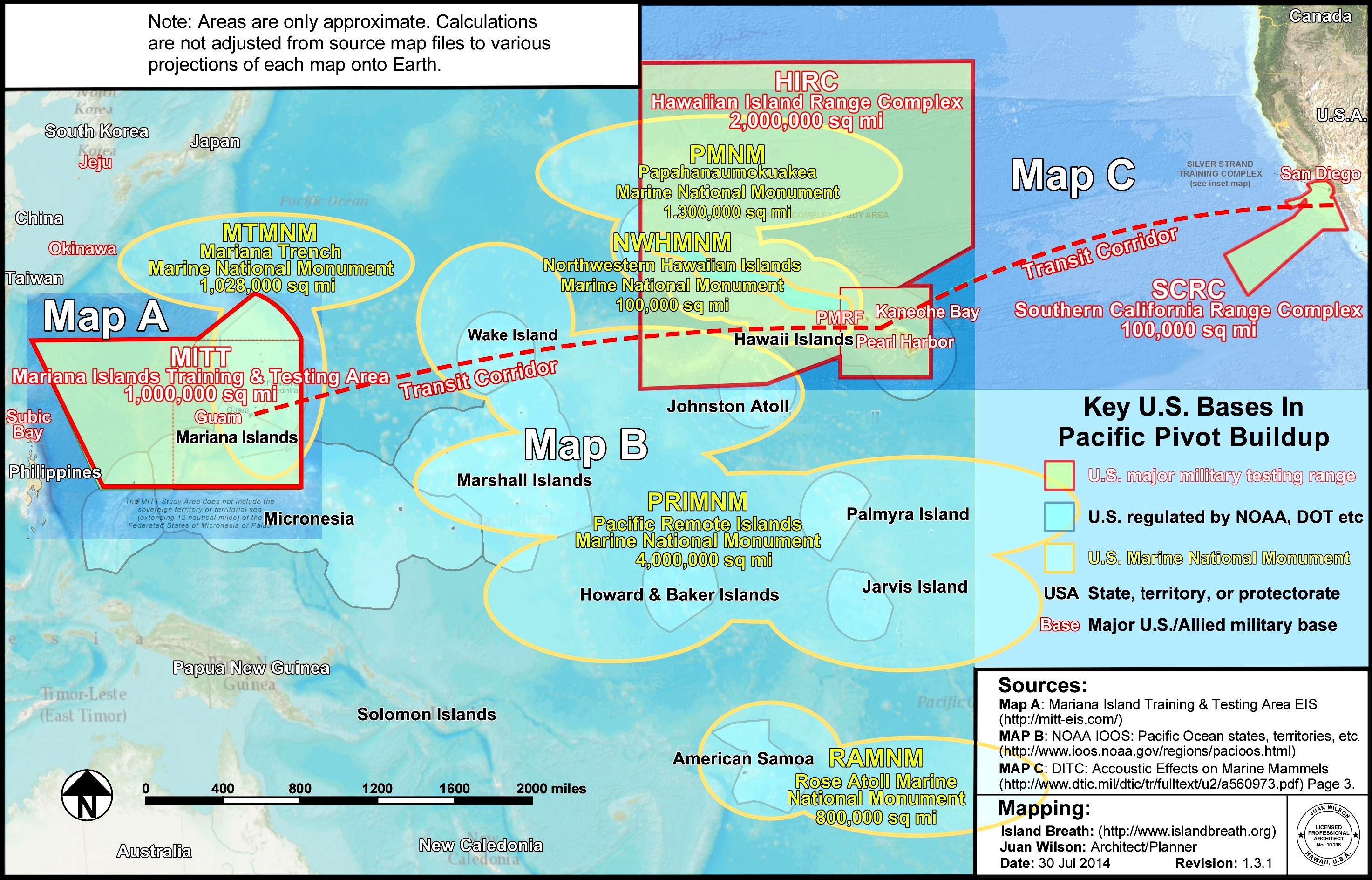
Below is map combing various US territorial claims in the Pacific Ocean including enormous military test range and war simulation areas. For more details see Island Ea o Ka Aina: The Pacific Pivot 6/26/14.

http://www.islandbreath.org/2014Year/06/140626overall.jpg
Image above: BATTLEGROUND OVERVIEW - Thumbnail of map joining  Maps A, B and C showing Pacific Ocean U.S.A. state, territory and protectorates as well as military range and testing facilities US marine national monuments existing and proposed.  Together these areas provide a complex and overlapping set of protocols, regulation and control that clusterfuck much of the Pacific Command area. Map by Juan Wilson (www.isladnbreath.org). Click for larger more complete view.

.

Coral Grief

SUBHEAD: It is clear that there is a disastrous connection between pesticide use and coral reef die-off.

By Katherine Muzik on 25 August 2013 for Island Breath -
(http://islandbreath.blogspot.com/2013/08/coral-grief.html)


Image above: Coral on the Great Barrier Reef. The same pesticides pushing along the destruction of the Great Barrier Reef are also linked to a raft of illnesses in humans. From (http://www.wwf.org.au/?6401/Dangerous-chemicals-a-threat-to-families-and-environment-Report).

I am writing to speak up for the voiceless members of our Kauai Island, including the corals, limu and numerous other marine creatures which are increasingly troubled by our human activities here on land.

While conducting their research, GMO companies on Kauai are apparently using still-undisclosed kinds and amounts of pesticides, which eventually reach the sea, where they can cause grave harm to our marine life.

A quick Google search for “pesticides and coral reefs” nets 31,200,000 entries, and a search for just one herbicide, “glyphosate (as in Round-up) and corals”, an astonishing 14,800,000.

Just now, my search for “herbicides and turtles” yielded me 8,130,000!

And for “herbicides and marine algae”, 4,450,00 results!!

It is clear there is a connection - a very important one.

It is a disastrous connection. We humans ignore it at our peril.

Let me summarize these many millions of articles for you: pesticides, especially herbicides, have been scientifically shown to have a deleterious effect on marine life, whether plankton, corals, limu, turtles…

Having studied coral reefs and their decline for many decades, all over the world, I am utterly dismayed.

Corals which have already been under intense pressure from sediments, oil pollution, overfishing, marine debris, military base construction and more recently, acidification and global climate change, are now facing an additional threat in the form of pesticides arriving from land.

In 2011, marine biologists in Australia reported that pesticides increase the vulnerability of corals to rising sea surface temperatures and other human-induced threats.

Another recent report from the Great Barrier Reef shows that corals can be harmed by agricultural chemicals at levels so low as to be practically undetectable: “Coral settlement was reduced by between 50 and 100% following 18 hours exposure to very low concentrations”.

Herbicides used on farmlands eventually run down to the sea, where they damage or destroy free-living phytoplankton (which provide us oxygen and are food for zooplankton and other animals); they damage the zooxanthellae in coral (the algae in their tissues, which help corals grow and thrive); and they damage the seaweed and sea grass communities (which turtles and we too eat).

In addition to herbicides, the insecticides and fungicides used on land also enter the sea, where they damage or destroy zooplankton and coral polyps. They cause further damage to the food chain by accumulating in the tissues of shellfish, fish and marine mammals and negatively affecting their physiological processes too.

Here in Kauai, we have unusual coral reefs, formed not only by coral polyps living with their zooxanthellae (remember, plants), but also formed by coralline algae (plants)! Yes, plants! 35% of our reef sands here in Kauai are from the skeletons of plants, the so-called coralline algae!
Uh oh! As plants, the coralline algae too have photosynthetic systems already proven to be disrupted by herbicides, and so they too will likely suffer and ultimately perish if we do not care for them properly.'

And again, about those turtles, eating turtle grass, well, take a guess.

Let’s keep our reefs alive! Our corals, our limu, our turtle grass, our turtles!

Let’s remember that corals were regarded as sacred since Ancient Times, and thus were honored in the Kumulipo, the Hawaiian hymn of Creation: “Hanau ka Uku-ko‘ako’a” or, “Born the coral polyp”. And so, eventually we humans too were born.

I am for passage of Bill 2491. We need to know, and simultaneously learn how to control and manage, what is entering our watersheds and then descending, so harmfully, to our sea. The corals cannot escape. Ultimately, neither can we.

• Katherine Muzik, Ph.D. is an Associate in Natural Sciences at the Bishop Museum and is a resident, Kapaa, Kauai.


.

Kauai White Coral Disease

SUBHEAD: View a film and presentation about health problems facing Kauai northshore coral reefs.

By Terry Lilley on 8 March 2013 in Island Breath -
(http://islandbreath.blogspot.com/2013/03/kauai-white-coral-disease.html)


Image above: Terry Lilley under Hanalei Bay shooting video of reef conditions. From Terry Lilley.

WHAT:
 Free video and talk about threats to health of northshore reefs. See some amazing creatures that live below the surf in Hanalei Bay.

WHEN:
 Wednesday, 20 March 2013 at 6:00pm

WHERE:
Princiville Library
Princeville, Kauai

CONTACT:
Terry Lilly
underwater2web@gmail.com


Aloha Ocean Lovers,

Please come join me, Terry Lilley, at the Princiville Library March 20th at 6:00 for my free talk and video about the "Kauai White Coral Disease".

For the first time ever you will get to see this disease close up and personal like I have been doing for two years scuba diving.

You will get to see how it is eating up our reefs at alarming speed and come to understand how dangerous this is to our future as surfers, divers, swimmers and tourist. You will get to see how many corals are infected and dying right now all along the north shore, and where they are located.

You will also get to see what may be causing this deadly cyanobacteria to spread along our reefs. Possible causes like Atrizine from GMO chemicals, toxic run off from illegal digging in the Hanalei River to Navy microwave sonic testing and chemtrails along our coastline!

Find out how each person on Kauai can help in curing this major reef problem. Also find out why the politicians in Kauai have been ignoring this disease for years!

On the positive side, you will see for the first time video of the amazing creatures that live below the surf in Hanalei Bay, and come to understand why we need to protect their environment.

.

Coral Death Epidemic

SOURCE: Bradley Jones (bjesquire@gmail.com)
SUBHEAD: U.S. Geological Survey says a coral disease outbreak along Kauai’s North Shore is nothing short of an “epidemic.

By Chris DeAngelo on 22 November 2012 for Garden Island News -
(http://thegardenisland.com/news/local/usgs-coral-disease-outbreak-an-epidemic/article_ca64e85a-347a-11e2-bb8b-001a4bcf887a.html)


Image above: Photo by Terry Lilley of a diseased piece of rice coral is pictured in Anini Bay. This photo shows a cyanobacterial/fungal disease attacking a piece of coral — the black ring is the disease, and the white area is the coral’s dead skeleton.From original article.

A diagnostic report released Wednesday by the U.S. Geological Survey says a coral disease outbreak along Kauai’s North Shore is nothing short of an “epidemic.”

“Given the scale of the event, the large numbers of corals affected, and the consistent preponderance of a few agents (cyanobacteria and fungi) associated with gross lesions that look similar in both Makua (Tunnels Beach) and ‘Anini, this outbreak would have to qualify as an epidemic,” Dr. Thierry Work, head of Infectious Disease for USGS, writes in the report.

Work says this is the first time a cyanobacterial/fungal disease on this scale has been documented in Hawaiian corals and that he feels “very comfortable” describing the situation as he sees it.

“I wrote (epidemic) down in there because it’s true,” he said Wednesday, shortly after releasing his report. “The bottom line is the definition of an epidemic is an unusual or above-background occurrence of a disease. It doesn’t necessarily need to be a lot of animals.”

Work went on to say that reefs along Kaua‘i’s North Shore look “horrible” and that locating diseased corals at Tunnels and ‘Anini was not a difficult task.

“I have never seen a cyanobacterial disease like this killing corals to this degree in Hawai‘i,” he said. “This is truly an unusual event.”

North Shore tests

In August, Work traveled to Kaua‘i to complete tests on the diseased coral at Tunnels reef. An official report was filed Sept. 4 outlining the reef’s poor condition.

“The overall picture was one of a severely degraded reef impacted by sediments and turf algae,” Work wrote in the September report.

In late-September, Work — along with Dr. Greta Aeby, a coral expert with the Hawai‘i Institute of Marine Biology at the University of Hawai‘i, and Amanda Shore, a UH graduate student — accompanied Terry Lilley, a biologist and Eyes of the Reef volunteer who first alerted scientists of the unusual outbreak, to ‘Anini to photo document lesions, sample coral and apply a marine epoxy to affected corals to try and stop the disease’s progression.

At that time, paired normal and lesion tissues were collected from 15 different coral colonies. Work’s findings were outlined in Wednesday’s report.

“Live coral cover appeared unusually low as compared to what would be expected on a healthy reef,” he wrote. “On microscopy, of the 17 samples with lesions, 10 had tissue death (necrosis) associated with cyanobacteria, five had necrosis with cyanobacteria and fungi, and the remainder had no recognizable microscopic lesions.”

As for non-lesion coral samples, microscopic changes in tissue suggests the animals are undergoing some type of stress, according to the report.

“Based on the large percentage (59 percent) of corals affected by cyanobacteria only at ‘Anini, I suspect this organism is playing a primary role in causing lesions, with the likelihood that fungi may pose a complicating factor,” Work writes. “In aggregate, 88 percent of corals with lesions at ‘Anini are infected with cyanobacteria and fungi.”

The reefs at both ‘Anini and Tunnels are heavily overgrown by turf algae, have low coral cover and large amounts of suspended solids in the water column, according to Work. And while sedimentation and the presence of the disease appear closely associated, Work says that remains to be proven through further scientific testing.

“That said, the similarity of the findings at Makua (Tunnels) and ‘Anini strongly suggests a common underlying cause, and it is difficult to conclude that the degraded environmental conditions at both sites are not, in some way, driving the occurrence of these infectious diseases on corals,” Work writes.

What’s next?

As a scientist, Work says his job is simply to provide data on his findings. After that, he says it is up to decision-makers and the community to decide what they want to do about it.

The next step of his work will be to determine the disease’s cause.

“Is it coming from Hanalei River? Is it coming from Hanalei Stream?,” Work questioned. “The first question is where is the source.”

Another big concern is whether this new strain of cyanobacteria is infectious to humans and marine life. Work says he and other scientists involved in the ongoing study have spotted puffer fish with skin discoloration and unusual lesions on their fins.

“Right now I have no evidence that there’s any relationship between the coral disease and what’s happening to the turtles and fish,” Work said. “We’re going to try to come out next week to look at the fish, to see what’s causing the lesions.”

The bottom line, according to Work, is that Kaua‘i’s reefs are heavily degraded and infected with a rapidly-spreading white coral disease unlike any seen here before. How they got this way is yet to be determined by Work, Aeby and other scientists.

“I think people need to know what’s going on with their reefs,” Work said. “It’s actually quite serious.”

See also:

Ea O Ka Aina: State denies Hanalei River polluted 5/6/12
Ea O Ka Aina: Poisonous mud in Hanalei 3/5/12
Ea O Ka Aina: Mud in Hanalei Bay 11/11/11


.