Showing posts with label Contraction. Show all posts

Battle of the Behemoths

SUBHEAD: And the transition will get underway with a speed that will make your head spin.

By James Kunstler on 11 August 2017 for Kunstler.com -
(http://kunstler.com/clusterfuck-nation/battle-of-the-behemoths/)
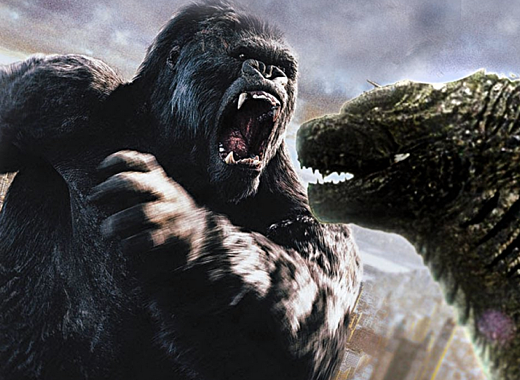

Image above: The ‘Godzilla vs. Kong’ development process has begun for a 2020 release. From (http://bloody-disgusting.com/movie/3427859/godzilla-vs-kong-development-process-begun-first-details/).

As the empire deliquesces into a fetid slurry of economic failure, we stand ankle deep in the rising swamp waters witnessing the futile battle of the giants, Walmart and Amazon.

Neil Howe, co-author of The Fourth Turning, wrote this week that “[t]he Amazon-Walmart rivalry will determine the future of retail.”

Well, it seems that way, perhaps, and I understand why a lot of people would imagine it, but I would draw some different conclusions. What we’re seeing is more like the battle between Godzilla and King Kong, two freaks of nature produced by a toxic culture, fixing to finish each other off.

The condition that will flavor events going forward is scale. Everything organized at the giant scale is going to fail. We have made all the systems of daily life too large and they will not function in the long emergency (and the fourth turning), an age characterized by universal contraction.

This is true of corporations, institutions, schools, hospitals, farms, governments, virtually all organized enterprise. Retail is currently just the most visible example at the moment, since it is a commercial battleground that doesn’t enjoy public subsidies.

The organisms on that field are exquisitely sensitive to economic reality, and the salient reality these days is the impoverishment of their customers, the former middle class.

This has been a sensational year for retail failure so far with a record number of brick-and-mortar store closings. But it is hardly due solely to Internet shopping. The nation was vastly over-stored by big chain operations.

Their replication was based on a suicidal business model that demanded constant expansion, and was nourished by a regime of ultra-low interest rates promulgated by the Federal Reserve (and its cheerleaders in the academic econ departments).

The goal of the business model was to enrich the executives and shareholders as rapidly as possible, not to build sustainable enterprise.

As the companies march off the cliff of bankruptcy, these individuals will be left with enormous fortunes — and the American landscape will be left with empty, flat-roofed, throwaway buildings unsuited to adaptive re-use. Eventually, the empty Walmarts will be among them.

Just about everybody yakking in the public arena assumes that commerce will just migrate to the web. Think again. What you’re seeing now is a very short term aberration, the terminal expression of the cheap oil economy that is fumbling to a close.

Apart from Amazon’s failure so far to ever show a corporate profit, Internet shopping requires every purchase to make a journey in a truck to the customer.

In theory, it might not seem all that different from the Monkey Ward model of a hundred years ago. But things have changed in this land.

We made the unfortunate decision to suburbanize the nation, and now we’re stuck with the results: a living arrangement that can’t be serviced or maintained going forward, a living arrangement with no future.

This includes the home delivery of every product under sun to every farflung housing subdivision from Rancho Cucamonga to Hackensack.

Of course, the Big Box model, like Walmart, has also recruited every householder in his or her SUV into the company’s distribution network, and that’s going to become a big problem, too, as the beleaguered middle-class finds itself incrementally foreclosed from Happy Motoring and sinking into conditions of overt peonage.

The actual destination of retail in America is to be severely downscaled and reorganized locally.

Main Street will be the new mall, and it will be a whole lot less glitzy than the failed gallerias of yore, but it will represent a range of activities that will put a lot of people back to work at the community level. It will necessarily entail the rebuilding of local and regional wholesale networks and means of distribution that don’t require trucking.

If you think we’re just going to switch the trucking industry over to electric vehicles or engines that run on bio-fuels, hydrogen, compressed air, or natural gas, you will be disappointed. Ain’t going to happen.

We’re going to have to come up with something else, starting with the basic idea of the walkable community. This implies that we’re going to have to revive the existing towns and small cities that fit that description.

And it also implies that a great deal of American suburbia will have to be abandoned. The capital will not be there to reform it.

In any case, commerce later on in this century is not going to be anything like the Blue Light Special orgy of recent decades. And the transition will get underway with a speed that will make your head spin.

.
Mayan Civilization Continues

SUBHEAD: Usually when a civilization over-extends it experiences rapid decline in complexity.

By Albert Bates on 9 July 2017 for The Great Change -
(http://peaksurfer.blogspot.com/2017/07/maya-theater-states.html)


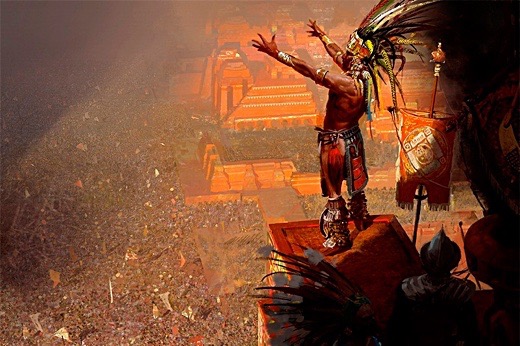
Image above: Illustration of a Mayan priest conducting a public ritual from atop a temple pyramid. From (http://wallpapercave.com/age-of-empires-wallpapers).

The collapse of the Classic Maya period, around 900 CE, is an active academic field, with many conflicting theories and a mountain of literature. While traveling in the Yucatán we are reading Arthur Demarest’s Ancient Maya: the Rise and Fall of the Rainforest Civilization (Cambridge University Press, 2004).

One of the terms Demarest uses to describe the period is a “theater-state.” The ruling elite, known as the K’uhul Ajaw, or Holy Lords, were relatively hands-off with respect to economics, social welfare and trade but devoted lots of resources to legitimizing their political and religious authority through monumental architecture, art, pageant, sports spectacles and warfare.

This resource misallocation — taking away from the real needs of the populace, especially in times of stress — led to swelling the elite class, enormous diversions to unproductive types of labor, depredations from unnecessary wars, resentment from disenfranchised youth who were relegated to javelin–fodder, and, of course, ecological decay — as previously elegant eco-agriculture microsystems (using 400–500 species of plants) were consolidated into monocultures and overproduced.

A question Demarest probes is why, in so many areas, did not Mayan leaders respond with effective corrective measures for the stresses generated by internal and external pressures they could not have failed to notice.

We generally think of complex societies as problem-solving machines, in which elaborate chains of central command and control “wire” a nation to meet its goals. Yet beginning around the Eighth Century, the Holy Lords were apparently away from the control room.

Demarest thinks the problem was structural. Since the elites of the most classic Maya kingdoms did not farm or manage production of goods, the “real” economy was decentralized to community or family.

The role of the Holy Lords was to manage a “false” economy that was derivative, its only marginal utility being that it gave their Kingdoms some sort of patriotic zeal or sense of exceptionalism.

When these derivatives eventually began to unravel, the Holy Lords, like mechanics with a limited set of wrenches, did what they knew best — they intensified ritual activities, built taller and more ornate temples and expensive stages, props, and costumes, and scheduled more performance rituals, wars, and feasting.

Contrary to earlier results, however, these measures only prolonged or intensified the problems, led to further disenchantment, which eventually brought about whatever cataclysm dethroned them.

Successive rounds of quantitative easing had diminishing returns. The “real” economy suffered a century-long drought punctuated by severe droughts in CE 810, 860 and 910. Even the “false” economy could not help but feel reality intrude.

Today the theater state is shown in high definition and 3-D, and it resembles in its own way the grand Berlin pageants of Albert Speer as much as the scenes from Apocalypto.

Mad-Men have refined the manufacture of consent, to use Chomsky’s phrase, to a fine science, and as in Classic Maya times, military recruitment is viewed as a fortunate outlet for the unemployed.

However, a “classic” period, signifying the peak of empire and also a peak in energy, productivity, and population in most cases, is never sustainable, because it is inherently unbalanced.

Demarest’s insight here is that we tend to characterize every civilization in terms of “preclassic, classic, and postclassic,” but we might do better to think of it as “stable and expanding,” “unstable,” and “shrinking and reconsolidating.”


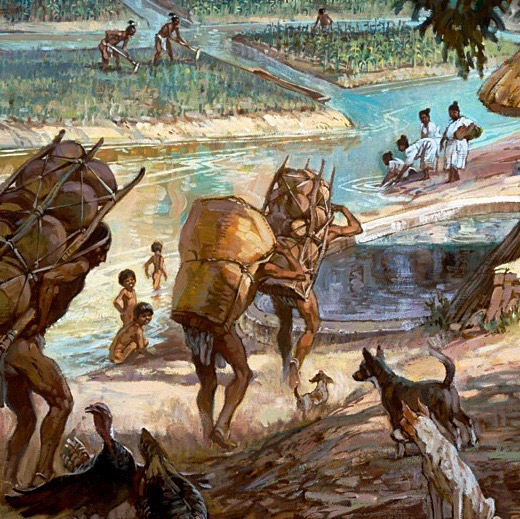
Image above: Illustration by Roy Anderson of rural Mayan farming practice that supported the empire. From (http://news.nationalgeographic.com/news/2012/11/121109-maya-civilization-climate-change-belize-science/).

Preclassic Maya agriculture was exceedingly diverse, with agroforestry, household garden plots, rotational field crops, chinampas and aquaponic systems, and perhaps also novel farming techniques we have yet to learn about. So was the postclassic.

We have only just recently begun to appreciate that the “slash and burn” found in many parts of the tropics was once a highly productive and ecologically sustainable biochar amendment system when practiced in the ancient ways.

The Mayan preclassic food system was only marginally regional. While trade and tribute brought in salt, chocolate, hardwoods, hard stone, luxuries, textiles, and non-perishable goods, transportation of corn or other staples was largely prohibitive from an energy efficiency standpoint.

Moving corn on the back of a man 25 km requires the consumption of 16% of the caloric value of the load.

Transport from 100 km would have cost a third of the load in expended caloric energy. Demarest wrote, “Such high transport costs might have been maintained by a few Mayan cities at their peak, but more generally Mayan subsistence economies and markets were probably based on an area of about 20 to 30 km — a day of travel from the major center and its periodic markets.”


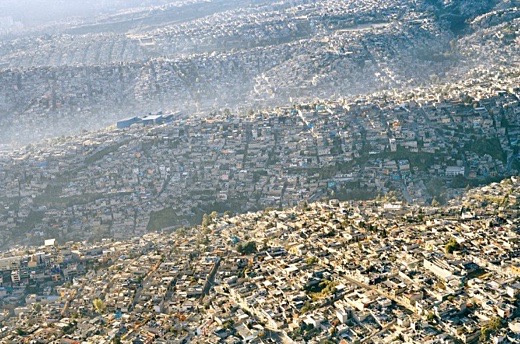
Image above: The Sprawl of Mexico City today. Photo by Paul Lopez. From original article.

Joseph Tainter’s famous 1988 analysis of civilizational collapses argues that what generally occurs when a civilization over-extends is not a complete disappearance but a rapid decline in complexity. Axiomatically, it can be said that the instability experienced at the peak of a culture is a function of over-complexity. 

While this might be true of the Maya in some ways, in other respects that analysis fails to satisfy. While the theater state of the Holy Lords reached a peak complexity and then declined, a different type of state followed that increased in complexity over what had existed in the classic period.

The end of the theater state led to the cessation of monumental architecture and the disappearance of high status exotic goods and ornaments, but good riddance.

At the same time, although at different times and speeds in different regions, there was a flowering and transformation to the new order. Extensive ecological, archaeological, and settlement pattern studies have found a resurgence of complex agricultural regimes that were well adapted to population levels with no indications of nutritional stress.

When the curtains were drawn on the theater state, the health and welfare of the people improved. With the loss of simple monoculture and central authority and the diffusion of complex microfarming diversity and decentralized councils, the new order recaptured stability.

What followed in the postclassic period were a diffusion of distinctive new variants of the classic culture, with strange costumes, long hairstyles, experimentation with new legitimating ideologies, and unusual features in buildings, sculpture and ceramics (e.g.: ubiquitous serpents, brightly colored murals, and the psychedelic temple complex of Tulum).

The Maya that flourish in the Guatemalan highlands and Yucatán today are as populous and even more vigorous economically than during the classic theater state, but they do not generate anything like the art and architecture of their predecessors from 1000 years ago. They don’t need to.
Demarest observed;
For at least 6000 years, the hallmarks of the Western tradition have been linear concepts of time, monocultural agricultural systems, overproduction and exchange of surplus in full-market economies, technology-driven development, a long history of attempts to separate religious and political authority, and judgmental Gods concerned with individual, personal moral conduct.  
As we learn from the Maya, none of these traits is universal, none of them was characteristic of classic Maya civilization, and none of them is critical to the fluorescence of high civilization.
***
Too often scholars and the public viewed non-Western societies with an implicit, unconscious condescension. We tend to regard their political and economic systems as incomplete (“less evolved”) versions of our own. Ideology and cosmetology are viewed as detailed esoteric collections of ideas fascinating for scholarly study and public imagination.
We also tend to emphasize aspects of ancient religion that attempted control of nature as “primitive science.” In so doing, we ignore the personal and philosophical challenges of experiencing another worldview — an alternative perspective on existence and death.
***
From an openly philosophical, subjective, and postmodern perspective of our society and its science, we are no wiser than the Maya priests and shamans in the face of these mysteries.
For that reason we can study the ancient Maya, and other non-Western cultures, as sources of alternative views of reality and of contemplation of our own culturally ingrained worldviews.

You can view the classic Maya as a less developed society trying to control the forces of nature and to survive economically. Or instead, they can be regarded as fellow travelers who simply chose a different path through the darkness.
The pre- and postclassic system of mimicking the diversity and dispersion of the forest allowed the Maya to maintain populations in the millions in the Yucatán for over 1500 years without destroying a rich but fragile tropical environment and biodiversity.

They are still here — still engaged in that work. That offers hope for us all.


Image above: A Mayan woman with weaving at the beach in present day Belize. The Maya continue their culture today with a population of about six million in part because they have been able to inhabit a single unbroken area including parts of southern Mexico, Guatemala, Belize, and the western edges of Honduras and El Salvador for millennia. From (http://jacerivers.tumblr.com/post/34217736135).

This is an update of an essay we wrote six years ago from the Fourth World Congress on Ecological Restoration in Mérida, México. It was published as part of the collection Pour Evian on Your Radishes in 2014.


.

The Big Contraction

SUBHEAD: An interview with James Howard Kunstler on the nature of our unraveling future.

Interview by Erico Tavares on 30 March 2017 for LinkedIn -
(https://www.linkedin.com/pulse/big-contraction-interview-james-howard-kunstler-erico-matias-tavares)


Image above: Family "camping out" of their 1958 Chevy Brookwood station wagon. Back when the car was new they were not "homeless", they were just "roughing it". From (http://www.ultraswank.net/advertising/classic-hand-drawn-car-ads-from-the-us/).

E Tavares: Thank you for being with us today. You have been writing about worsening societal issues, what you call “entropy in action”, for many years. Broadly speaking, why do you think the US is in so much trouble?

JH Kunstler: We’ve been sowing the seeds for our predicament since the end of World War II. You might even call this process “The Victory Disease.” In practical terms it represents sets of poor decisions with accelerating bad consequences.

For instance, the collective decision to suburbanize the nation. This was not a conspiracy. It was consistent with my new theory of history, which is Things happen because they seem like a good idea at the time.

In 1952 we had plenty of oil and the ability to make a lot of cars, which were fun, fun, fun! And we turned our war production expertise into the mass production of single family houses built on cheap land outside the cities. But the result now is that we’re stuck in a living arrangement with no future, the greatest misallocation of resources in the history of the world.

Another bad choice was to offshore most of our industry. Seemed like a good idea at the time; now you have a citizenry broadly impoverished, immiserated, and politically inflamed.

Of course, one must also consider the possibility that industrial society was a historic interlude with a beginning, middle, and end, and that we are closer to the end of the story than the middle.

It was, after all, a pure product of the fossil fuel bonanza, which is also coming to an end (with no plausible replacement in view.) I don’t view all this as the end of the world, or of civilization, per se, but we’re certainly in for a big re-set of the terms for remaining civilized.

I’ve tried to outline where this is all going in my four-book series of the “World Made By Hand” novels, set in the near future. If we’re lucky, we can fall back to sets of less complex social and economic arrangements, but it’s unclear whether we will land back in something like the mid-nineteenth century, or go full-bore medieval, or worse. One thing we can be sure of: the situation we face is one of comprehensive discontinuity — a lot of things just stop, beginning with financial arrangements and long-distance supply lines of resources and finished goods.

Then it depends whether we can respond by reorganizing life locally in this nation at a finer scale — if it even remains a unified nation. Anyway, implicit in this kind of discontinuity is the possibility for disorder. We don’t know how that will go, and how we come through it depends on the degree of disorder.

ET: Fair points, but one remarkable feature of Western civilization has been its resilience. In less than a decade the US has been able not only to reverse the historical decline in domestic crude oil production but also come up with natural gas as an expansive new source of energy. It now exports both of these commodities. Ditto for food production, where it can afford the luxury of using 40% of its corn production as car fuel. Doesn’t all this contradict what you had postulated in “The Long Emergency” back in 2005?

JHK: We flatter ourselves a bit to harp on our “resilience.” More realistically, history is an emergent process and societies are emergent phenomena which necessarily respond to the circumstances that reality presents. Sh*t happens and sh*t unhappens and then re-happens differently. The oil situation is grossly misunderstood by the public, including you, as implicit in the question you have just put to me.

We are not exporting any meaningful quantities of oil or natural gas. In fact we’re still importing nearly 8 million barrels of oil a day.

The shale oil “miracle” has largely been a manifestation of low interest lending into an industry that can’t pay back its loans, even as it produces like mad at a loss. You can look at it as a simple equation: oil over $75 a barrel crushes economies and oil under $75 a barrel crushes oil companies. To date, American oil companies have not made a red cent off the shale oil “miracle.”

It seemed like a good idea at the time, and it kept a lot of people busy for a while, but it was essentially a stunt that is not paying for itself and it has a short horizon. The public only sees lower gasoline prices at the pump; they have no idea how low prices are wrecking the oil industry. The result of all this will be an incrementally smaller global oil industry and fewer customers for its products — without anything to replace it.

The crux of the matter is the falling Energy Return on Investment (EROI). In the 1950s you got 100 barrels of Texas crude for every equivalent barrel of energy you sunk into the project. That’s 100 to 1. Shale oil gives you about 5 to 1.

Tar sands are a little worse. The worldwide average EROI these days is 17 to 1 (including Arabian oil, deep water, etc.). We can’t run all the systems of our “advanced” society at those ratios, and that is why we have been running up the debt so dramatically — borrowing from the future to cover the cost of living as we do.

And that is exactly why we are heading into financial clusterfuck as it becomes increasingly evident that the debt will never be paid back. This will wreck the banking system, and that will force everything else to change, including the dynamic of how we produce and distribute food. So, no, none of what I am saying here contradicts my 2005 book, “The Long Emergency”, though it has played out with some strange twists in the story.


Image above: A 1958 Chevy Brookwood station wagon as it appears today. With that big cargo bay and isolated location it could easily be used by homeless persons roughing it. From (http://usedfromusa.com/chevrolet-ads/145244-1958-chevrolet-brookwood-station-wagon.html).

ET: Another theme you talked about in that book is that in order to cope with looming energy and food crises Americans would have to eventually live in smaller-scale, localized and semi-agrarian communities. All part of a process you call the Big Contraction. 

However, a McKinsey Global Institute research paper from 2012 predicts quite the opposite for most of the world in the coming years, as depicted in the graph above. Indeed, growing urbanization has been one of the major trends so far in the 21st century. What do they see here that you don’t?

JHK: McKinsey’s prescience may be on a level with what the CIA failed to see in the 1990 collapse of the Soviet Union. Everybody and his mother is predicting that our cities will only get bigger and bigger. I will impudently state that they are all mistaken.

Our cities have attained a scale which cannot be sustained, given the capital and resource scarcities we face immediately ahead. This is what they don’t see: the fragility of the fossil fuel supply system (and everything that depends on it) and its relation to money and capital formation.

McKinsey and its compadres are dumb extrapolationists — they look at what’s been going on and they say we’ll only get more of it in a bigger package. These people are the “intellectual-yet-idiots” that Nassim Nicholas Taleb identifies so shrewdly.

For one thing, the successful places in the years ahead will be those places with a meaningful relationship to food production. I believe the action in US will shift to the now-derelict small towns and small cities, especially places around the extensive inland waterway system and the Great Lakes.

The giant metroplexes, so-called, will contract, probably in a messy way that includes great losses of notional real estate value and battles between various ethnic groups as to who gets to inhabit the districts with remaining value (e.g. close to the waterfront).

This contraction has already occurred in many cities of the heartland — Detroit, St. Louis, Milwaukee, Cleveland, etc. In contrast, booming New York, Boston, San Francisco and Dallas are purely products of the financialization of economy, and disorder in the banking system will hit them very hard. The suburbs around these places are next to go. Their destiny is either slums, salvage, or ruins.

ET: One aspect that we find fascinatingly provocative in your work is your description of modern urban landscapes, and how instead of being welcoming social spaces they now cause anxiety, even repulsion. What have modern architects missed in relation to their predecessors? Is that in any way related to the cultural revolution of the 1960s, which profoundly impacted much of the Western world?

JHK: The architects are a dysfunctional sub-culture in themselves. Suffice it to say they are hand-maidens of the corporate racketeers and victims of a particularly virulent form of techno-narcissism that infects our culture of wishful thinking and solipsism.

But the condition of the landscape is a product of much more than architects. The suburban project comes to us courtesy of banking, the automobile and trucking interests, national chain retail, municipal planning officials (who know nothing of urban design), traffic engineers, and many other ultra-specialists who populate this matrix of racketeering.

They have produced an everyday environment that is positively punishing to human neurology. It makes people sad, lonely, confused, angry, anxious, and despondent. They didn’t do it on purpose. It was just the blowback from their methods, customs, and practices. The zoning ordinances crafted and refined over a hundred years now mandate a suburban sprawl outcome in most American places.

Look, life is tragic. As I began to say in this interview, societies can make some pretty poor choices. Our choice to live in a drive-in utopia was a terrible blunder and now we’re stuck with the consequences. Notice that the outcome on the European landscape is still rather different. They will have plenty of problems in The Long Emergency, but at least they did not destroy their old city centres, and when the time for contraction comes, as it will, they have something of great value to contract back into.

ET: You talk about a “population overshoot” relating to demographic explosions in Africa and the Middle East that you claim cannot be sustained by the existing resources of those regions. Why do you say that?

JHK: Much of this region is desert wasteland. The populations of the “nations” in it (many boundaries drawn arbitrarily by the victors of World War One) have exploded numerically. The region can’t feed nor water itself, nor employ its exploded population. It is purely a product of fossil fuel pseudo-prosperity. It went this way for less than a century and then it will be over.

For the moment these populations (especially the young men) are exploding in political violence. Categorically, “normal” life will not continue as it has. We’re already seeing the gross disintegration of whole societies. It will accelerate.


James Howard Kunstler's thinking gained prominence after the publication of his book The Geography of Nowhere (1994), a history of American suburbia and urban development “because [he] believe[s] a lot of people share [his] feelings about the tragic landscape of highway strips, parking lots, housing tracts, mega-malls, junked cities and ravaged countryside that makes up the everyday environment where most Americans live and work.” This was followed by The Long Emergency (2005) and most recently Too Much Magic (2012), both non-fictional books. Starting with World Made by Hand in 2008, he has written a series of science fiction novels about such a culture in the future.
.

What now?

SUBHEAD: America coughed up Clinton like a hairball and swallow the Cheeto-colored bolus Trump

By James Kunstler on 14 November 2016 for Kunstler.com -
(http://kunstler.com/clusterfuck-nation/what-now/)


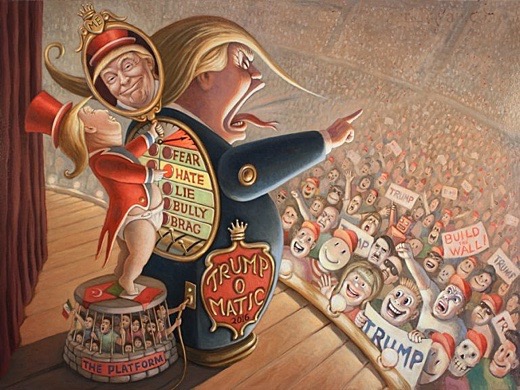
Image above: "Trump-O-Matic" painting by Mark Bryan. From (http://www.artofmarkbryan.com/trump-o-matic-trump-art-caricature/).

Not to put too fine a point on it, America coughed up Hillary Clinton like a hairball last week — the catch being it then had to swallow the Cheeto-colored bolus called Donald Trump.

It was worth it to see the fog of Hillary-smuggery lift across the cable TV networks since the “I’m With Her / It’s Her Turn” fog was a cover for the looting operation that the permanent Washington DC establishment had turned into, including the Clinton Foundation.

Obviously, the nation is reeling from this emetic, struggling to process the meaning of it all.

The big “tell” for me came at a moment in last week’s Slate Political Gabfest, a leftish-oriented podcast, when moderator David Plotz asked his sidekicks John Dickerson (of CBS News) and Emily Bazelon (of The NY Times) what the Democratic Party might do to regain legitimacy after this electoral disaster. Dead silence on the air. Nothing came to mind.

Something came to my mind as a long-time disaffected (registered) Democrat: jettison the stupid identity politics and get back to reality. Alas, that may be too much to ask. For now, the party lies in ruins without a single figure of stature to represent a coherent set of ideas other than boosting the self-esteem of its favor-seeking constituent groups.

Here’s my idea: how about forming a credible opposition to the so-called Deep State, the matrix of racketeering and empire-building that has drained the life out of this polity. That was impossible with the racketeer-in-chief leading the blue electoral ticket, but now the dynamic stands naked and obvious, answering the question: what to do next?

Another catch, of course, is that opposing the Deep State of Rackets is pretty much what Mr. Trump has promised to do, if “draining the swamp” means anything. He never quite articulated it clearly beyond that metaphor, but you can bet that’s what the DC establishment is so alarmed about. Trump’s behavior on the campaign trail is now being hailed in the media as a kind of genius.

To me, it still seems oafish to an extreme, and it remains to be seen how such a blunderer might finesse our escape from the empire of rackets and the racket of empire. He begins to look like a man in a tunnel staring down the harsh light of the onrushing gravy train.

Mr. Trump might not know it yet, but his chief task will be managing contraction. It would appear to be problematic, since his chief promise — “to make America great again” — is based on restarting the epic expansions of the 19th and 20th centuries.

Well, things have changed. This is no longer a virgin continent filled with motherlodes, untapped oil bonanzas, and fabulous soils begging to be exploited. In fact, we’re close to being played out where those resources are concerned. And the techno-industrial economy engineered out of those assets is wobbling badly.

There is a Great Wish that this system might be replaced just-in-time with some as-yet-unrealized Green Alt Economy of solar-charged driverless electric cars — but, of course, the unchallenged pathetic idiocy of the assumed car dependence at the center of this fantasy ought to tell you how exactly unreal it is.

The contraction we face has mandates of its own, and it doesn’t include the continuation of Happy Motoring on any terms. I’m quite certain that the Trump forces haven’t even imagined it.

I would propose three meta-matters in consideration of how America might survive the disorders of the Long Emergency: the financialization of the economy, the burdens of empire, and the fiasco of our suburban living arrangement.

The financialization of the economy is already playing into its disastrous climax as I write, with bond markets tanking all over the planet. What this means is that the long-ignored chickens of risk associated with debt are coming home to roost.

As they do, they are going to shit over everything on the financial landscape. Industrial societies have been borrowing from the future to a grotesque degree for decades, pretending that these debts were assets rather than liabilities.

That perception is about to change, and with it an enormous amount of presumed notional wealth is going to disappear. That will manifest in rising bond yields (and falling bond values), cratering currencies, panicked capital flows, banking emergencies, and weird action in markets.

If that seems too metaphysical, you can also think of it as contracting economies and the withering of global trade relations. There’s also the chance it will express itself in kinetic conflict, i.e. war.

My sense of things is that this meta-predicament alone could overwhelm the Trump government from the very start. We could have problems with money orders of magnitude worse than anything FDR faced in 1933, with bank closures, the seizing of accounts, and the paralysis of everyday business.

That would easily lead to civil disorders, a breakdown in law, and the immiseration of most Americans. It could also lead to previously unimagined political outcomes, such as a discontinuity of government. This is connected with the second meta-problem, the burdens of empire.

The USA is squandering its vitality trying to maintain a half-assed global empire of supposed interests, economic, ideological, and existential. Lately, this hapless project has only resulted in wars with no end in places we don’t belong.

It includes reckless experiments such as the promotion of regime change (Iraq, Libya, Ukraine, Egypt, Syria), and senseless, provocative exercises such as the use of NATO forces to run war games near Russia’s border.

The monetary cost of all this is off the hook, of course, redounding to the financial mess. Reigning in these imperial impulses could be on the Trump agenda, but his own gold-plated imperial pretensions suggest that he might actually make the situation worse by conflating a reduction of our empire with a loss of the very “greatness” he wants to reclaim.

As it happens, America may be forced by economic circumstances to yield the burdens of empire. The world is about to become a bigger place again as globalism winds down and the larger nations establish more realistic spheres of influence. We better get with the program.

Thirdly comes the question of how Americans inhabit the terrain: the suburban fiasco and all its accessories and furnishings.

You can just stick a fork in that. The great project awaiting this country is how we might redistribute our people into re-scaled walkable communities with re-localized economies, including re-scaled agriculture. It’s going to happen whether we like it or not. It’s only a matter of how disorderly the process may be.

Obviously all the suburban crapola out there also represents a tremendous load of presumed wealth. The vested “value” in suburban houses alone is the underlayment of structured finance.

There is almost no conscious political awareness in any party — including the Greens — as to how we might attempt to work this out.

But, for example, and for a start, Mr. Trump might consider the effect that national chain “Big Box” shopping has had on Main Street America. It literally destroyed local commercial economies all over the land, and with it numberless vocational niches and social roles in communities.

He can’t sign an edict against the Big Box empire, but his people might start imagining the process of rebuilding local networks of commerce and actively de-incentivizing the Big Box business model.

That model has many other ways to fail, incidentally, and already is failing to some degree between the impoverishment of its customers and the growing problems with global supply lines. But anything that might lubricate the transition would be better than the stark collapse of the current arrangement.

The chatter this week has been all about the upcoming “infrastructure” orgy that Trump will undertake. That depends first of all on how badly the financial sector cracks up. I hope we do not squander more of our dwindling capital on the accessories of car dependence, because that addiction is on the way out.

One thing Mr. Trump might get behind is restoring the passenger railroads of America so that we can at least get around the continental nation when the Happy Motoring fiesta grinds to a halt.

It would put an awful lot of people to work on something with real long-term benefit — it ties into the restoration of Main Street towns and their economies — and it is a do-able project that might give us the needed encouragement to get on with the many other necessary projects awaiting our attention.

In case you were wondering, I was not jumping up and down cheering the Trump victory, amazing as it was. I figured the good news was that Hillary lost and the bad news was that Trump won. Now, we just have to roll with it.

.

Is the Deep State dumping Hillary?

SUBHEAD: Clinton is holding down the status-quo of failed expansionism and proxy wars.

By Charles Hugh Smith on 26 September 2016 fpr Of Two Minds -
(http://www.oftwominds.com/blogsept16/deep-state9-16.html)


Image above: Illustration on Mrs. Clinton, terrorist groups and U.S. intelligence operations in the Middle-East by Greg Groesch. From (http://www.washingtontimes.com/news/2016/aug/3/hillary-clinton-pursued-by-us-intelligence-agents/).

The governed are ready for a period of retrenchment, consolidation and diplomatic solutions to unwinnable conflicts, as imperfect as the peace might be to hawks.

Are you open to a somewhat unconventional perspective on this election? If so, read on. If you're absolutely confident you know all there is know about this election (good vs evil, Democrat vs. Republican, etc.), well then let's compare notes in five years and see which context provided more insight into the future.

In the context presented here, the personalities of the two candidates matter less than their perceived role in the changing of the Imperial Order. Let's start with a quick overview of the relationships between each political party and the Deep State--the unelected power centers of the central government that continue on regardless of which person or party is in elected office.

Liberal Democrats have always been uneasy bedfellows with the Deep State. Republican President Eisenhower had the political and military gravitas to put limits on the Military-Industrial wing of the Deep State, so much so that Democratic candidate John F. Kennedy claimed the U.S. had fallen behind the U.S.S.R. militarily in the 1960 presidential election (the infamous "missile gap").

Eisenhower was a cautious Cold War leader, wary of hot wars, wars of conquest, and the inevitable burden of conquest, nation-building. The military was best left sheathed in his view, and careful diplomacy was sufficient to pursue America's interests.

Kennedy entered office as a foreign policy hawk who was going to out-hawk the cautious Republicans. A brush with C.I.A. cowboys (the failed Bay of Pigs invasion of Cuba) and a taste of Imperial meddling in distant, poorly understood lands (Vietnam) increased his interest in peace and reduced his enthusiasm for foreign adventurism.

Lyndon Johnson, perhaps the most activist liberal Democrat of the era, was not about to be out-hawked by the Republicans, and so he followed an expansive Imperial agenda into the 10-year quagmire of Vietnam.

Since the immense global enterprise known as World War II had taken less than four years to win, Americans had little patience for low-intensity wars that dragged on inconclusively for years while combat deaths mounted into the tens of thousands.

Liberal Democrats could find no easy political ground between the pressure to out-hawk the Republicans and the demands of an expansive Cold War Deep State. Both liberal Democratic presidents between 1965 and 1980, Johnson and Jimmy Carter, were one-term presidents, undermined by military/foreign entanglements.

The Republicans were given a freer hand; Nixon unleashed the B-52s on Hanoi in late 1972 until the North Vietnamese ran out of Soviet-supplied SAMs (surface to air missiles). Given a choice between a brokered peace or a flattened capital, they chose peace, and Nixon was free to declare victory and pull the majority of remaining American forces out of Southeast Asia.

The disastrous defeat in Vietnam of expansive Imperial ambitions (nation-building, etc.) led to an era of retrenchment and consolidation. Other than "splendid little wars" in Grenada and Panama and supporting proxies such as the Contras, the 1980s were years not of Imperial expansion but of Cold war diplomacy.

Republican President Reagan was also given a free hand to be a peacemaker, overseeing the fatal erosion of the U.S.S.R. and the end of the long, costly Cold War. President Bush Senior was a cautious Cold War leader, careful not to alienate the post-U.S.S.R. Russians and wary of over-reach and quagmires even in the new Unipolar world of unrivaled U.S. power.

The era's one hot war, Desert Storm, restored the sovereignty of Kuwait but left Saddam Hussein in control of Iraq. Bush and his inner circle (and the Deep State they represented) were mindful of the lessons of Vietnam: Imperial over-reach led to costly, drawn-out failures of nation-building in the name of exporting democracy.

Though it was poorly understood by the public, Desert Storm played to American military strengths: a high-intensity conflict with concentrated forces, maneuver warfare with heavy armor protected by absolute air superiority, aided by proximity to allied bases and aircraft carrier groups. If you designed a war optimized to American military strengths, it would look much like Desert Storm. No wonder it was one of the most lopsided victories in history, with most American casualties resulting from random Scud missile strikes and accidents.

The end of the Cold War and victory in Iraq left the Republicans without their hawkish agenda and political raison d'etre, and Ross Perot's third-party movement in 1992 effectively delivered the presidency to Democrat Bill Clinton.

Clinton was blessed with a booming domestic economy and a peace dividend from the end of the Cold war. Though Clinton reportedly hankered for a great crisis he could exploit to burnish his place in the history books, alas none arose, and the 20th century ended with a decided absence of existential threats to the U.S. or even U.S. interests.

The incredible success of Desert Storm and the temptations of Unipolar Power birthed an expansionist, activist Imperial doctrine (neoconservatism) and a Deep State enthusiasm for flexing America's unrivaled power. What better place to put these doctrines into practice than Iraq, a thorn in the Imperial side since Desert Storm in 1991.

Alas, Bush Junior and his clique of doctrinaire neoconservatives had little grasp of the limits and trade-offs of military tactics and strategies, and they confused the optimization of Desert Storm with universal superiority in any and all conflicts.

But as veterans of Vietnam knew, low-intensity war with diffused, irregular combatants is quite a different situation. Add in the shifting politics of Sunni and Shia, tribal allegiances, failed states and a post-colonial pot of simmering resentments and rivalries, and you get Iraq and Afghanistan, two quagmires that have already exceeded the cost and duration of the Vietnam quagmire.

A decade after the collapse of the U.S.S.R. and 25 years after Vietnam, the Deep State was once again enamored of expansion, hot wars, conquest and nation-building. Fifteen years on, despite endless neocon PR and saber-rattling, the smarter and more adept elements of the Deep State have given up on expansion, hot wars, conquest and nation-building.


Even empires eventually taste the ashes of defeat when expansion and hubris-soaked ambitions lead to over-reach, over-extended military forces, and enemies who are not just undeterred but much stronger than when the over-confident expansion began.

In my view, the current era of U.S. history shares parallels with the Roman era of A.D. 9 and beyond, when a planned expansionist invasion of the Danube region in central Europe led to military defeats and insurgencies that took years of patient warfighting and diplomacy to quell.

Which brings us to Hillary Clinton and Donald Trump. President Obama, nominally a liberal Democrat, has pursued an extension of the neocon Bush expansionism, with the key difference being Obama has relied more on proxies and drone strikes than on "boots on the ground." But the quagmires in Iraq and Afghanistan have not only persisted, they have expanded under Obama's watch into Syria and Libya.

War by drone and proxy is even more tempting than outright invasion, as American casualties are modest and the responsibilities for failure are (it is fervently hoped) easily sidestepped. Alas, fulfilling Imperial ambitions via proxies has its own set of limits and trade-offs; proxy wars only get the desired results in very specific circumstances.

The Democrats have out-hawked the Republicans for eight years, and the Deep State is in disarray. I have been writing about this for several years now:

Is the Deep State Fracturing into Disunity? (March 14, 2014)

When we speak of the Deep State, this ruling Elite is generally assumed to be monolithic: of one mind, so to speak, unified in worldview, strategy and goals.

In my view, this is an over-simplification of a constantly shifting battleground of paradigms and political power between a number of factions and alliances within the Deep State. Disagreements are not publicized, of course, but they become apparent years after the conflict was resolved, usually by one faction winning the hearts and minds of decision-makers or consolidating the Deep State's group-think around their worldview and strategy.

Even the Deep State only rules with the consent of the governed. The wiser elements of the Deep State recall how the Vietnam War split the nation in two and exacerbated social upheaval. These elements recognize America is tired of Imperial expansion, quagmires, proxy wars and doomed nation-building.

This exhaustion with over-reach shares many parallels with 1968 America.

In this long view of Imperial expansion, defeat and retrenchment, Hillary is holding down the status quo fort of failed expansionism and proxy wars. Her ability to out-hawk the Republicans is unquestioned, and that is one of her problems:

Could the Deep State Be Sabotaging Hillary? (August 8, 2016)

When the governed get tired of Imperial over-reach and expansion, they are willing to take chances just to get rid of the expansionist status quo. In this point in history, Hillary Clinton embodies the status quo. The differences in policy between her and the Obama administration are paper-thin: she is the status quo.

The governed are ready for a period of retrenchment, consolidation and diplomatic solutions to unwinnable conflicts, as imperfect as the peace might be to hawks.

For these reasons, the more adept elements of the Deep State have no choice but to dump Hillary. Empires fall not just from defeat in war with external enemies, but from the abandonment of expansionist Imperial burdens by the domestic populace.
.

Slowly, then All at Once

SUBHEAD: The elites in over-ripe societies have begun to resort to magic to prop up failing living arrangements.

By James Kunstler on 19 September 2016 for Kunstler.com -
(http://kunstler.com/clusterfuck-nation/slowly-then-all-at-once/)


Image above: Still frame of suburbia from movie "Edward Scissorhands", 1990.  From (http://www.dailymotion.com/video/x2xasls).

The staggering incoherence of the election campaign only mirrors the shocking incapacity of the American public, from top to bottom, to process the tendings of our time.

The chief tending is permanent worldwide economic contraction. Having hit the resource wall, especially of affordable oil, the global techno-industrial economy has sucked a valve in its engine.

For sure there are ways for human beings to inhabit this planet, perhaps in a civilized mode, but not at the gigantic scale of the current economic regime. The fate of this order has nothing to do with our wishes or preferences.

It’s going down whether we like it or not because it was such a violent anomaly in world history and the salient question is: how do we manage our journey to a new disposition of things. Neither Trump or Clinton show that they have a clue about the situation.

The quandary I describe is often labeled the end of growth. The semantic impact of this phrase tends to paralyze even well-educated minds, most particularly the eminent econ professors, the Yale lawyers-turned-politicos, the Wall Street Journal editors, the corporate poobahs of the “C-Suites,” the hedge fund maverick-geniuses, and the bureaucratic errand boys (and girls) of Washington.

In the absence of this “growth,” as defined by the employment and productivity statistics extruded like poisoned bratwursts from the sausage grinders of government agencies, this elite can see only the yawning abyss. The poverty of imagination among our elites is really something to behold.

As is usually the case with troubled, over-ripe societies, these elites have begun to resort to magic to prop up failing living arrangements.

This is why the Federal Reserve, once an obscure institution deep in the background of normal life, has come downstage front and center, holding the rest of us literally spellbound with its incantations against the intractable ravages of debt deflation. (For a brilliant gloss on this phenomenon, read Ben Hunt’s essay “Magical Thinking” at the Epsilon Theory website.)

One way out of this quandary would be to substitute the word “activity” for “growth.” A society of human beings can choose different activities that would produce different effects than the techno-industrial model of behavior. They can organize ten-acre farms instead of cell phone game app companies.
  • They can do physical labor instead of watching television. 
  • They can build compact walkable towns instead of suburban wastelands (probably even out of the salvaged detritus of those wastelands). 
  • They can put on plays, concerts, sing-alongs, and puppet shows instead of Super Bowl halftime shows and Internet porn videos. 
  • They can make things of quality by hand instead of stamping out a million things guaranteed to fall apart next week.
None of these alt-activities would be classifiable as “growth” in the current mode. In fact, they are consistent with the reality of contraction. And they could produce a workable and satisfying living arrangement.

The rackets and swindles unleashed in our futile quest to keep up appearances have disabled the financial operating system that the regime depends on. It’s all an illusion sustained by accounting fraud to conceal promises that won’t be kept.

All the mighty efforts of central bank authorities to borrow “wealth” from the future in the form of “money” — to “paper over” the absence of growth — will not conceal the impossibility of paying that borrowed money back.

The future’s revenge for these empty promises will be the disclosure that the supposed wealth is not really there — especially as represented in currencies, stock shares, bonds, and other ephemeral “instruments” designed to be storage vehicles for wealth.

The stocks are not worth what they pretend. The bonds will never be paid off. The currencies will not store value. How did this happen? Slowly, then all at once.

We’re on a collision course with these stark realities. They are coinciding with the sickening vectors of national politics in a great wave of latent consequences built up by the sheer inertia of the scale at which we have been doing things. Trump, convinced of his own brilliance, knows nothing, and wears his incoherence like a medal of honor.

Clinton literally personifies the horror of these coiled consequences waiting to spring — and the pretense that everything will continue to be okay with her in the White House (not). When these two gargoyle combatants meet in the debate arena a week from now, you will hear nothing about the journey we’re on to a different way of life.

But there is a clear synergy between the mismanagement of our money and the mismanagement of our politics. They have the ability to amplify each other’s disorders. The awful vibe from this depraved election might be enough to bring down markets and banks.

The markets and banks are unstable enough to affect the election.

In history, elites commonly fail spectacularly. Ask yourself: how could these two ancient institutions, the Democratic and Republican parties, cough up such human hairballs? And having done so, do they deserve to continue to exist?

And if they go up in a vapor, along with the public’s incomes and savings, what happens next?

Enter the generals.

.

The Status Quo is Doomed

SUBHEAD: The problem is the Status Quo only works in a world with plenty of room to expand.

By Charles Hugh Smith on 17 September 2015 for Of Two Minds -
(http://charleshughsmith.blogspot.co.uk/2015/09/heres-why-status-quo-is-doomed.html)


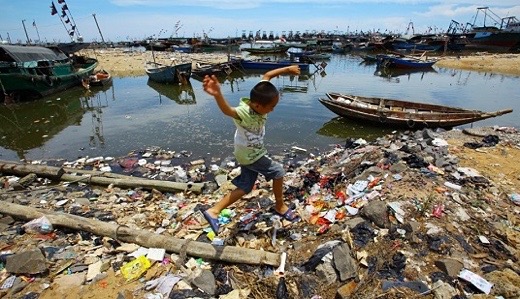
Image above: A boy plays in garbage in south China. Does this look like a world with plenty of room for everything to expand? From ().

The problem is the Status Quo only works in a world with plenty of room to expand.
The central illusion of this era is that the Status Quo can be reformed or saved.All we need to do is (or so we're told):
  1. Get money out of politics
  2. Re-impose the Glass-Steagall Act on banking
  3. Close the tax loopholes exploited by corporations and the wealthy
  4. Overturn the Supreme Court decision giving corporations personhood
  5. Restrict the Imperial War Powers of the president
  6. Restore the civil liberties stripped by post-9/11 legislation
...and so on. All good-governance, all prudent, all necessary.

But none of these reforms--or any of the other good-governance tweaks habitually promoted by left, right, center and Libertarian--can save the Status Quo. For what's wrong with the Status Quo is systemic: tweaking rules and limiting excesses may make us feel like we've accomplished something useful, but that sense of accomplishment is illusory.

The problem is the Status Quo only works in a world with plenty of room to expand--a world of virgin resources ripe for exploitation (oops, I mean development), easy-to-extract abundant energy, and an expanding population with rising productivity and little debt.

In this world, there's plenty of room for everything to expand: resource extraction, energy consumption, population, productivity, income and debt.

This is a world optimized for growth: there is so much material and labor capital available, enormous quantities can be squandered on wars, mal-investment, elite excesses and plain old waste.

The world optimized for growth begins with little or no debt. Debt, as we know, is a way to consume future earnings today. If $1 in income can be leveraged into $10 of debt, the worker earning the $1 can consume $10 of goods and services today, or buy $10 of assets.

The world optimized for growth is also optimized for banks and central states.Banks earn money as debt expands, and government tax revenues explode higher as population, earnings, productivity, commerce and profits all expand.

The Status Quo has been optimized for this world of limitless growth. There's one tiny little problem with this: the real world has limits, and so does the financial world of debt, interest and taxes.

Here's the problem: when the world the Status Quo has been optimized to exploit can no longer expand, the Status Quo doesn't just slow--it implodes.When incomes stop expanding, debt eventually stops expanding, which means consumption (i.e. "growth") stops expanding.

When debt and the consumption it fuels both stop expanding, the system implodes because it's based on a simple iron directive: the system requires more of everything to sustain itself: more households and enterprises borrowing more money to consume/produce more, and paying more taxes as commerce, consumption and debt all expand.

There is no way for less to be produced, purchased, consumed and borrowed,or for the number of workers and consumers to decline. The system is not just optimized for growth, it is entirely dependent on expansion of everything for its survival.
Once the number of workers starts declining, the social security/old-age pension system implodes.

Once households and enterprises stop borrowing more and start defaulting on existing debt, the banking sector implodes.

Once household consumption starts declining, the retail sector implodes.

Once tax revenues plummet and nation-states destroy their currencies with excessive borrowing and/or money-printing, nation-states implode.
The world is shifting from unlimited growth to limits and Degrowth. The Status Quo that is completely dependent on growth is doomed--an implosion that no amount of reform can stave off.

See also:
Degrowth, Anti-Consumerism and Peak Consumption (May 9, 2013)
Success Is No Longer Possible - Degrowth and the Black Market Beckon (February 7, 2014)
And the Next Big Thing Is ... Degrowth? (April 7, 2014)

.

We reached peak trade in 2007

SUBHEAD: WTO's stark warning on world trade: "The timing belt on the global growth engine Is off".

By Tyler Durden on 15 September 2015 for Zero Hedge -
(http://www.zerohedge.com/news/2015-09-15/wtos-stark-warning-global-trade-timing-belt-global-growth-engine)


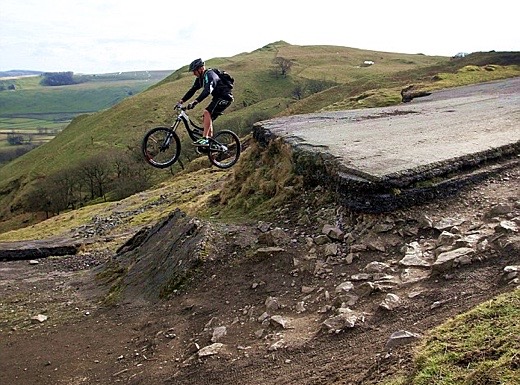
Image above: Pete Tye jumps off a nine foot tarmac cliff on the A625 in Derbyshire, which has slowly been destroyed by a landslide moving down a hillside for thousands of years. From (http://www.dailymail.co.uk/news/article-2287994/A-real-rocky-road-Abandoned-half-mile-stretch-tarmac-Peak-District-hit-mountain-bikers-series-landslides-twist-recognition.html).

One narrative we’ve built on this year is that the sub-par character of the global economic recovery isn’t just a consequence of a transient downturn in demand from China whose transition from an investment-led, smokestack economy towards a model driven by consumption and services has effectively caused the engine of global growth to stall.

Rather, it seems entirely possible that an epochal shift has taken place in the post-crisis world and the downturn in global trade which many had assumed was merely cyclical, may in fact be structural and endemic.

We touched on this in “Emerging Market Mayhem: Gross Warns Of ‘Debacle’ As Currencies, Bonds Collapse,” when we highlighted a WSJ piece that contained the following rather disconcerting passage:  
“Central to this emerging-market slump is the unprecedented weakness of world trade, which has now grown by less than global output for the past four years, unique since World War II.”
This echoes concerns we voiced in May, when BofAML was out warning that if “wobbling” global trade turned out to be structural rather than cyclical, “then EM economies should not count on meaningful demand boosts coming from above-trend growth in DM.”

Most recently, we looked at freight rates (which, incidentally, Goldman predicted earlier this year will remain subdued until 2020) noting that despite a dead cat bounce in the Baltic Dry, “freight rates on the world’s busiest shipping route have tanked this year due to overcapacity in available vessels and sluggish demand for transported goods.

Rates generally deemed profitable for shipping companies on the route are at about US$800-US$1,000 per TEU. In other words, at current prices shippers are losing half a dollar on every booked contractual dollar at current rates.”

Now, WSJ is back with a fresh look at the new normal for global trade and unsurprisingly, the picture they paint based largely on WTO data and projections, is not pretty. Here’s more:
For the third year in a row, the rate of growth in global trade is set to trail the already sluggish expansion of the world economy, according to data from the World Trade Organization and projections from leading economists.

Before the recent slump, the last time trade growth underperformed the rate of an economic expansion was 1985.
 Robert Koopman, WTO chief economist said:
“We have seen this burst of globalization, and now we’re at a point of consolidation, maybe retrenchment. It’s almost like the timing belt on the global growth engine is a bit off or the cylinders are not firing as they should.”
Since rebounding sharply in 2010 after the financial crisis, trade growth has averaged only about 3% a year, compared with 6% a year from 1983 to 2008, the WTO says.

Few see any signs that trade will soon regain its previous pace of growth, which was double the rate of economic expansion before 2008. In 2006, global trade volumes grew 8.5%, compared with a 4% expansion in global GDP.

This year the WTO is expected to cut its 2015 trade forecast a second time after a sudden contraction in the first half of the year—the first such decline since 2009.

“It’s fairly obvious that we reached peak trade in 2007,” said Scott Miller, trade expert at the Center for Strategic and International Studies, a Washington, D.C., think tank.
And this, bear in mind, is the environment into which the Fed intends to hike, even as the emerging economies which have been hit the hardest by the slowdown in trade (which has served to depress commodities and wreak havoc on commodity currencies) would likely suffer from accelerated capital outflows in the wake of an FOMC liftoff.

What's also notable here is that this comes as central banks have engaged in round after round of easing in a desperate, multi-trillion quest to boost global growth, suggesting that competitive devaluations are a zero sum game and to the extent that individual countries can boost exports in the short term by devaluing, that gain comes at someone else's expense, meaning, in The Journal's words, "foreign-exchange moves have little chance of raising trade overall" and even if they did, the backdrop of depressed demand means that what many EMs are producing, no one now wants, irrespective of how cheap it may be.

Make no mistake, the most worrying part of the new normal for trade is what it portends for emerging markets. We've already seen Brazil's investment grade rating cut by S&P as the country careens headlong into fiscal, political, and economic crises.

As Morgan Stanley put it in August, Brazil is the epicenter and one can reasonably expect that other EMs will follow in its footsteps should the WTO's projections about the sturctural nature of depressed global demand and trade prove accurate.

What comes next is the descent of the emerging world into frontier status, and as we've put it on several occasions, after that it will be time to break out the humanitarian aid packages.

Of course, as we mentioned late last month, there is one more possibility: central banks could learn how to print trade.

.

Anxiety turns to Fear

SUBHEAD: Nature is weighing on our economy in the form of climate change and fossil fuel depletion.

By Kurt Cobb on 30 August 2015 for Resource Insights -
(http://resourceinsights.blogspot.com/2015/08/anxiety-turns-to-fear-markets-energy.html)


Image above: Still frame from the 2011 movie "Take Shelter". From (http://www.imdb.com/title/tt1675192/?ref_=fn_al_tt_1). Update 9/1/15 - the whole movie can be seen on YouTube at (https://youtu.be/Y5233mYtpqc).

The characteristic feeling of the post-2008 world has been one of anxiety. Occasionally, that anxiety breaks out into fear as it did in the last two weeks when stock markets around the world swooned and middle class and wealthy investors had a sudden visitation from Pan, the god from whose name we get the word "panic."

Pan's appearance is yet another reminder that the relative stability of the globe from the end of World War II right up until 2008 is over. We are in uncharted waters.

Here is the crux of the matter as expressed in a piece which I wrote last year:
The relentless, if zigzag, rise in financial markets for the past 150 years has been sustained by cheap fossil fuels and a benign climate. We cannot count on either from here on out....
Another thing we cannot necessarily count on is the remarkable geopolitical stability that the world experienced for two long stretches during the fossil fuel age. The first one lasted from the end of the Napoleonic Wars in 1815 to the beginning of World War I in 1914 (interrupted only by the brief Franco-Prussian War). The second lasted from the end of World War II in 1945 until now.
Following the withdrawal of U.S. military forces from Iraq, the Middle East has experienced increasing chaos devolving into a civil war in Syria; the rapid success of forces calling themselves the Islamic State of Iraq and Syria which are busily reshaping the borders of those two countries; and now the renewed chaos in Libya. We must add to this the Russian-Ukranian conflict. It is no accident that all of these conflicts are related to oil and natural gas.
As I view the current world landscape, I am reminded of two movies (which I've written about before) that I think capture the Zeitgeist: Melancholia and Take Shelter. In both the protagonists increasingly sense that something is terribly wrong, but can't quite put their finger on it. Everyone around them thinks they are ill or crazy.

But for both protagonists, their anxiety comes from an inner vision that stems not from mere psychic disturbances, but rather from alarming real-world circumstances that are about to break into the open.

In a sense, these two characters represent those of us who cannot repress the pervasive anxiety of our times and who seek not merely to alleviate it, but rather to face it--to find out its origins and address its causes.

And here we return to the god Pan, mentioned at the outset. It is fitting that this god of nature--of shepherds, flocks, and wild places--should also in our age be associated with the panic we feel.

For it is nature itself which is weighing on our economy in the form of climate change and fossil fuel depletion. As California--the seventh largest economy in the world behind France--burns in the heat of a multi-year drought, the grim consequences of our poor stewardship are becoming apparent. The images of fiery forests and dust-dry fields command our attention.

But hidden from the view of most is the role that increasingly expensive energy has played since the beginning of this century in slowing economic growth. The shorthand way of understanding this is that in the last century we extracted all the easy-to-get fossil fuels. Now we are going after the hard-to-get remainder which are costly to extract.

That takes resources away from the energy-consuming part of the economy and creates a drag on economic growth. Hence, a dramatically slower economy in 2015 after four years of record or near record average daily prices for the most critical fossil fuel, oil. (The recent drop in oil prices is primarily a reflection of slowing demand that comes from a slowing economy.)

The financial industry through the media has intervened forcefully during the recent stock market sell-off to tell us all not to panic. These corrections are normal, they say, and long-term investors--that is, virtually everyone except Wall Street--should ignore them. What the industry and the media do not tell us is that these are not normal times.

Circumstances have changed dramatically. The evidence is there if only we have eyes to see it. Interest rates in much of the world are still stuck at or near zero seven years after the last worldwide downturn.

How will the world's central banks stimulate the economy after the next inevitable recession? By lowering interests that are already at zero? In the post-World War II paradigm, rates would be at much higher levels today, say four or five percent, and economic growth would be much faster.

Annual world economic growth from 1961 through 2000 according to the World Bank was 3.8 percent per year. From 2000 to 2013, an era of increasingly expensive energy, it slowed to 2.4 percent.

From the initial spurt of 4.1 percent growth in 2010 (after a contraction of 2.1 percent in 2009), growth settled down to 2.3 percent in 2012 and 2013, slightly below the recent average. This is despite unprecedented efforts to stimulate the world economy through large increases in government spending and record low interest rates.

And, as mentioned above, the geopolitical stability that has been the backdrop to the pervasive buy-and-hold investment mentality has disappeared. Like the protagonists of Melancholia and Take Shelter, we anxiously await we-know-not-what.

As we do, Pan makes his ever-more-frequent appearances. Franklin Roosevelt is famous for saying: "The only thing we have to fear is fear itself." But fear is a protective mechanism. We are right to fear things that can hurt us and to act accordingly. We cannot solve our problems if we refuse to accept that we have them.

Sometimes Pan is trying to help us by warning us. Sometimes it is possible to hear him playing his flute long before he arrives on the scene. But can we listen and act in some way other than panic?


Video above: Trailer for the 2011 movie "Take Shelter". From (https://youtu.be/I5U4TtYpKIc).
Update 9/1/15 - the whole movie can be seen on YouTube at (https://youtu.be/Y5233mYtpqc).


Video above: Trailer for the 2011 movie "Melancholea". From (https://youtu.be/RHMy6abqq04).
Update 9/1/15 - the whole movie can be seen on YouTube at (https://youtu.be/_ZdJ6zIAeFc).


.

Say Goodbye to Normal

SUBHEAD: Get your shit together locally, and do it in place that has some prospect for keeping on.

By James Kunstler on 31 August 2015 for Kunstler.com -
(http://kunstler.com/clusterfuck-nation/say-goodbye-to-normal/)


Image above: Painting "Peasant Dance" by Pieter Bruegel, 1568, oil on panel, 114 x 164 cm, Vienna, Kunsthistorisches Museum, in Vienna. From (http://www.jhna.org/index.php/past-issues/vol-3-1/134-producing-the-vernacular).

The tremors rattling markets are not exactly what they seem to be. A meme prevails that these movements represent a kind of financial peristalsis — regular wavelike workings of eternal progress toward an epic more of everything, especially profits! 

You can forget the supposedly “normal” cycles of the techno-industrial arrangement, which means, in particular, the business cycle of the standard economics textbooks. Those cycle are dying.

They’re dying because there really are Limits to Growth and we are now solidly in grips of those limits. Only we can’t recognize the way it is expressing itself, especially in political terms. What’s afoot is a not “recession” but a permanent contraction of what has been normal for a little over two hundred years. 

There is not going to be more of everything, especially profits, and the stock buyback orgy that has animated the corporate executive suites will be recognized shortly for what it is: an assest-stripping operation.

What’s happening now is a permanent contraction. Well, of course, nothing lasts forever, and the contraction is one phase of a greater transition. The cornucopians and techno-narcissists would like to think that we are transitioning into an even more lavish era of techno-wonderama — life in a padded recliner tapping on a tablet for everything

I don’t think so. Rather, we’re going medieval, and we’re doing it the hard way because there’s just not enough to go around and the swollen populations of the world are going to be fighting over what’s left.

Actually, we’ll be lucky if we can go medieval, because there’s no guarantee that the contraction has to stop there, especially if we behave really badly about it — and based on the way we’re acting now, it’s hard to be optimistic about our behavior improving. 

Going medieval would imply living within the solar energy income of the planet, and by that I don’t mean photo-voltaic panels, but rather what the planet might provide in the way of plant and animal “income” for a substantially smaller population of humans. That plus a long-term resource salvage operation.

All the grand movements of stock indexes and central banks are just a diverting sort of stagecraft within the larger pageant of this contraction. The governors of the Federal Reserve play the role of viziers in this comic melodrama. That is, they are exalted figures robed in magical Brooks Brothers summer poplin pretending to have supernatural power to control events. 

You can tell from their recent assembly out west — “A-holes at the J-hole” — that they are very much in doubt that their “powers” will continue to be taken seriously. This endless hand-wringing over a measily quarter-point interest rate hike is like some quarrel among alchemists as to whether a quarter-degree rise in temperature might render a lump of clay into a gold nugget.
 
What they do doesn’t matter anymore. What matters is that a great deal of the notional “wealth” they conjured up over the past decade or so is about to vanish —poof! 

Perhaps that will look like a black magic act. That wealth seemed so real! The bulging portfolios with their exquisite allocations! The clever options! The cunning shorts. Especially the canny bets in dark derivative pools! All up in a vapor. 

The sad truth being it was never there in the first place. It was just an hallucination induced by the manipulation of markets and the criminal misrepresentation of statistics, especially the employment numbers.

There are rumors that the Grand Vizeress of all, Ms. Yellen, is flirting with possible indictment over the “leakage” of valuable information out of her inner circle to potential profiteers. Whoops. It may lead nowhere but to me it is an index of her more general loss of credibility. 

All year she has spouted supernaturally fallacious nonsense about how “the data” guides Fed decision-making. Only her data is contrary to what is actually happening in the pathetic Rube Goldberg contraption that the so-called US economy has become (Walmart + entitlements). 

Her “guidance” amounts to a lot of futile drum-beating on a turret of the Fed castle, hoping to make it rain prosperity. Her enigmatic utterances have kept financial markets in a narrow sideways channel most of the year until recently.

I’d say she’d lost her mojo, and the lesser viziers on the Fed board are looking more and more like the larval, sunken-chested dweebs that they really are. So where is the nation to turn? Why, to the great blustering Trump, with his “can-do” bombast about “making America great again.” 

What does he mean, exactly? Like, making America the way it was in 1958?” Behold: the return of the great steel rolling mills along the banks of the Monongahela (and so on)! Fuggeddabowdit. Ain’t gonna happen.

I have to say it again: prepare to get smaller and more local. Things on the grand level are not going to work out. 

Get your shit together locally, and do it in place that has some prospect for keeping on: a small town somewhere food can be grown and especially places near the inland waterways where some kind of commercial exchange might continue in the absence of the trucking industry. 

Sound outlandish? Okay then. Keep buying Tesla stock and party on, dudes. 

Hail the viziers in their star-and-planet bedizened Brooks Brother raiment. Put your head between your legs and kiss your ass goodbye.

.

The Solution Space - Part 2

SUBHEAD: If solutions depend on cooperation at a large scale, they will not be part of solution space.


[IB Publisher's note: This is one of a five part series on the boundaries of the Solution Space in which our future lives can take place.]  

By Nicole Foss on 16 August 2015 for the Automatic Earth -
(http://www.theautomaticearth.com/2015/08/the-boundaries-and-future-of-solution-space-part-2/)


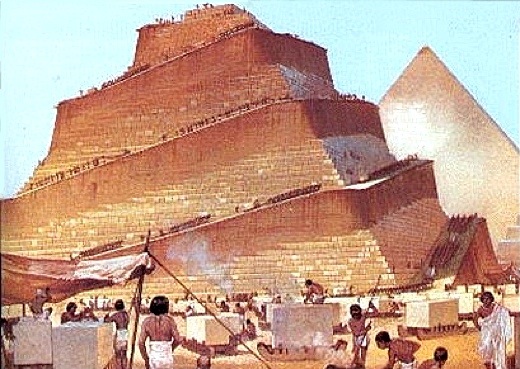
Image above: Egyptians building of the great pyramids at Giza using external ramps .From (http://blackrainbow-blackrainbow.blogspot.com/2011/06/building-pyramids-of-egypt.html).

Part 2
Psychological Driver of Deflation and the Collapse of the Trust Horizon

The collective mood shifts rapidly from optimism and greed to pessimism and fear as the bubble bursts, and as it does so, the financial system moves from expansion to contraction.

Financial contraction involves the breaking of promises right left and center, with credit instruments drastically revalued downwards in the process. As the promises that back them cease to be credible, value disappears extremely rapidly. This is deflation and the elimination of excess claims to underlying real wealth.

Instruments once regarded as money equivalents will lose that status through the loss of confidence in them, causing the supply of what retains sufficient confidence to still be regarded as money to collapse. The more instruments lose the confidence that confers value upon them, the smaller the effective money supply will be, and the more confidence will become a rare ‘commodity’.

Being grounded in psychology is the primary reason that deflation cannot be overcome through policy adaptations which are inherently too little and too late. Nothing moves as quickly as a collective loss of confidence in human promises, and nothing destroys value as comprehensively.

The same abrupt change in collective mood will also drive contraction in the real economy, but more slowly, since the time constant for change in the real world is much slower than in the virtual world of finance.

This process will also result in broken promises as structural dependencies fracture when there is no longer enough to go around. There will be wage and benefit cuts, layoffs, strikes, strike-breaking, breaches of contract, business failures and more on a huge scale, and these will fuel further fear, anger and the destruction of trust.

In the political realm, trust, such as it is, will be an early casualty. Political promises have been regarded as highly suspect for a long time in any case, but considering that the electorate tends consistently to vote for whomever tells them the largest number of comforting lies, this is not particularly surprising.

Our political system selects for mendaciousness by design, since no party is normally elected by telling the truth, yet we have still collectively retained some faith in the concept of democracy until relatively recently.

In recent years, however, it has become increasingly clear that the political institutions in supposedly democratic nations have largely been bought by big capital. More often than not, and more blatantly than ever, the political machinery has come to serve those special interests, not the public interest.

The public is increasingly realizing that ‘representative democracy’ leaves them unrepresented, as they see more and more examples of austerity for the masses combined with enormous bailouts guaranteeing that the large scale gamblers of casino capitalism will not take losses on the reckless bets they made gambling with other people’s money.

In the countries subjected to austerity, where the contrast is the most stark, a wave of public anger is is already depriving national governments, or supranational governance institutions where applicable (ie Europe), of political legitimacy.

As more and more states slide into the austerity trap as a result of their unsustainable debt burdens, this polarization process will continue, driving wedges between the governors and the governed which will make governance far more difficult.

Governments struggling with the loss of political legitimacy are going to find that people will no longer follow rules once they feel that the social contract has been violated, and that rules no longer represent the public interest.

When the governed broadly accept that society functions under the rule of law, in other words that all are equally subject to the same rules, then they tend to internalize those rules and follow them without the need for negative incentives or outright enforcement.

However, once the dominant perception becomes that rules are imposed only on the powerless, to their detriment and for the benefit of the powerful, while the well connected can do as they please, then general compliance can cease very quickly.

Without compliance, force would become necessary, and we are indeed likely to see this occur as a transitional phase as social polarization increases in a climate of increasing anger. The transitional element arises from the fact that force, especially as exercised technologically at large scale, requires substantial resources which are unlikely to remain available. Force produces reaction, straining the fabric of society, quite possibly to breaking point.

As contagion propagates the impact of financial and economic contraction, we will rapidly be moving from a long era of high trust in the value of promises to one of low trust. The trust horizon will contract sharply, leaving supranational and national governments lying beyond its reach, as stranded assets from a trust perspective.

Trust determines effective organizational scale, so when the trust horizon draws in, withdrawing political legitimacy in its wake, larger scale entities, whether public or private, are going to find it extremely difficult to function.

Effective organizational scale had been increasing for the duration of our long economic expansion, forcing an across the board scaling up of all manner of organizations by increasing the competitiveness accruing to large scale. As we scaled up, we formed structural dependencies on these larger scale entities’ ability to function.

While the scaling-up process was reasonable smooth and seamless, the scaling-down process will not be, as the lower rungs of the figurative ladder we climbed to reach this pinnacle have been kicked out as we ascended. Structural dependencies are going to fail very painfully as large scale ceases to be effective and competitive, leading to abrupt dislocations with ricocheting impacts.

Proposed solutions to our predicament that depend on the functioning of large-scale organizations operating in a top-down manner do not lie within viable solution space.

Instability and the ‘Discount Rate’
The pessimism-and-fear-driven psychology of contraction differs dramatically from the optimism-and-greed-driven psychology of expansion. The extreme complacency as to systemic risk of recent years will be replaced by an equally extreme risk aversion, as we move from overshoot in one direction to undershoot in the other.

The perception of economic visibility is gong to change substantially, as we move from a period where people thought they knew where things were headed into an era where fear and confusion reign, and the sense of predictability evaporates abruptly.

This is an important psychological shift, as it affects an aspect known as the ‘Discount Rate’, which reflects the extent to which we think in the short term rather than the long term, or the extent to which we value the present over the future.

The perceived rate of change is an important factor in determining the ‘Discount Rate’, and fear, being a very sharp emotion, causes the rate of change to accelerate markedly, driving the ‘Discount Rate’ sharply higher in times of contraction.

True long term thinking is relatively rare. We manage an approximation of it at times when all immediate needs, along with many mere ‘wants’, are met and we are not concerned about this condition changing, in other words at times when we take a comfortable situation for granted.

At such times, the longer term view is a luxury we can afford, and we find it relatively simple to summon the presence of mind to think abstractly and constructively, and to ponder circumstances which are are neither personal nor immediate.

Even at such times, however, it is not particularly common for humans to transcend mere contemplation and actually act in the interests of the long term, especially if it involves aspects beyond the personal, or perhaps familial.

As the financial bubble bursts, and we rapidly begin to pick up on the fear of others and feel the consequences of contagion in our own lives, our collective ‘Discount Rates' are going to sky-rocket. In a relatively short period of time, a large percentage of the population is going to begin worry about immediate needs, let alone wants, not being met.

A short time later those worries are likely to transition into reality, as has already happened in the countries, like Greece, in the forefront of the bursting bubble. As ‘Discount Rates' go through the roof, the luxury of the longer term view, which is always quite ephemeral, is likely to disappear altogether.

Where people have no supply cushions and find themselves abruptly penniless, cold, thirsty, hungry or homeless, the likelihood of them considering anything much beyond the needs of the day at hand is very low. Under such circumstances, the present becomes the only reality that matters, and societies are abruptly pitched into a panicked state of short term crisis management.

This of course underlines the need to develop supply cushions and contingency plans in advance of a bubble bursting, so that a greater percentage of people might be able to retain a clear head and the ability to plan more than one day at a time. Unfortunately, few are likely to heed advance warnings and we can expect society to shift rapidly into a state of short-termism.

Given the coming rise in collective ‘Discount Rates', if proposed solutions depend on the ability for societies to engage in rational planning for longer term goals, then those solutions are not part of solution space.

The Psychology of Contraction and Social Context
Expansionary times are times of relative peace and prosperity. If those conditions persist for a relatively long time, trust builds slowly and societies become more inclusive and cooperative, tending to perceive common humanity and focus on similarities rather than differences.

In such times we reach out and interact with distant people, even if we have no relationship of personal trust with them, as we have, over time, vested our trust in stable institutional frameworks for managing our affairs.

This institutional trust replaces the need for trust at a personal level and is a key factor in our ability to scale up our economies and their governance structures. Individuals raised in such an environment tend to show a presumption of trust towards others, and their inclination is generally to act cooperatively.

There is a sharp contrast between this stable state of affairs and the circumstances which pertain when suddenly the pie is shrinking and there is not enough to go around. As difficult as it can be share gains in a way perceived to be fair, it is infinitely more difficult to share losses in a way that is not extremely divisive.

As elucidated above, a deflationary credit implosion involved the wholesale destruction of excess claims to underlying real wealth, meaning that a majority of people who thought they had a valid claim to something of tangible value are going to find that they do not. The losses will be very widespread, but uneven, and the perception of unfairness will be almost universal.

Under such circumstances a sense of common humanity is much less prevalent, and the focus shifts from similarities to the differences upon which social divisions are founded and then inflamed. An ‘us versus them’ dynamic is prone to take hold, where ‘us’ becomes ever more tightly defined and ‘them’ becomes an ever more pejorative term. People build literal and figurative walls and peer suspiciously at each other over them.

Rather than working together in the attempt to address concerns common to all, division shifts the focus from cooperation to competition. A collectively constructive mindset can easily morph into something far more motivated by negative emotions such as jealousy and revenge and therefore far more destructive of perceived commonality.

The kind of initiatives which capture the public imagination in expansionary times are not at all the type which get traction once a contractionary dynamic takes hold. Attempts to build cooperative projects are going to be facing a rising tide of negative social mood, and will struggle to get off the ground. Sadly, negative ideas are far more likely to go viral than positive ones.

Novel movements grounded in anger and fear may arise to feed on this new emotional context and thereby be empowered to wreak havoc on the fabric of society, notably through providing a political mandate to extremists with an agenda of focusing blame on to some identifiable, and marginalizable, social group.

While it will not be the case that cooperative endeavors will be impossible to achieve, they will require additional effort, and are likely to succeed only at a much smaller scale in a newly fractured society than might previously have been expected. It is very much a worthwhile effort, and will be far simpler if begun prior to the end of the period of cooperative presumption.

All the more reason to adapt to a major trend change in advance. There is nothing so dangerous as collectively dashed expectations.

If proposed solutions depend on a cooperative social context at large scale, they will not be part of solution space.

See also:
Ea O Ka Aina: The Solution Space - Part 1 8/15/15
The cost of capital will be high and solutions which need it will lie outside solution space.
Ea O Ka Aina: The Solution Space - Part 2  8/16/15
If solutions depend on a cooperation at large scale, they will not be part of solution space.
Ea O Ka Aina: The Solution Space - Part 3 8/17/15
Proposed solutions which depend on energy-intensivity will lie outside of solution space. 
Ea O Ka Aina: The Solution Space - Part 4 8/18/15
Lower consumption will be imposed on us. Our choice will be how we choose to face it.
Ea O Ka Aina: The Solution Space - Part 5 8/19/15
The ways forward will be inexpensive, small-scale, simple, low-energy, community-based.


.