Showing posts with label Peak Energy. Show all posts

The Great Unravelling

SUBHEAD: Part of a discussion series on adapting to the environmental crises we have created.

By Asher Miller on 28 October 2020 for the Post Carbon 
(https://www.postcarbon.org/is-the-great-unraveling-upon-us/)

Image above: Firefighters conduct a back-burn operation along Route CA-168 during the Creek fire as it approaches the Shaver Lake Marina on Sunday, Sept. 6, 2020. Photo by Kent Nishimura for The Los Angeles Times. From (https://www.latimes.com/california/story/2020-09-27/times-photos-california-fires).

Introducing “The Great Unraveling?”, a series of interviews with some of the world’s foremost experts on a broad range of environmental and societal challenges, culminating with a powerful discussion on what these converging and accelerating crises mean, and how we can respond.

What if we don’t look back on 2020 as the year from hell, a painful and surreal slip on the otherwise generally smooth path of progress? What if, instead, we look back in five or ten or twenty years to 2020 as the moment when everything started to really and truly unravel?

Of course, what I’ve presented is a false choice. The truth is that for billions of people (and other species!) the unraveling has been occurring for a long time, assuming they had anything that could be unravelled to begin with.

People who have been left behind or churned up by the relentless machine of exploitative capitalism. People and natural ecosystems already on the frontline of the climate crisis. Communities that have lost their social cohesion and ability to confront problems collectively.

2020 has exposed and supercharged the fragility, unsustainability, and injustice of so many of our global systems:
  • untenable economic and racial inequality;
  • brittle, globalized supply chains controlled by a relatively small number of corporations;
  • a global climate system that’s already fevered at 1.2ºC warming;
  • growing political instability, distrust, and the rise of authoritarian governments;
  • the collapse of biodiversity and the crossing of other planetary boundaries;
  • an economy dependent on growth, consumption, debt, energy, & population;
  • the failure of governmental institutions to respond to, let alone anticipate, crises;
  • the likely peak in the amount of energy available to power modern society.
These crises were already here or looming long before the coronavirus pandemic hit us broadside this year. In fact, my colleagues at Post Carbon Institute, the many writers who we have featured here at resilience.org, and allies across the globe have been sounding the alarm for decades that the Great Acceleration would inevitably lead to a Great Unraveling or even collapse. That forewarning may now be moot.

To begin considering how to navigate the “Great Unraveling,” we must first try to understand how various environmental and social systems may interact. So a few months ago, Post Carbon Institute and Anthropocene Actions asked some of the world’s foremost experts to share their views of where things stand with some of our most pressing environmental and societal challenges, particularly in the wake of the pandemic.

We then hosted a powerful discussion with an esteemed, diverse panel on what these converging and accelerating crises mean, and how we can respond.

Facing up to these interconnected crises requires unprecedented cooperation and coordination, if we have any hope of creating a sustainable, equitable, and resilient world. To this end, campaigners, politicians, companies, governments, and communities all across the world are pushing for and enacting change. 

But these efforts will have to remain robust, flexible, and resilient in the face of growing destabilization. And they must be grounded in an understanding of the systemic nature of the predicament we face.

The wrenching disruption of the pandemic presents barriers to change, as shown by those seeking to reinforce the pre-pandemic status quo. But this historic moment also presents opportunities to move toward a sustainable society that benefits all. The key to a better future is to learn how to manage the compounding crises of a more destabilized future – how to navigate the Great Unraveling. 

  .

Sweet and fitting to die for country

SUBHEAD: “Dulce et Decorum est” - Xenophobia, racism, patriotism and collapse are leading us towards WWIII.

By Alexander Aston on 25 July 2019 in The Automatic Earth -
(https://www.theautomaticearth.com/2019/07/dulce-et-decorum-est/)


Image above: Results in Lebanon of America's long fought Middle East Warn continue. In the future this could be Miami. From (https://moderndiplomacy.eu/2018/03/23/the-coming-long-planned-middle-east-war/).
“Dulce et Decorum est” is a poem written by Wilfred Owen during World War I, and published posthumously in 1920. The Latin title is taken from Ode 3.2 of the Roman poet Horace and means “it is sweet and fitting …”. It is followed there by “pro patria mori”, which means “to die for one’s country”.

“The muffled tongue of Big Ben tolled nine by the clock as the cortege left the palace, but on history’s clock it was sunset, and the sun of the old world was setting in a dying blaze of splendour never to be seen again.”
– Barbara W. Tuchman, The Guns of August
If you have not read Barbara Tuchman’s The Guns of August you should do so, it is one of the great, accessible works of history. Tuchman details with great clarity the diplomatic failures, miscalculations and political logics that ensnared the imperial powers of Europe into the cataclysm of the Great War.

It was the book that Kennedy drew upon when navigating the Cuban missile crisis. Just over a century since the guns fell silent in Europe, and nearly fifty years since nuclear holocaust was averted, the world is teetering on what might very well be the largest regional, potentially global, conflict since the second world war.

The United States is a warfare economy, its primary export is violence and it is through violence that it creates the demand for its products.

The markets of the Empire are the failed states, grinding civil conflicts, escalating regional tensions and human immiseration created by gun-boat diplomacy. In true entrepreneurial spirit, the United States has repeatedly overestimated its abilities to control the course of events and underestimated the complexities of a market predicated on violence.

However, since the beginning of the twenty-first century the American Imperium has proven itself as incompetent as it is vicious. After nearly two decades of intensifying conflicts, a fundamentally broken global economy and a dysfunctional political system, Washington has turned feral, lashing out against decline.

The points of instability in the global system are various and growing, and the only geo-political logics that the Imperium appears to be operating under are threats, coercion, and violence. It is at this moment, with the most erratic president in the country’s history, surrounded by some of the most extreme neo-conservative voices, that the United States has been belligerently stumbling across the globe.

In the past few months we have witnessed a surrealistic reimagining of the Latin American coup, the medieval melodrama of Canadian vassals taking a royal hostage from the Middle Kingdom and British buccaneers’ privateering off the coast of Gibraltar. The Imperial system is in a paroxysm of incoherent but sustained aggression.

It has long been clear that if another Great War were to emerge, it would likely begin in the Middle East. Just over a century later, we have found ourselves amidst another July crisis of escalating military and diplomatic confrontations. European modernity immolated itself in the Balkans though miscalculation, overconfidence and the prisoners dilemma of national prestige.

The conditions of the contemporary Middle East are no less volatile than those of Europe when the Austro-Hungarian Empire decided to attack Serbia. If anything, conditions are far more complex in a region entangled with allegiances and enmities that transgress and supersede the national borders imposed in the wake of the first world war.

The United States’ withdrawal from the JCPOA and the stated aim of reducing Iranian oil exports to zero has enforced a zero-sum logic between the American Imperium and Persia. With each move and counter move the two countries are further entangled into the dynamics of a conflict.

Much like the run up to July 28th 1914, tanker seizures, drone shoot downs, sanctions, military deployments and general bellicosity reinforce the rational of the opposing sides and make it harder to back down without losing face and appearing weak.

Due to the asymmetry of the two powers the Iranians have the fewest options for de-escalation while the American establishment perceives the least incentive. This dynamic is further exacerbated by major regional powers agitating for a conflict they believe they will benefit from.

Indeed, the slide to war might be inexorable at this point, the momentum of historical causality may have already exceeded the abilities of those in power to control.

Czar Nicholas and Kaiser Wilhelm were cousins that desperately wanted to avoid war and were nonetheless impotent to avert disaster. There is nowhere near such intimacy, communication and motivation in our current context.

If war with Iran erupts, the Pax Americana will come to an end and humanity will fully enter a new historical epoch. The most unlikely scenario is an easy victory for the United States, yet even this outcome will only exacerbate the decline of the Empire. The other great powers would expedite their exit from the dollar system and drastically increase investment into the means to counter American hegemony.

Likewise, victory would further reinforce Washington’s hubris, generating more serious challenges to the Imperial order and making the US prone to take on even bigger fights. Ironically, easy military success would almost assure the outbreak of a third world war in the long-term.


War with Iran would likely ignite violence in Israel-Palestine, Lebanon and Iraq, re-energise and expand the ongoing wars in Syria and Yemen as well as generate sectarian violence and domestic insurgencies across the Middle East.

Under such conditions regional actors would likely utilise a dramatically intensifying conflict as cover for their own agendas, for example with a renewed Turkish assault on the Syrian Kurds. The conditions for rapid escalation are extremely high in which non-linear dynamics could easily take hold and quickly outstrip any attempts to maintain control of the situation.

Pyrrhic victory for either side is the most likely outcome, making the parallels to the Great War all the more salient. Global conflagration is a possibility, but with “luck” the fighting could be contained to the region. Nonetheless, amplified refugee crises, supply chain disruptions and immense geopolitical realignments will cascade out of such an event.

Undoubtedly, there would be concerted efforts to abandon the dollar system as quickly as possible. Furthermore, rapid increases in the price of oil would all but grind the global economy to a halt within a matter of months, tipping citizenries already saturated with private debt into financial crises.

Furthermore, the entanglement of the military-industrial complex, the petrodollar reserve currency system and the omni-bubble generated by quantitative easing has left the Empire systemically fragile.

Particularly, the bubble in non-conventional fuels precipitated by QE, depressed oil prices with scaled down exploration, R&D and maintenance makes the possibility of a self-reinforcing collapse in the American energy and financial systems extremely plausible. It is a Gordian knot which war with Persia would leave in fetters.

The most likely long-term outcome of a war with Iran would be the economic isolation and political fragmentation of the United States. What is assured is that whatever world results it will not look anything like the world since 1945.

The first world war collapsed the European world system, dynasties that had persisted for centuries were left in ruins and the surviving great powers crippled by the overwhelming expenditures of blood and treasure. We are on the precipice of another such moment. The American world system is fundamentally dependent upon the relationship between warfare, energy dominance and debt.

Conflict is required to maintain control of the energy markets which prop up a financialised economy. A dynamic that puts the nation deeper in hock while amplifying resistance to financial vassalage.

Losing energy dominance undermines the country’s reserve currency status and weakens the Empires ability to generate the debt necessary to sustain the warfare economy.

Likewise, the system of national and international debt peonage parasitizes global populations to work against their own best interests. This fuels resentment and resistance which further drives the warfare economy. It is, in the inimitably American expression, a “self-licking ice cream cone.”

On August 3rd 1914, one week into the war, the British Foreign Secretary Edward Grey famously remarked that “the lamps are going out across Europe and we shall not see them relit in our lifetime.”

At the beginning of the twenty-first century, we face similar, terrifying prospects. Indeed, we could witness the collapse of democratic societies for a very long time to come. If we have any hope of averting calamity we need to generate loud opposition to imperialist warfare.

This does not mean some hackneyed anti-war movement based on past glories and the parochialism of domestic politics, but earnest effort to find common cause in resisting the insanity of those that seek profit in our collective suffering.

This means working with people that we have very deep disagreements with by respecting our mutual opposition to the masters of war. It also means serious commitment to strategies such as tax and debt strikes as expressions of non-consent as well as other peaceful means of direct action.

Indeed, it is from a place of agreement that we can potentially rebuild civil discourse and renew our trust in the ability of democratic institutions to mediate our quarrels. Perhaps it is too late to change course, but how sweet and fitting it is to face madness with dignity.

“What is the cause of historical events? Power. What is power? …power is a word the meaning of which we do not understand. ”
“Kings are the slaves of history.”
– Tolstoy, War and Peace
.

The Big Picture

SUBHEAD: Each day of relative normalcy that remains is an occasion for opportunity and action.

By Richard Heinberg on 17 December 2018 for Resilience -
(https://www.resilience.org/stories/2018-12-17/the-big-picture/)


Image above: This Hubble Space Telescope image by NASA of the cluster Westerlund 2 and its surroundingswas been released in 2015 to celebrate Hubble's 25th year in orbit. From (http://time.com/3833015/hubble-telescope-photo/).

Humanity has a lot of problems these days. Climate change, increasing economic inequality, crashing biodiversity, political polarization, and a global debt bubble are just a few of our worries.

None of these trends can continue indefinitely without leading to a serious failure of our civilization’s ability to maintain itself. Taken together, these metastasizing problems suggest we are headed toward some kind of historic discontinuity.

Serious discontinuities tend to disrupt the timelines of all complex societies (another name for civilizations—that is, societies with cities, writing, money, and full-time division of labor).

The ancient Roman, Egyptian, and Mayan civilizations all collapsed. Archaeologists, historians, and systems thinkers have spent decades seeking an explanation for this pattern of failure—a general unified theory of civilizational collapse, if you will.

One of the most promising concepts that could serve as the basis for such a theory comes from resilience science, a branch of ecology (the study of the relationship between organisms and their environments).

Why Civilizations Collapse: The Adaptive Cycle
Ecosystems have been observed almost universally to repeatedly pass through four phases of the adaptive cycle: exploitation, conservation, release, and reorganization. Imagine, for example, a Ponderosa pine forest.

Following a disturbance such as a fire (in which stored carbon is released into the environment), hardy and adaptable “pioneer” species of plants and small animals fill in open niches and reproduce rapidly.

This reorganization phase of the cycle soon transitions to an exploitation phase, in which those species that can take advantage of relationships with other species start to dominate. These relationships make the system more stable, but at the expense of diversity.

During the conservation phase, resources like nutrients, water, and sunlight are so taken up by the dominant species that the system as a whole eventually loses its flexibility to deal with changing conditions.

These trends lead to a point where the system is susceptible to a crash—a release phase. Many trees die, dispersing their nutrients, opening the forest canopy to let more light in, and providing habitat for shrubs and small animals. The cycle starts over.

Civilizations do roughly the same thing. In their early days, complex societies are populated with generalist pioneers (people who do lots of things reasonably well) living in an environment with abundant resources ready to be exploited. These people develop tools to enable them to exploit their resources more effectively.

Division of labor and trade with increasingly distant regions also aids in more thorough resource exploitation. Trading and administrative centers, i.e., cities, appear and grow. Money is increasingly used to facilitate trade, while debt enables a transfer of consumption from the future to the present. Specialists in violence, armed with improved weaponry, conquer surrounding peoples.

Complexity (more kinds of tools, more social classes, more specialization) solves problems and enables accumulation of wealth, leading to a conservation phase during which an empire is built and great achievements are made in the arts and sciences.

However, as time goes on, the costs of complexity accumulate and the resilience of the society declines. Tax burdens become unbearable, natural resources become depleted, environments become polluted, and conquered peoples become restless.

At its height, each civilization appears stable and invincible. Yet it is just at this moment of triumph that it is vulnerable to external enemies and internal discord. Debt can no longer be repaid. Conquered peoples revolt. A natural disaster breaks open the façade of stability and control.
Collapse often comes swiftly, leaving ruin in its wake.

But at least some of the components that made the civilization great (including tools and elements of practical knowledge) persist, and the natural environment has opportunity to regenerate and recover, eventually enabling reorganization and a new exploitation phase—that is, the rise of yet another civilization.

Energy Is Everything
Global industrial civilization shows significant signs of being in its conservation phase. Our accomplishments are mind-boggling, but our systems are overstretched, and problems (including climate change, inequality, and political dysfunction) are accumulating and worsening.

However, our civilization is different from any of its predecessors. Unlike the ancient Romans, Greeks, Egyptians, Shang Dynasty Chinese, Incas, Aztecs, and Mayans, we have built a civilization that is global in scope.

We have invented modes of transportation and communication previously unimaginable. Thanks to advances in public health and agriculture, the total human population has grown to many times its size when Roman armies marched across North Africa, Europe, and Britain. Have we perhaps outgrown the adaptive cycle and escaped natural checks to perpetual expansion?

In order to answer the question, we must first inquire why modern civilization has been so successful. The rise of technology, including advances in metallurgy and engineering, certainly played a part. These provided better ways of obtaining and harnessing energy.

But it’s the rapid shift in qualities and quantities of energy available to us that really made the difference.

Previously, people derived their energy from annual plant growth (food and firewood), and manipulated their environment using human and animal muscle power. These energy sources were inherently limited. But, starting in the 19th century, new technologies enabled us to access and harness the energy of fossil fuels. And fossil fuels—coal, oil, and natural gas—were able to provide energy in amounts far surpassing previous energy sources.

Energy is everything. All terrestrial ecosystems and all human societies are essentially machines for using (and dissipating) solar energy that has been collected and concentrated through photosynthesis. We like to think that money makes the world go ’round, but it is actually energy that enables us to do anything at all—from merely getting up in the morning to launching a space station. And having lots of energy available cheaply can enable us to do a great deal.

Fossil fuels represent tens of millions of years’ worth of stored ancient sunlight. They are energy-dense, portable, and storable sources of power. Accessing them changed nearly everything about human existence.

They were uniquely transformative in that they enabled higher rates of harvesting and using all other resources—via tractors, bulldozers, powered mining equipment, chainsaws, motorized fishing trawlers, and more.

Take just one example. In all previous agrarian civilizations, roughly three-quarters of the population had to farm in order to supply a food surplus to support the other 25 percent—who lived as aristocrats, traders, soldiers, artisans, and so on. Fossil fuels enabled the industrialization and automation of agriculture, as well as longer-distance distribution chains.
 Today only one or two percent of the U.S. population need to farm full-time in order to supply everyone else with food. The industrialization of food systems has freed up nearly all of the former peasant class to move to cities and take up jobs in manufacturing, marketing, finance, advertising, management, sales, and so on.

Thus urbanization and the dramatic expansion of the middle class during the 20th century were almost entirely attributable to fossil fuels.

But fossil fuels have been a bargain with the devil: these are depleting, non-renewable resources, and burning them produces carbon dioxide and other greenhouse gases, changing the climate and the chemistry of the world’s oceans.

These are not small problems. Climate change by itself is far and away the most serious pollution dilemma any human society has ever faced, and could lead to crashing ecosystems, failing food systems, and widespread forced human migration.human needs and desires can be satisfied by self-reproducing machines.

Denial comes in shades, some of them quite benign. Many thoughtful and informed people acknowledge the threats of climate change, species extinctions, soil depletion, and so on, and insist that we can overcome these threats if we just try harder. They are often on the right track when they propose changes.

Elect different, more responsible politicians. Donate to environmental nonprofit organizations. Drive an electric car.

Put solar panels on our roofs. Start solar co-ops or regional non-profit utility companies that aim to source all electricity from renewable sources. Eat organic food. Shop at local farmers markets.

These are all actions that move society in the right direction (that is, away from the brink of failure)—but in small increments. Perhaps people can be motivated to undertake such efforts through the belief that a smooth transition and a happy future are possible, and that renewable energy will create plentiful jobs and lead to a perpetually growing green economy.

There is no point in discouraging such beliefs and their related actions; quite the contrary: they should, if anything, be encouraged. Such practical efforts, however motivated or rationalized, could help moderate collapse, even if they can’t prevent it (a point we’ll return to below). But an element of denial persists nonetheless—denial, that is, of the reality that the overall trajectory of modern industrial society is beyond our control, and that it leads inexorably toward overshoot and collapse.

What to Do?
All of the above may help us better understand why the world seems to be running off the rails. But the implications are horrific. If all this is true, then we now face more-or-less inevitable economic, social, political, and ecological calamity. And since industrial civilization is now global, and human population levels are multiples higher than in any previous century, this calamity could occur on a scale never seen before.

Although no one can possibly predict at this point just how complete and awful collapse might actually be, even human extinction is conceivable (though no one can say with any confidence that it is likely, much less inevitable).

This is more than a fragile human psyche can bear. One’s own mortality is hard enough to contemplate. A school of psychology (“terror management theory”) proposes that many of our cultural institutions and practices (religion, values of national identity) exist at least in part to help us deal with the intolerable knowledge of our inevitable personal demise.

How much harder must it be to acknowledge signs of the imminent passing of one’s entire way of life, and the extreme disruption of familiar ecosystems? It is therefore no wonder that so many of us opt for denial and distraction.

There’s no question that collapse is a scary word.

When we hear it, we tend to think immediately of images from movies like Mad Max and The Road. We assume collapse means a sudden and complete dissolution of everything meaningful. Our reasoning shuts down. But this is just when we need it most.

In reality, there are degrees of collapse, and history shows that the process has usually taken decades and sometimes centuries to unfold, often in stair-steps punctuated by periods of partial recovery. Further, it may be possible to intervene in collapse to improve outcomes—for ourselves, our communities, our species, and thousands of other species.

After the collapse of the Roman Empire, medieval Irish monks may have “saved civilization” by memorizing and transcribing ancient texts. Could we, with planning and motivation, do as much and more?

Many of the things we could do toward this end are already being done in order to avert climate change and other converging crises.

Again, people who voluntarily reduce energy usage, eat locally grown organic food, make the effort to get to know their neighbors, get off the consumer treadmill, reduce their debt, help protect local biodiversity by planting species that feed or shelter native pollinators, use biochar in their gardens, support political candidates who prioritize addressing the sustainability crisis, and contribute to environmental, population, and human rights organizations are all helping moderate the impending collapse and ensure that there will be more survivors. We could do more.

Acting together, we could start to re-green the planet; begin to incorporate captured carbon not only in soils, but in nearly everything we make, including concrete, paper, and plastics; and design a new economic system based on mutual aid rather than competition, debt, and perpetual growth. All of these efforts make sense with or without the knowledge that civilization is nearing its sell-by date.

How we describe the goals of these efforts—whether as ways of improving people’s lives, as ways to save the planet, as fulfilling the evolutionary potential of our species, as contributing to a general spiritual awakening, or as ways of moderating an inevitable civilizational crash—is relatively unimportant.

However, the Big Picture (an understanding of the adaptive cycle, the role of energy, and our overshoot predicament) adds both a sense of urgency, and also a new set of priorities that are currently being neglected.

For example, when civilizations collapse, culturally significant knowledge is typically lost. It’s probably inevitable that we will lose a great deal of our shared knowledge during the coming centuries. Much of this information is trivial anyway (will our distant descendants really suffer from not having the ability to watch archived episodes of Let’s Make a Deal or Storage Wars?).

Yet people across the globe now use fragile storage media—computer and server hard drives—to store everything from music to books to instruction manuals. In the event that the world’s electricity grids could no longer be maintained, we would miss more than comfort and convenience; we could lose science, higher mathematics, and history.

It’s not only the dominant industrial culture that is vulnerable to information loss. Indigenous cultures that have survived for millennia are being rapidly eroded by the forces of globalization, resulting in the extinction of region-specific knowledge that could help future humans live sustainably.
Upon whom does the responsibility fall to curate, safeguard, and reproduce all this knowledge, if not those who understand its peril?

Act Where You Are: Community Resilience
We at Post Carbon Institute (PCI) have been aware of the Big Picture since the founding of the organization 15 years ago. We’ve been privileged to meet, and draw upon the insights of, some of the pioneering ecologists of the 1960s, ’70s, and ’80s who laid the basis of our current understanding of resilience science, systems thinking, climate change, resource depletion, and much more. And we’ve strived to convey that understanding to a younger generation of thinkers and activists.

Throughout this time, we have continually grappled with the question, “What plan for action makes the most sense in the context of the Big Picture, given our meager organizational resources?”
After protracted discussion, we’ve hit upon a four-fold strategy.
Encourage resilience building at the community level

Resilience is the capacity of a system to encounter disruption and still maintain its basic structure and functions. When it is in its conservation phase, a system’s resilience is typically at its lowest level throughout the entire adaptive cycle. If it is possible at this point to build resilience into the human social system, and ecological systems, then the approaching release phase of the cycle may be more moderate and less intense.

Why undertake resilience building in communities, rather than attempting to do so at the national or international level? It’s because the community is the most available and effective level of scale at which to intervene in human systems.

National action is difficult these days, and not only in the United States: discussions about nearly everything quickly become politicized, polarized, and contested. It’s at the community level where we most directly interact with the people and institutions that make up our society. It’s where we’re most affected by the decisions society makes: what jobs are available to us, what infrastructure is available for our use, and what policies exist that limit or empower us.

And critically, it’s where the majority of us who do not wield major political or economic power can most directly affect society, as voters, neighbors, entrepreneurs, volunteers, shoppers, activists, and elected officials.

PCI has supported Transition Initiatives since its inception as one useful, locally replicable, and adaptable model for community resilience building.

Leave good ideas lying around.
Naomi Klein, in her book The Shock Doctrine, quotes economist Milton Friedman, who wrote:
“Only a crisis—actual or perceived—produces real change. When that crisis occurs, the actions that are taken depend on the ideas that are lying around. That, I believe, is our basic function: to develop alternatives to existing policies, to keep them alive and available until the politically impossible becomes the politically inevitable.”
Friedman and other neoliberal economists have used this “shock doctrine” for decades to undermine regional economies, national governments, and indigenous cultures in order to further the project of corporate-led economic globalization. Klein’s point is that the key to taking advantage of crises is having effective system-changing plans waiting in the wings for the ripe moment.

And that’s a strategy that makes sense as society as a whole teeters on the brink of an immensely disruptive shift.
What ideas and skills need to be lying around as industrial civilization crumbles?

One collection of ideas and skills that’s already handily packaged and awaiting adoption is permaculture—a set of design tools for living created by ecologists back in the 1970s who understood that industrial civilization would eventually reach its limits. Another set consists of consensus group decision-making skills. The list could go on at some length.

Target innovators and early adopters.
Back in the 1960s, Everett Rogers, a professor of communications, contributed the theory of the Diffusion of Innovations, which describes how, why, and at what rate new ideas, social innovations, and technology spread throughout culture.

The key to the theory is his identification of different types of individuals in the population, in terms of how they relate to the development and adoption of something new: innovators, early adopters, early majority, late majority, and laggards.

Innovators are important, but the success of their efforts depends on diffusion of the innovation among early adopters, who tend to be few in number but exceptionally influential in the general population.

At PCI, we have decided to focus our communications on early adopters.

Help people grasp the Big Picture.
Discussions about the vulnerability of civilization to collapse are not for everyone. Some of us are too psychologically fragile. All of us need a break occasionally, and time to feel and process the emotions that contemplating the Big Picture inevitably evokes.

But for those able to take in the information and still function, the Big Picture offers helpful perspective. It confirms what many of us already intuitively know. And it provides a context for strategic action.

Pro-Social, Nonpartisan
I’m frequently asked if I have hope for the future. My usual reply is along these lines: hope is not just an expectation of better times ahead; it is an active attitude, a determination to achieve the best possible outcome regardless of the challenges one is facing. PCI Fellow David Orr summed this up best when he wrote, “Hope is a verb with its sleeves rolled up.”

However, if that’s as far as the discussion goes, merely redefining “hope” may seem facile and unsatisfying. The questioner wants and needs reasonable grounds for believing that an outcome is possible that is something other than horrific. There is indeed evidence along these lines, and it should not be ignored.

Steven Pinker, in his book The Better Angels of Our Nature, argues that we humans are becoming more peaceful and cooperative. Now, it could be argued that any decline in violence during the past few decades can be seen as yet another indication that civilization is in a conservation phase of the adaptive cycle: we have attained a balance of power, facilitated by the wealth flowing ultimately from fossil fuels; perhaps violence is simply being held in abeyance until the dam breaks and we head into the release phase of the cycle. Nevertheless, evolution is real, and for humans it occurs more rapidly via culture than through genes. It is entirely possible, therefore, that we humans are rapidly evolving to live more peacefully in larger groups.

Earlier I explained how the findings of neuroscience help us understand why so many of us turn to denial and distraction in the face of terrible threats to civilization’s survival. Neuroscience also offers good news: it teaches us that cooperative impulses are rooted deep in our evolutionary past, just like competitive ones.

Self-restraint and empathy for others are partly learned behaviors, acquired and developed in the same way as our capacity for language. We inherit both selfishness and the capacity for altruism, but culture generally nudges us more in the direction of the latter, as parents are traditionally encouraged to teach their children to share and not to be wasteful or arrogant.

Disaster research informs us that, in the early phases of crisis, people typically respond with extraordinary degrees of cooperation and self-sacrifice (I witnessed this in the immediate aftermath of wildfires in my community of Santa Rosa, California). But if privation persists, they may turn toward blame and competition for scarce resources.

All of this suggests that the one thing that is most likely to influence how our communities get through the coming meta-crisis is the quality of relationships among members. A great deal depends on whether we exhibit pro-social attitudes and responses, while discouraging blame and panic. Those of us working to build community resilience need to avoid partisan frames and loaded words, and appeal to shared values. Everyone must understand that we’re all in this together.

The Big Picture can help here, if it aids people in grasping that the collapse of civilization is not any one group’s fault. It is only by pulling together that we can hope to salvage and protect what is most intrinsically valuable about our world, and perhaps even improve lives over the long term.

Hard times are in store. But that doesn’t mean there’s nothing we can do. Each day of relative normalcy that remains is an occasion for thankfulness and an opportunity for action.

.

The oil industry's soft underbelly

SUBHEAD: The upcoming Seneca Collapse will be demand side, and not supply side driven.

By Ugo Bardi on 19 November 2017 for Cassandra's Legacy -
(http://cassandralegacy.blogspot.com/2017/11/the-soft-belly-of-oil-industry-upcoming.html)


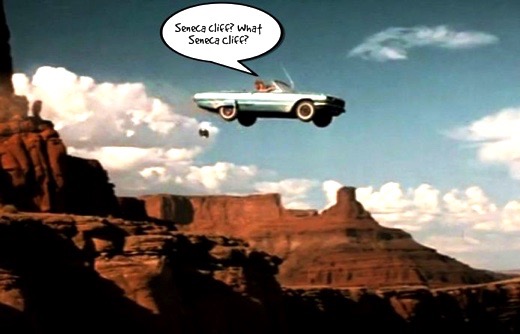
Image above: "Seneca Cliff? What Seneca Cliff?" scene from 1991 movie "Thelma and Louise" From (http://thesenecatrap.blogspot.com/2017/05/seneca-cliff-what-seneca-cliff.html).

Dear colleagues, we are having an interesting discussion on how to stop climate change and I think I could add some thoughts of mine on the basis of my recent work that I published in the form of the book titled "The Seneca Effect".

The problem we have been discussing is how to limit emissions and we saw that it needs to be done fast and even drastically if we want to avoid the worse effects of climate change. Obviously, it is not easy. (image from Skeptical Science)

Most of what has been said today was based on a "top-down" approach, which I may also describe as supply-limiting. That is, we are speaking of a carbon tax, of emission limits, and the like; measures that governments should take in order to limit the production of fossil fuels. I don't have to tell you that it is an effort that has been ongoing for several years and yet emissions keep growing. It doesn't seem to work

So, can we take the opposite approach? That is, look at the demand side in a "bottom-up" approach?

To discuss this point, let me introduce the concept of the "Seneca Effect" or the "Seneca Cliff." Here is the shape of the Seneca curve.

You know that I use the term of "Seneca Effect" taking inspiration from something that the Roman philosopher Seneca said long ago; "growth is sluggish but ruin is rapid". And you see how the curve looks like the projections for emission reductions we have been seeing here.

So, the question is, what causes the collapse we see in the Seneca Curve in complex systems?

Well, we can use system dynamics to model the collapse and we know it is not a "top-down" effect, nobody from outside forces the system to collapse. It is a very general phenomenon caused by the interactions of the various elements that compose the system which cooperate to bring it down. And that's a trick that can be exploited: as I say in my book, "The Seneca Effect", collapse is not a bug, it is a feature.

Let me see to explain it using the oil industry as an example: see the figure drawn on the board.

Now, you see the segmented line I drew, it keeps going up. It is what the oil companies expect for the future. Their projections, by Exxon for instance, say this: given sufficient investments, we can keep growing the oil production for a number of years, maybe a decade or more.

That's what they have been doing; despite various dire warnings, the oil industry has been able to keep production growing. It is true that conventional oil ("crude") peaked at some moment between 2005 and 2010, but it didn't really decline. Then, the production of "all liquids" kept growing by exploiting other sources such as shale oil.

Of course, the problem is that if the industry continues to make an all-out effort to increase, or at least maintain, production, all we were saying about the need of reducing emissions goes out of the smokestack. Forget about keeping warming below 2 degrees. It would be a disaster.

But look at the Seneca curve in the graph. It would generate more or less the kind of rapidly declining production curve we need for our future survival

The oil industry doesn't predict anything like that, but it is vulnerable, very vulnerable. The industry has a "soft belly:" the collapse of the demand. That is, we don't need governments to enact draconian regulations: if the market for a product disappears, then the industry producing it will disappear. Can it happen? Yes, it can.

The key point of the oil industry's vulnerability is in the need of large investments to keep the whole thing moving. Facing increasing production costs, they have been able to survive by growing and exploiting economies of scale. This has been possible because investors thought they were investing in a growing industry.

But things have been changing and the market of the oil industry is at risk. Consider that typically a good 50% of the oil industry production is gasoline. To this, you may add about 20% of diesel fuel and the result is that some 70% of the output of the industry is for internal combustion engines used for transportation.

So far, this has been a growing market, but the electric transportation revolution is coming, and not just that. There is a whole systemic change under the concept of "Transportation as a Service" (TAAS). The combination of the diffusion of electric vehicles and the optimization of the system may rapidly reduce the demand for gasoline and diesel fuel.

We don't need a large reduction in the demand for transportation fuels to generate a spiral of decline for the oil industry.

Less demand means less production, less production means the loss of economies of scale, and the loss of the economies of scale means higher costs that translate into higher prices which also depress the demand. And so it goes until it reaches the bottom.

As Lucius Annaeus Seneca said, long ago, "ruin is rapid". And the ruin of the oil industry is not a bad thing for the earth's ecosystem and for us all.

See also:
The Seneca Effect book published
(http://thesenecatrap.blogspot.com/2017/08/the-seneca-effect-published.html/)

Ea O Ka Aina: Can airlines be saved? 11/1/17
Ea O Ka Aina: American way of life is negotiable 5/31/17
Ea O Ka Aina: Ecovillage Rescuing Los Angeles 3/27/17

.

US Nuclear power dream is dying

SUBHEAD: In the last 20 years, the U.S. has seen only one new functional nuclear reactor constructed.

By Michael McDonald on 23 February 2017 for OilPrice.com -
(http://oilprice.com/Energy/Energy-General/The-US-Nuclear-Energy-Dream-Is-Dying.html)


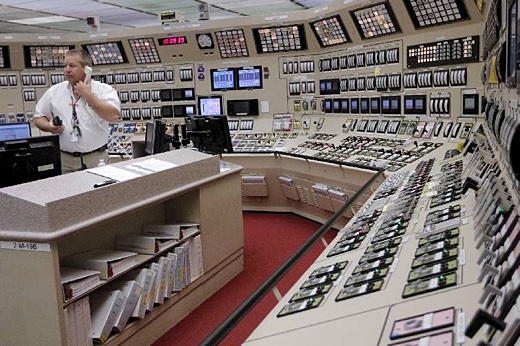
Image above: Operator in the Control Room of the Watts Bar II Nuclear Plant. The Watts Bar plant named 8th biggest U.S. boondoggle ever. From (http://www.timesfreepress.com/news/business/aroundregion/story/2015/nov/25/watts-bar-plant-named-8th-biggest-us-boondoggle/337599/).

The United States was once a projected leader in the nuclear energy race. In the 20th century, the world dreamed of finding a way to provide safe, cheap, and renewable energy, and nuclear power seemed to be the manifestation of those dreams. All of this, however, seems to be coming to an end.

This past week, Toshiba decided to sell its American nuclear power subsidiary at a $6 billion loss.

Westinghouse Electric Company, an American company that Toshiba acquired 10 years ago, is in the business of building and constructing nuclear power facilities. This isn’t the first time that Toshiba attempted to offload controlling interest in Westinghouse – all previous efforts, however, have failed.

Many reasons have been cited for this sell-off. Firstly, demand for electricity has been slowing down as of late. Secondly, natural-gas prices have been declining, making it harder to justify the measures necessary to make nuclear power work – one of the primary motivators for these projects was the increasingly high cost of natural-gas.

Finally, integration of renewable energy sources (such as wind and solar) have been becoming more prevalent. Again, this makes it harder to justify nuclear energy projects.

However, the biggest barrier to entry for nuclear energy providers is the trade-off between safety and cost. The production of this type of energy can be fast and cheap, but not if companies comply fully with the U.S. nuclear regulatory body. Nuclear energy in America is simply becoming an uneconomic option.

This is problematic on the global scene for a variety of reasons, chief of which is safety standards. The U.S. remains the exemplary model to follow when it comes to regulation of new technologies.

If nuclear power in America slows down substantially, the influence the U.S. has over global safety standards wanes, and the world becomes less willing to comply with basic guidelines. Without that scale of market presence from the U.S., the industry can suffer.

This slowdown from the U.S. may be advantageous for state-owned nuclear facilities. Without America as an example, Russia, parts of Asia, and the Middle East become the example to follow – their lack of standards and regulation would be to the benefit of nuclear facilities owned by governments.

However, many privately owned nuclear facilities simply do not have the capital to sustain these plants, even when the government helps subsidize their operations. This is evidenced by Toshiba’s termination of their Westinghouse project. Projects on the private side take much longer to complete, so that safety concerns change along the way, locking them into a cycle of never ending regulation updates.

In the last 20 years, the U.S. has seen only one new nuclear reactor that is functional, constructed by a government entity – the Tennessee Valley Authority. Further, the Nuclear Regulatory Commission shows that there are only four reactors currently under construction in the entire country.

Two would be at the Alvin W. Vogtle station in Georgia, and two at the Virgil C. Summer plant in South Carolina.
These projects are implementing reactors manufactured by Westinghouse.

Construction on all four are currently delayed over three years and are billions over-budget. Westinghouse itself was one of the last private companies to be commissioned for the manufacture of nuclear reactors – before over-budget, inefficient projects such as these pushed them into ruin.

Westinghouse has said that these four projects, as well as two more in China, will be completed. But it remains doubtful that the dozens of other projects it has been commissioned to complete – and yet to begin – will ever reach fruition.


Video above: Scene from 1979 movie "China Syndrome" when operators, played by Jack Lemon and Wilfred Brimley realize that the core of the nuclear plant they are running is about to meltdown. Note this review was done before the March 2011 Fukushima Daiichi triple nuclear meltdown in Japan. From (https://youtu.be/fmdSBQGqfJw).

.

Cheap, Profitable and Abundant

SUBHEAD: Trump's Energy Plan envisions cheap, profitable and abundant fossil fuel. It won't happen.

By bart Hawkins Krep on 1 February 2017 for An Outside Chance -
(http://anoutsidechance.com/2017/02/01/alternative-geologies-trumps-america-first-energy-plan/)


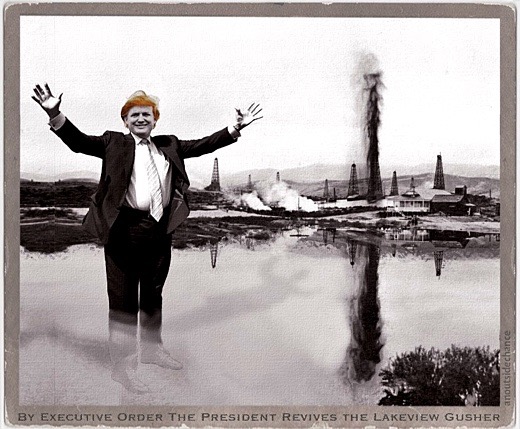
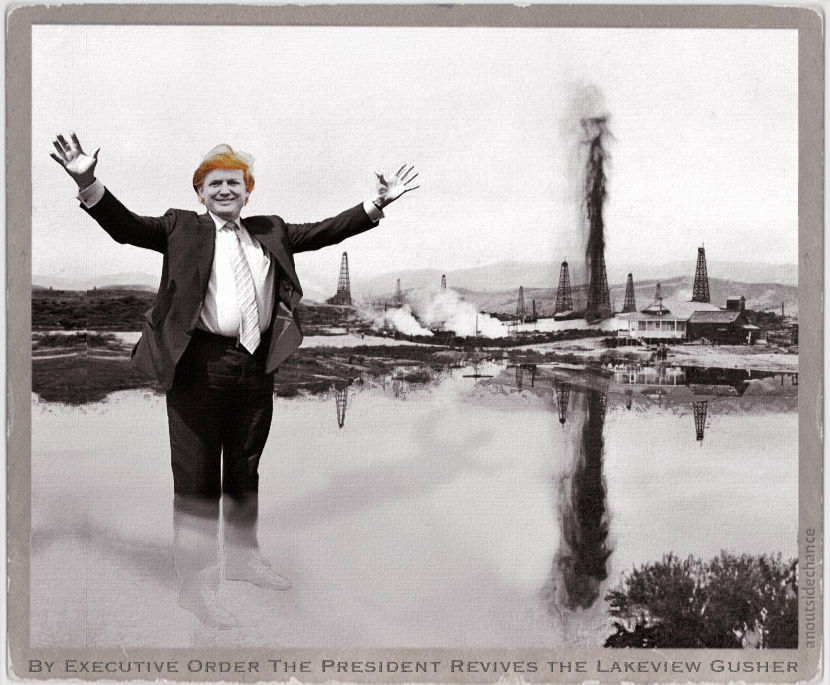
Image above: Composite of Donald Trump in a lake of oil spilled by the Lakeview Gusher, California, 1910 (click here for larger version). The Lakeview Gusher was the largest on-land oil spill in the US. It occurred in the Midway-Sunset oil field, which was discovered in 1894. In 2006 this field remained California’s largest producing field, though more than 80% of the estimated recoverable reserves had been extracted. Source: California Department of Conservation, 2009 Annual Report of the State Oil & Gas Supervisor. From original article.


Donald Trump’s official Energy Plan envisions cheap fossil fuel, profitable fossil fuel and abundant fossil fuel. The evidence shows that from now on, only two of those three goals can be met – briefly – at any one time.
While many of the Trump administration’s “alternative facts” have been roundly and rightly ridiculed, the myths in the America First Energy Plan are still widely accepted and promoted by mainstream media.
The dream of a great America which is energy independent, an America in which oil companies make money and pay taxes, and an America in which gas is still cheap, is fondly nurtured by the major business media and by many politicians of both parties.
The America First Energy Plan expresses this dream clearly:
The Trump Administration is committed to energy policies that lower costs for hardworking Americans and maximize the use of American resources, freeing us from dependence on foreign oil.
And further:
Sound energy policy begins with the recognition that we have vast untapped domestic energy reserves right here in America. The Trump Administration will embrace the shale oil and gas revolution to bring jobs and prosperity to millions of Americans. … We will use the revenues from energy production to rebuild our roads, schools, bridges and public infrastructure. Less expensive energy will be a big boost to American agriculture, as well.
– www.whitehouse.gov/america-first-energy
This dream harkens back to a time when fossil fuel energy was indeed plentiful and cheap, when profitable oil companies did pay taxes to fund public infrastructure, and the US was energy independent – that is, when Donald Trump was still a boy who had not yet managed a single company into bankruptcy.

To add to the “flashback to the ’50s” mood, Trump’s plan doesn’t mention renewable energy, solar power, and wind turbines – it’s all fossil fuel all the way.

Nostalgia for energy independence
Let’s look at the “energy independence” myth in context. It has been more than 50 years since the US produced as much oil as it consumed.

Here’s a graph of US oil consumption and production since 1966. (Figures are from the BP Statistical Review of World Energy, via ycharts.com.)


Gap between US oil consumption and production – from stats on ycharts.com

Even at the height of the fracking boom in 2014, according to BP’s figures Americans were burning 7  million barrels per day more oil than was being produced domestically. (Note: the US Energy Information Agency shows net oil imports at about 5 million barrels/day in 2014 – still a big chunk of consumption.)

OK, so the US hasn’t been “energy independent” in oil for generations, and is not close to that goal now.

But if Americans Drill, Baby, Drill, isn’t it possible that great new fields could be discovered?
Well … oil companies in the US and around the world ramped up their exploration programs dramatically during the past 40 years – and came up with very little new oil, and very expensive new oil.

It’s difficult to find estimates of actual new oil discoveries in the US – though it’s easy to find news of one imaginary discovery.

When I  google “new oil discoveries in US”, most of the top links go to articles with totally bogus headlines, in totally mainstream media, from November 2016. For example:
CNN: “Mammoth Texas oil discovery biggest ever in USA”
USA Today: “Largest oil deposit ever found in U.S. discovered in Texas”
The Guardian: “Huge deposit of untapped oil could be largest ever discovered in US”
Business Insider: “The largest oil deposit ever found in America was just discovered in Texas”
All these stories are based on a November 15, 2016 announcement by the United States Geological Survey – but the USGS claim was a far cry from the oil gushers conjured up in mass-media headlines.

The USGS wasn’t talking about a new oil field, but about one that has been drilled and tapped for decades. It merely estimated that there might be 20 billion more barrels of tight oil (oil trapped in shale) remaining in the field. The USGS announcement further specified that this estimated oil “consists of undiscovered, technically recoverable resources”. (Emphasis in USGS statement). In other words, if and when it is discovered, it will likely be technically possible to extract it, if the cost of extraction is no object.

The dwindling pace of oil discovery
We’ll come back to the issues of “technically recoverable” and “cost of extraction” later. First let’s take a realistic look at the pace of new oil discoveries.

Bloomberg sums it up in an article and graph from August, 2016:


Image above: Graph from Bloomberg.com

This chart is restricted to “conventional oil” – that is, the oil that can be pumped straight out of the ground, or which comes streaming out under its own pressure once the well is drilled. That’s the kind of oil that fueled the 20th century – but the glory days of discovery ended by the early 1970s.

While it is difficult to find good estimates of ongoing oil exploration expenditures, we do have estimates of “upstream capital spending”. This larger category includes not only the cost of exploration, but the capital outlays needed in developing new discoveries through to production.

Exploration and development costs must be funded by oil companies or by lenders, and the more companies rely on expensive wells such as deep off-shore wells or fracked wells, the less money is available for new exploration.

Over the past 20 years companies have been increasingly reliant on a) fracked oil and gas wells which suck up huge amounts of capital, and 2) exploration in ever-more-difficult environments such as deep sea, the arctic, and countries with volatile social situations.

As Julie Wilson of Wood Mackenzie forecast in Sept 2016, “Over the next three years or more, exploration will be smaller, leaner, more efficient and generally lower-risk. The biggest issue exploration has faced recently is the difficulty in commercializing discoveries—turning resources into reserves.”

Do oil companies choose to explore in more difficult environments just because they love a costly challenge? Or is it because their highly skilled geologists believe most of the oil deposits in easier environments have already been tapped?

The following chart from Barclays Global Survey shows the steeply rising trend in upstream capital spending over the past 20 years.


Image above: Graph from Energy Fuse Chart of the Week, Sept 30, 2016
Between the two charts above – “Oil Discoveries Lowest Since 1947”, and “Global Upstream Capital Spending” – there is overlap for the years 1985 to 2014. I took the numbers from these charts, averaged them into five-year running averages to smooth out year-to-year volatility, and plotted them together along with global oil production for the same years.


Image above: Graph based on Mackenzie Wood figures for new oil discoveries, Barclays Global Survey figures for upstream capital expenditures, and world oil production figures from US Energy Information Administration

This chart highlights the predicament faced by societies reliant on petroleum. It has been decades since we found as much new conventional oil in a year as we burned – so the supplies of cheap oil are being rapidly depleted.

The trend has not been changed by the fracking boom in the US – which has involved oil resources that had been known for decades, resources which are costly to extract, and which has only amounted to about 5% of world production at the high point of the boom.

Yet while our natural capital in the form of conventional oil reserves is dwindling, the financial capital at play has risen steeply. In the 10 year period from 2005, upstream capital spending nearly tripled from $200 billion to almost $600 billion, while oil production climbed only about 15% and new conventional oil discoveries averaged out to no significant growth at all.

Is doubling down on this bet a sound business plan for a country? Will prosperity be assured by investing exponentially greater financial capital into the reliance on ever more expensive oil reserves, because the industry simply can’t find significant quantities of cheaper reserves?

That fool’s bargain is a good summary of Trump’s all-fossil-fuel “energy independence” plan.

(The Canadian government’s implicit national energy plan is not significantly different, as the Trudeau government continues the previous Harper government’s promotion of tar sands extraction as an essential engine of “growth” in the Canadian economy.)

To jump back from global trends to a specific example, we can consider the previously mentioned “discovery” of 20 billion barrels of unconventional oil in the Permian basin of west Texas.

Mainstream media articles exclaimed that this oil was worth $900 billion. As geologist Art Berman points out, that valuation is simply 20 billion barrels times the market price last November of about $45/barrel.

But he adds that based on today’s extraction costs for unconventional oil in that field, it would cost $1.4 trillion to get this oil out of the ground. At today’s prices, in other words, each barrel of that oil would represent a $20 loss by the time it got to the surface.

Two out of three
To close, let’s look again at the three goals of Trump’s America First Energy Plan:
• Abundant fossil fuel
• Profitable fossil fuel
• Cheap fossil fuel
With remaining resources increasingly represented by unconventional oil such as that in the Permian basin of Texas, there is indeed abundant fossil fuel – but it’s very expensive to get.

Therefore if oil companies are to remain profitable, oil has to be more expensive – that is, there can be abundant fossil fuel and profitable fossil fuel, but then the fuel cannot be cheap (and the economy will hit the skids).

Or there can be abundant fossil fuel at low prices, but oil companies will lose money hand-over-fist (a situation which cannot last long).

It’s a bit harder to imagine, but there can also be fossil fuel which is both profitable to extract and cheap enough for economies to afford – it just won’t be abundant.

That would require scaling back production/consumption to the remaining easy-to-extract conventional fossil fuels, and a reduction in overall demand so that those limited supplies aren’t immediately bid out of a comfortable price range.

For that reduction in demand to occur, there would have to be some combination of dramatic reduction in energy use per capita and a rapid increase in deployment of renewable energies.

A rapid decrease in demand for oil is anathema to Trumpian fossil-fuel cheerleaders, but it is far more realistic than their own dream of cheap, profitable, abundant fossil fuel forever.


.

End of the bitumen boom

SUBHEAD: The homes burned in Fort McMurry fire can be restored, but not the bitumen boom that put them there.

By Andrew Nikiforuk on 13 May 2016 for the Tyee -
(http://thetyee.ca/Opinion/2016/05/13/Fort-McMurray-Slow-Burn/)


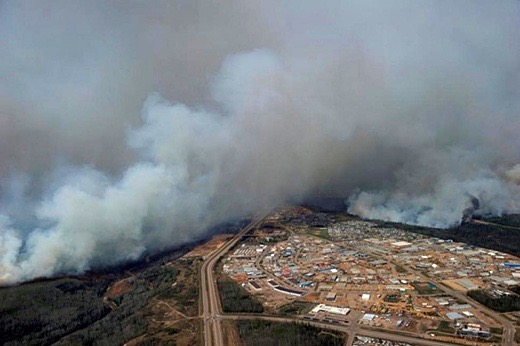
Image above: Aerial photo of the fire engulfing Fort McMurry, Canada. From original article.

At the end of the day the $10-billion wildfire that consumed 2400 homes and buildings in Fort McMurray may be the least of the region's problems.

Although the chaotic evacuation of 80,000 people through walls of flame will likely haunt its brave participants for years, a slow global economic burn has already taken a nasty toll on the region's workers.

That fire began last year when global oil prices crashed by 40 percent and evaporated billions of investment capital in the tarsands.

As the project's most hight cost producers started to bleed cash, corporations laid off 40,000 engineers, labourers, cleaners, welders, mechanics and trades people with little fanfare and even less thanks.

Many of these human "stranded assets" endured home foreclosures and lineups at the food bank.

Worker flights to Red Deer and Kelowna got cancelled and traffic at the city's new airport declined by 16 per cent. Unemployment in Canada's so-called economic engine soared to nearly nine percent.

Despite the high cost of the oil price crash, most residents of Fort McMurray, along with Canada's politicians, think that oil prices will rebound and things will turn around sooner or later. They've seen it all before, they say.

But a number of economic trends and analyses suggest that bitumen's glory days may be over.

Oil demand is slowing

What resembles a string of bad luck may actually be the unfortunate consequence of rapidly developing a high risk and volatile resource with no real safety net.

The first undeniable factor is weakening demand for oil, the engine of global economic growth. China's economy, the world's largest oil importer, is faltering as its industrial revolution peaks and fades.

Europe, Japan and the United States are also using less oil, and their economies are stagnating too.

The global economy has become so stuck in neutral that famous financial power brokers such as Larry Summers now write depressing articles entitled "The Age of Secular Stagnation," in Foreign Affairs no less.

In such a world, little if any bitumen will be needed in the international market place. In fact economists now trace about 50 per cent of the oil price collapse to evaporating demand.

Investors fear getting burned

But there are many other potent signs and they have already covered the economic landscape with smoke.

Murray Edwards, the billionaire tycoon behind Canadian Natural Resources, one of the largest bitumen extractors, has decamped from Alberta to London, England.

Edwards and company slashed $2.4-billion from CNRL's budget in 2015.

Since the oil price crash, by some accounts, Murray's company has lost 50 per cent of its market value.

(Cenovus, another oilsands player, got cursed with junk bond status.)

Edwards likely has read the tea leaves and understands that bitumen might not play a significant role in the secular age of stagnation.

In fact bitumen has lost so much of its global investment lustre that, even before the Fort Mac blaze, Bloomberg reported that no new supplies of low-grade bitumen will enter the market in 2018.

This would mark the first time in more than a decade that the rate of bitumen extraction, now at 2.4 million barrels a day, will not increase.

In addition Carbon Tracker, a market friendly group, now informs investors that low oil prices will favor existing production from low carbon and low cost conventional sources.

That's a terrible forecast for Alberta's oilsands and its product which is neither low cost to produce nor low carbon to refine.

Sold cheap, pricey to refine

Unfortunately, there's more reason to expect Fort McMurray's and the oil patch to get burnt by global economic realities.

Consider the Alberta government data on the dive bombing value it places on bitumen.

The junk low-grade heavy oil or what the Koch brothers accurately call "garbage" (the right-wing billionaires remain the largest buyers of raw bitumen at their Pine Bend facility in Minnesota) is such a complicated and low-grade resource that it requires a complex methodology to grade its market value.

Bitumen might be the world's most expensive hydrocarbon to extract out of the ground, but it remains the world's cheapest refinery feedstock. Due to its low quality it has always sold at a discount to West Texas Intermediate.

About half of all oilsands exports -- 1.2 million barrels -- are raw unrefined bitumen. Unlike the Alberta government, which has rarely thought about adding value to bitumen, the Koch brothers saw an opportunity years ago.

Since the 1980s Koch Industries has been buying Canada's bitumen crude and turning it into high value jet fuel and gasoline at their Pine Bend refinery. In fact Koch Industries now gobbles up 300,000 barrels of bitumen a day and remains the single largest buyer of Canada's dirtiest crude. To the Kochs it's a no brainer: bitumen offers some of the most attractive refinery margins in the world.

Up in smoke? Even before the Fort Mac blaze, Bloomberg reported that no new supplies of low-grade bitumen will enter the market in 2018. Photo of wildfires near Fort McMurray neighborhoods, May 5, 2016, Courtesy CF Operations/Handout.

With the oil price collapse the Kochs keep on making more money, while Alberta gets poorer.

In February the Alberta government set a minimum value for bitumen at $10 per cubic metre. That equates to a value of about $1.50 per barrel of bitumen.

But in 2014 the government's monthly report valued bitumen at $421 per cubic metre. The data suggests that bitumen has lost 97 per cent of its value during the price collapse. In other words companies once worth billions are now worth millions.

Could that be why Edwards sailed to England?

A slow fire has victims, too

Last but not least comes a pithy analysis by Jeff Rubin, CIBC's former chief economist. Rubin warns that contraction is the only future for the oilsands unless Canada wishes its economy to become "obsolete and non-competitive."

He correctly notes that 80 per cent of the increase in new global oil did not come from OPEC but from high cost bitumen mines and fracked U.S. shale deposits.

North American corporations, in other words, engineered the global oil glut.

Encouraged by easy credit, Big Oil flooded the market with difficult and largely uneconomic hydrocarbons.

The Saudis, the world's number one and cheapest producers, refused to scale back production or give up market share. Instead they precipitated a price free-fall.

When oil prices stood at $100, rash bitumen development made some sense. But when prices fell below $45 the gamble turned into Russian roulette.

Unlike Saudi oil, most bitumen projects require prices of at least $60 to $70 a barrel to survive.

And so most tarsands extractors (except those who own refineries) are now bleeding cash; many banks have developed nervous twitches; and thousands of workers have found themselves unemployed.

The overproduction of bitumen explains why, says Rubin, "the oilsands morphed from an engine of economic growth into the epicenter of a made-in-Canada recession."

Canadian politicians and the media, adds Rubin, still treat the market downturn as "a largely self-correcting" oil price cycle and assume that happy days will return again.

But Rubin doubts that. As the world economy stagnates and begins to cut carbon emissions, demand for oil and its most carbon intensive products from the tarsands, Canada's single largest source of carbon pollution, will likely shrink.

The wise course of action for Alberta and Canada, therefore, rather than being caught by surprise, would be to plan for an orderly transition that protects communities and oilsands workers, and rewards them for the economic contributions they've made by providing funds for retraining and industry diversification.

As Rubin argues, the tarsands can downsize today and avoid more economic pain. Or it could ignore all the smoke and global trends and wait for "massive write downs tomorrow."

No one who has survived a horrific fire wants to hear that sort of truth. But there are nasty and dirty fires burning in the economic woods and they are now stalking a project that industry and government carelessly allowed to grow too fast and too big.

Most Albertans and most Fort McMurray residents never wanted reckless growth. In a heartbeat they would have voted to slow down the tarsands years ago with higher royalties and better regulations, but their political masters refused to put on the brakes.

Ironically enough, only a wildfire has been able to do that.

.

The Paris Gravity Well

SUBHEAD: Civilization is a heat engine. The global economy must crash for humanity to stand a chance.

By Alan Bates on 24 January 2016 for The Great Change -
(http://peaksurfer.blogspot.co.uk/2016/01/the-paris-gravity-well-part-ii.html)


Image above: Lot for unsold new Dodge SUVs in Baltinore, Maryland. From (http://www.thetruthaboutcars.com/2014/05/consider-the-source-lots-of-unsold-cars-are-normal/).

"We will not suddenly convert steel mills, cement kilns and road surfacing machines to operate on sunbeams."
Charlie said, "That's the trouble. You see it the way the banking industry sees it and they make money by manipulating money irrespective of effects in the real world. You've spent a trillion dollars of American taxpayers' money over the lifetime of the bank and there's nothing to show for it. You go into poor countries and force them to sell their assets to foreign investors and to switch from subsistence agriculture to cash crops. Then, when the prices of those crops collapse, you call this "nicely competitive" on the world market. The local populations starve and you then insist on austerity measures even though your actions have shattered their economy….

"You were intended to be the Marshall Plan, and instead you've been carpetbaggers."
— Kim Stanley Robinson, Sixty Days and Counting: Science in the Capitol (2007).

 “With fundamentals changing slowly and risk appetite falling rapidly, the stage is set for a longer period of risk asset underperformance,” Jabaz Mathai, a strategist at Citigroup Inc., said.  “There is no quick fix to the headwinds facing global growth.”
"Similar periods of weakness have occurred in only five other instances since 1985: (1) the majority of 1988, (2) the first half of 1991, (3) several weeks in early 1996, (4) late 2000 and early 2001, and (5) late 2008 and the majority of 2009 … all either overlapped with a recession, or preceded a recession by a few quarters."
There has been a storm brewing since the last trifle with full-on collapse in 2008-2009. The extend-and-pretend debt balloon was reinflated and stretched to new enormities as Keynesian cash infusions fueled a Minsky Moment, if not a Korowicz Crunch.

The instability in finance is compounded by the instability in demographics. In Mexico City, Bogata and Rio they call them NINIs — the millions of youth between 15 and 24 who neither study nor work. They are now about a fifth of the population in the underdeveloping world, responsible for higher rates of homicide, gangs, and unwed pregnancy. Of those born to NINI mothers, there is a 22.3% greater likelihood of becoming a NINI, according to the World Bank. All this tinder simply builds, bides its time, wanders the streets, waits for a revolutionary spark.

As we said here last week, the trigger for the markets' sudden move may have been what happened in Paris but could not stay in Paris. When it filtered out from the December summit that 195 countries had actually done the unimaginable and set a goal of carbon neutrality, meaning phasing out net fossil fuel emissions by 2050, the financial sector was at first caught dumbfounded. The World Bank guys flinched.

Now it has sunk in. The Guardian reports:
Investors face a “cataclysmic year” where stock markets could fall by up to 20% and oil could slump to $16 (£11) a barrel, economists at the Royal Bank of Scotland have warned. In a note to its clients the bank said: “Sell everything except high quality bonds. This is about return of capital, not return on capital. In a crowded hall, exit doors are small.” It said the current situation was reminiscent of 2008, when the collapse of the Lehman Brothers investment bank led to the global financial crisis. This time China could be the crisis point.
Government subsidies are about to undergo a titanic shift. Many governments spend more on fossil-fuel subsidies than they do on health and education, more than a trillion dollars. Consumer benefits such as subsidized fuels and cheap finance add $548 billion per year. Government support for companies to expand production add another $542 billion just in G20 overdeveloped countries, and a mere top 8 of those will spend $80 billion of this kind every year, four times the investments going to renewables globally.

Tomorrow those same Big-8, and 188 others, will begin spending several times those trillions subsidizing renewables. Jeremy Leggett, founder of Solar Aid and Solarcentury, calls it "trillionization." It won't begin to fill the energy gap that the switch will create, but the psychology of sunk investment will be in charge from thereon out.

Oil producing states and countries are aghast. The "clear signal" that Paris sent was not what they were expecting. In Alaska, the Permanent Fund has been running in the red and the legislature is talking about an income tax. Had the Paris Agreement not come together, they might hope for a rebound of fossil prices and investments in drilling the North Slope and Arctic Refuge.

Petroblas, the national oil company of Brazil and wellspring of the Brazilian Economic Miracle, is now cash negative. It will be forced to turn to the government for a bail-out, but to where will its government turn?

In Mexico, the deficit is running 100 billion and the peso has dropped from 12 in 2014 to soon-to-be 20 against the dollar. If you have dollars you can get a meal in a good restaurant or a room for the night for 5 or 10 of them. So far in January the price rise of food for the average Mexican is alarming. Onions are up 19%, poblanos 15%, bananas 10%, tomatoes 9%.
 
The national oil company, PEMEX, came out on Monday saying it is not true that its operating with losses, but below the $26 per barrel it would be. On Tuesday the price dropped to $24.74. It closed the week at $22.77 but as we write this you can buy a barrel in Mexico City for as little as $20.32. Mexico's federal budget is entirely dependent on oil money and don't look now but Mexico, when it was petrodollar flush, became a net importer of most staple foods and many other essential commodities, which helps explain the grocery dilemma. Mexico now buys onions, poblanos, bananas and tomatoes from California. Also beans, corn and rice.

Gotta love those World Bank guys.

Venezuela, which surprised everyone by signing the Paris Agreement at the final hour, declared an economic emergency on January 15. France, which foolishly drank too much atomic kool aid thinking it might spare itself from petrocollapse, has a budget shortfall of 2.2 billion dollars and declared national economic emergency on January 17. The jobless rate in France, the eurozone's 2d largest economy, is above 10%, compared with a 9.8% EU average.

Andrew Roberts, RBS’s credit chief, said:
European and US markets could fall by 10% to 20%, with the FTSE 100 particularly at risk due to the predominance of commodity companies in the UK index. London is vulnerable to a negative shock. All these people who are long [buyers of] oil and mining companies thinking that the dividends are safe are going to discover that they’re not at all safe.

We suspect 2016 will be characterized by more focus on how the exiting occurs of positions in the three main asset classes that benefited from quantitative easing: 1) emerging markets, 2) credit, 3) equities … Risks are high.

Zero Hedge reports:
"For dry bulk, China has gone completely belly up,” said Erik Nikolai Stavseth, an analyst at Arctic Securities ASA in Oslo, talking about ships that haul everything from coal to iron ore to grain. “Present Chinese demand is insufficient to service dry-bulk production, which is driving down rates and subsequently asset values as they follow each other.”

“China’s slowdown has come as a major shock to the system,” said Hartland Shipping’s Prentis. “We are now caught in the twilight zone between shifts in China’s economy, and it is uncomfortable as it’s causing unexpected slowing of demand.”
The continued collapse of The Baltic Dry Index remains ignored by most.

According to  Zero Hedge:
The North Atlantic has few to nil cargo traveling in its waters. Instead, the giant container ships are anchored. Unmoving. Empty.

Commerce between Europe and North America has literally come to a halt. For the first time in known history, not one cargo ship is in-transit in the North Atlantic between Europe and North America. All of them (hundreds) are either anchored offshore or in-port. NOTHING is moving.

This has never happened before. It is a horrific economic sign; proof that commerce is literally stopped.
The slow response to the Paris outcome has been a complete portfolio review by every actuary and bean-counter in the biggest banks and investment houses, pension funds and mutuals. Hedge fund managers are scratching and sniffing for places to park billions being lifted from soon-to-be-stranded fossil assets. The clean-tech market, signaled first by China, is reacting by recycling cash out of fossil holdings.

Peter Sinclair of ClimateCrocks.com reports:
The Energy Information Administration calculates in its 2015 analysis that the average U.S. levelized cost for new natural-gas advanced combined cycle plants is 7.3 cents per kilowatt-hour — the same as solar.

However, to compare accurately, we have to add about 10 percent to the cost of solar to firm up this variable resource. So we’re close to cost parity, but not quite there.

At $1 per watt, the levelized cost falls to just 5.7 cents per kilowatt-hour, well below cost parity with new natural-gas plants. With two-axis trackers and the best solar resources, which increase the capacity factor to 32 percent, that cost falls to just 4.5 cents per kilowatt-hour. We’re headed to $1 per watt as an all-in cost in the next five to 10 years.
Bloomberg New Energy Finance reported last summer that wind power was the cheapest source of power in the U.K. and Germany in 2015, even without subsidies. The article’s tagline reads: “It has never made less sense to build fossil fuel power plants.” The same article highlights the feedback loop that solar and wind power have in terms of reducing the cost-effectiveness of fossil fuel power plants due to the dispatch order of renewables versus fossil fuel plants.

The solar singularity is indeed near (here?) in the U.S. and increasingly around the world. I described previously that 1 percent of the market is halfway to solar ubiquity because 1 percent is halfway between nothing and 100 percent in terms of doublings (seven doublings from .01 percent to 1 percent and seven more from 1 percent to reach 100 percent). The U.S. will reach the 1 percent solar milestone in 2016. We’re halfway there. Buckle your seatbelts.
There are plenty of unemployed oil workers ready for retraining. James Howard Kunstler: 
So, in 2015, the shale oil companies laid off thousands of workers, idled the drilling rigs, and kicked back to pray that the price would go back up. Which it didn’t.... The landscape of North Dakota is littered with unfinished garden apartment complexes that may never be completed, and the discharged construction carpenters and roofers drove back to Minnesota ahead of the re-po men coming for their Ford F-110s.
To see what does well in the new, post-Paris domain, watch stocks like First Solar (FSLR), Renewable Energy Group (REGI), SolarCity (SCTY) and Siemens (SIE) over the next quarter, and mutuals like Firsthand Alternative Energy (ALTEX), New Alternatives (NALFX) and Guinness Atkinson Alternative Energy (GAAEX). Some of these know their audience and have vowed to screen for social justice. Gabelli SRI AAA says, for instance:
The fund will not invest in the top 50 defense/weapons contractors or in companies that derive more than 5% of their revenues from the following areas: tobacco, alcohol, gaming, defense/weapons production....
There is a psychology that sets in once the corner is turned on fossil investments that may make a big difference in the political debate about climate change. For more than half a century the GOP, the Fossil Lobby and Wall Street have blocked, cut or delayed investments in renewables and papered it over with greenwash.

Forced by pledges made in Paris — and a legally-binding agreement with the word "shall" used 143 times — and the emergence of a huge new global competition to begin not only unchaining the clean-tech sector, but to actively promote it with subsidies, research grants and moonshot-scale deployments, the psychology of chasing after sunk investments will drive an apolitical energy conversion.

Moreover, 350.org and Greenpeace are ramping up campaigns to make sure the promises made in Paris are kept.

No pipelines, no mines. You said 1-point-5!

Clean energy will not deliver a 1:1 replacement for fossil fuels. Get over it. We will not suddenly convert steel mills, cement kilns and road surfacing machines to operate on sunbeams. But the investments we do make, and the worsening weather, will drive us to make even more and ever larger investments, in a forlorn search for a full replacement. While wasteful, it is not nearly as wasteful as the industrial and military investments of the past century or more.

Persian Gulf wars, going back to antiquity, have never been fought over sunlight. As David Stockman recently recalled:
[A] 45-year old error ... holds the Persian Gulf is an American Lake and that the answer to high oil prices and energy security is the Fifth Fleet.
***
That doctrine has been wrong from the day it was officially enunciated by one of America’s great economic ignoramuses, Henry Kissinger, at the time of the original oil crisis in 1973. The 42 years since then have proven in spades that its doesn’t matter who controls the oilfields, and that the only effective cure for high oil prices is the free market.
The switch to sunlight will make the lives we are living better for many, especially those on the front lines of the oil wars, even as we continue towards an Anthropocene Armageddon with little sign of being able to change that trajectory.

Guy McPherson is fond of reminding us, after University of Utah professor Tim Garrett's deft analysis, that industrial civilization is a heat engine.

In a well-read article in Climate Change in November 2010, Garrett ran the simple arithmetic:
Specifically, the human system grows through a self-perpetuating feedback loop in which the consumption rate of primary energy resources stays tied to the historical accumulation of global economic production — or p×g — through a time-independent factor of 9.7±0.3 mW per inflation-adjusted 1990 US dollar.

If civilization is considered at a global level, it turns out there is no explicit need to consider people or their lifestyles in order to forecast future energy consumption. At civilization’s core there is a single constant factor, λ = 9.7 ± 0.3 mW per inflation-adjusted 1990 dollar, that ties the global economy to simple physical principles. Viewed from this perspective, civilization evolves in a spontaneous feedback loop maintained only by energy consumption and incorporation of environmental matter.

Because the current state of the system, by nature, is tied to its unchangeable past, it looks unlikely that there will be any substantial near-term departure from recently observed acceleration in CO2 emission rates. For predictions over the longer term, however, what is required is thermodynamically based models for how rates of carbonization and energy efficiency evolve. To this end, these rates are almost certainly constrained by the size and availability of environmental resource reservoirs. Previously, such factors have been shown to be primary constraints in the evolution of species
What this means is the same thing that Gail Tverberg, Richard Heinberg and many others have been saying for a very long time — modern economies are a product of cheap energy. Take that away and they crash and burn. That’s the good news. Garrett says there is no other climate remediation model that works.

Civilization is a heat engine whether it is powered by nuclear fusion or photovoltaics. The global economy must crash for humanity to stand a chance. McPherson would take it a step farther and say it is already too late, enjoy what time you have.

The famous Fermi paradox raises the question: why haven’t we detected signs of alien life, despite high estimates of probability, such as observations of planets in the “habitable zone” around a Sun-like star by the Kepler telescope and calculations of hundreds of billions of Earth-like planets in our galaxy that might support life. 

To produce a habitable planet, life forms need to regulate greenhouse gases such as water and carbon dioxide to keep surface temperatures stable. Early extinction, before interstellar communication, solves the Fermi Paradox. So does merely the extinction of civilization capable of interstellar communication without the same degree of trauma. No civilization, no heat.

But wait! Can that excess heat civilization is producing be turned into air conditioning for the planet? Is there a permacultural decroissance that could rescue our genome? Stay tuned, but first, next week, we play the Trump card.

.