Showing posts with label University. Show all posts

Conferences with less CO2 gas

SUBHEAD: One third of the University of California Santa Barbara campus carbon-dioxide footprint comes from aviation emissions to take professors to conferences.

By Natasha Tandler on 10 December 2016 for Resilience -
(http://www.resilience.org/stories/2016-12-09/a-climate-change-conference-without-the-carbon)
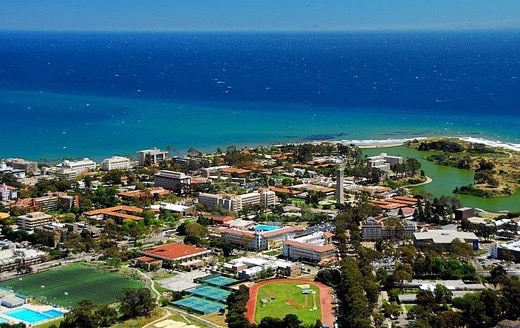

Image above: Aerial view of UCSB campus and Pacific Ocean.It is ranked No. 2 in the lorld in Leiden Ranking of top 500 universities. From (http://www.news.ucsb.edu/2013/013502/ucsb-ranked-no-2-world-leiden-ranking-top-500-universities).

English professor Ken Hiltner, of the University of California, Santa Barbara (UCSB)  was tending to his garden, but he wasn’t thinking about how to keep weeds away or if his tomatoes were getting enough sunlight.

Rather, the director of UCSB’s Environmental Humanities Initiative thought, “Why not make academic conferences virtual to reduce their carbon dioxide footprint?”

The inspiration for this idea came after Hiltner heard the startling discovery from a report conducted by UCSB’s Sustainability Office in 2014. It found that one third of the carbon dioxide footprint for the UCSB campus came from air travel that takes faculty and staff to conferences and talks. Hiltner knew that his idea of a digital conference could dramatically curb these unnecessary emissions.

In May, just a mere six months later, a virtual conference called “Climate Change: Views from the Humanities” was launched by Hiltner and his co-director, sociology Professor John Foran.

The conference had over 50 speakers and was sponsored by the Critical Issues in America series and UCSB’s Environmental Humanities Initiative. Foran called the conference “game-changing.”

The conference addressed climate change by bringing academics together from eight countries across the world, but it only produced 1% of the carbon dioxide emissions of a traditional fly-in conference. For this reason, Hiltner and Foran called the conference “nearly carbon dioxide neutral.”

The conference website reported that speakers would have had to travel over 300,000 miles and would have generated 100,000 pounds of carbon dioxide if the conference had been in person.

Having a hard time imagining what 100,000 pounds of carbon dioxide actually looks like? The Environmental Protection Agency reports that it is equivalent to the emissions that driving 188 different passenger vehicles for one year generate. 100,000 pounds of carbon dioxide is also the same as the emissions produced by driving one car 2,129,908 miles.

The Criticisms and Disadvantages
The digital conference did not come together flawlessly though. It received a fair share of criticism about the disadvantages of a virtual platform. Foran said that some lecturers “missed the paid trip to a place for travel purposes,” while others had a hard time using technology to give their talks.

Hiltner explained that the organizers attempted to create a “paradigm shift” in the social practice of academics flying to conferences throughout America.

In the United States alone, Hiltner stated that 200 million people attend conferences each year. He added, “Whenever you try to shift culture, there is going to be resistance to it.”

One of the main critiques about the conference was that the digital platform inhibited face-to-face interactions that occur at fly-in conferences. Keynote speaker Elizabeth Kaplan from Stony Brook University confessed that she missed having a live audience. She said that she prefers “to see the people that she is speaking to and gauge their reactions” to her presentation.

Rick Thomas, a graduate student at UCSB’s Bren School of Environmental Science and Management, also disliked the lack of personal communication. He was one of the web platform designers for the conference and was a participant in many of the Q&As at the conference.

Thomas thought that the part of the conference where the most interpersonal connection was lost was actually during the talks. “Sometimes the speakers just used a PowerPoint for their talks and you just heard a voice,” he said.

Another critique of the conference was that it was not diverse. All four of the keynote speakers were white and Kaplan was the only woman. “If you look at the keynote speakers and panelists, there are too many men, too few people of color, and too little geographical diversity,” Foran noted.

The conference also left out those who do not have access to the Internet, which is surprisingly 60% of the world’s population according to The United Nations’ Broadband Commission.

The commission estimates that 4.2 billion people do not have regular access to the Internet and that only one in 10 people has regular access to the Internet in lesser-developed countries. This is a big problem since developing countries are affected the most by climate change because they do not have many financial resources to cope with its consequences.

The Social and Educational Advantages
Many argued that the online conference was actually inclusive to those in the developing world, such as UCSB Global Studies Professor Raymond Clémençon. He teaches a class called Global Environmental Politics and was the former Head at the International Affairs Division of the Swiss Environment Ministry.

“For developing countries, it is very expensive and they don’t have the capacity to travel to an in-person conference,” Clémençon said. He thought that the virtual conference is a good solution to this problem because it was free to participate in.

Hiltner and Foran also said that another advantage of the virtual conference was that it was actually “more democratic” than a standard academic conference. Hiltner mentioned that most academic conferences are “practices of privilege” because they are “closed door affairs” that prohibit the public from entering. An academic normally needs an invitation to attend one of these events.

However, anyone affiliated with an academic institution could have participated in the virtual conference and all of its contents are still available online for anyone to see.

Kaplan, one of the keynote speakers, said that in person conferences “rarely have records of what the speakers or audience members say.” Since all of the talks and Q&As are online, the conference is on record forever. This benefits academics who want to cite from the conference or teachers who want to share talks from the conference with their students.

Many of the speakers and participants also expressed how much they enjoyed the length of the conference, which was three weeks.

For someone like Rick Thomas, who juggles a rigorous graduate school workload, a time-consuming research project, and a social life, the three weeks were very necessary.

He was appreciative of the time frame because he could participate during his moments of leisure and because it gave him “a chance to sit back and think for a bit.”

Other attendees also enjoyed this time frame, as Hiltner proudly stated that the conference generated “three times as much discussion as a normal conference.” At a normal conference, the Q&A is usually limited to a 15-minute time frame. Not everyone in the audience gets an opportunity to ask his or her question.

With the online format, anyone could ask a question and receive an answer.
Hiltner also observed that the questions that were asked by audience members were “better formulated” and “more considerate” than questions asked spontaneously at an academic conference.

Attendees were able to provide research and statistics for their questions or responses. Both Hiltner and Foran thought that the online Q&A format was much more thoughtful and productive than the Q&As at fly-in conferences.

Environmental Benefits and Worldwide Impacts
The virtual conference not only provides a solution to reducing UCSB’s carbon dioxide emissions, but it is also an answer to reducing worldwide aviation emissions. According to Air Transport Action Group, “flights produced 781 million tons” of carbon dioxide in 2015.

The aviation industry is a large contributor to climate change, as it is responsible for 2% of worldwide global carbon dioxide emissions. Greenhouse gas emissions produced by the aviation industry could be significantly reduced if the 200 million academics in America who fly to academic conferences instead participated in digital conferences that do not require air travel.

Recently, the Environmental Humanities Initiative conducted a second virtual conference for three weeks during October and November of 2016. The conference was called “The World in 2050: Creating/Imagining Just Climate.” One of the speakers was Bill McKibben, a world-renowned climate change activist.

Hiltner and Foran made sure that many of the criticisms from the first conference were addressed in the second conference. The most important one was making the conference more diverse. The second conference had over fifty voices from six different continents. Antarctica was the only continent that did not participate, although the co-directors did reach out to many scholars there.

To address the criticism that the virtual format was not personal, the newest conference included “Nearly-Carbon-Neutral Salons.” These were virtual spaces where conference attendees could interact in real time with others through a video conferencing website called Zoom. There were three different scheduled salons to accommodate for different time zones of people throughout the world.

After the first conference, Hiltner created a “white paper” which is a practical guide for those interested in conducting their own virtual conferences. It is an extremely long and detailed document that outlines all of the advantages and frequently asked questions about digital conferences.

The white paper also provides a step-by-step guide on how to implement a virtual conference following the same format of the Environmental Humanities Initiatives conferences.

Many organizations not only commend this innovative conference type, but also want to implement it themselves. Bioversity International, a global organization that is designed to ensure genetic diversity on the planet, will be the first major environmental group to use this model. Additionally, The Modern Language Association is going to use the instructional manual to conduct its own virtual conference in April of 2017.

It is uncertain if numerous organizations or universities will use the virtual academic conference platform in the future.

However, it is clear that the UCSB climate change conferences have definitely started the “paradigm shift in a cultural practice” that the conference organizers hoped to initiate.

.
UH walkout over Mauna Kea TMT


SUBHEAD: University wide walkout planned over construction of Thirty Meter Telescope on Mauna Kea sacred ground.

By Ilima Long on 12 April 2015 on Island Breath -
(http://islandbreath.blogspot.com/2015/04/uh-walkout-over-mauna-kea-tmt.html)


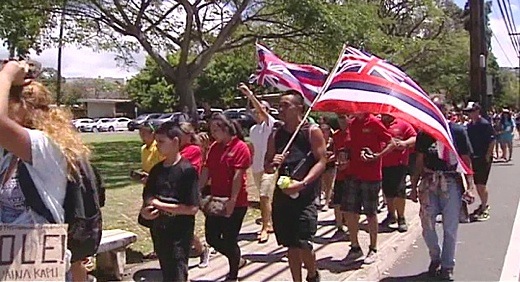
Image above: A protest was held at UH Manoa on Friday. The walkout will lead into a rally at UH Manoa's Campus Center. From (http://www.kitv.com/news/uh-systemwide-walkout-planned-in-tmt-protest/32341006).

As the University of Hawaii, which purports to be a “Hawaiian place of learning” continues to disregard the voice of the Hawaiian community in its opposition to the construction of the Thirty Meter Telescope on the summit of Mauna Kea, the Pukoa Council, the Native Hawaiian council of the University of Hawaii system, has called for a system-wide walk-out among all Native Hawaiian serving programs on Monday, April 13 at noon. The walk-out will be supported by various professors, staff and students throughout the University of Hawaii system.

The Pukoa council, composed of  representatives from all ten University of Hawaii (UH) system campuses, met with President Lassner at Kapiolani Community College on April 6, 2015.  At that time, the President was advised that the Pūkoʻa Council stands firmly against the TMT project and was urged to halt construction.

In addition, a separate letter urging Thirty Meter Telescope Corporation partners to divest from the project has garnered support from over 150 University of Hawaai and community organizations, departments, professors, staff and student organizations.

The Pūkoʻa Council position and the letter to the TMT investors shows that there is substantial opposition to the TMT within the University of Hawaii and calls for the University of Hawaii to halt all construction efforts.

“The Board of Regents or the Office of Mauna Kea Management can no longer speak on behalf of the entire University for this issue. As we’ve seen in the past week, opposition to this issue is widespread and this includes opposition within the University itself. The Board of Regents needs to know this as do the TMT investors,” says UH Mānoa representative for the Pūkoʻa Council, Dr. LilikalavKameeleihiwa.

“Mauna Kea is sacred to Native Hawaiians and is part of the corpus of Hawaiian national lands but this is not simply a Native Hawaiian issue,” says Professor of English, Candace Fujikane. “This is an environmental issue, one of upholding legal protections for the environment as well as one of good government . There are three court cases yet to be resolved over the TMT so why is the University beginning construction?”

The walk-out will lead into a rally at Campus Center, followed by a press conference at 12:30 at the UHM Campus Center courtyard where the Pūkoʻa Council will issue a statement on its position to the University of Hawaii Board of Regents and Professor Jon Osorio will also release the letter directed to the TMT partners.

CONTACT:
Ilima Long at (setolong@gmail.com)
Phone  (808) 781-8423

.

Kauai Peace & Justice reinstated

SUBHEAD: Demilitarization group back in after initially being denied spot at College & Career Fair.

By Chris D'Angelo on 13 November 2014 for the Garden Island -
(http://thegardenisland.com/news/local/education/reinstated/article_03951588-6b05-11e4-9dd8-6bec5ca4c6e8.html#user-comment-area)


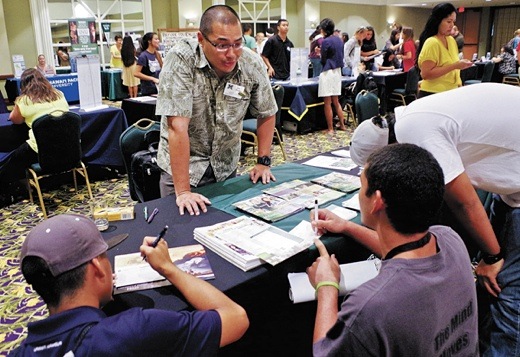
Image above: ose Magno of the University of Hawaii at Manoa talks to Waimea High School students about possible athletic scholarships, Monday during the Hawaii 39th Annual College & Career Fair at the Kauai Marriott Resort and Beach Club. Photo by Dennis Fujimoto. From original article.


Hawaii Peace and Justice — an organization that supports the demilitarization of Hawaii — will be allowed a spot at the upcoming Hawaii College and Career Fair after initially being told it could not participate.

Contacted Tuesday by The Garden Island, HCCF Board President and Kauai Fair Coordinator Bricen Moritsugu confirmed HPJ’s application to participate in the 40th annual event had been rejected. 
He called back Wednesday afternoon to retract HCCF’s original decision.

“I did review the policy again and we’ll go ahead and let their organization attend the fair,” he said.
While HPJ members say their group provides a valuable service to the community, career fair representatives initially maintained the group did not fit the newly adopted criteria for participating in the exhibit.

Kauai resident and HPJ volunteer Kip Goodwin said the group’s fair coordinator Sanford Yee received a letter Nov. 7 from HCCF Treasurer and Coordinator Pamela Teehan outlining HCCF’s rejection decision.

“This just came right out of the blue,” Goodwin said Tuesday.

In an email to Goodwin and other HPJ members, Yee referenced the HCCF letter.

“Our organization has rethought its exhibitor policy, to coincide with our mission statement,” the letter reads. “Unfortunately, your organization does not fall within the realm of our goals. We apologize and hope your future endeavors meet your expectations.”

Moritsugu said the fair adopted its new policy this year in response to feedback from the community and other exhibitors. While the changes were not in response to any specific organization, they were necessary, he said Tuesday.

“It brings us more in line with other college fairs happening across the nation,” Moritsugu said.

Goodwin said that for the past several years, he and other HPJ volunteers have manned a table at the event and distributed handouts with information and statistics about the military that are not disclosed by recruiters.

One such handout, provided by Goodwin on Tuesday, is a four-page cartoon called “Sgt. Abe the Honest Recruiter,” which outlines the “sweet” promises recruiters often make and how they can be broken.

“Take the length of enlistment, for instance,” reads one message from Sgt. Abe. “Here, it looks definite and limited. But in fact it’s not. The military can make it longer. If you don’t believe me, turn the page.”

“Think hard before you sign — your life could be at stake,” reads another.

A second handout the group plans to distribute at the fair provides a number of statistics about the low percentage of veterans that use their military skills in their current jobs, as well as the rates of sexual assault, suicide and homelessness among vets.

Among the many exhibitors at this year’s Kauai event, scheduled from 9 a.m. to 11 a.m. and 5 to 7 p.m. Monday at the Kauai Marriott Resort, are the Hawaii Air National Guard, United States Army Recruiting, United States Coast Guard Academy and the United States Military Academy at West Point.

Under HCCF’s new policy, exhibitors must fit one of the following criteria: an educational institution of higher learning; a nonprofit or governmental organization offering information on programs or services in support of higher learning; or an organization or firm offering career information or career opportunities.

Prior to changing his mind about allowing HPJ to participate, Moritsugu said he respects HPJ’s mission, but that the organization failed to meet any of the required criteria. He added that while he recognized that the new policy is a “big change” — one not everyone is going to support — HCCF will continue to evaluate how to improve the fair.

On Wednesday, however, Moritsugu said he met with Goodwin and other HPJ members and came to the conclusion that the organization does fit the criteria by distributing information that could lead to higher learning.

Goodwin said that while he did not fully understand the reasons for Moritsugu’s change of heart, he welcomed the news.

“We are conduits to education and career opportunities not represented at the fair,” he said. “We are not, repeat not, anti-military or anti-recruitment. We believe we are inherently within the mission statement of College and Career Fair and provide valuable service to Kauai youth.”

See also:
Ea O Ka Aina: College and Career peace ban 11/12/14 

.

Pentagon readying for breakdown

SUBHEAD: Social science is being militarized to target peaceful activists and protest movements.

By Nafeez Ahmed on 12 June 2014 for the Guardian -
(http://www.theguardian.com/environment/earth-insight/2014/jun/12/pentagon-mass-civil-breakdown)


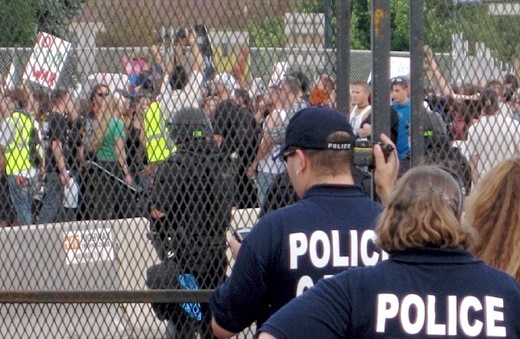
Image above: Freedom of Speech Zone during George Bush run Republican National Convention in 2004. From (http://www.fark.com/comments/7844971/One-hundred-protestors-arrested-by-state-security-after-singing-clapping-demonstration-against-regime-in-far-flung-despotic-country-of-North-Carolina).

A US Department of Defense (DoD) research programme is funding universities to model the dynamics, risks and tipping points for large-scale civil unrest across the world, under the supervision of various US military agencies. The multi-million dollar programme is designed to develop immediate and long-term "warfighter-relevant insights" for senior officials and decision makers in "the defense policy community," and to inform policy implemented by "combatant commands."

Launched in 2008 – the year of the global banking crisis – the DoD 'Minerva Research Initiative' partners with universities "to improve DoD's basic understanding of the social, cultural, behavioral, and political forces that shape regions of the world of strategic importance to the US."

Among the projects awarded for the period 2014-2017 is a Cornell University-led study managed by the US Air Force Office of Scientific Research which aims to develop an empirical model "of the dynamics of social movement mobilisation and contagions." The project will determine "the critical mass (tipping point)" of social contagians by studying their "digital traces" in the cases of "the 2011 Egyptian revolution, the 2011 Russian Duma elections, the 2012 Nigerian fuel subsidy crisis and the 2013 Gazi park protests in Turkey." (IB emphasis)

Twitter posts and conversations will be examined "to identify individuals mobilised in a social contagion and when they become mobilised."

Another project awarded this year to the University of Washington "seeks to uncover the conditions under which political movements aimed at large-scale political and economic change originate," along with their "characteristics and consequences." (IB emphasis)

The project, managed by the US Army Research Office, focuses on "large-scale movements involving more than 1,000 participants in enduring activity," and will cover 58 countries in total.

Last year, the DoD's Minerva Initiative funded a project to determine 'Who Does Not Become a Terrorist, and Why?' which, however, conflates peaceful activists with "supporters of political violence" who are different from terrorists only in that they do not embark on "armed militancy" themselves. The project explicitly sets out to study non-violent activists: (IB emphasis)
"In every context we find many individuals who share the demographic, family, cultural, and/or socioeconomic background of those who decided to engage in terrorism, and yet refrained themselves from taking up armed militancy, even though they were sympathetic to the end goals of armed groups. The field of terrorism studies has not, until recently, attempted to look at this control group. This project is not about terrorists, but about supporters of political violence."
The project's 14 case studies each "involve extensive interviews with ten or more activists and militants in parties and NGOs who, though sympathetic to radical causes, have chosen a path of non-violence."

I contacted the project's principal investigator, Prof Maria Rasmussen of the US Naval Postgraduate School, asking why non-violent activists working for NGOs should be equated to supporters of political violence – and which "parties and NGOs" were being investigated – but received no response.

Similarly, Minerva programme staff refused to answer a series of similar questions I put to them, including asking how "radical causes" promoted by peaceful NGOs constituted a potential national security threat of interest to the DoD.

Among my questions, I asked:
"Does the US Department of Defense see protest movements and social activism in different parts of the world as a threat to US national security? If so, why? Does the US Department of Defense consider political movements aiming for large scale political and economic change as a national security matter? If so, why? Activism, protest, 'political movements' and of course NGOs are a vital element of a healthy civil society and democracy - why is it that the DoD is funding research to investigate such issues?"
Minerva's programme director Dr Erin Fitzgerald said "I appreciate your concerns and am glad that you reached out to give us the opportunity to clarify" before promising a more detailed response. Instead, I received the following bland statement from the DoD's press office:
"The Department of Defense takes seriously its role in the security of the United States, its citizens, and US allies and partners. While every security challenge does not cause conflict, and every conflict does not involve the US military, Minerva helps fund basic social science research that helps increase the Department of Defense's understanding of what causes instability and insecurity around the world. By better understanding these conflicts and their causes beforehand, the Department of Defense can better prepare for the dynamic future security environment."
In 2013, Minerva funded a University of Maryland project in collaboration with the US Department of Energy's Pacific Northwest National Laboratory to gauge the risk of civil unrest due to climate change. The three-year $1.9 million project is developing models to anticipate what could happen to societies under a range of potential climate change scenarios. (IB emphasis)

From the outset, the Minerva programme was slated to provide over $75 million over five years for social and behavioral science research. This year alone it has been allocated a total budget of $17.8 million by US Congress.

An internal Minerva staff email communication referenced in a 2012 Masters dissertation reveals that the programme is geared toward producing quick results that are directly applicable to field operations. The dissertation was part of a Minerva-funded project on "counter-radical Muslim discourse" at Arizona State University.

The internal email from Prof Steve Corman, a principal investigator for the project, describes a meeting hosted by the DoD's Human Social Cultural and Behavioural Modeling (HSCB) programme in which senior Pentagon officials said their priority was "to develop capabilities that are deliverable quickly" in the form of "models and tools that can be integrated with operations."

Although Office of Naval Research supervisor Dr Harold Hawkins had assured the university researchers at the outset that the project was merely "a basic research effort, so we shouldn't be concerned about doing applied stuff", the meeting in fact showed that DoD is looking to "feed results" into "applications," Corman said in the email. He advised his researchers to "think about shaping results, reports, etc., so they [DoD] can clearly see their application for tools that can be taken to the field." (IB emphasis)

Many independent scholars are critical of what they see as the US government's efforts to militarise social science in the service of war. In May 2008, the American Anthropological Association (AAA) wrote to the US government noting that the Pentagon lacks "the kind of infrastructure for evaluating anthropological [and other social science] research" in a way that involves "rigorous, balanced and objective peer review", calling for such research to be managed instead by civilian agencies like the National Science Foundation (NSF).

The following month, the DoD signed a memorandum of understanding (MoU) with the NSF to cooperate on the management of Minerva. In response, the AAA cautioned that although research proposals would now be evaluated by NSF's merit-review panels. "Pentagon officials will have decision-making power in deciding who sits on the panels":
"… there remain concerns within the discipline that research will only be funded when it supports the Pentagon's agenda. (IB emphasis) Other critics of the programme, including the Network of Concerned Anthropologists, have raised concerns that the programme would discourage research in other important areas and undermine the role of the university as a place for independent discussion and critique of the military."
According to Prof David Price, a cultural anthropologist at St Martin's University in Washington DC and author of Weaponizing Anthropology: Social Science in Service of the Militarized State, "when you looked at the individual bits of many of these projects they sort of looked like normal social science, textual analysis, historical research, and so on, but when you added these bits up they all shared themes of legibility with all the distortions of over-simplification. Minerva is farming out the piece-work of empire in ways that can allow individuals to disassociate their individual contributions from the larger project."

Prof Price has previously exposed how the Pentagon's Human Terrain Systems (HTS) programme - designed to embed social scientists in military field operations - routinely conducted training scenarios set in regions "within the United States."

Citing a summary critique of the programme sent to HTS directors by a former employee, Price reported that the HTS training scenarios "adapted COIN [counterinsurgency] for Afghanistan/Iraq" to domestic situations "in the USA where the local population was seen from the military perspective as threatening the established balance of power and influence, and challenging law and order."

One war-game, said Price, involved environmental activists protesting pollution from a coal-fired plant near Missouri, some of whom were members of the well-known environmental NGO Sierra Club. Participants were tasked to "identify those who were 'problem-solvers' and those who were 'problem-causers,' (IB emphasis) and the rest of the population whom would be the target of the information operations to move their Center of Gravity toward that set of viewpoints and values which was the 'desired end-state' of the military's strategy."

Such war-games are consistent with a raft of Pentagon planning documents which suggest that National Security Agency (NSA) mass surveillance is partially motivated to prepare for the destabilising impact of coming environmental, energy and economic shocks.

James Petras, Bartle Professor of Sociology at Binghamton University in New York, concurs with Price's concerns. Minerva-funded social scientists tied to Pentagon counterinsurgency operations are involved in the "study of emotions in stoking or quelling ideologically driven movements," he said, including how "to counteract grassroots movements."  (IB emphasis)

Minerva is a prime example of the deeply narrow-minded and self-defeating nature of military ideology. Worse still, the unwillingness of DoD officials to answer the most basic questions is symptomatic of a simple fact – in their unswerving mission to defend an increasingly unpopular global system serving the interests of a tiny minority, security agencies have no qualms about painting the rest of us as potential terrorists.

• Dr. Nafeez Ahmed is an international security journalist and academic. He is the author of A User's Guide to the Crisis of Civilization: And How to Save It, and the forthcoming science fiction thriller, ZERO POINT.

.

University of Texas motto mod

SUBHEAD: "What starts here changes the world" modified to "What starts here accelerates the destruction of the world”

By Robert Jensen on 15 November 2012 for Austin Post -
(http://www.austinpost.org/university-texas/what-starts-here)


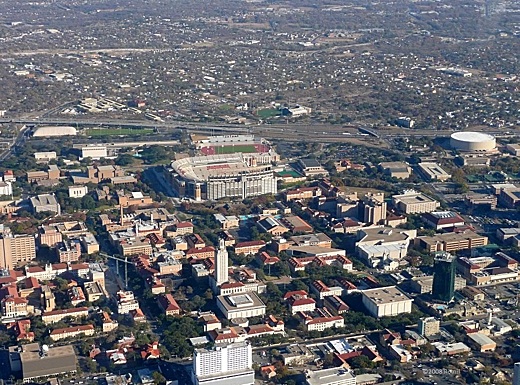
Image above: Ariel photo of UT Austin campus looking towards suburban sprawl. From (http://media.photobucket.com/image/recent/mopacs/Air%2520Austin%2520UT/P1090511-1.jpg).


I want to suggest a slight modification of the University of Texas’ motto, “What starts here changes the world.”

A more accurate slogan -- while not quite as pithy and probably less effective for public-relations purposes -- would be, “What starts here accelerates the destruction of the world.”

I am not suggesting that the administrators or faculty of UT, where I have been a professor for two decades, want to destroy the world. Rather, I’m arguing that like almost every other institution of higher education in the United States, UT is complicit in the ongoing destruction of the world by offering a curriculum that celebrates the existing economic/political/social systems, which undermine the life-sustaining capacity of the world.

While that claim may sound crazy, I think my reasoning is calm and careful. The destructive features of contemporary America’s systems -- an extractive economy that demands endless growth, with a mystical faith in high-energy/high-technology systems and gadgets, dependent on continued mass consumption of goods of questionable value -- are all woven into the fabric of UT’s teaching and research. Entire departments on campus are staffed with faculty who seem incapable of imagining a challenge to those features and appear dedicated to maintaining the systems. The goal of most courses is to train students to play by the existing rules, not question the systems that produce the rules.

The obvious problem: We face multiple, cascading ecological crises that should spur us to rethink our economy, politics and society, but the existing rules rule out such thinking. If we can’t transcend these intellectual limits, it is not clear that an ongoing large-scale human presence on the earth will be possible. What is clear is that affluent societies such as the United States cannot continue to live indefinitely in the style to which so many have become accustomed. In the short term such affluence can be maintained only by intensifying already unconscionable levels of inequality, and in the long term even that soulless strategy can’t stop the inevitable decline and eventual collapse.

Reality Check

First, the difficult realities. Look at any crucial measure of the health of the ecosphere in which we live -- groundwater depletion, topsoil loss, desertification, chemical contamination, increased toxicity in our own bodies, the number and size of “dead zones” in the oceans, extinction of species and reduction of bio-diversity -- and ask a simple question: Are we heading in the right direction? Don’t forget that we also live in an oil-based world and are rapidly depleting the cheap and easily accessible oil, which means we face a huge reconfiguration of the infrastructure that undergirds our lives. The desperation to avoid that reconfiguration has brought us into the era of “extreme energy,” marked by the use of more dangerous and destructive technologies (hydrofracturing, deep-water drilling, mountain-top removal, tar sands extraction). And, of course, there is the undeniable trajectory of global warming and climate disruption.

Where does that leave us? Instead of thinking in terms of manageable “environmental problems,” scientists these days are talking about tipping points and the breach of planetary boundaries, about how human activity is pushing the planet beyond its limits.

Second, the deficient response. Universities, which have the resources to chart the new paths that are necessary, too often push students onto the same old dead-end roads. On occasion, cautionary notes from the academy are sounded. For example, one group of scientists recently warned that humans are forcing a planetary-scale critical transition “with the potential to transform Earth rapidly and irreversibly into a state unknown in human experience,” which means that “the biological resources we take for granted at present may be subject to rapid and unpredictable transformations within a few human generations.”

Unfortunately, most of the modern university pays no heed. The most obvious place where realities are avoided and illusions maintained is the business school, ground zero on campus for the indoctrination into capitalist ideology. What’s the problem with that? After all, hasn’t capitalism unleashed incredible productivity and created unparalleled wealth? Yes, but putting aside the important questions about what the unequal distribution of that wealth says about our alleged commitment to moral principles (in case it’s not clear, it says we don’t take our moral principles very seriously), we now face the grim reality that capitalism is ecocidal. Industrial capitalism treats the world as a mine from which to extract resources and a dump for wastes. Largely unregulated markets obscure that destruction, as financial “instruments” are traded with no regard for what is necessary for a real economy to continue -- the capacity of nature to sustain life.

Schools of Thought

But in business school, future corporate leaders are taught to maximize profit, marketing experts develop evermore ways to sell us things we don’t need, and financial wizards slice and dice the numbers to make it all work -- at least on paper. How much critique of the destructive capacity of contemporary corporate capitalism will students encounter in the UT business school? I regularly ask my students about their experience in business classes, and they report that there is virtually no such discussion beyond occasional mentions of “corporate social responsibility,” a concept designed to assuage consciences rather than deal with core problems. Real critique in business classes is so rare that when I ask that question, students either look confused or chuckle at the absurdity.

Move over to the economics department, which at UT (and most other universities) is dominated by the conventional wisdom of neoclassical and/or mildly reformist Keynesian economic thought. These models acknowledge “market failures” and “negative externalities,” and then proceed to downplay the dramatic consequences. Failures and externalities such as climate disruption and other human-generated forms of ecological destruction aren’t mere footnotes to otherwise well-functioning models. Yet while these looming disasters reveal the models to be irrational, market fundamentalism demands we ignore the obvious.

These difficult realities do not seem to slow down the economics department or the business school, as they offer instruction in the theory and practice of a system that is killing the planet at a quickening pace.

In other parts of the university, the story is slightly more complicated. In the government department and law school, for example, a wider range of views are acceptable, but the overall thrust of each is toward the conventional. The study of law and politics typically takes corporate capitalism as non-negotiable, and so other aspects of our lives must adapt to the rules of that economic game. A few critics are allowed in these departments but are largely treated as cranky misfits who need not be taken seriously.

In the sciences and engineering, there is less attention paid to economic/political/social systems. There, administrators and faculty see their disciplines as focused on answering different kinds of questions. Here it is not market fundamentalism but technological fundamentalism that is most troubling.

Technological fundamentalists assume that the increasing use of evermore sophisticated high-energy advanced technology is always a good thing and that any problems caused by the unintended consequences of such technology eventually can be remedied by more technology. This kind of magical thinking offers a reassuring way out of the problems that the extractive/industrial economy has created -- if we ignore the history of those unintended consequences.

The story of air-conditioning is a great example. The chlorofluorocarbons (CFCs) widely used in cooling systems were depleting the ozone layer, and so they were replaced with “safer” hydrochlorofluorocarbons (HCFCs), which we now know are contributing significantly to global warming. Rather than rethink our demand for constant cooling, we stumble forward looking for the next technological fix. But if we look only for “solutions” that don’t disturb existing systems, and those existing systems are unsustainable, then our solutions are at best irrelevant and at worst will exacerbate the fundamental problems and make it harder for people to imagine new systems. That’s not an argument to abandon all attempts to improve technology, but rather a reminder of technology’s limits and dangers.

The university departments where one is most likely to find the culture of sustained critical inquiry we need are in the humanities and the social sciences. These departments -- philosophy, history, literature, sociology, anthropology, as well as ethnic and women’s studies -- will vary ideologically depending on time and place, but they offer space from which one can think about challenges to existing systems of power and privilege.

While much excellent and exciting thinking goes on in such settings, too often the way in which that knowledge is framed and communicated guarantees that any insights will not go beyond a narrow scholarly community. The university’s system of rewards and punishments encourages professors to stay stuck in the academic trenches, which have become increasingly self-indulgent spaces. As long as critically minded academics stay safely within academic life and speak an unnecessarily jargon-laden specialized language, they are free to pursue whatever topics they like, but at the cost of social irrelevance.

Power To The ... Powers That Be?

Let me be clear about what I am NOT arguing: I am not suggesting there is no good intellectual work done at UT; I am not suggesting that the system has cowed every administrator or professor; and I most certainly am not saying that anyone who disagrees with me is corrupt or incompetent. Reasonable people can disagree, and I do not think I have an exclusive claim on wisdom. I consider myself a hard-working second-tier intellectual and make no claim to being a terribly deep or original thinker. This essay reflects the analyses and arguments made by an increasingly large group of critics urging us to step back and think more deeply about the world we have built.

And let me be clear about one more thing: I love my job and am grateful for the resources that UT provides for my work. But when I try to understand the system in which I work, I observe patterns that keep certain points of view dominant and other approaches marginal. I see younger faculty who want to challenge that system but get beaten down, or who toe the line out of fear, or who are quickly seduced by the promise of privilege. I see students who want to push their professors to consider more critical views but often give up when they meet resistance.

Most important to understanding all this, I see a system of higher education that is structured hierarchically like a corporation and largely dependent on corporations for support. The primary reason that UT rarely challenges the conventional wisdom is that it is dependent on other institutions and people who build, maintain, and profit from the conventional wisdom.

The University of Texas should be a place where teaching and research challenge the culture to face what it prefers to ignore. Such confrontation isn’t going to come from corporations in a capitalist economy, which are dedicated to the status quo. Such confrontation isn’t going to come from conventional political parties and politicians, who are largely captured by the wealth concentrated in the corporate sector. Such confrontation usually emerges on the margins of society, from relatively small grassroots groups that generate new ideas but lack the resources to put the relevant issues on the public agenda.

Universities could serve an important role in helping amplify those challenges to power. They have not only the resources, but the responsibility of pursuing knowledge even when the consequences are uncomfortable. UT claims that “we are a catalyst for change,” but the institution implicitly defines that as “change within existing systems.” While UT administrators may be heartfelt in their belief that “we are driven to solve society’s issues,” most of the so-called solutions that are generated ignore or intensify the fundamental problems of the systems.

In a culture that is short on long-term vision, universities are vital spaces for critical thought. Instead of remaining trapped within the logic of existing systems, that critical thinking has to be more creative. If there is to be a decent future, we have to give up on the imperial fantasy of endless power, the capitalist fantasy of endless growth, the technological fantasy of endless comfort.

There’s a lot of intellectual work to do if we are to create such a future. What starts at UT and other universities can change the world, but only if we give up on those seductive fantasies and start facing the difficult realities.

• Robert Jensen is a professor in the School of Journalism at the University of Texas at Austin and board member of the Third Coast Activist Resource Center in Austin. He is the author of Arguing for Our Lives: Critical Thinking in Crisis Times (City Lights, coming in 2013); All My Bones Shake: Seeking a Progressive Path to the Prophetic Voice, (Soft Skull Press, 2009); Getting Off: Pornography and the End of Masculinity (South End Press, 2007); The Heart of Whiteness: Confronting Race, Racism and White Privilege (City Lights, 2005); Citizens of the Empire: The Struggle to Claim Our Humanity (City Lights, 2004); and Writing Dissent: Taking Radical Ideas from the Margins to the Mainstream (Peter Lang, 2002).

.

Class of 2012 meets 1984

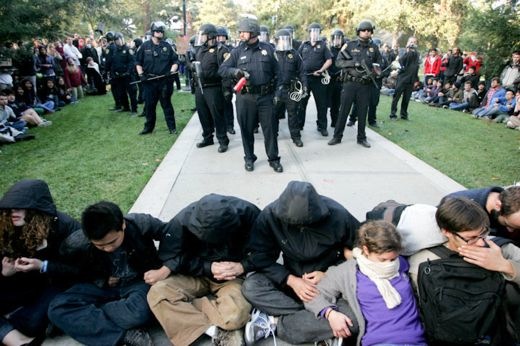
SUBHEAD: Seven steps our nation has taken to achieve the Homeland Security Campus. By Michael Gould-Wartofsky on 22 march 2012 for Tom Dispatch - (http://www.tomdispatch.com/post/175519/tomgram%3A_michael_gould-wartofsky%2C_class_of_2012_meet_the_class_of_1984/) Image above: Lt. John Pike leads SWAT team on UC Davis campus just before he pepper sprayed peaceful students. From (http://occupycolleges.org/2011/11/21/video-police-pepper-spray-uc-davis-student-protesters/). Campus spies. Pepper spray. SWAT teams. Twitter trackers. Biometrics. Student security consultants. Professors of homeland security studies. Welcome to Repress U, class of 2012.

Since 9/11, the homeland security state has come to campus just as it has come to America’s towns and cities, its places of work and its houses of worship, its public space and its cyberspace. But the age of (in)security had announced its arrival on campus with considerably less fanfare than elsewhere -- until, that is, the “less lethal” weapons were unleashed in the fall of 2011.

Today, from the City University of New York to the University of California, students increasingly find themselves on the frontlines, not of a war on terror, but of a war on “radicalism” and “extremism.” Just about everyone from college administrators and educators to law enforcement personnel and corporate executives seems to have enlisted in this war effort. Increasingly, American students are in their sights.

In 2008, I laid out seven steps the Bush administration had taken to create a homeland security campus. Four years and a president later, Repress U has come a long way. In the Obama years, it has taken seven more steps to make the university safe for plutocracy. Here is a step-by-step guide to how they did it.

1. Target Occupy

Had there been no UC Davis, no Lt. John Pike, no chemical weapons wielded against peacefully protesting students, and no cameras to broadcast it all, Americans might never have known just how far the homeland security campus has come in its mission to police its students. In the old days, you might have called in the National Guard. Nowadays, all you need is an FBI-trained, federally funded, and “less lethally” armed campus police department.

The mass pepper-spraying of students at UC Davis was only the most public manifestation of a long-running campus trend in which, for officers of the peace, the pacification of student protest has become part of the job description. The weapons of choice have sometimes been blunt instruments, such as the extendable batons used to bludgeon the student body at Berkeley, Baruch, and the University of Puerto Rico. At other times, tactical officers have turned to “less-lethal” munitions, like the CS gas, beanbag rounds, and pepper pellets fired into crowds at Occupy protests across the University of California system this past winter.

Yet for everything we see of the homeland security campus, there is a good deal more that we miss. Behind the riot suits, the baton strikes, and the pepper-spray cannons stands a sprawling infrastructure made possible by multimillion-dollar federal grants, “memoranda of understanding” and “mutual aid” agreements among law enforcement agencies, counter-terrorism training, an FBI-sponsored “Academic Alliance,” and 103 Joint Terrorism Task Forces (which provide “one-stop shopping” for counterterrorism operations to more than 50 federal and 600 state and local agencies).

“We have to go where terrorism takes us, so we often have to go onto campuses,” FBI Special Agent Jennifer Gant told Campus Safety Magazine in an interview last year. To that end, campus administrators and campus police chiefs are now known to coordinate their operations with Department of Homeland Security (DHS) “special advisors,” FBI “campus liaison agents,” an FBI-led National Security Advisory Board, and a Federal Law Enforcement Training Center, which instructs local law enforcement in everything from “physical techniques” to “behavioral science.” More than half of campus police forces already have “intelligence-sharing agreements” with these and other government agencies in place.

2. Get a SWAT team

Since 2007, campus police forces have decisively escalated their tactics, expanded their arsenals, and trained ever more of their officers in SWAT-style paramilitary policing. Many agencies acquire their arms directly from the Department of Defense through a surplus weapons sales program known as “1033,” which offers, among other things, “used grenade launchers (for the deployment of less lethal weapons)... for a significantly reduced cost.”

According to the most recent federal data available, nine out of 10 campus agencies with sworn police officers now deploy armed patrols authorized to use deadly force. Nine in 10 also authorize the use of chemical munitions, while one in five make regular use of Tasers. Last August, an 18-year old student athlete died after being tased at the University of Cincinnati.

Meanwhile, many campus police squads have been educated in the art of war through regular special weapons training sessions by “tactical officers’ associations” which run a kind of SWAT university. In October, UC Berkeley played host to an “Urban Shield” SWAT training exercise involving local and campus agencies, the California National Guard, and special police forces from Israel, Jordan, and Bahrain. And since 2010, West Texas A&M has played host to paramilitary training programs for police from Mexico.

In October, the University of North Carolina at Charlotte got its very own SWAT team, equipped with MP-15 rifles, M&P 40 sidearms, and Remington shotguns. “We have integrated SWAT officers into the squads that serve our campus day and night,” boasted UNC Charlotte Chief of Police Jeff Baker. The following month, in Chapel Hill, North Carolina, a SWAT team staged an armed raid on an occupied building, pointing assault rifles at the heads of activists, among them UNC students.

3. Spy on Muslims

The long arm of Repress U stretches far beyond the bounds of any one campus or college town. As reported by the Associated Press this winter, the New York City Police Department (NYPD) and its hitherto secret “Demographics Unit” sent undercover operatives to spy on members of the Muslim Students Association at more than 20 universities in four states across the Northeast beginning in 2006.

None of the organizations or persons of interest were ever accused of any wrongdoing, but that didn’t stop NYPD detectives from tracking Muslim students through a “Cyber Intelligence Unit,” issuing weekly “MSA Reports” on local chapters of the Muslim Students Association, attending campus meetings and seminars, noting how many times students prayed, or even serving as chaperones for what they described as “militant paintball trips.” The targeted institutions ran the gamut from community colleges to Columbia and Yale.

According to the AP’s investigation, the intelligence units in question worked closely not only with agencies in other cities, but with an agent on the payroll of the CIA. Police Commissioner Ray Kelly, facing mounting calls to resign, has issued a spirited defense of the campus surveillance program, as has Mayor Michael Bloomberg. “If terrorists aren't limited by borders and boundaries, we can't be either,” Kelly said in a speech at Fordham Law School.

The NYPD was hardly the only agency conducting covert surveillance of Muslim students on campus. The FBI has been engaging in such tactics for years. In 2007, UC Irvine student Yasser Ahmed was assaulted by FBI agents, who followed him as he was on his way to a campus “free speech zone.” In 2010, Yasir Afifi, a student at Mission College in Santa Clara, California, found a secret GPS tracking device affixed to his car. A half-dozen agents later knocked on his door to ask for it back.

4. Keep the undocumented out

Foreign students are followed closely by Immigration and Customs Enforcement (ICE) through its Student and Exchange Visitor Information System (SEVIS). As of 2011, the agency was keeping tabs on 1.2 million students and their dependents. Most recently, as part of a transition to the paperless SEVIS II -- which aims to “unify records” -- ICE has been linking student files to biometric and employer data collected by DHS and other agencies.

“That information stays forever,” notes Louis Farrell, director of the ICE program. “And every activity that’s ever been associated with that person will come up. That’s something that has been asked for by the national security community... [and] the academic community.”

Then there are the more than 360,000 undocumented students and high-school graduates who would qualify for permanent resident status and college admission, were the DREAM Act ever passed. It would grant conditional permanent residency to undocumented students who were brought to the U.S. as children. When such students started “coming out” as part of an “undocumented and unafraid” campaign, many received DHS notices to appear for removal proceedings. Take 24-year old Uriel Alberto, of Lees-McRae College, who recently went on hunger strike in North Carolina’s Wake County jail; he now faces deportation (and separation from his U.S.-born son) for taking part in a protest at the state capitol.

Since 2010, the homeland security campus has been enlisted by the state of Arizona to enforce everything from bans on ethnic studies programs to laws like S.B. 1070, which makes it a crime to appear in public without proof of legal residency and is considered a mandate for police to detain anyone suspected of being undocumented. Many undocumented students have turned down offers of admission to the University of Arizona since the passage of the law, while others have stopped attending class for fear of being detained and deported.

5. Keep an eye on student spaces and social media

While Muslim and undocumented students are particular targets of surveillance, they are not alone. Electronic surveillance has expanded beyond traditional closed-circuit TV cameras to next-generation technologies like IQeye HD megapixel cameras, so-called edge devices (cameras that can do their own analytics), and Perceptrak’s video analytics software, which “analyzes video from security cameras 24x7 for events of interest,” and which recently made its debut at Johns Hopkins University and Mount Holyoke College.

At the same time, students’ social media accounts have become a favorite destination for everyone from campus police officers to analysts at the Department of Homeland Security.

In 2010, the DHS National Operations Center established a Media Monitoring Capability (MMC). According to an internal agency document, MMC is tasked with “leveraging news stories, media reports and postings on social media sites… for operationally relevant data, information, analysis, and imagery.” The definition of operationally relevant data includes “media reports that reflect adversely on DHS and response activities,” “partisan or agenda-driven sites,” and a final category ambiguously labeled “research/studies, etc.”

With the Occupy movement coming to campus, even university police departments have gotten in on the action. According to a how-to guide called “Essential Ingredients to Working with Campus Protests” by UC Santa Barbara police chief Dustin Olson, the first step to take is to “monitor social media sites continuously,” both for intelligence about the “leadership and agenda” and “for any messages that speak to violent or criminal behavior.”

6. Coopt the classroom and the laboratory

At a time when entire departments and disciplines are facing the chopping block at America’s universities, the Department of Homeland Security has proven to be the best-funded department of all. Homeland security studies has become a major growth sector in higher education and now has more than 340 certificate- and degree-granting programs. Many colleges have joined the Homeland Security and Defense Education Consortium, a spinoff of the U.S. Northern Command (the Department of Defense’s “homeland defense” division), which offers a model curriculum to its members.

This emerging discipline has been directed and funded to the tune of $4 billion over the last five years by DHS. The goal, according to Dr. Tara O’Toole, DHS Undersecretary of Science & Technology, is to “leverag[e] the investment and expertise of academia… to meet the needs of the department.” Additional funding is being made available from the Pentagon through its blue-skies research arm, the Defense Advanced Research Projects Agency, and the “intelligence community” through its analogous Intelligence Advanced Research Projects Activity.

At the core of the homeland security-university partnership are DHS’s 12 centers of excellence. (A number that has doubled since I first reported on the initiative in 2008.) The DHS Office of University Programs advertises the centers of excellence as an “extended consortium of hundreds of universities” which work together “to develop customer-driven research solutions” and “to provide essential training to the next generation of homeland security experts.”

But what kind of research is being carried out at these centers of excellence, with the support of tens of millions of taxpayer dollars each year? Among the 41 “knowledge products” currently in use by DHS or being evaluated in pilot studies, we find an “extremist crime database,” a “Minorities at Risk for Organizational Behavior” dataset, analytics for aerial surveillance systems along the border, and social media monitoring technologies. Other research focuses include biometrics, “suspicious behavior detection,” and “violent radicalization.”

7. Privatize, subsidize, and capitalize

Repress U has not only proven a boon to hundreds of cash-starved universities, but also to big corporations as higher education morphs into hired education. While a majority of the $184 billion in homeland security funding in 2011 came from government agencies like DHS and the Pentagon, private sector funding is expected to make up an increasing share of the total in the coming years, according to the Homeland Security Research Corporation, a consulting firm serving the homeland security industry.

Each DHS Center of Excellence has been founded on private-public partnerships, corporate co-sponsorships, and the leadership of “industry advisory boards” which give big business a direct stake and say in its operations. Corporate giants allied with DHS Centers of Excellence include:

*Lockheed Martin at the Consortium for the Study of Terrorism and Responses to Terrorism (START), based at the University of Maryland at College Park.

*Alcatel-Lucent and AT&T at the Rutgers University-based Command, Control, and Interoperability Center for Advanced Data Analysis (CICADA).

*ExxonMobil and Con Edison at the Center for Risk and Economic Analysis of Terrorism Events (CREATE), based at the University of Southern California.

*Motorola, Boeing, and Bank of America at the Purdue University-based Center for Visual Analytics for Command, Control, and Interoperability Environments (VACCINE).

*Wal-Mart, Cargill, Kraft, and McDonald’s at the National Center for Food Protection and Defense (NCFPD), based at the University of Minnesota-Twin Cities.

What’s more, universities have struck multimillion-dollar deals with multinational private security firms like Securitas, deploying unsworn, underpaid, often untrained “protection officers” on campus as “extra eyes and ears.” The University of Wisconsin-Madison, in one report, boasts that police and private partners have been “seamlessly integrated.”

Elsewhere, even students have gotten into the business of security. The private intelligence firm STRATFOR, for example, recently partnered with the University of Texas to use its students to “essentially parallel the work of… outside consultants” but on campus, offering information on activist groups like the Yes Men.

Step by step, at school after school, the homeland security campus has executed a silent coup in the decade since September 11th. The university, thus usurped, has increasingly become an instrument not of higher learning, but of intelligence gathering and paramilitary training, of profit-taking on behalf of America’s increasingly embattled “1%.”

Yet the next generation may be otherwise occupied. Since September 2011, a new student movement has swept across the country, making itself felt most recently on March 1st with a national day of action to defend the right to education. This Occupy-inspired wave of on-campus activism is making visible what was once invisible, calling into question what was once beyond question, and counteracting the logic of Repress U with the logic of nonviolence and education for democracy.

For many, the rise of the homeland security campus has provoked some basic questions about the aims and principles of a higher education: Whom does the university serve? Whom does it protect? Who is to speak? Who is to be silenced? To whom does the future belong?

The guardians of Repress U are uninterested in such inquiry. Instead, they cock their weapons. They lock the gates. And they prepare to take the next step.

• Michael Alexander Gould-Wartofsky is a writer from New York City and a MacCracken Fellow in Sociology at New York University. His writing has received Harvard’s James Gordon Bennett Prize and the New York Times James B. Reston Award, and has appeared in the Nation, the Harvard Crimson, The Huffington Post, and Monthly Review, along with TomDispatch. He is currently writing a book about Occupy Wall Street. His website is http://www.michaelgouldwartofsky.com.

.