Showing posts with label Wildlife. Show all posts

Rewilding Your Lawn

SUBHEAD: Now that we've entered the Anthropocene you need to do your part in supporting the living environment.

By Amy Brady on 28 July 2018 for Orion Magazine -
(https://orionmagazine.org/2018/07/rewilding-your-lawn-in-the-anthropocene-an-interview-with-author-jeff-vandermeer/)
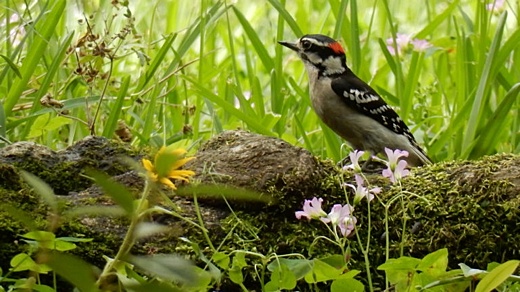

Image above: Photographs of a yard gone wild. From original article.

Jeff VanderMeer, award-winning author of Borne and the Southern Reach Trilogy, is also an avid environmentalist. 

As part of his desire to make outdoor spaces more habitable for birds and insects, he’s embarked on a yard rewilding project that involves letting native grasses and plants (many of them deemed “weeds” by some less-than-pleased neighbors) take over his lawn.

If you follow the author on Twitter, you may have read his amusing—and educational—anecdotes about the project. Here, we discuss the yard project in more depth, including the benefits a wild yard provides for local wildlife and what others can do to improve their own neighborhood ecosystems.

AB: What inspired you to re-wild your yard?
JV: I was the writer-in-residence at Hobart and William Smith Colleges in upstate New York in 2016 and lived in a house with a very lively bird population. I started putting out feeders. 

Then Trump was elected president and my stress level went through the roof. We returned to our home in Florida and, to distract myself from the news, I put up a lot of bird feeders and tried to emulate the things that we’d loved about upstate New York.

We got several more birds than in the past, although I’d always been an avid birdwatcher. The feeders made me feel like I could help semi-urban wildlife and migrating birds in the moment, which was important at a time when I felt useless and worn down by the news.

I then began investigating how to make the yard more bird and bee and butterfly friendly. Given that our attempts at a “normal” lawn had always led to bare dirt, I figured nothing would grow. 

But as soon as we gave the yard over to whatever would naturally grow there, we had a great burgeoning of 
plant, insect, and animal life. We even have, ironically enough, a fair amount of grass in the yard now.

AB: What do you hope to achieve by doing this? Do you anticipate an environmental impact?
JV: I already know we’re creating a safe haven for migratory birds. We’re also helping to cement a corner of an unacknowledged greenway for raccoons and possums and other nocturnal animals, none of which have been a bother. They also eat insects and are beneficial in other ways. 

I’ve also seen more toads and frogs and in general a healthy little ecosystem quietly building up. Contrary to the generalizations people make about non-traditional yards, we’ve not seen any ticks. Either the possum eats those or they just aren’t present.

In addition, we’ve had some exciting finds, like Florida lupine growing in one part of the yard. Florida lupine is rare these days and should be encouraged.

Does all this mean much in the grand scheme of things? I don’t know. But it acknowledges that in addition to dealing with things on the macro level, you can support the environment in your own backyard by not using pesticides and, while not letting things look totally unkempt, support life rather than a mono-lawn that nothing else can thrive on.

AB: You’ve said on Twitter that your neighbors are less than thrilled. How would you sum up their response to your yard?
JV: I think it’s accurate to say that the “neighbor complaint” has become in my mind an existential threat from The Neighbor. By that I mean I feel like I need to anticipate the possible objections to what I’m doing, and thus The Neighbor is always on my mind. 

This is probably very unfair to the actual neighbor in question, which is why I keep everything very anonymous [on Twitter] and try to acknowledge that it’s the system and our assumptions at the neighborhood association and city government level that are flawed.

We also have lots of lovely neighbors, and even the neighbor who complained is not automatically not-lovely. But the system is crap. 

The fact that I can grow weeds only so long as they’re in a straight line and look like a garden—or put up a white fence around a part of the mayhem to ritualistically create a “lawn”—is hilarious and also a bit depressing to me. 

A traditional “lawn” is really about signs and symbols and status. What we’re really talking about is whether you admit life onto your property or decide to kill it off.
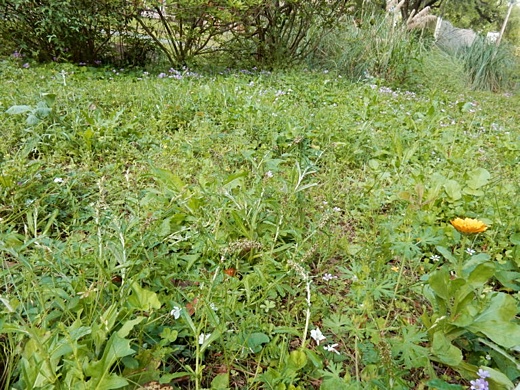

Image above: Photographs of a yard gone wild. From original article.

AB: What kinds of wildlife have entered your yard since starting this project?
JV: In addition to a regular polite possum and raccoon, we have many more bats out at night. We also have a wealth of birds that we didn’t have before. For example, the thrashers are out in force and very comfortable. 

We’ve had migrating grosbeaks, a first, and we have almost all of the Florida woodpeckers in our yard: downy, hairy, red bellied, flickers, and pileated. They used to be much rarer sightings. We also have a resurgence of snakes and tree frogs and toads of all kinds. 

We used to have a few skinks, pretty big ones, and now we have a lot more. And more bees. And tons of different kinds of plants—too many for me really to go into. Except, of course, the famous one, Fred the Weed, a giant wild lettuce.

Fred blew down in a storm, but is currently convalescing and plotting his return. I’m only just learning more about the plants in our yard, and some are likely invasive, but I must admit that paying attention to what’s growing in the yard has made landscapes so different for me in general. I used to think of plants as the backdrop for animals, but now I see acutely the plant life and how it’s growing. 

I feel like when we visit other people’s houses I can tell a lot about them just from the yard. I’m grateful to Jenn Benner, an Orlando friend, who helped me identify a lot of these plants.

AB: Have any of these lifeforms inspired new characters or settings in your writing?  
JV: This sense of plants being in the foreground will definitely seep into my fiction. The fact that I know individual cardinals and individual downy woodpeckers—that I can see them interacting with other individual birds—is also something that will influence my work. 

Somehow the whole world is now more alive than before, which is, to be honest, also painful, because suddenly I’m aware that even yards that seem green and healthy are actually sterile spaces. 

That’s hard to take. It’s also quite frankly hard to take when I find a vole dead in the yard, a victim of some passing cat. 

Luckily, we don’t get cats much—I chase them away and sometimes squirt them with orange juice, which they hate. In a sense, I feel very connected to this little piece of land and I feel it in my body when something goes wrong.
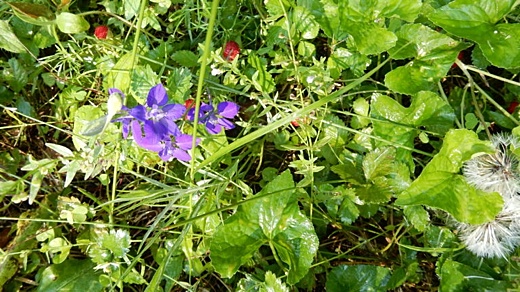

Image above: Photographs of a yard gone wild. From original article.

AB: Do you have any tips for readers who’d like to do something similar with their yards?
JV: I’d say let the space speak to you and really observe what’s going on. Go with the flow of what seems to grow well—don’t try too hard to push back against what nature tells you needs to happen. 

And before uprooting a plant, make sure you know what you’re doing. Early on I wound up taking out some beneficial plants and leaving some that weren’t from pure ignorance. And be aware that herbicides aren’t really any better than pesticides in many cases.

Bring in a local specialist for a consult, even if you don’t want them to do any actual landscaping. 

Finally, where possible, do leave some dead leaves around, especially in places in shade, where they’ll help form good habitats for toads and worms. These are really beneficial creatures that will only add to the richness of the place.

AB: Do you have any suggestions for people living in urban and suburban areas who want to have a positive environmental impact but who can’t let their yards grow wild?
JV: You can always do something. Even a few potted plants that your local nursery says are good for butterflies or birds can be of use. 

Even a small bird feeder can be of use, too. 

In that case, I’d learn what migratory birds pass through your area, what they tend to eat, and when they tend to appear. 

Keep in mind that birds might take as long as a month to find a new feeder and deem it safe. 

Finally, and this is controversial in some areas, keep in mind that outdoor cats do kill lots of birds. There’s no two ways about it. 

So keep your cat inside if at all possible. If your cat seems too energetic for that, all apologies, but you may need to increase your efforts in engaging and playing with your cat inside.

AB: What has been the most rewarding thing about this project?
JV: Rewilding the yard has largely saved me from situational depression, which means I can be more effective in my other, wider environmental efforts. 

Also rewarding has been the daily connection, in some form, to our environment. It is so important to our health in general to understand what it is we’re losing and what we need to save and why.

.
Walmart patents bee drones

SUBHEAD: Autonomous robotic insects owned by a rapacious soul destroying corporation are not the solution.

By Claire S. Bernish on 18 March 2018 for The Mind Unleashed -
(https://themindunleashed.com/2018/03/walmart-files-patent-for-autonomous-bee-drones.html)


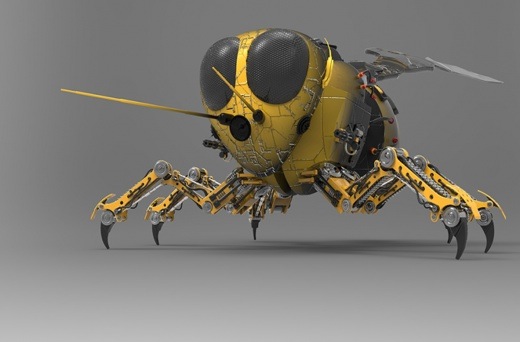
Image above: Illustration of a hypothetical robotic bee. From original article.

With honey bee populations still in peril from one or several of a litany of hotly debated causes — neonicotinoid insecticides, changing climate, and more — Walmart appears to have joined the race for a technological solution to a potential looming disaster, filing a patent for robotic, drone bees earlier this month.

Technically called pollination drones, Business Insider points out, the tiny bee imposters’ capabilities would theoretically include crop pollination — managed remotely through sensors and cameras allowing precision maneuverability between crops and monitor, as well as to monitor that pollination was both sufficient and successful.

CB Insights, credited with first publicizing the patent filed on March 8, surmised Walmart is seeking further control of its supply chain, as the pollinator drones are among six “patents targeting farm automation. The applications propose using drones to identify pests attacking crops, monitor crop damage, spray pesticides, and pollinate crops.”

It continues, “Drones could spray pesticides across a more targeted set of crops, rather than the blanket approach used today. The patent notes that ‘chemical spraying of crops is expensive and may not be looked upon favorably by some consumers.’”

Walmart’s move might thus be considered proactive and positive — although an albeit eerie dystopian commentary on the state of the planet and its ecosystems, or humankind’s unfortunate myopathy — but criticism questions whether funds might be better spent identifying issues facing honey bees and working to conserve and rejuvenate dwindling populations, rather than essentially planning for the worst.

“On top of more practical arguments, such as costs to smaller farms,” Quinn McFrederick, an entomologist at the University of California, Riverside, told NPR, “I would not like to live in a world where bees are replaced by plastic machines. Let’s focus on protecting the biodiversity we still have left.”

McFrederick doesn’t deny the efficacy of drone pollinators, particularly in conjunction with the use of artificial intelligence, but sees the effort heaved at solutions for a problem which has yet to fully develop — without a coincident examination of the root problem — as somewhat misguided.

If bees die out, humans would face a drastically-reduced food landscape — according to Big Think, mirroring similar estimates, around a third of the food humans eat relies on honey bee pollination — and honey bees comprise a paltry 2 percent of all bees.

“Bee deaths have been on the rise, with losses outpacing colonies’ ability to regenerate,” NPR reported last year. “Last year, the U.S. lost 44 percent of all honeybee colonies — a species essential to commercial pollination in this country. Other species of bees have neared mass extinction, including the rusty patch [sic] bumble bee and seven species of Hawaiian yellow-faced bees.”

Even with a slightly lessened decline in recent years, that’s an astoundingly high figure next to the generally-expected 17-percent decline in honey bee populations in a ‘typical’ year, Phys.org noted in 2016, adding that myriad environmental and biological factors likely contribute to colony collapse disorder — even though a solid cause has yet to be fully established.

Robotic bees, pollinator drones, would certainly stave off one of the more pernicious problems facing honey bees in recent years: a mite which acts like a vampire in the tiny insects. Phys.org explains,
“Beekeepers’ biggest challenge today is probably Varroa destructor, an aptly named parasitic mite that we call the vampire of the bee world. Varroa feeds on hemolymph (the insect ‘blood’) of adult and developing honey bees. In the process it transmits pathogens and suppresses bees’ immune response. They are fairly large relative to bees: for perspective, imagine a parasite the size of a dinner plate feeding on you. And individual bees often are hosts to multiple mites.”
Whether single issue as-yet undiscovered or a plethora of damaging factors acting insidiously, the decline of pollinators is a silent if impending doom whose fruition may yet be halted — even if by corporations and private entities like Walmart, whose self-interest in self-preservation in the matter is undeniable.

However, that in itself is a timely caveat for the state of food, wildlife, and the natural order — creating a robotic version of an evolutionary masterpiece bespeaks volumes of humans’ sad penchant for examining problems post mortem — rather than applying forethought..

Speaking of Nature

SUBHEAD: Can we use "ki" and "kin"and  not "it"or "they"when describing natural living things?

By Robin Wall Kimmerer on 11 June 2107 for Orion Magazine -
(https://orionmagazine.org/article/speaking-of-nature/)


Image above: Painting of American Indian spirit animals. From (https://stockdalewolfe.com/2017/05/14/spirit-animals/).

A CEMETERY SEEMED AN ODD PLACE to contemplate the boundaries of being. Sandwiched between the campus and the interstate, this old burial ground is our cherished slice of nearby nature where the long dead are silent companions to college students wandering the hilly paths beneath rewilding oaks.

The engraved names on overgrown headstones are upholstered in moss and crows congregate in the bare branches of an old beech, which is also carved with names.

Reading the messages of a graveyard you understand the deep human longing for the enduring respect that comes with personhood. Names, names, names: the stones seem to say, “I am. You are. He was.”

Grammar, especially our use of pronouns, is the way we chart relationships in language and, as it happens, how we relate to each other and to the natural world.
Tiptoeing in her mud boots, Caroline skirts around a crumbling family plot to veer into the barberry hedge where a plastic bag is caught in the thorns. “Isn’t it funny,” she says, “that we think it’s disrespectful to walk over the dead, but it’s perfectly okay to disrespect the other species who actually live here?”

We have a special grammar for personhood. We would never say of our late neighbor, “It is buried in Oakwood Cemetery.” Such language would be deeply disrespectful and would rob him of his humanity. We use instead a special grammar for humans: we distinguish them with the use of he or she, a grammar of personhood for both living and dead Homo sapiens.

Yet we say of the oriole warbling comfort to mourners from the treetops or the oak tree herself beneath whom we stand, “It lives in Oakwood Cemetery.” In the English language, a human alone has distinction while all other living beings are lumped with the nonliving “its.”
 
As a botany professor, I am as interested in the pale-green lichens slowly dissolving the words on the gravestones as in the almost-forgotten names, and the students, too, look past the stones for inky cap mushrooms in the grass or a glimpse of an urban fox.

The students out for a walk on this late fall day are freshmen in Janine DeBaise’s environmental writing class at the SUNY College of Environmental Science and Forestry where we both teach. I’ve invited them on a mission to experiment with the nature of language and the language of personhood.

 Janine would correct me: she would not refer to her students as “freshmen” since they are neither fresh nor all men. We call them “first-year students.” Words matter. She has collected their assignment, a written reflection on a cemetery walk last week, as baseline data.

Now we revisit the same place, but with new ideas about grammar bouncing around in the students’ heads. New to them, perhaps, but in fact ancient—the grammar of animacy.
 
For me, this story began in another classroom, in another century, at the Carlisle Indian School where my Potawatomi grandfather was taken as a small boy. My chance of knowing my native language and your chance of ever hearing it were stolen in the Indian boarding schools where native children were forbidden to speak their own language.

Within the walls of that school, the clipped syllables of English replaced the lush Potawatomi sounds of water splashing on rocks and wind in the trees, a language that emerged from the lands of the Great Lakes. Our language hovers at the edge of extinction, an endangered species of knowledge and wisdom dwindling away with the loss of every elder.

So, bit by bit, I have been trying to learn my lost language. My house is spangled with Post-it notes labeling wiisgaak, gokpenagen, and ishkodenhs. It’s a very difficult language to learn, but what keeps me going is the pulse of animacy in every sentence.

There are words for states of being that have no equivalent in English. The language that my grandfather was forbidden to speak is composed primarily of verbs, ways to describe the vital beingness of the world. Both nouns and verbs come in two forms, the animate and the inanimate.

You hear a blue jay with a different verb than you hear an airplane, distinguishing that which possesses the quality of life from that which is merely an object. Birds, bugs, and berries are spoken of with the same respectful grammar as humans are, as if we were all members of the same family. Because we are.

There is no it for nature. Living beings are referred to as subjects, never as objects, and personhood is extended to all who breathe and some who don’t. I greet the silent boulder people with the same respect as I do the talkative chickadees.

It’s no wonder that our language was forbidden.

The language we speak is an affront to the ears of the colonist in every way, because it is a language that challenges the fundamental tenets of Western thinking—that humans alone are possessed of rights and all the rest of the living world exists for human use.

Those whom my ancestors called relatives were renamed natural resources. In contrast to verb-based Potawatomi, the English language is made up primarily of nouns, somehow appropriate for a culture so obsessed with things.

At the same time that the language of the land was being suppressed, the land itself was being converted from the communal responsibility of native people to the private property of settlers, in a one-two punch of colonization.

Replacing the aboriginal idea of land as a revered living being with the colonial understanding of land as a warehouse of natural resources was essential to Manifest Destiny, so languages that told a different story were an enemy. Indigenous languages and thought were as much an impediment to land-taking as were the vast herds of buffalo, and so were likewise targeted for extermination.

Linguistic imperialism has always been a tool of colonization, meant to obliterate history and the visibility of the people who were displaced along with their languages. But five hundred years later, in a renamed landscape, it has become a nearly invisible tool. We forget the original names, that the Hudson River was “the river that runs both ways,” that Devils Tower was the sacred Bear Butte of the Lakota.

Beyond the renaming of places, I think the most profound act of linguistic imperialism was the replacement of a language of animacy with one of objectification of nature, which renders the beloved land as lifeless object, the forest as board feet of timber.

Because we speak and live with this language every day, our minds have also been colonized by this notion that the nonhuman living world and the world of inanimate objects have equal status. Bulldozers, buttons, berries, and butterflies are all referred to as it, as things, whether they are inanimate industrial products or living beings.

English has come to be the dominant language of commerce, in which contracts to convert a forest to a copper mine are written. It’s just the right language for the purpose, because the forest and the copper ore are equivalent “its.”

English encodes human exceptionalism, which privileges the needs and wants of humans above all others and understands us as detached from the commonwealth of life.

But I wonder if it was always that way. I can’t help but think that the land spoke clearly to early Anglo-Saxons, just as it did to the Potawatomi.

Robert Macfarlane’s wonderful book Landmarks, about land and language, documents myriad place names of great particularity that illuminate an ancient Anglo-Saxon intimacy with the land and her beings.

It is said that we are known by the company we keep, and I wonder if English sharpened its verbal ax and lost the companionship of oaks and primroses when it began to keep company with capitalism. I want to suggest that we can begin to mend that rift—with pronouns.

As a reluctant student of the formalities of writing, I never would have imagined that I would one day be advocating for grammar as a tool of the revolution.


SOME OF THE STUDENTS in the cemetery have read the chapter in my book Braiding Sweetgrass that invokes the grammar of animacy. They are taken aback by the implicit assumption of the hierarchy of being on which English grammar is built, something they had not considered before. They dive headfirst into the philosophical implications of English-language pronouns.

One student, Carson, writes in his essay that it is a numbing word: “It numbs us to the consequences of what we do and allows us to take advantage of nature, to harm it even, free of guilt, because we declare other beings to be less than ourselves, just things.”

He echoes the words of Wendell Berry who writes, “People exploit what they have merely concluded to be of value, but they defend what they love, and to defend what we love we need a particularizing language, for we love what we particularly know.”

While it’s true that words are simply vessels for meaning, without meaning of their own, many cultures imbue the utterance of words with spirit because they originate with the breath, with the mystery of life itself.

In her book Becoming Wise, Krista Tippett writes, “The words we use shape how we understand ourselves, how we interpret the world, how we treat others. Words make worlds.”

I don’t mean to say that we are constrained to act in a certain way because of our grammar. I’ve been saying it for most of my life and so far I have not clearcut a forest. (I can’t even bring myself to litter, although I tried once, just to see what it would feel like.)

Nor does a language of animacy dictate that its speakers will behave with respect toward nonhumans. After all, there are leaders of indigenous nations, raised speaking a grammar of animacy, who willingly surrender their homelands to the use of mining or timber companies.

And the Russian language, while embracing animacy in its structure, has not exactly led to a flowering of sustainability there.

The relationship between the structure of a language and the behavior characteristic of a culture, is not a causal one, but many linguists and psychologists agree that language reveals unconscious cultural assumptions and exerts some influence over patterns of thought.

As we talk beneath the oaks, one of the students emphatically disagrees: “Just because I say it doesn’t mean I disrespect nature. I grew up on a farm and we called all of our animals it, but we took great care of them.

We just said it because everyone knows that you don’t give a name to the thing that you’re going to eat.” Exactly!

We use it to distance ourselves, to set others outside our circle of moral consideration, creating hierarchies of difference that justify our actions—so we don’t feel.

In contrast, indigenous philosophy recognizes other beings as our relatives, including the ones we intend to eat.

Sadly, since we cannot photosynthesize, we humans must take other lives in order to live. We have no choice but to consume, but we can choose to consume a plant or animal in a way that honors the life that is given and the life that flourishes as a consequence.

Instead of avoiding ethical jeopardy by creating distance, we can embrace and reconcile that tension. We can acknowledge food plants and animals as fellow beings and through sophisticated practices of reciprocity demonstrate respect for the sacred exchange of life among relatives.

The students we walk with in the cemetery are primarily environmental scientists in training. The practice of it-ing everything in nature is not only prevalent, but is required in scientific writing. Rachel points out that in her biology class, there are “strict taboos governing personification of nature, and even a whisper of anthropomorphism will lose you a grade on a paper.”

I have had the privilege of spending my life kneeling before plants. As a plant scientist, sometimes I am collecting data. As an indigenous plant woman, sometimes I am gathering medicine.

These two roles offer a sharp contrast in ways of thinking, but I am always in awe, and always in relationship. In both cases the plants provide for me, teach me, and inspire me.

When I write as a scientist, I must say, “An eight centimeter root was extracted from the soil,” as if the leafy beings were objects, and, for that matter, as if I were too.

Scientific writing prefers passive voice to subject pronouns of any kind. And yet its technical language, which is designed to be highly accurate, obscures the greater truth.

Writing as an indigenous plant woman I might say, “My plant relatives have shared healing knowledge with me and given me a root medicine.” Instead of ignoring our mutual relationship, I celebrate it. Yet English grammar demands that I refer to my esteemed healer as it, not as a respected teacher, as all plants are understood to be in Potawatomi.

That has always made me uncomfortable. I want a word for beingness. Can we unlearn the language of objectification and throw off colonized thought? Can we make a new world with new words?

Inspired by the grammar of animacy in Potawatomi that feels so right and true, I’ve been searching for a new expression that could be slipped into the English language in place of it when we are speaking of living beings.

Mumbling to myself through the woods and fields, I’ve tried many different words, hoping that one would sound right to my leafy or feathered companions. There was one that kept rising through my musings. So I sought the counsel of my elder and language guide, Stewart King, and explained my purpose in seeking a word to instill animacy in English grammar, to heal disrespect.

He rightly cautioned that “our language holds no responsibility to heal the society that sought to exterminate it.”

With deep respect for his response, I thought also of how the teachings of our traditional wisdom might one day be needed as medicine for a broken world. So I asked him if there was a word in our language that captured the simple but miraculous state of just being.

And of course there is. “Aakibmaadiziiwin,” he said, “means ‘a being of the earth.’” I sighed with relief and gratitude for the existence of that word.

However, those beautiful syllables would not slide easily into English to take the place of the pronoun it. But I wondered about that first sound, the one that came to me as I walked over the land. With full recognition and celebration of its Potawatomi roots, might we hear a new pronoun at the beginning of the word, from the “aaki” part that means land? Ki to signify a being of the living earth. Not he or she, but ki.

So that when the robin warbles on a summer morning, we can say, “Ki is singing up the sun.” Ki runs through the branches on squirrel feet, ki howls at the moon, ki’s branches sway in the pine-scented breeze, all alive in our language as in our world.

We’ll need a plural form of course, to speak of these many beings with whom we share the planet. We don’t need to borrow from Potawatomi since—lo and behold—we already have the perfect English word for them: kin.

Kin are ripening in the fields; kin are nesting under the eaves; kin are flying south for the winter, come back soon. Our words can be an antidote to human exceptionalism, to unthinking exploitation, an antidote to loneliness, an opening to kinship.

If words can make the world, can these two little sounds call back the grammar of animacy that was scrubbed from the mouths of children at Carlisle?

I have no illusions that we can suddenly change language and, with it, our worldview, but in fact English evolves all the time. We drop words we don’t need anymore and invent words that we do.

The Oxford Children’s Dictionary notoriously dropped the words acorn and buttercup in favor of bandwidth and chatroom, but restored them after public pressure. I don’t think that we need words that distance us from nature; we need words that heal that relationship, that invite us into an inclusive worldview of personhood for all beings.

As I’ve sent these two little words out into the world like seeds on the wind, they have fallen here and there on fertile ground. Several writers have incorporated them into children’s books and into music. Readers have reported that the very sound, the phoneme pronounced “kee,” has resonance with other words of similar meaning.  

Ki is a parallel spelling of chi—the word for the inherent life energy that flows through all things. It finds harmony with qui or “who” in Latinate languages. I’ve been told it is the name of a Sumerian Earth goddess and the root of Turkic words for tree. Could ki be a key to unlocking a new way of thinking, or remembering an ancient one?

But these responses are from nature writers, artists, teachers, and philosophers; I want to know how young people, the language makers among us, react. Our little environmental college is dominated by tree huggers, so if there were ever an audience open to ki, they would be it.


WITH ki and kin rattling around in their heads, the students walk together in the cemetery again, playing with using the words and seeing how they feel on their tongues and in their heads.Steeped in the formalities of syntax, a fair number of student questions revolve around wanting “rules” for the use of the new words, rules that we don’t have. Is there a possessive case? Where are the boundaries?

“I could say ‘ki’ about this shrub,” Renee says, “but what about the wind?”

“Yes,” I tell her, “in my language, the wind is understood as animate.”

As we stand beneath the stoutly branched oak, the students debate how to use the words. If the tree is ki, what about the acorns? They agree that the acorns are kin, a whole family of little beings. The ground is also littered, in this unkempt portion of the cemetery, with fallen branches. “Are these dead limbs considered kin too? Even though they’re dead?” Evelyn asks. “Looking at the dead branches on the ground, I found myself thinking a lot about firewood,” she says. “I’ve always spoken—and thought—as if I was the one who made firewood. But when I thought of that tree as ki, as a being, I suddenly saw how preposterous that was. I didn’t make the firewood. The tree did. I only picked it up from the ground.” In just one sentence Evelyn experiences a transfer of agency or capacity for action from humankind to the tree itself. The grammar of animacy is an antidote to arrogance; it reminds us that we are not alone.

Evelyn later writes, “Using ki made me see everything differently, like all these persons were giving gifts—and I couldn’t help but feel grateful. We call that kind of firewood kindling, and for me it has kindled a new understanding. And look—that word kin is right there in kindling.”

Another student, Amanda, adds, “Having this word makes me regard the trees more as individuals. Before, I would just call them all ‘oak’ as if they were a species and not individuals. That’s how we learn it in dendrology, but using ki makes me think of them each, as not just ‘oak,’ but as that particular oak, the one with the broken branch and the brown leaves.”

Despite their very brief introduction to ki and kin, the students get right to the heart of the words’ implications: “I imagine that this would be a challenge for most religious people,” Paul says. “It kind of knocks humans off the pedestal of being the only ones with souls.”

Indeed, Christian missionaries were the spearhead of language suppression in indigenous cultures and were among the prime architects of the Indian-boarding-school movement.

War on a language of animacy and relationship to the natural world was essential to the dual mission of religious and economic conversion. Certainly the biblical mandate for human subjugation of the creation was incompatible with indigenous languages.

Another student, Kieran, observes, “Using these words as I walk around opened my eyes to how we are all connected. When you start using ki and kin, you will feel remorseful that all of your life you took them for granted.”

Ecopsychologists have suggested that our conceptions of self as inherently separate from the natural world have negative outcomes on the well-being of humans and ecosystems.

Perhaps these words can be medicine for them both, so that every time we speak of the living world we breathe out respect and inhale kinship, turning the very atmosphere into a medium of relatedness. If pronouns can kindle empathy, I want to shower the world with their sound.

The most outspoken students voice some enthusiasm for the new pronouns, but the quiet skeptics save their reservations for the writing assignment when we are back in class. One student puts it this way: “This is a warm-hearted and generous idea, but it will never work. People don’t like change and they will be pissed off if you try and tell them how to talk.

Most people don’t want to think of nature as being as good as them.” One student writes in a scrawl that carries his impatience in every half-formed letter: “If changing the world is what you’re after, do something real. Volunteer at the food bank, plant a tree. Dreaming up pronouns is a major waste of time.”

This is why I love teaching, the way we are forced to be accountable.

The abstraction of “dreaming up pronouns” does seem fruitless during a time in our nation’s history when the language of disrespect is the currency of political discourse. American nationalism, to say nothing of human exceptionalism, is being elevated as a lofty goal, which leaves little room for humility and ecological compassion.

It seems quixotic to argue for respect for nonhuman beings when we refuse to extend it to human refugees. But I think this student is wrong. Words do matter, and they can ripple out to make waves in the “real” world.

The ecological compassion that resides in our indigenous languages is dangerous once again to the enterprise of domination, as political and economic forces are arrayed against the natural world and extractive colonialism is reborn under the gospel of prosperity.

The contrast in worldview is as stark today as it was in my grandfather’s time, and once again it is land and native peoples who are made to pay the price.

If you think this is only an arcane linguistic matter, just look to the North Dakota prairie where, as I write this, there are hundreds of people camping out in a blizzard enduring bitter cold to continue the protective vigil for their river, which is threatened by the construction of the Dakota Access Pipeline and the pipeline’s inevitable oil spills.

The river is not an it for them—the river lies within their circle of moral responsibility and compassion and so they protect ki fiercely, as if the river were their relative, because ki is.

But the ones they are protecting ki from speak of the river and the oil and the pipe all with the same term, as if “it” were their property, as if “it” were nothing more than resources for them to use. As if it were dead.

At Standing Rock, between the ones armed with water cannons and the ones armed with prayer, exist two different languages for the world, and that is where the battle lines are being drawn.

Do we treat the earth as if ki is our relative—as if the earth were animated by being—with reciprocity and reverence, or as stuff that we may treat with or without respect, as we choose?

The language and worldview of the colonizer are once again in a showdown with the indigenous worldview. Knowing this, the water protectors at Standing Rock were joined by thousands of non-native allies, who also speak with the voice of resistance, who speak for the living world, for the grammar of animacy.

Thankfully, human history is marked by an ever-expanding recognition of personhood, from the time when aboriginals were not seen as human, when slaves were counted as three-fifths of a person, and when a woman was worth less than a man.

Language, personhood, and politics have always been linked to human rights. Will we have the wisdom to expand the circle yet again? Naming is the beginning of justice.

Around the world, ideas of justice for nature are emerging in political and legal arenas.

In New Zealand, when the Whanganui River was threatened, indigenous Maori leadership earned protection for the sacred waters by getting the river declared a legal “person” with rights to its own well-being. The constitutions of indigenous-led Ecuador and Bolivia enshrine the rights of Mother Nature. The Swiss amended their constitution to define animals as beings instead of objects.

Just last year, the Ho-Chunk Nation in Wisconsin amended its tribal constitution, recognizing that “ecosystems and natural communities within the Ho-Chunk territory possess an inherent, fundamental, and inalienable right to exist and thrive.”

This legal structure will allow the tribe to protect its homelands from mining for fracking sand and fossil fuel extraction because the land will have legal standing as a person.

Supported by the revolutionary initiatives of the Community Environmental Legal Defense Fund, the burgeoning Rights of Nature movement is flowering from the roots of animacy, from the personhood of all beings. We’ll need a new pronoun for that.


THE STUDENTS COMMENT that they’d like to use ki and kin, but stumble over the changes in phrasing. “This would be much easier if I’d learned it as a child,” they say. They’re right of course. Not only because language patterns are established early in development, but because children quite naturally speak of other beings as persons. I delight in listening to my grandson, who like most toddlers watching a butterfly flit across the yard says, “He is flying,” or “She sits on a flower.”

Children speak at first with a universal grammar of animacy, until we teach them not to. My grandson is also completely smitten with bulldozers and will watch them endlessly, but despite their motion and their roar he is not confused as to their nature: he calls them “it.”I am also introducing him to Potawatomi words.

In honor of the language that was taken from his great-grandfather, I want to give that language back to my grandson, so he will never be alone in the world and live surrounded by kin. He already has the basics of animacy; he hugs trees and kisses moss. My heart cracked with happiness when he looked up from the blueberries in his oatmeal and said, “Nokomis, are these minan?”

He’s growing up in a time when respect among peoples has grown threadbare and there are gaping holes in the fabric of life. The mending we need will require reweaving the relationship between humans and our more-than-human kin.

Maybe now, in this time when the myth of human exceptionalism has proven illusory, we will listen to intelligences other than our own, to kin. To get there, we may all need a new language to help us honor and be open to the beings who will teach us. I hope my grandson will always know the other beings as a


• Robin Wall Kimmerer is Professor of Environmental and Forest Biology at the State University of New York College of Environmental Science and Forestry (SUNY-ESF). She is the author of numerous scientific articles, the book Gathering Moss: A Natural and Cultural History of Mosses (2003), and her latest publication Braiding Sweetgrass (Milkweed Editions 2014) has received praise from authors such as Jane Goodall and Elizabeth Gilbert. She is an enrolled member of the Citizen Potawatomi Nation, and combines her heritage with her scientific and environmental passions.

.

Nature - We Miss You

SUBHEAD: The film's concept is eloquent in its simplicity, and remarkable for its execution.

By Stephan Messenger on 7 July 2011 for Tree Hugger - 
(http://www.treehugger.com/files/2011/07/powerful-short-film-urges-reconnection-with-nature.php)

 
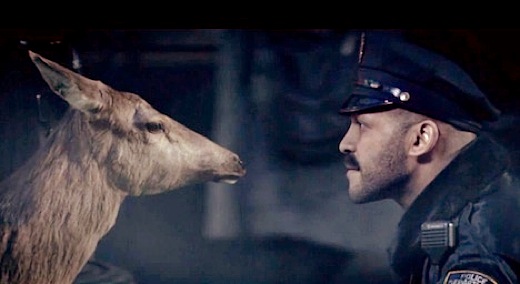
Image above: Still from "We Miss You" video below.

[IB Publisher's note: This short video is not for the squeemish. It makes its point bluntly.]  

It could be said that the we divide our world into two extremes: the comfortable neighborhoods, towns, and cities that become the setting of our lives, and the wildness of nature -- though the two needn't always be so far removed. In a short film entitled "We Miss You" German-born director Hanna Maria Heidrich highlights the starkness of urban life while urging us to reconnect with the natural world, to surprisingly poignant and surreal effect.

Heidrich's work on the short earned her several prizes at the Cannes Film Festival, including 'Best European Branded Short', and it's no wonder why. The film's concept is eloquent in its simplicity, and remarkable for its execution.

Even despite the fact that there's one moment in particular that borders on comical (you'll know what I'm talking about), it is nevertheless a powerful depiction of how disconnected many of us have become to the 'wild' world around us.

Video above: "We Miss You" from fireapple films .From on Vimeo at (https://vimeo.com/25943947).


According to the film's web site, 'We Miss You' was produced by "three film students who didn't care about nature," adding that this was their way of "doing something."

"We only miss what we love," the filmakers continue. "Our aim is to get people back in touch with nature."

.