Showing posts with label Hunting. Show all posts

The energy of picking berries

SUBHEAD: What Return on Energy Invested (EROI) do we need to reasonably pick berries.

By Ugo Bardi on 14 August 2017 for Cassandra's Legacy -
(http://cassandralegacy.blogspot.com/2017/08/which-eroi-do-we-need-to-collect-berries.html)


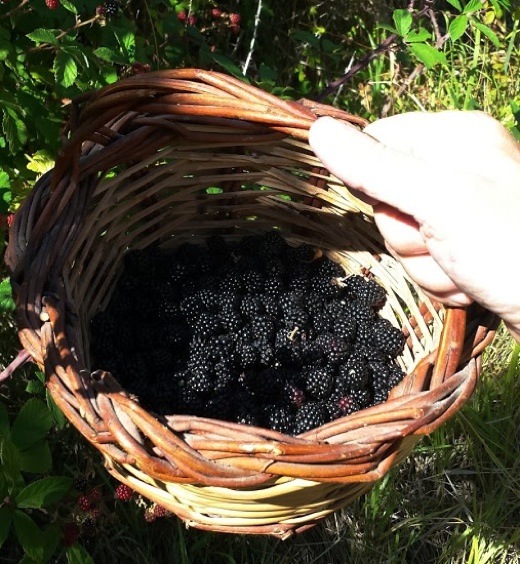
Image above: A basket of blackberries picked in Tuscany, From original article.

Above a photo of my wife Grazia collecting berries in the woods of Tuscany in a hot day of August. It maybe her ancestors were doing exactly the same, more or less in the same place, hundreds or thousands of years ago.

Here, I present some reflections and some calculations showing that the EROI of this simple way of collecting food may be over 100, better than almost anything we have nowadays. Of course, no empire in history was based on hunting and gathering, but was that a bad thing?

The question of EROI - the energy return on energy invested - is raging nowadays, with some people insisting that a civilization cannot exist without an EROI of at least variously estimated values, at least 10 and higher (image on the right by Charles Hall). And that is said to mean we absolutely need sophisticated technologies, such as nuclear, in order to survive.

Yet, this morning I had been collecting berries in the wood with my wife and wondering: 'what is the EROI of what we are doing?'

A reasonably good EROI, I am sure, enough for what our ancestors needed when they survived on hunting and gathering. All you have to do is to walk in the woods, find the berries and pick them up (and watch your step, you don't want to fall into a thorn bush).

If our hunter-gatherer ancestors used this method, and if we are here today - their descendants - it means it was an effective strategy for survival. Collecting what you can find is an ancient and tested strategy that goes under the name of "gleaning" and it has accompanied humankind for millennia. It is a good strategy just because it is so simple: no tools, no laws, no hierarchy. And it works.

As I was collecting berries, I started thinking things. How to program a drone to collect berries, for instance. Sure: a perfect way to bring down the EROI of the whole thing to nearly zero. And to destroy the bushes forever.

Humans are like this, with their attempt of "improving" things they always pull the levers in the wrong direction. And that means making things more complicated, needing more and more energy to keep them running, and then complaining that we don't have enough.

Of course, with more than seven billion humans on this planet, it is hard to think that we can go back to gleaning to feed them all.

But for how long we can trust the expensive, complex, delicate, and terribly inefficient enterprise we call "industrial agriculture"? I can't say. What I can say is that collecting berries is a big satisfaction, as you see below.

And now some approximate calculations: Today we collected 2 kg of berries. According to the available data, berries contain 125 kJ/100g. So, the total collection was about 2500 kJ, about 700 Wh.

Now, it was about one hour of low-intensity work for two people, so let's say it involved a total of 50x2x1h = 100 Wh of human work. Then, I found values of 20-25% for the human metabolic efficiency of converting food to mechanical energy, it means we consumed some 400-500 Wh of food energy in order to collect 700 Wh.

Very approximate, or course, but the final result is an EROI = 1.4-1.7. Not comparable to crude oil, but probably more than enough for our ancestors to enjoy berries as a seasonal treat.

But, of course, no one ever lived on berries alone, not even in paleolithic times. The energy content of several kinds of foods that you can find in a natural environment may be more than an order of magnitude larger than that of blackberries.

Walnuts are reported to have more than 10,000 kJ/100 g. If you can collect one kg/hour, as we did for berries, it means an EROI of more than 100 (!!). Larger than the mythical EROI of crude oil of a hundred years ago.

 Wheat and cereals, in general, have also high energy content, wheat is reported to have 15,000 kJ/kg, showing how gleaning could be an extremely efficient food gathering strategy.

So, life was simple and easy, once, until we decided to make it complicated and difficult.


.

DAPL battle not over

SUBHEAD: A federal judge ruled an environmental review of the project was inadequate, and ordered it redone.

By Nick Visser on 15 June 2017 for Huffington Post -
(http://www.huffingtonpost.com/entry/judge-dakota-access-pipeline_us_594233bbe4b003d5948d22e7)


Image above: A demonstrator holds a ‘Water Is Life’ sign in front of the White House during a protest against the Dakota Access Pipeline in Washington, D.C. From original article.

A federal judge on Wednesday said an environmental review of the controversial Dakota Access Pipeline was inadequate, handing a last-minute victory to Native American tribes and environmentalists who have long opposed the project.

In a 91-page decision, U.S. District Court Judge James Boasberg said the Army Corps of Engineers, which gave its final approval to the oil project in February, “did not adequately consider the impacts of an oil spill on fishing rights, hunting rights, or environmental justice, or the degree to which the pipeline’s effect are likely to be highly controversial.”

Boasberg ordered the agency to conduct new reviews of those sections of its environmental analysis, but did not halt the use of the pipeline, which began flowing oil on June 1.

The Standing Rock Sioux tribe, which filed the lawsuit, called Wednesday’s decision a “significant victory.”

“The previous administration painstakingly considered the impacts of this pipeline, and President Trump hastily dismissed these careful environmental considerations in favor of political and personal interests,” tribe chairman Dave Archambault said in a statement. “We applaud the courts for protecting our laws and regulations from undue political influence, and will ask the Court to shut down pipeline operations immediately.”

The $3.8 billion, 1,170-mile pipeline has been at the center of an environmental battle for more than a year after thousands of activist, many with Standing Rock, descended on a small region of North Dakota to protest. The monthslong standoff drew international media attention and led the Army Corps of Engineers to pull the plug on the project.

However, just weeks into his presidency, Donald Trump signed an executive order reopening both the Dakota Access and Keystone XL pipelines. Now in operation, at its peak, the Dakota Access pipeline could ship up to 570,000 barrels of oil a day.

The courts have previously rejected legal arguments to shut down the pipeline. Boasberg in February allowed the project to go ahead after siding with its owner, Energy Transfer Partners, over a lawsuit that alleged the pipeline threatened cultural and historic sites.

The judge said he would consider whether the pipeline should shut down while a new environmental review is being conducted at a later time, The Guardian reports.

“This decision marks an important turning point. Until now, the rights of the Standing Rock Sioux Tribe have been disregarded by the builders of the Dakota Access Pipeline and the Trump administration ― prompting a well-deserved global outcry,” Jan Hasselman, an attorney for the group Earthjustice, which represented the Standing Rock Sioux, said in a statement:

“The federal courts have stepped in where our political systems have failed to protect the rights of Native communities.”

See also:
Ea O Ka Aina: Defense contractors fought NoDAPL 5/27/17
Ea O Ka Aina: Tribes divest DAPL Bankers 2/13/17
Ea O Ka Aina: Veterans defending NoDAPL 2/11/17
Ea O Ka Aina: Army Corps okays DAPL Easement  2/8/17
Ea O Ka Aina: Trump orders go on DAPL EIS 2/3/17
Ea O Ka Aina: Water Protectors pipeline resistance 2/1/17 
Ea O Ka Aina: Force a full EIS on DAPL 1/27/17
Ea O Ka Aina: Missile launcher at Standing Rock 1/19/17
Ea O Ka Aina: Lockdown at Trans-Pecos Pipeline 1/10/17
Ea O Ka Aina: Standing Rock has changed us 12/9/16
Ea O Ka Aina: As Standing Rock celebrates... 12/5/16
Ea O Ka Aina: Army Corps denies easement 12/4/16
Ea O Ka Aina: My Whole Heart is With You 12/2/16
Ea O Ka Aina: The Loving Containment of Courage 12/1/16
Ea O Ka Aina: The Beginning is Near 12/1/16
Ea O Ka Aina: Feds to shutdown NoDAPL Camp 11/25/16
Ea O Ka Aina: NoDAPL people are going to die 11/23/16
Ea O Ka Aina: Hundreds of vets to join NoDAPL 11/22/16
Ea O Ka Aina: Obama must support Standing Rock 11/21/16
Ea O Ka Aina: Trump's pro oil stance vs NoDaPL 11/15/16
Ea O Ka Aina: Kauai NoDAPL Demonstration 11/12/16
Ea O Ka Aina: Obama to Betray Standing Rock 11/12/16
Ea O Ka Aina: Trump impact on Standing Rock 11/12/16
Ea O Ka Aina: Ann Wright on Standing Rock 11/8/16
Ea O Ka Aina: Turning Point at Standing Rock 11/6/16
Ea O Ka Aina: Jackson Browne vs DAPL owner 11/5/16
Democracy Now: Boycott of DAPL Owner's Music Festival
Ea O Ka Aina: World responds to NoDAPL protests 11/5/16
Ea O Ka Aina: NoDAPL victory that was missed 11/5/16
Ea O Ka Aina: DAPL hid discovery of Sioux artifacts 11/5/16
Ea O Ka Aina: Dakota Access Pipeline will leak 11/5/16
Ea O Ka Aina: Route of the Dakota Access Pipeline 11/4/16
Ea O Ka Aina: Sanders calls for stopping DAPL 11/4/16
Ea O Ka Aina: Obama hints at DAPL rerouting 11/3/16
Ea O Ka Aina: New military attack on NODAPL 11/3/16
Ea O Ka Aina: How to Support NoDAPL 11/3/16
Unicorn Riot: Tweets from NoDAPL 11/2/16
Ea O Ka Aina: Standing Rock & the Ballot Box 10/31/16
Ea O Ka Aina: NoDAPL reclaim new frontline 10/24/16
Ea O Ka Aina: How far will North Dakota go? 10/23/16
Ea O Ka Aina: Amy Goodman "riot" charge dropped 10/17/16
Ea O Ka Aina: Amy Goodwin to face "Riot Charge" 10/16/16
Ea O Ka Aina: Shutdown of all tar sand pipelines 10/11/16
Ea O Ka Aina: Why Standing Rock is test for Oabama 10/8/16
Ea O Ka Aina: Why we are Singing for Water 10/8/16
Ea O Ka Aina: Labor's Dakota Access Pipeline Crisis 10/3/16
Ea O Ka Aina: Standing Firm for Standing Rock 10/3/16
Ea O Ka Aina: Contact bankers behind DAPL 9/29/16
Ea O Ka Aina: NoDAPL demo at Enbridge Inc 9/29/16
Ea O Ka Aina: Militarized Police raid NoDAPL 9/28/16
Ea O Ka Aina: Stop funding of Dakota Access Pipeline 9/27/16
Ea O Ka Aina: UN experts to US, "Stop DAPL Now!" 9/27/16
Ea O Ka Aina: No DAPL solidarity grows 9/21/16
Ea O Ka Aina: This is how we should be living 9/16/16
Ea O Ka Aina: 'Natural Capital' replacing 'Nature' 9/14/16
Ea O Ka Aina: The Big Difference at Standing Rock 9/13/16
Ea O Ka Aina: Jill Stein joins Standing Rock Sioux 9/10/16
Ea O Ka Aina: Pipeline temporarily halted 9/6/16
Ea O Ka Aina: Native Americans attacked with dogs 9/5/16
Ea O Ka Aina: Mni Wiconi! Water is Life! 9/3/16
Ea O Ka Aina: Sioux can stop the Pipeline 8/28/16
Ea O Ka Aina: Officials cut water to Sioux 8/23/16


.

The blood on my hands

SUBHEAD: Just because we don't pull the trigger we are all culpable in the killing that our lifestyle requires.

By Brian Miller on 9 August 2015 for Winged Elm Farm -
(http://www.wingedelmfarm.com/blog/2015/08/09/the-blood-on-my-hands/)


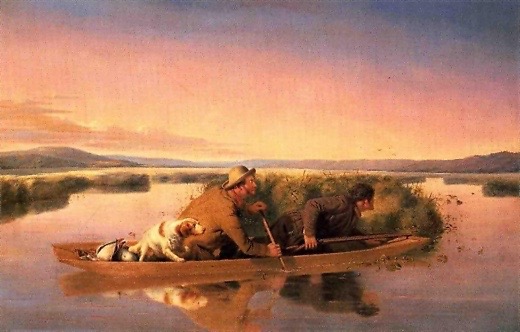
Image above: Painting of  "Duck Hunters On The Hoboken Marshes" by William Tylee Ranney, 1849, Boston Museum of Fine arts. From (http://americanartgallery.org/artist/details/view/sshow/id/458).

I laid out my shotguns and deer rifle on a folding table outside the kitchen window. With fall around the corner, it was time to clean and oil the guns. It’s a methodical process that is satisfying to undertake on objects that are a beautiful marriage of design and utility.

Using a kit made for the purpose, I rammed the cleaning rods through the barrels, oiled the working parts, and rubbed the wood stocks till they shone. I finished just as guests arrived for dinner, returning the guns to the cabinet as they walked up the drive.

Growing up in Louisiana I, alongside my father and brother, hunted and fished year round. It was a rare week that did not find me crouching in a duck blind, running trot lines, crabbing, or catching crawfish.

Game, fresh- and saltwater fish, shrimp, and oysters easily provided five dinner meals out of seven for our household. Staying up late at night cleaning and gutting fish, setting the alarm every two hours to run the trot-line, waking up at 3 a.m. to get to the duck blind or be on the open gulf by sunrise, all were part of the landscape of my childhood.

Mine was the hunting and fishing of providence, not of the trophy hunter. It was the experience of a profoundly masculine world. From the catching, shooting, and cleaning to, in many cases, the cooking, it was a culture of men putting food on the table for their families.

It wasn’t needed in the middle class home of my father—he certainly could have provided all of our meat needs from the grocery store—but it was a lifestyle I shared with most of my friends growing up.

There was always an exhilaration in making a good shot or setting the hook on a large fish. It provided, and still does, a sense of accomplishment that is part evolutionary and large part tribal.

The camaraderie of men in camp, the solitude of the hunt, being on the water by myself, or with my father, the rituals of killing and of eating, each shaped who I am as a person.

Perhaps it is counterintuitive, but killing another living creature can teach a person a lot about nature. Putting that act of killing in its “proper place” reminds us of where we came from and where we belong. And remembering our place in a natural order may be the best way to save this planet.

A detractor could argue against the killing, the male role in that culture, and I would listen and perhaps agree in part. But my defense is simple and straightforward: I prefer to be the one with blood on his hands. I believe it is a stance that makes me more, not less, sensitive to the value of life. It is the same reason I butcher poultry and livestock. It seems more honest.

Some may be shaking their heads right now. But as we collectively pile into our cars, while away our hours shopping, allow our kids to grow up without seeing the light of day as they game their way into perpetual adolescence, move from air-conditioned office to air-conditioned vehicle to air-conditioned home, with all that those actions entail to the planet, we might ask ourselves a hard question: who are we kidding?

Whether vegetarian or meat eater, just because we do not pull the trigger or set the hook, we are all culpable in the killing that our lifestyle requires.

.

Global warming and woolly mammoth

SUBHEAD: Rapid global warming major contributor to extinction of mega fauna of North America.

By Brian Palmer on 24 Jult 2015 for On Earth -
(http://www.onearth.org/earthwire/rapid-warming-not-hunters-killed-woolly-mammoth)


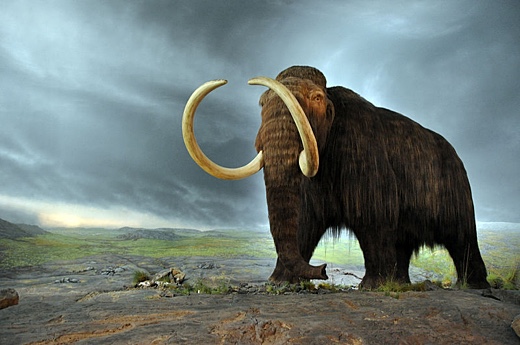
Image above: Diorama of woolly mammoth n the Royal BC Museum in Victoria (Canada). The display is from 1979, and the fur is musk ox hair. From original article and (https://commons.wikimedia.org/wiki/File:Woolly_mammoth.jpg).

Humans are truly self-important creatures. No matter what happens, we think it must have been our doing. Lightning cracks and earthquakes? We obviously angered God. Your team wins a football game? It’s because you wore your lucky jersey. Woolly mammoths go extinct thousands of years ago? Well, we must have killed them.

That last example is called the “overkill hypothesis.” At the end of the Pleistocene, around 11,000 years ago, many large mammals, like the woolly mammoth and the giant ground sloth, died out.

 Paleontologists have argued for centuries about what killed these so-called “megafauna.” The overkill hypothesis, proposed 40 years ago by geoscientist Paul Martin, holds that humans swept into their habitats and hunted the giants to extinction. (This idea is also called the “blitzkrieg model,” but let’s stick with “overkill hypothesis”—I prefer not to liken our hunter-gatherer ancestors to the Nazis.)

 The theory had a good run. Humans got to spend several decades imagining themselves as the descendants of super-hunters who swept aside the strongest beasts nature had to offer.

Unfortunately, the likely truth is less impressive. The overkill hypothesis is wrong—or at least incomplete. A series of more recent studies shows that forces much larger than humans were primarily responsible for the disappearance of the great mammals of the Pleistocene. First, archaeologists have pointed out that only two of the 36 animals that went extinct during this period show evidence of having been hunted by humans.

Last year, researchers showed that many of the megafauna in the American Northeast were already or almost gone when humans rolled through.
Photo: ДиБгд/Wikimedia CommonsMegatherium, an extinct genus of elephant-sized ground sloths.
If humans didn’t single-handedly kill those great beasts, then who or what did?

Rapid climate change has long been a prime suspect, but some of the pieces didn’t quite fit. Paleontologists could find little evidence of mass extinctions during the coldest part of the last ice age—the period during which you’d expect climate change to be taking its toll.

It now seems that we were looking at the wrong end of the process. For some reason, people are inclined to think of cold as the more dangerous temperature extreme. Perhaps it’s hard-wired into the human brain.

But heat is just as deadly, if not more so. And it now looks as though rapid warming at the end of the ice age—not the frigid cold of the ice age itself—was largely responsible for the megafauna extinction.

Today, a team of geneticists reported in Science that DNA evidence from the late Pleistocene shows the major turnover of species lines up perfectly with a period of sudden climate oscillations identified in ice cores. These samples of ancient ice carry a record of the composition of the earth’s atmosphere going back hundreds of thousands of years.

The study doesn’t end the extinction mystery entirely, since warming at the end of the Pleistocene probably couldn’t have killed the megafauna without help. It’s not as though a few degrees of temperature increase gave the mammoths heat stroke, and they crumpled into a lifeless woolly pile.

One possibility is that temperature shifts changed the food supply. Woolly mammoths, giant ground sloths, and other megafauna appear to have been herbivores. (At least, that’s what their dung suggests.) Last year, a team based in Europe argued that the ice age reduced the population of protein-rich plants called “forbs,” a family that includes the modern sunflower.

When the temperature eventually rebounded, new plants more suited to the warmer climate replaced the forbs and greatly limited the availability of plant-based protein.

Humans probably also played a supporting role.

“The abrupt warming of the climate caused massive changes to the environment that set the extinction events in motion,” says Chris Turney, a paleoclimatologist at Australia’s University of New South Wales and a coauthor of today’s study. “But the rise of humans applied the coup de grace to a population that was already under stress."

Think of humans as the matador, the guy who comes in at the end of a bullfight and takes all the credit for killing a bull that has been weakened to the edge of death by a bunch of other guys. Suddenly, we don’t sound so tough.

.

Whodunit? The foragers

SUBHEAD: Archeologists have been far too eager to brand ancient cultures as farmers on flimsy evidence. 

By Vera Bradova on 11 February 2015 for Leaving Babylon -
(https://leavingbabylon.wordpress.com/2015/02/11/whodunit-the-foragers/)


Image above: Hunter-gaterers, or foragers, in what appears to temperate north America. From original article.

Dogs diverged genetically from wolves more than 100,000 years ago, during the previous warm interglacial. Did humans have anything to do with it? The oldest known dog skeletons are from 36 and 33,000 years ago, found in Belgium and Siberia. A child was exploring the Chauvet cave, using a torch to look at the artwork while a dog followed… 26,000 years ago, well before the Ice Age Maximum.

When the cold began to let up, some 17,000 years ago, the people of the Pyrenees living at the Isteritz cave took such good care of a reindeer with a broken leg, it survived for two years (viz Paul Bahn: Pre-neolithic control of animals, 1984, and his response to ongoing controversy). By 15,000 years ago, pictures of horses with rope halters appear in the Magdalenian cave art of SW France.

Foragers created the first magnificent art. They built the first temples and the first high-density towns with thousands of inhabitants. They invented ovens and kilns, cookworthy pottery, wine and beer. They clearly domesticated the dog and probably tamed reindeer and horses.

So perhaps it’s not such a stretch to believe that they also domesticated the pigs, sheep and goats and a whole slew of plants, from grains to squash, gourds, and legumes, to delicacies like chocolate, vanilla, and chili peppers. Even more amazingly, it was rock-shelter dwelling, semi-nomadic foragers who spent hundreds of years patiently experimenting with the unpromising teosinte to bring about maize. Then they spent thousands of years more improving the new tiny-cobbed plant before settling down to grow it as a staple.

If a group of foragers plants a plot of squash near their favorite cave, then comes back in late summer to harvest their bounty, can they legitimately be called farmers? If another group of foragers raises some pigs while living off wild foods (and eating no cereals), can they be called farmers?

If Egyptian foragers throw a bunch of traded domesticated wheat down into the rich alluvial mud on the banks of the Nile, perhaps to brew some beer, but otherwise live the hunting-fishing-gathering lifestyle, how are they any different from the Californian native foragers or the Aborigines who spread some favorite seeds and flooded them by diverting a creek’s spring runoff?

Perhaps we need a new term, one that would reflect the foragers’ sophisticated plant manipulation skills that nevertheless did not, by themselves, lead to the predominantly farming life.

Archeologists have been, in my opinion, far too eager to brand cultures as farmers on flimsy evidence. It appears that farming is much younger than previously claimed. The first farming village was found in Egypt, dated to only 7,000 years ago.

As Melinda A. Zeder, an archeobiologist, states:
This broad middle ground between wild and domestic, foraging and farming, hunting and herding makes it hard to draw clean lines of demarcation between any of these states.

Perhaps this is the greatest change in our understanding of agricultural origins since 1995.
The finer-resolution picture we are now able to draw of this process in the Near East (and, as seen in the other contributions to this volume, in other world areas) not only makes it impossible to identify any threshold moments when wild became domestic or hunting and gathering became agriculture but also shows that drawing such distinctions actually impedes rather than improves our understanding of this process.

Instead of continuing to try to pigeonhole these concepts into tidy definitional categories, a more productive approach would be to embrace the ambiguity of this middle ground and continue to develop tools that allow us to watch unfolding developments within this neither-nor territory.

.

Go Nuclear or Go Native

SUBHEAD: Being indigenous isn't really so bad, considering the alternative. It's just means being in a community in a place in the world.

By Juan Wilson on 20 October 2014 for Island Breath -
(http://islandbreath.blogspot.com/2014/10/go-nuclear-or-go-native.html)


Image above: Ceremony of the lighting of the Indigenous Sacred Fire in Cuiaba November 8, 2013. Forty-eight Brazilian tribes presented their cultural rituals and competed in traditional sports such as archery, running with logs and canoeing during the XII Games of Indigenous People.
From (http://totallycoolpix.com/2013/11/the-xii-games-of-indigenous-people/).

GOING NUCLEAR
There are several movers and shakers in the world that I have had respect for who have come to realize the desperate situation that modern mankind faces. This group senses that Peak Energy and Climate Change (due to the burning of the afore mentioned energy) are conspiring to put Modern Civilization off the road and in the ditch.

As mentioned before on this blog the group includes:
  • James Hansen -  NASA atmospheric physicist; climatologist; Climate Change activist.
  • James Lovelock - proponent of the Gaia Hypotheses; author "The Vanishing Face of Gaia".
  • Steven Hawking - cosmologist of Black Holes; author of "A Brief History of Time".
  • Stewart Brand - founder of the Whole Earth Catalog and The Long Now Foundation.
  • Bill Gates - software engineer, founder of Microsoft, philanthropist, author of "The Road Ahead".
These guys perceive, quite rightly, that there aren't many ways to stay on the road and keep the wheels turning. The universities, the industries, the technology hubs, medical research facilities, the information/entertainment networks all require a level of refinement and continuous clean energy that does not appear possible with our current means.
    This group has concluded that there is no way forward but a crash course of building nuclear power plants to support the power grid and information systems and organizations that sustain Modern Civilization throughout the world. This would require the construction of several hundred nuclear power plants to replace virtually all the oil, coal and natural gas power generating stations in the world.

    There is plenty of Main Stream Media techno-porn about "New" and "Improved" nuclear power technology:

    Popular Science: Compact Fusion Reactor  10/17/14
    As they look to the sun Lockheed is working to develop a source of infinite energy... Suuuure.

    The Telegaph: Molten Salt Nuclear Reactors 9/24/14
    A revolution in nuclear power could slash costs of energy below cost of coal... Suuuure.

    Forbes Magazine: Small Modular Reactors  5/13/14
    Safe as a nuclear sub. These units be installed anywhere to supply needed power... Suuuure.

    The facts are that the infrastructure to support a nuclear powered future does not exist and the resources to create and sustain that infrastructure do not exist.

    As one example: We simply will not be able to repair and maintain the US Interstate Highway System necessary to provide the support for building, operating, and decommissioning of those nuclear power plants we want to build.

    Just need for concrete, steel, and paving that is required for the bridges, over/under passes, culverts and roadways is monumental. As it is, our highway systems are crumbling and we do not seem to have the ability to keep up with its decay. Just imagine the lack of highway repair if we get to the point that interstate trucking is an unprofitable undertaking due to the cost of diesel fuel.

    Although they won't yet admit it, Japan has demonstrated that nuclear power is a dead-end. The continuing massive release of radioactive material into the Pacific Ocean and the contamination of a large section of the middle third of Honshu Island (including greater Tokyo) is a permanent testament to the folly of nuclear power.

    Japan's economy has been destroyed. The fact is hat they cannot afford to keep the Toyota, Nissan, Hitachi, and Mistubishi industries running on oil and they do not dare restart their 50 nuclear plants. This will be much clearer when the thyroid cancers emerge and other debilitating consequences of the Fukushima nuclear plant failure can no longer be hidden.

    GOING NATIVE

    However, there is an alternative to nuclear already in hand. As early as late 2011 James Howard Kunsler precicted (http://www.kunstler.com/Mags_Forecast2012.php):
    Turning to Japan....That sore beset kingdom is suffering all the blowback of modern times at once: the Godzilla syndrome up in Fukushima; a demographic collapse; an imminent bond crisis; the collapse of export market partners; and a long, agonizing death spiral of its banks. I stick by a prediction I tendered back in March, after the deadly tsunami: Japan will decisively opt for a return to pre-industrial civilization. Why not? The rest of the world will be dragged kicking and screaming to the same place. Let Japan get there first and enjoy the advantage of the early adapter - back to an economy of local, hand-made stuff, rigid social hierarchy, folkloric hijinks in whispering bamboo groves, silk robes, and frequent time outs for the tea ceremony.
    I wholeheartedly agree with Kunstler on this point and see that there is really no alternative to climbing down off our high horse and dealing with reality.

    It seems the cost of keeping Western Civilization running is too expensive for the planet Earth to handle. As a result we will soon be forced to close that franchise or face the consequences - which likely will include several ramifications that could be called Extinction Level Events (ELE). Those would include among other things:
      • Worldwide economic collapse due loss of non-renewable resources - Peak Everything.
      • Massive desertification and/or soil loss in food producing areas of the world; 
      • Wars fought with WMDs for diminishing resources - especially water, food and fuel.
      • Multiple breaches of nuclear containment facilities due to industrialization's failures;
      • Extinguishing of world's coastal urban centers due to global warming ocean level rise;
      • Loss of knowledge and technological skill resulting from failure of information systems.
      What will be needed as a base to work from is being able to conduct our lives with the energy and renewable resources immediately around us. That means sun, water, animals, plants and soil where we live.

      For some places and peoples that may mean being hunter/gatherers with no fixed settlements; for others that may mean small rural gardening communities. The point is that the hunters and gardeners will be the rule not the exception. We will be indigenous, finally again.

      This does not mean we will have no education or culture. But the subject matter and art forms however will be your own responsibility.

      There will be repositories of knowledge - likely in the country monastery or manor library. There may even be villages with a school and the occasional town with a university, but they will be the exception not the rule.

      Being indigenous isn't really so bad, considering the alternative. It's just means being in a community in a place in the world... and not somewhere else. It also means embracing that arrangement.

      Forget the airports, the strip malls, the office cubicle and the cul-de-sac. You won't have to go there anymore. In fact you won't be able to. But you will have to get together to make dinner then make some music.

      Go Nuclear or Go Native. There won't be much in between.

      .

      Dark skin - Blue eyes

      SUBHEAD: Light skin genes evolved more recently than previously thought. Related to agriculture not latitude.

      By Tia Ghose on 27 January 2014 for Huffington Post -
      (http://www.huffingtonpost.com/2014/01/27/light-skin-genes-dna_n_4673328.html)


      Image above: A progression of sketches shows how a skull and genetic clues were combined to come up with the look of a 7,000-year-old hunter-gatherer who lived in Spain. From (http://www.nbcnews.com/science/dark-skin-blue-eyes-genes-paint-picture-7-000-year-2D11996418).

      In ancient European hunter-gatherer man had dark skin and blue eyes, a new genetic analysis has revealed.

      The analysis of the man, who lived in modern-day Spain only about 7,000 years ago, shows light-skin genes in Europeans evolved much more recently than previously thought.

      The findings, which were detailed today (Jan. 26) in the journal Nature, also hint that light skin evolved not to adjust to the lower-light conditions in Europe compared with Africa, but instead to the new diet that emerged after the agricultural revolution, said study co-author Carles Lalueza-Fox, a paleogenomics researcher at Pompeu Fabra University in Spain.

      Sunlight changes
      Many scientists have believed that lighter skin gradually arose in Europeans starting around 40,000 years ago, soon after people left tropical Africa for Europe's higher latitudes. The hunter-gatherer's dark skin pushes this date forward to only 7,000 years ago, suggesting that at least some humans lived considerably longer than thought in Europe before losing the dark pigmentation that evolved under Africa's sun.

      "It was assumed that the lighter skin was something needed in high latitudes, to synthesize vitamin D in places where UV light is lower than in the tropics," Lalueza-Fox told LiveScience.

      Scientists had assumed this was true because people need vitamin D for healthy bones, and can synthesize it in the skin with energy from the sun's UV rays, but darker skin, like that of the hunter-gatherer man, prevents UV-ray absorption.

      But the new discovery shows that latitude alone didn't drive the evolution of Europeans' light skin. If it had, light skin would have become widespread in Europeans millennia earlier, Lalueza-Fox said.
       
      Mysterious find

      In 2006, hikers discovered two male skeletons buried in a labyrinthine cave known as La Braña-Arintero, in the Cantabrian Mountains of Spain. [Images of the Ancient Skeletons]

      At first, officials thought the skeletons may have been recent murder victims. But then, an analysis revealed the skeletons were about 7,000 years old, and had no signs of trauma. The bodies were covered with red soil, characteristic of Paleolithic burial sites, Lalueza-Fox said.

      At the time of the discovery, genetic techniques weren't advanced enough to analyze the skeletons. Several years later, the team revisited the skeletons and extracted DNA from a molar tooth in one skeleton. (The other skeleton had been sitting in water for millennia, so his DNA was more degraded, Lalueza-Fox said.)
       
      Blue eyes, dark skin

       The new analysis of that DNA now shows the man had the gene mutation for blue eyes, but not the European mutations for lighter skin.

      The DNA also shows that the man was more closely related to modern-day northern Europeans than to southern Europeans.

      The discovery may explain why baby blues are more common in Scandinavia. It's been thought that poor conditions in northern Europe delayed the agricultural revolution there, so Scandinavians may have more genetic traces of their hunter-gatherer past — including a random blue-eye mutation that emerged in the small population of ancient hunter-gatherers, Lalueza-Fox said.

      Skin changes

      The finding implies that for most of their evolutionary history, Europeans were not what many people today would call 'Caucasian', said Guido Barbujani, president of the Associazione Genetica Italiana in Ferrara, Italy, who was not involved in the study.

      Instead, "what seems likely, then, is that the dietary changes accompanying the so-called Neolithic revolution, or the transition from food collection to food production, might have caused, or contributed to cause, this change," Barbujani said.

      In the food-production theory, the cereal-rich diet of Neolithic farmers lacked vitamin D, so Europeans rapidly lost their dark-skin pigmentation only once they switched to agriculture, because it was only at that point that they had to synthesize vitamin D from the sun more readily.


      Image above: A contemporary dark skinned blue eyed boy from Sembehun in Sierra Leone who is deaf and mute. From (http://ngm.nationalgeographic.com/ngm/photo-contest/2011/entries/112262/view/).

      .

      When agriculture stops working #1

      SUBHEAD: Agriculture is no longer a given. The 10,000 year-old agricultural experiment may soon be coming to an end.

      By Dan Allen on 12 March 2013 for Resilience.org -
      (http://www.resilience.org/stories/2013-03-11/when-agriculture-stops-working-a-guide-to-growing-food-in-the-age-of-climate-destabilization-and-civilization-collapse)

      This is Part 1 of an essay in 2 parts. Part 1, below, outlines the issues. Part 2, offers 'Ten Recommendations for Growing Food in the Anthropocene
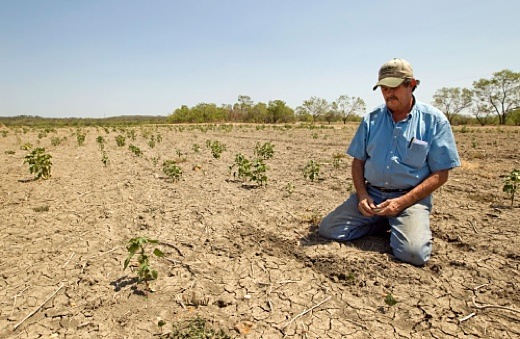

      Image above: A farmer in a failed field. From original article.

      “Well it's hotter 'n blazes and all the long faces / there'll be no oasis for a dry local grazier” – Tom Waits
       
       “What we’re seeing is stark evidence that the gradual temperature increase is not the important story related to climate change; it’s the rapid regional changes and increased frequency of extreme weather that global warming is causing. As the Arctic warms at twice the global rate, we expect an increased probability of extreme weather events across the temperate latitudes of the northern hemisphere, where billions of people live.” --  Jennifer Francis (http://thinkprogress.org/climate/2012/10/11/989231/noaa-bombshell-warming-driven-arctic-ice-loss-is-boosting-chance-of-extreme-us-weather/

       “[W]hen we learn that in the collapse now underway resides the seeds of a different style of agriculture that does not carry all the historic baggage that burdens us, we may, with good justification, rejoice.” – Albert Bates (http://www.resilience.org/stories/2013-02-27/going-deep)

      Summary 
      As the toxic trappings of industrial civilization crumble around us, agriculture is set to regain its place at the forefront of our daily American lives.  …And won’t we be surprised to find out that it barely works anymore!  Worsening climate destabilization, combined with the legacy of industrial ecosystem degradation and the loss of crucial pre-industrial agricultural genetics and knowledge, will severely challenge our ability to feed ourselves in the decades ahead.  So perhaps it’s time we re-think our modern food-acquisition strategies in the face of the massive changes bearing down on us.  …And I mean REALLY re-think them.

      References
      Below are some key resources to both back up the stuff I’m going to talk about and help people move ahead with the good work we need to do.

      I. Ten Agricultural Premises
      My main goal in this essay is to outline a suite of agricultural or food-acquisition strategies that might stand a chance in our climate-destabilized, civilization-collapsing future – and how we might go about laying the foundation for those strategies now.

      But before getting into the essay-proper, I think it’s a good idea to lay out the basic agricultural premises that underlie these recommendations. For example, if I tell you it’s a really good idea to hone your hunting and gathering skills (as I will do), an acceptance of that message will only take if you’re fully aware of the reasoning that gave birth to such a wild suggestion (pun intended). So here they are:

      Premise 1: The Earth’s climate is destabilizing.
      Humans are forcing an unprecedented destabilization of the global climate with fossil fuel CO2 emissions.  We are likely very close to (if not exactly at, or even past) a positive-feedback tipping point, beyond which most or all of the planet becomes uninhabitable to humans.  Due to inertia in the climate system, even if CO2 emissions stopped tomorrow, the worst climatic disruptions are ahead of us and will continue at least for many centuries.

      Premise 2: Our agriculture is adapted to the stable Holocene climate.
       Land-based human agriculture, the main source of bodily sustenance for North Americans, is adapted only to the stable Holocene climate of the past 10,000 years – the relatively predictable patterns (in both magnitude and timing) of temperature, rainfall, snowmelt, storm intensity, and pest densities in any given region.  Unfortunately, this is a climate our species will likely never see again.

      Premise 3: Climate destabilization will severely stress agriculture.
      Climatic destabilization will severely stress the viability of human agriculture via extremes in these traditional climatic patterns – e.g., extremes in the magnitude and timing of temperature, rainfall, snowmelt, storm intensity, and pests.  Such stresses have indeed already begun, and will intensify over the coming years, decades, and centuries as the climate continues to destabilize.

      Premise 4: Collapse of industrial civilization will magnify the climatic stresses.
      These already-severe agricultural stresses from a destabilizing climate will be magnified by industrial depredations (past, present, and future) and disruptions from the ongoing collapse of industrial civilization.  Specifically, these magnifying factors include rapid disappearance of the fossil fuel platform for current agricultural practices, loss of pre-industrial agricultural technology and genetics, soil loss and degradation, bioaccumulation of toxins (metals, organics, and nuclear), depletion of fossil aquifers, as well as war and social strife.   Post-industrial deforestation and mounting ocean acidification will also have deleterious indirect effects on terrestrial agriculture.

      Premise 5: Agriculture will unavoidably shrink in scale and technological complexity. 
      The combination of climatic destabilization, past/residual industrial depredations, and collapse of industrial civilization will unavoidably shrink the scale and technological complexity of human agriculture.  Agriculture will quickly evolve from (1) today’s doomed, high-tech, huge-scale operations, to (2) still-fragile, large-scale, mechanized operations, to (3) a medium-scale, draft-animal-based agriculture, to (4) a small-scale, ‘primitive’ human-labor-based agriculture, to (5) increasing reliance on managed hunting and gathering, and perhaps finally to (6) regional extirpation.  Different societies will differ in the rate and ultimate level of agricultural simplification based on geographical, ecological, and social factors -- but the general trends will be near-universal and undoubtedly severe.

      Premise 6:  Ecological complexity in agriculture will necessarily replace technological complexity.
       Challenged by (1) the disappearance of essentially all industrial agricultural technology, (2) the loss of much pre-industrial agricultural technology to cultural erosion, (3) severely degraded agricultural ecosystems, and (4) worsening climatic destabilization, successful human food acquisition will necessarily rely increasingly on ecological knowledge and assistance – what we can perhaps call ‘ecological technology’.  We will need to return humbly, thankfully, and thoughtfully to ‘the tangled bank.’  And given the climatic, ecological, and social challenges bearing down on us, such an ecological awakening will not be optional for human survival.

      Premise 7: A polyculture of perennial vegetation has the best chance of providing food for humans in the future. 
      In light of challenges outlined above, a diverse polyculture of perennial vegetation has many advantages over the largely-annual monocultures of traditional human agriculture: more robust structural integrity, improved soil-holding and building ability, superior nutrient and water gathering efficiency, decreased annual labor inputs, more efficient gathering of sunlight, longer annual period of active photosynthesis, and less reliance on precise rainfall and temperature patterns.  As such, an agriculture based largely on a rich diversity of ecologically-managed, food and fiber-producing perennials embedded within diverse perennial-based wild ecosystems will exhibit maximum resilience and stand the best chance of providing food in our climate-destabilized, civilization-collapsing future.

      Premise 8:  Our current ‘leaders’ will not aid the necessary transition to an ecologically-sound perennial agriculture – they will hinder it.
      The crucial near-term response of the ‘powers that be’ (corporations, national governments) to the gathering existential agricultural emergencies will continue to be, perversely and suicidally, their exacerbation – e.g., trying to maximize carbon emissions (even as they fall), accelerating industrial depredations, and a desperate inflating of the industrial bubble via economic and public-relations chicanery, resulting in a more rapid and destructive collapse when the bubble inevitably pops.  Lobbying of such ‘powers that be’ to change course has proven, at best, largely ineffectual – and perhaps even counter-productive, as it can perpetuate the illusion of ‘if only they understood’ and distract from constructive efforts possible at the local level.

      Premise 9:  Local responses are possible, necessary, and should begin ASAP.
       In this critical pre-collapse period, constructive responses to both our agricultural and broader predicaments will only be fashioned at the local and community level – a fact that is at once frightening, sad, embarrassing, and empowering.  These responses involve efforts to learn, preserve, and disseminate (1) a more resilient, ecologically-attuned agriculture, (2) hunting and gathering skills, along with the accompanying ecological knowledge and sensitivity, (3) craftsmanship and artistry in the manufacturing of basic necessities (tools, shelter, water infrastructure, medicines), and (4) key social skills, such as conflict-resolution, cooperation, and collaboration, as well as the cultivation of beauty, joyfulness, and thankfulness in our everyday lives.

      Premise 10: We may not succeed, but we must try.
       Livable outcomes in any given region are neither assured nor frankly probable at this point, but we must try – we have a moral, biological, and spiritual imperative to try.  …Because what do you do when human civilization gives you global catastrophe?  You make catastrophe-aid.  J

      …And now for the essay-proper:

      II. Growing Food in a Funhouse
      In that heady time before every American youth was enslaved by their portable electronics to the cold realm of cyberspace, end-of-summer fairs were the place to be.  The gaudy lights, the blaring tinny music, the hormone-addled teens, the strung-out carnies, the crumbling nuclear families with double-wide strollers, the way-too-made-up tweens, the ever-changing ribbons of smells pummeling your nostrils: cotton candy, cigarette smoke, fried dough, cheap perfume, diesel fumes, oily dust, italian ice…

      Ahhh...the (cough) memories!
       But more than anything, I remember a haunting, fair-themed nightmare I had around the time I was ten:  My friends and I were exploring a funhouse, but the place kept taking on a progressively more menacing vibe.  The normal funhouse elements -- the amusing surprises, the pleasant distortions of normality, the benign helplessness – were becoming less amusing, pleasant, and benign by the second.  At some point, after realizing that the funhouse was actually trying to kill us rather than fun us, I found myself alone in a barren field outside the funhouse, pock-marked with what appeared to be deep bomb craters.  Descending into one such water-filled crater, an alien (?!) reached out of the water, grabbed my leg, and pulled me under.  …And then I woke up.  (cold shiver)

      Psychoanalyze away, but that dream still haunts me to this day.  I can still see it, still feel it.  It still scares the hell out of me.  In fact, it’s starting to scare me more than ever these days.
      …Because it’s coming true.

      Earth’s climate, a key leg of the three-legged agro-ecological stool (climate, soil & ecosystem health, genetics), is taking on all the elements of that menacing funhouse from my nightmare – the increasingly-unpleasant surprises, the ominous distortions of normality, the growing feelings of helplessness among its victims.  …It’s all coming true.

      As David Korowicz warns of our collapsing civilization: we are going someplace we have never been before.  This is true economically, socially, and politically – but, most frighteningly, it is also true climatically.  We are in the process of forcing the climate into a state unlike anything our species, much less agriculture, has ever experienced.  Given that, is it really wise to expect our Holocene-adapted agriculture to function adequately in this new ‘evil-funhouse’ climate we’re making?  I would argue no.

      So perhaps then we need to rethink our modern food-acquiring strategies in the face of the massive changes now bearing down upon us, with all their challenges and inherent uncertainties.
      …And maybe we better start soon, no?

      III. The Making of a Funhouse Climate
      Let me be blunt here: We are wrecking the climate.  Or I should say, we have wrecked the climate.  Because by increasing the atmospheric CO2 from 280ppm to over 390ppm over the few hundred years of our industrial experiment, we have already wrenched the climate out of the relatively stable Holocene climate that gave birth to human agriculture.  And we have likely even wrenched the climate out of its million year long glacial-interglacial dance (to a 100K year beat!) during which our species developed.

      As UCLA climatologist Aradhna Tripati reported in Science in 2009, “The last time carbon dioxide levels were apparently as high as they are today…and were sustained at those levels…global temperatures were 5 to 10 degrees Fahrenheit higher than they are today, the sea level was approximately 75 to 120 feet higher than today, there was no permanent sea ice cap in the Arctic and very little ice on Antarctica and Greenland.”

      …And that was 15 million years ago, by the way – well before our species existed.
      We are stumbling suicidally into uncharted waters.  The arctic, warming at over twice the global average, is melting rapidly.  Summer arctic sea ice will likely be gone just a few years from now.  (See Figure 1, below.)  And with it will go the reflective albedo buffer to further rapid warming, as well as the regular weather patterns we count on for temperate Northern hemisphere agriculture.       
       But how exactly do warmer temperatures disrupt regular weather patterns?  Witness the ‘new, improved’ jet stream!  The Northern hemisphere jet stream, that bringer of crop-friendly weather systems to US agriculture, is having some problems.  Even the relatively meager warming to date of the arctic relative to the temperate latitudes appears to have already caused both a slowing and a more extreme meandering of the west-to-east winds of the jet stream.  (See Figure 2, below.)
      \
      And a slower, more randomly-meandering jet stream brings with it some weird, unpleasant weather to the agricultural bread-baskets of the world.  Larger-amplitude meanderings bring more extremes in hot and cold, often at rather odd times relative to what our crops and agricultural practices are adapted to.  And the slower movement of the jet stream means that these wacky weather systems stick around longer.  Often way too long.  (See short video embedded in link for Figure 2.)  Think of the brutal heat and dryness in the US 2011-12, Russia 2010, and France 2003.

      Indeed, the relatively modest warming of land and ocean temperatures experienced so far has already resulted in a noticeable increase in extreme temperature and rainfall events.  James Hansen has recently documented an alarming and steady shift in summer temperature extremes well beyond anything experienced even in recent times.  (See Figure 3, below.)  And similar upticks in frequencies of severe droughts and massive rainfall events have also been documented.  (Follow all the action at Joe Romm’s http://thinkprogress.org/climate/issue/?mobile=nc.)

      Oh, and did someone say ‘massively destructive storms’? Because as temperatures increase, so also do the strength of storms, with their eroding deluges, vast flooding, violent winds, and deadly storm surges. ‘Frankenstorms’ are indeed an apt term for these part-natural/part-human-caused monstrosities. Higher ocean, land, and air temperatures mean more water vapor pumped more rapidly into an atmosphere that can now hold that extra water. In turn, the extra water vapor in the atmosphere (+4-5%) provides both higher rainfall potential and more stored energy (‘latent heat’) to power the destructive winds. (See http://thinkprogress.org/climate/2012/10/28/1101241/cnn-bans-term-frankenstorm-but-its-a-good-metaphor-for-warming-driven-monster-largest-hurricane-in-atlantic-history/)

      And bear in mind that, due to inertia in the climate system, even if we stopped emitting CO2 tomorrow, there is still more destabilization in the pipeline – warming and its resulting ‘wacky weather’ that will persist for centuries and even millennia. That means significantly more arctic melting, more sea-level rise, more jet stream convulsions, more extreme weather events – the heat-waves, the droughts, the deluges, the hurricanes, the derechos.

      …And all the while, arctic methane feedbacks loom. If you have the stomach for it, watch this 20min video about the dire situation unfolding up North: http://www.youtube.com/watch?v=iSsPHytEnJM. We are children with hammers, banging on armed thermonuclear warheads. Clink. Clink. Clink-clink. Clunk…uh oh.

      In short, our sputtering fossil-fuel orgy is in the process of turning the stable Holocene into an ‘evil funhouse’ climate straight out of a nightmare – one where horrifying surprises pop up ever more frequently, where normal weather patterns are grotesquely and dangerously distorted, where we are increasingly helpless in our efforts to ‘adapt’ to a climate that appears more and more like it’s trying to kill us.

      …And all of this, of course, does not bode well for human agriculture.

      IV. The Coming Failure of Holocene-adapted Agriculture
      Let me tell you a secret: Human agriculture is no longer a given. This is, of course, only a ‘secret’ because so many people these days have so little knowledge of agriculture, climate, or ecology. …But it’s true: the 10,000 year-old agricultural experiment may soon be coming to an end.

      Human agriculture is, despite our culture’s unthinking faith in its inevitability, an exceedingly-fragile, three-legged stool resting on the shaky legs of (1) Holocene-like climate stability, (2) culturally-preserved genetics and agricultural knowledge, and (3) the health of the soil and surrounding ecosystems. Knock out any one of those and the stool comes a-tumblin’ down. And a culture blinks out.

      Because, contrary to popular opinion here in the spastic endgame of our death-dealing civilization, agriculture doesn’t come from shiny tractor dealerships, sacks of genetically-engineered ‘miracle’ seeds, heaping piles of fertilizer, tanks of [insert organism]icide, irrigation pipes, six-figure bank loans, and an ‘essentially-infinite’ torrent of fossil fuels. No -- it comes from the Earth, from the skies, from our bodies, and from a complex (and often heartbreakingly destructive) culture passed down from generation to generation .

      ...And without any thought to the consequences or to developing alternatives, we’re doing our damndest to snuff it out. Indeed, a lethal one-two-three punch of climate destabilization, accumulated/ongoing industrial depredations, and the chaos unleashed by a collapsing civilization will very likely bring human agriculture to its knees – possibly within the next few decades, and almost certainly within this century.

      So here’s a quick anatomy of our agricultural train-wreck, already in progress:  

      1.   Climatic Destabilization:
      The climatic requirement for agricultural viability represents a relatively narrow range – in both magnitude and timing – of a number of key variables: temperature, water (in the form of both rainfall and snowmelt), wind, and climate-influenced pest/disease densities. 

      Unfortunately, crops born of Holocene-era climate stability and further embrittled by industrial, fossil-fueled coddling and yield-maximization are sitting ducks for the kind of wacky, extreme weather they will increasingly face.  Decade-long crippling droughts, weeks of ultra-extreme high temperatures, surprise late-Spring freezes from a tortured jet stream, erosive levee-bursting deluges, salinization of delta farmland from increasingly-common and severe coastal storm surges, brutal outbreaks of weather-influenced pests and disease, and violent storms with crop-flattening winds – these are the kinds of things we’ll be dealing with.  And not once a decade, but likely every year – several times a year! 

      That’s the climate we’re making -- and it’s simply not the one Holocene agriculture signed up for.  And note again that this climate destabilization is not academic speculation or merely a reading of the climate-model tea leaves – it’s what we’re already seeing.  It’s already bad and already worsening exponentially.  (See http://thinkprogress.org/climate/2012/12/21/1278861/climate-story-of-the-year-extreme-weather-from-superstorms-to-drought-emerges-as-political-scientific-gamechanger/, as well as the climate references above.) 

      2.    Loss of Agricultural Genetics, Technology, and Knowledge:
      The second key requirement for human agricultural is the suite of culturally-preserved genetics (plant & animal) and accumulated agricultural technology/knowledge available to farmers.
      I think it scarcely needs to be said here that virtually the entire toolkit of industrial agricultural technology -- the fossil-fuel powered machines, the industrial chemical-dependent crop varieties and animal breeds, and the knowledge of how to manage such technologies -- will be next to useless without fossil fuels.  And sometime soon, we just won’t have fossil fuels to kick around anymore.  

      Why not?  Because the remaining ‘difficult half’ of fossil fuels – tricky enough to access with the industrial machine still humming along – will certainly remain in their dark geologic tombs once the economic wheels come off.  (And just in case, it will be up to the post-collapse ‘monkey-wrench gangs’ to ensure they do.  Long live Edward Abbey!  Long live Derrick Jensen!  Long live…you?)

      So where does that leave us?  It leaves us depending on agricultural genetics, technology, and knowledge that served us in pre-industrial times.  And unfortunately for human agriculture, a massive and mostly-unacknowledged loss of these resources has been occurring during the industrial era – a loss that has rapidly accelerated in recent decades.  (Now, I fully realize the destructiveness of many pre-industrial annuals-based agricultural practices -- and one could well argue ‘good-riddance’ -- but I’ll address that later in the essay when I discuss recommendations for the future.) 
        
      Diverse place-adapted pre-industrial varieties of crops and breeds of domesticated animals, each with their special attributes, have been increasingly sacrificed to a relative small number of industrial varieties and breeds with the narrowest of attributes: yield maximization in a high-input, fossil-fuel-drenched system.  This is unfortunate, of course, because a wide genetic variety will be needed to handle the challenging, unpredictable, low-input conditions that Anthropocene (Funhousocene?) agriculture will certainly face. 

      Need a chicken that doesn’t keel over in two weeks of 115 oF heat?  Oh sorry, that breed was lost.  Need a deeply-rooted, sprawling apple tree that can withstand 100 mph winds…twice a year?   Sorry.  Re-breeding will, of course, be possible and necessary (more on that later), but for some crops suffering significant genetic losses, breeding the required genetic varieties from the pathetically narrow set of genetics that ultimately squeeze through the bottleneck may be very slow.  And in some cases, the genetic losses will be so extreme that re-breeding will be effectively impossible – like trying to re-breed a passenger pigeon.

      Likewise, pre-industrial agriculture technology and knowledge have also been hemorrhaging, especially since the industrial war machine turned its cold, metallic eyes towards agriculture after WWII.  It’s a familiar story: old-time farmer with place-based knowledge dies, kids in city sell farm to industrial farmer, old-time technology rusts away beside the collapsing barn, many kinds of crucial knowledge blink out.

       How many people will remember how to grow, harvest, and process our crops without fossil fuels?  How many people will remember how to propagate and breed all the new plant or animal varieties we’ll need?  How many people will remember how to preserve and store the harvest for the lean early-Spring months?  (How many people remember that there even are lean months of the year?)  And how will we disperse our remaining fragmented knowledge and technology at a time when long-distance travel and communication for the spreading of these agricultural necessities will likely be close to nil?   
        
      And then there’s the whole war thing.  Namely, that the already-severe loss of the pre-industrial genetics, technology, and knowledge will be further exacerbated by the social strife, war, and population dislocations that will certainly accompany the unraveling of the industrial fabric and the climate catastrophes-to-come.  Varieties, breeds, technology, and knowledge that have been carefully safeguarded from the industrial shredder for generations in back-yard gardens, small farms, and seed-banks can and will be lost in just a single ‘unfortunate incident’.  …And there will certainly be no shortage of ‘unfortunate incidents’ to choose from as we careen onward and downward from here. 

      So now close your eyes and mentally layer these lost genetics, technologies, and knowledge onto the toxic disruptions from climate destabilization.  What do you get?  Well, you get an agriculture that barely works.  Hmmm…can’t wait!  But, of course, we’re not even done yet: 

      3.  Ecosystem degradation:
      The third ‘key requirement’ for the viability of human agriculture is adequate health of the soil and surrounding ecosystems.

      Try this: Look around you. Marvel at the deep rich topsoil outside your door – fertile topsoil that runs deep right up to the top of the nearby mountain. And at the foot of the mountain, refresh yourself from the cold, gushing spring that pours out from beneath the boulder. And now follow the stream down to the crystal-clear river under the cool shade of the huge old-growth trees – now walk across. That’s right, walk across on the backs of the fish, so thick in the water that the surface boils.

      …Now snap out of it. …Sorry about that. It hurts, doesn’t it? As the great tracker/teacher Jon Young has said, “We have lost so much.” It breaks your heart. But even beyond the deflating spiritual implications, all our ecosystem degradations are certainly going to come back to bite us physically, as we stumble into the gathering train-wreck of Anthropocene agriculture. …And they will bite us hard.

      Why? Because as the fossil fuel platform of industrial agriculture blinks out, we’ll need to rely on these ecosystems more than ever (the soil nutrients and communities, the groundwater, the streams and rivers, the pollinators and the other ‘beneficial’ insects, birds, and amphibians, etc.) to furnish all the agricultural services that fossil fuels once myopically provided for us. And perversely, these are the very treasures that fossil-fueled agriculture was so good at destroying – to the point that many currently-‘productive’ agricultural regions are so ecologically-denuded that we’re in for a very rude awakening once the fossil fuel spigot runs dry and we try in vain to coax food from them.

      For example, take the Central Valley, California, post-collapse: Soil fertility? Gone. Soil communities? Gone. Aquifers and springs? Gone. Pollinators? Gone. Mountain snowmelt? Gone. Rainfall? Wacky. Agricultural potential? Gone. …Now try this exercise in the long-abused-but-now-fossil-fuel-deprived heartlands of Texas, Illinois, etc. Now try it at home.  Fun!
      And don’t forget to layer on that additional legacy of our modern insanity: the persistent toxins that lie as industrial booby traps all over this great land of ours – in the aging nuclear reactors, in the brimming industrial ‘retention’ ponds, in the soils, the water, the animals, our bodies. Think of the bio-accumulating heavy metals, the PCBs, the radioactive ‘hot particles’ – health-compromising poisons that are both already present in excessive amounts and ready to flood over our communities en masse from their temporary repositories once the feeble industrial safeguards melt away with collapse. …So like the present-day farmers of Fukushima, many of us will indeed be raising radioactive cesium from the soil along with our post-collapse fruits, nuts, and veggies. Yum. ...Hey, what’s this lump?

      So we are about to ‘discover’ (surprise!) that human agriculture indeed has an ecological foundation – and that this foundation is either severely eroded, toxic, or just plain gone. …All of which sort of sucks if your goal is to feed yourself, your family, and your community.

      …But hey, no worries – human agriculture’s a given, right?
                       
      V. The Hazy Future of Human Food
      Now, I find no joy in being a ‘Danny Downer’ here, but there just seems to be an awful lot conspiring against our ability to grow food in the decades ahead. And I do realize I have no divine knowledge; I fully understand that these are complex systems interlinked in complex ways, resulting in an awful lot of possible futures. But when you start to weight those futures based on the apparent biophysical trajectories of all-things-agricultural (climate change, loss of genetics, soil degradation, economic collapse, etc.), it just doesn’t look too promising.

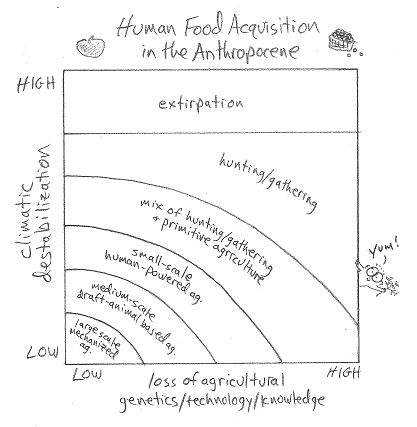
      So as a way to visualize where we may be headed, I made a little chart plotting the possible climate destabilization versus the possible loss of agricultural genetics/technology/knowledge. I’m holding the degree of ecosystem degradation as a constant here – an approximation, of course, since it is linked to the other variables. I do this because I suspect that such degradation is (sadly) the most predictable of the three key factors discussed in the last section.
      Image above: Human food-acquisition in the Anthropocene.  Different food acquisition strategies will be possible based on different (as-yet-to-be-determined) degrees of climate destabilization and loss of agricultural genetics/technology/knowledge.  Both scale and technological complexity decrease upwards and to the right – as each of the variables becomes more degraded. 

      So how do we interpret this graph? Different regions of the graph correspond to different food acquisition strategies that may be possible under various (as-yet-to-be-determined…but looking worse every day) combinations of climate destabilization and genetics/technology/knowledge-losses.

      My (not-exactly-earth-shattering) thesis here is that increased climate destabilization and increased genetics/technology/knowledge-losses will necessarily reduce both the scale and technological complexity of human agriculture. They will simply reduce what is possible. First fossil fuel agriculture blinks out. Then progressively simpler forms of agriculture blink out. And at some point, any form of agriculture becomes non-viable as a sole provider of food and must be supplemented with hunting and gathering. Beyond that, only hunting and gathering become viable. And beyond that, no food acquisition strategies are effective, and the population blinks out.

      What I think is vital about the graph is that it’s a conversation we are not having -- and one that we really need to start having. We need to stop pretending human agriculture is a given – and especially to stop pretending that we will be able to feed ourselves using the same fragile, annuals-based, fossil-energy-dependent agriculture we now employ. …Because we certainly won’t. And heck, we might not be able to employ any agriculture at all – at least not as it’s now recognized.

      And beyond that, we need to start saying that, yea, the stakes of our industrial depredations are rising so high that we actually need to invoke the dreaded “E” words here – extirpation and extinction. We need to stop telling ourselves that, by continuing our wicked industrial ways, we’re only endangering ‘the economy’ or ‘growth’ or ‘prosperity’ or ‘our standing as a nation.’ Fuck that. …We’re endangering our lives. We’re endangering the lives of our children. We’re endangering the lives of every living being on the planet. Those are the stakes here, and if we’re hell-bent on offing ourselves for the sake of double-caramel lattes, we should at least have the pseudo-dignity to acknowledge it and maybe sort of apologize to everything we’re taking down with us.

      (deep breath)

      So there. And aside from just being kind of scary (or inspiring, I suppose, if you rejoice at the demise of ecosystem-degrading human agriculture), the graph above does have practical implications, which I’ll discuss in the next section.

      References
      Here are some key resources to both back up the stuff I’m going to talk about and help people move ahead with the good work we need to do:

      A. Climate
      B. Collapse
      C. Agriculture
      • Mark Shepard:  Restoration Agriculture: Real-World Permaculture for Farmers (2013)  …VERY HIGHLY RECOMMENDED!
      • Dave Jacke & Eric Toensmeier: Edible Forest Gardens (2005)
      • Bill Mollison: Permaculture: A Designer’s Manual (1988)
      • David Holmgren: Permaculture: Principles and Pathways Beyond Sustainability (2002)
      • Permaculture videos: http://www.resilience.org/resource-detail/1470432-7-food-forests-in-7-minutes and http://www.resilience.org/resource-detail/1527704-kramerterhof-a-tour-of-sepp-holzer-s
      • Eric Toensmeier: Perennial Vegetables (2007)
      • Joseph Jenkins:  The Humanure Handbook: A Guide to Composting Human Manure (2005)
      • P.A. Yeomans:  Water For Every Farm: Yeoman’s Keyline Plan (2008)
      • Janisse Ray:  The Seed Underground: A Growing Revolution to Save Food (2012)
      • Carol Deppe:  The Resilient Gardener: Food Production and Self-Reliance in Uncertain Times (2010)
      • Sandor Katz: The Art of Fermentation: An In-Depth Exploration of Essential Concepts and Processes from Around the World (2012)
      • Mike & Nancy Bubel:  Root Cellaring: Natural Cold Storage of Fruits & Vegetables (1991)
      D. Hunting and Gathering
      • Samuel Thayer:  Natures Garden: A guide to Identifying, Harvesting, and Preparing Wild Plants (2010); The Forager’s Harvest: A guide to Identifying, Harvesting, and Preparing Wild Plants (2006)
      • Richo Cech:  Making Plant Medicine (2000)
      • Jon Young:  Animal Tracking Basics (2007); What the Robin Knows: How Birds Reveal the Secrets of the Natural World (2012)
      • Paul Rezendes: Tracking and the Art of Seeing: How to Read Animal Tracks and Sign (1999)
      • Tom Brown: Tom Brown’s Field Guide to Wilderness Survival (1987); Grandfather: A Native American’s Lifelong Search for Truth and Harmony with Nature (2001)
      See also:
      Ea O Ka Aina: When agriculture stops working #2 3/13/13
      .