Showing posts with label Language. Show all posts

Speaking of Nature

SUBHEAD: Can we use "ki" and "kin"and  not "it"or "they"when describing natural living things?

By Robin Wall Kimmerer on 11 June 2107 for Orion Magazine -
(https://orionmagazine.org/article/speaking-of-nature/)
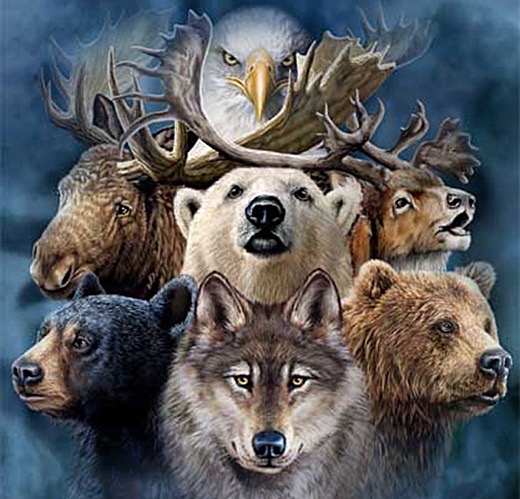

Image above: Painting of American Indian spirit animals. From (https://stockdalewolfe.com/2017/05/14/spirit-animals/).

A CEMETERY SEEMED AN ODD PLACE to contemplate the boundaries of being. Sandwiched between the campus and the interstate, this old burial ground is our cherished slice of nearby nature where the long dead are silent companions to college students wandering the hilly paths beneath rewilding oaks.

The engraved names on overgrown headstones are upholstered in moss and crows congregate in the bare branches of an old beech, which is also carved with names.

Reading the messages of a graveyard you understand the deep human longing for the enduring respect that comes with personhood. Names, names, names: the stones seem to say, “I am. You are. He was.”

Grammar, especially our use of pronouns, is the way we chart relationships in language and, as it happens, how we relate to each other and to the natural world.
Tiptoeing in her mud boots, Caroline skirts around a crumbling family plot to veer into the barberry hedge where a plastic bag is caught in the thorns. “Isn’t it funny,” she says, “that we think it’s disrespectful to walk over the dead, but it’s perfectly okay to disrespect the other species who actually live here?”

We have a special grammar for personhood. We would never say of our late neighbor, “It is buried in Oakwood Cemetery.” Such language would be deeply disrespectful and would rob him of his humanity. We use instead a special grammar for humans: we distinguish them with the use of he or she, a grammar of personhood for both living and dead Homo sapiens.

Yet we say of the oriole warbling comfort to mourners from the treetops or the oak tree herself beneath whom we stand, “It lives in Oakwood Cemetery.” In the English language, a human alone has distinction while all other living beings are lumped with the nonliving “its.”
 
As a botany professor, I am as interested in the pale-green lichens slowly dissolving the words on the gravestones as in the almost-forgotten names, and the students, too, look past the stones for inky cap mushrooms in the grass or a glimpse of an urban fox.

The students out for a walk on this late fall day are freshmen in Janine DeBaise’s environmental writing class at the SUNY College of Environmental Science and Forestry where we both teach. I’ve invited them on a mission to experiment with the nature of language and the language of personhood.

 Janine would correct me: she would not refer to her students as “freshmen” since they are neither fresh nor all men. We call them “first-year students.” Words matter. She has collected their assignment, a written reflection on a cemetery walk last week, as baseline data.

Now we revisit the same place, but with new ideas about grammar bouncing around in the students’ heads. New to them, perhaps, but in fact ancient—the grammar of animacy.
 
For me, this story began in another classroom, in another century, at the Carlisle Indian School where my Potawatomi grandfather was taken as a small boy. My chance of knowing my native language and your chance of ever hearing it were stolen in the Indian boarding schools where native children were forbidden to speak their own language.

Within the walls of that school, the clipped syllables of English replaced the lush Potawatomi sounds of water splashing on rocks and wind in the trees, a language that emerged from the lands of the Great Lakes. Our language hovers at the edge of extinction, an endangered species of knowledge and wisdom dwindling away with the loss of every elder.

So, bit by bit, I have been trying to learn my lost language. My house is spangled with Post-it notes labeling wiisgaak, gokpenagen, and ishkodenhs. It’s a very difficult language to learn, but what keeps me going is the pulse of animacy in every sentence.

There are words for states of being that have no equivalent in English. The language that my grandfather was forbidden to speak is composed primarily of verbs, ways to describe the vital beingness of the world. Both nouns and verbs come in two forms, the animate and the inanimate.

You hear a blue jay with a different verb than you hear an airplane, distinguishing that which possesses the quality of life from that which is merely an object. Birds, bugs, and berries are spoken of with the same respectful grammar as humans are, as if we were all members of the same family. Because we are.

There is no it for nature. Living beings are referred to as subjects, never as objects, and personhood is extended to all who breathe and some who don’t. I greet the silent boulder people with the same respect as I do the talkative chickadees.

It’s no wonder that our language was forbidden.

The language we speak is an affront to the ears of the colonist in every way, because it is a language that challenges the fundamental tenets of Western thinking—that humans alone are possessed of rights and all the rest of the living world exists for human use.

Those whom my ancestors called relatives were renamed natural resources. In contrast to verb-based Potawatomi, the English language is made up primarily of nouns, somehow appropriate for a culture so obsessed with things.

At the same time that the language of the land was being suppressed, the land itself was being converted from the communal responsibility of native people to the private property of settlers, in a one-two punch of colonization.

Replacing the aboriginal idea of land as a revered living being with the colonial understanding of land as a warehouse of natural resources was essential to Manifest Destiny, so languages that told a different story were an enemy. Indigenous languages and thought were as much an impediment to land-taking as were the vast herds of buffalo, and so were likewise targeted for extermination.

Linguistic imperialism has always been a tool of colonization, meant to obliterate history and the visibility of the people who were displaced along with their languages. But five hundred years later, in a renamed landscape, it has become a nearly invisible tool. We forget the original names, that the Hudson River was “the river that runs both ways,” that Devils Tower was the sacred Bear Butte of the Lakota.

Beyond the renaming of places, I think the most profound act of linguistic imperialism was the replacement of a language of animacy with one of objectification of nature, which renders the beloved land as lifeless object, the forest as board feet of timber.

Because we speak and live with this language every day, our minds have also been colonized by this notion that the nonhuman living world and the world of inanimate objects have equal status. Bulldozers, buttons, berries, and butterflies are all referred to as it, as things, whether they are inanimate industrial products or living beings.

English has come to be the dominant language of commerce, in which contracts to convert a forest to a copper mine are written. It’s just the right language for the purpose, because the forest and the copper ore are equivalent “its.”

English encodes human exceptionalism, which privileges the needs and wants of humans above all others and understands us as detached from the commonwealth of life.

But I wonder if it was always that way. I can’t help but think that the land spoke clearly to early Anglo-Saxons, just as it did to the Potawatomi.

Robert Macfarlane’s wonderful book Landmarks, about land and language, documents myriad place names of great particularity that illuminate an ancient Anglo-Saxon intimacy with the land and her beings.

It is said that we are known by the company we keep, and I wonder if English sharpened its verbal ax and lost the companionship of oaks and primroses when it began to keep company with capitalism. I want to suggest that we can begin to mend that rift—with pronouns.

As a reluctant student of the formalities of writing, I never would have imagined that I would one day be advocating for grammar as a tool of the revolution.


SOME OF THE STUDENTS in the cemetery have read the chapter in my book Braiding Sweetgrass that invokes the grammar of animacy. They are taken aback by the implicit assumption of the hierarchy of being on which English grammar is built, something they had not considered before. They dive headfirst into the philosophical implications of English-language pronouns.

One student, Carson, writes in his essay that it is a numbing word: “It numbs us to the consequences of what we do and allows us to take advantage of nature, to harm it even, free of guilt, because we declare other beings to be less than ourselves, just things.”

He echoes the words of Wendell Berry who writes, “People exploit what they have merely concluded to be of value, but they defend what they love, and to defend what we love we need a particularizing language, for we love what we particularly know.”

While it’s true that words are simply vessels for meaning, without meaning of their own, many cultures imbue the utterance of words with spirit because they originate with the breath, with the mystery of life itself.

In her book Becoming Wise, Krista Tippett writes, “The words we use shape how we understand ourselves, how we interpret the world, how we treat others. Words make worlds.”

I don’t mean to say that we are constrained to act in a certain way because of our grammar. I’ve been saying it for most of my life and so far I have not clearcut a forest. (I can’t even bring myself to litter, although I tried once, just to see what it would feel like.)

Nor does a language of animacy dictate that its speakers will behave with respect toward nonhumans. After all, there are leaders of indigenous nations, raised speaking a grammar of animacy, who willingly surrender their homelands to the use of mining or timber companies.

And the Russian language, while embracing animacy in its structure, has not exactly led to a flowering of sustainability there.

The relationship between the structure of a language and the behavior characteristic of a culture, is not a causal one, but many linguists and psychologists agree that language reveals unconscious cultural assumptions and exerts some influence over patterns of thought.

As we talk beneath the oaks, one of the students emphatically disagrees: “Just because I say it doesn’t mean I disrespect nature. I grew up on a farm and we called all of our animals it, but we took great care of them.

We just said it because everyone knows that you don’t give a name to the thing that you’re going to eat.” Exactly!

We use it to distance ourselves, to set others outside our circle of moral consideration, creating hierarchies of difference that justify our actions—so we don’t feel.

In contrast, indigenous philosophy recognizes other beings as our relatives, including the ones we intend to eat.

Sadly, since we cannot photosynthesize, we humans must take other lives in order to live. We have no choice but to consume, but we can choose to consume a plant or animal in a way that honors the life that is given and the life that flourishes as a consequence.

Instead of avoiding ethical jeopardy by creating distance, we can embrace and reconcile that tension. We can acknowledge food plants and animals as fellow beings and through sophisticated practices of reciprocity demonstrate respect for the sacred exchange of life among relatives.

The students we walk with in the cemetery are primarily environmental scientists in training. The practice of it-ing everything in nature is not only prevalent, but is required in scientific writing. Rachel points out that in her biology class, there are “strict taboos governing personification of nature, and even a whisper of anthropomorphism will lose you a grade on a paper.”

I have had the privilege of spending my life kneeling before plants. As a plant scientist, sometimes I am collecting data. As an indigenous plant woman, sometimes I am gathering medicine.

These two roles offer a sharp contrast in ways of thinking, but I am always in awe, and always in relationship. In both cases the plants provide for me, teach me, and inspire me.

When I write as a scientist, I must say, “An eight centimeter root was extracted from the soil,” as if the leafy beings were objects, and, for that matter, as if I were too.

Scientific writing prefers passive voice to subject pronouns of any kind. And yet its technical language, which is designed to be highly accurate, obscures the greater truth.

Writing as an indigenous plant woman I might say, “My plant relatives have shared healing knowledge with me and given me a root medicine.” Instead of ignoring our mutual relationship, I celebrate it. Yet English grammar demands that I refer to my esteemed healer as it, not as a respected teacher, as all plants are understood to be in Potawatomi.

That has always made me uncomfortable. I want a word for beingness. Can we unlearn the language of objectification and throw off colonized thought? Can we make a new world with new words?

Inspired by the grammar of animacy in Potawatomi that feels so right and true, I’ve been searching for a new expression that could be slipped into the English language in place of it when we are speaking of living beings.

Mumbling to myself through the woods and fields, I’ve tried many different words, hoping that one would sound right to my leafy or feathered companions. There was one that kept rising through my musings. So I sought the counsel of my elder and language guide, Stewart King, and explained my purpose in seeking a word to instill animacy in English grammar, to heal disrespect.

He rightly cautioned that “our language holds no responsibility to heal the society that sought to exterminate it.”

With deep respect for his response, I thought also of how the teachings of our traditional wisdom might one day be needed as medicine for a broken world. So I asked him if there was a word in our language that captured the simple but miraculous state of just being.

And of course there is. “Aakibmaadiziiwin,” he said, “means ‘a being of the earth.’” I sighed with relief and gratitude for the existence of that word.

However, those beautiful syllables would not slide easily into English to take the place of the pronoun it. But I wondered about that first sound, the one that came to me as I walked over the land. With full recognition and celebration of its Potawatomi roots, might we hear a new pronoun at the beginning of the word, from the “aaki” part that means land? Ki to signify a being of the living earth. Not he or she, but ki.

So that when the robin warbles on a summer morning, we can say, “Ki is singing up the sun.” Ki runs through the branches on squirrel feet, ki howls at the moon, ki’s branches sway in the pine-scented breeze, all alive in our language as in our world.

We’ll need a plural form of course, to speak of these many beings with whom we share the planet. We don’t need to borrow from Potawatomi since—lo and behold—we already have the perfect English word for them: kin.

Kin are ripening in the fields; kin are nesting under the eaves; kin are flying south for the winter, come back soon. Our words can be an antidote to human exceptionalism, to unthinking exploitation, an antidote to loneliness, an opening to kinship.

If words can make the world, can these two little sounds call back the grammar of animacy that was scrubbed from the mouths of children at Carlisle?

I have no illusions that we can suddenly change language and, with it, our worldview, but in fact English evolves all the time. We drop words we don’t need anymore and invent words that we do.

The Oxford Children’s Dictionary notoriously dropped the words acorn and buttercup in favor of bandwidth and chatroom, but restored them after public pressure. I don’t think that we need words that distance us from nature; we need words that heal that relationship, that invite us into an inclusive worldview of personhood for all beings.

As I’ve sent these two little words out into the world like seeds on the wind, they have fallen here and there on fertile ground. Several writers have incorporated them into children’s books and into music. Readers have reported that the very sound, the phoneme pronounced “kee,” has resonance with other words of similar meaning.  

Ki is a parallel spelling of chi—the word for the inherent life energy that flows through all things. It finds harmony with qui or “who” in Latinate languages. I’ve been told it is the name of a Sumerian Earth goddess and the root of Turkic words for tree. Could ki be a key to unlocking a new way of thinking, or remembering an ancient one?

But these responses are from nature writers, artists, teachers, and philosophers; I want to know how young people, the language makers among us, react. Our little environmental college is dominated by tree huggers, so if there were ever an audience open to ki, they would be it.


WITH ki and kin rattling around in their heads, the students walk together in the cemetery again, playing with using the words and seeing how they feel on their tongues and in their heads.Steeped in the formalities of syntax, a fair number of student questions revolve around wanting “rules” for the use of the new words, rules that we don’t have. Is there a possessive case? Where are the boundaries?

“I could say ‘ki’ about this shrub,” Renee says, “but what about the wind?”

“Yes,” I tell her, “in my language, the wind is understood as animate.”

As we stand beneath the stoutly branched oak, the students debate how to use the words. If the tree is ki, what about the acorns? They agree that the acorns are kin, a whole family of little beings. The ground is also littered, in this unkempt portion of the cemetery, with fallen branches. “Are these dead limbs considered kin too? Even though they’re dead?” Evelyn asks. “Looking at the dead branches on the ground, I found myself thinking a lot about firewood,” she says. “I’ve always spoken—and thought—as if I was the one who made firewood. But when I thought of that tree as ki, as a being, I suddenly saw how preposterous that was. I didn’t make the firewood. The tree did. I only picked it up from the ground.” In just one sentence Evelyn experiences a transfer of agency or capacity for action from humankind to the tree itself. The grammar of animacy is an antidote to arrogance; it reminds us that we are not alone.

Evelyn later writes, “Using ki made me see everything differently, like all these persons were giving gifts—and I couldn’t help but feel grateful. We call that kind of firewood kindling, and for me it has kindled a new understanding. And look—that word kin is right there in kindling.”

Another student, Amanda, adds, “Having this word makes me regard the trees more as individuals. Before, I would just call them all ‘oak’ as if they were a species and not individuals. That’s how we learn it in dendrology, but using ki makes me think of them each, as not just ‘oak,’ but as that particular oak, the one with the broken branch and the brown leaves.”

Despite their very brief introduction to ki and kin, the students get right to the heart of the words’ implications: “I imagine that this would be a challenge for most religious people,” Paul says. “It kind of knocks humans off the pedestal of being the only ones with souls.”

Indeed, Christian missionaries were the spearhead of language suppression in indigenous cultures and were among the prime architects of the Indian-boarding-school movement.

War on a language of animacy and relationship to the natural world was essential to the dual mission of religious and economic conversion. Certainly the biblical mandate for human subjugation of the creation was incompatible with indigenous languages.

Another student, Kieran, observes, “Using these words as I walk around opened my eyes to how we are all connected. When you start using ki and kin, you will feel remorseful that all of your life you took them for granted.”

Ecopsychologists have suggested that our conceptions of self as inherently separate from the natural world have negative outcomes on the well-being of humans and ecosystems.

Perhaps these words can be medicine for them both, so that every time we speak of the living world we breathe out respect and inhale kinship, turning the very atmosphere into a medium of relatedness. If pronouns can kindle empathy, I want to shower the world with their sound.

The most outspoken students voice some enthusiasm for the new pronouns, but the quiet skeptics save their reservations for the writing assignment when we are back in class. One student puts it this way: “This is a warm-hearted and generous idea, but it will never work. People don’t like change and they will be pissed off if you try and tell them how to talk.

Most people don’t want to think of nature as being as good as them.” One student writes in a scrawl that carries his impatience in every half-formed letter: “If changing the world is what you’re after, do something real. Volunteer at the food bank, plant a tree. Dreaming up pronouns is a major waste of time.”

This is why I love teaching, the way we are forced to be accountable.

The abstraction of “dreaming up pronouns” does seem fruitless during a time in our nation’s history when the language of disrespect is the currency of political discourse. American nationalism, to say nothing of human exceptionalism, is being elevated as a lofty goal, which leaves little room for humility and ecological compassion.

It seems quixotic to argue for respect for nonhuman beings when we refuse to extend it to human refugees. But I think this student is wrong. Words do matter, and they can ripple out to make waves in the “real” world.

The ecological compassion that resides in our indigenous languages is dangerous once again to the enterprise of domination, as political and economic forces are arrayed against the natural world and extractive colonialism is reborn under the gospel of prosperity.

The contrast in worldview is as stark today as it was in my grandfather’s time, and once again it is land and native peoples who are made to pay the price.

If you think this is only an arcane linguistic matter, just look to the North Dakota prairie where, as I write this, there are hundreds of people camping out in a blizzard enduring bitter cold to continue the protective vigil for their river, which is threatened by the construction of the Dakota Access Pipeline and the pipeline’s inevitable oil spills.

The river is not an it for them—the river lies within their circle of moral responsibility and compassion and so they protect ki fiercely, as if the river were their relative, because ki is.

But the ones they are protecting ki from speak of the river and the oil and the pipe all with the same term, as if “it” were their property, as if “it” were nothing more than resources for them to use. As if it were dead.

At Standing Rock, between the ones armed with water cannons and the ones armed with prayer, exist two different languages for the world, and that is where the battle lines are being drawn.

Do we treat the earth as if ki is our relative—as if the earth were animated by being—with reciprocity and reverence, or as stuff that we may treat with or without respect, as we choose?

The language and worldview of the colonizer are once again in a showdown with the indigenous worldview. Knowing this, the water protectors at Standing Rock were joined by thousands of non-native allies, who also speak with the voice of resistance, who speak for the living world, for the grammar of animacy.

Thankfully, human history is marked by an ever-expanding recognition of personhood, from the time when aboriginals were not seen as human, when slaves were counted as three-fifths of a person, and when a woman was worth less than a man.

Language, personhood, and politics have always been linked to human rights. Will we have the wisdom to expand the circle yet again? Naming is the beginning of justice.

Around the world, ideas of justice for nature are emerging in political and legal arenas.

In New Zealand, when the Whanganui River was threatened, indigenous Maori leadership earned protection for the sacred waters by getting the river declared a legal “person” with rights to its own well-being. The constitutions of indigenous-led Ecuador and Bolivia enshrine the rights of Mother Nature. The Swiss amended their constitution to define animals as beings instead of objects.

Just last year, the Ho-Chunk Nation in Wisconsin amended its tribal constitution, recognizing that “ecosystems and natural communities within the Ho-Chunk territory possess an inherent, fundamental, and inalienable right to exist and thrive.”

This legal structure will allow the tribe to protect its homelands from mining for fracking sand and fossil fuel extraction because the land will have legal standing as a person.

Supported by the revolutionary initiatives of the Community Environmental Legal Defense Fund, the burgeoning Rights of Nature movement is flowering from the roots of animacy, from the personhood of all beings. We’ll need a new pronoun for that.


THE STUDENTS COMMENT that they’d like to use ki and kin, but stumble over the changes in phrasing. “This would be much easier if I’d learned it as a child,” they say. They’re right of course. Not only because language patterns are established early in development, but because children quite naturally speak of other beings as persons. I delight in listening to my grandson, who like most toddlers watching a butterfly flit across the yard says, “He is flying,” or “She sits on a flower.”

Children speak at first with a universal grammar of animacy, until we teach them not to. My grandson is also completely smitten with bulldozers and will watch them endlessly, but despite their motion and their roar he is not confused as to their nature: he calls them “it.”I am also introducing him to Potawatomi words.

In honor of the language that was taken from his great-grandfather, I want to give that language back to my grandson, so he will never be alone in the world and live surrounded by kin. He already has the basics of animacy; he hugs trees and kisses moss. My heart cracked with happiness when he looked up from the blueberries in his oatmeal and said, “Nokomis, are these minan?”

He’s growing up in a time when respect among peoples has grown threadbare and there are gaping holes in the fabric of life. The mending we need will require reweaving the relationship between humans and our more-than-human kin.

Maybe now, in this time when the myth of human exceptionalism has proven illusory, we will listen to intelligences other than our own, to kin. To get there, we may all need a new language to help us honor and be open to the beings who will teach us. I hope my grandson will always know the other beings as a


• Robin Wall Kimmerer is Professor of Environmental and Forest Biology at the State University of New York College of Environmental Science and Forestry (SUNY-ESF). She is the author of numerous scientific articles, the book Gathering Moss: A Natural and Cultural History of Mosses (2003), and her latest publication Braiding Sweetgrass (Milkweed Editions 2014) has received praise from authors such as Jane Goodall and Elizabeth Gilbert. She is an enrolled member of the Citizen Potawatomi Nation, and combines her heritage with her scientific and environmental passions.

.

Trouble with the King's english

SUBHEAD: What ever language you speak should be spoken with some mastery and art. 

By Juan Wilson on 2 November 2015 for Island Breaeth -
(http://www.countercurrents.org/irwin021115.htm)


Image above: Graphic for Cab Calloway's "Are You Hip to the Jive" record set with 22 tracks.  From (http://region5.herbzinser08.com/dir/index.php/blog28/hydrocarbon-gasoline-asks-carbon-black).

I read the two articles below this morning with some amusement. Jerome Irwin and James Kunstler are both correct in thinking that using English without some mastery of grammar, vocabulary and pronunciation leads to weakened ability to communicate as well as think clearly. In Irwin's example it is the drunken slur of Australian whites, and in Kunslter's case it is the jive street talk of American blacks.

The mastery out English language leads to higher education, professional accreditation, solid employment. The lack thereof leads not only to fuzzy thinking, but poverty.

However, neither Irwin or Kunstler address issue of any cultural or social advantages to those populations that speak a dialect. Nor due they evaluate in any depth the culture identity of those who speak a dialect. Both the Briritish whites originally exiled to Australia and the African blacks brought to slavery in America have been   "associated with "violent criminality and other anti-social behaviors."

Both the Australian criminals and African blacks had a reason to have their own "secret" language.

Another point not mentioned is that other languages than English describe other realities for other cultures. Those who identify as Americans here in Hawaii often complain about Pigeon English spoken by Polynesians and their descendants.

A bit like Spanglish,  Pigeon English is a mixture of English and another language - here in Hawaii that language would be Hawaiian.

The Hawaiian culture was one carried by the spoken word - without a written language.  It was a rich culture that mastered sailing the Pacific Ocean a millennium before English the speaking British and Americans.

That meant that all their culture as well as technology was carried through the spoken word - navigation, engineering, agricultural practice, etc. The Polynesians thrived on the Pacific Ocean islands for centuries without bringing on the level of destruction we see today.

The little I know of the Hawaiian language has shown me that every word seems to have several meanings even in context, thus mixing the profane with the spiritual and the serious with the amusing.

It does pay to know your own language and speak it with some mastery and art.


Linguistic Attack In Australia

SUBHEAD: Linguistic and Cultural Diversity Under Attack in Australia

By Jerome Irwin on 2 November 201 for Counter Culture -
(http://www.countercurrents.org/irwin021115.htm)

Dean Frenkel – a singer, voice coach and public speaking-communication lecturer at Melbourne Australia’s Victoria University – is on the hot seat for a controversial theory he recently put forth (“Australia, we need to talk about the way we speak”, The Age, October 26th, 2015).

The gist of Frenkel’s theory is that the by now infamous “G’Day Mate” drawl, that has come to embody the essence of Australian culture, is actually nothing more than a ‘lazy’ accent caused by the ‘alcoholic state’ of Australia’s heavy rum-drinking early settlers who regularly got drunk together on their new-found Down Under continent.

According to the laments of Frenkel, this original drunk-induced linguistic trait has since been passed down from generation to generation by all those descendants who, whether drunk or sober, have unknowingly added an alcoholic slur to the fact that they only use two-thirds of their mouth to speak and hence has become part of the Aussie national speech pattern.

Frankel contends that consequent sweeping effects have occurred as a result: poor communications is evident among all sectors of Australian society; a gaping hole in rhetorical training has been created in the Australian educational system; a subsequent diminishment has occurred in critical thought-processes, problem-solving, judgment and poor speech skills that have led to a lack of confidence and the internalization of emotions and thoughts that have contributed to difficulties in relationships, loneliness and stalled development.

In short, Frenkel’s theories hold that Australia’s linguistic accents, moulded by booze, have led to a general inarticulateness among the people as a result.

By contrast, Frenkel holds up the example of the ancient history of Australia’s aboriginal peoples spoken word and storytelling abilities that otherwise artfully uses rhetoric as an integral part of the recounting of the Australian Dreamtime to pass on to each generation their special spiritual and survival knowledge.

He contends that Australia’s western-centric civilization has instead created a “dumbing down” of speech in Australia that has “created holes in our education system that reflects holes in our culture.” Frankel declares, “Australia, It is time to take our beer goggles off. It’s no longer acceptable to be smarter than we sound.”

Yet whether Frenkel, as essentially a singer and voice coach, is qualified to theorize on such sweeping historical-sociological-psychological matters is a bone of contention.

In 2011, Aidan Wilson, a PHD graduate student at the University of Melbourne, challenged Frenkel’s qualifications to assess Australian politician’s qualities based upon their accents (“Beware of speech experts bearing science”, Crikey, Nov 2, 2011 & Oct 29th, 2015). At the time, this spawned a language blog debate between the two. (“A Reply from Dean Frenkel”, Crikey, Nov 7th, 2011).

Yet a far more important question exists behind such professed theories.

Is the ultimate objective in Australia, or wherever else in the world, to eventually get the entire world’s populace to speak in some uniform, standardized, sanitized “General Australian”, “General American”, or “General Whatever” way?

The obvious continuing mass disappearances of regional accents worldwide, and the negative attitudes of lower social class status and inferior traits that are often attributed to regional accents, symbolize what is a constant attempt by certain controlling forces in the world who are intent upon constantly reducing or utterly eliminating all such cultural human uniqueness or biological diversity on the planet.

During the 19th & 20th centuries, in Australia in particular, the attempt was made by still others to perpetuate an inferior cultural mentality in the people in relationship to their original British origins. Those who ever attempted to excel in whatever endeavour were shown resentment or ridicule with such pejorative terms as, “stop trying to be a tall poppy” or “you’re just another Plastic Brit.”

From the very beginning of the literary arts, Australian writers were decried as mere plagiarists of some Rudyard Kipling or Robbie Burns.

In 1950, A.A. Phillips, the Melbourne critic and social commentator, coined the term “cultural cringe” to describe the post-colonial literary arts in Australia as being deficient when compared to the work of their British and European counterparts.

Back then, Australia was being made out to be synonymous with failure, just as theorists like Frenkel now attempt to reduce Australian’s speech patterns down to the level of the hard-drinking drunkards of Australia’s early colonial days.

Apparently, as some would have us believe, the only way that Australian’s now can build themselves up in the eyes of the world, and especially in the ears of elocution experts like Frenkel who speak the British mother tongue, is to learn to pronounce proper “King’s English”. Is the intended net effect to encourage Australian’s to once again redefine their cultural heritage not only as convict stained but now as drunken stained?


Good Little Maoists

SUBHEAD:American education does not put enough emphasis on teaching standard spoken English.

By James Kunstler on 2 November 2015 for Kunstler.com - 
(http://kunstler.com/clusterfuck-nation/good-little-maoists/)


Image above: From ().

ometimes societies just go batshit crazy. For ten years, 1966 to 1976, China slid into the chaotic maw of Mao Zedong’s “cultural revolution.” 

A youth army called the Red Guard was given license to terrorize authorities all over the nation — teachers, scientists, government officials, really just about anyone in charge of anything. They destroyed lives and families and killed quite a few of their victims. 

They paralyzed the country with their persecutions against “bourgeois elements” and “capitalist roaders,” reaching as deep into the top leadership as Deng Xiaoping, who was paraded in public wearing a dunce-cap, but eventually was able to put an end to all the insanity after Mao’s death.

America’s own cultural revolution has worked differently. It was mostly limited to the hermetically-sealed hot-house world of the universities, where new species of hierophants and mystagogues were busy constructing a crypto-political dogma aimed at redefining status arrangements among the various diverse ethnic and sexual “multi-cultures” of the land.

There is no American Mao, but there are millions of good little Maoists all over America bent on persecuting anyone who departs from a party line that now dominates the bubble of campus life. It’s a weird home-grown mixture of Puritan witch-hunting, racial paranoia, and sexual hysteria, and it comes loaded with a lexicon of jargon — “micro-aggression,” “trigger warnings,” “speech codes,” etc — designed to enforce uniformity in thinking, and to punish departures from it.

At a moment in history when the US is beset by epochal problems of economy, energy, ecology, and foreign relations, campus life is preoccupied with handwringing over the hurt feelings of every imaginable ethnic and sexual group and just as earnestly with the suppression of ideological trespassers who don’t go along with the program of exorcisms. 

A comprehensive history of this unfortunate campaign has yet to be written, but by the time it is, higher education may lie in ruins. It is already burdened and beset by the unintended consequences of the financial racketeering so pervasive across American life these days. But in promoting the official suppression of ideas, it is really committing intellectual suicide, disgracing its mission to civilized life.

I had my own brush with this evil empire last week when I gave a talk at Boston College, a general briefing on the progress of long emergency. The audience was sparse. It was pouring rain. The World Series was on TV. People are not so interested in these issues since the Federal Reserve saved the world with free money, and what I had to say did not include anything on race, gender, and white privilege.

However, after the talk, I went out for dinner with four faculty members and one friend-of-faculty. Three of them were English profs. One was an urban planner and one was an ecology prof. All of the English profs were specialists in race, gender, and privilege. Imagine that. You’d think that the college was a little overloaded there, but it speaks for the current academic obsessive-compulsive neurosis with these matters. 

Anyway, on the way to restaurant I was chatting in the car with one of the English profs about a particular angle on race, since this was his focus and he tended to view things through that lens. The discussion continued at the dinner table and this is what ensued on the Internet (an email to me the next morning):  On Oct 29, 2015, at 4:37 PM, Rhonda Frederick wrote:


Jim—
This is what I posted on my social medias, am sharing with you and your agent.

Yesterday, novelist/journalist James Howard Kunstler was invited to give a talk at BC (see his bio at http://www.bc.edu/offices/lowellhs/calendar.html#1028).

At the post-talk dinner, he said “the great problem facing African Americans is that they aren’t taught proper English, and that … academics are too preoccupied with privilege and political correctness to admit this obvious fact.”

No black people (I presume he used “African American” when he meant “black”) were present at the dinner. I was not at the dinner, but two of my friends/colleagues were; I trust their recollections implicitly.

Whether Kunstler was using stereotypes about black people to be provocative, or whether he believed the ignorance he spouted, my response is the same: I cannot allow this kind of ignorance into my space and I am not the one to cast what he said as a “teachable moment.” I do think there should be a BC response to this, as the university paid his honorarium and for his meal.

Here’s some contact information for anyone interested in sharing your thoughts on how BC should spend its money:

Lowell Humanities Series at Boston College (http://www.bc.edu/offices/lowellhs/about.html)


Rhonda—

That is not quite what I said.

I said that teaching black Americans how to speak English correctly ought to be the most important mission of primary and secondary education for blacks in order for them to function successfully in our economy. Moreover, I said that anyone mounting an argument against this was hurting the very people they pretend to help.

I stand by those statements.

Your attempt at Stalinist thought policing is emblematic of something terribly wrong in higher education, especially since you were not present.

James Howard Kunstler
“It’s All Good”


So I was subjected to attempted character assassination via social media by this Rhonda Frederick person — faculty or student, she did not say — who admits to not having been present at the incident in question. This is the new fashion in academia: slander by Twitter and Facebook. It is fully supported by the faculty and administration. While they have been super-busy constructing speech codes and sex protocols, it seems they haven’t had any time for establishing ethical norms in the use of the Internet. 

As it happened, I offered to come back and publically debate my statements about the benefits of teaching spoken English to black primary and secondary students — they’d have to pay me, of course — but received no reply on that from Rhonda Frederick. I also received no reply from James Smith (smithbt@bc.edu), director of the Lowell Lecture Series, when I emailed my objection to being vilified on the Web by his colleague.

Now, as to the substance of what I said to this table of college professors. I’ve written before in books and blogs about the issue of spoken English and the black underclass, but for the record I will try to summarize some of my thoughts about it (trigger warning).

True, there are various dialects of English among us, but it must be obvious that they have different merits and disadvantages. There is such a thing as standard grammatical English. It evolves over generations, for sure, but it shows a certain conservative stability, like the rule of law. It tends to be spoken by educated people and by people in authority. 

This implies people in power, of course, people who run things, but also people at large in the professions (medicine, engineering, etc.) and the arenas of business and government. Standard grammatical English tends to be higher status because competence in it tends to confer the benefits of higher living standards.

It also must be self-evident that there is such a thing as a black English dialect in America. With perhaps a few lingering regional differences, it is remarkably uniform from Miami, Florida, to Rochester, New York, to Fresno, California. It prevails among the so-called black underclass, the cohort that continues to struggle economically. 

Despite its verve and inventiveness, this black dialect tends to confer low status and lower standards of living on those who speak it. In popular mythology and culture, it is associated with violent criminality and other anti-social behaviors. If you don’t believe this, turn on HBO sometime.

I argue that black people who seek to succeed socially and economically would benefit from learning to speak standard grammatical English, not solely because it is associated with higher status and living standards, but because proficiency with grammar, tenses, and a rich vocabulary helps people think better. 

After all, if you employ only the present tense in all your doings and dealings, how would you truly understand the difference between now, tomorrow, and yesterday? I submit that it becomes problematical. You may not be able to show up on time, among other things.

Some of my auditors have argued that “code switching” allows black Americans to easily turn back and forth for convenience between two modes of speech, black and “white” (i.e standard grammatical English). I’d argue that this is not as common as it is made out to be. 

Not everybody has the skill of entertainer Dave Chapelle, a master amateur linguist (whose parents were both college professors).

It’s my opinion that American primary and secondary education does not put enough emphasis on teaching standard spoken English to those deficient in it. The pedagogues have been hectored and browbeaten by the hierophants in higher ed not to press the matter. It is not regarded as important (probably because the task seems too painful and embarrassing and may hurt some feelings). The results are plain to see: academic failure among black Americans. (Not total but broad.) 

Instead, we concoct endless excuses to explain this failure and the related economic failures, the favorite by far being “structural racism” (despite having elected a black president who speaks standard grammatical English).

Now to the touchier question as to why this is. After all, other ethnic groups in America are eager to fully participate in the national life. For example, I gave a talk to a large honors freshman class at Rutgers University a year ago. 

Due to the current demographics of New Jersey, the class was overwhelming composed of Indian (Asian, that is) youngsters, many of them as dark-skinned as Americans of African ancestry. They had uniformly opted to speak standard grammatical English. 

They were all succeeding academically (it was an honors class, after all). They were on a trajectory to succeed in adult life. What does this suggest? To me it says that maybe some behavioral choices are better than others and the color of your skin is not the primary determinant in the matter.

Here’s what I think has happened to get us where we are today (second trigger warning). I think the civil rights victories of the mid 1960s generated enormous anxiety among black Americans, who were thereby invited to participate more fully in the national life after many generations of hardship and abuse. (If you argue that this was not the sum, substance, and intention of the Voting Rights Act and Public Accommodations Act of 1964-65, then you are being disingenuous.) 

However, they were not comfortable with the prospect of assimilating into the mainstream culture of the day. They either didn’t believe in it, or feared it, or despised it, or worried about being able to perform in it.

Many would attribute this anxiety to the legacy of slavery. Can a people get over a particular historical injury? American blacks are not the only group traumatized by circumstance. 

When do you decide to move forward? Or do you nurse a grievance forever? Anyway, it was not a coincidence that in the mid 1960s a new wave of black separatist avatars arose around the time of the civil rights legislative victories. Malcolm X, Stokely Charmichael, the Black Panthers, to name a few. 

That was the moment when much of the black population slid into what has become essentially an oppositional culture, determined to remain separate. Language is part of that picture.

The diversity cult of the day is a smokescreen to disguise this fundamental fact of American life: much of black America has simply opted out. They don’t want to assimilate into a common culture — so common culture has been deemed dispensable by the confounded keepers of the common culture’s flame, the university faculty. 

Much of black America doesn’t want to play along with the speech, manners, rules, or laws of whatever remains of that common culture after its systematic disassembly by the professors, the deans, and their handmaidens in progressive politics — heedless of the damage to the basic social contract. We remain very much a house divided, as Lincoln put it, and he could see clearly what the consequences would be.

Is it racist to try to air these abiding quandaries in the public arena? Apparently so. And why is that? Because of the awful embarrassment of political progressives over the disappointing outcome of the civil rights project. 

Black news pundits such as Charles Blow of The New York Times constantly call for “an honest conversation about race,” but they don’t mean it. Any public intellectual who ventures to start that conversation is automatically branded a racist. 

Hey, I couldn’t even have a conversation at a private dinner on the merits of speaking standard English with three college professors whose life-work centers on race. They had a melt-down and used a proxy (who wasn’t even there) to slander me on the Internet.

They are cowards and I am their enemy.
.

Landspeak

SUBHEAD: Words which do not simply label a place but in some mysterious and beautiful way become part of it.

By Robert Macfarlane on 15 May 2015 for Orion Magazine -
(https://orionmagazine.org/article/landspeak/)


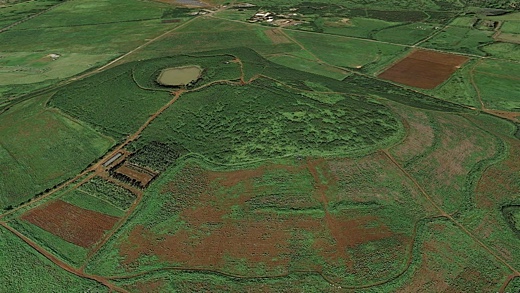
Image above: The Hawaiian language is rich with place names; all with multiple meanings. "Puu" is a Hawaiian word for a conical land formation of a volcano that also implies a throat or pump (http://www.wehewehe.org). Pictured here (from GoogleEarth) is a "Puu" in Koloa, Kauai, Hawaii named Puuhi, where the ahupuaa (districts) of Weliweli, Paa and Mahaulepu join.  Puu formations are often places where Hawaiians districts meet and are sometimes locations where water can be distributed from one district to another. Puuhi became a reservoir for the first sugarcane plantation in Hawaii. In the distance is the site of the Koloa Sugar Mill.  When "Puu" is combined with the word "Wai", as in the word "Puuwai", they create the word for "heart". "Wai"  means fresh water (or any organic fluid not from salt water; such as honey, sap, semen or blood). The only "town" on the Hawaiian island of Niihau is called Puuwai (or Heart). It is the only place in Hawaii where all the residence speak the language. 

For over a decade I have been collecting place-words: gleaned singly from conversations, correspondences, or books, and jotted down in journals or on slips of paper. Now and then I have hit buried treasure in the form of vernacular dictionaries or extraordinary people—troves that have held gleaming handfuls of coinages.

One such trove turned up on the moors of the Outer Hebridean island of Lewis in 2007. There, I was shown a “Peat Glossary”: a word-list of the hundreds of Gaelic terms for the moorland that stretches over much of Lewis’s interior. Some of the language it recorded was still spoken—but much had fallen into disuse.

The same year I first saw the Peat Glossary, a new edition of the Oxford Junior Dictionary was published. A sharp-eyed reader noticed that there had been a culling of words concerning nature. Under pressure, Oxford University Press revealed a list of the entries it no longer felt to be relevant to a modern-day childhood.

The deletions included acorn, adder, ash, beech, bluebell, buttercup, catkin, conker, cowslip, cygnet, dandelion, fern, hazel, heather, heron, ivy, kingfisher, lark, mistletoe, nectar, newt, otter, pasture, and willow.

The words introduced to the new edition included attachment, block-graph, blog, broadband, bullet-point, celebrity, chatroom, committee, cut-and-paste, MP3 player, and voice-mail.

The substitutions made in the dictionary—the outdoor and the natural being displaced by the indoor and the virtual—are a small but significant symptom of the simulated life we increasingly live. Children are now (and valuably) adept ecologists of the technoscape, with numerous terms for file types but few for differ-ent trees and creatures.

A basic literacy of landscape is falling away up and down the ages. And what is lost along with this literacy is something precious: a kind of word magic, the power that certain terms possess to enchant our relations with nature and place.

As the writer Henry Porter observed, the OUP deletions removed the “euphonious vocabulary of the natural world—words which do not simply label an object or action but in some mysterious and beautiful way become part of it.”

Consider ammil, a Devon term meaning “the sparkle of morning sunlight through hoar-frost,” a beautifully exact word for a fugitive phenomenon I have several times seen but never before been able to name. Shetlandic has a word, pirr, meaning “a light breath of wind, such as will make a cat’s paw on the water”; and another, klett, for “a low-lying earth-fast rock on the seashore.”

On Exmoor, zwer is the onomatopoeic term for the sound made by a covey of partridges taking flight. Smeuse is a Sussex dialect noun for “the gap in the base of a hedge made by the regular passage of a small animal”; now that I know the word smeuse, I will notice these signs of creaturely movement more often.

The variant English terms for icicle—aquabob (Kent), clinkerbell and daggler (Wessex), cancervell (Exmoor), ickle (Yorkshire), tankle (Durham), shuckle (Cumbria)—form a tinkling poem of their own. Blinter is a northern Scots word meaning “a cold dazzle,” connoting especially “the radiance of winter stars on a clear night,” or “ice-splinters catching low light.”

Instantly the word opens prospects: walking sunwards through snow late on a midwinter day, with the wind shifting spindrift into the air such that the ice-dust acts as a prismatic mist, refracting sunshine into its pale and separate colors; or out on a crisp November night in a city garden, with the lit windows of houses and the orange glow of street light around, while the stars blinter above in the cold high air.

I would not have guessed at the existence of quite so many terms for animal dung, from crottle (a foresters’ term for hare excrement) to doofers (Scots for horse shit) to the expressive ujller (Shetlandic for the “unctuous filth that runs from a dunghill”) and turdstool (West Country for a very substantial cowpat).

Nor did I know that a dialect name for the kestrel, alongside such felicities as windhover and bell-hawk, is wind-fucker. Once learnt, never forgotten—it is hard now not to see in the pose of the hovering kestrel a certain lustful quiver.

In The History of the Countryside, the great botanist Oliver Rackham describes four ways in which “landscape is lost”: through the loss of beauty, the loss of freedom, the loss of wildlife and vegetation, and the loss of meaning. I admire the way that aesthetics, human experience, ecology, and semantics are given parity in his list. Of these losses the last is hardest to measure.

I do not, of course, believe that such words will magically summon us into a pure realm of harmony and communion with nature. Rather that they might offer a vocabulary that is “convivial” as the philosopher Ivan Illich intended the word—meaning enriching of life, stimulating to the imagination, and “encouraging creative relations between people, and people and nature.”

And, perhaps, that the vibrancy of perception evoked in these glossaries may irrigate the dry metalanguages of modern policymaking (the Department for Environment, Food and Rural Affairs, for instance, offers such tautological aridities as “Land use: the use to which a piece of land is put”).

For there is no single mountain language, but a range of mountain languages; no one coastal language, but a fractal of coastal languages; no lone tree language, but a forest of tree languages.

As I have traveled, I have come to under­stand that although place-words are being lost, they are also being ­created. I met a painter in the Hebrides who used landskein to refer to the braid of blue horizon lines in hill country on a hazy day; and a five-year-old girl who concocted honeyfur to describe the soft seeds of grasses held in the fingers.

John Constable invented the verb to sky, meaning “to lie on one’s back and study the clouds.” We have forgotten ten thousand words for our landscapes, but we will make ten thousand more, given time.

Of course there are experiences of landscape that will always resist articulation, and of which words offer only a remote echo—or to which silence is by far the best response. Nature does not name itself.

Granite does not self-identify as igneous. Light has no grammar. Language is always late for its subject. Sometimes on the top of a mountain I just say, “Wow.”

• Robert Macfarlane lives in Cambridge and is author of The Wild Places and The Old Ways. The text that appears here is adapted from his book Landmarks, forthcoming from Trafalgar in
.

Programmable Permaculture

SUBHEAD: How can a gardener create different sorts of microclimates of soil, air, and water?

By Barath Raghaven on 28 February 2013 for Contraposition -
(http://contraposition.org/blog/2013/02/28/programmable-permaculture/)


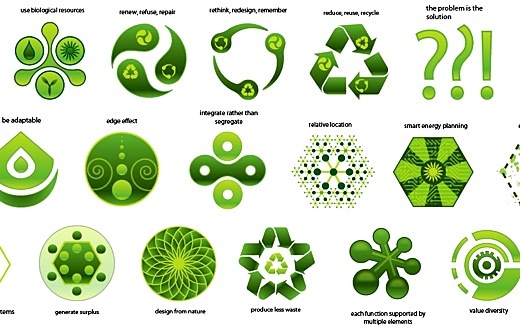
Image above: Computer designed icons for permaculture metatools. From (http://podcollective.com/fora/viewtopic.php?p=9900).

There’s a cultural phenomenon, one that has been growing for the past decade, of hobbyist hackers exemplified by Make Magazine and TechShop. These hackers want to have the experience of building something in the physical world while still applying the tools and techniques of computing. With the rise of open hardware platforms like Arduino—even whole systems like the Raspberry Pi for $25—it’s surprisingly affordable for people to program their own electronics.

The key to design when working on such projects is to decompose a problem into its constituent actions, to figure out what can be done by the programmable hardware vs. what must be done using other (e.g., more conventionally mechanical) components, and then to assemble the pieces into a working whole. While I can’t say I have any deep experience working on such projects, for some time I’ve been wondering whether the same ideas can be applied in a direction of more interest and perhaps of more importance.

How can we solve a problem (in a garden, say), with permaculture tools, by decomposing the problem and coming up with a set of interlocking pieces that solves it? Framing the problem in this way is very much applying an engineering mindset, something that might irk those who insist on thinking holistically about any and all ecological settings. 
And I can relate to that sentiment, because too much has been done in engineering and science more broadly to stop holistic thinking and to employ scientific reductionism in its place.

But for the moment I want to consider something small scale: employing the vocabulary and tools of permaculture to specific tasks in a garden. Here are the stated principles of permaculture:
  1. Observe and interact: By taking time to engage with nature we can design solutions that suit our particular situation.
  2. Catch and store energy: By developing systems that collect resources at peak abundance, we can use them in times of need.
  3. Obtain a yield: Ensure that you are getting truly useful rewards as part of the work that you are doing.
  4. Apply self-regulation and accept feedback: We need to discourage inappropriate activity to ensure that systems can continue to function well.
  5. Use and value renewable resources and services: Make the best use of nature’s abundance to reduce our consumptive behavior and dependence on non-renewable resources.
  6. Produce no waste: By valuing and making use of all the resources that are available to us, nothing goes to waste.
  7. Design from patterns to details: By stepping back, we can observe patterns in nature and society. These can form the backbone of our designs, with the details filled in as we go.
  8. Integrate rather than segregate: By putting the right things in the right place, relationships develop between those things and they work together to support each other.
  9. Use small and slow solutions: Small and slow systems are easier to maintain than big ones, making better use of local resources and producing more sustainable outcomes.
  10. Use and value diversity: Diversity reduces vulnerability to a variety of threats and takes advantage of the unique nature of the environment in which it resides.
  11. Use edges and value the marginal: The interface between things is where the most interesting events take place. These are often the most valuable, diverse and productive elements in the system.
  12. Creatively use and respond to change: We can have a positive impact on inevitable change by carefully observing, and then intervening at the right time.
I don’t know about you, but while I agree with this list, it’s all a little vague. And so what I’d like to look at is specific techniques that have broadly become part of the permaculture bag of tricks that somewhat adhere to this thinking.

To make the goal concrete, let’s focus on one question: how can a gardener create different sorts of microclimates of soil, air, and water for the diversity of plants one might want to include in a garden? While I could have considered other goals like water purification, fertilization, composting, water transport, etc. 
I’ve found myself trying to figure out microclimates a lot lately so it seems like a good place to start. It seems to me that many challenges I’ve run into while gardening have to do with the environment not being right for what I’m trying to grow, something that’s inevitable given that most of the food-bearing crops we eat today are not native to the places we live.

I’m often reminded of Sepp Holzer’s citrus gardens in the Alps as a sign that it’s possible to do amazing things with microclimates, but very few people have Holzer’s level of skill and experience. This is where programmable permaculture comes in. To make the analogy concrete, here the hardware is permaculture, which is capable of being used to do perform certain actions towards a goal, and the software is the creative combination of instructions for the hardware to achieve that goal. 
The certain actions the hardware can execute is its instruction set, and usually hardware is relatively minimalist (and the challenge is to make it complete at the same time), so it’s the combination of steps that makes it powerful. In addition to the microclimate aspect we want to adjust (soil, air, water, etc.) there’s the question of scale—how big is the microclimate? Are the techniques that help when building an herb spiral the same as when building an impoundment lake? That is, is there a subroutine in common between the two?

Let’s say we’re trying to grow avocados in a flat garden in a suboptimal climate. Avocados (the tasty cultivars, anyway) require well-drained fertile soil, nearly zero days of frost in the winter and relatively warm summer days, no shallow-root competition, and lots of direct sun. While we’re probably not going to be growing avocados in Portland, Maine (anytime soon, that is), we might be able to grow them in Portland, Oregon with the right microclimate. So let’s decompose it:

Soil: 
the soil in the Willamette Valley is plenty fertile, though throughout the winter it’s probably too wet for an Avocado tree. Here we might apply the principle of self-regulation, and dig a shallow French drain near the tree, and direct the water from it to a pond. Since the garden is flat in this example, the tree would have to be on a raised bed.

Frost: 
Portland has over 30 days of frost a year and even a few days with highs below freezing annually. (To give you a sense of the challenge that presents, consider that the California Master Gardener Handbook lists Santa Cruz County as the furthest North one can reliably grow avocados, and Santa Cruz gets something like 3 days of mild frost per year.) 
Here we clearly want to catch and store energy. The key is that the average (over a 24 hour period) is typically above freezing, and so buffers are key. We want to store a lot of heat and release it slowly, and conveniently water has the highest specific heat capacity of any common substance. 
That suggests that digging a pond near the tree—perhaps the same pond that was used for drainage—would help store heat during the day and re-radiate it at night. Add warm wastewater from a house to the pond and we apply the principle “produce no waste” while giving the tree-pond system a margin of safety for those days that don’t go above freezing. Stones placed in and around the tree and pond can add to the pond’s heat buffering.

Sun: 
The Pacific Northwest isn’t known for its sunshine. It’s likely that the directly incident rays in Portland would be insufficient for a tropical / sub-tropical tree like an avocado. Conveniently, water reflects light, and by placing the pond at the correct angle for the winter sun, we can provide a bit of extra sunshine to the tree via pond reflection. But what if the sky is just gray and the sun’s rays diffuse? While there isn’t much we can do, we can build a small parabolic reflector that redirects the sun’s rays at the tree from another spot in the garden. (One technique I’ve heard of is to pick up a discarded satellite dish and cover it in something reflective like aluminum foil.)

The other microclimate needs—such as warm summer days—are probably already met here.

While this application of principles was fun, it wasn’t as, well, programmable as I would have liked. Ideally it’d be possible to take a setting, describe the constraints / objectives within some dimensions, and then directly apply techniques that are derived from the principles to achieve the goal. In another post I’ll try to develop what we might consider an instruction set for permaculture and also, separately, what might differentiate permaculture from geoengineering.

See also:
Ea O Ka Aina: Permaculture - Growing Zones 3/22/10

.

Twin extinctions - species & language

SUBHEAD: We inevitably underestimate the bond between biological and cultural complexity.

 By Verlyn Klinkenborg on 17 July 2012 for Yale Environment 360 -  
(http://e360.yale.edu/feature/linking_twin_extinctions_of_species_and_languages/2552/)

   
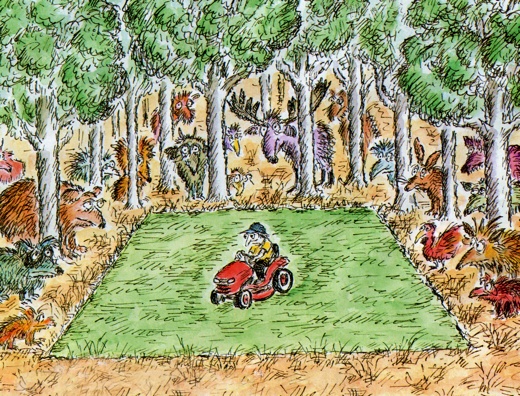
Image above: From cartoon "Summer Chore" on cover of 7/2/12 New Yorker magazine by Edward Koren.
 
A recent study noted that most of the 6,900 languages spoken on Earth occur in regions of high biodiversity. These findings point to a strong correlation between biological and linguistic diversity, with languages closely connected to the habitats where they are found.

Like many people, I’ve spent a lot of time thinking about — and mourning — the cascading extinction of species caused by human activity. But only recently has it occurred to me to frame it this way: Humans have lived past the peak of biological diversity on this planet. There may well be other, higher peaks of biodiversity after we’re gone, but the best I can imagine as long as we’re around is a slight decline in the calamitous rate of extinction.

As it happens, we’ve also lived past the peak of linguistic diversity — the number of different human languages spoken on this planet. The loss would be more evident if each of this planet’s nearly 7,000 human languages was spoken by a separate species — one species per language. But losing language is as human as using language. After all, we live in a country where, for the past two and a half centuries, people have come to abandon their ancestral tongues in the second generation after arrival — a country where most of the aboriginal languages had long since been destroyed.

According to a recent study, there is a close correlation between biological diversity and linguistic diversity. A biological hotspot is likely to be a linguistic hotspot. Put simply, there are more human languages where there are more species. “Of the 6,900 languages currently spoken on Earth,” the authors write in the Proceedings of the National Academy of Sciences, “more than 4,800 occur in regions containing high biodiversity.” The corollary? Most of those languages are threatened. Nearly 60 percent of the languages in high biodiversity regions, like Amazonia and the lowland forests of West Africa, are spoken by fewer than 10,000 people; more than 1,200 of those languages are spoken by fewer than 1,000 people. Every language is a species, but most languages are also habitats, linked closely to the physical habitats in which they occur.

Human languages evolve far more quickly than the single species — Homo sapiens — that speaks them. And languages speciate for some of the same reasons that organisms do — topographic separation, for instance. A good example is New Guinea, which is as rich in linguistic species (972 endemic languages) as it is in biological species. Topographically speaking, New Guinea is famously difficult, a torturous landscape that isolates humans as well as other species.

It’s tempting to assume that the correlation between biological and linguistic diversity is functionally negative. In other words, high linguistic diversity occurs where the conditions of biological diversity — dense forests, harsh terrain, and other barriers, like disease — force small human societies to remain separate. But there’s another way to think of it. What if the correlation is functionally positive? Instead of merely forcing linguistic diversity, high biological diversity also affords linguistic diversity. The richness of one sustains the richness of the other.

There’s something curious and unsettling in all of this. It seems odd to think that such a pure and somehow abstract extension of humanness as language itself (apart from mere vocabulary) is so niched, so profusely and divergently rooted in the natural world. A universally shared language seems like a universal good. But most languages spoken by small numbers of humans in regions of high biodiversity do not and will not survive extended contact with widely-spoken languages like English, Spanish, Portuguese, and French. No matter how desirable it may seem, a universal language is a bulldozer with measles.

I think we inevitably underestimate the bond between biological complexity and cultural complexity. Let me turn to a landscape I know far better than the jungles and mountain ridges of New Guinea: northwestern Iowa.

Within my lifetime, the cultural and biological complexity of rural Iowa has declined precipitously. What underlies both kinds of loss is the decline in the number of farms. Modern farming is a way of spreading vacancy. The farms grow bigger and bigger — declining in number — and fewer and fewer people live on them. This has been accompanied, in Iowa, by a decline in the biological diversity of the farm itself. In most of the state, there are now only soybeans, corn, chickens and hogs, a huge change from even 50 years ago.

This much is easy to see. But so is the loss of cultural complexity. The way to measure that is to ask as many good questions about the components of social and cultural texture as you can. What kinds of questions would you ask to get at the diversity, the complexity of a small town? Some are fairly obvious. How many independent banks are there? How many independent grain elevators? How many independent slaughterhouses? Creameries? Grocery stores? How many farm implement and auto dealerships? How many butchers and livestock breeders? How many farmers sold milk and eggs in town? How many entries were there in the county fairs?

But these are really technical and economic questions. So let’s consider some others. What percentage of the children learned how to play a musical instrument? How many amateur theatrical societies and singing clubs — even small-town opera houses — were there? How many softball teams? What about sewing circles and baling rings and card clubs?

All these questions point in one direction. With the decrease in biological complexity — the regression to corn and soybeans — came a decrease in social and cultural complexity. The farmscape emptied and the towns became ghosts of themselves. You might argue that the one didn’t directly and necessarily cause the other: in other words, if most of the 203,000 farms that existed in Iowa when I was born (1952) suddenly switched to growing only corn and soybeans, that wouldn’t necessarily have reduced the population and complexity of the countryside. But the fact is that Iowa did switch to corn and soybeans and when it was done, fewer than 90,000 farms remained. Not many people live on 90,000 farms.

It may seem far-fetched to compare social and agricultural change in Iowa with linguistic and biological correlation in some of Earth’s biodiversity hotspots. But the underlying premise is the same. Biological diversity and cultural diversity go hand in hand.

This is a hard idea to absorb for the simple reason that humans, in our pride, have always assumed that cultural diversity (and complexity) is the result of who we are, not what nature has made of us and we have made of nature. We still believe fiercely, against all the evidence, that we are independent of most other species. And we still believe fiercely that the habitat that matters most is the one we create. We could not be more mistaken.
.